Making the web accessible both for mobile devices and people with disabilities Henny Swan RNIB, UK
Contents  Introduction Similar problems Demo  Similar solutions Conclusions  Resources
Introduction  Similar barriers of access exist for disabled web users and mobile users. There are also subtle differences Separate sets of guidance that overlap
Shared problems  Images:  hide or remove unnecessary/large images JavaScript:  provide an alternative. Links:  limit links, keep them short, group them and provide skip links Keyboard only:  avoid mouseover and mouseout events, double clicks and right clicks And  many more …
Demo www.thisislondon.com  website tested: Web accessibility:  tested using Jaws 8 and Internet Explorer 7. Mobile access:  tested using Opera 9.27 “small view”. Shared issues: Repeated links Overuse of images Lack of skip links
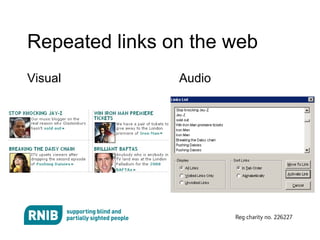
Repeated links on the web Visual Audio
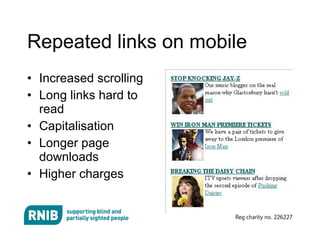
Repeated links on mobile Increased scrolling Long links hard to read Capitalisation Longer page downloads Higher charges
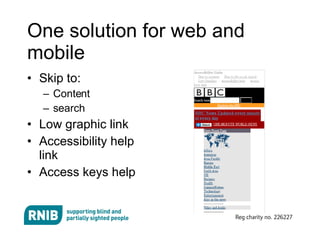
One solution for web and mobile Skip to: Content search Low graphic link Accessibility help link Access keys help
Similar solutions   Mobile Web Best Practices  (MWBP): best practices for making web sites uable on mobile devices - DRAFT.  Web Content Accessibility Guidelines  (WCAG): guidelines for making web content accessible to people with disabilities.
The relationship Relationship between MWBP 1.0 and WCAG  - DRAFT MWBP and WCAG 2.0  - DRAFT From  MWBP to WCAG 1.0  /  MWBP to WCAG 2.0  - DRAFT From  WCAG 1.0 to MWBP 1.0  /  WCAG 2.0 to MWBP  - DRAFT
Conclusions Many web sites have already adopted WCAG In many countries compliance with WCAG is mandatory Mobile web is becoming increasingly important especially in developing countries Reduced cost and effort if both are implemented together Reinforces the business case for accessibility Better overall access for  all  users
Resources  Web content accessibility and the mobile web  – an introduction Experiences Shared by People with Disabilities and by People Using Mobile Devices   W3C Mobile Web Initiative   Web Compatibility Test for Mobile Browsers Web Accessibility Initiative
谢谢  / Thank you
The solutions side by side  MWBP partly derived from WCAG Web sites that meet WCAG or MWBP go a long way to supporting the other Compliance with one doesn’t mean compliance with another There is no direct mapping between the two, as there are subtle differences MWBP is not prioritised, WCAG is Test both with users and mobile devices. Early and often.
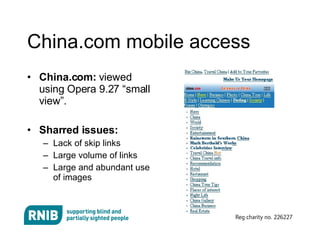
China.com mobile access China.com:  viewed using Opera 9.27 “small view”. Sharred issues: Lack of skip links Large volume of links Large and abundant use of images

Web and mobile accessibility

  • 1.
    Making the webaccessible both for mobile devices and people with disabilities Henny Swan RNIB, UK
  • 2.
    Contents IntroductionSimilar problems Demo Similar solutions Conclusions Resources
  • 3.
    Introduction Similarbarriers of access exist for disabled web users and mobile users. There are also subtle differences Separate sets of guidance that overlap
  • 4.
    Shared problems Images: hide or remove unnecessary/large images JavaScript: provide an alternative. Links: limit links, keep them short, group them and provide skip links Keyboard only: avoid mouseover and mouseout events, double clicks and right clicks And many more …
  • 5.
    Demo www.thisislondon.com website tested: Web accessibility: tested using Jaws 8 and Internet Explorer 7. Mobile access: tested using Opera 9.27 “small view”. Shared issues: Repeated links Overuse of images Lack of skip links
  • 6.
    Repeated links onthe web Visual Audio
  • 7.
    Repeated links onmobile Increased scrolling Long links hard to read Capitalisation Longer page downloads Higher charges
  • 8.
    One solution forweb and mobile Skip to: Content search Low graphic link Accessibility help link Access keys help
  • 9.
    Similar solutions Mobile Web Best Practices (MWBP): best practices for making web sites uable on mobile devices - DRAFT. Web Content Accessibility Guidelines (WCAG): guidelines for making web content accessible to people with disabilities.
  • 10.
    The relationship Relationshipbetween MWBP 1.0 and WCAG - DRAFT MWBP and WCAG 2.0 - DRAFT From MWBP to WCAG 1.0 / MWBP to WCAG 2.0 - DRAFT From WCAG 1.0 to MWBP 1.0 / WCAG 2.0 to MWBP - DRAFT
  • 11.
    Conclusions Many websites have already adopted WCAG In many countries compliance with WCAG is mandatory Mobile web is becoming increasingly important especially in developing countries Reduced cost and effort if both are implemented together Reinforces the business case for accessibility Better overall access for all users
  • 12.
    Resources Webcontent accessibility and the mobile web – an introduction Experiences Shared by People with Disabilities and by People Using Mobile Devices W3C Mobile Web Initiative Web Compatibility Test for Mobile Browsers Web Accessibility Initiative
  • 13.
    谢谢 /Thank you
  • 14.
    The solutions sideby side MWBP partly derived from WCAG Web sites that meet WCAG or MWBP go a long way to supporting the other Compliance with one doesn’t mean compliance with another There is no direct mapping between the two, as there are subtle differences MWBP is not prioritised, WCAG is Test both with users and mobile devices. Early and often.
  • 15.
    China.com mobile accessChina.com: viewed using Opera 9.27 “small view”. Sharred issues: Lack of skip links Large volume of links Large and abundant use of images