© Acando AB
WEB 2.0 AT WORK
© Acando AB
Communication technologies
change society in waves
© Acando ABhttp://www.flickr.com/photos/rachel_s/
© Acando AB
http://www.flickr.com/photos/storm_gal/
© Acando ABhttp://www.flickr.com/photos/darko_pevec/2302492866/sizes/o/
© Acando AB
© Acando AB
Innovations like these have
helped to democratizise
access to information.
© Acando AB
.
© Acando AB
Since information is power,
such innovations are often met
with scepticism and fear.
© Acando AB
But we must try to overcome
our scepticism and fears by
learning to see the value these
innovations bring.
© Acando AB
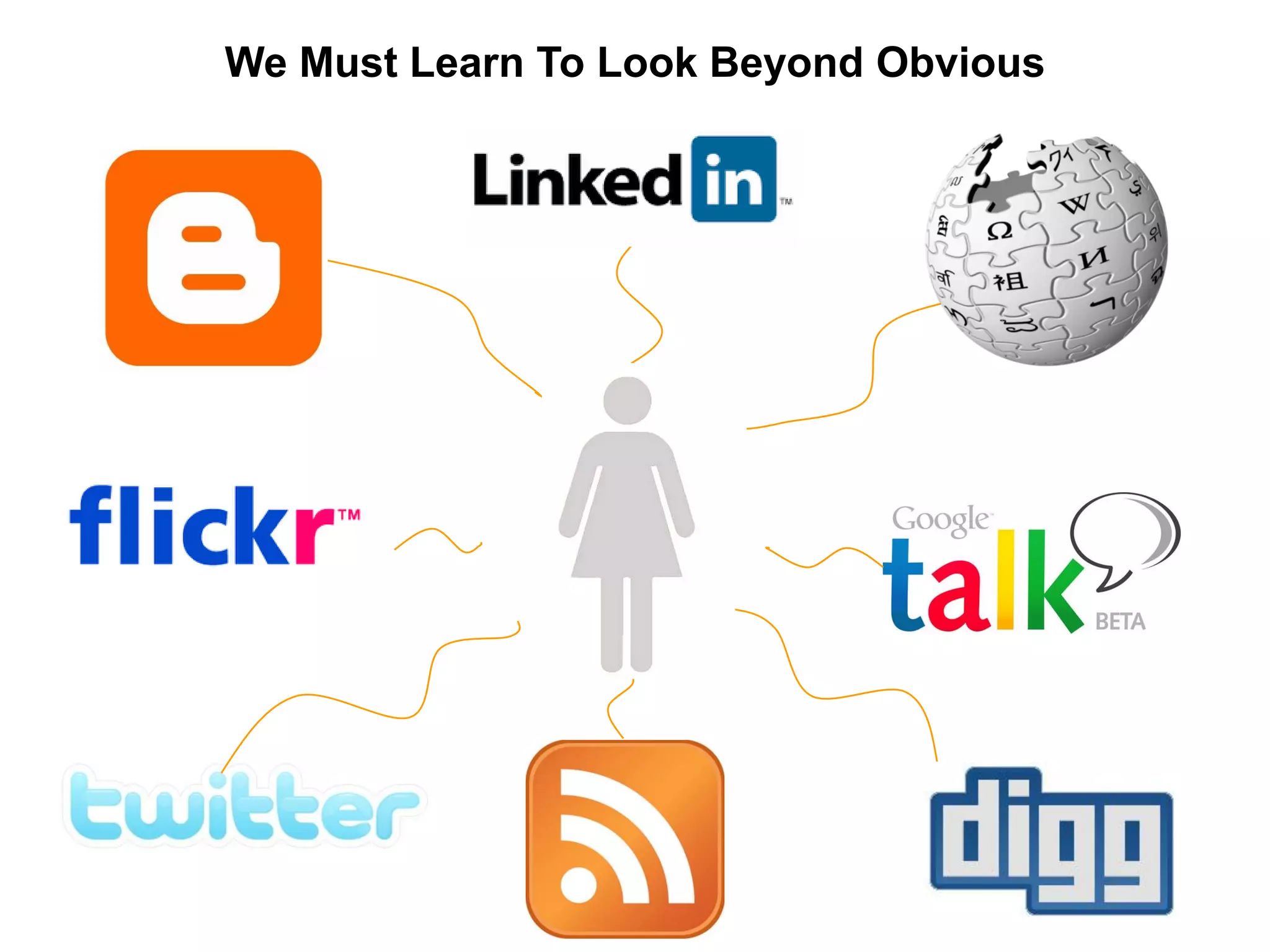
We Must Learn To Look Beyond Obvious
© Acando AB
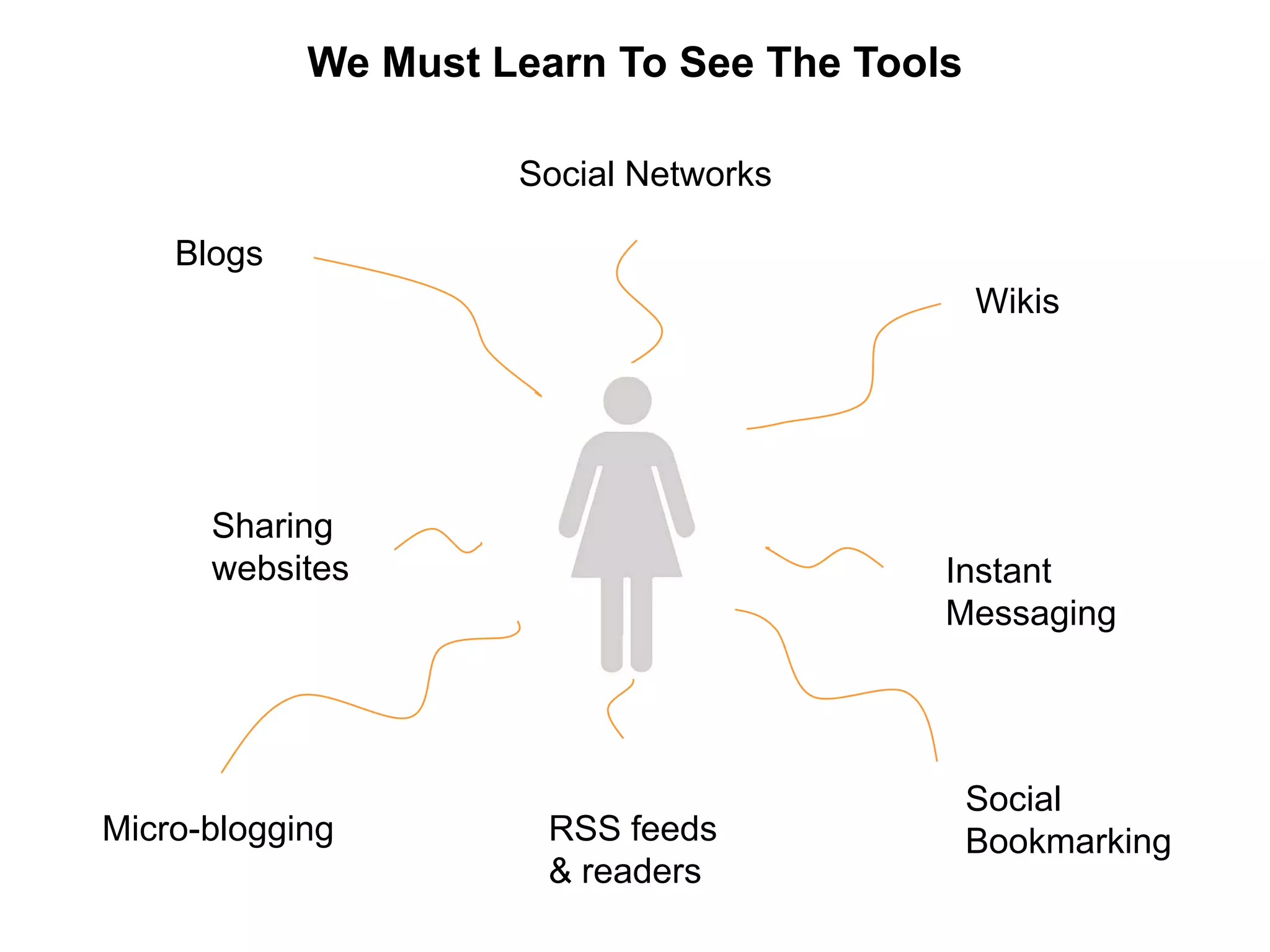
RSS feeds
& readers
Social
Bookmarking
Sharing
websites Instant
Messaging
Wikis
Social Networks
Micro-blogging
Blogs
We Must Learn To See The Tools
© Acando AB
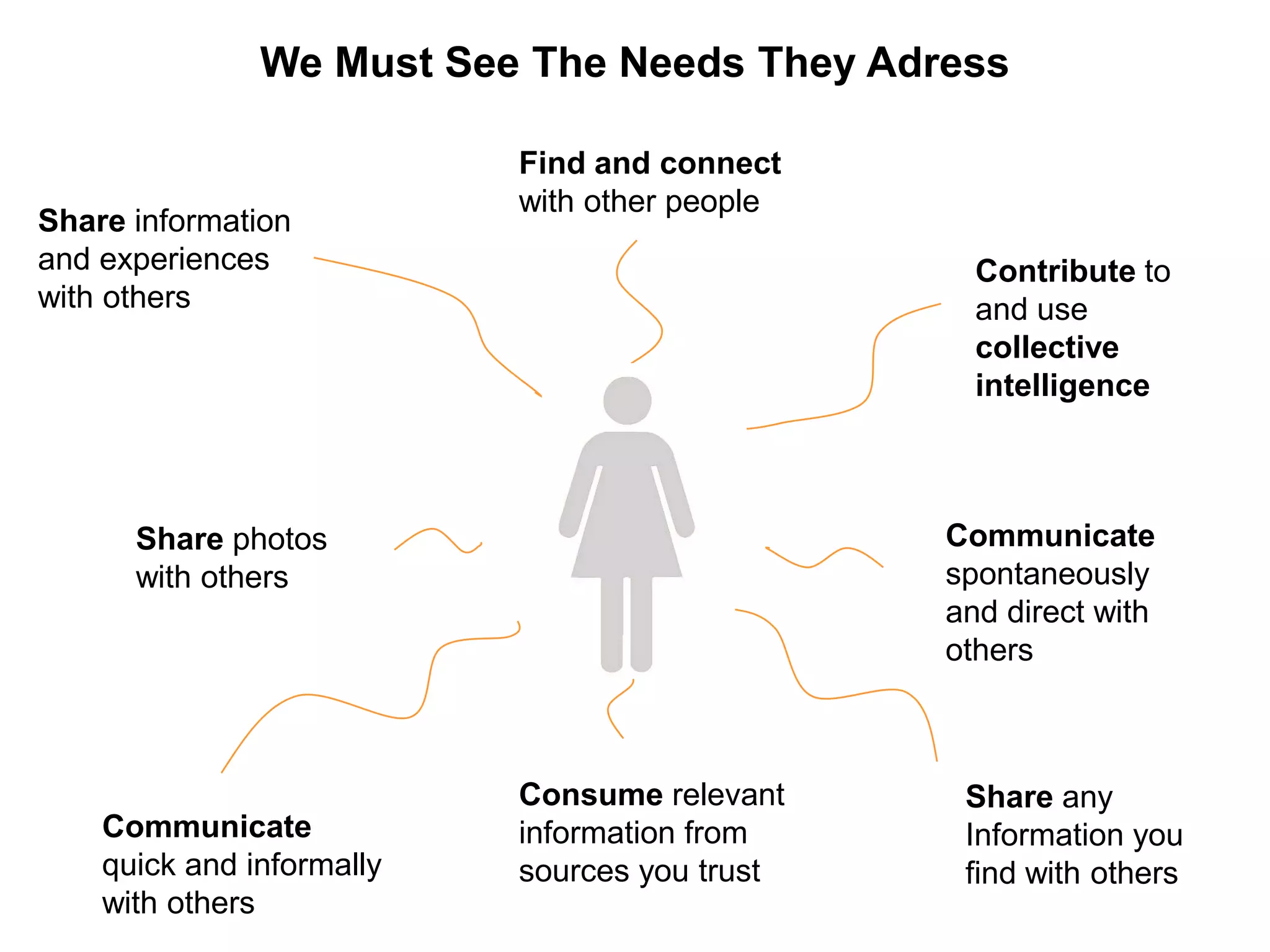
Share information
and experiences
with others
Consume relevant
information from
sources you trust
Share any
Information you
find with others
Share photos
with others
Communicate
spontaneously
and direct with
others
Contribute to
and use
collective
intelligence
Find and connect
with other people
Communicate
quick and informally
with others
We Must See The Needs They Adress
© Acando AB
As individuals, many of us
are already using these
tools to enrich and simplify
our (social) lives.
© Acando AB
Our question today:
How can an organization
improve collaboration with
these simple and social tools?
© Acando AB
© Acando AB
Web 2.0 at Work
Simple & Social Internal Collaboration
© Acando AB
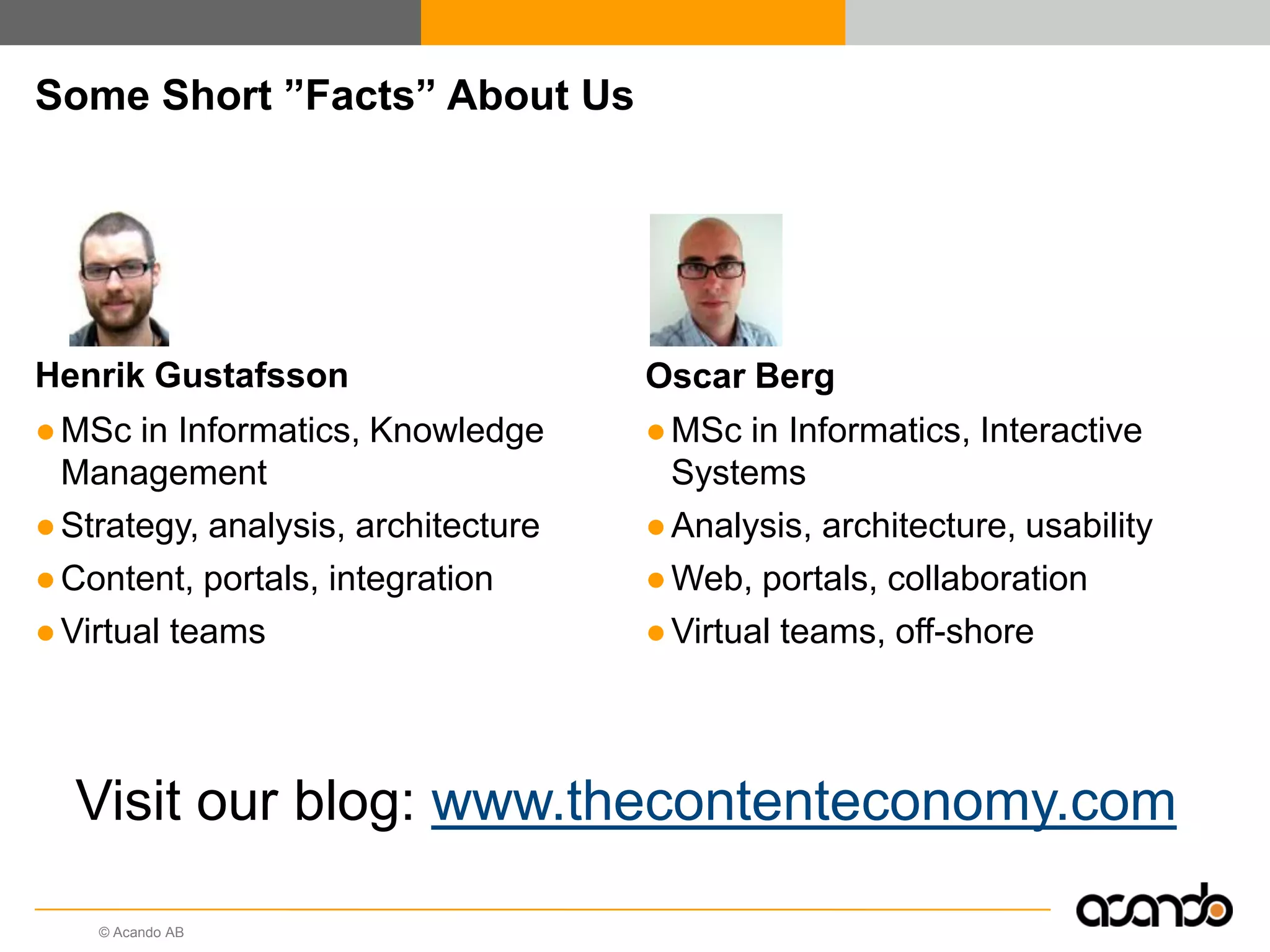
Some Short ”Facts” About Us
Henrik Gustafsson
●MSc in Informatics, Knowledge
Management
●Strategy, analysis, architecture
●Content, portals, integration
●Virtual teams
Oscar Berg
●MSc in Informatics, Interactive
Systems
●Analysis, architecture, usability
●Web, portals, collaboration
●Virtual teams, off-shore
Visit our blog: www.thecontenteconomy.com
© Acando AB
If HP knew what HP knows, we
would be three times as profitable.
Lew Platt
Former CEO of Hewlett-Packard
“
”
© Acando AB
PART I
Trends & Challenges
© Acando AB
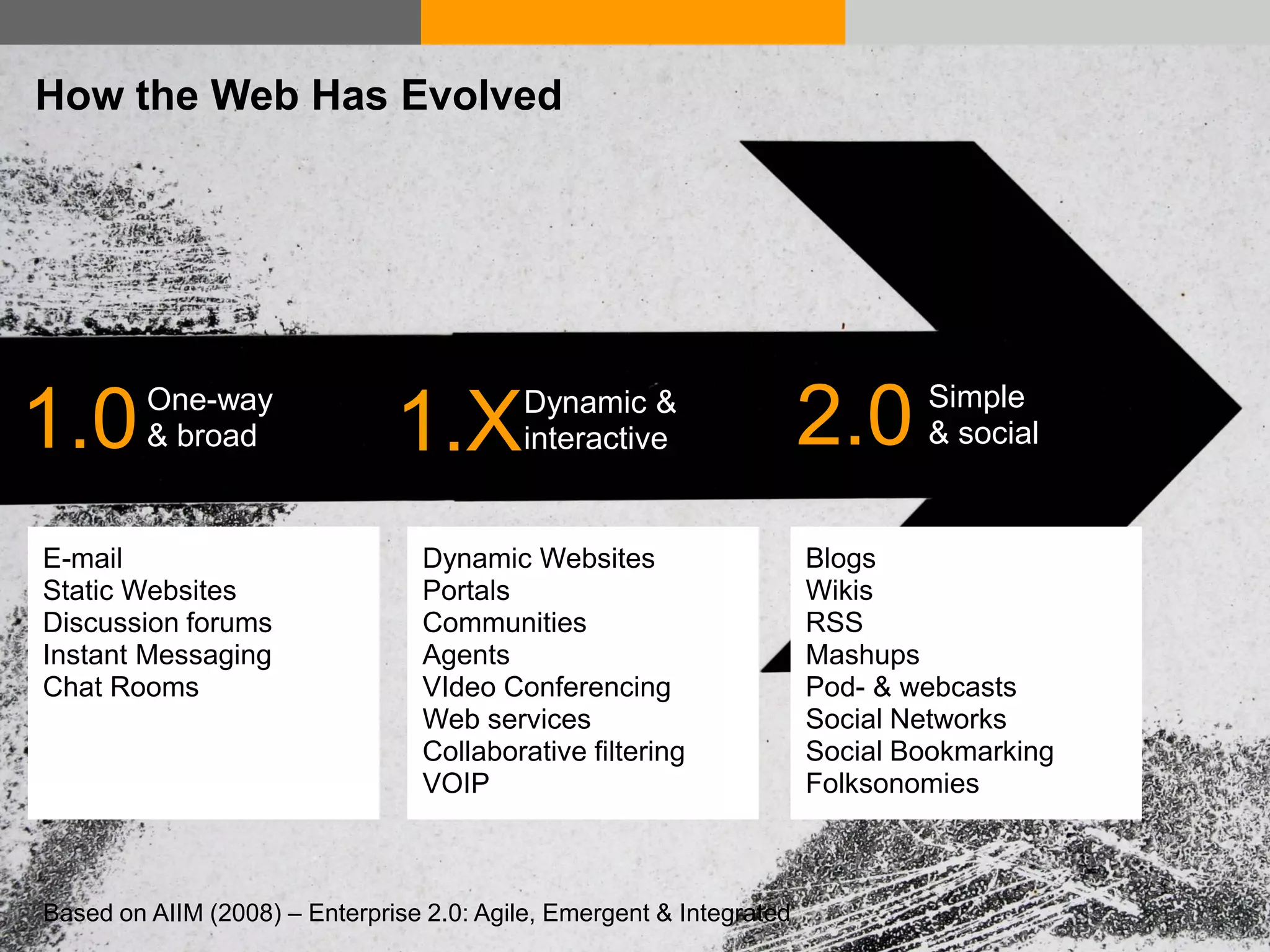
1.0
E-mail
Static Websites
Discussion forums
Instant Messaging
Chat Rooms
One-way
& broad 2.0
Blogs
Wikis
RSS
Mashups
Pod- & webcasts
Social Networks
Social Bookmarking
Folksonomies
Simple
& social
Dynamic Websites
Portals
Communities
Agents
VIdeo Conferencing
Web services
Collaborative filtering
VOIP
Dynamic &
interactive1.X
How the Web Has Evolved
Based on AIIM (2008) – Enterprise 2.0: Agile, Emergent & Integrated
© Acando AB
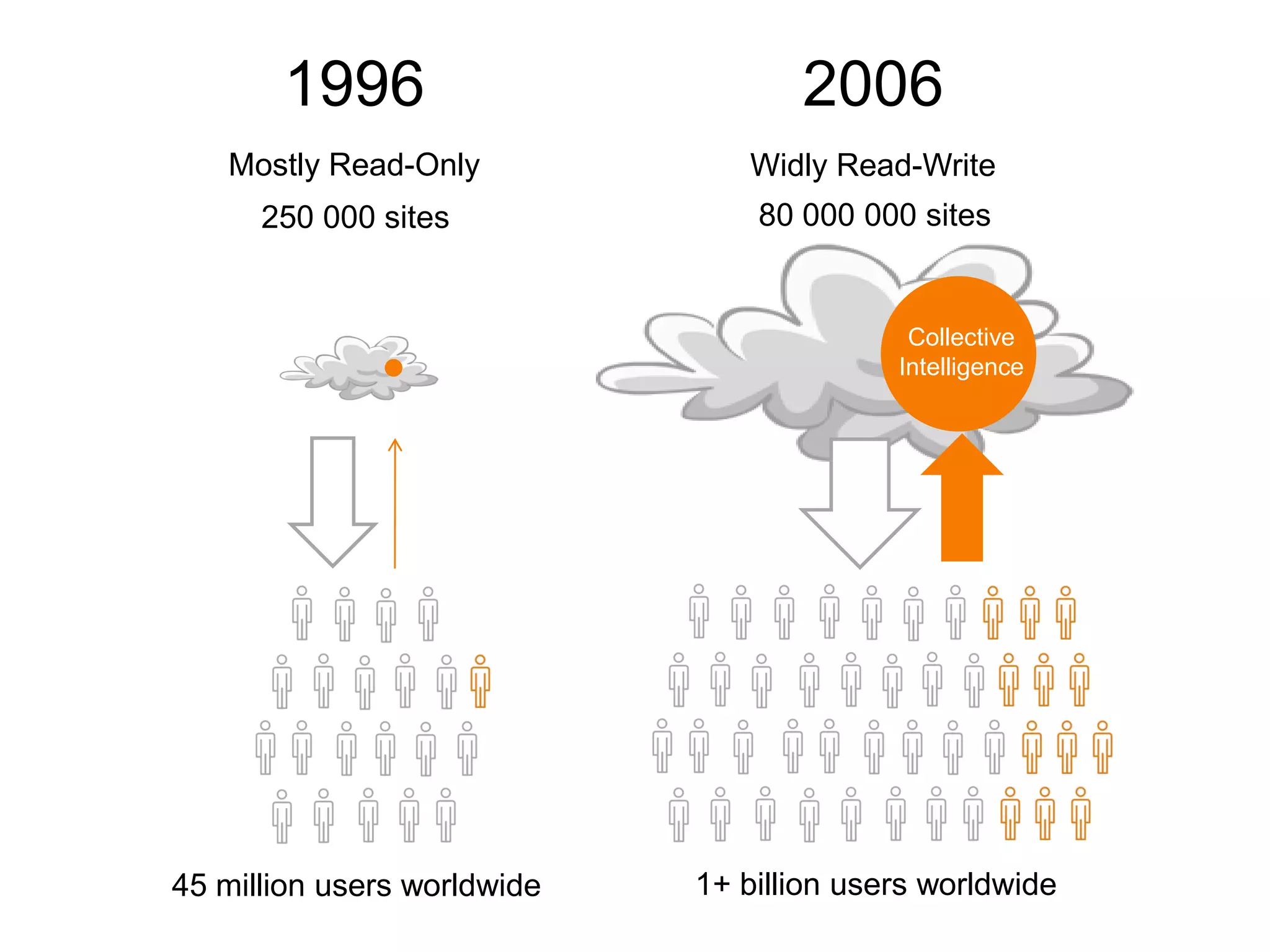
Mostly Read-Only Widly Read-Write
250 000 sites 80 000 000 sites
Collective
Intelligence
1996 2006
45 million users worldwide 1+ billion users worldwide
© Acando AB
Pillow Fight Flash Mob
Torino, Italy
.
© Acando AB
Most of the barriers to group action
have collapsed…
We can have groups that operate
with a birthday party's informality
and a multinational's scope.
Clay Shirky
Author of “Here Comes Everybody: The Power of
Organizing Without Organizations”
“
”
© Acando AB
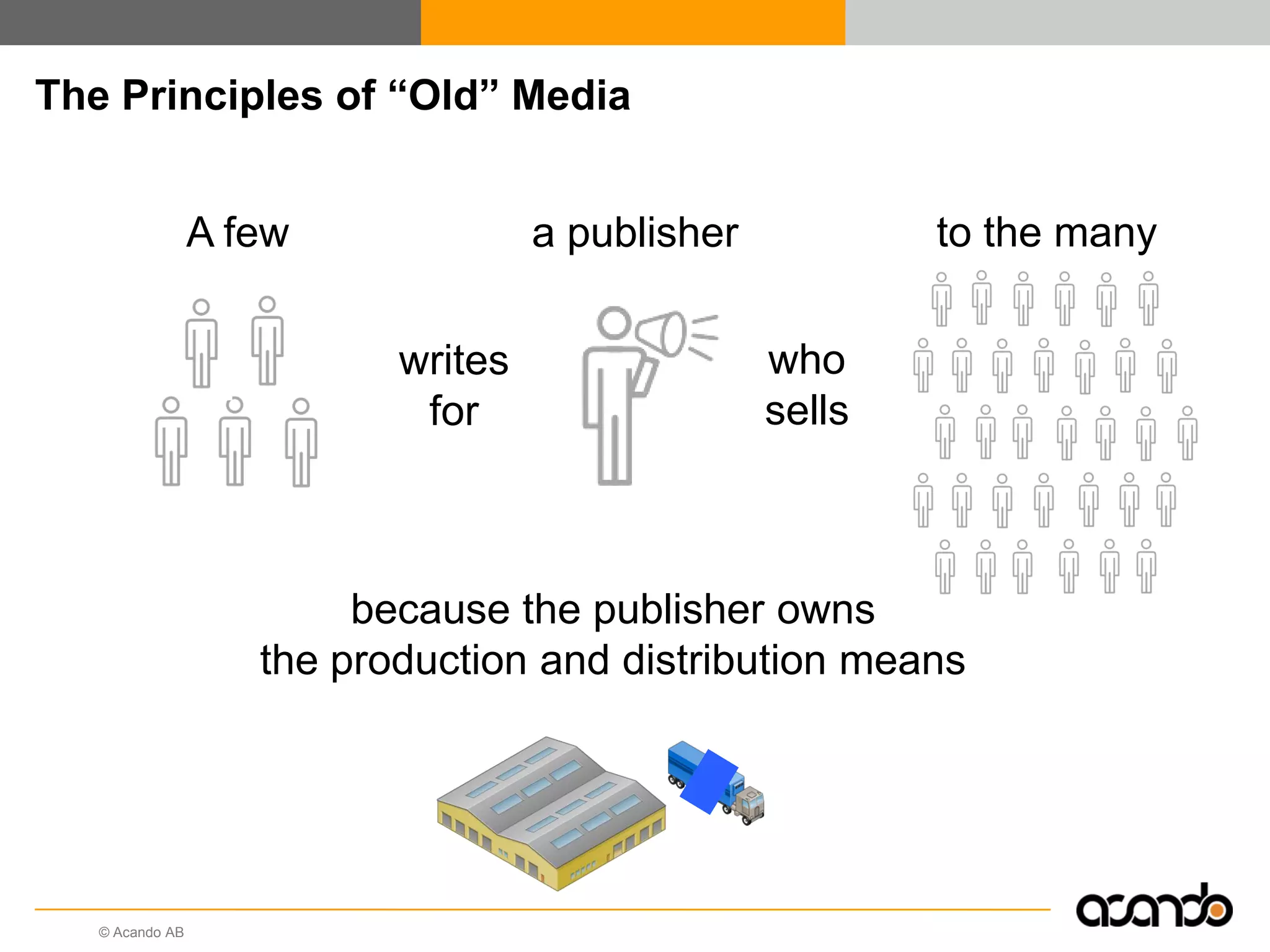
The Principles of “Old” Media
A few
because the publisher owns
the production and distribution means
writes
for
a publisher
who
sells
to the many
© Acando AB
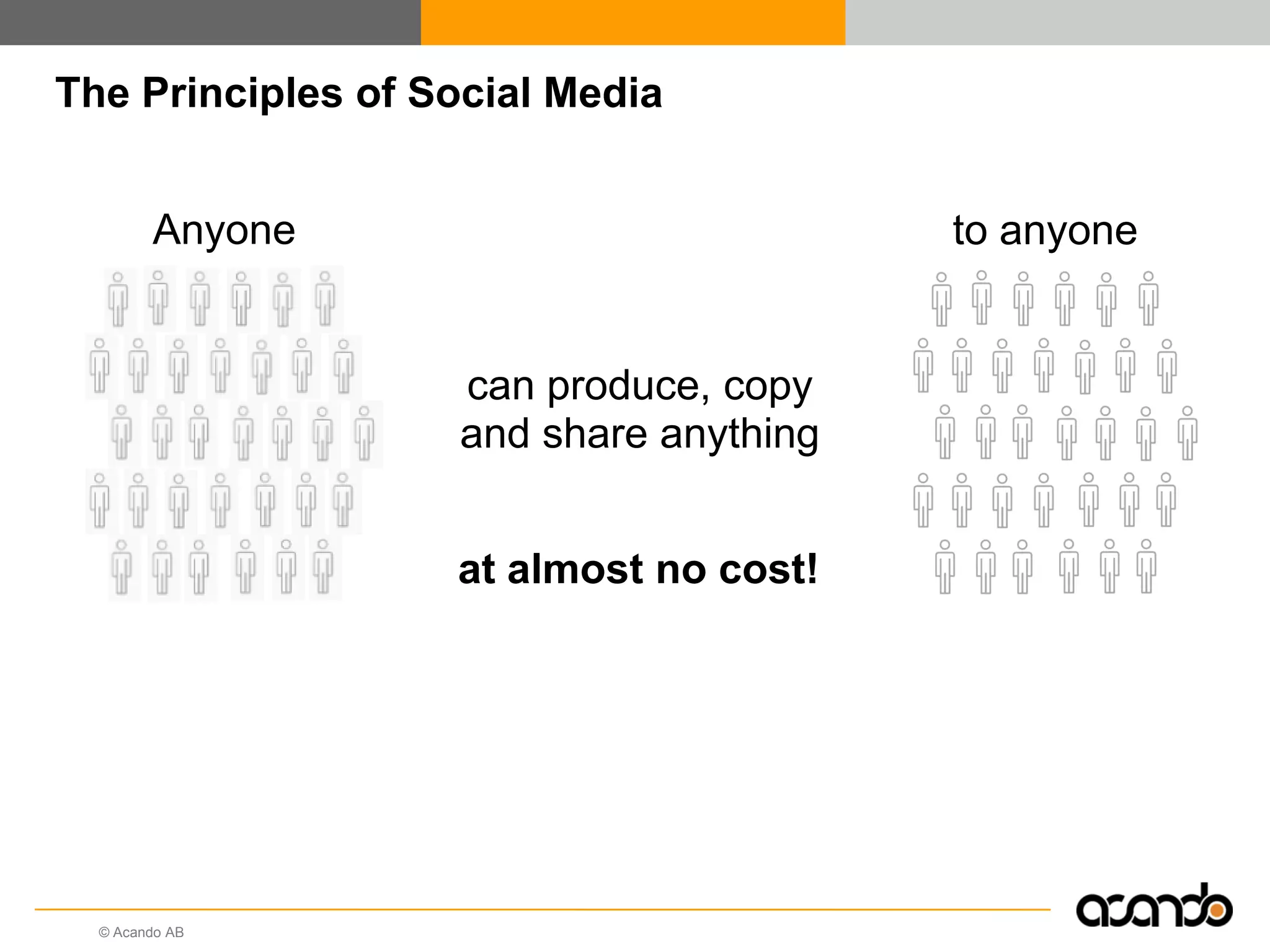
The Principles of Social Media
can produce, copy
and share anything
at almost no cost!
Anyone to anyone
© Acando AB
All business are media businesses,
because whatever else they do, all
businesses rely on the managing of
information for two audiences -
employees and the world.
Clay Shirky
“Here Comes Everybody: The Power of Organizing
Without Organizations”
“
”
© Acando AB
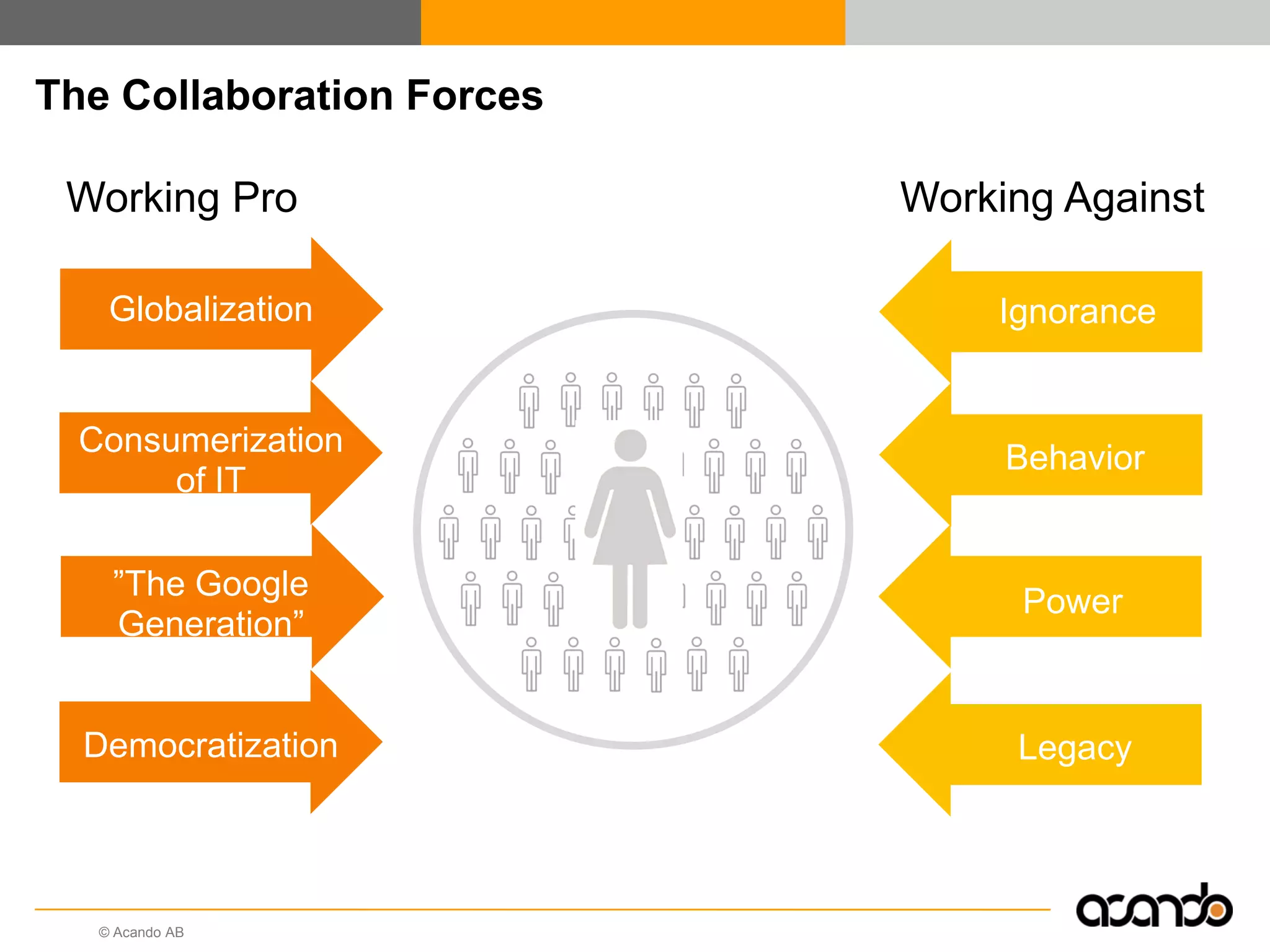
Globalization
Consumerization
of IT
”The Google
Generation”
Democratization
Working Pro Working Against
Ignorance
Behavior
Power
Legacy
The Collaboration Forces
© Acando AB
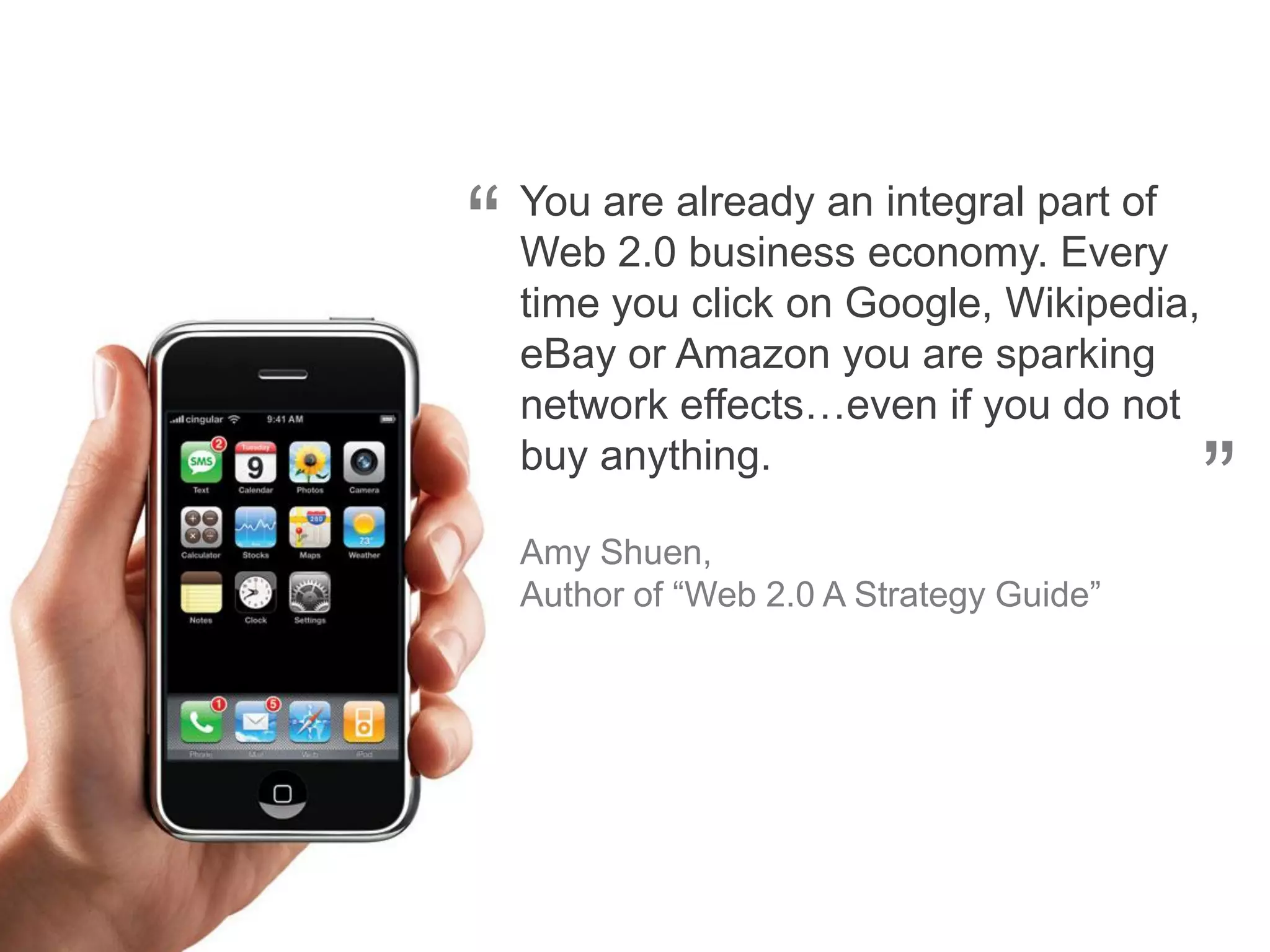
You are already an integral part of
Web 2.0 business economy. Every
time you click on Google, Wikipedia,
eBay or Amazon you are sparking
network effects…even if you do not
buy anything.
Amy Shuen,
Author of “Web 2.0 A Strategy Guide”
“
”
© Acando AB
The Collaboration Challenge
© Acando AB
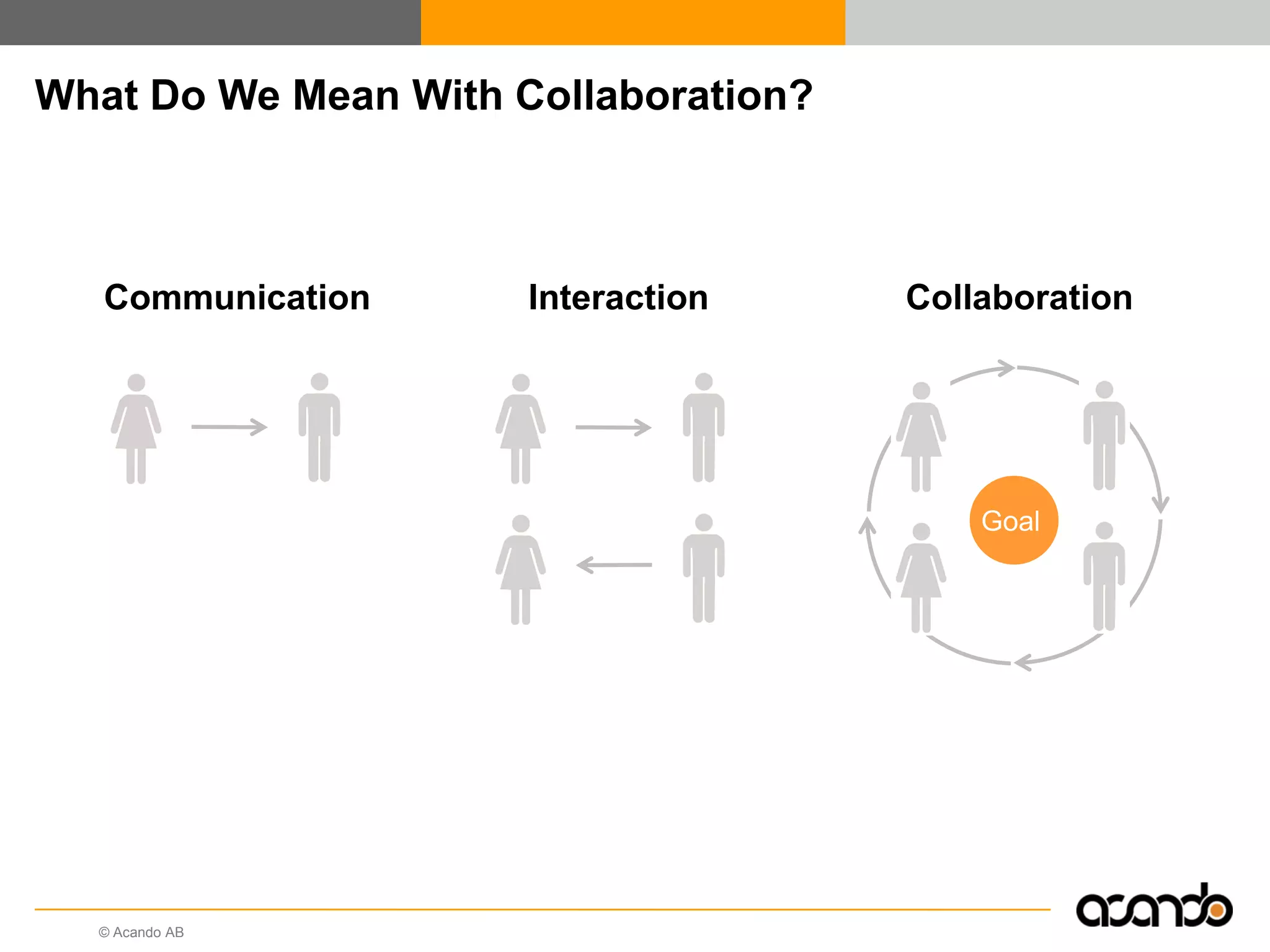
What Do We Mean With Collaboration?
Goal
Communication Interaction Collaboration
© Acando AB
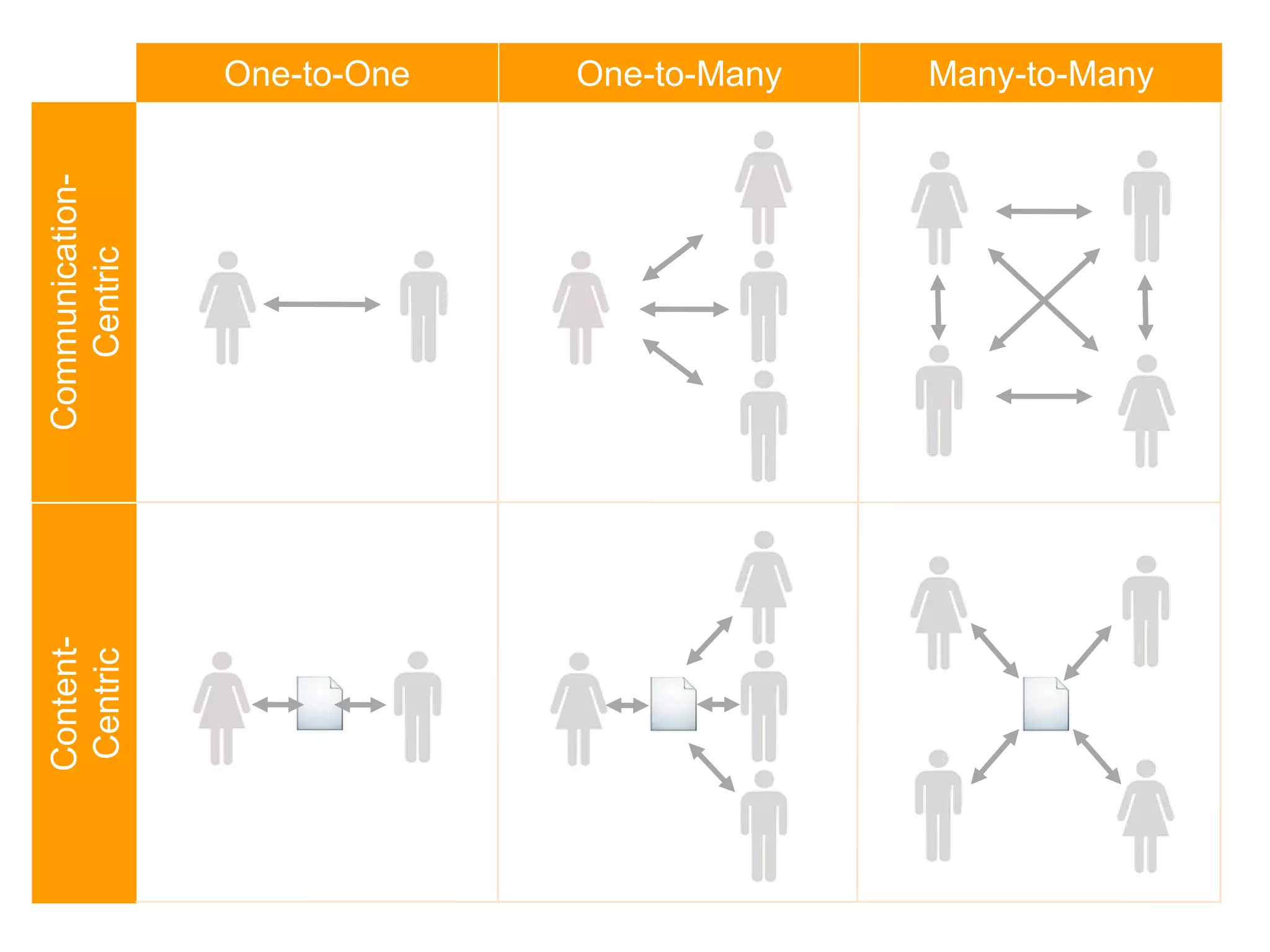
Communication-
Centric
One-to-One One-to-Many Many-to-ManyContent-
Centric
© Acando AB
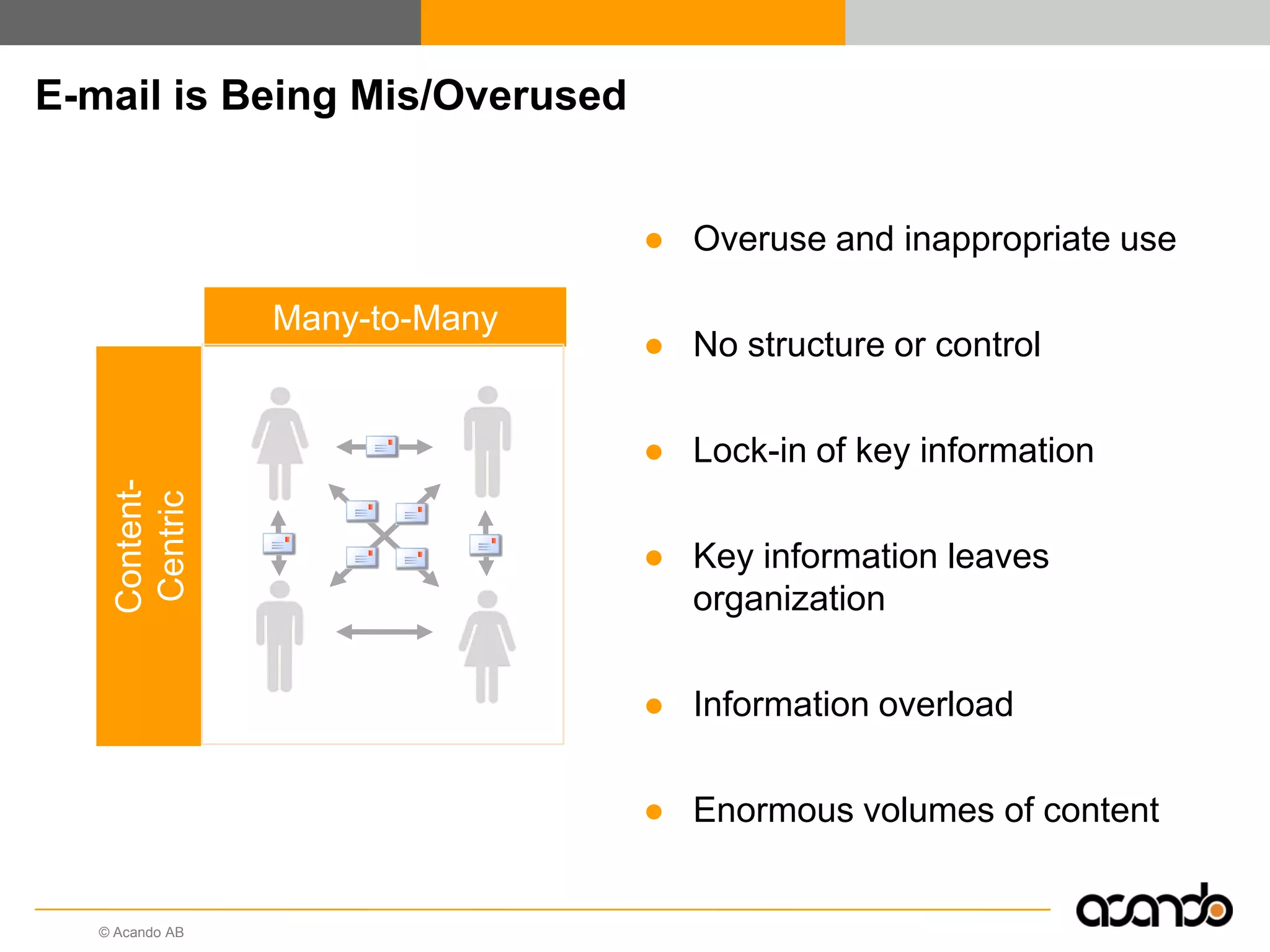
E-mail is Being Mis/Overused
● Overuse and inappropriate use
● No structure or control
● Lock-in of key information
● Key information leaves
organization
● Information overload
● Enormous volumes of content
Many-to-Many
Content-
Centric
© Acando AB
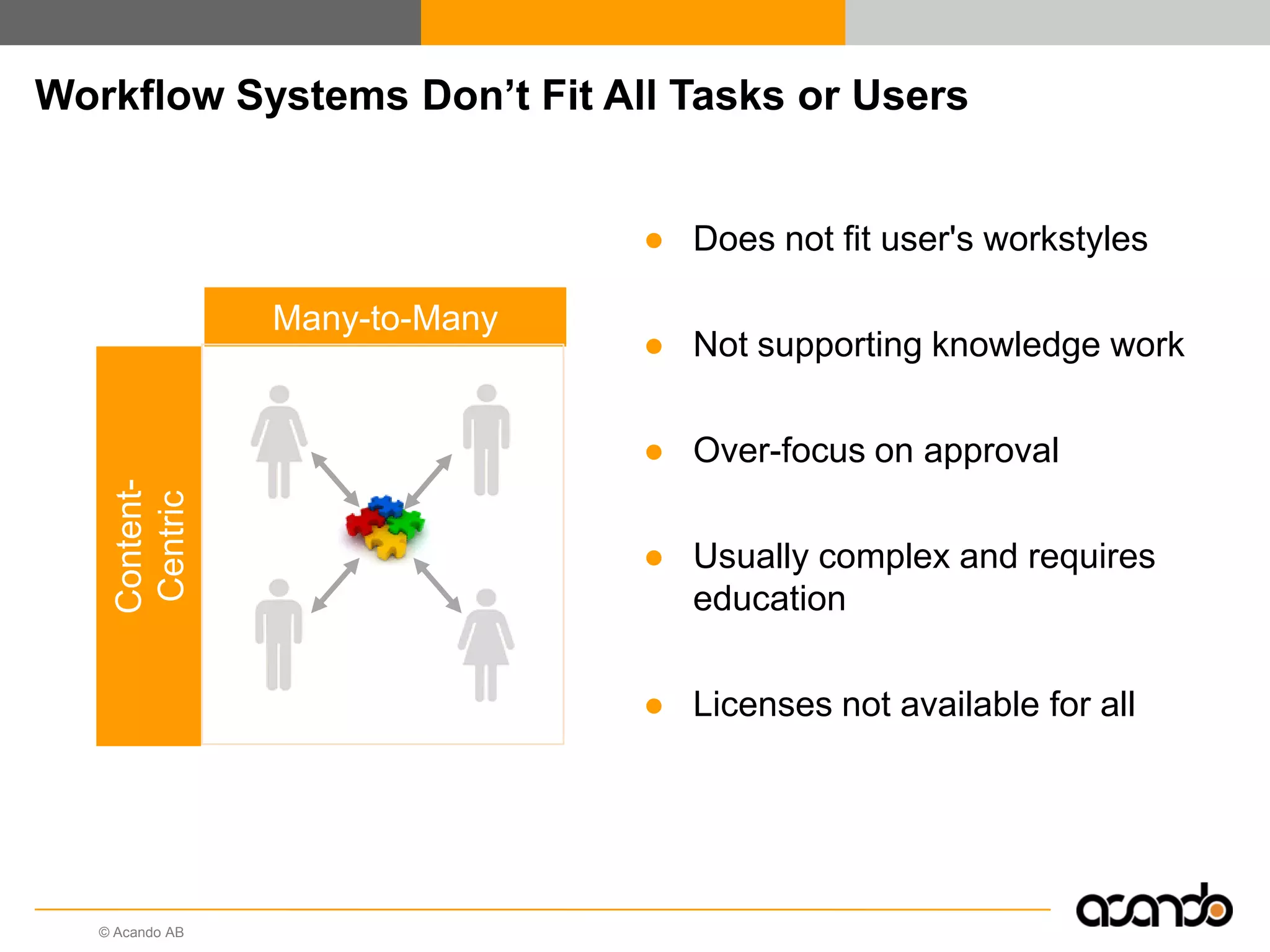
Workflow Systems Don’t Fit All Tasks or Users
● Does not fit user's workstyles
● Not supporting knowledge work
● Over-focus on approval
● Usually complex and requires
education
● Licenses not available for all
Many-to-Many
Content-
Centric
© Acando AB
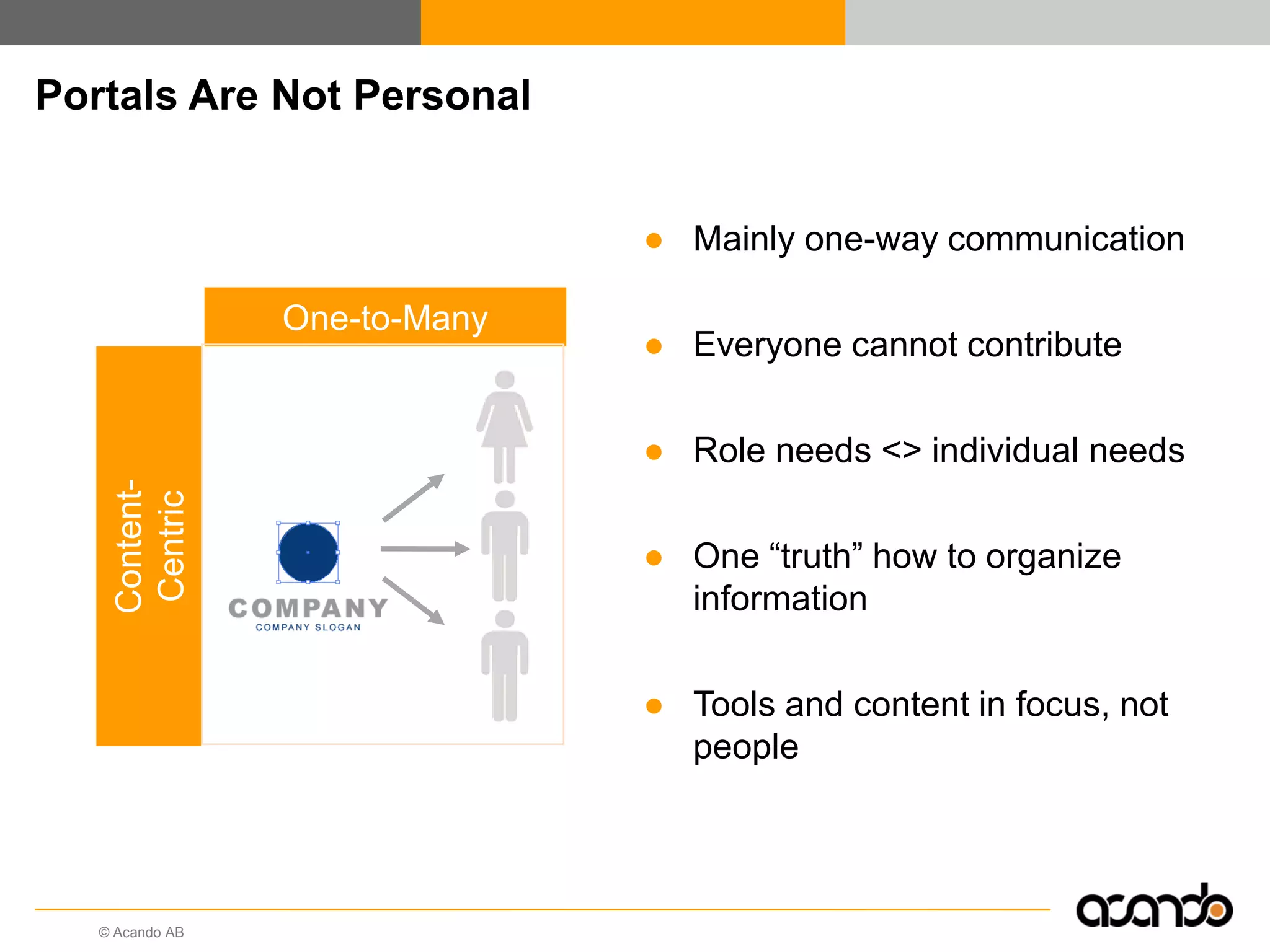
Portals Are Not Personal
● Mainly one-way communication
● Everyone cannot contribute
● Role needs <> individual needs
● One “truth” how to organize
information
● Tools and content in focus, not
people
One-to-Many
Content-
Centric
© Acando AB
Key Ingredients for
Successful Collaboration
© Acando AB
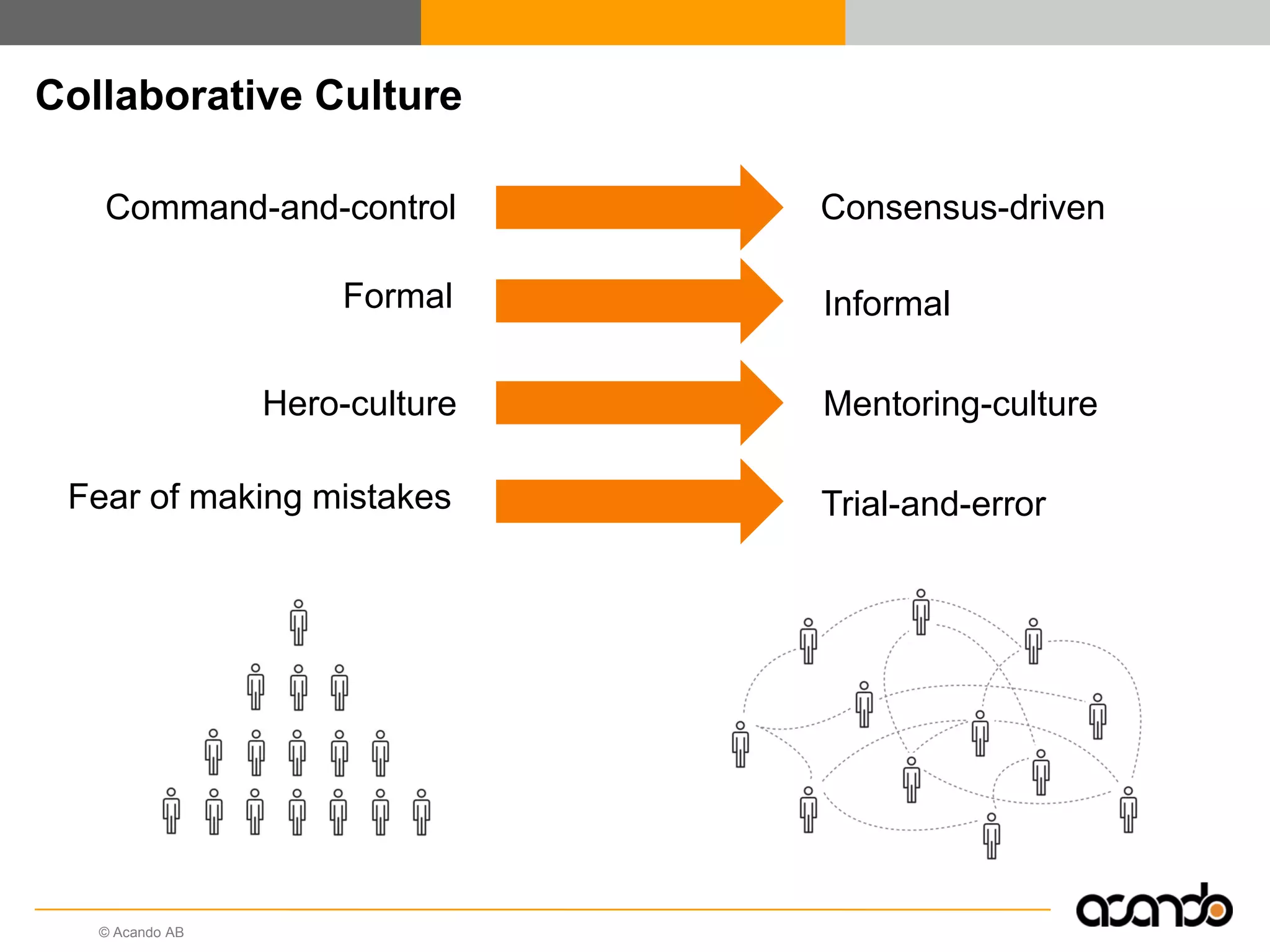
Collaborative Culture
Consensus-driven
Informal
Fear of making mistakes Trial-and-error
Command-and-control
Formal
Hero-culture Mentoring-culture
© Acando AB
Easy to use
People are
visible
Universally
accessible Informal &
spontaneous
Fits
Different
needs
Encourages
contribution
Fits my
work-style
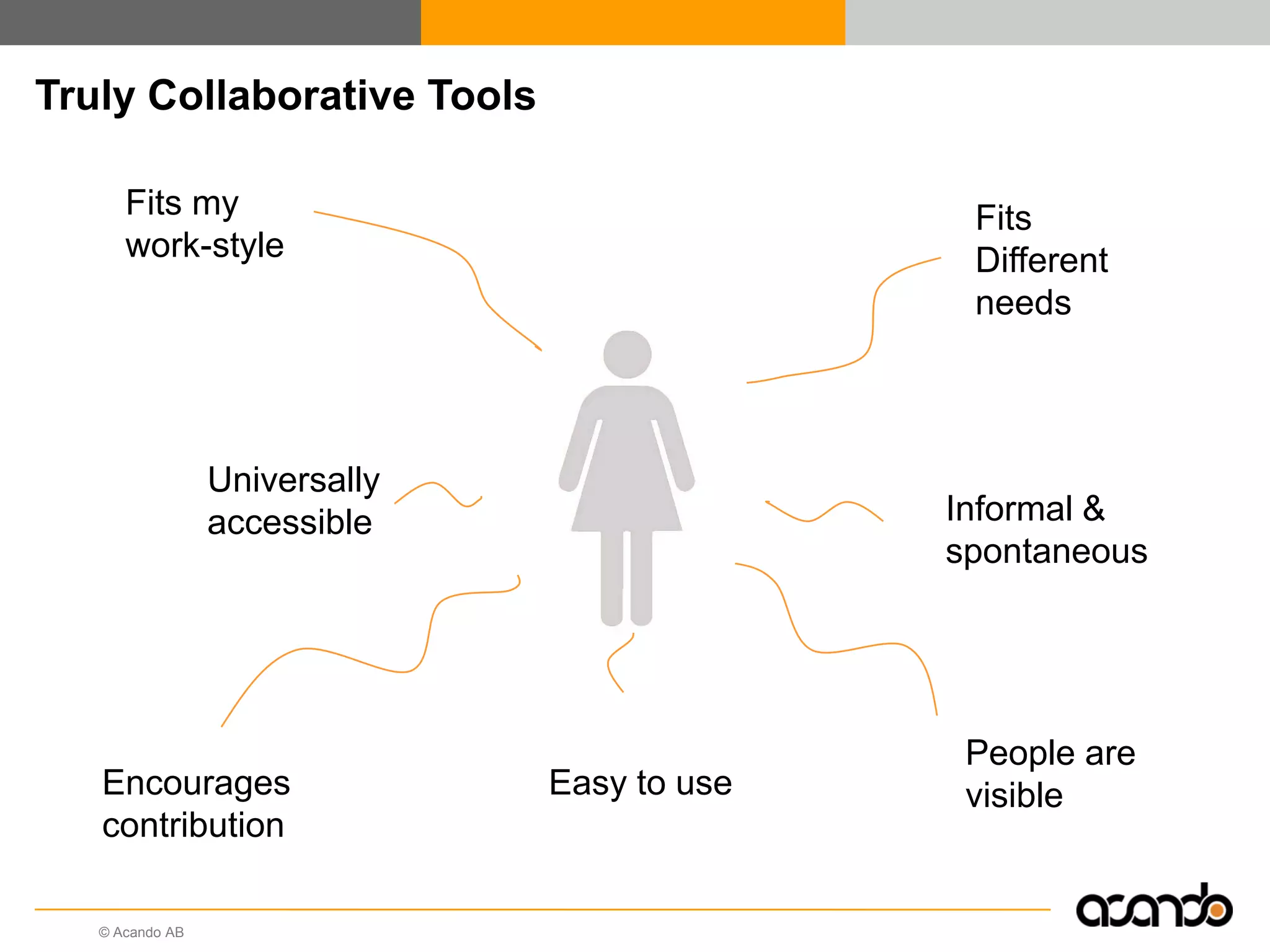
Truly Collaborative Tools
© Acando AB
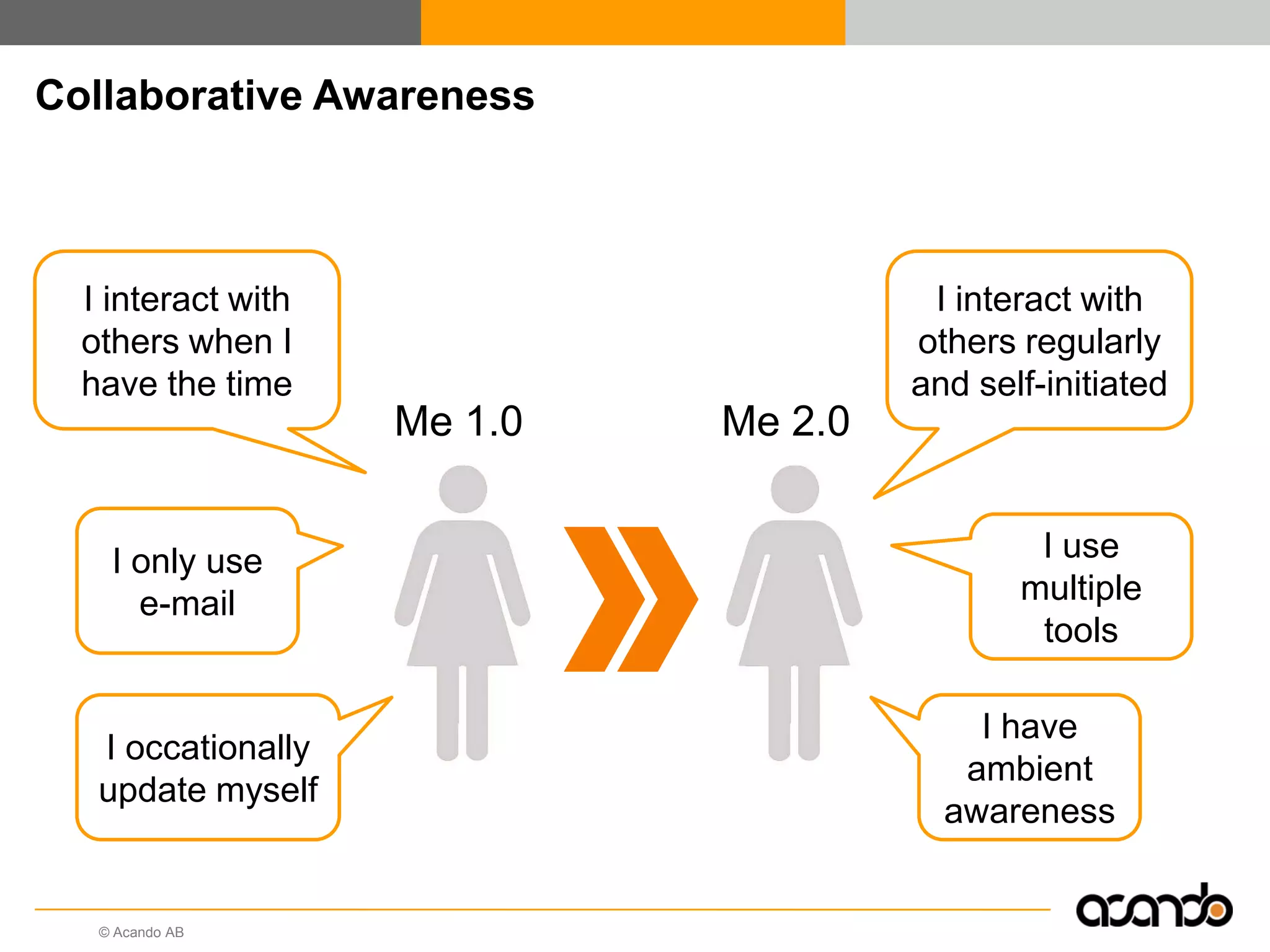
Collaborative Awareness
Me 1.0 Me 2.0
I interact with
others when I
have the time
I only use
e-mail
I occationally
update myself
I interact with
others regularly
and self-initiated
I use
multiple
tools
I have
ambient
awareness
© Acando AB
What About
Knowledge Management?
© Acando AB
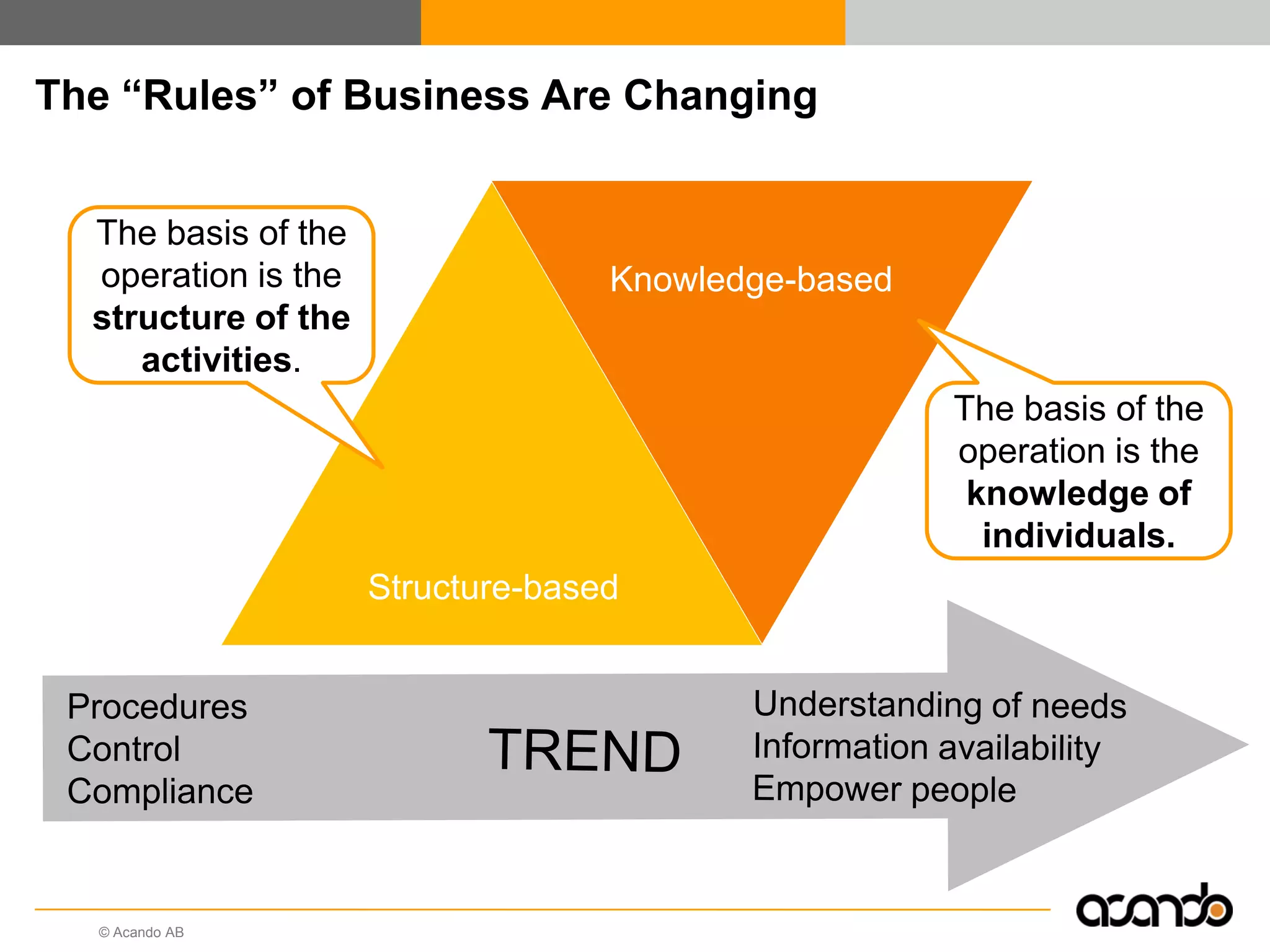
The “Rules” of Business Are Changing
Knowledge-based
Structure-based
The basis of the
operation is the
structure of the
activities.
The basis of the
operation is the
knowledge of
individuals.
© Acando AB
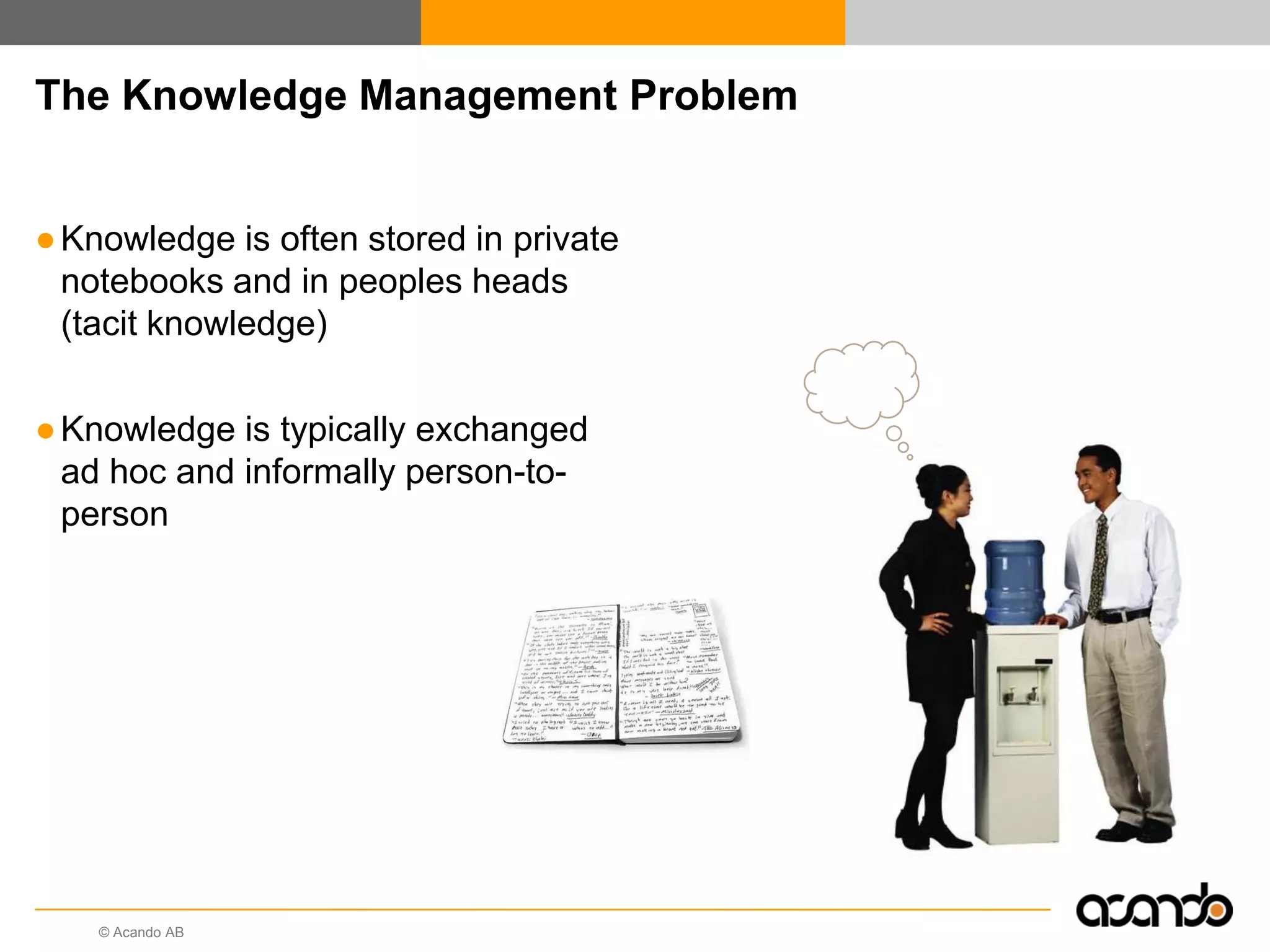
The Knowledge Management Problem
●Knowledge is often stored in private
notebooks and in peoples heads
(tacit knowledge)
●Knowledge is typically exchanged
ad hoc and informally person-to-
person
© Acando AB
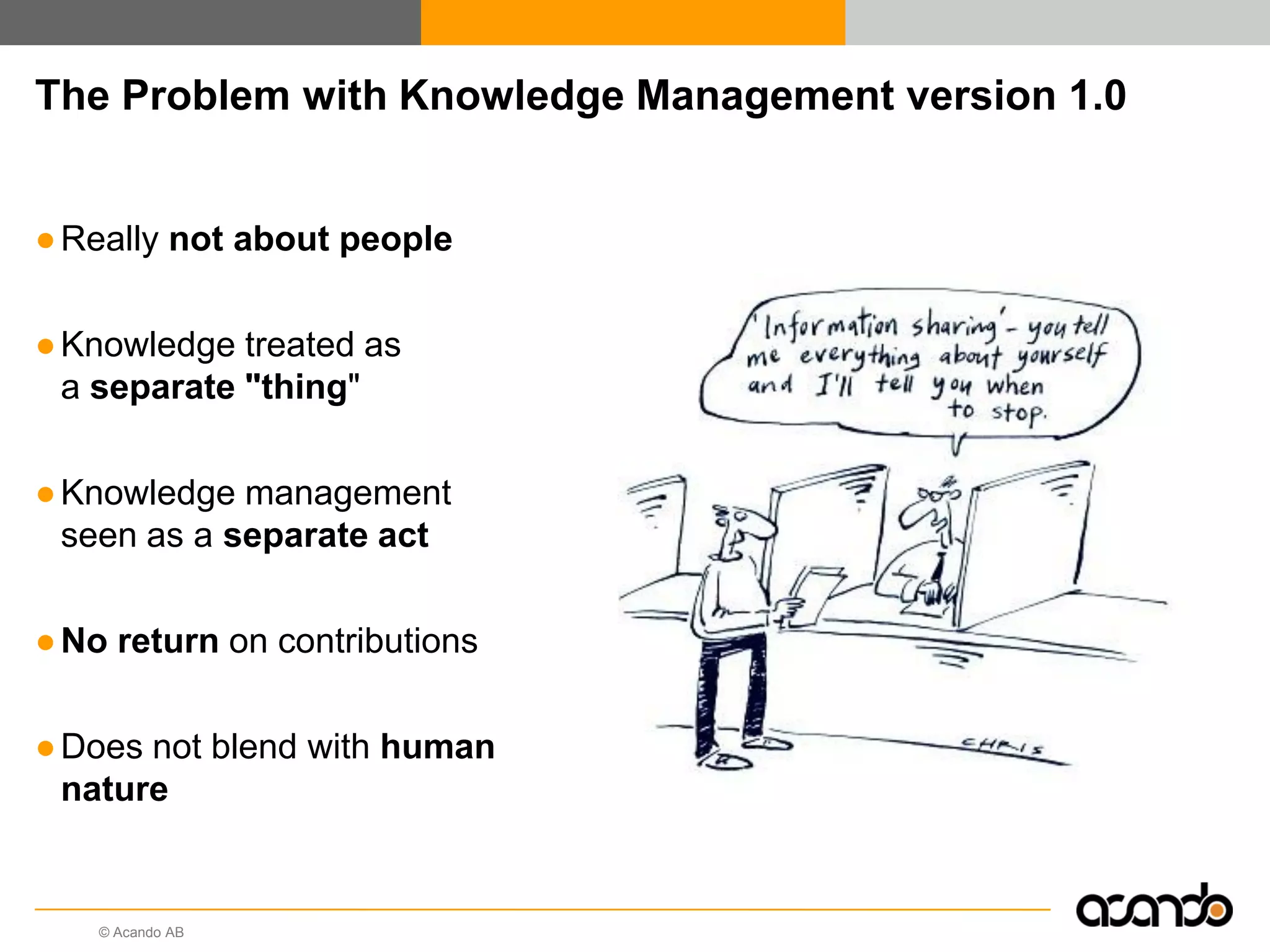
The Problem with Knowledge Management version 1.0
●Really not about people
●Knowledge treated as
a separate "thing"
●Knowledge management
seen as a separate act
●No return on contributions
●Does not blend with human
nature
© Acando AB
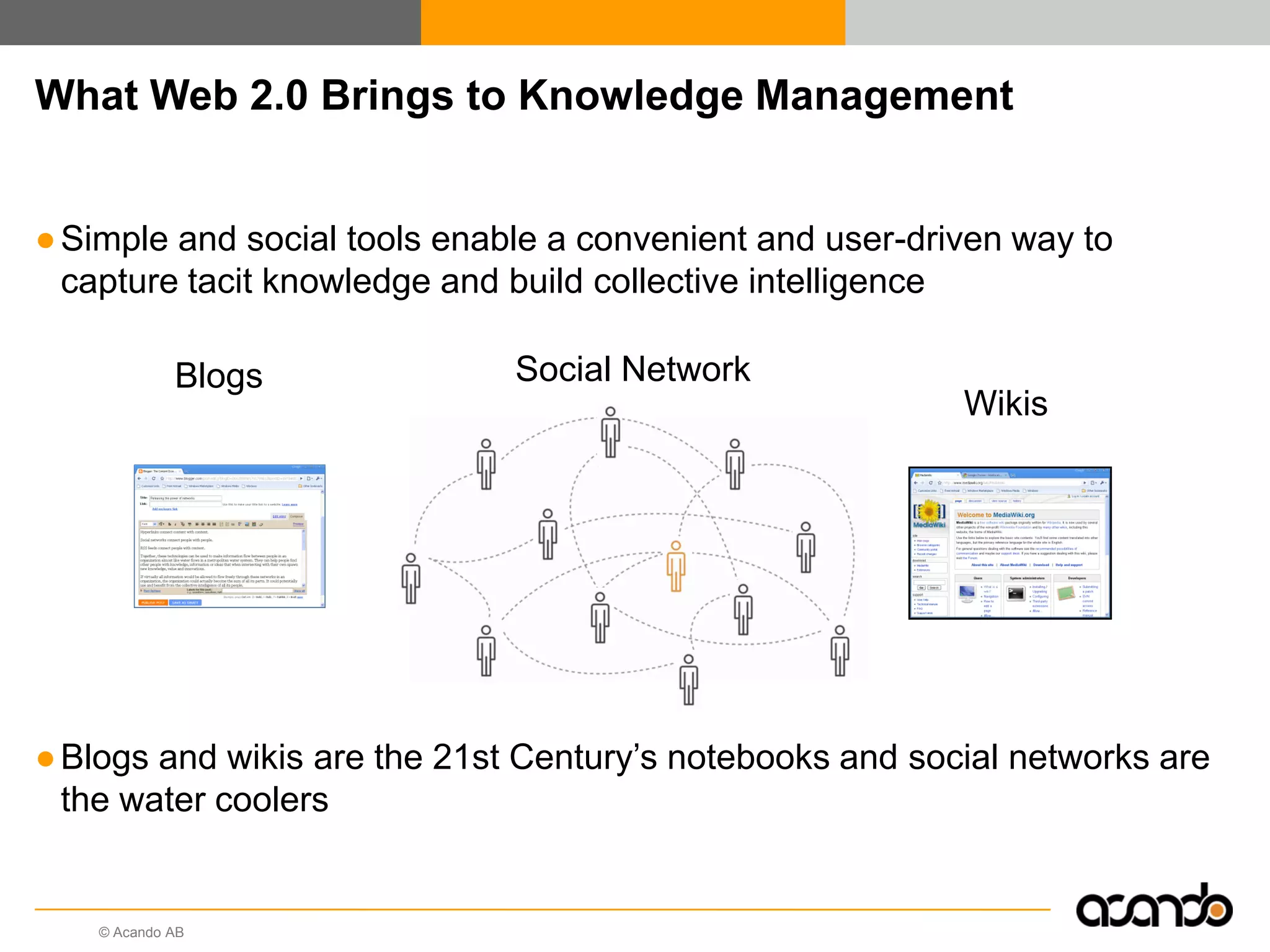
●Simple and social tools enable a convenient and user-driven way to
capture tacit knowledge and build collective intelligence
●Blogs and wikis are the 21st Century‟s notebooks and social networks are
the water coolers
What Web 2.0 Brings to Knowledge Management
Blogs
Wikis
Social Network
© Acando AB
PART II
Tools, Technologies
and their uses
© Acando AB
Enterprise 2.0 is the use of emergent
social software platforms within
companies, or between companies
and their partners or customers.
Andrew McAfee
Associate Professor, Harward Business School
“
”
© Acando AB
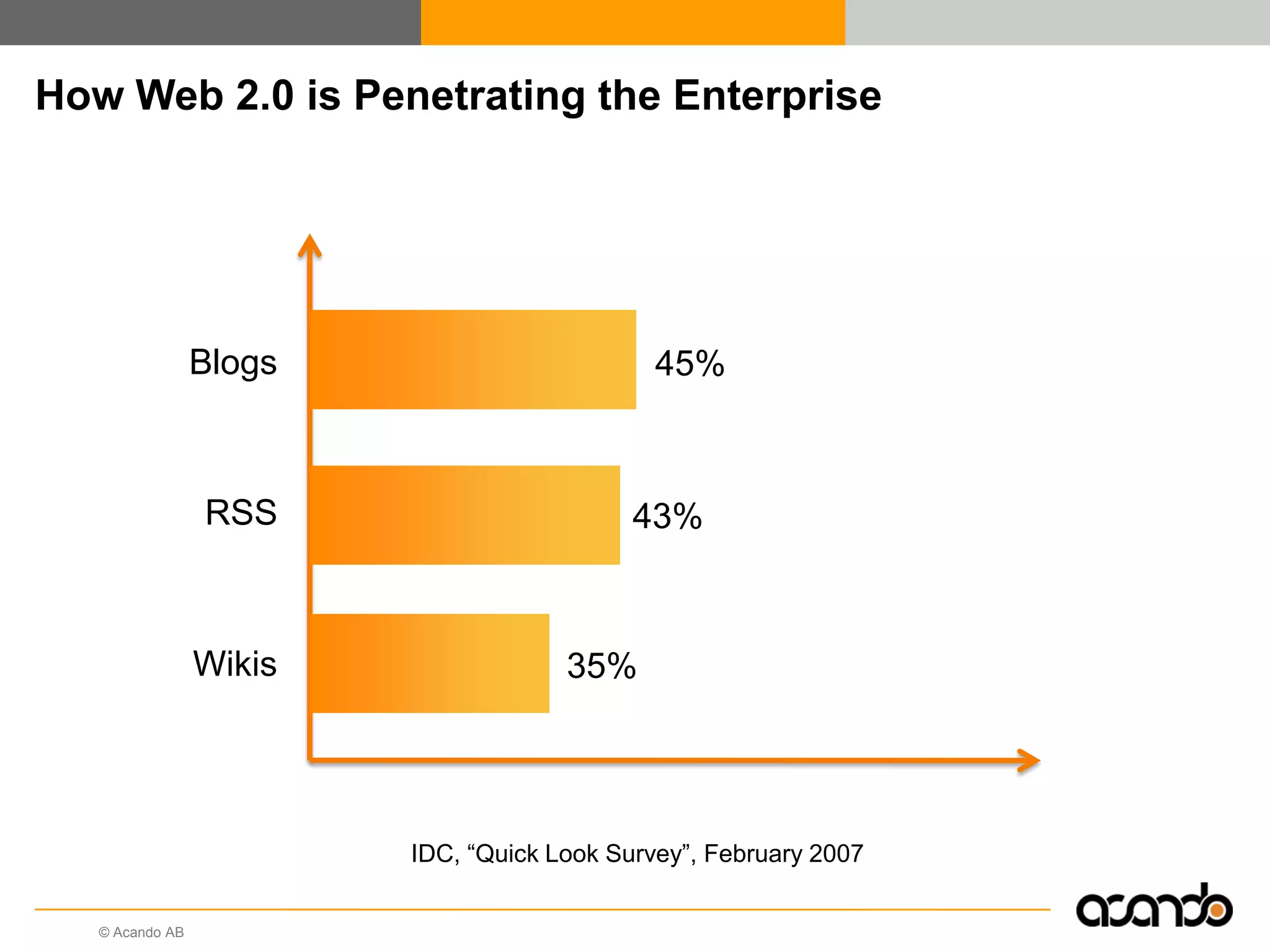
How Web 2.0 is Penetrating the Enterprise
Wikis
RSS
Blogs 45%
43%
35%
IDC, “Quick Look Survey”, February 2007
© Acando AB
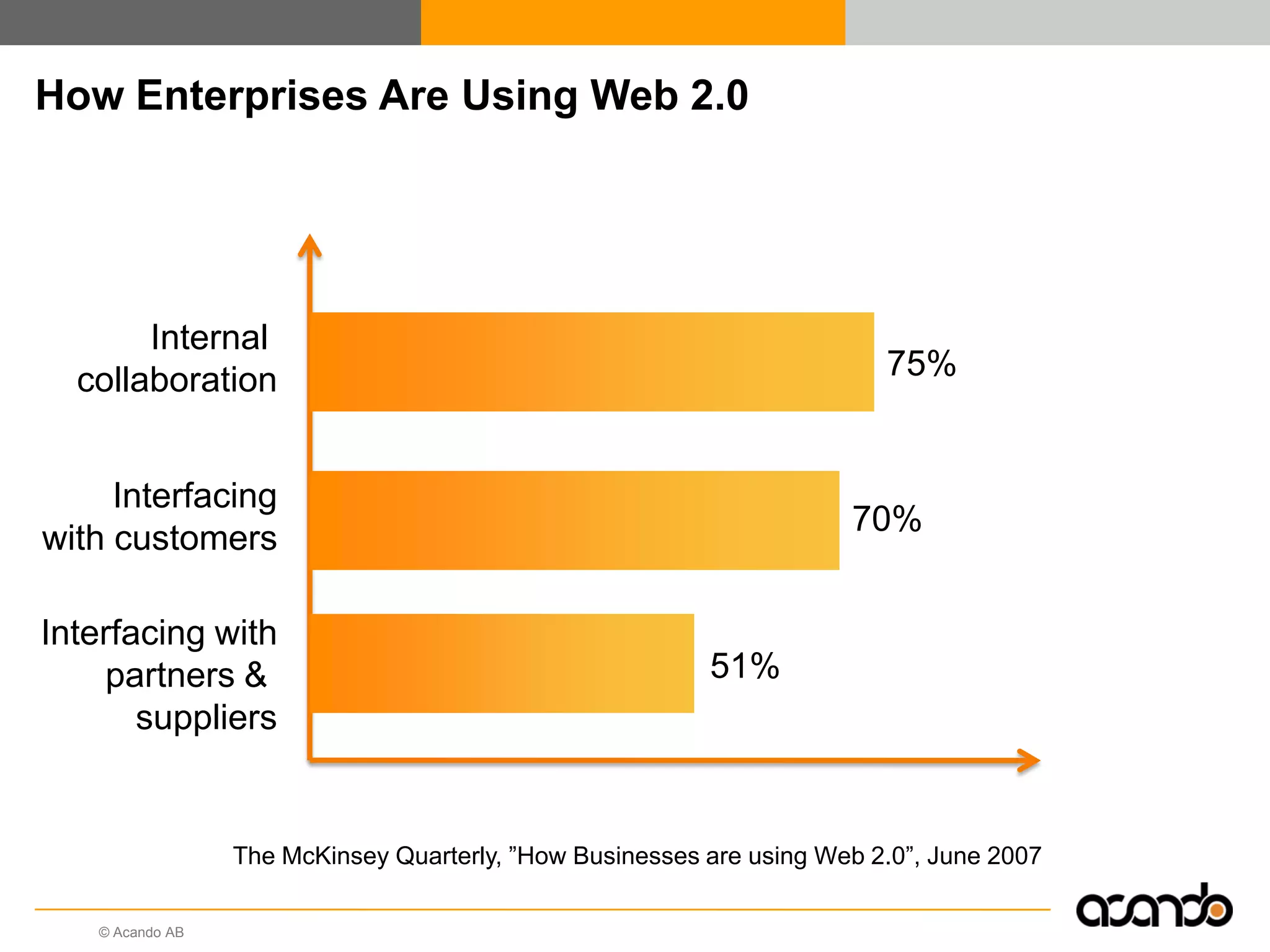
How Enterprises Are Using Web 2.0
The McKinsey Quarterly, ”How Businesses are using Web 2.0”, June 2007
Interfacing with
partners &
suppliers
Interfacing
with customers
Internal
collaboration 75%
70%
51%
© Acando AB
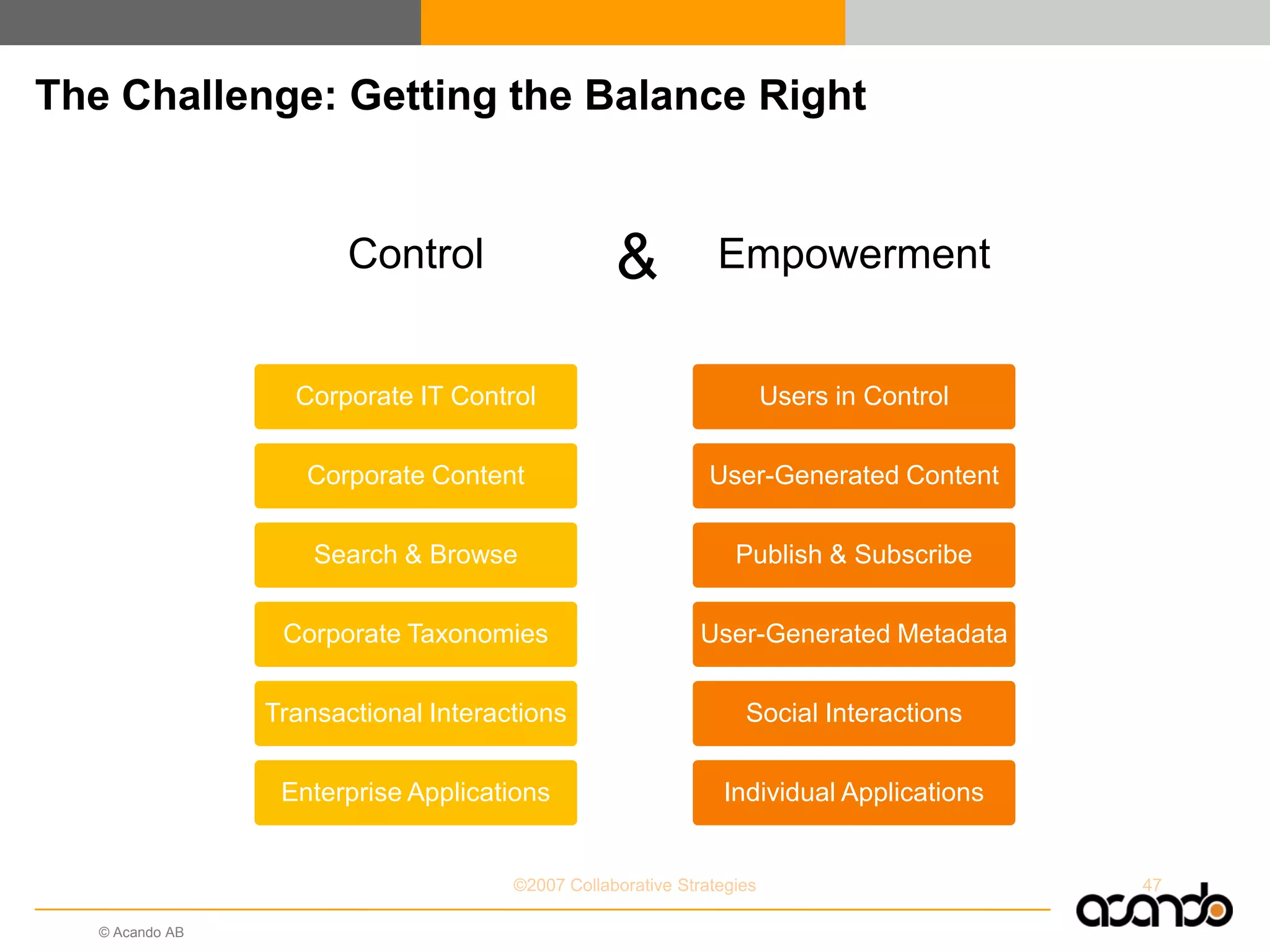
The Challenge: Getting the Balance Right
©2007 Collaborative Strategies 47
Control
Corporate IT Control
Corporate Content
Search & Browse
Corporate Taxonomies
Transactional Interactions
Enterprise Applications
Empowerment
Users in Control
User-Generated Content
Publish & Subscribe
User-Generated Metadata
Social Interactions
Individual Applications
&
© Acando AB
Being dismissive of blogs and wikis
because of how they are most of-ten
used, and talked about, today is a
mistake. What is important is how
they could be used.
The Gilbane Report
Vol 12 no 10, 2005
"Blogs & Wikis: Technologies for Enterprise Applications?"
“
”
© Acando AB
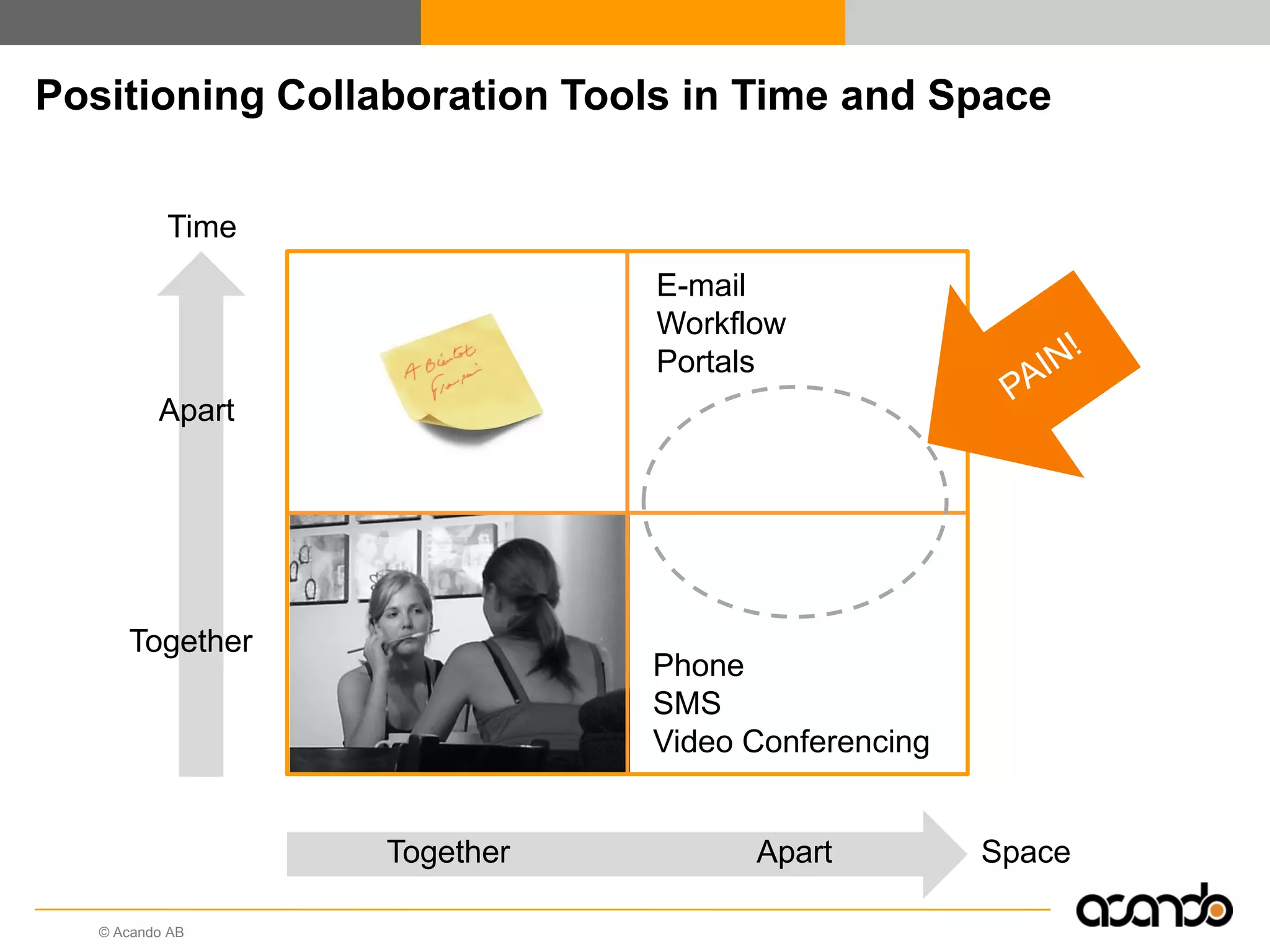
Positioning Collaboration Tools in Time and Space
Apart
Together
ApartTogether
Time
Space
E-mail
Workflow
Portals
Phone
SMS
Video Conferencing
© Acando AB
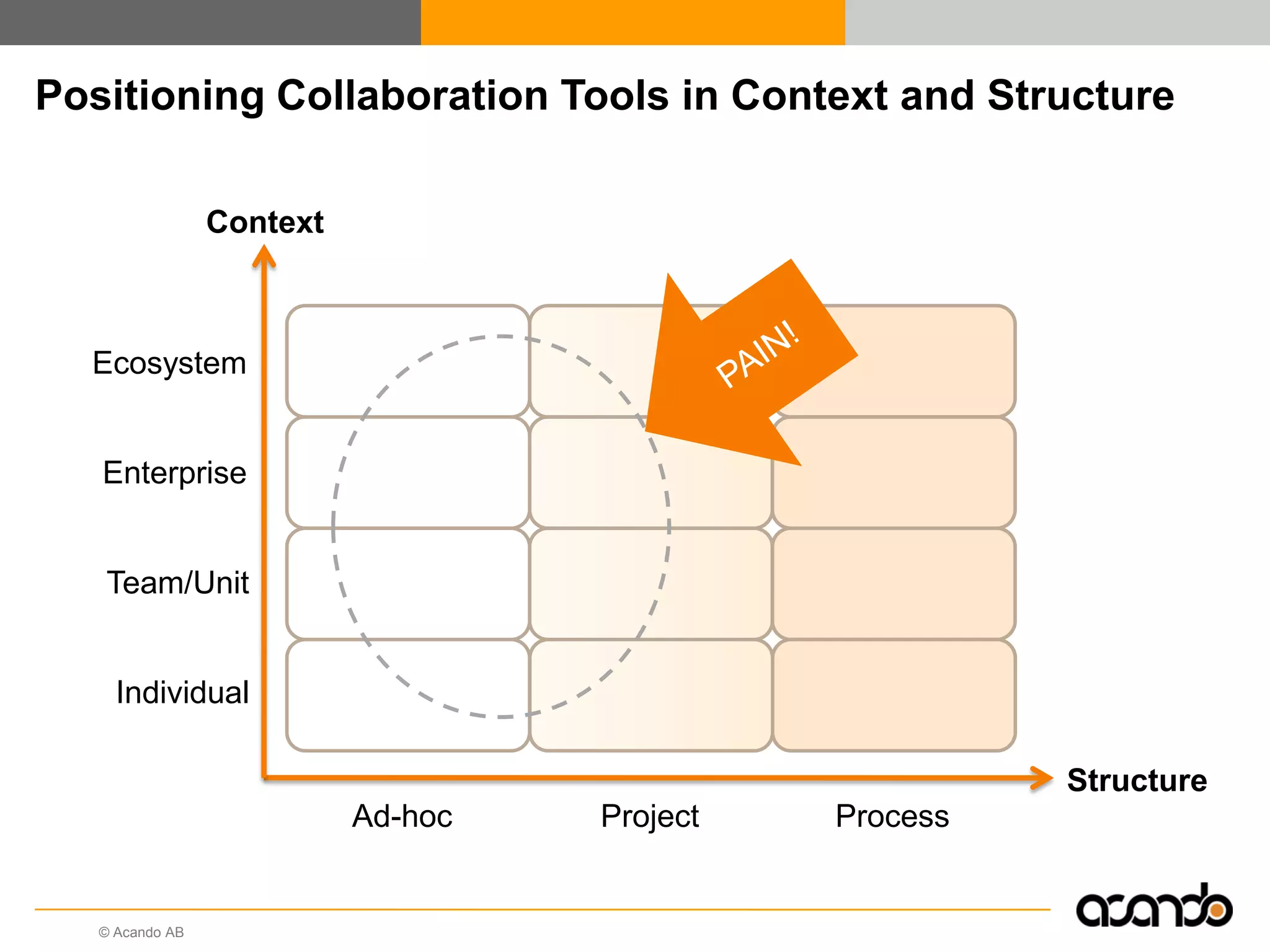
Positioning Collaboration Tools in Context and Structure
Ad-hoc Project Process
Structure
Context
Individual
Team/Unit
Enterprise
Ecosystem
© Acando AB
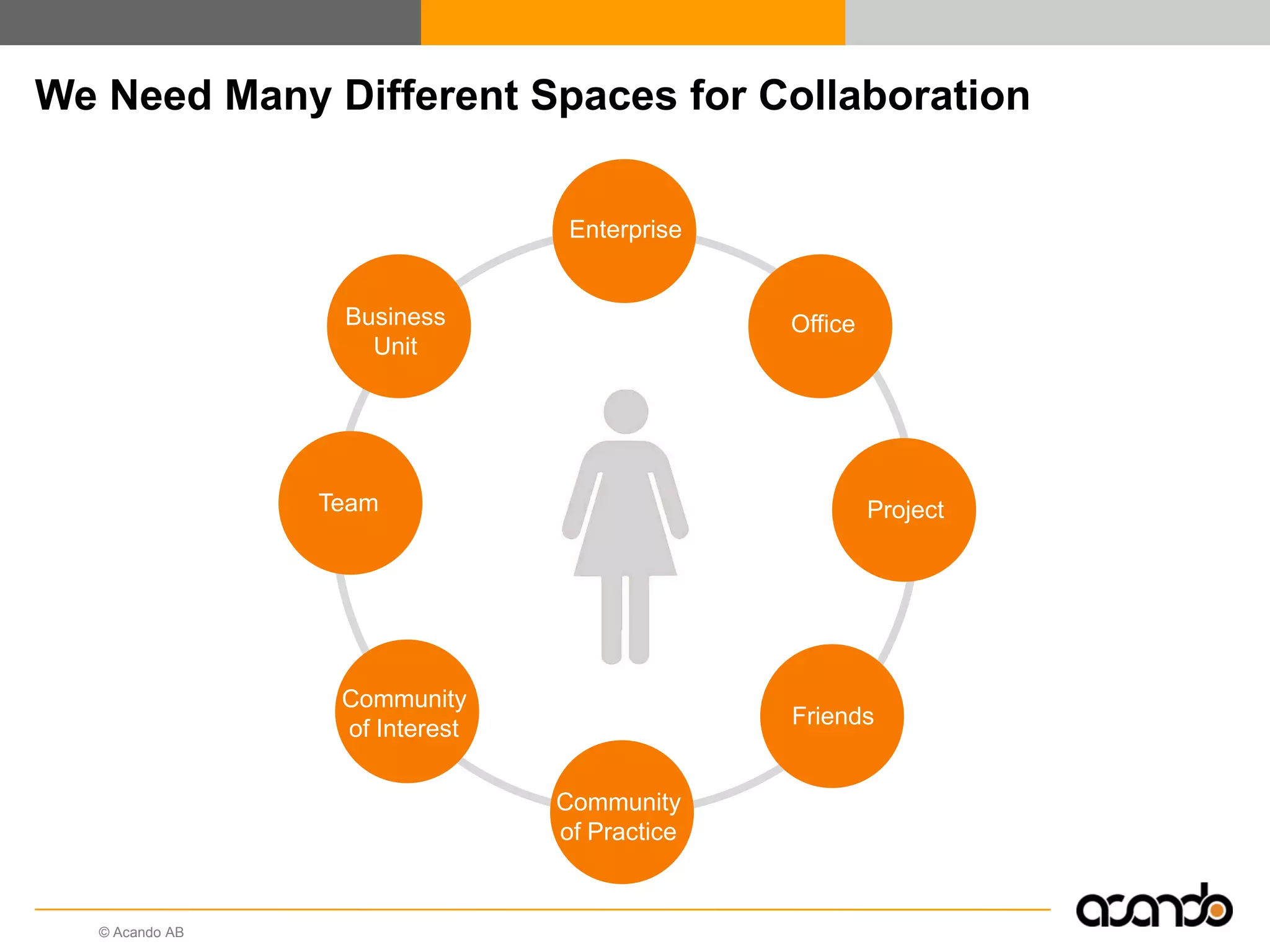
Team
OfficeBusiness
Unit
Project
Enterprise
Community
of Practice
Friends
Community
of Interest
We Need Many Different Spaces for Collaboration
© Acando AB
Key Tools & Technologies
© Acando AB
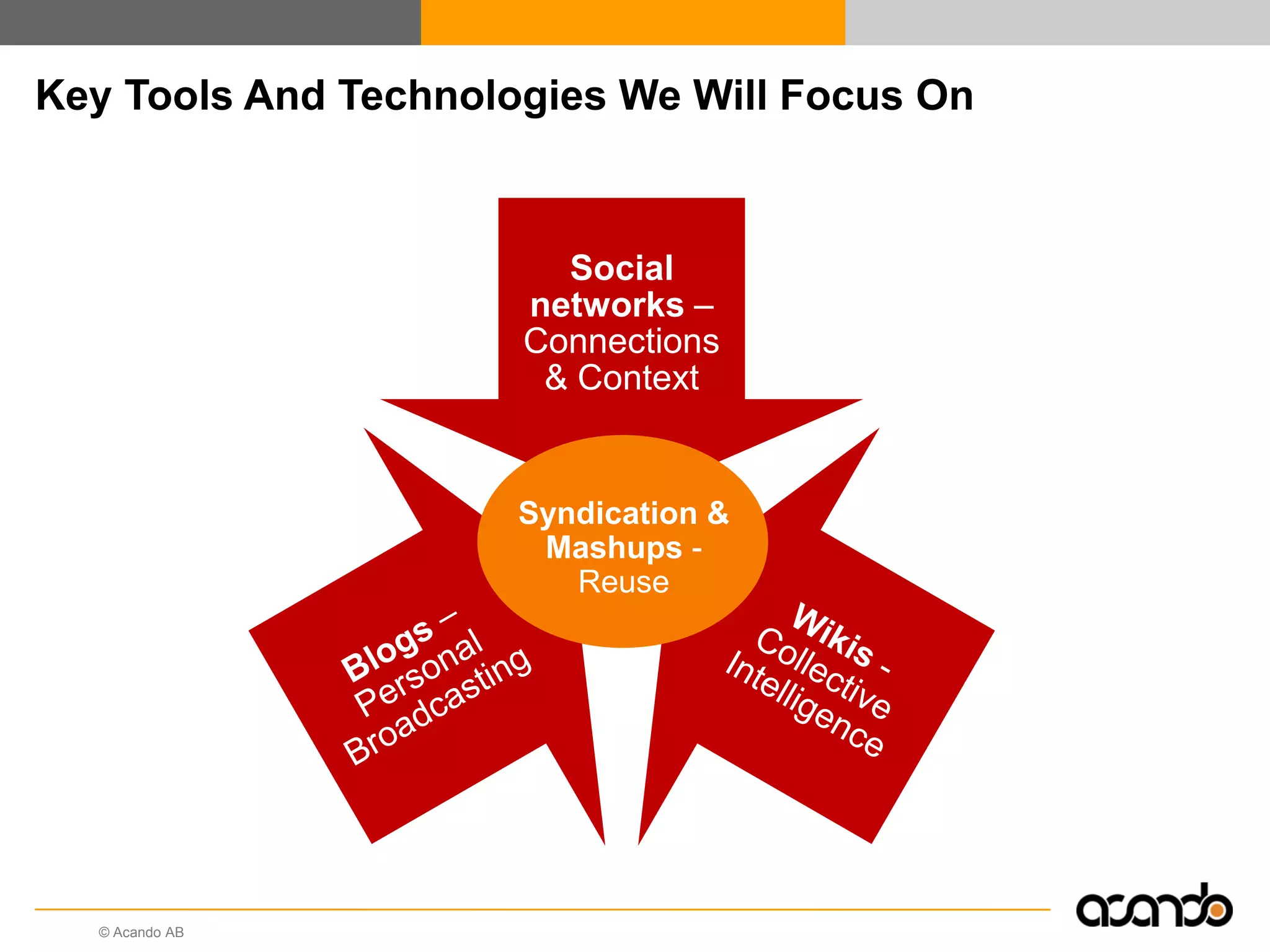
Key Tools And Technologies We Will Focus On
Social
networks –
Connections
& Context
Syndication &
Mashups -
Reuse
© Acando AB
ENTERPRISE BLOGS
© Acando AB
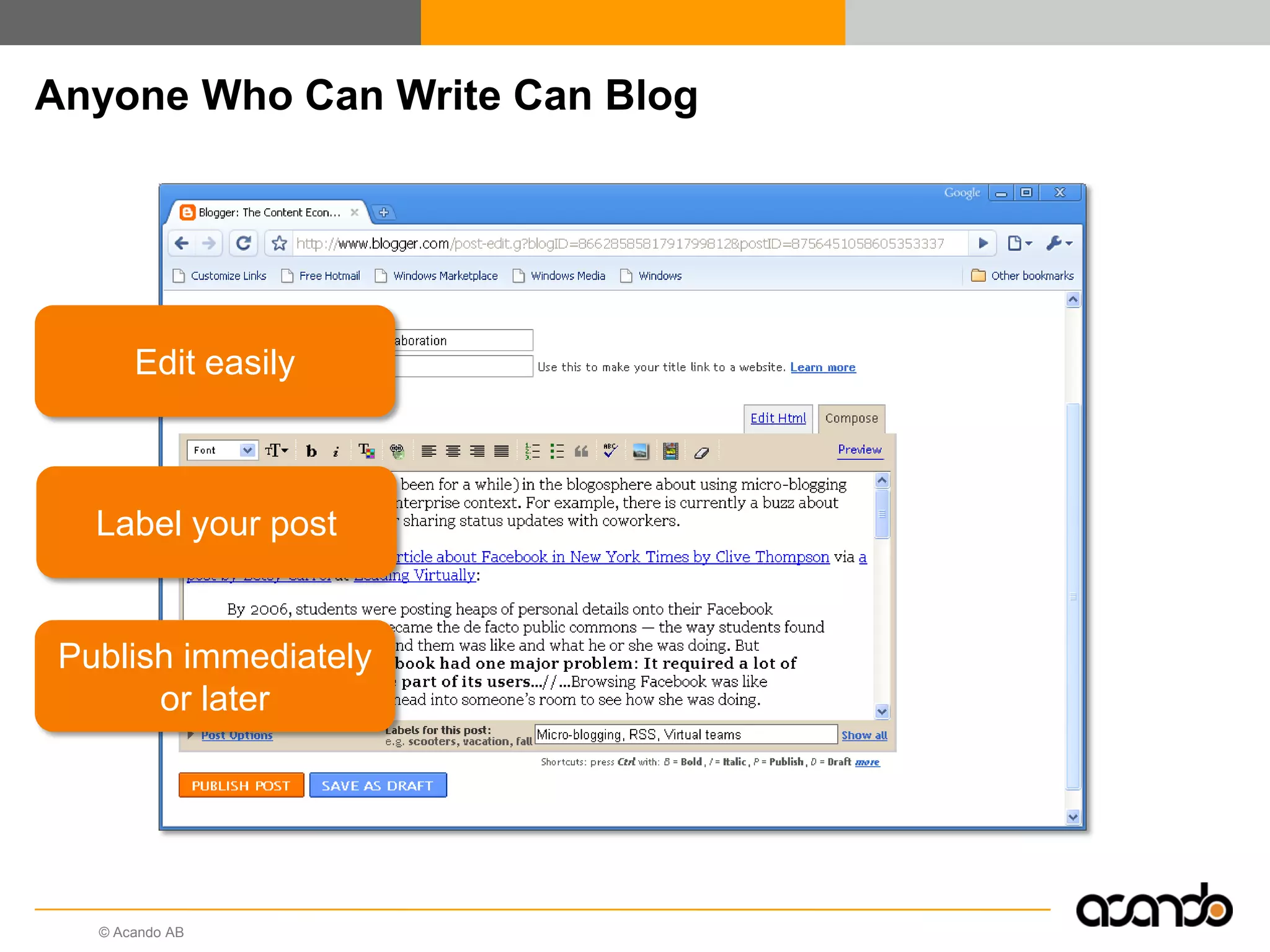
Anyone Who Can Write Can Blog
Label your post
Publish immediately
or later
Edit easily
© Acando AB
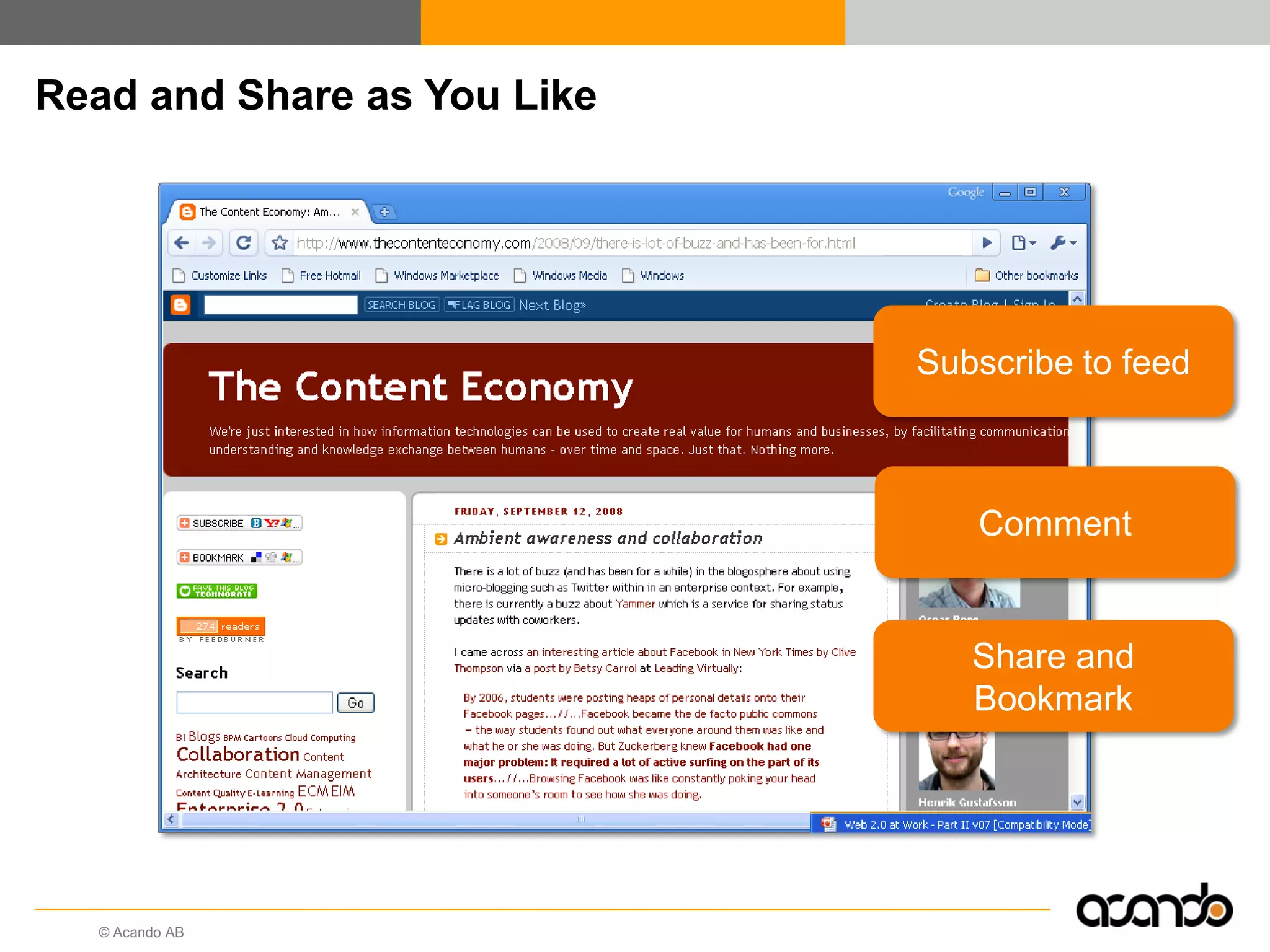
Read and Share as You Like
Comment
Share and
Bookmark
Subscribe to feed
© Acando AB
Our legal department loves the blogs,
because it is basically a written-down,
backed-up, permanent time-stamped
version of the scientists notebook.
Marissa Mayer
VP of Search Product & User Experience , Google
“
”
© Acando AB
Why Enterprise Blogs?
●Blogs are a good way of conveying information instantly to the rest of
your community in one action
●They can be used as a timeline of events within a workgroup
●Capture and present ideas and opinions to coworkers
●Gather feedback and involve others in discussions
© Acando AB
Examples of Enterprise Uses
●CEO blog for communicating with coworkers
●Product management blogs for product communication and strategies
●Project management blogs for meeting minutes, project history, project
definition, risks…
●Sales blogs for sales and customer development
●Personal blogs for sharing experiences, links, news, ideas, opinions…
© Acando AB
ENTERPRISE WIKIS
© Acando AB
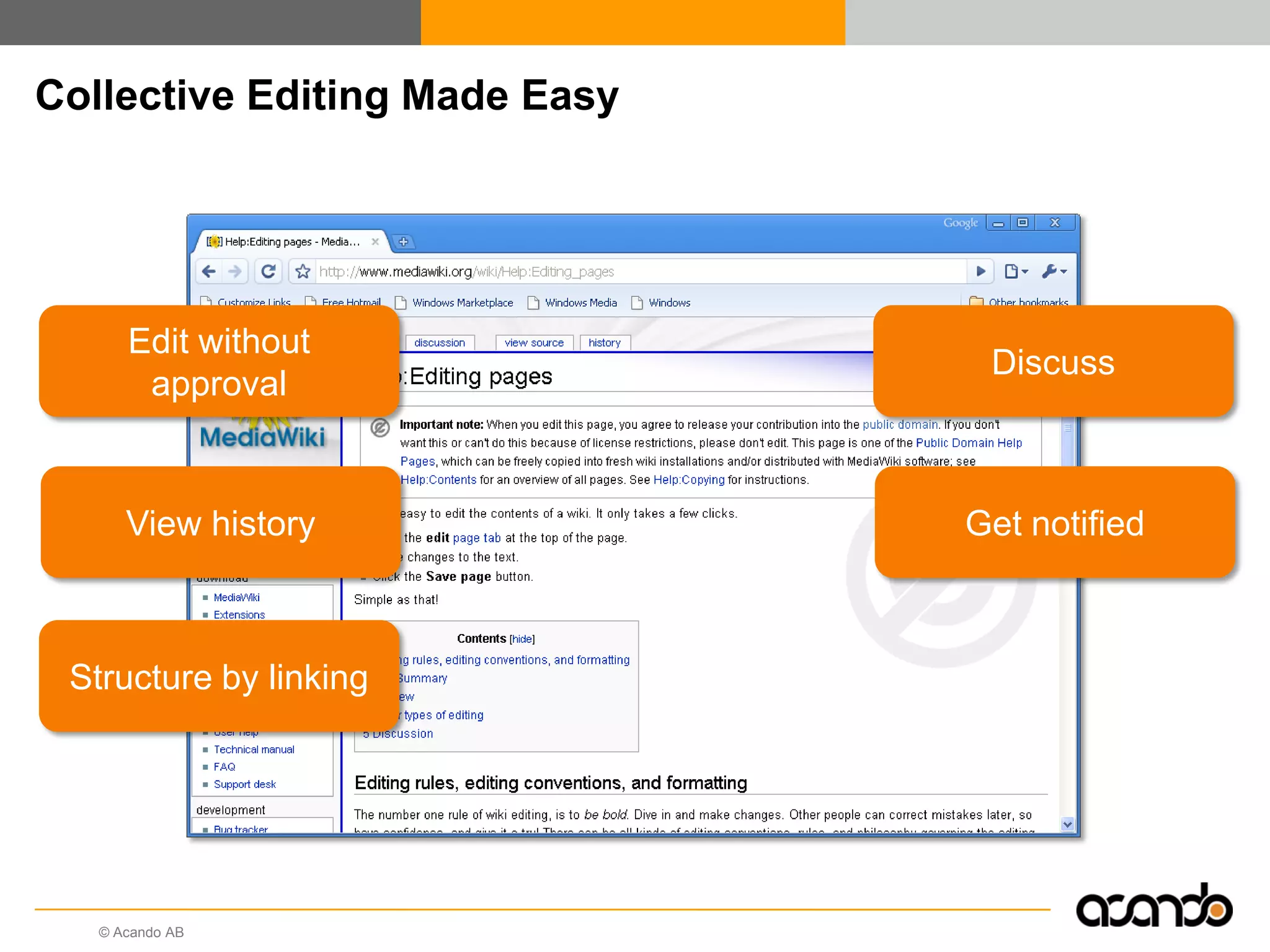
Collective Editing Made Easy
Get notified
Discuss
View history
Structure by linking
Edit without
approval
© Acando AB
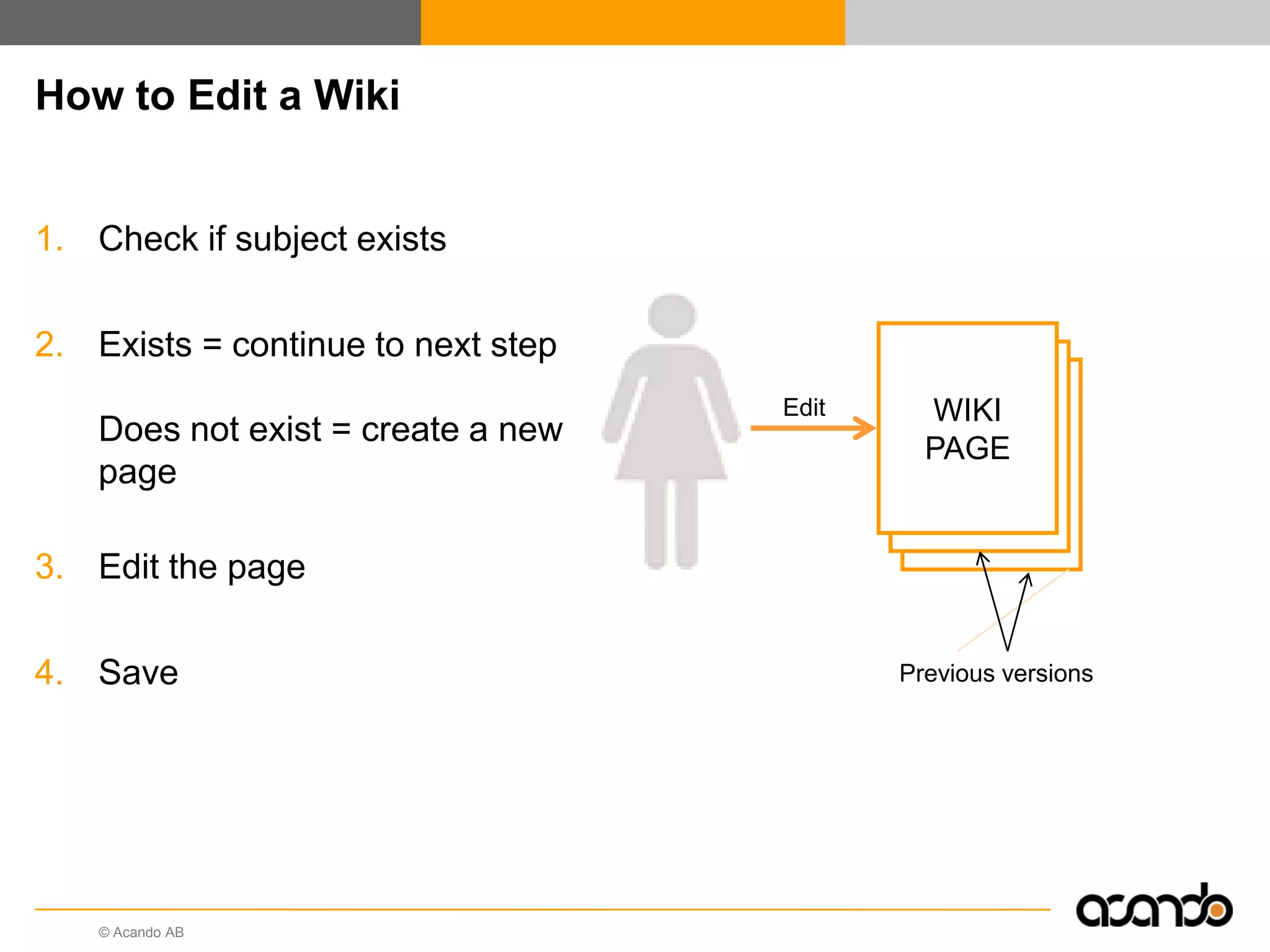
WIKI
PAGE
How to Edit a Wiki
1. Check if subject exists
2. Exists = continue to next step
Does not exist = create a new
page
3. Edit the page
4. Save Previous versions
Edit
© Acando AB
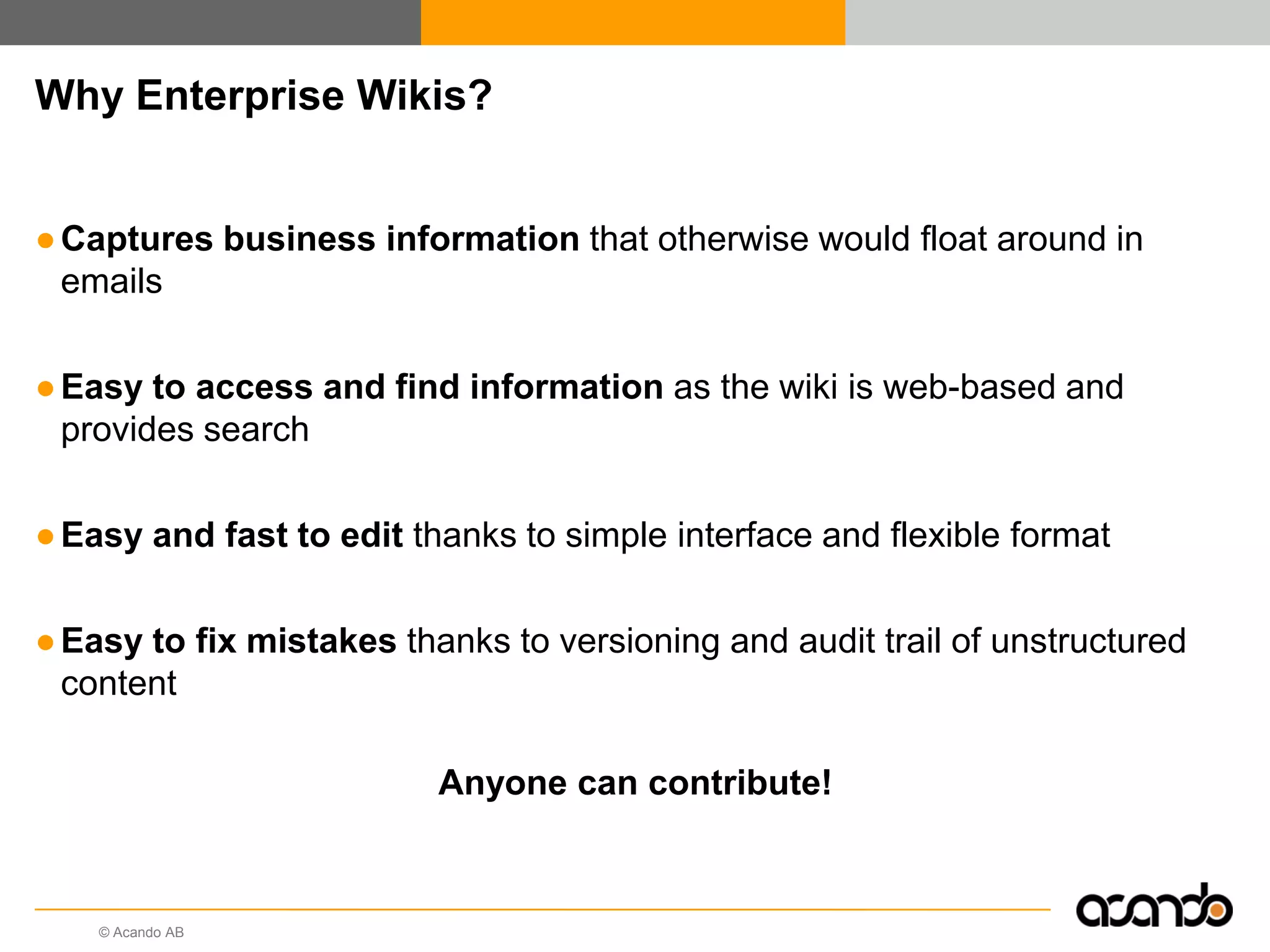
Why Enterprise Wikis?
●Captures business information that otherwise would float around in
emails
●Easy to access and find information as the wiki is web-based and
provides search
●Easy and fast to edit thanks to simple interface and flexible format
●Easy to fix mistakes thanks to versioning and audit trail of unstructured
content
Anyone can contribute!
© Acando AB
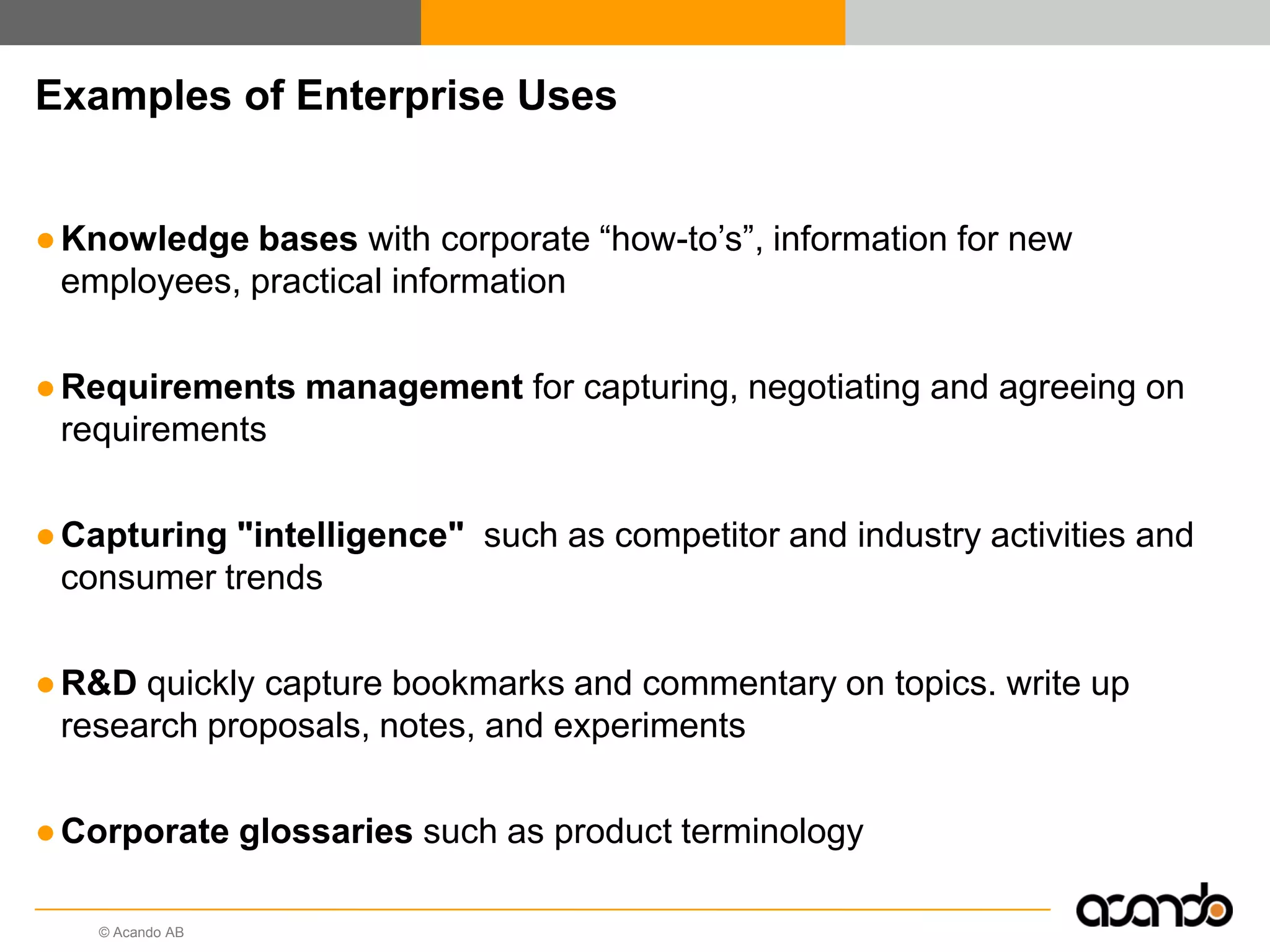
Examples of Enterprise Uses
●Knowledge bases with corporate “how-to‟s”, information for new
employees, practical information
●Requirements management for capturing, negotiating and agreeing on
requirements
●Capturing "intelligence" such as competitor and industry activities and
consumer trends
●R&D quickly capture bookmarks and commentary on topics. write up
research proposals, notes, and experiments
●Corporate glossaries such as product terminology
© Acando AB
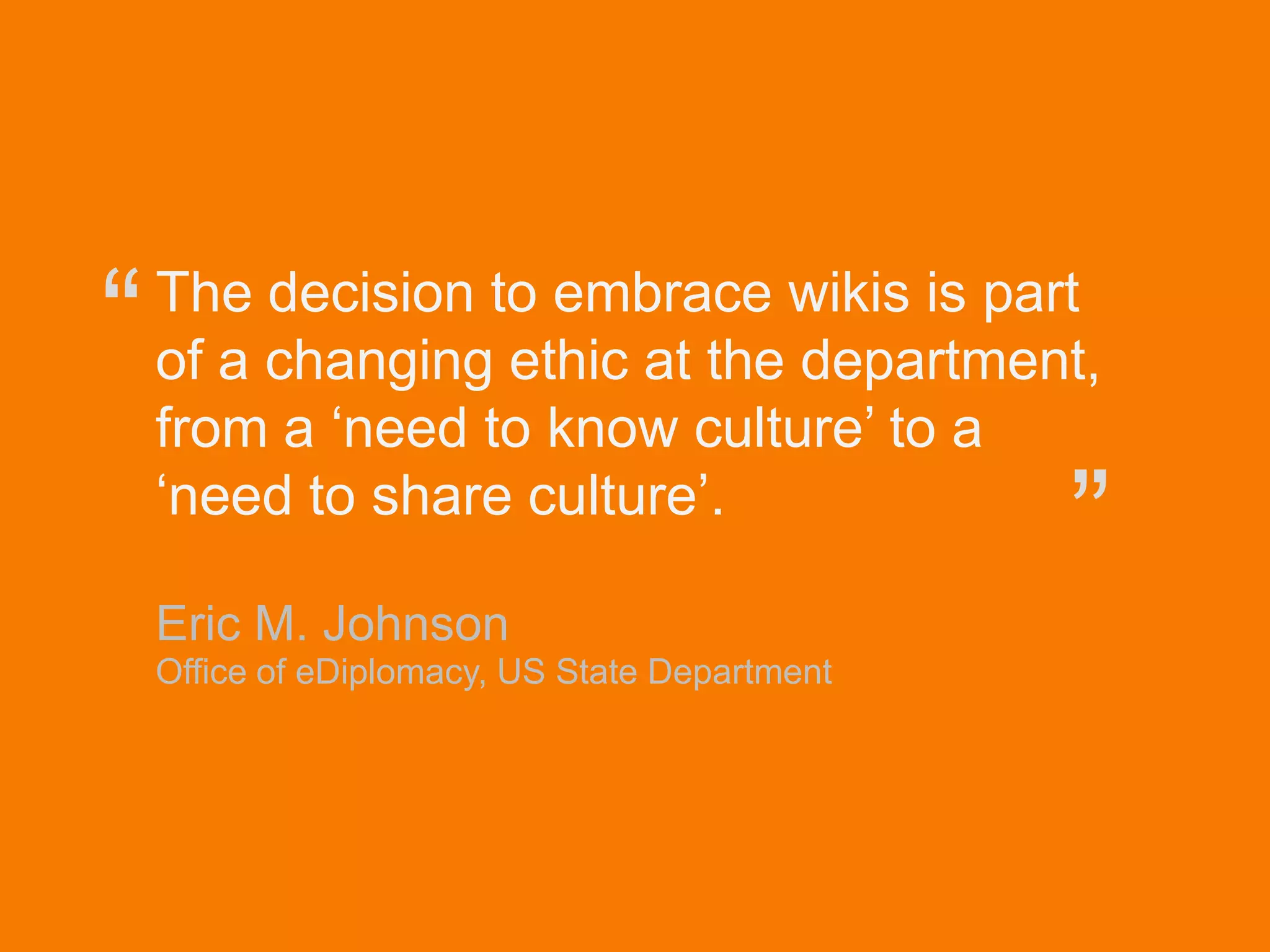
The decision to embrace wikis is part
of a changing ethic at the department,
from a „need to know culture‟ to a
„need to share culture‟.
Eric M. Johnson
Office of eDiplomacy, US State Department
“
”
© Acando AB
”Intellipedia” - Connecting the Dots at CIA After 9/11
© Acando AB
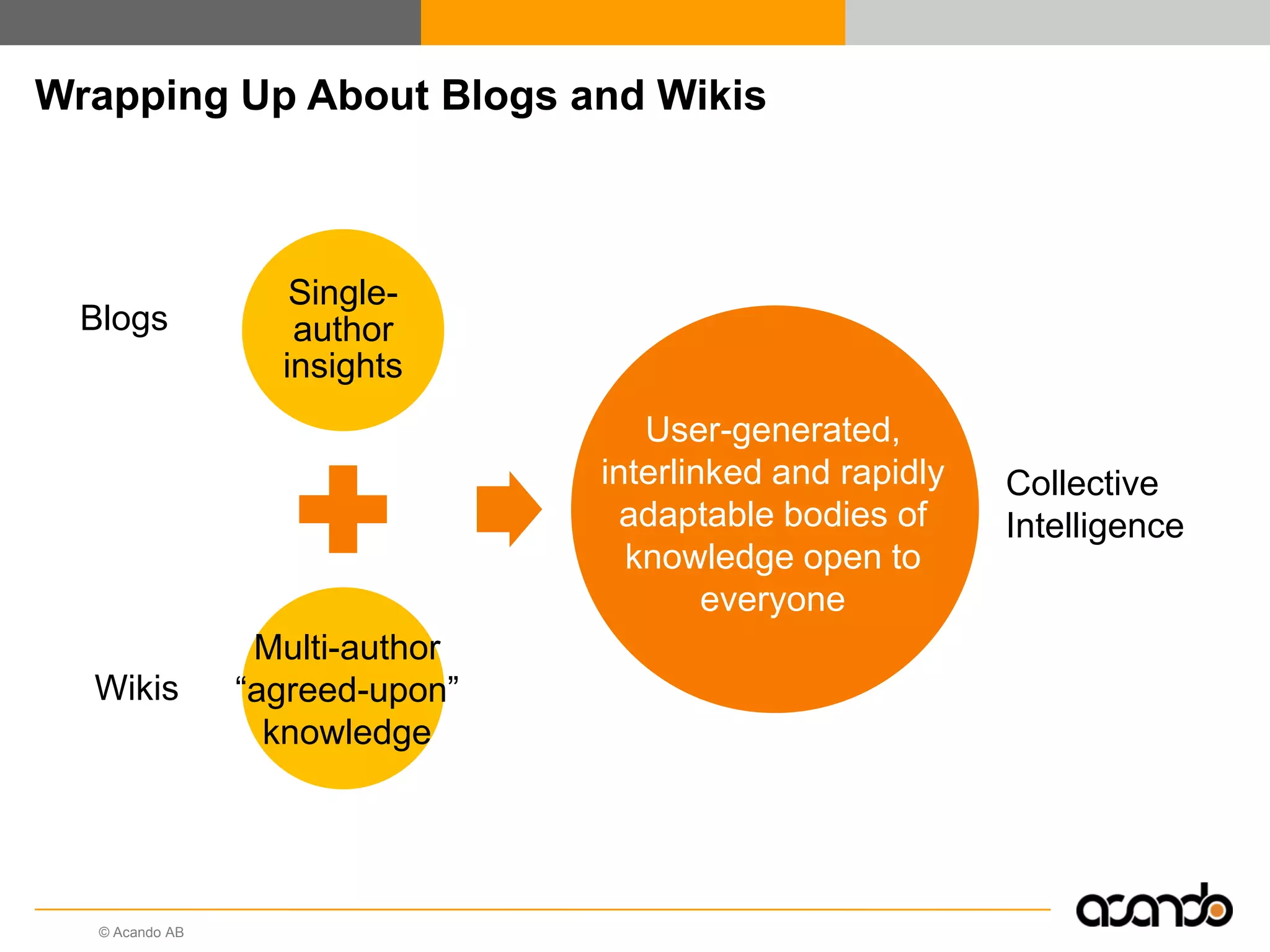
Wrapping Up About Blogs and Wikis
Single-
author
insights
Blogs
Wikis
Collective
Intelligence
User-generated,
interlinked and rapidly
adaptable bodies of
knowledge open to
everyone
Multi-author
“agreed-upon”
knowledge
© Acando AB
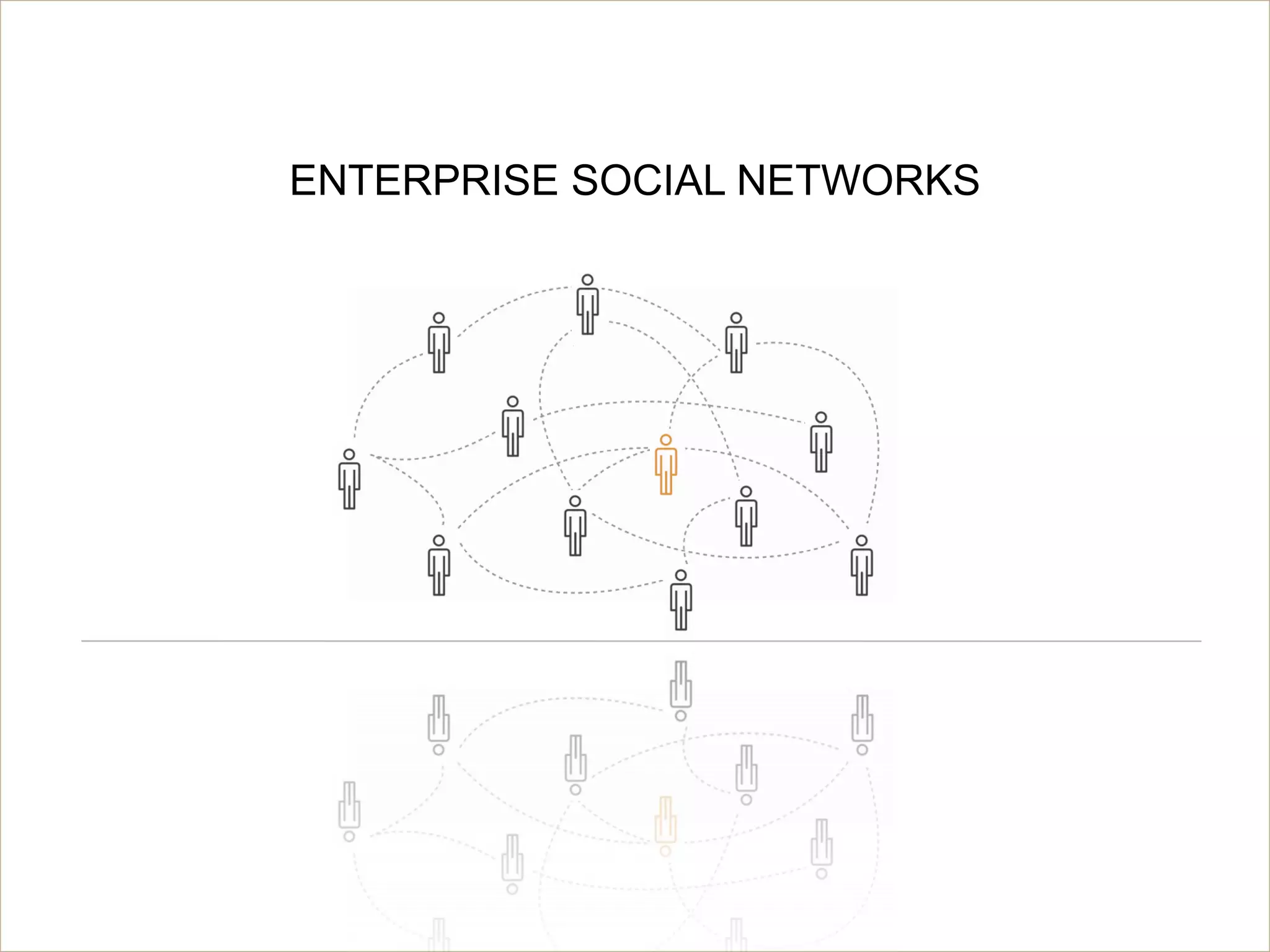
ENTERPRISE SOCIAL NETWORKS
© Acando AB
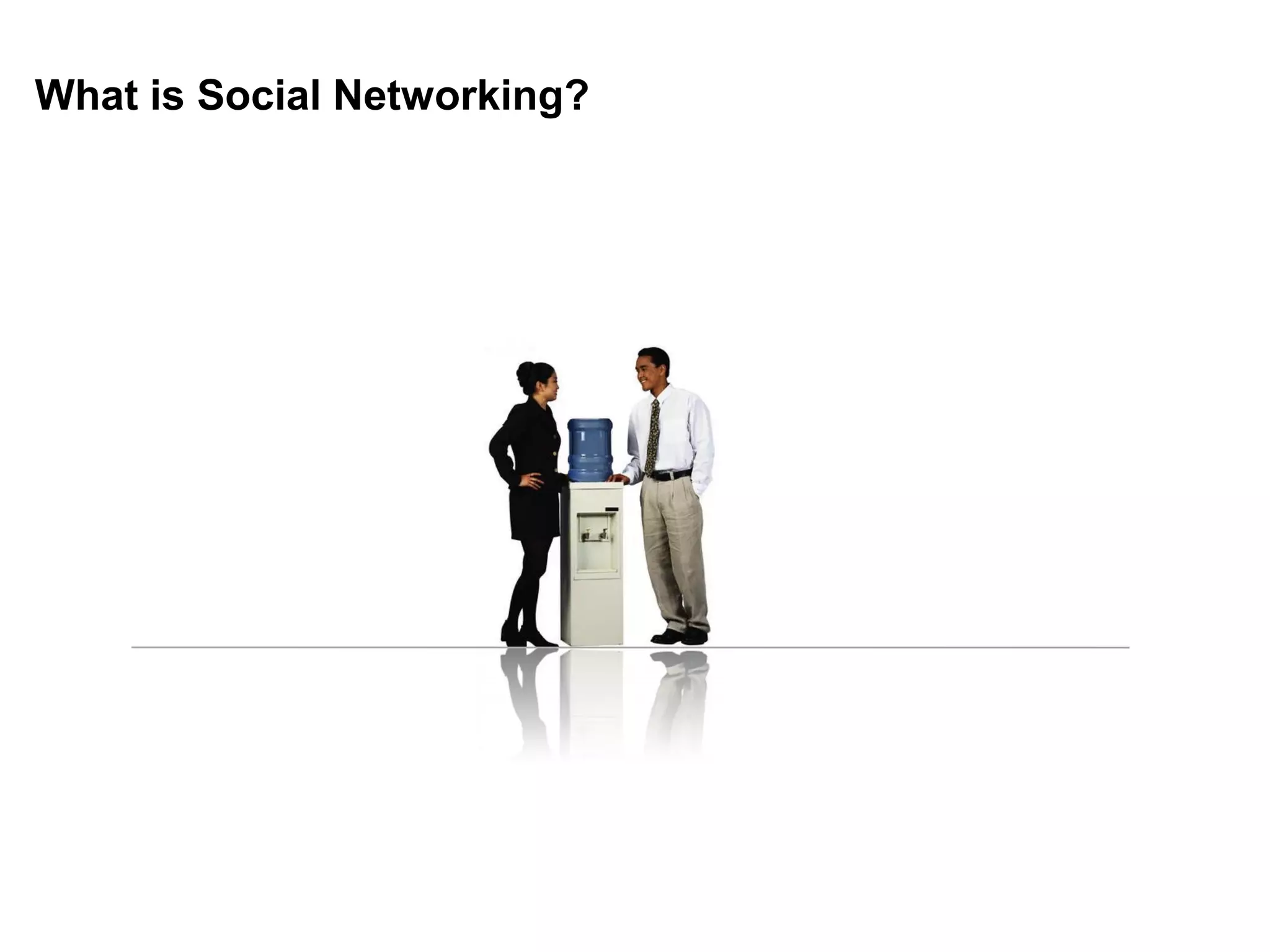
What is Social Networking?
© Acando AB
The social network put all that we
were doing into context.
Richard Dennison
Intranet and channel strategy manager at BT
“ ”
© Acando AB
Why Enterprise Social Networks?
●A shared social space for people who are apart in time and/or space
●Easy to find people to connect, communicate with and get to know them
●Rapid distribution of relevant and informal information person-to-network
●Build relationships across boundaries (organizational, geographic…)
●Provides a context for knowledge exchange
© Acando AB
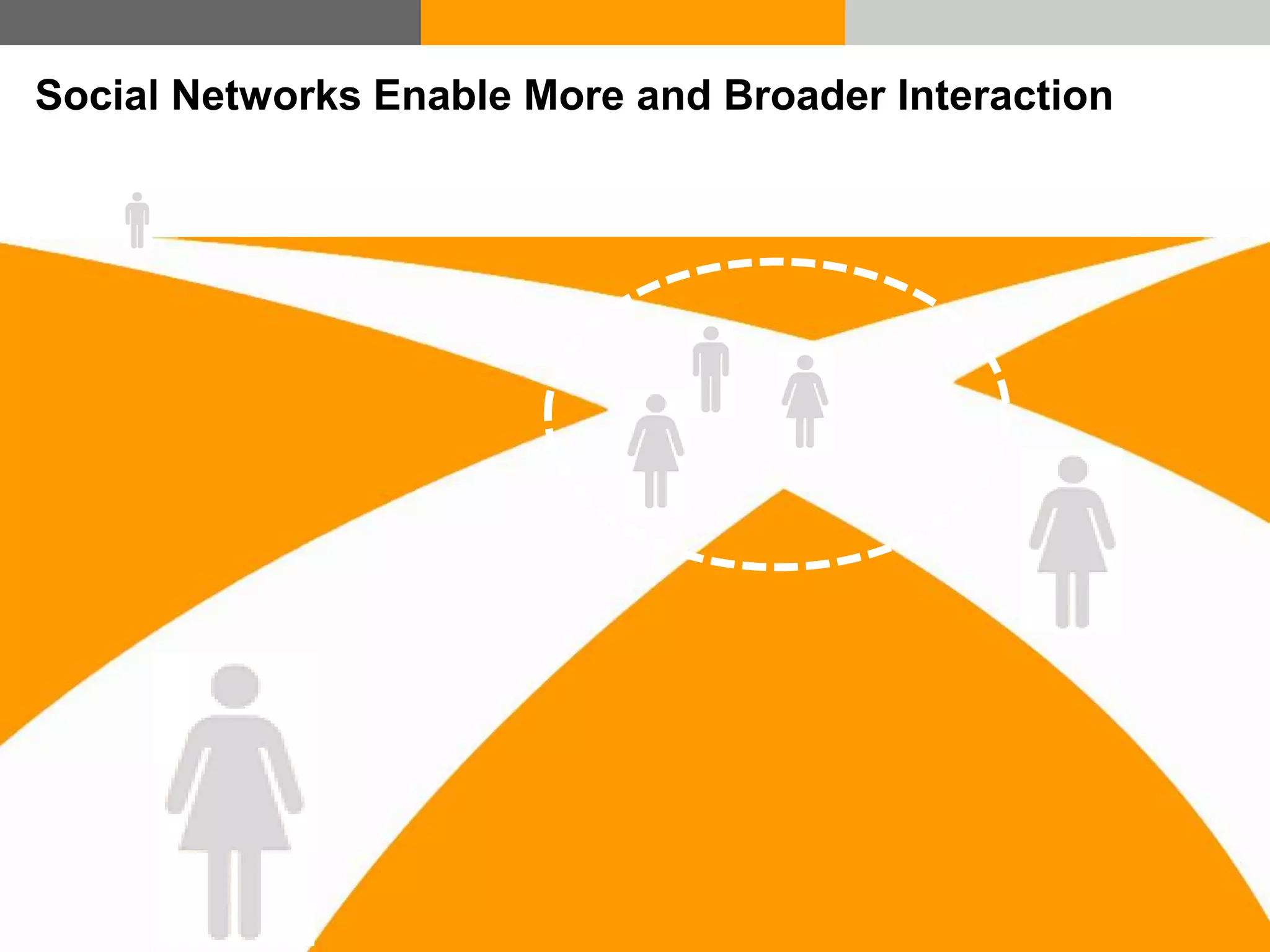
Social Networks Enable More and Broader Interaction
© Acando AB
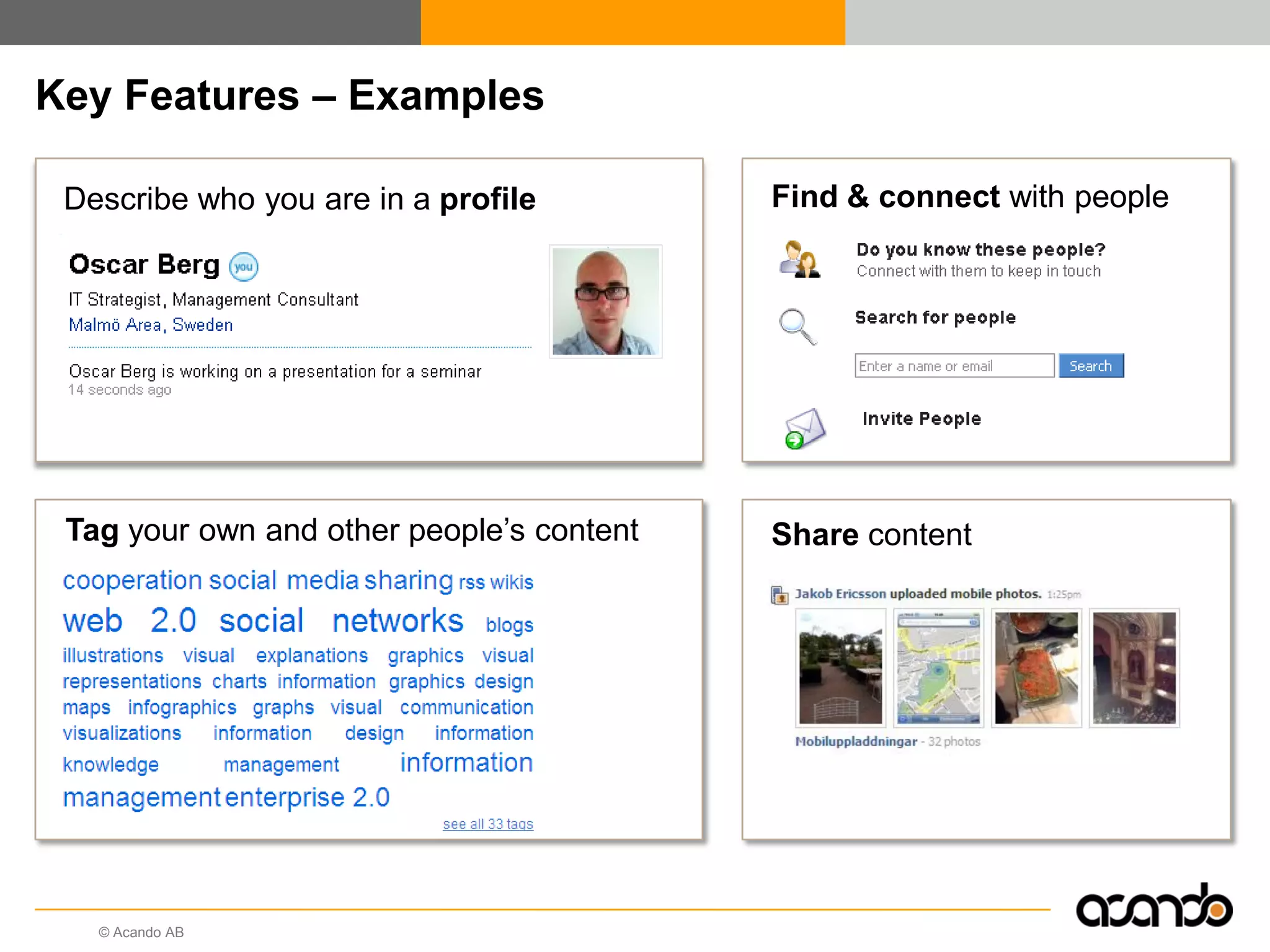
Key Features – Examples
Find & connect with peopleDescribe who you are in a profile
Share contentTag your own and other people‟s content
© Acando AB
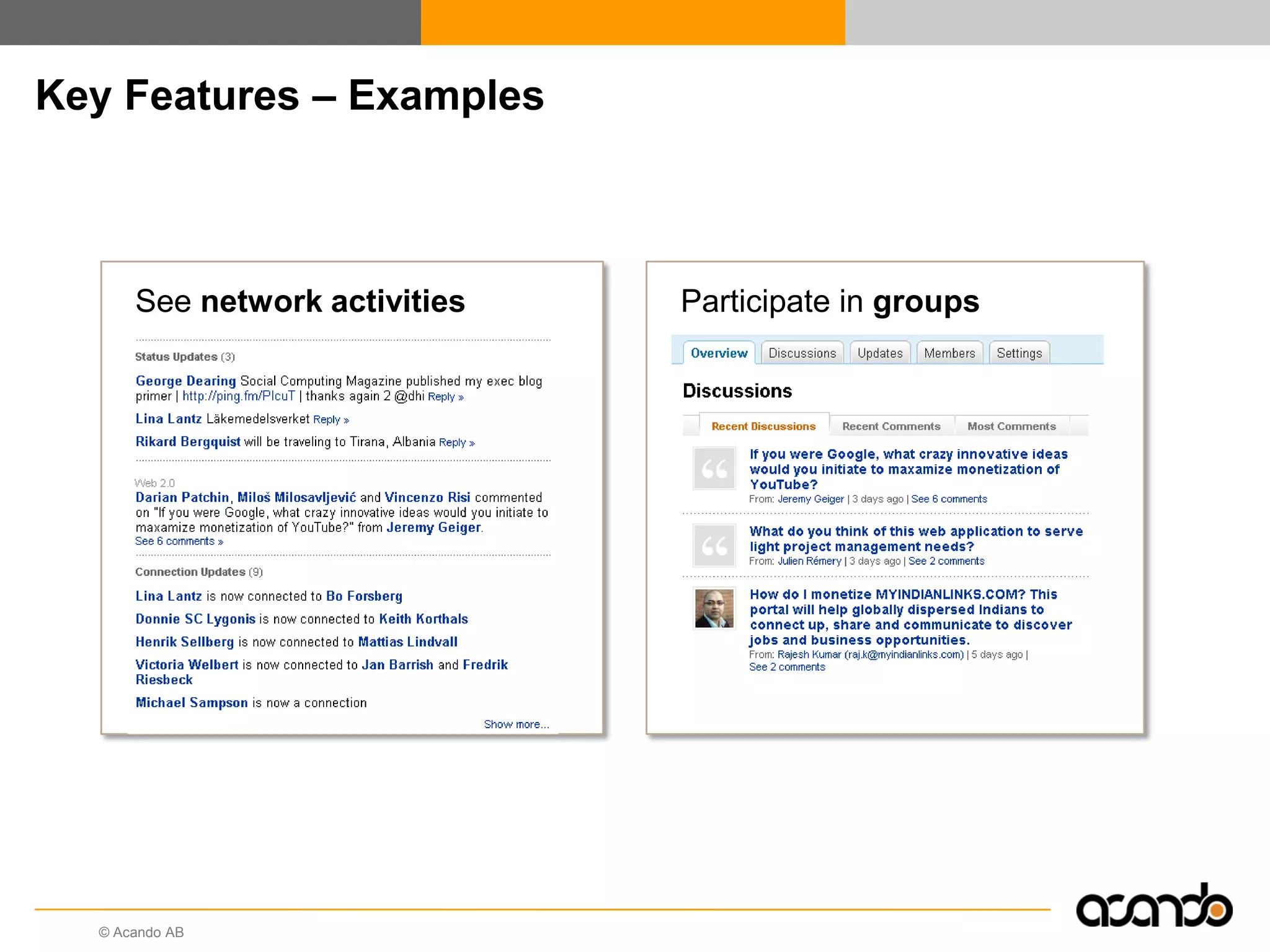
Key Features – Examples
See network activities Participate in groups
© Acando AB
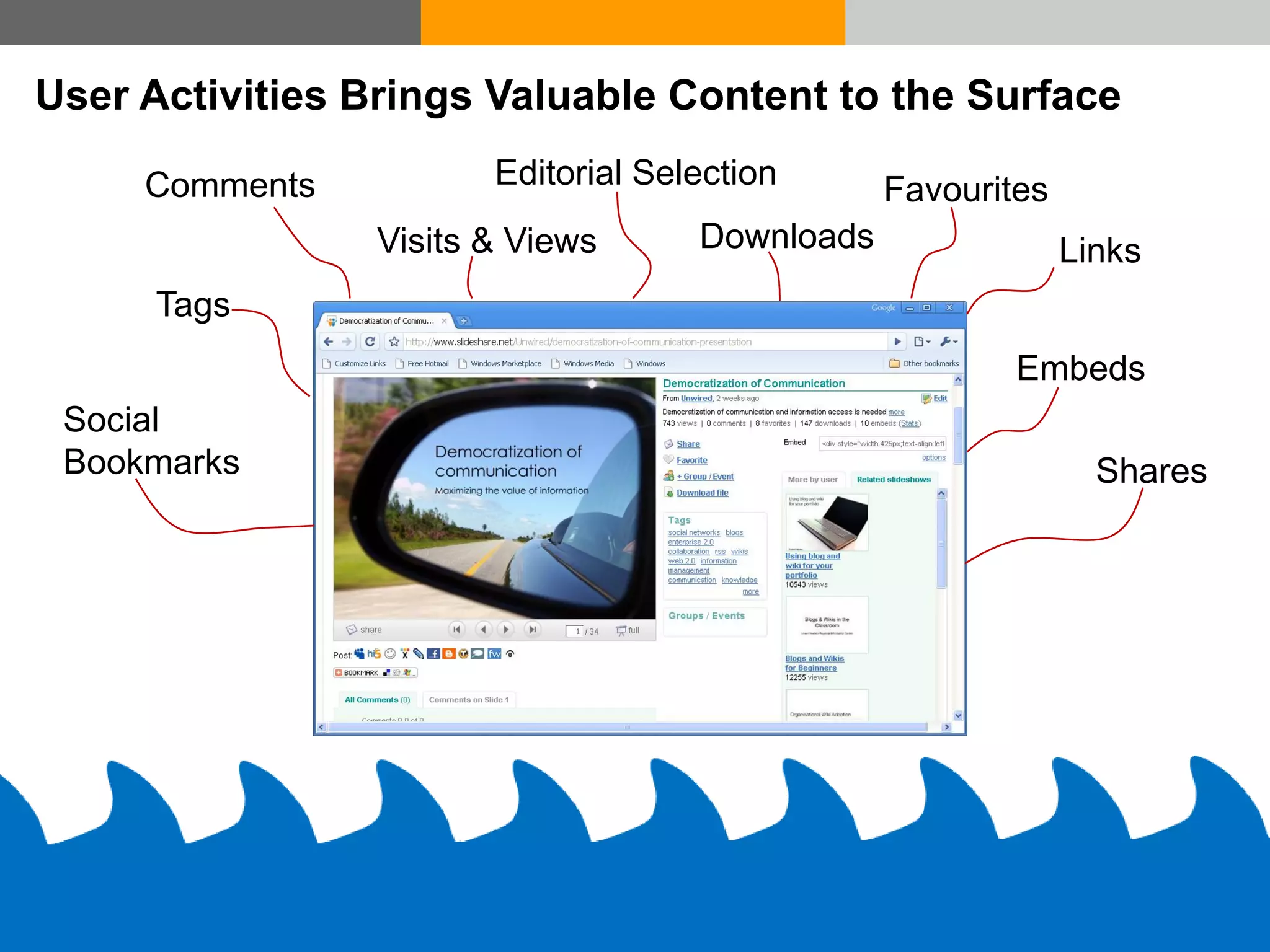
Visits & Views Downloads
Favourites
Tags
Social
Bookmarks
Editorial Selection
Embeds
Links
User Activities Brings Valuable Content to the Surface
Shares
Comments
© Acando AB
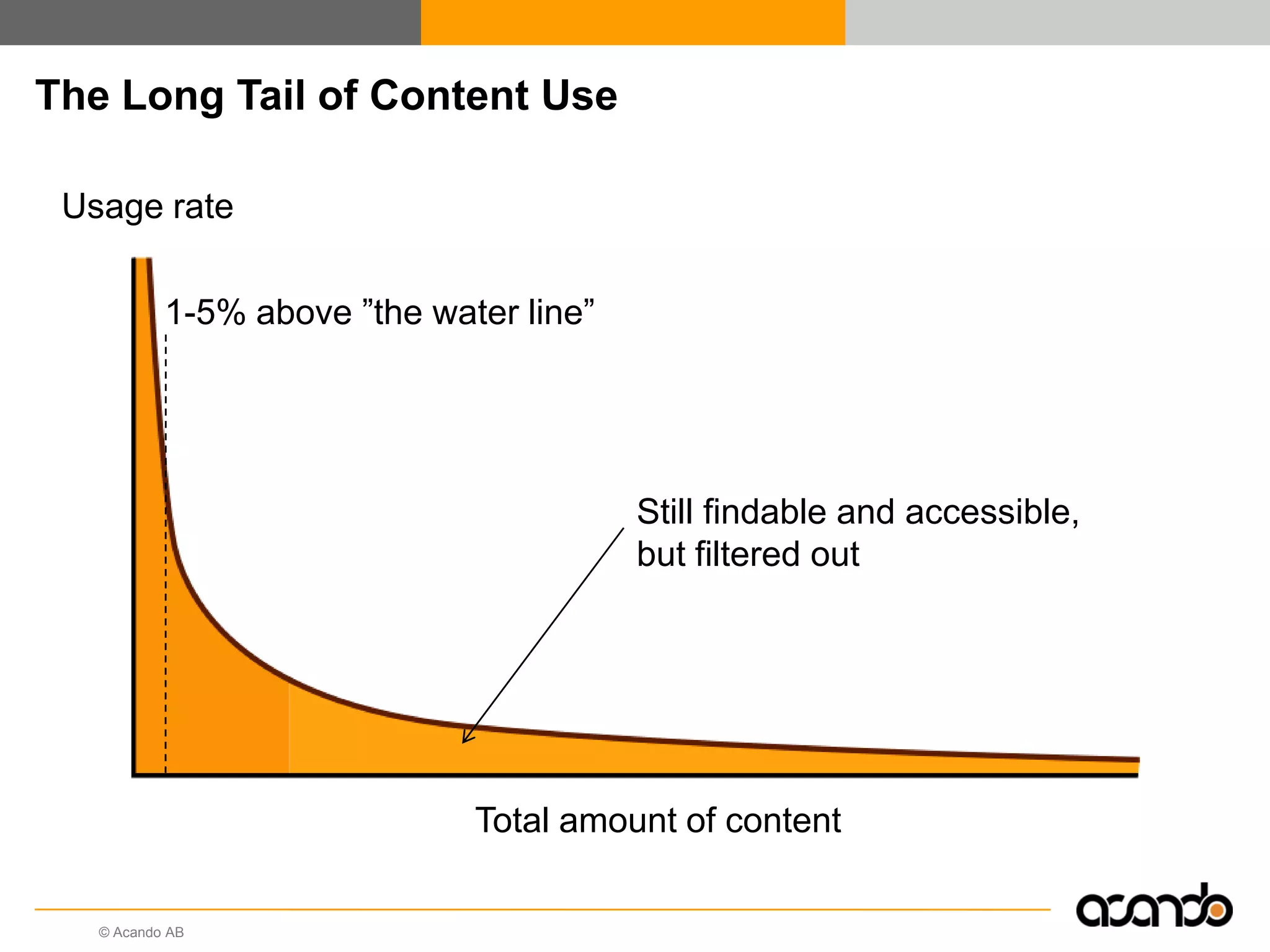
The Long Tail of Content Use
Usage rate
Total amount of content
1-5% above ”the water line”
Still findable and accessible,
but filtered out
© Acando AB
Social Tools Encouraging Disruptive Thinking at BT
© Acando AB
ENTERPRISE SYNDICATION
© Acando AB
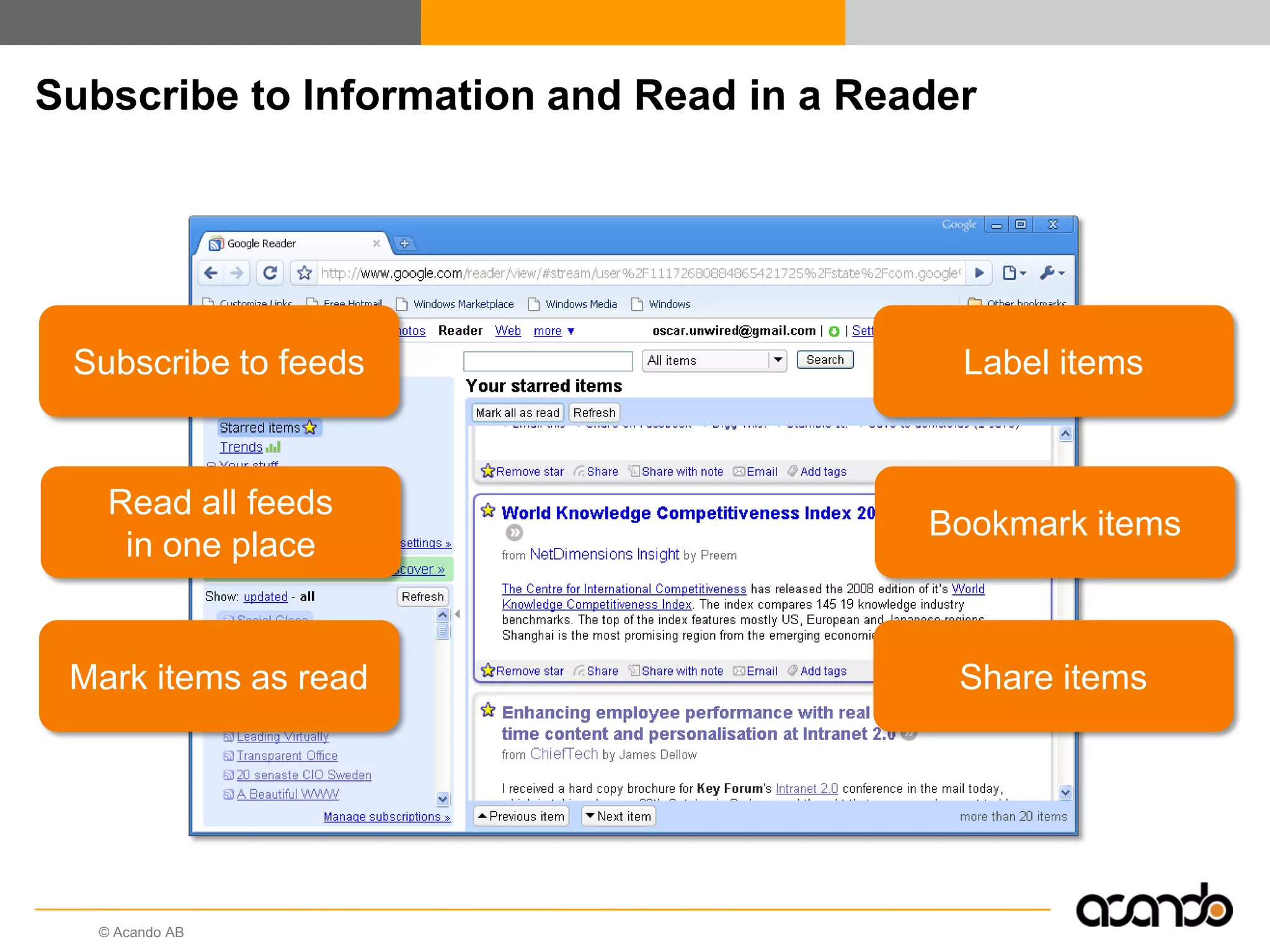
Subscribe to Information and Read in a Reader
Bookmark items
Share items
Label items
Read all feeds
in one place
Mark items as read
Subscribe to feeds
© Acando AB
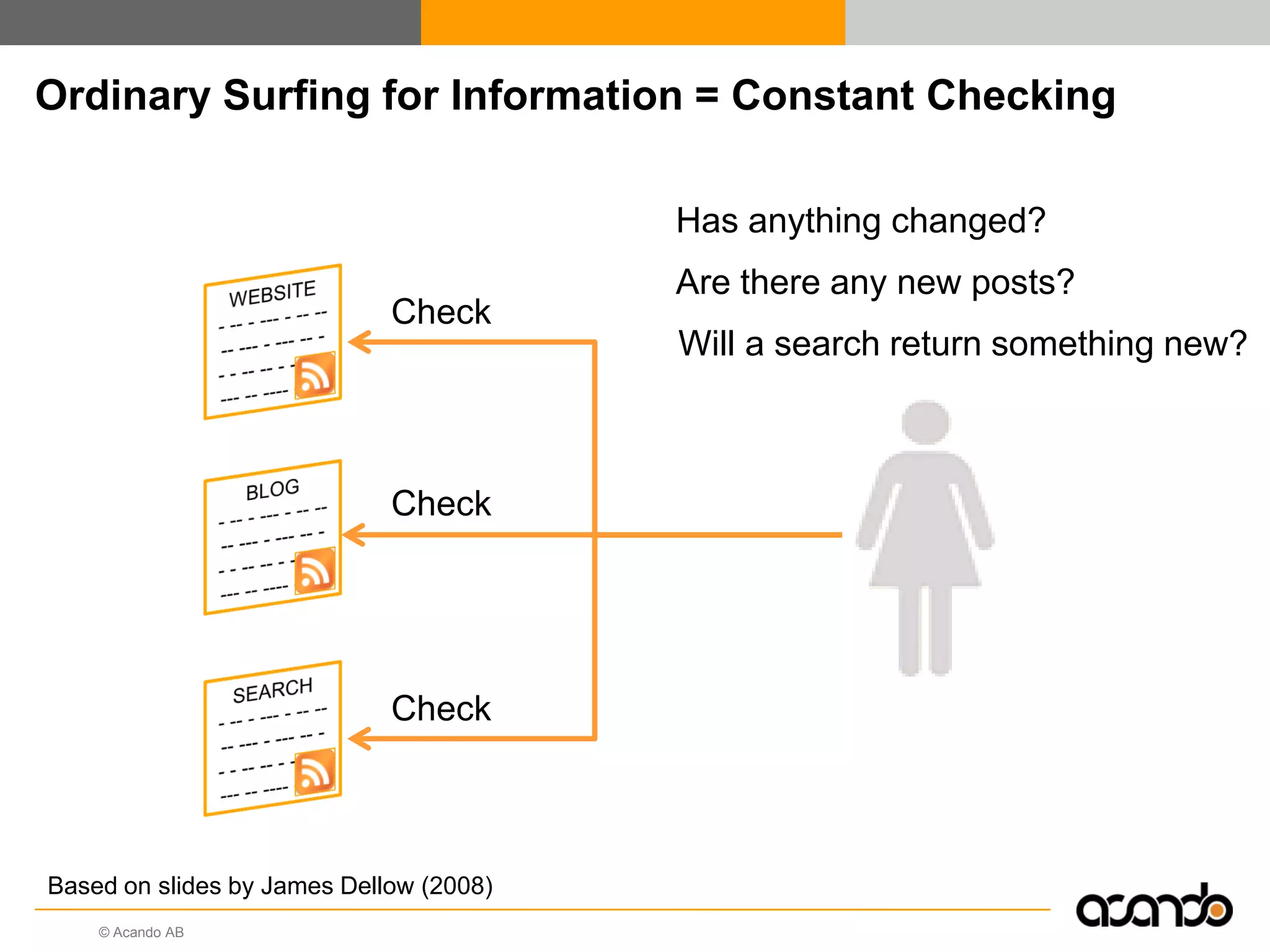
Has anything changed?
Are there any new posts?
Will a search return something new?
Ordinary Surfing for Information = Constant Checking
Check
Check
Check
Based on slides by James Dellow (2008)
© Acando AB
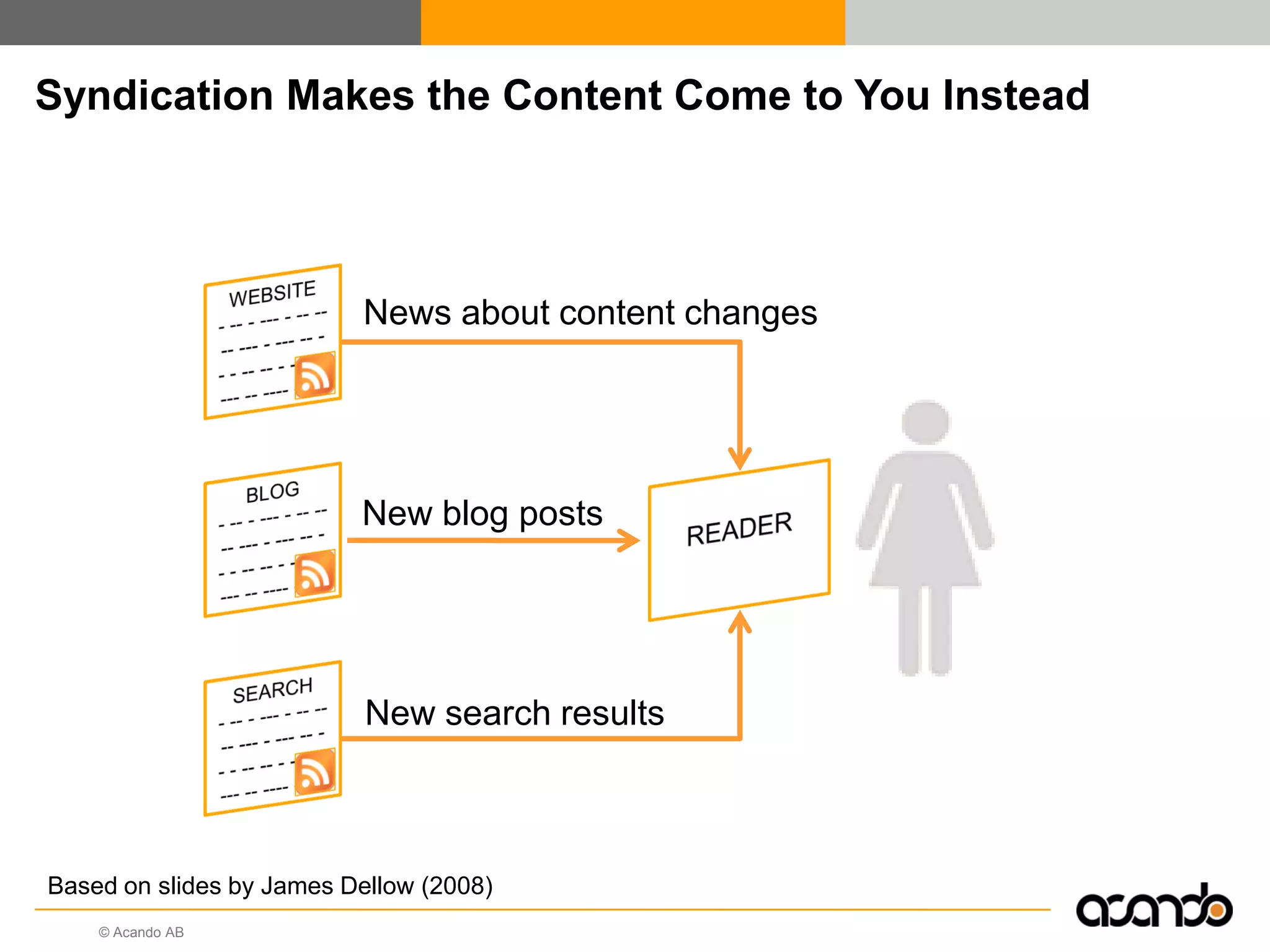
News about content changes
New blog posts
New search results
Syndication Makes the Content Come to You Instead
Based on slides by James Dellow (2008)
© Acando AB
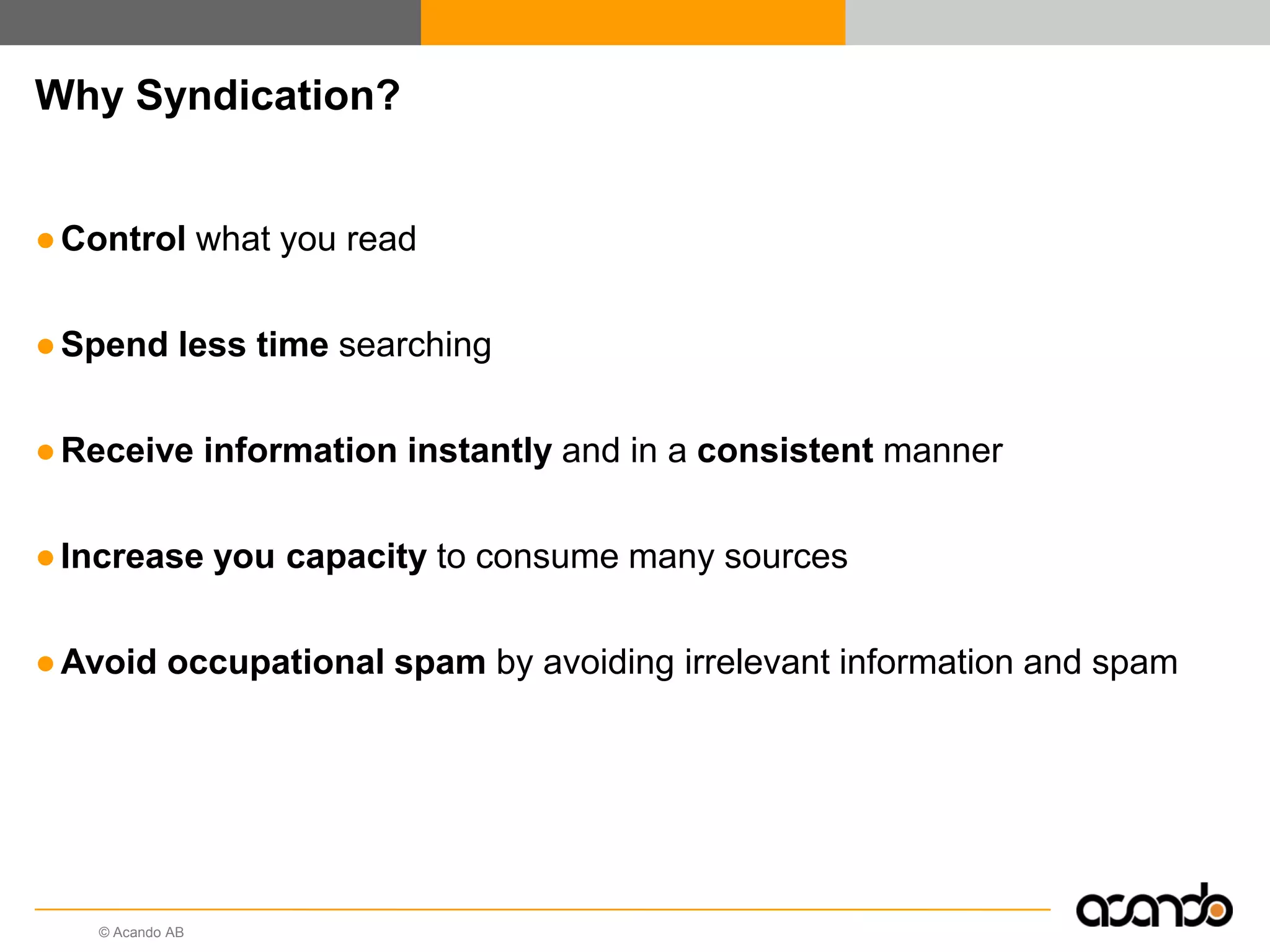
Why Syndication?
●Control what you read
●Spend less time searching
●Receive information instantly and in a consistent manner
●Increase you capacity to consume many sources
●Avoid occupational spam by avoiding irrelevant information and spam
© Acando AB
I
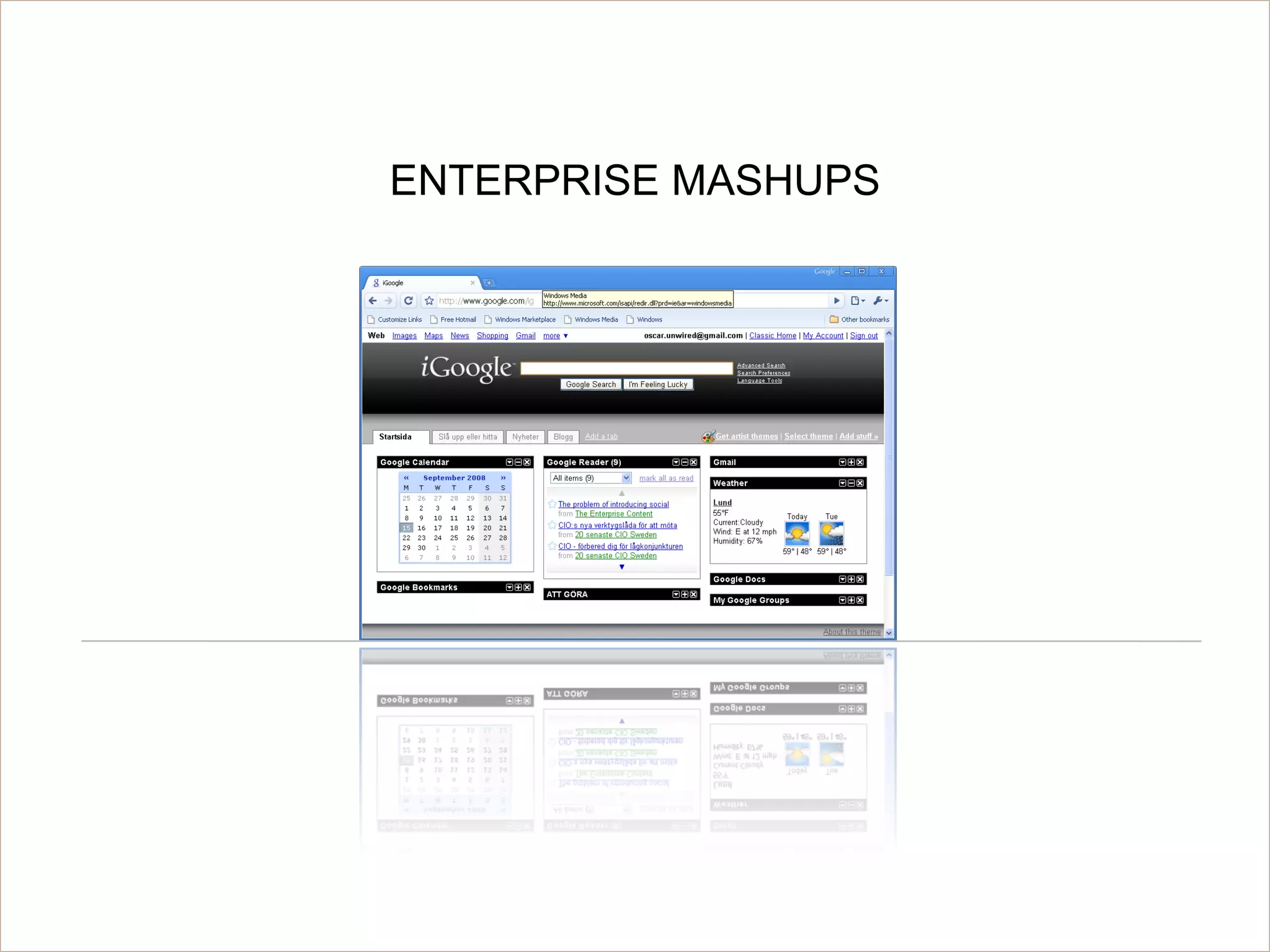
ENTERPRISE MASHUPS
© Acando AB
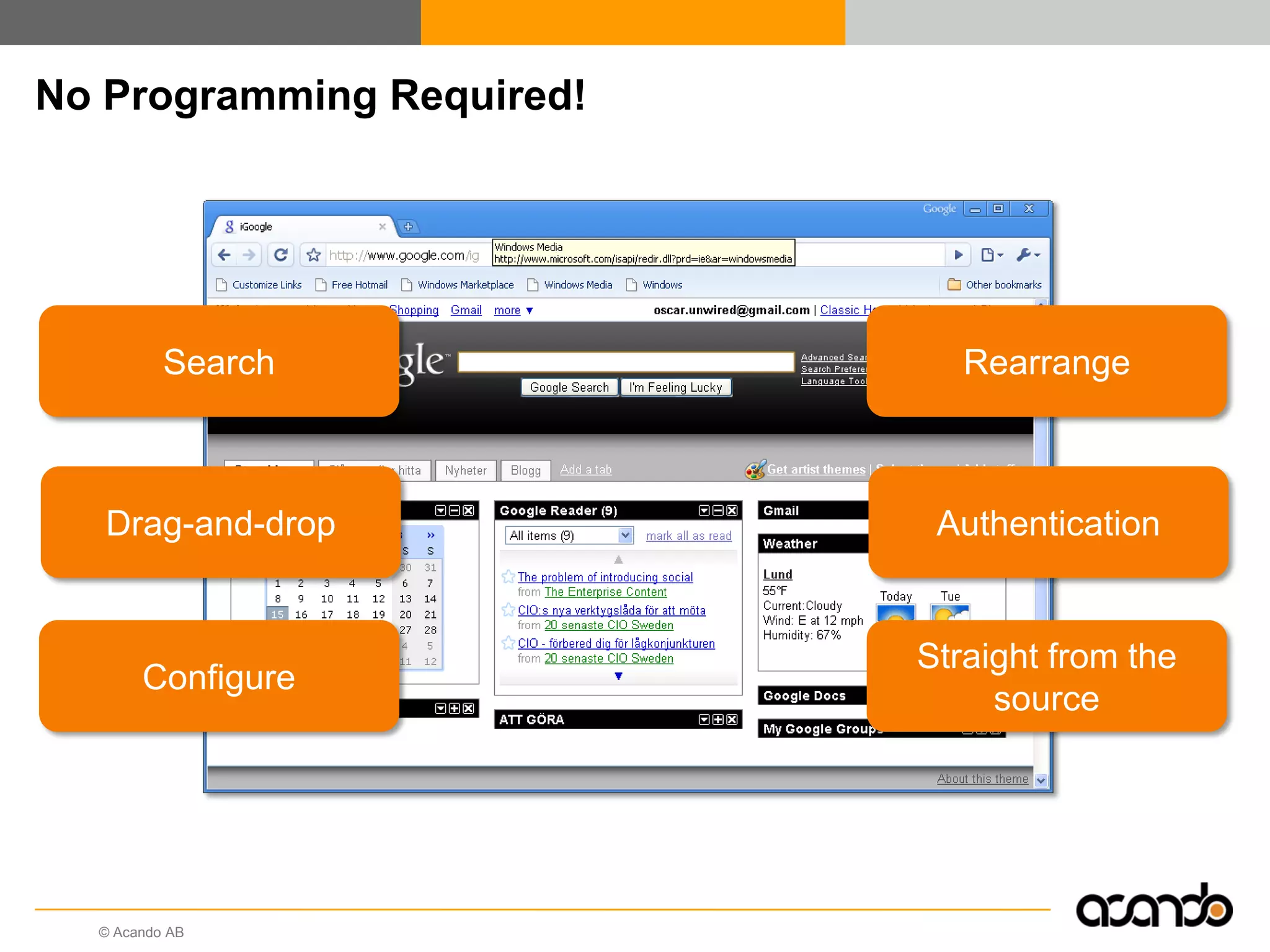
No Programming Required!
Authentication
Straight from the
source
Rearrange
Drag-and-drop
Configure
Search
© Acando AB
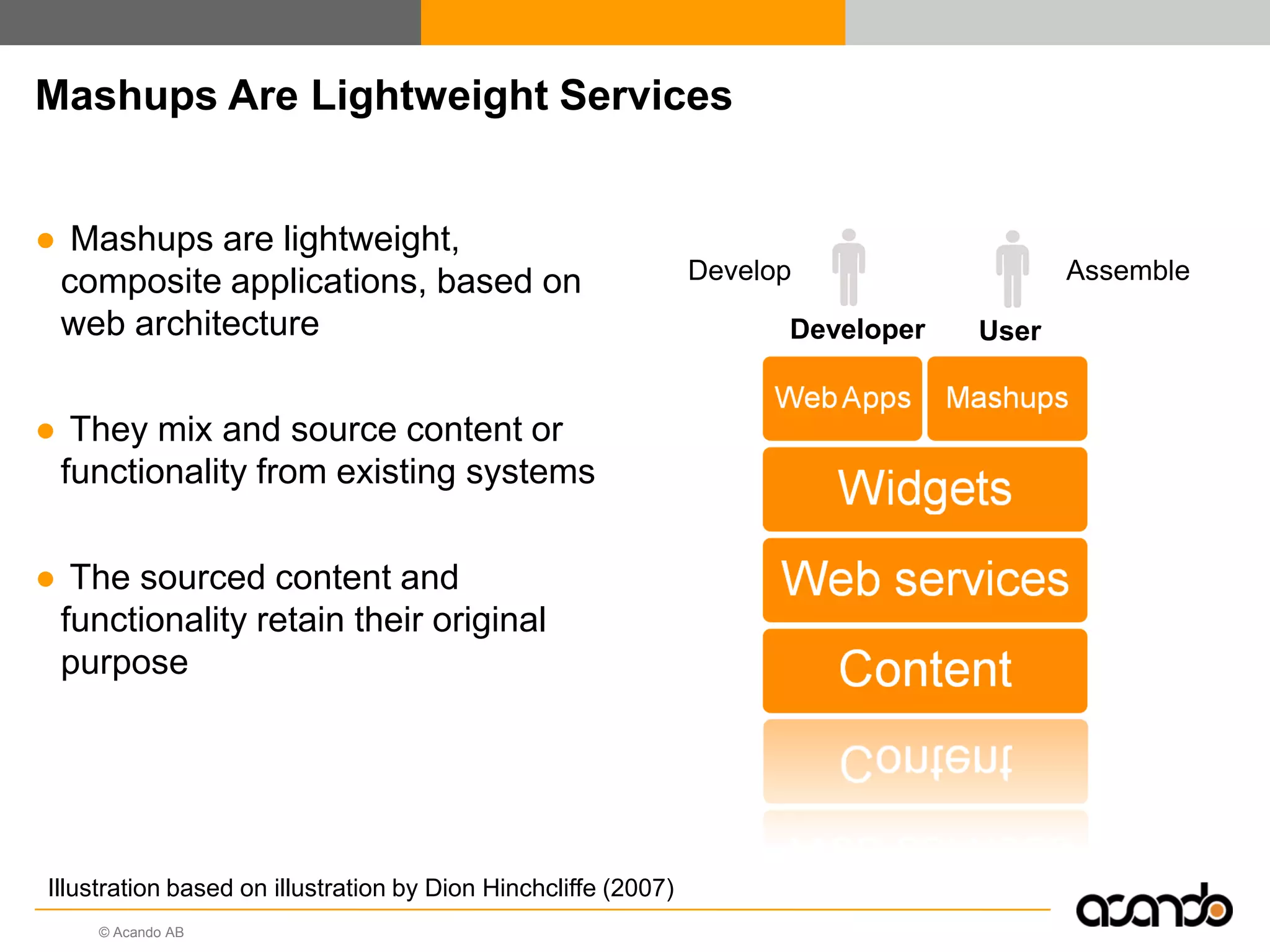
Mashups Are Lightweight Services
● Mashups are lightweight,
composite applications, based on
web architecture
● They mix and source content or
functionality from existing systems
● The sourced content and
functionality retain their original
purpose
Developer User
AssembleDevelop
Illustration based on illustration by Dion Hinchcliffe (2007)
© Acando AB
According to Gartner by 2010, 80% of
enterprise applications will be mashups.
© Acando AB
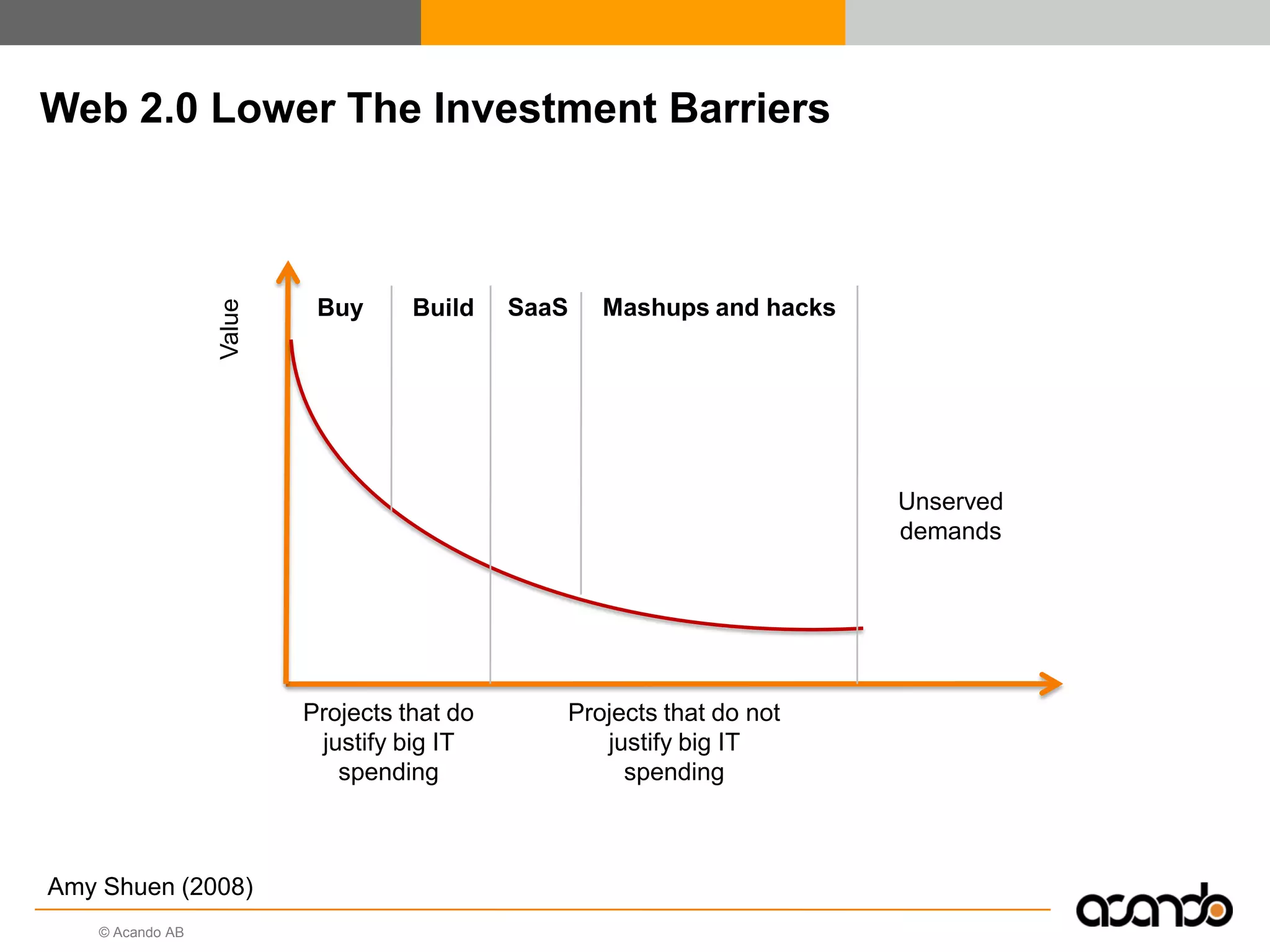
Web 2.0 Lower The Investment Barriers
Projects that do
justify big IT
spending
Value
Projects that do not
justify big IT
spending
Unserved
demands
Buy Build SaaS Mashups and hacks
Amy Shuen (2008)
© Acando AB
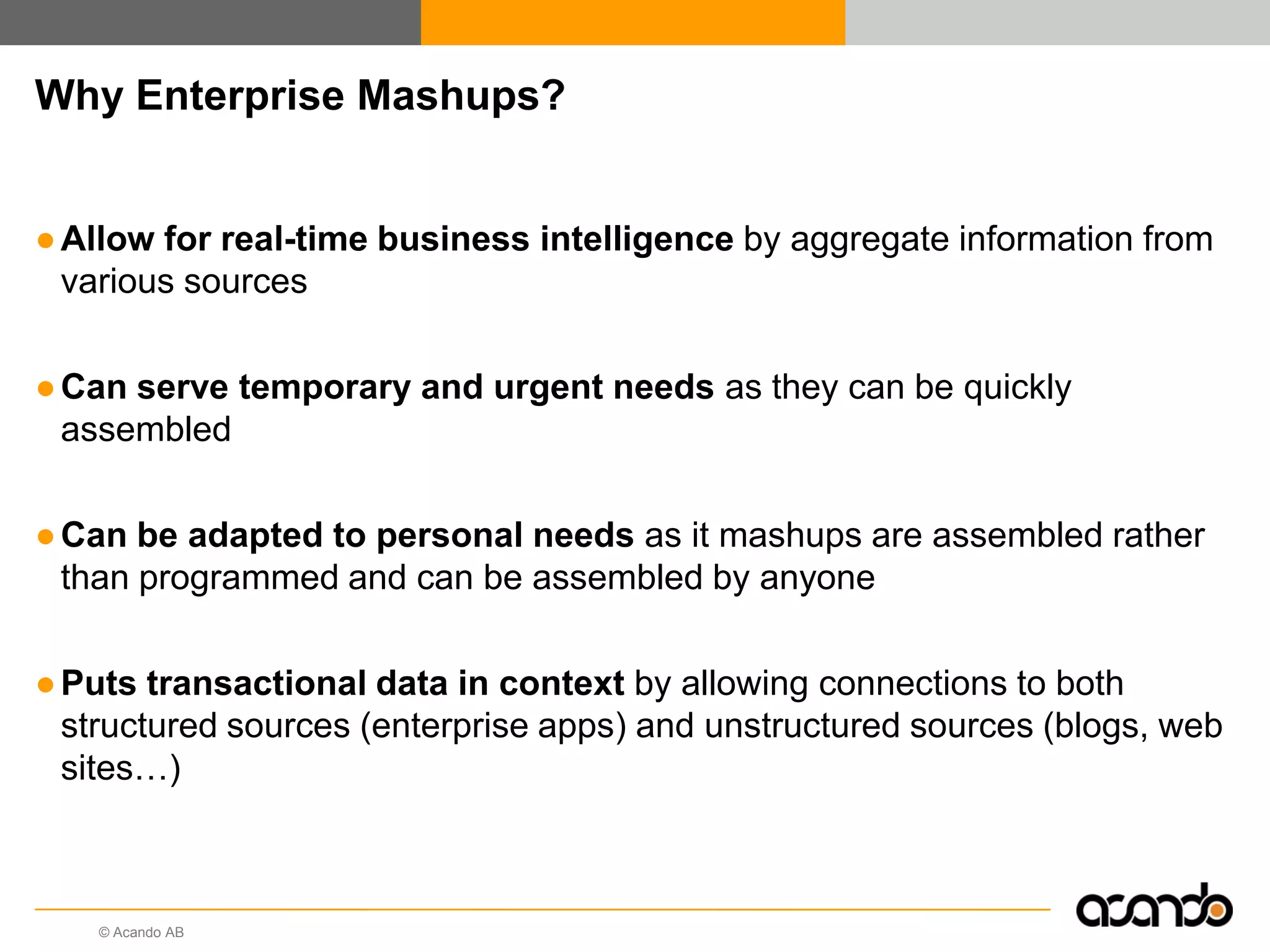
Why Enterprise Mashups?
●Allow for real-time business intelligence by aggregate information from
various sources
●Can serve temporary and urgent needs as they can be quickly
assembled
●Can be adapted to personal needs as it mashups are assembled rather
than programmed and can be assembled by anyone
●Puts transactional data in context by allowing connections to both
structured sources (enterprise apps) and unstructured sources (blogs, web
sites…)
© Acando AB
© Acando AB
Collaboration in Practice
© Acando AB
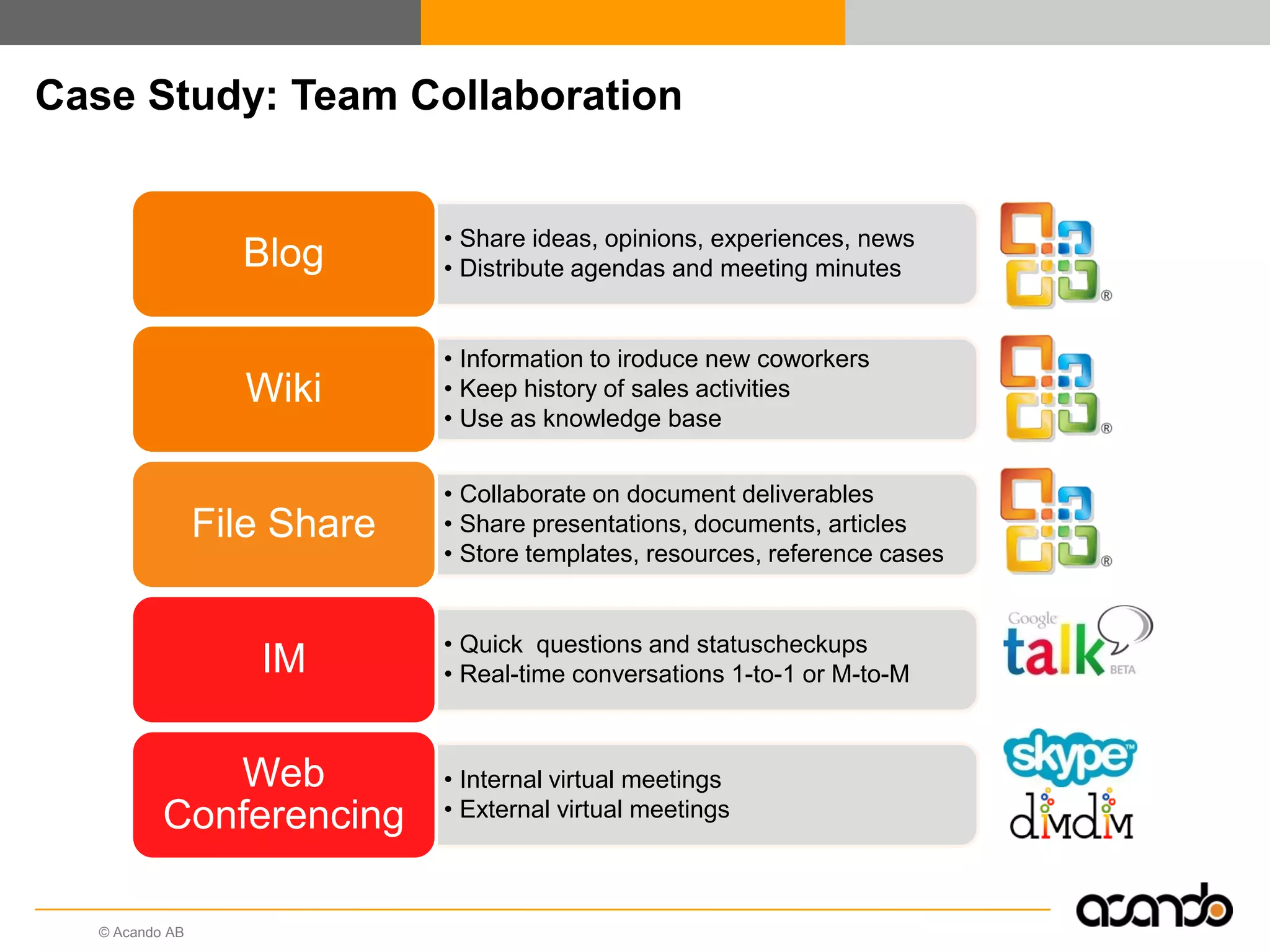
Case Study: Team Collaboration
• Share ideas, opinions, experiences, news
• Distribute agendas and meeting minutesBlog
• Information to iroduce new coworkers
• Keep history of sales activities
• Use as knowledge base
Wiki
• Collaborate on document deliverables
• Share presentations, documents, articles
• Store templates, resources, reference cases
File Share
• Quick questions and statuscheckups
• Real-time conversations 1-to-1 or M-to-MIM
• Internal virtual meetings
• External virtual meetings
Web
Conferencing
© Acando AB
© Acando AB
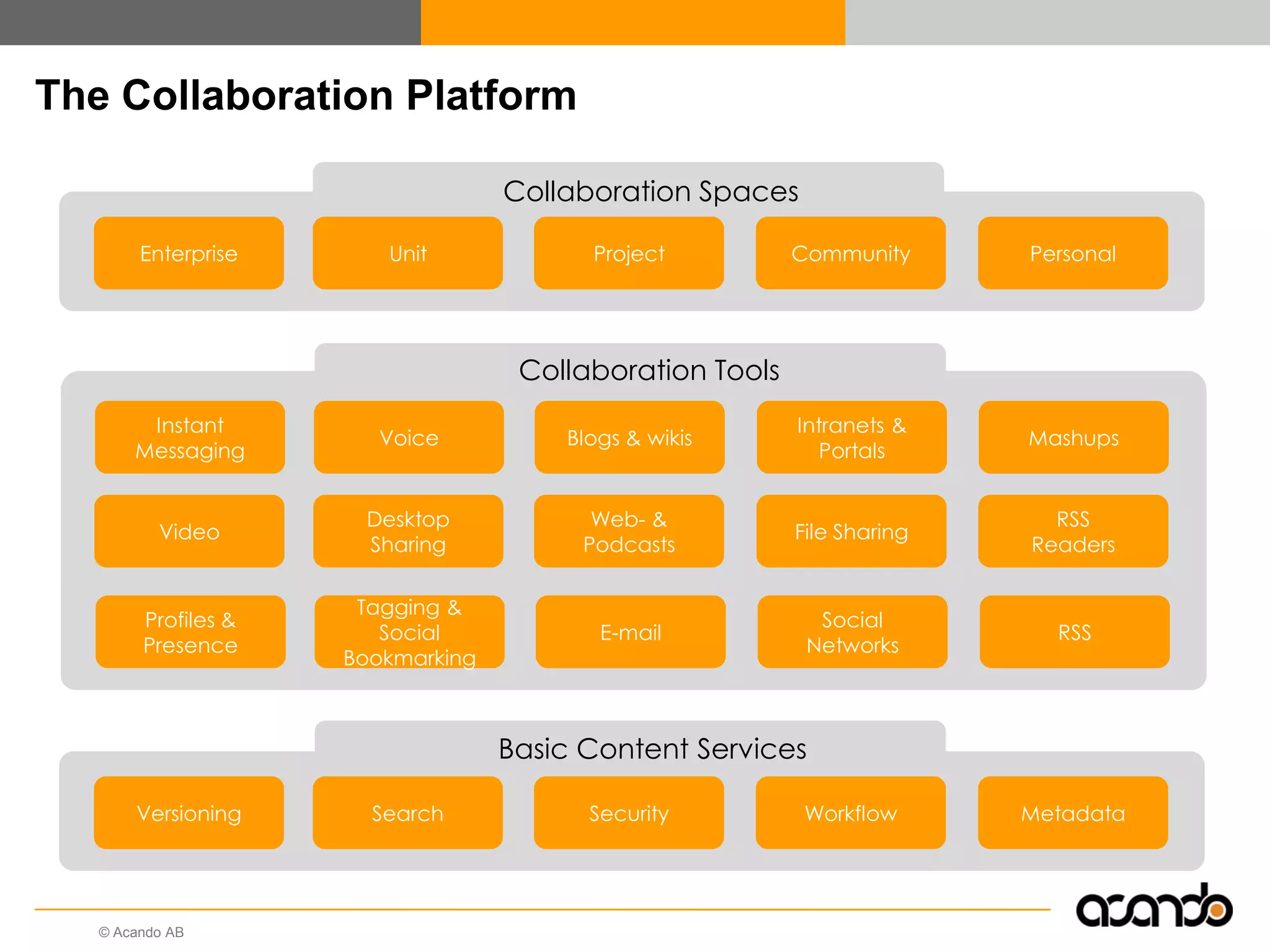
The Collaboration Platform
© Acando AB
© Acando AB
The Collaboration Platform
Collaboration Spaces
Enterprise Unit Project Community Personal
Collaboration Tools
Instant
Messaging
Voice
Video
Desktop
Sharing
Blogs & wikis
Intranets &
Portals
Web- &
Podcasts
File Sharing
Mashups
RSS
Readers
Profiles &
Presence
Tagging &
Social
Bookmarking
E-mail
Social
Networks
RSS
Versioning Search Security Workflow Metadata
Basic Content Services
© Acando AB
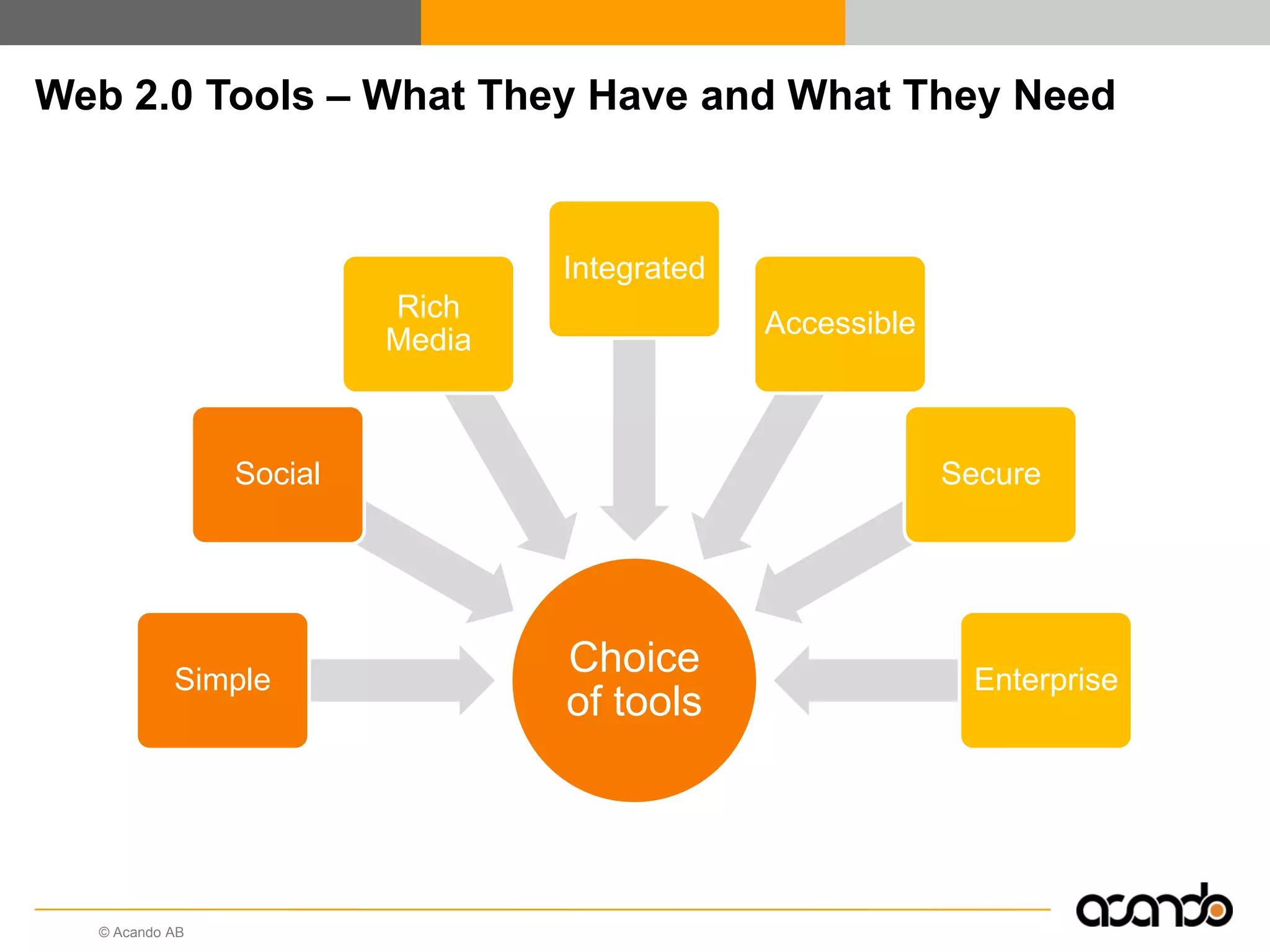
Web 2.0 Tools – What They Have and What They Need
Choice
of tools
Simple
Social
Rich
Media
Integrated
Accessible
Secure
Enterprise
© Acando AB
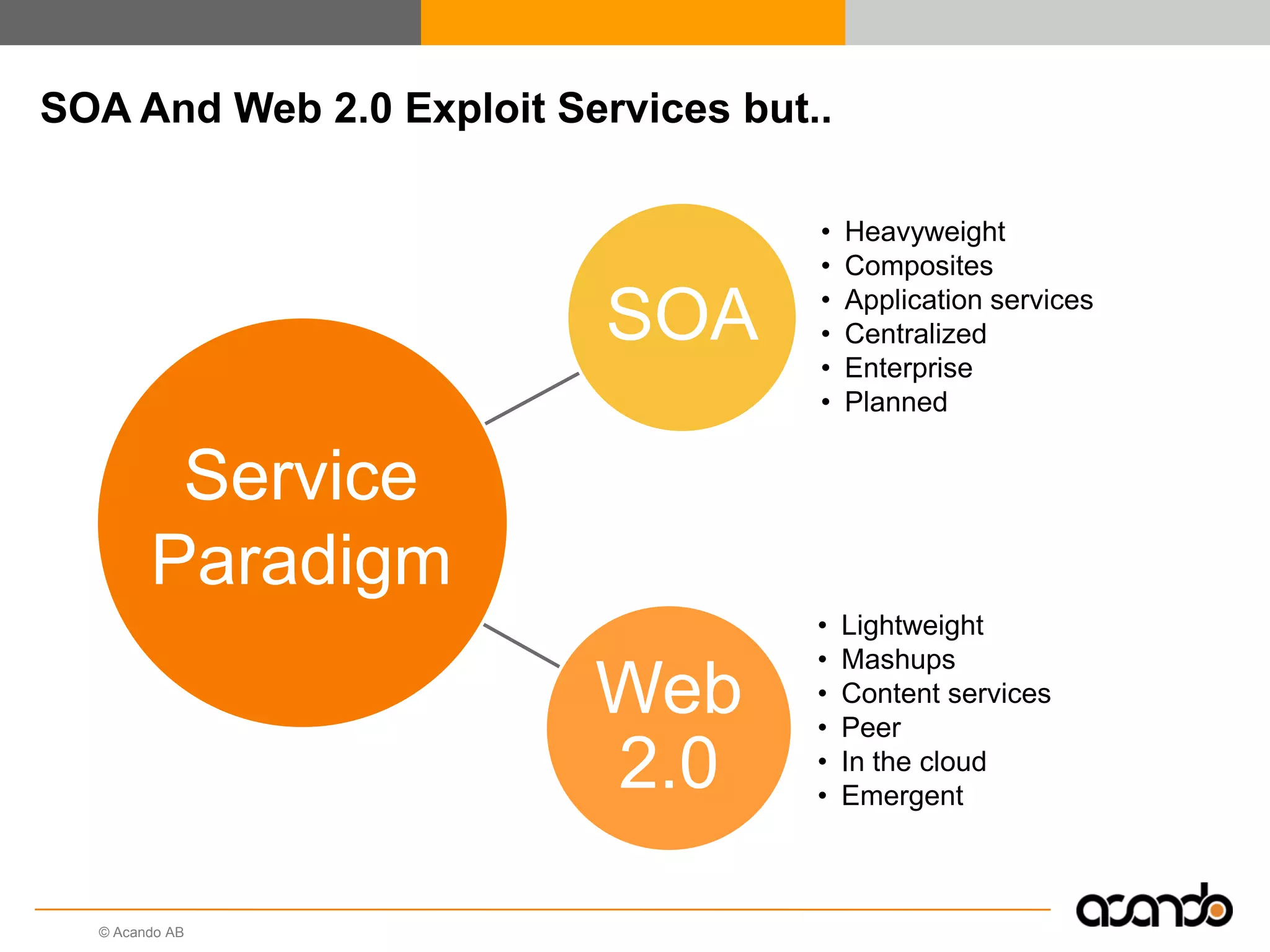
SOA And Web 2.0 Exploit Services but..
SOA
• Heavyweight
• Composites
• Application services
• Centralized
• Enterprise
• Planned
Web
2.0
• Lightweight
• Mashups
• Content services
• Peer
• In the cloud
• Emergent
Service
Paradigm
© Acando AB
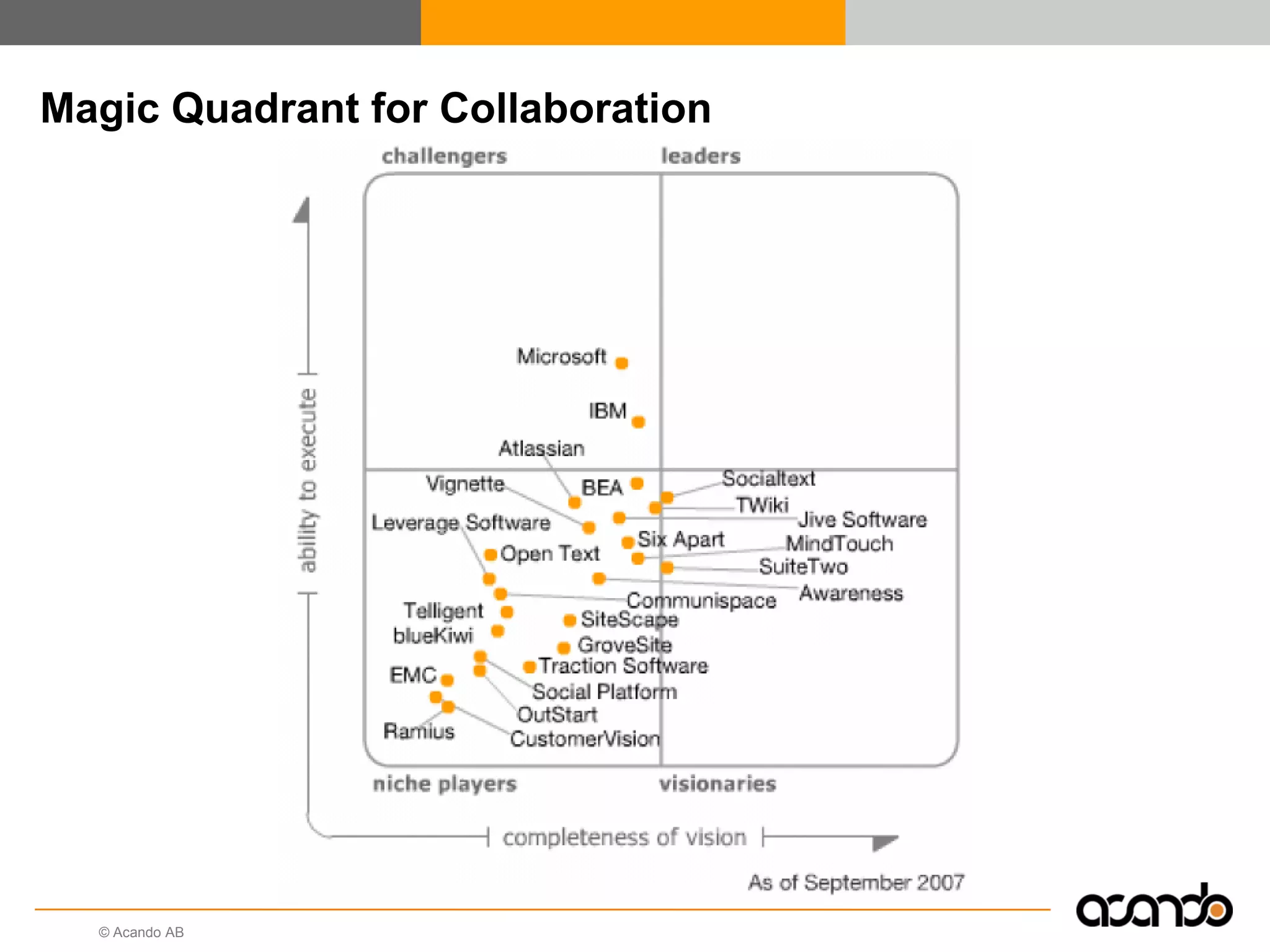
Magic Quadrant for Collaboration
© Acando AB
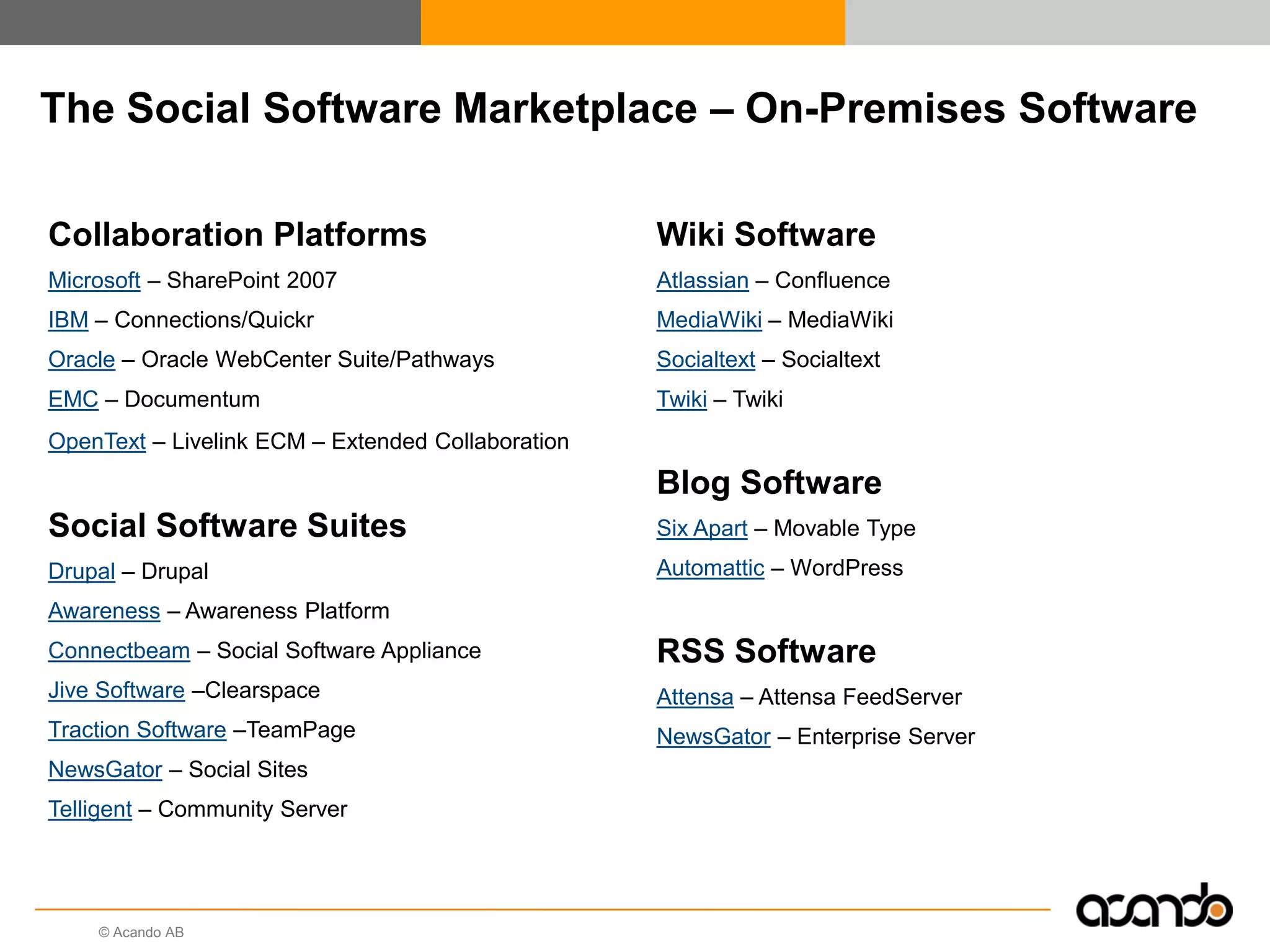
The Social Software Marketplace – On-Premises Software
Collaboration Platforms
Microsoft – SharePoint 2007
IBM – Connections/Quickr
Oracle – Oracle WebCenter Suite/Pathways
EMC – Documentum
OpenText – Livelink ECM – Extended Collaboration
Social Software Suites
Drupal – Drupal
Awareness – Awareness Platform
Connectbeam – Social Software Appliance
Jive Software –Clearspace
Traction Software –TeamPage
NewsGator – Social Sites
Telligent – Community Server
Wiki Software
Atlassian – Confluence
MediaWiki – MediaWiki
Socialtext – Socialtext
Twiki – Twiki
Blog Software
Six Apart – Movable Type
Automattic – WordPress
RSS Software
Attensa – Attensa FeedServer
NewsGator – Enterprise Server
© Acando AB
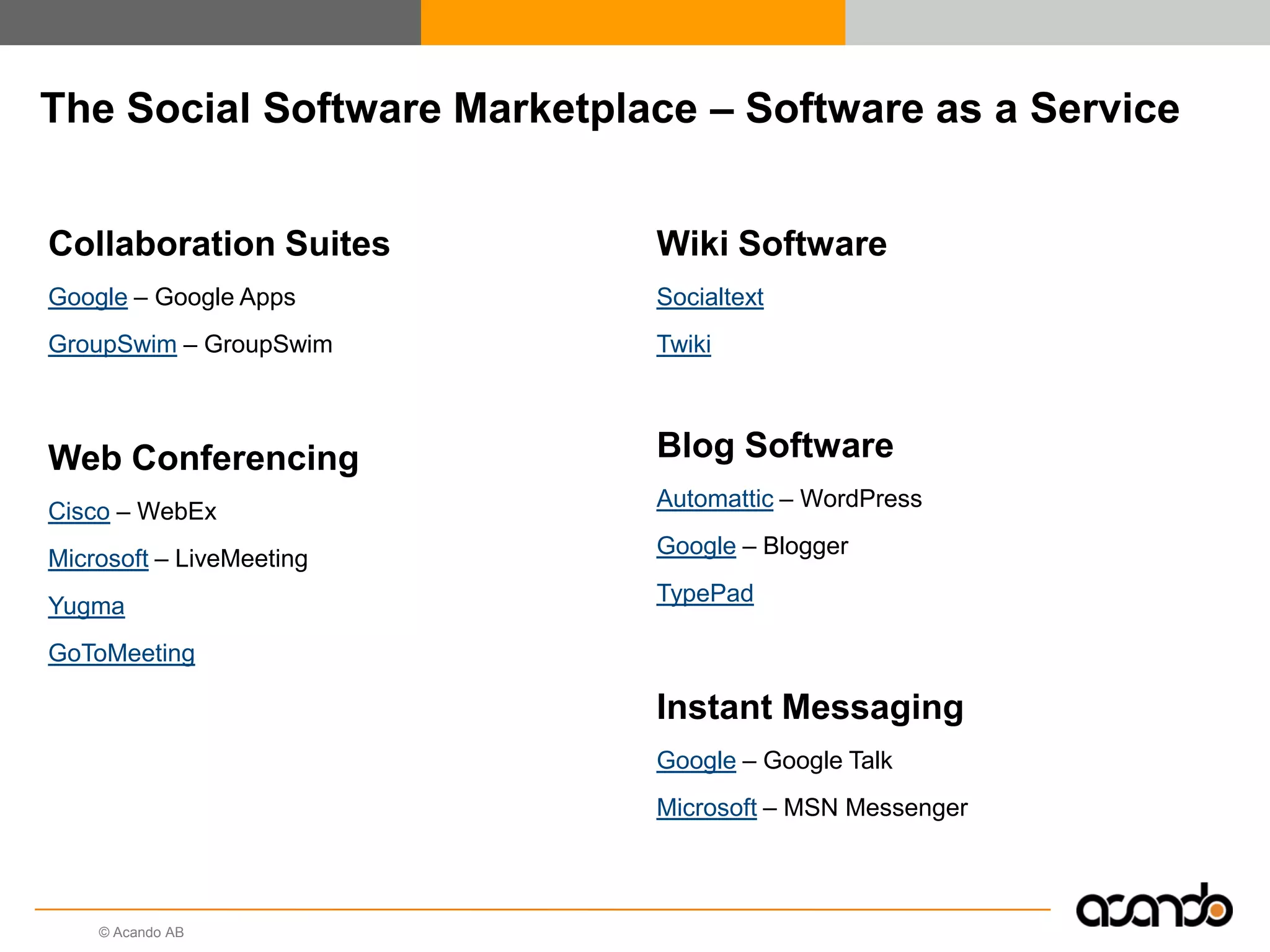
The Social Software Marketplace – Software as a Service
Collaboration Suites
Google – Google Apps
GroupSwim – GroupSwim
Web Conferencing
Cisco – WebEx
Microsoft – LiveMeeting
Yugma
GoToMeeting
Wiki Software
Socialtext
Twiki
Blog Software
Automattic – WordPress
Google – Blogger
TypePad
Instant Messaging
Google – Google Talk
Microsoft – MSN Messenger
© Acando AB
PART III
Approaching Web 2.0 at Work
© Acando AB
100
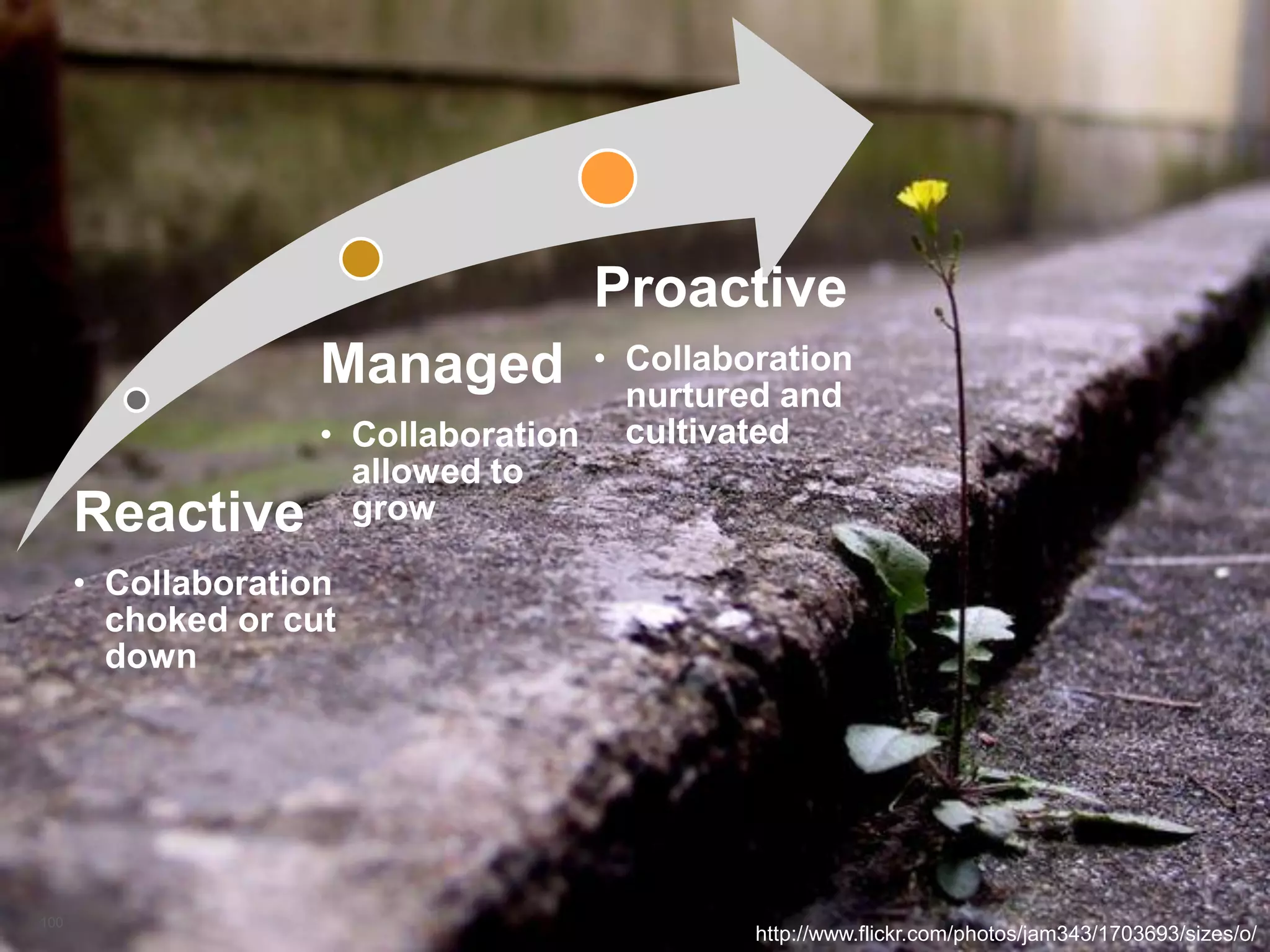
Reactive
• Collaboration
choked or cut
down
Managed
• Collaboration
allowed to
grow
Proactive
• Collaboration
nurtured and
cultivated
http://www.flickr.com/photos/jam343/1703693/sizes/o/
© Acando AB
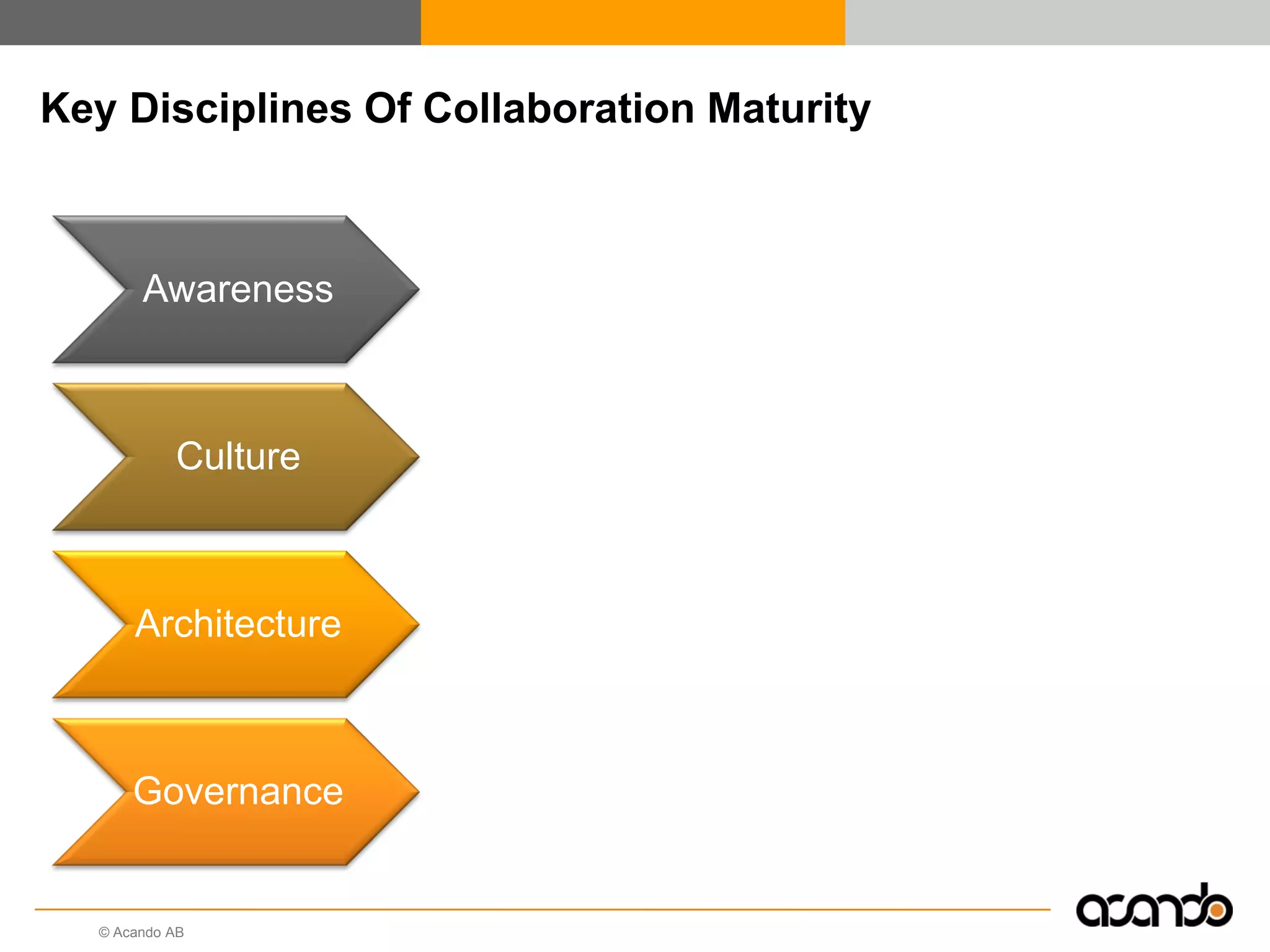
Key Disciplines Of Collaboration Maturity
Awareness
Culture
Architecture
Governance
© Acando AB
Key Disciplines Of Collaboration Maturity
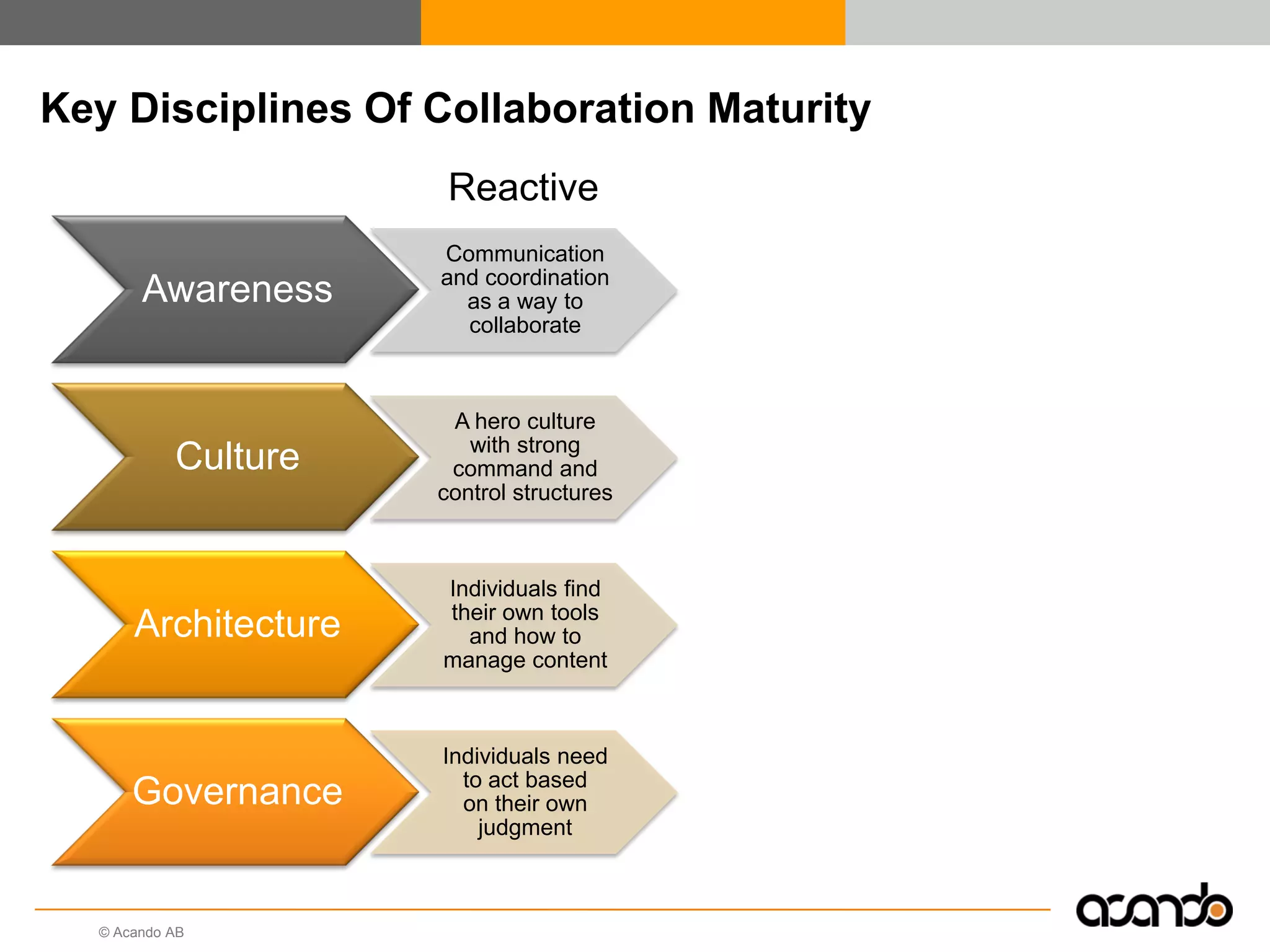
Awareness
Communication
and coordination
as a way to
collaborate
Culture
A hero culture
with strong
command and
control structures
Architecture
Individuals find
their own tools
and how to
manage content
Governance
Individuals need
to act based
on their own
judgment
Reactive
© Acando AB
Key Disciplines Of Collaboration Maturity
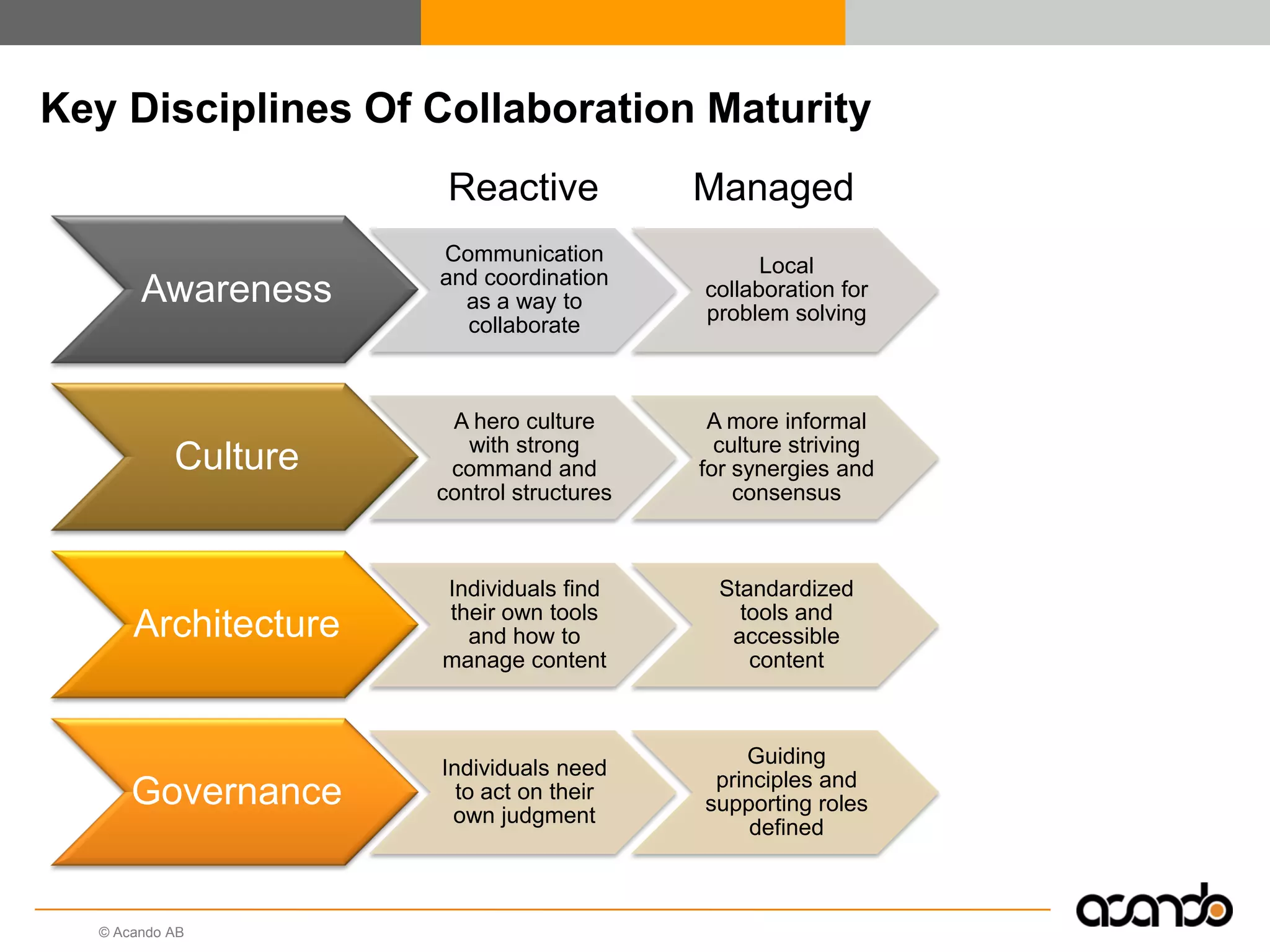
Awareness
Communication
and coordination
as a way to
collaborate
Local
collaboration for
problem solving
Culture
A hero culture
with strong
command and
control structures
A more informal
culture striving
for synergies and
consensus
Architecture
Individuals find
their own tools
and how to
manage content
Standardized
tools and
accessible
content
Governance
Individuals need
to act on their
own judgment
Guiding
principles and
supporting roles
defined
Reactive Managed
© Acando AB
Key Disciplines Of Collaboration Maturity
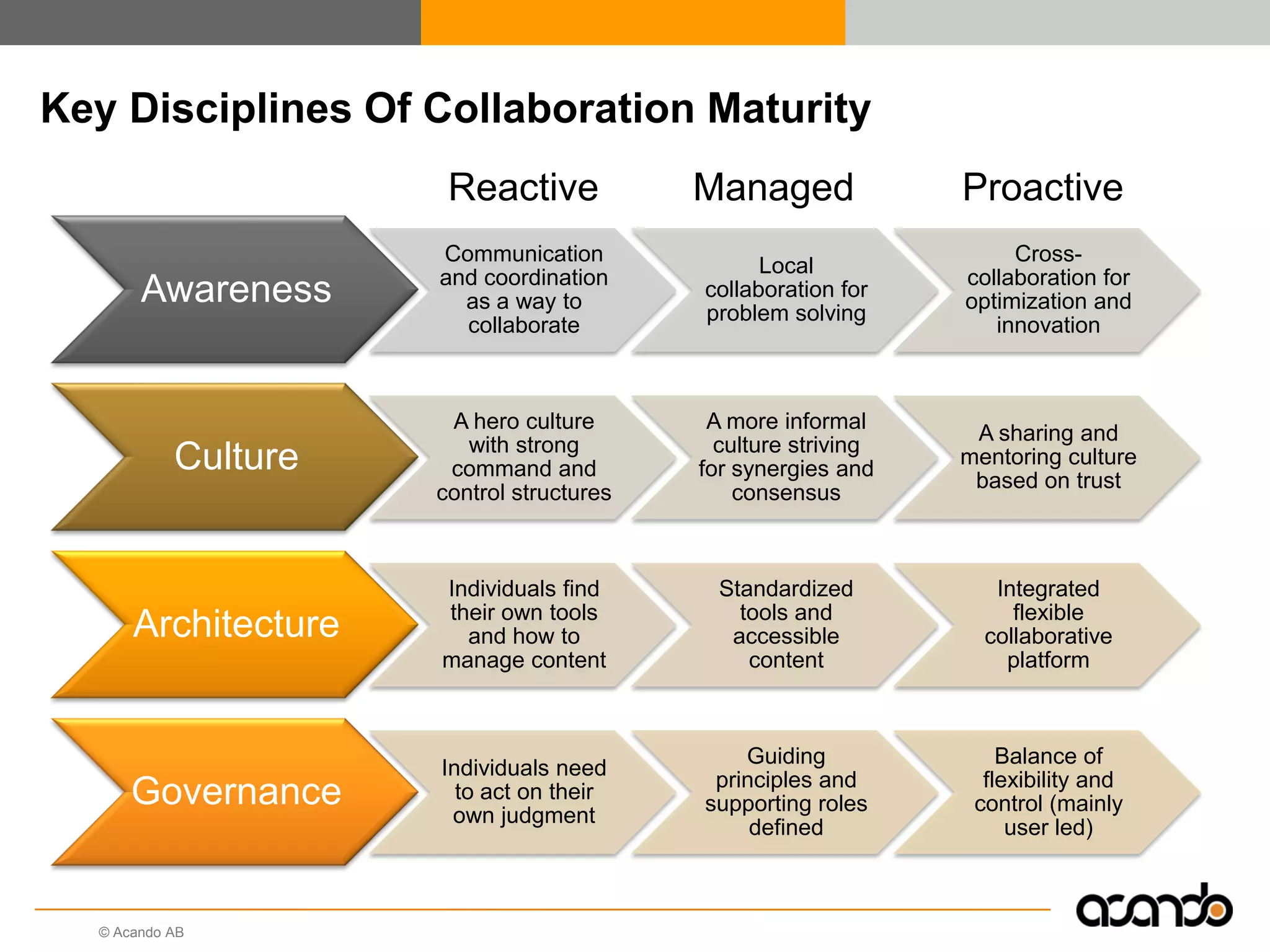
Awareness
Communication
and coordination
as a way to
collaborate
Local
collaboration for
problem solving
Cross-
collaboration for
optimization and
innovation
Culture
A hero culture
with strong
command and
control structures
A more informal
culture striving
for synergies and
consensus
A sharing and
mentoring culture
based on trust
Architecture
Individuals find
their own tools
and how to
manage content
Standardized
tools and
accessible
content
Integrated
flexible
collaborative
platform
Governance
Individuals need
to act on their
own judgment
Guiding
principles and
supporting roles
defined
Balance of
flexibility and
control (mainly
user led)
Reactive Managed Proactive
© Acando AB
Governance For The Formal And Informal
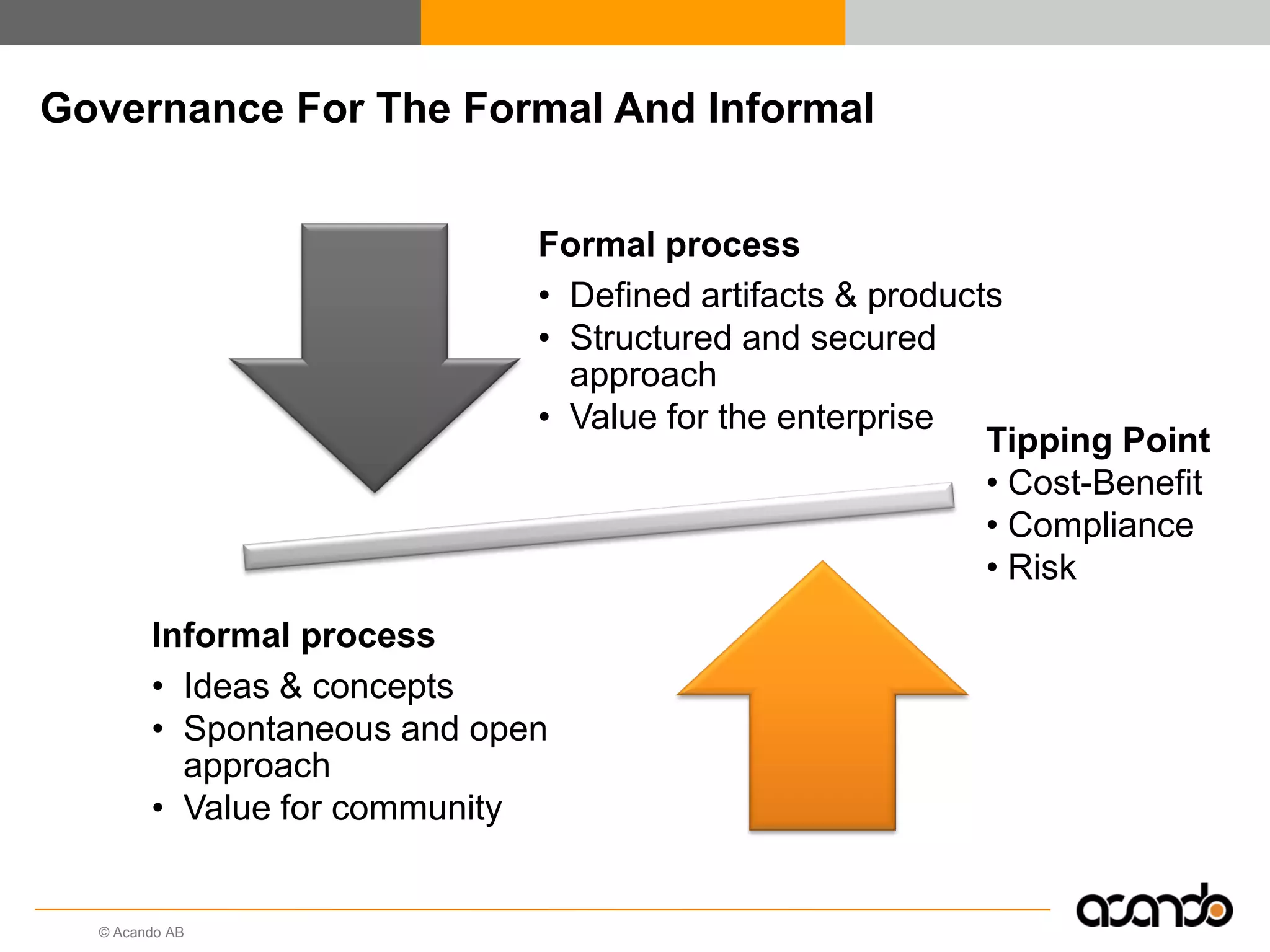
Formal process
• Defined artifacts & products
• Structured and secured
approach
• Value for the enterprise
Informal process
• Ideas & concepts
• Spontaneous and open
approach
• Value for community
Tipping Point
• Cost-Benefit
• Compliance
• Risk
© Acando AB
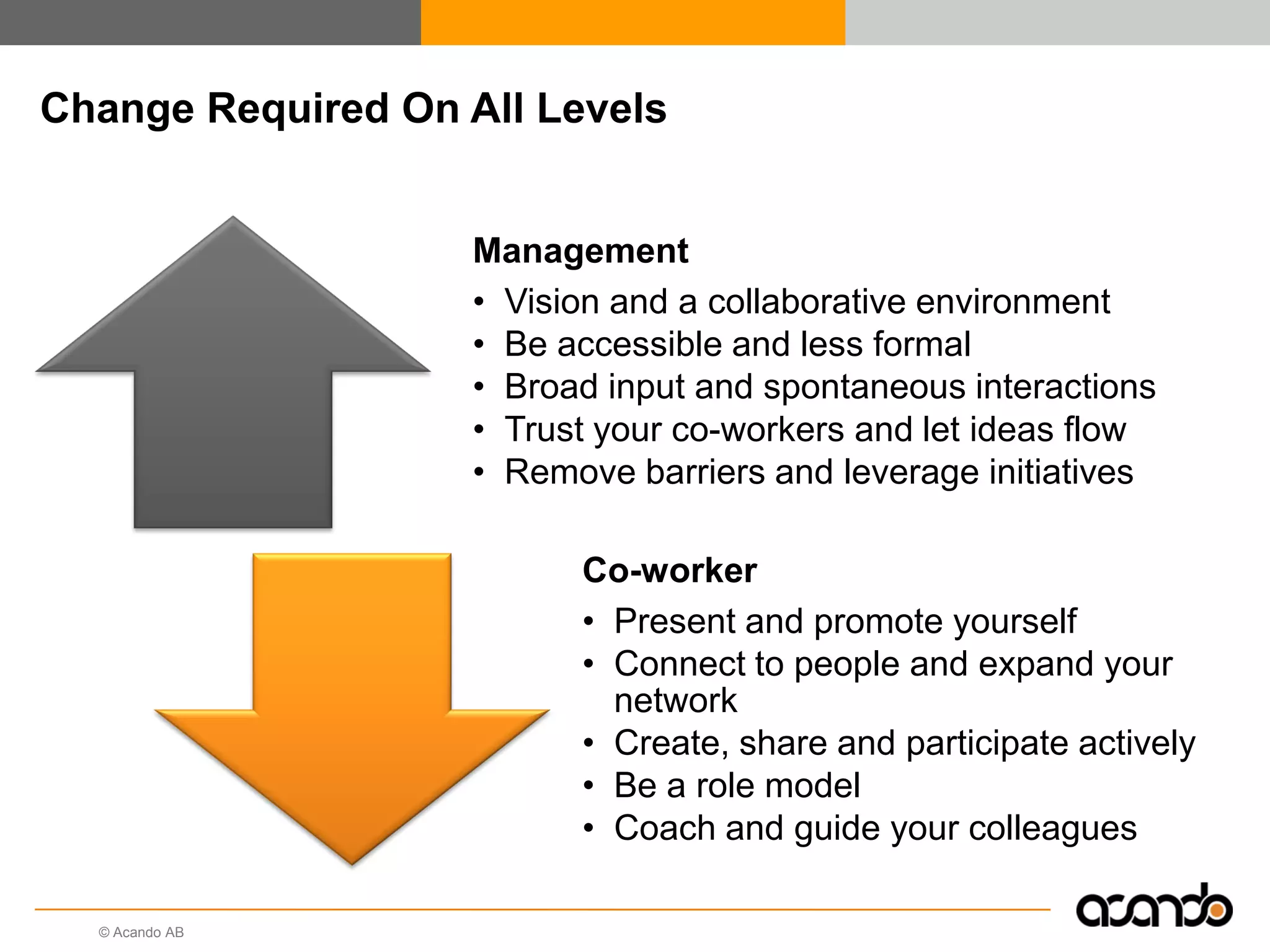
Change Required On All Levels
Management
• Vision and a collaborative environment
• Be accessible and less formal
• Broad input and spontaneous interactions
• Trust your co-workers and let ideas flow
• Remove barriers and leverage initiatives
Co-worker
• Present and promote yourself
• Connect to people and expand your
network
• Create, share and participate actively
• Be a role model
• Coach and guide your colleagues
© Acando AB
Realize that Enterprise Web 2.0 is
unavoidable. Begin planning how to
deploy effective Web 2.0 capabilities
for maximum business value.
Anthony Bradley
Gartner
“
”
© Acando AB
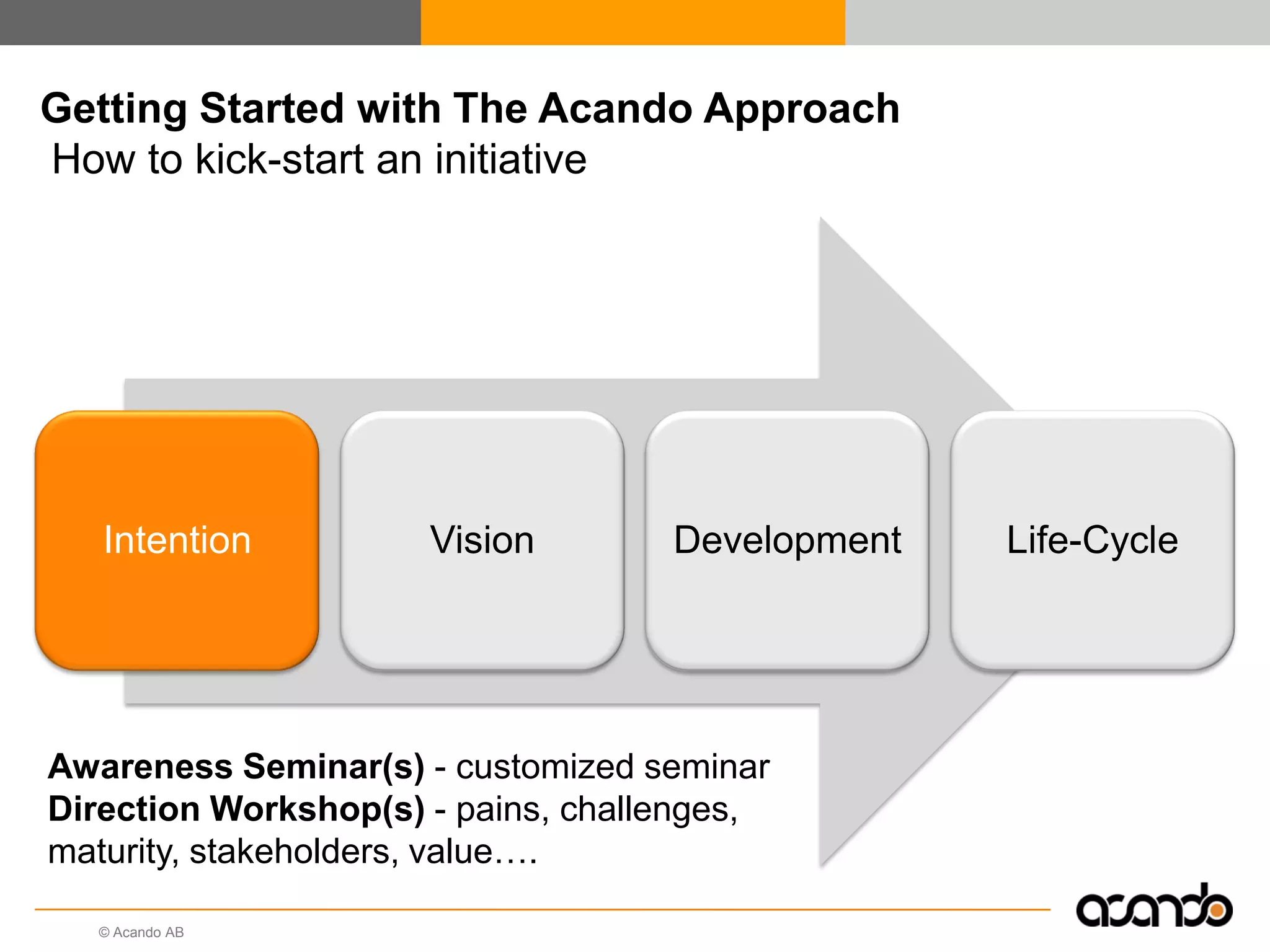
Getting Started with The Acando Approach
How to kick-start an initiative
Intention Vision Development Life-Cycle
Awareness Seminar(s) - customized seminar
Direction Workshop(s) - pains, challenges,
maturity, stakeholders, value….
© Acando AB
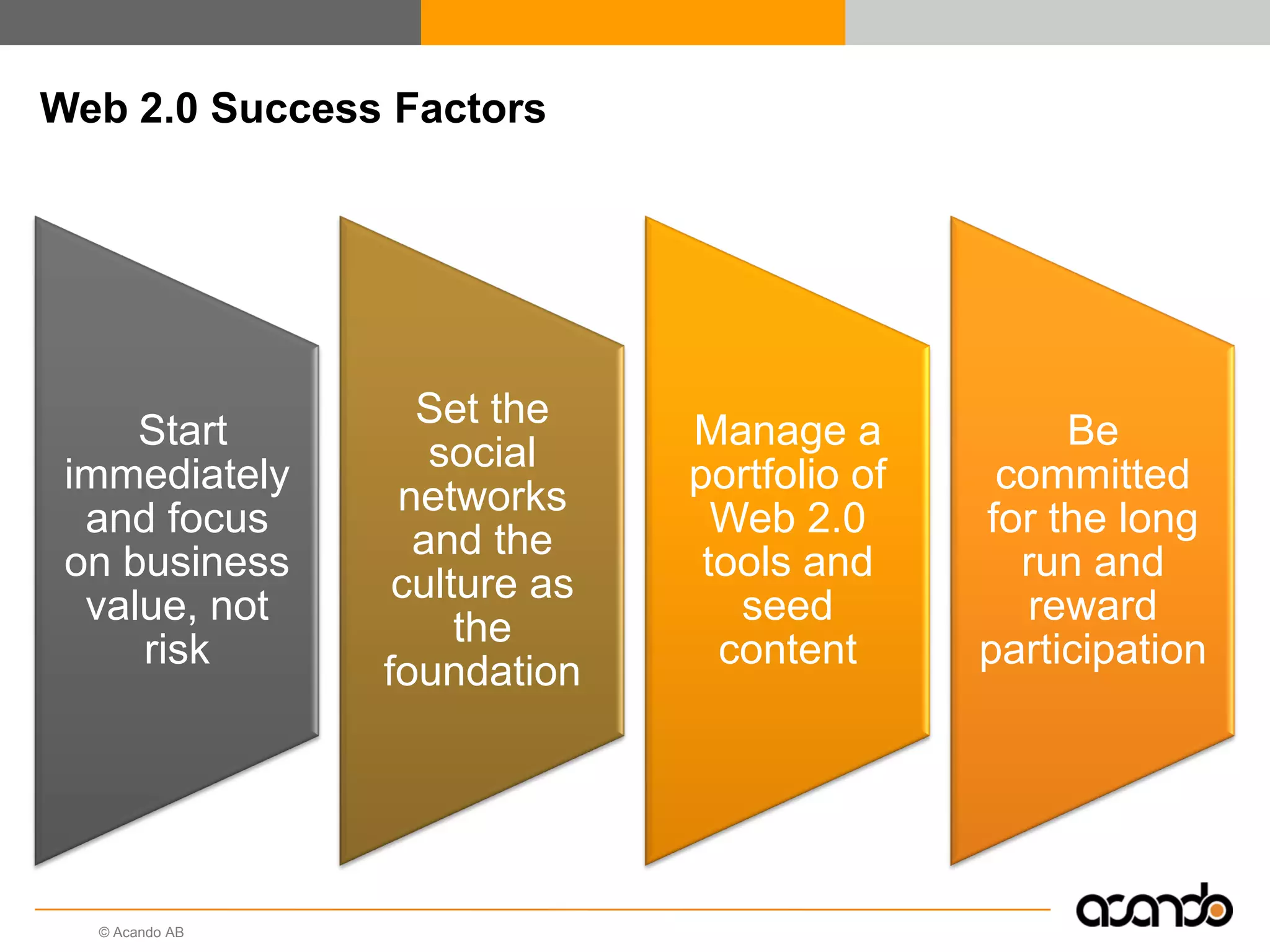
Web 2.0 Success Factors
Start
immediately
and focus
on business
value, not
risk
Set the
social
networks
and the
culture as
the
foundation
Manage a
portfolio of
Web 2.0
tools and
seed
content
Be
committed
for the long
run and
reward
participation
© Acando AB
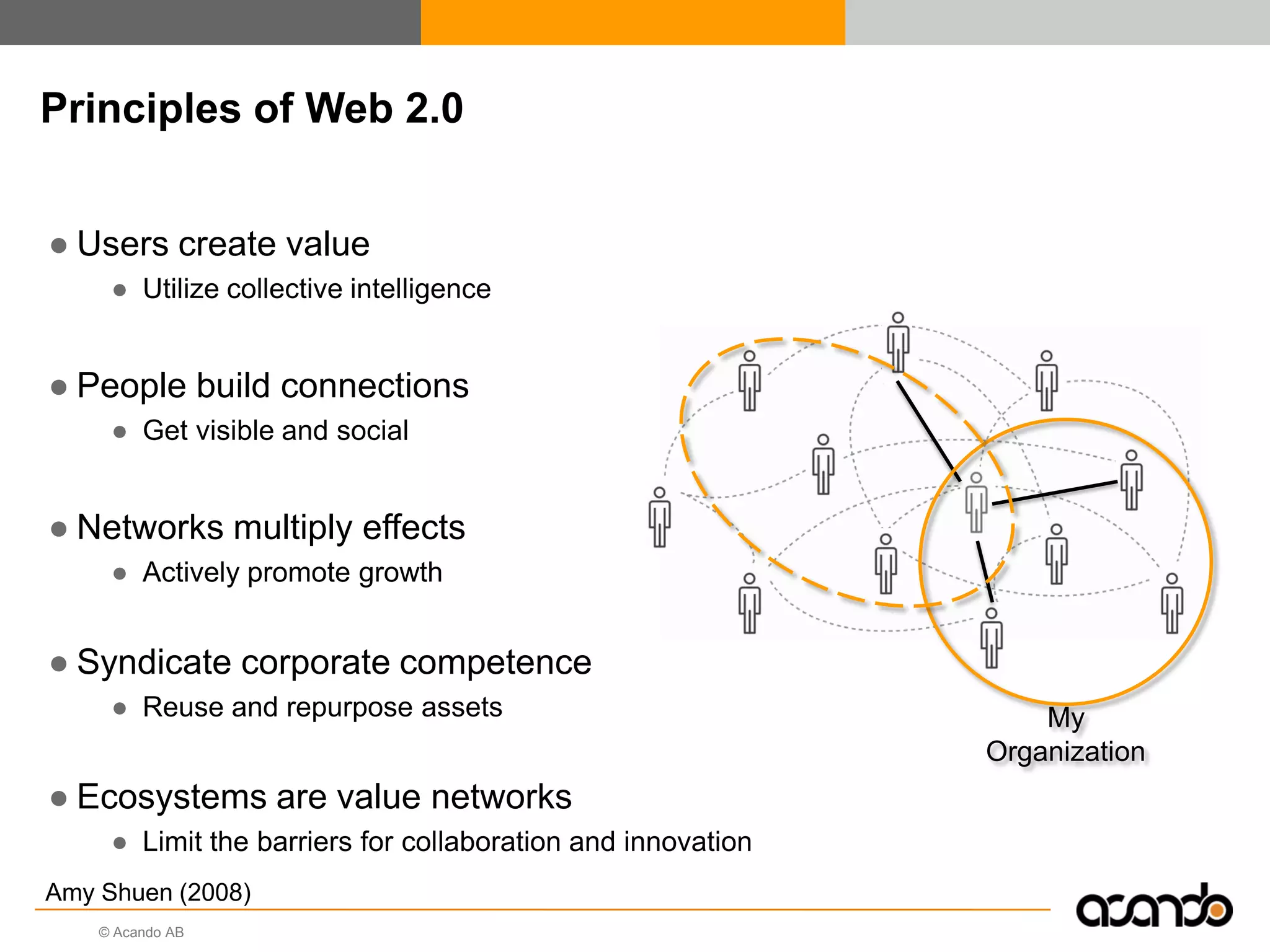
Principles of Web 2.0
● Users create value
● Utilize collective intelligence
● People build connections
● Get visible and social
● Networks multiply effects
● Actively promote growth
● Syndicate corporate competence
● Reuse and repurpose assets
● Ecosystems are value networks
● Limit the barriers for collaboration and innovation
My
Organization
Amy Shuen (2008)
© Acando AB
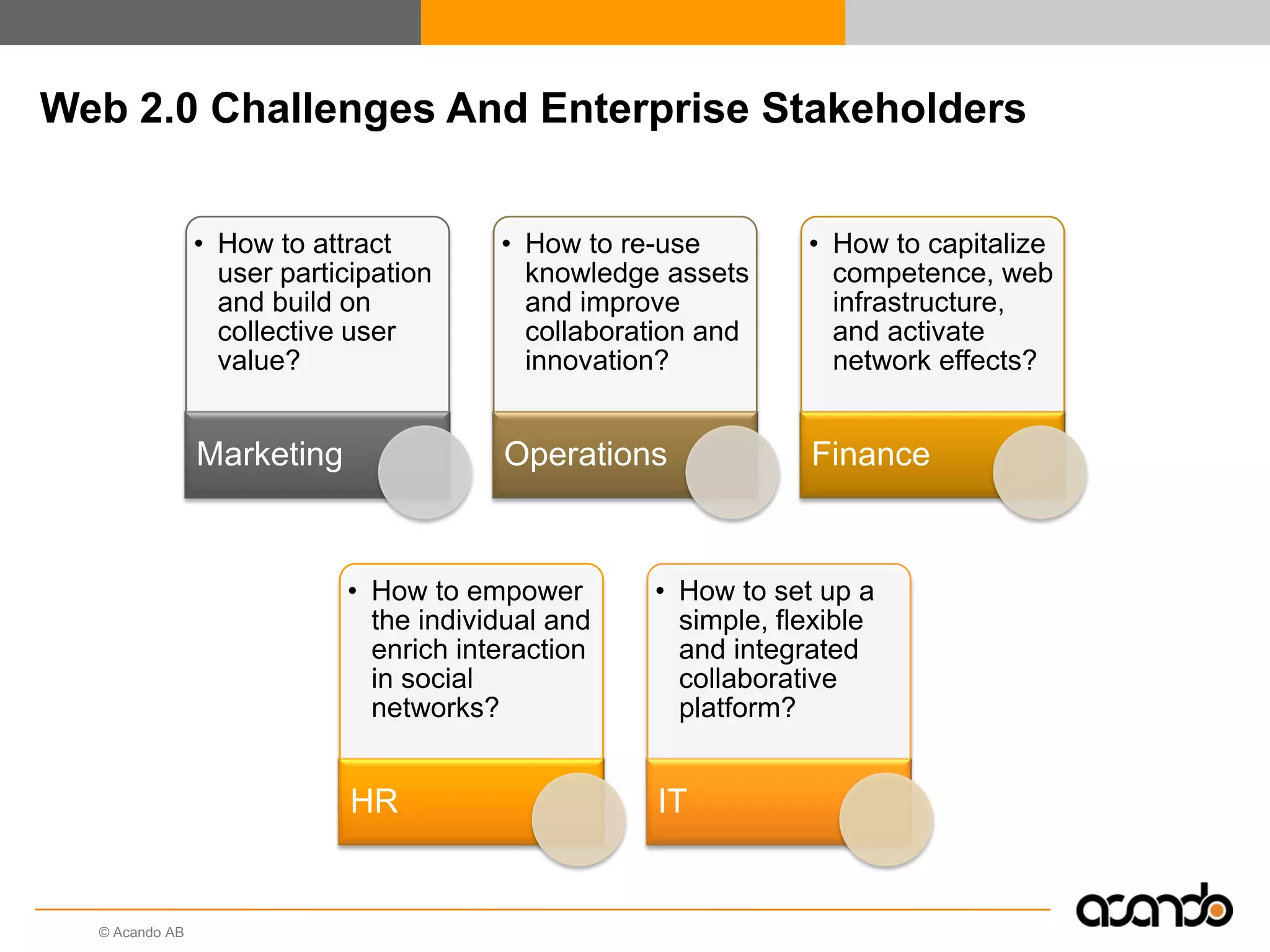
Web 2.0 Challenges And Enterprise Stakeholders
• How to attract
user participation
and build on
collective user
value?
Marketing
• How to re-use
knowledge assets
and improve
collaboration and
innovation?
Operations
• How to capitalize
competence, web
infrastructure,
and activate
network effects?
Finance
• How to empower
the individual and
enrich interaction
in social
networks?
HR
• How to set up a
simple, flexible
and integrated
collaborative
platform?
IT
© Acando AB
© Acando AB
THANK YOU!

Web 20-at-work

  • 1.
    © Acando AB WEB2.0 AT WORK
  • 2.
    © Acando AB Communicationtechnologies change society in waves
  • 3.
  • 4.
  • 5.
  • 6.
  • 7.
    © Acando AB Innovationslike these have helped to democratizise access to information.
  • 8.
  • 9.
    © Acando AB Sinceinformation is power, such innovations are often met with scepticism and fear.
  • 10.
    © Acando AB Butwe must try to overcome our scepticism and fears by learning to see the value these innovations bring.
  • 11.
    © Acando AB WeMust Learn To Look Beyond Obvious
  • 12.
    © Acando AB RSSfeeds & readers Social Bookmarking Sharing websites Instant Messaging Wikis Social Networks Micro-blogging Blogs We Must Learn To See The Tools
  • 13.
    © Acando AB Shareinformation and experiences with others Consume relevant information from sources you trust Share any Information you find with others Share photos with others Communicate spontaneously and direct with others Contribute to and use collective intelligence Find and connect with other people Communicate quick and informally with others We Must See The Needs They Adress
  • 14.
    © Acando AB Asindividuals, many of us are already using these tools to enrich and simplify our (social) lives.
  • 15.
    © Acando AB Ourquestion today: How can an organization improve collaboration with these simple and social tools?
  • 16.
    © Acando AB ©Acando AB Web 2.0 at Work Simple & Social Internal Collaboration
  • 17.
    © Acando AB SomeShort ”Facts” About Us Henrik Gustafsson ●MSc in Informatics, Knowledge Management ●Strategy, analysis, architecture ●Content, portals, integration ●Virtual teams Oscar Berg ●MSc in Informatics, Interactive Systems ●Analysis, architecture, usability ●Web, portals, collaboration ●Virtual teams, off-shore Visit our blog: www.thecontenteconomy.com
  • 18.
    © Acando AB IfHP knew what HP knows, we would be three times as profitable. Lew Platt Former CEO of Hewlett-Packard “ ”
  • 19.
    © Acando AB PARTI Trends & Challenges
  • 20.
    © Acando AB 1.0 E-mail StaticWebsites Discussion forums Instant Messaging Chat Rooms One-way & broad 2.0 Blogs Wikis RSS Mashups Pod- & webcasts Social Networks Social Bookmarking Folksonomies Simple & social Dynamic Websites Portals Communities Agents VIdeo Conferencing Web services Collaborative filtering VOIP Dynamic & interactive1.X How the Web Has Evolved Based on AIIM (2008) – Enterprise 2.0: Agile, Emergent & Integrated
  • 21.
    © Acando AB MostlyRead-Only Widly Read-Write 250 000 sites 80 000 000 sites Collective Intelligence 1996 2006 45 million users worldwide 1+ billion users worldwide
  • 22.
    © Acando AB PillowFight Flash Mob Torino, Italy .
  • 23.
    © Acando AB Mostof the barriers to group action have collapsed… We can have groups that operate with a birthday party's informality and a multinational's scope. Clay Shirky Author of “Here Comes Everybody: The Power of Organizing Without Organizations” “ ”
  • 24.
    © Acando AB ThePrinciples of “Old” Media A few because the publisher owns the production and distribution means writes for a publisher who sells to the many
  • 25.
    © Acando AB ThePrinciples of Social Media can produce, copy and share anything at almost no cost! Anyone to anyone
  • 26.
    © Acando AB Allbusiness are media businesses, because whatever else they do, all businesses rely on the managing of information for two audiences - employees and the world. Clay Shirky “Here Comes Everybody: The Power of Organizing Without Organizations” “ ”
  • 27.
    © Acando AB Globalization Consumerization ofIT ”The Google Generation” Democratization Working Pro Working Against Ignorance Behavior Power Legacy The Collaboration Forces
  • 28.
    © Acando AB Youare already an integral part of Web 2.0 business economy. Every time you click on Google, Wikipedia, eBay or Amazon you are sparking network effects…even if you do not buy anything. Amy Shuen, Author of “Web 2.0 A Strategy Guide” “ ”
  • 29.
    © Acando AB TheCollaboration Challenge
  • 30.
    © Acando AB WhatDo We Mean With Collaboration? Goal Communication Interaction Collaboration
  • 31.
    © Acando AB Communication- Centric One-to-OneOne-to-Many Many-to-ManyContent- Centric
  • 32.
    © Acando AB E-mailis Being Mis/Overused ● Overuse and inappropriate use ● No structure or control ● Lock-in of key information ● Key information leaves organization ● Information overload ● Enormous volumes of content Many-to-Many Content- Centric
  • 33.
    © Acando AB WorkflowSystems Don’t Fit All Tasks or Users ● Does not fit user's workstyles ● Not supporting knowledge work ● Over-focus on approval ● Usually complex and requires education ● Licenses not available for all Many-to-Many Content- Centric
  • 34.
    © Acando AB PortalsAre Not Personal ● Mainly one-way communication ● Everyone cannot contribute ● Role needs <> individual needs ● One “truth” how to organize information ● Tools and content in focus, not people One-to-Many Content- Centric
  • 35.
    © Acando AB KeyIngredients for Successful Collaboration
  • 36.
    © Acando AB CollaborativeCulture Consensus-driven Informal Fear of making mistakes Trial-and-error Command-and-control Formal Hero-culture Mentoring-culture
  • 37.
    © Acando AB Easyto use People are visible Universally accessible Informal & spontaneous Fits Different needs Encourages contribution Fits my work-style Truly Collaborative Tools
  • 38.
    © Acando AB CollaborativeAwareness Me 1.0 Me 2.0 I interact with others when I have the time I only use e-mail I occationally update myself I interact with others regularly and self-initiated I use multiple tools I have ambient awareness
  • 39.
    © Acando AB WhatAbout Knowledge Management?
  • 40.
    © Acando AB The“Rules” of Business Are Changing Knowledge-based Structure-based The basis of the operation is the structure of the activities. The basis of the operation is the knowledge of individuals.
  • 41.
    © Acando AB TheKnowledge Management Problem ●Knowledge is often stored in private notebooks and in peoples heads (tacit knowledge) ●Knowledge is typically exchanged ad hoc and informally person-to- person
  • 42.
    © Acando AB TheProblem with Knowledge Management version 1.0 ●Really not about people ●Knowledge treated as a separate "thing" ●Knowledge management seen as a separate act ●No return on contributions ●Does not blend with human nature
  • 43.
    © Acando AB ●Simpleand social tools enable a convenient and user-driven way to capture tacit knowledge and build collective intelligence ●Blogs and wikis are the 21st Century‟s notebooks and social networks are the water coolers What Web 2.0 Brings to Knowledge Management Blogs Wikis Social Network
  • 44.
    © Acando AB PARTII Tools, Technologies and their uses
  • 45.
    © Acando AB Enterprise2.0 is the use of emergent social software platforms within companies, or between companies and their partners or customers. Andrew McAfee Associate Professor, Harward Business School “ ”
  • 46.
    © Acando AB HowWeb 2.0 is Penetrating the Enterprise Wikis RSS Blogs 45% 43% 35% IDC, “Quick Look Survey”, February 2007
  • 47.
    © Acando AB HowEnterprises Are Using Web 2.0 The McKinsey Quarterly, ”How Businesses are using Web 2.0”, June 2007 Interfacing with partners & suppliers Interfacing with customers Internal collaboration 75% 70% 51%
  • 48.
    © Acando AB TheChallenge: Getting the Balance Right ©2007 Collaborative Strategies 47 Control Corporate IT Control Corporate Content Search & Browse Corporate Taxonomies Transactional Interactions Enterprise Applications Empowerment Users in Control User-Generated Content Publish & Subscribe User-Generated Metadata Social Interactions Individual Applications &
  • 49.
    © Acando AB Beingdismissive of blogs and wikis because of how they are most of-ten used, and talked about, today is a mistake. What is important is how they could be used. The Gilbane Report Vol 12 no 10, 2005 "Blogs & Wikis: Technologies for Enterprise Applications?" “ ”
  • 50.
    © Acando AB PositioningCollaboration Tools in Time and Space Apart Together ApartTogether Time Space E-mail Workflow Portals Phone SMS Video Conferencing
  • 51.
    © Acando AB PositioningCollaboration Tools in Context and Structure Ad-hoc Project Process Structure Context Individual Team/Unit Enterprise Ecosystem
  • 52.
    © Acando AB Team OfficeBusiness Unit Project Enterprise Community ofPractice Friends Community of Interest We Need Many Different Spaces for Collaboration
  • 53.
    © Acando AB KeyTools & Technologies
  • 54.
    © Acando AB KeyTools And Technologies We Will Focus On Social networks – Connections & Context Syndication & Mashups - Reuse
  • 55.
  • 56.
    © Acando AB AnyoneWho Can Write Can Blog Label your post Publish immediately or later Edit easily
  • 57.
    © Acando AB Readand Share as You Like Comment Share and Bookmark Subscribe to feed
  • 58.
    © Acando AB Ourlegal department loves the blogs, because it is basically a written-down, backed-up, permanent time-stamped version of the scientists notebook. Marissa Mayer VP of Search Product & User Experience , Google “ ”
  • 59.
    © Acando AB WhyEnterprise Blogs? ●Blogs are a good way of conveying information instantly to the rest of your community in one action ●They can be used as a timeline of events within a workgroup ●Capture and present ideas and opinions to coworkers ●Gather feedback and involve others in discussions
  • 60.
    © Acando AB Examplesof Enterprise Uses ●CEO blog for communicating with coworkers ●Product management blogs for product communication and strategies ●Project management blogs for meeting minutes, project history, project definition, risks… ●Sales blogs for sales and customer development ●Personal blogs for sharing experiences, links, news, ideas, opinions…
  • 61.
  • 62.
    © Acando AB CollectiveEditing Made Easy Get notified Discuss View history Structure by linking Edit without approval
  • 63.
    © Acando AB WIKI PAGE Howto Edit a Wiki 1. Check if subject exists 2. Exists = continue to next step Does not exist = create a new page 3. Edit the page 4. Save Previous versions Edit
  • 64.
    © Acando AB WhyEnterprise Wikis? ●Captures business information that otherwise would float around in emails ●Easy to access and find information as the wiki is web-based and provides search ●Easy and fast to edit thanks to simple interface and flexible format ●Easy to fix mistakes thanks to versioning and audit trail of unstructured content Anyone can contribute!
  • 65.
    © Acando AB Examplesof Enterprise Uses ●Knowledge bases with corporate “how-to‟s”, information for new employees, practical information ●Requirements management for capturing, negotiating and agreeing on requirements ●Capturing "intelligence" such as competitor and industry activities and consumer trends ●R&D quickly capture bookmarks and commentary on topics. write up research proposals, notes, and experiments ●Corporate glossaries such as product terminology
  • 66.
    © Acando AB Thedecision to embrace wikis is part of a changing ethic at the department, from a „need to know culture‟ to a „need to share culture‟. Eric M. Johnson Office of eDiplomacy, US State Department “ ”
  • 67.
    © Acando AB ”Intellipedia”- Connecting the Dots at CIA After 9/11
  • 68.
    © Acando AB WrappingUp About Blogs and Wikis Single- author insights Blogs Wikis Collective Intelligence User-generated, interlinked and rapidly adaptable bodies of knowledge open to everyone Multi-author “agreed-upon” knowledge
  • 69.
    © Acando AB ENTERPRISESOCIAL NETWORKS
  • 70.
    © Acando AB Whatis Social Networking?
  • 71.
    © Acando AB Thesocial network put all that we were doing into context. Richard Dennison Intranet and channel strategy manager at BT “ ”
  • 72.
    © Acando AB WhyEnterprise Social Networks? ●A shared social space for people who are apart in time and/or space ●Easy to find people to connect, communicate with and get to know them ●Rapid distribution of relevant and informal information person-to-network ●Build relationships across boundaries (organizational, geographic…) ●Provides a context for knowledge exchange
  • 73.
    © Acando AB SocialNetworks Enable More and Broader Interaction
  • 74.
    © Acando AB KeyFeatures – Examples Find & connect with peopleDescribe who you are in a profile Share contentTag your own and other people‟s content
  • 75.
    © Acando AB KeyFeatures – Examples See network activities Participate in groups
  • 76.
    © Acando AB Visits& Views Downloads Favourites Tags Social Bookmarks Editorial Selection Embeds Links User Activities Brings Valuable Content to the Surface Shares Comments
  • 77.
    © Acando AB TheLong Tail of Content Use Usage rate Total amount of content 1-5% above ”the water line” Still findable and accessible, but filtered out
  • 78.
    © Acando AB SocialTools Encouraging Disruptive Thinking at BT
  • 79.
  • 80.
    © Acando AB Subscribeto Information and Read in a Reader Bookmark items Share items Label items Read all feeds in one place Mark items as read Subscribe to feeds
  • 81.
    © Acando AB Hasanything changed? Are there any new posts? Will a search return something new? Ordinary Surfing for Information = Constant Checking Check Check Check Based on slides by James Dellow (2008)
  • 82.
    © Acando AB Newsabout content changes New blog posts New search results Syndication Makes the Content Come to You Instead Based on slides by James Dellow (2008)
  • 83.
    © Acando AB WhySyndication? ●Control what you read ●Spend less time searching ●Receive information instantly and in a consistent manner ●Increase you capacity to consume many sources ●Avoid occupational spam by avoiding irrelevant information and spam
  • 84.
  • 85.
    © Acando AB NoProgramming Required! Authentication Straight from the source Rearrange Drag-and-drop Configure Search
  • 86.
    © Acando AB MashupsAre Lightweight Services ● Mashups are lightweight, composite applications, based on web architecture ● They mix and source content or functionality from existing systems ● The sourced content and functionality retain their original purpose Developer User AssembleDevelop Illustration based on illustration by Dion Hinchcliffe (2007)
  • 87.
    © Acando AB Accordingto Gartner by 2010, 80% of enterprise applications will be mashups.
  • 88.
    © Acando AB Web2.0 Lower The Investment Barriers Projects that do justify big IT spending Value Projects that do not justify big IT spending Unserved demands Buy Build SaaS Mashups and hacks Amy Shuen (2008)
  • 89.
    © Acando AB WhyEnterprise Mashups? ●Allow for real-time business intelligence by aggregate information from various sources ●Can serve temporary and urgent needs as they can be quickly assembled ●Can be adapted to personal needs as it mashups are assembled rather than programmed and can be assembled by anyone ●Puts transactional data in context by allowing connections to both structured sources (enterprise apps) and unstructured sources (blogs, web sites…)
  • 90.
    © Acando AB ©Acando AB Collaboration in Practice
  • 91.
    © Acando AB CaseStudy: Team Collaboration • Share ideas, opinions, experiences, news • Distribute agendas and meeting minutesBlog • Information to iroduce new coworkers • Keep history of sales activities • Use as knowledge base Wiki • Collaborate on document deliverables • Share presentations, documents, articles • Store templates, resources, reference cases File Share • Quick questions and statuscheckups • Real-time conversations 1-to-1 or M-to-MIM • Internal virtual meetings • External virtual meetings Web Conferencing
  • 92.
    © Acando AB ©Acando AB The Collaboration Platform
  • 93.
  • 94.
    © Acando AB TheCollaboration Platform Collaboration Spaces Enterprise Unit Project Community Personal Collaboration Tools Instant Messaging Voice Video Desktop Sharing Blogs & wikis Intranets & Portals Web- & Podcasts File Sharing Mashups RSS Readers Profiles & Presence Tagging & Social Bookmarking E-mail Social Networks RSS Versioning Search Security Workflow Metadata Basic Content Services
  • 95.
    © Acando AB Web2.0 Tools – What They Have and What They Need Choice of tools Simple Social Rich Media Integrated Accessible Secure Enterprise
  • 96.
    © Acando AB SOAAnd Web 2.0 Exploit Services but.. SOA • Heavyweight • Composites • Application services • Centralized • Enterprise • Planned Web 2.0 • Lightweight • Mashups • Content services • Peer • In the cloud • Emergent Service Paradigm
  • 97.
    © Acando AB MagicQuadrant for Collaboration
  • 98.
    © Acando AB TheSocial Software Marketplace – On-Premises Software Collaboration Platforms Microsoft – SharePoint 2007 IBM – Connections/Quickr Oracle – Oracle WebCenter Suite/Pathways EMC – Documentum OpenText – Livelink ECM – Extended Collaboration Social Software Suites Drupal – Drupal Awareness – Awareness Platform Connectbeam – Social Software Appliance Jive Software –Clearspace Traction Software –TeamPage NewsGator – Social Sites Telligent – Community Server Wiki Software Atlassian – Confluence MediaWiki – MediaWiki Socialtext – Socialtext Twiki – Twiki Blog Software Six Apart – Movable Type Automattic – WordPress RSS Software Attensa – Attensa FeedServer NewsGator – Enterprise Server
  • 99.
    © Acando AB TheSocial Software Marketplace – Software as a Service Collaboration Suites Google – Google Apps GroupSwim – GroupSwim Web Conferencing Cisco – WebEx Microsoft – LiveMeeting Yugma GoToMeeting Wiki Software Socialtext Twiki Blog Software Automattic – WordPress Google – Blogger TypePad Instant Messaging Google – Google Talk Microsoft – MSN Messenger
  • 100.
    © Acando AB PARTIII Approaching Web 2.0 at Work
  • 101.
    © Acando AB 100 Reactive •Collaboration choked or cut down Managed • Collaboration allowed to grow Proactive • Collaboration nurtured and cultivated http://www.flickr.com/photos/jam343/1703693/sizes/o/
  • 102.
    © Acando AB KeyDisciplines Of Collaboration Maturity Awareness Culture Architecture Governance
  • 103.
    © Acando AB KeyDisciplines Of Collaboration Maturity Awareness Communication and coordination as a way to collaborate Culture A hero culture with strong command and control structures Architecture Individuals find their own tools and how to manage content Governance Individuals need to act based on their own judgment Reactive
  • 104.
    © Acando AB KeyDisciplines Of Collaboration Maturity Awareness Communication and coordination as a way to collaborate Local collaboration for problem solving Culture A hero culture with strong command and control structures A more informal culture striving for synergies and consensus Architecture Individuals find their own tools and how to manage content Standardized tools and accessible content Governance Individuals need to act on their own judgment Guiding principles and supporting roles defined Reactive Managed
  • 105.
    © Acando AB KeyDisciplines Of Collaboration Maturity Awareness Communication and coordination as a way to collaborate Local collaboration for problem solving Cross- collaboration for optimization and innovation Culture A hero culture with strong command and control structures A more informal culture striving for synergies and consensus A sharing and mentoring culture based on trust Architecture Individuals find their own tools and how to manage content Standardized tools and accessible content Integrated flexible collaborative platform Governance Individuals need to act on their own judgment Guiding principles and supporting roles defined Balance of flexibility and control (mainly user led) Reactive Managed Proactive
  • 106.
    © Acando AB GovernanceFor The Formal And Informal Formal process • Defined artifacts & products • Structured and secured approach • Value for the enterprise Informal process • Ideas & concepts • Spontaneous and open approach • Value for community Tipping Point • Cost-Benefit • Compliance • Risk
  • 107.
    © Acando AB ChangeRequired On All Levels Management • Vision and a collaborative environment • Be accessible and less formal • Broad input and spontaneous interactions • Trust your co-workers and let ideas flow • Remove barriers and leverage initiatives Co-worker • Present and promote yourself • Connect to people and expand your network • Create, share and participate actively • Be a role model • Coach and guide your colleagues
  • 108.
    © Acando AB Realizethat Enterprise Web 2.0 is unavoidable. Begin planning how to deploy effective Web 2.0 capabilities for maximum business value. Anthony Bradley Gartner “ ”
  • 109.
    © Acando AB GettingStarted with The Acando Approach How to kick-start an initiative Intention Vision Development Life-Cycle Awareness Seminar(s) - customized seminar Direction Workshop(s) - pains, challenges, maturity, stakeholders, value….
  • 110.
    © Acando AB Web2.0 Success Factors Start immediately and focus on business value, not risk Set the social networks and the culture as the foundation Manage a portfolio of Web 2.0 tools and seed content Be committed for the long run and reward participation
  • 111.
    © Acando AB Principlesof Web 2.0 ● Users create value ● Utilize collective intelligence ● People build connections ● Get visible and social ● Networks multiply effects ● Actively promote growth ● Syndicate corporate competence ● Reuse and repurpose assets ● Ecosystems are value networks ● Limit the barriers for collaboration and innovation My Organization Amy Shuen (2008)
  • 112.
    © Acando AB Web2.0 Challenges And Enterprise Stakeholders • How to attract user participation and build on collective user value? Marketing • How to re-use knowledge assets and improve collaboration and innovation? Operations • How to capitalize competence, web infrastructure, and activate network effects? Finance • How to empower the individual and enrich interaction in social networks? HR • How to set up a simple, flexible and integrated collaborative platform? IT
  • 113.
    © Acando AB ©Acando AB THANK YOU!