RESEARCHREPORT 
Vol 2012 No 76 
Who Drives Economic Reform in Vietnam’s 
Provinces? 
Hubert Schmitz, Dau Anh Tuan, Pham Thi Thu Hang and Neil McCulloch 
June 2012
About IDS 
The Institute of Development Studies is one of the world's leading charities for research, teaching and 
communications on international development. Founded in 1966, the Institute enjoys an international 
reputation based on the quality of its work and the rigour with which it applies academic skills to real 
world challenges. Its purpose is to understand and explain the world, and to try to change it – to 
influence as well as to inform. 
IDS hosts six dynamic research programmes, five popular postgraduate courses, and a family of world-class 
web-based knowledge services. These three spheres are integrated in a unique combination – as a 
development knowledge hub, IDS is connected into and is a convenor of networks throughout the 
world. 
The Institute is home to approximately 80 researchers, 50 knowledge services staff, 50 support staff and 
about 150 students at any one time. But the IDS community extends far beyond, encompassing an 
extensive network of partners, former staff and students across the development community 
worldwide. 
For further information on IDS publications and for a free catalogue, contact: 
IDS Central Communications 
Institute of Development Studies 
Brighton BN1 9RE, UK 
Tel: +44 (0) 1273 915637 
Fax: +44 (0) 1273 621202 
E-mail: bookshop@ids.ac.uk 
Web: www.ids.ac.uk/ids/bookshop 
IDS is a charitable company, limited by guarantee and registered in England (No. 877338).
IDS RESEARCH REPORT 76 
Who Drives Economic Reform in 
Vietnam’s Provinces? 
Hubert Schmitz, Dau Anh Tuan, Pham Thi Thu Hang and Neil McCulloch 
June 2012 
Institute of Development Studies Brighton BN1 9RE UK 
IDS RESEARCH REPORT 76 
01
IDS RESEARCH REPORT 76 
Who Drives Economic Reform in Vietnam’s Provinces? 
Hubert Schmitz, Dau Anh Tuan, Pham Thi Thu Hang and Neil McCulloch 
IDS Research Report 76 
First published by the Institute of Development Studies in June 2012 
Cover photo: Mark Henley/Panos 
Photo caption: Ho Chi Minh City (Saigon), Vietnam. Small boats on the Saigon River passing the city centre with 
its new high-rise buildings. 
© Institute of Development Studies 2012 
ISSN 2040-0217 ISBN 978-1-78118-051-8 
A catalogue record for this publication is available from the British Library. 
All rights reserved. Reproduction, copy, transmission, or translation of any part of this publication may be made 
only under the following conditions: 
• with the prior permission of the publisher; or 
• with a licence from the Copyright Licensing Agency Ltd., 90 Tottenham Court Road, London W1P 9HE, UK, 
or from another national licensing agency; or 
• under the terms set out below. 
This publication is copyright, but may be reproduced by any method without fee for teaching or non-profit 
purposes, but not for resale. Formal permission is required for all such uses, but normally will be granted 
immediately. For copying in any other circumstances, or for re-use in other publications, or for translation or 
adaptation, prior written permission must be obtained from the publisher and a fee may be payable. 
Available from: 
Central Communications 
Institute of Development Studies 
Brighton BN1 9RE, UK 
Tel: +44 (0) 1273 915637 
Fax: +44 (0) 1273 621202 
E-mail: bookshop@ids.ac.uk 
Web: www.ids.ac.uk/ids/bookshop 
Typeset by Warwick Printing, Leamington Spa, UK. Printed by Nexus, Brighton, UK. 
IDS is a charitable company limited by guarantee and registered in England (No. 877338). 
02
IDS RESEARCH REPORT 76 
03 
Summary 
Vietnam keeps surprising the world with the speed and depth of its economic 
transformation. This research report suggests that the decentralisation of certain 
economic powers from central to provincial government has contributed to this 
success. Allowing provinces to find their own way forward was central to Vietnam’s 
progress in institutional and economic development. Decentralisation brought 
about a number of inefficiencies, but these are outweighed by the gains resulting 
from policy experimentation at the provincial level. 
The main question of the report is who drives the economic reform process in the 
provinces, exploring the role of business and government and alliances between 
the two. This is a difficult undertaking because it involves dipping into sensitive 
issues of state-business relations and because there are enormous variations 
between provinces and over time. Key to the feasibility of this project was the 
collaboration of IDS with the Vietnam Chamber of Commerce and Industry (VCCI). 
VCCI is an influential organisation with strong connections to business, government 
and the Communist Party. These connections are essential for access to political 
and business leaders and for understanding the economic reform process from 
private and public perspectives. 
Provincial government is by necessity involved in the economic reform process, 
but who is actually driving it? The research shows that in those provinces which 
are making most progress in economic reform, the private sector played an 
important role. Not against government but with government. There was no formal 
public-private coalition but the dynamic was one of proactive government seeking 
the input from the private sector, and the latter lobbying for and contributing to 
responsive and effective government. Both national and foreign enterprises played 
a role but small enterprises tended to be marginalised from the process. Some of 
the best insights come from comparing provinces and observing how different 
alignments of interest influenced the reform process. 
Keywords: investment climate; economic reform; economic governance; private 
sector; state business relations; decentralisation; provincial government; Vietnam 
Hubert Schmitz is Professor at the Institute of Development Studies (IDS), 
University of Sussex. He is the coordinator of the project on which this research 
report is based. 
Dau Anh Tuan is Deputy Director of the Legal Department of Vietnam Chamber 
of Commerce and Industry (VCCI), Ha Noi. He has coordinated Vietnam’s 
Provincial Competitiveness Survey since its inception in 2005. 
Pham Thi Thu Hang is Secretary General of the Vietnam Chamber of Commerce 
and Industry (VCCI). As Director of the Enterprise Development Foundation she is 
in charge of VCCI research. 
Neil McCulloch is Lead Economist of the Australian Aid Programme in Indonesia. 
He was formerly a Fellow of IDS and Leader of its Globalisation Team.
IDS RESEARCH REPORT 76 
04
Contents 
IDS RESEARCH REPORT 76 
Summary, keywords, author notes 3 
Acknowledgements, note 7 
Acronyms 8 
1 Introduction 9 
2 What do we know and what do we need to find out? 10 
3 The national framework for economic reform in the provinces 13 
4 How we conducted our research: methods and sources 18 
5 Findings from Bac Ninh 21 
6 Findings from Hung Yen 29 
7 Findings from Dong Thap 37 
8 Findings from Ca Mau 43 
9 Similarities and differences across four provinces 49 
10 Quantitative analysis 52 
11 Conclusions: the roles of business, government and Party 60 
Appendix 1: Interview questions for business 71 
Appendix 2: Interview questions for government 74 
Appendix 3: List of respondents 77 
Appendix 4: Modelling the determinants of governance reform 83 
References 87 
05
IDS RESEARCH REPORT 76 
06 
Tables 
Table 4.1 PCI scores and rankings of four selected provinces, 2006–2010 19 
Table 4.2 Interviews by category 20 
Table 4.3 Interviews by province 20 
Table 5.1 Bac Ninh PCI: aggregate scores and ranking, 2006–2010 21 
Table 5.2 Economic growth in Bac Ninh 22 
Table 6.1 Hung Yen PCI: aggregate scores and ranking, 2006–2010 29 
Table 6.2 Economic growth in Hung Yen 30 
Table 7.1 Dong Thap PCI: aggregate scores and ranking, 2006–2010 37 
Table 7.2 Economic growth in Dong Thap 38 
Table 8.1 Ca Mau PCI: aggregate scores and ranking, 2006–2010 43 
Table 8.2 Economic growth in Ca Mau 44 
Table 9.1 Drivers summary table 51 
Table 10.1 Descriptive statistics of the determinants of governance 
improvements 55 
Table 10.2 PCI Improvement prior to change of leadership 59 
Table A4.1 Determinants of PCI growth 84 
Table A4.2 Correlations of PCI scores and VCCI PCI team visits 84 
Table A4.3 One-step difference GMM estimation of impact of PCI team visits 
on PCI score 86 
Figures 
Figure 4.1 PCI scores of four provinces, 2006–2010 19 
Figure 4.2 Disaggregated PCI for four provinces in 2010 20 
Figure 5.1 Bac Ninh: disaggregated PCI scores, 2006–2010 22 
Figure 6.1 Hung Yen: disaggregated PCI scores, 2006–2010 29 
Figure 7.1 Dong Thap: disaggregated PCI scores, 2006–2010 37 
Figure 8.1 Ca Mau: disaggregated PCI scores, 2006–2010 43 
Figure 10.1 Growth in PCI 2006–2010 against initial PCI score in 2006 57
IDS RESEARCH REPORT 76 
07 
Acknowledgements 
This report is the outcome of a joint project between the Institute of Development 
Studies (IDS) and the Vietnam Chamber of Commerce and Industry (VCCI). The 
authors acknowledge and are grateful for the support from: 
– the Economic and Social Research Council (ESRC) and the Department 
for International Development (DFID) of the UK for funding this study; 
– many government officials and business leaders in Vietnam for giving us 
their time and responding to our questions; 
– experts from the research community, the media and donor agencies for 
sharing with us their views on the economic reform process; 
– Edmund Malesky for advising us on research strategy and providing 
numerous insights and suggestions in the course of the project; 
– Bui Linh Chi, Le Thanh Ha and Le Thanh Hai for assistance during the 
entire project, in particular assistance with preparing, conducting and 
analysing the interviews; 
– Nguyen Duc Nhat for constructing the database for the quantitative analysis 
and making useful suggestions for the policy analysis. 
Helpful comments on earlier drafts were received from Anu Joshi, Dang Kim Son, 
Edmund Malesky, Mimi Groenbech, Nguyen Dinh Cung, Nguyen Duc Nhat, 
Nguyen Xuan Thang, Phung Huu Phu, Tran Dinh Thien, Vo Hung Dung, Tran Huu 
Huynh. 
The responsibility for everything said in this report lies with the authors. 
Note 
The Vietnamese version of this research report is published simultaneously by the 
Vietnam Chamber of Commerce and Industry in Ha Noi (www.vcci.com.vn).
IDS RESEARCH REPORT 76 
08 
Acronyms 
CASEP Ca Mau Association of Seafood Exporters and Producers 
CIDA Canadian International Development Agency 
DAI Development Alternatives, Inc. 
DANIDA Danish International Development Agency 
DFID Department for International Development 
DPI Department of Planning and Investment 
ESRC Economic and Social Research Council 
FDI Foreign Direct Investment 
GIZ German Agency for International Cooperation 
GSO General Statistical Office 
GTZ German Agency for Technical Cooperation 
IDS Institute of Development Studies 
IFC International Finance Corporation 
ILO International Labour Organization 
PCI Provincial Competitiveness Index 
PPC Provincial People’s Committee 
SIDA Swedish International Development Cooperation Agency 
SME Small and medium-sized enterprise 
SOE State-owned enterprise 
UNIDO United Nations Industrial Development Organization 
USAID US Agency for International Development 
VASEP Vietnam Seafood Exporters and Producers Association 
VCCI Vietnam Chamber of Commerce and Industry 
VNCI Vietnam Competitive Initiative 
VND Vietnamese dong 
WTO World Trade Organization
IDS RESEARCH REPORT 76 
09 
1 Introduction 
? 
Success commands attention. Vietnam continues to surprise the world with high 
rates of economic growth and a strong capacity to reform its economy. While the 
central government is in overall charge, provincial governments have considerable 
room to manoeuvre. This report analyses the forces that drive economic reform in 
the provinces. The central question is who drives the improvement in the quality 
of local economic governance? We are particularly interested in whether and how 
the private sector plays a role in the reform process. Who initiates the reform 
process in the provinces? Who drives it forward? What are the roles of big 
investors, small investors, business associations, provincial government 
agencies, provincial leaders and central government? Is there active cooperation 
between government and business people? What form does it take? Is it formal 
or informal? Who tries to slow down the process? We examine these questions 
for four provinces, two provinces in the North and two in the South. They are 
located in the Red River and Mekong River Delta respectively. In each pair, one 
province is successful in reforming its investment climate and one is less 
successful. We try to understand each province in its own right but also learn 
from comparing them. 
In seeking answers to the above questions, we focus on the provinces but do not 
look at them in isolation. We ask how the provinces are conditioned by ‘The Centre’, 
notably the central government and the Communist Party. Seeking to understand 
how the Centre influences what happens in the provinces had an unexpected 
consequence. It opened our eyes to a bigger story with a clear message: the 
empowerment of the provinces is central to Vietnam’s success. This is a 
controversial story to tell at a time when decentralisation is criticised for leading to 
wasteful investment. We agree that such criticism is valid in particular instances, 
but we believe that it fails to grasp the bigger picture: Vietnam is a big laboratory 
and has been a big laboratory for the last 25 years. The challenge was first the 
transition from a centrally planned to a market economy and then the integration 
into the world economy. Under the political control of the Communist Party, the 
market was allowed to play an increasing role and propel the economy forward. 
The economic transformation was deep and fast, but was in fact based on 
experimentation. Ceding powers over the investment climate to the provinces is 
part of this experimentation. Provinces have used the policy spaces granted to 
them in many different ways, unleashing unexpected dynamics within and 
between provinces. 
Understanding these dynamics is what we seek to do. Our initial intention was 
more modest, namely to understand who drives the investment climate reform in 
the provinces. As it turns out, precisely because we have started in the provinces 
(outside Ha Noi and Ho Chi Minh City), we begin to see processes which have 
escaped the attention of most observers but are central for understanding the 
economic transformation of the country. The insights we learn from Vietnam finally 
lead us to ask what lessons there are for other countries. 
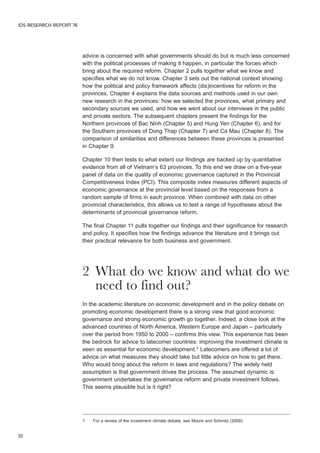
The report is structured as follows: Chapter 2 sets out briefly what the literature 
tells us about the drivers of investment climate reform. A wealth of research and
IDS RESEARCH REPORT 76 
10 
advice is concerned with what governments should do but is much less concerned 
with the political processes of making it happen, in particular the forces which 
bring about the required reform. Chapter 2 pulls together what we know and 
specifies what we do not know. Chapter 3 sets out the national context showing 
how the political and policy framework affects (dis)incentives for reform in the 
provinces. Chapter 4 explains the data sources and methods used in our own 
new research in the provinces: how we selected the provinces, what primary and 
secondary sources we used, and how we went about our interviews in the public 
and private sectors. The subsequent chapters present the findings for the 
Northern provinces of Bac Ninh (Chapter 5) and Hung Yen (Chapter 6), and for 
the Southern provinces of Dong Thap (Chapter 7) and Ca Mau (Chapter 8). The 
comparison of similarities and differences between these provinces is presented 
in Chapter 9. 
Chapter 10 then tests to what extent our findings are backed up by quantitative 
evidence from all of Vietnam’s 63 provinces. To this end we draw on a five-year 
panel of data on the quality of economic governance captured in the Provincial 
Competitiveness Index (PCI). This composite index measures different aspects of 
economic governance at the provincial level based on the responses from a 
random sample of firms in each province. When combined with data on other 
provincial characteristics, this allows us to test a range of hypotheses about the 
determinants of provincial governance reform. 
The final Chapter 11 pulls together our findings and their significance for research 
and policy. It specifies how the findings advance the literature and it brings out 
their practical relevance for both business and government. 
2 What do we know and what do we 
need to find out? 
In the academic literature on economic development and in the policy debate on 
promoting economic development there is a strong view that good economic 
governance and strong economic growth go together. Indeed, a close look at the 
advanced countries of North America, Western Europe and Japan – particularly 
over the period from 1950 to 2000 – confirms this view. This experience has been 
the bedrock for advice to latecomer countries: improving the investment climate is 
seen as essential for economic development.1 Latecomers are offered a lot of 
advice on what measures they should take but little advice on how to get there. 
Who would bring about the reform in laws and regulations? The widely held 
assumption is that government drives the process. The assumed dynamic is: 
government undertakes the governance reform and private investment follows. 
This seems plausible but is it right? 
1 For a review of the investment climate debate, see Moore and Schmitz (2008).
IDS RESEARCH REPORT 76 
11 
Examining this question is of relevance for many countries that seek to accelerate 
growth and transform their economies. So as to make this debate relevant for 
them it is important to concentrate on the starting point and not the end point of 
the journey they seek to undertake. In other words, the relevant question is how to 
get from ineffective to effective economic governance. 
Countries which have made this journey in recent decades – characterised by 
rapid globalisation – are more likely to provide insights than countries that have 
been prosperous for some time. The experience of the rapidly growing countries 
of East Asia, notably China and Vietnam, is particularly interesting in this respect. 
Both countries challenge the dominant view. When they embarked on their reform 
process, they did not have in place the key elements of a good investment climate: 
property rights, legally enforceable contracts and regulation of business activity 
which is transparent and fast. 
Yet both countries have grown rapidly and transformed their economies over the 
last 35 and 25 years respectively. And both countries have gradually transformed 
their legal and regulatory frameworks. Clearly the dynamic was not one of 
investment following governance reform, but was it one of investors leading 
governance reform? 
The official view in both countries is to attribute leadership in the reform process 
to the Communist Party and central government. Indeed they have retained 
overall control, setting the direction and boundaries for reform but – as we shall 
see later – the boundaries can be challenged and there is political space for other 
actors. This report examines what happened in this space in the case of Vietnam. 
Before presenting the findings of our research, this chapter sums up what we can 
learn from the literature. 
We start with a quote which expresses in stark terms the issues we are concerned 
with. It comes from research on the legal and institutional reform in post-communist 
countries of Eastern Europe and the former Soviet Union: 
Foreign investors… are not passive bystanders in the legislative and 
institutional reform process, as is widely assumed. Rather, foreign investment 
is a dynamic force in the forefront of the push for change and an agent for 
such reform. This phenomenon has been largely misunderstood by the 
international development community and ignored in the prevailing literature. 
(Hewko 2003: 72) 
In other words, trying to find the drivers of reform within the public sector alone 
would miss an essential part of the picture. The role of the private sector needs 
attention. 
This precisely is the focus of Edmund Malesky’s (2004a, 2008) research on the 
politics of economic reform in Vietnam. He demonstrates how a coalition of foreign 
investors and provincial officials induced far-reaching economic reforms. His 
research concentrates on the 1990s and early 2000s and on key issues of the 
reform debate at that time: opening up to the international system, reducing the 
role of state-owned enterprises, and decentralising government authority. Malesky 
depicts the power struggles going on in the Centre but concludes that the reform
IDS RESEARCH REPORT 76 
12 
battle was in fact won in the provinces. By working with foreign enterprises, 
provincial leaders could obtain fiscal room to manoeuvre. Direct and indirect tax 
income from foreign direct investment was key. Some of the daring provinces 
were able to exceed the fiscal targets set by the Centre and keep the surplus 
revenue. Provincial officials thus had an incentive to attract foreign investment and 
in order to do this they experimented by modifying regulations and introducing 
new measures. 
This came to be known as ‘fence breaking’ because the provinces took initiatives 
which were – at that time – beyond their remit, meddling with things that were 
under the jurisdiction of the central government.2 The fence breaking and 
experimentation in the provinces caused a lot of controversy in the Centre. The 
outcome was that some provinces were disciplined but others were allowed to get 
away with it because their attraction of foreign investment showed results on the 
ground: increases in economic growth and jobs. More than that, some of the 
provincial policy reforms – worked out in conjunction with foreign enterprises – 
were eventually adopted into national-level legislation (Malesky 2004a, 2008). 
We have referred to Malesky’s research in detail because it provides exceptionally 
robust quantitative and qualitative evidence for the role which foreign investors 
(especially export-oriented investors) have played in Vietnam’s reform process. 
His subsequent work shows that foreign investors were also agents of change in 
other transition economies (Malesky 2009). To be precise, his research covers 
export-oriented foreign investors and the early phase of the transition process. 
Our research is concerned with the later phase of the transition process – or what 
is referred to in Vietnam as the second wave of reforms. We are particularly 
concerned with the reforms from 2005 onwards when all provinces were formally 
empowered to determine their own investment climate. Most provinces embraced 
with enthusiasm their new policy space and many of them were able to make 
substantial changes in the rules and regulations governing business activities. 
As set out in the introduction we are particularly interested in the role of the 
private sector in influencing the recent reform process, not just foreign enterprises 
but also domestic enterprises. Very little is known about whether and how 
domestic enterprises have played a role in the reform process. This is hardly 
surprising for the first wave of policy reforms. At the start of the transition there 
was no class of private domestic investors. But then such a class emerged rapidly, 
often from the upper ranks of the Communist Party. In the words of Gainsborough 
(2010: 16): 
In Vietnam, the reform years have certainly seen the emergence of a new 
business elite. However, while this elite is new in terms of its business 
interests, it is in fact rather old in terms of its political ties. That is, many of the 
new entrepreneurs have emerged from within the existing system, are 
currently serving or former officials, or are the children of the political elite. 
2 The term ‘fence breaking’ goes back to Vietnam’s early reform years and was introduced into the 
academic debate by Fforde and de Vylder (1996).
The implication is that discerning the role of domestic business in the early reform 
process would have been both difficult and sensitive. Difficult because it did not 
(yet) constitute a separate social grouping, sensitive because acknowledging that 
there was a private entrepreneur in the family was ideologically painful. Membership 
of the Communist Party was a condition for success in public office but private 
entrepreneurs were not allowed to join the party. 
Discerning the role of national entrepreneurs in the second wave of reforms has 
become less difficult for several reasons: the entrepreneurs are seen as more 
legitimate, there are more of them and they have had a chance to organise. This 
does not mean that it is an easy topic to explore. The main problem is no longer 
ideology but corruption. Both business people and public officials fear that by 
talking openly about the connections between them they will be suspected of 
corrupt practices. In this respect, present-day Vietnam is no different from most 
other places in the world. And in line with most other places, there are instances 
of corruption, but it is by no means a defining characteristic of close relationships 
between public officials and private investors. On the contrary, as we shall see 
later, in the provinces where the two sides work best together for the common 
good, focusing on corruption would prevent us from understanding the dynamics 
of the reform process forward. 
In analysing whether the public or private sector drives the reform process we will 
distinguish on the public side between the Communist Party and the government 
and within government between the policymakers and the bureaucracy. On the 
business side we will distinguish between foreign and domestic business, between 
big and small business and between individual business leaders and collective 
organisations such as business associations. We will look for alliances between 
public and private actors, always asking questions about their incentives for being 
against or in favour of specific reforms. 
Before presenting our findings, we provide the national context for the province-level 
analysis (Chapter 3) and then set out how we conducted our research and 
where the information comes from (Chapter 4). 
3 The national framework for 
economic reform in the provinces 
In order to understand the incentives for actors in the provinces we need to 
understand how they are influenced by the Centre. There are many ways in which 
the Centre affects the economic reform process in the provinces. For our purposes, 
the most important influences are: 
 Administrative: formal decentralisation; 
 Economic: joining the WTO; 
 Political: maintaining control through the Party. 
IDS RESEARCH REPORT 76 
13
IDS RESEARCH REPORT 76 
14 
3.1 Administrative decentralisation 
Historically, Vietnam’s state apparatus has been centralised. Formal decentralisation 
has occurred in recent years but de facto decentralisation started in the 1990s. As 
mentioned earlier, some provinces wanted to accelerate the transition from central 
planning to market economy more quickly than the Centre. Above all they were 
trying to attract enterprises and in order to do so they encroached on the Centre’s 
legal space, bending rules and offering incentives to enterprises. It remains 
controversial whether this made economic sense. For example, Vu Thanh Tu Anh 
et al. (2007) conclude that ‘the extralegal investment incentives provided by 32 
provinces over the last five years (2000–05) not only did not help them attract 
more FDI but also increased their fiscal burden. As a result, competition among 
these provinces has indeed become a “race to the bottom”…’ (p28). This study 
focused specifically on tax incentives and the economic pay off. In contrast, 
Malesky (2004b) asked whether there was a political pay-off. He looked at tax 
incentives and ways of making the regulatory environment more business-friendly. 
His conclusion was that breaking fences had a political pay-off in that it paved the 
way for greater formal autonomy by the provinces. 
In our own research we tried to ascertain why formal administrative decentralisation 
was eventually agreed upon in 2004. We interviewed a number of advisors and 
former officials who had participated in the preceding debate and decision-making 
process. It seems that the main reason was a pragmatic one: the Centre could not 
cope. Regulating the private sector in a way which is efficient for both sides 
requires procedures, skills, and expertise which the government did not have. 
Business–government interactions are many: registering a business, closing a 
business, providing infrastructure, health and safety clearance or customs 
clearance. Particularly challenging are the effective collection of taxes, the 
allocation of land and issuing licences to foreign enterprises. Business people 
were queuing in Ha Noi ministries for negotiation and approval of new projects 
and the queues were getting longer because interest in Vietnam was increasing. 
The solution was obvious: shifting a lot of this administrative work to the provincial 
governments and letting them work out how best to deal with it. But it was not just 
an administrative issue. It was also a political issue. Central agencies resisted. 
Decentralisation meant giving up power in Ha Noi and reducing and re-organising 
the cadres of officials in the Centre, in particular the Ministry of Planning and 
Investment. Our interviewees stressed that this was painful and caused problems in 
the transition. But they also said that the Centre was happy to diffuse the political 
responsibility for working with private enterprises. The political risk of approving 
big projects comes to light when such projects go wrong. According to some of our 
respondents, failed projects contributed to the willingness of central government to 
cede more powers to the provinces. 
Reflecting the difficult political process, formal decentralisation was not a result of 
one legal act but contained in several laws and spread over several years 
(including a pilot). The key step was Government Resolution 08/2004/NQ-CP which 
decreed administrative decentralisation to provincial government, in particular the 
transfer of decision-making and public management tasks relevant for private 
sector development. The authority to approve foreign investment projects was 
given to provincial governments step by step, culminating in the Unified
IDS RESEARCH REPORT 76 
15 
Investment Law, which came into effect in 2006 and enshrined equal treatment for 
domestic and foreign investors. Decree 108/2006/ND-CP provides additional 
specification of provincial government power and reserves for central government 
the approval of certain infrastructural and mining projects.3 
Provincial agencies to which powers have been transferred can only carry out their 
tasks when they have the necessary resources and authority to make spending 
decisions. The extent and way in which fiscal decentralisation has occurred is 
therefore of key relevance. The Budget Law of 2002 (further specified in Decree 
60/2003/ND-CP) was critical here in giving provincial governments more power 
over taxing and spending. The formula for sharing public revenue between central 
and provincial governments is complicated and has been modified over time but 
the essence of the Budget Law is clear. Provincial governments have an incentive 
for attracting enterprises and promoting their growth. Success in doing so means 
greater revenue – from certain taxes and fees – for the province. 
The laws and decrees which regulate provincial autonomy have been and continue 
to be debated intensely, some arguing that they go too far and others that they do 
not go far enough. Not surprisingly many provinces seek additional powers, 
evidenced by their defiance of laws and decrees and continued fence breaking 
(documented in Vũ Xuâ n Thuyên 2010). Our report is not concerned with the 
contested margins of decentralisation. We are concerned with the core policy 
space which the decentralising laws and decrees provide to the provinces. There 
are many ways in which this space can be used and in which the economic 
reforms are carried out. We seek to understand who drives this process, 
concentrating on the period from 2005 onwards. 
3.2 Joining the World Trade Organization (WTO) 
The boundaries of the policy space which the Centre conceded to the provinces 
and the way the space is used have been influenced by the decision to join the 
WTO. This was more than a legal act. It was a symbol, intended to show that 
Vietnam was serious about integrating in the global economy. The message to 
people in the state-owned enterprises was that they can no longer count on the 
privileges of the past and need to compete internationally. The message to people 
in government was that they need to change their way of thinking from controlling 
private enterprise to promoting private enterprise. The decision to join the WTO 
meant there was a target date for changing rules and mindsets. The change in 
mindset, however, was very slow in the state-owned enterprise sector, fast in the 
private enterprise sector and uneven in the government sector (MPI 2010). 
Vietnam was formally admitted to the WTO in January 2007, but it was the 
preparation for joining that brought about many changes of concern to us: the 
realisation that business registration and customs clearance is too complicated and 
3 These were the culmination of earlier reforms. For overviews, see Malesky (2004b) and Vu Thanh Tu 
Anh et al. (2007).
IDS RESEARCH REPORT 76 
16 
time consuming for enterprises competing globally, that industrial zone models and 
one-stop shop models tried out in some provinces might have wider relevance, and 
that separate legal frameworks for foreign and local enterprises are not tenable. All 
this contributed indirectly to giving provincial governments greater powers, even 
though the WTO is not concerned with decentralisation of authority. The unified 
Investment Law of 2006, giving equal treatment to domestic and foreign investors 
and, by implication, authorising provincial government to approve all projects, was 
to some extent an outcome of preparing for full membership of the WTO.4 
It also changed the incentives for provincial policymakers. Joining the WTO and 
corresponding internal legal changes signalled greater openness to the outside 
world and the need to compete in the global economy. Provincial leaders and 
government officials could enhance their career prospects by improving the 
investment climate. As we shall see later, this had a substantial effect on what 
provincial governments did and how they wanted to be seen. 
3.3 Political control through the Communist Party 
Vietnam’s transition from centrally planned to market economy started in 1986. 
The first phase laid the institutional basis for private enterprise culminating in the 
enterprise law of 1999. However, the second wave of reform, coinciding with the 
first decade of the century, brought about an important qualitative difference. 
Powerful centrifugal forces were unleashed: 
 The integration into the world economy: foreign investment increased in 
importance and local enterprises integrated into global value chains from 
outside the country. 
 The decentralisation of the national productive sector (agriculture, industry 
and services): the number of formally registered private enterprises increased 
15 times from 31,000 enterprises in 2000 to over 500,000 enterprises in 2010 
(Le Duy Binh and Dau Anh Tuan 2010). In contrast, the number of state-owned 
enterprises (SOE) plummeted.5 
 The decentralisation of government: as explained above, central government 
ceded considerable fiscal and administrative powers to provincial 
governments.6 
With so many economic decisions taken outside the country and the multiplication 
of decision-making units inside the country, how could fragmentation be avoided 
and how could the ensemble be made to work for the country? 
4 The US–Vietnam bilateral trade agreement of 2000 had paved the way for the equal treatment of 
foreign and domestic enterprises. 
5 This occurred partly because SOEs merged into conglomerates and thus retained influence. 
6 A third phase seems to have started in 2011, characterised by taking stock of achievements and 
excesses and modifying the rules which govern the public and private sectors.
IDS RESEARCH REPORT 76 
17 
Vietnam is not the only country facing this situation. In many parts of the world, 
the solution would be seen in a combination of central government setting the 
overall framework and the market providing the coordinating and disciplining 
mechanism. This applies also to Vietnam but there is an additional political force 
which seeks to provide cohesion: the Communist Party. It retains the power of 
setting the directions of economic policy and approving key public appointments. 
Throughout the transition period it has shown a capacity for big debates and 
radical change. 
While all public executives are members of the Party, it is important to distinguish 
between the public management and the political system both at national and 
provincial level. The chairman of the People’s Committee is the chief executive 
officer of the province. The vice-chairmen and all heads of department report 
directly to the chairman. Their relationships with the provincial party secretary are 
important when controversial reform issues are confronted. In the provincial 
political system, the party secretary is the top position.7 Transfer from chairman of 
the Provincial People’s Committee to secretary of the Provincial Party is seen as a 
considerable promotion. The party secretary is usually a member of the Central 
Committee of the Communist Party at national level. 
The Communist Party has thus political reach into the provinces and this matters 
for answering our central research question: who drives the reform process in the 
provinces? Playing a leading role in the reform process often means taking on 
controversial issues. It entails risks. The willingness and ability to take on risks is 
influenced by the position in the Communist Party and/or connections to key 
people in the Party. An insightful account of the first wave of reforms and the early 
fence breaking experiments suggests that ‘the local leaders who launched this 
dynamic were actually high in the Party structure... Many of them were party 
secretaries at the provincial level’ (Rama 2008: 27). As we shall see later on, the 
quality of relationships with(in) the Party continues to matter in the second wave 
of reform. They matter not in a day-to-day fashion but in terms of giving green or 
red lights for new initiatives. 
In conclusion, the purpose of this chapter was to show how the national political 
and policy framework influences the space in which provinces operate. The aim 
was not to provide a complete list. For example, the Centre continues to intervene 
with specific old and new directives which are meant to provide guidance but 
sometimes create ambiguities and uncertainties in the provinces. We have 
concentrated on the key factors which define and influence the space for provincial 
level reform. Chapters 5 to 8 show how the provinces have used this space. The 
next chapter explains where the data for this analysis comes from. 
7 This is not to suggest that the party secretary alone can decide controversial issues. The Party has a 
principle of collective leadership. The final decision lies normally with the Party Standing Committee 
which includes the party secretary, the chairman of the People’s Committee, the chairman of the 
People’s Council and other provincial leaders. Alliances matter.
IDS RESEARCH REPORT 76 
18 
4 How we conducted our research: 
methods and sources 
In order to unravel who drives economic reform in the provinces we combine 
economic and political analysis and draw on quantitative and qualitative information. 
The assessment of improvements (and deterioration) in economic governance is 
based on panel data available for all provinces and for five years. The Provincial 
Competitiveness Index (PCI) captures the perceptions of domestic private 
investors about governance at the provincial level.8 This index is available for each 
year from 2006 to 2010 in a disaggregated form by province and governance 
component.9 Where appropriate and possible we draw on additional quantitative 
and qualitative information relating to earlier years. 
The research on who drives these improvements in governance is based primarily 
on qualitative research in four provinces, two in the North and two in the South. 
We picked provinces which made substantial and sustained improvements, since 
the objective was to identify the contributions of the various actors to the 
improvement. The bigger the improvements the greater is the chance of identifying 
these contributions and capturing the political dynamic behind the change. In order 
to identify factors critical for success and failure we compared the successful 
provinces with provinces which were less successful. 
Comparability is an issue because there are many factors that can influence 
improvements in governance. Propensity Score Matching helped us to identify 
provinces with similar endowments: human capital, infrastructure (roads and 
telephones), and distance from major cities (Malesky 2011). These steps led us to 
the selection of two pairs of provinces: Bac Ninh and Hung Yen in the North and 
Dong Thap and Ca Mau in the South. The selected Northern provinces are both in 
the Red River Delta and the selected Southern provinces are both in the Mekong 
River Delta. 
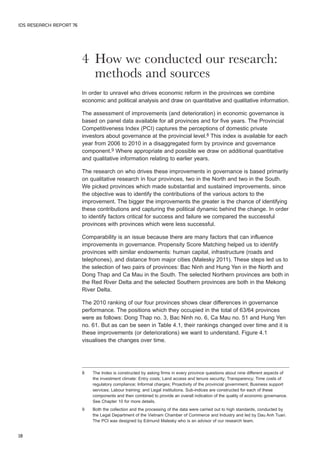
The 2010 ranking of our four provinces shows clear differences in governance 
performance. The positions which they occupied in the total of 63/64 provinces 
were as follows: Dong Thap no. 3, Bac Ninh no. 6, Ca Mau no. 51 and Hung Yen 
no. 61. But as can be seen in Table 4.1, their rankings changed over time and it is 
these improvements (or deteriorations) we want to understand. Figure 4.1 
visualises the changes over time. 
8 The Index is constructed by asking firms in every province questions about nine different aspects of 
the investment climate: Entry costs; Land access and tenure security; Transparency; Time costs of 
regulatory compliance; Informal charges; Proactivity of the provincial government; Business support 
services; Labour training; and Legal institutions. Sub-indices are constructed for each of these 
components and then combined to provide an overall indication of the quality of economic governance. 
See Chapter 10 for more details. 
9 Both the collection and the processing of the data were carried out to high standards, conducted by 
the Legal Department of the Vietnam Chamber of Commerce and Industry and led by Dau Anh Tuan. 
The PCI was designed by Edmund Malesky who is an advisor of our research team.
IDS RESEARCH REPORT 76 
19 
Table 4.1 PCI scores and rankings of four selected provinces, 2006–2010 
Province PCI 
2006 2007 2008 2009 2010 
Bac Ninh 54.79 58.96 59.57 65.70 64.48 
Ca Mau 43.99 56.19 58.64 61.96 53.57 
Dong Thap 58.13 64.89 66.64 68.54 67.22 
Hung Yen 55.97 57.47 57.53 61.31 49.77 
Province Ranking 
2006 2007 2008 2009 2010 
(64 provinces) (63 provinces) 
Bac Ninh 22 20 16 10 6 
Ca Mau 57 29 18 22 51 
Dong Thap 11 9 5 4 3 
Hung Yen 16 26 20 24 61 
Note: The PCI ranges from 0 to 100 with higher scores indicating better economic governance. 
Figure 4.1 PCI scores of four provinces, 2006–2010 
Table 4.1 and Figure 4.1 show the aggregate index. For each province and each 
year, we can decompose the picture and focus on particular components of the 
index.10 For example, Figure 4.2 shows how the four provinces differed in 2010. 
10 The PCI components (sub-indices) are explained in detail in each year’s PCI Report. See, for example, 
pages 3–4 of VCCI (2010). www.pcivietnam.org/uploads/report/PCI%202010%20final%20report.pdf 
(accessed 12 October 2011).
IDS RESEARCH REPORT 76 
20 
Figure 4.2 Disaggregated PCI for four provinces in 2010 
Although Figure 4.2 confirms the good performance of Bac Ninh and Dong Thap, 
it shows that performance can vary considerably by component. For example, Ca 
Mau scores poorly on the quality of its legal institutions and the proactivity of its 
government, but its entry costs, transparency, labour training and lack of informal 
charges are similar to better performing provinces. 
Unravelling the drivers of change was based on interviews. Careful selection of 
informants was important. The principle was that on most issues we would need 
to hear both the public and private sector and cross-check information within and 
across public and private sectors. In each province we talked to roughly similar 
numbers of government officials and business leaders, conducting a total of 121 
interviews. Table 4.2 gives the breakdown according to ‘sector’: public, private, 
donor, media, experts. Table 4.3 gives the breakdown by province. It also includes 
the number of interviews carried out in Ha Noi – where we cross-checked 
information received in the provinces and gathered information on the Centre’s 
influence on the provinces. 
Table 4.2 Interviews by category 
Category Quantity 
Government 47 
Enterprises 58 
Associations 8 
Experts 4 
Donors 2 
Media 2 
Total 121 
Table 4.3 Interviews by province 
Province Quantity 
Bac Ninh 26 
Hung Yen 26 
Dong Thap 31 
Ca Mau 24 
Ha Noi 14 
Total 121
IDS RESEARCH REPORT 76 
21 
The respondents are listed in the appendix but the report does not specify which 
person says what. We promised confidentiality in order to have a free discussion. 
And we did not use tape recorders. As a result most informants opened up but 
some more so than others. This is not surprising because the interviews probed 
into sensitive issues. Covering the period 2005–07 was much more difficult than 
discussing what happened during 2008–10 because of changes in leadership in 
both government and business. 
Our interviews were conducted in the form of an open discussion but were 
structured around interview schedules which are included in the appendix. Each 
interview team had one person asking the questions and another taking notes and 
sometimes swapping roles in the process. In some cases the interview team 
included four people. Interviews led by Hubert Schmitz and Neil McCulloch had 
professional translators. Most interviews were led by the Vietnamese team 
members. The composition of the interview teams varied but overlapped both 
within and across provinces in order to share experiences and insights. 
While the interviews are our prime and main source of information for 
understanding the differences between provinces and changes over time we have 
also drawn on secondary material which is referred to in the course of the report. 
The following four chapters show the findings for each of the four selected 
provinces. Subsequent chapters then compare and draw overall conclusions. 
5 Findings from Bac Ninh 
This province is located in the Red River Delta, bordering Ha Noi on the north-eastern 
side. We selected Bac Ninh because – if one wants to understand the 
drivers of reform – it is good to concentrate on a success story. Section 5.1 
documents this success, Section 5.2 provides background information on the 
province and Sections 5.3 to 5.6 then discuss the drivers of economic reform in 
this province. Subsequent chapters on the other provinces follow the same 
structure. 
5.1 Governance – the PCI scores 
Bac Ninh’s economic governance has improved steadily in the second half of the 
2000s. Table 5.1 shows the aggregate changes and Figure 5.1 indicates how each 
component of the PCI changed over the years 2006–10. 
Table 5.1 Bac Ninh PCI: aggregate scores and ranking, 2006–2010 
2006 2007 2008 2009 2010 
PCI score 54.79 58.96 59.57 67.70 64.48 
Ranking 22 20 16 10 6
IDS RESEARCH REPORT 76 
22 
Figure 5.1 Bac Ninh: disaggregated PCI scores, 2006–2010 
The improvement of this province comes out more dramatically when it is seen in 
comparison with other provinces. The PCI ranking has improved year on year. 
Amongst the 63/64 provinces in Vietnam, Bac Ninh moved steadily up the ranks 
from no. 22 in 2006 to no. 6 in 2010 (Table 4.1). 
5.2 Economic development 
These reforms seem to have contributed to Bac Ninh’s economic performance.11 
Table 5.1 shows the trends in economic growth and investment over the period. 
Table 5.2 Economic growth in Bac Ninh 
2000 2001 2005 2006 2007 2008 2009 2010 
Growth rates GDP (%) n/a 15.1 15.7 16.2 12.5 15 
Ranking GDP growth n/a 7 7 4 7 5 
Number of operating 363 1,120 1,273 2,394 2,162 2,394 2,652 
enterprises 
Growth rates of taxes 7 38 22 91 23 91 52 
paid by enterprises (%) 
Source: General Statistical Office. 
11 Another component of our project is examining the direction of causality between governance reform 
and economic growth (McCulloch and Nguyen, forthcoming).
IDS RESEARCH REPORT 76 
23 
Table 5.1 shows that Bac Ninh has had a high average annual growth rate of 
around 15 per cent over the period 2006–10.12 The ranking of Bac Ninh – in terms 
of GDP growth – varied slightly over these years but moved up over the period 
from 7 to 5. The period 2000–10 witnessed impressive growth in the number of 
registered enterprises with around 100 enterprises in the year 2000, and then 40 
times that number ten years later, reaching 4,300 registered enterprises in 2010 
with registered capital of 22.6 trillion VND. Registered capital per enterprise more 
than doubled over the period 2006–10.13 
Bac Ninh is also successful in attracting foreign direct investment. In 2010, the 
province ranked 13th out of 63 provinces nationwide and 6th in new licensed 
projects.14 For the period from 1997 to September 2011 the province has had 
312 foreign direct investment (FDI) projects, of which 308 are operative with total 
registered capital of 3,541.9 million US$. The province has attracted foreign 
corporations such as Canon and Sumitomo from Japan; Samsung and Orion from 
Korea; Foxconn from Taiwan; Tyco Electronics from the United States; ABB from 
Sweden and most recently, a subsidiary of the Nokia Group from Finland. The FDI 
share in Bac Ninh’s GDP increased from 7.7 per cent in 2001 to 9.7 per cent in 
2006 and to 28.2 per cent in 2010. Its share in industrial production reached 49.8 
per cent in 2010.15 To attract local and foreign investment, Bac Ninh has planned 
15 industrial parks and clusters with 7,525 hectares of land, of which ten parks 
and clusters were in operation in 2011. 
In terms of sectors, Bac Ninh has a diversified economy but two sectoral 
specialisations have emerged. Foreign enterprises have invested mainly in the 
electronics sector as can be seen from the companies mentioned above. Local 
enterprises are particularly numerous in the handicraft sector. 
5.3 Main driver of reform in the early stage 
We seek to understand the forces which drive the reform process, primarily on the 
basis of interviews in the selected provinces. In Bac Ninh we focused these 
interviews mainly on the PCI component in which most progress was made: ‘time 
costs of regulatory compliance’. 
The interviews with business leaders confirm the big reduction in time costs. Our 
informants provided examples of how the time spent on complying with 
regulations, and the speed with which government officials responded to queries, 
has shortened over the years. Those informants with direct experience in other 
provinces also stressed that Bac Ninh was superior in this respect and that this 
influenced their investment decision in favour of Bac Ninh. 
12 In earlier years, Bac Ninh had also achieved stable and high growth. During 2000–03, GDP growth 
averaged around 14 per cent (Vo Trinh et al. 2005: 22). 
13 Report by Bac Ninh People’s Committee on ‘Bac Ninh Development for the period 2006–2010’. 
14 Source: MPI, Foreign Investment Agency. 
15 Source: DPI Bac Ninh – http://bacninhbusiness.gov.vn/Index.aspx.
Views differed on the question of who initiated this process of reform. Some 
respondents stressed that the change came from within the government. Others 
felt that the change came from outside, notably the business side. And then there 
were those who felt that the public and private sector together brought about the 
changes. At first sight, some of these responses seem difficult to reconcile but by 
digging deeper we found that the responses were by no means contradictory. 
They reflect the different time periods which the respondents had in mind. In this 
section, we concentrate on the years 2005–06 when major reforms were initiated. 
One of the department leaders with long and direct experience in the big decision-making 
processes emphasised that the business leaders played a critical role in 
initiating the reform process and pushing it forward. Informants from the private 
sector confirmed this. Interviews and discussions with a local business leader and 
with the president, vice-president and secretary of the Business Association helped 
us to understand what went on at the time. The private sector influence did not just 
take the usual form of business people lobbying or complaining individually. The 
provincial Business Association of Small and Medium Enterprises (SME) played an 
effective role in bundling the voices of its members and in channelling these voices 
into the governmental apparatus and processes. The critical institutional innovation 
was the establishment – by the Association – of an advisory committee which 
included both government and business people. Through this advisory committee, 
introduced in 2005, government officials were brought into the discussions with 
business people on a regular basis. And through this committee, business found a 
way of exerting influence on the direction, speed and contents of the reform. 
For such committees to work effectively, both sides must have a direct interest in 
the outcome of the discussions. The interest of the business people is clear: they 
stand to gain from policies and regulations which provide clarity and increase speed. 
The interest of government officials in such reform is less obvious. The old rules 
and regulations might have given them power and the potential of ‘informal income’, 
but such incentives were soon superseded. The incentives for provincial leaders 
and government officials changed in Vietnam in 2005/6. As shown in Chapter 3 of 
this report, central government introduced changes in legislation which signalled 
greater openness to the outside world, underlined the need to compete in the global 
economy and brought provinces greater autonomy in economic regulation and 
taxation. Provincial leaders and government officials could enhance their career 
prospects and promotion prospects by promoting investment and supporting 
business in constructive ways. It seems that this new spirit influenced the provincial 
leader and government of Bac Ninh in 2005 and has continued to do so since then. 
In summary, the decisive push in the early period came from the private sector, 
but – given the policy changes made by central government and embraced by the 
provincial government of Bac Ninh – the private sector did not have to push hard. 
5.4 The role of the provincial government 
Those informants who did not experience the changes in the middle of the decade 
and/or arrived later in Bac Ninh put more stress on the government as the driving 
force of the reform. They encountered a government which had already changed 
IDS RESEARCH REPORT 76 
24
IDS RESEARCH REPORT 76 
25 
and went out of its way in adopting an approach which stressed speed and 
flexibility. The most notable example was the manager of a Korean multinational 
company who stressed that, once the decision had been taken to invest in Vietnam, 
the attitude of the provincial government played an important role in opting for Bac 
Ninh. With only three years of experience in this province, he did not realise that 
the local (domestic) entrepreneurs had played a major role in earlier years in 
initiating the changes in attitude and regulation of the provincial government. 
Distinguishing between periods of the reform process is clearly important. In the 
more recent years 2007–10, the provincial government has emerged as the main 
driver of reform. Interviews in both the public and private sector support this 
conclusion. It is particularly striking that in Bac Ninh all government departments 
have embraced the view that reform is never finished and that it requires 
continuous improvement. Business leaders testify to the enthusiasm and dynamism 
of the province’s chairman and secretary. 
Amongst the department leaders we noticed that some, notably the leaders of the 
Department of Planning and Investment (DPI) and the Management Board of 
Industrial Parks, push the process forward, whereas others see it as their 
responsibility to implement the orders given from above. The latter did not seem 
reluctant implementers. It was striking that across the many interviews we carried 
out in a range of government departments (detailed in Appendix 3) there were no 
dissenting voices. As we shall see later, they recognised problems in the 
implementation process but such observations did not question the direction of 
reform. Responses to our follow-up questions showed that, where problems 
arose, they did not lead to questioning the direction of reform; the efforts went into 
solving the problems. While some department leaders exerted more influence 
than others, partly due to position, partly due to personality, they seemed united in 
advancing the reform. 
Such unity in government is not what we expected. For example, Martin 
Gainsborough (2010: 180) who studied provincial government in some detail, 
stresses: 
Perhaps the first thing to note about the state in Vietnam is the highly 
particularistic nature of different institutions, offices and personnel which we 
commonly regard as comprising ‘the state’. That is, what comprises ‘the state’ 
rarely moves in the same direction, rarely works together, and rarely sings 
from the same hymn sheet. 
This is not what we found in Bac Ninh province. One of the reasons for this relative 
unity in Bac Ninh seems to lie in the way in which the Communist Party binds 
together the players relevant for this province. We heard frequent references to 
the constructive ways in which the Communist Party, the People’s Committee and 
local government departments overlap and interact in this province. 
There are two aspects to the role of the provincial government in Bac Ninh which 
deserve highlighting. The first concerns the continuity in personnel. Since 2005, 
the province has had only two chairmen of the provincial committee and the 
current chairman was previously deputy chairman. The second feature concerns 
the way they carried out their work: they made the pro-business direction of
IDS RESEARCH REPORT 76 
26 
reform very clear and maintained a hands-on approach. They did not issue many 
legal documents and were not afraid of using discretion. According to themselves 
and others who observed them, they were not afraid of change, were open to 
suggestions from business, and willing to take risks. In the words of the chairman 
of the People’s Committee, the changes in the business environment of Bac Ninh 
are driven by ‘the ambition of provincial leaders, but under pressure from 
business’. 
As mentioned earlier, the greatest progress was made in the ‘time costs of 
regulatory compliance’. These improvements seem to have benefited from support 
provided by the International Finance Corporation (IFC) for streamlining 
administrative procedures. IFC projects focused on the simplification and 
transparency of the process of business registration, unification and simplification 
of procedures for land access, investment and construction. While it is difficult to 
determine how much difference this external support made on the ground, the 
willingness to take part in this IFC project is a further indicator of the government’s 
reform ambition. 
5.5 The role of business in the reform process 
Local enterprises, through their business association, were a driving force in the 
reform process in the early period, namely 2005–06. This was set out in section 
5.3. In this section we discuss the years since then. In these more recent years, a 
more complicated picture has emerged. To some extent this is unavoidable since 
some formerly small local enterprises have become large and other large 
enterprises have come from other provinces and other countries. We know from 
the international experience that increasing differentiation between enterprises in 
terms of size and sector makes collective representation more difficult. 
Participation in the reform process therefore does not occur in a uniform way. This 
became clear in the interviews. When large enterprises want government support, 
their owners or managers speak directly with the directors of the relevant 
department – or even the (vice-) chairman of the People’s Committee. 
Informal contact between big business and government leaders is common, taking 
place over the phone, or face to face in the office of the government official and 
sometimes followed up over lunch or dinner in a restaurant. Both sides talked 
about these interactions openly. For government it was a way of finding out what 
mattered to business and for business it was a way of resolving their problems 
quickly. Such informal discussions – often arranged at short notice – were thought 
to be more effective than formal occasions. In spite of this easy and direct access 
to government, large enterprises are not the dynamo of the reform process. Their 
role is one of making suggestions and requests, some of which might contribute to 
general improvements. They recognise that they are dealing with a government 
which has a clear vision and is in the driving seat. 
The direct and informal route is not open to small enterprises. Their access to 
government is different in two respects. First, they need to work through their local 
association. Second, when they have direct contact with government officials they 
meet with lower ranking officials. Let us explain.
IDS RESEARCH REPORT 76 
27 
The business association, which was so important in the early stage, no longer 
plays a major convening role. It continues to bundle the suggestions and concerns 
of small and medium enterprises and discuss them with the provincial government 
but its influence is hard to judge. The vast majority of enterprises can only make 
their influence at the district level. Their association is organised at district level. In 
turn the district-level association deals with the district-level government. In many 
respects this is entirely appropriate. Many issues concerning the small enterprises’ 
business environment are best resolved at district level. However, it is striking that 
large enterprises tend to take their concerns straight to the (more powerful) 
provincial level government and the leaders of the People’s Committee or 
department. 
In contrast, small enterprises, if they have direct access at all, deal with lower or 
middle-ranking government officials. The latter are often less business-friendly, are 
less good at listening and less willing to explore mutually acceptable solutions. 
Department leaders are aware that their lower ranks do not necessarily embrace 
the leaders’ views and practices. When asked about forces which slow down the 
progress of reform, some department leaders admitted that lower ranks of their own 
departments are sometimes the main problem. They admitted that they needed to 
invest more in training and changing the outlook of the lower level officials. Small 
enterprises seem to suffer from this more than the large ones do. This explains 
why small enterprises are more critical of the reform efforts of government and 
see little chance of influencing the pace or content of reform. In the words of the 
owner of one small business, the biggest drawback to the business environment 
in Bac Ninh is ‘the difference between the ambitions of the leaders and the 
performance of subordinate staff’. 
It seems important to acknowledge this difference in current perceptions and 
difference in current roles of small versus large enterprises. Government likes to 
portray the view that the investment climate has improved for all enterprises and 
that all enterprises have a way of contributing to this improvement through 
dialogue and pressure. Interviews in the private sector indicate that this is not quite 
how it works and how it is seen. This is also borne out by the 2010 PCI survey. Of 
the 101 respondents in Bac Ninh, 43.6 per cent felt that the provincial government 
prioritised FDI attraction over private sector development.16 
5.6 Divisive issues 
The unevenness and difference became even clearer when discussions turned to 
the issue of access to land. The 2010 PCI survey indicates that 70.4 per cent of 
Bac Ninh respondents felt that government favoured foreign enterprises in the 
allocation of land. Our interviews suggest that the bias extends to large national 
enterprises whereas small enterprises lose out. In order to attract large investors, 
the provincial government made land available at favourable prices. Often this 
involved taking land away from local farmers who would receive only modest 
16 Source: PCI database of VCCI.
compensation. While this in itself created tension, the tension mounted when the 
buyers of this land did not make the promised investment and did not create the 
promised jobs. According to the Justice Department, such cases lead to difficulties 
in implementing clearance policies in the future. In this way, some large investors 
are holding back rather than moving the process of reform forward. 
This sensitive land question brings up a wider issue. The case of Bac Ninh shows 
that reform is an ongoing process which requires cooperation between government 
and business. In the early period, business was the main driver and in the later 
period the government was the main driver. For the process to continue, both sides 
need to keep their promises. There is a deal. Government improves the conditions 
for business and business is expected to improve the conditions for government to 
do its job. What matters most for government is public revenue that comes from 
taxes paid by business. This is where the deal breaks down sometimes. A number 
of enterprises have been able to avoid or minimise tax payments. In particular, 
some foreign enterprises have paid little tax in spite of high profitability. They have 
been able to do this by shifting costs and profits between subsidiaries/headquarters 
(transfer pricing) and other mechanisms. Such practices have attracted a good 

deal of attention in Vietnam generally, and in Bac Ninh province in particular.17 
SME owners expressed strong misgivings during the interviews, stressing that this 
taxation issue – like the land question – has increased the tension between 
foreign and local enterprises. Similarly, some government officials felt that the tax 
avoidance by foreign enterprises undermines the business-friendly reforms that 
government has been pushing forward energetically. 
In summary, we heard from both the public and private sector in Bac Ninh that 
business continues to play a constructive role in the reform process by drawing 
attention to problem areas. This takes the form of complaining, lobbying and 
frequent dialogue with government leaders and officials. However, some 
enterprises are abusing the business-friendly reforms by hoarding land acquired 
on preferential terms or by avoiding taxation in spite of successfully operating in 
Bac Ninh. This leads to tension between local and non-local enterprises and 
tension between government and enterprises. It threatens to undermine the reform 
process. 
It is already leading to the perception amongst local small enterprises that the 
provincial government is too close to large enterprises, in particular foreign 
enterprises. We heard of suspicions of corruption but find it difficult to make a 
judgement of how important this is in the differential treatment of large and small 
enterprises. The disaggregate PCI data suggests that there is a problem of 
enterprises paying ‘informal charges’. While Bac Ninh’s overall rank in 2010 was 
no. 6, in the sub-index ‘informal charges’ Bac Ninh ranked no. 47. And with regard 
to land policy it ranked no. 46. These low rankings in the sub-indices confirm the 
concerns expressed above. 
IDS RESEARCH REPORT 76 
28 
17 See, for example http://vietnamnews.vnagency.com.vn/Economy/Business-Beat/197649/foreign-firms-post- 
losses-to-avoid-taxes.htmlhttp://vietnamnews.vnagency.com.vn/Economy/Business-Beat/197649/ 
foreign-firms-post-losses-to-avoid-taxes.html (accessed 15 April 2012).
IDS RESEARCH REPORT 76 
6 Findings from Hung Yen 
Like Bac Ninh, this province is located in the Red River Delta, but it borders Ha 
Noi on the Southern side. We selected Hung Yen, because in its structural 
characteristics18 it is comparable with Bac Ninh. Hung Yen’s PCI scores, however, 
developed differently, starting off better than Bac Ninh but then declining (see 
Table 6.1). The expectation was that this contrast would yield new insights. 
6.1 Governance – the PCI scores 
Hung Yen’s PCI scores were comparatively good in 2006, ranked 16th in Vietnam 
and second in the Red River Delta, higher than Bac Ninh. This was not a one-off, 
similarly good results had been achieved in 2005 (TAF-VCCI 2005a). However, 
the ranking declined in subsequent years, slumping to 61st (out of 63 provinces) 
in 2010. This suggests an alarming recent decline – as perceived by business – 
which we will seek to explain in this section. 
29 
Table 6.1 Hung Yen PCI: aggregate scores and ranking, 2006–2010 
2006 2007 2008 2009 2010 
PCI score 55.97 57.47 57.43 61.31 49.77 
Ranking 16 26 20 24 61 
Table 6.1 shows the aggregate PCI score for the years 2006–10 and Figure 6.1 
shows that the poor performance in 2010 did not extend to all PCI components. 
There were considerable variations. As in Bac Ninh, Hung Yen’s best performance 
in 2010 was in ‘time costs’ which meant rank no. 3 in the Red River Delta. 
Figure 6.1 Hung Yen: disaggregated PCI scores, 2006–2010 
18 These structural characteristics include initial wealth, population size and density, urbanisation, 
education, infrastructure, distance from major cities, and economic structure of the region in which the 
province resides (Malesky 2011).
6.2 Economic development 
Economic growth in Hung Yen has been remarkably stable over a long period. 
During 1998 to 2003, the GDP growth rate was about 12 per cent (Vo Tri Thanh et 
al. 2005: 63). It continued at an average of 12 per cent over the period 2006–10 
but dipped to 7 per cent in 2009. The ranking of Hung Yen – in terms of GDP 
growth – declined from 12 to 25 (see Table 6.2). 
IDS RESEARCH REPORT 76 
30 
Table 6.2 Economic growth in Hung Yen 
2000 2001 2005 2006 2007 2008 2009 2010 
Growth rates GDP (%) n/a 13.7 13.8 12.3 7.0 12.1 
Ranking GDP growth n/a 12 15 16 38 25 
Number of operating 224 719 809 1,080 1,355 1,605 1,847 
enterprises 
Growth rates of taxes -50 40 -20 131 61 -3 87 
paid by enterprises (%) 
Source: General Statistical Office. 
Starting as a largely agricultural province, Hung Yen has restructured fast over the 
period 2000–10, with industry, services and agriculture accounting for 45 per cent, 
31 per cent and 24 per cent of GDP respectively. 
Like Bac Ninh, Hung Yen had around 4,000 registered enterprises by the end of 
2010. Considering that the province had only 90 enterprises in 1997, this suggests 
rapid growth. In terms of attracting foreign direct investment, Hung Yen ranked 
14th in 2010 (compared with Bac Ninh 13th – according to FDI data of the GSO). 
By the end of 2011, Hung Yen had 213 FDI projects in operation with total 
registered capital of 1,880 million US$ of which 550 million US$ were outside 
industrial parks and 1,330 million US$ in industrial parks.19 The province has 
attracted big foreign companies such as Sumitomo, Canon, Pulpy Corelex from 
Japan and Cargill from the USA. The biggest number of FDI investors were from 
Japan (35 projects with total registered at 808 million US$), the second biggest 
was Korea (29 projects), followed by the Netherlands and China. In the early 
2000s, Hung Yen was renowned for attracting large-scale domestic investment 
from other provinces. 
6.3 Ups and downs in reform 
Before analysing the process of economic reform in this province, let us be clear 
about what we are trying to explain. As shown above, Hung Yen did well in the 
PCI of 2005 and 2006 and then lost out in subsequent years. In other words, we 
need to explain both the early success and later decline. 
19 Source: http://hungyen.gov.vn/vi-vn/Pages/Article.aspx?ChannelId=354articleID=10833 (accessed 15 
April 2012).
IDS RESEARCH REPORT 76 
Figure 6.1 suggests that there is no absolute collapse in the quality of economic 
governance. The contours of Hung Yen’s PCI performance are fairly similar over the 
years. (The partial exception is 2010 when the scores for some PCI components 
were visibly lower than in previous years, but this poor performance has its own 
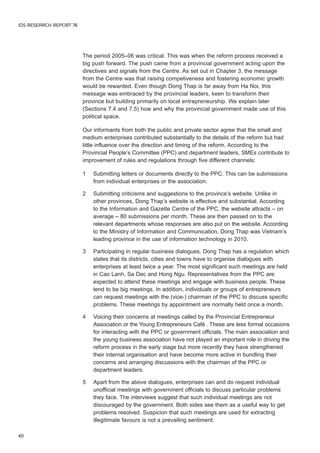
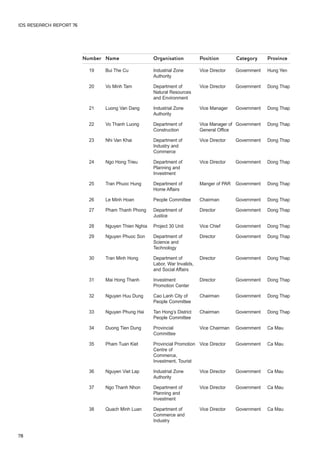
exception, namely the improvement in the component ‘time costs’ which results in 
Hung Yen being on a par with Bac Ninh.) The key point is that Hung Yen has 
declined relative to other provinces. The strength of the PCI data set for 2006–10 
is that – in addition to tracing absolute changes within each province – we can 
observe how each province is doing in relation to others. This is where the alarm 
bells go off because Hung Yen has slumped to 61st out of 63 in 2010. 
This is in stark contrast to half a decade earlier. Hung Yen was a strong performer 
in 2006. This strong early performance is supported by data for 2005 when a pilot 
study of the PCI was carried out. Out of nine provinces in the Red River Delta (all 
within a three-hour car drive from Ha Noi), Hung Yen occupied second place 
(TAF-VCCI 2005a). Further evidence of a qualitative kind comes from a study of 
best practices carried out by Edmund Malesky and Dau Anh Tuan in 2005 (TAF-VCCI 
2005b). Several of the examples of best practice (exemplary at that time) 
came from Hung Yen. These included: discarding superfluous procedures in 
business registration, clear posting of registration procedures, expediting customs 
procedures, experiments in land allocation, clear documents on various aspects of 
provincial financial and land clearance policies, openness about likely future 
changes in policy, inter-departmental coordination of factory inspections, working 
with the media to make information on legislative and policy changes accessible 
(TAF-VCCI 2005b). Many problems remained (some of them inherited from the 
era of state socialism) but Hung Yen was one of the pioneers in reforming the 
investment climate in the first part of the decade. Our task in this section is to 
understand who was behind this reform. Who drove it forward? And who or what 
caused the relative decline? 
Explaining the early success turned out to be more difficult than explaining the 
subsequent decline. The reasons are first, there was a high turnover of provincial 
and department leaders which made it difficult to identify government officials 
directly involved in the reform process in the early years. Second, the private 
sector was not well organised and memory of the private sector role was weak. 
Third, foreign technical assistance played a role in the early success but the 
foreign experts involved have dispersed around the globe. Nevertheless, we can 
piece together a picture of what happened based on interviews and supporting 
material. 
6.4 The role of government 
Most respondents in the public and private sector suggested that the central 
government played an important role in providing ‘overall orientation’. In other 
words, central government gave overall direction and set boundaries. The direction 
was clear: Vietnam should integrate into and compete in the world economy, the 
private sector should play a key role in this process, and provincial governments 
should find effective ways of supporting the private sector. We have set out in 
Chapter 3 how this influenced the motives and incentives for provincial leaders 
31
and department heads. These changes in the overall political framework and 
incentive structure, carried out mainly in the first half of the decade, applied to all 
provinces in Vietnam, so they cannot explain why Hung Yen did particularly well in 
2005–06. 
The interviews suggest that at that time the provincial leader and head of the 
Department of Planning and Investment were particularly dynamic and played an 
important role. They provided leadership in the reform process. It seems that the 
political space provided by this leadership was filled with reforms on the ground 
partly because a foreign assistance agency came in with financial resources and 
technical expertise. The foreign agency was GTZ (now renamed GIZ) from 
Germany and the political counterpart was the Ministry of Planning and Investment. 
GTZ brought in new ideas of how to promote local economic development and 
how to adopt a value chain lens and thus bring out the importance of making 
procedures more efficient and rapid.20 This seems to have contributed to the 
reforms undertaken in 2005 and 2006 but we do not have firm evidence for this. 
The problem was that the early dynamism was not maintained and disappeared by 
2010. Discussing the reasons for Hung Yen’s relative decline with our respondents 
was not difficult. Because of the poor performance in 2010 a lot of soul searching 
went on in Hung Yen as to why this happened. The interviews suggest that there 
was no single reason but confluence of several contributing factors. 
First, the central government gave clear overall directions but in a number of 
areas the policy directives coming from the Centre are not clear or interfere with 
provincial policies causing confusion and slowing down the process of reform. 
Such problems arise because the decentralisation of economic governance from 
the Centre to the provinces has been pushed through politically but laws and 
regulations are still catching up. The resulting confusion and lack of coordination 
between central and provincial level is a challenge for all provinces. The question 
therefore is why it was not managed well in Hung Yen. 
Second, the reason why this lack of clarity was not managed well lies in the 
frequent changes in provincial leadership. Senior personnel of the provincial 
government changed three times between 2005 and 2010. This meant disruption 
and loss of expertise at a time of rapid economic transformation and political 
decentralisation. Sustaining reform requires good relationships between levels of 
government, between departments of government, with the Party Committees and 
with the private sector. Frequent changes in key personnel make this difficult. The 
interviews make clear that the problem was not a lack of ambition or lack of ideas 
of those who were in charge. The problem was that they were not in power for 
long enough to build the support networks required to implement the changes. 
Third, in a situation of frequent changes at the top, it becomes particularly 
important to have capable middle and lower cadres embracing the spirit of the 
reform and acting accordingly. Frontline workers need to take initiative and resolve 
IDS RESEARCH REPORT 76 
32 
20 VCCI was acting as local coordinator for the Local Economic Development and Value Chain 
components of this GTZ project.
IDS RESEARCH REPORT 76 
issues because regulations and procedures are not yet clear (to be expected in a 
process of rapid reform). The interviews suggest that this was not happening. In 
the words of one of our respondents, they ‘kicked the ball to each other’ instead of 
finding solutions. This problem arose in particular when contributions had to come 
from more than one department. The interviews in both the public and private 
sector suggest that coordination between departments was often poor, for 
example, too many inspections were carried out with similar content or problems 
were only half resolved because staff did not liaise across departments. 
Fourth, the relative decline which followed the excellent start in Hung Yen might 
also be due to the way the reform was conceived. This is difficult to judge but with 
hindsight we can say the brave initial reforms remained shallow. The policy directives 
sought reform but there was no plan for what to do within the new policy directives. 
There are various indications for this: a master plan for industrial development 
was missing. Investment projects were approved but not carried out by the private 
sector because complementary services were not provided. Infrastructure was 
provided along the main roads but not further inland leading to main arteries 
clogging up. Scheduled meetings between government and business took place 
just once a year whereas other provinces had such meetings every month. 
6.5 The role of the private sector 
The private sector was and remains poorly organised and has played only a very 
limited role in the reform process. Interviews in both the public and private sector 
agree on this point but suggest also some nuances to this overall picture. 
We need to distinguish between local and foreign enterprises because they tend 
to have different channels for exerting influence. Local enterprises seek influence 
mainly through their business association. Foreign enterprises do this mainly 
through the management board of the industrial park, in which they are located, or 
through direct contact with government. Many participants in the 2010 PCI survey 
indicated that government was biased towards foreign enterprises. Of the 92 
respondents from Hung Yen, 40.2 per cent felt that the provincial government 
prioritised FDI attraction over private sector development; and 70.2 per cent 
expressed that land allocation was biased in favour of foreign investors.21 
The main collective organisation for local enterprises is the Hung Yen Business 
Association which was set up in 2004 with support from the VCCI. At the time of 
the fieldwork (June 2011), this association had 1,238 members, mainly local 
enterprises but surprisingly also some government departments, including the 
Department for Planning and Investment and the Industrial Zone Authority. The 
interviews suggest that the association arranged meetings with government officials 
and workshops on policies and thus provided opportunities for communication 
between the public and private sectors and for learning about each others’ problem. 
However, neither public nor private sector respondents judged it to be effective in 
terms of influencing the reform process. The main reason, it seems, is the lack of 
33 
21 Source: PCI database of the VCCI.
professional staff and organisation. This view from our respondents is supported 
by an evaluation of Hung Yen’s Business Associations which compares them with 
associations in other provinces (GTZ-MPI 2008). The evaluation gave the Hung 
Yen Business Association low overall scores (using multiple criteria).22 The 
disaggregated score provides useful additional information: the main association 
scored particularly poorly on ‘number of staff’, ‘quality of staff’, ‘governance’ and 
‘governmental influence’. 
Foreign enterprises rarely participate in local or provincial business associations 
but sometimes are members of the national associations organised according to 
country of origin (for example, the Korean Business Association) or sector (for 
example, the Vietnam Steel Association). When it comes to influencing provincial 
level rules and policies, they tend to work through the organisation which manages 
the industrial zones in which they are located. For example, the ‘Thang Long II’ 
Industrial Zone is managed by Sumitomo from Japan which established a good 
relationship with the provincial leadership. The start up of this industrial zone was 
exceptionally fast. Government procedures and ground clearance were dealt with 
in two months whereas other zones take two years to get ready. Some national 
enterprises from other provinces have also invested in Thang Long II, which has 
become an island of effective governance for industrial development. This shows 
that large foreign and national enterprises can use their influence to get into the 
fast lane and that this influence provides advantages to a select few, not 
contributing necessarily to general improvement. 
Overall we can conclude that the private sector contributed little to improving 
economic governance in the province of Hung Yen. Foreign enterprises benefited 
from the ‘red carpet’ treatment by government but this only led to selective benefits 
and not to general improvements in governance. Local enterprises can channel 
their concerns through the business association but the organisational capacity of 
this association was and remains too weak to exert much influence. 
6.6 Divisive issues 
There is a sense amongst small and medium-sized local enterprises in Hung Yen 
that their concerns are neglected by provincial and district government. In a way 
this is hardly surprising given that these enterprises have no effective collective 
voice. Their poor organisational capacity explains to some extent the neglect by 
government. But there are other reasons. 
Respondents from within the government admit that they have given most attention 
to big projects proposed by big enterprises from outside the province. The reasons 
are easy and not specific to Hung Yen. Concentrating on attracting a few large 
enterprises is easier than fostering a multitude of small enterprises. Big projects 
promise a visible way of pushing up the tax revenue for government. The problem 
is that the tax revenue is often not forthcoming, either because – in the course of 
IDS RESEARCH REPORT 76 
34 
22 The overall scores were even lower for other business associations in Hung Yen Province.
IDS RESEARCH REPORT 76 
the negotiation – government ends up granting tax exemptions in order to fight off 
the competition from other provinces. Or big enterprises have ways of concealing 
profits by operating in multiple locations and enlisting the services of accountants 
who help them to minimise tax payments. 
The issue that causes most resentment amongst local enterprises is the 
preferential access to land given to enterprises from other provinces or countries. 
In a number of cases the outside investors implemented the projects on a smaller 
scale and for a shorter period than promised in order to take advantage of opening 
incentives and then transferred the land to others at a highly profitable price. Such 
practices are not unique to Hung Yen but are particularly problematic in an 
environment of declining trust between local and non-local enterprises and 
between business and government. 
6.7 Learning from success? 
The objective of this report is not just to analyse and understand. We also look for 
practical ways forward arising from positive experience. In this respect, it is 
]important to consider Hung Yen’s own success story. As can be seen from 
Figure 6.1, Hung Yen obtained a high score in one of the PCI components, namely 
‘time cost’. The score of 7.47 in 2010 is very similar to that of Bac Ninh. 
The interviews confirm the considerable efforts made to reduce the time cost of 
dealing with government. The provincial government introduced a regulation for all 
departments providing or withholding awards for complying with ‘Scheme 30’. The 
government established a division focused on this piece of administrative reform 
in 2007.23 The government of Hung Yen also published the full administrative 
procedures under the jurisdiction of all departments and provided online access.24 
These initiatives seem to have resulted in a good performance with regard to time 
cost. 
6.8 Comparing Bac Ninh and Hung Yen 
The comparison underlines that reform cannot be achieved by one-off jumps 
forward. Reform is a process of continuous improvement. It takes time for the 
details to come together, especially where coordination of different levels of 
government and different departments of government is needed. Constant 
improvement is needed because other provinces are also improving. 
Bac Ninh had two things that were lacking in Hung Yen: 
1 Organisational capacity of the private sector. This was decisive for getting the 
reform process underway. Local private enterprise was the main driver in the 
early phase. 
35 
23 Decree No. 30/QĐ – TTg, dated 10 January 2007, approved the project to simplify administrative 
procedures in the fields of state management for the period 2007 to 2010 (Scheme 30). 
24 See www.hungyen.gov.vn/vi-VN/hdtthc/Pages/Default.aspx (accessed 15 April 2012).
2 Continuity in leadership. This enabled Bac Ninh to turn unclear orientation 
from the Centre into advantage for the province. 
Both Bac Ninh and Hung Yen have two problems in common: 
1 Implementation of reform is slowed down by middle and lower-level cadres. In 
both provinces, there is a problem of frontline workers not always carrying 
through what the leaders promise. 
2 The private sector is increasingly divided into large and small. Government 
has contributed to this by giving large enterprises preferential access to land 
and other resources and granting tax exemptions. Large enterprises exploit 
the reform ambitions of provinces through illegitimate land acquisition and tax 
avoidance. 
Policy implications for the private sector: 
1 If the private sector wants more effective governance, it needs to organise. 
The organisational capacity of the private sector is essential for influencing the 
reform process. 
2 The activities of the SME Association of Bac Ninh during 2005–07 provide a 
best practice example of engaging government officials in discussions on how 
to improve governance and industrial policy. 
Policy implications for government: 
1 If the government wants more effective economic governance, it needs to 
provide better training to lower and middle-level officials. 
2 A study should be commissioned which compares the tax burdens for small, 
medium and large enterprises, concentrating on actual tax payments and 
taking into account tax exemptions. 
3 A study should be commissioned which examines whether and how small and 
medium enterprises are disadvantaged in the process of land acquisition. 
4 Best practice of repossessing cleared land that remains un(der)used should 
be studied and applied. 
Policy implications for the Communist Party: 
1 There seems to be rising inequality between upper, middle and lower ranks in 
the civil service in terms of both training opportunities and earning opportunities. 
It would be useful to have a debate on whether the implementation of reform 
would be more effective by improving the opportunities of middle and lower 
level staff. Experimentation in selective provinces and departments would be 
particularly useful. 
2 Provincial governments on their own cannot deal with excessive tax exemptions 
and land acquisition for speculative purposes. These two issues contribute to 
negative competition between provinces, distort competition between enterprises 
and diminish public revenue. Breaking out of this downward dynamic requires 
intervention by the Party with both punitive and educative measures. 
IDS RESEARCH REPORT 76 
36
IDS RESEARCH REPORT 76 
7 Findings from Dong Thap 
Since North and South Vietnam have different histories, we selected two Northern 
and two Southern provinces for in-depth research. The pair of Southern provinces 
is Dong Thap and Ca Mau for which the findings are presented in Chapters 7 and 8 
respectively. Both these chapters are driven by the same questions and follow 
roughly the same structure as the two previous chapters on the Northern provinces. 
The province of Dong Thap is located in the Mekong River Delta, 165km south-west 
of Ho Chi Minh City, bordering Cambodia. We chose this province for our 
research because we wanted to learn from a Southern success story that is not 
part of the Ho Chi Minh industrial region. 
7.1 Governance – the PCI scores 
This small province, far away from the political and economic centres of the 
country, has been able to achieve high scores in all five PCIs carried out so far. 
And its ranking has improved consistently over time such that it occupied third 
place amongst Vietnam’s 63 provinces in 2010 and first place in the Mekong River 
Delta. Figure 7.1 shows that Dong Thap achieved its highest scores and its 
greatest improvement over time in the PCI component ‘time costs’. 
37 
Table 7.1 Dong Thap PCI: aggregate scores and ranking, 2006–2010 
2006 2007 2008 2009 2010 
PCI score 58.13 64.9 66.64 68.54 67.22 
Ranking 11 9 5 4 3 
Figure 7.1 Dong Thap: disaggregated PCI scores, 2006–2010
7.2 Economic development 
In analysing the forces which drove this improvement in the PCI, we need to draw 
attention to a big difference between Bac Ninh – our success story in the North – 
and Dong Thap – our success story in the South. Their economies are very 
different. Unlike Bac Ninh, Dong Thap has virtually no big business, neither national 
nor foreign. The only exceptions are state-owned enterprises such as Petrimex 
and Domesco. There are only three medium-sized foreign investors. With few 
exceptions, the economy consists of national enterprises of medium and small 
scale. 
Taking advantage of two branches of the Mekong River, this is an agricultural 
province, producing in particular rice, tropical fruit, flowers, and fish. Its industry is 
engaged in agricultural processing: rice processing, cattle feed manufacturing and 
fish processing. The share of agriculture to GDP remains high at a level of 40.8 per 
cent in 2010 while industry and construction took 26.5 per cent and the service 
sector took 32.7 per cent.25 
While mainly an agricultural province, Dong Thap has been able to average annual 
growth rates of slightly above 14 per cent during 2006–10, as shown in Table 7.2. 
The number of registered enterprises almost doubled from 1,436 to 2,852 in 2010, 
with total registered capital amounting to VND 14,387 billion. 
IDS RESEARCH REPORT 76 
38 
Table 7.2 Economic growth in Dong Thap 
2000 2001 2005 2006 2007 2008 2009 2010 
Growth rates GDP (%) n/a 14.3 15.8 16.6 11.1 13.0 
Ranking GDP growth n/a 10 4 3 13 12 
Number of operating 853 990 1,005 1,097 1,446 1,583 1,497 
enterprises 
Growth rates of taxes -4 25 28 21 43 13 22 
paid by enterprises (%) 
Source: General Statistical Office. 
The Dong Thap government is aware that offering good economic governance is 
not sufficient to attract new investors. It has therefore planned six industrial parks, 
three of which have large scale infrastructure for both road and water transport. 
For these parks, 58 projects have been approved, of which 32 are up and running 
and a further 17 are in different stages of preparation. While the share of private 
domestic and foreign investment in total investment has varied between 68.8 per 
cent in 2006 and 62.7 per cent in 2010, in absolute value the investment of the 
private sector has increased 1.6 times over this period. 
25 www.dongthap.gov.vn/wps/wcm/connect/Internet/sitdoanhnghiep/sitakinhtexahoi/sitabaocaokinhte/ 
20110128+tinh+hinh+kinh+te+xa+hoi (accessed 15 April 2012).
IDS RESEARCH REPORT 76 
Dong Thap’s excellence in rules and regulations does not extend to infrastructure. 
Amongst Vietnam’s 63 provinces, Dong Thap ‘only’ occupies rank 16 in the 2010 
infrastructure index. While higher than in most other provinces, this rank is much 
lower than the PCI rank – which was no. 3 in 2010.26 
7.3 The role of the private sector in governance reform 
Dong Thap’s PCI performance is impressive: consistently high and consistently 
improving. In this section we ask whether and how the private sector has 
contributed to this achievement. In order to answer this question we need to 
distinguish between big and small business. 
7.3.1 The role of large enterprises 
As indicated earlier, Dong Thap has only a few large enterprises. We investigated 
the role of those few by talking to their leaders and talking to others about their role. 
The result is clear: the large enterprises appreciate the reforms which the government 
has implemented, they have easy access to the leaders and departments in 
government, but they contribute little to the policy process at provincial level. 
This is particularly clear in the case of two quite large enterprises specialising in 
catfish processing and fish food. They have not joined the local business association, 
do not seem to participate in debates on the provincial policy and seem to 
concentrate entirely on their own enterprises. This does not mean that they do not 
care about what the provincial government does. On the contrary, their decision to 
invest in Dong Thap was influenced by the efficiently administrated procedures and 
easy direct access to government when specific issues needed to be resolved. 
These enterprises do, however, contribute to the policy process at national level. 
According to some department heads, large enterprises in Dong Thap are active 
members of national business associations, such as the Vietnam Food Association, 
the Vietnam Animal Feed Association and the Vietnam Association of Seafood 
Exporters and Producers. In contrast, they show less interest in the provincial 
business association. They have quick and easy individual access to relevant 
government officials in their province. This seems to be the main reason for them 
contributing little to the collective organisation of business in Dong Thap. They are 
not active and do not need to be active in provincial business associations. 
7.3.2 The role of small and medium-sized enterprises 
In contrast to the large enterprises, small and medium-sized enterprises have 
played an active role in the provincial reform process. They have contributed in 
many specific ways to the changes in rules and regulations, helping to make them 
relevant and practical for their realities. The main driver of the reform process, 
however, was the provincial government. 
39 
26 The infrastructure index is a separate measure and not a sub-index of the PCI (VCCI 2010).
The period 2005–06 was critical. This was when the reform process received a 
big push forward. The push came from a provincial government acting upon the 
directives and signals from the Centre. As set out in Chapter 3, the message 
from the Centre was that raising competiveness and fostering economic growth 
would be rewarded. Even though Dong Thap is far away from Ha Noi, this 
message was embraced by the provincial leaders, keen to transform their 
province but building primarily on local entrepreneurship. We explain later 
(Sections 7.4 and 7.5) how and why the provincial government made use of this 
political space. 
Our informants from both the public and private sector agree that the small and 
medium enterprises contributed substantially to the details of the reform but had 
little influence over the direction and timing of the reform. According to the 
Provincial People’s Committee (PPC) and department leaders, SMEs contribute to 
improvement of rules and regulations through five different channels: 
1 Submitting letters or documents directly to the PPC. This can be submissions 
from individual enterprises or the association. 
2 Submitting criticisms and suggestions to the province’s website. Unlike in 
other provinces, Dong Thap’s website is effective and substantial. According 
to the Information and Gazette Centre of the PPC, the website attracts – on 
average – 80 submissions per month. These are then passed on to the 
relevant departments whose responses are also put on the website. According 
to the Ministry of Information and Communication, Dong Thap was Vietnam’s 
leading province in the use of information technology in 2010. 
3 Participating in regular business dialogues. Dong Thap has a regulation which 
states that its districts, cities and towns have to organise dialogues with 
enterprises at least twice a year. The most significant such meetings are held 
in Cao Lanh, Sa Dec and Hong Ngu. Representatives from the PPC are 
expected to attend these meetings and engage with business people. These 
tend to be big meetings. In addition, individuals or groups of entrepreneurs 
can request meetings with the (vice-) chairman of the PPC to discuss specific 
problems. These meetings by appointment are normally held once a month. 
4 Voicing their concerns at meetings called by the Provincial Entrepreneur 
Association or the Young Entrepreneurs Café . These are less formal occasions 
for interacting with the PPC or government officials. The main association and 
the young business association have not played an important role in driving the 
reform process in the early stage but more recently they have strengthened 
their internal organisation and have become more active in bundling their 
concerns and arranging discussions with the chairman of the PPC or 
department leaders. 
5 Apart from the above dialogues, enterprises can and do request individual 
unofficial meetings with government officials to discuss particular problems 
they face. The interviews suggest that such individual meetings are not 
discouraged by the government. Both sides see them as a useful way to get 
problems resolved. Suspicion that such meetings are used for extracting 
illegitimate favours is not a prevailing sentiment. 
IDS RESEARCH REPORT 76 
40
IDS RESEARCH REPORT 76 
The relative importance of each of these communication channels is difficult to 
assess. Both government and business people seem to appreciate that they have 
multiple channels to interact. Of course, some enterprises are more active than 
others and those who can make comparisons with other provinces regard the 
ease of access to government as a strength of Dong Thap. All this is confirmed by 
the high PCI scores shown earlier. 
7.4 The role of the provincial government 
There was little doubt amongst our informants from the public and private sector 
that the provincial authorities were and continue to be the driving force in the 
reform process. It seems that the provincial secretary of the Communist Party, the 
chairman of the People’s Committee and the heads of department worked well 
together to drive the process forward. Leadership in the critical year 2005 is 
credited to the provincial party secretary. It seems that he was key in reading the 
signals from the Centre, learning from other provinces, articulating a vision for 
Dong Thap and getting the People’s Committee and department heads on board. 
In subsequent years, the reform process continued to benefit from strong 
leadership from the top, in particular the chairmen of the People’s Committee. 
Also the close articulation between leaders and implementers and between public 
and private sectors continued. 
The common vision was self-reliance. It was recognised that the province was poor 
and could not wait for help from outside. The way forward was seen in providing 
support for Dong Thap’s own enterprises, building on the existing small-scale 
agriculture and aquaculture, upgrading processes and products, and investing in 
processing and marketing of local products. Attracting enterprises from other 
provinces or countries was merely a complement. 2008 was the first year that 
Dong Thap held an investment promotion event (in Ho Chi Minh City). Some 
SMEs have come to the province and invested in its new industrial parks. 
Compared with other provinces, government policy in Dong Thap is low key. The 
government concentrates on improving the business environment in close 
consultation with the private sector. The PCI is used actively in this process. It is 
not just seen as an external verdict on provincial-level governance; it is used 
actively for modifying weak aspects of the business environment. For example, 
the 2008 and 2009 surveys showed that business support services were an area 
of relative weakness. This led to the Department of Planning and Investment 
being asked to establish an enterprise assistance centre for SMEs. 
The same ethos and thinking has extended from the provincial level to the district 
level People’s Committee and government. This is important because the smaller 
the enterprise the more likely it is that district level authorities matter to them – 
and Dong Thap is mainly a small enterprise province. 
Districts do not just follow; they are themselves spaces for experimentation and 
innovation. A good example is the procedure for obtaining building permission in 
Lap Vo district. An entrepreneur planning to build a workshop needs permission 
from local government. Putting together the required documentation and paying 
41
the right amount of fees is a time-consuming process, in particular when it involves 
travel to the capital. In Lap Vo district, public officials at the commune level help 
the entrepreneurs to complete the procedure, thus reducing the time and cost of 
compliance. The provincial government has encouraged other districts to adopt this 
model of providing services closer to where they are needed. The overall point is 
that the spirit of experimentation and innovation occurs at all levels. 
7.5 The benefits of neglect 
Dong Thap is an unexpected success story. The province is poor, located on the 
margins of the Vietnamese economy and receiving little attention from central 
government. These factors are often reasons for continued underdevelopment but 
there are cases in which these factors contribute to positive development. The 
international experience shows that being neglected by central government and by 
big business (national and international) need not be a bad thing. It can contribute 
to a local process of seeking solutions within rather than outside, a sense of self-reliance 
at the enterprise, and government level. 
This is precisely what has happened in Dong Thap. There is a strong sense of self-reliance. 
This has propelled the province forward because a number of things seem 
to have come together: 
 Political leadership from the local Communist Party with a vision for fostering 
the local economy by relying on the Province’s own resources; 
 People’s Committee and government departments willing and able to translate 
this vision into reality by working closely with the private sector; 
 An entrepreneurial culture which seeks advancement not through speculative 
activity but productive activity extracting and processing what land and water 
provide; 
 Strong social relationships which limit abuse by entrepreneurs of access to 
government and abuse by government officials of public office. 
The last point deserves a special comment. Since this report is concerned in particular 
with the role of the private sector in governance reform, one needs to address the 
question of whether close relationships between business and government are 
abused (by either side) for private gain. This is a big problem in some provinces 
but probably less so in Dong Thap. There appears to be a relaxed attitude towards 
close public–private relationships. The engagement of family members of public 
officials in business activities is not discouraged and is openly discussed. There is 
a view that this enables the public official in the family to concentrate on his public 
duty and reduces the temptation to seek ‘informal income’ from public office. This is 
not to say that corruption does not exist but there are reasons to believe that social 
control mechanisms severely limit instances of unearned income. 
One could add that opportunities for corruption tend to increase when big public or 
private money flows in from outside. Such financial flows to Dong Thap have not 
occurred – a rarely recognised benefit of neglect. Most important, for our concerns, 
these are favourable conditions for constructive state-business relations. As we 
IDS RESEARCH REPORT 76 
42
IDS RESEARCH REPORT 76 
have seen, the good working relationship between government and business has 
led to substantial accomplishments in governance reform. 
8 Findings from Ca Mau 
Ca Mau is the southernmost province of Vietnam, surrounded by sea on two sides. 
Its capital, Ca Mau City, is 370km from Ho Chi Minh City and 180km from Can Tho, 
the main city of the Mekong Delta. We chose Ca Mau to provide a contrast to Dong 
Thap. The structural characteristics of the two are similar but the PCI performance 
is very different. 
8.1 Governance – the PCI scores 
As can be seen from Table 8.1, Ca Mau started with a low rank, then improved 
substantially but ended up with a low rank. In terms of absolute levels and 
changes over time, this is very different from the PCI performance of Dong Thap. 
43 
Table 8.1 Ca Mau PCI: aggregate scores and ranking, 2006–2010 
2006 2007 2008 2009 2010 
Score 43.99 56.19 58.64 61.96 53.57 
Ranking 57 29 18 22 51 
Figure 8.1 presents the poor starting scores of 2006, the subsequent improvements 
and then the decline in the 2010 PCI. The decline was particularly severe in ‘time 
costs’ which is surprising given Ca Mau’s deep integration in the world economy – 
see section 8.2. 
Figure 8.1 Ca Mau: disaggregated PCI scores, 2006–2010
8.2 Economic development 
Due to its location, the economy of Ca Mau is dominated by fishing. Conditions are 
very favourable with a coast of 254km and huge areas for aquaculture, in particular 
shrimp farming. In 2010 the province sold around 320,000 tons of fish and seafood, 
with shrimps alone accounting for 120,000 tonnes, most of which were exported 
(www.camau.gov.vn). In the words of one of our respondents, ‘one third of the 
province area is used for shrimp farming’. The fishing and seafood industry 
account for around 80 per cent of the province’s output, other sectors include 
forestry products and agriculture. 
Unlike Dong Thap, Ca Mau has a number of large enterprises, mainly in the fishing 
industry. Over 20 large enterprises are engaged in seafood processing and many 
smaller establishments are engaged in aquaculture. Only one of the seafood 
enterprises is foreign-owned. The largest company, Minh Phu Company, is (mainly) 
Vietnamese-owned. It had 10,000 workers and exports of 300 million US$ in 
2010. 
Ca Mau’s economic performance in recent years is summarised in Table 8.2. Its 
GDP growth over the period 2006–10 has been relatively stable, averaging around 
12 per cent after a peak in 2006. However, investment (not in table) has fluctuated 
widely due to the establishment of a gas energy fertiliser complex in 2006–07. 
While the share of private domestic and foreign investment in total investment of 
Dong Thap was more than 62 per cent, in Ca Mau this share varied between 30 
per cent to 37 per cent – due to the big state-owned complex which generates gas 
and produces fertiliser. 
IDS RESEARCH REPORT 76 
44 
Table 8.2 Economic growth in Ca Mau 
2000 2001 2005 2006 2007 2008 2009 2010 
Growth rates GDP (%) 10.6 9.3 11.5 19.8 12.3 12.3 11.5 11.5 
Ranking GDP growth n/a 1 33 33 10 24 
Number of operating 672 1157 1240 1502 1876 1992 2125 
enterprises 
Growth rates of taxes 50 33 14 29 37 6 102 
paid by enterprises (%) 
Source: General Statistical Office. 
8.3 The role of the private sector in governance reform 
The governance and growth statistics presented above invite two questions: first, 
how to interpret a case where the governance performance was poor and the 
economic growth performance was strong? Assuming that the statistics are a good 
reflection of what actually happened, this is an important question. It will be dealt 
with in a parallel report on the connection and sequence between governance and 
growth (McCulloch and Nguyen forthcoming). 
Second, how to explain that governance improved for a few years but then fell 
back to its former low level? This is the question which we concentrate on in the
IDS RESEARCH REPORT 76 
remainder of this chapter on Ca Mau. Whereas the Dong Thap chapter sought to 
explain who or what drove the improvements in governance, this chapter needs to 
add the question of who or what explains the recent decline. 
In order to understand the dynamics in Ca Mau it is important to recall that the 
economy of this province is highly specialised and deeply integrated into the world 
economy. In the fish and shrimp industry, some 24 large enterprises pull the strings 
both economically and politically. Seventeen of these enterprises are active 
members of the Ca Mau Association of Seafood Exporters and Producers (CASEP). 
This association has close relationships with the government of Ca Mau. This 
close connection takes three forms. First, some provincial officials, notably from 
the Centre for Trade Promotion and the Department of Agriculture and Rural 
Development, are associate members and attend the association meetings. 
Second, there are regular formal and substantial meetings between the 
association and provincial leaders, complemented with ad hoc meetings when 
serious problems arise. Third, individual members of the association have easy 
direct access to the leaders of the People’s Committee or relevant government 
departments. 
These three connections between the public and private sector are used actively, 
but they do not concentrate on governance reform as assessed in the PCI. The 
latter is aimed at improving the business environment for all enterprises and can 
therefore be called horizontal policy. In contrast, vertical policy is focused on 
support for enterprises in a particular sector. It seems that this is what the public-private 
alliance in Ca Mau is mainly concerned with. It concentrates on the fish 
and seafood industry. This vertical policy at the provincial level is an extension of 
the vertical policy at the national level. The central government is working closely 
with the Vietnam Seafood Exporters and Producers Association (VASEP), the 
national sectoral association (www.vasep.com.vn). 
The interviews with Ca Mau’s business and government people make it clear that 
their interactions are almost entirely concerned with providing information, 
infrastructure, training, certification and other services for the specific needs of a 
fish and seafood industry which caters primarily for international markets. Much of 
this vertical support is in line with what advocates of ‘industrial policy’ would 
recommend. Consulting and negotiating with the private sector is also considered 
good practice. 
Complementing the research in the province with interviews in Ha Noi helped to 
understand what goes on in Ca Mau. The key point is that the public-private 
interaction that matters most for the Ca Mau enterprises is the one in Ha Noi 
between VASEP and the Ministry of Agriculture and Rural Development. The big 
Ca Mau enterprises are members of VASEP, a professionally-run association with 
a staff of 64 (40 in Ha Noi and 24 in Ho Chi Minh City). It works closely with the 
above Ministry; in fact it has its offices in the compound of the Ministry. The 
association provides daily updated information on national and international 
markets, trade promotion services, short courses tailored to the needs of the 
industry, and representation of the industry’s needs vis-à -vis government agencies. 
Of course, VASEP provides these services not just for Ca Mau enterprises but for 
290 members, representing 80 per cent of Vietnam’s sea food exports. Annual 
exports are US$ 5 billion (in 2010) and rising. 
45
We have to understand the big Ca Mau enterprises in this context of operating in 
a very competitive global market. This is what they concentrate on. Their local 
association, CASEP, helps them with this but the key association is VASEP in Ha 
Noi (CASEP is not a subsidiary of VASEP). Investing in collective business 
capacity at the provincial level is not important to them. Investing in relationships 
with the provincial government for the sake of developing the province is not 
important to them. Conversely, for the provincial government, these big seafood 
enterprises are the key for the prosperity of the province. At least this is how 
provincial government sees it. 
The provincial government of Ca Mau runs the risk of concentrating too much on 
the seafood industry. The province has committed 100 billion VND of public 
money on training and raising productivity in the seafood industry over the period 
2010–15 (according to the Department of Agriculture and Rural Development). 
The fund is big and small enterprises seem to benefit little. Virtually all the efforts 
are going into one industry and little goes into developing the rest of the 
economy. In other words, the good relationships between big business and 
provincial leaders are unlikely to result in inclusive benefits for the local economy 
in general. 
As regards small and medium enterprises, they have been unable to exercise 
influence on the governance reform in Ca Mau. This comes out clearly from the 
interviews with both the entrepreneurs and the government officials. There are 
some SMEs in the seafood industry but most SMEs operate in the other sectors of 
the economy. These enterprises have no collective voice. There are two yearly 
meetings between the authorities and SMEs but they are formalities. They are 
more ceremonial than substantial. Some young entrepreneurs have tried to change 
this by setting up a youth association and seeking dialogue with the government. 
The association, however, has few members and little influence. In the three years 
of its existence it has never been invited to any meeting related to governance 
reform. 
This is in marked contrast to Dong Thap (see previous chapter). In Ca Mau, the 
authorities have a low opinion of the potential or actual role of the SMEs in the 
economy of the province. Conversely, the SMEs show little interest in governance 
reform and little capacity to organise. So there is no impetus for horizontal policies 
coming from the SMEs. Nor is there impetus for vertical policies to diversify away 
from seafood. 
In summary, the private sector has used its influence to improve the business 
environment but only for the immediate concerns of the seafood industry and for 
the large enterprises in this industry. 
8.4 The role of the provincial government 
According to the PCI data in Table 8.1, economic governance in Ca Mau improved 
over the period 2007–09. At no stage did the province attain the PCI scores we 
have seen in the case of Dong Thap, but there was some improvement. The 
question we ask in this section is whether the provincial government was a driving 
force in this process. 
IDS RESEARCH REPORT 76 
46
IDS RESEARCH REPORT 76 
Discussing this question with our interviewees turned out to be awkward because 
they seemed to see above all, things which the provincial government had failed 
to do. The province’s particular weaknesses lie in infrastructure, human resources 
and administrative reform. The respondents in the private sector and even some 
of those in the public sector felt that the provincial government was not effective, 
neither in initiating nor implementing reform. To the extent that improvements 
occurred, these seemed more due to directives or support from the central 
government (discussed in section 8.5). 
The reasons for the modest contribution of the provincial government in improving 
the general business environment are not entirely clear. Some of the explanation 
seems to lie in the provincial government’s preference for big projects and quick 
growth. Four industrial parks were planned and partially built but only one of the 
industrial parks is working though not working very well. The financial and 
management capacity of the province is overstretched. Another even bigger 
venture is the earlier-mentioned 100 billion VND programme to enhance the 
productivity and quality of shrimp farming. While the financial support for this 
programme was secured from central government, the implementation is suffering 
from numerous practical problems especially in the provision of specialised 
services. Enormous energies from provincial leaders and implementers are then 
absorbed in trying to solve the problems that come from being trapped in projects 
that are ‘too big and too quick’. 
The overall impression one gains from the interviews and the collected data is that 
Ca Mau manages to attract substantial investment and generate economic growth 
but this is due to the favourable economic opportunities that arise in the seafood 
industry. The provincial government has taken care of the needs of this industry 
and provided exclusive benefits to some big enterprises. But it has not been a 
driving force for improving the overall business environment of the province. 
8.5 The role of central government 
As discussed in Chapter 3, the central government retains an influence on what 
happens in the provinces by providing the overall direction of governance reform 
and defining the incentives according to which provincial leaders are appointed 
and promoted. The pace and way in which governance reform is carried out is, 
however, left to the provincial government. In previous chapters we have seen the 
different ways in which the provincial governments have used their space. 
In the case of Ca Mau, the provincial government has not been proactive and the 
central government has had a bigger influence. The interviews suggest that the 
central government has been the main driving force of changes in Ca Mau. For 
example, in 2007, the three central government Ministries of Planning and 
Investment, of Finance and of Public Security brought together three procedures 
into one. They advocated for a ‘one stop shop’ which would deal with business 
registration, tax code registration and seal engraving permits – and thus reduce 
the time and cost business spends on complying with regulations. The provincial 
government followed this recommendation, seemingly with good effect. As can be 
seen from Figure 8.1, time costs and entry costs improved substantially in the 
years 2007 and 2009 respectively. 
47
A similar dynamic can be observed in the training of human resources. Central 
government expressed concerns and exercised pressure because educational and 
skill levels were particularly low in Ca Mau. The provincial government then 
followed the signals and directives that came from the Centre, making human 
resources training a priority. Some progress was made but it remains an area of 
major concern. 
The biggest influence of central government is felt in a specific big project. A big 
gas powered fertiliser complex was built to enhance the country’s energy security 
and meet the demand for fertiliser in Southern Vietnam. Today this complex 
accounts for a third of the province’s public revenue. 
8.6 Recent problems 
In spite of improvements in some areas, Ca Mau continues to experience many 
problems: 
 a number of administrative procedures tend to be slow and unpredictable; 
 the capabilities of government officials, in particular in medium and lower ranks, 
are thought to be low; 
 infrastructure is seen as poor in relation to that in many other provinces (in the 
VCCI infrastructure index, Ca Mau ranks 53 out of 63 provinces); 
 allocation of land and clearing of sites is fraught with many difficulties for many 
enterprises. 
Some of these issues also arose in other provinces, but the dissatisfaction in Ca 
Mau seemed greater, certainly in the private sector and to some extent also in the 
public sector. 
It is tempting to regard the conjuncture of these factors as the reason for Ca Mau’s 
recent low PCI score. As shown in Table 8.1, in 2010 Ca Mau’s rank dropped to 
51st in a total of 63 provinces. In our interviews, we enquired specifically into the 
reasons for the low recent score. The responses drew attention to unresolved 
problems but they could not explain the dramatic drop from rank 18 in 2008 and 
rank 22 in 2009 to rank 51 in 2010. Indeed, some informants suggested that 
problems in the business environment did not suddenly emerge in 2010. Others, 
however, felt that two specific problems might have influenced the PCI scores. 
First, there was a central land decree that stopped conversion of agricultural land 
to industrial use. Second, there was overcapacity in the industry and 
entrepreneurs were keen to prevent new entry into industry which might have 
affected the very low score given to entry cost. 
It could also be that respondents in Ca Mau are more aware of shortcomings in 
the general business environment because the province has pockets of 
excellence (the gas energy fertiliser complex and the exporting seafood enterprises) 
which have been able to solve their problems through special arrangements. But 
this does not explain the big drop from 2009 to 2010. 
IDS RESEARCH REPORT 76 
48
IDS RESEARCH REPORT 76 
8.7 Comparing Dong Thap and Ca Mau 
How can we explain that the dynamics of improving the general investment climate 
in the two provinces are so different? In Dong Thap, the provincial government is 
proactive whereas in Ca Mau the provincial government merely falls in line with 
guidance from the Centre. 
There seem to be two main reasons: 
 In Ca Mau, the provincial government devotes most attention to one 
internationally competitive sector and has little energy for other sectors. Dong 
Thap, in contrast, is not blessed with a natural resource which it can exploit 
readily, leading the government to support the local small and medium 
enterprises in general.27 This and the previous chapter show this difference 
very clearly. 
 Relationships in the People’s Committee are different in the two provinces. 
This requires some explanation. According to several informants in Ca Mau, 
the party secretary and Committee chairman have not always found a common 
voice. As a result, on some matters the latter may not always have received 
support from the former. In contrast, the provincial government of Dong Thap 
enjoyed a mutually supportive relationship with the party leadership in the 
province. This difference in relationship matters. Being proactive and trying 
out new solutions to old problems means taking the risk of being reprimanded 
and criticised. Where the executive has a good relationship with the party 
secretary, it is more likely to be given the benefit of the doubt; it might even 
gain recognition for taking new initiatives. To give an example, Dong Thap 
made progress with its land policy and Ca Mau did not. The comparison 
between the two provinces suggests that consensus between government 
and party leader matters for experimentation. Observing this relationship 
helps to understand the dynamics of the reform process. 
9 Similarities and differences across 
four provinces 
The main findings from the four provinces are drawn together in Table 9.1. The 
summary table shows a very interesting result. First, it is clear that in the two 
cases where there have been substantial and sustained reforms (Bac Ninh and 
Dong Thap) the private sector was very much involved. However, the nature of 
private sector involvement was different in the two cases, with large firms playing 
an important role in Bac Ninh, whilst SMEs played the key role in Dong Thap. In 
part this reflects the different natures of the two economies, with Bac Ninh 
49 
27 This is in line with one of the main arguments of the resource curse literature. See for example, Rosser 
(2006).
dominated by large export-driven firms, whilst Dong Thap, being remote and rural, 
is dominated by much smaller and more local firms. In the other two provinces, 
large firms did not play a leading role in reform, but did lobby for their own interests, 
particularly in Ca Mau, whilst small firms were ignored and generally irrelevant in 
the reform process. Thus on the private sector we tentatively conclude three things: 
large firms will always lobby for their own interests; small firms are often (although 
not always) excluded from influence on the reform process; and, critically, 
organisational capacity and leadership in the private sector is necessary (but not 
sufficient) for successful reform. 
The second conclusion we draw relates to the role of government. Again, it is clear 
that both cases of success were heavily influenced by proactive, competent and 
stable leadership from the provincial government. Without this, private sector 
lobbying merely serves particular interests but does not translate into broader-based 
reform. Thus it is the combination of an organised and capable private 
sector and proactive local leadership that seems to give rise to success, rather 
than one or the other. In the absence of such leadership, or in situations where 
there is political conflict or constant change, the existence of a central government 
mandate for reform can hold back deterioration in governance and promote some 
constructive administrative reforms. But the central government’s inability to 
engage directly with the local private sector means that it cannot create the 
embedded dynamic relationships that seem critical for serious reform. Nor can it 
encourage the coordination and common ground within the private sector that is 
essential for a coherent dialogue about reform. 
Small enterprises found it difficult to engage in the reform process. There were 
exceptions, notably Bac Ninh in the early stage and Dong Thap in the later stage. 
Our discussion with experts suggests that in most parts of Vietnam small 
enterprises are marginalised from the reform process. The reasons are several. 
First, in a small enterprise, the owner-manager has multiple roles. This makes it 
difficult to add a further role of engaging in policy advocacy. Business associations 
can help to give them more voice but often government hinders rather than helps 
the effectiveness of associations.28 Small-scale entrepreneurs also feel that 
government officials prioritise large enterprises, because this provides opportunities 
for complementing their formal income with informal charges. 
This raises the question of whether personal enrichment by public officials is a 
hidden driver of economic reform. There is a literature which suggests that it 
played a role in Chinese provinces (Francis 2001), but the evidence from our 
Vietnamese provinces is not clear. Most respondents in the public and private 
sector were reluctant to engage in discussions of this topic but those who opened 
up admitted that the families of public officials often gained financially from a 
prospering private sector. It is not possible for us to ascertain to what extent this is 
the case. We can, however, reflect on the relevance for the reform process which 
is our main concern. Does the financial gain by the families of public officials have 
IDS RESEARCH REPORT 76 
50 
28 For example, insisting that a retired government official run the association makes it more difficult for a 
small business to have a vigorous and authentic voice.
IDS RESEARCH REPORT 76 
an impact on the reform process? Here it seems essential to distinguish between 
corrupt and legitimate ties between public officials and private business. Where 
the financial gain is based on abusing a public position, the official concerned will 
want to maintain the old way of doing things rather than make the procedures 
easier and more transparent for business. In other words, gains based on corrupt 
ties are likely to lead to blocking reform. Where the financial gain is based on a 
family member prospering in business and this business benefiting from reform of 
regulations, the official is likely to support reforms enthusiastically. This distinction 
should help further discussion of the incentives of public officials for economic 
reform. Let us also recall a finding from across the provinces and confirmed by 
outside experts. A good track record in accelerating and improving economic 
reform enhances the career prospects within government and the Party. 
Table 9.1 provides an overview of the different constellations of forces which help 
explain the (lack of) progress in the four provinces. There is, however, a dimension 
which the Table does not capture and which seems to have played a role in the 
reform process: unified support versus divisions amongst the provincial leaders. A 
mutually supportive relationship between the provincial executive (chairman and 
vice-chairmen of the People’s Committee) and the provincial party secretary is 
particularly important. Government leaders and Party leaders tend to be the key 
people in the Provincial People’s Committee (PPC) and forging an alliance within 
the PPC seems critical for undertaking daring reform. The final chapter elaborates 
on these political dimensions of the reform process, in particular the role of the 
Party. 
51 
Table 9.1 Drivers summary table 
Drivers 
Central 
government 
Provincial 
government 
– Leaders 
– Bureaucracy 
Large business 
Small business 
Bac Ninh 
Connections with 
central government 
and proximity to Ha 
Noi probably useful 
but not the dominant 
driver 
Provincial leadership 
played a critical role 
in the later stages of 
reform 
Big firms play an 
important role 
throughout, working 
closely with provincial 
government 
SME association 
was the main driver 
in the early stage but 
had less influence 
later on 
Hung Yen 
Central government 
has been the only 
mainstay of reform, 
but without a local 
champion, reform 
has flagged 
Provincial leadership 
has constantly 
changed leaving 
policy uncertainty 
and a lack of 
direction 
Large businesses 
have not played a 
key role in driving 
reform. Indeed, the 
lack of a leadership 
role from business 
may be one reason 
for the lack of 
governance reform 
SMEs have had 
very little influence 
over reform 
Dong Thap 
Central government 
has been an 
important driver 
Provincial leadership 
has been the critical 
driver 
Big firms have 
focused on their 
own needs rather 
than on generalised 
reform 
Good SME/ 
government 
relationships (and 
political links) have 
helped reform to be 
more broad-based 
Ca Mau 
Central government 
is a key driver, 
particularly of 
administrative 
reform 
Provincial leadership 
has been mediocre 
and is not the key 
driver of change 
Big firms have been 
influential in driving 
reforms, but only for 
issues of concern to 
them 
SMEs have had 
virtually no influence 
on reform
The focus in this chapter and in previous chapters on reform in the provinces does 
not imply that central government is superfluous. Far from it. Our interviews in the 
provinces and with key actors in Ha Noi have confirmed the urgent need for a 
stronger central framework to avoid a ‘race to the bottom’ in investment 
incentives. It is entirely rational for each provincial government to attempt to 
provide better incentives than their neighbours to attract investment to their 
provinces. However, at a national level this does not make sense – it simply 
results in a substantial loss of tax revenue to the state. Stricter regulation of the 
nature of incentives which can and cannot be offered could mitigate this tendency. 
Moreover, better central coordination of strategic investments (such as seaports 
and airports) is needed to avoid wasteful investments with low utilisation rates. 
This is not a new insight, central government is aware of it and is seeking solutions 
which do not block provincial energies but improve overall efficiency. 
10 Quantitative analysis 
The qualitative analysis presented in the above chapters suggests that the 
combination of engaged private sector and proactive public sector have been the 
drivers of governance reform in the provinces. However, inevitably, our case studies 
are only able to explore the detailed interactions in a small number of locations. To 
examine whether our hypotheses are true more generally necessitates the use of 
quantitative analysis covering all 63 provinces of Vietnam.29 
Here we are very fortunate, because Vietnam (uniquely to our knowledge) has an 
indicator of the quality of local economic governance at the provincial level for 
several years.30 The Provincial Competitiveness Index (PCI) measures different 
aspects of economic governance at the provincial level based on the responses 
from a random sample of firms in each province. This data, when combined with 
data on other provincial characteristics, allow us to test a range of hypotheses 
about the determinants of provincial governance reform. This chapter explains the 
quantitative data available to us; sets out a range of factors which can be 
measured and whose influence can be tested using quantitative methods; and then 
presents the results of testing our hypotheses. 
10.1 Data 
We employ data from several different sources in our analysis. To measure the 
quality of local economic governance we draw on the Provincial Competitiveness 
Index (PCI). The PCI is a composite index of provincial economic governance 
IDS RESEARCH REPORT 76 
52 
29 There were five centrally run cities and 59 provinces in Vietnam before 2008. After 2008, there are five 
centrally run cities and 58 provinces only as HaTay province merged with Ha Noi. 
30 Several countries have undertaken similar exercises, but almost always for only one or two years – see 
Asia Foundation (2011) for an overview of similar work in Indonesia, Bangladesh, Sri Lanka and 
Cambodia.
IDS RESEARCH REPORT 76 
which has been calculated each year since 2006 by the VCCI.31 It is based upon 
a mail-out survey to a random sample of firms in each province.32 The survey 
asks a range of questions about firms’ perceptions of local economic governance, 
as well as concrete measures of their experience of local governance. A particular 
strength of the PCI is that it focuses on aspects of local governance which are 
under the control of the provincial administration. It therefore excludes factors such 
as the quality or availability of national roads, airports and ports which would bias 
the index in favour of larger cities or provinces. Firm responses to the questions 
are combined into a set of nine sub-indices reflecting provincial performance on: 
 Entry costs; 
 Land access and tenure security; 
 Transparency; 
 Time costs of regulatory compliance; 
 Informal charges; 
 Proactivity of the provincial government; 
 Business support services; 
 Labour training; 
 Legal institutions. 
Provincial scores on each sub-index represent the province’s performance on that 
topic relative to the performance of other provinces in Vietnam. The overall PCI 
index is a combination of the sub-indices, yielding an overall score for the quality 
of economic governance in each province.33 In our analysis, we measure the 
speed of economic reform as the average annual growth rate of the PCI in each 
province between 2006–10. 
In addition to the PCI data, we draw data from several other sources. In particular, 
we use data on the value of domestic investment from the Enterprise Censuses34 
conducted by the GSO. This annual census attempts to cover all non-state 
enterprises with ten or more employees (as well as a sample of smaller firms). We 
also draw on the GSO’s national accounts data on GDP at the provincial level, as 
well as a range of provincial statistics from the GSO Statistical Yearbook. We also 
employed the Ministry of Finance’s archive to include data on budget transfers 
between central and provincial governments. 
53 
31 A pilot PCI was conducted in 2005 but this did not cover all provinces in the country. 
32 The sampling frame for the survey is the list of firms provided by the provincial tax authority. For 
example, in 2007, 6,700 firms were chosen randomly from the list of 177,815 firms provided by the tax 
office. To ensure representativeness, the sample is stratified by legal type of enterprises, sector of 
business and age of firm. 
33 For full details of the construction of the PCI, see VCCI (2008). The published PCI scores use a 
weighted sum of the sub-indices, with weights determined by the influence of each sub-index in 
predicting different aspects of firm performance. Because our analysis requires a consistent index 
across time, we constructed a mini-PCI using only those variables used in all years from 2006–10 and 
combined the sub-indices using equal weights. 
34 Technically these are surveys since firms with fewer than ten employees are only sampled rather than 
enumerated in full.
Finally, to explore the influence of provincial leadership on governance reform, we 
constructed a database of the chairs of the Provincial People’s Committee in each 
province from 2006–10. From this we can see when the chair changed (often, but 
not always, after Party Congresses) and the reason for the change (i.e. whether 
they retired/fell ill/died, were disciplined, were transferred to another position at the 
same level elsewhere, or were promoted to a more senior position, e.g. secretary 
of the province Party, or chairman of a larger province or a move to a ministerial 
position). 
10.2 Factors influencing governance reform 
There are a range of factors which might determine whether a provincial 
government pushes forward with economic reform. 
Private sector investment: one possibility is that private sector growth stimulates 
engagement with the government which then leads to reform. If this was the case 
we would expect to see prior investment positively correlated with subsequent 
improvements in the PCI. 
Leadership changes: another possibility is that reform is affected by changes in 
the local leadership. Leaders of the province change, typically around every five 
years. As noted above, our dataset includes information on the year in which the 
provincial leaders (chairs of the PPC) changed and the reason for the change. 
Unfortunately we have no information on the quality of leaders. However, the 
different reasons for change of leader lead to different predictions about the 
impact on governance. Specifically, if a leader retires, or has to step down due to 
illness or death, then we cannot know whether they were more or less reform-minded. 
We therefore expect that, on average, their governance performance will 
have been average. On the other hand, if a leader changes because they were 
promoted, this may be an indication of good performance35 – hence we would 
expect that, on average, their governance performance was good. Finally, if the 
leader changes because of being disciplined, this suggests that their governance 
performance may have been poor.36 
PCI team visits (diagnostic workshops): a third possibility is that performance on 
the PCI is driven by the Centre. VCCI is responsible for administering the PCI tool 
and provides substantial additional support and help to provinces each year in 
understanding the results and in helping provinces understand how they can 
improve their performance. It is therefore possible that economic reforms proceed 
fastest in the places that the PCI team visited the most.37 Of course, visits by the 
PCI team are not random – they occur at the invitation of the province. There are 
IDS RESEARCH REPORT 76 
54 
35 As a matter of fact, in Vietnam, official rotation between central and provincial positions are planned in 
advance (from three to five years). The governance performance is among key factors that test the 
high ranking official candidates’ capability for planned promotion. 
36 Leaders might also be disciplined for being too reform-minded – later we test which effect predominates. 
37 We are focusing on visits by the PCI team for the purpose of diagnostic workshops; VCCI staff visit 
provinces for a wide variety of reasons.
IDS RESEARCH REPORT 76 
two possible reasons why Provincial leaders may have invited the PCI team to 
visit: first, because they were reform-minded and keen to improve; and second 
because they had scored badly on the PCI and that this was a source of 
embarrassment for them. Since we know the PCI scores, we can try to distinguish 
between these two reasons. We also estimate a model which attempts to assess 
the impact of PCI team visits on the PCI, taking into account the likely relationship 
between reform-mindedness and PCI team visits. 
Structural characteristics of the province: a further possibility is that there are 
structural characteristics of the province that make it more or less likely that 
economic reform will be pursued. In particular, provinces that are close to Ha Noi 
or Ho Chi Minh City may be more likely to be part of the discussion of economic 
reform nationally than those that are more remote. Similarly major cities may be 
under more political pressure to pursue reforms because of their higher visibility 
on the national stage. Against this, larger cities tend to generate much more 
revenue than other provinces. This makes them politically more powerful since 
they are funders of central government rather than supplicants. Malesky (2008) 
has shown that this provided such provinces with considerable autonomy for 
policy reform. This autonomy may enable such provinces to push forward faster 
with reforms than other, more dependent, provinces. 
10.3 Results 
The descriptive statistics for the variables used in our analysis are shown in 
Table 10.1. 
55 
Table 10.1 Descriptive statistics of the determinants of governance 
improvements 
Variable mean sd min max 
Avg annual growth in PCI (2006–10) 0.0025 0.0218 -0.049 0.041 
PCI 48.4 4.10 38.17 58.50 
Log real investment per capita 6.22 1.02 4.15 8.82 
Private investment share of total investment 0.84 0.04 0.74 0.97 
Log real GDP per capita 8.49 0.58 6.23 10.70 
Leader changed 0.70 0.46 0 1 
Distance to Ha Noi/Ho Chi Minh City 253.7 221.4 0 835 
City dummy 0.08 0.27 0 1 
Share of population with secondary schooling 87.2 9.85 65.7 99.79 
Revenue ratio under 100% 0.23 0.43 0 1 
Note: figures are for 2006 unless otherwise stated. As noted in the above section, PCI in all the results in 
this chapter refers to the mini-PCI constructed to be comparable across all years of the panel. 
It is interesting to note that when using a PCI measure, average annual PCI growth 
over the period 2006–10 is almost zero (0.25 per cent per annum). However, there 
is a very wide range of performance; the province with the fastest growing PCI
saw an increase of 4.1 per cent per year, whilst the PCI of the worst performing 
province shrank by almost 5 per cent per year. The average PCI score in 2006 
was 48.4, but again there was significant variation with the worst province scoring 
only 38.2, while the best had a score of 58.5. 
The data also show very large variations in the size of investment per capita and 
GDP per capita between provinces with Ha Noi getting more than 100 times as 
much investment as the lowest ranking province (Ha Giang). Provinces also vary 
in the dominance of the private sector in investment; in some provinces almost all 
investment is from the private sector, whilst in others as much as a quarter of 
investment is from the state. Other structural characteristics also reflect great 
diversity. For example, the average distance from either Ha Noi or Ho Chi Minh 
City was 253km – but Quang Ngai is 835km from the nearest of these two cities. 
Similarly, whilst 87 per cent of the population has at least secondary school 
education in the average province, this varied from 66 per cent in Can Tho to over 
95 per cent in 20 provinces. 
Finally, looking at political leadership, we see that almost three-quarters of 
provinces had some kind of change in leadership during the period, with many 
experiencing more than one change. However, less than a quarter of provinces 
run financial surpluses. 
Using the variables in Table 10.1, we used regression analysis to estimate the 
impact of each of these factors on the growth in the PCI between 2006 and 2010 
(see Appendix 4 for details). These results tell an interesting story about the 
political determinants of governance change. 
First, provinces that started with a low PCI score in 2006 were significantly more 
likely than provinces with high scores to have higher growth in their PCI score 
over the period. This is consistent with qualitative evidence suggesting that a key 
motivation for focusing on improving governance is avoiding embarrassment by 
being publically ranked near the bottom. Figure 10.1 illustrates this point. A 
province with the average value of PCI in 2006 of 48.8 (and average values of all 
the other variables above), typically experienced a growth in its PCI of 0.25 per 
cent per year from 2006–10. But, as the downward slope in Figure 10.1 shows, a 
province with the same characteristics but with a PCI score five points lower, 
typically experienced a much higher PCI growth of 1.4 per cent per year. This 
suggests that the embarrassment of a low PCI score provides an incentive for 
provincial governments to improve their performance. 
Second, we find no statistically significant effect of investment on subsequent PCI 
improvements.38 Similarly, it does not appear to be the case that the speed of 
reform is related to the size of the province’s economy, nor to the share of the 
private sector in local investment. This runs counter to the evidence from our 
qualitative interviews which suggested an important role for the private sector. 
Note that this result does not mean that the private sector did not have a role in 
IDS RESEARCH REPORT 76 
56 
38 Appendix 4 only shows the result for the share of the private sector in investment; results using the 
absolute quantity of investment are available on request.
IDS RESEARCH REPORT 76 
reform; it merely shows that the amount of investment and the size of the economy 
are not significant factors in determining the speed of reform. Thus it is as possible 
for provinces with low levels of investment, or with low shares of private 
investment, to achieve significant reform as it is for others with higher levels of 
investment. 
57 
Figure 10.1 Growth in PCI 2006–2010 against initial PCI score in 2006 
-10 -5 0 5 10 
Initial value of PCI X 
coef = -.00230582, se = .00048296, t = -4.77 
-.04 -.02 0 .02 .04 
Average growth of PCI X 
Interestingly, having had some kind of leadership change seems to spur 
improvement in governance rather than limit it. Whilst our qualitative interviews 
pointed to frequent changes in leadership being disruptive to reform, it would 
appear that, on average, replacing leaders promotes reform. One possibility is 
that replacements are merit based and so are more effective at implementing 
reform than their predecessors. Further below in this section we analyse how 
improvements in governance influence the prospects of promotion. 
Distance from Ha Noi or Ho Chi Minh City makes no difference to performance in 
reforming governance, suggesting that information flows and monitoring is strong 
between the Centre and the provinces, regardless of location. Certainly our 
qualitative interviews in the provinces suggested that the PCI was very well known 
regardless of location. However, the reform is significantly slower in the five major 
cities (Ha Noi, Ho Chi Minh City, Can Tho, Danang, Hai Phong). This may point to 
the difficulties of reform in the major cities, perhaps due to the higher political 
visibility of measures that contravene national regulations, even if they improve 
the investment climate. Rather surprisingly, better educated provinces tended to 
have slower PCI growth, although this is consistent with other work showing that 
education does not necessarily translate into better governance (McCulloch and 
Malesky 2011).
As expected, we find a large and statistically significant effect on PCI growth of 
being a surplus province. This is consistent with the literature suggesting that 
provinces with large fiscal resources have greater policy autonomy to pursue 
reforms (Malesky 2008). 
Another potential explanation for improved governance performance is the technical 
support and advice provided by the PCI teams themselves. As noted above, there 
are two possible reasons why a provincial leader might invite the VCCI to a province: 
the local leader may be embarrassed by poor performance; or they may be reform-minded. 
These two explanations have different predictions about the relationship 
between such visits and the PCI. If leaders invite the PCI team to visit when their PCI 
scores are low, then we would expect a negative correlation between such visits and 
PCI scores. Conversely, if the VCCI are invited by reform-minded leaders, then we 
might expect a positive correlation between PCI team visits and the PCI scores 
(assuming that the PCI is likely to be higher in places with reform-minded leaders). 
Table A4.2 (in Appendix 4) shows the correlation matrix between the PCI and PCI 
team visits. The table shows three things: first, that PCI scores are correlated with 
PCI scores in previous years – good performance in the past makes it more likely 
that performance in the future will be good too (although this is not inevitable); 
second, visits by the PCI team are also persistent, that is, having had a visit in the 
past makes it more likely to receive one in the future; and third, there is a strong 
positive correlation between PCI scores and PCI team visits. Of course, correlation 
is not causation – we do not know whether PCI scores are high because of the 
support provided by the PCI team, or whether provinces with high scores for other 
reasons were more likely to invite the VCCI to visit. However, we find no evidence 
that provinces with poor scores are systematically more likely to invite the PCI 
team to visit (even though, as noted above, they are more likely to improve their 
performance subsequently). 
This leaves the question of whether PCI team visits have an impact on the PCI 
scores. So far our analysis has focused on the impact of various initial conditions 
in 2006 on PCI growth over the period (2006–10). However, to assess the impact 
of PCI team visits on the PCI, we need to exploit the annual data, to be able to 
see the pattern of visits and PCI changes. Appendix 4 outlines a simple model for 
doing this and shows the results in Table A4.3. Our analysis suggests that there is 
a strong, although not always statistically significant, impact of a PCI team visit on 
a province’s PCI performance. 
Overall, our model provides support for the evidence from our qualitative interviews 
that reform is pursued proactively by provinces that have a degree of autonomy 
(outside the high profile national cities), as well as those that are embarrassed by 
their initially poor scores. It also supports the idea that visits from the PCI team 
help provinces to improve. However, these results also challenge the idea that it is 
prior investment, or the share of the private sector in investment, that drives the 
reform process. 
Finally, to explore the idea that an important motive for reform is the desire for 
promotion, we exploit the fact that we know the reason for the change in 
leadership. We therefore examined the growth in PCI immediately prior to the 
change in leadership. Table 10.2 shows the PCI growth rate preceding the change 
of leadership by reason for the change. 
IDS RESEARCH REPORT 76 
58
IDS RESEARCH REPORT 76 
The results are consistent with the hypotheses regarding the motivation for reform. 
Provincial leaders who were promoted tended to be in provinces that had performed 
well in improving the PCI; those that were disciplined were in provinces where the 
PCI had not performed well (although the standard error is large); those that retired 
tended to have relatively poor performance as well.39 A multinomial logit regression 
produces the same result, with prior PCI growth associated with a significant 
increase in the probability of promotion. Note that prior GDP growth is not 
associated with promotion.40 Thus the potential impact on the promotion prospects 
of the leader may be one factor that drives provinces to reform. 
10.4 Conclusions of the quantitative analysis 
This chapter has attempted to test quantitatively some of the hypotheses about 
the determinants of governance reform arising from our qualitative interviews. The 
results confirm some of these hypotheses, but challenge others. For example, our 
qualitative research suggests that the PCI is an effective tool for promoting 
governance reform, precisely because it provides an independent and transparent 
measure of performance. Provinces scoring poorly frequently feel embarrassed by 
their score and take steps to improve it. We see confirmation of this effect in the 
quantitative data. 
Similarly, our qualitative interviews raised a range of hypotheses about the political 
determinants of reform. The quantitative evidence finds support for some of these. 
For example, provinces with greater revenue autonomy are more likely to be able 
to pursue reforms; but achieving rapid reform in large cities is more difficult, 
59 
Table 10.2 PCI improvement prior to change of leadership 
Reason for change Avg PCI growth Avg GDP growth N 
No change 0.001) 0.102) 148 
(0.006) (0.016) 
Retirement/illness/death -0.013) 0.099) 14 
(0.012) (0.004) 
Disciplined 0.012) 0.209) 5 
(0.045) (0.110) 
Transferred/promoted to deputy 0.067) 0.095) 5 
(0.046) (0.013) 
Promotion/minister/secretary of 0.032) 0.076) 18 
the province (0.019) (0.036) 
Note: Standard errors in parentheses. 
39 The results in Table 10.2 only refer to PCI growth performance in the year preceding the change of 
leadership. To provide a longer time frame, we also selected the 28 provinces where only one change 
happened during 2006–2010 and calculated the average PCI growth prior to the change. The results 
are very similar to those shown above. 
40 In fact, high prior GDP growth is associated with being disciplined, but with a sample size of five we do 
not put any weight on this result.
perhaps because the economies of such cities are more complex, or because 
reforms which challenge central authority are more visible. We also find some 
evidence that promotions are merit-based, with changes in leadership bringing in 
new ideas and new impetus for reform. 
At the same time, our results challenge the idea that the size or share of the 
private sector is a key driver for reform. This could be because, in some provinces, 
reforms are genuinely driven by government, either provincial or central, with the 
private sector playing a more limited role. Alternatively, it may be the nature and 
quality of the interaction between the private sector and the state that determines 
reform, rather than the absolute amount of investment or its origin. Investment 
arises for many reasons (accessibility of land, access to markets, low transaction 
costs, high quality labour, etc), many of which have little to do with the quality of 
provincial governance. Thus it is perfectly possible to have high levels of 
investment in provinces with poor governance (and vice versa). What would 
appear to matter for reform is the willingness of the provincial authorities to engage 
with the private sector and the capacity of the private sector to do so. This is 
consistent with the strong relationship that we found between PCI team visits and 
provincial reform. Where both the desire and capacity of the public and private 
sector to interact existed, reform took place, regardless of the absolute value of 
investment or the extent to which investment originated from the private sector. 
11 Conclusions: the roles of business, 
government and Party 
Governments and aid agencies around the world are investing efforts and money 
in improving the investment climate. They assume that there is evidence-based 
knowledge on how best to bring about the corresponding reforms. This assumption 
is questionable. Answers to the question of who drives the reform of the investment 
climate are far from clear. This is why we undertook this research on the drivers of 
economic reform in Vietnam’s provinces, concentrating mainly on the process 
since 2005. This final chapter pulls together the main findings from the qualitative 
and quantitative analysis. 
11.1 Recognising the role of the private sector in enhancing reform 
Provincial government is by necessity involved in the economic reform process but 
who is actually driving it? In our research we found that in those provinces which 
are making most progress in economic reform (Bac Ninh and Dong Thap), the 
private sector played an important role. Not against government but with 
government. There was no formal public–private coalition but the dynamic was 
one of proactive government seeking the input from the private sector and the 
latter lobbying for and contributing to responsive and effective government. In Bac 
Ninh, the initial push came from the private sector; in Dong Thap the initial push 
came from the public sector. In both cases, there was a clear and open recognition 
that the two sides needed each other in order to bring about effective reform. 
IDS RESEARCH REPORT 76 
60 
Conclusions: the roles of business, 
government and Party
IDS RESEARCH REPORT 76 
Malesky’s earlier research showed that foreign enterprises had a considerable 
influence in helping provinces to increase their autonomy and engage in 
experiments in the 1990s and early 2000s. We have tried to ascertain whether – in 
the period since 2005 – national enterprises have been able to exert influence. The 
answer is threefold: first, national enterprises have indeed exerted considerable 
influence. We noticed this in Bac Ninh and Dong Thap (see Chapters 5 and 6). 
Second, the potential for influencing policy is much greater than actual influence. 
The reason is the lack of organisational capacity in the form of business 
associations. The experience of Bac Ninh in the 2005–08 period showed what 
can be achieved. At that time, the local SME association forced the pace of 
reform and organised regular meetings with reform-minded government leaders. 
In Dong Thap, local enterprises have only participated by invitation, relying on the 
initiative of the provincial government to consult with them. Their organisational 
capacity remains weak. In Hung Yen and Ca Mau, there are associations but 
without strong leadership and influence. Local enterprises complain about 
government but do little to improve things. Of course individually there is little they 
can do. What is required is bundling their concerns and giving them organisational 
force. This is required not just in the provinces which we investigated but in many 
other provinces. 
We recognise the main reason for the current weakness of associations.41 Large 
enterprises find it easier to exert influence by contacting government leaders 
directly and individually.42 We established in our interviews that this is the preferred 
route for leaders of big business. Participating in collective efforts is more time 
consuming. Leading collective efforts is more time-consuming still. Small 
enterprises need business associations to exert influence but their owners rarely 
have the clout – or time – to organise collective efforts. They also have the problem 
of being taken less seriously because of the large firm bias amongst many public 
officials. 
Third, there is a way in which national enterprises have had a big influence on the 
reform but it is rarely acknowledged as such. The PCI which has been conducted 
since 2005 is based on the perceptions of domestic enterprises. The publication 
of the PCI scores and the ranking of provinces have attracted a lot of attention 
and triggered a range of responses: 
 Business and central government have used the PCI as a source of 
information on the performance of provincial governments. 
 Changes in PCI ranking have had an influence on whether provincial 
government officials were promoted or demoted – according to some 
observers. 
61 
41 The problem of weak business associations has been recognised for some time (see, for example, 
Nguyen Dinh Cung et al. 2004: 12–16). The weakness continues but the reason seems to have 
changed over time. 
42 In earlier years, policymaking tended to be a closed process (Tran Huu Huynh and Dau Anh Tuan 
2007: 28–9). Government doors are now more open to allow business participation in this process.
Provincial governments have sought assistance from VCCI to improve their 
ranking – as evidenced in the quantitative analysis. 
 Poor performers have tried to learn from strong performers – confirmed in our 
interviews. 
In short, the PCI scores which domestic enterprises have given to their provincial 
government seem to have had a considerable influence on the reform process. 
We will come back to this later as it is a vital piece in our assessment of the drivers 
of the reform process. 
11.2 Learning in 63 laboratories 
Neither the general policymaking literature nor the investment climate literature is 
able to give clear advice on how to bring about economic reform and tailor it to 
local conditions. Taking into account local conditions was a particular challenge in 
Vietnam. The geographical, economic and cultural conditions within the country 
vary a great deal. Add to this that the country was embarking on the transition 
from central planning to market economy and that North and South had different 
political legacies. The challenge was enormous and the chosen way forward was 
decentralisation of some government functions, notably those relevant for 
improving the investment climate. As shown in Chapter 3, decentralisation 
occurred through a process of political negotiation in which provincial leaders 
played the key role and were supported by some leaders in the central Party. 
Formal decentralisation was the result of a process of experimentation 
characterised by breaking fences and learning step-by-step. We have concentrated 
our research on the process since then. 
Our qualitative and quantitative research leads us to suggest that the reform 
process since 2005 is a continuation of the previous practice of learning by 
experimenting. Each province is given the space to try out new things. Vietnam is 
learning by experimenting in 63 laboratories. Some provinces have used this 
space to the full, learnt a lot and built up their governance capacities in impressive 
ways. Others have been reluctant learners and reformed because they felt they had 
to. The differences in provincial state capacity which we have experienced – in the 
course of this research and in the course of visits to other provinces – are huge. 
Certainly the view of some critics that provinces are not capable of conducting 
effective economic policy is no longer valid as a generalisation. 
Many factors have contributed to this learning and capacity building. The relative 
importance of these factors varies between provinces but it is important to see 
them working in conjunction. First, provincial leaders and officials have the 
ambition to make a difference to their career and to their province’s growth. This 
came out clearly from the interviews. Second, provincial leaders who made the 
greatest progress learnt from working with the private sector. The comparison 
between our provinces makes this clear. Third, provinces learn from each other. A 
number of respondents confirmed that they sought to find out what has worked in 
other provinces but we cannot say how systematically such learning from each 
other is pursued. Third, central government contributes through its promotion 
IDS RESEARCH REPORT 76 
62
IDS RESEARCH REPORT 76 
decisions. This takes us back to Chapter 3 where we asked how the Centre 
influences reform in the provinces. The research confirms that central government 
has retained substantial influence through its promotion decisions. Our interviews 
in the provinces confirm that promotion – decided by the Centre – plays a role. 
(Vice-) chairmen of the People’s Committee and the heads of department seek 
promotion by implementing reforms which enhance economic growth and thus 
raise tax income of their province. Further confirmation comes from our quantitative 
analysis: provincial leaders who were promoted tended to be in provinces that had 
performed well in improving the PCI; those that were disciplined were in provinces 
where the PCI had gone backwards. 
The Party also plays a role. Reforming requires changing the status quo, often in 
controversial ways. Precisely because Vietnam changed so fast, issues keep 
coming up for which there is no officially recognised way forward. Experimenting 
is needed but means taking risks. Where government executives have good 
connections with Party leaders, they are more likely to take such risks. The 
comparison between Dong Thap and Ca Mau shows that consensus between 
government and party is conducive to government reform. The greater the 
experimentation, the greater the need to engage the Party in discussion. 
Comparison of our research, which deals with the second wave of reform, with 
accounts of the first wave of reform (which is well portrayed in Rama 2008) shows 
that in this respect little has changed. 
In summary, in the course of examining the drivers of economic reform, a learning 
dynamic became apparent. It is uneven between provinces but it is strong. This 
finding deserves further analysis. There is a literature which suggests that political 
decentralisation contributes to policy experimentation, but Hongbin Cai and Daniel 
Treisman (2006, 2009) present counterarguments based on empirical and 
modelling work. It would be useful to specify in further research under what 
conditions decentralisation leads to the observed learning and experimentation. 
11.3 Decentralisation out of control? 
We discussed our findings from the provinces with people from business, 
government, research and media in Ha Noi. Most acknowledged that 
decentralisation has been a success but then emphasised the problems which the 
empowerment of provincial government has brought about. The favourite topic 
was wasteful investment, in particular the excessive number of airports, seaports, 
and industrial zones built in the country. Provinces built expensive infrastructure 
seeking high prestige but ending up with low utilisation. Many of our informants 
referred to such problems. Some went further in proclaiming that decentralisation 
was out of control, giving entertaining examples. One of our informants lamented: 
‘thanks to decentralisation this agricultural province now has 14 golf courses! 
They destroyed the rice fields to convert them to golf courses!’ 
Addressing this question of whether decentralisation has gone too far means 
going beyond our initial research agenda. We will, however, address it here 
because our research on the dynamics of decentralised reform gives us some 
insights which might be of wider interest. 
63
It is clear that there are problems of inefficiency and waste. The most visible sign are 
the cement, steel, electricity, golf and real estate projects which have been started 
but not completed. The reasons for this failure need to be laid bare and discussed 
openly. Our informants emphasised that there was too much emphasis on speed and 
not enough consideration of scale economies. In search of fame and money, private 
and public leaders fast-track their projects, often forgetting that some of these projects 
are too big for their province. Or they fail to liaise with neighbouring provinces 
where similar projects are planned. The resulting lack of efficiency and scale 
economies is increasingly recognised in the decentralisation debate. This is good. 
The decentralisation debate, however, needs to recognise also the enormity of 
what Vietnam has achieved and acknowledge that the empowering of provincial 
governments was key to the country’s success. The improvements in Vietnam’s 
economic governance have been fast and substantial. It would have been 
impossible to orchestrate this centrally. Allowing all provinces to find their own way 
forward was central to Vietnam’s progress in institutional and economic development. 
This is impossible to prove because we cannot examine the counterfactual.43 We 
can, however, observe what happens in other countries where inappropriate 
recipes for governance reform are disseminated by central governments or foreign 
aid agencies. The history of governance reforms from outside includes many 
failures.44 The conclusion drawn by critical analysts is to move away from ideas of 
global best practice and concentrate more on homegrown experiences (CFS 2010). 
‘Working with the grain’ of local society is a perspective which is gaining increasing 
respect amongst researchers and policymakers (Crook and Booth 2011). 
This perspective is needed but lacking in current assessments of Vietnam’s recent 
reforms. Take, for example, the 2012 Vietnam Development Report. It explicitly 
recognises that reform was gradual and based on experimentation in the early 
stage (p13) but then loses sight of this perspective in its assessment of the recent 
decentralisation experience. Where we see ‘Learning in 63 laboratories’ (heading 
of Section 11.2), the Vietnam Development Report (p18) sees ‘fragmented 
development and institutional inertia’. This does not seem a helpful perspective for 
understanding what goes on in the provinces. And it is not helpful for finding ways 
of dealing with the wasteful investment that has undoubtedly occurred. The next 
section elaborates on our learning perspective and sets out how monitoring and 
setting boundaries helps to make the required improvements. 
11.4 Monitoring and setting boundaries 
The extent and way in which provincial governments have used the space created 
by formal decentralisation varies. Some have learnt a great deal, built up 
considerable capacity and improved the local investment climate. That such 
IDS RESEARCH REPORT 76 
64 
43 The Abadie Synthetic Control Method for Comparative Research tries to deal with such problems but 
applying it to our case would be difficult (Abadie et al. 2011). 
44 For example, the structural adjustment programmes imposed by donor agencies on African countries in 
the 1980s destroyed many of their state capacities (van de Walle 2001).
IDS RESEARCH REPORT 76 
differences emerge was to be expected. What is unusual, however, is that 
Vietnam has a capacity to monitor the differences in the quality of local economic 
governance. In this section we explain why and how this monitoring capacity has 
influenced the dynamics of reform, why this capacity needs to be further extended 
and why it needs to be complemented with a capacity to set limits to what 
provincial governments can do in certain critical areas. We organise this discussion 
around the actors that are key for the boundary setting and monitoring: the Party 
and VCCI. 
11.4.1 The role of the Communist Party 
Governance reform is difficult to do. There was no tested and successful role 
model, certainly not in the early years of this century when Vietnam decided to 
empower provincial governments to reform economic governance and improve the 
investment climate. This decentralisation has been a success and it is important to 
understand why. In this concluding chapter we have argued that the key reasons 
were that Vietnam relied on its tradition of experimentation and allowed all 
provinces to find their own way of reforming in line with their endowments and 
preferences. From the national point of view, 63 (initially 64) provinces were 
unleashed to explore, to compete with each other and to learn from each other. 
The learning dynamics were enormous and the advances in reform were 
considerable. We know, however, from the PCI monitoring and from the research 
presented in this report that some provinces have been much more successful 
than others in using the space given to them. In spite of the tensions this has 
brought about, Vietnam has not fallen apart. Our discussions with a wide range of 
stakeholders indicate that the Communist Party has been the key force in holding 
the country together and providing the necessary glue for an increasingly complex 
political system.45 
The Party has, however, failed to deal with two problems which endanger the 
entire edifice. Our research in the provinces highlights two corrosive issues: tax 
exemptions and land hoarding. There is evidence that granting excessive tax 
incentives continues in many provinces, that it undermines the financial capacity 
of their governments and leads to a race to the bottom.46 And our interviews 
suggest that it undermines the legitimacy of provincial governments in the eyes of 
SMEs who rarely benefit. It even makes relationships between enterprises of 
different size difficult and thus makes it more difficult for the private sector to 
organise and develop a collective organisational capacity. 
65 
45 It is worth pointing out that the Vietnamese system has generated lower inequality than the Chinese 
system. Over the past two decades, no two economies have averaged more rapid economic growth 
than China and Vietnam. But China’s inequality has risen more rapidly than that of Vietnam. Abrami, 
Malesky and Zheng (2008) suggest that this is because of the difference in Party organisation. 
Compared with China, Vietnam’s institutions empower a larger group of insiders and place more 
constraints on the party leadership, both through vertical checks and semi-competitive elections. As a 
result, Vietnam spends a larger proportion of its revenue on transfers and has been able to achieve 
more equalisation between provinces and individuals. 
46 Granting tax incentives in the first wave of reform can be seen as a way of augmenting autonomy for 
provinces (Malesky 2008) but this political case for tax incentives no longer applies in the current phase.
Land speculation also has a poisonous effect, in particular when land is sold at 
preferential prices to enterprises which then do not use it in the promised way. We 
have seen in the course of our interviews that this practice does much harm and we 
have also seen that provincial governments are struggling to deal with it effectively.47 
Both practices have been known for some time but progress in dealing with them 
has been slow. Provincial governments on their own cannot resolve this, partly 
because there is a conflict of interest between what is good for Vietnam, for the 
province, for the enterprise and for the individual officials concerned. Addressing 
these conflicts of interest requires guidance and intervention from above. It is 
difficult to see how these corrosive practices can be stopped without substantial 
involvement of the Party. Recent Politebureau Resolution No. 9 (December 2011) 
provides a basis for doing this. The resolution is a political affirmation of the 
transformative role of enterprises and their social responsibilities. Paying taxes is 
the prime social responsibility of an enterprise. Equally, acquiring land on false 
pretences is not compatible with Party Resolution No. 9. 
Resolutions are important but not sufficient. Continuous monitoring on these two 
issues is important. The recent report of Vũ Xuân Thuyên (2010) shows that 
provinces continue to engage in negative competition. Enlisting the press in such 
monitoring seems appropriate. Vietnam has a cadre of competent and responsible 
journalists, in particular in the field of state-business relations. The press is, 
however, often held back from reporting illicit tax and land deals. Giving the press 
more freedom to report on issues where business and/or government act against 
the national interest and against the interest of society seems essential. 
By concentrating its moral and political power on these two issues, the Party can 
make a major difference to shifting competition between provinces and competition 
between enterprises from the low road to the high road. By setting boundaries to 
what is acceptable, the Party can make a leap towards its ultimate objective: 
making Vietnam both competitive and inclusive. 
11.4.2 VCCI 
VCCI is a very Vietnamese organisation. It represents the private sector but it works 
closely with government and has strong links with the Party. The VCCI Board 
consists of business leaders representing individual enterprises and associations. 
The VCCI chairman is elected by the General Convention of Businesses but the 
appointment needs to be approved by the Party. The ambiguity in its constitution is 
reflected in the many tasks it carries out, many of which would be carried out by 
governmental organisations in other countries. It can cope with the multitude of 
tasks because it has a large professional staff and because it regards its wide 
mandate as an opportunity for reaching out rather than a burden. 
Conducting the annual survey of the quality of economic governance in 63 provinces 
has become one of the most important and influential activities of VCCI. We have 
explained, in Section 11.1, how this annual survey, the PCI, gives national 
IDS RESEARCH REPORT 76 
66 
47 See also the recent Tien Lang case in Hai Phong – www.vnnnews.net/tag/tien-lang (accessed 15 March 2012).
IDS RESEARCH REPORT 76 
enterprises an important voice even in provinces where their organisational 
capacity remains weak. In this section, we suggest that the PCI has become a 
driver of quality improvements in its own right. The survey is conducted in a 
professional and impartial way; the indicators it generates have legitimacy. They 
can be compared across provinces and over time, enabling entrepreneurs, 
researchers, media, central government and provincial governments themselves 
to make broad judgements on both improvements and deterioration. It gives rise 
to numerous learning effects. It leads provincial governments to engage in positive 
competition with other provinces and emulate successful provinces. Provincial 
leaders are aware that high scores can enhance their promotion prospects and 
vice versa. It is a low cost way of enhancing an upward dynamic in governance 
reform. Continuing this annual survey seems essential but not sufficient. 
Further improvement is needed. In order to achieve this it is not helpful to put the 
problems of decentralisation in terms of ‘fragmentation’ (as done in the 2012 
Vietnam Development Report). ‘Uneven learning’ offers a better point of 
departure. Learning has been uneven between provinces – as evidenced in 
uneven PCI scores – indicating that the poor performers need help. VCCI already 
plays a role in helping poorly performing provinces to understand their own 
problems and indicating how other provinces have dealt with such problems. This 
can be stepped up. Distilling the key lessons from the last five years of reform, 
along with facilitating greater interaction on these issues between provincial 
governments could help boost reform and raise the quality of governance. 
It is not enough, however, to work only on ways of strengthening the upward spiral 
in governance reform. It is equally important to take on those issues which feed 
into the downward spiral, namely tax avoidance and land corruption. No single 
organisation and no single measure can stop this downward dynamic. VCCI can, 
however, play an advocacy role and support Party and government in dealing with 
these problems. VCCI can play a key role because: 
 It has direct knowledge of how these problems harm in particular the small 
and medium-sized enterprises. VCCI has a mandate to strengthen in particular 
the competitive prospects of small and medium-sized enterprises. 
 It has direct access to big business, including foreign business, through a 
number of formal and informal channels. For example, VCCI is co-organiser of 
the Vietnam Business Forum, jointly with the American and European 
Business Chambers. 
 It is well respected by the provincial governments and it has direct knowledge 
of the very uneven capacities of provincial governments for undertaking 
reforms. The success of the PCI lies in unpacking problems and tailoring 
support to local conditions. 
 It has a history of working with policy researchers and making productive use 
of their expertise. Both local and international organisations have been involved 
in conducting analyses of the taxation and land issues.48 
67 
48 See, for example, recent land transparency and land corruption studies by DEPOCEN (2010) and World 
Bank (2011) and the study of illegal policies for investment attraction by Vũ Xuân Thuyên (2010).
Most importantly, it can obtain political backing from the Party for taking on 
such sensitive issues. Recent Party Resolution No. 9 (December 2011), which 
recognises the transformative role of enterprises and underlines the social 
responsibilities of enterprises, provides a good basis for new initiatives. 
In summary, a central recommendation emerging from this report is that land 
acquisition and tax avoidance issues be prioritised by Party, government and 
VCCI. These were not issues which we set out to study when we started the 
research but they kept coming up in the interviews and therefore kept coming up 
in the course of this report. Many other countries struggle with the same issues 
but perhaps Vietnam can surprise the world again by finding – through 
experimentation – solutions which suit the country’s economic and political 
circumstances yet enable it to compete effectively in the global economy. 
11.5 Lessons for other countries 
The overriding lesson for other countries is that Vietnam was successful by finding 
its own way forward rather than relying on models advocated by international 
development agencies. This comes out clearly from Rama’s (2008) account of the 
first wave of reform and from our account of the second wave of reform. This is 
not an argument against learning from each other’s successes and mistakes. It is, 
however, an argument for starting with one’s own internal and external 
circumstances. 
The same point was made a long time ago by the historian Alexander 
Gerschenkron. In his book Economic Backwardness in Historical Perspective (1962) 
he argued that latecomers have to plot their own distinctive path of development. 
Repeating what others have tried before is rarely possible because each country 
has its own specific internal conditions and because the rise of the early developer 
changes the external conditions for the latecomer. Analysis of early industrialisation 
in continental Europe led Gerschenkron to this conclusion. Analysis of the 
successful industrialisers in East Asia leads to the same conclusion. Japan, Korea, 
Malaysia, Taiwan and China did not follow models from elsewhere. In ‘Institutions 
and Growth in East Asia’, Stephan Haggard (2004) emphasised how East Asia 
succeeded through a long process of ‘transition’ that was highly experimental in 
nature. Similarly, Michael Hobday (2003), in a review of Asian industrial 
development, concludes that it is diversity rather than uniformity in the institutional 
arrangements and development policy that characterises the innovation experience 
of the Asian Tigers. 
We can add the case of Vietnam to this formidable list. Starting from desperate 
conditions less than 30 years ago, it has found its own way forward and 
transformed itself. While our research was not concerned with Vietnam’s industrial 
development in general, the focus on reform in the provinces helped to 
understand three key features of the transformation: first, there was an alignment 
of interests of the newly-enabled decentralised actors with the reformers in central 
government; second, provinces had the space to experiment (what we called 
‘learning in 63 laboratories’); and third, the private sector engaged actively in 
these experiments. 
IDS RESEARCH REPORT 76 
68
IDS RESEARCH REPORT 76 
The implication is not that international assistance agencies were superfluous. 
They could make useful contributions because they were feeding into a process of 
decentralised reform which was being driven forward from within Vietnam. They 
were active in 27 or so provinces. GTZ, DANIDA, IFC, ILO, UNIDO, SIDA, CIDA 
and others provided useful technical inputs for administrative reform and provided 
complementary tools for understanding and promoting local economic development. 
One of the most influential contributions was the financial and technical support by 
USAID, DAI and the Asia Foundation for the Provincial Competitiveness Index. As 
stressed earlier, the PCI provided critical capacity to monitor reform efforts and 
contributed to multiple learning effects within and across provinces. 
This PCI experience entails a clear and specific lesson for other countries. It 
highlights the power of having an explicit quantitative tool which measures reform 
performance. The PCI has been a useful tool through which the central government 
can both encourage and reward good performance and, where necessary, sanction 
poor performance. In Vietnam this has spurred stronger efforts for reform. Similar 
indices have been constructed for other countries,49 but these have often been 
one-off exercises with limited impact. Donors can support the institutionalisation 
and adoption of such measures, thereby providing a tool for governments which, if 
successful, can become part of the government’s own mechanism for monitoring 
sub-national performance. 
The limitation of the Vietnamese index needs, however, to be recognised. It is 
deliberately limited to a relatively narrow range of administrative measures and 
regulations. The long-run development of provinces (or other sub-national units) 
also depends upon the production and effective management of other key public 
goods and services, including infrastructure, better educational standards, and 
environmental controls. It would be appropriate to consider the development of 
systematic, independent measures of these factors to encourage progress in 
these dimensions too. 
While this research supports the case for decentralising authority for reforming the 
investment climate, it also recognises the pitfalls of decentralising investment 
control, with large sums wasted on inefficient tax competition and wasteful 
infrastructure projects. This suggests that investment decentralisation needs to be 
accompanied by strong central regulation specifying what provincial governments 
are permitted to offer investors and what they are not. These rules should apply 
equally to all provinces. The aim should be to encourage provinces to compete on 
their helpfulness to investors and the quality and timeliness of the services they offer, 
not on tax incentives or holidays. Similarly, large infrastructure investments, such 
as seaports and airports, must be subject to central control or, at least, consistent 
with central master plans to avoid inefficient oversupply of such public goods. 
A further problem caused by decentralising investment controls in Vietnam has 
been a tendency for local elites to push farmers off land to make way for 
development with very little compensation. This is a common problem in rapidly 
69 
49 See www.asiafoundation.org for details of such indices in Indonesia, Bangladesh, Sri Lanka, Cambodia 
and the Philippines.
industrialising countries across the world. Here it is essential that the Centre acts 
as a counterweight to local development interests, providing a clear framework for 
the process which must be followed and ensuring that compensation is appropriate. 
In both this area, and in framing the tax regime, donors can play a useful role, 
bringing experience from other countries to the attention of policymakers and 
supporting their access to expertise in constructing regulatory frameworks which 
are suitable to the country’s specific context. 
Finally, there is a lesson for the private sector in Vietnam and in other countries. 
The research highlights the importance of both formal and informal spaces for 
communication and dialogue between the private sector and government. Reform 
has happened fastest in places where government has had a good understanding 
of the problems faced by the private sector and has been responsive to their needs. 
The capacity of government to do the right things depends to a considerable 
extent on the capacity of the private sector to engage. Governments and donors 
can support and challenge the private sector to develop such collective capacity 
but to do so is above all the responsibility of the private sector itself. Business 
people throughout the world excel in pointing out public sector failures. Few 
recognise that public sector failure often arises because the private sector is not 
sufficiently well organised to work with government in a constructive way. The 
comparison between provinces in Vietnam underlines the importance of developing 
the organisational capacity of the private sector. This is not a new point. The 
importance of well-organised business associations has been recognised for a 
long time in Vietnam and elsewhere.50 This point, however, needs to be made 
more forcefully. For government to be effective in improving the investment climate 
and conducting industrial policy, it requires an effective business sector. 
Conversely, behind public sector failure is often private sector failure. 
IDS RESEARCH REPORT 76 
70 
50 See, for example, Tran Huu Huynh and Dau Anh Tuan (2007), Abdel-Latif and Schmitz (2010), 
Schneider and Maxfield (1997).
Appendix 1: Interview questions for 
business 
Enterprise: 
Respondent: 
Date: 
1. What is your main line of business? 
2. What was the best experience for your business last year and what was the 
worst? 
3. Why is your business in the province of .....? 
4. Does the provincial government matter for the success of your business? If 
yes, in which way? 
5. Have you heard of the PCI? Do you know what it is about? 
6. According to the PCI, the greatest progress over the last five years was made 
in the area of .....? Do you agree there was real improvement? Can you give 
us two examples of progress (or lack of progress), comparing 2005 with 2011? 
7. Have the changes in policies and regulations influenced your investment 
decisions? 
8. What prompted the reform? 
– Pressure from within the government? 
– Pressure from outside: the private sector? 
– Other factors? 
9. Who initiated the reform discussion? Who was pushing for it? What did they do? 
10. Who slowed it down? What did they do? 
11. In your experience, were the promises (declarations/announcements) of 
department leaders followed through by officials in lower ranks? What did 
they do – or fail to do? 
12. Was there a critical year (moment/event) in the reform process? What 
happened? 
13. Were you personally involved in the discussion of the reform? How? 
– Discussing with other business people? 
– Discussing directly with government people? 
14. Did you have any influence? If yes, how do you know? 
15. Did other business people – or a group of business people – play a major role? 
Who? How? 
IDS RESEARCH REPORT 76 
71
16. Which kind of contacts/meetings with government people were more effective 
for moving the reform forward? Formal or informal? 
17. In what forum did you or other business people get involved in the reform debate? 
– Annual Meeting of government and investors? 
– People’s Committee? 
– Party meetings? 
– Business association meetings? 
– Personal meetings with government people? 
Which of these were most important? 
18. Where did the personal meetings with government take place? 
– In the government office? 
– In the enterprise? 
– Over dinner/lunch? 
– Family gatherings? 
– Other? 
Which of these happened most frequently? How frequently? 
19. Are you a member of the SME association? Any other association? 
20. Was your association active in the reform process? Did it have any influence? 
Major or minor? What did it do? Were you personally involved? 
21. Does it matter to you personally whether the reform succeeds? Why? Why not? 
22. Is there discussion amongst business people about the ranking of your 
province in the PCI? Once/occasionally/frequently? Has this led to pressure on 
the provincial government to change rules and regulations further? 
23. Please give us your view on the influence which the main stakeholders had on 
the reform. And indicate whether the influence was high/medium/low/non-existent. 
IDS RESEARCH REPORT 76 
72 
Stakeholder High Medium Low None 
Provincial leader 
Dept of Planning  Investment 
Dept of Industry  Commerce 
Dept of Natural Resources  Environment 
Industrial Zone Authority 
Other departments 
Central government 
People’s Committee at District Level 
Foreign Donor Agencies (indicate which) 
Press/TV/Radio 
National business leaders 
Foreign business people 
SME association 
Other association (indicate which) 
Chamber of Commerce and Industry 
Other stakeholders (indicate which)
24. Which stakeholders had the biggest influence? Rank. 1....., 2....., 3..... 
25. Are there other areas in which business played an important role in driving the 
reform forward? Which areas? How did entrepreneurs get involved? 
26. With regard to the future, does your province need further improvements in 
policies and regulations? In which area? 
27. What are you doing to make this happen? 
28. Are you planning to make substantial investment over the next three years? 
29. In this province or elsewhere? If elsewhere, why? 
30. Do provincial policies and regulations have a major influence on whether or 
where you will invest? 
IDS RESEARCH REPORT 76 
73
Appendix 2: Interview questions for 
government 
Department/Organisation: 
Respondent: 
Date: 
1. What is your role in this department/organisation? What do you do? 
2. In which way does your department matter for business? 
3. Have you heard of the PCI? Do you know what it is about? 
4. According to the PCI, the greatest progress over the last 5 years was made in 
the area of ......? Do you agree there was real improvement? Has it influenced 
the work of your department? 
5. What prompted the reform? 
– Pressure from within the government? 
– Pressure from outside: the private sector? 
– Other factors? 
6. Who initiated the reform discussion? Who was pushing for it? What did they do? 
7. Who slowed it down? What did they do? 
8. In your experience, are the promises (declarations/announcements) which you 
make as department leader understood/followed through by officials in lower 
ranks? What do they do – or fail to do? 
9. Was there a critical year (moment/event) in the reform process? What 
happened? 
10. Were you personally involved in the discussion of the reform? How? 
– Discussions in your own department? 
– Discussions with other departments? 
– Discussions with business people? 
11. Did you have any influence? If yes, how do you know? 
12. Did other government people – or a group of government people – play a major 
role? Who? How? 
13. Which kind of contacts/meetings with business people were more effective for 
moving the reform forward? Formal or informal? 
14. In what forum did you or other business people get involved in the reform 
debate? 
– Annual Meeting of government and investors? 
– People’s Committee? 
IDS RESEARCH REPORT 76 
74
– Party meetings? 
– Business association meetings? 
– Personal meetings with business people? 
Which of these were most important? 
IDS RESEARCH REPORT 76 
15. Where did the personal meetings with business people take place? 
– In your office? 
– In the enterprise? 
– Over dinner/lunch? 
– Family gatherings? 
– Other? 
Which of these happened most frequently? How frequently? 
16. What has been the role of the business association in the reform process? 
What did it do in 2005/6? And in 2010/11? With regard to which questions has 
it been effective? Why? With regard to which questions has it been ineffective? 
Why? 
17. Does it matter to you personally whether the reform succeeds? Why? Why 
not? 
18. Did your department have any influence? Major or minor? What did it do? 
19. Is there discussion amongst government people about the ranking of your 
province in the PCI? Once/occasionally/frequently? Has this led to pressure 
on your department to change policies and regulations further? 
20. Please give us your view on the influence which the main stake holders have 
had on the reform. And indicate whether the influence was high/medium/low/ 
non-existent. 
75 
Stakeholder High Medium Low None 
Provincial leader 
Dept of Planning  Investment 
Dept of Industry  Commerce 
Dept of Natural Resources  Environment 
Industrial Zone Authority 
Other departments 
Central government 
People’s Committee 
Foreign Donor Agencies (indicate which) 
Press/TV/Radio 
National business leaders 
Foreign business people 
SME association 
Other association (indicate which) 
Chamber of Commerce and Industry 
Other stakeholders (indicate which)
21. Which stakeholders had the biggest influence? Rank. 1....., 2....., 3..... 
22. Are there other areas in which business played an important role in driving the 
reform forward? Which areas? How did entrepreneurs get involved? 
23. With regard to the future, does your province need further improvements in 
policies and regulations? In which area? 
24. What are the priorities of your department for the next two years? 
25. What are you doing to put them into practice? 
IDS RESEARCH REPORT 76 
76
Appendix 3: List of respondents 
Number Name Organisation Position Category Province 
1 Nguyen Nhan Chien Bac Ninh Provincial Vice Chairman Government Bac Ninh 
Committee 
2 Bui Hoang Mai Industrial Zone Vice Director Government Bac Ninh 
Authority 
3 Nguyen Van Hai Department of Director Government Bac Ninh 
Industry and 
Commerce 
4 Nguyen Phuong Bac Department of Vice Director Government Bac Ninh 
Planning and 
Investment 
5 Tran Quang Huy Department of Director Government Bac Ninh 
Natural Resources 
and Environment 
6 Nguyen Duc Truc Department of Director Government Bac Ninh 
Justice 
7 Le Tien Nam Department of Vice Director Government Bac Ninh 
Construction 
8 Dang Minh Ngoc Hung Yen Provincial Vice Chairman Government Hung Yen 
Committee 
9 Dang Ngoc Quynh Department of Director Government Hung Yen 
Planning and 
Investment 
10 Nguyen Hai Trieu Department of Director Government Hung Yen 
Industry and 
Commerce 
11 Le Ngoc Soi Department of Vice Director Government Hung Yen 
Natural Resources 
and Environment 
12 Bui Quang Kiem Department of Vice Director Government Hung Yen 
Construction 
13 Doan Anh Quan Board Management Manager Government Hung Yen 
of Pho Hien 
University Park 
14 Chu Tuong Anh Department of Vice Director Government Hung Yen 
Taxation 
15 Le Huu Thuan Department of Labor, Vice Director Government Hung Yen 
War Invalids, and 
Social Affairs 
16 Pham Thi Ly Department of Vice Director Government Hung Yen 
Science and 
Technology 
17 Nguyen Trong Tam Department of Chief of Government Hung Yen 
Agriculture and Secretariat 
Rural development 
18 Mr. Tuan Department of Manager of Government Hung Yen 
Home Affairs Administration 
Innovation 
IDS RESEARCH REPORT 76 
77
19 Bui The Cu Industrial Zone Vice Director Government Hung Yen 
Authority 
20 Vo Minh Tam Department of Vice Director Government Dong Thap 
Natural Resources 
and Environment 
21 Luong Van Dang Industrial Zone Vice Manager Government Dong Thap 
Authority 
22 Vo Thanh Luong Department of Vice Manager of Government Dong Thap 
Construction General Office 
23 Nhi Van Khai Department of Vice Director Government Dong Thap 
Industry and 
Commerce 
24 Ngo Hong Trieu Department of Vice Director Government Dong Thap 
Planning and 
Investment 
25 Tran Phuoc Hung Department of Manger of PAR Government Dong Thap 
Home Affairs 
26 Le Minh Hoan People Committee Chairman Government Dong Thap 
27 Pham Thanh Phong Department of Director Government Dong Thap 
Justice 
28 Nguyen Thien Nghia Project 30 Unit Vice Chief Government Dong Thap 
29 Nguyen Phuoc Son Department of Director Government Dong Thap 
Science and 
Technology 
30 Tran Minh Hong Department of Director Government Dong Thap 
Labor, War Invalids, 
and Social Affairs 
31 Mai Hong Thanh Investment Director Government Dong Thap 
Promotion Center 
32 Nguyen Huu Dung Cao Lanh City of Chairman Government Dong Thap 
People Committee 
33 Nguyen Phung Hai Tan Hong’s District Chairman Government Dong Thap 
People Committee 
34 Duong Tien Dung Provincial Vice Chairman Government Ca Mau 
Committee 
35 Pham Tuan Kiet Provincial Promotion Vice Director Government Ca Mau 
Centre of 
Commerce, 
Investment, Tourist 
36 Nguyen Viet Lap Industrial Zone Vice Director Government Ca Mau 
Authority 
37 Ngo Thanh Nhon Department of Vice Director Government Ca Mau 
Planning and 
Investment 
38 Quach Minh Luan Department of Vice Director Government Ca Mau 
Commerce and 
Industry 
IDS RESEARCH REPORT 76 
78 
Number Name Organisation Position Category Province
39 Dang Huu Lac Department of Vice Director Government Ca Mau 
Natural Resources 
and Environment 
40 Dang Thai Nguyen Department of Vice Director Government Ca Mau 
Construction 
41 Chau Cong Bang Department of Vice Director Government Ca Mau 
Agriculture and 
Rural Development 
42 Le Thanh Tong Department of Vice Director Government Ca Mau 
Labor, War Invalids, 
and Social Affairs 
43 Tran Thanh Hoa Department of Vice Director Government Ca Mau 
Home Affairs 
44 Nguyen Thanh Xua Department of Vice Director Government Ca Mau 
Taxation 
45 Thanh Ngon Dam Doi District Vice Chairman Government Ca Mau 
People Committee 
46 Vu Xuan Thuyen Agency of Enterprise Senior official Government Ha Noi 
Development, MPI 
47 Le Viet Thai Research Head of the Government Ha Noi 
Department on Department 
Economic 
Institutions, CIEM 
48 Nguyen Van Vu Viglacera, Yen Phong Director Business Bac Ninh 
Insustrial Zone 
49 Kim Yong Seok SamSung Complex Business Bac Ninh 
Electronics Vietnam Planning 
Director 
50 Chan Gyun Young Seoul Metal General Director Business Bac Ninh 
Vietnam JSC 
51 Vu Quang Anh ALS Bac Ninh Director Business Bac Ninh 
Company Co. Ltd 
52 Nguyen Hong Hanh Kinh Bac City Sale Executive Business Bac Ninh 
Development 
Holding Corp 
53 Sachio Kageyama Canon Vietnam General Director Business Bac Ninh 
54 Tran Vong Bac Viet Structure Human Business Bac Ninh 
Steel Building Resource 
Company Manager 
55 Jack Lin Mitac Precision Senior Manager Business Bac Ninh 
Technology Vietnam 
Co. Ltd 
56 Peter Pan Hon Hai Technology Manager Land Business Bac Ninh 
Group Division 
57 Dong Ngoc Cam Vissan Limited Production Business Bac Ninh 
Nhung Company in Manager 
TienSon Industrial 
Zone 
IDS RESEARCH REPORT 76 
79 
Number Name Organisation Position Category Province
58 Tran Ngoc Linh Duc Viet Director Business Bac Ninh 
Manufacturing  
Trade Joint Stock 
Company 
59 Phung Thi Thu Ha Ace Cook Vietnam Administration Business Bac Ninh 
Manager 
60 Nguyen Dinh Vinh Ariston Thermo Production Business Bac Ninh 
Vietnam Co. Ltd Manager 
61 Vu Mai Anh Vinamilk Chief Business Bac Ninh 
Accountant 
62 Nguyen Thi Hoa Truong Giang Director Business Bac Ninh 
Company 
63 Vu Quy Hung Long Director Business Bac Ninh 
Company 
64 Nguyen Van Son Hoang Anh Director Business Bac Ninh 
Company 
65 Nguyen Van Trung Trung Nguyet Executive Business Bac Ninh 
Company Director 
66 Pham Van Tiep Hung Phat Co. Ltd Director Business Hung Yen 
67 Nguyen Thi Muon Phuc Hung Co. Ltd Director Business Hung Yen 
68 Nguyen Thi Thanh Thanh Vinh Private Director Business Hung Yen 
Company 
69 Ha Van Lai Lai Hoai Co. Ltd Director Business Hung Yen 
70 Bang Cheol Sik KPI Special Vehicles General Director Business Hung Yen 
Body Co. Ltd 
71 Chang Hong Kim DongYang EP General Director Business Hung Yen 
Vietnam Co. Ltd 
72 Tran Quang Duong Vietnam-Italy Steel Project Manager Business Hung Yen 
73 Tran Thanh Long Ngoc Diep Joint Factory Director Business Hung Yen 
Stock Company 
74 Tsuneto Yasuji Canon Electronics General Director Business Hung Yen 
Vietnam Co. Ltd 
75 Hiroshi Kurosaki JP Corelex (Vietnam) General Director Business Hung Yen 
Co. Ltd 
76 Le Thi Mai May Fancy Creation Chief Business Hung Yen 
Vietnam Co. Ltd Accountant 
77 Chiba Tokiteru Akiyama – SC General Director Business Hung Yen 
(Vietnam) Co. Ltd 
78 Le Minh Thuan Sao Mai Co. Vice Director Business Dong Thap 
79 Nguyen Ba Dien Golden Lotus Co. CEO Business Dong Thap 
80 Phan Thanh Nhan Minh Thanh Co. Director Business Dong Thap 
81 Ha Xuan Long DASCO. Co. Director Business Dong Thap 
82 Nguyen Anh Dung Water Supply Co. Vice General Business Dong Thap 
Director 
IDS RESEARCH REPORT 76 
80 
Number Name Organisation Position Category Province
83 Trieu Duong New Hope Co. General Director Business Dong Thap 
84 Nguyen Hoang Trieu Docifish Co. Director Business Dong Thap 
85 Le Ba Ty Truong Giang Director Business Dong Thap 
Seafood Co. 
86 Nguyen Van Hung Dong Thap Director Business Dong Thap 
Packaging Co. 
87 Tran Thi Dao IMEXPHARM Co. Director Business Dong Thap 
88 Dam Thi Van Hoa Hung Co. Director Business Dong Thap 
89 Tran Thi Le Khanh Vinh Hoan Co. Director Business Dong Thap 
90 Nguyen Quang Thinh PG Bank Director Business Dong Thap 
91 Tran Quang Si Petrolium Trading Vice Director Business Dong Thap 
Co. 
92 Le Ngoc Hang Hidico Director Business Dong Thap 
93 Nguyen Chi Linh Chi Linh Co. Ltd Director Business Ca Mau 
94 Pham Hung Trang Constructing and Director Business Ca Mau 
post service Joint 
Stock Co. 
95 Mr. Thong Camau Trading Manager of Business Ca Mau 
Joint Stock Co. Human 
Resource 
Department 
96 Nguyen Minh Phu Minh Phu Seafood Chairman Business Ca Mau 
Co. 
97 Do Cong Thanh Ca Mau Processing Vice General Business Ca Mau 
Seafood Co. Director 
98 Chu chea hok Sinh Viet Company Director Business Ca Mau 
99 Ta Hoang Nam Hue Nam Co. Director Business Ca Mau 
100 Mr. Chung Quoc Viet Processing Vice Director Business Ca Mau 
Seafood and Ex-Im 
Co. 
101 Vo Anh Hoang Minh Hai Hospital Director Business Ca Mau 
102 Nguyen Viet Khai Quang Dien Co. Vice Director Business Ca Mau 
103 Manager NH  KS BEST CM Manager Business Ca Mau 
Co. 
104 Nguyen Tran Bat InvestConsult Group Chairman of Business Ha Noi 
Board 
105 Nguyen Phuong Vietnam Investment Business Business Ha Noi 
Thao Development Group Director 
106 Nguyen Nhan SME Association Chairman Association Bac Ninh 
Phuong 
107 Dang Dinh Quan Hung Yen Chairman Association Hung Yen 
Enterprises 
Association 
IDS RESEARCH REPORT 76 
81 
Number Name Organisation Position Category Province
108 Nguyen Duc Thien Young Entreprenuer Chairman Association Hung Yen 
Association 
109 Nguyen Hai Quan Young Entreprenuer Chairman Association Dong Thap 
Association 
110 Dang Xuan Huy Dong Thap Chairman Association Dong Thap 
Enterprises 
Association 
111 Minh Khoi Young Businessman Chairman Association Ca Mau 
Association 
112 Vu Quoc Tuan Vietnam Association Chairman Association Ha Noi 
of Craft 
113 Nguyen Hoai Nam Vietnam Association Deputy General Association Ha Noi 
for Seafood Secretary 
Exporters and 
Producers 
114 Nguyen Van Lan MPDF – IFC Senior expert Donor Ha Noi 
115 Mimi Groenbech International Labour Chief Technical Donor Ha Noi 
Organization Adviser 
116 Nguyen Cao Cuong Foreign Investment Editor in Chief Media Ha Noi 
Review 
117 Manh Quan Saigon Tiep thi Journalist Media Ha Noi 
Review 
118 Le Duy Binh Economica Vietnam Director Expert Ha Noi 
119 Phan Huu Thang Center for Foreign Director Expert Ha Noi 
Investment Studies 
120 Nguyen Minh Institute of Scientific Manager Expert Ha Noi 
Phuong of State Organization, 
Ministry of Home 
Affairs 
121 Nguyen Cuc Institute of Politics – Senior official Expert Ha Noi 
Administration 
Region I 
IDS RESEARCH REPORT 76 
82 
Number Name Organisation Position Category Province
IDS RESEARCH REPORT 76 
Appendix 4: Modelling the 
determinants of governance reform 
We estimate the following model: 
PCIGrowth0610i = β 0 + β 1.PCI06i + β 2.lnInvprivatesharei + β 3.lnGDPpercapi + 
β 4.Leaderchangei + β 5.Distancei + β 6.Cityi + β 7.Secondaryi + β 8.revenueratioi + εi 
Where PCIGrowth0610i is the growth of the PCI from 2006 to 2010 of province i;51 
PCI06i is the initial value of the PCI in 2006; Invprivateshare is the average share 
of private investment in total investment between 2000–2010; lnGDPpercapi is the 
log of provincial GDP per capita in 2006;52 Leaderchangei is a dummy variable 
indicating that there was at least one change of chairman of the Provincial People’s 
Committee during the period; Distancei is the distance from Ha Noi or Ho Chi 
Minh City; Cityi is a dummy variable indicating that the province is one of the five 
national cities (Ha Noi, Ho Chi Minh City, Can Tho, Danang, Hai Phong); 
Secondaryi is the share of the provincial workforce that have at least secondary 
schooling in 2006; revenueratioi is a dummy variable indicating that the province 
receives less than 100 per cent of its locally collected revenues from the Centre 
(an indication that it is a surplus province); and εi is an i.i.d. error term.53 
The results of estimating four different versions of this model, starting from the 
most parsimonious to the complete model, are shown in Table A4.1. 
The results show several interesting features. First, strong convergence of the PCI 
appears in every model. Second, neither the share of private sector in investment, 
nor per capita GDP are statistically significant in any model. In fact, per capita 
GDP becomes statistically significant if the model is run without control variables – 
but this disappears when other variables are added, and the size of the coefficient 
falls when RevenueRatio is added. This suggests that GDP was picking up the 
effect of a low revenue ratio, since these variables are strongly (negatively) 
correlated. 
The remaining variables have consistent effects throughout: leadership change 
increases reform; distance has no effect; but being a city makes reform more 
difficult. Having more secondary education has a consistent negative effect, as do 
the two outliers provinces of Lang Son and Bac Kan. 
83 
51 The mean of the annual arithmetic growth rate is used to avoid excess dependence on the end period 
values. 
52 Both investment and GDP are measured in constant 1994 prices. 
53 In addition we add dummies for two provinces (Lang Son and Bac Kan) which are significant outliers 
and which strongly bias all the other results.
IDS RESEARCH REPORT 76 
84 
Table A4.1 Determinants of PCI growth 
Average PCI Growth 
Model 1 Model 2 Model 3 Model 4 
PCI06 -0.002 -0.00208 -0.00238 -0.00238 
(-3.35) (-3.33) (-4.77) (-4.92) 
Invprivateshare -0.01356 0.016352 -0.00096 
(-0.23) (0.34) (-0.02) 
lnGDPpercap 0.003037 0.004642 -0.00012 
(0.6) (0.96) (-0.02) 
Leaderchange 0.007419 0.009342 
(1.56) (1.98) 
Distance -3.99E-06 -2.92E-06 
(-0.4) (-0.3) 
City -0.01558 -0.02266 
(-1.94) (-2.64) 
Secondary -0.0013 -0.00129 
(-6.22) (-6.36) 
RevenueRatio 0.012568 
(2.02) 
province20_LangSon -0.05669 -0.05578 -0.06317 -0.06119 
(-2.91) (-2.8) (-4.08) (-4.06) 
province24_BacKan -0.03683 -0.0301 -0.04336 -0.05224 
(-1.89) (-1.32) (-2.27) (-2.73) 
Constant 0.100657 0.090222 0.176263 0.226934 
(3.47) (1.38) (2.79) (3.42) 
Adjusted R2 0.2214 0.2001 0.5218 0.5476 
Number of observations 64 64 64 64 
Note: t-statistics in parentheses. 
Table A4.2 Correlations of PCI scores and VCCI PCI team 
PCI (t) PCI (t-1) PCI (t-2) VCCI (t) VCCI (t-1) VCCI (t-2) 
PCI (t) 1 
PCI (t-1) 0.7593* 1 
PCI (t-2) 0.7182* 0.7569* 1 
VCCI (t) 0.1838* 0.1286* 0.1798* 1 
VCCI (t-1) 0.2409* 0.1673* 0.1525* 0.2931* 1 
VCCI (t-2) 0.3119* 0.2082* 0.1582* 0.2970* 0.3399* 1 
Note: An asterisk indicates statistically different from zero at a 5 per cent confidence level.
IDS RESEARCH REPORT 76 
85 
t 
A model γof the impact of PCI team visits on PCI performance 
Consider a simple dynamic model of the PCI score in province i in year t. 
PCIit = α.PCIit-1 + β.VCCIit + + RMi + vit 
t 
γWhere VCCIit is a dummy variable indicating whether there was a visit from the 
PCI team of VCCI54 to the province in year t; is a set of dummy variables 
indicating factors that affect all provinces in a given year; RMi is an unobserved 
variable indicating how ‘reform-minded’ the province is; and vit is a i.i.d. error term. 
This model suggests that PCI scores are persistent, as indicated by their strong 
correlation over time, but that a PCI team visit may boost the PCI score in the 
year in which it takes place. 
Estimating this model is complicated by two factors. First, it is a dynamic model, with 
an endogenous dependent variable on the right-hand side of the equation. Second, 
we assume that there is an unobserved characteristic of ‘reform-mindedness’ 
which can also influence the score for a province. Moreover, reform-mindedness is 
almost certainly positively correlated with both PCI performance and with whether 
the province invites the PCI team to visit. As a result, OLS estimates of α and β 
will be biased upwards. Moreover, this problem cannot be solved by estimating 
using a fixed-effects panel estimator, because this induces correlation between 
PCIit-1 and the averaged error term, giving a downward bias to the estimated 
parameters. Similarly, a first-difference estimator has a strong downward bias due 
to correlation between PCIit-1 and vit-1. The solution is to use a one-step difference 
Generalised Method of Moments (GMM) estimator (Arellano and Bond 1991). In 
principle, this can eliminate the bias caused by the unobserved reform-mindedness 
as well as address the endogeneity of the lagged dependent variable. The results 
are shown in Table A4.3. 
54 Note that we are referring here only to visits of the PCI Team of the VCCI for diagnostic workshops, 
not the visits by VCCI staff to the province for other reasons.
IDS RESEARCH REPORT 76 
86 
Table A4.3 One-step difference GMM estimation of impact of PCI team 
visits on PCI score 
Dynamic panel-data estimation, one-step difference GMM 
Group variable: pci_id Number of obs = 190 
Time variable: year Number of groups = 64 
Number of instruments = 10 Obs per group: min = 1 
Wald chi2 (3) = 29.12 avg = 2.97 
Prob  chi2 = 0.000 max = 3 
Robust 
pci Coef. Std. Err. z P z [95% Conf. Interval] 
pci 
L1. .4742086 .2249807 2.11 0.035 .0332545 .9151627 
vcci_visit .5701594 .4854597 1.17 0.240 -.3813241 1.521643 
_Iyear_2008 -2.664494 .5028629 -5.30 0.000 -3.650087 -1.6789 
_Iyear_2010 -1.274766 .4603508 -2.77 0.006 -2.177037 -.3724948 
_Iyear_2010 -1.705363 .4933799 -3.46 0.001 -2.672369 -.7383557 
Instruments for first differences equation 
Standard 
D. (_Iyear_2006 _Iyear_2007 _Iyear_2008 _Iyear_2009 _Iyear_2010 vcci_visit) 
GMM-type (missing=0, separate instruments for each period unless collapsed) 
L(2/.).pci 
Arellano-Bond test for AR (1) in first differences: z = -2.79 Pr  z = 0.005 
Arellano-Bond test for AR (2) in first differences: z = -0.62 Pr  z = 0.532 
Sargan test of overid. restrictions: chi2 (5) = 1.05 Prob  chi2 = 0.958 
(Not robust, but not weakened by many instruments.) 
Hansen test of overid. restrictions: chi2 (5) = 1.05 Prob  chi2 = 0.958 
(Robust, but can be weakened by many instruments.) 
Table A4.3 shows two key results. First, it confirms the persistence of PCI scores: 
α is positive and statistically significant. Second, it provides some evidence that 
visits from the PCI team may improve the PCI score. The estimate of β is 0.57, 
suggesting that a visit from the PCI team increased a province’s PCI score by 0.57 
in the year of the visit. However, the estimate is not statistically significant at 
conventional confidence levels.
IDS RESEARCH REPORT 76 
References 
Abadie, Alberto; Diamond, Alexis J. and Hainmueller, Jens (2011) ‘Comparative 
Politics and the Synthetic Control Method’, MIT Political Science Department 
Research Paper 2011-25, http://papers.ssrn.com/sol3/cf_dev/ 
AbsByAuth.cfm?per_id=198468#show1950298 (accessed 15 March 2012) 
Abdel-Latif, Abla and Schmitz, Hubert (2010) ‘Growth Alliances: Insights from 
Egypt’, Business and Politics 12.4: 1–27 
Abrami, Regina; Malesky, Edmund and Zheng, Yu (2008) Accountability and 
Inequality in Single-Party Regimes: A Comparative Analysis of Vietnam and 
China, HBS Working Paper 08-099, Cambridge, MA: Harvard Business School 
Arellano, Manuel and Bond, Stephen (1991) ‘Some Tests of Specification for 
Panel Data: Monte Carlo Evidence and an Application to Employment Equations’, 
The Review of Economic Studies 58: 277–97 
Asia Foundation (2011) Innovations in Local Economic Governance in Asia, San 
Francisco: The Asia Foundation 
CFS (2010) An Upside Down View of Governance, Brighton: Centre for the Future 
State, IDS 
Crook, Richard and Booth, David (2011) ‘Working with the Grain? Rethinking 
African Governance’, IDS Bulletin 42.2 
DEPOCEN (2010) Survey Report on Information Disclosures of Land 
Management Regulations, Ha Noi: Development Policies Research Centre 
Fforde, Adam and de Vylder, Stefan (1996) From Plan to Market: the Economic 
Transition in Vietnam, Boulder: West View Press 
Francis, Corinna-Barbara (2001) ‘Quasi-Public, Quasi-Private Trends in Emerging 
Market Economies: The Case of China’, Comparative Politics 33.3: 275–94 
Gainsborough, Martin (2010) Vietnam – Rethinking the State, London and New 
York: Zed Books and Chiang Mai: Silkworm Books 
Gerschenkron, Alexander (1962) Economic Backwardness in Historical 
Perspective, Cambridge, MA: Harvard University Press 
GTZ-MPI (2008) ‘Business Associations in Hung Yen, Quang Nam, Dak Lak, An 
Giang – Audit, Benchmark and Recommendations’, mimeo, Ha Noi: GTZ 
Haggard, Stephan (2004) ‘Institutions and Growth in East Asia’, Studies in 
Comparative International Development 38.4: 53–81 
Hewko, John (2003) ‘Foreign Direct Investment in Transitional Economies: Does 
the Rule of Law Matter?’, East European Constitutional Review, Fall 2002/Winter 
2003: 71–9 
87
Hobday, Michael (2003) ‘Innovation in Asian Industrialization: A Gerschenkronian 
Perspective’, Oxford Development Studies 31.3: 293–314 
Hongbin Cai and Triesman, Daniel (2009) ‘Political Decentralization and Policy 
Experimentation’ Quarterly Journal of Political Science 4.1: 35–58 
Hongbin Cai and Triesman, Daniel (2006) ‘Did Government Decentralization 
Cause China's Economic Miracle?’ World Politics 58.4: 505–35 
Le Duy Binh and Dau Anh Tuan (2010) ‘A Rapid Assessment of the Quality of 
Vietnam’s Private Sector after Ten Years of Implementing Enterprise Law’, mimeo, Ha 
Noi: UNDP-CIEM Task Force on Implementation of Enterprise and Investment Law 
Malesky, Edmund (2011) ‘Selection of 30 Provinces for First Stage Roll Out Using 
Propensity Score Matching’, mimeo, University of California, San Diego 
Malesky, Edmund (2009) ‘Foreign Investors: Agents of Economic Transition. An 
Instrumental Variables Analysis’, Quarterly Journal of Political Science 4.1: 59–85 
Malesky, Edmund (2008) ‘Straight Ahead on Red: How Foreign Direct Investment 
Empowers Subnational Leaders’, Journal of Politics 70.1: 97–119 
Malesky, Edmund (2004a) ‘At Provincial Gates: The Impact of Foreign Direct 
Investment on Local Autonomy and Economic Reform’, PhD Dissertation, Political 
Science Department, Duke University, Durham/North Carolina 
Malesky, Edmund (2004b) ‘Push, Pull and Reinforcing: The Channels of FDI 
Influence on Provincial Governance in Vietnam’, in Benedict Kerkvliet and David 
Marr (eds), Beyond Ha Noi: Local Government in Vietnam, Singapore: Institute of 
Southeast Asian Studies: 285–333 
McCulloch, Neil and Malesky, Edmund (2011) Does Better Local Governance 
Improve District Growth Performance in Indonesia?, IDS Working Paper 369, July 
2011, Brighton: IDS 
McCulloch, Neil and Nguyen Duc Nhat (forthcoming) ‘The Sequence of 
Governance Reform and Private Investment in Vietnam’s Provinces’, IDS Working 
Paper, Brighton: IDS 
MPI (2010) Impacts of International Economic Integration on Vietnam’s Economy 
after Three Years of WTO Membership, Ha Noi: Ministry of Planning and Investment 
Moore, Mick and Schmitz, Hubert (2008) Idealism, Realism and the Investment 
Climate in Developing Countries, IDS Working Paper 307, Brighton: IDS 
Nguyen Dinh Cung; Pham Anh Tuan; Bui Van and Capice, David (2004) History or 
Policy: Why don’t Northern Provinces Grow Faster?, Ha Noi: Central Institute of 
Economic Management and United Nations Development Programme 
Rama, Martin (2008) Making Difficult Choices: Vietnam in Transition, based on 
conversations with H.E. Vo Van Kiet, with Professor Dang Phong and Doan Hong 
Quang, Working Paper 40, The Commission on Growth and Development, 
Washington: The World Bank 
IDS RESEARCH REPORT 76 
88
IDS RESEARCH REPORT 76 
Rosser, Andrew (2006) The Political Economy of the Resource Curse: A Literature 
Review, IDS Working Paper 268, Brighton: IDS 
Schneider, Ben Ross and Maxfield, Sylvia (1997) ‘Business, the State, and 
Economic Performance in Developing Countries’, in Sylvia Maxfield and Ben Ross 
Schneider, Business and the State in Developing Countries, Ithaca and London: 
Cornell University Press 
TAF-VCCI (2005a) Provincial Economic Governance in Vietnam: Key 
Determinants, Ha Noi: The Asia Foundation and Vietnamese Chamber of 
Commerce and Industry 
TAF-VCCI (2005b) Provincial Economic Governance in Vietnam: Best Practices, 
Ha Noi: The Asia Foundation and Vietnamese Chamber of Commerce and 
Industry 
Tran Huu Huynh and Dau Anh Tuan (2007) Vietnamese Business Associations as 
Policy Advocates – A Lot More can be Done, Ha Noi: VCCI and GTZ 
van de Walle, Nicolas (2001) African Economies and the Politics of Permanent 
Crisis 1979–1999, Cambridge: Cambridge University Press 
VCCI (2006, 2007, 2008, 2009, 2010) The Provincial Competitiveness Index, 
USAID/VNCI Policy Papers 11, 12, 13, 14, 15, Ha Noi: USAID and VNCI (Vietnam 
Competitiveness Initiative) , www.pcivietnam.org (accessed 12 October 2011) 
Vietnam Development Report (2012) Market Economy for a Middle-Income 
Vietnam, Joint Donor Report to the Vietnam Consultative Group Meeting, 6 
December 2011 
Vo Tri Thanh; Dinh Hien Minh and Trinh Quang Long (2005) Domestic Enterprise 
Development and the Role of Local Governments, Part II, Joint Research 
Program Series 134, Tokyo: Institute of Developing Economies 
Vu Thanh Tu Anh; Le Viet Thai and Vo Tat Thang (2007) ‘Provincial Extralegal 
Investment Incentives in the Context of Decentralisation in Viet Nam: Mutually 
Beneficial or a Race to the Bottom?’, Policy Dialogue Paper Series, Ha Noi: 
United Nations Development Programme, Vietnam 
Vũ Xuân Thuyên (2010) ‘Một số giải pháp khắc phục tình trạng ban hành chính 
sách thu hút đầu tư trái pháp luật của chính quyền cấp tỉnh’, Báo cáo nghiên cứu 
khoa học cấp Bộ [Solutions to Overcome the Issue of Illegal Policies for Investment 
Attraction of Provincial Government], Ha Noi: Scientific Research Programme, 
Ministry of Planning and Investment 
World Bank (2011) Recognising and Reducing Corruption Risks in Land 
Management in Vietnam, Report by World Bank, Embassy of Denmark and 
Embassy of Sweden, Ha Noi: National Political Publishing House – Su That 
89
Publications 
IDS Online Bookshop 
You can browse our catalogue and order publications securely online at www.ids.ac.uk/ids/bookshop 
Recent IDS Series Papers 
Patricia Justino, War and Poverty, Working Paper 391, April 2012 
Elise Wach, Measuring the ‘Inclusivity’ of Inclusive Business, Practice Paper 9, April 2012 
Xavier Cirera, Anabel Marin and Ricardo Markwald, Firm Behaviour and the Introduction of New Exports: Evidence 
from Brazil, Working Paper 390, March 2012 
Naomi Hossain, Women’s Empowerment Revisited: From Individual to Collective Power among the Export Sector 
Workers of Bangladesh, Working Paper 389, March 2012 
Ferdinand Mugumo Mushi, Insecurity and Local Governance in Congo’s South Kivu, Research Report 74, March 2012 
IDS Publications Series 
IDS Bulletin 
Brings together the latest thinking and research from programmes and events at IDS and presents them in an 
accessible way for development practitioners, policymakers and researchers. 
IDS Working Papers 
Present work in progress and interim results from a range of research projects. 
IDS Practice Papers 
Academically-rigorous papers aimed at programme and policy managers. 
IDS Research Reports 
Final reports of major research projects conducted through IDS. 
IDS Development Bibliographies 
Present annotated literature guides and an overview essay on specific development themes. 
All IDS academic papers are peer reviewed by one internal and one external reviewer. 
For mail order sales and subscription details please contact: 
IDS Central Communications 
Institute of Development Studies 
Brighton BN1 9RE, UK 
Tel: +44 (0) 1273 915637 
Fax: +44 (0) 1273 621202 
E-mail: bookshop@ids.ac.uk 
Web: www.ids.ac.uk/ids/bookshop
Institute of Development Studies 
Brighton BN1 9RE UK 
T +44 (0) 1273 606261 
F +44 (0) 1273 621202 
E ids@ids.ac.uk 
www.ids.ac.uk

Vietnam Dda research report

  • 1.
    RESEARCHREPORT Vol 2012No 76 Who Drives Economic Reform in Vietnam’s Provinces? Hubert Schmitz, Dau Anh Tuan, Pham Thi Thu Hang and Neil McCulloch June 2012
  • 2.
    About IDS TheInstitute of Development Studies is one of the world's leading charities for research, teaching and communications on international development. Founded in 1966, the Institute enjoys an international reputation based on the quality of its work and the rigour with which it applies academic skills to real world challenges. Its purpose is to understand and explain the world, and to try to change it – to influence as well as to inform. IDS hosts six dynamic research programmes, five popular postgraduate courses, and a family of world-class web-based knowledge services. These three spheres are integrated in a unique combination – as a development knowledge hub, IDS is connected into and is a convenor of networks throughout the world. The Institute is home to approximately 80 researchers, 50 knowledge services staff, 50 support staff and about 150 students at any one time. But the IDS community extends far beyond, encompassing an extensive network of partners, former staff and students across the development community worldwide. For further information on IDS publications and for a free catalogue, contact: IDS Central Communications Institute of Development Studies Brighton BN1 9RE, UK Tel: +44 (0) 1273 915637 Fax: +44 (0) 1273 621202 E-mail: bookshop@ids.ac.uk Web: www.ids.ac.uk/ids/bookshop IDS is a charitable company, limited by guarantee and registered in England (No. 877338).
  • 3.
    IDS RESEARCH REPORT76 Who Drives Economic Reform in Vietnam’s Provinces? Hubert Schmitz, Dau Anh Tuan, Pham Thi Thu Hang and Neil McCulloch June 2012 Institute of Development Studies Brighton BN1 9RE UK IDS RESEARCH REPORT 76 01
  • 4.
    IDS RESEARCH REPORT76 Who Drives Economic Reform in Vietnam’s Provinces? Hubert Schmitz, Dau Anh Tuan, Pham Thi Thu Hang and Neil McCulloch IDS Research Report 76 First published by the Institute of Development Studies in June 2012 Cover photo: Mark Henley/Panos Photo caption: Ho Chi Minh City (Saigon), Vietnam. Small boats on the Saigon River passing the city centre with its new high-rise buildings. © Institute of Development Studies 2012 ISSN 2040-0217 ISBN 978-1-78118-051-8 A catalogue record for this publication is available from the British Library. All rights reserved. Reproduction, copy, transmission, or translation of any part of this publication may be made only under the following conditions: • with the prior permission of the publisher; or • with a licence from the Copyright Licensing Agency Ltd., 90 Tottenham Court Road, London W1P 9HE, UK, or from another national licensing agency; or • under the terms set out below. This publication is copyright, but may be reproduced by any method without fee for teaching or non-profit purposes, but not for resale. Formal permission is required for all such uses, but normally will be granted immediately. For copying in any other circumstances, or for re-use in other publications, or for translation or adaptation, prior written permission must be obtained from the publisher and a fee may be payable. Available from: Central Communications Institute of Development Studies Brighton BN1 9RE, UK Tel: +44 (0) 1273 915637 Fax: +44 (0) 1273 621202 E-mail: bookshop@ids.ac.uk Web: www.ids.ac.uk/ids/bookshop Typeset by Warwick Printing, Leamington Spa, UK. Printed by Nexus, Brighton, UK. IDS is a charitable company limited by guarantee and registered in England (No. 877338). 02
  • 5.
    IDS RESEARCH REPORT76 03 Summary Vietnam keeps surprising the world with the speed and depth of its economic transformation. This research report suggests that the decentralisation of certain economic powers from central to provincial government has contributed to this success. Allowing provinces to find their own way forward was central to Vietnam’s progress in institutional and economic development. Decentralisation brought about a number of inefficiencies, but these are outweighed by the gains resulting from policy experimentation at the provincial level. The main question of the report is who drives the economic reform process in the provinces, exploring the role of business and government and alliances between the two. This is a difficult undertaking because it involves dipping into sensitive issues of state-business relations and because there are enormous variations between provinces and over time. Key to the feasibility of this project was the collaboration of IDS with the Vietnam Chamber of Commerce and Industry (VCCI). VCCI is an influential organisation with strong connections to business, government and the Communist Party. These connections are essential for access to political and business leaders and for understanding the economic reform process from private and public perspectives. Provincial government is by necessity involved in the economic reform process, but who is actually driving it? The research shows that in those provinces which are making most progress in economic reform, the private sector played an important role. Not against government but with government. There was no formal public-private coalition but the dynamic was one of proactive government seeking the input from the private sector, and the latter lobbying for and contributing to responsive and effective government. Both national and foreign enterprises played a role but small enterprises tended to be marginalised from the process. Some of the best insights come from comparing provinces and observing how different alignments of interest influenced the reform process. Keywords: investment climate; economic reform; economic governance; private sector; state business relations; decentralisation; provincial government; Vietnam Hubert Schmitz is Professor at the Institute of Development Studies (IDS), University of Sussex. He is the coordinator of the project on which this research report is based. Dau Anh Tuan is Deputy Director of the Legal Department of Vietnam Chamber of Commerce and Industry (VCCI), Ha Noi. He has coordinated Vietnam’s Provincial Competitiveness Survey since its inception in 2005. Pham Thi Thu Hang is Secretary General of the Vietnam Chamber of Commerce and Industry (VCCI). As Director of the Enterprise Development Foundation she is in charge of VCCI research. Neil McCulloch is Lead Economist of the Australian Aid Programme in Indonesia. He was formerly a Fellow of IDS and Leader of its Globalisation Team.
  • 6.
  • 7.
    Contents IDS RESEARCHREPORT 76 Summary, keywords, author notes 3 Acknowledgements, note 7 Acronyms 8 1 Introduction 9 2 What do we know and what do we need to find out? 10 3 The national framework for economic reform in the provinces 13 4 How we conducted our research: methods and sources 18 5 Findings from Bac Ninh 21 6 Findings from Hung Yen 29 7 Findings from Dong Thap 37 8 Findings from Ca Mau 43 9 Similarities and differences across four provinces 49 10 Quantitative analysis 52 11 Conclusions: the roles of business, government and Party 60 Appendix 1: Interview questions for business 71 Appendix 2: Interview questions for government 74 Appendix 3: List of respondents 77 Appendix 4: Modelling the determinants of governance reform 83 References 87 05
  • 8.
    IDS RESEARCH REPORT76 06 Tables Table 4.1 PCI scores and rankings of four selected provinces, 2006–2010 19 Table 4.2 Interviews by category 20 Table 4.3 Interviews by province 20 Table 5.1 Bac Ninh PCI: aggregate scores and ranking, 2006–2010 21 Table 5.2 Economic growth in Bac Ninh 22 Table 6.1 Hung Yen PCI: aggregate scores and ranking, 2006–2010 29 Table 6.2 Economic growth in Hung Yen 30 Table 7.1 Dong Thap PCI: aggregate scores and ranking, 2006–2010 37 Table 7.2 Economic growth in Dong Thap 38 Table 8.1 Ca Mau PCI: aggregate scores and ranking, 2006–2010 43 Table 8.2 Economic growth in Ca Mau 44 Table 9.1 Drivers summary table 51 Table 10.1 Descriptive statistics of the determinants of governance improvements 55 Table 10.2 PCI Improvement prior to change of leadership 59 Table A4.1 Determinants of PCI growth 84 Table A4.2 Correlations of PCI scores and VCCI PCI team visits 84 Table A4.3 One-step difference GMM estimation of impact of PCI team visits on PCI score 86 Figures Figure 4.1 PCI scores of four provinces, 2006–2010 19 Figure 4.2 Disaggregated PCI for four provinces in 2010 20 Figure 5.1 Bac Ninh: disaggregated PCI scores, 2006–2010 22 Figure 6.1 Hung Yen: disaggregated PCI scores, 2006–2010 29 Figure 7.1 Dong Thap: disaggregated PCI scores, 2006–2010 37 Figure 8.1 Ca Mau: disaggregated PCI scores, 2006–2010 43 Figure 10.1 Growth in PCI 2006–2010 against initial PCI score in 2006 57
  • 9.
    IDS RESEARCH REPORT76 07 Acknowledgements This report is the outcome of a joint project between the Institute of Development Studies (IDS) and the Vietnam Chamber of Commerce and Industry (VCCI). The authors acknowledge and are grateful for the support from: – the Economic and Social Research Council (ESRC) and the Department for International Development (DFID) of the UK for funding this study; – many government officials and business leaders in Vietnam for giving us their time and responding to our questions; – experts from the research community, the media and donor agencies for sharing with us their views on the economic reform process; – Edmund Malesky for advising us on research strategy and providing numerous insights and suggestions in the course of the project; – Bui Linh Chi, Le Thanh Ha and Le Thanh Hai for assistance during the entire project, in particular assistance with preparing, conducting and analysing the interviews; – Nguyen Duc Nhat for constructing the database for the quantitative analysis and making useful suggestions for the policy analysis. Helpful comments on earlier drafts were received from Anu Joshi, Dang Kim Son, Edmund Malesky, Mimi Groenbech, Nguyen Dinh Cung, Nguyen Duc Nhat, Nguyen Xuan Thang, Phung Huu Phu, Tran Dinh Thien, Vo Hung Dung, Tran Huu Huynh. The responsibility for everything said in this report lies with the authors. Note The Vietnamese version of this research report is published simultaneously by the Vietnam Chamber of Commerce and Industry in Ha Noi (www.vcci.com.vn).
  • 10.
    IDS RESEARCH REPORT76 08 Acronyms CASEP Ca Mau Association of Seafood Exporters and Producers CIDA Canadian International Development Agency DAI Development Alternatives, Inc. DANIDA Danish International Development Agency DFID Department for International Development DPI Department of Planning and Investment ESRC Economic and Social Research Council FDI Foreign Direct Investment GIZ German Agency for International Cooperation GSO General Statistical Office GTZ German Agency for Technical Cooperation IDS Institute of Development Studies IFC International Finance Corporation ILO International Labour Organization PCI Provincial Competitiveness Index PPC Provincial People’s Committee SIDA Swedish International Development Cooperation Agency SME Small and medium-sized enterprise SOE State-owned enterprise UNIDO United Nations Industrial Development Organization USAID US Agency for International Development VASEP Vietnam Seafood Exporters and Producers Association VCCI Vietnam Chamber of Commerce and Industry VNCI Vietnam Competitive Initiative VND Vietnamese dong WTO World Trade Organization
  • 11.
    IDS RESEARCH REPORT76 09 1 Introduction ? Success commands attention. Vietnam continues to surprise the world with high rates of economic growth and a strong capacity to reform its economy. While the central government is in overall charge, provincial governments have considerable room to manoeuvre. This report analyses the forces that drive economic reform in the provinces. The central question is who drives the improvement in the quality of local economic governance? We are particularly interested in whether and how the private sector plays a role in the reform process. Who initiates the reform process in the provinces? Who drives it forward? What are the roles of big investors, small investors, business associations, provincial government agencies, provincial leaders and central government? Is there active cooperation between government and business people? What form does it take? Is it formal or informal? Who tries to slow down the process? We examine these questions for four provinces, two provinces in the North and two in the South. They are located in the Red River and Mekong River Delta respectively. In each pair, one province is successful in reforming its investment climate and one is less successful. We try to understand each province in its own right but also learn from comparing them. In seeking answers to the above questions, we focus on the provinces but do not look at them in isolation. We ask how the provinces are conditioned by ‘The Centre’, notably the central government and the Communist Party. Seeking to understand how the Centre influences what happens in the provinces had an unexpected consequence. It opened our eyes to a bigger story with a clear message: the empowerment of the provinces is central to Vietnam’s success. This is a controversial story to tell at a time when decentralisation is criticised for leading to wasteful investment. We agree that such criticism is valid in particular instances, but we believe that it fails to grasp the bigger picture: Vietnam is a big laboratory and has been a big laboratory for the last 25 years. The challenge was first the transition from a centrally planned to a market economy and then the integration into the world economy. Under the political control of the Communist Party, the market was allowed to play an increasing role and propel the economy forward. The economic transformation was deep and fast, but was in fact based on experimentation. Ceding powers over the investment climate to the provinces is part of this experimentation. Provinces have used the policy spaces granted to them in many different ways, unleashing unexpected dynamics within and between provinces. Understanding these dynamics is what we seek to do. Our initial intention was more modest, namely to understand who drives the investment climate reform in the provinces. As it turns out, precisely because we have started in the provinces (outside Ha Noi and Ho Chi Minh City), we begin to see processes which have escaped the attention of most observers but are central for understanding the economic transformation of the country. The insights we learn from Vietnam finally lead us to ask what lessons there are for other countries. The report is structured as follows: Chapter 2 sets out briefly what the literature tells us about the drivers of investment climate reform. A wealth of research and
  • 12.
    IDS RESEARCH REPORT76 10 advice is concerned with what governments should do but is much less concerned with the political processes of making it happen, in particular the forces which bring about the required reform. Chapter 2 pulls together what we know and specifies what we do not know. Chapter 3 sets out the national context showing how the political and policy framework affects (dis)incentives for reform in the provinces. Chapter 4 explains the data sources and methods used in our own new research in the provinces: how we selected the provinces, what primary and secondary sources we used, and how we went about our interviews in the public and private sectors. The subsequent chapters present the findings for the Northern provinces of Bac Ninh (Chapter 5) and Hung Yen (Chapter 6), and for the Southern provinces of Dong Thap (Chapter 7) and Ca Mau (Chapter 8). The comparison of similarities and differences between these provinces is presented in Chapter 9. Chapter 10 then tests to what extent our findings are backed up by quantitative evidence from all of Vietnam’s 63 provinces. To this end we draw on a five-year panel of data on the quality of economic governance captured in the Provincial Competitiveness Index (PCI). This composite index measures different aspects of economic governance at the provincial level based on the responses from a random sample of firms in each province. When combined with data on other provincial characteristics, this allows us to test a range of hypotheses about the determinants of provincial governance reform. The final Chapter 11 pulls together our findings and their significance for research and policy. It specifies how the findings advance the literature and it brings out their practical relevance for both business and government. 2 What do we know and what do we need to find out? In the academic literature on economic development and in the policy debate on promoting economic development there is a strong view that good economic governance and strong economic growth go together. Indeed, a close look at the advanced countries of North America, Western Europe and Japan – particularly over the period from 1950 to 2000 – confirms this view. This experience has been the bedrock for advice to latecomer countries: improving the investment climate is seen as essential for economic development.1 Latecomers are offered a lot of advice on what measures they should take but little advice on how to get there. Who would bring about the reform in laws and regulations? The widely held assumption is that government drives the process. The assumed dynamic is: government undertakes the governance reform and private investment follows. This seems plausible but is it right? 1 For a review of the investment climate debate, see Moore and Schmitz (2008).
  • 13.
    IDS RESEARCH REPORT76 11 Examining this question is of relevance for many countries that seek to accelerate growth and transform their economies. So as to make this debate relevant for them it is important to concentrate on the starting point and not the end point of the journey they seek to undertake. In other words, the relevant question is how to get from ineffective to effective economic governance. Countries which have made this journey in recent decades – characterised by rapid globalisation – are more likely to provide insights than countries that have been prosperous for some time. The experience of the rapidly growing countries of East Asia, notably China and Vietnam, is particularly interesting in this respect. Both countries challenge the dominant view. When they embarked on their reform process, they did not have in place the key elements of a good investment climate: property rights, legally enforceable contracts and regulation of business activity which is transparent and fast. Yet both countries have grown rapidly and transformed their economies over the last 35 and 25 years respectively. And both countries have gradually transformed their legal and regulatory frameworks. Clearly the dynamic was not one of investment following governance reform, but was it one of investors leading governance reform? The official view in both countries is to attribute leadership in the reform process to the Communist Party and central government. Indeed they have retained overall control, setting the direction and boundaries for reform but – as we shall see later – the boundaries can be challenged and there is political space for other actors. This report examines what happened in this space in the case of Vietnam. Before presenting the findings of our research, this chapter sums up what we can learn from the literature. We start with a quote which expresses in stark terms the issues we are concerned with. It comes from research on the legal and institutional reform in post-communist countries of Eastern Europe and the former Soviet Union: Foreign investors… are not passive bystanders in the legislative and institutional reform process, as is widely assumed. Rather, foreign investment is a dynamic force in the forefront of the push for change and an agent for such reform. This phenomenon has been largely misunderstood by the international development community and ignored in the prevailing literature. (Hewko 2003: 72) In other words, trying to find the drivers of reform within the public sector alone would miss an essential part of the picture. The role of the private sector needs attention. This precisely is the focus of Edmund Malesky’s (2004a, 2008) research on the politics of economic reform in Vietnam. He demonstrates how a coalition of foreign investors and provincial officials induced far-reaching economic reforms. His research concentrates on the 1990s and early 2000s and on key issues of the reform debate at that time: opening up to the international system, reducing the role of state-owned enterprises, and decentralising government authority. Malesky depicts the power struggles going on in the Centre but concludes that the reform
  • 14.
    IDS RESEARCH REPORT76 12 battle was in fact won in the provinces. By working with foreign enterprises, provincial leaders could obtain fiscal room to manoeuvre. Direct and indirect tax income from foreign direct investment was key. Some of the daring provinces were able to exceed the fiscal targets set by the Centre and keep the surplus revenue. Provincial officials thus had an incentive to attract foreign investment and in order to do this they experimented by modifying regulations and introducing new measures. This came to be known as ‘fence breaking’ because the provinces took initiatives which were – at that time – beyond their remit, meddling with things that were under the jurisdiction of the central government.2 The fence breaking and experimentation in the provinces caused a lot of controversy in the Centre. The outcome was that some provinces were disciplined but others were allowed to get away with it because their attraction of foreign investment showed results on the ground: increases in economic growth and jobs. More than that, some of the provincial policy reforms – worked out in conjunction with foreign enterprises – were eventually adopted into national-level legislation (Malesky 2004a, 2008). We have referred to Malesky’s research in detail because it provides exceptionally robust quantitative and qualitative evidence for the role which foreign investors (especially export-oriented investors) have played in Vietnam’s reform process. His subsequent work shows that foreign investors were also agents of change in other transition economies (Malesky 2009). To be precise, his research covers export-oriented foreign investors and the early phase of the transition process. Our research is concerned with the later phase of the transition process – or what is referred to in Vietnam as the second wave of reforms. We are particularly concerned with the reforms from 2005 onwards when all provinces were formally empowered to determine their own investment climate. Most provinces embraced with enthusiasm their new policy space and many of them were able to make substantial changes in the rules and regulations governing business activities. As set out in the introduction we are particularly interested in the role of the private sector in influencing the recent reform process, not just foreign enterprises but also domestic enterprises. Very little is known about whether and how domestic enterprises have played a role in the reform process. This is hardly surprising for the first wave of policy reforms. At the start of the transition there was no class of private domestic investors. But then such a class emerged rapidly, often from the upper ranks of the Communist Party. In the words of Gainsborough (2010: 16): In Vietnam, the reform years have certainly seen the emergence of a new business elite. However, while this elite is new in terms of its business interests, it is in fact rather old in terms of its political ties. That is, many of the new entrepreneurs have emerged from within the existing system, are currently serving or former officials, or are the children of the political elite. 2 The term ‘fence breaking’ goes back to Vietnam’s early reform years and was introduced into the academic debate by Fforde and de Vylder (1996).
  • 15.
    The implication isthat discerning the role of domestic business in the early reform process would have been both difficult and sensitive. Difficult because it did not (yet) constitute a separate social grouping, sensitive because acknowledging that there was a private entrepreneur in the family was ideologically painful. Membership of the Communist Party was a condition for success in public office but private entrepreneurs were not allowed to join the party. Discerning the role of national entrepreneurs in the second wave of reforms has become less difficult for several reasons: the entrepreneurs are seen as more legitimate, there are more of them and they have had a chance to organise. This does not mean that it is an easy topic to explore. The main problem is no longer ideology but corruption. Both business people and public officials fear that by talking openly about the connections between them they will be suspected of corrupt practices. In this respect, present-day Vietnam is no different from most other places in the world. And in line with most other places, there are instances of corruption, but it is by no means a defining characteristic of close relationships between public officials and private investors. On the contrary, as we shall see later, in the provinces where the two sides work best together for the common good, focusing on corruption would prevent us from understanding the dynamics of the reform process forward. In analysing whether the public or private sector drives the reform process we will distinguish on the public side between the Communist Party and the government and within government between the policymakers and the bureaucracy. On the business side we will distinguish between foreign and domestic business, between big and small business and between individual business leaders and collective organisations such as business associations. We will look for alliances between public and private actors, always asking questions about their incentives for being against or in favour of specific reforms. Before presenting our findings, we provide the national context for the province-level analysis (Chapter 3) and then set out how we conducted our research and where the information comes from (Chapter 4). 3 The national framework for economic reform in the provinces In order to understand the incentives for actors in the provinces we need to understand how they are influenced by the Centre. There are many ways in which the Centre affects the economic reform process in the provinces. For our purposes, the most important influences are: Administrative: formal decentralisation; Economic: joining the WTO; Political: maintaining control through the Party. IDS RESEARCH REPORT 76 13
  • 16.
    IDS RESEARCH REPORT76 14 3.1 Administrative decentralisation Historically, Vietnam’s state apparatus has been centralised. Formal decentralisation has occurred in recent years but de facto decentralisation started in the 1990s. As mentioned earlier, some provinces wanted to accelerate the transition from central planning to market economy more quickly than the Centre. Above all they were trying to attract enterprises and in order to do so they encroached on the Centre’s legal space, bending rules and offering incentives to enterprises. It remains controversial whether this made economic sense. For example, Vu Thanh Tu Anh et al. (2007) conclude that ‘the extralegal investment incentives provided by 32 provinces over the last five years (2000–05) not only did not help them attract more FDI but also increased their fiscal burden. As a result, competition among these provinces has indeed become a “race to the bottom”…’ (p28). This study focused specifically on tax incentives and the economic pay off. In contrast, Malesky (2004b) asked whether there was a political pay-off. He looked at tax incentives and ways of making the regulatory environment more business-friendly. His conclusion was that breaking fences had a political pay-off in that it paved the way for greater formal autonomy by the provinces. In our own research we tried to ascertain why formal administrative decentralisation was eventually agreed upon in 2004. We interviewed a number of advisors and former officials who had participated in the preceding debate and decision-making process. It seems that the main reason was a pragmatic one: the Centre could not cope. Regulating the private sector in a way which is efficient for both sides requires procedures, skills, and expertise which the government did not have. Business–government interactions are many: registering a business, closing a business, providing infrastructure, health and safety clearance or customs clearance. Particularly challenging are the effective collection of taxes, the allocation of land and issuing licences to foreign enterprises. Business people were queuing in Ha Noi ministries for negotiation and approval of new projects and the queues were getting longer because interest in Vietnam was increasing. The solution was obvious: shifting a lot of this administrative work to the provincial governments and letting them work out how best to deal with it. But it was not just an administrative issue. It was also a political issue. Central agencies resisted. Decentralisation meant giving up power in Ha Noi and reducing and re-organising the cadres of officials in the Centre, in particular the Ministry of Planning and Investment. Our interviewees stressed that this was painful and caused problems in the transition. But they also said that the Centre was happy to diffuse the political responsibility for working with private enterprises. The political risk of approving big projects comes to light when such projects go wrong. According to some of our respondents, failed projects contributed to the willingness of central government to cede more powers to the provinces. Reflecting the difficult political process, formal decentralisation was not a result of one legal act but contained in several laws and spread over several years (including a pilot). The key step was Government Resolution 08/2004/NQ-CP which decreed administrative decentralisation to provincial government, in particular the transfer of decision-making and public management tasks relevant for private sector development. The authority to approve foreign investment projects was given to provincial governments step by step, culminating in the Unified
  • 17.
    IDS RESEARCH REPORT76 15 Investment Law, which came into effect in 2006 and enshrined equal treatment for domestic and foreign investors. Decree 108/2006/ND-CP provides additional specification of provincial government power and reserves for central government the approval of certain infrastructural and mining projects.3 Provincial agencies to which powers have been transferred can only carry out their tasks when they have the necessary resources and authority to make spending decisions. The extent and way in which fiscal decentralisation has occurred is therefore of key relevance. The Budget Law of 2002 (further specified in Decree 60/2003/ND-CP) was critical here in giving provincial governments more power over taxing and spending. The formula for sharing public revenue between central and provincial governments is complicated and has been modified over time but the essence of the Budget Law is clear. Provincial governments have an incentive for attracting enterprises and promoting their growth. Success in doing so means greater revenue – from certain taxes and fees – for the province. The laws and decrees which regulate provincial autonomy have been and continue to be debated intensely, some arguing that they go too far and others that they do not go far enough. Not surprisingly many provinces seek additional powers, evidenced by their defiance of laws and decrees and continued fence breaking (documented in Vũ Xuâ n Thuyên 2010). Our report is not concerned with the contested margins of decentralisation. We are concerned with the core policy space which the decentralising laws and decrees provide to the provinces. There are many ways in which this space can be used and in which the economic reforms are carried out. We seek to understand who drives this process, concentrating on the period from 2005 onwards. 3.2 Joining the World Trade Organization (WTO) The boundaries of the policy space which the Centre conceded to the provinces and the way the space is used have been influenced by the decision to join the WTO. This was more than a legal act. It was a symbol, intended to show that Vietnam was serious about integrating in the global economy. The message to people in the state-owned enterprises was that they can no longer count on the privileges of the past and need to compete internationally. The message to people in government was that they need to change their way of thinking from controlling private enterprise to promoting private enterprise. The decision to join the WTO meant there was a target date for changing rules and mindsets. The change in mindset, however, was very slow in the state-owned enterprise sector, fast in the private enterprise sector and uneven in the government sector (MPI 2010). Vietnam was formally admitted to the WTO in January 2007, but it was the preparation for joining that brought about many changes of concern to us: the realisation that business registration and customs clearance is too complicated and 3 These were the culmination of earlier reforms. For overviews, see Malesky (2004b) and Vu Thanh Tu Anh et al. (2007).
  • 18.
    IDS RESEARCH REPORT76 16 time consuming for enterprises competing globally, that industrial zone models and one-stop shop models tried out in some provinces might have wider relevance, and that separate legal frameworks for foreign and local enterprises are not tenable. All this contributed indirectly to giving provincial governments greater powers, even though the WTO is not concerned with decentralisation of authority. The unified Investment Law of 2006, giving equal treatment to domestic and foreign investors and, by implication, authorising provincial government to approve all projects, was to some extent an outcome of preparing for full membership of the WTO.4 It also changed the incentives for provincial policymakers. Joining the WTO and corresponding internal legal changes signalled greater openness to the outside world and the need to compete in the global economy. Provincial leaders and government officials could enhance their career prospects by improving the investment climate. As we shall see later, this had a substantial effect on what provincial governments did and how they wanted to be seen. 3.3 Political control through the Communist Party Vietnam’s transition from centrally planned to market economy started in 1986. The first phase laid the institutional basis for private enterprise culminating in the enterprise law of 1999. However, the second wave of reform, coinciding with the first decade of the century, brought about an important qualitative difference. Powerful centrifugal forces were unleashed: The integration into the world economy: foreign investment increased in importance and local enterprises integrated into global value chains from outside the country. The decentralisation of the national productive sector (agriculture, industry and services): the number of formally registered private enterprises increased 15 times from 31,000 enterprises in 2000 to over 500,000 enterprises in 2010 (Le Duy Binh and Dau Anh Tuan 2010). In contrast, the number of state-owned enterprises (SOE) plummeted.5 The decentralisation of government: as explained above, central government ceded considerable fiscal and administrative powers to provincial governments.6 With so many economic decisions taken outside the country and the multiplication of decision-making units inside the country, how could fragmentation be avoided and how could the ensemble be made to work for the country? 4 The US–Vietnam bilateral trade agreement of 2000 had paved the way for the equal treatment of foreign and domestic enterprises. 5 This occurred partly because SOEs merged into conglomerates and thus retained influence. 6 A third phase seems to have started in 2011, characterised by taking stock of achievements and excesses and modifying the rules which govern the public and private sectors.
  • 19.
    IDS RESEARCH REPORT76 17 Vietnam is not the only country facing this situation. In many parts of the world, the solution would be seen in a combination of central government setting the overall framework and the market providing the coordinating and disciplining mechanism. This applies also to Vietnam but there is an additional political force which seeks to provide cohesion: the Communist Party. It retains the power of setting the directions of economic policy and approving key public appointments. Throughout the transition period it has shown a capacity for big debates and radical change. While all public executives are members of the Party, it is important to distinguish between the public management and the political system both at national and provincial level. The chairman of the People’s Committee is the chief executive officer of the province. The vice-chairmen and all heads of department report directly to the chairman. Their relationships with the provincial party secretary are important when controversial reform issues are confronted. In the provincial political system, the party secretary is the top position.7 Transfer from chairman of the Provincial People’s Committee to secretary of the Provincial Party is seen as a considerable promotion. The party secretary is usually a member of the Central Committee of the Communist Party at national level. The Communist Party has thus political reach into the provinces and this matters for answering our central research question: who drives the reform process in the provinces? Playing a leading role in the reform process often means taking on controversial issues. It entails risks. The willingness and ability to take on risks is influenced by the position in the Communist Party and/or connections to key people in the Party. An insightful account of the first wave of reforms and the early fence breaking experiments suggests that ‘the local leaders who launched this dynamic were actually high in the Party structure... Many of them were party secretaries at the provincial level’ (Rama 2008: 27). As we shall see later on, the quality of relationships with(in) the Party continues to matter in the second wave of reform. They matter not in a day-to-day fashion but in terms of giving green or red lights for new initiatives. In conclusion, the purpose of this chapter was to show how the national political and policy framework influences the space in which provinces operate. The aim was not to provide a complete list. For example, the Centre continues to intervene with specific old and new directives which are meant to provide guidance but sometimes create ambiguities and uncertainties in the provinces. We have concentrated on the key factors which define and influence the space for provincial level reform. Chapters 5 to 8 show how the provinces have used this space. The next chapter explains where the data for this analysis comes from. 7 This is not to suggest that the party secretary alone can decide controversial issues. The Party has a principle of collective leadership. The final decision lies normally with the Party Standing Committee which includes the party secretary, the chairman of the People’s Committee, the chairman of the People’s Council and other provincial leaders. Alliances matter.
  • 20.
    IDS RESEARCH REPORT76 18 4 How we conducted our research: methods and sources In order to unravel who drives economic reform in the provinces we combine economic and political analysis and draw on quantitative and qualitative information. The assessment of improvements (and deterioration) in economic governance is based on panel data available for all provinces and for five years. The Provincial Competitiveness Index (PCI) captures the perceptions of domestic private investors about governance at the provincial level.8 This index is available for each year from 2006 to 2010 in a disaggregated form by province and governance component.9 Where appropriate and possible we draw on additional quantitative and qualitative information relating to earlier years. The research on who drives these improvements in governance is based primarily on qualitative research in four provinces, two in the North and two in the South. We picked provinces which made substantial and sustained improvements, since the objective was to identify the contributions of the various actors to the improvement. The bigger the improvements the greater is the chance of identifying these contributions and capturing the political dynamic behind the change. In order to identify factors critical for success and failure we compared the successful provinces with provinces which were less successful. Comparability is an issue because there are many factors that can influence improvements in governance. Propensity Score Matching helped us to identify provinces with similar endowments: human capital, infrastructure (roads and telephones), and distance from major cities (Malesky 2011). These steps led us to the selection of two pairs of provinces: Bac Ninh and Hung Yen in the North and Dong Thap and Ca Mau in the South. The selected Northern provinces are both in the Red River Delta and the selected Southern provinces are both in the Mekong River Delta. The 2010 ranking of our four provinces shows clear differences in governance performance. The positions which they occupied in the total of 63/64 provinces were as follows: Dong Thap no. 3, Bac Ninh no. 6, Ca Mau no. 51 and Hung Yen no. 61. But as can be seen in Table 4.1, their rankings changed over time and it is these improvements (or deteriorations) we want to understand. Figure 4.1 visualises the changes over time. 8 The Index is constructed by asking firms in every province questions about nine different aspects of the investment climate: Entry costs; Land access and tenure security; Transparency; Time costs of regulatory compliance; Informal charges; Proactivity of the provincial government; Business support services; Labour training; and Legal institutions. Sub-indices are constructed for each of these components and then combined to provide an overall indication of the quality of economic governance. See Chapter 10 for more details. 9 Both the collection and the processing of the data were carried out to high standards, conducted by the Legal Department of the Vietnam Chamber of Commerce and Industry and led by Dau Anh Tuan. The PCI was designed by Edmund Malesky who is an advisor of our research team.
  • 21.
    IDS RESEARCH REPORT76 19 Table 4.1 PCI scores and rankings of four selected provinces, 2006–2010 Province PCI 2006 2007 2008 2009 2010 Bac Ninh 54.79 58.96 59.57 65.70 64.48 Ca Mau 43.99 56.19 58.64 61.96 53.57 Dong Thap 58.13 64.89 66.64 68.54 67.22 Hung Yen 55.97 57.47 57.53 61.31 49.77 Province Ranking 2006 2007 2008 2009 2010 (64 provinces) (63 provinces) Bac Ninh 22 20 16 10 6 Ca Mau 57 29 18 22 51 Dong Thap 11 9 5 4 3 Hung Yen 16 26 20 24 61 Note: The PCI ranges from 0 to 100 with higher scores indicating better economic governance. Figure 4.1 PCI scores of four provinces, 2006–2010 Table 4.1 and Figure 4.1 show the aggregate index. For each province and each year, we can decompose the picture and focus on particular components of the index.10 For example, Figure 4.2 shows how the four provinces differed in 2010. 10 The PCI components (sub-indices) are explained in detail in each year’s PCI Report. See, for example, pages 3–4 of VCCI (2010). www.pcivietnam.org/uploads/report/PCI%202010%20final%20report.pdf (accessed 12 October 2011).
  • 22.
    IDS RESEARCH REPORT76 20 Figure 4.2 Disaggregated PCI for four provinces in 2010 Although Figure 4.2 confirms the good performance of Bac Ninh and Dong Thap, it shows that performance can vary considerably by component. For example, Ca Mau scores poorly on the quality of its legal institutions and the proactivity of its government, but its entry costs, transparency, labour training and lack of informal charges are similar to better performing provinces. Unravelling the drivers of change was based on interviews. Careful selection of informants was important. The principle was that on most issues we would need to hear both the public and private sector and cross-check information within and across public and private sectors. In each province we talked to roughly similar numbers of government officials and business leaders, conducting a total of 121 interviews. Table 4.2 gives the breakdown according to ‘sector’: public, private, donor, media, experts. Table 4.3 gives the breakdown by province. It also includes the number of interviews carried out in Ha Noi – where we cross-checked information received in the provinces and gathered information on the Centre’s influence on the provinces. Table 4.2 Interviews by category Category Quantity Government 47 Enterprises 58 Associations 8 Experts 4 Donors 2 Media 2 Total 121 Table 4.3 Interviews by province Province Quantity Bac Ninh 26 Hung Yen 26 Dong Thap 31 Ca Mau 24 Ha Noi 14 Total 121
  • 23.
    IDS RESEARCH REPORT76 21 The respondents are listed in the appendix but the report does not specify which person says what. We promised confidentiality in order to have a free discussion. And we did not use tape recorders. As a result most informants opened up but some more so than others. This is not surprising because the interviews probed into sensitive issues. Covering the period 2005–07 was much more difficult than discussing what happened during 2008–10 because of changes in leadership in both government and business. Our interviews were conducted in the form of an open discussion but were structured around interview schedules which are included in the appendix. Each interview team had one person asking the questions and another taking notes and sometimes swapping roles in the process. In some cases the interview team included four people. Interviews led by Hubert Schmitz and Neil McCulloch had professional translators. Most interviews were led by the Vietnamese team members. The composition of the interview teams varied but overlapped both within and across provinces in order to share experiences and insights. While the interviews are our prime and main source of information for understanding the differences between provinces and changes over time we have also drawn on secondary material which is referred to in the course of the report. The following four chapters show the findings for each of the four selected provinces. Subsequent chapters then compare and draw overall conclusions. 5 Findings from Bac Ninh This province is located in the Red River Delta, bordering Ha Noi on the north-eastern side. We selected Bac Ninh because – if one wants to understand the drivers of reform – it is good to concentrate on a success story. Section 5.1 documents this success, Section 5.2 provides background information on the province and Sections 5.3 to 5.6 then discuss the drivers of economic reform in this province. Subsequent chapters on the other provinces follow the same structure. 5.1 Governance – the PCI scores Bac Ninh’s economic governance has improved steadily in the second half of the 2000s. Table 5.1 shows the aggregate changes and Figure 5.1 indicates how each component of the PCI changed over the years 2006–10. Table 5.1 Bac Ninh PCI: aggregate scores and ranking, 2006–2010 2006 2007 2008 2009 2010 PCI score 54.79 58.96 59.57 67.70 64.48 Ranking 22 20 16 10 6
  • 24.
    IDS RESEARCH REPORT76 22 Figure 5.1 Bac Ninh: disaggregated PCI scores, 2006–2010 The improvement of this province comes out more dramatically when it is seen in comparison with other provinces. The PCI ranking has improved year on year. Amongst the 63/64 provinces in Vietnam, Bac Ninh moved steadily up the ranks from no. 22 in 2006 to no. 6 in 2010 (Table 4.1). 5.2 Economic development These reforms seem to have contributed to Bac Ninh’s economic performance.11 Table 5.1 shows the trends in economic growth and investment over the period. Table 5.2 Economic growth in Bac Ninh 2000 2001 2005 2006 2007 2008 2009 2010 Growth rates GDP (%) n/a 15.1 15.7 16.2 12.5 15 Ranking GDP growth n/a 7 7 4 7 5 Number of operating 363 1,120 1,273 2,394 2,162 2,394 2,652 enterprises Growth rates of taxes 7 38 22 91 23 91 52 paid by enterprises (%) Source: General Statistical Office. 11 Another component of our project is examining the direction of causality between governance reform and economic growth (McCulloch and Nguyen, forthcoming).
  • 25.
    IDS RESEARCH REPORT76 23 Table 5.1 shows that Bac Ninh has had a high average annual growth rate of around 15 per cent over the period 2006–10.12 The ranking of Bac Ninh – in terms of GDP growth – varied slightly over these years but moved up over the period from 7 to 5. The period 2000–10 witnessed impressive growth in the number of registered enterprises with around 100 enterprises in the year 2000, and then 40 times that number ten years later, reaching 4,300 registered enterprises in 2010 with registered capital of 22.6 trillion VND. Registered capital per enterprise more than doubled over the period 2006–10.13 Bac Ninh is also successful in attracting foreign direct investment. In 2010, the province ranked 13th out of 63 provinces nationwide and 6th in new licensed projects.14 For the period from 1997 to September 2011 the province has had 312 foreign direct investment (FDI) projects, of which 308 are operative with total registered capital of 3,541.9 million US$. The province has attracted foreign corporations such as Canon and Sumitomo from Japan; Samsung and Orion from Korea; Foxconn from Taiwan; Tyco Electronics from the United States; ABB from Sweden and most recently, a subsidiary of the Nokia Group from Finland. The FDI share in Bac Ninh’s GDP increased from 7.7 per cent in 2001 to 9.7 per cent in 2006 and to 28.2 per cent in 2010. Its share in industrial production reached 49.8 per cent in 2010.15 To attract local and foreign investment, Bac Ninh has planned 15 industrial parks and clusters with 7,525 hectares of land, of which ten parks and clusters were in operation in 2011. In terms of sectors, Bac Ninh has a diversified economy but two sectoral specialisations have emerged. Foreign enterprises have invested mainly in the electronics sector as can be seen from the companies mentioned above. Local enterprises are particularly numerous in the handicraft sector. 5.3 Main driver of reform in the early stage We seek to understand the forces which drive the reform process, primarily on the basis of interviews in the selected provinces. In Bac Ninh we focused these interviews mainly on the PCI component in which most progress was made: ‘time costs of regulatory compliance’. The interviews with business leaders confirm the big reduction in time costs. Our informants provided examples of how the time spent on complying with regulations, and the speed with which government officials responded to queries, has shortened over the years. Those informants with direct experience in other provinces also stressed that Bac Ninh was superior in this respect and that this influenced their investment decision in favour of Bac Ninh. 12 In earlier years, Bac Ninh had also achieved stable and high growth. During 2000–03, GDP growth averaged around 14 per cent (Vo Trinh et al. 2005: 22). 13 Report by Bac Ninh People’s Committee on ‘Bac Ninh Development for the period 2006–2010’. 14 Source: MPI, Foreign Investment Agency. 15 Source: DPI Bac Ninh – http://bacninhbusiness.gov.vn/Index.aspx.
  • 26.
    Views differed onthe question of who initiated this process of reform. Some respondents stressed that the change came from within the government. Others felt that the change came from outside, notably the business side. And then there were those who felt that the public and private sector together brought about the changes. At first sight, some of these responses seem difficult to reconcile but by digging deeper we found that the responses were by no means contradictory. They reflect the different time periods which the respondents had in mind. In this section, we concentrate on the years 2005–06 when major reforms were initiated. One of the department leaders with long and direct experience in the big decision-making processes emphasised that the business leaders played a critical role in initiating the reform process and pushing it forward. Informants from the private sector confirmed this. Interviews and discussions with a local business leader and with the president, vice-president and secretary of the Business Association helped us to understand what went on at the time. The private sector influence did not just take the usual form of business people lobbying or complaining individually. The provincial Business Association of Small and Medium Enterprises (SME) played an effective role in bundling the voices of its members and in channelling these voices into the governmental apparatus and processes. The critical institutional innovation was the establishment – by the Association – of an advisory committee which included both government and business people. Through this advisory committee, introduced in 2005, government officials were brought into the discussions with business people on a regular basis. And through this committee, business found a way of exerting influence on the direction, speed and contents of the reform. For such committees to work effectively, both sides must have a direct interest in the outcome of the discussions. The interest of the business people is clear: they stand to gain from policies and regulations which provide clarity and increase speed. The interest of government officials in such reform is less obvious. The old rules and regulations might have given them power and the potential of ‘informal income’, but such incentives were soon superseded. The incentives for provincial leaders and government officials changed in Vietnam in 2005/6. As shown in Chapter 3 of this report, central government introduced changes in legislation which signalled greater openness to the outside world, underlined the need to compete in the global economy and brought provinces greater autonomy in economic regulation and taxation. Provincial leaders and government officials could enhance their career prospects and promotion prospects by promoting investment and supporting business in constructive ways. It seems that this new spirit influenced the provincial leader and government of Bac Ninh in 2005 and has continued to do so since then. In summary, the decisive push in the early period came from the private sector, but – given the policy changes made by central government and embraced by the provincial government of Bac Ninh – the private sector did not have to push hard. 5.4 The role of the provincial government Those informants who did not experience the changes in the middle of the decade and/or arrived later in Bac Ninh put more stress on the government as the driving force of the reform. They encountered a government which had already changed IDS RESEARCH REPORT 76 24
  • 27.
    IDS RESEARCH REPORT76 25 and went out of its way in adopting an approach which stressed speed and flexibility. The most notable example was the manager of a Korean multinational company who stressed that, once the decision had been taken to invest in Vietnam, the attitude of the provincial government played an important role in opting for Bac Ninh. With only three years of experience in this province, he did not realise that the local (domestic) entrepreneurs had played a major role in earlier years in initiating the changes in attitude and regulation of the provincial government. Distinguishing between periods of the reform process is clearly important. In the more recent years 2007–10, the provincial government has emerged as the main driver of reform. Interviews in both the public and private sector support this conclusion. It is particularly striking that in Bac Ninh all government departments have embraced the view that reform is never finished and that it requires continuous improvement. Business leaders testify to the enthusiasm and dynamism of the province’s chairman and secretary. Amongst the department leaders we noticed that some, notably the leaders of the Department of Planning and Investment (DPI) and the Management Board of Industrial Parks, push the process forward, whereas others see it as their responsibility to implement the orders given from above. The latter did not seem reluctant implementers. It was striking that across the many interviews we carried out in a range of government departments (detailed in Appendix 3) there were no dissenting voices. As we shall see later, they recognised problems in the implementation process but such observations did not question the direction of reform. Responses to our follow-up questions showed that, where problems arose, they did not lead to questioning the direction of reform; the efforts went into solving the problems. While some department leaders exerted more influence than others, partly due to position, partly due to personality, they seemed united in advancing the reform. Such unity in government is not what we expected. For example, Martin Gainsborough (2010: 180) who studied provincial government in some detail, stresses: Perhaps the first thing to note about the state in Vietnam is the highly particularistic nature of different institutions, offices and personnel which we commonly regard as comprising ‘the state’. That is, what comprises ‘the state’ rarely moves in the same direction, rarely works together, and rarely sings from the same hymn sheet. This is not what we found in Bac Ninh province. One of the reasons for this relative unity in Bac Ninh seems to lie in the way in which the Communist Party binds together the players relevant for this province. We heard frequent references to the constructive ways in which the Communist Party, the People’s Committee and local government departments overlap and interact in this province. There are two aspects to the role of the provincial government in Bac Ninh which deserve highlighting. The first concerns the continuity in personnel. Since 2005, the province has had only two chairmen of the provincial committee and the current chairman was previously deputy chairman. The second feature concerns the way they carried out their work: they made the pro-business direction of
  • 28.
    IDS RESEARCH REPORT76 26 reform very clear and maintained a hands-on approach. They did not issue many legal documents and were not afraid of using discretion. According to themselves and others who observed them, they were not afraid of change, were open to suggestions from business, and willing to take risks. In the words of the chairman of the People’s Committee, the changes in the business environment of Bac Ninh are driven by ‘the ambition of provincial leaders, but under pressure from business’. As mentioned earlier, the greatest progress was made in the ‘time costs of regulatory compliance’. These improvements seem to have benefited from support provided by the International Finance Corporation (IFC) for streamlining administrative procedures. IFC projects focused on the simplification and transparency of the process of business registration, unification and simplification of procedures for land access, investment and construction. While it is difficult to determine how much difference this external support made on the ground, the willingness to take part in this IFC project is a further indicator of the government’s reform ambition. 5.5 The role of business in the reform process Local enterprises, through their business association, were a driving force in the reform process in the early period, namely 2005–06. This was set out in section 5.3. In this section we discuss the years since then. In these more recent years, a more complicated picture has emerged. To some extent this is unavoidable since some formerly small local enterprises have become large and other large enterprises have come from other provinces and other countries. We know from the international experience that increasing differentiation between enterprises in terms of size and sector makes collective representation more difficult. Participation in the reform process therefore does not occur in a uniform way. This became clear in the interviews. When large enterprises want government support, their owners or managers speak directly with the directors of the relevant department – or even the (vice-) chairman of the People’s Committee. Informal contact between big business and government leaders is common, taking place over the phone, or face to face in the office of the government official and sometimes followed up over lunch or dinner in a restaurant. Both sides talked about these interactions openly. For government it was a way of finding out what mattered to business and for business it was a way of resolving their problems quickly. Such informal discussions – often arranged at short notice – were thought to be more effective than formal occasions. In spite of this easy and direct access to government, large enterprises are not the dynamo of the reform process. Their role is one of making suggestions and requests, some of which might contribute to general improvements. They recognise that they are dealing with a government which has a clear vision and is in the driving seat. The direct and informal route is not open to small enterprises. Their access to government is different in two respects. First, they need to work through their local association. Second, when they have direct contact with government officials they meet with lower ranking officials. Let us explain.
  • 29.
    IDS RESEARCH REPORT76 27 The business association, which was so important in the early stage, no longer plays a major convening role. It continues to bundle the suggestions and concerns of small and medium enterprises and discuss them with the provincial government but its influence is hard to judge. The vast majority of enterprises can only make their influence at the district level. Their association is organised at district level. In turn the district-level association deals with the district-level government. In many respects this is entirely appropriate. Many issues concerning the small enterprises’ business environment are best resolved at district level. However, it is striking that large enterprises tend to take their concerns straight to the (more powerful) provincial level government and the leaders of the People’s Committee or department. In contrast, small enterprises, if they have direct access at all, deal with lower or middle-ranking government officials. The latter are often less business-friendly, are less good at listening and less willing to explore mutually acceptable solutions. Department leaders are aware that their lower ranks do not necessarily embrace the leaders’ views and practices. When asked about forces which slow down the progress of reform, some department leaders admitted that lower ranks of their own departments are sometimes the main problem. They admitted that they needed to invest more in training and changing the outlook of the lower level officials. Small enterprises seem to suffer from this more than the large ones do. This explains why small enterprises are more critical of the reform efforts of government and see little chance of influencing the pace or content of reform. In the words of the owner of one small business, the biggest drawback to the business environment in Bac Ninh is ‘the difference between the ambitions of the leaders and the performance of subordinate staff’. It seems important to acknowledge this difference in current perceptions and difference in current roles of small versus large enterprises. Government likes to portray the view that the investment climate has improved for all enterprises and that all enterprises have a way of contributing to this improvement through dialogue and pressure. Interviews in the private sector indicate that this is not quite how it works and how it is seen. This is also borne out by the 2010 PCI survey. Of the 101 respondents in Bac Ninh, 43.6 per cent felt that the provincial government prioritised FDI attraction over private sector development.16 5.6 Divisive issues The unevenness and difference became even clearer when discussions turned to the issue of access to land. The 2010 PCI survey indicates that 70.4 per cent of Bac Ninh respondents felt that government favoured foreign enterprises in the allocation of land. Our interviews suggest that the bias extends to large national enterprises whereas small enterprises lose out. In order to attract large investors, the provincial government made land available at favourable prices. Often this involved taking land away from local farmers who would receive only modest 16 Source: PCI database of VCCI.
  • 30.
    compensation. While thisin itself created tension, the tension mounted when the buyers of this land did not make the promised investment and did not create the promised jobs. According to the Justice Department, such cases lead to difficulties in implementing clearance policies in the future. In this way, some large investors are holding back rather than moving the process of reform forward. This sensitive land question brings up a wider issue. The case of Bac Ninh shows that reform is an ongoing process which requires cooperation between government and business. In the early period, business was the main driver and in the later period the government was the main driver. For the process to continue, both sides need to keep their promises. There is a deal. Government improves the conditions for business and business is expected to improve the conditions for government to do its job. What matters most for government is public revenue that comes from taxes paid by business. This is where the deal breaks down sometimes. A number of enterprises have been able to avoid or minimise tax payments. In particular, some foreign enterprises have paid little tax in spite of high profitability. They have been able to do this by shifting costs and profits between subsidiaries/headquarters (transfer pricing) and other mechanisms. Such practices have attracted a good deal of attention in Vietnam generally, and in Bac Ninh province in particular.17 SME owners expressed strong misgivings during the interviews, stressing that this taxation issue – like the land question – has increased the tension between foreign and local enterprises. Similarly, some government officials felt that the tax avoidance by foreign enterprises undermines the business-friendly reforms that government has been pushing forward energetically. In summary, we heard from both the public and private sector in Bac Ninh that business continues to play a constructive role in the reform process by drawing attention to problem areas. This takes the form of complaining, lobbying and frequent dialogue with government leaders and officials. However, some enterprises are abusing the business-friendly reforms by hoarding land acquired on preferential terms or by avoiding taxation in spite of successfully operating in Bac Ninh. This leads to tension between local and non-local enterprises and tension between government and enterprises. It threatens to undermine the reform process. It is already leading to the perception amongst local small enterprises that the provincial government is too close to large enterprises, in particular foreign enterprises. We heard of suspicions of corruption but find it difficult to make a judgement of how important this is in the differential treatment of large and small enterprises. The disaggregate PCI data suggests that there is a problem of enterprises paying ‘informal charges’. While Bac Ninh’s overall rank in 2010 was no. 6, in the sub-index ‘informal charges’ Bac Ninh ranked no. 47. And with regard to land policy it ranked no. 46. These low rankings in the sub-indices confirm the concerns expressed above. IDS RESEARCH REPORT 76 28 17 See, for example http://vietnamnews.vnagency.com.vn/Economy/Business-Beat/197649/foreign-firms-post- losses-to-avoid-taxes.htmlhttp://vietnamnews.vnagency.com.vn/Economy/Business-Beat/197649/ foreign-firms-post-losses-to-avoid-taxes.html (accessed 15 April 2012).
  • 31.
    IDS RESEARCH REPORT76 6 Findings from Hung Yen Like Bac Ninh, this province is located in the Red River Delta, but it borders Ha Noi on the Southern side. We selected Hung Yen, because in its structural characteristics18 it is comparable with Bac Ninh. Hung Yen’s PCI scores, however, developed differently, starting off better than Bac Ninh but then declining (see Table 6.1). The expectation was that this contrast would yield new insights. 6.1 Governance – the PCI scores Hung Yen’s PCI scores were comparatively good in 2006, ranked 16th in Vietnam and second in the Red River Delta, higher than Bac Ninh. This was not a one-off, similarly good results had been achieved in 2005 (TAF-VCCI 2005a). However, the ranking declined in subsequent years, slumping to 61st (out of 63 provinces) in 2010. This suggests an alarming recent decline – as perceived by business – which we will seek to explain in this section. 29 Table 6.1 Hung Yen PCI: aggregate scores and ranking, 2006–2010 2006 2007 2008 2009 2010 PCI score 55.97 57.47 57.43 61.31 49.77 Ranking 16 26 20 24 61 Table 6.1 shows the aggregate PCI score for the years 2006–10 and Figure 6.1 shows that the poor performance in 2010 did not extend to all PCI components. There were considerable variations. As in Bac Ninh, Hung Yen’s best performance in 2010 was in ‘time costs’ which meant rank no. 3 in the Red River Delta. Figure 6.1 Hung Yen: disaggregated PCI scores, 2006–2010 18 These structural characteristics include initial wealth, population size and density, urbanisation, education, infrastructure, distance from major cities, and economic structure of the region in which the province resides (Malesky 2011).
  • 32.
    6.2 Economic development Economic growth in Hung Yen has been remarkably stable over a long period. During 1998 to 2003, the GDP growth rate was about 12 per cent (Vo Tri Thanh et al. 2005: 63). It continued at an average of 12 per cent over the period 2006–10 but dipped to 7 per cent in 2009. The ranking of Hung Yen – in terms of GDP growth – declined from 12 to 25 (see Table 6.2). IDS RESEARCH REPORT 76 30 Table 6.2 Economic growth in Hung Yen 2000 2001 2005 2006 2007 2008 2009 2010 Growth rates GDP (%) n/a 13.7 13.8 12.3 7.0 12.1 Ranking GDP growth n/a 12 15 16 38 25 Number of operating 224 719 809 1,080 1,355 1,605 1,847 enterprises Growth rates of taxes -50 40 -20 131 61 -3 87 paid by enterprises (%) Source: General Statistical Office. Starting as a largely agricultural province, Hung Yen has restructured fast over the period 2000–10, with industry, services and agriculture accounting for 45 per cent, 31 per cent and 24 per cent of GDP respectively. Like Bac Ninh, Hung Yen had around 4,000 registered enterprises by the end of 2010. Considering that the province had only 90 enterprises in 1997, this suggests rapid growth. In terms of attracting foreign direct investment, Hung Yen ranked 14th in 2010 (compared with Bac Ninh 13th – according to FDI data of the GSO). By the end of 2011, Hung Yen had 213 FDI projects in operation with total registered capital of 1,880 million US$ of which 550 million US$ were outside industrial parks and 1,330 million US$ in industrial parks.19 The province has attracted big foreign companies such as Sumitomo, Canon, Pulpy Corelex from Japan and Cargill from the USA. The biggest number of FDI investors were from Japan (35 projects with total registered at 808 million US$), the second biggest was Korea (29 projects), followed by the Netherlands and China. In the early 2000s, Hung Yen was renowned for attracting large-scale domestic investment from other provinces. 6.3 Ups and downs in reform Before analysing the process of economic reform in this province, let us be clear about what we are trying to explain. As shown above, Hung Yen did well in the PCI of 2005 and 2006 and then lost out in subsequent years. In other words, we need to explain both the early success and later decline. 19 Source: http://hungyen.gov.vn/vi-vn/Pages/Article.aspx?ChannelId=354articleID=10833 (accessed 15 April 2012).
  • 33.
    IDS RESEARCH REPORT76 Figure 6.1 suggests that there is no absolute collapse in the quality of economic governance. The contours of Hung Yen’s PCI performance are fairly similar over the years. (The partial exception is 2010 when the scores for some PCI components were visibly lower than in previous years, but this poor performance has its own exception, namely the improvement in the component ‘time costs’ which results in Hung Yen being on a par with Bac Ninh.) The key point is that Hung Yen has declined relative to other provinces. The strength of the PCI data set for 2006–10 is that – in addition to tracing absolute changes within each province – we can observe how each province is doing in relation to others. This is where the alarm bells go off because Hung Yen has slumped to 61st out of 63 in 2010. This is in stark contrast to half a decade earlier. Hung Yen was a strong performer in 2006. This strong early performance is supported by data for 2005 when a pilot study of the PCI was carried out. Out of nine provinces in the Red River Delta (all within a three-hour car drive from Ha Noi), Hung Yen occupied second place (TAF-VCCI 2005a). Further evidence of a qualitative kind comes from a study of best practices carried out by Edmund Malesky and Dau Anh Tuan in 2005 (TAF-VCCI 2005b). Several of the examples of best practice (exemplary at that time) came from Hung Yen. These included: discarding superfluous procedures in business registration, clear posting of registration procedures, expediting customs procedures, experiments in land allocation, clear documents on various aspects of provincial financial and land clearance policies, openness about likely future changes in policy, inter-departmental coordination of factory inspections, working with the media to make information on legislative and policy changes accessible (TAF-VCCI 2005b). Many problems remained (some of them inherited from the era of state socialism) but Hung Yen was one of the pioneers in reforming the investment climate in the first part of the decade. Our task in this section is to understand who was behind this reform. Who drove it forward? And who or what caused the relative decline? Explaining the early success turned out to be more difficult than explaining the subsequent decline. The reasons are first, there was a high turnover of provincial and department leaders which made it difficult to identify government officials directly involved in the reform process in the early years. Second, the private sector was not well organised and memory of the private sector role was weak. Third, foreign technical assistance played a role in the early success but the foreign experts involved have dispersed around the globe. Nevertheless, we can piece together a picture of what happened based on interviews and supporting material. 6.4 The role of government Most respondents in the public and private sector suggested that the central government played an important role in providing ‘overall orientation’. In other words, central government gave overall direction and set boundaries. The direction was clear: Vietnam should integrate into and compete in the world economy, the private sector should play a key role in this process, and provincial governments should find effective ways of supporting the private sector. We have set out in Chapter 3 how this influenced the motives and incentives for provincial leaders 31
  • 34.
    and department heads.These changes in the overall political framework and incentive structure, carried out mainly in the first half of the decade, applied to all provinces in Vietnam, so they cannot explain why Hung Yen did particularly well in 2005–06. The interviews suggest that at that time the provincial leader and head of the Department of Planning and Investment were particularly dynamic and played an important role. They provided leadership in the reform process. It seems that the political space provided by this leadership was filled with reforms on the ground partly because a foreign assistance agency came in with financial resources and technical expertise. The foreign agency was GTZ (now renamed GIZ) from Germany and the political counterpart was the Ministry of Planning and Investment. GTZ brought in new ideas of how to promote local economic development and how to adopt a value chain lens and thus bring out the importance of making procedures more efficient and rapid.20 This seems to have contributed to the reforms undertaken in 2005 and 2006 but we do not have firm evidence for this. The problem was that the early dynamism was not maintained and disappeared by 2010. Discussing the reasons for Hung Yen’s relative decline with our respondents was not difficult. Because of the poor performance in 2010 a lot of soul searching went on in Hung Yen as to why this happened. The interviews suggest that there was no single reason but confluence of several contributing factors. First, the central government gave clear overall directions but in a number of areas the policy directives coming from the Centre are not clear or interfere with provincial policies causing confusion and slowing down the process of reform. Such problems arise because the decentralisation of economic governance from the Centre to the provinces has been pushed through politically but laws and regulations are still catching up. The resulting confusion and lack of coordination between central and provincial level is a challenge for all provinces. The question therefore is why it was not managed well in Hung Yen. Second, the reason why this lack of clarity was not managed well lies in the frequent changes in provincial leadership. Senior personnel of the provincial government changed three times between 2005 and 2010. This meant disruption and loss of expertise at a time of rapid economic transformation and political decentralisation. Sustaining reform requires good relationships between levels of government, between departments of government, with the Party Committees and with the private sector. Frequent changes in key personnel make this difficult. The interviews make clear that the problem was not a lack of ambition or lack of ideas of those who were in charge. The problem was that they were not in power for long enough to build the support networks required to implement the changes. Third, in a situation of frequent changes at the top, it becomes particularly important to have capable middle and lower cadres embracing the spirit of the reform and acting accordingly. Frontline workers need to take initiative and resolve IDS RESEARCH REPORT 76 32 20 VCCI was acting as local coordinator for the Local Economic Development and Value Chain components of this GTZ project.
  • 35.
    IDS RESEARCH REPORT76 issues because regulations and procedures are not yet clear (to be expected in a process of rapid reform). The interviews suggest that this was not happening. In the words of one of our respondents, they ‘kicked the ball to each other’ instead of finding solutions. This problem arose in particular when contributions had to come from more than one department. The interviews in both the public and private sector suggest that coordination between departments was often poor, for example, too many inspections were carried out with similar content or problems were only half resolved because staff did not liaise across departments. Fourth, the relative decline which followed the excellent start in Hung Yen might also be due to the way the reform was conceived. This is difficult to judge but with hindsight we can say the brave initial reforms remained shallow. The policy directives sought reform but there was no plan for what to do within the new policy directives. There are various indications for this: a master plan for industrial development was missing. Investment projects were approved but not carried out by the private sector because complementary services were not provided. Infrastructure was provided along the main roads but not further inland leading to main arteries clogging up. Scheduled meetings between government and business took place just once a year whereas other provinces had such meetings every month. 6.5 The role of the private sector The private sector was and remains poorly organised and has played only a very limited role in the reform process. Interviews in both the public and private sector agree on this point but suggest also some nuances to this overall picture. We need to distinguish between local and foreign enterprises because they tend to have different channels for exerting influence. Local enterprises seek influence mainly through their business association. Foreign enterprises do this mainly through the management board of the industrial park, in which they are located, or through direct contact with government. Many participants in the 2010 PCI survey indicated that government was biased towards foreign enterprises. Of the 92 respondents from Hung Yen, 40.2 per cent felt that the provincial government prioritised FDI attraction over private sector development; and 70.2 per cent expressed that land allocation was biased in favour of foreign investors.21 The main collective organisation for local enterprises is the Hung Yen Business Association which was set up in 2004 with support from the VCCI. At the time of the fieldwork (June 2011), this association had 1,238 members, mainly local enterprises but surprisingly also some government departments, including the Department for Planning and Investment and the Industrial Zone Authority. The interviews suggest that the association arranged meetings with government officials and workshops on policies and thus provided opportunities for communication between the public and private sectors and for learning about each others’ problem. However, neither public nor private sector respondents judged it to be effective in terms of influencing the reform process. The main reason, it seems, is the lack of 33 21 Source: PCI database of the VCCI.
  • 36.
    professional staff andorganisation. This view from our respondents is supported by an evaluation of Hung Yen’s Business Associations which compares them with associations in other provinces (GTZ-MPI 2008). The evaluation gave the Hung Yen Business Association low overall scores (using multiple criteria).22 The disaggregated score provides useful additional information: the main association scored particularly poorly on ‘number of staff’, ‘quality of staff’, ‘governance’ and ‘governmental influence’. Foreign enterprises rarely participate in local or provincial business associations but sometimes are members of the national associations organised according to country of origin (for example, the Korean Business Association) or sector (for example, the Vietnam Steel Association). When it comes to influencing provincial level rules and policies, they tend to work through the organisation which manages the industrial zones in which they are located. For example, the ‘Thang Long II’ Industrial Zone is managed by Sumitomo from Japan which established a good relationship with the provincial leadership. The start up of this industrial zone was exceptionally fast. Government procedures and ground clearance were dealt with in two months whereas other zones take two years to get ready. Some national enterprises from other provinces have also invested in Thang Long II, which has become an island of effective governance for industrial development. This shows that large foreign and national enterprises can use their influence to get into the fast lane and that this influence provides advantages to a select few, not contributing necessarily to general improvement. Overall we can conclude that the private sector contributed little to improving economic governance in the province of Hung Yen. Foreign enterprises benefited from the ‘red carpet’ treatment by government but this only led to selective benefits and not to general improvements in governance. Local enterprises can channel their concerns through the business association but the organisational capacity of this association was and remains too weak to exert much influence. 6.6 Divisive issues There is a sense amongst small and medium-sized local enterprises in Hung Yen that their concerns are neglected by provincial and district government. In a way this is hardly surprising given that these enterprises have no effective collective voice. Their poor organisational capacity explains to some extent the neglect by government. But there are other reasons. Respondents from within the government admit that they have given most attention to big projects proposed by big enterprises from outside the province. The reasons are easy and not specific to Hung Yen. Concentrating on attracting a few large enterprises is easier than fostering a multitude of small enterprises. Big projects promise a visible way of pushing up the tax revenue for government. The problem is that the tax revenue is often not forthcoming, either because – in the course of IDS RESEARCH REPORT 76 34 22 The overall scores were even lower for other business associations in Hung Yen Province.
  • 37.
    IDS RESEARCH REPORT76 the negotiation – government ends up granting tax exemptions in order to fight off the competition from other provinces. Or big enterprises have ways of concealing profits by operating in multiple locations and enlisting the services of accountants who help them to minimise tax payments. The issue that causes most resentment amongst local enterprises is the preferential access to land given to enterprises from other provinces or countries. In a number of cases the outside investors implemented the projects on a smaller scale and for a shorter period than promised in order to take advantage of opening incentives and then transferred the land to others at a highly profitable price. Such practices are not unique to Hung Yen but are particularly problematic in an environment of declining trust between local and non-local enterprises and between business and government. 6.7 Learning from success? The objective of this report is not just to analyse and understand. We also look for practical ways forward arising from positive experience. In this respect, it is ]important to consider Hung Yen’s own success story. As can be seen from Figure 6.1, Hung Yen obtained a high score in one of the PCI components, namely ‘time cost’. The score of 7.47 in 2010 is very similar to that of Bac Ninh. The interviews confirm the considerable efforts made to reduce the time cost of dealing with government. The provincial government introduced a regulation for all departments providing or withholding awards for complying with ‘Scheme 30’. The government established a division focused on this piece of administrative reform in 2007.23 The government of Hung Yen also published the full administrative procedures under the jurisdiction of all departments and provided online access.24 These initiatives seem to have resulted in a good performance with regard to time cost. 6.8 Comparing Bac Ninh and Hung Yen The comparison underlines that reform cannot be achieved by one-off jumps forward. Reform is a process of continuous improvement. It takes time for the details to come together, especially where coordination of different levels of government and different departments of government is needed. Constant improvement is needed because other provinces are also improving. Bac Ninh had two things that were lacking in Hung Yen: 1 Organisational capacity of the private sector. This was decisive for getting the reform process underway. Local private enterprise was the main driver in the early phase. 35 23 Decree No. 30/QĐ – TTg, dated 10 January 2007, approved the project to simplify administrative procedures in the fields of state management for the period 2007 to 2010 (Scheme 30). 24 See www.hungyen.gov.vn/vi-VN/hdtthc/Pages/Default.aspx (accessed 15 April 2012).
  • 38.
    2 Continuity inleadership. This enabled Bac Ninh to turn unclear orientation from the Centre into advantage for the province. Both Bac Ninh and Hung Yen have two problems in common: 1 Implementation of reform is slowed down by middle and lower-level cadres. In both provinces, there is a problem of frontline workers not always carrying through what the leaders promise. 2 The private sector is increasingly divided into large and small. Government has contributed to this by giving large enterprises preferential access to land and other resources and granting tax exemptions. Large enterprises exploit the reform ambitions of provinces through illegitimate land acquisition and tax avoidance. Policy implications for the private sector: 1 If the private sector wants more effective governance, it needs to organise. The organisational capacity of the private sector is essential for influencing the reform process. 2 The activities of the SME Association of Bac Ninh during 2005–07 provide a best practice example of engaging government officials in discussions on how to improve governance and industrial policy. Policy implications for government: 1 If the government wants more effective economic governance, it needs to provide better training to lower and middle-level officials. 2 A study should be commissioned which compares the tax burdens for small, medium and large enterprises, concentrating on actual tax payments and taking into account tax exemptions. 3 A study should be commissioned which examines whether and how small and medium enterprises are disadvantaged in the process of land acquisition. 4 Best practice of repossessing cleared land that remains un(der)used should be studied and applied. Policy implications for the Communist Party: 1 There seems to be rising inequality between upper, middle and lower ranks in the civil service in terms of both training opportunities and earning opportunities. It would be useful to have a debate on whether the implementation of reform would be more effective by improving the opportunities of middle and lower level staff. Experimentation in selective provinces and departments would be particularly useful. 2 Provincial governments on their own cannot deal with excessive tax exemptions and land acquisition for speculative purposes. These two issues contribute to negative competition between provinces, distort competition between enterprises and diminish public revenue. Breaking out of this downward dynamic requires intervention by the Party with both punitive and educative measures. IDS RESEARCH REPORT 76 36
  • 39.
    IDS RESEARCH REPORT76 7 Findings from Dong Thap Since North and South Vietnam have different histories, we selected two Northern and two Southern provinces for in-depth research. The pair of Southern provinces is Dong Thap and Ca Mau for which the findings are presented in Chapters 7 and 8 respectively. Both these chapters are driven by the same questions and follow roughly the same structure as the two previous chapters on the Northern provinces. The province of Dong Thap is located in the Mekong River Delta, 165km south-west of Ho Chi Minh City, bordering Cambodia. We chose this province for our research because we wanted to learn from a Southern success story that is not part of the Ho Chi Minh industrial region. 7.1 Governance – the PCI scores This small province, far away from the political and economic centres of the country, has been able to achieve high scores in all five PCIs carried out so far. And its ranking has improved consistently over time such that it occupied third place amongst Vietnam’s 63 provinces in 2010 and first place in the Mekong River Delta. Figure 7.1 shows that Dong Thap achieved its highest scores and its greatest improvement over time in the PCI component ‘time costs’. 37 Table 7.1 Dong Thap PCI: aggregate scores and ranking, 2006–2010 2006 2007 2008 2009 2010 PCI score 58.13 64.9 66.64 68.54 67.22 Ranking 11 9 5 4 3 Figure 7.1 Dong Thap: disaggregated PCI scores, 2006–2010
  • 40.
    7.2 Economic development In analysing the forces which drove this improvement in the PCI, we need to draw attention to a big difference between Bac Ninh – our success story in the North – and Dong Thap – our success story in the South. Their economies are very different. Unlike Bac Ninh, Dong Thap has virtually no big business, neither national nor foreign. The only exceptions are state-owned enterprises such as Petrimex and Domesco. There are only three medium-sized foreign investors. With few exceptions, the economy consists of national enterprises of medium and small scale. Taking advantage of two branches of the Mekong River, this is an agricultural province, producing in particular rice, tropical fruit, flowers, and fish. Its industry is engaged in agricultural processing: rice processing, cattle feed manufacturing and fish processing. The share of agriculture to GDP remains high at a level of 40.8 per cent in 2010 while industry and construction took 26.5 per cent and the service sector took 32.7 per cent.25 While mainly an agricultural province, Dong Thap has been able to average annual growth rates of slightly above 14 per cent during 2006–10, as shown in Table 7.2. The number of registered enterprises almost doubled from 1,436 to 2,852 in 2010, with total registered capital amounting to VND 14,387 billion. IDS RESEARCH REPORT 76 38 Table 7.2 Economic growth in Dong Thap 2000 2001 2005 2006 2007 2008 2009 2010 Growth rates GDP (%) n/a 14.3 15.8 16.6 11.1 13.0 Ranking GDP growth n/a 10 4 3 13 12 Number of operating 853 990 1,005 1,097 1,446 1,583 1,497 enterprises Growth rates of taxes -4 25 28 21 43 13 22 paid by enterprises (%) Source: General Statistical Office. The Dong Thap government is aware that offering good economic governance is not sufficient to attract new investors. It has therefore planned six industrial parks, three of which have large scale infrastructure for both road and water transport. For these parks, 58 projects have been approved, of which 32 are up and running and a further 17 are in different stages of preparation. While the share of private domestic and foreign investment in total investment has varied between 68.8 per cent in 2006 and 62.7 per cent in 2010, in absolute value the investment of the private sector has increased 1.6 times over this period. 25 www.dongthap.gov.vn/wps/wcm/connect/Internet/sitdoanhnghiep/sitakinhtexahoi/sitabaocaokinhte/ 20110128+tinh+hinh+kinh+te+xa+hoi (accessed 15 April 2012).
  • 41.
    IDS RESEARCH REPORT76 Dong Thap’s excellence in rules and regulations does not extend to infrastructure. Amongst Vietnam’s 63 provinces, Dong Thap ‘only’ occupies rank 16 in the 2010 infrastructure index. While higher than in most other provinces, this rank is much lower than the PCI rank – which was no. 3 in 2010.26 7.3 The role of the private sector in governance reform Dong Thap’s PCI performance is impressive: consistently high and consistently improving. In this section we ask whether and how the private sector has contributed to this achievement. In order to answer this question we need to distinguish between big and small business. 7.3.1 The role of large enterprises As indicated earlier, Dong Thap has only a few large enterprises. We investigated the role of those few by talking to their leaders and talking to others about their role. The result is clear: the large enterprises appreciate the reforms which the government has implemented, they have easy access to the leaders and departments in government, but they contribute little to the policy process at provincial level. This is particularly clear in the case of two quite large enterprises specialising in catfish processing and fish food. They have not joined the local business association, do not seem to participate in debates on the provincial policy and seem to concentrate entirely on their own enterprises. This does not mean that they do not care about what the provincial government does. On the contrary, their decision to invest in Dong Thap was influenced by the efficiently administrated procedures and easy direct access to government when specific issues needed to be resolved. These enterprises do, however, contribute to the policy process at national level. According to some department heads, large enterprises in Dong Thap are active members of national business associations, such as the Vietnam Food Association, the Vietnam Animal Feed Association and the Vietnam Association of Seafood Exporters and Producers. In contrast, they show less interest in the provincial business association. They have quick and easy individual access to relevant government officials in their province. This seems to be the main reason for them contributing little to the collective organisation of business in Dong Thap. They are not active and do not need to be active in provincial business associations. 7.3.2 The role of small and medium-sized enterprises In contrast to the large enterprises, small and medium-sized enterprises have played an active role in the provincial reform process. They have contributed in many specific ways to the changes in rules and regulations, helping to make them relevant and practical for their realities. The main driver of the reform process, however, was the provincial government. 39 26 The infrastructure index is a separate measure and not a sub-index of the PCI (VCCI 2010).
  • 42.
    The period 2005–06was critical. This was when the reform process received a big push forward. The push came from a provincial government acting upon the directives and signals from the Centre. As set out in Chapter 3, the message from the Centre was that raising competiveness and fostering economic growth would be rewarded. Even though Dong Thap is far away from Ha Noi, this message was embraced by the provincial leaders, keen to transform their province but building primarily on local entrepreneurship. We explain later (Sections 7.4 and 7.5) how and why the provincial government made use of this political space. Our informants from both the public and private sector agree that the small and medium enterprises contributed substantially to the details of the reform but had little influence over the direction and timing of the reform. According to the Provincial People’s Committee (PPC) and department leaders, SMEs contribute to improvement of rules and regulations through five different channels: 1 Submitting letters or documents directly to the PPC. This can be submissions from individual enterprises or the association. 2 Submitting criticisms and suggestions to the province’s website. Unlike in other provinces, Dong Thap’s website is effective and substantial. According to the Information and Gazette Centre of the PPC, the website attracts – on average – 80 submissions per month. These are then passed on to the relevant departments whose responses are also put on the website. According to the Ministry of Information and Communication, Dong Thap was Vietnam’s leading province in the use of information technology in 2010. 3 Participating in regular business dialogues. Dong Thap has a regulation which states that its districts, cities and towns have to organise dialogues with enterprises at least twice a year. The most significant such meetings are held in Cao Lanh, Sa Dec and Hong Ngu. Representatives from the PPC are expected to attend these meetings and engage with business people. These tend to be big meetings. In addition, individuals or groups of entrepreneurs can request meetings with the (vice-) chairman of the PPC to discuss specific problems. These meetings by appointment are normally held once a month. 4 Voicing their concerns at meetings called by the Provincial Entrepreneur Association or the Young Entrepreneurs Café . These are less formal occasions for interacting with the PPC or government officials. The main association and the young business association have not played an important role in driving the reform process in the early stage but more recently they have strengthened their internal organisation and have become more active in bundling their concerns and arranging discussions with the chairman of the PPC or department leaders. 5 Apart from the above dialogues, enterprises can and do request individual unofficial meetings with government officials to discuss particular problems they face. The interviews suggest that such individual meetings are not discouraged by the government. Both sides see them as a useful way to get problems resolved. Suspicion that such meetings are used for extracting illegitimate favours is not a prevailing sentiment. IDS RESEARCH REPORT 76 40
  • 43.
    IDS RESEARCH REPORT76 The relative importance of each of these communication channels is difficult to assess. Both government and business people seem to appreciate that they have multiple channels to interact. Of course, some enterprises are more active than others and those who can make comparisons with other provinces regard the ease of access to government as a strength of Dong Thap. All this is confirmed by the high PCI scores shown earlier. 7.4 The role of the provincial government There was little doubt amongst our informants from the public and private sector that the provincial authorities were and continue to be the driving force in the reform process. It seems that the provincial secretary of the Communist Party, the chairman of the People’s Committee and the heads of department worked well together to drive the process forward. Leadership in the critical year 2005 is credited to the provincial party secretary. It seems that he was key in reading the signals from the Centre, learning from other provinces, articulating a vision for Dong Thap and getting the People’s Committee and department heads on board. In subsequent years, the reform process continued to benefit from strong leadership from the top, in particular the chairmen of the People’s Committee. Also the close articulation between leaders and implementers and between public and private sectors continued. The common vision was self-reliance. It was recognised that the province was poor and could not wait for help from outside. The way forward was seen in providing support for Dong Thap’s own enterprises, building on the existing small-scale agriculture and aquaculture, upgrading processes and products, and investing in processing and marketing of local products. Attracting enterprises from other provinces or countries was merely a complement. 2008 was the first year that Dong Thap held an investment promotion event (in Ho Chi Minh City). Some SMEs have come to the province and invested in its new industrial parks. Compared with other provinces, government policy in Dong Thap is low key. The government concentrates on improving the business environment in close consultation with the private sector. The PCI is used actively in this process. It is not just seen as an external verdict on provincial-level governance; it is used actively for modifying weak aspects of the business environment. For example, the 2008 and 2009 surveys showed that business support services were an area of relative weakness. This led to the Department of Planning and Investment being asked to establish an enterprise assistance centre for SMEs. The same ethos and thinking has extended from the provincial level to the district level People’s Committee and government. This is important because the smaller the enterprise the more likely it is that district level authorities matter to them – and Dong Thap is mainly a small enterprise province. Districts do not just follow; they are themselves spaces for experimentation and innovation. A good example is the procedure for obtaining building permission in Lap Vo district. An entrepreneur planning to build a workshop needs permission from local government. Putting together the required documentation and paying 41
  • 44.
    the right amountof fees is a time-consuming process, in particular when it involves travel to the capital. In Lap Vo district, public officials at the commune level help the entrepreneurs to complete the procedure, thus reducing the time and cost of compliance. The provincial government has encouraged other districts to adopt this model of providing services closer to where they are needed. The overall point is that the spirit of experimentation and innovation occurs at all levels. 7.5 The benefits of neglect Dong Thap is an unexpected success story. The province is poor, located on the margins of the Vietnamese economy and receiving little attention from central government. These factors are often reasons for continued underdevelopment but there are cases in which these factors contribute to positive development. The international experience shows that being neglected by central government and by big business (national and international) need not be a bad thing. It can contribute to a local process of seeking solutions within rather than outside, a sense of self-reliance at the enterprise, and government level. This is precisely what has happened in Dong Thap. There is a strong sense of self-reliance. This has propelled the province forward because a number of things seem to have come together: Political leadership from the local Communist Party with a vision for fostering the local economy by relying on the Province’s own resources; People’s Committee and government departments willing and able to translate this vision into reality by working closely with the private sector; An entrepreneurial culture which seeks advancement not through speculative activity but productive activity extracting and processing what land and water provide; Strong social relationships which limit abuse by entrepreneurs of access to government and abuse by government officials of public office. The last point deserves a special comment. Since this report is concerned in particular with the role of the private sector in governance reform, one needs to address the question of whether close relationships between business and government are abused (by either side) for private gain. This is a big problem in some provinces but probably less so in Dong Thap. There appears to be a relaxed attitude towards close public–private relationships. The engagement of family members of public officials in business activities is not discouraged and is openly discussed. There is a view that this enables the public official in the family to concentrate on his public duty and reduces the temptation to seek ‘informal income’ from public office. This is not to say that corruption does not exist but there are reasons to believe that social control mechanisms severely limit instances of unearned income. One could add that opportunities for corruption tend to increase when big public or private money flows in from outside. Such financial flows to Dong Thap have not occurred – a rarely recognised benefit of neglect. Most important, for our concerns, these are favourable conditions for constructive state-business relations. As we IDS RESEARCH REPORT 76 42
  • 45.
    IDS RESEARCH REPORT76 have seen, the good working relationship between government and business has led to substantial accomplishments in governance reform. 8 Findings from Ca Mau Ca Mau is the southernmost province of Vietnam, surrounded by sea on two sides. Its capital, Ca Mau City, is 370km from Ho Chi Minh City and 180km from Can Tho, the main city of the Mekong Delta. We chose Ca Mau to provide a contrast to Dong Thap. The structural characteristics of the two are similar but the PCI performance is very different. 8.1 Governance – the PCI scores As can be seen from Table 8.1, Ca Mau started with a low rank, then improved substantially but ended up with a low rank. In terms of absolute levels and changes over time, this is very different from the PCI performance of Dong Thap. 43 Table 8.1 Ca Mau PCI: aggregate scores and ranking, 2006–2010 2006 2007 2008 2009 2010 Score 43.99 56.19 58.64 61.96 53.57 Ranking 57 29 18 22 51 Figure 8.1 presents the poor starting scores of 2006, the subsequent improvements and then the decline in the 2010 PCI. The decline was particularly severe in ‘time costs’ which is surprising given Ca Mau’s deep integration in the world economy – see section 8.2. Figure 8.1 Ca Mau: disaggregated PCI scores, 2006–2010
  • 46.
    8.2 Economic development Due to its location, the economy of Ca Mau is dominated by fishing. Conditions are very favourable with a coast of 254km and huge areas for aquaculture, in particular shrimp farming. In 2010 the province sold around 320,000 tons of fish and seafood, with shrimps alone accounting for 120,000 tonnes, most of which were exported (www.camau.gov.vn). In the words of one of our respondents, ‘one third of the province area is used for shrimp farming’. The fishing and seafood industry account for around 80 per cent of the province’s output, other sectors include forestry products and agriculture. Unlike Dong Thap, Ca Mau has a number of large enterprises, mainly in the fishing industry. Over 20 large enterprises are engaged in seafood processing and many smaller establishments are engaged in aquaculture. Only one of the seafood enterprises is foreign-owned. The largest company, Minh Phu Company, is (mainly) Vietnamese-owned. It had 10,000 workers and exports of 300 million US$ in 2010. Ca Mau’s economic performance in recent years is summarised in Table 8.2. Its GDP growth over the period 2006–10 has been relatively stable, averaging around 12 per cent after a peak in 2006. However, investment (not in table) has fluctuated widely due to the establishment of a gas energy fertiliser complex in 2006–07. While the share of private domestic and foreign investment in total investment of Dong Thap was more than 62 per cent, in Ca Mau this share varied between 30 per cent to 37 per cent – due to the big state-owned complex which generates gas and produces fertiliser. IDS RESEARCH REPORT 76 44 Table 8.2 Economic growth in Ca Mau 2000 2001 2005 2006 2007 2008 2009 2010 Growth rates GDP (%) 10.6 9.3 11.5 19.8 12.3 12.3 11.5 11.5 Ranking GDP growth n/a 1 33 33 10 24 Number of operating 672 1157 1240 1502 1876 1992 2125 enterprises Growth rates of taxes 50 33 14 29 37 6 102 paid by enterprises (%) Source: General Statistical Office. 8.3 The role of the private sector in governance reform The governance and growth statistics presented above invite two questions: first, how to interpret a case where the governance performance was poor and the economic growth performance was strong? Assuming that the statistics are a good reflection of what actually happened, this is an important question. It will be dealt with in a parallel report on the connection and sequence between governance and growth (McCulloch and Nguyen forthcoming). Second, how to explain that governance improved for a few years but then fell back to its former low level? This is the question which we concentrate on in the
  • 47.
    IDS RESEARCH REPORT76 remainder of this chapter on Ca Mau. Whereas the Dong Thap chapter sought to explain who or what drove the improvements in governance, this chapter needs to add the question of who or what explains the recent decline. In order to understand the dynamics in Ca Mau it is important to recall that the economy of this province is highly specialised and deeply integrated into the world economy. In the fish and shrimp industry, some 24 large enterprises pull the strings both economically and politically. Seventeen of these enterprises are active members of the Ca Mau Association of Seafood Exporters and Producers (CASEP). This association has close relationships with the government of Ca Mau. This close connection takes three forms. First, some provincial officials, notably from the Centre for Trade Promotion and the Department of Agriculture and Rural Development, are associate members and attend the association meetings. Second, there are regular formal and substantial meetings between the association and provincial leaders, complemented with ad hoc meetings when serious problems arise. Third, individual members of the association have easy direct access to the leaders of the People’s Committee or relevant government departments. These three connections between the public and private sector are used actively, but they do not concentrate on governance reform as assessed in the PCI. The latter is aimed at improving the business environment for all enterprises and can therefore be called horizontal policy. In contrast, vertical policy is focused on support for enterprises in a particular sector. It seems that this is what the public-private alliance in Ca Mau is mainly concerned with. It concentrates on the fish and seafood industry. This vertical policy at the provincial level is an extension of the vertical policy at the national level. The central government is working closely with the Vietnam Seafood Exporters and Producers Association (VASEP), the national sectoral association (www.vasep.com.vn). The interviews with Ca Mau’s business and government people make it clear that their interactions are almost entirely concerned with providing information, infrastructure, training, certification and other services for the specific needs of a fish and seafood industry which caters primarily for international markets. Much of this vertical support is in line with what advocates of ‘industrial policy’ would recommend. Consulting and negotiating with the private sector is also considered good practice. Complementing the research in the province with interviews in Ha Noi helped to understand what goes on in Ca Mau. The key point is that the public-private interaction that matters most for the Ca Mau enterprises is the one in Ha Noi between VASEP and the Ministry of Agriculture and Rural Development. The big Ca Mau enterprises are members of VASEP, a professionally-run association with a staff of 64 (40 in Ha Noi and 24 in Ho Chi Minh City). It works closely with the above Ministry; in fact it has its offices in the compound of the Ministry. The association provides daily updated information on national and international markets, trade promotion services, short courses tailored to the needs of the industry, and representation of the industry’s needs vis-à -vis government agencies. Of course, VASEP provides these services not just for Ca Mau enterprises but for 290 members, representing 80 per cent of Vietnam’s sea food exports. Annual exports are US$ 5 billion (in 2010) and rising. 45
  • 48.
    We have tounderstand the big Ca Mau enterprises in this context of operating in a very competitive global market. This is what they concentrate on. Their local association, CASEP, helps them with this but the key association is VASEP in Ha Noi (CASEP is not a subsidiary of VASEP). Investing in collective business capacity at the provincial level is not important to them. Investing in relationships with the provincial government for the sake of developing the province is not important to them. Conversely, for the provincial government, these big seafood enterprises are the key for the prosperity of the province. At least this is how provincial government sees it. The provincial government of Ca Mau runs the risk of concentrating too much on the seafood industry. The province has committed 100 billion VND of public money on training and raising productivity in the seafood industry over the period 2010–15 (according to the Department of Agriculture and Rural Development). The fund is big and small enterprises seem to benefit little. Virtually all the efforts are going into one industry and little goes into developing the rest of the economy. In other words, the good relationships between big business and provincial leaders are unlikely to result in inclusive benefits for the local economy in general. As regards small and medium enterprises, they have been unable to exercise influence on the governance reform in Ca Mau. This comes out clearly from the interviews with both the entrepreneurs and the government officials. There are some SMEs in the seafood industry but most SMEs operate in the other sectors of the economy. These enterprises have no collective voice. There are two yearly meetings between the authorities and SMEs but they are formalities. They are more ceremonial than substantial. Some young entrepreneurs have tried to change this by setting up a youth association and seeking dialogue with the government. The association, however, has few members and little influence. In the three years of its existence it has never been invited to any meeting related to governance reform. This is in marked contrast to Dong Thap (see previous chapter). In Ca Mau, the authorities have a low opinion of the potential or actual role of the SMEs in the economy of the province. Conversely, the SMEs show little interest in governance reform and little capacity to organise. So there is no impetus for horizontal policies coming from the SMEs. Nor is there impetus for vertical policies to diversify away from seafood. In summary, the private sector has used its influence to improve the business environment but only for the immediate concerns of the seafood industry and for the large enterprises in this industry. 8.4 The role of the provincial government According to the PCI data in Table 8.1, economic governance in Ca Mau improved over the period 2007–09. At no stage did the province attain the PCI scores we have seen in the case of Dong Thap, but there was some improvement. The question we ask in this section is whether the provincial government was a driving force in this process. IDS RESEARCH REPORT 76 46
  • 49.
    IDS RESEARCH REPORT76 Discussing this question with our interviewees turned out to be awkward because they seemed to see above all, things which the provincial government had failed to do. The province’s particular weaknesses lie in infrastructure, human resources and administrative reform. The respondents in the private sector and even some of those in the public sector felt that the provincial government was not effective, neither in initiating nor implementing reform. To the extent that improvements occurred, these seemed more due to directives or support from the central government (discussed in section 8.5). The reasons for the modest contribution of the provincial government in improving the general business environment are not entirely clear. Some of the explanation seems to lie in the provincial government’s preference for big projects and quick growth. Four industrial parks were planned and partially built but only one of the industrial parks is working though not working very well. The financial and management capacity of the province is overstretched. Another even bigger venture is the earlier-mentioned 100 billion VND programme to enhance the productivity and quality of shrimp farming. While the financial support for this programme was secured from central government, the implementation is suffering from numerous practical problems especially in the provision of specialised services. Enormous energies from provincial leaders and implementers are then absorbed in trying to solve the problems that come from being trapped in projects that are ‘too big and too quick’. The overall impression one gains from the interviews and the collected data is that Ca Mau manages to attract substantial investment and generate economic growth but this is due to the favourable economic opportunities that arise in the seafood industry. The provincial government has taken care of the needs of this industry and provided exclusive benefits to some big enterprises. But it has not been a driving force for improving the overall business environment of the province. 8.5 The role of central government As discussed in Chapter 3, the central government retains an influence on what happens in the provinces by providing the overall direction of governance reform and defining the incentives according to which provincial leaders are appointed and promoted. The pace and way in which governance reform is carried out is, however, left to the provincial government. In previous chapters we have seen the different ways in which the provincial governments have used their space. In the case of Ca Mau, the provincial government has not been proactive and the central government has had a bigger influence. The interviews suggest that the central government has been the main driving force of changes in Ca Mau. For example, in 2007, the three central government Ministries of Planning and Investment, of Finance and of Public Security brought together three procedures into one. They advocated for a ‘one stop shop’ which would deal with business registration, tax code registration and seal engraving permits – and thus reduce the time and cost business spends on complying with regulations. The provincial government followed this recommendation, seemingly with good effect. As can be seen from Figure 8.1, time costs and entry costs improved substantially in the years 2007 and 2009 respectively. 47
  • 50.
    A similar dynamiccan be observed in the training of human resources. Central government expressed concerns and exercised pressure because educational and skill levels were particularly low in Ca Mau. The provincial government then followed the signals and directives that came from the Centre, making human resources training a priority. Some progress was made but it remains an area of major concern. The biggest influence of central government is felt in a specific big project. A big gas powered fertiliser complex was built to enhance the country’s energy security and meet the demand for fertiliser in Southern Vietnam. Today this complex accounts for a third of the province’s public revenue. 8.6 Recent problems In spite of improvements in some areas, Ca Mau continues to experience many problems: a number of administrative procedures tend to be slow and unpredictable; the capabilities of government officials, in particular in medium and lower ranks, are thought to be low; infrastructure is seen as poor in relation to that in many other provinces (in the VCCI infrastructure index, Ca Mau ranks 53 out of 63 provinces); allocation of land and clearing of sites is fraught with many difficulties for many enterprises. Some of these issues also arose in other provinces, but the dissatisfaction in Ca Mau seemed greater, certainly in the private sector and to some extent also in the public sector. It is tempting to regard the conjuncture of these factors as the reason for Ca Mau’s recent low PCI score. As shown in Table 8.1, in 2010 Ca Mau’s rank dropped to 51st in a total of 63 provinces. In our interviews, we enquired specifically into the reasons for the low recent score. The responses drew attention to unresolved problems but they could not explain the dramatic drop from rank 18 in 2008 and rank 22 in 2009 to rank 51 in 2010. Indeed, some informants suggested that problems in the business environment did not suddenly emerge in 2010. Others, however, felt that two specific problems might have influenced the PCI scores. First, there was a central land decree that stopped conversion of agricultural land to industrial use. Second, there was overcapacity in the industry and entrepreneurs were keen to prevent new entry into industry which might have affected the very low score given to entry cost. It could also be that respondents in Ca Mau are more aware of shortcomings in the general business environment because the province has pockets of excellence (the gas energy fertiliser complex and the exporting seafood enterprises) which have been able to solve their problems through special arrangements. But this does not explain the big drop from 2009 to 2010. IDS RESEARCH REPORT 76 48
  • 51.
    IDS RESEARCH REPORT76 8.7 Comparing Dong Thap and Ca Mau How can we explain that the dynamics of improving the general investment climate in the two provinces are so different? In Dong Thap, the provincial government is proactive whereas in Ca Mau the provincial government merely falls in line with guidance from the Centre. There seem to be two main reasons: In Ca Mau, the provincial government devotes most attention to one internationally competitive sector and has little energy for other sectors. Dong Thap, in contrast, is not blessed with a natural resource which it can exploit readily, leading the government to support the local small and medium enterprises in general.27 This and the previous chapter show this difference very clearly. Relationships in the People’s Committee are different in the two provinces. This requires some explanation. According to several informants in Ca Mau, the party secretary and Committee chairman have not always found a common voice. As a result, on some matters the latter may not always have received support from the former. In contrast, the provincial government of Dong Thap enjoyed a mutually supportive relationship with the party leadership in the province. This difference in relationship matters. Being proactive and trying out new solutions to old problems means taking the risk of being reprimanded and criticised. Where the executive has a good relationship with the party secretary, it is more likely to be given the benefit of the doubt; it might even gain recognition for taking new initiatives. To give an example, Dong Thap made progress with its land policy and Ca Mau did not. The comparison between the two provinces suggests that consensus between government and party leader matters for experimentation. Observing this relationship helps to understand the dynamics of the reform process. 9 Similarities and differences across four provinces The main findings from the four provinces are drawn together in Table 9.1. The summary table shows a very interesting result. First, it is clear that in the two cases where there have been substantial and sustained reforms (Bac Ninh and Dong Thap) the private sector was very much involved. However, the nature of private sector involvement was different in the two cases, with large firms playing an important role in Bac Ninh, whilst SMEs played the key role in Dong Thap. In part this reflects the different natures of the two economies, with Bac Ninh 49 27 This is in line with one of the main arguments of the resource curse literature. See for example, Rosser (2006).
  • 52.
    dominated by largeexport-driven firms, whilst Dong Thap, being remote and rural, is dominated by much smaller and more local firms. In the other two provinces, large firms did not play a leading role in reform, but did lobby for their own interests, particularly in Ca Mau, whilst small firms were ignored and generally irrelevant in the reform process. Thus on the private sector we tentatively conclude three things: large firms will always lobby for their own interests; small firms are often (although not always) excluded from influence on the reform process; and, critically, organisational capacity and leadership in the private sector is necessary (but not sufficient) for successful reform. The second conclusion we draw relates to the role of government. Again, it is clear that both cases of success were heavily influenced by proactive, competent and stable leadership from the provincial government. Without this, private sector lobbying merely serves particular interests but does not translate into broader-based reform. Thus it is the combination of an organised and capable private sector and proactive local leadership that seems to give rise to success, rather than one or the other. In the absence of such leadership, or in situations where there is political conflict or constant change, the existence of a central government mandate for reform can hold back deterioration in governance and promote some constructive administrative reforms. But the central government’s inability to engage directly with the local private sector means that it cannot create the embedded dynamic relationships that seem critical for serious reform. Nor can it encourage the coordination and common ground within the private sector that is essential for a coherent dialogue about reform. Small enterprises found it difficult to engage in the reform process. There were exceptions, notably Bac Ninh in the early stage and Dong Thap in the later stage. Our discussion with experts suggests that in most parts of Vietnam small enterprises are marginalised from the reform process. The reasons are several. First, in a small enterprise, the owner-manager has multiple roles. This makes it difficult to add a further role of engaging in policy advocacy. Business associations can help to give them more voice but often government hinders rather than helps the effectiveness of associations.28 Small-scale entrepreneurs also feel that government officials prioritise large enterprises, because this provides opportunities for complementing their formal income with informal charges. This raises the question of whether personal enrichment by public officials is a hidden driver of economic reform. There is a literature which suggests that it played a role in Chinese provinces (Francis 2001), but the evidence from our Vietnamese provinces is not clear. Most respondents in the public and private sector were reluctant to engage in discussions of this topic but those who opened up admitted that the families of public officials often gained financially from a prospering private sector. It is not possible for us to ascertain to what extent this is the case. We can, however, reflect on the relevance for the reform process which is our main concern. Does the financial gain by the families of public officials have IDS RESEARCH REPORT 76 50 28 For example, insisting that a retired government official run the association makes it more difficult for a small business to have a vigorous and authentic voice.
  • 53.
    IDS RESEARCH REPORT76 an impact on the reform process? Here it seems essential to distinguish between corrupt and legitimate ties between public officials and private business. Where the financial gain is based on abusing a public position, the official concerned will want to maintain the old way of doing things rather than make the procedures easier and more transparent for business. In other words, gains based on corrupt ties are likely to lead to blocking reform. Where the financial gain is based on a family member prospering in business and this business benefiting from reform of regulations, the official is likely to support reforms enthusiastically. This distinction should help further discussion of the incentives of public officials for economic reform. Let us also recall a finding from across the provinces and confirmed by outside experts. A good track record in accelerating and improving economic reform enhances the career prospects within government and the Party. Table 9.1 provides an overview of the different constellations of forces which help explain the (lack of) progress in the four provinces. There is, however, a dimension which the Table does not capture and which seems to have played a role in the reform process: unified support versus divisions amongst the provincial leaders. A mutually supportive relationship between the provincial executive (chairman and vice-chairmen of the People’s Committee) and the provincial party secretary is particularly important. Government leaders and Party leaders tend to be the key people in the Provincial People’s Committee (PPC) and forging an alliance within the PPC seems critical for undertaking daring reform. The final chapter elaborates on these political dimensions of the reform process, in particular the role of the Party. 51 Table 9.1 Drivers summary table Drivers Central government Provincial government – Leaders – Bureaucracy Large business Small business Bac Ninh Connections with central government and proximity to Ha Noi probably useful but not the dominant driver Provincial leadership played a critical role in the later stages of reform Big firms play an important role throughout, working closely with provincial government SME association was the main driver in the early stage but had less influence later on Hung Yen Central government has been the only mainstay of reform, but without a local champion, reform has flagged Provincial leadership has constantly changed leaving policy uncertainty and a lack of direction Large businesses have not played a key role in driving reform. Indeed, the lack of a leadership role from business may be one reason for the lack of governance reform SMEs have had very little influence over reform Dong Thap Central government has been an important driver Provincial leadership has been the critical driver Big firms have focused on their own needs rather than on generalised reform Good SME/ government relationships (and political links) have helped reform to be more broad-based Ca Mau Central government is a key driver, particularly of administrative reform Provincial leadership has been mediocre and is not the key driver of change Big firms have been influential in driving reforms, but only for issues of concern to them SMEs have had virtually no influence on reform
  • 54.
    The focus inthis chapter and in previous chapters on reform in the provinces does not imply that central government is superfluous. Far from it. Our interviews in the provinces and with key actors in Ha Noi have confirmed the urgent need for a stronger central framework to avoid a ‘race to the bottom’ in investment incentives. It is entirely rational for each provincial government to attempt to provide better incentives than their neighbours to attract investment to their provinces. However, at a national level this does not make sense – it simply results in a substantial loss of tax revenue to the state. Stricter regulation of the nature of incentives which can and cannot be offered could mitigate this tendency. Moreover, better central coordination of strategic investments (such as seaports and airports) is needed to avoid wasteful investments with low utilisation rates. This is not a new insight, central government is aware of it and is seeking solutions which do not block provincial energies but improve overall efficiency. 10 Quantitative analysis The qualitative analysis presented in the above chapters suggests that the combination of engaged private sector and proactive public sector have been the drivers of governance reform in the provinces. However, inevitably, our case studies are only able to explore the detailed interactions in a small number of locations. To examine whether our hypotheses are true more generally necessitates the use of quantitative analysis covering all 63 provinces of Vietnam.29 Here we are very fortunate, because Vietnam (uniquely to our knowledge) has an indicator of the quality of local economic governance at the provincial level for several years.30 The Provincial Competitiveness Index (PCI) measures different aspects of economic governance at the provincial level based on the responses from a random sample of firms in each province. This data, when combined with data on other provincial characteristics, allow us to test a range of hypotheses about the determinants of provincial governance reform. This chapter explains the quantitative data available to us; sets out a range of factors which can be measured and whose influence can be tested using quantitative methods; and then presents the results of testing our hypotheses. 10.1 Data We employ data from several different sources in our analysis. To measure the quality of local economic governance we draw on the Provincial Competitiveness Index (PCI). The PCI is a composite index of provincial economic governance IDS RESEARCH REPORT 76 52 29 There were five centrally run cities and 59 provinces in Vietnam before 2008. After 2008, there are five centrally run cities and 58 provinces only as HaTay province merged with Ha Noi. 30 Several countries have undertaken similar exercises, but almost always for only one or two years – see Asia Foundation (2011) for an overview of similar work in Indonesia, Bangladesh, Sri Lanka and Cambodia.
  • 55.
    IDS RESEARCH REPORT76 which has been calculated each year since 2006 by the VCCI.31 It is based upon a mail-out survey to a random sample of firms in each province.32 The survey asks a range of questions about firms’ perceptions of local economic governance, as well as concrete measures of their experience of local governance. A particular strength of the PCI is that it focuses on aspects of local governance which are under the control of the provincial administration. It therefore excludes factors such as the quality or availability of national roads, airports and ports which would bias the index in favour of larger cities or provinces. Firm responses to the questions are combined into a set of nine sub-indices reflecting provincial performance on: Entry costs; Land access and tenure security; Transparency; Time costs of regulatory compliance; Informal charges; Proactivity of the provincial government; Business support services; Labour training; Legal institutions. Provincial scores on each sub-index represent the province’s performance on that topic relative to the performance of other provinces in Vietnam. The overall PCI index is a combination of the sub-indices, yielding an overall score for the quality of economic governance in each province.33 In our analysis, we measure the speed of economic reform as the average annual growth rate of the PCI in each province between 2006–10. In addition to the PCI data, we draw data from several other sources. In particular, we use data on the value of domestic investment from the Enterprise Censuses34 conducted by the GSO. This annual census attempts to cover all non-state enterprises with ten or more employees (as well as a sample of smaller firms). We also draw on the GSO’s national accounts data on GDP at the provincial level, as well as a range of provincial statistics from the GSO Statistical Yearbook. We also employed the Ministry of Finance’s archive to include data on budget transfers between central and provincial governments. 53 31 A pilot PCI was conducted in 2005 but this did not cover all provinces in the country. 32 The sampling frame for the survey is the list of firms provided by the provincial tax authority. For example, in 2007, 6,700 firms were chosen randomly from the list of 177,815 firms provided by the tax office. To ensure representativeness, the sample is stratified by legal type of enterprises, sector of business and age of firm. 33 For full details of the construction of the PCI, see VCCI (2008). The published PCI scores use a weighted sum of the sub-indices, with weights determined by the influence of each sub-index in predicting different aspects of firm performance. Because our analysis requires a consistent index across time, we constructed a mini-PCI using only those variables used in all years from 2006–10 and combined the sub-indices using equal weights. 34 Technically these are surveys since firms with fewer than ten employees are only sampled rather than enumerated in full.
  • 56.
    Finally, to explorethe influence of provincial leadership on governance reform, we constructed a database of the chairs of the Provincial People’s Committee in each province from 2006–10. From this we can see when the chair changed (often, but not always, after Party Congresses) and the reason for the change (i.e. whether they retired/fell ill/died, were disciplined, were transferred to another position at the same level elsewhere, or were promoted to a more senior position, e.g. secretary of the province Party, or chairman of a larger province or a move to a ministerial position). 10.2 Factors influencing governance reform There are a range of factors which might determine whether a provincial government pushes forward with economic reform. Private sector investment: one possibility is that private sector growth stimulates engagement with the government which then leads to reform. If this was the case we would expect to see prior investment positively correlated with subsequent improvements in the PCI. Leadership changes: another possibility is that reform is affected by changes in the local leadership. Leaders of the province change, typically around every five years. As noted above, our dataset includes information on the year in which the provincial leaders (chairs of the PPC) changed and the reason for the change. Unfortunately we have no information on the quality of leaders. However, the different reasons for change of leader lead to different predictions about the impact on governance. Specifically, if a leader retires, or has to step down due to illness or death, then we cannot know whether they were more or less reform-minded. We therefore expect that, on average, their governance performance will have been average. On the other hand, if a leader changes because they were promoted, this may be an indication of good performance35 – hence we would expect that, on average, their governance performance was good. Finally, if the leader changes because of being disciplined, this suggests that their governance performance may have been poor.36 PCI team visits (diagnostic workshops): a third possibility is that performance on the PCI is driven by the Centre. VCCI is responsible for administering the PCI tool and provides substantial additional support and help to provinces each year in understanding the results and in helping provinces understand how they can improve their performance. It is therefore possible that economic reforms proceed fastest in the places that the PCI team visited the most.37 Of course, visits by the PCI team are not random – they occur at the invitation of the province. There are IDS RESEARCH REPORT 76 54 35 As a matter of fact, in Vietnam, official rotation between central and provincial positions are planned in advance (from three to five years). The governance performance is among key factors that test the high ranking official candidates’ capability for planned promotion. 36 Leaders might also be disciplined for being too reform-minded – later we test which effect predominates. 37 We are focusing on visits by the PCI team for the purpose of diagnostic workshops; VCCI staff visit provinces for a wide variety of reasons.
  • 57.
    IDS RESEARCH REPORT76 two possible reasons why Provincial leaders may have invited the PCI team to visit: first, because they were reform-minded and keen to improve; and second because they had scored badly on the PCI and that this was a source of embarrassment for them. Since we know the PCI scores, we can try to distinguish between these two reasons. We also estimate a model which attempts to assess the impact of PCI team visits on the PCI, taking into account the likely relationship between reform-mindedness and PCI team visits. Structural characteristics of the province: a further possibility is that there are structural characteristics of the province that make it more or less likely that economic reform will be pursued. In particular, provinces that are close to Ha Noi or Ho Chi Minh City may be more likely to be part of the discussion of economic reform nationally than those that are more remote. Similarly major cities may be under more political pressure to pursue reforms because of their higher visibility on the national stage. Against this, larger cities tend to generate much more revenue than other provinces. This makes them politically more powerful since they are funders of central government rather than supplicants. Malesky (2008) has shown that this provided such provinces with considerable autonomy for policy reform. This autonomy may enable such provinces to push forward faster with reforms than other, more dependent, provinces. 10.3 Results The descriptive statistics for the variables used in our analysis are shown in Table 10.1. 55 Table 10.1 Descriptive statistics of the determinants of governance improvements Variable mean sd min max Avg annual growth in PCI (2006–10) 0.0025 0.0218 -0.049 0.041 PCI 48.4 4.10 38.17 58.50 Log real investment per capita 6.22 1.02 4.15 8.82 Private investment share of total investment 0.84 0.04 0.74 0.97 Log real GDP per capita 8.49 0.58 6.23 10.70 Leader changed 0.70 0.46 0 1 Distance to Ha Noi/Ho Chi Minh City 253.7 221.4 0 835 City dummy 0.08 0.27 0 1 Share of population with secondary schooling 87.2 9.85 65.7 99.79 Revenue ratio under 100% 0.23 0.43 0 1 Note: figures are for 2006 unless otherwise stated. As noted in the above section, PCI in all the results in this chapter refers to the mini-PCI constructed to be comparable across all years of the panel. It is interesting to note that when using a PCI measure, average annual PCI growth over the period 2006–10 is almost zero (0.25 per cent per annum). However, there is a very wide range of performance; the province with the fastest growing PCI
  • 58.
    saw an increaseof 4.1 per cent per year, whilst the PCI of the worst performing province shrank by almost 5 per cent per year. The average PCI score in 2006 was 48.4, but again there was significant variation with the worst province scoring only 38.2, while the best had a score of 58.5. The data also show very large variations in the size of investment per capita and GDP per capita between provinces with Ha Noi getting more than 100 times as much investment as the lowest ranking province (Ha Giang). Provinces also vary in the dominance of the private sector in investment; in some provinces almost all investment is from the private sector, whilst in others as much as a quarter of investment is from the state. Other structural characteristics also reflect great diversity. For example, the average distance from either Ha Noi or Ho Chi Minh City was 253km – but Quang Ngai is 835km from the nearest of these two cities. Similarly, whilst 87 per cent of the population has at least secondary school education in the average province, this varied from 66 per cent in Can Tho to over 95 per cent in 20 provinces. Finally, looking at political leadership, we see that almost three-quarters of provinces had some kind of change in leadership during the period, with many experiencing more than one change. However, less than a quarter of provinces run financial surpluses. Using the variables in Table 10.1, we used regression analysis to estimate the impact of each of these factors on the growth in the PCI between 2006 and 2010 (see Appendix 4 for details). These results tell an interesting story about the political determinants of governance change. First, provinces that started with a low PCI score in 2006 were significantly more likely than provinces with high scores to have higher growth in their PCI score over the period. This is consistent with qualitative evidence suggesting that a key motivation for focusing on improving governance is avoiding embarrassment by being publically ranked near the bottom. Figure 10.1 illustrates this point. A province with the average value of PCI in 2006 of 48.8 (and average values of all the other variables above), typically experienced a growth in its PCI of 0.25 per cent per year from 2006–10. But, as the downward slope in Figure 10.1 shows, a province with the same characteristics but with a PCI score five points lower, typically experienced a much higher PCI growth of 1.4 per cent per year. This suggests that the embarrassment of a low PCI score provides an incentive for provincial governments to improve their performance. Second, we find no statistically significant effect of investment on subsequent PCI improvements.38 Similarly, it does not appear to be the case that the speed of reform is related to the size of the province’s economy, nor to the share of the private sector in local investment. This runs counter to the evidence from our qualitative interviews which suggested an important role for the private sector. Note that this result does not mean that the private sector did not have a role in IDS RESEARCH REPORT 76 56 38 Appendix 4 only shows the result for the share of the private sector in investment; results using the absolute quantity of investment are available on request.
  • 59.
    IDS RESEARCH REPORT76 reform; it merely shows that the amount of investment and the size of the economy are not significant factors in determining the speed of reform. Thus it is as possible for provinces with low levels of investment, or with low shares of private investment, to achieve significant reform as it is for others with higher levels of investment. 57 Figure 10.1 Growth in PCI 2006–2010 against initial PCI score in 2006 -10 -5 0 5 10 Initial value of PCI X coef = -.00230582, se = .00048296, t = -4.77 -.04 -.02 0 .02 .04 Average growth of PCI X Interestingly, having had some kind of leadership change seems to spur improvement in governance rather than limit it. Whilst our qualitative interviews pointed to frequent changes in leadership being disruptive to reform, it would appear that, on average, replacing leaders promotes reform. One possibility is that replacements are merit based and so are more effective at implementing reform than their predecessors. Further below in this section we analyse how improvements in governance influence the prospects of promotion. Distance from Ha Noi or Ho Chi Minh City makes no difference to performance in reforming governance, suggesting that information flows and monitoring is strong between the Centre and the provinces, regardless of location. Certainly our qualitative interviews in the provinces suggested that the PCI was very well known regardless of location. However, the reform is significantly slower in the five major cities (Ha Noi, Ho Chi Minh City, Can Tho, Danang, Hai Phong). This may point to the difficulties of reform in the major cities, perhaps due to the higher political visibility of measures that contravene national regulations, even if they improve the investment climate. Rather surprisingly, better educated provinces tended to have slower PCI growth, although this is consistent with other work showing that education does not necessarily translate into better governance (McCulloch and Malesky 2011).
  • 60.
    As expected, wefind a large and statistically significant effect on PCI growth of being a surplus province. This is consistent with the literature suggesting that provinces with large fiscal resources have greater policy autonomy to pursue reforms (Malesky 2008). Another potential explanation for improved governance performance is the technical support and advice provided by the PCI teams themselves. As noted above, there are two possible reasons why a provincial leader might invite the VCCI to a province: the local leader may be embarrassed by poor performance; or they may be reform-minded. These two explanations have different predictions about the relationship between such visits and the PCI. If leaders invite the PCI team to visit when their PCI scores are low, then we would expect a negative correlation between such visits and PCI scores. Conversely, if the VCCI are invited by reform-minded leaders, then we might expect a positive correlation between PCI team visits and the PCI scores (assuming that the PCI is likely to be higher in places with reform-minded leaders). Table A4.2 (in Appendix 4) shows the correlation matrix between the PCI and PCI team visits. The table shows three things: first, that PCI scores are correlated with PCI scores in previous years – good performance in the past makes it more likely that performance in the future will be good too (although this is not inevitable); second, visits by the PCI team are also persistent, that is, having had a visit in the past makes it more likely to receive one in the future; and third, there is a strong positive correlation between PCI scores and PCI team visits. Of course, correlation is not causation – we do not know whether PCI scores are high because of the support provided by the PCI team, or whether provinces with high scores for other reasons were more likely to invite the VCCI to visit. However, we find no evidence that provinces with poor scores are systematically more likely to invite the PCI team to visit (even though, as noted above, they are more likely to improve their performance subsequently). This leaves the question of whether PCI team visits have an impact on the PCI scores. So far our analysis has focused on the impact of various initial conditions in 2006 on PCI growth over the period (2006–10). However, to assess the impact of PCI team visits on the PCI, we need to exploit the annual data, to be able to see the pattern of visits and PCI changes. Appendix 4 outlines a simple model for doing this and shows the results in Table A4.3. Our analysis suggests that there is a strong, although not always statistically significant, impact of a PCI team visit on a province’s PCI performance. Overall, our model provides support for the evidence from our qualitative interviews that reform is pursued proactively by provinces that have a degree of autonomy (outside the high profile national cities), as well as those that are embarrassed by their initially poor scores. It also supports the idea that visits from the PCI team help provinces to improve. However, these results also challenge the idea that it is prior investment, or the share of the private sector in investment, that drives the reform process. Finally, to explore the idea that an important motive for reform is the desire for promotion, we exploit the fact that we know the reason for the change in leadership. We therefore examined the growth in PCI immediately prior to the change in leadership. Table 10.2 shows the PCI growth rate preceding the change of leadership by reason for the change. IDS RESEARCH REPORT 76 58
  • 61.
    IDS RESEARCH REPORT76 The results are consistent with the hypotheses regarding the motivation for reform. Provincial leaders who were promoted tended to be in provinces that had performed well in improving the PCI; those that were disciplined were in provinces where the PCI had not performed well (although the standard error is large); those that retired tended to have relatively poor performance as well.39 A multinomial logit regression produces the same result, with prior PCI growth associated with a significant increase in the probability of promotion. Note that prior GDP growth is not associated with promotion.40 Thus the potential impact on the promotion prospects of the leader may be one factor that drives provinces to reform. 10.4 Conclusions of the quantitative analysis This chapter has attempted to test quantitatively some of the hypotheses about the determinants of governance reform arising from our qualitative interviews. The results confirm some of these hypotheses, but challenge others. For example, our qualitative research suggests that the PCI is an effective tool for promoting governance reform, precisely because it provides an independent and transparent measure of performance. Provinces scoring poorly frequently feel embarrassed by their score and take steps to improve it. We see confirmation of this effect in the quantitative data. Similarly, our qualitative interviews raised a range of hypotheses about the political determinants of reform. The quantitative evidence finds support for some of these. For example, provinces with greater revenue autonomy are more likely to be able to pursue reforms; but achieving rapid reform in large cities is more difficult, 59 Table 10.2 PCI improvement prior to change of leadership Reason for change Avg PCI growth Avg GDP growth N No change 0.001) 0.102) 148 (0.006) (0.016) Retirement/illness/death -0.013) 0.099) 14 (0.012) (0.004) Disciplined 0.012) 0.209) 5 (0.045) (0.110) Transferred/promoted to deputy 0.067) 0.095) 5 (0.046) (0.013) Promotion/minister/secretary of 0.032) 0.076) 18 the province (0.019) (0.036) Note: Standard errors in parentheses. 39 The results in Table 10.2 only refer to PCI growth performance in the year preceding the change of leadership. To provide a longer time frame, we also selected the 28 provinces where only one change happened during 2006–2010 and calculated the average PCI growth prior to the change. The results are very similar to those shown above. 40 In fact, high prior GDP growth is associated with being disciplined, but with a sample size of five we do not put any weight on this result.
  • 62.
    perhaps because theeconomies of such cities are more complex, or because reforms which challenge central authority are more visible. We also find some evidence that promotions are merit-based, with changes in leadership bringing in new ideas and new impetus for reform. At the same time, our results challenge the idea that the size or share of the private sector is a key driver for reform. This could be because, in some provinces, reforms are genuinely driven by government, either provincial or central, with the private sector playing a more limited role. Alternatively, it may be the nature and quality of the interaction between the private sector and the state that determines reform, rather than the absolute amount of investment or its origin. Investment arises for many reasons (accessibility of land, access to markets, low transaction costs, high quality labour, etc), many of which have little to do with the quality of provincial governance. Thus it is perfectly possible to have high levels of investment in provinces with poor governance (and vice versa). What would appear to matter for reform is the willingness of the provincial authorities to engage with the private sector and the capacity of the private sector to do so. This is consistent with the strong relationship that we found between PCI team visits and provincial reform. Where both the desire and capacity of the public and private sector to interact existed, reform took place, regardless of the absolute value of investment or the extent to which investment originated from the private sector. 11 Conclusions: the roles of business, government and Party Governments and aid agencies around the world are investing efforts and money in improving the investment climate. They assume that there is evidence-based knowledge on how best to bring about the corresponding reforms. This assumption is questionable. Answers to the question of who drives the reform of the investment climate are far from clear. This is why we undertook this research on the drivers of economic reform in Vietnam’s provinces, concentrating mainly on the process since 2005. This final chapter pulls together the main findings from the qualitative and quantitative analysis. 11.1 Recognising the role of the private sector in enhancing reform Provincial government is by necessity involved in the economic reform process but who is actually driving it? In our research we found that in those provinces which are making most progress in economic reform (Bac Ninh and Dong Thap), the private sector played an important role. Not against government but with government. There was no formal public–private coalition but the dynamic was one of proactive government seeking the input from the private sector and the latter lobbying for and contributing to responsive and effective government. In Bac Ninh, the initial push came from the private sector; in Dong Thap the initial push came from the public sector. In both cases, there was a clear and open recognition that the two sides needed each other in order to bring about effective reform. IDS RESEARCH REPORT 76 60 Conclusions: the roles of business, government and Party
  • 63.
    IDS RESEARCH REPORT76 Malesky’s earlier research showed that foreign enterprises had a considerable influence in helping provinces to increase their autonomy and engage in experiments in the 1990s and early 2000s. We have tried to ascertain whether – in the period since 2005 – national enterprises have been able to exert influence. The answer is threefold: first, national enterprises have indeed exerted considerable influence. We noticed this in Bac Ninh and Dong Thap (see Chapters 5 and 6). Second, the potential for influencing policy is much greater than actual influence. The reason is the lack of organisational capacity in the form of business associations. The experience of Bac Ninh in the 2005–08 period showed what can be achieved. At that time, the local SME association forced the pace of reform and organised regular meetings with reform-minded government leaders. In Dong Thap, local enterprises have only participated by invitation, relying on the initiative of the provincial government to consult with them. Their organisational capacity remains weak. In Hung Yen and Ca Mau, there are associations but without strong leadership and influence. Local enterprises complain about government but do little to improve things. Of course individually there is little they can do. What is required is bundling their concerns and giving them organisational force. This is required not just in the provinces which we investigated but in many other provinces. We recognise the main reason for the current weakness of associations.41 Large enterprises find it easier to exert influence by contacting government leaders directly and individually.42 We established in our interviews that this is the preferred route for leaders of big business. Participating in collective efforts is more time consuming. Leading collective efforts is more time-consuming still. Small enterprises need business associations to exert influence but their owners rarely have the clout – or time – to organise collective efforts. They also have the problem of being taken less seriously because of the large firm bias amongst many public officials. Third, there is a way in which national enterprises have had a big influence on the reform but it is rarely acknowledged as such. The PCI which has been conducted since 2005 is based on the perceptions of domestic enterprises. The publication of the PCI scores and the ranking of provinces have attracted a lot of attention and triggered a range of responses: Business and central government have used the PCI as a source of information on the performance of provincial governments. Changes in PCI ranking have had an influence on whether provincial government officials were promoted or demoted – according to some observers. 61 41 The problem of weak business associations has been recognised for some time (see, for example, Nguyen Dinh Cung et al. 2004: 12–16). The weakness continues but the reason seems to have changed over time. 42 In earlier years, policymaking tended to be a closed process (Tran Huu Huynh and Dau Anh Tuan 2007: 28–9). Government doors are now more open to allow business participation in this process.
  • 64.
    Provincial governments havesought assistance from VCCI to improve their ranking – as evidenced in the quantitative analysis. Poor performers have tried to learn from strong performers – confirmed in our interviews. In short, the PCI scores which domestic enterprises have given to their provincial government seem to have had a considerable influence on the reform process. We will come back to this later as it is a vital piece in our assessment of the drivers of the reform process. 11.2 Learning in 63 laboratories Neither the general policymaking literature nor the investment climate literature is able to give clear advice on how to bring about economic reform and tailor it to local conditions. Taking into account local conditions was a particular challenge in Vietnam. The geographical, economic and cultural conditions within the country vary a great deal. Add to this that the country was embarking on the transition from central planning to market economy and that North and South had different political legacies. The challenge was enormous and the chosen way forward was decentralisation of some government functions, notably those relevant for improving the investment climate. As shown in Chapter 3, decentralisation occurred through a process of political negotiation in which provincial leaders played the key role and were supported by some leaders in the central Party. Formal decentralisation was the result of a process of experimentation characterised by breaking fences and learning step-by-step. We have concentrated our research on the process since then. Our qualitative and quantitative research leads us to suggest that the reform process since 2005 is a continuation of the previous practice of learning by experimenting. Each province is given the space to try out new things. Vietnam is learning by experimenting in 63 laboratories. Some provinces have used this space to the full, learnt a lot and built up their governance capacities in impressive ways. Others have been reluctant learners and reformed because they felt they had to. The differences in provincial state capacity which we have experienced – in the course of this research and in the course of visits to other provinces – are huge. Certainly the view of some critics that provinces are not capable of conducting effective economic policy is no longer valid as a generalisation. Many factors have contributed to this learning and capacity building. The relative importance of these factors varies between provinces but it is important to see them working in conjunction. First, provincial leaders and officials have the ambition to make a difference to their career and to their province’s growth. This came out clearly from the interviews. Second, provincial leaders who made the greatest progress learnt from working with the private sector. The comparison between our provinces makes this clear. Third, provinces learn from each other. A number of respondents confirmed that they sought to find out what has worked in other provinces but we cannot say how systematically such learning from each other is pursued. Third, central government contributes through its promotion IDS RESEARCH REPORT 76 62
  • 65.
    IDS RESEARCH REPORT76 decisions. This takes us back to Chapter 3 where we asked how the Centre influences reform in the provinces. The research confirms that central government has retained substantial influence through its promotion decisions. Our interviews in the provinces confirm that promotion – decided by the Centre – plays a role. (Vice-) chairmen of the People’s Committee and the heads of department seek promotion by implementing reforms which enhance economic growth and thus raise tax income of their province. Further confirmation comes from our quantitative analysis: provincial leaders who were promoted tended to be in provinces that had performed well in improving the PCI; those that were disciplined were in provinces where the PCI had gone backwards. The Party also plays a role. Reforming requires changing the status quo, often in controversial ways. Precisely because Vietnam changed so fast, issues keep coming up for which there is no officially recognised way forward. Experimenting is needed but means taking risks. Where government executives have good connections with Party leaders, they are more likely to take such risks. The comparison between Dong Thap and Ca Mau shows that consensus between government and party is conducive to government reform. The greater the experimentation, the greater the need to engage the Party in discussion. Comparison of our research, which deals with the second wave of reform, with accounts of the first wave of reform (which is well portrayed in Rama 2008) shows that in this respect little has changed. In summary, in the course of examining the drivers of economic reform, a learning dynamic became apparent. It is uneven between provinces but it is strong. This finding deserves further analysis. There is a literature which suggests that political decentralisation contributes to policy experimentation, but Hongbin Cai and Daniel Treisman (2006, 2009) present counterarguments based on empirical and modelling work. It would be useful to specify in further research under what conditions decentralisation leads to the observed learning and experimentation. 11.3 Decentralisation out of control? We discussed our findings from the provinces with people from business, government, research and media in Ha Noi. Most acknowledged that decentralisation has been a success but then emphasised the problems which the empowerment of provincial government has brought about. The favourite topic was wasteful investment, in particular the excessive number of airports, seaports, and industrial zones built in the country. Provinces built expensive infrastructure seeking high prestige but ending up with low utilisation. Many of our informants referred to such problems. Some went further in proclaiming that decentralisation was out of control, giving entertaining examples. One of our informants lamented: ‘thanks to decentralisation this agricultural province now has 14 golf courses! They destroyed the rice fields to convert them to golf courses!’ Addressing this question of whether decentralisation has gone too far means going beyond our initial research agenda. We will, however, address it here because our research on the dynamics of decentralised reform gives us some insights which might be of wider interest. 63
  • 66.
    It is clearthat there are problems of inefficiency and waste. The most visible sign are the cement, steel, electricity, golf and real estate projects which have been started but not completed. The reasons for this failure need to be laid bare and discussed openly. Our informants emphasised that there was too much emphasis on speed and not enough consideration of scale economies. In search of fame and money, private and public leaders fast-track their projects, often forgetting that some of these projects are too big for their province. Or they fail to liaise with neighbouring provinces where similar projects are planned. The resulting lack of efficiency and scale economies is increasingly recognised in the decentralisation debate. This is good. The decentralisation debate, however, needs to recognise also the enormity of what Vietnam has achieved and acknowledge that the empowering of provincial governments was key to the country’s success. The improvements in Vietnam’s economic governance have been fast and substantial. It would have been impossible to orchestrate this centrally. Allowing all provinces to find their own way forward was central to Vietnam’s progress in institutional and economic development. This is impossible to prove because we cannot examine the counterfactual.43 We can, however, observe what happens in other countries where inappropriate recipes for governance reform are disseminated by central governments or foreign aid agencies. The history of governance reforms from outside includes many failures.44 The conclusion drawn by critical analysts is to move away from ideas of global best practice and concentrate more on homegrown experiences (CFS 2010). ‘Working with the grain’ of local society is a perspective which is gaining increasing respect amongst researchers and policymakers (Crook and Booth 2011). This perspective is needed but lacking in current assessments of Vietnam’s recent reforms. Take, for example, the 2012 Vietnam Development Report. It explicitly recognises that reform was gradual and based on experimentation in the early stage (p13) but then loses sight of this perspective in its assessment of the recent decentralisation experience. Where we see ‘Learning in 63 laboratories’ (heading of Section 11.2), the Vietnam Development Report (p18) sees ‘fragmented development and institutional inertia’. This does not seem a helpful perspective for understanding what goes on in the provinces. And it is not helpful for finding ways of dealing with the wasteful investment that has undoubtedly occurred. The next section elaborates on our learning perspective and sets out how monitoring and setting boundaries helps to make the required improvements. 11.4 Monitoring and setting boundaries The extent and way in which provincial governments have used the space created by formal decentralisation varies. Some have learnt a great deal, built up considerable capacity and improved the local investment climate. That such IDS RESEARCH REPORT 76 64 43 The Abadie Synthetic Control Method for Comparative Research tries to deal with such problems but applying it to our case would be difficult (Abadie et al. 2011). 44 For example, the structural adjustment programmes imposed by donor agencies on African countries in the 1980s destroyed many of their state capacities (van de Walle 2001).
  • 67.
    IDS RESEARCH REPORT76 differences emerge was to be expected. What is unusual, however, is that Vietnam has a capacity to monitor the differences in the quality of local economic governance. In this section we explain why and how this monitoring capacity has influenced the dynamics of reform, why this capacity needs to be further extended and why it needs to be complemented with a capacity to set limits to what provincial governments can do in certain critical areas. We organise this discussion around the actors that are key for the boundary setting and monitoring: the Party and VCCI. 11.4.1 The role of the Communist Party Governance reform is difficult to do. There was no tested and successful role model, certainly not in the early years of this century when Vietnam decided to empower provincial governments to reform economic governance and improve the investment climate. This decentralisation has been a success and it is important to understand why. In this concluding chapter we have argued that the key reasons were that Vietnam relied on its tradition of experimentation and allowed all provinces to find their own way of reforming in line with their endowments and preferences. From the national point of view, 63 (initially 64) provinces were unleashed to explore, to compete with each other and to learn from each other. The learning dynamics were enormous and the advances in reform were considerable. We know, however, from the PCI monitoring and from the research presented in this report that some provinces have been much more successful than others in using the space given to them. In spite of the tensions this has brought about, Vietnam has not fallen apart. Our discussions with a wide range of stakeholders indicate that the Communist Party has been the key force in holding the country together and providing the necessary glue for an increasingly complex political system.45 The Party has, however, failed to deal with two problems which endanger the entire edifice. Our research in the provinces highlights two corrosive issues: tax exemptions and land hoarding. There is evidence that granting excessive tax incentives continues in many provinces, that it undermines the financial capacity of their governments and leads to a race to the bottom.46 And our interviews suggest that it undermines the legitimacy of provincial governments in the eyes of SMEs who rarely benefit. It even makes relationships between enterprises of different size difficult and thus makes it more difficult for the private sector to organise and develop a collective organisational capacity. 65 45 It is worth pointing out that the Vietnamese system has generated lower inequality than the Chinese system. Over the past two decades, no two economies have averaged more rapid economic growth than China and Vietnam. But China’s inequality has risen more rapidly than that of Vietnam. Abrami, Malesky and Zheng (2008) suggest that this is because of the difference in Party organisation. Compared with China, Vietnam’s institutions empower a larger group of insiders and place more constraints on the party leadership, both through vertical checks and semi-competitive elections. As a result, Vietnam spends a larger proportion of its revenue on transfers and has been able to achieve more equalisation between provinces and individuals. 46 Granting tax incentives in the first wave of reform can be seen as a way of augmenting autonomy for provinces (Malesky 2008) but this political case for tax incentives no longer applies in the current phase.
  • 68.
    Land speculation alsohas a poisonous effect, in particular when land is sold at preferential prices to enterprises which then do not use it in the promised way. We have seen in the course of our interviews that this practice does much harm and we have also seen that provincial governments are struggling to deal with it effectively.47 Both practices have been known for some time but progress in dealing with them has been slow. Provincial governments on their own cannot resolve this, partly because there is a conflict of interest between what is good for Vietnam, for the province, for the enterprise and for the individual officials concerned. Addressing these conflicts of interest requires guidance and intervention from above. It is difficult to see how these corrosive practices can be stopped without substantial involvement of the Party. Recent Politebureau Resolution No. 9 (December 2011) provides a basis for doing this. The resolution is a political affirmation of the transformative role of enterprises and their social responsibilities. Paying taxes is the prime social responsibility of an enterprise. Equally, acquiring land on false pretences is not compatible with Party Resolution No. 9. Resolutions are important but not sufficient. Continuous monitoring on these two issues is important. The recent report of Vũ Xuân Thuyên (2010) shows that provinces continue to engage in negative competition. Enlisting the press in such monitoring seems appropriate. Vietnam has a cadre of competent and responsible journalists, in particular in the field of state-business relations. The press is, however, often held back from reporting illicit tax and land deals. Giving the press more freedom to report on issues where business and/or government act against the national interest and against the interest of society seems essential. By concentrating its moral and political power on these two issues, the Party can make a major difference to shifting competition between provinces and competition between enterprises from the low road to the high road. By setting boundaries to what is acceptable, the Party can make a leap towards its ultimate objective: making Vietnam both competitive and inclusive. 11.4.2 VCCI VCCI is a very Vietnamese organisation. It represents the private sector but it works closely with government and has strong links with the Party. The VCCI Board consists of business leaders representing individual enterprises and associations. The VCCI chairman is elected by the General Convention of Businesses but the appointment needs to be approved by the Party. The ambiguity in its constitution is reflected in the many tasks it carries out, many of which would be carried out by governmental organisations in other countries. It can cope with the multitude of tasks because it has a large professional staff and because it regards its wide mandate as an opportunity for reaching out rather than a burden. Conducting the annual survey of the quality of economic governance in 63 provinces has become one of the most important and influential activities of VCCI. We have explained, in Section 11.1, how this annual survey, the PCI, gives national IDS RESEARCH REPORT 76 66 47 See also the recent Tien Lang case in Hai Phong – www.vnnnews.net/tag/tien-lang (accessed 15 March 2012).
  • 69.
    IDS RESEARCH REPORT76 enterprises an important voice even in provinces where their organisational capacity remains weak. In this section, we suggest that the PCI has become a driver of quality improvements in its own right. The survey is conducted in a professional and impartial way; the indicators it generates have legitimacy. They can be compared across provinces and over time, enabling entrepreneurs, researchers, media, central government and provincial governments themselves to make broad judgements on both improvements and deterioration. It gives rise to numerous learning effects. It leads provincial governments to engage in positive competition with other provinces and emulate successful provinces. Provincial leaders are aware that high scores can enhance their promotion prospects and vice versa. It is a low cost way of enhancing an upward dynamic in governance reform. Continuing this annual survey seems essential but not sufficient. Further improvement is needed. In order to achieve this it is not helpful to put the problems of decentralisation in terms of ‘fragmentation’ (as done in the 2012 Vietnam Development Report). ‘Uneven learning’ offers a better point of departure. Learning has been uneven between provinces – as evidenced in uneven PCI scores – indicating that the poor performers need help. VCCI already plays a role in helping poorly performing provinces to understand their own problems and indicating how other provinces have dealt with such problems. This can be stepped up. Distilling the key lessons from the last five years of reform, along with facilitating greater interaction on these issues between provincial governments could help boost reform and raise the quality of governance. It is not enough, however, to work only on ways of strengthening the upward spiral in governance reform. It is equally important to take on those issues which feed into the downward spiral, namely tax avoidance and land corruption. No single organisation and no single measure can stop this downward dynamic. VCCI can, however, play an advocacy role and support Party and government in dealing with these problems. VCCI can play a key role because: It has direct knowledge of how these problems harm in particular the small and medium-sized enterprises. VCCI has a mandate to strengthen in particular the competitive prospects of small and medium-sized enterprises. It has direct access to big business, including foreign business, through a number of formal and informal channels. For example, VCCI is co-organiser of the Vietnam Business Forum, jointly with the American and European Business Chambers. It is well respected by the provincial governments and it has direct knowledge of the very uneven capacities of provincial governments for undertaking reforms. The success of the PCI lies in unpacking problems and tailoring support to local conditions. It has a history of working with policy researchers and making productive use of their expertise. Both local and international organisations have been involved in conducting analyses of the taxation and land issues.48 67 48 See, for example, recent land transparency and land corruption studies by DEPOCEN (2010) and World Bank (2011) and the study of illegal policies for investment attraction by Vũ Xuân Thuyên (2010).
  • 70.
    Most importantly, itcan obtain political backing from the Party for taking on such sensitive issues. Recent Party Resolution No. 9 (December 2011), which recognises the transformative role of enterprises and underlines the social responsibilities of enterprises, provides a good basis for new initiatives. In summary, a central recommendation emerging from this report is that land acquisition and tax avoidance issues be prioritised by Party, government and VCCI. These were not issues which we set out to study when we started the research but they kept coming up in the interviews and therefore kept coming up in the course of this report. Many other countries struggle with the same issues but perhaps Vietnam can surprise the world again by finding – through experimentation – solutions which suit the country’s economic and political circumstances yet enable it to compete effectively in the global economy. 11.5 Lessons for other countries The overriding lesson for other countries is that Vietnam was successful by finding its own way forward rather than relying on models advocated by international development agencies. This comes out clearly from Rama’s (2008) account of the first wave of reform and from our account of the second wave of reform. This is not an argument against learning from each other’s successes and mistakes. It is, however, an argument for starting with one’s own internal and external circumstances. The same point was made a long time ago by the historian Alexander Gerschenkron. In his book Economic Backwardness in Historical Perspective (1962) he argued that latecomers have to plot their own distinctive path of development. Repeating what others have tried before is rarely possible because each country has its own specific internal conditions and because the rise of the early developer changes the external conditions for the latecomer. Analysis of early industrialisation in continental Europe led Gerschenkron to this conclusion. Analysis of the successful industrialisers in East Asia leads to the same conclusion. Japan, Korea, Malaysia, Taiwan and China did not follow models from elsewhere. In ‘Institutions and Growth in East Asia’, Stephan Haggard (2004) emphasised how East Asia succeeded through a long process of ‘transition’ that was highly experimental in nature. Similarly, Michael Hobday (2003), in a review of Asian industrial development, concludes that it is diversity rather than uniformity in the institutional arrangements and development policy that characterises the innovation experience of the Asian Tigers. We can add the case of Vietnam to this formidable list. Starting from desperate conditions less than 30 years ago, it has found its own way forward and transformed itself. While our research was not concerned with Vietnam’s industrial development in general, the focus on reform in the provinces helped to understand three key features of the transformation: first, there was an alignment of interests of the newly-enabled decentralised actors with the reformers in central government; second, provinces had the space to experiment (what we called ‘learning in 63 laboratories’); and third, the private sector engaged actively in these experiments. IDS RESEARCH REPORT 76 68
  • 71.
    IDS RESEARCH REPORT76 The implication is not that international assistance agencies were superfluous. They could make useful contributions because they were feeding into a process of decentralised reform which was being driven forward from within Vietnam. They were active in 27 or so provinces. GTZ, DANIDA, IFC, ILO, UNIDO, SIDA, CIDA and others provided useful technical inputs for administrative reform and provided complementary tools for understanding and promoting local economic development. One of the most influential contributions was the financial and technical support by USAID, DAI and the Asia Foundation for the Provincial Competitiveness Index. As stressed earlier, the PCI provided critical capacity to monitor reform efforts and contributed to multiple learning effects within and across provinces. This PCI experience entails a clear and specific lesson for other countries. It highlights the power of having an explicit quantitative tool which measures reform performance. The PCI has been a useful tool through which the central government can both encourage and reward good performance and, where necessary, sanction poor performance. In Vietnam this has spurred stronger efforts for reform. Similar indices have been constructed for other countries,49 but these have often been one-off exercises with limited impact. Donors can support the institutionalisation and adoption of such measures, thereby providing a tool for governments which, if successful, can become part of the government’s own mechanism for monitoring sub-national performance. The limitation of the Vietnamese index needs, however, to be recognised. It is deliberately limited to a relatively narrow range of administrative measures and regulations. The long-run development of provinces (or other sub-national units) also depends upon the production and effective management of other key public goods and services, including infrastructure, better educational standards, and environmental controls. It would be appropriate to consider the development of systematic, independent measures of these factors to encourage progress in these dimensions too. While this research supports the case for decentralising authority for reforming the investment climate, it also recognises the pitfalls of decentralising investment control, with large sums wasted on inefficient tax competition and wasteful infrastructure projects. This suggests that investment decentralisation needs to be accompanied by strong central regulation specifying what provincial governments are permitted to offer investors and what they are not. These rules should apply equally to all provinces. The aim should be to encourage provinces to compete on their helpfulness to investors and the quality and timeliness of the services they offer, not on tax incentives or holidays. Similarly, large infrastructure investments, such as seaports and airports, must be subject to central control or, at least, consistent with central master plans to avoid inefficient oversupply of such public goods. A further problem caused by decentralising investment controls in Vietnam has been a tendency for local elites to push farmers off land to make way for development with very little compensation. This is a common problem in rapidly 69 49 See www.asiafoundation.org for details of such indices in Indonesia, Bangladesh, Sri Lanka, Cambodia and the Philippines.
  • 72.
    industrialising countries acrossthe world. Here it is essential that the Centre acts as a counterweight to local development interests, providing a clear framework for the process which must be followed and ensuring that compensation is appropriate. In both this area, and in framing the tax regime, donors can play a useful role, bringing experience from other countries to the attention of policymakers and supporting their access to expertise in constructing regulatory frameworks which are suitable to the country’s specific context. Finally, there is a lesson for the private sector in Vietnam and in other countries. The research highlights the importance of both formal and informal spaces for communication and dialogue between the private sector and government. Reform has happened fastest in places where government has had a good understanding of the problems faced by the private sector and has been responsive to their needs. The capacity of government to do the right things depends to a considerable extent on the capacity of the private sector to engage. Governments and donors can support and challenge the private sector to develop such collective capacity but to do so is above all the responsibility of the private sector itself. Business people throughout the world excel in pointing out public sector failures. Few recognise that public sector failure often arises because the private sector is not sufficiently well organised to work with government in a constructive way. The comparison between provinces in Vietnam underlines the importance of developing the organisational capacity of the private sector. This is not a new point. The importance of well-organised business associations has been recognised for a long time in Vietnam and elsewhere.50 This point, however, needs to be made more forcefully. For government to be effective in improving the investment climate and conducting industrial policy, it requires an effective business sector. Conversely, behind public sector failure is often private sector failure. IDS RESEARCH REPORT 76 70 50 See, for example, Tran Huu Huynh and Dau Anh Tuan (2007), Abdel-Latif and Schmitz (2010), Schneider and Maxfield (1997).
  • 73.
    Appendix 1: Interviewquestions for business Enterprise: Respondent: Date: 1. What is your main line of business? 2. What was the best experience for your business last year and what was the worst? 3. Why is your business in the province of .....? 4. Does the provincial government matter for the success of your business? If yes, in which way? 5. Have you heard of the PCI? Do you know what it is about? 6. According to the PCI, the greatest progress over the last five years was made in the area of .....? Do you agree there was real improvement? Can you give us two examples of progress (or lack of progress), comparing 2005 with 2011? 7. Have the changes in policies and regulations influenced your investment decisions? 8. What prompted the reform? – Pressure from within the government? – Pressure from outside: the private sector? – Other factors? 9. Who initiated the reform discussion? Who was pushing for it? What did they do? 10. Who slowed it down? What did they do? 11. In your experience, were the promises (declarations/announcements) of department leaders followed through by officials in lower ranks? What did they do – or fail to do? 12. Was there a critical year (moment/event) in the reform process? What happened? 13. Were you personally involved in the discussion of the reform? How? – Discussing with other business people? – Discussing directly with government people? 14. Did you have any influence? If yes, how do you know? 15. Did other business people – or a group of business people – play a major role? Who? How? IDS RESEARCH REPORT 76 71
  • 74.
    16. Which kindof contacts/meetings with government people were more effective for moving the reform forward? Formal or informal? 17. In what forum did you or other business people get involved in the reform debate? – Annual Meeting of government and investors? – People’s Committee? – Party meetings? – Business association meetings? – Personal meetings with government people? Which of these were most important? 18. Where did the personal meetings with government take place? – In the government office? – In the enterprise? – Over dinner/lunch? – Family gatherings? – Other? Which of these happened most frequently? How frequently? 19. Are you a member of the SME association? Any other association? 20. Was your association active in the reform process? Did it have any influence? Major or minor? What did it do? Were you personally involved? 21. Does it matter to you personally whether the reform succeeds? Why? Why not? 22. Is there discussion amongst business people about the ranking of your province in the PCI? Once/occasionally/frequently? Has this led to pressure on the provincial government to change rules and regulations further? 23. Please give us your view on the influence which the main stakeholders had on the reform. And indicate whether the influence was high/medium/low/non-existent. IDS RESEARCH REPORT 76 72 Stakeholder High Medium Low None Provincial leader Dept of Planning Investment Dept of Industry Commerce Dept of Natural Resources Environment Industrial Zone Authority Other departments Central government People’s Committee at District Level Foreign Donor Agencies (indicate which) Press/TV/Radio National business leaders Foreign business people SME association Other association (indicate which) Chamber of Commerce and Industry Other stakeholders (indicate which)
  • 75.
    24. Which stakeholdershad the biggest influence? Rank. 1....., 2....., 3..... 25. Are there other areas in which business played an important role in driving the reform forward? Which areas? How did entrepreneurs get involved? 26. With regard to the future, does your province need further improvements in policies and regulations? In which area? 27. What are you doing to make this happen? 28. Are you planning to make substantial investment over the next three years? 29. In this province or elsewhere? If elsewhere, why? 30. Do provincial policies and regulations have a major influence on whether or where you will invest? IDS RESEARCH REPORT 76 73
  • 76.
    Appendix 2: Interviewquestions for government Department/Organisation: Respondent: Date: 1. What is your role in this department/organisation? What do you do? 2. In which way does your department matter for business? 3. Have you heard of the PCI? Do you know what it is about? 4. According to the PCI, the greatest progress over the last 5 years was made in the area of ......? Do you agree there was real improvement? Has it influenced the work of your department? 5. What prompted the reform? – Pressure from within the government? – Pressure from outside: the private sector? – Other factors? 6. Who initiated the reform discussion? Who was pushing for it? What did they do? 7. Who slowed it down? What did they do? 8. In your experience, are the promises (declarations/announcements) which you make as department leader understood/followed through by officials in lower ranks? What do they do – or fail to do? 9. Was there a critical year (moment/event) in the reform process? What happened? 10. Were you personally involved in the discussion of the reform? How? – Discussions in your own department? – Discussions with other departments? – Discussions with business people? 11. Did you have any influence? If yes, how do you know? 12. Did other government people – or a group of government people – play a major role? Who? How? 13. Which kind of contacts/meetings with business people were more effective for moving the reform forward? Formal or informal? 14. In what forum did you or other business people get involved in the reform debate? – Annual Meeting of government and investors? – People’s Committee? IDS RESEARCH REPORT 76 74
  • 77.
    – Party meetings? – Business association meetings? – Personal meetings with business people? Which of these were most important? IDS RESEARCH REPORT 76 15. Where did the personal meetings with business people take place? – In your office? – In the enterprise? – Over dinner/lunch? – Family gatherings? – Other? Which of these happened most frequently? How frequently? 16. What has been the role of the business association in the reform process? What did it do in 2005/6? And in 2010/11? With regard to which questions has it been effective? Why? With regard to which questions has it been ineffective? Why? 17. Does it matter to you personally whether the reform succeeds? Why? Why not? 18. Did your department have any influence? Major or minor? What did it do? 19. Is there discussion amongst government people about the ranking of your province in the PCI? Once/occasionally/frequently? Has this led to pressure on your department to change policies and regulations further? 20. Please give us your view on the influence which the main stake holders have had on the reform. And indicate whether the influence was high/medium/low/ non-existent. 75 Stakeholder High Medium Low None Provincial leader Dept of Planning Investment Dept of Industry Commerce Dept of Natural Resources Environment Industrial Zone Authority Other departments Central government People’s Committee Foreign Donor Agencies (indicate which) Press/TV/Radio National business leaders Foreign business people SME association Other association (indicate which) Chamber of Commerce and Industry Other stakeholders (indicate which)
  • 78.
    21. Which stakeholdershad the biggest influence? Rank. 1....., 2....., 3..... 22. Are there other areas in which business played an important role in driving the reform forward? Which areas? How did entrepreneurs get involved? 23. With regard to the future, does your province need further improvements in policies and regulations? In which area? 24. What are the priorities of your department for the next two years? 25. What are you doing to put them into practice? IDS RESEARCH REPORT 76 76
  • 79.
    Appendix 3: Listof respondents Number Name Organisation Position Category Province 1 Nguyen Nhan Chien Bac Ninh Provincial Vice Chairman Government Bac Ninh Committee 2 Bui Hoang Mai Industrial Zone Vice Director Government Bac Ninh Authority 3 Nguyen Van Hai Department of Director Government Bac Ninh Industry and Commerce 4 Nguyen Phuong Bac Department of Vice Director Government Bac Ninh Planning and Investment 5 Tran Quang Huy Department of Director Government Bac Ninh Natural Resources and Environment 6 Nguyen Duc Truc Department of Director Government Bac Ninh Justice 7 Le Tien Nam Department of Vice Director Government Bac Ninh Construction 8 Dang Minh Ngoc Hung Yen Provincial Vice Chairman Government Hung Yen Committee 9 Dang Ngoc Quynh Department of Director Government Hung Yen Planning and Investment 10 Nguyen Hai Trieu Department of Director Government Hung Yen Industry and Commerce 11 Le Ngoc Soi Department of Vice Director Government Hung Yen Natural Resources and Environment 12 Bui Quang Kiem Department of Vice Director Government Hung Yen Construction 13 Doan Anh Quan Board Management Manager Government Hung Yen of Pho Hien University Park 14 Chu Tuong Anh Department of Vice Director Government Hung Yen Taxation 15 Le Huu Thuan Department of Labor, Vice Director Government Hung Yen War Invalids, and Social Affairs 16 Pham Thi Ly Department of Vice Director Government Hung Yen Science and Technology 17 Nguyen Trong Tam Department of Chief of Government Hung Yen Agriculture and Secretariat Rural development 18 Mr. Tuan Department of Manager of Government Hung Yen Home Affairs Administration Innovation IDS RESEARCH REPORT 76 77
  • 80.
    19 Bui TheCu Industrial Zone Vice Director Government Hung Yen Authority 20 Vo Minh Tam Department of Vice Director Government Dong Thap Natural Resources and Environment 21 Luong Van Dang Industrial Zone Vice Manager Government Dong Thap Authority 22 Vo Thanh Luong Department of Vice Manager of Government Dong Thap Construction General Office 23 Nhi Van Khai Department of Vice Director Government Dong Thap Industry and Commerce 24 Ngo Hong Trieu Department of Vice Director Government Dong Thap Planning and Investment 25 Tran Phuoc Hung Department of Manger of PAR Government Dong Thap Home Affairs 26 Le Minh Hoan People Committee Chairman Government Dong Thap 27 Pham Thanh Phong Department of Director Government Dong Thap Justice 28 Nguyen Thien Nghia Project 30 Unit Vice Chief Government Dong Thap 29 Nguyen Phuoc Son Department of Director Government Dong Thap Science and Technology 30 Tran Minh Hong Department of Director Government Dong Thap Labor, War Invalids, and Social Affairs 31 Mai Hong Thanh Investment Director Government Dong Thap Promotion Center 32 Nguyen Huu Dung Cao Lanh City of Chairman Government Dong Thap People Committee 33 Nguyen Phung Hai Tan Hong’s District Chairman Government Dong Thap People Committee 34 Duong Tien Dung Provincial Vice Chairman Government Ca Mau Committee 35 Pham Tuan Kiet Provincial Promotion Vice Director Government Ca Mau Centre of Commerce, Investment, Tourist 36 Nguyen Viet Lap Industrial Zone Vice Director Government Ca Mau Authority 37 Ngo Thanh Nhon Department of Vice Director Government Ca Mau Planning and Investment 38 Quach Minh Luan Department of Vice Director Government Ca Mau Commerce and Industry IDS RESEARCH REPORT 76 78 Number Name Organisation Position Category Province
  • 81.
    39 Dang HuuLac Department of Vice Director Government Ca Mau Natural Resources and Environment 40 Dang Thai Nguyen Department of Vice Director Government Ca Mau Construction 41 Chau Cong Bang Department of Vice Director Government Ca Mau Agriculture and Rural Development 42 Le Thanh Tong Department of Vice Director Government Ca Mau Labor, War Invalids, and Social Affairs 43 Tran Thanh Hoa Department of Vice Director Government Ca Mau Home Affairs 44 Nguyen Thanh Xua Department of Vice Director Government Ca Mau Taxation 45 Thanh Ngon Dam Doi District Vice Chairman Government Ca Mau People Committee 46 Vu Xuan Thuyen Agency of Enterprise Senior official Government Ha Noi Development, MPI 47 Le Viet Thai Research Head of the Government Ha Noi Department on Department Economic Institutions, CIEM 48 Nguyen Van Vu Viglacera, Yen Phong Director Business Bac Ninh Insustrial Zone 49 Kim Yong Seok SamSung Complex Business Bac Ninh Electronics Vietnam Planning Director 50 Chan Gyun Young Seoul Metal General Director Business Bac Ninh Vietnam JSC 51 Vu Quang Anh ALS Bac Ninh Director Business Bac Ninh Company Co. Ltd 52 Nguyen Hong Hanh Kinh Bac City Sale Executive Business Bac Ninh Development Holding Corp 53 Sachio Kageyama Canon Vietnam General Director Business Bac Ninh 54 Tran Vong Bac Viet Structure Human Business Bac Ninh Steel Building Resource Company Manager 55 Jack Lin Mitac Precision Senior Manager Business Bac Ninh Technology Vietnam Co. Ltd 56 Peter Pan Hon Hai Technology Manager Land Business Bac Ninh Group Division 57 Dong Ngoc Cam Vissan Limited Production Business Bac Ninh Nhung Company in Manager TienSon Industrial Zone IDS RESEARCH REPORT 76 79 Number Name Organisation Position Category Province
  • 82.
    58 Tran NgocLinh Duc Viet Director Business Bac Ninh Manufacturing Trade Joint Stock Company 59 Phung Thi Thu Ha Ace Cook Vietnam Administration Business Bac Ninh Manager 60 Nguyen Dinh Vinh Ariston Thermo Production Business Bac Ninh Vietnam Co. Ltd Manager 61 Vu Mai Anh Vinamilk Chief Business Bac Ninh Accountant 62 Nguyen Thi Hoa Truong Giang Director Business Bac Ninh Company 63 Vu Quy Hung Long Director Business Bac Ninh Company 64 Nguyen Van Son Hoang Anh Director Business Bac Ninh Company 65 Nguyen Van Trung Trung Nguyet Executive Business Bac Ninh Company Director 66 Pham Van Tiep Hung Phat Co. Ltd Director Business Hung Yen 67 Nguyen Thi Muon Phuc Hung Co. Ltd Director Business Hung Yen 68 Nguyen Thi Thanh Thanh Vinh Private Director Business Hung Yen Company 69 Ha Van Lai Lai Hoai Co. Ltd Director Business Hung Yen 70 Bang Cheol Sik KPI Special Vehicles General Director Business Hung Yen Body Co. Ltd 71 Chang Hong Kim DongYang EP General Director Business Hung Yen Vietnam Co. Ltd 72 Tran Quang Duong Vietnam-Italy Steel Project Manager Business Hung Yen 73 Tran Thanh Long Ngoc Diep Joint Factory Director Business Hung Yen Stock Company 74 Tsuneto Yasuji Canon Electronics General Director Business Hung Yen Vietnam Co. Ltd 75 Hiroshi Kurosaki JP Corelex (Vietnam) General Director Business Hung Yen Co. Ltd 76 Le Thi Mai May Fancy Creation Chief Business Hung Yen Vietnam Co. Ltd Accountant 77 Chiba Tokiteru Akiyama – SC General Director Business Hung Yen (Vietnam) Co. Ltd 78 Le Minh Thuan Sao Mai Co. Vice Director Business Dong Thap 79 Nguyen Ba Dien Golden Lotus Co. CEO Business Dong Thap 80 Phan Thanh Nhan Minh Thanh Co. Director Business Dong Thap 81 Ha Xuan Long DASCO. Co. Director Business Dong Thap 82 Nguyen Anh Dung Water Supply Co. Vice General Business Dong Thap Director IDS RESEARCH REPORT 76 80 Number Name Organisation Position Category Province
  • 83.
    83 Trieu DuongNew Hope Co. General Director Business Dong Thap 84 Nguyen Hoang Trieu Docifish Co. Director Business Dong Thap 85 Le Ba Ty Truong Giang Director Business Dong Thap Seafood Co. 86 Nguyen Van Hung Dong Thap Director Business Dong Thap Packaging Co. 87 Tran Thi Dao IMEXPHARM Co. Director Business Dong Thap 88 Dam Thi Van Hoa Hung Co. Director Business Dong Thap 89 Tran Thi Le Khanh Vinh Hoan Co. Director Business Dong Thap 90 Nguyen Quang Thinh PG Bank Director Business Dong Thap 91 Tran Quang Si Petrolium Trading Vice Director Business Dong Thap Co. 92 Le Ngoc Hang Hidico Director Business Dong Thap 93 Nguyen Chi Linh Chi Linh Co. Ltd Director Business Ca Mau 94 Pham Hung Trang Constructing and Director Business Ca Mau post service Joint Stock Co. 95 Mr. Thong Camau Trading Manager of Business Ca Mau Joint Stock Co. Human Resource Department 96 Nguyen Minh Phu Minh Phu Seafood Chairman Business Ca Mau Co. 97 Do Cong Thanh Ca Mau Processing Vice General Business Ca Mau Seafood Co. Director 98 Chu chea hok Sinh Viet Company Director Business Ca Mau 99 Ta Hoang Nam Hue Nam Co. Director Business Ca Mau 100 Mr. Chung Quoc Viet Processing Vice Director Business Ca Mau Seafood and Ex-Im Co. 101 Vo Anh Hoang Minh Hai Hospital Director Business Ca Mau 102 Nguyen Viet Khai Quang Dien Co. Vice Director Business Ca Mau 103 Manager NH KS BEST CM Manager Business Ca Mau Co. 104 Nguyen Tran Bat InvestConsult Group Chairman of Business Ha Noi Board 105 Nguyen Phuong Vietnam Investment Business Business Ha Noi Thao Development Group Director 106 Nguyen Nhan SME Association Chairman Association Bac Ninh Phuong 107 Dang Dinh Quan Hung Yen Chairman Association Hung Yen Enterprises Association IDS RESEARCH REPORT 76 81 Number Name Organisation Position Category Province
  • 84.
    108 Nguyen DucThien Young Entreprenuer Chairman Association Hung Yen Association 109 Nguyen Hai Quan Young Entreprenuer Chairman Association Dong Thap Association 110 Dang Xuan Huy Dong Thap Chairman Association Dong Thap Enterprises Association 111 Minh Khoi Young Businessman Chairman Association Ca Mau Association 112 Vu Quoc Tuan Vietnam Association Chairman Association Ha Noi of Craft 113 Nguyen Hoai Nam Vietnam Association Deputy General Association Ha Noi for Seafood Secretary Exporters and Producers 114 Nguyen Van Lan MPDF – IFC Senior expert Donor Ha Noi 115 Mimi Groenbech International Labour Chief Technical Donor Ha Noi Organization Adviser 116 Nguyen Cao Cuong Foreign Investment Editor in Chief Media Ha Noi Review 117 Manh Quan Saigon Tiep thi Journalist Media Ha Noi Review 118 Le Duy Binh Economica Vietnam Director Expert Ha Noi 119 Phan Huu Thang Center for Foreign Director Expert Ha Noi Investment Studies 120 Nguyen Minh Institute of Scientific Manager Expert Ha Noi Phuong of State Organization, Ministry of Home Affairs 121 Nguyen Cuc Institute of Politics – Senior official Expert Ha Noi Administration Region I IDS RESEARCH REPORT 76 82 Number Name Organisation Position Category Province
  • 85.
    IDS RESEARCH REPORT76 Appendix 4: Modelling the determinants of governance reform We estimate the following model: PCIGrowth0610i = β 0 + β 1.PCI06i + β 2.lnInvprivatesharei + β 3.lnGDPpercapi + β 4.Leaderchangei + β 5.Distancei + β 6.Cityi + β 7.Secondaryi + β 8.revenueratioi + εi Where PCIGrowth0610i is the growth of the PCI from 2006 to 2010 of province i;51 PCI06i is the initial value of the PCI in 2006; Invprivateshare is the average share of private investment in total investment between 2000–2010; lnGDPpercapi is the log of provincial GDP per capita in 2006;52 Leaderchangei is a dummy variable indicating that there was at least one change of chairman of the Provincial People’s Committee during the period; Distancei is the distance from Ha Noi or Ho Chi Minh City; Cityi is a dummy variable indicating that the province is one of the five national cities (Ha Noi, Ho Chi Minh City, Can Tho, Danang, Hai Phong); Secondaryi is the share of the provincial workforce that have at least secondary schooling in 2006; revenueratioi is a dummy variable indicating that the province receives less than 100 per cent of its locally collected revenues from the Centre (an indication that it is a surplus province); and εi is an i.i.d. error term.53 The results of estimating four different versions of this model, starting from the most parsimonious to the complete model, are shown in Table A4.1. The results show several interesting features. First, strong convergence of the PCI appears in every model. Second, neither the share of private sector in investment, nor per capita GDP are statistically significant in any model. In fact, per capita GDP becomes statistically significant if the model is run without control variables – but this disappears when other variables are added, and the size of the coefficient falls when RevenueRatio is added. This suggests that GDP was picking up the effect of a low revenue ratio, since these variables are strongly (negatively) correlated. The remaining variables have consistent effects throughout: leadership change increases reform; distance has no effect; but being a city makes reform more difficult. Having more secondary education has a consistent negative effect, as do the two outliers provinces of Lang Son and Bac Kan. 83 51 The mean of the annual arithmetic growth rate is used to avoid excess dependence on the end period values. 52 Both investment and GDP are measured in constant 1994 prices. 53 In addition we add dummies for two provinces (Lang Son and Bac Kan) which are significant outliers and which strongly bias all the other results.
  • 86.
    IDS RESEARCH REPORT76 84 Table A4.1 Determinants of PCI growth Average PCI Growth Model 1 Model 2 Model 3 Model 4 PCI06 -0.002 -0.00208 -0.00238 -0.00238 (-3.35) (-3.33) (-4.77) (-4.92) Invprivateshare -0.01356 0.016352 -0.00096 (-0.23) (0.34) (-0.02) lnGDPpercap 0.003037 0.004642 -0.00012 (0.6) (0.96) (-0.02) Leaderchange 0.007419 0.009342 (1.56) (1.98) Distance -3.99E-06 -2.92E-06 (-0.4) (-0.3) City -0.01558 -0.02266 (-1.94) (-2.64) Secondary -0.0013 -0.00129 (-6.22) (-6.36) RevenueRatio 0.012568 (2.02) province20_LangSon -0.05669 -0.05578 -0.06317 -0.06119 (-2.91) (-2.8) (-4.08) (-4.06) province24_BacKan -0.03683 -0.0301 -0.04336 -0.05224 (-1.89) (-1.32) (-2.27) (-2.73) Constant 0.100657 0.090222 0.176263 0.226934 (3.47) (1.38) (2.79) (3.42) Adjusted R2 0.2214 0.2001 0.5218 0.5476 Number of observations 64 64 64 64 Note: t-statistics in parentheses. Table A4.2 Correlations of PCI scores and VCCI PCI team PCI (t) PCI (t-1) PCI (t-2) VCCI (t) VCCI (t-1) VCCI (t-2) PCI (t) 1 PCI (t-1) 0.7593* 1 PCI (t-2) 0.7182* 0.7569* 1 VCCI (t) 0.1838* 0.1286* 0.1798* 1 VCCI (t-1) 0.2409* 0.1673* 0.1525* 0.2931* 1 VCCI (t-2) 0.3119* 0.2082* 0.1582* 0.2970* 0.3399* 1 Note: An asterisk indicates statistically different from zero at a 5 per cent confidence level.
  • 87.
    IDS RESEARCH REPORT76 85 t A model γof the impact of PCI team visits on PCI performance Consider a simple dynamic model of the PCI score in province i in year t. PCIit = α.PCIit-1 + β.VCCIit + + RMi + vit t γWhere VCCIit is a dummy variable indicating whether there was a visit from the PCI team of VCCI54 to the province in year t; is a set of dummy variables indicating factors that affect all provinces in a given year; RMi is an unobserved variable indicating how ‘reform-minded’ the province is; and vit is a i.i.d. error term. This model suggests that PCI scores are persistent, as indicated by their strong correlation over time, but that a PCI team visit may boost the PCI score in the year in which it takes place. Estimating this model is complicated by two factors. First, it is a dynamic model, with an endogenous dependent variable on the right-hand side of the equation. Second, we assume that there is an unobserved characteristic of ‘reform-mindedness’ which can also influence the score for a province. Moreover, reform-mindedness is almost certainly positively correlated with both PCI performance and with whether the province invites the PCI team to visit. As a result, OLS estimates of α and β will be biased upwards. Moreover, this problem cannot be solved by estimating using a fixed-effects panel estimator, because this induces correlation between PCIit-1 and the averaged error term, giving a downward bias to the estimated parameters. Similarly, a first-difference estimator has a strong downward bias due to correlation between PCIit-1 and vit-1. The solution is to use a one-step difference Generalised Method of Moments (GMM) estimator (Arellano and Bond 1991). In principle, this can eliminate the bias caused by the unobserved reform-mindedness as well as address the endogeneity of the lagged dependent variable. The results are shown in Table A4.3. 54 Note that we are referring here only to visits of the PCI Team of the VCCI for diagnostic workshops, not the visits by VCCI staff to the province for other reasons.
  • 88.
    IDS RESEARCH REPORT76 86 Table A4.3 One-step difference GMM estimation of impact of PCI team visits on PCI score Dynamic panel-data estimation, one-step difference GMM Group variable: pci_id Number of obs = 190 Time variable: year Number of groups = 64 Number of instruments = 10 Obs per group: min = 1 Wald chi2 (3) = 29.12 avg = 2.97 Prob chi2 = 0.000 max = 3 Robust pci Coef. Std. Err. z P z [95% Conf. Interval] pci L1. .4742086 .2249807 2.11 0.035 .0332545 .9151627 vcci_visit .5701594 .4854597 1.17 0.240 -.3813241 1.521643 _Iyear_2008 -2.664494 .5028629 -5.30 0.000 -3.650087 -1.6789 _Iyear_2010 -1.274766 .4603508 -2.77 0.006 -2.177037 -.3724948 _Iyear_2010 -1.705363 .4933799 -3.46 0.001 -2.672369 -.7383557 Instruments for first differences equation Standard D. (_Iyear_2006 _Iyear_2007 _Iyear_2008 _Iyear_2009 _Iyear_2010 vcci_visit) GMM-type (missing=0, separate instruments for each period unless collapsed) L(2/.).pci Arellano-Bond test for AR (1) in first differences: z = -2.79 Pr z = 0.005 Arellano-Bond test for AR (2) in first differences: z = -0.62 Pr z = 0.532 Sargan test of overid. restrictions: chi2 (5) = 1.05 Prob chi2 = 0.958 (Not robust, but not weakened by many instruments.) Hansen test of overid. restrictions: chi2 (5) = 1.05 Prob chi2 = 0.958 (Robust, but can be weakened by many instruments.) Table A4.3 shows two key results. First, it confirms the persistence of PCI scores: α is positive and statistically significant. Second, it provides some evidence that visits from the PCI team may improve the PCI score. The estimate of β is 0.57, suggesting that a visit from the PCI team increased a province’s PCI score by 0.57 in the year of the visit. However, the estimate is not statistically significant at conventional confidence levels.
  • 89.
    IDS RESEARCH REPORT76 References Abadie, Alberto; Diamond, Alexis J. and Hainmueller, Jens (2011) ‘Comparative Politics and the Synthetic Control Method’, MIT Political Science Department Research Paper 2011-25, http://papers.ssrn.com/sol3/cf_dev/ AbsByAuth.cfm?per_id=198468#show1950298 (accessed 15 March 2012) Abdel-Latif, Abla and Schmitz, Hubert (2010) ‘Growth Alliances: Insights from Egypt’, Business and Politics 12.4: 1–27 Abrami, Regina; Malesky, Edmund and Zheng, Yu (2008) Accountability and Inequality in Single-Party Regimes: A Comparative Analysis of Vietnam and China, HBS Working Paper 08-099, Cambridge, MA: Harvard Business School Arellano, Manuel and Bond, Stephen (1991) ‘Some Tests of Specification for Panel Data: Monte Carlo Evidence and an Application to Employment Equations’, The Review of Economic Studies 58: 277–97 Asia Foundation (2011) Innovations in Local Economic Governance in Asia, San Francisco: The Asia Foundation CFS (2010) An Upside Down View of Governance, Brighton: Centre for the Future State, IDS Crook, Richard and Booth, David (2011) ‘Working with the Grain? Rethinking African Governance’, IDS Bulletin 42.2 DEPOCEN (2010) Survey Report on Information Disclosures of Land Management Regulations, Ha Noi: Development Policies Research Centre Fforde, Adam and de Vylder, Stefan (1996) From Plan to Market: the Economic Transition in Vietnam, Boulder: West View Press Francis, Corinna-Barbara (2001) ‘Quasi-Public, Quasi-Private Trends in Emerging Market Economies: The Case of China’, Comparative Politics 33.3: 275–94 Gainsborough, Martin (2010) Vietnam – Rethinking the State, London and New York: Zed Books and Chiang Mai: Silkworm Books Gerschenkron, Alexander (1962) Economic Backwardness in Historical Perspective, Cambridge, MA: Harvard University Press GTZ-MPI (2008) ‘Business Associations in Hung Yen, Quang Nam, Dak Lak, An Giang – Audit, Benchmark and Recommendations’, mimeo, Ha Noi: GTZ Haggard, Stephan (2004) ‘Institutions and Growth in East Asia’, Studies in Comparative International Development 38.4: 53–81 Hewko, John (2003) ‘Foreign Direct Investment in Transitional Economies: Does the Rule of Law Matter?’, East European Constitutional Review, Fall 2002/Winter 2003: 71–9 87
  • 90.
    Hobday, Michael (2003)‘Innovation in Asian Industrialization: A Gerschenkronian Perspective’, Oxford Development Studies 31.3: 293–314 Hongbin Cai and Triesman, Daniel (2009) ‘Political Decentralization and Policy Experimentation’ Quarterly Journal of Political Science 4.1: 35–58 Hongbin Cai and Triesman, Daniel (2006) ‘Did Government Decentralization Cause China's Economic Miracle?’ World Politics 58.4: 505–35 Le Duy Binh and Dau Anh Tuan (2010) ‘A Rapid Assessment of the Quality of Vietnam’s Private Sector after Ten Years of Implementing Enterprise Law’, mimeo, Ha Noi: UNDP-CIEM Task Force on Implementation of Enterprise and Investment Law Malesky, Edmund (2011) ‘Selection of 30 Provinces for First Stage Roll Out Using Propensity Score Matching’, mimeo, University of California, San Diego Malesky, Edmund (2009) ‘Foreign Investors: Agents of Economic Transition. An Instrumental Variables Analysis’, Quarterly Journal of Political Science 4.1: 59–85 Malesky, Edmund (2008) ‘Straight Ahead on Red: How Foreign Direct Investment Empowers Subnational Leaders’, Journal of Politics 70.1: 97–119 Malesky, Edmund (2004a) ‘At Provincial Gates: The Impact of Foreign Direct Investment on Local Autonomy and Economic Reform’, PhD Dissertation, Political Science Department, Duke University, Durham/North Carolina Malesky, Edmund (2004b) ‘Push, Pull and Reinforcing: The Channels of FDI Influence on Provincial Governance in Vietnam’, in Benedict Kerkvliet and David Marr (eds), Beyond Ha Noi: Local Government in Vietnam, Singapore: Institute of Southeast Asian Studies: 285–333 McCulloch, Neil and Malesky, Edmund (2011) Does Better Local Governance Improve District Growth Performance in Indonesia?, IDS Working Paper 369, July 2011, Brighton: IDS McCulloch, Neil and Nguyen Duc Nhat (forthcoming) ‘The Sequence of Governance Reform and Private Investment in Vietnam’s Provinces’, IDS Working Paper, Brighton: IDS MPI (2010) Impacts of International Economic Integration on Vietnam’s Economy after Three Years of WTO Membership, Ha Noi: Ministry of Planning and Investment Moore, Mick and Schmitz, Hubert (2008) Idealism, Realism and the Investment Climate in Developing Countries, IDS Working Paper 307, Brighton: IDS Nguyen Dinh Cung; Pham Anh Tuan; Bui Van and Capice, David (2004) History or Policy: Why don’t Northern Provinces Grow Faster?, Ha Noi: Central Institute of Economic Management and United Nations Development Programme Rama, Martin (2008) Making Difficult Choices: Vietnam in Transition, based on conversations with H.E. Vo Van Kiet, with Professor Dang Phong and Doan Hong Quang, Working Paper 40, The Commission on Growth and Development, Washington: The World Bank IDS RESEARCH REPORT 76 88
  • 91.
    IDS RESEARCH REPORT76 Rosser, Andrew (2006) The Political Economy of the Resource Curse: A Literature Review, IDS Working Paper 268, Brighton: IDS Schneider, Ben Ross and Maxfield, Sylvia (1997) ‘Business, the State, and Economic Performance in Developing Countries’, in Sylvia Maxfield and Ben Ross Schneider, Business and the State in Developing Countries, Ithaca and London: Cornell University Press TAF-VCCI (2005a) Provincial Economic Governance in Vietnam: Key Determinants, Ha Noi: The Asia Foundation and Vietnamese Chamber of Commerce and Industry TAF-VCCI (2005b) Provincial Economic Governance in Vietnam: Best Practices, Ha Noi: The Asia Foundation and Vietnamese Chamber of Commerce and Industry Tran Huu Huynh and Dau Anh Tuan (2007) Vietnamese Business Associations as Policy Advocates – A Lot More can be Done, Ha Noi: VCCI and GTZ van de Walle, Nicolas (2001) African Economies and the Politics of Permanent Crisis 1979–1999, Cambridge: Cambridge University Press VCCI (2006, 2007, 2008, 2009, 2010) The Provincial Competitiveness Index, USAID/VNCI Policy Papers 11, 12, 13, 14, 15, Ha Noi: USAID and VNCI (Vietnam Competitiveness Initiative) , www.pcivietnam.org (accessed 12 October 2011) Vietnam Development Report (2012) Market Economy for a Middle-Income Vietnam, Joint Donor Report to the Vietnam Consultative Group Meeting, 6 December 2011 Vo Tri Thanh; Dinh Hien Minh and Trinh Quang Long (2005) Domestic Enterprise Development and the Role of Local Governments, Part II, Joint Research Program Series 134, Tokyo: Institute of Developing Economies Vu Thanh Tu Anh; Le Viet Thai and Vo Tat Thang (2007) ‘Provincial Extralegal Investment Incentives in the Context of Decentralisation in Viet Nam: Mutually Beneficial or a Race to the Bottom?’, Policy Dialogue Paper Series, Ha Noi: United Nations Development Programme, Vietnam Vũ Xuân Thuyên (2010) ‘Một số giải pháp khắc phục tình trạng ban hành chính sách thu hút đầu tư trái pháp luật của chính quyền cấp tỉnh’, Báo cáo nghiên cứu khoa học cấp Bộ [Solutions to Overcome the Issue of Illegal Policies for Investment Attraction of Provincial Government], Ha Noi: Scientific Research Programme, Ministry of Planning and Investment World Bank (2011) Recognising and Reducing Corruption Risks in Land Management in Vietnam, Report by World Bank, Embassy of Denmark and Embassy of Sweden, Ha Noi: National Political Publishing House – Su That 89
  • 92.
    Publications IDS OnlineBookshop You can browse our catalogue and order publications securely online at www.ids.ac.uk/ids/bookshop Recent IDS Series Papers Patricia Justino, War and Poverty, Working Paper 391, April 2012 Elise Wach, Measuring the ‘Inclusivity’ of Inclusive Business, Practice Paper 9, April 2012 Xavier Cirera, Anabel Marin and Ricardo Markwald, Firm Behaviour and the Introduction of New Exports: Evidence from Brazil, Working Paper 390, March 2012 Naomi Hossain, Women’s Empowerment Revisited: From Individual to Collective Power among the Export Sector Workers of Bangladesh, Working Paper 389, March 2012 Ferdinand Mugumo Mushi, Insecurity and Local Governance in Congo’s South Kivu, Research Report 74, March 2012 IDS Publications Series IDS Bulletin Brings together the latest thinking and research from programmes and events at IDS and presents them in an accessible way for development practitioners, policymakers and researchers. IDS Working Papers Present work in progress and interim results from a range of research projects. IDS Practice Papers Academically-rigorous papers aimed at programme and policy managers. IDS Research Reports Final reports of major research projects conducted through IDS. IDS Development Bibliographies Present annotated literature guides and an overview essay on specific development themes. All IDS academic papers are peer reviewed by one internal and one external reviewer. For mail order sales and subscription details please contact: IDS Central Communications Institute of Development Studies Brighton BN1 9RE, UK Tel: +44 (0) 1273 915637 Fax: +44 (0) 1273 621202 E-mail: bookshop@ids.ac.uk Web: www.ids.ac.uk/ids/bookshop
  • 93.
    Institute of DevelopmentStudies Brighton BN1 9RE UK T +44 (0) 1273 606261 F +44 (0) 1273 621202 E ids@ids.ac.uk www.ids.ac.uk