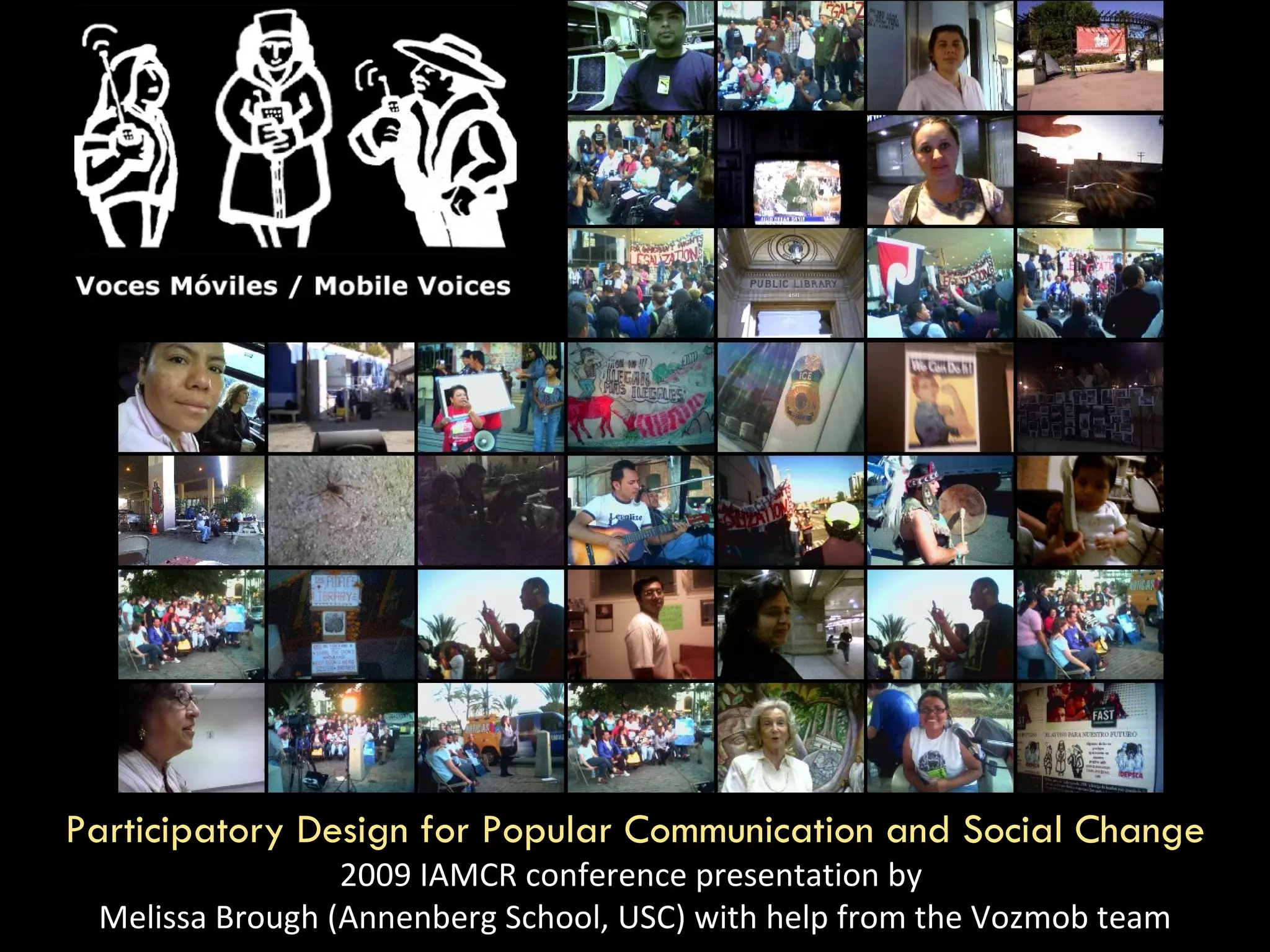
Participatory Design for Popular Communication and Social Change 2009 IAMCR conference presentation by  Melissa Brough (Annenberg School, USC) with help from the Vozmob team
mobile voices
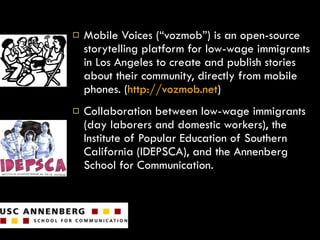
Mobile Voices (“vozmob”) is an open-source storytelling platform for low-wage immigrants in Los Angeles to create and publish stories about their community, directly from mobile phones. ( http://vozmob.net ) Collaboration between low-wage immigrants (day laborers and domestic workers), the Institute of Popular Education of Southern California (IDEPSCA), and the Annenberg School for Communication.
Day Laborers in Los Angeles Subject to anti-immigrant biases Subject to exploitation and human rights abuses; workers regularly experience abuse by employers Silenced voices; limited access to tools/channels for self-representation (Costanza-Chock, 2007) But also contributing to the economy, volunteering in their community, and fighting for social justice, human rights & dignity
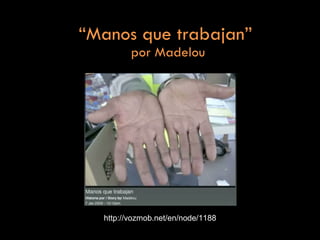
“ Manos que trabajan”  por Madelou http://vozmob.net/en/node/1188
Background: Community Partner The Institute of Popular Education of Southern California (IDEPSCA - http://idepsca.org), is a nonprofit serving low-income Latino immigrants in Los Angeles.  Runs 6 day laborer centers under contract with the City of L.A., organizes day laborers at corners throughout the city, and offers health programs, a domestic worker organizing project, and an elementary school. Popular education approach; participatory methods
participatory design?
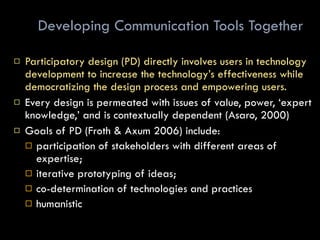
Developing Communication Tools Together Participatory design (PD) directly involves users in technology development to increase the technology’s effectiveness while democratizing the design process and empowering users.  Every design is permeated with issues of value, power, ‘expert knowledge,’ and is contextually dependent (Asaro, 2000) Goals of PD (Froth & Axum 2006) include:  participation of stakeholders with different areas of expertise; iterative prototyping of ideas;  co-determination of technologies and practices humanistic
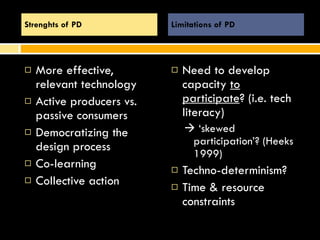
More effective, relevant technology Active producers vs. passive consumers Democratizing the design process Co-learning Collective action Need to develop capacity  to participate ? (i.e. tech literacy)    ‘ skewed participation’? (Heeks 1999)  Techno-determinism?  Time & resource constraints Strenghts of PD Limitations of PD
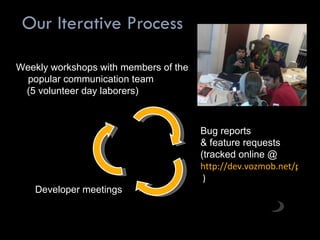
Our Iterative Process Weekly workshops with members of the popular communication team  (5 volunteer day laborers) Bug reports  & feature requests (tracked online @  http://dev.vozmob.net/projects/show/vozmob  ) Developer meetings
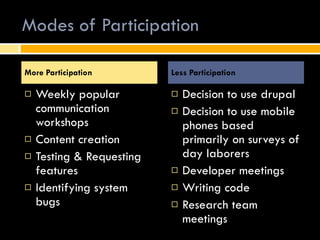
Modes of Participation Weekly popular communication workshops Content creation Testing & Requesting features Identifying system bugs Decision to use drupal Decision to use mobile phones based primarily on surveys of day laborers Developer meetings Writing code Research team meetings More Participation Less Participation
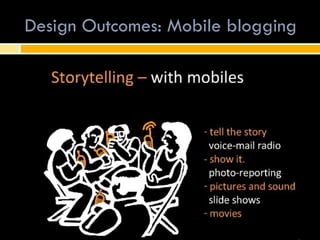
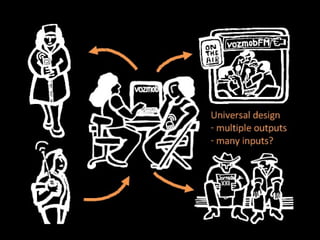
Design Outcomes: Mobile blogging
 
learning from the process
Case study of the PD process (in progress) Whether & how the PD process changed participants’ relationship to and use of communication technology; If the process contributed to empowerment, self- and collective efficacy (as defined by participants);  If it yields a more relevant/effective (and still scalable?) communication system for social change
Methods (in development) Participant observation of weekly workshops with the Popular Communication Team (PCT) Semi-structured interviews of all collaborators (PCT, IDEPSCA staff, developers, university researchers)  Critical validation through group data analysis Review of project documentation (open research/design) Comparison of findings to other documented cases
Some Initial Observations* Participatory process does impact design Need to develop capacity (i.e. tech literacy) to increase participation in design process; how to do this through popular education? Many users have expressed need for training on use of system  Appropriation  occurs more easily/naturally than participatory design *  Based on participant observation, initial review of project documentation, and early interviews. These have not yet been analyzed as a group.
Some Initial Observations (cont’d) Barriers to participation:  Privacy concern Participatory process takes time; software development takes time Technical systems & services Cost & access How to engage people who are “esclavos al hambre?” (PCT)
Thank you!  Gracias! Questions/Comments?:  mbrough@usc.edu  Interested in the tools?:  http://vozmob.net/es/contact  Participate!  Send a story or  comment: [FINISH]
Open research http://prueba.vozmob.net   - sandbox test site http://blog.vozmob.net  -  research blog http://wiki.vozmob.net  -  project wiki http://class.vozmob.net  -  USC class wiki http://tags.vozmob.net  -   del.icio.us tags for ‘vozmob’ http://list.vozmob.net  -  project mailing list http://devlist.vozmob.net  – development mailing list archive http://dev.vozmob.net/projects/show/vozmob  -   bugs, features requests http://code.vozmob.net  -  code repository irc:  http://irc.freenode.net  #vozmob
credits vozmob team Steve Anderson, Murali Annavaram, Natalie Arellano, François Bar, Melissa Brough, Mark Burdett, Adolfo Cisneros, Sasha Costanza-Chock, Pedro Espinosa, Amanda Garces, Maria De Lourdes Gonzalez, Carmen Gonzales, Chris Guitarte, Josh Haglund, Philip Javellana, Crispin Jimenez, Charlotte Lapsansky, Manuel Mancia, Gabriela Rodriguez, Marcos Rodriguez, Cara Wallis graphics adapted from originals by Rini Templeton (riniart.org) http://vozmob.net
Works Cited Asaro, P.M. (2000). Transforming society by transforming technology: the science and politics of participatory design. Accounting, Management and Information Technologies, Vol. 10, No. 4., pp. 257-290. Bar, F., Pisani, F. & Weber, M. (forthcoming). Mobile technology appropriation in a distant mirror: baroque infiltration, creolization and cannibalism. Byrne, E. & Alexander, P.M. (2006). Questions of ethics: participatory information systems research in community settings. Proceedings of the 2006 annual research conference of the South African institute of computer scientists and information technologists on IT research in developing countries. SAICSIT, Vol. 204. Costanza-Chock, S. (2007). Migrant Voices: Communication for social change with garment workers and day laborers in Los Angeles. Mid-project report to the Social Science Research Council.  Fals-Borda, O., Ed. (1998). People’s participation: Challenges ahead. New York: Apex. Freire, P. (1973) Pedagogy of the oppressed. Myra Bergman Ramos, Trans. New York: Herder and Herder.  Heeks, R. (2008). ICT4D 2.0: The Next Phase of Applying ICT for International Development. Computer, vol. 41, no. 6, pp. 26-33. Spinuzzi, C. (2005). The Methodology of Participatory Design. Technical Communication Online. Valenzuela, A. et al. (2006). On the Corner: Day Labor in the United States.

Mb Pd Draft Presentation

  • 1.
    Participatory Design forPopular Communication and Social Change 2009 IAMCR conference presentation by Melissa Brough (Annenberg School, USC) with help from the Vozmob team
  • 2.
  • 3.
    Mobile Voices (“vozmob”)is an open-source storytelling platform for low-wage immigrants in Los Angeles to create and publish stories about their community, directly from mobile phones. ( http://vozmob.net ) Collaboration between low-wage immigrants (day laborers and domestic workers), the Institute of Popular Education of Southern California (IDEPSCA), and the Annenberg School for Communication.
  • 4.
    Day Laborers inLos Angeles Subject to anti-immigrant biases Subject to exploitation and human rights abuses; workers regularly experience abuse by employers Silenced voices; limited access to tools/channels for self-representation (Costanza-Chock, 2007) But also contributing to the economy, volunteering in their community, and fighting for social justice, human rights & dignity
  • 5.
    “ Manos quetrabajan” por Madelou http://vozmob.net/en/node/1188
  • 6.
    Background: Community PartnerThe Institute of Popular Education of Southern California (IDEPSCA - http://idepsca.org), is a nonprofit serving low-income Latino immigrants in Los Angeles. Runs 6 day laborer centers under contract with the City of L.A., organizes day laborers at corners throughout the city, and offers health programs, a domestic worker organizing project, and an elementary school. Popular education approach; participatory methods
  • 7.
  • 8.
    Developing Communication ToolsTogether Participatory design (PD) directly involves users in technology development to increase the technology’s effectiveness while democratizing the design process and empowering users. Every design is permeated with issues of value, power, ‘expert knowledge,’ and is contextually dependent (Asaro, 2000) Goals of PD (Froth & Axum 2006) include: participation of stakeholders with different areas of expertise; iterative prototyping of ideas; co-determination of technologies and practices humanistic
  • 9.
    More effective, relevanttechnology Active producers vs. passive consumers Democratizing the design process Co-learning Collective action Need to develop capacity to participate ? (i.e. tech literacy)  ‘ skewed participation’? (Heeks 1999) Techno-determinism? Time & resource constraints Strenghts of PD Limitations of PD
  • 10.
    Our Iterative ProcessWeekly workshops with members of the popular communication team (5 volunteer day laborers) Bug reports & feature requests (tracked online @ http://dev.vozmob.net/projects/show/vozmob ) Developer meetings
  • 11.
    Modes of ParticipationWeekly popular communication workshops Content creation Testing & Requesting features Identifying system bugs Decision to use drupal Decision to use mobile phones based primarily on surveys of day laborers Developer meetings Writing code Research team meetings More Participation Less Participation
  • 12.
  • 13.
  • 14.
  • 15.
    Case study ofthe PD process (in progress) Whether & how the PD process changed participants’ relationship to and use of communication technology; If the process contributed to empowerment, self- and collective efficacy (as defined by participants); If it yields a more relevant/effective (and still scalable?) communication system for social change
  • 16.
    Methods (in development)Participant observation of weekly workshops with the Popular Communication Team (PCT) Semi-structured interviews of all collaborators (PCT, IDEPSCA staff, developers, university researchers) Critical validation through group data analysis Review of project documentation (open research/design) Comparison of findings to other documented cases
  • 17.
    Some Initial Observations*Participatory process does impact design Need to develop capacity (i.e. tech literacy) to increase participation in design process; how to do this through popular education? Many users have expressed need for training on use of system Appropriation occurs more easily/naturally than participatory design * Based on participant observation, initial review of project documentation, and early interviews. These have not yet been analyzed as a group.
  • 18.
    Some Initial Observations(cont’d) Barriers to participation: Privacy concern Participatory process takes time; software development takes time Technical systems & services Cost & access How to engage people who are “esclavos al hambre?” (PCT)
  • 19.
    Thank you! Gracias! Questions/Comments?: mbrough@usc.edu Interested in the tools?: http://vozmob.net/es/contact Participate! Send a story or comment: [FINISH]
  • 20.
    Open research http://prueba.vozmob.net - sandbox test site http://blog.vozmob.net -  research blog http://wiki.vozmob.net -  project wiki http://class.vozmob.net -  USC class wiki http://tags.vozmob.net -   del.icio.us tags for ‘vozmob’ http://list.vozmob.net -  project mailing list http://devlist.vozmob.net – development mailing list archive http://dev.vozmob.net/projects/show/vozmob -   bugs, features requests http://code.vozmob.net -  code repository irc: http://irc.freenode.net #vozmob
  • 21.
    credits vozmob teamSteve Anderson, Murali Annavaram, Natalie Arellano, François Bar, Melissa Brough, Mark Burdett, Adolfo Cisneros, Sasha Costanza-Chock, Pedro Espinosa, Amanda Garces, Maria De Lourdes Gonzalez, Carmen Gonzales, Chris Guitarte, Josh Haglund, Philip Javellana, Crispin Jimenez, Charlotte Lapsansky, Manuel Mancia, Gabriela Rodriguez, Marcos Rodriguez, Cara Wallis graphics adapted from originals by Rini Templeton (riniart.org) http://vozmob.net
  • 22.
    Works Cited Asaro,P.M. (2000). Transforming society by transforming technology: the science and politics of participatory design. Accounting, Management and Information Technologies, Vol. 10, No. 4., pp. 257-290. Bar, F., Pisani, F. & Weber, M. (forthcoming). Mobile technology appropriation in a distant mirror: baroque infiltration, creolization and cannibalism. Byrne, E. & Alexander, P.M. (2006). Questions of ethics: participatory information systems research in community settings. Proceedings of the 2006 annual research conference of the South African institute of computer scientists and information technologists on IT research in developing countries. SAICSIT, Vol. 204. Costanza-Chock, S. (2007). Migrant Voices: Communication for social change with garment workers and day laborers in Los Angeles. Mid-project report to the Social Science Research Council. Fals-Borda, O., Ed. (1998). People’s participation: Challenges ahead. New York: Apex. Freire, P. (1973) Pedagogy of the oppressed. Myra Bergman Ramos, Trans. New York: Herder and Herder. Heeks, R. (2008). ICT4D 2.0: The Next Phase of Applying ICT for International Development. Computer, vol. 41, no. 6, pp. 26-33. Spinuzzi, C. (2005). The Methodology of Participatory Design. Technical Communication Online. Valenzuela, A. et al. (2006). On the Corner: Day Labor in the United States.