Anthony Cocciolo Teachers College, Columbia University www.thinkingprojects.org Presentation to the EdLab Seminar New York, NY
 
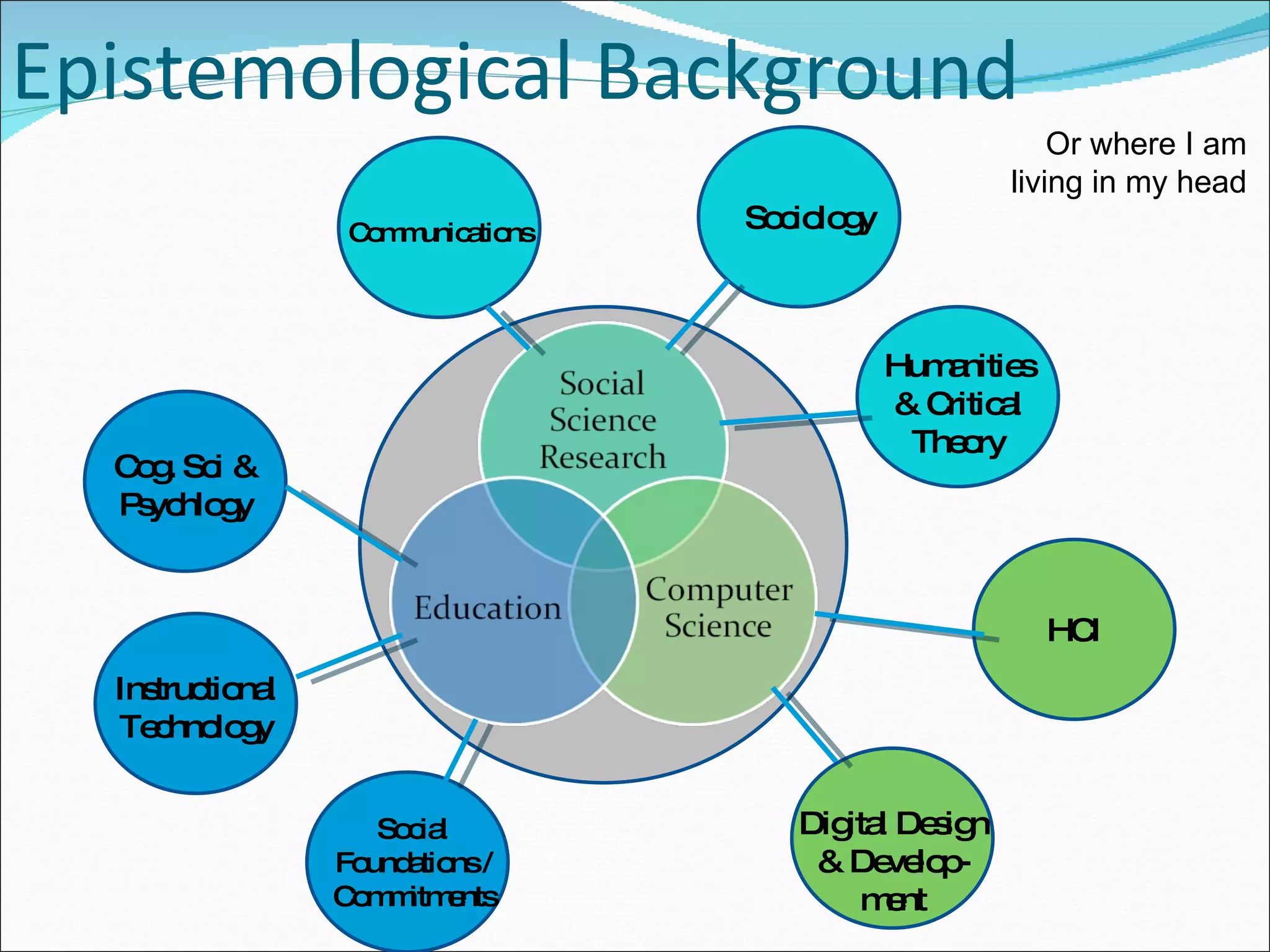
Epistemological Background HCI Digital Design & Develop- ment Communications Cog. Sci & Psychlogy Instructional Technology Social Foundations / Commitments Humanities & Critical Theory Or where I am living in my head Sociology
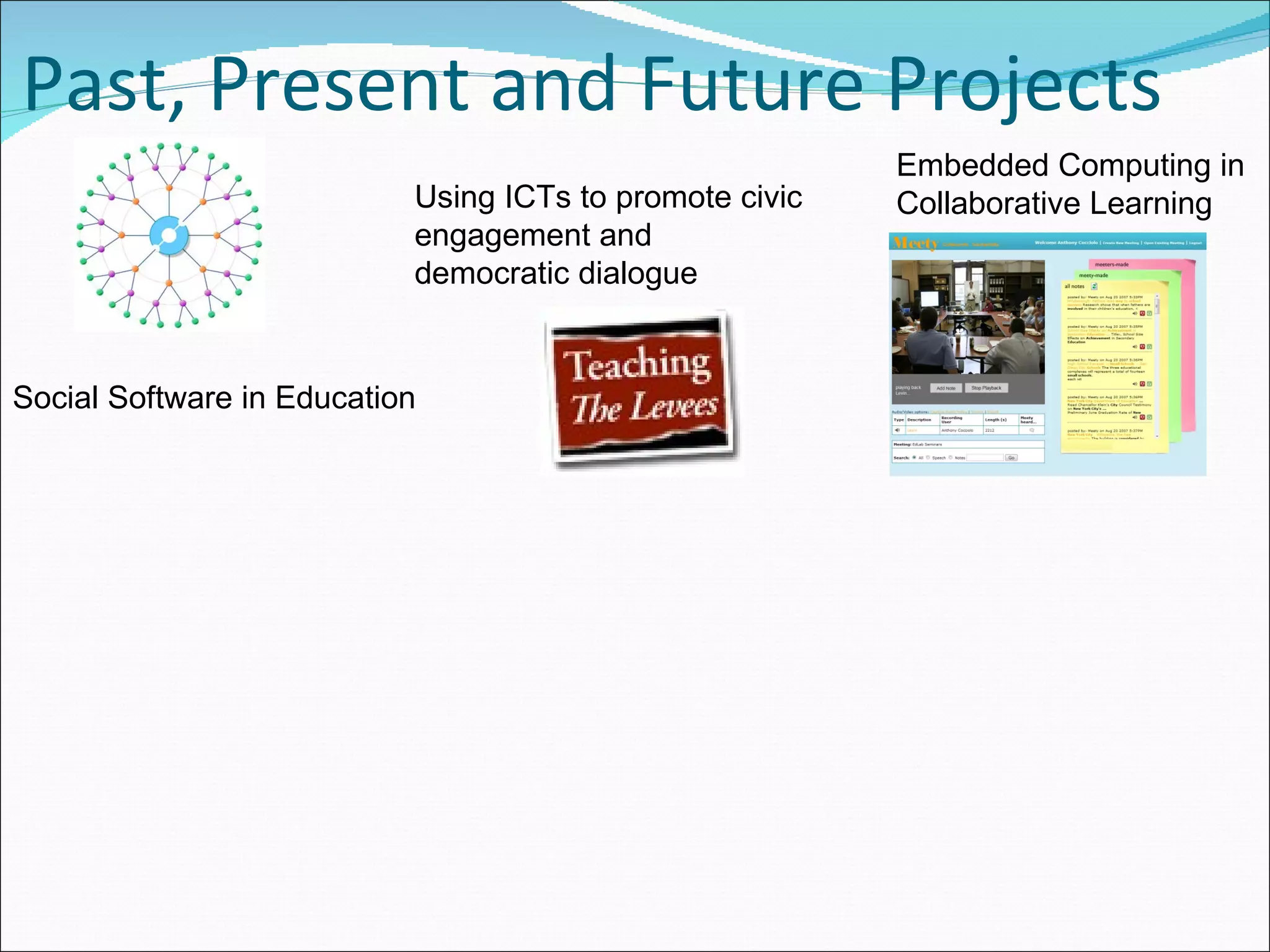
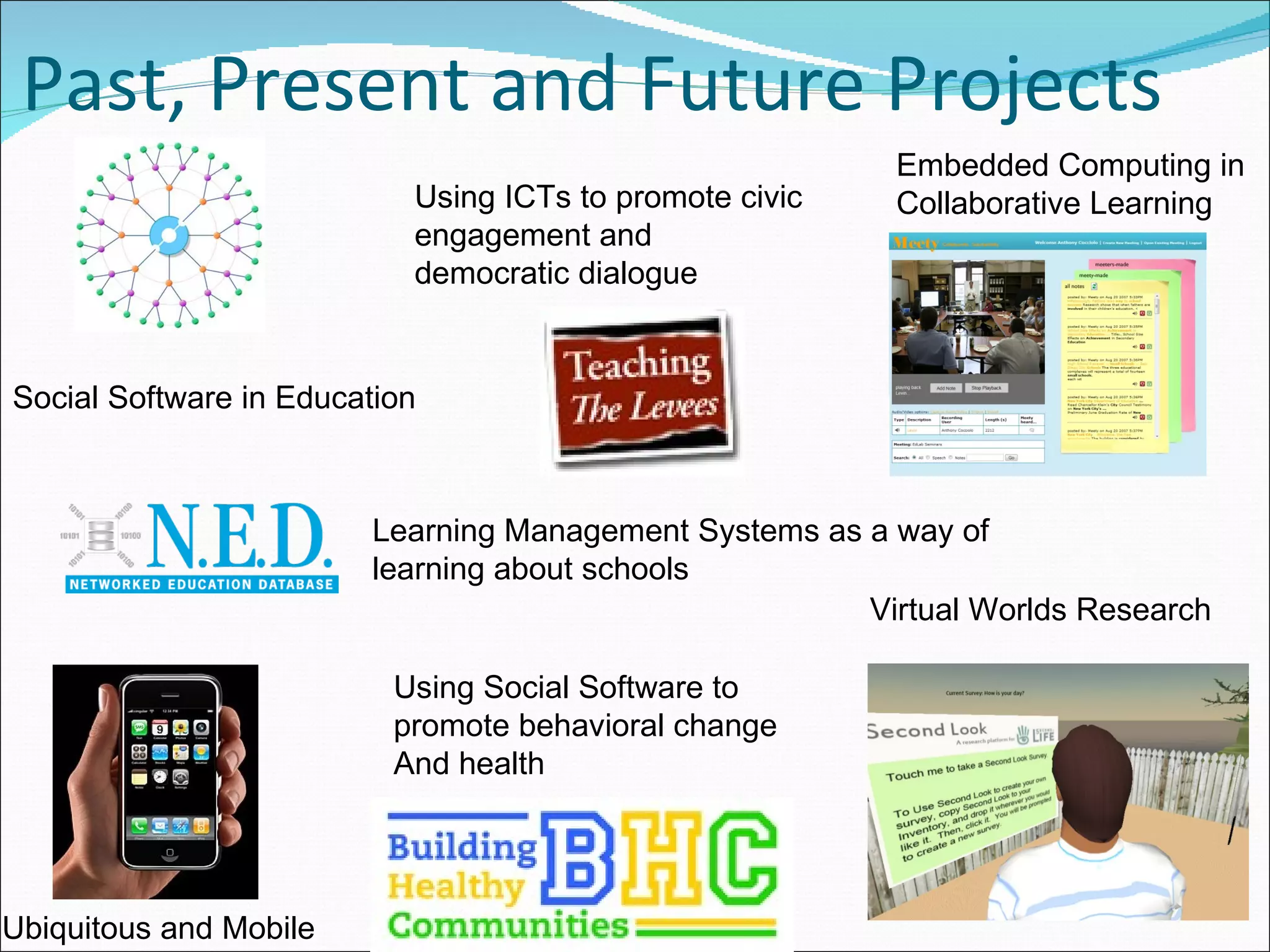
Past, Present and Future Projects Social Software in Education
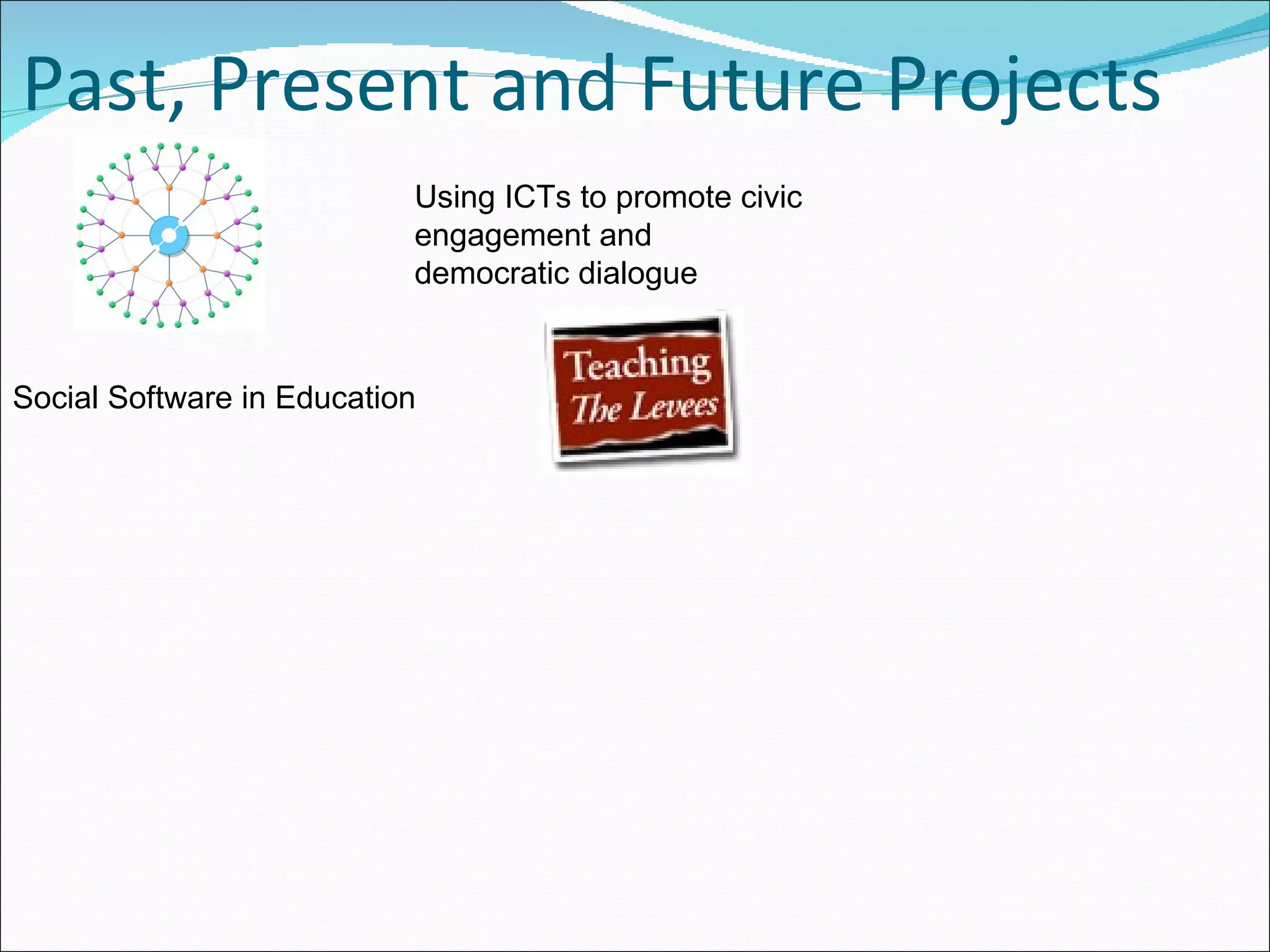
Past, Present and Future Projects Social Software in Education Using ICTs to promote civic engagement and democratic dialogue
Past, Present and Future Projects Social Software in Education Embedded Computing in  Collaborative Learning Using ICTs to promote civic engagement and democratic dialogue
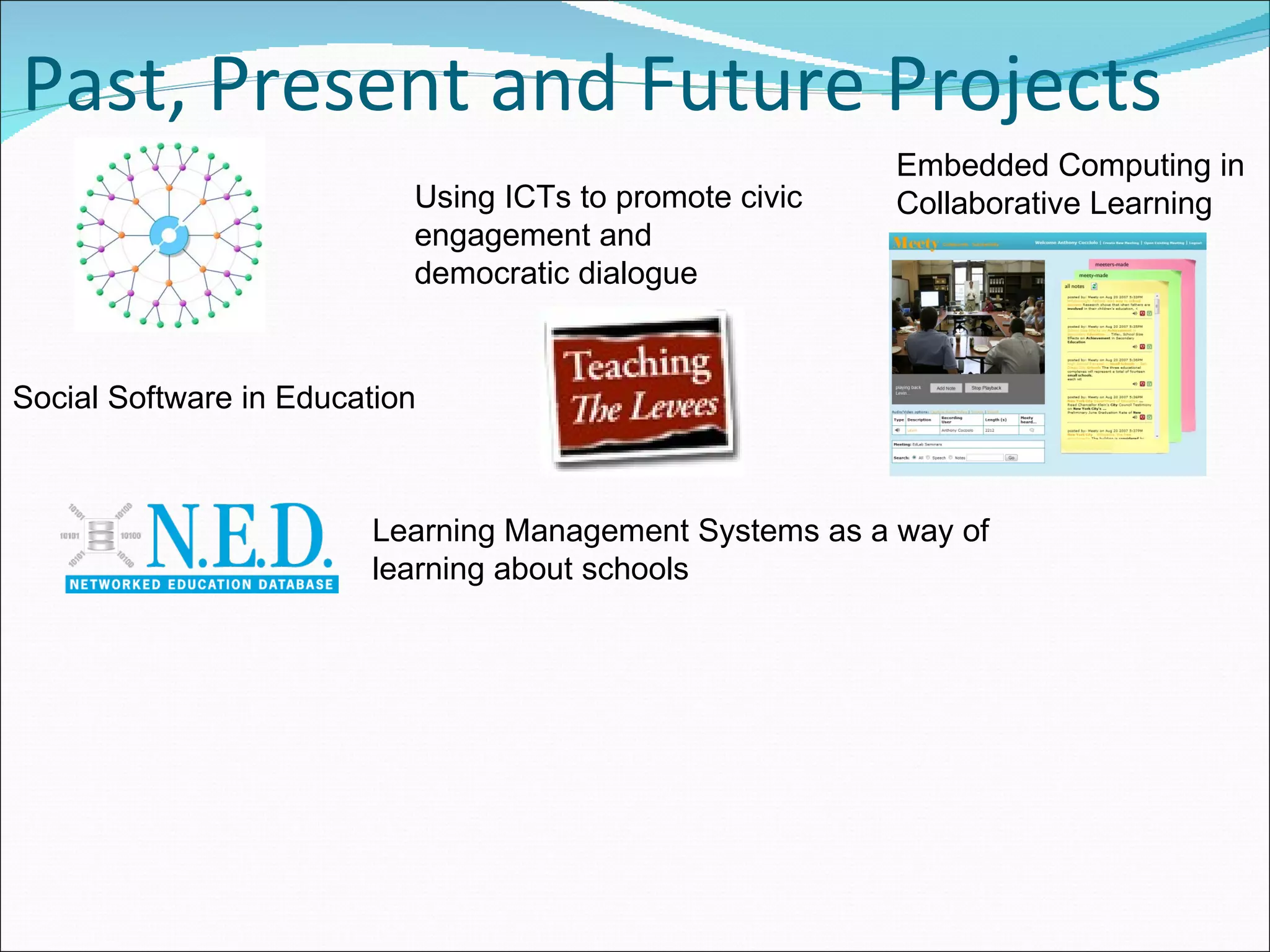
Past, Present and Future Projects Social Software in Education Embedded Computing in  Collaborative Learning Using ICTs to promote civic engagement and democratic dialogue Learning Management Systems as a way of learning about schools
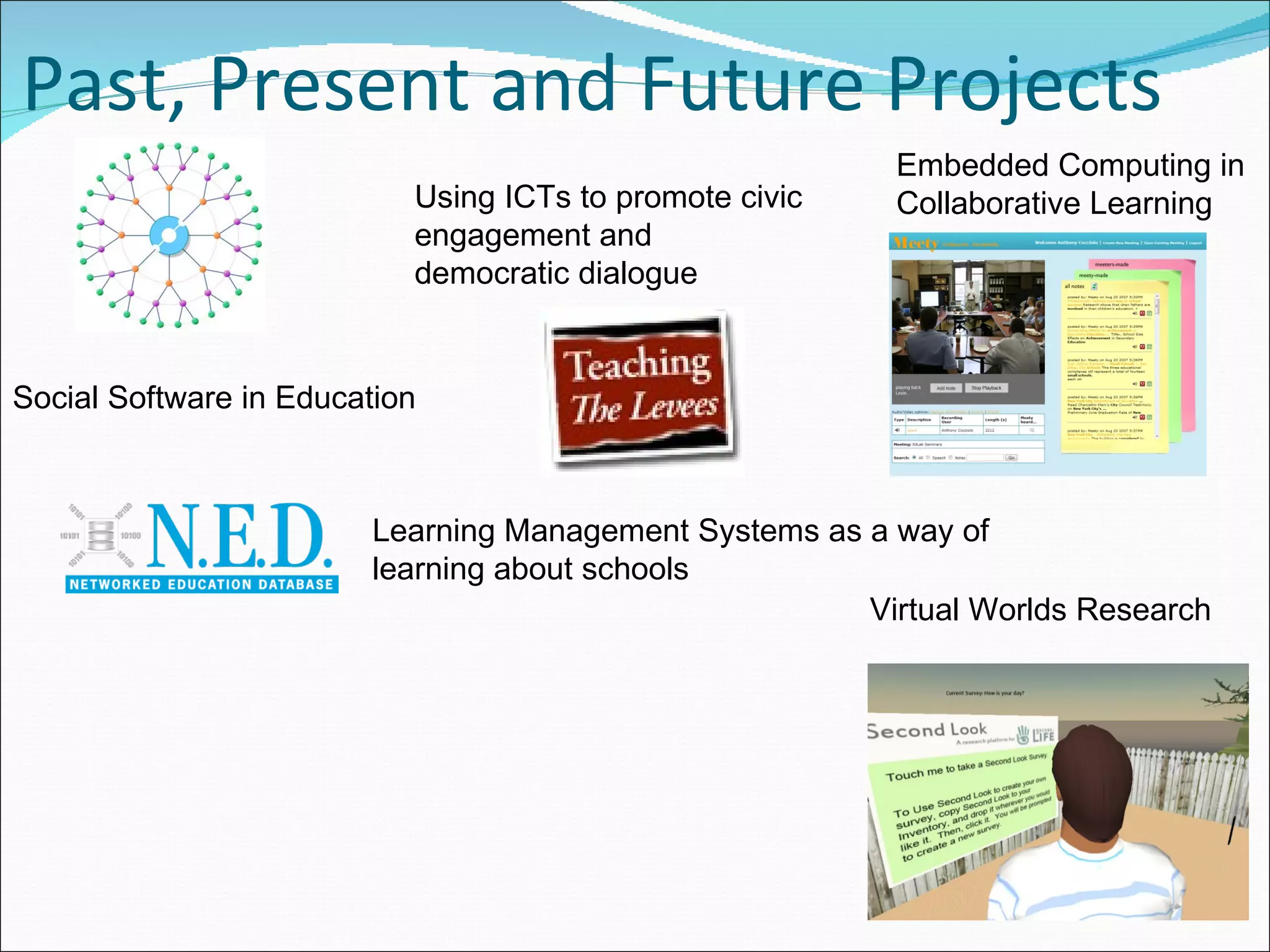
Past, Present and Future Projects Social Software in Education Virtual Worlds Research Embedded Computing in  Collaborative Learning Using ICTs to promote civic engagement and democratic dialogue Learning Management Systems as a way of learning about schools
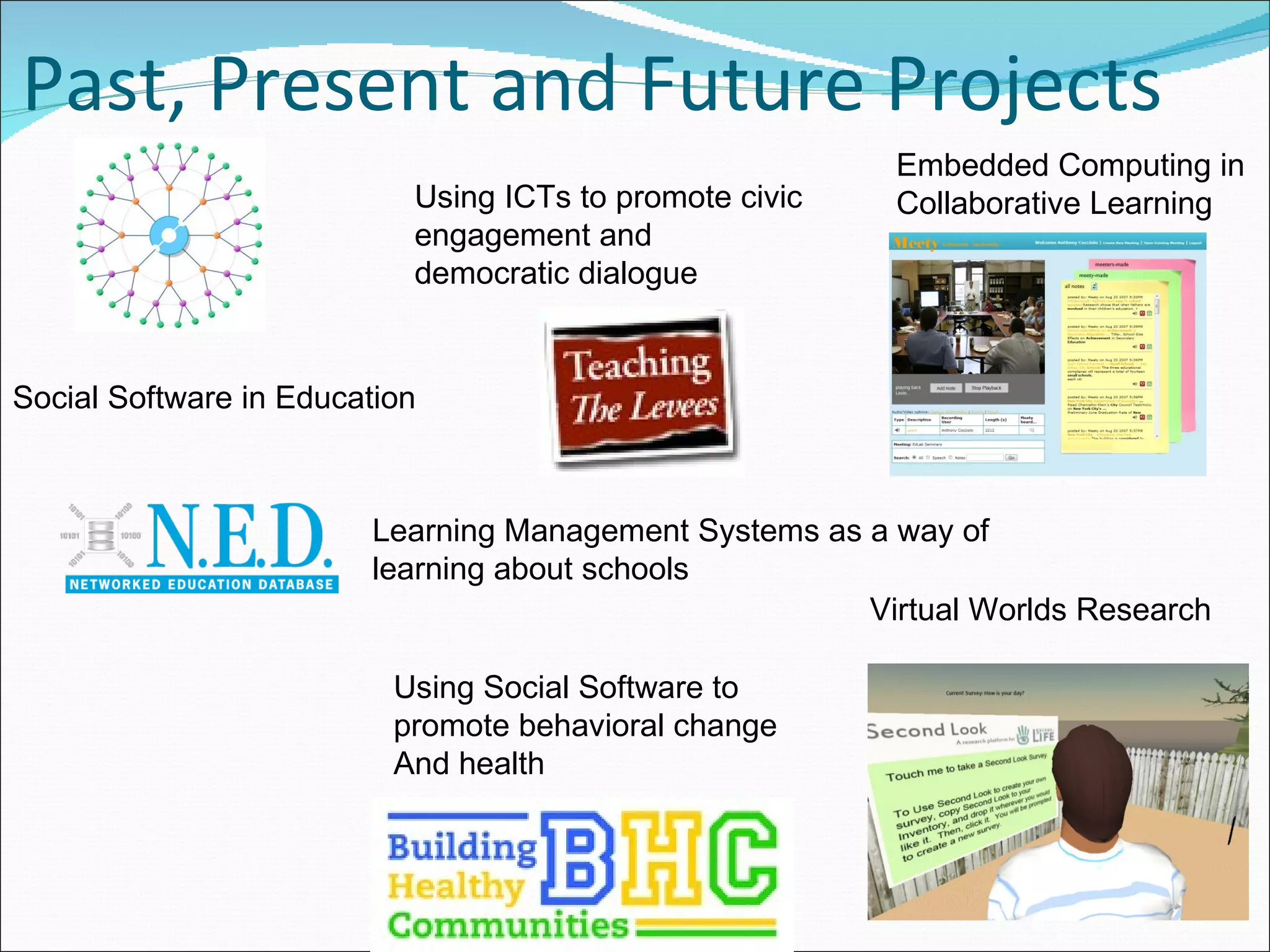
Past, Present and Future Projects Social Software in Education Virtual Worlds Research Embedded Computing in  Collaborative Learning Using ICTs to promote civic engagement and democratic dialogue Using Social Software to promote behavioral change And health Learning Management Systems as a way of learning about schools
Past, Present and Future Projects Social Software in Education Virtual Worlds Research Embedded Computing in  Collaborative Learning Using ICTs to promote civic engagement and democratic dialogue Using Social Software to promote behavioral change And health Ubiquitous and Mobile Learning Management Systems as a way of learning about schools
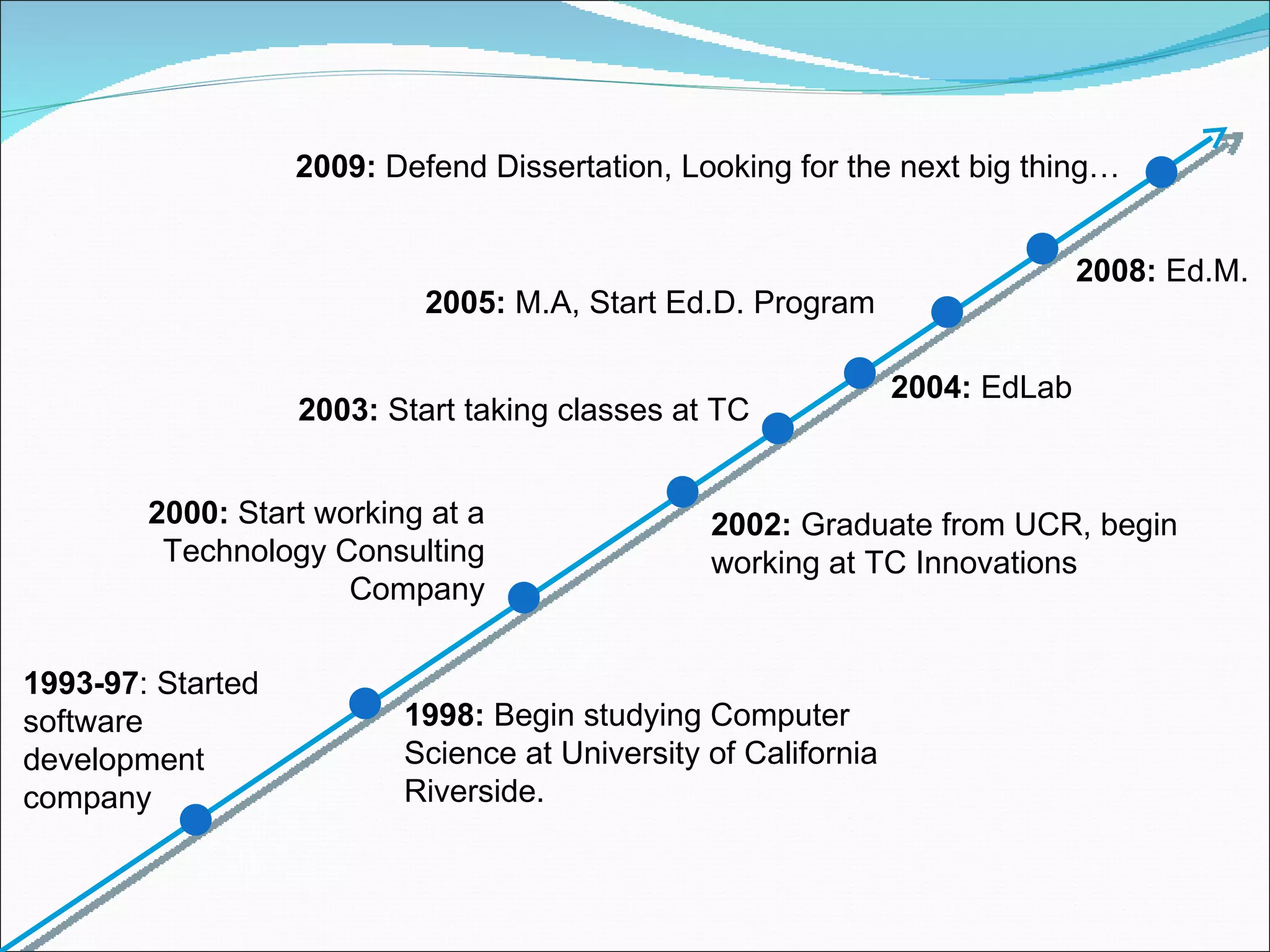
1993-97 : Started  software  development  company 1998:  Begin studying Computer Science at University of California Riverside. 2000:  Start working at a Technology Consulting Company 2002:  Graduate from UCR, begin working at TC Innovations 2009:  Defend Dissertation, Looking for the next big thing… 2003:  Start taking classes at TC 2005:  M.A, Start Ed.D. Program 2004:  EdLab 2008:  Ed.M.
 
 
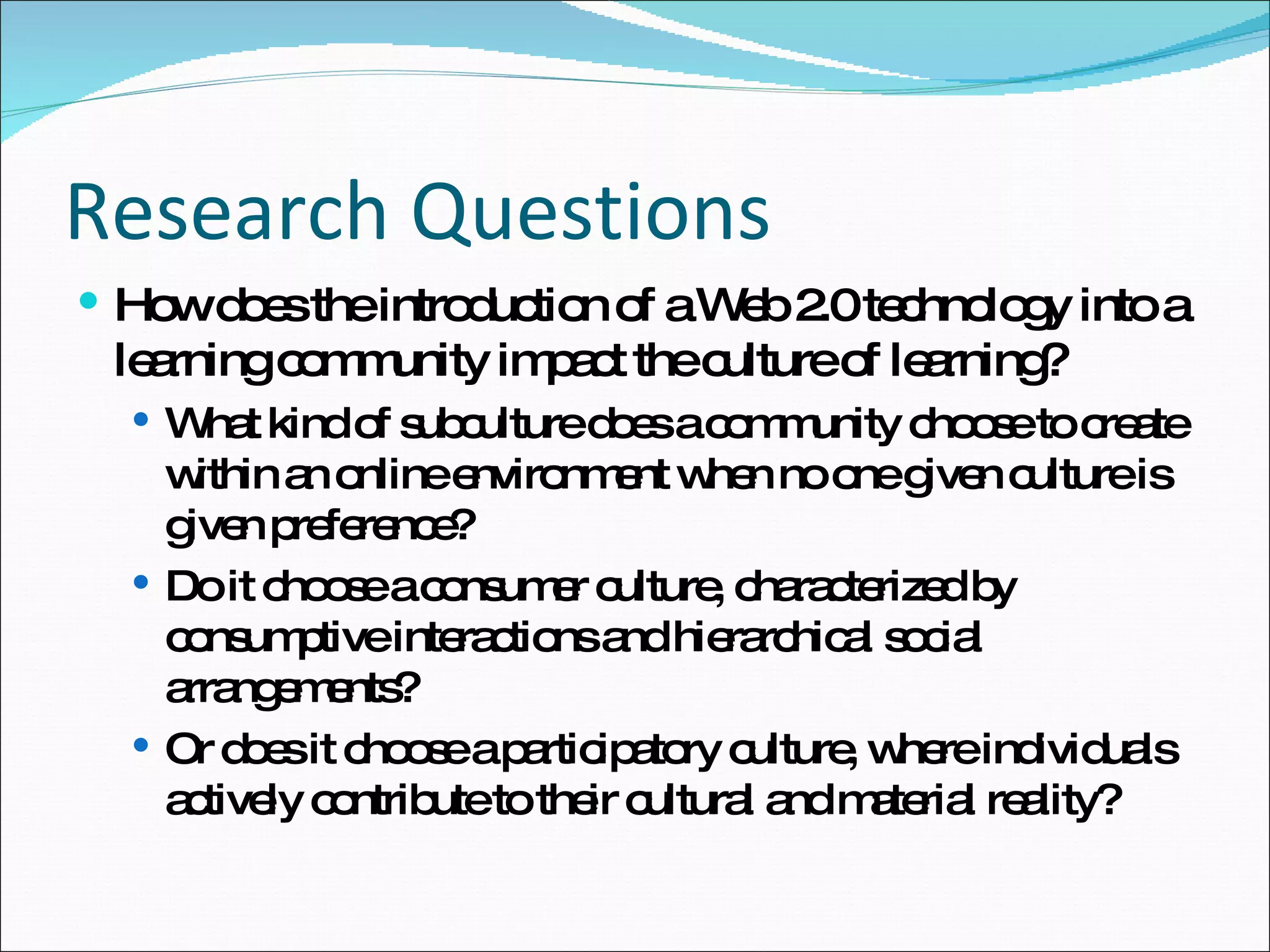
Research Questions How does the introduction of a Web 2.0 technology into a learning community impact the culture of learning? What kind of subculture does a community choose to create within an online environment when no one given culture is given preference? Do it choose a consumer culture, characterized by consumptive interactions and hierarchical social arrangements?  Or does it choose a participatory culture, where individuals actively contribute to their cultural and material reality?
Does the subculture that gets developed in the Web 2.0 environment impact the overall organizational culture? And…
Many Questions and Issues How is culture expressed in an online environment?  What activity must take place regularly in the environment to qualify it was promoting a participatory culture?  What is a Web 2.0 environment?  How do you know you have designed one?
Literature Review How computers have been used to support learning? CSCL, Situated Learning, and Networked Learning Approach to Research: Design and Design-based Research Clarification of ICT specifics Web 2.0 and ICTs How have technologies been adopted and diffused across a community? Diffusion, Change, and Innovation What have we learned from past changes in technologies? Historical & Cultural Context
Who cares? Design of online environments Possibilities for ICTs to have an impact on organizational cultures Widespread use (Pew Studies) and hypothesized potential of Web 2.0 technologies (from business and educational communities)
 
 
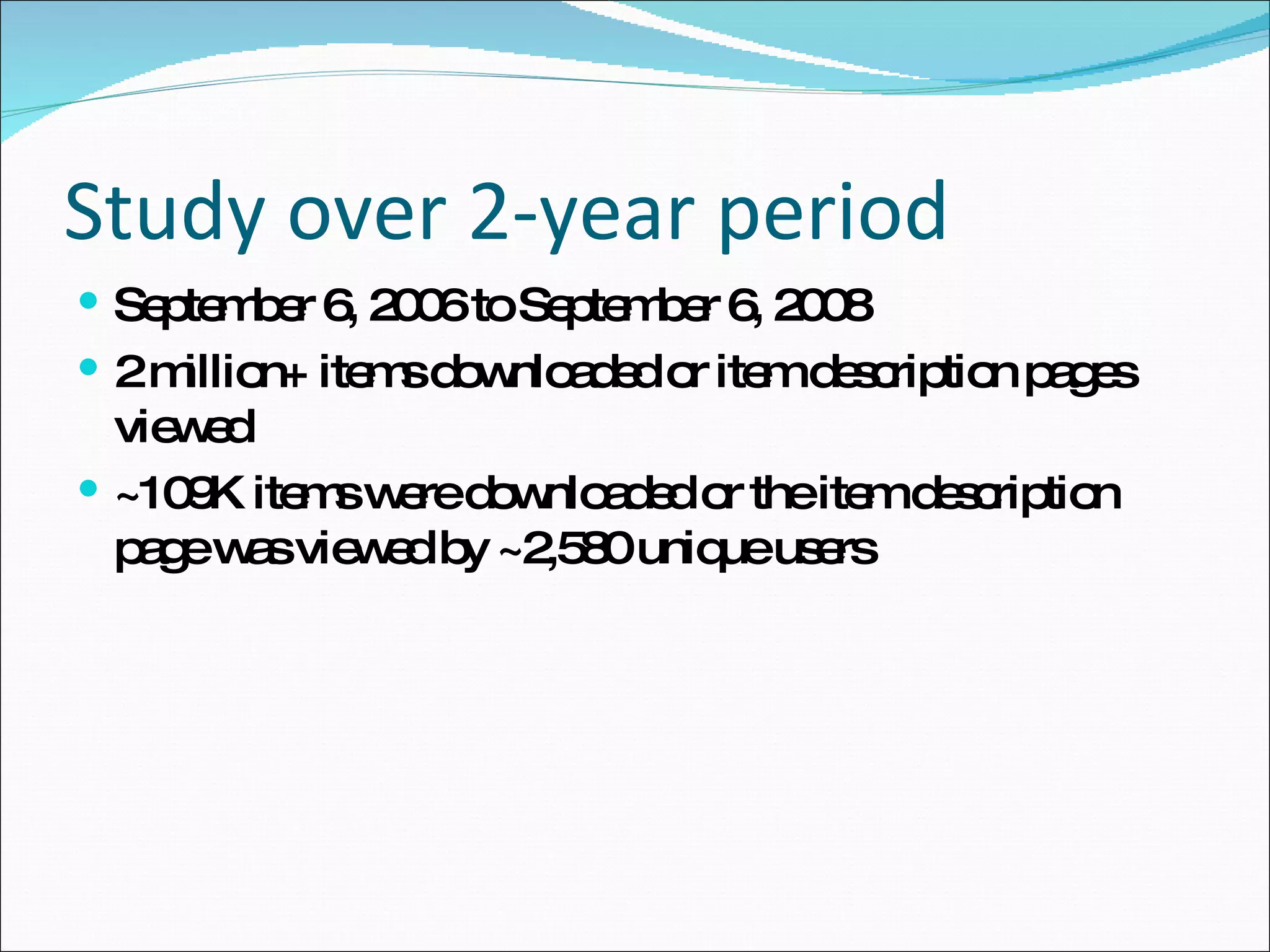
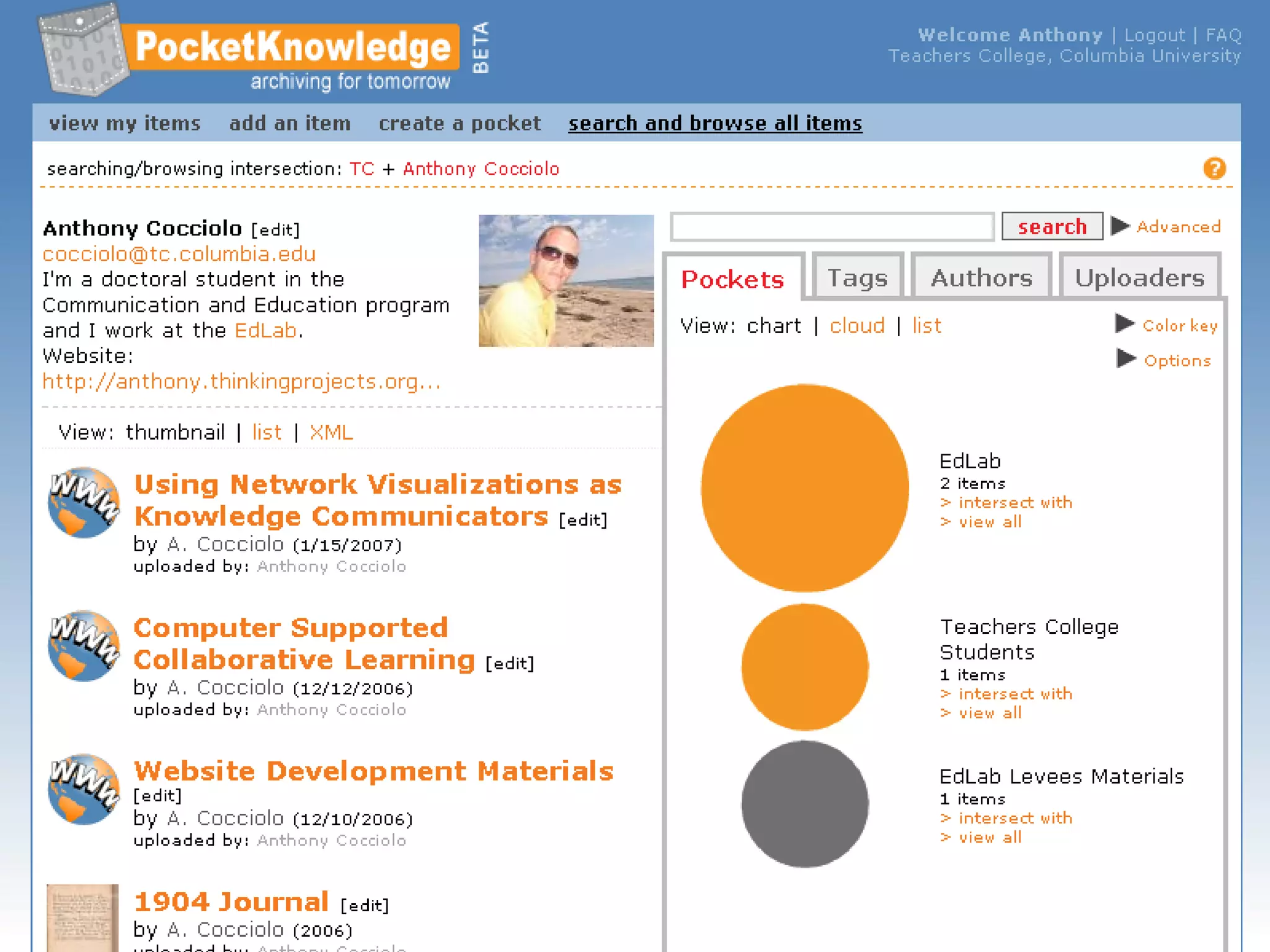
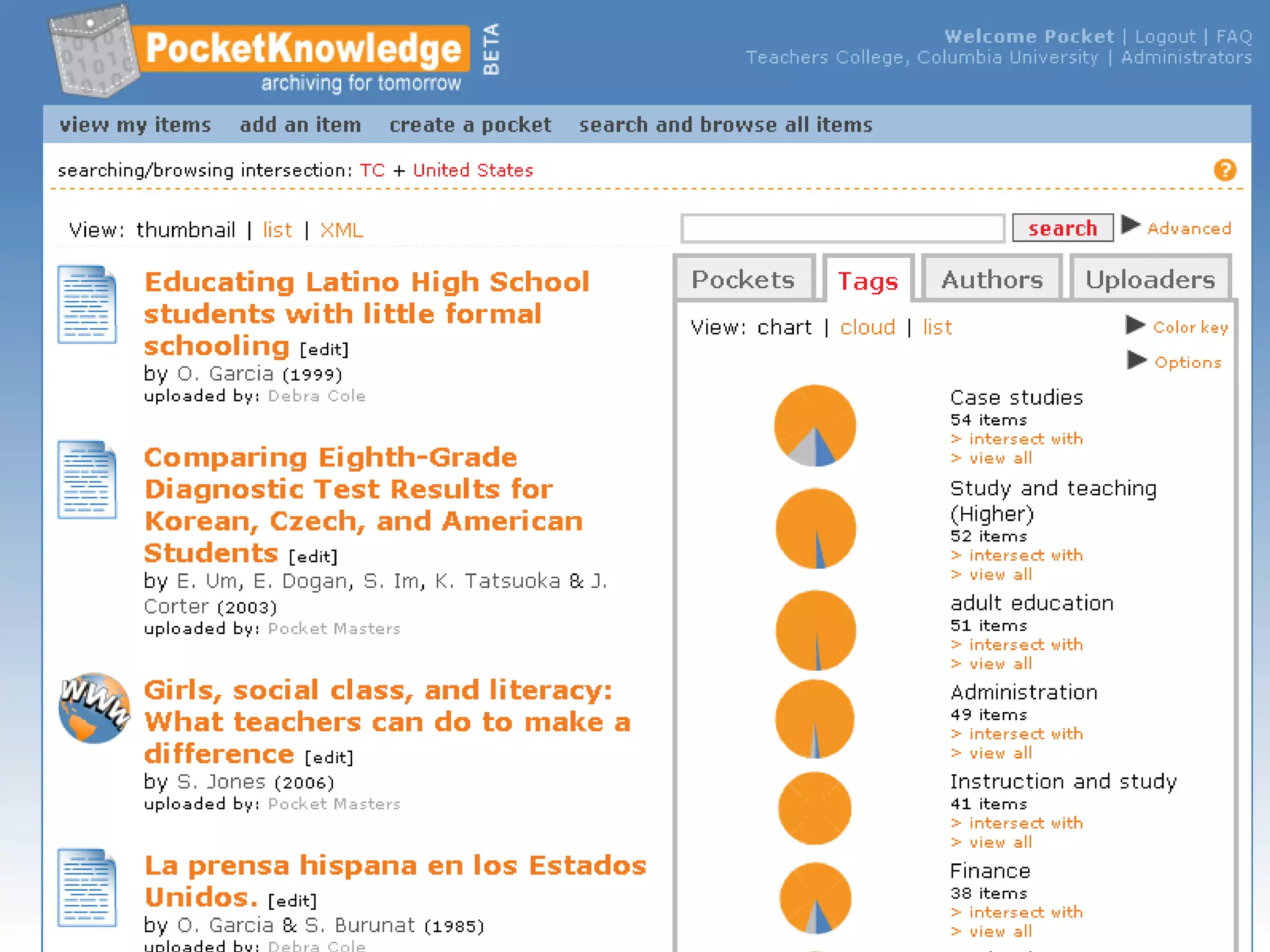
Study over 2-year period September 6, 2006 to September 6, 2008 2 million+ items downloaded or item description pages viewed ~109K items were downloaded or the item description page was viewed by ~2,580 unique users
 
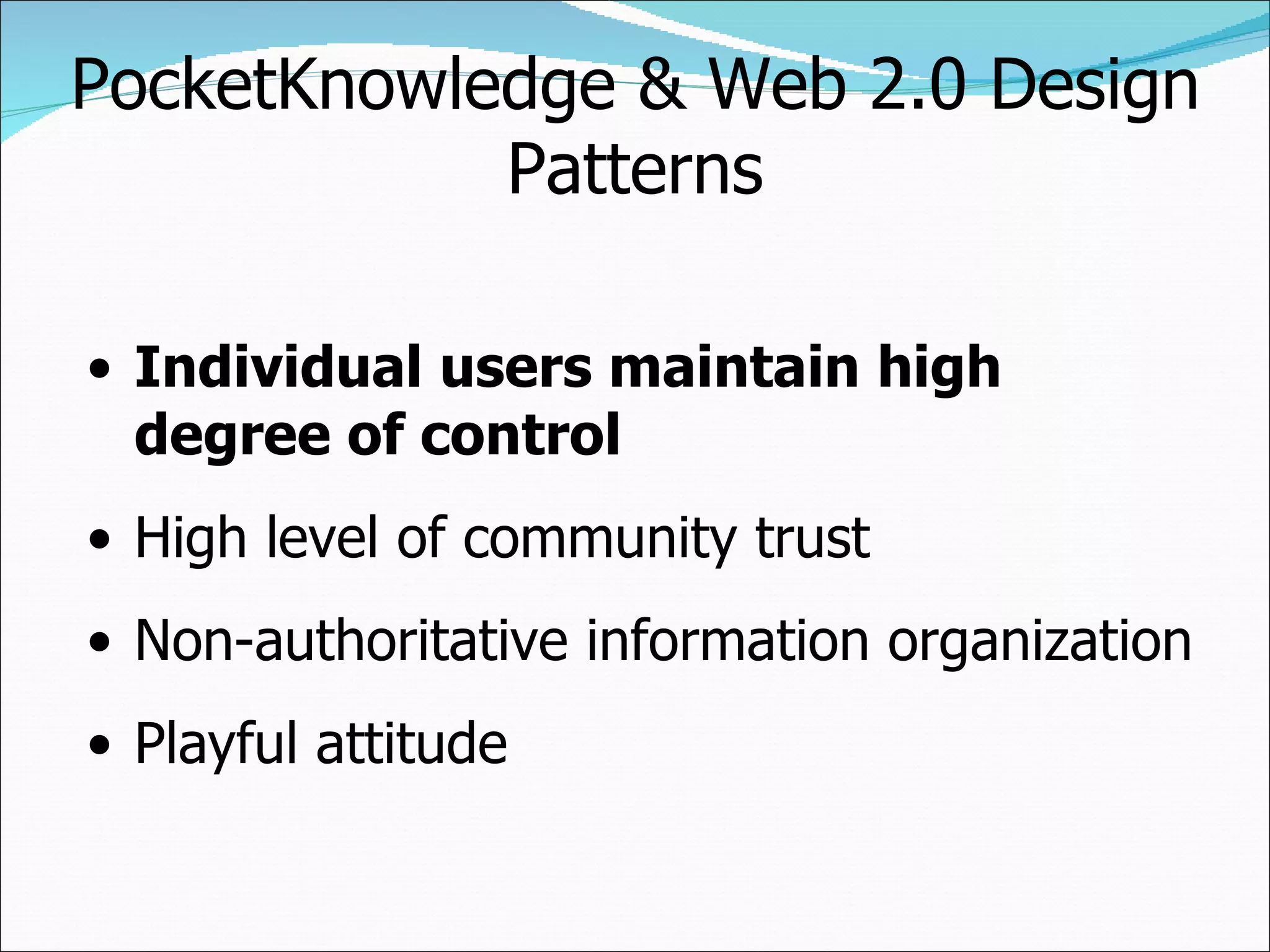
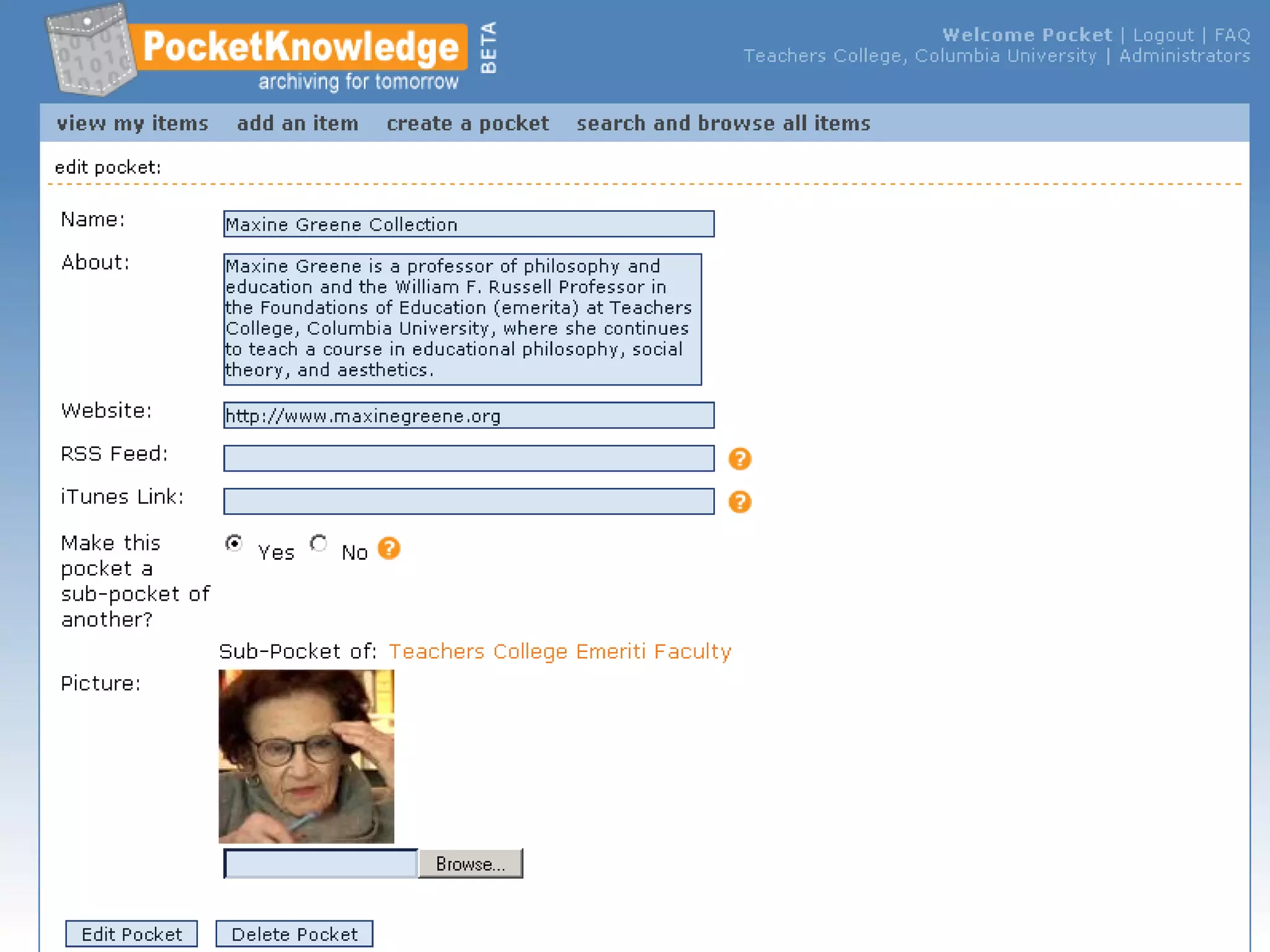
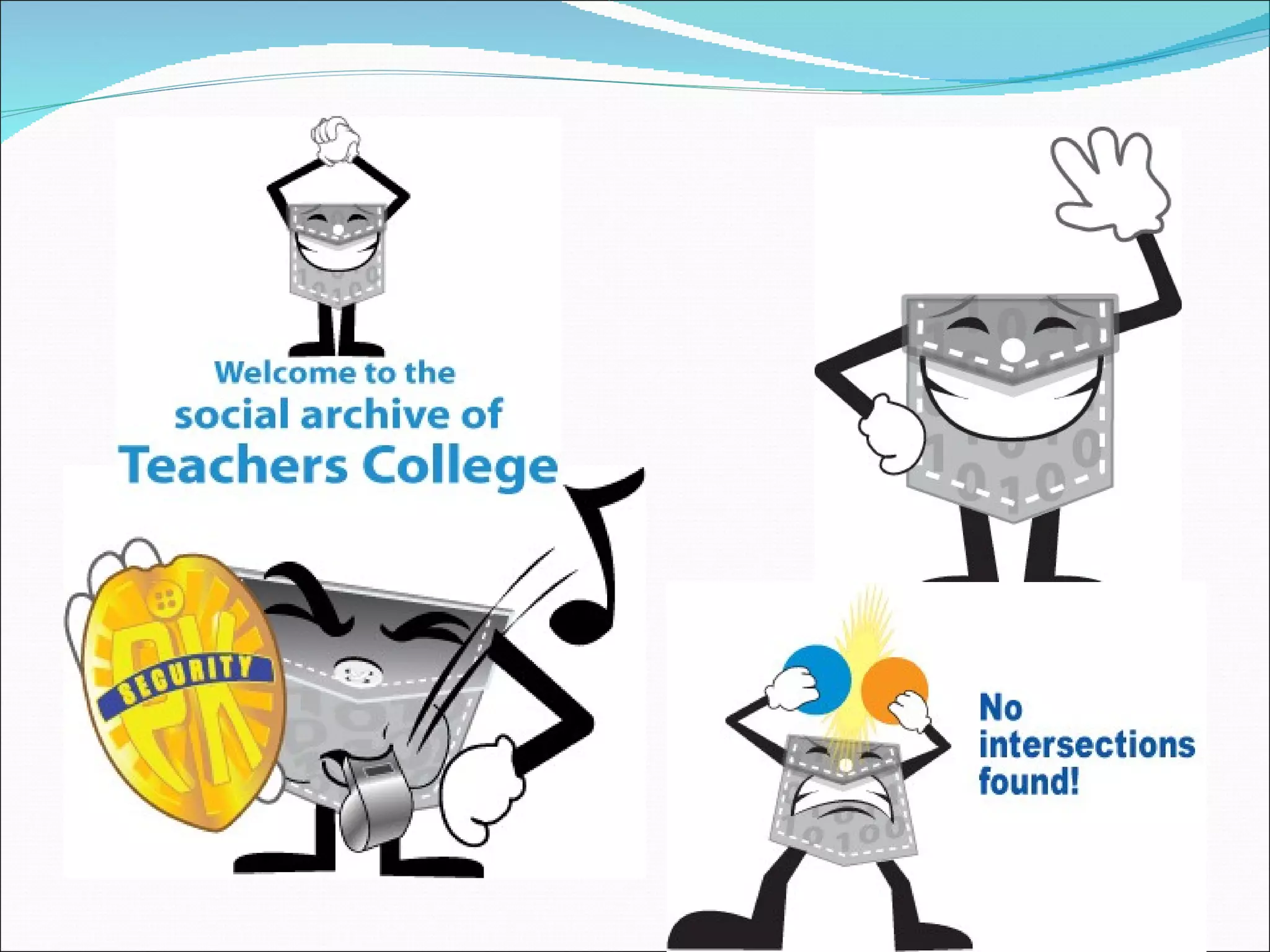
PocketKnowledge & Web 2.0 Design Patterns Individual users maintain high degree of control High level of community trust Non-authoritative information organization Playful attitude
 
PocketKnowledge & Web 2.0 Design Patterns Individual users maintain high degree of control High level of community trust Non-authoritative information organization Playful attitude
 
PocketKnowledge & Web 2.0 Design Patterns Individual users maintain high degree of control High level of community trust Non-authoritative information organization Playful attitude
 
PocketKnowledge & Web 2.0 Design Patterns Individual users maintain high degree of control High level of community trust Non-authoritative information organization Playful attitude
 
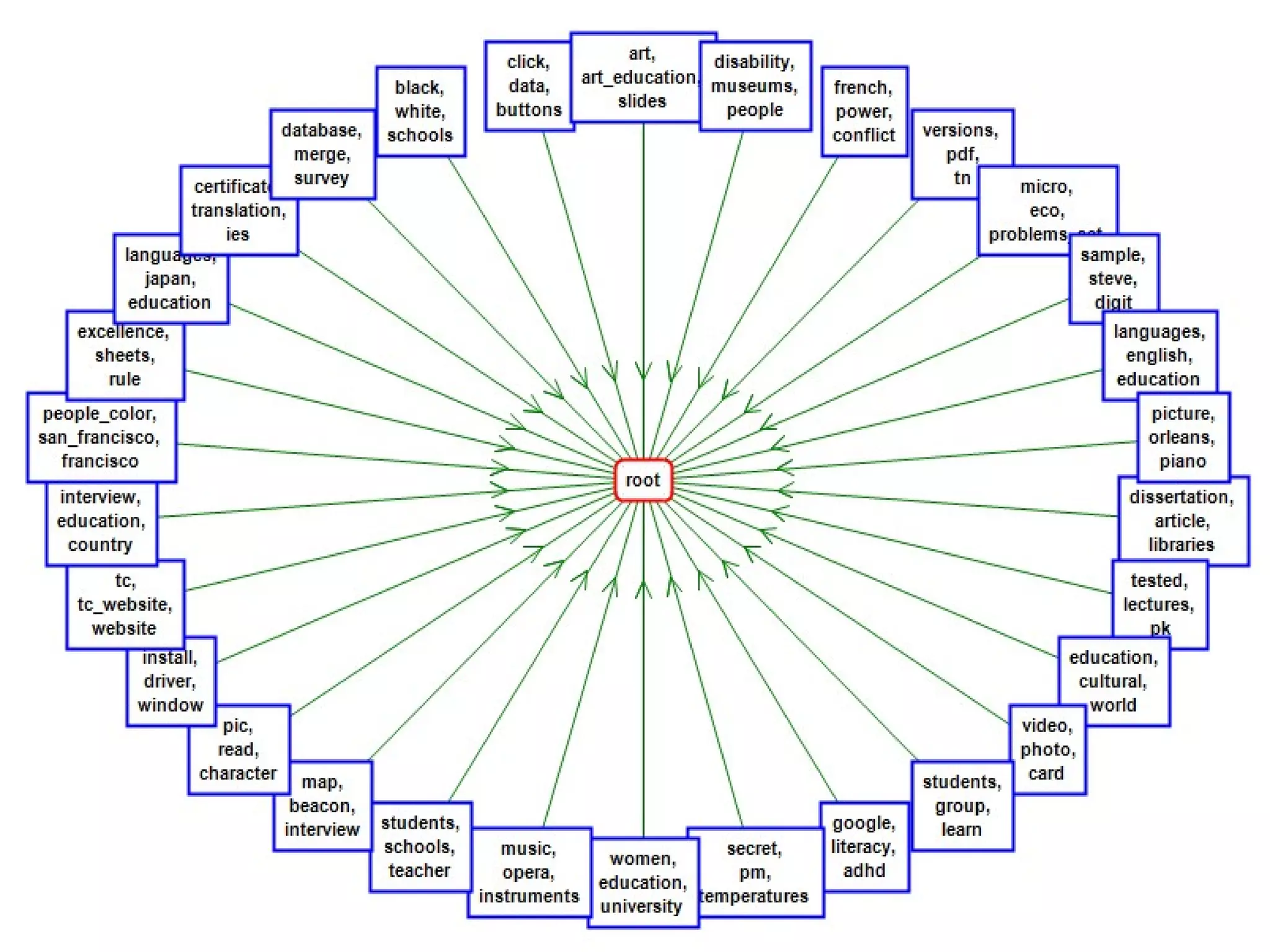
How do we understand the cultural that was created within the environment? Who is sharing with whom? Knowledge sharing networks What is being shared? Network Content semantics Why is it being shared? What caused you to be here at PocketKnowledge?
Making Hypothesis Make set of hypothesis that if proved true would show evidence that the Web 2.0 technology is providing a space for a participatory subculture to form:
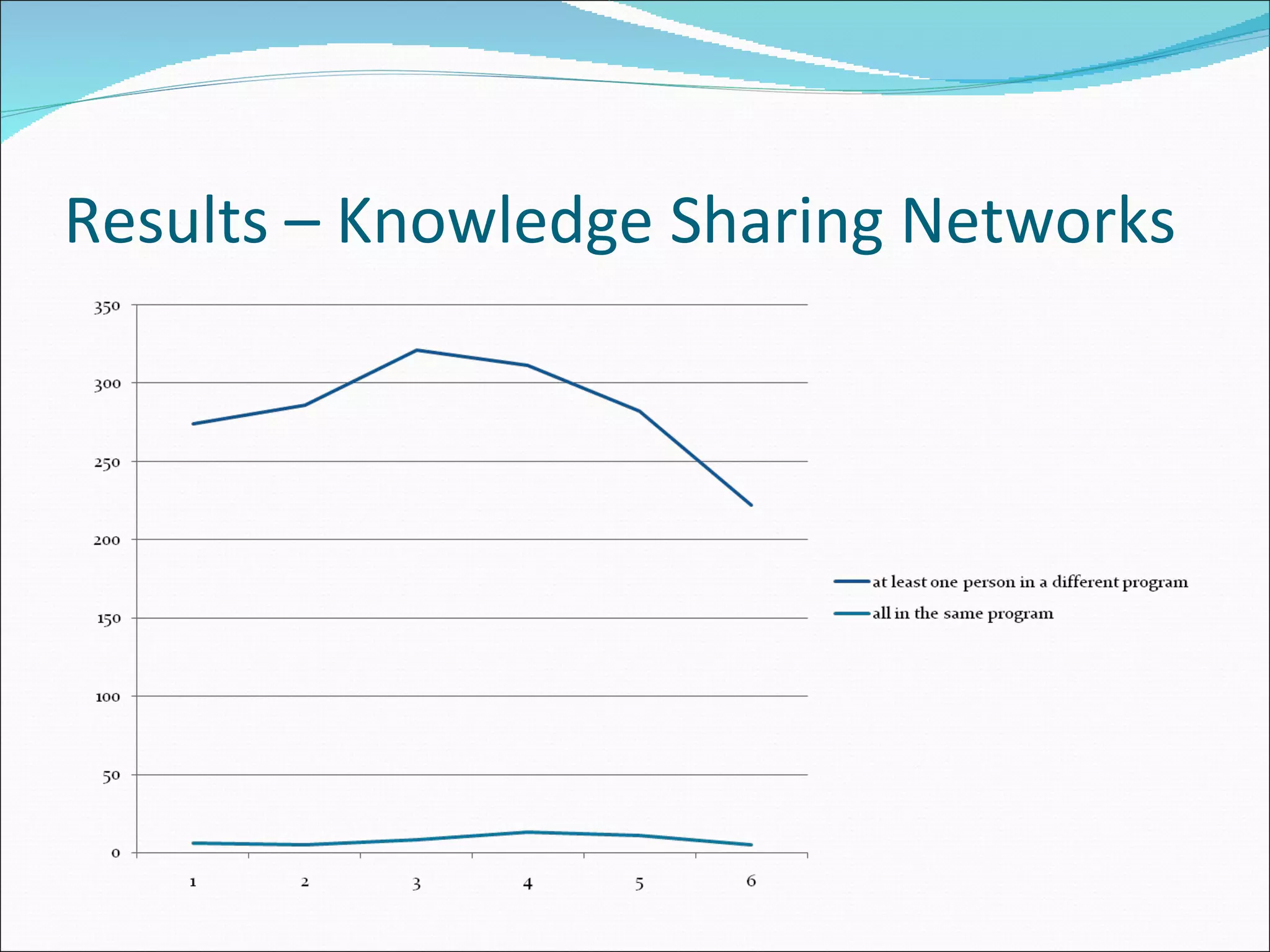
Hypothesis 1 – Knowledge Sharing Networks The Web 2.0 environment prompted the sharing of materials amongst members of the community that were not formally grouped together by institutional structures, such as programs, to a higher degree than people within the same program.
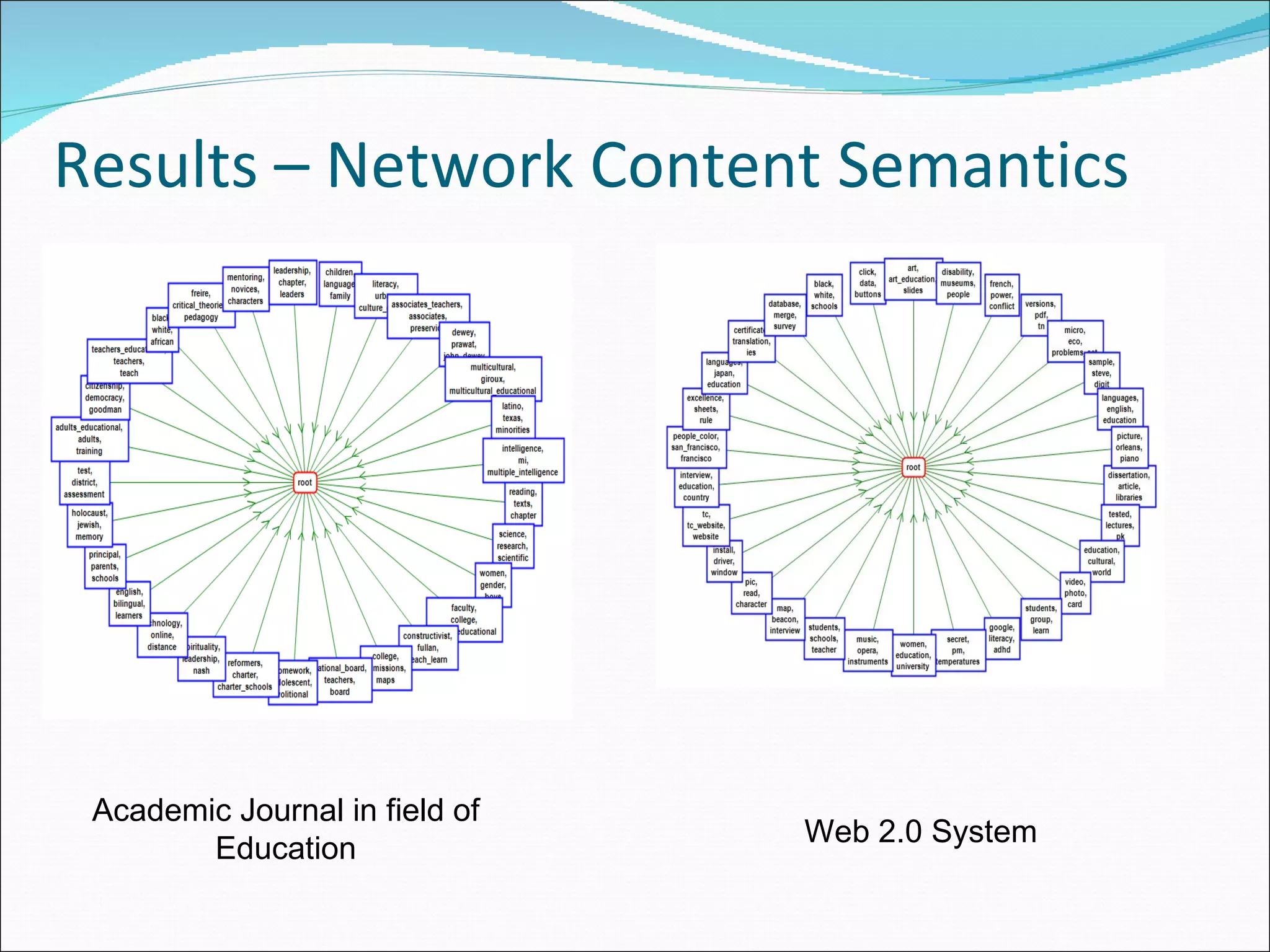
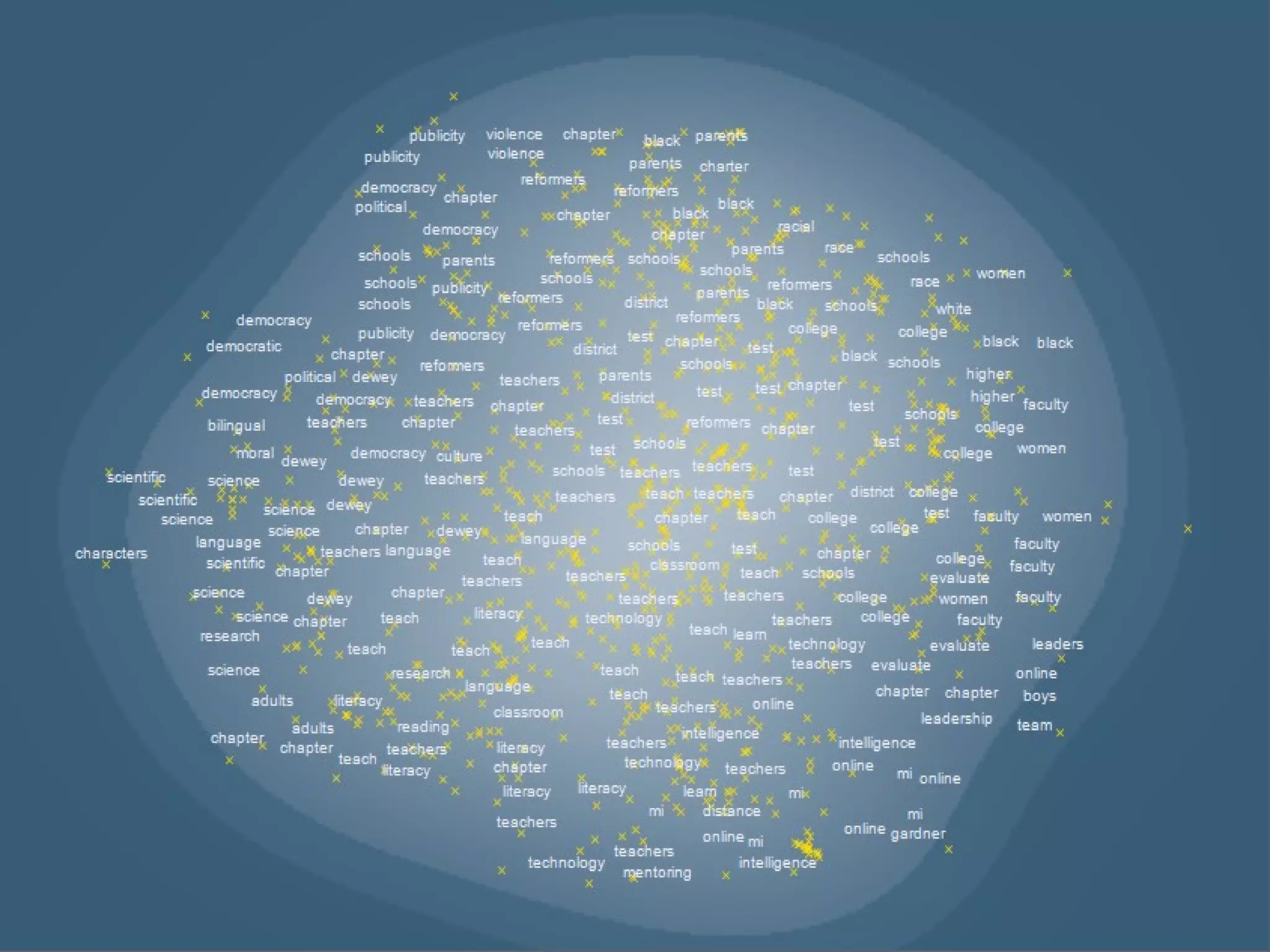
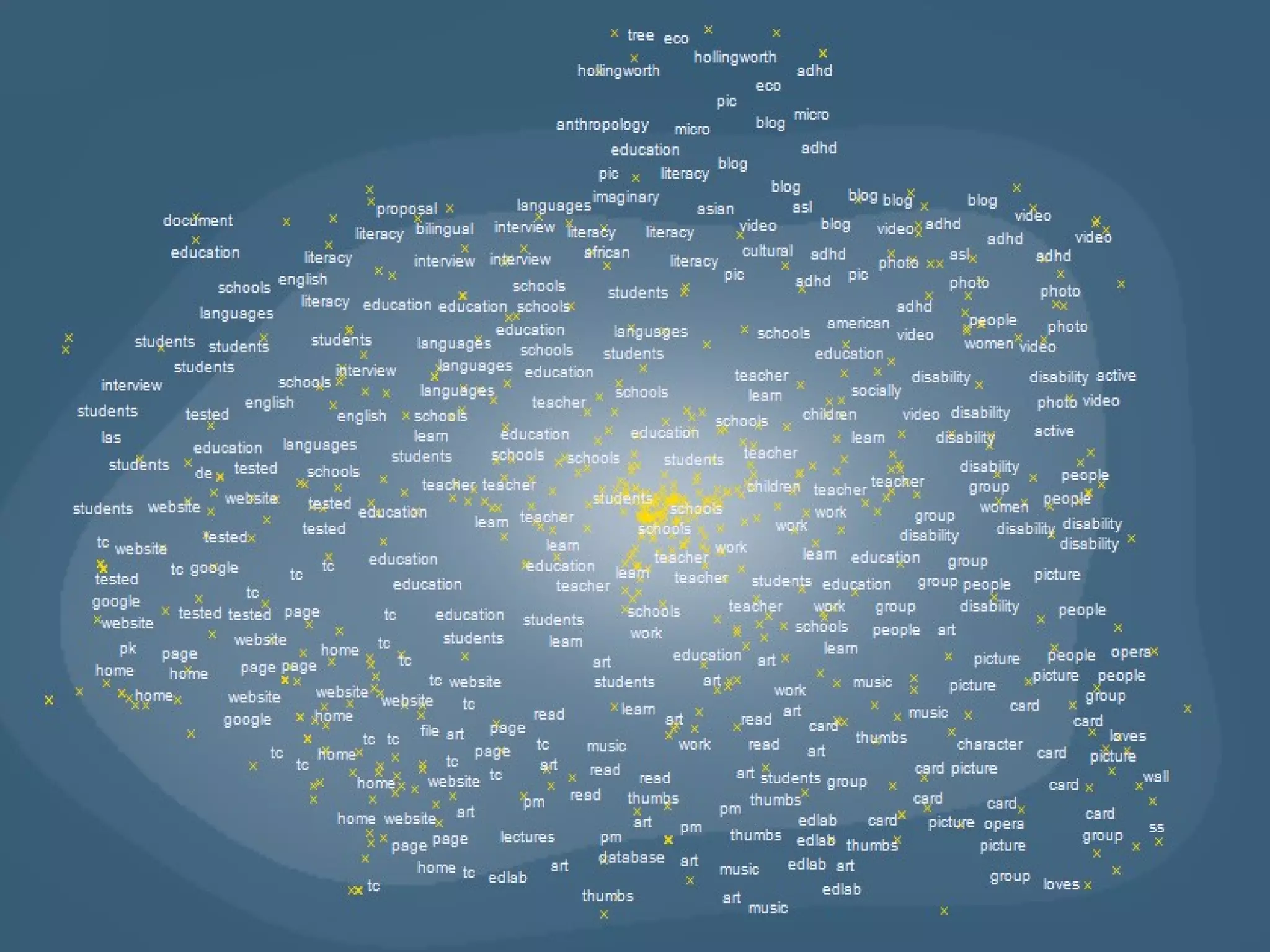
Hypothesis 2- Network Content Semantics The Web 2.0 technology promoted the sharing of content that diverged from typical academic discourse within a graduate school of education.
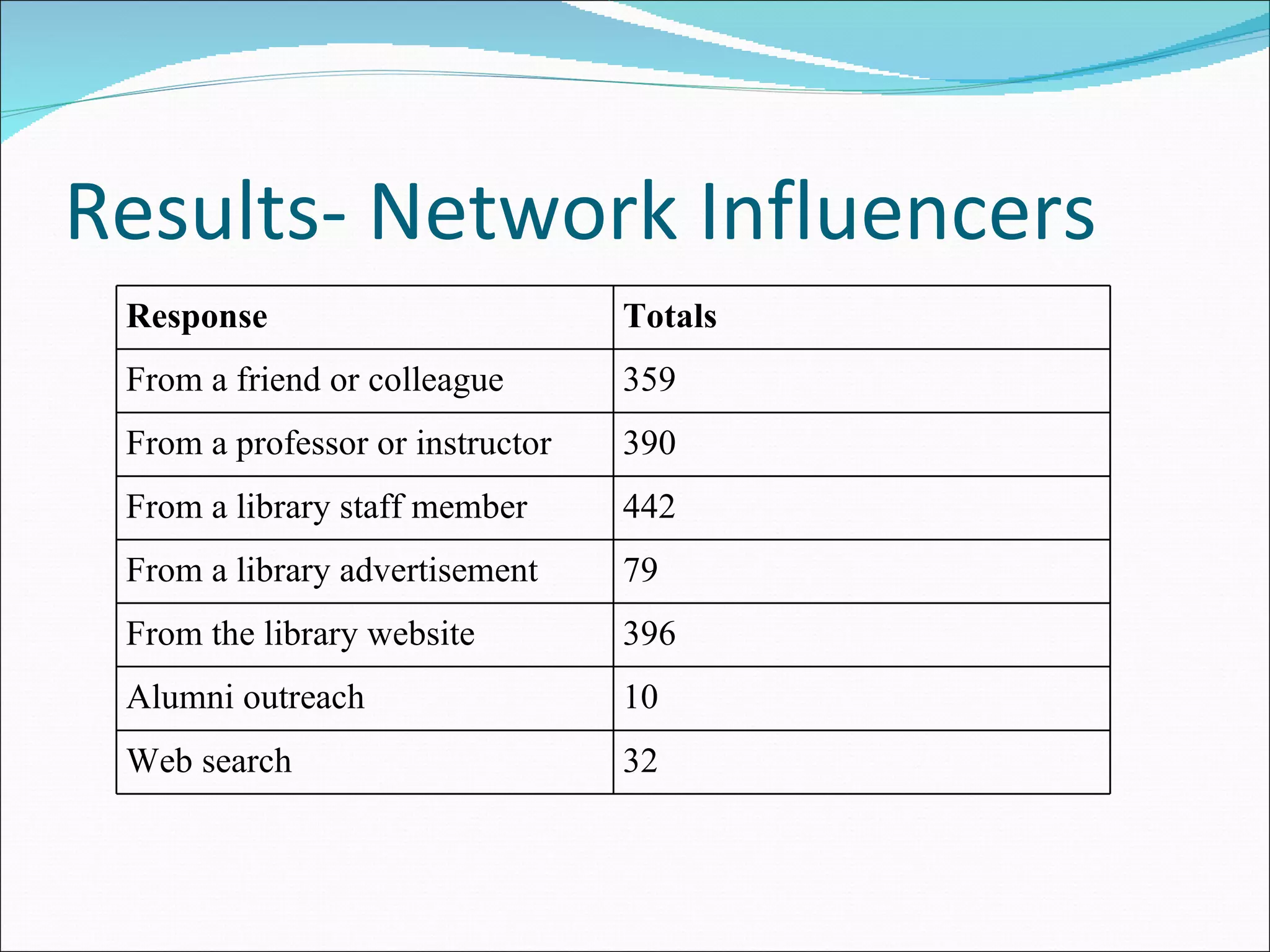
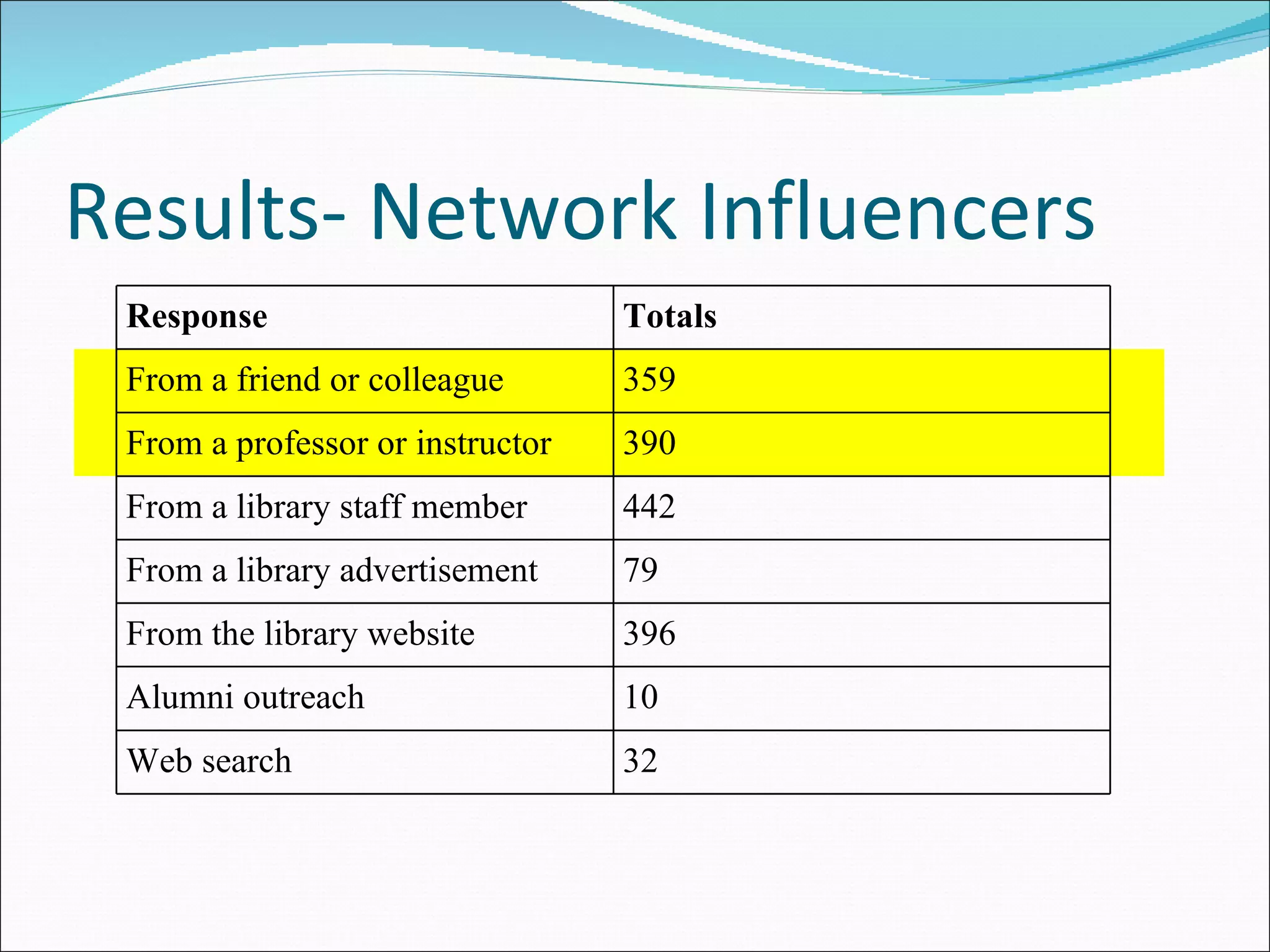
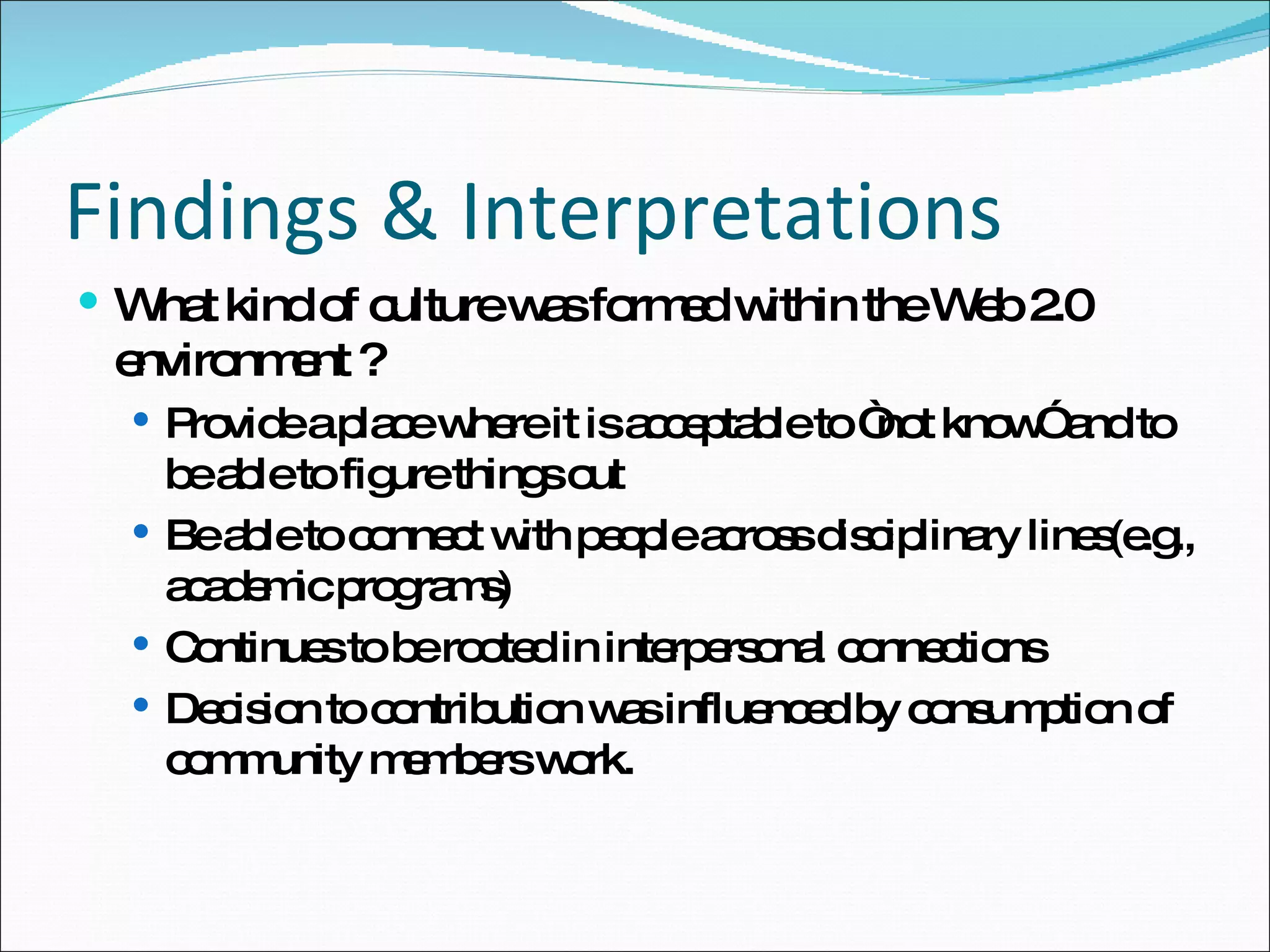
Hypothesis 3- Network Influencers Users were prompted to join the Web 2.0 system because of interpersonal connections (e.g., professor, friend or colleague) at a higher degree than non-interpersonal sources (e.g., advertisement, website, or other source).
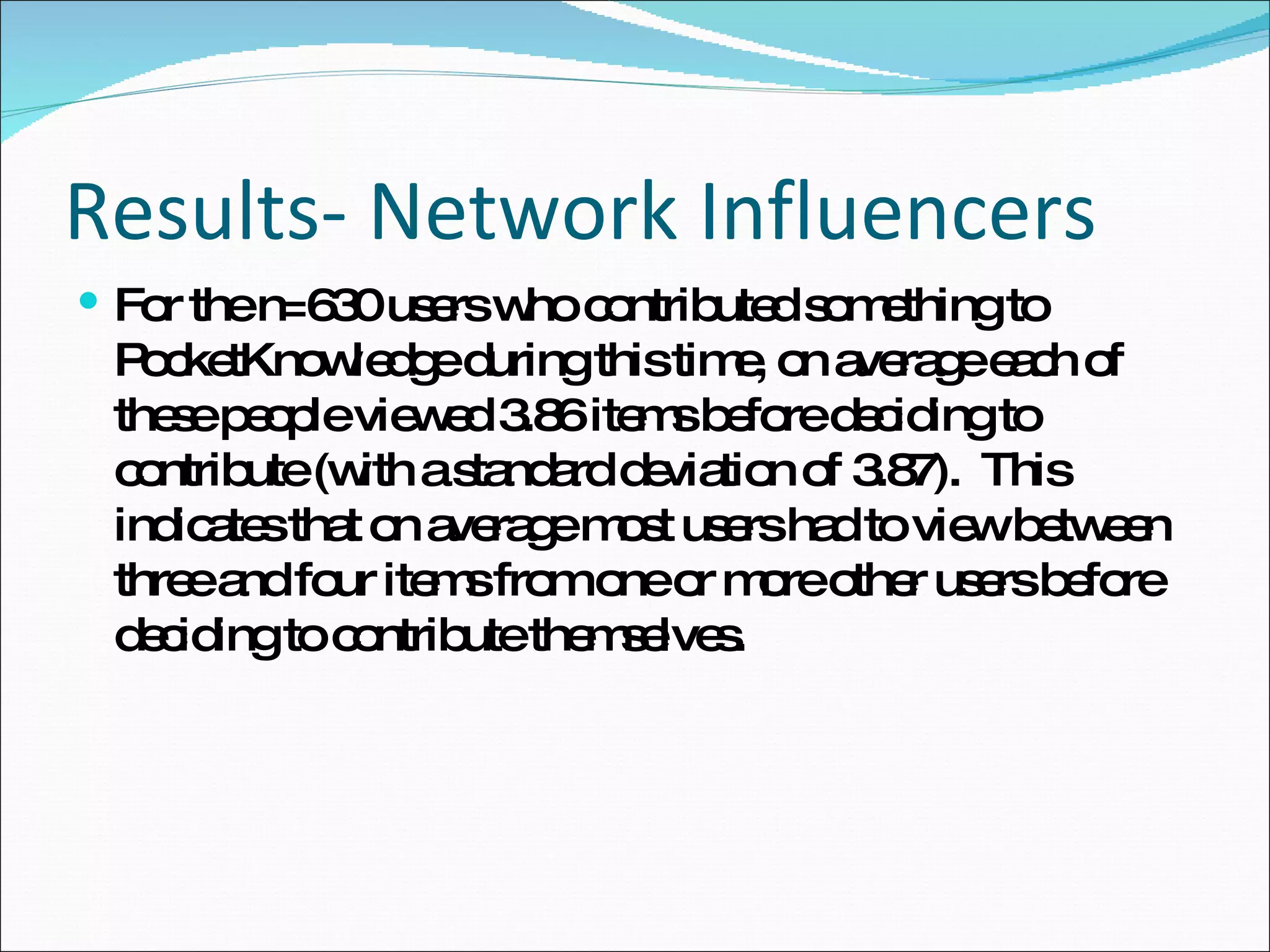
Hypothesis 4- Network Influencers Hypothesis 4: On average, users view the works of others before deciding to contribute themselves.
Methods Knowledge Sharing Networks Network Content Semantics Network Influences
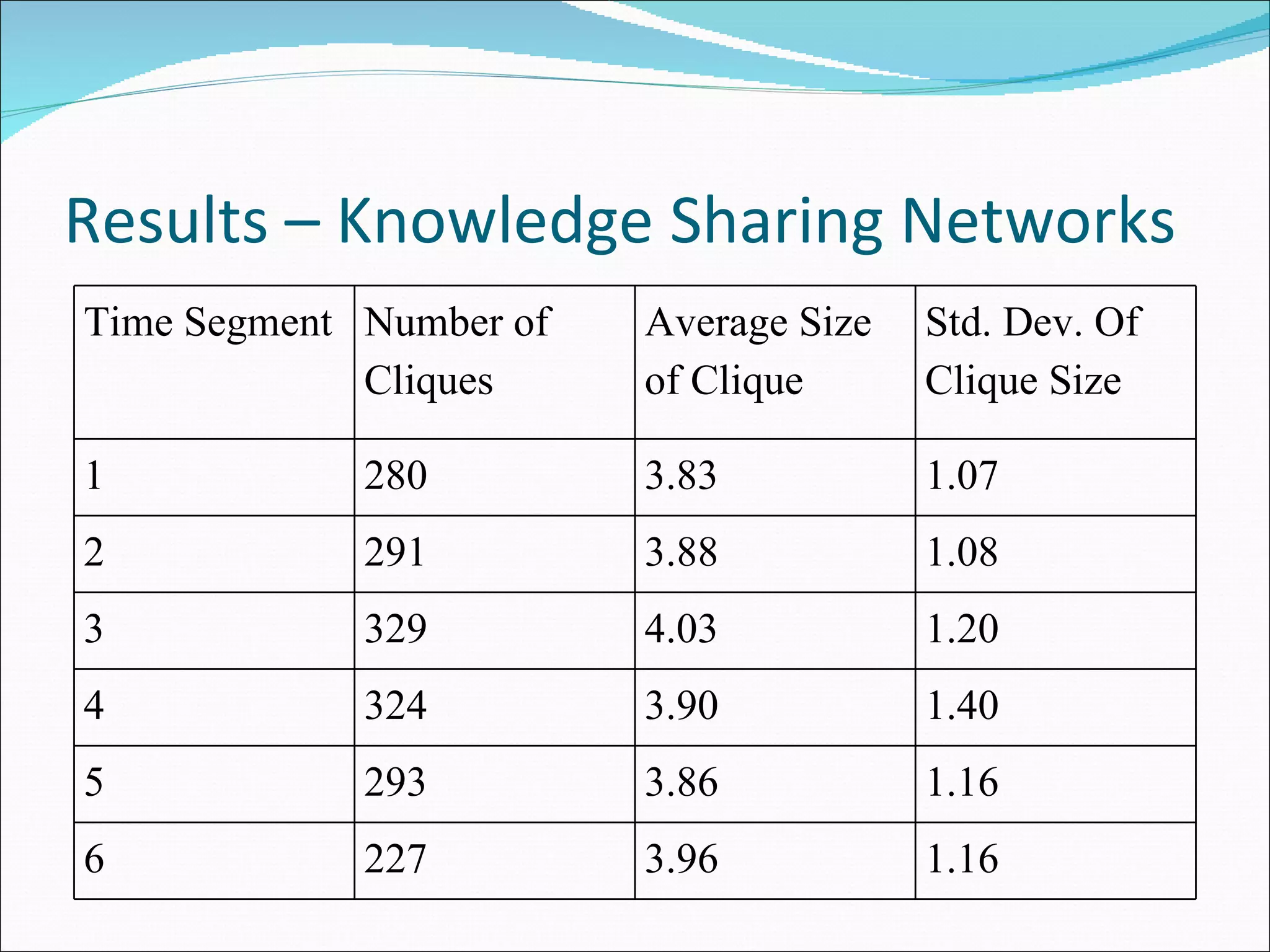
Results – Knowledge Sharing Networks Time Segment Number of Cliques Average Size of Clique Std. Dev. Of Clique Size 1 280 3.83 1.07 2 291 3.88 1.08 3 329 4.03 1.20 4 324 3.90 1.40 5 293 3.86 1.16 6 227 3.96 1.16
Results – Knowledge Sharing Networks
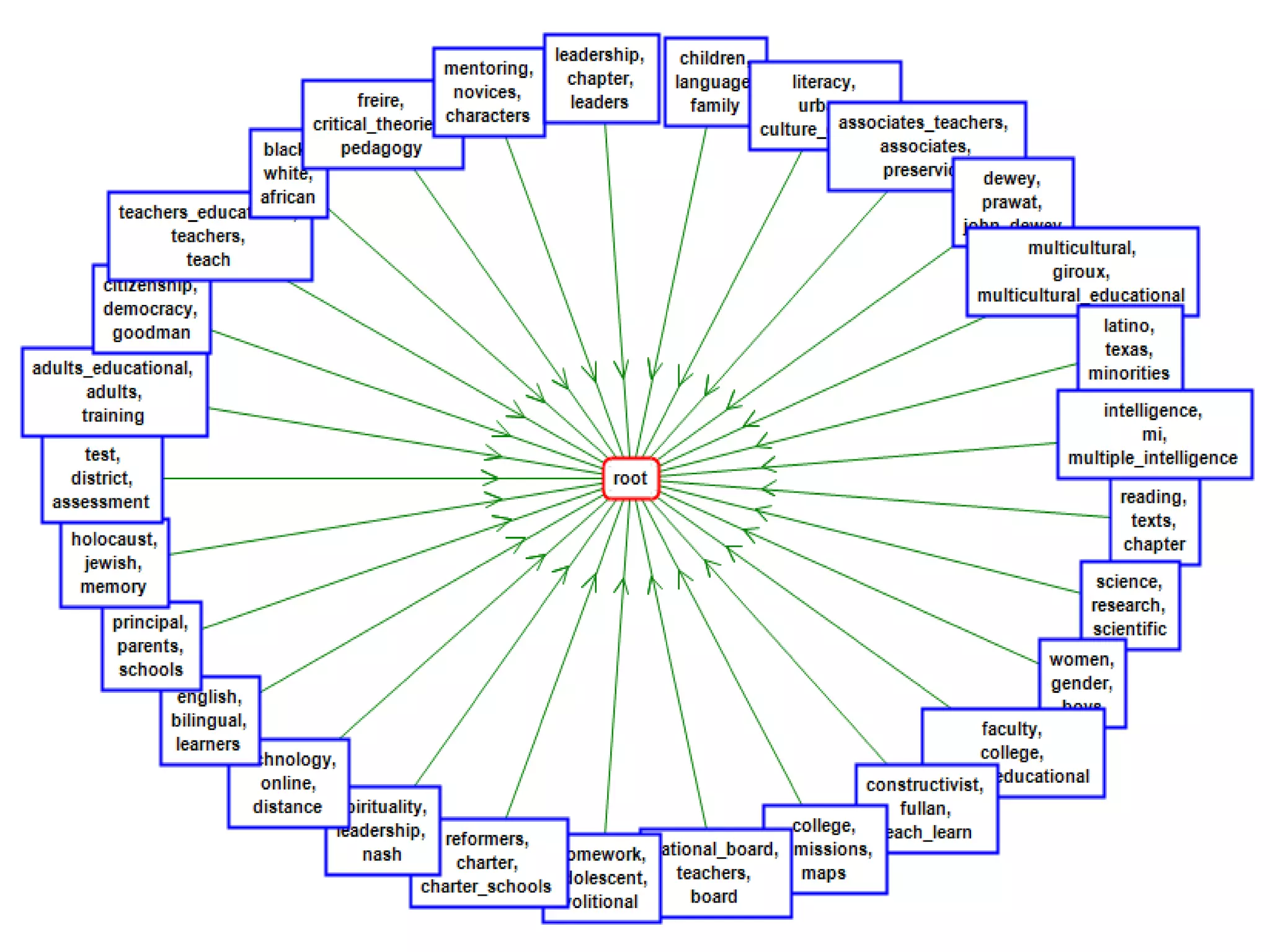
Results – Network Content Semantics Academic Journal in field of Education Web 2.0 System


Results – Network Content Semantics Ontologies are dissimilar Jaccard similarity coefficient of .18
Results- Network Influencers Response Totals From a friend or colleague 359 From a professor or instructor 390 From a library staff member 442 From a library advertisement 79 From the library website 396 Alumni outreach 10 Web search 32
Results- Network Influencers For the n=630 users who contributed something to PocketKnowledge during this time, on average each of these people viewed 3.86 items before deciding to contribute (with a standard deviation of 3.87).  This indicates that on average most users had to view between three and four items from one or more other users before deciding to contribute themselves.
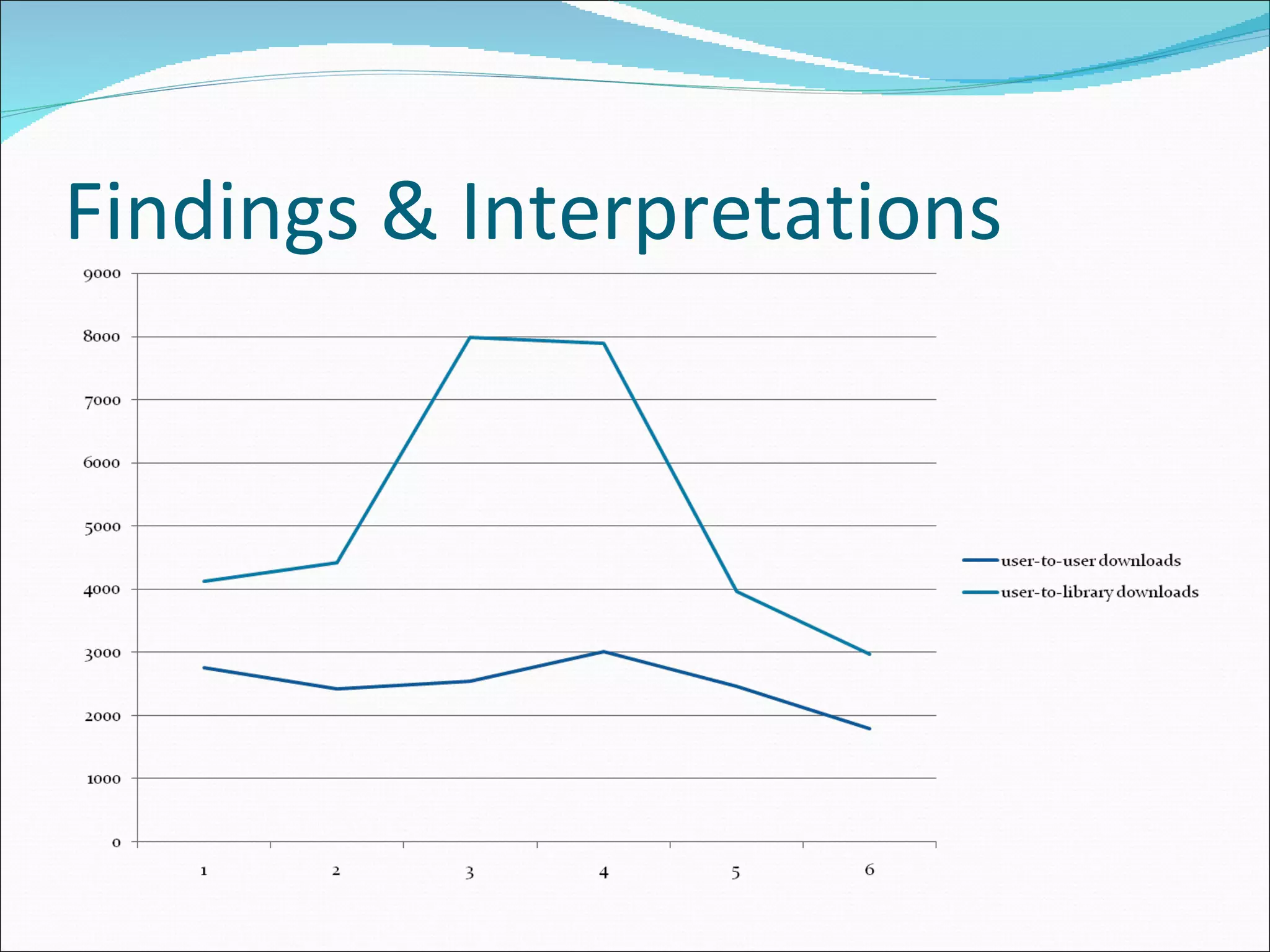
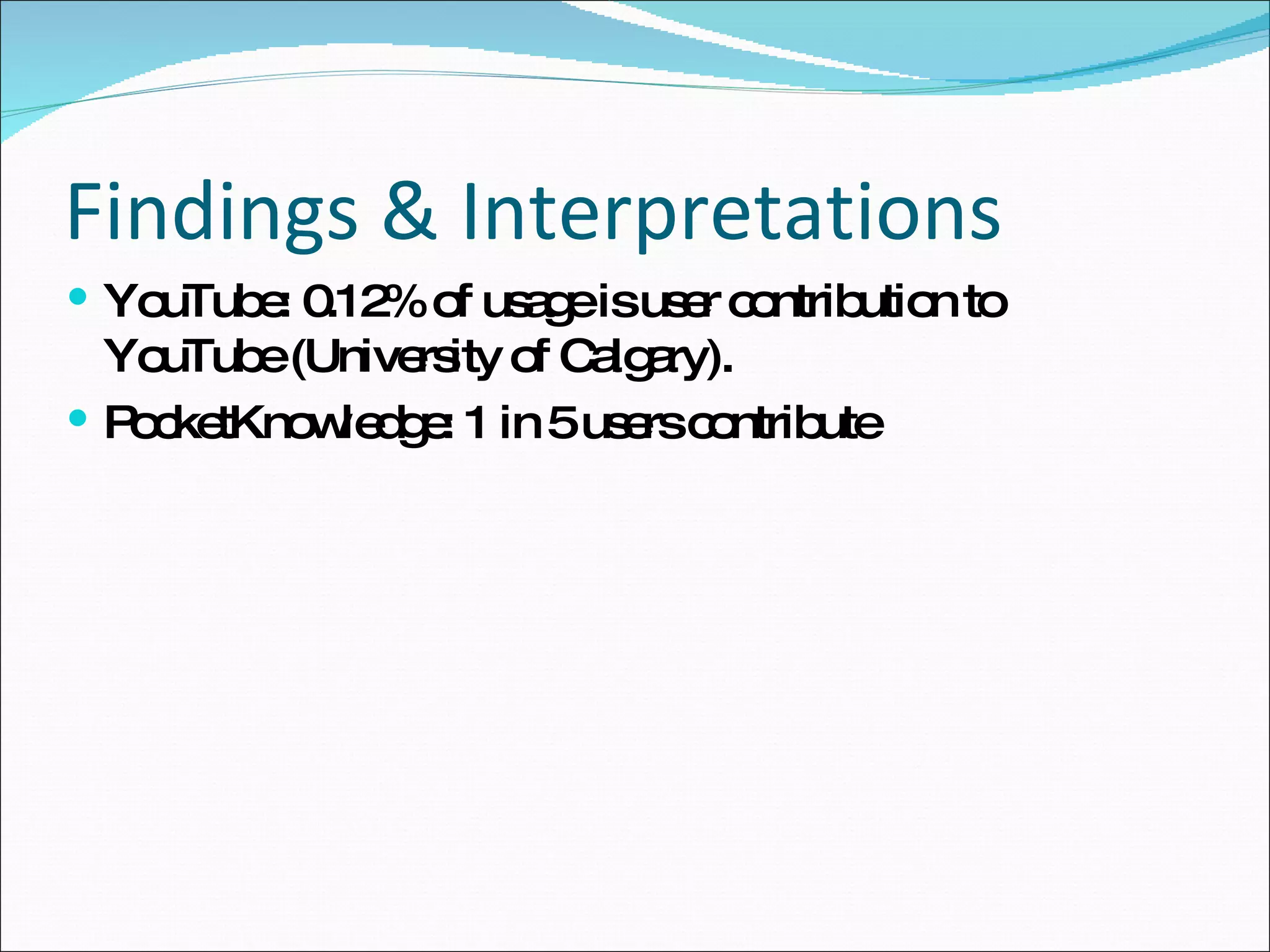
Findings & Interpretations Evidence that the Web 2.0 technology provided a space for a participatory subculture to form.  Consumption versus Participation
Findings & Interpretations
Findings & Interpretations YouTube: 0.12% of usage is user contribution to YouTube (University of Calgary).  PocketKnowledge: 1 in 5 users contribute
Findings & Interpretations What kind of culture was formed within the Web 2.0 environment ? Provide a place where it is acceptable to “not know” and to be able to figure things out Be able to connect with people across disciplinary lines(e.g., academic programs) Continues to be rooted in interpersonal connections Decision to contribution was influenced by consumption of community members work.
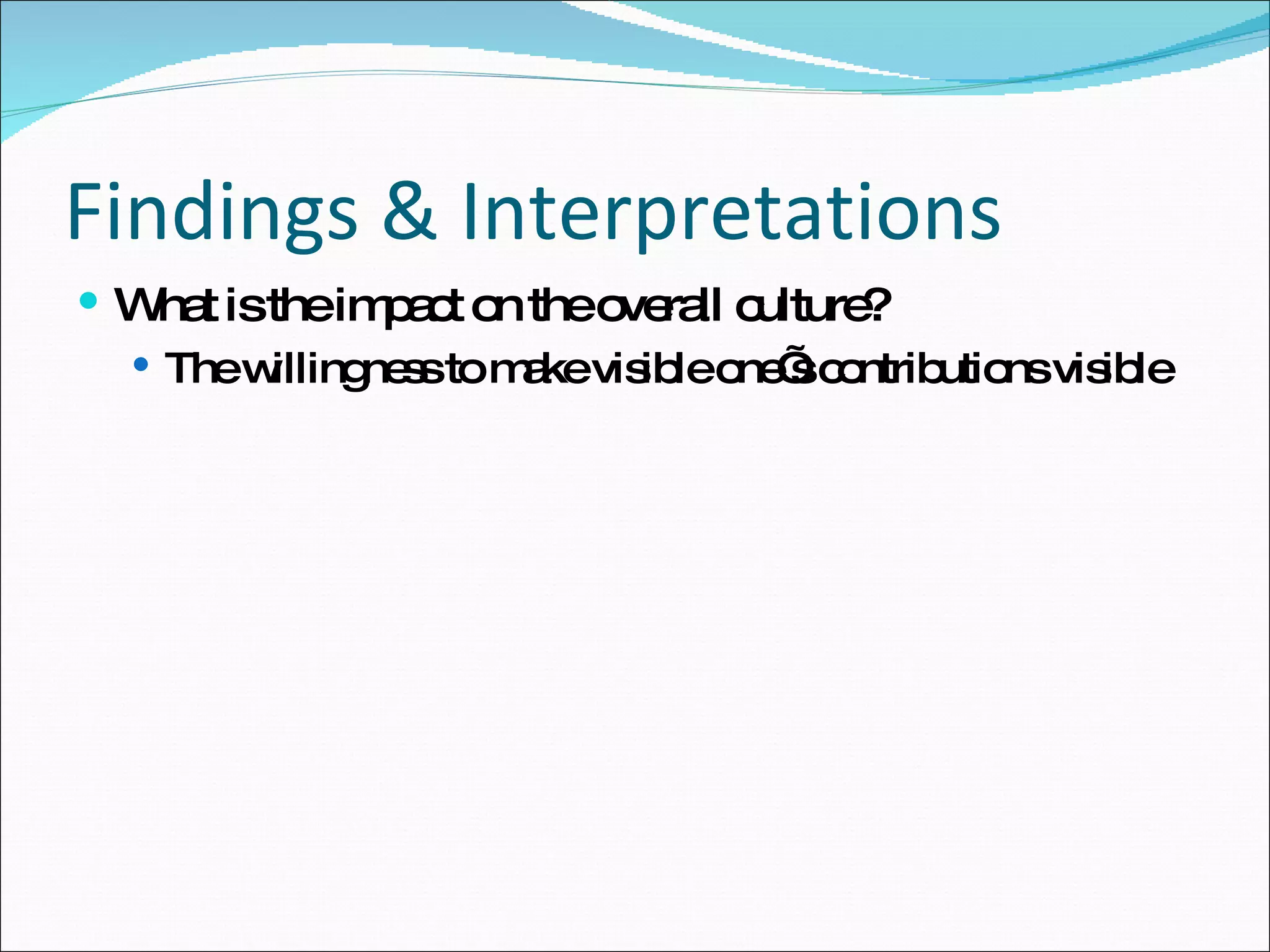
Findings & Interpretations What is the impact on the overall culture?  The willingness to make visible one’s contributions visible
Implications What qualifies as participatory culture? Set some parameters, understand network dynamics Do Web 2.0 technologies promote participatory cultures? The biggest impact is that it makes culture more visible and instantiates it into a digital artifact.  Because of this increased visibility, this seems to have an impact on decision for people to participate as well.
Future Research Specific methods and interventions for using Web 2.0 tools to support participatory culture beyond simply design affordances. Other use of social media to promote behavioral and cultural change (healthy behaviors)  Explore what specific design affordances prompt what kinds of behavior Trying out findings in other Web 2.0 systems
Thank you. Anthony Cocciolo  cocciolo@tc.columbia.edu  www.thinkingprojects.org

Using ICTs to Promote Cultural Change: A Study from a Higher Education Context

  • 1.
    Anthony Cocciolo TeachersCollege, Columbia University www.thinkingprojects.org Presentation to the EdLab Seminar New York, NY
  • 2.
  • 3.
    Epistemological Background HCIDigital Design & Develop- ment Communications Cog. Sci & Psychlogy Instructional Technology Social Foundations / Commitments Humanities & Critical Theory Or where I am living in my head Sociology
  • 4.
    Past, Present andFuture Projects Social Software in Education
  • 5.
    Past, Present andFuture Projects Social Software in Education Using ICTs to promote civic engagement and democratic dialogue
  • 6.
    Past, Present andFuture Projects Social Software in Education Embedded Computing in Collaborative Learning Using ICTs to promote civic engagement and democratic dialogue
  • 7.
    Past, Present andFuture Projects Social Software in Education Embedded Computing in Collaborative Learning Using ICTs to promote civic engagement and democratic dialogue Learning Management Systems as a way of learning about schools
  • 8.
    Past, Present andFuture Projects Social Software in Education Virtual Worlds Research Embedded Computing in Collaborative Learning Using ICTs to promote civic engagement and democratic dialogue Learning Management Systems as a way of learning about schools
  • 9.
    Past, Present andFuture Projects Social Software in Education Virtual Worlds Research Embedded Computing in Collaborative Learning Using ICTs to promote civic engagement and democratic dialogue Using Social Software to promote behavioral change And health Learning Management Systems as a way of learning about schools
  • 10.
    Past, Present andFuture Projects Social Software in Education Virtual Worlds Research Embedded Computing in Collaborative Learning Using ICTs to promote civic engagement and democratic dialogue Using Social Software to promote behavioral change And health Ubiquitous and Mobile Learning Management Systems as a way of learning about schools
  • 11.
    1993-97 : Started software development company 1998: Begin studying Computer Science at University of California Riverside. 2000: Start working at a Technology Consulting Company 2002: Graduate from UCR, begin working at TC Innovations 2009: Defend Dissertation, Looking for the next big thing… 2003: Start taking classes at TC 2005: M.A, Start Ed.D. Program 2004: EdLab 2008: Ed.M.
  • 12.
  • 13.
  • 14.
    Research Questions Howdoes the introduction of a Web 2.0 technology into a learning community impact the culture of learning? What kind of subculture does a community choose to create within an online environment when no one given culture is given preference? Do it choose a consumer culture, characterized by consumptive interactions and hierarchical social arrangements? Or does it choose a participatory culture, where individuals actively contribute to their cultural and material reality?
  • 15.
    Does the subculturethat gets developed in the Web 2.0 environment impact the overall organizational culture? And…
  • 16.
    Many Questions andIssues How is culture expressed in an online environment? What activity must take place regularly in the environment to qualify it was promoting a participatory culture? What is a Web 2.0 environment? How do you know you have designed one?
  • 17.
    Literature Review Howcomputers have been used to support learning? CSCL, Situated Learning, and Networked Learning Approach to Research: Design and Design-based Research Clarification of ICT specifics Web 2.0 and ICTs How have technologies been adopted and diffused across a community? Diffusion, Change, and Innovation What have we learned from past changes in technologies? Historical & Cultural Context
  • 18.
    Who cares? Designof online environments Possibilities for ICTs to have an impact on organizational cultures Widespread use (Pew Studies) and hypothesized potential of Web 2.0 technologies (from business and educational communities)
  • 19.
  • 20.
  • 21.
    Study over 2-yearperiod September 6, 2006 to September 6, 2008 2 million+ items downloaded or item description pages viewed ~109K items were downloaded or the item description page was viewed by ~2,580 unique users
  • 22.
  • 23.
    PocketKnowledge & Web2.0 Design Patterns Individual users maintain high degree of control High level of community trust Non-authoritative information organization Playful attitude
  • 24.
  • 25.
    PocketKnowledge & Web2.0 Design Patterns Individual users maintain high degree of control High level of community trust Non-authoritative information organization Playful attitude
  • 26.
  • 27.
    PocketKnowledge & Web2.0 Design Patterns Individual users maintain high degree of control High level of community trust Non-authoritative information organization Playful attitude
  • 28.
  • 29.
    PocketKnowledge & Web2.0 Design Patterns Individual users maintain high degree of control High level of community trust Non-authoritative information organization Playful attitude
  • 30.
  • 31.
    How do weunderstand the cultural that was created within the environment? Who is sharing with whom? Knowledge sharing networks What is being shared? Network Content semantics Why is it being shared? What caused you to be here at PocketKnowledge?
  • 32.
    Making Hypothesis Makeset of hypothesis that if proved true would show evidence that the Web 2.0 technology is providing a space for a participatory subculture to form:
  • 33.
    Hypothesis 1 –Knowledge Sharing Networks The Web 2.0 environment prompted the sharing of materials amongst members of the community that were not formally grouped together by institutional structures, such as programs, to a higher degree than people within the same program.
  • 34.
    Hypothesis 2- NetworkContent Semantics The Web 2.0 technology promoted the sharing of content that diverged from typical academic discourse within a graduate school of education.
  • 35.
    Hypothesis 3- NetworkInfluencers Users were prompted to join the Web 2.0 system because of interpersonal connections (e.g., professor, friend or colleague) at a higher degree than non-interpersonal sources (e.g., advertisement, website, or other source).
  • 36.
    Hypothesis 4- NetworkInfluencers Hypothesis 4: On average, users view the works of others before deciding to contribute themselves.
  • 37.
    Methods Knowledge SharingNetworks Network Content Semantics Network Influences
  • 38.
    Results – KnowledgeSharing Networks Time Segment Number of Cliques Average Size of Clique Std. Dev. Of Clique Size 1 280 3.83 1.07 2 291 3.88 1.08 3 329 4.03 1.20 4 324 3.90 1.40 5 293 3.86 1.16 6 227 3.96 1.16
  • 39.
    Results – KnowledgeSharing Networks
  • 40.
    Results – NetworkContent Semantics Academic Journal in field of Education Web 2.0 System
  • 41.
  • 42.
  • 43.
  • 44.
  • 45.
    Results – NetworkContent Semantics Ontologies are dissimilar Jaccard similarity coefficient of .18
  • 46.
    Results- Network InfluencersResponse Totals From a friend or colleague 359 From a professor or instructor 390 From a library staff member 442 From a library advertisement 79 From the library website 396 Alumni outreach 10 Web search 32
  • 47.
    Results- Network InfluencersResponse Totals From a friend or colleague 359 From a professor or instructor 390 From a library staff member 442 From a library advertisement 79 From the library website 396 Alumni outreach 10 Web search 32
  • 48.
    Results- Network InfluencersFor the n=630 users who contributed something to PocketKnowledge during this time, on average each of these people viewed 3.86 items before deciding to contribute (with a standard deviation of 3.87). This indicates that on average most users had to view between three and four items from one or more other users before deciding to contribute themselves.
  • 49.
    Findings & InterpretationsEvidence that the Web 2.0 technology provided a space for a participatory subculture to form. Consumption versus Participation
  • 50.
  • 51.
    Findings & InterpretationsYouTube: 0.12% of usage is user contribution to YouTube (University of Calgary). PocketKnowledge: 1 in 5 users contribute
  • 52.
    Findings & InterpretationsWhat kind of culture was formed within the Web 2.0 environment ? Provide a place where it is acceptable to “not know” and to be able to figure things out Be able to connect with people across disciplinary lines(e.g., academic programs) Continues to be rooted in interpersonal connections Decision to contribution was influenced by consumption of community members work.
  • 53.
    Findings & InterpretationsWhat is the impact on the overall culture? The willingness to make visible one’s contributions visible
  • 54.
    Implications What qualifiesas participatory culture? Set some parameters, understand network dynamics Do Web 2.0 technologies promote participatory cultures? The biggest impact is that it makes culture more visible and instantiates it into a digital artifact. Because of this increased visibility, this seems to have an impact on decision for people to participate as well.
  • 55.
    Future Research Specificmethods and interventions for using Web 2.0 tools to support participatory culture beyond simply design affordances. Other use of social media to promote behavioral and cultural change (healthy behaviors) Explore what specific design affordances prompt what kinds of behavior Trying out findings in other Web 2.0 systems
  • 56.
    Thank you. AnthonyCocciolo cocciolo@tc.columbia.edu www.thinkingprojects.org