How Online Education is Transforming Colleges and Universities in the US **Burks Oakley IIResearch ProfessorUniversity of Illinois at Springfield (UIS)** A caution to institutions that are “perfecting the irrelevant”
Know the business you are inRemember Smith-Corona? When the plant closed, the president said, “This (the last typewriter) is the best product we have ever produced. But what we ended up doing was perfecting the irrelevant.”Notice the carbon paper!
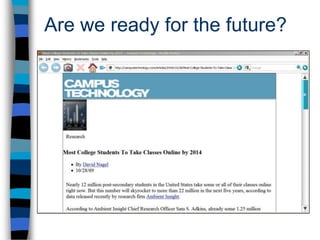
Are we ready for the future?
Are we ready for the future?The Internet is now used by 1.7 billion people (25% of the world’s population).More than 160 million people every month are logging on to social networking sites such as Facebook and Twitter.There are now over 100 million blogs with more than 100,000 new ones being created every day.EC's Joint Research Centre - Institute for Prospective Technological Studies
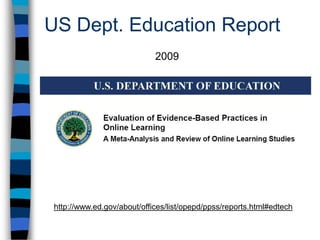
US Dept. Education Report2009http://www.ed.gov/about/offices/list/opepd/ppss/reports.html#edtech
Online Learning StudiesStudents who took all or part of their class online performed better, on average, than those taking the same course through traditional face-to-face instruction.Instruction combining online and face-to-face elements had a larger advantage over purely face-to-face instruction than did purely online instruction.
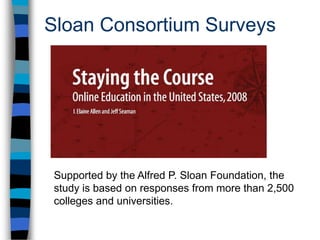
Sloan Consortium SurveysSupported by the Alfred P. Sloan Foundation, the study is based on responses from more than 2,500 colleges and universities.
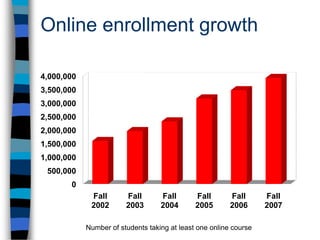
Online enrollment growthNumber of students taking at least one online course
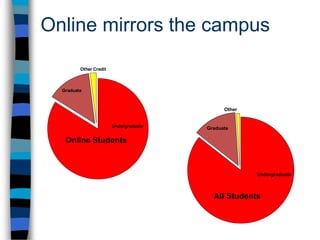
Online mirrors the campusOnline StudentsAll Students
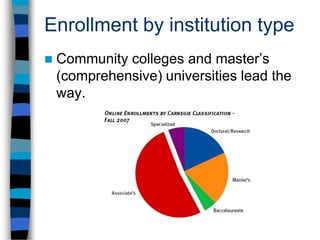
Enrollment by institution typeCommunity colleges and master’s (comprehensive) universities lead the way.
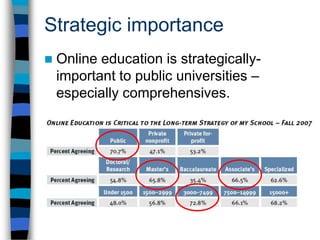
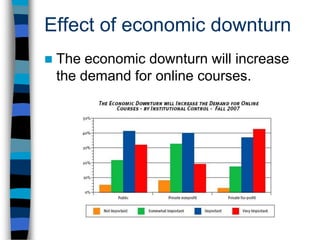
Strategic importanceOnline education is strategically-important to public universities – especially comprehensives.Effect of economic downturnThe economic downturn will increase the demand for online courses.
Sloan-C Quality FrameworkEmphasis on quality and the five pillars:AccessLearning effectivenessStudent satisfactionFaculty satisfactionCost effectivenessWestminster CollegeFulton, MO
National Survey of Student EngagementTracking Student Engagement Over Time Indiana University Center for Postsecondary Researchhttp://nsse.iub.edu/NSSE_2009_Results/pdf/NSSE_AR_2009.pdf
NSSE – 2009 ResultsCourse management and interactive technologies were positively related to student engagement, self-reported learning outcomes, and deep approaches to learning.Interactive technologies corresponded most strongly with students’ self-reported gains and the supportive campus environment benchmark.
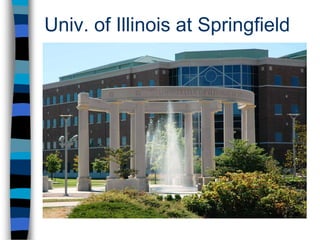
Univ. of Illinois at Springfield
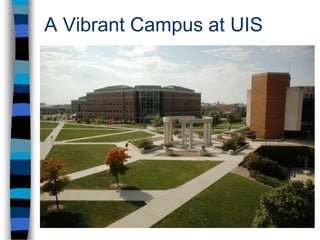
A Vibrant Campus at UIS
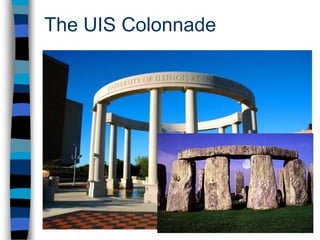
The UIS Colonnade
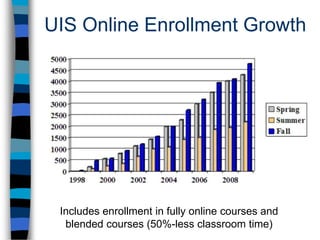
UIS Online Enrollment GrowthIncludes enrollment in fully online courses andblended courses (50%-less classroom time)
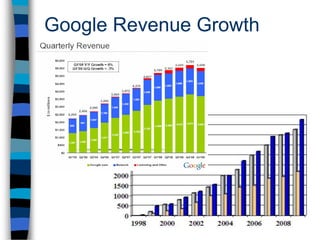
© NY TimesGoogle Revenue Growth
UIS Online DegreesUndergraduate BA/BS degree completion (last 60 hours) in:Math, Philosophy, Economics, English, History, Liberal Studies, Business Administration, & Computer ScienceMaster’s degrees in:Human Services Administration, Legal Studies, Teacher Leadership, Public Administration, Public Health, Management Information Systems, Computer Science, Environmental Science, & Liberal Studies
UIS Online – Fall 200930.9% of credits are generated by online courses  At 1,301, the number of online majors increased by 101 from Fall 2008.Online majors make up 26.2% of UIS headcount.50.4% of UIS students are taking at least one online course, and 30.2% are registered only in online courses35.7% of online majors have mailing addresses outside Illinois84.3% of Illinois online majors have mailing addresses outside Sangamon county
Transforming UISOnline majors made up 26.2% of UIS headcount enrollment. Fewer students are coming to campus and needing campus facilities.The financial base of the institution is no longer as heavily regional in nature (online students come from 47 states and 11 foreign countries).
Transforming UISAt 1,301, the number of online majors increased by 101 from Fall 2008 (8.4%). (The UIS census headcount increased by 250 students overall, to 4966.) This has added to the stability and actual growth of tuition revenues as the student base expands.UIS Online is providing ACCESS to quality educational opportunities.
Transforming UIS30.9% of credits were generated in online courses.Students in online courses pay a fee of $25 per credit hour [students only taking online courses don’t pay the regular campus fees].This has generated about a million dollars a year in online course fees (to support online programs).
Transforming UIS50.4% of UIS students took at least one course online. These students are exposed to new and emerging technologies - a value added for employment and for experience. As the recently-released NSSE report suggests, this has also resulted in deeper thinking and greater student engagement - leading to greater student satisfaction.
Transforming UIS30.2% of all students were registered only in online courses. This reflects greater access and flexibility for nearly a third of the students.Providing increased access to quality education is a critical component of the campus’ strategic plan.
Transforming UIS35.7% of online majors have mailing addresses outside Illinois. These numbers represent nearly all of the out-of-state students enrolled at UIS. The cultural diversity enhances the environment in UIS classes.
Transforming UIS84.3% of the Illinois students have mailing addresses outside Sangamon county. UIS is expanding its reach within Illinois – no longer just serving students from central Illinois.
Transforming UISStudents taking both online and on-campus courses take heavier course loads than either the completely online or on campus students, by more than 4 hours at the graduate level. The flexibility enables better time to completion of degrees.
Keys to Online SuccessFull degree programs available onlineFaculty-driven initiative; course development supportCOLRS – constructivist, student-centered pedagogyTech supportStudent support – program coordinators, online library, online tutoringIntegration of online teachingFaculty experimentation, sharing, & scholarshipTechnology (online) fee and e-tuitionDistributed ownershipPrograms that meet the needs of adult learnersFaculty champion – Ray SchroederMarketed as part of a larger initiative – U of I OnlineUIS community emphasis on quality teaching
Faculty Thoughts"I have taught several undergraduate and graduate classes online. My students are from all over Illinois and increasingly from other states. Feedback from students has been very favorable and appreciative, especially from women who are at home raising kids, business people who travel a lot, and those who are busy and trying to juggle jobs, family and school. I am particularly pleased that if a course is well designed, it can actually be a better learning experience (due to student-student and student-teacher interaction) than on-campus classes."David O'Gorman, PhD, Professor, Business Administration
Students are more engagedOne of the human services faculty members told me that she is having to re-write all of her exams for her online class. She says that the previous exams were just fine for the face-to-face students, but the online students are thinking more deeply about the subject. They are at a far deeper level, she says, than her on-campus students. The students challenge one another to think more deeply and reflectively in the discussion forums in Blackboard.
Student from S. CarolinaAs a manager for a state agency, I found leaving work in the middle of the day and traveling to and from the university campus for a course very disrupting to my work schedule.I wanted a “traditional” university that offered the same computer science curriculum online as they offered in their classroom environment.
Student from S. CarolinaIt was cost prohibitive to attend an out of state university for online coursework and pay two to three times as much per credit hour.With UIS, I finally found a university that understood what I needed and offered it in a format that was complimentary to my career as well as my wallet.I only wish that our own state university had possessed the foresight to offer such a program for those students that don’t fit the traditional mold.
Student from ArkansasAs an older student who is involved in a family business, I am not able to attend on-campus classes due to the fact that it is impossible for me to adhere to traditional classroom meeting times. Online is not only the most convenient option for me, it is the only option.Additionally, my choice of UIS was because they were one of the few universities that offered an English degree completely online.
Student from ArkansasAs a writer, I knew it was important to my career to obtain an English degree.At first, before I discovered UIS, I was afraid I would have to settle for more of a “generic” degree simply because online English degrees are virtually nonexistent. I am thrilled at the thought of being able to obtain what is considered a “professional” degree online.
Retention in Online CoursesRetention in a course is defined as the percentage of students that get a final grade out of the total in the class on day 10 (census).Online course retention averages 94%.  On-campus course retention averages 96%. More details at:http://online.uis.edu/info/retention.html
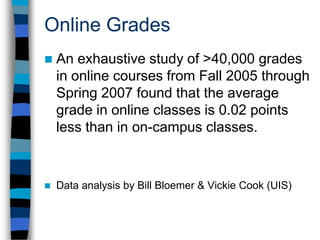
Online GradesAn exhaustive study of >40,000 grades in online courses from Fall 2005 through Spring 2007 found that the average grade in online classes is 0.02 points less than in on-campus classes.Data analysis by Bill Bloemer & Vickie Cook (UIS)
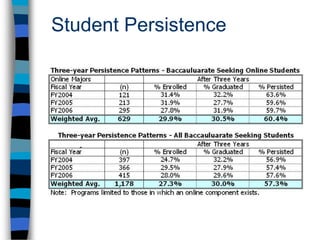
Student Persistence
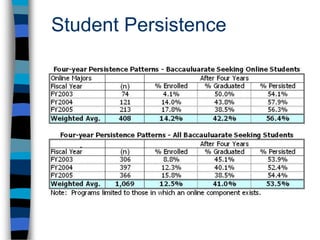
Student Persistence
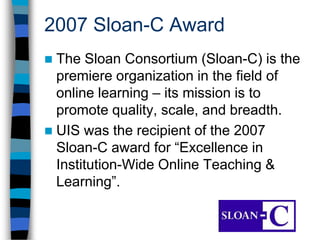
2007 Sloan-C AwardThe Sloan Consortium (Sloan-C) is the premiere organization in the field of online learning – its mission is to promote quality, scale, and breadth.UIS was the recipient of the 2007 Sloan-C award for “Excellence in Institution-Wide Online Teaching & Learning”.
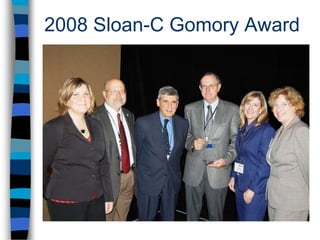
2008 Sloan-C Gomory AwardUIS was selected to be one of two recipients of Sloan-C’s 2008 Ralph E. Gomory Award for Quality Online Education.Citation:  “For innovative work in using quantitative data in a process of continuous quality improvement to assure excellence in online teaching and learning at UIS.”
2008 Sloan-C Gomory Award
Let’s move on to UCF!
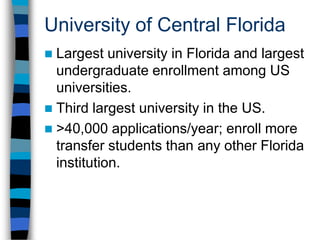
University of Central FloridaLargest university in Florida and largest undergraduate enrollment among US universities.Third largest university in the US.>40,000 applications/year; enroll more transfer students than any other Florida institution.
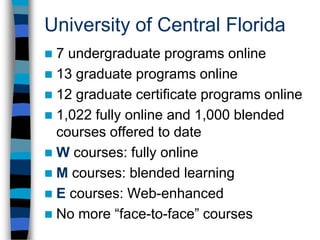
University of Central Florida7 undergraduate programs online13 graduate programs online12 graduate certificate programs online1,022 fully online and 1,000 blended courses offered to dateW courses: fully onlineM courses: blended learningE courses: Web-enhancedNo more “face-to-face” courses
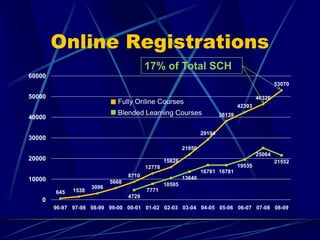
Online Registrations17% of Total SCHn Fully Online CoursesBlended Learning Coursesn
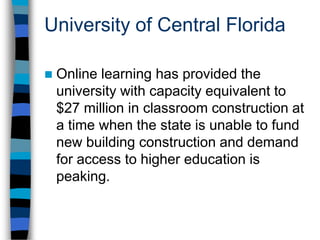
University of Central FloridaOnline learning has provided the university with capacity equivalent to $27 million in classroom construction at a time when the state is unable to fund new building construction and demand for access to higher education is peaking.
University of Central FloridaOnline learning is now the largest component of institutional growth, which is generating new funds in an otherwise down economy.Student course evaluations show that all online modalities are rated excellent at a higher rate than other modalities, including face-to-face instruction.
University of Central FloridaOnline learning continues to expand educational access throughout central Florida and beyond through a strategic partnership with the university’s regional campus system. The  result is “Learning on Demand,” which is changing the institutional access model from capacity driven to demand driven.
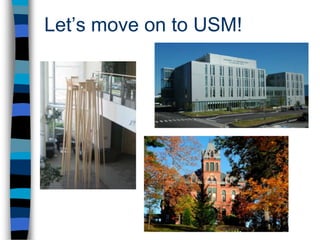
Let’s move on to USM!
Univ. of Southern Maine3 fully online graduate programs5 blended undergraduate degree programs (one of which will be a fully online degree completion program next fall)One college’s general education core online.Online & blended students are largely from Portland – Gorham - Lewiston-Auburn area (southern Maine)
Univ. of Southern MaineNumber of online & blended courses:Fa 09: 118  (97% increase over Fa08)Su 09: 97  (64% increase over Su08)Sp 09: 106  (58% increase over Sp09)Number of online & blended credit hours:Fa09: 5683  (96% increase over Fa08)Su09: 4568  (56% increase over Su08)Sp09:  4149  (33% increase over Sp08)
Univ. of Southern MaineUSM is now better able to serve the access needs of Maine residents since online courses gives access to higher education to place-bound and time-restricted students who otherwise would not have been able to go to campus. Enrollment stabilization at a time of otherwise shrinking enrollments.
Univ. of Southern Maine“The online initiative has created a campus environment more accepting of technology as an enhancement to learning (in both the face-to-face classroom and online) and is thus bringing us into the 21st century.”                 -- Dr. Robert Hansen                     Assoc. Provost, USM
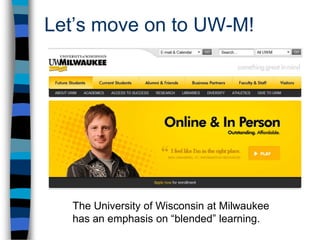
Let’s move on to UW-M!The University of Wisconsin at Milwaukee has an emphasis on “blended” learning.
What is Blended?Blended/hybrid courses are courses where a portion of the traditional face-to-face classroom time is replaced by online learning activities. Students spend less time in the classroom and more time working and interacting online, providing greater flexibility regarding when and where coursework can be completed.
Blended Course DescriptionBlended courses are:NOT simply traditional classes with a Web siteNot web-enhancedOnline time replaces some classroom timeNOT traditional “distance education” coursesNot entirely onlineFace-to-face classroom meetings NOT all alikeMany different formats and schedules are possibleNOT just transferring information to the WebInvolves an extensive course redesign
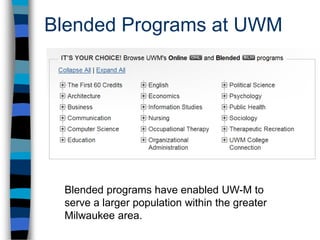
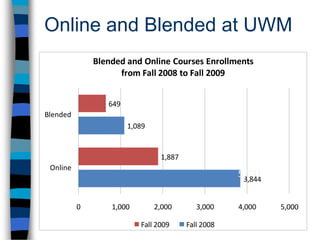
Blended Programs at UWMBlended programs have enabled UW-M to serve a larger population within the greater Milwaukee area.
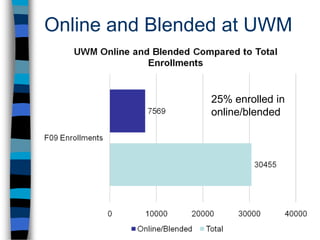
Online and Blended at UWM
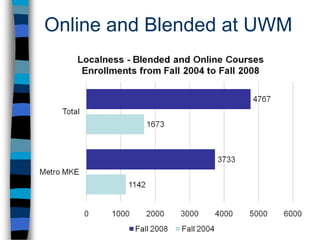
Online and Blended at UWM25% enrolled in online/blended
Campus Computing ProjectManaging Online Education: The 2009 WCET-Campus Computing Project Survey of Online Education (Oct. ‘09)Kenneth C. Green http://www.campuscomputing.net/
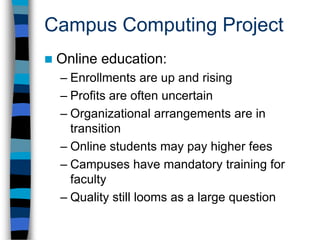
Campus Computing ProjectOnline education:Enrollments are up and risingProfits are often uncertainOrganizational arrangements are in transitionOnline students may pay higher feesCampuses have mandatory training for facultyQuality still looms as a large question
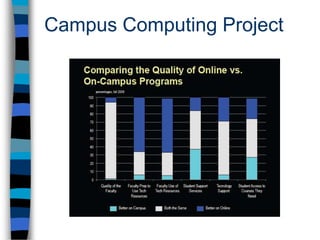
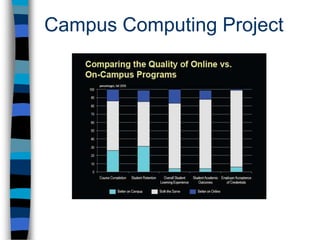
Campus Computing Project
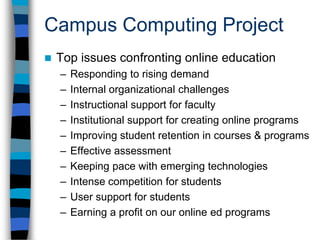
Campus Computing ProjectTop issues confronting online educationResponding to rising demandInternal organizational challengesInstructional support for facultyInstitutional support for creating online programsImproving student retention in courses & programsEffective assessmentKeeping pace with emerging technologiesIntense competition for studentsUser support for studentsEarning a profit on our online ed programs
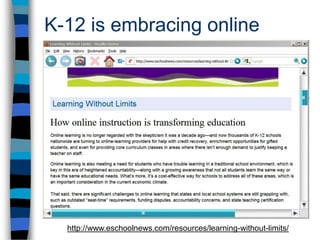
K-12 is embracing onlinehttp://www.eschoolnews.com/resources/learning-without-limits/
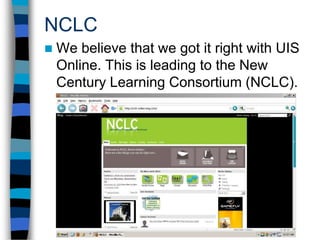
NCLCWe believe that we got it right with UIS Online. This is leading to the New Century Learning Consortium (NCLC).
NCLC – Our Next StepsFunding from the Alfred P. Sloan Foundation to form a consortium of institutions that want to develop online programs of quality, scale, and breadth – as part of their strategic vision – and do this the “UIS way”.NCLC partner institutions include Univ. of Southern Maine, Cal State East Bay, Oakland Univ., Southern Oregon Univ., Chicago State Univ., and Louisiana Tech University.Kickoff workshop at UIS (July 2008).http://nclc-online.ning.com/
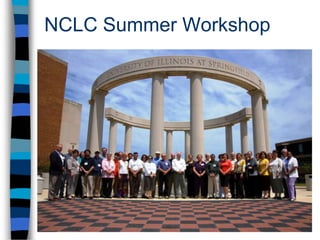
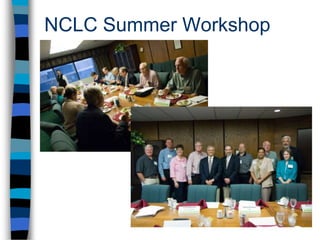
NCLC Summer Workshop
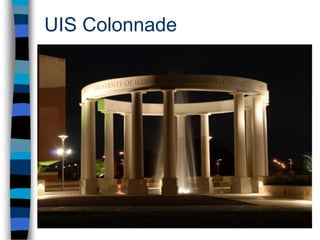
UIS Colonnade
How Online Education is Transforming Colleges and Universities in the USBurks Oakley IIhttp://www.burksoakley.com/http://twitter.com/burkso2oakley@uis.edu
Web 2.0 in Higher Education

Web 2.0 in Higher Education

  • 1.
    How Online Educationis Transforming Colleges and Universities in the US **Burks Oakley IIResearch ProfessorUniversity of Illinois at Springfield (UIS)** A caution to institutions that are “perfecting the irrelevant”
  • 2.
    Know the businessyou are inRemember Smith-Corona? When the plant closed, the president said, “This (the last typewriter) is the best product we have ever produced. But what we ended up doing was perfecting the irrelevant.”Notice the carbon paper!
  • 3.
    Are we readyfor the future?
  • 4.
    Are we readyfor the future?The Internet is now used by 1.7 billion people (25% of the world’s population).More than 160 million people every month are logging on to social networking sites such as Facebook and Twitter.There are now over 100 million blogs with more than 100,000 new ones being created every day.EC's Joint Research Centre - Institute for Prospective Technological Studies
  • 5.
    US Dept. EducationReport2009http://www.ed.gov/about/offices/list/opepd/ppss/reports.html#edtech
  • 6.
    Online Learning StudiesStudentswho took all or part of their class online performed better, on average, than those taking the same course through traditional face-to-face instruction.Instruction combining online and face-to-face elements had a larger advantage over purely face-to-face instruction than did purely online instruction.
  • 7.
    Sloan Consortium SurveysSupportedby the Alfred P. Sloan Foundation, the study is based on responses from more than 2,500 colleges and universities.
  • 8.
    Online enrollment growthNumberof students taking at least one online course
  • 9.
    Online mirrors thecampusOnline StudentsAll Students
  • 10.
    Enrollment by institutiontypeCommunity colleges and master’s (comprehensive) universities lead the way.
  • 11.
    Strategic importanceOnline educationis strategically-important to public universities – especially comprehensives.Effect of economic downturnThe economic downturn will increase the demand for online courses.
  • 12.
    Sloan-C Quality FrameworkEmphasison quality and the five pillars:AccessLearning effectivenessStudent satisfactionFaculty satisfactionCost effectivenessWestminster CollegeFulton, MO
  • 13.
    National Survey ofStudent EngagementTracking Student Engagement Over Time Indiana University Center for Postsecondary Researchhttp://nsse.iub.edu/NSSE_2009_Results/pdf/NSSE_AR_2009.pdf
  • 14.
    NSSE – 2009ResultsCourse management and interactive technologies were positively related to student engagement, self-reported learning outcomes, and deep approaches to learning.Interactive technologies corresponded most strongly with students’ self-reported gains and the supportive campus environment benchmark.
  • 15.
    Univ. of Illinoisat Springfield
  • 16.
  • 17.
  • 18.
    UIS Online EnrollmentGrowthIncludes enrollment in fully online courses andblended courses (50%-less classroom time)
  • 19.
    © NY TimesGoogleRevenue Growth
  • 20.
    UIS Online DegreesUndergraduateBA/BS degree completion (last 60 hours) in:Math, Philosophy, Economics, English, History, Liberal Studies, Business Administration, & Computer ScienceMaster’s degrees in:Human Services Administration, Legal Studies, Teacher Leadership, Public Administration, Public Health, Management Information Systems, Computer Science, Environmental Science, & Liberal Studies
  • 21.
    UIS Online –Fall 200930.9% of credits are generated by online courses At 1,301, the number of online majors increased by 101 from Fall 2008.Online majors make up 26.2% of UIS headcount.50.4% of UIS students are taking at least one online course, and 30.2% are registered only in online courses35.7% of online majors have mailing addresses outside Illinois84.3% of Illinois online majors have mailing addresses outside Sangamon county
  • 22.
    Transforming UISOnline majorsmade up 26.2% of UIS headcount enrollment. Fewer students are coming to campus and needing campus facilities.The financial base of the institution is no longer as heavily regional in nature (online students come from 47 states and 11 foreign countries).
  • 23.
    Transforming UISAt 1,301,the number of online majors increased by 101 from Fall 2008 (8.4%). (The UIS census headcount increased by 250 students overall, to 4966.) This has added to the stability and actual growth of tuition revenues as the student base expands.UIS Online is providing ACCESS to quality educational opportunities.
  • 24.
    Transforming UIS30.9% ofcredits were generated in online courses.Students in online courses pay a fee of $25 per credit hour [students only taking online courses don’t pay the regular campus fees].This has generated about a million dollars a year in online course fees (to support online programs).
  • 25.
    Transforming UIS50.4% ofUIS students took at least one course online. These students are exposed to new and emerging technologies - a value added for employment and for experience. As the recently-released NSSE report suggests, this has also resulted in deeper thinking and greater student engagement - leading to greater student satisfaction.
  • 26.
    Transforming UIS30.2% ofall students were registered only in online courses. This reflects greater access and flexibility for nearly a third of the students.Providing increased access to quality education is a critical component of the campus’ strategic plan.
  • 27.
    Transforming UIS35.7% ofonline majors have mailing addresses outside Illinois. These numbers represent nearly all of the out-of-state students enrolled at UIS. The cultural diversity enhances the environment in UIS classes.
  • 28.
    Transforming UIS84.3% ofthe Illinois students have mailing addresses outside Sangamon county. UIS is expanding its reach within Illinois – no longer just serving students from central Illinois.
  • 29.
    Transforming UISStudents takingboth online and on-campus courses take heavier course loads than either the completely online or on campus students, by more than 4 hours at the graduate level. The flexibility enables better time to completion of degrees.
  • 30.
    Keys to OnlineSuccessFull degree programs available onlineFaculty-driven initiative; course development supportCOLRS – constructivist, student-centered pedagogyTech supportStudent support – program coordinators, online library, online tutoringIntegration of online teachingFaculty experimentation, sharing, & scholarshipTechnology (online) fee and e-tuitionDistributed ownershipPrograms that meet the needs of adult learnersFaculty champion – Ray SchroederMarketed as part of a larger initiative – U of I OnlineUIS community emphasis on quality teaching
  • 31.
    Faculty Thoughts"I havetaught several undergraduate and graduate classes online. My students are from all over Illinois and increasingly from other states. Feedback from students has been very favorable and appreciative, especially from women who are at home raising kids, business people who travel a lot, and those who are busy and trying to juggle jobs, family and school. I am particularly pleased that if a course is well designed, it can actually be a better learning experience (due to student-student and student-teacher interaction) than on-campus classes."David O'Gorman, PhD, Professor, Business Administration
  • 32.
    Students are moreengagedOne of the human services faculty members told me that she is having to re-write all of her exams for her online class. She says that the previous exams were just fine for the face-to-face students, but the online students are thinking more deeply about the subject. They are at a far deeper level, she says, than her on-campus students. The students challenge one another to think more deeply and reflectively in the discussion forums in Blackboard.
  • 33.
    Student from S.CarolinaAs a manager for a state agency, I found leaving work in the middle of the day and traveling to and from the university campus for a course very disrupting to my work schedule.I wanted a “traditional” university that offered the same computer science curriculum online as they offered in their classroom environment.
  • 34.
    Student from S.CarolinaIt was cost prohibitive to attend an out of state university for online coursework and pay two to three times as much per credit hour.With UIS, I finally found a university that understood what I needed and offered it in a format that was complimentary to my career as well as my wallet.I only wish that our own state university had possessed the foresight to offer such a program for those students that don’t fit the traditional mold.
  • 35.
    Student from ArkansasAsan older student who is involved in a family business, I am not able to attend on-campus classes due to the fact that it is impossible for me to adhere to traditional classroom meeting times. Online is not only the most convenient option for me, it is the only option.Additionally, my choice of UIS was because they were one of the few universities that offered an English degree completely online.
  • 36.
    Student from ArkansasAsa writer, I knew it was important to my career to obtain an English degree.At first, before I discovered UIS, I was afraid I would have to settle for more of a “generic” degree simply because online English degrees are virtually nonexistent. I am thrilled at the thought of being able to obtain what is considered a “professional” degree online.
  • 37.
    Retention in OnlineCoursesRetention in a course is defined as the percentage of students that get a final grade out of the total in the class on day 10 (census).Online course retention averages 94%. On-campus course retention averages 96%. More details at:http://online.uis.edu/info/retention.html
  • 38.
    Online GradesAn exhaustivestudy of >40,000 grades in online courses from Fall 2005 through Spring 2007 found that the average grade in online classes is 0.02 points less than in on-campus classes.Data analysis by Bill Bloemer & Vickie Cook (UIS)
  • 39.
  • 40.
  • 41.
    2007 Sloan-C AwardTheSloan Consortium (Sloan-C) is the premiere organization in the field of online learning – its mission is to promote quality, scale, and breadth.UIS was the recipient of the 2007 Sloan-C award for “Excellence in Institution-Wide Online Teaching & Learning”.
  • 43.
    2008 Sloan-C GomoryAwardUIS was selected to be one of two recipients of Sloan-C’s 2008 Ralph E. Gomory Award for Quality Online Education.Citation: “For innovative work in using quantitative data in a process of continuous quality improvement to assure excellence in online teaching and learning at UIS.”
  • 44.
  • 45.
  • 46.
    University of CentralFloridaLargest university in Florida and largest undergraduate enrollment among US universities.Third largest university in the US.>40,000 applications/year; enroll more transfer students than any other Florida institution.
  • 47.
    University of CentralFlorida7 undergraduate programs online13 graduate programs online12 graduate certificate programs online1,022 fully online and 1,000 blended courses offered to dateW courses: fully onlineM courses: blended learningE courses: Web-enhancedNo more “face-to-face” courses
  • 48.
    Online Registrations17% ofTotal SCHn Fully Online CoursesBlended Learning Coursesn
  • 49.
    University of CentralFloridaOnline learning has provided the university with capacity equivalent to $27 million in classroom construction at a time when the state is unable to fund new building construction and demand for access to higher education is peaking.
  • 50.
    University of CentralFloridaOnline learning is now the largest component of institutional growth, which is generating new funds in an otherwise down economy.Student course evaluations show that all online modalities are rated excellent at a higher rate than other modalities, including face-to-face instruction.
  • 51.
    University of CentralFloridaOnline learning continues to expand educational access throughout central Florida and beyond through a strategic partnership with the university’s regional campus system. The result is “Learning on Demand,” which is changing the institutional access model from capacity driven to demand driven.
  • 52.
  • 53.
    Univ. of SouthernMaine3 fully online graduate programs5 blended undergraduate degree programs (one of which will be a fully online degree completion program next fall)One college’s general education core online.Online & blended students are largely from Portland – Gorham - Lewiston-Auburn area (southern Maine)
  • 54.
    Univ. of SouthernMaineNumber of online & blended courses:Fa 09: 118 (97% increase over Fa08)Su 09: 97 (64% increase over Su08)Sp 09: 106 (58% increase over Sp09)Number of online & blended credit hours:Fa09: 5683 (96% increase over Fa08)Su09: 4568 (56% increase over Su08)Sp09: 4149 (33% increase over Sp08)
  • 55.
    Univ. of SouthernMaineUSM is now better able to serve the access needs of Maine residents since online courses gives access to higher education to place-bound and time-restricted students who otherwise would not have been able to go to campus. Enrollment stabilization at a time of otherwise shrinking enrollments.
  • 56.
    Univ. of SouthernMaine“The online initiative has created a campus environment more accepting of technology as an enhancement to learning (in both the face-to-face classroom and online) and is thus bringing us into the 21st century.” -- Dr. Robert Hansen Assoc. Provost, USM
  • 57.
    Let’s move onto UW-M!The University of Wisconsin at Milwaukee has an emphasis on “blended” learning.
  • 58.
    What is Blended?Blended/hybridcourses are courses where a portion of the traditional face-to-face classroom time is replaced by online learning activities. Students spend less time in the classroom and more time working and interacting online, providing greater flexibility regarding when and where coursework can be completed.
  • 59.
    Blended Course DescriptionBlendedcourses are:NOT simply traditional classes with a Web siteNot web-enhancedOnline time replaces some classroom timeNOT traditional “distance education” coursesNot entirely onlineFace-to-face classroom meetings NOT all alikeMany different formats and schedules are possibleNOT just transferring information to the WebInvolves an extensive course redesign
  • 60.
    Blended Programs atUWMBlended programs have enabled UW-M to serve a larger population within the greater Milwaukee area.
  • 61.
  • 62.
  • 63.
    Online and Blendedat UWM25% enrolled in online/blended
  • 64.
    Campus Computing ProjectManagingOnline Education: The 2009 WCET-Campus Computing Project Survey of Online Education (Oct. ‘09)Kenneth C. Green http://www.campuscomputing.net/
  • 65.
    Campus Computing ProjectOnlineeducation:Enrollments are up and risingProfits are often uncertainOrganizational arrangements are in transitionOnline students may pay higher feesCampuses have mandatory training for facultyQuality still looms as a large question
  • 66.
  • 67.
  • 68.
    Campus Computing ProjectTopissues confronting online educationResponding to rising demandInternal organizational challengesInstructional support for facultyInstitutional support for creating online programsImproving student retention in courses & programsEffective assessmentKeeping pace with emerging technologiesIntense competition for studentsUser support for studentsEarning a profit on our online ed programs
  • 69.
    K-12 is embracingonlinehttp://www.eschoolnews.com/resources/learning-without-limits/
  • 70.
    NCLCWe believe thatwe got it right with UIS Online. This is leading to the New Century Learning Consortium (NCLC).
  • 71.
    NCLC – OurNext StepsFunding from the Alfred P. Sloan Foundation to form a consortium of institutions that want to develop online programs of quality, scale, and breadth – as part of their strategic vision – and do this the “UIS way”.NCLC partner institutions include Univ. of Southern Maine, Cal State East Bay, Oakland Univ., Southern Oregon Univ., Chicago State Univ., and Louisiana Tech University.Kickoff workshop at UIS (July 2008).http://nclc-online.ning.com/
  • 72.
  • 73.
  • 74.
  • 75.
    How Online Educationis Transforming Colleges and Universities in the USBurks Oakley IIhttp://www.burksoakley.com/http://twitter.com/burkso2oakley@uis.edu

Editor's Notes

  • #60 Let’s begin at the beginning, with a definition of a blended course…In comparison to a traditional face-to-face course, a blended course is characterized by the fact that a significant amount of the course material has been moved online. Now, the key to this definition is that not only has material been moved online, but the face-to-face seat time has been reduced.So, a blended course is different from a traditional course that uses a website, (also known as a web-enhanced course), because the online work REPLACES time spent in the face-to-face classroom. Because a blended course is partially online and partially face-to-face, it provides instructors and students with “the best of both worlds”, the best of the face-to-face classroom and the best of the online world. Blended programming at UWM offers students an opportunity to take courses in a variety of delivery modes, including f2f, blended, and fully online.