WEB 2.0 By K.Santhosh Kumar
Introduction to WEB 2.0 "Web 2.0" is commonly associated with web applications that facilitate interactive  information sharing, interoperability, user-centered design  and  collaboration  on the World Wide Web. A Web 2.0 site allows its users to interact with each other as contributors to the website's content, in contrast to non-interactive websites where users are limited to the passive viewing of information that is provided to them.
Examples of Web 2.0 Web-based communities, Hosted services,  Web applications,  Social-networking sites, Video-sharing sites, Wikis,  Blogs,  Mashups,  and folksonomies.
History of WEB 2.0 The term "Web 2.0" was coined in 1999 by Darcy DiNucci.  In 2004, the term began its rise in popularity when O'Reilly Media and MediaLive hosted the first Web 2.0 conference.  O'Reilly et al. contrasted Web 2.0 with what they called "Web 1.0". They associated Web 1.0 with the business models of Netscape and the Encyclopedia Britannica Online.
Real Web2.0 Design 1. Simplicity 2. Central layout 3. Fewer columns 4. Separate top  section 5. Solid areas of  screen real-estate 6. Simple nav 7. Bold logos 8. Bigger text 9. Bold text  introductions 10. Strong colours 11. Rich surfaces 12. Gradients 13. Reflections 14. Cute icons 15. Star flashes
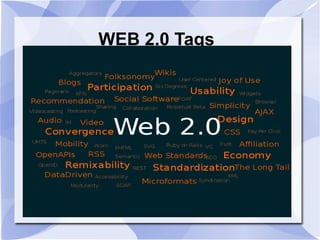
WEB 2.0 Tags
Characteristics Network as platform Web-as-participation-platform  Flock Free-ride  Radical Trust Metadata Scalability.
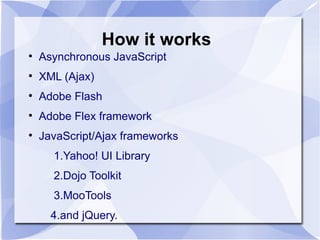
How it works Asynchronous JavaScript XML (Ajax) Adobe Flash  Adobe Flex framework JavaScript/Ajax frameworks 1.Yahoo! UI Library 2.Dojo Toolkit 3.MooTools  4.and jQuery.
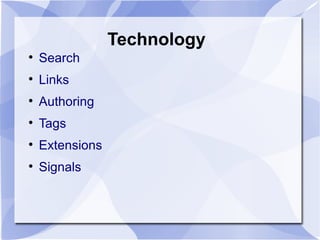
Technology Search Links Authoring Tags Extensions Signals
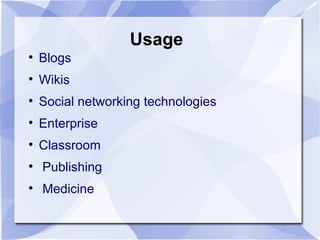
Usage Blogs Wikis Social networking technologies Enterprise  Classroom  Publishing  Medicine
Thank you..........

Web 2.0

  • 1.
    WEB 2.0 ByK.Santhosh Kumar
  • 2.
    Introduction to WEB2.0 "Web 2.0" is commonly associated with web applications that facilitate interactive information sharing, interoperability, user-centered design and collaboration on the World Wide Web. A Web 2.0 site allows its users to interact with each other as contributors to the website's content, in contrast to non-interactive websites where users are limited to the passive viewing of information that is provided to them.
  • 3.
    Examples of Web2.0 Web-based communities, Hosted services, Web applications, Social-networking sites, Video-sharing sites, Wikis, Blogs, Mashups, and folksonomies.
  • 4.
    History of WEB2.0 The term "Web 2.0" was coined in 1999 by Darcy DiNucci. In 2004, the term began its rise in popularity when O'Reilly Media and MediaLive hosted the first Web 2.0 conference. O'Reilly et al. contrasted Web 2.0 with what they called "Web 1.0". They associated Web 1.0 with the business models of Netscape and the Encyclopedia Britannica Online.
  • 5.
    Real Web2.0 Design1. Simplicity 2. Central layout 3. Fewer columns 4. Separate top section 5. Solid areas of screen real-estate 6. Simple nav 7. Bold logos 8. Bigger text 9. Bold text introductions 10. Strong colours 11. Rich surfaces 12. Gradients 13. Reflections 14. Cute icons 15. Star flashes
  • 6.
  • 7.
    Characteristics Network asplatform Web-as-participation-platform Flock Free-ride Radical Trust Metadata Scalability.
  • 8.
    How it worksAsynchronous JavaScript XML (Ajax) Adobe Flash Adobe Flex framework JavaScript/Ajax frameworks 1.Yahoo! UI Library 2.Dojo Toolkit 3.MooTools 4.and jQuery.
  • 9.
    Technology Search LinksAuthoring Tags Extensions Signals
  • 10.
    Usage Blogs WikisSocial networking technologies Enterprise Classroom Publishing Medicine
  • 11.