A New Approach to Diversity & Inclusion:
Getting Engineers to Talk About
Unconscious Bias
 Focus and overview of the program
 Overview of the Diversity & Knowledge cards
 Overview of SWE’s Diversity and Inclusion Modules
 Small group exercise
 Debrief and Q&A
Agenda
Goals
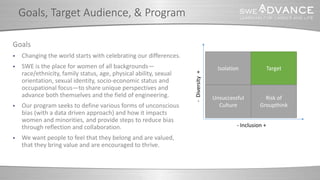
 Changing the world starts with celebrating our differences.
 SWE is the place for women of all backgrounds—
race/ethnicity, family status, age, physical ability, sexual
orientation, sexual identity, socio-economic status and
occupational focus—to share unique perspectives and
advance both themselves and the field of engineering.
 Our program seeks to define various forms of unconscious
bias (with a data driven approach) and how it impacts
women and minorities, and provide steps to reduce bias
through reflection and collaboration.
 We want people to feel that they belong and are valued,
that they bring value and are encouraged to thrive.
Goals, Target Audience, & Program
Isolation Target
Unsuccessful
Culture
Risk of
Groupthink
-Diversity+
- Inclusion +
Target Audience:
 SWE’s leadership (e.g., board of directors, senate, and region
governors), general membership, and corporate partners. A
secondary audience are mid-size and smaller organizations
who may have a need for diversity and inclusion resources.
Products/Program
 Online Course (5 modules)
 Diversity and Inclusion Knowledge Cards
 Workshops with Corporate Partners and Members
 Research and whitepaper(s)/Ebook(s)
Goals, Target Audience, & Program
Isolation Target
Unsuccessful
Culture
Risk of
Groupthink
-Diversity+
- Inclusion +
 Bias is the process by which the brain uses: "mental
associations that are so well-established as to operate
without awareness, or without intention, or without
control.”
 Everyone has unconscious biases, this does not make
us bad people. “Implicit biases come from the culture. I
think of them as the thumbprint of the culture on our
minds.” (Mahzarin Banaji, Harvard University, Project
Implicit – an online test for unconscious bias)
Focus on Unconscious Bias
January ’14: Began
Collaboration with ARUP
February to June ‘14
Developed Card Set
Print/Release in July ‘14
Developing Online Modules
to Complement Cards –
release as package Q1 ‘15
Timeline & Backstory for D&I Knowledge Card Set
 Over 12,000 people in 38 countries
 Over 40 unique consulting disciplines
 Employee-owned through impenetrable trusts
 Core Values:
 Quality of work
 Total Architecture
 Humane Organization
 Straight & Honorable Dealings
 Social Usefulness
 Reasonable Prosperity of Members
Our Partner - Arup
Front matter
 Notes on Terminology
 Glossary
 Using the Cards
 Benefits of Diversity and Inclusion
 Frequently Asked Questions
Five main sections:
 Demographics (in North American engineering industry)
 Experience (of women and minorities with implicit bias)
 Evidence (of most prevalent North American biases)
 Science (covering most recent brain science proving bias)
 Best Practices (to create inclusive environments)
Questions for Further Reflection
References
Structure of the Cards
 The knowledge cards feature facts, activities
and scenarios to start conversations in the
workplace and beyond.
 The thought-provoking resource gives
businesses the tools they need to insight
meaningful change in their organizational
structures to welcome more perspectives at
every level.
 Each card revolves around a key aspect of
identifying the unconscious biases.
About the Cards
1. What is the impact on your business if people are not able to be their authentic selves at
work?
 What about young girls deciding on a major in college or choosing classes in high
school?
 Does it effect females stopping-by a recruiting table for more information?
 Will it deter women from asking for a promotion or worse, a “flight or fight” situation?
2. What steps can an organization take to minimize the underlying causes of the double-bind
bias?
3. How can your organization ensure that individuals feel valued, trusted, and welcomed?
Example: Double Bind
Double-bind exists in a culture where women's leadership is measured
against the traditional male leadership style, if “women act in ways that
are consistent with gender stereotypes, they are viewed as less
competent leaders.”
Launch of Online Modules
 Importance of Diversity in the Workplace
 Confronting Gender Bias
 Managing Diverse Teams
 Coaching, Mentoring & Sponsorship
 Impacts of a Global Marketplace
D&I Online Courses
The online learning courses focus on developing the individual;
as a lifelong learner and leader, who is engaged in promoting
and stewarding an inclusive culture.
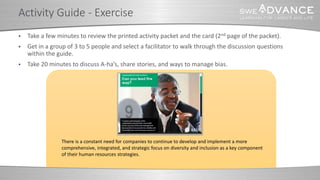
 Take a few minutes to review the printed activity packet and the card (2nd page of the packet).
 Get in a group of 3 to 5 people and select a facilitator to walk through the discussion questions
within the guide.
 Take 20 minutes to discuss A-ha’s, share stories, and ways to manage bias.
Activity Guide - Exercise
There is a constant need for companies to continue to develop and implement a more
comprehensive, integrated, and strategic focus on diversity and inclusion as a key component
of their human resources strategies.
1. In small groups (3 – 8 people) each person reads one card
2. Select a scribe for the group to record some of the discussion highlights/insights
3. Each person shares what they learned from the card, how they reacted to it, and what it
made them think about…
4. Everyone in the small group has the opportunity to discuss how this might impact their
organization or partners of their association (in engineering)
5. Everyone in the small group has the opportunity to share how this may change their own
behavior.
6. Larger group debrief that highlights key insights/suggestions from each group
appropriate to context
Additional Exercises - On Your Own
1. Sifting through the cards, which one(s) caught your eye, why?
2. Can you think of areas or functions in your role where the cards
would be of benefit, how?
Learning From You

WE Europe 2015: Getting Engineers to Talk About Unconscious Bias

  • 1.
    A New Approachto Diversity & Inclusion: Getting Engineers to Talk About Unconscious Bias
  • 2.
     Focus andoverview of the program  Overview of the Diversity & Knowledge cards  Overview of SWE’s Diversity and Inclusion Modules  Small group exercise  Debrief and Q&A Agenda
  • 3.
    Goals  Changing theworld starts with celebrating our differences.  SWE is the place for women of all backgrounds— race/ethnicity, family status, age, physical ability, sexual orientation, sexual identity, socio-economic status and occupational focus—to share unique perspectives and advance both themselves and the field of engineering.  Our program seeks to define various forms of unconscious bias (with a data driven approach) and how it impacts women and minorities, and provide steps to reduce bias through reflection and collaboration.  We want people to feel that they belong and are valued, that they bring value and are encouraged to thrive. Goals, Target Audience, & Program Isolation Target Unsuccessful Culture Risk of Groupthink -Diversity+ - Inclusion +
  • 4.
    Target Audience:  SWE’sleadership (e.g., board of directors, senate, and region governors), general membership, and corporate partners. A secondary audience are mid-size and smaller organizations who may have a need for diversity and inclusion resources. Products/Program  Online Course (5 modules)  Diversity and Inclusion Knowledge Cards  Workshops with Corporate Partners and Members  Research and whitepaper(s)/Ebook(s) Goals, Target Audience, & Program Isolation Target Unsuccessful Culture Risk of Groupthink -Diversity+ - Inclusion +
  • 5.
     Bias isthe process by which the brain uses: "mental associations that are so well-established as to operate without awareness, or without intention, or without control.”  Everyone has unconscious biases, this does not make us bad people. “Implicit biases come from the culture. I think of them as the thumbprint of the culture on our minds.” (Mahzarin Banaji, Harvard University, Project Implicit – an online test for unconscious bias) Focus on Unconscious Bias
  • 6.
    January ’14: Began Collaborationwith ARUP February to June ‘14 Developed Card Set Print/Release in July ‘14 Developing Online Modules to Complement Cards – release as package Q1 ‘15 Timeline & Backstory for D&I Knowledge Card Set
  • 7.
     Over 12,000people in 38 countries  Over 40 unique consulting disciplines  Employee-owned through impenetrable trusts  Core Values:  Quality of work  Total Architecture  Humane Organization  Straight & Honorable Dealings  Social Usefulness  Reasonable Prosperity of Members Our Partner - Arup
  • 8.
    Front matter  Noteson Terminology  Glossary  Using the Cards  Benefits of Diversity and Inclusion  Frequently Asked Questions Five main sections:  Demographics (in North American engineering industry)  Experience (of women and minorities with implicit bias)  Evidence (of most prevalent North American biases)  Science (covering most recent brain science proving bias)  Best Practices (to create inclusive environments) Questions for Further Reflection References Structure of the Cards
  • 9.
     The knowledgecards feature facts, activities and scenarios to start conversations in the workplace and beyond.  The thought-provoking resource gives businesses the tools they need to insight meaningful change in their organizational structures to welcome more perspectives at every level.  Each card revolves around a key aspect of identifying the unconscious biases. About the Cards
  • 10.
    1. What isthe impact on your business if people are not able to be their authentic selves at work?  What about young girls deciding on a major in college or choosing classes in high school?  Does it effect females stopping-by a recruiting table for more information?  Will it deter women from asking for a promotion or worse, a “flight or fight” situation? 2. What steps can an organization take to minimize the underlying causes of the double-bind bias? 3. How can your organization ensure that individuals feel valued, trusted, and welcomed? Example: Double Bind Double-bind exists in a culture where women's leadership is measured against the traditional male leadership style, if “women act in ways that are consistent with gender stereotypes, they are viewed as less competent leaders.”
  • 11.
    Launch of OnlineModules  Importance of Diversity in the Workplace  Confronting Gender Bias  Managing Diverse Teams  Coaching, Mentoring & Sponsorship  Impacts of a Global Marketplace D&I Online Courses The online learning courses focus on developing the individual; as a lifelong learner and leader, who is engaged in promoting and stewarding an inclusive culture.
  • 12.
     Take afew minutes to review the printed activity packet and the card (2nd page of the packet).  Get in a group of 3 to 5 people and select a facilitator to walk through the discussion questions within the guide.  Take 20 minutes to discuss A-ha’s, share stories, and ways to manage bias. Activity Guide - Exercise There is a constant need for companies to continue to develop and implement a more comprehensive, integrated, and strategic focus on diversity and inclusion as a key component of their human resources strategies.
  • 13.
    1. In smallgroups (3 – 8 people) each person reads one card 2. Select a scribe for the group to record some of the discussion highlights/insights 3. Each person shares what they learned from the card, how they reacted to it, and what it made them think about… 4. Everyone in the small group has the opportunity to discuss how this might impact their organization or partners of their association (in engineering) 5. Everyone in the small group has the opportunity to share how this may change their own behavior. 6. Larger group debrief that highlights key insights/suggestions from each group appropriate to context Additional Exercises - On Your Own
  • 14.
    1. Sifting throughthe cards, which one(s) caught your eye, why? 2. Can you think of areas or functions in your role where the cards would be of benefit, how? Learning From You