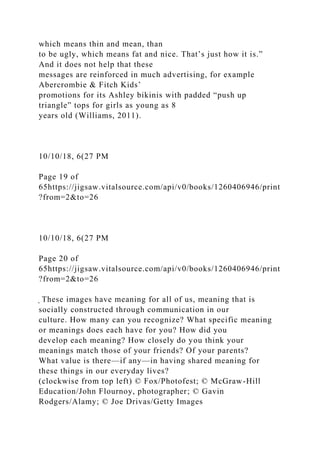
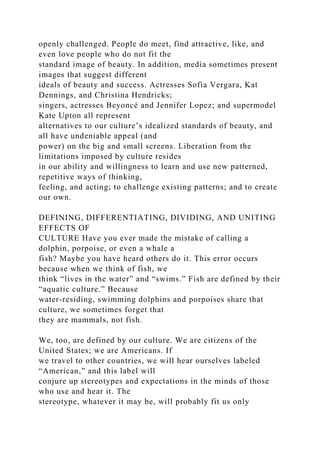
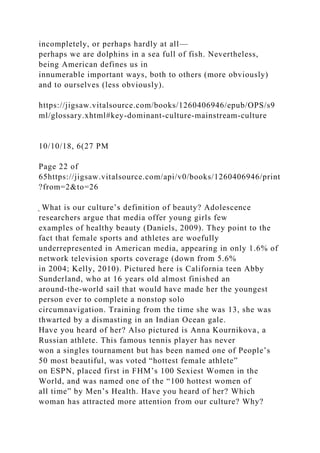
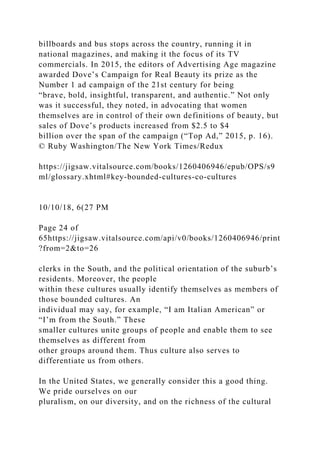
10/10/18, 6(27 PM
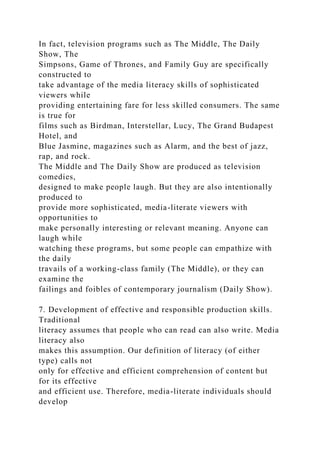
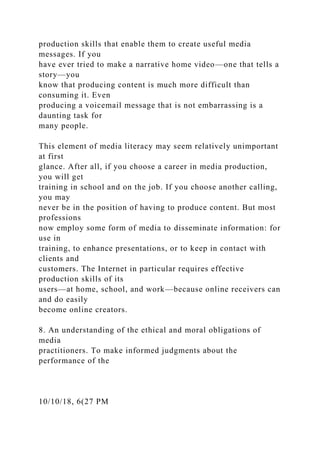
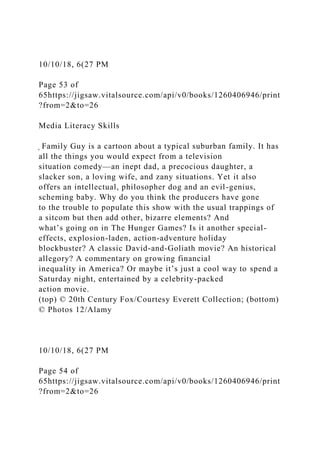
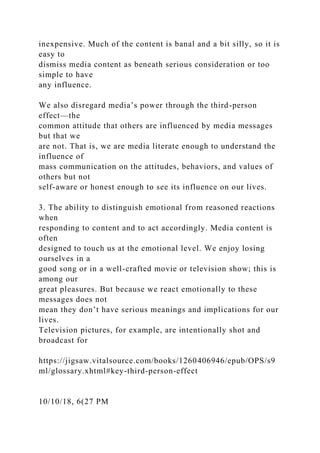
Page 1 of
65https://jigsaw.vitalsource.com/api/v0/books/1260406946/print
?from=2&to=26
10/10/18, 6(27 PM
Page 2 of
65https://jigsaw.vitalsource.com/api/v0/books/1260406946/print
?from=2&to=26
Page 2
PRINTED BY: [email protected] Printing is for personal,
private use only. No part of this book may
be reproduced or transmitted without publisher's prior
permission. Violators will be prosecuted.
1 Mass Communication, Culture, and
Media Literacy
10/10/18, 6(27 PM
Page 3 of
65https://jigsaw.vitalsource.com/api/v0/books/1260406946/print
?from=2&to=26
Learning Objectives
Mass communication, mass media, and the culture that shapes
us (and that we shape) are
inseparable. After studying this chapter, you should be able to
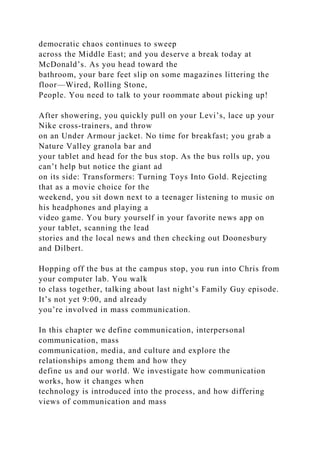
̖ Our experiences of the world are increasingly mass mediated.
© Sean Gallup/Getty Images
Define communication, mass communication, mass media, and
cu
lture.
Describe the relationships among communication, mass
communi
https://jigsaw.vitalsource.com/books/1260406946/epub/OPS/s9
ml/chapter01/chapter01.xhtml#lo0100
https://jigsaw.vitalsource.com/books/1260406946/epub/OPS/s9
ml/chapter01/chapter01.xhtml#lo0101
10/10/18, 6(27 PM
Page 4 of
65https://jigsaw.vitalsource.com/api/v0/books/1260406946/print
?from=2&to=26
cation, culture, and those who live in the culture.
Evaluate the impact of technology and economics on those
relation
ships.
List the components of media literacy.
Identify key skills required for developing media literacy.
https://jigsaw.vitalsource.com/books/1260406946/epub/OPS/s9
ml/chapter01/chapter01.xhtml#lo0101
https://jigsaw.vitalsource.com/books/1260406946/epub/OPS/s9
ml/chapter01/chapter01.xhtml#lo0102
https://jigsaw.vitalsource.com/books/1260406946/epub/OPS/s9
ml/chapter01/chapter01.xhtml#lo0103
https://jigsaw.vitalsource.com/books/1260406946/epub/OPS/s9
ml/chapter01/chapter01.xhtml#lo0104
10/10/18, 6(27 PM
Page 5 of
65https://jigsaw.vitalsource.com/api/v0/books/1260406946/print
?from=2&to=26
Page 3
PRINTED BY: [email protected] Printing is for personal,
private use only. No part of this book may
be reproduced or transmitted without publisher's prior
permission. Violators will be prosecuted.
YOUR SMARTPHONE’S RADIO ALARM SINGS YOU
AWAKE. It’s Sam
Smith, the last few bars of “Stay With Me.” The laughing
deejay shouts at you that it’s
7:41 and you’d better get going. But before you do, he adds,
listen to a few words from your
friends at Best Buy electronics, home of fast, friendly,
courteous service—“Buyer be happy!”
In the living room, you find your roommate has left the
television on. You stop for a moment
and listen: The economy is showing stronger signs of
rebounding, brightening the employment
picture for new college grads; several states are considering
providing free high-speed Internet
to all students to improve their access to the digital world;
democratic chaos continues to sweep
across the Middle East; and you deserve a break today at
McDonald’s. As you head toward the
bathroom, your bare feet slip on some magazines littering the
floor—Wired, Rolling Stone,
People. You need to talk to your roommate about picking up!
After showering, you quickly pull on your Levi’s, lace up your
Nike cross-trainers, and throw
on an Under Armour jacket. No time for breakfast; you grab a
Nature Valley granola bar and
your tablet and head for the bus stop. As the bus rolls up, you
can’t help but notice the giant ad
on its side: Transformers: Turning Toys Into Gold. Rejecting
that as a movie choice for the
weekend, you sit down next to a teenager listening to music on
his headphones and playing a
video game. You bury yourself in your favorite news app on
your tablet, scanning the lead
stories and the local news and then checking out Doonesbury
and Dilbert.
Hopping off the bus at the campus stop, you run into Chris from
your computer lab. You walk
to class together, talking about last night’s Family Guy episode.
It’s not yet 9:00, and already
you’re involved in mass communication.
In this chapter we define communication, interpersonal
communication, mass
communication, media, and culture and explore the
relationships among them and how they
define us and our world. We investigate how communication
works, how it changes when
technology is introduced into the process, and how differing
views of communication and mass
communication can lead to different interpretations of their
power. We also discuss the
opportunities mass communication and culture offer us and the
responsibilities that come with
those opportunities. Always crucial, these issues are of
particular importance now, when we
find ourselves in a period of remarkable development in new
communication technologies. This
discussion inevitably leads to an examination of media literacy,
its importance, and its practice.
10/10/18, 6(27 PM
Page 6 of
65https://jigsaw.vitalsource.com/api/v0/books/1260406946/print
?from=2&to=26
What Is Mass Communication?
“Does a fish know it’s wet?” influential cultural and media
critic Marshall McLuhan would often
ask. The answer, he would say, is “No.” The fish’s existence is
so dominated by water that only
when water is absent is the fish aware of its condition.
So it is with people and mass media. The media so fully saturate
our everyday lives that we
are often unconscious of their presence, not to mention their
influence. Media inform us,
entertain us, delight us, annoy us. They move our emotions,
challenge our intellects, insult our
intelligence. Media often reduce us to mere commodities for
sale to the highest bidder. Media
help define us; they shape our realities.
A fundamental theme of this book is that media do none of this
alone. They do it with us as
well as to us through mass communication, and they do it as a
central—many critics and
scholars say the central—cultural force in our society.
Communication Defined
In its simplest form, communication is the transmission of a
message from a source to a
receiver. For nearly 70 years now, this view of communication
has been identified with the
writing of political scientist Harold Lasswell (1948). He said
that a convenient way to describe
communication is to answer these questions:
Who?
Says what?
https://jigsaw.vitalsource.com/books/1260406946/epub/OPS/s9
ml/glossary.xhtml#key-communication
10/10/18, 6(27 PM
Page 7 of
65https://jigsaw.vitalsource.com/api/v0/books/1260406946/print
?from=2&to=26
Expressed in terms of the basic elements of the communication
process, communication
occurs when
Straightforward enough, but what if the source is a professor
who insists on speaking in a
technical language far beyond the receiving students’ level of
skill? Obviously, communication
does not occur. Unlike mere message-sending, communication
requires the response of others.
Therefore, there must be a sharing (or correspondence) of
meaning for communication to take
place.
A second problem with this simple model is that it suggests that
the receiver passively accepts
the source’s message. However, if our imaginary students do
not comprehend the professor’s
words, they respond with “Huh?” or look confused or yawn.
This response, or feedback, is also
a message. The receivers (the students) now become a source,
sending their own message to the
source (the offending professor), who is now a receiver. Hence,
communication is a reciprocal
and ongoing process with all involved parties more or less
engaged in creating shared meaning.
Communication, then, is better defined as the process of
creating shared meaning.
Communication researcher Wilbur Schramm, using ideas
originally developed by
psychologist Charles E. Osgood, developed a graphic way to
represent the reciprocal nature of
communication (Figure 1). This depiction of interpersonal
communication—
communication between two or a few people—shows that there
is no clearly identifiable source
or receiver. Rather, because communication is an ongoing and
reciprocal process, all the
participants, or “interpreters,” are working to create meaning by
encoding and decoding
messages. A message is first encoded, that is, transformed into
an understandable sign and
symbol system. Speaking is encoding, as are writing, printing,
and filming a television program.
Once received, the message is decoded; that is, the signs and
symbols are interpreted. Decoding
occurs through listening, reading, or watching that television
show.
Page 4
PRINTED BY: [email protected] Printing is for personal,
private use only. No part of this book
may be reproduced or transmitted without publisher's prior
permission. Violators will be prosecuted.
Through which channel?
To whom?
With what effect?
https://jigsaw.vitalsource.com/books/1260406946/epub/OPS/s9
ml/glossary.xhtml#key-feedback
https://jigsaw.vitalsource.com/books/1260406946/epub/OPS/s9
ml/chapter01/chapter01.xhtml#figure0101
https://jigsaw.vitalsource.com/books/1260406946/epub/OPS/s9
ml/glossary.xhtml#key-interpersonal-communication
https://jigsaw.vitalsource.com/books/1260406946/epub/OPS/s9
ml/glossary.xhtml#key-encoding
https://jigsaw.vitalsource.com/books/1260406946/epub/OPS/s9
ml/glossary.xhtml#key-decoding
10/10/18, 6(27 PM
Page 8 of
65https://jigsaw.vitalsource.com/api/v0/books/1260406946/print
?from=2&to=26
̖ Figure 1 Osgood and Schramm’s Model of Communication.
Source: From The Process and Effects of Mass Communication
by Wilbur Lang Schramm, 1954. Reprinted by
permission of Mary Schramm Coberly.
10/10/18, 6(27 PM
Page 9 of
65https://jigsaw.vitalsource.com/api/v0/books/1260406946/print
?from=2&to=26
Page 5
PRINTED BY: [email protected] Printing is for personal,
private use only. No part of this book
may be reproduced or transmitted without publisher's prior
permission. Violators will be prosecuted.
The Osgood–Schramm model demonstrates the ongoing and
reciprocal nature of
the communication process. There is, therefore, no source, no
receiver, and no
feedback. The reason is that, as communication is happening,
both interpreters are
simultaneously source and receiver. There is no feedback
because all messages are presumed to
be in reciprocation of other messages. Even when your friend
starts a conversation with you, for
example, it can be argued that it was your look of interest and
willingness that communicated to
her that she should speak. In this example, it is improper to
label either you or your friend as
the source—Who really initiated this chat?—and, therefore, it is
impossible to identify who is
providing feedback to whom.
Not every model can show all aspects of a process as complex
as communication. Missing
from this representation is noise—anything that interferes with
successful communication.
Noise is more than screeching or loud music when you are
trying to work online. Biases that
lead to incorrect decoding, for example, are noise, as is a page
torn out of a magazine story you
want to read.
Encoded messages are carried by a medium, that is, the means
of sending information.
Sound waves are the medium that carries our voice to friends
across the table; the telephone is
the medium that carries our voice to friends across town. When
the medium is a technology
that carries messages to a large number of people—as
newspapers carry the printed word and
radio conveys the sound of music and news—we call it a mass
medium (the plural of medium
is media). The mass media we use regularly include radio,
television, books, magazines,
newspapers, movies, sound recordings, cell phones, and
computer networks. Each medium is
the basis of a giant industry, but other related and supporting
industries also serve them and us
—advertising and public relations, for example. In our culture
we use the words media and
mass media interchangeably to refer to the communication
industries themselves. We say, “The
media entertain” or “The mass media are too conservative (or
too liberal).”
Mass Communication Defined
We speak, too, of mass communication. Mass communication is
the process of creating
shared meaning between the mass media and their audiences.
Schramm recast his and
Osgood’s general model of communication to help us visualize
the particular aspects of the
mass communication process (Figure 2). This model and the
original Osgood—Schramm
model have much in common—interpreters, encoding, decoding,
and messages—but it is their
differences that are most significant for our understanding of
how mass communication differs
from other forms of communication. For example, whereas the
original model includes
“message,” the mass communication model offers “many
identical messages.” In addition, the
mass communication model specifies “feedback,” whereas the
interpersonal communication
model does not. When two or a few people communicate face-
to-face, the participants can
immediately and clearly recognize the feedback residing in the
reciprocal messages (our boring
professor can see and hear the students’ disenchantment as they
listen to the lecture). Things
are not nearly as simple in mass communication.
https://jigsaw.vitalsource.com/books/1260406946/epub/OPS/s9
ml/glossary.xhtml#key-noise
https://jigsaw.vitalsource.com/books/1260406946/epub/OPS/s9
ml/glossary.xhtml#key-medium-pl-media
https://jigsaw.vitalsource.com/books/1260406946/epub/OPS/s9
ml/glossary.xhtml#key-mass-medium
https://jigsaw.vitalsource.com/books/1260406946/epub/OPS/s9
ml/glossary.xhtml#key-mass-communication
https://jigsaw.vitalsource.com/books/1260406946/epub/OPS/s9
ml/chapter01/chapter01.xhtml#figure0102
10/10/18, 6(27 PM
Page 10 of
65https://jigsaw.vitalsource.com/api/v0/books/1260406946/print
?from=2&to=26
In Schramm’s mass communication model, feedback is
represented by a dotted line labeled
delayed inferential feedback. This feedback is indirect rather
than direct. Television
executives, for example, must wait a day, at the very minimum,
and sometimes a week or a
month, to discover the ratings for new programs. Even then, the
ratings measure only how
many sets are tuned in, not whether people liked or disliked the
programs. As a result, these
executives can only infer what they must do to improve
programming; hence the term
inferential feedback. Mass communicators are also subject to
additional feedback, usually in
the form of criticism in other media, such as a television critic
writing a column in a newspaper.
The differences between the individual elements of
interpersonal and mass communication
change the very nature of the communication process. How
those alterations influence
̖ Figure 2 Schramm’s Model of Mass Communication.
Source: From The Process and Effects of Mass Communication
by Wilbur Lang Schramm, 1954. Reprinted by permission of
Mary
Schramm Coberly.
https://jigsaw.vitalsource.com/books/1260406946/epub/OPS/s9
ml/glossary.xhtml#key-inferential-feedback
10/10/18, 6(27 PM
Page 11 of
65https://jigsaw.vitalsource.com/api/v0/books/1260406946/print
?from=2&to=26
Page 6
PRINTED BY: [email protected] Printing is for personal,
private use only. No part of this book
may be reproduced or transmitted without publisher's prior
permission. Violators will be prosecuted.
the message itself and how the likelihood of successfully
sharing meaning varies
are shown in Figure 3. For example, the immediacy and
directness of feedback in
interpersonal communication free communicators to gamble, to
experiment with different
approaches. Their knowledge of one another enables them to
tailor their messages as narrowly
as they wish. As a result, interpersonal communication is often
personally relevant and possibly
even adventurous and challenging. In contrast, the distance
between participants in the mass
communication process, imposed by the technology, creates a
sort of “communication
conservatism.” Feedback comes too late to enable corrections or
alterations in communication
that fails. The sheer number of people in many mass
communication audiences makes
personalization and specificity difficult. As a result, mass
communication tends to be more
constrained, less free. This does not mean, however, that it is
less potent than interpersonal
communication in shaping our understanding of ourselves and
our world.
https://jigsaw.vitalsource.com/books/1260406946/epub/OPS/s9
ml/chapter01/chapter01.xhtml#figure0103
10/10/18, 6(27 PM
Page 12 of
65https://jigsaw.vitalsource.com/api/v0/books/1260406946/print
?from=2&to=26
̖ Figure 3 Elements of Interpersonal Communication and Mass
Communication Compared.
10/10/18, 6(27 PM
Page 13 of
65https://jigsaw.vitalsource.com/api/v0/books/1260406946/print
?from=2&to=26
Media theorist James W. Carey (1975) recognized this and
offered a cultural definition of
communication that has had a profound impact on the way
communication scientists and
others have viewed the relationship between communication and
culture. Carey wrote,
“Communication is a symbolic process whereby reality is
produced, maintained, repaired and
transformed” (p. 10).
Carey’s (1989) definition asserts that communication and reality
are linked. Communication
is a process embedded in our everyday lives that informs the
way we perceive, understand, and
construct our view of reality and the world. Communication is
the foundation of our culture. Its
truest purpose is to maintain ever-evolving, “fragile” cultures;
communication is that “sacred
ceremony that draws persons together in fellowship and
commonality” (p. 43).
What Is Culture?
(left) © Image Source RF; (right) © AF archive/Alamy
https://jigsaw.vitalsource.com/books/1260406946/epub/OPS/s9
ml/glossary.xhtml#key-cultural-definition-of-communication
10/10/18, 6(27 PM
Page 14 of
65https://jigsaw.vitalsource.com/api/v0/books/1260406946/print
?from=2&to=26
Culture is the learned behavior of members of a given social
group. Many writers and thinkers
have offered interesting expansions of this definition. Here are
four examples, all from
anthropologists. These definitions highlight not only what
culture is but also what culture does:
Culture is the learned, socially acquired traditions and lifestyles
of the members of a society,
including their patterned, repetitive ways of thinking, feeling,
and acting. (Harris, 1983, p.
5)
https://jigsaw.vitalsource.com/books/1260406946/epub/OPS/s9
ml/glossary.xhtml#key-culture
10/10/18, 6(27 PM
Page 15 of
65https://jigsaw.vitalsource.com/api/v0/books/1260406946/print
?from=2&to=26
Page 7
PRINTED BY: [email protected] Printing is for personal,
private use only. No part of this book
may be reproduced or transmitted without publisher's prior
permission. Violators will be prosecuted.
10/10/18, 6(27 PM
Page 16 of
65https://jigsaw.vitalsource.com/api/v0/books/1260406946/print
?from=2&to=26
Page 8
PRINTED BY: [email protected] Printing is for personal,
private use only. No part of this book may
be reproduced or transmitted without publisher's prior
permission. Violators will be prosecuted.
Culture lends significance to human experience by selecting
from and organizing it.
It refers broadly to the forms through which people make sense
of their lives,
rather than more narrowly to the opera or art of museums.
(Rosaldo, 1989, p. 26)
Culture is the medium evolved by humans to survive. Nothing is
free from cultural
influences. It is the keystone in civilization’s arch and is the
medium through which all of
life’s events must flow. We are culture. (Hall, 1976, p. 14)
Culture is an historically transmitted pattern of meanings
embodied in symbolic forms by
means of which [people] communicate, perpetuate, and develop
their knowledge about and
attitudes toward life. (Geertz, as cited in Taylor, 1991, p. 91)
Culture as Socially Constructed Shared Meaning
Virtually all definitions of culture recognize that culture is
learned. Recall the opening vignette.
Even if this scenario does not exactly match your early
mornings, you probably recognize its
elements. Moreover, all of us are familiar with most, if not
every, cultural reference in it. Family
Guy, Rolling Stone, McDonald’s, Under Armour, Dilbert—all
are points of reference, things
that have some meaning for all of us. How did this come to be?
Creation and maintenance of a more or less common culture
occurs through communication,
including mass communication. When we talk to our friends;
when a parent raises a child;
when religious leaders instruct their followers; when teachers
teach; when grandparents pass
on recipes; when politicians campaign; when media
professionals produce content that we
read, listen to, or watch, meaning is being shared and culture is
being constructed and
maintained.
Functions and Effects of Culture
Culture serves a purpose. It helps us categorize and classify our
experiences; it helps define us,
our world, and our place in it. In doing so, culture can have a
number of sometimes conflicting
effects.
LIMITING AND LIBERATING EFFECTS OF CULTURE A
culture’s learned traditions
and values can be seen as patterned, repetitive ways of thinking,
feeling, and acting. Culture
limits our options and provides useful guidelines for behavior.
For example, when conversing,
you do not consciously consider, “Now, how far away should I
stand? Am I too close?” You
simply stand where you stand. After a hearty meal with a
friend’s family, you do not engage in
mental self-debate, “Should I burp? Yes! No! Arghhhh....”
Culture provides information that
helps us make meaningful distinctions about right and wrong,
appropriate and inappropriate,
good and bad, attractive and unattractive, and so on. How does
it do this?
Obviously, through communication. Through a lifetime of
communication, we have learned
just what our culture expects of us. The two examples given
here are positive results of culture’s
limiting effects. But culture’s limiting effects can be negative,
such as when we are unwilling or
unable to move past patterned, repetitive ways of thinking,
feeling, and acting or when we
10/10/18, 6(27 PM
Page 17 of
65https://jigsaw.vitalsource.com/api/v0/books/1260406946/print
?from=2&to=26
entrust our “learning” to teachers whose interests are selfish,
narrow, or otherwise not
consistent with our own.
U.S. culture, for example, values thinness and beauty in women.
How many women endure
weeks of unhealthy diets and succumb to potentially dangerous
surgical procedures in search of
a body that for most is physically unattainable? How many
women are judged by the men and
other women around them for not conforming to our culture’s
standards of thinness and
beauty? Why are 40% to 60% of girls aged 6 to 12 concerned
about their weight or about
becoming too fat? Why do 42% of girls in first, second, and
third grade want to be thinner, and
why are 81% of 10-year-olds—girls and boys—afraid of being
fat? Why do 57% of adolescent
girls go on crash diets, fasts, or engage in self-induced vomiting
(National Eating Disorders
Association, 2015)? Why did the number of hospitalizations for
eating disorders among
children under the age of 12 spike 119% between 1999 and
2006, and why do almost 1.3 million
adolescent girls in the United States have anorexia (Pai &
Schryver, 2015)?
Now consider how this situation may have come about. Our
mothers did not bounce us on
their knees when we were babies, telling us that thin was good
and fat was bad. Think back,
though, to the stories you were told and the television shows
and movies you watched
10/10/18, 6(27 PM
Page 18 of
65https://jigsaw.vitalsource.com/api/v0/books/1260406946/print
?from=2&to=26
Page 9
PRINTED BY: [email protected] Printing is for personal,
private use only. No part of this book
may be reproduced or transmitted without publisher's prior
permission. Violators will be prosecuted.
growing up. The heroines (or, more often, the beautiful love
interests of the
heroes) were invariably tall, beautiful, and thin. The bad guys
were usually mean
and fat. From Disney’s depictions of Snow White, Cinderella,
Belle, Tinker Bell, and Pocahontas
to the impossible dimensions of most video-game and comic-
book heroines, the message is
embedded in the conscious (and unconscious) mind of every girl
and boy: You can’t be too thin
or too beautiful! Or as one 10-year-old girl explained to
Courtney Martin (2007), author of
Perfect Girls, Starving Daughters, “It is better to be pretty,
which means thin and mean, than
to be ugly, which means fat and nice. That’s just how it is.”
And it does not help that these
messages are reinforced in much advertising, for example
Abercrombie & Fitch Kids’
promotions for its Ashley bikinis with padded “push up
triangle” tops for girls as young as 8
years old (Williams, 2011).
10/10/18, 6(27 PM
Page 19 of
65https://jigsaw.vitalsource.com/api/v0/books/1260406946/print
?from=2&to=26
10/10/18, 6(27 PM
Page 20 of
65https://jigsaw.vitalsource.com/api/v0/books/1260406946/print
?from=2&to=26
̖ These images have meaning for all of us, meaning that is
socially constructed through communication in our
culture. How many can you recognize? What specific meaning
or meanings does each have for you? How did you
develop each meaning? How closely do you think your
meanings match those of your friends? Of your parents?
What value is there—if any—in having shared meaning for
these things in our everyday lives?
(clockwise from top left) © Fox/Photofest; © McGraw-Hill
Education/John Flournoy, photographer; © Gavin
Rodgers/Alamy; © Joe Drivas/Getty Images
10/10/18, 6(27 PM
Page 21 of
65https://jigsaw.vitalsource.com/api/v0/books/1260406946/print
?from=2&to=26
Page 10
PRINTED BY: [email protected] Printing is for personal,
private use only. No part of this book
may be reproduced or transmitted without publisher's prior
permission. Violators will be prosecuted.
This message and millions of others come to us primarily
through the media,
and although the people who produce these media images are
not necessarily
selfish or mean, their motives are undeniably financial. Their
contribution to our culture’s
repetitive ways of thinking, feeling, and acting is most certainly
not primary among their
concerns when preparing their communication.
Culture need not only limit. That media representations of
female beauty often meet with
debate and disagreement points up the fact that culture can be
liberating as well. This is so
because cultural values can be contested.
Especially in a pluralistic, democratic society such as ours, the
dominant culture (or mai
nstream culture)—the one that seems to hold sway with the
majority of people—is often
openly challenged. People do meet, find attractive, like, and
even love people who do not fit the
standard image of beauty. In addition, media sometimes present
images that suggest different
ideals of beauty and success. Actresses Sofia Vergara, Kat
Dennings, and Christina Hendricks;
singers, actresses Beyoncé and Jennifer Lopez; and supermodel
Kate Upton all represent
alternatives to our culture’s idealized standards of beauty, and
all have undeniable appeal (and
power) on the big and small screens. Liberation from the
limitations imposed by culture resides
in our ability and willingness to learn and use new patterned,
repetitive ways of thinking,
feeling, and acting; to challenge existing patterns; and to create
our own.
DEFINING, DIFFERENTIATING, DIVIDING, AND UNITING
EFFECTS OF
CULTURE Have you ever made the mistake of calling a
dolphin, porpoise, or even a whale a
fish? Maybe you have heard others do it. This error occurs
because when we think of fish, we
think “lives in the water” and “swims.” Fish are defined by their
“aquatic culture.” Because
water-residing, swimming dolphins and porpoises share that
culture, we sometimes forget that
they are mammals, not fish.
We, too, are defined by our culture. We are citizens of the
United States; we are Americans. If
we travel to other countries, we will hear ourselves labeled
“American,” and this label will
conjure up stereotypes and expectations in the minds of those
who use and hear it. The
stereotype, whatever it may be, will probably fit us only
incompletely, or perhaps hardly at all—
perhaps we are dolphins in a sea full of fish. Nevertheless,
being American defines us in
innumerable important ways, both to others (more obviously)
and to ourselves (less obviously).
https://jigsaw.vitalsource.com/books/1260406946/epub/OPS/s9
ml/glossary.xhtml#key-dominant-culture-mainstream-culture
10/10/18, 6(27 PM
Page 22 of
65https://jigsaw.vitalsource.com/api/v0/books/1260406946/print
?from=2&to=26
̖ What is our culture’s definition of beauty? Adolescence
researchers argue that media offer young girls few
examples of healthy beauty (Daniels, 2009). They point to the
fact that female sports and athletes are woefully
underrepresented in American media, appearing in only 1.6% of
network television sports coverage (down from 5.6%
in 2004; Kelly, 2010). Pictured here is California teen Abby
Sunderland, who at 16 years old almost finished an
around-the-world sail that would have made her the youngest
person ever to complete a nonstop solo
circumnavigation. Training from the time she was 13, she was
thwarted by a dismasting in an Indian Ocean gale.
Have you heard of her? Also pictured is Anna Kournikova, a
Russian athlete. This famous tennis player has never
won a singles tournament but has been named one of People’s
50 most beautiful, was voted “hottest female athlete”
on ESPN, placed first in FHM’s 100 Sexiest Women in the
World, and was named one of the “100 hottest women of
all time” by Men’s Health. Have you heard of her? Which
woman has attracted more attention from our culture? Why?
(left) © Richard Hartog/AP Photo; (right) © Jeremy
Bembaron/Sygma/Corbis
10/10/18, 6(27 PM
Page 23 of
65https://jigsaw.vitalsource.com/api/v0/books/1260406946/print
?from=2&to=26
Page 11
PRINTED BY: [email protected] Printing is for personal,
private use only. No part of this book may
be reproduced or transmitted without publisher's prior
permission. Violators will be prosecuted.
Within this large, national culture, however, there are many
smaller, bounded cultures (o
r co-cultures). For example, we speak comfortably of Italian
neighborhoods, fraternity row,
the South, and the suburbs. Because of our cultural
understanding of these categories, each
expression communicates something about our expectations of
these places. We think we can
predict with a good deal of certainty the types of restaurants and
shops we will find in the
Italian neighborhood, even the kind of music we will hear
escaping from open windows. We can
predict the kinds of clothes and cars we will see on fraternity
row, the likely behavior of shop
̖ Culture can be contested. The makers of Dove soap challenge
the culture’s narrow image of beauty with its “Real
Women Have Curves” campaign, placing images like this on
billboards and bus stops across the country, running it in
national magazines, and making it the focus of its TV
commercials. In 2015, the editors of Advertising Age magazine
awarded Dove’s Campaign for Real Beauty its prize as the
Number 1 ad campaign of the 21st century for being
“brave, bold, insightful, transparent, and authentic.” Not only
was it successful, they noted, in advocating that women
themselves are in control of their own definitions of beauty, but
sales of Dove’s products increased from $2.5 to $4
billion over the span of the campaign (“Top Ad,” 2015, p. 16).
© Ruby Washington/The New York Times/Redux
https://jigsaw.vitalsource.com/books/1260406946/epub/OPS/s9
ml/glossary.xhtml#key-bounded-cultures-co-cultures
10/10/18, 6(27 PM
Page 24 of
65https://jigsaw.vitalsource.com/api/v0/books/1260406946/print
?from=2&to=26
clerks in the South, and the political orientation of the suburb’s
residents. Moreover, the people
within these cultures usually identify themselves as members of
those bounded cultures. An
individual may say, for example, “I am Italian American” or
“I’m from the South.” These
smaller cultures unite groups of people and enable them to see
themselves as different from
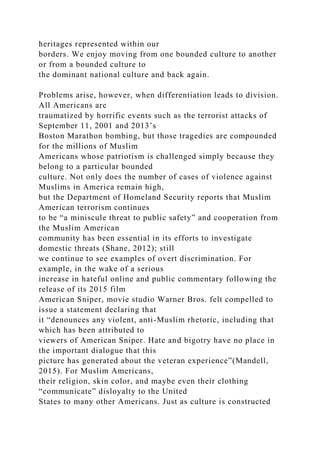
other groups around them. Thus culture also serves to
differentiate us from others.
In the United States, we generally consider this a good thing.
We pride ourselves on our
pluralism, on our diversity, and on the richness of the cultural
heritages represented within our
borders. We enjoy moving from one bounded culture to another
or from a bounded culture to
the dominant national culture and back again.
Problems arise, however, when differentiation leads to division.
All Americans are
traumatized by horrific events such as the terrorist attacks of
September 11, 2001 and 2013’s
Boston Marathon bombing, but those tragedies are compounded
for the millions of Muslim
Americans whose patriotism is challenged simply because they
belong to a particular bounded
culture. Not only does the number of cases of violence against
Muslims in America remain high,
but the Department of Homeland Security reports that Muslim
American terrorism continues
to be “a miniscule threat to public safety” and cooperation from
the Muslim American
community has been essential in its efforts to investigate
domestic threats (Shane, 2012); still
we continue to see examples of overt discrimination. For
example, in the wake of a serious
increase in hateful online and public commentary following the
release of its 2015 film
American Sniper, movie studio Warner Bros. felt compelled to
issue a statement declaring that
it “denounces any violent, anti-Muslim rhetoric, including that
which has been attributed to
viewers of American Sniper. Hate and bigotry have no place in
the important dialogue that this
picture has generated about the veteran experience”(Mandell,
2015). For Muslim Americans,
their religion, skin color, and maybe even their clothing
“communicate” disloyalty to the United
States to many other Americans. Just as culture is constructed
and maintained through
communication, it is also communication (or
miscommunication) that turns differentiation
into division.
10/10/18, 6(27 PM
Page 25 of
65https://jigsaw.vitalsource.com/api/v0/books/1260406946/print
?from=2&to=26
Page 12
PRINTED BY: [email protected] Printing is for personal,
private use only. No part of this book
may be reproduced or transmitted without publisher's prior
permission. Violators will be prosecuted.
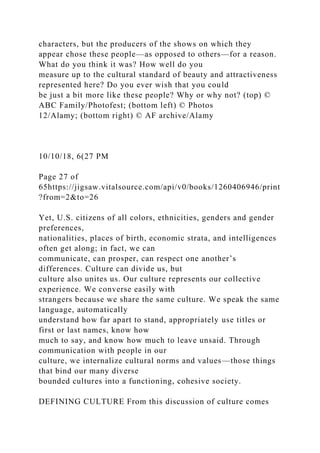
̖ Pretty Little Liars, Grey’s Anatomy, and The Vampire
Diaries—these three television programs are aimed at
10/10/18, 6(27 PM
Page 26 of
65https://jigsaw.vitalsource.com/api/v0/books/1260406946/print
?from=2&to=26
different audiences, yet in each the characters share certain
traits that mark them as attractive. Must people in real
life look like these performers to be considered attractive?
Successful? Good? The people shown are all slender, tall,
and young. Yes, they are just make-believe television
characters, but the producers of the shows on which they
appear chose these people—as opposed to others—for a reason.
What do you think it was? How well do you
measure up to the cultural standard of beauty and attractiveness
represented here? Do you ever wish that you could
be just a bit more like these people? Why or why not? (top) ©
ABC Family/Photofest; (bottom left) © Photos
12/Alamy; (bottom right) © AF archive/Alamy
10/10/18, 6(27 PM
Page 27 of
65https://jigsaw.vitalsource.com/api/v0/books/1260406946/print
?from=2&to=26
Yet, U.S. citizens of all colors, ethnicities, genders and gender
preferences,
nationalities, places of birth, economic strata, and intelligences
often get along; in fact, we can
communicate, can prosper, can respect one another’s
differences. Culture can divide us, but
culture also unites us. Our culture represents our collective
experience. We converse easily with
strangers because we share the same culture. We speak the same
language, automatically
understand how far apart to stand, appropriately use titles or
first or last names, know how
much to say, and know how much to leave unsaid. Through
communication with people in our
culture, we internalize cultural norms and values—those things
that bind our many diverse
bounded cultures into a functioning, cohesive society.
DEFINING CULTURE From this discussion of culture comes
the definition of culture on
which the remainder of this book is based:
Culture is the world made meaningful; it is socially constructed
and maintained through
communication. It limits as well as liberates us; it differentiates
as well as unites us. It defines our
realities and thereby shapes the ways we think, feel, and act.
Page 13
PRINTED BY: [email protected] Printing is for personal,
private use only. No part of this book may
be reproduced or transmitted without publisher's prior
permission. Violators will be prosecuted.
10/10/18, 6(27 PM
Page 28 of
65https://jigsaw.vitalsource.com/api/v0/books/1260406946/print
?from=2&to=26
̖ What is it about Muslim Americans that
“communicates disloyalty” to the United States?
© lm Otero/AP Photo
10/10/18, 6(27 PM
Page 29 of
65https://jigsaw.vitalsource.com/api/v0/books/1260406946/print
?from=2&to=26
Mass Communication and Culture
Because culture can limit and divide or liberate and unite, it
offers us infinite opportunities to
use communication for good—if we choose to do so. James
Carey (1975) wrote,
Because we have looked at each new advance in communication
technology as opportunities for politics
and economics, we have devoted them, almost exclusively, to
government and trade. We have rarely seen
them as opportunities to expand [our] powers to learn and
exchange ideas and experience. (pp. 20–21)
Who are “we” in this quote? We are everyone involved in
creating and maintaining the
culture that defines us. We are the people involved in mass
media industries and the people
who compose their audiences. Together we allow mass
communication not only to occur but
also to contribute to the creation and maintenance of culture.
Everyone involved has an obligation to participate responsibly.
For people working in the
media industries, this means professionally and ethically
creating and transmitting content. For
audience members, it means behaving as critical and thoughtful
consumers of that content.
Two ways to understand our opportunities and our
responsibilities in the mass communication
process are to view the mass media as our cultural storytellers
and to conceptualize mass
communication as a cultural forum.
Mass Media as Cultural Storytellers
A culture’s values and beliefs reside in the stories it tells. Who
are the good guys? Who are the
bad guys? How many of your childhood heroines were chubby?
How many good guys dressed
10/10/18, 6(27 PM
Page 30 of
65https://jigsaw.vitalsource.com/api/v0/books/1260406946/print
?from=2&to=26
in black? How many heroines lived happily ever after without
marrying Prince Charming?
Probably not very many. Our stories help define our realities,
shaping the ways we think, feel,
and act. “Stories are sites of observations about self and
society,” explains media theorist
Hanno Hardt (2007). “These fictional accounts are the
constitutive material signs of a shared
conversation” (p. 476). Therefore, the “storytellers” have a
responsibility to tell their stories in
as professional and ethical a way as possible.
At the same time, we, the audience for these stories, also have
opportunities and
responsibilities. We use these stories not only to be entertained
but to learn about the world
around us, to understand the values, the way things work, and
how the pieces fit together. We
have a responsibility to question the tellers and their stories, to
interpret the stories in ways
10/10/18, 6(27 PM
Page 31 of
65https://jigsaw.vitalsource.com/api/v0/books/1260406946/print
?from=2&to=26
Page 14
PRINTED BY: [email protected] Printing is for personal,
private use only. No part of this book
may be reproduced or transmitted without publisher's prior
permission. Violators will be prosecuted.
consistent with larger or more important cultural values and
truths, to be
thoughtful, to reflect on the stories’ meanings and what they say
about us and our
culture. To do less is to miss an opportunity to construct our
own meaning and, thereby,
culture.
10/10/18, 6(27 PM
Page 32 of
65https://jigsaw.vitalsource.com/api/v0/books/1260406946/print
?from=2&to=26
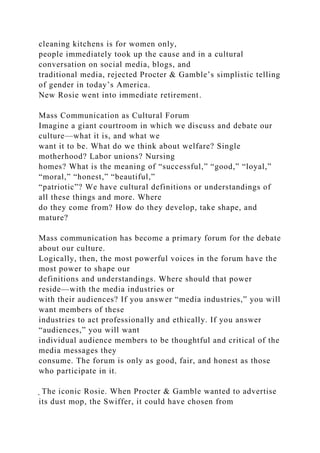
In 2013, Procter & Gamble introduced its new floor steamer, the
Swiffer, using an ad
campaign based on the iconic World War II symbol of female
empowerment, Rosie, and her
shout of female strength, “We can do it!,” even Tweeting “We
can do it! Because cleaning
kitchens is women’s work.” Angered by the use of a symbol of
female workplace success to sell
cleaning products and the sexism inherent in claiming that
cleaning kitchens is for women only,
people immediately took up the cause and in a cultural
conversation on social media, blogs, and
traditional media, rejected Procter & Gamble’s simplistic telling
of gender in today’s America.
New Rosie went into immediate retirement.
Mass Communication as Cultural Forum
Imagine a giant courtroom in which we discuss and debate our
culture—what it is, and what we
want it to be. What do we think about welfare? Single
motherhood? Labor unions? Nursing
homes? What is the meaning of “successful,” “good,” “loyal,”
“moral,” “honest,” “beautiful,”
“patriotic”? We have cultural definitions or understandings of
all these things and more. Where
do they come from? How do they develop, take shape, and
mature?
Mass communication has become a primary forum for the debate
about our culture.
Logically, then, the most powerful voices in the forum have the
most power to shape our
definitions and understandings. Where should that power
reside—with the media industries or
with their audiences? If you answer “media industries,” you will
want members of these
industries to act professionally and ethically. If you answer
“audiences,” you will want
individual audience members to be thoughtful and critical of the
media messages they
consume. The forum is only as good, fair, and honest as those
who participate in it.
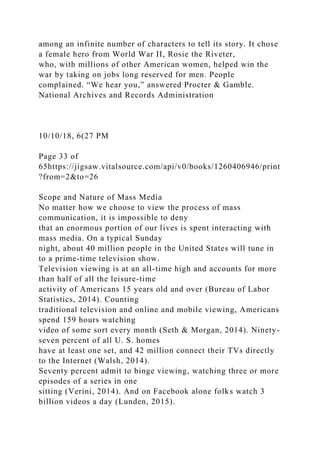
̖ The iconic Rosie. When Procter & Gamble wanted to advertise
its dust mop, the Swiffer, it could have chosen from
among an infinite number of characters to tell its story. It chose
a female hero from World War II, Rosie the Riveter,
who, with millions of other American women, helped win the
war by taking on jobs long reserved for men. People
complained. “We hear you,” answered Procter & Gamble.
National Archives and Records Administration
10/10/18, 6(27 PM
Page 33 of
65https://jigsaw.vitalsource.com/api/v0/books/1260406946/print
?from=2&to=26
Scope and Nature of Mass Media
No matter how we choose to view the process of mass
communication, it is impossible to deny
that an enormous portion of our lives is spent interacting with
mass media. On a typical Sunday
night, about 40 million people in the United States will tune in
to a prime-time television show.
Television viewing is at an all-time high and accounts for more
than half of all the leisure-time
activity of Americans 15 years old and over (Bureau of Labor
Statistics, 2014). Counting
traditional television and online and mobile viewing, Americans
spend 159 hours watching
video of some sort every month (Seth & Morgan, 2014). Ninety-
seven percent of all U. S. homes
have at least one set, and 42 million connect their TVs directly
to the Internet (Walsh, 2014).
Seventy percent admit to binge viewing, watching three or more
episodes of a series in one
sitting (Verini, 2014). And on Facebook alone folks watch 3
billion videos a day (Lunden, 2015).
We listen to more than four hours of music every day (Stutz,
2014), and we spend more than
$10 billion a year at the movies, buying just under 1.3 billion
tickets (“Domestic Movie,” 2015).
If Facebook were its own country, its 1.4 billion monthly active
users would make it the largest
in the world. Facebook alone accounts for 6% of all the time the
world’s Internet users spend
online (Smith, 2015). Fifty-nine percent of Americans regularly
play video games, and over half
of all U. S. homes have a game console, averaging two per
home (Entertainment Software
Association, 2014).
Three billion people across the globe are connected to the
Internet, 35% of the planet’s
population and a 566% increase since 2000. Eighty-eight
percent of North Americans use the
Internet, a 39% increase since 2000 (“Internet users,” 2015).
Annual global Internet
https://jigsaw.vitalsource.com/books/1260406946/epub/OPS/s9
ml/glossary.xhtml#key-binge-viewing
10/10/18, 6(27 PM
Page 34 of
65https://jigsaw.vitalsource.com/api/v0/books/1260406946/print
?from=2&to=26
Page 15
PRINTED BY: [email protected] Printing is for personal,
private use only. No part of this book
may be reproduced or transmitted without publisher's prior
permission. Violators will be prosecuted.
traffic will pass the zettabyte (that’s 1,000 exabytes, which is 1
billion gigabytes)
threshold by the end of 2016, and will reach 1.6 zettabytes per
year by 2018.
Worldwide Internet traffic has increased fivefold over the past
five years, and will increase
threefold over the next five years. Traffic on the Internet in
2018 will be 64 times greater than it
was in 2005. By 2018 nearly a million minutes of video content
will cross the Internet every
second, and it would take you more than 5 million years to
watch all the video that will travel
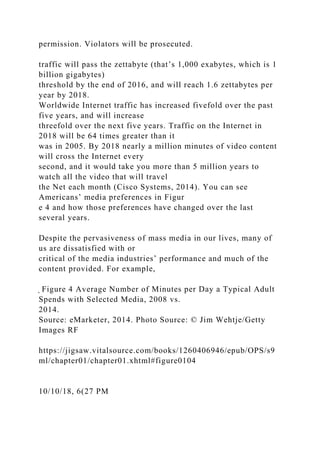
the Net each month (Cisco Systems, 2014). You can see
Americans’ media preferences in Figur
e 4 and how those preferences have changed over the last
several years.
Despite the pervasiveness of mass media in our lives, many of
us are dissatisfied with or
critical of the media industries’ performance and much of the
content provided. For example,
̖ Figure 4 Average Number of Minutes per Day a Typical Adult
Spends with Selected Media, 2008 vs.
2014.
Source: eMarketer, 2014. Photo Source: © Jim Wehtje/Getty
Images RF
https://jigsaw.vitalsource.com/books/1260406946/epub/OPS/s9
ml/chapter01/chapter01.xhtml#figure0104
10/10/18, 6(27 PM
Page 35 of
65https://jigsaw.vitalsource.com/api/v0/books/1260406946/print
?from=2&to=26
only 17% of adults feel that entertainment media provide “very
good” or “excellent” value
(Smith, 2011). People’s evaluations of the news media have
become more negative over the last
decade. Only 38% of the public holds a positive view of the
publishing industry (down 9% from
2011); only 32% think highly of the public relations industry
(down 6%); and only 39% have
positive views of radio and television (down 3%; Newport,
2011). Their trust in each of the three
major news sources—television, newspapers, and the Internet—
has fallen to its lowest level
since 1994, continuing a “decades-long decline in the share of
Americans saying they have ‘a
great deal’ or ‘quite a lot’ of confidence” in their media
(Dugan, 2014). Their faith in the
“media’s ability to report the news fully, accurately, and fairly”
has also returned to an historic
low of 40% of all Americans (McCarthy, 2014).
Our ambivalence—we criticize, yet we consume—comes in part
from our uncertainties about
the relationships among the elements of mass communication.
What is the role of technology?
What is the role of money? And what is our role in the mass
communication process?
The Role of Technology
To some thinkers, it is machines and their development that
drive economic and cultural
change. This idea is referred to as technological determinism.
Certainly there can be no
doubt that movable type contributed to the Protestant
Reformation and the decline of the
Catholic Church’s power in Europe or that television changed
the way members of American
families interact. Those who believe in technological
determinism would argue that these
changes in the cultural landscape were the inevitable result of
new technology.
https://jigsaw.vitalsource.com/books/1260406946/epub/OPS/s9
ml/glossary.xhtml#key-technological-determinism
10/10/18, 6(27 PM
Page 36 of
65https://jigsaw.vitalsource.com/api/v0/books/1260406946/print
?from=2&to=26
Page 16
PRINTED BY: [email protected] Printing is for personal,
private use only. No part of this book
may be reproduced or transmitted without publisher's prior
permission. Violators will be prosecuted.
But others see technology as more neutral and claim that the
way people use
technology is what gives it significance. This perspective
accepts technology as one
of many factors that shape economic and cultural change;
technology’s influence is ultimately
determined by how much power it is given by the people and
cultures that use it.
This disagreement about the power of technology is at the heart
of the controversy
surrounding the new communication technologies. Are we more
or less powerless in the wake
of advances such as the Internet, the World Wide Web, and
instant global audio and visual
communication? If we are at the mercy of technology, the
culture that surrounds us will not be
of our making, and the best we can hope to do is make our way
reasonably well in a world
outside our control. But if these technologies are indeed neutral
and their power resides in how
we choose to use them, we can utilize them responsibly and
thoughtfully to construct and
maintain whatever kind of culture we want. As film director and
technophile Steven Spielberg
explained, “Technology can be our best friend, and technology
can also be the biggest party
pooper of our lives. It interrupts our own story, interrupts our
ability to have a thought or
daydream, to imagine something wonderful because we’re too
busy bridging the walk from the
cafeteria back to the office on the cell phone” (quoted in
Kennedy, 2002, p. 109). Or, as Dr. Ian
Malcolm (Jeff Goldblum) said in Spielberg’s 1997 The Lost
World: Jurassic Park, “Oooh!
Ahhh! That’s how it always starts. Then later there’s running
and screaming.”
Technology does have an impact on communication. At the very
least it changes the basic
elements of communication (see Figure 3). What technology
does not do is relieve us of our
obligation to use mass communication responsibly and wisely.
The Role of Money
Money, too, alters communication. It shifts the balance of
power; it tends to make audiences
products rather than consumers.
The first newspapers were financially supported by their
readers; the money they paid for the
paper covered its production and distribution. But in the 1830s a
new form of newspaper
financing emerged. Publishers began selling their papers for a
penny—much less than it cost to
produce and distribute them. Because so many more papers were
sold at this bargain price,
publishers could “sell” advertising space based on their
readership. What they were actually
selling to advertisers was not space on the page—it was readers.
How much they could charge
advertisers was directly related to how much product (how
many readers) they could produce
for them.
This new type of publication changed the nature of mass
communication. The goal of the
process was no longer for audience and media to create meaning
together. Rather, it was to sell
those readers to a third participant—advertisers.
Some observers think this was a devastatingly bad development,
not only in the history of
mass communication but in the history of democracy. It robbed
people of their voice, or at least
made the voices of the advertisers more powerful. Others think
it was a huge advance for both
mass communication and democracy because it vastly expanded
the media, broadening and
deepening communication. Models showing these two different
ways of viewing mass
https://jigsaw.vitalsource.com/books/1260406946/epub/OPS/s9
ml/chapter01/chapter01.xhtml#figure0103
10/10/18, 6(27 PM
Page 37 of
65https://jigsaw.vitalsource.com/api/v0/books/1260406946/print
?from=2&to=26
communication are presented in the box “Audience as Consumer
or Audience as Produc
t?” Which model makes more sense to you? Which do you think
is more accurate? ABC
journalist Ted Koppel told the Washington Post, “[Television]
is an industry. It’s a business. We
exist to make money. We exist to put commercials on the air.
The programming that is put on
between those commercials is simply the bait we put in the
mousetrap” (in “Soundbites,” 2005,
p. 2). Do you think Koppel is unnecessarily cynical or is he
correct in his analysis of television?
The goals of media professionals will be questioned repeatedly
throughout this book. For
now, keep in mind that ours is a capitalist economic system and
that media industries are
businesses. Movie producers must sell tickets, book publishers
must sell books, and even public
broadcasting has bills to pay.
This does not mean, however, that the media are or must be
slaves to profit. Our task is to
understand the constraints placed on these industries by their
economics and then demand
that, within those limits, they perform ethically and responsibly.
We can do this only by being
thoughtful, critical consumers of the media.
10/10/18, 6(27 PM
Page 38 of
65https://jigsaw.vitalsource.com/api/v0/books/1260406946/print
?from=2&to=26
Page 17
PRINTED BY: [email protected] Printing is for personal,
private use only. No part of this book
may be reproduced or transmitted without publisher's prior
permission. Violators will be prosecuted.
CULTURAL FORUM
Audience as Consumer or Audience as Product?
People base their judgments of media performance and content
on the way
they see themselves fitting into the economics of the media
industry.
Businesses operate to serve their consumers and make a profit.
The consumer
comes first, then, but who is the consumer in our mass media
system? This is
a much-debated issue among media practitioners and media
critics. Consider
the following models.
10/10/18, 6(27 PM
Page 39 of
65https://jigsaw.vitalsource.com/api/v0/books/1260406946/print
?from=2&to=26
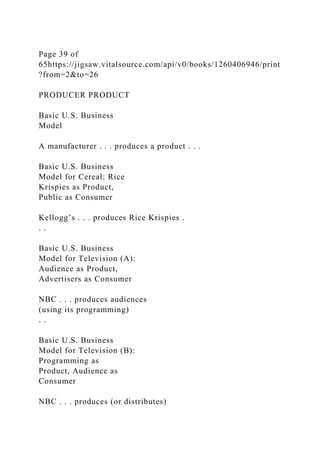
PRODUCER PRODUCT
Basic U.S. Business
Model
A manufacturer . . . produces a product . . .
Basic U.S. Business
Model for Cereal: Rice
Krispies as Product,
Public as Consumer
Kellogg’s . . . produces Rice Krispies .
. .
Basic U.S. Business
Model for Television (A):
Audience as Product,
Advertisers as Consumer
NBC . . . produces audiences
(using its programming)
. .
Basic U.S. Business
Model for Television (B):
Programming as
Product, Audience as
Consumer
NBC . . . produces (or distributes)
programming . . .
The first three models assume that the consumer buys the
product; that is,
the consumer is the one with the money and therefore the one
who must be
satisfied. The last model makes a different assumption. It sees
the audience,
even though it does not buy anything, as sufficiently important
to NBC’s profit-
making ability to force NBC to consider its interests above
others’ (even those
of advertisers). Which model do you think best represents the
economics of
U.S. mass media?
10/10/18, 6(27 PM
Page 40 of
65https://jigsaw.vitalsource.com/api/v0/books/1260406946/print
?from=2&to=26
Mass Communication, Culture, and Media Literacy
Culture and communication are inseparable, and mass
communication, as we’ve seen, is a
particularly powerful, pervasive, and complex form of
communication. Our level of skill in the
mass communication process is therefore of utmost importance.
This skill is not necessarily a
simple one to master (it is much more than booting up the
computer, turning on the television
set, or flipping the pages of your favorite magazine). But it is,
indeed, a learnable skill, one that
can be practiced. This skill is media literacy—the ability to
effectively and efficiently
comprehend and use any form of mediated communication. But
let’s start with the first mass
medium, books, and the technology that enabled their spread,
the printing press.
The Gutenberg Revolution
https://jigsaw.vitalsource.com/books/1260406946/epub/OPS/s9
ml/glossary.xhtml#key-media-literacy
10/10/18, 6(27 PM
Page 41 of
65https://jigsaw.vitalsource.com/api/v0/books/1260406946/print
?from=2&to=26
Page 18
PRINTED BY: [email protected] Printing is for personal,
private use only. No part of this book may
be reproduced or transmitted without publisher's prior
permission. Violators will be prosecuted.
As it is impossible to overstate the importance of writing, so too
is it impossible to
overstate the significance of Johannes Gutenberg’s development
of movable metal
type. Historian S. H. Steinberg (1959) wrote in Five Hundred
Years of Printing:
Neither political, constitutional, ecclesiastical, and economic,
nor sociological, philosophical, and
literary movements can be fully understood without taking into
account the influence the printing press
has exerted upon them. (p. 11)
Marshall McLuhan expressed his admiration for Gutenberg’s
innovation by calling his 1962
book The Gutenberg Galaxy. In it he argued that the advent of
print is the key to our modern
consciousness, because although literacy—the ability to
effectively and efficiently comprehend
and use written symbols—had existed since the development of
the first alphabets more than
5,000 years ago, it was reserved for very few, the elites.
Gutenberg’s invention was world-
changing because it opened literacy to all; that is, it allowed
mass communication.
THE PRINTING PRESS Printing and the printing press existed
long before Gutenberg
perfected his process in or around 1446. The Chinese were
using wooden block presses as early
as 600 C.E. and had movable clay type by 1000 C.E. A simple
movable metal type was even in
use in Korea in the 13th century. Gutenberg’s printing press was
a significant leap forward,
however, for two important reasons.
Gutenberg was a goldsmith and a metallurgist. He hit on the
idea of using metal type crafted
from lead molds in place of type made from wood or clay. This
was an important advance. Not
only was movable metal type durable enough to print page after
page, but letters could be
arranged and rearranged to make any message possible. And
Gutenberg was able to produce
virtually identical copies.
In addition, Gutenberg’s advance over Korean metal mold
printing was one of scope. The
Korean press was used to produce books for a very small, royal
readership. Gutenberg saw his
invention as a way to produce many books for profit. He was,
however, a poor businessman. He
stressed quality over quantity, in part because of his reverence
for the book he was printing, the
Bible. He used the highest-quality paper and ink and turned out
far fewer volumes than he
otherwise could have.
Other printers, however, quickly saw the true economic
potential of Gutenberg’s invention.
The first Gutenberg Bible appeared in 1456. By the end of that
century, 44 years later, printing
operations existed in 12 European countries, and the continent
was flooded with 20 million
volumes of 7,000 titles in 35,000 different editions (Drucker,
1999).
THE IMPACT OF PRINT Although Gutenberg developed his
printing press with a limited
use in mind, printing Bibles, the cultural effects of mass
printing have been profound.
Handwritten or hand-copied materials were expensive to
produce, and the cost of an
education, in time and money, had made reading an expensive
luxury. However, with the
spread of printing, written communication was available to a
much larger portion of the
population, and the need for literacy among the lower and
middle classes grew. The ability to
read became less of a luxury and more of a necessity; eventually
literacy spread, as did
https://jigsaw.vitalsource.com/books/1260406946/epub/OPS/s9
ml/glossary.xhtml#key-literacy
10/10/18, 6(27 PM
Page 42 of
65https://jigsaw.vitalsource.com/api/v0/books/1260406946/print
?from=2&to=26
education. Soldiers at the front needed to be able to read the
emperor’s orders. Butchers needed
to understand the king’s shopping list. So the demand for
literacy expanded, and more (and
more types of) people learned to read.
Tradespeople, soldiers, clergy, bakers, and musicians all now
had business at the printer’s
shop. They talked. They learned of things, both in conversation
and by reading printed
material. As more people learned to read, new ideas germinated
and spread and cross-
pollination of ideas occurred.
10/10/18, 6(27 PM
Page 43 of
65https://jigsaw.vitalsource.com/api/v0/books/1260406946/print
?from=2&to=26
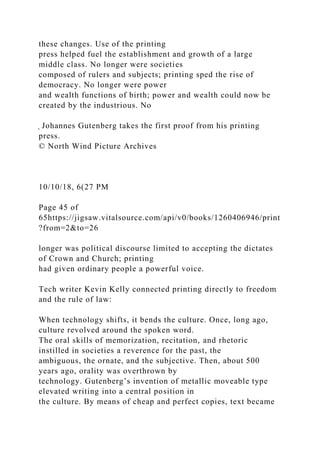
̖ This page from a Gutenberg Bible shows the exquisite care the
printer used in creating his works. The
artwork in the margins is handpainted, but the text is
mechanically printed.
© North Wind Picture Archives/Alamy
10/10/18, 6(27 PM
Page 44 of
65https://jigsaw.vitalsource.com/api/v0/books/1260406946/print
?from=2&to=26
Page 19
PRINTED BY: [email protected] Printing is for personal,
private use only. No part of this book may
be reproduced or transmitted without publisher's prior
permission. Violators will be prosecuted.
More material from various sources was published, and people
were freer to read what they
wanted when they wanted. Dominant authorities—the Crown
and the Church—were now less
able to control communication and, therefore, the people. New
ideas about the world appeared;
new understandings of the existing world flourished.
In addition, duplication permitted standardization and
preservation. Myth and superstition
began to make way for standard, verifiable bodies of
knowledge. History, economics, physics,
and chemistry all became part of the culture’s intellectual life.
Literate cultures were now on the
road to modernization.
Printed materials were the first mass-produced product,
speeding the development and
entrenchment of capitalism. We live today in a world built on
these changes. Use of the printing
press helped fuel the establishment and growth of a large
middle class. No longer were societies
composed of rulers and subjects; printing sped the rise of
democracy. No longer were power
and wealth functions of birth; power and wealth could now be
created by the industrious. No
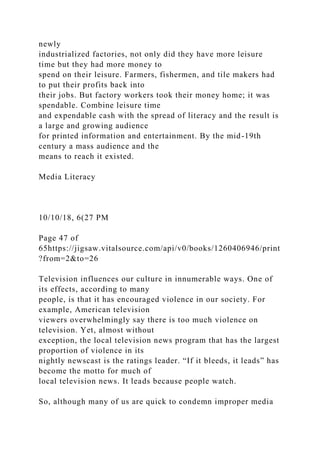
̖ Johannes Gutenberg takes the first proof from his printing
press.
© North Wind Picture Archives
10/10/18, 6(27 PM
Page 45 of
65https://jigsaw.vitalsource.com/api/v0/books/1260406946/print
?from=2&to=26
longer was political discourse limited to accepting the dictates
of Crown and Church; printing
had given ordinary people a powerful voice.
Tech writer Kevin Kelly connected printing directly to freedom
and the rule of law:
When technology shifts, it bends the culture. Once, long ago,
culture revolved around the spoken word.
The oral skills of memorization, recitation, and rhetoric
instilled in societies a reverence for the past, the
ambiguous, the ornate, and the subjective. Then, about 500
years ago, orality was overthrown by
technology. Gutenberg’s invention of metallic moveable type
elevated writing into a central position in
the culture. By means of cheap and perfect copies, text became
the engine of change and the foundation
of stability. From printing came journalism, science and the
mathematics of libraries and law. (2008, p.
48)
The Industrial Revolution
By the mid-18th century, printing and its libraries of science
and mathematics had become one
of the engines driving the Industrial Revolution. Print was
responsible for building and
disseminating bodies of knowledge, leading to scientific and
technological developments and
the refinement of new machines. In addition, industrialization
reduced the time necessary to
complete work, and this created something heretofore unknown
to most working people—
leisure time.
10/10/18, 6(27 PM
Page 46 of
65https://jigsaw.vitalsource.com/api/v0/books/1260406946/print
?from=2&to=26
Page 20
PRINTED BY: [email protected] Printing is for personal,
private use only. No part of this book
may be reproduced or transmitted without publisher's prior
permission. Violators will be prosecuted.
Industrialization had another effect as well. As workers left
their sunrise-to-
sunset jobs in agriculture, the crafts, and trades to work in the
newly
industrialized factories, not only did they have more leisure
time but they had more money to
spend on their leisure. Farmers, fishermen, and tile makers had
to put their profits back into
their jobs. But factory workers took their money home; it was
spendable. Combine leisure time
and expendable cash with the spread of literacy and the result is
a large and growing audience
for printed information and entertainment. By the mid-19th
century a mass audience and the
means to reach it existed.
Media Literacy
10/10/18, 6(27 PM
Page 47 of
65https://jigsaw.vitalsource.com/api/v0/books/1260406946/print
?from=2&to=26
Television influences our culture in innumerable ways. One of
its effects, according to many
people, is that it has encouraged violence in our society. For
example, American television
viewers overwhelmingly say there is too much violence on
television. Yet, almost without
exception, the local television news program that has the largest
proportion of violence in its
nightly newscast is the ratings leader. “If it bleeds, it leads” has
become the motto for much of
local television news. It leads because people watch.
So, although many of us are quick to condemn improper media
performance or to identify
and lament its harmful effects, we rarely question our own role
in the mass communication
process. We overlook it because we participate in mass
communication naturally, almost
without conscious effort. We possess high-level interpretive and
comprehension skills that
make even the most sophisticated television show, movie, or
magazine story understandable
and enjoyable. We are able, through a lifetime of interaction
with the media, to read media
texts.
Media literacy is a skill we take for granted, but like all skills,
it can be improved. And if we
consider how important the mass media are in creating and
maintaining the culture that helps
define us and our lives, it is a skill that must be improved.
Hunter College media professor Stuart Ewen (2000) emphasized
this point in comparing
media literacy with traditional literacy. “Historically,” he
wrote, “links between literacy and
democracy are inseparable from the notion of an informed
populace, conversant with the issues
that touch upon their lives, enabled with tools that allow them
to participate actively in public
deliberation and social change.... Literacy was about crossing
the lines that had historically
separated men of ideas from ordinary people, about the
enfranchisement of those who had
been excluded from the compensations of citizenship” (p. 448).
To Ewen, and others committed
to media literacy, media literacy represents no less than the
means to full participation in the
culture.
Elements of Media Literacy
Media scholar Art Silverblatt (2008) identifies seven
fundamental elements of media literacy.
To these we will add an eighth. Media literacy includes these
characteristics:
1. A critical thinking skill enabling audience members to
develop independent
judgments about media content. Thinking critically about the
content we
consume is the very essence of media literacy. Why do we
watch what we
watch, read what we read, listen to what we listen to? If we
cannot answer
these questions, we have taken no responsibility for ourselves
or our choices.
As such, we have taken no responsibility for the outcome of
those choices.
2. An understanding of the process of mass communication. If
we know the
components of the mass communication process and how they
relate to one
another, we can form expectations of how they can serve us.
How do the
10/10/18, 6(27 PM
Page 48 of
65https://jigsaw.vitalsource.com/api/v0/books/1260406946/print
?from=2&to=26
various media industries operate? What are their obligations to
us? What are
the obligations of the audience? How do different media limit or
enhance
messages? Which forms of feedback are most effective, and
why?
3. An awareness of the impact of media on the individual and
society. Writing
and the printing press helped change the world and the people in
it. Mass
media do the same. If we ignore the impact of media on our
lives, we run the
risk of being caught up and carried along by that change rather
than
controlling or leading it.
4. Strategies for analyzing and discussing media messages. To
consume media
messages thoughtfully, we need a foundation on which to base
thought and
reflection. If we make
10/10/18, 6(27 PM
Page 49 of
65https://jigsaw.vitalsource.com/api/v0/books/1260406946/print
?from=2&to=26
Page 21
PRINTED BY: [email protected] Printing is for personal,
private use only. No part of this book
may be reproduced or transmitted without publisher's prior
permission. Violators will be prosecuted.
meaning, we must possess the tools with which to make it (for
example, understanding the intent and impact of film and video
conventions, such as camera angles and lighting, or the strategy
behind the
placement of photos on a newspaper page). Otherwise, meaning
is made for
us; the interpretation of media content will then rest with its
creator, not with
us.
5. An understanding of media content as a text that provides
insight into our
culture and our lives. How do we know a culture and its people,
attitudes,
values, concerns, and myths? We know them through
communication. For
modern cultures like ours, media messages increasingly
dominate that
communication, shaping our understanding of and insight into
our culture.
6. The ability to enjoy, understand, and appreciate media
content. Media
literacy does not mean living the life of a grump, liking nothing
in the media,
or always being suspicious of harmful effects and cultural
degradation. We
take high school and college classes to enhance our
understanding and
appreciation of novels; we can do the same for media texts.
Learning to enjoy, understand, and appreciate media content
includes the
ability to use multiple points of access—to approach media
content from
a variety of directions and derive from it many levels of
meaning. Thus, we
control meaning making for our own enjoyment or appreciation.
For
example, we can enjoy any one of the hit movies from the
Hunger Games
trilogy as an action-laden adventure full of explosions, danger,
and romance,
the perfect holiday blockbuster. But as movie buffs we might
see it as a
David-and-Goliath, underdog-takes-on-the-powerful-villain tale.
Or we
might read it as an analogy for what’s happening in America’s
contemporary
economy of growing income inequality and harshness of life for
those near
the bottom. Maybe it’s a history lesson disguised as dystopian
fiction,
reminding us that our country was born of revolution against
those who
would rule us. Or maybe it’s just a cool way to spend a
Saturday night,
entertained by the same folks who so delighted us with other
special-effects
extravaganzas, like Constantine, I Am Legend, and Alexander.
https://jigsaw.vitalsource.com/books/1260406946/epub/OPS/s9
ml/glossary.xhtml#key-multiple-points-of-access
10/10/18, 6(27 PM
Page 50 of
65https://jigsaw.vitalsource.com/api/v0/books/1260406946/print
?from=2&to=26
In fact, television programs such as The Middle, The Daily
Show, The
Simpsons, Game of Thrones, and Family Guy are specifically
constructed to
take advantage of the media literacy skills of sophisticated
viewers while
providing entertaining fare for less skilled consumers. The same
is true for
films such as Birdman, Interstellar, Lucy, The Grand Budapest
Hotel, and
Blue Jasmine, magazines such as Alarm, and the best of jazz,
rap, and rock.
The Middle and The Daily Show are produced as television
comedies,
designed to make people laugh. But they are also intentionally
produced to
provide more sophisticated, media-literate viewers with
opportunities to
make personally interesting or relevant meaning. Anyone can
laugh while
watching these programs, but some people can empathize with
the daily
travails of a working-class family (The Middle), or they can
examine the
failings and foibles of contemporary journalism (Daily Show).
7. Development of effective and responsible production skills.
Traditional
literacy assumes that people who can read can also write. Media
literacy also
makes this assumption. Our definition of literacy (of either
type) calls not
only for effective and efficient comprehension of content but
for its effective
and efficient use. Therefore, media-literate individuals should
develop
production skills that enable them to create useful media
messages. If you
have ever tried to make a narrative home video—one that tells a
story—you
know that producing content is much more difficult than
consuming it. Even
producing a voicemail message that is not embarrassing is a
daunting task for
many people.
This element of media literacy may seem relatively unimportant
at first
glance. After all, if you choose a career in media production,
you will get
training in school and on the job. If you choose another calling,
you may
never be in the position of having to produce content. But most
professions
now employ some form of media to disseminate information: for
use in
training, to enhance presentations, or to keep in contact with
clients and
customers. The Internet in particular requires effective
production skills of its
users—at home, school, and work—because online receivers can
and do easily
become online creators.
8. An understanding of the ethical and moral obligations of
media
practitioners. To make informed judgments about the
performance of the
10/10/18, 6(27 PM
Page 51 of
65https://jigsaw.vitalsource.com/api/v0/books/1260406946/print
?from=2&to=26
media, we also must be aware of the competing pressures on
practitioners as
they do their jobs. We must understand the media’s official and
unofficial
rules of operation. In other words, we must know, respectively,
their legal and
ethical obligations. Return, for a moment, to the question of
televised
violence. It is legal for a station to air graphic violence. But is
it ethical? If it is
unethical, what power, if any, do we have to demand its removal
from our
screens? Dilemmas such as this are discussed at length in the
chapter on
media freedom, regulation, and ethics.
10/10/18, 6(27 PM
Page 52 of
65https://jigsaw.vitalsource.com/api/v0/books/1260406946/print
?from=2&to=26
Page 22
PRINTED BY: [email protected] Printing is for personal,
private use only. No part of this book may
be reproduced or transmitted without publisher's prior
permission. Violators will be prosecuted.
10/10/18, 6(27 PM
Page 53 of
65https://jigsaw.vitalsource.com/api/v0/books/1260406946/print
?from=2&to=26
Media Literacy Skills
̖ Family Guy is a cartoon about a typical suburban family. It has
all the things you would expect from a television
situation comedy—an inept dad, a precocious daughter, a
slacker son, a loving wife, and zany situations. Yet it also
offers an intellectual, philosopher dog and an evil-genius,
scheming baby. Why do you think the producers have gone
to the trouble to populate this show with the usual trappings of
a sitcom but then add other, bizarre elements? And
what’s going on in The Hunger Games? Is it another special-
effects, explosion-laden, action-adventure holiday
blockbuster? A classic David-and-Goliath movie? An historical
allegory? A commentary on growing financial
inequality in America? Or maybe it’s just a cool way to spend a
Saturday night, entertained by a celebrity-packed
action movie.
(top) © 20th Century Fox/Courtesy Everett Collection; (bottom)
© Photos 12/Alamy
10/10/18, 6(27 PM
Page 54 of
65https://jigsaw.vitalsource.com/api/v0/books/1260406946/print
?from=2&to=26
Page 23
PRINTED BY: [email protected] Printing is for personal,
private use only. No part of this book may
be reproduced or transmitted without publisher's prior
permission. Violators will be prosecuted.
Consuming media content is simple. Push a button and you have
images on a
television or music on a radio. Come up with enough cash and
you can see a movie
or buy a magazine. Media-literate consumption, however,
requires a number of specific skills:
1. The ability and willingness to make an effort to understand
content, to pay
attention, and to filter out noise. As we saw earlier, anything
that interferes
with successful communication is called noise, and much of the
noise in the
mass communication process results from our own consumption
behavior.
When we watch television, often we are also doing other things,
such as
eating, reading, or chatting on the phone. We drive while we
listen to the
radio. Obviously, the quality of our meaning making is related
to the effort we
give it.
2. An understanding of and respect for the power of media
messages. The
mass media have been around for more than a century and a
half. Just about
everybody can enjoy them. Their content is either free or
relatively
inexpensive. Much of the content is banal and a bit silly, so it is
easy to
dismiss media content as beneath serious consideration or too
simple to have
any influence.
We also disregard media’s power through the third-person
effect—the
common attitude that others are influenced by media messages
but that we
are not. That is, we are media literate enough to understand the
influence of
mass communication on the attitudes, behaviors, and values of
others but not
self-aware or honest enough to see its influence on our lives.
3. The ability to distinguish emotional from reasoned reactions
when
responding to content and to act accordingly. Media content is
often
designed to touch us at the emotional level. We enjoy losing
ourselves in a
good song or in a well-crafted movie or television show; this is
among our
great pleasures. But because we react emotionally to these
messages does not
mean they don’t have serious meanings and implications for our
lives.
Television pictures, for example, are intentionally shot and
broadcast for
https://jigsaw.vitalsource.com/books/1260406946/epub/OPS/s9
ml/glossary.xhtml#key-third-person-effect
10/10/18, 6(27 PM
Page 55 of
65https://jigsaw.vitalsource.com/api/v0/books/1260406946/print
?from=2&to=26
their emotional impact. Reacting emotionally is appropriate and
proper. But
then what? What do these pictures tell us about the larger issue
at hand? We
can use our feelings as a point of departure for meaning making.
We can ask,
“Why does this content make me feel this way?”
4. Development of heightened expectations of media content.
We all use media
to tune out, waste a little time, and provide background noise.
When we
decide to watch television, we are more likely to turn on the set
and flip
channels until we find something passable than we are to read
the listings to
find a specific program to view. When we search for online
video, we often
settle for the “10 most shared today.” When we expect little
from the content
before us, we tend to give meaning making little effort and
attention.
5. A knowledge of genre conventions and the ability to
recognize when they
are being mixed. The term genre refers to the categories of
expression
within the different media, such as “evening news,”
“documentary,” “horror
movie,” or “entertainment magazine.” Each genre is
characterized by certain
distinctive, standardized style elements—the conventions of that
genre. The
conventions of the evening news, for example, include a short,
upbeat
introductory theme and one or two good-looking people sitting
at a large,
curved desk. When we hear and see these style elements, we
expect the
evening news. We can tell a documentary film from an
entertainment movie
by its more serious tone and the number of talking heads. We
know by their
appearance—the use of color, the types of images, and the
amount of text on
the cover—which magazines offer serious reading and which
provide
entertainment.
Knowledge of these conventions is important because they cue
or direct our
meaning making. For example, we know to accept the details in
a
documentary film about the sinking of the Titanic as more
credible than
those found in a Hollywood movie about that disaster.
This skill is also important for another reason. Sometimes, in an
effort to
maximize audiences (and therefore profits) or for creative
reasons, media
content makers mix genre conventions. Is Clint Eastwood’s
American Sniper
https://jigsaw.vitalsource.com/books/1260406946/epub/OPS/s9
ml/glossary.xhtml#key-genre
https://jigsaw.vitalsource.com/books/1260406946/epub/OPS/s9
ml/glossary.xhtml#key-conventions
10/10/18, 6(27 PM
Page 56 of
65https://jigsaw.vitalsource.com/api/v0/books/1260406946/print
?from=2&to=26
fact or fiction? Is Meredith Vieira a journalist, a talk show host,
or a
showperson? Extra! and E! News look increasingly like
10/10/18, 6(27 PM
Page 57 of
65https://jigsaw.vitalsource.com/api/v0/books/1260406946/print
?from=2&to=26
Let’s consider two versions of the same movie scene. In the
first, a man is driving a car. Cut to
a woman lying tied up on a railroad track. What is the
relationship between the man and the
woman? Where is he going? With no more information than
these two shots, you know
automatically that he cares for her and is on his way to save her.
Now, here is the second
Page 24
PRINTED BY: [email protected] Printing is for personal,
private use only. No part of this
book may be reproduced or transmitted without publisher's prior
permission. Violators will be prosecuted.
CNN’s reporting and the CBS Evening News. Reading media
texts becomes more difficult as formats are co-opted.
6. The ability to think critically about media messages, no
matter how credible
their sources. It is crucial that media be credible in a democracy
in which the
people govern because the media are central to the governing
process. This is
why the news media are sometimes referred to as the fourth
branch of
government, complementing the executive, judicial, and
legislative branches.
This does not mean, however, that we should believe everything
they report.
But it is often difficult to arrive at the proper balance between
wanting to
believe and accepting what we see and hear unquestioningly,
especially when
frequently we are willing to suspend disbelief and are
encouraged by the
media themselves to see their content as real and credible.
Consider the New York Times motto “All the News That’s Fit
to Print” and
the title of ABC’s “Eyewitness News.” If it is all there, it must
all be real, and
who is more credible than an eyewitness? But if we examine
these media, we
would learn that the Times in actuality prints all the news that
fits (in its
pages) and that “Eyewitness News” is a very narrowly selective
eyewitness.
7. A knowledge of the internal language of various media and
the ability to
understand its effects, no matter how complex. Just as each
media genre has
its own distinctive style and conventions, each medium also has
its own
specific internal language. This language is expressed in
production values
—the choice of lighting, editing, special effects, music, camera
angle, location
on the page, and size and placement of headlines. To be able to
read a media
text, you must understand its language. We learn the grammar
of this
language automatically from childhood—for example, we know
that when the
television image goes “all woosielike,” the character is
dreaming.
https://jigsaw.vitalsource.com/books/1260406946/epub/OPS/s9
ml/glossary.xhtml#key-production-values
10/10/18, 6(27 PM
Page 58 of
65https://jigsaw.vitalsource.com/api/v0/books/1260406946/print
?from=2&to=26
version. The man is driving the car. Fade to black. Fade back up
to the woman on the tracks.
Now what is the relationship between the man and the woman?
Where is he going? It is less
clear that these two people even have anything to do with each
other. We construct completely
different meanings from exactly the same two pictures because
the punctuation (the quick
cut/fade) differs.
Media texts tend to be more complicated than these two scenes.
The better we can handle
their grammar, the more we can understand and appreciate texts.
The more we understand
texts, the more we can be equal partners with media
professionals in meaning making.
̖ This television show offers all the conventions we’d expect
from the news—background digital graphics, an anchor
behind his desk, a well-known interviewee. But it also contains
conventions we’d expect from a comedy program—a
satirist as host and an unruly, loud audience. Why does Last
Week Tonight with John Oliver mix the conventions of
these two very different genres? Does your knowledge of those
conventions add to your enjoyment of this hit
program?
© Eric Liebowitz/HBO/Courtesy Everett Collection
10/10/18, 6(27 PM
Page 59 of
65https://jigsaw.vitalsource.com/api/v0/books/1260406946/print
?from=2&to=26
Page 25
PRINTED BY: [email protected] Printing is for personal,
private use only. No part of this book may
be reproduced or transmitted without publisher's prior
permission. Violators will be prosecuted.
MEDIA LITERACY CHALLENGE
Recognizing Cultural Values
Media-literate people develop an understanding of media
content as a text that
provides insight into our culture and our lives, and they have an
awareness of
the impact of media on the individual and society. So, challenge
your own
media literacy skills. You can do this exercise with a parent or
another person
older than you, or you can speculate after using the Internet to
view movies
and television shows from 20 years ago. Compare your
childhood heroes and
heroines with those of someone older. What differences are
there between the
generations in what you consider heroic qualities? What are
some similarities
and differences between the heroic qualities you and people
from an earlier
generation identify? Are the good qualities of your personal
heroes something
you can find in today’s movies or TV? Perhaps your hero is
even a TV character.
Either way, where on TV or in film can you find the qualities
you consider
heroic? Which cultural values, attitudes, and beliefs, if any, do
you think have
influenced how heroes and heroines have changed throughout
the last few
decades? How have the media helped establish the values you
identify as
important qualities in people?
Resources for Review and Discussion
REVIEW POINTS: TYING CONTENT TO LEARNING
OUTCOMES
Define communication, mass communication, mass media, and
culture.
□ Communication is the process of creating shared meaning.
□ Mass communication is the process of creating shared
meaning between the
10/10/18, 6(27 PM
Page 60 of
65https://jigsaw.vitalsource.com/api/v0/books/1260406946/print
?from=2&to=26
mass media and their audiences.
□ Mass media is the plural of mass medium, a technology that
carries
messages to a large number of people.
□ Culture is the world made meaningful. It resides all around
us; it is socially
constructed and maintained through communication. It limits as
well as
liberates us; it differentiates as well as unites us. It defines our
realities and
shapes the ways we think, feel, and act.
Describe the relationships among communication, mass
communication, culture, and those who live in the culture.
□ Mass media are our culture’s dominant storytellers and the
forum in which
we debate cultural meaning.
Evaluate the impact of technology and economics on those
relationships.
□ Technological determinism argues that technology is the
predominant agent
of social and cultural change. But it is not technology that
drives culture; it
is how people use technology.
□ With technology, money, too, shapes mass communication.
Audiences can
be either the consumer or the product in our mass media system.
List the components of media literacy.
□ Media literacy, the ability to effectively and efficiently
comprehend and use
any form of mediated communication, consists of several
components:
Critical thinking skills enabling the development of independent
judgments about media content
An understanding of the process of mass communication
10/10/18, 6(27 PM
Page 61 of
65https://jigsaw.vitalsource.com/api/v0/books/1260406946/print
?from=2&to=26
An awareness of the impact of the media on individuals and
society
Strategies for analyzing and discussing media messages
An awareness of media content as a “text” providing insight
into
contemporary culture
A cultivation of enhanced enjoyment, understanding, and
appreciation
of media content
The development of effective and responsible production skills
The development of an understanding of the ethical and moral
obligations of media practitioners
Identify key skills required for developing media literacy.
□ Media skills include
The ability and willingness to make an effort to understand
content, to
pay attention, and to filter out noise
An understanding of and respect for the power of media
messages
The ability to distinguish emotional from reasoned reactions
when
responding to content and to act accordingly
10/10/18, 6(27 PM
Page 62 of
65https://jigsaw.vitalsource.com/api/v0/books/1260406946/print
?from=2&to=26
KEY TERMS
communication, 3
feedback, 4
interpersonal communication, 4
encoding, 4
decoding, 4
noise, 5
medium (pl. media), 5
mass medium, 5
mass communication, 5
inferential feedback, 5
cultural definition of communication, 6
culture, 6
dominant culture (mainstream culture), 10
bounded culture (co-culture), 11
binge viewing, 14
technological determinism, 15
media literacy, 17
literacy, 18
multiple points of access, 21
Page 26
PRINTED BY: [email protected] Printing is for personal,
private use only. No part of this
book may be reproduced or transmitted without publisher's prior
permission. Violators will be prosecuted.
The development of heightened expectations of media
content
A knowledge of genre conventions and the recognition of their
mixing
The ability to think critically about media messages
A knowledge of the internal language of various media and the
ability to
understand its effects
https://jigsaw.vitalsource.com/books/1260406946/epub/OPS/s9
ml/glossary.xhtml#key-communication
https://jigsaw.vitalsource.com/books/1260406946/epub/OPS/s9
ml/glossary.xhtml#key-feedback
https://jigsaw.vitalsource.com/books/1260406946/epub/OPS/s9
ml/glossary.xhtml#key-interpersonal-communication
https://jigsaw.vitalsource.com/books/1260406946/epub/OPS/s9
ml/glossary.xhtml#key-encoding
https://jigsaw.vitalsource.com/books/1260406946/epub/OPS/s9
ml/glossary.xhtml#key-decoding
https://jigsaw.vitalsource.com/books/1260406946/epub/OPS/s9
ml/glossary.xhtml#key-noise
https://jigsaw.vitalsource.com/books/1260406946/epub/OPS/s9
ml/glossary.xhtml#key-medium-pl-media
https://jigsaw.vitalsource.com/books/1260406946/epub/OPS/s9
ml/glossary.xhtml#key-mass-medium
https://jigsaw.vitalsource.com/books/1260406946/epub/OPS/s9
ml/glossary.xhtml#key-mass-communication
https://jigsaw.vitalsource.com/books/1260406946/epub/OPS/s9
ml/glossary.xhtml#key-inferential-feedback
https://jigsaw.vitalsource.com/books/1260406946/epub/OPS/s9
ml/glossary.xhtml#key-cultural-definition-of-communication
https://jigsaw.vitalsource.com/books/1260406946/epub/OPS/s9
ml/glossary.xhtml#key-culture
https://jigsaw.vitalsource.com/books/1260406946/epub/OPS/s9
ml/glossary.xhtml#key-dominant-culture-mainstream-culture
https://jigsaw.vitalsource.com/books/1260406946/epub/OPS/s9
ml/glossary.xhtml#key-bounded-cultures-co-cultures
https://jigsaw.vitalsource.com/books/1260406946/epub/OPS/s9
ml/glossary.xhtml#key-binge-viewing
https://jigsaw.vitalsource.com/books/1260406946/epub/OPS/s9
ml/glossary.xhtml#key-technological-determinism
https://jigsaw.vitalsource.com/books/1260406946/epub/OPS/s9
ml/glossary.xhtml#key-media-literacy
https://jigsaw.vitalsource.com/books/1260406946/epub/OPS/s9
ml/glossary.xhtml#key-literacy
https://jigsaw.vitalsource.com/books/1260406946/epub/OPS/s9
ml/glossary.xhtml#key-multiple-points-of-access
10/10/18, 6(27 PM
Page 63 of
65https://jigsaw.vitalsource.com/api/v0/books/1260406946/print
?from=2&to=26
third-person effect, 23
genre, 23
conventions, 23
production values, 24
QUESTIONS FOR REVIEW
QUESTIONS FOR CRITICAL THINKING AND DISCUSSION
1. What is culture? How does culture define people?
2. What is communication? What is mass communication?
3. What are encoding and decoding? How do they differ when
technology enters
the communication process?
4. What does it mean to say that communication is a reciprocal
process?
5. What is James Carey’s cultural definition of communication?
How does it
differ from other definitions of that process?
6. What do we mean by mass media as cultural storyteller?
7. What do we mean by mass communication as cultural forum?
8. What is media literacy? What are its components?
9. What are some specific media literacy skills?
10. What is the difference between genres and production
conventions? What do
these have to do with media literacy?
To maximize your study time, check out CONNECT to access
the SmartBook study module for this chapter, watch
videos, and explore other resources.
1. Who were your childhood heroes and heroines? Why did you
choose them?
What cultural lessons did you learn from them?
2. The arrival of the printing press dramatically changed
history. Traditional
https://jigsaw.vitalsource.com/books/1260406946/epub/OPS/s9
ml/glossary.xhtml#key-third-person-effect
https://jigsaw.vitalsource.com/books/1260406946/epub/OPS/s9
ml/glossary.xhtml#key-genre
https://jigsaw.vitalsource.com/books/1260406946/epub/OPS/s9
ml/glossary.xhtml#key-conventions
https://jigsaw.vitalsource.com/books/1260406946/epub/OPS/s9
ml/glossary.xhtml#key-production-values
10/10/18, 6(27 PM
Page 64 of
65https://jigsaw.vitalsource.com/api/v0/books/1260406946/print
?from=2&to=26
REFERENCES
seats of power lost influence, science flourished, and the seeds
were planted
for capitalism and the growth of a middle class. What effects
will the Internet
have on our future? Will its impact be less than, equal to, or
greater than the
impact wrought by the printing press? Defend your answer.
3. How media literate do you think you are? What about those
around you—
your parents, for example, or your best friend? What are your
weaknesses as
a media-literate person?
1. Bureau of Labor Statistics. (2014, June 18). American time
use survey
summary. Online: http://www.bls.gov/news.release/atus.nr0.htm
2. Carey, J. W. (1975). A cultural approach to communication.
Communication,
2, 1-22.
3. Carey, J. W. (1989). Communication as culture. Boston:
Unwin Hyman.
4. Cisco Systems. (2014, June 2014). The zettabyte era: Trends
and analysis. Cis
co.com. Online:
http://www.cisco.com/c/en/us/solutions/collateral
/service-provider/visual-networking-index-
vni/VNI_Hyperconnec
tivity_WP.html
5. “Domestic movie theatrical market summary 1995 to 2015.”
(2015, February
5). The Numbers. Online: http://www.the-numbers.com/market/
6. Drucker, P. E. (1999, October). Beyond the information
revolution. Atlantic
Monthly, pp. 47-57.
7. Dugan, A. (2014, June 19). Americans’ confidence in news
media remains
low. Gallup.com. Online:
http://www.gallup.com/poll/171740/ameri
cans-confidence-news-media-remains-low.aspx
8. eMarketer. (2014, December 29). Time spent using media.
Advertising Age
Marketing Fact Pack 2015, p. 17.
http://www.bls.gov/news.release/atus.nr0.htm
http://cisco.com/
http://www.cisco.com/c/en/us/solutions/collateral/service-
provider/visual-networking-index-
vni/VNI_Hyperconnectivity_WP.html
http://www.the-numbers.com/market/
http://gallup.com/
http://www.gallup.com/poll/171740/americans-confidence-
news-media-remains-low.aspx
10/10/18, 6(27 PM
Page 65 of
65https://jigsaw.vitalsource.com/api/v0/books/1260406946/print
?from=2&to=26
Page 27
9. PRINTED BY: [email protected] Printing is for personal,
private use only. No part of this book
may be reproduced or transmitted without publisher's prior
permission. Violators will be prosecuted.
Running head: STUDENT LAST NAME 1
STUDENT LAST NAME
4
Annotated Bibliography
Student Name
ILR260
Instructed by: James C. Lhotak, Jr., Ph.D.
[email protected]
National University
August 17, 2018
Annotated Bibliography
Fuster, D., Cheng, D. M., Allensworth-Davies, D., Palfai, T. P.,
Samet, J., & Saitz, R., (2014). No detectable association
between frequency of marijuana use and health or healthcare
utilization among primary care patients who screen positive for
drug use. Journal of General Internal Medicine, 29(1), 133-9.
doi: http://dx.doi.org.nuls.idm.oclc.org/10.1007/s11606-013-
2605-z
There is a lack of studies that show the impact of marijuana use
on individual health and their use of healthcare services. Fuster
et al hypothesized that there is a correlation between the
frequency of healthcare utilization and advise effects of
marijuana use. The independent variables such as frequency of
marijuana use in the past three months; further defined as daily
use, less than daily use and no use, the use of alcohol and other
drugs were used to determine the results. The study also utilized
self-reported health status and frequency of healthcare service
use, as well as Charlson comorbidity data from electronic
medical records. The results of this study revealed that
participants who used marijuana daily or less than daily were
healthier than those who reported no use, however the
difference was insignificant. The study also showed that there
only one percent of the participants experienced adverse effects
and that there was no association between marijuana use and
healthcare utilization. This study has limitations because of the
inaccuracy of self-reporting, illicit drug use by all the
participants, and past marijuana use was not considered. In
addition, the Charlson comorbidity data was flawed because it
was designed to predict mortality rates among older patients.
The author acknowledges that their study conflicts with other
studies which shows that marijuana has adverse side effects,
and do not propose that marijuana is safe. Since a comparison
study of a group with no drug use was not conducted, further
research needs to be conducted to determine the correlation
between marijuana use and health status.
Although this article provides adequate variables, it does not
evidence, it does not confirm their hypothesis. Since research is
primarily based on self-reporting tools, its accuracy is
inconclusive. While the authors claim not to have any conflict
of interest, it appears that their research is biased because by
their own admission the limitation of the study did not produce
irrefutable results. Therefore, I agree that additional studies
need to bee conducted about the long-term effects of marijuana
use on health and healthcare outcomes.
Hall, W. (2015). What has research over the past two decades
revealed about the adverse health effects of recreational
cannabis use?. Addiction, 110(1), 19-35. doi:10.1111/add.12703
Given that recreational cannabis use has become as
common as tobacco use in teens and young adults particularly in
low and middle-income countries, the purpose of this literary
review was to examine the problems associated with its use over
the past two decades. Hall analyzed literature from previous
studies conducted in 1993 and compared them to conclusions
from studies conducted in 2013. The study applied variables
such as rules for making casual conclusions of previous studies,
conclusions about probable causes of adverse health effects
particularly when compared to the route of administration, as
well as a comparison between the effects of cannabis to those of
alcohol and tobacco use. The results of the literary study
conclude that cannabis use has a significantly association with
adverse health effects, and increased risks of cognitive
impairment and psychotic episodes in young adults. In addition,
cannabis use is associated with an increase in cancers and other
chronic diseases. Hall asserts that since many cohort studies
have been conducted around the world, researcher now know
more about adverse health effects of cannabis used than their
counterparts in 1993. He also admits that there are no overdoses
with cannabis use, however, there is a significant risk when
alcohol is consumed in conjunction to its use.
The literary review provides adequate evidence of the
adverse health effects of cannabis use. It appears that Hall is
unbiased because he applied rules for making casual
conclusions pertaining to the results of various studies. The
only weakness of this study is that Hall made casual conclusion
on his review of prior studies. However, based on the breath,
time frame, and extent of the literary analysis, no further
studies need to be conducted.
Tyler, E., Jones, S., Black, N., Carter, L., & Barrowclough, C.
(2015). The relationship between bipolar disorder and cannabis
use in daily life: an experience sampling study. Plos ONE,
10(3), 1-15. doi: 10.1371/journal.pone.0118916
Since there is insufficient data about the effectiveness of
cannabis in persons bipolar disorder (BD), the purpose of the
authors study was to examine the effects its daily use. They
hypothesized that: 1). cannabis use to self-medicate would
increase as BD symptom change 2). cannabis use would
intensify manic and depressive effects of BD sufferers. The
authors analyzed other literatures about bipolar disorder and
cannabis use, and conducted their own research by using the
experienced sampling method (ESM). While the study did
require BD sufferers who used cannabis at least twice a week, it
excluded those who were severely affected by their symptoms.
Twenty-four study participants were prompted at random times
to answer a series of questions regarding their thoughts, BD
symptomatology, and cannabis use over a six-day period.
Variables such as age, gender, other drugs, alcohol, type of
cannabis, and total cannabis use, were factored into the results
of the study. In addition, dependent variables such as prior
positive and negative effects, and prior mania and depression
were used to study the effects of cannabis use for self-
medication. The results of the study revealed that cannabis use
to self-medicate did not increase as BD symptoms changed.
However, cannabis use increased the psychological effects of
BD sufferers. There is evidence that dose and personal method
of use increased symptoms of mania and depression. The EMS
tracking allowed the participants to question their cannabis use
and even accounted for a reduction of its use in some cases. In
addition, the EMS method could be a valuable therapeutic tool
in managing cannabis use for BD sufferers. Since cannabis use
was self-reported and responses were limited to “yes” or “no,”
there is insufficient data and additional studies need to be done
to further study the effects of cannabis use by BD sufferers.
The research results suggest that cannabis use is associated
with increased episodes of mania and depression in BD
sufferers. And while the researchers sought to prove their
hypotheses, they are biased because they utilized the same
methods as those of previous studies which yielded the same
results. I agree that due to the design and limitations of this
study, the results cannot be viewed as conclusive. The study
would have would have yielded different results if it study was
conducted over a longer period of time with more participants,
and included more self-reporting responses. While the EMS
research is a valuable tool in monitoring cannabis use, the real
problem that cannabis increases mania and depression cannot be
ignored.
Use the example annotated bibliography to summarize 4 peer
reviewed articles on “EFFECTS OF LGBTQ OFFSPRING ON
PARENTS.
Use the sample annotated bibliography as a template. APA
papers are required to use Times New Roman, 12 point.
Typically, an annotated bibliography is one paragraph, however,
recall that you should split the annotated bibliography into two
paragraphs--summary and analysis--so that you learn to analyze
articles. Critical thinking is required! Try to summarize in
detail at least 10 ideas from each article.
101018, 6(27 PMPage 1 of 65httpsjigsaw.vitalsource.co.docx

101018, 6(27 PMPage 1 of 65httpsjigsaw.vitalsource.co.docx

  • 1.
    10/10/18, 6(27 PM Page1 of 65https://jigsaw.vitalsource.com/api/v0/books/1260406946/print ?from=2&to=26 10/10/18, 6(27 PM Page 2 of 65https://jigsaw.vitalsource.com/api/v0/books/1260406946/print ?from=2&to=26 Page 2 PRINTED BY: [email protected] Printing is for personal, private use only. No part of this book may be reproduced or transmitted without publisher's prior permission. Violators will be prosecuted. 1 Mass Communication, Culture, and Media Literacy 10/10/18, 6(27 PM Page 3 of 65https://jigsaw.vitalsource.com/api/v0/books/1260406946/print ?from=2&to=26
  • 2.
    Learning Objectives Mass communication,mass media, and the culture that shapes us (and that we shape) are inseparable. After studying this chapter, you should be able to ̖ Our experiences of the world are increasingly mass mediated. © Sean Gallup/Getty Images Define communication, mass communication, mass media, and cu lture. Describe the relationships among communication, mass communi https://jigsaw.vitalsource.com/books/1260406946/epub/OPS/s9 ml/chapter01/chapter01.xhtml#lo0100 https://jigsaw.vitalsource.com/books/1260406946/epub/OPS/s9 ml/chapter01/chapter01.xhtml#lo0101 10/10/18, 6(27 PM Page 4 of 65https://jigsaw.vitalsource.com/api/v0/books/1260406946/print ?from=2&to=26 cation, culture, and those who live in the culture. Evaluate the impact of technology and economics on those relation ships. List the components of media literacy. Identify key skills required for developing media literacy. https://jigsaw.vitalsource.com/books/1260406946/epub/OPS/s9 ml/chapter01/chapter01.xhtml#lo0101 https://jigsaw.vitalsource.com/books/1260406946/epub/OPS/s9
  • 3.
    ml/chapter01/chapter01.xhtml#lo0102 https://jigsaw.vitalsource.com/books/1260406946/epub/OPS/s9 ml/chapter01/chapter01.xhtml#lo0103 https://jigsaw.vitalsource.com/books/1260406946/epub/OPS/s9 ml/chapter01/chapter01.xhtml#lo0104 10/10/18, 6(27 PM Page5 of 65https://jigsaw.vitalsource.com/api/v0/books/1260406946/print ?from=2&to=26 Page 3 PRINTED BY: [email protected] Printing is for personal, private use only. No part of this book may be reproduced or transmitted without publisher's prior permission. Violators will be prosecuted. YOUR SMARTPHONE’S RADIO ALARM SINGS YOU AWAKE. It’s Sam Smith, the last few bars of “Stay With Me.” The laughing deejay shouts at you that it’s 7:41 and you’d better get going. But before you do, he adds, listen to a few words from your friends at Best Buy electronics, home of fast, friendly, courteous service—“Buyer be happy!” In the living room, you find your roommate has left the television on. You stop for a moment and listen: The economy is showing stronger signs of rebounding, brightening the employment picture for new college grads; several states are considering providing free high-speed Internet to all students to improve their access to the digital world;
  • 4.
    democratic chaos continuesto sweep across the Middle East; and you deserve a break today at McDonald’s. As you head toward the bathroom, your bare feet slip on some magazines littering the floor—Wired, Rolling Stone, People. You need to talk to your roommate about picking up! After showering, you quickly pull on your Levi’s, lace up your Nike cross-trainers, and throw on an Under Armour jacket. No time for breakfast; you grab a Nature Valley granola bar and your tablet and head for the bus stop. As the bus rolls up, you can’t help but notice the giant ad on its side: Transformers: Turning Toys Into Gold. Rejecting that as a movie choice for the weekend, you sit down next to a teenager listening to music on his headphones and playing a video game. You bury yourself in your favorite news app on your tablet, scanning the lead stories and the local news and then checking out Doonesbury and Dilbert. Hopping off the bus at the campus stop, you run into Chris from your computer lab. You walk to class together, talking about last night’s Family Guy episode. It’s not yet 9:00, and already you’re involved in mass communication. In this chapter we define communication, interpersonal communication, mass communication, media, and culture and explore the relationships among them and how they define us and our world. We investigate how communication works, how it changes when technology is introduced into the process, and how differing views of communication and mass
  • 5.
    communication can leadto different interpretations of their power. We also discuss the opportunities mass communication and culture offer us and the responsibilities that come with those opportunities. Always crucial, these issues are of particular importance now, when we find ourselves in a period of remarkable development in new communication technologies. This discussion inevitably leads to an examination of media literacy, its importance, and its practice. 10/10/18, 6(27 PM Page 6 of 65https://jigsaw.vitalsource.com/api/v0/books/1260406946/print ?from=2&to=26 What Is Mass Communication? “Does a fish know it’s wet?” influential cultural and media critic Marshall McLuhan would often ask. The answer, he would say, is “No.” The fish’s existence is so dominated by water that only when water is absent is the fish aware of its condition. So it is with people and mass media. The media so fully saturate our everyday lives that we are often unconscious of their presence, not to mention their influence. Media inform us, entertain us, delight us, annoy us. They move our emotions, challenge our intellects, insult our intelligence. Media often reduce us to mere commodities for sale to the highest bidder. Media help define us; they shape our realities.
  • 6.
    A fundamental themeof this book is that media do none of this alone. They do it with us as well as to us through mass communication, and they do it as a central—many critics and scholars say the central—cultural force in our society. Communication Defined In its simplest form, communication is the transmission of a message from a source to a receiver. For nearly 70 years now, this view of communication has been identified with the writing of political scientist Harold Lasswell (1948). He said that a convenient way to describe communication is to answer these questions: Who? Says what? https://jigsaw.vitalsource.com/books/1260406946/epub/OPS/s9 ml/glossary.xhtml#key-communication 10/10/18, 6(27 PM Page 7 of 65https://jigsaw.vitalsource.com/api/v0/books/1260406946/print ?from=2&to=26 Expressed in terms of the basic elements of the communication process, communication occurs when Straightforward enough, but what if the source is a professor who insists on speaking in a technical language far beyond the receiving students’ level of skill? Obviously, communication
  • 7.
    does not occur.Unlike mere message-sending, communication requires the response of others. Therefore, there must be a sharing (or correspondence) of meaning for communication to take place. A second problem with this simple model is that it suggests that the receiver passively accepts the source’s message. However, if our imaginary students do not comprehend the professor’s words, they respond with “Huh?” or look confused or yawn. This response, or feedback, is also a message. The receivers (the students) now become a source, sending their own message to the source (the offending professor), who is now a receiver. Hence, communication is a reciprocal and ongoing process with all involved parties more or less engaged in creating shared meaning. Communication, then, is better defined as the process of creating shared meaning. Communication researcher Wilbur Schramm, using ideas originally developed by psychologist Charles E. Osgood, developed a graphic way to represent the reciprocal nature of communication (Figure 1). This depiction of interpersonal communication— communication between two or a few people—shows that there is no clearly identifiable source or receiver. Rather, because communication is an ongoing and reciprocal process, all the participants, or “interpreters,” are working to create meaning by encoding and decoding messages. A message is first encoded, that is, transformed into an understandable sign and symbol system. Speaking is encoding, as are writing, printing,
  • 8.
    and filming atelevision program. Once received, the message is decoded; that is, the signs and symbols are interpreted. Decoding occurs through listening, reading, or watching that television show. Page 4 PRINTED BY: [email protected] Printing is for personal, private use only. No part of this book may be reproduced or transmitted without publisher's prior permission. Violators will be prosecuted. Through which channel? To whom? With what effect? https://jigsaw.vitalsource.com/books/1260406946/epub/OPS/s9 ml/glossary.xhtml#key-feedback https://jigsaw.vitalsource.com/books/1260406946/epub/OPS/s9 ml/chapter01/chapter01.xhtml#figure0101 https://jigsaw.vitalsource.com/books/1260406946/epub/OPS/s9 ml/glossary.xhtml#key-interpersonal-communication https://jigsaw.vitalsource.com/books/1260406946/epub/OPS/s9 ml/glossary.xhtml#key-encoding https://jigsaw.vitalsource.com/books/1260406946/epub/OPS/s9 ml/glossary.xhtml#key-decoding 10/10/18, 6(27 PM Page 8 of 65https://jigsaw.vitalsource.com/api/v0/books/1260406946/print ?from=2&to=26
  • 9.
    ̖ Figure 1Osgood and Schramm’s Model of Communication. Source: From The Process and Effects of Mass Communication by Wilbur Lang Schramm, 1954. Reprinted by permission of Mary Schramm Coberly. 10/10/18, 6(27 PM Page 9 of 65https://jigsaw.vitalsource.com/api/v0/books/1260406946/print ?from=2&to=26 Page 5 PRINTED BY: [email protected] Printing is for personal, private use only. No part of this book may be reproduced or transmitted without publisher's prior permission. Violators will be prosecuted. The Osgood–Schramm model demonstrates the ongoing and reciprocal nature of the communication process. There is, therefore, no source, no receiver, and no feedback. The reason is that, as communication is happening, both interpreters are simultaneously source and receiver. There is no feedback because all messages are presumed to be in reciprocation of other messages. Even when your friend starts a conversation with you, for example, it can be argued that it was your look of interest and willingness that communicated to her that she should speak. In this example, it is improper to label either you or your friend as the source—Who really initiated this chat?—and, therefore, it is impossible to identify who is
  • 10.
    providing feedback towhom. Not every model can show all aspects of a process as complex as communication. Missing from this representation is noise—anything that interferes with successful communication. Noise is more than screeching or loud music when you are trying to work online. Biases that lead to incorrect decoding, for example, are noise, as is a page torn out of a magazine story you want to read. Encoded messages are carried by a medium, that is, the means of sending information. Sound waves are the medium that carries our voice to friends across the table; the telephone is the medium that carries our voice to friends across town. When the medium is a technology that carries messages to a large number of people—as newspapers carry the printed word and radio conveys the sound of music and news—we call it a mass medium (the plural of medium is media). The mass media we use regularly include radio, television, books, magazines, newspapers, movies, sound recordings, cell phones, and computer networks. Each medium is the basis of a giant industry, but other related and supporting industries also serve them and us —advertising and public relations, for example. In our culture we use the words media and mass media interchangeably to refer to the communication industries themselves. We say, “The media entertain” or “The mass media are too conservative (or too liberal).” Mass Communication Defined
  • 11.
    We speak, too,of mass communication. Mass communication is the process of creating shared meaning between the mass media and their audiences. Schramm recast his and Osgood’s general model of communication to help us visualize the particular aspects of the mass communication process (Figure 2). This model and the original Osgood—Schramm model have much in common—interpreters, encoding, decoding, and messages—but it is their differences that are most significant for our understanding of how mass communication differs from other forms of communication. For example, whereas the original model includes “message,” the mass communication model offers “many identical messages.” In addition, the mass communication model specifies “feedback,” whereas the interpersonal communication model does not. When two or a few people communicate face- to-face, the participants can immediately and clearly recognize the feedback residing in the reciprocal messages (our boring professor can see and hear the students’ disenchantment as they listen to the lecture). Things are not nearly as simple in mass communication. https://jigsaw.vitalsource.com/books/1260406946/epub/OPS/s9 ml/glossary.xhtml#key-noise https://jigsaw.vitalsource.com/books/1260406946/epub/OPS/s9 ml/glossary.xhtml#key-medium-pl-media https://jigsaw.vitalsource.com/books/1260406946/epub/OPS/s9 ml/glossary.xhtml#key-mass-medium https://jigsaw.vitalsource.com/books/1260406946/epub/OPS/s9 ml/glossary.xhtml#key-mass-communication https://jigsaw.vitalsource.com/books/1260406946/epub/OPS/s9 ml/chapter01/chapter01.xhtml#figure0102
  • 12.
    10/10/18, 6(27 PM Page10 of 65https://jigsaw.vitalsource.com/api/v0/books/1260406946/print ?from=2&to=26 In Schramm’s mass communication model, feedback is represented by a dotted line labeled delayed inferential feedback. This feedback is indirect rather than direct. Television executives, for example, must wait a day, at the very minimum, and sometimes a week or a month, to discover the ratings for new programs. Even then, the ratings measure only how many sets are tuned in, not whether people liked or disliked the programs. As a result, these executives can only infer what they must do to improve programming; hence the term inferential feedback. Mass communicators are also subject to additional feedback, usually in the form of criticism in other media, such as a television critic writing a column in a newspaper. The differences between the individual elements of interpersonal and mass communication change the very nature of the communication process. How those alterations influence ̖ Figure 2 Schramm’s Model of Mass Communication. Source: From The Process and Effects of Mass Communication by Wilbur Lang Schramm, 1954. Reprinted by permission of Mary Schramm Coberly.
  • 13.
    https://jigsaw.vitalsource.com/books/1260406946/epub/OPS/s9 ml/glossary.xhtml#key-inferential-feedback 10/10/18, 6(27 PM Page11 of 65https://jigsaw.vitalsource.com/api/v0/books/1260406946/print ?from=2&to=26 Page 6 PRINTED BY: [email protected] Printing is for personal, private use only. No part of this book may be reproduced or transmitted without publisher's prior permission. Violators will be prosecuted. the message itself and how the likelihood of successfully sharing meaning varies are shown in Figure 3. For example, the immediacy and directness of feedback in interpersonal communication free communicators to gamble, to experiment with different approaches. Their knowledge of one another enables them to tailor their messages as narrowly as they wish. As a result, interpersonal communication is often personally relevant and possibly even adventurous and challenging. In contrast, the distance between participants in the mass communication process, imposed by the technology, creates a sort of “communication conservatism.” Feedback comes too late to enable corrections or alterations in communication that fails. The sheer number of people in many mass communication audiences makes personalization and specificity difficult. As a result, mass
  • 14.
    communication tends tobe more constrained, less free. This does not mean, however, that it is less potent than interpersonal communication in shaping our understanding of ourselves and our world. https://jigsaw.vitalsource.com/books/1260406946/epub/OPS/s9 ml/chapter01/chapter01.xhtml#figure0103 10/10/18, 6(27 PM Page 12 of 65https://jigsaw.vitalsource.com/api/v0/books/1260406946/print ?from=2&to=26 ̖ Figure 3 Elements of Interpersonal Communication and Mass Communication Compared. 10/10/18, 6(27 PM Page 13 of 65https://jigsaw.vitalsource.com/api/v0/books/1260406946/print ?from=2&to=26 Media theorist James W. Carey (1975) recognized this and offered a cultural definition of communication that has had a profound impact on the way communication scientists and others have viewed the relationship between communication and culture. Carey wrote, “Communication is a symbolic process whereby reality is produced, maintained, repaired and transformed” (p. 10).
  • 15.
    Carey’s (1989) definitionasserts that communication and reality are linked. Communication is a process embedded in our everyday lives that informs the way we perceive, understand, and construct our view of reality and the world. Communication is the foundation of our culture. Its truest purpose is to maintain ever-evolving, “fragile” cultures; communication is that “sacred ceremony that draws persons together in fellowship and commonality” (p. 43). What Is Culture? (left) © Image Source RF; (right) © AF archive/Alamy https://jigsaw.vitalsource.com/books/1260406946/epub/OPS/s9 ml/glossary.xhtml#key-cultural-definition-of-communication 10/10/18, 6(27 PM Page 14 of 65https://jigsaw.vitalsource.com/api/v0/books/1260406946/print ?from=2&to=26 Culture is the learned behavior of members of a given social group. Many writers and thinkers have offered interesting expansions of this definition. Here are four examples, all from anthropologists. These definitions highlight not only what culture is but also what culture does: Culture is the learned, socially acquired traditions and lifestyles of the members of a society, including their patterned, repetitive ways of thinking, feeling,
  • 16.
    and acting. (Harris,1983, p. 5) https://jigsaw.vitalsource.com/books/1260406946/epub/OPS/s9 ml/glossary.xhtml#key-culture 10/10/18, 6(27 PM Page 15 of 65https://jigsaw.vitalsource.com/api/v0/books/1260406946/print ?from=2&to=26 Page 7 PRINTED BY: [email protected] Printing is for personal, private use only. No part of this book may be reproduced or transmitted without publisher's prior permission. Violators will be prosecuted. 10/10/18, 6(27 PM Page 16 of 65https://jigsaw.vitalsource.com/api/v0/books/1260406946/print ?from=2&to=26 Page 8 PRINTED BY: [email protected] Printing is for personal, private use only. No part of this book may be reproduced or transmitted without publisher's prior permission. Violators will be prosecuted. Culture lends significance to human experience by selecting
  • 17.
    from and organizingit. It refers broadly to the forms through which people make sense of their lives, rather than more narrowly to the opera or art of museums. (Rosaldo, 1989, p. 26) Culture is the medium evolved by humans to survive. Nothing is free from cultural influences. It is the keystone in civilization’s arch and is the medium through which all of life’s events must flow. We are culture. (Hall, 1976, p. 14) Culture is an historically transmitted pattern of meanings embodied in symbolic forms by means of which [people] communicate, perpetuate, and develop their knowledge about and attitudes toward life. (Geertz, as cited in Taylor, 1991, p. 91) Culture as Socially Constructed Shared Meaning Virtually all definitions of culture recognize that culture is learned. Recall the opening vignette. Even if this scenario does not exactly match your early mornings, you probably recognize its elements. Moreover, all of us are familiar with most, if not every, cultural reference in it. Family Guy, Rolling Stone, McDonald’s, Under Armour, Dilbert—all are points of reference, things that have some meaning for all of us. How did this come to be? Creation and maintenance of a more or less common culture occurs through communication, including mass communication. When we talk to our friends; when a parent raises a child; when religious leaders instruct their followers; when teachers teach; when grandparents pass on recipes; when politicians campaign; when media
  • 18.
    professionals produce contentthat we read, listen to, or watch, meaning is being shared and culture is being constructed and maintained. Functions and Effects of Culture Culture serves a purpose. It helps us categorize and classify our experiences; it helps define us, our world, and our place in it. In doing so, culture can have a number of sometimes conflicting effects. LIMITING AND LIBERATING EFFECTS OF CULTURE A culture’s learned traditions and values can be seen as patterned, repetitive ways of thinking, feeling, and acting. Culture limits our options and provides useful guidelines for behavior. For example, when conversing, you do not consciously consider, “Now, how far away should I stand? Am I too close?” You simply stand where you stand. After a hearty meal with a friend’s family, you do not engage in mental self-debate, “Should I burp? Yes! No! Arghhhh....” Culture provides information that helps us make meaningful distinctions about right and wrong, appropriate and inappropriate, good and bad, attractive and unattractive, and so on. How does it do this? Obviously, through communication. Through a lifetime of communication, we have learned just what our culture expects of us. The two examples given here are positive results of culture’s limiting effects. But culture’s limiting effects can be negative, such as when we are unwilling or unable to move past patterned, repetitive ways of thinking,
  • 19.
    feeling, and actingor when we 10/10/18, 6(27 PM Page 17 of 65https://jigsaw.vitalsource.com/api/v0/books/1260406946/print ?from=2&to=26 entrust our “learning” to teachers whose interests are selfish, narrow, or otherwise not consistent with our own. U.S. culture, for example, values thinness and beauty in women. How many women endure weeks of unhealthy diets and succumb to potentially dangerous surgical procedures in search of a body that for most is physically unattainable? How many women are judged by the men and other women around them for not conforming to our culture’s standards of thinness and beauty? Why are 40% to 60% of girls aged 6 to 12 concerned about their weight or about becoming too fat? Why do 42% of girls in first, second, and third grade want to be thinner, and why are 81% of 10-year-olds—girls and boys—afraid of being fat? Why do 57% of adolescent girls go on crash diets, fasts, or engage in self-induced vomiting (National Eating Disorders Association, 2015)? Why did the number of hospitalizations for eating disorders among children under the age of 12 spike 119% between 1999 and 2006, and why do almost 1.3 million adolescent girls in the United States have anorexia (Pai & Schryver, 2015)?
  • 20.
    Now consider howthis situation may have come about. Our mothers did not bounce us on their knees when we were babies, telling us that thin was good and fat was bad. Think back, though, to the stories you were told and the television shows and movies you watched 10/10/18, 6(27 PM Page 18 of 65https://jigsaw.vitalsource.com/api/v0/books/1260406946/print ?from=2&to=26 Page 9 PRINTED BY: [email protected] Printing is for personal, private use only. No part of this book may be reproduced or transmitted without publisher's prior permission. Violators will be prosecuted. growing up. The heroines (or, more often, the beautiful love interests of the heroes) were invariably tall, beautiful, and thin. The bad guys were usually mean and fat. From Disney’s depictions of Snow White, Cinderella, Belle, Tinker Bell, and Pocahontas to the impossible dimensions of most video-game and comic- book heroines, the message is embedded in the conscious (and unconscious) mind of every girl and boy: You can’t be too thin or too beautiful! Or as one 10-year-old girl explained to Courtney Martin (2007), author of Perfect Girls, Starving Daughters, “It is better to be pretty,
  • 21.
    which means thinand mean, than to be ugly, which means fat and nice. That’s just how it is.” And it does not help that these messages are reinforced in much advertising, for example Abercrombie & Fitch Kids’ promotions for its Ashley bikinis with padded “push up triangle” tops for girls as young as 8 years old (Williams, 2011). 10/10/18, 6(27 PM Page 19 of 65https://jigsaw.vitalsource.com/api/v0/books/1260406946/print ?from=2&to=26 10/10/18, 6(27 PM Page 20 of 65https://jigsaw.vitalsource.com/api/v0/books/1260406946/print ?from=2&to=26 ̖ These images have meaning for all of us, meaning that is socially constructed through communication in our culture. How many can you recognize? What specific meaning or meanings does each have for you? How did you develop each meaning? How closely do you think your meanings match those of your friends? Of your parents? What value is there—if any—in having shared meaning for these things in our everyday lives? (clockwise from top left) © Fox/Photofest; © McGraw-Hill Education/John Flournoy, photographer; © Gavin Rodgers/Alamy; © Joe Drivas/Getty Images
  • 22.
    10/10/18, 6(27 PM Page21 of 65https://jigsaw.vitalsource.com/api/v0/books/1260406946/print ?from=2&to=26 Page 10 PRINTED BY: [email protected] Printing is for personal, private use only. No part of this book may be reproduced or transmitted without publisher's prior permission. Violators will be prosecuted. This message and millions of others come to us primarily through the media, and although the people who produce these media images are not necessarily selfish or mean, their motives are undeniably financial. Their contribution to our culture’s repetitive ways of thinking, feeling, and acting is most certainly not primary among their concerns when preparing their communication. Culture need not only limit. That media representations of female beauty often meet with debate and disagreement points up the fact that culture can be liberating as well. This is so because cultural values can be contested. Especially in a pluralistic, democratic society such as ours, the dominant culture (or mai nstream culture)—the one that seems to hold sway with the majority of people—is often
  • 23.
    openly challenged. Peopledo meet, find attractive, like, and even love people who do not fit the standard image of beauty. In addition, media sometimes present images that suggest different ideals of beauty and success. Actresses Sofia Vergara, Kat Dennings, and Christina Hendricks; singers, actresses Beyoncé and Jennifer Lopez; and supermodel Kate Upton all represent alternatives to our culture’s idealized standards of beauty, and all have undeniable appeal (and power) on the big and small screens. Liberation from the limitations imposed by culture resides in our ability and willingness to learn and use new patterned, repetitive ways of thinking, feeling, and acting; to challenge existing patterns; and to create our own. DEFINING, DIFFERENTIATING, DIVIDING, AND UNITING EFFECTS OF CULTURE Have you ever made the mistake of calling a dolphin, porpoise, or even a whale a fish? Maybe you have heard others do it. This error occurs because when we think of fish, we think “lives in the water” and “swims.” Fish are defined by their “aquatic culture.” Because water-residing, swimming dolphins and porpoises share that culture, we sometimes forget that they are mammals, not fish. We, too, are defined by our culture. We are citizens of the United States; we are Americans. If we travel to other countries, we will hear ourselves labeled “American,” and this label will conjure up stereotypes and expectations in the minds of those who use and hear it. The stereotype, whatever it may be, will probably fit us only
  • 24.
    incompletely, or perhapshardly at all— perhaps we are dolphins in a sea full of fish. Nevertheless, being American defines us in innumerable important ways, both to others (more obviously) and to ourselves (less obviously). https://jigsaw.vitalsource.com/books/1260406946/epub/OPS/s9 ml/glossary.xhtml#key-dominant-culture-mainstream-culture 10/10/18, 6(27 PM Page 22 of 65https://jigsaw.vitalsource.com/api/v0/books/1260406946/print ?from=2&to=26 ̖ What is our culture’s definition of beauty? Adolescence researchers argue that media offer young girls few examples of healthy beauty (Daniels, 2009). They point to the fact that female sports and athletes are woefully underrepresented in American media, appearing in only 1.6% of network television sports coverage (down from 5.6% in 2004; Kelly, 2010). Pictured here is California teen Abby Sunderland, who at 16 years old almost finished an around-the-world sail that would have made her the youngest person ever to complete a nonstop solo circumnavigation. Training from the time she was 13, she was thwarted by a dismasting in an Indian Ocean gale. Have you heard of her? Also pictured is Anna Kournikova, a Russian athlete. This famous tennis player has never won a singles tournament but has been named one of People’s 50 most beautiful, was voted “hottest female athlete” on ESPN, placed first in FHM’s 100 Sexiest Women in the World, and was named one of the “100 hottest women of all time” by Men’s Health. Have you heard of her? Which woman has attracted more attention from our culture? Why?
  • 25.
    (left) © RichardHartog/AP Photo; (right) © Jeremy Bembaron/Sygma/Corbis 10/10/18, 6(27 PM Page 23 of 65https://jigsaw.vitalsource.com/api/v0/books/1260406946/print ?from=2&to=26 Page 11 PRINTED BY: [email protected] Printing is for personal, private use only. No part of this book may be reproduced or transmitted without publisher's prior permission. Violators will be prosecuted. Within this large, national culture, however, there are many smaller, bounded cultures (o r co-cultures). For example, we speak comfortably of Italian neighborhoods, fraternity row, the South, and the suburbs. Because of our cultural understanding of these categories, each expression communicates something about our expectations of these places. We think we can predict with a good deal of certainty the types of restaurants and shops we will find in the Italian neighborhood, even the kind of music we will hear escaping from open windows. We can predict the kinds of clothes and cars we will see on fraternity row, the likely behavior of shop ̖ Culture can be contested. The makers of Dove soap challenge the culture’s narrow image of beauty with its “Real Women Have Curves” campaign, placing images like this on
  • 26.
    billboards and busstops across the country, running it in national magazines, and making it the focus of its TV commercials. In 2015, the editors of Advertising Age magazine awarded Dove’s Campaign for Real Beauty its prize as the Number 1 ad campaign of the 21st century for being “brave, bold, insightful, transparent, and authentic.” Not only was it successful, they noted, in advocating that women themselves are in control of their own definitions of beauty, but sales of Dove’s products increased from $2.5 to $4 billion over the span of the campaign (“Top Ad,” 2015, p. 16). © Ruby Washington/The New York Times/Redux https://jigsaw.vitalsource.com/books/1260406946/epub/OPS/s9 ml/glossary.xhtml#key-bounded-cultures-co-cultures 10/10/18, 6(27 PM Page 24 of 65https://jigsaw.vitalsource.com/api/v0/books/1260406946/print ?from=2&to=26 clerks in the South, and the political orientation of the suburb’s residents. Moreover, the people within these cultures usually identify themselves as members of those bounded cultures. An individual may say, for example, “I am Italian American” or “I’m from the South.” These smaller cultures unite groups of people and enable them to see themselves as different from other groups around them. Thus culture also serves to differentiate us from others. In the United States, we generally consider this a good thing. We pride ourselves on our pluralism, on our diversity, and on the richness of the cultural
  • 27.
    heritages represented withinour borders. We enjoy moving from one bounded culture to another or from a bounded culture to the dominant national culture and back again. Problems arise, however, when differentiation leads to division. All Americans are traumatized by horrific events such as the terrorist attacks of September 11, 2001 and 2013’s Boston Marathon bombing, but those tragedies are compounded for the millions of Muslim Americans whose patriotism is challenged simply because they belong to a particular bounded culture. Not only does the number of cases of violence against Muslims in America remain high, but the Department of Homeland Security reports that Muslim American terrorism continues to be “a miniscule threat to public safety” and cooperation from the Muslim American community has been essential in its efforts to investigate domestic threats (Shane, 2012); still we continue to see examples of overt discrimination. For example, in the wake of a serious increase in hateful online and public commentary following the release of its 2015 film American Sniper, movie studio Warner Bros. felt compelled to issue a statement declaring that it “denounces any violent, anti-Muslim rhetoric, including that which has been attributed to viewers of American Sniper. Hate and bigotry have no place in the important dialogue that this picture has generated about the veteran experience”(Mandell, 2015). For Muslim Americans, their religion, skin color, and maybe even their clothing “communicate” disloyalty to the United States to many other Americans. Just as culture is constructed
  • 28.
    and maintained through communication,it is also communication (or miscommunication) that turns differentiation into division. 10/10/18, 6(27 PM Page 25 of 65https://jigsaw.vitalsource.com/api/v0/books/1260406946/print ?from=2&to=26 Page 12 PRINTED BY: [email protected] Printing is for personal, private use only. No part of this book may be reproduced or transmitted without publisher's prior permission. Violators will be prosecuted. ̖ Pretty Little Liars, Grey’s Anatomy, and The Vampire Diaries—these three television programs are aimed at 10/10/18, 6(27 PM Page 26 of 65https://jigsaw.vitalsource.com/api/v0/books/1260406946/print ?from=2&to=26 different audiences, yet in each the characters share certain traits that mark them as attractive. Must people in real life look like these performers to be considered attractive? Successful? Good? The people shown are all slender, tall, and young. Yes, they are just make-believe television
  • 29.
    characters, but theproducers of the shows on which they appear chose these people—as opposed to others—for a reason. What do you think it was? How well do you measure up to the cultural standard of beauty and attractiveness represented here? Do you ever wish that you could be just a bit more like these people? Why or why not? (top) © ABC Family/Photofest; (bottom left) © Photos 12/Alamy; (bottom right) © AF archive/Alamy 10/10/18, 6(27 PM Page 27 of 65https://jigsaw.vitalsource.com/api/v0/books/1260406946/print ?from=2&to=26 Yet, U.S. citizens of all colors, ethnicities, genders and gender preferences, nationalities, places of birth, economic strata, and intelligences often get along; in fact, we can communicate, can prosper, can respect one another’s differences. Culture can divide us, but culture also unites us. Our culture represents our collective experience. We converse easily with strangers because we share the same culture. We speak the same language, automatically understand how far apart to stand, appropriately use titles or first or last names, know how much to say, and know how much to leave unsaid. Through communication with people in our culture, we internalize cultural norms and values—those things that bind our many diverse bounded cultures into a functioning, cohesive society. DEFINING CULTURE From this discussion of culture comes
  • 30.
    the definition ofculture on which the remainder of this book is based: Culture is the world made meaningful; it is socially constructed and maintained through communication. It limits as well as liberates us; it differentiates as well as unites us. It defines our realities and thereby shapes the ways we think, feel, and act. Page 13 PRINTED BY: [email protected] Printing is for personal, private use only. No part of this book may be reproduced or transmitted without publisher's prior permission. Violators will be prosecuted. 10/10/18, 6(27 PM Page 28 of 65https://jigsaw.vitalsource.com/api/v0/books/1260406946/print ?from=2&to=26 ̖ What is it about Muslim Americans that “communicates disloyalty” to the United States? © lm Otero/AP Photo 10/10/18, 6(27 PM Page 29 of 65https://jigsaw.vitalsource.com/api/v0/books/1260406946/print ?from=2&to=26
  • 31.
    Mass Communication andCulture Because culture can limit and divide or liberate and unite, it offers us infinite opportunities to use communication for good—if we choose to do so. James Carey (1975) wrote, Because we have looked at each new advance in communication technology as opportunities for politics and economics, we have devoted them, almost exclusively, to government and trade. We have rarely seen them as opportunities to expand [our] powers to learn and exchange ideas and experience. (pp. 20–21) Who are “we” in this quote? We are everyone involved in creating and maintaining the culture that defines us. We are the people involved in mass media industries and the people who compose their audiences. Together we allow mass communication not only to occur but also to contribute to the creation and maintenance of culture. Everyone involved has an obligation to participate responsibly. For people working in the media industries, this means professionally and ethically creating and transmitting content. For audience members, it means behaving as critical and thoughtful consumers of that content. Two ways to understand our opportunities and our responsibilities in the mass communication process are to view the mass media as our cultural storytellers and to conceptualize mass communication as a cultural forum. Mass Media as Cultural Storytellers A culture’s values and beliefs reside in the stories it tells. Who are the good guys? Who are the
  • 32.
    bad guys? Howmany of your childhood heroines were chubby? How many good guys dressed 10/10/18, 6(27 PM Page 30 of 65https://jigsaw.vitalsource.com/api/v0/books/1260406946/print ?from=2&to=26 in black? How many heroines lived happily ever after without marrying Prince Charming? Probably not very many. Our stories help define our realities, shaping the ways we think, feel, and act. “Stories are sites of observations about self and society,” explains media theorist Hanno Hardt (2007). “These fictional accounts are the constitutive material signs of a shared conversation” (p. 476). Therefore, the “storytellers” have a responsibility to tell their stories in as professional and ethical a way as possible. At the same time, we, the audience for these stories, also have opportunities and responsibilities. We use these stories not only to be entertained but to learn about the world around us, to understand the values, the way things work, and how the pieces fit together. We have a responsibility to question the tellers and their stories, to interpret the stories in ways 10/10/18, 6(27 PM
  • 33.
    Page 31 of 65https://jigsaw.vitalsource.com/api/v0/books/1260406946/print ?from=2&to=26 Page14 PRINTED BY: [email protected] Printing is for personal, private use only. No part of this book may be reproduced or transmitted without publisher's prior permission. Violators will be prosecuted. consistent with larger or more important cultural values and truths, to be thoughtful, to reflect on the stories’ meanings and what they say about us and our culture. To do less is to miss an opportunity to construct our own meaning and, thereby, culture. 10/10/18, 6(27 PM Page 32 of 65https://jigsaw.vitalsource.com/api/v0/books/1260406946/print ?from=2&to=26 In 2013, Procter & Gamble introduced its new floor steamer, the Swiffer, using an ad campaign based on the iconic World War II symbol of female empowerment, Rosie, and her shout of female strength, “We can do it!,” even Tweeting “We can do it! Because cleaning kitchens is women’s work.” Angered by the use of a symbol of female workplace success to sell cleaning products and the sexism inherent in claiming that
  • 34.
    cleaning kitchens isfor women only, people immediately took up the cause and in a cultural conversation on social media, blogs, and traditional media, rejected Procter & Gamble’s simplistic telling of gender in today’s America. New Rosie went into immediate retirement. Mass Communication as Cultural Forum Imagine a giant courtroom in which we discuss and debate our culture—what it is, and what we want it to be. What do we think about welfare? Single motherhood? Labor unions? Nursing homes? What is the meaning of “successful,” “good,” “loyal,” “moral,” “honest,” “beautiful,” “patriotic”? We have cultural definitions or understandings of all these things and more. Where do they come from? How do they develop, take shape, and mature? Mass communication has become a primary forum for the debate about our culture. Logically, then, the most powerful voices in the forum have the most power to shape our definitions and understandings. Where should that power reside—with the media industries or with their audiences? If you answer “media industries,” you will want members of these industries to act professionally and ethically. If you answer “audiences,” you will want individual audience members to be thoughtful and critical of the media messages they consume. The forum is only as good, fair, and honest as those who participate in it. ̖ The iconic Rosie. When Procter & Gamble wanted to advertise its dust mop, the Swiffer, it could have chosen from
  • 35.
    among an infinitenumber of characters to tell its story. It chose a female hero from World War II, Rosie the Riveter, who, with millions of other American women, helped win the war by taking on jobs long reserved for men. People complained. “We hear you,” answered Procter & Gamble. National Archives and Records Administration 10/10/18, 6(27 PM Page 33 of 65https://jigsaw.vitalsource.com/api/v0/books/1260406946/print ?from=2&to=26 Scope and Nature of Mass Media No matter how we choose to view the process of mass communication, it is impossible to deny that an enormous portion of our lives is spent interacting with mass media. On a typical Sunday night, about 40 million people in the United States will tune in to a prime-time television show. Television viewing is at an all-time high and accounts for more than half of all the leisure-time activity of Americans 15 years old and over (Bureau of Labor Statistics, 2014). Counting traditional television and online and mobile viewing, Americans spend 159 hours watching video of some sort every month (Seth & Morgan, 2014). Ninety- seven percent of all U. S. homes have at least one set, and 42 million connect their TVs directly to the Internet (Walsh, 2014). Seventy percent admit to binge viewing, watching three or more episodes of a series in one sitting (Verini, 2014). And on Facebook alone folks watch 3 billion videos a day (Lunden, 2015).
  • 36.
    We listen tomore than four hours of music every day (Stutz, 2014), and we spend more than $10 billion a year at the movies, buying just under 1.3 billion tickets (“Domestic Movie,” 2015). If Facebook were its own country, its 1.4 billion monthly active users would make it the largest in the world. Facebook alone accounts for 6% of all the time the world’s Internet users spend online (Smith, 2015). Fifty-nine percent of Americans regularly play video games, and over half of all U. S. homes have a game console, averaging two per home (Entertainment Software Association, 2014). Three billion people across the globe are connected to the Internet, 35% of the planet’s population and a 566% increase since 2000. Eighty-eight percent of North Americans use the Internet, a 39% increase since 2000 (“Internet users,” 2015). Annual global Internet https://jigsaw.vitalsource.com/books/1260406946/epub/OPS/s9 ml/glossary.xhtml#key-binge-viewing 10/10/18, 6(27 PM Page 34 of 65https://jigsaw.vitalsource.com/api/v0/books/1260406946/print ?from=2&to=26 Page 15 PRINTED BY: [email protected] Printing is for personal, private use only. No part of this book may be reproduced or transmitted without publisher's prior
  • 37.
    permission. Violators willbe prosecuted. traffic will pass the zettabyte (that’s 1,000 exabytes, which is 1 billion gigabytes) threshold by the end of 2016, and will reach 1.6 zettabytes per year by 2018. Worldwide Internet traffic has increased fivefold over the past five years, and will increase threefold over the next five years. Traffic on the Internet in 2018 will be 64 times greater than it was in 2005. By 2018 nearly a million minutes of video content will cross the Internet every second, and it would take you more than 5 million years to watch all the video that will travel the Net each month (Cisco Systems, 2014). You can see Americans’ media preferences in Figur e 4 and how those preferences have changed over the last several years. Despite the pervasiveness of mass media in our lives, many of us are dissatisfied with or critical of the media industries’ performance and much of the content provided. For example, ̖ Figure 4 Average Number of Minutes per Day a Typical Adult Spends with Selected Media, 2008 vs. 2014. Source: eMarketer, 2014. Photo Source: © Jim Wehtje/Getty Images RF https://jigsaw.vitalsource.com/books/1260406946/epub/OPS/s9 ml/chapter01/chapter01.xhtml#figure0104 10/10/18, 6(27 PM
  • 38.
    Page 35 of 65https://jigsaw.vitalsource.com/api/v0/books/1260406946/print ?from=2&to=26 only17% of adults feel that entertainment media provide “very good” or “excellent” value (Smith, 2011). People’s evaluations of the news media have become more negative over the last decade. Only 38% of the public holds a positive view of the publishing industry (down 9% from 2011); only 32% think highly of the public relations industry (down 6%); and only 39% have positive views of radio and television (down 3%; Newport, 2011). Their trust in each of the three major news sources—television, newspapers, and the Internet— has fallen to its lowest level since 1994, continuing a “decades-long decline in the share of Americans saying they have ‘a great deal’ or ‘quite a lot’ of confidence” in their media (Dugan, 2014). Their faith in the “media’s ability to report the news fully, accurately, and fairly” has also returned to an historic low of 40% of all Americans (McCarthy, 2014). Our ambivalence—we criticize, yet we consume—comes in part from our uncertainties about the relationships among the elements of mass communication. What is the role of technology? What is the role of money? And what is our role in the mass communication process? The Role of Technology To some thinkers, it is machines and their development that drive economic and cultural change. This idea is referred to as technological determinism. Certainly there can be no
  • 39.
    doubt that movabletype contributed to the Protestant Reformation and the decline of the Catholic Church’s power in Europe or that television changed the way members of American families interact. Those who believe in technological determinism would argue that these changes in the cultural landscape were the inevitable result of new technology. https://jigsaw.vitalsource.com/books/1260406946/epub/OPS/s9 ml/glossary.xhtml#key-technological-determinism 10/10/18, 6(27 PM Page 36 of 65https://jigsaw.vitalsource.com/api/v0/books/1260406946/print ?from=2&to=26 Page 16 PRINTED BY: [email protected] Printing is for personal, private use only. No part of this book may be reproduced or transmitted without publisher's prior permission. Violators will be prosecuted. But others see technology as more neutral and claim that the way people use technology is what gives it significance. This perspective accepts technology as one of many factors that shape economic and cultural change; technology’s influence is ultimately determined by how much power it is given by the people and cultures that use it. This disagreement about the power of technology is at the heart
  • 40.
    of the controversy surroundingthe new communication technologies. Are we more or less powerless in the wake of advances such as the Internet, the World Wide Web, and instant global audio and visual communication? If we are at the mercy of technology, the culture that surrounds us will not be of our making, and the best we can hope to do is make our way reasonably well in a world outside our control. But if these technologies are indeed neutral and their power resides in how we choose to use them, we can utilize them responsibly and thoughtfully to construct and maintain whatever kind of culture we want. As film director and technophile Steven Spielberg explained, “Technology can be our best friend, and technology can also be the biggest party pooper of our lives. It interrupts our own story, interrupts our ability to have a thought or daydream, to imagine something wonderful because we’re too busy bridging the walk from the cafeteria back to the office on the cell phone” (quoted in Kennedy, 2002, p. 109). Or, as Dr. Ian Malcolm (Jeff Goldblum) said in Spielberg’s 1997 The Lost World: Jurassic Park, “Oooh! Ahhh! That’s how it always starts. Then later there’s running and screaming.” Technology does have an impact on communication. At the very least it changes the basic elements of communication (see Figure 3). What technology does not do is relieve us of our obligation to use mass communication responsibly and wisely. The Role of Money Money, too, alters communication. It shifts the balance of
  • 41.
    power; it tendsto make audiences products rather than consumers. The first newspapers were financially supported by their readers; the money they paid for the paper covered its production and distribution. But in the 1830s a new form of newspaper financing emerged. Publishers began selling their papers for a penny—much less than it cost to produce and distribute them. Because so many more papers were sold at this bargain price, publishers could “sell” advertising space based on their readership. What they were actually selling to advertisers was not space on the page—it was readers. How much they could charge advertisers was directly related to how much product (how many readers) they could produce for them. This new type of publication changed the nature of mass communication. The goal of the process was no longer for audience and media to create meaning together. Rather, it was to sell those readers to a third participant—advertisers. Some observers think this was a devastatingly bad development, not only in the history of mass communication but in the history of democracy. It robbed people of their voice, or at least made the voices of the advertisers more powerful. Others think it was a huge advance for both mass communication and democracy because it vastly expanded the media, broadening and deepening communication. Models showing these two different ways of viewing mass
  • 42.
    https://jigsaw.vitalsource.com/books/1260406946/epub/OPS/s9 ml/chapter01/chapter01.xhtml#figure0103 10/10/18, 6(27 PM Page37 of 65https://jigsaw.vitalsource.com/api/v0/books/1260406946/print ?from=2&to=26 communication are presented in the box “Audience as Consumer or Audience as Produc t?” Which model makes more sense to you? Which do you think is more accurate? ABC journalist Ted Koppel told the Washington Post, “[Television] is an industry. It’s a business. We exist to make money. We exist to put commercials on the air. The programming that is put on between those commercials is simply the bait we put in the mousetrap” (in “Soundbites,” 2005, p. 2). Do you think Koppel is unnecessarily cynical or is he correct in his analysis of television? The goals of media professionals will be questioned repeatedly throughout this book. For now, keep in mind that ours is a capitalist economic system and that media industries are businesses. Movie producers must sell tickets, book publishers must sell books, and even public broadcasting has bills to pay. This does not mean, however, that the media are or must be slaves to profit. Our task is to understand the constraints placed on these industries by their economics and then demand that, within those limits, they perform ethically and responsibly.
  • 43.
    We can dothis only by being thoughtful, critical consumers of the media. 10/10/18, 6(27 PM Page 38 of 65https://jigsaw.vitalsource.com/api/v0/books/1260406946/print ?from=2&to=26 Page 17 PRINTED BY: [email protected] Printing is for personal, private use only. No part of this book may be reproduced or transmitted without publisher's prior permission. Violators will be prosecuted. CULTURAL FORUM Audience as Consumer or Audience as Product? People base their judgments of media performance and content on the way they see themselves fitting into the economics of the media industry. Businesses operate to serve their consumers and make a profit. The consumer comes first, then, but who is the consumer in our mass media system? This is a much-debated issue among media practitioners and media critics. Consider the following models. 10/10/18, 6(27 PM
  • 44.
    Page 39 of 65https://jigsaw.vitalsource.com/api/v0/books/1260406946/print ?from=2&to=26 PRODUCERPRODUCT Basic U.S. Business Model A manufacturer . . . produces a product . . . Basic U.S. Business Model for Cereal: Rice Krispies as Product, Public as Consumer Kellogg’s . . . produces Rice Krispies . . . Basic U.S. Business Model for Television (A): Audience as Product, Advertisers as Consumer NBC . . . produces audiences (using its programming) . . Basic U.S. Business Model for Television (B): Programming as Product, Audience as Consumer NBC . . . produces (or distributes)
  • 45.
    programming . .. The first three models assume that the consumer buys the product; that is, the consumer is the one with the money and therefore the one who must be satisfied. The last model makes a different assumption. It sees the audience, even though it does not buy anything, as sufficiently important to NBC’s profit- making ability to force NBC to consider its interests above others’ (even those of advertisers). Which model do you think best represents the economics of U.S. mass media? 10/10/18, 6(27 PM Page 40 of 65https://jigsaw.vitalsource.com/api/v0/books/1260406946/print ?from=2&to=26 Mass Communication, Culture, and Media Literacy Culture and communication are inseparable, and mass communication, as we’ve seen, is a particularly powerful, pervasive, and complex form of communication. Our level of skill in the mass communication process is therefore of utmost importance. This skill is not necessarily a simple one to master (it is much more than booting up the computer, turning on the television set, or flipping the pages of your favorite magazine). But it is, indeed, a learnable skill, one that can be practiced. This skill is media literacy—the ability to
  • 46.
    effectively and efficiently comprehendand use any form of mediated communication. But let’s start with the first mass medium, books, and the technology that enabled their spread, the printing press. The Gutenberg Revolution https://jigsaw.vitalsource.com/books/1260406946/epub/OPS/s9 ml/glossary.xhtml#key-media-literacy 10/10/18, 6(27 PM Page 41 of 65https://jigsaw.vitalsource.com/api/v0/books/1260406946/print ?from=2&to=26 Page 18 PRINTED BY: [email protected] Printing is for personal, private use only. No part of this book may be reproduced or transmitted without publisher's prior permission. Violators will be prosecuted. As it is impossible to overstate the importance of writing, so too is it impossible to overstate the significance of Johannes Gutenberg’s development of movable metal type. Historian S. H. Steinberg (1959) wrote in Five Hundred Years of Printing: Neither political, constitutional, ecclesiastical, and economic, nor sociological, philosophical, and literary movements can be fully understood without taking into account the influence the printing press
  • 47.
    has exerted uponthem. (p. 11) Marshall McLuhan expressed his admiration for Gutenberg’s innovation by calling his 1962 book The Gutenberg Galaxy. In it he argued that the advent of print is the key to our modern consciousness, because although literacy—the ability to effectively and efficiently comprehend and use written symbols—had existed since the development of the first alphabets more than 5,000 years ago, it was reserved for very few, the elites. Gutenberg’s invention was world- changing because it opened literacy to all; that is, it allowed mass communication. THE PRINTING PRESS Printing and the printing press existed long before Gutenberg perfected his process in or around 1446. The Chinese were using wooden block presses as early as 600 C.E. and had movable clay type by 1000 C.E. A simple movable metal type was even in use in Korea in the 13th century. Gutenberg’s printing press was a significant leap forward, however, for two important reasons. Gutenberg was a goldsmith and a metallurgist. He hit on the idea of using metal type crafted from lead molds in place of type made from wood or clay. This was an important advance. Not only was movable metal type durable enough to print page after page, but letters could be arranged and rearranged to make any message possible. And Gutenberg was able to produce virtually identical copies. In addition, Gutenberg’s advance over Korean metal mold
  • 48.
    printing was oneof scope. The Korean press was used to produce books for a very small, royal readership. Gutenberg saw his invention as a way to produce many books for profit. He was, however, a poor businessman. He stressed quality over quantity, in part because of his reverence for the book he was printing, the Bible. He used the highest-quality paper and ink and turned out far fewer volumes than he otherwise could have. Other printers, however, quickly saw the true economic potential of Gutenberg’s invention. The first Gutenberg Bible appeared in 1456. By the end of that century, 44 years later, printing operations existed in 12 European countries, and the continent was flooded with 20 million volumes of 7,000 titles in 35,000 different editions (Drucker, 1999). THE IMPACT OF PRINT Although Gutenberg developed his printing press with a limited use in mind, printing Bibles, the cultural effects of mass printing have been profound. Handwritten or hand-copied materials were expensive to produce, and the cost of an education, in time and money, had made reading an expensive luxury. However, with the spread of printing, written communication was available to a much larger portion of the population, and the need for literacy among the lower and middle classes grew. The ability to read became less of a luxury and more of a necessity; eventually literacy spread, as did
  • 49.
    https://jigsaw.vitalsource.com/books/1260406946/epub/OPS/s9 ml/glossary.xhtml#key-literacy 10/10/18, 6(27 PM Page42 of 65https://jigsaw.vitalsource.com/api/v0/books/1260406946/print ?from=2&to=26 education. Soldiers at the front needed to be able to read the emperor’s orders. Butchers needed to understand the king’s shopping list. So the demand for literacy expanded, and more (and more types of) people learned to read. Tradespeople, soldiers, clergy, bakers, and musicians all now had business at the printer’s shop. They talked. They learned of things, both in conversation and by reading printed material. As more people learned to read, new ideas germinated and spread and cross- pollination of ideas occurred. 10/10/18, 6(27 PM Page 43 of 65https://jigsaw.vitalsource.com/api/v0/books/1260406946/print ?from=2&to=26 ̖ This page from a Gutenberg Bible shows the exquisite care the printer used in creating his works. The artwork in the margins is handpainted, but the text is mechanically printed.
  • 50.
    © North WindPicture Archives/Alamy 10/10/18, 6(27 PM Page 44 of 65https://jigsaw.vitalsource.com/api/v0/books/1260406946/print ?from=2&to=26 Page 19 PRINTED BY: [email protected] Printing is for personal, private use only. No part of this book may be reproduced or transmitted without publisher's prior permission. Violators will be prosecuted. More material from various sources was published, and people were freer to read what they wanted when they wanted. Dominant authorities—the Crown and the Church—were now less able to control communication and, therefore, the people. New ideas about the world appeared; new understandings of the existing world flourished. In addition, duplication permitted standardization and preservation. Myth and superstition began to make way for standard, verifiable bodies of knowledge. History, economics, physics, and chemistry all became part of the culture’s intellectual life. Literate cultures were now on the road to modernization. Printed materials were the first mass-produced product, speeding the development and entrenchment of capitalism. We live today in a world built on
  • 51.
    these changes. Useof the printing press helped fuel the establishment and growth of a large middle class. No longer were societies composed of rulers and subjects; printing sped the rise of democracy. No longer were power and wealth functions of birth; power and wealth could now be created by the industrious. No ̖ Johannes Gutenberg takes the first proof from his printing press. © North Wind Picture Archives 10/10/18, 6(27 PM Page 45 of 65https://jigsaw.vitalsource.com/api/v0/books/1260406946/print ?from=2&to=26 longer was political discourse limited to accepting the dictates of Crown and Church; printing had given ordinary people a powerful voice. Tech writer Kevin Kelly connected printing directly to freedom and the rule of law: When technology shifts, it bends the culture. Once, long ago, culture revolved around the spoken word. The oral skills of memorization, recitation, and rhetoric instilled in societies a reverence for the past, the ambiguous, the ornate, and the subjective. Then, about 500 years ago, orality was overthrown by technology. Gutenberg’s invention of metallic moveable type elevated writing into a central position in the culture. By means of cheap and perfect copies, text became
  • 52.
    the engine ofchange and the foundation of stability. From printing came journalism, science and the mathematics of libraries and law. (2008, p. 48) The Industrial Revolution By the mid-18th century, printing and its libraries of science and mathematics had become one of the engines driving the Industrial Revolution. Print was responsible for building and disseminating bodies of knowledge, leading to scientific and technological developments and the refinement of new machines. In addition, industrialization reduced the time necessary to complete work, and this created something heretofore unknown to most working people— leisure time. 10/10/18, 6(27 PM Page 46 of 65https://jigsaw.vitalsource.com/api/v0/books/1260406946/print ?from=2&to=26 Page 20 PRINTED BY: [email protected] Printing is for personal, private use only. No part of this book may be reproduced or transmitted without publisher's prior permission. Violators will be prosecuted. Industrialization had another effect as well. As workers left their sunrise-to- sunset jobs in agriculture, the crafts, and trades to work in the
  • 53.
    newly industrialized factories, notonly did they have more leisure time but they had more money to spend on their leisure. Farmers, fishermen, and tile makers had to put their profits back into their jobs. But factory workers took their money home; it was spendable. Combine leisure time and expendable cash with the spread of literacy and the result is a large and growing audience for printed information and entertainment. By the mid-19th century a mass audience and the means to reach it existed. Media Literacy 10/10/18, 6(27 PM Page 47 of 65https://jigsaw.vitalsource.com/api/v0/books/1260406946/print ?from=2&to=26 Television influences our culture in innumerable ways. One of its effects, according to many people, is that it has encouraged violence in our society. For example, American television viewers overwhelmingly say there is too much violence on television. Yet, almost without exception, the local television news program that has the largest proportion of violence in its nightly newscast is the ratings leader. “If it bleeds, it leads” has become the motto for much of local television news. It leads because people watch. So, although many of us are quick to condemn improper media
  • 54.
    performance or toidentify and lament its harmful effects, we rarely question our own role in the mass communication process. We overlook it because we participate in mass communication naturally, almost without conscious effort. We possess high-level interpretive and comprehension skills that make even the most sophisticated television show, movie, or magazine story understandable and enjoyable. We are able, through a lifetime of interaction with the media, to read media texts. Media literacy is a skill we take for granted, but like all skills, it can be improved. And if we consider how important the mass media are in creating and maintaining the culture that helps define us and our lives, it is a skill that must be improved. Hunter College media professor Stuart Ewen (2000) emphasized this point in comparing media literacy with traditional literacy. “Historically,” he wrote, “links between literacy and democracy are inseparable from the notion of an informed populace, conversant with the issues that touch upon their lives, enabled with tools that allow them to participate actively in public deliberation and social change.... Literacy was about crossing the lines that had historically separated men of ideas from ordinary people, about the enfranchisement of those who had been excluded from the compensations of citizenship” (p. 448). To Ewen, and others committed to media literacy, media literacy represents no less than the means to full participation in the culture.
  • 55.
    Elements of MediaLiteracy Media scholar Art Silverblatt (2008) identifies seven fundamental elements of media literacy. To these we will add an eighth. Media literacy includes these characteristics: 1. A critical thinking skill enabling audience members to develop independent judgments about media content. Thinking critically about the content we consume is the very essence of media literacy. Why do we watch what we watch, read what we read, listen to what we listen to? If we cannot answer these questions, we have taken no responsibility for ourselves or our choices. As such, we have taken no responsibility for the outcome of those choices. 2. An understanding of the process of mass communication. If we know the components of the mass communication process and how they relate to one another, we can form expectations of how they can serve us. How do the 10/10/18, 6(27 PM Page 48 of 65https://jigsaw.vitalsource.com/api/v0/books/1260406946/print ?from=2&to=26 various media industries operate? What are their obligations to
  • 56.
    us? What are theobligations of the audience? How do different media limit or enhance messages? Which forms of feedback are most effective, and why? 3. An awareness of the impact of media on the individual and society. Writing and the printing press helped change the world and the people in it. Mass media do the same. If we ignore the impact of media on our lives, we run the risk of being caught up and carried along by that change rather than controlling or leading it. 4. Strategies for analyzing and discussing media messages. To consume media messages thoughtfully, we need a foundation on which to base thought and reflection. If we make 10/10/18, 6(27 PM Page 49 of 65https://jigsaw.vitalsource.com/api/v0/books/1260406946/print ?from=2&to=26 Page 21 PRINTED BY: [email protected] Printing is for personal, private use only. No part of this book may be reproduced or transmitted without publisher's prior permission. Violators will be prosecuted.
  • 57.
    meaning, we mustpossess the tools with which to make it (for example, understanding the intent and impact of film and video conventions, such as camera angles and lighting, or the strategy behind the placement of photos on a newspaper page). Otherwise, meaning is made for us; the interpretation of media content will then rest with its creator, not with us. 5. An understanding of media content as a text that provides insight into our culture and our lives. How do we know a culture and its people, attitudes, values, concerns, and myths? We know them through communication. For modern cultures like ours, media messages increasingly dominate that communication, shaping our understanding of and insight into our culture. 6. The ability to enjoy, understand, and appreciate media content. Media literacy does not mean living the life of a grump, liking nothing in the media, or always being suspicious of harmful effects and cultural degradation. We take high school and college classes to enhance our understanding and appreciation of novels; we can do the same for media texts. Learning to enjoy, understand, and appreciate media content includes the ability to use multiple points of access—to approach media content from
  • 58.
    a variety ofdirections and derive from it many levels of meaning. Thus, we control meaning making for our own enjoyment or appreciation. For example, we can enjoy any one of the hit movies from the Hunger Games trilogy as an action-laden adventure full of explosions, danger, and romance, the perfect holiday blockbuster. But as movie buffs we might see it as a David-and-Goliath, underdog-takes-on-the-powerful-villain tale. Or we might read it as an analogy for what’s happening in America’s contemporary economy of growing income inequality and harshness of life for those near the bottom. Maybe it’s a history lesson disguised as dystopian fiction, reminding us that our country was born of revolution against those who would rule us. Or maybe it’s just a cool way to spend a Saturday night, entertained by the same folks who so delighted us with other special-effects extravaganzas, like Constantine, I Am Legend, and Alexander. https://jigsaw.vitalsource.com/books/1260406946/epub/OPS/s9 ml/glossary.xhtml#key-multiple-points-of-access 10/10/18, 6(27 PM Page 50 of 65https://jigsaw.vitalsource.com/api/v0/books/1260406946/print ?from=2&to=26
  • 59.
    In fact, televisionprograms such as The Middle, The Daily Show, The Simpsons, Game of Thrones, and Family Guy are specifically constructed to take advantage of the media literacy skills of sophisticated viewers while providing entertaining fare for less skilled consumers. The same is true for films such as Birdman, Interstellar, Lucy, The Grand Budapest Hotel, and Blue Jasmine, magazines such as Alarm, and the best of jazz, rap, and rock. The Middle and The Daily Show are produced as television comedies, designed to make people laugh. But they are also intentionally produced to provide more sophisticated, media-literate viewers with opportunities to make personally interesting or relevant meaning. Anyone can laugh while watching these programs, but some people can empathize with the daily travails of a working-class family (The Middle), or they can examine the failings and foibles of contemporary journalism (Daily Show). 7. Development of effective and responsible production skills. Traditional literacy assumes that people who can read can also write. Media literacy also makes this assumption. Our definition of literacy (of either type) calls not only for effective and efficient comprehension of content but for its effective and efficient use. Therefore, media-literate individuals should develop
  • 60.
    production skills thatenable them to create useful media messages. If you have ever tried to make a narrative home video—one that tells a story—you know that producing content is much more difficult than consuming it. Even producing a voicemail message that is not embarrassing is a daunting task for many people. This element of media literacy may seem relatively unimportant at first glance. After all, if you choose a career in media production, you will get training in school and on the job. If you choose another calling, you may never be in the position of having to produce content. But most professions now employ some form of media to disseminate information: for use in training, to enhance presentations, or to keep in contact with clients and customers. The Internet in particular requires effective production skills of its users—at home, school, and work—because online receivers can and do easily become online creators. 8. An understanding of the ethical and moral obligations of media practitioners. To make informed judgments about the performance of the 10/10/18, 6(27 PM
  • 61.
    Page 51 of 65https://jigsaw.vitalsource.com/api/v0/books/1260406946/print ?from=2&to=26 media,we also must be aware of the competing pressures on practitioners as they do their jobs. We must understand the media’s official and unofficial rules of operation. In other words, we must know, respectively, their legal and ethical obligations. Return, for a moment, to the question of televised violence. It is legal for a station to air graphic violence. But is it ethical? If it is unethical, what power, if any, do we have to demand its removal from our screens? Dilemmas such as this are discussed at length in the chapter on media freedom, regulation, and ethics. 10/10/18, 6(27 PM Page 52 of 65https://jigsaw.vitalsource.com/api/v0/books/1260406946/print ?from=2&to=26 Page 22 PRINTED BY: [email protected] Printing is for personal, private use only. No part of this book may be reproduced or transmitted without publisher's prior permission. Violators will be prosecuted.
  • 62.
    10/10/18, 6(27 PM Page53 of 65https://jigsaw.vitalsource.com/api/v0/books/1260406946/print ?from=2&to=26 Media Literacy Skills ̖ Family Guy is a cartoon about a typical suburban family. It has all the things you would expect from a television situation comedy—an inept dad, a precocious daughter, a slacker son, a loving wife, and zany situations. Yet it also offers an intellectual, philosopher dog and an evil-genius, scheming baby. Why do you think the producers have gone to the trouble to populate this show with the usual trappings of a sitcom but then add other, bizarre elements? And what’s going on in The Hunger Games? Is it another special- effects, explosion-laden, action-adventure holiday blockbuster? A classic David-and-Goliath movie? An historical allegory? A commentary on growing financial inequality in America? Or maybe it’s just a cool way to spend a Saturday night, entertained by a celebrity-packed action movie. (top) © 20th Century Fox/Courtesy Everett Collection; (bottom) © Photos 12/Alamy 10/10/18, 6(27 PM Page 54 of 65https://jigsaw.vitalsource.com/api/v0/books/1260406946/print ?from=2&to=26
  • 63.
    Page 23 PRINTED BY:[email protected] Printing is for personal, private use only. No part of this book may be reproduced or transmitted without publisher's prior permission. Violators will be prosecuted. Consuming media content is simple. Push a button and you have images on a television or music on a radio. Come up with enough cash and you can see a movie or buy a magazine. Media-literate consumption, however, requires a number of specific skills: 1. The ability and willingness to make an effort to understand content, to pay attention, and to filter out noise. As we saw earlier, anything that interferes with successful communication is called noise, and much of the noise in the mass communication process results from our own consumption behavior. When we watch television, often we are also doing other things, such as eating, reading, or chatting on the phone. We drive while we listen to the radio. Obviously, the quality of our meaning making is related to the effort we give it. 2. An understanding of and respect for the power of media messages. The mass media have been around for more than a century and a half. Just about everybody can enjoy them. Their content is either free or relatively
  • 64.
    inexpensive. Much ofthe content is banal and a bit silly, so it is easy to dismiss media content as beneath serious consideration or too simple to have any influence. We also disregard media’s power through the third-person effect—the common attitude that others are influenced by media messages but that we are not. That is, we are media literate enough to understand the influence of mass communication on the attitudes, behaviors, and values of others but not self-aware or honest enough to see its influence on our lives. 3. The ability to distinguish emotional from reasoned reactions when responding to content and to act accordingly. Media content is often designed to touch us at the emotional level. We enjoy losing ourselves in a good song or in a well-crafted movie or television show; this is among our great pleasures. But because we react emotionally to these messages does not mean they don’t have serious meanings and implications for our lives. Television pictures, for example, are intentionally shot and broadcast for https://jigsaw.vitalsource.com/books/1260406946/epub/OPS/s9 ml/glossary.xhtml#key-third-person-effect 10/10/18, 6(27 PM
  • 65.
    Page 55 of 65https://jigsaw.vitalsource.com/api/v0/books/1260406946/print ?from=2&to=26 theiremotional impact. Reacting emotionally is appropriate and proper. But then what? What do these pictures tell us about the larger issue at hand? We can use our feelings as a point of departure for meaning making. We can ask, “Why does this content make me feel this way?” 4. Development of heightened expectations of media content. We all use media to tune out, waste a little time, and provide background noise. When we decide to watch television, we are more likely to turn on the set and flip channels until we find something passable than we are to read the listings to find a specific program to view. When we search for online video, we often settle for the “10 most shared today.” When we expect little from the content before us, we tend to give meaning making little effort and attention. 5. A knowledge of genre conventions and the ability to recognize when they are being mixed. The term genre refers to the categories of expression within the different media, such as “evening news,” “documentary,” “horror movie,” or “entertainment magazine.” Each genre is characterized by certain
  • 66.
    distinctive, standardized styleelements—the conventions of that genre. The conventions of the evening news, for example, include a short, upbeat introductory theme and one or two good-looking people sitting at a large, curved desk. When we hear and see these style elements, we expect the evening news. We can tell a documentary film from an entertainment movie by its more serious tone and the number of talking heads. We know by their appearance—the use of color, the types of images, and the amount of text on the cover—which magazines offer serious reading and which provide entertainment. Knowledge of these conventions is important because they cue or direct our meaning making. For example, we know to accept the details in a documentary film about the sinking of the Titanic as more credible than those found in a Hollywood movie about that disaster. This skill is also important for another reason. Sometimes, in an effort to maximize audiences (and therefore profits) or for creative reasons, media content makers mix genre conventions. Is Clint Eastwood’s American Sniper https://jigsaw.vitalsource.com/books/1260406946/epub/OPS/s9 ml/glossary.xhtml#key-genre https://jigsaw.vitalsource.com/books/1260406946/epub/OPS/s9
  • 67.
    ml/glossary.xhtml#key-conventions 10/10/18, 6(27 PM Page56 of 65https://jigsaw.vitalsource.com/api/v0/books/1260406946/print ?from=2&to=26 fact or fiction? Is Meredith Vieira a journalist, a talk show host, or a showperson? Extra! and E! News look increasingly like 10/10/18, 6(27 PM Page 57 of 65https://jigsaw.vitalsource.com/api/v0/books/1260406946/print ?from=2&to=26 Let’s consider two versions of the same movie scene. In the first, a man is driving a car. Cut to a woman lying tied up on a railroad track. What is the relationship between the man and the woman? Where is he going? With no more information than these two shots, you know automatically that he cares for her and is on his way to save her. Now, here is the second Page 24 PRINTED BY: [email protected] Printing is for personal, private use only. No part of this book may be reproduced or transmitted without publisher's prior permission. Violators will be prosecuted.
  • 68.
    CNN’s reporting andthe CBS Evening News. Reading media texts becomes more difficult as formats are co-opted. 6. The ability to think critically about media messages, no matter how credible their sources. It is crucial that media be credible in a democracy in which the people govern because the media are central to the governing process. This is why the news media are sometimes referred to as the fourth branch of government, complementing the executive, judicial, and legislative branches. This does not mean, however, that we should believe everything they report. But it is often difficult to arrive at the proper balance between wanting to believe and accepting what we see and hear unquestioningly, especially when frequently we are willing to suspend disbelief and are encouraged by the media themselves to see their content as real and credible. Consider the New York Times motto “All the News That’s Fit to Print” and the title of ABC’s “Eyewitness News.” If it is all there, it must all be real, and who is more credible than an eyewitness? But if we examine these media, we would learn that the Times in actuality prints all the news that fits (in its pages) and that “Eyewitness News” is a very narrowly selective eyewitness. 7. A knowledge of the internal language of various media and
  • 69.
    the ability to understandits effects, no matter how complex. Just as each media genre has its own distinctive style and conventions, each medium also has its own specific internal language. This language is expressed in production values —the choice of lighting, editing, special effects, music, camera angle, location on the page, and size and placement of headlines. To be able to read a media text, you must understand its language. We learn the grammar of this language automatically from childhood—for example, we know that when the television image goes “all woosielike,” the character is dreaming. https://jigsaw.vitalsource.com/books/1260406946/epub/OPS/s9 ml/glossary.xhtml#key-production-values 10/10/18, 6(27 PM Page 58 of 65https://jigsaw.vitalsource.com/api/v0/books/1260406946/print ?from=2&to=26 version. The man is driving the car. Fade to black. Fade back up to the woman on the tracks. Now what is the relationship between the man and the woman? Where is he going? It is less clear that these two people even have anything to do with each other. We construct completely different meanings from exactly the same two pictures because the punctuation (the quick
  • 70.
    cut/fade) differs. Media textstend to be more complicated than these two scenes. The better we can handle their grammar, the more we can understand and appreciate texts. The more we understand texts, the more we can be equal partners with media professionals in meaning making. ̖ This television show offers all the conventions we’d expect from the news—background digital graphics, an anchor behind his desk, a well-known interviewee. But it also contains conventions we’d expect from a comedy program—a satirist as host and an unruly, loud audience. Why does Last Week Tonight with John Oliver mix the conventions of these two very different genres? Does your knowledge of those conventions add to your enjoyment of this hit program? © Eric Liebowitz/HBO/Courtesy Everett Collection 10/10/18, 6(27 PM Page 59 of 65https://jigsaw.vitalsource.com/api/v0/books/1260406946/print ?from=2&to=26 Page 25 PRINTED BY: [email protected] Printing is for personal, private use only. No part of this book may be reproduced or transmitted without publisher's prior permission. Violators will be prosecuted. MEDIA LITERACY CHALLENGE
  • 71.
    Recognizing Cultural Values Media-literatepeople develop an understanding of media content as a text that provides insight into our culture and our lives, and they have an awareness of the impact of media on the individual and society. So, challenge your own media literacy skills. You can do this exercise with a parent or another person older than you, or you can speculate after using the Internet to view movies and television shows from 20 years ago. Compare your childhood heroes and heroines with those of someone older. What differences are there between the generations in what you consider heroic qualities? What are some similarities and differences between the heroic qualities you and people from an earlier generation identify? Are the good qualities of your personal heroes something you can find in today’s movies or TV? Perhaps your hero is even a TV character. Either way, where on TV or in film can you find the qualities you consider heroic? Which cultural values, attitudes, and beliefs, if any, do you think have influenced how heroes and heroines have changed throughout the last few decades? How have the media helped establish the values you identify as important qualities in people? Resources for Review and Discussion
  • 72.
    REVIEW POINTS: TYINGCONTENT TO LEARNING OUTCOMES Define communication, mass communication, mass media, and culture. □ Communication is the process of creating shared meaning. □ Mass communication is the process of creating shared meaning between the 10/10/18, 6(27 PM Page 60 of 65https://jigsaw.vitalsource.com/api/v0/books/1260406946/print ?from=2&to=26 mass media and their audiences. □ Mass media is the plural of mass medium, a technology that carries messages to a large number of people. □ Culture is the world made meaningful. It resides all around us; it is socially constructed and maintained through communication. It limits as well as liberates us; it differentiates as well as unites us. It defines our realities and shapes the ways we think, feel, and act. Describe the relationships among communication, mass communication, culture, and those who live in the culture.
  • 73.
    □ Mass mediaare our culture’s dominant storytellers and the forum in which we debate cultural meaning. Evaluate the impact of technology and economics on those relationships. □ Technological determinism argues that technology is the predominant agent of social and cultural change. But it is not technology that drives culture; it is how people use technology. □ With technology, money, too, shapes mass communication. Audiences can be either the consumer or the product in our mass media system. List the components of media literacy. □ Media literacy, the ability to effectively and efficiently comprehend and use any form of mediated communication, consists of several components: Critical thinking skills enabling the development of independent judgments about media content An understanding of the process of mass communication 10/10/18, 6(27 PM Page 61 of 65https://jigsaw.vitalsource.com/api/v0/books/1260406946/print ?from=2&to=26
  • 74.
    An awareness ofthe impact of the media on individuals and society Strategies for analyzing and discussing media messages An awareness of media content as a “text” providing insight into contemporary culture A cultivation of enhanced enjoyment, understanding, and appreciation of media content The development of effective and responsible production skills The development of an understanding of the ethical and moral obligations of media practitioners Identify key skills required for developing media literacy. □ Media skills include The ability and willingness to make an effort to understand content, to pay attention, and to filter out noise An understanding of and respect for the power of media messages The ability to distinguish emotional from reasoned reactions when responding to content and to act accordingly
  • 75.
    10/10/18, 6(27 PM Page62 of 65https://jigsaw.vitalsource.com/api/v0/books/1260406946/print ?from=2&to=26 KEY TERMS communication, 3 feedback, 4 interpersonal communication, 4 encoding, 4 decoding, 4 noise, 5 medium (pl. media), 5 mass medium, 5 mass communication, 5 inferential feedback, 5 cultural definition of communication, 6 culture, 6 dominant culture (mainstream culture), 10 bounded culture (co-culture), 11 binge viewing, 14 technological determinism, 15 media literacy, 17 literacy, 18 multiple points of access, 21 Page 26 PRINTED BY: [email protected] Printing is for personal, private use only. No part of this book may be reproduced or transmitted without publisher's prior permission. Violators will be prosecuted. The development of heightened expectations of media content
  • 76.
    A knowledge ofgenre conventions and the recognition of their mixing The ability to think critically about media messages A knowledge of the internal language of various media and the ability to understand its effects https://jigsaw.vitalsource.com/books/1260406946/epub/OPS/s9 ml/glossary.xhtml#key-communication https://jigsaw.vitalsource.com/books/1260406946/epub/OPS/s9 ml/glossary.xhtml#key-feedback https://jigsaw.vitalsource.com/books/1260406946/epub/OPS/s9 ml/glossary.xhtml#key-interpersonal-communication https://jigsaw.vitalsource.com/books/1260406946/epub/OPS/s9 ml/glossary.xhtml#key-encoding https://jigsaw.vitalsource.com/books/1260406946/epub/OPS/s9 ml/glossary.xhtml#key-decoding https://jigsaw.vitalsource.com/books/1260406946/epub/OPS/s9 ml/glossary.xhtml#key-noise https://jigsaw.vitalsource.com/books/1260406946/epub/OPS/s9 ml/glossary.xhtml#key-medium-pl-media https://jigsaw.vitalsource.com/books/1260406946/epub/OPS/s9 ml/glossary.xhtml#key-mass-medium https://jigsaw.vitalsource.com/books/1260406946/epub/OPS/s9 ml/glossary.xhtml#key-mass-communication https://jigsaw.vitalsource.com/books/1260406946/epub/OPS/s9 ml/glossary.xhtml#key-inferential-feedback https://jigsaw.vitalsource.com/books/1260406946/epub/OPS/s9 ml/glossary.xhtml#key-cultural-definition-of-communication https://jigsaw.vitalsource.com/books/1260406946/epub/OPS/s9 ml/glossary.xhtml#key-culture https://jigsaw.vitalsource.com/books/1260406946/epub/OPS/s9 ml/glossary.xhtml#key-dominant-culture-mainstream-culture
  • 77.
    https://jigsaw.vitalsource.com/books/1260406946/epub/OPS/s9 ml/glossary.xhtml#key-bounded-cultures-co-cultures https://jigsaw.vitalsource.com/books/1260406946/epub/OPS/s9 ml/glossary.xhtml#key-binge-viewing https://jigsaw.vitalsource.com/books/1260406946/epub/OPS/s9 ml/glossary.xhtml#key-technological-determinism https://jigsaw.vitalsource.com/books/1260406946/epub/OPS/s9 ml/glossary.xhtml#key-media-literacy https://jigsaw.vitalsource.com/books/1260406946/epub/OPS/s9 ml/glossary.xhtml#key-literacy https://jigsaw.vitalsource.com/books/1260406946/epub/OPS/s9 ml/glossary.xhtml#key-multiple-points-of-access 10/10/18, 6(27 PM Page63 of 65https://jigsaw.vitalsource.com/api/v0/books/1260406946/print ?from=2&to=26 third-person effect, 23 genre, 23 conventions, 23 production values, 24 QUESTIONS FOR REVIEW QUESTIONS FOR CRITICAL THINKING AND DISCUSSION 1. What is culture? How does culture define people? 2. What is communication? What is mass communication? 3. What are encoding and decoding? How do they differ when technology enters the communication process?
  • 78.
    4. What doesit mean to say that communication is a reciprocal process? 5. What is James Carey’s cultural definition of communication? How does it differ from other definitions of that process? 6. What do we mean by mass media as cultural storyteller? 7. What do we mean by mass communication as cultural forum? 8. What is media literacy? What are its components? 9. What are some specific media literacy skills? 10. What is the difference between genres and production conventions? What do these have to do with media literacy? To maximize your study time, check out CONNECT to access the SmartBook study module for this chapter, watch videos, and explore other resources. 1. Who were your childhood heroes and heroines? Why did you choose them? What cultural lessons did you learn from them? 2. The arrival of the printing press dramatically changed history. Traditional https://jigsaw.vitalsource.com/books/1260406946/epub/OPS/s9 ml/glossary.xhtml#key-third-person-effect https://jigsaw.vitalsource.com/books/1260406946/epub/OPS/s9 ml/glossary.xhtml#key-genre https://jigsaw.vitalsource.com/books/1260406946/epub/OPS/s9
  • 79.
    ml/glossary.xhtml#key-conventions https://jigsaw.vitalsource.com/books/1260406946/epub/OPS/s9 ml/glossary.xhtml#key-production-values 10/10/18, 6(27 PM Page64 of 65https://jigsaw.vitalsource.com/api/v0/books/1260406946/print ?from=2&to=26 REFERENCES seats of power lost influence, science flourished, and the seeds were planted for capitalism and the growth of a middle class. What effects will the Internet have on our future? Will its impact be less than, equal to, or greater than the impact wrought by the printing press? Defend your answer. 3. How media literate do you think you are? What about those around you— your parents, for example, or your best friend? What are your weaknesses as a media-literate person? 1. Bureau of Labor Statistics. (2014, June 18). American time use survey summary. Online: http://www.bls.gov/news.release/atus.nr0.htm 2. Carey, J. W. (1975). A cultural approach to communication. Communication, 2, 1-22. 3. Carey, J. W. (1989). Communication as culture. Boston:
  • 80.
    Unwin Hyman. 4. CiscoSystems. (2014, June 2014). The zettabyte era: Trends and analysis. Cis co.com. Online: http://www.cisco.com/c/en/us/solutions/collateral /service-provider/visual-networking-index- vni/VNI_Hyperconnec tivity_WP.html 5. “Domestic movie theatrical market summary 1995 to 2015.” (2015, February 5). The Numbers. Online: http://www.the-numbers.com/market/ 6. Drucker, P. E. (1999, October). Beyond the information revolution. Atlantic Monthly, pp. 47-57. 7. Dugan, A. (2014, June 19). Americans’ confidence in news media remains low. Gallup.com. Online: http://www.gallup.com/poll/171740/ameri cans-confidence-news-media-remains-low.aspx 8. eMarketer. (2014, December 29). Time spent using media. Advertising Age Marketing Fact Pack 2015, p. 17. http://www.bls.gov/news.release/atus.nr0.htm http://cisco.com/ http://www.cisco.com/c/en/us/solutions/collateral/service- provider/visual-networking-index- vni/VNI_Hyperconnectivity_WP.html http://www.the-numbers.com/market/ http://gallup.com/ http://www.gallup.com/poll/171740/americans-confidence-
  • 81.
    news-media-remains-low.aspx 10/10/18, 6(27 PM Page65 of 65https://jigsaw.vitalsource.com/api/v0/books/1260406946/print ?from=2&to=26 Page 27 9. PRINTED BY: [email protected] Printing is for personal, private use only. No part of this book may be reproduced or transmitted without publisher's prior permission. Violators will be prosecuted. Running head: STUDENT LAST NAME 1 STUDENT LAST NAME 4 Annotated Bibliography Student Name ILR260 Instructed by: James C. Lhotak, Jr., Ph.D. [email protected]
  • 82.
    National University August 17,2018 Annotated Bibliography Fuster, D., Cheng, D. M., Allensworth-Davies, D., Palfai, T. P., Samet, J., & Saitz, R., (2014). No detectable association between frequency of marijuana use and health or healthcare utilization among primary care patients who screen positive for drug use. Journal of General Internal Medicine, 29(1), 133-9. doi: http://dx.doi.org.nuls.idm.oclc.org/10.1007/s11606-013- 2605-z There is a lack of studies that show the impact of marijuana use on individual health and their use of healthcare services. Fuster et al hypothesized that there is a correlation between the frequency of healthcare utilization and advise effects of marijuana use. The independent variables such as frequency of marijuana use in the past three months; further defined as daily use, less than daily use and no use, the use of alcohol and other drugs were used to determine the results. The study also utilized self-reported health status and frequency of healthcare service use, as well as Charlson comorbidity data from electronic medical records. The results of this study revealed that participants who used marijuana daily or less than daily were healthier than those who reported no use, however the difference was insignificant. The study also showed that there only one percent of the participants experienced adverse effects and that there was no association between marijuana use and healthcare utilization. This study has limitations because of the inaccuracy of self-reporting, illicit drug use by all the participants, and past marijuana use was not considered. In addition, the Charlson comorbidity data was flawed because it was designed to predict mortality rates among older patients. The author acknowledges that their study conflicts with other studies which shows that marijuana has adverse side effects, and do not propose that marijuana is safe. Since a comparison
  • 83.
    study of agroup with no drug use was not conducted, further research needs to be conducted to determine the correlation between marijuana use and health status. Although this article provides adequate variables, it does not evidence, it does not confirm their hypothesis. Since research is primarily based on self-reporting tools, its accuracy is inconclusive. While the authors claim not to have any conflict of interest, it appears that their research is biased because by their own admission the limitation of the study did not produce irrefutable results. Therefore, I agree that additional studies need to bee conducted about the long-term effects of marijuana use on health and healthcare outcomes. Hall, W. (2015). What has research over the past two decades revealed about the adverse health effects of recreational cannabis use?. Addiction, 110(1), 19-35. doi:10.1111/add.12703 Given that recreational cannabis use has become as common as tobacco use in teens and young adults particularly in low and middle-income countries, the purpose of this literary review was to examine the problems associated with its use over the past two decades. Hall analyzed literature from previous studies conducted in 1993 and compared them to conclusions from studies conducted in 2013. The study applied variables such as rules for making casual conclusions of previous studies, conclusions about probable causes of adverse health effects particularly when compared to the route of administration, as well as a comparison between the effects of cannabis to those of alcohol and tobacco use. The results of the literary study conclude that cannabis use has a significantly association with adverse health effects, and increased risks of cognitive impairment and psychotic episodes in young adults. In addition, cannabis use is associated with an increase in cancers and other chronic diseases. Hall asserts that since many cohort studies have been conducted around the world, researcher now know more about adverse health effects of cannabis used than their counterparts in 1993. He also admits that there are no overdoses with cannabis use, however, there is a significant risk when
  • 84.
    alcohol is consumedin conjunction to its use. The literary review provides adequate evidence of the adverse health effects of cannabis use. It appears that Hall is unbiased because he applied rules for making casual conclusions pertaining to the results of various studies. The only weakness of this study is that Hall made casual conclusion on his review of prior studies. However, based on the breath, time frame, and extent of the literary analysis, no further studies need to be conducted. Tyler, E., Jones, S., Black, N., Carter, L., & Barrowclough, C. (2015). The relationship between bipolar disorder and cannabis use in daily life: an experience sampling study. Plos ONE, 10(3), 1-15. doi: 10.1371/journal.pone.0118916 Since there is insufficient data about the effectiveness of cannabis in persons bipolar disorder (BD), the purpose of the authors study was to examine the effects its daily use. They hypothesized that: 1). cannabis use to self-medicate would increase as BD symptom change 2). cannabis use would intensify manic and depressive effects of BD sufferers. The authors analyzed other literatures about bipolar disorder and cannabis use, and conducted their own research by using the experienced sampling method (ESM). While the study did require BD sufferers who used cannabis at least twice a week, it excluded those who were severely affected by their symptoms. Twenty-four study participants were prompted at random times to answer a series of questions regarding their thoughts, BD symptomatology, and cannabis use over a six-day period. Variables such as age, gender, other drugs, alcohol, type of cannabis, and total cannabis use, were factored into the results of the study. In addition, dependent variables such as prior positive and negative effects, and prior mania and depression were used to study the effects of cannabis use for self- medication. The results of the study revealed that cannabis use to self-medicate did not increase as BD symptoms changed. However, cannabis use increased the psychological effects of BD sufferers. There is evidence that dose and personal method
  • 85.
    of use increasedsymptoms of mania and depression. The EMS tracking allowed the participants to question their cannabis use and even accounted for a reduction of its use in some cases. In addition, the EMS method could be a valuable therapeutic tool in managing cannabis use for BD sufferers. Since cannabis use was self-reported and responses were limited to “yes” or “no,” there is insufficient data and additional studies need to be done to further study the effects of cannabis use by BD sufferers. The research results suggest that cannabis use is associated with increased episodes of mania and depression in BD sufferers. And while the researchers sought to prove their hypotheses, they are biased because they utilized the same methods as those of previous studies which yielded the same results. I agree that due to the design and limitations of this study, the results cannot be viewed as conclusive. The study would have would have yielded different results if it study was conducted over a longer period of time with more participants, and included more self-reporting responses. While the EMS research is a valuable tool in monitoring cannabis use, the real problem that cannabis increases mania and depression cannot be ignored. Use the example annotated bibliography to summarize 4 peer reviewed articles on “EFFECTS OF LGBTQ OFFSPRING ON PARENTS. Use the sample annotated bibliography as a template. APA papers are required to use Times New Roman, 12 point. Typically, an annotated bibliography is one paragraph, however, recall that you should split the annotated bibliography into two paragraphs--summary and analysis--so that you learn to analyze articles. Critical thinking is required! Try to summarize in detail at least 10 ideas from each article.