WAYS TO IMPROVE LISTENING
1.Prepare to listen
The first thing to do before attending a speech or
lecture is to prepare yourself to listen. This means
knowing something about the subject before hand so
that you can listen actively rather than passively. The
first step in preparing to listen is to determine the
subject from the title of the speech or lecture.if your
knowledge is limited, you can go to the library or read
your textbook to obtain information that will help
your better understand what the speaker has to say.
2.Avoid Distraction
Distractions can interfere with concentration and
make it difficult to listen. To limit external
distractions , arrive early enough to get a
centrally located seat close to the speaker. Avoid
sitting near windows or an entrance or exit.
3.Identify the Central Idea
If the speech or lecture you are listening to has
been well prepared, the central idea should
become immediatelly apparent. You might get a
clue as to the central idea from the title or the
purpose.
4. Identify the Main Points
The listener’s job is to sort out these main points from
the supporting materials. This takes thinking and
concentration. Identifying main points,listen for
signals: ‘’some of the reasons that’’..or ‘’in addition.
5.Think along with the speaker
As you are listening , try to reconstruct the
organizational pattern of the speech. Determine if
the speaker is supporting each new idea with a
variety of supporting materials. Relate what the
speaker is saying to your own knowledge and
interest. Responding to the speech in this way will
not only improve your active listening but will
provide insight.
6.Take effective notes
Take effective notes is an excellent way to improve
your listening. It takes clear thinking and
concentration to sort out main ideas from
supporting details.
Note Taking Tips
1.Write down only iportant ideas
A good speech is planned around a central idea an
several main points. Listen for signals that
indicate that main ideas are forthcoming . Words
like : specifically , further , and first indicate that
a speaker is moving from one point to another.
2.Write legibly
Sometime notes takers write so hurriedly that
when they finish, they can’t read their own
notes.
3. Keep up
If you find that you are falling behind in your note
taking, skip a few lines and begin again.
4. Use your own words
When you translate the ideas of another into your
own vocabulary, they will be easier to
understand and remember.
5.Be brief
A common mistake among inexperienced note
takers is the tendencyto write down too much. A
set of notes should be a summary of a speaker’s
main ideas.
6. Don’t erase
Draw a line through the mistake and continue. If you
want your notes to be neat, you can rewrite or type
them later.
7. Don’t worry about spelling
If you’re not sure about how a word is spelled, write it
phonetically. You can check the spelling later when
you expand your notes.
8. Date your notes
When you are taking notes, you should get into the
habit of dating them. This will enable you to
pinpoint a missed lecture or the specific date of a
speech.
9. Expand your notes
The notes will help you for remember
information or to aid in studying for an exam
, it is wise to expand them as soon after a
lecture as possible.
You aim as a speaker should be to fulfill a
purpose by achieving a desired response. Your
succes in informing , entertaining, or
persuading must always be measured in terms
of the response your receiver gives to yur
message
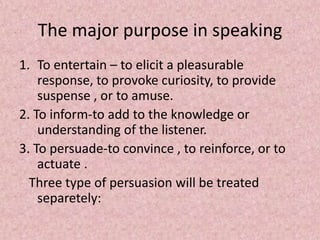
The major purpose in speaking
1. To entertain – to elicit a pleasurable
response, to provoke curiosity, to provide
suspense , or to amuse.
2. To inform-to add to the knowledge or
understanding of the listener.
3. To persuade-to convince , to reinforce, or to
actuate .
Three type of persuasion will be treated
separetely:
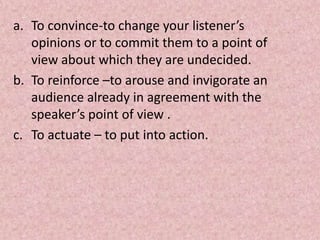
a. To convince-to change your listener’s
opinions or to commit them to a point of
view about which they are undecided.
b. To reinforce –to arouse and invigorate an
audience already in agreement with the
speaker’s point of view .
c. To actuate – to put into action.

Ways to improve listening

  • 1.
    WAYS TO IMPROVELISTENING 1.Prepare to listen The first thing to do before attending a speech or lecture is to prepare yourself to listen. This means knowing something about the subject before hand so that you can listen actively rather than passively. The first step in preparing to listen is to determine the subject from the title of the speech or lecture.if your knowledge is limited, you can go to the library or read your textbook to obtain information that will help your better understand what the speaker has to say.
  • 2.
    2.Avoid Distraction Distractions caninterfere with concentration and make it difficult to listen. To limit external distractions , arrive early enough to get a centrally located seat close to the speaker. Avoid sitting near windows or an entrance or exit. 3.Identify the Central Idea If the speech or lecture you are listening to has been well prepared, the central idea should become immediatelly apparent. You might get a clue as to the central idea from the title or the purpose.
  • 3.
    4. Identify theMain Points The listener’s job is to sort out these main points from the supporting materials. This takes thinking and concentration. Identifying main points,listen for signals: ‘’some of the reasons that’’..or ‘’in addition. 5.Think along with the speaker As you are listening , try to reconstruct the organizational pattern of the speech. Determine if the speaker is supporting each new idea with a variety of supporting materials. Relate what the speaker is saying to your own knowledge and interest. Responding to the speech in this way will not only improve your active listening but will provide insight.
  • 4.
    6.Take effective notes Takeeffective notes is an excellent way to improve your listening. It takes clear thinking and concentration to sort out main ideas from supporting details.
  • 5.
    Note Taking Tips 1.Writedown only iportant ideas A good speech is planned around a central idea an several main points. Listen for signals that indicate that main ideas are forthcoming . Words like : specifically , further , and first indicate that a speaker is moving from one point to another. 2.Write legibly Sometime notes takers write so hurriedly that when they finish, they can’t read their own notes.
  • 6.
    3. Keep up Ifyou find that you are falling behind in your note taking, skip a few lines and begin again. 4. Use your own words When you translate the ideas of another into your own vocabulary, they will be easier to understand and remember. 5.Be brief A common mistake among inexperienced note takers is the tendencyto write down too much. A set of notes should be a summary of a speaker’s main ideas.
  • 7.
    6. Don’t erase Drawa line through the mistake and continue. If you want your notes to be neat, you can rewrite or type them later. 7. Don’t worry about spelling If you’re not sure about how a word is spelled, write it phonetically. You can check the spelling later when you expand your notes. 8. Date your notes When you are taking notes, you should get into the habit of dating them. This will enable you to pinpoint a missed lecture or the specific date of a speech.
  • 8.
    9. Expand yournotes The notes will help you for remember information or to aid in studying for an exam , it is wise to expand them as soon after a lecture as possible. You aim as a speaker should be to fulfill a purpose by achieving a desired response. Your succes in informing , entertaining, or persuading must always be measured in terms of the response your receiver gives to yur message
  • 9.
    The major purposein speaking 1. To entertain – to elicit a pleasurable response, to provoke curiosity, to provide suspense , or to amuse. 2. To inform-to add to the knowledge or understanding of the listener. 3. To persuade-to convince , to reinforce, or to actuate . Three type of persuasion will be treated separetely:
  • 10.
    a. To convince-tochange your listener’s opinions or to commit them to a point of view about which they are undecided. b. To reinforce –to arouse and invigorate an audience already in agreement with the speaker’s point of view . c. To actuate – to put into action.