Case Study:
Blue Nile &
Diamond
Retailing
Group 15:
1802073 – Kapil Gavali
1802074 – Gowtham M
1802075 – Lionel Gracias
1802076 – Venkatesh G
1802077 – Harish N
1
Summary of Case:
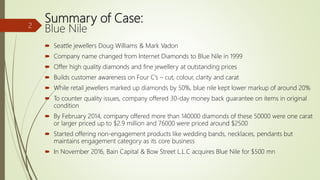
Blue Nile
 Seattle jewellers Doug Williams & Mark Vadon
 Company name changed from Internet Diamonds to Blue Nile in 1999
 Offer high quality diamonds and fine jewellery at outstanding prices
 Builds customer awareness on Four C’s – cut, colour, clarity and carat
 While retail jewellers marked up diamonds by 50%, blue nile kept lower markup of around 20%
 To counter quality issues, company offered 30-day money back guarantee on items in original
condition
 By February 2014, company offered more than 140000 diamonds of these 50000 were one carat
or larger priced up to $2.9 million and 76000 were priced around $2500
 Started offering non-engagement products like wedding bands, necklaces, pendants but
maintains engagement category as its core business
 In November 2016, Bain Capital & Bow Street L.L.C acquires Blue Nile for $500 mn
2
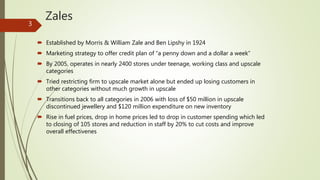
Zales
 Established by Morris & William Zale and Ben Lipshy in 1924
 Marketing strategy to offer credit plan of “a penny down and a dollar a week”
 By 2005, operates in nearly 2400 stores under teenage, working class and upscale
categories
 Tried restricting firm to upscale market alone but ended up losing customers in
other categories without much growth in upscale
 Transitions back to all categories in 2006 with loss of $50 million in upscale
discontinued jewellery and $120 million expenditure on new inventory
 Rise in fuel prices, drop in home prices led to drop in customer spending which led
to closing of 105 stores and reduction in staff by 20% to cut costs and improve
overall effectivenes
3
Tiffany & Co.
 Opened in 1837 as stationery and fancy goods emporium in New York
 Received tremendous success with its silver designs
 In 1886 introduced now famous, “tiffany setting” for solitaire engagement rings
 Offers high end products including diamond rings, wedding bands and gemstone jewellery
 By 2012 expanded to 275 stores worldwide (90% stores operate in US)
 High end products, including jewellery, were sold primarily through retail stores
 Direct channel focused on non-gemstone sterling silver jewellery with average price tag of $200
were sold online
 In 2003, it established diamond-processing operations in several countries
 By 2007, it sourced almost 60% of its jewellery from internal manufacturing facilities
 For 2012, 90% of its net sales came from jewellery, with approximately 48% net sales coming from
diamonds
 Tiffany brand enjoys relatively higher margins, company lays emphasis on maintaining strong
brand with any dilution leading to significant negative impacts on its margins
4
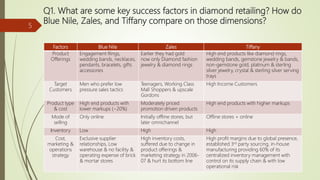
Q1. What are some key success factors in diamond retailing? How do
Blue Nile, Zales, and Tiffany compare on those dimensions?
Factors Blue Nile Zales Tiffany
Product
Offerings
Engagement Rings,
wedding bands, necklaces,
pendants, bracelets, gifts
accessories
Earlier they had gold
now only Diamond fashion
jewelry & diamond rings
High end products like diamond rings,
wedding bands, gemstone jewelry & bands,
non-gemstone gold, platinum & sterling
silver jewelry, crystal & sterling silver serving
trays
Target
Customers
Men who prefer low
pressure sales tactics
Teenagers, Working Class
Mall Shoppers & upscale
Gordons
High Income Customers
Product type
& cost
High end products with
lower markups (~20%)
Moderately priced
promotion driven products
High end products with higher markups
Mode of
selling
Only online Initially offline stores, but
later omnichannel
Offline stores + online
Inventory Low High High
Cost,
marketing &
operations
strategy
Exclusive supplier
relationships, Low
warehouse & no facility &
operating expense of brick
& mortar stores
High inventory costs,
suffered due to change in
product offerings &
marketing strategy in 2006-
07 & hurt its bottom line
High profit margins due to global presence,
established 3rd party sourcing, in-house
manufacturing providing 60% of its
centralized inventory management with
control on its supply chain & with low
operational risk
5
Q2. What do you think of the fact that Blue Nile carries about 30,000
stones priced at $2,500 or higher while almost 60 percent of the
products sold from the Tiffany Web site are priced around $200?
Which of the two product categories is better suited to the online
channel?
 Blue Nile – The Reasons are:
 Savings in inventory holding cost due to lower safety stocks.
 The broad product variety and product availability that the firm can offer customers.
 Stones priced at $2,500 or higher are unique, high-value items with relatively low demand and
high demand variability.The high demand variability necessitates carrying larger safety stock in
order to meet required customer service levels.
 Cost of holding high price stones is proportionally higher.
 Aggregating inventory reduces the amount of safety stock required since the demand variability is
less than in a disaggregated scenario.
 By aggregating the inventory in the online channel, Blue Nile also broadens the product
availability and variety available to customers which is a smart move
6
 Tiffany – The Reasons are:
 The Tiffany brand is built on the glamour, luxury, and quality that customers perceive when visiting a
Tiffany store
 Inventory includes items ranging from very high-end diamond jewelry to tableware
 Has stores as small as 1,300 square feet to those about 2,000 square feet selling high-margin
products
 There is a push towards smaller facilities and lower cost
 Benefits are:
 It’s advantageous to position the high-end luxury products at the store and move the D items to the
online channel
 Able to to utilize the limited facility space to highlight the high-end items
 Able to provide customer service and offers for the lower-end items
 Helps to lower safety stocl for D-Items
7
 Better category for online channel
 Blue Nile has an advantage and is well suited for online channel because their primary focus is
to offer a variety of diamonds online while reducing cost
 Tiffany is at a cost disadvantage relative to Blue Nile because Tiffany decentralizes its high-
value items with low demand and high variety while centralizing its lower-value items.
This can be justified as long as Tiffany can maintain its strong brand and associate it with the
store experience.
8
Q3. What do you think of Tiffany’s decision to not sell engagement
rings online? What do you think of Blue Nile’s growth into non-
engagement category?
 Reasons for Tiffany not selling engagement rings online
 Prevent brand dilution by competing online
 Sustain margins, since going online requires reducing price
 Already invested in retail stores with 275 stores and boutiques
 Increase foot-fall in retail stores to increase sales of high price items
 If engagement rings priced at $2000 are sold online, existing items priced at $200 might lose
customers
 Analysis of Blue Nile’s growth in non-engagement category
 Increases target customers
 If margins are kept low (like engagement rings), has potential to capture significant market share
 Has the potential to boost sales by marketing bundled items (wedding engagement ring +
wedding bands, birthday  pendant + rings etc..,)
9
Q4. Given that tiffany stores have thrived with their focus on selling
high-end jewellery, what do you think caused the failure of Zales’
upscale strategy in 2006? What products should Zale focus on?
 Zales Background and Brand Image
 Middle America was Zales target market since its founding in 1924.
 Large portion of companies revenue came from value-oriented customers who frequented the
malls
 Customers had a value for money perception of Zales brand
 Along with that Zales also got the inexpensive tag
 Reason for failure of Zales upscale strategy
 The firm drastically changed its portfolio of products
 There were 15% new suppliers in the supply chain network
 The strategy to bring high end jewelry to its store raised inventory costs
 Low margin strategy did not earn higher profit even though sales were higher then tiffany’s
10
Q5. Which of the three companies do you think is best structured to
deal with weak economic times?
 Reasons for Blue Nile to be best suited to deal with weak economic times
 Blue Nile has low fixed cost
 Both Zales and Tiffany are tied up in many medium and long term leases
 Blue Nile has very low investment compared to other two companies
 Blue Nile has a low cost structure, that is well suited if demand shrink
 Situation of other two companies is worse comparatively
 Zales is perhaps the weakest postion to handle the weak economic situation, since its high end
strategy failed it had to write off inventory.
 Tiffany is stronger company but its high fixed cost will be severely affected if there is a significant
drop in sales as the costs will not be covered.
Blue Nile Tiffany Zales
Fixed Costs 2.38 13.93 25.46
11
Q6. What advice would you give to each of the three companies
regarding its strategy and structure? How can they best use omni-
channel retail?
 Blue Nile
 It has a strategy that focuses on lower prices on a large variety of high-end stones that aligns very
well with its centralized structure.
 Its marketing focus on convincing customers that the four Cs and third-party validation are the
key ingredients when valuing a diamond is also well aligned with its structure, which does not
allow customers to touch and see the stone before buying.
 Given its significant cost advantages and customers tendency to try to save money during difficult
times.
 Blue Nile has a significant opportunity in this downturn. Blue Nile can take an aggressive position,
emphasizing its lower prices with similar quality to very high-end diamond retailers.
 Although this is a difficult message to sell in general, it may be easier in the difficult economic
environment of 2009.
12
 Zales
 It's positive recommendations are more difficult to make.
 From a financial perspective, Zales needs to get control of its inventories.
 One way to do this is to centralize more of its expensive diamond inventory, making it available to
stores as needed.
 Lower-value diamonds could be stocked and sold from retail stores.
 For higher-end diamonds, rings with imitation stones could be used to help customers select a style,
followed by having the real diamond installed later at a central location and shipped to the store for
customer pick-up.
 Zales’s ideal situation seems to be one in which it stocks and sells lower-cost products from
decentralized locations with higher-value stones centralized and provided on demand.
 It cannot centralize its high-end stones because that would conflict with its brand image.
 Pricing pressure at retail is likely to continue with the growth of Blue Nile at the high end and
retailers such as Wal-Mart and Costco at the lower end. As a result, Tiffany has to continue working
hard to maintain its brand image.
 Its move into the wholesale part of the diamond business has potential pluses it gives the company
the wholesale margin and could give it some form of exclusivity on its stones.
 For now, its sources of stones are very similar to those of its competitors
13
 Tiffany
 It cannot centralize its high-end stones because that would conflict with its brand image.
 Pricing pressure at retail is likely to continue with the growth of Blue Nile at the high end and
retailers such as Wal-Mart and Costco at the lower end. As a result, Tiffany has to continue working
hard to maintain its brand image.
 Its move into the wholesale part of the diamond business has potential plus it gives the company
the wholesale margin and could give it some form of exclusivity on its stones.
 For now, its sources of stones are very similar to those of its competitors.
14

Blue Nile & Diamond Retailing

  • 1.
    Case Study: Blue Nile& Diamond Retailing Group 15: 1802073 – Kapil Gavali 1802074 – Gowtham M 1802075 – Lionel Gracias 1802076 – Venkatesh G 1802077 – Harish N 1
  • 2.
    Summary of Case: BlueNile  Seattle jewellers Doug Williams & Mark Vadon  Company name changed from Internet Diamonds to Blue Nile in 1999  Offer high quality diamonds and fine jewellery at outstanding prices  Builds customer awareness on Four C’s – cut, colour, clarity and carat  While retail jewellers marked up diamonds by 50%, blue nile kept lower markup of around 20%  To counter quality issues, company offered 30-day money back guarantee on items in original condition  By February 2014, company offered more than 140000 diamonds of these 50000 were one carat or larger priced up to $2.9 million and 76000 were priced around $2500  Started offering non-engagement products like wedding bands, necklaces, pendants but maintains engagement category as its core business  In November 2016, Bain Capital & Bow Street L.L.C acquires Blue Nile for $500 mn 2
  • 3.
    Zales  Established byMorris & William Zale and Ben Lipshy in 1924  Marketing strategy to offer credit plan of “a penny down and a dollar a week”  By 2005, operates in nearly 2400 stores under teenage, working class and upscale categories  Tried restricting firm to upscale market alone but ended up losing customers in other categories without much growth in upscale  Transitions back to all categories in 2006 with loss of $50 million in upscale discontinued jewellery and $120 million expenditure on new inventory  Rise in fuel prices, drop in home prices led to drop in customer spending which led to closing of 105 stores and reduction in staff by 20% to cut costs and improve overall effectivenes 3
  • 4.
    Tiffany & Co. Opened in 1837 as stationery and fancy goods emporium in New York  Received tremendous success with its silver designs  In 1886 introduced now famous, “tiffany setting” for solitaire engagement rings  Offers high end products including diamond rings, wedding bands and gemstone jewellery  By 2012 expanded to 275 stores worldwide (90% stores operate in US)  High end products, including jewellery, were sold primarily through retail stores  Direct channel focused on non-gemstone sterling silver jewellery with average price tag of $200 were sold online  In 2003, it established diamond-processing operations in several countries  By 2007, it sourced almost 60% of its jewellery from internal manufacturing facilities  For 2012, 90% of its net sales came from jewellery, with approximately 48% net sales coming from diamonds  Tiffany brand enjoys relatively higher margins, company lays emphasis on maintaining strong brand with any dilution leading to significant negative impacts on its margins 4
  • 5.
    Q1. What aresome key success factors in diamond retailing? How do Blue Nile, Zales, and Tiffany compare on those dimensions? Factors Blue Nile Zales Tiffany Product Offerings Engagement Rings, wedding bands, necklaces, pendants, bracelets, gifts accessories Earlier they had gold now only Diamond fashion jewelry & diamond rings High end products like diamond rings, wedding bands, gemstone jewelry & bands, non-gemstone gold, platinum & sterling silver jewelry, crystal & sterling silver serving trays Target Customers Men who prefer low pressure sales tactics Teenagers, Working Class Mall Shoppers & upscale Gordons High Income Customers Product type & cost High end products with lower markups (~20%) Moderately priced promotion driven products High end products with higher markups Mode of selling Only online Initially offline stores, but later omnichannel Offline stores + online Inventory Low High High Cost, marketing & operations strategy Exclusive supplier relationships, Low warehouse & no facility & operating expense of brick & mortar stores High inventory costs, suffered due to change in product offerings & marketing strategy in 2006- 07 & hurt its bottom line High profit margins due to global presence, established 3rd party sourcing, in-house manufacturing providing 60% of its centralized inventory management with control on its supply chain & with low operational risk 5
  • 6.
    Q2. What doyou think of the fact that Blue Nile carries about 30,000 stones priced at $2,500 or higher while almost 60 percent of the products sold from the Tiffany Web site are priced around $200? Which of the two product categories is better suited to the online channel?  Blue Nile – The Reasons are:  Savings in inventory holding cost due to lower safety stocks.  The broad product variety and product availability that the firm can offer customers.  Stones priced at $2,500 or higher are unique, high-value items with relatively low demand and high demand variability.The high demand variability necessitates carrying larger safety stock in order to meet required customer service levels.  Cost of holding high price stones is proportionally higher.  Aggregating inventory reduces the amount of safety stock required since the demand variability is less than in a disaggregated scenario.  By aggregating the inventory in the online channel, Blue Nile also broadens the product availability and variety available to customers which is a smart move 6
  • 7.
     Tiffany –The Reasons are:  The Tiffany brand is built on the glamour, luxury, and quality that customers perceive when visiting a Tiffany store  Inventory includes items ranging from very high-end diamond jewelry to tableware  Has stores as small as 1,300 square feet to those about 2,000 square feet selling high-margin products  There is a push towards smaller facilities and lower cost  Benefits are:  It’s advantageous to position the high-end luxury products at the store and move the D items to the online channel  Able to to utilize the limited facility space to highlight the high-end items  Able to provide customer service and offers for the lower-end items  Helps to lower safety stocl for D-Items 7
  • 8.
     Better categoryfor online channel  Blue Nile has an advantage and is well suited for online channel because their primary focus is to offer a variety of diamonds online while reducing cost  Tiffany is at a cost disadvantage relative to Blue Nile because Tiffany decentralizes its high- value items with low demand and high variety while centralizing its lower-value items. This can be justified as long as Tiffany can maintain its strong brand and associate it with the store experience. 8
  • 9.
    Q3. What doyou think of Tiffany’s decision to not sell engagement rings online? What do you think of Blue Nile’s growth into non- engagement category?  Reasons for Tiffany not selling engagement rings online  Prevent brand dilution by competing online  Sustain margins, since going online requires reducing price  Already invested in retail stores with 275 stores and boutiques  Increase foot-fall in retail stores to increase sales of high price items  If engagement rings priced at $2000 are sold online, existing items priced at $200 might lose customers  Analysis of Blue Nile’s growth in non-engagement category  Increases target customers  If margins are kept low (like engagement rings), has potential to capture significant market share  Has the potential to boost sales by marketing bundled items (wedding engagement ring + wedding bands, birthday  pendant + rings etc..,) 9
  • 10.
    Q4. Given thattiffany stores have thrived with their focus on selling high-end jewellery, what do you think caused the failure of Zales’ upscale strategy in 2006? What products should Zale focus on?  Zales Background and Brand Image  Middle America was Zales target market since its founding in 1924.  Large portion of companies revenue came from value-oriented customers who frequented the malls  Customers had a value for money perception of Zales brand  Along with that Zales also got the inexpensive tag  Reason for failure of Zales upscale strategy  The firm drastically changed its portfolio of products  There were 15% new suppliers in the supply chain network  The strategy to bring high end jewelry to its store raised inventory costs  Low margin strategy did not earn higher profit even though sales were higher then tiffany’s 10
  • 11.
    Q5. Which ofthe three companies do you think is best structured to deal with weak economic times?  Reasons for Blue Nile to be best suited to deal with weak economic times  Blue Nile has low fixed cost  Both Zales and Tiffany are tied up in many medium and long term leases  Blue Nile has very low investment compared to other two companies  Blue Nile has a low cost structure, that is well suited if demand shrink  Situation of other two companies is worse comparatively  Zales is perhaps the weakest postion to handle the weak economic situation, since its high end strategy failed it had to write off inventory.  Tiffany is stronger company but its high fixed cost will be severely affected if there is a significant drop in sales as the costs will not be covered. Blue Nile Tiffany Zales Fixed Costs 2.38 13.93 25.46 11
  • 12.
    Q6. What advicewould you give to each of the three companies regarding its strategy and structure? How can they best use omni- channel retail?  Blue Nile  It has a strategy that focuses on lower prices on a large variety of high-end stones that aligns very well with its centralized structure.  Its marketing focus on convincing customers that the four Cs and third-party validation are the key ingredients when valuing a diamond is also well aligned with its structure, which does not allow customers to touch and see the stone before buying.  Given its significant cost advantages and customers tendency to try to save money during difficult times.  Blue Nile has a significant opportunity in this downturn. Blue Nile can take an aggressive position, emphasizing its lower prices with similar quality to very high-end diamond retailers.  Although this is a difficult message to sell in general, it may be easier in the difficult economic environment of 2009. 12
  • 13.
     Zales  It'spositive recommendations are more difficult to make.  From a financial perspective, Zales needs to get control of its inventories.  One way to do this is to centralize more of its expensive diamond inventory, making it available to stores as needed.  Lower-value diamonds could be stocked and sold from retail stores.  For higher-end diamonds, rings with imitation stones could be used to help customers select a style, followed by having the real diamond installed later at a central location and shipped to the store for customer pick-up.  Zales’s ideal situation seems to be one in which it stocks and sells lower-cost products from decentralized locations with higher-value stones centralized and provided on demand.  It cannot centralize its high-end stones because that would conflict with its brand image.  Pricing pressure at retail is likely to continue with the growth of Blue Nile at the high end and retailers such as Wal-Mart and Costco at the lower end. As a result, Tiffany has to continue working hard to maintain its brand image.  Its move into the wholesale part of the diamond business has potential pluses it gives the company the wholesale margin and could give it some form of exclusivity on its stones.  For now, its sources of stones are very similar to those of its competitors 13
  • 14.
     Tiffany  Itcannot centralize its high-end stones because that would conflict with its brand image.  Pricing pressure at retail is likely to continue with the growth of Blue Nile at the high end and retailers such as Wal-Mart and Costco at the lower end. As a result, Tiffany has to continue working hard to maintain its brand image.  Its move into the wholesale part of the diamond business has potential plus it gives the company the wholesale margin and could give it some form of exclusivity on its stones.  For now, its sources of stones are very similar to those of its competitors. 14