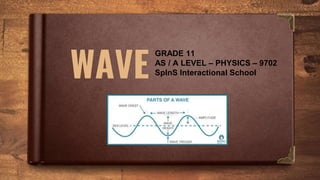
WAVE
GRADE 11
AS / A LEVEL – PHYSICS – 9702
SpInS Interactional School
Progressive Waves
2
Wave Motion
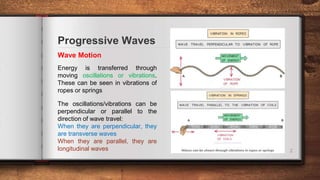
Energy is transferred through
moving oscillations or vibrations.
These can be seen in vibrations of
ropes or springs
The oscillations/vibrations can be
perpendicular or parallel to the
direction of wave travel:
When they are perpendicular, they
are transverse waves
When they are parallel, they are
longitudinal waves
3
Ripple tanks
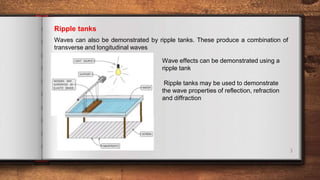
Waves can also be demonstrated by ripple tanks. These produce a combination of
transverse and longitudinal waves
Wave effects can be demonstrated using a
ripple tank
Ripple tanks may be used to demonstrate
the wave properties of reflection, refraction
and diffraction
4
General Wave Properties
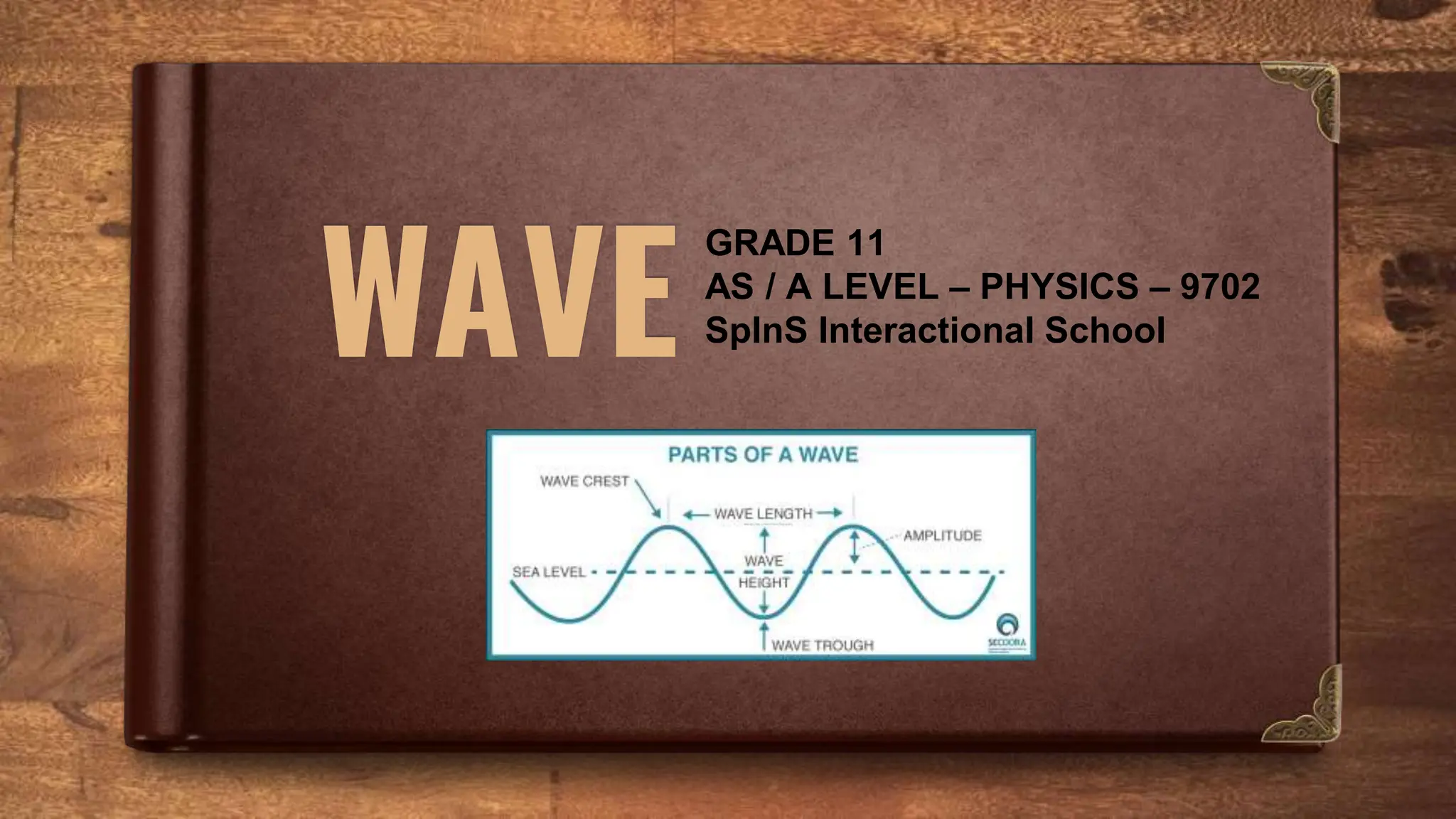
Displacement (x) of a wave is the
distance from its equilibrium position. It
is a vector quantity; it can be positive
or negative
Amplitude (A) is the maximum
displacement of a particle in the wave
from its equilibrium position
Wavelength (λ) is the distance
between points on successive
oscillations of the wave that are in
phase
5
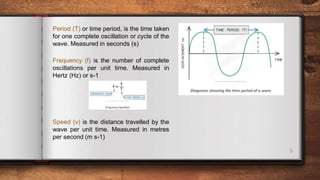
Period (T) or time period, is the time taken
for one complete oscillation or cycle of the
wave. Measured in seconds (s)
Frequency (f) is the number of complete
oscillations per unit time. Measured in
Hertz (Hz) or s-1
Speed (v) is the distance travelled by the
wave per unit time. Measured in metres
per second (m s-1)
6
Phase
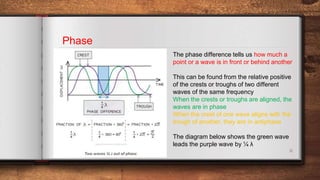
The phase difference tells us how much a
point or a wave is in front or behind another
This can be found from the relative positive
of the crests or troughs of two different
waves of the same frequency
When the crests or troughs are aligned, the
waves are in phase
When the crest of one wave aligns with the
trough of another, they are in antiphase
The diagram below shows the green wave
leads the purple wave by ¼ λ
7
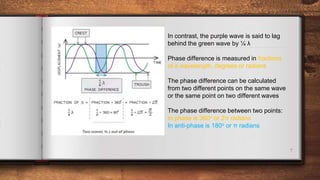
In contrast, the purple wave is said to lag
behind the green wave by ¼ λ
Phase difference is measured in fractions
of a wavelength, degrees or radians
The phase difference can be calculated
from two different points on the same wave
or the same point on two different waves
The phase difference between two points:
In phase is 360o or 2π radians
In anti-phase is 180o or π radians
8
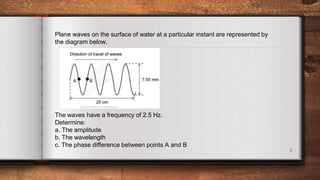
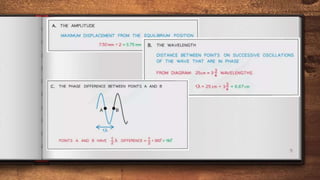
Plane waves on the surface of water at a particular instant are represented by
the diagram below.
The waves have a frequency of 2.5 Hz.
Determine:
a. The amplitude
b. The wavelength
c. The phase difference between points A and B
9
Wave Energy
10
Waves transfer energy between points, without transferring matter
When a wave travels between two points, no matter actually travels with it:
The points on the wave simply vibrate back and forth about fixed positions
Waves that transfer energy are known as progressive waves
Waves that do not transfer energy are known as stationary waves
11
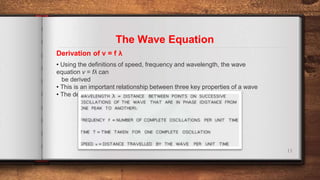
Derivation of v = f λ
The Wave Equation
• Using the definitions of speed, frequency and wavelength, the wave
equation v = fλ can
be derived
• This is an important relationship between three key properties of a wave
• The derivation for this is shown below
12
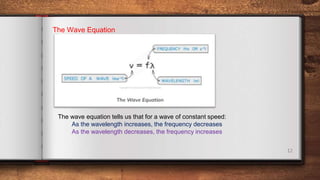
The Wave Equation
The wave equation tells us that for a wave of constant speed:
As the wavelength increases, the frequency decreases
As the wavelength decreases, the frequency increases
13
14
15
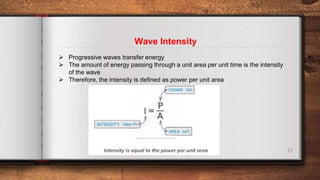
Wave Intensity
 Progressive waves transfer energy
 The amount of energy passing through a unit area per unit time is the intensity
of the wave
 Therefore, the intensity is defined as power per unit area
16
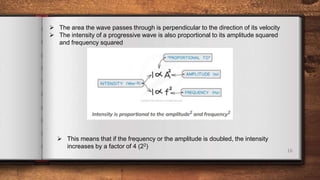
 The area the wave passes through is perpendicular to the direction of its velocity
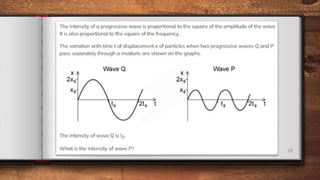
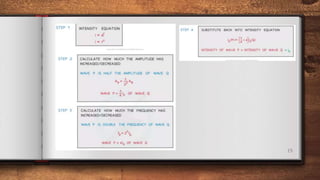
 The intensity of a progressive wave is also proportional to its amplitude squared
and frequency squared
 This means that if the frequency or the amplitude is doubled, the intensity
increases by a factor of 4 (22)
17
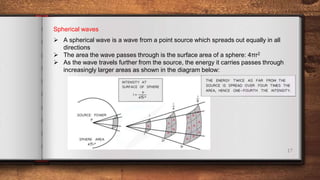
Spherical waves
 A spherical wave is a wave from a point source which spreads out equally in all
directions
 The area the wave passes through is the surface area of a sphere: 4πr2
 As the wave travels further from the source, the energy it carries passes through
increasingly larger areas as shown in the diagram below:
18
19

progressive wave - a level - 9702 - cambridge curriculum

  • 1.
    WAVE GRADE 11 AS /A LEVEL – PHYSICS – 9702 SpInS Interactional School
  • 2.
    Progressive Waves 2 Wave Motion Energyis transferred through moving oscillations or vibrations. These can be seen in vibrations of ropes or springs The oscillations/vibrations can be perpendicular or parallel to the direction of wave travel: When they are perpendicular, they are transverse waves When they are parallel, they are longitudinal waves
  • 3.
    3 Ripple tanks Waves canalso be demonstrated by ripple tanks. These produce a combination of transverse and longitudinal waves Wave effects can be demonstrated using a ripple tank Ripple tanks may be used to demonstrate the wave properties of reflection, refraction and diffraction
  • 4.
    4 General Wave Properties Displacement(x) of a wave is the distance from its equilibrium position. It is a vector quantity; it can be positive or negative Amplitude (A) is the maximum displacement of a particle in the wave from its equilibrium position Wavelength (λ) is the distance between points on successive oscillations of the wave that are in phase
  • 5.
    5 Period (T) ortime period, is the time taken for one complete oscillation or cycle of the wave. Measured in seconds (s) Frequency (f) is the number of complete oscillations per unit time. Measured in Hertz (Hz) or s-1 Speed (v) is the distance travelled by the wave per unit time. Measured in metres per second (m s-1)
  • 6.
    6 Phase The phase differencetells us how much a point or a wave is in front or behind another This can be found from the relative positive of the crests or troughs of two different waves of the same frequency When the crests or troughs are aligned, the waves are in phase When the crest of one wave aligns with the trough of another, they are in antiphase The diagram below shows the green wave leads the purple wave by ¼ λ
  • 7.
    7 In contrast, thepurple wave is said to lag behind the green wave by ¼ λ Phase difference is measured in fractions of a wavelength, degrees or radians The phase difference can be calculated from two different points on the same wave or the same point on two different waves The phase difference between two points: In phase is 360o or 2π radians In anti-phase is 180o or π radians
  • 8.
    8 Plane waves onthe surface of water at a particular instant are represented by the diagram below. The waves have a frequency of 2.5 Hz. Determine: a. The amplitude b. The wavelength c. The phase difference between points A and B
  • 9.
  • 10.
    Wave Energy 10 Waves transferenergy between points, without transferring matter When a wave travels between two points, no matter actually travels with it: The points on the wave simply vibrate back and forth about fixed positions Waves that transfer energy are known as progressive waves Waves that do not transfer energy are known as stationary waves
  • 11.
    11 Derivation of v= f λ The Wave Equation • Using the definitions of speed, frequency and wavelength, the wave equation v = fλ can be derived • This is an important relationship between three key properties of a wave • The derivation for this is shown below
  • 12.
    12 The Wave Equation Thewave equation tells us that for a wave of constant speed: As the wavelength increases, the frequency decreases As the wavelength decreases, the frequency increases
  • 13.
  • 14.
  • 15.
    15 Wave Intensity  Progressivewaves transfer energy  The amount of energy passing through a unit area per unit time is the intensity of the wave  Therefore, the intensity is defined as power per unit area
  • 16.
    16  The areathe wave passes through is perpendicular to the direction of its velocity  The intensity of a progressive wave is also proportional to its amplitude squared and frequency squared  This means that if the frequency or the amplitude is doubled, the intensity increases by a factor of 4 (22)
  • 17.
    17 Spherical waves  Aspherical wave is a wave from a point source which spreads out equally in all directions  The area the wave passes through is the surface area of a sphere: 4πr2  As the wave travels further from the source, the energy it carries passes through increasingly larger areas as shown in the diagram below:
  • 18.
  • 19.