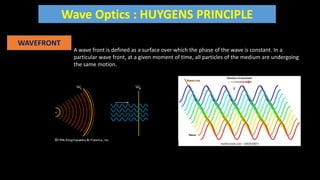
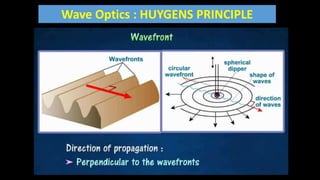
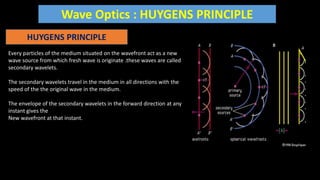
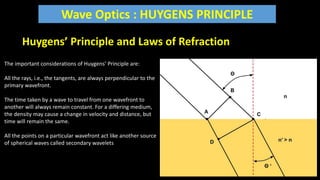
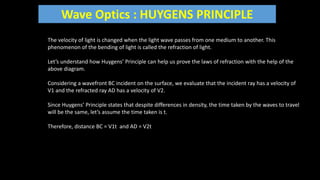
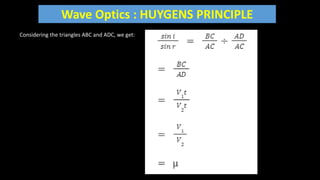
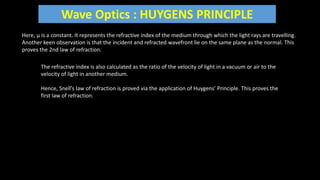
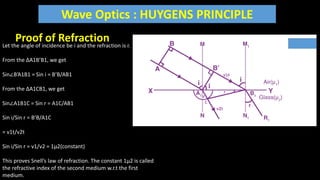
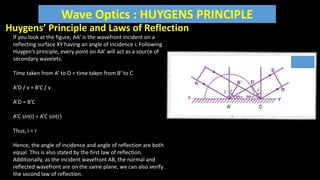
Huygens' principle states that every point on a wavefront can be considered a source of secondary wavelets. The new wavefront is determined by the envelope of these secondary wavelets. Huygens used this principle to explain the laws of reflection and refraction. For refraction, the principle implies that the time taken for a wave to travel between two wavefronts is constant, regardless of the medium. This leads to Snell's law relating the sines of the angles of incidence and refraction to the ratio of velocities in each medium. For reflection, the principle shows that the angles of incidence and reflection are equal, in accordance with the first law of reflection.