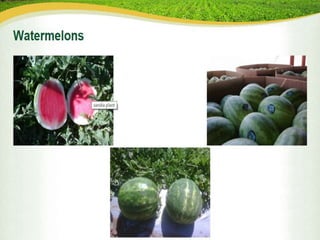
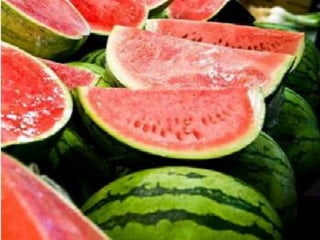
WATERMELON
• Pakistan is generally self sufficient in the production of
water melons.
• With the arrival of summer the natural gifts from the
nature also come to the aid of people struggling with
the scorching heat and harsh sunshine, one of the
useful fruits of the summer is the water melon.
• The water melon is usually consumed in the peak of
summer in the months of April, May and June.
• It is generally recommended not to consume water
melon in the rainy season as it can cause more
problem than benefit.
• But in the peak of summer it is a great blessing
and reduces the body heat to a great level.
• Usually it is consumed after being placed in the
refrigerator for at least couple of hours.
• Consuming it early in the morning with empty
stomach is very useful for the health.
• Water melon is very good for the patients having
liver problem as this gives a cool effect on the
liver and general body and has a lot of water
inside it.
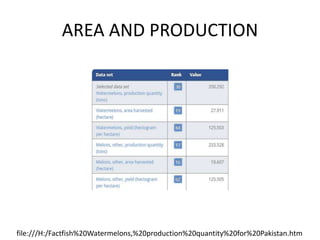
AREA AND PRODUCTION
file:///H:/Factfish%20Watermelons,%20production%20quantity%20for%20Pakistan.htm
PAKISTAN POSITION IN WORLD
Pakistan is on no.30 in the world ranking in the
production of watermelon.
Top ten ( 5 ) countries in the
world are
1. china
2.iran
3.turkey
4.brazil
5.egypt
file:///H:/Factfish%20Watermelons,%20production%20quantity%20for%20Pakistan.html
Comparison of Pakistan with other
countries
file:///H:/Factfish%20Watermelons,%20production%20quantity%20for%20Pakistan.html
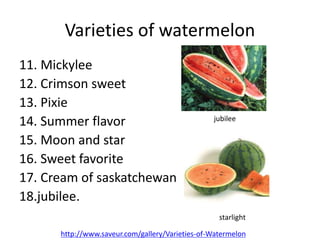
Varieties of watermelon
There are 18 varieties of watermelon on the basis of taste,
texture, color, and size given below
1. Sugar baby
2. Sangria
3. Golden midget
4. Starlight
5. Starbrite
6. Extazy
7. Stars n trip
8. Yellow baby
9. Yellow doll
10. Little baby flower.
sugar baby watermelon
Golden-Midget
sangria
http://www.saveur.com/gallery/Varieties-of-Watermelon
Varieties of watermelon
11. Mickylee
12. Crimson sweet
13. Pixie
14. Summer flavor
15. Moon and star
16. Sweet favorite
17. Cream of saskatchewan
18.jubilee.
jubilee
starlight
http://www.saveur.com/gallery/Varieties-of-Watermelon
MATURITY ASSESMENT
• Watermelon are considered optimum for
eating when their flesh mature to produce a
sweet flavor.
• And crisp texture.
• Deep red color.
• External rind appearance does not always
predict good internal flesh quality and full
maturity.
QUALITY INDICES
• Watermelon should be symmetrical and
uniform in appearance.
• The surface should be waxy and and bright in
appearance.
• No evidence of bruising.
• Appears heavy for size.
• Absence of scars , sunburn, or other surface
defects or dirt.
HARVESTING
• Watermelon don’t sweeten after they are picked,
harvest time is important.
• Thump it, if the watermelon sound hollow , it’s ripe.
• Look at the color at bottom, a green watermelon have
a white color at bottom. And a ripe melon will have
cream or yellow colored bottom.
• Stem should be cut with a sharp kinfe close to the fruit.
• Watermelon can be stored uncut for about 10 days, if
cut they can last in the refrigerator for 4 days.
HARVESTING METHOD
• Watermelon are harvested by clipping the
stem with help of sharp clippers , or sharp
kinfe.
• The stem is cut as short as possible to avoid
mechanical injury.
Handling
• Rough handling due to carelessness and haste during
harvest will cause damage and quality loss.
• Loaders on the ground should hand pass melons to
stackers who carefully place them in the load.
• Pitching melons often results in their being dropped or
rolled onto the load .
• Never stack melons on their ends, because the thin
blossom end is the most susceptible area for bruising.
A drop of only 8 inches can result in severe internal
bruising; a 1-foot drop can crack the flesh internally or
split the melon open.
Handling
The conveyor belt loading
watermelons onto the traile.
Handling
Damage results when loaders pitch melons
on top of the field load
Handling
Padding protects melons from damage as
they are loaded and hauled from the truck.
PACKING OF WATERMELON
• Watermelon are loaded as a bulk shipments or
packed into bins and cartons loaded onto
transport trucks.
• Bulk shipment are loaded adjacent to the
watermelon growing field.
• Bulk loading required protection
of melon from vibration and
load shifting injury during transporting.
PACKING OF WATERMELON
Straw protects against vibration and impact
damage during truck shipment.
Body weight causes bruising and splitting of
watermelon flesh.
Post harvest storage and degreening
• Optimum temperature
10-15 ºcstorage life is typically 14 days at15ºc
With upto 21 days attainable at 7-10ºc
• Optimum relative humidity is about 85-90%
• High relative humidity is generally advisable
to reduce desiccation and loss of glossiness.
• Rate of ethylene rate is
0.1-1.0 micro l/ kg.hr at 20 degree centigrade.
• Response to controlled atmosphere ( CA )
controlled atmosphere storage or shipping are
not recognized as offering controlled benefits
for water melon.
RATE OF RESPIRATION
• The rate of respiration for watermelon is given
below.
DISEASES
Following are the main diseases found in
watermelon.
• Gummy stem blight
• Damping-off
• Anthracnose
• Root-knot nematodes
• Rind necroses
• Fruit blotch
• Watermelon mosaic virus
DISEASES
Rind necrosis
Watermelon fruit blotchWatermelon mosaic virus
REFERENCES
• http://www.lawaonline.com/types-of-watermelon-in-pakistan-picture/
• http://www.factfish.com/statistic-
country/pakistan/watermelons,+production+quantity
• http://edu.par.com.pk/wiki/musk-melon/
• http://edu.par.com.pk/wiki/watermelon/
• http://www.gardeningknowhow.com/edible/fruits/watermelon/pick-a-
watermelon.htm
( harvesting )
• http://www.almanac.com/plant/watermelon
• http://postharvest.ucdavis.edu/PFfruits/Watermelon/
• http://groweralliance.net/products/watermelons/
• http://www.agrisk.umn.edu/cache/ARL01971.htm
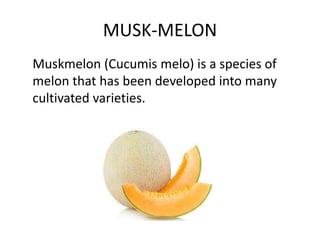
MUSK-MELON
Muskmelon (Cucumis melo) is a species of
melon that has been developed into many
cultivated varieties.
Muskmelon in Pakistan
• Muskmelon is an important crop of Pakistan. It is
grown over an area of 48,214 thousand hectare
with production of 710,326 thousand tons.
(Agricultural statistics of Pakistan, 2009-2010).
• Musk melon (cucumismelo) is a creeping
cucurbit, originated from Iran and Pakistan and is
also cultivated in many warm countries of the
world like India, Thailand, Sri Lanka and
Afghanistan.
Major areas of crop production
The major pockets of musk melon growing are.
1. Thatta
2. Badin
3. Mirpurkhas
4. as well as Bahawalpur
5. and Sahiwal.
6. It is also cultivated in ‘katcha’ areas and is
known as a money-maker crop.
VARIETIES OF MUSKMELON
There are a number of varieties in the world but
in Pakistan, farmers grow only two varieties
i.e.
1. Golden ( Tumma ) and
2. Dharidar ( Gadap ).
VARIETIES OF MUSKMELON
Golden muskmelon Dharidhar muskmelon
Maturity Indices
• Cantaloupes are harvested by maturity and not by size.
• Commercial maturity is ideally at the firm-ripe stage or
"3/4 to full-slip" when a clear abscission (slip,
separation) from the vine occurs with light pressure.
• Cantaloupes ripen after harvest but do not increase in
sugar content .
• Cultivars vary in their external color at this stage of
maturity and may retain a greenish cast.
• This skin color typically transitions from gray to dull
green when immature, deep uniform green at
maturity, and light yellow at full ripeness.
Quality Indices
• Well-shaped nearly spherical and uniform in
appearance
• Smooth stem end with no adhering peduncle
(stem-attachment) which suggests premature
harvest
• Absence of scars, sunburn or surface defects
• Firm with no evidence of bruising or excessive
scuffing
• Appears heavy for size and has firm internal
cavity without loose seeds or liquid accumulation
TEMPERATURE & CONTROLLED
ATMOSPHERE (CA)
• 2.2°C-5°C (36°F-41°F) Storage life is up to 21 days
at 2.2°C (36°F) but sensory quality may be
reduced.
• Typically 12-15 days of shelf life are attainable
within the optimum range. Short term storage or
transit temperatures below this range are used by
some in the trade but may result in chilling injury
after several days [for example,7 days or longer at
temperatures below 2.2°C (36°F)].
Optimum Relative Humidity
• 90%-95%; High relative humidity is essential
to maximize postharvest quality and prevent
desiccation.
• Water loss through scuffed and damaged
surface netting can be significant.
• Extended periods of higher humidity or
condensation may encourage the growth of
stem-scar and surface molds.
Rates of Ethylene Production
• Intact fruit: 40 - 80 µl/kg hr at 20°C (68°F)
• Production Fresh-cut: - 7-10 µl/kg hr at 5°C
(41°F)
Responses to Ethylene
• Cantaloupes are moderately sensitive to
exogenous ethylene and over-ripening may be
a problem during distribution and short-term
storage.
DISORDERS
• Physiological and Physical Disorders
1. Chilling injury.
2. Typically occurs after storage at temperatures
< 2°C Disorders (35.6°F) for several days.
3. Sensitivity to chilling injury decreases as
melon maturity and ripeness increases.
4. Symptoms of chilling injury include pitting or
sunken areas, failure to ripen, off-flavors and
increased surface decay.
POST HARVEST HANDLING
• Sorting and grading
• Packaging
• Storage
• Market preparation
Sorting and grading
• At the packing location, melons are graded,
sorted and packed into
1. crates or
2. cartons according to size for
shipping/marketing
Packaging
• For short-distance shipping or local markets, melons are
often hauled in bulk.
• Several sizes are packed: 12, 15, 18, or 23 melons in a crate
weighing 16 to 18kg.
• The smaller the number, the larger the melons. The 15s are
generally the most desirable .
• Until recently, few cantaloupes were cooled before
shipment.
• However , cooling prior to shipment improves marketability
and increases the time for melons to reach full ripeness,
which extends shelf life.
• Most buyers will be demanding that melons be cooled prior
to shipment.
Packaging
Storage
• Cantaloupes are highly perishable.
• Even when harvested, handled and held under
optimum conditions, they will be of only fair
quality two weeks after harvest.
• If cantaloupes that are half slip to three-
fourths slip are held or stored, they should be
at 2 to 7 °C.
• Ripened cantaloupes (equivalent to full slip)
may be stored at 0 to 2 °C.
Market preparation
• The bulk of the commercial crop is shipped out
and sold on the open market at prevailing prices.
• Many are sold from smaller plantings through
temporary or permanent roadside stands or at
farmers’ markets.
• Although earliness usually results in higher prices,
quality and maturity should be of prime
importance in marketing cantaloupes and other
muskmelons.
REFERENCES
• Coleman, E. 1995. The new organic grower. 2nd edition. Chelsea
Green Publishing.
• McCollum, J.P., Swiager, J.H & Ware, G.W. 1992. Producing
vegetable crops. 4th edition. Danville, Illinois: Interstate Publishing.
• Van Wyk, B.E. 2005. Food plants of the world—identification,
culinary uses and nutritional value. Pretoria: Briza.
• Rubatzky, V.E. & Yamaguchi, M. 1997. World vegetables: principles,
production and nutritive values. 2nd edition. New York: Chapman &
Hall.
• http://learningstore.uwex.edu/assets/pdfs/a3688.pdf
• http://www.overlandingafrica.com/weather/
• http://extension.missouri.edu/publications/DisplayPub.aspx?P=M1
73

Watermelon

  • 3.
    WATERMELON • Pakistan isgenerally self sufficient in the production of water melons. • With the arrival of summer the natural gifts from the nature also come to the aid of people struggling with the scorching heat and harsh sunshine, one of the useful fruits of the summer is the water melon. • The water melon is usually consumed in the peak of summer in the months of April, May and June. • It is generally recommended not to consume water melon in the rainy season as it can cause more problem than benefit.
  • 4.
    • But inthe peak of summer it is a great blessing and reduces the body heat to a great level. • Usually it is consumed after being placed in the refrigerator for at least couple of hours. • Consuming it early in the morning with empty stomach is very useful for the health. • Water melon is very good for the patients having liver problem as this gives a cool effect on the liver and general body and has a lot of water inside it.
  • 5.
  • 6.
    PAKISTAN POSITION INWORLD Pakistan is on no.30 in the world ranking in the production of watermelon. Top ten ( 5 ) countries in the world are 1. china 2.iran 3.turkey 4.brazil 5.egypt file:///H:/Factfish%20Watermelons,%20production%20quantity%20for%20Pakistan.html
  • 7.
    Comparison of Pakistanwith other countries file:///H:/Factfish%20Watermelons,%20production%20quantity%20for%20Pakistan.html
  • 8.
    Varieties of watermelon Thereare 18 varieties of watermelon on the basis of taste, texture, color, and size given below 1. Sugar baby 2. Sangria 3. Golden midget 4. Starlight 5. Starbrite 6. Extazy 7. Stars n trip 8. Yellow baby 9. Yellow doll 10. Little baby flower. sugar baby watermelon Golden-Midget sangria http://www.saveur.com/gallery/Varieties-of-Watermelon
  • 9.
    Varieties of watermelon 11.Mickylee 12. Crimson sweet 13. Pixie 14. Summer flavor 15. Moon and star 16. Sweet favorite 17. Cream of saskatchewan 18.jubilee. jubilee starlight http://www.saveur.com/gallery/Varieties-of-Watermelon
  • 10.
    MATURITY ASSESMENT • Watermelonare considered optimum for eating when their flesh mature to produce a sweet flavor. • And crisp texture. • Deep red color. • External rind appearance does not always predict good internal flesh quality and full maturity.
  • 11.
    QUALITY INDICES • Watermelonshould be symmetrical and uniform in appearance. • The surface should be waxy and and bright in appearance. • No evidence of bruising. • Appears heavy for size. • Absence of scars , sunburn, or other surface defects or dirt.
  • 12.
    HARVESTING • Watermelon don’tsweeten after they are picked, harvest time is important. • Thump it, if the watermelon sound hollow , it’s ripe. • Look at the color at bottom, a green watermelon have a white color at bottom. And a ripe melon will have cream or yellow colored bottom. • Stem should be cut with a sharp kinfe close to the fruit. • Watermelon can be stored uncut for about 10 days, if cut they can last in the refrigerator for 4 days.
  • 13.
    HARVESTING METHOD • Watermelonare harvested by clipping the stem with help of sharp clippers , or sharp kinfe. • The stem is cut as short as possible to avoid mechanical injury.
  • 14.
    Handling • Rough handlingdue to carelessness and haste during harvest will cause damage and quality loss. • Loaders on the ground should hand pass melons to stackers who carefully place them in the load. • Pitching melons often results in their being dropped or rolled onto the load . • Never stack melons on their ends, because the thin blossom end is the most susceptible area for bruising. A drop of only 8 inches can result in severe internal bruising; a 1-foot drop can crack the flesh internally or split the melon open.
  • 15.
    Handling The conveyor beltloading watermelons onto the traile.
  • 16.
    Handling Damage results whenloaders pitch melons on top of the field load
  • 17.
    Handling Padding protects melonsfrom damage as they are loaded and hauled from the truck.
  • 18.
    PACKING OF WATERMELON •Watermelon are loaded as a bulk shipments or packed into bins and cartons loaded onto transport trucks. • Bulk shipment are loaded adjacent to the watermelon growing field. • Bulk loading required protection of melon from vibration and load shifting injury during transporting.
  • 19.
    PACKING OF WATERMELON Strawprotects against vibration and impact damage during truck shipment. Body weight causes bruising and splitting of watermelon flesh.
  • 20.
    Post harvest storageand degreening • Optimum temperature 10-15 ºcstorage life is typically 14 days at15ºc With upto 21 days attainable at 7-10ºc • Optimum relative humidity is about 85-90% • High relative humidity is generally advisable to reduce desiccation and loss of glossiness.
  • 21.
    • Rate ofethylene rate is 0.1-1.0 micro l/ kg.hr at 20 degree centigrade. • Response to controlled atmosphere ( CA ) controlled atmosphere storage or shipping are not recognized as offering controlled benefits for water melon.
  • 22.
    RATE OF RESPIRATION •The rate of respiration for watermelon is given below.
  • 23.
    DISEASES Following are themain diseases found in watermelon. • Gummy stem blight • Damping-off • Anthracnose • Root-knot nematodes • Rind necroses • Fruit blotch • Watermelon mosaic virus
  • 24.
    DISEASES Rind necrosis Watermelon fruitblotchWatermelon mosaic virus
  • 25.
    REFERENCES • http://www.lawaonline.com/types-of-watermelon-in-pakistan-picture/ • http://www.factfish.com/statistic- country/pakistan/watermelons,+production+quantity •http://edu.par.com.pk/wiki/musk-melon/ • http://edu.par.com.pk/wiki/watermelon/ • http://www.gardeningknowhow.com/edible/fruits/watermelon/pick-a- watermelon.htm ( harvesting ) • http://www.almanac.com/plant/watermelon • http://postharvest.ucdavis.edu/PFfruits/Watermelon/ • http://groweralliance.net/products/watermelons/ • http://www.agrisk.umn.edu/cache/ARL01971.htm
  • 26.
    MUSK-MELON Muskmelon (Cucumis melo)is a species of melon that has been developed into many cultivated varieties.
  • 27.
    Muskmelon in Pakistan •Muskmelon is an important crop of Pakistan. It is grown over an area of 48,214 thousand hectare with production of 710,326 thousand tons. (Agricultural statistics of Pakistan, 2009-2010). • Musk melon (cucumismelo) is a creeping cucurbit, originated from Iran and Pakistan and is also cultivated in many warm countries of the world like India, Thailand, Sri Lanka and Afghanistan.
  • 28.
    Major areas ofcrop production The major pockets of musk melon growing are. 1. Thatta 2. Badin 3. Mirpurkhas 4. as well as Bahawalpur 5. and Sahiwal. 6. It is also cultivated in ‘katcha’ areas and is known as a money-maker crop.
  • 29.
    VARIETIES OF MUSKMELON Thereare a number of varieties in the world but in Pakistan, farmers grow only two varieties i.e. 1. Golden ( Tumma ) and 2. Dharidar ( Gadap ).
  • 30.
    VARIETIES OF MUSKMELON Goldenmuskmelon Dharidhar muskmelon
  • 31.
    Maturity Indices • Cantaloupesare harvested by maturity and not by size. • Commercial maturity is ideally at the firm-ripe stage or "3/4 to full-slip" when a clear abscission (slip, separation) from the vine occurs with light pressure. • Cantaloupes ripen after harvest but do not increase in sugar content . • Cultivars vary in their external color at this stage of maturity and may retain a greenish cast. • This skin color typically transitions from gray to dull green when immature, deep uniform green at maturity, and light yellow at full ripeness.
  • 32.
    Quality Indices • Well-shapednearly spherical and uniform in appearance • Smooth stem end with no adhering peduncle (stem-attachment) which suggests premature harvest • Absence of scars, sunburn or surface defects • Firm with no evidence of bruising or excessive scuffing • Appears heavy for size and has firm internal cavity without loose seeds or liquid accumulation
  • 33.
    TEMPERATURE & CONTROLLED ATMOSPHERE(CA) • 2.2°C-5°C (36°F-41°F) Storage life is up to 21 days at 2.2°C (36°F) but sensory quality may be reduced. • Typically 12-15 days of shelf life are attainable within the optimum range. Short term storage or transit temperatures below this range are used by some in the trade but may result in chilling injury after several days [for example,7 days or longer at temperatures below 2.2°C (36°F)].
  • 34.
    Optimum Relative Humidity •90%-95%; High relative humidity is essential to maximize postharvest quality and prevent desiccation. • Water loss through scuffed and damaged surface netting can be significant. • Extended periods of higher humidity or condensation may encourage the growth of stem-scar and surface molds.
  • 35.
    Rates of EthyleneProduction • Intact fruit: 40 - 80 µl/kg hr at 20°C (68°F) • Production Fresh-cut: - 7-10 µl/kg hr at 5°C (41°F) Responses to Ethylene • Cantaloupes are moderately sensitive to exogenous ethylene and over-ripening may be a problem during distribution and short-term storage.
  • 36.
    DISORDERS • Physiological andPhysical Disorders 1. Chilling injury. 2. Typically occurs after storage at temperatures < 2°C Disorders (35.6°F) for several days. 3. Sensitivity to chilling injury decreases as melon maturity and ripeness increases. 4. Symptoms of chilling injury include pitting or sunken areas, failure to ripen, off-flavors and increased surface decay.
  • 37.
    POST HARVEST HANDLING •Sorting and grading • Packaging • Storage • Market preparation
  • 38.
    Sorting and grading •At the packing location, melons are graded, sorted and packed into 1. crates or 2. cartons according to size for shipping/marketing
  • 39.
    Packaging • For short-distanceshipping or local markets, melons are often hauled in bulk. • Several sizes are packed: 12, 15, 18, or 23 melons in a crate weighing 16 to 18kg. • The smaller the number, the larger the melons. The 15s are generally the most desirable . • Until recently, few cantaloupes were cooled before shipment. • However , cooling prior to shipment improves marketability and increases the time for melons to reach full ripeness, which extends shelf life. • Most buyers will be demanding that melons be cooled prior to shipment.
  • 40.
  • 41.
    Storage • Cantaloupes arehighly perishable. • Even when harvested, handled and held under optimum conditions, they will be of only fair quality two weeks after harvest. • If cantaloupes that are half slip to three- fourths slip are held or stored, they should be at 2 to 7 °C. • Ripened cantaloupes (equivalent to full slip) may be stored at 0 to 2 °C.
  • 42.
    Market preparation • Thebulk of the commercial crop is shipped out and sold on the open market at prevailing prices. • Many are sold from smaller plantings through temporary or permanent roadside stands or at farmers’ markets. • Although earliness usually results in higher prices, quality and maturity should be of prime importance in marketing cantaloupes and other muskmelons.
  • 43.
    REFERENCES • Coleman, E.1995. The new organic grower. 2nd edition. Chelsea Green Publishing. • McCollum, J.P., Swiager, J.H & Ware, G.W. 1992. Producing vegetable crops. 4th edition. Danville, Illinois: Interstate Publishing. • Van Wyk, B.E. 2005. Food plants of the world—identification, culinary uses and nutritional value. Pretoria: Briza. • Rubatzky, V.E. & Yamaguchi, M. 1997. World vegetables: principles, production and nutritive values. 2nd edition. New York: Chapman & Hall. • http://learningstore.uwex.edu/assets/pdfs/a3688.pdf • http://www.overlandingafrica.com/weather/ • http://extension.missouri.edu/publications/DisplayPub.aspx?P=M1 73