VALIDATION OF WATER SYSTEM FOR
PHARMACEUTICAL USE
o Introduction
o Water system requirements
o Water quality specifications
o Water purification methods
o Commissioning, qualification, operation and
maintenance
1
INTRODUCTION
o Information on Water for Pharmaceutical Use (WPU)
o Quality of water for APIs, finished products, etc.
o GMP for design, installation, operation of systems
o Supplementary to general GMP guidelines
o See also other guidelines, pharmacopoeia, etc.
2
BACKGROUND TO WATER REQUIREMENTS AND USE
o Water is the most widely used substance / raw material
o Used in production, processing, formulation, cleaning, quality
control
o Unique chemical properties
 Able to dissolve, absorb, adsorb, suspend compounds and contaminants
o Different grades of water quality available
o Control quality of water
 Production
 Storage and distribution
o Contaminants, microbial and chemical quality
o Microbial contamination risk and concern
3
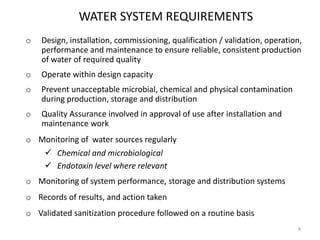
WATER SYSTEM REQUIREMENTS
o Design, installation, commissioning, qualification / validation, operation,
performance and maintenance to ensure reliable, consistent production
of water of required quality
o Operate within design capacity
o Prevent unacceptable microbial, chemical and physical contamination
during production, storage and distribution
o Quality Assurance involved in approval of use after installation and
maintenance work
o Monitoring of water sources regularly
 Chemical and microbiological
 Endotoxin level where relevant
o Monitoring of system performance, storage and distribution systems
o Records of results, and action taken
o Validated sanitization procedure followed on a routine basis
4
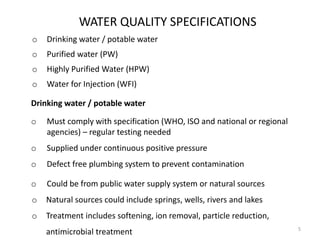
WATER QUALITY SPECIFICATIONS
o Drinking water / potable water
o Purified water (PW)
o Highly Purified Water (HPW)
o Water for Injection (WFI)
Drinking water / potable water
o Must comply with specification (WHO, ISO and national or regional
agencies) – regular testing needed
o Supplied under continuous positive pressure
o Defect free plumbing system to prevent contamination
o Could be from public water supply system or natural sources
o Natural sources could include springs, wells, rivers and lakes
o Treatment includes softening, ion removal, particle reduction,
antimicrobial treatment 5
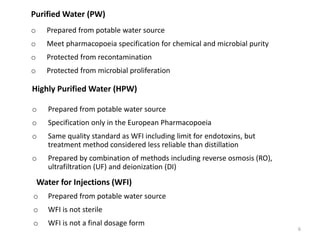
Purified Water (PW)
o Prepared from potable water source
o Meet pharmacopoeia specification for chemical and microbial purity
o Protected from recontamination
o Protected from microbial proliferation
Highly Purified Water (HPW)
o Prepared from potable water source
o Specification only in the European Pharmacopoeia
o Same quality standard as WFI including limit for endotoxins, but
treatment method considered less reliable than distillation
o Prepared by combination of methods including reverse osmosis (RO),
ultrafiltration (UF) and deionization (DI)
Water for Injections (WFI)
o Prepared from potable water source
o WFI is not sterile
o WFI is not a final dosage form
6
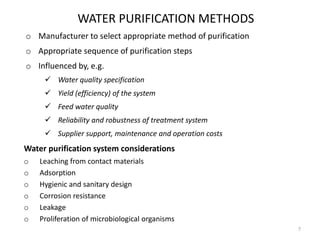
WATER PURIFICATION METHODS
o Manufacturer to select appropriate method of purification
o Appropriate sequence of purification steps
o Influenced by, e.g.
 Water quality specification
 Yield (efficiency) of the system
 Feed water quality
 Reliability and robustness of treatment system
 Supplier support, maintenance and operation costs
Water purification system considerations
o Leaching from contact materials
o Adsorption
o Hygienic and sanitary design
o Corrosion resistance
o Leakage
o Proliferation of microbiological organisms
7
PRODUCTION OF DRINKING WATER
o Derived from raw water (e.g. well, river, reservoir)
o Processes may include:
 Filtration, softening
 Disinfection or sanitization
 Iron (ferrous) removal
 Precipitation
 Inorganic / organic reduction
o Storage tanks
 Closed, with protected vents
 Allows visual inspection, draining and sanitization
o Care to prevent and control microbiological contamination of sand
filters, carbon beds, water softeners
 Back-flushing, chemical or thermal sanitization and frequent
regeneration, continuous waterflow
8
PRODUCTION OF PURIFIED WATER (PW)
o Use appropriate, qualified methods for production
o Methods use for production of PW
 Distillation
 Ion exchange
 Ultra filtration
 Reverse Osmosis
PRODUCTION OF HIGHLY PURIFIED WATER (HPW)
o Use appropriate, qualified methods for production
o Appropriate sequence of techniques
o As for PW
o Processes may include:
 Ion exchange
 Ultra filtration
 Reverse Osmosis
9
PRODUCTION OF WATER FOR INJECTIONS (WFI)
o Pharmacopoeia requires distillation as preferred technique for final
purification step
o Factors to consider:
 Feed water quality
 Required water quality specification
 Optimum generator sizing (prevent frequent start/stop)
 Cool-down venting (avoid contamination ingress)
10
COMMISSIONING, QUALIFICATION AND OPERATION
CONSIDERATIONS
To discuss the operational considerations of water
systems including
 Start up, commissioning and qualification
 Monitoring
 Maintenance
 System reviews
11
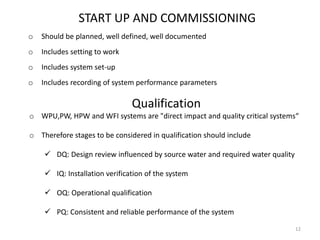
START UP AND COMMISSIONING
o Should be planned, well defined, well documented
o Includes setting to work
o Includes system set-up
o Includes recording of system performance parameters
Qualification
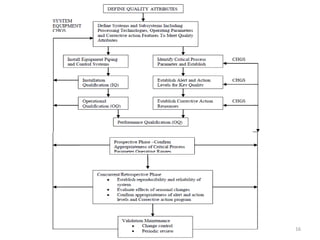
o WPU,PW, HPW and WFI systems are "direct impact and quality critical systems“
o Therefore stages to be considered in qualification should include
 DQ: Design review influenced by source water and required water quality
 IQ: Installation verification of the system
 OQ: Operational qualification
 PQ: Consistent and reliable performance of the system
12
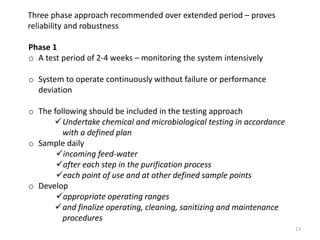
Three phase approach recommended over extended period – proves
reliability and robustness
Phase 1
o A test period of 2-4 weeks – monitoring the system intensively
o System to operate continuously without failure or performance
deviation
o The following should be included in the testing approach
Undertake chemical and microbiological testing in accordance
with a defined plan
o Sample daily
incoming feed-water
after each step in the purification process
each point of use and at other defined sample points
o Develop
appropriate operating ranges
and finalize operating, cleaning, sanitizing and maintenance
procedures
13
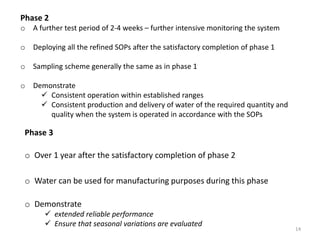
Phase 2
o A further test period of 2-4 weeks – further intensive monitoring the system
o Deploying all the refined SOPs after the satisfactory completion of phase 1
o Sampling scheme generally the same as in phase 1
o Demonstrate
 Consistent operation within established ranges
 Consistent production and delivery of water of the required quantity and
quality when the system is operated in accordance with the SOPs
Phase 3
o Over 1 year after the satisfactory completion of phase 2
o Water can be used for manufacturing purposes during this phase
o Demonstrate
 extended reliable performance
 Ensure that seasonal variations are evaluated
14
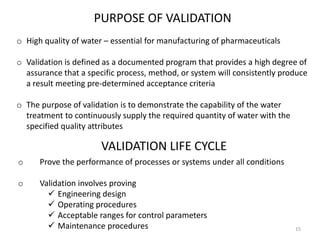
PURPOSE OF VALIDATION
o High quality of water – essential for manufacturing of pharmaceuticals
o Validation is defined as a documented program that provides a high degree of
assurance that a specific process, method, or system will consistently produce
a result meeting pre-determined acceptance criteria
o The purpose of validation is to demonstrate the capability of the water
treatment to continuously supply the required quantity of water with the
specified quality attributes
VALIDATION LIFE CYCLE
o Prove the performance of processes or systems under all conditions
o Validation involves proving
 Engineering design
 Operating procedures
 Acceptable ranges for control parameters
 Maintenance procedures 15
16
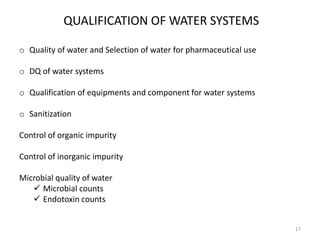
QUALIFICATION OF WATER SYSTEMS
o Quality of water and Selection of water for pharmaceutical use
o DQ of water systems
o Qualification of equipments and component for water systems
o Sanitization
Control of organic impurity
Control of inorganic impurity
Microbial quality of water
 Microbial counts
 Endotoxin counts
17
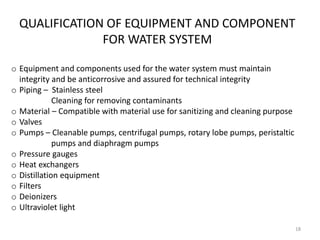
QUALIFICATION OF EQUIPMENT AND COMPONENT
FOR WATER SYSTEM
o Equipment and components used for the water system must maintain
integrity and be anticorrosive and assured for technical integrity
o Piping – Stainless steel
Cleaning for removing contaminants
o Material – Compatible with material use for sanitizing and cleaning purpose
o Valves
o Pumps – Cleanable pumps, centrifugal pumps, rotary lobe pumps, peristaltic
pumps and diaphragm pumps
o Pressure gauges
o Heat exchangers
o Distillation equipment
o Filters
o Deionizers
o Ultraviolet light
18
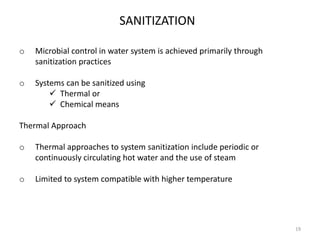
SANITIZATION
o Microbial control in water system is achieved primarily through
sanitization practices
o Systems can be sanitized using
 Thermal or
 Chemical means
Thermal Approach
o Thermal approaches to system sanitization include periodic or
continuously circulating hot water and the use of steam
o Limited to system compatible with higher temperature
19
Chemical method
o Chemical methods, where compatible, can be used on a wider variety
of construction materials
o Oxidizing agents
 Hydrogen peroxide
 Ozone
 Per-acetic acid
20
VALIDATION OF SANITIZATION STEPS
o Sanitization steps require validation to demonstrate the capability of
reducing and holding microbial contamination at acceptable levels
o Validation of thermal methods should include a heat distribution
study to demonstrate that sanitization temperatures are achieved
throughout the system
o Validation of chemical methods requires a demonstration of
adequate chemical concentrations throughout the system
21
SYSTEM MONITORING
o After phase 3 – system review needed
o Based on review including results, establish a routine monitoring plan
o Monitoring to include a combination of on-line monitoring and off-
line sample testing
Online monitoring includes
 Flow
 Pressure
 Temperature
 Conductivity
 Total organic carbon
Offline sample testing includes
 Physical attributes
 Chemical attributes
 Microbial attributes
22
MAINTENANCE OF WATER SYSTEMS
A controlled, documented maintenance programme covering:
 Defined frequency with plan and instructions
 Calibration programme
 SOPs for tasks
 Control of approved spares
 Record and review of problems and faults during maintenance
23
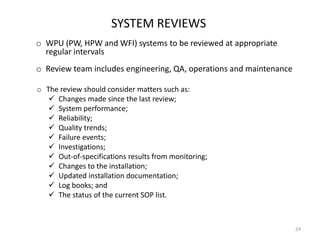
SYSTEM REVIEWS
o WPU (PW, HPW and WFI) systems to be reviewed at appropriate
regular intervals
o Review team includes engineering, QA, operations and maintenance
o The review should consider matters such as:
 Changes made since the last review;
 System performance;
 Reliability;
 Quality trends;
 Failure events;
 Investigations;
 Out-of-specifications results from monitoring;
 Changes to the installation;
 Updated installation documentation;
 Log books; and
 The status of the current SOP list.
24
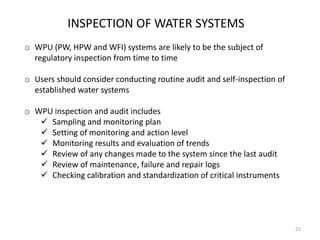
INSPECTION OF WATER SYSTEMS
o WPU (PW, HPW and WFI) systems are likely to be the subject of
regulatory inspection from time to time
o Users should consider conducting routine audit and self-inspection of
established water systems
o WPU inspection and audit includes
 Sampling and monitoring plan
 Setting of monitoring and action level
 Monitoring results and evaluation of trends
 Review of any changes made to the system since the last audit
 Review of maintenance, failure and repair logs
 Checking calibration and standardization of critical instruments
25

dokumen.tips_validation-of-water-system-for-pharmaceutical-use.pptx

  • 1.
    VALIDATION OF WATERSYSTEM FOR PHARMACEUTICAL USE o Introduction o Water system requirements o Water quality specifications o Water purification methods o Commissioning, qualification, operation and maintenance 1
  • 2.
    INTRODUCTION o Information onWater for Pharmaceutical Use (WPU) o Quality of water for APIs, finished products, etc. o GMP for design, installation, operation of systems o Supplementary to general GMP guidelines o See also other guidelines, pharmacopoeia, etc. 2
  • 3.
    BACKGROUND TO WATERREQUIREMENTS AND USE o Water is the most widely used substance / raw material o Used in production, processing, formulation, cleaning, quality control o Unique chemical properties  Able to dissolve, absorb, adsorb, suspend compounds and contaminants o Different grades of water quality available o Control quality of water  Production  Storage and distribution o Contaminants, microbial and chemical quality o Microbial contamination risk and concern 3
  • 4.
    WATER SYSTEM REQUIREMENTS oDesign, installation, commissioning, qualification / validation, operation, performance and maintenance to ensure reliable, consistent production of water of required quality o Operate within design capacity o Prevent unacceptable microbial, chemical and physical contamination during production, storage and distribution o Quality Assurance involved in approval of use after installation and maintenance work o Monitoring of water sources regularly  Chemical and microbiological  Endotoxin level where relevant o Monitoring of system performance, storage and distribution systems o Records of results, and action taken o Validated sanitization procedure followed on a routine basis 4
  • 5.
    WATER QUALITY SPECIFICATIONS oDrinking water / potable water o Purified water (PW) o Highly Purified Water (HPW) o Water for Injection (WFI) Drinking water / potable water o Must comply with specification (WHO, ISO and national or regional agencies) – regular testing needed o Supplied under continuous positive pressure o Defect free plumbing system to prevent contamination o Could be from public water supply system or natural sources o Natural sources could include springs, wells, rivers and lakes o Treatment includes softening, ion removal, particle reduction, antimicrobial treatment 5
  • 6.
    Purified Water (PW) oPrepared from potable water source o Meet pharmacopoeia specification for chemical and microbial purity o Protected from recontamination o Protected from microbial proliferation Highly Purified Water (HPW) o Prepared from potable water source o Specification only in the European Pharmacopoeia o Same quality standard as WFI including limit for endotoxins, but treatment method considered less reliable than distillation o Prepared by combination of methods including reverse osmosis (RO), ultrafiltration (UF) and deionization (DI) Water for Injections (WFI) o Prepared from potable water source o WFI is not sterile o WFI is not a final dosage form 6
  • 7.
    WATER PURIFICATION METHODS oManufacturer to select appropriate method of purification o Appropriate sequence of purification steps o Influenced by, e.g.  Water quality specification  Yield (efficiency) of the system  Feed water quality  Reliability and robustness of treatment system  Supplier support, maintenance and operation costs Water purification system considerations o Leaching from contact materials o Adsorption o Hygienic and sanitary design o Corrosion resistance o Leakage o Proliferation of microbiological organisms 7
  • 8.
    PRODUCTION OF DRINKINGWATER o Derived from raw water (e.g. well, river, reservoir) o Processes may include:  Filtration, softening  Disinfection or sanitization  Iron (ferrous) removal  Precipitation  Inorganic / organic reduction o Storage tanks  Closed, with protected vents  Allows visual inspection, draining and sanitization o Care to prevent and control microbiological contamination of sand filters, carbon beds, water softeners  Back-flushing, chemical or thermal sanitization and frequent regeneration, continuous waterflow 8
  • 9.
    PRODUCTION OF PURIFIEDWATER (PW) o Use appropriate, qualified methods for production o Methods use for production of PW  Distillation  Ion exchange  Ultra filtration  Reverse Osmosis PRODUCTION OF HIGHLY PURIFIED WATER (HPW) o Use appropriate, qualified methods for production o Appropriate sequence of techniques o As for PW o Processes may include:  Ion exchange  Ultra filtration  Reverse Osmosis 9
  • 10.
    PRODUCTION OF WATERFOR INJECTIONS (WFI) o Pharmacopoeia requires distillation as preferred technique for final purification step o Factors to consider:  Feed water quality  Required water quality specification  Optimum generator sizing (prevent frequent start/stop)  Cool-down venting (avoid contamination ingress) 10
  • 11.
    COMMISSIONING, QUALIFICATION ANDOPERATION CONSIDERATIONS To discuss the operational considerations of water systems including  Start up, commissioning and qualification  Monitoring  Maintenance  System reviews 11
  • 12.
    START UP ANDCOMMISSIONING o Should be planned, well defined, well documented o Includes setting to work o Includes system set-up o Includes recording of system performance parameters Qualification o WPU,PW, HPW and WFI systems are "direct impact and quality critical systems“ o Therefore stages to be considered in qualification should include  DQ: Design review influenced by source water and required water quality  IQ: Installation verification of the system  OQ: Operational qualification  PQ: Consistent and reliable performance of the system 12
  • 13.
    Three phase approachrecommended over extended period – proves reliability and robustness Phase 1 o A test period of 2-4 weeks – monitoring the system intensively o System to operate continuously without failure or performance deviation o The following should be included in the testing approach Undertake chemical and microbiological testing in accordance with a defined plan o Sample daily incoming feed-water after each step in the purification process each point of use and at other defined sample points o Develop appropriate operating ranges and finalize operating, cleaning, sanitizing and maintenance procedures 13
  • 14.
    Phase 2 o Afurther test period of 2-4 weeks – further intensive monitoring the system o Deploying all the refined SOPs after the satisfactory completion of phase 1 o Sampling scheme generally the same as in phase 1 o Demonstrate  Consistent operation within established ranges  Consistent production and delivery of water of the required quantity and quality when the system is operated in accordance with the SOPs Phase 3 o Over 1 year after the satisfactory completion of phase 2 o Water can be used for manufacturing purposes during this phase o Demonstrate  extended reliable performance  Ensure that seasonal variations are evaluated 14
  • 15.
    PURPOSE OF VALIDATION oHigh quality of water – essential for manufacturing of pharmaceuticals o Validation is defined as a documented program that provides a high degree of assurance that a specific process, method, or system will consistently produce a result meeting pre-determined acceptance criteria o The purpose of validation is to demonstrate the capability of the water treatment to continuously supply the required quantity of water with the specified quality attributes VALIDATION LIFE CYCLE o Prove the performance of processes or systems under all conditions o Validation involves proving  Engineering design  Operating procedures  Acceptable ranges for control parameters  Maintenance procedures 15
  • 16.
  • 17.
    QUALIFICATION OF WATERSYSTEMS o Quality of water and Selection of water for pharmaceutical use o DQ of water systems o Qualification of equipments and component for water systems o Sanitization Control of organic impurity Control of inorganic impurity Microbial quality of water  Microbial counts  Endotoxin counts 17
  • 18.
    QUALIFICATION OF EQUIPMENTAND COMPONENT FOR WATER SYSTEM o Equipment and components used for the water system must maintain integrity and be anticorrosive and assured for technical integrity o Piping – Stainless steel Cleaning for removing contaminants o Material – Compatible with material use for sanitizing and cleaning purpose o Valves o Pumps – Cleanable pumps, centrifugal pumps, rotary lobe pumps, peristaltic pumps and diaphragm pumps o Pressure gauges o Heat exchangers o Distillation equipment o Filters o Deionizers o Ultraviolet light 18
  • 19.
    SANITIZATION o Microbial controlin water system is achieved primarily through sanitization practices o Systems can be sanitized using  Thermal or  Chemical means Thermal Approach o Thermal approaches to system sanitization include periodic or continuously circulating hot water and the use of steam o Limited to system compatible with higher temperature 19
  • 20.
    Chemical method o Chemicalmethods, where compatible, can be used on a wider variety of construction materials o Oxidizing agents  Hydrogen peroxide  Ozone  Per-acetic acid 20
  • 21.
    VALIDATION OF SANITIZATIONSTEPS o Sanitization steps require validation to demonstrate the capability of reducing and holding microbial contamination at acceptable levels o Validation of thermal methods should include a heat distribution study to demonstrate that sanitization temperatures are achieved throughout the system o Validation of chemical methods requires a demonstration of adequate chemical concentrations throughout the system 21
  • 22.
    SYSTEM MONITORING o Afterphase 3 – system review needed o Based on review including results, establish a routine monitoring plan o Monitoring to include a combination of on-line monitoring and off- line sample testing Online monitoring includes  Flow  Pressure  Temperature  Conductivity  Total organic carbon Offline sample testing includes  Physical attributes  Chemical attributes  Microbial attributes 22
  • 23.
    MAINTENANCE OF WATERSYSTEMS A controlled, documented maintenance programme covering:  Defined frequency with plan and instructions  Calibration programme  SOPs for tasks  Control of approved spares  Record and review of problems and faults during maintenance 23
  • 24.
    SYSTEM REVIEWS o WPU(PW, HPW and WFI) systems to be reviewed at appropriate regular intervals o Review team includes engineering, QA, operations and maintenance o The review should consider matters such as:  Changes made since the last review;  System performance;  Reliability;  Quality trends;  Failure events;  Investigations;  Out-of-specifications results from monitoring;  Changes to the installation;  Updated installation documentation;  Log books; and  The status of the current SOP list. 24
  • 25.
    INSPECTION OF WATERSYSTEMS o WPU (PW, HPW and WFI) systems are likely to be the subject of regulatory inspection from time to time o Users should consider conducting routine audit and self-inspection of established water systems o WPU inspection and audit includes  Sampling and monitoring plan  Setting of monitoring and action level  Monitoring results and evaluation of trends  Review of any changes made to the system since the last audit  Review of maintenance, failure and repair logs  Checking calibration and standardization of critical instruments 25