WATER
RESOURCES
J.Dhanushiya
II BSc. Chemistry
Introduction:
• Water resources are sources of water that are useful or
potentially useful.
• Uses of water include agricultural, industrial, household,
recreational and environmental activities.
• Virtually all of theses human uses require fresh water.
Fresh Water
• Fresh water is a renewable resource,
yet the world’s supply of clean, fresh
water is steadily decreasing.
• Water demand already exceeds
supply in many parts of the world
and as the world population
continues to rise, so too does the
water demand.
Sources of Fresh Water
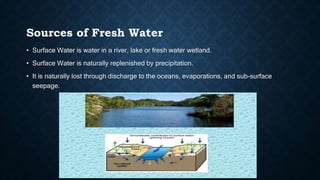
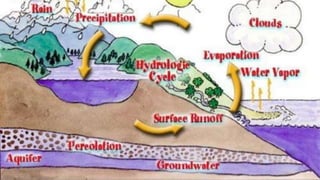
• Surface Water is water in a river, lake or fresh water wetland.
• Surface Water is naturally replenished by precipitation.
• It is naturally lost through discharge to the oceans, evaporations, and sub-surface
seepage.
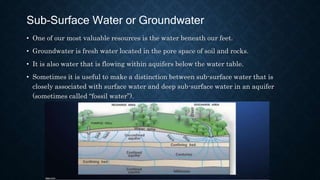
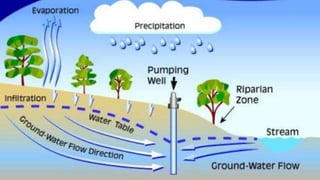
Sub-Surface Water or Groundwater
• One of our most valuable resources is the water beneath our feet.
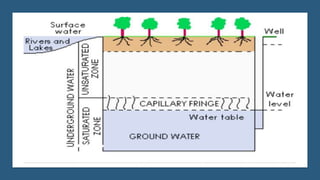
• Groundwater is fresh water located in the pore space of soil and rocks.
• It is also water that is flowing within aquifers below the water table.
• Sometimes it is useful to make a distinction between sub-surface water that is
closely associated with surface water and deep sub-surface water in an aquifer
(sometimes called “fossil water”).
How much do we depend on groundwater?
• According to United States Geological Survey (USGS) figures,
groundwater provides an estimated:
• 22% of all freshwater withdrawals
• 37% of agricultural use (mostly for irrigation)
• 37% of the public water supply withdrawals
• 51% of all drinking water for the total population
• 99% of drinking water for the rural population
FLOODS
Floods are Natural Phenomenal
Floods are Water Related Disaster
A flood occurs when the Geomorphic Equilibrium in the river
system is disturbed because of intrinsic or extrinsic factors or
when a system crosses the geomorphic threshold.
a) Flooding in a river due to aggradation of river bed
(intrinsic threshold).
b) Flooding in a river due to heavy rainfall (extrinsic threshold).
Types Of Floods
*Flash floods
*River floods
*Coastal floods
*Urban flood
According to their duration flood can be divided into different
categories:
1. Slow-Onset Floods: Slow Onset Floods usually last for a
relatively longer period, it may last for one or more peeks, or
even months.
2. Rapid-Onset Floods: Rapid Onset Floods last for a relatively
shorter period, they usually last for one or two days only.
3. Flash Floods: Flash Floods may occur within minutes or a few
hours after heavy rainfall, tropical storm, failure of dams or
levees or releases of ice dams. And it causes the greatest
damages to society.
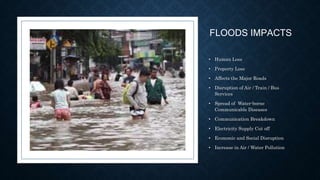
FLOODS IMPACTS
• Human Loss
• Property Loss
• Affects the Major Roads
• Disruption of Air / Train / Bus
Services
• Spread of Water-borne
Communicable Diseases
• Communication Breakdown
• Electricity Supply Cut off
• Economic and Social Disruption
• Increase in Air / Water Pollution
Drought
• Rains are very unpredictable. This leads to periods where there is serious scarcity of
water.
• Drought prone areas are faced with irregular periods of famine as farmers have no
income.
• Drought prone areas Development Programs:
• Under this scheme, People are given wages in bad years for activities like building
roads, minor irrigation works and plantation programs.
• It is a major problem in arid and semi arid regions.
• Drought affects home, agriculture, industry, leads to malnutrition problems in
children due to food shortages.
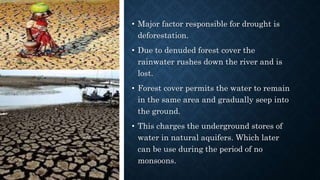
• Major factor responsible for drought is
deforestation.
• Due to denuded forest cover the
rainwater rushes down the river and is
lost.
• Forest cover permits the water to remain
in the same area and gradually seep into
the ground.
• This charges the underground stores of
water in natural aquifers. Which later
can be use during the period of no
monsoons.
CAUSES OF DROUGHT
Natural / Physical causes:
• Weather: Increased amount of anticyclone
weather (hot + dry) means air holds less
moisture so you get less rain.
• Global warming: Weather patterns
change (e.g. Sahel is becoming hotter +
drier).
• Hotter weather = more evaporation than
precipitation.
• EI Nino: random weather event that
reverses normal weather patterns (e.g.
Australia has years of drought + then
ears of flood)
Human causes:
• Overpopulation: too many people living in
an area using too much water.
• Overcultivation: planting too many crops
which use up too much water.
• Overextraction: removing too much water
from wells so they dry up.
• Deforestation: cutting down trees which
otherwise store water + hold soil together.
• Politics: fighting over water, or companies
being greedy + taking too much water to
then sell on.
Conflicts over water:
• Multiple conflicts between countries.
• Around 20 major cities in India face chronic or interrupted water shortages.
• Around 100 countries all around the world share the waters of 13 large rivers and
lakes.
• The upstream countries could stare the downstream countries leading to political
instability. E.g. Ethiopia (Upstream) and Egypt (Downstream) are highly dependent
on the river Nile for their water supply.
• International accords the look at fair distribution of water will become critical to the
world peace.
• India and Bangladesh already have a pact for fair usage of water of Ganges River.
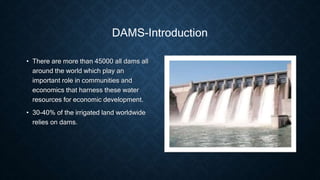
DAMS-Introduction
• There are more than 45000 all dams all
around the world which play an
important role in communities and
economics that harness these water
resources for economic development.
• 30-40% of the irrigated land worldwide
relies on dams.
THANK YOU

Water Resources

  • 1.
  • 2.
    Introduction: • Water resourcesare sources of water that are useful or potentially useful. • Uses of water include agricultural, industrial, household, recreational and environmental activities. • Virtually all of theses human uses require fresh water.
  • 4.
    Fresh Water • Freshwater is a renewable resource, yet the world’s supply of clean, fresh water is steadily decreasing. • Water demand already exceeds supply in many parts of the world and as the world population continues to rise, so too does the water demand.
  • 6.
    Sources of FreshWater • Surface Water is water in a river, lake or fresh water wetland. • Surface Water is naturally replenished by precipitation. • It is naturally lost through discharge to the oceans, evaporations, and sub-surface seepage.
  • 7.
    Sub-Surface Water orGroundwater • One of our most valuable resources is the water beneath our feet. • Groundwater is fresh water located in the pore space of soil and rocks. • It is also water that is flowing within aquifers below the water table. • Sometimes it is useful to make a distinction between sub-surface water that is closely associated with surface water and deep sub-surface water in an aquifer (sometimes called “fossil water”).
  • 11.
    How much dowe depend on groundwater? • According to United States Geological Survey (USGS) figures, groundwater provides an estimated: • 22% of all freshwater withdrawals • 37% of agricultural use (mostly for irrigation) • 37% of the public water supply withdrawals • 51% of all drinking water for the total population • 99% of drinking water for the rural population
  • 12.
    FLOODS Floods are NaturalPhenomenal Floods are Water Related Disaster A flood occurs when the Geomorphic Equilibrium in the river system is disturbed because of intrinsic or extrinsic factors or when a system crosses the geomorphic threshold. a) Flooding in a river due to aggradation of river bed (intrinsic threshold). b) Flooding in a river due to heavy rainfall (extrinsic threshold).
  • 13.
    Types Of Floods *Flashfloods *River floods *Coastal floods *Urban flood According to their duration flood can be divided into different categories: 1. Slow-Onset Floods: Slow Onset Floods usually last for a relatively longer period, it may last for one or more peeks, or even months. 2. Rapid-Onset Floods: Rapid Onset Floods last for a relatively shorter period, they usually last for one or two days only. 3. Flash Floods: Flash Floods may occur within minutes or a few hours after heavy rainfall, tropical storm, failure of dams or levees or releases of ice dams. And it causes the greatest damages to society.
  • 14.
    FLOODS IMPACTS • HumanLoss • Property Loss • Affects the Major Roads • Disruption of Air / Train / Bus Services • Spread of Water-borne Communicable Diseases • Communication Breakdown • Electricity Supply Cut off • Economic and Social Disruption • Increase in Air / Water Pollution
  • 15.
    Drought • Rains arevery unpredictable. This leads to periods where there is serious scarcity of water. • Drought prone areas are faced with irregular periods of famine as farmers have no income. • Drought prone areas Development Programs: • Under this scheme, People are given wages in bad years for activities like building roads, minor irrigation works and plantation programs. • It is a major problem in arid and semi arid regions. • Drought affects home, agriculture, industry, leads to malnutrition problems in children due to food shortages.
  • 16.
    • Major factorresponsible for drought is deforestation. • Due to denuded forest cover the rainwater rushes down the river and is lost. • Forest cover permits the water to remain in the same area and gradually seep into the ground. • This charges the underground stores of water in natural aquifers. Which later can be use during the period of no monsoons.
  • 17.
    CAUSES OF DROUGHT Natural/ Physical causes: • Weather: Increased amount of anticyclone weather (hot + dry) means air holds less moisture so you get less rain. • Global warming: Weather patterns change (e.g. Sahel is becoming hotter + drier). • Hotter weather = more evaporation than precipitation. • EI Nino: random weather event that reverses normal weather patterns (e.g. Australia has years of drought + then ears of flood) Human causes: • Overpopulation: too many people living in an area using too much water. • Overcultivation: planting too many crops which use up too much water. • Overextraction: removing too much water from wells so they dry up. • Deforestation: cutting down trees which otherwise store water + hold soil together. • Politics: fighting over water, or companies being greedy + taking too much water to then sell on.
  • 18.
    Conflicts over water: •Multiple conflicts between countries. • Around 20 major cities in India face chronic or interrupted water shortages. • Around 100 countries all around the world share the waters of 13 large rivers and lakes. • The upstream countries could stare the downstream countries leading to political instability. E.g. Ethiopia (Upstream) and Egypt (Downstream) are highly dependent on the river Nile for their water supply. • International accords the look at fair distribution of water will become critical to the world peace. • India and Bangladesh already have a pact for fair usage of water of Ganges River.
  • 19.
    DAMS-Introduction • There aremore than 45000 all dams all around the world which play an important role in communities and economics that harness these water resources for economic development. • 30-40% of the irrigated land worldwide relies on dams.
  • 22.