Unit 4
SLOPE PROCESSES
3
Types of Water Erosion
1. Splash Erosion
2. Sheet Erosion
3. Rill Erosion
4. Gully Erosion
Splash erosion
 This kind of erosion is caused by the impact of rain
drops striking the ground surface (rain splash).
 It can be takes place in two steps.
1 as initial precipitation is absorbed by the ground
surface, it fills the pore space, loosening the soil
particles and moving them apart.
2 the impact of subsequent rain drops hitting the surface
splash and sends sand and other types of particles of
the soil away from the point of impact.
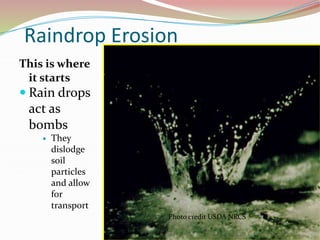
Raindrop Erosion
This is where
it starts
 Rain drops
act as
bombs
 They
dislodge
soil
particles
and allow
for
transport
Photo credit USDA NRCS
7
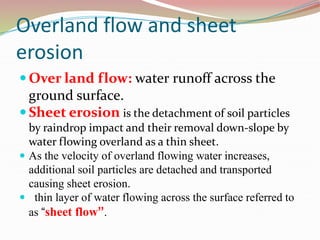
Overland flow and sheet
erosion
 Over land flow: water runoff across the
ground surface.
 Sheet erosion is the detachment of soil particles
by raindrop impact and their removal down-slope by
water flowing overland as a thin sheet.
 As the velocity of overland flowing water increases,
additional soil particles are detached and transported
causing sheet erosion.
 thin layer of water flowing across the surface referred to
as “sheet flow”.
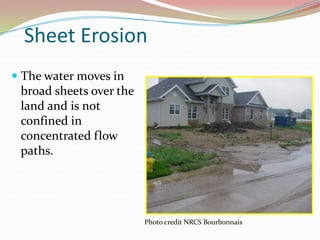
Sheet Erosion
 The water moves in
broad sheets over the
land and is not
confined in
concentrated flow
paths.
Photo credit NRCS Bourbonnais
10
Sheet
Erosion
Does not occur over long lengths of
time; it quickly goes to rill and gully
erosion.
Rill erosion
 Rill –a small channel …………
 Rills are formed by the minute stream of
water cutting separate flow channels.
 Rill erosion refers to the development of
small, ephemeral concentrated flow paths
which function as both sediment source and
sediment delivery systems for erosion on
hillslopes.
13
Photograph of rill erosion
RILL EROSION
Gully erosion
 Rills that continue to receive concentrated flows can
eventually turn into gullies of varying widths and depths.
 Gullies are Steep-sided trenches formed by the
coalescence of many rills.
 The distinction between a rill and a gully is one of
depth.
 A gully is sufficiently deep that it would not be obliterated
by normal tillage operations, whereas a rill is of lesser
depth and would be smoothed by use of normal tillage
equipment.
1. Raindrop erosion
2. Sheet erosion
3. Rill and gully
erosion
4. Streambank and
bed erosion
16
Stages in Erosion &
Sedimentation
1.
Detachment
2. Transport 3. Deposition
Colluvium
The loose, unconsolidated earth materials that
accumulate at the base of hillslopes by the processes of
sheet erosion, splash erosion and slow continuous
down-slope movements of rock particles or a variable
combination of these process is colluvium.
It is a heterogeneous mixture of earth materials ranging from silt to
larger rock fragments of various sizes.
Colluviation: the process of building up
of colluvium at the base of a hillslope.
Mass
Movements
/Wasting
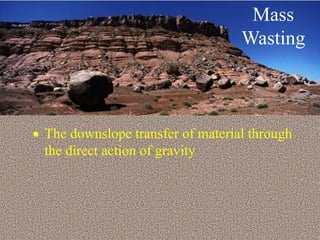
 The downslope transfer of material through
the direct action of gravity
Mass
Wasting
 Mass wasting is the process of down- slope
movement of rock debris and soil mainly under the
influence of gravity.
 This process may be slow and gradual or very
rapid.
 Mass wasting is a process of erosion and here the
agent involved is gravity.
 Gravity is considered as a passive agent therefore it
requires no medium for its erosive action.
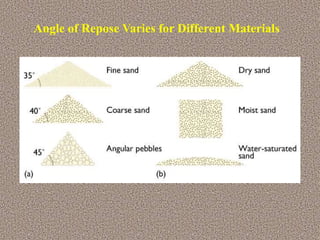
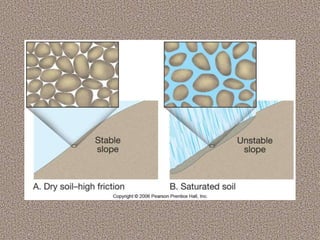
Angle of repose is the
natural angle at which a granular material,
such as sand or gravel, will rest without
slipping.
 The forces of gravity and friction are in
balance at the angle of repose.
Angle of Repose Varies for Different Materials
A
A
R
R
What are they?
On the basis of the nature of
movement involved, Mass
movements include:
Landslides
• Rock falls
• Avalanches
• Mud flows
• Debris flows
• Creep
. topples
Creep
 Creep is the slowest form of mass
movements.
 The process of creep along slopes cannot
be monitored in a short interval of time and
is undetectable by the eye.
 The slow down-slope movement of soil and
regolith is termed soil-creep or solifluction.
Falls
 Rapid mass movements.
 Falls are abrupt movements of masses of
geologic materials , such as rocks and
boulders that become detached from steep
slopes or cliffs.
 Falls are further subdivided into rock fall,
debris fall, etc., based upon the type of rock
materials involved.
Rock Falls
Topples
 Toppling movements are characterized by
the forward rotation of a rock unit or rock
unit about some pivotal point, located below
or low in the unit, under the action of
gravity and forces exerted by adjacent units
or by fluids in cracks.
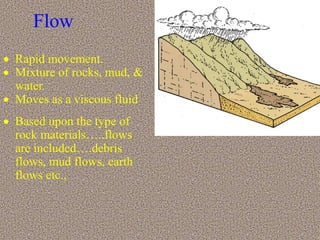
Flow
 Rapid movement.
 Mixture of rocks, mud, &
water.
 Moves as a viscous fluid
 Based upon the type of
rock materials…..flows
are included….debris
flows, mud flows, earth
flows etc.,
 Subsidence:- is the another type of mass
movement.
 it is the direct sinking or lowering of a mass of earth
material below the surrounding ground level.
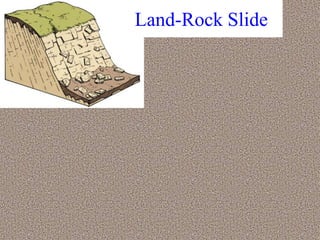
Slides
 Slides are down-slope movement of
coherent block of earth material
 The movement take place along a clear-cut
or distinct surface of detachment that
separates underlying stationary material
from the moving mass of rock material
above.
 Slides can be either (a ) translational slide or
(b) rotational slide
Land-Rock Slide
Rotational landslide
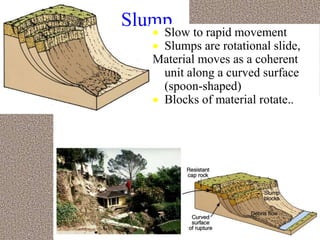
Slump
 Slow to rapid movement
 Slumps are rotational slide,
Material moves as a coherent
unit along a curved surface
(spoon-shaped)
 Blocks of material rotate..
Landslide
 The term “landslide” describes a wide
variety of processes that result in the
downward and outward movement of slope-
forming materials including bedrock,
regolith, soil, artificial fill, or a combination
of these.
 The materials may move by falling,
toppling, sliding, spreading, or flowing.
Avalanches
 Avalanches is the another type of mass
movement where the downward moving
mass of material comprises mostly of snow
and ice.
 This type of mass movement occurs along
mountain slopes especially in cold countries
and at high mountain altitudes covered with
snow is known as avalanche.
thanks

SLOPE PROCESSE 4.pptx

  • 1.
  • 2.
  • 3.
    3 Types of WaterErosion 1. Splash Erosion 2. Sheet Erosion 3. Rill Erosion 4. Gully Erosion
  • 4.
    Splash erosion  Thiskind of erosion is caused by the impact of rain drops striking the ground surface (rain splash).  It can be takes place in two steps. 1 as initial precipitation is absorbed by the ground surface, it fills the pore space, loosening the soil particles and moving them apart. 2 the impact of subsequent rain drops hitting the surface splash and sends sand and other types of particles of the soil away from the point of impact.
  • 5.
    Raindrop Erosion This iswhere it starts  Rain drops act as bombs  They dislodge soil particles and allow for transport Photo credit USDA NRCS
  • 7.
  • 8.
    Overland flow andsheet erosion  Over land flow: water runoff across the ground surface.  Sheet erosion is the detachment of soil particles by raindrop impact and their removal down-slope by water flowing overland as a thin sheet.  As the velocity of overland flowing water increases, additional soil particles are detached and transported causing sheet erosion.  thin layer of water flowing across the surface referred to as “sheet flow”.
  • 9.
    Sheet Erosion  Thewater moves in broad sheets over the land and is not confined in concentrated flow paths. Photo credit NRCS Bourbonnais
  • 10.
  • 11.
    Does not occurover long lengths of time; it quickly goes to rill and gully erosion.
  • 12.
    Rill erosion  Rill–a small channel …………  Rills are formed by the minute stream of water cutting separate flow channels.  Rill erosion refers to the development of small, ephemeral concentrated flow paths which function as both sediment source and sediment delivery systems for erosion on hillslopes.
  • 13.
    13 Photograph of rillerosion RILL EROSION
  • 14.
    Gully erosion  Rillsthat continue to receive concentrated flows can eventually turn into gullies of varying widths and depths.  Gullies are Steep-sided trenches formed by the coalescence of many rills.  The distinction between a rill and a gully is one of depth.  A gully is sufficiently deep that it would not be obliterated by normal tillage operations, whereas a rill is of lesser depth and would be smoothed by use of normal tillage equipment.
  • 15.
    1. Raindrop erosion 2.Sheet erosion 3. Rill and gully erosion 4. Streambank and bed erosion
  • 16.
    16 Stages in Erosion& Sedimentation 1. Detachment 2. Transport 3. Deposition
  • 17.
    Colluvium The loose, unconsolidatedearth materials that accumulate at the base of hillslopes by the processes of sheet erosion, splash erosion and slow continuous down-slope movements of rock particles or a variable combination of these process is colluvium. It is a heterogeneous mixture of earth materials ranging from silt to larger rock fragments of various sizes. Colluviation: the process of building up of colluvium at the base of a hillslope.
  • 18.
  • 19.
     The downslopetransfer of material through the direct action of gravity Mass Wasting
  • 20.
     Mass wastingis the process of down- slope movement of rock debris and soil mainly under the influence of gravity.  This process may be slow and gradual or very rapid.  Mass wasting is a process of erosion and here the agent involved is gravity.  Gravity is considered as a passive agent therefore it requires no medium for its erosive action.
  • 21.
    Angle of reposeis the natural angle at which a granular material, such as sand or gravel, will rest without slipping.  The forces of gravity and friction are in balance at the angle of repose.
  • 22.
    Angle of ReposeVaries for Different Materials
  • 24.
  • 25.
    What are they? Onthe basis of the nature of movement involved, Mass movements include: Landslides • Rock falls • Avalanches • Mud flows • Debris flows • Creep . topples
  • 26.
    Creep  Creep isthe slowest form of mass movements.  The process of creep along slopes cannot be monitored in a short interval of time and is undetectable by the eye.  The slow down-slope movement of soil and regolith is termed soil-creep or solifluction.
  • 28.
    Falls  Rapid massmovements.  Falls are abrupt movements of masses of geologic materials , such as rocks and boulders that become detached from steep slopes or cliffs.  Falls are further subdivided into rock fall, debris fall, etc., based upon the type of rock materials involved.
  • 29.
  • 31.
    Topples  Toppling movementsare characterized by the forward rotation of a rock unit or rock unit about some pivotal point, located below or low in the unit, under the action of gravity and forces exerted by adjacent units or by fluids in cracks.
  • 33.
    Flow  Rapid movement. Mixture of rocks, mud, & water.  Moves as a viscous fluid  Based upon the type of rock materials…..flows are included….debris flows, mud flows, earth flows etc.,
  • 34.
     Subsidence:- isthe another type of mass movement.  it is the direct sinking or lowering of a mass of earth material below the surrounding ground level.
  • 36.
    Slides  Slides aredown-slope movement of coherent block of earth material  The movement take place along a clear-cut or distinct surface of detachment that separates underlying stationary material from the moving mass of rock material above.
  • 37.
     Slides canbe either (a ) translational slide or (b) rotational slide
  • 38.
  • 40.
  • 41.
    Slump  Slow torapid movement  Slumps are rotational slide, Material moves as a coherent unit along a curved surface (spoon-shaped)  Blocks of material rotate..
  • 42.
    Landslide  The term“landslide” describes a wide variety of processes that result in the downward and outward movement of slope- forming materials including bedrock, regolith, soil, artificial fill, or a combination of these.  The materials may move by falling, toppling, sliding, spreading, or flowing.
  • 43.
    Avalanches  Avalanches isthe another type of mass movement where the downward moving mass of material comprises mostly of snow and ice.  This type of mass movement occurs along mountain slopes especially in cold countries and at high mountain altitudes covered with snow is known as avalanche.
  • 44.

Editor's Notes

  • #4 There are four basic types of water erosion, each of which will now be discussed.
  • #6  Raindrop velocity can vary from 4.6 miles/hr in a light rain to 44.4 miles /hr for a large hailstone in a heavy thundershower. Source: http://www.shorstmeyer.com/wxfaqs/float/rdtable.html
  • #8 Picture showing how vegetation protects the soil from raindrop energy.
  • #11 As the velocity of overland flowing water increases, additional soil particles are detached and transported causing sheet erosion. Sheet erosion involves the uniform detachment of soil particles by a thin layer of water flowing across the surface referred to as “sheet flow”. Sheet erosion is often somewhat gradual and sometimes can be difficult to detect.
  • #14 Rill erosion on the side of a hill slope.
  • #17 There are three stages in erosion and sedimentation: detachment, transport, and deposition.