WATER ACTIVITY
Alan Kuriakose
MACFAST
Water
 Water is the most abundant constituent of food
and in terms of food safety the most significant.
Its presence, quantity and nature determines
many chemical and biochemical processes
important for the control of product safety and
quality
 The chemical structure of water is H2O
WATER IN FOOD
 All foods contain at least some water
Free water
 Not bound
 Available for microbial growth
 Chemical and enzymatic reaction
Bound water
 It is bound
 Does not retain properties of free water
WATER ACTIVITY
 water activity is the amount of free or available
water in a product as opposed to bound water.
 water activity is the measure of the energy status
of the water in a system.
 Ratio of the vapor pressure of water in a food at a
specified temperature to the vapor pressure of
pure water at same temperature.
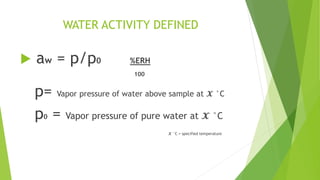
WATER ACTIVITY DEFINED
 aw = p/p0 %ERH
100
p= Vapor pressure of water above sample at 𝓧 °C
p0 = Vapor pressure of pure water at 𝓧 °C
𝓧 °C = specified temperature
WHY WATER ACTIVITY IS IMPORTANT
 Water activity (aw) is one of the most critical factors in
determining quality and safety of foods. Water activity affects the
shelf life, safety, texture, flavour, and smell of foods.
 While temperature, pH and several other factors can influence if
and how fast organisms will grow in a product, water activity may
be the most important Factor in controlling spoilage.
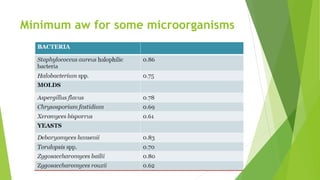
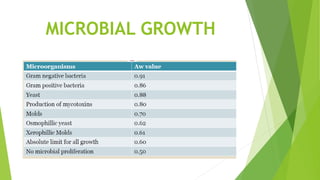
 Most bacteria, for example, do not grow at water activities below
0.91, and most molds cease to grow at water activities below
0.80.
 By measuring water activity, it is possible to
predict which microorganisms will and will
not be potential sources of spoilage.
 Water activity--not water content--
determines the lower limit of available
water for microbial growth.
 In addition to influencing microbial
spoilage, water activity can play a
significant role in determining the activity
of enzymes and vitamins in foods and can
have a major impact their color, taste, and
aroma.
Water Activity Application
 Control microbial growth
 Control moisture migration
 Avoid caking and clumping
 Formulate profitable products
 Control chemical reaction rates
 Model dry ingredient mixing
 Conduct shelf life testing
 Predict packaging needs
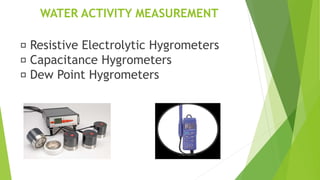
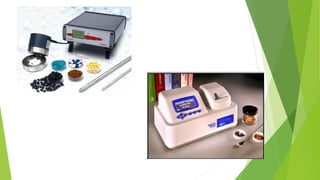
WATER ACTIVITY MEASUREMENT
Resistive Electrolytic Hygrometers
Capacitance Hygrometers
Dew Point Hygrometers
FACTORS EFFECTING
 Drying: Water activity is decreased by physically
removing water (Ex: beef jerky).
 Solutes: Water activity is decreased by adding solutes
such as salt or sugar (Ex: jams, cured meats).
 Freezing: Water activity is decreased by freezing (Ex:
water is removed in the form of ice).
 Combination: One or more of the above can be
combined for a greater influence on water activity (Ex:
salting and drying fish).
Moisture Content
 Water content or moisture content is the quantity of
water contained in a material.
 Water activity is related to water content in a nonlinear
relationship known as a moisture sorption isotherm curve.
 These isotherms are substance and
temperaturespecific.Isotherms can be used to help predict
product stability over time in different storage conditions.
Minimum aw for some microorganisms
MICROBIAL GROWTH
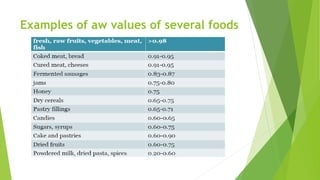
Examples of aw values of several foods

Water activity

  • 1.
  • 2.
    Water  Water isthe most abundant constituent of food and in terms of food safety the most significant. Its presence, quantity and nature determines many chemical and biochemical processes important for the control of product safety and quality  The chemical structure of water is H2O
  • 3.
    WATER IN FOOD All foods contain at least some water Free water  Not bound  Available for microbial growth  Chemical and enzymatic reaction Bound water  It is bound  Does not retain properties of free water
  • 4.
    WATER ACTIVITY  wateractivity is the amount of free or available water in a product as opposed to bound water.  water activity is the measure of the energy status of the water in a system.  Ratio of the vapor pressure of water in a food at a specified temperature to the vapor pressure of pure water at same temperature.
  • 5.
    WATER ACTIVITY DEFINED aw = p/p0 %ERH 100 p= Vapor pressure of water above sample at 𝓧 °C p0 = Vapor pressure of pure water at 𝓧 °C 𝓧 °C = specified temperature
  • 6.
    WHY WATER ACTIVITYIS IMPORTANT  Water activity (aw) is one of the most critical factors in determining quality and safety of foods. Water activity affects the shelf life, safety, texture, flavour, and smell of foods.  While temperature, pH and several other factors can influence if and how fast organisms will grow in a product, water activity may be the most important Factor in controlling spoilage.  Most bacteria, for example, do not grow at water activities below 0.91, and most molds cease to grow at water activities below 0.80.
  • 7.
     By measuringwater activity, it is possible to predict which microorganisms will and will not be potential sources of spoilage.  Water activity--not water content-- determines the lower limit of available water for microbial growth.  In addition to influencing microbial spoilage, water activity can play a significant role in determining the activity of enzymes and vitamins in foods and can have a major impact their color, taste, and aroma.
  • 8.
    Water Activity Application Control microbial growth  Control moisture migration  Avoid caking and clumping  Formulate profitable products  Control chemical reaction rates  Model dry ingredient mixing  Conduct shelf life testing  Predict packaging needs
  • 9.
    WATER ACTIVITY MEASUREMENT ResistiveElectrolytic Hygrometers Capacitance Hygrometers Dew Point Hygrometers
  • 11.
    FACTORS EFFECTING  Drying:Water activity is decreased by physically removing water (Ex: beef jerky).  Solutes: Water activity is decreased by adding solutes such as salt or sugar (Ex: jams, cured meats).  Freezing: Water activity is decreased by freezing (Ex: water is removed in the form of ice).  Combination: One or more of the above can be combined for a greater influence on water activity (Ex: salting and drying fish).
  • 12.
    Moisture Content  Watercontent or moisture content is the quantity of water contained in a material.  Water activity is related to water content in a nonlinear relationship known as a moisture sorption isotherm curve.  These isotherms are substance and temperaturespecific.Isotherms can be used to help predict product stability over time in different storage conditions.
  • 13.
    Minimum aw forsome microorganisms
  • 14.
  • 15.
    Examples of awvalues of several foods