WATER,
Basis of life…
“No water, no life. No
blue, no green.”
-Sylvia Earle
2
Content Page 3
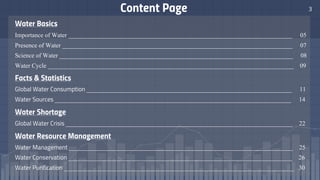
Water Basics
Importance of Water ________________________________________________________________________ 05
Presence of Water __________________________________________________________________________ 07
Science of Water ___________________________________________________________________________ 08
Water Cycle _______________________________________________________________________________ 09
Facts & Statistics
Global Water Consumption __________________________________________________________________ 11
Water Sources ____________________________________________________________________________ 14
Water Shortage
Global Water Crisis _________________________________________________________________________ 22
Water Resource Management
Water Management ________________________________________________________________________ 25
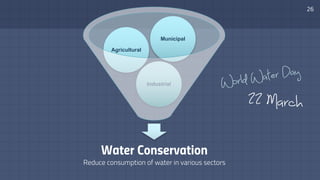
Water Conservation ________________________________________________________________________ 26
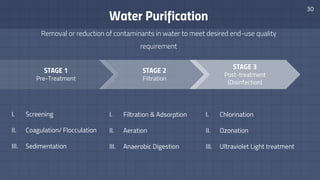
Water Purification __________________________________________________________________________ 30
Water Basics
Importance of Water
Presence of Water
Science of Water
Water Cycle
Importance of Water 5
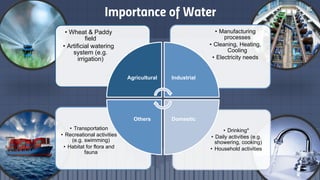
• Drinking*
• Daily activities (e.g.
showering, cooking)
• Household activities
• Transportation
• Recreational activities
(e.g. swimming)
• Habitat for flora and
fauna
• Manufacturing
processes
• Cleaning, Heating,
Cooling
• Electricity needs
• Wheat & Paddy
field
• Artificial watering
system (e.g.
irrigation)
Agricultural Industrial
DomesticOthers
6
Functions of water in human body1
§ Moves nutrients through digestive tract
§ Fiber absorbs water and allows waste to
move through digestive tract
§ Heat regulator, dissipating body heat
through perspiration
§ Cell waste elimination through urine
§ Cushion and lubricate body joints
§ Protects key organs such as brain
§ Fluid for senses to function properly
Presence of Water 7
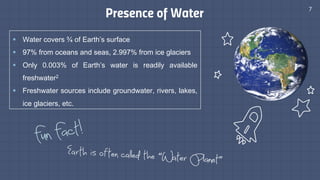
§ Water covers ¾ of Earth’s surface
§ 97% from oceans and seas, 2.997% from ice glaciers
§ Only 0.003% of Earth’s water is readily available
freshwater2
§ Freshwater sources include groundwater, rivers, lakes,
ice glaciers, etc.
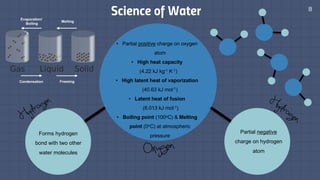
Science of Water 8
Forms hydrogen
bond with two other
water molecules
Partial negative
charge on hydrogen
atom
• Partial positive charge on oxygen
atom
• High heat capacity
(4.22 kJ kg-1 K-1)
• High latent heat of vaporization
(40.63 kJ mol-1)
• Latent heat of fusion
(6.013 kJ mol-1)
• Boiling point (100oC) & Melting
point (0oC) at atmospheric
pressure
Evaporation/
Boiling
Melting
FreezingCondensation
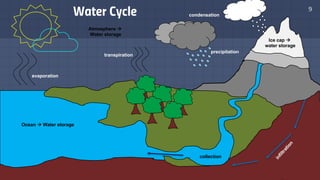
Water Cycle 9
evaporation
transpiration
precipitation
Ice cap à
water storage
collection
Ocean à Water storage
Atmosphere à
Water storage
condensation
Facts & Statistics
Global Water Consumption
Water Sources
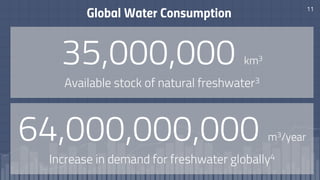
64,000,000,000 m3/year
Increase in demand for freshwater globally4
11
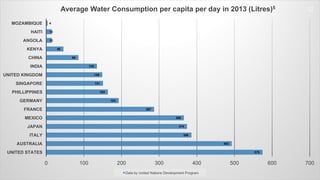
Global Water Consumption
35,000,000 km3
Available stock of natural freshwater3
575
493
386
374
366
287
193
164
151
149
135
86
46
15
15
4
0 100 200 300 400 500 600 700
UNITED STATES
AUSTRALIA
ITALY
JAPAN
MEXICO
FRANCE
GERMANY
PHILLIPPINES
SINGAPORE
UNITED KINGDOM
INDIA
CHINA
KENYA
ANGOLA
HAITI
MOZAMBIQUE
Average Water Consumption per capita per day in 2013 (Litres)5
Data by United Nations Development Program
12
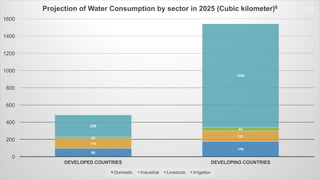
95
176
114
12120
45
255
1200
0
200
400
600
800
1000
1200
1400
1600
DEVELOPED COUNTRIES DEVELOPING COUNTRIES
Projection of Water Consumption by sector in 2025 (Cubic kilometer)6
Domestic Industrial Livestock Irrigation
13
14
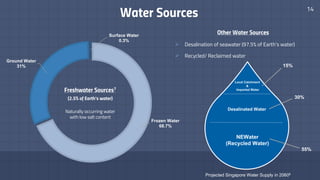
Water Sources
Other Water Sources
Ø Desalination of seawater (97.5% of Earth’s water)
Ø Recycled/ Reclaimed water
Frozen Water
68.7%
Ground Water
31%
Surface Water
0.3%
Projected Singapore Water Supply in 20608
Local Catchment
&
Imported Water
Desalinated Water
NEWater
(Recycled Water)
15%
30%
55%
Freshwater Sources7
(2.5% of Earth’s water)
Naturally occurring water
with low salt content
15
Surface Water
§ Constitutes 0.3% of Earth’s freshwater.
§ Considered readily available and needs
to be treated to be potable water.
§ Non-saline water in river, lake, wetland,
etc.
§ Replenished through water channeled
from ocean, aquifers or precipitation.
§ Lost through evaporation into
atmosphere or infiltration into ground.
precipitation
land runoff
infiltration
evaporation
16
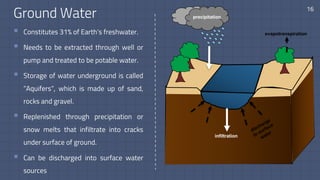
Ground Water
§ Constitutes 31% of Earth’s freshwater.
§ Needs to be extracted through well or
pump and treated to be potable water.
§ Storage of water underground is called
”Aquifers”, which is made up of sand,
rocks and gravel.
§ Replenished through precipitation or
snow melts that infiltrate into cracks
under surface of ground.
§ Can be discharged into surface water
sources
precipitation
infiltration
evapotranspiration
17
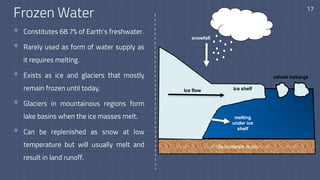
Frozen Water
§ Constitutes 68.7% of Earth’s freshwater.
§ Rarely used as form of water supply as
it requires melting.
§ Exists as ice and glaciers that mostly
remain frozen until today.
§ Glaciers in mountainous regions form
lake basins when the ice masses melt.
§ Can be replenished as snow at low
temperature but will usually melt and
result in land runoff.
Glaciomarine muds
Ice flow Ice shelf
melting
under ice
shelf
calved icebergs
snowfall
18
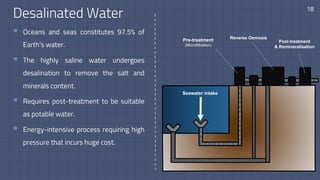
Desalinated Water
§ Oceans and seas constitutes 97.5% of
Earth’s water.
§ The highly saline water undergoes
desalination to remove the salt and
minerals content.
§ Requires post-treatment to be suitable
as potable water.
§ Energy-intensive process requiring high
pressure that incurs huge cost.
Seawater intake
Pre-treatment
(Microfiltration)
Reverse Osmosis
Post-treatment
& Remineralisation
19
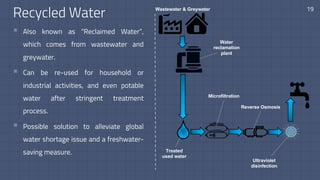
Recycled Water
§ Also known as “Reclaimed Water”,
which comes from wastewater and
greywater.
§ Can be re-used for household or
industrial activities, and even potable
water after stringent treatment
process.
§ Possible solution to alleviate global
water shortage issue and a freshwater-
saving measure. Treated
used water
Wastewater & Greywater
Water
reclamation
plant
Microfiltration
Reverse Osmosis
Ultraviolet
disinfection
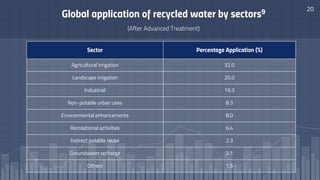
Global application of recycled water by sectors9
(After Advanced Treatment)
Sector Percentage Application (%)
Agricultural irrigation 32.0
Landscape irrigation 20.0
Industrial 19.3
Non-potable urban uses 8.3
Environmental enhancements 8.0
Recreational activities 6.4
Indirect potable reuse 2.3
Groundwater recharge 2.1
Others 1.5
20
Water Shortage
Global Water Shortage Crisis
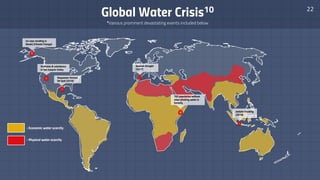
Global Water Crisis10
*Various prominent devastating events included below
22
Deepwater Horizon
Oil Spill (2010)
Ice caps receding in
Alaska (Climate Change)
70% population without
clean drinking water in
Somalia
Jarkata Flooding
(2018)
Sinkholes & subsidence
in San Joaquin Valley
Spanish Drought
(2017)
- Economic water scarcity
- Physical water scarcity
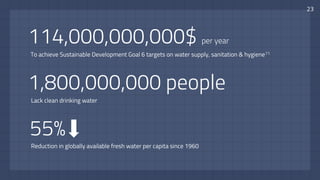
114,000,000,000$ per year
To achieve Sustainable Development Goal 6 targets on water supply, sanitation & hygiene11
55%
Reduction in globally available fresh water per capita since 1960
1,800,000,000 people
Lack clean drinking water
23
Water Resource Management
Water Management
Water Conservation
Water Purification
Water Management
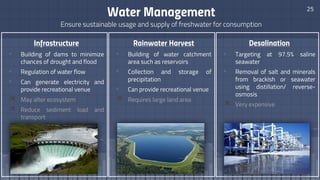
Ensure sustainable usage and supply of freshwater for consumption
Infrastructure
▫ Building of dams to minimize
chances of drought and flood
▫ Regulation of water flow
▫ Can generate electricity and
provide recreational venue
✖ May alter ecosystem
✖ Reduce sediment load and
transport
Rainwater Harvest
▫ Building of water catchment
area such as reservoirs
▫ Collection and storage of
precipitation
▫ Can provide recreational venue
✖ Requires large land area
Desalination
▫ Targeting at 97.5% saline
seawater
▫ Removal of salt and minerals
from brackish or seawater
using distillation/ reverse-
osmosis
✖ Very expensive
25
Water Conservation
Reduce consumption of water in various sectors
26
Industrial
Agricultural
Municipal
27
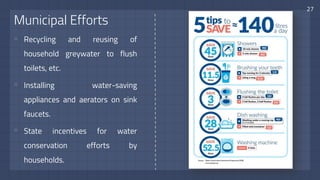
Municipal Efforts
▫ Recycling and reusing of
household greywater to flush
toilets, etc.
▫ Installing water-saving
appliances and aerators on sink
faucets.
▫ State incentives for water
conservation efforts by
households.
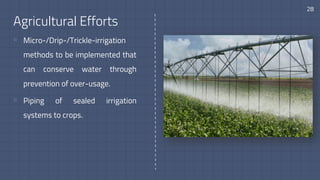
Agricultural Efforts
▫ Micro-/Drip-/Trickle-irrigation
methods to be implemented that
can conserve water through
prevention of over-usage.
▫ Piping of sealed irrigation
systems to crops.
28
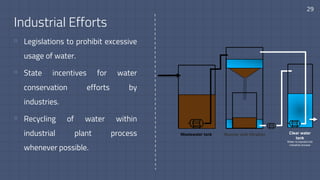
Industrial Efforts
▫ Legislations to prohibit excessive
usage of water.
▫ State incentives for water
conservation efforts by
industries.
▫ Recycling of water within
industrial plant process
whenever possible.
29
Wastewater tank Clear water
tank
Water re-injected into
industrial process
Reactor with filtration
30
STAGE 3
Post-treatment
(Disinfection)
I. Chlorination
II. Ozonation
III. Ultraviolet Light treatment
STAGE 1
Pre-Treatment
I. Screening
II. Coagulation/ Flocculation
III. Sedimentation
STAGE 2
Filtration
I. Filtration & Adsorption
II. Aeration
III. Anaerobic Digestion
Water Purification
Removal or reduction of contaminants in water to meet desired end-use quality
requirement
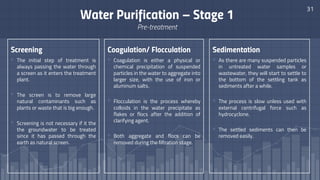
Screening
▫ The initial step of treatment is
always passing the water through
a screen as it enters the treatment
plant.
▫ The screen is to remove large
natural contaminants such as
plants or waste that is big enough.
▫ Screening is not necessary if it the
the groundwater to be treated
since it has passed through the
earth as natural screen.
31
Water Purification – Stage 1
Pre-treatment
Coagulation/ Flocculation
▫ Coagulation is either a physical or
chemical precipitation of suspended
particles in the water to aggregate into
larger size, with the use of iron or
aluminum salts.
▫ Flocculation is the process whereby
colloids in the water precipitate as
flakes or flocs after the addition of
clarifying agent.
▫ Both aggregate and flocs can be
removed during the filtration stage.
Sedimentation
▫ As there are many suspended particles
in untreated water samples or
wastewater, they will start to settle to
the bottom of the settling tank as
sediments after a while.
▫ The process is slow unless used with
external centrifugal force such as
hydrocyclone.
▫ The settled sediments can then be
removed easily.
32
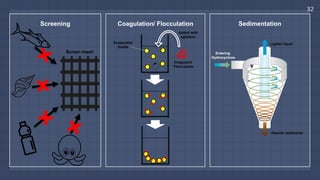
Coagulation/ Flocculation SedimentationScreening
Screen mesh
Coagulant/
Flocculants
Suspended
Solids
Added with
agitation
Lighter liquid
Heavier sediments
Entering
Hydrocyclone
Filtration & Adsorption
▫ Filtration is the physical or mechanical
process of separating solids from
liquids through a membrane.
▫ [Pore sizes of Ultrafiltration: 0.002 –
0.1 microns, Nanofiltration: 0.001
microns, Reverse Osmosis: Removes
everything]
▫ Carbon filtering uses a bed of
activated carbon to remove
contaminants through chemical
adsorption. It is used to remove
organic compounds and free chlorine,
preventing discharge of harmful
byproducts.
33
Water Purification – Stage 2
Filtration
Aeration
▫ Aeration is a process of introducing
air into the water through bubbling.
▫ This is done to reduce the unpleasant
smell and taste by inducing oxidation
of dissolved or suspended metals and
volatile organic chemicals (VOCs).
▫ Dissolved gases such as carbon
dioxide can also be removed through
aeration.
Anaerobic Digestion
▫ Anaerobic Digestion is the introduction
of microorganisms such as bacteria
into the water in order to break down
biodegradable materials.
▫ This process is done with little or no
presence of oxygen, with high
application in wastewater treatment.
▫ It can effectively eliminate pathogens
as well as lowering the Chemical
Oxygen Demand (COD) in the
wastewater.
34
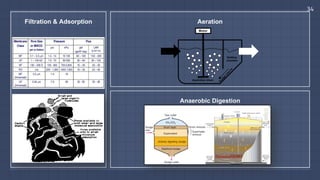
Filtration & Adsorption Aeration
Anaerobic Digestion
Search	(Week	2)		
ng	
ARBON	FILTER:	
ering	uses	a	bed	of	activated	carbon	to	remove	contaminants	through	chemical	
.	 In	 water	 treatment,	 activated	 carbon	 filters	 are	 used	 to	 remove	 organic	
s	 and	 free	 chlorine	 so	 as	 to	 prevent	 discharge	 of	 harmful	 byproducts	 between	
nd	 acids	 such	 as	 humic	 and	 fulvic	 acid.	 (WaterProfessionals,	 2014)	 Therefore,	
d	taste	would	be	greatly	reduced	after	treatment	with	activated	carbon	filter.
	
activated	 carbon	 is	 unable	 to	 remove	 hardness,	 sodium,	 fluorides,	 nitrates	 and	
As	 the	 water	 passes	 through	 the	 filter,	 particles	 are	 trapped	 within	 the	 carbon	
	this	process	is	known	as	adsorption.	Activated	carbon	has	slightly	positive	charge	
s	it	to	act	as	an	ion	exchanger	to	remove	impurities.	
Motor
Settling
chamber
Aspiration mixer
35
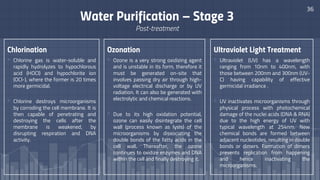
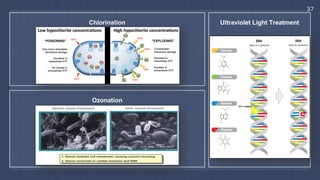
Chlorination
▫ Chlorine gas is water-soluble and
rapidly hydrolyzes to hypochlorous
acid (HOCl) and hypochlorite ion
(OCl-), where the former is 20 times
more germicidal.
▫ Chlorine destroys microorganisms
by corroding the cell membrane. It is
then capable of penetrating and
destroying the cells after the
membrane is weakened, by
disrupting respiration and DNA
activity.
36
Water Purification – Stage 3
Post-treatment
Ozonation
▫ Ozone is a very strong oxidizing agent
and is unstable in its form, therefore it
must be generated on-site that
involves passing dry air through high-
voltage electrical discharge or by UV
radiation. It can also be generated with
electrolytic and chemical reactions.
▫ Due to its high oxidation potential,
ozone can easily disintegrate the cell
wall (process known as lysis) of the
microorganisms by dissociating the
double bonds of the fatty acids in the
cell wall. Thereafter, the ozone
continues to oxidize enzymes and DNA
within the cell and finally destroying it.
Ultraviolet Light Treatment
▫ Ultraviolet (UV) has a wavelength
ranging from 10nm to 400nm, with
those between 200nm and 300nm (UV-
C) having capability of effective
germicidal irradiance .
▫ UV inactivates microorganisms through
physical process with photochemical
damage of the nuclei acids (DNA & RNA)
due to the high energy of UV with
typical wavelength at 254nm. New
chemical bonds are formed between
adjacent nucleotides, resulting in double
bonds or dimers. Formation of dimers
prevents replication from happening
and hence inactivating the
microorganisms.
37
Chlorination
Ozonation
Ultraviolet Light Treatment
INTRODU
Slide 2
Water Disinfection byU
U
ge
di
ca
A
A
th
ab
tr
th
Principles	&	Mechanisms:	
Chlorine	 destroys	 microorganisms	 by	 corroding	 the	 cell	 membrane.	 It	 is	 then	 capable	 of	
penetrating	 and	 destroying	 the	 cells	 after	 the	 membrane	 is	 weakened,	 by	 disrupting	
respiration	 and	 DNA	 activity.	 This	 results	 in	 the	 microorganisms	 unable	 to	 multiply	 and	
eventually	die.	
What	it	can	remove:	
Chlorine	 treatment	 is	 effective	 against	 bacteria	 and	 viruses,	 but	 not	 all	 water-borne	
pathogens.	Certain	protozoa	cysts	(Giardia	and	Cryptosporidium)	have	developed	resistance	
to	chlorine.	The	mentioned	protozoa	can	be	removed	with	other	disinfectant	such	as	ozone	
and	chlorine	dioxide.	Chlorine-based	disinfectants	can	also	remove	micro-pollutants	such	as	
pesticides.	
Advantages:	
• More	cost-effective	than	UV	or	ozone	treatment	
• Presence	of	disinfectant	residual	in	the	effluent	that	prolong	disinfection	
• Can	oxidize	certain	organic	and	inorganic	compounds	
• Dosage	of	chlorine	is	flexible	and	customizable	
Limitations:	
• Chlorine	disinfectant	residual	is	toxic	to	aquatic	life	
• Additional	dechlorination	step	to	remove	residual	
• Highly	corrosive	and	therefore	poses	risk	in	handling	
• By-products	from	oxidation	may	create	more	harmful	compounds	
• Total	dissolved	solids	increase	after	treatment	
Literature	Search	(Week	1)	–	Water	Disinfection	
Ee	Liang	Ying	
	
Ozone Treatment
What	it	is:	
Ozone	 is	 a	 very	 strong	 oxidizing	 agent	 and	 is	 unstable	 in	 its	 form,	 therefore	 it	 must	 be	
generated	on-site	that	involves	passing	dry	air	through	high-voltage	electrical	discharge	or	by	
UV	radiation.	It	can	also	be	generated	with	electrolytic	and	chemical	reactions.	This	treatment	
method	 can	 be	 used	 at	 various	 points	 of	 the	 whole	 treatment	 system,	 but	 usually	 pre-
filtration	stage.	
Principles	&	Mechanisms:	
Due	to	its	high	oxidation	potential,	ozone	can	easily	disintegrate	the	cell	wall	(process	known	
as	lysis)	of	the	microorganisms	by	dissociating	the	double	bonds	of	the	fatty	acids	in	the	cell	
wall.	Thereafter,	the	ozone	continues	to	oxidize	enzymes	and	DNA	within	the	cell	and	finally	
destroying	it.	
	
What	it	can	remove:	
Ozone	is	a	broad	range	biocide	that	can	inactivate	all	pathogenic	organisms	including	bacteria,	
viruses	and	protozoa.	It	can	also	remove	certain	heavy	metals,	organic	and	inorganic	matter,
38
dark	repair	
	
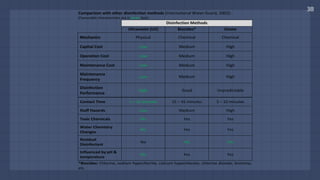
Comparison	with	other	disinfection	methods	(International	Water-Guard,	2002):	
(Favourable	characteristics	are	in	green	font)	
	 Disinfection	Methods	
	 Ultraviolet	(UV)	 Biocides*	 Ozone	
Mechanics	 Physical	 Chemical	 Chemical	
Capital	Cost	 Low	 Medium	 High	
Operation	Cost	 Low	 Medium	 High	
Maintenance	Cost	 Low	 Medium	 High	
Maintenance	
Frequency	
Low	 Medium	 High	
Disinfection	
Performance	
High	 Good	 Unpredictable	
Literature	Search	(Week	2)		
Ee	Liang	Ying	
	
Contact	Time	 1	–	10	seconds	 15	–	45	minutes	 5	–	10	minutes	
Staff	Hazards	 Low	 Medium	 High	
Toxic	Chemicals	 No	 Yes	 Yes	
Water	Chemistry	
Changes	
No		 Yes	 Yes	
Residual	
Disinfectant	
No	 Yes	 Yes	
Influenced	by	pH	&	
temperature	
No	 Yes	 Yes	
*Biocides:	Chlorine,	sodium	hypochlorite,	calcium	hypochlorate,	chlorine	dioxide,	bromine,	
etc.	
	
Ways	of	producing	UV-light	(Sciencedirect,	2017):
39
THANK
YOU!
References
1. Laskey, J. (2015, February 16). The Health Benefits of Water. Retrieved May 10, 2018,
from Everyday Health: https://www.everydayhealth.com/water-health/water-body-
health.aspx
2. Everything Connects. (2013, November 20). Fresh Water. Retrieved May 10, 2018, from
Everything Connects: http://www.everythingconnects.org/fresh-water.html
3. Gleick, P. H., & Palaniappan, M. (2010, June 22). Peak water limits to freshwater
withdrawal and use. PNAS, 107, 11155 - 11162.
4. UNESCO. (2009, March 12). New report highlights crucial role of water in development.
Retrieved May 21, 2018, from UNESCO: http://www.unesco.org/new/en/media-
services/single-
view/news/new_report_highlights_crucial_role_of_water_in_development/
5. Watkins, K. (2006, May). Human Development Report 2006. New York: United Nations
Development Programme. Retrieved from Data360:
http://www.data360.org/dsg.aspx?Data_Set_Group_Id=757
6. Rosegrant, M. W., Cai, X., & Cline, S. A. (2002). Global Water Outlook To 2025.
International Food Policy Research Institute. Colombo: International Food Policy
Research Institute.
7. PUB. (2018, January 01). Singapore Water Story. Retrieved May 28, 2018, from Public
Utilities Board: https://www.pub.gov.sg/watersupply/singaporewaterstory
8. Koncagul, E., Tran, M., Connor, R., Uhlenbrook, S., & Ortigara, A. R. (2017). The United
Nations World Water Development Report 2017. Italy: United Nations World Water
Assessment Programme.
9. Gleick, P. H. (1996). Water resources. In P. H. Gleick, In Encyclopedia of Climate and
Weather (pp. 817 - 823). New York: Oxford University Press. Retrieved from blueplanet:
http://www.blueplanet.nsw.edu.au/mi--water--distribution-of-water/.aspx
10. WaterWoes. (2001, April 26). Where's the water? Retrieved June 02, 2018, from Water
Woes: https://whyfiles.org/131fresh_water/index.html
11. Guppy, L., & Anderson, K. (2017). Global Water Crisis: The Facts. Canada: UNU-INWEH.

Basics of Water & Purification Methods

  • 1.
  • 2.
    “No water, nolife. No blue, no green.” -Sylvia Earle 2
  • 3.
    Content Page 3 WaterBasics Importance of Water ________________________________________________________________________ 05 Presence of Water __________________________________________________________________________ 07 Science of Water ___________________________________________________________________________ 08 Water Cycle _______________________________________________________________________________ 09 Facts & Statistics Global Water Consumption __________________________________________________________________ 11 Water Sources ____________________________________________________________________________ 14 Water Shortage Global Water Crisis _________________________________________________________________________ 22 Water Resource Management Water Management ________________________________________________________________________ 25 Water Conservation ________________________________________________________________________ 26 Water Purification __________________________________________________________________________ 30
  • 4.
    Water Basics Importance ofWater Presence of Water Science of Water Water Cycle
  • 5.
    Importance of Water5 • Drinking* • Daily activities (e.g. showering, cooking) • Household activities • Transportation • Recreational activities (e.g. swimming) • Habitat for flora and fauna • Manufacturing processes • Cleaning, Heating, Cooling • Electricity needs • Wheat & Paddy field • Artificial watering system (e.g. irrigation) Agricultural Industrial DomesticOthers
  • 6.
    6 Functions of waterin human body1 § Moves nutrients through digestive tract § Fiber absorbs water and allows waste to move through digestive tract § Heat regulator, dissipating body heat through perspiration § Cell waste elimination through urine § Cushion and lubricate body joints § Protects key organs such as brain § Fluid for senses to function properly
  • 7.
    Presence of Water7 § Water covers ¾ of Earth’s surface § 97% from oceans and seas, 2.997% from ice glaciers § Only 0.003% of Earth’s water is readily available freshwater2 § Freshwater sources include groundwater, rivers, lakes, ice glaciers, etc.
  • 8.
    Science of Water8 Forms hydrogen bond with two other water molecules Partial negative charge on hydrogen atom • Partial positive charge on oxygen atom • High heat capacity (4.22 kJ kg-1 K-1) • High latent heat of vaporization (40.63 kJ mol-1) • Latent heat of fusion (6.013 kJ mol-1) • Boiling point (100oC) & Melting point (0oC) at atmospheric pressure Evaporation/ Boiling Melting FreezingCondensation
  • 9.
    Water Cycle 9 evaporation transpiration precipitation Icecap à water storage collection Ocean à Water storage Atmosphere à Water storage condensation
  • 10.
    Facts & Statistics GlobalWater Consumption Water Sources
  • 11.
    64,000,000,000 m3/year Increase indemand for freshwater globally4 11 Global Water Consumption 35,000,000 km3 Available stock of natural freshwater3
  • 12.
    575 493 386 374 366 287 193 164 151 149 135 86 46 15 15 4 0 100 200300 400 500 600 700 UNITED STATES AUSTRALIA ITALY JAPAN MEXICO FRANCE GERMANY PHILLIPPINES SINGAPORE UNITED KINGDOM INDIA CHINA KENYA ANGOLA HAITI MOZAMBIQUE Average Water Consumption per capita per day in 2013 (Litres)5 Data by United Nations Development Program 12
  • 13.
    95 176 114 12120 45 255 1200 0 200 400 600 800 1000 1200 1400 1600 DEVELOPED COUNTRIES DEVELOPINGCOUNTRIES Projection of Water Consumption by sector in 2025 (Cubic kilometer)6 Domestic Industrial Livestock Irrigation 13
  • 14.
    14 Water Sources Other WaterSources Ø Desalination of seawater (97.5% of Earth’s water) Ø Recycled/ Reclaimed water Frozen Water 68.7% Ground Water 31% Surface Water 0.3% Projected Singapore Water Supply in 20608 Local Catchment & Imported Water Desalinated Water NEWater (Recycled Water) 15% 30% 55% Freshwater Sources7 (2.5% of Earth’s water) Naturally occurring water with low salt content
  • 15.
    15 Surface Water § Constitutes0.3% of Earth’s freshwater. § Considered readily available and needs to be treated to be potable water. § Non-saline water in river, lake, wetland, etc. § Replenished through water channeled from ocean, aquifers or precipitation. § Lost through evaporation into atmosphere or infiltration into ground. precipitation land runoff infiltration evaporation
  • 16.
    16 Ground Water § Constitutes31% of Earth’s freshwater. § Needs to be extracted through well or pump and treated to be potable water. § Storage of water underground is called ”Aquifers”, which is made up of sand, rocks and gravel. § Replenished through precipitation or snow melts that infiltrate into cracks under surface of ground. § Can be discharged into surface water sources precipitation infiltration evapotranspiration
  • 17.
    17 Frozen Water § Constitutes68.7% of Earth’s freshwater. § Rarely used as form of water supply as it requires melting. § Exists as ice and glaciers that mostly remain frozen until today. § Glaciers in mountainous regions form lake basins when the ice masses melt. § Can be replenished as snow at low temperature but will usually melt and result in land runoff. Glaciomarine muds Ice flow Ice shelf melting under ice shelf calved icebergs snowfall
  • 18.
    18 Desalinated Water § Oceansand seas constitutes 97.5% of Earth’s water. § The highly saline water undergoes desalination to remove the salt and minerals content. § Requires post-treatment to be suitable as potable water. § Energy-intensive process requiring high pressure that incurs huge cost. Seawater intake Pre-treatment (Microfiltration) Reverse Osmosis Post-treatment & Remineralisation
  • 19.
    19 Recycled Water § Alsoknown as “Reclaimed Water”, which comes from wastewater and greywater. § Can be re-used for household or industrial activities, and even potable water after stringent treatment process. § Possible solution to alleviate global water shortage issue and a freshwater- saving measure. Treated used water Wastewater & Greywater Water reclamation plant Microfiltration Reverse Osmosis Ultraviolet disinfection
  • 20.
    Global application ofrecycled water by sectors9 (After Advanced Treatment) Sector Percentage Application (%) Agricultural irrigation 32.0 Landscape irrigation 20.0 Industrial 19.3 Non-potable urban uses 8.3 Environmental enhancements 8.0 Recreational activities 6.4 Indirect potable reuse 2.3 Groundwater recharge 2.1 Others 1.5 20
  • 21.
  • 22.
    Global Water Crisis10 *Variousprominent devastating events included below 22 Deepwater Horizon Oil Spill (2010) Ice caps receding in Alaska (Climate Change) 70% population without clean drinking water in Somalia Jarkata Flooding (2018) Sinkholes & subsidence in San Joaquin Valley Spanish Drought (2017) - Economic water scarcity - Physical water scarcity
  • 23.
    114,000,000,000$ per year Toachieve Sustainable Development Goal 6 targets on water supply, sanitation & hygiene11 55% Reduction in globally available fresh water per capita since 1960 1,800,000,000 people Lack clean drinking water 23
  • 24.
    Water Resource Management WaterManagement Water Conservation Water Purification
  • 25.
    Water Management Ensure sustainableusage and supply of freshwater for consumption Infrastructure ▫ Building of dams to minimize chances of drought and flood ▫ Regulation of water flow ▫ Can generate electricity and provide recreational venue ✖ May alter ecosystem ✖ Reduce sediment load and transport Rainwater Harvest ▫ Building of water catchment area such as reservoirs ▫ Collection and storage of precipitation ▫ Can provide recreational venue ✖ Requires large land area Desalination ▫ Targeting at 97.5% saline seawater ▫ Removal of salt and minerals from brackish or seawater using distillation/ reverse- osmosis ✖ Very expensive 25
  • 26.
    Water Conservation Reduce consumptionof water in various sectors 26 Industrial Agricultural Municipal
  • 27.
    27 Municipal Efforts ▫ Recyclingand reusing of household greywater to flush toilets, etc. ▫ Installing water-saving appliances and aerators on sink faucets. ▫ State incentives for water conservation efforts by households.
  • 28.
    Agricultural Efforts ▫ Micro-/Drip-/Trickle-irrigation methodsto be implemented that can conserve water through prevention of over-usage. ▫ Piping of sealed irrigation systems to crops. 28
  • 29.
    Industrial Efforts ▫ Legislationsto prohibit excessive usage of water. ▫ State incentives for water conservation efforts by industries. ▫ Recycling of water within industrial plant process whenever possible. 29 Wastewater tank Clear water tank Water re-injected into industrial process Reactor with filtration
  • 30.
    30 STAGE 3 Post-treatment (Disinfection) I. Chlorination II.Ozonation III. Ultraviolet Light treatment STAGE 1 Pre-Treatment I. Screening II. Coagulation/ Flocculation III. Sedimentation STAGE 2 Filtration I. Filtration & Adsorption II. Aeration III. Anaerobic Digestion Water Purification Removal or reduction of contaminants in water to meet desired end-use quality requirement
  • 31.
    Screening ▫ The initialstep of treatment is always passing the water through a screen as it enters the treatment plant. ▫ The screen is to remove large natural contaminants such as plants or waste that is big enough. ▫ Screening is not necessary if it the the groundwater to be treated since it has passed through the earth as natural screen. 31 Water Purification – Stage 1 Pre-treatment Coagulation/ Flocculation ▫ Coagulation is either a physical or chemical precipitation of suspended particles in the water to aggregate into larger size, with the use of iron or aluminum salts. ▫ Flocculation is the process whereby colloids in the water precipitate as flakes or flocs after the addition of clarifying agent. ▫ Both aggregate and flocs can be removed during the filtration stage. Sedimentation ▫ As there are many suspended particles in untreated water samples or wastewater, they will start to settle to the bottom of the settling tank as sediments after a while. ▫ The process is slow unless used with external centrifugal force such as hydrocyclone. ▫ The settled sediments can then be removed easily.
  • 32.
    32 Coagulation/ Flocculation SedimentationScreening Screenmesh Coagulant/ Flocculants Suspended Solids Added with agitation Lighter liquid Heavier sediments Entering Hydrocyclone
  • 33.
    Filtration & Adsorption ▫Filtration is the physical or mechanical process of separating solids from liquids through a membrane. ▫ [Pore sizes of Ultrafiltration: 0.002 – 0.1 microns, Nanofiltration: 0.001 microns, Reverse Osmosis: Removes everything] ▫ Carbon filtering uses a bed of activated carbon to remove contaminants through chemical adsorption. It is used to remove organic compounds and free chlorine, preventing discharge of harmful byproducts. 33 Water Purification – Stage 2 Filtration Aeration ▫ Aeration is a process of introducing air into the water through bubbling. ▫ This is done to reduce the unpleasant smell and taste by inducing oxidation of dissolved or suspended metals and volatile organic chemicals (VOCs). ▫ Dissolved gases such as carbon dioxide can also be removed through aeration. Anaerobic Digestion ▫ Anaerobic Digestion is the introduction of microorganisms such as bacteria into the water in order to break down biodegradable materials. ▫ This process is done with little or no presence of oxygen, with high application in wastewater treatment. ▫ It can effectively eliminate pathogens as well as lowering the Chemical Oxygen Demand (COD) in the wastewater.
  • 34.
    34 Filtration & AdsorptionAeration Anaerobic Digestion Search (Week 2) ng ARBON FILTER: ering uses a bed of activated carbon to remove contaminants through chemical . In water treatment, activated carbon filters are used to remove organic s and free chlorine so as to prevent discharge of harmful byproducts between nd acids such as humic and fulvic acid. (WaterProfessionals, 2014) Therefore, d taste would be greatly reduced after treatment with activated carbon filter. activated carbon is unable to remove hardness, sodium, fluorides, nitrates and As the water passes through the filter, particles are trapped within the carbon this process is known as adsorption. Activated carbon has slightly positive charge s it to act as an ion exchanger to remove impurities. Motor Settling chamber Aspiration mixer
  • 35.
  • 36.
    Chlorination ▫ Chlorine gasis water-soluble and rapidly hydrolyzes to hypochlorous acid (HOCl) and hypochlorite ion (OCl-), where the former is 20 times more germicidal. ▫ Chlorine destroys microorganisms by corroding the cell membrane. It is then capable of penetrating and destroying the cells after the membrane is weakened, by disrupting respiration and DNA activity. 36 Water Purification – Stage 3 Post-treatment Ozonation ▫ Ozone is a very strong oxidizing agent and is unstable in its form, therefore it must be generated on-site that involves passing dry air through high- voltage electrical discharge or by UV radiation. It can also be generated with electrolytic and chemical reactions. ▫ Due to its high oxidation potential, ozone can easily disintegrate the cell wall (process known as lysis) of the microorganisms by dissociating the double bonds of the fatty acids in the cell wall. Thereafter, the ozone continues to oxidize enzymes and DNA within the cell and finally destroying it. Ultraviolet Light Treatment ▫ Ultraviolet (UV) has a wavelength ranging from 10nm to 400nm, with those between 200nm and 300nm (UV- C) having capability of effective germicidal irradiance . ▫ UV inactivates microorganisms through physical process with photochemical damage of the nuclei acids (DNA & RNA) due to the high energy of UV with typical wavelength at 254nm. New chemical bonds are formed between adjacent nucleotides, resulting in double bonds or dimers. Formation of dimers prevents replication from happening and hence inactivating the microorganisms.
  • 37.
    37 Chlorination Ozonation Ultraviolet Light Treatment INTRODU Slide2 Water Disinfection byU U ge di ca A A th ab tr th Principles & Mechanisms: Chlorine destroys microorganisms by corroding the cell membrane. It is then capable of penetrating and destroying the cells after the membrane is weakened, by disrupting respiration and DNA activity. This results in the microorganisms unable to multiply and eventually die. What it can remove: Chlorine treatment is effective against bacteria and viruses, but not all water-borne pathogens. Certain protozoa cysts (Giardia and Cryptosporidium) have developed resistance to chlorine. The mentioned protozoa can be removed with other disinfectant such as ozone and chlorine dioxide. Chlorine-based disinfectants can also remove micro-pollutants such as pesticides. Advantages: • More cost-effective than UV or ozone treatment • Presence of disinfectant residual in the effluent that prolong disinfection • Can oxidize certain organic and inorganic compounds • Dosage of chlorine is flexible and customizable Limitations: • Chlorine disinfectant residual is toxic to aquatic life • Additional dechlorination step to remove residual • Highly corrosive and therefore poses risk in handling • By-products from oxidation may create more harmful compounds • Total dissolved solids increase after treatment Literature Search (Week 1) – Water Disinfection Ee Liang Ying Ozone Treatment What it is: Ozone is a very strong oxidizing agent and is unstable in its form, therefore it must be generated on-site that involves passing dry air through high-voltage electrical discharge or by UV radiation. It can also be generated with electrolytic and chemical reactions. This treatment method can be used at various points of the whole treatment system, but usually pre- filtration stage. Principles & Mechanisms: Due to its high oxidation potential, ozone can easily disintegrate the cell wall (process known as lysis) of the microorganisms by dissociating the double bonds of the fatty acids in the cell wall. Thereafter, the ozone continues to oxidize enzymes and DNA within the cell and finally destroying it. What it can remove: Ozone is a broad range biocide that can inactivate all pathogenic organisms including bacteria, viruses and protozoa. It can also remove certain heavy metals, organic and inorganic matter,
  • 38.
    38 dark repair Comparison with other disinfection methods (International Water-Guard, 2002): (Favourable characteristics are in green font) Disinfection Methods Ultraviolet (UV) Biocides* Ozone Mechanics Physical Chemical Chemical Capital Cost Low Medium High Operation Cost Low Medium High Maintenance Cost Low Medium High Maintenance Frequency Low Medium High Disinfection Performance High Good Unpredictable Literature Search (Week 2) Ee Liang Ying Contact Time 1 – 10 seconds 15 – 45 minutes 5 – 10 minutes Staff Hazards Low Medium High Toxic Chemicals No Yes Yes Water Chemistry Changes No Yes Yes Residual Disinfectant No Yes Yes Influenced by pH & temperature No Yes Yes *Biocides: Chlorine, sodium hypochlorite, calcium hypochlorate, chlorine dioxide, bromine, etc. Ways of producing UV-light (Sciencedirect, 2017):
  • 39.
    39 THANK YOU! References 1. Laskey, J.(2015, February 16). The Health Benefits of Water. Retrieved May 10, 2018, from Everyday Health: https://www.everydayhealth.com/water-health/water-body- health.aspx 2. Everything Connects. (2013, November 20). Fresh Water. Retrieved May 10, 2018, from Everything Connects: http://www.everythingconnects.org/fresh-water.html 3. Gleick, P. H., & Palaniappan, M. (2010, June 22). Peak water limits to freshwater withdrawal and use. PNAS, 107, 11155 - 11162. 4. UNESCO. (2009, March 12). New report highlights crucial role of water in development. Retrieved May 21, 2018, from UNESCO: http://www.unesco.org/new/en/media- services/single- view/news/new_report_highlights_crucial_role_of_water_in_development/ 5. Watkins, K. (2006, May). Human Development Report 2006. New York: United Nations Development Programme. Retrieved from Data360: http://www.data360.org/dsg.aspx?Data_Set_Group_Id=757 6. Rosegrant, M. W., Cai, X., & Cline, S. A. (2002). Global Water Outlook To 2025. International Food Policy Research Institute. Colombo: International Food Policy Research Institute. 7. PUB. (2018, January 01). Singapore Water Story. Retrieved May 28, 2018, from Public Utilities Board: https://www.pub.gov.sg/watersupply/singaporewaterstory 8. Koncagul, E., Tran, M., Connor, R., Uhlenbrook, S., & Ortigara, A. R. (2017). The United Nations World Water Development Report 2017. Italy: United Nations World Water Assessment Programme. 9. Gleick, P. H. (1996). Water resources. In P. H. Gleick, In Encyclopedia of Climate and Weather (pp. 817 - 823). New York: Oxford University Press. Retrieved from blueplanet: http://www.blueplanet.nsw.edu.au/mi--water--distribution-of-water/.aspx 10. WaterWoes. (2001, April 26). Where's the water? Retrieved June 02, 2018, from Water Woes: https://whyfiles.org/131fresh_water/index.html 11. Guppy, L., & Anderson, K. (2017). Global Water Crisis: The Facts. Canada: UNU-INWEH.