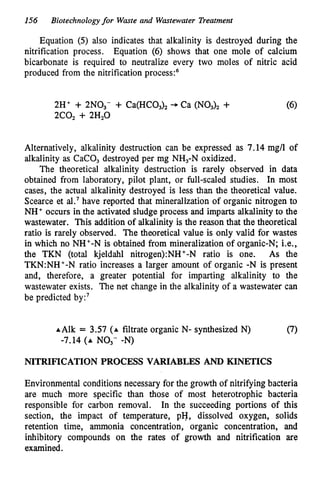
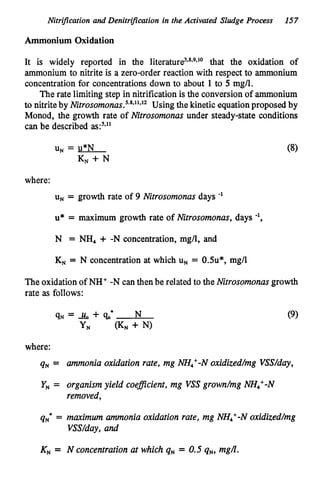
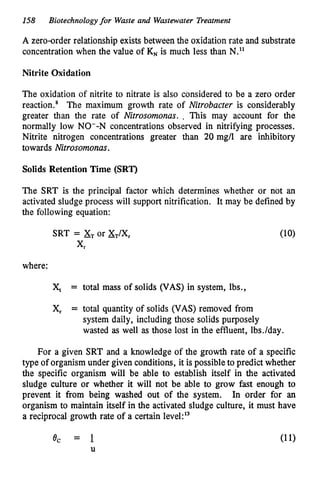
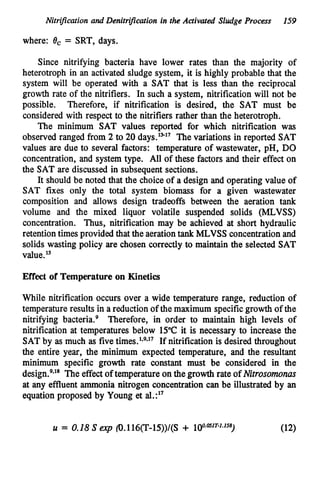
BIOTECHNOLOGY
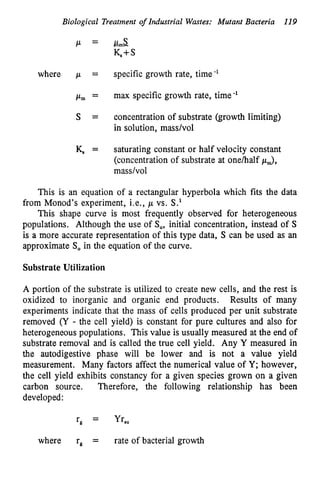
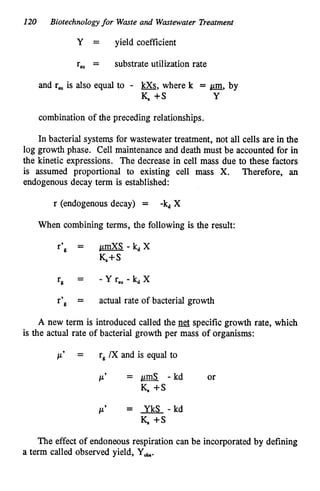
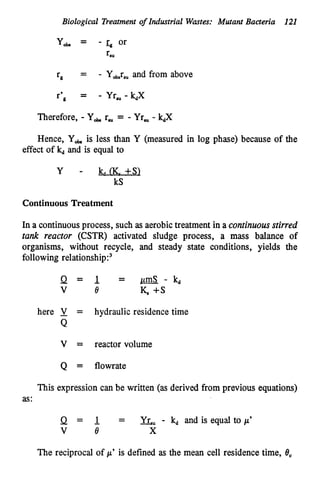
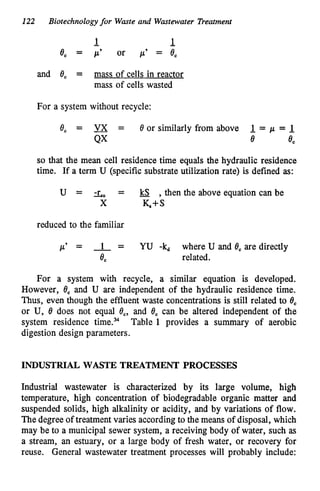
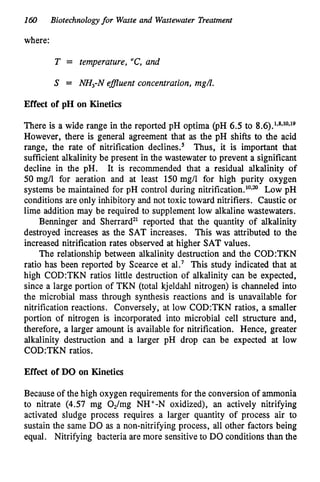
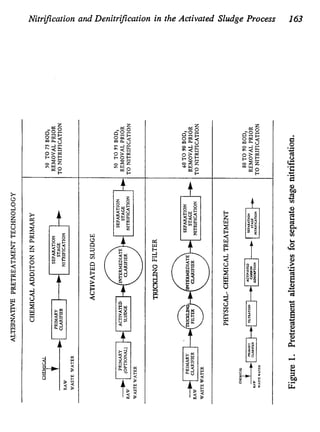
FOR WASTE
AND WASTEWATER TREATMENT
by
Nicholas P. Cheremisinoff, Ph.D.
NOYES PUBLICATIONS
Weatwood, New Jerary, U.8.A.
Copyright 0 1996 by Nicholas P. Cheremisinoff
No part of this book may be reproduced or utilized in
any form or by any means, electronic or mechanical,
including photocopying, recording or by any informa-
tion storage and retrieval system, without permission
in writing from the Publisher.
Library of Congress Catalog Card Number:
Printed in the United States
ISBN: 0-8155-1409-3
Published in the United States of America by
Noyes Publications
Fairview Avenue, Westwood, New Jersey 07675
10 9 8 7 6 5 4 3 2 1
Library of Congress Cataloging-in-Publication Data
Cheremisinoff, Nicholas P.
Biotechnology for waste and wastewater treatment / Nicholas P.
Cheremisnoff.
p. cm.
Includes bibliographical references and index.
1. Sewage--Purification--Biological treatment. 2
. Water-
-Purification--Biological treatment. I. Title.
TD755.C547 1996 96-45255
628.3--d~21 CIP
ISBN 0-8155-1409-3
NOTICE
To the best of our knowledge the information in this publication
is accurate; however, the Publisher does not assume any
responsibility or liability for the accuracy or completeness of, or
consequences arising from, such information. This book is
intended for informational purposes only. Mention of trade names
or commercial products does not constitute endorsement or
recommendation for use by the Publisher. Final determination of
the suitability of any information or product for use contemplated
by any user, and the manner of that use, is the sole responsibility
of the user. We recommend that anyone intending to rely on any
recommendation of materials or procedures mentioned in this
publication should satisfy himself as to such suitability, and that
he can meet all applicable safety and health standards.
vi
ABOUT THE AUTHOR
Nicholas P. Cheremisinoff is a private consultant to
industry, academia, and government. He has nearly twenty years
of industry and applied research experience in elastomers,
synthetic fuels, petrochemicals manufacturing, and environmental
control. A chemical engineer by trade, he has authored over 100
engineering textbooks and has contributed extensively to the
industrial press. He is currently working for the United States
Agency for International Development in Eastern Ukraine, where
he is managing the Industrial Waste Management Project. Dr.
Cheremisinoff received his B.S., M.S., and Ph.D. degrees from
Clarkson College of Technology.
vii
PREFACE
This book examines the practices used or considered for
biological treatment of waterlwastewater and hazardous wastes.
The technologies described involve conventional treatment
processes, their variations, as well as recent research. The book
is intended for those seeking an overview of the field, and covers
the major topics. The book is divided into five principal sections,
and references are provided for those who wish to dig deeper.
Nicholas P. Cheremisinoff
V
CONTENTS
Preface ..................................... iii
About the Author ................................ Y
CHAPTER 1. BIOTECHNOLOGY FOR INDUSTRIAL
AND MUNICIPAL WASTES ...........1
Wastewater Treatment ................3
BOD Removal ..................... 5
T
y
p
e
sof Biological Processes ........... 5
Municipal Wastewater ................ 6
Activated Sludge Process .............. 7
Sludge ...................... 10
Tapered Aeration . . . . . . . . . . . . . . . . . . 12
Step Feed Aeration . . . . . . . . . . . . . . . . . 12
Contact Stabilization . . . . . . . . . . . . . . . . 12
Complete Mix .................... 13
Extended Aeration ................. 13
Oxidation Ditch ................... 13
Anaerobic Digestion ................ 15
SLUDGES ....................... 18
Desulfurization ................... 21
Nitrification/Denitrification . . . . . . . . . . . . 25
Nitrification ...................... 27
Suspended Growth Systems . . . . . . . . . . . 34
Attached Growth Systems . . . . . . . . . . . . . 34
Aquatics ....................... 35
Concluding Remarks ................ 35
Conventional (Plug Flow) Activated
MUNICIPAL TREATMENT PLANT
ix
x Contents
CHAPTER 2. BIOLOGICAL DEGRADATION OF
HAZARDOUS WASTES .............37
INTRODUCTION .................... 38
ABIOTIC TREATMENT TECHNIQUES ..... 42
Wastewater Treatment ............... 42
Liquids-Solids Separation ............. 42
Chemical Treatment ................ 43
Physical Methods .................. 44
Incineration ..................... 46
Wet Air Oxidation ................. 48
SolidificationTechniques ............. 48
BIOLOGICAL CONTROL METHODS ...... 49
Land Treatment ................... 50
Composting ...................... 51
Liquids/Solids Treatment Systems (LSTS) .. 52
Soil Biofilters .................... 54
Wastewater Treatment ............... 55
Activated Sludge Process ............. 56
Trickling Over Process .............. 56
Stabilization ..................... 57
DEGRADABILITY .................. 57
Basis for Biodegradation ............. 58
Genetics ........................ 59
Testing for Recalcitrance ............. 61
Aerobic Tiered Testing .............. 62
Anaerobic Tiered Testing ............. 63
Testing for Recalcitrance ............. 63
PILOT STUDIES .................... 66
PCB Biodegradation ................ 66
Methyl Ethyl Ketone ................ 69
Landfill Leachate .................. 70
DEGRADATION .................... 71
TCE Degradation . . . . . . . . . . . . . . . . . . 71
Degradation .................... 73
DETERMINATION OF BIOLOGICAL
LABORATORY STUDIES OF AEROBIC
Polycyclic Aromatic Hydrocarbon
Ring Fission Products ............... 74
Phenanthrene Degradation ............ 78
Contents xi
Chlorophenol Degradation ............ 79
Chlorinated Wastes ................. 80
p-Nitrophenol Degradation ............ 80
Degradation of Fluoro Substituted
Benzenes ...................... 81
PentachlorophenolDegradation ......... 81
Oil Degradation ................... 82
HexachlorocyclohexaneDegradation . . . . . . 83
Metolachlor Degradation ............. 87
PolyphosphateDegrading Enzymes ....... 88
Aniline Degradation . . . . . . . . . . . . . . . . 85
Disulfide Removal ................. 86
Activated Sludge Studies ............. 87
Two Stage BiologicalKhemical Treatment
of Leachate .................... 89
ANAEROBIC BACTERIA . . . . . . . . . . . . . . 90
Metabolism ...................... 90
Anaerobic Processes . . . . . . . . . . . . . . . . 92
Perchloroethylene .................. 93
Coal GasificationWastewater . . . . . . . . . . 94
Tannery Wastes . . . . . . . . . . . . . . . . . . . 94
1.1. 1.Trichloroethane Degradation In-Situ .. 95
Patent for Haloaromatic Compounds . . . . . . 96
2.4.Dichlorophenol ................. 96
FUNGI ........................... 97
Dioxin .......................... 97
PAH Degradation . . . . . . . . . . . . . . . . . . 98
Selenium ....................... 99
Immobilization of Phenolics . . . . . . . . . . . 99
Metalaxyl Degradation . . . . . . . . . . . . . . . 99
CONCLUSIONS .................... 100
REFERENCES ..................... 101
CHAPTER 3. BIOLOGICAL TREATMENT OF
INDUSTRIAL WASTES: MUTANT
BACTERIA ..................... 111
BIOLOGICAL TREATMENT .
OVERVIEW ..................... 111
MICROBIOLOGY BACKGROUND ....... 112
xii Contents
Energy and Carbon Sources . . . . . . . . . . 112
Type of Organisms ................ 114
BACTERIAL GROWTH . . . . . . . . . . . . . . 1
1
6
Factors Affecting Growth ............ 116
Temperature .................... 116
pH .......................... 116
Oxygen ....................... 117
Nutrients ...................... 117
KINETICS OF GROWTH .............. 117
Growth Curve ................... 117
Cultures ....................... 118
Substrate Utilization ............... 119
Continuous Treatment .............. 121
PROCESSES ..................... 122
Aerated Processes . . . . . . . . . . . . . . . . . 123
Activated Sludge (Suspended Growth) . . . . 127
Aerated Lagoons . . . . . . . . . . . . . . . . . 129
Waste Stabilization ................ 132
Trickling Filter (Attached Growth) ...... 132
Rotating Biological Contactors (RBC) .... 133
Packed Beds .................... 133
Landfarming .................... 134
Anaerobic Digestion (Treatment) ....... 135
MUTANT BACTERIA ............... 137
Case Histories .................... 138
Dissenting Opinions . . . . . . . . . . . . . . . 144
REFERENCES ..................... 145
INDUSTRIAL WASTE TREATMENT
CHAPTER 4. NITRIFICATION AND DENITRIFICATION
IN THE ACTIVATED SLUDGE
PROCESS ...................... 151
INTRODUCTION ................... 151
FORMS OF NITROGEN . . . . . . . . . . . . . . 152
NITRIFYING BACTERIA ............. 153
NITRIFICATION STOICHIOMETRY . . . . . . 155
NITRIFICATION PROCESS VARIABLES
AND KINETICS .................. 156
Ammonium Oxidation .............. 157
Contents xiii
Nitrite Oxidation ................. 158
Solids Retention Time (SRT) . . . . . . . . . 158
Effect of Temperature on Kinetics ...... 159
Effect of pH on Kinetics . . . . . . . . . . . . 160
Effect of DO on Kinetics . . . . . . . . . . . . 160
Effect of Organic Loading on Kinetics .... 161
Inhibition of Nitrification . . . . . . . . . . . . 162
DENITRIFICATION . . . . . . . . . . . . . . . . . . 164
DENITRIFYING BACTERIA . . . . . . . . . . . 164
DENITRIFICATION STOICHIOMETRY . . . . 165
DENITRIFICATION PROCESS VARIABLES
AND KINETICS . . . . . . . . . . . . . . . . . . 166
Kinetics ...................... 166
Effect of NO,. N Concentration on
Effect of Temperature on Kinetics . . . . . . 166
Effect of pH on Kinetics . . . . . . . . . . . . 167
Effect of Carbon Concentration on
Kinetics ...................... 167
NITRIFICATION PROCESSES . . . . . . . . . . 167
Plug-Flow Versus Complete Mix ....... 167
Single-Stage Versus Two-Stage Systems . . . 168
DENITRIFICATION PROCESSES . . . . . . . . 170
Denitrification Using Methanol as the
Carbon Source ................. 170
Denitrification Using Organic Matter
Present in Raw Wastewater . . . . . . . . . 174
Denitrification Using Thiosulfate and
Sulfide ...................... 176
SUMMARY AND CONCLUSIONS . . . . . . . 177
REFERENCES ..................... 184
CHAPTER 5. IN-SITU BIORECLAMATION OF
CONTAMINATED GROUNDWATER ... 189
INTRODUCTION . . . . . . . . . . . . . . . . . . . 189
TREATING CONTAMINATED
GROUNDWATER . . . . . . . . . . . . . . . . . 193
APPLICATION OF MODELING . . . . . . . . . 196
SOC and NO.. Profiles . . . . . . . . . . . . . 196
One-BAZ Columr . . . . . . . . . . . . . . . . 198
xiv Contents
TWO-BAZ
Column ................ 199
Secondary Substrate Profiles .......... 204
Carbon Tetrachloride .............. 204
Bromoform. Ethylene Dibromide.
Tetrachloroethene.and Trichloroethene . . 209
Simulationof BioreclamationStrategies . . . 210
CONCLUSIONS .................... 216
REFERENCES ...................... 221
Index ..................................... 225
1 BIOTECHNOLOGY FOR INDUSTRIAL AND
MUNICIPAL WASTES
Hazardous waste management remains the primary area of concern for
many industries. Regulations, such as the Resource Conservation and
Recovery Act (RCRA), the Toxic Substance Control Act (TSCA), and
Superfund (CERCLA) as well as regulatory agencies, continue to keep
corporate attention and the pressure on.
An important area of technology is biological treatment, popularly
re-classified in recent years as Biotechnology. Biotechnology has its
origins from an old sciencewhere we find applications in the antiquities.
It is however a new technologyunder-going a resurgence in a wide range
of applications, including past/present/future applications for the
pollution engineer.
Natural decomposition of inorganic and organic materials has
occurred for millions of years. Biological management of wastehas been
practiced for thousands of years. Most microorganisms in use are
extracted from soil and water bodies and more recently technically
developed for specific applications, and uses organic and toxic materials
as sources of energy and carbon. While in the future, biological
treatment will be based on microorganisms, a drastic departure from the
past will most likely take place based on the new scienceof recombinant
DNA.
The following are examples of recent research and applications of
wastes and toxics, using biotechnology control:
Some 20 different bacteria are said to be capableof breaking
down polychlorinated biphenyls into water and carbon
dioxide. One of these organisms from the genus Alcalie-
genes is photoactivated by sunlight. Sunlight enhances the
speed of degradation of PCB by some 400%.
1
2 Biotechnology for Waste and Wastewater Treatment
Researchers, involved in training bacteria--Bacillus
megaterium and Nocardiopsis--to consume dioxin, observe
that dioxin could easily penetrate the cell walls and be
degraded faster if solvents such as ethyl acetate and dimethyl
sulfoxide were added to the broth.
A strain of genetically engineered microorganisms degrades
95% or more of the persistent 2,4,5-T within a week.
Microbes can also degrade a variety of dichlorobiphenyls and
chlorobenzoates.
Scientists have isolated a strain of Pseudomonas that uses
2,4-D as a source of carbon. The gene involved was
isolated and inserted in a different host bacteria.
A number of microorganisms containing plasmids bearing
genes for the degradation of aromatic molecules--toluene and
xylene diverse salicylates and chloride derivatives of 4-
chlorocatecol--have been tested.
Formulation of bacterial mutants are commercially available
for a variety of wastewater treatment problems. Specially
formulated preparations are used for petroleum
refinery/petroleum chemical plant wastewater cleanups. The
bacteria degrades various hydrocarbons and organic
chemicals (benzenes, phenols, cresols, napthalenes, amines,
alcohols, synthetic detergents, petroleum (crude and
processed)).
Grease eating bacteria having syccessfully been used in
cleaning clogged sewers.
A major problem in recent decades has been the appearance
of new chemicals in the environment stretching the ability of
microorganisms to evolve by adaptation of existing catabolic
enzymes or by the appearance of new metabolic pathways,
the ability to degrade persistent xenobiotic compounds. We
are constantly learning from such organisms and selecting
those that show a maximum rate of biodegradation with
maximum substrate utilization and minimum microbial
biomass production.
Biotechnologyfor Industrial and Municipal Wastes 3
Wastewater Treatment
Biological treatment is one of the most widely used removal methods as
well as for partial or complete stabilization of biologically degradable
substances in wastewaters and wastes. Suspended, colloidal or dissolved
degradable organic material, quantities and ratios depend on the nature
of the wastewater. Characteristics of wastewaters are measured in terms
of Chemical Oxygen Demand (COD), Biochemical Oxygen Demand
(BOD), and Volatile Suspended Solids (VSS).
Most biological waste and wastewater treatment processes employ
bacteria as primary microorganisms; certain other microorganisms may
play an important role. Degradation of organic matter is effected by its
use as food by microorganisms to produce protoplasm for new cells
during the growth process. Population dynamics of bacteria in biological
treatment depends on environmental factors which include: pH;
temperature; type and concentration of the substrate; hydrogen acceptor;
essential nutrient concentration and availability; concentration of essential
nutrients (e.g. ,nitrogen, phosphorous, sulfur, etc.); essential minerals;
osmotic pressure; media toxicity; byproducts; and degree of mixing.
Metabolic reactions occurring within a biological treatment process
can be divided into three phases:
Oxidation
Synthesis
Endogenous respiration
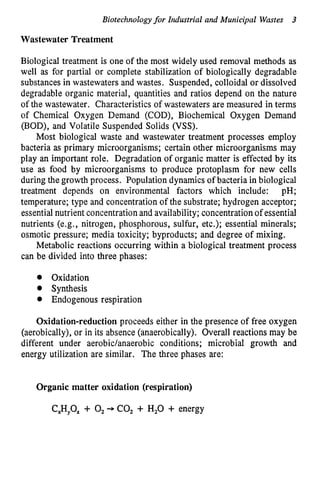
Oxidation-reduction proceeds either in the presence of free oxygen
(aerobically), or in its absence (anaerobically). Overall reactions may be
different under aerobidanaerobic conditions; microbial growth and
energy utilization are similar. The three phases are:
Organic matter oxidation (respiration)
CP,O, + 0, --+ CO, + H,O + energy
4 Biotechnologyfor Waste and Wastewater Treatment
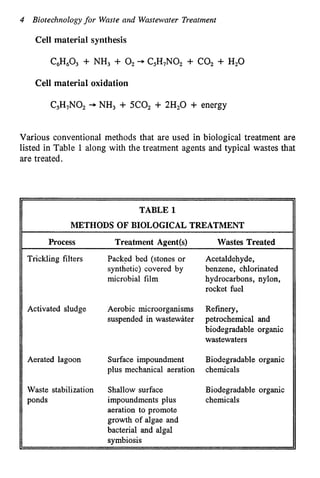
Cell material synthesis
CGHGO3 + NH3 + 0 2 -+ CSH7NOz + CO2 + H2O
Cell material oxidation
C5H7N02
+ NH3 + 5C0, + 2H,O + energy
Various conventional methods that are used in biological treatment are
listed in Table 1 along with the treatment agents and typical wastes that
are treated.
TABLE 1
METHODS OF BIOLOGICAL TREATMENT
Process Treatment Agent(s) Wastes Treated
Trickling filters Packed bed (stones or Acetaldehyde,
synthetic) covered by benzene, chlorinated
microbial film hydrocarbons, nylon,
rocket fuel
Activated sludge Aerobic microorganisms Refinery,
suspended in wastewater petrochemical and
biodegradable organic
wastewaters
Aerated lagoon Surface impoundment Biodegradable organic
plus mechanical aeration chemicals
Waste stabilization Shallow surface Biodegradable organic
ponds impoundments plus chemicals
aeration to promote
growth of algae and
bacterial and algal
symbiosis
Biotechnologyfor Industrial and Municipal Wastes 5
BOD Removal
In wastewater treatment microorganisms are not present as isolated cells,
but as a collection of microorganisms (such as bacteria, yeast, molds,
protozoa, rotifers, worms and insect larvae) in a mass. These
microorganisms tend to collect as a biological floc called biomass and
generally possess good settling characteristics. Biological oxida-
tiodstabilization of organic matter proceeds as follows:
High rate of BOD removal from wastewater upon contact
with activebiomass. This removal and its extent depends on
loading rate, waste type, and biomass.
BOD is utilized in proportion to cell growth. Materials that
concentrate on the biomass surface are decomposed by
enzymes of living cells; new cells are synthesized;
decomposition end products are washed into the water or
escape into the atmosphere.
Biological cell material oxidizes through endogenous
respiration when food supply becomes limited.
Biomass is converted to settleable material or removable
solids.
Rates of these reactions depend on substrate transport rates,
nutrients, and oxygen (in case of aerobic treatment). Any one or more
of these transport rates can be the controlling factors that determine the
process efficiency.
Types of Biological Processes
Biological treatment processes can be divided into three groups:
0 Aerobic stationary contact systems-irrigation beds,
irrigation sand filters, and trickling biomass remains
stationary in contact with the solid support media (sand or
rocks) and the wastewater flows around it.
0 Aerobic suspended contact systems--the activated sludge
process, its variations and aerobic lagoons comprise this
group. In this group both biomass and substrate are in
suspension or motion.
6 Biotechnologyfor Waste and Wastewater Treatment
Anaerobic suspended contact systems--anaerobic sludge
digestion, anaerobiclagoons, and latter stagesof landfillsfall
in this category.
Municipal Wastewater
Sewage is about 99.95% water and 0.05% waste. It is the spent water
supply of a community. Due to infiltration of groundwater into loose
sewer pipe joints, the quantity of wastewater is often greater than the
water quantity that is initially consumed. More dilute sewage is a result
of greater per capita water consumption, and industrial and commercial
wastes contribute to sewage strength. Per capita sewageproduction can
vary from less than 100 gallons per day for strictfy residential areas to
300 gallons per day or more for industrialized areas. A typical sewage
composition may be:
Total solids 600 mgll Mineral 20 mgll
Suspended solids 200 mgll Filterable solids 400 mgll
Settleable solids 120 mgll BOD (5 day 20%) 54 g1cap.lday
Colloidal solids 80 mgll Suspended 42 g1cap.lday
Organics 60 mgll Dissolved 12 g1cap.lday
The above estimateindicatesa measure of the loading on a treatment
plant (this may be additionally complicated by the presence of industrial
effluents). The two principal processes utilized for biological (secon-
dary) treatment are the trickling filter and activated sludge process.
Objectives in waste management change. Originally sewage
treatment facilities were built primarily from a public health viewpoint
but now include objectives such as oxygen protection for receiving
waters. Clean water demand has increasedmore rapidly than population.
This has given rise to the supply of complete treatment plants for small
communities, developments, and isolated installations by manufacturers
of waste treatment equipment in the form of packaged plants. A
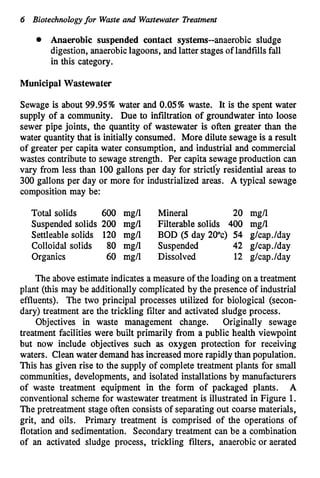
conventionalscheme for wastewater treatment is illustrated in Figure 1.
The pretreatment stage often consists of separating out coarse materials,
grit, and oils. Primary treatment is comprised of the operations of
flotation and sedimentation. Secondary treatment can be a combination
of an activated sludge process, trickling filters, anaerobic or aerated
Biotechnologyfor Industrial and Municipal Wastes 7
R
i
W SECONDARY TERTIARY FINAL
- EFFLUENT
WASCFXATER
/
I
AND GRIT
1 4. AERATED LAGOONS
REMOVAL
2. OIL SEPA-
RATION I 5. STABILIZATION PONDS
I ''s ~ ~ ~ ~ ~ N -
2. TRICKLING FILTERS 1
3. ANAEROBIC LAGOONS I
I
I
I
Figure 1. Typical wastewater treatment sequence.
lagoons, and stabilizationponds. This is often followedby sedimentation
and then tertiary treatment, which is sometimes called "polishing.'I
Activated Sludge Process
The activated sludge process is a widely used and effective treatment for
the removal of dissolved and colloidal biodegradable organics. It is a
treatment technique well suited where organically contaminated
wastewater exists. The activated sludge process is used by a wide range
of municipalities and industries that treat wastewater containing organic
chemicals, petroleum refining wastes, textile wastes, and municipal
sewage.
The active sludge process converts dissolved and colloidal organic
contaminants into a biological sludge which can be removed by settling.
The treatment method is generally considered to be a form of secondary
treatment and normally follows a primary settling basin. The flow
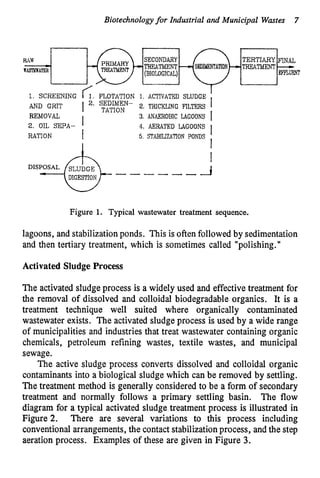
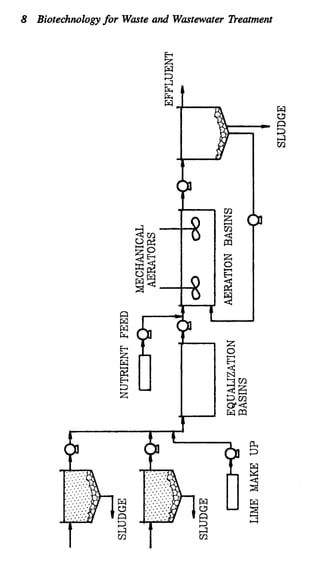
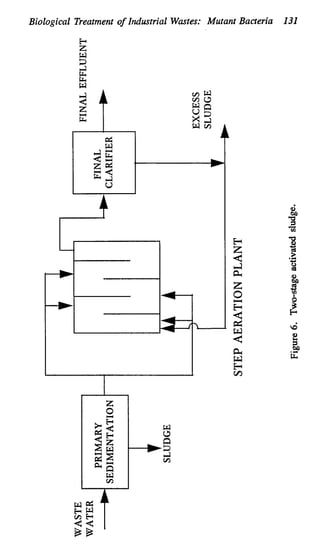
diagram for a typical activated sludge treatment process is illustrated in
Figure 2. There are several variations to this process including
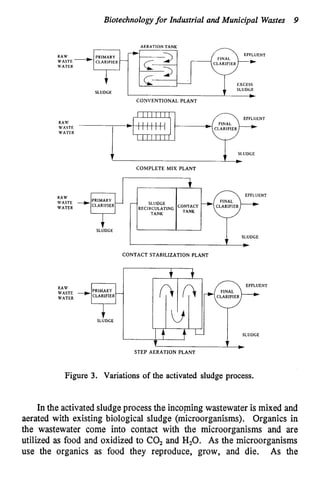
conventionalarrangements, the contact stabilizationprocess, and the step
aeration process. Examples of these are given in Figure 3.
8 Biotechnologyfor Wasteand Wastewater Treatment
Biotechnologyfor Industrial and Municipal Wastes 9
-
-E
Y
Z
b
%
-
RAW
WASTE
WATER
SLUDGE
TANK
RECIRCULATING Co::iF
SLUDGE
AERATION TANK
FINAL
EXCESS
SLUDGE
-
CONVENTIONAL PLANT
EFFLUENT
RAW
WASTE
WATER
SLUDGE
f
RAW
WASTE
WATER
RAW
WASTE
WATER
SLUDGE
I
STEP AERATION PLANT
Figure 3. Variations of the activated sludge process.
In the activatedsludge process the incoming wastewateris mixed and
aerated with existing biological sludge (microorganisms). Organics in
the wastewater come into contact with the microorganisms and are
utilized as food and oxidized to CO, and H,O. As the microorganisms
use the organics as food they reproduce, grow, and die. As the
10 Biotechnology for Waste and Wastewater Treatment
microorganisms grow and are mixed together by the agitation of air,
individual organisms floc together to form an active mass of microbes
called activated sludge. The wastewater flows continuously into an
aeration tank where air is injected to mix the activated sludge with the
wastewater and to supply oxygen needed for microbes to breakdown the
organic materials. This mixture of activated sludge and wastewater in
the aeration tank is called mixed liquor. The mixed liquor flows from
the aeration basin to maintain sufficient microbial population levels. This
is the return activated sludge, The excess sludge which constitutes waste
activated sludge is sent to sludge handling disposal.
Air is introduced into the system by aerators which are located at the
bottom of the aeration basin, or by mechanical mixers (surface aerators).
In addition, some processes utilize pure oxygen instead of air, known as
pure oxygen activated sludge.
The microorganisms in activated sludge generally are composed of
70 to 90% organic and 10 to 30% inorganic matter. The
microorganisms generally found in activated sludge consist of bacteria,
fungi, protozoa, and rotifers. The growth and predominance of
microorganism types are controlled by $a number of circumstances
including type of waste-organic matter (food), metabolic rate, and size.
Predominance of certain microorganisms can be an indicator of treatment
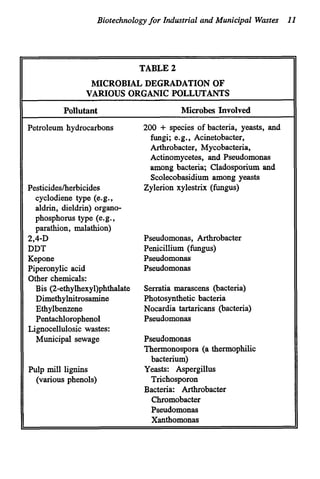
efficiency. Table 2 lists some of the microbes involved with the
degradation of organic pollutants. There are variations to the
conventional activated sludge process which are designed to overcome
disadvantages inherent in specific applications. Some of these are
described below.
Conventional (Plug Flow) Activated Sludge
The conventional activated sludge system is run in a plug flow pattern.
That is, both the untreated wastewater and the return sludge are
introduced at the head end of the aeration tank and mixed liquor is
withdrawn at the opposite end. In an ideal plug flow system the flow
will pass through the aeration tank without much mixing in the direction
of flow. However, due to the aeration tank being aerated, mixing cannot
be avoided. The best means of approaching plug flow conditions is to
compartmentalize the chamber into a series of completely mixed reactors.
A series of three or more reactors or compartments creates a truer plug
flow design.
Biotechnologyfor Industrial and Municipal Wastes 11
TABLE 2
MICROBIALDEGRADATION OF
VARIOUS ORGANICPOLLUTANTS
Pollutant Microbes Involved
Petroleum hydrocarbons
Pesticidesherbicides
cyclodiene type (e.g.,
aldrin, dieldrin) organo-
phosphorus type (e.g.,
parathion, malathion)
2,4-D
DDT
Kepone
Piperonylic acid
Other chemicals:
Bis (2ethylhexyl)phthalate
Dimethylnitrosamine
Ethylbenzene
Pentachlorophenol
Lignocellulosicwastes:
Municipal sewage
Pulp mill lignins
(various phenols)
200 + species of bacteria, yeasts, and
fungi; e.g., Acinetobacter,
Arthrobacter, Mycobacteria,
Actinomycetes, and Pseudomonas
among bacteria; Cladosporium and
Scolecobasidium among yeasts
Zylerion xylestrix (fungus)
Pseudomonas, Arthrobacter
Penicillium (fungus)
Pseudomonas
Pseudomonas
Serratia marascens (bacteria)
Photosyntheticbacteria
Nocardia tartaricans (bacteria)
Pseudomonas
Pseudomonas
Thermonospora (a thermophilic
bacterium)
Y
e
a
s
t
s
: Aspergillus
Trichosporon
Bacteria: Arthrobacter
Chromobacter
Pseudomonas
Xanthomonas
12 Biotechnologyfor Waste and Wastewater Treatment
Tapered Aeration
Plug flow processes are susceptible to shock loads. This is because the
maximum concentrationof flow is applied to microorganisms at the head
end of the tank. Since a large oxygen demand is exerted at one location
(thehead end), adequatedissolvedoxygenlevels aredifficultto maintain.
The tapered aerationprocess is intendedto deal with this problem, where
a greater portion of the air is injected at the inlet end of the aeration tank
where the greatest oxygen demand is required.
Step Feed Aeration
Step feed aeration is another variation of tapered aeration to equalizethe
oxygen supply and demand. Influent is fed at two or more points along
the basin which equalizes the distribution of organic waste which
subsequently results in more efficient oxygen use. The return sludge is
returned to the head end of the tank where it initially does not come in
contact with the raw wastewater. This reaeration assures that the sludge
is not oxygen starved when it comes in contact with the waste and can
readily absorb organic pollutants within a relatively short time. The
aeration process also provides a short term reservoir for shock or toxic
loads. The step aeration process can carry more solids under aeration
than the conventionalprocess: handles shockloads better; and has lower
solids storage in the final settling tanks.
Contact Stabilization
Contact stabilization utilizes similar principles of sludge reaeration as
discussed in the step-feed process. In this system the incoming
wastewater is mixed briefly (20-30 minutes) with the activated sludge
contact tank long enough for the microbes $0absorb the organics but not
actually long enoughto break them down. The activatedsludge is settled
out and returned to another aeratiodmetabolization tank. The activated
sludge is reaerated for 2-3 hours where the absorbed organics are
oxidized. Following stabilization the reaerated sludge is mixed with
incoming wastewater in the contact tank and the cycle starts again.
Advantages of this process include: a smaller total aeration volume than
the conventional processes, and as with the step feed process it can
Biotechnology for Industrial and Municipal Wastes 13
handle greater organic and shock loads due to the biological buffering
capacity of the stabilization tank and lower solids inventory.
Complete Mix
In the complete mix system, the influent is fed as uniformly as possible
along the entire length of the basin. As a result, the aeration tank is
essentially homogenous resulting in uniform oxygen demand throughout
the tank. This results in a homogeneous concentration of solids and
substrates in the tank. This system is very stable and is less prone to
toxic shocks which is a result of a relatively uniform population of
organisms, and shock loads will be uniformly distributed to the tank and
subsequently diluted.
Extended Aeration
The extended aeration process uses the same flow scheme as the
conventional process but aerates the wastewater for 24 hours as opposed
to 6-8 hours. Wastewater is aerated in a complex mix flow regime.
This process operates in the endogenous respiration phase of the bacterial
growth cycle in which there is not enough food remaining in the system
to support all the microorganisms present because of low BOD, loading.
The organisms are starved and undergo partial auto-oxidation utilizing
their own cell structure for food. This results in a highly treated effluent
and low sludge production. A disadvantage in this method is large
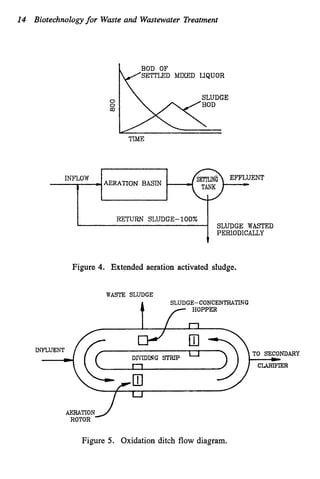
oxygen requirements and tank volumes. Figure 4 illustrates the process
of extended aeration activated sludge.
Oxidation Ditch
A variation of the extended aeration process is the oxidation ditch. In
this system the wastewater is fed along a circular channel or racetrack
and aerated by mechanical brushes or paddles along both sides of the
channel. The typical oxidation ditch is 4-6 feet deep and is designed
with a 24 hour retention time. A high degree of nitrification occurs due
to the long retention time and high solids qetention time (10 to 50 days).
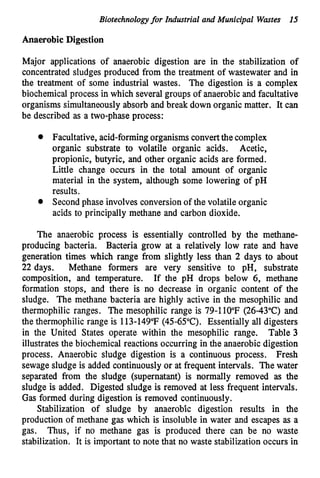
A flow diagram for the oxidation ditch process is illustrated in Figure 5.
14 Biotechnologyfor Waste and Wastewater Treatment
SETTLED MIXED LIQUOR
SLUDGE
0
0
m
TIME
EFFLUENT
SLUDGE WASTED
PERIODICALLY
Figure 4. Extended aeration activated sludge.
WASTE SLUDGE
SLUDGE- CONCENTRATING
HOPPER
TO SECONDARY
L
CLARIFIER
/ U
AERATION
ROTOR
Figure 5. Oxidation ditch flow diagram.
Biotechnologyfor Industrial and Municipal Wastes 15
AnaerobicDigestion
Major applications of anaerobic digestion are in the stabilization of
concentrated sludges produced from the treatment of wastewater and in
the treatment of some industrial wastes. The digestion is a complex
biochemical process in which several groups of anaerobicand facultative
organisms simultaneouslyabsorb and break down organic matter. It can
be described as a two-phase process:
Facultative, acid-forming organismsconvertthe complex
organic substrate to volatile organic acids. Acetic,
propionic, butyric, and other organic acids are formed.
Little change occurs in the total amount of organic
material in the system, although some lowering of pH
results.
Second phase involves conversionof the volatile organic
acids to principally methane and carbon dioxide.
The anaerobic process is essentially controlled by the methane-
producing bacteria. Bacteria grow at a relatively low rate and have
generation times which range from slightly less than 2 days to about
22 days. Methane formers are very sensitive to pH, substrate
composition, and temperature. If the pH drops below 6, methane
formation stops, and there is no decrease in organic content of the
sludge. The methane bacteria are highly active in the mesophilic and
thermophilic ranges. The mesophilic range is 79-1lO"F(2643°C)and
the thermophilic range is 113-149°F(45-65°C).Essentially all digesters
in the United States operate within the mesophilic range. Table 3
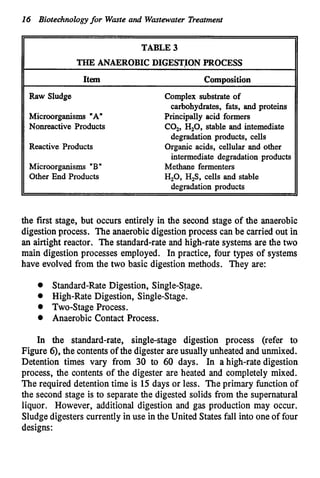
illustrates the biochemical reactions occurring in the anaerobic digestion
process. Anaerobic sludge digestion is a continuous process. Fresh
sewagesludge is added continuouslyor at frequent intervals. The water
separated from the sludge (supernatant) is normally removed as the
sludge is added. Digested sludge is removed at less frequent intervals.
Gas formed during digestion is removed continuously.
Stabilization of sludge by anaerobic digestion results in the
production of methane gas which is insoluble in water and escapes as a
gas. Thus, if no methane gas is produced there can be no waste
stabilization. It is important to note that no waste stabilization occurs in
16 Biotechnologyfor Waste and Wmtewater Treatment
TABLE 3
THE ANAEROBIC DIGESTION PROCESS
Item Composition
Raw Sludge Complex substrate of
carbohydrates, fats, and proteins
Microorganisms "A"
Nonreactive Products
Reactive Products
Principally acid formers
CO,, H,O, stable and intemediate
Organic acids, cellular and other
degradation products, cells
intermediate degradation products
Microorganisms "B" Methane fermenters
Other End Products H,O, H,S, cells and stable
degradation products
the first stage, but occurs entirely in the second stage of the anaerobic
digestionprocess. The anaerobic digestion process can be carried out in
an airtight reactor. The standard-rate and high-rate systems are the two
main digestion processes employed. In practice, four types of systems
have evolved from the two basic digestion methods. They are:
0 Standard-Rate Digestion, Single-Stage.
0 High-Rate Digestion, Single-Stage.
Two-Stage Process.
0 Anaerobic Contact Process.
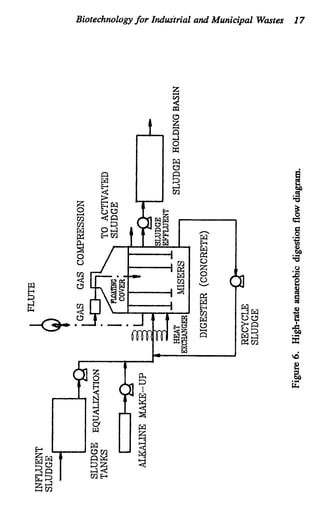
In the standard-rate, single-stage digestion process (refer to
Figure a), the contentsof the digester areusually unheated and unmixed.
Detention times vary from 30 to 60 days. In a high-rate digestion
process, the contents of the digester are heated and completely mixed.
The required detention time is 15days or less. The primary function of
the second stage is to separate the digested solids from the supernatural
liquor. However, additional digestion and gas production may occur.
Sludgedigesters currently in use in the United States fall into one of four
designs:
Biotechnologyfor Industrial and Municipal Wmtes 17
18 Biotechnologyfor Waste and Wastewater Treatment
1. Conventional Rate Digestion - One Stage
a. heated or unheated
b. detention time 30-60 days
c. solids loading 0.03 - 0.1 lb VVS/ft3 day
d. intermittent feeding and withdrawal
2. High-Rate Digestion - One Stage
a. heated 8595°F (mesophilic range)
b. detention time 15-20 days
c. solids loading 0.1-0.2 lb VSS/ft3 day
d. continuous feeding and withdrawal
e. process feature: homogeneity
f. process feature: stratification
3. Two-Stage Digestion: a combination of Designs 1and 2 above.
4. Anaerobic Contact Process: similar to Design 3 except sludge
from the second stage is recycled to the head of the first stage.
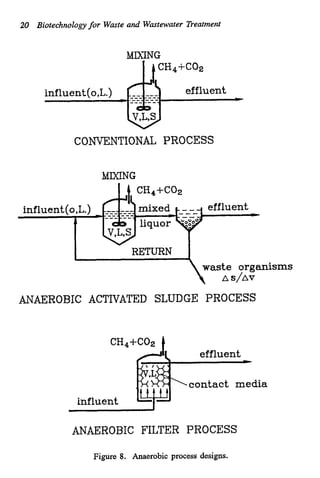
Examples of these processes and digesters are illustratedin Figures 7and
8.
MUNICIPAL TREATMENT PLANT SLUDGES
Wastewater sludge is being generated in enormous quantities at sewage
treatment plants, particularly at activated sludge facilities. Regulations
have mandated both the end of ocean dumping of sludges and provisions
for full secondary treatment. These regulations result in increased
production of sludge and the necessity to treat and dispose of it in an
acceptable manner. Anaerobic digestion is one of the processes
employed in the stabilization of these sludges, to remove from the raw
sludge its odor, pathogens, putreseibility, and other offensive
characteristics. The quantities of sludge produced in municipal
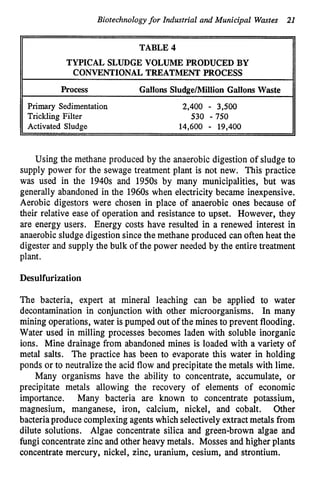
operations as an example are considerable. Some typical volumes of
sludges generated are reported in Table 4. There are various unit
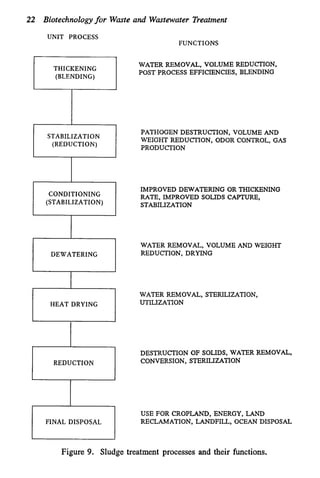
operations that are used in a typical sludge treatment process. The
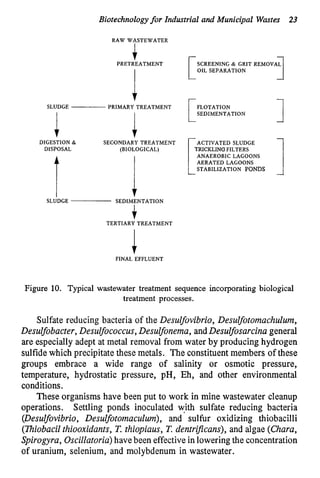
conventional design is shown schematically in Figure 9. The origins of
sludges derived from wastewater treatment operations can be readily
identified from Figure 10.
Biotechnologyfor Industrial and Municipal Wastes 19
SLUDGE IN
-
REMOVAL
SLUDGE
DRAWOF’F
RETURN
ANAEROBIC CONTACT DIGESTER
LAYER 1
-
SUPERNATANT
SUPEXNATANT -REMOVAL
ACTIVELY
DIGEXING SLUDGE
SLUDGE
I W T MMED
LIQUOR
SLUDGE
DRAWOF’F TO FURTHER
TWO STAGE ANAEROBIC DIGESTER
COMTENTIOKAL STANDARD RATE SINGLE STAGE
ANAEROBIC DIGESTION PROCESS
Figure 7
. Sludge digesters used in the United States.
20 Biotechnologyfor Waste and Wastewater Treatment
MIXING
c
influent(o,L.)
RETURN
waste organisms
A S/AV
ANAEROBIC ACTIVATED SLUDGE PROCESS
effluent c
contact media
influent
ANAEROBIC FILTER PROCESS
Figure 8. Anaerobic process designs.
Biotechnology for Industrial and Municipal Wastes 21
TABLE 4
TYPICAL SLUDGE VOLUME PRODUCED BY
CONVENTIONAL TREATMENT PROCESS
Process Gallons Sludge/Million Gallons Waste
Primary Sedimentation 2,400 - 3,500
Trickling Filter 530 -750
Activated Sludge 14,600 - 19,400
Using the methane produced by the anaerobic digestion of sludge to
supply power for the sewage treatment plant is not new. This practice
was used in the 1940s and 1950s by many municipalities, but was
generally abandoned in the 1960s when electricity became inexpensive.
Aerobic digestors were chosen in place of anaerobic ones because of
their relative ease of operation and resistance to upset. However, they
are energy users. Energy costs have resulted in a renewed interest in
anaerobic sludge digestion since the methane produced can often heat the
digester and supply the bulk of the power needed by the entire treatment
plant.
Desulfurization
The bacteria, expert at mineral leaching can be applied to water
decontamination in conjunction with other microorganisms. In many
mining operations, water is pumped out of the mines to prevent flooding.
Water used in milling processes becomes laden with soluble inorganic
ions. Mine drainage from abandoned mines is loaded with a variety of
metal salts. The practice has been to evaporate this water in holding
ponds or to neutralize the acid flow and precipitate the metals with lime.
Many organisms have the ability to concentrate, accumulate, or
precipitate metals allowing the recovery of elements of economic
importance. Many bacteria are known to concentrate potassium,
magnesium, manganese, iron, calcium, nickel, and cobalt. Other
bacteria produce complexing agents which selectively extract metals from
dilute solutions. Algae concentrate silica and green-brown algae and
fungi concentrate zinc and other heavy metals. Mosses and higher plants
concentrate mercury, nickel, zinc, uranium, cesium, and strontium.
22 Biotechnologyfor Waste and Wastewater Treatment
UNIT PROCESS
FUNCTIONS
WATER REMOVAL, VOLUME REDUCTION,
POST PROCESS EFFICIENCIES, BLENDING
THICKENING
(BLENDING)
STABILIZATION
(REDUCTION)
CONDITIONING
(STABILIZATION)
DEWATERING
PATHOGEN DESTRUCTION, VOLUME AND
WEIGHT REDUCTION, ODOR CONTROL, GAS
PRODUCTION
IMPROVED DEWATERING OR THICKENING
RATE, IMPROVED SOLIDS CAPTURE,
STABILIZATION
WATER REMOVAL, VOLUME AND WEIGHT
REDUCTION, DRYING
WATER REMOVAL, STERILIZATION,
HEAT DRYING UTILIZATION
REDUCTION
I
FINAL DISPOSAL
E3
DESTRUCTION OF SOLIDS, WATER REMOVAL,
CONVERSION, STERILIZATION
USE FOR CROPLAND, ENERGY, LAND
RECLAMATION, LANDFILL, OCEAN DISPOSAL
Figure 9. Sludge treatment processes and their functions.
Biotechnologyfor Industrial and Municipal Wastes 23
RAW WASTEWATER
i
PRETREATMENT
SLUDGE PRIMARY TREATMENT
i i
DIGESTION & SECONDARY TREATMENT
DISPOSAL (BIOLOGICAL)
SCREENING & GRIT
OIL SEPARATION
L
1
FLOTATION
SEDIMENTATION
ACTIVATED SLUDGE
ANAEROBIC LAGOONS
AERATED LAGOONS
STABILIZATION PONDS
SLUDGE SEDIMENTATION
t
TERTIARY TREATMENT
FINAL EFFLUENT
Figure 10. Typical wastewater treatment sequence incorporating biological
treatment processes.
Sulfate reducing bacteria of the Desulfovibrio, Desulfotomachulum,
Besulfobacter,Desulfococcus,Desulfonema, andDesulfosarcina general
are especially adept at metal removal from water by producing hydrogen
sulfide which precipitate these metals. The constituent members of these
groups embrace a wide range of salinity or osmotic pressure,
temperature, hydrostatic pressure, pH, Eh, and other environmental
conditions.
These organisms have been put to work in mine wastewater cleanup
operations. Settling ponds inoculated with sulfate reducing bacteria
(Desulfovibrio, Desulfotomaculum), and sulfur oxidizing thiobacilli
(l7iiobacilthiooxidants, T.thiopiaus, T. dentrijkans), and algae (Chara,
Spirogyra, Oscillatoria)havebeen effective in lowering the concentration
of uranium, selenium, and molybdenum in wastewater.
24 Biotechnologyfor Wasteand Wmtewater Treatment
A variety of metallurgical effluents contain high concentrations of
sulfate ions. A number of microorganisms can utilize this sulfate and
convert it to an insoluble, stable non-leachable form. Desulfovibrio
reduces sulfate to sulfide. Chlorobiwn and Chromatium
photosyntheticallyoxidizeH,S to elementalsulfur. A mutualism between
these bacteria is proposed.
A series of tests applied to solvent extraction raffinate demonstrates
that a gas purged mutuallistic system of DesuIfovibrio and Chlorobiwn
can be used for the efficient conversion of sulfate to elemental sulfur.
The extraction of minerals from ores, its benefitiation to a high quality
material, and its fabrication into a useful product are all sources of very
toxic materials. Many industrial wastes contain valuable metals diluted
in a large mass or volume. Processes must be developed to
simultaneouslyextract these valuable metab and reduce the attackon the
environment.
T
e
s
t
s have been conducted using T.ferroxidans and T.thiooxidants
to extract economically interesting metals from wastes:
1. Jarosite--a residue which accumulates during zinc production.
2. Sulidic dust concentrates from copper processing.
3. Fly ash from apyrite-roasting process.
4. Slag from a lead smelting process.
The results indicate that it is possible to stimulate bacteria already to
work on these waste dumps to leach into solution economically valuable
metals.
Flotation is probably the most common unit operation in
metallurgical operations. One of the problems is that the reject water is
ladenwith flotationchemical agents. Laboratory experimentshave tested
the ability of Escherichia coli, Proteus retigerii, Klebsiellapnewnoniae
and Pseudomonas aerucinosa to biodegrade sodium hexadecyl-sulfate,
Biotechnology for Industrial and Municipal Wastes 25
sodium oleate, and dodecylamineacetate. Klebsiella and Proteus appear
to be the most efficient organisms. They handled very well the sodium
hexadecyl sulfate, manage with the sodium oleate but had difficulty with
the amine. Pseudomonas fluorescens has been used to remove flotation
agents from wastewaters.
Nitrification/Denitrification
The nitrogen cycle is complex like all biogeological cycles. Its essential
components are:
1. Nitrogen fixation
Rhizobium
__________3 NH,
N, + H+
2. Nitrification
Nitrobacter
NO,- + 0, __________-NO,-
3. Denitrification
Pseudomonas
NH, + NO,- = -------4H,O or N,
During the biological denitrification, bacteria reduces nitrite or
nitrate to nitrogen gas. The heterotropic bacteria require a source of
carbon. In denitrification reactions, this supplemental source is often
provided by methanol. The nitrogen reaction is a respiratory process
encompassing the following reactions.
NO, + 113 CH,OH + 2/3 CO, -NOz + COz + 213 HzO
NOz + 112 CH,CH + 1/2Oz-112 Nz + 112 CO, + 112 HzO + OH + 112 CO
NO, + 516 CH,OH -112 N, + 516 CO, + 718 HzO + H,O
26 Biotechnologyfor Waste and Wastewater Treatment
Biological reactions have been used in the conversion of ammonia-
nitrogen to nitrate-nitrogen with attendant reduction in chemical oxygen
demand and total organic carbon in coal gasifier effluents and municipal
wastewaters.
Nitrogen, in its various forms, can deplete dissolved oxygen levels
in receiving waters, stimulate aquatic growth, exhibit toxicity toward
aquatic life, affect chlorine disinfection efSiciency, present public health
hazards, and affect the suitability of wastewater reuse. Nitrogenous
materials enter the aquatic environment from natural or man-caused
sources. Natural sources include precipitation, dustfall, non-urban run-
off, and biological fixation. Activities that may increase quantities of
nitrogen added to the aquatic environment are from fertilization of
agricultural land and combustion of fossil fuels. Other man-related
sources includeurban and livestockfeedlotrun-off, municipalwastewater
effluents, and subsurface drainage wastes. The average concentrations
of nitrogen from natural sources is difficult to estimate but range from
0.02 mg/l to 0.2 mg/l. Nitrogen concentrations in raw municipal
wastewaters are well documented, and values range from 15to 50 mg/l
of which approximately 60% is ammonia nitrogen, 40% is organic
nitrogen, and a negligible amount (1%) is nitrite and nitrate nitrogen.
Nitrogen concentrations of other man-related sources vary widely
dependingon the source. Treatment of these and other non-point sources
is difficult if not impossible to treat. For the purpose of this control,
methods can be divided into three broad categories:
Biological methods of removal.
Chemical/physical methods of removal.
0 Other methods of removal.
Biological methods include nitrification in suspended growth; and
attached growth systems: using trickling filters, rotating biological
contractors, and packed bed reactors. Biological denitrification in both
suspended and attached growth reactors is a developing method.
Chemical physical methods for removal include breakpoint chlorination
and ozone treatment, selective ion exchange, and ammonia stripping. In
addition, other methods such as aquatics have been discussed.
The term nitrification is applied to the reaction in nature of the
biological oxidation of ammonium (NH,) first to the nitrite (NOJ, then
Biotechnologyfor Industrial and Municipal Wastes 27
to the nitrate (NO,) form. The conversion of ammonium to nitrate is
caused by the bacteria Nitrosomonas as foUows:
bacteria
2NH4 + 302--------4 2N0, + 4H + 2H2O
The nitrate in turn are oxidized by the bacteria Nitrobacter according to
the following:
bacteria
2N0, + 0, --------a
2N03
The overall nitrification reaction is as follows:
bacteria
NH, + 20, --------4 NO3 + 2H + H,O
For this reaction to go to completion about 4
.
6mg/l of oxygen are
required per gram of ammonia nitrogen. This oxygen demand is often
identified as the nitrogenous oxygen demand (NOD).
The problem with nitrogen in wastewater is related to the NOD if
ammonia nitrogen is discharged into the environment. This problem can
be mitigated by either converting the ammonia and organic nitrogen to
nitrate or by eliminating the nitrogen in the wastewater. Biological
methods of nitrogen removal are classified under two broad categories,
biological nitrification and denitrification.
Nitrification
The application of biological nitrification in municipal wastewater
treatment is applicable to cases where ammonia removal requirements
exist, without the need for complete nitrogen removal. Nitrification
systems are broken up into combined carbon oxidation-nitrification and
separate stage nitrification processes and each can be divided further into
suspended and attached growth processes. Suspended growth processes
are those which suspend the biological solids in a mixed liquor by a
mixing mechanism. A subsequent clarification stage is required for
returning these solids to the nitrification stage. Attached growth
processes, on the other hand, retain the bulk of the biomass onthe media
28 Biotechnologyfor Waste and Wastewater Treatment
and, therefore, do not require a solids separation stage for returning the
solids to the nitrification reactor.
Attached Growth Processes--The trickling filter, rotating biological
contactor, and the packed bed reactor areprincipal biological methods of
nitrification. The trickling filter and rotating biological contactor canbe
consideredfor combined carbonoxidation-nitrificationand separate stage
nitrification, whereas the packed bed reactor is only considered as a
separate stage process.
Trickling Filter (combined oxidation/nitrification)--The trickling
filter consists of a bed of highly permeable media to which
microorganisms are attached and wastewater is percolated. The filter
media usually consists of rock, packing, etc. one to four inches in
diameter to a depth of three to eight feet. Some filters have been built
with plastic or redwood media and to depths of 15 to 25 feet.
The development and maintenance of nitrifying organisms in a
trickling filter depends on factors such as organic loading and
temperature. Kinetic theory for combined carbon oxidation nitrification
has not been developed, therefore, the approach appliedto date is largely
empirical and relys mostly on specificationof an organic loading rate
suitable for application to each media. A typical loading rate for rock
media to attain 75%nitrification is 10 to 12 lb BODS/lOOOgal/day. At
higher loading rates, such as that above 30to 40 lb BODS/lOOOgallday,
very little nitrification occurs. The specific media surface selected has
an effect on the allowable organic loading. Greater specific surface in
the media allows greater biological film development and a greater
concentration of organisms within a unit volume.
Trickling Filter (separate stage nitrification)--This system initiated
the development of the two-stage suspended growth system for
nitrification. Later it was observed that nitrification occurred as a side
affect of the original use of the two-stage trickling filters. Initially, the
two-stage trickling filtration process was developed to increase the
removal of organics in the effluent of high rate trickling filters. In
separate stage nitrification applications, the rate of nitrification is
proportional to the surface area exposed to the liquid being nitrified.
Plastic media is commercially available with specific surface available
from 27 fi2/ft3 to 68 fi2/ft3 and as such is the best alternative for a two-
stage suspendedgrowth system because of its high specific surface area.
Pilot plant studies indicate that with temperatures of 13 to 19°C and
influent NH4-N of between 8 to 18 mg/l NH,-N can be reduced to
Biotechnologyfor Industrial and Municipal Wastes 2
9
2.5 mg/l for 4000 ft2/lb NH,-N oxidized/day. Whereas with
temperatures of 7 to 11°C and the same influent ranges, removal rates
only averaged 3.0 mg/l per 4000 ft2/lb NH4-N oxidized/day. When
effluent levels of less than 2.5 mg/l NH-N are desired, consideration
should be given to breakpoint chlorination for reducing the ammonia
residual rather than increasing the surface area of the filter since a
surface area of 10,000 to 12,000 ft2/lb NH,-N oxidized/day will be
required to reduce ammonia effluents to between 1to 2.5 mg/l. Tests
using rock media have shown the NH,-N oxidation is only 15to 50%of
the plastic media rate. The main reason for this is rock media’s lower
specific surface area. A 1:l recirculation ratio is normally considered
adequatefor this type of system. Effluent clarification is not required in
separate stage trickling filter systems since organisms are attached to the
media and solid levels are low. In pilot plant studies, it was found that
the same low influentsolids of 9 to 28 mg/l were evident in the effluent.
Rotating Biological Contactors (combined carbon oxidationhitri-
fication)--The rotating biological contactor or disk (RBD) has seen
limited use in the United States in combined carbon oxidation/nitrifi-
cation. The RBD process consists of a series of closely spaced circular
disks of polystyrene or polyvinyl chloride. The disks are slowly rotated
and submerged in the wastewater. In operation, biological organisms
become attached to the surface of the disks and in about 10 days to two
weeks, form a slime layer of aerobic biomass. In rotation, the disks
biomass contact wastewater and then the atmosphere for absorption of
oxygen. Disk rotation is the mechanism used for the removal of the
excess solids from the disks by the shearing forces as the disks pass
through the liquid. The treated effluent is mixed and in suspension, and
the wastewater flow carries the suspension out of the disk section into a
secondary clarifier for separation and disposal. Disk units are normally
housed to avoid temperature drops, prevent algae growth on disk
surfaces, and to protect from weather.
As a RBD system operates in series, organic matter is removed in
the first disk stages and the subsequent disk stages are used for
nitrification. Nitrification only occurs after the bulk of the BOD, has
been oxidized. After the low levels of BOD, have been reached, the disk
is no longer dominated by heterotrophs, and nitrification can proceed.
Rotating Biological Contactors (separate stage nitrification)--In
order to obtain separate stage nitrification, the wastewater influent must
be pretreated to remove organic carbon. As such, separate stage
30 Biotechnologyfor Waste and Wastewater Treatment
nitrification is very adaptable to upgrading existing secondary sewage
treatment systems to meet low ammonia nitrification effluents. The
BOD,/TKN ratio must be sufficientlylow to ensure a significant fraction
of nitrogen to biomass. Some alternative pretreatment systems used are
chemical treatment in activated sludge, roughing filters, and trickling
filters. In addition to the separate stage trickling filter, Rotating
Biological Contactors are very adaptable to separate stage nitrification.
The purpose for RBD combined carbon oxidation/nitrification may
be applied to separate stage nitrification. The only difference is if the
secondary effluentbeing treated has a BOD, or suspended solids content
of less than 20 mg/l, the secondary clarifier may be eliminated. The
most common RBD systemsused is afour-stage systemhavingfour rows
of disks. But the more stages, the greater the nitrification.
Packed Bed Reactors (PBR) (separate stage)--A packed bed reactor
consists of a bed of media where nitrifying biological m
a
s
s is developed,
overlaying a support media and inlet chamber to which wastewater
influent is introducedthrough an upflow configuration. Media bed types
that have been used are anthracite coal, silica sand, stones, gravel, and
a plastic packing media. Both air and high purity oxygen have been
employed as a means of supplyingthe necessary oxygenfor nitrification.
Air can either be injected directly into the inlet chamber or distributed
across the PBR floor. Oxygen can be bubbled directly into the PBR.
Only monthly backwashingof light density anthracite or plastic media is
considerednecessary dueto turbulencedevelopedinthe bed. Experience
has shown that back-washing of a gravel media reactor is required on a
more frequent basis, perhaps as much as once per day. Oxidation rates
for a typical reactor range from 4 to 27 lb NH,-N oxidized per
1000 ft3/day. A typical reactor using crushed coal and loosely packed
plastic can reduce averageammonia nitrogen concentrationfrom 15mg/l
to less than 1mg/l. This is at an ammonia loading of
6.9 lb NH3-N/day/1000ft3 of media volume, detention time of
3.25 hours, operation temperature of 10°C. Temperature has a strong
affect on the PBR process by increasing the temperature of liquid from
10°C to 20°C; the detention can be cut to less than two hours to obtain
the same effluent characteristics.
Suspended Growth Process--The activated sludge process is the
main suspended growth biological method nitrification used to treat
sewage. Basically, there are two methods considered for nitrification by
activated sludge systems: combined carbon/nitrification, accomplished
Biotechnologyfor Industrial and Municipal Wastes 31
by nitrification in the same t
a
n
k where carbonaceous removal is
accomplished; and separate stage nitrification which has developed to
isolate the carbonaceous removal and the nitrification processes so that
each could be separately controlled and optimized.
Not all of the modifications to the activated (combined carbon
oxidationhitrification) process are appropriate for nitrification
applications. Some of the more successful applications are the complete
mix plant, conventional plant, extended aeration plant, contact
stabilization plant, and step aeration plants.
Conventional Plant--A conventional plant consists of a series of
rectangular tanks with a length to width ratio of 5 to 50. Tanks
hydraulics are plug flow. In the system, sludge from the aeration tank
is returned to be mixed with influent coming into the tank. When the
safety factor for a conventionalplant is compared to that of a complete
mix plant, it is determined that the contentionalplant is more efficient.
However, the conventional plant has the disadvantages that the
carbonaceous oxygen demand is concentrated at the head of the tank,
making it more difficult to supply enough air in the front of the tank to
supply both carbonaceous and nitrogenous oxygen demands. Air
difision systems for conventional plants must be specifically designed
to handle this concentratedload, otherwise, the first portion of the tank
is not available for nitrification and the nitrification volume is reduced.
Complete Mix Plants--A complete mix plant is designed so the
effluent entering the plant's aeration tank is evenly distributed. This
design provides uniformity of load to all points and elimination of the
oxygentransfer problems of the conventionalplant. Due to the increased
amount of short circuiting of the influent to effluent, ammonia
concentrations may be slightly higher than a conventional plant. Load
characteristics are similar to a conventionalplant. Temperature plays a
critical roll in nitrification. At a minimum temperature of lO"C, the
hydraulic retention is about 14 hours whereas at a 2O"C, the retention
time is decreasedto 6 hours. Therefore, location and temperature of the
plant must be determined before sizing.
Extended Aeration Plant--Extended aeration plants are similar to
complete mix plants except that hydraulic retention times are 24 to 48
hours instead of 2 to 14 hours used in the complete mix plants.
Endogenous respiration is maximized in this type of plant, consequently
25 to 35 day solids retention times are not uncommon. Because of the
long aeration time, they do suffer heat losses because of this long net
32 Biotechnologyfor Waste and Wastewater Treatment
growth, extended aeration plants can be expected to nitrify unless the
temperature is less than 10°C.
Contact Stabilization Plants--Contact stabilization plants are not
well suited for completenitrificationbecause insufficientbiological mass
is present in the contact tank for complete nitrification of ammonia.
Since the ammonia is not absorbed on the biological floc, ammonia will
bleed through to the effluent. In contact stabilization, instead of mixing
the influent wastewater with return sludge, the return sludge is reaerated
in a sludge reaeration tank prior to mixing with the influent wastewater.
Backmixing between the contact and sludge reaeration tanks is prevented
by the use of weirs. BOD, removal, not nitrification, is fairly high in
this system because the bulk of the organics in domestic wastewater are
particulate and can be absorbed by biological solids for later oxidation
in the sludge reaeration tank.
Step Aeration Plant--In the step aeration plant, the influent
wastewater is introduced at several points along the aeration tank even
though the return sludge is introduced at the head of the plant like a
conventionalplant. This influent distribution reduces the initial oxygen
demand usually experienced in contact stabilizationplants and is avoided
in a step aeration plant because of the longer contact time. In any case,
some NH, bleed through will occur from short circuiting of the influent
to the effluentand insufficientcontacttime for completeorganic nitrogen
hydrolysis and oxidation of ammonia.
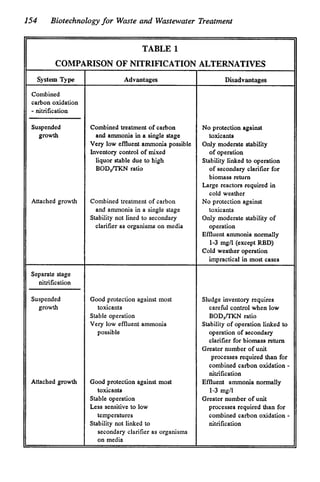
Advantages and Disadvantages--The combined systemssingle stage
is more compact than the separate stage system, but at the same time the
chances for toxic upset are greater. Suspended growth systems (both
combined and separate stages) have the ,advantage over the attached
growth system in that effluentammonia concentration are lower, but this
is overcome in attached growth systems by treating the effluent by
breakpoint chlorination. Also, in attached growth systems, stability is
not linked to a secondary clarifier as in the suspended growth system.
Separate stage attached growth systems are less sensitive to cold weather
operations than the combined attached growth systems.
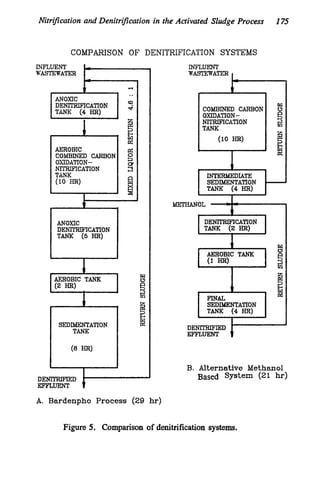
Denitrification--Biological denitrificationisused to remove nitrogen
from wastewater when it is in the nitrite or nitrate form. In the process,
ammonia-nitrogen in wastewater is first converted to nitrite and
subsequentlynitrate. The nitrate nitrogen is then convertedto a gaseous
nitrogen, primarily nitrogen gas. This gaseous form of nitrogen is not
objectional. This is accomplished through suspended and attached
Biotechnologyfor Industrial and Municipal Wmtes 33
growth systems using methanol as the carbon source and combined
carbon oxidation/nitrification/denitrification
systems, using wastewater
as an endogenous carbon source.
Pseudomonas, Micrococcus, Achromobacter, and Bacillus are
principal nitrate-reducingbacteria that accomplish denitrification. These
bacteria accomplish nitrate reduction by nitrate dissimilation whereby
nitrate or nitrite replace oxygen in the respiratory processes of the
organismunder anoxic conditions. Using methanol as the carbon source,
the energy reaction is represented as follows:
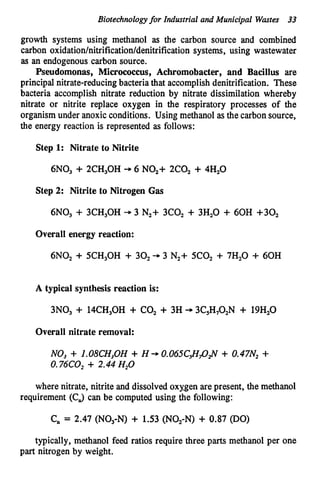
Step 1: Nitrate to Nitrite
6NO, + 2CH,OH -
+ 6 NO,+ 2C0, + 4H,O
Step 2: Nitrite to Nitrogen G
a
s
6N03 + 3CH,OH + 3 N,+ 3c0, + 3H20 + 60H +so2
Overall energy reaction:
6NO, + SCH30H + 30, + 3 N,+ 5c0, + 7H,O + 60H
A typical synthesis reaction is:
3N03 + 14CH30H + CO, + 3H -
+ 3C,H,O,N + 19H20
Overall nitrate removal:
NO, + l.08CH3OH + H + O.O65C&O&V + o.47N2+
0.76C0,+ 2.44H20
where nitrate, nitrite and dissolved ox3gen are present, the methanol
requirement (CJ can be computed using the following:
C,, = 2.47 (NO,-N) + 1.53 (NO,-N) + 0.87 (DO)
typically, methanol feed ratios require three parts methanol per one
part nitrogen by weight.
34 Biotechnologyfor Waste and Wastewater Treatment
Suspended Growth Systems
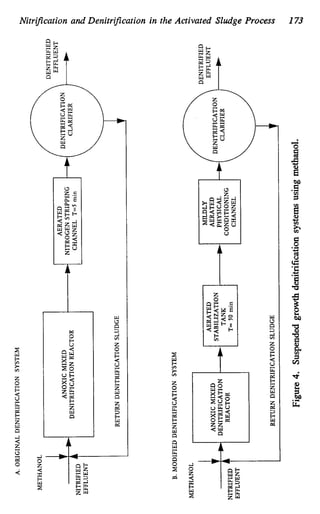
Suspended-growthdenitrificationis usually carried out in plug-flow type
activated-sludge systems. The anaerobic bacteria obtains energy for
growth from the conversion of nitrate or nitrite to nitrogen gas but
requires an external source of carbon for cell syntheses. Methanol is
commonly used as this carbon source. In'denitrification, it is nitrite or
nitrate that is the pollutant to be removed, where as in conventional
treatment, carbon is the pollutant. The methanol added is a carbon
source but should not be added in excess, if left in the effluent, the
methanol will exert a BOD,. Because the nitrogen gas formed in the
denitrification reaction hinders the settling of the mixed liquors, a
nitrogen-gas stripping reactor precedes the denitrification clarifier.
Removal of residual methanol induced BOD, is an added benefit of the
stripping tank.
Attached Growth Systems
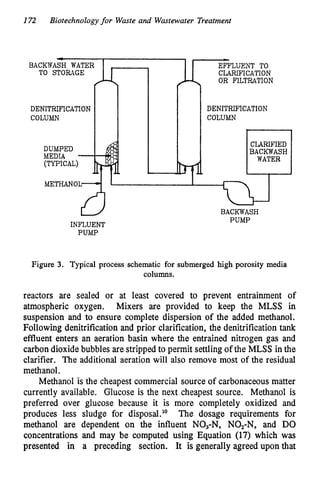
Denitrification in attachedgrowth systems, are accomplishedby avariety
of column configurations. Column systems are nitrogen gas packed
beds, submerged high porosity packed beds, and submerged high
porosity fluidizedbed systems. Sincethere is a variety of media used to
measure reactions, general design criteria for these systems is not readily
available. In order to size the reactor volume, one approach is to
estimatethe level of biomass on the media surface and then use measured
reaction rates per unit of biomass to obtain the nitrogen removal capacity
of the column. This is best done through p,ilotplant experiments. Based
on the measured rates, surfacenitrate removal rates are classifiedas high
surface removal rates, reflecting the formation of extensive biological
film; and low surface removal rates, reflecting minimal surface film
development.
Nitrogen Gas Filled Packed Bed Reactor--The nitrogen gas filled
packed bed reactor is covered and filled with nitrogen gas. This
eliminates the necessity of having to submerge the medium to maintain
anoxic conditions. The column media consists of plastic (corrugated
sheet modules) similar to those used in trickling filters.
Biotechnologyfor Industrial and Municipal Wastes 35
Aquatics
The use of aquatic plants as nutrient removal agents, is not a new
concept. The water hyacinth (Eiclornia crassipes) is the most researched
plant in this area to date. The water hyacinth is a floating plant that
covers vast areas of water surface in the southern United States. The
plant interferes with navigation, causes flood control problems, and
restricts recreational activities such as fishing, boating, and water skiing.
The water hyacinth is a native of South America and was introduced to
the United States in the late 1800s. Any constructive use of this plant is
most welcomed.
In 1968,61%removal of PO,-P was accomplished by growing water
hyacinths after a five day detention time. However, most tests to date
have shown that after 25 to 30 days of continuous operations, phosphate
removal efficiency declines until only 5 to 8% removal efficiency is
observed. Also, hyacinth removal efficiency is much less during colder
months. Research done at Gainesville, Florida, found that the nutrient
removal capacity of water hyacinths was directly related to pond surface
area. In order to remove 44% of the phosphorus, a one million gallon
pond with 5.1 acres of water hyacinths was needed. For the small ponds
used in the Gainesville test, influent values ranged from 3.37 to
3.44 mg/l with effluent values of 1.82to 1.86 mg/l. Effluent had a four-
day detention time and the pond a depth of one foot. Tests were also
done with a deeper pond and it was found the shallower pond, had better
the PO,-P removal efficiency. Nutrient uptake by the hyacinths was
good during the area growth phase and vertical growth phase, but if the
hyacinths growth was not limited, lesser efficiencies in PO,-P were
noted; however, some phosphorus removal is obtained.
Concluding Remarks
Biological treatment systems contain living organisms and require
carbon, nutrients, and water as a vital part of the process. Such systems
are affected by temperature, light, movement, and chemical conditions
of pH, oxygen, salinity, and metals and the interrelations of the
organisms present. Microorganisms perform best under steady state
36 Biotechnologyfor Waste and Wastewater Treatment
environment. Environmental changes if at suitable rates will allow the
biomass to acclimate.
Biotechnology research for the future is striving to develop new
strains of microorganisms and processes for destruction of organic toxics
and hazardous materials heretofore immune to treatment and to shorten
process and retention time. The need is present in the market place and
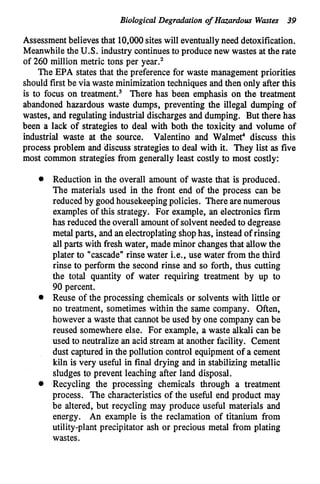
biotechnology will respond.
2 BIOLOGICAL DEGRADATION OF
HAZARDOUS WASTES
Industrial waste problems, especially those involving hazardous waste,
are an ongoing problem. They have a high profile, and as such are
reported regularly in the media. Examples of past mishaps are Love
Canal, New York; Times Beach, Missouri; and Serveso, Italy. In our
modern day world, with our use of plastics, cars, leather, and pesticides,
it is now accepted that they have "side effects." Within the last number
of years, there has been a move to cleanthese problems. Presented here
is a review of current studies concerning biological treatment of
hazardous waste, along with non-biological strategies.
Biological treatment is an expanding field which has shown success
in remediationof hazardous waste problems. It is not the only treatment
technology available and does not have to be used in isolation, nor is it
without limitations. The chapter begins with an introduction, explaining
some of the problems with hazardous waste, ways to reduce it, some past
legislation, and facts about hazardous waste. Then there is a brief
section reviewing current abiotic treatment methods available, including
some of their advantages and limitations. Discussed are some of the
types of biological treatment techniques, (e.g., land composting,
activated sludgeprocesses, filters), before assessingwhat we know about
the microbiological basis for biological degradation. Also addressed is
how we test if a compound is susceptible or not, the genetical basis of
degradation, and the terms "mineralization" and "recalcitrance." There
follows work done in degradation methods using aerobicbacteria in pilot
plant demonstrationsor in-situ studies. These are the successstoriesthat
have originated in laboratory research and bench scale demonstrations.
A review of current laboratory work follows. The work discussed to
date has been aerobic but there are anaerobic bacteria that degrade
many compounds with certain advantages over aerobic degradation.
37
38 Biotechnologyfor Waste and Wastewater Treatment
They have a different type of metabolism. This will be discussed prior
to the laboratory work. Included in this section and not in the pilot
studiedin-situ section is work on 1,1,1-trichloroethane, which is an in-
situ study. It is placed here because it is an example of anaerobic
degradation. The work with fungi has so far been ignored. Although
therehas been a great deal of informationabout fungal degradation in the
past years, the majority of published works dealt with bacteria.
INTRODUCTION
Hazardous waste does not consist of one chemical or attribute; the
definition of it is a wide one. The Environmental-Protection Agency
(EPA) stated in its report to Congress that:' The term "hazardouswaste"
means any waste or combination of wastes which pose a substantial
present or potential hazard to human health or living organisms because
such wastes are lethal, nondegradable, persistent in nature, biologically
magnified, or otherwise cause or tend to cause detrimental cumulative
effects. General categories of hazardous waste are toxic chemical,
flammable, radioactive, explosive, andbiological. These wastes cantake
the form of solids, sludges, liquids, or gases. So, the range of hazardous
wastes, and their effects is large and diverse.
Attributes of hazardous wastes are: irritation, corrosivity, and
bioconcentration. The observable effects are a function of exposure, the
longer a person is exposed, the more serious the effects.
Nearly all industry produces some waste and since no one is likely
to independently shut down an industry that makes the waste, we need
some guidelines and regulations. On the federal level, industrial waste
was originally regulated by the Clean Water Act of 1977 and the Clean
Air Act of 1963 and subsequentamendments; hazardous wastes received
specialemphasisinthe Resource Conservation and Recovery Act of 1976
(RCRA), the Toxic Substances Control Act of 1976 (TOSCA), and the
Comprehensive Environmental Response, Compensation and Liability
Act of 1980 (CERCLA) and subsequent amendments.
Through CERCLA, the Superfund aid was initiated and it was seen
as an assaulton growing hazardous wasteproblems, but to date, only 12-
15sites have been detoxified and restored. Most other sites have been
limited to containment. The EPA estimates that there are some
2000 hazardous waste sites, but more alarmingly the Office of Technical
Biological Degradation of Hazardous Wastes 39
Assessment believesthat 10,000sites will eventuallyneed detoxification.
Meanwhile the U.S. industry continuesto produce new wastes at the rate
of 260 million metric tons per year.'
The EPA states that the preference for waste management priorities
should first be via waste minimizationtechniques and then only after this
is to focus on treatment.3 There has been emphasis on the treatment
abandoned hazardous waste dumps, preventing the illegal dumping of
wastes, and regulating industrial discharges and dumping. But there has
been a lack of strategies to deal with both the toxicity and volume of
industrial waste at the source. Valentino and Walmet4 discuss this
process problem and discuss strategies to deal with it. They list as five
most common strategies from generally least costly to most costly:
Reduction in the overall amount of waste that is produced.
The materials used in the front end of the process can be
reduced by goodhousekeepingpolicies. There are numerous
examples of this strategy. For example, an electronics firm
has reduced the overall amount of solventneeded to degrease
metal parts, and an electroplatingshophas, instead of rinsing
all parts with fresh water, made minor changesthat allowthe
plater to "cascade"rinse water Le., use water from the third
rinse to perform the second rinse and so forth, thus cutting
the total quantity of water requiring treatment by up to
90 percent.
Reuse of the processing chemicals or solvents with little or
no treatment, sometimes within the same company. Often,
however a waste that cannot be used by one company can be
reused somewhere else. For example, a waste alkali can be
used to neutralize an acid stream at another facility. Cement
dust captured in the pollution control equipmentof a cement
kiln is very useful in final drying and in stabilizing metallic
sludges to prevent leaching after land disposal.
Recycling the processing chemicals through a treatment
process. The characteristics of the useful end product may
be altered, but recycling may produce useful materials and
energy. An example is the reclamation of titanium from
utility-plant precipitator ash or precious metal from plating
wastes.
40 Biotechnologyfor Waste and Wastewater Treatment
Research, development, and demonstration (RD&D) of new
waste-reductiontechnologies. RD&D can range from basic
research, to demonstrating the feasibility of tailoring an
existing technology to the process of a particular business.
An example is the developmentof a system for the anaerobic
digestion of cheese-whey, a by-product of the cheese
manufacturing process. While it is not a hazardous waste,
cheesewhey has an oxygen demand 350times stronger than
normal sanitary domestic sewage, and it creates serious
disposal problems. In the past, m b y cheese-manufacturing
plants have either spread the whey on farmland (which
results in odor and run-off into surface water) or sent the
whey down the sewers into a municipal sewage treatment
works, which overloaded the treatment capacity of the
system. The development of an anaerobic treatment system
for cheesewhey in which certainbacteria are used to convert
waste material into a mixture of harmless gases, including
methane is reducing the load of the systems and producing
sizable quantities of biogas, which can be used as fuel.
Replacement of the entire industrial process. This is the
most costlystrategy and usually beyond the capabilitiesof all
but the most prosperous and willing industries. An example
of replacement, which has applied to industrial as well as
residential practices, is the wholesale reduction of oil-based
paints in favor for water-based paints. Another examplethat
illustrates a costly alternative is heat-treating certain metal
parts to provide suitable hardness. Small items were
previously hardened in molten cyanide baths. Because
cyanide is toxic, many cyanidebaths have been replaced by
controlled atmospherefurnaces that are much more complex
and costly to operate.
Legislation for the process problem would be difficult since each
industry is different, with different starting chemicals, techniques, and
products. Another problem with legislation is that waste problems vary
on a regional basis and with locale. The waste problem in central
New Jersey will not have the same characteristics as one in California.
Biological Degradation o
f Hazardous Wastes 41
Weather patterns differ greatly across the United States. Leaching
of landfills is much less of a problem in arid regions than it is in the
rainy areas. Solar evaporation may be an effective waste-concentration
option in New Mexico but not in New York. Similarly, certain
industries that are regional in nature have specialized waste treatment
problems. For example, the petrochemical industry is concentrated on
the Gulf Coast. Mining and ore refining tend to occur in only a few
major locations. Steel has historically been heavily concentrated in
Pennsylvania and Ohio. New York has unusually large concentrations
of many small electroplatersin the New York City area, leather tanneries
in two Mohawk River Valley counties, and a large number of diverse,
old manufacturing operations in the Buffalo area and Elmira areas.
Most of the production of waste in the U.S. is from industry which
is responsible for 69%. Municipal output accounts for 35% .’
The bulk of potentially hazardous waste is generated from four
industries: primary metals; organic chemicals and explosives; electro-
plating and metal finishing; and inorganic chemicals. The hazardous
waste management industry often deals with input materials in the five
groupings of: metaldmetal finishing; paint/solvent/coatings; organics;
petroleum; and inorganics.
Some estimates show that 71% of the waste is produced from the
chemical and petroleum industries, 22% from metal and related
industries, and 7% from other industries.’
As stated before, waste production is regional in nature. Of the
hazardous waste produced in the U.S. some 60% of it is from the
following states: New Jersey, Ohio, Illinois, California, Pennsylvania,
Texas, New York, Michigan, Tennessee, and Indiana.
Legislation as a tool in itself is not enough to deal with the problem;
economically viable alternatives are necessary. Different states show
different types of waste management, but land treatment is ubiquitous in
treatment technologies. In the past the land took much of the brunt with
landfills and surface impoundments, with deep injection into the
groundwater system being the next biggest category, and other forms
being responsible for only a small percentage. With the rising cost of
land treatment, depletion of space, and concern over contaminationof
our groundwater, other technologies will have to take on a more
significant role in treating hazardous wastes.
42 Biotechnology for Waste and Wastewater Treatment
ABIOTIC TREATMENT TECHNIQUES
Wastewater Treatment
Selection of a treatment process is dependent on the nature of the
wastewater and the quality of the effluent desired. Hazardous
components of the wastewater may be either separated or converted to
non-hazardous forms in order to permit the disposal of the wastewater
effluent by conventional methods. Conversion processes can be done in
one step or in multiple steps. The hazkdous components which are
separated from the wastewater must be disposed of. This may take
additional steps, e.g., sludge dewatering.
Liquids-Solids Separation
Separationof suspended matter from wastewater canbe accomplishedby
a number of differentprocesses. Large heavy solids are easierto remove
than finely divided light solids.
Screening devices are used to remove large pieces of solid matter
that would interfere with subsequent processing operations or would
cause damage to equipment such as pumps. Coarse screening devices
may consist of parallel bars, rods or wires, perforated plates, gratings,
or wire mesh.
Gravity sedimentation--This process involves the containment of
wastewater for a sufficient period of time to allow some or all of the
suspended materials to either settle out or float to the surface of the
wastewater. In its simplest form as a batch process, a given volume of
wastewater is transferred to a vessel and held there until nearly all the
settleable and floatable matter separates. The floating matter can be
skimmed off and the wastewater decanted for discharge or further
treatment. Sludge may be allowed to collect until several batches of
wastewater have been processed. Then it is removed. The vessel may
have a conical bottom so that the sludge can be removed via a valve.
Large settling ponds may be constructed which are drained periodically
to permit sludge removal. Solids-contactor sludge-blanket clarifiers are
useful where sludges are flocculent and of low density. They are
designed with large mixing and reaction zones that coupled with the
sludge blanket account for greater efficiency in solids removal. Gravity
Biological Degradation o
f Hazardous Wastes 43
sedimentation works like the clarifiers but more time is taken for the
settling.
Dissolved-Air Flotation is useful for suspended matter that does not
sink or float in a reasonable period of time. Separation is brought about
by the introduction of finely divided gas bubbles which become attached
to the particulate matter, causing it to float to the surface where it is
removed by skimming. Introduction of the gas bubbles is usually
accomplished by reducing the pressure of the wastewater causing
dissolved gases to be released. This is commonly used to separate
greasy or oily matter from industrial wastes. Granular-Media Filters or
deep bed filtration is a polishing step that removes small amounts of
suspended solids and produces a highly clarified water. Chemical
coagulation and sedimentation typically precede this stage. Graded sand
and pulverized coal are commonly used in the filter beds. Conventional
operation is usually by downflow. The ability of the granular media
filter beds to produce a clear effluent results from the straining action
and adhesion, which removes particles finer than the pore space.
Surface Filters make use of a fine medium such as a cloth or close
mesh screen. In the rotary vacuum filter,-the medium is in the form of
a continuous belt and it rotates over a perforated drum that is partially
submerged in the slurry to be filtered. Water is pulled through the filter
cake that forms on the belt to the inside of the drum, where it is
transferred to the vacuum system.
Centrifugation is a useful alternative to filtration for sticky sludges
that do not dewater rapidly on a filter. They operate by a rapid rotation
of a liquid suspension, which induces a much greater force than gravity
to hasten the separation of the suspended matter.
Chemical Treatment
Chemical treatment is a widely used process for the destruction or
separation of hazardous constituents in wastewater. This can be done by
neutralization of acidic or alkaline wastewater until a suitable pH is
obtained. Precipitation/Coagulation/Flocculationis used for theremoval
of heavy metals. Precipitation refers to the formation of a solid phase,
coagulation is where the containment is trapped by the formation of a
precipitate, and flocculation is the agglomeration of a coagulating
chemical.
44 Biotechnologyfor Waste and Wastewater Treatment
Oxidation-Reduction or the redox processes are used for converting
toxic pollutants to harmless or less toxic materials that are more easily
removed. These processes involve the addition of chemical reagents to
wastewaters, causing changes in the oxidation states of substances both
in the reagents and in the wastewaters. In,order for one substanceto be
oxidized, another must be reduced. Ozone is a powerful oxidizing agent
that is usually oxygen at temperatures and pressures up to 350°C and 180
atmospheres, respectively, to treat organic wastes.
Ion exchangeinvolves a change in the chemical form of a compound;
the exchange of ions in solution with other ions held by mixed anionic
or cationic groups or charges. Typically, a waste solution is percolated
through a granular bed of the ion exchanger, where certain ions in
solution are replaced by ions contained in the ion exchanger. If the
exchangeinvolves cations, the exchanger is called a cation exchanger and
correspondingly anion exchanger is one that involves anion exchange.
Physical Methods
There are several methods used for separating pollutants from
wastewater: activated carbon, steam stripping, evaporation, reverse
osmosis, and solvent extraction. The chemical and physical
characteristics of the pollutant are important in the selection of the
physical removal method. Steamstripping is effectivefor substancesthat
have an appreciablevapor pressure at the boiling point of water, whereas
evaporation is effective for those chemicals that will not volatilize.
Soluble, small organic molecules are adsorbedby activated carbon; large
ions are separated by reverse osmosis.
Activated Carbon Adsorption--Here the inorganic and organic
chemicals are adsorbed onto activated carbon. Usually hydrophobic
chemicals are more likely to be removed. The degree of adsorption is
linked to the molecular weight, methanol-water coefficient, or solubility
(these are also linked to the recalcitrance and/or toxicity). The smaller
the size of the grain, the more surface area is available and so
equilibrium is reached quicker with powdered activated carbon compared
to the granular form. But then the powdered form needs more pumping
to get the wastewaterthrough and hence the costs are increased. There
are two principle systems, one is downward flow through the bed
(pressure or gravity flow) and the other is upflow through a packed or
Biological Degradation of Hazardous Wastes 45
expanded bed. Activated carbon adsorptionis applicableto the treatment
of dilute aqueous wastes, but they shouldbe treated to remove suspended
solids, oil, and grease. Temperature and pH are also important for the
different compounds to be treated. The carbon is either disposed of or
regenerated. Carbonhas also been added directly to biologicaltreatment
effluent in a contactingbasin. The advantages of this arethat the sludge
toxicity is reduced by selectively removing the toxic organics from
solution and that the carbon adsorption capacity is extended by
bioregenerationof the "biocompatible"species adsorbed on the surface.6
For aqueous solvent waste containing contaminants in concentrationsup
to 10,000 mg/l, the activated sludge process has been proposed as a
potential applicable treatment. However these concentrations may be
toxic to the sludge or they may be easily stripped to the atmosphere,
thereby creating another hazard. The sludge may also contain
recalcitrant waste, due to adsorption of the contaminants and be difficult
to dispose of.'
Evaporation is the process that heats the liquid, venting the vapors
to the atmosphere and concentratingthe pollutants into a slurry.
Reverse osmosis--Osmosis is the process where a solvent (e.g.,
water) moves from an area of low concentration to high across a
semipermeable membrane which does not allow the dissolved solids to
pass. In reverse osmosis, a pressure greater than the osmotic pressure
is applied so the flow is reversed. Pure water will then flow through the
membrane from the concentrated solution.
Solvent extraction is a process whereby a dissolved or adsorbed
substance is transferred from a liquid or solid phase to a solvent that
preferentially dissolves that substance. For the process to be effective,
the extracting solvent must be immiscible in the liquid and differ in
density so that gravity separation is possible and there is minimal
contamination of the raffinate with the solvent. The hydrophobic solutes
are more likely to be extracted. Solvent extraction can be performed as
a batch process, or by the contact of the solvent with the feed in staged
or continuous equipment.
Steam stripping is where water vapor at elevated temperatures is
used to remove volatile components of a liquid. Countercurrent flow is
generally used to promote gas-liquid contact, thus allowing soluble
gaseous organics from the liquid waste to be continuously exchanged
with molecules within the stripping gas. Again, this is useful only for
waste with low water solubilities.
46 Biotechnologyfor Waste and Wastewater Treatment
Incineration
Incineration is a high temperature oxidation process that converts the
principal elements (carbon, hydrogen, and oxygen) in most organic com-
pounds to carbon dioxide and water. Given with the problems of
disposing on land, incineration may take on a lead role in waste
treatment. However, it is not without its problems. There is fear among
the general public about the nature of the stack emissions but it is an
efficient method. The destruction of the molecular structure usually
eliminates the toxicity of the chemical. But the existence of other
elements in a waste may result in the production of particulate pollutants
that require removal in off-gas treatment systems. There are several
types of incinerators available.
The liquid injection incinerators operate by spraying the
combustible waste mix with air into a chamber where flame oxidation
takes place. The purpose of spraying is to atomize the waste into small
droplets which present a large surface area for rapid heat transfer,
thereby increasing the rate of vaporization and mixing with air to
promote combustion. Air is supplied to provide the necessary mixing
and turbulence. These incinerators are widely used for destruction of
liquid organic wastes.
Rotary-kiln incinerators are designed to process solids and tars that
cannot be processed in the liquid incinerator. The rotary-kiln is a
cylindrical shell lined with refractory material that is horizontally
mounted at a slight incline. It is rotated from 5 to 25 times at high
temperatures, 1500to 3000°F with excess air, the residence time varied
depending on the nature of the waste. The rotation causes a tumbling
actionthat mixes the waste with air. The primary function is to convert,
through partial burning and volatization, solid wastes to gases and
ashhesidue. If the ash is free of dangerous levels of hazardous wastes,
it is put in a landfill.
Fume incineration--Large quantities of organic vapor fumes are
produced by many industries, includingfat rendering, metal painting and
varnishing, and various types of printing. These vapors are generally
mixes of hydrocarbons, alcohols, and acetates. The mixes may not be
acutely toxic but they do cause odor problems. An integrated heat-
recovery system demonstration at Case-Hoyt Company, near Rochester,
captures waste heat and simultaneously reduces plant air emissions by
oxidizing solvents into harmless gases as the heat is recovered.
Biological Degradation of Hazardous Wastes 47
The multiple hearth incinerator is used for wastes that are difficult
to burn or that contain valuable metals that can be recovered. It consists
of a refractory-lined circular steel shell, with refractory hearths located
one above the other. Solid waste or partially dewatered sludge is fed to
the top of the unit where a rotating plow rake plows it across the hearth
to dropholes. The uncombusted material falls to the next hearth and the
process is repeated until the combustion is complete.
Fluidized-bed incinerators (FBI) are applicable to the destruction of
halogenated organic waste streams. This type of incinerator consists of
a vessel in which inert granular particles are fluidized by a low velocity
air stream which is passed through a distributor plate below the bed. An
FBI consists of a windbox (through which combustion air is introduced
to the reactor), and a reactor zone (containing a bed of sand, waste
injection, and removal ports). Temperatures are in the range of 1300to
2100°F, gas residence times usually a few seconds. They have been used
to treat municipal sewage sludge, low quality fuels, pulp and paper
effluents, food processing waste, refinery waste, radioactive waste, and
miscellaneous chemical waste.g
A molten salt incinerator uses a molten salt such as a sodium
carbonate as a heat transfer and reaction medium. In the process, waste
material along with air is added below the surface of the bed so that any
gases formed during combustion are forced to pass through the melt.
Reaction temperatures in the bed range from 1500 to 2000°F and
residence times are less than a second. Any acidic gases formed are
neutralized by the alkalinity of the bed. This can change the fluidity of
the bed so it needs replacement frequently.
Plasma arc incineration is based on the concept of reducing or
pyrolyzing waste molecules to the atomic state using a thermal plasma
field. They system uses very high energy at temperatures near to
10,000"C to break bonds of hazardous waste chemical molecules down
to the atomic state. An electrode assembly ionizes air molecules which
create a plasma field. Hazardous waste mixtures interact with the field,
forming simple molecules such as carbon dioxide, hydrogen, hydrogen
chloride, and other minor matrix compounds such as acetylene and
ethene. Westinghouse Electric has a mobile plasma arc unit called
Pyroplasma that reportedly treats liquid wastes at the rate of a
3 gal/min.'' The high temperatures decomposes PCB and other wastes
in an oxygen-deficient atmosphere. Hydrogen chloride is treated with
sodium to form water and salt.
48 Biotechnologyfor Wasteand Wastewater Treatment
Lime or cement kiln incineration--A cement kiln is basically a large
rotary kiln in which raw materials are fed countercurrent to combustion
gas flow. The wet process kilns uses a 30% water slurry feed and are
the most suitable for hazardous waste destruction. The products formed
are alkaline and so act as a scrubber, removing acid gases formed during
combustion. This system operates at 2800°F resulting in very efficient
removal of wastes. A project" is in operation at Blue Circle Atlantic
Inc., a cement company in Ravena where it is evaluating the
incorporationofhazardous wastes into an existing cement-kiln operation.
The facility is not yet in operation but should be able to handle large
amounts of waste and alleviate some problems locally.
Wet Air Oxidation
Wet air oxidation involves the aqueous phase oxidation of organic
materials at high temperature and pressure. A major advantage over
other incineration methods is that the water in the waste stream is kept
in the liquid state. Water is pumped into the reactor along with oxygen
which is heated by the hot effluent. Two types of reactors are used, a
bubble tower reactor and a stirred tankcascade reactor. This process is
good for wastes that are too dilute to incinerate but too toxic for
biological methods. The products are usually acetic acid and carbon
dioxide.
Solidification Techniques
There are several innovative non-thermal processes that have been
developed under the SITE program that immobilize wastes by
vitrification or other types of solidification." The SITE program is the
Superfund Innovative Technology Evaluation, a $20milliodyear pro-
gram which has been developed to encourage the private development
and demonstrationof new technologiesfor cleaningup hazardous wastes.
For example, the researchers at Battelle Pacific Northwest Laboratories
have developed an in-situ vitrification process (which was originally
designed for the containment of nuclear wastes) in which electrodes are
sunk into a contaminated area and attached to a diesel powered
generator. The current produced temperatures of about 3600°F which is
much higher than the fusion temperature of soil. An exhaust hood is
placed over the site to collect and treat any combustion products. The
Biological Degradation o
f Hazardous Wastes 49
result is a massive glass-like product consisting of completely
immobilizedorganics, inorganics, steeldrums, andother componentsthat
are essentially locked up and inert. The time taken to complete the
process depends on the electrode depth and frequency. Another
solidification process uses a reagent called Urrichem that immobilizes
slurried hazardous components. The contaminated soil is excavated and
intimately mixed with the Urrichem off-site. After blending, the slurry
is pumped out of the mixer and hardens into a concrete like mass within
24 hours. Chemfix is a process developed by Chemfix Technologies
(Metaire, LA). In this technique, a proprietary blend of soluble silicates
and additives is used to convert high molecular weight organic and
inorganic slurries into a cross-linked, clay like matrix.
Alternative methods have also included landfills, deep well injection
disposal, and ocean dumping. Landfills were developed because it was
believed that by placing waste in designated ground areas, there would
be a natural decomposition over time. Unfortunately the water table
rises in a landfill and this mounding effect means that we get a leaching
of the water containing toxics since the water flow is always from areas
of high to low head, i.e., there is a gradient set up that favors water
movement originating inthe landfill and away from it thus contaminating
our groundwater supplies. This is a special problem for an area like
Long Island, New York, that relies on groundwater and not surface
water for their domestic/industrial supplies. Deep injection wells have
similar problems. When the aquifers in which the deep well sits are
pumped, the contaminants are drawn into the well. Ocean dumping has
upset the delicate ecosystembalance in some areas. Thus there is a need
for effectivetechniquesthat industry can safelyuse to try and combat the
nation’s hazardous waste problems. Biological treatment may be such.
BIOLOGICAL CONTROL METHODS
Biological treatment of hazardous wastes is becoming a realistic option
in the treatment strategies for hazardous wastes. As we research more
about specificbacteria and fungi that do the work and know more about
what conditions favor degradation, we are finding more uses for them.
A major advantage is that the cost is much less than incineration. A
limitation is the length of time involved, since biological treatment can
take months. There are different mechanisms that we can use to degrade
50 Biotechnologyfor Waste and Wastewater Treatment
a compound. Selection is based on the type of pollutant, type of
degradation (Le., aerobic or anaerobic), and various other parameters.
There are suspended growth systems such as activated sludge,
aerated lagoons, and anaerobic digesters where the microorganisms are
suspended; and fixed film processes, which include filters and rotating
biological contactorswhere the microorganismsgrow on a fixed surface.
Since toxin degradation is a slow process, the fixed film processes may
be best since the microbial retention is very high." In aerobic
degradation, the major portion of the cost is the aeration. Wastes in any
form--solid, aqueous, and gaseous--can be treated biologically. The
treatment can be done several ways: by applying the waste to the soil,
by composting, using a hybrid liquidkolid treatment technique, treating
the wastes in-situ, using soil filter gases, and with wastewater treatment
systems.'* Care must be taken in assessing biological treatment since
nondegradable pesticides and other organics may be unaffected by the
treatment or toxic intermediatesmay be formed and therefore a finishing
process such as activated carbon may be needed.
Land Treatment
Land treatment is the biological option most widely used to treat
hazardous wastes. Many of the industrial waste treatment sites using
biological treatment are at petroleum refineries.
The steps in the process typically are: spread the waste on the land,
let it dry, till the soil to mix the waste in, control moisture, and if
necessary add nutrients so that the wastedestroying bacteria will grow.
In a land treatment system, bottom liners under the treatment zone
are generally not rieeded. Physical, chemical, and biological processes
in the soil are relied on to degrade, immobilize, or transform the wastes
to the environmentally acceptable forms. Most pollutants are captured
and transformed in the top 6-12 in. in the soil, though the treatment zone
may extend down 5 ft.
Land treatment is suitable with wastes such as petroleum refinery
sludges, creosote sludges and wastewaters, and processing sludges from
wood, paper, and textile manufacture. It is also widely used for
municipal sludges and wastewaters, and food processing sludges and
wastewaters. Oil, metals, and other constituents of environmental
concern are successfully controlled by land treatment.
Biological Degradation of Hazardous Wastes 51
While most land treatment sites are at operating facilities, at least one
is at an abandoned wood preserving facility now being remediatedunder
Superfund or CERCLA.12 At this Minnesota site a treatment pilot test
was run for a year proving that the creosote constituents could be
degraded by acclimated soil microorganisms.
To scale up to full operation, about 12,000 cu. yd. of contaminated
soils and sludges were removed from the impoundment and temporarily
stored. A lined treatment area was then constructed over the
impoundment, and the stored wastes were put back in place.
The process has been encouragingly effective, as shown by
polycyclic aromatic hydrocarbon removals of 90% after 193 days of
treatment. Total cost, includingexcavation of the waste and construction
and operation of the facility, was approximately $80/cu. yd. This cost
is much less than incineration, the only other in-situ treatment technique
that completely eliminates the hazardous compound.
Costs for unlined land treatment systems are a little cheaper but since
we need to protect the groundwater system, extensive site testing is
necessary to obtain federal RCRA permits.
As a result of the Hazardous and Solid Waste Amendments of 1984
and the current land disposal restrictions rule, EPA is in the process of
demonstrating achievable treatment techniques to be used as an
alternativeto the land disposal of hazardous wastes.13 Research has been
done by waste generators that also treat the waste, commercial facilities,
and EPA in-house research.
Cornposting
Cornposting uses less space than land treatment and it controls gases and
leachate. In composting, piles of the waste 3-6 ft. high are treated.
Aeration is provided either by turning the piles mechanically or through
a forced aeration system. Bulking agents such as wood chips are
sometimes addedto facilitatemixing and oxygentransfer. Thesebulking
agentsaretypically screenedout at completionof composting, and mixed
in with the next batch.
Cornposting has been used mostly in treating municipal sewage
sludge, but has also been used to treat several industrial solid wastes.
These include industrial wastewater treatment sludge, food processing
wastes, and some industrial wastes containinglow levels of pesticides.
52 Biotechnologyfor Waste and Wastewater Treatment
A flow diagram for a biochemical compost bed system is shown in
Figure 1.
A pilot scalebacteria-based cornpostingsystemhas successfullybeen
used for treating diesel-fuel contaminated s0i1s.l~ Aeration is provided
by an air compressor that draws a vacuum at the bottom of the pile and
returns the air at the top. Additional air is added as necessary.
Nutrients and water are provided through an irrigationsystem located at
the top of the pile. The system is a fully enclosed vessel that is batch
loaded. Studies to date have shown that the diesel contaminants have
half-lives in the range of 30-60 days. Costs of a full-scale system are
estimated at under $lOO/cu. yd. of soil, again significantly less than
incineration.
Liquids/Solids Treatment Systems (LSTS)
These arehybrids, intermediatebetweenland treatment and conventional
water-suspendedbiological systems. The waste is not in a solid form as
in land treatment, nor in water as in conventional municipal wastewater
treatment, but half way between. The wastes are in a suspended solid,
slurry or sludge form.
LSTS systems reduce the level of contaminants in a waste primarily
by 1) dissolvingtheorganics, 2) biodegradingthe dissolvedorganics into
lesstoxic and less environmentallysignificantforms, and 3) releasingthe
products as gases to the atmosphere. The key step, dissolvingthe wastes
from solid to liquid, can result from microbial action and/or physical-
chemical action.
There are two basic LSTS process types: single-reactor and two-
stage. In either case it is vital to have sufficient mixing of the
liquid/solid mixture to achieve effective mass transfer of both organics
in the liquid phase, adequateoxygentransfer to the microorganisms, and
to keep the suspensionof solids in the solution.
The single-batch reactor is the simpler process and the most widely
used. Here both the dissolving and biodegradationsteps occur together
in a single tank, pit, or lagoon. Air is introduced to provide mixing for
the extraction process and oxygen for biological reasons. Aeration and
mixing may be provided by submerged aerators, floating aerators, or
compressor/sparger (lance) systems.
At completion of treatment, the aerators and mixing are stopped and
the solids allowed to settle. The treated liquid is decanted off the top,
Biological Degradation of Hazardous Wastes 53
t
54 Biotechnologyfor Waste and Wastewater Treatment
while the treated solids are treated further, by conventional land
treatment or by disposal on-site. If the process is done in a lagoon or
surface impoundment, it may be possible to decant the liquid and leave
the solids in place.
LSTS have been used in coal tar waste sites in Florida and Illin~is.'~
In Florida, about 600,000gal. of the wastes were found in a gas holder
and in Illinois 2000 cu. yd. of material in an in-ground concrete
structure. After 9 months, significant reduction of tar volume, phenol
concentration and flash point were reported.
LSTS have the potential to achieve the treatment goals in a shorter
time using less land area than other on-site biological management
approaches, such as land treatment and composting. The process uses
tank reactors, and thus may eliminate regulatory obstacles or concerns
related to the possible land-treatmentban or to contaminant migration in
the groundwater.
Soil Biofilters
Hazardous wastes in gaseous form can be biologically treated too. On-
site biofilters can reduce nuisance odors, volatile organic compounds,
and particulates in waste gases. The soil biofilter involves two
mechanisms; mechanical filtration and treatment by bacteria on the soil
particles.
A biofilter consists of a distributing pipe network underneath soil or
gravel. The gas to be treated is pumped through the media and escapes
through holes in the pipe wall. It rises through the media bed which is
usually 3-10 ft. deep. Pollutants captured on the biofilter can be
removed by filtration, physical and chemical absorption, chemical
oxidation, and structural treatment.
The technique is not a new one, filters have been used for many
years to remove odors from agricultural, food, and wastewater
processing operations, and emissions from paper and chemical
manufacturing plants. The soil filters have successfully removed low
concentrations of H,S, SO,, NH,, and NO, as well as particulates in
these gases. Other potential applications includetreatment of exhaust
gases from air stripping units for wastewater and solvents, from
mechanical technologies such as belt presses for oily sludges, from
aerated waste treatment systems, and from in-situ soil stripping of
Biological Degradation o
f Hazardous Wmtes 55
volatile organic compounds (VOCs) using vacuum and forced aeration
methods.
TheS.C. JohnsonWax Co., inRacine, Wis~onsin'~
hasdemonstrated
removal of VOCs in a soil bed. This, in turn, has led to research on the
biodegradation of chlorinated ethenes, such as those likely to be in
exhaustgasesunder anaerobicconditions. Theresearch demonstratedthe
aerobic degradation of TCE and other chemicals.
A soil biofilter is being planned for the treatment of VOCs being
removed from contaminated soil and groundwater in New Jersey.14
Natural gas will be introduced with the contaminated air stream to
stimulate growth of the needed methane-oxidizing bacteria.
Wastewater Treatment
Biological treatment has been very successful in the removal of organic
pollutants and colloidal organics from wastewater. Activated sludge,
biologicd filters, aerated lagoons, oxidation ponds, and aerobic
fermentation are some of the methods available for wastewater
biodegradation. In removal of toxic waste, more care is needed since the
bacteria areprone to destruction from shock loadingor increases of toxic
material fed in without allowing time for the population to grow large
enough to deal with it.
Biodegradation occurs because bacteria are able to metabolize the
organic matter via enzyme systems to yield carbon dioxide, water, and
energy. The energy is used for synthesis, motility, and respiration.
With simple dissolved matter, it is taken into the cell and oxidized,
but with more complex inorganics, enzymes are secreted extracellularly
to hydrolyze the proteins and fats into a soluble form which can then be
taken into the cell and oxidized. Hence the more complex matter takes
longer to process.
Some organic compounds are "refractory," they cannot be oxidized
while others are toxic to the bacteria at high concentrations.
The purpose of biodegradation is to convert the waste into the end
products and material that will settle and can be removed as sediment.
Again, biodegradation may not be one hundred percent, or toxic by-
products may be formed. Further treatment by chemical methods or
dilution may be needed to get the contaminant to a concentration
prescribed as safe.
56 Biotechnologyfor Wmte and Wastewater Treatment
Nitrogen and phosphorus are essential in the oxidation process for
the synthesis of new cells, and trace amounts of potassium and calcium
are also required. The former are sometimes deficient so nitrogen is
added in the form of ammoniacal nitrogen (nitrite and nitrate are not
readily used by bacteria).
BOD or biochemical oxygen demand, measures the strength of the
organics present and is defined as the amount of oxygen needed by the
bacteria for oxidation. The more concentrated the organic material the
higher the BOD. A B0D:N:P ratio of 100:5:1 is thought to be the
optimum ratio of nutrients needed by bacteria.
Activated SludgeProcess
This involves the generation of a suspendedmass of bacteria in a reactor
to degrade soluble and finely suspended organic compounds.
In this method the wastewater with its organic compounds is fed into
the aeration tank. This is supplied with air and is vigorously mixed to
allow maximum contactof bacteria and waste. The contents, referred to
as MLSS (mixed liquor suspendedsolids) arethen fed to a sedimentation
tank where the treated solids settle to the bottom and the top liquid layer
is treated and discharged. Part of the biological solids are recycled back
to the aeration tank to maintain the correct mix; the remainder is waste.
This method is flexible and can be used on almost any type of
biological waste. An industrial application has been demonstrated for
phenol degradationusing a petroleum refinery wastewater: there was an
85-90%removal of phenol and cyanide in the steel industr~.'~
Trickling Over Process
Here the wastewater is distributed by a flow distributor over a fixed bed
of medium on which the bacteria grow forming a slime layer to which
oxygen is supplied. The wastewater flows down over the slime layer
which absorb organic materials and nutrients, releasing the oxidized end
products to the drainage system underneath. Eventually some of the
layer will detach with the wastewater, and then some additional
separation is necessary.
Biological Degradation of Hazardous Wmtes 57
Stabilization
This is a procedure where wastewater is stabilized by the actions of
bacteria in shallowponds. There are basically two types of ponds, ones
where there is a natural supply of oxygen from algal photosynthesis
(oxidation ponds) and mechanically supplied oxygen (aerated lagoons).
The bacteria metabolize the wastes and the solids settle at the bottom as
a sludge. Also there is anaerobic decomposition where the bacteria at
the bottom will degrade the waste without oxygen's presence. Or there
can be a lagoon that has both aerobic and anaerobic decomposition, with
an interchange of products between the two layers of bacteria in a
symbiotic relationship.
DETERMINATION OF BIOLOGICAL DEGRADABILITY
Some terms are important in understanding the fate of hazardous wastes
in biological systems. They are biodegradable,persistent, recalcitrant,
and mineralization. A compound that is biodegradable can be changed
by the action of microorganisms to another compound. This does not
necessarily mean that the product is less toxic than theparent compound,
or that intermediate toxic compounds are formed that may inhibit the
degraders, or that the product will not be toxic to the next degraders or
to man himself. Park et al.16 demonstratedthis possibility in their study
of bacterial degradation of 7,-12 dimethylbenzanthracene is non-
acclimated soil. When this compound was degraded aerobically, the
parent14C DMBA had a half life of 17 days. There was a decrease in
the parent compound accompanied by an increase in metabolites:
4-hydroxy, 5-hydroxy, and 10-hydroxy DMBA and 7,12 dihydro-12-
methyl 7-methylene benz (a)anthracene. But there was some associated
mutagenicity that was thought to be due to the polarity of the
compounds, with those that are low and moderately polar having more
mutagenicpotential than the highly polar compounds. ThepH of the soil
also plays a role since at low pH fungi dominate the ecosystem and they
are more likely to form epoxides (associated with mutagenicity) than
bacteria which are dominant at higher pH. So there are some possible
58 Biotechnologyfor Wmte and Wastewater Treatment
types of reaction that we do not want. We need information so that we
can select favorable degradation reactions so as to reduce some types of
toxic waste. Recalcitrant means that the compound cannot be
biodegraded under any circumstances, Le., it's the compound itself that
is inherently resistant and not the treatment system that has failed to
account for some vital fact. Persistence is a "conditional" property of
the biodegradable compound in that it may be biodegraded if the correct
circumstances favoring biodegradation are present.
Mineralization is the complete conversion of an organic compound
to the endproducts of carbondioxide and water. Primary biodegradation
is the single transformation of a compound and partial biodegradation is
somewhere between primary degradation and mineralization.
Basis for Biodegradation
Why are some compounds degraded by microorganisms? The
degradation is done not as a favor to us but because the organisms gain
energy needed for growth, repair, reproduction, and other biological
functionsneeded for survival. Food sources contain oxygen in hydroxyl
(OH) or carboxylic acid (COOH) groups. Oxidationreactions take place
where electrons are transferred along an electron chain with compounds
accepting and passing on electrons to a terminal electron acceptor. The
coenzymesmay be NADH and NAD which get reduced andthen coupled
with the electron transport chain to produce high energy bonds in ATP.
Many compounds are biochemically inert such as alkanes, saturated ring
structures, and unsubstituted benzene. They are devoid of oxygen and
not subject to dehydrogenation reactions. The ability of bacteria to
utilize these compounds lies in the fact that they can catalyze oxidation
using oxygen. Other bacteria have enzymes which work without oxygen
and coenzymes are needed.
Studies have been done that attempt to relate the physical and/or
chemical properties of a chemical to its recalcitrance; however
experiencehas shown that many chemicals which are thought not to be
removed by abiotic mechanisms actually undergo transformations in
model treatment systems."
Biological Degradation of Hazardous Wmta 59
Genetics
Bacteria can only do things for which they have a genetic capability.
They must be able to produce the right enzymes to do the job, and the
right environment must exist for them to be able to produce the right
enzymes. If a chemical is present in concentrationseither too low or too
high, then it may not be biodegraded: too low and the enzymes will not
be induced, too high and the compound may be toxic. One reason why
bacteria are robust at biodegradation is that they may still be able to
degrade a different compound to the one that they normally utilize if the
active site of the molecule has not been altered. The xenobiotic still
needs to be able to induce the production enzymes or the reaction will
stop. The bacteria will not be able to metabolize it and will die. This
use of a different substrate is fortunate for us and has been termed
"gratuitous" metabolism. Complicating biodegradation further is
"cometabolism" where two substrates are needed Le., one compound
cannot fulfill all the bacterial needs and act as the sole carbon and energy
source. A second compound is needed as growth substrate. Biological
degradationtreatment systemshave to be designed to take care of another
problem. Bacteria need a continuous carbon source for growth and yet
if too much substrate is added, initially the bacteria are unable to
metabolize it. They need a period of "acclimation" where they are
growing and strengtheningandperhaps evenundergoing geneticchanges.
If the intermediate is toxic then the bacteria may be killed or the
formation of the next strain that metabolizes it may be stopped so that it
accumulates and destroys the system. Bacteria often work with a
successionof strains so that completemineralizationneeds more than one
organism which does not alone have the required genetic capability. As
will be discussed in the anaerobic section, mixed cultures can degrade
better both qualitativelyand quantitativelythan single cultures. This may
involvemutation. Vandenberghet al." took different strains of bacteria,
found out what they could grow on and not; and then did transformation
and conjunction experimentswith them. They found that after plasmids
had been introduced, strains that couldn't previously metabolizetoluene,
60 Biotechnologyfor Waste and Wastewater Treatment
could now degrade it. They also isolated the plasmids necessary for
activity. Their findings support the idea of evolution since the bacteria
specific for the biodegradation of halaromatic compounds could not
utilize toluene. There has been an evolution pathway involving
mutations and transfer of genetic material between bacteria so that
although at one time they could degrade toluene, they could now only
degrade the products of it and not the parent compound.
A less desirable aspect of the ability of bacteria to degrade
compounds has been reported by Reed et al.19 who noted that some
pesticides are degraded quickly by microorganisms before they have
eliminated the pests. This phenomenon is called accelerated pesticide
degradation. The study examined the response of microbial populations
in soils after incorporation of the herbicides, alachlor, butylate, EPTC,
carbofuran, cloethocarb, and isophenos. Enzyme assays for alkaline
phosphomonoesterase, phosphodiesterase, and rhodanese were also
studied. To test the sensitivity of selected microorganisms to the
pesticides, formulationsof the pesticideswere applied to cultures on agar
plates and zones of inhibition noted. Those bacteria that grew on
pesticides were examined for specificenzymes. The activitiesvaried but
were greater for those in the field than control strains indicating that
there had been a selection for increased activity in the presence of
pesticides. Several isolates capable of growing on the carbamate
insecticide, carbofuran, and the thiocarbamate herbicides, butylate and
EPTC, also exhibited high rhodaneseactivitysuggestingthat this enzyme
may be involved in the metabolism of these pesticides. These results
suggestthat the bacteria capableof developinghigh rhodanese activity in
response to applicationsof thiocarbamateherbicides (e.g., butylate) may
also be involved in the degradation of the chemically similar carbamate
insecticides (e.g., carbofuran) without prior exposure to them. Again
evolutionappearsto be the factor here; individualbacterium may acquire
the ability to utilize a pesticide by the evolution of specific enzymes.
Several organisms may have to coexist insacommunity to metabolize a
pesticide. Assays for specific enzymatic activities of microorganisms
shown to metabolize certain pesticide substrates indicate that cross-
adaption of the microorganisms for degradation of chemically similar
pesticides in the soil environment may exist. The growth pattern of
microorganisms is conceptually illustratedin Figure 2. This is a classical
viewpoint.
Biological Degradation of Hazardous Wastes 61
4
0
% m
.-
pi!
F
9 0
b;
e g
-2
2
5
4
1 Declining Increasing Log
LAG LOG Growth S t a t i ~ q Death Death Death
hase Phase Phase Phase Phase Phase
1
I/ 
I F
! ' Log Declining
.r(
ttl Growth Growth Endogenous Phase
Phase Phase
5
P o '
k
0
0
k
0
ttl
*
Time
Figure 2. Growth pattern of microorganisms.
Testing for Recalcitrance
There have been several endeavors to find out which chemicals are
recalcitrant and which are not and under what conditions. Obviously if
62 Biotechnologyfor Waste and Wastewater Treatment
we have a list of possibilities, then designing hazardous waste treatment
becomes all the easier. However, there are problems and these will be
discussed in this section. First we need an experimental technique that
lets us test for recalcitrance. A "tiered" approach has been advocated by
Grady." Thephilosophy behind tiered testing is that tests are started that
isolate those compounds which are readily biodegraded under less than
optimum conditions and then give more and more favorable conditions
up through the tiers until a compound can be classified as recalcitrant.
This is a cost saving approach. Recalcitrance can only be deduced from
the failure of biodegradation under the most favorable conditions. It
cannot be proved.
Aerobic Tiered Testing
lier I is a screening test where the test compound is the sole carbon and
energy source to organisms that have not had prior exposure to it.
Biodegradation is measured by dissolved organic carbon (DOC) removal,
oxygen uptake, or carbon dioxide evolution. Cometabolism is precluded
and so the genetic capability of the bacteria must be wide. The use of
an unacclimated culture and the short time of the test means that
induction must be the only mechanism responsible for the degradation.
Only compounds readily degradable will give positive results. If
biodegradation does take place, then we need to know if inhibition is
important. Therefore growth of bacteria are tested with the substrate
over a range of concentrations. For a non-biodegradable compound
inhibition can be tested on another group of bacteria that are growing on
a different substrate (i.e., are able to utilize that substrate unless they are
inhibited by the test compound). ner 2 testing is acclimation and
enrichment. Here a culture of bacteria is grown on more than one
carbon source. The test compound is applied first in low concentrations
and increased if there is evidence of biodegradation. Since there is more
than one carbon source, DOC removal,, oxygen uptake, and carbon
dioxide emission cannot be used. Here chemical analysis is needed
specific for the test compound. lier 3 is the assessment of the degree of
biodegradation. If we get a positive result from Tier 2, then we can go
back and do a Tier 1 test with a mixed culture. If the results are
positive, the test compound can be degraded by a culture as the sole
carbon and energy source. If the results are negative at this point, it
doesn't mean that the compound is recalcitrant, but that cometabolism is
Biological Degradation of H
a
z
a
r
d
o
u
s Wastes 63
needed or that completebiodegradationis impossible. Following the fate
of carbon can be done through radioactive labelling and seeing if the
carbon ends up in new cells or metabolic intermediates which may then
be mineralized. Zier 4 is the actual kinetic studies done on a
multicomponent media.
Anaerobic Tiered Testing
The philosophy of anaerobic tiered testing is the same as the aerobic.
EerI is the use of a single carbon and energy source on an
unacclimated, mixed anaerobic culture with the production of carbon
dioxide and methane. Since it is possible to predict more or less the
amount of gas produced if a substrate is completely mineralized, then
mineralization can be deduced easily. Due to the slow growth of
anaerobic bacteria, this stage can take a long time. Eer 2 is the
acclimation and enrichment stage. The test compound is increased in a
multicomponent setting. Complete mineralization needs several
interacting populations and furthermore, usually requires changes in the
composition of the populations.
Testing for Recalcitrance
It is important that we can differentiate whether biodegradation has
occurred or not. Intrinsicallybiodegradablecompounds may be removed
by abiotic mechanisms (e.g., sorption onto the biological floc or
stripping due to aeration)." These are not desirable; stripping may be
venting the toxin to another media (i.e., the air) and sorption onto the
floc may result in a sludge that is unacceptable for disposal. Bearing
these abiotic processes in mind, we should not necessarily believe long
lists reporting biodegradability for various chemicals. Ghisalba" noted
that theEPA's report "WaterRelated EnvironmentalFate of 129Priority
Pollutants" (1979)containsmany contradictorystatementsand is suspect.
Since this may have resulted from sorption and stripping and not
biodegradation, it is important for us to be able to accurately measure
biodegradation and furthermore, to be able to design the engineering
system so that biodegradation can be maximized. Pitte? did
experimentson many chemicals in order to assesstheir biodegradability.
He used the substrate as a sole source of carbon for bacteria in activated
sludge and calculated the percent chemical oxygen demand (COD)
64 Biotechnologyfor Waste and Wastewater Treatment
removal based on the initial concentration. He lists many chemicalsand
notes that biodegradation can be partial, acceptable, or total. This is an
early study. While it does not directly address problems in the design
system, it does conclude that there are many parameters that effect the
reaction outcome. The physico-chemical aspects (e.g., temperature,
solubility, the degree of dispersion of the compound in the media, pH,
dissolved oxygen as well as the molecule size, chain length, kind and
number of substituents, and stereochemistry) are as important as the
biological factors (e.g., the microbiological culture, adaptation, age of
the culture, toxicity of the compound, or other substrates). In order to
reach a persistent, repeatable degradation of toxics, we must understand
how these factors interact. The generation of intermediates, or end
products and their effect on the treatment system has been an area of
research. Chudoba reported” the adverse effects of the accumulationof
wasteproduct on bacterial activity. First there was a severe deterioration
of the flocculating and settling properties of the mixed culture. Also
there was a decrease in the COD removal. The waste product,
proportional to the amount of substrate degraded, consisted of high
molecular saccharidicpolymers. There are still many questionsthat need
to be answered. Can changing reactor configurations lead to a more
stable culture? How do the dynamics of the different populations in a
culture effect the system? What is the role of intermediatedend
products? How can we best acclimatea culture? What aboutthe toxicity
of substances to be biodegraded?
Harman et al.= expressed dissatisfaction with past screening
techniques that did not always include toxicity testing as a parameter.
Such investigations failed to establish a primary cause of persistence.
Since a large number of xenobiotics are persistent, this may be due to a
lack of necessary enzymes by the microorganisms or inhibition by the
chemical. Knowing the cause of persistence is important; if it is because
of a lack of the appropriate enzymes we can choose either acclimationor
bioaugmentationwith microorganismsthat do possess the enzymes. The
authors were interested in what tests we canuse to assesspersistence and
what operating conditions are favorable for the biotransformation of
specific compounds. They outline testing procedures for orthochloro-
phenol (OCP) (highly inhibitory and moderately persistent) and 2,4-
dichlorophenoxyacetic acid @CP) (moderately inhibitory and slightly
persistent) using bacteria from activated sludge for SBR’s fed with potato
starch wastewater. Biodegradation,toxicity, and metabolic activity tests
Biological Degradation o
f Hazardous Wastes 65
were undertaken. The biodegradation tests were done by agar plating
and shaker flasks. There was more growth of DCP than OCP. Acute
toxicity tests were done with Daphnia and the Microtox tests, where
OCP was more inhibitory. Metabolic activity tests were carried out by
adding the compounds to bacteria and measuring the decreased oxygen
uptake compared to a control. OCP showed the greatest decrease in
oxygen uptake. Also cellular ATP levels were measured with OCP
being found to have smaller levels. The study found discrepancies
between individualtests and concluded that no onetechnique isuseful for
establishingpersistence. To narrow the cause, acute toxicity tests were
done and found OCP to be more toxic and inhibitory. To find the rate
and degree of biodegradation a simulationtest is needed (e.g., the batch
shaker test). Use of the three tests will determine if a xenobiotic will
persist in the reactor, the causeof persistence, and the estimated rate and
degree of biodegradation that can be achieved. The metabolic testing is
useful as a complimentary analysis.
Another point in question is if the technique we use to assess
biodegradability really show this. In some instances where a high
concentration of a chemical is required in order to achieve analytical
precision, a toxic but biodegradable substance may be falsely labelled
non-biodegradabledue to its toxicity to the test organisms. Blok et al.?z
tested the sensitivity of different tests to a variety of chemicals. They
suggest a method to minimize this false labelling of chemicals and
provided insight into the testing procedures. Various chemicals were
selected that were known to be biodegradable,had given variable results,
but could be toxic. These chemicals were then tested for degradability
via different techniques.
The BOD, and closed bottle inhibition tests establish toxicity by
measuring the inhibitory effect of chemicals on the oxygen uptake
resulting from the degradation of a readily degradable substrate
(glucose/glutamicacid or a fatty acid ethoxylate). If a chemical is non-
toxic and biodegradable, a higher oxygen uptake than the controls is
expected.
The activated sludge - inhibition of respiration test measures the
inhibitory effect of the test chemical on oxygen uptake of a respiring
sludge while it is degrading a standard substrate at high concentration,
thus giving a high respiration rate.
The growth inhibition test is a measure of a decrease in the
turbidity of microorganisms in solution as their growth is stopped
66 Biotechnology for Waste and Wastewater Treatment
because of the addition of a toxin. The Microtox measures a light
reduction by the luminescent bacterial species Phyrobucrerium
phophoreumdue to a toxic presence. In the repetitive die away test two
cultures are incubated, one with a growth substrate alone and one with
the test chemical. Toxicity is a measure of the reduced oxygen uptake.
Thetests were compared by an EC50, that is the concentrationof the
substrate that causes a 50% reduction in the specific test parameter.
Microtox is the most sensitive of the tests and may overestimate the
toxicity of a chemical. The inhibition of respiration test proved to be
consistent and may be good for testing where there are high innoculum
concentrations. The growth inhibition, RDA, and BOD tests seemed to
have similar sensitivities. From the chemicals tested, no single test gave
EC50 values that were consistentlyrelated to toxicity. It was found that
in most cases, the EC50 concentration were inhibitory. Therefore, the
authors suggest that the test substance concentrations used in
biodegradability testing should be less than one-tenth that of the EC50
values obtained in toxicity testing.
PILOT STUDIES
PCB Biodegradation
Polychlorinate biphenols (PCB) are very toxic chemicals and suspected
carcinogens. They include polychlorinated dibenzodioxins (PCDD),
polychlorinateddibenzofurans(PCDF), and chlorinatedbenzenes. They
have been found in sediments where they are a threat to the drinking
water. A consortium of bacteria has been isolated that appears able to
degrade PCBs. Some strains of bacteria were isolated that had varying
degrees of competence in degradingPCBs. Thebacteria metabolized the
PCBs by using enzymes specificto the strain. In many cases a particular
isomer may not be completely degraded, and a second species is needed
to catalyze the degradation of the intermediate (although it cannot
degrade the parent compound). Some 25 strains of indigenous, and
chemically mutated (grown naturally in diverse PCB sediments) have
been isolated and tested. Of theseAZcuZigenes eurrophsandPseudomonul
puridu degraded 13 different isomers to the extent of between 80 and
100%. Also Arthrobucferia were found to degrade most isomers. The
Biological Degradation o
f Hazardous Wmtes 67
degradation pathway may occur via oxidation of PCBs to chlorobenzoic
acid. Alcaligenes are believed to have a dioxygenase that attacks the
carbon at position 3,4. Corynebacterium sp MBl is believed to have a
2,3 dioxygenase. Effective strains usually contain plasmids. A mutant
strain that has lost its plasmid can no longer metabolize PCBs. A few
strains mineralize some chlorinated biphenols but in most cases a strain
can degrade one ring of the PCB, but are unable to degrade the resulting
chlorobenzoateswhich accumulate. Pseudomonassp B13 is a hybrid that
has the relatively non-specific oxygenaseof P.purida and can completely
mineralize the chlorobenzoates. In general, the more heavily chlorinated
structures resist degradation. The mechanism of hydroxylation of PCBs
has not been elucidated, nor an enzyme isolated. However, two
pathways have been proposed.
The first involves initial hydroxylation in the 2,3 position of the less
substituted ring, followed by meta cleavage and subsequent degradation
of the alphatic portion to form unsubstituted benzoic acids. The
chlorines on the aliphatic carbon are lost inthis process. This may not
be the mechanism for the degradation of PCB’s substitutes in all the
orthopositions. A second pathway may be the preferential 3,4 dioxy-
genase of A.eurrophus H850 or the 2,3 dioxygenase of Corynebacterium
sp MB1.
The U.S. EPA has written about a biological process developed by
BiocleanInc. called the BiocleanNaturally Adapted Microbial Process.%
Here the microbes can be bacteria or fungi; the method being aerobic,
anaerobic, or facultative. This has been successful with cleaning
pentachlorophenol bearing sediments. The process was evaluated along
with abiotic mechanisms for the decontamination of PCB bearing
sediments and was found to be quite useful. The bioclean process does
not need pretreatment of the sediments and does not appear to generate
any RCRA wastes or emissions. It involves two steps:
1. The extraction, sterilization, and solubilization of the
contaminants using high pH and temperature.
2. The bacterial destruction of the contaminant.
These take place over a three day period and have the capacity for
treating 22-28 m3/day. The processing cycle has the following stages:
68 Biotechnologyfor Waste and Wastewater Treatment
1. The contaminated sediment is fed to a digester in a slurry if
that is how it is received. The final digester charge is
2/3 water and 1/3 solids. It is made alkalineby the addition
of sodiumhydroxide and then the temperature raised to 82°C
for one hour. The mix is agitated throughout.
2. It is extracted, cooled to 30"C, and neutralized. Bacteria is
inoculated and left for 48-72 hours. The process is aerobic
so sterile filtered air is fed through.
3. The treated batch is dischargedto a dewateringpit where the
sediment is separated for redeposition.
4. A decontamination period follows after which Stage 1 can
begin again.
Under SITE, the "Superfund innovative technology evaluation"
scheme developed to accelerate new hazardous waste treatment
technologies, Detox Industries (Texas) reported a way to treat PCE,
creosote, oil, phenolics, and pentachlorophenol in-situ." They culture
mutant microorganisms that feed on the target contaminant and then
apply them to the site in an aqueous solution. The compounds are
slowly metabolized over a period of several months. Ultimately the
bacteria die from lack of nutrients. Problems with the process are that
heavy metals can inhibit the growth of the bacteria, but Detox states that
14,000 cu. yd. of PCB contaminated soil was reduced from levels of
2900 ppm to 1 ppm at 20% of the cost of excavation.
Kampbell et al.= investigated the use of a soil bioreactor for the
degradation of isobutane, butane, and propane and found that the
mineralization was rapid and extensive. At higher concentrations the
biodegradation rate was limited by the microbial capacity to metabolize
the organic compound. At 90 cm depth they found less biodegradation
and they linked this to the liner which was used to protect the ground-
water from being contaminated, but kept the soil wetter. So better
drainage is needed. The probable intermediatesare alcohols and ketones
which are produced through the hydroxylation of the alkenes by
monoxygenase bacterial enzymes which start alkene metabolism. These
are readily degraded in oxygenated soil. The hydrocarbons were
completely degraded without any accumulation of the propellant
Biological Degradationof Hazardous Wastes 69
hydrocarbons or intermediatesin the leachate. The overall efficiencyof
thebioreactor is 9599% at 24°C althoughthe acclimationtime was slow.
The ability to degrade volatile organic compounds decreased at low
temperatures. But for soil temperatures between 12°C and 24"C, the
bioreactor functionedwell. The study showed an averagetransformation
of greater than 90% for the volatile organic compounds between 1984-
1985. If the temperature is sustained, then there could be good
biodegradation all year. The bioreactor removed TCE as rapidly as the
most refractory propellant hydrocarbon. The study showed that organic
compounds can be removed from the air by permeation through soil
bioreactors. Further work is needed to determine the most appropriate
texture and type of soil, to see if the addition of mineral nutrients will
enhancebiodegradation, and to assess the effect of flow rate, bed depth,
organic vapor concentration, and soil moisture content on the system.
The predicted behavior of the bioreactor based on laboratory studies
agreed closely with the actual behavior of the field system.
Methyl Ethyl Ketone
Skladany et al.29found in-situ treatment of methyl ethyl ketone (MEK)
to be successful. Detox industries supplied two submerged bioreactors
to a plant that had MEK as a waste product. The first was to act as the
biodegradation unit and the second as the polishing unit. Bacteria were
to be grown on the fixed plastic film and supplied oxygen, organic
carbon, the inorganic nutrients nitrogen and phosphorous, and a pH
range of 7-8. The reactors were put in place and given four weeks
pretreatment before MEK was fed in batch mode. They found that the
MEK was degraded to such an extent that the bacteria would no longer
have a growth substance and so additional waste producers were fed to
the reactor. At this point a heat exchanger was installed in the reactor
in readiness. The compounds were cyclohexanone, miscellaneous
organics, and miscellaneous solvents. The cyclohexanone was readily
biodegraded, the MEK continued to be removed to >99% and the others
degraded slightly less. The system was sensitive to shock loadings and
care had to be taken in loading the compounds. However the in-situ
overall biodegradation of MEK and other compounds proved to be
successful. The reactors were in operation between May 1986 to
May 1987 and 3,092,919 gallons of wastewater were treated.
70 Biotechnologyfor Waste and Wastewater Treatment
A patentmwas granted to Research Co., San Francisco, CA for an
in-situ process for the biodegradation of hydrocarbon soil where oxygen
is pumped into the soil using a borehole in the earth’s surface having
Rydrocarbondegrading microbes in place.
Landfill Leachate
Ying et al.31investigated the feasibility of adding powdered activated
carbon (PAC) to sequencing batch bioreactors already in place for the
treatment of landfill leachatefrom the Hyde Park landfill, Niagara, NY
instead of a subsequentPAC treatment. Sincemany organic compounds
arereadily absorbed onto PAC, the authorsproposedthat biodegradation
would be enhanced because of the long residence time of the compounds
on PAC. This was a successful pilot scale study where improvements
were found in the effluent quality, with more organic removal and better
sludge settling with better dewaterability, and the bacteria being more
resistant to shock loading of the wastewater. The effluent needed
treatment with only 4% of the carbon which would have been needed for
treating the raw leachate alone. Nitrification and denitrification were
observed in all bioreactors with no aeration during the last two hours of
treatment so the PAC-SBR treatment can accomplish nitrogen removals
as well. So a high quality effluent was produced compared to the two
stagebiodegradationfollowed by activatedcarbontreatment. Additional
work by Weber et aL3*studied the effect that an intermittent treatment
of a SBR-PAC reactor would have on degradation rates. A pilot study
was initiated to test the feasibility of the process. A former hazardous
waste site was found to be contaminated by a wide variety of hazardous
organic substances. Since there was a projected low groundwater
pumping rate at this site, the on-site treatment was expected to be most
cost effective if carried out on an intermittentbasis. They found that the
rate of COD removal was adversely affected by decreases in operation
frequency and decreasing operation temperatures. But all the biological
BOD was removed within a reaction period of 24 hours despite periods
as long as three weeks between operations. The addition of PAC was
advantageous for decreasing the aeration times, for conditions of low
temperature and extended lag periods. This pilot study showed that
intermittent biological treatment can achieve significant reduction of
waste pollutants. COD removal was decreased by decreasing operation
frequency but if the reaction periods are extended, the biodegradable
Next Page
Biological Degradation o
f Hazardous Wastes 7
1
COD can be removed in bioreactors having long lag periods. The
intermittent process has potential applications for leachate treatment of
municipal and hazardous waste landfills, industrial waste flows released
on an intermittent basis, and other waste sites needing remediation.
LABORATORY STUDIES OF AEROBIC DEGRADATION
There has been much research on aerobic degradation in the laboratory.
These are at both the experimental and bench scale level. While there
is a long way to go before these procedures are ready to be used at
treatment plants, or in-situ treatment, they are a necessary part of the
learning process that may eventually lead to a feasible biological
treatment method for a particular hazardous waste. Included in this
section are reports about the biodegradation of TCE, chlorophenol,
TCDD, PNP, phenanthrene, and chlorinat'ed groundwaters.
TCE Degradation
Trichloroethene (TCE) is a common contaminant of our environment.
It has been used extensively in the past in the dry cleaning industry for
example. It is generally resistant to aerobic degradation. An anaerobic
process will be described later. This anaerobic process has as its end
product, vinyl chloride, a more potent carcinogen than TCE, and hence
a different degradation pathway would be better. Some methanotrophic
bacteria which utilize methane have been found to degrade TCE. This
is important since it is an aerobic process and one that might be able to
be used in-situ. Little et al.33isolated some strains of bacteria from a
waste disposal site near Oak Ridge, TN. It had been used for direct
dumping of chlorinated organic solvent wastes for a number of years.
The cultures were grown and the pure methanotrophic strains isolated.
These were called 46-1 and 68-1. These appeared to be Type 1
methanotrophic bacteria based on their enzymatic activities and internal
structure. Type 46-1 was chosen for the experiments due to its growth
characteristics. In pure culture Type 46-1 converted 40% of TCE in a
methane limited environment, incubated fgr twenty days. Most of the
converted TCE was water soluble breakdown products, although some
fraction was completely mineralized to carbon dioxide. It was
found that the cells stopped growhg and degrading TCE once the
Previous Page
72 Biotechnologyfor Waste and Wastewater Treatment
methane had been used. When the experiment was repeated but with the
addition of more methane, more TCE was degraded. The fact that
methane or methanol is needed by the bacteria suggest a cometabolic
process. However, it seems that the methanotrophic bacteria alone
cannot completely degrade TCE, but that the heterotrophic
bacteria normally associated with it finish the process. The apparent
accumulation of glyoxylic acid, dichloroacetic acid, and carbon dioxide
in TCE degrading cultures suggests , a possible mechanism of
biodegradation. The authors propose that the methane-oxidizing bacteria,
such as Strain 46-1, convert TCE to its epoxide, which then breaks down
spontaneously in water to form dichloroacetic acid, glyoxylic acid, or
one-carbon compounds such as formate or carbon monoxide. The two
carbon acids accumulate in the water phase, while formate and carbon
monoxide are further oxidized by methanotrophic bacteria to carbon
dioxide. The hydrolysis of the TCE epoxide to form one carbon
products explains the production of carbon dioxide from TCE by this
methanotrophic organism. The degradation pathway can be seen in the
figure that follows.
CI /C1
c=c
C1/ ‘H
TCE
TCE
INTERMEDIATE
/-€I H,O-
:&vycl;i-~
 c1, /C1
c=o + c=o
I OH
o /H
FORMATE CARBON ’ *0
c-c
C1 ,OH H /
c,/y-cI
H O DIOXIDE OH
DICHLOROACETIC GLYOXYLIC
ACID
/
/
r-:/
ACID


-co, -
Figure 3. Reprinted from: TCE Degradation by a Methane-Oxidizing
Bacterium. Little et al., App & Env Mic, April 1988.
Biological Degradation of Hazardow Wastes 7
3
The authors suggest a potential for treating sites contaminated by
chlorinated alkenes with methanotrophic bacteria.
Polycyclic Aromatic Hydrocarbon Degradation
There have been numerous studies concerned with PAHs. These occur
as natural constituents and combustion products of fossil fuels and are
widespread environmental contaminants. They are toxic and have a
potential for bioaccumulation and many are carcinogens. The most
important mode of degradation may be via microorganisms. The ability
to degrade PAHs depends on the complexity of their structure and the
extent of enzymatic adaptation by bacteria. In general PAHs with 2 or
3 aromatic rings are readily degraded, but ones with 4 or more are
usually recalcitrant and genotoxic.
Meitkemp et al.= isolatedMycobacterium sp, which readily degraded
pyrene in pure culture under optimal conditions. This species was found
in an ecosystem chronically exposed to petrogenic hydrocarbons. They
treated both induced and non-induced cultures with chloramphenicol and
showed that pyrene degrading enzymes were inducible in this
Mycobacterium sp. This species could also degrade other PAHs and
alkyl and nitro substituted PAHs such as naphthalene, phenanthrene,
fluoranthenem 3-methylchloranethene, 1-nitropyrene, and 6-nitrochry-
sene.
This is the first report of a bacteria being able to extensively
mineralize pyrene and other PAHs with four aromatic rings. Further
investigati~n,~~
using radioactive carbon tracers elucidated the pathway
for the microbial catabolism of pyrene. Over 60% of pyrene was
mineralized to carbon dioxide after 96 hours when incubated at 24°C.
The metabolites were cis- and trans-4,S pyrene dihydrodiols and pyrenol
(as the initial microbial ring oxidation products of pyrene). The major
metabolite was 4-phenanthroic acid and 4-hydroxyperinapthenone.
Cinnamic and phthalic acids were identified as ring fission products.
Studies showed that the formation of the cis- and trans-4,s pyrene
dihydrodiols were catalyzedby dioxygenaseand monoxygenaseenzymes
respectively. The initial oxidative attack on pyrene resulted in the
formation of dihydrodiols at the 4,5 position. The inducible enzymes
responsible for the degradation could be chromosomal or plasmid in
origin. If we can isolate the genetic material that codes for the enzymes,
future degradation in-situ may be possible.
74 Biotechnologyfor Waste and Wastewater Treatment
Pyrene
Ring oxidation products
@
?
;
H HO H
H OH
OH
pyrenol
Figure 4. Ring oxidation products.
Ring Fission Products
PAHs found that the interactions were important to the rate and total
extent of degradation of individual PABs. Exposure of the marine
sediments to a particular PAH or benzene enhanced the ability of those
sediments to degrade that PAH as well as others.
They enriched bacteria with individual PAHs or combinations of
them and then followed this with incubation with PAHs. They found
that exposure to 3 PAHs and benzene led to an increased amount of
subsequent anthracene. Prior exposure to phenanthrene led to a rise in
Biological Degradation of Hazardous Wastes 7
5
Ai0
Ring Fission Products
"
"
"
1
1
4 hydroxyperinapthenone
0
Figure 5. Ring fission products.
the initial degradation of anthracene. Prior exposure to napthalene led
to a rise in the initial degradation of phenanthrene but not anthracene.
Napthalene mineralization was enhanced by pre-exposure to all other
aromatics after 14days. It is suggested that there is either a less specific
or more degradative mechanism for the compound. This phenomenon
may be because of the selection and proliferation of specific bacterial
populations. The enhanced degradation of other PAHs suggests that the
population selected has either a broad specificity to the PAHs with
perhaps functionally similar oxidases or common pathways of PAH
degradation or both. There may also be a broad range of populations
selected and within this, different bacteria each having some ability to
degrade PAHs.
Interactionsbetween PAHs may be anotherfactor governingthe rates
of degradation of such hydrocarbons in sedimentary environments.
Mihelck et al.37 looked at several PAHs under aerobic, anaerobic,
and dentrifying conditions in soil-water systems. The compounds were
napthalene, acenaphthene, and napthol which all were degraded by
bacteria in aerobic conditions in 10, 10, and 3 days, respectively. They
found that under anaerobic conditions napthol was at non-detectable
levels after the fifteenth day but that napthaleneand acenaptheneshowed
no significant degradation over 5-70 days. In the dentrifying
76 Biotechnology for Waste and Wastewater Treatment
experiments, all were degraded to non-detectable levels in 45, 40, and
16 days, respectively. An acclimation period of two weeks was
necessary. They also tested naphthol and naphthalene with the abiotic
reaction with maganese oxide and found that napthol showed no
degradation over 9 weeks, whereas naphthalene decreased to non-
detectable levels in 9 days. Napthol was degraded under all conditions.
The authors conclude that this is because of the hydroxyl group which
makes it more reactive. An acclimation period of two days for aerobic
degradation and a period of two weeks for denitrifying conditions were
observed for both naphthalene and acenaphthene. This is the first work
showing that low weight unsubstituted PAH are amenable to degradation
under dentrifying conditions. Therefore microbial restoration of anoxic
soil sediments and groundwater systems contaminated with PAH
compounds is possible.
It is possible that other factors play a role in microbiological
degradation. Mahaffey et al.38studied the degradation of benz(a)anthra-
cene. The Beirjerinkia strain B1 used in this study was unable to utilize
benz(a)anthracene as a source of carbon and energy for growth.
Anthracene
Naphthalene
Figure 6. Proposed relationship between benzene and the PAHs used i
n the
study.
Biological Degradation o
f Hazardous Wastes 77
However after growth with succinate in the presence of biphenyl, m-
xylene, or salicylate as inducing substrates, the strain oxidized
benz(a)anthracene to carbon dioxide and a mixture of o-hydroxy
polyaromatic acids. The cells induced with biphenyl were the most
active degraders. 1-hydroxy 2-anthranoic acid was the major product.
The two minor metabolites were 2-hydroxy 3-phenathroic acid and 3-
hydroxy 3-phenanthroic acids.
Beirjerinkiu strain B8/36 converts most of benz(a)anthraceneto the
cis-1,2 diol (see Figure 7).
Major diol-epoxide
cis-1.2 diol (73%)
OH
''@
cis-10.11 diol (12%)
Figure 7. Chemical transition structure.
Reprinted from Mahaffey et al., App & Env Mic, Oct 1988.
The hydroxy acids can be further oxidized as evidenced by the formation
of carbon dioxide, and at least 2 rings of benz(a)anthracene can be
degraded. Since these molecules do not appear to induce their own
metabolism, cooxidationmay represent a significantmode of degradation
in soil.
Bauer et aL3' also found that the polychaete Capitella cupituta has
degrativeabilitiesfor PAHs, e.g., anthracenemineralizedafter5 months.
7
8 Biotechnologyfor Waste and Wastewater Treatment
MAJOR PATHWAY
OH
OH H
I/K A O +
J
I
t
&ZH
CHgCC0014
pKAOH
OH
OH
yy&i
1
0
CHjCCOOH
I I
HO1:lJ
I I
Figure 8. Proposed pathways for the metabolism of benz(a)anthracene by
Beijerinckia strain B1. Reprinted from Mahaffey, et al., App & Env Mic,
Oct. '88, p. 2421.
PhenanthreneDegradation
Polycycloaromatichydrocarbons in the environment are a great concern
because of their toxicity, carcinogenicity, resistance to biodegradation,
Biological Degradation o
f Hazardous Wastes 79
and because they are ubiquitous. Phenanthrene was chosen by Guerin
and Jones@because although it is not particularly toxic it is a good
model compound for studying PAH degradation. They studied cultured
bacteria with two concentrations of phenanthrene, with quite different
results. In both cases, the intermediateproduct of 1-hydroxy 2-napthoic
acid (1H2NA) was obtained.
At low concentrations, 1H2NA accumulates to a lesser extent than
at high concentrations. It is thought that when phenanthrene is present
in excess, it acts as a readily available source of carbon and the cultures
are dominated by the phenanthrene degraders. The phenanthrene is
degraded to 1H2NA. The lH2NA is produced more rapidly than it is
consumed in this first stage and so it accumulates. Only when the
phenanthrene is depleted does the 1H2NA degrade, allowing a second
stage of protein production to start. At low concentrations, the
phenanthrenedegraders mineralize the substancemore efficiently so that
the intermediatedoesn’t accumulate. This two stage degradation pattern
may also be the method used for the degradation of naphthalene,
anthracene, benzanthracene, and BAP. The authors provide a note of
caution. The transformation of PAH to polar intermediates has
implications inmeasuringtherate of degradation, sincethe disappearance
of the parent compound does not mean that it is completely mineralized.
----
PHENANTHRENE 1HBNA
Figure 9. Phenanthrene degradation.
Chlorophenol Degradation
An interesting biodegradative technique, involving the aquatic
macrophyte pennywort (Hydrocotyle umbrellutu) and bacteria was
reported by Dieberg et a L 4 1 In this study, they placed a thin layer of
pennywort in a raceway and fed through sewagewith 2,4dichlorophenol
80 Biotechnologyfor Waste and Wastewater Treatment
(2,4-DCP) and monochloramineadded to it. They found an acclimation
to chlorophenol which suggests that the subsequent degradation was
biotic. The plants developed masses of roots which together with the
colonizingbacteria removed the toxins to extremely low concentrations;
100% for monochloramine and >95% for 2,4-DCP, even with high
loading rates and low residence times over the sixty day study.
Pennywort only needs harvesting or thinning one or two times a year.
Removal of contaminants such as 2,4-DCP and chloramines, can
therefore be attained in pennywort thin film systems without incurring a
major waste problem. The authors believe the phenol was primarily
degraded to other compounds by the plant. They did not isolate the
bacteria present, nor assess if the bacteria are necessary for the
biodegradation; however, it is one of the rare studies involving plants as
the degradative agents.
ChlorinatedWastes
Highly chlorinated wastes are generally not considered readily
biodegradable. Contaminated water may contain many of these
carcinogens. Pelon and Mayo" wanted to see if bacteria would utilize
various chlorinated wastes as the only carbon source. The wastes
included, hexachlorobutadiene, 1,1,2-tricloroethane, tetra-chloroethane,
hexachlorobenzene, and 1,2dichloroethane. Bacteria from soils at the
dump site were cultured with these organics with the only addition of
salts. The experiments used aerobic mixing and a temperature of 25°C.
They reported that the bacterial cultures were able to grow on the
organic saturatedgroundwater with no added carbon source. They noted
that the populations changed both qualitatively and quantitatively. The
authors did not determine if indeed any of the compounds were
mineralized, or if intermediateproducts were formed and they only hint
at the presence of a consortium. Further information is needed, but the
study does show that some bacteria can utilize these wastes.
p-Nitrophenol Degradation
Many factors limit the ability of bacteria to degrade compounds. If we
are to treat hazardous wastes in a reliable manner, we need to know
more about these factors. Yaldi et al.43were interested in factors that
limit the ability of bacteria added to lake water to stimulate
Biological Degradation o
f Hazardous Wmta 81
biodegradation. Corynebacterium sp were used for the study. They
were made resistant to antibiotics by growing them in increasing
concentrationsof streptomycin, kasugamycin, and spectinomycin. The
test compound was p-nitrophenol (PNP) which was added to water
collected from lakes. The rate of biodegradation for low initial
concentrations of PNP was found to be less than expected when
extrapolatedback from higher concentrationsof PNP. The authors found
that this was in fact due to inorganic deficiencies in the lake water
collected at certain times. Therefore, the degradation of even a low
concentration of PNP was not good. When there had been no rainfall,
nutrients were not leached from the soil into the lake water. By adding
nitrogen and phosphorous to the water, mineralization was increased.
Also the addition of glucose as a second substrate, did not reduce or
delay mineralizationbut actually increased it to some 70%. When more
phosphorous was added, the mineralization was even higher at 82%.
This study shows how other factors interact with the bacteria, both the
nutrients needed and the population dynamics play a role.
Degradation of Fluoro SubstitutedBenzenes
RenganathenUfound that Pseudomonassp strain T-12 cells in which the
toluene degrading enzymes have been induced can transform many 3-
fluoro-substituted benzenes to the corresponding 2,3-catechols with the
concomitant release of inorganic fluoride. The substrates that induce
2,3-dioxygenase are 3-fluorotoluene, 3-fluorotrifluorotoluene, 3-flUOrO-
halobenzene, 3-fluoronisole, and 3-fluorobenzonitrile. While 3-flUOrO-
toluene and 3-fluoronisole produced only deflorinated catechols, other
substrates led to catechol products both with and without the toluene
substituent. The stearic size of the C-1 substituent plays an important
role in determiningthe deflourinationreaction. Theprobable mechanism
for defluorinating involves toluene 2,3dioxygenase (see Figure 10).
PentachlorophenolDegradation
Topp et al." investigated the interactionof pentachlorophenol (PCP) and
an alternate carbon source on the survival and activities of
Flavobacterium in axenic cultures. They found that PCB degradation
does not require extra carbon source but the acclimation time is
decreased if it is present. Cultures raised on PCB alonehave activities
82 Biotechnologyfor Waste and Wastewater Treatment
R R
w
Figure 10. Possible mechanism of defluorination of 3-fluor0 substituted
benzenes by Pseudomonas sp, strain T-12 involving tol~ene-2~3-dioxygenase.
Reprinted from Renganathan, App & Env Mic, vol. 55 #2, Feb. '89, p. 332.
slightly greater than with supplementary carbon. The decrease in lag
time before degradation occurs could be due to a reduction in induction
time or the stimulationof an activity of an already induced population or
both. The cells were sensitive to shock loads of PCP but the survivors
had more resistance. When PCP induced cells grown on PCP and
sodium glutamate were removed to PCP substrate only, there was a
decrease in biodegradation. Adding sodium glutamate fully restored the
activity. This study has important implications for in-situ treatment,
where cells grown in-vitro and then exposed to high concentrations of
PCP in-situ may survive and degrade the PCP better if there is
metabolizable carbon in the environment as a supplementary source of
food.
Oil Degradation
Another major source of waste is from the oil industry. Using bacteria
to degrade oil is in the experimental stage, but further researchMmay
prove its utility in removing oil from the environment. Feld et al.47
describes the biotransformation of oil based drill cuttings and a
production sludge from an oil field waste pit. These are not usually
biodegradable. An emulsificationand demulsificationprocess are critical
and convert the non-biodegradable compounds to ones that are
biodegradable. They measured the respiration rates in a batch reactor
and found two microbial cultures from the environment that would
degrade the batch drill cuttings and the sludge. They found that the
concentration of the sludges was important; at too high a concentration
Biological Degradation of Hazardous Wastes 83
the mixture could not be mixed and properly aerated so that the bacteria
could not utilize the source. To achieve dewatering of the sludge,
polymer additions are required, but after using bacteria, less and less
polymers had to be added to achieve the same effect and hence bacteria
may be useful as a pretreatment for the dewatering stage. A pilot test is
planned. Emulsan is the extra cellular form of a heteropoly-saccharide
produced by the oil degrading bacterium Acinebacter calcoaceticusRAG-
1. It has potential use in the oil industry for example in reducing oil
viscosity during pipe line transportation. Foght et al.48studied the effect
of emulsan on the biodegradation of oil by both pure cultures of bacteria
and mixed cultures. They found a 50-90% decrease in degradation of
alkanes after treatment with emulsan. The aromatic compound
degradation was largely unaffected. The inhibition may be due to the
emulsan stopping a direct physical interaction between the bacterial cells
with the hydrophobic media that is necessary to initiate biodegradation.
Several mechanisms are proposed; it could be due to a masking of
hydrophobic sites on the bacterial cells. Further research is required if
we are to successfully overcome this obstacle to biodegradation after oil
is treated with emulsan. Although the emulsan makes transportation of
oil easier, at present the choice of remediation by bacterial degradation
in the case of a spill is weakened. Use of an emulsifying agent produced
by a Pseudomonas strain has been dem~nstrated~~
in field trials in the
Middle East where when added to oil storage tanks for four days, it
released 5600 barrels of oil that would normally have been lost and
reduced the waste.
Hexachlorocyclohexane Degradation
Gamma-hexachlorocyclohexane (HCH) or lindane is a widely used
pesticide. During its production, a mixture of isomers are formed. The
most important of them are alpha, beta, gamma, and delta. The gamma
form is the only effective insecticide. Bachman et aL50tested HCH
breakdown from contaminated soils in the Netherlands aerobically, in
methanogenic, denitrifying, and sulfate reducing conditions. This study
found that HCH was better degraded in aerobic conditions, contrary to
results in earlier literature. In aerobic conditions, HCH was mineralized
in 18 days with the only intermediate detected being pentachloro-
cyclohexane. The methanogenic bacteria mineralized HCH at a slower
84 Biotechnologyfor Waste and Wastewater Treatment
rate, with 85% of the breakdown products identified as monochloro-
benzene, 3,5dichlorophenol, and a trichlorophenol, possibly 2,4,5-
trichlorophenol. In sulfate reducing and denitrifying conditions, no
significantdegradationof HCH was found to be superior, and care must
be taken to prevent anaerobiosis in HCH contaminated soils. A later
study by De Bruin et al.51studied the effectsof temperature, auxiliary
carbon, oxygen, substrate concentration, and availability on the
degradation of alpha HCH in aerobic conditions. We need an
understandingof thesefactors, for the developmentof efficientstrategies
for the clean-up of contaminated waste. They found that temperatures
in the range of 20-30°C were the most favorable. The addition of an
auxiliarycarbonsourcerepressedtheHCH degradation,possiblybecause
thebacteriapreferentiallyused the more easilydegradablecarbonsource.
Increasing the oxygen partial pressure reduced the repressive effect.
They found there was a linear relationshipbetween the concentrationof
alpha HCH and its conversion rate up to concentrations of 900mg
HCH/kg, after which there was a saturation effect. The alpha degrading
enzymes were apparentlyalready inducedinthe contaminatedsoilslurry.
Inhomogeneities were found to have an important role in HCH
degradation. The soil had been sieved and homogenized prior to use in
the experiments, but when more alpha HCH was added to try and
overcome the lag effect, they found that although the lag phase
disappeared, the biodegradation rates decreased. The authors
hypothesized that this was because the not very soluble alpha was
creating more inhomogeneity. When they added the more soluble
gamma form, the lag phase disappeared and the rates of biodegradation
increased. So,thesolubilizationandadsorptiondesorptioncharacteristics
of HCH were important in the biodegradation of this chemical. This
observationis importantfor the applicationof biotransformationmethods
for cleaningup contaminatedsoilsand interpretationof laboratorystudies
quantifying biodegradation. The conversationpathway is believed to be
as shown in Figure 11.
The study does not show if one or more pathways occur
concomitantly. Bergman et al.” studied the degradation of alpha and
beta HCH under anaerobic field conditions and found that even the
relatively easy to degrade gamma HCH was not degraded. They assess
the failure,as being due to the environmental conditions of the soil plus
the low temperatures. This suggestion is supported by the work
described above on HCH.
Biological Degradation of Hazardous Wastes 85
CI
I
Figure 11. Proposed initial steps of alph-HCH degradation under aerobic
conditions i
n a slurry of contaminated soil. (A) Alpha-HCH; (B) PCHH; (C)
1,2,3,5-TeCB; (D) 1,2,4-TCB; (E) 1,2,4-DCB; (F) 1,2-DCB; (G) 1,4-DCB.
Reprinted f
r
o
m Bachman et al., App & Env Mic, vol. 54, Feb. '88, p. 553.
Aniline Degradation
In the environmentnot only one carbon source is usually available. This
alternate substrate may either promote or inhibit the utilization of the
chemical of concern. Konopka et al.53 was interested in the effect that
a secondary carbon had on the degradation of aniline by a Pseudomonas
sp that was isolated from sewage. Anilines are used in the manufacture
of dyes, plastics, and pharmaceuticals. The strain K1 had a narrow
range of aromatic substrateutilization. Resting cells from aniline grown
cultures exhibited high respiratory activity upon the addition of aniline
or catechol, some activity with toluidine, and no activity with the
addition of a wide variety of other aromatic compounds, including
dihydroxybenzylamine, chloroanilines, ethylanilines, aminophenols,
aminobenzoates, and dihydroxybenzoates. The enzymes responsible for
the degradation of anilinehave some 2,3dioxygenaseactivity. This was
an inducible system, as was shown in the inability of cells grown on
lactate and acetate to respire when given aniline and by the absence of
catechol dioxygenase in those cells. The simultaneous utilization of
86 Biotechnologyfor Waste and Wastewater Treatment
aniline and other organic substrates by strain K1 has significancefor the
degradation of aniline in natural environments. If other substrates such
as glycerol or lactate are present, this strain can continue to degrade
aniline, and if the aniline is present only in small concentrations, the
microbial population can still be supported which can then transform the
xenobiotic at a high rate.
PURINES
H
/
H- N N
 /‘c
Jc- I
‘ C J 
N C- N
/
H
H ADENINE
(A)
0
N
,
 / I C

/” I
H-N C- N
H
PYRIMIDINES
H
(U)
URACIL
Figure 12. Purines; pyrimidines -the five bases.
Disulfide Removal
H
Contaminationdoes not always involvethe groundwater or soil systems,
although much of the work has focused on these media. Kanagwa and
Biological Degradation of Hazardous Wastes 87
Mikami’s report? is how lhiobacillus thioparus successfully removed
various disulfides from the air. Methanethiol (methylmercaptan) (MM),
dimethyl sulfide (DMS), dimethyl disulfide (DMDS), and hydrogen
sulfide are malodorous compounds produced by the wood-pulping
industry, in oil refineries, and in manure &d sewer systems. They were
found to be removed by the bacterium sometimes far more rapidly than
with acclimated sludge.
Metolachlor Degradation
A study by Zheng et al.” investigated the nature and extent of sorption
and metabolism of the herbicide metolachlor by a bacterial community
as opposed to one species. They found that a mixed bacterial culture
(J4-A) exhibited a remarkable capacity to take up and accumulate
metolachlor from a liquid medium and in addition possessed a metabolic
potential for transforming the herbicide. The pure culture (B-2),
although able to accumulate metolachlor, was much less effective than
the mixed population. The synergistic action among members of the
microbial community apparently led to better growth and consequently
increased accumulation and metabolism of the herbicide. The metabolic
pathway involves dechlorination, since the products found included
dechlorinated metolachlor. The intentional seeding of bacterial
populations may be useful in the removal of this herbicide and its
metabolites from the environment.
Activated Sludge Studies
The activated sludge process is a widely used process for the removal of
organic and inorganic substances from industrial and municipal
wastewaters. A problem with this process is the presence of inhibitory
or toxic substances in the wastewater. Heavy metals in particular can
upset the process. Hexavalent chromium is a heavy metal that has to be
removed from the sludge process. Lee et al.%wanted to assess the effect
of adding powdered activated carbon (PAC) to the activated sludge
process for treatment of wastewaters containing Cr(V1). The adsorption
of Cr(V1) on activated sludge was not as high as for PAC which had a
very Righ initial adsorption rate; 66% of the equilibrium value was
reached in 30 minutes. There were high removal efficiencies of COD
and Cr(VI), with 41% removal of chromium in the PAC unit compared
88 Biotechnologyfor Waste and Wastewater Treatment
to the control. The addition of PAC also led to a decrease in the time
that the unit required to recover from stress. The addition of the PAC
to the aeration unit increased overall microorganism growth rate and
biological removal rate of the substrate.
Grosse et al.57report on the results of a bench scale study of
activated sludge degradation of methyl ethyl ketone (MEK) and l,l,l-
trichlorothane VCA). Each system consisted of a completely mixed,
continuous flow reactor and two clarifiers. They were acclimated to a
synthetic feed for one month before introduction of the sludge. There
were several system upsets that had to be overcome; an operational
failure stopped the test and shock loads of TCA had a detrimental effect
on the stability of the sludge. Both the MEK and TCA systems
experienced secondary sludge and recycle problems attributable to the
character of the sludge formed and the design of the secondary clarifier.
The sludge flocs formed were fine and light and did not settle well. Floc
formation may be associated with the use of the synthetic wastewater.
Nutrient deficienciesmay also have been a factor in the operation of the
MEK system at the higher concentrations. They found that while
biodegradationwas a primary mechanism for the removal of MEK at the
low concentrationsof 55 and 430 mg/l, stripping to the atmospherecould
become an increasingly important removal mechanism at higher
concentrations. TCA did not have any significant removal via
biodegradation; its main removal mechanisms were volatiliza-
tionhtripping.
PolyphosphateDegrading Enzymes
Acinetobacter spp is important in biological phosphate removal from
wastewater. The polyphosphate degrading enzymes were studied in
Acinetobacter spp strain 210A by Groenestun et al.” There were three
enzymes that can degrade polyphosphate in this strain. These are
polyphosphateAMPphosphotransferase(F‘AMPP), polyphosphatase,and
polyphosphatase kinase. PAMPP activity decreased with increasing
growth rates of the bacterium. The activity was maximal at a pH of 8.5
and a temperature of 40°C. PAMPP together with adenylate kinases
plays the most important role in anaerobic ATP production in
Acinetobacter strains that accumulate aerobically large amounts of
polyphosghate. In samplesof activated sludge from differentplants, the
Biological Degradation o
f Hazardous Wastes 89
activity of the adenylate kinase correlated well with the ability of the
sludge to remove phosphate biologically &om wastewater.
Two Stage Biological/Chemical Treatment of Leachate
Many leachates are characterized by a high content of organic matter
(COD, also BOD), high values for ammonia and salts and adsorbable
halogenated hydrocarbons (AOX), but fairly moderate levels of heavy
metals. With the current restrictions on land use and all the public
worry about contaminants from landfill leachate, we need an effective
treatment for the leachate. The costs for the transportation of wastes is
rising and there is often a need for a pretreatment before it can be
discharged at the sewage plant.
This adds to the cost of treatment. Albers and Kayse? reported on
a two stage treatment process for hazardous waste landfill leachate.
They wondered if a combination of chemical oxidation followed by
aerobic biological treatment may be an effective means to achieve an
extensivepurification of these leachates. A research project was initiated
in co-operation between the Technical University of Braunschweig and
the Nuclear Research Centre in Karlsruhe, W. Germany. The aim of the
study was to find a technique that would eliminate the majority of the
biodegradable organic compounds in the first biological stage with an
activated sludge plant. The biological treatment which consisted of
several completely mixed, continuousflow activatedsludge reactors with
internal sludge recycle was followed by a chemical oxidation step to
convert the non-biodegradable matte into more easily biodegraded
substances(cracking). Fenten's reagent or ozone were used as oxidizing
agents. The organic substancesproduced in the reaction are degraded by
the 124 second biological treatment stage. The reactors were started up
with excess sludge from nitrifying activated sludge plants treating
sanitary landfill leachates. Orthophosphoric acid was added to the
influent to adjust the BOD/P ratio to 100:1. The results showed that the
high removal efficiencies were obtained for various leachates tested
(COD 80-90%,BOD effluents <25 mg/l). Very low loadings had to be
applied and there were someproblems with poor activatedsludge settling
characteristics. Biological nitrification of the high ammoniacal nitrogen
contents proved to be a very sensitive process with low reaction rates
mainly due to the high salt concentration and some inhibitory factors.
90 Biotechnologyfor Waste and Wastewater Treatment
Chemical oxidationwith hydrogenperoxide was ableto break downparts
of the COD still present in the effluents and make them biodegradable,
but probably not to such an extent that no further post-treatment steps are
needed to meet discharge criteria.
ANAEROBIC BACTERIA
Metabolism
Anaerobic bacteria differ from aerobic bacteria in that they do not use
oxygen and are probably harmed by its presence. Research into
anaerobic processes of biodegradation have not been studied as
extensively as research into aerobic processes. Use of one or the other
have concomitant advantages and problems. The aerobic bacteria are
easier to grow in the laboratory and generally show a greater metabolic
diversity compared to the anaerobes,but alsofor effectivebiodegradation
they need aeration which is costly, and since they are so metabolically
effcient their biomass accumulates and can foul the system. Also they
are susceptible to poisoning by toxics, particularly heavy metals. The
anaerobic bacterial are more resistant to toxicity and don’t accumulate
biomass as much, as well as not needing aeration. Also they can work
in-situ if they don’t have exposureto the atmosphere. However they are
difficult to culture in the lab and need specialized handling techniques.
They need pre-reduced media to grow on and their growth takes place
very slowly, typically from weeks to months. But anaerobicbacteria has
a completely different type of metabolism from the aerobic bacteria and
therefore present the possibility of a degradation pathway not available
to aerobic bacteria.
There aretwo metabolism patterns with respect to electron acceptors:
0 Respiratory--where the terminal electron acceptor is
inorganic and supplied by the environment, for example
oxygen.
0 Fermentative--wheretheterminal electronacceptor isorganic
and suppliedby the cells own metabolism, for examplelactic
acid.
Biological Degradation of Hazardous Wastes 91
A traditional view has been that respiration gives us complete
mineralization
Glucose + 0, + COz + H,O
but that fermentation does not result in mineralization
Glucose + lactate, acetate, etc.
Some fermentationtechniquesthough can lead to mineralization, for
example oxides of nitrogen can act as terminal electron acceptancewith
the end result of nitrogen and carbon dioxide. These denitrifying
bacteria are almost as energy efficient as aerobic bacteria. The
methanogenic bacteria use carbon dioxide as the terminal electron
acceptor, producing methane. Similarly, the sulfidogenic bacteria use
sulfate ions to accept electrons and produce sulfide. These are
respiratory type reactionsbut all anaerobic. Methanogens and sufidogens
though can only give completemineralizationwith a sequentialoperation
of organisms called a consortium. Methanogens can oxidize hydrogen,
formate, acetate, methanol, and methylamine. Sulfidogens can oxidize
hydrogen, formate, acetate, and a few short chain alcohols.
It appears that there are more than one type of organism involved in
biodegradation, the primary degraders ferment the organic compound to
a typical fermentationproduct. The methanogens and sulfidogenscannot
utilize these products and yet they do not accumulate and inhibit the
system. It appears that there are a group of bacteria which use protons
as the terminal electron acceptor to produce hydrogen. This reaction has
a high redox potential, so that it is unfavorable unless the product has
been stripped from the system as the methanogens and sulfidogens do.
The consortium then consists of the primary degraders which determine
the organic that can be degraded. This is the first step in the procedure
and unlessthe primary degraders can utilizethe compound, then no more
degradation can occur. Next are the obligate protons who ferment the
products from the primary degraders larger than acetate and the electron
sink organisms who oxidizehydrogen, formate, and acetate and who are
necessary for the obligate protons to survive.
92 Biotechnologyfor Waste and Wastewater Treatment
Anaerobic Processes
There are several processes which have been developed for anaerobic
degradation. Some of these are: conventional, aerobic contact process,
anaerobic upflow filter, expanded bed, sludge blankets, and anaerobic
rotating biological contractors. All involve procedures for influent and
effluent control, and gas collection. An anaerobic system can have the
advantage that a usuable product such as methane is formed.
The conventional process consists of a heated reactor containing
waste and bacteria. The waste, usually sewage sludge, can be added
either continuously or periodically (semi-batch). There is compromise
between the hydraulic retention time (HRT) and solid retention time
(SRT), the longer the SRT, the longer the bacteria have to degrade the
solids.
The aerobic contact process or activated sludge process involves
two stages. The
digested waste undergoes secondary treatment in the second stage where
it is further clarified. Some of the waste is recycled to the first stage.
Waste is fed to the reactor that has a high concentration of bacteria and
a high concentration of solids. The solids are controlled by solids
wastage and the thickening ability of the sludge. Here the HRT can be
decreased if there is an adequate HRT.
In an anaerobic upflow filter, the bacteria grow on a packed bed
that trap a high concentration of solids so that there is a long solid
retention time. The high SRT’s lead to increased biodegradation at
normal temperatures.
In the anaerobic expanded bed process, the fluid velocities are
increased so that they can fluidize and expand sand beds containing the
bacteria so that there is a large surface area in the reactor and hence a
large contact area for the bacteria and hence more biodegradation is
possible.
The upflow activated sludge blanket process consists of a reactor
that has two components; a sludge bed wh,ich is formed by the settling
and thickening abilities of the bacteria so that there is good retention of
solids and a sludge blanket above this that consists of highly flocculated
sludge formed from the production of gas from the sludge bed which
ensures mixing of the bacteria and waste.
An anaerobicrotating biological contractor(AnRBC) is a series of
disks, mounted on a horizontal shaft in an enclosed cylindricaltank. The
The first reactor is like the conventional model.
Biological Degradation of Hazardous Wastes 93
disks are partially submerged in wastewater and rotated to facilitate
mixing and gas transfer. So it is similar to an aerobic RBC but is kept
under anoxic conditions. Since anaerobicbacteria do not accumulate as
much biomass as aerobic bacteria clogging is less of a problem and can
be decreased if the disk is rotated enough to have a sloughing off of the
film. Eaquidare et al.Mstudied the operation of an anaerobic biological
rotating contractor. They seeded the RBC with aiaerobically digested
primary sludge and acclimated it with a growth substrate for four weeks.
Next they fed the AnRBC reactors with organic load for 211 days.
Maximum organic removal was observed at low application rates;
methane production of 20 L/W/day. Solids were produced so that a
polishing system would be needed if surface discharge was needed.
Perchloroethylene
Perchloroethylene(PCE) and Trichloroethylene (TCE) arevery common
contaminants of groundwater. There is concern about them since they
are so common and they are carcinogens. They are usually resistant to
aerobic degradation except by methanotrophswhich can degrade them to
carbon dioxide with no other volatile chlorinated compounds produced
in the process as discussed earlier. The anaerobic sequential reductive
dechlorination pathway is from PCE>TCE>DCE (dichloroethy-
lene)>VC (vinyl chloride). Fathepure et a L 6 1 identified bacterial
cultures that could biodegrade PCE. They tested several methanogens
and foundMethanosarcinamazei which is very common in methanogenic
environments and Methanosarcina sp showed PCE degradation but
worked best using methanol as the growth substrate. But DCB-1, a
strain isolated from a consortiumthat dechlorinates3-chlorobenzoatewas
grown on pyruvate dechlorinates PCE 3-5 times as fast. Also tested
were various enrichments grown on chlorophenol, 3-chlorobenzoate,
chlorocatechol, and chlorosorcinol as the sole added carbon source.
Each enrichment had been growing for at least two years. It was found
that DCB-1 was more effective at degradation of PCE and TCE in a
cosortium with BZ-2 (a benzoate degrader) and MethanospiriZZiwn sp
strain where PCE was completely reduced in one week. The problem
with reductive dechlorination is that it is more effective with a more
chlorinated compound, but may not dechlorinate it totally and hence
other chlorinated compounds are produced in the process.
Methanotrophic oxidation on the other hand is more effective at
94 Biotechnologyfor Waste and Wastewater Treatment
dechlorinating less chlorinated compounds and doesn’t have chlorinated
intermediates, but cannot work on PCE. The authors suggest that a two
stage biological process may be implemented with reductive
dechlorination followed by methanotrophic oxidation and that this may
be useful for the decontaminationof waters with C1 and C2 chlorinated
solvents.
Coal Gasification Wastewater
Another anaerobic process that can be used in conjunction with an
aerobic system is for treating coal gasification wastewater. Coal can be
converted to a gas so that we use some of the vast coal reserves, but in
the process a polluted wastewater is produced. This-contains phenols,
ammonia, thiocyanate, and other organic and inorganics. Work by
Pfeffer et describes an anaerobic-aerobic system for biodegradation.
It consists of a granular activated carbon anaerobic filter followed by a
nitrification activated sludge. The anaerobicfilter removes solids asthey
pass through it. The bacteria are a consortium with fermentators and
methanogens. The fermentation products are diluted until the
methanogens can utilize them. The additionof granular activatedcarbon
(GAC) improves the process but it was found that it had to be replaced
in the experimentotherwisethe existingGAC became saturated and toxic
compounds built up and inhibitedthe bacteria. The anaerobic filter was
very efficient at removal of phenols. The nitrification activated sludge
system was responsible for a polishing of the effluent, reducing both the
COD and DOC levels as well as oxidizing ammonia, cyanide, and
thiocyanate to nitrates and carbon dioxide. Cyanide, thiocyanate, and
ammonia were decreased 89%,83%,and 95%,respectively. The two
stage process decreased COD and DOC by more than 98%.
With the increasedefficienciesof the devicesdevelopedfor anaerobic
treatment, the anaerobicprocess is expectedto become avaluablemethod
in wastewater treatment. It has the advantage of low energy
consideration,small amounts of sludgegenerated, simple equipment, and
methane recovery.
Tannery Wastes
Yanga studiedthe degradationof tannery wasteswhich contained organic
pollutants with large molecular weights and complex structures that are
Biological Degrdation o
f Hazardous Wastes 95
not easilyhydrolyzed. He found that it is feasibleto treat tannery wastes
with anaerobic bacteria although a long retention time was needed. The
sludge used was initially from a sewage plant and needed two months
acclimation. Also pH has to be carefully monitored, or the flocculating
ability of the bacteria was altered and decreased degradation of the
wastewater. He found a 60-77% removal with an influent COD of
8600 mg/l and a volumetric loading of 1.2-2.9 kg CODm3/d. The
efficiency was increased by maintaining large amounts of activated
sludge. At Moench Tanning, a large operation located in Gowanda,
there have been a series of pilot-scale waste treatment studies.64 One
phase of the project used an anaerobic fluid-bed reactor where the
bacteria growing on sand particles convert the waste into a mixture of
gases with fuel value. The particles are suspended and mixed by the
flowing wastewater and allow good contact between the toxic and the
bacteria. Problems were encounteredbecausethe bacteria were inhibited
by high sulfur levels. In the second phase, a sludge bed/fixed film
bioreactor was combined with a sulfur stripping process.
l,l,l-Trichloroethane Degradation In-Situ
Another use for anaerobic degradation was demonstrated by Boyer et
al.G This was a pilot plant study of the degradation of l,l,l,-
trichloroethane (TCA) in-situ. There had been a spill of TCA into an
unconfined aquifer. Laboratory work indicated that TCA is assimilated
by methanogenic consortia and since disturbing the soil would lead to
volatization of TCA, an in-situ remediation process was undertaken.
Two packed bed reactors (lysimeters) were prepared with granular
activated carbon and nutrients and trace elements added which were
necessary for bacterial growth. The reactors were inoculated with a
mixture of waste secondary sludge and anaerobic digester sludge.
Glucosewas added as a secondary carbon source. The reactors were fed
the contaminated wastewater from pumping wells but a hurricane and a
drought adversely effected the supply and so a pump was installed to
maintain a good supply of wastewater to the bacteria. The authors also
encountered several problems with the reactors. There w
a
s soil matrix
damage due to high sodium concentrations which made the clay swell
and the cavities to collapse resulting in a decreased rate of
biodegradation. This was alleviated by the addition of a suitable cation
concentration by adding calcium nitrate. Also there were decreased
96 Biotechnologyfor Waste and Wastewater Treatmenr
velocities of treated wastewater which were eventually found to be
mechanical in origin and so the reactors were redesigned to overcome
this. The ultimate successof the biodegradationwas conversion of TCA
to 20 ppb, with no other halohydrocarbonsfound. So althoughthe study
encountered severalproblems it was found that anaerobicdegradation in-
situ is a viable process for the remediation of soil and groundwater
contaminated with TCA.
Patent for Haloaromatic Compounds
The Occidental Chemical Corporation, Niagara Falls, NY obtained a
patent (Aug. 1988)for a method to degrade haloaromatic compounds in
a soil medium in-situ using KZebsieZZu oxytocu strain SAL-18A and its
mutants. These are facultatively anaerobic microorganisms.
Temperature in anaerobicsediments can widely vary throughout the year
and this may have effects on the fate of toxic chemicals. A study by
Kehring et reported the effect of temperature on the reductive
dechlorination of 2,4dichlorophenoxyacetic acid and 2,4,5-trichloro-
phenoxyacetic acid. These chemicals were studies since the aerobic
degradation of them is slow and they pass into the anaerobic zone. The
proposed pathway of the degradation is reductive dechlorination to
phenol and then further metabolism to methane and carbon dioxide. The
study showed that degradation in unacclaimed sediments dominated by
methanogenic bacteria only occurred at temperatures between 5-50"C,
althoughthere was some methane still formed to 60°C. The first product
was 4CP and at least two bacterial types were involved. 4CP appeared
to be the rate limiting step. Storing the sediments at cold temperatures
decreased the amount of degradation, probably because the bacteria had
decreased and they needed time to grow. Temperatures are important
since they effect both the composition of the community and the
enzymatic catabolic reaction.
Biological Degradation of Hazardous Wastes 97
FUNGI
Dioxin
Use of fungi for biodegradation has been limited, but some studies
suggestthat it may be useful. Dioxin (2,3,7,8-TCDD) is one of the most
toxic compounds known to us.
The EPA estimates a generation of dioxin of 1300tonslyear in the
U.S. There is also a stored 5000 metric tons waiting for treatment.
Dioxin is a very stable compound and biodegrades slowly. It is colorless
Figure 13. Chemical structure of dioxin.
and crystalline at room temperatures and only slightly soluble in water
and most organic liquids. Currently it is usually treated by incineration
(mainly liquid injection). Incineration is a viable treatment technique,
but it is not without its problems. There has been some recent
re~earch~’.~
that suggests that dioxin may be biodegraded by a fungus.
The white rot fungus Phanerochaete chrysosporium secretes a unique
hydrogen peroxide dependent enzyme capable of degrading lignin. It
also appears effective in degrading highly toxic and refractory organic
pollutants including dioxin and organohalides such as lindane, DDT,
4,5,6-trichlorophenol, and 2,4,6-trichlorophenoL So far the work has
been only done in the laboratory but EPA’s HWERL (hazardous waste
engineering research lab) plans to test the enzyme at contaminated sites
in the future. CE Environmental, Roseland, New Jersey, .has obtained
exclusive rights to a process that uses a white rot fungus to treat
hazardous wastes. The system developed by BiotechnologyResearch
98 Biotechnologyfor Waste and Wastewater Treatment
Associates (Raleigh, NC) involves treatment of the waste in tanks.
Research so farw shows that the process can degrade trichlorophenol,
trinitrotoluene, DDT, lindane, PCB, benzopyrene, dioxin, and other
chlorinated organics. Work with dioxin degradation is still at the initial
stage and needs further testing. Arthur et al.’” studies the effect of
TCDD on soil microorganisms and found slightly less fungi and
oligotrophic bacteria than control soils, but there was still a considerable
diversity of microorganisms regardless of the concentration of TCDD.
So its presence did not appear to exert an influence of soil enzymatic
activity. The authors postulate that either TCDD is not toxic to the soil
microorganisms or it is not bioavailable (chemical features meant that it
adheres to the soil particles). If needed many organisms can grow in its
presence then perhaps more than the white rot fungus may be able to
degrade it.
PAH Degradation
Bumpus’l investigated the ability of P. chrysosporim to degrade a
mixture of PAH since contamination is more likely to consist of more
than one chemical and so if the fungus is to be of any practical use it
must be able to degrade a mixture. The study used anthracene oil, a
distillation product obtained by the fractional distillation of coal tar. At
least 22 PAHs, including all the most abundantPAH components present
in anthracene oil, underwent 70-100% disappearance during 27 days of
incubation with nutrient limited cultures of this fungus. The lignin-
degradingenzyme systemis expressedunder nutrientlimiting conditions.
These results suggest that the fungus may be useful for the decon-
tamination of sites contaminated with PAHs.
Stephen Aust of Utah State University and othersn are doing bench
scale composting studies using a white rot fungus. Aust says bacteria,
the active agents in all other biological systems, each use only one or a
few enzymes, and each will degrade only a relatively narrow band of
chemicals. The white rot fungus generates a wider range of enzymes,
he says, and each will degrade a wider range of organic chemicals.
Bacterial enzymes work only within the,bacterial cell, and thus will
degrade only the dissolved chemicals, while tRe fungus actively secretes
enzymes externally, so will degrade some insoluble chemicals too. The
technique has not yet been applied on large scale field trials.
Biological Degradation o
f Hazardous Wastes 99
Selenium
Another fungus may be helpful in the decontaminationof selenium.n In
Kesterson National Wildlife Refuge, California selenium had been
unnaturally concentrated in farm-drainagewater. Originally a system of
underground pipes was to have carried the salt-laden runoff from
San Joaquin Valley farms into San Francisco Bay but it stopped in
Kesterson, and along with the salt, the water carried selenium. The
effects were seen in birth deformities of birds feeding on plant seeds
which had concentrated selenium. A fungushas been foundthat converts
the selenium into a harmless gas and although only at the research stage
it may prove to be a treatment alternative.
Immobilization of Phenolics
A problem with landfills has been the toxic nature of leachate.
Remediation techniqueshave involved moving the soil or treatment of the
groundwater, both of which are difficult and costly. A study by
Shannon74
used an enzymeproduced by the fungus Geotrichwncundidwn
to immobilizephenolic compounds in the soil and hence leave more time
for them to be degraded. The enzyme did not immobilize anilines,
benz(a)pyrenes which was good; the enzyme would be no good if it
encouraged normally stable pollutants to leach. They used 4-methyl
phenol in a column as a control group and one treated it with the
enzyme. They found that less of it leached out when treated with the
enzyme due to its polymerization and incorporative abilities. 2,4-DCP
is less reactive and therefore a more difficult candidate to use in the
immobilization test. They found that in just one day the amount that
leached out was half that of the control group. This illustrates that
groundwaterpollutionby phenolic substitutescouldbe controlledby their
immobilizationtechnique. More search is needed on how to maximize
the oxidativeenzymeproduction, perfect its storage and field application,
and to demonstrate a lasting decrease in the toxicity of phenolic
compounds.
Metalaxyl Degradation
Finally, a fungus has been found ableto degrade a fungicide. Fungicides
have been used copiously in the past and can be a source of concern if
100 Biotechnologyfor Waste and Wastewater Treatment
they are persistent in the environment. Although the study did not
discern an ultimate fate, or if the fungicide could be mineralized they
found the metabolites and isolated possible degradation pathways.
Metalaxyl (N-(2,6-dimethylphenyl)N(methoxyacetyl)-(alanine methyl
ester)) is a fungicide with residual and systemic activity against plant
pathogens. it is persistent in sterilized soil. Zheng et al.” concluded
that metalaxyl could be degraded by fie fungus Syncephalastrm
racemoswnwhen after incubating for 21 days 80%of the compound was
transformed. The transformation decreased as the concentration of
metalaxyl increased to 200 ug/ml indicatingthat the microbial enzyme
responsible for degradationwas inhibitedby higher concentrationsof the
fungicide. The fungus could not utilize metalaxyl as the sole source of
carbon and energy and hence the authors think that cometabolism is
necessary. Two isomeric metabolites and a mixture of two other
isomeric metabolites were isolated. These were N-3-methyl-6-
hydroxymethylphenyl-N; N-2-hydroxy-methyl-7-methylphenyl-N
(me-
thoxy acetyl)-alanine methyl ester; N-3-hydroxy and N-5-hydroxy 2,6-
dimethyl phenyl-N- (methoxyacetyl) alanine methyl ester. The major
transformation mechanisms by the fungus, deduced from the presence of
the metabolites are believed to be either hydroxylation on the aromatic
ring or benzylic hydroxylation of the methyl side chain of the ring.
CONCLUSIONS
In conclusion, biological degradation using bacteria and some fungal
species has a role in the present and future degradation of hazardous
waste compounds. Using them is advantageous in that they can utilize
xenobiotics, provided some period of acclimation or adaptation is
ensured. This period of adaptation may result in new enzymatic
pathways, or succession of bacterial groups or genetic changes such as
mutations or plasmid exchanges. In addition, the bacteria we often
would like to degrade a specificcompound canbe isolated from the same
area or type of area where we find the compound. The bacterial groups
appear to be able to degrade a wide range of chemicals, even the four
ring polycyclic aromatic hydrocarbons. Problems can appear in the
implementation and engineering stages. The microorganisms are
sensitive to xenobiotic concentrations, nutrients, temperature, pH, and
Biological Degradation of Hazardous Wmtes 101
other organic substrates. Some strains are inhibited by another growth
substrate while some are enhanced by its presence.
Each population has specific requirements and so the engineering
processes in place need extensive monitoring. How successful the
strategies are in-situ also depends in part on the external factors.
Biological degradation has also been shown to be successful when used
in conjunction with abiotic treatment techniques. There are so many
parameters impinging on the biological treatment system that copious
research is needed at the laboratory, bench scale, pilot studies, and in-
situ studies before we can know how to optimize degradation. We must
know what the degradationpathways are, the toxic intermediates if any,
and if more stable products are formed. Each situation is unique; a
study may show that a compound is recalcitrant but the bacteria may
require an extra growth substrate or symbiotic partner to utilize it. We
still have unanswered doubts about the analyticaltechniques that test for
recalcitrance and mineralization. But as our understanding of the
enzymaticpathways, ecologicalsuccession,genetics, andmicrobiological
basis of degradation grows, so will the systems we invent to degrade the
xenobiotics.
So in spite of the limitations of using biological control mechanisms,
the literature has shown that microorganisms have a large capacity for
degrading toxic chemicals.
REFERENCES
1.
2.
3.
4.
"StateDecision Makers Guide for Hazardous Waste Management,"
U.S. EPA, 1977.
de Young, G. "EPA and Industry Push for New Superfund
Solutions," Chemicd Week,Feb. 24, 1988, p. 28.
"Waste Minimization Involves Recycling and Source Reduction,"
Environ News, vol. 3 #1, pp. 14-15.
Valentino, F.W., and G.E. Walmet. "Industrial Waste Reduction:
The Process Problem," Environment, Sept. 1986, vol. 28 #7,
p. 16(10).
102 Biotechnologyfor Waste and Wastewater Treatment
5.
6.
7.
8.
9.
10.
11.
12.
13.
14.
Dawson, G. W., and B.S. Mercer. Hazardous WasteManagement.
New York: Wiley & Sons, 1986.
Bowers, A.R., W.W. Eckenfelder, P. Gaddipati, and R.M.
Monsen. "ToxicityReduction in Industrial WastewaterDischarge,"
Pollution Engineering, Feb. 1988, vol. 20 #2, pp. 68-73.
Grosse, D.W., M. Koczwara, J.E. Park, and R.J. Lesiecki.
"Activated Sludge Treatment of Selected Aqueous Organic
Hazardous Waste Compounds,' Proceedings of the 42nd Industrial
Waste Conference at Purdue University, May 1987.
Valentino, F.W., and G.E. Walmet. "Industrial Waste Reduction:
The Process Problem," Pollution Engineering, Feb. 1988, vol. 20
#2, pp. 68-73.
Turner, R.J. "A Review of Treatment Alternatives for Wastes
Containing Non-Solvent Halogenated Organics," JAPCA,
June 1986, vol. 36 #6.
de Young, G.
Solutions,' Chemical Week, Feb. 14, 1988.
"EPA and Industry Push for New Superfund
Turner, R.J. "A Review of Treatment Alternatives for Wastes
Containing Non-Solvent Halogenated Organics,'I JAPCA,
June 1986, vol. 36 #6.
Ryan, J.R., R. Kabrick, and R. Loehr. "Biological Treatment of
Hazardous Wastes," Civil Engineering, Feb. 1988, pp. 65-67.
Grosse, D.W., M. Koczwara, J.E. Park, and R.J. Lesiecki.
"Activated Sludge Treatment of Selected Aqueous Organic
Hazardous Waste Compounds,'I Proceedings of the 42nd Industrial
Waste Conference at Purdue University, May 1987.
Ryan, J.R., R. Kabrick, and R. Loehr. "Biological Treatment of
Hazardous Wastes," Civil Engineering, Feb. 1988, pp. 65-67.
Biological Degradation of Hazardous Wastes 103
15. Dawson, G. W., and B.S. Mercer. Hazardous WasteManagement,
New York: Wiley & Sons, 1986.
16. Park, K.S., R.C. Sims, W.J. Doucette, and J.E. Matthews.
"Biological Transformation and Detoxification of 7,12-
dimethylbenzanthracene in Soil Systems," J. Water Pollution
Control Federation, Oct. 1988, vol. 60 #lo, pp. 1822-1825.
17. Grady, C.P., andJ.R. Leslie. "Biodegradationof HazardousWastes
by Conventional Biological Treatment," Hazardous Waste and
Hazardous Materials, Nov. 1986, vol. 3, pp. 336-365.
18. Vandenbergh, P.A., R.H. Olsen, and J.H. Colaruoble. "Isolation
and Genetic Characterization of Bacteria That Degrades
Chloroaromatic Compounds," Oct. 1987, pp. 737-739.
19. Reed, J.P., R.J. Kremer, and A.J. Keastor. "Characterization of
Microorganisms in Soils Exhibiting Accelerated Pesticide
Degradation," Bull. Environ. Contam. Toxicol., 1987, 39:776-782.
20. Bowers, A.R., W.W. Eckenfelder, P. Gaddipati, and R.M.
Monsen. "ToxicityReduction in Industrial Wastewater Discharge,"
Pollution Engineering, Feb. 1988, vol. 20 #2, pp. 68-73.
21. Ghisalba, 0. "Microbial Degradation of Chemical Waste, An
Alternative to Physical Methods of Waste Disposal," Experientia,
1983, p. 39.
22. Pitter, P. "Determination of Biological Degradability of Organic
Substances," WaterResearch, 1976, vol. 10, p. 231(5).
23. Chudoba, J. "Inhibitory Effect of Refractory Organic Compounds
Produced by Activated Sludge Microorganisms on Microbial
Activity and Flocculation," Water Research, 1985, vol. 19 #2,
pp. 197-200.
104 Biotechnologyfor Waste and Wastewater Treatment
24. Harman, J., C. Lange, and M. Matsumora. "ToxicityEvaluation of
Persistent Organic Contaminants," Proceedings of the 42nd Indus-
trial Waste Conference at Purdue University, May 1987.
25. Blok, R.L., J. deMorsier, H. Wellens, and W.J. Bontinck.
"Evaluation of the Toxicity of Substances to be Assessed for
Biodegradability," Chemosphere, 1987, vol. 16, pp. 2259-2277.
26. Wilson, D. "Report on Decontamination of PCB Bearing
Sediments," U.S. EPA Cincinnati,OH, Oct. 1987.
27. de Young, G. "EPA and Industry Push for New Superfund
Solutions," Chemicd Week,Feb. 24, 1988.
28. Kampbell, D.H., J.T. Wilson, H.W. Read, and T. Stocksdale.
"Removal of VolatileAliphaticHydrocarbons in a Soil Bioreactor,"
JAPCA, Oct. 1987, V O ~ .37 #lo, pp. 1236-1240.
29. Skladany, G.J., J.M. Thomas, G. Fisher, and R. Ramachandran.
"The Design, Economics and Operation of Biotransformation
System for Ketone Control and SolventRecovery Process Waters,"
Proceedings of the 42nd Industrial Waste Conference at Purdue
University, May 1987.
30. Ely, D.K., and D.A. Heffner. US Patent 465902 Pollution
Abstracts, 1988, vol. 19 #6, pp. 88-08439P.
31. Ying, W.C., R.R. Bonk, and S.A. Sojka. "Treatment of a Landfill
Leachate in Powdered Activated Carbon Enhanced Sequencing
Batch Reactors," Environmental Progress, Feb. 1987.
32. Weber, S.A., and M.R. Matsumoto. "Feasibility of Intermittent
Biological Treatment for Hazardous Wastes," Environmental
Progress, Aug. 1987, vol. 6 #3, pp. 166-171.
33. Little, C.D., A.V. Palumbo, S.E. Herbes, M.E. Lidstrom, R.L.
Tyndall, and P.J. Gilmer. "TrichloroethyleneBiodegradation by a
Methane-Oxidating Bacterium," Applied and Env Mic, Apr. 1988,
p. 951.
Biological Degradation of Hazardous Wmtes 105
34. Heitkemp, M.A., W. Franklin, and C.E. Cerniglia. "Microbial
Metabolism of Polycyclic Aromatic Hydrocarbons: Isolation and
Characterization of a Pyrene Degrading Bacterium," Applied and
Env Mic, Oct. 1988, vol. 54 #lo, pp. 2549-2559.
35. Heitkemp, M.A., J.P. Freeman, D.W. Miller, and C.E. Cerniglia.
"PyreneDegradation of a Mycobacteriumsp: Identificationof Ring
oxidation and Ring Fission Products," Applied and Env Mic,
Oct. 1988, V O ~ .54 #lo, pp. 2556-2565.
36. Bauer, J.E., and D.G. Capone. "Effects of Co-Occurring Aromatic
Hydrocarbonson the Degradationof IndividualPolycyclicAromatic
Hydrocarbons in Marine SedimentStudies," Applied EnvMic, July
1988, V O ~ .54, pp. 1649-1655.
37. Mihelck, J.R., and R.G. Luthy. "Degradation of Polycyclic
Aromatic Hydrocarbons Under Various Redox Conditions in Soil
and Water Systems," Applied and Env Mic, May 1988, vol. 54 #5,
pp. 1182-1187.
38. Mahaffey, W.R., D.T. Gibson, and C.E. Cerniglia. "Bacterial
Oxidationof Chemical Carcinogens: Formatting of PolycyclicAro-
matic Acids from Benz(A) Anthracene," Applied Env Mic, Oct.
1988, V O ~ .54 #lo, pp. 2415-2423.
39. Bauer, J.E., R.P. Kerr, M.F. Baushsta, C.J. Decker, and D.G.
Capone. "Stimulation of Microbial Activities and Polycyclic
Aromatic Hydrocarbons Degraded in Marine Sediments Inhabited
by Capitella capitata," Marine Environ Res, 1988, vol. 25 #1,
~pp.63-84.
40. Guerin, W.F., and G.E. Jones. "Two Stage Mineralization of
Phenanthreneby Estuarine Enrichment Cultures," Applied EnvMic,
Apr. 1988, vol. 54 #4, pp. 929-936.
41. Dieberg, F.E., N.A. Goulet, and T. Debusk. "Removal of Two
Chlorinated Compounds from Secondary Domestic Effluent by a
Thin Film Technique," Journal Environmental Quality, 1987, #4,
pp. 321-324.
106 Biotechnologyfor Waste and Wastewater Treatment
42. Pelon, W., and J.A. Mayo. "Growth of Mixed Microbial
Populations in Ground Water Containing Highly Chlorinated
Organic Wastes," Bull. Environ. Contam. Toxicol., Apr. 1987,
vol. 38 #4, pp. 661466.
43. Yaldi, Y., Y. Murakami, and M. Alexander. "Limiting Success of
Inoculum to Enhance Biodegradation of Low Concentrations of
Organic Chemicals," Env Sci Tech, 1988, vol. 22 #12.
44. Renganathen, V. "Possible Involvement of Toluene 2,3-
Dioxygenase in Defluorination of 3-Fluor SubstitutedBenzenes by
Toluene DegradingPseudomonal SpeciesStrain T-12,'I AppliedEnv
Mic, Feb. 1989, pp. 330-334.
45. Topp, E., R.L. Crawford, and R. Hanson. "Influence of Readily
Metabolizable Carbon on Pentachlorophenol Metabolism by a
Pentachlorophenol Degrading Flavobacterium Species," Applied
Env Mic, Oct. 1988, vol. 54 #lo, pp. 2452-2459.
46. Brown, L.R. "Oil Degrading Microorganisms," Chem Eng Prog,
Oct. 1987, vol. 83 #lo, pp. 35-40.
47. Feld, S., N. Wojtonowitz, and R. Marks. "Biodegradation of Oil
Field Production Bit Sludges," Proceedings of the 42nd Industrial
Waste Conference at Purdue University,May 1987.
48. Foght, J.M., D.L. Gutnick, and D.W.S. Westlake. "Effect of
Emulsan on the Biodegradation of Crude Oil by Pure and Mixed
Bacterial Cultures," Applied Env Mic, Jan. 1989, vol. 55 #1,
pp. 36-43.
49. Chakrabarty, A. "Microbes Could Break Down Dioxin," New
Scientist, Feb. 25, 1988, 117:36.
50. Bachman A., P. Walet, P. Wijnan, W. de Bruin, J.L.M. Huntjens,
W. Roelofsen, and A.J.B. Zehnder. "Biodegradationof Alpha and
BetaHexachlorocyclohexanein a Soil SlurryUnder DifferentRedox
Conditions," Applied and Env Mic, Jan. 1988, vol. 54 #1, pp. 143-
149.
Biological Degradation o
f Hazardous Wastes 107
51. de Bruin,.A.B., J.C. Rienlet, H.H.N. Rynaarb, and A.B. Zehnder.
"Aerobic Mineralization of Alpha HCH in Contaminated Soil,"
Applied and Env Mic, Feb. 1988,vol. 54,pp. 548-554.
52. Bergman, A., G.Blomlevist, and U. Oem. "Microbial Degradation
by Autochthonous Soil Population of Alpha and Beta HCH Under
AnaerobicField Conditions in Temperature Zones, Chemosphere,
1988,vol. 17 #2,pp. 481-487.
53. Konopka, A., D. Knight, and R.F. Turco. "Characterization of a
Pseudomonas sp Capableof Aniline Degradation in the Presence of
a Secondary Carbon Source," Applied and Env Mic, Feb. 1989,
V O ~ .55 #2,pp. 383-389.
54. Kanagwa, T., and E. Mikami. "Removal of Methanodiol, Dimethyl
Sulfide, Dimethyl Disulfide and Hydrogen Sulfide from
Contaminated Air by Thiobacillus thioparus, Applied Env Mic,
Mar. 1989,~01.,55
#3, pp. 555-558.
55. Zheng, S.Y.L.,
Z. Zheng, R. Zhang, and J.M. Bollag. "Sorption
and Metabolism of Metolachlorby aBacterialCommunity," Applied
and Env Mic, Mar. 1989,vol. 55 #3,pp. 733-740.
56. Lee, S.E., H.S. Shin, and B.C. Paik. "Treatment of Cr(vi)-
ContainingWastewaterby Addition of Powdered Activated Carbon
to the Activated Sludge Process," Water Research, 1989,vol. 23
#1, pp. 67-72.
57. Grosse, D.W., M. Koczwara, J.E. Park, and R.J. Lesiecki.
"Activated Sludge Treatment of Selected Aqueous Organic
Hazardous Waste Compounds," Proceedings of the 42nd Industrial
Waste Conference at Purdue University, May 1987.
58. Groenestun,J.W., M.M.A. Bentvelsen,M.H. Deinema, and A.J.B.
Zehnder. "PolyphosphateDegrading Enzymes inAcinetobacter spp
and Activated Sludge," Applied and Env Mic, Jan. 1989,vol. 55
#1, pp. 219-223.
108 Biotechnologyfor Waste and Wastewater Treatment
59. Albers, H., and R. Kayser. "LandfillLeachateand Mine Drainage:
Two Stage BiologicalKhemical Treatment of Hazardous Waste
Landfill Leachate," Proceedings of the 42nd Industrial Waste
Conference at Purdue University,May 1987.
60. Laquidare, M.J., F.C. Blanc, and J.C. O'Shaugnessy.
"Developmentof Biofilm, Operating Characteristics and Operation
Control in the Anaerobic Rotation Biological Contractor Process,"
58thAnnual Conferenceof the Proceedings of the Industrial Waste
Symposium, 1985.
61. Fathepure, B., J.P. Nengu, and S.Boyd. "AnaerobicBacteria that
Dechlorinate Perchlorethene," AppZied and Env Mic, Nov. 1987,
pp. 2671-2674.
62. Pfeffer, J., and M.T. Suidan. "Anaerobic-Aerobic Process for
Treating Coal GasificationWastewater,"58thAnnual Conferenceof
Proceedings of the Industrial Waste Symposium, 1985.
63. Yang, H. "The Anaerobic Treatment of Tannery Wastewater,"
Proceedings of the 42nd Industrial Waste Conference at Purdue
University,May 1987.
64. Valentino, W., and G.E.Walmet. "Industrial Waste Reduction:
The Process Problem," Environment, Sep. 28, 1986.
65. Boyer, J.D., R.C. Ahlert, and D.S. Kosson. "Pilot Plant Demon-
stration of In-Situ Biodegradation of 1,1,1-trichloroethane,,
, J.
Water Pollution ControZ Federation, Oct. 1988, vol. 60 #lo,
pp. 1843-1849.
66. Kehring, G.W., J.E. Rogers, and J. Negel. "Anaerobic
Biodegradation of 2,4-Dichlorophenol in Freshwater Lake
SedimentsatDifferentTemperatures,"AppliedEnvMic, Feb. 1989,
VOI. 55 #2, pp. 348-353.
67. Freeman, H.H., and R.A. Olexsey. "Treatment Technologies for
Hazardous Wastes: P
a
r
t 1. A Review of Treatment Alternatives
for Dioxin Wastes," JAPCA, Jan. 1986, vol. 36, pp. 67-75.
Biological Degradation of Hazardous Wastes 109
68. Olexsey, R.A., and H.M. Freeman. "Managing Dioxin," Civil
Engineering, Feb. 1987.
69. de Young, C. "EPA and Industry Push for New Superfund
Solutions," Chemical Week, Feb. 24, 1988.
70. Arthur, M.F., and J.P. Frier. "Microbial Activity in Soils
Contaminated with 2,3,7,8-TCDD," Env Tox Chem, 1988, vol. 7
#1, pp. 5-13.
71. Bumpus, J. "Biodegradationof Polycyclicromatic Hydrocarbons by
Phanerochaete chrysosporiwn," Applied and Env Mic, Jan. 1989,
V O ~ .55 #1, pp. 154-158.
72. Ryan, J.R., and R. Kabrick. "Biological Treatment of Hazardous
Wastes," Civil Engineering, Feb. 1988, pp. 65-67.
73. Budiansky, S., and R. Clemings. "Toxic Wastes: A Little Fungus
May Help," US News & World Report, Nov. 9, 1987, vol. 103
#19, p. 85(1).
74. Shannon, M.J.R., and R. Bartha. "Immobilization of Leachable
Toxic Soil Pollutants by Using Oxidative Enzymes," Applied Env
Mic, July 1988, vol. 54, pp. 1719-1723.
75. Zheng, Z., S . Liu, A. Freyer, and J. Bollag. "Transformation of
Metalaxyl by the Fungus Synephalastrum racemosum,"Applied and
Env Mic, Jan. 1989, vol. 55, pp. 66-71.
3 BIOLOGICAL TREATMENT OF INDUSTRIAL WASTES:
MUTANT BACTERIA
BIOLOGICAL TREATMENT - OVERVIEW
The objectives of biological treatment of wastewater are to remove the
non-settleable colloidal solids and to degrade other organic matter. For
industrial wastewater, the objective is to remove or reduce the
concentration of organic and inorganic compounds. Because many of
these compounds are toxic to microorganisms, pretreatment may be
required.
With proper analysis and environmental control, almost all
wastewaters can be treated biologically. The removal of carbonaceous
BOD is accomplished biologically using a variety of microorganisms,
mainly bacteria. The microorganisms are used to convert the organic
matter (colloidal and dissolved) into various gases and into cell tissue.
Unless the cell tissue that is produced from the organic matter is
removed from this solution, treatment has not been accomplished. The
only treatment that has been achieved is the conversion of a portion of
the organics by bacteria to gaseous end products.
There are three major groups of biological processes:
0 Aerobic.
0 Anaerobic.
Combination of aerobic and anaerobic.
The processes are further subdivided into suspended or attached
growth systems. The principal application of the above processes are
for:
@ Removal of carbonaceousorganic material (BOD).
Nitrification.
111
112 Biotechnologyfor Waste and Wastewater Treatment
0 Denitrification.
Stabilization.
0 Phosphorous removal.
MICROBIOLOGY BACKGROUND
Microorganisms can be defined as those organisms that are too small to
be visible without the aid of a microscope or exist as individual cells.
In general, protozoa, algae, fungi, bacteria, and viruses are included in
this broad grouping. However, viruses (the smallest) are not cells and
differ in many respects from the other organisms. The recent trend is to
group microorganisms in three kingdoms: Protista, plants, and animals.
In each kingdom the cell is the basic unit of life regardless of the
complexity. Each cell containsnucleic acids, hereditary material vital to
reproduction. The cytoplasm contains ribonucleic acid (RNA), whose
major role is synthesis of proteins. The area of the nucleus is rich in
deoxyribonucleic acid (DNA), which contains all the information
necessary for the reproduction of all the cell c~mponents.'*~*~
Figure 1
illustrates some of the typical microorganisms that are important to the
biological process.
Energy and Carbon Sources
To reproduce and function properly an organism must have a source of
energy and carbon for synthesis of new cellular material. Inorganic
elements, such as nitrogen andphosphorus, and other trace elements such
as sulfur, K, Ca, and Mg are also vital to cell synthesis. Two common
sources of cell carbon for microorganisms are C02and organic matter.
If an organism derives its carbon from C02,it is called autotrophic; if
it uses organic carbon, heterotrophic.
Energy is also needed in synthesis of new cellular material. For
autotrophic organisms, the energy can be supplied by the sun
(photosynthesis) or by an inorganic redox reaction. If supplied by the
sun, the organism's energy is supplied by oxidation or fermentation of
organic matter.
Biological Treatment o
f Industrial Wmtes: Mutant Bacteria 113
SARCODINA
FLAGELLATED PROTOZOA
FREE SWIMMING CILIATED PROTOZOA
STALKED CILIATED PROTOZOA
ROTIFER
Figure 1. Typical microorganisms that are important in the biological
process.
Orgrnisms can also be classified accordingto ability to use oxygen.
0 Aerobic - exists where there is supply of oxygen.
0 Anaerobic - exists where there is no oxygen.
Facultative - can survive with or without oxygen.
114 Biotechnologyfor Waste and Wastewater Treatment
Type of Organisms
The following microorganisms are important to the biological treatment
processes: bacteria, fungi, algae, protozoa rotifers, crustaceans, and
viruses.
Bacteria (procaryotes)--are single cells, and when viewed under a light
microscope, it is unusual to see any distinguishable cellular structures.
Some structural features can be observed with an electron microscope or
sometimes by staining. The cells are small (tenfold difference in average
size of procaryotic and eucaryoticmicroorganisms). Representative size
is 0.5 to 1 micron in diameter for the spherical bacteria. (Bacteria fall
into three categories: spherical, cylindrical, and helical).
The essential components of a typical bacterial cell are a cell wall,
cytoplasmic membrane, a single molecule'of DNA, ribosomes, and the
cytoplasm. The distinguishing characteristic of procaryotic cell walls is
the presence of a mucopeptide layer. This material forms the rigid layer
of all bacterial cell walls, including the blue green algae, but has not
been found in eucaryotic cells.
Bacteria are about 80% water, 20%dry material of which 90% is
organic and 10% inorganic. An approximate formula for the organic
portion is C,H,O,N. Temperature and pH play a vital role in their life.
According to the temperature in which they function, bacteria may be
classified as psychrophilic (to 3
0
"
C
)
,mesophilic (20-45"C), and thermo-
philic (45 to 75°
C). Most organisms cannot tolerate pH levels above 9.5
or below 4.
Optimum pH for growth is between 6.5 to 7.5. Bacteria can be
classified as heterotrophic or autotrophic. In a biological wastewater
treatment system, the heterotrophic are important because of their need
for organic compounds for carbon for their cells.
Fungi--are the most structurally uniform group of the eucaryotes.
The predominantform of growth is filaments (hyphae)which collectively
form the filamentousmass called the mycelium. However, yeast are not
filamentous fungi that reproduce by budding. The others can reproduce
by fission or spore formation.
Geotrichum candidum is the most prevalent fungi in trickling filter
slimes (filamentous). It has also been implicated in contributing to
sludge bulking in activated sludgeunits. The ability of fungi to survive
Biological Treatment of Industrial Wastes: Mutant Bacteria 115
under low pH (range of 2 to 9) and low nitrogen conditions makes them
important in the biological treatment of industrial waste.
Algae--Many thousands of species of algae exist. They range from
unicellular to large aggregates of filamentous cells. Algae are primarily
aquatic organisms. They are autotrophic,' photosynthetic protists.
Algae produce bad tastes and odors in water supplies and shorten
filter mns in filtration plants. In an aerobic facultative oxidation pond,
algae are needed to supply oxygen to aerobic heterotrophic bacteria.
Algae, like other microorganisms, require inorganic nutrients to
reproduce; principally nitrogen and phosphorus. To prevent excessive
algae growth in natural waters, emphasis has centered around the
removal of nitrogen and/or phosphorus in treatment plant effluent^.^'^^^
Protozoa--are mostly single cell organisms, although very complex
and highly organized. They are mostly aerobic heterotrophs. They are
classified by life cycle and means of locomotion--flagella, cilia, or
pseudopodia (amoeba). Protozoa are important both as disease causing
organisms and as a vital link in the food chain from bacteria on up.
They feed on bacteria and in turn are food for larger organisms. In
effect, protozoa act as polishers of the effluent from biological waste
treatment processes by consuming bacteria and particulate matter.
They
consume dispersed flocculent bacteria and small particles of organic
matter. In waste treatment plant effluents, they indicate an efficient
aerobic purification process.
Crustaceans--are also aerobic, heterotrophic, and multicellular
animals. They have a hard body or shell. They do not really exist in
biotreatment systems; they are, however, normal occupants in natural
waters.
Viruses--are small; they can be seen only with an electron
microscope. They are parasites and can reproduce only within a living
cell. In an infected cell, the metabolism of the cell is used for the
manufacture of viruses. Outside the cell, the viruses are inert. They are
composed essentially of protein and nucleic acid. Viruses are usually
classified by the host they infect: plant, animal, or bacteria, and are
generally named for the disease they cause. Viruses are now the most
important pathogens to man, since bacterial disease can be treated by
antibiotics. Viral infections cannot. And many are found in the feces of
man. Therefore, it is necessary to ensure that viruses are controlled in
the effluent from waste treatment plants.
Rotifers--are aerobic heterotrophic, multicellular animals.
116 Biotechnologyfor Waste and Wastewater Treatment
BACTERIAL GROWTH
Factors Affecting Growth
Both physical and chemical characteristics of an environment influence
microbial growth. These factors can determine the types of organisms
that can grow and influence the rate of growth under these conditions.
Temperature
One of the most important physical factors affecting growth is
temperature. Each microorganism is able to grow within a specific
temperature range. While single species can grow only over a 40°C
range, others can grow below 0°C to above 90°C. Based on optimum
growth temperatures, microorganisms canbe classified as: psychrophiles
(less than 20"C),mesophiles (20-45"C),
and thermophiles (greater than
45°C.
1,3#
Another factor that influences growth rate is pH.
statements can be made about microorganisms' pH preferences:
Some general
1.
2
.
3.
4.
In
Bacteria have optimum pH near 7,(5-9
range).
Fungi prefer acid environment (PH minimum of 1 to 3 pH,
optimum near 5).
Blue-green algae, pH higher than 7
.
Most protozoa, pH range 5 to 8.
the treatment of industrial wastes, it is necessary at least to
provide initial adjustment of pH if biological treatment is to be
successful. In anaerobic treatment of industrial waste, pH control is of
greater concern than in aerobic because of a narrow range of pH
tolerance.1,424
Biological Treatment o
f Industrial Wastes: Mutant Bacteria 117
Oxygen
Many bacteria can grow only in the absence of oxygen, while many
bacteria and fungi and protozoa are capable of growth in either the
presence or absence of oxygen. Algae are aerobic organisms.
Oxygen is required for two purposes by aerobes. Mainly, for the
electron transport system necessary for generation of energy, and a small
amount is used in enzymatic reactions.
Nutrients
Only four elements C, 0, N, and H make up 90% of the dry weight of
a cell. These elements, plus P and S, comprise the large molecules of
the cell. The remainder includes a large number of elements including:
K, Na, Ca, Mg, Cl, Fe, etc. Of the four elements comprising the bulk
of the cell, i.e., CONH, only C and N are of selected importance. The
H and 0 are derived from water and/or from other compounds used by
the cell. Therefore, the major difference in nutritional requirements of
microorganisms is the different source of C and N that they can use for
synthesis of cellular material.
KINETICS OF GROWTH
Growth Curve
The growth curve shows "the rise and fall" of microbial populations. It
is a generalized description of experimental observations. The number
of viable organisms are reported as a function of time. The growth
pattern, based on number of cells or microbial population in mg/l (X),
has several distinct phases:
Lag.
Log increasing.
Log decreasing.
Stationary.
Accelerating autodigestion (log increasing).
Decelerating autodigestion (log decreasing).
118 Biotechnology for Waste and Wastewater Treatment
These phases can be described as follows:
Phase 1--Time of adjustment to a new environment.
Phase 2 and 3--Exponential and declining growth. Cells
generate at a rate determined by ability to process food, where
the growth rate equals p x for the log increasing portion of the
curve. Here the growth rate is proportional to the concen-
tration x, and p is called the specific growth rate. The biomass
is increasing exponentially - first order, increasing rate.
Phase 4--Growth ceases. This most likely occurs because of
exhaustion of an essential nutrient, and in most biological
processes the aim is to make the carbon source the limiting
nutrient for the growth of new cells.
Phases 5 and 6--Autodigestion in endogenous phase. Here the
death rate exceeds the production of new cells. Microorganisms
are forced to metabolize their own protoplasm.
Cultures
In a batch culture, growth in the log increasing phase is proportional to
the mass of the bacteria
where x = concentration of microorganisms
r, = rate of increase in X or
dX -
dt rate of bacterial growth
-
-
Growth ceases (does not continue indefinitely) when a necessary
requirement for growth in the environment is missing: including
exhaustion of nutrients, depletion of dissolved oxygen, clianges in the
chemical environment and production of toxic substances. In wastewater
treatment, conditions are controlled so that exhaustion of the carbon
supply limits its growth (substrate limiting).
In a continuous culture, growth is limited, and the effect of limiting
the substrate or nutrients can be described by the expression proposed by
Monod.'V3
Biological Treatment o
f Industrial Wastes: Mutant Bacteria 119
where p = specific growth rate, time-'
pm = max specific growth rate, time-'
S = concentration of substrate (growth limiting)
in solution, masshol
K, = saturating constant or half velocity constant
(concentration of substrate at onehalf pJ,
masdvol
This is an equation of a rectangular hyperbola which fits the data
from Monod's experiment, Le., p vs. S.'
This shape curve is most frequently observed for heterogeneous
populations. Although the use of So, initial concentration, instead of S
is a more accurate representation of this type data, S can be used as an
approximate So in the equation of the curve.
Substrate Utilization
A portion of the substrate is utilized to create new cells, and the rest is
oxidized to inorganic and organic end products. Results of many
experiments indicate that the mass of cells produced per unit substrate
removed (Y - the cell yield) is constant for pure cultures and also for
heterogeneous populations. This value is usually measured at the end of
substrate removal and is called the true cell yield. Any Y measured in
the autodigestive phase will be lower and is not a value yield
measurement. Many factors affect the numerical value of Y; however,
the cell yield exhibits constancy for a given species grown on a given
carbon source. Therefore, the following relationship has been
developed:
rg = Yr,,
where re = rate of bacterial growth
120 Biotechnologyfor Waste and Wastewater Treatment
Y = yield coefficient
r,, = substrate utilization rate
and r,, is also equal to - &,where k = a,
by
K +s Y
combination of the preceding relationships.
In bacterial system for wastewater treatment, not all cells are in the
log growth phase. Cell maintenance and death must be accounted for in
the kinetic expressions. The decrease in cell mass due to these factors
is assumed proportional to existing cell mass X. Therefore, an
endogenous decay term is established:
r (endogenous decay) = -kdX
When combining terms, the following is the result:
r’g = pmXS - kdX
K+S
-
rg - - Y rru- kdX
r’g = actual rate of bacterial growth
A new term is introduced called the specific growth rate, which
is the actual rate of bacterial growth per mass of organisms:
p’ = rg/X and is equal to
P’ = a
- kd or
K, +s
P’ = YkS - kd
K , S
The effect of endoneous respiration can be incorporated by defining
a term called observed yield, Y&.
Biological Treatment of Industrial Wastes: Mutant Bacteria 121
Y* = - z, or
TSU
TP = - Y,,rSu and from above
Therefore, - Y
, r, = - Yr, - kdX
Hence, Yob.is less than Y (measured in log phase) because of the
effect of kdand is equal to
y - k,, (K. +SI
kS
Continuous Treatment
In a continuousprocess, such as aerobictreatment in a continuousstirred
rank reacror (CSTR) activated sludge process, a m
a
s
s balance of
organisms, without recycle, and steady state conditions, yields the
following relati~nship:~
here 1 = hydraulic residence time
Q
V = reactor volume
Q = flowrate
This expression can be written (as derived from previous equations)
as:
Q = 1 = Y
&
, - k
d and is equal to /L’
V e X
The reciprocal of p’ is defined as the mean cell residence time, 6,
122 Biotechnologyfor Waste and Wastewater Treatment
and 8, = mass of cells in reactor
mass of cells wasted
For a system without recycle:
8, = -
VX = 8 or similarly from above 1
.= p = 1
.
QX 8 8,
so that the mean cell residence time equals the hydraulic residence
time. If a term U (specific substrate utilization rate) is defined as:
U = -
r
-
" = -
kS ,thenthe above equationcanbe
X K+S
reduced to the familiar
p' = -
1 = YU -kd where U and 8, are directly
8, related.
For a system with recycle, a similar equation is developed.
However, 8, and U are independent of the hydraulic residence time.
Thus, even though the effluent waste concentrations is still related to 8,
or U, 8 does not equal 8,, and 8, can be altered independent of the
system residence time.% Table 1 provides a summary of aerobic
digestion design parameters.
INDUSTRIAL WASTE TREATMENT PROCESSES
Industrial wastewater is characterized by its large volume, high
temperature, high concentration of biodegradable organic matter and
suspended solids, high alkalinity or acidity, and by variations of flow.
The degree of treatment varies accordingto the means of disposal, which
may be to a municipal sewer system, a receiving body of water, such as
a stream, an estuary, or a large body of fresh water, or recovery for
reuse. General wastewater treatment processes will probably include:
Biological Treatment of Industrial Wastes: Mutant Bacteria 123
equalization tanks, settling tanks, precipitation, coagulation, or
flocculation, neutralization, and biological processes. Available
biological treatment processes include: activated sludge, trickling filter,
land disposal, aerobic digestion, stabilization, aerated lagoons, and
variations of these such as:
0 Rotating Biological Contactors (RBC).
Deep Shaft.
Pure Oxygen.
Activated Carbon.
Mutant Seeding.
And anaerobic processes are also becoming important particularly for
strong organic effluents.
The selection of a biological treatment system will depend upon
factors as waste strength, land availability, supply of available
technicians, and quality of effluent required, and cost. All of the
aforementioned processes should be considered. No two wastes are
completely alike, and each industrial wastewater problem must be
considered according to its particular situation.
Aerated Processes
Activatedsludgeremainsthepredominantbiologicaltreatment systemfor
industrial wastes. With proper detention, activated sludge systems
perform well for BOD removal. With acclimation well established,
removal of some priority pollutants is possible; a properly designed
system can even degrade priority pollutants. However, when alcohols
and ketones predominate, there is the tendency to form filamentous
organisms. Although removals are good, control of settling and recycle
is difficult.n
Activated sludge, trickling filter, and aerated lagoon treatment
typically process wastewaters with less than 1% solids. Waste
stabilization ponds process wastewater with less than 0.1% solids.
Activated sludge treatment and trickling filter rely on biomass retaining
their slimy coating (so they settle better) and they are therefore best
operated in the log growth phase. Aerated lagoons and waste
stabilization ponds have long retention periods and exhibit endogenous
124 Biotechnologyfor Waste and Wastewater Treatment
TABLE 1
AEROBIC DIGESTION DESIGN PARAMETERS
Parameter Value Remarks
Detention Time, days
Air Requirements
diffuser system,
Cfm/lOOo cu. i
t
.
cfm/1OOo cu. ft.
mechanical system,
gpllOOo cu. ft.
mg 02/l/hr./1000 mg/l
MLSS
Minimum Dissolved
Oxygen, mgll
Temperature, "C
Volatile Solids Reduction,
percent
Tank Design
15-20 Waste activated sludge alone
20-25 Primary + Waste activated sludge
Enough to keep the solids in
suspension and maintain a D.O.
20-35' between 1-2 mgll.
>9 0
This level is governed by mixing
aeratoca in aerobic digesters require
bottom mixers for solids concentration
greater than 8000 mgll, especially if
deep tanks (>12 feet) are used.
1.0-1.25 requirements. Most mechanical
3.O
1.o
>15 If sludge temperatures are lower than
WC, additional detention time should
be provided so that stabiliation will
occur at the lower biological reaction
rates.
40-50
Aerobic digestion tanks are open and
generally require no special heat
transfer equipment or insulation. For
small treatment systems (0.1 mgd), the
tank design should be flexible enough
so that the digester tank can also act
as a sludge thickening unit. If
thickening is to be utilized in the
aeration tank, sock-type diffusers
should be used to minimize clogging.
Power Costa
SlyrAb. BOD removed 2.18 These cost data are based upon three
$lyr.lcapita 0.37 operational plants in Pennsylvania.
'Waste activated sludge alone.
Primary and waste activated sludge.
Biological Treatment of Industrial Wastes: Mutant Bacteria 125
In general, biological treatment processes are probably the most cost
effective techniques for treating aqueous waste streams containing
organic contaminants. Certain inorganic compounds may also be treated
using microorganisms (although applications are limited); ammonia can
be converted to nitrite and nitrate and then nitrogen gas through a
controlledsequenceof aerobicand anaerobicbiologicaltreatment steps."
Phosphorus can be concentrated in microorganisms under aerobic
conditions and then released under anaerobic c~nditions.~~
Various post
aeration devices are illustrated in Figure 2. The schematic for a
continuous-flow aeration unit is shown in Figure 3. Also, a typical
aerobic circular digester is illustrated in Figure 4.
AIR COMPRESSOR
P
BUBBLE DISPERSION TURBINE TYPE AGITATOR
a
w
do
TUBE AERATOR
PUMP TYPE AGITATOR
Figure 2. Various post aeration devices.
I26 Biotechnologyfor Waste and Wastewater Treatment
-0
w
+g
d
Biological Treatment of Industrial Wastes: Mutant Bacteria 127
SUPE
DRA
NTROL BAFFLX
EDUCTOR TUBE
Figure 4. Typical aerobic circular digester.
Activated Sludge (Suspended Growth)
Organic wastes are introduced to a reactor (either plug flow or
completely mixed) where the bacterial culture is held in suspension.
Aerobic environment is achieved through diffused or mechanical
aeration. After a certain time, the biological solids form a floc and settle
out and separate from the treated water. A portion of the settled cells is
recycled to maintain desired concentration of organisms in the reactor
and the rest wasted. Level of biological mass in the reactor depends on
desired efficiency and kinetic^.^'^
As mentioned earlier, a satisfactory floc is necessary for effective
separation of the biological solids. The floc formation is promoted by
operation at a cell retention time where slime layers exist. Also,
important for settling are proper-design of a settling unit and proper
operation to prevent the presence of filamentous organisms and fungi.
Bacteria in activated sludge are capable of performing hydrolysis and
oxidation reactions. The oxidations can be represented by:
128 Biotechnologyfor Waste and Wastewater Treatment
Oxidation (dissimilatory)
COHNS + 02,
+ COz NH, 3- energy
organics bacteria
Synthesis (assimilatory)
COHNS + O2 + energy - C3H7N0, (new bacterial cells)
bacteria
Endogenous Respiration (autooxidation)
C,H,NO, + 50, + 5 CO, + 2H,O + energy (cell tissue)
Both the oxidation of complex hydrocarbons and the hydrolysis of
polysaccharides occur outside the cell, and are catalyzed by exoenzymes
secreted from the cell wall into the surrounding aqueous environment.
Oxidation is conducted by aerobic organisms which use dissolved oxygen
present in the biological system. Hydrolytic reactions are caused by
aerobic organisms using water present in the biological system.
The activated sludge process was developed in England by the turn
of the century. Many versions of the original process are used today,
but fundamentally they are all similar.
Process modifications of conventiond activated sludge include the
following:
Contact stabilization--involves aerating activated sludge on
its return trip to the aeration tank so that sorbed organics are
decomposed.
Step aeration--involves admitting influent wastewater at
multiple points along the aeration tank.
Extended aeration--used where there are low organic
loadings and it is desirable to minimize sludge residue.
Involves longer aeration retention so that endogenous
respiration of the biomass is achieved.
Pure oxygen--used where there are high organic and trace
metals concentrations to maintain a high dissolved oxygen
level and a high biomass concentration. Involves closed
Biological Treatment of Industrial Wastes: Mutant Bacteria 129
aeration tank with mechanical mixers receiving wastewater and
oxygen gas.
Pure oxygen systems have been shown to operate
effectively at MLVSS concentrations of 4000 to 8000 mg/l
while conventional air activated sludge systems typically
operate at 1500to 2500 mg/l MLVSS.13
Activated carbon--Carbon is sometimes added to activated
sludgesystemsto provide adsorptive capacity.l3 Theprocess
combines aerobic treatment with activated carbon to destroy
materials refractory to conventional treatment. Dupont has
developed a process called PACT (powdered activated
carbon treatment) for treatment of broad types of aqueous
waste streams. In the PACT process, powdered carbon is
added to the aeration basin of an activated sludge system and
is capable of capturing and removing non-biodegradable
organic compounds. Dupont has such a treatment plant
(40 mgd) at its Chambers Works in Deepwater,
New Jersey.45
Deep shaft--A vertical underground shaft is used to provide
highly efficient transfer of oxygen for biodegradation of
sewage and organic industrial effluents. Depending on the
effluent composition and flow, shaft dimensions can be 50 -
150 meters deep and 0.5 to 10 meters in diameter. Influent
is fed into the top of the downflow section of the shaft and
mixed with air injected from a standard compressor.
Process advantages include a high intensity of oxygen
uptake, high utilization of transferred oxygen, and high
energy economy. The low land area required and minimal
environmental impact make the deep shaft process
attra~tive.~~
Figure 5shows improved sludgeprocessing for an activated sludgeplant.
Figure 6 shows a two-stage activated sludge process.
Aerated Lagoons
The technique of aerated lagoons was developed from adding artificial
aeration to existing waste stabilization ponds. The aerated lagoon
process is essentially the same as the conventional extended aeration
130 Biotechnologyfor Waste and Wastewater Treatment
- AERATION - FINAL -
GRIT - 4 PRIMARY --rc
REMO-JAL BASINS BASINS CLARIFIERS
1 1
1
FLOTATION
BLEND THICKENER
SLUDGE r
L TANK
CONDITIONER
25...30%
FILTER CAKE.
Figure 5. Improved sludge processing for an activated sludge plant.
process except that an earthen basin (for treatment of industrial wastes,
it may be necessary to line the basin) is used as the reactor and the
oxygen is supplied by surface or diffused aerators. However, because
lagoons are not generally as well mixed as activated sludge, a low level
of suspended solids is maintained in the mixed liquor. MLVSS of
lagoons range from 50 to 150mg/l.
When aeration is not sufficient to maintain aerobic conditions
throughout, a portion of the biomass on the bottom may undergo
anaerobic microbial decomposition. Such lagoons are called aerobic -
anaerobic of facultative lagoons.
The aerated lagoon process has been successfully operated on
petrochemical wastes, textile wastes, pulp and paper mills, and refinery
wastes. The process can operate on the same categories and organic
species as activated s l ~ d g e . ~ . ~
Biological Treatment o
f Industrial Wastes: Mutant Bacteria 131
rt d
e
M
-a
r
A
B
cd
0
cd
.2
Y
132 Biotechnologyfor Waste and Wastewater Treatment
Waste Stabilization
Stabilizationponds are large earthen basins that treat wastes by natural
processes of bacteria and algae. Aerobic conditions prevail by oxygen
produced by the algae and atmospheric difision. To maintain aerobic
conditions throughout, the contents are mixed periodically by pumps or
surface aerators.
Natural biodegradation reactions are allowed to proceed as
wastewater passes slowly through large shallow basins--allowing
oxygenationby wind aeration (diffusion) and algae photosynthesis using
sunlightenergy. Waste stabilizationof industrialwastes is recommended
only where the wastehas received preliminary treatment to remove most
of the organics and essentially all the inorganics.
Waste stabilizationprovides aerobic and, if deep enough, facultative
anaerobic decomposition of organics at the benthic sediment-water
interface. Stabilizationvaries with changes in temperature. During cold
seasons, facultative bacteria may shift to an anaerobic mode. Only
simple organics, such as carbohydrates and proteins, are decomposed by
anaerobic activity and the rate is less than aerobic conditions. Also,
anaerobic activity increases with pond depth.
Industries employing stabilization ponds are meat and poultry,
packing-cannery, dairy plants, iron and steel, oil refineries and
petrochemicals plar~ts.~.~
Trickling Filter (Attached Growth)
Wastes are sprayed through the air to absorb oxygen and allowed to
trickle through a bed of rock or synthetic media coated with a slime of
microbial growth, which is able to decompose organic matter in *e
waste stream.
The trickling filter relies on a media support of immobile
microorganisms which receive substrate as waste and is trickled over
their cell surface. The microbial community consists primarily of
aerobic, anaerobic, and facultativebacteria, fungi, algae, and protozoa-
some higher animals. The microbial slime remains aerobic primarily at
its surface where air and water interface with cells. The underlining
portion, adjacentto the media, may become anaerobic. Periodically, the
Biological Treatment of Industrial’Wartes: Mutant Bacteria 133
microbial slime sloughs off the media and is collected and clarified from
the underflow. The ability of trickling filters to acceptvariable hydraulic
and organic loads is based on the short residence time of wastewater in
the process. However, because of the short residence time, removal of
organics is not as good as in activated sludge treatment.
Trickling filter treatment of aqueous wastes is proven technology for
industrial waste treatment. It is especially applicable in sequence with
activated sludge; the filters are more accommodating to load variations
and the activated sludge unit can achieve higher organic loading
efficiencies. Trickling filters are reported to successfully handle
acetaldehyde, acetic acid, acetone, formaldehyde, etc. They have also
been used to decompose oil and phen01.~*~l
Rotating Biological Contactors (RBC)
Rotating biological contactors are closely packed circular disks
submerged in wastewater and rotated slowly. Biological growth is
attached to the surface of the disk and forms a slime layer. The disks
contact wastewater and air for oxidation as.it rotates. The rotation helps
to slough off excess solids. About one third of the disk is submerged.
The disk system can be staged in series to obtain nearly any detention
time or degree of removal required. Since the systems are staged, the
culture of the later stages can be acclimated to the slowly degraded
materials. Only recently has laboratory disk data been effectively scaled
up to predict plant operations.”
Packed Beds
Microbial growth can also be attached to media in a packed bed.
Wastewater flow is introduced to the bottom and air or oxygen is also
introduced in the ~astewater.~~
The Oxitron systems,%a fluidized bed wastewater treatment process,
combines activated sludge and trickling filter methods. Higher
volumetric loading rates are possible. Biological organisms are fixed in
the system - as in a trickling filter, and are capable of providing greater
process stability in handling shock and toxic loads. But there is minimal
sheddingof biological growth; therefore, no clarifier or recycle of sludge
is required.
134 Biotechnologyfor Waste and Wastewater Treatment
The key to its effective treatment is the high concentration of active
biological organisms in the fluidized reactor - 12,000 to 14,000 mgn
MLVSS as compared to 1500 to 3000 for conventional activated sludge
and 3000 to 6000 mg/l for pure oxygen activated sludge treatment. One
pilot plant in Iowa treated influent of 3000 mg/l BOD from a corn wet
milling plant. Results showed 95%BOD removal."
Landfarming
Landfarming can be defined as controlled application and cultivation of
wastes on soil at a properly engineered site in order to use
microorganisms naturally present in the soil to decompose the organic
fraction of the wastes. The process uses minimum energy, is relatively
odorless, can be repeated at frequent intervals, and is not an eyesore,
since it resembles a plowed field.
Landfarming is applied to the top layers of soil where natural
bacteria are found in abundance. An underlying layer of impermeable
clay-like soil must be in place to prevent vertical movement of the waste
prior to destruction." Landfilling, in turn, is not as suitable for organic
waste if covered by more than a few feet. The organics will not degrade
rapidly in the absence of those bacteria found in abundance only in the
upper layers of soil.
This system is used to dispose of meat packing wastes, cannery
waste, organic chemical wastes, and oily wastes of petroleum refineries.
Waste materials with high metal content or other non-biodegradable
materials are not suitable for this process."
Monitoring of the site is necessary to ensure both maximum
efficiency of biodegradation and compliance with environmental
regulations. Samplesof the soil are analyzed periodically and some sites
require monitoring wells to analyze the groundwater.
Landfarming oily sludges and many organic industrial wastes may
deposit heavy metals in the soil. Therefore, the land may be rendered
unsuitable for growing crops for human or animal consumption.
However, the increased humus contentmakes the site suited for growing
trees and grass.
Oily wastes have been disposed of since 1959. Exxon had an eight
acre landfarm at its refinery in Bayway, New Jersey. Runoff is
controlled by c~ntouring.~.~'Landfill gas production during the
biological degradation process is illustrated in Figure 7.
Biological Treatment of Industrial Wastes: Mutant Bacteria 135
I I1 1
1
1 IV
I i I
O O TIME
Figure 7. Landfill gas production during the biological degradation process.
Anaerobic Digestion (Treatment)
Anaerobic digestion is a process for degradation of organics in an air-
free environment. Anaerobic organisms utilize part of the substrate for
cell growth and the other part to produce methane and CO, gas.
Anaerobic digestion is applicable primarily to simpler organics--
carbohydrates, lipids, proteins, alcohols; and organic acids. Little
degradation of long chain or cyclic hydrocarbons takes place.
The process has been mostly used for sewage sludge digestion, but
should be considered for treatment of industrial wastes--such as meat
packing wastes and brewery wastes.
The process relies on two types of organisms in a symbiotic
relationship--acid forming and methane forming bacteria. The process
produces methane and results in a low production of sludge. Typically,
the process treats 5to 7% solids; however, a modification, the anaerobic
contact process is used for wastes with low solids concentration. Other
modifications are the upflow contact process and the anaerobic filter
pro~ess.~~*~*
136 Biotechnology for Waste and Wastewater Treatment
Anaerobic digestion is affected by influent waste composition, pH,
and temperature. Overall rate, however, is controlled by the conversion
of acid, methane, and CO,. Therefore, the methane bacteria are rate
limiting microorganisms in the population.
The inhibitory effect of certain hydrocarbons on unacclimated
digestion was studied by Union Carbide. Acclimation of the process to
the organic inhibitor was slow and most un~uccessful.~
In industry, anaerobic digestion has been employed by the meat
packing industry. Potentially, treatment can be applied to feedlot wastes,
wastes from pharmaceutical industries, and food processing waste^.^
A new commercially successful anaerobic wastewater treatment
process has been introduced by Celanese, called Celrobic. It is targeted
for a large number of industries including chemical, petrochemical, food,
brewery, and distilleries. Celanese claims that rising energy prices have
made aerated processes such as activated sludge and aerated lagoons
expensive. The basic unit of Celrobic is the reactor, a packed bed
through which water circulates upward. The organic material is
absorbed and degraded by the bacteria. To avoid microbe wipeouts that
have plagued previous anaerobic systems, a computer system constantly
monitors environmental factors, such as temperature and acidity-
alkalinity, and makes corrections when factors get out of balance.
Celanese has not yet come up with a method to keep a reserve of
trained bugs just in case wipeout occurs despite the computer. It takes
two to three months to acclimate microorganisms to high concentrations
of organic chemicals that generally threaten anaerobic microbes. They
are, however, trying to use a freeze dried method now used for aerobic
organisms so that the organisms can be reconstituted when needed.28*29
In a process, "Bioenergy," marketed by Capital Plant International
(London), streams having a high waste content (4-10% biodegradable
matter) can be converted to methane gas with much lower energy input.
%he major difference in the system is a patented digester that mixes
incoming wastes with a sparging stirrer. The process was developed by
Biomechanics, Ltd. and has been tested at commercial scale throughputs
in three European locations. Throughput can be as high as 100tons/d
of COD."
Biological Treatment of Industrial Wastes: Mutant Bacteria 137
MUTANT BACTERIA
Mutant bacteria additives are now available to augment the naturally
developed bacterial population of activated sludge, trickling filter, or
lagoon treatment plants. A regular schedule of bacterial additions can
provide faster systemresponseto suchproblems as start-ups, plant upsets
to variable and shock loads, and cold weather operations. Use of the
specializedbugs seems to be increasing; later on in this chapter, several
laboratory and plant applications called from the literature are noted.
Bacterial cultures are sold either as liquid preparation, or as an air dried
or freeze dried product. The formula may contain bacteria specific to a
particular waste material, or a number of bacteria for treating a general
class of waste.I2
General Environmental Science Corporation offers a patented liquid
product calledLLMO (for liquid live microorganisms). Thelivebacteria
come in a dormant state suspended in sodium sulfite which acts as an
inhibitor.6 There are seven different strains, including aerobic and
facultative bacteria, for treating most organic wastes. The strains can
also be used to prevent foul odors from being produced by competing
with those bacteria that can produce odorous fumes. Shelf life is
guaranteed for two years; reactivation is by dilution. Polybac
Corporation selects bacteria on their ability to survive environments
containing uncommon organic compounds. The bacteria are exposed to
increasing concentrations of these compounds to increase tolerance of
subsequent strains. Use of radiation helps to obtain strains with even
more enhanced properties, namely, bacteria with specialized waste
disposal capabilities. The Sybron/BiochemicalCompany has developed
a new series of bacterial cultures, the Bi-Chem 1000series, to aid in the
biological oxidation of industrial wastewater. This series of specialized
strains of microorganisms, both liquid and solid, are selected cultures
designed to degrade chemical wastes and metabolize these wastes at
accelerated rates under conditions which may exist in industrial waste
streams. These cultures break down chemical wastes which are
considered to be non-biodegradablewith existing sewage bacteria.
Since the ability of the cultures to survive is marginal when
introduced in a wastewater treatment plant, companies suggest a regular
138 Biotechnologyfor Waste and Wastewater Treatment
reinoculation schedule. This means the bacteria will be present even if
their substrates are in low concentration or absent. The bacterial mixes
also need a proper nutritional balance. General Environmental Science,
for example, insists that wastewater contain at least 5 ppm nitrogen (as
ammonia) and 1ppm orthophosphate for every 100ppm BOD.
Case Histories
1. At Exxon’s 1mgd activated sludge plant at Benicia, California’s oil
refinery, control tests of bacterial addition have been conducted. At
the plant, which has two parallel trains, specialized bacteria were
added (in freeze-dried form) to the east aeration basin--while the
other basin remained conventional. It was found that in normal
operation there was a 32% improvement in the performance of the
activated sludge system on the basis of organic matter removed.
Phenol and ammonia effluent levels were lower than the controlled
unit. Upon seeding the west basin, Exxon obtained similar
improvement. Other benefits observed were faster unit start-ups,
more stable operation with variable loads, and less foaming. The
saving in antifoaming chemicals exceeded the cost of the bacterial
additives. Exxon concluded that regular maintenance dosages of
bacteria are not necessary for oil refineries with constant crude
processing.12
2. J.T. Baker Company’s three million gallon per day secondary
treatment plant at Phillipsburg, New Jersey started using bacterial
cultures in 1978. Two dried cultures were used; one for ammonia
removal and the other for hydrocarbon degradation. Daily dosages
of 2.5 pounds and 5 pounds were used, respectively. The company
believes that the cultures have improved removal efficiency. BOD
levels which were close to 18 ppm were reduced to 6 ppm, and
ammonia levels, which had been in the 40 to 45 ppm range, were
well below 20 ppm.12
3. On March 25, 1982, a railroad tank car spilled 20,000 gallons of
formaldehyde and contaminated the ground near Ukiah, California.
Mutant bacteria had reduced the residual formaldehyde in the final
stage of soil cleanup from 1000 pprn to 50 ppm after 15 days of
treatment. Polybac, who made the microorganisms used in the
Biological Treatment of Industrial Wastes: Mutant Bacteria 139
cleanup, also used bacteria for residud cleanup of soil contaminated
with pentachlorophenol. And Polybac claims it will soon
demonstratethe ability of mutant bacteria to detoxify PCBs in a test
sanctioned by EPA. They claim also that bacteria can be used on
other aliphatic and aromatic hydrocarbons, halogenated aliphatics
and aromatics, cyanides, and nitriles.”.”
4. Application of mutant adapted bacteria to potentially toxic wastes
prevented the release of high levels of phenol to the Ohio River.
A wipeout of 4.5 mgd biological waste treatment plant caused the
backup of untreated waste containingup to 60 ppm of phenol. An
equalizationbasin and 6M gallon emergency impoundment lagoon
were almost filled with contaminated wastewater. The use of
mutant bacteria prevented the plant from being out of compliance
with EPA effluent standards. Bacteria used was Phenobac, which
is marketed by the Polybac Corporation, and is a mixture of
bacterial strains.%
5. In 1980, about 20,000 gallons of dioxin leaked from a tank car in
Sturgeon, Missouri causing the evacuation of 650 residents. The
hazardous material, plus contaminated runoff, were collected in an
impermeablelagoon by a spill control contractor, O.H. Material of
Findlay, Ohio. The lagoon was turned into a temporary waste
treatment system where nutrients and aeration equipment were
added and inoculated with mutant adapted bacteria. This
formulation was also Phenobac. The orthochlorophenol content of
the lagoon was initially greater than 600 ppm; after one month of
treatment with Phenobac, the dioxin level was down to 25 ppm.”
6. At the Texas Oil and Chemical Terminal in Vidor, Texas, about
13M gallons of wastewater, high in organic matter, accumulated
without discharge. A means of treating this water was urgently
needed; it had reached a high level in a lagoon and did not meet
discharge criteria. In October 1980, aerators were added, and in
January 1981, a section was seeded with a bacterial culture at the
rear end of the lagoon and circulated to the front section. Within
three weeks of the seeding with bacteria, the COD dropped to about
300 ppm even with low temperatureprevailing. Within fivemonths
of starting the aerators and three months after seedingwith bacteria,
140 Biotechnologyfor Waste and Wastewater Treatment
7.
the lagoon water was suitable for discharge. The bacterial culture,
which was supplied in dried form, was very effective in consuming
organic matter, and once the biological community was established,
no daily maintenance additions were needed.25
Special bacteria have also been applied to a sewer system to remove
grease. They were first injected,in high doses to give the
dominance that they must have over naturally occurring strains. A
specially formulated bacterial culture was used for this purpose,
DBC plus, developed and supplied by the Environmental Cultures
Division of Flow Laboratories. This bacterial approach has also
been used to reduce BOD in sewage treatment plant effluents and
to reduce hydrogen sulfideodor problems in fly ash holding ponds.5
8. Mutant bacteria have also been used to control filamentous growth
in mill wastewater treatment. A treatment system was developed
which, in a two month trial, increased a waste treatment plant's
BOD removal rates, improved sludgesettling, and increasedtanning
and lining removal. The system, after initial acclimatization, was
able to meet state mandated permit parameters under normal
operating conditions. Problems were experiencedwith the build-up
of filamentous organisms during periods of high temperature, or
when the normal biomass was in weakened condition.
Subsequently, the biomass was able to be acclimated so as to resist
the changes that had previously caused such drastic effects.'
9. A two acre lagoon with 2M gallons of waste oil was located behind
a bearing plant in southern New England. Floating in the lagoon
was an oil layer several feet deep. Such large scale waste oil
accumulation plagues many metal working plants, and there is
increasing pressure to find efficient disposal methods that comply
with regulations. Many of these methods are expensive. But the
bearing plant found a relatively inexpensive solution. By using
mutant bacteria, the contamination in the oily wastewater was
reduced to levels acceptablefor dischargeto the municipal treatment
system.*
10. A rendering plant with a small but concentrated organic nitrogen
loading achieved a 99.9% removal of ammonia after inoculation
Biological Treatment of Industrial Wastes: Mutant Bacteria 141
with a bacteria produced by in-situ genetic engineering methods.
Influent BOD of over 1200 mg/l with influent ammonia over
1100 mg/l were both reduced to less than 5 mg/l in effluent quality
during a program based on the use of two mutant cultures.’
11. An ethoxylated non-phenol detergent, which is also considered an
oil and grease, was the causative agent in a foaming problem at a
Taxtex, South Carolina textile plant. In a series of experiments,
several organisms were isolated from samples of wastewater taken
from the plant’s aerated lagoons. In a batch biotower experiment
using the three most effective cultures, the initial detergent
concentration of 520 mg/l was reduced by 88% after 41% hrs.
Onsite treatment with the most effective of the three cultures
produced a temporary but fairly rapid reduction of foam.
Installation of a baffle in the tower may correct the problem and
introducing the culture in a lagoon, where it could have more time
to act, may provide more positive result^.^
12. North Chemical Company of Mariett, Georgia emits process
wastewater effluents to the company’s treatment facility. The
effluents include emulsified petroleum waxes and polyacrylic and
polyvinyl acetate polymers. The waste treatment facility contains
a bio-oxidation tower which is 32 ft. high and contains a
honeycomb PVC media providing 3.6 acres of surface area. Its
capacity is 30,000 gallons per day while the rest of the system is
50,000 gpd. Phenobac, commercial bacteria, was seeded into the
biotower. Five pounds of the Phenobac were reconstituted with
warm water and added to the final pH adjustment tank at the same
point as the nutrients. Additions of one pound per day were made
over the next ten days and 1/5 lb. was added daily thereafter for
population maintenance. Within one month COD was reduced to
57% of the former average. Within three months the COD was
reduced 97%.1°
13. A study was made to investigatethe feasibility of bioengineering a
dairy waste treatment system and improve its performance through
inoculations of selected bacteria cultures. Parameters were
monitored to follow system removal efficiency, sludge floc
formation characteristics, microbial population shifts; and other
142 Biotechnology for Waste and Wastewater Treatment
functional performance parameters OF the system (mainly settling
and quality of final effluent). Prior to the bacterial inoculation
program, the poorly operating dairy extended aeration system had
a BOD removal efficiency ranging from 80 to 90%with daily BOD
loadings of 900 to 1100 lbs. After the inoculated bacteria
established dominance, BOD removal efficiency increased to about
98%. BOD removal efficiency was improved from a range of 70
to 80% before inoculation to about 91%. Sludge volume indexes
were reduced from average values of 350 to values of 200 ml/g
which reflect the improved sludge settleability and biomass
compaction. Effluent discharge quality was improved by a
reduction in suspended solids from averages of 200 mg/l prior to
inoculation to consistent values of less than 90. Included with the
improved suspended solids discharge reduction was increased solids
removal efficiency of the in-line centrifuges.l3
14. Some research organizations are working to create new
microorganisms with voracious appetites for some of the most
highly noxious pollutants. Battelle Memorial Institute @MI) is
focusing on bacterial means of destroying such notoriously resistant
chemicals as DDT and 2,4-D. The University of Illinois is
developing microbes that digest 9CBs and 2,4,5-T. SRI
International is trying to engineer a microbe to digest certain
chemical intermediates, dye stuffs, and parathion. BMI is in the
process of transferring the gene for 2,4-D degradation from a less
active organism into a bacterium of the genus Pseudomonas. This
organism converts 2,4-D into harmless products such as carbon
dioxide and water. SRI had accumulated cultures of naturally
occurring bacteria that degrade highly resistant chemicals. These
strains and recombinant-DNA techniques will be exploited to obtain
more active microbes for commercial use. The University of Osaka
has an extensive collection of wild bacterial strains with the ability
to degrade organic mercury c~mpounds.'~
15. The concept of bacterial augmentation was evaluated in the
Northeast Sewage Treatment Plant in St. Petersburg, Florida.
Treatment began in January of 1977 by adding 1ppm of a mixed
bacterial seed culture to three lift stations. By October 1977,
Biological Treatment o
f Industrial Wastes: Mutant Bacteria 143
effluent BOD and SS levels were reduced from 1500 lb. to 391 lb.
and 502 lb., respectively. Nitrite and nitrate levels were reduced
to less than 0.1 mg/l and grease accumulation and odors were
eliminated. Whenbacterial augmentation was discontinued, effluent
concentration of BOD and suspended solids increased insignificantly
within 60 days. The actual effect of bacterial augmentation on the
plant, which bacteria was most effective, and why the improved
removal deteriorated afterbacterial augmentation stopped, remained
to be determined.6
16. V. Boroneko investigated the rapid destruction of mixtures of
organic substances present in industrial wastewater mixed with
cultivated bacteria with an unlimited flow of oxygen and substrate
in a laboratory flow-through fermenter with a mechanical aerating
device. The dosage of solution, pH, and temperature were
regulated automatically. Ammonia and potassium phosphate were
added at a ratio of C0D:N:P of 100:5:1. Traditional methods of
biological purification indicated the acceptable load on a single
aerated volume can be increased by greater than or equal to one
order, compared with those generally accepted for traditional
systems. Highly active populations of microorganisms were
selected that were capable of quickly adapting to the destructive
compounds. The significant exothermic effect in the destruction of
pollutants created the high temperatures (35 to 37°C) necessary
without additional heat."
17. Batelle Pacific Northwest Laboratories is seeking to develop a
genetically engineered microbe that can produce useful materials
from chemical plant waste. They expect to develop the microbe in
1983 and a process for using it two years later. They are also
examining use of microorganisms to accumulate metals, which
might be used in cleanup of metal laden industrial wastes.16
18. The "bioaccumulation" of wastes is also being investigated under a
joint venture of Polybac Corporation and the O'Kelly Companies.
Conceptually, mutated organisms that selectively accumulate metals
such as cadmium, lead, or molybdenum would be mixed into a
waste stream and later separated out leaving a purified material."
144 Biotechnologyfor Waste and Wastewater Treatment
19. Auckland University and Warkato University (New Zealand) are
exploring applications of high temperature resistant bacteria thought
to exist only in geothermal pools of North Island. The bacteria,
which thrive between 82 and 104"C, produce protease, lactase, and
cellulose enzymes that may be useful in waste treatment and other
applications.
Dissenting Opinions
The claims of manufacturers of mutant bacteria are not easily verified
and experts are divided in their opinions on the cultures' effectiveness.
For example, Richard Raymond, an environmental consultant with
Suntech Incorporated says that "most systems (conventional) are well
inoculated; they just need a good nutritional balance for each waste being
degraded. There is little evidence, published and documented, that
special cultures are needed."" While basically agreeing with Raymond,
Ed Barth, chief of biological treatment at the U.S. Environmental
Protection Agency's Cincinnati Research Laboratory, conceded "there
may be a place for special bacterial additions in specialized systems."
More positively, Ed Stigall, Director of Office of Quality Review, EPA's
Effluent Guidelines Division, stated: "Bacterial additives will speed up
the process of one culture dominating the system, and they aid plant
recovery after an upset. As such, they are a very useful operations and
maintenance tool for help on infrequent bad days."12
R.E. Grubbs of Flow Laboratories, Inc. states that "unfortunately
many hazardous waste spills involve mixtures of all kinds of chemicals.
With pure chemicals, like a rail car spill, it is relatively easy to develop
a bug for the job." "The complexity of the chemicals and the
surrounding environment can pose a threat to successful use of bacteria
in the cleanup of abandoned hazardous waste sites," says W. Studebaker
of O.H. Materials Company."
W. Sun of Durham, North Carolina is also skeptical about the
efficacy of bacterial additions. "They are solid in microgram and
milligram quantities for applications that include huge volumes of waste.
It is unwise to expect these preparations to cure the ills associated with
a treatment process that requires strict control conditions for its
success.""
Betz Laboratories, Inc. researchers tested a variety of cultured
microorganisms that are commercially produced and sold to treat
Biological Treatment of Industrial Wastes: Mutant Bacteria 145
wastewater contaminatedwith organic compounds not normally found in
nature. In bench scale, pilot plant, and commercial-scale activated
sludge systems, they found little improvement in handling shockloads of
phenol and no improvement in reduction in TSS of 30D. Higher than
recommended dosages of the additives (above 60 lb/mg wastewater)
resulted in noticeable improvement, but Betz questions the cost-
effectiveness. "Our general conclusion is that over the long term, these
biological additives may have some benefit-especially when genetic
engineering techniques (to tailor organisms to specific wastes) become
widespread--but right now it seems generally uneconomical to use them"
says Steven Spoerle, technology manager at Betz.'*
Considerableresistancetowardbiologicalaugmentationinwastewater
treatment is prevalent among consulting engineers, superintendents or
operators of wastewater treatment plants, since they are trained that
augmentation is not necessary.44 It is difficult to convince an operator
or consulting engineer of the effect of the cultures since it is difficult, if
not impossible, to run carefully controlled experiments on wastewater
treatment plants. Improvements and innovationswill occur in treatment
plants only with the combined efforts of those experts in design and
operation and those in the biochemical disciplines. Certain over-
statements have been made by biologists as to the effects of biological
augmentation to wastewater treatment and by engineers as to the effect
on plant efficiency. Answers will only be provided when those who are
really involved meet and discuss the problem. So far what has been
written only demonstrates that neither side has the answers to the
questions firmly established.
REFERENCES
1. Gaudy, A., and E. Gaudy. Microbiology for Environmental
Scientists and Engineers. New York: McGraw-Hill, 1980.
2. Sawyer, C.N., and P.L. McCarty. Chemistryfor Environmental
Engineering. New York: McGraw-Hill, 1967.
3. Metcalf & Eddy, Inc., and G. Tchobanoglous. Wastewater
Engineering: Treatment,Disposal, Reuse. New York: McGraw-
Hill, 1979.
146 Biotechnologyfor Waste and Wastewater Treatment
4. De Renzo, D.J. Unit Operations for Treatment o
f Hazardous
Industrial Wastes. New Jersey: Noyes Data Corporation, 1978.
5. Anonymous: "Clean That Sewer With Bugs," E.S. & T.,Oct.
1979, 13 (lo), pp. 1198-1199.
6. F.I. Horsfall. "Bacterial Augmentation of Wastewater Treatment,"
New England Water Pollution Control Association Journal, Sept.
1979, 13 (2), pp. 158-163.
7. Zitrides, T.G. "Mutant Bacteria Control Filamentous Growth in
Mill Wastewater Treatment," Pulp & Paper, Feb. 1980, 54 (2),
pp. 172-174.
8. Anonymous: "Mutant Bacteria Clean Up Waste Oil," American
Machinist, July 1981, 125 (7), pp. 104-105.
9. Davis, L., J. Blair, and C. Randall. "Mixed Bacterial Cultures
Break "on-Biodegradable' Detergent," Industrial Wastes, May-
June 1979, 25 (3), pp. 26-27.
10. Zitrides, T.G. "Mutant Bacteria Overcome Growth Inhibitors in
Industrial Waste Facility," Industrial Wastes, Sept.-Oct. 1978, 24
(S), pp. 42-44.
11. Sun, W. "How Super Are the New Super Heroes?" Water and
WastesEngineering, Oct., 1978, 15 (lo), pp. 25-46.
12. Deutsch, D.J. "Waste Treatment Boosted by Bacterial Additions,"
Chemical Engineering, Apr. 23, 1979, 86 (9), pp. 100-102.
13. Chambers, J.V. "Bioengineeringan Activated Sludge Microflora to
Improve Waste Removal Performance," Fifth Annual Industrial
Pollution Conference, Atlanta/Georgia, Apr. 19-21, 1977.
14. Anonymous: "Building 'Superbugs' for the Big Cleanup,"
Chemical Week,July 23, 1980, 127 (4), pp. 39-40.
Biological Treatment of Industrial Wastes: Mutant Bacteria 147
15. Anonymous: "An Anaerobic Digester That Converts Industrial
Wastes to Methane," ChemicalEngineering, May 31, 1982, p. 19.
16. Anonymous: "BatellePacific Moves Into the Genetic Engineering
Field," Chemical Engineering, June 14, 1982, p. 19.
17. Anonymous: "Microbial 'Bioaccumulation' of Metals From Waste
Streams," Chemical Engineering, Aug. 23, 1982, p. 18.
18. Anonymous: "Are 'Superbugs' Effective in TreatingWastewater?"
Chemical Engineering, Apr. 19, 1982, p. 20.
19. Anonymous: "New Zealand Bets $1 Million on the Commercial
Potential of UniqueBacteria," ChemicalEngineering,May 3, 1982,
p. 19.
20. Anonymous: "Mutant Bacteria Helped in Cleaning Up a California
Formaldehyde Spill," ChemiculEngineering, Aug. 9, 1982, p. 18.
21. Olthof, M., and J. Olezkiewicz. "AnaerobicTreatment of Industrial
Wastewaters," Chemical Engineering, Nov. 15, 1982, p. 121.
22. Boroneko, V., L.Usmanova, and R. Naumova. "Rapid Biological
Purification of Wastewater,'
I Khimicheskara Promyshlennost
(Russian), 1979, No. 8, pp. 468-469.
23. Anonymous: "Bugs Tame Hazardous Spills and Dumpsites,"
Chemical Week, May 5, 1982, p. 49.
24. Voras, N. "Mutant Bacteria Clean Up Herbicide," Pollution
Engineering, M
a
r
.1980, p. 23.
25. Winchester, C.T., and M. Isaacs. "Aerators/Bacteria Team Up to
Treat Wastewater in Refinery Lagoons,'I Chemical Processing,
Sept. 1982, p. 24-25.
26. Anonymous: "Mutant Bacteria Prevent Release of Toxic
Substances," Pollution Engineering, May 1979, p. 21.
148 Biotechnologyfor Waste and Wastewater Treatment
27. Robertson, J., W. Cowen, and J. Longfield. "Water Pollution
Control," Chemical Engineering, June 30, 1980,pp. 102-119.
28. Anonymous: "Anaerobic Treatment Cuts Costs, Generates
Energy," Chemical Week, Aug. 5, 1981,pp. 40-41.
29. Anonymous: "For License, Anaerobic Wastewater Process,"
Chemical and Engineering News, Aug. 17,1981.
30. Barber, N.R., and C.W. Dole. "Increasing Sludge-Digester
Efficiency," Chemical Engineering, July 17,1978,pp. 147-149.
31. Galdieri, J.V. "Biological Phosphorus Removal," Qzemical
Engineering, Dec. 31, 1979,pp. 34-35.
32. Huddleston, R.L. "Solid-WasteDisposal: Landfarming," Chemical
Engineering, Dec. 31, 1979.
33. Thibault, G.T., and K.D. Tracy. "Controlling and Monitoring
Activated-Sludge Units," Chemical Engineering, Sept. 11, 1978,
pp. 155-160.
34. Anonymous: "Space-Saving Wastewater Treatment," Chemical
Engineering, July 2, 1979,p. 47-48.
35. Frandsen, C.F. "Landfarming Disposes of Organic Wastes,"
Pollution Engineering, Feb. 1980,pp. 55-57.
36. Dallaire, G. "Behind the Rapid Rise of the Rotating Biological
Contactor," Civil Engineering, Jan. 1979,49 (l), pp. 72-73.
37. Holladay, D.W. "Biodegradation of Phenolic Waste Liquors in
Stirred-Tank, Packed-Bed, and FluidizedBed Bioreactors," Journal
WaterPollution Control Federation, Nov. 1978,50(1 l
)
, pp. 2573-
2589.
38. Mosey, F.E. "Anaerobic Filtration: A Biological Treatment
Process for Warm Industrial Effluents," Water Pollution Control,
1978,77 (
3
)
, pp. 370-378.
Biological Treatment of Industrial Wastes: Mutant Bacteria 149
39. Anonymous: "Deep Shaft-Process and Application," Efluent and
Waste TreatmentJournal, Jan. 1978, 18 (l), pp. 33-35.
40. Grieves C. "Powdered vs. Granular Carbon for Oil Refinery
Wastewater Treatment," JWPCF, Mar. 1980, 52 (3), pp. 483-497.
41. Hosono, Y. "Trickling Filter Process Characteristic Evaluation,"
WaterResearch, 1980, 14 (6), pp. 580-590.
42. Beccari, M. "Nitrogen Removal from Wastewater," Efluent and
Water TreatmentJournal, Feb. 1979, 19 (2), pp. 65-71.
43. Collins, C.E. "The Effect of Temperature Control on Biological
Wastewater Treatment Processes," WaterResources, 1978, 12 (S),
pp. 547-554.
44. Horsfall, F.L. "Biochemical Augmentation of Wastewater
Treatment," JWPCF, Feb. 1977.
45. "Protectingthe Environment," Supplementto Chemical Week,1982.
4 NITRIFICATION AND DENITRIFICATION
IN THE ACTIVATED SLUDGE PROCESS
INTRODUCTION
The deleterious effects of nitrogenous compounds on aquatic
environments have long been recognized. Nitrogenous compounds can
cause a significant depletion of dissolved oxygen in receiving waters,
exhibit toxicity towards fish, and therefore, decrease the productivity of
streams and lakes, and present a public health hazard. To preserve
receiving water quality, many dischargepermits for wastewatertreatment
plants are being revised to include restrictions on the discharge of the
various nitrogen compounds. In order to meet these permit limitations,
the biological processes of nitrification and denitrification are commonly
employed. Nitrification is the process by which ammonia is first
convertedto nitrite and, finally, to nitrate. Gaseous nitrogen is produced
from nitrite and nitrate during denitrification.
Prior to 1930, most wastewater treatment facilities were designed to
accomplish a relatively high degree of nitrification, at least during the
warmer months of the year, since highly nitrified effluents were
discovered to be unsusceptible to putrefaction.
During the period from 1940 to the late 1960's, the design of
wastewater treatment facilities was directed towards the removal of
carbonaceous materials in terms of the biochemical oxygen demand
(BOD). Designing strictly for BOD removal was favored since it could
be accomplished at reduced capital and operating costs as compared to
designs incorporating nitrification.
Also, during this time, environmental engineers generally dismissed
the effects of unnitrified effluents on receiving waters based on the
following concepts:'
151
152 Biotechnologyfor Waste and Wastewater Treatment
Nitrification is caused by a specific group of microorganisms,
the population of which is minimal in natural waters.
The reaction rate for nitrogenous oxidation is small in relation to
that for carbonaceous material.
0 The oxidation of ammonia to nitrates simply converts dissolved
oxygen (DO) to a form in which it is still available to aquatic
organisms.
These concepts have been proven inaccurate by biologists who indicated
that nitrates would not satisfy the oxygen requirements of fishes and
many other aquatic fauna and by numerous river and stream
investigations.
Courchaine,2 in a study of the Grand River below the Lansing,
Michigan municipal wastewater treatment plant, reported that in a stream
where nitrification is active, the nitrogenous oxygen demand (NOD)
exerts a demand on the oxygen resources of the stream which can result
in a partial depletion of the DO assets if the rate of deoxygenation
exceeds the rate of stream reaeration. Therefore, it is evident that the
NOD load must be considered in any program of stream improvement
having as one of its objectives, the maintenance of a given level of
minimum stream DO. Table 1 provides a comparison of nitrification
alternatives.
FORMS OF NITROGEN
Nitrogen has the ability to exist in seven oxidation ~tates,~
ranging from
minus 3 to plus 5, and therefore, is found in many compounds. In
wastewaters, nitrogen may be found in four forms: organic nitrogen,
ammonia nitrogen, nitrite nitrogen, and nitrate nitrogen.
In fresh wastewater the nitrogen present is primarily combined in
proteinaceous matter and urea as organic nitrogen. Decomposition by
heterotrophic bacteria, known as ammonification, readily converts
organic nitrogen to ammonia nitrogen.
Ammonia nitrogen may exist in aqueous solution as either
ammonium ion or unionized ammonia. The relationship between the two
forms is pH dependent and may be expressed in accordance with the
following equation:
Nitri3cation and DenitriJcation in the Activated Sludge Process 153
NH, + H,O -+ NH,+ + OH-
At a pH greater than 7.0, the reaction is displaced to the left.
Ammonium is predominant at any pH less than 7.0. Unionized or free
ammonia in concentrations above 0.2 mg/l,has been shown to be fatal to
several species of fish.3 In 1972, the National Academy of Sciences/
National Academy of Engineering Committee recommended that no more
than 0.02 mg/l free ammonia be permitted in receiving waters to provide
a margin of safety. Ammonia toxicity should not be a problem in
receiving waters with pH below 8 and ammonia nitrogen concentrations
less than about 1 mg/l.3
Nitrite nitrogen is unstable and easily oxidized to nitrate. It exists
as an intermediate compound during the oxidation of ammonia nitrogen
to nitrate nitrogen. If present in wastewater, the concentration is usually
less than 1.O mg/l. Some industrial wastes may contain nitrite nitrogen
in significant concentrations.
Nitrate nitrogen is the most highly oxidized form of nitrogen. Its
discharge into receiving waters from wastewater treatment plants will not
result in any oxygen demand in terms of NOD. Nitrate is, however, an
important nutrient for algae growth and, when present in excessive
quantities, may be responsible for promoting eutrophication in streams
and lakes. Thus, in certain cases, its discharge might have to be limited
or prohibited to prevent excessive algae growth. In the case of potable
water supplies, the maximum allowable concentration of nitrate is
10 mg/l since high concentrations (90-104 units mg/l) have been shown
to cause methemoglobinemia in infants under four months old.
NITRIFYING BACTERIA
The principal organisms involved in nitrification processes are the genera
Nitrosomonas and Nitrobacter. These organisms are considered to be
autotrophs since they derive energy for growth and synthesis from the
oxidation of inorganic nitrogen and carbon (COJ compounds, rather than
from organic compounds. Both of these groups have rather specific
environmental requirements in terms of pH, temperature, and dissolved
oxygen and reproduce at much slower rates than heterotrophic bacteria.
Various heavy metals and organic compounds have been found to
154 Biotechnologyfor Waste and Wastewater Treatment
Advantages
Combined treatment of carbon
Very low effluent ammonia possible
Inventory control of mixed
liquor stable due to high
BOD,/TKN ratio
and ammonia in a single stage
Combined treatment of carbon
Stability not lined to secondary
and ammonia in a single stage
clarifier as organisms on media
Good protection against most
Stable operation
Very low effluent ammonia
toxicants
possible
Good protection against most
Stable operation
Less sensitive to low
temperatures
Stability not linked to
secondary clarifier as organisms
on media
toxicants
Disadvantages
TABLE 1
COMPARISON OF NITRIFICATION ALTERNATIVES
System Type
Combined
carbon oxidation
- nitrification
Suspended
growth
Attached growth
Separate stage
nitrification
Suspended
growth
Attached growth
No protection against
toxicants
Only moderate stability
of operation
Stability linked to operation
of secondary clarifier for
biomass return
Large reactors required in
cold weather
No protection against
toxicants
Only moderate stability of
operation
Effluent ammonia normally
1-3mgll (except RBD)
Cold weather operation
impractical in most cases
Sludge inventory requires
careful control when low
BOD,AKN ratio
Stability of operation linked to
operation of secondary
clarifier for biomass return
processes required than for
combined carbon oxidation -
nitrification
1-3 mgll
processes required than for
combined carbon oxidation -
nitrification
Greater number of unit
Effluent ammonia normally
Greater number of unit
Nitrification and Denitrification in the Activated Sludge Process 155
suppress or inhibit the growth of nitrifiers. Nitrosomonas can only
oxidizeammonia nitrogen to nitrite nitrogen, whileNitrobacteris limited
to the oxidation of nitrite nitrogen to nitrate nitrogen.
NITRIFICATION STOICHIOMETRY
The oxidation of NH,-N to NO,-N occurs in two steps as represented by
the following equations?
NH,' + 1.5 0, Nitrosomonas 2H+ + H,O + NO,- (1)
------------------,
NO,+ + 0.5 0, Nitrobacter NO,-
-----------------,
The overall reaction may be represented by combining Equations (1) and
(2):
NH,+ + 20, + NO3- + 2H' + H,O (3)
In order for this reaction to go to completion, 4.57 mg of 0, are
required per mg NH4+-N.
Assimilative reactions are also occurring during nitrification
according to Equation (4):,
NH,' + 4c02 + HCO,- + H,O -C5H,N0, + 50, (4)
in which C5H,N02 is the empirical formula of a bacterial cell.
By combining Equations (3) and (4), the overall oxidation and
assimilation reaction is:,
22NH,+ + 370, + 4C0, + HCO,- + C,H,NO, + (5)
21 NO3- + 20H,O + 42H+
156 Biotechnologyfor Waste and Wastewater Treatment
Equation (5) also indicates that alkalinity is destroyed during the
nitrification process. Equation (6) shows that one mole of calcium
bicarbonate is required to neutralize every two moles of nitric acid
produced from the nitrification p r o c e d
2H' + 2NO,- + Ca(HCO,), -
,
Ca (NO,), + (6)
2C0, + 2H20
Alternatively, alkalinity destruction can be expressed as 7.14 mg/l of
alkalinity as CaCO, destroyed per mg NH,-N oxidized.
The theoretical alkalinity destruction is rarely observed in data
obtained from laboratory, pilot plant, or full-scaled studies. In most
cases, the actual alkalinity destroyed is less than the theoretical value.
Scearce et al.7 have reported that mineralization of organic nitrogen to
NH' occurs in the activated sludge process and imparts alkalinity to the
wastewater. This addition of alkalinity is the reason that the theoretical
ratio is rarely observed. The theoretical value is only valid for wastes
in which no NH'-N is obtained from mineralization of organic-N; Le.,
the TKN (total kjeldahl nitrogen):NH+-N ratio is one. As the
TKN:NH'-N ratio increases a larger amount of organic -N is present
and, therefore, a greater potential for imparting alkalinity to the
wastewater exists. The net change in the alkalinity of a wastewater can
be predicted by:7
A Alk = 3.57 (A filtrate organic N- synthesized N) (7)
-7.14 (A NO,- -N)
NITRIFICATION PROCESS VARIABLES AND KINETICS
Environmental conditions necessary for the growth of nitrifying bacteria
are much more specific than those of most heterotrophic bacteria
responsible for carbon removal. In the succeeding portions of this
section, the impact of temperature, pH, dissolved oxygen, solids
retention time, ammonia concentration, organic concentration, and
inhibitory compounds on the rates of growth and nitrification are
examined.
Nitrification and Denitriication in the Activated Sludge Process 157
Ammonium Oxidation
It is widely reported in the literat~re~***~.l~
that the oxidation of
ammonium to nitrite is a zero-order reaction with respect to ammonium
concentrationfor concentrationsdown to about 1to 5 mg/l.
The rate limiting step in nitrification is the conversion of ammonium
to nitrite by Nitros~monas.~.~~~'~'~
Using the kinetic equationproposed by
Monod, the growth rate of Nitrosomonas under steady-state conditions
can be described a ~ : ~ ~ ~ '
where:
uN= growth rate of 9 Nitrosomonas days -'
u* = maximum growth rate of Nitrosomonas, days
N = NH, + -N concentration, mg/l, and
K
N = N concentration at which U, = 0.5u*, mg/l
The oxidationof NH+ -N canthenbe related to the Nitrosomonas growth
rate as follows:
where:
q N = ammonia oxidation rate, mg NH,+-Noxidized/mg VSS/day,
Y, = organismyield coeflcient, mg VSS grown/mg NH4+-N
removed,
qN8 = maximum ammonia oxidation rate, mg NH,+-Noxidized/mg
VSS/day,and
K
N = N concentration at which q N = 0.5 qN, mgA.
158 Biotechnologyfor Waste and Wastewater Treatment
A zero-order relationship exists between the oxidation rate and substrate
concentration when the vdue of K
, is much less than N."
Nitrite Oxidation
The oxidation of nitrite to nitrate is also considered to be a zero order
reaction.* The maximum growth rate of Nitrobacter is considerably
greater than the rate of Nitrosomonas. , This may account for the
normally low NO--N concentrations observed in nitrifying processes.
Nitrite nitrogen concentrations greater than 20 mg/l are inhibitory
towards Nitrosomonas.
Solids Retention Time (SRT)
The SRT is the principal factor which determines whether or not an
activated sludge process will support nitrification. It may be defined by
tRe following equation:
where:
X, = total mass of solids (VAS) in system, lbs.,
XI = total quantity of solids (VAS) removed from
system daily, including those solids purposely
wasted as well as those lost in the effluent, lbs./day.
For a given SRT and a knowledge of the growth rate of a specific
type of organism under given conditions, it is possibleto predict whether
the specific organism will be able to establish itself in the activated
sludge culture or whether it will not be able to grow fast enough to
prevent it from being washed out of the system. In order for an
organism to maintain itself in the activated sludge culture, it must have
a reciprocal growth rate of a certain level:I3
e
, =
U
Nitrijkation and Denitrijlcation in the Activated Sludge Process 159
where: 0, = SRT,days.
Since nitrifying bacteria have lower rates than the majority of
heterotroph in an activated sludge system, it is highly probable that the
system will be operated with a SAT that is less than the reciprocal
growth rate of the nitrifiers. In such a system, nitrification will not be
possible. Therefore, if nitrification is desired, the SAT must be
considered with respect to the nitrifiers rather than the heterotroph.
The minimum SAT values reported for which nitrification was
observed ranged from 2 to 2
0days.’”17 The variations in reported SAT
values are due to several factors: temperature of wastewater, pH, DO
concentration, and system type. All of these factors and their effect on
the SAT are discussed in subsequent sections.
It should be noted that the choice of a design and operating value of
SAT fixes only the total system biomass for a given wastewater
composition and allows design tradeoffs between the aeration tank
volume and the mixed liquor volatile suspended solids (MLVSS)
concentration. Thus, nitrification may be achieved at short hydraulic
retentiontimes provided that the aerationtankMLVSS concentration and
solids wasting policy are chosen correctly to maintain the selected SAT
value.l5
Effect of Temperature on Kinetics
While nitrification occurs over a wide temperature range, reduction of
temperature results in a reduction of the maximum specificgrowth of the
nitrifying bacteria.’ Therefore, in order to maintain high levels of
nitrification at temperatures below 1
5
°
C it is necessary to increase the
SAT by as much as five If nitrification is desired throughout
the entire year, the minimum expected temperature, and the resultant
minimum specific growth rate constant must be considered in the
design.’.’’ The effect of temperature on the growth rate of Nitrosomonus
at any effluent ammonia nitrogen concentration can be illustrated by an
equation proposed by Young et aI.:l7
160 Biotechnologyfor Waste and Wastewater Treatment
where:
T = temperature, “C,
and
S = NH,-N efluent concentration, mgL.
Effect of pH on Kinetics
There is a wide range in the reported pH optima (PH 6.5 to 8.6).1*8*10*19
However, there is general agreement that as the pH shifts to the acid
range, the rate of nitrification decline^.^ Thus, it is important that
sufficient alkalinity be present in the wastewater to prevent a significant
decline in the pH. It is recommended that a residual alkalinity of
50 mg/l for aeration and at least 150 mg/l for high purity oxygen
systems be maintained for pH control during nitrification.lO*” Low pH
conditions are only inhibitory and not toxic toward nitrifiers. Caustic or
lime addition may be required to supplement low alkaline wastewaters.
Benninger and Sherrard’l reported that the quantity of alkalinity
destroyed increases as the SAT increases. This was attributed to the
increased nitrification rates observed at higher SAT values.
The relationship between alkalinity destruction and the C0D:TKN
ratio has been reported by Scearce et aL7 This study indicated that at
high C0D:TKN ratios little destruction of alkalinity can be expected,
since a large portion of TKN (total kjeldahl nitrogen) is channeled into
the microbial mass through synthesis reactions and is unavailable for
nitrification reactions. Conversely, at low C0D:TKN ratios, a smaller
portion of nitrogen is incorporated into microbial cell structure and,
therefore, a larger amount is available for nitrification. Hence, greater
alkalinity destruction and a larger pH drop can be expected at low
C0D:TKN ratios.
Effect of DO on Kinetics
Because of the high oxygen requirements for the conversion of ammonia
to nitrate (4.57 mg OJmg NH+-N oxidized), an actively nitrifying
activated sludge process requires a larger quantity of process air to
sustain the same DO as a non-nitrifying process, all other factors being
equal. Nitrifying bacteria are more sensitive to DO conditions than the
Nitrijlcation and Denitrification in the Activated Sludge Process 161
majority of heterotroph found in activated sludge. Although there is
disagreement in the literature as to the minimum DO concentration
required for nitrification to proceed, it is generally agreed that 1.5 to
2.0 mg/l of DO are necessary for optima nitrification rates. The Monod
Equation may be applied to determine the relationship between a given
DO concentration and its effect on the maximum specificgrowth rate of
the nitrifying bacteria.' Nitrification will proceed at dissolved oxygen
concentrations as low as 0.2 rng/Lr2 However, the rate at which it
proceeds will be significantly lower than those observed at higher
concentrationsof DO. Therefore, atlow DO concentrations,the aeration
tank detention time must be increased to permit complete nitrification.
Charley et al." observed that high dissolved oxygen concentrations
(38 mg/l) are not inhibitory towards nitrifiers following a brief
acclimation period.
Effect of Organic Loading on Kinetics
The organic loading to the aeration tanks affects the efficiency of
nitrification as the organic matter controls the growth of heter~troph.'~
High organic loads accelerate the heterotrophic growth rate and the
sludge quantities produced in the system. Thus, any increase in the
BOD,:TKN ratio results in a decreaseof the fraction of nitrifiers present
in an activated sludge system. For BOD,:TKN ratios between one and
three the fraction is less than 20 percent and greater than 8 percent.'
Lawrence and Brown" reported that at a C0D:N ratio of 20:1, the
nitrogen present would be just sufficientto satisfy the nitrogen synthesis
requirementsof heterotroph. Thus, ammonia oxidationwould not occur.
However, at a C0D:N ratio of zero, all of the ammonia present would
be oxidized. Within these limits, the fraction of NH,-N oxidized versus
the fraction assimilated by heterotrophic growth would be a function of
the growth rate of the system, since the amount of excess biomass
produced is a function of the mean net specific microbial growth rate.
Wild et al.' observed no change in the nitrification rate of a
laboratory scale reactor when subjected to instantaneous increases or
decreases on BOD concentrationsfrom 50 to 5 mg/l or 50 to 100 mg/l.
The author did state, however, that a change in the average BOD
concentrationof the feed would affect that percentage of MLVSS that is
composed of nitrifiers and, consequently, the rate of nitrification.
162 Biotechnologyfor Waste and Wastewater Treatment
Figure 1 illustrates pretreatment alternatives for separate stage
nitrification.
Inhibition of Nitrification
Hockenbury and GradyB reported that aniline, ethylenediamine,
hexamethylenediamine, and monoethanolamine were industrially
significant organic chemicals capable of inhibiting ammonia oxidation by
Nitrosomonas. In a subsequent study by Joel and Grady,” it was
determined that at a solids retention time of seven days significant
degradation of aniline occurs, thus removing its inhibitory effect toward
nitrification.
Laboratory investigations performed by Beckman et al.I9 indicated
that slug doses of copper and chromium at concentrations of 1.0 mg/l or
less did not retard nitrification. Slug doses of zinc and nickel at
concentrations less than 0.5 mg/l reduced the rate of nitrification.
Complete inhibition of nitrification was not observed with zinc and nickel
concentrations as high as 3.0 mg/l. Effects of other heavy metals were
not reported in the literature examined.
Hockenbury et al.z concluded from laboratory studies on domestic
and industrial wastes that heterotrophic bacteria do not exert an
antagonistic effect on nitrifying organisms, but could in fact stimulate
nitrification rates by the release of their, metabolic products into the
surrounding medium. He also reported that, in the absence of specific
inhibitors, the failure for nitrification to proceed at the head-end of an
activated sludge basin is due to the operational characteristics or
environmental conditions (low pH and/or DO) of the system, rather than
to the presence of organic compounds or active heterotroph in the
system.
Shock organic loads to nitrifying sludges have been known to inhibit
nitrification. Reinhart% observed an increase in MLVSS concentration
and reduced nitrification rates following a peak in the BOD, influent
concentration. Severe oil and grease loadings were causing sudden
increases in the organic load to the pilot plant resulting in nitrification
inhibition. Stover et al.27reported a similar response to sudden increases
in the influent COD. This study concluded that as a result of the abrupt
COD increase and subsequent accelerating heterotrophic growth rates, an
intermediate by-product is excreted by heterotroph having an inhibitory
effect on nitrifiers.
NitriJcation and Denitrijication in the Activated Sludge Process 163
L
I-
4
I64 Biotechnologyfor Waste and Wastewater Treatment
Unionized ammonia (free ammonia, NH,, FA) and unionized nitrous
acid (free nitrous acid, HNO,, FNA) can also inhibit nitrification.
Studies by Anthonisen et a1.2*indicated that FA inhibited Nitrobacter at
concentrations substantially lower than those that inhibited Nitrosomonas
(0.1 - 1.O mg/l for Nitrobacter). The ranges of FNA concentrations that
begin to inhibit nitrifying organisms are between 0.22 - 2.8 mg/l. When
nitrification is incomplete or will not begin, the possibility of inhibition
should be investigated by determining the FA and FNA concentrations
and comparing them to the above ranges. Inhibition by FA or FNA is
not permanent and may be removed by adjusting operational conditions.
Dilution, pH adjustment, and denitrification will reduce inhibitory
concentrations of FA and FNA.
Neufeld et al.29examined the effect of phenol on nitrifying cultures
in a laboratory fill and draw system. Concentrations of 0 - 75 mg/l of
phenol were found to cause progressive inhibition of ammonia oxidation
by Nitrosomonas.
DENITRIFICATION
Denitrification is a process by which certain species of bacteria under
anoxic conditions reduce nitrate nitrogen to the gaseous end-products of
N,, NO, or N,O which can then escape from solution to the atmosphere.
Unlike other nitrogen compounds, the gaseous forms of nitrogen are
relatively unavailable for biological growth and have no significant effect
on environmental quality. Thepresence of oxidized nitrogen and organic
carbon are important requisites for denitrification to proceed.
DENITRIFYING BACTERIA
Unlike the autotrophic nitrifying bacteria responsible for nitrification,
denitrifying bacteria are composed of ubiquitous, heterotrophic
organisms. The most common denitrifying bacteria are Bacillus
denitrijicans, Micrococcus denitrijicans, Pseudomonas stutzeri, and
Achrornobacter S P . ~ In the absence of molecular oxygen, these
organisms use nitrate or nitrite as terminal electron acceptors, while
oxidizing organic matter for energy. This metabolic process, termed
nitrate dissimilation, results in the eventual reduction of nitrate to
Nitrification and Denitrijication in the Activated Sludge Process 165
nitrogen gas. At DO concentrations greater than approximately
0.5 mg/l, oxygen will be more readily utilized as the final electron
acceptor than nitrates by the above named organi~rns.~' Thus,
denitrification will be inhibited when the DO concentration exceeds
0.5 mg/l.
DENITRIFTCATION STOICHIOMETRY
Denitrification is a two step process and, using methanol as the electron
donor, may be represented by the following equations:6
2CH30H + 6N03- -
,6NOz- + 2C0, + 4Hz0 (13)
3CH30H + 6N@- + 30, -
,3co2 -P 3N2 + 3Hz0 + 60H- (14)
The overall reaction using methanol may be expressed as:
5CH,OH + 6N03- + 60, --. 5Coz + 3Nz + 7Hz0 + 60H-(15)
Since cell synthesis occurs simultaneously with nitrate reduction, the
overall nitrate removal with methanol including cell synthesis may be
represented by Equation (16)?
68N03 + 80CH30H + 98H' + 3oco2 +
24Nz + 10C,H,OzN + 174H,O
The equation most commonly applied to determine the methanol
requirementsin abiologicaldenitrificationunit wherenitrate, nitrite, and
dissolved oxygen are present is:
Cm = 2.47Na + 1.53Ni + 0.87D
Cm = required methanol concentration, mg/l,
where:
Na = initial NO3-Nconcentration, mg/l,
Ni = initial NOz-N concentration, mg/l, and
D = initial DO concentration, mg/l.
166 Biotechnology for Waste and Wastewater Treatment
The biomass production (Cb, mg/l) may be calculated similarly:
c b = 0.53Na + 0.32Ni + 0.19D (18)
From equation (15), it is apparent that hydroxide is produced during
the denitrification process. Thehydroxide produced reacts with carbonic
acid to produce bicarbonate alkalinity. The stoichiometric quantity of
alkalinity produced is 3.57 mg alkalinity as CaCO, per mg of nitrate of
nitrite reduced to nitrogen gas.5 Denitrification, therefore, partially
reverses the effects of nitrification whereby 7.14 mg alkalinity is
destroyed per mg NH,-N oxidized.
DENITRIFICATION PROCESS VARIABLES
AND KINETICS
Like nitrification, denitrification requires specific environmental
conditions to be present before it can proceed. Factors considered in
subsequent sections include nitrate nitrogen concentration, pH,
temperature, and carbon concentration.
Effect of NO,-N Concentration on Kinetics
The concentration of nitrate available will affect the maximum growth
rate of the organisms responsible for denitrification. The relationship
between nitrate concentration and the denitrifier growth rates can be
described by the Monod expre~sion.~
Effect of Temperature on Kinetics
Temperature has a significant effect on the growth rate of denitrifying
bacteria. It may be estimated by using the following ex~ression:~
P = 0.25T2
where:
P = percent of denitrification growth rate at 20"C, and
T = temperature, "C.
Nitrijication and DenitrijZation in the Activated Sludge Process 167
M ~ l b a r g e r ~ ~
observed a nonlinear relationship between the denitrification
rate and temperature in pilot plant studies. Denitrification will proceed
at reduced rates at temperatures as low as 5°C.
Effect of pH on Kinetics
Denitrification is inhibited below pH 6.0 and above pH 8.0. Although
there is some disagreement in the literature as to the optimum pH for
denitrification, it is generally agreed upon that the pH should be between
6.5 and 7.5.
Effect of Carbon Concentration on Kinetics
The effect of carbon concentration on the maximum growth rate of
denitrifiers may be described by a Monod type of expression. The low
value (0.1 mg/l of methanol) reported for the half saturation constant for
methanol (KJ indicates that large excesses of methanol above
stoichiometric requirements are not required in the effluent from a
suspended growth denitrification process to achieve maximum
denitrification rates.’
NITRIFICATION PROCESSES
It is beyond the scope of this book to discuss the various modifications
of the activated sludge process capable of achieving nitrification. The
reader is referred to the EPA Process Design Manual for Nitrogen
Control’ for a detailed examination of the various processes. Discussion
in this book will be limited to comparisons between plug-flow versus
complete mix reactors and single-stage versus two-stage nitrification.
Plug-Flow Versus Complete Mix
It is generally agreed upon in the literature that a plug-flow reactor is
more effective than a completely mixed reactor in maintaining a low
effluent ammonia concentration. Several reasons are given to support
this view. Poduska and Andrewsg indicate that plug-flow reactors are
more efficient because the minimum overall reaction rate for substrate
removal is first-order. Furthermore, because the rate of reaction may
168 Biotechnologyfor Waste and Wastewater Treatment
vary, the plug-flow reactor may offer an additional advantage in that the
reaction order will increase through the length of the reactor as the
substrate concentration decreases to less than 2 mg/l of NH+-N. The
completely mixed reactor is limited in this regard because it operates a
homogeneous unit in which the reaction rate is uniform throughout the
reactor. The same authors also observed that a plug-flow system was
also better suited to handled pulses of toxic materials. A short toxic
pulse can pass through a plug-flow system, contacting only a small
fraction of the nitrifying organisms. However, in a completely mixed
reactor, a toxic material will be distributed instantaneously so that it
contacts almost all of the organisms. Sawyer et al." suggests that
because the rate of oxidation of ammonia is essentially linear (zero-order
reaction), short circuiting must be prevented by ensuring plug-flow
conditions are present throughout the reactor. This is best accomplished
by dividing the tank into a series of compartments (minimum of three)
with ports between them.
Singlestage Versus Two-Stage Systems
The current design considerations for activated sludge systems in which
both BOD and NH,-N removal is desired, center on whether the removal
of both pollutants will be carried out in a single reactor (single-stage
nitrification) containing both heterotrophic and autotrophic
microorganisms or in two separate reactors (two-stage nitrification) in
which separate and distinct heterotrophic and autotrophic populations are
maintained. In two-stage nitrification, BOD removal is accomplished in
a high rate activated sludge basin prior to the nitrification reactor. An
intermediate clarifier between the two reactors prevents the high rate and
nitrifying sludges from being mixed together. In the subsequent section,
it will be seen that the selection of either system must be done on a case
by case basis and will depend upon such things as the amount of
ammonia removal desired, seasonal requirements, cost, and land
availability.
MulbargeP concluded that the separate sludge system with isolated,
optimized sludge cultures was preferred over single-stage systems for
nitrification. It was observed that mixed BOD removal and nitrification
resulted in a loss of soluble carbon removal efficiency, longer aeration
times for nitrification, and a loss of nitrogen removal caused by sludge
synthesis. Barth et al.33indicated that the separation of carbonaceous
Nitrijkation and Denitrijkation in the Activated Sludge Process 169
removal and cellular synthesisfrom nitrification was necessary to prevent
the loss of nitrifiers by washout from sludge wasting. In a separate
stage, the nitrification biomass becomes an enriched culture of nitrifiers,
the population of which is limited only by the ammonia concentration.
Bench-scale studies by Stover et al.16 demonstrated that higher SAT
values are required in single-stage systems to achieve comparable
nitrification rates and levels of ammonia removal as in two-stage
systems. A single-stage reactor with short hydraulic retention times may
be unable to maintain the necessary SATfor nitrification. The maximum
permissible MLSS concentration in the reactor will be determined by the
solids loading rate to the secondary clarifiers. Clarifier upsets resulting
in the escape of activated sludge solids to the effluent are detrimental to
nitrification since they effectively increase the sludge wasting rate,
thereby decreasing the SAT.
The seasonal variation in the temperature of the wastewater is
another factor which should be considered before selecting the
appropriate type of system. Many engineers feel that, in order to
accomplish nitrification, a separate two-stage system is a mandatory
requirement in northern climates where wastewater temperatures fall
below 18°C. It is believed that since the sludge in the separate
nitrification reactor has a significant nitrifier population, nitrification
would not be as temperature sensitive as in a sludge with a marginal
population. Bench-scale studiesby Lawrence and Brown" failed to show
any significant differencebetween the performance of both systems when
operated at temperatures of 8°C and 20°C. In both systems, ammonia
breakthroughs in the effluent did occur with significant increases in the
ammonia mass loading at 8°C. Young et al.17 reported that due to the
poor sludge settleability observed at wastewater temperatures less than
15"C, application of the two-stage system is favored at reduced
temperatures. A higher percentage of nitrifiers can be maintained in the
nitrification stage of the two-stage system than in the single-stage system
and nitrification can be achieved with a lower concentration of MLSS in
the nitrification reactor.
Two-stage nitrification provides protection from toxic substances and
shock organic loads which inhibit nitrification.% Before reaching the
second stage intrification reactor, most of the toxics, if biodegradable,
and organic materials will be oxidized in the first reactor. Also heavy
metals may precipitate or be absorbed by the sludge in the first stage,
thus causing no harm to the nitrifiers. However, as Lawrence and
170 Biotechnologyfor Waste and Wastewater Treatment
Brown" point out, toxic materials might be excluded from wastewater
systems by regulation rather than by relying on a "sacrificial" biosystem.
Also, if phosphorous removal is required in addition to nitrification and
coagulants are used prior to aeration, heavy metals will be removed in
addition to the phosphorous.
In spite of the seemingly negative attributes of single-stage
nitrification, it has been demonstrated to be a viable means of
accomplishing nitrifi~ation'~.
15~17~19p35 and to have certain advantages over
two-stage systems. Lawrence and Brown" take issue with the claim that
two-stage systems have more positive control capabilities. They point
out that the use of the SRT concept and controlled sludge wasting make
the single-sludge system as controllable as the two-stage system. In the
two-stage system, due to the low MLSS concentration in the nitrification
reactor, poor solids separation can occur in the clarifier. This may
necessitate the wasting of first stage solids into the nitrification reactor
or the use of coagulants at increased operating costs. The additional
clarifier required in the two-stage system results in the increased
possibility of failure. Finally, because of the higher levels of sludge
production and, consequently, the increased demand on sludge disposal
processes, plus the additional reactor, clarifier, and land requirements,
two-stage nitrification systems will have higher capital and operating
costs than comparable single-stage systems.% Thus, it is essential that
comprehensive studies of a facility be performed before selecting one of
the processes. Figure 2 ilustrates a nitrification-denitrification flow sheet
utilizing low porosity fine media in columns. Figure 3 shows a process
schematic for submerged high porosity media columns.
DENITRIFICATION PROCESSES
The discussion of denitrification processes will focus on the kind of
carbon source applied to the denitrification reactor. Additional
consideration will be given to the various combinations of nitrification
and denitrification processes reported in the literature.
Denitrification Using Methanol as the Carbon Source
Denitrification processes utilizing methanol are most commonly applied
following a nitrification system. Refer to Figure 4. The denitrification
Nitrijkation and Denitrification in the Activated Sludge Process 171
172 Biotechnology for Waste and Wastewater Treatment
- I
-
BACKWASH WATER
TO STORAGE
DENITRIFTCATION
COLUMN
DUMPED
MEDIA -
(TYPICAL)
J-4 ll EFFLUENT TO
CLARIFICATION
OR FILTRATION
rf
DENITRIFICATION
COLUMN
CLARIFIED
BACKWASH
WATER
METHANOL
INFLUENT
7 3 3
BACKWASH
PUMP
PUMP
Figure 3. Typical process schematic for submerged high porosity media
columns.
reactors are sealed or at least covered to prevent entrainment of
atmospheric oxygen. Mixers are provided to keep the MLSS in
suspension and to ensure complete dispersion of the added methanol.
Following denitrification and prior clarification, the denitrification tank
effluent enters an aeration basin where the entrained nitrogen gas and
carbon dioxide bubbles are stripped to permit settling of the MLSS in the
clarifier. The additional aeration will also remove most of the residual
methanol.
Methanol is the cheapest commercial source of carbonaceous matter
currently available. Glucose is the next cheapest source. Methanol is
preferred over glucose because it is more completely oxidized and
produces less sludge for disposal." The dosage requirements for
methanol are dependent on the influent NO,-N, NO,-N, and DO
concentrations and may be computed using Equation (17) which was
presented in a preceding section. It is generally agreed upon that
Nitrification and Denitrification in the Activated Sludge Process 173
w
0
3
z
n
d
E
d
B
E
n
e:
z
W
5
t;
3
e
:
z
c
0
b
L
d
e:
z
w
CI
w
0
3
z
n
d
E
3
2
E
b
E
e:
E
K
174 Biotechnologyfor Waste and Wastewater Treatment
3-4 parts parts of methanol are required per part of NO3-N for efficient
denitrification. If sufficient methanol is not added to the system, the
NO3-N is mostly converted to NOz-N.33 Since excess methanol will
appear in the effluentas BOD, automated methanol addition as a function
of the mass flow of NO3-Nwill maximize the efficiency of denitrification
systems. According to Sherrard et al.37methanol requirements decrease
as the SRT is increased due to a reduction in the net sludge production.
Increased methanol dosages are required at higher temperatures at a
constant SRT.
Denitrification Using Organic Matter
Resent in Raw Wastewater
Lower denitrification rates may be expected when oxidizable organic
substances in raw wastewater are substituted for methanol. More
importantly, when domestic sewage is applied as the organic carbon
source in the flow scheme described in the preceding section for
methanol, increased NH3-N levels are observed in the effluent. Any
ammonia present in the sewage will pass through the denitrification
system essentiallyunaltered. However, because of the operating expense
associated with methanol addition, flow schemes have been devised to
permit the use of organics derived from wastewater while preventing
ammonia bleedthrough in the effluent. A brief discussion of these
processes follows. A comparison of denitrification processes is shown
in Figure 5.
In a one-sludge predenitrification and nitrification process,
denitrification is accomplished in the anoxic first stage with the organics
present in the raw wastewaterbeing utilized as electrondonors for nitrate
reduction. The conversion of ammonia to nitrate and the oxidation of
any biodegradableorganicsnot removed in the first stage is accomplished
in the aerobic second stage. In this type of system, both sludge and
mixed liquor are recycled. Sludge recycling is to maintain a desired
level of MLVSS concentration3*and mixed liquor recycling is required
to produce a final effluent which has a low residual nitrate
c~ncentration.~~
The low BOD concentration in the denitrification
effluentprevents high organic loadings to the aerobic second stage, thus
providing optimal conditions for nitrification." The lower organic
Nitrification and Denitri@cation in the Activated Sludge Process 175
SEDIMENTATION
TANK
(8 HR)
-
COMPARISON OF DENITRIFICATION SYSTEMS
i
?
w
!
x
INFm'ENT
"ASTEWATER
P
DENITRIFICATION
ANOXIC
ITANK (4HR)
I
I
AEROBIC
OMDATION-
NITRIFICATION
ANOMC
DENITRIFICATION
TANK (5HR)
1
INFLUENT
WASEXATEX I
.-
COMBINED CARBON 8
OXIDATION-
NITRLFICATION
ITANK , 1
(10 HR)
z
SEDIMENTATION
TANK (4 HR)
METHANOL
I-
1
DENITRIFICATION
TANK ( Z H R )
I 3
AEROBIC TANK
(1 HR)I 1 s
r
n
SEDIMENTATION
TANK (4 HR)
DENITRIFIED 1
-
EFFLUENT
B. Alternative Methanol
Based System (21 h)
Figure 5. Comparison of denitrification systems.
176 Biotechnologyfor Waste and Wastewater Treatment
loadings also result in decreased oxygen transfer requirements for the
aerated bashs Thefeasibilityof one-sludgepredenitrification systems
has been demonstrated in pilot-planel and full-scale studies." Reduced
capital costs are also realized inpredenitrification systems since primary
clarificationas well as intermediateclarificationmay be eliminated. This
savings, however, is partially offset by increased volumes required for
the nitrification and denitrification basins. Another process variation
utilizing the indigenous organic carbon material in wastewater for
denitrification involves the utilization of alternating periods or zones of
aerobic and anoxic conditions. Nitrification readily proceeds during the
aerobic phase, while denitrification occurs during the anoxic phase.
Oxidation of carbonaceous material will occur during both phases.
According to Bishop et al.," the applicationof such processes results in:
a reduction in the volume of air required for nitrification and BOD
removal; minimization or elimination of methanol for denitrification;
substantial nitrogen removal achieved without special recycle of the
mixed liquor; and elimination of intermediate and primary clarification.
This kind of process has been successfully demonstrated in both pilot-
plant'" and full-scalea*" operations.
Denitrification Using Thiosulfate and Sulfide
The rising costs and increasing scarcity of methanol and similar organic
compounds make it increasingly undesirable to use them as chemical
additives. Thus, it is advantageous to develop denitrification processes
which do not involve organic supplements.
7hiobaciZZusdenirrijkans is a species of autotrophicbacteria capable
of oxidizing sulfur and sulfur compounds while reducing nitrate to free
nitrogen gas. Lab-scale studiesby Biscogni and Driscoll,46indicated that
reliable autotrophic denitrification could be obtained using thiosulfate
and/or sulfide as electron donors for T. denitrifcans in a completely
mixed suspended growth system. Further study in this area should be
applied to a full-scale system to determine its feasibility in terms of
chemical requirements and costs.
Nitrification and Denitrijkation in the Activated Sludge Process 177
SUMMARY AND CONCLUSIONS
Significant quantities of data and a variety of process alternatives have
been generated for nitrification and denitrification activated sludge
systems during the past decade. The selection of an appropriate
nitrification process will depend upon the following factors:
System classification - upgrade or new.
Permit limitations - seasonal or continuous.
Lowest expected wastewater temperatures.
Inclusion of phosphorous removal.
Frequency of shock organic loads.
Presence of inhibitors from industrial discharges.
Land availability.
Costs - capital, operating, and maintenance.
The selection of a denitrification process will be influenced by the
kind of nitrification process chosen. If it is determined that two-stage
nitrification is required then, most likely, the denitrification process will
follow the nitrification stage and utilize methanol as the carbon source.
Conversely, if single-stage nitrification is acceptable, the denitrification
process may be incorporated into the combined carbon oxidation-
nitrification reactor and utilize the organic carbon compounds present in
the raw wastewater. Alternating anoxic and aerobic periods are required
in this kind of combined system. A separate pre-denitrification process
may also be used in conjunction with single-stage nitrification. Pre-
denitrification one-sludge systems have lower oxygen, methanol, and
lime requirements than for similar two-sludge post-denitrification
processes and, consequently, reduced operating and capital costs.
Figure 6 shows a feedforward control of methanol based on flow and
nitrate nitrogen. Figure 7 shows the effect of safety factor on effluent
nitrate level in suspended growth systems. Figure 8 shows the effect of
diurnal variation in load on effluent nitrate level in complete mix
suspended growth systems. Figure 9 shows the endless channel system
for nitrogen removal. Figures 10 and 11 illustrate various nitrification
systems.
178 Biotechnologyfor Waste and Wastewater Treatment
FEEDFORWARD CONTROL OF METHANOL
BASED ON FLOW AND NITRATE NITROGEN
CH,OH
t >
TO DENITRIFICATION
TANKS
NITRIFICATION
EFFLUENT
FLUIDIZED BED DENITRIFICATION SYSTEM
FLUIDIZED SAND BIOMASS
BED SEPARATION
REACTOR TANK
INFLUENT
PUMP
SEDIMENTATION
TANK
4
I 
u u
c
SAND
CLEANING
AND RETURN WASTE SLUDGE
PUMP TO DISPOSAL
Figure 6. Feedforward control of methanol based on flow and nitrate
nitrogen.
Nitrij?cation and Denitrification in the Activated Sludge Process 179
2.0
2
E
2
!
2
2 1.5
I
k l
P=
z
E 0.5
0
E 1.0
crr
crr
w
EFFECT FOR FACTOR ON EFFLUENT NITRATE
LEVEL IN SUSPENDED GROWTH SYSTEM
1.0
when: Do =
bo -
Dl -
El -
Q -
a -
-
cD
L
pD -
2.0
SAFETY FACTOR, SF
influent nitrate-Nlevel at any time, m d ,
masa m p influent nitrate-N I
m
l over
24 houn, m d .
mu, average effluent nitrate-N level at any time, mfl.
massaverageeffluent nilntc -N h
-
I mu 24 hwn. rng/t,
Influent flow rate at any time,
avenge ddly lnnuent flow rate,
d d m dedtdllerpowth rate. dry-', and
mrxlmum dmltrlfler growth nla, dry".
3.0
Figure 7. Effect of safety factor on effluent nitrate level i
n suspended growth
system.
180 Biotechnology for Waste and Wastewater Treatment
A
EFFECT OF DIURNAL VARIATION IN LOAD ON
EFFLUENT NITRATE LEVEL IN COMPLETE MIX
SUSPENDED GROWTH SYSTEM
2400 0200 04000600080010001200 1400 160018002000 2200 2400
TIME, HR
A. ASSUMED VARIATION IN INFLUENT NITROGEN LOAD
SUSPENDED GROWTH SYSTEM
150
0 I I i 1 I I I I I I I J
2400 0200 04000600080010001200 1400 160018002000 2200 2400
TIME, HR
. ASSUMED VARIATION IN INFLUENT NITROGEN LOAD
E
E
k
z
2 2400 0200 040006000800100012001400160018002000 2200 2400
E4
E4 TIME, HR
B. CALCULATED EFFLUENT NITRATE LEVEL
Figure 8. Effect of diurnal variation in load on effluent nitrate level i
n
complete mix suspended growth system.
Nitri3cation and Denitrijkation in the Activated Sludge Process 181
a
.
I
L
t
n
--
e
182 Biotechnologyfor Waste and Wastewater Treatment
ATTF SYSTEM FOR NITROGEN
AND PHOSPHORUS REMOVAL
RAW WASTEWATER
POLYMER OR
FERRIC CHLORIDE
P
R
I
M
A
R
Y SLUDGE TO
SEDIMEEPTATON TANK SOLIDS
CHEMICAL COa
-
w
PROCESSMG
ATR
OXIDATION-
NlTRIFICATION TANK
SLUDGE
SECONDARY WASTE SLUDGE
SEDIMENTATION TANK TO
RAW WASTEWATER
DENITRIPICATON MWNG
I REmw
SLUDGE
AERATED
STABILIZATON TANK
I
WASTE SLUDGE
RAW WASTEWATER
SEDIMENTATION TANK
Figure 10. A'ITF system for nitrogen and phosphorus removal.
Nitrification and Denitrification in the Activated Sludge Process 183
184
REFERENCES
Biotechnologyfor Waste and Wastewater Treatment
1.
2.
3.
4.
5.
6.
7.
8.
9.
10.
11.
Wild, H.E., et al. "Factors Affecting Nitrification Kinetics," Jour.
Water Poll. Control Fed., 1971, (43), 1845.
Courchaine, R. J. "Significance of Nitrification in Stream Analysis -
Effects on the Oxygen Balance," Jour. Water Poll. Control Fed.,
1968, (40), 835.
Sawyer, C.N., and P.L. McCarty. Chemistryfor Environmental
Engineering. New York: McGraw-Hill Inc., 1978.
Metcalf and Eddy, Inc. WastewaterEngineering: Treatment, Dis-
posal, Reuse. New York: McGraw-Hill Inc., 1979.
U.S. EPA, "Process Design Manual for Nitrogen Control," Office
of Technology Transfer, Wash. D.C., 1975.
Wang, L.K., et al. "Chemistry of Nitrification-Denitrification
Process," Jour. o
f Env. Sci., 1978, (21) #6, 23.
Scearce, S.N., et al. "Prediction of Alkalinity Changes in the
Activated Sludge Process," Jour. WaterPoll. Control Fed., 1980,
(52), 399.
Wong-Chong, G.M., and R.C. Loehr. "The Kinetics of Microbial
Nitrification," Water Research (G.B.), 1975, (9), 1099.
Poduska, R.A., and J.F. Andrews. "Dynamics of Nitrification in
the Activated Sludge Process," Jour. Water Poll. Control Fed.,
1975, (47), 2599.
Sawyer, C.N., et al. "Nitrification and Denitrification Facilities,"
EPA Technology Transfer Seminar Publication, 1973, EPA-62514-
73-004a.
Sutton, P.M., and D.S. Parker. "Nitrification Design Approach for
High Strength Ammonia Wastewaters," Jour. Water Poll. Control
Fed., 1978, (50), 2050.
Nitrijkation and Denitrijlcation in the Activated Sludge Process 185
12. Charley, R.C., et al. "Nitrification Kinetics in Activated Sludge at
Various Temperatures and Dissolved Oxygen Concentrations,'
I
Water Research (G.B.), 1980,(
1
4
)
, 1387.
13. Jenkins, D.,
and W.E. Garrison. "Control of Activated Sludge by
Mean Cell ResidenceTime," Jour. WaferPoll. ControlFed., 1968,
(40),1905.
14. Munch, W.L. "Control Ammonia Nitrogen with Single-Stage
Nitrification," Water and Wastes Eng., 1978,(15)#8, 16.
15. Lawrence, A.W., and C.G. Brown. "Design and Control of
Nitrifying Activated Sludge Systems," Jour. Water Poll. Control
Fed., 1976,(
4
8
)
,645.
16. Stover, E.L., et al. "One-Versus Two-Stage Nitrification in the
Activated Sludge Process," Jour. Water Poll. Control Fed., 1976,
(
4
8
)
,645.
1
7
. Young, J.C., et al. "Control Strategy for Biological Nitrification
Systems," Jour. Water Poll. Control Fed., 1979,(
5
1
)
,1824.
18. Mulbarger, M.C. "Three Sludge * System for Nitrogen and
Phosphorous Removal," National Technical Information Service,
PB-213778, 1972.
1
1
9
. Beckman, W.J., et al. "Combined Carbon Oxidation-Nitrification,"
Jour. Water Poll. Control Fed., 1972,(44),1917.
20. "Wastewater Treatment Plant Design," Manual of Practice No. 8,
Water Pollution Control Federation, Wash. D.C., 1977.
21. Benninger, R.W., and J.H. Sherrard. "Nitrification and Alkalinity
Relationships in Activated Sludge," Jour. WaterPoll. ControlFed.,
1978,(SO), 2132.
22. Stenstrom, M.K. "The Effect of Dissolved Oxygen Concentration
on Nitrification," WaterResearch (G.B.), 1980,(
1
4
)
,643.
186 Biotechnologyfor Waste and Wastewater Treatment
23. Hockenbury, M.R., and C. P. Grady. "Inhibition of Nitrification-
Effects of Selected Organic Compounds, '' Jour. WaterPoll. Control
Fed., 1977, (49), 768.
24. Joel, A.R., and C.P. Grady. "Inhibition of Nitrification-Effects of
Aniline after Biodegradtion," Jour. WaterPoll. ControlFed., 1977,
(49), 768.
25. Hockenbury, M.R., et al. "Factors Affecting Nitrification," Jour.
Env. Eng. Div., ASCE, 1977, (103) #EE1, 9.
26. Reinhart, D.R. "Nitrification Treatability Study for Carrollton,
Ga.," Jour. WaterPoll.Control Fed., 1979, (51), 1032.
27. Stover, E.L., et al. "Inhibiting Nitrification in Wastewater
Treatment Plants," Water and Sew. Works, 1976, (133) #8, 56.
28. Anthonisen, A.C., et al. "Inhibition of Nitrification by Ammonia
and Nitrous Acid," Jour. Water Poll. Control Fed., 1976, (48),
835.
29. Neufeld, R.D., et al. "Phenol and Free Ammonia Inhibition to
Nitrosomonas Activity," WaterResearch (G.B.), 1980, (14), 1695.
30. Mitchell, R. Introduction toEnvironmentalMicrobiology, New Jer-
sey: Prentice-Hall, Inc., 1974.
31. Irvine, R.L., et al. "Stoichiometry and Kinetics of Biological Waste
Treatment," Jour. WaterPoll. ControlFed., 1980, (52), 1987.
32. Mulbarger, M.C. "Nitrification and Denitrification in Activated
Sludge System," Jour. WaterPoll. Control Fed., 1971, (43), 2059.
33. Barth, E.F., et al. "Chemical-Biological Control of Nitrogen and
Phosphrous in Wastewater Effluent," Jour. Water Poll. Control
Fed., 1968, (40), 2040.
34. Beccari, M., et al. "A Critical Analysis of Nitrification Alterna-
tives," WaterResearch (G.B.),
1979, (13), 185.
Nitrification and Denitripcation in the Activated Sludge Process 187
35. Clarkson, R.A., et al. "Single-Sludge Pure-Oxygen Nitrification
and Phosphorous Removal," Jour. WaterPoll. ControlFed., 1980,
(52), 770.
36. Sutton, P.M., et al. "Efficacy of Biological Nitrification," Jour.
Water Poll. Control Fed., 1975, (47), 2655.
37. Sherrard, J.H., et al. "Utilizing Stoichiometry for Denitrification,"
Water and Sew. Works, 1978, (125) #6, 104.
38. Argaman, Y . , and E. Miller. "Modeling Recycled Systems for
Biological Nitrification and Denitrification," Jour. Water Poll.
Control Fed., 1979, (51), 749.
39. Wilson, R.W., et al. "Design and Cpst Comparison of Biological
Nitrogen Removal Processes," Jour. Water Poll. Control Fed.,
1981, (53), 1294.
40. Narkis, N., et al. "Denitrification at Various Carbon to Nitrogen
Ratios," Water Research (G.B.), 1979, (13), 93.
41. Sutton, P.M., et al. "Nutrient Removal in Suspended Growth
Systems Without Chemical Addition," Jour. Water Poll. Control
Fed., 1980, (52), 98.
42. Sutton, P.M., et al. "Nitrification and Denitrification of an
Industrial Wastewater," Jour. WaterPoll. ControlFed., 1981, (53),
176.
43. Bishop, D.F., et al. "Single-Stage Nitrification-Denitrification,"
Jour. Water Poll. Control Fed., 1976, (48), 52.
44. Matsche', N.F., and G. Spatzierer. "Austrian Plant Knocks Out
Nitrogen," Water and WastesEng., 1975, (12) #1, 19.
45. Schwinn, D.E., and D.F. Storrier. "One Step for Nitrogen
Removal--A Giant Step for Optimum Performance," Water and
Wastes Eng., 1978, (15) #12, 33.
188 Biotechnologyfor Waste and Wastewater Treatment
46. Biscogni, J.J., and C.T.Driscoll. "DenitrificationUsingThiosulfate
and Sulfide," Jour. Env. Eng. Div., ASCE,1977,(103)#EE4,593.
5 IN-SITU BIORECLAMATION OF
CONTAMINATED GROUNDWATER
INTRODUCTION
In-situ bioreclamation of contaminated groundwater is a promising new
technique for enhancing the clean-up rate of aquifers contaminated with
organic pollutants, such as chlorinated solvents, gasoline constituents,
and pesticides. In-situ bioreclamation involves injecting the materials
necessary to significantly increase the microbiological activity in the
subsurface. The injected material is a component that limits the growth
of the desired microorganisms and is usually an electron acceptor (e.g.,
oxygen or nitrate), a carbon source, or a macro-nutrient (e.g., nitrogen
or phosphorus). Injecting the proper amount of the limiting material
creates a region of increased microbiological activity, called the
Biologically Active Zone (BAZ).
Creation of a BAZ offers major advantages for aquifer clean-up
because the removal agents, the bacteria, are in close proximity to all the
contaminants, including those in the water, those sorbed to aquifer
materials, and those in a nonaqueous liquid phase. Thus, the relatively
slow mechanism of flushing by water flow is replaced by a degradation
reaction very near the source of contaminants.
A study by Rittmann et al.' centered around an increased ability to
understand and quantitatively describe the key phenomena affecting the
formation of and reactions within a BAZ. The specific objectives of the
study were to:
1. Develop a laboratory-scale, porous-medium column that
can be used to create and study BAZs under well-defined
conditions.
189
190
2.
3.
4.
5.
6.
Biotechnologyfor Waste and Wastewater Treatment
Evaluate the formation of one or more BAZs within the
laboratory-scale column when the electron acceptor,
nitrate, is injected into the flow path.
Using the laboratory-scale columns, evaluate the fate of
commonly found halogenated solvents as they passed
through the BAZs.
Develop and test an efficient computer model for the
formation of BAZs and the utilization of substrates by
the BAZs.
Apply the model to describe and interpret the formation
of the BAZ and the fates of the various substrates in the
column experiments.
Employ the model to evaluate strategies for in-situ
bioreclamation in the field.
The laboratory-scale, porous-medium columns were constructed of
2.5-cm inside diameter by 22.5-cm long glass tubes and were filled with
3-mm glass beads. Ports were placed every 2.5 cm to allow for
sampling and/or injection. Special injection assemblies were designed to
allow for uniform planar injection of substrate into the flow path. The
systems gave an excellent approximation of one-dimensional flow.
The organic source was sodium acetate, which was available as a C-
radio-labelled tracer.'" It was fed continuously to the inlet end of the
column from an elevated reservoir. In most experiments, the injected
material was the electron acceptor, NO,-. One or two BAZs were
established at and downstream of the injection ports. In order to ensure
that NO3- was limiting, no other electron acceptors were added to the
feed medium, and extreme measures were taken to preclude 0, entry in
the reservoir, feed lines, and columns.
Well-defined BAZs developed from the injection ports and up to
7.5 cm downstream of the injection ports. Photography of the intact
columns and of the beads in the columns demonstrated that the bacterial
growth was present as biofilms on the glass beads. Photography and
measurements of biofilm mass on the beads confirmed that the amount
In-Situ Bioreclamation o
f Contaminated Groundwater 191
of accumulated biofilm was greatest right after the injection port, and it
gradually declined downstream.
Acetate (expressed as soluble organic carbon, SOC) and NO3-
declined across the BAZs according to the expected stoichiometry,
0.67 mg NO3- -N/mg SOC. For the column with two BAZs, removal
of SOC was partial in the BAZ after the first injection port, because
NO3- was depleted; however, SOC removal was essentially complete in
the second BAZ, as sufficient NO3- was supplied in the second injection.
These results demonstrated that stoichiometric addition of an electron
acceptor could be used to remove an electron-donor substrate to the
degree desired.
Formation of N, gas bubbles occurred as a result of the
denitrification of NO3-. These bubbles tended to accumulate in the
BAZs and caused some short-circuiting, which led to a deterioration of
SOC removal. Removal of the bubbles restored the SOC removal and
demonstrated the possible deleterious effects of gas evolution within a
confined aquifer.
Eight trace-concentration halogenated solvents were applied to the
feed of the column having one BAZ. Two dichlorobenzenes were added
together as a mixture, and six one- or two-carbon halogenated aliphatics
were added as another mixture. Of the halogenated aliphatics, carbon
tetrachloride was removed the most completely by the denitrifying BAZ.
Tetrachloroethane, bromoform, ethylene dibromide, and trichloroethene
were removed to lower degrees. Trichloroethane was slightly removed.
1,2 and 1,3-dichlorobenzene also were 20-30% removed during passage
through the BAZ. Significant increases in the fractional removal were
effected as the liquid flow velocity was decreased, which increased the
contact time in the BAZ. These results are especially significant for two
reasons. First, they show that common groundwater contaminants were
degradable in the BAZs induced by NO3- injection. Most interesting are
the removals of the dichlorobenzenes and.trichloroethene, which were
thought previously to be refractory under denitrifying conditions.
Second, the results show that the removals of each compound depended
upon the degradation kinetics of the particular compound and the contact
time in the BAZ.
Modeling of the formation of a BAZ was based on application of
biofilm kinetics to solute transport in porous media. A steady-state-
biofilm model was incorporated into a one-dimensional, steady-state,
192 Biotechnologyfor Waste and Wastewater Treatment
solute-transport equation. The equation was transformed from the
differential form to one using discrete finite differences and solved
numerically directly for the steady-state profiles of substrate
concentration and biofilm accumulation. Major modeling advancements
were the ability to have lateral injection sources at any point along the
column and the use of quasilinearization to give a highly efficient and
direct solution for the steady state. The quasilinearization technique,
which involves substituting a first-order Taylor series approximation for
the highly nonlinear reaction term, made the convergence to steady state
approximately ten times faster than by conventional methods. Even
greater improvements are expected for more complicated geometries.
The modeling also was advanced by explicit coupling of the steady-
state-biofilm model solution, which solves for the concentration profile
of the limiting substrate and the amount of biofilm, to models for a non-
limiting substrate and for secondary substrates. An example of a non-
limiting substrate is NO3- when SOC is limiting; the flux of NO3- into
the biofilm was set equal to the flux of SOC multiplied by a
stoichiometric coefficient. Although the flux of the non-limiting
substrate was determined by the flux of limiting substrate, it had its own
rates of advection, dispersion, and injection. A secondary substrate is,
in this context, a trace-level contaminant that is removed in the BAZ,
even though its utilization provides negligible or no benefit to the
microorganisms. The flux of secondary substrate was determined by its
own kinetic characteristics and by the amount of biofilm accumulated
through utilization of the SOC.
The steady-state, solute-transport model for the limiting substrate and
the coupled transport model for the non-limiting substrate were used to
evaluate the experiments on the formation of BAZs. Kinetic parameters
for the utilization of the SOC were determined independently; thus,
model results were true predictions. SOC, NO3-, and biofilm profiles
matched the experimental results very well ‘forcolumns with one and two
BAZs. Model predictions and experimental results agreed quantitatively
that removals of SOC and NO3- and accumulation of biofilm were
greatest in the first 2.5 cm beyond the injection port. Removal rates and
biofilm accumulation declined gradually in the next 5.0 cm, and substrate
concentrations attained a steady plateau value thereafter. Predictions and
experimental results also concurred that injection of more of the limiting
material (NO3- in this case) allowed formation of a second BAZ and
renewed removal of SOC. The model predictions correctly described all
In-Situ Bioreclamation o
f Contaminated Groundwater 193
trends, and absolute deviations between predicted and experimental
results were small in all cases.
The coupled transport model for secondary substrates also was used
successfully for describing the removal of the halogenated aliphatic
solvents. Since the kinetic parameters for each secondary substrate could
not be determined independently, one set of results from the column
experiments was used to obtain a best-fit set of kinetic parameters.
These parameters were then used to predict the removal across the BAZ
for experiments with different liquid flow velocities. Model and
experimental results agreed well on the effect of liquid flow velocity.
When the flow velocity was decreased, the contact time for the secondary
substrates in the BAZ was increased proportionally. This increase in
contact time allowed greater removal. For example, experimental and
modeling results agreed that the removal of carbon tetrachloride through
a BAZ should increase from 18% to 55%to 92% as the post-injection
detention time increased from 50 minutes to 125minutes to 500 minutes,
respectively.
Thesteady-state models were applied to investigatepossible strategies
to be used in field bioreclamations. The use of multiple injection wells
was studied for its ability to decrease aquifer clogging potential by
spreading out the distance over which ,limiting substrate is added.
Modeling results verified that the strategy of multiple injections could
reduce high densities of biofilm accumulation near the injection well.
Also investigated was the strategy of adding a supplemental carbon
source to extend the length of a BAZ. The modeling illustrated that such
an extension of the BAZ could be accomplished and could result in
longer contact times of a secondary substrate with the BAZ, thereby
increasing the removal of the secondary substrate.
TREATING CONTAMINATED GROUNDWATER
Contamination of groundwater by organic materials--such as chlorinated
solvents, petroleum products, and landfill leachates--is widely recognized
as one of the most critical environmental problems of recent times.
Currently, clean-up efforts usually involve extraction of the contaminated
water, followed by physical, chemical, or biological treatment. Because
the organic contaminants can adsorb onto aquifer solids or can be trapped
in regions of relatively low permeability, the volume of water required
to be extracted is many times larger than the pore volume that is
194 Biotechnologyfor Waste and Wastewater Treatment
contaminated; thus conventional clean-up is very expensive and time-
consuming.
In-situ biological degradation is being proposed as a promising
alternative for aquifer restoration. In-situ projects typically involve a set
of extraction and injection wells, which establishes a defined flow field
and permits inputs of seed microorganisms, electron acceptor, carbon
source, or other nutrients at one or more points along the flow path.
Being a very new technology, in-situ bioreclamation designs have been
based on only a few simple microbiological experiments aimed at testing
biodegradation potential and nutrient requirements. Incorporation of
realistic biodegradation kinetics and groundwater hydraulics has not been
accomplished.
An initial requirement of any in-situ decontamination technology is
that the flow field be defined. Otherwise, contaminants can escape
treatment by migrating out of the treatment site or by remaining in
isolated portions of the aquifer. For in-situ bioreclamation, however,
more than a defined flow field is required: the water in that flow field
must pass through a biologically active zone before it is extracted or
leaves the treatment site. The biologically active zone in an aquifer is
made up almost completely by microorganisms attached as biofilms to
the large amount of surface area presented by the aquifer solids. Even
in uncontaminated aquifers, bacteria are found attached to aquifer solids;
however, their densities are very low (106/gram of soil), and their
metabolic capabilities are largely undefined. Successful in-situ
bioreclamation requires that the attached biomass be increased greatly
from that normally found on aquifer solids. In some cases, different
types of microorganisms, having capabilities not found in the natural
community, should be added as seed. In almost every situation,
however, success requires that the microorganisms grow to attached
densities a hundred or more times that naturally present.
Cell growth and accumulation in an aquifer depend on the availability
of an electron donor, an electron acceptor, and several other nutrients,
such as nitrogen, phosphorous, and sulfur. Usually, one factor is rate
limiting which controls how much cell mass can be accumulated. The
growth-limiting factor can be called the limiting substrate. Enhanced in-
situ bioreclamation usually involves adding the limiting substrate in such
a manner that the growth limitation is eliminated and significant
quantities of biomass are generated in the aquifer.
In-Situ Bioreclamation of Contaminated Groundwater 195
What the limiting substrate must be varies with the contaminating
situation. For instance, a leak or spill that creates high organic-
contaminant concentrations probably is limited by the electron acceptor
or a nutrient. On the other hand, low-level contamination of a drinking
water supply by a distant source creates a situation in which an organic
electron donor is needed to allow significant growth.
The objective of enhanced in-situ bioreclamation is to establish a
biologically active zone by supplying the limiting substrate in such a
manner that no contaminant escapes biodegradation. However,
biodegradable material added via an injection well to enhance in-situ
biodegradation often is consumed very rapidly near the injection well,
creating two significant problems: (1) biological growth is limited to
only a region very near the injection well, and (2) well clogging can
occur. The first problem is quite serious, since localization of biological
activityprevents adequatecontaminant/microorganism contact throughout
most of the aquifer. The second problem also is serious because
clogging retards the input of the limiting substrate and may force the
groundwater flow to go around the biologically active zone.
The problem of localized biological activity can be solved, at least
in principle, by providing multiple injection wells perpendicular to and/or
along the flow path. Figure l(a) depicts the case where multiple
injection wells are placed laterally along the flow path to create a saw-
tooth pattern of nutrient concentration, which allows the biological
activity to extend the necessary distance to assure adequate contaminant
removal. Figure l(a) also demonstrates the concept of coupled
hydraulichiological reclamation, since a network of injection/extraction
wells is utilized to hydraulically isolate the contaminant plume from the
natural groundwater flow regime. To date, all reported cases of in-situ
bioreclamation have included hydraulic control measures; in fact, several
projects did not utilize multiple injection wells along the flow path and,
thus, biological activity was most likely concentrated in the vicinity of
the hydraulic-control injection wells.
The need for multiple injection wells along the flow path is most
acute for two commonly encountered situations. The first occurs when
the limiting substrate is oxygen, a common electron acceptor. Because
of the low solubility of dissolved oxygen (about 9 mg/l when exposed to
the atmosphere) and its reactivity with reduced materials, supplying
dissolved oxygen from one injection point cannot maintain sufficient
196 Biotechnologyfor Waste and Wastewater Treatment
dissolved oxygen throughout the flow path when the amount of organic
material to be degraded is more than a few mg/l. Since degradation of
certain common classes of compounds, especially including benzene
derivatives, appears to occur best (and likely exclusively) when oxygen
is available, the application of oxygen is likely to be a major vehicle for
enhanced in-situ bioreclamation. Other oxygen sources are ozone and
hydrogen peroxide; although application of these materials overcomes
some of the solubility problems of dissolved oxygen, they are reactive
with reduced materials and are toxicants to microorganisms. Thus, they
cannot be applied in unlimited amounts.
The second common occasion when multiple injections are needed
along the flow path occurs when an electron donor, usually an organic
compound, must be applied to allow increased growth of microorganisms
that bring about contaminant removal through secondary utilization or co-
metabolism. Because the electron donor can be utilized quickly near the
injection well, small input concentrations do not penetrate far into the
aquifer, but large concentrations cause well clogging through biomass
plugging or gas binding (in methanogenic or denitrifying cases). Thus,
the electron donor input must be spread out along the flow path to give
a sufficient amount of microorganisms without plugging the aquifer.
Figure l(b) shows the case in which multiple injection wells are
placed perpendicular to the groundwater flow path to create a
biologically active zone through which all of a contaminant plume must
pass. This bioreclamation scheme is probably less expensive than that
shown in Figure l(a) since hydraulic control measures are not utilized.
Creating a biologically active zone perpendicular to the natural
groundwater flow path is a novel concept in the field of aquifer
restoration.
APPLICATION OF MODELING
SOC and NO,- Profiles
The one-dimensional model developed by Rittmann et al.' was evaluated
for its ability to describe the laboratory results on SOC and NO3-
removal through the BAZs. The assumptions used for applying the one-
dimensional solute transport equation to the laboratory column are that
wall effects were negligible and the surface area due to the sides of the
In-Situ Bioreclamation o
f Contaminated Groundwater 197
(a) enhancement of in situ biodegradation along the groundwater
flow path
extraction wells
injection wells
ill 0 injection/extraction wells for hydraulic control of plume
migration
A injection wells for stimulation of in biological activity
biologically active zone
(b) enhancement of A u biodegradation perpendicular
to groundwater
Figure 1. Strategies for in-situ bioreclamation of contaminated groundwater.
198 Biotechnologyfor Waste and Wastewater Treatment
column (less than one percent of the area of the glass beads) need not be
included.
The kinetic parameters (k, k,Y, b, and Xf) were determined
independently. The kinetic and reactor parameters used to model the
laboratory results are presented in Table 1. The value of S,, determined
from the kinetic parameters is slightly less than the plateau concentration
of SOC measured in the laboratory. This can be explained by the
formation of soluble microbial products (SMP) (Namkung and Rittmann,
1986) which contained C14. Thus, SOC measurements toward the
downstream end of the column contained residual substrate and some
SMP, while the model predictions are only for residual substrate.
One-BAZ Column
The modeling procedure was a two-step process. First the SOC profile
was solved by assuming SOC was the rate-limiting substrate. This
yielded steady-state profiles of SOC concentration and Jsoc, the flux of
SOC into the biofilm. Then, the NO3- profile was obtained by solving
TABLE 1
PARAMETERS USED IN SOLUTE-TRANSPORTMODELING
OF ONE-BAZ COLUMN
Value Used Value w
i
t
h Alternative
Parameter Units i
n Model Units
Acetate
S"
L
s
m
i
n
k
Y
x,
Y
b
Dsoc
Dli
V
a
NO,-
S"
E
as SOC
mgSOCl1
cm
mgSOCll
mgSOClmgcell-day
mgSOCll
mg cellslcm'
mg cellslmg SOC
day-l
cm2/day
cm2/day
cm/day
cm.I
cm3/cm'
as N
mg NO,- -N/I
6.5
0.02195
0.0131
2.22 4.17 mg SOClmgcellC-d
0.218
15. 8.0 mg cell Clcm'
0.678 0.36 mg cell ClmgSOC
0.07
1.07
120.58
144.
20.0
0.30
7.32
-~
D
N cm2/day 1.40
In-Situ Bioreclamation of Contaminated Groundwater 199
the solute-transport equation for NO3- when the rate of NO3- removal
was equal to the flux of SOC multiplied by a stoichiometric coeffcient.
The stoichiometry was found in the laboratory to be 0.67 mg NO3-
-N/mg acetate as SOC. That is, equation (4.2) was solved for the NO3-
concentration profile with J N 0 3 = 0.67 Jsoc. The numerical values for
flux of NO3- were computed from stored values of the SOC obtained
with the primary substrate model and were calculated for each grid point.
Sincethe rates of NO3- were determined by multiplying the flux of SOC
at each grid point by 0.67 mg N03-/mg SOC, the governing transport
equation was linear, so that quasilinearization was not required. In other
words, dJ/dS was zero for NO3-, because J was a predetermined
constant.
The model results are compared with the experimental results in
Figure 2. The model and laboratory results compare very well. Both
substrates were removed rapidly in the first 5.0 cm downstream of the
injection. They then approached a plateau concentration beyond about
10 cm, as the SOC primary substrate’ approached its S-. The
correspondence between model and experimental results for both
substrates verifies that SOC was rate limiting and that the stoichiometry
between NO3- and SOC removals was correct. While there is nearly
perfect agreement for the electron acceptor, NO3-, small deviations for
SOC occur at 5.0 and 7.5 cm downstream of the injection port. These
deviations may be the result of short circuiting due to nitrogen gas build-
up, or they may be caused by sampling error.
Two-BAZ Column
The two-BAZ column was modeled using the solute transport model
and the same reactor and kinetic parameters as for the one-BAZ column.
The same influent SOC concentration was used as in the one-BAZ
experiment; however, the electron acceptor was injected in two locations,
the second injection being ten centimeters downstream from the first.
The same total amount of electron acceptor was injected into both
columns, but the two-BAZ column received 25% through the first port
and the remaining 75% through the second port; this corresponds to 1.92
and 5.52 mg NO3- -N/1 respectively. This two-injection strategy caused
NO3- to be the rate limiting substrate in the first BAZ, where it was
depleted to close to its Smi, just before the second injection. At this
point, there was approximately 5G% removal of acetate. After the
200 Biotechnologyfor Waste and Wastewater Treatment
second injection, NO3- was in ample supply, and SOC (acetate) became
the rate-limiting substrate.
The change of rate-limiting substrate after the second injection of
NO3- presented an interesting modeling situation. If the electron
acceptor had limited the growth throughout the length of the column, the
modified model with lateral injection ports could have been used directly.
In the case of a change of limitation, however, two coupled solute-
transport equations had to be used.
In the section of the column after the first injection,
quasilinearization and finite differences were used to solve the solute
transport equation for NO3-, the rate limiting substrate. Then, the
profile for SOC was obtained from the NO3- fluxes and stoichiometry,
as reported in the previous section. At the point of the second injection
of nitrate a new solute transport equation had to be solved. For the
points downstream of the second injection, this new solute transport
equation was solved using SOC as the primary substrate; it was coupled
to the upstream segment of the column byqconsidering the continuity of
SOC flux at the injection port. For NO3-, the upstream flux of NO3-
was added to the flux through the injection port, as it represented only
approximately 0.18% of the flux through the port. The NO3- profile
after the second injection was obtained from the SOC fluxes and
stoichiometry.
Table 2 shows the parameters used in the solute transport modeling.
The kinetic parameters for NO,- were not independently measured in the
laboratory and had to be estimated. The maximum specific rate of
substrate utilization, k, was taken from the k of SOC, adjusted by
stoichiometry. The K, value was varied until proper fit of the laboratory
data was obtained. The low value for K, for NO3- is consistent for
electron acceptors (Rittmann and Langeland, 1985). The kinetic
parameters for SOC, the primary substrate after the second NO3-
injection, were averaged from those measured independently at different
locations in the column.
Figure 3 shows the numerical results compared to the laboratory
data. The numerical results are in extremely good agreement with the
laboratory data. The stoichiometric values used in the numerical work,
1.5 mg SOC/mg NO3- and 0.67 mg N03-/mg SOC for the first and
In-Situ Bioreclamation o
f Contaminated Groundwater 201
second BAZ, respectively, allowed proper representation of both
substrateprofiles in both BAZs. Thus, the choiceof which substratewas
rate-limiting seems justified.
Comparison of Figures 2 and 3 demonstrates that having two NO3-
injections spread out the distance over which a BAZ was present. With
two injections, the BAZ covered about 12.5 cm, while it covered about
7.5 cm for one injection.
TABLE 2
PARAMETERS USED IN SOLUTE-TRANSPORT
MODELmG OF TWO-BAZ COLUMN
II Parameter UNtS Value
Nitrate
So
L
SUliItN
k
K,
Xf
YN
D
N
D
H
N
b
V
€
Acetate
So
k
K
s
Xf
s,,
Y
D
as NO,- -N
mg NO,-/l
cm
mg N03-/1
mg NO,-/mg cell-day
mg NO,-/l
mg cells/cm3
mg cells/mg NO,-
day-'
cm2/day
cm2/day
cm/day
cm3/cm3
as SOC
mg SOC/1
mgSOC/mgcell-day
mgSOC/l
mg cells/cm3
mg cells/mg SOC
mgSOCI1
cm2/day
1.92, 5.52
0.02195
0.0090
1.45
0.146
15.
1.02
0.07
1.07
120.58
144.
0.30
7.09
2.00
0.80
15.
0.678
0.0497
1.40
202 Biotechnologyfor Waste and Wastewater Treatment
4
4
In-SituBioreclamation of Contaminated Groundwater 203
204 Biotechnologyfor Wmte and Wmtewater Treatment
Secondary SubstrateProfiles
The primary substrateprofile was modeled first. From the results for
the primary substrate, the steady-state biofilm thickness was calculated
at each grid point from the following equation (Rittmann and McCarty,
1980a)
Lfi =
bXf
where Ji is the flux into the biofilm at grid point i. The result was a
profileof biofilm thickness throughoutthe length of the column. The Lf
values then served as key inputs to the model to estimate the flux of a
particular secondary substrateinto the biofilm (Rittmann and McCarty,
1981; Namkung et al., 1983).
The strategy for modeling the secondary substrates was to choose k
and K, values that provided a good fit to the experimental results for one
experiment. This fitting exercise was needed, because the k and K,
values of these secondary substrates were not known independently for
the denitrification system. The appropriate reactor parameters and the
kinetic parameters of the primary substratewere known independently.
The fitted k and K, values were used to predict the results for different
experiments with the same secondary substrates.
Several secondary substrates were ' fed continuously into the
laboratory column. The original detention time of 50 minutes showed
only slight removal of one compound, CTC. To obtainbetter removals,
the detention time was increased at first to 125 minutes and then to
500 minutes. Most of the compounds showed significantly greater
percentageremoval as the detentiontime increased. Three categories of
compounds resulted: (1) CTC was rapidly removed, (2) BF, EDB,
TeCE, and TCE were removed less rapidly, and (3) TCA was not
removed. To evaluate the secondary-substrate modeling, CTC, BF,
EDB, TeCE, and TCE were modeled.
Carbon Tetrachloride
The first secondary substratemodeled was CTC, which entered the first
BAZ at a concentrationof 81.0 pg/l. The k and K, values which gave
a good fit for a detentiontime of 50 minutes were 0.030 pg/mg cellday
Zn-Situ Bioreclamation o
f Contaminated Groundwater 205
and 4.5 pg/l, respectively. Figure 4 shows the results of the numerical
fitting for the 50-min. detention time. Clearly, all of the points are well
represented by the numerical result. In order to demonstrate the
predictive ability of the numerical model, the profiles at the two other
detention times (125 and 500 min.) were calculated using the same k and
K. values. The superficial velocity and influent concentration are
suitably modified for each of the other runs.
The 125-min. detentiontime was modeled by changing the superficial
velocity and influent concentration to 0.04 cm/min. and 69 pg/l,
respectively. Figure 5 shows the results of the numerical prediction
compared to the laboratory data. The two curves fit well and show
removal through all of the BAZ (- 7.5 cm). The 500-min. detention
time column was modeled using the laboratory obtained concentration of
53 pg/l and an adjusted superficial velocity of 0.01 cm/min. Figure 6
shows the results of the numerical prediction. The results are
encouraging, because the numerical and experimental results have the
same trends of rapid decrease and approach a plateau concentration. The
absolute values of the plateau concentration are slightly different, but are
in the same order of magnitude.
Before the secondary-substrate experiments were started, the one-
BAZ column had been operated for over one year at approximately the
same detention time and concentration of substrates. By the time the
secondary substrates were added to the column, a steady-state biomass
distribution had been attained throughout the length of the BAZ. One
possibility is that the biomass distribution changed during the
experiments at longer detention times and, to some degree, with different
influent SOC concentrations. Reduction of the detention time reduced
the substrate (SOC) input to the BAZ and should have created a situation
of slower biological activity in the BAZ. The time that the new
detention times were maintained before sampling of the profiles of the
secondary substrates is a major factor in @e assumption made about the
biomass distribution for the secondary-substrate measurements. Because
of the long time used to establish the steady-state biofilm and the
relatively short times the reactors were run at the new detention times
(6 weeks at 125min. and 5 weeks at 500 min.), it was assumed that the
biomass distribution remained the same as that calculated for the
50 minute detention time. Nevertheless, it is possible that the BAZ lost
active biomass during the detention-time experiments. The data shown
in Figures 4-6 suggest that the loss of activity for CTC removal was
negligible.
206 Biotechnologyfor Waste and Wastewater Treatment
In-Situ Bioredamation of Contaminated Groundwater 207
208 Biotechnologyfor Waste and Wastewater Treatment
In-Situ Bioreclamation o
f Contaminated Groundwater 209
Bromoform, Ethylene Dibromide,
Tetrachloroethene, and Trichloroethene
The second secondary substrate modeled was bromoform (BF), which
entered the column at a concentration of 106pg/1 at a detention time of
50 min. As opposed to CTC, BF had no detectable removal at the
50 min. detention time. This was due to insufficient contact time with
the biomass, and as a result, the detention time of the column was
increased. The 125-min. detention time had an influent concentration of
BF of 57 pg/l, and BF removal was observed. In this case, the kinetic
parameters, k and K, were found for this detention time. Figure 7
shows the results of the numerical fitting between the experimental values
and the model results using k and K, values of 0.013 pg/mg-day and
9.5 pg/l, respectively.
The 500-min. detention time column had an influent concentration of
54 pg/l of BF. Figure 8 shows the results of the numerical model using
the kinetic parameters from the 125-min. detention time. The numerical
model predicted a slightly lower plateau concentration than was measured
in the laboratory. This difference in removals perhaps can be attributed
to biofilm loss between the two sampling periods. The assumption made
was that the biomass distribution remained constant throughout the
duration of the secondary-utilization experiments, even though some
biomass loss probably took place.
Modeling predictions for the 50-min. detention time gave a
prediction of only 1.5% removal of BF (results not shown). This
negligible predicted removal was consistent with the undetectable
removal for the experiments. Thekinetic parameters of tetrachloroethene
(TeCE), ethylene dibromide (EDB), and trichloroethene (TCE)were
measured at the intermediate detention time of 125 min. Again, there
were no detectable removals of these compounds at the lowest detention
time of 50 min. The numerical model was fit to the laboratory data to
obtain the k and K, values of each compound. These values are shown
in Table 3. Because the numerical fit to laboratory data was similar to
that shown for BF in Figure 7, these curves are not presented. The same
trend of somewhat greater removals of substrate predicted by the
numerical model than measured in thd laboratory applied to the
210 Biotechnologyfor Waste and Wastewater Treatment
TABLE 3
K AND k VALUES OF TeCE, EDB, AND TCE
OBTAINED FROM NUMERICAL CURVE l?ITTING
Compound K (mg/l) k (mg/mg-day)
TeCE 8.0 0.01760
EDB 9.0 0.00900
TCE 8.5 0.00935
greater detention time results for these three compounds. The
differences are hypothesized to be the result of biomass loss.
Simulation of Bioreclamation Strategies
There are several possible strategies that can be used to achieve
maximum performance of a bioreclamation site. Two very interesting
strategies are presented in this chapter in the form of hypothetical
examples. One strategy is to minimize the clogging from biomass
growth. A clogging problem is exacerbated by injection of an excess
amount of electron acceptor through one well or port. If the electron-
donor concentration is relatively large compared to that of the electron
acceptor, clogging is likely to develop in a region close to the point of
injection. In order to reduce the potential for clogging, lower
concentrations of the electron acceptor can be added at several locations
along the flow path.
The clogging potential can be demonstrated by presenting an example
problem. A model problem compares one injection of nitrate at
10.0 mg/l to a multiple injection of an equivalent amount of nitrate. For
this example, SOC is assumed to be present in excess, so that nitrate is
assumed to limit the growth throughout the length of the column. The
concentration of SOC is assumed to be 20.0 mg SOU1 as it enters the
column. Kinetic parameters for denitrification limited by NO3-, found
in Table 2, were used for the model problem. The reactor parameters
used in this example are shown in Table 4.
In-Situ Bioreclamation of Contaminated Groundwater 211
212 Biotechnologyfor Waste and Wastewater Treatment
O
0
4
I 4
In-Situ Bioreclamation o
f Contaminated Groundwater 213
TABLE 4
PARAMETERS USED IN CLOGGING
EXAMPLE PROBLEM
Parameter Units Value
Nitrate as NO,- -N -
L cm 0.0289
V cm/day 180.
cm3/cm3 0.30
cm 0.12
cm-' 50.0
So mg NO,-/l 3.3, 3.3, 3.3
i
a
Acetate as SOC -
S O mg SOC/l 20.00
Figure 9 shows the nitrate and SOC profiles when the NO,- is
injected through one or three ports. It is evident that the net removal of
SOC is nearly equivalent for either case, although it is slightly better
with three injections. A relative measure of clogging potential can be
estimated by considering the relative biofilm thickness throughout the
length of the column. The relative biofilm thickness is the film thickness
at a point in the reactor divided by the particle diameter. It is clear by
comparing the relative biofilm thicknesses of the two scenarios, given in
Figure 10, that the multiple injection gives much less potential for
clogging.
The second strategy involves enhancing the removal of organic
contaminants when the total availableprimary substrate is low. Injection
of additional SOC when the original SOC is depleted should extend the
BAZ and allow increased consumption of individual secondary
substrates.
In order to demonstrate the advantage of an additional injection of
carbon, a simple example was developed. Consider a situation such as
the SOC profile in the one-BAZ column (see Figure 2). The SOC was
rate limiting throughout the length of the column. The injected electron
acceptor was removed approximately 50%. At this point, if additional
acetate were added to the column, the BAZ could be extended. This
configuration was modeled numerically using the laboratory kinetic
214 Biotechnologyfor Waste and Wastewater Treatment
In-Situ Bioreclamation o
f Contaminated Groundwater 215
216 Biotechnologyfor Waste and Wastewater Treatment
parameters. The initial concentration of nitrate was 10.0 mg NO,- -N/l,
and the SOC was 6.5 mg S O U . At a distance of ten centimeters
downstream from the nitrate injection, 10.0 mg SOC/l was injected.
Figure 11 shows the resulting nitrate and SOC profiles. The BAZ was
extended another 7.5 cm from the second injection.
The advantage of adding the SOC injection can be demonstrated
further by considering the fate of CTC applied to the column at a
concentration of 100pg/l (using the same k and K.values obtained in the
section titled Carbon Tetrachloride). Figure 12 shows the profile of
CTC throughout the length of the column. There is approximately 43%
removal in the first ten centimeters of the column. An additional 40%
removal is calculated for the last ten centimeters and is due to the
injection of SOC. Thus, extension of the BAZ by addition of more
biodegradable SOC significantly enhanced removal of CTC.
CONCLUSIONS
This research investigated the fundamental mechanisms that can act when
an electron acceptor is injected along the flow path of an electron-donor-
rich groundwater to establish a biologically active zone (BAZ) for
degradation of pollutants that serve as primary and secondary substrates.
The research methodology consisted of laboratory column experiments
that were coupled with computer modeling.
The laboratory experiments demonstrated that lateral injection of
NO3- could be successfully utilized to control the location and extent of
BAZs in systems where acetate was fed as the sole carbon source.
Columns containing one and two BAZs were successfully operated, and
profiles of acetate and NO3- were determined. Additional measurements
of steady-state biofilm thicknesses and densities gave further evidence of
the value of lateral injection for spreading out biological activity along
the flow path, which leads to enhanced biodegradation capability and
diminished clogging potential. These experiments also demonstrated the
deleterious effects of N2gas accumulation; N2gas bubbles that occurred
as a result of denitrification tended to accumulate in the BAZs, resulting
in reduced liquid contact times and lowered acetate removal efficiencies.
Laboratory experiments evaluating the secondary utilization of eight
trace-concentration halogenated solvents were also conducted. Results
of these experiments indicate that carbon tetrachloride was removed most
In-Situ Bioreclamation of Contaminated Groundwater 217
218 Biotechnologyfor Waste and Wastewater Treatment
9
n
N
-2
N
-2
r(
-9
n
-:
.
4
- 9
0,
- Y
I
-
- 9
n
In-Situ Bioreclamation of Contaminated Groundwater 219
completely by denitrifying BAZs, while tetrachloroethene, bromoform,
dibromoethane, and trichloroethene were removed to lesser degrees.
Trichloroethane removal was slight. A significant result was that 1,2 and
1,3-dichlorobenzene were 20-30% removed; these compounds have
previously been considered refractory under denitrifying conditions.
A highly efficient numerical model that couples solute transport
mechanisms and biofilm kinetics was developed. Employing a
quasilinearization technique for the biofilm reaction term, the model is
capable of solving directly for the steady-state profiles of limiting
substrate, biofilm thickness, non-limiting substrates, and secondary
substrates. The predictive ability of the model was successfully verified
by simulating the results of the laboratory experiments using
independently determined kinetic parameters. Independently determined
kinetic parameters did not exist for the secondary substrates; in this case,
one set of results from the column experiments was used to obtain a best-
fit set of kinetic parameters, which were t4en used to predict the results
for experiments conducted with different liquid flow velocities. The
model predictions correctly described all trends. Absolute deviations
between predicted and experimental results were very small for cases
involving acetate and nitrate; systematic deviations for some of the
secondary substrates occurred and probably were due to a loss of
biomass during the experiments conducted at the higher detention times.
The steady-state models were applied to investigatepossible strategies
to be used in field bioreclamations. The use of multiple injection wells
was studied for its ability to decrease aquifer clogging potential by
spreading out the distance over which the limiting substrate is added.
Modeling results verified that the strategy of multiple injections could
reduce high densities of biofilm accumulation near the injection well.
Also investigated was the strategy of adding a supplemental carbon
source to extend the length of a BAZ. The modeling illustrated that such
an extension of the BAZ could be accomplished and could result in
longer contact times for a secondary substrate in the BAZ, thereby
increasing the removal of the secondary substrate.
The results of this research demonstrate that injection of limiting
substrates along the groundwater flow path is a viable means of
establishing spatially distributed BAZs for enhanced in-situ
bioreclamation. Trace-levels of hazardous secondary substrates can be
degraded as groundwater flows through the BAZs. The phenomena of
formation of BAZs and substrate utilization within BAZs can be
220 Biotechnology for Waste and Wastewater Treatment
quantitatively interpreted and predicted at the laboratory scale by
rigorous mathematical models that couple.principles of solute transport
and biofilm kinetics.
An ultimate goal is to develop the fundamental understanding of
coupled biological and hydrological processes to a level sufficiently great
that field-scale in-situ bioreclamation systems can be designed reliably.
A critical need is to extend the research reported here to include transient
and multi-dimensional aspects. In particular, the following areas of
additional research are recommended:
1.
2.
3.
4.
5.
6.
7.
Use the combined experimental and modeling approach
to study transient biofilm kinetics and dual-substrate
limitation.
Examine the use of alternative electron acceptors to
establish specialized BAZs capable of degrading specific
pollutants.
Conduct further study of the basic mechanisms of
dichlorobenzene degradation under denitrifying
conditions.
Examine the fundamental mechanisms of bacterial
transport and attachment and their role in the
establishment and extension of BAZs.
Study the effect of biological activity upon the hydraulic
properties of aquifers.
Extend the computer modeling to consider transient,
heterogeneous, multi-dimensional flow fields, as well as
transient biofilms.
Study the phenomena controlling the biodegradation of
organic contaminants which are strongly adsorbed or
which form a nonaqueous phase.
Additional references for the reader to refer to are cited at the end of this
chapter.
In-Situ Bioreclamation of Contaminated Groundwater 221
REFERENCES
1.
2.
3.
4.
5.
6.
7.
8.
9.
Rittmann, B.E., A.J. Volocchi, J.E. Odencrantz, and W. Bae.
"In-Situ Bioreclamation of Contaminated Groundwater," Illinois
Dept. of Energy and Natural Resources, Report HWRIC RR-031,
October, 1990.
American Public Health Association, Inc. "Standard Methods for
the Examination of Waste and Wastewater." 15th ed. Washington
D.C., 1981.
Atkinson, B., and S.Y. How. "The Overall Rate of Substrate
Uptake (Reaction) by Microbial Films. Part 11. Effect of
Concentration and Thickness with Mixed Microbial Films. I'
Transactions, Znst. Chem. Engrs., 1974, (52) 260-272.
Bouwer, E.J. "Biotransformations of Contaminants in
Groundwater." Paper presented at the Third National Water
Conference, Philadelphia, PA, January, 1987.
Bouwer, E.J., and P.L. McCarty. "Transformation of
Halogenated Organic Compounds Under Denitrification
Conditions." Appl. Environ. Microb., 1983, (45) 1295-1299.
Bouwer, E.J., and P.L. McCarty. "Utilization Rates of Trace
Halogenated Organic Compounds in Acetate-Grown Biofilms.'I
Biotech. and Bioengr., 1985, (27) 1564-1571.
Casolari, A. "Microbial Death." , In Physiological Models in
Microbiology, Vol. ZI,edited by M.J. Bazin and J.I. Prosser, Boca
Raton, FL: CRC Press, Inc., 1988, 1-44.
Chang, H.T.
Microscopic Study of Biofilms on Adsorptive Media.
Dissertation.
Illinois, Urbana, IL, 1985.
Mathematical Modeling and Scanning Electron
Ph.D.
Department of Civil Engineering, University of
Daugherty, R.L., and J.B. Franzini. Fluid Mechanics with
Engineering Applications. New York: McGraw-Hill, 1977.
222 Biotechnologyfor Waste and Wastewater Treatment
10.
11.
12.
13.
14.
15.
16.
17.
18.
Flathman, P.E. et al. "BiologicalSpill Cleanup." Proc. Technical
Seminar on Chemical Spills, October 25-27, 1983; Toronto, 117-
130.
Flathman, P.E., J.R. Quince, and L.S. Bottomley. "Biological
Treatment of Ethylene Glycol-ContaminatedGroundwater at Naval
Air Engineering Center, Lakehurst, New Jersey. Proc. 4th
National Symposium on Aquifer Restoration and Ground Water
Monitoring, May 23-25, 1984; Columbus, Ohio, 23-25.
Freeze, R.A., and J.A. Cherry. Groundwater. Englewood Cliffs,
NJ: Prentice-Hall., 1979.
Ghiorse, W.C., and D.L. Balkwill. "Enumeration and
Morphological Characterization of Bacteria Indigenous to
Subsurface Environments." Dev. Ind. Microb., 1983, 24.
Kobayashi, H., and B.E. Rittmann. "Microbial Removal of
Hazardous Organic Compounds." Environ. Sci. Technol., 1982,
(16) 170A-181A.
Kuhn, E.P., P.J. Colberg, J.L. Schnoor, 0. Wanner, A.F.B.
Zehnder,and R.P. Schwarzenbach. "Microbial Transformations
of Substituted Benzenes during Infiltration of River Water to
Groundwater: Laboratory Column Studies." Environ. Sci.
Technol., 1985, (19) 961-968.
Lapidus, L., and G.F. Pinder. Numerical Solution of Partial
DifSerential Equation in Science and Engineering. New York: J.
Wiley and Sons, Inc, 1982.
Lee, E.S. Quasilinearization and Invariant Imbedding. New
York: Academic Press, 1968.
Lyman, W.J., W.F. Reehl, and D.H. Rosenblatt. Handbook o
f
ChemicalPropertyEstimationMethods. New York: McGraw-Hill
Book Co., 1982.
In-Situ Bioreclamation of Contaminated Groundwater 223
19.
20.
21.
22.
23.
24.
25.
26.
27.
McCarty, P.L. "Energetics and Bacterial Growth," In Organic
Compounds in Aquatic Environments, edited by S.D. Faust and
J.V. Hunter. New York: Marcel Dekker, Inc., 1972.
McCarty, P.L., B.E. Rittmann, and M. Reinhard. "Trace
Organics in Groundwater," Environ. Sci. Technol., 1981, (15) 40-
51.
Miller, M.M., S.P. Wasik, G.-L. Huang, W.-Y. Shiu, and D.
Mackay. "Relationship between Octanol-Water Partition
Coefficient and Aqueous Solubility," Environ. Sci. Technol.,
1985, (19) 522-529.
Nagel, G., W. Kuehn, P. Werner, and H. Sontheimer. "Sanitation
of Groundwater by Infiltration of Ozone Treated Water," G W -
Wasser/Abwasser, 1982, (123) 399-407.
Namkung, E. Kinetics and Mechanisms of Low-Concentration
Multisubstrate Utilization by Biofilms. Ph.D. Dissertation.
Department of Civil Engineering, University of Illinois, Urbana,
IL, 1985.
Namkung, E. and B.E. Rittmann. "Soluble Microbial Products
(SMP) Formation Kinetics by Biofilms," Water Research, 1986,
(20) 795-806.
Namkung, E., R.G. Stratton, and B.E. Rittmann. "Predicting
Removal of Trace-Organic Compounds by Biofilms," J. Water
Poll. Control Fed., 1983, (55) 1366-1372.
Parker, G.A. In ColorimetricDeterminationo
f Nonmetals, edited
by D.R. Boltz and Z.A. Howell. New York: J. Wiley and Sons,
1928.
Rittmann, B.E. "Comparative Performance of Biofilm Reactor
Types," Biotech. and Bioengr., 1982a, (24) 1341-1370.
224 Biotechnologyfor Waste and Wastewater Treatment
28.
29.
30.
31.
32.
33.
34.
35.
36.
Rittmann, B.E. "The Effect of Shear Loss on Biofilm Loss Rate,"
Biotech. and Bioengr., 1982b, (24) 501-506.
Rittmann, B.E., and W.E. Langeland. "Simultaneous
Denitrification with Nitrification in Single Channel Oxidation
Ditches," J. Water Poll. Control Fed., 1985, (57) 300-308.
Rittmann, B.E., and P.L. McCarty. "Evaluation of Steady-State
Biofilm Kinetics," Biotech. and Bioengr., 1980a, (22) 2359-2373.
Rittmann, B.E., and P.L. McCarty. "Model of Steady-State
Biofilm Kinetics," Biotech. and Bioengr., 1980b, (22) 2343-2357.
Rittmann, B.E., and P.L. McCarty. "Substrate Flux into Biofilms
of any Thickness," J. Environ. Engr., 1981, (107) 831-849.
Rittmann, B.E., P.L. McCarty, and P.V. Roberts. "Trace-
Organics Biodegradation in Aquifer Recharge," Ground Water,
1980, (18) 236-243.
Saez, P.B., and B.E. Rittmann. "An Improved Pseudo-Analytical
Solution for Steady-State Biofilm Kinetics," Biotech. and Bioengr.,
1988, (32) 362-368.
Stratton, R., E. Namkung, and B.E. Rittmann. "Biodegradation
of Trace-Organic Compounds by Biofilms on Porous Media," J.
Amer. Water WorksAssn., 1983, (75) 463-469.
Werner, P. "A New Way for the Decontamination of Polluted
Aquifers by Biodegradation," Water Supply, 1985, (3) 41-47.
225
This page has been reformatted by Knovel to provide easier navigation
INDEX
Index Terms Links
A
abandoned mines 21
abiotic treatment techniques 42
acclimated sludge 87
acclimation period 76
acetates 46
Achromobacter 33
activated carbon 50 123 129
activated carbon adsorption 44 45
activated sludge 10 65 127 130 133
activated sludge plant 138
activated sludge process 7 56 151
activated sludge studies 87
aerated lagoons 129
aerated processes 123
aeration 129 130
aerobic 111 113
aerobic conditions 84
aerobic degradation 37 71
aerobic second stage 174
aerobic tiered testing 62
Alcaligenes 67
Alcaligenes eutrophs 66
alcohols 46
algae 115 132
ammonia 94
ammonia oxidation 161
ammoniacal nitrogen 56
ammonium oxidation 157
anaerobic 111 113 13
anaerobic bacteria 90
anaerobic contact process 16 18
anaerobic digestion 15 135
anaerobic fluid-bed reactor 95
anaerobic microorganisms 96
anaerobic process 15 92
anaerobic tiered testing 63
aniline degradation 85
anoxic conditions 176
aquatic fauna 152
aquatics 35
Arihrobacteria 66
assimilative reactions 155
attached growth 132
226
This page has been reformatted by Knovel to provide easier navigation
Index Terms Links
attached growth processes 28
attached growth system 34
B
bacillus 33
bacteria 21 27 49 59 60
114 116 137 140
bacterial augmentation 142
bacterial growth 116 119
Beirjerinkia strain B1 76
benz(a)anthracene 77
bioaccumulation of wastes 143
biodegradation 58 59 84 97
biodegradation of hydrogen soil 70
bioengineering 141
biological BOD 70
biological control methods 49
biological degradability 57
biological degradation 37
biological methods 26
biological nitrification 89
biological processes 5 111
biological reactions 26
biological treatment 49 55 111
biological treatment processes 5 125
biological treatment system 100
Biologically Active Zone 189
biomass production 2
bioreclamation strategies 210
biotechnology 36
blue-green algae 116
BOD 6
BOD removal 5
bromoform 209
C
carbon 34 112 170
carbon dioxide 94
carbon tetrachloride 204
carbonaceous organic material 111
carboxylic acid 58
cement kiln incineration 48
centrifugation 43
CERCLA 38 51
cesium 21
Chemfix Technologies 49
227
This page has been reformatted by Knovel to provide easier navigation
Index Terms Links
chemical methods 55
chemical plant wastewater cleanups 2
chemical treatment 43
chemical treatment of leachate 88
chemicals 144
chlorinated alkenes 73
chlorinated wastes 80
chlorophenol degradation 79
Clean Water Act 38
closed bottle inhibition tests 65
coagulation 123
coal gasification wastewater 94
COD 70
colloidal solids 6
commercial bacteria 141
complete mix 13 167
complete mix plants 31
composting 51
contact stabilization 12 128
contact stabilization plants 32
continuous treatment 121
conventional (plug flow) activated sludge 10
conventional rate digestion 18
countercurrent flow 45
crustaceans 115
cultures 118
cyanide 94
D
decontamination 21
degradation 81 142
degradation pathways 100
degradative agents 80
denitrification 25 27 32 112
151 164 170 174
denitrification process variables 166
denitrification processes 170
denitrification stoichiometry 165
denitrifying bacteria 164
Desulfobacter 23
Desulfococcus 23
Desulfonema 23
Desulfosarcina 23
Desulfotomachulum 23
desulfurization 21
Desulvovibrio 23
dewatering pit 68
228
This page has been reformatted by Knovel to provide easier navigation
Index Terms Links
dioxin 97
discharge criteria 90
disk rotation 29
dissolved-air flotation 43
dissolved matter 55
disulfide removal 86
DNA 1 1
E
ecosystem balance 49
endogenous respiration 3 128
energy 112
energy costs 21
energy reaction 33
enzymatic catabolic reaction 96
enzyme assays 60
equalization tanks 123
ethoxylated non-phenol detergent 141
ethylene dibromide 209
expanded bed process 92
extended aeration 13 128
extended aeration plant 31
F
facultative 113
facultative bacteria 132
filterable solids 6
fluidized-bed incinerators 47
fluidized bed wastewater treatment process 133
fluoro substituted benzenes 81
fly ash 24
free ammonia 153
fume incineration 46
fungi 97 116 132
fungus 98
G
genetics 59
geotrichum candidum 114
gravity sedimentation 42
green-brown algae 21
groundwater 96
groundwater systems 76
growth curve 117
growth inhibition test 65
229
This page has been reformatted by Knovel to provide easier navigation
Index Terms Links
H
Hazardous and Solid Waste Amendments 51
hazardous waste 41
hazardous waste management 1
hazardous waste problems 37
hazardous waste spills 144
HCH contaminated soils 84
HCH degradation 84
heat 143
heat exchanger 69
heavy metals 153
heterotrophic 112
hetrotrophic bacteria 72
hexachlorocyclohexane degradation 83
hydraulic residence time 121
hydrocarbon degradation 138
hydrocarbons 46
hydrogen 91
hydrogen acceptor 3
hydrogendegrading microbes 70
hydrolysis 72
I
immobilization of phenolics 99
in-situ biological degradation 194
in-situ bioreclamation 189
incineration 46
industrial effluents 129
industrial process 40
industrial solid wastes 51
industrial wastes 111
industrial wastewater 122
inhibition of nitrification 162
inorganics 49
insect larvae 5
iron 132
isolates 60
J
Jarosite 24
K
kinetic studies 63
kinetics 156 159 160 161 166 167
230
This page has been reformatted by Knovel to provide easier navigation
Index Terms Links
kinetics of growth 117
Klebsiella oxytoca 96
L
lagoons 130 139
landfarming 134
landfill leachate 70
land treatment 50
land treatment system 50
lead smelting process 24
lime 48
liquid injection incinerators 46
liquid/solid treatment technique 50
liquids-solids separation 42
liquid/solids treatment systems 52
luminescent bacterial species 66
M
material synthesis 4
matter oxidation 3
mercury 21
metal laden industrial wastes 143
metalaxyl degradation 99
methane gas 136
methane-oxidizing bacteria 55
methanol 170 172
Methanosarcina mazei 93
methanotrophic bacteria 72 73
methyl ethyl ketone 69
metolachlor degradation 87
microbial degradation 11
microbial growth rate 161
microbiology 112
Micrococcus 33
microorganisms 1 16 35 60 64 101
Microtox tests 65
mineral 6
mineralization 57 58 91
mineralized 79
mixed liquor 130
modeling 196
molten salt incinerator 47
mosses 21
multicomponent media 63
multiple hearth incinerator 47
municipal treatment plant sludges 18
231
This page has been reformatted by Knovel to provide easier navigation
Index Terms Links
municipal wastewater 6
mutant bacteria 111 137
mutant seeding 123
N
natural biodegradation reactions 132
nickel 21
nitrate(s) 33 94
nitrate removal 33
nitrification 25 27 111 151 156 161
nitrification process 156 167
nitrification rate 161
nitrification stoichiometry 155
nitnfiers 161 169
nitrifying bacteria 153
nitrifying organisms 164
nitrite 33
nitrite oxidation 158
Nitrobactor 155
nitrogen 152
nitrogen fixation 25
nitrogen gas 33 34
nitrogen removal capacity 34
nitrogenous oxygen demand 27
Nitrosomonas 157
Nocardiopsis 2
non-biological strategies 37
nonreactive products 16
nuclear wastes 48
nutrients 117
O
ocean dumping 49
off-gas treatment systems 46
oil 133
oil degradation 82
oil refineries 132
oily wastes 134
one-BAZ column 198
organic compounds 137 153
organic loading 161
organic matter 174
organic pollutants 11
organic supplements 176
organics 6
organisms 113 114 145
232
This page has been reformatted by Knovel to provide easier navigation
Index Terms Links
orthochlorophenol content 139
oxidation 3 128
oxidation ditch 13
oxidation-reduction 44
oxygen 52 117 123
oxygen transfer requirements 174
oxygenated soil 68
P
p-nitrophenol degradation 80
packed bed reactors 30
packed beds 133
PAH degradation 98
PCB 1
PCB biodegradation 66
pentachlorophenol degradation 81
perchloroethylene 93
pefrochemicals plants 132
petroleum refineries 50
pH 116 167
pH on kinetics 160
phenanthrene 79
phenanthrene degradation 78
phenol 133
phosphorous 112
physical methods 44
pipe line transportation 83
plasma arc 47
plasma arc incineration 47
plasmids 67
polycyclic aromatic hydrocarbon degradation 73
polycyclic aromatic hydrocarbon removals 51
polycycloaromatic hydrocarbons 78
polyphosphate degrading enzymes 88
post-treatment steps 90
plug-flow 167
precipitation 123
protozoa 115 116 132
Pseudomonas 2 33
Pseudomonas sp B13 67
R
reactive products 16
recalcitrance 61 63
recalcitrant 62
recycling 39
233
This page has been reformatted by Knovel to provide easier navigation
Index Terms Links
remediation 70
removal 26
removal efficiency 35
rendering plant 140
repetitive die away test 66
residence time(s) 80 121
Resource Conservation and Recovery Act 1
respiration 3 120
reverse osmosis 45
ring fission products 74
ring polycyclic aromatic hydrocarbons 100
rinse water 39
rotary-kiln incinerators 46
rotating biological contactors 29 123 133
rotifers 5 115
S
secondary substrate profiles 204
sedimentary environments 75
sediments 67
selenium 99
settleable solids 6
settling tanks 123
sewage sludge 92
shearing forces 29
silica 21
slag 24
sludge-blanket clarifiers 42
sludge bulking 114
sludge dewatering 42
soil biofilters 54
soil environment 60
solidification techniques 48
solids retention time 158
solubilization 67
solvent extraction 45
stabilization 57 112
standard-rate digestion 16
steam stripping 45
steel 132
step aeration 128
step aeration plant 32
step feed aeration 12
sterilization 67
stripping tank 34
strontium 21
structural treatment 54
234
This page has been reformatted by Knovel to provide easier navigation
Index Terms Links
substrate utilization 119
sulfide 176
sulfur stripping process 95
sulidic dust 24
Superfund 38 51
surface filters 43
suspended-growth denitrification 34
suspended growth process 30
suspended growth systems 34
suspended solids 6
synthesis 3 128
synthesis reaction 33
T
tannery wastes 94
tapered aeration 12
TCE degradation 71
tetrachloroethene 209
textile manufacture 50
thiocyanate 94
thiosulfate 176
total solids 6
toxic chemicals 101
toxic intermediates 100
toxic organics 45
Toxic Substance Control Act 1
toxicity 66
toxicity testing 66
treated wastewater 96
treatment method 7
trichloroethene 209
trickling filter 28 132
trickling filter treatment 133
trickling over process 56
two-stage nitrification 169
two-stage systems 168
two-BAZ Column 199
U
unionized ammonia 152
unnitrified effluents 151
uranium 21
viral infections 115
viruses 115
volatile organic compounds 69
volumetric loading 95
235
This page has been reformatted by Knovel to provide easier navigation
Index Terms Links
W
waste problems 40
waste stabilization 132
waste treatment 115 122
wastewater 70 174
wastewater temperatures 169
wastewater treatment 3 42
wet air oxidation 48
wind aeration 132
worms 5
X
xenobiotic 86
Z
zinc 21

BIOTECHNOLOGY_FOR_WASTE_AND_WASTEWATER_T.pdf

  • 1.
    BIOTECHNOLOGY FOR WASTE AND WASTEWATERTREATMENT by Nicholas P. Cheremisinoff, Ph.D. NOYES PUBLICATIONS Weatwood, New Jerary, U.8.A.
  • 2.
    Copyright 0 1996by Nicholas P. Cheremisinoff No part of this book may be reproduced or utilized in any form or by any means, electronic or mechanical, including photocopying, recording or by any informa- tion storage and retrieval system, without permission in writing from the Publisher. Library of Congress Catalog Card Number: Printed in the United States ISBN: 0-8155-1409-3 Published in the United States of America by Noyes Publications Fairview Avenue, Westwood, New Jersey 07675 10 9 8 7 6 5 4 3 2 1 Library of Congress Cataloging-in-Publication Data Cheremisinoff, Nicholas P. Biotechnology for waste and wastewater treatment / Nicholas P. Cheremisnoff. p. cm. Includes bibliographical references and index. 1. Sewage--Purification--Biological treatment. 2 . Water- -Purification--Biological treatment. I. Title. TD755.C547 1996 96-45255 628.3--d~21 CIP ISBN 0-8155-1409-3
  • 3.
    NOTICE To the bestof our knowledge the information in this publication is accurate; however, the Publisher does not assume any responsibility or liability for the accuracy or completeness of, or consequences arising from, such information. This book is intended for informational purposes only. Mention of trade names or commercial products does not constitute endorsement or recommendation for use by the Publisher. Final determination of the suitability of any information or product for use contemplated by any user, and the manner of that use, is the sole responsibility of the user. We recommend that anyone intending to rely on any recommendation of materials or procedures mentioned in this publication should satisfy himself as to such suitability, and that he can meet all applicable safety and health standards. vi
  • 4.
    ABOUT THE AUTHOR NicholasP. Cheremisinoff is a private consultant to industry, academia, and government. He has nearly twenty years of industry and applied research experience in elastomers, synthetic fuels, petrochemicals manufacturing, and environmental control. A chemical engineer by trade, he has authored over 100 engineering textbooks and has contributed extensively to the industrial press. He is currently working for the United States Agency for International Development in Eastern Ukraine, where he is managing the Industrial Waste Management Project. Dr. Cheremisinoff received his B.S., M.S., and Ph.D. degrees from Clarkson College of Technology. vii
  • 5.
    PREFACE This book examinesthe practices used or considered for biological treatment of waterlwastewater and hazardous wastes. The technologies described involve conventional treatment processes, their variations, as well as recent research. The book is intended for those seeking an overview of the field, and covers the major topics. The book is divided into five principal sections, and references are provided for those who wish to dig deeper. Nicholas P. Cheremisinoff V
  • 6.
    CONTENTS Preface ..................................... iii Aboutthe Author ................................ Y CHAPTER 1. BIOTECHNOLOGY FOR INDUSTRIAL AND MUNICIPAL WASTES ...........1 Wastewater Treatment ................3 BOD Removal ..................... 5 T y p e sof Biological Processes ........... 5 Municipal Wastewater ................ 6 Activated Sludge Process .............. 7 Sludge ...................... 10 Tapered Aeration . . . . . . . . . . . . . . . . . . 12 Step Feed Aeration . . . . . . . . . . . . . . . . . 12 Contact Stabilization . . . . . . . . . . . . . . . . 12 Complete Mix .................... 13 Extended Aeration ................. 13 Oxidation Ditch ................... 13 Anaerobic Digestion ................ 15 SLUDGES ....................... 18 Desulfurization ................... 21 Nitrification/Denitrification . . . . . . . . . . . . 25 Nitrification ...................... 27 Suspended Growth Systems . . . . . . . . . . . 34 Attached Growth Systems . . . . . . . . . . . . . 34 Aquatics ....................... 35 Concluding Remarks ................ 35 Conventional (Plug Flow) Activated MUNICIPAL TREATMENT PLANT ix
  • 7.
    x Contents CHAPTER 2.BIOLOGICAL DEGRADATION OF HAZARDOUS WASTES .............37 INTRODUCTION .................... 38 ABIOTIC TREATMENT TECHNIQUES ..... 42 Wastewater Treatment ............... 42 Liquids-Solids Separation ............. 42 Chemical Treatment ................ 43 Physical Methods .................. 44 Incineration ..................... 46 Wet Air Oxidation ................. 48 SolidificationTechniques ............. 48 BIOLOGICAL CONTROL METHODS ...... 49 Land Treatment ................... 50 Composting ...................... 51 Liquids/Solids Treatment Systems (LSTS) .. 52 Soil Biofilters .................... 54 Wastewater Treatment ............... 55 Activated Sludge Process ............. 56 Trickling Over Process .............. 56 Stabilization ..................... 57 DEGRADABILITY .................. 57 Basis for Biodegradation ............. 58 Genetics ........................ 59 Testing for Recalcitrance ............. 61 Aerobic Tiered Testing .............. 62 Anaerobic Tiered Testing ............. 63 Testing for Recalcitrance ............. 63 PILOT STUDIES .................... 66 PCB Biodegradation ................ 66 Methyl Ethyl Ketone ................ 69 Landfill Leachate .................. 70 DEGRADATION .................... 71 TCE Degradation . . . . . . . . . . . . . . . . . . 71 Degradation .................... 73 DETERMINATION OF BIOLOGICAL LABORATORY STUDIES OF AEROBIC Polycyclic Aromatic Hydrocarbon Ring Fission Products ............... 74 Phenanthrene Degradation ............ 78
  • 8.
    Contents xi Chlorophenol Degradation............ 79 Chlorinated Wastes ................. 80 p-Nitrophenol Degradation ............ 80 Degradation of Fluoro Substituted Benzenes ...................... 81 PentachlorophenolDegradation ......... 81 Oil Degradation ................... 82 HexachlorocyclohexaneDegradation . . . . . . 83 Metolachlor Degradation ............. 87 PolyphosphateDegrading Enzymes ....... 88 Aniline Degradation . . . . . . . . . . . . . . . . 85 Disulfide Removal ................. 86 Activated Sludge Studies ............. 87 Two Stage BiologicalKhemical Treatment of Leachate .................... 89 ANAEROBIC BACTERIA . . . . . . . . . . . . . . 90 Metabolism ...................... 90 Anaerobic Processes . . . . . . . . . . . . . . . . 92 Perchloroethylene .................. 93 Coal GasificationWastewater . . . . . . . . . . 94 Tannery Wastes . . . . . . . . . . . . . . . . . . . 94 1.1. 1.Trichloroethane Degradation In-Situ .. 95 Patent for Haloaromatic Compounds . . . . . . 96 2.4.Dichlorophenol ................. 96 FUNGI ........................... 97 Dioxin .......................... 97 PAH Degradation . . . . . . . . . . . . . . . . . . 98 Selenium ....................... 99 Immobilization of Phenolics . . . . . . . . . . . 99 Metalaxyl Degradation . . . . . . . . . . . . . . . 99 CONCLUSIONS .................... 100 REFERENCES ..................... 101 CHAPTER 3. BIOLOGICAL TREATMENT OF INDUSTRIAL WASTES: MUTANT BACTERIA ..................... 111 BIOLOGICAL TREATMENT . OVERVIEW ..................... 111 MICROBIOLOGY BACKGROUND ....... 112
  • 9.
    xii Contents Energy andCarbon Sources . . . . . . . . . . 112 Type of Organisms ................ 114 BACTERIAL GROWTH . . . . . . . . . . . . . . 1 1 6 Factors Affecting Growth ............ 116 Temperature .................... 116 pH .......................... 116 Oxygen ....................... 117 Nutrients ...................... 117 KINETICS OF GROWTH .............. 117 Growth Curve ................... 117 Cultures ....................... 118 Substrate Utilization ............... 119 Continuous Treatment .............. 121 PROCESSES ..................... 122 Aerated Processes . . . . . . . . . . . . . . . . . 123 Activated Sludge (Suspended Growth) . . . . 127 Aerated Lagoons . . . . . . . . . . . . . . . . . 129 Waste Stabilization ................ 132 Trickling Filter (Attached Growth) ...... 132 Rotating Biological Contactors (RBC) .... 133 Packed Beds .................... 133 Landfarming .................... 134 Anaerobic Digestion (Treatment) ....... 135 MUTANT BACTERIA ............... 137 Case Histories .................... 138 Dissenting Opinions . . . . . . . . . . . . . . . 144 REFERENCES ..................... 145 INDUSTRIAL WASTE TREATMENT CHAPTER 4. NITRIFICATION AND DENITRIFICATION IN THE ACTIVATED SLUDGE PROCESS ...................... 151 INTRODUCTION ................... 151 FORMS OF NITROGEN . . . . . . . . . . . . . . 152 NITRIFYING BACTERIA ............. 153 NITRIFICATION STOICHIOMETRY . . . . . . 155 NITRIFICATION PROCESS VARIABLES AND KINETICS .................. 156 Ammonium Oxidation .............. 157
  • 10.
    Contents xiii Nitrite Oxidation................. 158 Solids Retention Time (SRT) . . . . . . . . . 158 Effect of Temperature on Kinetics ...... 159 Effect of pH on Kinetics . . . . . . . . . . . . 160 Effect of DO on Kinetics . . . . . . . . . . . . 160 Effect of Organic Loading on Kinetics .... 161 Inhibition of Nitrification . . . . . . . . . . . . 162 DENITRIFICATION . . . . . . . . . . . . . . . . . . 164 DENITRIFYING BACTERIA . . . . . . . . . . . 164 DENITRIFICATION STOICHIOMETRY . . . . 165 DENITRIFICATION PROCESS VARIABLES AND KINETICS . . . . . . . . . . . . . . . . . . 166 Kinetics ...................... 166 Effect of NO,. N Concentration on Effect of Temperature on Kinetics . . . . . . 166 Effect of pH on Kinetics . . . . . . . . . . . . 167 Effect of Carbon Concentration on Kinetics ...................... 167 NITRIFICATION PROCESSES . . . . . . . . . . 167 Plug-Flow Versus Complete Mix ....... 167 Single-Stage Versus Two-Stage Systems . . . 168 DENITRIFICATION PROCESSES . . . . . . . . 170 Denitrification Using Methanol as the Carbon Source ................. 170 Denitrification Using Organic Matter Present in Raw Wastewater . . . . . . . . . 174 Denitrification Using Thiosulfate and Sulfide ...................... 176 SUMMARY AND CONCLUSIONS . . . . . . . 177 REFERENCES ..................... 184 CHAPTER 5. IN-SITU BIORECLAMATION OF CONTAMINATED GROUNDWATER ... 189 INTRODUCTION . . . . . . . . . . . . . . . . . . . 189 TREATING CONTAMINATED GROUNDWATER . . . . . . . . . . . . . . . . . 193 APPLICATION OF MODELING . . . . . . . . . 196 SOC and NO.. Profiles . . . . . . . . . . . . . 196 One-BAZ Columr . . . . . . . . . . . . . . . . 198
  • 11.
    xiv Contents TWO-BAZ Column ................199 Secondary Substrate Profiles .......... 204 Carbon Tetrachloride .............. 204 Bromoform. Ethylene Dibromide. Tetrachloroethene.and Trichloroethene . . 209 Simulationof BioreclamationStrategies . . . 210 CONCLUSIONS .................... 216 REFERENCES ...................... 221 Index ..................................... 225
  • 12.
    1 BIOTECHNOLOGY FORINDUSTRIAL AND MUNICIPAL WASTES Hazardous waste management remains the primary area of concern for many industries. Regulations, such as the Resource Conservation and Recovery Act (RCRA), the Toxic Substance Control Act (TSCA), and Superfund (CERCLA) as well as regulatory agencies, continue to keep corporate attention and the pressure on. An important area of technology is biological treatment, popularly re-classified in recent years as Biotechnology. Biotechnology has its origins from an old sciencewhere we find applications in the antiquities. It is however a new technologyunder-going a resurgence in a wide range of applications, including past/present/future applications for the pollution engineer. Natural decomposition of inorganic and organic materials has occurred for millions of years. Biological management of wastehas been practiced for thousands of years. Most microorganisms in use are extracted from soil and water bodies and more recently technically developed for specific applications, and uses organic and toxic materials as sources of energy and carbon. While in the future, biological treatment will be based on microorganisms, a drastic departure from the past will most likely take place based on the new scienceof recombinant DNA. The following are examples of recent research and applications of wastes and toxics, using biotechnology control: Some 20 different bacteria are said to be capableof breaking down polychlorinated biphenyls into water and carbon dioxide. One of these organisms from the genus Alcalie- genes is photoactivated by sunlight. Sunlight enhances the speed of degradation of PCB by some 400%. 1
  • 13.
    2 Biotechnology forWaste and Wastewater Treatment Researchers, involved in training bacteria--Bacillus megaterium and Nocardiopsis--to consume dioxin, observe that dioxin could easily penetrate the cell walls and be degraded faster if solvents such as ethyl acetate and dimethyl sulfoxide were added to the broth. A strain of genetically engineered microorganisms degrades 95% or more of the persistent 2,4,5-T within a week. Microbes can also degrade a variety of dichlorobiphenyls and chlorobenzoates. Scientists have isolated a strain of Pseudomonas that uses 2,4-D as a source of carbon. The gene involved was isolated and inserted in a different host bacteria. A number of microorganisms containing plasmids bearing genes for the degradation of aromatic molecules--toluene and xylene diverse salicylates and chloride derivatives of 4- chlorocatecol--have been tested. Formulation of bacterial mutants are commercially available for a variety of wastewater treatment problems. Specially formulated preparations are used for petroleum refinery/petroleum chemical plant wastewater cleanups. The bacteria degrades various hydrocarbons and organic chemicals (benzenes, phenols, cresols, napthalenes, amines, alcohols, synthetic detergents, petroleum (crude and processed)). Grease eating bacteria having syccessfully been used in cleaning clogged sewers. A major problem in recent decades has been the appearance of new chemicals in the environment stretching the ability of microorganisms to evolve by adaptation of existing catabolic enzymes or by the appearance of new metabolic pathways, the ability to degrade persistent xenobiotic compounds. We are constantly learning from such organisms and selecting those that show a maximum rate of biodegradation with maximum substrate utilization and minimum microbial biomass production.
  • 14.
    Biotechnologyfor Industrial andMunicipal Wastes 3 Wastewater Treatment Biological treatment is one of the most widely used removal methods as well as for partial or complete stabilization of biologically degradable substances in wastewaters and wastes. Suspended, colloidal or dissolved degradable organic material, quantities and ratios depend on the nature of the wastewater. Characteristics of wastewaters are measured in terms of Chemical Oxygen Demand (COD), Biochemical Oxygen Demand (BOD), and Volatile Suspended Solids (VSS). Most biological waste and wastewater treatment processes employ bacteria as primary microorganisms; certain other microorganisms may play an important role. Degradation of organic matter is effected by its use as food by microorganisms to produce protoplasm for new cells during the growth process. Population dynamics of bacteria in biological treatment depends on environmental factors which include: pH; temperature; type and concentration of the substrate; hydrogen acceptor; essential nutrient concentration and availability; concentration of essential nutrients (e.g. ,nitrogen, phosphorous, sulfur, etc.); essential minerals; osmotic pressure; media toxicity; byproducts; and degree of mixing. Metabolic reactions occurring within a biological treatment process can be divided into three phases: Oxidation Synthesis Endogenous respiration Oxidation-reduction proceeds either in the presence of free oxygen (aerobically), or in its absence (anaerobically). Overall reactions may be different under aerobidanaerobic conditions; microbial growth and energy utilization are similar. The three phases are: Organic matter oxidation (respiration) CP,O, + 0, --+ CO, + H,O + energy
  • 15.
    4 Biotechnologyfor Wasteand Wastewater Treatment Cell material synthesis CGHGO3 + NH3 + 0 2 -+ CSH7NOz + CO2 + H2O Cell material oxidation C5H7N02 + NH3 + 5C0, + 2H,O + energy Various conventional methods that are used in biological treatment are listed in Table 1 along with the treatment agents and typical wastes that are treated. TABLE 1 METHODS OF BIOLOGICAL TREATMENT Process Treatment Agent(s) Wastes Treated Trickling filters Packed bed (stones or Acetaldehyde, synthetic) covered by benzene, chlorinated microbial film hydrocarbons, nylon, rocket fuel Activated sludge Aerobic microorganisms Refinery, suspended in wastewater petrochemical and biodegradable organic wastewaters Aerated lagoon Surface impoundment Biodegradable organic plus mechanical aeration chemicals Waste stabilization Shallow surface Biodegradable organic ponds impoundments plus chemicals aeration to promote growth of algae and bacterial and algal symbiosis
  • 16.
    Biotechnologyfor Industrial andMunicipal Wastes 5 BOD Removal In wastewater treatment microorganisms are not present as isolated cells, but as a collection of microorganisms (such as bacteria, yeast, molds, protozoa, rotifers, worms and insect larvae) in a mass. These microorganisms tend to collect as a biological floc called biomass and generally possess good settling characteristics. Biological oxida- tiodstabilization of organic matter proceeds as follows: High rate of BOD removal from wastewater upon contact with activebiomass. This removal and its extent depends on loading rate, waste type, and biomass. BOD is utilized in proportion to cell growth. Materials that concentrate on the biomass surface are decomposed by enzymes of living cells; new cells are synthesized; decomposition end products are washed into the water or escape into the atmosphere. Biological cell material oxidizes through endogenous respiration when food supply becomes limited. Biomass is converted to settleable material or removable solids. Rates of these reactions depend on substrate transport rates, nutrients, and oxygen (in case of aerobic treatment). Any one or more of these transport rates can be the controlling factors that determine the process efficiency. Types of Biological Processes Biological treatment processes can be divided into three groups: 0 Aerobic stationary contact systems-irrigation beds, irrigation sand filters, and trickling biomass remains stationary in contact with the solid support media (sand or rocks) and the wastewater flows around it. 0 Aerobic suspended contact systems--the activated sludge process, its variations and aerobic lagoons comprise this group. In this group both biomass and substrate are in suspension or motion.
  • 17.
    6 Biotechnologyfor Wasteand Wastewater Treatment Anaerobic suspended contact systems--anaerobic sludge digestion, anaerobiclagoons, and latter stagesof landfillsfall in this category. Municipal Wastewater Sewage is about 99.95% water and 0.05% waste. It is the spent water supply of a community. Due to infiltration of groundwater into loose sewer pipe joints, the quantity of wastewater is often greater than the water quantity that is initially consumed. More dilute sewage is a result of greater per capita water consumption, and industrial and commercial wastes contribute to sewage strength. Per capita sewageproduction can vary from less than 100 gallons per day for strictfy residential areas to 300 gallons per day or more for industrialized areas. A typical sewage composition may be: Total solids 600 mgll Mineral 20 mgll Suspended solids 200 mgll Filterable solids 400 mgll Settleable solids 120 mgll BOD (5 day 20%) 54 g1cap.lday Colloidal solids 80 mgll Suspended 42 g1cap.lday Organics 60 mgll Dissolved 12 g1cap.lday The above estimateindicatesa measure of the loading on a treatment plant (this may be additionally complicated by the presence of industrial effluents). The two principal processes utilized for biological (secon- dary) treatment are the trickling filter and activated sludge process. Objectives in waste management change. Originally sewage treatment facilities were built primarily from a public health viewpoint but now include objectives such as oxygen protection for receiving waters. Clean water demand has increasedmore rapidly than population. This has given rise to the supply of complete treatment plants for small communities, developments, and isolated installations by manufacturers of waste treatment equipment in the form of packaged plants. A conventionalscheme for wastewater treatment is illustrated in Figure 1. The pretreatment stage often consists of separating out coarse materials, grit, and oils. Primary treatment is comprised of the operations of flotation and sedimentation. Secondary treatment can be a combination of an activated sludge process, trickling filters, anaerobic or aerated
  • 18.
    Biotechnologyfor Industrial andMunicipal Wastes 7 R i W SECONDARY TERTIARY FINAL - EFFLUENT WASCFXATER / I AND GRIT 1 4. AERATED LAGOONS REMOVAL 2. OIL SEPA- RATION I 5. STABILIZATION PONDS I ''s ~ ~ ~ ~ ~ N - 2. TRICKLING FILTERS 1 3. ANAEROBIC LAGOONS I I I I Figure 1. Typical wastewater treatment sequence. lagoons, and stabilizationponds. This is often followedby sedimentation and then tertiary treatment, which is sometimes called "polishing.'I Activated Sludge Process The activated sludge process is a widely used and effective treatment for the removal of dissolved and colloidal biodegradable organics. It is a treatment technique well suited where organically contaminated wastewater exists. The activated sludge process is used by a wide range of municipalities and industries that treat wastewater containing organic chemicals, petroleum refining wastes, textile wastes, and municipal sewage. The active sludge process converts dissolved and colloidal organic contaminants into a biological sludge which can be removed by settling. The treatment method is generally considered to be a form of secondary treatment and normally follows a primary settling basin. The flow diagram for a typical activated sludge treatment process is illustrated in Figure 2. There are several variations to this process including conventionalarrangements, the contact stabilizationprocess, and the step aeration process. Examples of these are given in Figure 3.
  • 19.
    8 Biotechnologyfor WasteandWastewater Treatment
  • 20.
    Biotechnologyfor Industrial andMunicipal Wastes 9 - -E Y Z b % - RAW WASTE WATER SLUDGE TANK RECIRCULATING Co::iF SLUDGE AERATION TANK FINAL EXCESS SLUDGE - CONVENTIONAL PLANT EFFLUENT RAW WASTE WATER SLUDGE f RAW WASTE WATER RAW WASTE WATER SLUDGE I STEP AERATION PLANT Figure 3. Variations of the activated sludge process. In the activatedsludge process the incoming wastewateris mixed and aerated with existing biological sludge (microorganisms). Organics in the wastewater come into contact with the microorganisms and are utilized as food and oxidized to CO, and H,O. As the microorganisms use the organics as food they reproduce, grow, and die. As the
  • 21.
    10 Biotechnology forWaste and Wastewater Treatment microorganisms grow and are mixed together by the agitation of air, individual organisms floc together to form an active mass of microbes called activated sludge. The wastewater flows continuously into an aeration tank where air is injected to mix the activated sludge with the wastewater and to supply oxygen needed for microbes to breakdown the organic materials. This mixture of activated sludge and wastewater in the aeration tank is called mixed liquor. The mixed liquor flows from the aeration basin to maintain sufficient microbial population levels. This is the return activated sludge, The excess sludge which constitutes waste activated sludge is sent to sludge handling disposal. Air is introduced into the system by aerators which are located at the bottom of the aeration basin, or by mechanical mixers (surface aerators). In addition, some processes utilize pure oxygen instead of air, known as pure oxygen activated sludge. The microorganisms in activated sludge generally are composed of 70 to 90% organic and 10 to 30% inorganic matter. The microorganisms generally found in activated sludge consist of bacteria, fungi, protozoa, and rotifers. The growth and predominance of microorganism types are controlled by $a number of circumstances including type of waste-organic matter (food), metabolic rate, and size. Predominance of certain microorganisms can be an indicator of treatment efficiency. Table 2 lists some of the microbes involved with the degradation of organic pollutants. There are variations to the conventional activated sludge process which are designed to overcome disadvantages inherent in specific applications. Some of these are described below. Conventional (Plug Flow) Activated Sludge The conventional activated sludge system is run in a plug flow pattern. That is, both the untreated wastewater and the return sludge are introduced at the head end of the aeration tank and mixed liquor is withdrawn at the opposite end. In an ideal plug flow system the flow will pass through the aeration tank without much mixing in the direction of flow. However, due to the aeration tank being aerated, mixing cannot be avoided. The best means of approaching plug flow conditions is to compartmentalize the chamber into a series of completely mixed reactors. A series of three or more reactors or compartments creates a truer plug flow design.
  • 22.
    Biotechnologyfor Industrial andMunicipal Wastes 11 TABLE 2 MICROBIALDEGRADATION OF VARIOUS ORGANICPOLLUTANTS Pollutant Microbes Involved Petroleum hydrocarbons Pesticidesherbicides cyclodiene type (e.g., aldrin, dieldrin) organo- phosphorus type (e.g., parathion, malathion) 2,4-D DDT Kepone Piperonylic acid Other chemicals: Bis (2ethylhexyl)phthalate Dimethylnitrosamine Ethylbenzene Pentachlorophenol Lignocellulosicwastes: Municipal sewage Pulp mill lignins (various phenols) 200 + species of bacteria, yeasts, and fungi; e.g., Acinetobacter, Arthrobacter, Mycobacteria, Actinomycetes, and Pseudomonas among bacteria; Cladosporium and Scolecobasidium among yeasts Zylerion xylestrix (fungus) Pseudomonas, Arthrobacter Penicillium (fungus) Pseudomonas Pseudomonas Serratia marascens (bacteria) Photosyntheticbacteria Nocardia tartaricans (bacteria) Pseudomonas Pseudomonas Thermonospora (a thermophilic bacterium) Y e a s t s : Aspergillus Trichosporon Bacteria: Arthrobacter Chromobacter Pseudomonas Xanthomonas
  • 23.
    12 Biotechnologyfor Wasteand Wastewater Treatment Tapered Aeration Plug flow processes are susceptible to shock loads. This is because the maximum concentrationof flow is applied to microorganisms at the head end of the tank. Since a large oxygen demand is exerted at one location (thehead end), adequatedissolvedoxygenlevels aredifficultto maintain. The tapered aerationprocess is intendedto deal with this problem, where a greater portion of the air is injected at the inlet end of the aeration tank where the greatest oxygen demand is required. Step Feed Aeration Step feed aeration is another variation of tapered aeration to equalizethe oxygen supply and demand. Influent is fed at two or more points along the basin which equalizes the distribution of organic waste which subsequently results in more efficient oxygen use. The return sludge is returned to the head end of the tank where it initially does not come in contact with the raw wastewater. This reaeration assures that the sludge is not oxygen starved when it comes in contact with the waste and can readily absorb organic pollutants within a relatively short time. The aeration process also provides a short term reservoir for shock or toxic loads. The step aeration process can carry more solids under aeration than the conventionalprocess: handles shockloads better; and has lower solids storage in the final settling tanks. Contact Stabilization Contact stabilization utilizes similar principles of sludge reaeration as discussed in the step-feed process. In this system the incoming wastewater is mixed briefly (20-30 minutes) with the activated sludge contact tank long enough for the microbes $0absorb the organics but not actually long enoughto break them down. The activatedsludge is settled out and returned to another aeratiodmetabolization tank. The activated sludge is reaerated for 2-3 hours where the absorbed organics are oxidized. Following stabilization the reaerated sludge is mixed with incoming wastewater in the contact tank and the cycle starts again. Advantages of this process include: a smaller total aeration volume than the conventional processes, and as with the step feed process it can
  • 24.
    Biotechnology for Industrialand Municipal Wastes 13 handle greater organic and shock loads due to the biological buffering capacity of the stabilization tank and lower solids inventory. Complete Mix In the complete mix system, the influent is fed as uniformly as possible along the entire length of the basin. As a result, the aeration tank is essentially homogenous resulting in uniform oxygen demand throughout the tank. This results in a homogeneous concentration of solids and substrates in the tank. This system is very stable and is less prone to toxic shocks which is a result of a relatively uniform population of organisms, and shock loads will be uniformly distributed to the tank and subsequently diluted. Extended Aeration The extended aeration process uses the same flow scheme as the conventional process but aerates the wastewater for 24 hours as opposed to 6-8 hours. Wastewater is aerated in a complex mix flow regime. This process operates in the endogenous respiration phase of the bacterial growth cycle in which there is not enough food remaining in the system to support all the microorganisms present because of low BOD, loading. The organisms are starved and undergo partial auto-oxidation utilizing their own cell structure for food. This results in a highly treated effluent and low sludge production. A disadvantage in this method is large oxygen requirements and tank volumes. Figure 4 illustrates the process of extended aeration activated sludge. Oxidation Ditch A variation of the extended aeration process is the oxidation ditch. In this system the wastewater is fed along a circular channel or racetrack and aerated by mechanical brushes or paddles along both sides of the channel. The typical oxidation ditch is 4-6 feet deep and is designed with a 24 hour retention time. A high degree of nitrification occurs due to the long retention time and high solids qetention time (10 to 50 days). A flow diagram for the oxidation ditch process is illustrated in Figure 5.
  • 25.
    14 Biotechnologyfor Wasteand Wastewater Treatment SETTLED MIXED LIQUOR SLUDGE 0 0 m TIME EFFLUENT SLUDGE WASTED PERIODICALLY Figure 4. Extended aeration activated sludge. WASTE SLUDGE SLUDGE- CONCENTRATING HOPPER TO SECONDARY L CLARIFIER / U AERATION ROTOR Figure 5. Oxidation ditch flow diagram.
  • 26.
    Biotechnologyfor Industrial andMunicipal Wastes 15 AnaerobicDigestion Major applications of anaerobic digestion are in the stabilization of concentrated sludges produced from the treatment of wastewater and in the treatment of some industrial wastes. The digestion is a complex biochemical process in which several groups of anaerobicand facultative organisms simultaneouslyabsorb and break down organic matter. It can be described as a two-phase process: Facultative, acid-forming organismsconvertthe complex organic substrate to volatile organic acids. Acetic, propionic, butyric, and other organic acids are formed. Little change occurs in the total amount of organic material in the system, although some lowering of pH results. Second phase involves conversionof the volatile organic acids to principally methane and carbon dioxide. The anaerobic process is essentially controlled by the methane- producing bacteria. Bacteria grow at a relatively low rate and have generation times which range from slightly less than 2 days to about 22 days. Methane formers are very sensitive to pH, substrate composition, and temperature. If the pH drops below 6, methane formation stops, and there is no decrease in organic content of the sludge. The methane bacteria are highly active in the mesophilic and thermophilic ranges. The mesophilic range is 79-1lO"F(2643°C)and the thermophilic range is 113-149°F(45-65°C).Essentially all digesters in the United States operate within the mesophilic range. Table 3 illustrates the biochemical reactions occurring in the anaerobic digestion process. Anaerobic sludge digestion is a continuous process. Fresh sewagesludge is added continuouslyor at frequent intervals. The water separated from the sludge (supernatant) is normally removed as the sludge is added. Digested sludge is removed at less frequent intervals. Gas formed during digestion is removed continuously. Stabilization of sludge by anaerobic digestion results in the production of methane gas which is insoluble in water and escapes as a gas. Thus, if no methane gas is produced there can be no waste stabilization. It is important to note that no waste stabilization occurs in
  • 27.
    16 Biotechnologyfor Wasteand Wmtewater Treatment TABLE 3 THE ANAEROBIC DIGESTION PROCESS Item Composition Raw Sludge Complex substrate of carbohydrates, fats, and proteins Microorganisms "A" Nonreactive Products Reactive Products Principally acid formers CO,, H,O, stable and intemediate Organic acids, cellular and other degradation products, cells intermediate degradation products Microorganisms "B" Methane fermenters Other End Products H,O, H,S, cells and stable degradation products the first stage, but occurs entirely in the second stage of the anaerobic digestionprocess. The anaerobic digestion process can be carried out in an airtight reactor. The standard-rate and high-rate systems are the two main digestion processes employed. In practice, four types of systems have evolved from the two basic digestion methods. They are: 0 Standard-Rate Digestion, Single-Stage. 0 High-Rate Digestion, Single-Stage. Two-Stage Process. 0 Anaerobic Contact Process. In the standard-rate, single-stage digestion process (refer to Figure a), the contentsof the digester areusually unheated and unmixed. Detention times vary from 30 to 60 days. In a high-rate digestion process, the contents of the digester are heated and completely mixed. The required detention time is 15days or less. The primary function of the second stage is to separate the digested solids from the supernatural liquor. However, additional digestion and gas production may occur. Sludgedigesters currently in use in the United States fall into one of four designs:
  • 28.
  • 29.
    18 Biotechnologyfor Wasteand Wastewater Treatment 1. Conventional Rate Digestion - One Stage a. heated or unheated b. detention time 30-60 days c. solids loading 0.03 - 0.1 lb VVS/ft3 day d. intermittent feeding and withdrawal 2. High-Rate Digestion - One Stage a. heated 8595°F (mesophilic range) b. detention time 15-20 days c. solids loading 0.1-0.2 lb VSS/ft3 day d. continuous feeding and withdrawal e. process feature: homogeneity f. process feature: stratification 3. Two-Stage Digestion: a combination of Designs 1and 2 above. 4. Anaerobic Contact Process: similar to Design 3 except sludge from the second stage is recycled to the head of the first stage. Examples of these processes and digesters are illustratedin Figures 7and 8. MUNICIPAL TREATMENT PLANT SLUDGES Wastewater sludge is being generated in enormous quantities at sewage treatment plants, particularly at activated sludge facilities. Regulations have mandated both the end of ocean dumping of sludges and provisions for full secondary treatment. These regulations result in increased production of sludge and the necessity to treat and dispose of it in an acceptable manner. Anaerobic digestion is one of the processes employed in the stabilization of these sludges, to remove from the raw sludge its odor, pathogens, putreseibility, and other offensive characteristics. The quantities of sludge produced in municipal operations as an example are considerable. Some typical volumes of sludges generated are reported in Table 4. There are various unit operations that are used in a typical sludge treatment process. The conventional design is shown schematically in Figure 9. The origins of sludges derived from wastewater treatment operations can be readily identified from Figure 10.
  • 30.
    Biotechnologyfor Industrial andMunicipal Wastes 19 SLUDGE IN - REMOVAL SLUDGE DRAWOF’F RETURN ANAEROBIC CONTACT DIGESTER LAYER 1 - SUPERNATANT SUPEXNATANT -REMOVAL ACTIVELY DIGEXING SLUDGE SLUDGE I W T MMED LIQUOR SLUDGE DRAWOF’F TO FURTHER TWO STAGE ANAEROBIC DIGESTER COMTENTIOKAL STANDARD RATE SINGLE STAGE ANAEROBIC DIGESTION PROCESS Figure 7 . Sludge digesters used in the United States.
  • 31.
    20 Biotechnologyfor Wasteand Wastewater Treatment MIXING c influent(o,L.) RETURN waste organisms A S/AV ANAEROBIC ACTIVATED SLUDGE PROCESS effluent c contact media influent ANAEROBIC FILTER PROCESS Figure 8. Anaerobic process designs.
  • 32.
    Biotechnology for Industrialand Municipal Wastes 21 TABLE 4 TYPICAL SLUDGE VOLUME PRODUCED BY CONVENTIONAL TREATMENT PROCESS Process Gallons Sludge/Million Gallons Waste Primary Sedimentation 2,400 - 3,500 Trickling Filter 530 -750 Activated Sludge 14,600 - 19,400 Using the methane produced by the anaerobic digestion of sludge to supply power for the sewage treatment plant is not new. This practice was used in the 1940s and 1950s by many municipalities, but was generally abandoned in the 1960s when electricity became inexpensive. Aerobic digestors were chosen in place of anaerobic ones because of their relative ease of operation and resistance to upset. However, they are energy users. Energy costs have resulted in a renewed interest in anaerobic sludge digestion since the methane produced can often heat the digester and supply the bulk of the power needed by the entire treatment plant. Desulfurization The bacteria, expert at mineral leaching can be applied to water decontamination in conjunction with other microorganisms. In many mining operations, water is pumped out of the mines to prevent flooding. Water used in milling processes becomes laden with soluble inorganic ions. Mine drainage from abandoned mines is loaded with a variety of metal salts. The practice has been to evaporate this water in holding ponds or to neutralize the acid flow and precipitate the metals with lime. Many organisms have the ability to concentrate, accumulate, or precipitate metals allowing the recovery of elements of economic importance. Many bacteria are known to concentrate potassium, magnesium, manganese, iron, calcium, nickel, and cobalt. Other bacteria produce complexing agents which selectively extract metals from dilute solutions. Algae concentrate silica and green-brown algae and fungi concentrate zinc and other heavy metals. Mosses and higher plants concentrate mercury, nickel, zinc, uranium, cesium, and strontium.
  • 33.
    22 Biotechnologyfor Wasteand Wastewater Treatment UNIT PROCESS FUNCTIONS WATER REMOVAL, VOLUME REDUCTION, POST PROCESS EFFICIENCIES, BLENDING THICKENING (BLENDING) STABILIZATION (REDUCTION) CONDITIONING (STABILIZATION) DEWATERING PATHOGEN DESTRUCTION, VOLUME AND WEIGHT REDUCTION, ODOR CONTROL, GAS PRODUCTION IMPROVED DEWATERING OR THICKENING RATE, IMPROVED SOLIDS CAPTURE, STABILIZATION WATER REMOVAL, VOLUME AND WEIGHT REDUCTION, DRYING WATER REMOVAL, STERILIZATION, HEAT DRYING UTILIZATION REDUCTION I FINAL DISPOSAL E3 DESTRUCTION OF SOLIDS, WATER REMOVAL, CONVERSION, STERILIZATION USE FOR CROPLAND, ENERGY, LAND RECLAMATION, LANDFILL, OCEAN DISPOSAL Figure 9. Sludge treatment processes and their functions.
  • 34.
    Biotechnologyfor Industrial andMunicipal Wastes 23 RAW WASTEWATER i PRETREATMENT SLUDGE PRIMARY TREATMENT i i DIGESTION & SECONDARY TREATMENT DISPOSAL (BIOLOGICAL) SCREENING & GRIT OIL SEPARATION L 1 FLOTATION SEDIMENTATION ACTIVATED SLUDGE ANAEROBIC LAGOONS AERATED LAGOONS STABILIZATION PONDS SLUDGE SEDIMENTATION t TERTIARY TREATMENT FINAL EFFLUENT Figure 10. Typical wastewater treatment sequence incorporating biological treatment processes. Sulfate reducing bacteria of the Desulfovibrio, Desulfotomachulum, Besulfobacter,Desulfococcus,Desulfonema, andDesulfosarcina general are especially adept at metal removal from water by producing hydrogen sulfide which precipitate these metals. The constituent members of these groups embrace a wide range of salinity or osmotic pressure, temperature, hydrostatic pressure, pH, Eh, and other environmental conditions. These organisms have been put to work in mine wastewater cleanup operations. Settling ponds inoculated with sulfate reducing bacteria (Desulfovibrio, Desulfotomaculum), and sulfur oxidizing thiobacilli (l7iiobacilthiooxidants, T.thiopiaus, T. dentrijkans), and algae (Chara, Spirogyra, Oscillatoria)havebeen effective in lowering the concentration of uranium, selenium, and molybdenum in wastewater.
  • 35.
    24 Biotechnologyfor WasteandWmtewater Treatment A variety of metallurgical effluents contain high concentrations of sulfate ions. A number of microorganisms can utilize this sulfate and convert it to an insoluble, stable non-leachable form. Desulfovibrio reduces sulfate to sulfide. Chlorobiwn and Chromatium photosyntheticallyoxidizeH,S to elementalsulfur. A mutualism between these bacteria is proposed. A series of tests applied to solvent extraction raffinate demonstrates that a gas purged mutuallistic system of DesuIfovibrio and Chlorobiwn can be used for the efficient conversion of sulfate to elemental sulfur. The extraction of minerals from ores, its benefitiation to a high quality material, and its fabrication into a useful product are all sources of very toxic materials. Many industrial wastes contain valuable metals diluted in a large mass or volume. Processes must be developed to simultaneouslyextract these valuable metab and reduce the attackon the environment. T e s t s have been conducted using T.ferroxidans and T.thiooxidants to extract economically interesting metals from wastes: 1. Jarosite--a residue which accumulates during zinc production. 2. Sulidic dust concentrates from copper processing. 3. Fly ash from apyrite-roasting process. 4. Slag from a lead smelting process. The results indicate that it is possible to stimulate bacteria already to work on these waste dumps to leach into solution economically valuable metals. Flotation is probably the most common unit operation in metallurgical operations. One of the problems is that the reject water is ladenwith flotationchemical agents. Laboratory experimentshave tested the ability of Escherichia coli, Proteus retigerii, Klebsiellapnewnoniae and Pseudomonas aerucinosa to biodegrade sodium hexadecyl-sulfate,
  • 36.
    Biotechnology for Industrialand Municipal Wastes 25 sodium oleate, and dodecylamineacetate. Klebsiella and Proteus appear to be the most efficient organisms. They handled very well the sodium hexadecyl sulfate, manage with the sodium oleate but had difficulty with the amine. Pseudomonas fluorescens has been used to remove flotation agents from wastewaters. Nitrification/Denitrification The nitrogen cycle is complex like all biogeological cycles. Its essential components are: 1. Nitrogen fixation Rhizobium __________3 NH, N, + H+ 2. Nitrification Nitrobacter NO,- + 0, __________-NO,- 3. Denitrification Pseudomonas NH, + NO,- = -------4H,O or N, During the biological denitrification, bacteria reduces nitrite or nitrate to nitrogen gas. The heterotropic bacteria require a source of carbon. In denitrification reactions, this supplemental source is often provided by methanol. The nitrogen reaction is a respiratory process encompassing the following reactions. NO, + 113 CH,OH + 2/3 CO, -NOz + COz + 213 HzO NOz + 112 CH,CH + 1/2Oz-112 Nz + 112 CO, + 112 HzO + OH + 112 CO NO, + 516 CH,OH -112 N, + 516 CO, + 718 HzO + H,O
  • 37.
    26 Biotechnologyfor Wasteand Wastewater Treatment Biological reactions have been used in the conversion of ammonia- nitrogen to nitrate-nitrogen with attendant reduction in chemical oxygen demand and total organic carbon in coal gasifier effluents and municipal wastewaters. Nitrogen, in its various forms, can deplete dissolved oxygen levels in receiving waters, stimulate aquatic growth, exhibit toxicity toward aquatic life, affect chlorine disinfection efSiciency, present public health hazards, and affect the suitability of wastewater reuse. Nitrogenous materials enter the aquatic environment from natural or man-caused sources. Natural sources include precipitation, dustfall, non-urban run- off, and biological fixation. Activities that may increase quantities of nitrogen added to the aquatic environment are from fertilization of agricultural land and combustion of fossil fuels. Other man-related sources includeurban and livestockfeedlotrun-off, municipalwastewater effluents, and subsurface drainage wastes. The average concentrations of nitrogen from natural sources is difficult to estimate but range from 0.02 mg/l to 0.2 mg/l. Nitrogen concentrations in raw municipal wastewaters are well documented, and values range from 15to 50 mg/l of which approximately 60% is ammonia nitrogen, 40% is organic nitrogen, and a negligible amount (1%) is nitrite and nitrate nitrogen. Nitrogen concentrations of other man-related sources vary widely dependingon the source. Treatment of these and other non-point sources is difficult if not impossible to treat. For the purpose of this control, methods can be divided into three broad categories: Biological methods of removal. Chemical/physical methods of removal. 0 Other methods of removal. Biological methods include nitrification in suspended growth; and attached growth systems: using trickling filters, rotating biological contractors, and packed bed reactors. Biological denitrification in both suspended and attached growth reactors is a developing method. Chemical physical methods for removal include breakpoint chlorination and ozone treatment, selective ion exchange, and ammonia stripping. In addition, other methods such as aquatics have been discussed. The term nitrification is applied to the reaction in nature of the biological oxidation of ammonium (NH,) first to the nitrite (NOJ, then
  • 38.
    Biotechnologyfor Industrial andMunicipal Wastes 27 to the nitrate (NO,) form. The conversion of ammonium to nitrate is caused by the bacteria Nitrosomonas as foUows: bacteria 2NH4 + 302--------4 2N0, + 4H + 2H2O The nitrate in turn are oxidized by the bacteria Nitrobacter according to the following: bacteria 2N0, + 0, --------a 2N03 The overall nitrification reaction is as follows: bacteria NH, + 20, --------4 NO3 + 2H + H,O For this reaction to go to completion about 4 . 6mg/l of oxygen are required per gram of ammonia nitrogen. This oxygen demand is often identified as the nitrogenous oxygen demand (NOD). The problem with nitrogen in wastewater is related to the NOD if ammonia nitrogen is discharged into the environment. This problem can be mitigated by either converting the ammonia and organic nitrogen to nitrate or by eliminating the nitrogen in the wastewater. Biological methods of nitrogen removal are classified under two broad categories, biological nitrification and denitrification. Nitrification The application of biological nitrification in municipal wastewater treatment is applicable to cases where ammonia removal requirements exist, without the need for complete nitrogen removal. Nitrification systems are broken up into combined carbon oxidation-nitrification and separate stage nitrification processes and each can be divided further into suspended and attached growth processes. Suspended growth processes are those which suspend the biological solids in a mixed liquor by a mixing mechanism. A subsequent clarification stage is required for returning these solids to the nitrification stage. Attached growth processes, on the other hand, retain the bulk of the biomass onthe media
  • 39.
    28 Biotechnologyfor Wasteand Wastewater Treatment and, therefore, do not require a solids separation stage for returning the solids to the nitrification reactor. Attached Growth Processes--The trickling filter, rotating biological contactor, and the packed bed reactor areprincipal biological methods of nitrification. The trickling filter and rotating biological contactor canbe consideredfor combined carbonoxidation-nitrificationand separate stage nitrification, whereas the packed bed reactor is only considered as a separate stage process. Trickling Filter (combined oxidation/nitrification)--The trickling filter consists of a bed of highly permeable media to which microorganisms are attached and wastewater is percolated. The filter media usually consists of rock, packing, etc. one to four inches in diameter to a depth of three to eight feet. Some filters have been built with plastic or redwood media and to depths of 15 to 25 feet. The development and maintenance of nitrifying organisms in a trickling filter depends on factors such as organic loading and temperature. Kinetic theory for combined carbon oxidation nitrification has not been developed, therefore, the approach appliedto date is largely empirical and relys mostly on specificationof an organic loading rate suitable for application to each media. A typical loading rate for rock media to attain 75%nitrification is 10 to 12 lb BODS/lOOOgal/day. At higher loading rates, such as that above 30to 40 lb BODS/lOOOgallday, very little nitrification occurs. The specific media surface selected has an effect on the allowable organic loading. Greater specific surface in the media allows greater biological film development and a greater concentration of organisms within a unit volume. Trickling Filter (separate stage nitrification)--This system initiated the development of the two-stage suspended growth system for nitrification. Later it was observed that nitrification occurred as a side affect of the original use of the two-stage trickling filters. Initially, the two-stage trickling filtration process was developed to increase the removal of organics in the effluent of high rate trickling filters. In separate stage nitrification applications, the rate of nitrification is proportional to the surface area exposed to the liquid being nitrified. Plastic media is commercially available with specific surface available from 27 fi2/ft3 to 68 fi2/ft3 and as such is the best alternative for a two- stage suspendedgrowth system because of its high specific surface area. Pilot plant studies indicate that with temperatures of 13 to 19°C and influent NH4-N of between 8 to 18 mg/l NH,-N can be reduced to
  • 40.
    Biotechnologyfor Industrial andMunicipal Wastes 2 9 2.5 mg/l for 4000 ft2/lb NH,-N oxidized/day. Whereas with temperatures of 7 to 11°C and the same influent ranges, removal rates only averaged 3.0 mg/l per 4000 ft2/lb NH4-N oxidized/day. When effluent levels of less than 2.5 mg/l NH-N are desired, consideration should be given to breakpoint chlorination for reducing the ammonia residual rather than increasing the surface area of the filter since a surface area of 10,000 to 12,000 ft2/lb NH,-N oxidized/day will be required to reduce ammonia effluents to between 1to 2.5 mg/l. Tests using rock media have shown the NH,-N oxidation is only 15to 50%of the plastic media rate. The main reason for this is rock media’s lower specific surface area. A 1:l recirculation ratio is normally considered adequatefor this type of system. Effluent clarification is not required in separate stage trickling filter systems since organisms are attached to the media and solid levels are low. In pilot plant studies, it was found that the same low influentsolids of 9 to 28 mg/l were evident in the effluent. Rotating Biological Contactors (combined carbon oxidationhitri- fication)--The rotating biological contactor or disk (RBD) has seen limited use in the United States in combined carbon oxidation/nitrifi- cation. The RBD process consists of a series of closely spaced circular disks of polystyrene or polyvinyl chloride. The disks are slowly rotated and submerged in the wastewater. In operation, biological organisms become attached to the surface of the disks and in about 10 days to two weeks, form a slime layer of aerobic biomass. In rotation, the disks biomass contact wastewater and then the atmosphere for absorption of oxygen. Disk rotation is the mechanism used for the removal of the excess solids from the disks by the shearing forces as the disks pass through the liquid. The treated effluent is mixed and in suspension, and the wastewater flow carries the suspension out of the disk section into a secondary clarifier for separation and disposal. Disk units are normally housed to avoid temperature drops, prevent algae growth on disk surfaces, and to protect from weather. As a RBD system operates in series, organic matter is removed in the first disk stages and the subsequent disk stages are used for nitrification. Nitrification only occurs after the bulk of the BOD, has been oxidized. After the low levels of BOD, have been reached, the disk is no longer dominated by heterotrophs, and nitrification can proceed. Rotating Biological Contactors (separate stage nitrification)--In order to obtain separate stage nitrification, the wastewater influent must be pretreated to remove organic carbon. As such, separate stage
  • 41.
    30 Biotechnologyfor Wasteand Wastewater Treatment nitrification is very adaptable to upgrading existing secondary sewage treatment systems to meet low ammonia nitrification effluents. The BOD,/TKN ratio must be sufficientlylow to ensure a significant fraction of nitrogen to biomass. Some alternative pretreatment systems used are chemical treatment in activated sludge, roughing filters, and trickling filters. In addition to the separate stage trickling filter, Rotating Biological Contactors are very adaptable to separate stage nitrification. The purpose for RBD combined carbon oxidation/nitrification may be applied to separate stage nitrification. The only difference is if the secondary effluentbeing treated has a BOD, or suspended solids content of less than 20 mg/l, the secondary clarifier may be eliminated. The most common RBD systemsused is afour-stage systemhavingfour rows of disks. But the more stages, the greater the nitrification. Packed Bed Reactors (PBR) (separate stage)--A packed bed reactor consists of a bed of media where nitrifying biological m a s s is developed, overlaying a support media and inlet chamber to which wastewater influent is introducedthrough an upflow configuration. Media bed types that have been used are anthracite coal, silica sand, stones, gravel, and a plastic packing media. Both air and high purity oxygen have been employed as a means of supplyingthe necessary oxygenfor nitrification. Air can either be injected directly into the inlet chamber or distributed across the PBR floor. Oxygen can be bubbled directly into the PBR. Only monthly backwashingof light density anthracite or plastic media is considerednecessary dueto turbulencedevelopedinthe bed. Experience has shown that back-washing of a gravel media reactor is required on a more frequent basis, perhaps as much as once per day. Oxidation rates for a typical reactor range from 4 to 27 lb NH,-N oxidized per 1000 ft3/day. A typical reactor using crushed coal and loosely packed plastic can reduce averageammonia nitrogen concentrationfrom 15mg/l to less than 1mg/l. This is at an ammonia loading of 6.9 lb NH3-N/day/1000ft3 of media volume, detention time of 3.25 hours, operation temperature of 10°C. Temperature has a strong affect on the PBR process by increasing the temperature of liquid from 10°C to 20°C; the detention can be cut to less than two hours to obtain the same effluent characteristics. Suspended Growth Process--The activated sludge process is the main suspended growth biological method nitrification used to treat sewage. Basically, there are two methods considered for nitrification by activated sludge systems: combined carbon/nitrification, accomplished
  • 42.
    Biotechnologyfor Industrial andMunicipal Wastes 31 by nitrification in the same t a n k where carbonaceous removal is accomplished; and separate stage nitrification which has developed to isolate the carbonaceous removal and the nitrification processes so that each could be separately controlled and optimized. Not all of the modifications to the activated (combined carbon oxidationhitrification) process are appropriate for nitrification applications. Some of the more successful applications are the complete mix plant, conventional plant, extended aeration plant, contact stabilization plant, and step aeration plants. Conventional Plant--A conventional plant consists of a series of rectangular tanks with a length to width ratio of 5 to 50. Tanks hydraulics are plug flow. In the system, sludge from the aeration tank is returned to be mixed with influent coming into the tank. When the safety factor for a conventionalplant is compared to that of a complete mix plant, it is determined that the contentionalplant is more efficient. However, the conventional plant has the disadvantages that the carbonaceous oxygen demand is concentrated at the head of the tank, making it more difficult to supply enough air in the front of the tank to supply both carbonaceous and nitrogenous oxygen demands. Air difision systems for conventional plants must be specifically designed to handle this concentratedload, otherwise, the first portion of the tank is not available for nitrification and the nitrification volume is reduced. Complete Mix Plants--A complete mix plant is designed so the effluent entering the plant's aeration tank is evenly distributed. This design provides uniformity of load to all points and elimination of the oxygentransfer problems of the conventionalplant. Due to the increased amount of short circuiting of the influent to effluent, ammonia concentrations may be slightly higher than a conventional plant. Load characteristics are similar to a conventionalplant. Temperature plays a critical roll in nitrification. At a minimum temperature of lO"C, the hydraulic retention is about 14 hours whereas at a 2O"C, the retention time is decreasedto 6 hours. Therefore, location and temperature of the plant must be determined before sizing. Extended Aeration Plant--Extended aeration plants are similar to complete mix plants except that hydraulic retention times are 24 to 48 hours instead of 2 to 14 hours used in the complete mix plants. Endogenous respiration is maximized in this type of plant, consequently 25 to 35 day solids retention times are not uncommon. Because of the long aeration time, they do suffer heat losses because of this long net
  • 43.
    32 Biotechnologyfor Wasteand Wastewater Treatment growth, extended aeration plants can be expected to nitrify unless the temperature is less than 10°C. Contact Stabilization Plants--Contact stabilization plants are not well suited for completenitrificationbecause insufficientbiological mass is present in the contact tank for complete nitrification of ammonia. Since the ammonia is not absorbed on the biological floc, ammonia will bleed through to the effluent. In contact stabilization, instead of mixing the influent wastewater with return sludge, the return sludge is reaerated in a sludge reaeration tank prior to mixing with the influent wastewater. Backmixing between the contact and sludge reaeration tanks is prevented by the use of weirs. BOD, removal, not nitrification, is fairly high in this system because the bulk of the organics in domestic wastewater are particulate and can be absorbed by biological solids for later oxidation in the sludge reaeration tank. Step Aeration Plant--In the step aeration plant, the influent wastewater is introduced at several points along the aeration tank even though the return sludge is introduced at the head of the plant like a conventionalplant. This influent distribution reduces the initial oxygen demand usually experienced in contact stabilizationplants and is avoided in a step aeration plant because of the longer contact time. In any case, some NH, bleed through will occur from short circuiting of the influent to the effluentand insufficientcontacttime for completeorganic nitrogen hydrolysis and oxidation of ammonia. Advantages and Disadvantages--The combined systemssingle stage is more compact than the separate stage system, but at the same time the chances for toxic upset are greater. Suspended growth systems (both combined and separate stages) have the ,advantage over the attached growth system in that effluentammonia concentration are lower, but this is overcome in attached growth systems by treating the effluent by breakpoint chlorination. Also, in attached growth systems, stability is not linked to a secondary clarifier as in the suspended growth system. Separate stage attached growth systems are less sensitive to cold weather operations than the combined attached growth systems. Denitrification--Biological denitrificationisused to remove nitrogen from wastewater when it is in the nitrite or nitrate form. In the process, ammonia-nitrogen in wastewater is first converted to nitrite and subsequentlynitrate. The nitrate nitrogen is then convertedto a gaseous nitrogen, primarily nitrogen gas. This gaseous form of nitrogen is not objectional. This is accomplished through suspended and attached
  • 44.
    Biotechnologyfor Industrial andMunicipal Wmtes 33 growth systems using methanol as the carbon source and combined carbon oxidation/nitrification/denitrification systems, using wastewater as an endogenous carbon source. Pseudomonas, Micrococcus, Achromobacter, and Bacillus are principal nitrate-reducingbacteria that accomplish denitrification. These bacteria accomplish nitrate reduction by nitrate dissimilation whereby nitrate or nitrite replace oxygen in the respiratory processes of the organismunder anoxic conditions. Using methanol as the carbon source, the energy reaction is represented as follows: Step 1: Nitrate to Nitrite 6NO, + 2CH,OH - + 6 NO,+ 2C0, + 4H,O Step 2: Nitrite to Nitrogen G a s 6N03 + 3CH,OH + 3 N,+ 3c0, + 3H20 + 60H +so2 Overall energy reaction: 6NO, + SCH30H + 30, + 3 N,+ 5c0, + 7H,O + 60H A typical synthesis reaction is: 3N03 + 14CH30H + CO, + 3H - + 3C,H,O,N + 19H20 Overall nitrate removal: NO, + l.08CH3OH + H + O.O65C&O&V + o.47N2+ 0.76C0,+ 2.44H20 where nitrate, nitrite and dissolved ox3gen are present, the methanol requirement (CJ can be computed using the following: C,, = 2.47 (NO,-N) + 1.53 (NO,-N) + 0.87 (DO) typically, methanol feed ratios require three parts methanol per one part nitrogen by weight.
  • 45.
    34 Biotechnologyfor Wasteand Wastewater Treatment Suspended Growth Systems Suspended-growthdenitrificationis usually carried out in plug-flow type activated-sludge systems. The anaerobic bacteria obtains energy for growth from the conversion of nitrate or nitrite to nitrogen gas but requires an external source of carbon for cell syntheses. Methanol is commonly used as this carbon source. In'denitrification, it is nitrite or nitrate that is the pollutant to be removed, where as in conventional treatment, carbon is the pollutant. The methanol added is a carbon source but should not be added in excess, if left in the effluent, the methanol will exert a BOD,. Because the nitrogen gas formed in the denitrification reaction hinders the settling of the mixed liquors, a nitrogen-gas stripping reactor precedes the denitrification clarifier. Removal of residual methanol induced BOD, is an added benefit of the stripping tank. Attached Growth Systems Denitrification in attachedgrowth systems, are accomplishedby avariety of column configurations. Column systems are nitrogen gas packed beds, submerged high porosity packed beds, and submerged high porosity fluidizedbed systems. Sincethere is a variety of media used to measure reactions, general design criteria for these systems is not readily available. In order to size the reactor volume, one approach is to estimatethe level of biomass on the media surface and then use measured reaction rates per unit of biomass to obtain the nitrogen removal capacity of the column. This is best done through p,ilotplant experiments. Based on the measured rates, surfacenitrate removal rates are classifiedas high surface removal rates, reflecting the formation of extensive biological film; and low surface removal rates, reflecting minimal surface film development. Nitrogen Gas Filled Packed Bed Reactor--The nitrogen gas filled packed bed reactor is covered and filled with nitrogen gas. This eliminates the necessity of having to submerge the medium to maintain anoxic conditions. The column media consists of plastic (corrugated sheet modules) similar to those used in trickling filters.
  • 46.
    Biotechnologyfor Industrial andMunicipal Wastes 35 Aquatics The use of aquatic plants as nutrient removal agents, is not a new concept. The water hyacinth (Eiclornia crassipes) is the most researched plant in this area to date. The water hyacinth is a floating plant that covers vast areas of water surface in the southern United States. The plant interferes with navigation, causes flood control problems, and restricts recreational activities such as fishing, boating, and water skiing. The water hyacinth is a native of South America and was introduced to the United States in the late 1800s. Any constructive use of this plant is most welcomed. In 1968,61%removal of PO,-P was accomplished by growing water hyacinths after a five day detention time. However, most tests to date have shown that after 25 to 30 days of continuous operations, phosphate removal efficiency declines until only 5 to 8% removal efficiency is observed. Also, hyacinth removal efficiency is much less during colder months. Research done at Gainesville, Florida, found that the nutrient removal capacity of water hyacinths was directly related to pond surface area. In order to remove 44% of the phosphorus, a one million gallon pond with 5.1 acres of water hyacinths was needed. For the small ponds used in the Gainesville test, influent values ranged from 3.37 to 3.44 mg/l with effluent values of 1.82to 1.86 mg/l. Effluent had a four- day detention time and the pond a depth of one foot. Tests were also done with a deeper pond and it was found the shallower pond, had better the PO,-P removal efficiency. Nutrient uptake by the hyacinths was good during the area growth phase and vertical growth phase, but if the hyacinths growth was not limited, lesser efficiencies in PO,-P were noted; however, some phosphorus removal is obtained. Concluding Remarks Biological treatment systems contain living organisms and require carbon, nutrients, and water as a vital part of the process. Such systems are affected by temperature, light, movement, and chemical conditions of pH, oxygen, salinity, and metals and the interrelations of the organisms present. Microorganisms perform best under steady state
  • 47.
    36 Biotechnologyfor Wasteand Wastewater Treatment environment. Environmental changes if at suitable rates will allow the biomass to acclimate. Biotechnology research for the future is striving to develop new strains of microorganisms and processes for destruction of organic toxics and hazardous materials heretofore immune to treatment and to shorten process and retention time. The need is present in the market place and biotechnology will respond.
  • 48.
    2 BIOLOGICAL DEGRADATIONOF HAZARDOUS WASTES Industrial waste problems, especially those involving hazardous waste, are an ongoing problem. They have a high profile, and as such are reported regularly in the media. Examples of past mishaps are Love Canal, New York; Times Beach, Missouri; and Serveso, Italy. In our modern day world, with our use of plastics, cars, leather, and pesticides, it is now accepted that they have "side effects." Within the last number of years, there has been a move to cleanthese problems. Presented here is a review of current studies concerning biological treatment of hazardous waste, along with non-biological strategies. Biological treatment is an expanding field which has shown success in remediationof hazardous waste problems. It is not the only treatment technology available and does not have to be used in isolation, nor is it without limitations. The chapter begins with an introduction, explaining some of the problems with hazardous waste, ways to reduce it, some past legislation, and facts about hazardous waste. Then there is a brief section reviewing current abiotic treatment methods available, including some of their advantages and limitations. Discussed are some of the types of biological treatment techniques, (e.g., land composting, activated sludgeprocesses, filters), before assessingwhat we know about the microbiological basis for biological degradation. Also addressed is how we test if a compound is susceptible or not, the genetical basis of degradation, and the terms "mineralization" and "recalcitrance." There follows work done in degradation methods using aerobicbacteria in pilot plant demonstrationsor in-situ studies. These are the successstoriesthat have originated in laboratory research and bench scale demonstrations. A review of current laboratory work follows. The work discussed to date has been aerobic but there are anaerobic bacteria that degrade many compounds with certain advantages over aerobic degradation. 37
  • 49.
    38 Biotechnologyfor Wasteand Wastewater Treatment They have a different type of metabolism. This will be discussed prior to the laboratory work. Included in this section and not in the pilot studiedin-situ section is work on 1,1,1-trichloroethane, which is an in- situ study. It is placed here because it is an example of anaerobic degradation. The work with fungi has so far been ignored. Although therehas been a great deal of informationabout fungal degradation in the past years, the majority of published works dealt with bacteria. INTRODUCTION Hazardous waste does not consist of one chemical or attribute; the definition of it is a wide one. The Environmental-Protection Agency (EPA) stated in its report to Congress that:' The term "hazardouswaste" means any waste or combination of wastes which pose a substantial present or potential hazard to human health or living organisms because such wastes are lethal, nondegradable, persistent in nature, biologically magnified, or otherwise cause or tend to cause detrimental cumulative effects. General categories of hazardous waste are toxic chemical, flammable, radioactive, explosive, andbiological. These wastes cantake the form of solids, sludges, liquids, or gases. So, the range of hazardous wastes, and their effects is large and diverse. Attributes of hazardous wastes are: irritation, corrosivity, and bioconcentration. The observable effects are a function of exposure, the longer a person is exposed, the more serious the effects. Nearly all industry produces some waste and since no one is likely to independently shut down an industry that makes the waste, we need some guidelines and regulations. On the federal level, industrial waste was originally regulated by the Clean Water Act of 1977 and the Clean Air Act of 1963 and subsequentamendments; hazardous wastes received specialemphasisinthe Resource Conservation and Recovery Act of 1976 (RCRA), the Toxic Substances Control Act of 1976 (TOSCA), and the Comprehensive Environmental Response, Compensation and Liability Act of 1980 (CERCLA) and subsequent amendments. Through CERCLA, the Superfund aid was initiated and it was seen as an assaulton growing hazardous wasteproblems, but to date, only 12- 15sites have been detoxified and restored. Most other sites have been limited to containment. The EPA estimates that there are some 2000 hazardous waste sites, but more alarmingly the Office of Technical
  • 50.
    Biological Degradation ofHazardous Wastes 39 Assessment believesthat 10,000sites will eventuallyneed detoxification. Meanwhile the U.S. industry continuesto produce new wastes at the rate of 260 million metric tons per year.' The EPA states that the preference for waste management priorities should first be via waste minimizationtechniques and then only after this is to focus on treatment.3 There has been emphasis on the treatment abandoned hazardous waste dumps, preventing the illegal dumping of wastes, and regulating industrial discharges and dumping. But there has been a lack of strategies to deal with both the toxicity and volume of industrial waste at the source. Valentino and Walmet4 discuss this process problem and discuss strategies to deal with it. They list as five most common strategies from generally least costly to most costly: Reduction in the overall amount of waste that is produced. The materials used in the front end of the process can be reduced by goodhousekeepingpolicies. There are numerous examples of this strategy. For example, an electronics firm has reduced the overall amount of solventneeded to degrease metal parts, and an electroplatingshophas, instead of rinsing all parts with fresh water, made minor changesthat allowthe plater to "cascade"rinse water Le., use water from the third rinse to perform the second rinse and so forth, thus cutting the total quantity of water requiring treatment by up to 90 percent. Reuse of the processing chemicals or solvents with little or no treatment, sometimes within the same company. Often, however a waste that cannot be used by one company can be reused somewhere else. For example, a waste alkali can be used to neutralize an acid stream at another facility. Cement dust captured in the pollution control equipmentof a cement kiln is very useful in final drying and in stabilizing metallic sludges to prevent leaching after land disposal. Recycling the processing chemicals through a treatment process. The characteristics of the useful end product may be altered, but recycling may produce useful materials and energy. An example is the reclamation of titanium from utility-plant precipitator ash or precious metal from plating wastes.
  • 51.
    40 Biotechnologyfor Wasteand Wastewater Treatment Research, development, and demonstration (RD&D) of new waste-reductiontechnologies. RD&D can range from basic research, to demonstrating the feasibility of tailoring an existing technology to the process of a particular business. An example is the developmentof a system for the anaerobic digestion of cheese-whey, a by-product of the cheese manufacturing process. While it is not a hazardous waste, cheesewhey has an oxygen demand 350times stronger than normal sanitary domestic sewage, and it creates serious disposal problems. In the past, m b y cheese-manufacturing plants have either spread the whey on farmland (which results in odor and run-off into surface water) or sent the whey down the sewers into a municipal sewage treatment works, which overloaded the treatment capacity of the system. The development of an anaerobic treatment system for cheesewhey in which certainbacteria are used to convert waste material into a mixture of harmless gases, including methane is reducing the load of the systems and producing sizable quantities of biogas, which can be used as fuel. Replacement of the entire industrial process. This is the most costlystrategy and usually beyond the capabilitiesof all but the most prosperous and willing industries. An example of replacement, which has applied to industrial as well as residential practices, is the wholesale reduction of oil-based paints in favor for water-based paints. Another examplethat illustrates a costly alternative is heat-treating certain metal parts to provide suitable hardness. Small items were previously hardened in molten cyanide baths. Because cyanide is toxic, many cyanidebaths have been replaced by controlled atmospherefurnaces that are much more complex and costly to operate. Legislation for the process problem would be difficult since each industry is different, with different starting chemicals, techniques, and products. Another problem with legislation is that waste problems vary on a regional basis and with locale. The waste problem in central New Jersey will not have the same characteristics as one in California.
  • 52.
    Biological Degradation o fHazardous Wastes 41 Weather patterns differ greatly across the United States. Leaching of landfills is much less of a problem in arid regions than it is in the rainy areas. Solar evaporation may be an effective waste-concentration option in New Mexico but not in New York. Similarly, certain industries that are regional in nature have specialized waste treatment problems. For example, the petrochemical industry is concentrated on the Gulf Coast. Mining and ore refining tend to occur in only a few major locations. Steel has historically been heavily concentrated in Pennsylvania and Ohio. New York has unusually large concentrations of many small electroplatersin the New York City area, leather tanneries in two Mohawk River Valley counties, and a large number of diverse, old manufacturing operations in the Buffalo area and Elmira areas. Most of the production of waste in the U.S. is from industry which is responsible for 69%. Municipal output accounts for 35% .’ The bulk of potentially hazardous waste is generated from four industries: primary metals; organic chemicals and explosives; electro- plating and metal finishing; and inorganic chemicals. The hazardous waste management industry often deals with input materials in the five groupings of: metaldmetal finishing; paint/solvent/coatings; organics; petroleum; and inorganics. Some estimates show that 71% of the waste is produced from the chemical and petroleum industries, 22% from metal and related industries, and 7% from other industries.’ As stated before, waste production is regional in nature. Of the hazardous waste produced in the U.S. some 60% of it is from the following states: New Jersey, Ohio, Illinois, California, Pennsylvania, Texas, New York, Michigan, Tennessee, and Indiana. Legislation as a tool in itself is not enough to deal with the problem; economically viable alternatives are necessary. Different states show different types of waste management, but land treatment is ubiquitous in treatment technologies. In the past the land took much of the brunt with landfills and surface impoundments, with deep injection into the groundwater system being the next biggest category, and other forms being responsible for only a small percentage. With the rising cost of land treatment, depletion of space, and concern over contaminationof our groundwater, other technologies will have to take on a more significant role in treating hazardous wastes.
  • 53.
    42 Biotechnology forWaste and Wastewater Treatment ABIOTIC TREATMENT TECHNIQUES Wastewater Treatment Selection of a treatment process is dependent on the nature of the wastewater and the quality of the effluent desired. Hazardous components of the wastewater may be either separated or converted to non-hazardous forms in order to permit the disposal of the wastewater effluent by conventional methods. Conversion processes can be done in one step or in multiple steps. The hazkdous components which are separated from the wastewater must be disposed of. This may take additional steps, e.g., sludge dewatering. Liquids-Solids Separation Separationof suspended matter from wastewater canbe accomplishedby a number of differentprocesses. Large heavy solids are easierto remove than finely divided light solids. Screening devices are used to remove large pieces of solid matter that would interfere with subsequent processing operations or would cause damage to equipment such as pumps. Coarse screening devices may consist of parallel bars, rods or wires, perforated plates, gratings, or wire mesh. Gravity sedimentation--This process involves the containment of wastewater for a sufficient period of time to allow some or all of the suspended materials to either settle out or float to the surface of the wastewater. In its simplest form as a batch process, a given volume of wastewater is transferred to a vessel and held there until nearly all the settleable and floatable matter separates. The floating matter can be skimmed off and the wastewater decanted for discharge or further treatment. Sludge may be allowed to collect until several batches of wastewater have been processed. Then it is removed. The vessel may have a conical bottom so that the sludge can be removed via a valve. Large settling ponds may be constructed which are drained periodically to permit sludge removal. Solids-contactor sludge-blanket clarifiers are useful where sludges are flocculent and of low density. They are designed with large mixing and reaction zones that coupled with the sludge blanket account for greater efficiency in solids removal. Gravity
  • 54.
    Biological Degradation o fHazardous Wastes 43 sedimentation works like the clarifiers but more time is taken for the settling. Dissolved-Air Flotation is useful for suspended matter that does not sink or float in a reasonable period of time. Separation is brought about by the introduction of finely divided gas bubbles which become attached to the particulate matter, causing it to float to the surface where it is removed by skimming. Introduction of the gas bubbles is usually accomplished by reducing the pressure of the wastewater causing dissolved gases to be released. This is commonly used to separate greasy or oily matter from industrial wastes. Granular-Media Filters or deep bed filtration is a polishing step that removes small amounts of suspended solids and produces a highly clarified water. Chemical coagulation and sedimentation typically precede this stage. Graded sand and pulverized coal are commonly used in the filter beds. Conventional operation is usually by downflow. The ability of the granular media filter beds to produce a clear effluent results from the straining action and adhesion, which removes particles finer than the pore space. Surface Filters make use of a fine medium such as a cloth or close mesh screen. In the rotary vacuum filter,-the medium is in the form of a continuous belt and it rotates over a perforated drum that is partially submerged in the slurry to be filtered. Water is pulled through the filter cake that forms on the belt to the inside of the drum, where it is transferred to the vacuum system. Centrifugation is a useful alternative to filtration for sticky sludges that do not dewater rapidly on a filter. They operate by a rapid rotation of a liquid suspension, which induces a much greater force than gravity to hasten the separation of the suspended matter. Chemical Treatment Chemical treatment is a widely used process for the destruction or separation of hazardous constituents in wastewater. This can be done by neutralization of acidic or alkaline wastewater until a suitable pH is obtained. Precipitation/Coagulation/Flocculationis used for theremoval of heavy metals. Precipitation refers to the formation of a solid phase, coagulation is where the containment is trapped by the formation of a precipitate, and flocculation is the agglomeration of a coagulating chemical.
  • 55.
    44 Biotechnologyfor Wasteand Wastewater Treatment Oxidation-Reduction or the redox processes are used for converting toxic pollutants to harmless or less toxic materials that are more easily removed. These processes involve the addition of chemical reagents to wastewaters, causing changes in the oxidation states of substances both in the reagents and in the wastewaters. In,order for one substanceto be oxidized, another must be reduced. Ozone is a powerful oxidizing agent that is usually oxygen at temperatures and pressures up to 350°C and 180 atmospheres, respectively, to treat organic wastes. Ion exchangeinvolves a change in the chemical form of a compound; the exchange of ions in solution with other ions held by mixed anionic or cationic groups or charges. Typically, a waste solution is percolated through a granular bed of the ion exchanger, where certain ions in solution are replaced by ions contained in the ion exchanger. If the exchangeinvolves cations, the exchanger is called a cation exchanger and correspondingly anion exchanger is one that involves anion exchange. Physical Methods There are several methods used for separating pollutants from wastewater: activated carbon, steam stripping, evaporation, reverse osmosis, and solvent extraction. The chemical and physical characteristics of the pollutant are important in the selection of the physical removal method. Steamstripping is effectivefor substancesthat have an appreciablevapor pressure at the boiling point of water, whereas evaporation is effective for those chemicals that will not volatilize. Soluble, small organic molecules are adsorbedby activated carbon; large ions are separated by reverse osmosis. Activated Carbon Adsorption--Here the inorganic and organic chemicals are adsorbed onto activated carbon. Usually hydrophobic chemicals are more likely to be removed. The degree of adsorption is linked to the molecular weight, methanol-water coefficient, or solubility (these are also linked to the recalcitrance and/or toxicity). The smaller the size of the grain, the more surface area is available and so equilibrium is reached quicker with powdered activated carbon compared to the granular form. But then the powdered form needs more pumping to get the wastewaterthrough and hence the costs are increased. There are two principle systems, one is downward flow through the bed (pressure or gravity flow) and the other is upflow through a packed or
  • 56.
    Biological Degradation ofHazardous Wastes 45 expanded bed. Activated carbon adsorptionis applicableto the treatment of dilute aqueous wastes, but they shouldbe treated to remove suspended solids, oil, and grease. Temperature and pH are also important for the different compounds to be treated. The carbon is either disposed of or regenerated. Carbonhas also been added directly to biologicaltreatment effluent in a contactingbasin. The advantages of this arethat the sludge toxicity is reduced by selectively removing the toxic organics from solution and that the carbon adsorption capacity is extended by bioregenerationof the "biocompatible"species adsorbed on the surface.6 For aqueous solvent waste containing contaminants in concentrationsup to 10,000 mg/l, the activated sludge process has been proposed as a potential applicable treatment. However these concentrations may be toxic to the sludge or they may be easily stripped to the atmosphere, thereby creating another hazard. The sludge may also contain recalcitrant waste, due to adsorption of the contaminants and be difficult to dispose of.' Evaporation is the process that heats the liquid, venting the vapors to the atmosphere and concentratingthe pollutants into a slurry. Reverse osmosis--Osmosis is the process where a solvent (e.g., water) moves from an area of low concentration to high across a semipermeable membrane which does not allow the dissolved solids to pass. In reverse osmosis, a pressure greater than the osmotic pressure is applied so the flow is reversed. Pure water will then flow through the membrane from the concentrated solution. Solvent extraction is a process whereby a dissolved or adsorbed substance is transferred from a liquid or solid phase to a solvent that preferentially dissolves that substance. For the process to be effective, the extracting solvent must be immiscible in the liquid and differ in density so that gravity separation is possible and there is minimal contamination of the raffinate with the solvent. The hydrophobic solutes are more likely to be extracted. Solvent extraction can be performed as a batch process, or by the contact of the solvent with the feed in staged or continuous equipment. Steam stripping is where water vapor at elevated temperatures is used to remove volatile components of a liquid. Countercurrent flow is generally used to promote gas-liquid contact, thus allowing soluble gaseous organics from the liquid waste to be continuously exchanged with molecules within the stripping gas. Again, this is useful only for waste with low water solubilities.
  • 57.
    46 Biotechnologyfor Wasteand Wastewater Treatment Incineration Incineration is a high temperature oxidation process that converts the principal elements (carbon, hydrogen, and oxygen) in most organic com- pounds to carbon dioxide and water. Given with the problems of disposing on land, incineration may take on a lead role in waste treatment. However, it is not without its problems. There is fear among the general public about the nature of the stack emissions but it is an efficient method. The destruction of the molecular structure usually eliminates the toxicity of the chemical. But the existence of other elements in a waste may result in the production of particulate pollutants that require removal in off-gas treatment systems. There are several types of incinerators available. The liquid injection incinerators operate by spraying the combustible waste mix with air into a chamber where flame oxidation takes place. The purpose of spraying is to atomize the waste into small droplets which present a large surface area for rapid heat transfer, thereby increasing the rate of vaporization and mixing with air to promote combustion. Air is supplied to provide the necessary mixing and turbulence. These incinerators are widely used for destruction of liquid organic wastes. Rotary-kiln incinerators are designed to process solids and tars that cannot be processed in the liquid incinerator. The rotary-kiln is a cylindrical shell lined with refractory material that is horizontally mounted at a slight incline. It is rotated from 5 to 25 times at high temperatures, 1500to 3000°F with excess air, the residence time varied depending on the nature of the waste. The rotation causes a tumbling actionthat mixes the waste with air. The primary function is to convert, through partial burning and volatization, solid wastes to gases and ashhesidue. If the ash is free of dangerous levels of hazardous wastes, it is put in a landfill. Fume incineration--Large quantities of organic vapor fumes are produced by many industries, includingfat rendering, metal painting and varnishing, and various types of printing. These vapors are generally mixes of hydrocarbons, alcohols, and acetates. The mixes may not be acutely toxic but they do cause odor problems. An integrated heat- recovery system demonstration at Case-Hoyt Company, near Rochester, captures waste heat and simultaneously reduces plant air emissions by oxidizing solvents into harmless gases as the heat is recovered.
  • 58.
    Biological Degradation ofHazardous Wastes 47 The multiple hearth incinerator is used for wastes that are difficult to burn or that contain valuable metals that can be recovered. It consists of a refractory-lined circular steel shell, with refractory hearths located one above the other. Solid waste or partially dewatered sludge is fed to the top of the unit where a rotating plow rake plows it across the hearth to dropholes. The uncombusted material falls to the next hearth and the process is repeated until the combustion is complete. Fluidized-bed incinerators (FBI) are applicable to the destruction of halogenated organic waste streams. This type of incinerator consists of a vessel in which inert granular particles are fluidized by a low velocity air stream which is passed through a distributor plate below the bed. An FBI consists of a windbox (through which combustion air is introduced to the reactor), and a reactor zone (containing a bed of sand, waste injection, and removal ports). Temperatures are in the range of 1300to 2100°F, gas residence times usually a few seconds. They have been used to treat municipal sewage sludge, low quality fuels, pulp and paper effluents, food processing waste, refinery waste, radioactive waste, and miscellaneous chemical waste.g A molten salt incinerator uses a molten salt such as a sodium carbonate as a heat transfer and reaction medium. In the process, waste material along with air is added below the surface of the bed so that any gases formed during combustion are forced to pass through the melt. Reaction temperatures in the bed range from 1500 to 2000°F and residence times are less than a second. Any acidic gases formed are neutralized by the alkalinity of the bed. This can change the fluidity of the bed so it needs replacement frequently. Plasma arc incineration is based on the concept of reducing or pyrolyzing waste molecules to the atomic state using a thermal plasma field. They system uses very high energy at temperatures near to 10,000"C to break bonds of hazardous waste chemical molecules down to the atomic state. An electrode assembly ionizes air molecules which create a plasma field. Hazardous waste mixtures interact with the field, forming simple molecules such as carbon dioxide, hydrogen, hydrogen chloride, and other minor matrix compounds such as acetylene and ethene. Westinghouse Electric has a mobile plasma arc unit called Pyroplasma that reportedly treats liquid wastes at the rate of a 3 gal/min.'' The high temperatures decomposes PCB and other wastes in an oxygen-deficient atmosphere. Hydrogen chloride is treated with sodium to form water and salt.
  • 59.
    48 Biotechnologyfor WasteandWastewater Treatment Lime or cement kiln incineration--A cement kiln is basically a large rotary kiln in which raw materials are fed countercurrent to combustion gas flow. The wet process kilns uses a 30% water slurry feed and are the most suitable for hazardous waste destruction. The products formed are alkaline and so act as a scrubber, removing acid gases formed during combustion. This system operates at 2800°F resulting in very efficient removal of wastes. A project" is in operation at Blue Circle Atlantic Inc., a cement company in Ravena where it is evaluating the incorporationofhazardous wastes into an existing cement-kiln operation. The facility is not yet in operation but should be able to handle large amounts of waste and alleviate some problems locally. Wet Air Oxidation Wet air oxidation involves the aqueous phase oxidation of organic materials at high temperature and pressure. A major advantage over other incineration methods is that the water in the waste stream is kept in the liquid state. Water is pumped into the reactor along with oxygen which is heated by the hot effluent. Two types of reactors are used, a bubble tower reactor and a stirred tankcascade reactor. This process is good for wastes that are too dilute to incinerate but too toxic for biological methods. The products are usually acetic acid and carbon dioxide. Solidification Techniques There are several innovative non-thermal processes that have been developed under the SITE program that immobilize wastes by vitrification or other types of solidification." The SITE program is the Superfund Innovative Technology Evaluation, a $20milliodyear pro- gram which has been developed to encourage the private development and demonstrationof new technologiesfor cleaningup hazardous wastes. For example, the researchers at Battelle Pacific Northwest Laboratories have developed an in-situ vitrification process (which was originally designed for the containment of nuclear wastes) in which electrodes are sunk into a contaminated area and attached to a diesel powered generator. The current produced temperatures of about 3600°F which is much higher than the fusion temperature of soil. An exhaust hood is placed over the site to collect and treat any combustion products. The
  • 60.
    Biological Degradation o fHazardous Wastes 49 result is a massive glass-like product consisting of completely immobilizedorganics, inorganics, steeldrums, andother componentsthat are essentially locked up and inert. The time taken to complete the process depends on the electrode depth and frequency. Another solidification process uses a reagent called Urrichem that immobilizes slurried hazardous components. The contaminated soil is excavated and intimately mixed with the Urrichem off-site. After blending, the slurry is pumped out of the mixer and hardens into a concrete like mass within 24 hours. Chemfix is a process developed by Chemfix Technologies (Metaire, LA). In this technique, a proprietary blend of soluble silicates and additives is used to convert high molecular weight organic and inorganic slurries into a cross-linked, clay like matrix. Alternative methods have also included landfills, deep well injection disposal, and ocean dumping. Landfills were developed because it was believed that by placing waste in designated ground areas, there would be a natural decomposition over time. Unfortunately the water table rises in a landfill and this mounding effect means that we get a leaching of the water containing toxics since the water flow is always from areas of high to low head, i.e., there is a gradient set up that favors water movement originating inthe landfill and away from it thus contaminating our groundwater supplies. This is a special problem for an area like Long Island, New York, that relies on groundwater and not surface water for their domestic/industrial supplies. Deep injection wells have similar problems. When the aquifers in which the deep well sits are pumped, the contaminants are drawn into the well. Ocean dumping has upset the delicate ecosystembalance in some areas. Thus there is a need for effectivetechniquesthat industry can safelyuse to try and combat the nation’s hazardous waste problems. Biological treatment may be such. BIOLOGICAL CONTROL METHODS Biological treatment of hazardous wastes is becoming a realistic option in the treatment strategies for hazardous wastes. As we research more about specificbacteria and fungi that do the work and know more about what conditions favor degradation, we are finding more uses for them. A major advantage is that the cost is much less than incineration. A limitation is the length of time involved, since biological treatment can take months. There are different mechanisms that we can use to degrade
  • 61.
    50 Biotechnologyfor Wasteand Wastewater Treatment a compound. Selection is based on the type of pollutant, type of degradation (Le., aerobic or anaerobic), and various other parameters. There are suspended growth systems such as activated sludge, aerated lagoons, and anaerobic digesters where the microorganisms are suspended; and fixed film processes, which include filters and rotating biological contactorswhere the microorganismsgrow on a fixed surface. Since toxin degradation is a slow process, the fixed film processes may be best since the microbial retention is very high." In aerobic degradation, the major portion of the cost is the aeration. Wastes in any form--solid, aqueous, and gaseous--can be treated biologically. The treatment can be done several ways: by applying the waste to the soil, by composting, using a hybrid liquidkolid treatment technique, treating the wastes in-situ, using soil filter gases, and with wastewater treatment systems.'* Care must be taken in assessing biological treatment since nondegradable pesticides and other organics may be unaffected by the treatment or toxic intermediatesmay be formed and therefore a finishing process such as activated carbon may be needed. Land Treatment Land treatment is the biological option most widely used to treat hazardous wastes. Many of the industrial waste treatment sites using biological treatment are at petroleum refineries. The steps in the process typically are: spread the waste on the land, let it dry, till the soil to mix the waste in, control moisture, and if necessary add nutrients so that the wastedestroying bacteria will grow. In a land treatment system, bottom liners under the treatment zone are generally not rieeded. Physical, chemical, and biological processes in the soil are relied on to degrade, immobilize, or transform the wastes to the environmentally acceptable forms. Most pollutants are captured and transformed in the top 6-12 in. in the soil, though the treatment zone may extend down 5 ft. Land treatment is suitable with wastes such as petroleum refinery sludges, creosote sludges and wastewaters, and processing sludges from wood, paper, and textile manufacture. It is also widely used for municipal sludges and wastewaters, and food processing sludges and wastewaters. Oil, metals, and other constituents of environmental concern are successfully controlled by land treatment.
  • 62.
    Biological Degradation ofHazardous Wastes 51 While most land treatment sites are at operating facilities, at least one is at an abandoned wood preserving facility now being remediatedunder Superfund or CERCLA.12 At this Minnesota site a treatment pilot test was run for a year proving that the creosote constituents could be degraded by acclimated soil microorganisms. To scale up to full operation, about 12,000 cu. yd. of contaminated soils and sludges were removed from the impoundment and temporarily stored. A lined treatment area was then constructed over the impoundment, and the stored wastes were put back in place. The process has been encouragingly effective, as shown by polycyclic aromatic hydrocarbon removals of 90% after 193 days of treatment. Total cost, includingexcavation of the waste and construction and operation of the facility, was approximately $80/cu. yd. This cost is much less than incineration, the only other in-situ treatment technique that completely eliminates the hazardous compound. Costs for unlined land treatment systems are a little cheaper but since we need to protect the groundwater system, extensive site testing is necessary to obtain federal RCRA permits. As a result of the Hazardous and Solid Waste Amendments of 1984 and the current land disposal restrictions rule, EPA is in the process of demonstrating achievable treatment techniques to be used as an alternativeto the land disposal of hazardous wastes.13 Research has been done by waste generators that also treat the waste, commercial facilities, and EPA in-house research. Cornposting Cornposting uses less space than land treatment and it controls gases and leachate. In composting, piles of the waste 3-6 ft. high are treated. Aeration is provided either by turning the piles mechanically or through a forced aeration system. Bulking agents such as wood chips are sometimes addedto facilitatemixing and oxygentransfer. Thesebulking agentsaretypically screenedout at completionof composting, and mixed in with the next batch. Cornposting has been used mostly in treating municipal sewage sludge, but has also been used to treat several industrial solid wastes. These include industrial wastewater treatment sludge, food processing wastes, and some industrial wastes containinglow levels of pesticides.
  • 63.
    52 Biotechnologyfor Wasteand Wastewater Treatment A flow diagram for a biochemical compost bed system is shown in Figure 1. A pilot scalebacteria-based cornpostingsystemhas successfullybeen used for treating diesel-fuel contaminated s0i1s.l~ Aeration is provided by an air compressor that draws a vacuum at the bottom of the pile and returns the air at the top. Additional air is added as necessary. Nutrients and water are provided through an irrigationsystem located at the top of the pile. The system is a fully enclosed vessel that is batch loaded. Studies to date have shown that the diesel contaminants have half-lives in the range of 30-60 days. Costs of a full-scale system are estimated at under $lOO/cu. yd. of soil, again significantly less than incineration. Liquids/Solids Treatment Systems (LSTS) These arehybrids, intermediatebetweenland treatment and conventional water-suspendedbiological systems. The waste is not in a solid form as in land treatment, nor in water as in conventional municipal wastewater treatment, but half way between. The wastes are in a suspended solid, slurry or sludge form. LSTS systems reduce the level of contaminants in a waste primarily by 1) dissolvingtheorganics, 2) biodegradingthe dissolvedorganics into lesstoxic and less environmentallysignificantforms, and 3) releasingthe products as gases to the atmosphere. The key step, dissolvingthe wastes from solid to liquid, can result from microbial action and/or physical- chemical action. There are two basic LSTS process types: single-reactor and two- stage. In either case it is vital to have sufficient mixing of the liquid/solid mixture to achieve effective mass transfer of both organics in the liquid phase, adequateoxygentransfer to the microorganisms, and to keep the suspensionof solids in the solution. The single-batch reactor is the simpler process and the most widely used. Here both the dissolving and biodegradationsteps occur together in a single tank, pit, or lagoon. Air is introduced to provide mixing for the extraction process and oxygen for biological reasons. Aeration and mixing may be provided by submerged aerators, floating aerators, or compressor/sparger (lance) systems. At completion of treatment, the aerators and mixing are stopped and the solids allowed to settle. The treated liquid is decanted off the top,
  • 64.
    Biological Degradation ofHazardous Wastes 53 t
  • 65.
    54 Biotechnologyfor Wasteand Wastewater Treatment while the treated solids are treated further, by conventional land treatment or by disposal on-site. If the process is done in a lagoon or surface impoundment, it may be possible to decant the liquid and leave the solids in place. LSTS have been used in coal tar waste sites in Florida and Illin~is.'~ In Florida, about 600,000gal. of the wastes were found in a gas holder and in Illinois 2000 cu. yd. of material in an in-ground concrete structure. After 9 months, significant reduction of tar volume, phenol concentration and flash point were reported. LSTS have the potential to achieve the treatment goals in a shorter time using less land area than other on-site biological management approaches, such as land treatment and composting. The process uses tank reactors, and thus may eliminate regulatory obstacles or concerns related to the possible land-treatmentban or to contaminant migration in the groundwater. Soil Biofilters Hazardous wastes in gaseous form can be biologically treated too. On- site biofilters can reduce nuisance odors, volatile organic compounds, and particulates in waste gases. The soil biofilter involves two mechanisms; mechanical filtration and treatment by bacteria on the soil particles. A biofilter consists of a distributing pipe network underneath soil or gravel. The gas to be treated is pumped through the media and escapes through holes in the pipe wall. It rises through the media bed which is usually 3-10 ft. deep. Pollutants captured on the biofilter can be removed by filtration, physical and chemical absorption, chemical oxidation, and structural treatment. The technique is not a new one, filters have been used for many years to remove odors from agricultural, food, and wastewater processing operations, and emissions from paper and chemical manufacturing plants. The soil filters have successfully removed low concentrations of H,S, SO,, NH,, and NO, as well as particulates in these gases. Other potential applications includetreatment of exhaust gases from air stripping units for wastewater and solvents, from mechanical technologies such as belt presses for oily sludges, from aerated waste treatment systems, and from in-situ soil stripping of
  • 66.
    Biological Degradation o fHazardous Wmtes 55 volatile organic compounds (VOCs) using vacuum and forced aeration methods. TheS.C. JohnsonWax Co., inRacine, Wis~onsin'~ hasdemonstrated removal of VOCs in a soil bed. This, in turn, has led to research on the biodegradation of chlorinated ethenes, such as those likely to be in exhaustgasesunder anaerobicconditions. Theresearch demonstratedthe aerobic degradation of TCE and other chemicals. A soil biofilter is being planned for the treatment of VOCs being removed from contaminated soil and groundwater in New Jersey.14 Natural gas will be introduced with the contaminated air stream to stimulate growth of the needed methane-oxidizing bacteria. Wastewater Treatment Biological treatment has been very successful in the removal of organic pollutants and colloidal organics from wastewater. Activated sludge, biologicd filters, aerated lagoons, oxidation ponds, and aerobic fermentation are some of the methods available for wastewater biodegradation. In removal of toxic waste, more care is needed since the bacteria areprone to destruction from shock loadingor increases of toxic material fed in without allowing time for the population to grow large enough to deal with it. Biodegradation occurs because bacteria are able to metabolize the organic matter via enzyme systems to yield carbon dioxide, water, and energy. The energy is used for synthesis, motility, and respiration. With simple dissolved matter, it is taken into the cell and oxidized, but with more complex inorganics, enzymes are secreted extracellularly to hydrolyze the proteins and fats into a soluble form which can then be taken into the cell and oxidized. Hence the more complex matter takes longer to process. Some organic compounds are "refractory," they cannot be oxidized while others are toxic to the bacteria at high concentrations. The purpose of biodegradation is to convert the waste into the end products and material that will settle and can be removed as sediment. Again, biodegradation may not be one hundred percent, or toxic by- products may be formed. Further treatment by chemical methods or dilution may be needed to get the contaminant to a concentration prescribed as safe.
  • 67.
    56 Biotechnologyfor Wmteand Wastewater Treatment Nitrogen and phosphorus are essential in the oxidation process for the synthesis of new cells, and trace amounts of potassium and calcium are also required. The former are sometimes deficient so nitrogen is added in the form of ammoniacal nitrogen (nitrite and nitrate are not readily used by bacteria). BOD or biochemical oxygen demand, measures the strength of the organics present and is defined as the amount of oxygen needed by the bacteria for oxidation. The more concentrated the organic material the higher the BOD. A B0D:N:P ratio of 100:5:1 is thought to be the optimum ratio of nutrients needed by bacteria. Activated SludgeProcess This involves the generation of a suspendedmass of bacteria in a reactor to degrade soluble and finely suspended organic compounds. In this method the wastewater with its organic compounds is fed into the aeration tank. This is supplied with air and is vigorously mixed to allow maximum contactof bacteria and waste. The contents, referred to as MLSS (mixed liquor suspendedsolids) arethen fed to a sedimentation tank where the treated solids settle to the bottom and the top liquid layer is treated and discharged. Part of the biological solids are recycled back to the aeration tank to maintain the correct mix; the remainder is waste. This method is flexible and can be used on almost any type of biological waste. An industrial application has been demonstrated for phenol degradationusing a petroleum refinery wastewater: there was an 85-90%removal of phenol and cyanide in the steel industr~.'~ Trickling Over Process Here the wastewater is distributed by a flow distributor over a fixed bed of medium on which the bacteria grow forming a slime layer to which oxygen is supplied. The wastewater flows down over the slime layer which absorb organic materials and nutrients, releasing the oxidized end products to the drainage system underneath. Eventually some of the layer will detach with the wastewater, and then some additional separation is necessary.
  • 68.
    Biological Degradation ofHazardous Wmtes 57 Stabilization This is a procedure where wastewater is stabilized by the actions of bacteria in shallowponds. There are basically two types of ponds, ones where there is a natural supply of oxygen from algal photosynthesis (oxidation ponds) and mechanically supplied oxygen (aerated lagoons). The bacteria metabolize the wastes and the solids settle at the bottom as a sludge. Also there is anaerobic decomposition where the bacteria at the bottom will degrade the waste without oxygen's presence. Or there can be a lagoon that has both aerobic and anaerobic decomposition, with an interchange of products between the two layers of bacteria in a symbiotic relationship. DETERMINATION OF BIOLOGICAL DEGRADABILITY Some terms are important in understanding the fate of hazardous wastes in biological systems. They are biodegradable,persistent, recalcitrant, and mineralization. A compound that is biodegradable can be changed by the action of microorganisms to another compound. This does not necessarily mean that the product is less toxic than theparent compound, or that intermediate toxic compounds are formed that may inhibit the degraders, or that the product will not be toxic to the next degraders or to man himself. Park et al.16 demonstratedthis possibility in their study of bacterial degradation of 7,-12 dimethylbenzanthracene is non- acclimated soil. When this compound was degraded aerobically, the parent14C DMBA had a half life of 17 days. There was a decrease in the parent compound accompanied by an increase in metabolites: 4-hydroxy, 5-hydroxy, and 10-hydroxy DMBA and 7,12 dihydro-12- methyl 7-methylene benz (a)anthracene. But there was some associated mutagenicity that was thought to be due to the polarity of the compounds, with those that are low and moderately polar having more mutagenicpotential than the highly polar compounds. ThepH of the soil also plays a role since at low pH fungi dominate the ecosystem and they are more likely to form epoxides (associated with mutagenicity) than bacteria which are dominant at higher pH. So there are some possible
  • 69.
    58 Biotechnologyfor Wmteand Wastewater Treatment types of reaction that we do not want. We need information so that we can select favorable degradation reactions so as to reduce some types of toxic waste. Recalcitrant means that the compound cannot be biodegraded under any circumstances, Le., it's the compound itself that is inherently resistant and not the treatment system that has failed to account for some vital fact. Persistence is a "conditional" property of the biodegradable compound in that it may be biodegraded if the correct circumstances favoring biodegradation are present. Mineralization is the complete conversion of an organic compound to the endproducts of carbondioxide and water. Primary biodegradation is the single transformation of a compound and partial biodegradation is somewhere between primary degradation and mineralization. Basis for Biodegradation Why are some compounds degraded by microorganisms? The degradation is done not as a favor to us but because the organisms gain energy needed for growth, repair, reproduction, and other biological functionsneeded for survival. Food sources contain oxygen in hydroxyl (OH) or carboxylic acid (COOH) groups. Oxidationreactions take place where electrons are transferred along an electron chain with compounds accepting and passing on electrons to a terminal electron acceptor. The coenzymesmay be NADH and NAD which get reduced andthen coupled with the electron transport chain to produce high energy bonds in ATP. Many compounds are biochemically inert such as alkanes, saturated ring structures, and unsubstituted benzene. They are devoid of oxygen and not subject to dehydrogenation reactions. The ability of bacteria to utilize these compounds lies in the fact that they can catalyze oxidation using oxygen. Other bacteria have enzymes which work without oxygen and coenzymes are needed. Studies have been done that attempt to relate the physical and/or chemical properties of a chemical to its recalcitrance; however experiencehas shown that many chemicals which are thought not to be removed by abiotic mechanisms actually undergo transformations in model treatment systems."
  • 70.
    Biological Degradation ofHazardous Wmta 59 Genetics Bacteria can only do things for which they have a genetic capability. They must be able to produce the right enzymes to do the job, and the right environment must exist for them to be able to produce the right enzymes. If a chemical is present in concentrationseither too low or too high, then it may not be biodegraded: too low and the enzymes will not be induced, too high and the compound may be toxic. One reason why bacteria are robust at biodegradation is that they may still be able to degrade a different compound to the one that they normally utilize if the active site of the molecule has not been altered. The xenobiotic still needs to be able to induce the production enzymes or the reaction will stop. The bacteria will not be able to metabolize it and will die. This use of a different substrate is fortunate for us and has been termed "gratuitous" metabolism. Complicating biodegradation further is "cometabolism" where two substrates are needed Le., one compound cannot fulfill all the bacterial needs and act as the sole carbon and energy source. A second compound is needed as growth substrate. Biological degradationtreatment systemshave to be designed to take care of another problem. Bacteria need a continuous carbon source for growth and yet if too much substrate is added, initially the bacteria are unable to metabolize it. They need a period of "acclimation" where they are growing and strengtheningandperhaps evenundergoing geneticchanges. If the intermediate is toxic then the bacteria may be killed or the formation of the next strain that metabolizes it may be stopped so that it accumulates and destroys the system. Bacteria often work with a successionof strains so that completemineralizationneeds more than one organism which does not alone have the required genetic capability. As will be discussed in the anaerobic section, mixed cultures can degrade better both qualitativelyand quantitativelythan single cultures. This may involvemutation. Vandenberghet al." took different strains of bacteria, found out what they could grow on and not; and then did transformation and conjunction experimentswith them. They found that after plasmids had been introduced, strains that couldn't previously metabolizetoluene,
  • 71.
    60 Biotechnologyfor Wasteand Wastewater Treatment could now degrade it. They also isolated the plasmids necessary for activity. Their findings support the idea of evolution since the bacteria specific for the biodegradation of halaromatic compounds could not utilize toluene. There has been an evolution pathway involving mutations and transfer of genetic material between bacteria so that although at one time they could degrade toluene, they could now only degrade the products of it and not the parent compound. A less desirable aspect of the ability of bacteria to degrade compounds has been reported by Reed et al.19 who noted that some pesticides are degraded quickly by microorganisms before they have eliminated the pests. This phenomenon is called accelerated pesticide degradation. The study examined the response of microbial populations in soils after incorporation of the herbicides, alachlor, butylate, EPTC, carbofuran, cloethocarb, and isophenos. Enzyme assays for alkaline phosphomonoesterase, phosphodiesterase, and rhodanese were also studied. To test the sensitivity of selected microorganisms to the pesticides, formulationsof the pesticideswere applied to cultures on agar plates and zones of inhibition noted. Those bacteria that grew on pesticides were examined for specificenzymes. The activitiesvaried but were greater for those in the field than control strains indicating that there had been a selection for increased activity in the presence of pesticides. Several isolates capable of growing on the carbamate insecticide, carbofuran, and the thiocarbamate herbicides, butylate and EPTC, also exhibited high rhodaneseactivitysuggestingthat this enzyme may be involved in the metabolism of these pesticides. These results suggestthat the bacteria capableof developinghigh rhodanese activity in response to applicationsof thiocarbamateherbicides (e.g., butylate) may also be involved in the degradation of the chemically similar carbamate insecticides (e.g., carbofuran) without prior exposure to them. Again evolutionappearsto be the factor here; individualbacterium may acquire the ability to utilize a pesticide by the evolution of specific enzymes. Several organisms may have to coexist insacommunity to metabolize a pesticide. Assays for specific enzymatic activities of microorganisms shown to metabolize certain pesticide substrates indicate that cross- adaption of the microorganisms for degradation of chemically similar pesticides in the soil environment may exist. The growth pattern of microorganisms is conceptually illustratedin Figure 2. This is a classical viewpoint.
  • 72.
    Biological Degradation ofHazardous Wastes 61 4 0 % m .- pi! F 9 0 b; e g -2 2 5 4 1 Declining Increasing Log LAG LOG Growth S t a t i ~ q Death Death Death hase Phase Phase Phase Phase Phase 1 I/ I F ! ' Log Declining .r( ttl Growth Growth Endogenous Phase Phase Phase 5 P o ' k 0 0 k 0 ttl * Time Figure 2. Growth pattern of microorganisms. Testing for Recalcitrance There have been several endeavors to find out which chemicals are recalcitrant and which are not and under what conditions. Obviously if
  • 73.
    62 Biotechnologyfor Wasteand Wastewater Treatment we have a list of possibilities, then designing hazardous waste treatment becomes all the easier. However, there are problems and these will be discussed in this section. First we need an experimental technique that lets us test for recalcitrance. A "tiered" approach has been advocated by Grady." Thephilosophy behind tiered testing is that tests are started that isolate those compounds which are readily biodegraded under less than optimum conditions and then give more and more favorable conditions up through the tiers until a compound can be classified as recalcitrant. This is a cost saving approach. Recalcitrance can only be deduced from the failure of biodegradation under the most favorable conditions. It cannot be proved. Aerobic Tiered Testing lier I is a screening test where the test compound is the sole carbon and energy source to organisms that have not had prior exposure to it. Biodegradation is measured by dissolved organic carbon (DOC) removal, oxygen uptake, or carbon dioxide evolution. Cometabolism is precluded and so the genetic capability of the bacteria must be wide. The use of an unacclimated culture and the short time of the test means that induction must be the only mechanism responsible for the degradation. Only compounds readily degradable will give positive results. If biodegradation does take place, then we need to know if inhibition is important. Therefore growth of bacteria are tested with the substrate over a range of concentrations. For a non-biodegradable compound inhibition can be tested on another group of bacteria that are growing on a different substrate (i.e., are able to utilize that substrate unless they are inhibited by the test compound). ner 2 testing is acclimation and enrichment. Here a culture of bacteria is grown on more than one carbon source. The test compound is applied first in low concentrations and increased if there is evidence of biodegradation. Since there is more than one carbon source, DOC removal,, oxygen uptake, and carbon dioxide emission cannot be used. Here chemical analysis is needed specific for the test compound. lier 3 is the assessment of the degree of biodegradation. If we get a positive result from Tier 2, then we can go back and do a Tier 1 test with a mixed culture. If the results are positive, the test compound can be degraded by a culture as the sole carbon and energy source. If the results are negative at this point, it doesn't mean that the compound is recalcitrant, but that cometabolism is
  • 74.
    Biological Degradation ofH a z a r d o u s Wastes 63 needed or that completebiodegradationis impossible. Following the fate of carbon can be done through radioactive labelling and seeing if the carbon ends up in new cells or metabolic intermediates which may then be mineralized. Zier 4 is the actual kinetic studies done on a multicomponent media. Anaerobic Tiered Testing The philosophy of anaerobic tiered testing is the same as the aerobic. EerI is the use of a single carbon and energy source on an unacclimated, mixed anaerobic culture with the production of carbon dioxide and methane. Since it is possible to predict more or less the amount of gas produced if a substrate is completely mineralized, then mineralization can be deduced easily. Due to the slow growth of anaerobic bacteria, this stage can take a long time. Eer 2 is the acclimation and enrichment stage. The test compound is increased in a multicomponent setting. Complete mineralization needs several interacting populations and furthermore, usually requires changes in the composition of the populations. Testing for Recalcitrance It is important that we can differentiate whether biodegradation has occurred or not. Intrinsicallybiodegradablecompounds may be removed by abiotic mechanisms (e.g., sorption onto the biological floc or stripping due to aeration)." These are not desirable; stripping may be venting the toxin to another media (i.e., the air) and sorption onto the floc may result in a sludge that is unacceptable for disposal. Bearing these abiotic processes in mind, we should not necessarily believe long lists reporting biodegradability for various chemicals. Ghisalba" noted that theEPA's report "WaterRelated EnvironmentalFate of 129Priority Pollutants" (1979)containsmany contradictorystatementsand is suspect. Since this may have resulted from sorption and stripping and not biodegradation, it is important for us to be able to accurately measure biodegradation and furthermore, to be able to design the engineering system so that biodegradation can be maximized. Pitte? did experimentson many chemicals in order to assesstheir biodegradability. He used the substrate as a sole source of carbon for bacteria in activated sludge and calculated the percent chemical oxygen demand (COD)
  • 75.
    64 Biotechnologyfor Wasteand Wastewater Treatment removal based on the initial concentration. He lists many chemicalsand notes that biodegradation can be partial, acceptable, or total. This is an early study. While it does not directly address problems in the design system, it does conclude that there are many parameters that effect the reaction outcome. The physico-chemical aspects (e.g., temperature, solubility, the degree of dispersion of the compound in the media, pH, dissolved oxygen as well as the molecule size, chain length, kind and number of substituents, and stereochemistry) are as important as the biological factors (e.g., the microbiological culture, adaptation, age of the culture, toxicity of the compound, or other substrates). In order to reach a persistent, repeatable degradation of toxics, we must understand how these factors interact. The generation of intermediates, or end products and their effect on the treatment system has been an area of research. Chudoba reported” the adverse effects of the accumulationof wasteproduct on bacterial activity. First there was a severe deterioration of the flocculating and settling properties of the mixed culture. Also there was a decrease in the COD removal. The waste product, proportional to the amount of substrate degraded, consisted of high molecular saccharidicpolymers. There are still many questionsthat need to be answered. Can changing reactor configurations lead to a more stable culture? How do the dynamics of the different populations in a culture effect the system? What is the role of intermediatedend products? How can we best acclimatea culture? What aboutthe toxicity of substances to be biodegraded? Harman et al.= expressed dissatisfaction with past screening techniques that did not always include toxicity testing as a parameter. Such investigations failed to establish a primary cause of persistence. Since a large number of xenobiotics are persistent, this may be due to a lack of necessary enzymes by the microorganisms or inhibition by the chemical. Knowing the cause of persistence is important; if it is because of a lack of the appropriate enzymes we can choose either acclimationor bioaugmentationwith microorganismsthat do possess the enzymes. The authors were interested in what tests we canuse to assesspersistence and what operating conditions are favorable for the biotransformation of specific compounds. They outline testing procedures for orthochloro- phenol (OCP) (highly inhibitory and moderately persistent) and 2,4- dichlorophenoxyacetic acid @CP) (moderately inhibitory and slightly persistent) using bacteria from activated sludge for SBR’s fed with potato starch wastewater. Biodegradation,toxicity, and metabolic activity tests
  • 76.
    Biological Degradation o fHazardous Wastes 65 were undertaken. The biodegradation tests were done by agar plating and shaker flasks. There was more growth of DCP than OCP. Acute toxicity tests were done with Daphnia and the Microtox tests, where OCP was more inhibitory. Metabolic activity tests were carried out by adding the compounds to bacteria and measuring the decreased oxygen uptake compared to a control. OCP showed the greatest decrease in oxygen uptake. Also cellular ATP levels were measured with OCP being found to have smaller levels. The study found discrepancies between individualtests and concluded that no onetechnique isuseful for establishingpersistence. To narrow the cause, acute toxicity tests were done and found OCP to be more toxic and inhibitory. To find the rate and degree of biodegradation a simulationtest is needed (e.g., the batch shaker test). Use of the three tests will determine if a xenobiotic will persist in the reactor, the causeof persistence, and the estimated rate and degree of biodegradation that can be achieved. The metabolic testing is useful as a complimentary analysis. Another point in question is if the technique we use to assess biodegradability really show this. In some instances where a high concentration of a chemical is required in order to achieve analytical precision, a toxic but biodegradable substance may be falsely labelled non-biodegradabledue to its toxicity to the test organisms. Blok et al.?z tested the sensitivity of different tests to a variety of chemicals. They suggest a method to minimize this false labelling of chemicals and provided insight into the testing procedures. Various chemicals were selected that were known to be biodegradable,had given variable results, but could be toxic. These chemicals were then tested for degradability via different techniques. The BOD, and closed bottle inhibition tests establish toxicity by measuring the inhibitory effect of chemicals on the oxygen uptake resulting from the degradation of a readily degradable substrate (glucose/glutamicacid or a fatty acid ethoxylate). If a chemical is non- toxic and biodegradable, a higher oxygen uptake than the controls is expected. The activated sludge - inhibition of respiration test measures the inhibitory effect of the test chemical on oxygen uptake of a respiring sludge while it is degrading a standard substrate at high concentration, thus giving a high respiration rate. The growth inhibition test is a measure of a decrease in the turbidity of microorganisms in solution as their growth is stopped
  • 77.
    66 Biotechnology forWaste and Wastewater Treatment because of the addition of a toxin. The Microtox measures a light reduction by the luminescent bacterial species Phyrobucrerium phophoreumdue to a toxic presence. In the repetitive die away test two cultures are incubated, one with a growth substrate alone and one with the test chemical. Toxicity is a measure of the reduced oxygen uptake. Thetests were compared by an EC50, that is the concentrationof the substrate that causes a 50% reduction in the specific test parameter. Microtox is the most sensitive of the tests and may overestimate the toxicity of a chemical. The inhibition of respiration test proved to be consistent and may be good for testing where there are high innoculum concentrations. The growth inhibition, RDA, and BOD tests seemed to have similar sensitivities. From the chemicals tested, no single test gave EC50 values that were consistentlyrelated to toxicity. It was found that in most cases, the EC50 concentration were inhibitory. Therefore, the authors suggest that the test substance concentrations used in biodegradability testing should be less than one-tenth that of the EC50 values obtained in toxicity testing. PILOT STUDIES PCB Biodegradation Polychlorinate biphenols (PCB) are very toxic chemicals and suspected carcinogens. They include polychlorinated dibenzodioxins (PCDD), polychlorinateddibenzofurans(PCDF), and chlorinatedbenzenes. They have been found in sediments where they are a threat to the drinking water. A consortium of bacteria has been isolated that appears able to degrade PCBs. Some strains of bacteria were isolated that had varying degrees of competence in degradingPCBs. Thebacteria metabolized the PCBs by using enzymes specificto the strain. In many cases a particular isomer may not be completely degraded, and a second species is needed to catalyze the degradation of the intermediate (although it cannot degrade the parent compound). Some 25 strains of indigenous, and chemically mutated (grown naturally in diverse PCB sediments) have been isolated and tested. Of theseAZcuZigenes eurrophsandPseudomonul puridu degraded 13 different isomers to the extent of between 80 and 100%. Also Arthrobucferia were found to degrade most isomers. The
  • 78.
    Biological Degradation o fHazardous Wmtes 67 degradation pathway may occur via oxidation of PCBs to chlorobenzoic acid. Alcaligenes are believed to have a dioxygenase that attacks the carbon at position 3,4. Corynebacterium sp MBl is believed to have a 2,3 dioxygenase. Effective strains usually contain plasmids. A mutant strain that has lost its plasmid can no longer metabolize PCBs. A few strains mineralize some chlorinated biphenols but in most cases a strain can degrade one ring of the PCB, but are unable to degrade the resulting chlorobenzoateswhich accumulate. Pseudomonassp B13 is a hybrid that has the relatively non-specific oxygenaseof P.purida and can completely mineralize the chlorobenzoates. In general, the more heavily chlorinated structures resist degradation. The mechanism of hydroxylation of PCBs has not been elucidated, nor an enzyme isolated. However, two pathways have been proposed. The first involves initial hydroxylation in the 2,3 position of the less substituted ring, followed by meta cleavage and subsequent degradation of the alphatic portion to form unsubstituted benzoic acids. The chlorines on the aliphatic carbon are lost inthis process. This may not be the mechanism for the degradation of PCB’s substitutes in all the orthopositions. A second pathway may be the preferential 3,4 dioxy- genase of A.eurrophus H850 or the 2,3 dioxygenase of Corynebacterium sp MB1. The U.S. EPA has written about a biological process developed by BiocleanInc. called the BiocleanNaturally Adapted Microbial Process.% Here the microbes can be bacteria or fungi; the method being aerobic, anaerobic, or facultative. This has been successful with cleaning pentachlorophenol bearing sediments. The process was evaluated along with abiotic mechanisms for the decontamination of PCB bearing sediments and was found to be quite useful. The bioclean process does not need pretreatment of the sediments and does not appear to generate any RCRA wastes or emissions. It involves two steps: 1. The extraction, sterilization, and solubilization of the contaminants using high pH and temperature. 2. The bacterial destruction of the contaminant. These take place over a three day period and have the capacity for treating 22-28 m3/day. The processing cycle has the following stages:
  • 79.
    68 Biotechnologyfor Wasteand Wastewater Treatment 1. The contaminated sediment is fed to a digester in a slurry if that is how it is received. The final digester charge is 2/3 water and 1/3 solids. It is made alkalineby the addition of sodiumhydroxide and then the temperature raised to 82°C for one hour. The mix is agitated throughout. 2. It is extracted, cooled to 30"C, and neutralized. Bacteria is inoculated and left for 48-72 hours. The process is aerobic so sterile filtered air is fed through. 3. The treated batch is dischargedto a dewateringpit where the sediment is separated for redeposition. 4. A decontamination period follows after which Stage 1 can begin again. Under SITE, the "Superfund innovative technology evaluation" scheme developed to accelerate new hazardous waste treatment technologies, Detox Industries (Texas) reported a way to treat PCE, creosote, oil, phenolics, and pentachlorophenol in-situ." They culture mutant microorganisms that feed on the target contaminant and then apply them to the site in an aqueous solution. The compounds are slowly metabolized over a period of several months. Ultimately the bacteria die from lack of nutrients. Problems with the process are that heavy metals can inhibit the growth of the bacteria, but Detox states that 14,000 cu. yd. of PCB contaminated soil was reduced from levels of 2900 ppm to 1 ppm at 20% of the cost of excavation. Kampbell et al.= investigated the use of a soil bioreactor for the degradation of isobutane, butane, and propane and found that the mineralization was rapid and extensive. At higher concentrations the biodegradation rate was limited by the microbial capacity to metabolize the organic compound. At 90 cm depth they found less biodegradation and they linked this to the liner which was used to protect the ground- water from being contaminated, but kept the soil wetter. So better drainage is needed. The probable intermediatesare alcohols and ketones which are produced through the hydroxylation of the alkenes by monoxygenase bacterial enzymes which start alkene metabolism. These are readily degraded in oxygenated soil. The hydrocarbons were completely degraded without any accumulation of the propellant
  • 80.
    Biological Degradationof HazardousWastes 69 hydrocarbons or intermediatesin the leachate. The overall efficiencyof thebioreactor is 9599% at 24°C althoughthe acclimationtime was slow. The ability to degrade volatile organic compounds decreased at low temperatures. But for soil temperatures between 12°C and 24"C, the bioreactor functionedwell. The study showed an averagetransformation of greater than 90% for the volatile organic compounds between 1984- 1985. If the temperature is sustained, then there could be good biodegradation all year. The bioreactor removed TCE as rapidly as the most refractory propellant hydrocarbon. The study showed that organic compounds can be removed from the air by permeation through soil bioreactors. Further work is needed to determine the most appropriate texture and type of soil, to see if the addition of mineral nutrients will enhancebiodegradation, and to assess the effect of flow rate, bed depth, organic vapor concentration, and soil moisture content on the system. The predicted behavior of the bioreactor based on laboratory studies agreed closely with the actual behavior of the field system. Methyl Ethyl Ketone Skladany et al.29found in-situ treatment of methyl ethyl ketone (MEK) to be successful. Detox industries supplied two submerged bioreactors to a plant that had MEK as a waste product. The first was to act as the biodegradation unit and the second as the polishing unit. Bacteria were to be grown on the fixed plastic film and supplied oxygen, organic carbon, the inorganic nutrients nitrogen and phosphorous, and a pH range of 7-8. The reactors were put in place and given four weeks pretreatment before MEK was fed in batch mode. They found that the MEK was degraded to such an extent that the bacteria would no longer have a growth substance and so additional waste producers were fed to the reactor. At this point a heat exchanger was installed in the reactor in readiness. The compounds were cyclohexanone, miscellaneous organics, and miscellaneous solvents. The cyclohexanone was readily biodegraded, the MEK continued to be removed to >99% and the others degraded slightly less. The system was sensitive to shock loadings and care had to be taken in loading the compounds. However the in-situ overall biodegradation of MEK and other compounds proved to be successful. The reactors were in operation between May 1986 to May 1987 and 3,092,919 gallons of wastewater were treated.
  • 81.
    70 Biotechnologyfor Wasteand Wastewater Treatment A patentmwas granted to Research Co., San Francisco, CA for an in-situ process for the biodegradation of hydrocarbon soil where oxygen is pumped into the soil using a borehole in the earth’s surface having Rydrocarbondegrading microbes in place. Landfill Leachate Ying et al.31investigated the feasibility of adding powdered activated carbon (PAC) to sequencing batch bioreactors already in place for the treatment of landfill leachatefrom the Hyde Park landfill, Niagara, NY instead of a subsequentPAC treatment. Sincemany organic compounds arereadily absorbed onto PAC, the authorsproposedthat biodegradation would be enhanced because of the long residence time of the compounds on PAC. This was a successful pilot scale study where improvements were found in the effluent quality, with more organic removal and better sludge settling with better dewaterability, and the bacteria being more resistant to shock loading of the wastewater. The effluent needed treatment with only 4% of the carbon which would have been needed for treating the raw leachate alone. Nitrification and denitrification were observed in all bioreactors with no aeration during the last two hours of treatment so the PAC-SBR treatment can accomplish nitrogen removals as well. So a high quality effluent was produced compared to the two stagebiodegradationfollowed by activatedcarbontreatment. Additional work by Weber et aL3*studied the effect that an intermittent treatment of a SBR-PAC reactor would have on degradation rates. A pilot study was initiated to test the feasibility of the process. A former hazardous waste site was found to be contaminated by a wide variety of hazardous organic substances. Since there was a projected low groundwater pumping rate at this site, the on-site treatment was expected to be most cost effective if carried out on an intermittentbasis. They found that the rate of COD removal was adversely affected by decreases in operation frequency and decreasing operation temperatures. But all the biological BOD was removed within a reaction period of 24 hours despite periods as long as three weeks between operations. The addition of PAC was advantageous for decreasing the aeration times, for conditions of low temperature and extended lag periods. This pilot study showed that intermittent biological treatment can achieve significant reduction of waste pollutants. COD removal was decreased by decreasing operation frequency but if the reaction periods are extended, the biodegradable Next Page
  • 82.
    Biological Degradation o fHazardous Wastes 7 1 COD can be removed in bioreactors having long lag periods. The intermittent process has potential applications for leachate treatment of municipal and hazardous waste landfills, industrial waste flows released on an intermittent basis, and other waste sites needing remediation. LABORATORY STUDIES OF AEROBIC DEGRADATION There has been much research on aerobic degradation in the laboratory. These are at both the experimental and bench scale level. While there is a long way to go before these procedures are ready to be used at treatment plants, or in-situ treatment, they are a necessary part of the learning process that may eventually lead to a feasible biological treatment method for a particular hazardous waste. Included in this section are reports about the biodegradation of TCE, chlorophenol, TCDD, PNP, phenanthrene, and chlorinat'ed groundwaters. TCE Degradation Trichloroethene (TCE) is a common contaminant of our environment. It has been used extensively in the past in the dry cleaning industry for example. It is generally resistant to aerobic degradation. An anaerobic process will be described later. This anaerobic process has as its end product, vinyl chloride, a more potent carcinogen than TCE, and hence a different degradation pathway would be better. Some methanotrophic bacteria which utilize methane have been found to degrade TCE. This is important since it is an aerobic process and one that might be able to be used in-situ. Little et al.33isolated some strains of bacteria from a waste disposal site near Oak Ridge, TN. It had been used for direct dumping of chlorinated organic solvent wastes for a number of years. The cultures were grown and the pure methanotrophic strains isolated. These were called 46-1 and 68-1. These appeared to be Type 1 methanotrophic bacteria based on their enzymatic activities and internal structure. Type 46-1 was chosen for the experiments due to its growth characteristics. In pure culture Type 46-1 converted 40% of TCE in a methane limited environment, incubated fgr twenty days. Most of the converted TCE was water soluble breakdown products, although some fraction was completely mineralized to carbon dioxide. It was found that the cells stopped growhg and degrading TCE once the Previous Page
  • 83.
    72 Biotechnologyfor Wasteand Wastewater Treatment methane had been used. When the experiment was repeated but with the addition of more methane, more TCE was degraded. The fact that methane or methanol is needed by the bacteria suggest a cometabolic process. However, it seems that the methanotrophic bacteria alone cannot completely degrade TCE, but that the heterotrophic bacteria normally associated with it finish the process. The apparent accumulation of glyoxylic acid, dichloroacetic acid, and carbon dioxide in TCE degrading cultures suggests , a possible mechanism of biodegradation. The authors propose that the methane-oxidizing bacteria, such as Strain 46-1, convert TCE to its epoxide, which then breaks down spontaneously in water to form dichloroacetic acid, glyoxylic acid, or one-carbon compounds such as formate or carbon monoxide. The two carbon acids accumulate in the water phase, while formate and carbon monoxide are further oxidized by methanotrophic bacteria to carbon dioxide. The hydrolysis of the TCE epoxide to form one carbon products explains the production of carbon dioxide from TCE by this methanotrophic organism. The degradation pathway can be seen in the figure that follows. CI /C1 c=c C1/ ‘H TCE TCE INTERMEDIATE /-€I H,O- :&vycl;i-~ c1, /C1 c=o + c=o I OH o /H FORMATE CARBON ’ *0 c-c C1 ,OH H / c,/y-cI H O DIOXIDE OH DICHLOROACETIC GLYOXYLIC ACID / / r-:/ ACID -co, - Figure 3. Reprinted from: TCE Degradation by a Methane-Oxidizing Bacterium. Little et al., App & Env Mic, April 1988.
  • 84.
    Biological Degradation ofHazardow Wastes 7 3 The authors suggest a potential for treating sites contaminated by chlorinated alkenes with methanotrophic bacteria. Polycyclic Aromatic Hydrocarbon Degradation There have been numerous studies concerned with PAHs. These occur as natural constituents and combustion products of fossil fuels and are widespread environmental contaminants. They are toxic and have a potential for bioaccumulation and many are carcinogens. The most important mode of degradation may be via microorganisms. The ability to degrade PAHs depends on the complexity of their structure and the extent of enzymatic adaptation by bacteria. In general PAHs with 2 or 3 aromatic rings are readily degraded, but ones with 4 or more are usually recalcitrant and genotoxic. Meitkemp et al.= isolatedMycobacterium sp, which readily degraded pyrene in pure culture under optimal conditions. This species was found in an ecosystem chronically exposed to petrogenic hydrocarbons. They treated both induced and non-induced cultures with chloramphenicol and showed that pyrene degrading enzymes were inducible in this Mycobacterium sp. This species could also degrade other PAHs and alkyl and nitro substituted PAHs such as naphthalene, phenanthrene, fluoranthenem 3-methylchloranethene, 1-nitropyrene, and 6-nitrochry- sene. This is the first report of a bacteria being able to extensively mineralize pyrene and other PAHs with four aromatic rings. Further investigati~n,~~ using radioactive carbon tracers elucidated the pathway for the microbial catabolism of pyrene. Over 60% of pyrene was mineralized to carbon dioxide after 96 hours when incubated at 24°C. The metabolites were cis- and trans-4,S pyrene dihydrodiols and pyrenol (as the initial microbial ring oxidation products of pyrene). The major metabolite was 4-phenanthroic acid and 4-hydroxyperinapthenone. Cinnamic and phthalic acids were identified as ring fission products. Studies showed that the formation of the cis- and trans-4,s pyrene dihydrodiols were catalyzedby dioxygenaseand monoxygenaseenzymes respectively. The initial oxidative attack on pyrene resulted in the formation of dihydrodiols at the 4,5 position. The inducible enzymes responsible for the degradation could be chromosomal or plasmid in origin. If we can isolate the genetic material that codes for the enzymes, future degradation in-situ may be possible.
  • 85.
    74 Biotechnologyfor Wasteand Wastewater Treatment Pyrene Ring oxidation products @ ? ; H HO H H OH OH pyrenol Figure 4. Ring oxidation products. Ring Fission Products PAHs found that the interactions were important to the rate and total extent of degradation of individual PABs. Exposure of the marine sediments to a particular PAH or benzene enhanced the ability of those sediments to degrade that PAH as well as others. They enriched bacteria with individual PAHs or combinations of them and then followed this with incubation with PAHs. They found that exposure to 3 PAHs and benzene led to an increased amount of subsequent anthracene. Prior exposure to phenanthrene led to a rise in
  • 86.
    Biological Degradation ofHazardous Wastes 7 5 Ai0 Ring Fission Products " " " 1 1 4 hydroxyperinapthenone 0 Figure 5. Ring fission products. the initial degradation of anthracene. Prior exposure to napthalene led to a rise in the initial degradation of phenanthrene but not anthracene. Napthalene mineralization was enhanced by pre-exposure to all other aromatics after 14days. It is suggested that there is either a less specific or more degradative mechanism for the compound. This phenomenon may be because of the selection and proliferation of specific bacterial populations. The enhanced degradation of other PAHs suggests that the population selected has either a broad specificity to the PAHs with perhaps functionally similar oxidases or common pathways of PAH degradation or both. There may also be a broad range of populations selected and within this, different bacteria each having some ability to degrade PAHs. Interactionsbetween PAHs may be anotherfactor governingthe rates of degradation of such hydrocarbons in sedimentary environments. Mihelck et al.37 looked at several PAHs under aerobic, anaerobic, and dentrifying conditions in soil-water systems. The compounds were napthalene, acenaphthene, and napthol which all were degraded by bacteria in aerobic conditions in 10, 10, and 3 days, respectively. They found that under anaerobic conditions napthol was at non-detectable levels after the fifteenth day but that napthaleneand acenaptheneshowed no significant degradation over 5-70 days. In the dentrifying
  • 87.
    76 Biotechnology forWaste and Wastewater Treatment experiments, all were degraded to non-detectable levels in 45, 40, and 16 days, respectively. An acclimation period of two weeks was necessary. They also tested naphthol and naphthalene with the abiotic reaction with maganese oxide and found that napthol showed no degradation over 9 weeks, whereas naphthalene decreased to non- detectable levels in 9 days. Napthol was degraded under all conditions. The authors conclude that this is because of the hydroxyl group which makes it more reactive. An acclimation period of two days for aerobic degradation and a period of two weeks for denitrifying conditions were observed for both naphthalene and acenaphthene. This is the first work showing that low weight unsubstituted PAH are amenable to degradation under dentrifying conditions. Therefore microbial restoration of anoxic soil sediments and groundwater systems contaminated with PAH compounds is possible. It is possible that other factors play a role in microbiological degradation. Mahaffey et al.38studied the degradation of benz(a)anthra- cene. The Beirjerinkia strain B1 used in this study was unable to utilize benz(a)anthracene as a source of carbon and energy for growth. Anthracene Naphthalene Figure 6. Proposed relationship between benzene and the PAHs used i n the study.
  • 88.
    Biological Degradation o fHazardous Wastes 77 However after growth with succinate in the presence of biphenyl, m- xylene, or salicylate as inducing substrates, the strain oxidized benz(a)anthracene to carbon dioxide and a mixture of o-hydroxy polyaromatic acids. The cells induced with biphenyl were the most active degraders. 1-hydroxy 2-anthranoic acid was the major product. The two minor metabolites were 2-hydroxy 3-phenathroic acid and 3- hydroxy 3-phenanthroic acids. Beirjerinkiu strain B8/36 converts most of benz(a)anthraceneto the cis-1,2 diol (see Figure 7). Major diol-epoxide cis-1.2 diol (73%) OH ''@ cis-10.11 diol (12%) Figure 7. Chemical transition structure. Reprinted from Mahaffey et al., App & Env Mic, Oct 1988. The hydroxy acids can be further oxidized as evidenced by the formation of carbon dioxide, and at least 2 rings of benz(a)anthracene can be degraded. Since these molecules do not appear to induce their own metabolism, cooxidationmay represent a significantmode of degradation in soil. Bauer et aL3' also found that the polychaete Capitella cupituta has degrativeabilitiesfor PAHs, e.g., anthracenemineralizedafter5 months.
  • 89.
    7 8 Biotechnologyfor Wasteand Wastewater Treatment MAJOR PATHWAY OH OH H I/K A O + J I t &ZH CHgCC0014 pKAOH OH OH yy&i 1 0 CHjCCOOH I I HO1:lJ I I Figure 8. Proposed pathways for the metabolism of benz(a)anthracene by Beijerinckia strain B1. Reprinted from Mahaffey, et al., App & Env Mic, Oct. '88, p. 2421. PhenanthreneDegradation Polycycloaromatichydrocarbons in the environment are a great concern because of their toxicity, carcinogenicity, resistance to biodegradation,
  • 90.
    Biological Degradation o fHazardous Wastes 79 and because they are ubiquitous. Phenanthrene was chosen by Guerin and Jones@because although it is not particularly toxic it is a good model compound for studying PAH degradation. They studied cultured bacteria with two concentrations of phenanthrene, with quite different results. In both cases, the intermediateproduct of 1-hydroxy 2-napthoic acid (1H2NA) was obtained. At low concentrations, 1H2NA accumulates to a lesser extent than at high concentrations. It is thought that when phenanthrene is present in excess, it acts as a readily available source of carbon and the cultures are dominated by the phenanthrene degraders. The phenanthrene is degraded to 1H2NA. The lH2NA is produced more rapidly than it is consumed in this first stage and so it accumulates. Only when the phenanthrene is depleted does the 1H2NA degrade, allowing a second stage of protein production to start. At low concentrations, the phenanthrenedegraders mineralize the substancemore efficiently so that the intermediatedoesn’t accumulate. This two stage degradation pattern may also be the method used for the degradation of naphthalene, anthracene, benzanthracene, and BAP. The authors provide a note of caution. The transformation of PAH to polar intermediates has implications inmeasuringtherate of degradation, sincethe disappearance of the parent compound does not mean that it is completely mineralized. ---- PHENANTHRENE 1HBNA Figure 9. Phenanthrene degradation. Chlorophenol Degradation An interesting biodegradative technique, involving the aquatic macrophyte pennywort (Hydrocotyle umbrellutu) and bacteria was reported by Dieberg et a L 4 1 In this study, they placed a thin layer of pennywort in a raceway and fed through sewagewith 2,4dichlorophenol
  • 91.
    80 Biotechnologyfor Wasteand Wastewater Treatment (2,4-DCP) and monochloramineadded to it. They found an acclimation to chlorophenol which suggests that the subsequent degradation was biotic. The plants developed masses of roots which together with the colonizingbacteria removed the toxins to extremely low concentrations; 100% for monochloramine and >95% for 2,4-DCP, even with high loading rates and low residence times over the sixty day study. Pennywort only needs harvesting or thinning one or two times a year. Removal of contaminants such as 2,4-DCP and chloramines, can therefore be attained in pennywort thin film systems without incurring a major waste problem. The authors believe the phenol was primarily degraded to other compounds by the plant. They did not isolate the bacteria present, nor assess if the bacteria are necessary for the biodegradation; however, it is one of the rare studies involving plants as the degradative agents. ChlorinatedWastes Highly chlorinated wastes are generally not considered readily biodegradable. Contaminated water may contain many of these carcinogens. Pelon and Mayo" wanted to see if bacteria would utilize various chlorinated wastes as the only carbon source. The wastes included, hexachlorobutadiene, 1,1,2-tricloroethane, tetra-chloroethane, hexachlorobenzene, and 1,2dichloroethane. Bacteria from soils at the dump site were cultured with these organics with the only addition of salts. The experiments used aerobic mixing and a temperature of 25°C. They reported that the bacterial cultures were able to grow on the organic saturatedgroundwater with no added carbon source. They noted that the populations changed both qualitatively and quantitatively. The authors did not determine if indeed any of the compounds were mineralized, or if intermediateproducts were formed and they only hint at the presence of a consortium. Further information is needed, but the study does show that some bacteria can utilize these wastes. p-Nitrophenol Degradation Many factors limit the ability of bacteria to degrade compounds. If we are to treat hazardous wastes in a reliable manner, we need to know more about these factors. Yaldi et al.43were interested in factors that limit the ability of bacteria added to lake water to stimulate
  • 92.
    Biological Degradation o fHazardous Wmta 81 biodegradation. Corynebacterium sp were used for the study. They were made resistant to antibiotics by growing them in increasing concentrationsof streptomycin, kasugamycin, and spectinomycin. The test compound was p-nitrophenol (PNP) which was added to water collected from lakes. The rate of biodegradation for low initial concentrations of PNP was found to be less than expected when extrapolatedback from higher concentrationsof PNP. The authors found that this was in fact due to inorganic deficiencies in the lake water collected at certain times. Therefore, the degradation of even a low concentration of PNP was not good. When there had been no rainfall, nutrients were not leached from the soil into the lake water. By adding nitrogen and phosphorous to the water, mineralization was increased. Also the addition of glucose as a second substrate, did not reduce or delay mineralizationbut actually increased it to some 70%. When more phosphorous was added, the mineralization was even higher at 82%. This study shows how other factors interact with the bacteria, both the nutrients needed and the population dynamics play a role. Degradation of Fluoro SubstitutedBenzenes RenganathenUfound that Pseudomonassp strain T-12 cells in which the toluene degrading enzymes have been induced can transform many 3- fluoro-substituted benzenes to the corresponding 2,3-catechols with the concomitant release of inorganic fluoride. The substrates that induce 2,3-dioxygenase are 3-fluorotoluene, 3-fluorotrifluorotoluene, 3-flUOrO- halobenzene, 3-fluoronisole, and 3-fluorobenzonitrile. While 3-flUOrO- toluene and 3-fluoronisole produced only deflorinated catechols, other substrates led to catechol products both with and without the toluene substituent. The stearic size of the C-1 substituent plays an important role in determiningthe deflourinationreaction. Theprobable mechanism for defluorinating involves toluene 2,3dioxygenase (see Figure 10). PentachlorophenolDegradation Topp et al." investigated the interactionof pentachlorophenol (PCP) and an alternate carbon source on the survival and activities of Flavobacterium in axenic cultures. They found that PCB degradation does not require extra carbon source but the acclimation time is decreased if it is present. Cultures raised on PCB alonehave activities
  • 93.
    82 Biotechnologyfor Wasteand Wastewater Treatment R R w Figure 10. Possible mechanism of defluorination of 3-fluor0 substituted benzenes by Pseudomonas sp, strain T-12 involving tol~ene-2~3-dioxygenase. Reprinted from Renganathan, App & Env Mic, vol. 55 #2, Feb. '89, p. 332. slightly greater than with supplementary carbon. The decrease in lag time before degradation occurs could be due to a reduction in induction time or the stimulationof an activity of an already induced population or both. The cells were sensitive to shock loads of PCP but the survivors had more resistance. When PCP induced cells grown on PCP and sodium glutamate were removed to PCP substrate only, there was a decrease in biodegradation. Adding sodium glutamate fully restored the activity. This study has important implications for in-situ treatment, where cells grown in-vitro and then exposed to high concentrations of PCP in-situ may survive and degrade the PCP better if there is metabolizable carbon in the environment as a supplementary source of food. Oil Degradation Another major source of waste is from the oil industry. Using bacteria to degrade oil is in the experimental stage, but further researchMmay prove its utility in removing oil from the environment. Feld et al.47 describes the biotransformation of oil based drill cuttings and a production sludge from an oil field waste pit. These are not usually biodegradable. An emulsificationand demulsificationprocess are critical and convert the non-biodegradable compounds to ones that are biodegradable. They measured the respiration rates in a batch reactor and found two microbial cultures from the environment that would degrade the batch drill cuttings and the sludge. They found that the concentration of the sludges was important; at too high a concentration
  • 94.
    Biological Degradation ofHazardous Wastes 83 the mixture could not be mixed and properly aerated so that the bacteria could not utilize the source. To achieve dewatering of the sludge, polymer additions are required, but after using bacteria, less and less polymers had to be added to achieve the same effect and hence bacteria may be useful as a pretreatment for the dewatering stage. A pilot test is planned. Emulsan is the extra cellular form of a heteropoly-saccharide produced by the oil degrading bacterium Acinebacter calcoaceticusRAG- 1. It has potential use in the oil industry for example in reducing oil viscosity during pipe line transportation. Foght et al.48studied the effect of emulsan on the biodegradation of oil by both pure cultures of bacteria and mixed cultures. They found a 50-90% decrease in degradation of alkanes after treatment with emulsan. The aromatic compound degradation was largely unaffected. The inhibition may be due to the emulsan stopping a direct physical interaction between the bacterial cells with the hydrophobic media that is necessary to initiate biodegradation. Several mechanisms are proposed; it could be due to a masking of hydrophobic sites on the bacterial cells. Further research is required if we are to successfully overcome this obstacle to biodegradation after oil is treated with emulsan. Although the emulsan makes transportation of oil easier, at present the choice of remediation by bacterial degradation in the case of a spill is weakened. Use of an emulsifying agent produced by a Pseudomonas strain has been dem~nstrated~~ in field trials in the Middle East where when added to oil storage tanks for four days, it released 5600 barrels of oil that would normally have been lost and reduced the waste. Hexachlorocyclohexane Degradation Gamma-hexachlorocyclohexane (HCH) or lindane is a widely used pesticide. During its production, a mixture of isomers are formed. The most important of them are alpha, beta, gamma, and delta. The gamma form is the only effective insecticide. Bachman et aL50tested HCH breakdown from contaminated soils in the Netherlands aerobically, in methanogenic, denitrifying, and sulfate reducing conditions. This study found that HCH was better degraded in aerobic conditions, contrary to results in earlier literature. In aerobic conditions, HCH was mineralized in 18 days with the only intermediate detected being pentachloro- cyclohexane. The methanogenic bacteria mineralized HCH at a slower
  • 95.
    84 Biotechnologyfor Wasteand Wastewater Treatment rate, with 85% of the breakdown products identified as monochloro- benzene, 3,5dichlorophenol, and a trichlorophenol, possibly 2,4,5- trichlorophenol. In sulfate reducing and denitrifying conditions, no significantdegradationof HCH was found to be superior, and care must be taken to prevent anaerobiosis in HCH contaminated soils. A later study by De Bruin et al.51studied the effectsof temperature, auxiliary carbon, oxygen, substrate concentration, and availability on the degradation of alpha HCH in aerobic conditions. We need an understandingof thesefactors, for the developmentof efficientstrategies for the clean-up of contaminated waste. They found that temperatures in the range of 20-30°C were the most favorable. The addition of an auxiliarycarbonsourcerepressedtheHCH degradation,possiblybecause thebacteriapreferentiallyused the more easilydegradablecarbonsource. Increasing the oxygen partial pressure reduced the repressive effect. They found there was a linear relationshipbetween the concentrationof alpha HCH and its conversion rate up to concentrations of 900mg HCH/kg, after which there was a saturation effect. The alpha degrading enzymes were apparentlyalready inducedinthe contaminatedsoilslurry. Inhomogeneities were found to have an important role in HCH degradation. The soil had been sieved and homogenized prior to use in the experiments, but when more alpha HCH was added to try and overcome the lag effect, they found that although the lag phase disappeared, the biodegradation rates decreased. The authors hypothesized that this was because the not very soluble alpha was creating more inhomogeneity. When they added the more soluble gamma form, the lag phase disappeared and the rates of biodegradation increased. So,thesolubilizationandadsorptiondesorptioncharacteristics of HCH were important in the biodegradation of this chemical. This observationis importantfor the applicationof biotransformationmethods for cleaningup contaminatedsoilsand interpretationof laboratorystudies quantifying biodegradation. The conversationpathway is believed to be as shown in Figure 11. The study does not show if one or more pathways occur concomitantly. Bergman et al.” studied the degradation of alpha and beta HCH under anaerobic field conditions and found that even the relatively easy to degrade gamma HCH was not degraded. They assess the failure,as being due to the environmental conditions of the soil plus the low temperatures. This suggestion is supported by the work described above on HCH.
  • 96.
    Biological Degradation ofHazardous Wastes 85 CI I Figure 11. Proposed initial steps of alph-HCH degradation under aerobic conditions i n a slurry of contaminated soil. (A) Alpha-HCH; (B) PCHH; (C) 1,2,3,5-TeCB; (D) 1,2,4-TCB; (E) 1,2,4-DCB; (F) 1,2-DCB; (G) 1,4-DCB. Reprinted f r o m Bachman et al., App & Env Mic, vol. 54, Feb. '88, p. 553. Aniline Degradation In the environmentnot only one carbon source is usually available. This alternate substrate may either promote or inhibit the utilization of the chemical of concern. Konopka et al.53 was interested in the effect that a secondary carbon had on the degradation of aniline by a Pseudomonas sp that was isolated from sewage. Anilines are used in the manufacture of dyes, plastics, and pharmaceuticals. The strain K1 had a narrow range of aromatic substrateutilization. Resting cells from aniline grown cultures exhibited high respiratory activity upon the addition of aniline or catechol, some activity with toluidine, and no activity with the addition of a wide variety of other aromatic compounds, including dihydroxybenzylamine, chloroanilines, ethylanilines, aminophenols, aminobenzoates, and dihydroxybenzoates. The enzymes responsible for the degradation of anilinehave some 2,3dioxygenaseactivity. This was an inducible system, as was shown in the inability of cells grown on lactate and acetate to respire when given aniline and by the absence of catechol dioxygenase in those cells. The simultaneous utilization of
  • 97.
    86 Biotechnologyfor Wasteand Wastewater Treatment aniline and other organic substrates by strain K1 has significancefor the degradation of aniline in natural environments. If other substrates such as glycerol or lactate are present, this strain can continue to degrade aniline, and if the aniline is present only in small concentrations, the microbial population can still be supported which can then transform the xenobiotic at a high rate. PURINES H / H- N N /‘c Jc- I ‘ C J N C- N / H H ADENINE (A) 0 N , / I C /” I H-N C- N H PYRIMIDINES H (U) URACIL Figure 12. Purines; pyrimidines -the five bases. Disulfide Removal H Contaminationdoes not always involvethe groundwater or soil systems, although much of the work has focused on these media. Kanagwa and
  • 98.
    Biological Degradation ofHazardous Wastes 87 Mikami’s report? is how lhiobacillus thioparus successfully removed various disulfides from the air. Methanethiol (methylmercaptan) (MM), dimethyl sulfide (DMS), dimethyl disulfide (DMDS), and hydrogen sulfide are malodorous compounds produced by the wood-pulping industry, in oil refineries, and in manure &d sewer systems. They were found to be removed by the bacterium sometimes far more rapidly than with acclimated sludge. Metolachlor Degradation A study by Zheng et al.” investigated the nature and extent of sorption and metabolism of the herbicide metolachlor by a bacterial community as opposed to one species. They found that a mixed bacterial culture (J4-A) exhibited a remarkable capacity to take up and accumulate metolachlor from a liquid medium and in addition possessed a metabolic potential for transforming the herbicide. The pure culture (B-2), although able to accumulate metolachlor, was much less effective than the mixed population. The synergistic action among members of the microbial community apparently led to better growth and consequently increased accumulation and metabolism of the herbicide. The metabolic pathway involves dechlorination, since the products found included dechlorinated metolachlor. The intentional seeding of bacterial populations may be useful in the removal of this herbicide and its metabolites from the environment. Activated Sludge Studies The activated sludge process is a widely used process for the removal of organic and inorganic substances from industrial and municipal wastewaters. A problem with this process is the presence of inhibitory or toxic substances in the wastewater. Heavy metals in particular can upset the process. Hexavalent chromium is a heavy metal that has to be removed from the sludge process. Lee et al.%wanted to assess the effect of adding powdered activated carbon (PAC) to the activated sludge process for treatment of wastewaters containing Cr(V1). The adsorption of Cr(V1) on activated sludge was not as high as for PAC which had a very Righ initial adsorption rate; 66% of the equilibrium value was reached in 30 minutes. There were high removal efficiencies of COD and Cr(VI), with 41% removal of chromium in the PAC unit compared
  • 99.
    88 Biotechnologyfor Wasteand Wastewater Treatment to the control. The addition of PAC also led to a decrease in the time that the unit required to recover from stress. The addition of the PAC to the aeration unit increased overall microorganism growth rate and biological removal rate of the substrate. Grosse et al.57report on the results of a bench scale study of activated sludge degradation of methyl ethyl ketone (MEK) and l,l,l- trichlorothane VCA). Each system consisted of a completely mixed, continuous flow reactor and two clarifiers. They were acclimated to a synthetic feed for one month before introduction of the sludge. There were several system upsets that had to be overcome; an operational failure stopped the test and shock loads of TCA had a detrimental effect on the stability of the sludge. Both the MEK and TCA systems experienced secondary sludge and recycle problems attributable to the character of the sludge formed and the design of the secondary clarifier. The sludge flocs formed were fine and light and did not settle well. Floc formation may be associated with the use of the synthetic wastewater. Nutrient deficienciesmay also have been a factor in the operation of the MEK system at the higher concentrations. They found that while biodegradationwas a primary mechanism for the removal of MEK at the low concentrationsof 55 and 430 mg/l, stripping to the atmospherecould become an increasingly important removal mechanism at higher concentrations. TCA did not have any significant removal via biodegradation; its main removal mechanisms were volatiliza- tionhtripping. PolyphosphateDegrading Enzymes Acinetobacter spp is important in biological phosphate removal from wastewater. The polyphosphate degrading enzymes were studied in Acinetobacter spp strain 210A by Groenestun et al.” There were three enzymes that can degrade polyphosphate in this strain. These are polyphosphateAMPphosphotransferase(F‘AMPP), polyphosphatase,and polyphosphatase kinase. PAMPP activity decreased with increasing growth rates of the bacterium. The activity was maximal at a pH of 8.5 and a temperature of 40°C. PAMPP together with adenylate kinases plays the most important role in anaerobic ATP production in Acinetobacter strains that accumulate aerobically large amounts of polyphosghate. In samplesof activated sludge from differentplants, the
  • 100.
    Biological Degradation o fHazardous Wastes 89 activity of the adenylate kinase correlated well with the ability of the sludge to remove phosphate biologically &om wastewater. Two Stage Biological/Chemical Treatment of Leachate Many leachates are characterized by a high content of organic matter (COD, also BOD), high values for ammonia and salts and adsorbable halogenated hydrocarbons (AOX), but fairly moderate levels of heavy metals. With the current restrictions on land use and all the public worry about contaminants from landfill leachate, we need an effective treatment for the leachate. The costs for the transportation of wastes is rising and there is often a need for a pretreatment before it can be discharged at the sewage plant. This adds to the cost of treatment. Albers and Kayse? reported on a two stage treatment process for hazardous waste landfill leachate. They wondered if a combination of chemical oxidation followed by aerobic biological treatment may be an effective means to achieve an extensivepurification of these leachates. A research project was initiated in co-operation between the Technical University of Braunschweig and the Nuclear Research Centre in Karlsruhe, W. Germany. The aim of the study was to find a technique that would eliminate the majority of the biodegradable organic compounds in the first biological stage with an activated sludge plant. The biological treatment which consisted of several completely mixed, continuousflow activatedsludge reactors with internal sludge recycle was followed by a chemical oxidation step to convert the non-biodegradable matte into more easily biodegraded substances(cracking). Fenten's reagent or ozone were used as oxidizing agents. The organic substancesproduced in the reaction are degraded by the 124 second biological treatment stage. The reactors were started up with excess sludge from nitrifying activated sludge plants treating sanitary landfill leachates. Orthophosphoric acid was added to the influent to adjust the BOD/P ratio to 100:1. The results showed that the high removal efficiencies were obtained for various leachates tested (COD 80-90%,BOD effluents <25 mg/l). Very low loadings had to be applied and there were someproblems with poor activatedsludge settling characteristics. Biological nitrification of the high ammoniacal nitrogen contents proved to be a very sensitive process with low reaction rates mainly due to the high salt concentration and some inhibitory factors.
  • 101.
    90 Biotechnologyfor Wasteand Wastewater Treatment Chemical oxidationwith hydrogenperoxide was ableto break downparts of the COD still present in the effluents and make them biodegradable, but probably not to such an extent that no further post-treatment steps are needed to meet discharge criteria. ANAEROBIC BACTERIA Metabolism Anaerobic bacteria differ from aerobic bacteria in that they do not use oxygen and are probably harmed by its presence. Research into anaerobic processes of biodegradation have not been studied as extensively as research into aerobic processes. Use of one or the other have concomitant advantages and problems. The aerobic bacteria are easier to grow in the laboratory and generally show a greater metabolic diversity compared to the anaerobes,but alsofor effectivebiodegradation they need aeration which is costly, and since they are so metabolically effcient their biomass accumulates and can foul the system. Also they are susceptible to poisoning by toxics, particularly heavy metals. The anaerobic bacterial are more resistant to toxicity and don’t accumulate biomass as much, as well as not needing aeration. Also they can work in-situ if they don’t have exposureto the atmosphere. However they are difficult to culture in the lab and need specialized handling techniques. They need pre-reduced media to grow on and their growth takes place very slowly, typically from weeks to months. But anaerobicbacteria has a completely different type of metabolism from the aerobic bacteria and therefore present the possibility of a degradation pathway not available to aerobic bacteria. There aretwo metabolism patterns with respect to electron acceptors: 0 Respiratory--where the terminal electron acceptor is inorganic and supplied by the environment, for example oxygen. 0 Fermentative--wheretheterminal electronacceptor isorganic and suppliedby the cells own metabolism, for examplelactic acid.
  • 102.
    Biological Degradation ofHazardous Wastes 91 A traditional view has been that respiration gives us complete mineralization Glucose + 0, + COz + H,O but that fermentation does not result in mineralization Glucose + lactate, acetate, etc. Some fermentationtechniquesthough can lead to mineralization, for example oxides of nitrogen can act as terminal electron acceptancewith the end result of nitrogen and carbon dioxide. These denitrifying bacteria are almost as energy efficient as aerobic bacteria. The methanogenic bacteria use carbon dioxide as the terminal electron acceptor, producing methane. Similarly, the sulfidogenic bacteria use sulfate ions to accept electrons and produce sulfide. These are respiratory type reactionsbut all anaerobic. Methanogens and sufidogens though can only give completemineralizationwith a sequentialoperation of organisms called a consortium. Methanogens can oxidize hydrogen, formate, acetate, methanol, and methylamine. Sulfidogens can oxidize hydrogen, formate, acetate, and a few short chain alcohols. It appears that there are more than one type of organism involved in biodegradation, the primary degraders ferment the organic compound to a typical fermentationproduct. The methanogens and sulfidogenscannot utilize these products and yet they do not accumulate and inhibit the system. It appears that there are a group of bacteria which use protons as the terminal electron acceptor to produce hydrogen. This reaction has a high redox potential, so that it is unfavorable unless the product has been stripped from the system as the methanogens and sulfidogens do. The consortium then consists of the primary degraders which determine the organic that can be degraded. This is the first step in the procedure and unlessthe primary degraders can utilizethe compound, then no more degradation can occur. Next are the obligate protons who ferment the products from the primary degraders larger than acetate and the electron sink organisms who oxidizehydrogen, formate, and acetate and who are necessary for the obligate protons to survive.
  • 103.
    92 Biotechnologyfor Wasteand Wastewater Treatment Anaerobic Processes There are several processes which have been developed for anaerobic degradation. Some of these are: conventional, aerobic contact process, anaerobic upflow filter, expanded bed, sludge blankets, and anaerobic rotating biological contractors. All involve procedures for influent and effluent control, and gas collection. An anaerobic system can have the advantage that a usuable product such as methane is formed. The conventional process consists of a heated reactor containing waste and bacteria. The waste, usually sewage sludge, can be added either continuously or periodically (semi-batch). There is compromise between the hydraulic retention time (HRT) and solid retention time (SRT), the longer the SRT, the longer the bacteria have to degrade the solids. The aerobic contact process or activated sludge process involves two stages. The digested waste undergoes secondary treatment in the second stage where it is further clarified. Some of the waste is recycled to the first stage. Waste is fed to the reactor that has a high concentration of bacteria and a high concentration of solids. The solids are controlled by solids wastage and the thickening ability of the sludge. Here the HRT can be decreased if there is an adequate HRT. In an anaerobic upflow filter, the bacteria grow on a packed bed that trap a high concentration of solids so that there is a long solid retention time. The high SRT’s lead to increased biodegradation at normal temperatures. In the anaerobic expanded bed process, the fluid velocities are increased so that they can fluidize and expand sand beds containing the bacteria so that there is a large surface area in the reactor and hence a large contact area for the bacteria and hence more biodegradation is possible. The upflow activated sludge blanket process consists of a reactor that has two components; a sludge bed wh,ich is formed by the settling and thickening abilities of the bacteria so that there is good retention of solids and a sludge blanket above this that consists of highly flocculated sludge formed from the production of gas from the sludge bed which ensures mixing of the bacteria and waste. An anaerobicrotating biological contractor(AnRBC) is a series of disks, mounted on a horizontal shaft in an enclosed cylindricaltank. The The first reactor is like the conventional model.
  • 104.
    Biological Degradation ofHazardous Wastes 93 disks are partially submerged in wastewater and rotated to facilitate mixing and gas transfer. So it is similar to an aerobic RBC but is kept under anoxic conditions. Since anaerobicbacteria do not accumulate as much biomass as aerobic bacteria clogging is less of a problem and can be decreased if the disk is rotated enough to have a sloughing off of the film. Eaquidare et al.Mstudied the operation of an anaerobic biological rotating contractor. They seeded the RBC with aiaerobically digested primary sludge and acclimated it with a growth substrate for four weeks. Next they fed the AnRBC reactors with organic load for 211 days. Maximum organic removal was observed at low application rates; methane production of 20 L/W/day. Solids were produced so that a polishing system would be needed if surface discharge was needed. Perchloroethylene Perchloroethylene(PCE) and Trichloroethylene (TCE) arevery common contaminants of groundwater. There is concern about them since they are so common and they are carcinogens. They are usually resistant to aerobic degradation except by methanotrophswhich can degrade them to carbon dioxide with no other volatile chlorinated compounds produced in the process as discussed earlier. The anaerobic sequential reductive dechlorination pathway is from PCE>TCE>DCE (dichloroethy- lene)>VC (vinyl chloride). Fathepure et a L 6 1 identified bacterial cultures that could biodegrade PCE. They tested several methanogens and foundMethanosarcinamazei which is very common in methanogenic environments and Methanosarcina sp showed PCE degradation but worked best using methanol as the growth substrate. But DCB-1, a strain isolated from a consortiumthat dechlorinates3-chlorobenzoatewas grown on pyruvate dechlorinates PCE 3-5 times as fast. Also tested were various enrichments grown on chlorophenol, 3-chlorobenzoate, chlorocatechol, and chlorosorcinol as the sole added carbon source. Each enrichment had been growing for at least two years. It was found that DCB-1 was more effective at degradation of PCE and TCE in a cosortium with BZ-2 (a benzoate degrader) and MethanospiriZZiwn sp strain where PCE was completely reduced in one week. The problem with reductive dechlorination is that it is more effective with a more chlorinated compound, but may not dechlorinate it totally and hence other chlorinated compounds are produced in the process. Methanotrophic oxidation on the other hand is more effective at
  • 105.
    94 Biotechnologyfor Wasteand Wastewater Treatment dechlorinating less chlorinated compounds and doesn’t have chlorinated intermediates, but cannot work on PCE. The authors suggest that a two stage biological process may be implemented with reductive dechlorination followed by methanotrophic oxidation and that this may be useful for the decontaminationof waters with C1 and C2 chlorinated solvents. Coal Gasification Wastewater Another anaerobic process that can be used in conjunction with an aerobic system is for treating coal gasification wastewater. Coal can be converted to a gas so that we use some of the vast coal reserves, but in the process a polluted wastewater is produced. This-contains phenols, ammonia, thiocyanate, and other organic and inorganics. Work by Pfeffer et describes an anaerobic-aerobic system for biodegradation. It consists of a granular activated carbon anaerobic filter followed by a nitrification activated sludge. The anaerobicfilter removes solids asthey pass through it. The bacteria are a consortium with fermentators and methanogens. The fermentation products are diluted until the methanogens can utilize them. The additionof granular activatedcarbon (GAC) improves the process but it was found that it had to be replaced in the experimentotherwisethe existingGAC became saturated and toxic compounds built up and inhibitedthe bacteria. The anaerobic filter was very efficient at removal of phenols. The nitrification activated sludge system was responsible for a polishing of the effluent, reducing both the COD and DOC levels as well as oxidizing ammonia, cyanide, and thiocyanate to nitrates and carbon dioxide. Cyanide, thiocyanate, and ammonia were decreased 89%,83%,and 95%,respectively. The two stage process decreased COD and DOC by more than 98%. With the increasedefficienciesof the devicesdevelopedfor anaerobic treatment, the anaerobicprocess is expectedto become avaluablemethod in wastewater treatment. It has the advantage of low energy consideration,small amounts of sludgegenerated, simple equipment, and methane recovery. Tannery Wastes Yanga studiedthe degradationof tannery wasteswhich contained organic pollutants with large molecular weights and complex structures that are
  • 106.
    Biological Degrdation o fHazardous Wastes 95 not easilyhydrolyzed. He found that it is feasibleto treat tannery wastes with anaerobic bacteria although a long retention time was needed. The sludge used was initially from a sewage plant and needed two months acclimation. Also pH has to be carefully monitored, or the flocculating ability of the bacteria was altered and decreased degradation of the wastewater. He found a 60-77% removal with an influent COD of 8600 mg/l and a volumetric loading of 1.2-2.9 kg CODm3/d. The efficiency was increased by maintaining large amounts of activated sludge. At Moench Tanning, a large operation located in Gowanda, there have been a series of pilot-scale waste treatment studies.64 One phase of the project used an anaerobic fluid-bed reactor where the bacteria growing on sand particles convert the waste into a mixture of gases with fuel value. The particles are suspended and mixed by the flowing wastewater and allow good contact between the toxic and the bacteria. Problems were encounteredbecausethe bacteria were inhibited by high sulfur levels. In the second phase, a sludge bed/fixed film bioreactor was combined with a sulfur stripping process. l,l,l-Trichloroethane Degradation In-Situ Another use for anaerobic degradation was demonstrated by Boyer et al.G This was a pilot plant study of the degradation of l,l,l,- trichloroethane (TCA) in-situ. There had been a spill of TCA into an unconfined aquifer. Laboratory work indicated that TCA is assimilated by methanogenic consortia and since disturbing the soil would lead to volatization of TCA, an in-situ remediation process was undertaken. Two packed bed reactors (lysimeters) were prepared with granular activated carbon and nutrients and trace elements added which were necessary for bacterial growth. The reactors were inoculated with a mixture of waste secondary sludge and anaerobic digester sludge. Glucosewas added as a secondary carbon source. The reactors were fed the contaminated wastewater from pumping wells but a hurricane and a drought adversely effected the supply and so a pump was installed to maintain a good supply of wastewater to the bacteria. The authors also encountered several problems with the reactors. There w a s soil matrix damage due to high sodium concentrations which made the clay swell and the cavities to collapse resulting in a decreased rate of biodegradation. This was alleviated by the addition of a suitable cation concentration by adding calcium nitrate. Also there were decreased
  • 107.
    96 Biotechnologyfor Wasteand Wastewater Treatmenr velocities of treated wastewater which were eventually found to be mechanical in origin and so the reactors were redesigned to overcome this. The ultimate successof the biodegradationwas conversion of TCA to 20 ppb, with no other halohydrocarbonsfound. So althoughthe study encountered severalproblems it was found that anaerobicdegradation in- situ is a viable process for the remediation of soil and groundwater contaminated with TCA. Patent for Haloaromatic Compounds The Occidental Chemical Corporation, Niagara Falls, NY obtained a patent (Aug. 1988)for a method to degrade haloaromatic compounds in a soil medium in-situ using KZebsieZZu oxytocu strain SAL-18A and its mutants. These are facultatively anaerobic microorganisms. Temperature in anaerobicsediments can widely vary throughout the year and this may have effects on the fate of toxic chemicals. A study by Kehring et reported the effect of temperature on the reductive dechlorination of 2,4dichlorophenoxyacetic acid and 2,4,5-trichloro- phenoxyacetic acid. These chemicals were studies since the aerobic degradation of them is slow and they pass into the anaerobic zone. The proposed pathway of the degradation is reductive dechlorination to phenol and then further metabolism to methane and carbon dioxide. The study showed that degradation in unacclaimed sediments dominated by methanogenic bacteria only occurred at temperatures between 5-50"C, althoughthere was some methane still formed to 60°C. The first product was 4CP and at least two bacterial types were involved. 4CP appeared to be the rate limiting step. Storing the sediments at cold temperatures decreased the amount of degradation, probably because the bacteria had decreased and they needed time to grow. Temperatures are important since they effect both the composition of the community and the enzymatic catabolic reaction.
  • 108.
    Biological Degradation ofHazardous Wastes 97 FUNGI Dioxin Use of fungi for biodegradation has been limited, but some studies suggestthat it may be useful. Dioxin (2,3,7,8-TCDD) is one of the most toxic compounds known to us. The EPA estimates a generation of dioxin of 1300tonslyear in the U.S. There is also a stored 5000 metric tons waiting for treatment. Dioxin is a very stable compound and biodegrades slowly. It is colorless Figure 13. Chemical structure of dioxin. and crystalline at room temperatures and only slightly soluble in water and most organic liquids. Currently it is usually treated by incineration (mainly liquid injection). Incineration is a viable treatment technique, but it is not without its problems. There has been some recent re~earch~’.~ that suggests that dioxin may be biodegraded by a fungus. The white rot fungus Phanerochaete chrysosporium secretes a unique hydrogen peroxide dependent enzyme capable of degrading lignin. It also appears effective in degrading highly toxic and refractory organic pollutants including dioxin and organohalides such as lindane, DDT, 4,5,6-trichlorophenol, and 2,4,6-trichlorophenoL So far the work has been only done in the laboratory but EPA’s HWERL (hazardous waste engineering research lab) plans to test the enzyme at contaminated sites in the future. CE Environmental, Roseland, New Jersey, .has obtained exclusive rights to a process that uses a white rot fungus to treat hazardous wastes. The system developed by BiotechnologyResearch
  • 109.
    98 Biotechnologyfor Wasteand Wastewater Treatment Associates (Raleigh, NC) involves treatment of the waste in tanks. Research so farw shows that the process can degrade trichlorophenol, trinitrotoluene, DDT, lindane, PCB, benzopyrene, dioxin, and other chlorinated organics. Work with dioxin degradation is still at the initial stage and needs further testing. Arthur et al.’” studies the effect of TCDD on soil microorganisms and found slightly less fungi and oligotrophic bacteria than control soils, but there was still a considerable diversity of microorganisms regardless of the concentration of TCDD. So its presence did not appear to exert an influence of soil enzymatic activity. The authors postulate that either TCDD is not toxic to the soil microorganisms or it is not bioavailable (chemical features meant that it adheres to the soil particles). If needed many organisms can grow in its presence then perhaps more than the white rot fungus may be able to degrade it. PAH Degradation Bumpus’l investigated the ability of P. chrysosporim to degrade a mixture of PAH since contamination is more likely to consist of more than one chemical and so if the fungus is to be of any practical use it must be able to degrade a mixture. The study used anthracene oil, a distillation product obtained by the fractional distillation of coal tar. At least 22 PAHs, including all the most abundantPAH components present in anthracene oil, underwent 70-100% disappearance during 27 days of incubation with nutrient limited cultures of this fungus. The lignin- degradingenzyme systemis expressedunder nutrientlimiting conditions. These results suggest that the fungus may be useful for the decon- tamination of sites contaminated with PAHs. Stephen Aust of Utah State University and othersn are doing bench scale composting studies using a white rot fungus. Aust says bacteria, the active agents in all other biological systems, each use only one or a few enzymes, and each will degrade only a relatively narrow band of chemicals. The white rot fungus generates a wider range of enzymes, he says, and each will degrade a wider range of organic chemicals. Bacterial enzymes work only within the,bacterial cell, and thus will degrade only the dissolved chemicals, while tRe fungus actively secretes enzymes externally, so will degrade some insoluble chemicals too. The technique has not yet been applied on large scale field trials.
  • 110.
    Biological Degradation o fHazardous Wastes 99 Selenium Another fungus may be helpful in the decontaminationof selenium.n In Kesterson National Wildlife Refuge, California selenium had been unnaturally concentrated in farm-drainagewater. Originally a system of underground pipes was to have carried the salt-laden runoff from San Joaquin Valley farms into San Francisco Bay but it stopped in Kesterson, and along with the salt, the water carried selenium. The effects were seen in birth deformities of birds feeding on plant seeds which had concentrated selenium. A fungushas been foundthat converts the selenium into a harmless gas and although only at the research stage it may prove to be a treatment alternative. Immobilization of Phenolics A problem with landfills has been the toxic nature of leachate. Remediation techniqueshave involved moving the soil or treatment of the groundwater, both of which are difficult and costly. A study by Shannon74 used an enzymeproduced by the fungus Geotrichwncundidwn to immobilizephenolic compounds in the soil and hence leave more time for them to be degraded. The enzyme did not immobilize anilines, benz(a)pyrenes which was good; the enzyme would be no good if it encouraged normally stable pollutants to leach. They used 4-methyl phenol in a column as a control group and one treated it with the enzyme. They found that less of it leached out when treated with the enzyme due to its polymerization and incorporative abilities. 2,4-DCP is less reactive and therefore a more difficult candidate to use in the immobilization test. They found that in just one day the amount that leached out was half that of the control group. This illustrates that groundwaterpollutionby phenolic substitutescouldbe controlledby their immobilizationtechnique. More search is needed on how to maximize the oxidativeenzymeproduction, perfect its storage and field application, and to demonstrate a lasting decrease in the toxicity of phenolic compounds. Metalaxyl Degradation Finally, a fungus has been found ableto degrade a fungicide. Fungicides have been used copiously in the past and can be a source of concern if
  • 111.
    100 Biotechnologyfor Wasteand Wastewater Treatment they are persistent in the environment. Although the study did not discern an ultimate fate, or if the fungicide could be mineralized they found the metabolites and isolated possible degradation pathways. Metalaxyl (N-(2,6-dimethylphenyl)N(methoxyacetyl)-(alanine methyl ester)) is a fungicide with residual and systemic activity against plant pathogens. it is persistent in sterilized soil. Zheng et al.” concluded that metalaxyl could be degraded by fie fungus Syncephalastrm racemoswnwhen after incubating for 21 days 80%of the compound was transformed. The transformation decreased as the concentration of metalaxyl increased to 200 ug/ml indicatingthat the microbial enzyme responsible for degradationwas inhibitedby higher concentrationsof the fungicide. The fungus could not utilize metalaxyl as the sole source of carbon and energy and hence the authors think that cometabolism is necessary. Two isomeric metabolites and a mixture of two other isomeric metabolites were isolated. These were N-3-methyl-6- hydroxymethylphenyl-N; N-2-hydroxy-methyl-7-methylphenyl-N (me- thoxy acetyl)-alanine methyl ester; N-3-hydroxy and N-5-hydroxy 2,6- dimethyl phenyl-N- (methoxyacetyl) alanine methyl ester. The major transformation mechanisms by the fungus, deduced from the presence of the metabolites are believed to be either hydroxylation on the aromatic ring or benzylic hydroxylation of the methyl side chain of the ring. CONCLUSIONS In conclusion, biological degradation using bacteria and some fungal species has a role in the present and future degradation of hazardous waste compounds. Using them is advantageous in that they can utilize xenobiotics, provided some period of acclimation or adaptation is ensured. This period of adaptation may result in new enzymatic pathways, or succession of bacterial groups or genetic changes such as mutations or plasmid exchanges. In addition, the bacteria we often would like to degrade a specificcompound canbe isolated from the same area or type of area where we find the compound. The bacterial groups appear to be able to degrade a wide range of chemicals, even the four ring polycyclic aromatic hydrocarbons. Problems can appear in the implementation and engineering stages. The microorganisms are sensitive to xenobiotic concentrations, nutrients, temperature, pH, and
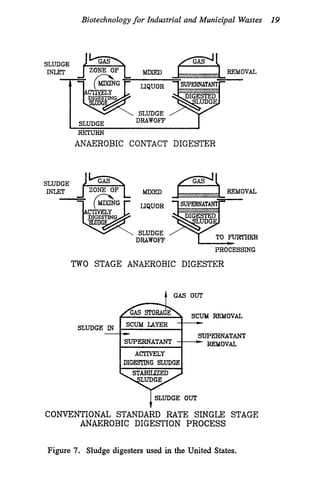
  • 112.
    Biological Degradation ofHazardous Wmtes 101 other organic substrates. Some strains are inhibited by another growth substrate while some are enhanced by its presence. Each population has specific requirements and so the engineering processes in place need extensive monitoring. How successful the strategies are in-situ also depends in part on the external factors. Biological degradation has also been shown to be successful when used in conjunction with abiotic treatment techniques. There are so many parameters impinging on the biological treatment system that copious research is needed at the laboratory, bench scale, pilot studies, and in- situ studies before we can know how to optimize degradation. We must know what the degradationpathways are, the toxic intermediates if any, and if more stable products are formed. Each situation is unique; a study may show that a compound is recalcitrant but the bacteria may require an extra growth substrate or symbiotic partner to utilize it. We still have unanswered doubts about the analyticaltechniques that test for recalcitrance and mineralization. But as our understanding of the enzymaticpathways, ecologicalsuccession,genetics, andmicrobiological basis of degradation grows, so will the systems we invent to degrade the xenobiotics. So in spite of the limitations of using biological control mechanisms, the literature has shown that microorganisms have a large capacity for degrading toxic chemicals. REFERENCES 1. 2. 3. 4. "StateDecision Makers Guide for Hazardous Waste Management," U.S. EPA, 1977. de Young, G. "EPA and Industry Push for New Superfund Solutions," Chemicd Week,Feb. 24, 1988, p. 28. "Waste Minimization Involves Recycling and Source Reduction," Environ News, vol. 3 #1, pp. 14-15. Valentino, F.W., and G.E. Walmet. "Industrial Waste Reduction: The Process Problem," Environment, Sept. 1986, vol. 28 #7, p. 16(10).
  • 113.
    102 Biotechnologyfor Wasteand Wastewater Treatment 5. 6. 7. 8. 9. 10. 11. 12. 13. 14. Dawson, G. W., and B.S. Mercer. Hazardous WasteManagement. New York: Wiley & Sons, 1986. Bowers, A.R., W.W. Eckenfelder, P. Gaddipati, and R.M. Monsen. "ToxicityReduction in Industrial WastewaterDischarge," Pollution Engineering, Feb. 1988, vol. 20 #2, pp. 68-73. Grosse, D.W., M. Koczwara, J.E. Park, and R.J. Lesiecki. "Activated Sludge Treatment of Selected Aqueous Organic Hazardous Waste Compounds,' Proceedings of the 42nd Industrial Waste Conference at Purdue University, May 1987. Valentino, F.W., and G.E. Walmet. "Industrial Waste Reduction: The Process Problem," Pollution Engineering, Feb. 1988, vol. 20 #2, pp. 68-73. Turner, R.J. "A Review of Treatment Alternatives for Wastes Containing Non-Solvent Halogenated Organics," JAPCA, June 1986, vol. 36 #6. de Young, G. Solutions,' Chemical Week, Feb. 14, 1988. "EPA and Industry Push for New Superfund Turner, R.J. "A Review of Treatment Alternatives for Wastes Containing Non-Solvent Halogenated Organics,'I JAPCA, June 1986, vol. 36 #6. Ryan, J.R., R. Kabrick, and R. Loehr. "Biological Treatment of Hazardous Wastes," Civil Engineering, Feb. 1988, pp. 65-67. Grosse, D.W., M. Koczwara, J.E. Park, and R.J. Lesiecki. "Activated Sludge Treatment of Selected Aqueous Organic Hazardous Waste Compounds,'I Proceedings of the 42nd Industrial Waste Conference at Purdue University, May 1987. Ryan, J.R., R. Kabrick, and R. Loehr. "Biological Treatment of Hazardous Wastes," Civil Engineering, Feb. 1988, pp. 65-67.
  • 114.
    Biological Degradation ofHazardous Wastes 103 15. Dawson, G. W., and B.S. Mercer. Hazardous WasteManagement, New York: Wiley & Sons, 1986. 16. Park, K.S., R.C. Sims, W.J. Doucette, and J.E. Matthews. "Biological Transformation and Detoxification of 7,12- dimethylbenzanthracene in Soil Systems," J. Water Pollution Control Federation, Oct. 1988, vol. 60 #lo, pp. 1822-1825. 17. Grady, C.P., andJ.R. Leslie. "Biodegradationof HazardousWastes by Conventional Biological Treatment," Hazardous Waste and Hazardous Materials, Nov. 1986, vol. 3, pp. 336-365. 18. Vandenbergh, P.A., R.H. Olsen, and J.H. Colaruoble. "Isolation and Genetic Characterization of Bacteria That Degrades Chloroaromatic Compounds," Oct. 1987, pp. 737-739. 19. Reed, J.P., R.J. Kremer, and A.J. Keastor. "Characterization of Microorganisms in Soils Exhibiting Accelerated Pesticide Degradation," Bull. Environ. Contam. Toxicol., 1987, 39:776-782. 20. Bowers, A.R., W.W. Eckenfelder, P. Gaddipati, and R.M. Monsen. "ToxicityReduction in Industrial Wastewater Discharge," Pollution Engineering, Feb. 1988, vol. 20 #2, pp. 68-73. 21. Ghisalba, 0. "Microbial Degradation of Chemical Waste, An Alternative to Physical Methods of Waste Disposal," Experientia, 1983, p. 39. 22. Pitter, P. "Determination of Biological Degradability of Organic Substances," WaterResearch, 1976, vol. 10, p. 231(5). 23. Chudoba, J. "Inhibitory Effect of Refractory Organic Compounds Produced by Activated Sludge Microorganisms on Microbial Activity and Flocculation," Water Research, 1985, vol. 19 #2, pp. 197-200.
  • 115.
    104 Biotechnologyfor Wasteand Wastewater Treatment 24. Harman, J., C. Lange, and M. Matsumora. "ToxicityEvaluation of Persistent Organic Contaminants," Proceedings of the 42nd Indus- trial Waste Conference at Purdue University, May 1987. 25. Blok, R.L., J. deMorsier, H. Wellens, and W.J. Bontinck. "Evaluation of the Toxicity of Substances to be Assessed for Biodegradability," Chemosphere, 1987, vol. 16, pp. 2259-2277. 26. Wilson, D. "Report on Decontamination of PCB Bearing Sediments," U.S. EPA Cincinnati,OH, Oct. 1987. 27. de Young, G. "EPA and Industry Push for New Superfund Solutions," Chemicd Week,Feb. 24, 1988. 28. Kampbell, D.H., J.T. Wilson, H.W. Read, and T. Stocksdale. "Removal of VolatileAliphaticHydrocarbons in a Soil Bioreactor," JAPCA, Oct. 1987, V O ~ .37 #lo, pp. 1236-1240. 29. Skladany, G.J., J.M. Thomas, G. Fisher, and R. Ramachandran. "The Design, Economics and Operation of Biotransformation System for Ketone Control and SolventRecovery Process Waters," Proceedings of the 42nd Industrial Waste Conference at Purdue University, May 1987. 30. Ely, D.K., and D.A. Heffner. US Patent 465902 Pollution Abstracts, 1988, vol. 19 #6, pp. 88-08439P. 31. Ying, W.C., R.R. Bonk, and S.A. Sojka. "Treatment of a Landfill Leachate in Powdered Activated Carbon Enhanced Sequencing Batch Reactors," Environmental Progress, Feb. 1987. 32. Weber, S.A., and M.R. Matsumoto. "Feasibility of Intermittent Biological Treatment for Hazardous Wastes," Environmental Progress, Aug. 1987, vol. 6 #3, pp. 166-171. 33. Little, C.D., A.V. Palumbo, S.E. Herbes, M.E. Lidstrom, R.L. Tyndall, and P.J. Gilmer. "TrichloroethyleneBiodegradation by a Methane-Oxidating Bacterium," Applied and Env Mic, Apr. 1988, p. 951.
  • 116.
    Biological Degradation ofHazardous Wmtes 105 34. Heitkemp, M.A., W. Franklin, and C.E. Cerniglia. "Microbial Metabolism of Polycyclic Aromatic Hydrocarbons: Isolation and Characterization of a Pyrene Degrading Bacterium," Applied and Env Mic, Oct. 1988, vol. 54 #lo, pp. 2549-2559. 35. Heitkemp, M.A., J.P. Freeman, D.W. Miller, and C.E. Cerniglia. "PyreneDegradation of a Mycobacteriumsp: Identificationof Ring oxidation and Ring Fission Products," Applied and Env Mic, Oct. 1988, V O ~ .54 #lo, pp. 2556-2565. 36. Bauer, J.E., and D.G. Capone. "Effects of Co-Occurring Aromatic Hydrocarbonson the Degradationof IndividualPolycyclicAromatic Hydrocarbons in Marine SedimentStudies," Applied EnvMic, July 1988, V O ~ .54, pp. 1649-1655. 37. Mihelck, J.R., and R.G. Luthy. "Degradation of Polycyclic Aromatic Hydrocarbons Under Various Redox Conditions in Soil and Water Systems," Applied and Env Mic, May 1988, vol. 54 #5, pp. 1182-1187. 38. Mahaffey, W.R., D.T. Gibson, and C.E. Cerniglia. "Bacterial Oxidationof Chemical Carcinogens: Formatting of PolycyclicAro- matic Acids from Benz(A) Anthracene," Applied Env Mic, Oct. 1988, V O ~ .54 #lo, pp. 2415-2423. 39. Bauer, J.E., R.P. Kerr, M.F. Baushsta, C.J. Decker, and D.G. Capone. "Stimulation of Microbial Activities and Polycyclic Aromatic Hydrocarbons Degraded in Marine Sediments Inhabited by Capitella capitata," Marine Environ Res, 1988, vol. 25 #1, ~pp.63-84. 40. Guerin, W.F., and G.E. Jones. "Two Stage Mineralization of Phenanthreneby Estuarine Enrichment Cultures," Applied EnvMic, Apr. 1988, vol. 54 #4, pp. 929-936. 41. Dieberg, F.E., N.A. Goulet, and T. Debusk. "Removal of Two Chlorinated Compounds from Secondary Domestic Effluent by a Thin Film Technique," Journal Environmental Quality, 1987, #4, pp. 321-324.
  • 117.
    106 Biotechnologyfor Wasteand Wastewater Treatment 42. Pelon, W., and J.A. Mayo. "Growth of Mixed Microbial Populations in Ground Water Containing Highly Chlorinated Organic Wastes," Bull. Environ. Contam. Toxicol., Apr. 1987, vol. 38 #4, pp. 661466. 43. Yaldi, Y., Y. Murakami, and M. Alexander. "Limiting Success of Inoculum to Enhance Biodegradation of Low Concentrations of Organic Chemicals," Env Sci Tech, 1988, vol. 22 #12. 44. Renganathen, V. "Possible Involvement of Toluene 2,3- Dioxygenase in Defluorination of 3-Fluor SubstitutedBenzenes by Toluene DegradingPseudomonal SpeciesStrain T-12,'I AppliedEnv Mic, Feb. 1989, pp. 330-334. 45. Topp, E., R.L. Crawford, and R. Hanson. "Influence of Readily Metabolizable Carbon on Pentachlorophenol Metabolism by a Pentachlorophenol Degrading Flavobacterium Species," Applied Env Mic, Oct. 1988, vol. 54 #lo, pp. 2452-2459. 46. Brown, L.R. "Oil Degrading Microorganisms," Chem Eng Prog, Oct. 1987, vol. 83 #lo, pp. 35-40. 47. Feld, S., N. Wojtonowitz, and R. Marks. "Biodegradation of Oil Field Production Bit Sludges," Proceedings of the 42nd Industrial Waste Conference at Purdue University,May 1987. 48. Foght, J.M., D.L. Gutnick, and D.W.S. Westlake. "Effect of Emulsan on the Biodegradation of Crude Oil by Pure and Mixed Bacterial Cultures," Applied Env Mic, Jan. 1989, vol. 55 #1, pp. 36-43. 49. Chakrabarty, A. "Microbes Could Break Down Dioxin," New Scientist, Feb. 25, 1988, 117:36. 50. Bachman A., P. Walet, P. Wijnan, W. de Bruin, J.L.M. Huntjens, W. Roelofsen, and A.J.B. Zehnder. "Biodegradationof Alpha and BetaHexachlorocyclohexanein a Soil SlurryUnder DifferentRedox Conditions," Applied and Env Mic, Jan. 1988, vol. 54 #1, pp. 143- 149.
  • 118.
    Biological Degradation o fHazardous Wastes 107 51. de Bruin,.A.B., J.C. Rienlet, H.H.N. Rynaarb, and A.B. Zehnder. "Aerobic Mineralization of Alpha HCH in Contaminated Soil," Applied and Env Mic, Feb. 1988,vol. 54,pp. 548-554. 52. Bergman, A., G.Blomlevist, and U. Oem. "Microbial Degradation by Autochthonous Soil Population of Alpha and Beta HCH Under AnaerobicField Conditions in Temperature Zones, Chemosphere, 1988,vol. 17 #2,pp. 481-487. 53. Konopka, A., D. Knight, and R.F. Turco. "Characterization of a Pseudomonas sp Capableof Aniline Degradation in the Presence of a Secondary Carbon Source," Applied and Env Mic, Feb. 1989, V O ~ .55 #2,pp. 383-389. 54. Kanagwa, T., and E. Mikami. "Removal of Methanodiol, Dimethyl Sulfide, Dimethyl Disulfide and Hydrogen Sulfide from Contaminated Air by Thiobacillus thioparus, Applied Env Mic, Mar. 1989,~01.,55 #3, pp. 555-558. 55. Zheng, S.Y.L., Z. Zheng, R. Zhang, and J.M. Bollag. "Sorption and Metabolism of Metolachlorby aBacterialCommunity," Applied and Env Mic, Mar. 1989,vol. 55 #3,pp. 733-740. 56. Lee, S.E., H.S. Shin, and B.C. Paik. "Treatment of Cr(vi)- ContainingWastewaterby Addition of Powdered Activated Carbon to the Activated Sludge Process," Water Research, 1989,vol. 23 #1, pp. 67-72. 57. Grosse, D.W., M. Koczwara, J.E. Park, and R.J. Lesiecki. "Activated Sludge Treatment of Selected Aqueous Organic Hazardous Waste Compounds," Proceedings of the 42nd Industrial Waste Conference at Purdue University, May 1987. 58. Groenestun,J.W., M.M.A. Bentvelsen,M.H. Deinema, and A.J.B. Zehnder. "PolyphosphateDegrading Enzymes inAcinetobacter spp and Activated Sludge," Applied and Env Mic, Jan. 1989,vol. 55 #1, pp. 219-223.
  • 119.
    108 Biotechnologyfor Wasteand Wastewater Treatment 59. Albers, H., and R. Kayser. "LandfillLeachateand Mine Drainage: Two Stage BiologicalKhemical Treatment of Hazardous Waste Landfill Leachate," Proceedings of the 42nd Industrial Waste Conference at Purdue University,May 1987. 60. Laquidare, M.J., F.C. Blanc, and J.C. O'Shaugnessy. "Developmentof Biofilm, Operating Characteristics and Operation Control in the Anaerobic Rotation Biological Contractor Process," 58thAnnual Conferenceof the Proceedings of the Industrial Waste Symposium, 1985. 61. Fathepure, B., J.P. Nengu, and S.Boyd. "AnaerobicBacteria that Dechlorinate Perchlorethene," AppZied and Env Mic, Nov. 1987, pp. 2671-2674. 62. Pfeffer, J., and M.T. Suidan. "Anaerobic-Aerobic Process for Treating Coal GasificationWastewater,"58thAnnual Conferenceof Proceedings of the Industrial Waste Symposium, 1985. 63. Yang, H. "The Anaerobic Treatment of Tannery Wastewater," Proceedings of the 42nd Industrial Waste Conference at Purdue University,May 1987. 64. Valentino, W., and G.E.Walmet. "Industrial Waste Reduction: The Process Problem," Environment, Sep. 28, 1986. 65. Boyer, J.D., R.C. Ahlert, and D.S. Kosson. "Pilot Plant Demon- stration of In-Situ Biodegradation of 1,1,1-trichloroethane,, , J. Water Pollution ControZ Federation, Oct. 1988, vol. 60 #lo, pp. 1843-1849. 66. Kehring, G.W., J.E. Rogers, and J. Negel. "Anaerobic Biodegradation of 2,4-Dichlorophenol in Freshwater Lake SedimentsatDifferentTemperatures,"AppliedEnvMic, Feb. 1989, VOI. 55 #2, pp. 348-353. 67. Freeman, H.H., and R.A. Olexsey. "Treatment Technologies for Hazardous Wastes: P a r t 1. A Review of Treatment Alternatives for Dioxin Wastes," JAPCA, Jan. 1986, vol. 36, pp. 67-75.
  • 120.
    Biological Degradation ofHazardous Wastes 109 68. Olexsey, R.A., and H.M. Freeman. "Managing Dioxin," Civil Engineering, Feb. 1987. 69. de Young, C. "EPA and Industry Push for New Superfund Solutions," Chemical Week, Feb. 24, 1988. 70. Arthur, M.F., and J.P. Frier. "Microbial Activity in Soils Contaminated with 2,3,7,8-TCDD," Env Tox Chem, 1988, vol. 7 #1, pp. 5-13. 71. Bumpus, J. "Biodegradationof Polycyclicromatic Hydrocarbons by Phanerochaete chrysosporiwn," Applied and Env Mic, Jan. 1989, V O ~ .55 #1, pp. 154-158. 72. Ryan, J.R., and R. Kabrick. "Biological Treatment of Hazardous Wastes," Civil Engineering, Feb. 1988, pp. 65-67. 73. Budiansky, S., and R. Clemings. "Toxic Wastes: A Little Fungus May Help," US News & World Report, Nov. 9, 1987, vol. 103 #19, p. 85(1). 74. Shannon, M.J.R., and R. Bartha. "Immobilization of Leachable Toxic Soil Pollutants by Using Oxidative Enzymes," Applied Env Mic, July 1988, vol. 54, pp. 1719-1723. 75. Zheng, Z., S . Liu, A. Freyer, and J. Bollag. "Transformation of Metalaxyl by the Fungus Synephalastrum racemosum,"Applied and Env Mic, Jan. 1989, vol. 55, pp. 66-71.
  • 121.
    3 BIOLOGICAL TREATMENTOF INDUSTRIAL WASTES: MUTANT BACTERIA BIOLOGICAL TREATMENT - OVERVIEW The objectives of biological treatment of wastewater are to remove the non-settleable colloidal solids and to degrade other organic matter. For industrial wastewater, the objective is to remove or reduce the concentration of organic and inorganic compounds. Because many of these compounds are toxic to microorganisms, pretreatment may be required. With proper analysis and environmental control, almost all wastewaters can be treated biologically. The removal of carbonaceous BOD is accomplished biologically using a variety of microorganisms, mainly bacteria. The microorganisms are used to convert the organic matter (colloidal and dissolved) into various gases and into cell tissue. Unless the cell tissue that is produced from the organic matter is removed from this solution, treatment has not been accomplished. The only treatment that has been achieved is the conversion of a portion of the organics by bacteria to gaseous end products. There are three major groups of biological processes: 0 Aerobic. 0 Anaerobic. Combination of aerobic and anaerobic. The processes are further subdivided into suspended or attached growth systems. The principal application of the above processes are for: @ Removal of carbonaceousorganic material (BOD). Nitrification. 111
  • 122.
    112 Biotechnologyfor Wasteand Wastewater Treatment 0 Denitrification. Stabilization. 0 Phosphorous removal. MICROBIOLOGY BACKGROUND Microorganisms can be defined as those organisms that are too small to be visible without the aid of a microscope or exist as individual cells. In general, protozoa, algae, fungi, bacteria, and viruses are included in this broad grouping. However, viruses (the smallest) are not cells and differ in many respects from the other organisms. The recent trend is to group microorganisms in three kingdoms: Protista, plants, and animals. In each kingdom the cell is the basic unit of life regardless of the complexity. Each cell containsnucleic acids, hereditary material vital to reproduction. The cytoplasm contains ribonucleic acid (RNA), whose major role is synthesis of proteins. The area of the nucleus is rich in deoxyribonucleic acid (DNA), which contains all the information necessary for the reproduction of all the cell c~mponents.'*~*~ Figure 1 illustrates some of the typical microorganisms that are important to the biological process. Energy and Carbon Sources To reproduce and function properly an organism must have a source of energy and carbon for synthesis of new cellular material. Inorganic elements, such as nitrogen andphosphorus, and other trace elements such as sulfur, K, Ca, and Mg are also vital to cell synthesis. Two common sources of cell carbon for microorganisms are C02and organic matter. If an organism derives its carbon from C02,it is called autotrophic; if it uses organic carbon, heterotrophic. Energy is also needed in synthesis of new cellular material. For autotrophic organisms, the energy can be supplied by the sun (photosynthesis) or by an inorganic redox reaction. If supplied by the sun, the organism's energy is supplied by oxidation or fermentation of organic matter.
  • 123.
    Biological Treatment o fIndustrial Wmtes: Mutant Bacteria 113 SARCODINA FLAGELLATED PROTOZOA FREE SWIMMING CILIATED PROTOZOA STALKED CILIATED PROTOZOA ROTIFER Figure 1. Typical microorganisms that are important in the biological process. Orgrnisms can also be classified accordingto ability to use oxygen. 0 Aerobic - exists where there is supply of oxygen. 0 Anaerobic - exists where there is no oxygen. Facultative - can survive with or without oxygen.
  • 124.
    114 Biotechnologyfor Wasteand Wastewater Treatment Type of Organisms The following microorganisms are important to the biological treatment processes: bacteria, fungi, algae, protozoa rotifers, crustaceans, and viruses. Bacteria (procaryotes)--are single cells, and when viewed under a light microscope, it is unusual to see any distinguishable cellular structures. Some structural features can be observed with an electron microscope or sometimes by staining. The cells are small (tenfold difference in average size of procaryotic and eucaryoticmicroorganisms). Representative size is 0.5 to 1 micron in diameter for the spherical bacteria. (Bacteria fall into three categories: spherical, cylindrical, and helical). The essential components of a typical bacterial cell are a cell wall, cytoplasmic membrane, a single molecule'of DNA, ribosomes, and the cytoplasm. The distinguishing characteristic of procaryotic cell walls is the presence of a mucopeptide layer. This material forms the rigid layer of all bacterial cell walls, including the blue green algae, but has not been found in eucaryotic cells. Bacteria are about 80% water, 20%dry material of which 90% is organic and 10% inorganic. An approximate formula for the organic portion is C,H,O,N. Temperature and pH play a vital role in their life. According to the temperature in which they function, bacteria may be classified as psychrophilic (to 3 0 " C ) ,mesophilic (20-45"C), and thermo- philic (45 to 75° C). Most organisms cannot tolerate pH levels above 9.5 or below 4. Optimum pH for growth is between 6.5 to 7.5. Bacteria can be classified as heterotrophic or autotrophic. In a biological wastewater treatment system, the heterotrophic are important because of their need for organic compounds for carbon for their cells. Fungi--are the most structurally uniform group of the eucaryotes. The predominantform of growth is filaments (hyphae)which collectively form the filamentousmass called the mycelium. However, yeast are not filamentous fungi that reproduce by budding. The others can reproduce by fission or spore formation. Geotrichum candidum is the most prevalent fungi in trickling filter slimes (filamentous). It has also been implicated in contributing to sludge bulking in activated sludgeunits. The ability of fungi to survive
  • 125.
    Biological Treatment ofIndustrial Wastes: Mutant Bacteria 115 under low pH (range of 2 to 9) and low nitrogen conditions makes them important in the biological treatment of industrial waste. Algae--Many thousands of species of algae exist. They range from unicellular to large aggregates of filamentous cells. Algae are primarily aquatic organisms. They are autotrophic,' photosynthetic protists. Algae produce bad tastes and odors in water supplies and shorten filter mns in filtration plants. In an aerobic facultative oxidation pond, algae are needed to supply oxygen to aerobic heterotrophic bacteria. Algae, like other microorganisms, require inorganic nutrients to reproduce; principally nitrogen and phosphorus. To prevent excessive algae growth in natural waters, emphasis has centered around the removal of nitrogen and/or phosphorus in treatment plant effluent^.^'^^^ Protozoa--are mostly single cell organisms, although very complex and highly organized. They are mostly aerobic heterotrophs. They are classified by life cycle and means of locomotion--flagella, cilia, or pseudopodia (amoeba). Protozoa are important both as disease causing organisms and as a vital link in the food chain from bacteria on up. They feed on bacteria and in turn are food for larger organisms. In effect, protozoa act as polishers of the effluent from biological waste treatment processes by consuming bacteria and particulate matter. They consume dispersed flocculent bacteria and small particles of organic matter. In waste treatment plant effluents, they indicate an efficient aerobic purification process. Crustaceans--are also aerobic, heterotrophic, and multicellular animals. They have a hard body or shell. They do not really exist in biotreatment systems; they are, however, normal occupants in natural waters. Viruses--are small; they can be seen only with an electron microscope. They are parasites and can reproduce only within a living cell. In an infected cell, the metabolism of the cell is used for the manufacture of viruses. Outside the cell, the viruses are inert. They are composed essentially of protein and nucleic acid. Viruses are usually classified by the host they infect: plant, animal, or bacteria, and are generally named for the disease they cause. Viruses are now the most important pathogens to man, since bacterial disease can be treated by antibiotics. Viral infections cannot. And many are found in the feces of man. Therefore, it is necessary to ensure that viruses are controlled in the effluent from waste treatment plants. Rotifers--are aerobic heterotrophic, multicellular animals.
  • 126.
    116 Biotechnologyfor Wasteand Wastewater Treatment BACTERIAL GROWTH Factors Affecting Growth Both physical and chemical characteristics of an environment influence microbial growth. These factors can determine the types of organisms that can grow and influence the rate of growth under these conditions. Temperature One of the most important physical factors affecting growth is temperature. Each microorganism is able to grow within a specific temperature range. While single species can grow only over a 40°C range, others can grow below 0°C to above 90°C. Based on optimum growth temperatures, microorganisms canbe classified as: psychrophiles (less than 20"C),mesophiles (20-45"C), and thermophiles (greater than 45°C. 1,3# Another factor that influences growth rate is pH. statements can be made about microorganisms' pH preferences: Some general 1. 2 . 3. 4. In Bacteria have optimum pH near 7,(5-9 range). Fungi prefer acid environment (PH minimum of 1 to 3 pH, optimum near 5). Blue-green algae, pH higher than 7 . Most protozoa, pH range 5 to 8. the treatment of industrial wastes, it is necessary at least to provide initial adjustment of pH if biological treatment is to be successful. In anaerobic treatment of industrial waste, pH control is of greater concern than in aerobic because of a narrow range of pH tolerance.1,424
  • 127.
    Biological Treatment o fIndustrial Wastes: Mutant Bacteria 117 Oxygen Many bacteria can grow only in the absence of oxygen, while many bacteria and fungi and protozoa are capable of growth in either the presence or absence of oxygen. Algae are aerobic organisms. Oxygen is required for two purposes by aerobes. Mainly, for the electron transport system necessary for generation of energy, and a small amount is used in enzymatic reactions. Nutrients Only four elements C, 0, N, and H make up 90% of the dry weight of a cell. These elements, plus P and S, comprise the large molecules of the cell. The remainder includes a large number of elements including: K, Na, Ca, Mg, Cl, Fe, etc. Of the four elements comprising the bulk of the cell, i.e., CONH, only C and N are of selected importance. The H and 0 are derived from water and/or from other compounds used by the cell. Therefore, the major difference in nutritional requirements of microorganisms is the different source of C and N that they can use for synthesis of cellular material. KINETICS OF GROWTH Growth Curve The growth curve shows "the rise and fall" of microbial populations. It is a generalized description of experimental observations. The number of viable organisms are reported as a function of time. The growth pattern, based on number of cells or microbial population in mg/l (X), has several distinct phases: Lag. Log increasing. Log decreasing. Stationary. Accelerating autodigestion (log increasing). Decelerating autodigestion (log decreasing).
  • 128.
    118 Biotechnology forWaste and Wastewater Treatment These phases can be described as follows: Phase 1--Time of adjustment to a new environment. Phase 2 and 3--Exponential and declining growth. Cells generate at a rate determined by ability to process food, where the growth rate equals p x for the log increasing portion of the curve. Here the growth rate is proportional to the concen- tration x, and p is called the specific growth rate. The biomass is increasing exponentially - first order, increasing rate. Phase 4--Growth ceases. This most likely occurs because of exhaustion of an essential nutrient, and in most biological processes the aim is to make the carbon source the limiting nutrient for the growth of new cells. Phases 5 and 6--Autodigestion in endogenous phase. Here the death rate exceeds the production of new cells. Microorganisms are forced to metabolize their own protoplasm. Cultures In a batch culture, growth in the log increasing phase is proportional to the mass of the bacteria where x = concentration of microorganisms r, = rate of increase in X or dX - dt rate of bacterial growth - - Growth ceases (does not continue indefinitely) when a necessary requirement for growth in the environment is missing: including exhaustion of nutrients, depletion of dissolved oxygen, clianges in the chemical environment and production of toxic substances. In wastewater treatment, conditions are controlled so that exhaustion of the carbon supply limits its growth (substrate limiting). In a continuous culture, growth is limited, and the effect of limiting the substrate or nutrients can be described by the expression proposed by Monod.'V3
  • 129.
    Biological Treatment o fIndustrial Wastes: Mutant Bacteria 119 where p = specific growth rate, time-' pm = max specific growth rate, time-' S = concentration of substrate (growth limiting) in solution, masshol K, = saturating constant or half velocity constant (concentration of substrate at onehalf pJ, masdvol This is an equation of a rectangular hyperbola which fits the data from Monod's experiment, Le., p vs. S.' This shape curve is most frequently observed for heterogeneous populations. Although the use of So, initial concentration, instead of S is a more accurate representation of this type data, S can be used as an approximate So in the equation of the curve. Substrate Utilization A portion of the substrate is utilized to create new cells, and the rest is oxidized to inorganic and organic end products. Results of many experiments indicate that the mass of cells produced per unit substrate removed (Y - the cell yield) is constant for pure cultures and also for heterogeneous populations. This value is usually measured at the end of substrate removal and is called the true cell yield. Any Y measured in the autodigestive phase will be lower and is not a value yield measurement. Many factors affect the numerical value of Y; however, the cell yield exhibits constancy for a given species grown on a given carbon source. Therefore, the following relationship has been developed: rg = Yr,, where re = rate of bacterial growth
  • 130.
    120 Biotechnologyfor Wasteand Wastewater Treatment Y = yield coefficient r,, = substrate utilization rate and r,, is also equal to - &,where k = a, by K +s Y combination of the preceding relationships. In bacterial system for wastewater treatment, not all cells are in the log growth phase. Cell maintenance and death must be accounted for in the kinetic expressions. The decrease in cell mass due to these factors is assumed proportional to existing cell mass X. Therefore, an endogenous decay term is established: r (endogenous decay) = -kdX When combining terms, the following is the result: r’g = pmXS - kdX K+S - rg - - Y rru- kdX r’g = actual rate of bacterial growth A new term is introduced called the specific growth rate, which is the actual rate of bacterial growth per mass of organisms: p’ = rg/X and is equal to P’ = a - kd or K, +s P’ = YkS - kd K , S The effect of endoneous respiration can be incorporated by defining a term called observed yield, Y&.
  • 131.
    Biological Treatment ofIndustrial Wastes: Mutant Bacteria 121 Y* = - z, or TSU TP = - Y,,rSu and from above Therefore, - Y , r, = - Yr, - kdX Hence, Yob.is less than Y (measured in log phase) because of the effect of kdand is equal to y - k,, (K. +SI kS Continuous Treatment In a continuousprocess, such as aerobictreatment in a continuousstirred rank reacror (CSTR) activated sludge process, a m a s s balance of organisms, without recycle, and steady state conditions, yields the following relati~nship:~ here 1 = hydraulic residence time Q V = reactor volume Q = flowrate This expression can be written (as derived from previous equations) as: Q = 1 = Y & , - k d and is equal to /L’ V e X The reciprocal of p’ is defined as the mean cell residence time, 6,
  • 132.
    122 Biotechnologyfor Wasteand Wastewater Treatment and 8, = mass of cells in reactor mass of cells wasted For a system without recycle: 8, = - VX = 8 or similarly from above 1 .= p = 1 . QX 8 8, so that the mean cell residence time equals the hydraulic residence time. If a term U (specific substrate utilization rate) is defined as: U = - r - " = - kS ,thenthe above equationcanbe X K+S reduced to the familiar p' = - 1 = YU -kd where U and 8, are directly 8, related. For a system with recycle, a similar equation is developed. However, 8, and U are independent of the hydraulic residence time. Thus, even though the effluent waste concentrations is still related to 8, or U, 8 does not equal 8,, and 8, can be altered independent of the system residence time.% Table 1 provides a summary of aerobic digestion design parameters. INDUSTRIAL WASTE TREATMENT PROCESSES Industrial wastewater is characterized by its large volume, high temperature, high concentration of biodegradable organic matter and suspended solids, high alkalinity or acidity, and by variations of flow. The degree of treatment varies accordingto the means of disposal, which may be to a municipal sewer system, a receiving body of water, such as a stream, an estuary, or a large body of fresh water, or recovery for reuse. General wastewater treatment processes will probably include:
  • 133.
    Biological Treatment ofIndustrial Wastes: Mutant Bacteria 123 equalization tanks, settling tanks, precipitation, coagulation, or flocculation, neutralization, and biological processes. Available biological treatment processes include: activated sludge, trickling filter, land disposal, aerobic digestion, stabilization, aerated lagoons, and variations of these such as: 0 Rotating Biological Contactors (RBC). Deep Shaft. Pure Oxygen. Activated Carbon. Mutant Seeding. And anaerobic processes are also becoming important particularly for strong organic effluents. The selection of a biological treatment system will depend upon factors as waste strength, land availability, supply of available technicians, and quality of effluent required, and cost. All of the aforementioned processes should be considered. No two wastes are completely alike, and each industrial wastewater problem must be considered according to its particular situation. Aerated Processes Activatedsludgeremainsthepredominantbiologicaltreatment systemfor industrial wastes. With proper detention, activated sludge systems perform well for BOD removal. With acclimation well established, removal of some priority pollutants is possible; a properly designed system can even degrade priority pollutants. However, when alcohols and ketones predominate, there is the tendency to form filamentous organisms. Although removals are good, control of settling and recycle is difficult.n Activated sludge, trickling filter, and aerated lagoon treatment typically process wastewaters with less than 1% solids. Waste stabilization ponds process wastewater with less than 0.1% solids. Activated sludge treatment and trickling filter rely on biomass retaining their slimy coating (so they settle better) and they are therefore best operated in the log growth phase. Aerated lagoons and waste stabilization ponds have long retention periods and exhibit endogenous
  • 134.
    124 Biotechnologyfor Wasteand Wastewater Treatment TABLE 1 AEROBIC DIGESTION DESIGN PARAMETERS Parameter Value Remarks Detention Time, days Air Requirements diffuser system, Cfm/lOOo cu. i t . cfm/1OOo cu. ft. mechanical system, gpllOOo cu. ft. mg 02/l/hr./1000 mg/l MLSS Minimum Dissolved Oxygen, mgll Temperature, "C Volatile Solids Reduction, percent Tank Design 15-20 Waste activated sludge alone 20-25 Primary + Waste activated sludge Enough to keep the solids in suspension and maintain a D.O. 20-35' between 1-2 mgll. >9 0 This level is governed by mixing aeratoca in aerobic digesters require bottom mixers for solids concentration greater than 8000 mgll, especially if deep tanks (>12 feet) are used. 1.0-1.25 requirements. Most mechanical 3.O 1.o >15 If sludge temperatures are lower than WC, additional detention time should be provided so that stabiliation will occur at the lower biological reaction rates. 40-50 Aerobic digestion tanks are open and generally require no special heat transfer equipment or insulation. For small treatment systems (0.1 mgd), the tank design should be flexible enough so that the digester tank can also act as a sludge thickening unit. If thickening is to be utilized in the aeration tank, sock-type diffusers should be used to minimize clogging. Power Costa SlyrAb. BOD removed 2.18 These cost data are based upon three $lyr.lcapita 0.37 operational plants in Pennsylvania. 'Waste activated sludge alone. Primary and waste activated sludge.
  • 135.
    Biological Treatment ofIndustrial Wastes: Mutant Bacteria 125 In general, biological treatment processes are probably the most cost effective techniques for treating aqueous waste streams containing organic contaminants. Certain inorganic compounds may also be treated using microorganisms (although applications are limited); ammonia can be converted to nitrite and nitrate and then nitrogen gas through a controlledsequenceof aerobicand anaerobicbiologicaltreatment steps." Phosphorus can be concentrated in microorganisms under aerobic conditions and then released under anaerobic c~nditions.~~ Various post aeration devices are illustrated in Figure 2. The schematic for a continuous-flow aeration unit is shown in Figure 3. Also, a typical aerobic circular digester is illustrated in Figure 4. AIR COMPRESSOR P BUBBLE DISPERSION TURBINE TYPE AGITATOR a w do TUBE AERATOR PUMP TYPE AGITATOR Figure 2. Various post aeration devices.
  • 136.
    I26 Biotechnologyfor Wasteand Wastewater Treatment -0 w +g d
  • 137.
    Biological Treatment ofIndustrial Wastes: Mutant Bacteria 127 SUPE DRA NTROL BAFFLX EDUCTOR TUBE Figure 4. Typical aerobic circular digester. Activated Sludge (Suspended Growth) Organic wastes are introduced to a reactor (either plug flow or completely mixed) where the bacterial culture is held in suspension. Aerobic environment is achieved through diffused or mechanical aeration. After a certain time, the biological solids form a floc and settle out and separate from the treated water. A portion of the settled cells is recycled to maintain desired concentration of organisms in the reactor and the rest wasted. Level of biological mass in the reactor depends on desired efficiency and kinetic^.^'^ As mentioned earlier, a satisfactory floc is necessary for effective separation of the biological solids. The floc formation is promoted by operation at a cell retention time where slime layers exist. Also, important for settling are proper-design of a settling unit and proper operation to prevent the presence of filamentous organisms and fungi. Bacteria in activated sludge are capable of performing hydrolysis and oxidation reactions. The oxidations can be represented by:
  • 138.
    128 Biotechnologyfor Wasteand Wastewater Treatment Oxidation (dissimilatory) COHNS + 02, + COz NH, 3- energy organics bacteria Synthesis (assimilatory) COHNS + O2 + energy - C3H7N0, (new bacterial cells) bacteria Endogenous Respiration (autooxidation) C,H,NO, + 50, + 5 CO, + 2H,O + energy (cell tissue) Both the oxidation of complex hydrocarbons and the hydrolysis of polysaccharides occur outside the cell, and are catalyzed by exoenzymes secreted from the cell wall into the surrounding aqueous environment. Oxidation is conducted by aerobic organisms which use dissolved oxygen present in the biological system. Hydrolytic reactions are caused by aerobic organisms using water present in the biological system. The activated sludge process was developed in England by the turn of the century. Many versions of the original process are used today, but fundamentally they are all similar. Process modifications of conventiond activated sludge include the following: Contact stabilization--involves aerating activated sludge on its return trip to the aeration tank so that sorbed organics are decomposed. Step aeration--involves admitting influent wastewater at multiple points along the aeration tank. Extended aeration--used where there are low organic loadings and it is desirable to minimize sludge residue. Involves longer aeration retention so that endogenous respiration of the biomass is achieved. Pure oxygen--used where there are high organic and trace metals concentrations to maintain a high dissolved oxygen level and a high biomass concentration. Involves closed
  • 139.
    Biological Treatment ofIndustrial Wastes: Mutant Bacteria 129 aeration tank with mechanical mixers receiving wastewater and oxygen gas. Pure oxygen systems have been shown to operate effectively at MLVSS concentrations of 4000 to 8000 mg/l while conventional air activated sludge systems typically operate at 1500to 2500 mg/l MLVSS.13 Activated carbon--Carbon is sometimes added to activated sludgesystemsto provide adsorptive capacity.l3 Theprocess combines aerobic treatment with activated carbon to destroy materials refractory to conventional treatment. Dupont has developed a process called PACT (powdered activated carbon treatment) for treatment of broad types of aqueous waste streams. In the PACT process, powdered carbon is added to the aeration basin of an activated sludge system and is capable of capturing and removing non-biodegradable organic compounds. Dupont has such a treatment plant (40 mgd) at its Chambers Works in Deepwater, New Jersey.45 Deep shaft--A vertical underground shaft is used to provide highly efficient transfer of oxygen for biodegradation of sewage and organic industrial effluents. Depending on the effluent composition and flow, shaft dimensions can be 50 - 150 meters deep and 0.5 to 10 meters in diameter. Influent is fed into the top of the downflow section of the shaft and mixed with air injected from a standard compressor. Process advantages include a high intensity of oxygen uptake, high utilization of transferred oxygen, and high energy economy. The low land area required and minimal environmental impact make the deep shaft process attra~tive.~~ Figure 5shows improved sludgeprocessing for an activated sludgeplant. Figure 6 shows a two-stage activated sludge process. Aerated Lagoons The technique of aerated lagoons was developed from adding artificial aeration to existing waste stabilization ponds. The aerated lagoon process is essentially the same as the conventional extended aeration
  • 140.
    130 Biotechnologyfor Wasteand Wastewater Treatment - AERATION - FINAL - GRIT - 4 PRIMARY --rc REMO-JAL BASINS BASINS CLARIFIERS 1 1 1 FLOTATION BLEND THICKENER SLUDGE r L TANK CONDITIONER 25...30% FILTER CAKE. Figure 5. Improved sludge processing for an activated sludge plant. process except that an earthen basin (for treatment of industrial wastes, it may be necessary to line the basin) is used as the reactor and the oxygen is supplied by surface or diffused aerators. However, because lagoons are not generally as well mixed as activated sludge, a low level of suspended solids is maintained in the mixed liquor. MLVSS of lagoons range from 50 to 150mg/l. When aeration is not sufficient to maintain aerobic conditions throughout, a portion of the biomass on the bottom may undergo anaerobic microbial decomposition. Such lagoons are called aerobic - anaerobic of facultative lagoons. The aerated lagoon process has been successfully operated on petrochemical wastes, textile wastes, pulp and paper mills, and refinery wastes. The process can operate on the same categories and organic species as activated s l ~ d g e . ~ . ~
  • 141.
    Biological Treatment o fIndustrial Wastes: Mutant Bacteria 131 rt d e M -a r A B cd 0 cd .2 Y
  • 142.
    132 Biotechnologyfor Wasteand Wastewater Treatment Waste Stabilization Stabilizationponds are large earthen basins that treat wastes by natural processes of bacteria and algae. Aerobic conditions prevail by oxygen produced by the algae and atmospheric difision. To maintain aerobic conditions throughout, the contents are mixed periodically by pumps or surface aerators. Natural biodegradation reactions are allowed to proceed as wastewater passes slowly through large shallow basins--allowing oxygenationby wind aeration (diffusion) and algae photosynthesis using sunlightenergy. Waste stabilizationof industrialwastes is recommended only where the wastehas received preliminary treatment to remove most of the organics and essentially all the inorganics. Waste stabilizationprovides aerobic and, if deep enough, facultative anaerobic decomposition of organics at the benthic sediment-water interface. Stabilizationvaries with changes in temperature. During cold seasons, facultative bacteria may shift to an anaerobic mode. Only simple organics, such as carbohydrates and proteins, are decomposed by anaerobic activity and the rate is less than aerobic conditions. Also, anaerobic activity increases with pond depth. Industries employing stabilization ponds are meat and poultry, packing-cannery, dairy plants, iron and steel, oil refineries and petrochemicals plar~ts.~.~ Trickling Filter (Attached Growth) Wastes are sprayed through the air to absorb oxygen and allowed to trickle through a bed of rock or synthetic media coated with a slime of microbial growth, which is able to decompose organic matter in *e waste stream. The trickling filter relies on a media support of immobile microorganisms which receive substrate as waste and is trickled over their cell surface. The microbial community consists primarily of aerobic, anaerobic, and facultativebacteria, fungi, algae, and protozoa- some higher animals. The microbial slime remains aerobic primarily at its surface where air and water interface with cells. The underlining portion, adjacentto the media, may become anaerobic. Periodically, the
  • 143.
    Biological Treatment ofIndustrial’Wartes: Mutant Bacteria 133 microbial slime sloughs off the media and is collected and clarified from the underflow. The ability of trickling filters to acceptvariable hydraulic and organic loads is based on the short residence time of wastewater in the process. However, because of the short residence time, removal of organics is not as good as in activated sludge treatment. Trickling filter treatment of aqueous wastes is proven technology for industrial waste treatment. It is especially applicable in sequence with activated sludge; the filters are more accommodating to load variations and the activated sludge unit can achieve higher organic loading efficiencies. Trickling filters are reported to successfully handle acetaldehyde, acetic acid, acetone, formaldehyde, etc. They have also been used to decompose oil and phen01.~*~l Rotating Biological Contactors (RBC) Rotating biological contactors are closely packed circular disks submerged in wastewater and rotated slowly. Biological growth is attached to the surface of the disk and forms a slime layer. The disks contact wastewater and air for oxidation as.it rotates. The rotation helps to slough off excess solids. About one third of the disk is submerged. The disk system can be staged in series to obtain nearly any detention time or degree of removal required. Since the systems are staged, the culture of the later stages can be acclimated to the slowly degraded materials. Only recently has laboratory disk data been effectively scaled up to predict plant operations.” Packed Beds Microbial growth can also be attached to media in a packed bed. Wastewater flow is introduced to the bottom and air or oxygen is also introduced in the ~astewater.~~ The Oxitron systems,%a fluidized bed wastewater treatment process, combines activated sludge and trickling filter methods. Higher volumetric loading rates are possible. Biological organisms are fixed in the system - as in a trickling filter, and are capable of providing greater process stability in handling shock and toxic loads. But there is minimal sheddingof biological growth; therefore, no clarifier or recycle of sludge is required.
  • 144.
    134 Biotechnologyfor Wasteand Wastewater Treatment The key to its effective treatment is the high concentration of active biological organisms in the fluidized reactor - 12,000 to 14,000 mgn MLVSS as compared to 1500 to 3000 for conventional activated sludge and 3000 to 6000 mg/l for pure oxygen activated sludge treatment. One pilot plant in Iowa treated influent of 3000 mg/l BOD from a corn wet milling plant. Results showed 95%BOD removal." Landfarming Landfarming can be defined as controlled application and cultivation of wastes on soil at a properly engineered site in order to use microorganisms naturally present in the soil to decompose the organic fraction of the wastes. The process uses minimum energy, is relatively odorless, can be repeated at frequent intervals, and is not an eyesore, since it resembles a plowed field. Landfarming is applied to the top layers of soil where natural bacteria are found in abundance. An underlying layer of impermeable clay-like soil must be in place to prevent vertical movement of the waste prior to destruction." Landfilling, in turn, is not as suitable for organic waste if covered by more than a few feet. The organics will not degrade rapidly in the absence of those bacteria found in abundance only in the upper layers of soil. This system is used to dispose of meat packing wastes, cannery waste, organic chemical wastes, and oily wastes of petroleum refineries. Waste materials with high metal content or other non-biodegradable materials are not suitable for this process." Monitoring of the site is necessary to ensure both maximum efficiency of biodegradation and compliance with environmental regulations. Samplesof the soil are analyzed periodically and some sites require monitoring wells to analyze the groundwater. Landfarming oily sludges and many organic industrial wastes may deposit heavy metals in the soil. Therefore, the land may be rendered unsuitable for growing crops for human or animal consumption. However, the increased humus contentmakes the site suited for growing trees and grass. Oily wastes have been disposed of since 1959. Exxon had an eight acre landfarm at its refinery in Bayway, New Jersey. Runoff is controlled by c~ntouring.~.~'Landfill gas production during the biological degradation process is illustrated in Figure 7.
  • 145.
    Biological Treatment ofIndustrial Wastes: Mutant Bacteria 135 I I1 1 1 1 IV I i I O O TIME Figure 7. Landfill gas production during the biological degradation process. Anaerobic Digestion (Treatment) Anaerobic digestion is a process for degradation of organics in an air- free environment. Anaerobic organisms utilize part of the substrate for cell growth and the other part to produce methane and CO, gas. Anaerobic digestion is applicable primarily to simpler organics-- carbohydrates, lipids, proteins, alcohols; and organic acids. Little degradation of long chain or cyclic hydrocarbons takes place. The process has been mostly used for sewage sludge digestion, but should be considered for treatment of industrial wastes--such as meat packing wastes and brewery wastes. The process relies on two types of organisms in a symbiotic relationship--acid forming and methane forming bacteria. The process produces methane and results in a low production of sludge. Typically, the process treats 5to 7% solids; however, a modification, the anaerobic contact process is used for wastes with low solids concentration. Other modifications are the upflow contact process and the anaerobic filter pro~ess.~~*~*
  • 146.
    136 Biotechnology forWaste and Wastewater Treatment Anaerobic digestion is affected by influent waste composition, pH, and temperature. Overall rate, however, is controlled by the conversion of acid, methane, and CO,. Therefore, the methane bacteria are rate limiting microorganisms in the population. The inhibitory effect of certain hydrocarbons on unacclimated digestion was studied by Union Carbide. Acclimation of the process to the organic inhibitor was slow and most un~uccessful.~ In industry, anaerobic digestion has been employed by the meat packing industry. Potentially, treatment can be applied to feedlot wastes, wastes from pharmaceutical industries, and food processing waste^.^ A new commercially successful anaerobic wastewater treatment process has been introduced by Celanese, called Celrobic. It is targeted for a large number of industries including chemical, petrochemical, food, brewery, and distilleries. Celanese claims that rising energy prices have made aerated processes such as activated sludge and aerated lagoons expensive. The basic unit of Celrobic is the reactor, a packed bed through which water circulates upward. The organic material is absorbed and degraded by the bacteria. To avoid microbe wipeouts that have plagued previous anaerobic systems, a computer system constantly monitors environmental factors, such as temperature and acidity- alkalinity, and makes corrections when factors get out of balance. Celanese has not yet come up with a method to keep a reserve of trained bugs just in case wipeout occurs despite the computer. It takes two to three months to acclimate microorganisms to high concentrations of organic chemicals that generally threaten anaerobic microbes. They are, however, trying to use a freeze dried method now used for aerobic organisms so that the organisms can be reconstituted when needed.28*29 In a process, "Bioenergy," marketed by Capital Plant International (London), streams having a high waste content (4-10% biodegradable matter) can be converted to methane gas with much lower energy input. %he major difference in the system is a patented digester that mixes incoming wastes with a sparging stirrer. The process was developed by Biomechanics, Ltd. and has been tested at commercial scale throughputs in three European locations. Throughput can be as high as 100tons/d of COD."
  • 147.
    Biological Treatment ofIndustrial Wastes: Mutant Bacteria 137 MUTANT BACTERIA Mutant bacteria additives are now available to augment the naturally developed bacterial population of activated sludge, trickling filter, or lagoon treatment plants. A regular schedule of bacterial additions can provide faster systemresponseto suchproblems as start-ups, plant upsets to variable and shock loads, and cold weather operations. Use of the specializedbugs seems to be increasing; later on in this chapter, several laboratory and plant applications called from the literature are noted. Bacterial cultures are sold either as liquid preparation, or as an air dried or freeze dried product. The formula may contain bacteria specific to a particular waste material, or a number of bacteria for treating a general class of waste.I2 General Environmental Science Corporation offers a patented liquid product calledLLMO (for liquid live microorganisms). Thelivebacteria come in a dormant state suspended in sodium sulfite which acts as an inhibitor.6 There are seven different strains, including aerobic and facultative bacteria, for treating most organic wastes. The strains can also be used to prevent foul odors from being produced by competing with those bacteria that can produce odorous fumes. Shelf life is guaranteed for two years; reactivation is by dilution. Polybac Corporation selects bacteria on their ability to survive environments containing uncommon organic compounds. The bacteria are exposed to increasing concentrations of these compounds to increase tolerance of subsequent strains. Use of radiation helps to obtain strains with even more enhanced properties, namely, bacteria with specialized waste disposal capabilities. The Sybron/BiochemicalCompany has developed a new series of bacterial cultures, the Bi-Chem 1000series, to aid in the biological oxidation of industrial wastewater. This series of specialized strains of microorganisms, both liquid and solid, are selected cultures designed to degrade chemical wastes and metabolize these wastes at accelerated rates under conditions which may exist in industrial waste streams. These cultures break down chemical wastes which are considered to be non-biodegradablewith existing sewage bacteria. Since the ability of the cultures to survive is marginal when introduced in a wastewater treatment plant, companies suggest a regular
  • 148.
    138 Biotechnologyfor Wasteand Wastewater Treatment reinoculation schedule. This means the bacteria will be present even if their substrates are in low concentration or absent. The bacterial mixes also need a proper nutritional balance. General Environmental Science, for example, insists that wastewater contain at least 5 ppm nitrogen (as ammonia) and 1ppm orthophosphate for every 100ppm BOD. Case Histories 1. At Exxon’s 1mgd activated sludge plant at Benicia, California’s oil refinery, control tests of bacterial addition have been conducted. At the plant, which has two parallel trains, specialized bacteria were added (in freeze-dried form) to the east aeration basin--while the other basin remained conventional. It was found that in normal operation there was a 32% improvement in the performance of the activated sludge system on the basis of organic matter removed. Phenol and ammonia effluent levels were lower than the controlled unit. Upon seeding the west basin, Exxon obtained similar improvement. Other benefits observed were faster unit start-ups, more stable operation with variable loads, and less foaming. The saving in antifoaming chemicals exceeded the cost of the bacterial additives. Exxon concluded that regular maintenance dosages of bacteria are not necessary for oil refineries with constant crude processing.12 2. J.T. Baker Company’s three million gallon per day secondary treatment plant at Phillipsburg, New Jersey started using bacterial cultures in 1978. Two dried cultures were used; one for ammonia removal and the other for hydrocarbon degradation. Daily dosages of 2.5 pounds and 5 pounds were used, respectively. The company believes that the cultures have improved removal efficiency. BOD levels which were close to 18 ppm were reduced to 6 ppm, and ammonia levels, which had been in the 40 to 45 ppm range, were well below 20 ppm.12 3. On March 25, 1982, a railroad tank car spilled 20,000 gallons of formaldehyde and contaminated the ground near Ukiah, California. Mutant bacteria had reduced the residual formaldehyde in the final stage of soil cleanup from 1000 pprn to 50 ppm after 15 days of treatment. Polybac, who made the microorganisms used in the
  • 149.
    Biological Treatment ofIndustrial Wastes: Mutant Bacteria 139 cleanup, also used bacteria for residud cleanup of soil contaminated with pentachlorophenol. And Polybac claims it will soon demonstratethe ability of mutant bacteria to detoxify PCBs in a test sanctioned by EPA. They claim also that bacteria can be used on other aliphatic and aromatic hydrocarbons, halogenated aliphatics and aromatics, cyanides, and nitriles.”.” 4. Application of mutant adapted bacteria to potentially toxic wastes prevented the release of high levels of phenol to the Ohio River. A wipeout of 4.5 mgd biological waste treatment plant caused the backup of untreated waste containingup to 60 ppm of phenol. An equalizationbasin and 6M gallon emergency impoundment lagoon were almost filled with contaminated wastewater. The use of mutant bacteria prevented the plant from being out of compliance with EPA effluent standards. Bacteria used was Phenobac, which is marketed by the Polybac Corporation, and is a mixture of bacterial strains.% 5. In 1980, about 20,000 gallons of dioxin leaked from a tank car in Sturgeon, Missouri causing the evacuation of 650 residents. The hazardous material, plus contaminated runoff, were collected in an impermeablelagoon by a spill control contractor, O.H. Material of Findlay, Ohio. The lagoon was turned into a temporary waste treatment system where nutrients and aeration equipment were added and inoculated with mutant adapted bacteria. This formulation was also Phenobac. The orthochlorophenol content of the lagoon was initially greater than 600 ppm; after one month of treatment with Phenobac, the dioxin level was down to 25 ppm.” 6. At the Texas Oil and Chemical Terminal in Vidor, Texas, about 13M gallons of wastewater, high in organic matter, accumulated without discharge. A means of treating this water was urgently needed; it had reached a high level in a lagoon and did not meet discharge criteria. In October 1980, aerators were added, and in January 1981, a section was seeded with a bacterial culture at the rear end of the lagoon and circulated to the front section. Within three weeks of the seeding with bacteria, the COD dropped to about 300 ppm even with low temperatureprevailing. Within fivemonths of starting the aerators and three months after seedingwith bacteria,
  • 150.
    140 Biotechnologyfor Wasteand Wastewater Treatment 7. the lagoon water was suitable for discharge. The bacterial culture, which was supplied in dried form, was very effective in consuming organic matter, and once the biological community was established, no daily maintenance additions were needed.25 Special bacteria have also been applied to a sewer system to remove grease. They were first injected,in high doses to give the dominance that they must have over naturally occurring strains. A specially formulated bacterial culture was used for this purpose, DBC plus, developed and supplied by the Environmental Cultures Division of Flow Laboratories. This bacterial approach has also been used to reduce BOD in sewage treatment plant effluents and to reduce hydrogen sulfideodor problems in fly ash holding ponds.5 8. Mutant bacteria have also been used to control filamentous growth in mill wastewater treatment. A treatment system was developed which, in a two month trial, increased a waste treatment plant's BOD removal rates, improved sludgesettling, and increasedtanning and lining removal. The system, after initial acclimatization, was able to meet state mandated permit parameters under normal operating conditions. Problems were experiencedwith the build-up of filamentous organisms during periods of high temperature, or when the normal biomass was in weakened condition. Subsequently, the biomass was able to be acclimated so as to resist the changes that had previously caused such drastic effects.' 9. A two acre lagoon with 2M gallons of waste oil was located behind a bearing plant in southern New England. Floating in the lagoon was an oil layer several feet deep. Such large scale waste oil accumulation plagues many metal working plants, and there is increasing pressure to find efficient disposal methods that comply with regulations. Many of these methods are expensive. But the bearing plant found a relatively inexpensive solution. By using mutant bacteria, the contamination in the oily wastewater was reduced to levels acceptablefor dischargeto the municipal treatment system.* 10. A rendering plant with a small but concentrated organic nitrogen loading achieved a 99.9% removal of ammonia after inoculation
  • 151.
    Biological Treatment ofIndustrial Wastes: Mutant Bacteria 141 with a bacteria produced by in-situ genetic engineering methods. Influent BOD of over 1200 mg/l with influent ammonia over 1100 mg/l were both reduced to less than 5 mg/l in effluent quality during a program based on the use of two mutant cultures.’ 11. An ethoxylated non-phenol detergent, which is also considered an oil and grease, was the causative agent in a foaming problem at a Taxtex, South Carolina textile plant. In a series of experiments, several organisms were isolated from samples of wastewater taken from the plant’s aerated lagoons. In a batch biotower experiment using the three most effective cultures, the initial detergent concentration of 520 mg/l was reduced by 88% after 41% hrs. Onsite treatment with the most effective of the three cultures produced a temporary but fairly rapid reduction of foam. Installation of a baffle in the tower may correct the problem and introducing the culture in a lagoon, where it could have more time to act, may provide more positive result^.^ 12. North Chemical Company of Mariett, Georgia emits process wastewater effluents to the company’s treatment facility. The effluents include emulsified petroleum waxes and polyacrylic and polyvinyl acetate polymers. The waste treatment facility contains a bio-oxidation tower which is 32 ft. high and contains a honeycomb PVC media providing 3.6 acres of surface area. Its capacity is 30,000 gallons per day while the rest of the system is 50,000 gpd. Phenobac, commercial bacteria, was seeded into the biotower. Five pounds of the Phenobac were reconstituted with warm water and added to the final pH adjustment tank at the same point as the nutrients. Additions of one pound per day were made over the next ten days and 1/5 lb. was added daily thereafter for population maintenance. Within one month COD was reduced to 57% of the former average. Within three months the COD was reduced 97%.1° 13. A study was made to investigatethe feasibility of bioengineering a dairy waste treatment system and improve its performance through inoculations of selected bacteria cultures. Parameters were monitored to follow system removal efficiency, sludge floc formation characteristics, microbial population shifts; and other
  • 152.
    142 Biotechnology forWaste and Wastewater Treatment functional performance parameters OF the system (mainly settling and quality of final effluent). Prior to the bacterial inoculation program, the poorly operating dairy extended aeration system had a BOD removal efficiency ranging from 80 to 90%with daily BOD loadings of 900 to 1100 lbs. After the inoculated bacteria established dominance, BOD removal efficiency increased to about 98%. BOD removal efficiency was improved from a range of 70 to 80% before inoculation to about 91%. Sludge volume indexes were reduced from average values of 350 to values of 200 ml/g which reflect the improved sludge settleability and biomass compaction. Effluent discharge quality was improved by a reduction in suspended solids from averages of 200 mg/l prior to inoculation to consistent values of less than 90. Included with the improved suspended solids discharge reduction was increased solids removal efficiency of the in-line centrifuges.l3 14. Some research organizations are working to create new microorganisms with voracious appetites for some of the most highly noxious pollutants. Battelle Memorial Institute @MI) is focusing on bacterial means of destroying such notoriously resistant chemicals as DDT and 2,4-D. The University of Illinois is developing microbes that digest 9CBs and 2,4,5-T. SRI International is trying to engineer a microbe to digest certain chemical intermediates, dye stuffs, and parathion. BMI is in the process of transferring the gene for 2,4-D degradation from a less active organism into a bacterium of the genus Pseudomonas. This organism converts 2,4-D into harmless products such as carbon dioxide and water. SRI had accumulated cultures of naturally occurring bacteria that degrade highly resistant chemicals. These strains and recombinant-DNA techniques will be exploited to obtain more active microbes for commercial use. The University of Osaka has an extensive collection of wild bacterial strains with the ability to degrade organic mercury c~mpounds.'~ 15. The concept of bacterial augmentation was evaluated in the Northeast Sewage Treatment Plant in St. Petersburg, Florida. Treatment began in January of 1977 by adding 1ppm of a mixed bacterial seed culture to three lift stations. By October 1977,
  • 153.
    Biological Treatment o fIndustrial Wastes: Mutant Bacteria 143 effluent BOD and SS levels were reduced from 1500 lb. to 391 lb. and 502 lb., respectively. Nitrite and nitrate levels were reduced to less than 0.1 mg/l and grease accumulation and odors were eliminated. Whenbacterial augmentation was discontinued, effluent concentration of BOD and suspended solids increased insignificantly within 60 days. The actual effect of bacterial augmentation on the plant, which bacteria was most effective, and why the improved removal deteriorated afterbacterial augmentation stopped, remained to be determined.6 16. V. Boroneko investigated the rapid destruction of mixtures of organic substances present in industrial wastewater mixed with cultivated bacteria with an unlimited flow of oxygen and substrate in a laboratory flow-through fermenter with a mechanical aerating device. The dosage of solution, pH, and temperature were regulated automatically. Ammonia and potassium phosphate were added at a ratio of C0D:N:P of 100:5:1. Traditional methods of biological purification indicated the acceptable load on a single aerated volume can be increased by greater than or equal to one order, compared with those generally accepted for traditional systems. Highly active populations of microorganisms were selected that were capable of quickly adapting to the destructive compounds. The significant exothermic effect in the destruction of pollutants created the high temperatures (35 to 37°C) necessary without additional heat." 17. Batelle Pacific Northwest Laboratories is seeking to develop a genetically engineered microbe that can produce useful materials from chemical plant waste. They expect to develop the microbe in 1983 and a process for using it two years later. They are also examining use of microorganisms to accumulate metals, which might be used in cleanup of metal laden industrial wastes.16 18. The "bioaccumulation" of wastes is also being investigated under a joint venture of Polybac Corporation and the O'Kelly Companies. Conceptually, mutated organisms that selectively accumulate metals such as cadmium, lead, or molybdenum would be mixed into a waste stream and later separated out leaving a purified material."
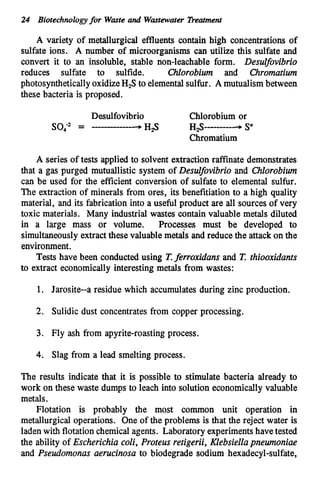
  • 154.
    144 Biotechnologyfor Wasteand Wastewater Treatment 19. Auckland University and Warkato University (New Zealand) are exploring applications of high temperature resistant bacteria thought to exist only in geothermal pools of North Island. The bacteria, which thrive between 82 and 104"C, produce protease, lactase, and cellulose enzymes that may be useful in waste treatment and other applications. Dissenting Opinions The claims of manufacturers of mutant bacteria are not easily verified and experts are divided in their opinions on the cultures' effectiveness. For example, Richard Raymond, an environmental consultant with Suntech Incorporated says that "most systems (conventional) are well inoculated; they just need a good nutritional balance for each waste being degraded. There is little evidence, published and documented, that special cultures are needed."" While basically agreeing with Raymond, Ed Barth, chief of biological treatment at the U.S. Environmental Protection Agency's Cincinnati Research Laboratory, conceded "there may be a place for special bacterial additions in specialized systems." More positively, Ed Stigall, Director of Office of Quality Review, EPA's Effluent Guidelines Division, stated: "Bacterial additives will speed up the process of one culture dominating the system, and they aid plant recovery after an upset. As such, they are a very useful operations and maintenance tool for help on infrequent bad days."12 R.E. Grubbs of Flow Laboratories, Inc. states that "unfortunately many hazardous waste spills involve mixtures of all kinds of chemicals. With pure chemicals, like a rail car spill, it is relatively easy to develop a bug for the job." "The complexity of the chemicals and the surrounding environment can pose a threat to successful use of bacteria in the cleanup of abandoned hazardous waste sites," says W. Studebaker of O.H. Materials Company." W. Sun of Durham, North Carolina is also skeptical about the efficacy of bacterial additions. "They are solid in microgram and milligram quantities for applications that include huge volumes of waste. It is unwise to expect these preparations to cure the ills associated with a treatment process that requires strict control conditions for its success."" Betz Laboratories, Inc. researchers tested a variety of cultured microorganisms that are commercially produced and sold to treat
  • 155.
    Biological Treatment ofIndustrial Wastes: Mutant Bacteria 145 wastewater contaminatedwith organic compounds not normally found in nature. In bench scale, pilot plant, and commercial-scale activated sludge systems, they found little improvement in handling shockloads of phenol and no improvement in reduction in TSS of 30D. Higher than recommended dosages of the additives (above 60 lb/mg wastewater) resulted in noticeable improvement, but Betz questions the cost- effectiveness. "Our general conclusion is that over the long term, these biological additives may have some benefit-especially when genetic engineering techniques (to tailor organisms to specific wastes) become widespread--but right now it seems generally uneconomical to use them" says Steven Spoerle, technology manager at Betz.'* Considerableresistancetowardbiologicalaugmentationinwastewater treatment is prevalent among consulting engineers, superintendents or operators of wastewater treatment plants, since they are trained that augmentation is not necessary.44 It is difficult to convince an operator or consulting engineer of the effect of the cultures since it is difficult, if not impossible, to run carefully controlled experiments on wastewater treatment plants. Improvements and innovationswill occur in treatment plants only with the combined efforts of those experts in design and operation and those in the biochemical disciplines. Certain over- statements have been made by biologists as to the effects of biological augmentation to wastewater treatment and by engineers as to the effect on plant efficiency. Answers will only be provided when those who are really involved meet and discuss the problem. So far what has been written only demonstrates that neither side has the answers to the questions firmly established. REFERENCES 1. Gaudy, A., and E. Gaudy. Microbiology for Environmental Scientists and Engineers. New York: McGraw-Hill, 1980. 2. Sawyer, C.N., and P.L. McCarty. Chemistryfor Environmental Engineering. New York: McGraw-Hill, 1967. 3. Metcalf & Eddy, Inc., and G. Tchobanoglous. Wastewater Engineering: Treatment,Disposal, Reuse. New York: McGraw- Hill, 1979.
  • 156.
    146 Biotechnologyfor Wasteand Wastewater Treatment 4. De Renzo, D.J. Unit Operations for Treatment o f Hazardous Industrial Wastes. New Jersey: Noyes Data Corporation, 1978. 5. Anonymous: "Clean That Sewer With Bugs," E.S. & T.,Oct. 1979, 13 (lo), pp. 1198-1199. 6. F.I. Horsfall. "Bacterial Augmentation of Wastewater Treatment," New England Water Pollution Control Association Journal, Sept. 1979, 13 (2), pp. 158-163. 7. Zitrides, T.G. "Mutant Bacteria Control Filamentous Growth in Mill Wastewater Treatment," Pulp & Paper, Feb. 1980, 54 (2), pp. 172-174. 8. Anonymous: "Mutant Bacteria Clean Up Waste Oil," American Machinist, July 1981, 125 (7), pp. 104-105. 9. Davis, L., J. Blair, and C. Randall. "Mixed Bacterial Cultures Break "on-Biodegradable' Detergent," Industrial Wastes, May- June 1979, 25 (3), pp. 26-27. 10. Zitrides, T.G. "Mutant Bacteria Overcome Growth Inhibitors in Industrial Waste Facility," Industrial Wastes, Sept.-Oct. 1978, 24 (S), pp. 42-44. 11. Sun, W. "How Super Are the New Super Heroes?" Water and WastesEngineering, Oct., 1978, 15 (lo), pp. 25-46. 12. Deutsch, D.J. "Waste Treatment Boosted by Bacterial Additions," Chemical Engineering, Apr. 23, 1979, 86 (9), pp. 100-102. 13. Chambers, J.V. "Bioengineeringan Activated Sludge Microflora to Improve Waste Removal Performance," Fifth Annual Industrial Pollution Conference, Atlanta/Georgia, Apr. 19-21, 1977. 14. Anonymous: "Building 'Superbugs' for the Big Cleanup," Chemical Week,July 23, 1980, 127 (4), pp. 39-40.
  • 157.
    Biological Treatment ofIndustrial Wastes: Mutant Bacteria 147 15. Anonymous: "An Anaerobic Digester That Converts Industrial Wastes to Methane," ChemicalEngineering, May 31, 1982, p. 19. 16. Anonymous: "BatellePacific Moves Into the Genetic Engineering Field," Chemical Engineering, June 14, 1982, p. 19. 17. Anonymous: "Microbial 'Bioaccumulation' of Metals From Waste Streams," Chemical Engineering, Aug. 23, 1982, p. 18. 18. Anonymous: "Are 'Superbugs' Effective in TreatingWastewater?" Chemical Engineering, Apr. 19, 1982, p. 20. 19. Anonymous: "New Zealand Bets $1 Million on the Commercial Potential of UniqueBacteria," ChemicalEngineering,May 3, 1982, p. 19. 20. Anonymous: "Mutant Bacteria Helped in Cleaning Up a California Formaldehyde Spill," ChemiculEngineering, Aug. 9, 1982, p. 18. 21. Olthof, M., and J. Olezkiewicz. "AnaerobicTreatment of Industrial Wastewaters," Chemical Engineering, Nov. 15, 1982, p. 121. 22. Boroneko, V., L.Usmanova, and R. Naumova. "Rapid Biological Purification of Wastewater,' I Khimicheskara Promyshlennost (Russian), 1979, No. 8, pp. 468-469. 23. Anonymous: "Bugs Tame Hazardous Spills and Dumpsites," Chemical Week, May 5, 1982, p. 49. 24. Voras, N. "Mutant Bacteria Clean Up Herbicide," Pollution Engineering, M a r .1980, p. 23. 25. Winchester, C.T., and M. Isaacs. "Aerators/Bacteria Team Up to Treat Wastewater in Refinery Lagoons,'I Chemical Processing, Sept. 1982, p. 24-25. 26. Anonymous: "Mutant Bacteria Prevent Release of Toxic Substances," Pollution Engineering, May 1979, p. 21.
  • 158.
    148 Biotechnologyfor Wasteand Wastewater Treatment 27. Robertson, J., W. Cowen, and J. Longfield. "Water Pollution Control," Chemical Engineering, June 30, 1980,pp. 102-119. 28. Anonymous: "Anaerobic Treatment Cuts Costs, Generates Energy," Chemical Week, Aug. 5, 1981,pp. 40-41. 29. Anonymous: "For License, Anaerobic Wastewater Process," Chemical and Engineering News, Aug. 17,1981. 30. Barber, N.R., and C.W. Dole. "Increasing Sludge-Digester Efficiency," Chemical Engineering, July 17,1978,pp. 147-149. 31. Galdieri, J.V. "Biological Phosphorus Removal," Qzemical Engineering, Dec. 31, 1979,pp. 34-35. 32. Huddleston, R.L. "Solid-WasteDisposal: Landfarming," Chemical Engineering, Dec. 31, 1979. 33. Thibault, G.T., and K.D. Tracy. "Controlling and Monitoring Activated-Sludge Units," Chemical Engineering, Sept. 11, 1978, pp. 155-160. 34. Anonymous: "Space-Saving Wastewater Treatment," Chemical Engineering, July 2, 1979,p. 47-48. 35. Frandsen, C.F. "Landfarming Disposes of Organic Wastes," Pollution Engineering, Feb. 1980,pp. 55-57. 36. Dallaire, G. "Behind the Rapid Rise of the Rotating Biological Contactor," Civil Engineering, Jan. 1979,49 (l), pp. 72-73. 37. Holladay, D.W. "Biodegradation of Phenolic Waste Liquors in Stirred-Tank, Packed-Bed, and FluidizedBed Bioreactors," Journal WaterPollution Control Federation, Nov. 1978,50(1 l ) , pp. 2573- 2589. 38. Mosey, F.E. "Anaerobic Filtration: A Biological Treatment Process for Warm Industrial Effluents," Water Pollution Control, 1978,77 ( 3 ) , pp. 370-378.
  • 159.
    Biological Treatment ofIndustrial Wastes: Mutant Bacteria 149 39. Anonymous: "Deep Shaft-Process and Application," Efluent and Waste TreatmentJournal, Jan. 1978, 18 (l), pp. 33-35. 40. Grieves C. "Powdered vs. Granular Carbon for Oil Refinery Wastewater Treatment," JWPCF, Mar. 1980, 52 (3), pp. 483-497. 41. Hosono, Y. "Trickling Filter Process Characteristic Evaluation," WaterResearch, 1980, 14 (6), pp. 580-590. 42. Beccari, M. "Nitrogen Removal from Wastewater," Efluent and Water TreatmentJournal, Feb. 1979, 19 (2), pp. 65-71. 43. Collins, C.E. "The Effect of Temperature Control on Biological Wastewater Treatment Processes," WaterResources, 1978, 12 (S), pp. 547-554. 44. Horsfall, F.L. "Biochemical Augmentation of Wastewater Treatment," JWPCF, Feb. 1977. 45. "Protectingthe Environment," Supplementto Chemical Week,1982.
  • 160.
    4 NITRIFICATION ANDDENITRIFICATION IN THE ACTIVATED SLUDGE PROCESS INTRODUCTION The deleterious effects of nitrogenous compounds on aquatic environments have long been recognized. Nitrogenous compounds can cause a significant depletion of dissolved oxygen in receiving waters, exhibit toxicity towards fish, and therefore, decrease the productivity of streams and lakes, and present a public health hazard. To preserve receiving water quality, many dischargepermits for wastewatertreatment plants are being revised to include restrictions on the discharge of the various nitrogen compounds. In order to meet these permit limitations, the biological processes of nitrification and denitrification are commonly employed. Nitrification is the process by which ammonia is first convertedto nitrite and, finally, to nitrate. Gaseous nitrogen is produced from nitrite and nitrate during denitrification. Prior to 1930, most wastewater treatment facilities were designed to accomplish a relatively high degree of nitrification, at least during the warmer months of the year, since highly nitrified effluents were discovered to be unsusceptible to putrefaction. During the period from 1940 to the late 1960's, the design of wastewater treatment facilities was directed towards the removal of carbonaceous materials in terms of the biochemical oxygen demand (BOD). Designing strictly for BOD removal was favored since it could be accomplished at reduced capital and operating costs as compared to designs incorporating nitrification. Also, during this time, environmental engineers generally dismissed the effects of unnitrified effluents on receiving waters based on the following concepts:' 151
  • 161.
    152 Biotechnologyfor Wasteand Wastewater Treatment Nitrification is caused by a specific group of microorganisms, the population of which is minimal in natural waters. The reaction rate for nitrogenous oxidation is small in relation to that for carbonaceous material. 0 The oxidation of ammonia to nitrates simply converts dissolved oxygen (DO) to a form in which it is still available to aquatic organisms. These concepts have been proven inaccurate by biologists who indicated that nitrates would not satisfy the oxygen requirements of fishes and many other aquatic fauna and by numerous river and stream investigations. Courchaine,2 in a study of the Grand River below the Lansing, Michigan municipal wastewater treatment plant, reported that in a stream where nitrification is active, the nitrogenous oxygen demand (NOD) exerts a demand on the oxygen resources of the stream which can result in a partial depletion of the DO assets if the rate of deoxygenation exceeds the rate of stream reaeration. Therefore, it is evident that the NOD load must be considered in any program of stream improvement having as one of its objectives, the maintenance of a given level of minimum stream DO. Table 1 provides a comparison of nitrification alternatives. FORMS OF NITROGEN Nitrogen has the ability to exist in seven oxidation ~tates,~ ranging from minus 3 to plus 5, and therefore, is found in many compounds. In wastewaters, nitrogen may be found in four forms: organic nitrogen, ammonia nitrogen, nitrite nitrogen, and nitrate nitrogen. In fresh wastewater the nitrogen present is primarily combined in proteinaceous matter and urea as organic nitrogen. Decomposition by heterotrophic bacteria, known as ammonification, readily converts organic nitrogen to ammonia nitrogen. Ammonia nitrogen may exist in aqueous solution as either ammonium ion or unionized ammonia. The relationship between the two forms is pH dependent and may be expressed in accordance with the following equation:
  • 162.
    Nitri3cation and DenitriJcationin the Activated Sludge Process 153 NH, + H,O -+ NH,+ + OH- At a pH greater than 7.0, the reaction is displaced to the left. Ammonium is predominant at any pH less than 7.0. Unionized or free ammonia in concentrations above 0.2 mg/l,has been shown to be fatal to several species of fish.3 In 1972, the National Academy of Sciences/ National Academy of Engineering Committee recommended that no more than 0.02 mg/l free ammonia be permitted in receiving waters to provide a margin of safety. Ammonia toxicity should not be a problem in receiving waters with pH below 8 and ammonia nitrogen concentrations less than about 1 mg/l.3 Nitrite nitrogen is unstable and easily oxidized to nitrate. It exists as an intermediate compound during the oxidation of ammonia nitrogen to nitrate nitrogen. If present in wastewater, the concentration is usually less than 1.O mg/l. Some industrial wastes may contain nitrite nitrogen in significant concentrations. Nitrate nitrogen is the most highly oxidized form of nitrogen. Its discharge into receiving waters from wastewater treatment plants will not result in any oxygen demand in terms of NOD. Nitrate is, however, an important nutrient for algae growth and, when present in excessive quantities, may be responsible for promoting eutrophication in streams and lakes. Thus, in certain cases, its discharge might have to be limited or prohibited to prevent excessive algae growth. In the case of potable water supplies, the maximum allowable concentration of nitrate is 10 mg/l since high concentrations (90-104 units mg/l) have been shown to cause methemoglobinemia in infants under four months old. NITRIFYING BACTERIA The principal organisms involved in nitrification processes are the genera Nitrosomonas and Nitrobacter. These organisms are considered to be autotrophs since they derive energy for growth and synthesis from the oxidation of inorganic nitrogen and carbon (COJ compounds, rather than from organic compounds. Both of these groups have rather specific environmental requirements in terms of pH, temperature, and dissolved oxygen and reproduce at much slower rates than heterotrophic bacteria. Various heavy metals and organic compounds have been found to
  • 163.
    154 Biotechnologyfor Wasteand Wastewater Treatment Advantages Combined treatment of carbon Very low effluent ammonia possible Inventory control of mixed liquor stable due to high BOD,/TKN ratio and ammonia in a single stage Combined treatment of carbon Stability not lined to secondary and ammonia in a single stage clarifier as organisms on media Good protection against most Stable operation Very low effluent ammonia toxicants possible Good protection against most Stable operation Less sensitive to low temperatures Stability not linked to secondary clarifier as organisms on media toxicants Disadvantages TABLE 1 COMPARISON OF NITRIFICATION ALTERNATIVES System Type Combined carbon oxidation - nitrification Suspended growth Attached growth Separate stage nitrification Suspended growth Attached growth No protection against toxicants Only moderate stability of operation Stability linked to operation of secondary clarifier for biomass return Large reactors required in cold weather No protection against toxicants Only moderate stability of operation Effluent ammonia normally 1-3mgll (except RBD) Cold weather operation impractical in most cases Sludge inventory requires careful control when low BOD,AKN ratio Stability of operation linked to operation of secondary clarifier for biomass return processes required than for combined carbon oxidation - nitrification 1-3 mgll processes required than for combined carbon oxidation - nitrification Greater number of unit Effluent ammonia normally Greater number of unit
  • 164.
    Nitrification and Denitrificationin the Activated Sludge Process 155 suppress or inhibit the growth of nitrifiers. Nitrosomonas can only oxidizeammonia nitrogen to nitrite nitrogen, whileNitrobacteris limited to the oxidation of nitrite nitrogen to nitrate nitrogen. NITRIFICATION STOICHIOMETRY The oxidation of NH,-N to NO,-N occurs in two steps as represented by the following equations? NH,' + 1.5 0, Nitrosomonas 2H+ + H,O + NO,- (1) ------------------, NO,+ + 0.5 0, Nitrobacter NO,- -----------------, The overall reaction may be represented by combining Equations (1) and (2): NH,+ + 20, + NO3- + 2H' + H,O (3) In order for this reaction to go to completion, 4.57 mg of 0, are required per mg NH4+-N. Assimilative reactions are also occurring during nitrification according to Equation (4):, NH,' + 4c02 + HCO,- + H,O -C5H,N0, + 50, (4) in which C5H,N02 is the empirical formula of a bacterial cell. By combining Equations (3) and (4), the overall oxidation and assimilation reaction is:, 22NH,+ + 370, + 4C0, + HCO,- + C,H,NO, + (5) 21 NO3- + 20H,O + 42H+
  • 165.
    156 Biotechnologyfor Wasteand Wastewater Treatment Equation (5) also indicates that alkalinity is destroyed during the nitrification process. Equation (6) shows that one mole of calcium bicarbonate is required to neutralize every two moles of nitric acid produced from the nitrification p r o c e d 2H' + 2NO,- + Ca(HCO,), - , Ca (NO,), + (6) 2C0, + 2H20 Alternatively, alkalinity destruction can be expressed as 7.14 mg/l of alkalinity as CaCO, destroyed per mg NH,-N oxidized. The theoretical alkalinity destruction is rarely observed in data obtained from laboratory, pilot plant, or full-scaled studies. In most cases, the actual alkalinity destroyed is less than the theoretical value. Scearce et al.7 have reported that mineralization of organic nitrogen to NH' occurs in the activated sludge process and imparts alkalinity to the wastewater. This addition of alkalinity is the reason that the theoretical ratio is rarely observed. The theoretical value is only valid for wastes in which no NH'-N is obtained from mineralization of organic-N; Le., the TKN (total kjeldahl nitrogen):NH+-N ratio is one. As the TKN:NH'-N ratio increases a larger amount of organic -N is present and, therefore, a greater potential for imparting alkalinity to the wastewater exists. The net change in the alkalinity of a wastewater can be predicted by:7 A Alk = 3.57 (A filtrate organic N- synthesized N) (7) -7.14 (A NO,- -N) NITRIFICATION PROCESS VARIABLES AND KINETICS Environmental conditions necessary for the growth of nitrifying bacteria are much more specific than those of most heterotrophic bacteria responsible for carbon removal. In the succeeding portions of this section, the impact of temperature, pH, dissolved oxygen, solids retention time, ammonia concentration, organic concentration, and inhibitory compounds on the rates of growth and nitrification are examined.
  • 166.
    Nitrification and Denitriicationin the Activated Sludge Process 157 Ammonium Oxidation It is widely reported in the literat~re~***~.l~ that the oxidation of ammonium to nitrite is a zero-order reaction with respect to ammonium concentrationfor concentrationsdown to about 1to 5 mg/l. The rate limiting step in nitrification is the conversion of ammonium to nitrite by Nitros~monas.~.~~~'~'~ Using the kinetic equationproposed by Monod, the growth rate of Nitrosomonas under steady-state conditions can be described a ~ : ~ ~ ~ ' where: uN= growth rate of 9 Nitrosomonas days -' u* = maximum growth rate of Nitrosomonas, days N = NH, + -N concentration, mg/l, and K N = N concentration at which U, = 0.5u*, mg/l The oxidationof NH+ -N canthenbe related to the Nitrosomonas growth rate as follows: where: q N = ammonia oxidation rate, mg NH,+-Noxidized/mg VSS/day, Y, = organismyield coeflcient, mg VSS grown/mg NH4+-N removed, qN8 = maximum ammonia oxidation rate, mg NH,+-Noxidized/mg VSS/day,and K N = N concentration at which q N = 0.5 qN, mgA.
  • 167.
    158 Biotechnologyfor Wasteand Wastewater Treatment A zero-order relationship exists between the oxidation rate and substrate concentration when the vdue of K , is much less than N." Nitrite Oxidation The oxidation of nitrite to nitrate is also considered to be a zero order reaction.* The maximum growth rate of Nitrobacter is considerably greater than the rate of Nitrosomonas. , This may account for the normally low NO--N concentrations observed in nitrifying processes. Nitrite nitrogen concentrations greater than 20 mg/l are inhibitory towards Nitrosomonas. Solids Retention Time (SRT) The SRT is the principal factor which determines whether or not an activated sludge process will support nitrification. It may be defined by tRe following equation: where: X, = total mass of solids (VAS) in system, lbs., XI = total quantity of solids (VAS) removed from system daily, including those solids purposely wasted as well as those lost in the effluent, lbs./day. For a given SRT and a knowledge of the growth rate of a specific type of organism under given conditions, it is possibleto predict whether the specific organism will be able to establish itself in the activated sludge culture or whether it will not be able to grow fast enough to prevent it from being washed out of the system. In order for an organism to maintain itself in the activated sludge culture, it must have a reciprocal growth rate of a certain level:I3 e , = U
  • 168.
    Nitrijkation and Denitrijlcationin the Activated Sludge Process 159 where: 0, = SRT,days. Since nitrifying bacteria have lower rates than the majority of heterotroph in an activated sludge system, it is highly probable that the system will be operated with a SAT that is less than the reciprocal growth rate of the nitrifiers. In such a system, nitrification will not be possible. Therefore, if nitrification is desired, the SAT must be considered with respect to the nitrifiers rather than the heterotroph. The minimum SAT values reported for which nitrification was observed ranged from 2 to 2 0days.’”17 The variations in reported SAT values are due to several factors: temperature of wastewater, pH, DO concentration, and system type. All of these factors and their effect on the SAT are discussed in subsequent sections. It should be noted that the choice of a design and operating value of SAT fixes only the total system biomass for a given wastewater composition and allows design tradeoffs between the aeration tank volume and the mixed liquor volatile suspended solids (MLVSS) concentration. Thus, nitrification may be achieved at short hydraulic retentiontimes provided that the aerationtankMLVSS concentration and solids wasting policy are chosen correctly to maintain the selected SAT value.l5 Effect of Temperature on Kinetics While nitrification occurs over a wide temperature range, reduction of temperature results in a reduction of the maximum specificgrowth of the nitrifying bacteria.’ Therefore, in order to maintain high levels of nitrification at temperatures below 1 5 ° C it is necessary to increase the SAT by as much as five If nitrification is desired throughout the entire year, the minimum expected temperature, and the resultant minimum specific growth rate constant must be considered in the design.’.’’ The effect of temperature on the growth rate of Nitrosomonus at any effluent ammonia nitrogen concentration can be illustrated by an equation proposed by Young et aI.:l7
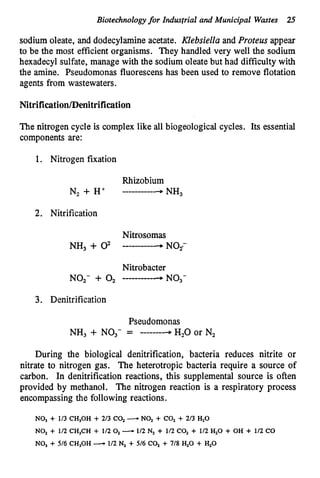
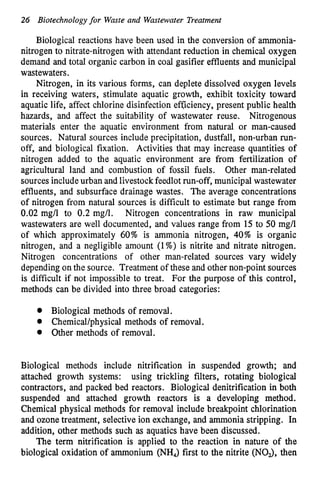
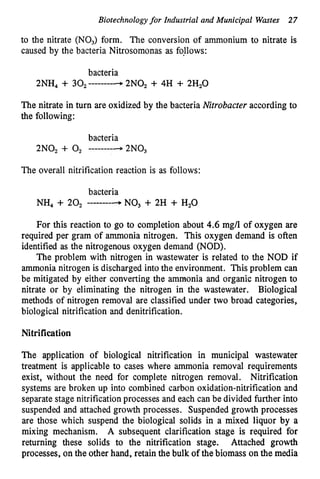
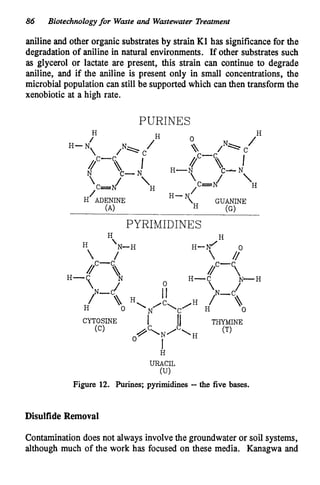
  • 169.
    160 Biotechnologyfor Wasteand Wastewater Treatment where: T = temperature, “C, and S = NH,-N efluent concentration, mgL. Effect of pH on Kinetics There is a wide range in the reported pH optima (PH 6.5 to 8.6).1*8*10*19 However, there is general agreement that as the pH shifts to the acid range, the rate of nitrification decline^.^ Thus, it is important that sufficient alkalinity be present in the wastewater to prevent a significant decline in the pH. It is recommended that a residual alkalinity of 50 mg/l for aeration and at least 150 mg/l for high purity oxygen systems be maintained for pH control during nitrification.lO*” Low pH conditions are only inhibitory and not toxic toward nitrifiers. Caustic or lime addition may be required to supplement low alkaline wastewaters. Benninger and Sherrard’l reported that the quantity of alkalinity destroyed increases as the SAT increases. This was attributed to the increased nitrification rates observed at higher SAT values. The relationship between alkalinity destruction and the C0D:TKN ratio has been reported by Scearce et aL7 This study indicated that at high C0D:TKN ratios little destruction of alkalinity can be expected, since a large portion of TKN (total kjeldahl nitrogen) is channeled into the microbial mass through synthesis reactions and is unavailable for nitrification reactions. Conversely, at low C0D:TKN ratios, a smaller portion of nitrogen is incorporated into microbial cell structure and, therefore, a larger amount is available for nitrification. Hence, greater alkalinity destruction and a larger pH drop can be expected at low C0D:TKN ratios. Effect of DO on Kinetics Because of the high oxygen requirements for the conversion of ammonia to nitrate (4.57 mg OJmg NH+-N oxidized), an actively nitrifying activated sludge process requires a larger quantity of process air to sustain the same DO as a non-nitrifying process, all other factors being equal. Nitrifying bacteria are more sensitive to DO conditions than the
  • 170.
    Nitrijlcation and Denitrificationin the Activated Sludge Process 161 majority of heterotroph found in activated sludge. Although there is disagreement in the literature as to the minimum DO concentration required for nitrification to proceed, it is generally agreed that 1.5 to 2.0 mg/l of DO are necessary for optima nitrification rates. The Monod Equation may be applied to determine the relationship between a given DO concentration and its effect on the maximum specificgrowth rate of the nitrifying bacteria.' Nitrification will proceed at dissolved oxygen concentrations as low as 0.2 rng/Lr2 However, the rate at which it proceeds will be significantly lower than those observed at higher concentrationsof DO. Therefore, atlow DO concentrations,the aeration tank detention time must be increased to permit complete nitrification. Charley et al." observed that high dissolved oxygen concentrations (38 mg/l) are not inhibitory towards nitrifiers following a brief acclimation period. Effect of Organic Loading on Kinetics The organic loading to the aeration tanks affects the efficiency of nitrification as the organic matter controls the growth of heter~troph.'~ High organic loads accelerate the heterotrophic growth rate and the sludge quantities produced in the system. Thus, any increase in the BOD,:TKN ratio results in a decreaseof the fraction of nitrifiers present in an activated sludge system. For BOD,:TKN ratios between one and three the fraction is less than 20 percent and greater than 8 percent.' Lawrence and Brown" reported that at a C0D:N ratio of 20:1, the nitrogen present would be just sufficientto satisfy the nitrogen synthesis requirementsof heterotroph. Thus, ammonia oxidationwould not occur. However, at a C0D:N ratio of zero, all of the ammonia present would be oxidized. Within these limits, the fraction of NH,-N oxidized versus the fraction assimilated by heterotrophic growth would be a function of the growth rate of the system, since the amount of excess biomass produced is a function of the mean net specific microbial growth rate. Wild et al.' observed no change in the nitrification rate of a laboratory scale reactor when subjected to instantaneous increases or decreases on BOD concentrationsfrom 50 to 5 mg/l or 50 to 100 mg/l. The author did state, however, that a change in the average BOD concentrationof the feed would affect that percentage of MLVSS that is composed of nitrifiers and, consequently, the rate of nitrification.
  • 171.
    162 Biotechnologyfor Wasteand Wastewater Treatment Figure 1 illustrates pretreatment alternatives for separate stage nitrification. Inhibition of Nitrification Hockenbury and GradyB reported that aniline, ethylenediamine, hexamethylenediamine, and monoethanolamine were industrially significant organic chemicals capable of inhibiting ammonia oxidation by Nitrosomonas. In a subsequent study by Joel and Grady,” it was determined that at a solids retention time of seven days significant degradation of aniline occurs, thus removing its inhibitory effect toward nitrification. Laboratory investigations performed by Beckman et al.I9 indicated that slug doses of copper and chromium at concentrations of 1.0 mg/l or less did not retard nitrification. Slug doses of zinc and nickel at concentrations less than 0.5 mg/l reduced the rate of nitrification. Complete inhibition of nitrification was not observed with zinc and nickel concentrations as high as 3.0 mg/l. Effects of other heavy metals were not reported in the literature examined. Hockenbury et al.z concluded from laboratory studies on domestic and industrial wastes that heterotrophic bacteria do not exert an antagonistic effect on nitrifying organisms, but could in fact stimulate nitrification rates by the release of their, metabolic products into the surrounding medium. He also reported that, in the absence of specific inhibitors, the failure for nitrification to proceed at the head-end of an activated sludge basin is due to the operational characteristics or environmental conditions (low pH and/or DO) of the system, rather than to the presence of organic compounds or active heterotroph in the system. Shock organic loads to nitrifying sludges have been known to inhibit nitrification. Reinhart% observed an increase in MLVSS concentration and reduced nitrification rates following a peak in the BOD, influent concentration. Severe oil and grease loadings were causing sudden increases in the organic load to the pilot plant resulting in nitrification inhibition. Stover et al.27reported a similar response to sudden increases in the influent COD. This study concluded that as a result of the abrupt COD increase and subsequent accelerating heterotrophic growth rates, an intermediate by-product is excreted by heterotroph having an inhibitory effect on nitrifiers.
  • 172.
    NitriJcation and Denitrijicationin the Activated Sludge Process 163 L I- 4
  • 173.
    I64 Biotechnologyfor Wasteand Wastewater Treatment Unionized ammonia (free ammonia, NH,, FA) and unionized nitrous acid (free nitrous acid, HNO,, FNA) can also inhibit nitrification. Studies by Anthonisen et a1.2*indicated that FA inhibited Nitrobacter at concentrations substantially lower than those that inhibited Nitrosomonas (0.1 - 1.O mg/l for Nitrobacter). The ranges of FNA concentrations that begin to inhibit nitrifying organisms are between 0.22 - 2.8 mg/l. When nitrification is incomplete or will not begin, the possibility of inhibition should be investigated by determining the FA and FNA concentrations and comparing them to the above ranges. Inhibition by FA or FNA is not permanent and may be removed by adjusting operational conditions. Dilution, pH adjustment, and denitrification will reduce inhibitory concentrations of FA and FNA. Neufeld et al.29examined the effect of phenol on nitrifying cultures in a laboratory fill and draw system. Concentrations of 0 - 75 mg/l of phenol were found to cause progressive inhibition of ammonia oxidation by Nitrosomonas. DENITRIFICATION Denitrification is a process by which certain species of bacteria under anoxic conditions reduce nitrate nitrogen to the gaseous end-products of N,, NO, or N,O which can then escape from solution to the atmosphere. Unlike other nitrogen compounds, the gaseous forms of nitrogen are relatively unavailable for biological growth and have no significant effect on environmental quality. Thepresence of oxidized nitrogen and organic carbon are important requisites for denitrification to proceed. DENITRIFYING BACTERIA Unlike the autotrophic nitrifying bacteria responsible for nitrification, denitrifying bacteria are composed of ubiquitous, heterotrophic organisms. The most common denitrifying bacteria are Bacillus denitrijicans, Micrococcus denitrijicans, Pseudomonas stutzeri, and Achrornobacter S P . ~ In the absence of molecular oxygen, these organisms use nitrate or nitrite as terminal electron acceptors, while oxidizing organic matter for energy. This metabolic process, termed nitrate dissimilation, results in the eventual reduction of nitrate to
  • 174.
    Nitrification and Denitrijicationin the Activated Sludge Process 165 nitrogen gas. At DO concentrations greater than approximately 0.5 mg/l, oxygen will be more readily utilized as the final electron acceptor than nitrates by the above named organi~rns.~' Thus, denitrification will be inhibited when the DO concentration exceeds 0.5 mg/l. DENITRIFTCATION STOICHIOMETRY Denitrification is a two step process and, using methanol as the electron donor, may be represented by the following equations:6 2CH30H + 6N03- - ,6NOz- + 2C0, + 4Hz0 (13) 3CH30H + 6N@- + 30, - ,3co2 -P 3N2 + 3Hz0 + 60H- (14) The overall reaction using methanol may be expressed as: 5CH,OH + 6N03- + 60, --. 5Coz + 3Nz + 7Hz0 + 60H-(15) Since cell synthesis occurs simultaneously with nitrate reduction, the overall nitrate removal with methanol including cell synthesis may be represented by Equation (16)? 68N03 + 80CH30H + 98H' + 3oco2 + 24Nz + 10C,H,OzN + 174H,O The equation most commonly applied to determine the methanol requirementsin abiologicaldenitrificationunit wherenitrate, nitrite, and dissolved oxygen are present is: Cm = 2.47Na + 1.53Ni + 0.87D Cm = required methanol concentration, mg/l, where: Na = initial NO3-Nconcentration, mg/l, Ni = initial NOz-N concentration, mg/l, and D = initial DO concentration, mg/l.
  • 175.
    166 Biotechnology forWaste and Wastewater Treatment The biomass production (Cb, mg/l) may be calculated similarly: c b = 0.53Na + 0.32Ni + 0.19D (18) From equation (15), it is apparent that hydroxide is produced during the denitrification process. Thehydroxide produced reacts with carbonic acid to produce bicarbonate alkalinity. The stoichiometric quantity of alkalinity produced is 3.57 mg alkalinity as CaCO, per mg of nitrate of nitrite reduced to nitrogen gas.5 Denitrification, therefore, partially reverses the effects of nitrification whereby 7.14 mg alkalinity is destroyed per mg NH,-N oxidized. DENITRIFICATION PROCESS VARIABLES AND KINETICS Like nitrification, denitrification requires specific environmental conditions to be present before it can proceed. Factors considered in subsequent sections include nitrate nitrogen concentration, pH, temperature, and carbon concentration. Effect of NO,-N Concentration on Kinetics The concentration of nitrate available will affect the maximum growth rate of the organisms responsible for denitrification. The relationship between nitrate concentration and the denitrifier growth rates can be described by the Monod expre~sion.~ Effect of Temperature on Kinetics Temperature has a significant effect on the growth rate of denitrifying bacteria. It may be estimated by using the following ex~ression:~ P = 0.25T2 where: P = percent of denitrification growth rate at 20"C, and T = temperature, "C.
  • 176.
    Nitrijication and DenitrijZationin the Activated Sludge Process 167 M ~ l b a r g e r ~ ~ observed a nonlinear relationship between the denitrification rate and temperature in pilot plant studies. Denitrification will proceed at reduced rates at temperatures as low as 5°C. Effect of pH on Kinetics Denitrification is inhibited below pH 6.0 and above pH 8.0. Although there is some disagreement in the literature as to the optimum pH for denitrification, it is generally agreed upon that the pH should be between 6.5 and 7.5. Effect of Carbon Concentration on Kinetics The effect of carbon concentration on the maximum growth rate of denitrifiers may be described by a Monod type of expression. The low value (0.1 mg/l of methanol) reported for the half saturation constant for methanol (KJ indicates that large excesses of methanol above stoichiometric requirements are not required in the effluent from a suspended growth denitrification process to achieve maximum denitrification rates.’ NITRIFICATION PROCESSES It is beyond the scope of this book to discuss the various modifications of the activated sludge process capable of achieving nitrification. The reader is referred to the EPA Process Design Manual for Nitrogen Control’ for a detailed examination of the various processes. Discussion in this book will be limited to comparisons between plug-flow versus complete mix reactors and single-stage versus two-stage nitrification. Plug-Flow Versus Complete Mix It is generally agreed upon in the literature that a plug-flow reactor is more effective than a completely mixed reactor in maintaining a low effluent ammonia concentration. Several reasons are given to support this view. Poduska and Andrewsg indicate that plug-flow reactors are more efficient because the minimum overall reaction rate for substrate removal is first-order. Furthermore, because the rate of reaction may
  • 177.
    168 Biotechnologyfor Wasteand Wastewater Treatment vary, the plug-flow reactor may offer an additional advantage in that the reaction order will increase through the length of the reactor as the substrate concentration decreases to less than 2 mg/l of NH+-N. The completely mixed reactor is limited in this regard because it operates a homogeneous unit in which the reaction rate is uniform throughout the reactor. The same authors also observed that a plug-flow system was also better suited to handled pulses of toxic materials. A short toxic pulse can pass through a plug-flow system, contacting only a small fraction of the nitrifying organisms. However, in a completely mixed reactor, a toxic material will be distributed instantaneously so that it contacts almost all of the organisms. Sawyer et al." suggests that because the rate of oxidation of ammonia is essentially linear (zero-order reaction), short circuiting must be prevented by ensuring plug-flow conditions are present throughout the reactor. This is best accomplished by dividing the tank into a series of compartments (minimum of three) with ports between them. Singlestage Versus Two-Stage Systems The current design considerations for activated sludge systems in which both BOD and NH,-N removal is desired, center on whether the removal of both pollutants will be carried out in a single reactor (single-stage nitrification) containing both heterotrophic and autotrophic microorganisms or in two separate reactors (two-stage nitrification) in which separate and distinct heterotrophic and autotrophic populations are maintained. In two-stage nitrification, BOD removal is accomplished in a high rate activated sludge basin prior to the nitrification reactor. An intermediate clarifier between the two reactors prevents the high rate and nitrifying sludges from being mixed together. In the subsequent section, it will be seen that the selection of either system must be done on a case by case basis and will depend upon such things as the amount of ammonia removal desired, seasonal requirements, cost, and land availability. MulbargeP concluded that the separate sludge system with isolated, optimized sludge cultures was preferred over single-stage systems for nitrification. It was observed that mixed BOD removal and nitrification resulted in a loss of soluble carbon removal efficiency, longer aeration times for nitrification, and a loss of nitrogen removal caused by sludge synthesis. Barth et al.33indicated that the separation of carbonaceous
  • 178.
    Nitrijkation and Denitrijkationin the Activated Sludge Process 169 removal and cellular synthesisfrom nitrification was necessary to prevent the loss of nitrifiers by washout from sludge wasting. In a separate stage, the nitrification biomass becomes an enriched culture of nitrifiers, the population of which is limited only by the ammonia concentration. Bench-scale studies by Stover et al.16 demonstrated that higher SAT values are required in single-stage systems to achieve comparable nitrification rates and levels of ammonia removal as in two-stage systems. A single-stage reactor with short hydraulic retention times may be unable to maintain the necessary SATfor nitrification. The maximum permissible MLSS concentration in the reactor will be determined by the solids loading rate to the secondary clarifiers. Clarifier upsets resulting in the escape of activated sludge solids to the effluent are detrimental to nitrification since they effectively increase the sludge wasting rate, thereby decreasing the SAT. The seasonal variation in the temperature of the wastewater is another factor which should be considered before selecting the appropriate type of system. Many engineers feel that, in order to accomplish nitrification, a separate two-stage system is a mandatory requirement in northern climates where wastewater temperatures fall below 18°C. It is believed that since the sludge in the separate nitrification reactor has a significant nitrifier population, nitrification would not be as temperature sensitive as in a sludge with a marginal population. Bench-scale studiesby Lawrence and Brown" failed to show any significant differencebetween the performance of both systems when operated at temperatures of 8°C and 20°C. In both systems, ammonia breakthroughs in the effluent did occur with significant increases in the ammonia mass loading at 8°C. Young et al.17 reported that due to the poor sludge settleability observed at wastewater temperatures less than 15"C, application of the two-stage system is favored at reduced temperatures. A higher percentage of nitrifiers can be maintained in the nitrification stage of the two-stage system than in the single-stage system and nitrification can be achieved with a lower concentration of MLSS in the nitrification reactor. Two-stage nitrification provides protection from toxic substances and shock organic loads which inhibit nitrification.% Before reaching the second stage intrification reactor, most of the toxics, if biodegradable, and organic materials will be oxidized in the first reactor. Also heavy metals may precipitate or be absorbed by the sludge in the first stage, thus causing no harm to the nitrifiers. However, as Lawrence and
  • 179.
    170 Biotechnologyfor Wasteand Wastewater Treatment Brown" point out, toxic materials might be excluded from wastewater systems by regulation rather than by relying on a "sacrificial" biosystem. Also, if phosphorous removal is required in addition to nitrification and coagulants are used prior to aeration, heavy metals will be removed in addition to the phosphorous. In spite of the seemingly negative attributes of single-stage nitrification, it has been demonstrated to be a viable means of accomplishing nitrifi~ation'~. 15~17~19p35 and to have certain advantages over two-stage systems. Lawrence and Brown" take issue with the claim that two-stage systems have more positive control capabilities. They point out that the use of the SRT concept and controlled sludge wasting make the single-sludge system as controllable as the two-stage system. In the two-stage system, due to the low MLSS concentration in the nitrification reactor, poor solids separation can occur in the clarifier. This may necessitate the wasting of first stage solids into the nitrification reactor or the use of coagulants at increased operating costs. The additional clarifier required in the two-stage system results in the increased possibility of failure. Finally, because of the higher levels of sludge production and, consequently, the increased demand on sludge disposal processes, plus the additional reactor, clarifier, and land requirements, two-stage nitrification systems will have higher capital and operating costs than comparable single-stage systems.% Thus, it is essential that comprehensive studies of a facility be performed before selecting one of the processes. Figure 2 ilustrates a nitrification-denitrification flow sheet utilizing low porosity fine media in columns. Figure 3 shows a process schematic for submerged high porosity media columns. DENITRIFICATION PROCESSES The discussion of denitrification processes will focus on the kind of carbon source applied to the denitrification reactor. Additional consideration will be given to the various combinations of nitrification and denitrification processes reported in the literature. Denitrification Using Methanol as the Carbon Source Denitrification processes utilizing methanol are most commonly applied following a nitrification system. Refer to Figure 4. The denitrification
  • 180.
    Nitrijkation and Denitrificationin the Activated Sludge Process 171
  • 181.
    172 Biotechnology forWaste and Wastewater Treatment - I - BACKWASH WATER TO STORAGE DENITRIFTCATION COLUMN DUMPED MEDIA - (TYPICAL) J-4 ll EFFLUENT TO CLARIFICATION OR FILTRATION rf DENITRIFICATION COLUMN CLARIFIED BACKWASH WATER METHANOL INFLUENT 7 3 3 BACKWASH PUMP PUMP Figure 3. Typical process schematic for submerged high porosity media columns. reactors are sealed or at least covered to prevent entrainment of atmospheric oxygen. Mixers are provided to keep the MLSS in suspension and to ensure complete dispersion of the added methanol. Following denitrification and prior clarification, the denitrification tank effluent enters an aeration basin where the entrained nitrogen gas and carbon dioxide bubbles are stripped to permit settling of the MLSS in the clarifier. The additional aeration will also remove most of the residual methanol. Methanol is the cheapest commercial source of carbonaceous matter currently available. Glucose is the next cheapest source. Methanol is preferred over glucose because it is more completely oxidized and produces less sludge for disposal." The dosage requirements for methanol are dependent on the influent NO,-N, NO,-N, and DO concentrations and may be computed using Equation (17) which was presented in a preceding section. It is generally agreed upon that
  • 182.
    Nitrification and Denitrificationin the Activated Sludge Process 173 w 0 3 z n d E d B E n e: z W 5 t; 3 e : z c 0 b L d e: z w CI w 0 3 z n d E 3 2 E b E e: E K
  • 183.
    174 Biotechnologyfor Wasteand Wastewater Treatment 3-4 parts parts of methanol are required per part of NO3-N for efficient denitrification. If sufficient methanol is not added to the system, the NO3-N is mostly converted to NOz-N.33 Since excess methanol will appear in the effluentas BOD, automated methanol addition as a function of the mass flow of NO3-Nwill maximize the efficiency of denitrification systems. According to Sherrard et al.37methanol requirements decrease as the SRT is increased due to a reduction in the net sludge production. Increased methanol dosages are required at higher temperatures at a constant SRT. Denitrification Using Organic Matter Resent in Raw Wastewater Lower denitrification rates may be expected when oxidizable organic substances in raw wastewater are substituted for methanol. More importantly, when domestic sewage is applied as the organic carbon source in the flow scheme described in the preceding section for methanol, increased NH3-N levels are observed in the effluent. Any ammonia present in the sewage will pass through the denitrification system essentiallyunaltered. However, because of the operating expense associated with methanol addition, flow schemes have been devised to permit the use of organics derived from wastewater while preventing ammonia bleedthrough in the effluent. A brief discussion of these processes follows. A comparison of denitrification processes is shown in Figure 5. In a one-sludge predenitrification and nitrification process, denitrification is accomplished in the anoxic first stage with the organics present in the raw wastewaterbeing utilized as electrondonors for nitrate reduction. The conversion of ammonia to nitrate and the oxidation of any biodegradableorganicsnot removed in the first stage is accomplished in the aerobic second stage. In this type of system, both sludge and mixed liquor are recycled. Sludge recycling is to maintain a desired level of MLVSS concentration3*and mixed liquor recycling is required to produce a final effluent which has a low residual nitrate c~ncentration.~~ The low BOD concentration in the denitrification effluentprevents high organic loadings to the aerobic second stage, thus providing optimal conditions for nitrification." The lower organic
  • 184.
    Nitrification and Denitri@cationin the Activated Sludge Process 175 SEDIMENTATION TANK (8 HR) - COMPARISON OF DENITRIFICATION SYSTEMS i ? w ! x INFm'ENT "ASTEWATER P DENITRIFICATION ANOXIC ITANK (4HR) I I AEROBIC OMDATION- NITRIFICATION ANOMC DENITRIFICATION TANK (5HR) 1 INFLUENT WASEXATEX I .- COMBINED CARBON 8 OXIDATION- NITRLFICATION ITANK , 1 (10 HR) z SEDIMENTATION TANK (4 HR) METHANOL I- 1 DENITRIFICATION TANK ( Z H R ) I 3 AEROBIC TANK (1 HR)I 1 s r n SEDIMENTATION TANK (4 HR) DENITRIFIED 1 - EFFLUENT B. Alternative Methanol Based System (21 h) Figure 5. Comparison of denitrification systems.
  • 185.
    176 Biotechnologyfor Wasteand Wastewater Treatment loadings also result in decreased oxygen transfer requirements for the aerated bashs Thefeasibilityof one-sludgepredenitrification systems has been demonstrated in pilot-planel and full-scale studies." Reduced capital costs are also realized inpredenitrification systems since primary clarificationas well as intermediateclarificationmay be eliminated. This savings, however, is partially offset by increased volumes required for the nitrification and denitrification basins. Another process variation utilizing the indigenous organic carbon material in wastewater for denitrification involves the utilization of alternating periods or zones of aerobic and anoxic conditions. Nitrification readily proceeds during the aerobic phase, while denitrification occurs during the anoxic phase. Oxidation of carbonaceous material will occur during both phases. According to Bishop et al.," the applicationof such processes results in: a reduction in the volume of air required for nitrification and BOD removal; minimization or elimination of methanol for denitrification; substantial nitrogen removal achieved without special recycle of the mixed liquor; and elimination of intermediate and primary clarification. This kind of process has been successfully demonstrated in both pilot- plant'" and full-scalea*" operations. Denitrification Using Thiosulfate and Sulfide The rising costs and increasing scarcity of methanol and similar organic compounds make it increasingly undesirable to use them as chemical additives. Thus, it is advantageous to develop denitrification processes which do not involve organic supplements. 7hiobaciZZusdenirrijkans is a species of autotrophicbacteria capable of oxidizing sulfur and sulfur compounds while reducing nitrate to free nitrogen gas. Lab-scale studiesby Biscogni and Driscoll,46indicated that reliable autotrophic denitrification could be obtained using thiosulfate and/or sulfide as electron donors for T. denitrifcans in a completely mixed suspended growth system. Further study in this area should be applied to a full-scale system to determine its feasibility in terms of chemical requirements and costs.
  • 186.
    Nitrification and Denitrijkationin the Activated Sludge Process 177 SUMMARY AND CONCLUSIONS Significant quantities of data and a variety of process alternatives have been generated for nitrification and denitrification activated sludge systems during the past decade. The selection of an appropriate nitrification process will depend upon the following factors: System classification - upgrade or new. Permit limitations - seasonal or continuous. Lowest expected wastewater temperatures. Inclusion of phosphorous removal. Frequency of shock organic loads. Presence of inhibitors from industrial discharges. Land availability. Costs - capital, operating, and maintenance. The selection of a denitrification process will be influenced by the kind of nitrification process chosen. If it is determined that two-stage nitrification is required then, most likely, the denitrification process will follow the nitrification stage and utilize methanol as the carbon source. Conversely, if single-stage nitrification is acceptable, the denitrification process may be incorporated into the combined carbon oxidation- nitrification reactor and utilize the organic carbon compounds present in the raw wastewater. Alternating anoxic and aerobic periods are required in this kind of combined system. A separate pre-denitrification process may also be used in conjunction with single-stage nitrification. Pre- denitrification one-sludge systems have lower oxygen, methanol, and lime requirements than for similar two-sludge post-denitrification processes and, consequently, reduced operating and capital costs. Figure 6 shows a feedforward control of methanol based on flow and nitrate nitrogen. Figure 7 shows the effect of safety factor on effluent nitrate level in suspended growth systems. Figure 8 shows the effect of diurnal variation in load on effluent nitrate level in complete mix suspended growth systems. Figure 9 shows the endless channel system for nitrogen removal. Figures 10 and 11 illustrate various nitrification systems.
  • 187.
    178 Biotechnologyfor Wasteand Wastewater Treatment FEEDFORWARD CONTROL OF METHANOL BASED ON FLOW AND NITRATE NITROGEN CH,OH t > TO DENITRIFICATION TANKS NITRIFICATION EFFLUENT FLUIDIZED BED DENITRIFICATION SYSTEM FLUIDIZED SAND BIOMASS BED SEPARATION REACTOR TANK INFLUENT PUMP SEDIMENTATION TANK 4 I u u c SAND CLEANING AND RETURN WASTE SLUDGE PUMP TO DISPOSAL Figure 6. Feedforward control of methanol based on flow and nitrate nitrogen.
  • 188.
    Nitrij?cation and Denitrificationin the Activated Sludge Process 179 2.0 2 E 2 ! 2 2 1.5 I k l P= z E 0.5 0 E 1.0 crr crr w EFFECT FOR FACTOR ON EFFLUENT NITRATE LEVEL IN SUSPENDED GROWTH SYSTEM 1.0 when: Do = bo - Dl - El - Q - a - - cD L pD - 2.0 SAFETY FACTOR, SF influent nitrate-Nlevel at any time, m d , masa m p influent nitrate-N I m l over 24 houn, m d . mu, average effluent nitrate-N level at any time, mfl. massaverageeffluent nilntc -N h - I mu 24 hwn. rng/t, Influent flow rate at any time, avenge ddly lnnuent flow rate, d d m dedtdllerpowth rate. dry-', and mrxlmum dmltrlfler growth nla, dry". 3.0 Figure 7. Effect of safety factor on effluent nitrate level i n suspended growth system.
  • 189.
    180 Biotechnology forWaste and Wastewater Treatment A EFFECT OF DIURNAL VARIATION IN LOAD ON EFFLUENT NITRATE LEVEL IN COMPLETE MIX SUSPENDED GROWTH SYSTEM 2400 0200 04000600080010001200 1400 160018002000 2200 2400 TIME, HR A. ASSUMED VARIATION IN INFLUENT NITROGEN LOAD SUSPENDED GROWTH SYSTEM 150 0 I I i 1 I I I I I I I J 2400 0200 04000600080010001200 1400 160018002000 2200 2400 TIME, HR . ASSUMED VARIATION IN INFLUENT NITROGEN LOAD E E k z 2 2400 0200 040006000800100012001400160018002000 2200 2400 E4 E4 TIME, HR B. CALCULATED EFFLUENT NITRATE LEVEL Figure 8. Effect of diurnal variation in load on effluent nitrate level i n complete mix suspended growth system.
  • 190.
    Nitri3cation and Denitrijkationin the Activated Sludge Process 181 a . I L t n -- e
  • 191.
    182 Biotechnologyfor Wasteand Wastewater Treatment ATTF SYSTEM FOR NITROGEN AND PHOSPHORUS REMOVAL RAW WASTEWATER POLYMER OR FERRIC CHLORIDE P R I M A R Y SLUDGE TO SEDIMEEPTATON TANK SOLIDS CHEMICAL COa - w PROCESSMG ATR OXIDATION- NlTRIFICATION TANK SLUDGE SECONDARY WASTE SLUDGE SEDIMENTATION TANK TO RAW WASTEWATER DENITRIPICATON MWNG I REmw SLUDGE AERATED STABILIZATON TANK I WASTE SLUDGE RAW WASTEWATER SEDIMENTATION TANK Figure 10. A'ITF system for nitrogen and phosphorus removal.
  • 192.
    Nitrification and Denitrificationin the Activated Sludge Process 183
  • 193.
    184 REFERENCES Biotechnologyfor Waste andWastewater Treatment 1. 2. 3. 4. 5. 6. 7. 8. 9. 10. 11. Wild, H.E., et al. "Factors Affecting Nitrification Kinetics," Jour. Water Poll. Control Fed., 1971, (43), 1845. Courchaine, R. J. "Significance of Nitrification in Stream Analysis - Effects on the Oxygen Balance," Jour. Water Poll. Control Fed., 1968, (40), 835. Sawyer, C.N., and P.L. McCarty. Chemistryfor Environmental Engineering. New York: McGraw-Hill Inc., 1978. Metcalf and Eddy, Inc. WastewaterEngineering: Treatment, Dis- posal, Reuse. New York: McGraw-Hill Inc., 1979. U.S. EPA, "Process Design Manual for Nitrogen Control," Office of Technology Transfer, Wash. D.C., 1975. Wang, L.K., et al. "Chemistry of Nitrification-Denitrification Process," Jour. o f Env. Sci., 1978, (21) #6, 23. Scearce, S.N., et al. "Prediction of Alkalinity Changes in the Activated Sludge Process," Jour. WaterPoll. Control Fed., 1980, (52), 399. Wong-Chong, G.M., and R.C. Loehr. "The Kinetics of Microbial Nitrification," Water Research (G.B.), 1975, (9), 1099. Poduska, R.A., and J.F. Andrews. "Dynamics of Nitrification in the Activated Sludge Process," Jour. Water Poll. Control Fed., 1975, (47), 2599. Sawyer, C.N., et al. "Nitrification and Denitrification Facilities," EPA Technology Transfer Seminar Publication, 1973, EPA-62514- 73-004a. Sutton, P.M., and D.S. Parker. "Nitrification Design Approach for High Strength Ammonia Wastewaters," Jour. Water Poll. Control Fed., 1978, (50), 2050.
  • 194.
    Nitrijkation and Denitrijlcationin the Activated Sludge Process 185 12. Charley, R.C., et al. "Nitrification Kinetics in Activated Sludge at Various Temperatures and Dissolved Oxygen Concentrations,' I Water Research (G.B.), 1980,( 1 4 ) , 1387. 13. Jenkins, D., and W.E. Garrison. "Control of Activated Sludge by Mean Cell ResidenceTime," Jour. WaferPoll. ControlFed., 1968, (40),1905. 14. Munch, W.L. "Control Ammonia Nitrogen with Single-Stage Nitrification," Water and Wastes Eng., 1978,(15)#8, 16. 15. Lawrence, A.W., and C.G. Brown. "Design and Control of Nitrifying Activated Sludge Systems," Jour. Water Poll. Control Fed., 1976,( 4 8 ) ,645. 16. Stover, E.L., et al. "One-Versus Two-Stage Nitrification in the Activated Sludge Process," Jour. Water Poll. Control Fed., 1976, ( 4 8 ) ,645. 1 7 . Young, J.C., et al. "Control Strategy for Biological Nitrification Systems," Jour. Water Poll. Control Fed., 1979,( 5 1 ) ,1824. 18. Mulbarger, M.C. "Three Sludge * System for Nitrogen and Phosphorous Removal," National Technical Information Service, PB-213778, 1972. 1 1 9 . Beckman, W.J., et al. "Combined Carbon Oxidation-Nitrification," Jour. Water Poll. Control Fed., 1972,(44),1917. 20. "Wastewater Treatment Plant Design," Manual of Practice No. 8, Water Pollution Control Federation, Wash. D.C., 1977. 21. Benninger, R.W., and J.H. Sherrard. "Nitrification and Alkalinity Relationships in Activated Sludge," Jour. WaterPoll. ControlFed., 1978,(SO), 2132. 22. Stenstrom, M.K. "The Effect of Dissolved Oxygen Concentration on Nitrification," WaterResearch (G.B.), 1980,( 1 4 ) ,643.
  • 195.
    186 Biotechnologyfor Wasteand Wastewater Treatment 23. Hockenbury, M.R., and C. P. Grady. "Inhibition of Nitrification- Effects of Selected Organic Compounds, '' Jour. WaterPoll. Control Fed., 1977, (49), 768. 24. Joel, A.R., and C.P. Grady. "Inhibition of Nitrification-Effects of Aniline after Biodegradtion," Jour. WaterPoll. ControlFed., 1977, (49), 768. 25. Hockenbury, M.R., et al. "Factors Affecting Nitrification," Jour. Env. Eng. Div., ASCE, 1977, (103) #EE1, 9. 26. Reinhart, D.R. "Nitrification Treatability Study for Carrollton, Ga.," Jour. WaterPoll.Control Fed., 1979, (51), 1032. 27. Stover, E.L., et al. "Inhibiting Nitrification in Wastewater Treatment Plants," Water and Sew. Works, 1976, (133) #8, 56. 28. Anthonisen, A.C., et al. "Inhibition of Nitrification by Ammonia and Nitrous Acid," Jour. Water Poll. Control Fed., 1976, (48), 835. 29. Neufeld, R.D., et al. "Phenol and Free Ammonia Inhibition to Nitrosomonas Activity," WaterResearch (G.B.), 1980, (14), 1695. 30. Mitchell, R. Introduction toEnvironmentalMicrobiology, New Jer- sey: Prentice-Hall, Inc., 1974. 31. Irvine, R.L., et al. "Stoichiometry and Kinetics of Biological Waste Treatment," Jour. WaterPoll. ControlFed., 1980, (52), 1987. 32. Mulbarger, M.C. "Nitrification and Denitrification in Activated Sludge System," Jour. WaterPoll. Control Fed., 1971, (43), 2059. 33. Barth, E.F., et al. "Chemical-Biological Control of Nitrogen and Phosphrous in Wastewater Effluent," Jour. Water Poll. Control Fed., 1968, (40), 2040. 34. Beccari, M., et al. "A Critical Analysis of Nitrification Alterna- tives," WaterResearch (G.B.), 1979, (13), 185.
  • 196.
    Nitrification and Denitripcationin the Activated Sludge Process 187 35. Clarkson, R.A., et al. "Single-Sludge Pure-Oxygen Nitrification and Phosphorous Removal," Jour. WaterPoll. ControlFed., 1980, (52), 770. 36. Sutton, P.M., et al. "Efficacy of Biological Nitrification," Jour. Water Poll. Control Fed., 1975, (47), 2655. 37. Sherrard, J.H., et al. "Utilizing Stoichiometry for Denitrification," Water and Sew. Works, 1978, (125) #6, 104. 38. Argaman, Y . , and E. Miller. "Modeling Recycled Systems for Biological Nitrification and Denitrification," Jour. Water Poll. Control Fed., 1979, (51), 749. 39. Wilson, R.W., et al. "Design and Cpst Comparison of Biological Nitrogen Removal Processes," Jour. Water Poll. Control Fed., 1981, (53), 1294. 40. Narkis, N., et al. "Denitrification at Various Carbon to Nitrogen Ratios," Water Research (G.B.), 1979, (13), 93. 41. Sutton, P.M., et al. "Nutrient Removal in Suspended Growth Systems Without Chemical Addition," Jour. Water Poll. Control Fed., 1980, (52), 98. 42. Sutton, P.M., et al. "Nitrification and Denitrification of an Industrial Wastewater," Jour. WaterPoll. ControlFed., 1981, (53), 176. 43. Bishop, D.F., et al. "Single-Stage Nitrification-Denitrification," Jour. Water Poll. Control Fed., 1976, (48), 52. 44. Matsche', N.F., and G. Spatzierer. "Austrian Plant Knocks Out Nitrogen," Water and WastesEng., 1975, (12) #1, 19. 45. Schwinn, D.E., and D.F. Storrier. "One Step for Nitrogen Removal--A Giant Step for Optimum Performance," Water and Wastes Eng., 1978, (15) #12, 33.
  • 197.
    188 Biotechnologyfor Wasteand Wastewater Treatment 46. Biscogni, J.J., and C.T.Driscoll. "DenitrificationUsingThiosulfate and Sulfide," Jour. Env. Eng. Div., ASCE,1977,(103)#EE4,593.
  • 198.
    5 IN-SITU BIORECLAMATIONOF CONTAMINATED GROUNDWATER INTRODUCTION In-situ bioreclamation of contaminated groundwater is a promising new technique for enhancing the clean-up rate of aquifers contaminated with organic pollutants, such as chlorinated solvents, gasoline constituents, and pesticides. In-situ bioreclamation involves injecting the materials necessary to significantly increase the microbiological activity in the subsurface. The injected material is a component that limits the growth of the desired microorganisms and is usually an electron acceptor (e.g., oxygen or nitrate), a carbon source, or a macro-nutrient (e.g., nitrogen or phosphorus). Injecting the proper amount of the limiting material creates a region of increased microbiological activity, called the Biologically Active Zone (BAZ). Creation of a BAZ offers major advantages for aquifer clean-up because the removal agents, the bacteria, are in close proximity to all the contaminants, including those in the water, those sorbed to aquifer materials, and those in a nonaqueous liquid phase. Thus, the relatively slow mechanism of flushing by water flow is replaced by a degradation reaction very near the source of contaminants. A study by Rittmann et al.' centered around an increased ability to understand and quantitatively describe the key phenomena affecting the formation of and reactions within a BAZ. The specific objectives of the study were to: 1. Develop a laboratory-scale, porous-medium column that can be used to create and study BAZs under well-defined conditions. 189
  • 199.
    190 2. 3. 4. 5. 6. Biotechnologyfor Waste andWastewater Treatment Evaluate the formation of one or more BAZs within the laboratory-scale column when the electron acceptor, nitrate, is injected into the flow path. Using the laboratory-scale columns, evaluate the fate of commonly found halogenated solvents as they passed through the BAZs. Develop and test an efficient computer model for the formation of BAZs and the utilization of substrates by the BAZs. Apply the model to describe and interpret the formation of the BAZ and the fates of the various substrates in the column experiments. Employ the model to evaluate strategies for in-situ bioreclamation in the field. The laboratory-scale, porous-medium columns were constructed of 2.5-cm inside diameter by 22.5-cm long glass tubes and were filled with 3-mm glass beads. Ports were placed every 2.5 cm to allow for sampling and/or injection. Special injection assemblies were designed to allow for uniform planar injection of substrate into the flow path. The systems gave an excellent approximation of one-dimensional flow. The organic source was sodium acetate, which was available as a C- radio-labelled tracer.'" It was fed continuously to the inlet end of the column from an elevated reservoir. In most experiments, the injected material was the electron acceptor, NO,-. One or two BAZs were established at and downstream of the injection ports. In order to ensure that NO3- was limiting, no other electron acceptors were added to the feed medium, and extreme measures were taken to preclude 0, entry in the reservoir, feed lines, and columns. Well-defined BAZs developed from the injection ports and up to 7.5 cm downstream of the injection ports. Photography of the intact columns and of the beads in the columns demonstrated that the bacterial growth was present as biofilms on the glass beads. Photography and measurements of biofilm mass on the beads confirmed that the amount
  • 200.
    In-Situ Bioreclamation o fContaminated Groundwater 191 of accumulated biofilm was greatest right after the injection port, and it gradually declined downstream. Acetate (expressed as soluble organic carbon, SOC) and NO3- declined across the BAZs according to the expected stoichiometry, 0.67 mg NO3- -N/mg SOC. For the column with two BAZs, removal of SOC was partial in the BAZ after the first injection port, because NO3- was depleted; however, SOC removal was essentially complete in the second BAZ, as sufficient NO3- was supplied in the second injection. These results demonstrated that stoichiometric addition of an electron acceptor could be used to remove an electron-donor substrate to the degree desired. Formation of N, gas bubbles occurred as a result of the denitrification of NO3-. These bubbles tended to accumulate in the BAZs and caused some short-circuiting, which led to a deterioration of SOC removal. Removal of the bubbles restored the SOC removal and demonstrated the possible deleterious effects of gas evolution within a confined aquifer. Eight trace-concentration halogenated solvents were applied to the feed of the column having one BAZ. Two dichlorobenzenes were added together as a mixture, and six one- or two-carbon halogenated aliphatics were added as another mixture. Of the halogenated aliphatics, carbon tetrachloride was removed the most completely by the denitrifying BAZ. Tetrachloroethane, bromoform, ethylene dibromide, and trichloroethene were removed to lower degrees. Trichloroethane was slightly removed. 1,2 and 1,3-dichlorobenzene also were 20-30% removed during passage through the BAZ. Significant increases in the fractional removal were effected as the liquid flow velocity was decreased, which increased the contact time in the BAZ. These results are especially significant for two reasons. First, they show that common groundwater contaminants were degradable in the BAZs induced by NO3- injection. Most interesting are the removals of the dichlorobenzenes and.trichloroethene, which were thought previously to be refractory under denitrifying conditions. Second, the results show that the removals of each compound depended upon the degradation kinetics of the particular compound and the contact time in the BAZ. Modeling of the formation of a BAZ was based on application of biofilm kinetics to solute transport in porous media. A steady-state- biofilm model was incorporated into a one-dimensional, steady-state,
  • 201.
    192 Biotechnologyfor Wasteand Wastewater Treatment solute-transport equation. The equation was transformed from the differential form to one using discrete finite differences and solved numerically directly for the steady-state profiles of substrate concentration and biofilm accumulation. Major modeling advancements were the ability to have lateral injection sources at any point along the column and the use of quasilinearization to give a highly efficient and direct solution for the steady state. The quasilinearization technique, which involves substituting a first-order Taylor series approximation for the highly nonlinear reaction term, made the convergence to steady state approximately ten times faster than by conventional methods. Even greater improvements are expected for more complicated geometries. The modeling also was advanced by explicit coupling of the steady- state-biofilm model solution, which solves for the concentration profile of the limiting substrate and the amount of biofilm, to models for a non- limiting substrate and for secondary substrates. An example of a non- limiting substrate is NO3- when SOC is limiting; the flux of NO3- into the biofilm was set equal to the flux of SOC multiplied by a stoichiometric coefficient. Although the flux of the non-limiting substrate was determined by the flux of limiting substrate, it had its own rates of advection, dispersion, and injection. A secondary substrate is, in this context, a trace-level contaminant that is removed in the BAZ, even though its utilization provides negligible or no benefit to the microorganisms. The flux of secondary substrate was determined by its own kinetic characteristics and by the amount of biofilm accumulated through utilization of the SOC. The steady-state, solute-transport model for the limiting substrate and the coupled transport model for the non-limiting substrate were used to evaluate the experiments on the formation of BAZs. Kinetic parameters for the utilization of the SOC were determined independently; thus, model results were true predictions. SOC, NO3-, and biofilm profiles matched the experimental results very well ‘forcolumns with one and two BAZs. Model predictions and experimental results agreed quantitatively that removals of SOC and NO3- and accumulation of biofilm were greatest in the first 2.5 cm beyond the injection port. Removal rates and biofilm accumulation declined gradually in the next 5.0 cm, and substrate concentrations attained a steady plateau value thereafter. Predictions and experimental results also concurred that injection of more of the limiting material (NO3- in this case) allowed formation of a second BAZ and renewed removal of SOC. The model predictions correctly described all
  • 202.
    In-Situ Bioreclamation o fContaminated Groundwater 193 trends, and absolute deviations between predicted and experimental results were small in all cases. The coupled transport model for secondary substrates also was used successfully for describing the removal of the halogenated aliphatic solvents. Since the kinetic parameters for each secondary substrate could not be determined independently, one set of results from the column experiments was used to obtain a best-fit set of kinetic parameters. These parameters were then used to predict the removal across the BAZ for experiments with different liquid flow velocities. Model and experimental results agreed well on the effect of liquid flow velocity. When the flow velocity was decreased, the contact time for the secondary substrates in the BAZ was increased proportionally. This increase in contact time allowed greater removal. For example, experimental and modeling results agreed that the removal of carbon tetrachloride through a BAZ should increase from 18% to 55%to 92% as the post-injection detention time increased from 50 minutes to 125minutes to 500 minutes, respectively. Thesteady-state models were applied to investigatepossible strategies to be used in field bioreclamations. The use of multiple injection wells was studied for its ability to decrease aquifer clogging potential by spreading out the distance over which ,limiting substrate is added. Modeling results verified that the strategy of multiple injections could reduce high densities of biofilm accumulation near the injection well. Also investigated was the strategy of adding a supplemental carbon source to extend the length of a BAZ. The modeling illustrated that such an extension of the BAZ could be accomplished and could result in longer contact times of a secondary substrate with the BAZ, thereby increasing the removal of the secondary substrate. TREATING CONTAMINATED GROUNDWATER Contamination of groundwater by organic materials--such as chlorinated solvents, petroleum products, and landfill leachates--is widely recognized as one of the most critical environmental problems of recent times. Currently, clean-up efforts usually involve extraction of the contaminated water, followed by physical, chemical, or biological treatment. Because the organic contaminants can adsorb onto aquifer solids or can be trapped in regions of relatively low permeability, the volume of water required to be extracted is many times larger than the pore volume that is
  • 203.
    194 Biotechnologyfor Wasteand Wastewater Treatment contaminated; thus conventional clean-up is very expensive and time- consuming. In-situ biological degradation is being proposed as a promising alternative for aquifer restoration. In-situ projects typically involve a set of extraction and injection wells, which establishes a defined flow field and permits inputs of seed microorganisms, electron acceptor, carbon source, or other nutrients at one or more points along the flow path. Being a very new technology, in-situ bioreclamation designs have been based on only a few simple microbiological experiments aimed at testing biodegradation potential and nutrient requirements. Incorporation of realistic biodegradation kinetics and groundwater hydraulics has not been accomplished. An initial requirement of any in-situ decontamination technology is that the flow field be defined. Otherwise, contaminants can escape treatment by migrating out of the treatment site or by remaining in isolated portions of the aquifer. For in-situ bioreclamation, however, more than a defined flow field is required: the water in that flow field must pass through a biologically active zone before it is extracted or leaves the treatment site. The biologically active zone in an aquifer is made up almost completely by microorganisms attached as biofilms to the large amount of surface area presented by the aquifer solids. Even in uncontaminated aquifers, bacteria are found attached to aquifer solids; however, their densities are very low (106/gram of soil), and their metabolic capabilities are largely undefined. Successful in-situ bioreclamation requires that the attached biomass be increased greatly from that normally found on aquifer solids. In some cases, different types of microorganisms, having capabilities not found in the natural community, should be added as seed. In almost every situation, however, success requires that the microorganisms grow to attached densities a hundred or more times that naturally present. Cell growth and accumulation in an aquifer depend on the availability of an electron donor, an electron acceptor, and several other nutrients, such as nitrogen, phosphorous, and sulfur. Usually, one factor is rate limiting which controls how much cell mass can be accumulated. The growth-limiting factor can be called the limiting substrate. Enhanced in- situ bioreclamation usually involves adding the limiting substrate in such a manner that the growth limitation is eliminated and significant quantities of biomass are generated in the aquifer.
  • 204.
    In-Situ Bioreclamation ofContaminated Groundwater 195 What the limiting substrate must be varies with the contaminating situation. For instance, a leak or spill that creates high organic- contaminant concentrations probably is limited by the electron acceptor or a nutrient. On the other hand, low-level contamination of a drinking water supply by a distant source creates a situation in which an organic electron donor is needed to allow significant growth. The objective of enhanced in-situ bioreclamation is to establish a biologically active zone by supplying the limiting substrate in such a manner that no contaminant escapes biodegradation. However, biodegradable material added via an injection well to enhance in-situ biodegradation often is consumed very rapidly near the injection well, creating two significant problems: (1) biological growth is limited to only a region very near the injection well, and (2) well clogging can occur. The first problem is quite serious, since localization of biological activityprevents adequatecontaminant/microorganism contact throughout most of the aquifer. The second problem also is serious because clogging retards the input of the limiting substrate and may force the groundwater flow to go around the biologically active zone. The problem of localized biological activity can be solved, at least in principle, by providing multiple injection wells perpendicular to and/or along the flow path. Figure l(a) depicts the case where multiple injection wells are placed laterally along the flow path to create a saw- tooth pattern of nutrient concentration, which allows the biological activity to extend the necessary distance to assure adequate contaminant removal. Figure l(a) also demonstrates the concept of coupled hydraulichiological reclamation, since a network of injection/extraction wells is utilized to hydraulically isolate the contaminant plume from the natural groundwater flow regime. To date, all reported cases of in-situ bioreclamation have included hydraulic control measures; in fact, several projects did not utilize multiple injection wells along the flow path and, thus, biological activity was most likely concentrated in the vicinity of the hydraulic-control injection wells. The need for multiple injection wells along the flow path is most acute for two commonly encountered situations. The first occurs when the limiting substrate is oxygen, a common electron acceptor. Because of the low solubility of dissolved oxygen (about 9 mg/l when exposed to the atmosphere) and its reactivity with reduced materials, supplying dissolved oxygen from one injection point cannot maintain sufficient
  • 205.
    196 Biotechnologyfor Wasteand Wastewater Treatment dissolved oxygen throughout the flow path when the amount of organic material to be degraded is more than a few mg/l. Since degradation of certain common classes of compounds, especially including benzene derivatives, appears to occur best (and likely exclusively) when oxygen is available, the application of oxygen is likely to be a major vehicle for enhanced in-situ bioreclamation. Other oxygen sources are ozone and hydrogen peroxide; although application of these materials overcomes some of the solubility problems of dissolved oxygen, they are reactive with reduced materials and are toxicants to microorganisms. Thus, they cannot be applied in unlimited amounts. The second common occasion when multiple injections are needed along the flow path occurs when an electron donor, usually an organic compound, must be applied to allow increased growth of microorganisms that bring about contaminant removal through secondary utilization or co- metabolism. Because the electron donor can be utilized quickly near the injection well, small input concentrations do not penetrate far into the aquifer, but large concentrations cause well clogging through biomass plugging or gas binding (in methanogenic or denitrifying cases). Thus, the electron donor input must be spread out along the flow path to give a sufficient amount of microorganisms without plugging the aquifer. Figure l(b) shows the case in which multiple injection wells are placed perpendicular to the groundwater flow path to create a biologically active zone through which all of a contaminant plume must pass. This bioreclamation scheme is probably less expensive than that shown in Figure l(a) since hydraulic control measures are not utilized. Creating a biologically active zone perpendicular to the natural groundwater flow path is a novel concept in the field of aquifer restoration. APPLICATION OF MODELING SOC and NO,- Profiles The one-dimensional model developed by Rittmann et al.' was evaluated for its ability to describe the laboratory results on SOC and NO3- removal through the BAZs. The assumptions used for applying the one- dimensional solute transport equation to the laboratory column are that wall effects were negligible and the surface area due to the sides of the
  • 206.
    In-Situ Bioreclamation o fContaminated Groundwater 197 (a) enhancement of in situ biodegradation along the groundwater flow path extraction wells injection wells ill 0 injection/extraction wells for hydraulic control of plume migration A injection wells for stimulation of in biological activity biologically active zone (b) enhancement of A u biodegradation perpendicular to groundwater Figure 1. Strategies for in-situ bioreclamation of contaminated groundwater.
  • 207.
    198 Biotechnologyfor Wasteand Wastewater Treatment column (less than one percent of the area of the glass beads) need not be included. The kinetic parameters (k, k,Y, b, and Xf) were determined independently. The kinetic and reactor parameters used to model the laboratory results are presented in Table 1. The value of S,, determined from the kinetic parameters is slightly less than the plateau concentration of SOC measured in the laboratory. This can be explained by the formation of soluble microbial products (SMP) (Namkung and Rittmann, 1986) which contained C14. Thus, SOC measurements toward the downstream end of the column contained residual substrate and some SMP, while the model predictions are only for residual substrate. One-BAZ Column The modeling procedure was a two-step process. First the SOC profile was solved by assuming SOC was the rate-limiting substrate. This yielded steady-state profiles of SOC concentration and Jsoc, the flux of SOC into the biofilm. Then, the NO3- profile was obtained by solving TABLE 1 PARAMETERS USED IN SOLUTE-TRANSPORTMODELING OF ONE-BAZ COLUMN Value Used Value w i t h Alternative Parameter Units i n Model Units Acetate S" L s m i n k Y x, Y b Dsoc Dli V a NO,- S" E as SOC mgSOCl1 cm mgSOCll mgSOClmgcell-day mgSOCll mg cellslcm' mg cellslmg SOC day-l cm2/day cm2/day cm/day cm.I cm3/cm' as N mg NO,- -N/I 6.5 0.02195 0.0131 2.22 4.17 mg SOClmgcellC-d 0.218 15. 8.0 mg cell Clcm' 0.678 0.36 mg cell ClmgSOC 0.07 1.07 120.58 144. 20.0 0.30 7.32 -~ D N cm2/day 1.40
  • 208.
    In-Situ Bioreclamation ofContaminated Groundwater 199 the solute-transport equation for NO3- when the rate of NO3- removal was equal to the flux of SOC multiplied by a stoichiometric coeffcient. The stoichiometry was found in the laboratory to be 0.67 mg NO3- -N/mg acetate as SOC. That is, equation (4.2) was solved for the NO3- concentration profile with J N 0 3 = 0.67 Jsoc. The numerical values for flux of NO3- were computed from stored values of the SOC obtained with the primary substrate model and were calculated for each grid point. Sincethe rates of NO3- were determined by multiplying the flux of SOC at each grid point by 0.67 mg N03-/mg SOC, the governing transport equation was linear, so that quasilinearization was not required. In other words, dJ/dS was zero for NO3-, because J was a predetermined constant. The model results are compared with the experimental results in Figure 2. The model and laboratory results compare very well. Both substrates were removed rapidly in the first 5.0 cm downstream of the injection. They then approached a plateau concentration beyond about 10 cm, as the SOC primary substrate’ approached its S-. The correspondence between model and experimental results for both substrates verifies that SOC was rate limiting and that the stoichiometry between NO3- and SOC removals was correct. While there is nearly perfect agreement for the electron acceptor, NO3-, small deviations for SOC occur at 5.0 and 7.5 cm downstream of the injection port. These deviations may be the result of short circuiting due to nitrogen gas build- up, or they may be caused by sampling error. Two-BAZ Column The two-BAZ column was modeled using the solute transport model and the same reactor and kinetic parameters as for the one-BAZ column. The same influent SOC concentration was used as in the one-BAZ experiment; however, the electron acceptor was injected in two locations, the second injection being ten centimeters downstream from the first. The same total amount of electron acceptor was injected into both columns, but the two-BAZ column received 25% through the first port and the remaining 75% through the second port; this corresponds to 1.92 and 5.52 mg NO3- -N/1 respectively. This two-injection strategy caused NO3- to be the rate limiting substrate in the first BAZ, where it was depleted to close to its Smi, just before the second injection. At this point, there was approximately 5G% removal of acetate. After the
  • 209.
    200 Biotechnologyfor Wasteand Wastewater Treatment second injection, NO3- was in ample supply, and SOC (acetate) became the rate-limiting substrate. The change of rate-limiting substrate after the second injection of NO3- presented an interesting modeling situation. If the electron acceptor had limited the growth throughout the length of the column, the modified model with lateral injection ports could have been used directly. In the case of a change of limitation, however, two coupled solute- transport equations had to be used. In the section of the column after the first injection, quasilinearization and finite differences were used to solve the solute transport equation for NO3-, the rate limiting substrate. Then, the profile for SOC was obtained from the NO3- fluxes and stoichiometry, as reported in the previous section. At the point of the second injection of nitrate a new solute transport equation had to be solved. For the points downstream of the second injection, this new solute transport equation was solved using SOC as the primary substrate; it was coupled to the upstream segment of the column byqconsidering the continuity of SOC flux at the injection port. For NO3-, the upstream flux of NO3- was added to the flux through the injection port, as it represented only approximately 0.18% of the flux through the port. The NO3- profile after the second injection was obtained from the SOC fluxes and stoichiometry. Table 2 shows the parameters used in the solute transport modeling. The kinetic parameters for NO,- were not independently measured in the laboratory and had to be estimated. The maximum specific rate of substrate utilization, k, was taken from the k of SOC, adjusted by stoichiometry. The K, value was varied until proper fit of the laboratory data was obtained. The low value for K, for NO3- is consistent for electron acceptors (Rittmann and Langeland, 1985). The kinetic parameters for SOC, the primary substrate after the second NO3- injection, were averaged from those measured independently at different locations in the column. Figure 3 shows the numerical results compared to the laboratory data. The numerical results are in extremely good agreement with the laboratory data. The stoichiometric values used in the numerical work, 1.5 mg SOC/mg NO3- and 0.67 mg N03-/mg SOC for the first and
  • 210.
    In-Situ Bioreclamation o fContaminated Groundwater 201 second BAZ, respectively, allowed proper representation of both substrateprofiles in both BAZs. Thus, the choiceof which substratewas rate-limiting seems justified. Comparison of Figures 2 and 3 demonstrates that having two NO3- injections spread out the distance over which a BAZ was present. With two injections, the BAZ covered about 12.5 cm, while it covered about 7.5 cm for one injection. TABLE 2 PARAMETERS USED IN SOLUTE-TRANSPORT MODELmG OF TWO-BAZ COLUMN II Parameter UNtS Value Nitrate So L SUliItN k K, Xf YN D N D H N b V € Acetate So k K s Xf s,, Y D as NO,- -N mg NO,-/l cm mg N03-/1 mg NO,-/mg cell-day mg NO,-/l mg cells/cm3 mg cells/mg NO,- day-' cm2/day cm2/day cm/day cm3/cm3 as SOC mg SOC/1 mgSOC/mgcell-day mgSOC/l mg cells/cm3 mg cells/mg SOC mgSOCI1 cm2/day 1.92, 5.52 0.02195 0.0090 1.45 0.146 15. 1.02 0.07 1.07 120.58 144. 0.30 7.09 2.00 0.80 15. 0.678 0.0497 1.40
  • 211.
    202 Biotechnologyfor Wasteand Wastewater Treatment 4 4
  • 212.
  • 213.
    204 Biotechnologyfor Wmteand Wmtewater Treatment Secondary SubstrateProfiles The primary substrateprofile was modeled first. From the results for the primary substrate, the steady-state biofilm thickness was calculated at each grid point from the following equation (Rittmann and McCarty, 1980a) Lfi = bXf where Ji is the flux into the biofilm at grid point i. The result was a profileof biofilm thickness throughoutthe length of the column. The Lf values then served as key inputs to the model to estimate the flux of a particular secondary substrateinto the biofilm (Rittmann and McCarty, 1981; Namkung et al., 1983). The strategy for modeling the secondary substrates was to choose k and K, values that provided a good fit to the experimental results for one experiment. This fitting exercise was needed, because the k and K, values of these secondary substrates were not known independently for the denitrification system. The appropriate reactor parameters and the kinetic parameters of the primary substratewere known independently. The fitted k and K, values were used to predict the results for different experiments with the same secondary substrates. Several secondary substrates were ' fed continuously into the laboratory column. The original detention time of 50 minutes showed only slight removal of one compound, CTC. To obtainbetter removals, the detention time was increased at first to 125 minutes and then to 500 minutes. Most of the compounds showed significantly greater percentageremoval as the detentiontime increased. Three categories of compounds resulted: (1) CTC was rapidly removed, (2) BF, EDB, TeCE, and TCE were removed less rapidly, and (3) TCA was not removed. To evaluate the secondary-substrate modeling, CTC, BF, EDB, TeCE, and TCE were modeled. Carbon Tetrachloride The first secondary substratemodeled was CTC, which entered the first BAZ at a concentrationof 81.0 pg/l. The k and K, values which gave a good fit for a detentiontime of 50 minutes were 0.030 pg/mg cellday
  • 214.
    Zn-Situ Bioreclamation o fContaminated Groundwater 205 and 4.5 pg/l, respectively. Figure 4 shows the results of the numerical fitting for the 50-min. detention time. Clearly, all of the points are well represented by the numerical result. In order to demonstrate the predictive ability of the numerical model, the profiles at the two other detention times (125 and 500 min.) were calculated using the same k and K. values. The superficial velocity and influent concentration are suitably modified for each of the other runs. The 125-min. detentiontime was modeled by changing the superficial velocity and influent concentration to 0.04 cm/min. and 69 pg/l, respectively. Figure 5 shows the results of the numerical prediction compared to the laboratory data. The two curves fit well and show removal through all of the BAZ (- 7.5 cm). The 500-min. detention time column was modeled using the laboratory obtained concentration of 53 pg/l and an adjusted superficial velocity of 0.01 cm/min. Figure 6 shows the results of the numerical prediction. The results are encouraging, because the numerical and experimental results have the same trends of rapid decrease and approach a plateau concentration. The absolute values of the plateau concentration are slightly different, but are in the same order of magnitude. Before the secondary-substrate experiments were started, the one- BAZ column had been operated for over one year at approximately the same detention time and concentration of substrates. By the time the secondary substrates were added to the column, a steady-state biomass distribution had been attained throughout the length of the BAZ. One possibility is that the biomass distribution changed during the experiments at longer detention times and, to some degree, with different influent SOC concentrations. Reduction of the detention time reduced the substrate (SOC) input to the BAZ and should have created a situation of slower biological activity in the BAZ. The time that the new detention times were maintained before sampling of the profiles of the secondary substrates is a major factor in @e assumption made about the biomass distribution for the secondary-substrate measurements. Because of the long time used to establish the steady-state biofilm and the relatively short times the reactors were run at the new detention times (6 weeks at 125min. and 5 weeks at 500 min.), it was assumed that the biomass distribution remained the same as that calculated for the 50 minute detention time. Nevertheless, it is possible that the BAZ lost active biomass during the detention-time experiments. The data shown in Figures 4-6 suggest that the loss of activity for CTC removal was negligible.
  • 215.
    206 Biotechnologyfor Wasteand Wastewater Treatment
  • 216.
    In-Situ Bioredamation ofContaminated Groundwater 207
  • 217.
    208 Biotechnologyfor Wasteand Wastewater Treatment
  • 218.
    In-Situ Bioreclamation o fContaminated Groundwater 209 Bromoform, Ethylene Dibromide, Tetrachloroethene, and Trichloroethene The second secondary substrate modeled was bromoform (BF), which entered the column at a concentration of 106pg/1 at a detention time of 50 min. As opposed to CTC, BF had no detectable removal at the 50 min. detention time. This was due to insufficient contact time with the biomass, and as a result, the detention time of the column was increased. The 125-min. detention time had an influent concentration of BF of 57 pg/l, and BF removal was observed. In this case, the kinetic parameters, k and K, were found for this detention time. Figure 7 shows the results of the numerical fitting between the experimental values and the model results using k and K, values of 0.013 pg/mg-day and 9.5 pg/l, respectively. The 500-min. detention time column had an influent concentration of 54 pg/l of BF. Figure 8 shows the results of the numerical model using the kinetic parameters from the 125-min. detention time. The numerical model predicted a slightly lower plateau concentration than was measured in the laboratory. This difference in removals perhaps can be attributed to biofilm loss between the two sampling periods. The assumption made was that the biomass distribution remained constant throughout the duration of the secondary-utilization experiments, even though some biomass loss probably took place. Modeling predictions for the 50-min. detention time gave a prediction of only 1.5% removal of BF (results not shown). This negligible predicted removal was consistent with the undetectable removal for the experiments. Thekinetic parameters of tetrachloroethene (TeCE), ethylene dibromide (EDB), and trichloroethene (TCE)were measured at the intermediate detention time of 125 min. Again, there were no detectable removals of these compounds at the lowest detention time of 50 min. The numerical model was fit to the laboratory data to obtain the k and K, values of each compound. These values are shown in Table 3. Because the numerical fit to laboratory data was similar to that shown for BF in Figure 7, these curves are not presented. The same trend of somewhat greater removals of substrate predicted by the numerical model than measured in thd laboratory applied to the
  • 219.
    210 Biotechnologyfor Wasteand Wastewater Treatment TABLE 3 K AND k VALUES OF TeCE, EDB, AND TCE OBTAINED FROM NUMERICAL CURVE l?ITTING Compound K (mg/l) k (mg/mg-day) TeCE 8.0 0.01760 EDB 9.0 0.00900 TCE 8.5 0.00935 greater detention time results for these three compounds. The differences are hypothesized to be the result of biomass loss. Simulation of Bioreclamation Strategies There are several possible strategies that can be used to achieve maximum performance of a bioreclamation site. Two very interesting strategies are presented in this chapter in the form of hypothetical examples. One strategy is to minimize the clogging from biomass growth. A clogging problem is exacerbated by injection of an excess amount of electron acceptor through one well or port. If the electron- donor concentration is relatively large compared to that of the electron acceptor, clogging is likely to develop in a region close to the point of injection. In order to reduce the potential for clogging, lower concentrations of the electron acceptor can be added at several locations along the flow path. The clogging potential can be demonstrated by presenting an example problem. A model problem compares one injection of nitrate at 10.0 mg/l to a multiple injection of an equivalent amount of nitrate. For this example, SOC is assumed to be present in excess, so that nitrate is assumed to limit the growth throughout the length of the column. The concentration of SOC is assumed to be 20.0 mg SOU1 as it enters the column. Kinetic parameters for denitrification limited by NO3-, found in Table 2, were used for the model problem. The reactor parameters used in this example are shown in Table 4.
  • 220.
    In-Situ Bioreclamation ofContaminated Groundwater 211
  • 221.
    212 Biotechnologyfor Wasteand Wastewater Treatment O 0 4 I 4
  • 222.
    In-Situ Bioreclamation o fContaminated Groundwater 213 TABLE 4 PARAMETERS USED IN CLOGGING EXAMPLE PROBLEM Parameter Units Value Nitrate as NO,- -N - L cm 0.0289 V cm/day 180. cm3/cm3 0.30 cm 0.12 cm-' 50.0 So mg NO,-/l 3.3, 3.3, 3.3 i a Acetate as SOC - S O mg SOC/l 20.00 Figure 9 shows the nitrate and SOC profiles when the NO,- is injected through one or three ports. It is evident that the net removal of SOC is nearly equivalent for either case, although it is slightly better with three injections. A relative measure of clogging potential can be estimated by considering the relative biofilm thickness throughout the length of the column. The relative biofilm thickness is the film thickness at a point in the reactor divided by the particle diameter. It is clear by comparing the relative biofilm thicknesses of the two scenarios, given in Figure 10, that the multiple injection gives much less potential for clogging. The second strategy involves enhancing the removal of organic contaminants when the total availableprimary substrate is low. Injection of additional SOC when the original SOC is depleted should extend the BAZ and allow increased consumption of individual secondary substrates. In order to demonstrate the advantage of an additional injection of carbon, a simple example was developed. Consider a situation such as the SOC profile in the one-BAZ column (see Figure 2). The SOC was rate limiting throughout the length of the column. The injected electron acceptor was removed approximately 50%. At this point, if additional acetate were added to the column, the BAZ could be extended. This configuration was modeled numerically using the laboratory kinetic
  • 223.
    214 Biotechnologyfor Wasteand Wastewater Treatment
  • 224.
    In-Situ Bioreclamation o fContaminated Groundwater 215
  • 225.
    216 Biotechnologyfor Wasteand Wastewater Treatment parameters. The initial concentration of nitrate was 10.0 mg NO,- -N/l, and the SOC was 6.5 mg S O U . At a distance of ten centimeters downstream from the nitrate injection, 10.0 mg SOC/l was injected. Figure 11 shows the resulting nitrate and SOC profiles. The BAZ was extended another 7.5 cm from the second injection. The advantage of adding the SOC injection can be demonstrated further by considering the fate of CTC applied to the column at a concentration of 100pg/l (using the same k and K.values obtained in the section titled Carbon Tetrachloride). Figure 12 shows the profile of CTC throughout the length of the column. There is approximately 43% removal in the first ten centimeters of the column. An additional 40% removal is calculated for the last ten centimeters and is due to the injection of SOC. Thus, extension of the BAZ by addition of more biodegradable SOC significantly enhanced removal of CTC. CONCLUSIONS This research investigated the fundamental mechanisms that can act when an electron acceptor is injected along the flow path of an electron-donor- rich groundwater to establish a biologically active zone (BAZ) for degradation of pollutants that serve as primary and secondary substrates. The research methodology consisted of laboratory column experiments that were coupled with computer modeling. The laboratory experiments demonstrated that lateral injection of NO3- could be successfully utilized to control the location and extent of BAZs in systems where acetate was fed as the sole carbon source. Columns containing one and two BAZs were successfully operated, and profiles of acetate and NO3- were determined. Additional measurements of steady-state biofilm thicknesses and densities gave further evidence of the value of lateral injection for spreading out biological activity along the flow path, which leads to enhanced biodegradation capability and diminished clogging potential. These experiments also demonstrated the deleterious effects of N2gas accumulation; N2gas bubbles that occurred as a result of denitrification tended to accumulate in the BAZs, resulting in reduced liquid contact times and lowered acetate removal efficiencies. Laboratory experiments evaluating the secondary utilization of eight trace-concentration halogenated solvents were also conducted. Results of these experiments indicate that carbon tetrachloride was removed most
  • 226.
    In-Situ Bioreclamation ofContaminated Groundwater 217
  • 227.
    218 Biotechnologyfor Wasteand Wastewater Treatment 9 n N -2 N -2 r( -9 n -: . 4 - 9 0, - Y I - - 9 n
  • 228.
    In-Situ Bioreclamation ofContaminated Groundwater 219 completely by denitrifying BAZs, while tetrachloroethene, bromoform, dibromoethane, and trichloroethene were removed to lesser degrees. Trichloroethane removal was slight. A significant result was that 1,2 and 1,3-dichlorobenzene were 20-30% removed; these compounds have previously been considered refractory under denitrifying conditions. A highly efficient numerical model that couples solute transport mechanisms and biofilm kinetics was developed. Employing a quasilinearization technique for the biofilm reaction term, the model is capable of solving directly for the steady-state profiles of limiting substrate, biofilm thickness, non-limiting substrates, and secondary substrates. The predictive ability of the model was successfully verified by simulating the results of the laboratory experiments using independently determined kinetic parameters. Independently determined kinetic parameters did not exist for the secondary substrates; in this case, one set of results from the column experiments was used to obtain a best- fit set of kinetic parameters, which were t4en used to predict the results for experiments conducted with different liquid flow velocities. The model predictions correctly described all trends. Absolute deviations between predicted and experimental results were very small for cases involving acetate and nitrate; systematic deviations for some of the secondary substrates occurred and probably were due to a loss of biomass during the experiments conducted at the higher detention times. The steady-state models were applied to investigatepossible strategies to be used in field bioreclamations. The use of multiple injection wells was studied for its ability to decrease aquifer clogging potential by spreading out the distance over which the limiting substrate is added. Modeling results verified that the strategy of multiple injections could reduce high densities of biofilm accumulation near the injection well. Also investigated was the strategy of adding a supplemental carbon source to extend the length of a BAZ. The modeling illustrated that such an extension of the BAZ could be accomplished and could result in longer contact times for a secondary substrate in the BAZ, thereby increasing the removal of the secondary substrate. The results of this research demonstrate that injection of limiting substrates along the groundwater flow path is a viable means of establishing spatially distributed BAZs for enhanced in-situ bioreclamation. Trace-levels of hazardous secondary substrates can be degraded as groundwater flows through the BAZs. The phenomena of formation of BAZs and substrate utilization within BAZs can be
  • 229.
    220 Biotechnology forWaste and Wastewater Treatment quantitatively interpreted and predicted at the laboratory scale by rigorous mathematical models that couple.principles of solute transport and biofilm kinetics. An ultimate goal is to develop the fundamental understanding of coupled biological and hydrological processes to a level sufficiently great that field-scale in-situ bioreclamation systems can be designed reliably. A critical need is to extend the research reported here to include transient and multi-dimensional aspects. In particular, the following areas of additional research are recommended: 1. 2. 3. 4. 5. 6. 7. Use the combined experimental and modeling approach to study transient biofilm kinetics and dual-substrate limitation. Examine the use of alternative electron acceptors to establish specialized BAZs capable of degrading specific pollutants. Conduct further study of the basic mechanisms of dichlorobenzene degradation under denitrifying conditions. Examine the fundamental mechanisms of bacterial transport and attachment and their role in the establishment and extension of BAZs. Study the effect of biological activity upon the hydraulic properties of aquifers. Extend the computer modeling to consider transient, heterogeneous, multi-dimensional flow fields, as well as transient biofilms. Study the phenomena controlling the biodegradation of organic contaminants which are strongly adsorbed or which form a nonaqueous phase. Additional references for the reader to refer to are cited at the end of this chapter.
  • 230.
    In-Situ Bioreclamation ofContaminated Groundwater 221 REFERENCES 1. 2. 3. 4. 5. 6. 7. 8. 9. Rittmann, B.E., A.J. Volocchi, J.E. Odencrantz, and W. Bae. "In-Situ Bioreclamation of Contaminated Groundwater," Illinois Dept. of Energy and Natural Resources, Report HWRIC RR-031, October, 1990. American Public Health Association, Inc. "Standard Methods for the Examination of Waste and Wastewater." 15th ed. Washington D.C., 1981. Atkinson, B., and S.Y. How. "The Overall Rate of Substrate Uptake (Reaction) by Microbial Films. Part 11. Effect of Concentration and Thickness with Mixed Microbial Films. I' Transactions, Znst. Chem. Engrs., 1974, (52) 260-272. Bouwer, E.J. "Biotransformations of Contaminants in Groundwater." Paper presented at the Third National Water Conference, Philadelphia, PA, January, 1987. Bouwer, E.J., and P.L. McCarty. "Transformation of Halogenated Organic Compounds Under Denitrification Conditions." Appl. Environ. Microb., 1983, (45) 1295-1299. Bouwer, E.J., and P.L. McCarty. "Utilization Rates of Trace Halogenated Organic Compounds in Acetate-Grown Biofilms.'I Biotech. and Bioengr., 1985, (27) 1564-1571. Casolari, A. "Microbial Death." , In Physiological Models in Microbiology, Vol. ZI,edited by M.J. Bazin and J.I. Prosser, Boca Raton, FL: CRC Press, Inc., 1988, 1-44. Chang, H.T. Microscopic Study of Biofilms on Adsorptive Media. Dissertation. Illinois, Urbana, IL, 1985. Mathematical Modeling and Scanning Electron Ph.D. Department of Civil Engineering, University of Daugherty, R.L., and J.B. Franzini. Fluid Mechanics with Engineering Applications. New York: McGraw-Hill, 1977.
  • 231.
    222 Biotechnologyfor Wasteand Wastewater Treatment 10. 11. 12. 13. 14. 15. 16. 17. 18. Flathman, P.E. et al. "BiologicalSpill Cleanup." Proc. Technical Seminar on Chemical Spills, October 25-27, 1983; Toronto, 117- 130. Flathman, P.E., J.R. Quince, and L.S. Bottomley. "Biological Treatment of Ethylene Glycol-ContaminatedGroundwater at Naval Air Engineering Center, Lakehurst, New Jersey. Proc. 4th National Symposium on Aquifer Restoration and Ground Water Monitoring, May 23-25, 1984; Columbus, Ohio, 23-25. Freeze, R.A., and J.A. Cherry. Groundwater. Englewood Cliffs, NJ: Prentice-Hall., 1979. Ghiorse, W.C., and D.L. Balkwill. "Enumeration and Morphological Characterization of Bacteria Indigenous to Subsurface Environments." Dev. Ind. Microb., 1983, 24. Kobayashi, H., and B.E. Rittmann. "Microbial Removal of Hazardous Organic Compounds." Environ. Sci. Technol., 1982, (16) 170A-181A. Kuhn, E.P., P.J. Colberg, J.L. Schnoor, 0. Wanner, A.F.B. Zehnder,and R.P. Schwarzenbach. "Microbial Transformations of Substituted Benzenes during Infiltration of River Water to Groundwater: Laboratory Column Studies." Environ. Sci. Technol., 1985, (19) 961-968. Lapidus, L., and G.F. Pinder. Numerical Solution of Partial DifSerential Equation in Science and Engineering. New York: J. Wiley and Sons, Inc, 1982. Lee, E.S. Quasilinearization and Invariant Imbedding. New York: Academic Press, 1968. Lyman, W.J., W.F. Reehl, and D.H. Rosenblatt. Handbook o f ChemicalPropertyEstimationMethods. New York: McGraw-Hill Book Co., 1982.
  • 232.
    In-Situ Bioreclamation ofContaminated Groundwater 223 19. 20. 21. 22. 23. 24. 25. 26. 27. McCarty, P.L. "Energetics and Bacterial Growth," In Organic Compounds in Aquatic Environments, edited by S.D. Faust and J.V. Hunter. New York: Marcel Dekker, Inc., 1972. McCarty, P.L., B.E. Rittmann, and M. Reinhard. "Trace Organics in Groundwater," Environ. Sci. Technol., 1981, (15) 40- 51. Miller, M.M., S.P. Wasik, G.-L. Huang, W.-Y. Shiu, and D. Mackay. "Relationship between Octanol-Water Partition Coefficient and Aqueous Solubility," Environ. Sci. Technol., 1985, (19) 522-529. Nagel, G., W. Kuehn, P. Werner, and H. Sontheimer. "Sanitation of Groundwater by Infiltration of Ozone Treated Water," G W - Wasser/Abwasser, 1982, (123) 399-407. Namkung, E. Kinetics and Mechanisms of Low-Concentration Multisubstrate Utilization by Biofilms. Ph.D. Dissertation. Department of Civil Engineering, University of Illinois, Urbana, IL, 1985. Namkung, E. and B.E. Rittmann. "Soluble Microbial Products (SMP) Formation Kinetics by Biofilms," Water Research, 1986, (20) 795-806. Namkung, E., R.G. Stratton, and B.E. Rittmann. "Predicting Removal of Trace-Organic Compounds by Biofilms," J. Water Poll. Control Fed., 1983, (55) 1366-1372. Parker, G.A. In ColorimetricDeterminationo f Nonmetals, edited by D.R. Boltz and Z.A. Howell. New York: J. Wiley and Sons, 1928. Rittmann, B.E. "Comparative Performance of Biofilm Reactor Types," Biotech. and Bioengr., 1982a, (24) 1341-1370.
  • 233.
    224 Biotechnologyfor Wasteand Wastewater Treatment 28. 29. 30. 31. 32. 33. 34. 35. 36. Rittmann, B.E. "The Effect of Shear Loss on Biofilm Loss Rate," Biotech. and Bioengr., 1982b, (24) 501-506. Rittmann, B.E., and W.E. Langeland. "Simultaneous Denitrification with Nitrification in Single Channel Oxidation Ditches," J. Water Poll. Control Fed., 1985, (57) 300-308. Rittmann, B.E., and P.L. McCarty. "Evaluation of Steady-State Biofilm Kinetics," Biotech. and Bioengr., 1980a, (22) 2359-2373. Rittmann, B.E., and P.L. McCarty. "Model of Steady-State Biofilm Kinetics," Biotech. and Bioengr., 1980b, (22) 2343-2357. Rittmann, B.E., and P.L. McCarty. "Substrate Flux into Biofilms of any Thickness," J. Environ. Engr., 1981, (107) 831-849. Rittmann, B.E., P.L. McCarty, and P.V. Roberts. "Trace- Organics Biodegradation in Aquifer Recharge," Ground Water, 1980, (18) 236-243. Saez, P.B., and B.E. Rittmann. "An Improved Pseudo-Analytical Solution for Steady-State Biofilm Kinetics," Biotech. and Bioengr., 1988, (32) 362-368. Stratton, R., E. Namkung, and B.E. Rittmann. "Biodegradation of Trace-Organic Compounds by Biofilms on Porous Media," J. Amer. Water WorksAssn., 1983, (75) 463-469. Werner, P. "A New Way for the Decontamination of Polluted Aquifers by Biodegradation," Water Supply, 1985, (3) 41-47.
  • 234.
    225 This page hasbeen reformatted by Knovel to provide easier navigation INDEX Index Terms Links A abandoned mines 21 abiotic treatment techniques 42 acclimated sludge 87 acclimation period 76 acetates 46 Achromobacter 33 activated carbon 50 123 129 activated carbon adsorption 44 45 activated sludge 10 65 127 130 133 activated sludge plant 138 activated sludge process 7 56 151 activated sludge studies 87 aerated lagoons 129 aerated processes 123 aeration 129 130 aerobic 111 113 aerobic conditions 84 aerobic degradation 37 71 aerobic second stage 174 aerobic tiered testing 62 Alcaligenes 67 Alcaligenes eutrophs 66 alcohols 46 algae 115 132 ammonia 94 ammonia oxidation 161 ammoniacal nitrogen 56 ammonium oxidation 157 anaerobic 111 113 13 anaerobic bacteria 90 anaerobic contact process 16 18 anaerobic digestion 15 135 anaerobic fluid-bed reactor 95 anaerobic microorganisms 96 anaerobic process 15 92 anaerobic tiered testing 63 aniline degradation 85 anoxic conditions 176 aquatic fauna 152 aquatics 35 Arihrobacteria 66 assimilative reactions 155 attached growth 132
  • 235.
    226 This page hasbeen reformatted by Knovel to provide easier navigation Index Terms Links attached growth processes 28 attached growth system 34 B bacillus 33 bacteria 21 27 49 59 60 114 116 137 140 bacterial augmentation 142 bacterial growth 116 119 Beirjerinkia strain B1 76 benz(a)anthracene 77 bioaccumulation of wastes 143 biodegradation 58 59 84 97 biodegradation of hydrogen soil 70 bioengineering 141 biological BOD 70 biological control methods 49 biological degradability 57 biological degradation 37 biological methods 26 biological nitrification 89 biological processes 5 111 biological reactions 26 biological treatment 49 55 111 biological treatment processes 5 125 biological treatment system 100 Biologically Active Zone 189 biomass production 2 bioreclamation strategies 210 biotechnology 36 blue-green algae 116 BOD 6 BOD removal 5 bromoform 209 C carbon 34 112 170 carbon dioxide 94 carbon tetrachloride 204 carbonaceous organic material 111 carboxylic acid 58 cement kiln incineration 48 centrifugation 43 CERCLA 38 51 cesium 21 Chemfix Technologies 49
  • 236.
    227 This page hasbeen reformatted by Knovel to provide easier navigation Index Terms Links chemical methods 55 chemical plant wastewater cleanups 2 chemical treatment 43 chemical treatment of leachate 88 chemicals 144 chlorinated alkenes 73 chlorinated wastes 80 chlorophenol degradation 79 Clean Water Act 38 closed bottle inhibition tests 65 coagulation 123 coal gasification wastewater 94 COD 70 colloidal solids 6 commercial bacteria 141 complete mix 13 167 complete mix plants 31 composting 51 contact stabilization 12 128 contact stabilization plants 32 continuous treatment 121 conventional (plug flow) activated sludge 10 conventional rate digestion 18 countercurrent flow 45 crustaceans 115 cultures 118 cyanide 94 D decontamination 21 degradation 81 142 degradation pathways 100 degradative agents 80 denitrification 25 27 32 112 151 164 170 174 denitrification process variables 166 denitrification processes 170 denitrification stoichiometry 165 denitrifying bacteria 164 Desulfobacter 23 Desulfococcus 23 Desulfonema 23 Desulfosarcina 23 Desulfotomachulum 23 desulfurization 21 Desulvovibrio 23 dewatering pit 68
  • 237.
    228 This page hasbeen reformatted by Knovel to provide easier navigation Index Terms Links dioxin 97 discharge criteria 90 disk rotation 29 dissolved-air flotation 43 dissolved matter 55 disulfide removal 86 DNA 1 1 E ecosystem balance 49 endogenous respiration 3 128 energy 112 energy costs 21 energy reaction 33 enzymatic catabolic reaction 96 enzyme assays 60 equalization tanks 123 ethoxylated non-phenol detergent 141 ethylene dibromide 209 expanded bed process 92 extended aeration 13 128 extended aeration plant 31 F facultative 113 facultative bacteria 132 filterable solids 6 fluidized-bed incinerators 47 fluidized bed wastewater treatment process 133 fluoro substituted benzenes 81 fly ash 24 free ammonia 153 fume incineration 46 fungi 97 116 132 fungus 98 G genetics 59 geotrichum candidum 114 gravity sedimentation 42 green-brown algae 21 groundwater 96 groundwater systems 76 growth curve 117 growth inhibition test 65
  • 238.
    229 This page hasbeen reformatted by Knovel to provide easier navigation Index Terms Links H Hazardous and Solid Waste Amendments 51 hazardous waste 41 hazardous waste management 1 hazardous waste problems 37 hazardous waste spills 144 HCH contaminated soils 84 HCH degradation 84 heat 143 heat exchanger 69 heavy metals 153 heterotrophic 112 hetrotrophic bacteria 72 hexachlorocyclohexane degradation 83 hydraulic residence time 121 hydrocarbon degradation 138 hydrocarbons 46 hydrogen 91 hydrogen acceptor 3 hydrogendegrading microbes 70 hydrolysis 72 I immobilization of phenolics 99 in-situ biological degradation 194 in-situ bioreclamation 189 incineration 46 industrial effluents 129 industrial process 40 industrial solid wastes 51 industrial wastes 111 industrial wastewater 122 inhibition of nitrification 162 inorganics 49 insect larvae 5 iron 132 isolates 60 J Jarosite 24 K kinetic studies 63 kinetics 156 159 160 161 166 167
  • 239.
    230 This page hasbeen reformatted by Knovel to provide easier navigation Index Terms Links kinetics of growth 117 Klebsiella oxytoca 96 L lagoons 130 139 landfarming 134 landfill leachate 70 land treatment 50 land treatment system 50 lead smelting process 24 lime 48 liquid injection incinerators 46 liquid/solid treatment technique 50 liquids-solids separation 42 liquid/solids treatment systems 52 luminescent bacterial species 66 M material synthesis 4 matter oxidation 3 mercury 21 metal laden industrial wastes 143 metalaxyl degradation 99 methane gas 136 methane-oxidizing bacteria 55 methanol 170 172 Methanosarcina mazei 93 methanotrophic bacteria 72 73 methyl ethyl ketone 69 metolachlor degradation 87 microbial degradation 11 microbial growth rate 161 microbiology 112 Micrococcus 33 microorganisms 1 16 35 60 64 101 Microtox tests 65 mineral 6 mineralization 57 58 91 mineralized 79 mixed liquor 130 modeling 196 molten salt incinerator 47 mosses 21 multicomponent media 63 multiple hearth incinerator 47 municipal treatment plant sludges 18
  • 240.
    231 This page hasbeen reformatted by Knovel to provide easier navigation Index Terms Links municipal wastewater 6 mutant bacteria 111 137 mutant seeding 123 N natural biodegradation reactions 132 nickel 21 nitrate(s) 33 94 nitrate removal 33 nitrification 25 27 111 151 156 161 nitrification process 156 167 nitrification rate 161 nitrification stoichiometry 155 nitnfiers 161 169 nitrifying bacteria 153 nitrifying organisms 164 nitrite 33 nitrite oxidation 158 Nitrobactor 155 nitrogen 152 nitrogen fixation 25 nitrogen gas 33 34 nitrogen removal capacity 34 nitrogenous oxygen demand 27 Nitrosomonas 157 Nocardiopsis 2 non-biological strategies 37 nonreactive products 16 nuclear wastes 48 nutrients 117 O ocean dumping 49 off-gas treatment systems 46 oil 133 oil degradation 82 oil refineries 132 oily wastes 134 one-BAZ column 198 organic compounds 137 153 organic loading 161 organic matter 174 organic pollutants 11 organic supplements 176 organics 6 organisms 113 114 145
  • 241.
    232 This page hasbeen reformatted by Knovel to provide easier navigation Index Terms Links orthochlorophenol content 139 oxidation 3 128 oxidation ditch 13 oxidation-reduction 44 oxygen 52 117 123 oxygen transfer requirements 174 oxygenated soil 68 P p-nitrophenol degradation 80 packed bed reactors 30 packed beds 133 PAH degradation 98 PCB 1 PCB biodegradation 66 pentachlorophenol degradation 81 perchloroethylene 93 pefrochemicals plants 132 petroleum refineries 50 pH 116 167 pH on kinetics 160 phenanthrene 79 phenanthrene degradation 78 phenol 133 phosphorous 112 physical methods 44 pipe line transportation 83 plasma arc 47 plasma arc incineration 47 plasmids 67 polycyclic aromatic hydrocarbon degradation 73 polycyclic aromatic hydrocarbon removals 51 polycycloaromatic hydrocarbons 78 polyphosphate degrading enzymes 88 post-treatment steps 90 plug-flow 167 precipitation 123 protozoa 115 116 132 Pseudomonas 2 33 Pseudomonas sp B13 67 R reactive products 16 recalcitrance 61 63 recalcitrant 62 recycling 39
  • 242.
    233 This page hasbeen reformatted by Knovel to provide easier navigation Index Terms Links remediation 70 removal 26 removal efficiency 35 rendering plant 140 repetitive die away test 66 residence time(s) 80 121 Resource Conservation and Recovery Act 1 respiration 3 120 reverse osmosis 45 ring fission products 74 ring polycyclic aromatic hydrocarbons 100 rinse water 39 rotary-kiln incinerators 46 rotating biological contactors 29 123 133 rotifers 5 115 S secondary substrate profiles 204 sedimentary environments 75 sediments 67 selenium 99 settleable solids 6 settling tanks 123 sewage sludge 92 shearing forces 29 silica 21 slag 24 sludge-blanket clarifiers 42 sludge bulking 114 sludge dewatering 42 soil biofilters 54 soil environment 60 solidification techniques 48 solids retention time 158 solubilization 67 solvent extraction 45 stabilization 57 112 standard-rate digestion 16 steam stripping 45 steel 132 step aeration 128 step aeration plant 32 step feed aeration 12 sterilization 67 stripping tank 34 strontium 21 structural treatment 54
  • 243.
    234 This page hasbeen reformatted by Knovel to provide easier navigation Index Terms Links substrate utilization 119 sulfide 176 sulfur stripping process 95 sulidic dust 24 Superfund 38 51 surface filters 43 suspended-growth denitrification 34 suspended growth process 30 suspended growth systems 34 suspended solids 6 synthesis 3 128 synthesis reaction 33 T tannery wastes 94 tapered aeration 12 TCE degradation 71 tetrachloroethene 209 textile manufacture 50 thiocyanate 94 thiosulfate 176 total solids 6 toxic chemicals 101 toxic intermediates 100 toxic organics 45 Toxic Substance Control Act 1 toxicity 66 toxicity testing 66 treated wastewater 96 treatment method 7 trichloroethene 209 trickling filter 28 132 trickling filter treatment 133 trickling over process 56 two-stage nitrification 169 two-stage systems 168 two-BAZ Column 199 U unionized ammonia 152 unnitrified effluents 151 uranium 21 viral infections 115 viruses 115 volatile organic compounds 69 volumetric loading 95
  • 244.
    235 This page hasbeen reformatted by Knovel to provide easier navigation Index Terms Links W waste problems 40 waste stabilization 132 waste treatment 115 122 wastewater 70 174 wastewater temperatures 169 wastewater treatment 3 42 wet air oxidation 48 wind aeration 132 worms 5 X xenobiotic 86 Z zinc 21