Supply Chain Logistics
part 2
Mcenroe ng
Why do companies need warehouses?
 One of them is to consolidate our raw material supply. So, let's imagine a
company that has two plants and three raw materials suppliers.
 Now we could shift from those raw material suppliers directly into both of our
plans and it'll be fine, but there is a better way and that is to use a
warehouse in between them that receives raw materials from the three
suppliers and then ships out, assembled assortments as needed
Why do companies need warehouses?
Advantages.
1. efficiencies and we can create efficiencies in transportation, because we
focus on each link specifically and make it really good. We can achieve
efficiencies in inventory, because we can hold our inventory where it's
needed and just as much as is needed. And then finally, in production,
because our production facilities get the resupplies they need when they
need them.
2. risk pooling, we hold inventories just in one location rather than scattered
across this network of companies. And then finally, our service level would
be much hire than they would be otherwise. Even in more complex
examples, warehouses still provide us with some benefits.
Why do companies need warehouses?
3. service. You could shipped out from those two plants to the five customers
individually, but the customer want an assortment of product produced by both
plants. So you instead should use three warehouses to consolidate your output
from the two plans, create assortment and then ship them out to your five final
customers.
Why do companies need warehouses?
the three basic functions of warehousing
1. movement. Warehouses are meant to facilitate movement of products by
receiving them, by transferring them across the warehouse, by picking them
when their need and by facilitating shipment.
2. storage. You want to have an assortment of products in you warehouse
available readily for when the customers want them.
3. information. Now, that storage may be in shorter term or longer term in the
case of less used items. And finally, information. Information about your
inventory. When it's coming in? What you currently have? When it's going to
go out? There's different types of warehouses.
Why do companies need warehouses?
what makes a warehouse really good?
1. speed. Once the product is demanded by the customer, we want to be able
to ship it out as quickly as possible.
2. quality. We don't want to send our customer the wrong item, because that
would really make them angry. And third, productivity. We want to recycle
as much as possible, think about the environment. We want to reduce as
much as possible and we want to reuse, as much as possible.
3. Productivity. Inside the warehouse, we will move around products using
forklifts, dollies and carts and we're going to use them to unload our
trucks. finally, we're going to used them to load our trucks backup and ship
the product out.
How should we design a warehouse?
what makes a warehouse great is three things.
 The first of all is speed, you're able to ship out as much product as possible.
 The next one is redundancy, you have multiple checks built into your
distribution system to ensure that the product that the customer asked for is
actually the one that you deliver.
 And finally, productivity. Even though this is a massive warehouse, they're
able to push out as much product as possible out of this huge distribution
center.
How should we design a warehouse?
 When it comes to designing our warehouse, we have to consider our goals.
1. Speed,
2. quality and
3. productivity.
How should we design a warehouse?
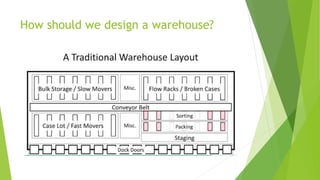
 Now we accomplish them by implementing a warehouse that has number one, the shortest
distances possible and that is for all the products. But more importantly, the items that are selling
the best must be located as close as possible to the shipping dock.
 Second, we want to maintain our quality. We don't want to ship out the wrong items, so we have to
have redundancy built into the process. And then finally, we have to maintain as much throughput
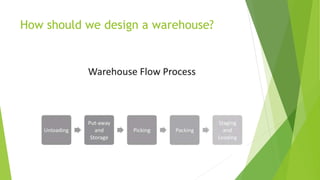
in our warehouse as possible by pushing out the items as quickly as possible. We start with unloading
the product off of our trucks, then we take the product. Put it away into our storage location, then
it's going to sit in storage until the customer is asking for the item and then we'll have a worker take
it off the shelf. Put it on a conveyor belt. Moving to a sorting location where finally, the whole
order, probably consisting of multiple products is going to be assembled into a package. We're going
to take all those packages.
 Move them to the staging location in front of the dark door where we then load our truck. This
whole process is controlled by a warehouse management system, which is essentially a very big
computer program that times all of these different steps. This was the flow process. Now, let's

visualize it in space.
 See the conveyor belt right going through the middle of the building? That then moves into the
sorting area and the packaging area, and they pull from three different storage areas arranged by
the importance of the items. Most important items, shortest distances and then we assemble the
orders, close the dock doors and move them out.
How should we design a warehouse?
Kiva Systems Warehouse Automation at
Quiet Logistics
 https://www.youtube.com/watch?v=3UxZDJ1HiPE&feature=youtu.be
Streamline the picking process – reduce
order pick time:
 Place most frequently picked items closest to the shipping areas. Also, consider
the frequency of orders, rather than the overall amount of products. You should
also review sales data constantly to ensure that the items are stored closest to
the shipping area are still the most frequently picked.
 Locate the highest-demand items within each storage area on the most
convenient storage space (for example: floor level for pallets in racks and
between waist and shoulder level for bins in racks).
 Consider difficulty of retrieval for workers and shorten it as much as possible.
Implement efficient dock management
practices:
 Dock space is some of the most critical space in the warehouse.
 All material must flow in and out of your docks, and they are limited in number
(and not readily added to).
 Space on inside and outside of docks is some of the busiest in warehouse.
 Receiving dock becomes a choke point in the supply chain.
 Docks in today’s warehouses must be more flexible and must support a variety
of receipts that are coming in at a faster rate and in greater frequency.
Add automation wisely:
 Use forklifts that enable workers to move pallets and larger items.
 Make the most of conveyor belts, sorters, and automated packing stations.
These tools not only improve efficiency, but they also increase speed and
ensure picking accuracy.
 Be careful not to overdo it with technology. Once put in place these expensive
automation systems typically cannot be easily upgraded and changed.
Maximize vertical space:
 Take advantage of every inch of available space (floor to ceiling
 Pallet racking lead to safer working conditions as well as increased efficiency.
Technology:
Implement Warehouse Management Software (WMS) to sequence orders and
organize the workflow inside the warehouse:
 Organize the workflow and optimize sequence performance.
 Sequence your orders by pick path
 Batch pick single lines, same-zone orders, and difficult picks (e.g. non-
conveyable items).
 To make the most of your WMS, provide your workers with hand-held RF
readers telling them what and how many
 to pick at each location.
Implement pick-to-light systems:
 Operator scans bar-coded label attached to a box.
 Systems informs operator of the item and quantity they need to pick.
 These systems work best for your top 5% to 20% products.
Pick-to-voice systems
 System informs operator of pick instructions through a headset.
 Enables workers to pick orders without looking at a computer screen or paper
pick tickets.
 Warehouses have adopted voice-based picking to complement the pick-to-light
systems (for fastest moving products).
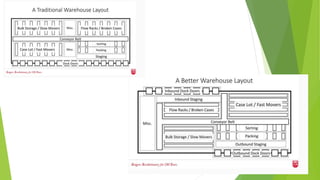
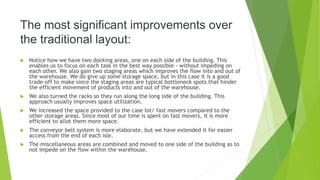
The most significant improvements over
the traditional layout:
 Notice how we have two docking areas, one on each side of the building. This
enables us to focus on each task in the best way possible - without impeding on
each other. We also gain two staging areas which improves the flow into and out of
the warehouse. We do give up some storage space, but in this case it is a good
trade-off to make since the staging areas are typical bottleneck spots that hinder
the efficient movement of products into and out of the warehouse.
 We also turned the racks so they run along the long side of the building. This
approach usually improves space utilization.
 We increased the space provided to the case lot/ fast movers compared to the
other storage areas. Since most of our time is spent on fast movers, it is more
efficient to allot them more space.
 The conveyor belt system is more elaborate, but we have extended it for easier
access from the end of each isle.
 The miscellaneous areas are combined and moved to one side of the building as to
not impede on the flow within the warehouse.
Can we improve this even further?
 Access into the case lot / fast movers area is impeded by the conveyor belt.
 The conveyor belt should have access to the end of each isle.
 The inbound staging area does not extend over the entire row of dock doors.
How much inventory do we need?
 inventory is typically made up of two different pieces.
1. Cycle Stock,
2. Safety Stock.
 Cycle Stock has to do with the inventory that goes up and down during
regular sales and replenishment.
 Safety Stock, we hold it just in case something we did not anticipate
happens. So we don't really expect it to be used, but it's there if we need it.
It's like an insurance policy. Let's look at an example. We are going to assume
that we have a little company that sells 20 units per day and every time they
get a shipment, they get 200 units and that's what we call cycle stock. So this
cycles up and down, as we get our replenishment.
How much inventory do we need?
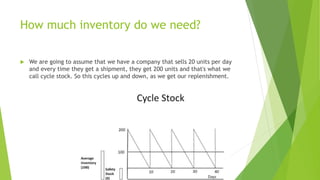
 We are going to assume that we have a company that sells 20 units per day
and every time they get a shipment, they get 200 units and that's what we
call cycle stock. So this cycles up and down, as we get our replenishment.
How much inventory do we need?
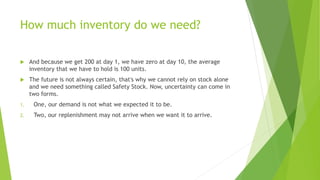
 And because we get 200 at day 1, we have zero at day 10, the average
inventory that we have to hold is 100 units.
 The future is not always certain, that's why we cannot rely on stock alone
and we need something called Safety Stock. Now, uncertainty can come in
two forms.
1. One, our demand is not what we expected it to be.
2. Two, our replenishment may not arrive when we want it to arrive.
How much inventory do we need?
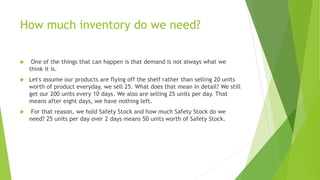
 One of the things that can happen is that demand is not always what we
think it is.
 Let's assume our products are flying off the shelf rather than selling 20 units
worth of product everyday, we sell 25. What does that mean in detail? We still
get our 200 units every 10 days. We also are selling 25 units per day. That
means after eight days, we have nothing left.
 For that reason, we hold Safety Stock and how much Safety Stock do we
need? 25 units per day over 2 days means 50 units worth of Safety Stock.
How much inventory do we need?
 Another case, the replenishment does not arrive when we expected to
arrive.
 We got our 200 units worth of inventory. We expect it to last for 10 days,
but the shipment does not arrive on day 10, it arrives on day 12. So, what
does that mean in terms of Safety Stock?
 We need to bridge two days with inventory. We sell 20 units a day. We need 40
units of Safety Stock and that is why our inventory is much higher than
before.
How much inventory do we need?
 Now let’s put both cases together, this is where stuff really goes crazy. We sell
25 units per day and our replenishment arrived late, that means 4 days
without inventory and we need to hold safety stock to bridge those 4 days
with 25 per day.
 That means we need 100 units worth of Safety Stock. See our average
inventory just went up from 100 before without any uncertainty to 200. An
inventory's pretty expensive.
When to order inventory?
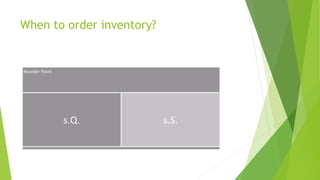
 the s.Q method and the s.S method.
 Now, the little s stands for reorder point, in other words when are you going
to trigger an order?
 The second letter, the Q stands for a fixed quantity that is determined ahead
of time, and the S stands for a variable quantity that depends on the current
inventory level as you place the order.
 The s.Q system is a continuous review method, where we monitor our
inventory at all times, and then once we hit the reorder point, we place an
order of the same quantity.
When to order inventory?
 In the s.S system, it's also a continuous review system, however, when we
place an order, we are going to place it dependent on where we are currently
in the inventory.
 So if we have a lower inventory, the order will be larger, because we order up
to a certain level. So the order will be the difference between our current
inventory and where we would like to be.
When to order inventory?
 Advantages of the s.Q system, is that it's simple,
 it's very predictable for our supplier.
 However, in certain cases, it may not be as precise and proficient. The s.S
method, may make it harder for a supplier, but it is a very precise system of
inventory. No matter if you're selling strawberries, flowers, microchips, cars,
or cats, inventory is a critical piece of your business. Knowing when to order
inventory, knowing how much to order, is a critically important decision for
your business. No matter which method you choose, either way you have to
pick the right method in your situation.
Reference
 Rutgers the State University of New Jersey

Supply chain logistics part 2

  • 1.
  • 2.
    Why do companiesneed warehouses?
  • 3.
    Why do companiesneed warehouses?  One of them is to consolidate our raw material supply. So, let's imagine a company that has two plants and three raw materials suppliers.  Now we could shift from those raw material suppliers directly into both of our plans and it'll be fine, but there is a better way and that is to use a warehouse in between them that receives raw materials from the three suppliers and then ships out, assembled assortments as needed
  • 4.
    Why do companiesneed warehouses? Advantages. 1. efficiencies and we can create efficiencies in transportation, because we focus on each link specifically and make it really good. We can achieve efficiencies in inventory, because we can hold our inventory where it's needed and just as much as is needed. And then finally, in production, because our production facilities get the resupplies they need when they need them. 2. risk pooling, we hold inventories just in one location rather than scattered across this network of companies. And then finally, our service level would be much hire than they would be otherwise. Even in more complex examples, warehouses still provide us with some benefits.
  • 5.
    Why do companiesneed warehouses? 3. service. You could shipped out from those two plants to the five customers individually, but the customer want an assortment of product produced by both plants. So you instead should use three warehouses to consolidate your output from the two plans, create assortment and then ship them out to your five final customers.
  • 6.
    Why do companiesneed warehouses? the three basic functions of warehousing 1. movement. Warehouses are meant to facilitate movement of products by receiving them, by transferring them across the warehouse, by picking them when their need and by facilitating shipment. 2. storage. You want to have an assortment of products in you warehouse available readily for when the customers want them. 3. information. Now, that storage may be in shorter term or longer term in the case of less used items. And finally, information. Information about your inventory. When it's coming in? What you currently have? When it's going to go out? There's different types of warehouses.
  • 7.
    Why do companiesneed warehouses? what makes a warehouse really good? 1. speed. Once the product is demanded by the customer, we want to be able to ship it out as quickly as possible. 2. quality. We don't want to send our customer the wrong item, because that would really make them angry. And third, productivity. We want to recycle as much as possible, think about the environment. We want to reduce as much as possible and we want to reuse, as much as possible. 3. Productivity. Inside the warehouse, we will move around products using forklifts, dollies and carts and we're going to use them to unload our trucks. finally, we're going to used them to load our trucks backup and ship the product out.
  • 8.
    How should wedesign a warehouse? what makes a warehouse great is three things.  The first of all is speed, you're able to ship out as much product as possible.  The next one is redundancy, you have multiple checks built into your distribution system to ensure that the product that the customer asked for is actually the one that you deliver.  And finally, productivity. Even though this is a massive warehouse, they're able to push out as much product as possible out of this huge distribution center.
  • 9.
    How should wedesign a warehouse?  When it comes to designing our warehouse, we have to consider our goals. 1. Speed, 2. quality and 3. productivity.
  • 10.
    How should wedesign a warehouse?  Now we accomplish them by implementing a warehouse that has number one, the shortest distances possible and that is for all the products. But more importantly, the items that are selling the best must be located as close as possible to the shipping dock.  Second, we want to maintain our quality. We don't want to ship out the wrong items, so we have to have redundancy built into the process. And then finally, we have to maintain as much throughput in our warehouse as possible by pushing out the items as quickly as possible. We start with unloading the product off of our trucks, then we take the product. Put it away into our storage location, then it's going to sit in storage until the customer is asking for the item and then we'll have a worker take it off the shelf. Put it on a conveyor belt. Moving to a sorting location where finally, the whole order, probably consisting of multiple products is going to be assembled into a package. We're going to take all those packages.  Move them to the staging location in front of the dark door where we then load our truck. This whole process is controlled by a warehouse management system, which is essentially a very big computer program that times all of these different steps. This was the flow process. Now, let's visualize it in space.  See the conveyor belt right going through the middle of the building? That then moves into the sorting area and the packaging area, and they pull from three different storage areas arranged by the importance of the items. Most important items, shortest distances and then we assemble the orders, close the dock doors and move them out.
  • 11.
    How should wedesign a warehouse?
  • 12.
    How should wedesign a warehouse?
  • 13.
    Kiva Systems WarehouseAutomation at Quiet Logistics  https://www.youtube.com/watch?v=3UxZDJ1HiPE&feature=youtu.be
  • 14.
    Streamline the pickingprocess – reduce order pick time:  Place most frequently picked items closest to the shipping areas. Also, consider the frequency of orders, rather than the overall amount of products. You should also review sales data constantly to ensure that the items are stored closest to the shipping area are still the most frequently picked.  Locate the highest-demand items within each storage area on the most convenient storage space (for example: floor level for pallets in racks and between waist and shoulder level for bins in racks).  Consider difficulty of retrieval for workers and shorten it as much as possible.
  • 15.
    Implement efficient dockmanagement practices:  Dock space is some of the most critical space in the warehouse.  All material must flow in and out of your docks, and they are limited in number (and not readily added to).  Space on inside and outside of docks is some of the busiest in warehouse.  Receiving dock becomes a choke point in the supply chain.  Docks in today’s warehouses must be more flexible and must support a variety of receipts that are coming in at a faster rate and in greater frequency.
  • 16.
    Add automation wisely: Use forklifts that enable workers to move pallets and larger items.  Make the most of conveyor belts, sorters, and automated packing stations. These tools not only improve efficiency, but they also increase speed and ensure picking accuracy.  Be careful not to overdo it with technology. Once put in place these expensive automation systems typically cannot be easily upgraded and changed.
  • 17.
    Maximize vertical space: Take advantage of every inch of available space (floor to ceiling  Pallet racking lead to safer working conditions as well as increased efficiency.
  • 18.
    Technology: Implement Warehouse ManagementSoftware (WMS) to sequence orders and organize the workflow inside the warehouse:  Organize the workflow and optimize sequence performance.  Sequence your orders by pick path  Batch pick single lines, same-zone orders, and difficult picks (e.g. non- conveyable items).  To make the most of your WMS, provide your workers with hand-held RF readers telling them what and how many  to pick at each location.
  • 19.
    Implement pick-to-light systems: Operator scans bar-coded label attached to a box.  Systems informs operator of the item and quantity they need to pick.  These systems work best for your top 5% to 20% products.
  • 20.
    Pick-to-voice systems  Systeminforms operator of pick instructions through a headset.  Enables workers to pick orders without looking at a computer screen or paper pick tickets.  Warehouses have adopted voice-based picking to complement the pick-to-light systems (for fastest moving products).
  • 22.
    The most significantimprovements over the traditional layout:  Notice how we have two docking areas, one on each side of the building. This enables us to focus on each task in the best way possible - without impeding on each other. We also gain two staging areas which improves the flow into and out of the warehouse. We do give up some storage space, but in this case it is a good trade-off to make since the staging areas are typical bottleneck spots that hinder the efficient movement of products into and out of the warehouse.  We also turned the racks so they run along the long side of the building. This approach usually improves space utilization.  We increased the space provided to the case lot/ fast movers compared to the other storage areas. Since most of our time is spent on fast movers, it is more efficient to allot them more space.  The conveyor belt system is more elaborate, but we have extended it for easier access from the end of each isle.  The miscellaneous areas are combined and moved to one side of the building as to not impede on the flow within the warehouse.
  • 23.
    Can we improvethis even further?  Access into the case lot / fast movers area is impeded by the conveyor belt.  The conveyor belt should have access to the end of each isle.  The inbound staging area does not extend over the entire row of dock doors.
  • 24.
    How much inventorydo we need?  inventory is typically made up of two different pieces. 1. Cycle Stock, 2. Safety Stock.  Cycle Stock has to do with the inventory that goes up and down during regular sales and replenishment.  Safety Stock, we hold it just in case something we did not anticipate happens. So we don't really expect it to be used, but it's there if we need it. It's like an insurance policy. Let's look at an example. We are going to assume that we have a little company that sells 20 units per day and every time they get a shipment, they get 200 units and that's what we call cycle stock. So this cycles up and down, as we get our replenishment.
  • 25.
    How much inventorydo we need?  We are going to assume that we have a company that sells 20 units per day and every time they get a shipment, they get 200 units and that's what we call cycle stock. So this cycles up and down, as we get our replenishment.
  • 26.
    How much inventorydo we need?  And because we get 200 at day 1, we have zero at day 10, the average inventory that we have to hold is 100 units.  The future is not always certain, that's why we cannot rely on stock alone and we need something called Safety Stock. Now, uncertainty can come in two forms. 1. One, our demand is not what we expected it to be. 2. Two, our replenishment may not arrive when we want it to arrive.
  • 27.
    How much inventorydo we need?  One of the things that can happen is that demand is not always what we think it is.  Let's assume our products are flying off the shelf rather than selling 20 units worth of product everyday, we sell 25. What does that mean in detail? We still get our 200 units every 10 days. We also are selling 25 units per day. That means after eight days, we have nothing left.  For that reason, we hold Safety Stock and how much Safety Stock do we need? 25 units per day over 2 days means 50 units worth of Safety Stock.
  • 28.
    How much inventorydo we need?  Another case, the replenishment does not arrive when we expected to arrive.  We got our 200 units worth of inventory. We expect it to last for 10 days, but the shipment does not arrive on day 10, it arrives on day 12. So, what does that mean in terms of Safety Stock?  We need to bridge two days with inventory. We sell 20 units a day. We need 40 units of Safety Stock and that is why our inventory is much higher than before.
  • 29.
    How much inventorydo we need?  Now let’s put both cases together, this is where stuff really goes crazy. We sell 25 units per day and our replenishment arrived late, that means 4 days without inventory and we need to hold safety stock to bridge those 4 days with 25 per day.  That means we need 100 units worth of Safety Stock. See our average inventory just went up from 100 before without any uncertainty to 200. An inventory's pretty expensive.
  • 30.
    When to orderinventory?
  • 31.
    When to orderinventory?  the s.Q method and the s.S method.  Now, the little s stands for reorder point, in other words when are you going to trigger an order?  The second letter, the Q stands for a fixed quantity that is determined ahead of time, and the S stands for a variable quantity that depends on the current inventory level as you place the order.  The s.Q system is a continuous review method, where we monitor our inventory at all times, and then once we hit the reorder point, we place an order of the same quantity.
  • 32.
    When to orderinventory?  In the s.S system, it's also a continuous review system, however, when we place an order, we are going to place it dependent on where we are currently in the inventory.  So if we have a lower inventory, the order will be larger, because we order up to a certain level. So the order will be the difference between our current inventory and where we would like to be.
  • 33.
    When to orderinventory?  Advantages of the s.Q system, is that it's simple,  it's very predictable for our supplier.  However, in certain cases, it may not be as precise and proficient. The s.S method, may make it harder for a supplier, but it is a very precise system of inventory. No matter if you're selling strawberries, flowers, microchips, cars, or cats, inventory is a critical piece of your business. Knowing when to order inventory, knowing how much to order, is a critically important decision for your business. No matter which method you choose, either way you have to pick the right method in your situation.
  • 34.
    Reference  Rutgers theState University of New Jersey