INTERNATIONAL BUSINESS
ENVIRONMENT
1
Trade Related Aspects of
Intellectual Property Rights
(TRIPS) Agreement
Prepared By:
Shubhangini Ruhela(45) &
Sonika Soni(52)
INTERNATIONAL BUSINESS
ENVIRONMENT
3
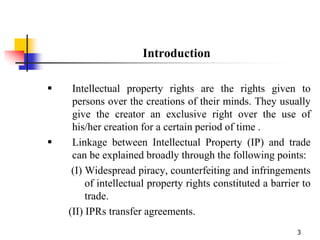
Introduction
 Intellectual property rights are the rights given to
persons over the creations of their minds. They usually
give the creator an exclusive right over the use of
his/her creation for a certain period of time .
 Linkage between Intellectual Property (IP) and trade
can be explained broadly through the following points:
(I) Widespread piracy, counterfeiting and infringements
of intellectual property rights constituted a barrier to
trade.
(II) IPRs transfer agreements.
4
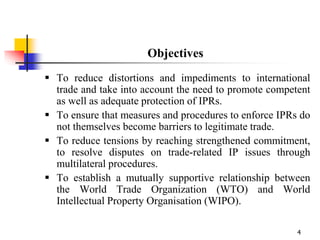
Objectives
 To reduce distortions and impediments to international
trade and take into account the need to promote competent
as well as adequate protection of IPRs.
 To ensure that measures and procedures to enforce IPRs do
not themselves become barriers to legitimate trade.
 To reduce tensions by reaching strengthened commitment,
to resolve disputes on trade-related IP issues through
multilateral procedures.
 To establish a mutually supportive relationship between
the World Trade Organization (WTO) and World
Intellectual Property Organisation (WIPO).
5
Types of IPRs:
Copyright and related rights
 Copyright grants exclusive rights to the creator of
original scientific, artistic and literary works.
 ‘Original’ is key in defining a work that qualifies for
copyright protection.
 Countries to confine limitations or exceptions to
exclusive rights to certain special cases which do not
conflict with exploitation of the work and not prejudicial
to right holder.
6
Trademark
 Trademark protects any word, name, logo or device used
to identify, distinguish or indicate the source of goods or
services.
 Includes trade dress (the total image and overall
appearance of a product) and product configuration (the
shape).
 The purpose is to safeguard the integrity of products and
to prevent product confusion and unfair competition.
 The term of protection (initial registration and each
renewal of registration of a trademark shall be for a term
of no less than 7 years).
7
Geographical Indications (GIs)
 GIs are denominations that identify a good as originating
in a region or locality, where the reputation and quality of
good is essentially attributable to its geographical origin
(for example: Darjeeling tea of India).
 TRIPS prohibits the use of GIs in such a way as to cause
deception and provides for injunctive relief, refusal of
trademark registration, etc.
 Exceptions such as Countries are not obliged to bring a
geographical indication under protection, where it has
become a generic term for describing the product in
question.
8
Industrial designs
 Protects the artistic aspect (namely, texture, pattern,
shape) of an object instead of the technical features
 The term of protection (amount to at least 10 years)
 ‘Amount to’ allow the term to be divided into two
periods (for example two periods of five years)
 The third party is prohibited from making, selling or
importing articles bearing a design which is a copy of the
protected design, when such acts are undertaken for
commercial purposes.
 Exception: optional mandate, if introduced then such
exceptions do not unreasonably conflict with the normal
exploitation of protected industrial designs and do not
unreasonably prejudice the legitimate interests of the
owner of the protected design
9
Patents
 The TRIPS Agreement requires Member countries to
make patents available for any inventions, whether
products or processes, in all fields of technology without
discrimination, subject to novelty, inventiveness and
industrial applicability.
 Invention to be novel, useful and non-obvious.
The agreement allows countries to exclude inventions
from patentability on following grounds:
 Inventions necessary ‘to protect ordre public or
morality; including to protect human, animal or plant life
or health or to avoid serious prejudice to the
environment…’
10
Continued..
 Compulsory Licensing
 The term of protection (for a period of 20 years counted
from the filing date)
11
Main feature of the agreement
 Standards: The agreement expresses minimum standards of
protection.
(I) The subject matter to be protected
(II) The minimum period of protection
 Enforcement
(I) Provisions for domestic procedure and remedies for the
enforcement of the IPRs
(II) Includes general principle applicable to IPR enforcement
procedure apart from administrative, civil and criminal
procedure available for enforcement of rights of the right
holder
 Dispute settlement: The agreement further provides for the
settlement of disputes over IPR among the member states within the
parameters of dispute settlement procedure.
12
Conclusion
 Highly innovative agreement and remains the most
comprehensive international agreement on intellectual
property till date.
 Overall it has worked well, however, it needs to continue
to implement wide ranging provisions specially when it
touches significant public policy questions.
THANK YOU
13

TRIPS ppt

  • 1.
  • 2.
    Trade Related Aspectsof Intellectual Property Rights (TRIPS) Agreement Prepared By: Shubhangini Ruhela(45) & Sonika Soni(52) INTERNATIONAL BUSINESS ENVIRONMENT
  • 3.
    3 Introduction  Intellectual propertyrights are the rights given to persons over the creations of their minds. They usually give the creator an exclusive right over the use of his/her creation for a certain period of time .  Linkage between Intellectual Property (IP) and trade can be explained broadly through the following points: (I) Widespread piracy, counterfeiting and infringements of intellectual property rights constituted a barrier to trade. (II) IPRs transfer agreements.
  • 4.
    4 Objectives  To reducedistortions and impediments to international trade and take into account the need to promote competent as well as adequate protection of IPRs.  To ensure that measures and procedures to enforce IPRs do not themselves become barriers to legitimate trade.  To reduce tensions by reaching strengthened commitment, to resolve disputes on trade-related IP issues through multilateral procedures.  To establish a mutually supportive relationship between the World Trade Organization (WTO) and World Intellectual Property Organisation (WIPO).
  • 5.
    5 Types of IPRs: Copyrightand related rights  Copyright grants exclusive rights to the creator of original scientific, artistic and literary works.  ‘Original’ is key in defining a work that qualifies for copyright protection.  Countries to confine limitations or exceptions to exclusive rights to certain special cases which do not conflict with exploitation of the work and not prejudicial to right holder.
  • 6.
    6 Trademark  Trademark protectsany word, name, logo or device used to identify, distinguish or indicate the source of goods or services.  Includes trade dress (the total image and overall appearance of a product) and product configuration (the shape).  The purpose is to safeguard the integrity of products and to prevent product confusion and unfair competition.  The term of protection (initial registration and each renewal of registration of a trademark shall be for a term of no less than 7 years).
  • 7.
    7 Geographical Indications (GIs) GIs are denominations that identify a good as originating in a region or locality, where the reputation and quality of good is essentially attributable to its geographical origin (for example: Darjeeling tea of India).  TRIPS prohibits the use of GIs in such a way as to cause deception and provides for injunctive relief, refusal of trademark registration, etc.  Exceptions such as Countries are not obliged to bring a geographical indication under protection, where it has become a generic term for describing the product in question.
  • 8.
    8 Industrial designs  Protectsthe artistic aspect (namely, texture, pattern, shape) of an object instead of the technical features  The term of protection (amount to at least 10 years)  ‘Amount to’ allow the term to be divided into two periods (for example two periods of five years)  The third party is prohibited from making, selling or importing articles bearing a design which is a copy of the protected design, when such acts are undertaken for commercial purposes.  Exception: optional mandate, if introduced then such exceptions do not unreasonably conflict with the normal exploitation of protected industrial designs and do not unreasonably prejudice the legitimate interests of the owner of the protected design
  • 9.
    9 Patents  The TRIPSAgreement requires Member countries to make patents available for any inventions, whether products or processes, in all fields of technology without discrimination, subject to novelty, inventiveness and industrial applicability.  Invention to be novel, useful and non-obvious. The agreement allows countries to exclude inventions from patentability on following grounds:  Inventions necessary ‘to protect ordre public or morality; including to protect human, animal or plant life or health or to avoid serious prejudice to the environment…’
  • 10.
    10 Continued..  Compulsory Licensing The term of protection (for a period of 20 years counted from the filing date)
  • 11.
    11 Main feature ofthe agreement  Standards: The agreement expresses minimum standards of protection. (I) The subject matter to be protected (II) The minimum period of protection  Enforcement (I) Provisions for domestic procedure and remedies for the enforcement of the IPRs (II) Includes general principle applicable to IPR enforcement procedure apart from administrative, civil and criminal procedure available for enforcement of rights of the right holder  Dispute settlement: The agreement further provides for the settlement of disputes over IPR among the member states within the parameters of dispute settlement procedure.
  • 12.
    12 Conclusion  Highly innovativeagreement and remains the most comprehensive international agreement on intellectual property till date.  Overall it has worked well, however, it needs to continue to implement wide ranging provisions specially when it touches significant public policy questions.
  • 13.