Spark on Mesos
tim@mesosphere.io
@tnachen
dean.wampler@typesafe.com
@deanwampler
2
Mesosphere’s Data Center Operating System (DCOS) is a commercially supported Mesos ecosystem. We’ll use it in the demo of Mesos features later.
3
Typesafe has launched
Spark support for
Mesosphere DCOS
Typesafe engineers are contributing to the Mesos support. Typesafe will provide commercial support for development and production deployment. Typesafe also offers
developer support for teams getting started with Spark, but with plans to deploy to other platforms, like YARN.
4
This page provides information about what Typesafe is doing with Spark, including our support offerings, the results of a recent survey of Spark usage, blog posts and
webinars about the world of Spark.
typesafe.com/reactive-big-data
5
This page provides more information, as well as results of a recent survey of Spark usage, blog posts and webinars about the world of Spark.
6
Mostly, we’re about helping you navigate treacherous waters…

http://petapixel.com/2015/06/15/raccoon-photographed-riding-on-an-alligators-back/
Mesos
mesos.apache.org
8
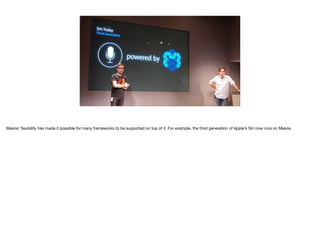
Mesos’ flexibility has made it possible for many frameworks to be supported on top of it. For example, the third generation of Apple’s Siri now runs on Mesos.
Apps are Frameworks on Mesos
• MySQL - Mysos
• Cassandra
• HDFS
• YARN! - Myriad
• others...
9
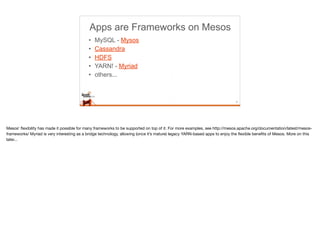
Mesos’ flexibility has made it possible for many frameworks to be supported on top of it. For more examples, see http://mesos.apache.org/documentation/latest/mesos-
frameworks/ Myriad is very interesting as a bridge technology, allowing (once it’s mature) legacy YARN-based apps to enjoy the flexible benefits of Mesos. More on this
later...
Resources are offered.
They can be refused.
Two-Level Scheduling
A key strategy in Mesos is to offer resources to frameworks, which can chose to accept or reject them. Why reject them? The offer may not be sufficient for the need, but
it’s also a technique for delegating to frameworks the logic for imposing policies of interest, such as enforcing data locality, server affinity, etc. 

Resources are dynamic and include CPU cores, memory, disk, & ports.

Scheduling and resource negotiation fine grained and per-framework.
Mesos Slaves
Mesos Cluster
master
Mesos Master
Key
Mesos
Spark
HDFS
master / client
master / client
node
Mesos Slave
Name Node
Executor
task1 …
node
DiskDiskDiskDiskDisk
Mesos Slave
Data Node
Executor
… …
node
…
HDFS FW Sched. Job 1
Spark FW Sched. Job 1
1
(S1, 8CPU, 32GB, ...)
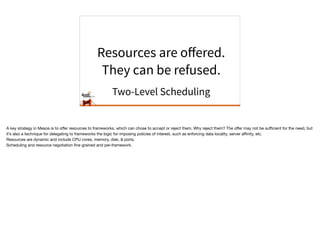
Here we show HDFS already running and we want to allocate resources and start executors running for Spark. 

1. A slave (#1) tells the Master (actually the Allocation policy module embedded within it) that it has 8 CPUs, 32GB Memory. (Mesos can also manage ports and disk
space.)

Adapted from http://mesos.apache.org/documentation/latest/mesos-architecture/
Mesos Slaves
Mesos Cluster
master
Mesos Master
Key
Mesos
Spark
HDFS
master / client
master / client
node
Mesos Slave
Name Node
Executor
task1 …
node
DiskDiskDiskDiskDisk
Mesos Slave
Data Node
Executor
… …
node
…
HDFS FW Sched. Job 1
Spark FW Sched. Job 1
2
(S1, 8CPU, 32GB, ...)
1
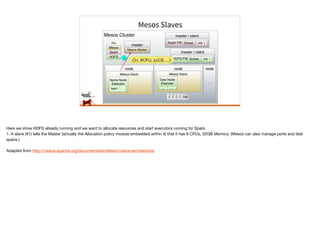
2. The Allocation module in the Master says that all the resources should be offered to the Spark Framework.
Mesos Slaves
Mesos Cluster
master
Mesos Master
Key
Mesos
Spark
HDFS
master / client
master / client
node
Mesos Slave
Name Node
Executor
task1 …
node
DiskDiskDiskDiskDisk
Mesos Slave
Data Node
Executor
… …
node
…
HDFS FW Sched. Job 1
Spark FW Sched. Job 1
2
1
(S1, 2CPU, 8GB, ...)
3
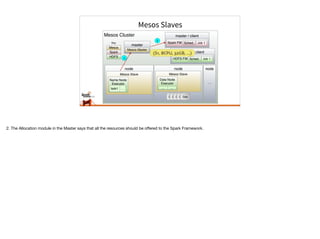
3. The Spark Framework Scheduler replies to the Master to run two tasks on the node, each with 2 CPU cores and 8GB of memory. The Master can then offer the rest of
the resources to other Frameworks.
Mesos Slaves
Mesos Cluster
master
Mesos Master
Key
Mesos
Spark
HDFS
master / client
master / client
node
Mesos Slave
Name Node
Executor
task1 …
node
DiskDiskDiskDiskDisk
Mesos Slave
Data Node
Executor
… …
node
…
HDFS FW Sched. Job 1
Spark FW Sched. Job 1
2
1
(S1, 2CPU, 8GB, ...)
3
4
Spark
Executor
task1 …
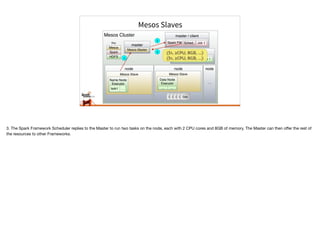
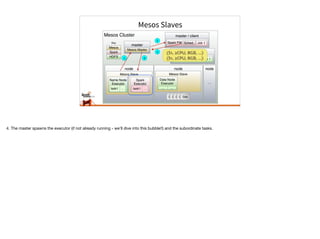
4. The master spawns the executor (if not already running - we’ll dive into this bubble!!) and the subordinate tasks.
Container Isolation
• Linux cgroups
• Docker
• Custom
15
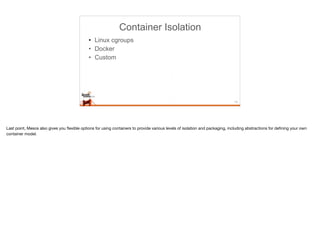
Last point, Mesos also gives you flexible options for using containers to provide various levels of isolation and packaging, including abstractions for defining your own
container model.
mesos.berkeley.edu/mesos_tech_report.pdf
16
For more details, it’s worth reading the very clear research paper by Benjamin Hindman, the creator of Mesos, Matei Zaharia, the creator of Spark, and others.
mesos.berkeley.edu/mesos_tech_report.pdf
17
“To validate our hypothesis ...,
we have also built a new framework
on top of Mesos called Spark...”
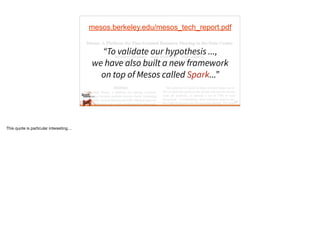
This quote is particular interesting…
Spark on Mesos
spark.apache.org/docs/latest/running-
on-mesos.html
Spark Cluster Abstraction
…NodeNode
Spark Driver
object MyApp {
def main() {
val sc =
new SparkContext(…)
…
}
}
Cluster
Manager
Spark Executor
task task
task task
Spark Executor
task task
task task
…
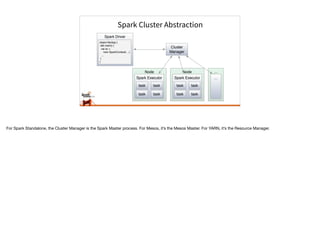
For Spark Standalone, the Cluster Manager is the Spark Master process. For Mesos, it’s the Mesos Master. For YARN, it’s the Resource Manager.
Mesos Coarse Grained Mode
…Node Node
Mesos Executor …Mesos Executor
master
Spark Executor
task task
task task
Spark Executor
task task
task task
…
Mesos Master
Spark Framework
Spark Driver
object MyApp {
def main() {
val sc =
new SparkContext(…)
…
}
}
Scheduler
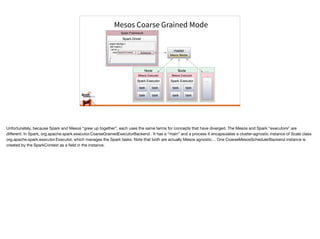
Unfortunately, because Spark and Mesos “grew up together”, each uses the same terms for concepts that have diverged. The Mesos and Spark “executors” are
different. In Spark, org.apache.spark.executor.CoarseGrainedExecutorBackend . It has a “main” and a process It encapsulates a cluster-agnostic instance of Scala class
org.apache.spark.executor.Executor, which manages the Spark tasks. Note that both are actually Mesos agnostic… One CoarseMesosSchedulerBackend instance is
created by the SparkContext as a field in the instance.
Mesos Coarse Grained Mode
• Fast startup for tasks:
• Better for interactive sessions.
• But resources locked up in larger Mesos task.
• (Dynamic allocation is coming…)
…Node Node
Mesos Executor …Mesos Executor
master
Spark Executor
task task
task task
Spark Executor
task task
task task
…
Mesos Master
Spark Framework
Spark Driver
object MyApp {
def main() {
val sc =
new SparkContext(…)
…
}
}
Scheduler
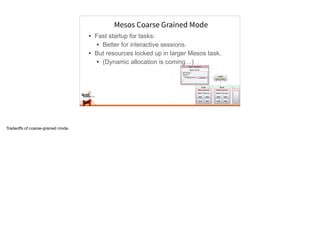
Tradeoffs of coarse-grained mode.
Mesos Fine Grained Mode
…NodeNode
Spark Framework
Mesos Executor …
master
Spark Driver
object MyApp {
def main() {
val sc =
new SparkContext(…)
…
}
}
task task
task task
…
Mesos Master
Mesos Executor
Spark Exec
task
Spark Exec
task
Spark Exec
task
Spark Exec
task
Mesos Executor
Spark Exec
task
Spark Exec
task
Spark Exec
task
Spark Exec
task
…
Scheduler
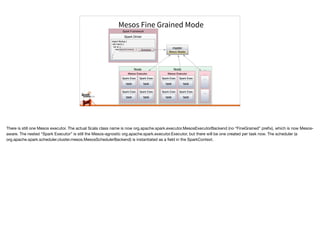
There is still one Mesos executor. The actual Scala class name is now org.apache.spark.executor.MesosExecutorBackend (no “FineGrained” prefix), which is now Mesos-
aware. The nested “Spark Executor” is still the Mesos-agnostic org.apache.spark.executor.Executor, but there will be one created per task now. The scheduler (a
org.apache.spark.scheduler.cluster.mesos.MesosSchedulerBackend) is instantiated as a field in the SparkContext.
Mesos Fine Grained Mode
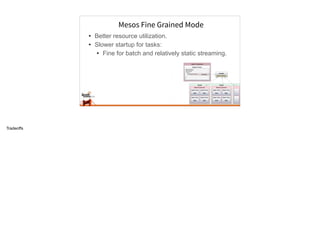
• Better resource utilization.
• Slower startup for tasks:
• Fine for batch and relatively static streaming.
…NodeNode
Spark Framework
Mesos Executor …
master
Spark Driver
object MyApp {
def main() {
val sc =
new SparkContext(…)
…
}
}
task task
task task
…
Mesos Master
Mesos Executor
Spark Exec
task
Spark Exec
task
Spark Exec
task
Spark Exec
task
Mesos Executor
Spark Exec
task
Spark Exec
task
Spark Exec
task
Spark Exec
task
…
Scheduler
Tradeoffs
Recap
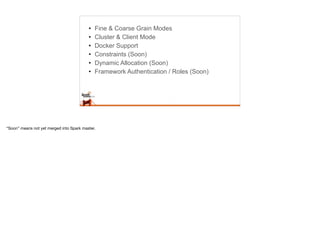
• Fine & Coarse Grain Modes
• Cluster & Client Mode
• Docker Support
• Constraints (Soon)
• Dynamic Allocation (Soon)
• Framework Authentication / Roles (Soon)
“Soon” means not yet merged into Spark master.
Demo!
Dean will demo supervision, which restarts a job automatically if it crashes or another problem happens. In this case, the docker image will disappear.
spark.mesos.coarse	


  true	
  
spark.shuffle.service.enabled	
  	
  	
  true	
  
spark.dynamicAllocation.enabled	


  true	
  
spark.dynamicAllocation.minExecutors	


  1	
  
spark.dynamicAllocation.maxExecutors	


  3	
  
spark.dynamicAllocation.executorIdleTimeout	
  	
  15
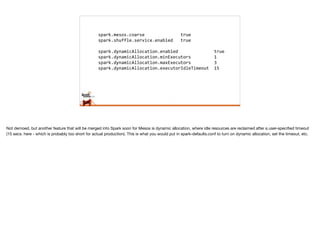
Not demoed, but another feature that will be merged into Spark soon for Mesos is dynamic allocation, where idle resources are reclaimed after a user-specified timeout
(15 secs. here - which is probably too short for actual production). This is what you would put in spark-defaults.conf to turn on dynamic allocation, set the timeout, etc.
val	
  rdd	
  =	
  sc.parallelize(1	
  to	
  10000000,	
  500)	
  
val	
  rdd1	
  =	
  rdd.zipWithIndex.groupBy(_._1	
  /	
  100)	
  
rdd1.cache()	
  
rdd1.collect()
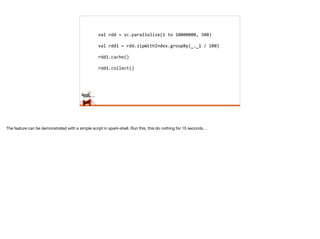
The feature can be demonstrated with a simple script in spark-shell. Run this, this do nothing for 15 seconds…
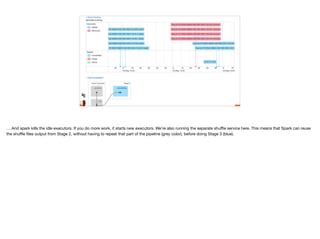
… And spark kills the idle executors. If you do more work, it starts new executors. We’re also running the separate shuffle service here. This means that Spark can reuse
the shuffle files output from Stage 2, without having to repeat that part of the pipeline (grey color), before doing Stage 3 (blue).
What’s Next
for Mesos?
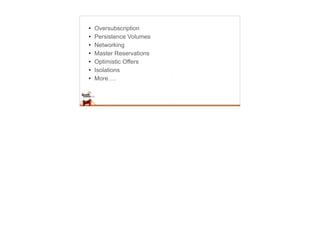
• Oversubscription
• Persistence Volumes
• Networking
• Master Reservations
• Optimistic Offers
• Isolations
• More….
Thanks!
dean.wampler@typesafe.com
@deanwampler
tim@mesosphere.io
@tnachen

Spark on Mesos-A Deep Dive-(Dean Wampler and Tim Chen, Typesafe and Mesosphere)

  • 1.
  • 2.
    2 Mesosphere’s Data CenterOperating System (DCOS) is a commercially supported Mesos ecosystem. We’ll use it in the demo of Mesos features later.
  • 3.
    3 Typesafe has launched Sparksupport for Mesosphere DCOS Typesafe engineers are contributing to the Mesos support. Typesafe will provide commercial support for development and production deployment. Typesafe also offers developer support for teams getting started with Spark, but with plans to deploy to other platforms, like YARN.
  • 4.
    4 This page providesinformation about what Typesafe is doing with Spark, including our support offerings, the results of a recent survey of Spark usage, blog posts and webinars about the world of Spark.
  • 5.
    typesafe.com/reactive-big-data 5 This page providesmore information, as well as results of a recent survey of Spark usage, blog posts and webinars about the world of Spark.
  • 6.
    6 Mostly, we’re abouthelping you navigate treacherous waters… http://petapixel.com/2015/06/15/raccoon-photographed-riding-on-an-alligators-back/
  • 7.
  • 8.
    8 Mesos’ flexibility hasmade it possible for many frameworks to be supported on top of it. For example, the third generation of Apple’s Siri now runs on Mesos.
  • 9.
    Apps are Frameworkson Mesos • MySQL - Mysos • Cassandra • HDFS • YARN! - Myriad • others... 9 Mesos’ flexibility has made it possible for many frameworks to be supported on top of it. For more examples, see http://mesos.apache.org/documentation/latest/mesos- frameworks/ Myriad is very interesting as a bridge technology, allowing (once it’s mature) legacy YARN-based apps to enjoy the flexible benefits of Mesos. More on this later...
  • 10.
    Resources are offered. Theycan be refused. Two-Level Scheduling A key strategy in Mesos is to offer resources to frameworks, which can chose to accept or reject them. Why reject them? The offer may not be sufficient for the need, but it’s also a technique for delegating to frameworks the logic for imposing policies of interest, such as enforcing data locality, server affinity, etc. Resources are dynamic and include CPU cores, memory, disk, & ports. Scheduling and resource negotiation fine grained and per-framework.
  • 11.
    Mesos Slaves Mesos Cluster master MesosMaster Key Mesos Spark HDFS master / client master / client node Mesos Slave Name Node Executor task1 … node DiskDiskDiskDiskDisk Mesos Slave Data Node Executor … … node … HDFS FW Sched. Job 1 Spark FW Sched. Job 1 1 (S1, 8CPU, 32GB, ...) Here we show HDFS already running and we want to allocate resources and start executors running for Spark. 1. A slave (#1) tells the Master (actually the Allocation policy module embedded within it) that it has 8 CPUs, 32GB Memory. (Mesos can also manage ports and disk space.) Adapted from http://mesos.apache.org/documentation/latest/mesos-architecture/
  • 12.
    Mesos Slaves Mesos Cluster master MesosMaster Key Mesos Spark HDFS master / client master / client node Mesos Slave Name Node Executor task1 … node DiskDiskDiskDiskDisk Mesos Slave Data Node Executor … … node … HDFS FW Sched. Job 1 Spark FW Sched. Job 1 2 (S1, 8CPU, 32GB, ...) 1 2. The Allocation module in the Master says that all the resources should be offered to the Spark Framework.
  • 13.
    Mesos Slaves Mesos Cluster master MesosMaster Key Mesos Spark HDFS master / client master / client node Mesos Slave Name Node Executor task1 … node DiskDiskDiskDiskDisk Mesos Slave Data Node Executor … … node … HDFS FW Sched. Job 1 Spark FW Sched. Job 1 2 1 (S1, 2CPU, 8GB, ...) (S1, 2CPU, 8GB, ...) 3 3. The Spark Framework Scheduler replies to the Master to run two tasks on the node, each with 2 CPU cores and 8GB of memory. The Master can then offer the rest of the resources to other Frameworks.
  • 14.
    Mesos Slaves Mesos Cluster master MesosMaster Key Mesos Spark HDFS master / client master / client node Mesos Slave Name Node Executor task1 … node DiskDiskDiskDiskDisk Mesos Slave Data Node Executor … … node … HDFS FW Sched. Job 1 Spark FW Sched. Job 1 2 1 (S1, 2CPU, 8GB, ...) (S1, 2CPU, 8GB, ...) 3 4 Spark Executor task1 … 4. The master spawns the executor (if not already running - we’ll dive into this bubble!!) and the subordinate tasks.
  • 15.
    Container Isolation • Linuxcgroups • Docker • Custom 15 Last point, Mesos also gives you flexible options for using containers to provide various levels of isolation and packaging, including abstractions for defining your own container model.
  • 16.
    mesos.berkeley.edu/mesos_tech_report.pdf 16 For more details,it’s worth reading the very clear research paper by Benjamin Hindman, the creator of Mesos, Matei Zaharia, the creator of Spark, and others.
  • 17.
    mesos.berkeley.edu/mesos_tech_report.pdf 17 “To validate ourhypothesis ..., we have also built a new framework on top of Mesos called Spark...” This quote is particular interesting…
  • 18.
  • 19.
    Spark Cluster Abstraction …NodeNode SparkDriver object MyApp { def main() { val sc = new SparkContext(…) … } } Cluster Manager Spark Executor task task task task Spark Executor task task task task … For Spark Standalone, the Cluster Manager is the Spark Master process. For Mesos, it’s the Mesos Master. For YARN, it’s the Resource Manager.
  • 20.
    Mesos Coarse GrainedMode …Node Node Mesos Executor …Mesos Executor master Spark Executor task task task task Spark Executor task task task task … Mesos Master Spark Framework Spark Driver object MyApp { def main() { val sc = new SparkContext(…) … } } Scheduler Unfortunately, because Spark and Mesos “grew up together”, each uses the same terms for concepts that have diverged. The Mesos and Spark “executors” are different. In Spark, org.apache.spark.executor.CoarseGrainedExecutorBackend . It has a “main” and a process It encapsulates a cluster-agnostic instance of Scala class org.apache.spark.executor.Executor, which manages the Spark tasks. Note that both are actually Mesos agnostic… One CoarseMesosSchedulerBackend instance is created by the SparkContext as a field in the instance.
  • 21.
    Mesos Coarse GrainedMode • Fast startup for tasks: • Better for interactive sessions. • But resources locked up in larger Mesos task. • (Dynamic allocation is coming…) …Node Node Mesos Executor …Mesos Executor master Spark Executor task task task task Spark Executor task task task task … Mesos Master Spark Framework Spark Driver object MyApp { def main() { val sc = new SparkContext(…) … } } Scheduler Tradeoffs of coarse-grained mode.
  • 22.
    Mesos Fine GrainedMode …NodeNode Spark Framework Mesos Executor … master Spark Driver object MyApp { def main() { val sc = new SparkContext(…) … } } task task task task … Mesos Master Mesos Executor Spark Exec task Spark Exec task Spark Exec task Spark Exec task Mesos Executor Spark Exec task Spark Exec task Spark Exec task Spark Exec task … Scheduler There is still one Mesos executor. The actual Scala class name is now org.apache.spark.executor.MesosExecutorBackend (no “FineGrained” prefix), which is now Mesos- aware. The nested “Spark Executor” is still the Mesos-agnostic org.apache.spark.executor.Executor, but there will be one created per task now. The scheduler (a org.apache.spark.scheduler.cluster.mesos.MesosSchedulerBackend) is instantiated as a field in the SparkContext.
  • 23.
    Mesos Fine GrainedMode • Better resource utilization. • Slower startup for tasks: • Fine for batch and relatively static streaming. …NodeNode Spark Framework Mesos Executor … master Spark Driver object MyApp { def main() { val sc = new SparkContext(…) … } } task task task task … Mesos Master Mesos Executor Spark Exec task Spark Exec task Spark Exec task Spark Exec task Mesos Executor Spark Exec task Spark Exec task Spark Exec task Spark Exec task … Scheduler Tradeoffs
  • 24.
  • 25.
    • Fine &Coarse Grain Modes • Cluster & Client Mode • Docker Support • Constraints (Soon) • Dynamic Allocation (Soon) • Framework Authentication / Roles (Soon) “Soon” means not yet merged into Spark master.
  • 26.
    Demo! Dean will demosupervision, which restarts a job automatically if it crashes or another problem happens. In this case, the docker image will disappear.
  • 27.
    spark.mesos.coarse                            true   spark.shuffle.service.enabled      true   spark.dynamicAllocation.enabled                            true   spark.dynamicAllocation.minExecutors                  1   spark.dynamicAllocation.maxExecutors                  3   spark.dynamicAllocation.executorIdleTimeout    15 Not demoed, but another feature that will be merged into Spark soon for Mesos is dynamic allocation, where idle resources are reclaimed after a user-specified timeout (15 secs. here - which is probably too short for actual production). This is what you would put in spark-defaults.conf to turn on dynamic allocation, set the timeout, etc.
  • 28.
    val  rdd  =  sc.parallelize(1  to  10000000,  500)   val  rdd1  =  rdd.zipWithIndex.groupBy(_._1  /  100)   rdd1.cache()   rdd1.collect() The feature can be demonstrated with a simple script in spark-shell. Run this, this do nothing for 15 seconds…
  • 29.
    … And sparkkills the idle executors. If you do more work, it starts new executors. We’re also running the separate shuffle service here. This means that Spark can reuse the shuffle files output from Stage 2, without having to repeat that part of the pipeline (grey color), before doing Stage 3 (blue).
  • 30.
  • 31.
    • Oversubscription • PersistenceVolumes • Networking • Master Reservations • Optimistic Offers • Isolations • More….
  • 32.