Scaling up genomic 
analysis with ADAM 
Frank Austin Nothaft, UC Berkeley AMPLab 
fnothaft@berkeley.edu, @fnothaft 
11/20/2014
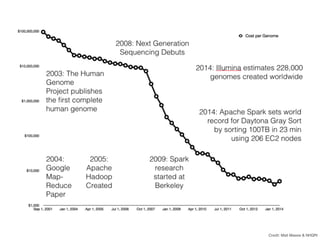
Credit: Matt Massie & NHGRI
The Sequencing Abstraction 
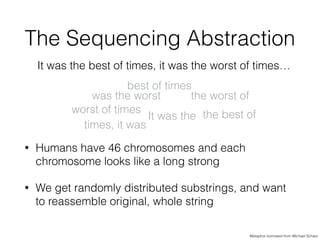
It was the best of times, it was the worst of times… 
the worst of 
It was the the best of 
worst of times 
times, it was 
• Humans have 46 chromosomes and each 
chromosome looks like a long strong 
• We get randomly distributed substrings, and want 
to reassemble original, whole string 
Metaphor borrowed from Michael Schatz 
best of times 
was the worst
Genomics = Big Data 
• Sequencing run produces >100 GB of raw data 
• Want to process 1,000’s of samples at once to 
improve statistical power 
• Current pipelines take about a week to run and are 
not horizontally scalable
How do we process a 
genome?
What’s our goal? 
• Human genome is 3.3B letters long, but our reads 
are only 50-250 letters long 
• Sequence of the average human genome is known 
• Insight: Each human genome only differs at 1 in 
1000 positions, so we can align short reads to 
average genome, and compute diff
Align Reads 
It was the best of times, it was the worst of times… 
best of times 
was the worst 
It was the the best of 
times, it was 
the worst of 
worst of times
Align Reads 
It was the best of times, it was the worst of times… 
It was the 
the best of 
best of times 
was the worst 
times, it was 
the worst of 
worst of times
Align Reads 
It was the best of times, it was the worst of times… 
It was the 
the best of 
best of times 
was the worst 
times, it was 
the worst of 
worst of times
Align Reads 
It was the best of times, it was the worst of times… 
It was the 
the best of 
best of times 
was the worst 
times, it was 
the worst of 
worst of times
Align Reads 
It was the best of times, it was the worst of times… 
It was the 
the best of 
times, it was 
the worst of 
best of times 
was the worst 
worst of times
Align Reads 
It was the best of times, it was the worst of times… 
It was the 
the best of 
times, it was 
the worst of 
best of times 
worst of times 
was the worst
Align Reads 
It was the best of times, it was the worst of times… 
It was the 
the best of 
times, it was 
the worst of 
best of times 
worst of times 
was the worst
Align Reads 
It was the best of times, it was the worst of times… 
It was the 
the best of 
times, it was 
the worst of 
worst of times 
best of times 
was the worst
Assemble Reads 
It was the best of times, it was the worst of times… 
It was the 
the best of 
times, it was 
the worst of 
worst of times 
best of times 
was the worst
Assemble Reads 
It was the best of times, it was the worst of times… 
It was the best of times, it was 
the worst of 
worst of times 
best of times 
was the worst
Assemble Reads 
It was the best of times, it was the worst of times… 
It was the best of times, it was 
was the worst 
the worst of 
worst of times
Assemble Reads 
It was the best of times, it was the worst of times… 
It was the best of times, it was 
the worst 
the worst of 
worst of times
Assemble Reads 
It was the best of times, it was the worst of times… 
It was the best of times, it was the worst 
of 
worst of times
Assemble Reads 
It was the best of times, it was the worst of times… 
It was the best of times, it was the worst of times
Overall Pipeline Structure 
From “GATK Best Practices”, https://www.broadinstitute.org/gatk/guide/best-practices
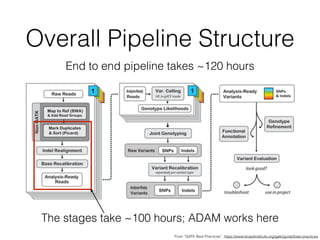
Overall Pipeline Structure 
End to end pipeline takes ~120 hours 
The stages take ~100 hours; ADAM works here 
From “GATK Best Practices”, https://www.broadinstitute.org/gatk/guide/best-practices
Making Genomics 
Horizontally Scalable
Key Observations 
• Current genomics pipelines are I/O limited 
• Most genomics algorithms can be formulated as 
either data/graph parallel computation 
• Genomics is heavy on iteration/pipelining, data 
access pattern is write once, read many times 
• High coverage, whole genome (>220 GB) will 
become main dataset for human genetics
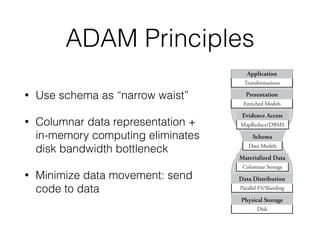
ADAM Principles 
• Use schema as “narrow waist” 
• Columnar data representation + 
in-memory computing eliminates 
disk bandwidth bottleneck 
• Minimize data movement: send 
code to data 
Application 
Transformations 
Presentation 
Enriched Models 
Evidence Access 
MapReduce/DBMS 
Schema 
Data Models 
Materialized Data 
Columnar Storage 
Data Distribution 
Parallel FS/Sharding 
Physical Storage 
Disk
Data Independence 
• Many current genomics systems require data to be 
stored and processed in sorted order 
• This is an abstraction inversion! 
• Narrow waist at schema forces processing to be 
abstract from data, data to be abstract from disk 
• Do tricks at the processing level (fast coordinate-system 
joins) to give necessary programming 
abstractions
Data Format 
• Genomics algorithms frequently 
access global metadata 
• Schema is fully denormalized, 
allows O(1) access to metadata 
• Make all fields nullable to allow for 
arbitrary column projections 
• Avro enables literate 
programming 
record AlignmentRecord { 
union { null, Contig } contig = null; 
union { null, long } start = null; 
union { null, long } end = null; 
union { null, int } mapq = null; 
union { null, string } readName = null; 
union { null, string } sequence = null; 
union { null, string } mateReference = null; 
union { null, long } mateAlignmentStart = null; 
union { null, string } cigar = null; 
union { null, string } qual = null; 
union { null, string } recordGroupName = null; 
union { int, null } basesTrimmedFromStart = 0; 
union { int, null } basesTrimmedFromEnd = 0; 
union { boolean, null } readPaired = false; 
union { boolean, null } properPair = false; 
union { boolean, null } readMapped = false; 
union { boolean, null } mateMapped = false; 
union { boolean, null } firstOfPair = false; 
union { boolean, null } secondOfPair = false; 
union { boolean, null } failedVendorQualityChecks = false; 
union { boolean, null } duplicateRead = false; 
union { boolean, null } readNegativeStrand = false; 
union { boolean, null } mateNegativeStrand = false; 
union { boolean, null } primaryAlignment = false; 
union { boolean, null } secondaryAlignment = false; 
union { boolean, null } supplementaryAlignment = false; 
union { null, string } mismatchingPositions = null; 
union { null, string } origQual = null; 
union { null, string } attributes = null; 
union { null, string } recordGroupSequencingCenter = null; 
union { null, string } recordGroupDescription = null; 
union { null, long } recordGroupRunDateEpoch = null; 
union { null, string } recordGroupFlowOrder = null; 
union { null, string } recordGroupKeySequence = null; 
union { null, string } recordGroupLibrary = null; 
union { null, int } recordGroupPredictedMedianInsertSize = null; 
union { null, string } recordGroupPlatform = null; 
union { null, string } recordGroupPlatformUnit = null; 
union { null, string } recordGroupSample = null; 
union { null, Contig } mateContig = null; 
}
Parquet 
• ASF Incubator project, based on 
Google Dremel 
• http://www.parquet.io 
• High performance columnar 
store with support for projections 
and push-down predicates 
• 3 layers of parallelism: 
• File/row group 
• Column chunk 
• Page 
Image from Parquet format definition: https://github.com/Parquet/parquet-format
Access to Remote Data 
• For genomics, we often have a really huge dataset 
which we only want to analyze part of 
• This dataset might be stored in S3/equivalent 
block store 
• Minimize data movement by allowing Parquet to 
support predicate pushdown/projections into S3 
• Work is in progress, found at https://github.com/ 
bigdatagenomics/adam/tree/multi-loader
Performance 
• Reduced pipeline time 
from 100 hrs to ~1hr 
• Linear speedup through 
128 nodes, when 
processing 234GB of data 
• For flagstat, columnar 
projection leads to a 5x 
speedup
ADAM Status 
• Apache 2 licensed OSS 
• 25 contributors across 10 institutions 
• Pushing for production 1.0 release towards end of year 
• Working with GA4GH to use concepts from ADAM to 
improve broader genomics data management techniques
Acknowledgements 
• UC Berkeley: Matt Massie, André Schumacher, Jey Kottalam, Christos 
Kozanitis, Dave Patterson, Anthony Joseph 
• Mt. Sinai: Arun Ahuja, Neal Sidhwaney, Ryan Williams, Michael 
Linderman, Jeff Hammerbacher 
• GenomeBridge: Timothy Danford, Carl Yeksigian 
• The Broad Institute: Chris Hartl 
• Cloudera: Uri Laserson 
• Microsoft Research: Jeremy Elson, Ravi Pandya 
• And other open source contributors, including Michael Heuer, Neil 
Ferguson, Andy Petrella, Xavier Tordoir!

Scaling up genomic analysis with ADAM

  • 1.
    Scaling up genomic analysis with ADAM Frank Austin Nothaft, UC Berkeley AMPLab fnothaft@berkeley.edu, @fnothaft 11/20/2014
  • 2.
  • 3.
    The Sequencing Abstraction It was the best of times, it was the worst of times… the worst of It was the the best of worst of times times, it was • Humans have 46 chromosomes and each chromosome looks like a long strong • We get randomly distributed substrings, and want to reassemble original, whole string Metaphor borrowed from Michael Schatz best of times was the worst
  • 4.
    Genomics = BigData • Sequencing run produces >100 GB of raw data • Want to process 1,000’s of samples at once to improve statistical power • Current pipelines take about a week to run and are not horizontally scalable
  • 5.
    How do weprocess a genome?
  • 6.
    What’s our goal? • Human genome is 3.3B letters long, but our reads are only 50-250 letters long • Sequence of the average human genome is known • Insight: Each human genome only differs at 1 in 1000 positions, so we can align short reads to average genome, and compute diff
  • 7.
    Align Reads Itwas the best of times, it was the worst of times… best of times was the worst It was the the best of times, it was the worst of worst of times
  • 8.
    Align Reads Itwas the best of times, it was the worst of times… It was the the best of best of times was the worst times, it was the worst of worst of times
  • 9.
    Align Reads Itwas the best of times, it was the worst of times… It was the the best of best of times was the worst times, it was the worst of worst of times
  • 10.
    Align Reads Itwas the best of times, it was the worst of times… It was the the best of best of times was the worst times, it was the worst of worst of times
  • 11.
    Align Reads Itwas the best of times, it was the worst of times… It was the the best of times, it was the worst of best of times was the worst worst of times
  • 12.
    Align Reads Itwas the best of times, it was the worst of times… It was the the best of times, it was the worst of best of times worst of times was the worst
  • 13.
    Align Reads Itwas the best of times, it was the worst of times… It was the the best of times, it was the worst of best of times worst of times was the worst
  • 14.
    Align Reads Itwas the best of times, it was the worst of times… It was the the best of times, it was the worst of worst of times best of times was the worst
  • 15.
    Assemble Reads Itwas the best of times, it was the worst of times… It was the the best of times, it was the worst of worst of times best of times was the worst
  • 16.
    Assemble Reads Itwas the best of times, it was the worst of times… It was the best of times, it was the worst of worst of times best of times was the worst
  • 17.
    Assemble Reads Itwas the best of times, it was the worst of times… It was the best of times, it was was the worst the worst of worst of times
  • 18.
    Assemble Reads Itwas the best of times, it was the worst of times… It was the best of times, it was the worst the worst of worst of times
  • 19.
    Assemble Reads Itwas the best of times, it was the worst of times… It was the best of times, it was the worst of worst of times
  • 20.
    Assemble Reads Itwas the best of times, it was the worst of times… It was the best of times, it was the worst of times
  • 21.
    Overall Pipeline Structure From “GATK Best Practices”, https://www.broadinstitute.org/gatk/guide/best-practices
  • 22.
    Overall Pipeline Structure End to end pipeline takes ~120 hours The stages take ~100 hours; ADAM works here From “GATK Best Practices”, https://www.broadinstitute.org/gatk/guide/best-practices
  • 23.
  • 24.
    Key Observations •Current genomics pipelines are I/O limited • Most genomics algorithms can be formulated as either data/graph parallel computation • Genomics is heavy on iteration/pipelining, data access pattern is write once, read many times • High coverage, whole genome (>220 GB) will become main dataset for human genetics
  • 25.
    ADAM Principles •Use schema as “narrow waist” • Columnar data representation + in-memory computing eliminates disk bandwidth bottleneck • Minimize data movement: send code to data Application Transformations Presentation Enriched Models Evidence Access MapReduce/DBMS Schema Data Models Materialized Data Columnar Storage Data Distribution Parallel FS/Sharding Physical Storage Disk
  • 26.
    Data Independence •Many current genomics systems require data to be stored and processed in sorted order • This is an abstraction inversion! • Narrow waist at schema forces processing to be abstract from data, data to be abstract from disk • Do tricks at the processing level (fast coordinate-system joins) to give necessary programming abstractions
  • 27.
    Data Format •Genomics algorithms frequently access global metadata • Schema is fully denormalized, allows O(1) access to metadata • Make all fields nullable to allow for arbitrary column projections • Avro enables literate programming record AlignmentRecord { union { null, Contig } contig = null; union { null, long } start = null; union { null, long } end = null; union { null, int } mapq = null; union { null, string } readName = null; union { null, string } sequence = null; union { null, string } mateReference = null; union { null, long } mateAlignmentStart = null; union { null, string } cigar = null; union { null, string } qual = null; union { null, string } recordGroupName = null; union { int, null } basesTrimmedFromStart = 0; union { int, null } basesTrimmedFromEnd = 0; union { boolean, null } readPaired = false; union { boolean, null } properPair = false; union { boolean, null } readMapped = false; union { boolean, null } mateMapped = false; union { boolean, null } firstOfPair = false; union { boolean, null } secondOfPair = false; union { boolean, null } failedVendorQualityChecks = false; union { boolean, null } duplicateRead = false; union { boolean, null } readNegativeStrand = false; union { boolean, null } mateNegativeStrand = false; union { boolean, null } primaryAlignment = false; union { boolean, null } secondaryAlignment = false; union { boolean, null } supplementaryAlignment = false; union { null, string } mismatchingPositions = null; union { null, string } origQual = null; union { null, string } attributes = null; union { null, string } recordGroupSequencingCenter = null; union { null, string } recordGroupDescription = null; union { null, long } recordGroupRunDateEpoch = null; union { null, string } recordGroupFlowOrder = null; union { null, string } recordGroupKeySequence = null; union { null, string } recordGroupLibrary = null; union { null, int } recordGroupPredictedMedianInsertSize = null; union { null, string } recordGroupPlatform = null; union { null, string } recordGroupPlatformUnit = null; union { null, string } recordGroupSample = null; union { null, Contig } mateContig = null; }
  • 28.
    Parquet • ASFIncubator project, based on Google Dremel • http://www.parquet.io • High performance columnar store with support for projections and push-down predicates • 3 layers of parallelism: • File/row group • Column chunk • Page Image from Parquet format definition: https://github.com/Parquet/parquet-format
  • 29.
    Access to RemoteData • For genomics, we often have a really huge dataset which we only want to analyze part of • This dataset might be stored in S3/equivalent block store • Minimize data movement by allowing Parquet to support predicate pushdown/projections into S3 • Work is in progress, found at https://github.com/ bigdatagenomics/adam/tree/multi-loader
  • 30.
    Performance • Reducedpipeline time from 100 hrs to ~1hr • Linear speedup through 128 nodes, when processing 234GB of data • For flagstat, columnar projection leads to a 5x speedup
  • 31.
    ADAM Status •Apache 2 licensed OSS • 25 contributors across 10 institutions • Pushing for production 1.0 release towards end of year • Working with GA4GH to use concepts from ADAM to improve broader genomics data management techniques
  • 32.
    Acknowledgements • UCBerkeley: Matt Massie, André Schumacher, Jey Kottalam, Christos Kozanitis, Dave Patterson, Anthony Joseph • Mt. Sinai: Arun Ahuja, Neal Sidhwaney, Ryan Williams, Michael Linderman, Jeff Hammerbacher • GenomeBridge: Timothy Danford, Carl Yeksigian • The Broad Institute: Chris Hartl • Cloudera: Uri Laserson • Microsoft Research: Jeremy Elson, Ravi Pandya • And other open source contributors, including Michael Heuer, Neil Ferguson, Andy Petrella, Xavier Tordoir!