“Comparative Study Of R.C.C. Waffle Slab
Vis-à-Vis Prestressed Concrete Waffle Slab”
PRESENTED BY-
AKSHAY S. RAUT
GUIDED BY-
Prof. RIYAZ SAMEER SHAH
Department of Civil Engineering,
Prof. Ram Meghe Institute of Technology and Research, Badnera, Amravati,
Maharashtra State, India
2015-16
 SLAB ARE PLATE ELEMENTS FORMING FLOORS AND
ROOFS IN BUILDINGS WHICH CARRIES UDL.
 SPANING ONE WAY BETWEEN BEAM’s & WALL’s
 SPANING TWO WAY BETWEEN SUPPORT BEAM’s & WALL’s
 FLAT SLAB CARRIED ON EDGE BEAM WITH NO INTERIOR
BEAMS
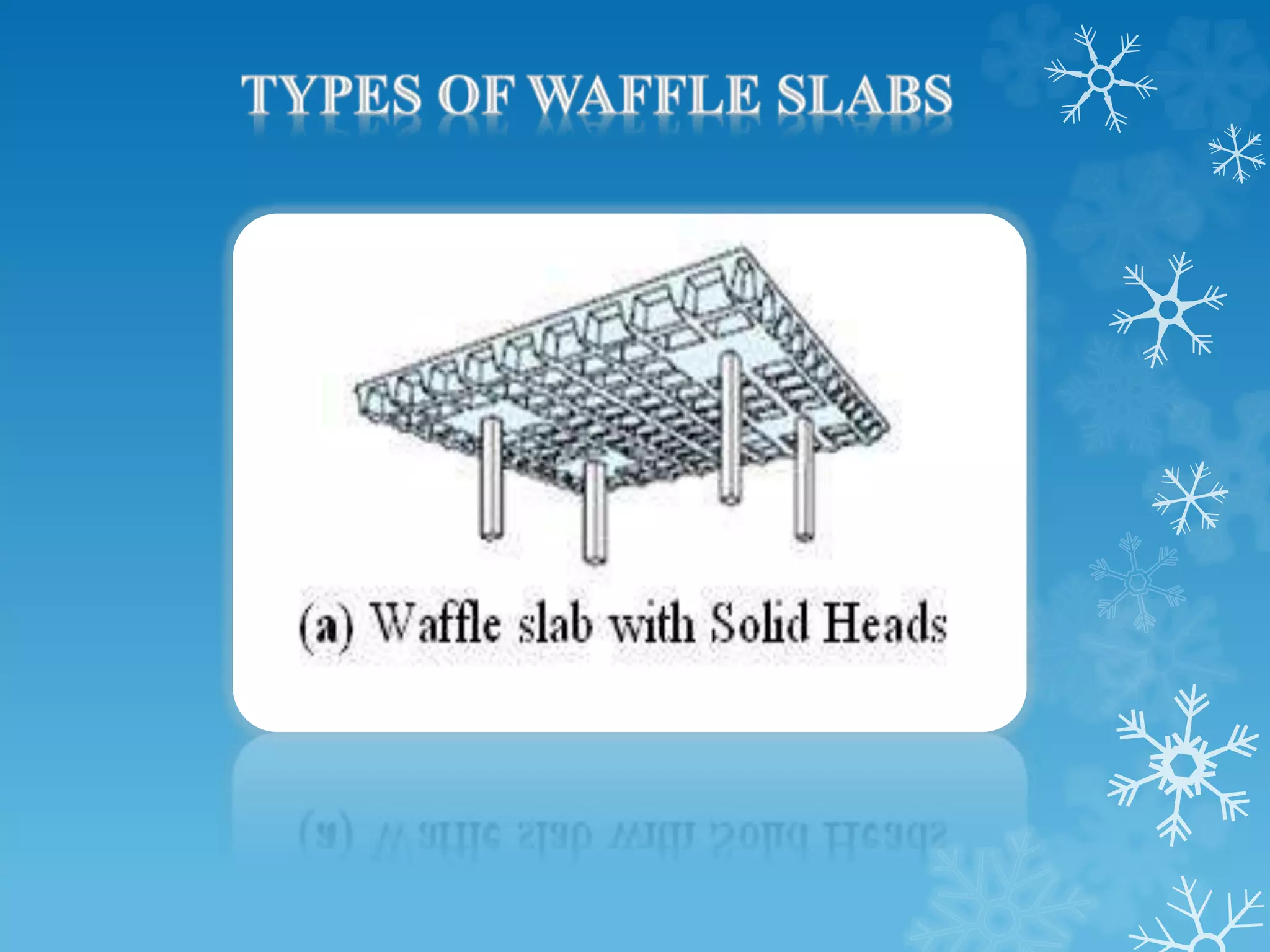
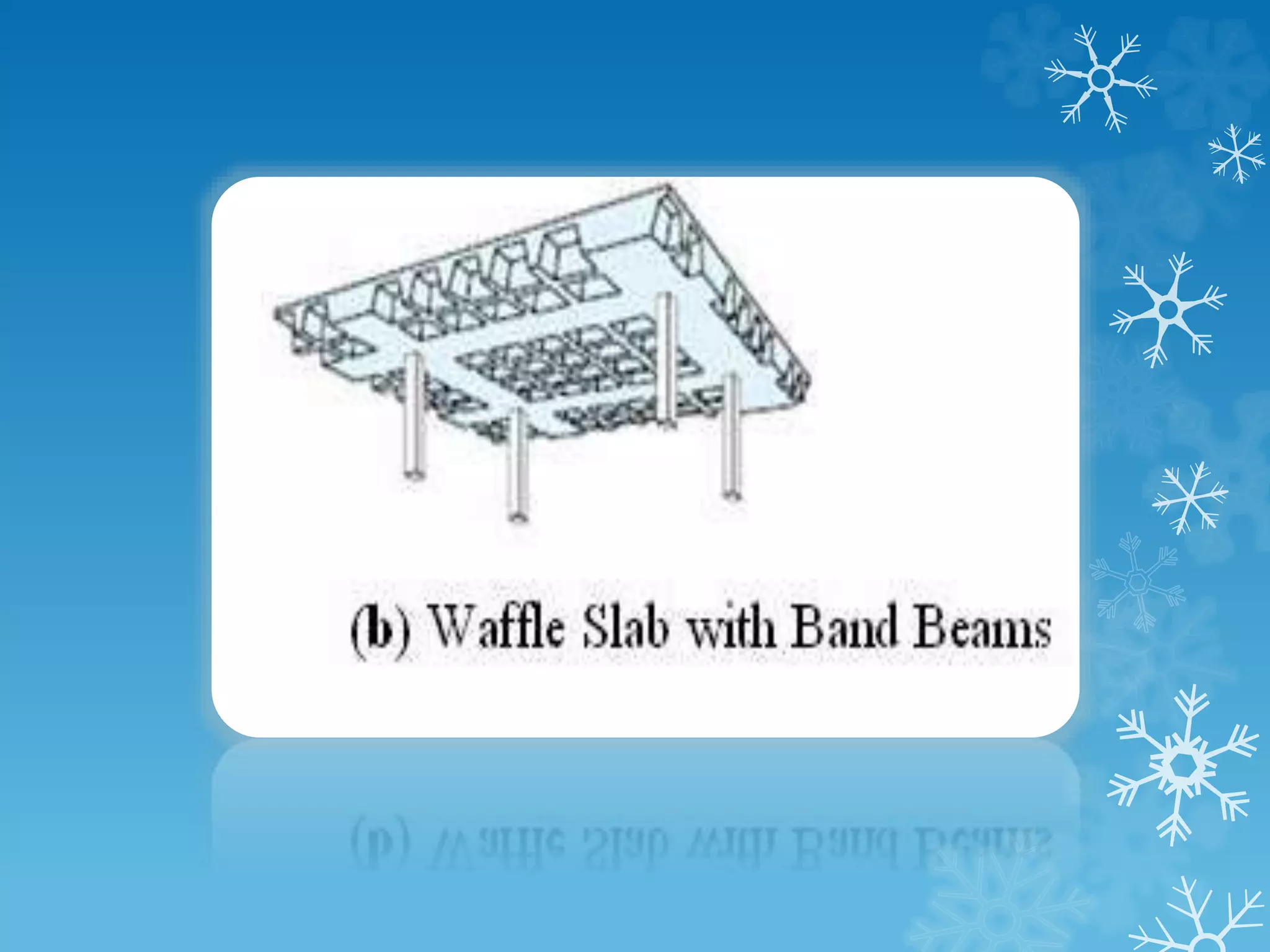
 THE COMBINATION OF EQUALLY SPACED
PARALLEL RIBS IN BOTH DIRECTIONS
 Used for Heavy Loads and Long Spans
 When the Building needs to be covered without Hindrance
and Supports
 To set the Attractive Ceiling
 Slab depth varies from 75mm to 125mm
 Rib width from 125mm to 200mm
 Rib spacing from 600mm to 1500mm
 Overall depth of floor from 300mm to 600mm
 To Study the structural behavior and optimum design of
Waffle Slab
 To show that for more than 25m span, Prestressed design is
economic
 To compare the results up to what span R.C.C. Waffle Slab
is economic
 To check weather it is safe to provide minimum depth of slab
METHODOLOGY :-
 Several analysis methods, Timoshenko’s Analysis, Finite Element
Method (FEM), and Direct Design Method (DDM) are available
to predict the structural behavior of the structure.
 In the project we are working on one long span structure and
analyses it with the help of various software, ETAB 15 and
SAFE 14 for Waffle Slab calculation and will be cross checked
with manual calculation for the both.
 The work includes the analysis and design of R.C.C. Waffle slab
and Prestressed Waffle slab for small span, medium span and
long span ranging from 8m to 30m.
CASE STUDY :-
J. Prasad[1], S. Chander[2], A.K. Ahuja[3]; “Optimum Dimensions of Waffle
Slab for Medium Size Floors”, Asian Journal of Civil Engineering VOL. 6, No.
3(2005).
 The author shows the results from the analysis carried out on waffle slab
medium size floor system with a view to achieve the optimum dimensions
of rib spacing, its depth and width.
 In order to carry out parametric investigation to arrive at optimum values
of rib number and dimensions for a given floor size, the waffle slabs with
square floor plans of size 6×6 m, 7×7 m and 8×8 m have been considered
for 3 kN/m2 and 5 kN/m2 of Live Load & Floor finish 1.5 kN/m2
 In order to evaluate dead loads unit-weight of R.C.C. as 25 kN/m3 has
taken
PROCEDURE ADOPTED:-
 The stiffness matrix is developed on the basis of writing joint equilibrium
in terms of stiffness co-efficient and unknown joint displacements and the
computer program for grid analysis, written in FORTRAN 77, has been
used for the present study.
 Floor deflections have been computed separately as elastic deflection
(short-term) (Δc) and creep deflection (long-term) (Δc).
 Results of the analytical study on 6×6 m square waffle slab under a live load
intensity of 3 kN/m2 with no. of ribs Nx = 5 and Ny = 5 are presented-
RESULTS OBTAINED:-
 Results of the analytical study on 6×6 m square waffle slab under a live load
intensity of 3 kN/m2 with no. of ribs Nx = 7 and Ny = 7 are presented-
RESULTS OBTAINED:-
 Results of the analytical study on 6×6 m square waffle slab under a live load
intensity of 3 kN/m2 with no. of ribs Nx = 9 and Ny = 9 are presented-
RESULTS OBTAINED:-
Conclusion of Case Study:-
 For 6×6 m square floor plan, 5 ribs of 140 mm depth (overall depth 205
mm) is found to be structurally most efficient for 3 kN/m2 live load
intensity.
 For 5 kN/m2 live load intensity on a 6×6 m square floor plan, a choice
between 9 ribs of 150 mm depth and 7 ribs of 160 mm depth becomes
available. Percentage of dead load is about 50 in both the cases.
 For square floor plan of 7 × 7 m, the most efficient structural system is 9
ribs of 180 mm depth for a live load intensity of 3 kN/m2.
 For a live load intensity of 5 kN/m2, the most efficient structural system is
9 ribs of 200 mm depth for 7 × 7 m square floor plan.
 For square floor plan of 8 × 8 m, the most efficient structural system is 9
ribs of 240 mm depth for a live load intensity of 3 kN/m2.
 For square floor plan of 8 × 8 m, the most efficient structural system is 9
ribs of 220 mm depth using M-40 grade concrete for a live load intensity of
5 kN/m2.
CONCLUSION:-
 From the above research from the literature paper, I have concluded that
the use of Waffle Slab for long span and heavy loading is economical as
well as having constructional benefits as they exhibit higher stiffness and
smaller deflection.
 The use of Waffle slab can reduce the cost of project up to 20%.
 From the present study done on waffle slab, it is concluded that, the depth
of rib increases as the length of span increases, therefore it is economical to
use Prestressed Waffle slab.
REFREANCES:-
 J. Prasad[1], S. Chander[2], A.K. Ahuja[3]; “Optimum Dimensions of
Waffle Slab for Medium Size Floors”, Asian Journal of Civil Engineering
VOL. 6, No. 3(2005).
 Chowdhury [1], J. P. Singh [2]; “Analysis and Design of Waffle Slab with
different Boundary Conditions”, The Indian Concrete Journal (2015).
 Somasekhar [1], P. Prabhakaran [2]; “Analysis of Concrete Waffle Slab
with Opening”, International Journal of Emerging Technology and
Advanced Engineering VOL. 5, Issue 9 (2015).
 A. C. Galeb[1], Z. F. Atiyah[2]; “Optimum design of reinforced concrete
waffle slabs”, International Journal of Civil And Structural Engineering
Volume 1, No 4, (2011).
 Ibrahim Arman[1]; “Analysis of two- way ribbed and waffle slabs with
hidden beams”, International Journal For Computational Civil AND
Structural Engineering · January (2014).

Waffle slab

  • 1.
    “Comparative Study OfR.C.C. Waffle Slab Vis-à-Vis Prestressed Concrete Waffle Slab” PRESENTED BY- AKSHAY S. RAUT GUIDED BY- Prof. RIYAZ SAMEER SHAH Department of Civil Engineering, Prof. Ram Meghe Institute of Technology and Research, Badnera, Amravati, Maharashtra State, India 2015-16
  • 2.
     SLAB AREPLATE ELEMENTS FORMING FLOORS AND ROOFS IN BUILDINGS WHICH CARRIES UDL.  SPANING ONE WAY BETWEEN BEAM’s & WALL’s  SPANING TWO WAY BETWEEN SUPPORT BEAM’s & WALL’s  FLAT SLAB CARRIED ON EDGE BEAM WITH NO INTERIOR BEAMS
  • 3.
     THE COMBINATIONOF EQUALLY SPACED PARALLEL RIBS IN BOTH DIRECTIONS
  • 6.
     Used forHeavy Loads and Long Spans  When the Building needs to be covered without Hindrance and Supports  To set the Attractive Ceiling  Slab depth varies from 75mm to 125mm  Rib width from 125mm to 200mm  Rib spacing from 600mm to 1500mm  Overall depth of floor from 300mm to 600mm
  • 7.
     To Studythe structural behavior and optimum design of Waffle Slab  To show that for more than 25m span, Prestressed design is economic  To compare the results up to what span R.C.C. Waffle Slab is economic  To check weather it is safe to provide minimum depth of slab
  • 8.
    METHODOLOGY :-  Severalanalysis methods, Timoshenko’s Analysis, Finite Element Method (FEM), and Direct Design Method (DDM) are available to predict the structural behavior of the structure.  In the project we are working on one long span structure and analyses it with the help of various software, ETAB 15 and SAFE 14 for Waffle Slab calculation and will be cross checked with manual calculation for the both.  The work includes the analysis and design of R.C.C. Waffle slab and Prestressed Waffle slab for small span, medium span and long span ranging from 8m to 30m.
  • 9.
    CASE STUDY :- J.Prasad[1], S. Chander[2], A.K. Ahuja[3]; “Optimum Dimensions of Waffle Slab for Medium Size Floors”, Asian Journal of Civil Engineering VOL. 6, No. 3(2005).  The author shows the results from the analysis carried out on waffle slab medium size floor system with a view to achieve the optimum dimensions of rib spacing, its depth and width.  In order to carry out parametric investigation to arrive at optimum values of rib number and dimensions for a given floor size, the waffle slabs with square floor plans of size 6×6 m, 7×7 m and 8×8 m have been considered for 3 kN/m2 and 5 kN/m2 of Live Load & Floor finish 1.5 kN/m2  In order to evaluate dead loads unit-weight of R.C.C. as 25 kN/m3 has taken
  • 10.
    PROCEDURE ADOPTED:-  Thestiffness matrix is developed on the basis of writing joint equilibrium in terms of stiffness co-efficient and unknown joint displacements and the computer program for grid analysis, written in FORTRAN 77, has been used for the present study.  Floor deflections have been computed separately as elastic deflection (short-term) (Δc) and creep deflection (long-term) (Δc).
  • 11.
     Results ofthe analytical study on 6×6 m square waffle slab under a live load intensity of 3 kN/m2 with no. of ribs Nx = 5 and Ny = 5 are presented- RESULTS OBTAINED:-
  • 12.
     Results ofthe analytical study on 6×6 m square waffle slab under a live load intensity of 3 kN/m2 with no. of ribs Nx = 7 and Ny = 7 are presented- RESULTS OBTAINED:-
  • 13.
     Results ofthe analytical study on 6×6 m square waffle slab under a live load intensity of 3 kN/m2 with no. of ribs Nx = 9 and Ny = 9 are presented- RESULTS OBTAINED:-
  • 14.
    Conclusion of CaseStudy:-  For 6×6 m square floor plan, 5 ribs of 140 mm depth (overall depth 205 mm) is found to be structurally most efficient for 3 kN/m2 live load intensity.  For 5 kN/m2 live load intensity on a 6×6 m square floor plan, a choice between 9 ribs of 150 mm depth and 7 ribs of 160 mm depth becomes available. Percentage of dead load is about 50 in both the cases.  For square floor plan of 7 × 7 m, the most efficient structural system is 9 ribs of 180 mm depth for a live load intensity of 3 kN/m2.  For a live load intensity of 5 kN/m2, the most efficient structural system is 9 ribs of 200 mm depth for 7 × 7 m square floor plan.  For square floor plan of 8 × 8 m, the most efficient structural system is 9 ribs of 240 mm depth for a live load intensity of 3 kN/m2.  For square floor plan of 8 × 8 m, the most efficient structural system is 9 ribs of 220 mm depth using M-40 grade concrete for a live load intensity of 5 kN/m2.
  • 15.
    CONCLUSION:-  From theabove research from the literature paper, I have concluded that the use of Waffle Slab for long span and heavy loading is economical as well as having constructional benefits as they exhibit higher stiffness and smaller deflection.  The use of Waffle slab can reduce the cost of project up to 20%.  From the present study done on waffle slab, it is concluded that, the depth of rib increases as the length of span increases, therefore it is economical to use Prestressed Waffle slab.
  • 16.
    REFREANCES:-  J. Prasad[1],S. Chander[2], A.K. Ahuja[3]; “Optimum Dimensions of Waffle Slab for Medium Size Floors”, Asian Journal of Civil Engineering VOL. 6, No. 3(2005).  Chowdhury [1], J. P. Singh [2]; “Analysis and Design of Waffle Slab with different Boundary Conditions”, The Indian Concrete Journal (2015).  Somasekhar [1], P. Prabhakaran [2]; “Analysis of Concrete Waffle Slab with Opening”, International Journal of Emerging Technology and Advanced Engineering VOL. 5, Issue 9 (2015).  A. C. Galeb[1], Z. F. Atiyah[2]; “Optimum design of reinforced concrete waffle slabs”, International Journal of Civil And Structural Engineering Volume 1, No 4, (2011).  Ibrahim Arman[1]; “Analysis of two- way ribbed and waffle slabs with hidden beams”, International Journal For Computational Civil AND Structural Engineering · January (2014).