The Lady and the Spider
by Robert Fulghum
Review
1. What is a fact?
 A statement that can be proved.
2. What is an opinion?
 A judgment that can be supported but not
proved.
3. What resources can you use to
check facts?
 Dictionaries
 Encyclopedias
 Reliable Web sites
4. What is tone?
 The writer’s attitude toward his or her
audience and subject.
5. What factors contribute to tone?
 Word choice, sentence structure, and
sentence length
 Characteristics such as the use of complex
sentences, sentence fragments, contractions,
scientific vocabulary, or slang describe tone.
 Ex. If you plan ahead, I promise you, you’ll have
the best party ever!
(Notice how word choice can create a friendly
tone.)
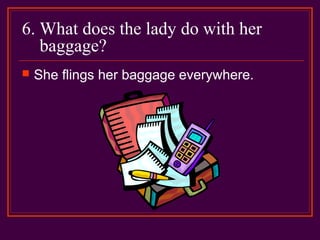
6. What does the lady do with her
baggage?
 She flings her baggage everywhere.
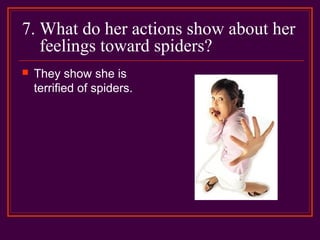
7. What do her actions show about her
feelings toward spiders?
 They show she is
terrified of spiders.
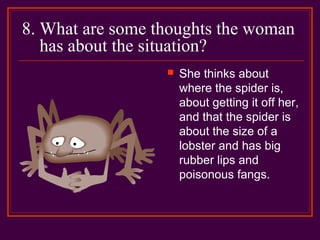
8. What are some thoughts the woman
has about the situation?
 She thinks about
where the spider is,
about getting it off her,
and that the spider is
about the size of a
lobster and has big
rubber lips and
poisonous fangs.
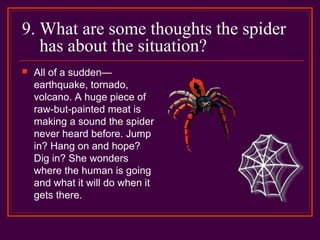
9. What are some thoughts the spider
has about the situation?
 All of a sudden—
earthquake, tornado,
volcano. A huge piece of
raw-but-painted meat is
making a sound the spider
never heard before. Jump
in? Hang on and hope?
Dig in? She wonders
where the human is going
and what it will do when it
gets there.
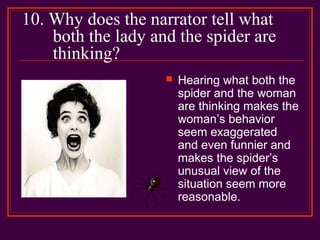
10. Why does the narrator tell what
both the lady and the spider are
thinking?
 Hearing what both the
spider and the woman
are thinking makes the
woman’s behavior
seem exaggerated
and even funnier and
makes the spider’s
unusual view of the
situation seem more
reasonable.
11. How does the author feel about
spiders? How do you know?
 The author thinks spiders are amazing.
 He describes how long they’ve been
around, their number, and how they make
webs.
12. List two details about the lady’s
fear that the narrator presents as
facts.
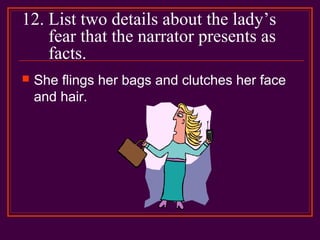
 She flings her bags and clutches her face
and hair.
13. List two details about the lady’s
fear that the narrator presents as
opinions.
 Her scream is “about
the level of a fire
engine at full cry” and
she “thinks the spider
is about the size of a
lobster.”
14. What are two facts from the essay
that you could prove true or false
by checking on the Internet?
 Spiders have been around for about 350
million years.
 There are sixty or seventy thousand spiders
per suburban acre.
15. Describe the tone of “The Lady
and the Spider.”
 The tone is humorous and informal.
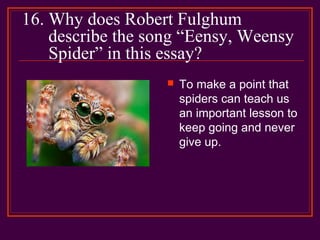
16. Why does Robert Fulghum
describe the song “Eensy, Weensy
Spider” in this essay?
 To make a point that
spiders can teach us
an important lesson to
keep going and never
give up.
17. How does Robert Fulghum make
his essay funny?
 He uses exaggeration such as describing the
lady’s scream at about the level of a fire engine at
full cry or the spider having rubber lips.
 He uses the point of view of the spider to describe
the woman.
 She flings her baggage in all directions. And at the same
time does a high-kick, jitterbug sort of dance—like a
mating stork in crazed heat. The web is torn loose and is
wrapped around a frenzied haystack, and a huge piece of
raw-but-painted meat is making a sound the spider never
heard before.
17. continued
 The author also describes the spider as if it were
human.
 Ordinary, middle-aged lady spider that has been up since
before dawn working on her web and thinking about the
little gnats she’d like to have for breakfast.
 He considers what it would be like if people were
equipped like spiders.
 With the little six-nozzled aperture at the base of the
spine, humans could make something like glass fiber to
wrap packages, to mountain climb, and to compete in
Olympic events.
17. continued
 He uses repetition to mention the woman’s
scream: “AAAAAAGGGGGGHHHHHH!!!!”
18. Mode
 Way of doing something
Please
study for
your test!
19. Frenzied
 Acting in a wild, uncontrolled way
20. Inhabited
 Lived in; occupied

The lady and the spider p point

  • 1.
    The Lady andthe Spider by Robert Fulghum Review
  • 2.
    1. What isa fact?  A statement that can be proved.
  • 3.
    2. What isan opinion?  A judgment that can be supported but not proved.
  • 4.
    3. What resourcescan you use to check facts?  Dictionaries  Encyclopedias  Reliable Web sites
  • 5.
    4. What istone?  The writer’s attitude toward his or her audience and subject.
  • 6.
    5. What factorscontribute to tone?  Word choice, sentence structure, and sentence length  Characteristics such as the use of complex sentences, sentence fragments, contractions, scientific vocabulary, or slang describe tone.  Ex. If you plan ahead, I promise you, you’ll have the best party ever! (Notice how word choice can create a friendly tone.)
  • 7.
    6. What doesthe lady do with her baggage?  She flings her baggage everywhere.
  • 8.
    7. What doher actions show about her feelings toward spiders?  They show she is terrified of spiders.
  • 9.
    8. What aresome thoughts the woman has about the situation?  She thinks about where the spider is, about getting it off her, and that the spider is about the size of a lobster and has big rubber lips and poisonous fangs.
  • 10.
    9. What aresome thoughts the spider has about the situation?  All of a sudden— earthquake, tornado, volcano. A huge piece of raw-but-painted meat is making a sound the spider never heard before. Jump in? Hang on and hope? Dig in? She wonders where the human is going and what it will do when it gets there.
  • 11.
    10. Why doesthe narrator tell what both the lady and the spider are thinking?  Hearing what both the spider and the woman are thinking makes the woman’s behavior seem exaggerated and even funnier and makes the spider’s unusual view of the situation seem more reasonable.
  • 12.
    11. How doesthe author feel about spiders? How do you know?  The author thinks spiders are amazing.  He describes how long they’ve been around, their number, and how they make webs.
  • 13.
    12. List twodetails about the lady’s fear that the narrator presents as facts.  She flings her bags and clutches her face and hair.
  • 14.
    13. List twodetails about the lady’s fear that the narrator presents as opinions.  Her scream is “about the level of a fire engine at full cry” and she “thinks the spider is about the size of a lobster.”
  • 15.
    14. What aretwo facts from the essay that you could prove true or false by checking on the Internet?  Spiders have been around for about 350 million years.  There are sixty or seventy thousand spiders per suburban acre.
  • 16.
    15. Describe thetone of “The Lady and the Spider.”  The tone is humorous and informal.
  • 17.
    16. Why doesRobert Fulghum describe the song “Eensy, Weensy Spider” in this essay?  To make a point that spiders can teach us an important lesson to keep going and never give up.
  • 18.
    17. How doesRobert Fulghum make his essay funny?  He uses exaggeration such as describing the lady’s scream at about the level of a fire engine at full cry or the spider having rubber lips.  He uses the point of view of the spider to describe the woman.  She flings her baggage in all directions. And at the same time does a high-kick, jitterbug sort of dance—like a mating stork in crazed heat. The web is torn loose and is wrapped around a frenzied haystack, and a huge piece of raw-but-painted meat is making a sound the spider never heard before.
  • 19.
    17. continued  Theauthor also describes the spider as if it were human.  Ordinary, middle-aged lady spider that has been up since before dawn working on her web and thinking about the little gnats she’d like to have for breakfast.  He considers what it would be like if people were equipped like spiders.  With the little six-nozzled aperture at the base of the spine, humans could make something like glass fiber to wrap packages, to mountain climb, and to compete in Olympic events.
  • 20.
    17. continued  Heuses repetition to mention the woman’s scream: “AAAAAAGGGGGGHHHHHH!!!!”
  • 21.
    18. Mode  Wayof doing something Please study for your test!
  • 22.
    19. Frenzied  Actingin a wild, uncontrolled way
  • 23.