
MIM
Overview Information Resource Management Online Information Publications Benefits of Online Publications  Strategic Management
Information Resource Management Information Resource Management (IRM): To manage and control all of the resources required to produce information.   The way IRM works is similar to Materials Resource Planning  (MRP) in manufacturing.   Both concern with cost effective and efficient use of resources.   MRP is concerned with managing products while IRM is    concerned with managing information.
Information Resource Management The use of IRM in societal sectors: 1. Private Sectors: corporations, factories 2. Federal Agencies: public banks, intelligent agencies, etc Three disciplines of Information Resource Management:" 1.  Database Management:  --> To manage the data on daily basis using database in    corporations. 2.  Records Management --> To handle effective storage, retrieval and the use of    documents in corporations. 3.  Data Processing Management --> To provide better support for corporate decision making.
Information Resource Management Three classes of information resources:   1.  BUSINESS RESOURCES   - Enterprises   - Business Functions   - Positions (Jobs)   - Human/Machine Resources   - Skills   - Business Objectives   - Projects, and    - Information Requirements.    2.  SYSTEM RESOURCES  3.  DATA RESOURCES
Information Resource Management Three classes of information resources:   1.  BUSINESS RESOURCES   2.  SYSTEM RESOURCES    - Systems   - Sub-Systems (business processes)   - Administrative Procedures (manual procedures and office    automation related)   - Computer Procedures, Programs, Operational Steps,  Modules, and Subroutines. 3.  DATA RESOURCES
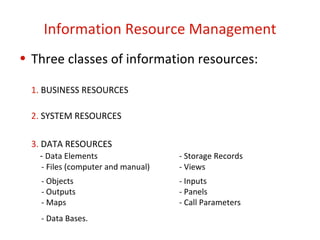
Information Resource Management Three classes of information resources:   1.  BUSINESS RESOURCES 2.  SYSTEM RESOURCES  3.  DATA RESOURCES   -  Data Elements  - Storage Records   - Files (computer and manual) - Views   - Objects - Inputs   - Outputs - Panels   - Maps - Call Parameters    - Data Bases.
Information Resource Management Benefits of IRM:   1.  All information resources are controllable, permitting the ability  to design integrated systems and perform an "impact analysis"  of a proposed resource change.   2.  Simplified search of information resources for reuse.  Redundancy of resource definition is eliminated.  3.  Complete and current documentation of all information  resources, in an organized and meaningful way.  4.  Communications within the organization is improved
Online Information Publications Examples: 1.  Management Information System Quarterly (MIS Quarterly) 2.  International Journal of Information Management (IJIM) 3.  Google Scholar, etc
Online Information Publications 1.   MIS Quarterly Published by MIS Research center @ the University of Minnesota Academic journal that issues scholarly literature in the area  of Management Information System & Information Technology MIS Quarterly  has the highest  impact factor  (4.978) of all peer reviewed academic journals in the field of Business from 1992 – 2005 ( Mangematin  2008 )  Website:  http://www.misq.org
Online Information Publications 2.   International Journal of Information Management (IJIM) It keeps the reader briefed with major papers, reports and reviews  It is topical:  viewpoint articles and other regular features including Research Notes, Case Studies and a Reviews section help keep the reader up to date with current issues.  It focuses on high quality papers that address contemporary issues for all those involved in information management and which make a contribution to advancing information management theory and practice   http://www.elsevier.com/wps/find/journaldescription.cws_home/30434/description#description
Online Information Publications 3.   Google Scholar - Built in 2004; which was intended to locate scholarly  literature available online. Advantages: * It is free and available at anytime and anywhere. * It is easy to understand. * Users may find citation that are unavailable through library databases. Disadvantages: * It does  not  index all scholarly papers on a particular topic. * It is not easy to limit your search. * Although it’s free, but many of the links lead you pay-per-view sites.
Online Information Publications 3.   Google Scholar The results: A. Article Links   - The most common result in Google Scholar with links/records to  to journal article B. Article Citations - They are the same as article links; nonetheless it has no  abstract or link supplied C. Article Books - They search several books
Strategic Management Approaches:   A. The Industrial Organizational Approach   * Based on economic theory  - deals with issues like competitive rivalry, resource  allocation, economies of scale   * Assumptions  - rationality, self discipline behaviour, profit maximization B. The Sociological Approach   * Deals primarily with human interactions   * Assumptions  - satisfying behaviour, profit optimality.
Strategic Management More strategies: A.  Corporate strategy refers to the overarching strategy of the  diversified firm.  B.  Business strategy refers to the aggregated strategies of  single business firm. C.  Functional strategies include marketing strategies,  new product development strategies, human resource  strategies, financial strategies, legal strategies,  supply-chain strategies, and information technology  management strategies.
References Traut, E. (1989). The Evolution of Information Resource Management  Bryce, T. (2009) Information Resource Management. Excerpt from:  http://it.toolbox.com/wiki/index.php/Information_Resource_Management

Information Resources Management

  • 1.
  • 2.
    Overview Information ResourceManagement Online Information Publications Benefits of Online Publications Strategic Management
  • 3.
    Information Resource ManagementInformation Resource Management (IRM): To manage and control all of the resources required to produce information.   The way IRM works is similar to Materials Resource Planning (MRP) in manufacturing.  Both concern with cost effective and efficient use of resources.  MRP is concerned with managing products while IRM is concerned with managing information.
  • 4.
    Information Resource ManagementThe use of IRM in societal sectors: 1. Private Sectors: corporations, factories 2. Federal Agencies: public banks, intelligent agencies, etc Three disciplines of Information Resource Management:" 1. Database Management: --> To manage the data on daily basis using database in corporations. 2. Records Management --> To handle effective storage, retrieval and the use of documents in corporations. 3. Data Processing Management --> To provide better support for corporate decision making.
  • 5.
    Information Resource ManagementThree classes of information resources:   1. BUSINESS RESOURCES - Enterprises - Business Functions - Positions (Jobs) - Human/Machine Resources - Skills - Business Objectives - Projects, and - Information Requirements.   2. SYSTEM RESOURCES 3. DATA RESOURCES
  • 6.
    Information Resource ManagementThree classes of information resources:   1. BUSINESS RESOURCES   2. SYSTEM RESOURCES - Systems - Sub-Systems (business processes) - Administrative Procedures (manual procedures and office automation related) - Computer Procedures, Programs, Operational Steps, Modules, and Subroutines. 3. DATA RESOURCES
  • 7.
    Information Resource ManagementThree classes of information resources:   1. BUSINESS RESOURCES 2. SYSTEM RESOURCES 3. DATA RESOURCES - Data Elements - Storage Records - Files (computer and manual) - Views - Objects - Inputs - Outputs - Panels - Maps - Call Parameters - Data Bases.
  • 8.
    Information Resource ManagementBenefits of IRM:   1. All information resources are controllable, permitting the ability to design integrated systems and perform an "impact analysis" of a proposed resource change. 2. Simplified search of information resources for reuse. Redundancy of resource definition is eliminated. 3. Complete and current documentation of all information resources, in an organized and meaningful way. 4. Communications within the organization is improved
  • 9.
    Online Information PublicationsExamples: 1. Management Information System Quarterly (MIS Quarterly) 2. International Journal of Information Management (IJIM) 3. Google Scholar, etc
  • 10.
    Online Information Publications1. MIS Quarterly Published by MIS Research center @ the University of Minnesota Academic journal that issues scholarly literature in the area of Management Information System & Information Technology MIS Quarterly has the highest impact factor (4.978) of all peer reviewed academic journals in the field of Business from 1992 – 2005 ( Mangematin 2008 ) Website: http://www.misq.org
  • 11.
    Online Information Publications2. International Journal of Information Management (IJIM) It keeps the reader briefed with major papers, reports and reviews It is topical: viewpoint articles and other regular features including Research Notes, Case Studies and a Reviews section help keep the reader up to date with current issues. It focuses on high quality papers that address contemporary issues for all those involved in information management and which make a contribution to advancing information management theory and practice http://www.elsevier.com/wps/find/journaldescription.cws_home/30434/description#description
  • 12.
    Online Information Publications3. Google Scholar - Built in 2004; which was intended to locate scholarly literature available online. Advantages: * It is free and available at anytime and anywhere. * It is easy to understand. * Users may find citation that are unavailable through library databases. Disadvantages: * It does not index all scholarly papers on a particular topic. * It is not easy to limit your search. * Although it’s free, but many of the links lead you pay-per-view sites.
  • 13.
    Online Information Publications3. Google Scholar The results: A. Article Links - The most common result in Google Scholar with links/records to to journal article B. Article Citations - They are the same as article links; nonetheless it has no abstract or link supplied C. Article Books - They search several books
  • 14.
    Strategic Management Approaches:  A. The Industrial Organizational Approach * Based on economic theory - deals with issues like competitive rivalry, resource allocation, economies of scale * Assumptions - rationality, self discipline behaviour, profit maximization B. The Sociological Approach * Deals primarily with human interactions * Assumptions - satisfying behaviour, profit optimality.
  • 15.
    Strategic Management Morestrategies: A. Corporate strategy refers to the overarching strategy of the diversified firm. B. Business strategy refers to the aggregated strategies of single business firm. C. Functional strategies include marketing strategies, new product development strategies, human resource strategies, financial strategies, legal strategies, supply-chain strategies, and information technology management strategies.
  • 16.
    References Traut, E.(1989). The Evolution of Information Resource Management Bryce, T. (2009) Information Resource Management. Excerpt from: http://it.toolbox.com/wiki/index.php/Information_Resource_Management