Social Web
2016
Lecture 2: What People DO on the Social Web?
Davide Ceolin (credits to: Lora Aroyo)
The Network Institute
VU University Amsterdam
Public Service
Announcement (I)
• Groups are formed
• Contact me otherwise
• From this Thursday we will have 3 labs
• Next deadlines:
• Wednesday 23:59 – slides/plan/screencast of your final
assignment
• Friday 10:00 – Post your questions about Lecture 3
• Friday 17:00 – Vote your favorite question
• Subscribing to the website is the easiest,
otherwise:
• You can vote by commenting “+1”
• Your comments need my approval
• Final Assignment Updates
• List of NI member added to the website
Public Service
Announcement (II)
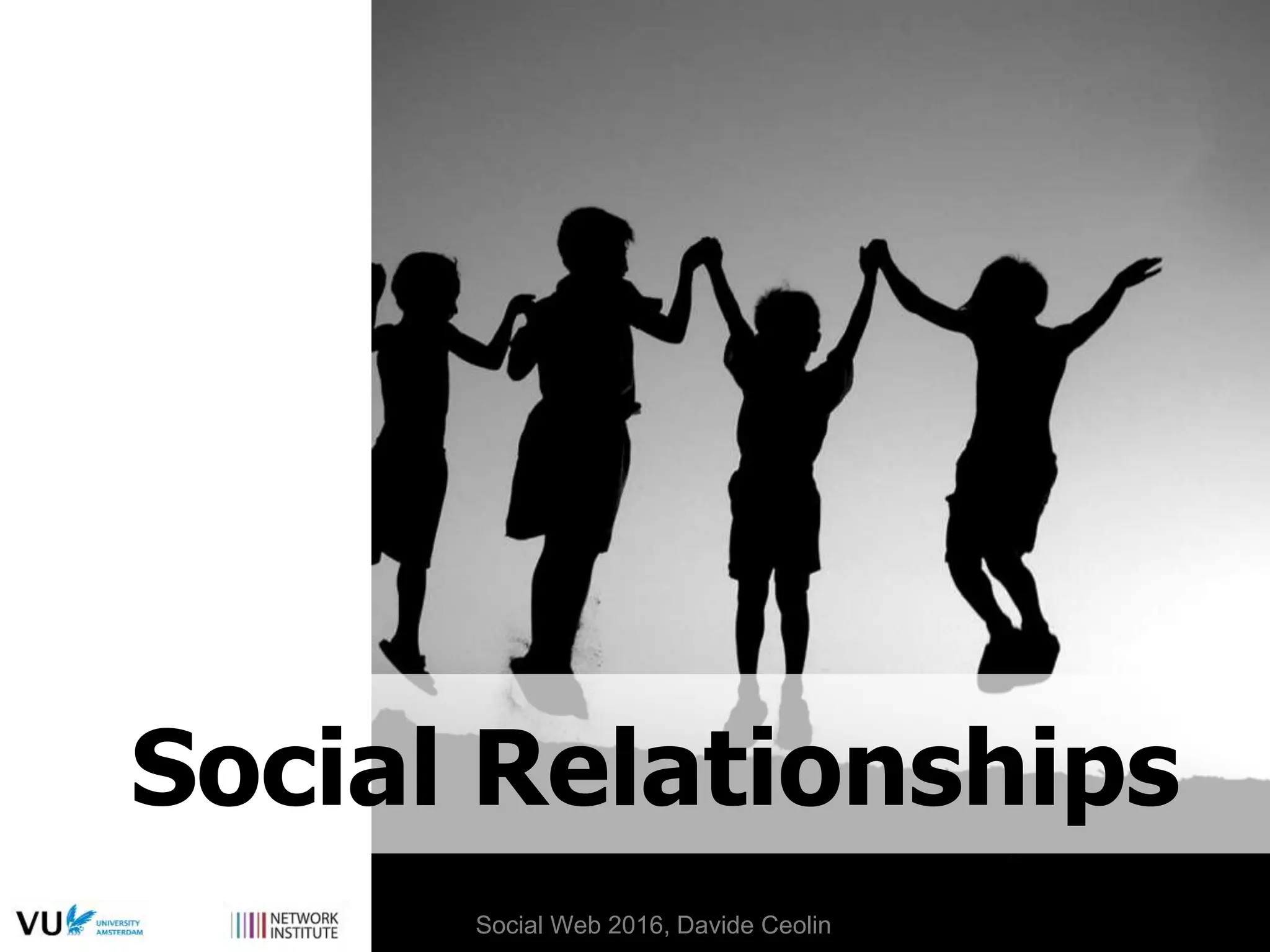
Social Relationships
Social Web 2016, Davide Ceolin
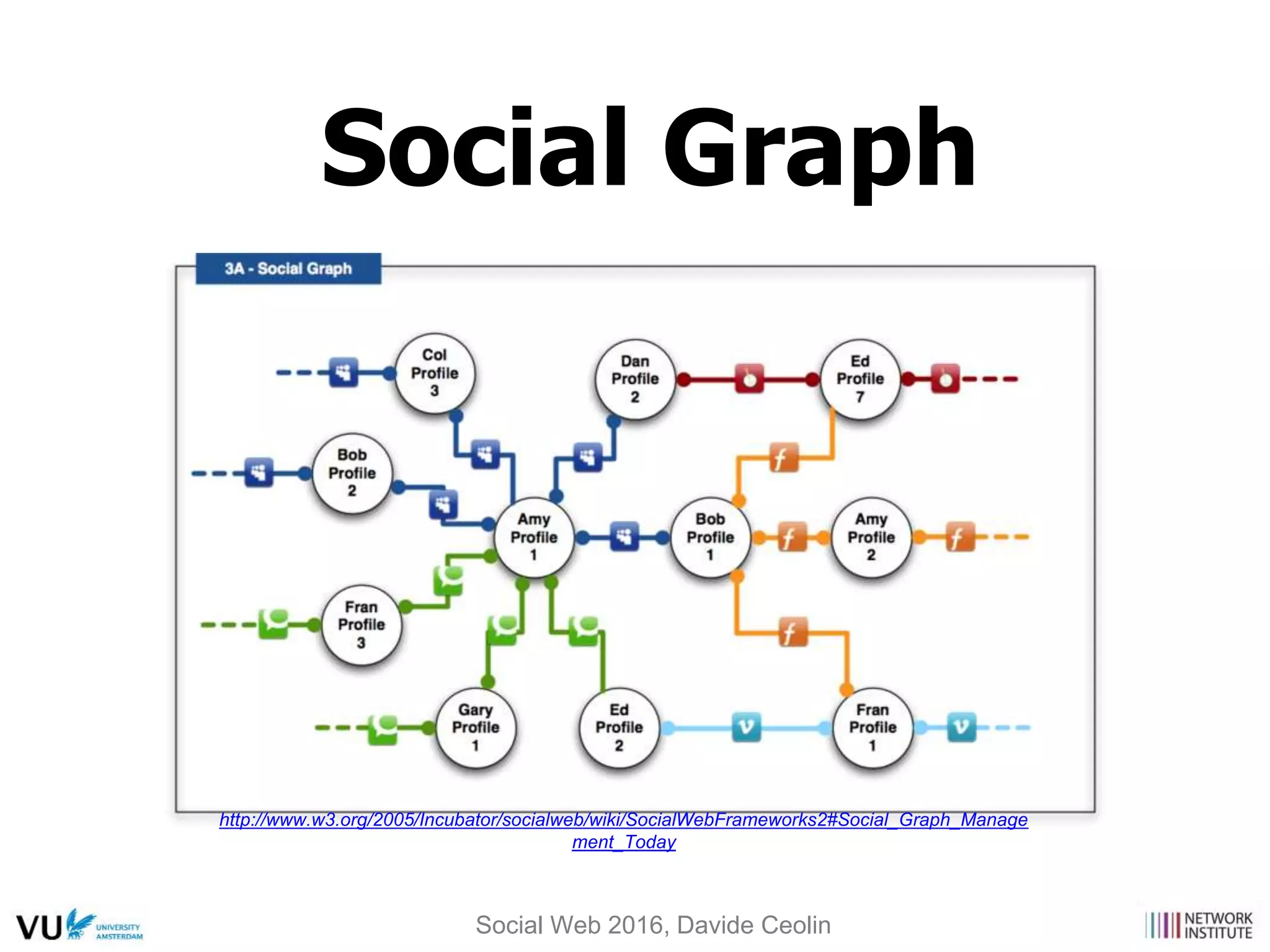
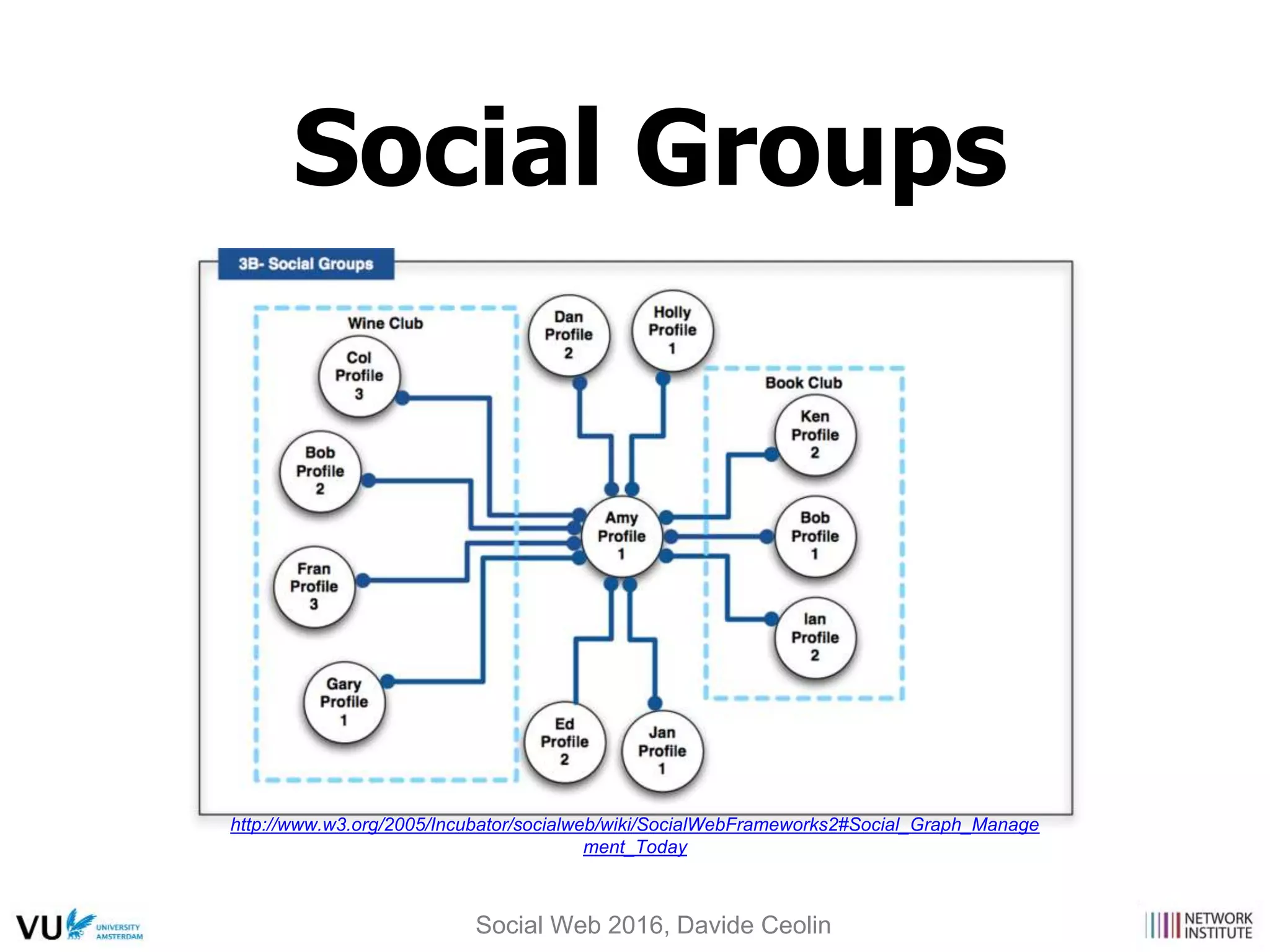
People have relationships within & across different contexts:
family, sports, work, friends
In ‘real world’ it works due to a relatively small set of social
contexts & interaction opportunitieshttp://www.w3.org/2005/Incubator/socialweb/wiki/SocialWebFrameworks2#Social_Graph_Mana
gement_Today
Social in Physical World
Social Web 2016, Davide Ceolin
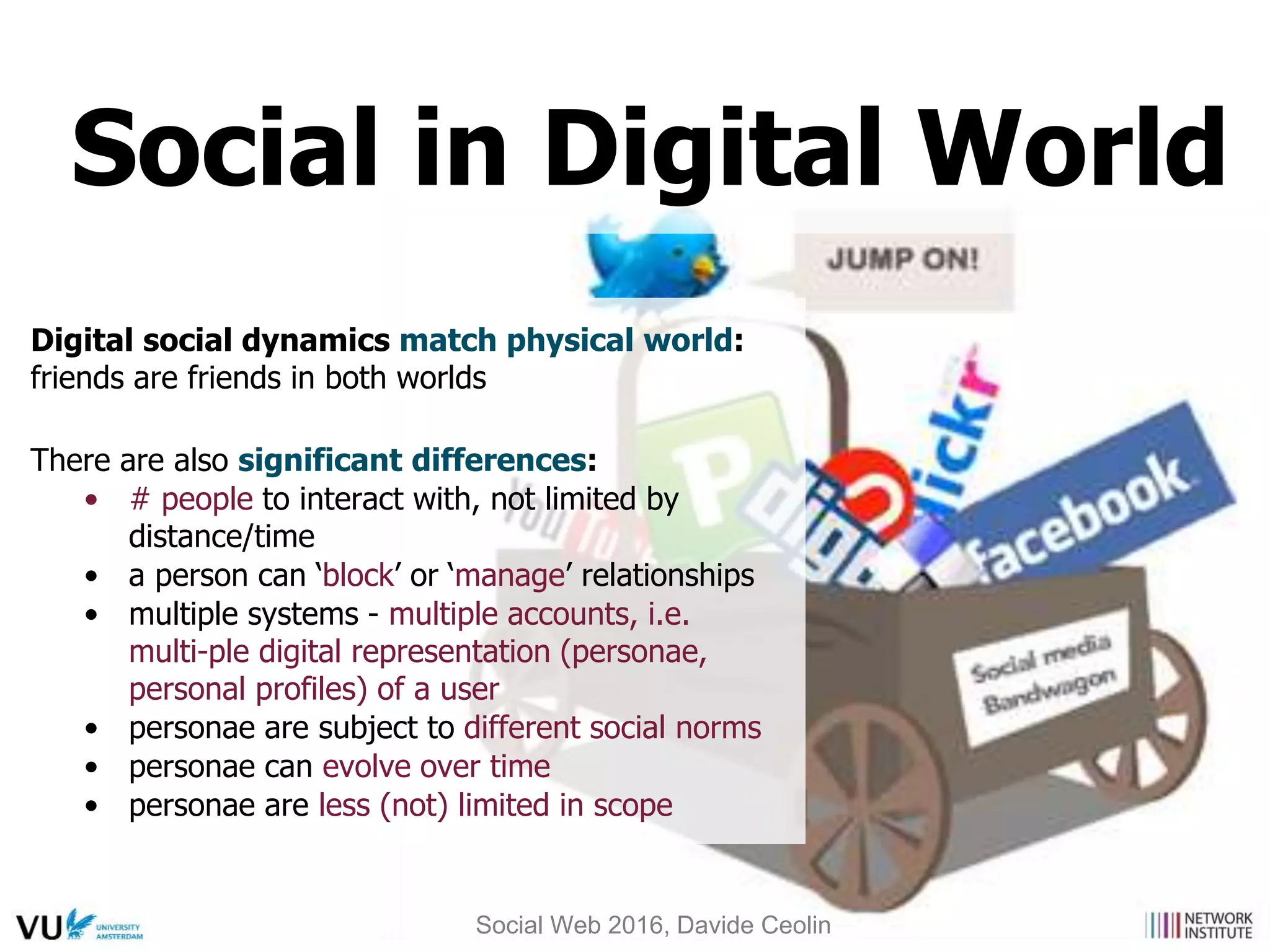
Digital social dynamics match physical world:
friends are friends in both worlds
There are also significant differences:
• # people to interact with, not limited by
distance/time
• a person can ‘block’ or ‘manage’ relationships
• multiple systems - multiple accounts, i.e.
multi-ple digital representation (personae,
personal profiles) of a user
• personae are subject to different social norms
• personae can evolve over time
• personae are less (not) limited in scope
Social in Digital World
Social Web 2016, Davide Ceolin
Accounts on different social networks, utilised in
different ways, depending on digital context, e.g.:
• friendly chat on Facebook
• professional discussion on LinkedIn
• dating on match.com
As a consequence there is a need to manage the
user profiles, identities & permissions, as well
as the data in them
Multiple SN Accounts
Social Web 2016, Davide Ceolin
Problems
Maintaining a multitude of online profiles for different contexts is
cumbersome and time consuming —> not scalable
Difficult for new social networks to attract new & maintain active
members simply because of the effort involved in creating & maintaining
“yet-another-profile”, e.g. re-establishing different aspects of your profile
under yet another context
Users cannot control how their information is viewed by others in
different contexts by different social applications
Social Web 2016, Davide Ceolin
for managing multiple Social Web profiles
“policy-oriented web” architecture to support
trusted services in the longer term
Architecture Needed
Social Web 2016, Davide Ceolin
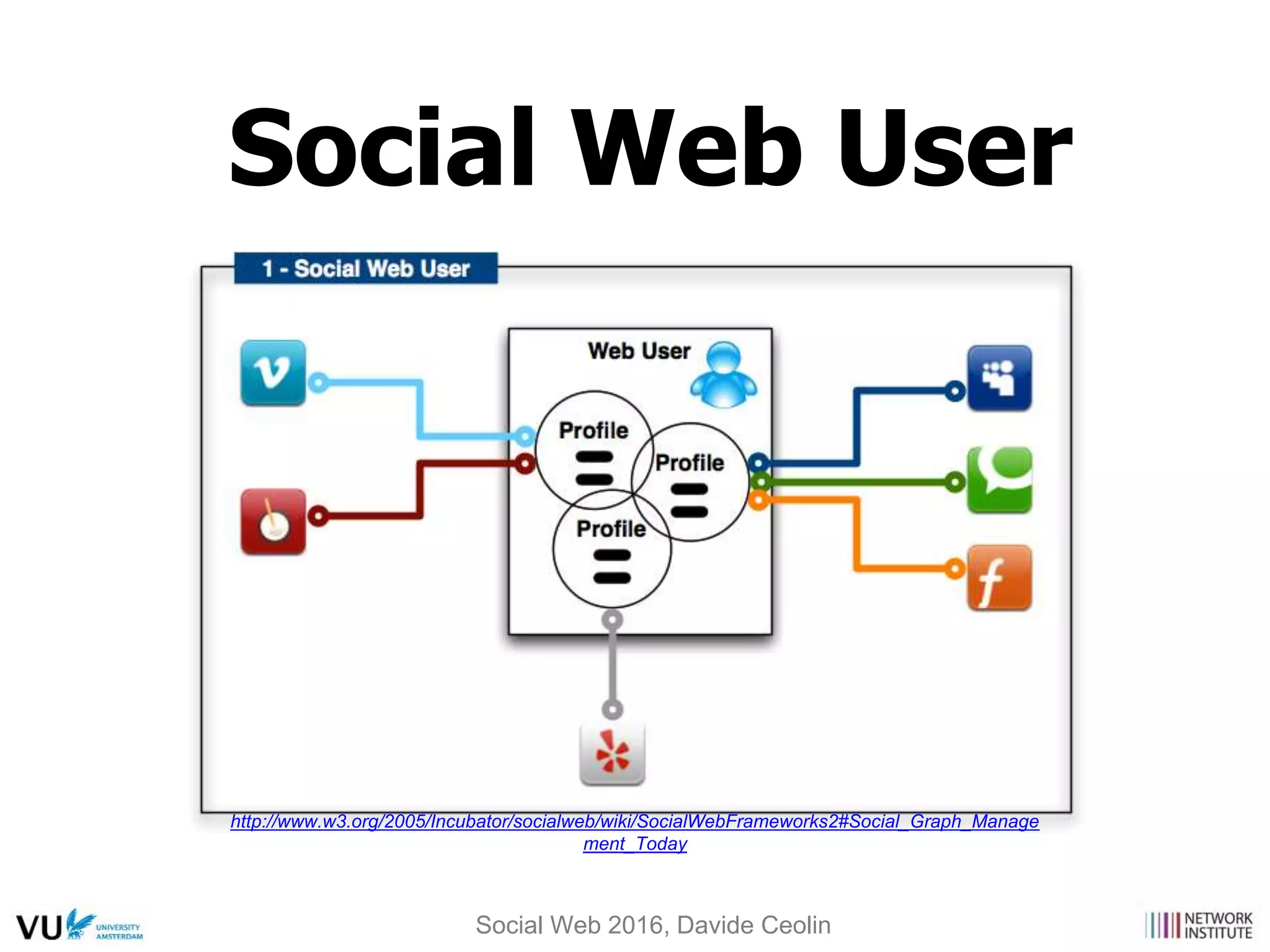
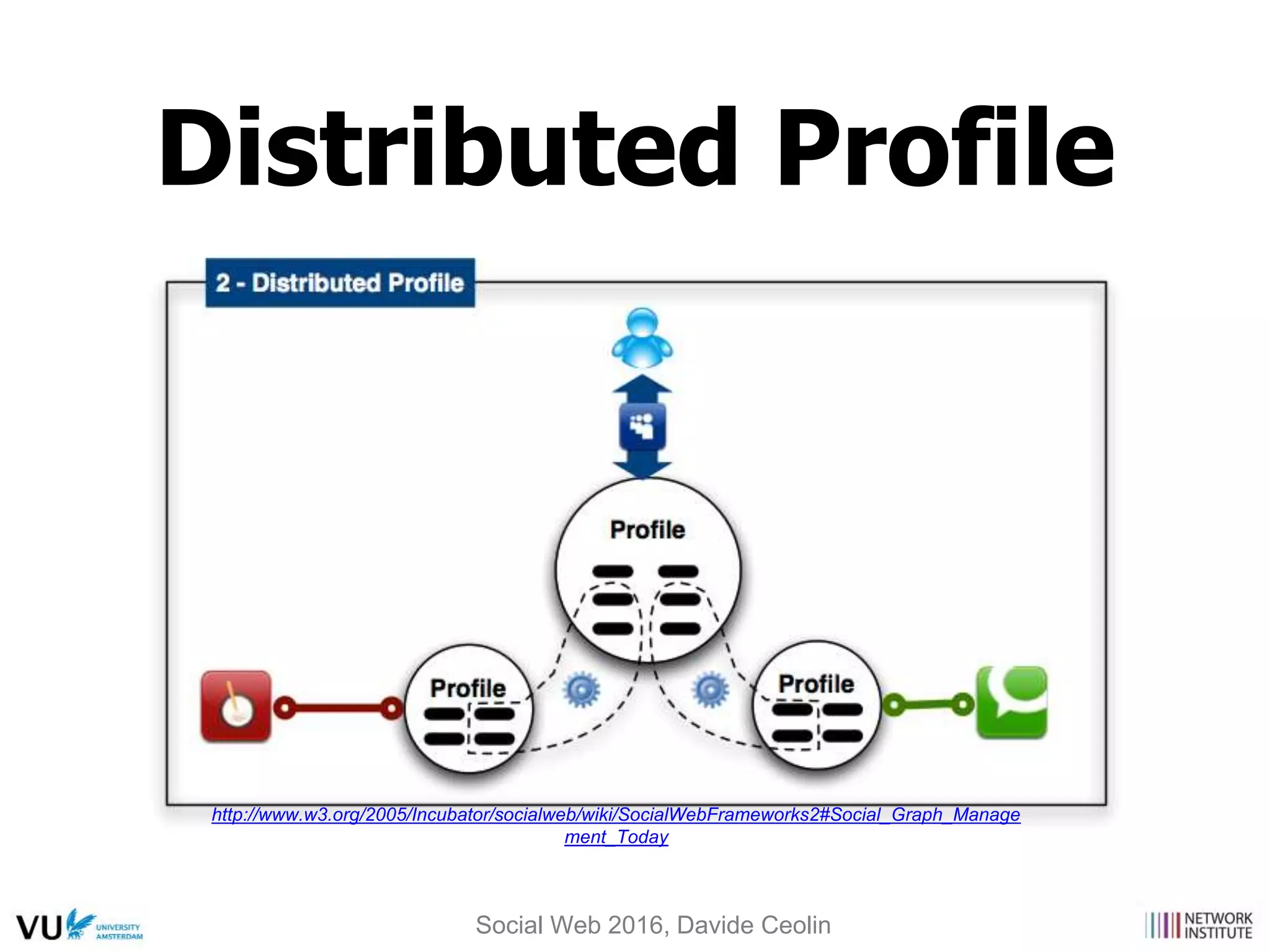
In one system manage your personal information:
• home address, telephone number, & best friends
• your Friends Profile gets exposed to Hives and Twitter
In another system manage work-related information:
• office address, office telephone number, & work colleagues
• your Work Profile gets exposed to Plaxo and LinkedIn
Another choice could be to store your entire profile locally with
a trusted third party, and then
• your Health Profile can be exposed to health care providers
• your Citizen Profile can be exposed to government services
For example …
Social Web 2016, Davide Ceolin
Social Web User
http://www.w3.org/2005/Incubator/socialweb/wiki/SocialWebFrameworks2#Social_Graph_Manage
ment_Today
Social Web 2016, Davide Ceolin
Distributed Profile
http://www.w3.org/2005/Incubator/socialweb/wiki/SocialWebFrameworks2#Social_Graph_Manage
ment_Today
Social Web 2016, Davide Ceolin
Social Graph
http://www.w3.org/2005/Incubator/socialweb/wiki/SocialWebFrameworks2#Social_Graph_Manage
ment_Today
Social Web 2016, Davide Ceolin
Social Groups
http://www.w3.org/2005/Incubator/socialweb/wiki/SocialWebFrameworks2#Social_Graph_Manage
ment_Today
Social Web 2016, Davide Ceolin
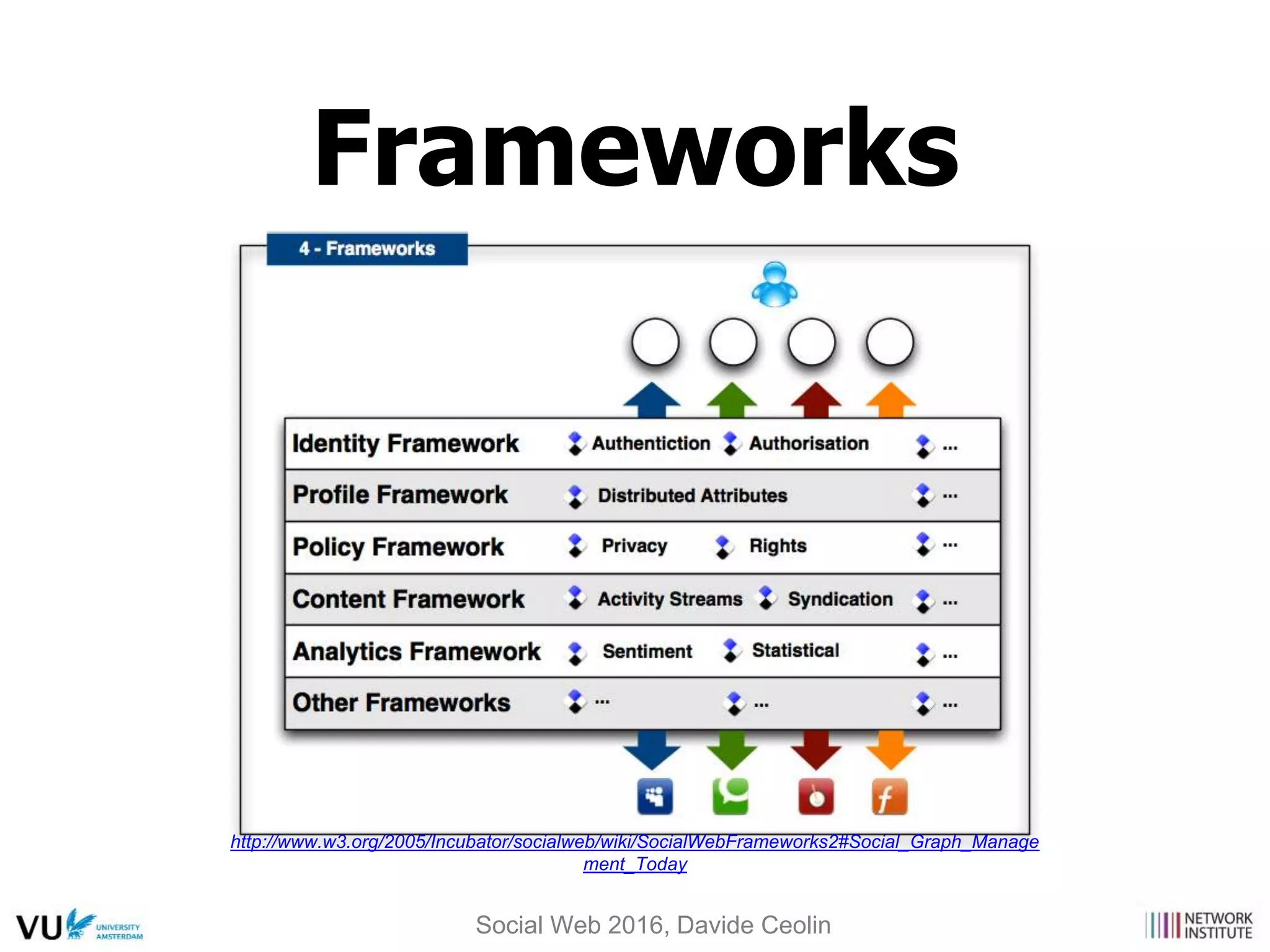
http://www.w3.org/2005/Incubator/socialweb/wiki/SocialWebFrameworks2#Social_Graph_Manage
ment_Today
Frameworks
Social Web 2016, Davide Ceolin
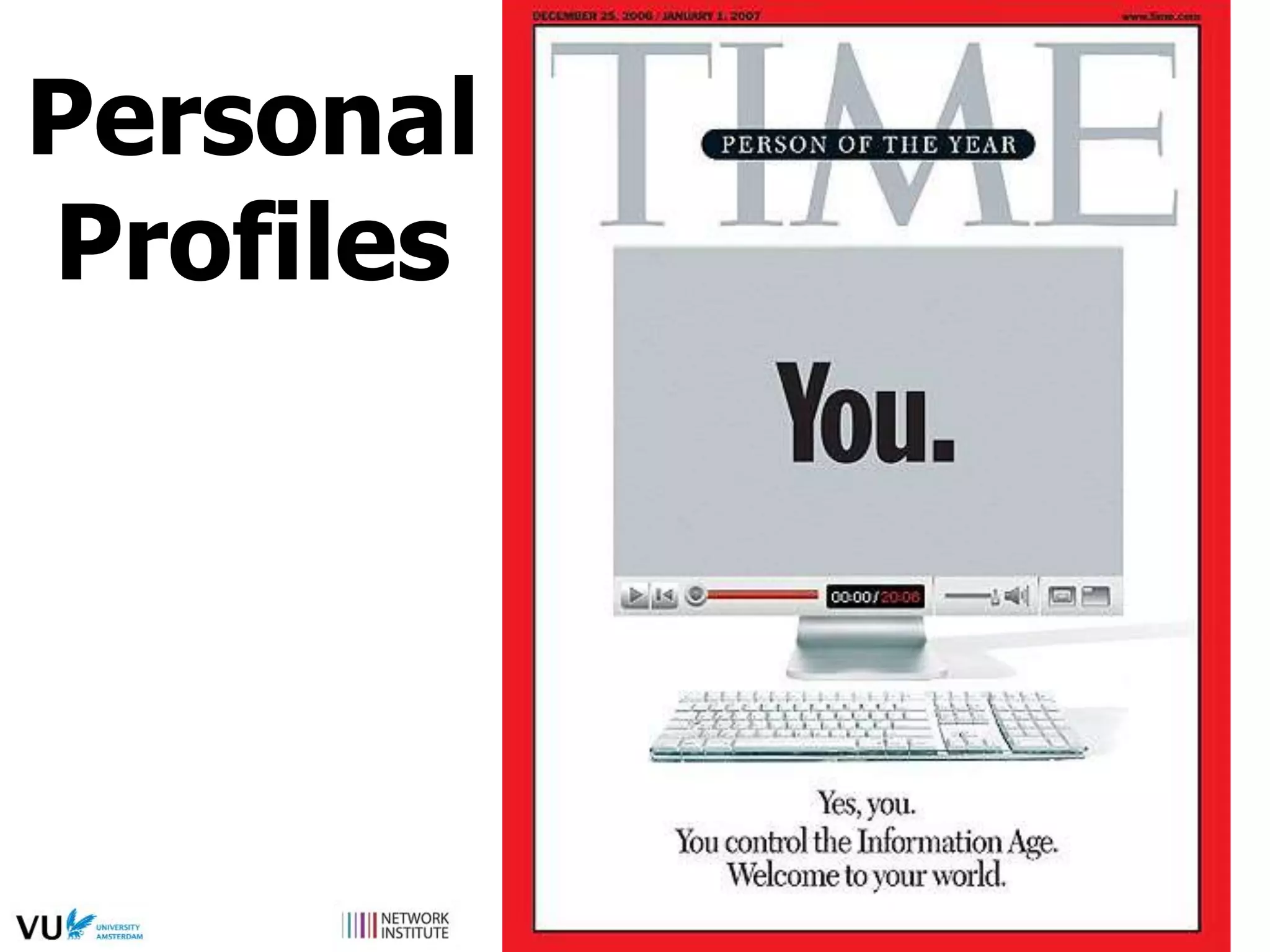
Personal
Profiles
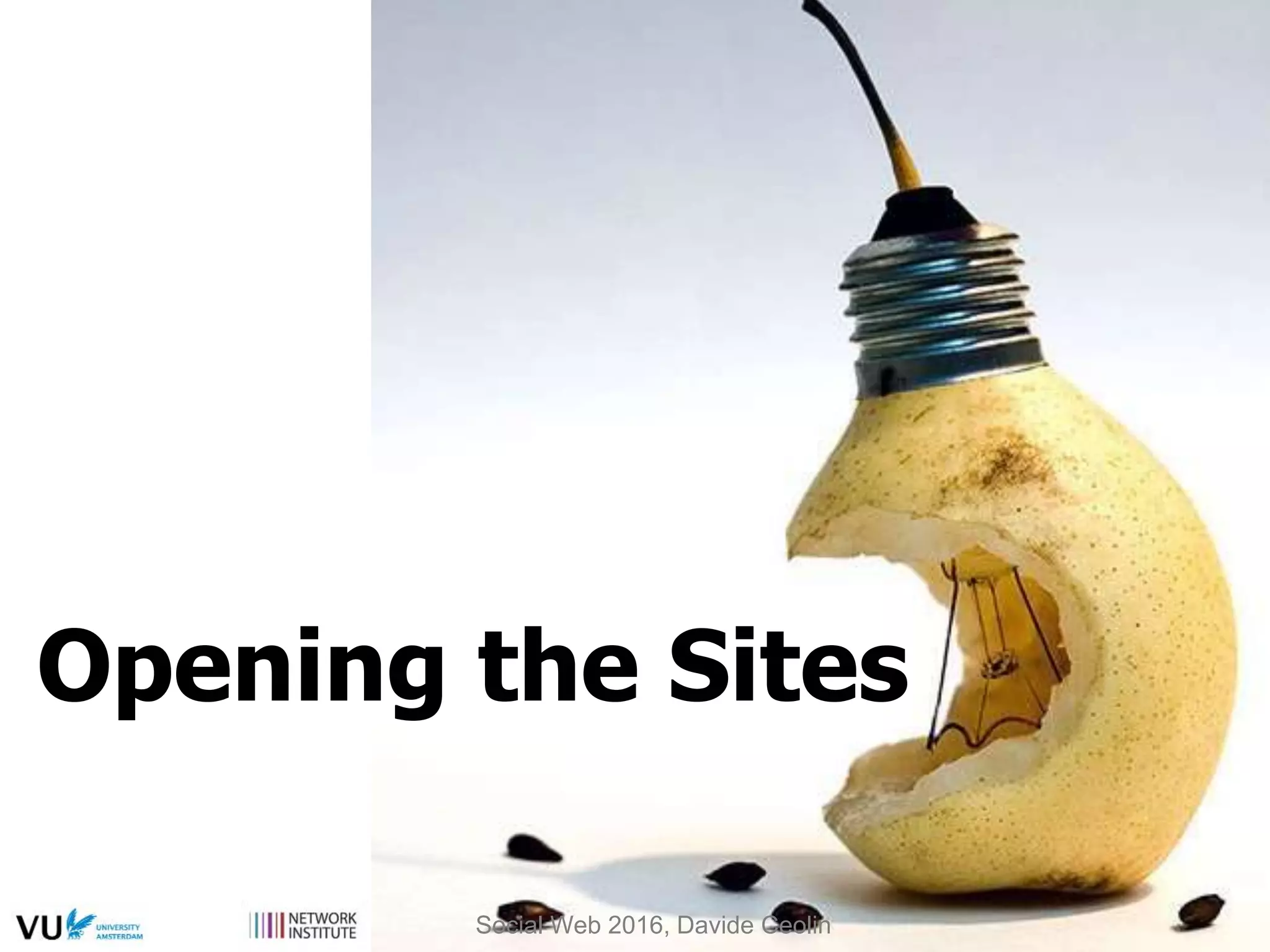
Opening the Sites
Social Web 2016, Davide Ceolin
• Demand from application developers to make use of the
amounts of Social Web data & make their applications
available to the site members
• Demand from users to reuse data and connections they
have already established on other sites, e.g. Google+
download your data, Diaspora* download xml, download
photos
• In response: Facebook provided an API & Google
OpenSocial API
Opening the Sites
Social Web 2016, Davide Ceolin
• open, decentralized standard for authenticating users
that can be used for access control, allowing users to log
on to different services with the same digital identity
where these services trust the authentication body
• making sure the users are who they say they are
• http://openid.net/
• Started in 2005 as Yadis (Yet another distributed identity
system)
Social Web 2016, Davide Ceolin
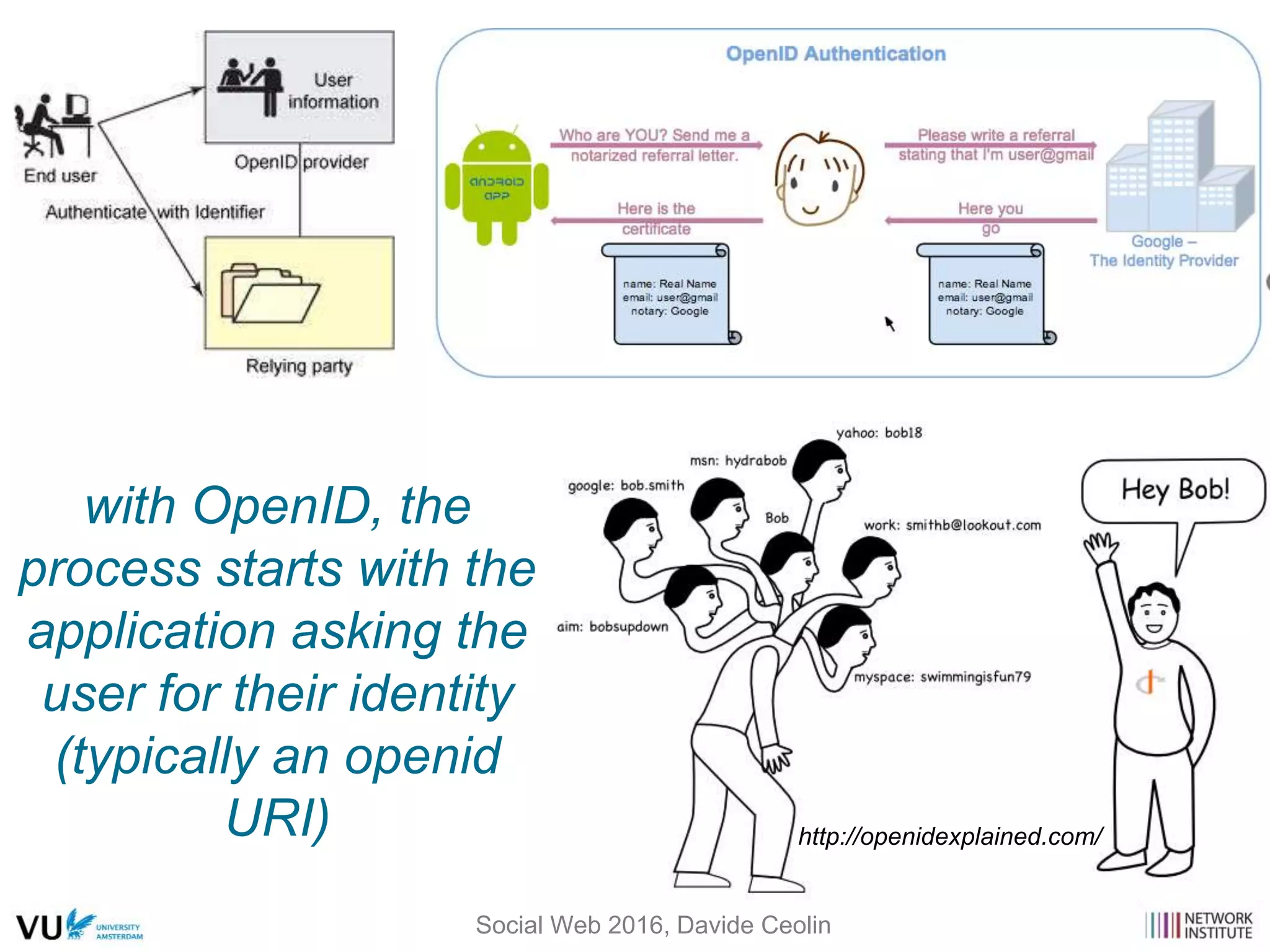
http://openidexplained.com/
with OpenID, the
process starts with the
application asking the
user for their identity
(typically an openid
URI)
Social Web 2016, Davide Ceolin
OAuth
• it enables users to grant third-party access to their web
resources without sharing their passwords
• largely based on: Flickr’s API Auth & Google’s AuthSub
• limitations in terms of complexity, user experience, scale
• 3 flows merged into one: web-based apps, desktop clients &
mobile/limited devices; e.g. when Facebook Connect existed
- flows for web apps, mobile devices & game consoles
• http://oauth.net/
Social Web 2016, Davide Ceolin
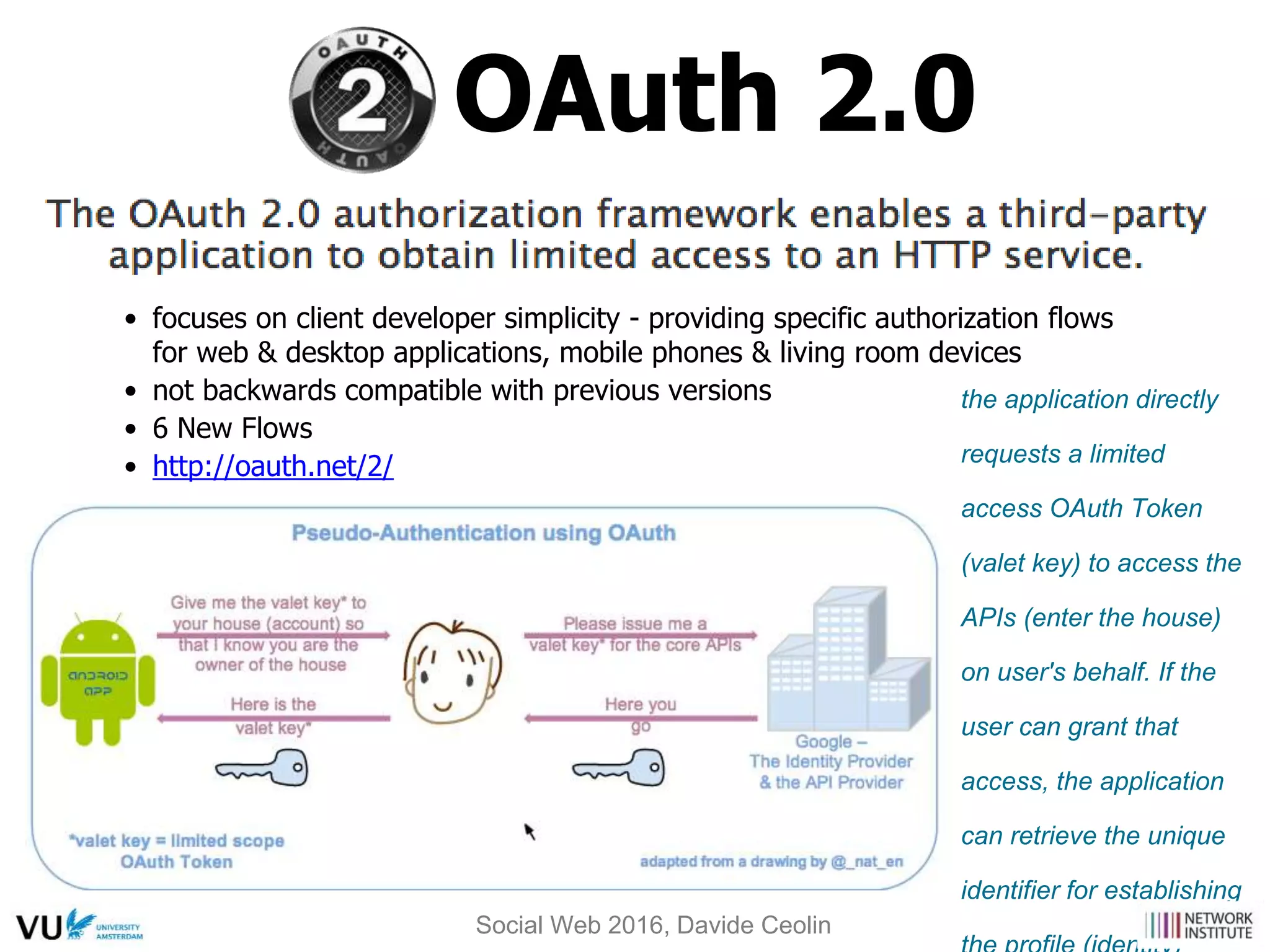
OAuth 2.0
the application directly
requests a limited
access OAuth Token
(valet key) to access the
APIs (enter the house)
on user's behalf. If the
user can grant that
access, the application
can retrieve the unique
identifier for establishing
• focuses on client developer simplicity - providing specific authorization flows
for web & desktop applications, mobile phones & living room devices
• not backwards compatible with previous versions
• 6 New Flows
• http://oauth.net/2/
Social Web 2016, Davide Ceolin
In a nutshell
What’s the difference between OAuth and OpenID?
OpenID is an authentication standard (to
prove who you are), Oauth is an authorization
protocol (to decide who can do what).
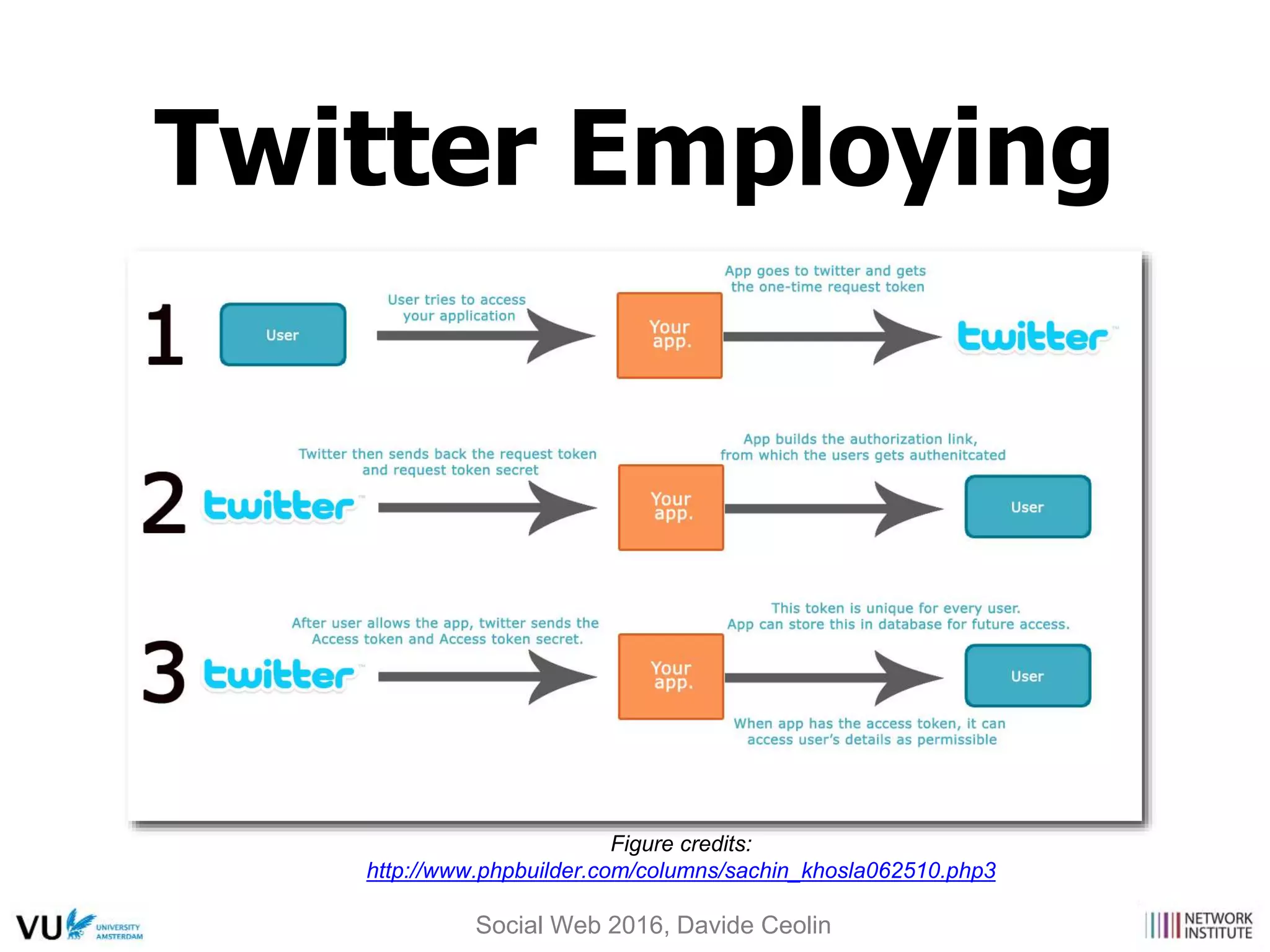
Figure credits:
http://www.phpbuilder.com/columns/sachin_khosla062510.php3
Twitter Employing
Social Web 2016, Davide Ceolin
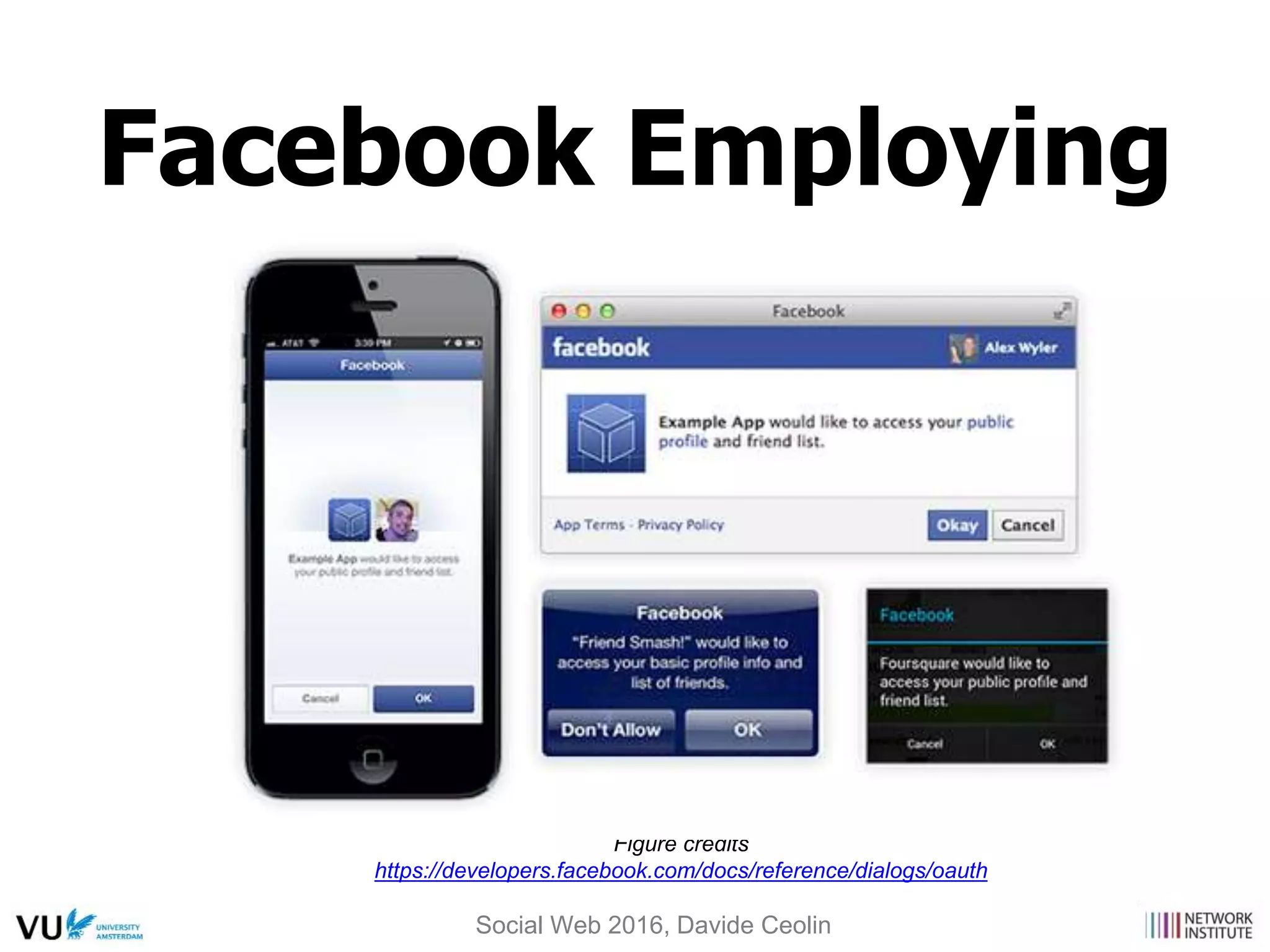
Figure credits
https://developers.facebook.com/docs/reference/dialogs/oauth
Facebook Employing
Social Web 2016, Davide Ceolin
Facebook Platform
• Graph API - core of Facebook Platform, to read and write data
to Facebook (simple and consistent view of the social graph)
• Open Graph - defining Actions and Objects
• Facebook Query Language (FQL) - SQL-style interface to
query the data exposed by the Graph API
• Authentication (Facebook Login) - interact with Graph API on
behalf of Facebook users (single-sign on mechanism for web,
mobile & desktop apps)
• Social Plugins, Facebook Payments, Ads API, Chat API (via
Jabber/XMPP service), JavaScript SDK
• Deprecated: REST API, FBML, and the old Javascript API,
Facebook Connect APIs
Social Web 2016, Davide Ceolin
• open standards-based (e.g. JavaScript, HTML) component
model for cloud-based social apps
• Google initiative (set of APIs) in 2007:
• People & Friends API (people and relationship
information)
• Activities API (publishing & accessing user activity
information)
• Persistence API (simple key-value pair data for
server-free stateful applications)
• with Open Social embedded in a site, a site instantly becomes
a social Web site (initially running only at Orkut)
• integrated, e.g. OAuth, OAuth 2.0, Activity Streams
• http://www.opensocial.org/
Social Web 2016, Davide Ceolin
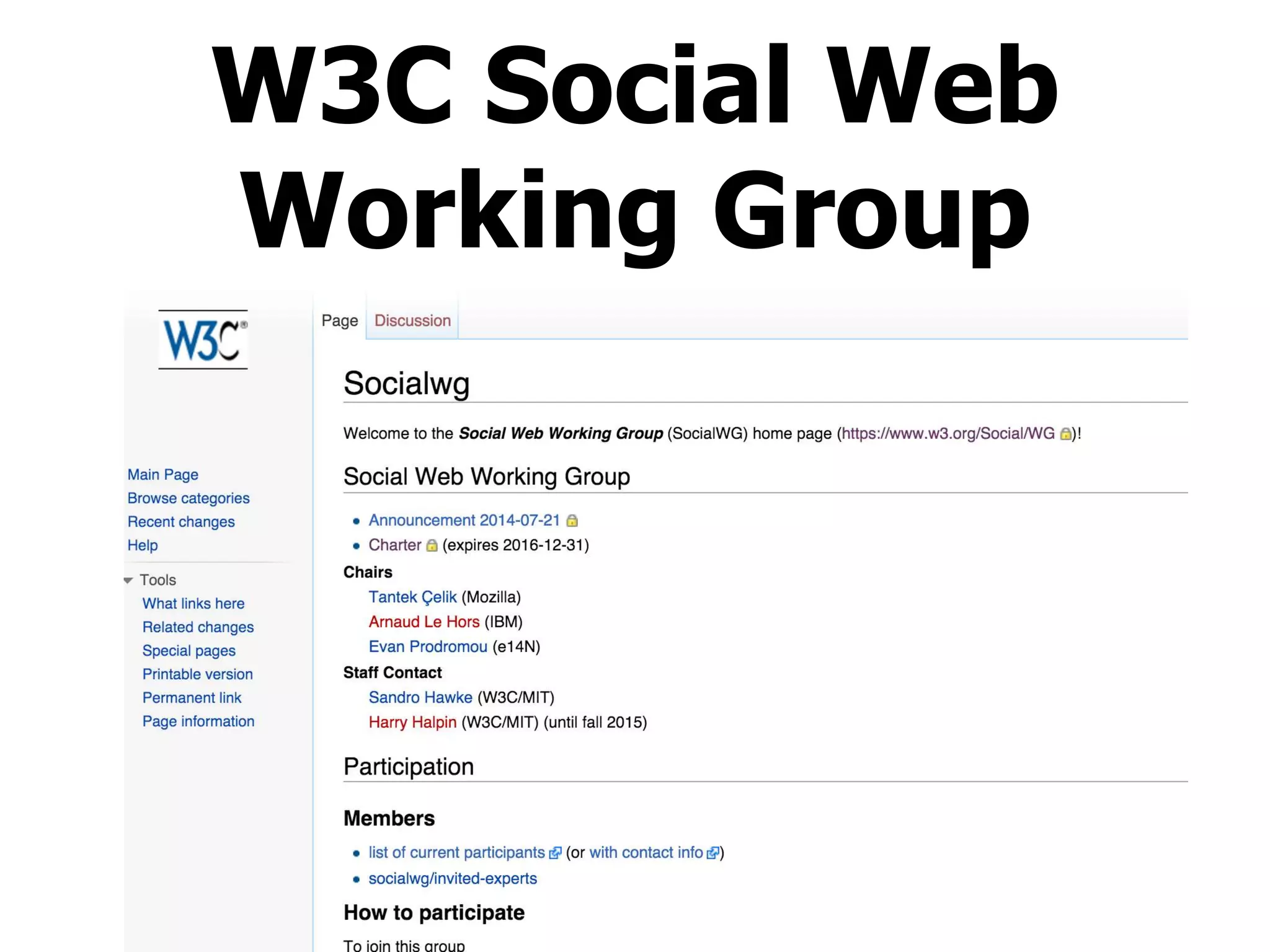
W3C Social Web
Working Group
• Half a year after Facebook Platform, Google launched Open Social
• Popular containers (initially): MySpace, Hi5, Plaxo, LinkedIn, Orkut,
Friendster, Six Apart
• http://opensocial.org/category/showcase/ (currently)
• Plugged-in applications: iLike, Slide, Flixter, Rock You, etc.
• https://github.com/opensocial
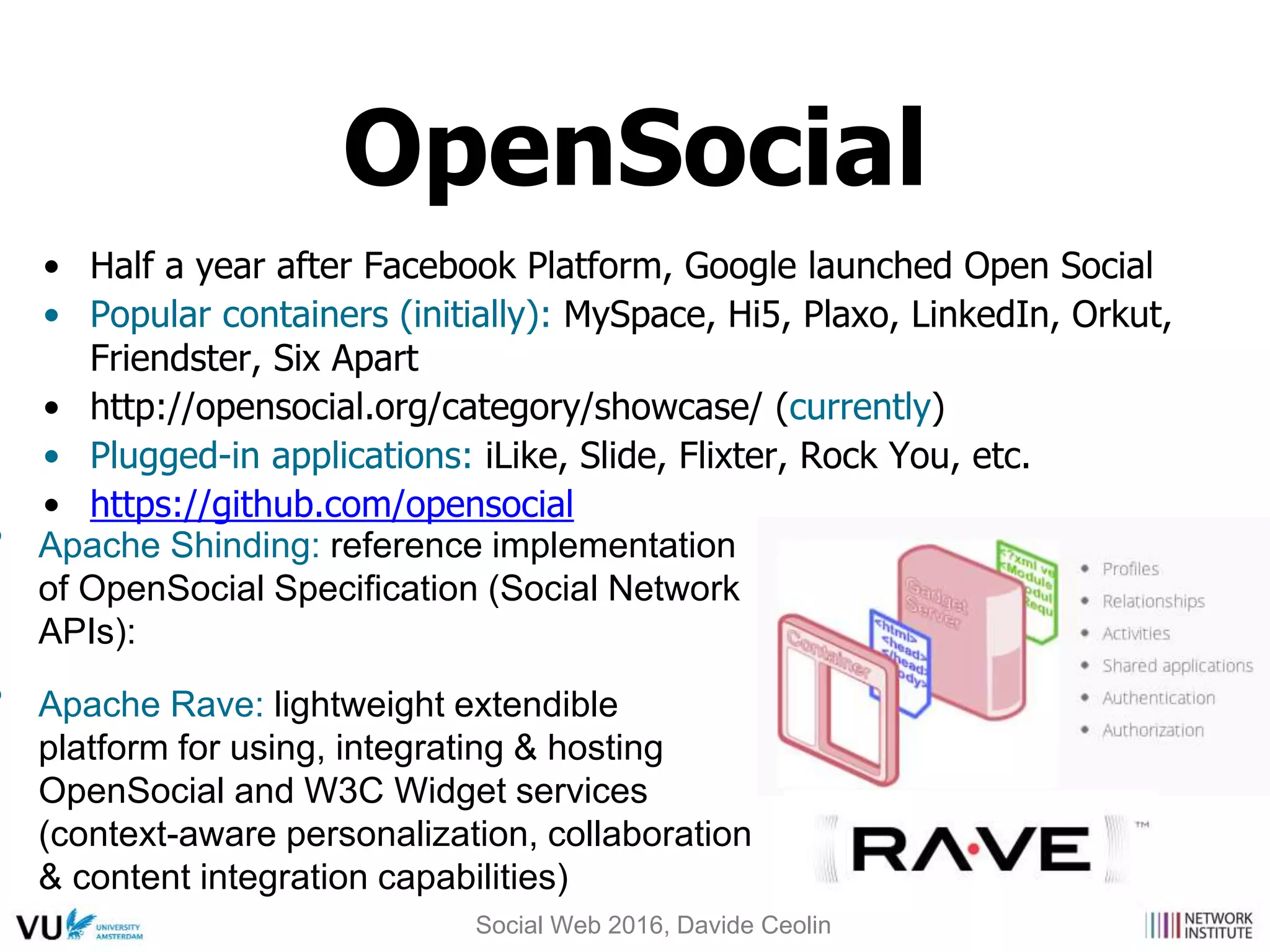
• Apache Shinding: reference implementation
of OpenSocial Specification (Social Network
APIs):
• Apache Rave: lightweight extendible
platform for using, integrating & hosting
OpenSocial and W3C Widget services
(context-aware personalization, collaboration
& content integration capabilities)
OpenSocial
Social Web 2016, Davide Ceolin
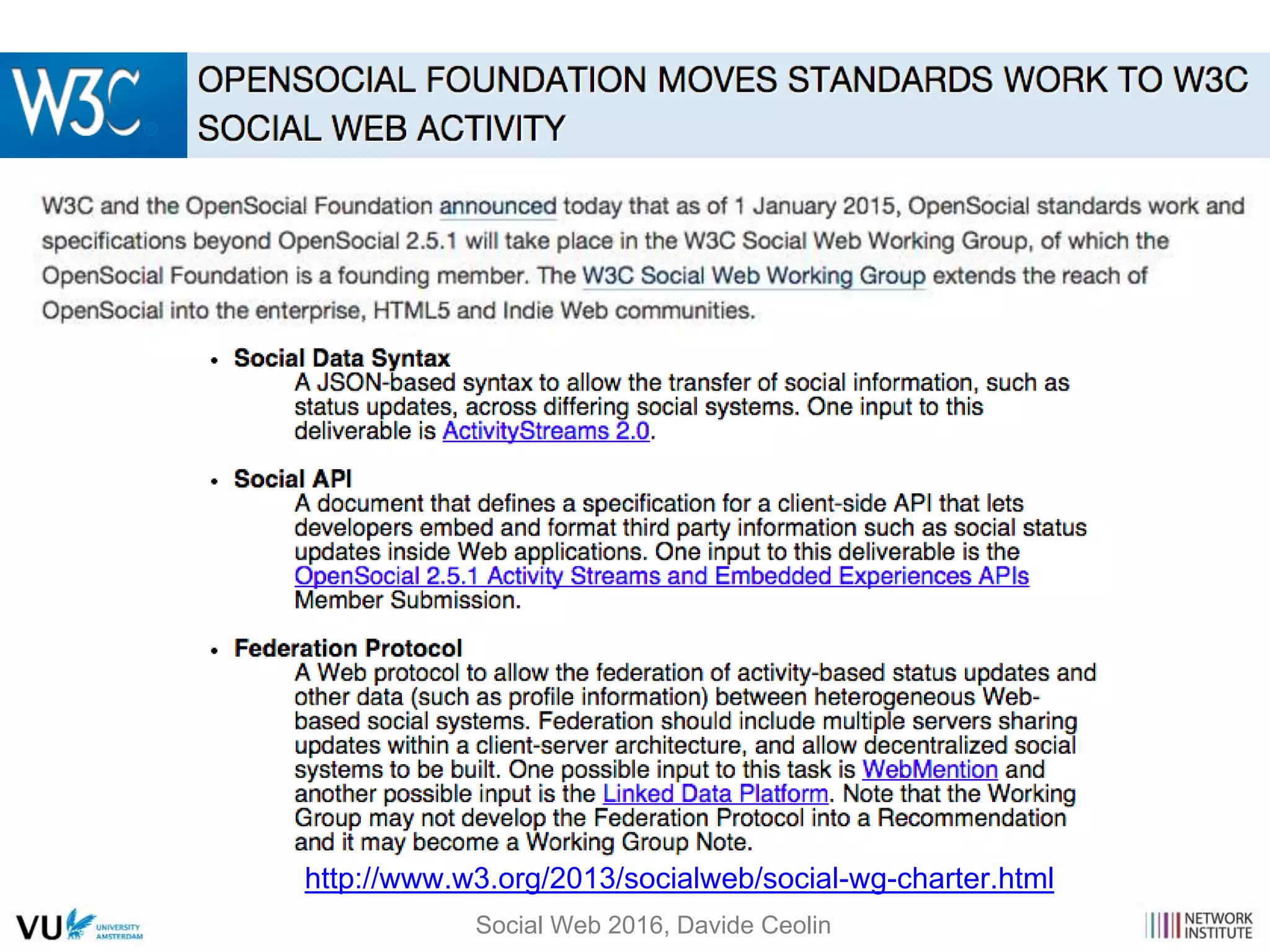
http://www.w3.org/2013/socialweb/social-wg-charter.html
Social Web 2016, Davide Ceolin
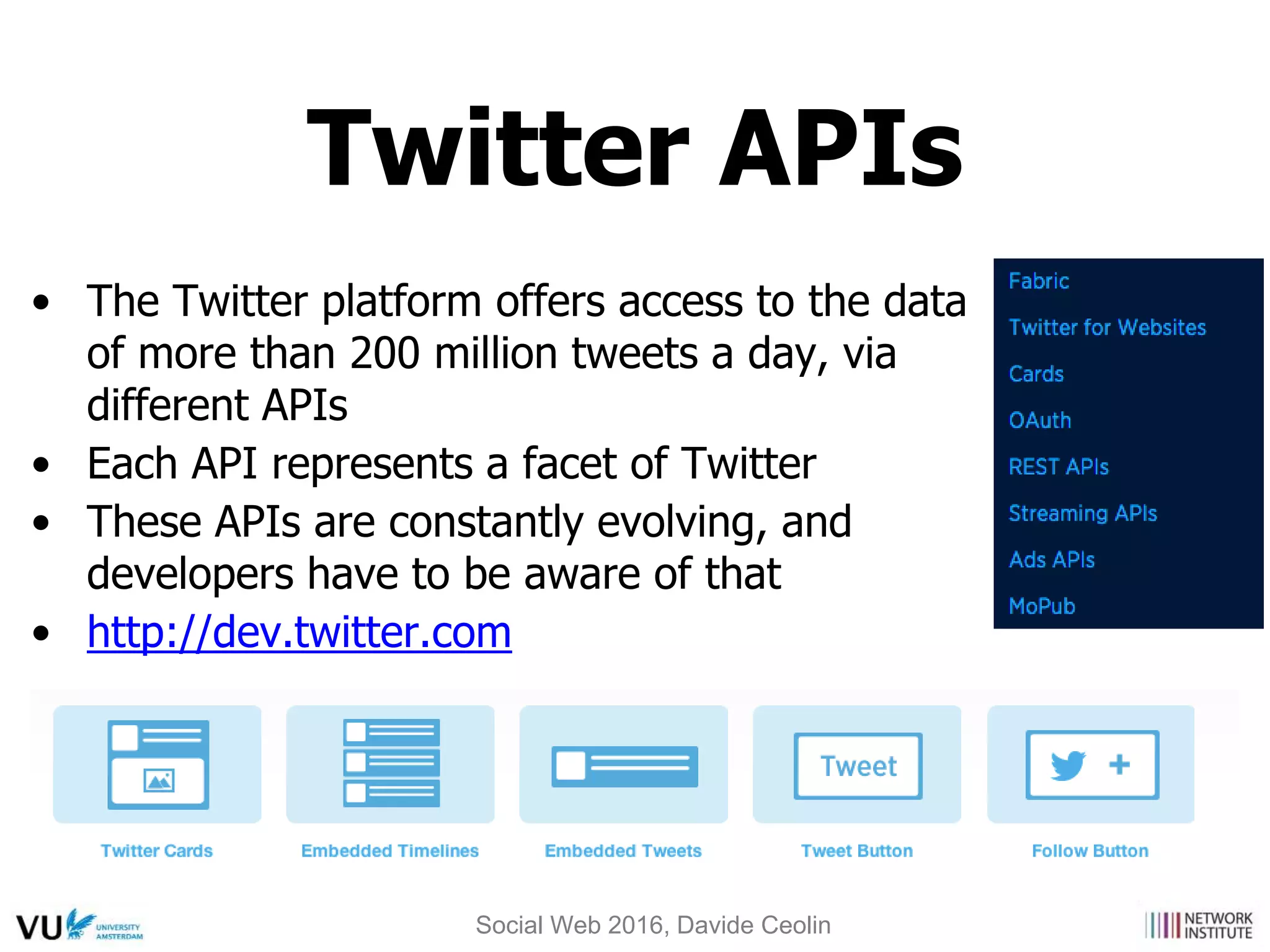
• The Twitter platform offers access to the data
of more than 200 million tweets a day, via
different APIs
• Each API represents a facet of Twitter
• These APIs are constantly evolving, and
developers have to be aware of that
• http://dev.twitter.com
Twitter APIs
Social Web 2016, Davide Ceolin
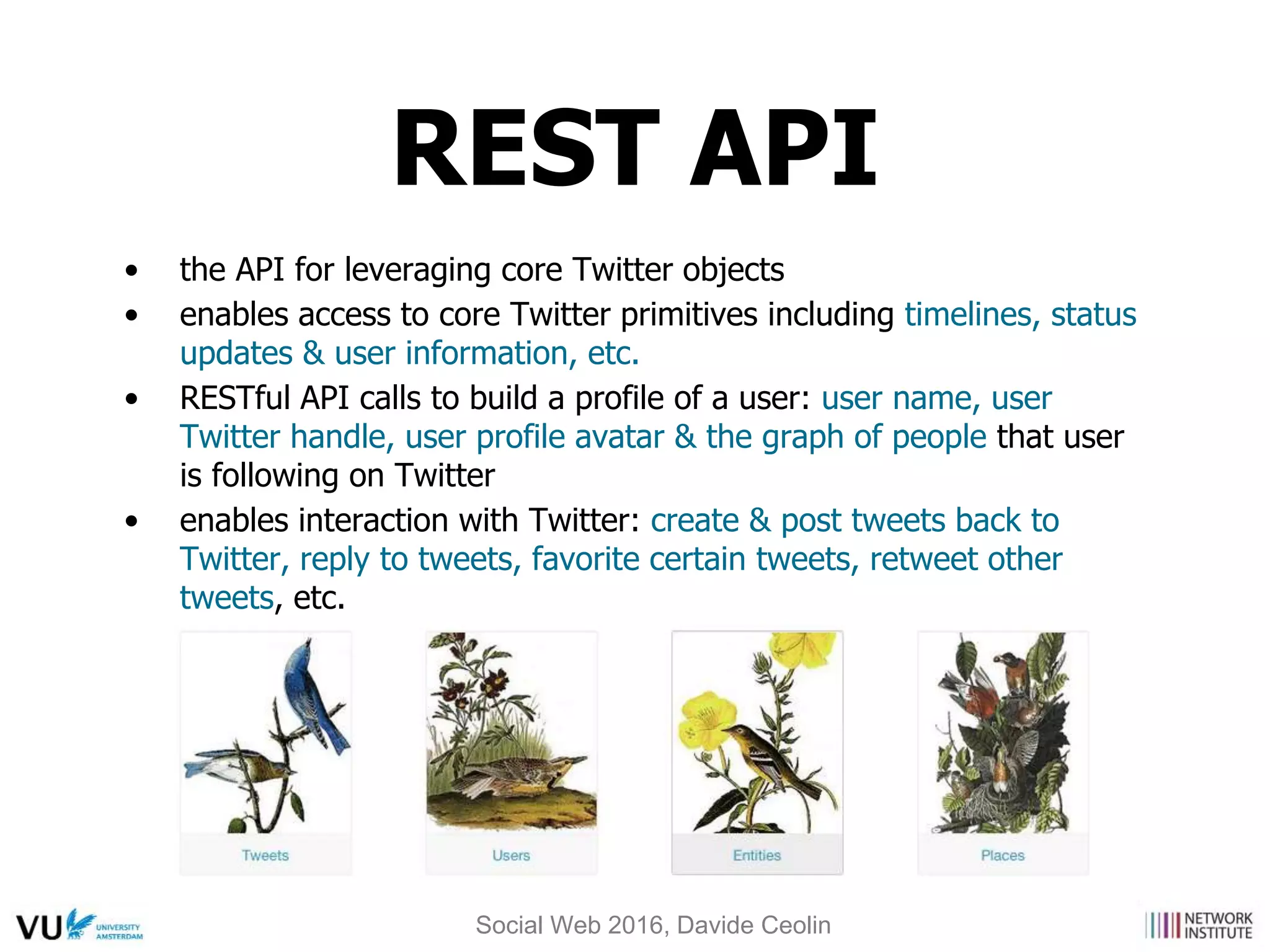
• the API for leveraging core Twitter objects
• enables access to core Twitter primitives including timelines, status
updates & user information, etc.
• RESTful API calls to build a profile of a user: user name, user
Twitter handle, user profile avatar & the graph of people that user
is following on Twitter
• enables interaction with Twitter: create & post tweets back to
Twitter, reply to tweets, favorite certain tweets, retweet other
tweets, etc.
REST API
Social Web 2016, Davide Ceolin
• a set of tweets with specific keywords,
• tweets referencing a specific user,
• tweets from a particular user
• access to data around Trends
• it’s limited, e.g. index of only recent tweets (6-9 days);
no authentication: all queries are made anonymously;
some tweets & users may be missing from search
results (focus on relevance)
Search API
Social Web 2016, Davide Ceolin
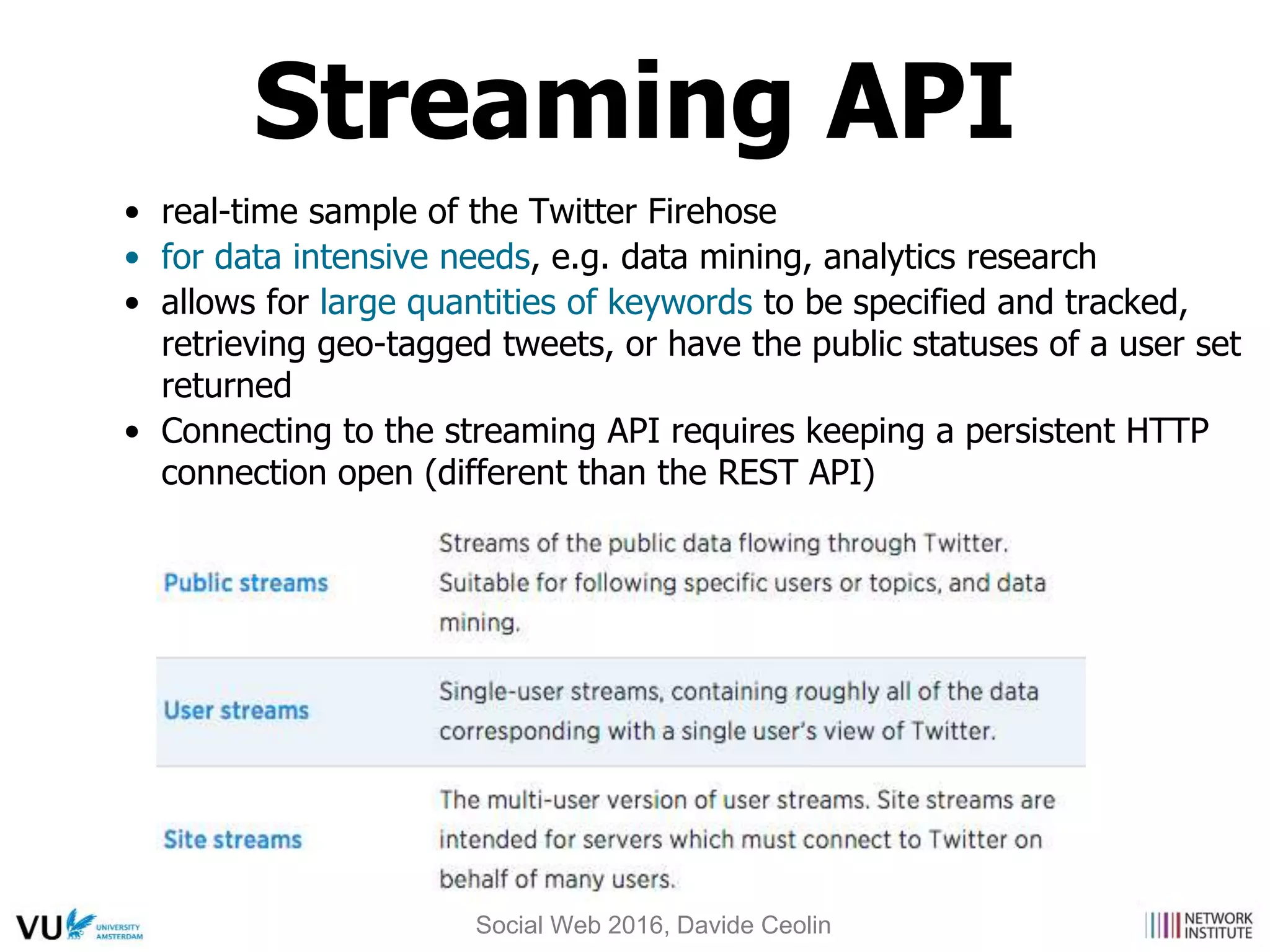
• real-time sample of the Twitter Firehose
• for data intensive needs, e.g. data mining, analytics research
• allows for large quantities of keywords to be specified and tracked,
retrieving geo-tagged tweets, or have the public statuses of a user set
returned
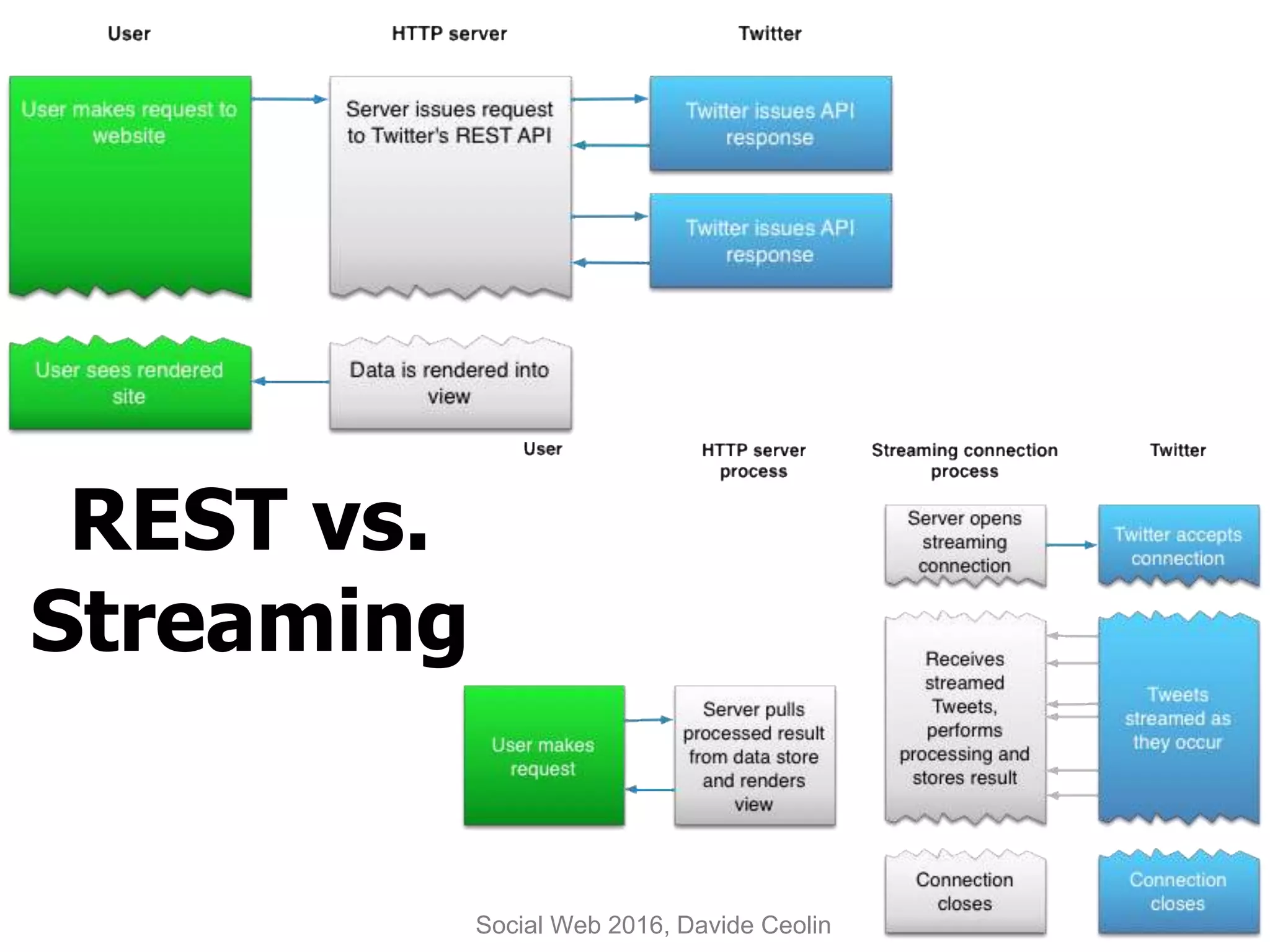
• Connecting to the streaming API requires keeping a persistent HTTP
connection open (different than the REST API)
Streaming API
Social Web 2016, Davide Ceolin
REST vs.
Streaming
Social Web 2016, Davide Ceolin
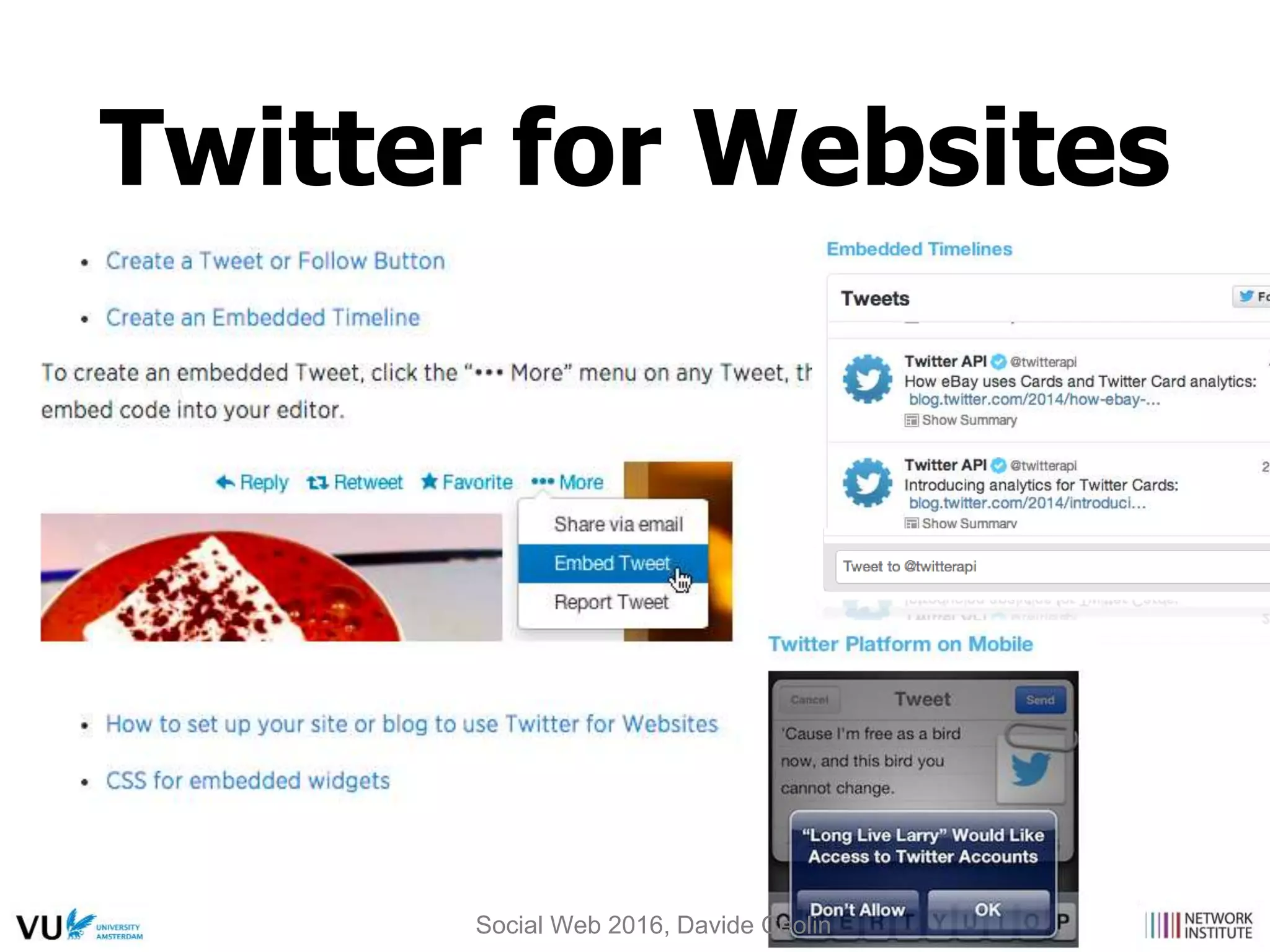
Twitter for Websites
Social Web 2016, Davide Ceolin
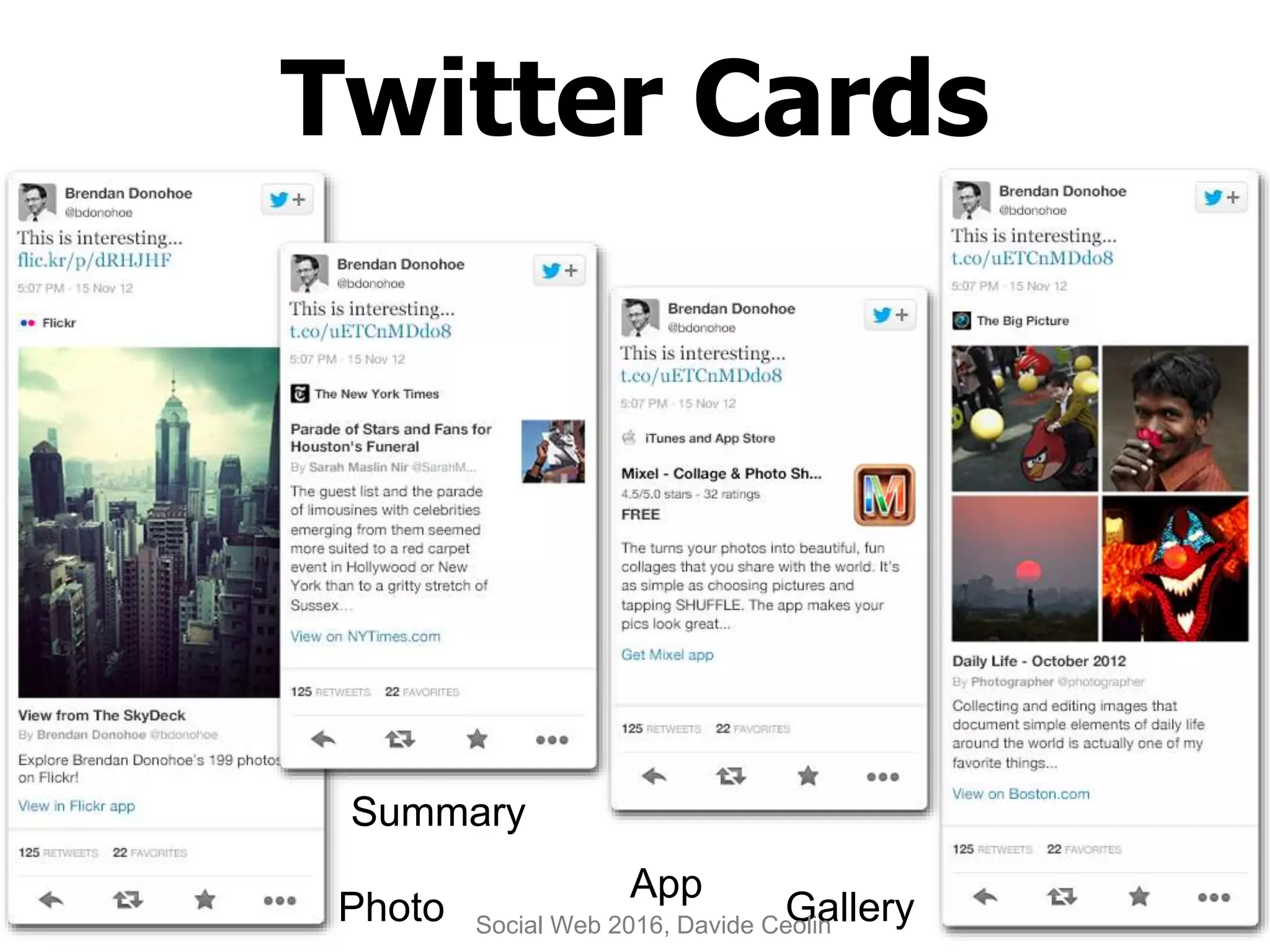
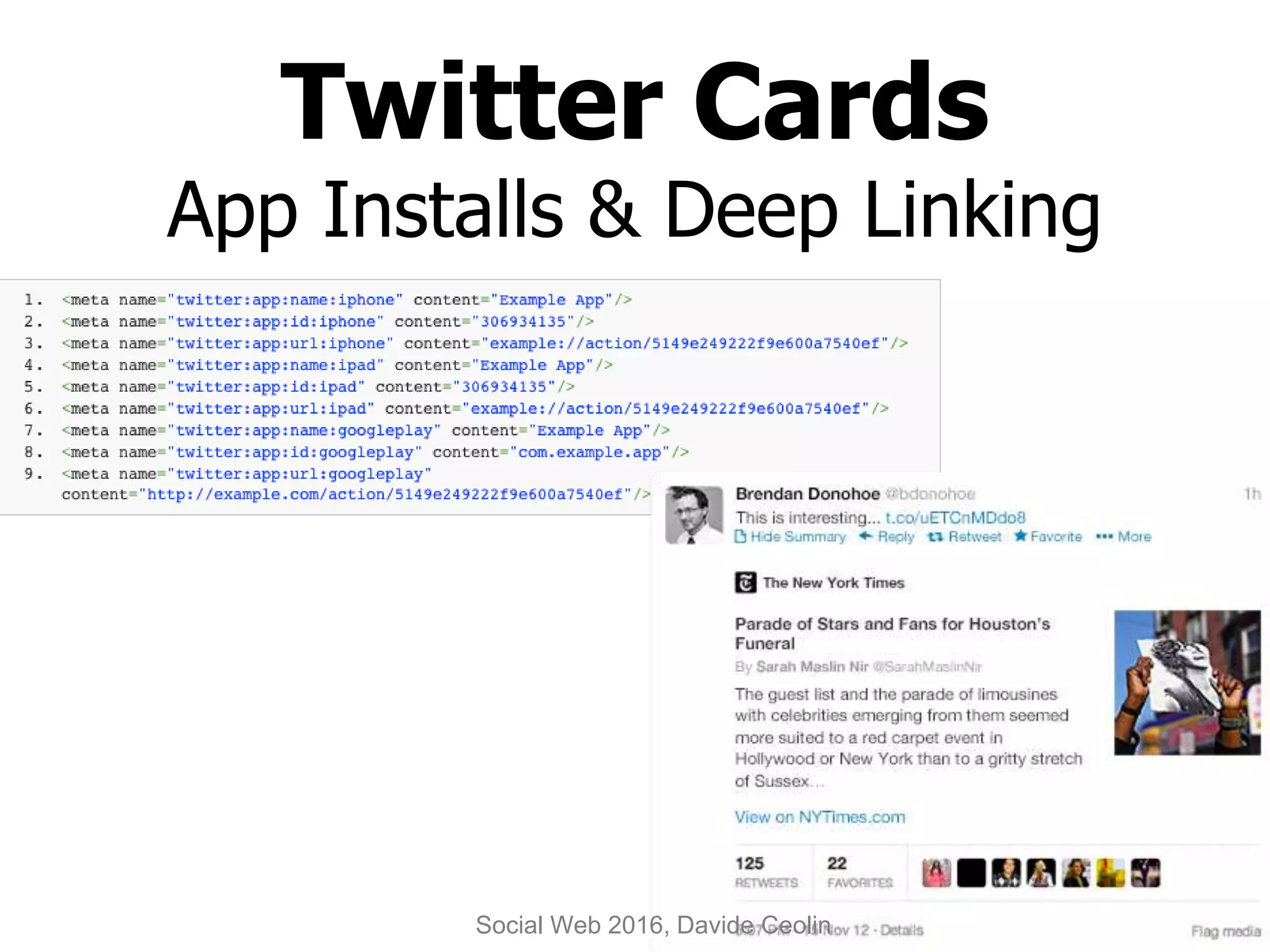
Twitter Cards
Summary
Photo
App
GallerySocial Web 2016, Davide Ceolin
Twitter Cards
App Installs & Deep Linking
Social Web 2016, Davide Ceolin
Issues related to
User Profiles &
Networks
Social Web 2016, Davide Ceolin
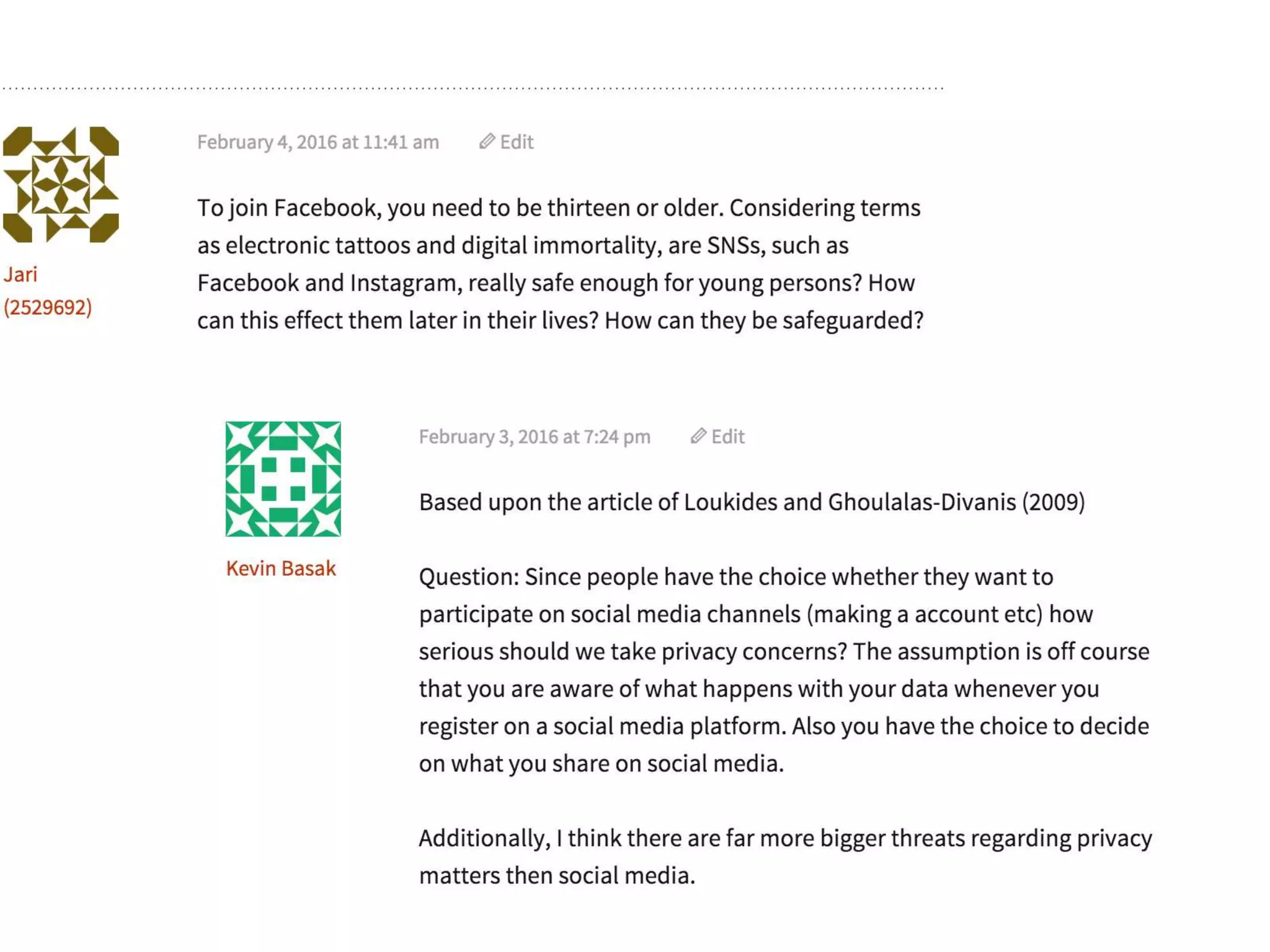
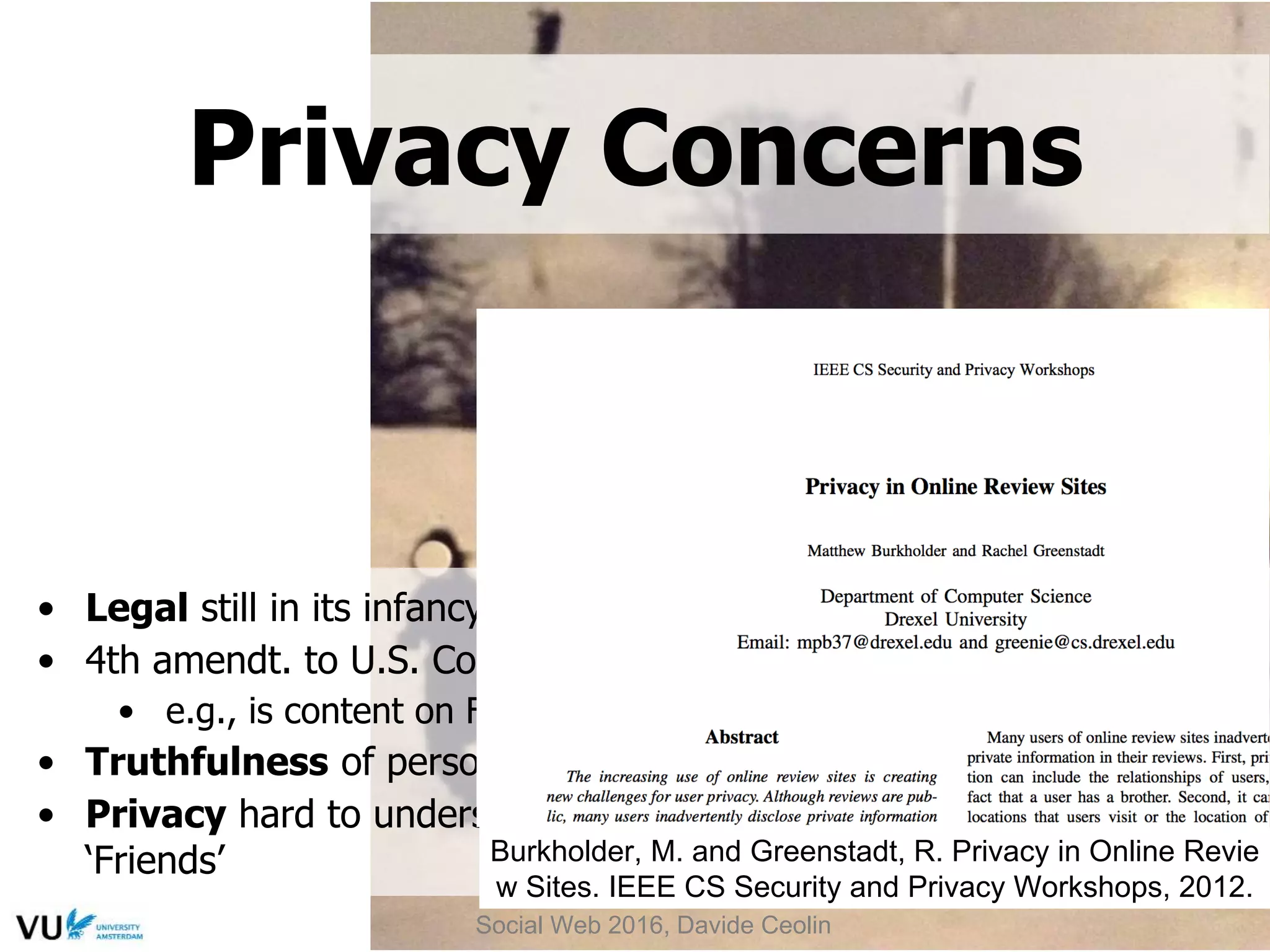
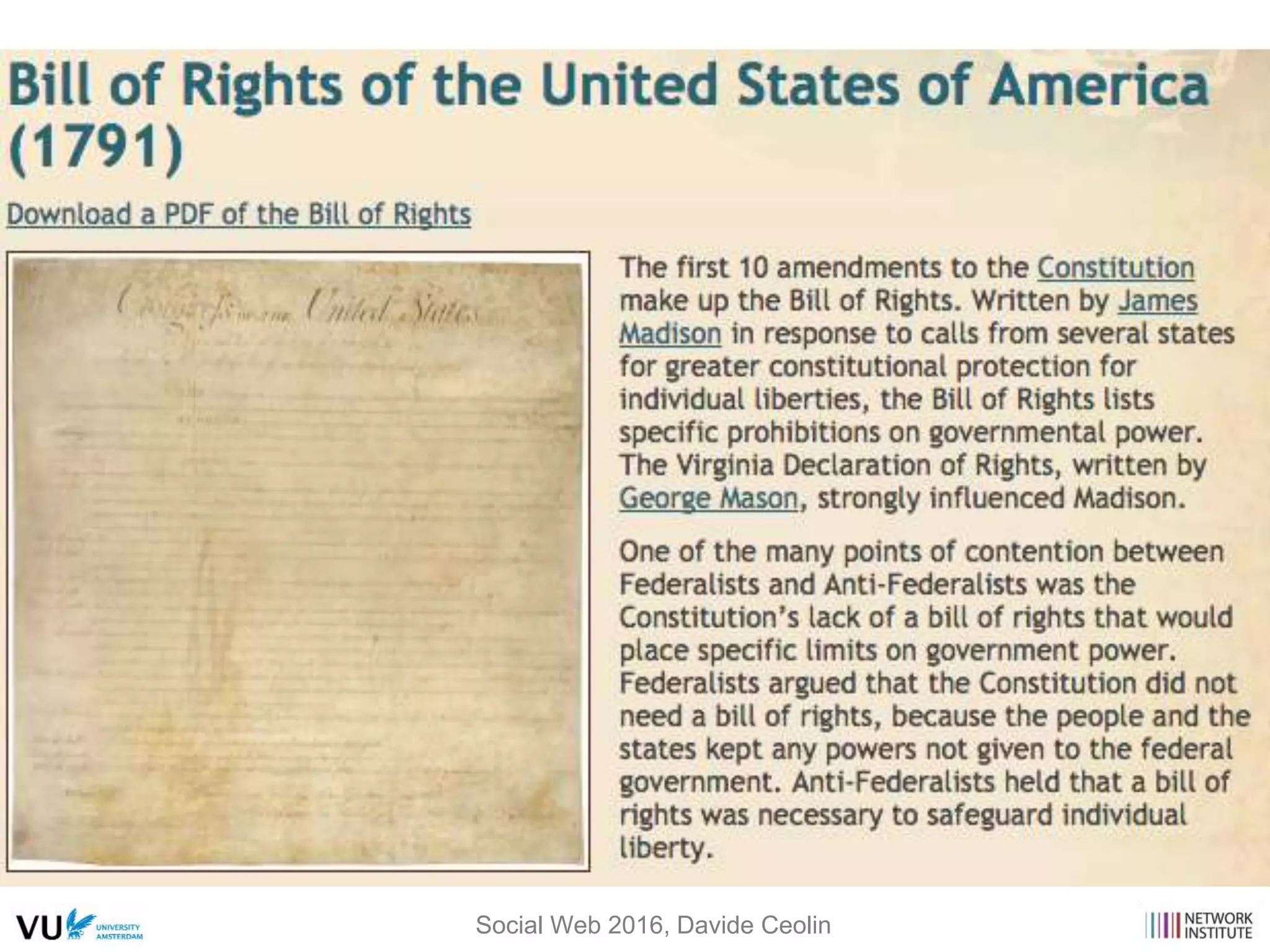
• Legal still in its infancy, but courts do rule on new behavior
• 4th amendt. to U.S. Constitution - not equipped to address SNS
• e.g., is content on Facebook accessible without a warrant?
• Truthfulness of personal profiles - subject of debate
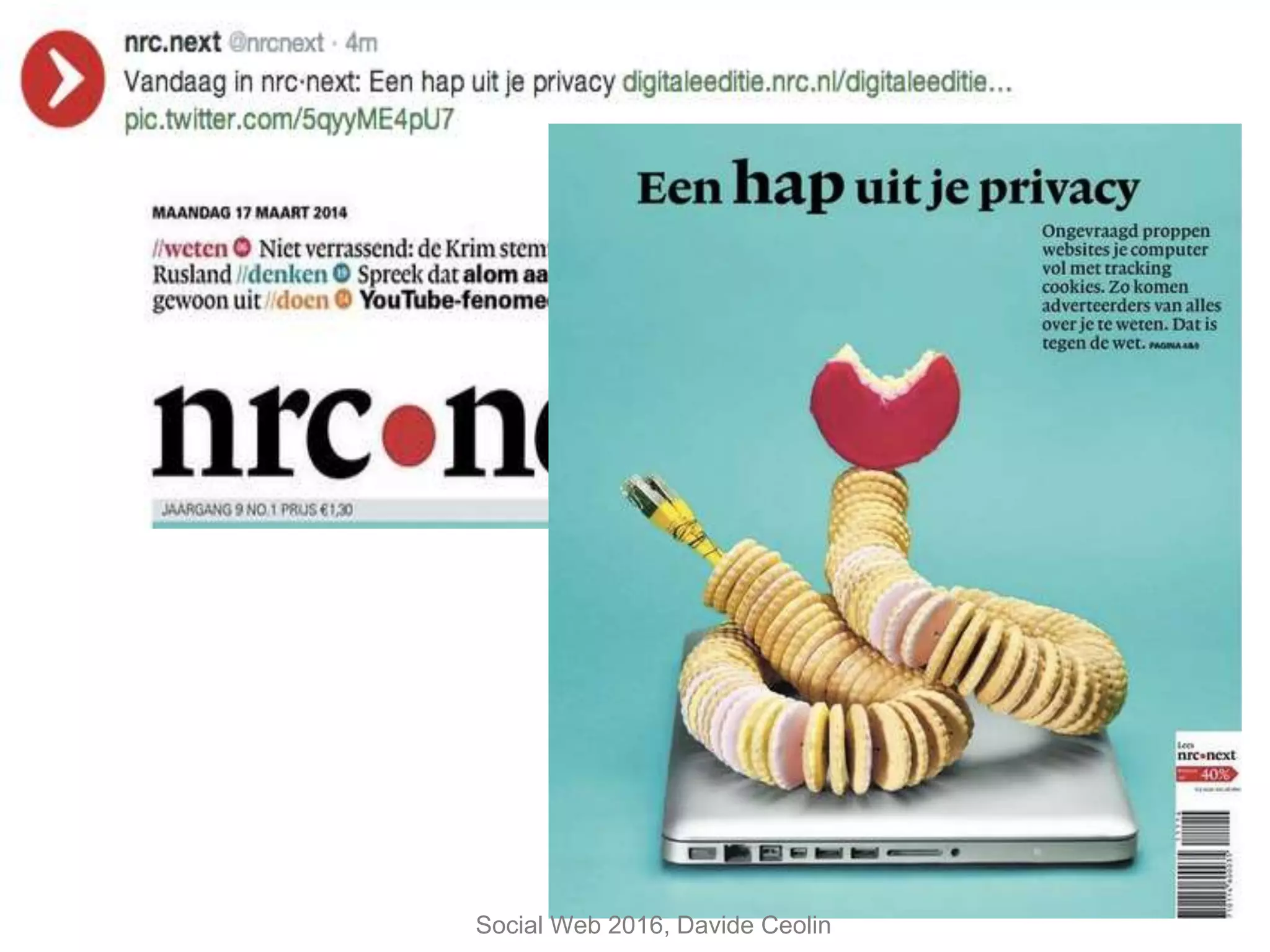
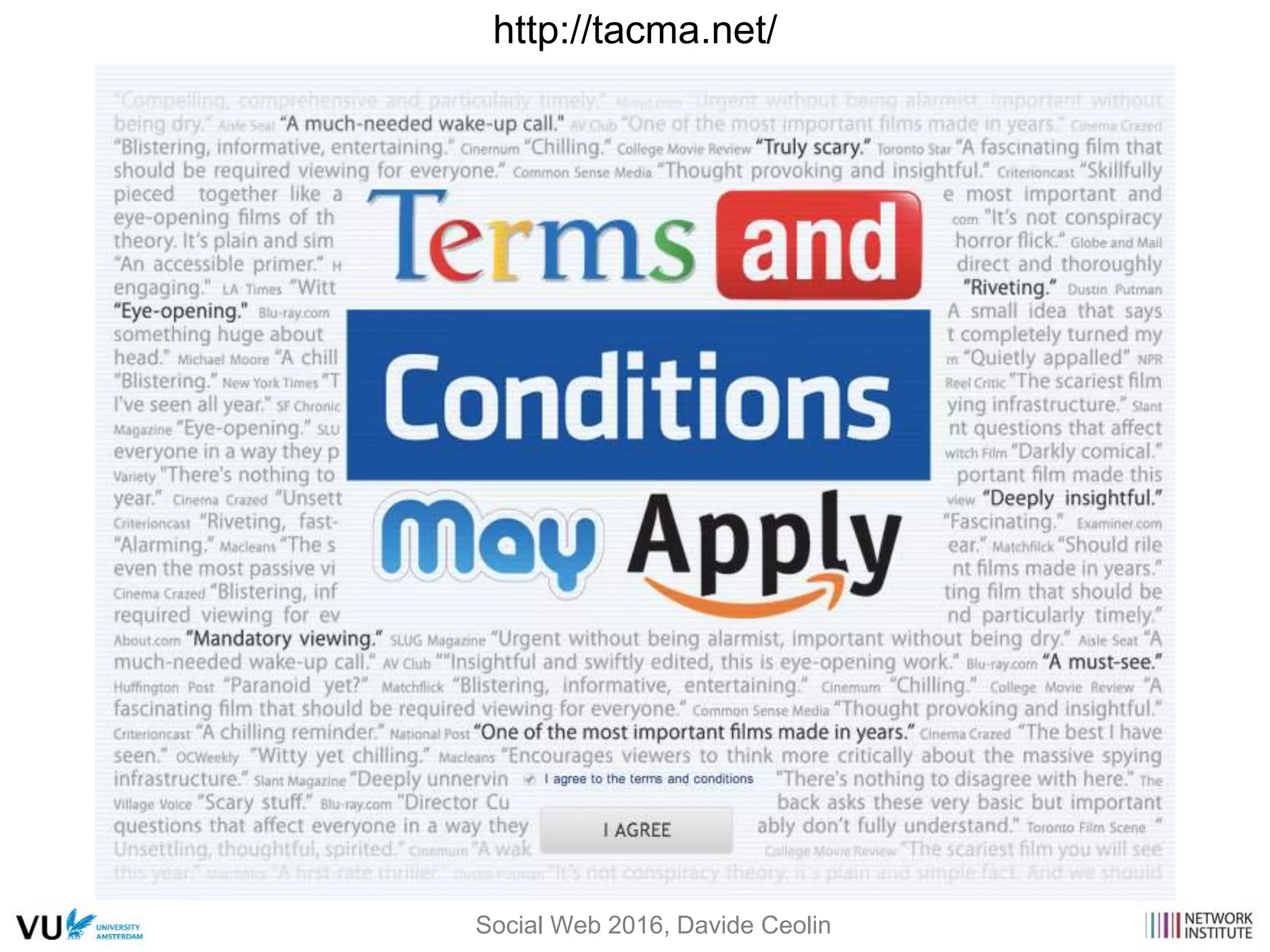
• Privacy hard to understand (few read Terms) & misinterpret
‘Friends’
Privacy Concerns
Social Web 2016, Davide Ceolin
Burkholder, M. and Greenstadt, R. Privacy in Online Revie
w Sites. IEEE CS Security and Privacy Workshops, 2012.
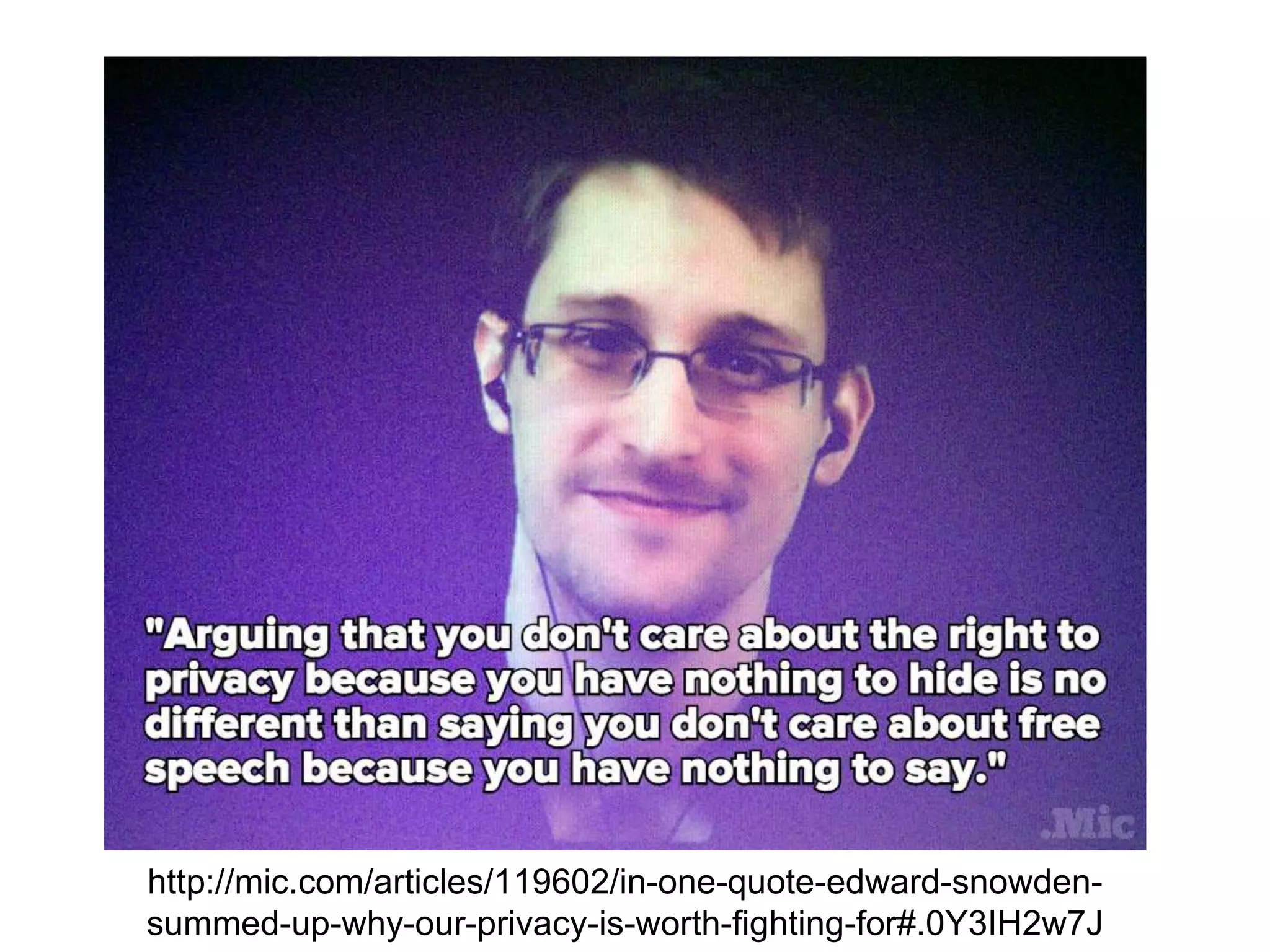
http://mic.com/articles/119602/in-one-quote-edward-snowden-
summed-up-why-our-privacy-is-worth-fighting-for#.0Y3IH2w7J
Social Web 2016, Davide Ceolin
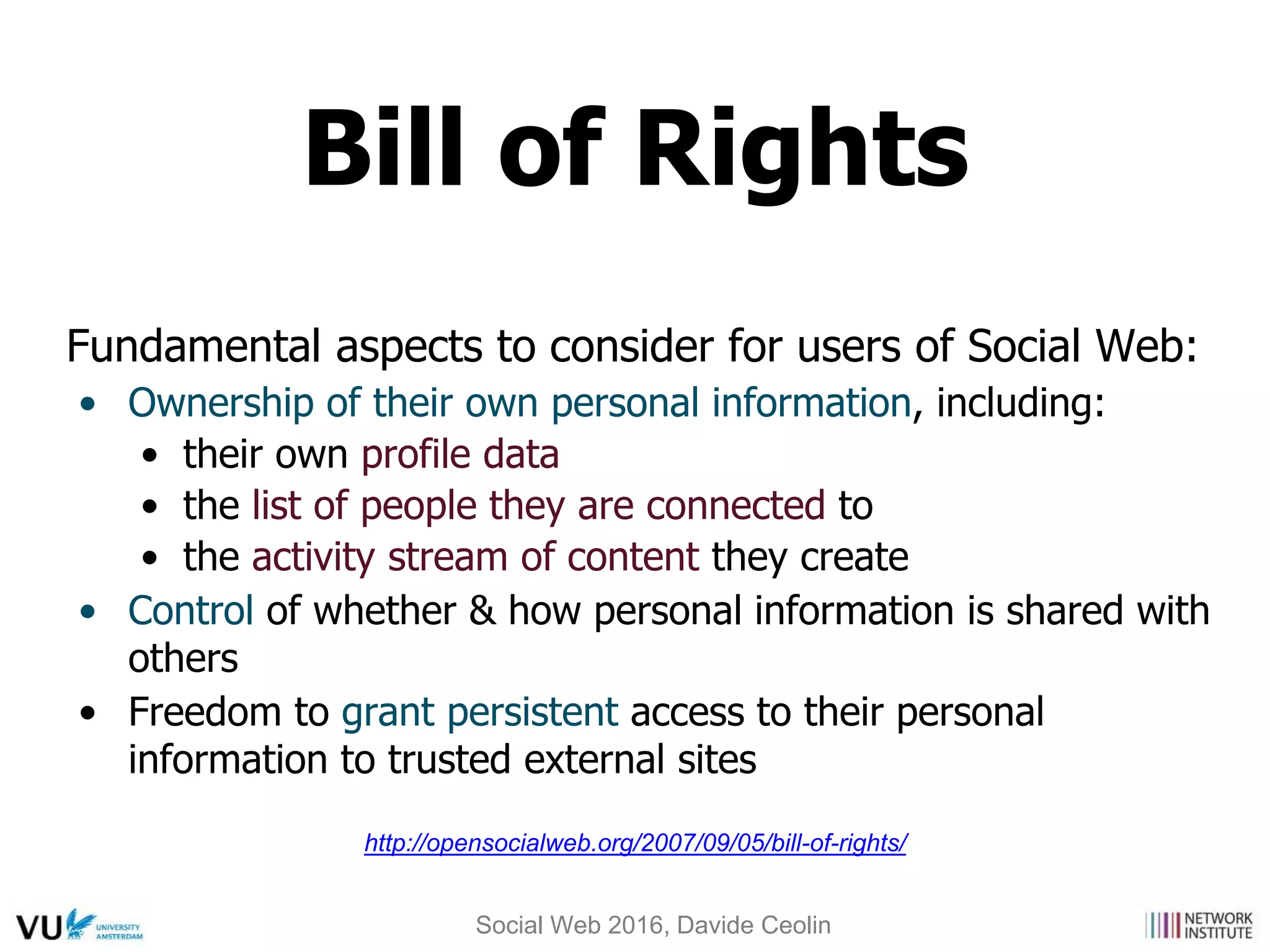
Fundamental aspects to consider for users of Social Web:
• Ownership of their own personal information, including:
• their own profile data
• the list of people they are connected to
• the activity stream of content they create
• Control of whether & how personal information is shared with
others
• Freedom to grant persistent access to their personal
information to trusted external sites
http://opensocialweb.org/2007/09/05/bill-of-rights/
Bill of Rights
Social Web 2016, Davide Ceolin
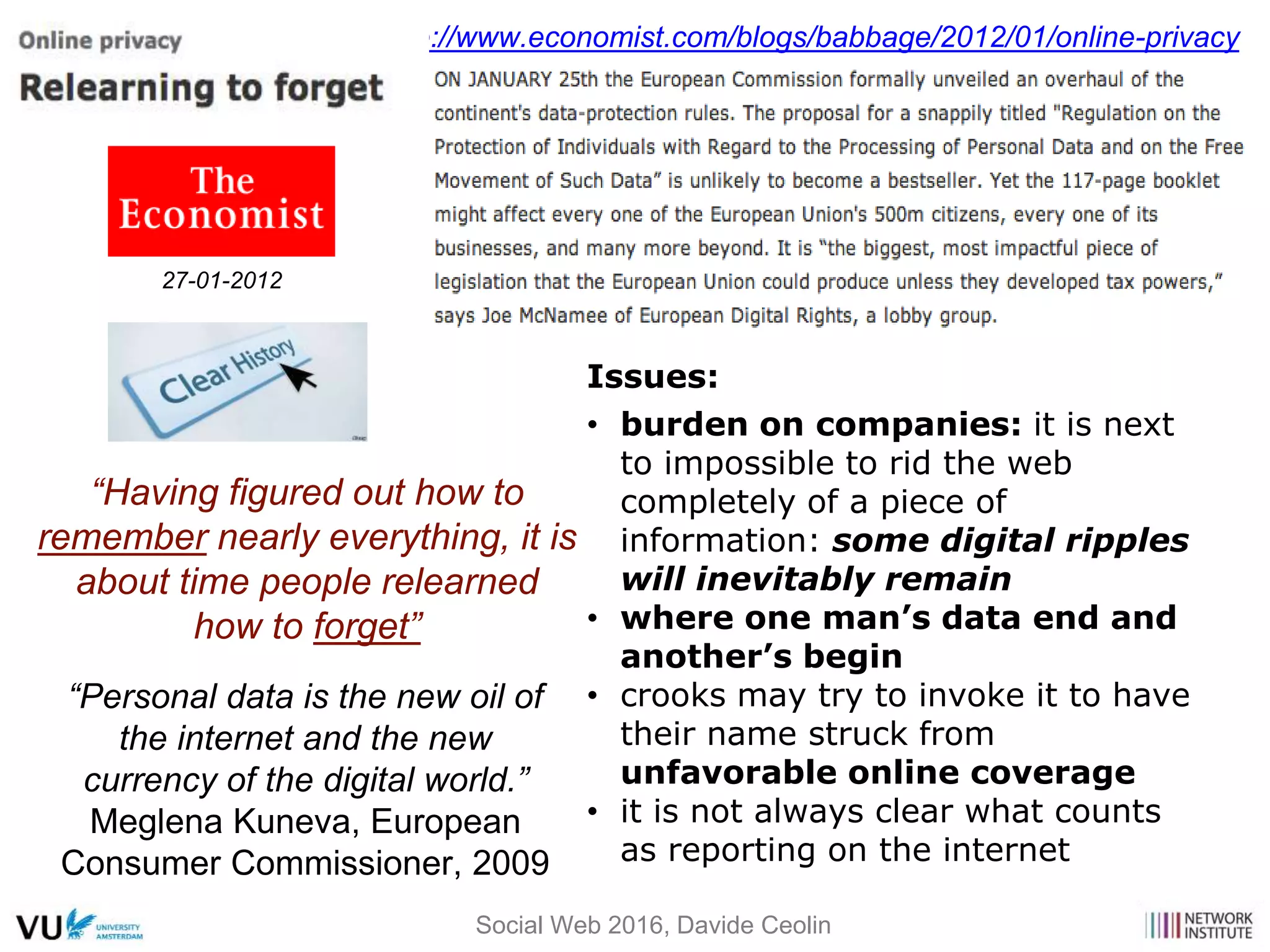
http://www.economist.com/blogs/babbage/2012/01/online-privacy
Issues:
• burden on companies: it is next
to impossible to rid the web
completely of a piece of
information: some digital ripples
will inevitably remain
• where one man’s data end and
another’s begin
• crooks may try to invoke it to have
their name struck from
unfavorable online coverage
• it is not always clear what counts
as reporting on the internet
“Having figured out how to
remember nearly everything, it is
about time people relearned
how to forget”
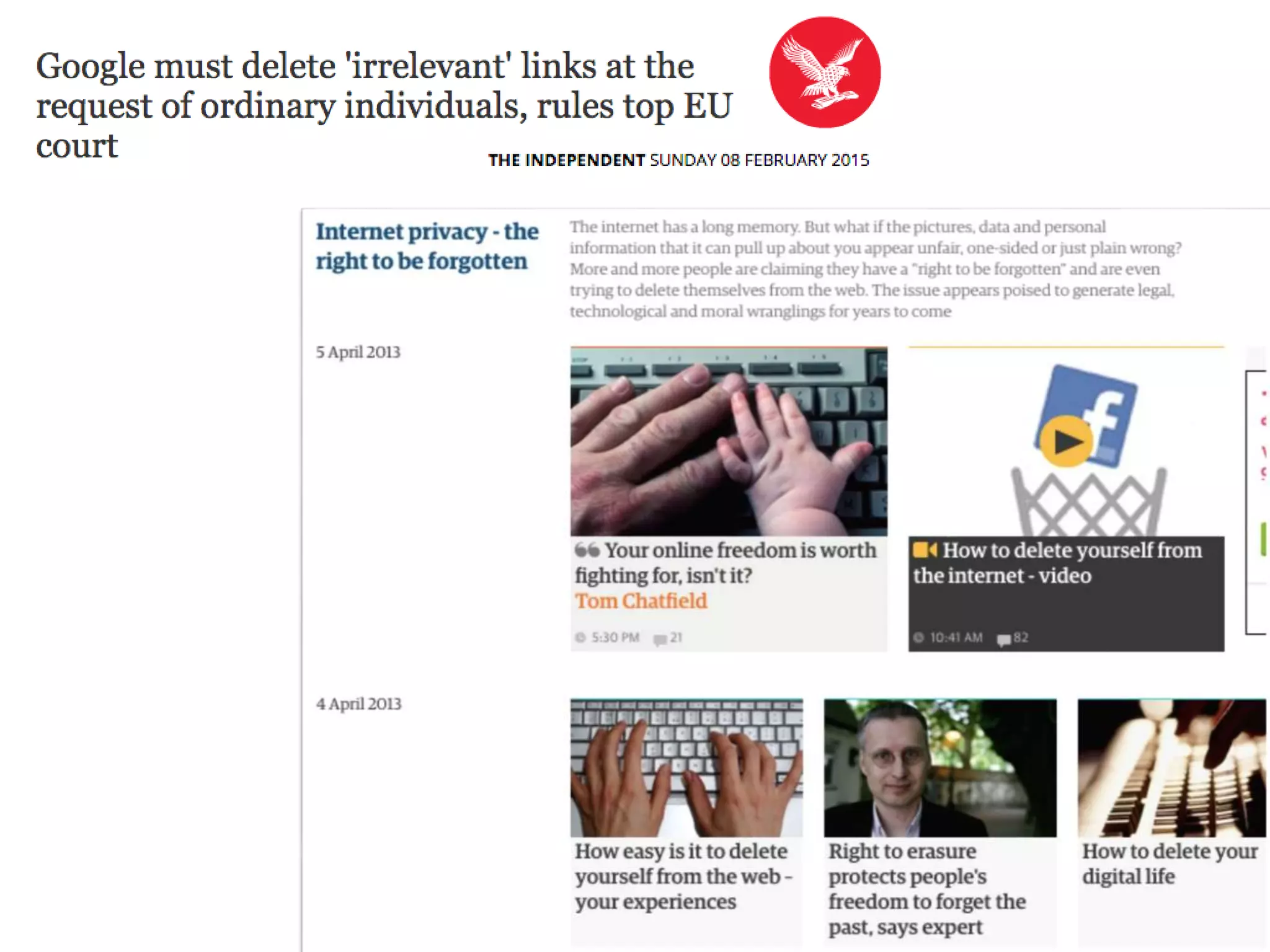
27-01-2012
“Personal data is the new oil of
the internet and the new
currency of the digital world.”
Meglena Kuneva, European
Consumer Commissioner, 2009
Social Web 2016, Davide Ceolin
• "privacy paradox" = lack of awareness of the public nature of Internet
• flexibility to handle friends with different conceptions of privacy
• ability to control data flow inside and outside network
• realize that sensitive information can be reconstructed
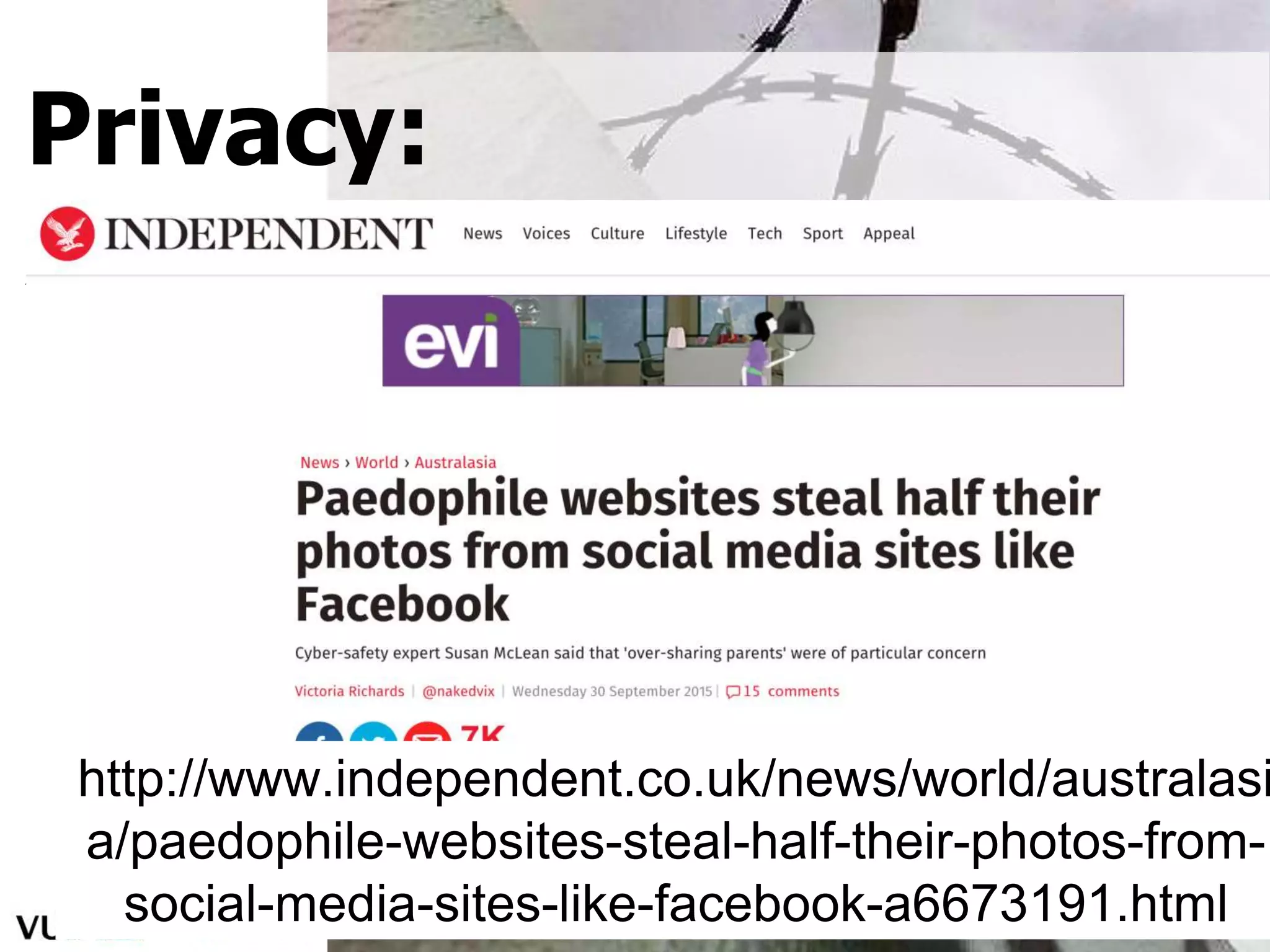
Privacy:
Awareness not Paranoia
Social Web 2016, Davide Ceolin
http://www.independent.co.uk/news/world/australasi
a/paedophile-websites-steal-half-their-photos-from-
social-media-sites-like-facebook-a6673191.html
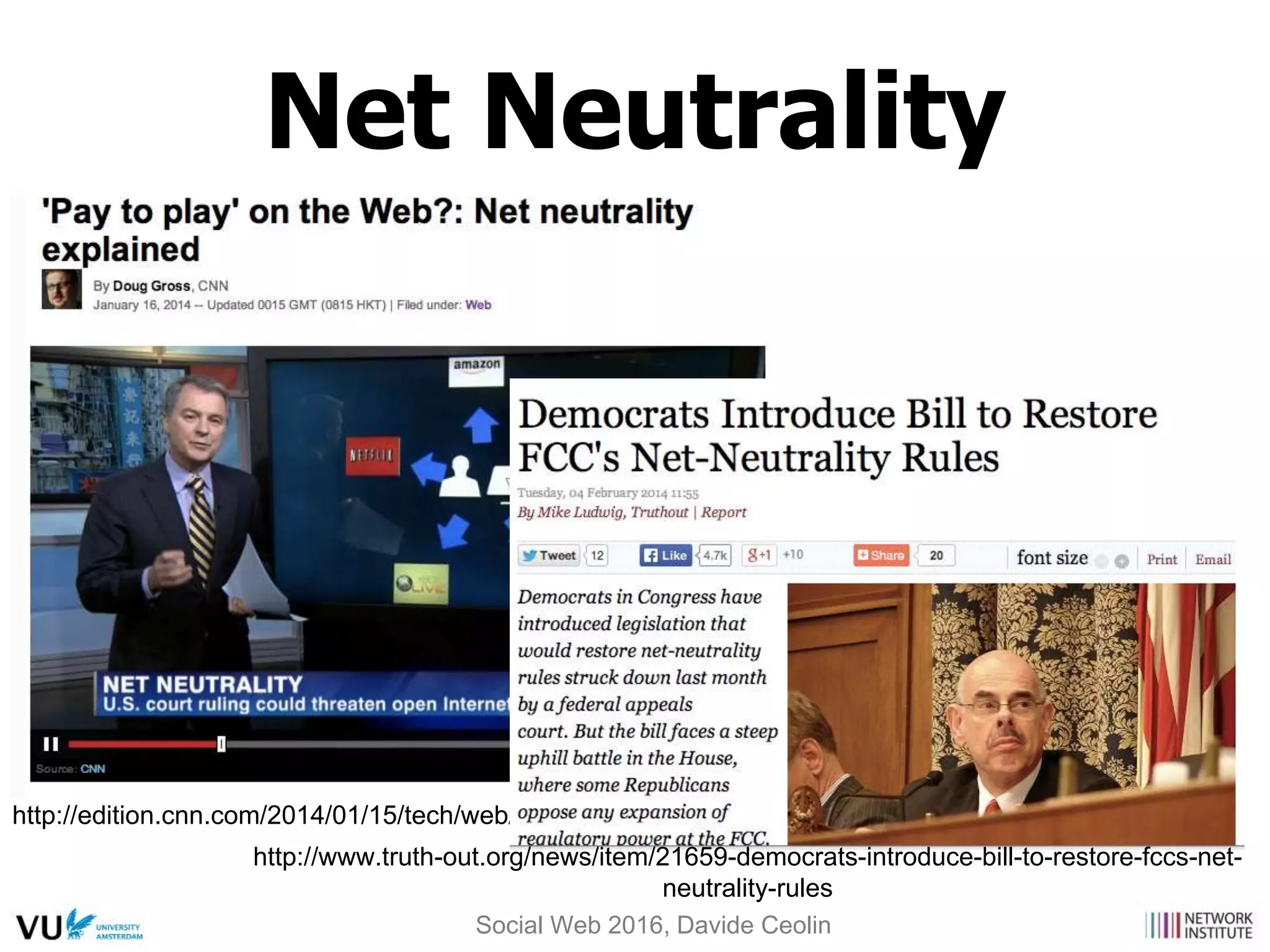
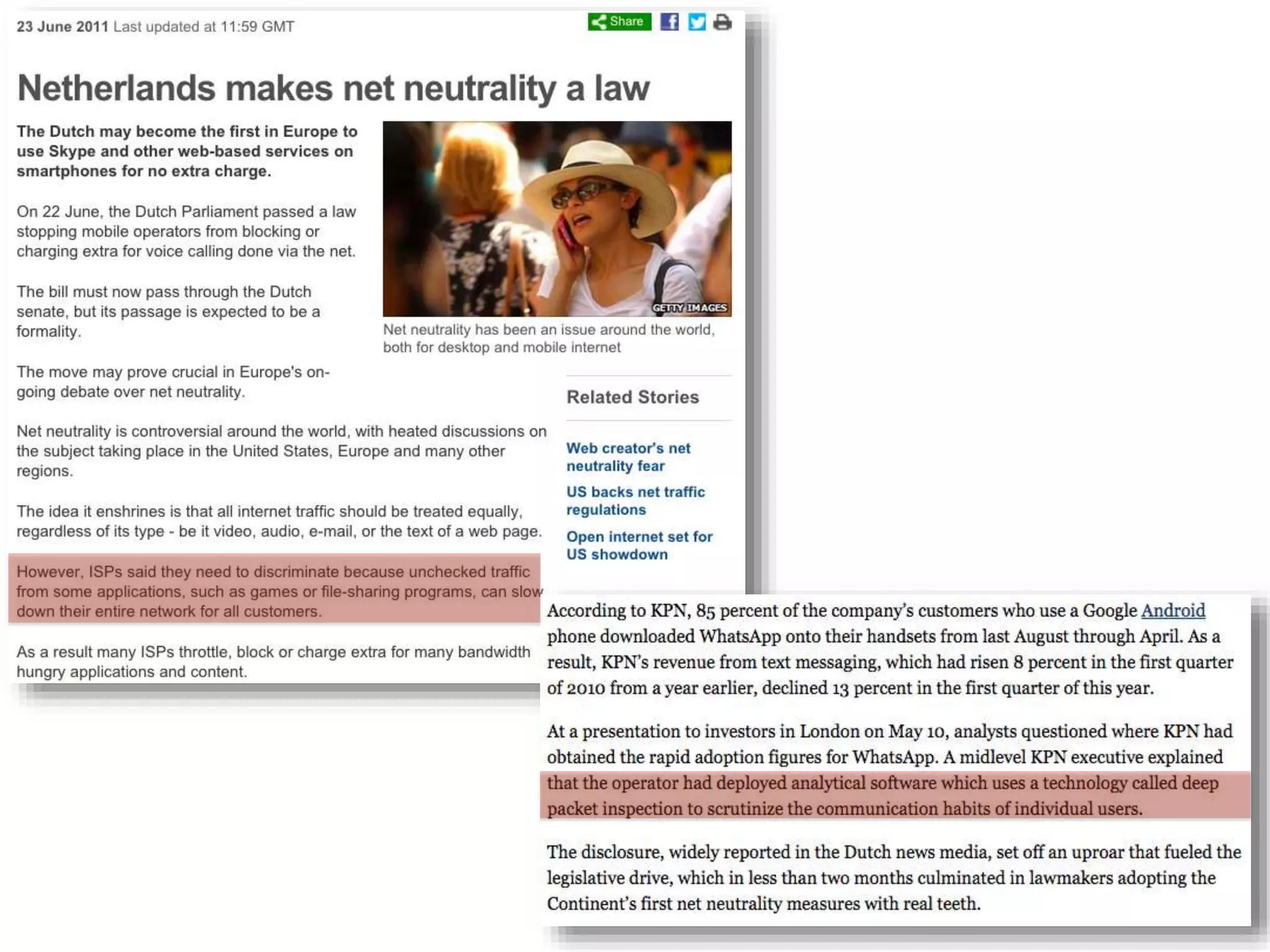
http://edition.cnn.com/2014/01/15/tech/web/net-neutrality-explained/
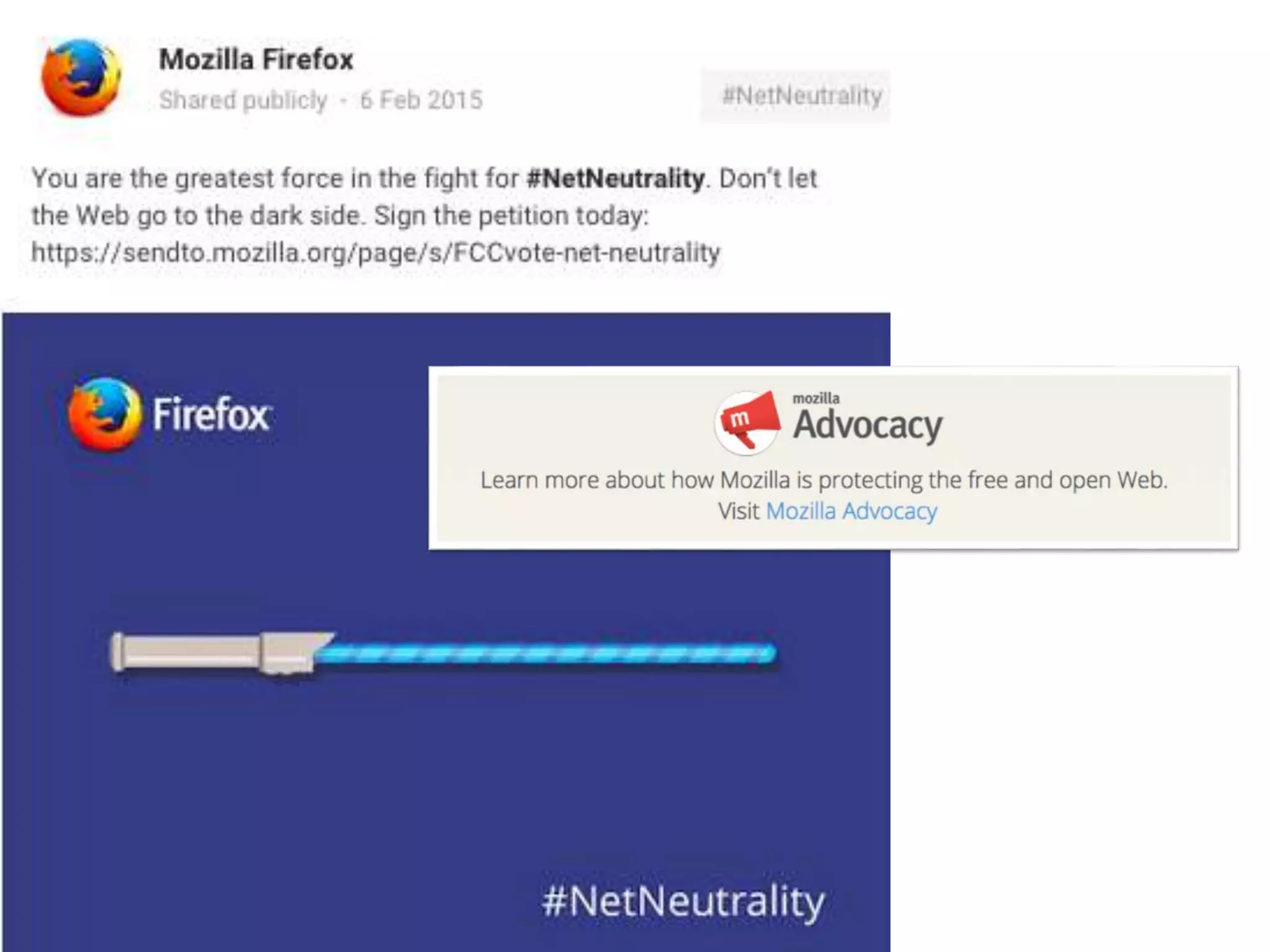
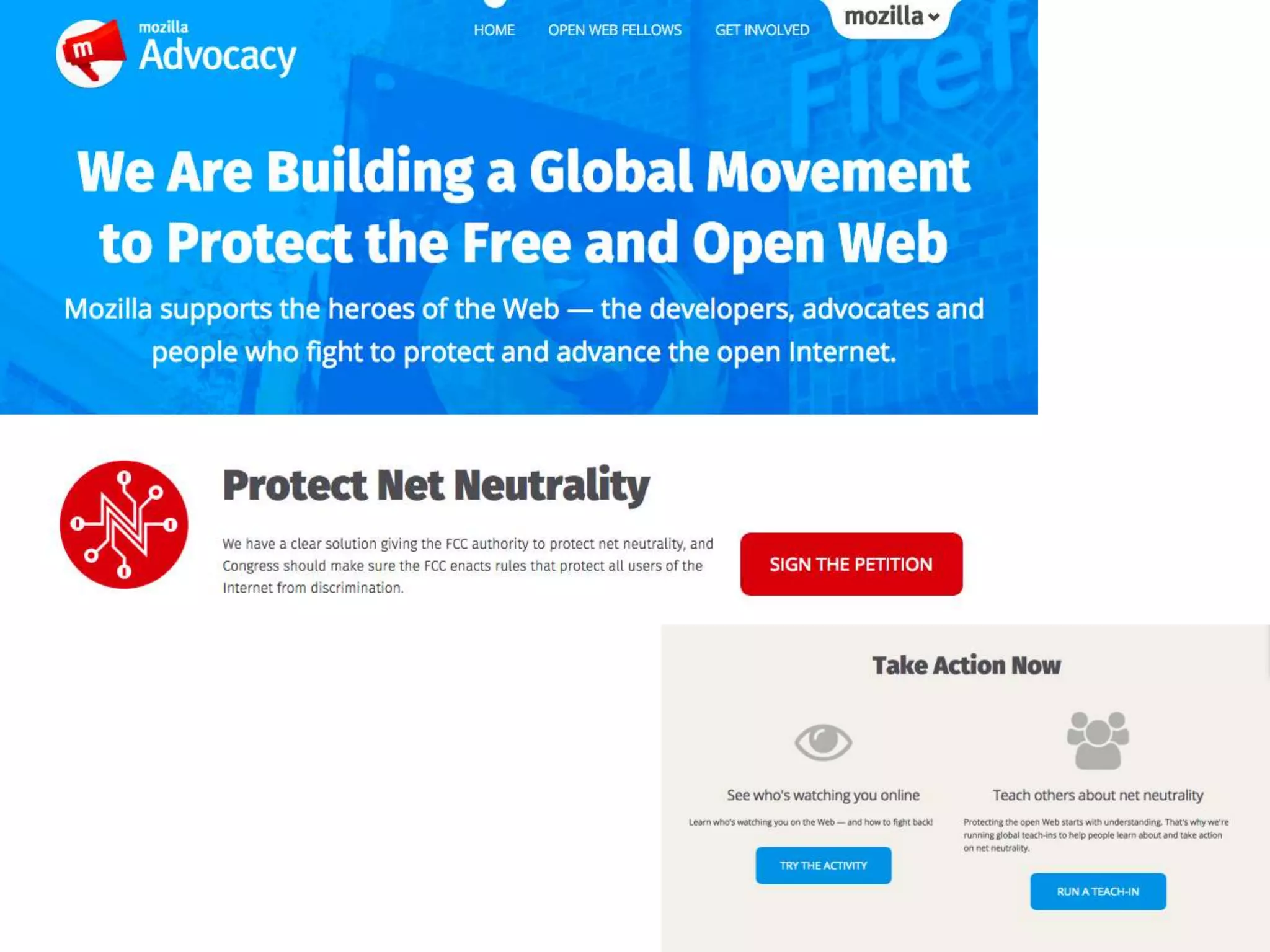
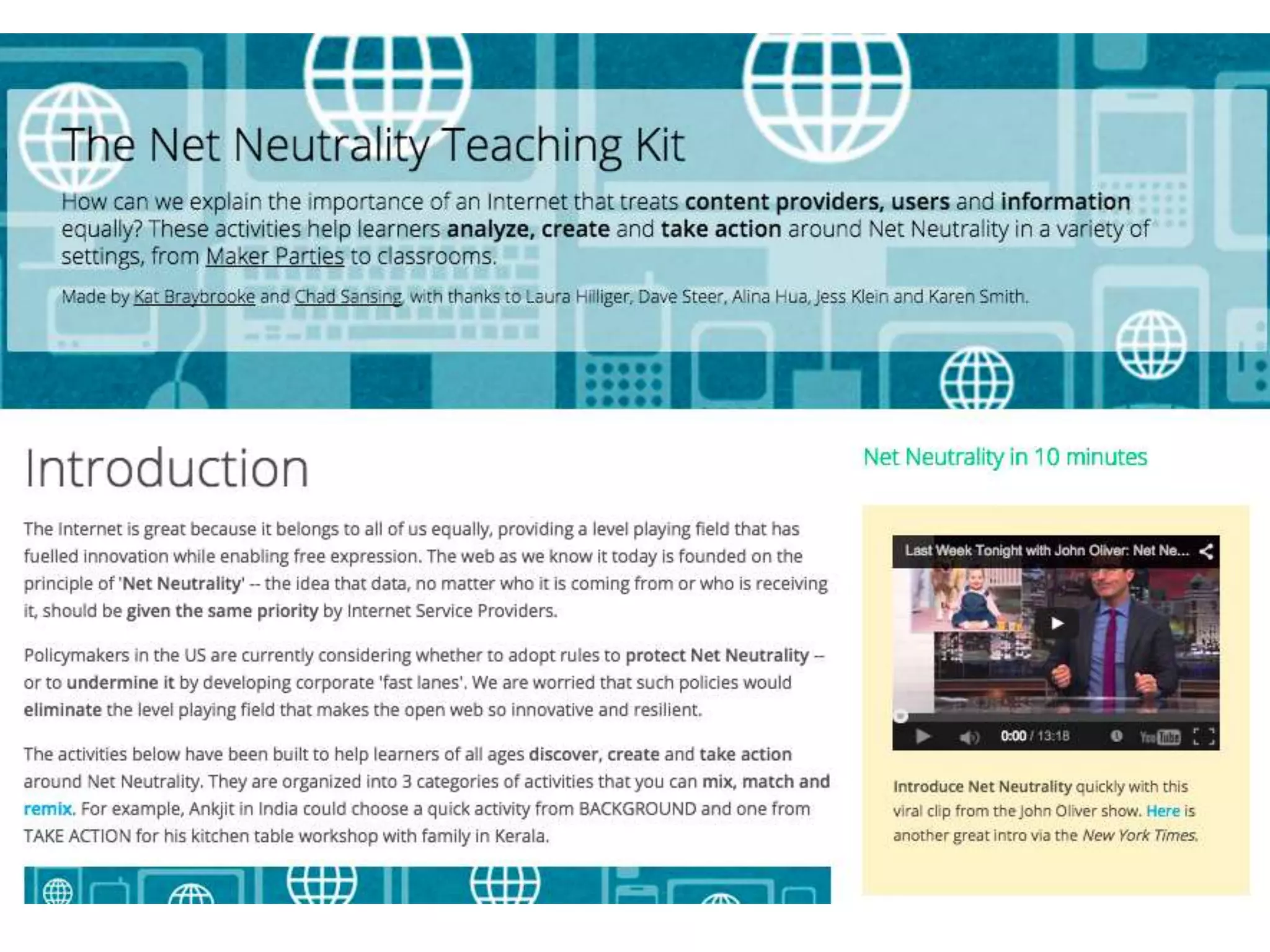
Net Neutrality
http://www.truth-out.org/news/item/21659-democrats-introduce-bill-to-restore-fccs-net-
neutrality-rules
Social Web 2016, Davide Ceolin
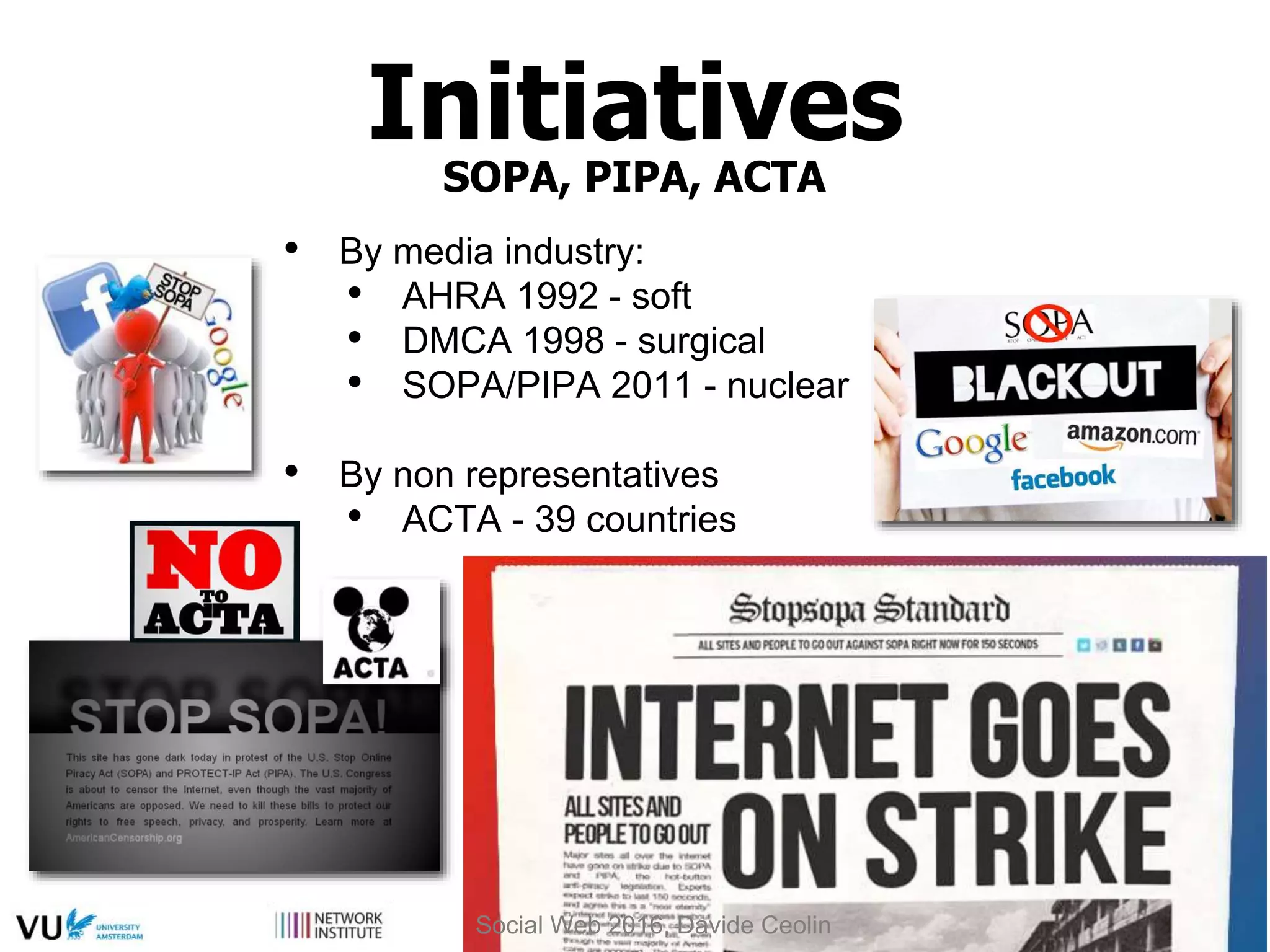
Initiatives
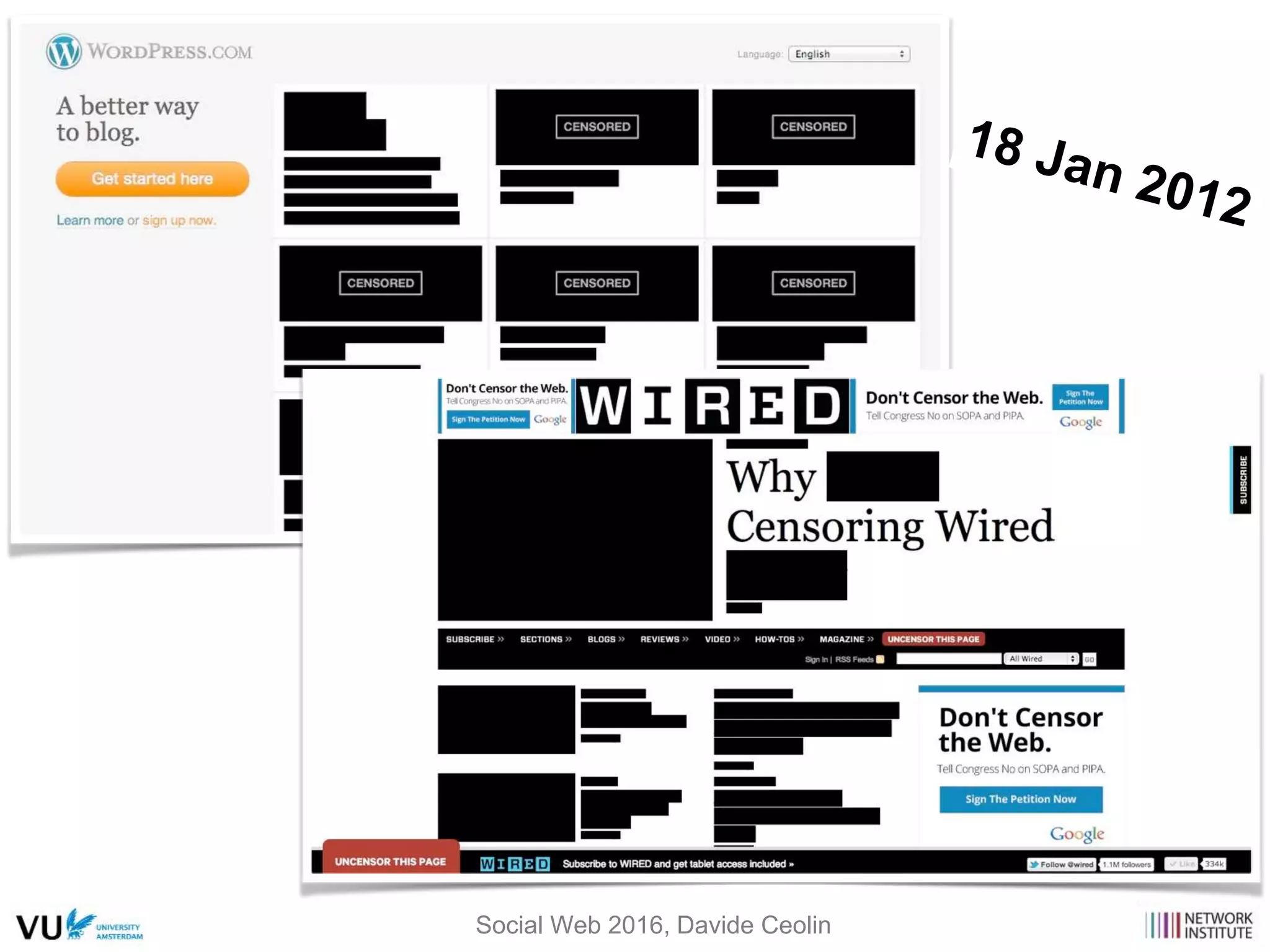
SOPA, PIPA, ACTA
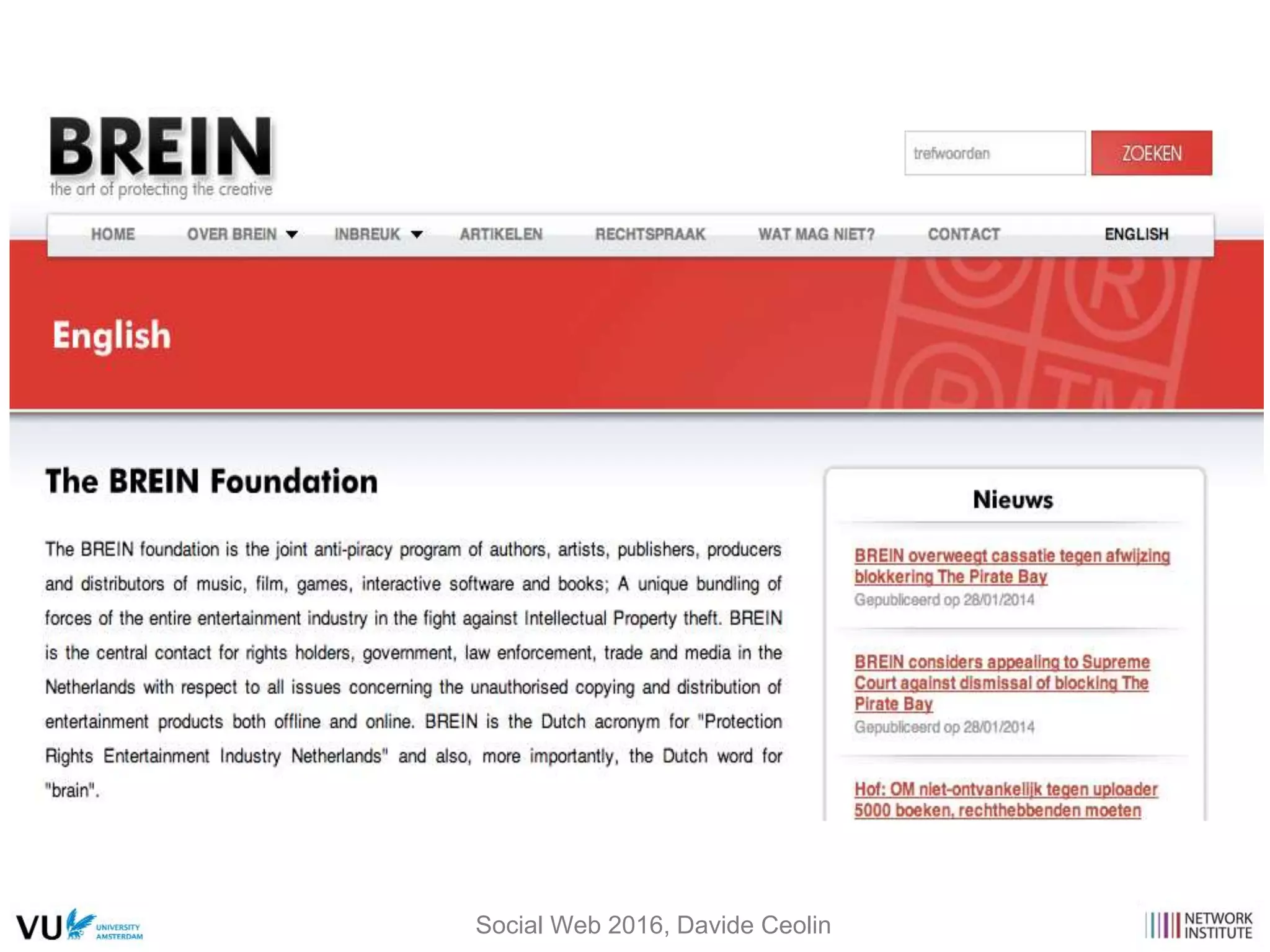
• By media industry:
• AHRA 1992 - soft
• DMCA 1998 - surgical
• SOPA/PIPA 2011 - nuclear
• By non representatives
• ACTA - 39 countries
Social Web 2016, Davide Ceolin
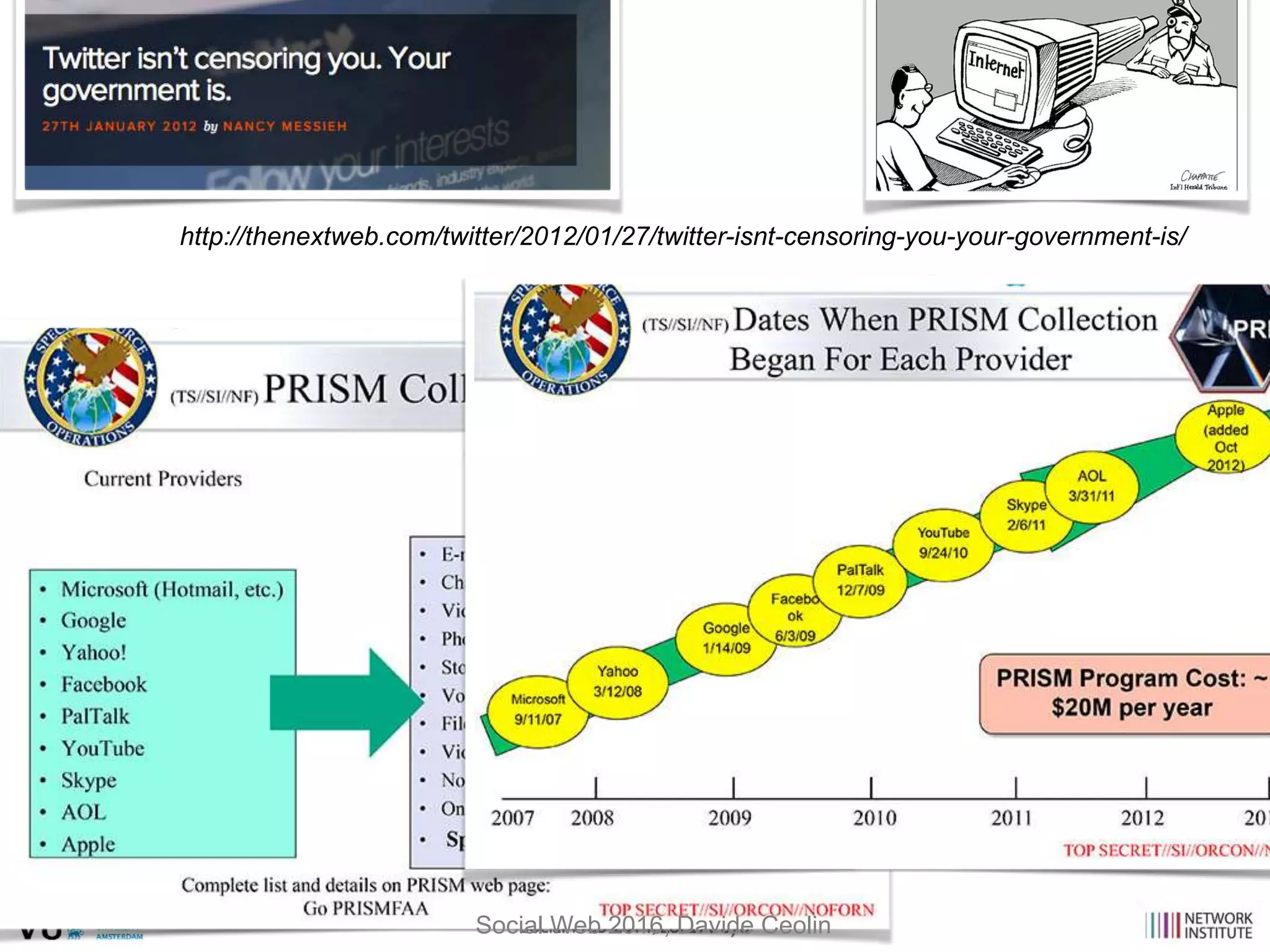
http://thenextweb.com/twitter/2012/01/27/twitter-isnt-censoring-you-your-government-is/
Social Web 2016, Davide Ceolin
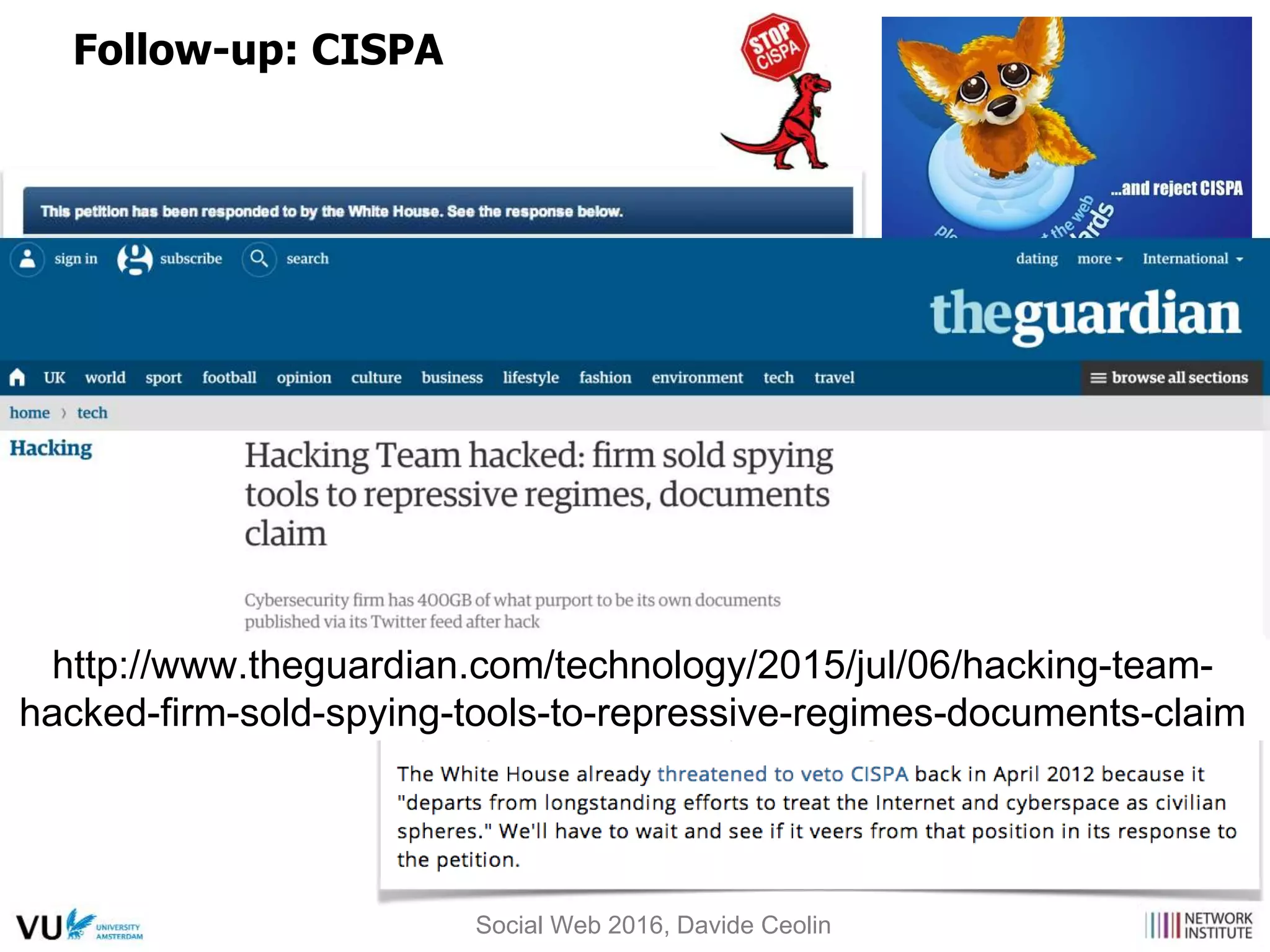
Follow-up: CISPA
Social Web 2016, Davide Ceolin
http://www.theguardian.com/technology/2015/jul/06/hacking-team-
hacked-firm-sold-spying-tools-to-repressive-regimes-documents-claim
Social Web 2016, Davide Ceolin
http://tacma.net/
Social Web 2016, Davide Ceolin
image source:
http://www.flickr.com/photos/bionicteaching/1375254387/
Assignment 1
Social Web 2016, Davide Ceolin
Provide analysis of privacy issues on the (Social) Web
• three articles <--> three mind maps <--> main Social Web privacy issues
• write for people who didn’t attend the course
• Use the concept maps from the lectures  Attempt to make one merged concept
map (from all the concept maps) on the issue of Privacy on the Social Web by
indicating which parts of it come from which papers or other material
Provide analysis of current privacy-related public initiatives
• legal contexts for privacy and ownership
• compare the intentions of both initiatives (advantages & disadvantages)
• your own vision on how this impacts the future of the social web
• your own advise to policy makers with regards to privacy on the web.
• links to Net Neutrality & the right to be forgotten
Link to Hands-on session:
• what would change if any of the initiative mentioned in the lecture were active, e.g.
SOPA, getting documents out of search index – would you still have access to the
information you pulled in for the assignments?
• Illustrate your answer showing what changes could appear in the graph from
exercise 4 (Hands-on session 2) and explain why.
• Do the same exercise with thinking about the formats and the ‘the right to be
forgotten’, what does need to be altered or added in order to support such an act
from technology point of view.
Deadline: 19 February 23:59
Social Web 2016, Davide Ceolin
Installations
• Python 2.7
• Python packages: json, facebook, uurllib2
• JavaScript Info Vis Toolkit (jit.zip)
• Facebook Developers app
Experience OAuth
Query the Facebook Open Graph
Visualize your FB social network in various ways
image source:
http://www.flickr.com/photos/bionicteaching/1375254387/
Hands-on Teaser
Social Web 2016, Davide Ceolin

VU University Amsterdam - The Social Web 2016 - Lecture 2

  • 1.
    Social Web 2016 Lecture 2:What People DO on the Social Web? Davide Ceolin (credits to: Lora Aroyo) The Network Institute VU University Amsterdam
  • 2.
    Public Service Announcement (I) •Groups are formed • Contact me otherwise • From this Thursday we will have 3 labs • Next deadlines: • Wednesday 23:59 – slides/plan/screencast of your final assignment • Friday 10:00 – Post your questions about Lecture 3 • Friday 17:00 – Vote your favorite question
  • 3.
    • Subscribing tothe website is the easiest, otherwise: • You can vote by commenting “+1” • Your comments need my approval • Final Assignment Updates • List of NI member added to the website Public Service Announcement (II)
  • 4.
  • 5.
    People have relationshipswithin & across different contexts: family, sports, work, friends In ‘real world’ it works due to a relatively small set of social contexts & interaction opportunitieshttp://www.w3.org/2005/Incubator/socialweb/wiki/SocialWebFrameworks2#Social_Graph_Mana gement_Today Social in Physical World Social Web 2016, Davide Ceolin
  • 6.
    Digital social dynamicsmatch physical world: friends are friends in both worlds There are also significant differences: • # people to interact with, not limited by distance/time • a person can ‘block’ or ‘manage’ relationships • multiple systems - multiple accounts, i.e. multi-ple digital representation (personae, personal profiles) of a user • personae are subject to different social norms • personae can evolve over time • personae are less (not) limited in scope Social in Digital World Social Web 2016, Davide Ceolin
  • 8.
    Accounts on differentsocial networks, utilised in different ways, depending on digital context, e.g.: • friendly chat on Facebook • professional discussion on LinkedIn • dating on match.com As a consequence there is a need to manage the user profiles, identities & permissions, as well as the data in them Multiple SN Accounts Social Web 2016, Davide Ceolin
  • 10.
    Problems Maintaining a multitudeof online profiles for different contexts is cumbersome and time consuming —> not scalable Difficult for new social networks to attract new & maintain active members simply because of the effort involved in creating & maintaining “yet-another-profile”, e.g. re-establishing different aspects of your profile under yet another context Users cannot control how their information is viewed by others in different contexts by different social applications Social Web 2016, Davide Ceolin
  • 11.
    for managing multipleSocial Web profiles “policy-oriented web” architecture to support trusted services in the longer term Architecture Needed Social Web 2016, Davide Ceolin
  • 12.
    In one systemmanage your personal information: • home address, telephone number, & best friends • your Friends Profile gets exposed to Hives and Twitter In another system manage work-related information: • office address, office telephone number, & work colleagues • your Work Profile gets exposed to Plaxo and LinkedIn Another choice could be to store your entire profile locally with a trusted third party, and then • your Health Profile can be exposed to health care providers • your Citizen Profile can be exposed to government services For example … Social Web 2016, Davide Ceolin
  • 13.
  • 14.
  • 15.
  • 16.
  • 17.
  • 18.
  • 20.
    Opening the Sites SocialWeb 2016, Davide Ceolin
  • 21.
    • Demand fromapplication developers to make use of the amounts of Social Web data & make their applications available to the site members • Demand from users to reuse data and connections they have already established on other sites, e.g. Google+ download your data, Diaspora* download xml, download photos • In response: Facebook provided an API & Google OpenSocial API Opening the Sites Social Web 2016, Davide Ceolin
  • 22.
    • open, decentralizedstandard for authenticating users that can be used for access control, allowing users to log on to different services with the same digital identity where these services trust the authentication body • making sure the users are who they say they are • http://openid.net/ • Started in 2005 as Yadis (Yet another distributed identity system) Social Web 2016, Davide Ceolin
  • 23.
    http://openidexplained.com/ with OpenID, the processstarts with the application asking the user for their identity (typically an openid URI) Social Web 2016, Davide Ceolin
  • 24.
    OAuth • it enablesusers to grant third-party access to their web resources without sharing their passwords • largely based on: Flickr’s API Auth & Google’s AuthSub • limitations in terms of complexity, user experience, scale • 3 flows merged into one: web-based apps, desktop clients & mobile/limited devices; e.g. when Facebook Connect existed - flows for web apps, mobile devices & game consoles • http://oauth.net/ Social Web 2016, Davide Ceolin
  • 25.
    OAuth 2.0 the applicationdirectly requests a limited access OAuth Token (valet key) to access the APIs (enter the house) on user's behalf. If the user can grant that access, the application can retrieve the unique identifier for establishing • focuses on client developer simplicity - providing specific authorization flows for web & desktop applications, mobile phones & living room devices • not backwards compatible with previous versions • 6 New Flows • http://oauth.net/2/ Social Web 2016, Davide Ceolin
  • 26.
    In a nutshell What’sthe difference between OAuth and OpenID? OpenID is an authentication standard (to prove who you are), Oauth is an authorization protocol (to decide who can do what).
  • 27.
  • 28.
  • 29.
    Facebook Platform • GraphAPI - core of Facebook Platform, to read and write data to Facebook (simple and consistent view of the social graph) • Open Graph - defining Actions and Objects • Facebook Query Language (FQL) - SQL-style interface to query the data exposed by the Graph API • Authentication (Facebook Login) - interact with Graph API on behalf of Facebook users (single-sign on mechanism for web, mobile & desktop apps) • Social Plugins, Facebook Payments, Ads API, Chat API (via Jabber/XMPP service), JavaScript SDK • Deprecated: REST API, FBML, and the old Javascript API, Facebook Connect APIs Social Web 2016, Davide Ceolin
  • 30.
    • open standards-based(e.g. JavaScript, HTML) component model for cloud-based social apps • Google initiative (set of APIs) in 2007: • People & Friends API (people and relationship information) • Activities API (publishing & accessing user activity information) • Persistence API (simple key-value pair data for server-free stateful applications) • with Open Social embedded in a site, a site instantly becomes a social Web site (initially running only at Orkut) • integrated, e.g. OAuth, OAuth 2.0, Activity Streams • http://www.opensocial.org/ Social Web 2016, Davide Ceolin
  • 31.
  • 32.
    • Half ayear after Facebook Platform, Google launched Open Social • Popular containers (initially): MySpace, Hi5, Plaxo, LinkedIn, Orkut, Friendster, Six Apart • http://opensocial.org/category/showcase/ (currently) • Plugged-in applications: iLike, Slide, Flixter, Rock You, etc. • https://github.com/opensocial • Apache Shinding: reference implementation of OpenSocial Specification (Social Network APIs): • Apache Rave: lightweight extendible platform for using, integrating & hosting OpenSocial and W3C Widget services (context-aware personalization, collaboration & content integration capabilities) OpenSocial Social Web 2016, Davide Ceolin
  • 33.
  • 34.
    • The Twitterplatform offers access to the data of more than 200 million tweets a day, via different APIs • Each API represents a facet of Twitter • These APIs are constantly evolving, and developers have to be aware of that • http://dev.twitter.com Twitter APIs Social Web 2016, Davide Ceolin
  • 35.
    • the APIfor leveraging core Twitter objects • enables access to core Twitter primitives including timelines, status updates & user information, etc. • RESTful API calls to build a profile of a user: user name, user Twitter handle, user profile avatar & the graph of people that user is following on Twitter • enables interaction with Twitter: create & post tweets back to Twitter, reply to tweets, favorite certain tweets, retweet other tweets, etc. REST API Social Web 2016, Davide Ceolin
  • 36.
    • a setof tweets with specific keywords, • tweets referencing a specific user, • tweets from a particular user • access to data around Trends • it’s limited, e.g. index of only recent tweets (6-9 days); no authentication: all queries are made anonymously; some tweets & users may be missing from search results (focus on relevance) Search API Social Web 2016, Davide Ceolin
  • 37.
    • real-time sampleof the Twitter Firehose • for data intensive needs, e.g. data mining, analytics research • allows for large quantities of keywords to be specified and tracked, retrieving geo-tagged tweets, or have the public statuses of a user set returned • Connecting to the streaming API requires keeping a persistent HTTP connection open (different than the REST API) Streaming API Social Web 2016, Davide Ceolin
  • 38.
    REST vs. Streaming Social Web2016, Davide Ceolin
  • 39.
    Twitter for Websites SocialWeb 2016, Davide Ceolin
  • 40.
  • 41.
    Twitter Cards App Installs& Deep Linking Social Web 2016, Davide Ceolin
  • 42.
    Issues related to UserProfiles & Networks Social Web 2016, Davide Ceolin
  • 43.
    • Legal stillin its infancy, but courts do rule on new behavior • 4th amendt. to U.S. Constitution - not equipped to address SNS • e.g., is content on Facebook accessible without a warrant? • Truthfulness of personal profiles - subject of debate • Privacy hard to understand (few read Terms) & misinterpret ‘Friends’ Privacy Concerns Social Web 2016, Davide Ceolin Burkholder, M. and Greenstadt, R. Privacy in Online Revie w Sites. IEEE CS Security and Privacy Workshops, 2012.
  • 44.
  • 45.
    Social Web 2016,Davide Ceolin
  • 46.
    Fundamental aspects toconsider for users of Social Web: • Ownership of their own personal information, including: • their own profile data • the list of people they are connected to • the activity stream of content they create • Control of whether & how personal information is shared with others • Freedom to grant persistent access to their personal information to trusted external sites http://opensocialweb.org/2007/09/05/bill-of-rights/ Bill of Rights Social Web 2016, Davide Ceolin
  • 47.
    Social Web 2016,Davide Ceolin
  • 48.
    http://www.economist.com/blogs/babbage/2012/01/online-privacy Issues: • burden oncompanies: it is next to impossible to rid the web completely of a piece of information: some digital ripples will inevitably remain • where one man’s data end and another’s begin • crooks may try to invoke it to have their name struck from unfavorable online coverage • it is not always clear what counts as reporting on the internet “Having figured out how to remember nearly everything, it is about time people relearned how to forget” 27-01-2012 “Personal data is the new oil of the internet and the new currency of the digital world.” Meglena Kuneva, European Consumer Commissioner, 2009 Social Web 2016, Davide Ceolin
  • 51.
    • "privacy paradox"= lack of awareness of the public nature of Internet • flexibility to handle friends with different conceptions of privacy • ability to control data flow inside and outside network • realize that sensitive information can be reconstructed Privacy: Awareness not Paranoia Social Web 2016, Davide Ceolin http://www.independent.co.uk/news/world/australasi a/paedophile-websites-steal-half-their-photos-from- social-media-sites-like-facebook-a6673191.html
  • 52.
  • 57.
    Initiatives SOPA, PIPA, ACTA •By media industry: • AHRA 1992 - soft • DMCA 1998 - surgical • SOPA/PIPA 2011 - nuclear • By non representatives • ACTA - 39 countries Social Web 2016, Davide Ceolin
  • 58.
    Social Web 2016,Davide Ceolin
  • 59.
    Social Web 2016,Davide Ceolin
  • 60.
    Social Web 2016,Davide Ceolin
  • 61.
    Social Web 2016,Davide Ceolin
  • 62.
  • 64.
    Social Web 2016,Davide Ceolin
  • 65.
    Follow-up: CISPA Social Web2016, Davide Ceolin http://www.theguardian.com/technology/2015/jul/06/hacking-team- hacked-firm-sold-spying-tools-to-repressive-regimes-documents-claim
  • 66.
    Social Web 2016,Davide Ceolin
  • 67.
  • 68.
  • 69.
    Provide analysis ofprivacy issues on the (Social) Web • three articles <--> three mind maps <--> main Social Web privacy issues • write for people who didn’t attend the course • Use the concept maps from the lectures  Attempt to make one merged concept map (from all the concept maps) on the issue of Privacy on the Social Web by indicating which parts of it come from which papers or other material Provide analysis of current privacy-related public initiatives • legal contexts for privacy and ownership • compare the intentions of both initiatives (advantages & disadvantages) • your own vision on how this impacts the future of the social web • your own advise to policy makers with regards to privacy on the web. • links to Net Neutrality & the right to be forgotten Link to Hands-on session: • what would change if any of the initiative mentioned in the lecture were active, e.g. SOPA, getting documents out of search index – would you still have access to the information you pulled in for the assignments? • Illustrate your answer showing what changes could appear in the graph from exercise 4 (Hands-on session 2) and explain why. • Do the same exercise with thinking about the formats and the ‘the right to be forgotten’, what does need to be altered or added in order to support such an act from technology point of view. Deadline: 19 February 23:59 Social Web 2016, Davide Ceolin
  • 70.
    Installations • Python 2.7 •Python packages: json, facebook, uurllib2 • JavaScript Info Vis Toolkit (jit.zip) • Facebook Developers app Experience OAuth Query the Facebook Open Graph Visualize your FB social network in various ways image source: http://www.flickr.com/photos/bionicteaching/1375254387/ Hands-on Teaser Social Web 2016, Davide Ceolin

Editor's Notes

  • #5 last week we talked in general about SNS this week we will zoom in the nature of the social relationships and the user profiles and further implications for privacy
  • #6 to understand how the SNS work is to understand how the social relationships work and what’s their nature
  • #7 What are different social norms that you can think of?
  • #11 If social applications are to thrive and provide new engaging and valuable services to Web users, then there must be scalable ways for people to connect with and manage their social interactions and connections It is nice to be able to experiment with and to benefit from different social contexts in the Web.
  • #12 The ability to set up and to maintain multiple profiles will be the driving force that will expand participation in the Social Web, including and beyond the silo applications provided by existing Social applications Managing their own profiles, users can decide which social applications can access which profile details via exposing one (or more) profiles to that provider. In such an architecture, exposing a profile is an explicit act, and one that the user is more aware of, and can just as easily retract as well.
  • #13 which are the attributes (including the social relationships) I am putting in one profile who will get access to that - the choice is not just them and me - an alternative is a trusted third party
  • #19 2006 personal profiles --> the basis for the social relationships
  • #25 Authentication and Signatures: quickly write Twitter scripts by using username and password vs. find, install, and configure libraries Performance at Scale: large providers using OAuth - it didn’t scale well
  • #31 Half a year after Facebook Platform, Google launched Open Social. The Web site obtains functions as member registration, member profile, review, comment, photo-sharing, etc., by accessing the corresponding data on the site.
  • #33 .
  • #34 Half a year after Facebook Platform, Google launched Open Social. The Web site obtains functions as member registration, member profile, review, comment, photo-sharing, etc., by accessing the corresponding data on the site.
  • #35 see dev.twitter.com
  • #38 https://dev.twitter.com/docs/streaming-api Allows high-throughput near-realtime access to various subsets of public and protected Twitter data.
  • #44 Pew found that 55% of online teens have profiles, 66% of whom report that their profile is not visible to all Internet users (Lenhart & Madden, 2007). Of the teens with completely open profiles, 46% reported including at least some false information.
  • #49 Viktor Mayer-Schönberger, a professor of internet governance at Oxford University and author of “Delete: the Virtue of Forgetting in a Digital Age”. You will have trouble recalling your online searches from a few months back; Google won't.
  • #52 "privacy paradox" lack of awareness of the public nature of Internet (safety of younger users) reconstruct users' social security numbers with profile info, e.g. hometown and date of birth from freely accessible profile data - craft a "phishing" scheme appearing from a friend users' ability to control impressions and manage social contexts, e.g. "News Feed" could disrupt users’ sense of control no flexibility to handle conflicts with friends with different conceptions of privacy
  • #53 Net neutrality (also network neutrality, Internet neutrality, or net equality) is the principle that Internet service providers and governments should treat all data on the Internet the same, not discriminating or charging differentially by user, content, site, platform, application, type of attached equipment, or mode of communication
  • #58 Audio Home Recording Act - The act enabled the release of recordable digital formats such as Sony and Philips' Digital Audio Tape without fear of contributory infringement lawsuits. Digital Millennium Copyright Act - It criminalizes production and dissemination of technology, devices, or services intended to circumvent measures (commonly known as digital rights management or DRM) that control access to copyrighted works. It also criminalizes the act of circumventing an access control, whether or not there is actual infringement of copyright itself. Stop Online Piracy Act - The Stop Online Piracy Act (SOPA) was a controversial United States bill introduced by U.S. Representative Lamar S. Smith (R-TX) to expand the ability of U.S. law enforcement to combat online copyright infringement and online trafficking in counterfeit goods. PROTECT IP Act - The PROTECT IP Act (Preventing Real Online Threats to Economic Creativity and Theft of Intellectual Property Act, or PIPA) was a proposed law with the stated goal of giving the US government and copyright holders additional tools to curb access to "rogue websites dedicated to the sale of infringing or counterfeit goods", especially those registered outside the U.S.[1] wild west -- crossings -- the need to have laws
  • #59 Network neutrality (also net neutrality, Internet neutrality) is a principle that advocates no restrictions by Internet service providers or governments on consumers' access to networks that participate in theInternet. Specifically, network neutrality would prevent restrictions on content, sites, platforms, types of equipment that may be attached, and modes of communication.