Image: Jenser (Clasix-Design) @ FlickrOpen, social and linkedA ménage à trois of content exploitationAndy Powell, Eduservwww.eduserv.org.uk/researchtwitter.com/andypowe11UKSG, HarrogateApril 2011
Overview/ will argue that we have tended to underplay the importance of social networks in our provision of library and academic publishing services/ and, in fact, in the development of digital library services more generally/ and that emphasis on providing open and linked content provides platform for social activityImage: Niecieden@ Flickr
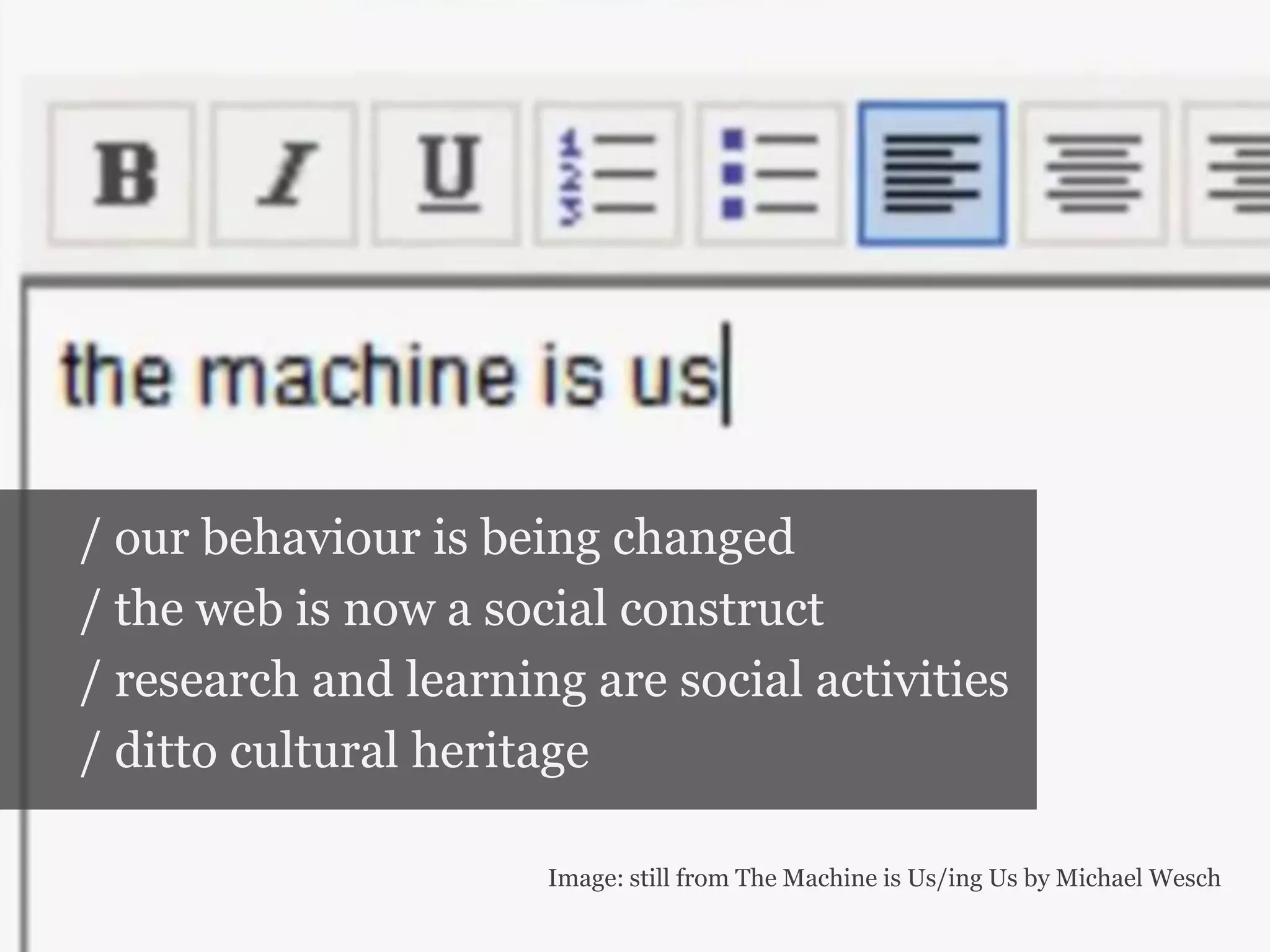
Attitude/ our behaviour is being changed/ the web is now a social construct/ research and learning are social activities/ ditto cultural heritageImage: still from The Machine is Us/ing Us by Michael Wesch
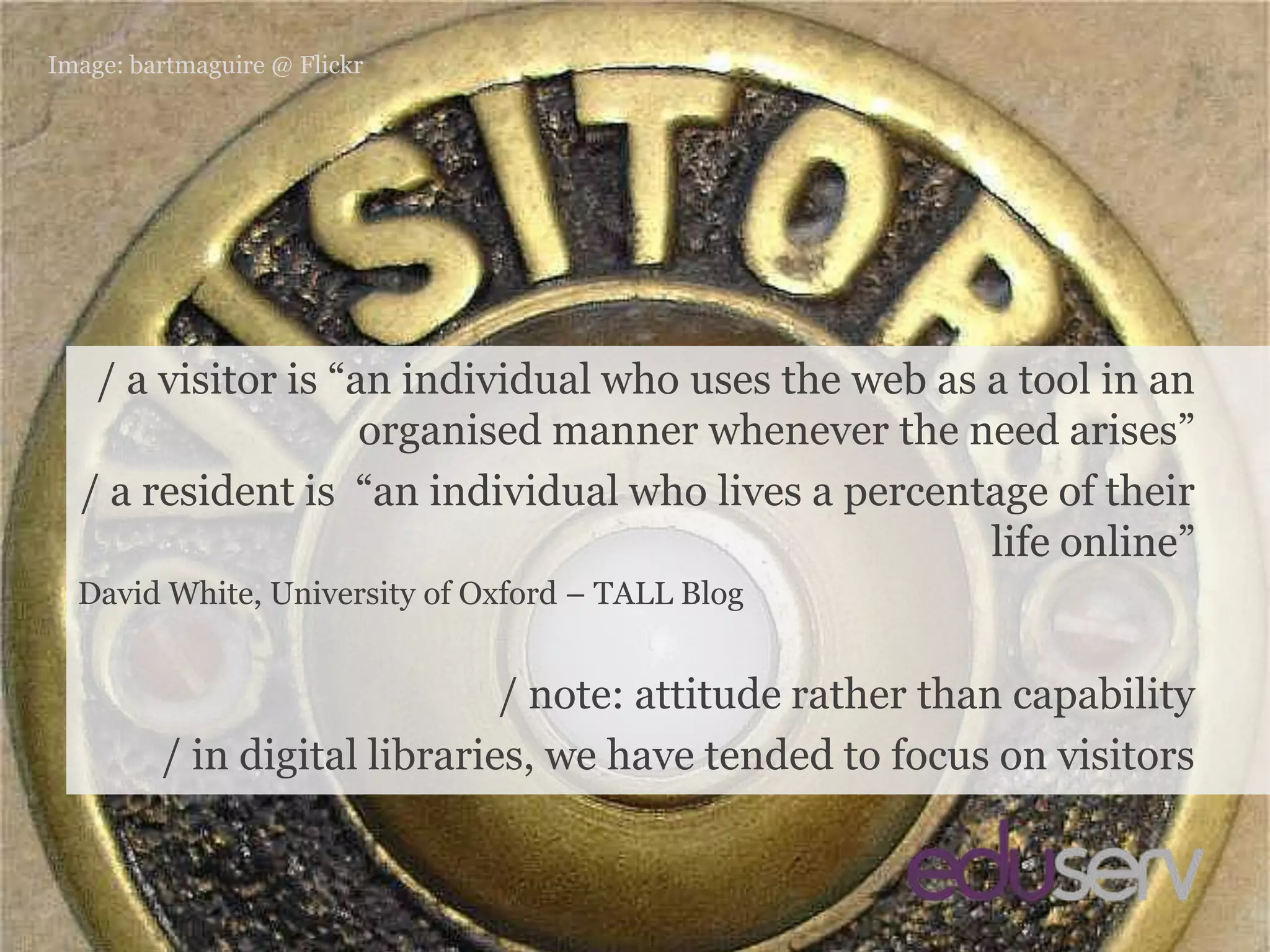
residents vs. visitorsImage: bartmaguire@ Flickr/ a visitor is “an individual who uses the web as a tool in an organised manner whenever the need arises”/ a resident is  “an individual who lives a percentage of their life online”David White, University of Oxford – TALL Blog/ note: attitude rather than capability/ in digital libraries, we have tended to focus on visitors
channels vs. platformsImage: akhr1961 @ Flickr/ content should be ‘of’ the web rather than ‘on’the web/ huh? what does that mean?/ again, it’s about attitude/ an expectation of re-use/ think platform rather than channel
In digital libraries…/ in digital librarieswe have a long (and pre-digital) heritage/ we tend to focus on contentand descriptions of content/ and moving collections of those descriptionsfrom providers to consumers/ such that they can be searched and browsedor otherwise displayed to individualsImage: spike55151 @ Flickr
StandardsImage: BEUTELTIERE @ Flickr/ we’re quite good at standards…/ particularly those that focus on metadata (MARC, MODS, DC, ORE, etc.)/ and identifiers for the content/ and protocols (OAI-PMH, Z39.50, SRW, etc.)/ and OpenURL, …
Access control/ because some (most?) content has not been freely availablewe also focus on access control/ standards like SAML/ software like Shibboleth or OpenAthensImage: spodzone@ Flickr
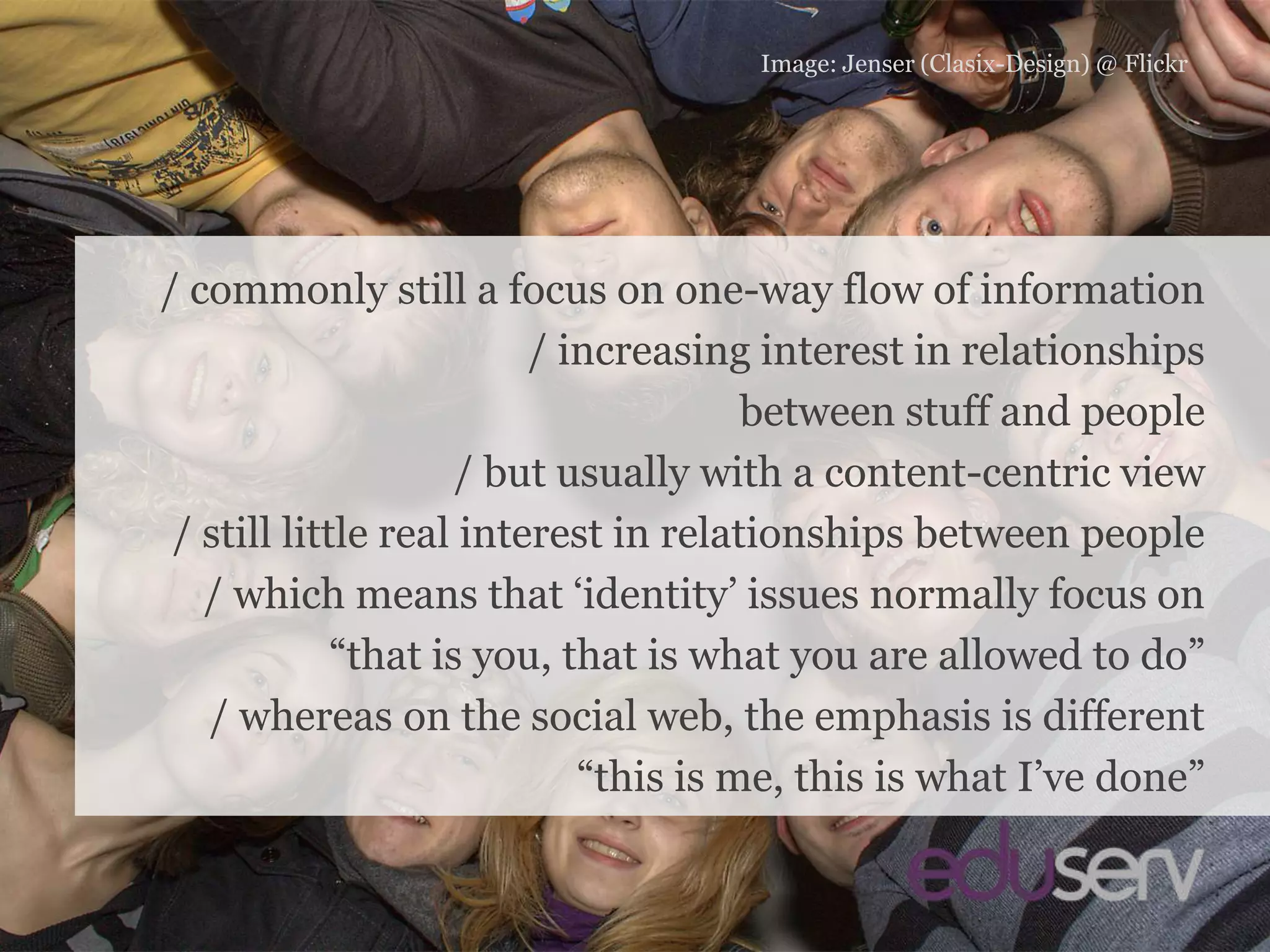
People and identityImage: Jenser (Clasix-Design) @ Flickr/ commonly still a focus on one-way flow of information/ increasing interest in relationshipsbetween stuff and people/ but usually with a content-centric view/ still little real interest in relationships between people/ which means that ‘identity’ issues normally focus on“that is you, that is what you are allowed to do”/ whereas on the social web, the emphasis is different“this is me, this is what I’ve done”
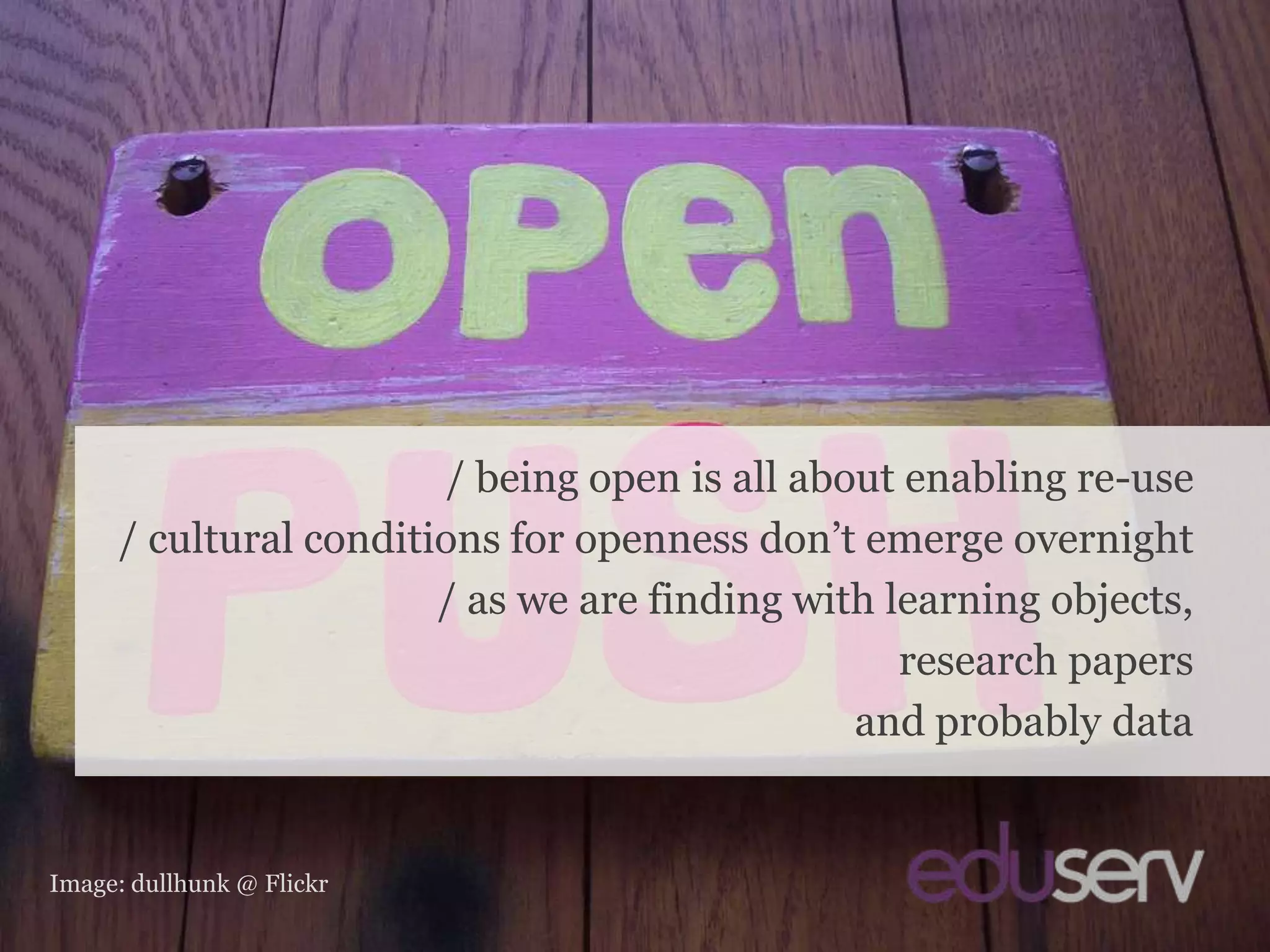
Openness aside (1)/ being open is all about enabling re-use/ cultural conditions for openness don’t emerge overnight/ as we are finding with learning objects,research papersand probably dataImage: dullhunk@ Flickr
Openness aside (1)Image: tk-link @ Flickr/ UKRDS survey of staff representing 700 researchers (2009).../ 43% expressed need to see other’s research data/ most share data in some form (informally with peers)/ but only 12% share via existing formal data centres
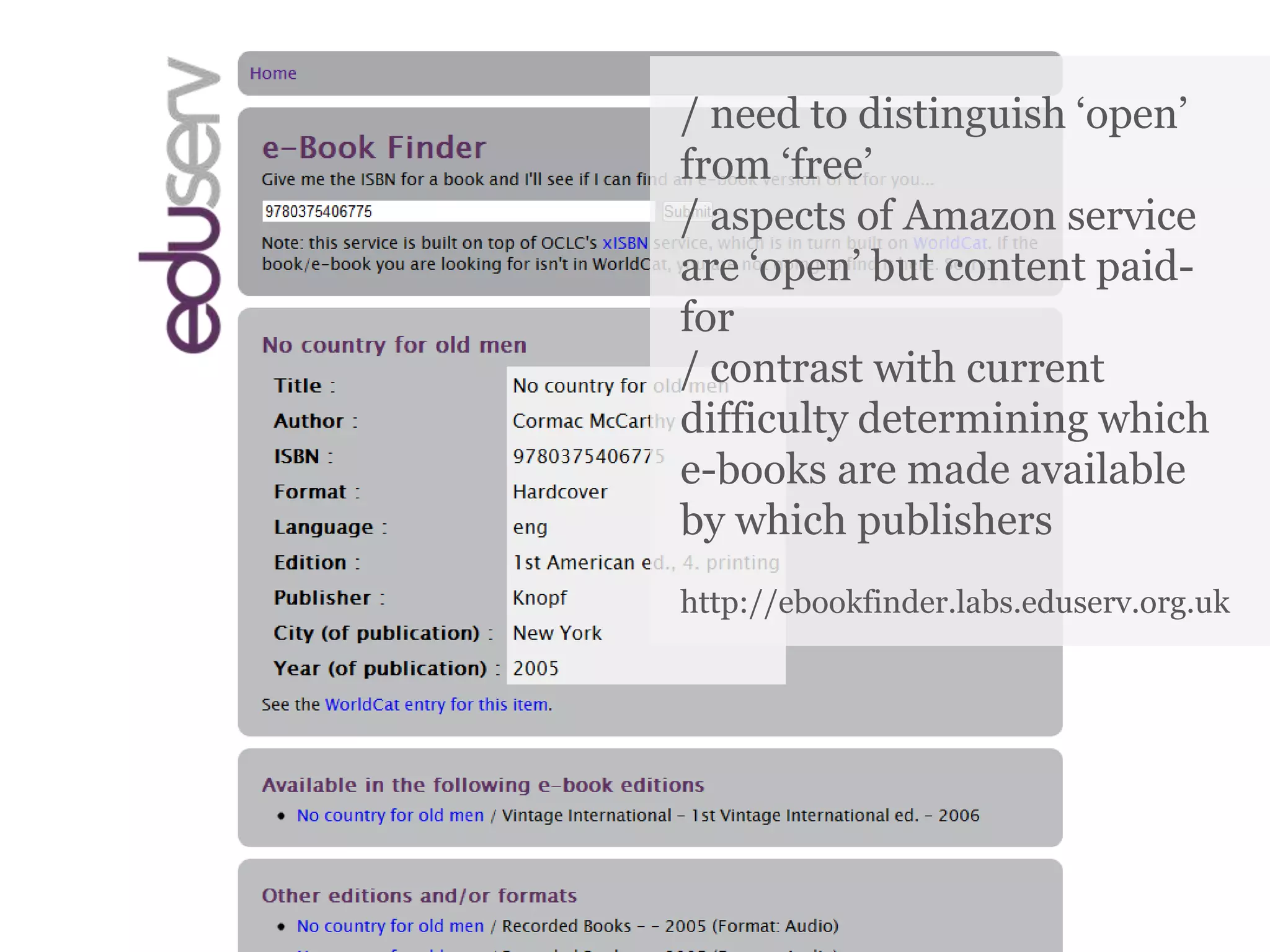
Openness aside (2)/ need to distinguish ‘open’ from ‘free’/ aspects of Amazon service are ‘open’ but content paid-for/ contrast with current difficulty determining which e-books are made available by which publishershttp://ebookfinder.labs.eduserv.org.uk
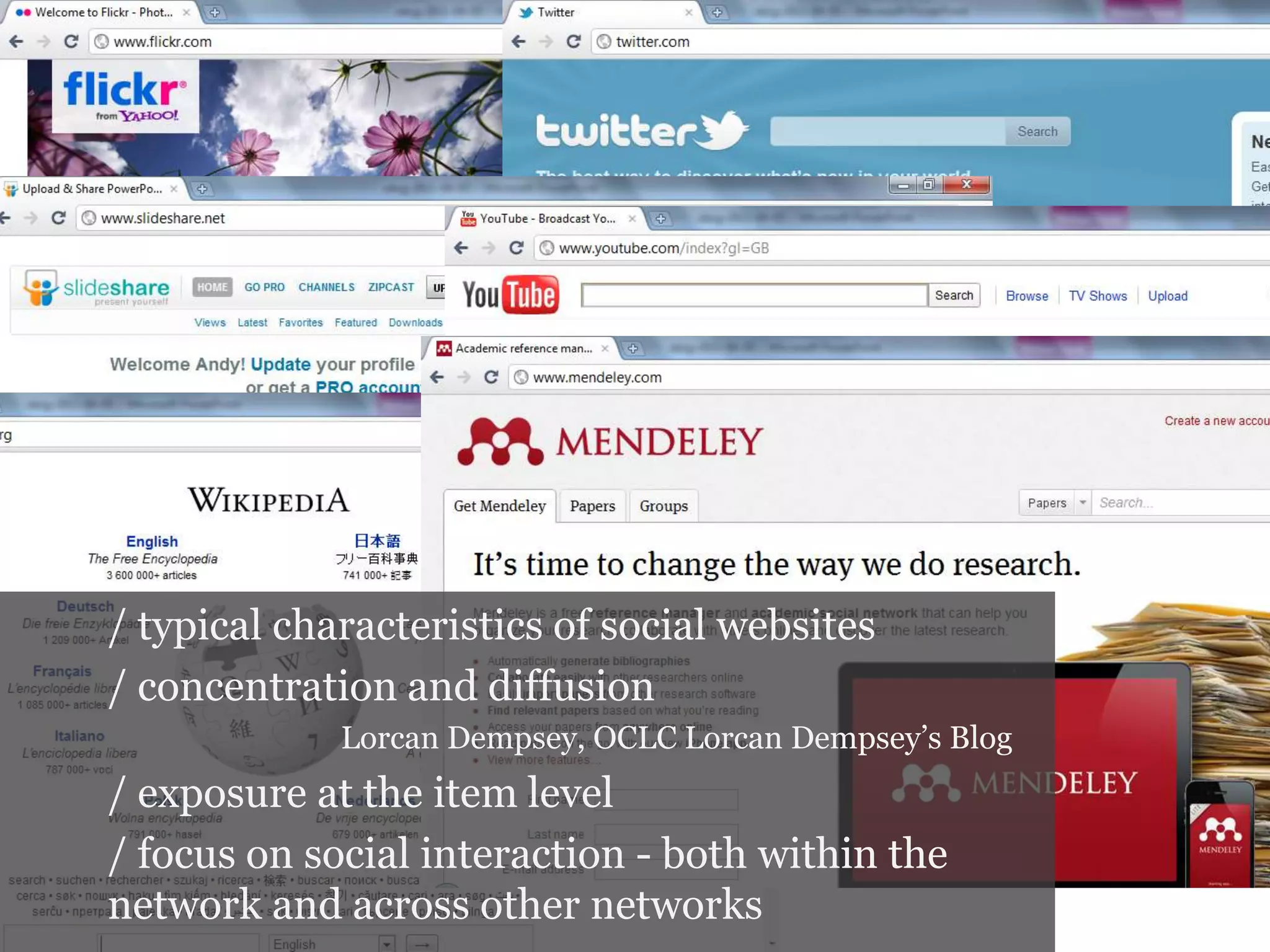
The social web/ typical characteristics of social websites/ concentration and diffusionLorcan Dempsey, OCLC Lorcan Dempsey’s Blog/ exposure at the item level/ focus on social interaction - both within the network and across other networks
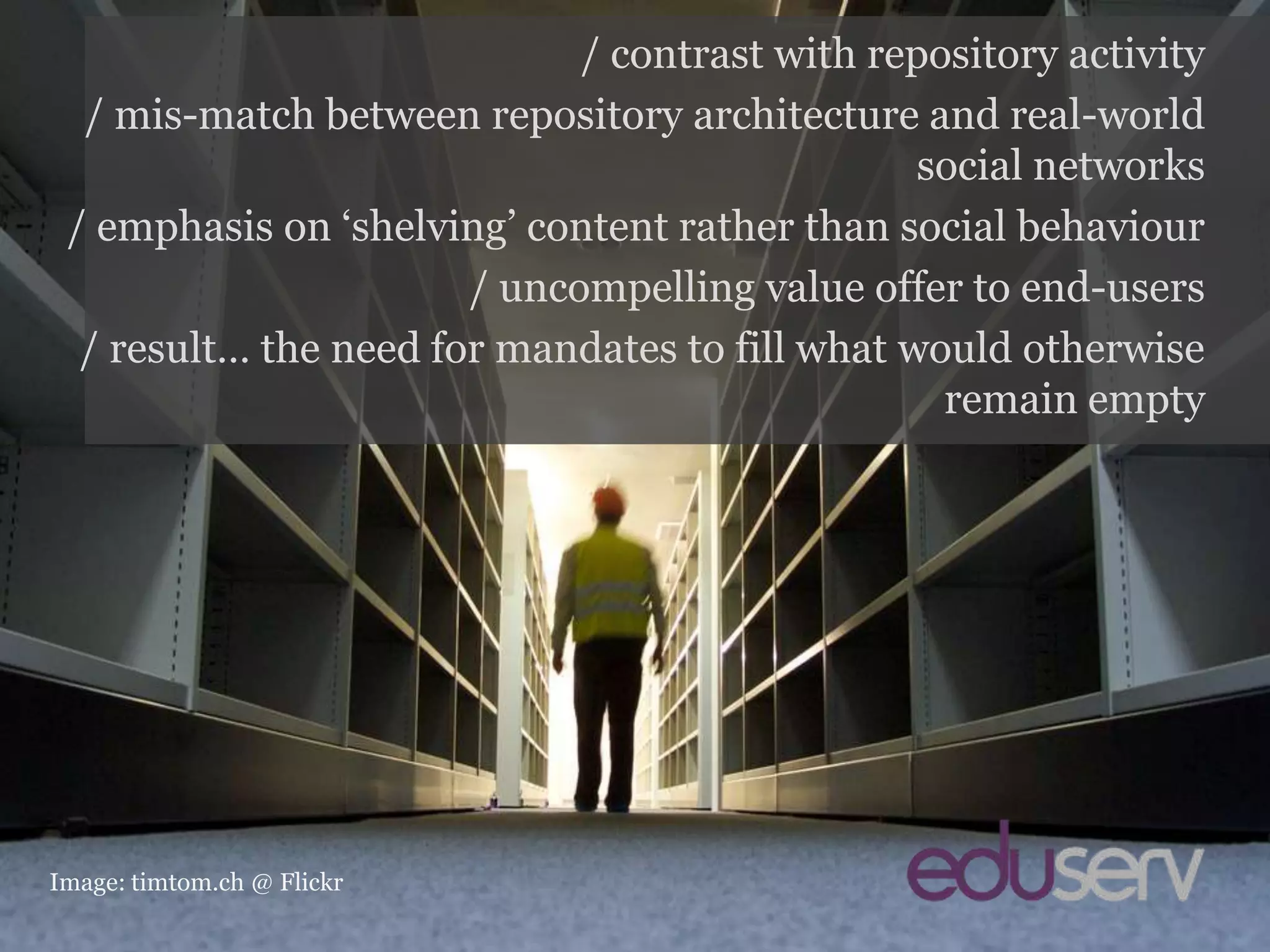
Contrast with repositories/ contrast with repository activity/ mis-match between repository architecture and real-world social networks/ emphasis on ‘shelving’ content rather than social behaviour/ uncompelling value offer to end-users/ result… the need for mandates to fill what would otherwise remain emptyImage: timtom.ch @ Flickr
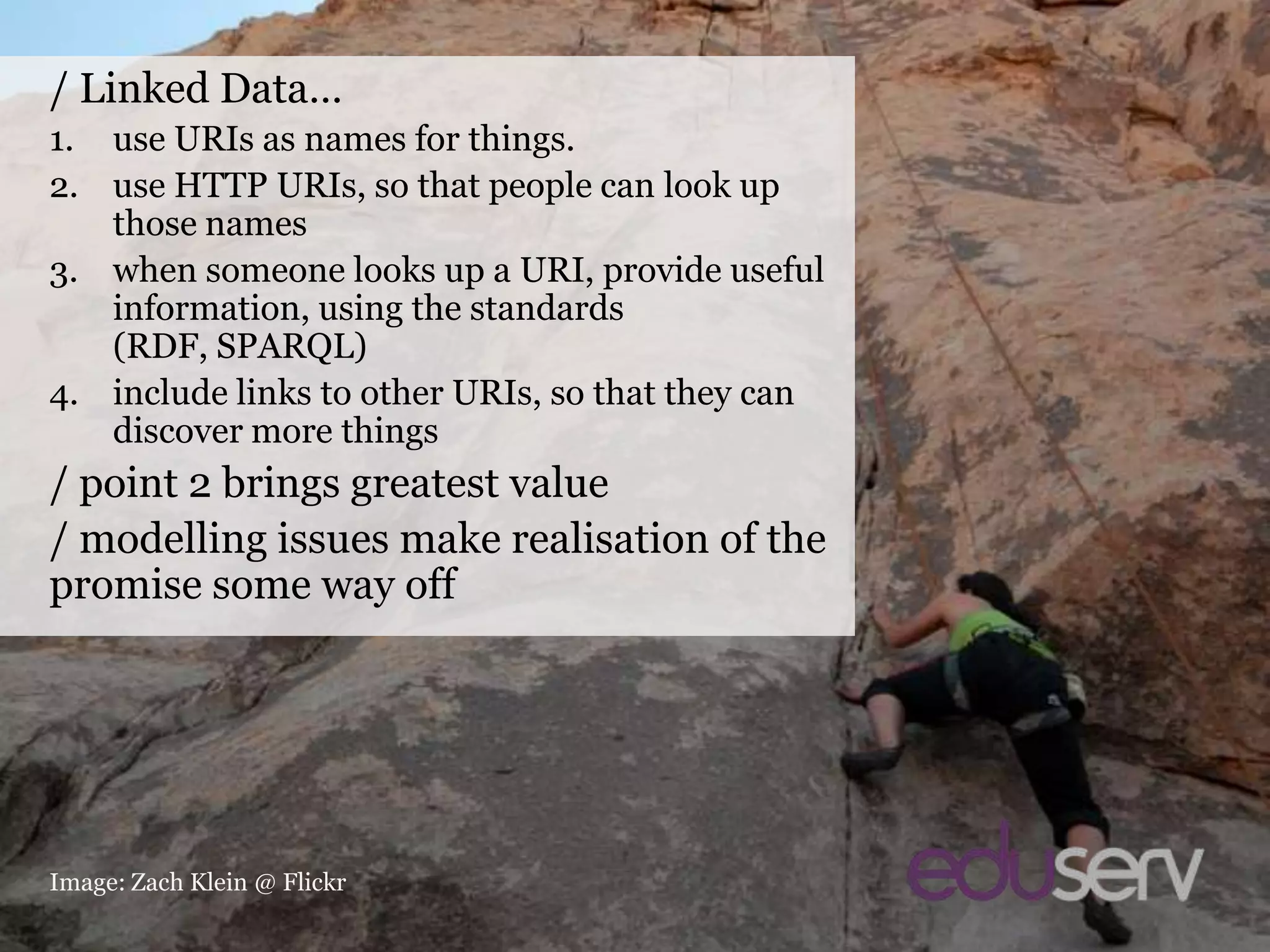
Linked Data/ Linked Data…use URIs as names for things.use HTTP URIs, so that people can look up those nameswhen someone looks up a URI, provide useful information, using the standards (RDF, SPARQL)include links to other URIs, so that they can discover more things/ point 2 brings greatest value/ modelling issues make realisation of the promise some way offImage: Zach Klein @ Flickr
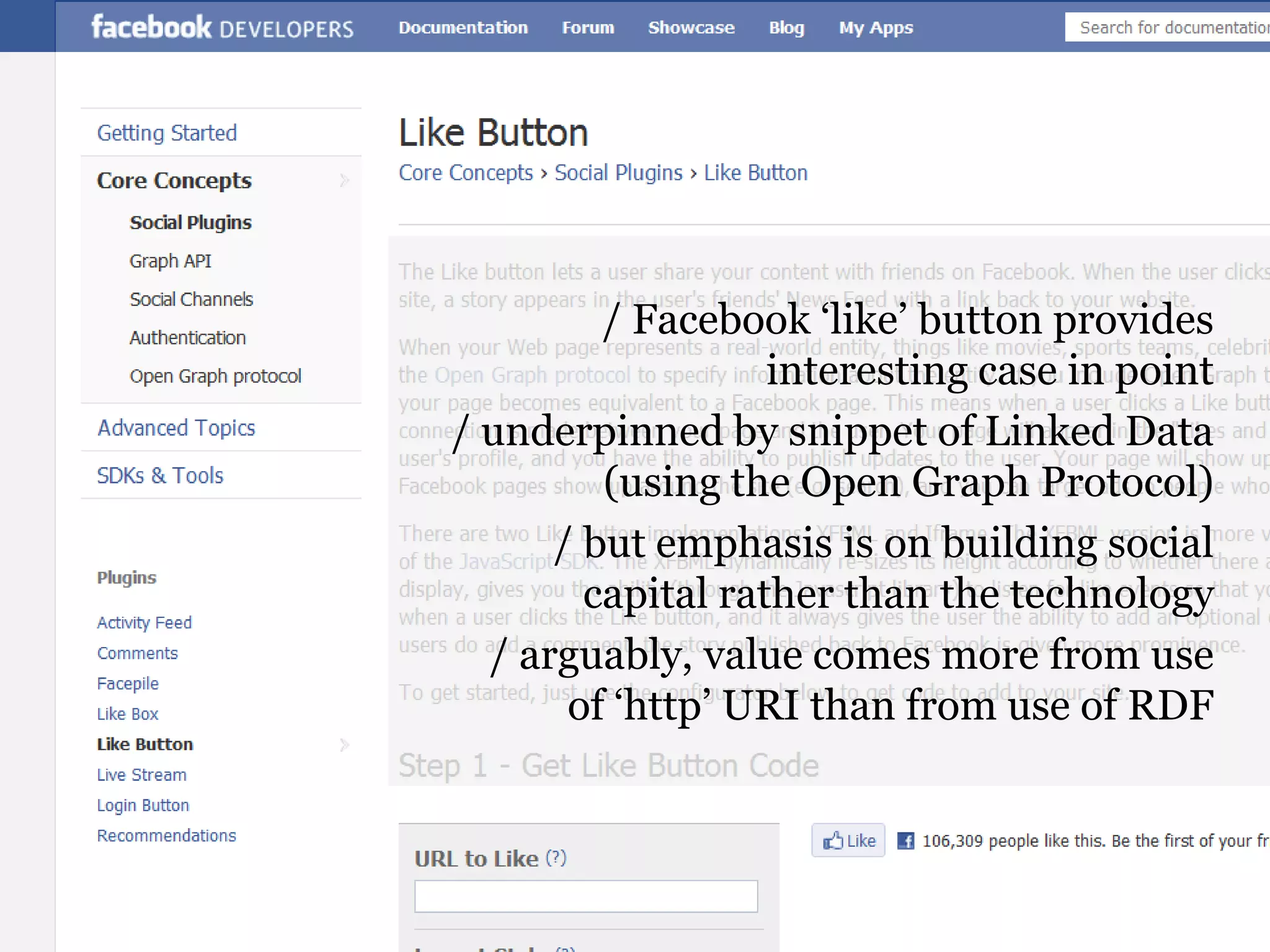
Facebook ‘like’ button/ Facebook ‘like’ button provides interesting case in point/ underpinned by snippet of Linked Data (using the Open Graph Protocol)/ but emphasis is on building social capital rather than the technology/ arguably, value comes more from use of ‘http’ URI than from use of RDF
ConclusionsConclusions/ if the web teaches us one thing, it is the power of the http URI and links based on it/ openness and linkedness provide a platform for social interaction/ but are not sufficient on their own/ increasingly need to understand the social activity of our users, particularly resident behaviours, and think platform rather than channel

Open, social and linked - A ménage à trois of content exploitation

  • 1.
    Image: Jenser (Clasix-Design)@ FlickrOpen, social and linkedA ménage à trois of content exploitationAndy Powell, Eduservwww.eduserv.org.uk/researchtwitter.com/andypowe11UKSG, HarrogateApril 2011
  • 2.
    Overview/ will arguethat we have tended to underplay the importance of social networks in our provision of library and academic publishing services/ and, in fact, in the development of digital library services more generally/ and that emphasis on providing open and linked content provides platform for social activityImage: Niecieden@ Flickr
  • 3.
    Attitude/ our behaviouris being changed/ the web is now a social construct/ research and learning are social activities/ ditto cultural heritageImage: still from The Machine is Us/ing Us by Michael Wesch
  • 4.
    residents vs. visitorsImage:bartmaguire@ Flickr/ a visitor is “an individual who uses the web as a tool in an organised manner whenever the need arises”/ a resident is “an individual who lives a percentage of their life online”David White, University of Oxford – TALL Blog/ note: attitude rather than capability/ in digital libraries, we have tended to focus on visitors
  • 5.
    channels vs. platformsImage:akhr1961 @ Flickr/ content should be ‘of’ the web rather than ‘on’the web/ huh? what does that mean?/ again, it’s about attitude/ an expectation of re-use/ think platform rather than channel
  • 6.
    In digital libraries…/in digital librarieswe have a long (and pre-digital) heritage/ we tend to focus on contentand descriptions of content/ and moving collections of those descriptionsfrom providers to consumers/ such that they can be searched and browsedor otherwise displayed to individualsImage: spike55151 @ Flickr
  • 7.
    StandardsImage: BEUTELTIERE @Flickr/ we’re quite good at standards…/ particularly those that focus on metadata (MARC, MODS, DC, ORE, etc.)/ and identifiers for the content/ and protocols (OAI-PMH, Z39.50, SRW, etc.)/ and OpenURL, …
  • 8.
    Access control/ becausesome (most?) content has not been freely availablewe also focus on access control/ standards like SAML/ software like Shibboleth or OpenAthensImage: spodzone@ Flickr
  • 9.
    People and identityImage:Jenser (Clasix-Design) @ Flickr/ commonly still a focus on one-way flow of information/ increasing interest in relationshipsbetween stuff and people/ but usually with a content-centric view/ still little real interest in relationships between people/ which means that ‘identity’ issues normally focus on“that is you, that is what you are allowed to do”/ whereas on the social web, the emphasis is different“this is me, this is what I’ve done”
  • 10.
    Openness aside (1)/being open is all about enabling re-use/ cultural conditions for openness don’t emerge overnight/ as we are finding with learning objects,research papersand probably dataImage: dullhunk@ Flickr
  • 11.
    Openness aside (1)Image:tk-link @ Flickr/ UKRDS survey of staff representing 700 researchers (2009).../ 43% expressed need to see other’s research data/ most share data in some form (informally with peers)/ but only 12% share via existing formal data centres
  • 12.
    Openness aside (2)/need to distinguish ‘open’ from ‘free’/ aspects of Amazon service are ‘open’ but content paid-for/ contrast with current difficulty determining which e-books are made available by which publishershttp://ebookfinder.labs.eduserv.org.uk
  • 13.
    The social web/typical characteristics of social websites/ concentration and diffusionLorcan Dempsey, OCLC Lorcan Dempsey’s Blog/ exposure at the item level/ focus on social interaction - both within the network and across other networks
  • 14.
    Contrast with repositories/contrast with repository activity/ mis-match between repository architecture and real-world social networks/ emphasis on ‘shelving’ content rather than social behaviour/ uncompelling value offer to end-users/ result… the need for mandates to fill what would otherwise remain emptyImage: timtom.ch @ Flickr
  • 15.
    Linked Data/ LinkedData…use URIs as names for things.use HTTP URIs, so that people can look up those nameswhen someone looks up a URI, provide useful information, using the standards (RDF, SPARQL)include links to other URIs, so that they can discover more things/ point 2 brings greatest value/ modelling issues make realisation of the promise some way offImage: Zach Klein @ Flickr
  • 16.
    Facebook ‘like’ button/Facebook ‘like’ button provides interesting case in point/ underpinned by snippet of Linked Data (using the Open Graph Protocol)/ but emphasis is on building social capital rather than the technology/ arguably, value comes more from use of ‘http’ URI than from use of RDF
  • 17.
    ConclusionsConclusions/ if theweb teaches us one thing, it is the power of the http URI and links based on it/ openness and linkedness provide a platform for social interaction/ but are not sufficient on their own/ increasingly need to understand the social activity of our users, particularly resident behaviours, and think platform rather than channel