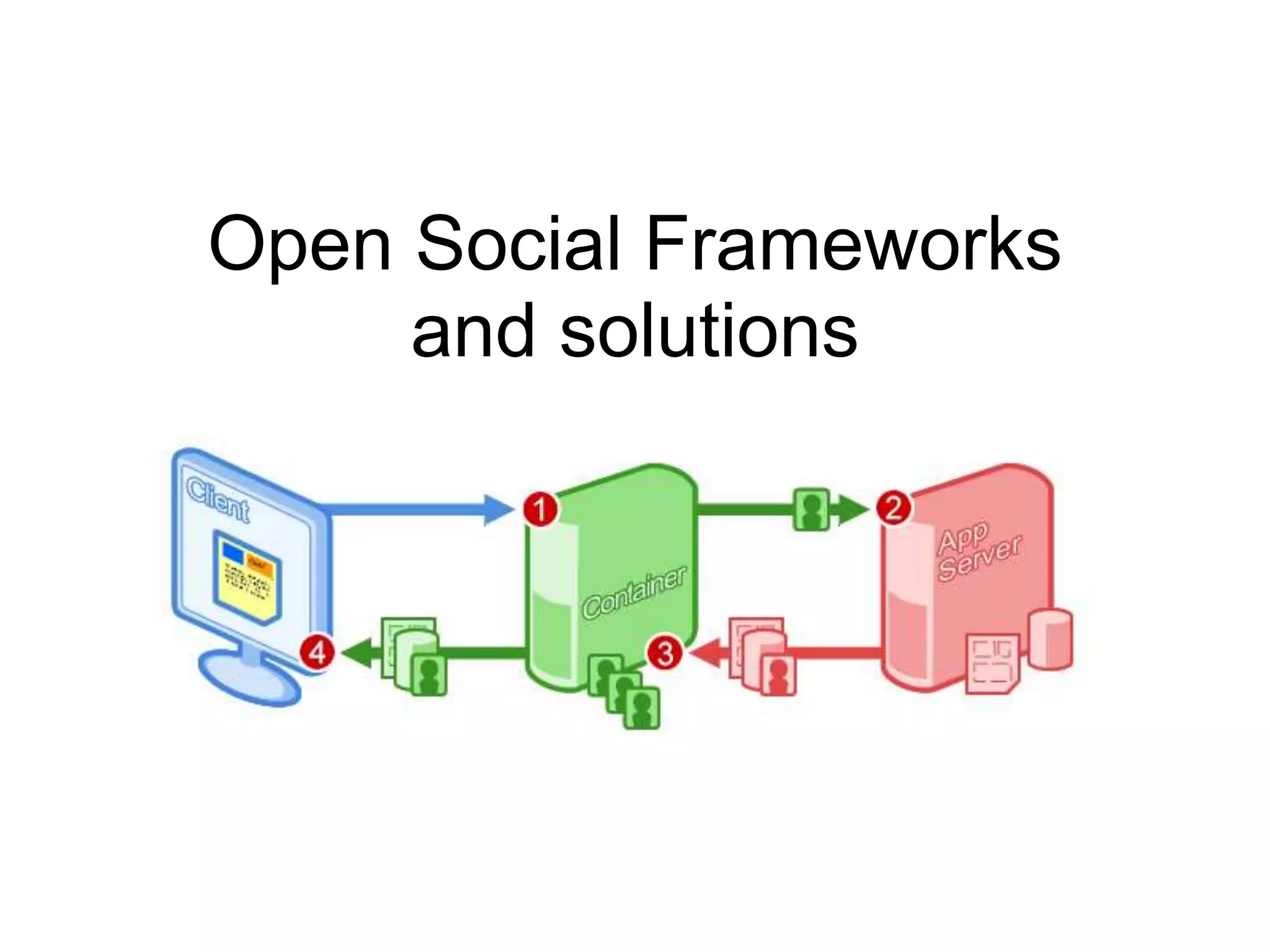
Open Social Frameworks and solutions
Why OpenSocial?Provide framework to connect different applications using single entry point.
Sites or Application having Open Social support can share data easily.
Rest support makes communication between applications platform independent.
Gadgets or Widgets applications are easily portable among different environments supporting OpenSocial API's.
Users can use their existing Google or Yahoo accounts or OpenID URL’s to login to different applications.
Signed requests can be sent using OpenAuth
Supported in large number of containers OpenSocial in Google IOhttp://code.google.com/events/io/sessions/OpenSocialEnterprise.htmlhttp://code.google.com/events/io/sessions.html#social
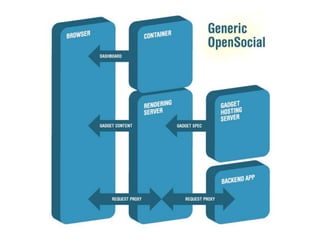
This diagram shows the standard high-level technical architecture of OpenSocial Gadgets. A Gadget Hosting Server is any web server that hosts a Gadget Spec XML file. The Gadget Rendering Server is responsible for tranforming the Gadget Spec into HTML. A Container is any application that puts a Gadget in one of its Web pages. Gadgets can make request to Backend Applications by proxying requests through the Rendering Server using OpenSocial's JavaScript API. http://www.atlassian.com/opensocial/atlassian-and-opensocial.jsp
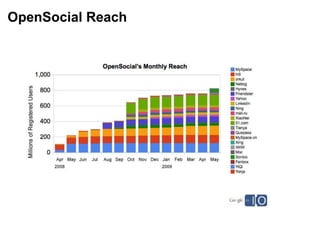
OpenSocial ReachIntrusting thing in this slide is how containers from all over the world are evolving and making their contributions to OpenSocial Society.
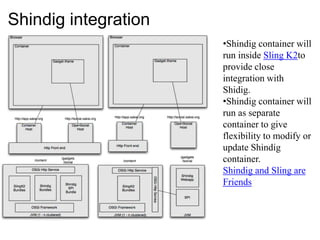
Introduction to API’s usedApache ShindigGadget Container JavaScript -- core JavaScript foundation for general gadget functionality. This JavaScript manages security, communication, UI layout, and feature extensions, such as the OpenSocial API.Gadget Server -- an open source version of gmodules.com, which is used to render the gadget xml into JavaScript and HTML for the container to expose via the container JavaScript.OpenSocial Container JavaScript -- JavaScript environment that sits on top of the Gadget Container JS and provides OpenSocial specific functionality (profiles, friends, activities).OpenSocial Gateway Server -- an open source implementation of the server interface to container-specific information, including the OpenSocial REST APIs, with clear extension points so others can connect it to their own backends.Apache SlingApache Sling is a web framework that uses a Java Content Repository, such as Apache Jackrabbit, to store and manage content.REST based web framework to access to JSR-170 Java Content RepositoriesSling applications use either scripts or Java servlets, selected based on simple name conventions, to process HTTP requests in a RESTful way.The embedded Apache FelixOSGi The Dynamic Module System for Java framework and console provide a dynamic runtime environment, where code and content bundles can be loaded, unloaded and reconfigured at runtime.
Frameworks looked into and other projects    Wookiehttp://wiki.apache.org/incubator/WookieProposalhttp://getwookie.org/ Sakai3http://3akai.sakaiproject.org/dev/eXo Portal and WebOShttp://bit.ly/eXoPortalhttp://bit.ly/eXoWebOS Atlassian+ OpenSocialhttp://www.atlassian.com/opensocial/Other projects Liferay(Using Shindig plugin to support open social) http://bit.ly/VDrN7Project Zero (Web 2.0 with PHP scripting, REST and Dojo)http://www.projectzero.org/ 
WookieEffort by CETIS to create OpenSocial container to run Widgets or Gadgets inside Moodle.Moodle is a Course Management System (CMS), also known as a Learning Management System (LMS) or a Virtual Learning Environment (VLE).OpenSocialSupport using Shindig(0.8).
Based on the W3C Widgets specification and support for Google Wave Gadgets.
Project in Apache incubator but does not have any code checked in yet.

Open Social Frameworks

  • 1.
  • 2.
    Why OpenSocial?Provide frameworkto connect different applications using single entry point.
  • 3.
    Sites or Applicationhaving Open Social support can share data easily.
  • 4.
    Rest support makescommunication between applications platform independent.
  • 5.
    Gadgets or Widgetsapplications are easily portable among different environments supporting OpenSocial API's.
  • 6.
    Users can usetheir existing Google or Yahoo accounts or OpenID URL’s to login to different applications.
  • 7.
    Signed requests canbe sent using OpenAuth
  • 8.
    Supported in largenumber of containers OpenSocial in Google IOhttp://code.google.com/events/io/sessions/OpenSocialEnterprise.htmlhttp://code.google.com/events/io/sessions.html#social
  • 9.
    This diagram showsthe standard high-level technical architecture of OpenSocial Gadgets. A Gadget Hosting Server is any web server that hosts a Gadget Spec XML file. The Gadget Rendering Server is responsible for tranforming the Gadget Spec into HTML. A Container is any application that puts a Gadget in one of its Web pages. Gadgets can make request to Backend Applications by proxying requests through the Rendering Server using OpenSocial's JavaScript API. http://www.atlassian.com/opensocial/atlassian-and-opensocial.jsp
  • 10.
    OpenSocial ReachIntrusting thingin this slide is how containers from all over the world are evolving and making their contributions to OpenSocial Society.
  • 11.
    Introduction to API’susedApache ShindigGadget Container JavaScript -- core JavaScript foundation for general gadget functionality. This JavaScript manages security, communication, UI layout, and feature extensions, such as the OpenSocial API.Gadget Server -- an open source version of gmodules.com, which is used to render the gadget xml into JavaScript and HTML for the container to expose via the container JavaScript.OpenSocial Container JavaScript -- JavaScript environment that sits on top of the Gadget Container JS and provides OpenSocial specific functionality (profiles, friends, activities).OpenSocial Gateway Server -- an open source implementation of the server interface to container-specific information, including the OpenSocial REST APIs, with clear extension points so others can connect it to their own backends.Apache SlingApache Sling is a web framework that uses a Java Content Repository, such as Apache Jackrabbit, to store and manage content.REST based web framework to access to JSR-170 Java Content RepositoriesSling applications use either scripts or Java servlets, selected based on simple name conventions, to process HTTP requests in a RESTful way.The embedded Apache FelixOSGi The Dynamic Module System for Java framework and console provide a dynamic runtime environment, where code and content bundles can be loaded, unloaded and reconfigured at runtime.
  • 12.
    Frameworks looked intoand other projects    Wookiehttp://wiki.apache.org/incubator/WookieProposalhttp://getwookie.org/ Sakai3http://3akai.sakaiproject.org/dev/eXo Portal and WebOShttp://bit.ly/eXoPortalhttp://bit.ly/eXoWebOS Atlassian+ OpenSocialhttp://www.atlassian.com/opensocial/Other projects Liferay(Using Shindig plugin to support open social) http://bit.ly/VDrN7Project Zero (Web 2.0 with PHP scripting, REST and Dojo)http://www.projectzero.org/ 
  • 13.
    WookieEffort by CETIS tocreate OpenSocial container to run Widgets or Gadgets inside Moodle.Moodle is a Course Management System (CMS), also known as a Learning Management System (LMS) or a Virtual Learning Environment (VLE).OpenSocialSupport using Shindig(0.8).
  • 14.
    Based on theW3C Widgets specification and support for Google Wave Gadgets.
  • 15.
    Project in Apacheincubator but does not have any code checked in yet.