ENTERPRISE 2.0 WITH OPEN SOURCE
Frameworks like Agorava
Who am I?
2 © 2012-2016 Creative Arts & Technologies
Werner Keil
• Consultant – Coach
• Creative Cosmopolitan
• Open Source Evangelist
• Software Architect
• JCP EC Member
• Agorava Co Founder
• JSR-363 Co Spec Lead
• IoT Enabler …
Twitter @wernerkeil
Email werner@catmedia.us
Proliferation
3 © 2012-2016 Creative Arts & Technologies
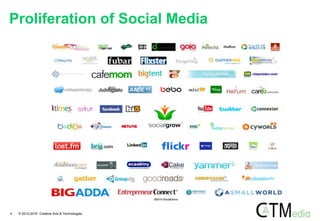
Proliferation of Social Media
4 © 2012-2016 Creative Arts & Technologies
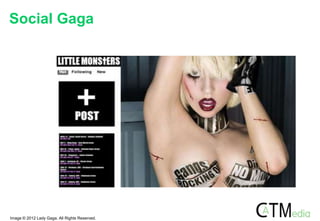
Social Gaga
Image © 2012 Lady Gaga. All Rights Reserved.
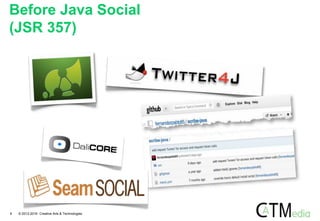
Before Java Social
(JSR 357)
6 © 2012-2016 Creative Arts & Technologies
Twitter4J
• Twitter4J is an unofficial Java library for Twitter API.
With Twitter4J, you can easily integrate your Java
application with Twitter.
• Its author, Yusuke Yamamoto used to work at
Twitter.
While he did, he was briefly meant to represent
Twitter in the Social JSR (357) EG.
• It’s light and compatible even with Java 1.4 to be
integrated e.g. in mobile apps
Scribe Java
• Scribe is Java framework that provides basic OAuth
function
• It also contains configuration for a lot of Social Media
• Only one dependency on Apache Common Codec
• Was at the heart of Agorava 0.5
DaliCore – CMS
• More than a CMS → DaliCore
• Adds functionality common to users, content and
permissions on top of Java EE 6.
• Focus on Users and Permissions.
• In about every DaliCore project, users should be able
to login with existing credentials (Facebook, Twitter,
Google Connect,...)
• Dali modules extend DaliCore
Spring Social
• Spring social somewhat inspirational to Seam
Social and Agorava has been around a bit longer
• Spring Social module were used to create first
Agorava modules (thanks to OSS and ASL2)
• But it’s Spring a only module....
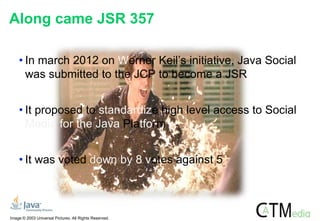
Along came JSR 357
• In march 2012 on Werner Keil’s initiative, Java Social
was submitted to the JCP to become a JSR
• It proposed to standardize high level access to Social
Media for the Java Platform
• It was voted down by 8 votes against 5
Image © 2003 Universal Pictures. All Rights Reserved.
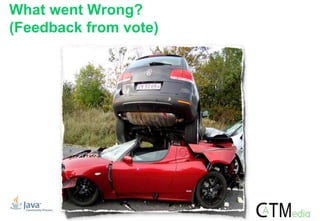
What went Wrong?
(Feedback from vote)
Too Broad?
Maybe...
14
Too Soon?
Lack of real POC...
15
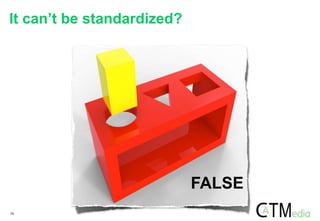
It can’t be standardized?
FALSE
16
Standard part in
Social Media
•All social medias use REST as transmission
protocol
•Most of them transmit data in JSON format and
some in XML
•Identification & Authentication are almost entirely
based on OAuth protocol
17
REST
•REpresentational State Transfer : Requests
about resource representation (customer, book,
order)
•REST is based on low level HTTP
•Each resource has a unique identifier (URI). 4
HTTP verbs can be applied to a URI : GET,
POST, PUT, DELETE
•Java has REST standard: JAX-RS. Version 1.0
didn’t provide client API yet, JAX-RS 2.0 does
18
1: {
2: "firstName": "John",
3: "lastName" : "Smith",
4: "age" : 25,
5: "address" :
6: {
7: "streetAddress": "21 2nd Street",
8: "city" : "New York",
9: "state" : "NY",
10: "postalCode" : "10021"
11: },
12: "phoneNumber":
13: [
14: {
15: "type" : "home",
16: "number": "212 555-1234"
17: },
18: {
19: "type" : "fax",
20: "number": "646 555-4567"
21: }
22: ]
23: }
JSON
•JavaScript Object
Notation: Data format
inspired by JavaScript. It
became a standard for
online services including
Social Media.
19
OAuth
•OAuth is a protocol to delegate rights
for an application to act on the behalf of a user
who granted its rights without giving away login /
password
•Developed by Twitter, Magnolia and Google, it
was made standard by IETF in April 2010 under
RFC 5849
20
OAuth (2)
•Version 2.0, simpler to use but often criticized for
too many implementation was standardized in
October 2012 under RFC 6749 and 6750.
Already widely used (Facebook, Google,
Microsoft)
•All Social Media services are based on
OAuth 1.0a or 2.0.
•To use OAuth, one has to create an application
on the targeted service to have an entry point for
consumer
OAuth has 3 steps
•Creating an application in
an OAauth service
•Initialization: right granting
phase also called OAuth Dance.
At its end we obtain an access
token (formed by public and secret part) to use in
next step
•Signature: each request is signed with an access
token identifying the OAuth application granted
rights to
Image © 2003 Universal Pictures. All Rights Reserved.
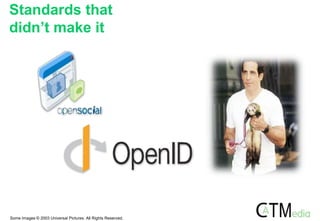
Standards that
didn’t make it
Some Images © 2003 Universal Pictures. All Rights Reserved.
23
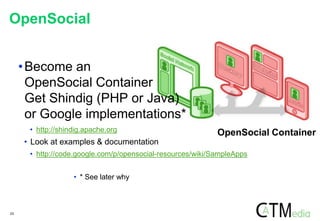
OpenSocial Container
•Become an
OpenSocial Container
Get Shindig (PHP or Java)
or Google implementations*
• http://shindig.apache.org
• Look at examples & documentation
• http://code.google.com/p/opensocial-resources/wiki/SampleApps
• * See later why
OpenSocial
24
• Open source implementation of OpenSocial &
Gadgets specification
• An Apache Software project
• Available in Java & PHP
• http://shindig.apache.org
It’s Goal: “Shindig's goal was to allow new sites to
start hosting social apps in under an hour's worth of
work“
•Those who tried it confirm, this failed
•And in 2015 Apache archived Shindig
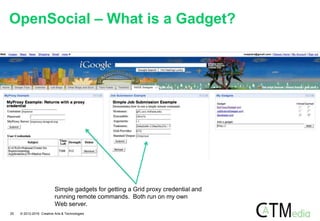
OpenSocial – Shindig
Simple gadgets for getting a Grid proxy credential and
running remote commands. Both run on my own
Web server.
OpenSocial – What is a Gadget?
25 © 2012-2016 Creative Arts & Technologies
The “official” OpenSocial implementation has shifted – from
Shindig to Google Code https://code.google.com/p/opensocial-
resources/
And just plans to move yet again, this time to GitHub!
In fact, Google’s OpenSocial Ruby Gem moved there 4 years
ago, and the code hasn’t changed since
https://github.com/revans/opensocial
(original Google Code SVN by MySpace also still exists;-)
OpenSocial Fork
26 © 2012-2016 Creative Arts & Technologies
27
Who uses OpenSocial?
•Social “Herrings”
• MySpace
• Orkut
• Friendster
• Hi5
• Jive
• IBM (Lotus Notes;-)
28
Who does not use
OpenSocial?
•Big “Fish”
• Facebook
• Twitter
• LinkedIn
• XING*
• Yammer
• Foursquare
• Google+
...
* Abandoned it for lack of Security among other reasons
29
• OpenSocial is what Google created for MySpace
(Yammer CTO and co-founder Adam Pisoni)
• Out of the box, most gadgets are publicly available
content that do not require authentication and
authorization.
(ThoughtWorks Studios about OpenSocial gadgets)
What’s said about
OpenSocial
30
• OpenSocial is a specification that provides a
standard way to share content between semi-trusted
applications.
• While initially proposed for public facing social
networking sites, it has possibly more potential
within the corporate firewall
(ThoughtWorks Radar, March 2012)
• Latest twist: OpenSocial was proposed as W3C
recommendation
What’s said about
OpenSocial (2)
31
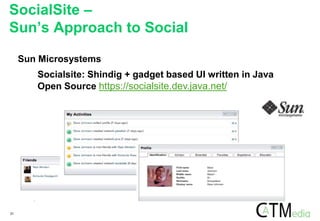
Sun Microsystems
Socialsite: Shindig + gadget based UI written in Java
Open Source https://socialsite.dev.java.net/
SocialSite –
Sun’s Approach to Social
32
The non Standard parts
•No standard identity management or any other
API across Social Media
(for Java JSR 351 tries to establish that)
•More than that. There is no Social Media that
guarantee:
• Its API won’t change for a given period
• Backward compatibility when its API changes
33
•A basic heart providing basic services :
• OAuth and Rest request
• Multi Social Media connections
• Polymorphic services to enforce standard on social Media
• Connector definition for Social module
•So this standard would be a kind Java Social
Connector definition standard
What would be a standard
for Social?
34
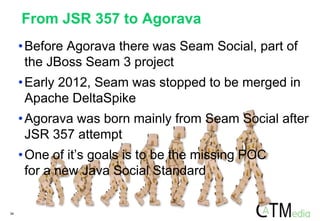
From JSR 357 to Agorava
•Before Agorava there was Seam Social, part of
the JBoss Seam 3 project
•Early 2012, Seam was stopped to be merged in
Apache DeltaSpike
•Agorava was born mainly from Seam Social after
JSR 357 attempt
•One of it’s goals is to be the missing POC
for a new Java Social Standard
Differences to
Spring Social
•Spring Social works primarily with Spring
•Other UI frameworks than Spring MVC are
harder to integrate
•Focus on Facebook, so far examples only
provide Single Service support, unlike Agorava
Multiservice approach
Differences to
Spring Social (2)
•Despite otherwise still somewhat active
Spring community, even at Pivotal / Vmware
there’s doubt about support and activity,
especially after some people left
•Currently supports .NET, too
Differences to
DaliCore
•Also offering Social Container and CMS, partial
OpenSocial support
•Persistence support via EJB, JPA, etc.
•Not so clear separation of modules, especially
API/Spec and Implementation, in most cases
they share same module and even package
•DaliCore no longer Open Source
37 © 2012-2016 Creative Arts & Technologies
49
Differences to
DaliCore (2)
•Currently seems a little heavier, strong
dependencies on the Full Java EE stack, i.e.
using only Web Profile or Java SE seems hard
right now
•Glassfish support and Integration
Oracle stopped professional GF support
•Demonstrated Scalability also under heavy
usage
38 © 2012-2016 Creative Arts & Technologies
Differences to
Oracle SocialLink
•Feels almost like Eclipse or Microsoft project
(ISocialNetwork)
•Still very new, looks immature in several areas
•Seemingly non-existent community support
•No Modularity or separation between API and
Implementation
•Last commit 3 years ago, so it’s practically dead
39 © 2012-2016 Creative Arts & Technologies
40
Agorava 0.7
Macro architecture
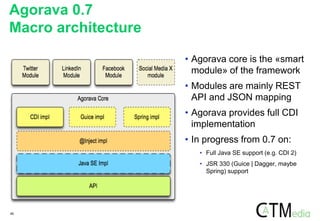
• Agorava core is the «smart
module» of the framework
• Modules are mainly REST
API and JSON mapping
• Agorava provides full CDI
implementation
• In progress from 0.7 on:
• Full Java SE support (e.g. CDI 2)
• JSR 330 (Guice | Dagger, maybe
Spring) support
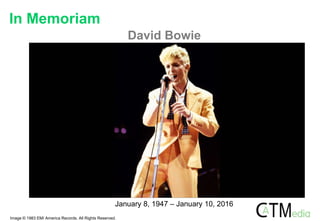
In Memoriam
January 8, 1947 – January 10, 2016
David Bowie
Image © 1983 EMI America Records. All Rights Reserved.
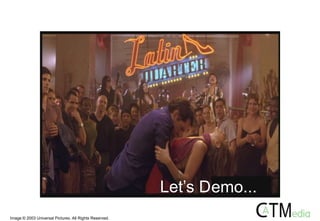
Image © 2003 Universal Pictures. All Rights Reserved.
Let’s Dance...emo...
43
Agorava Book
• A first book about Agorava is
scheduled for release to print
and online (Amazon, Google
Play!, iTunes) this Spring.
• Agorava Project:
http://agorava.org
• Github:
https://github.com/agorava
#Agorava
@wernerkeil
@AgoravaProj
Links
44
Q & A

Enterprise 2.0 with Open Source Frameworks like Agorava

  • 1.
    ENTERPRISE 2.0 WITHOPEN SOURCE Frameworks like Agorava
  • 2.
    Who am I? 2© 2012-2016 Creative Arts & Technologies Werner Keil • Consultant – Coach • Creative Cosmopolitan • Open Source Evangelist • Software Architect • JCP EC Member • Agorava Co Founder • JSR-363 Co Spec Lead • IoT Enabler … Twitter @wernerkeil Email werner@catmedia.us
  • 3.
    Proliferation 3 © 2012-2016Creative Arts & Technologies
  • 4.
    Proliferation of SocialMedia 4 © 2012-2016 Creative Arts & Technologies
  • 5.
    Social Gaga Image ©2012 Lady Gaga. All Rights Reserved.
  • 6.
    Before Java Social (JSR357) 6 © 2012-2016 Creative Arts & Technologies
  • 7.
    Twitter4J • Twitter4J isan unofficial Java library for Twitter API. With Twitter4J, you can easily integrate your Java application with Twitter. • Its author, Yusuke Yamamoto used to work at Twitter. While he did, he was briefly meant to represent Twitter in the Social JSR (357) EG. • It’s light and compatible even with Java 1.4 to be integrated e.g. in mobile apps
  • 8.
    Scribe Java • Scribeis Java framework that provides basic OAuth function • It also contains configuration for a lot of Social Media • Only one dependency on Apache Common Codec • Was at the heart of Agorava 0.5
  • 9.
    DaliCore – CMS •More than a CMS → DaliCore • Adds functionality common to users, content and permissions on top of Java EE 6. • Focus on Users and Permissions. • In about every DaliCore project, users should be able to login with existing credentials (Facebook, Twitter, Google Connect,...) • Dali modules extend DaliCore
  • 10.
    Spring Social • Springsocial somewhat inspirational to Seam Social and Agorava has been around a bit longer • Spring Social module were used to create first Agorava modules (thanks to OSS and ASL2) • But it’s Spring a only module....
  • 11.
    Along came JSR357 • In march 2012 on Werner Keil’s initiative, Java Social was submitted to the JCP to become a JSR • It proposed to standardize high level access to Social Media for the Java Platform • It was voted down by 8 votes against 5 Image © 2003 Universal Pictures. All Rights Reserved.
  • 12.
  • 13.
  • 14.
  • 15.
    15 It can’t bestandardized? FALSE
  • 16.
    16 Standard part in SocialMedia •All social medias use REST as transmission protocol •Most of them transmit data in JSON format and some in XML •Identification & Authentication are almost entirely based on OAuth protocol
  • 17.
    17 REST •REpresentational State Transfer: Requests about resource representation (customer, book, order) •REST is based on low level HTTP •Each resource has a unique identifier (URI). 4 HTTP verbs can be applied to a URI : GET, POST, PUT, DELETE •Java has REST standard: JAX-RS. Version 1.0 didn’t provide client API yet, JAX-RS 2.0 does
  • 18.
    18 1: { 2: "firstName":"John", 3: "lastName" : "Smith", 4: "age" : 25, 5: "address" : 6: { 7: "streetAddress": "21 2nd Street", 8: "city" : "New York", 9: "state" : "NY", 10: "postalCode" : "10021" 11: }, 12: "phoneNumber": 13: [ 14: { 15: "type" : "home", 16: "number": "212 555-1234" 17: }, 18: { 19: "type" : "fax", 20: "number": "646 555-4567" 21: } 22: ] 23: } JSON •JavaScript Object Notation: Data format inspired by JavaScript. It became a standard for online services including Social Media.
  • 19.
    19 OAuth •OAuth is aprotocol to delegate rights for an application to act on the behalf of a user who granted its rights without giving away login / password •Developed by Twitter, Magnolia and Google, it was made standard by IETF in April 2010 under RFC 5849
  • 20.
    20 OAuth (2) •Version 2.0,simpler to use but often criticized for too many implementation was standardized in October 2012 under RFC 6749 and 6750. Already widely used (Facebook, Google, Microsoft) •All Social Media services are based on OAuth 1.0a or 2.0. •To use OAuth, one has to create an application on the targeted service to have an entry point for consumer
  • 21.
    OAuth has 3steps •Creating an application in an OAauth service •Initialization: right granting phase also called OAuth Dance. At its end we obtain an access token (formed by public and secret part) to use in next step •Signature: each request is signed with an access token identifying the OAuth application granted rights to Image © 2003 Universal Pictures. All Rights Reserved.
  • 22.
    Standards that didn’t makeit Some Images © 2003 Universal Pictures. All Rights Reserved.
  • 23.
    23 OpenSocial Container •Become an OpenSocialContainer Get Shindig (PHP or Java) or Google implementations* • http://shindig.apache.org • Look at examples & documentation • http://code.google.com/p/opensocial-resources/wiki/SampleApps • * See later why OpenSocial
  • 24.
    24 • Open sourceimplementation of OpenSocial & Gadgets specification • An Apache Software project • Available in Java & PHP • http://shindig.apache.org It’s Goal: “Shindig's goal was to allow new sites to start hosting social apps in under an hour's worth of work“ •Those who tried it confirm, this failed •And in 2015 Apache archived Shindig OpenSocial – Shindig
  • 25.
    Simple gadgets forgetting a Grid proxy credential and running remote commands. Both run on my own Web server. OpenSocial – What is a Gadget? 25 © 2012-2016 Creative Arts & Technologies
  • 26.
    The “official” OpenSocialimplementation has shifted – from Shindig to Google Code https://code.google.com/p/opensocial- resources/ And just plans to move yet again, this time to GitHub! In fact, Google’s OpenSocial Ruby Gem moved there 4 years ago, and the code hasn’t changed since https://github.com/revans/opensocial (original Google Code SVN by MySpace also still exists;-) OpenSocial Fork 26 © 2012-2016 Creative Arts & Technologies
  • 27.
    27 Who uses OpenSocial? •Social“Herrings” • MySpace • Orkut • Friendster • Hi5 • Jive • IBM (Lotus Notes;-)
  • 28.
    28 Who does notuse OpenSocial? •Big “Fish” • Facebook • Twitter • LinkedIn • XING* • Yammer • Foursquare • Google+ ... * Abandoned it for lack of Security among other reasons
  • 29.
    29 • OpenSocial iswhat Google created for MySpace (Yammer CTO and co-founder Adam Pisoni) • Out of the box, most gadgets are publicly available content that do not require authentication and authorization. (ThoughtWorks Studios about OpenSocial gadgets) What’s said about OpenSocial
  • 30.
    30 • OpenSocial isa specification that provides a standard way to share content between semi-trusted applications. • While initially proposed for public facing social networking sites, it has possibly more potential within the corporate firewall (ThoughtWorks Radar, March 2012) • Latest twist: OpenSocial was proposed as W3C recommendation What’s said about OpenSocial (2)
  • 31.
    31 Sun Microsystems Socialsite: Shindig+ gadget based UI written in Java Open Source https://socialsite.dev.java.net/ SocialSite – Sun’s Approach to Social
  • 32.
    32 The non Standardparts •No standard identity management or any other API across Social Media (for Java JSR 351 tries to establish that) •More than that. There is no Social Media that guarantee: • Its API won’t change for a given period • Backward compatibility when its API changes
  • 33.
    33 •A basic heartproviding basic services : • OAuth and Rest request • Multi Social Media connections • Polymorphic services to enforce standard on social Media • Connector definition for Social module •So this standard would be a kind Java Social Connector definition standard What would be a standard for Social?
  • 34.
    34 From JSR 357to Agorava •Before Agorava there was Seam Social, part of the JBoss Seam 3 project •Early 2012, Seam was stopped to be merged in Apache DeltaSpike •Agorava was born mainly from Seam Social after JSR 357 attempt •One of it’s goals is to be the missing POC for a new Java Social Standard
  • 35.
    Differences to Spring Social •SpringSocial works primarily with Spring •Other UI frameworks than Spring MVC are harder to integrate •Focus on Facebook, so far examples only provide Single Service support, unlike Agorava Multiservice approach
  • 36.
    Differences to Spring Social(2) •Despite otherwise still somewhat active Spring community, even at Pivotal / Vmware there’s doubt about support and activity, especially after some people left •Currently supports .NET, too
  • 37.
    Differences to DaliCore •Also offeringSocial Container and CMS, partial OpenSocial support •Persistence support via EJB, JPA, etc. •Not so clear separation of modules, especially API/Spec and Implementation, in most cases they share same module and even package •DaliCore no longer Open Source 37 © 2012-2016 Creative Arts & Technologies
  • 38.
    49 Differences to DaliCore (2) •Currentlyseems a little heavier, strong dependencies on the Full Java EE stack, i.e. using only Web Profile or Java SE seems hard right now •Glassfish support and Integration Oracle stopped professional GF support •Demonstrated Scalability also under heavy usage 38 © 2012-2016 Creative Arts & Technologies
  • 39.
    Differences to Oracle SocialLink •Feelsalmost like Eclipse or Microsoft project (ISocialNetwork) •Still very new, looks immature in several areas •Seemingly non-existent community support •No Modularity or separation between API and Implementation •Last commit 3 years ago, so it’s practically dead 39 © 2012-2016 Creative Arts & Technologies
  • 40.
    40 Agorava 0.7 Macro architecture •Agorava core is the «smart module» of the framework • Modules are mainly REST API and JSON mapping • Agorava provides full CDI implementation • In progress from 0.7 on: • Full Java SE support (e.g. CDI 2) • JSR 330 (Guice | Dagger, maybe Spring) support
  • 41.
    In Memoriam January 8,1947 – January 10, 2016 David Bowie Image © 1983 EMI America Records. All Rights Reserved.
  • 42.
    Image © 2003Universal Pictures. All Rights Reserved. Let’s Dance...emo...
  • 43.
    43 Agorava Book • Afirst book about Agorava is scheduled for release to print and online (Amazon, Google Play!, iTunes) this Spring.
  • 44.
    • Agorava Project: http://agorava.org •Github: https://github.com/agorava #Agorava @wernerkeil @AgoravaProj Links 44
  • 45.

Editor's Notes