@girishtweek
Agenda
• Sample Application
• Run the App locally
• Deployment options in Azure
• Deployment to ACS(Kubernetes) using VSTS
Application
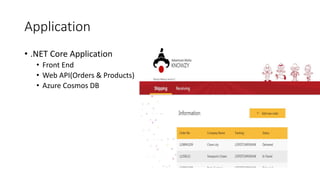
• .NET Core Application
• Front End
• Web API(Orders & Products)
• Azure Cosmos DB
Containers
• Docker file
• Docker-compose file
Demo
Application
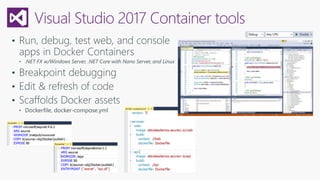
Docker Tools for visual studio
Debugging container
Running the application locally
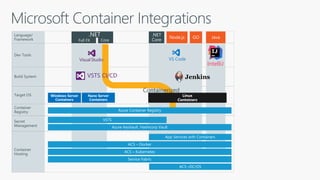
Linux
Containers
IntelliJ
Containerized
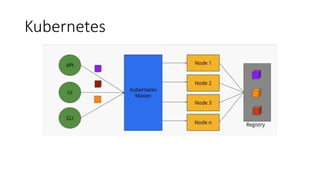
Kubernetes
Kubernetes
• Pods : Its a collection of containers and the basic unit of deployment
• Replication controller: Deploys the specified number of pods and make sure
the system is in the desired state
• Deployments: It contains the details of the pods and the replication
controller It will deploy the replica sets which will deploy pods and in turn
deploy container
• Services: Its a group of pods that can be accessed as a single unit. If one of
the pod goes down. a new a pod is created and user has to contact only the
service and not to the pods directly
Demo
Deploying .net application using VSTS on ACS in kubernetes

Deploying .net application using VSTS on ACS in kubernetes

Editor's Notes

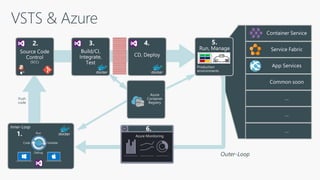
  • #9 When we look at the container continuous worfklows, we see containers and registries are a key concept. We start with what we call the inner loop. Which is everything you do before you commit code. From the beginning of your development cycle, you’re building and running your code in containers. We pull base images from a container registry. Either Docker Hub, or perhaps our private corporate registry. As we’re happy with our code, we commit the code to a source code repository. The build system takes our code, a dockerfile that describes the build system and builds the collection of images I need for deployment The images are pushed to our private registry, with the environment configurations extracted from the image. When deployment happens, we pull images, add the environment information and push it out to various environments. In Azure, we have many different container hosting offerings. From Azure Container Service, which hosts the best of breed open source orchestrators To Service Fabric, which can host guest containers Or, Azure Batch, App Services for single container workloads that can scale. And Azure continues to expand it’s container hosts as containers are becoming the unit of deployment.