Introduction to Kubernetes
@timothysc
Overview
● Motivation / Mission / Vision
● Architectural Overview
● Operations
● Demo
Assumption: You already
know about Docker &|
have attended the other
meetups or talks. I’m
going to skip Docker.
Kubernetes Motivation
What is kubernetes?
● Greek for “Helmsman”
● Kubernetes is an open source system for managing containerized
applications across multiple hosts, providing basic mechanisms for
deployment, maintenance, and scaling of applications. It’s APIs are
intended to serve as the foundation for an open ecosystem of tools,
automations systems, and higher-level API layers.
● Kubernetes establishes robust declarative primitives for maintaining the
desired state requested by the user. These primitives are the main
value added by Kubernetes.
What’s the motivation for kubernetes?
Develop a set of common declarative primitives
that operators can leverage to build a reliable
micro-service architecture in a composable
manner.
Tools around this core construct “could” provide
additional features, including cluster
management (elasticity ...), federation, etc.
Why?
A part of this is market positioning and commercialization, while the
other part is experience and opinions.
Google has years of experience managing containers at scale
under Borg & Omega. By exposing a subset of these features
targeting specific use cases they present themselves(GCE) as the
defacto cloud provider for running your container workloads to meet
those use cases.
It’s a legit positioning move for the shift from vm’s -> containers.
Why micro-services?
● Breaking down the SILOs
○ State of the Art of Micro-services @adrianco: http://youtu.
be/nMTaS07i3jk
● By cleanly defining the api’s between services and load balancing across
those services, it enables clever deployments
○ 1:64 gets some special UI to test
○ Rolling upgrades
○ Never go down
○ Autoscale only the service that needs it.
● Portability, flexibility, speed of development ....
○ Continuous Deployment [github push -> go build -> Run] O(minutes)
Use Case Example
You are going to create a new super awesome webpage
kittenpicsABC123.com, and you want to make $$$ off of it
with the following requirements:
● Use Containers
● You want to continuously deploy cool new changes
○ advertising changes
● Resilient against multiple failures
● Replicated-layers that are load-balanced
● SOA++
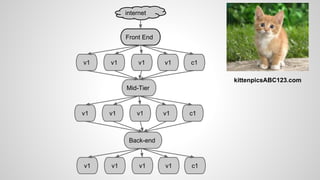
Front End
v1 v1 v1 v1 c1
internet
Mid-Tier
v1 v1 v1 v1 c1
Back-end
v1 v1 v1 v1 c1
kittenpicsABC123.com
Why declarative vs. imperative?
● Common use case patterns immerge, so make them
simple
● Doesn’t require a high level of understanding to get
started, which reduces the barrier to entry.
● Imperative could be used in many non-standard ways
that was never intended, especially if there is state.
● ...
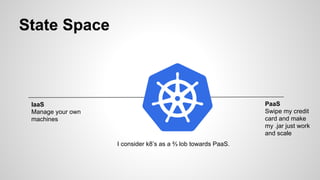
State Space
IaaS
Manage your own
machines
PaaS
Swipe my credit
card and make
my .jar just work
and scale
I consider k8’s as a ⅔ lob towards PaaS.
Kubernetes Architecture
Principles & Concepts
● Design Principles
● Core Concepts
○ Pods & Containers
○ Services
○ Labels
○ Controller(s) - replication controller
○ Selector
● Other Concepts [skip for today]
○ events
Design Principles - thockin’s crib
Declarative
Feedback Control loops : Controller = loop
Simple
Modular
Legacy compatible
Network-centric : IP per pod
Treat machines as Cattle not Pets
Open Source
What is a POD?
A pod (as in a pod of whales or pea pod) correspond to a
collocated group of “containers” with shared volumes. A
pod models an application-specific "logical host" in a
containerized environment. It may contain one or more
containers which are relatively tightly coupled -- in a pre-
container world, they would have executed on the same
physical or virtual host.
Why Pods?
● Pods are tightly coupled.
● Pods facilitate data sharing, and are a group of
containers that are scheduled onto the same host
○ shared mount
○ shared network namespace/IP and port space
○ higher order abstraction to the low level interface
○ Composable micro-services
● Pods abstract the gritty details of container
● Unit of scheduling
What are Services?
Yet
Another
Reuse of
Nomenclature
In-order-to
Confuse
Everyone
pirate speak - (YAR-NICE)
What are Services?
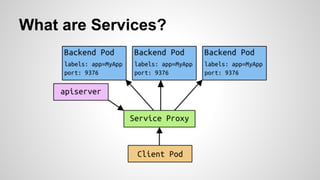
A Kubernetes service is an abstraction which defines a logical set of pods
and a policy by which to access them - sometimes called a micro-service.
The goal of services is to provide a bridge for non-Kubernetes-native
applications to access backends without the need to write code that is
specific to Kubernetes. A service offers clients an IP and port pair which,
when accessed, redirects to the appropriate backends. The set of pods
targetted is determined by a label selector.
It’s a NAT’d load-balanced proxy, whose IPADDR is injected into the
containers that are using that service via an environment variable.
What are Services?
What are Labels?
Labels are key/value pairs that are attached to objects, such as
pods. Labels can be used to organize and to select subsets of
objects. They are created by users at the same time as an object.
Each object can have a set of key/value labels set on it, with at
most one label with a particular key.
"labels": {
"key1" : "value1",
"key2" : "value2"
}
What are Replication Controllers?
A replication controller ensures that a specified number of
pod "replicas" are running at any one time. If there are too
many, it will kill some. If there are too few, it will start more.
As opposed to just creating singleton pods or even creating
pods in bulk, a replication controller replaces pods that are
deleted or terminated for any reason, such as in the case of
node failure.
Replication Controller Use Cases
● Rescheduling
○ Fault tolerant
● Scaling
○ up or down cluster management tools
● Rolling Updates
○ application readiness = ?
● Multiple Release Tracks
○ stable, prod, canary
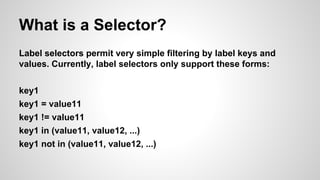
What is a Selector?
Label selectors permit very simple filtering by label keys and
values. Currently, label selectors only support these forms:
key1
key1 = value11
key1 != value11
key1 in (value11, value12, ...)
key1 not in (value11, value12, ...)
Kubernetes Operations
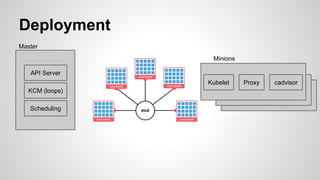
API Server
Scheduling
KCM (loops)
Kubelet Proxy
Deployment
Master
Minions
cadvisor
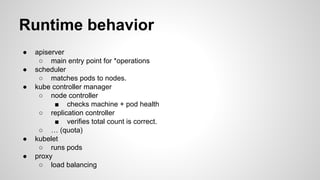
Runtime behavior
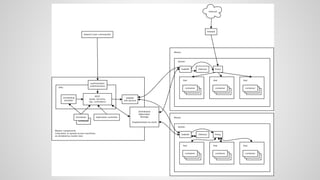
● apiserver
○ main entry point for *operations
● scheduler
○ matches pods to nodes.
● kube controller manager
○ node controller
■ checks machine + pod health
○ replication controller
■ verifies total count is correct.
○ … (quota)
● kubelet
○ runs pods
● proxy
○ load balancing
Demo

Docker Madison, Introduction to Kubernetes

  • 1.
  • 2.
    Overview ● Motivation /Mission / Vision ● Architectural Overview ● Operations ● Demo
  • 3.
    Assumption: You already knowabout Docker &| have attended the other meetups or talks. I’m going to skip Docker.
  • 4.
  • 5.
    What is kubernetes? ●Greek for “Helmsman” ● Kubernetes is an open source system for managing containerized applications across multiple hosts, providing basic mechanisms for deployment, maintenance, and scaling of applications. It’s APIs are intended to serve as the foundation for an open ecosystem of tools, automations systems, and higher-level API layers. ● Kubernetes establishes robust declarative primitives for maintaining the desired state requested by the user. These primitives are the main value added by Kubernetes.
  • 6.
    What’s the motivationfor kubernetes? Develop a set of common declarative primitives that operators can leverage to build a reliable micro-service architecture in a composable manner. Tools around this core construct “could” provide additional features, including cluster management (elasticity ...), federation, etc.
  • 7.
    Why? A part ofthis is market positioning and commercialization, while the other part is experience and opinions. Google has years of experience managing containers at scale under Borg & Omega. By exposing a subset of these features targeting specific use cases they present themselves(GCE) as the defacto cloud provider for running your container workloads to meet those use cases. It’s a legit positioning move for the shift from vm’s -> containers.
  • 8.
    Why micro-services? ● Breakingdown the SILOs ○ State of the Art of Micro-services @adrianco: http://youtu. be/nMTaS07i3jk ● By cleanly defining the api’s between services and load balancing across those services, it enables clever deployments ○ 1:64 gets some special UI to test ○ Rolling upgrades ○ Never go down ○ Autoscale only the service that needs it. ● Portability, flexibility, speed of development .... ○ Continuous Deployment [github push -> go build -> Run] O(minutes)
  • 9.
    Use Case Example Youare going to create a new super awesome webpage kittenpicsABC123.com, and you want to make $$$ off of it with the following requirements: ● Use Containers ● You want to continuously deploy cool new changes ○ advertising changes ● Resilient against multiple failures ● Replicated-layers that are load-balanced ● SOA++
  • 10.
    Front End v1 v1v1 v1 c1 internet Mid-Tier v1 v1 v1 v1 c1 Back-end v1 v1 v1 v1 c1 kittenpicsABC123.com
  • 11.
    Why declarative vs.imperative? ● Common use case patterns immerge, so make them simple ● Doesn’t require a high level of understanding to get started, which reduces the barrier to entry. ● Imperative could be used in many non-standard ways that was never intended, especially if there is state. ● ...
  • 12.
    State Space IaaS Manage yourown machines PaaS Swipe my credit card and make my .jar just work and scale I consider k8’s as a ⅔ lob towards PaaS.
  • 13.
  • 14.
    Principles & Concepts ●Design Principles ● Core Concepts ○ Pods & Containers ○ Services ○ Labels ○ Controller(s) - replication controller ○ Selector ● Other Concepts [skip for today] ○ events
  • 15.
    Design Principles -thockin’s crib Declarative Feedback Control loops : Controller = loop Simple Modular Legacy compatible Network-centric : IP per pod Treat machines as Cattle not Pets Open Source
  • 17.
    What is aPOD? A pod (as in a pod of whales or pea pod) correspond to a collocated group of “containers” with shared volumes. A pod models an application-specific "logical host" in a containerized environment. It may contain one or more containers which are relatively tightly coupled -- in a pre- container world, they would have executed on the same physical or virtual host.
  • 18.
    Why Pods? ● Podsare tightly coupled. ● Pods facilitate data sharing, and are a group of containers that are scheduled onto the same host ○ shared mount ○ shared network namespace/IP and port space ○ higher order abstraction to the low level interface ○ Composable micro-services ● Pods abstract the gritty details of container ● Unit of scheduling
  • 19.
    What are Services? Yet Another Reuseof Nomenclature In-order-to Confuse Everyone pirate speak - (YAR-NICE)
  • 20.
    What are Services? AKubernetes service is an abstraction which defines a logical set of pods and a policy by which to access them - sometimes called a micro-service. The goal of services is to provide a bridge for non-Kubernetes-native applications to access backends without the need to write code that is specific to Kubernetes. A service offers clients an IP and port pair which, when accessed, redirects to the appropriate backends. The set of pods targetted is determined by a label selector. It’s a NAT’d load-balanced proxy, whose IPADDR is injected into the containers that are using that service via an environment variable.
  • 21.
  • 22.
    What are Labels? Labelsare key/value pairs that are attached to objects, such as pods. Labels can be used to organize and to select subsets of objects. They are created by users at the same time as an object. Each object can have a set of key/value labels set on it, with at most one label with a particular key. "labels": { "key1" : "value1", "key2" : "value2" }
  • 23.
    What are ReplicationControllers? A replication controller ensures that a specified number of pod "replicas" are running at any one time. If there are too many, it will kill some. If there are too few, it will start more. As opposed to just creating singleton pods or even creating pods in bulk, a replication controller replaces pods that are deleted or terminated for any reason, such as in the case of node failure.
  • 24.
    Replication Controller UseCases ● Rescheduling ○ Fault tolerant ● Scaling ○ up or down cluster management tools ● Rolling Updates ○ application readiness = ? ● Multiple Release Tracks ○ stable, prod, canary
  • 25.
    What is aSelector? Label selectors permit very simple filtering by label keys and values. Currently, label selectors only support these forms: key1 key1 = value11 key1 != value11 key1 in (value11, value12, ...) key1 not in (value11, value12, ...)
  • 26.
  • 27.
    API Server Scheduling KCM (loops) KubeletProxy Deployment Master Minions cadvisor
  • 29.
    Runtime behavior ● apiserver ○main entry point for *operations ● scheduler ○ matches pods to nodes. ● kube controller manager ○ node controller ■ checks machine + pod health ○ replication controller ■ verifies total count is correct. ○ … (quota) ● kubelet ○ runs pods ● proxy ○ load balancing
  • 30.