

Cnam 2015 - Cloud Services
ZeCloud
Cloud Services
Cloud Services
 Focus on your application
 Scalability, availability and reliability
 Monitoring and diagnostics
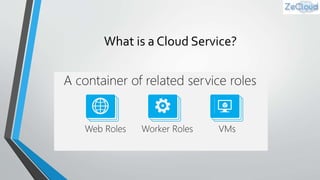
What is a Cloud Service?
• Public endpoints
Publicly accessible, load balanced
• Internal endpoints
Private to cloud service, not load balanced
• Instance Input endpoints
Address individual instance
5
Microsoft Azure
How do roles communicate?
Web Role• All features of a worker role + IIS 7, 7.5 or IIS 8.0*
• ASP.NET 3.5 SP1, 4.0 or 4.5* – 64bit
• Hosts
• Webforms or MVC
• FastCGI applications (e.g. PHP)
• Multiple Websites
• Http(s)
• Web/Worker Hybrid
• Can optionally implement RoleEntryPoint
Worker Role Patterns•
•
•
•
•
•
•
•
•
•
•
Roles and Instances
Design for
Cloud
A different mindset
 Embracing errors
 Design for availability, reliability, scalability
 Performance
Redundancy in Microsoft Azure
• Microsoft Azure Storage with replicas
• SQL Database built-in backup servers
• Microsoft Azure Caching with high availability enabled
• Multi-instance Microsoft AzureWeb Sites and Cloud Services
• Load-balancedVirtual Machines
• Built-in redundancy in Microsoft AzureVirtual Network gateways
• Failover with Microsoft AzureTraffic Manager
Reliability in Microsoft Azure
• Auto recovery of crashed/nonresponsive instances
• Fault domain to scatter instances across racks
• Virtual machine Availability set to allocateVMs across Fault domains
• Upgrade domain to avoid shutting down all instances at the same time
• VIP swap to allow promoting staging to production
• Simulator, Intellitrace and enhanced diagnostics
• First party and third party support for telemetry
• Handle transient errors using theTransient Fault Handling Application
block

Cnam cours azure cloud services

  • 1.
    Cnam 2015 -Cloud Services ZeCloud
  • 2.
  • 3.
    Cloud Services  Focuson your application  Scalability, availability and reliability  Monitoring and diagnostics
  • 4.
    What is aCloud Service?
  • 5.
    • Public endpoints Publiclyaccessible, load balanced • Internal endpoints Private to cloud service, not load balanced • Instance Input endpoints Address individual instance 5 Microsoft Azure How do roles communicate?
  • 6.
    Web Role• Allfeatures of a worker role + IIS 7, 7.5 or IIS 8.0* • ASP.NET 3.5 SP1, 4.0 or 4.5* – 64bit • Hosts • Webforms or MVC • FastCGI applications (e.g. PHP) • Multiple Websites • Http(s) • Web/Worker Hybrid • Can optionally implement RoleEntryPoint
  • 7.
  • 8.
  • 9.
  • 10.
    A different mindset Embracing errors  Design for availability, reliability, scalability  Performance
  • 11.
    Redundancy in MicrosoftAzure • Microsoft Azure Storage with replicas • SQL Database built-in backup servers • Microsoft Azure Caching with high availability enabled • Multi-instance Microsoft AzureWeb Sites and Cloud Services • Load-balancedVirtual Machines • Built-in redundancy in Microsoft AzureVirtual Network gateways • Failover with Microsoft AzureTraffic Manager
  • 12.
    Reliability in MicrosoftAzure • Auto recovery of crashed/nonresponsive instances • Fault domain to scatter instances across racks • Virtual machine Availability set to allocateVMs across Fault domains • Upgrade domain to avoid shutting down all instances at the same time • VIP swap to allow promoting staging to production • Simulator, Intellitrace and enhanced diagnostics • First party and third party support for telemetry • Handle transient errors using theTransient Fault Handling Application block

Editor's Notes

  • #4 Slide Objectives: Explain the agenda of the session. Speaker Notes: Explain this presentation is a high-level overview, so not everything is covered in-depth.
  • #5 Note: VM is separated out as IaaS offering.
  • #7 Slide Objective Understand how a Web Role extends the standard worker role Speaker Notes A web role takes all the capabilities and semantics of a worker role and adds the IIS Hostable Web Core Web Roles run ASP.NET websites- they do this by using the IIS hostage web core. pretty much anything that will work in a standard IIS ASP.NET Web Site should work in Microsoft Azure. At MIX09, we additionally added support for IIS7’s FastCGI capability. As a note, any files that are part of a asp.net project on Microsoft Azure are READ ONLY! If you need to be able to change the contents of files: User Blob Storage If its configuration, use the service model files – which can be changed at runtime. Inbound protocols are http(s) – outbound protocols are any TCP connection but NOT UDP. Notes http://msdn.microsoft.com/en-us/library/dd179341.aspx http://blogs.msdn.com/b/carlosag/archive/2008/04/14/hostyourownwebserverusingiis7.aspx http://blogs.iis.net/ksingla/archive/2007/12/20/ins-amp-outs-of-hostable-web-core.aspx
  • #8 Slide Objective Understand the 3 common patterns of worker roles Speaker Notes Pattern 1 – Polling Worker role polls a Queue Pops message Performs work Polls queue again Pattern 2 Worker listens for inbound TCP request Can implement with Raw TcpListeners or use WCF or use Hosted Web Core Pattern 3 Run a 3rd party process When the role starts up or runs use a Process.Start() call to run a standard windows executable E.g. Running a database server Notes http://blog.smarx.com/posts/build-your-own-web-role-running-hosted-web-core-in-windows-azure http://blog.smarx.com/posts/making-songs-swing-with-windows-azure-python-and-the-echo-nest-api
  • #9 Slide Objective Understand the difference between Roles and Instances Speaker Notes The Service model defines the shape of a service- the Roles it will have endpoints it will listen on Types of VMs that will be run At runtime each Role will run at a given scale Specifically each role will be deployed onto and executed on one or more VMs A VM runs a single role Notes Notes on the various security roles involved in running a Microsoft Azure account http://blog.toddysm.com/2010/01/subscription-and-service-administration-in-windows-azure.html
  • #10 Demo: Create a Hello World Cloud Service. Steps: Create a Cloud Service with a Web Role and Worker Role (with SB queue). Launch, explain local emulator. Show publish menu.
  • #12 Slide Objectives: Explain the agenda of the session. Speaker Notes: Explain this presentation is a high-level overview, so not everything is covered in-depth.
  • #16 It depends, but….