1
Embedded Software Development using
UML, Safety-Critical Java, and C
• Background and Objective for the embedded project
• Demonstrator: a Model Car
• Team and method
• Object-oriented steps and diagrams
• Design of system architecture
• Details of some components
• Test of components
• Conclusion
Hans Søndergaard, VIA, hso@via.dk
Together with Ib Havn, Stephan Korsholm, and Christian Sandbeck 21.11.2018
• Embedded ICT students at VIA
– First three semesters:
• Using OO-methods and language (Java)
– Fourth semester:
• Difficulty using OO-methods together with C.
Background (1)
2
• Embedded Markets Study (2017)
– The debugging process:
• Embedded design team's greatest concerns (23%)
– Greatest technology challenge:
• Managing increases in code complexity and size
– UML
• Only 17% are using UML.
Background (2)
3
Demonstrate that
• OO software development with UML can
be used effectively to ensure a better
structure of the software,
• A procedural language (C) along with an
OO language (Safety-Critical Java) can be
integrated easily into the OO development
process.
Objective for the embedded project
4
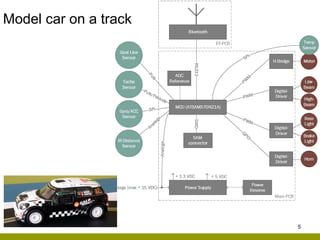
5
Model car on a track
6
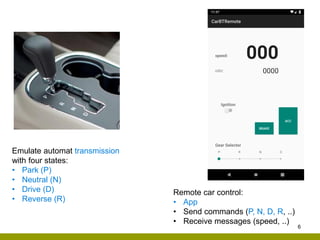
Emulate automat transmission
with four states:
• Park (P)
• Neutral (N)
• Drive (D)
• Reverse (R)
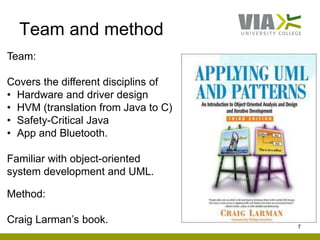
Remote car control:
• App
• Send commands (P, N, D, R, ..)
• Receive messages (speed, ..)
Team and method
7
Team:
Covers the different disciplins of
• Hardware and driver design
• HVM (translation from Java to C)
• Safety-Critical Java
• App and Bluetooth.
Familiar with object-oriented
system development and UML.
Method:
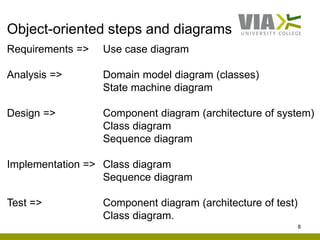
Craig Larman’s book.
Object-oriented steps and diagrams
8
Requirements => Use case diagram
Analysis => Domain model diagram (classes)
State machine diagram
Design => Component diagram (architecture of system)
Class diagram
Sequence diagram
Implementation => Class diagram
Sequence diagram
Test => Component diagram (architecture of test)
Class diagram.
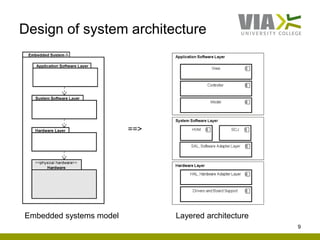
Design of system architecture
9
Embedded systems model Layered architecture
==>
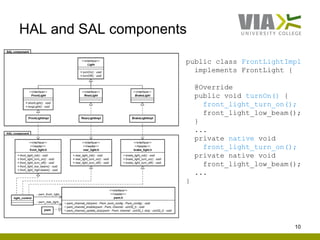
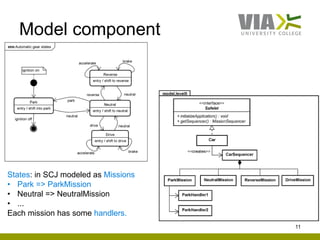
HAL and SAL components
10
public class FrontLightImpl
implements FrontLight {
@Override
public void turnOn() {
front_light_turn_on();
front_light_low_beam();
}
...
private native void
front_light_turn_on();
private native void
front_light_low_beam();
...
}
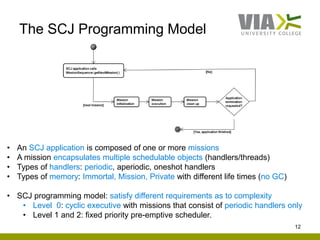
Model component
11
States: in SCJ modeled as Missions
• Park => ParkMission
• Neutral => NeutralMission
• ...
Each mission has some handlers.
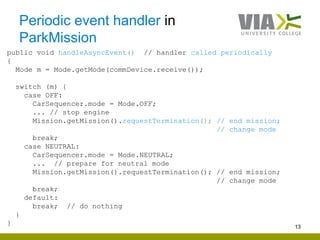
The SCJ Programming Model
12
• An SCJ application is composed of one or more missions
• A mission encapsulates multiple schedulable objects (handlers/threads)
• Types of handlers: periodic, aperiodic, oneshot handlers
• Types of memory: Immortal, Mission, Private with different life times (no GC)
• SCJ programming model: satisfy different requirements as to complexity
• Level 0: cyclic executive with missions that consist of periodic handlers only
• Level 1 and 2: fixed priority pre-emptive scheduler.
Periodic event handler in
ParkMission
13
public void handleAsyncEvent() // handler called periodically
{
Mode m = Mode.getMode(commDevice.receive());
switch (m) {
case OFF:
CarSequencer.mode = Mode.OFF;
... // stop engine
Mission.getMission().requestTermination(); // end mission;
// change mode
break;
case NEUTRAL:
CarSequencer.mode = Mode.NEUTRAL;
... // prepare for neutral mode
Mission.getMission().requestTermination(); // end mission;
// change mode
break;
default:
break; // do nothing
}
}
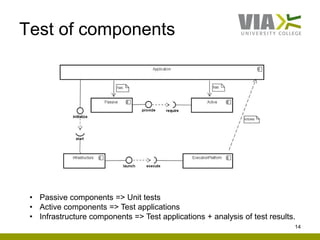
Test of components
14
• Passive components => Unit tests
• Active components => Test applications
• Infrastructure components => Test applications + analysis of test results.
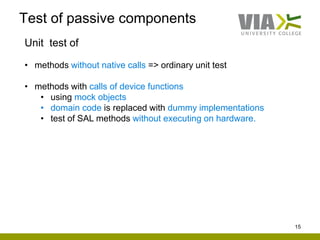
Test of passive components
15
Unit test of
• methods without native calls => ordinary unit test
• methods with calls of device functions
• using mock objects
• domain code is replaced with dummy implementations
• test of SAL methods without executing on hardware.
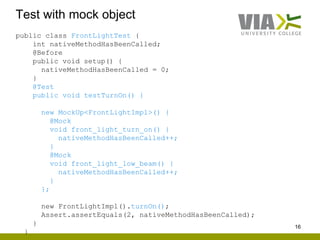
Test with mock object
16
public class FrontLightTest {
int nativeMethodHasBeenCalled;
@Before
public void setup() {
nativeMethodHasBeenCalled = 0;
}
@Test
public void testTurnOn() {
new MockUp<FrontLightImpl>() {
@Mock
void front_light_turn_on() {
nativeMethodHasBeenCalled++;
}
@Mock
void front_light_low_beam() {
nativeMethodHasBeenCalled++;
}
};
new FrontLightImpl().turnOn();
Assert.assertEquals(2, nativeMethodHasBeenCalled);
}
}
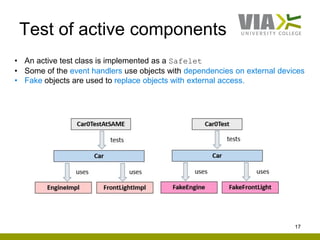
Test of active components
17
• An active test class is implemented as a Safelet
• Some of the event handlers use objects with dependencies on external devices
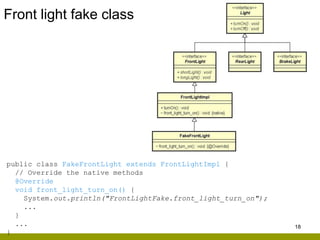
• Fake objects are used to replace objects with external access.
Front light fake class
18
public class FakeFrontLight extends FrontLightImpl {
// Override the native methods
@Override
void front_light_turn_on() {
System.out.println("FrontLightFake.front_light_turn_on");
...
}
...
}
Test of infrastructure
19
Performed on the execution platform.
SCJ has no garbage collector => predictable execution time
• Handlers each have their own private memory
• Missions each have their own mission memory
• The application has an immortal memory.
Allocation and use of memory must be tested:
ImmortalMem: 16000, used: 13520
MissionMem1: 2000, used: 1122, - maybe reduce size to 1350
PvtMem0: 4000, used 2113, - maybe reduce size to 2540
...
Stack sizes are treated accordingly.
Schedulability test.
Conclusion
20
• OO methods with UML can be used with advantage
• A layered architecture and different design patterns help in making
a solution with clean interfaces
• OO modelling with UML and subsequent implementation in C can
be done easily
• The mission concept in SCJ makes it easy to model separate
entities
• a mission encapsulate multiple handlers.
• Missions help to divide the program into smaller and more
manageable parts
• And thus can help solving the problem of handling the increased
complexity of future embedded systems.
[1] 2017 Embedded markets study, https://www.embedded.com/, 2017.
[2] T. Noergaard, Embedded Systems Architecture: A Comprehensive Guide for
Engineers and Programmers, Newnes, 2005.
[3] C. Larman, Applying UML and Patterns. An Introduction to Object-Oriented Analysis
and Design and Iterative Development (3rd Edition), Upper Saddle River, NJ, USA:
Prentice Hall PTR, 2004.
[4] S. E. Korsholm, H. Søndergaard and A. P. Ravn, A real-time Java tool chain for
resource constrained platforms, Concurrency and Computation: Practice & Experience,
vol. 2013, pp. 1-25, 9 2013.
[5] The Open Group, Safety-Critical Java Technology Specification, 2017.
[6] B. P. Douglass, UML for the C programming language, IBM, 2009.
[7] JMockit, http://jmockit.github.io/, 2018.
References
21

Embedded softwaredevelopment hcs

  • 1.
    1 Embedded Software Developmentusing UML, Safety-Critical Java, and C • Background and Objective for the embedded project • Demonstrator: a Model Car • Team and method • Object-oriented steps and diagrams • Design of system architecture • Details of some components • Test of components • Conclusion Hans Søndergaard, VIA, hso@via.dk Together with Ib Havn, Stephan Korsholm, and Christian Sandbeck 21.11.2018
  • 2.
    • Embedded ICTstudents at VIA – First three semesters: • Using OO-methods and language (Java) – Fourth semester: • Difficulty using OO-methods together with C. Background (1) 2
  • 3.
    • Embedded MarketsStudy (2017) – The debugging process: • Embedded design team's greatest concerns (23%) – Greatest technology challenge: • Managing increases in code complexity and size – UML • Only 17% are using UML. Background (2) 3
  • 4.
    Demonstrate that • OOsoftware development with UML can be used effectively to ensure a better structure of the software, • A procedural language (C) along with an OO language (Safety-Critical Java) can be integrated easily into the OO development process. Objective for the embedded project 4
  • 5.
  • 6.
    6 Emulate automat transmission withfour states: • Park (P) • Neutral (N) • Drive (D) • Reverse (R) Remote car control: • App • Send commands (P, N, D, R, ..) • Receive messages (speed, ..)
  • 7.
    Team and method 7 Team: Coversthe different disciplins of • Hardware and driver design • HVM (translation from Java to C) • Safety-Critical Java • App and Bluetooth. Familiar with object-oriented system development and UML. Method: Craig Larman’s book.
  • 8.
    Object-oriented steps anddiagrams 8 Requirements => Use case diagram Analysis => Domain model diagram (classes) State machine diagram Design => Component diagram (architecture of system) Class diagram Sequence diagram Implementation => Class diagram Sequence diagram Test => Component diagram (architecture of test) Class diagram.
  • 9.
    Design of systemarchitecture 9 Embedded systems model Layered architecture ==>
  • 10.
    HAL and SALcomponents 10 public class FrontLightImpl implements FrontLight { @Override public void turnOn() { front_light_turn_on(); front_light_low_beam(); } ... private native void front_light_turn_on(); private native void front_light_low_beam(); ... }
  • 11.
    Model component 11 States: inSCJ modeled as Missions • Park => ParkMission • Neutral => NeutralMission • ... Each mission has some handlers.
  • 12.
    The SCJ ProgrammingModel 12 • An SCJ application is composed of one or more missions • A mission encapsulates multiple schedulable objects (handlers/threads) • Types of handlers: periodic, aperiodic, oneshot handlers • Types of memory: Immortal, Mission, Private with different life times (no GC) • SCJ programming model: satisfy different requirements as to complexity • Level 0: cyclic executive with missions that consist of periodic handlers only • Level 1 and 2: fixed priority pre-emptive scheduler.
  • 13.
    Periodic event handlerin ParkMission 13 public void handleAsyncEvent() // handler called periodically { Mode m = Mode.getMode(commDevice.receive()); switch (m) { case OFF: CarSequencer.mode = Mode.OFF; ... // stop engine Mission.getMission().requestTermination(); // end mission; // change mode break; case NEUTRAL: CarSequencer.mode = Mode.NEUTRAL; ... // prepare for neutral mode Mission.getMission().requestTermination(); // end mission; // change mode break; default: break; // do nothing } }
  • 14.
    Test of components 14 •Passive components => Unit tests • Active components => Test applications • Infrastructure components => Test applications + analysis of test results.
  • 15.
    Test of passivecomponents 15 Unit test of • methods without native calls => ordinary unit test • methods with calls of device functions • using mock objects • domain code is replaced with dummy implementations • test of SAL methods without executing on hardware.
  • 16.
    Test with mockobject 16 public class FrontLightTest { int nativeMethodHasBeenCalled; @Before public void setup() { nativeMethodHasBeenCalled = 0; } @Test public void testTurnOn() { new MockUp<FrontLightImpl>() { @Mock void front_light_turn_on() { nativeMethodHasBeenCalled++; } @Mock void front_light_low_beam() { nativeMethodHasBeenCalled++; } }; new FrontLightImpl().turnOn(); Assert.assertEquals(2, nativeMethodHasBeenCalled); } }
  • 17.
    Test of activecomponents 17 • An active test class is implemented as a Safelet • Some of the event handlers use objects with dependencies on external devices • Fake objects are used to replace objects with external access.
  • 18.
    Front light fakeclass 18 public class FakeFrontLight extends FrontLightImpl { // Override the native methods @Override void front_light_turn_on() { System.out.println("FrontLightFake.front_light_turn_on"); ... } ... }
  • 19.
    Test of infrastructure 19 Performedon the execution platform. SCJ has no garbage collector => predictable execution time • Handlers each have their own private memory • Missions each have their own mission memory • The application has an immortal memory. Allocation and use of memory must be tested: ImmortalMem: 16000, used: 13520 MissionMem1: 2000, used: 1122, - maybe reduce size to 1350 PvtMem0: 4000, used 2113, - maybe reduce size to 2540 ... Stack sizes are treated accordingly. Schedulability test.
  • 20.
    Conclusion 20 • OO methodswith UML can be used with advantage • A layered architecture and different design patterns help in making a solution with clean interfaces • OO modelling with UML and subsequent implementation in C can be done easily • The mission concept in SCJ makes it easy to model separate entities • a mission encapsulate multiple handlers. • Missions help to divide the program into smaller and more manageable parts • And thus can help solving the problem of handling the increased complexity of future embedded systems.
  • 21.
    [1] 2017 Embeddedmarkets study, https://www.embedded.com/, 2017. [2] T. Noergaard, Embedded Systems Architecture: A Comprehensive Guide for Engineers and Programmers, Newnes, 2005. [3] C. Larman, Applying UML and Patterns. An Introduction to Object-Oriented Analysis and Design and Iterative Development (3rd Edition), Upper Saddle River, NJ, USA: Prentice Hall PTR, 2004. [4] S. E. Korsholm, H. Søndergaard and A. P. Ravn, A real-time Java tool chain for resource constrained platforms, Concurrency and Computation: Practice & Experience, vol. 2013, pp. 1-25, 9 2013. [5] The Open Group, Safety-Critical Java Technology Specification, 2017. [6] B. P. Douglass, UML for the C programming language, IBM, 2009. [7] JMockit, http://jmockit.github.io/, 2018. References 21