THE CITY UNIVERSITY OF NEW YORK
New York City College of Technology
Architectural Technology Department
May 4, 2020
Written By Ligia Oropeza & Laurin Moseley
V-Ray for Rhino in 7 Easy
Steps
2
This material is based upon work supported by the National Science Foundation
under Grant Numbers 1141234.
Any opinions, findings, and conclusions or recommendations expressed in this
material are those of the author(s) and do not necessarily reflect the views of the
National Science Foundation.
3
VRay-Lighting For
Table of Contents
V-Ray for Rhino in 7 Easy Steps:
	 ●Step A1: Set Up Lighting & Environment
	
	 ●StepA2: Setting Up Basic V-Ray Materials
             ●Step A3: Render Settings
	 ●Step A4: Rendering and Post Processing
	 ●Render Results
	
	 ●Step B1:Using HDRIs
             ●Step B2: Creating V-Ray Materials
             ●Render Results
4
VRay-Lighting For
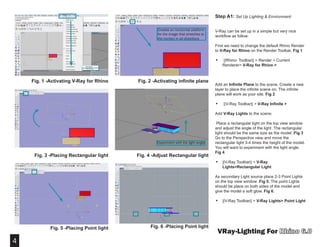
Fig. 1 -Activating V-Ray for Rhino
Step A1: Set Up Lighting & Environment
V-Ray can be set up in a simple but very nice
workflow as follow:   
First we need to change the default Rhino Render
to V-Ray for Rhino on the Render Toolbar. Fig 1
•	 ||Rhino- Toolbar|| > Render > Current
Renderer> V-Ray for Rhino >
Add an Infinite Plane to the scene. Create a new
layer to place the infinite scene on. The infinite
plane will work as your site. Fig 2
•	 ||V-Ray Toolbar|| > V-Ray Infinite >
Add V-Ray Lights to the scene.
Place a rectangular light on the top view window
and adjust the angle of the light .The rectangular
light should be the same size as the model .Fig 3
Go to the Perspective view and move the
rectangular light 3-4 times the height of the model.
You will want to experiment with the light angle.
Fig 4
•	 ||V-Ray Toolbar|| > V-Ray
Lights>Rectangular Light
As secondary Light source place 2-3 Point Lights
on the top view window .Fig 5. The point Lights
should be place on both sides of the model and
give the model a soft glow. Fig 6.
•	 ||V-Ray Toolbar|| > V-Ray Lights> Point Light
Creates an horizontal platform
for the image that stretches to
the horizon in all directions
Fig. 2 -Activating infinite plane
Experiment with the light angle
Fig. 3 -Placing Rectangular light
Fig. 5 -Placing Point light Fig. 6 -Placing Point light
Fig. 4 -Adjust Rectangular light
5
VRay-Lighting For
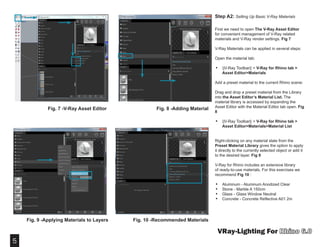
Step A2: Setting Up Basic V-Ray Materials
First we need to open The V-Ray Asset Editor
for convenient management of V-Ray related
materials and V-Ray render settings. Fig 7
V-Ray Materials can be applied in several steps:
Open the material tab:
•	 ||V-Ray Toolbar|| > V-Ray for Rhino tab >
Asset Editor>Materials
Add a preset material to the current Rhino scene:
Drag and drop a preset material from the Library
into the Asset Editor’s Material List. The
material library is accessed by expanding the
Asset Editor with the Material Editor tab open. Fig
8
•	 ||V-Ray Toolbar|| > V-Ray for Rhino tab >
Asset Editor>Materials>Material List
Right-clicking on any material slate from the
Preset Material Library gives the option to apply
it directly to the currently selected object or add it
to the desired layer. Fig 9
V-Ray for Rhino includes an extensive library
of ready-to-use materials. For this exercises we
recommend Fig 10 :
•	 Aluminum - Aluminum Anodized Clear
•	 Stone - Marble A 150cm
•	 Glass - Glass Window Neutral
•	 Concrete - Concrete Reflective A01 2m
Fig. 7 -V-Ray Asset Editor Fig. 8 -Adding Material
Fig. 9 -Applying Materials to Layers Fig. 10 -Recommended Materials
6
VRay-Lighting For
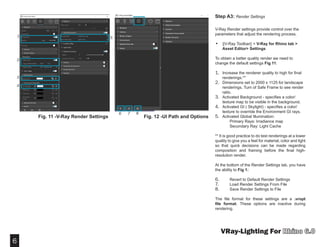
Step A3: Render Settings
V-Ray Render settings provide control over the
parameters that adjust the rendering process.
•	 ||V-Ray Toolbar|| > V-Ray for Rhino tab >
Asset Editor> Settings
To obtain a better quality render we need to
change the default settings Fig 11:
1.	 Increase the renderer quality to high for final
renderings.**
2.	 Dimensions set to 2000 x 1125 for landscape
renderings. Turn of Safe Frame to see render
ratio.
3.	 Activated Background - specifies a color/
texture map to be visible in the background.
4.	 Activated GI ( Skylight) - specifies a color/
texture to override the Environment GI rays.
5.	 Activated Global Illumination:
	 Primary Rays: Irradiance map
	 Secondary Ray: Light Cache
** It is good practice to do test renderings at a lower
quality to give you a feel for material, color and light
so that quick decisions can be made regarding
composition and framing before the final high-
resolution render.
At the bottom of the Render Settings tab, you have
the ability to Fig 1:
6.	 Revert to Default Render Settings
7.	 Load Render Settings From File
8.	 Save Render Settings to File
The file format for these settings are a .vropt
file format. These options are inactive during
rendering.
1 5
2
3
4
Fig. 11 -V-Ray Render Settings Fig. 12 -UI Path and Options
6 7 8
7
VRay-Lighting For
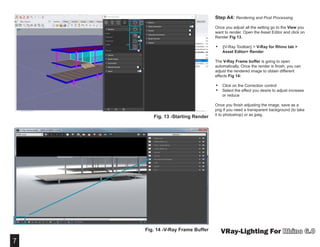
Step A4: Rendering and Post Processing
Once you adjust all the setting go to the View you
want to render. Open the Asset Editor and click on
Render Fig 13.
•	 ||V-Ray Toolbar|| > V-Ray for Rhino tab >
Asset Editor> Render
The V-Ray Frame buffer is going to open
automatically. Once the render is finish, you can
adjust the rendered image to obtain different
effects Fig 14:
•	 Click on the Correction control
•	 Select the effect you desire to adjust increase
or reduce
Once you finish adjusting the image, save as a
png if you need a transparent background (to take
it to photoshop) or as jpeg.
Fig. 13 -Starting Render
Fig. 14 -V-Ray Frame Buffer
8
VRay-Lighting For
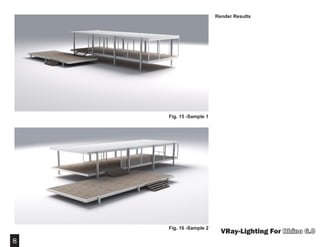
Render Results
Fig. 15 -Sample 1
Fig. 16 -Sample 2
9
VRay-Lighting For
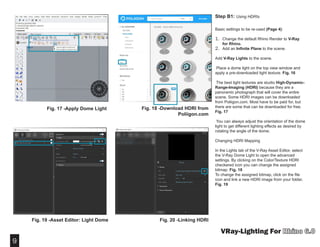
Step B1: Using HDRIs
Basic settings to be re-used (Page 4):
1.	 Change the default Rhino Render to V-Ray
for Rhino.
2.	 Add an Infinite Plane to the scene.
Add V-Ray Lights to the scene.
Place a dome light on the top view window and
apply a pre-downloaded light texture. Fig. 16
The best light textures are studio High-Dynamic-
Range-Imaging (HDRI) because they are a
panoramic photograph that will cover the entire
scene. Some HDRI images can be downloaded
from Poliigon.com. Most have to be paid for, but
there are some that can be downloaded for free.   
Fig. 17
You can always adjust the orientation of the dome
light to get different lighting effects as desired by
rotating the angle of the dome.
Changing HDRI Mapping
In the Lights tab of the V-Ray Asset Editor, select
the V-Ray Dome Light to open the advanced
settings. By clicking on the Color/Texture HDRI
checkered icon you can change the assigned
bitmap. Fig. 18
To change the assigned bitmap, click on the file
icon and link a new HDRI image from your folder.
Fig. 19
Fig. 17 -Apply Dome Light Fig. 18 -Download HDRI from
Poliigon.com
Fig. 19 -Asset Editor: Light Dome Fig. 20 -Linking HDRI
10
VRay-Lighting For
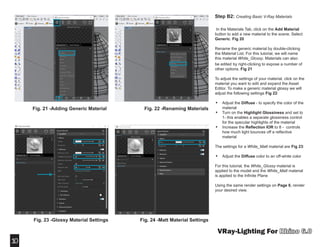
Step B2: Creating Basic V-Ray Materials
In the Materials Tab, click on the Add Material
button to add a new material to the scene. Select
Generic. Fig 20
Rename the generic material by double-clicking
the Material List. For this tutorial, we will name
this material White_Glossy. Materials can also
be edited by right-clicking to expose a number of
other options. Fig 21
To adjust the settings of your material, click on the
material you want to edit and expand the Asset
Editor. To make a generic material glossy we will
adjust the following settings Fig 22:
•	 Adjust the Diffuse - to specify the color of the
material
•	 Turn on the Highlight Glossiness and set to
1- this enables a separate glossiness control
for the specular highlights of the material
•	 Increase the Reflection IOR to 8 -  controls
how much light bounces off a reflective
material
The settings for a White_Matt material are Fig 23:
•	 Adjust the Diffuse color to an off-white color
For this tutorial, the White_Glossy material is
applied to the model and the White_Matt material
is applied to the Infinite Plane
Using the same render settings on Page 6, render
your desired view.
Fig. 21 -Adding Generic Material Fig. 22 -Renaming Materials
Fig. 23 -Glossy Material Settings Fig. 24 -Matt Material Settings
11
VRay-Lighting For
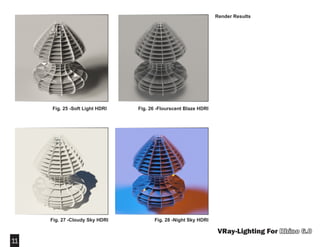
Render Results
Fig. 25 -Soft Light HDRI Fig. 26 -Flourscent Blaze HDRI
Fig. 27 -Cloudy Sky HDRI Fig. 28 -Night Sky HDRI

VRay Lighting for Rhino

  • 1.
    THE CITY UNIVERSITYOF NEW YORK New York City College of Technology Architectural Technology Department May 4, 2020 Written By Ligia Oropeza & Laurin Moseley V-Ray for Rhino in 7 Easy Steps
  • 2.
    2 This material isbased upon work supported by the National Science Foundation under Grant Numbers 1141234. Any opinions, findings, and conclusions or recommendations expressed in this material are those of the author(s) and do not necessarily reflect the views of the National Science Foundation.
  • 3.
    3 VRay-Lighting For Table ofContents V-Ray for Rhino in 7 Easy Steps: ●Step A1: Set Up Lighting & Environment ●StepA2: Setting Up Basic V-Ray Materials ●Step A3: Render Settings ●Step A4: Rendering and Post Processing ●Render Results ●Step B1:Using HDRIs ●Step B2: Creating V-Ray Materials ●Render Results
  • 4.
    4 VRay-Lighting For Fig. 1-Activating V-Ray for Rhino Step A1: Set Up Lighting & Environment V-Ray can be set up in a simple but very nice workflow as follow: First we need to change the default Rhino Render to V-Ray for Rhino on the Render Toolbar. Fig 1 • ||Rhino- Toolbar|| > Render > Current Renderer> V-Ray for Rhino > Add an Infinite Plane to the scene. Create a new layer to place the infinite scene on. The infinite plane will work as your site. Fig 2 • ||V-Ray Toolbar|| > V-Ray Infinite > Add V-Ray Lights to the scene. Place a rectangular light on the top view window and adjust the angle of the light .The rectangular light should be the same size as the model .Fig 3 Go to the Perspective view and move the rectangular light 3-4 times the height of the model. You will want to experiment with the light angle. Fig 4 • ||V-Ray Toolbar|| > V-Ray Lights>Rectangular Light As secondary Light source place 2-3 Point Lights on the top view window .Fig 5. The point Lights should be place on both sides of the model and give the model a soft glow. Fig 6. • ||V-Ray Toolbar|| > V-Ray Lights> Point Light Creates an horizontal platform for the image that stretches to the horizon in all directions Fig. 2 -Activating infinite plane Experiment with the light angle Fig. 3 -Placing Rectangular light Fig. 5 -Placing Point light Fig. 6 -Placing Point light Fig. 4 -Adjust Rectangular light
  • 5.
    5 VRay-Lighting For Step A2:Setting Up Basic V-Ray Materials First we need to open The V-Ray Asset Editor for convenient management of V-Ray related materials and V-Ray render settings. Fig 7 V-Ray Materials can be applied in several steps: Open the material tab: • ||V-Ray Toolbar|| > V-Ray for Rhino tab > Asset Editor>Materials Add a preset material to the current Rhino scene: Drag and drop a preset material from the Library into the Asset Editor’s Material List. The material library is accessed by expanding the Asset Editor with the Material Editor tab open. Fig 8 • ||V-Ray Toolbar|| > V-Ray for Rhino tab > Asset Editor>Materials>Material List Right-clicking on any material slate from the Preset Material Library gives the option to apply it directly to the currently selected object or add it to the desired layer. Fig 9 V-Ray for Rhino includes an extensive library of ready-to-use materials. For this exercises we recommend Fig 10 : • Aluminum - Aluminum Anodized Clear • Stone - Marble A 150cm • Glass - Glass Window Neutral • Concrete - Concrete Reflective A01 2m Fig. 7 -V-Ray Asset Editor Fig. 8 -Adding Material Fig. 9 -Applying Materials to Layers Fig. 10 -Recommended Materials
  • 6.
    6 VRay-Lighting For Step A3:Render Settings V-Ray Render settings provide control over the parameters that adjust the rendering process. • ||V-Ray Toolbar|| > V-Ray for Rhino tab > Asset Editor> Settings To obtain a better quality render we need to change the default settings Fig 11: 1. Increase the renderer quality to high for final renderings.** 2. Dimensions set to 2000 x 1125 for landscape renderings. Turn of Safe Frame to see render ratio. 3. Activated Background - specifies a color/ texture map to be visible in the background. 4. Activated GI ( Skylight) - specifies a color/ texture to override the Environment GI rays. 5. Activated Global Illumination: Primary Rays: Irradiance map Secondary Ray: Light Cache ** It is good practice to do test renderings at a lower quality to give you a feel for material, color and light so that quick decisions can be made regarding composition and framing before the final high- resolution render. At the bottom of the Render Settings tab, you have the ability to Fig 1: 6. Revert to Default Render Settings 7. Load Render Settings From File 8. Save Render Settings to File The file format for these settings are a .vropt file format. These options are inactive during rendering. 1 5 2 3 4 Fig. 11 -V-Ray Render Settings Fig. 12 -UI Path and Options 6 7 8
  • 7.
    7 VRay-Lighting For Step A4:Rendering and Post Processing Once you adjust all the setting go to the View you want to render. Open the Asset Editor and click on Render Fig 13. • ||V-Ray Toolbar|| > V-Ray for Rhino tab > Asset Editor> Render The V-Ray Frame buffer is going to open automatically. Once the render is finish, you can adjust the rendered image to obtain different effects Fig 14: • Click on the Correction control • Select the effect you desire to adjust increase or reduce Once you finish adjusting the image, save as a png if you need a transparent background (to take it to photoshop) or as jpeg. Fig. 13 -Starting Render Fig. 14 -V-Ray Frame Buffer
  • 8.
    8 VRay-Lighting For Render Results Fig.15 -Sample 1 Fig. 16 -Sample 2
  • 9.
    9 VRay-Lighting For Step B1:Using HDRIs Basic settings to be re-used (Page 4): 1. Change the default Rhino Render to V-Ray for Rhino. 2. Add an Infinite Plane to the scene. Add V-Ray Lights to the scene. Place a dome light on the top view window and apply a pre-downloaded light texture. Fig. 16 The best light textures are studio High-Dynamic- Range-Imaging (HDRI) because they are a panoramic photograph that will cover the entire scene. Some HDRI images can be downloaded from Poliigon.com. Most have to be paid for, but there are some that can be downloaded for free. Fig. 17 You can always adjust the orientation of the dome light to get different lighting effects as desired by rotating the angle of the dome. Changing HDRI Mapping In the Lights tab of the V-Ray Asset Editor, select the V-Ray Dome Light to open the advanced settings. By clicking on the Color/Texture HDRI checkered icon you can change the assigned bitmap. Fig. 18 To change the assigned bitmap, click on the file icon and link a new HDRI image from your folder. Fig. 19 Fig. 17 -Apply Dome Light Fig. 18 -Download HDRI from Poliigon.com Fig. 19 -Asset Editor: Light Dome Fig. 20 -Linking HDRI
  • 10.
    10 VRay-Lighting For Step B2:Creating Basic V-Ray Materials In the Materials Tab, click on the Add Material button to add a new material to the scene. Select Generic. Fig 20 Rename the generic material by double-clicking the Material List. For this tutorial, we will name this material White_Glossy. Materials can also be edited by right-clicking to expose a number of other options. Fig 21 To adjust the settings of your material, click on the material you want to edit and expand the Asset Editor. To make a generic material glossy we will adjust the following settings Fig 22: • Adjust the Diffuse - to specify the color of the material • Turn on the Highlight Glossiness and set to 1- this enables a separate glossiness control for the specular highlights of the material • Increase the Reflection IOR to 8 - controls how much light bounces off a reflective material The settings for a White_Matt material are Fig 23: • Adjust the Diffuse color to an off-white color For this tutorial, the White_Glossy material is applied to the model and the White_Matt material is applied to the Infinite Plane Using the same render settings on Page 6, render your desired view. Fig. 21 -Adding Generic Material Fig. 22 -Renaming Materials Fig. 23 -Glossy Material Settings Fig. 24 -Matt Material Settings
  • 11.
    11 VRay-Lighting For Render Results Fig.25 -Soft Light HDRI Fig. 26 -Flourscent Blaze HDRI Fig. 27 -Cloudy Sky HDRI Fig. 28 -Night Sky HDRI