Background
Redox Reaction:
The reaction in which both oxidation and reduction processes take place, that type of reaction
is called redox reaction. Displacement redox reaction is as follows i.e.
X + YZ → XZ + Y
Single Displacement Reaction
ActivitySeries
Metals are ranked by their abilities to displace H2 fromvarious sources and another metal from
solution. Its key points are following:
 Most reactive metal displaces H2 from water.
 Less reactive metal displaces H2 from the hot water (steam).
 Less reactive metal displaces H2 from the acid.
 Least reactive metal do displacement reaction i.e. single displacement reaction.
 Least reactive metals do not displace H2 from any source such as:
Ag, Au, Pt, C
Essential components of an electrochemical/galvanic/corrosion cell include;
1. Anode
It is the electrode where the metal dissolves, oxidation occurs and thus the loss or
generation of electrons.
2. Cathode
It is the electrode where metal deposition, reduction occur and thus the consuming or
gain of electrons.
3. Electrolyte
It provides ionic path between anode and cathode through which ionic species move.
Types of cells
 Spontaneous Cell (Galvanic Cell)
 Non Spontaneous (Voltaic Cell)
SpontaneousCell
Electrochemical cell
A strip of Zn is taken in ZnSo4 solution and Cu metal strip was taken in CuSo4 solution. A salt
bridge was provided for ionic conduction and used a volt meter to calculate the potential
difference.
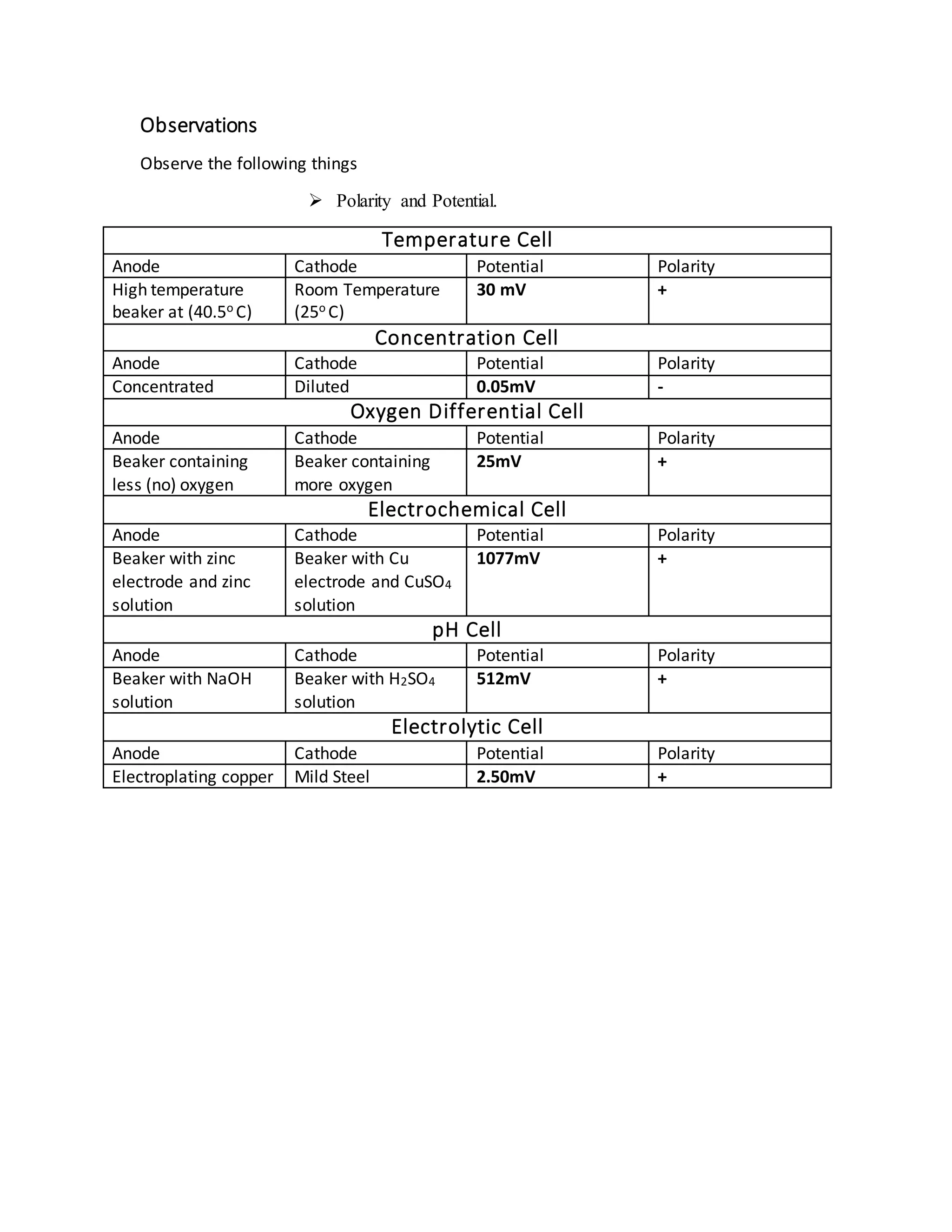
Concentration cell
Two strips of the copper were taken in two different beakers in which one beaker was filled
with concentrated CuSo4 and the other one was filled with dilute CuSo4. A salt bridge was
provided for ionic conduction and volt meter was connected to measure the potential
difference across the cell.
Temperature cell
Two strips of Cu were immersed in the CuSO4 solution of the same concentration in two
different beakers. One of the beakers was placed on the hot plate to raise the temperature and
a salt bridge was provided for the ionic conduction. The volt meter was connected across the
Cu electrodes and potential difference was observed.
SingleElectrode cell (Acidic Solution)
Metal dissolved in acidic solution with the evolution of hydrogen gas. This evolution is given by
the following reaction
2H+ + 2e- H2
An acidic solution was taken in a beaker and steel rod was dipped in solution from sometime
and observed.
Oxygen differential cell
When there is a difference in concentration in the dissolved oxygen at two different point of
the same metal surface, a corrosion reaction is promoted. As the direction of the reaction is
towards the equilibrium and the only way equilibrium can be achieved is by corrosion by
reducing the oxygen concentration where it is highest. This reduction of oxygen can be
observed in the following reaction
O2 + 2H2O + 4e- 4OH-
pH cell
Difference in the pH values of the electrolyte also generates the potential difference across the
anode and cathode of the same metal. Since increase in H+ ions will increase the feasibility of
the hydrogen reduction reaction to occur. So, lowering the pH value of the electrolyte will make
the electrode an anode and thus a potential difference is developed across the cell. Two strips
of copper acting as metal are dipped in the basic and acidic electrolytic solution in two different
beakers. A salt bridge was provided between two electrolytes and volt meter was used to
measure the potential difference.
Non Spontaneous Cell
Electrolytic cell
It is the non-spontaneous electrochemical cell where electricity is applied from a external
source to initiate the reaction. Positive end of the source is applied to the anode and negative
side is applied to cathode. the cathode is the part which is to be platted at anode, due to
oxidation, metal converts to its ions and electrons are produced.
Objective
Develop an activity series based on their own lab observations and will use it to predict and
explain single replacement reactions and oxidation-reduction.
Principle
Potential will produce due to difference in some other factors between two solutions like
temperature, pH value, different amount of oxygen, change in concentrations etc.
Chemistryof Analysis
Potential will produce and will tell us that which one is cathode and anode.
Chemicals
 Copper Sulphate
 Iron Sulphate
 Aluminum Sulphate
 Silver Nitrate
 Magnesium Sulphate
 Lead Sulphate
MaterialsRequired
 Beakers
 Oxygen cylinders
 AVO meter
 pH strips
 Boiler
 U-shaped bridge.
Procedure
1. First of all set all the apparatus of different given cells i.e.
 Temperature cell
 Concentration cell
 Oxygen differential cell
 Electrochemical cell
 pH cell
 Electrolysis cell
2. Then attach the avometer with all the apparatus and check the value of potential.
3. The negative and positive sign will indicate anode and cathode in the apparatus.
Observations
Observe the following things
 Polarity and Potential.
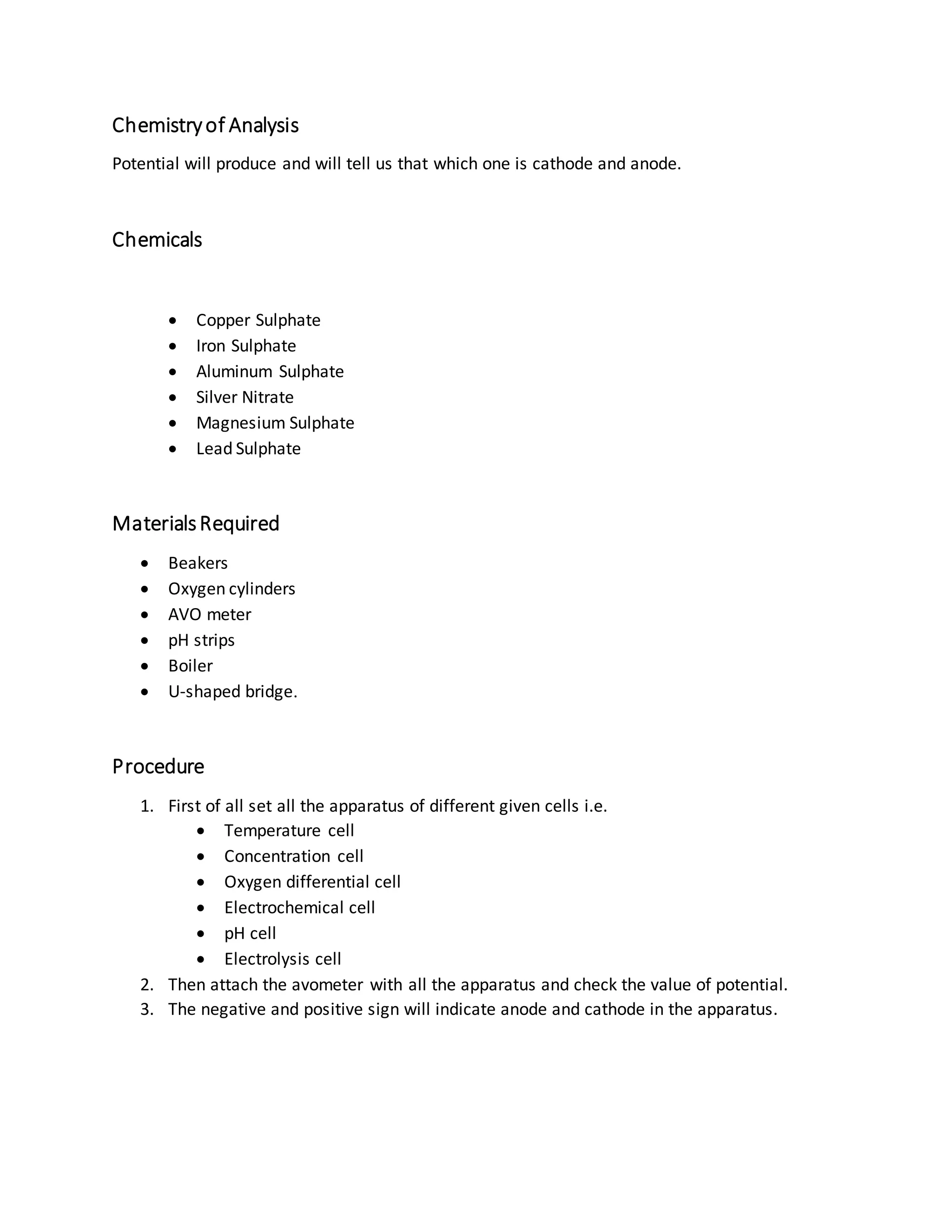
Temperature Cell
Anode Cathode Potential Polarity
High temperature
beaker at (40.5o C)
Room Temperature
(25o C)
30 mV +
Concentration Cell
Anode Cathode Potential Polarity
Concentrated Diluted 0.05mV -
Oxygen Differential Cell
Anode Cathode Potential Polarity
Beaker containing
less (no) oxygen
Beaker containing
more oxygen
25mV +
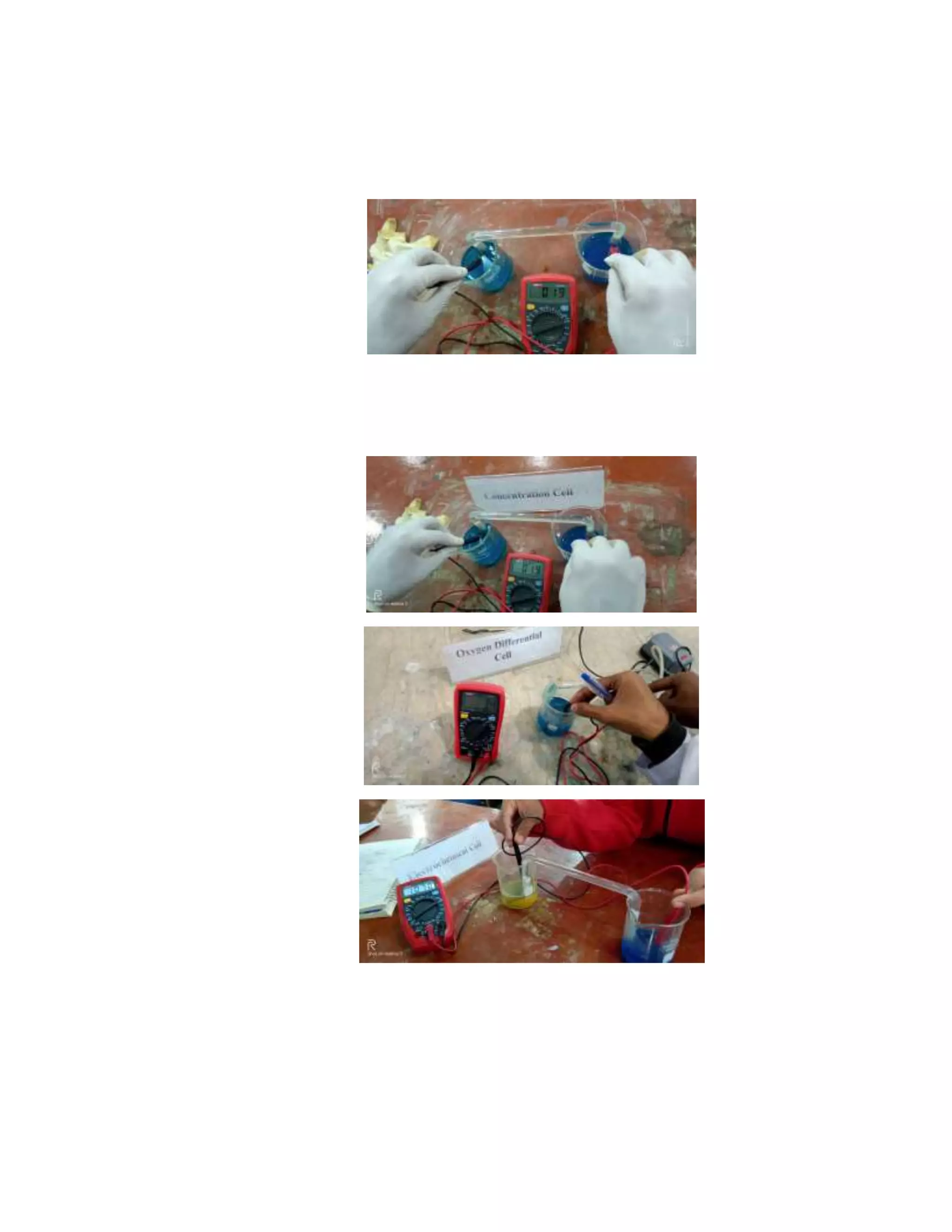
Electrochemical Cell
Anode Cathode Potential Polarity
Beaker with zinc
electrode and zinc
solution
Beaker with Cu
electrode and CuSO4
solution
1077mV +
pH Cell
Anode Cathode Potential Polarity
Beaker with NaOH
solution
Beaker with H2SO4
solution
512mV +
Electrolytic Cell
Anode Cathode Potential Polarity
Electroplating copper Mild Steel 2.50mV +
Potential difference

Potential difference

  • 1.
    Background Redox Reaction: The reactionin which both oxidation and reduction processes take place, that type of reaction is called redox reaction. Displacement redox reaction is as follows i.e. X + YZ → XZ + Y Single Displacement Reaction ActivitySeries Metals are ranked by their abilities to displace H2 fromvarious sources and another metal from solution. Its key points are following:  Most reactive metal displaces H2 from water.  Less reactive metal displaces H2 from the hot water (steam).  Less reactive metal displaces H2 from the acid.  Least reactive metal do displacement reaction i.e. single displacement reaction.  Least reactive metals do not displace H2 from any source such as: Ag, Au, Pt, C
  • 2.
    Essential components ofan electrochemical/galvanic/corrosion cell include; 1. Anode It is the electrode where the metal dissolves, oxidation occurs and thus the loss or generation of electrons. 2. Cathode It is the electrode where metal deposition, reduction occur and thus the consuming or gain of electrons. 3. Electrolyte It provides ionic path between anode and cathode through which ionic species move. Types of cells  Spontaneous Cell (Galvanic Cell)  Non Spontaneous (Voltaic Cell) SpontaneousCell Electrochemical cell A strip of Zn is taken in ZnSo4 solution and Cu metal strip was taken in CuSo4 solution. A salt bridge was provided for ionic conduction and used a volt meter to calculate the potential difference. Concentration cell Two strips of the copper were taken in two different beakers in which one beaker was filled with concentrated CuSo4 and the other one was filled with dilute CuSo4. A salt bridge was provided for ionic conduction and volt meter was connected to measure the potential difference across the cell. Temperature cell Two strips of Cu were immersed in the CuSO4 solution of the same concentration in two different beakers. One of the beakers was placed on the hot plate to raise the temperature and a salt bridge was provided for the ionic conduction. The volt meter was connected across the Cu electrodes and potential difference was observed. SingleElectrode cell (Acidic Solution) Metal dissolved in acidic solution with the evolution of hydrogen gas. This evolution is given by the following reaction 2H+ + 2e- H2
  • 3.
    An acidic solutionwas taken in a beaker and steel rod was dipped in solution from sometime and observed. Oxygen differential cell When there is a difference in concentration in the dissolved oxygen at two different point of the same metal surface, a corrosion reaction is promoted. As the direction of the reaction is towards the equilibrium and the only way equilibrium can be achieved is by corrosion by reducing the oxygen concentration where it is highest. This reduction of oxygen can be observed in the following reaction O2 + 2H2O + 4e- 4OH- pH cell Difference in the pH values of the electrolyte also generates the potential difference across the anode and cathode of the same metal. Since increase in H+ ions will increase the feasibility of the hydrogen reduction reaction to occur. So, lowering the pH value of the electrolyte will make the electrode an anode and thus a potential difference is developed across the cell. Two strips of copper acting as metal are dipped in the basic and acidic electrolytic solution in two different beakers. A salt bridge was provided between two electrolytes and volt meter was used to measure the potential difference. Non Spontaneous Cell Electrolytic cell It is the non-spontaneous electrochemical cell where electricity is applied from a external source to initiate the reaction. Positive end of the source is applied to the anode and negative side is applied to cathode. the cathode is the part which is to be platted at anode, due to oxidation, metal converts to its ions and electrons are produced. Objective Develop an activity series based on their own lab observations and will use it to predict and explain single replacement reactions and oxidation-reduction. Principle Potential will produce due to difference in some other factors between two solutions like temperature, pH value, different amount of oxygen, change in concentrations etc.
  • 4.
    Chemistryof Analysis Potential willproduce and will tell us that which one is cathode and anode. Chemicals  Copper Sulphate  Iron Sulphate  Aluminum Sulphate  Silver Nitrate  Magnesium Sulphate  Lead Sulphate MaterialsRequired  Beakers  Oxygen cylinders  AVO meter  pH strips  Boiler  U-shaped bridge. Procedure 1. First of all set all the apparatus of different given cells i.e.  Temperature cell  Concentration cell  Oxygen differential cell  Electrochemical cell  pH cell  Electrolysis cell 2. Then attach the avometer with all the apparatus and check the value of potential. 3. The negative and positive sign will indicate anode and cathode in the apparatus.
  • 5.
    Observations Observe the followingthings  Polarity and Potential. Temperature Cell Anode Cathode Potential Polarity High temperature beaker at (40.5o C) Room Temperature (25o C) 30 mV + Concentration Cell Anode Cathode Potential Polarity Concentrated Diluted 0.05mV - Oxygen Differential Cell Anode Cathode Potential Polarity Beaker containing less (no) oxygen Beaker containing more oxygen 25mV + Electrochemical Cell Anode Cathode Potential Polarity Beaker with zinc electrode and zinc solution Beaker with Cu electrode and CuSO4 solution 1077mV + pH Cell Anode Cathode Potential Polarity Beaker with NaOH solution Beaker with H2SO4 solution 512mV + Electrolytic Cell Anode Cathode Potential Polarity Electroplating copper Mild Steel 2.50mV +