EXECUTIVE SUMMARY 
Lt Gen Jay W. Kelley 
Commander, Air University 
Maxwell Air Force Base, Alabama 
Prepared by 
2025 Support Office 
Air University 
Air Education and Training Command 
Developed by 
Air University Press 
Educational Services Directorate 
College of Aerospace Doctrine, Research, and Education 
Maxwell Air Force Base, Alabama 
August 1996
Disclaimer 
2025 is a study designed to comply with a directive from the chief of staff of the Air 
Force to examine the concepts, capabilities, and technologies the United States will 
require to remain the dominant air and space force in the future. Presented on 17 June 
1996, this report was produced in the Department of Defense school environment of 
academic freedom and in the interest of advancing concepts related to national defense. 
The views expressed in this report are those of the authors and do not reflect the official 
policy or position of the United States Air Force, Department of Defense, or the United 
States government. 
This report contains fictional representations of future situations/scenarios. Any 
similarities to real people or events, other than those specifically cited, are unintentional 
and are for purposes of illustration only. 
This publication has been reviewed by security and policy review authorities, is 
unclassified, and is cleared for public release. 
ii
Contents 
Chapter Page 
Disclaimer .................................................................................................................. ii 
PART 1 
The Charge and the Findings 
1 Introduction ............................................................................................................... 2 
2 What We Did And Why............................................................................................ 4 
3 What We Learned ..................................................................................................... 7 
4 Implications ............................................................................................................. 10 
5 What It Means: Vigilant Edge ................................................................................ 17 
PART 2 
The Methodology and 
White Paper Summaries 
6 Methodology............................................................................................................ 19 
The Alternative Futures.................................................................................... 21 
Gulliver’s Travails ...................................................................................... 21 
Zaibatsu ....................................................................................................... 22 
Digital Cacophony ...................................................................................... 22 
King Khan.................................................................................................... 23 
Halves and Half Naughts ............................................................................ 23 
Crossroads 2015.......................................................................................... 23 
The Operations Analysis and the Value Focused Thinking Model................... 24 
Highest Leverage Systems ........................................................................... 25 
Observations ................................................................................................ 27 
7 White Paper Summaries: Awareness....................................................................... 29 
Awareness/Information Concepts and Systems................................................ 30 
Information Operations: Wisdom Warfare for 2025 ................................... 30 
World Wide Information Control System.................................................... 31 
iii
Chapter Page 
2025 In-Time Information Integration System, (I3S) ................................... 31 
Organizing for Awareness................................................................................. 32 
The Command or Control Dilemma: When Technology and 
Organizational Orientation Collide.......................................................... 32 
Joint Readiness Assessment and Planning Integrated Decision System: 
Combat Readiness and Joint Force Management for 2025..................... 33 
Virtual Integrated Planning and Execution Resource System: The High 
Ground of 2025 ....................................................................................... 33 
The Man in the Chair: Cornerstone of Global Battlespace Dominance ...... 34 
Education and Training for Awareness ............................................................ 34 
Brilliant Warrior........................................................................................... 34 
Brilliant Force and the Expert Architecture that Supports It....................... 35 
Brilliant Warrior: Information Technology Integration in Education and 
Training ................................................................................................... 35 
8 White Paper Summaries: Reach and Presence........................................................ 37 
Logistics............................................................................................................ 38 
Logistics in 2025: Consider It Done! ........................................................... 38 
Dynamic Response Logistics: Changing Environments Technologies, 
and Processes .......................................................................................... 38 
2025 Aerospace Replenishment: The Insidious Force Multiplier................ 39 
Lift .................................................................................................................... 39 
Airlift 2025: The First With the Most .......................................................... 39 
Spacelift 2025: The Supporting Pillar for Space Superiority ....................... 40 
SPACENET: On-Orbit Support in 2025 ...................................................... 41 
Procurement and Bases .................................................................................... 41 
Procurement for 2025: Smarter Ways to Modernize................................... 41 
Aerospace Sanctuary in 2025: Shrinking the Bull’s-Eye............................. 42 
9 White Paper Summaries: Power And Influence...................................................... 43 
Concepts of Operations .................................................................................... 44 
Frontier Missions: Peace-Space Dominance................................................ 44 
Information Operations: A New War Fighting Capability........................... 45 
Information Attack: Information Warfare in 2025 ...................................... 45 
A Contrarian View of Strategic Aerospace Warfare ................................... 46 
Roles and Missions ........................................................................................... 47 
Interdiction: Shaping Things to Come.......................................................... 47 
Hit ‘em Where It Hurts: Strategic Attack in 2025 ....................................... 47 
Close Air Support in 2025: Computer, Lead's in Hot............................... 48 
Counterair: The Cutting Edge...................................................................... 49 
Star TEK—Exploiting the Final Frontier: Counterspace Operations in 
2025......................................................................................................... 49 
iv
Chapter Page 
Surfing the First and Second Waves in 2025: A Special Operations 
Force Strategy for Regional Engagement................................................ 50 
The “Dim Mak” Response of Special Operations Forces to the World of 
2025: Zero Tolerance/Zero Error............................................................ 51 
Aerial Strike Systems........................................................................................ 51 
A Hypersonic Attack Platform: The S3 Concept ......................................... 51 
Strikestar 2025 ............................................................................................. 52 
Space Strike Systems ........................................................................................ 53 
Space Operations: Through the Looking GLASS (Global Area Strike 
System).................................................................................................... 53 
Information Strike............................................................................................. 53 
Knowledge Warfare: Shattering the Information-War Paradigm ................ 53 
Incapacattack: The Strings of the Puppet Master....................................... 54 
C–Net Attack............................................................................................... 55 
Novel Necessary Capabilities ........................................................................... 55 
Weather as a Force Multiplier: Owning the Weather in 2025.................... 55 
Planetary Defense: Catastrophic Health Insurance for Planet Earth .......... 56 
10 White Paper Summaries: Challenges and Choices ................................................. 57 
The Null Hypothesis ......................................................................................... 57 
Paths to Extinction: The US Air Force in 2025 ........................................... 57 
A New Vision.................................................................................................... 58 
“. . . Or Go Down In Flame?” An Airpower Manifesto for the Twenty- 
First Century ........................................................................................... 58 
Illustrations 
Figure Page 
1 Alternate Futures Strategic Planning Space ........................................................... 20 
v
Part 1 
The Charge and the Findings
Chapter 1 
Introduction 
I come from an era when you “eyeballed” the other guy 
and then you drove up to a couple of hundred yards and 
gave him a squirt. 
—Lt Gen Alvan Gillem, USAF, Retired 
Personal Letter to Lt Gen Jay W. Kelley 
on Air Force 2025 
Many things have changed since the United States entered World War II on the 
wings of airmen. The challenges we face today are more complex. The lead times are 
longer, the time of engagements shorter, the numbers of airmen and airplanes smaller, the 
systems more complicated, missiles more prevalent, and a reliance on space-based assets 
common. Precision, range, lethality, speed, and versatility are all greater than in the past. 
Such change will continue and could make today as unfamiliar to future airmen as the 
past is to today’s military personnel. 
Preparing now for the military challenges of the twenty-first century is central to 
our national security. Key to preserving the future security of the US are the integration 
of information technologies with air and space capabilities and the connectivity for 
distributed, demand-driven systems. Having these capabilities helps produce what we call 
the “Vigilant Edge.” That is a condition of advantage, of watchful superiority, in using air 
and space power to help preserve the nation and protect our interests. 
While the full range of issues, technologies, systems, and concepts of operations is 
much greater than suggested in this summary, several trends characterize much of our 
preparation for 2025. These trends involve shifts in relative emphasis in the following 
areas: 
·  Humans will move from being more “in the cockpit” to being more “in the 
2 
loop;”
·  The medium for Air Force operations will move from the air and space toward 
3 
space and air; 
·  Development responsibilities for critical technologies and capabilities will 
move from government toward industry; and 
·  Influence increasingly will be exerted by information more than by bombs. 
Each or all of these evolutions may have dramatic or even revolutionary effects. Even 
so, these trends are unavoidable. One other important observation emerged. Although 
not of the same type as the others, it affects them all and is just as important, if not 
dominant. Smart systems and uncertain futures require “brilliant warriors.” Thus, we 
must improve how we prepare ourselves mentally as well as technologically. Unless this 
change occurs, the course and direction of the other changes may not work to our 
advantage. 
·  Military education will move from being rigid to responsive. 
To maintain dominance in air and space in 2025, we must make choices now on 
how to invest for the future. These are the general directions and areas of emphasis 
which characterize the next 30 years for the USAF.
Chapter 2 
What We Did And Why 
Long range planning does not deal with future decisions, 
but with the future of present decisions. 
4 
—Peter Drucker 
We conducted a year-long study at Air University during 1995-96 to answer the 
question: What capabilities should the USAF have in 2025 to help defend the nation? 
The 2025 effort was begun at the direction of the chief of staff of the US Air Force, Gen 
Ronald R. Fogleman. His charge was to “generate ideas and concepts on the capabilities 
the United States will require to possess the dominant air and space force in the future.” 
Ultimately, the study involved the following: 
·  More than 200 participants¾students and faculty from the Air 
Command and Staff College and Air War College¾and a support staff 
at Air University, Maxwell Air Force Base (AFB), Alabama; 
·  Fifteen scientists and technologists who formed an operations analysis 
team at the Air Force Institute of Technology at Wright Patterson 
AFB, Ohio; 
·  Cadets at the US Air Force Academy in Colorado Springs and at 
AFROTC detachments nationwide; 
·  More than 70 guest speakers, including Alvin Toffler, Adm William 
Owens, Kevin Kelly, Andrew Marshall, Dennis Meadows, Martin van 
Creveld, and Fritz Ermath among a host of others, including experts on 
creativity and critical thinking; science fiction writers and movie 
producers; scientists discussing swarming insects, communication 
capabilities, advances in energy; experts in propulsion systems; 
military historians; international relations specialists, and others; 
·  Groups of outside advisors and assessors, both military and civilian, 
who sought to evaluate the concepts as they were developed and 
refined; 
·  A survey of retired general officers asking for their insights and 
opinions; and
·  More than 2,000 contributors from around the world who participated 
as contributors to web sites and internet dialogues. 
The body of the report, detailed in the white paper summaries of 41 papers on various 
topics, consisted of more than 3,300 pages of text. 
The methodology of the study itself¾search multiple sources of data and 
concepts, create a system to harvest ideas, connect diverse players, continuous review, 
selection and integration of data flows, and cross talk on virtual and actual 
communication nets¾created a self-servicing, rapidly adapting system for learning and 
for knowing. The combination of operators and scientists in an environment which 
encouraged maverick thinking was a powerful means to envision future capabilities. How 
the 2025 study was conducted is instructive in its own right. 
Some comments on what we did not do may also be in order. We did not compare 
existing systems with hypothetical ones. The difficulties in comparing real airplanes with 
“paper” ones are many, and our charge did not require that we do so. Though important 
for the future, we were not tasked to identify future roles and missions or the 
organizational changes required to maximize capabilities in 2025. While some comments 
along these lines may exist, this too was not a part of our charge. 
Though we recognize that the single biggest problem for the utilization of space 
lies more in “getting there” than in talking about “being there,” we did not solve the space 
lift problem. We did identify an alternative space lift system, but this is, at best, a 
transition. 
To assess future requirements based on both the world of 2025 and the emerging 
technologies in the next 30 years, this study attempted to avoid the existing and focus on 
the emergent—to color “outside the box.” Its purpose was to help shape an air force 
which could maintain a dominant air and space force in 2025. Its results may be 
controversial, but they should be. There are no guarantees that our findings are correct. 
But we will be more knowledgeable for having made the effort. 
Thirty years is a long way off and just around the corner—it all depends on one’s 
point of view. Forecasting is a perilous art. Critical elements in the process are our 
assumptions and how we think we need to plan for a future that we can only barely 
conceive of now. Consider that 30 years ago, software wasn’t a word and hardware was 
a hammer. There were no: 
·  Cellular phones, cable TVs with 150 channels, or home computers; 
·  Compact discs, VCRs, fiber optics, or direct broadcast satellites; 
·  CNN, AIDS, automatic teller machines or Super Bowls; 
·  Microsoft, Federal Express, MTV, or the Internet and World Wide 
5 
Web; 
·  Laser guided munitions, stealth, or GPS; and
·  F-15s, F-16s, F-117s, B-1s, or B-2s. 
These items are all relatively commonplace in our current vocabulary, if not our direct 
experience. Life 30 years ago was very different. Instead of these, we had: 
·  Black and white TVs with only 3 channels, operator assistance for 
6 
long-distance telephone calls; 
·  Mechanical cash registers and adding machines; 
·  Slide rules, analog instruments, and punch cards for batch processing; 
·  AM only on car radios, all-dial telephones, transistor circuitry; 
·  The Soviet Union, the Warsaw Pact, and the Berlin Wall; 
·  The cold war, consensus on US national security, and tactical nukes; 
and 
·  F-4s, F-100s, F-101s, F-102s, F-104s, F-105s, and F-106s, and B-52s 
(which are with us still). 
As one reflects on that degree of change, one gets some idea of the difficulty of 
forecasting the world of 2025. 
The problems in forecasting are several. First, one runs the risk of assuming that 
because we can do something, we will. In this case technology drives planning, not the 
reverse. Second, we straight-jacket the future with today’s assumptions. That is, we 
focus on an array of problems and possibilities that are too narrow compared to the array 
we actually will encounter. A third problem is the reverse of the previous one. Here, we 
are too expansive and imagine far more than we or the world are in fact capable of 
accomplishing in the time frame under review. All three faults may exist in the white 
papers in this study. But there is value in doing the exercise even if some of the details 
are wrong.
Chapter 3 
What We Learned 
If we should have to fight, we should be prepared to do so 
from the neck up instead of from the neck down. 
7 
—Jimmy Doolittle 
The acid test of 2025 is not how much of what it discusses comes to pass nor even 
the degree to which it does or does not describe the relevant future of tomorrow. Rather, 
the test is the degree to which it helps us think about relevant probabilities and how we 
might begin to shape our future by taking charge of those decisions and events which we 
can affect rather than leaving things to chance. So, we are presented with a series of 
visions and a chance to choose among them to try and shape the future. 
We investigated a number of alternative futures in the year 2025. There were 
three critical forces or “drivers” helping shape these alternate futures. The first of these 
is the rate of change and spread in technological vitality, which can range from 
constrained to exponential. When constrained, evolutionary technological changes are 
occurring, and it is possible for nations or groups to preserve technological monopolies 
and advantages. When changing at an exponential rate, revolutionary technological 
changes are possible, and nations or groups no longer can preserve technological 
monopolies and advantages. To illustrate, are you riding a rising technological tide in a 
rowboat or the QE II? 
The second driver is the nature of world power¾cultural, political, military, 
economic¾ranging from concentrated to dispersed. The last is the American worldview, 
which could range in focus from domestic to global. We examined five alternative 
futures in 2025 and one on the way to it—Crossroads 2015. 
The common characteristics that emerged from examining this array of plausible 
futures are instructive. They describe a future in which there is a simultaneous trend for 
an increase in the number of states and a decreasing role in world affairs. Coalitions and 
empires may emerge, but the state sees much of its dominance of the twentieth century
ebbing away to nonstate entities both larger and smaller than itself. While there is a 
growing need for the US to be able to defend against threats, including terrorists with 
weapons of mass destruction, other forms of nonviolent but powerfully destructive 
economic and information war are likely to emerge. Whatever the nature of the world in 
2025, it is not likely to be more benign than the one which confronts us now. Our ability 
to know, to communicate, and to act decisively through the employment of the required 
forces are all based on vigilance. 
In 2025 most major battles among advanced postindustrial societies may not be to 
capture territory. They may not even occur on the earth’s surface. But if they do, armies 
and navies will deploy and maneuver with the privilege of air and space power. More 
than likely, the major battles among these societies will occur in space or cyberspace. 
Those who can control the flow of knowledge will be advantaged. It is not information 
itself which is important but the architecture of and infrastructure for its collection, 
processing, and distribution which will be critical. This is not to say that surface conflicts 
reminiscent of the slaughter by machetes in Rwanda will not continue in the future. They 
probably will. But the US need not fight those adversaries in those places with those 
weapons—even when we must become involved. 
Whether or not there are any major competitors for the US, many competitors will 
be advantaged by time, capability, or circumstance. In the world of 2025, there will be a 
select few who can compete in some aspects at the highest levels of military technology. 
Others will have reasonable military capability—possessing modern technology to project 
power by land, sea, or air. But they will be unable to sustain high-tech combat for long. 
More specifically, as more actors, state and nonstate, become capable of 
launching and building satellites and using space-based assets for increasing their own 
global awareness, the US margin of superiority which now exists in this arena will likely 
diminish. The ability of the US to retain a full service air force and continue its 
dominance in airpower, given current and programmed assets, should continue well into 
the next century. Increasingly, advantage is achieved through investments in information 
systems, decision-making structures, and communication architectures. Effective 
competition with the US in this area must remain difficult for most adversaries. 
Some further trends which emerge from the 2025 study should be noted. 
Satellites—ours and others—will increase in quality and quantity, and space-based 
sensors will become increasingly important. Many of the alternative futures and the 
individual papers describe uninhabited air vehicles for reconnaissance and strike and 
space planes (transatmospheric vehicles) with multiple functions. High-energy lasers— 
whether atmospheric or space-based—are seen as a weapon of choice for the future. Our 
study did not identify upgrades to intercontinental ballistic missiles (ICBMs) or nuclear 
weapons. We did find a trend toward unmanned aircraft and manned rockets and an 
increase in smart satellites and a decrease in large ground stations. We did not see a 
permanent manned military presence in space. 
8
The operations analysis and value-focused thinking model used in the study 
suggests that the leverage technologies will revolve around data fusion, power sources, 
micromechanical devices, and advanced materials. However, what is most important is 
discovering what needs to be done. Knowing what you have, what to acquire, what to 
protect, and what to explore further is critical. Understanding the synthesis of these for 
maximum effect is also important. However difficult the development of the technologies 
required, it is easier than the thinking which precedes their effective employment. 
9
Chapter 4 
Implications 
The past is done. Finished. The “future” does not exist. 
It is created micro-second by micro-second by every living 
being and thing in the universe. 
10 
—Dr Edward Teller 
Lecture to Participants in 
SPACECAST 2020 
Given these likely realities as expressed by Teller, what should we do? What 
future should we create? It is not only a matter of investments in technologies and 
systems that is at issue here. It is also a matter of insights that flow from the alternative 
futures and the creation of a strategy to cope effectively with the world of 2025. What 
can we draw from the white papers in this study? What do they suggest about how the 
United States in general and the USAF in particular should go about preparing for the 
world of 2025? 
·  All boats rise on a rising technological tide. Maintaining superiority will 
become more difficult but is possible. We should make investments for the 
future in the technologies which enhance vigilance, decision-making 
capabilities, and communications architectures. 
The rest of the world will become far more capable in the critical areas of power 
projection and application for the future—information technologies, airpower capabilities, 
and the utilization of space—relative to the US than they are today. Hence, the half-life 
of the “world’s last remaining superpower” may be rather short. We will have to work 
smarter and harder to maintain an advantage in these areas. But the rest of the world is 
not likely to become uniformly competent in information technologies, airpower 
capabilities, and the utilization of space to the same extent as the US. We have a full-service 
air force on which to build. Others do not. But build we must: neither time nor 
technological tide will wait for the Air Force. In the meantime, we have a dominant 
capability in information gathered from space-based systems which is not likely to be 
replicated by many. We have space assets, infrastructure, and experience rivaled by few.
While we will no doubt be challenged in each of these areas, few could challenge us in 
all. Even then, we have an edge. 
Knowing what is going on is a prerequisite for effective deterrence, for offense or 
for defense. If we seek to maintain our relative superiority in the future, we must 
constantly improve our capacity for vigilance. Equally as important, we must improve 
both our communications and computing capabilities and our human abilities to make 
rapid, intelligent, appropriate decisions at all levels. The costs of systems, the disruption 
caused by error, and the consequences of failure increase dramatically in the fast-paced 
interlocking world of the future. 
·  The US has an opportunity to achieve integrated dominance to oppose 
strength with strength to impose strength on weakness. The key to 
achieving and maintaining lasting superiority that cannot easily be 
duplicated by others lies in the integration of information, air, and space. 
The successful integration of information, air, and space will provide increased 
capabilities by enhancing the capabilities of each individual area as well as the 
combination of them. Utilizing them will allow the US to achieve dominance in air and 
space to protect the nation, its assets, and its citizens around the globe. Integrating these 
capabilities will provide the capability for achieving and maintaining superiority. It has 
become cliché to advise employing “your strength against his weakness.” Although we 
agree that our strength should be used to attack an enemy’s weakness, the papers also 
suggest that we must preserve or acquire sufficient strength to oppose an enemy’s 
strength in the future. By 2025 we will have learned that we cannot exploit an enemy’s 
weakness unless we can also counter his strength. 
For example, the strength of some future tinpot despot may be a deliverable 
nuclear or biological weapon. A strength of the US may be its information and knowledge 
systems. Knowing (our strength) that the enemy is about to launch a weapon of mass 
destruction (his strength) and doing something about it is good enough. But if we don’t 
know, we must still be able to defend, or his strength will prevail. The papers offer 
numerous potential ways to increase our strength by using the vantage of air and space. 
There are several levels of insight here. The connectivity architecture is more 
important than any of its separate components. Integration among these components is 
absolutely vital to the future security of the US. This is what enables the timely, effective 
application of our capabilities. It permits us to do things first, farther, faster, and better 
than an opponent. This being so, we can achieve the disaggregation of C3. Information is 
best handled by a demand-driven network. Command is a task-driven hierarchy. But, 
they need not be the same systems. They should be simultaneous, parallel, and 
connected. Command, control, and communications can be discrete functions. 
Command hierarchies are too slow for the exponential advantage that increased 
information flows and rapid communications can confer. If vertical categorical 
stovepipes¾military, intelligence, cultural, economic¾were complemented with 
11
horizontal cross drafts, it would be possible to take full advantage of information 
architecture and connectivity. 
·  Information is no longer a staff function but an operational one. It is 
12 
deadly as well as useful. 
Information has always been an important tool for the war fighter. But its 
importance is increasing. The distillation and distribution of knowledge from information 
is even more critical. Knowing what is going on in-time, not necessarily in real-time, 
gives one a big advantage. In the future, information will be available in greater quantity, 
quality, and timeliness. But not everyone needs all the information. The key is in 
designing an architecture which routes or makes available relevant information to the user 
who needs it and in turning information into knowledge about what the individual needs 
to know without generating useless data. 
Increasingly, the utility of information is measured by its timeliness as well as its 
accuracy. This trend will increase exponentially in the future as the speed of data 
transmission, vehicles, and weaponry increase dramatically. But as information itself 
becomes the weapon of choice, it will become an operational capability of first, not last 
resort. Information is a weapon which is versatile in the extreme and therefore attractive. 
It can act quickly or slowly, be lethal or nonlethal, tactical or strategic, short term or long 
term, clean and precise, or large and “dirty.” It can target anything from an individual to 
a culture, region, country, or religion. It can be used against alliances, communications, 
logistics, governments, societies, economic systems, weapons systems or armies, navies, 
and air forces. Deception may become more important than denial. Whether by 
overwhelming, corrupting information flows to an adversary, or improving one’s own 
capability to know what is going on, information and knowledge are the keys to 
successful competition, both violent and nonviolent. 
·  Superiority may derive as much from improved thinking about the 
employment of current capabilities and the rapid integration of existing 
technologies as from the development of technological breakthroughs. 
Increasingly, the successful application of military technology rests on the 
integration of appropriate civilian and military capabilities. Because basic scientific 
knowledge is less proprietary and more diffuse, the timely integration of existing 
capabilities is critical to successful competition and war fighting. Cycle time in fielding 
future forces is as important as the cycle time of their employment. There is no need to 
invent what can be borrowed and copied, nor should we procure something merely 
because it is possible. The advantage of a unique capability is relatively short-lived. 
On the other hand, because it can be done does not mean it should be done. 
Merely going higher, farther, or faster may be insufficient reason to invest scarce 
resources in small numbers of high-unit-priced systems. The National Aerospace Plane, 
the B-70 “Valkyrie” and the B-58 “Hustler,” may be examples of attempting to develop
scientifically feasible and technologically possible follow-on capabilities which made 
insufficient contributions to our fundamental needs. 
Just as there is a business advantage to those who can compete successfully in 
bringing out new models and adding more features to goods and services to attain market 
share, there is an advantage of the same sort in defense. Market share in security 
translates as superiority. Attaining and maintaining superiority is as much dependent on 
the rapid introduction of marginal hardware improvements to existing systems and their 
integration with new ideas as it is on the breakthrough technology which establishes a 
new market and product. Both technological breakthroughs and careful and timely 
improvements of existing technologies are important in maintaining superiority. So too 
are ideas about new concepts of operations and new thinking about winning and losing. 
Even new hardware requires new thinking to fully utilize it. The full implications of the 
global positioning system were not appreciated until the capability existed and we began 
to expand our understanding of what we could do with it. However difficult the 
achievement of new technology, new thinking is the more difficult task. 
·  Courage and confidence in technology and our ability to deploy it 
quickly will enable many of the current missions performed today by 
manned aircraft to be performed in the future by uninhabited vehicles 
and space systems. 
We will embrace and exploit new concepts of operations and new systems in the 
future. Uninhabited air vehicles, space planes, and other space systems are important to 
us and the security of the nation in 2025. Moving from a reliance on manned systems 
toward a mix of manned and unmanned systems will become increasingly attractive. The 
papers suggest that we may be able to execute many missions remotely and execute them 
more efficiently, effectively, and with less risk. 
The papers also suggest that space is the ultimate high ground but that it is more 
than a place. It is a set of opportunities, a new dimension of warfare, a final frontier. It is 
a place with such vantage that it confers significant advantages on those who utilize it and 
transit it regularly. From space one can observe what is occurring in all time zones. Its 
importance will only grow in the future. By 2025 it is very likely that space will be to the 
air as air is to cavalry today. The view afforded from space, the rapidity of 
communications, speed and effectiveness of interception, the use of space-transiting 
systems, or space-based systems to enhance vigilance, presence, and influence combine 
to make it the arena, the means, and the locus of increasingly useful capabilities. The fact 
that others will be attempting to utilize space for their own purposes and to compete, 
peacefully and militarily, from and in space means that it must be viewed as an important 
potential battlespace of the future. 
·  The revolutionary information technologies of the future are so fast 
moving that they suggest the need for dramatic changes in planning, 
budgeting, and acquisition if we are to continue to compete successfully. 
13
The half-life of many technological advances may be limited but still important. 
Fielding systems which take advantage of advances in various areas requires a responsive 
acquisition system. Our responsiveness in peace and war ultimately depends on the 
responsiveness of the acquisition system. To date, our track record is mixed with 
successes and failures. But the breakthrough successes have come because they were 
created essentially outside the normal system as “black” programs. The “skunk works” 
approach has served us well—the U-2, the SR-71, the F-117, and the B-2 all emerged 
from secret programs with different rules for contracting and testing. We must find a way 
to do routine things differently in the design and acquisition of new systems. 
As the speed of communications, means of power projection, and weaponry all 
increase from subsonic to that of orbital velocities and the speed of light, the length of 
time of a critical engagement, the time to employ military forces, and the length of war 
itself may shrink dramatically. That makes war a “come-as-you-are” affair, without 
mobilizing the “arsenal of democracy” to engage an enemy and defeat him over months 
or years. Preparation becomes a continuous process. Preparing for war to deter, prevent, 
or defend, however costly preparation may be, is cheaper than the costs of a war which 
will follow if we don’t prepare for it. It will be our peacetime preparation that 
increasingly will influence our war time performance. The first engagement of the war 
may well be in the battle to prepare for it—the routine acquisition and fielding of 
improved capabilities. 
·  Increasingly, the US government will both voluntarily relinquish being 
the owner of militarily relevant technologies and become a user, licensee, 
and lessee of commercially developed systems with military applications. 
As we move toward 2025, we also may move to an environment where the US 
government no longer can afford—in time or money—to provide most of its capabilities 
for itself or fund their exclusive, MILSPEC development in the commercial sector. 
Civilian commercial activity will dominate many militarily relevant technologies— 
telecommunications, computing, artificial intelligence, optics, and robotics to name a few. 
There is no sense in competing with a highly competitive civilian market in replicating 
what can be modified from this arena or in funding what will be produced there in any 
event. 
On the other hand, in some areas the US government must take the lead. The 
private sector will not have sufficient incentive to solve some of the problems that are 
crucial for future defense. Among the most important are space lift and space maneuver 
capabilities. These are important to dominate space. They will not be improved without 
substantial government investment. Routine, on demand, cost-effective access to space is 
vital to America’s future security. Maneuver from the atmosphere to orbit and back and 
from one orbital path to another routinely is also critical. Only government funding can 
make these happen in the foreseeable future. Likewise, the government must continue to 
invest in data fusion, power systems, propellants, and high-energy lasers. Yet, proper 
investments will not be sufficient to be ready for 2025. 
14
·  The USAF must pursue the exploitation of information and space with 
the same fervor with which it has mastered atmospheric flight. 
As Giulio Douhet argued, “Victory smiles upon those who anticipate the changes 
in the character of war, not upon those who wait to adapt themselves after they occur.” 
Space and information are becoming more important to airpower. The basic development 
of information technologies will be done by industry. The integration and application of 
these technologies, however, lie at the heart of America’s future superiority. 
Technologies alone will not be enough. The processes and organizational structures 
which they demand to maximize the potentials inherent in them are equally important. 
Airpower has atmospheric, exoatmospheric, and infospheric components. The USAF 
needs a commitment to information and space¾and to the Air Force people whose 
expertise makes information and space capabilities possible¾that is as passionate as was 
the commitment to a separate service and the early custodians of flight. 
There is another point to be made. Though not specifically having to do with 
technologies and systems for the dominance of air and space in 2025, it is fundamental to 
that effort. Without it, we cannot achieve these goals. It represents perhaps the most 
fundamental insight gained from the study, though it was essentially an unintended 
consequence—the need to improve professional military education. 
·  A revolution in military education (RME) will be required if we are to 
achieve a revolution in military affairs (RMA). 
To be successful, we will require a capacity for rapid adaptation before and during 
conflict. This capacity will in turn require a revolution in military education to take 
advantage of these transformations rather than be overwhelmed by them. Smart systems 
and uncertain futures require “brilliant warriors,” or as Alvin and Heidi Toffler argue, 
“brain force” as well as brute force. We must improve how we prepare ourselves 
mentally as well as technologically. 
Socrates would be comfortable in the classrooms of our professional military 
education systems of today. That is a major indictment of how we educate on the 
threshold of the twenty-first century, given the technological progress and degree of 
change we see in nearly all other fields of endeavor. We need education which is on 
demand, off-site, in-time, properly sourced, under budget, and on the net. It should be 
demand driven, continuously available, and individualized. In short, it should be exactly 
the opposite of how we do it now—moving large numbers of students to a single place to 
listen to a lecturer in an auditorium and discuss readings in a seminar for months at a time. 
Better thinking—conceptual, critical, and creative—is required to cope with the 
rapidly changing, complex, and uncertain environments of the future and the emerging 
technologies and capabilities which cascade about us. We must improve our capabilities 
to learn and think if we are to integrate information, air, and space successfully. Our best 
weapons are our minds—and we need to devote as much care and attention to them as to 
the other weapons with which we will fight in the future. 
15
One would expect a study hosted at a university and largely done by students in 
the Air Command and Staff College and Air War College to endorse the value of 
education. One would not have expected that these future leaders would express such 
alarm about the inadequacies of today’s professional military educational system to 
prepare us for tomorrow’s challenges. Yet, again and again, the papers emphasize the 
need to think about the future, envision alternate futures, and through virtual reality 
systems gain the edge of having operated in them before the present becomes the 
uncertain future. The papers argue for this ability and for advancing it by placing warrior 
requirements on new educational technology. 
From the ancient Greek warriors we learned “the strong do what they must. The 
weak do what they can.” To strive for less in educating our own is to become weak, 
doing only what we can and neglecting what we are obligated to do to prepare for the 
future we desire. But there’s one more thing. 
16
Chapter 5 
What It Means: Vigilant Edge 
Having lived in 2025 for the last 10 months, we believe we’ve gained some 
insights on how we successfully arrived in 2025. As we look back, we believe our 
“Vigilant Edge” got us here. 
“Vigilance” has several dimensions. It is alert watchfulness to detect danger, 
implying steadfast and continuous observation. It means being ready, being prepared. 
But it also suggests prudence, discretion, and care as well. All these are attributes of a 
military force charged with protecting the nation and its vital interests. They are 
synonymous with much of our experience where thousands of airmen have spent millions 
of watchful hours prepared to respond to threats to the nation and our interests. It is the 
ultimate global extension of “situational awareness.” 
“Edge” represents the intersection of several notions. It is a place, in our case, on 
the frontier of air and space. And most importantly, it represents a condition of 
advantage and superiority. Furthermore, it is a concept which is at once a statement of 
and a description of the means to attain that end. Holding a dominant position from 
above the earth’s surface on the frontier of air and space enables superiority. Achieving 
that condition and position is accomplished by advancing gradually—edging—toward 
sustaining a dominant capability. The purpose is to preserve the advantage—an edge— 
for action from that place and time. 
Vigilant Edge is the way to 2025. It describes the role the US seeks to play in the 
world and the capabilities we must provide within the US military establishment. It is the 
reality and the means by which we seek to remain secure. It is the harmonious integration 
of information, air, and space to leverage those combined capabilities as required: A full 
service Air Force providing America’s Vigilant Edge. 
17
Part 2 
The Methodology and 
White Paper Summaries
Chapter 6 
Methodology 
Nothing is certain except that we face innumerable uncertainties; but 
simply recognizing that fact provides a vital starting point, and is, of 
course, far better than being blindly unaware of how our world is 
changing. 
—Paul Kennedy 
Preparing for the Twenty-First 
Century 
The 2025 project team reviewed a number of different future forecasting 
methodologies. A review of the array of methods led to the selection of alternative 
futures, operations analysis, and value-focused modeling as the combination of 
methodologies most likely to yield useful results for the project. These techniques were a 
part of the earlier SPACECAST 2020 project and experience with them had been 
beneficial. Their further refinement in this study seemed appropriate. The approach used 
by the 2025 study creates alternative futures by examining trends, studying the work of 
respected futurists, considering surprises and “wild cards,” and conducting analyses to 
identify the factors, or “drivers,” that will be the major contributors to the process of 
change in the future. 
After extensive analysis, the Alternative Futures team identified the American 
World View, D TeK, and the World Power Grid as the most important drivers affecting 
the future relevant to air and space power. The American World View is the US 
perspective on the world and is a description of US willingness and capability to interact 
with the rest of the world. D TeK is the differential in the rate of economic growth and 
the proliferation of technology. World Power Grid describes the generation, transmission, 
distribution, and control of power—political, economic, and military—throughout the 
world. Each driver is two-dimensional. The dyadic extremes of American World View 
are either domestic or global, D  TeK is either constrained or exponential, and World 
Power Grid is either concentrated or dispersed. 
19
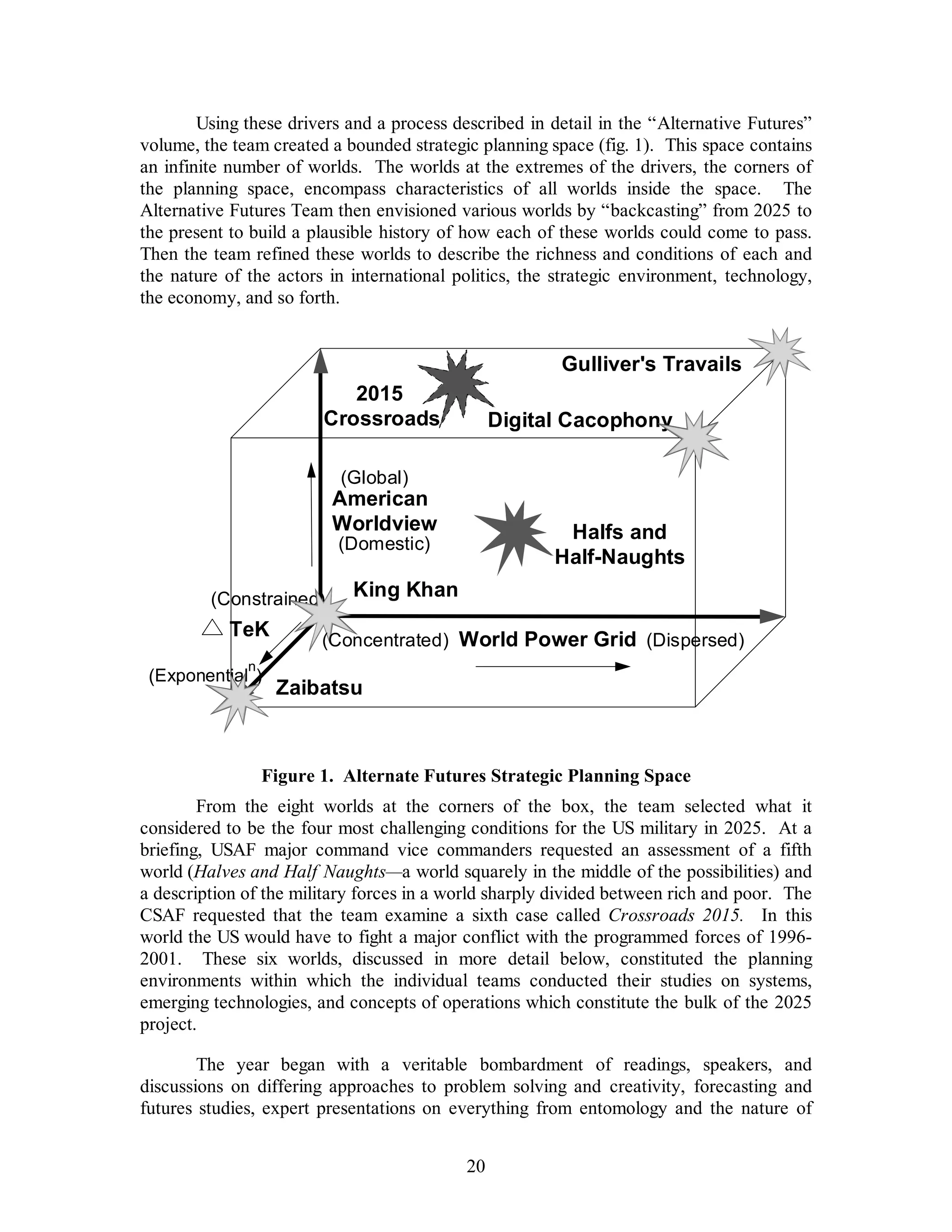
Using these drivers and a process described in detail in the “Alternative Futures” 
volume, the team created a bounded strategic planning space (fig. 1). This space contains 
an infinite number of worlds. The worlds at the extremes of the drivers, the corners of 
the planning space, encompass characteristics of all worlds inside the space. The 
Alternative Futures Team then envisioned various worlds by “backcasting” from 2025 to 
the present to build a plausible history of how each of these worlds could come to pass. 
Then the team refined these worlds to describe the richness and conditions of each and 
the nature of the actors in international politics, the strategic environment, technology, 
the economy, and so forth. 
20 
2015 
Crossroads 
(Global) 
American 
Worldview 
(Domestic) 
World Power Grid (Dispersed) 
(Constrained) 
TeK 
(Exponentialn) 
Gulliver's Travails 
Digital Cacophony 
King Khan 
Zaibatsu 
Halfs and 
Half-Naughts 
(Concentrated) 
Figure 1. Alternate Futures Strategic Planning Space 
From the eight worlds at the corners of the box, the team selected what it 
considered to be the four most challenging conditions for the US military in 2025. At a 
briefing, USAF major command vice commanders requested an assessment of a fifth 
world (Halves and Half Naughts—a world squarely in the middle of the possibilities) and 
a description of the military forces in a world sharply divided between rich and poor. The 
CSAF requested that the team examine a sixth case called Crossroads 2015. In this 
world the US would have to fight a major conflict with the programmed forces of 1996- 
2001. These six worlds, discussed in more detail below, constituted the planning 
environments within which the individual teams conducted their studies on systems, 
emerging technologies, and concepts of operations which constitute the bulk of the 2025 
project. 
The year began with a veritable bombardment of readings, speakers, and 
discussions on differing approaches to problem solving and creativity, forecasting and 
futures studies, expert presentations on everything from entomology and the nature of
insect swarms and hive behavior to explanations of the internet and future computer 
capabilities. Speakers ranged from distinguished scientists from national laboratories, 
major universities, and corporations around the country to science fiction writers, 
Hollywood screenwriters, and television and movie producers. Throughout the year there 
were group presentations on topics as diverse as information warfare and genetics, 
terrorism and space asset capabilities, and nanotechnology and microelectrical 
mechanical devices. Thinking “outside the box” was encouraged. 
Individual teams were organized halfway through the project to investigate 
specific topics. These teams debated population projections, economic growth rates, and 
the nature of international political systems. They read fiction and history, played 
environmental games, and conducted simulations and exercises on a number of topics. 
They studied American business practices, researched topics from asteroids to holograms 
to weather modification, carried on Internet dialogues with contributors from around the 
world, talked with others by video teleconference, and refined tiny bits of scenarios to 
make their visions more robust. They then tested and retested these visions, internally 
with other members of the project, and externally, through briefings to a board of advisors 
and a group of outside assessors, and then with a team of Air Force Institute of 
Technology (AFIT) scientists. The results of these deliberations are summarized below. 
This process of repeated internal and external validation with different groups helped to 
sharpen the methods and products throughout the study. 
The Alternative Futures 
The cornerstone to futures planning in 2025 is the use of the alternative futures 
methodology to construct an array of future worlds in which the US must be able to 
survive and prosper. Doing so was the first order of business. 
The team created eight separate worlds. The four most challenging, interesting, 
and difficult for the US served as guides. Two additional worlds—an intermediary world 
with selected characteristics of other worlds and a world that was a partial evolution to 
the future of 2025, Crossroads 2015—served as baselines for the 2025 analysis. The 
worlds that emerged follow. 
21 
Gulliver’s Travails 
This is a world of rampant nationalism, state and nonstate sponsored terrorism, 
and fluid coalitions. Territorialism, national sentiments, the proliferation of refugees, and 
authoritarian means flourish.
The US is overwhelmed and preoccupied with such worldwide commitments as 
counterterrorism and counterproliferation efforts, humanitarian assistance, and 
peacekeeping operations. The US is attempting to be the world’s policeman, fireman, 
physician, social worker, financier, and mailman. 
The US military, based in the continental United States, is not really welcomed 
overseas. This world forces the US military to devise systems and concepts of operation 
for meeting expanding requirements while maintaining a high operations tempo during a 
period of constrained budgets. The US world view is global, D  TeK is constrained— 
evolutionary, not revolutionary—and the global power grid is dispersed. 
22 
Zaibatsu 
In Zaibatsu, multinational corporations dominate international affairs and loosely 
cooperate in a syndicate to create a superficially benign world. Economic growth and 
profits are the dominant concerns. 
While conflict occurs, it is usually through proxies and is short lived. Military 
forces serve more as “security guards” for multinational interests and property rights 
Technology has grown exponentially and proliferated widely. Global power is 
concentrated in a few coalitions of multinational corporations. 
The main challenge to the US military in this world, which is becoming unstable 
due to rising income disparities, is to maintain relevance and competence in a relatively 
benign world where the United States is no longer dominant. The US world view is 
limited as domestic concerns take precedence. 
Digital Cacophony 
This is the most technologically advanced world resulting in increased individual 
power but decreasing order and authority in a world characterized by fear and anxiety. 
Advances in computing power and sophistication, global databases, biotechnology and 
artificial organs, and virtual reality entertainment all exist. 
Electronic referenda have created pseudo-democracies, but nations and political 
allegiances have given way to a scramble for wealth amid explosive economic growth. 
Rapid proliferation of high technology and weapons of mass destruction provide 
individual independence but social isolation. The US military must cope with a multitude 
of high technology threats, particularly in cyberspace. The US world view is global, 
technological change exponential, and the world power grid dispersed.
23 
King Khan 
This world contains a strategic surprise in the form of the creation of a Sino-colossus 
incorporating China, Taiwan, Malaysia, Singapore, and Hong Kong. US 
dominance in this world has waned as it has been surpassed economically by this entity 
and suffered an economic depression. This has led to a rapidly falling defense budget and 
hard choices about which core competencies to maintain in a period of severe austerity. 
The American Century has given way to the Asian Millennium and the power, 
prestige, and capability that were once American now reside on the other side of the 
Pacific Rim. The US world view is decidedly domestic as it copes with problems at home, 
the growth in technology is constrained and world power is concentrated in a Chinese 
monolith whose economy, military, and political influence dwarf those of the US. The US 
has come to resemble the United Kingdom after World War II—a superpower has-been. 
Halves and Half Naughts 
This is a world in which there are both changing social structures and changing 
security conditions. The main challenge to the military is to prepare for a multitude of 
threats in a world dominated by conflict between haves and have nots. The world has 
split into two unequal camps: a small, wealthy, technologically advanced, politically 
stable minority of the states and peoples of the world (roughly 15 %) and the poor, 
backward, sick, angry, unstable vast majority of the world’s states and people who have 
little, and therefore have little to lose, in seeking redress of their grievances. 
The US world view is global but only because of the threats to its security 
represented by these masses. Technology and power are bifurcated exhibiting trends in 
both directions in the divided world. 
Crossroads 2015 
In Kurdish areas of Eurasia, the US uses programmed forces from 1996-2001 to 
fight a major conflict. The choices and outcomes made at this juncture have much to do 
with determining which of the worlds of 2025 will emerge a decade later. The American 
World View is global, D  TeK is constrained, and the World Power Grid is seen as 
concentrated but beginning to become dispersed. Potential future conflicts center on 
events involving disputes between the Ukraine and a resurgent Russia and the reaction of 
the rest of the world to such a conflict. 
The US in 2015 still has global commitments and concerns, but a constrained rate 
of economic and technological growth. Whether the US chooses a more isolationist path
because of these pressures or chooses a more activist role with the sacrifices that would 
require is the major question to answer in shaping the world of 2025. 
The Operations Analysis and the Value Focused Thinking Model 
After the study group constructed the alternative futures and explored the various 
technologies and systems which could emerge in the next 30 years, the Operations 
Analysis team conducted an assessment of the technologies and systems which the study 
teams developed. Various white papers identified 25 emerging technologies and 
developed 43 separate platforms and weapons systems. The analysis team arranged each 
of the missions and tasks needed to reach the objective of achieving dominance in Air and 
Space into the general categories of awareness, reach, and power. The team refined these 
categories in operational terms and subdivided them by the nature of the task. Each 
system was judged for its contribution to the awareness tasks of detect, understand, and 
direct; the reach tasks of deploy, maintain, and replenish; and power tasks to engage and 
survive. These tasks were then subdivided into subtasks of two or more additional levels 
to refine the definitional criteria. Ultimately, the concepts of awareness, reach, and 
power analyzed in the model merged in the team’s thinking into what they enable— 
Vigilant Edge. 
The team then employed value-focused thinking as the enabling methodology to 
score the various technologies and systems. These scores were based on the decision 
maker’s values, were futuristic and forward looking, and were collectively exhaustive, 
and mutually exclusive. The capabilities were assessed and scored using force quality 
measures of merit for both the critical technologies and the systems, subjected to a 
sensitivity analysis weighted for the futures, and finally ranked according to their relative 
utility. Each of the technologies and systems was then plotted against all others for each 
of the alternative futures envisioned in the study. The resulting comparison across all 
technologies, systems and worlds yields those technologies and systems which have the 
highest utility regardless of the specific future which emerges. 
This methodology and its results and their comparison are explained in detail in a 
separate volume of the final report. There are, however, several significant aspects 
worthy of emphasis here. First, this model was built from the bottom up and is the 
farthest reaching value model yet attempted. Its 30-year time frame is far longer than 
most applications. The results are robust. When tested for internal consistency across the 
different alternative futures and for different weightings of individual technologies and 
systems, the results are confirmed. There is little change across alternative futures and 
little change for radically different weight sets. This suggests that the general conclusions 
regarding awareness, reach, and power are very strong. 
There are several conclusions to be drawn from this analysis. First, according to 
the operations analysis done on the concepts of operations, technologies, and systems 
24
developed as a part of 2025, the investments made in awareness versus reach and power 
are roughly two to three times as important as investments in the other areas. Second, 
there is a major increase in utility of space-oriented systems as opposed to atmospheric 
ones. A decade or more into the next century, the utility of most current and 
programmed air assets is sufficient for the small threats the US is likely to encounter. 
Without a large competitor, who will probably emphasize space assets and information 
warfare capabilities, the US does not need to do more than the upgrades and systems 
already planned. The real payoff is the integration of information systems and space 
systems. This may be one of those few instances in which the US gets to “leap frog” a 
technological capability and focus on Mark III space and information systems instead of 
Mark II. Space systems are clearly the power investments to be made, and the reach 
capabilities are the least worry in the long run, despite the critical shortage of airlift in the 
day-to-day operation of a global military deployment. 
25 
Highest Leverage Systems 
Of the 43 systems extracted from the white papers, 10 emerged with the highest 
value for their contribution to achieving air and space dominance in 2025. Interestingly, 
the systems rated the highest value by the study participants were often the most 
technically challenging. Others will want to validate the study’s results with their own 
weights for the operational analysis. The model is designed for such testing, and we are 
confident that our results are sufficiently robust that our top systems will also be highly 
ranked by others. In addition, others will want to examine the systems concepts and 
enabling technologies in some detail. The separate volume on the analysis contains the 
data for such a review. What follows is a brief description of the highest leverage 
systems identified in 2025. 
Global Information Management System. The Global Information Management 
System (GIMS) is a pervasive network of intelligent information gathering, processing, 
analysis, and advisory nodes. It collects, stores, analyzes, fuses, and manages information 
from ground, air, and space sensors and all-source intelligence. This system has all types 
of sensors (i.e., acoustic, optical, radio frequency, olfactory, etc.). However, the true 
power of this system is in its use of neural processing to provide the right type of 
information based on the user's personal requirements. GIMS provides complete 
situational and battle space awareness tailored to each user's needs and interest. The 
system also provides human interfaces through personal digital assistants, a holographic 
war room, and other systems. 
Sanctuary Base. The sanctuary base provides a secure, low-observable, all-weather 
forward operating base that reduces the number of assets requiring protection 
from attack. The runway, power systems, ordnance storage, aircraft maintenance assets, 
and command, control, communications, computer, and intelligence systems are self-maintaining 
and self-repairing. Base security is highly automated. Chemical/biological
hazards are cleaned up by nanobots and biotechnology. Robots perform refueling, 
weapons loading, maintenance, security, and explosive ordnance destruction. 
Global Surveillance, Reconnaissance, and Targeting System. The Global 
Surveillance, Reconnaissance, and Targeting System (GSRT) is a space-based, 
omnisensorial collection, processing, and dissemination system to provide a real-time 
information database. This database is used to create a virtual reality image of the area of 
interest. This virtual reality image can be used at all levels of command to provide 
situational awareness, technical and intelligence information, and two-way command and 
control. 
Global Area Strike System. The Global Area Strike System (GLASS) consists of 
a high energy laser (HEL) system, a kinetic energy weapon (KEW) system, and a 
transatmospheric vehicle (TAV). The HEL system consists of ground-based lasers and 
space-based mirrors which direct energy to the intended target. The KEW system 
consists of terminally guided projectiles with and without explosive enhancers. The TAV 
is a flexible platform capable of supporting maintenance and replenishment of the HEL 
and KEW space assets, and could also be used for rapid deployment of special operations 
forces. Target definition and sequencing is managed externally using GIMS. 
Uninhabited Combat Air Vehicle. The uninhabited combat air vehicle (UCAV) 
can be employed either as an independent system or in conjunction with other airborne, 
ground-based, and space-based systems. It carries a suite of multispectral sensors 
(optical, infrared, radar, laser, etc.) which supplies information to its suite of standoff 
precision-guided munitions. It loiters at high altitude over the region of interest for long 
periods of time (24+ hours) until called upon to strike a target. While in its subsonic loiter 
mode, it can perform a surveillance and reconnaissance mission for the Global 
Information Management System. It could be used as part of a bistatic configuration in 
which it illuminates a region of interest while a different sensor receives and processes the 
information. As a secondary mission, it can perform electronic countermeasure and 
counter-countermeasure roles. 
Space-Based High Energy Laser System. The space-based high energy laser 
(HEL) system is a space-based, multimegawatt, high-energy chemical laser constellation 
that can operate in several modes. In its weapons mode with the laser at high power, it 
can attack ground, air, and space targets. In its surveillance mode, it can operate using 
the laser at low power for active illumination imaging or with the laser inoperative for 
passive imaging. Worldwide coverage could be provided by a constellation of 15-20 
HELs. The system provides optical surveillance by active or passive imaging and has 
counterspace, counterair, force application, and weather modification uses. 
Solar-Powered High Energy Laser System. The solar-powered high energy 
laser system is a space-based, multimegawatt, high-energy solar-powered laser 
constellation that can operate in several modes. In its weapons mode with the laser at 
high power, it can attack ground, air, and space targets. In its surveillance mode, it can 
operate using the laser at low power levels for active illumination imaging, or with the 
laser inoperative for passive imaging. 
26
Uninhabited Reconnaissance Aerial Vehicle. The uninhabited reconnaissance 
aerial vehicle (URAV) can be employed either as an independent system or in 
conjunction with other airborne, ground-based, and spaceborne systems. The URAV is 
fitted with a variety of multispectral sensors, such as infrared, optical, radar, and laser, 
and collects images, signals, electronic emissions, and other information. It loiters 
subsonically at very high altitudes over the region of interest for extended periods of time 
without refueling. The URAV could also be used as part of a bistatic configuration in 
which it illuminates the region of interest while different sensors receive and process the 
information. 
Attack Microbots. Attack microbots describes a class of highly miniaturized 
(one millimeter scale) electromechanical systems capable of being deployed en masse and 
performing individual or collective target attack. Various deployment approaches are 
possible, including dispersal as an aerosol, transportation by a larger platform, and full 
flying and crawling autonomy. Attack is accomplished by a variety of robotic effectors, 
electromagnetic measures, or energetic materials. Some sensor microbot capabilities are 
required for target acquisition and analysis. Microbots could provide unobtrusive, 
pervasive intervention into adversary environments and systems. The extremely small 
size provides high penetration capabilities and natural stealth. 
Piloted Single-Stage-to-Orbit Transatmospheric Vehicle. This system 
provides space support and global reach from the earth's surface to low earth orbit (LEO) 
using a combination of rocket and hypersonic air breathing technology. The 
transatmospheric vehicle envisioned takes off vertically, is refuelable in either air or 
space, and can land on a conventional runway. It has a variable payload capacity (up to 
10,000 lb) and performs as both a sensor and weapons platform. Alternate missions 
include satellite deployment and retrieval from LEO and deployment of anti-ASAT 
weapons. 
27 
Observations 
Most of these papers focus on US offensive capabilities and US ability to improve 
awareness, reach, and power. The papers are not, in many cases, as concerned about the 
architecture and array of systems for a defensive capability for the US. While 
countermeasures are considered, there is more thought and effort expended on offensive 
and deterrent capabilities. Second, there is far less thought devoted to existing 
capabilities—cruise missiles, intercontinental ballistic missiles, current satellite systems, 
and existing or programmed air assets—than to the emerging technologies and systems of 
2025. The reasons for this are simple. 2025’s charge was to look into the middle range 
future—6 program objective memorandum (POM) cycles out, to be exact—and not to 
focus on existing capabilities. In the team’s analyses of the relative merits of emerging 
systems and technologies, we chose not to compare existing systems with hypothetical 
ones, or, to be somewhat more blunt, real airplanes with paper ones. It is not that this is 
an unimportant consideration. We thought it best left to others to construct a different
analytical framework with a different purpose than the one we pursued. The focus of 
New World Vistas was more near term and technologically feasible. 2025 is avowedly 
more visionary. 
However, lest the United States be too smug about our technological superiority, 
we should consider the relative ease with which rather unsophisticated countermeasures 
could be brought to bear on our capabilities. Nations without a strong access to space— 
North Korea or Iraq—could still significantly hinder the US space capabilities at low cost 
and with little effort. 
The choices we make amid constrained resources but burgeoning threats are 
critical. The use of alternative futures and operational analysis has provided us with a 
hierarchy of concerns and some insight into the best investments and trade-offs that can 
be made to deal with the likely environment of 2025. They help us discern the key 
threats, technologies, and systems that should prove most beneficial to the US in the year 
2025. This study does not provide all answers, but rather is one set of answers to the 
questions of what will the world of 2025 be and how can we best provide for the security 
of the US in that world. The value of our response is high, but it is neither absolute nor 
comprehensive. There are other questions to be asked and other considerations to be 
analyzed. But given our charge and our methods, we are confident that the guidance 
suggested here is a valuable assessment and suggests appropriate courses of action for 
2025. This has been the beginning of the planning process, not its culmination. It is up to 
others to review what is presented here and decide how best to proceed. 
28
Chapter 7 
White Paper Summaries: Awareness 
Nam et ipsa scientia potestas est. (Knowledge is power.) 
29 
—Francis Bacon 
There is no substitute for knowing about the environment, one’s adversary, and 
oneself. Alternative courses of action which are informed decisions rather than poor 
choices based on chance flow from knowledge. Without knowing what is going on, one is 
deaf, dumb, and blind—without reference point or compass. With knowledge, informed 
decisions are possible. The odds of accomplishing one’s purpose increase dramatically. 
The knowledge of others—their intentions, capabilities, and actions—is valuable in itself. 
It can add to our capacity for defense or our ability to compel an adversary to do our will 
when necessary. It can enable our capacity to deny, degrade, delay, or destroy an 
adversary’s assets, military capability, or will to resist. More importantly, their 
knowledge that we know is even more useful. It can increase deterrence—our ability to 
prevent another from doing something. Those technologies that increase our awareness— 
our ability to know, to “see the other side of the hill,” to have the basic information on 
which to make reasoned choices—are not only invaluable, they are a prerequisite to the 
efficient and effective deployment or employment of military force. Knowledge is the 
biggest force multiplier. 
Investment in emerging technologies, systems, and concepts of operations which 
increase our awareness—our knowledge—yield the greatest returns. Increasingly, space-based 
sensors; the computer architecture needed to collect, process, and distribute 
massive amounts of data; and the timely dissemination of such information will be critical 
to the successful deployment and employment of military force in the twenty-first 
century. The studies summarized below constitute efforts to enhance our awareness in a 
variety of ways. In that knowledge is power; they represent the cornerstone for how the 
USAF should provide for US security in 2025. They are critical to the ability for the US 
to adapt to a complex, constantly changing, and uncertain strategic environment. 
Air and space forces are particularly well suited to enhancing awareness. They 
can operate at great distance from the continental US and provide the most rapid manner
to “see” what is going on by a variety of means. They are the most timely assets to make 
continual assessments of an unfolding reality which may be hostile and closed to surface-based 
assets. Whether it is a manned aircraft, a UAV, or satellite in LEO or 
geosynchronous orbit, the USAF has a variety of platforms and capabilities to provide 
awareness for US decision makers. That capacity will improve greatly as we move 
towards 2025. 
All the papers follow the same general format, though they differ greatly in 
subject matter, length, supporting evidence, and conclusions. After a brief introduction, 
each has a section on required capabilities, a section on the system description and 
emerging technologies, another on the concept of operations, a section on 
countermeasures considerations, and a concluding section on the investigating team’s 
recommendations. Lastly, any supporting data—a glossary, graphics, maps, calculations, 
and so forth—are provided in support of the team paper. 
Awareness/Information Concepts and Systems 
Information Operations: Wisdom Warfare for 2025 
The thesis of this paper is that a robust information operations architecture system 
can provide leaders dominant battle space knowledge and tools for improved decision 
making. Ideally such a system needs to be timely, reliable, relevant, and tailored to the 
user’s needs. Further, the system needs to be secure, redundant, survivable, 
transportable, adaptable, deception resistant, capable of fusing vast amounts of data, and 
capable of forecasting as well. Having such a system would require the networking of 
thousands of widely distributed nodes performing a full range of collection, data fusion, 
analysis, and command functions. Combining this with the ability to organize, analyze, 
and display the information and use modeling, simulation, and forecasting tools to help 
the commander better utilize it will create “wisdom warfare.” 
This system will be either “push” or “pull” in nature—command driven or 
demand driven—and can be tapped at various levels by a variety of users for the 
performance and enhancement of a number of tasks. It could only be developed by 
leveraging commercial technologies and applications. This investment in new systems 
will require doctrinal and organizational transformation and a better understanding of 
human decision-making processes as well as artificial intelligence, software development, 
and processor speeds and capacities. The integration of humans and computing systems 
and better display technology are also required. This paper presents the architecture for 
such a system in order to collect and use information better and faster than any adversary. 
That will be the test of winning in the twenty-first century. An appendix showing how 
30
such a system works in a hypothetical encounter in the future illustrates the advantages it 
could confer. 
31 
World Wide Information Control System 
The World Wide Information Control System (WICS) is a system to supersede 
C4I. It seeks to gather, process, and present in-time information to military users. A 
secondary set of objectives is to provide uninterrupted, secure, global communications for 
military forces. It seeks to do so through an integrated system of low earth orbit data 
harvesters and geosynchronous earth orbit (GEO) distributed processing using 
multispectral sensing and direct laser links to both GEO and LEO satellites for critical 
data transfers. The second way in which it operates is through BATTLE-NET, a 
streamlined, computer based, networked information database similar to the Internet but 
dedicated for military purposes. The key to the system is the connectivity and the 
accessibility of information in a timely manner. Access is gained through a personal 
interface card (PIC) for users across a layered access—tactical, operational and strategic. 
Development of WICS depends on the enhancement of the enabling technologies 
required—data collection, data processing, presentation, communications, and 
information control. These technologies will be pursued for the most part by commercial 
as well as military users. Hence, the costs, though great, do not have to be borne solely 
by the military. A number of technologies applicable to a WICS are either under way in 
research and development or likely to emerge within the next 30 years. Among these are 
high bandwidth laser communications, data compression systems, information protection, 
signal processing for distributed satellite communications, and improved networking 
technologies. WICS represents the ultimate in centralized control and decentralized 
execution for the military user. 
2025 In-Time Information Integration System, (I3S) 
This paper describes the system needed to integrate all sources of data in order to 
achieve “top sight vision.” This begins with the data collected from an array of 
sophisticated sensors linked in a global information net. This net, an in-time information 
integration system (I3S), incorporates artificial intelligence, neural nets, and fuzzy logic to 
produce an advanced computer systems architecture for data collection, transmission, and 
analysis. To do so will require terabyte capability and microprocessor “brains” working 
in an optical medium. These would be embedded throughout a three-dimensional 
distributed architecture to enhance timeliness, safeguard data, and provide back-up 
communications paths. The microprocessor brains would discriminate based on the type 
of information and data flows required by different users in different times.
This system would require a global grid of multiple intelligent plug-in nodes. It 
would have connectivity to a variety of input sensors and data users, be they land-, sea-, 
air-, or space-based. A critical element would be an enhanced visual display of an 
unfolding event, a particular place, or a segment of time one wished to view. This system 
would depend on emerging computer technologies and concepts such as quantum 
computer technology, holographic association, and nonlinear processing, optical 
computers, and even deoxyribonucleic acid computers. Such a system would have 
commercial as well as military applications. Cost sharing is critical to the development 
and deployment of such a system. Possessing such a system would enhance the ability of 
the US to claim the high ground in the struggle for information dominance and secure its 
superpower status well into the twenty-first century. 
Organizing for Awareness 
The Command or Control Dilemma: When Technology and Organizational 
Orientation Collide 
In an information age military, the proper organizational orientation may not be 
one of command and control, but rather, command or control. Traditionally, the military 
response to increasing technological competencies has been greater centralization. 
Unfortunately, greater centralized control is the exact opposite of what is required to 
maximize the full benefits of the burgeoning advances in information technology. As the 
tempo of operations increases, so does the amount of information processed and the 
demand for faster decision making amid greater and greater data flows. We have had an 
information revolution. We can collect far more information in a faster cycle than ever 
before. Unfortunately, what we need is a decision-making revolution—a means by which 
we can make use of the information collected, a way to sort it, assess it, and act upon it in 
a timely and effective manner. 
The solution lies in organizational change and a change of culture to maximize the 
value of the information flows and produce an improved decision-making capability. The 
information age military needs the shared information gathering advantages of a 
networked organization with the decentralized decision-making advantages of a flattened 
hierarchical organization. Failure to adapt to a new organizational orientation of 
decentralized control may result in a US military unable to profit from and take advantage 
of the increased tempo of future warfare. The paper reviews the problems with various 
organizational models and service orientations and proposes a new Air Force orientation 
for more effective decision making in the twenty-first century world of vastly increased 
information flows. 
32
Joint Readiness Assessment and Planning Integrated Decision System: Combat 
Readiness and Joint Force Management for 2025 
This system seeks to provide the commanders of 2025 with a more 
comprehensive understanding of total force readiness and potential trade-off benefits 
available in making different decisions. The ability to create a new system for readiness 
and sustainment measurement increases the commander’s awareness of his own forces 
and assets rather than those of the enemy or the strategic environment in general. Having 
an integrated system for measuring, adjusting, and forecasting readiness and training will 
help provide the USAF with a comparative advantage over its adversaries. This system is 
called Joint Readiness Assessment And Planning Integrated Decision System (JRAPIDS). 
JRAPIDS is a computerized data system to measure both operational and 
structural readiness in terms of responsiveness, training, and sustainability. It is an overall 
architecture for real-time assessment. It will automatically update the readiness status of 
individuals, units, and forces (active, guard, and reserve) while providing decision makers 
a comprehensive measure of readiness and sustainment that focuses on outputs. The final 
product consists of a time-variable, mission-scaleable matrix depicting capability 
available over time in a given theater of operations for a specific task or mission. This 
provides decision makers with an overall force management capability. Such a complex 
data collection, processing, and management system is possible if we desire it through the 
merging technologies of artificial intelligence and increased computing and 
communications capabilities. 
Virtual Integrated Planning and Execution Resource System: The High Ground of 
2025 
This paper is another approach to increasing awareness of one’s own systems and 
capabilities rather than that of the adversary. It describes combat support in terms of 
people, processes, and products and posits a preferred name for this: force support. It 
depends on three key competencies: information supremacy, reflexive sustainment, and 
precision employment. The proposed system is the Virtual Integrated Planning And 
Execution Resource System (VIPERS). It is designed to give commanders information 
supremacy so they may dominate the battle space by allowing collaborative planning 
between combat and support forces. 
VIPERS provides commanders a real-time “bird’s eye” view of the battle space 
during execution. This perspective results in visibility of all logistics from factory to 
foxhole and improved combat identification. This information is displayed using a three-dimensional 
holographic projection system with natural human-machine interface. In 
addition to these, VIPERS depends on microelectrical mechanical systems, artificial 
intelligence, and image understanding software; all of which are in their infancy but show 
promising development in the next decade or so. A sense of how such a system will work 
is given in a scenario entitled Operation Zion. Successful deployment of such a system 
33
depends on better private sector-military interface, and dual-use research and 
development. 
The Man in the Chair: Cornerstone of Global Battlespace Dominance 
The system proposed in the Man in the Chair (MITCH) is an effort to 
operationalize a concept that would provide the US with an unrivaled capability for 
comprehending the battle space of 2025 by giving the right decision maker the right 
information at the right time. It is evolutionary in capitalizing on emerging satellite 
technologies to fully exploit the high ground of space for surveillance and reconnaissance 
to achieve continuous global awareness. It is revolutionary in its method of data 
collection and fusion from space collectors to a terrestrial brain. The brain provides what 
decision makers really need—not mere data, but specific information, and if possible, 
knowledge. In effect the system operates as a human does—subconsciously aware of the 
general environment, focused on stimuli of importance, and continuously making sense of 
it all. The summative notion of this is the “man in the chair”—MITCH. MITCH is a 
powerful mix of small satellites, high capacity communications, processing, storage, and 
artificial intelligence technologies. 
The individual technologies themselves will not create MITCH. The concept of 
operations is as important as the technologies which enable it. How decision makers 
interact with the system is critical. Vignettes illustrate this reality and demonstrate 
MITCH’s utility in both combat and peace operations. Three critical elements exist in the 
development of MITCH. Commercial initiatives and government developments must be 
integrated in certain areas. Users and decision makers must come to trust MITCH as an 
integral part of the decision process. Lastly, an acquisition strategy must be pursued that 
embraces these ideas. 
Education and Training for Awareness 
34 
Brilliant Warrior 
Brilliant Warrior describes the objectives and the processes by which a future 
professional military education (PME) system prepares leaders to succeed in any 
alternative future. Today's PME system is episodic, requires travel to a central location, 
uses archaic tools and methods, and withdraws personnel from the field for up to 10 
months at a time. Training has taken advantage of dramatic improvements in information 
technology. Education has not. The Brilliant Warrior approach aims to describe the
characteristics that future military leaders will require, the nature of potential future 
conflicts, and the need to experience and operate in alternative future operating 
environments to describe a curriculum that is both delivered continuously on the net and 
periodically at technology-intensive locations. The paper concludes with questions from 
which specific recommendations can be framed. 
Brilliant Force and the Expert Architecture that Supports It 
This paper demonstrates that a new military education and training architecture, 
supported by investments in key technology components, will produce a Brilliant Force 
capable of meeting the challenges of 2025. Engagement in nontraditional missions will 
increase and operations will be joint as well as combined. The demand for highly skilled 
people will intensify and the pace of technological change will increase. Thus we will 
need to produce brilliant warriors. To do so we need an agile and adaptive education and 
training system to meet the demands of a constantly changing, complex, external 
environment. 
The paradigm developed is one that seeks to provide efficient and effective 
training and education which is individualized, on demand, and just-in-time; that 
education and training should be available to anyone, anytime, anywhere. It will be 
provided via a national knowledge superhighway, academic centers of excellence for 
curriculum development, and expert tutors and personal artificial intelligence agents. 
Doing so will require the use of artificial intelligence technology, virtual reality (and 
improvements to simulation), and improvements in computing and communications 
technologies. In addition, advances in hyper-learning will create air and space power 
experts in shorter time and at lower costs than is currently possible. Enhanced selection 
and screening tools will further reduce costs by educating and training the right people for 
the right job. 
Brilliant Warrior: Information Technology Integration in Education and Training 
In 2025, massive amounts of information will be available through advanced 
networks. The challenge will be how to deal with nearly unlimited volumes of 
information, the means to disseminate it, and the growing need to discern what 
information has value for the military professional. The purpose of this paper is to look at 
how the air and space force of 2025 will use information technology to educate and train 
its members. The paper describes an adaptive learning environment in which emerging 
technologies completely reform the educational process and the nature of training. 
Through the application of nanotechnologies and microelectrical mechanical computer 
processing advances, a three-tier system of education and training is created consisting of 
the delivery system, the development system, and the tracking system. 
35
Combining the fruits of technology into personal information devices (PID) which 
allow access to the global information infrastructure provides a radically different basis 
for the learning process and redefines the learning environment. Microprocessors, virtual 
reality, communications networks, and other technologies will mean that education and 
training can be tailored to time, task, and individual as required. It is superior to the 
grossly inefficient manner in which we do large scale, group education and training at the 
moment—on a rigid time schedule, in a fixed format, at a single place. There are, 
however, three cautionary truths. The medium isn’t the message, this will not happen 
quickly, and it will not save money soon. But if the military is to take advantage of a 
revolution in military affairs (RMA), it must first prepare for a revolution in military 
education (RME). This paper presents the basic outlines of and paradigm shifts required 
for that revolution and why it is required for the USAF of 2025. 
36
Chapter 8 
White Paper Summaries: Reach and Presence 
Aptitude for war is aptitude for movement. 
37 
—Napoleon 
Knowing what is transpiring in the world is one thing. Doing something about it is 
quite another. In many cases, being able to arrive at a particular place at a particular time 
with particular capabilities is a part of the policy solution. Doing so from a distance in a 
timely fashion is part of what the USAF is all about. Furthermore, the ability to deploy 
and sustain a presence of various kinds—aerial reconnaissance, humanitarian relief 
workers, peacekeepers, combat forces, space-based surveillance—all are capabilities of 
the USAF. These sorts of capabilities are critical to making use of the knowledge, 
updating it, and maintaining the flow of it from a variety of on-site assets. And, arriving 
and remaining on-site for an indefinite time under hostile conditions is part of the mission 
of global reach—of establishing presence. This presence can be either virtual or actual in 
2025. 
Global reach—presence—is the USAF’s ability to utilize its responsiveness to 
deploy nearly anywhere in the world, on relatively short notice, in a matter of hours 
rather than the days or weeks which may be required by surface forces. Doing so 
routinely, on a daily basis, is a part of the USAF mission now. That capability will be 
strenuously tested in the twenty-first century and will demand more creative 
technological solutions in order to continue in the world of 2025.
Logistics 
38 
Logistics in 2025: Consider It Done! 
This paper envisions a system of systems approach to ensuring total asset visibility 
from cradle-to-grave for all major systems and components. To do so, this logistics 
system relies on improved communications, artificial intelligence, and virtual reality along 
with enhanced maintenance and transportation. The battle space responsive agile 
integrated network (BRAIN), an automated logistics management system; is an all-encompassing 
logistics system. A host of high-technology subsystems are integrated into 
a concept of operations which merges new acquisition techniques with materials 
management concepts including just-in-time logistics, and virtual materials management 
with transportation and maintenance including lean logistics, robotics, neural networks, 
smart parts, and virtual reality. A scenario illustrates the concept of operation. 
The integration of the technologies necessary to implement this logistics system, 
the investments required to achieve it, and the skills mix necessary to operate it will all 
require major transformations in the way the military does its business. But, all these 
aspects are already visible in commercial sector practices and research and development 
for future capabilities. The degree of transformation is considerable, but the advantages 
are clear. As items in the inventory become more complex, costly, and valuable, the care 
and maintenance of them become more important and are the key to efficient and 
effective operations. The costs, while significant, pale in comparison when we consider 
the question, “can we afford not to?” 
Dynamic Response Logistics: Changing Environments Technologies, and Processes 
Logistics management is the integrated management of the functions required to 
acquire, store, transport, and maintain the materiel necessary to support combat forces. 
After assessing new environments, technologies, and processes likely to develop between 
now and 2025, this paper explores ways of designing and implementing an integrated, 
flexible, and seamless logistics system from vendor to battlefield. It foresees what it calls 
dynamic response logistics as a way of governing logistics decisions in support of 
operational strategy. Doing so efficiently and effectively means that these tasks should 
be accomplished in a timely manner while consuming the least amount of resources. 
Operationalizing these notions calls for the use of a number of novel systems and 
technologies including the use of self-repairing and self-reporting parts as ways to reduce 
the logistics “footprint” and “tail.” Concepts such as a multiuse packaging with different 
catalysts (to produce a food or a fuel product for instance) and a battlefield delivery 
system (BDS) to reduce the number of shipments into a theater of operations are among
the more promising notions explored. Some of the more novel components of a dynamic 
response logistics capability include a container aircraft which not only delivers supplies 
but becomes part of an agile base construct by providing a command and control center 
and electrical power to a base. The mobile asset repair station will support the 
remanufacture and repair of avionics and components in the theater of operations using a 
mobile facility with fully integrated flexible manufacturing systems and robotics linked to 
commercial manufacturers. 
2025 Aerospace Replenishment: The Insidious Force Multiplier 
Replenishment is an oft overlooked aspect of future studies and force planning. It 
is an important aspect of power projection, however, and a critical capability for US air 
and space forces. The capability required is to provide air and space vehicles with on-demand 
replenishment. Those demands have to be anticipated and projected with 
sufficient operational responsiveness and flexibility to meet those needs. This paper 
identifies current vehicles, uninhabited aerial vehicles (UAV), transatmospheric vehicles, 
and satellites as potential customers in need of replenishment. Replenishment supplies 
include energy as well as numerous solids, liquids, and gases. 
The replenishment needs are vast. One platform cannot do all of the tasks well. 
Therefore, the team identified three types of platforms to meet specialized needs for 
customers operating in different environments. A mothership will be used to meet the 
needs of UAVs. A multirole automated replenishing system will meet replenishment of 
current air vehicles and the TAV. A space support system along with space tugs is 
envisioned for supporting satellites and other vehicles in space. This paper proposes what 
may seem incredible yet thoroughly plausible concepts of operations, novel ways, and 
new vehicles for accomplishing the replenishment mission across a variety of platforms 
and circumstances. 
Lift 
39 
Airlift 2025: The First With the Most 
Power projection is critically dependent on mobility forces. The air mobility 
system should be capable of supporting national objectives from humanitarian, nonhostile 
operations through armed conflict. Because of operational constraints that include 
evolving threats and reduced external infrastructure, the airlift system in the year 2025 
should be independent of theater basing structure. This assumption addresses a worst 
case scenario and drives the requirement for direct delivery from CONUS to the war
fighter. The continued decline of overseas basing necessitates long unrefueled ranges, 
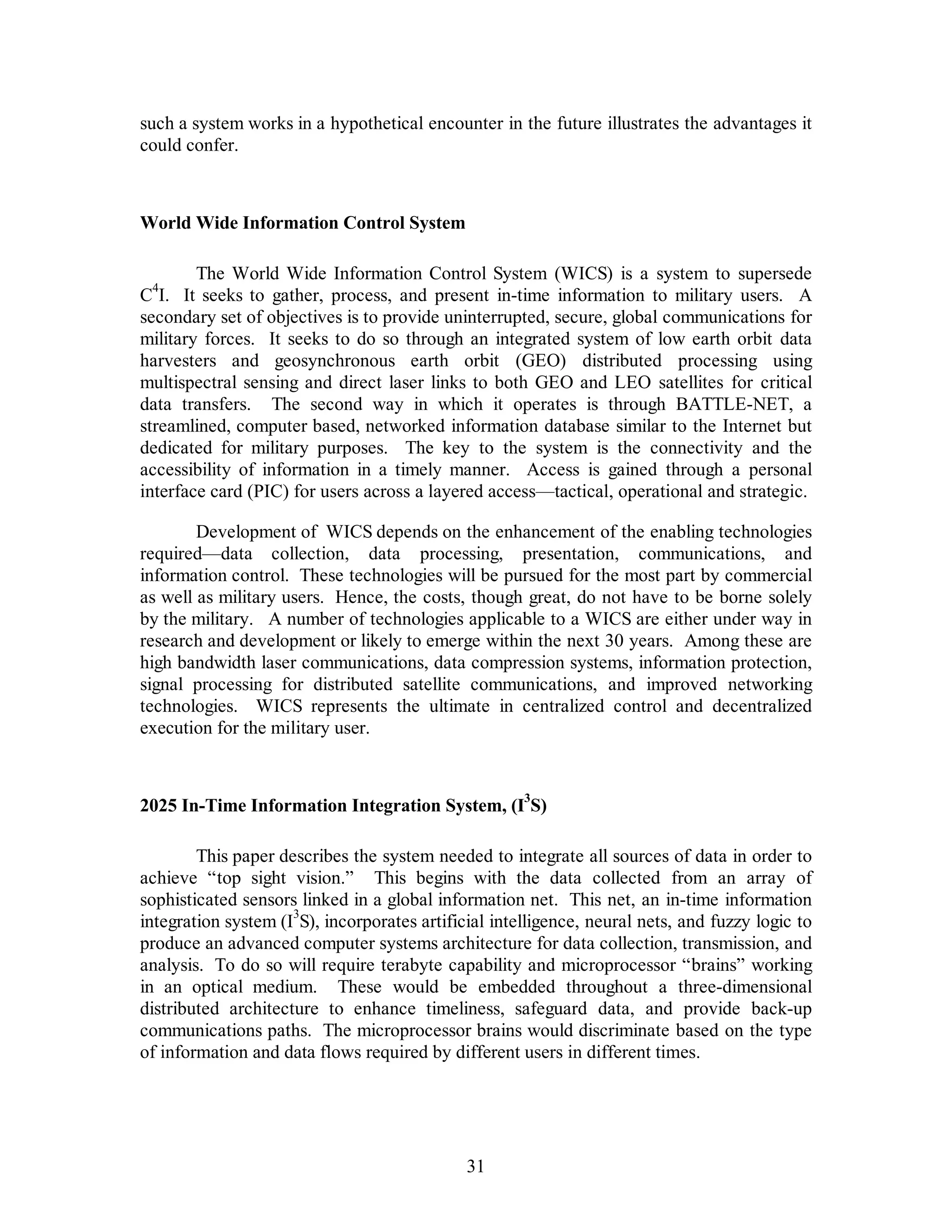
limited materiel on ground, and the decreased utility of civil reserve air fleet (CRAF) 
assets. 
Several possible systems are evaluated as being available in 2025. A combination 
of large airships and powered and unpowered UAV delivery platforms appear to provide 
the greatest utility. Among the large airships-airframes considered are a large cargo 
airship, a conceptual wingship, and a very large aircraft. Other components include a 
National Aerospace Laboratory jump jet and a parafoil delivery system. These would be 
combined in a variety of ways to create an integrated airlift system for 2025. This 
system, operating in conjunction with existing airframes, will require a greatly improved 
C4I system. In-transit visibility will provide the user-warfighter invaluable insight and 
enhance his operational capability. The goal is to supply personnel and equipment as 
needed within 10 meters of the target. System costs will be high and adversely effect the 
development of any new system or major component without research, development, and 
production in the civil sector to support it. 
Spacelift 2025: The Supporting Pillar for Space Superiority 
Spacelift in 2025 is characterized by routine operations of a reusable spacelift 
system operated by both commercial industry and the US spacelift wing. A new 
platform—the multipurpose transatmospheric vehicle (MTV) is the major platform 
capable of missions like intelligence, surveillance, reconnaissance, global mobility, and 
strike. It can be flown in either the manned or unmanned mode and is capable of 
performing earth to orbit (ETO) or earth to earth (ETE) missions. It is complemented by 
an orbital transfer vehicle (OTV) for space critical missions. MTVs park satellites in LEO 
and OTVs push them into higher orbits as required. OTVs also facilitate the maintenance 
of satellites by retrieving existing platforms for repair, refueling, or rearming. Finally, 
OTVs give the spacelift system a rapid orbital sortie capability for deterrence, space 
control, reconnaissance, counterspace, and force application. 
Once routine operations are institutionalized with these first generation reusable 
systems, propulsion and materials technology should be expanded to provide an even 
more capable system. This paper recommends strongly the research and development 
(RD) funding to pursue such “generation after next” technologies. Continuing efforts in 
RD are critical to the continued success in space. Strengthening all air and space 
capabilities can be the result of an aggressive strategy in this regard. This paper sets out a 
road map for the pursuit of second and third generation systems for space lift. Only in this 
manner can the US move into an operational mode. Critical to success in this regard are 
such technologies as high specific impulse, modular mission packaging, and the continual 
pursuit of more efficient propulsion technologies. 
40
41 
SPACENET: On-Orbit Support in 2025 
In 2025, on-orbit support will be vital to employing space assets as an instrument 
of national power. Four areas of on-orbit support need to be developed over the next 
three decades to ensure that the US maintains space dominance. First, supporting forces 
in the field will be the primary mission of the military space program. Theater 
commanders require reliable, timely support from space to maximize their war-fighting 
potential. This includes communications, navigation, weather, missile launch warning, 
interdiction, and data transfer. Second, satellite command, control, and communications 
(C3) systems must be responsive enough to position satellites in correct orbits to support 
the theater commander. While satellite autonomy is the goal, the reality for the 
foreseeable future is likely to be a system of C3 to control satellites over the horizon from 
a ground control station; automatic, redundant switching to ensure a particular satellite 
receives the correct commands; and flexible, secure, and mobile ground stations. 
The third component is satellite design. This will lower costs, improve flexibility, 
and enhance survivability. Key design considerations include satellite size, longevity, 
power and propulsion requirements, survivability, computer processing capability, and 
cost. While quantum leaps in information technology will occur, adapting them to the 
environment of space may take a little longer. Finally, space assets need to be made 
survivable in a hostile space environment and be immediately replaceable if destroyed. 
Such protection should include a system of both passive and active defense measures to 
counter both man-made and environmental threats. These might include antisatellite 
(ASAT) systems and those to protect satellites from space debris and meteorites. Solving 
these four problems through SPACENET will make it the ultimate in force enhancement 
and projection in order to ensure US dominance in the twenty-first century. 
Procurement and Bases 
Procurement for 2025: Smarter Ways to Modernize 
If the USAF is going to compete successfully in the twenty-first century and bring 
to fruition the technological promise that exists, it will have to change its procurement 
policies. Present procurement practices are too costly, too highly supervised, too 
cumbersome, too slow, and too secretive to be part of an organization characterized by 
awareness, agility, and adaptation. The integration of these five problems makes the 
system unresponsive to the needs of the service. As the pace of technological change and 
the sophistication of platforms and systems increase, the need for a simpler, more 
responsive, and less costly procurement system increases as well. Changes envisioned 
elsewhere in this study, however valuable and technologically feasible, operationally and
strategically important, simply will not come to pass with the current outmoded, 
ineffective, and inefficient procurement system. 
The first priority in making changes is the way in which the Department of 
Defense (DOD) awards contracts. It should award only design, engineering, and final 
assembly contracts to aerospace defense firms. The remaining contracts for most parts, 
subassemblies, and systems should be awarded directly to firms in the cost-effective 
commercial sector. Computer aided design/computer aided manufacturing technology 
makes outsourcing a practical, low-cost method for manufacturing. DOD needs fresh 
faces from industries not related to defense and a better comprehension of modern 
industrial practices to institute these changes. Some of the burdens of an overly 
supervised, inspected, paper heavy, and security laden process come from DOD and some 
from Congress, but all are correctable. The future of the USAF will be bleak and less 
than it could be unless or until procurement practices are streamlined and improved 
considerably. 
Aerospace Sanctuary in 2025: Shrinking the Bull’s-Eye 
The thesis of this white paper is that information dominance will allow a reduction 
of the size and importance of core entities on operating air bases. It identifies the 
emerging technologies that have the potential to create a land base which provides 
sanctuary and sustains the mission regardless of threat, location, or environmental 
conditions. First, the base should be harder to locate and target due to the lower 
requirement for people, assets, buildings, and spare parts occasioned by increased 
reliability; the use of robotics; smaller bomb dumps for smaller, more precise weapons; 
reduced external infrared, radar, and visual signature design; and improved hardening. 
Second, the base of 2025 will be guarded by a ground-based, multispectral sensor system 
integrated with air and space sensors and a combination of directed energy weapons, 
smart mines, armed UAVs, and enhanced human response teams possessing lethal and 
nonlethal weaponry. 
If this self-contained, self-protecting aerospace base is damaged, the third concept 
envisions structures, runways, and taxiways able to determine the damage and initiate 
their own repairs. For instance, enzymes and catalysts could be released to clean up 
chemical or biological agents. Last, advances in nanotechnology, MEMS, biotechnology 
and methods of power generation will allow deployment, build-up sustainment, and 
redeployment of an aerospace base with far less lift than now required. Runways could 
be created with air-dropped materials as could structures which would self-erect. The 
goal ultimately is a base which costs less, is easier to operate, and is self-defending so that 
airpower assets may be positioned anywhere in the world based only on a set of 
coordinates instead of being tied to preexisting infrastructures. 
42
Chapter 9 
White Paper Summaries: Power And Influence 
Power undirected by high purpose spells calamity; and high purpose 
by itself is utterly useless if the power to put it into effect is lacking. 
43 
—Theodore Roosevelt 
Ultimately, the test of national defense is the ability to apply military force 
unilaterally in support of the national interest. The array of power at the nation’s disposal 
in support of its interests is crucial to national security. The power that the USAF can 
employ—both lethal and nonlethal—in the worlds of 2025 is critical to the nation’s ability 
to survive and prosper in a complex, interdependent, constantly changing security 
environment. That power has many different dimensions—tactical and strategic, 
conventional and nuclear, informational, and chemical or biological. The nature of the 
force available in 2025 will determine the effectiveness of the power of the United States 
in 2025. Hence, force structure decisions made now are crucial to the strategic 
environment of the future. 
But power, the application of force, the utilization of military capabilities, is only 
an instrumental goal. What we really seek is influence, the ability to produce effects on 
others, directly or indirectly. We want to change another’s perceptions, cost benefit 
calculations, and action or inaction in accord with our desires. We seek to influence 
people to make certain choices. The use of power in the application of force is merely 
one way to do this. Having the power, the force, to compel is a means to deter. We don’t 
use power directly, but we have it and our possession of certain systems and capabilities 
may indirectly cause an adversary to change his mind on a course of action. What we 
seek is less global power than global influence. In Douhet’s terms, we seek to destroy the 
enemy’s will to resist. That may be done by destroying his capability to resist. But it 
need not be. All we need do is influence his decision processes. 
The papers summarized below investigate numerous systems, technologies, and 
concepts of operations by which the United States may maintain or increase its 
technological superiority to leverage asymmetrical advantage in conflict with nearly any 
adversary to preserve American security in the twenty-first century. Some of these
notions may seem rather outlandish and more akin to science fiction than serious military 
planning. But one must remember that the technology of the future may verge on the 
incomprehensible. Any technology forecast 30 years hence which does not seem like 
magic is probably flawed. 
Concepts of Operations 
Frontier Missions: Peace-Space Dominance 
The word frontier evokes images of the unknown, the edges of civilization, 
austerity, hardship, and lawlessness. This is less a place than a condition and that 
condition will be the reality of much of the world in 2025. The choice will be whether or 
not to meet force with force or to prevent violence by preempting its use. Critical to this 
choice is the ability to dominate “peace space”—that dimension in which a rough 
equilibrium exists between a people’s expectation and fulfillment. Dominating that peace 
space and controlling it before transitions occur into battle space and open warfare is 
essential. This paper advocates the creation of a small, rugged, and specialized composite 
force dedicated to operating in the physical and psychological territory of peace space. 
Based on the notion that you can’t kill your way to victory in an insurgency, this 
approach seeks to co-opt potential adversaries and improve their living conditions. The 
force will be a composite of military, civil service, contractor, and international personnel 
aided by explosive technological possibilities and new conceptual thinking. This security 
assistance force (SAF, pronounced “safe”) will foster improved political, social, 
economic, and information institutions and stability. 
These “frontier missions” can dampen or remove violence and fear through the 
application of constabulary power (military), education (civilian), and infrastructure 
building (combination) to create a wider peace space. SAF will have sufficient capability 
to impose order in the face of low levels of violence and on-call forces, conventional or 
special, to deal with greater threats. SAF and civilian leaders will design an education 
plan targeting key indicators such as literacy rates, human rights, economic development, 
infant mortality, and infectious diseases. It will also coordinate private investment in 
infrastructure and a withdrawal plan. SAF will require a special breed of warriors, 
educated and trained like no others, to operate in this complex environment. In the world 
of 2025, warriors will battle for the terrain of the mind and seek to provide protection of 
the US and its citizens in a different way—one which brings law and order to the frontier 
without the overwhelming use of force and violence. Such a capability would seem to be 
a necessary part of the US inventory for the foreseeable future. 
44
Information Operations: A New War Fighting Capability 
US military commanders face two fundamental challenges to preserve military 
dominance in 2025. First, the proliferation of unintegrated military war-fighting 
architectures cause conflicting perspectives of the battle space. Overall integration for 
command and control becomes more important and more difficult. Simultaneously, the 
speed and range of modern weapons systems reduces the time commanders have to 
integrate conflicting information and decide on a course of action. Second, the explosion 
of available information creates an environment of mental overload leading to flawed 
decision making. As the quantity of messages increases, the ability to read, hear, or 
consider them, let alone interpret them or use them, grows. The decision maker is 
overwhelmed, and the quality of decisions may decrease as the quantity of data increases. 
Failure to master these challenges will critically weaken the military in the future. This 
paper presents a solution to these challenges confronting commanders employing future 
air and space forces. 
The paper describes a system called cyber situation which optimizes the 
commander’s capability by integrating the functions of the observe-orient-decide-act 
(OODA) loop and allowing the commander to control the momentum of the cycle. 
Commanders will have in-time access to the battle space, characterize the nature of the 
engagement, determine the calculated probabilities of success from the options 
authorized, decide what to do, employ the weapons chosen, and receive in-time feedback 
on the results and progress of the engagement. There are five major components of the 
cyber situation. First, there is the information integration center (IIC), an interconnected 
web of satellites that analyzes, correlates, fuses, and deconflicts all relayed data. Second 
are the all-source information collectors that transmit information to the IIC. The third 
component is an implanted microchip that optically links to the IIC and presents a three-dimensional 
computer generated mental visualization that encompasses and transforms 
the individual into the battle space of the user’s choice. The fourth component consists of 
lethal and nonlethal weapons that authorized users may employ from the cyber situation. 
Finally, there are archival databases resident on the ground linked to the IIC. Such a 
system makes maximum use of information technology and is the key to dominant power 
in 2025. 
Information Attack: Information Warfare in 2025 
The thesis of this paper is that the proper understanding and future development 
of information attack within the context of the USAF core competency of information 
dominance is the key to information warfare in the future. Information warfare, 
especially information attack, will provide the differential advantage, especially through 
air and space power, to permit the US to develop and employ asymmetric modes of 
operation at what are called currently the strategic, operational, and tactical levels of 
conflict. Asymmetric and differential strategy is the key to breaking the platform-to-platform 
thinking which continues to dominate long-range strategic thinking inherited 
45
from the successful experience of industrial age warfare. Information warfare is the key 
to asymmetrical and differential strategy, and information attack and new forms of air and 
space power are the key to information warfare. 
The chief technical requirements for information attack which would need to be 
developed by the USAF would include awareness of future prepositioned trapdoors in 
commercial computer programs and components in use worldwide; future systems to 
defend and penetrate, in peace and war, critical military, commercial, educational, and 
information-dependent systems; future systems to protect against and deploy corrupt 
information via common carrier globally distributed information systems; and false flag 
(commercial products) or third party (coalition partner) systems. Capability for precision 
stealthy deployment of sensors and information attack devices would need to be 
developed. The battle space of the future may well be shaped by the long-term effects of 
nonlethal “disorientation” information attack. 
A Contrarian View of Strategic Aerospace Warfare 
The future of 2025 will be highly interconnected and global. The lines between 
the traditional levels of war will become blurred. The increased costs of war may make 
traditional contests unaffordable. Increased lethality in conventional conflicts, collateral 
damage from the use of weapons of mass destruction, and new forms of warfare itself 
could make violent conflict less attractive and a means of last resort. War could come to 
have only one dimension—the strategic. Viewing the global system as an organic whole, 
the critical requirement may be the ability to apply strategic influence to prevent war 
from ravaging that system. To operate in such an environment and meet future fiscal 
constraints, we must adapt our organizational structure. Planning staffs must be designed, 
trained, and staffed to effectively apply power to the global system to meet our national 
objectives under these altered conditions. 
This paper proposes the creation of a leadership corps, specially selected and 
trained, to meet the challenges of the world described and lead the creative and 
innovative staffs of 2025. Central to this concept is the need for methods to support 
strategic analysis and decision making which accurately predict and measure the response 
of the system to global warfare. These methods will require a staff that is not only 
educated and trained differently but organized differently so that it can maintain 
flexibility and adapt to the changing and challenging environment of 2025. Failure to 
adjust our people, our thinking, as well as our platforms in the future will prevent us from 
applying our capabilities effectively. This paper presents some preliminary considerations 
and alternatives for doing this. 
46
Roles and Missions 
47 
Interdiction: Shaping Things to Come 
Interdiction will still be a major tool used to shape the battle space in 2025. 
Information dominance will be utilized along with precision, lethality, target 
identification, and cycle time to enhance our capability for interdiction. A number of 
technological leaps will improve interdiction in 2025. Penetrating sensors and 
designators, coupled with microtechnology, will permit weapons to have the processing 
power required to “touch” targets in exactly the right spot. Variable lethality will permit 
the option of killing, delaying, deterring, or breaking targets. Synergistically combining 
these capabilities with intelligent system logic processing, improved target detection, 
decreased sensor to weapon cycle time, and air and space power will dominate the battle 
space. 
The systems required to build the interdiction systems of systems in 2025 include 
beyond electromagnetic sensors; acoustic, penetrating, and variable yield weapons; 
sensory netting; energy and particle weapons; and a virtual OODA Loop. From these 
systems, a nexus of three critically enabling technologies emerges, which, if pursued, will 
provide the leveraged investment necessary to revolutionize interdiction. These 
technologies include nanotechnology for inertial measuring units, sensors, transmitters, 
processors and locomotion; nonlinear modeling and intelligent systems to support the 
virtual OODA Loop; and extended use of the electromagnetic spectrum for weapon 
guidance and remote sensing. Various types of lasers, multispectral imaging, miniature 
unattended ground sensors (MUGS), and holographic interface will all be part of the 
interdiction system of 2025. 
While the task of interdiction, like strategic attack and close air support tasks 
discussed below, will remain viable in 2025, the systems that perform these tasks are 
likely to be the same or be interchangeable. Given future awareness and precision, all air 
and space to ground applications of power may simply be understood as strike. 
Hit ‘em Where It Hurts: Strategic Attack in 2025 
The capability for strategic attack in 2025 should be greatly enhanced, making it 
easier to conduct operations against an enemy to destroy an enemy’s will to resist. 
Strategic attack operations in the future will run the gamut from highly destructive force-on- 
force encounters to much less invasive, but very effective, computer-based 
information warfare. The diverse nature of potential adversaries in the future and the 
vast amount of information pertaining to them require an integrated approach to 
protecting American and allied security interests. Technological advances will enable all
levels of leadership to successfully deal with the vast volumes of information in ways not 
envisioned or realized in the past. Artificial intelligence and the use of transatmospheric 
vehicles will create a highly effective strategic attack capability. 
These advances make it possible to determine accurately and engage an 
adversary’s locus of values (LOV). The LOV is that which an adversary holds dear, and 
if influenced or threatened, would affect the enemy’s ability or will to carry out covert or 
overt aggression against the US or its allies. LOVs are soft or hard. Hard LOVs are 
physical things: militaries, weapons of mass destruction, or industries. Soft LOVs are 
intangible things: systems of knowledge or ways of thinking. LOVs are engaged 
immediately or never, lethally or nonlethally, directly or indirectly. Each strategic 
situation is unique and the force applied to an LOV focuses on a strategic effect. To attain 
this capability for strategic attack in 2025, we must invest in key elements of system 
analysis, target acquisition, target engagement, and feedback. Each phase is integrated 
and connected in real time with the others through a system linked to, and interpreted by, 
human decision makers. 
Close Air Support in 2025: Computer, Lead's in Hot 
Close Air Support (CAS) will continue to be a necessary mission in 2025. 
Advances in technology will reduce the shortfalls that cause concern in CAS at the 
moment. In 2025, time critical applications of air and space power in support of troops 
on the ground will be vastly simplified from the perspective of both the tasker and the 
attacker. This paper describes the requisite systems and technology for aircraft to 
perform this mission. It does not discuss organizational details but focuses on the ability 
to influence battles on the ground directly from the air with air-to-ground weapons. That 
will likely occur after the establishment of air superiority and will permit the 
reapportionment of air and space assets as required. Single mission tactical aircraft are 
likely to be luxuries we are unable to afford in the future given evolving fiscal realities. 
Hence, the ability of available air-to-air assets to swing to the ground attack mission will 
maximize the application of force. 
In 2025, the inevitable evolution of precision weapons will make every air asset 
that is capable of ground attack capable of performing the CAS mission. The automated 
assignment of the ground target coupled with the ease of employment and standoff 
capability will profoundly simplify the weapon delivery tactics and defensive system 
requirements. Adding onboard and in-flight programming capabilities to weapons greatly 
enhances mission effectiveness. Relative proximity of the target to allied ground troops 
with the resultant urgency for attack could be the only discriminator of mission 
demarcation between CAS, battlefield air interdiction, or even strategic attack. Pre-mission 
planning and weaponeering time will be slashed. The resultant rapid 
apportionment flexibility will revolutionize the application of airpower. 
48
49 
Counterair: The Cutting Edge 
This white paper examines the counterair mission in 2025—what it is, what the 
threats are, and how we counter them. In the broad sense, the mission will not change in 
the next 30 years. The basic premise of air superiority—neutralizing or destroying an 
adversary’s ability to control the skies—will remain intact. This paper examines the 
counterair mission by first performing an analysis of three different trajectories. The first 
is an evolutionary one based on projections of current and programmed capability. The 
second and third trajectories represent extreme approaches to conducting the counterair 
mission. The second is anything but inhabited aircraft, and the third is anything but 
aircraft at all—performing the counterair mission solely with surface- and space-based 
systems. These methods are then compared and assessed. 
Common themes emerged from all three trajectories. The primary theme is a 
requirement for real-time collection, processing, and distribution of information, or in 
some cases, knowledge, to support the commander’s assessment in direction to a given 
situation. A comprehensive holographic display system is required to present the 
information to the commander. There also is a need for robust command, control, 
communications networks, distributed over commercial and military networks to pass this 
information. Finally, a synthesis of the three approaches will yield a “system of 
systems”—the counterair triad. This triad will be able to handle multiple threats from 
cessnas threatening the White House to UAVs attempting to monitor our operations, from 
Chinese built stealth fighters in the Pacific to cruise missiles from Iran, from terrorists 
with handheld antiaircraft weapons to North Korean theater ballistic missiles. Piloted 
fighters, UAVs, and space-based assets are all a part of the counterair mission in 2025 as 
are both lethal and nonlethal weapons. 
Star TEK—Exploiting the Final Frontier: Counterspace Operations in 2025 
Space superiority will be a vital core competency for the US in 2025. Protecting 
the use of space and controlling, when required, its omnipresent advantage is the essence 
of the counterspace mission. This paper demonstrates the need for and the means by 
which counterspace operations will be conducted in 2025. Space will become 
increasingly important as the means of achieving information dominance. The protection 
of space-based platforms, access to them, and the security of orbital paths of particular 
value will be an important part of national security too. To implement this capability, the 
US will have to take advantage of technological progress in such fields as computers and 
miniaturization (nanotechnologies and microelectromechanical systems), which will in 
turn improve space detection, targeting, and stealth. Kinetic and directed energy systems 
will likely constitute the backbone of future offensive and defensive counterspace 
capabilities. A counterspace architecture to integrate the array of missions and weapons 
systems is mandatory for a successful counterspace capability.
The focus and emphasis on counterspace capabilities today will condition the 
capabilities we actually have at our disposal in 2025. This paper presents an array of 
counterspace systems with a description, concept of operations, and possible 
countermeasures. It then selects the system which it thinks will pay the greatest 
dividends in both the commercial and military arenas. The offensive counterspace 
systems recommended for future development are parasite microsatellites (robo-bugs), 
transatmospheric vehicles, and a ground-based laser system. Defensive systems include a 
space interdiction net capable of detecting and intercepting satellite signals and miniature 
satellite body guards to protect high-value space assets. 
Surfing the First and Second Waves in 2025: A Special Operations Force Strategy 
for Regional Engagement 
The US is riding high on the crest of “third wave” technology as it leads the 
world’s rush into the information age. It must not become so fixated on the information-based 
future that it is unprepared to deal with the 78 percent of the world’s population 
who will still be living in preindustrial and marginally industrialized societies late into the 
twenty-first century. The thesis of this white paper is that special operations regional 
engagement (SORE) forces will be the warriors the US needs to engage in these less 
developed, but no less threatening, arenas of the first and second waves—the niche 
warriors of 2025. SORE forces have several core competencies that make them capable 
of meeting these challenges. First, they possess the cross-cultural skills—foreign 
language proficiency, cultural and area awareness, nonverbal communications skills, and 
interpersonal skills—needed to build trust in underdeveloped regions. Second, they can 
blend into their environment using these skills and third wave technologies. Third, SORE 
forces are to help others help themselves without developing a dependency on SORE 
forces. Fourth, SORE forces are the experts in the procedures, tactics, and support 
requirements necessary to prevent and counter the spreading threat of small wars as 
threats to US security. The rest of the US armed forces, trained to fight with and defined 
by third wave competencies, may be ill-suited for these environments. 
SORE forces may find themselves being employed across the spectrum of conflict 
and called upon to engage in noncombative environments on the one hand, and those 
requiring anything from guerrilla warfare, subversion, sabotage, intelligence activities of a 
clandestine and covert nature to active combat in some circumstances. In becoming 
involved in first and second wave societies, they will not disrupt the evolutionary stage by 
introducing third wave technologies before their time but instead work within the 
constraints of those countries and use their third wave capabilities to train, prepare, and 
protect themselves. This paper focuses on the provision of the requisite tasks, systems, 
and the concepts of operations—recruitment, C4I systems, information weapons and 
techniques, sustainment capabilities, energy sources, and specialized weapons and 
skills—for their employment for the SORE forces of 2025. 
50
The “Dim Mak” Response of Special Operations Forces to the World of 2025: Zero 
Tolerance/Zero Error 
This paper seeks to answer the question, what should the role of special operations 
forces (SOF) be in 2025? Dim Mak (or Dim Hsueh) is a once forbidden technique in 
Chinese Kung Fu. It means “Poison Hand” or “Touch of Death.” It consists of striking a 
vital point with a certain force at a certain time to kill. So, too, with SOF. Given the 
array of threats which the US is likely to face in the world of 2025, the team focused on 
those problems, and the role of SOF in them. There are essentially four SOF missions 
derived. The first of these is WMD neutralization, the destruction or neutralization of 
weapons of mass destruction in a target location. The second is high value target (HVT) 
engagement, the permanent or temporary destruction or neutralization of a person or item 
to achieve strategic effect. The third is high value asset (HVA) recovery, the control of 
American assets or citizens at risk. Fourth is ether targeting, the exposure or exploitation 
of vulnerabilities of a peer or niche competitor in the electronic medium. Conducting all 
these missions quickly and precisely enhances the odds of successful completion. 
The enabling capabilities are of three types: communications (awareness), 
mobility (reach), and destruction-neutralization (power). The first requires mission 
knowledge, fusion, integration, and analysis of specialized information. The second 
requires vertical lift, global range, and high speed insertion and extraction. The third 
requires capabilities from nonlethal to lethal and selection of the most appropriate 
capability for the mission. Among the technological solutions which show the most 
promise for SOF missions are hypersonic aircraft for increased mobility and speed; 
increased stealth for airlift in support of SOF missions; extraction rockets; smaller, 
integrated, and more durable communication systems; and weapons with tunable lethality. 
The paper investigates these areas and devises numerous concepts of operation and 
technological advances in support of the range of SOF missions in 2025. 
Aerial Strike Systems 
A Hypersonic Attack Platform: The S3 Concept 
It is likely that the US air and space forces will have at least three broad roles in 
conflicts in 2025. These are strategic attack at the outset of a war; the delivery of 
effective weapons to defeat time-critical targets and establish in-theater dominance if a 
protracted war cannot be avoided; and the need to maintain flexible, readily 
accomplished access to space. This paper proposes an integrated, multistage weapons 
system which is capable of performing a variety of missions, both strategic and tactical. 
In short, this paper envisages a system to perform the three roles delineated above. It 
consists of a three-stage system, the first stage of which is an unpiloted flying wing which 
51
is used to accelerate the weapons system from the runway to flight condition at Mach 3.5 
at 60,000 feet altitude. The second stage is a piloted, aerodynamically efficient attack 
aircraft capable of sustained hypersonic flight. This supersonic/hypersonic attack aircraft 
(SHAAFT) could then, in turn, launch a variety of third stage systems. 
The third stage could be either (1) a barrage of hypersonic cruise missiles (HCM) 
which could deliver massive firepower to multiple targets, or (2) a transatmospheric 
vehicle which is capable of delivering new satellites to orbit, repairing existing satellites or 
attacking the enemy’s space assets. The cruise missiles are referred to as standoff 
hypersonic missiles with attack capability (SHMAC), and the TAV will be a part of space 
control with a reusable military aircraft (SCREMAR). Since the hypersonic cruise 
missiles have a range of over 1,000 nautical miles, the attack aircraft can stand off from 
the targets minimizing the risk of losing the delivery system and its crew. These systems 
are explained in detail in the paper. 
52 
Strikestar 2025 
This paper investigates the potential contributions of uninhabited aerial vehicles to 
the future war fighter and their expansion from the present reconnaissance emphasis to 
that of a multimission strike role. It seeks to promote UAVs as lethal platforms for new 
roles and missions for the USAF in 2025. It begins by assessing the current state of 
development, deployment, and employment of UAVs, consideration of the nontechnical 
aspects of this capability, assesses the technology required to make the vision a reality 
and shows employment notions for using this type of UAV in 2025. An appendix 
summarizes the capabilities and use of all UAVs to date as a baseline for their future 
development. 
Others have promoted the notion of future UAVs as being high speed, highly 
maneuverable, and thoroughly capable of performance far greater than current fighter 
aircraft—essentially an evolutionary extension of that concept. This paper looks at a 
different UAV capability emphasizing long loiter time and cost effectiveness to enable the 
concept of “air occupation”—the ability to hold an adversary continuously at risk from 
lethal or nonlethal effects from the air. Such a notion gives rise to the notion of an air-based 
UAV called Strikestar. This would be a UAV with an 8,000-nautical-mile combat 
radius estimated to be 40 to 80 percent cheaper to operate than a conventional aircraft. 
Five of them aloft at any one time could provide global coverage and operate as a stand-alone 
system or in conjunction with other forces. Such a capability and the 
implementation of air occupation would revolutionize warfare.
Space Strike Systems 
Space Operations: Through the Looking GLASS (Global Area Strike System) 
Space is an increasingly important aspect of US military operations. The reliance 
on space and space-based assets grows daily. Space will become more important in the 
future, and the use of it will extend beyond surveillance, reconnaissance, 
communications, navigation, and weather. Weapons use from space will become a reality 
as well because of the enormous advantages in responsiveness that such a capability 
gives. The US must be concerned about such a capability and be ready to develop it. This 
paper focuses on force application from space against targets on the earth and in the 
atmosphere. Such a space strike system should be both responsive and flexible. 
The Global Area Strike System consists of a continental US-based laser system 
which bounces high energy beams off a constellation of space-based mirrors. Inherently 
precise, megawatt-class, light speed weapons can potentially act within seconds or 
minutes to impact on events in space, the atmosphere, or the earth’s surface. A 
transatmospheric vehicle serves as a weapons platform for kinetic energy projectiles, 
directed energy weapons, and manned strike and provides flexibility in the response. It 
can thus deliver a variety of forces to anywhere on earth within hours. The combined 
system has near instantaneous response capability, a full range of lethality, and global 
reach and adequate flexibility. Although it can strike from space, no actual weapons are 
based in space. Its greatest asset is that it provides power projection without forward 
basing. 
Information Strike 
Knowledge Warfare: Shattering the Information-War Paradigm 
This paper argues that the ability to affect the decision maker directly through 
knowledge war may be plausible in the future. Besides using evolutionary improvements 
to existing capabilities to conduct traditional information war on the means of 
communicating, it should be possible to employ revolutionary methods that focus on the 
actual decision-making process. The authors describe a system that targets the decision 
maker directly. Successful creation of the capability may make an adversary’s decision 
the center of gravity for conflict and conflict resolution. Fascinating technological 
discoveries that today are only in their infancy will mature quickly and coalesce to 
provide the necessary capability. 
53
The paper explores five categories of counter-information operations which would 
enable the capability the authors describe. They argue that a successful information 
attack requires stealthy and powerful virus capability that can attack strategic, 
operational, and tactical information systems to varying degrees of lethality as soon as 
power is applied. Holographic image projection, cloaking devices, and multispectral 
camouflage will provide enhanced military deception capability, but the most promising 
technology is the creation of synthetic environments that an adversary thinks are real. 
One of the most innovative methods for psychological operations to influence a target is 
to use holographic image projection with messages conveying the desired effect. The 
electronic warfare battlefield of the future will include dynamic high-speed neural 
processors, autonomous adaptive processing systems, and precision-guided cyber 
munitions that launch information attack weapons into an adversary’s system. Trusted 
systems, trusted software agents, and secure communications provide promising means of 
protection against information attacks. 
Incapacattack: The Strings of the Puppet Master 
The twenty-first century will demand innovative approaches to command and control 
(C2) attack. Current approaches are primarily lethal and overt—one bombs C2 nodes, 
shoots down surveillance platforms, and jams radar systems. By 2025, the focus will 
have shifted to more indirect, nonlethal methods for two reasons. First, technological 
advances will provide more of the stealth, precision, and miniaturization needed to do so, 
and second, the US will desire to minimize casualties and collateral damage. To conduct 
C2 attack on a broader spectrum ranging from prehostilities through posthostilities against 
enemies at various stages of technological development, commanders will need a range of 
flexible deterrent and attack options, particularly when lethal force is undesirable. 
The paper argues for subtle manipulation of human perception as a dominant 
characteristic of C2 attack in 2025. The enabling technologies for such subtlety are those 
which “demassify” and microminiaturize. The authors highlight five core technologies 
which will develop in the next 30 years. These technologies enable the development of 
Incapacattack (pronounced, in-ca-pass-attack), a multicomponent system that provides 
commanders with a range of attack options that can be used singly or in combination to 
influence an opponent, much as a puppet master manipulates the strings of a marionette. 
The system includes a cyberforce attack cell, a global awareness capability, a 
constellation of distributed minisatellites, uninhabited aerial vehicles, “micro-know-bots,” 
and a holographic projection capability. Its attack options include psychological 
operations, information attack, deception, biomedical attack, multispectral warfare, and 
destruction. 
54
55 
C–Net Attack 
In 2025 advances in computing power and microminiaturization, coupled with 
organizations’ need to handle information rapidly and efficiently, will result in the 
pervasive presence of expanded and distributed communications networks (C-Nets). 
Organizations of all types will rely on these C-Nets increasingly to maintain their unity of 
purpose. Thus unlike some of the papers above that assumed that communications links 
would be so distributed and redundant that a more effective focus of attack would be on 
the decision maker, this paper makes the opposite assumption. The C-Nets will be so 
pervasive that they must be attacked. 
The authors contend that as organizations flatten and communications technology 
proliferates, the strategic targeting emphasis must shift from leaders to the leadership 
function that maintains unity of purpose. The paper describes a system of systems which 
targets the growing organizational reliance on information systems for maintaining 
strategic unity of purpose. Given this focus, the authors examine the role of air and space 
power in conducting information operations in an initial intelligence gathering phase and 
in a precision-attack phase. The authors develop nine concepts for conducting C-net 
attacks and identify the emerging technologies to enable the capability. 
Novel Necessary Capabilities 
Weather as a Force Multiplier: Owning the Weather in 2025 
In 2025, US aerospace forces can “own the weather,” as they “own the night” 
now. Though a high-risk effort, the investment to do so would pay high rewards. 
Weather modification offers both the commercial sector and the military greatly 
enhanced capabilities. For this to occur, technology advancements in five major areas are 
necessary. These are advanced nonlinear modeling techniques, computational capability, 
information gathering and transmission, a global sensor array, and weather intervention 
techniques. All of these will be greatly enhanced as we approach 2025. Current 
demographic, economic, and environmental trends will create global stresses that create 
the necessary impetus for weather modification to become a reality in the commercial 
sector. Its application in the military arena is a natural development as well. 
Weather modification will become a part of domestic and international security 
and could be done unilaterally, through alliance networks—particularly regional ones—or 
through an ad hoc coalition or a UN framework. It could have offensive and defensive 
applications and even be used for deterrence purposes. The ability to generate 
precipitation, fog, and storms on earth or to modify space weather, improve
communications through ionospheric modification (the use of ionospheric mirrors), and 
the production of artificial weather all are a part of an integrated set of technologies 
which can provide substantial increase in US, or degraded capability in an adversary, to 
achieve global awareness, reach, and power. Weather modification will be a part of 
2025 and is an area in which the US must invest if only to be able to counter adversaries 
seeking such a capability. 
Planetary Defense: Catastrophic Health Insurance for Planet Earth 
Concern exists among a growing number of scientists throughout the world 
regarding the possibility of a catastrophic event caused by an impact of a large earth 
crossing object (ECO) on the earth-moon-system (EMS), be it an asteroid or comet. Such 
events, although rare for large objects (greater than one kilometer diameter) are not 
unprecedented. The extinction of the dinosaurs 65,000,000 years ago is thought to have 
been caused by such an event with a 10-kilometer-diameter asteroid. In 1908, a 50- 
meter-diameter asteroid exploded above the Tunguska River in Siberia producing an 
equivalent yield of 15 to 30 megatons of trinitrotoluene and leveling over 2,000 square 
miles of forest. Sooner or later, a large ECO will impact the earth. 
Currently there is no viable capability to defend the EMS against a large ECO. 
Even if detected in time, at present there is no way to avert such a catastrophe. This 
paper explores the creation of a Planetary Defense System (PDS) consisting of a 
detection subsystem, a C4I subsystem, and a mitigation system. Many different 
technologies available by 2025 offer a range of choice regarding the configuration of a 
credible PDS. The one proposed here is a three-tier system with different capabilities 
directed towards interception in far tier (between Mars and Jupiter near the main asteroid 
belt), mid-tier (between the EMS and the asteroid belt) and near tier (within the EMS). 
Though expensive, the alternative may be extinction of life on the planet. The 
technologies required would have multiple uses in the detection and tracking of space 
debris, the continued exploration of the galaxy, and the development of space-based 
weapons. The paper recommends building the detection system now and then assessing 
global support for the other components of the system. 
56
Chapter 10 
White Paper Summaries: Challenges and Choices 
We must ask where we are and whither we are tending. 
57 
—Abraham Lincoln 
Not all the studies in 2025 could be categorized under the headings listed above. 
Some do not depend on the specific worlds of 2025 which have been forecast and used as 
the basis for the study. They do not fit neatly into the categories of technologies, systems, 
and concepts of operations listed above. They lie outside the alternative futures 
assumptions and are more generic in nature and, to some degree, independent of the 
transformation of the world and the threats it may generate. These are reviewed here in 
the concluding section so as to present the total range of topics investigated. 
The specific studies in this section are a mixture of specific issues, alternative 
futures of a different sort, and general circumstances which may well condition, if not 
determine, the world of 2025. In this way, the two papers serve as an internal validation 
mechanism and a “null hypothesis” for certain of the 2025 team assumptions about the 
future. It is entirely possible, for a variety of reasons, that there will be no USAF in 2025. 
That possibility should be thoroughly explored if the overall 2025 study is to be objective 
and of real value to the CSAF in his deliberations about how best to plan for the world of 
tomorrow. 
The Null Hypothesis 
Paths to Extinction: The US Air Force in 2025 
This paper tests the hypothesis that there will be no USAF in the year 2025 and 
explores the ways in which such a reality could come to pass. There are six reasons
which are external to the USAF—the ascendancy of other services, economic and 
budgetary constraints, different defense choices in a constrained environment, a 
transformation of the nature of war, technology becoming the death knell of the air force 
rather than its savior, and the rise of jointness to the exclusion of the USAF. There are a 
like number of internal causes for the USAF’s potential demise. These could occur 
because the USAF loses its sense of vision and its mission, mismanages its people, 
mismanages its programs, chooses the wrong path for the future, is too good at strategic 
warfare, or fails to adapt appropriately to the changing strategic environment. 
All of these are not likely to occur, but all are plausible. Many are likely, either 
completely or partially. The odds that the US could escape all of these pressures or 
tendencies is not very good. Hence, the extinction of the USAF is a likely outcome unless 
action is taken to prevent this from occurring. The key to that action is an informed 
military, political leadership, and public knowledgeable about the attributes of air and 
space power and what it can—and cannot—do. The US has no desire for territorial 
aggrandizement, lays claim to the moral high ground, needs to project force at a distance, 
seeks to be responsive, and accepts the increased importance of awareness, reach, and 
power to assure knowledge, agility, and adaptation. A capability to know about, reach 
and strike if necessary, any point on the globe is critical to US security. The US must 
preserve its aerospace capability in the third dimension to protect the nation and its 
interests and be successful when wars must be waged in the future. Though there are 
many paths to extinction for the USAF—and perhaps the nation—they should be avoided 
and airpower’s capabilities promoted. 
A New Vision 
“. . . Or Go Down In Flame?” An Airpower Manifesto for the Twenty-First Century 
This paper calls for a reexamination of the emphasis in the USAF on its traditional 
platforms, roles, and missions. Instead of the emphasis on atmospheric capabilities, the 
authors call for a transition to an “infospheric” Air Force instead. This is necessary, it is 
argued, because the new “high ground” is not aerospace, but cyberspace. The new 
missions on which the USAF is embarked—a constabulary one in peacekeeping 
operations and information warfare, full of Trojan horses, computer viruses, and so forth, 
may not be the wave of the future. Neither will serve the USAF well if it has to confront 
and defeat an adversary without an information infrastructure to attack who is bent on 
fighting a first or second wave war. 
The new missions of the future are extended information dominance, global 
transparency, and strategic defense. They have nothing to do with the human mastery of 
flight. That was yesterday’s problem. Today’s facts are different. The raison d’être of air 
58
and space forces in the twenty-first century must tend to operating militarily in a 
transparent world, understanding space, and defending the American homeland from 
aerospace threats. If the USAF does these things well, it will gain fame. If it does not, it 
will go down in flames. Whether the USAF flies like Daedalus or perishes like Icarus will 
be determined by not only how well it contends with the atmospheric threats that 
continue to exist but also by how well it reinvents itself to occupy the high ground of 
cyberspace to achieve the space and infospheric roles and missions of the twenty-first 
century. 
59

Executive summary

  • 1.
    EXECUTIVE SUMMARY LtGen Jay W. Kelley Commander, Air University Maxwell Air Force Base, Alabama Prepared by 2025 Support Office Air University Air Education and Training Command Developed by Air University Press Educational Services Directorate College of Aerospace Doctrine, Research, and Education Maxwell Air Force Base, Alabama August 1996
  • 2.
    Disclaimer 2025 isa study designed to comply with a directive from the chief of staff of the Air Force to examine the concepts, capabilities, and technologies the United States will require to remain the dominant air and space force in the future. Presented on 17 June 1996, this report was produced in the Department of Defense school environment of academic freedom and in the interest of advancing concepts related to national defense. The views expressed in this report are those of the authors and do not reflect the official policy or position of the United States Air Force, Department of Defense, or the United States government. This report contains fictional representations of future situations/scenarios. Any similarities to real people or events, other than those specifically cited, are unintentional and are for purposes of illustration only. This publication has been reviewed by security and policy review authorities, is unclassified, and is cleared for public release. ii
  • 3.
    Contents Chapter Page Disclaimer .................................................................................................................. ii PART 1 The Charge and the Findings 1 Introduction ............................................................................................................... 2 2 What We Did And Why............................................................................................ 4 3 What We Learned ..................................................................................................... 7 4 Implications ............................................................................................................. 10 5 What It Means: Vigilant Edge ................................................................................ 17 PART 2 The Methodology and White Paper Summaries 6 Methodology............................................................................................................ 19 The Alternative Futures.................................................................................... 21 Gulliver’s Travails ...................................................................................... 21 Zaibatsu ....................................................................................................... 22 Digital Cacophony ...................................................................................... 22 King Khan.................................................................................................... 23 Halves and Half Naughts ............................................................................ 23 Crossroads 2015.......................................................................................... 23 The Operations Analysis and the Value Focused Thinking Model................... 24 Highest Leverage Systems ........................................................................... 25 Observations ................................................................................................ 27 7 White Paper Summaries: Awareness....................................................................... 29 Awareness/Information Concepts and Systems................................................ 30 Information Operations: Wisdom Warfare for 2025 ................................... 30 World Wide Information Control System.................................................... 31 iii
  • 4.
    Chapter Page 2025In-Time Information Integration System, (I3S) ................................... 31 Organizing for Awareness................................................................................. 32 The Command or Control Dilemma: When Technology and Organizational Orientation Collide.......................................................... 32 Joint Readiness Assessment and Planning Integrated Decision System: Combat Readiness and Joint Force Management for 2025..................... 33 Virtual Integrated Planning and Execution Resource System: The High Ground of 2025 ....................................................................................... 33 The Man in the Chair: Cornerstone of Global Battlespace Dominance ...... 34 Education and Training for Awareness ............................................................ 34 Brilliant Warrior........................................................................................... 34 Brilliant Force and the Expert Architecture that Supports It....................... 35 Brilliant Warrior: Information Technology Integration in Education and Training ................................................................................................... 35 8 White Paper Summaries: Reach and Presence........................................................ 37 Logistics............................................................................................................ 38 Logistics in 2025: Consider It Done! ........................................................... 38 Dynamic Response Logistics: Changing Environments Technologies, and Processes .......................................................................................... 38 2025 Aerospace Replenishment: The Insidious Force Multiplier................ 39 Lift .................................................................................................................... 39 Airlift 2025: The First With the Most .......................................................... 39 Spacelift 2025: The Supporting Pillar for Space Superiority ....................... 40 SPACENET: On-Orbit Support in 2025 ...................................................... 41 Procurement and Bases .................................................................................... 41 Procurement for 2025: Smarter Ways to Modernize................................... 41 Aerospace Sanctuary in 2025: Shrinking the Bull’s-Eye............................. 42 9 White Paper Summaries: Power And Influence...................................................... 43 Concepts of Operations .................................................................................... 44 Frontier Missions: Peace-Space Dominance................................................ 44 Information Operations: A New War Fighting Capability........................... 45 Information Attack: Information Warfare in 2025 ...................................... 45 A Contrarian View of Strategic Aerospace Warfare ................................... 46 Roles and Missions ........................................................................................... 47 Interdiction: Shaping Things to Come.......................................................... 47 Hit ‘em Where It Hurts: Strategic Attack in 2025 ....................................... 47 Close Air Support in 2025: Computer, Lead's in Hot............................... 48 Counterair: The Cutting Edge...................................................................... 49 Star TEK—Exploiting the Final Frontier: Counterspace Operations in 2025......................................................................................................... 49 iv
  • 5.
    Chapter Page Surfingthe First and Second Waves in 2025: A Special Operations Force Strategy for Regional Engagement................................................ 50 The “Dim Mak” Response of Special Operations Forces to the World of 2025: Zero Tolerance/Zero Error............................................................ 51 Aerial Strike Systems........................................................................................ 51 A Hypersonic Attack Platform: The S3 Concept ......................................... 51 Strikestar 2025 ............................................................................................. 52 Space Strike Systems ........................................................................................ 53 Space Operations: Through the Looking GLASS (Global Area Strike System).................................................................................................... 53 Information Strike............................................................................................. 53 Knowledge Warfare: Shattering the Information-War Paradigm ................ 53 Incapacattack: The Strings of the Puppet Master....................................... 54 C–Net Attack............................................................................................... 55 Novel Necessary Capabilities ........................................................................... 55 Weather as a Force Multiplier: Owning the Weather in 2025.................... 55 Planetary Defense: Catastrophic Health Insurance for Planet Earth .......... 56 10 White Paper Summaries: Challenges and Choices ................................................. 57 The Null Hypothesis ......................................................................................... 57 Paths to Extinction: The US Air Force in 2025 ........................................... 57 A New Vision.................................................................................................... 58 “. . . Or Go Down In Flame?” An Airpower Manifesto for the Twenty- First Century ........................................................................................... 58 Illustrations Figure Page 1 Alternate Futures Strategic Planning Space ........................................................... 20 v
  • 6.
    Part 1 TheCharge and the Findings
  • 7.
    Chapter 1 Introduction I come from an era when you “eyeballed” the other guy and then you drove up to a couple of hundred yards and gave him a squirt. —Lt Gen Alvan Gillem, USAF, Retired Personal Letter to Lt Gen Jay W. Kelley on Air Force 2025 Many things have changed since the United States entered World War II on the wings of airmen. The challenges we face today are more complex. The lead times are longer, the time of engagements shorter, the numbers of airmen and airplanes smaller, the systems more complicated, missiles more prevalent, and a reliance on space-based assets common. Precision, range, lethality, speed, and versatility are all greater than in the past. Such change will continue and could make today as unfamiliar to future airmen as the past is to today’s military personnel. Preparing now for the military challenges of the twenty-first century is central to our national security. Key to preserving the future security of the US are the integration of information technologies with air and space capabilities and the connectivity for distributed, demand-driven systems. Having these capabilities helps produce what we call the “Vigilant Edge.” That is a condition of advantage, of watchful superiority, in using air and space power to help preserve the nation and protect our interests. While the full range of issues, technologies, systems, and concepts of operations is much greater than suggested in this summary, several trends characterize much of our preparation for 2025. These trends involve shifts in relative emphasis in the following areas: · Humans will move from being more “in the cockpit” to being more “in the 2 loop;”
  • 8.
    · Themedium for Air Force operations will move from the air and space toward 3 space and air; · Development responsibilities for critical technologies and capabilities will move from government toward industry; and · Influence increasingly will be exerted by information more than by bombs. Each or all of these evolutions may have dramatic or even revolutionary effects. Even so, these trends are unavoidable. One other important observation emerged. Although not of the same type as the others, it affects them all and is just as important, if not dominant. Smart systems and uncertain futures require “brilliant warriors.” Thus, we must improve how we prepare ourselves mentally as well as technologically. Unless this change occurs, the course and direction of the other changes may not work to our advantage. · Military education will move from being rigid to responsive. To maintain dominance in air and space in 2025, we must make choices now on how to invest for the future. These are the general directions and areas of emphasis which characterize the next 30 years for the USAF.
  • 9.
    Chapter 2 WhatWe Did And Why Long range planning does not deal with future decisions, but with the future of present decisions. 4 —Peter Drucker We conducted a year-long study at Air University during 1995-96 to answer the question: What capabilities should the USAF have in 2025 to help defend the nation? The 2025 effort was begun at the direction of the chief of staff of the US Air Force, Gen Ronald R. Fogleman. His charge was to “generate ideas and concepts on the capabilities the United States will require to possess the dominant air and space force in the future.” Ultimately, the study involved the following: · More than 200 participants¾students and faculty from the Air Command and Staff College and Air War College¾and a support staff at Air University, Maxwell Air Force Base (AFB), Alabama; · Fifteen scientists and technologists who formed an operations analysis team at the Air Force Institute of Technology at Wright Patterson AFB, Ohio; · Cadets at the US Air Force Academy in Colorado Springs and at AFROTC detachments nationwide; · More than 70 guest speakers, including Alvin Toffler, Adm William Owens, Kevin Kelly, Andrew Marshall, Dennis Meadows, Martin van Creveld, and Fritz Ermath among a host of others, including experts on creativity and critical thinking; science fiction writers and movie producers; scientists discussing swarming insects, communication capabilities, advances in energy; experts in propulsion systems; military historians; international relations specialists, and others; · Groups of outside advisors and assessors, both military and civilian, who sought to evaluate the concepts as they were developed and refined; · A survey of retired general officers asking for their insights and opinions; and
  • 10.
    · Morethan 2,000 contributors from around the world who participated as contributors to web sites and internet dialogues. The body of the report, detailed in the white paper summaries of 41 papers on various topics, consisted of more than 3,300 pages of text. The methodology of the study itself¾search multiple sources of data and concepts, create a system to harvest ideas, connect diverse players, continuous review, selection and integration of data flows, and cross talk on virtual and actual communication nets¾created a self-servicing, rapidly adapting system for learning and for knowing. The combination of operators and scientists in an environment which encouraged maverick thinking was a powerful means to envision future capabilities. How the 2025 study was conducted is instructive in its own right. Some comments on what we did not do may also be in order. We did not compare existing systems with hypothetical ones. The difficulties in comparing real airplanes with “paper” ones are many, and our charge did not require that we do so. Though important for the future, we were not tasked to identify future roles and missions or the organizational changes required to maximize capabilities in 2025. While some comments along these lines may exist, this too was not a part of our charge. Though we recognize that the single biggest problem for the utilization of space lies more in “getting there” than in talking about “being there,” we did not solve the space lift problem. We did identify an alternative space lift system, but this is, at best, a transition. To assess future requirements based on both the world of 2025 and the emerging technologies in the next 30 years, this study attempted to avoid the existing and focus on the emergent—to color “outside the box.” Its purpose was to help shape an air force which could maintain a dominant air and space force in 2025. Its results may be controversial, but they should be. There are no guarantees that our findings are correct. But we will be more knowledgeable for having made the effort. Thirty years is a long way off and just around the corner—it all depends on one’s point of view. Forecasting is a perilous art. Critical elements in the process are our assumptions and how we think we need to plan for a future that we can only barely conceive of now. Consider that 30 years ago, software wasn’t a word and hardware was a hammer. There were no: · Cellular phones, cable TVs with 150 channels, or home computers; · Compact discs, VCRs, fiber optics, or direct broadcast satellites; · CNN, AIDS, automatic teller machines or Super Bowls; · Microsoft, Federal Express, MTV, or the Internet and World Wide 5 Web; · Laser guided munitions, stealth, or GPS; and
  • 11.
    · F-15s,F-16s, F-117s, B-1s, or B-2s. These items are all relatively commonplace in our current vocabulary, if not our direct experience. Life 30 years ago was very different. Instead of these, we had: · Black and white TVs with only 3 channels, operator assistance for 6 long-distance telephone calls; · Mechanical cash registers and adding machines; · Slide rules, analog instruments, and punch cards for batch processing; · AM only on car radios, all-dial telephones, transistor circuitry; · The Soviet Union, the Warsaw Pact, and the Berlin Wall; · The cold war, consensus on US national security, and tactical nukes; and · F-4s, F-100s, F-101s, F-102s, F-104s, F-105s, and F-106s, and B-52s (which are with us still). As one reflects on that degree of change, one gets some idea of the difficulty of forecasting the world of 2025. The problems in forecasting are several. First, one runs the risk of assuming that because we can do something, we will. In this case technology drives planning, not the reverse. Second, we straight-jacket the future with today’s assumptions. That is, we focus on an array of problems and possibilities that are too narrow compared to the array we actually will encounter. A third problem is the reverse of the previous one. Here, we are too expansive and imagine far more than we or the world are in fact capable of accomplishing in the time frame under review. All three faults may exist in the white papers in this study. But there is value in doing the exercise even if some of the details are wrong.
  • 12.
    Chapter 3 WhatWe Learned If we should have to fight, we should be prepared to do so from the neck up instead of from the neck down. 7 —Jimmy Doolittle The acid test of 2025 is not how much of what it discusses comes to pass nor even the degree to which it does or does not describe the relevant future of tomorrow. Rather, the test is the degree to which it helps us think about relevant probabilities and how we might begin to shape our future by taking charge of those decisions and events which we can affect rather than leaving things to chance. So, we are presented with a series of visions and a chance to choose among them to try and shape the future. We investigated a number of alternative futures in the year 2025. There were three critical forces or “drivers” helping shape these alternate futures. The first of these is the rate of change and spread in technological vitality, which can range from constrained to exponential. When constrained, evolutionary technological changes are occurring, and it is possible for nations or groups to preserve technological monopolies and advantages. When changing at an exponential rate, revolutionary technological changes are possible, and nations or groups no longer can preserve technological monopolies and advantages. To illustrate, are you riding a rising technological tide in a rowboat or the QE II? The second driver is the nature of world power¾cultural, political, military, economic¾ranging from concentrated to dispersed. The last is the American worldview, which could range in focus from domestic to global. We examined five alternative futures in 2025 and one on the way to it—Crossroads 2015. The common characteristics that emerged from examining this array of plausible futures are instructive. They describe a future in which there is a simultaneous trend for an increase in the number of states and a decreasing role in world affairs. Coalitions and empires may emerge, but the state sees much of its dominance of the twentieth century
  • 13.
    ebbing away tononstate entities both larger and smaller than itself. While there is a growing need for the US to be able to defend against threats, including terrorists with weapons of mass destruction, other forms of nonviolent but powerfully destructive economic and information war are likely to emerge. Whatever the nature of the world in 2025, it is not likely to be more benign than the one which confronts us now. Our ability to know, to communicate, and to act decisively through the employment of the required forces are all based on vigilance. In 2025 most major battles among advanced postindustrial societies may not be to capture territory. They may not even occur on the earth’s surface. But if they do, armies and navies will deploy and maneuver with the privilege of air and space power. More than likely, the major battles among these societies will occur in space or cyberspace. Those who can control the flow of knowledge will be advantaged. It is not information itself which is important but the architecture of and infrastructure for its collection, processing, and distribution which will be critical. This is not to say that surface conflicts reminiscent of the slaughter by machetes in Rwanda will not continue in the future. They probably will. But the US need not fight those adversaries in those places with those weapons—even when we must become involved. Whether or not there are any major competitors for the US, many competitors will be advantaged by time, capability, or circumstance. In the world of 2025, there will be a select few who can compete in some aspects at the highest levels of military technology. Others will have reasonable military capability—possessing modern technology to project power by land, sea, or air. But they will be unable to sustain high-tech combat for long. More specifically, as more actors, state and nonstate, become capable of launching and building satellites and using space-based assets for increasing their own global awareness, the US margin of superiority which now exists in this arena will likely diminish. The ability of the US to retain a full service air force and continue its dominance in airpower, given current and programmed assets, should continue well into the next century. Increasingly, advantage is achieved through investments in information systems, decision-making structures, and communication architectures. Effective competition with the US in this area must remain difficult for most adversaries. Some further trends which emerge from the 2025 study should be noted. Satellites—ours and others—will increase in quality and quantity, and space-based sensors will become increasingly important. Many of the alternative futures and the individual papers describe uninhabited air vehicles for reconnaissance and strike and space planes (transatmospheric vehicles) with multiple functions. High-energy lasers— whether atmospheric or space-based—are seen as a weapon of choice for the future. Our study did not identify upgrades to intercontinental ballistic missiles (ICBMs) or nuclear weapons. We did find a trend toward unmanned aircraft and manned rockets and an increase in smart satellites and a decrease in large ground stations. We did not see a permanent manned military presence in space. 8
  • 14.
    The operations analysisand value-focused thinking model used in the study suggests that the leverage technologies will revolve around data fusion, power sources, micromechanical devices, and advanced materials. However, what is most important is discovering what needs to be done. Knowing what you have, what to acquire, what to protect, and what to explore further is critical. Understanding the synthesis of these for maximum effect is also important. However difficult the development of the technologies required, it is easier than the thinking which precedes their effective employment. 9
  • 15.
    Chapter 4 Implications The past is done. Finished. The “future” does not exist. It is created micro-second by micro-second by every living being and thing in the universe. 10 —Dr Edward Teller Lecture to Participants in SPACECAST 2020 Given these likely realities as expressed by Teller, what should we do? What future should we create? It is not only a matter of investments in technologies and systems that is at issue here. It is also a matter of insights that flow from the alternative futures and the creation of a strategy to cope effectively with the world of 2025. What can we draw from the white papers in this study? What do they suggest about how the United States in general and the USAF in particular should go about preparing for the world of 2025? · All boats rise on a rising technological tide. Maintaining superiority will become more difficult but is possible. We should make investments for the future in the technologies which enhance vigilance, decision-making capabilities, and communications architectures. The rest of the world will become far more capable in the critical areas of power projection and application for the future—information technologies, airpower capabilities, and the utilization of space—relative to the US than they are today. Hence, the half-life of the “world’s last remaining superpower” may be rather short. We will have to work smarter and harder to maintain an advantage in these areas. But the rest of the world is not likely to become uniformly competent in information technologies, airpower capabilities, and the utilization of space to the same extent as the US. We have a full-service air force on which to build. Others do not. But build we must: neither time nor technological tide will wait for the Air Force. In the meantime, we have a dominant capability in information gathered from space-based systems which is not likely to be replicated by many. We have space assets, infrastructure, and experience rivaled by few.
  • 16.
    While we willno doubt be challenged in each of these areas, few could challenge us in all. Even then, we have an edge. Knowing what is going on is a prerequisite for effective deterrence, for offense or for defense. If we seek to maintain our relative superiority in the future, we must constantly improve our capacity for vigilance. Equally as important, we must improve both our communications and computing capabilities and our human abilities to make rapid, intelligent, appropriate decisions at all levels. The costs of systems, the disruption caused by error, and the consequences of failure increase dramatically in the fast-paced interlocking world of the future. · The US has an opportunity to achieve integrated dominance to oppose strength with strength to impose strength on weakness. The key to achieving and maintaining lasting superiority that cannot easily be duplicated by others lies in the integration of information, air, and space. The successful integration of information, air, and space will provide increased capabilities by enhancing the capabilities of each individual area as well as the combination of them. Utilizing them will allow the US to achieve dominance in air and space to protect the nation, its assets, and its citizens around the globe. Integrating these capabilities will provide the capability for achieving and maintaining superiority. It has become cliché to advise employing “your strength against his weakness.” Although we agree that our strength should be used to attack an enemy’s weakness, the papers also suggest that we must preserve or acquire sufficient strength to oppose an enemy’s strength in the future. By 2025 we will have learned that we cannot exploit an enemy’s weakness unless we can also counter his strength. For example, the strength of some future tinpot despot may be a deliverable nuclear or biological weapon. A strength of the US may be its information and knowledge systems. Knowing (our strength) that the enemy is about to launch a weapon of mass destruction (his strength) and doing something about it is good enough. But if we don’t know, we must still be able to defend, or his strength will prevail. The papers offer numerous potential ways to increase our strength by using the vantage of air and space. There are several levels of insight here. The connectivity architecture is more important than any of its separate components. Integration among these components is absolutely vital to the future security of the US. This is what enables the timely, effective application of our capabilities. It permits us to do things first, farther, faster, and better than an opponent. This being so, we can achieve the disaggregation of C3. Information is best handled by a demand-driven network. Command is a task-driven hierarchy. But, they need not be the same systems. They should be simultaneous, parallel, and connected. Command, control, and communications can be discrete functions. Command hierarchies are too slow for the exponential advantage that increased information flows and rapid communications can confer. If vertical categorical stovepipes¾military, intelligence, cultural, economic¾were complemented with 11
  • 17.
    horizontal cross drafts,it would be possible to take full advantage of information architecture and connectivity. · Information is no longer a staff function but an operational one. It is 12 deadly as well as useful. Information has always been an important tool for the war fighter. But its importance is increasing. The distillation and distribution of knowledge from information is even more critical. Knowing what is going on in-time, not necessarily in real-time, gives one a big advantage. In the future, information will be available in greater quantity, quality, and timeliness. But not everyone needs all the information. The key is in designing an architecture which routes or makes available relevant information to the user who needs it and in turning information into knowledge about what the individual needs to know without generating useless data. Increasingly, the utility of information is measured by its timeliness as well as its accuracy. This trend will increase exponentially in the future as the speed of data transmission, vehicles, and weaponry increase dramatically. But as information itself becomes the weapon of choice, it will become an operational capability of first, not last resort. Information is a weapon which is versatile in the extreme and therefore attractive. It can act quickly or slowly, be lethal or nonlethal, tactical or strategic, short term or long term, clean and precise, or large and “dirty.” It can target anything from an individual to a culture, region, country, or religion. It can be used against alliances, communications, logistics, governments, societies, economic systems, weapons systems or armies, navies, and air forces. Deception may become more important than denial. Whether by overwhelming, corrupting information flows to an adversary, or improving one’s own capability to know what is going on, information and knowledge are the keys to successful competition, both violent and nonviolent. · Superiority may derive as much from improved thinking about the employment of current capabilities and the rapid integration of existing technologies as from the development of technological breakthroughs. Increasingly, the successful application of military technology rests on the integration of appropriate civilian and military capabilities. Because basic scientific knowledge is less proprietary and more diffuse, the timely integration of existing capabilities is critical to successful competition and war fighting. Cycle time in fielding future forces is as important as the cycle time of their employment. There is no need to invent what can be borrowed and copied, nor should we procure something merely because it is possible. The advantage of a unique capability is relatively short-lived. On the other hand, because it can be done does not mean it should be done. Merely going higher, farther, or faster may be insufficient reason to invest scarce resources in small numbers of high-unit-priced systems. The National Aerospace Plane, the B-70 “Valkyrie” and the B-58 “Hustler,” may be examples of attempting to develop
  • 18.
    scientifically feasible andtechnologically possible follow-on capabilities which made insufficient contributions to our fundamental needs. Just as there is a business advantage to those who can compete successfully in bringing out new models and adding more features to goods and services to attain market share, there is an advantage of the same sort in defense. Market share in security translates as superiority. Attaining and maintaining superiority is as much dependent on the rapid introduction of marginal hardware improvements to existing systems and their integration with new ideas as it is on the breakthrough technology which establishes a new market and product. Both technological breakthroughs and careful and timely improvements of existing technologies are important in maintaining superiority. So too are ideas about new concepts of operations and new thinking about winning and losing. Even new hardware requires new thinking to fully utilize it. The full implications of the global positioning system were not appreciated until the capability existed and we began to expand our understanding of what we could do with it. However difficult the achievement of new technology, new thinking is the more difficult task. · Courage and confidence in technology and our ability to deploy it quickly will enable many of the current missions performed today by manned aircraft to be performed in the future by uninhabited vehicles and space systems. We will embrace and exploit new concepts of operations and new systems in the future. Uninhabited air vehicles, space planes, and other space systems are important to us and the security of the nation in 2025. Moving from a reliance on manned systems toward a mix of manned and unmanned systems will become increasingly attractive. The papers suggest that we may be able to execute many missions remotely and execute them more efficiently, effectively, and with less risk. The papers also suggest that space is the ultimate high ground but that it is more than a place. It is a set of opportunities, a new dimension of warfare, a final frontier. It is a place with such vantage that it confers significant advantages on those who utilize it and transit it regularly. From space one can observe what is occurring in all time zones. Its importance will only grow in the future. By 2025 it is very likely that space will be to the air as air is to cavalry today. The view afforded from space, the rapidity of communications, speed and effectiveness of interception, the use of space-transiting systems, or space-based systems to enhance vigilance, presence, and influence combine to make it the arena, the means, and the locus of increasingly useful capabilities. The fact that others will be attempting to utilize space for their own purposes and to compete, peacefully and militarily, from and in space means that it must be viewed as an important potential battlespace of the future. · The revolutionary information technologies of the future are so fast moving that they suggest the need for dramatic changes in planning, budgeting, and acquisition if we are to continue to compete successfully. 13
  • 19.
    The half-life ofmany technological advances may be limited but still important. Fielding systems which take advantage of advances in various areas requires a responsive acquisition system. Our responsiveness in peace and war ultimately depends on the responsiveness of the acquisition system. To date, our track record is mixed with successes and failures. But the breakthrough successes have come because they were created essentially outside the normal system as “black” programs. The “skunk works” approach has served us well—the U-2, the SR-71, the F-117, and the B-2 all emerged from secret programs with different rules for contracting and testing. We must find a way to do routine things differently in the design and acquisition of new systems. As the speed of communications, means of power projection, and weaponry all increase from subsonic to that of orbital velocities and the speed of light, the length of time of a critical engagement, the time to employ military forces, and the length of war itself may shrink dramatically. That makes war a “come-as-you-are” affair, without mobilizing the “arsenal of democracy” to engage an enemy and defeat him over months or years. Preparation becomes a continuous process. Preparing for war to deter, prevent, or defend, however costly preparation may be, is cheaper than the costs of a war which will follow if we don’t prepare for it. It will be our peacetime preparation that increasingly will influence our war time performance. The first engagement of the war may well be in the battle to prepare for it—the routine acquisition and fielding of improved capabilities. · Increasingly, the US government will both voluntarily relinquish being the owner of militarily relevant technologies and become a user, licensee, and lessee of commercially developed systems with military applications. As we move toward 2025, we also may move to an environment where the US government no longer can afford—in time or money—to provide most of its capabilities for itself or fund their exclusive, MILSPEC development in the commercial sector. Civilian commercial activity will dominate many militarily relevant technologies— telecommunications, computing, artificial intelligence, optics, and robotics to name a few. There is no sense in competing with a highly competitive civilian market in replicating what can be modified from this arena or in funding what will be produced there in any event. On the other hand, in some areas the US government must take the lead. The private sector will not have sufficient incentive to solve some of the problems that are crucial for future defense. Among the most important are space lift and space maneuver capabilities. These are important to dominate space. They will not be improved without substantial government investment. Routine, on demand, cost-effective access to space is vital to America’s future security. Maneuver from the atmosphere to orbit and back and from one orbital path to another routinely is also critical. Only government funding can make these happen in the foreseeable future. Likewise, the government must continue to invest in data fusion, power systems, propellants, and high-energy lasers. Yet, proper investments will not be sufficient to be ready for 2025. 14
  • 20.
    · TheUSAF must pursue the exploitation of information and space with the same fervor with which it has mastered atmospheric flight. As Giulio Douhet argued, “Victory smiles upon those who anticipate the changes in the character of war, not upon those who wait to adapt themselves after they occur.” Space and information are becoming more important to airpower. The basic development of information technologies will be done by industry. The integration and application of these technologies, however, lie at the heart of America’s future superiority. Technologies alone will not be enough. The processes and organizational structures which they demand to maximize the potentials inherent in them are equally important. Airpower has atmospheric, exoatmospheric, and infospheric components. The USAF needs a commitment to information and space¾and to the Air Force people whose expertise makes information and space capabilities possible¾that is as passionate as was the commitment to a separate service and the early custodians of flight. There is another point to be made. Though not specifically having to do with technologies and systems for the dominance of air and space in 2025, it is fundamental to that effort. Without it, we cannot achieve these goals. It represents perhaps the most fundamental insight gained from the study, though it was essentially an unintended consequence—the need to improve professional military education. · A revolution in military education (RME) will be required if we are to achieve a revolution in military affairs (RMA). To be successful, we will require a capacity for rapid adaptation before and during conflict. This capacity will in turn require a revolution in military education to take advantage of these transformations rather than be overwhelmed by them. Smart systems and uncertain futures require “brilliant warriors,” or as Alvin and Heidi Toffler argue, “brain force” as well as brute force. We must improve how we prepare ourselves mentally as well as technologically. Socrates would be comfortable in the classrooms of our professional military education systems of today. That is a major indictment of how we educate on the threshold of the twenty-first century, given the technological progress and degree of change we see in nearly all other fields of endeavor. We need education which is on demand, off-site, in-time, properly sourced, under budget, and on the net. It should be demand driven, continuously available, and individualized. In short, it should be exactly the opposite of how we do it now—moving large numbers of students to a single place to listen to a lecturer in an auditorium and discuss readings in a seminar for months at a time. Better thinking—conceptual, critical, and creative—is required to cope with the rapidly changing, complex, and uncertain environments of the future and the emerging technologies and capabilities which cascade about us. We must improve our capabilities to learn and think if we are to integrate information, air, and space successfully. Our best weapons are our minds—and we need to devote as much care and attention to them as to the other weapons with which we will fight in the future. 15
  • 21.
    One would expecta study hosted at a university and largely done by students in the Air Command and Staff College and Air War College to endorse the value of education. One would not have expected that these future leaders would express such alarm about the inadequacies of today’s professional military educational system to prepare us for tomorrow’s challenges. Yet, again and again, the papers emphasize the need to think about the future, envision alternate futures, and through virtual reality systems gain the edge of having operated in them before the present becomes the uncertain future. The papers argue for this ability and for advancing it by placing warrior requirements on new educational technology. From the ancient Greek warriors we learned “the strong do what they must. The weak do what they can.” To strive for less in educating our own is to become weak, doing only what we can and neglecting what we are obligated to do to prepare for the future we desire. But there’s one more thing. 16
  • 22.
    Chapter 5 WhatIt Means: Vigilant Edge Having lived in 2025 for the last 10 months, we believe we’ve gained some insights on how we successfully arrived in 2025. As we look back, we believe our “Vigilant Edge” got us here. “Vigilance” has several dimensions. It is alert watchfulness to detect danger, implying steadfast and continuous observation. It means being ready, being prepared. But it also suggests prudence, discretion, and care as well. All these are attributes of a military force charged with protecting the nation and its vital interests. They are synonymous with much of our experience where thousands of airmen have spent millions of watchful hours prepared to respond to threats to the nation and our interests. It is the ultimate global extension of “situational awareness.” “Edge” represents the intersection of several notions. It is a place, in our case, on the frontier of air and space. And most importantly, it represents a condition of advantage and superiority. Furthermore, it is a concept which is at once a statement of and a description of the means to attain that end. Holding a dominant position from above the earth’s surface on the frontier of air and space enables superiority. Achieving that condition and position is accomplished by advancing gradually—edging—toward sustaining a dominant capability. The purpose is to preserve the advantage—an edge— for action from that place and time. Vigilant Edge is the way to 2025. It describes the role the US seeks to play in the world and the capabilities we must provide within the US military establishment. It is the reality and the means by which we seek to remain secure. It is the harmonious integration of information, air, and space to leverage those combined capabilities as required: A full service Air Force providing America’s Vigilant Edge. 17
  • 23.
    Part 2 TheMethodology and White Paper Summaries
  • 24.
    Chapter 6 Methodology Nothing is certain except that we face innumerable uncertainties; but simply recognizing that fact provides a vital starting point, and is, of course, far better than being blindly unaware of how our world is changing. —Paul Kennedy Preparing for the Twenty-First Century The 2025 project team reviewed a number of different future forecasting methodologies. A review of the array of methods led to the selection of alternative futures, operations analysis, and value-focused modeling as the combination of methodologies most likely to yield useful results for the project. These techniques were a part of the earlier SPACECAST 2020 project and experience with them had been beneficial. Their further refinement in this study seemed appropriate. The approach used by the 2025 study creates alternative futures by examining trends, studying the work of respected futurists, considering surprises and “wild cards,” and conducting analyses to identify the factors, or “drivers,” that will be the major contributors to the process of change in the future. After extensive analysis, the Alternative Futures team identified the American World View, D TeK, and the World Power Grid as the most important drivers affecting the future relevant to air and space power. The American World View is the US perspective on the world and is a description of US willingness and capability to interact with the rest of the world. D TeK is the differential in the rate of economic growth and the proliferation of technology. World Power Grid describes the generation, transmission, distribution, and control of power—political, economic, and military—throughout the world. Each driver is two-dimensional. The dyadic extremes of American World View are either domestic or global, D TeK is either constrained or exponential, and World Power Grid is either concentrated or dispersed. 19
  • 25.
    Using these driversand a process described in detail in the “Alternative Futures” volume, the team created a bounded strategic planning space (fig. 1). This space contains an infinite number of worlds. The worlds at the extremes of the drivers, the corners of the planning space, encompass characteristics of all worlds inside the space. The Alternative Futures Team then envisioned various worlds by “backcasting” from 2025 to the present to build a plausible history of how each of these worlds could come to pass. Then the team refined these worlds to describe the richness and conditions of each and the nature of the actors in international politics, the strategic environment, technology, the economy, and so forth. 20 2015 Crossroads (Global) American Worldview (Domestic) World Power Grid (Dispersed) (Constrained) TeK (Exponentialn) Gulliver's Travails Digital Cacophony King Khan Zaibatsu Halfs and Half-Naughts (Concentrated) Figure 1. Alternate Futures Strategic Planning Space From the eight worlds at the corners of the box, the team selected what it considered to be the four most challenging conditions for the US military in 2025. At a briefing, USAF major command vice commanders requested an assessment of a fifth world (Halves and Half Naughts—a world squarely in the middle of the possibilities) and a description of the military forces in a world sharply divided between rich and poor. The CSAF requested that the team examine a sixth case called Crossroads 2015. In this world the US would have to fight a major conflict with the programmed forces of 1996- 2001. These six worlds, discussed in more detail below, constituted the planning environments within which the individual teams conducted their studies on systems, emerging technologies, and concepts of operations which constitute the bulk of the 2025 project. The year began with a veritable bombardment of readings, speakers, and discussions on differing approaches to problem solving and creativity, forecasting and futures studies, expert presentations on everything from entomology and the nature of
  • 26.
    insect swarms andhive behavior to explanations of the internet and future computer capabilities. Speakers ranged from distinguished scientists from national laboratories, major universities, and corporations around the country to science fiction writers, Hollywood screenwriters, and television and movie producers. Throughout the year there were group presentations on topics as diverse as information warfare and genetics, terrorism and space asset capabilities, and nanotechnology and microelectrical mechanical devices. Thinking “outside the box” was encouraged. Individual teams were organized halfway through the project to investigate specific topics. These teams debated population projections, economic growth rates, and the nature of international political systems. They read fiction and history, played environmental games, and conducted simulations and exercises on a number of topics. They studied American business practices, researched topics from asteroids to holograms to weather modification, carried on Internet dialogues with contributors from around the world, talked with others by video teleconference, and refined tiny bits of scenarios to make their visions more robust. They then tested and retested these visions, internally with other members of the project, and externally, through briefings to a board of advisors and a group of outside assessors, and then with a team of Air Force Institute of Technology (AFIT) scientists. The results of these deliberations are summarized below. This process of repeated internal and external validation with different groups helped to sharpen the methods and products throughout the study. The Alternative Futures The cornerstone to futures planning in 2025 is the use of the alternative futures methodology to construct an array of future worlds in which the US must be able to survive and prosper. Doing so was the first order of business. The team created eight separate worlds. The four most challenging, interesting, and difficult for the US served as guides. Two additional worlds—an intermediary world with selected characteristics of other worlds and a world that was a partial evolution to the future of 2025, Crossroads 2015—served as baselines for the 2025 analysis. The worlds that emerged follow. 21 Gulliver’s Travails This is a world of rampant nationalism, state and nonstate sponsored terrorism, and fluid coalitions. Territorialism, national sentiments, the proliferation of refugees, and authoritarian means flourish.
  • 27.
    The US isoverwhelmed and preoccupied with such worldwide commitments as counterterrorism and counterproliferation efforts, humanitarian assistance, and peacekeeping operations. The US is attempting to be the world’s policeman, fireman, physician, social worker, financier, and mailman. The US military, based in the continental United States, is not really welcomed overseas. This world forces the US military to devise systems and concepts of operation for meeting expanding requirements while maintaining a high operations tempo during a period of constrained budgets. The US world view is global, D TeK is constrained— evolutionary, not revolutionary—and the global power grid is dispersed. 22 Zaibatsu In Zaibatsu, multinational corporations dominate international affairs and loosely cooperate in a syndicate to create a superficially benign world. Economic growth and profits are the dominant concerns. While conflict occurs, it is usually through proxies and is short lived. Military forces serve more as “security guards” for multinational interests and property rights Technology has grown exponentially and proliferated widely. Global power is concentrated in a few coalitions of multinational corporations. The main challenge to the US military in this world, which is becoming unstable due to rising income disparities, is to maintain relevance and competence in a relatively benign world where the United States is no longer dominant. The US world view is limited as domestic concerns take precedence. Digital Cacophony This is the most technologically advanced world resulting in increased individual power but decreasing order and authority in a world characterized by fear and anxiety. Advances in computing power and sophistication, global databases, biotechnology and artificial organs, and virtual reality entertainment all exist. Electronic referenda have created pseudo-democracies, but nations and political allegiances have given way to a scramble for wealth amid explosive economic growth. Rapid proliferation of high technology and weapons of mass destruction provide individual independence but social isolation. The US military must cope with a multitude of high technology threats, particularly in cyberspace. The US world view is global, technological change exponential, and the world power grid dispersed.
  • 28.
    23 King Khan This world contains a strategic surprise in the form of the creation of a Sino-colossus incorporating China, Taiwan, Malaysia, Singapore, and Hong Kong. US dominance in this world has waned as it has been surpassed economically by this entity and suffered an economic depression. This has led to a rapidly falling defense budget and hard choices about which core competencies to maintain in a period of severe austerity. The American Century has given way to the Asian Millennium and the power, prestige, and capability that were once American now reside on the other side of the Pacific Rim. The US world view is decidedly domestic as it copes with problems at home, the growth in technology is constrained and world power is concentrated in a Chinese monolith whose economy, military, and political influence dwarf those of the US. The US has come to resemble the United Kingdom after World War II—a superpower has-been. Halves and Half Naughts This is a world in which there are both changing social structures and changing security conditions. The main challenge to the military is to prepare for a multitude of threats in a world dominated by conflict between haves and have nots. The world has split into two unequal camps: a small, wealthy, technologically advanced, politically stable minority of the states and peoples of the world (roughly 15 %) and the poor, backward, sick, angry, unstable vast majority of the world’s states and people who have little, and therefore have little to lose, in seeking redress of their grievances. The US world view is global but only because of the threats to its security represented by these masses. Technology and power are bifurcated exhibiting trends in both directions in the divided world. Crossroads 2015 In Kurdish areas of Eurasia, the US uses programmed forces from 1996-2001 to fight a major conflict. The choices and outcomes made at this juncture have much to do with determining which of the worlds of 2025 will emerge a decade later. The American World View is global, D TeK is constrained, and the World Power Grid is seen as concentrated but beginning to become dispersed. Potential future conflicts center on events involving disputes between the Ukraine and a resurgent Russia and the reaction of the rest of the world to such a conflict. The US in 2015 still has global commitments and concerns, but a constrained rate of economic and technological growth. Whether the US chooses a more isolationist path
  • 29.
    because of thesepressures or chooses a more activist role with the sacrifices that would require is the major question to answer in shaping the world of 2025. The Operations Analysis and the Value Focused Thinking Model After the study group constructed the alternative futures and explored the various technologies and systems which could emerge in the next 30 years, the Operations Analysis team conducted an assessment of the technologies and systems which the study teams developed. Various white papers identified 25 emerging technologies and developed 43 separate platforms and weapons systems. The analysis team arranged each of the missions and tasks needed to reach the objective of achieving dominance in Air and Space into the general categories of awareness, reach, and power. The team refined these categories in operational terms and subdivided them by the nature of the task. Each system was judged for its contribution to the awareness tasks of detect, understand, and direct; the reach tasks of deploy, maintain, and replenish; and power tasks to engage and survive. These tasks were then subdivided into subtasks of two or more additional levels to refine the definitional criteria. Ultimately, the concepts of awareness, reach, and power analyzed in the model merged in the team’s thinking into what they enable— Vigilant Edge. The team then employed value-focused thinking as the enabling methodology to score the various technologies and systems. These scores were based on the decision maker’s values, were futuristic and forward looking, and were collectively exhaustive, and mutually exclusive. The capabilities were assessed and scored using force quality measures of merit for both the critical technologies and the systems, subjected to a sensitivity analysis weighted for the futures, and finally ranked according to their relative utility. Each of the technologies and systems was then plotted against all others for each of the alternative futures envisioned in the study. The resulting comparison across all technologies, systems and worlds yields those technologies and systems which have the highest utility regardless of the specific future which emerges. This methodology and its results and their comparison are explained in detail in a separate volume of the final report. There are, however, several significant aspects worthy of emphasis here. First, this model was built from the bottom up and is the farthest reaching value model yet attempted. Its 30-year time frame is far longer than most applications. The results are robust. When tested for internal consistency across the different alternative futures and for different weightings of individual technologies and systems, the results are confirmed. There is little change across alternative futures and little change for radically different weight sets. This suggests that the general conclusions regarding awareness, reach, and power are very strong. There are several conclusions to be drawn from this analysis. First, according to the operations analysis done on the concepts of operations, technologies, and systems 24
  • 30.
    developed as apart of 2025, the investments made in awareness versus reach and power are roughly two to three times as important as investments in the other areas. Second, there is a major increase in utility of space-oriented systems as opposed to atmospheric ones. A decade or more into the next century, the utility of most current and programmed air assets is sufficient for the small threats the US is likely to encounter. Without a large competitor, who will probably emphasize space assets and information warfare capabilities, the US does not need to do more than the upgrades and systems already planned. The real payoff is the integration of information systems and space systems. This may be one of those few instances in which the US gets to “leap frog” a technological capability and focus on Mark III space and information systems instead of Mark II. Space systems are clearly the power investments to be made, and the reach capabilities are the least worry in the long run, despite the critical shortage of airlift in the day-to-day operation of a global military deployment. 25 Highest Leverage Systems Of the 43 systems extracted from the white papers, 10 emerged with the highest value for their contribution to achieving air and space dominance in 2025. Interestingly, the systems rated the highest value by the study participants were often the most technically challenging. Others will want to validate the study’s results with their own weights for the operational analysis. The model is designed for such testing, and we are confident that our results are sufficiently robust that our top systems will also be highly ranked by others. In addition, others will want to examine the systems concepts and enabling technologies in some detail. The separate volume on the analysis contains the data for such a review. What follows is a brief description of the highest leverage systems identified in 2025. Global Information Management System. The Global Information Management System (GIMS) is a pervasive network of intelligent information gathering, processing, analysis, and advisory nodes. It collects, stores, analyzes, fuses, and manages information from ground, air, and space sensors and all-source intelligence. This system has all types of sensors (i.e., acoustic, optical, radio frequency, olfactory, etc.). However, the true power of this system is in its use of neural processing to provide the right type of information based on the user's personal requirements. GIMS provides complete situational and battle space awareness tailored to each user's needs and interest. The system also provides human interfaces through personal digital assistants, a holographic war room, and other systems. Sanctuary Base. The sanctuary base provides a secure, low-observable, all-weather forward operating base that reduces the number of assets requiring protection from attack. The runway, power systems, ordnance storage, aircraft maintenance assets, and command, control, communications, computer, and intelligence systems are self-maintaining and self-repairing. Base security is highly automated. Chemical/biological
  • 31.
    hazards are cleanedup by nanobots and biotechnology. Robots perform refueling, weapons loading, maintenance, security, and explosive ordnance destruction. Global Surveillance, Reconnaissance, and Targeting System. The Global Surveillance, Reconnaissance, and Targeting System (GSRT) is a space-based, omnisensorial collection, processing, and dissemination system to provide a real-time information database. This database is used to create a virtual reality image of the area of interest. This virtual reality image can be used at all levels of command to provide situational awareness, technical and intelligence information, and two-way command and control. Global Area Strike System. The Global Area Strike System (GLASS) consists of a high energy laser (HEL) system, a kinetic energy weapon (KEW) system, and a transatmospheric vehicle (TAV). The HEL system consists of ground-based lasers and space-based mirrors which direct energy to the intended target. The KEW system consists of terminally guided projectiles with and without explosive enhancers. The TAV is a flexible platform capable of supporting maintenance and replenishment of the HEL and KEW space assets, and could also be used for rapid deployment of special operations forces. Target definition and sequencing is managed externally using GIMS. Uninhabited Combat Air Vehicle. The uninhabited combat air vehicle (UCAV) can be employed either as an independent system or in conjunction with other airborne, ground-based, and space-based systems. It carries a suite of multispectral sensors (optical, infrared, radar, laser, etc.) which supplies information to its suite of standoff precision-guided munitions. It loiters at high altitude over the region of interest for long periods of time (24+ hours) until called upon to strike a target. While in its subsonic loiter mode, it can perform a surveillance and reconnaissance mission for the Global Information Management System. It could be used as part of a bistatic configuration in which it illuminates a region of interest while a different sensor receives and processes the information. As a secondary mission, it can perform electronic countermeasure and counter-countermeasure roles. Space-Based High Energy Laser System. The space-based high energy laser (HEL) system is a space-based, multimegawatt, high-energy chemical laser constellation that can operate in several modes. In its weapons mode with the laser at high power, it can attack ground, air, and space targets. In its surveillance mode, it can operate using the laser at low power for active illumination imaging or with the laser inoperative for passive imaging. Worldwide coverage could be provided by a constellation of 15-20 HELs. The system provides optical surveillance by active or passive imaging and has counterspace, counterair, force application, and weather modification uses. Solar-Powered High Energy Laser System. The solar-powered high energy laser system is a space-based, multimegawatt, high-energy solar-powered laser constellation that can operate in several modes. In its weapons mode with the laser at high power, it can attack ground, air, and space targets. In its surveillance mode, it can operate using the laser at low power levels for active illumination imaging, or with the laser inoperative for passive imaging. 26
  • 32.
    Uninhabited Reconnaissance AerialVehicle. The uninhabited reconnaissance aerial vehicle (URAV) can be employed either as an independent system or in conjunction with other airborne, ground-based, and spaceborne systems. The URAV is fitted with a variety of multispectral sensors, such as infrared, optical, radar, and laser, and collects images, signals, electronic emissions, and other information. It loiters subsonically at very high altitudes over the region of interest for extended periods of time without refueling. The URAV could also be used as part of a bistatic configuration in which it illuminates the region of interest while different sensors receive and process the information. Attack Microbots. Attack microbots describes a class of highly miniaturized (one millimeter scale) electromechanical systems capable of being deployed en masse and performing individual or collective target attack. Various deployment approaches are possible, including dispersal as an aerosol, transportation by a larger platform, and full flying and crawling autonomy. Attack is accomplished by a variety of robotic effectors, electromagnetic measures, or energetic materials. Some sensor microbot capabilities are required for target acquisition and analysis. Microbots could provide unobtrusive, pervasive intervention into adversary environments and systems. The extremely small size provides high penetration capabilities and natural stealth. Piloted Single-Stage-to-Orbit Transatmospheric Vehicle. This system provides space support and global reach from the earth's surface to low earth orbit (LEO) using a combination of rocket and hypersonic air breathing technology. The transatmospheric vehicle envisioned takes off vertically, is refuelable in either air or space, and can land on a conventional runway. It has a variable payload capacity (up to 10,000 lb) and performs as both a sensor and weapons platform. Alternate missions include satellite deployment and retrieval from LEO and deployment of anti-ASAT weapons. 27 Observations Most of these papers focus on US offensive capabilities and US ability to improve awareness, reach, and power. The papers are not, in many cases, as concerned about the architecture and array of systems for a defensive capability for the US. While countermeasures are considered, there is more thought and effort expended on offensive and deterrent capabilities. Second, there is far less thought devoted to existing capabilities—cruise missiles, intercontinental ballistic missiles, current satellite systems, and existing or programmed air assets—than to the emerging technologies and systems of 2025. The reasons for this are simple. 2025’s charge was to look into the middle range future—6 program objective memorandum (POM) cycles out, to be exact—and not to focus on existing capabilities. In the team’s analyses of the relative merits of emerging systems and technologies, we chose not to compare existing systems with hypothetical ones, or, to be somewhat more blunt, real airplanes with paper ones. It is not that this is an unimportant consideration. We thought it best left to others to construct a different
  • 33.
    analytical framework witha different purpose than the one we pursued. The focus of New World Vistas was more near term and technologically feasible. 2025 is avowedly more visionary. However, lest the United States be too smug about our technological superiority, we should consider the relative ease with which rather unsophisticated countermeasures could be brought to bear on our capabilities. Nations without a strong access to space— North Korea or Iraq—could still significantly hinder the US space capabilities at low cost and with little effort. The choices we make amid constrained resources but burgeoning threats are critical. The use of alternative futures and operational analysis has provided us with a hierarchy of concerns and some insight into the best investments and trade-offs that can be made to deal with the likely environment of 2025. They help us discern the key threats, technologies, and systems that should prove most beneficial to the US in the year 2025. This study does not provide all answers, but rather is one set of answers to the questions of what will the world of 2025 be and how can we best provide for the security of the US in that world. The value of our response is high, but it is neither absolute nor comprehensive. There are other questions to be asked and other considerations to be analyzed. But given our charge and our methods, we are confident that the guidance suggested here is a valuable assessment and suggests appropriate courses of action for 2025. This has been the beginning of the planning process, not its culmination. It is up to others to review what is presented here and decide how best to proceed. 28
  • 34.
    Chapter 7 WhitePaper Summaries: Awareness Nam et ipsa scientia potestas est. (Knowledge is power.) 29 —Francis Bacon There is no substitute for knowing about the environment, one’s adversary, and oneself. Alternative courses of action which are informed decisions rather than poor choices based on chance flow from knowledge. Without knowing what is going on, one is deaf, dumb, and blind—without reference point or compass. With knowledge, informed decisions are possible. The odds of accomplishing one’s purpose increase dramatically. The knowledge of others—their intentions, capabilities, and actions—is valuable in itself. It can add to our capacity for defense or our ability to compel an adversary to do our will when necessary. It can enable our capacity to deny, degrade, delay, or destroy an adversary’s assets, military capability, or will to resist. More importantly, their knowledge that we know is even more useful. It can increase deterrence—our ability to prevent another from doing something. Those technologies that increase our awareness— our ability to know, to “see the other side of the hill,” to have the basic information on which to make reasoned choices—are not only invaluable, they are a prerequisite to the efficient and effective deployment or employment of military force. Knowledge is the biggest force multiplier. Investment in emerging technologies, systems, and concepts of operations which increase our awareness—our knowledge—yield the greatest returns. Increasingly, space-based sensors; the computer architecture needed to collect, process, and distribute massive amounts of data; and the timely dissemination of such information will be critical to the successful deployment and employment of military force in the twenty-first century. The studies summarized below constitute efforts to enhance our awareness in a variety of ways. In that knowledge is power; they represent the cornerstone for how the USAF should provide for US security in 2025. They are critical to the ability for the US to adapt to a complex, constantly changing, and uncertain strategic environment. Air and space forces are particularly well suited to enhancing awareness. They can operate at great distance from the continental US and provide the most rapid manner
  • 35.
    to “see” whatis going on by a variety of means. They are the most timely assets to make continual assessments of an unfolding reality which may be hostile and closed to surface-based assets. Whether it is a manned aircraft, a UAV, or satellite in LEO or geosynchronous orbit, the USAF has a variety of platforms and capabilities to provide awareness for US decision makers. That capacity will improve greatly as we move towards 2025. All the papers follow the same general format, though they differ greatly in subject matter, length, supporting evidence, and conclusions. After a brief introduction, each has a section on required capabilities, a section on the system description and emerging technologies, another on the concept of operations, a section on countermeasures considerations, and a concluding section on the investigating team’s recommendations. Lastly, any supporting data—a glossary, graphics, maps, calculations, and so forth—are provided in support of the team paper. Awareness/Information Concepts and Systems Information Operations: Wisdom Warfare for 2025 The thesis of this paper is that a robust information operations architecture system can provide leaders dominant battle space knowledge and tools for improved decision making. Ideally such a system needs to be timely, reliable, relevant, and tailored to the user’s needs. Further, the system needs to be secure, redundant, survivable, transportable, adaptable, deception resistant, capable of fusing vast amounts of data, and capable of forecasting as well. Having such a system would require the networking of thousands of widely distributed nodes performing a full range of collection, data fusion, analysis, and command functions. Combining this with the ability to organize, analyze, and display the information and use modeling, simulation, and forecasting tools to help the commander better utilize it will create “wisdom warfare.” This system will be either “push” or “pull” in nature—command driven or demand driven—and can be tapped at various levels by a variety of users for the performance and enhancement of a number of tasks. It could only be developed by leveraging commercial technologies and applications. This investment in new systems will require doctrinal and organizational transformation and a better understanding of human decision-making processes as well as artificial intelligence, software development, and processor speeds and capacities. The integration of humans and computing systems and better display technology are also required. This paper presents the architecture for such a system in order to collect and use information better and faster than any adversary. That will be the test of winning in the twenty-first century. An appendix showing how 30
  • 36.
    such a systemworks in a hypothetical encounter in the future illustrates the advantages it could confer. 31 World Wide Information Control System The World Wide Information Control System (WICS) is a system to supersede C4I. It seeks to gather, process, and present in-time information to military users. A secondary set of objectives is to provide uninterrupted, secure, global communications for military forces. It seeks to do so through an integrated system of low earth orbit data harvesters and geosynchronous earth orbit (GEO) distributed processing using multispectral sensing and direct laser links to both GEO and LEO satellites for critical data transfers. The second way in which it operates is through BATTLE-NET, a streamlined, computer based, networked information database similar to the Internet but dedicated for military purposes. The key to the system is the connectivity and the accessibility of information in a timely manner. Access is gained through a personal interface card (PIC) for users across a layered access—tactical, operational and strategic. Development of WICS depends on the enhancement of the enabling technologies required—data collection, data processing, presentation, communications, and information control. These technologies will be pursued for the most part by commercial as well as military users. Hence, the costs, though great, do not have to be borne solely by the military. A number of technologies applicable to a WICS are either under way in research and development or likely to emerge within the next 30 years. Among these are high bandwidth laser communications, data compression systems, information protection, signal processing for distributed satellite communications, and improved networking technologies. WICS represents the ultimate in centralized control and decentralized execution for the military user. 2025 In-Time Information Integration System, (I3S) This paper describes the system needed to integrate all sources of data in order to achieve “top sight vision.” This begins with the data collected from an array of sophisticated sensors linked in a global information net. This net, an in-time information integration system (I3S), incorporates artificial intelligence, neural nets, and fuzzy logic to produce an advanced computer systems architecture for data collection, transmission, and analysis. To do so will require terabyte capability and microprocessor “brains” working in an optical medium. These would be embedded throughout a three-dimensional distributed architecture to enhance timeliness, safeguard data, and provide back-up communications paths. The microprocessor brains would discriminate based on the type of information and data flows required by different users in different times.
  • 37.
    This system wouldrequire a global grid of multiple intelligent plug-in nodes. It would have connectivity to a variety of input sensors and data users, be they land-, sea-, air-, or space-based. A critical element would be an enhanced visual display of an unfolding event, a particular place, or a segment of time one wished to view. This system would depend on emerging computer technologies and concepts such as quantum computer technology, holographic association, and nonlinear processing, optical computers, and even deoxyribonucleic acid computers. Such a system would have commercial as well as military applications. Cost sharing is critical to the development and deployment of such a system. Possessing such a system would enhance the ability of the US to claim the high ground in the struggle for information dominance and secure its superpower status well into the twenty-first century. Organizing for Awareness The Command or Control Dilemma: When Technology and Organizational Orientation Collide In an information age military, the proper organizational orientation may not be one of command and control, but rather, command or control. Traditionally, the military response to increasing technological competencies has been greater centralization. Unfortunately, greater centralized control is the exact opposite of what is required to maximize the full benefits of the burgeoning advances in information technology. As the tempo of operations increases, so does the amount of information processed and the demand for faster decision making amid greater and greater data flows. We have had an information revolution. We can collect far more information in a faster cycle than ever before. Unfortunately, what we need is a decision-making revolution—a means by which we can make use of the information collected, a way to sort it, assess it, and act upon it in a timely and effective manner. The solution lies in organizational change and a change of culture to maximize the value of the information flows and produce an improved decision-making capability. The information age military needs the shared information gathering advantages of a networked organization with the decentralized decision-making advantages of a flattened hierarchical organization. Failure to adapt to a new organizational orientation of decentralized control may result in a US military unable to profit from and take advantage of the increased tempo of future warfare. The paper reviews the problems with various organizational models and service orientations and proposes a new Air Force orientation for more effective decision making in the twenty-first century world of vastly increased information flows. 32
  • 38.
    Joint Readiness Assessmentand Planning Integrated Decision System: Combat Readiness and Joint Force Management for 2025 This system seeks to provide the commanders of 2025 with a more comprehensive understanding of total force readiness and potential trade-off benefits available in making different decisions. The ability to create a new system for readiness and sustainment measurement increases the commander’s awareness of his own forces and assets rather than those of the enemy or the strategic environment in general. Having an integrated system for measuring, adjusting, and forecasting readiness and training will help provide the USAF with a comparative advantage over its adversaries. This system is called Joint Readiness Assessment And Planning Integrated Decision System (JRAPIDS). JRAPIDS is a computerized data system to measure both operational and structural readiness in terms of responsiveness, training, and sustainability. It is an overall architecture for real-time assessment. It will automatically update the readiness status of individuals, units, and forces (active, guard, and reserve) while providing decision makers a comprehensive measure of readiness and sustainment that focuses on outputs. The final product consists of a time-variable, mission-scaleable matrix depicting capability available over time in a given theater of operations for a specific task or mission. This provides decision makers with an overall force management capability. Such a complex data collection, processing, and management system is possible if we desire it through the merging technologies of artificial intelligence and increased computing and communications capabilities. Virtual Integrated Planning and Execution Resource System: The High Ground of 2025 This paper is another approach to increasing awareness of one’s own systems and capabilities rather than that of the adversary. It describes combat support in terms of people, processes, and products and posits a preferred name for this: force support. It depends on three key competencies: information supremacy, reflexive sustainment, and precision employment. The proposed system is the Virtual Integrated Planning And Execution Resource System (VIPERS). It is designed to give commanders information supremacy so they may dominate the battle space by allowing collaborative planning between combat and support forces. VIPERS provides commanders a real-time “bird’s eye” view of the battle space during execution. This perspective results in visibility of all logistics from factory to foxhole and improved combat identification. This information is displayed using a three-dimensional holographic projection system with natural human-machine interface. In addition to these, VIPERS depends on microelectrical mechanical systems, artificial intelligence, and image understanding software; all of which are in their infancy but show promising development in the next decade or so. A sense of how such a system will work is given in a scenario entitled Operation Zion. Successful deployment of such a system 33
  • 39.
    depends on betterprivate sector-military interface, and dual-use research and development. The Man in the Chair: Cornerstone of Global Battlespace Dominance The system proposed in the Man in the Chair (MITCH) is an effort to operationalize a concept that would provide the US with an unrivaled capability for comprehending the battle space of 2025 by giving the right decision maker the right information at the right time. It is evolutionary in capitalizing on emerging satellite technologies to fully exploit the high ground of space for surveillance and reconnaissance to achieve continuous global awareness. It is revolutionary in its method of data collection and fusion from space collectors to a terrestrial brain. The brain provides what decision makers really need—not mere data, but specific information, and if possible, knowledge. In effect the system operates as a human does—subconsciously aware of the general environment, focused on stimuli of importance, and continuously making sense of it all. The summative notion of this is the “man in the chair”—MITCH. MITCH is a powerful mix of small satellites, high capacity communications, processing, storage, and artificial intelligence technologies. The individual technologies themselves will not create MITCH. The concept of operations is as important as the technologies which enable it. How decision makers interact with the system is critical. Vignettes illustrate this reality and demonstrate MITCH’s utility in both combat and peace operations. Three critical elements exist in the development of MITCH. Commercial initiatives and government developments must be integrated in certain areas. Users and decision makers must come to trust MITCH as an integral part of the decision process. Lastly, an acquisition strategy must be pursued that embraces these ideas. Education and Training for Awareness 34 Brilliant Warrior Brilliant Warrior describes the objectives and the processes by which a future professional military education (PME) system prepares leaders to succeed in any alternative future. Today's PME system is episodic, requires travel to a central location, uses archaic tools and methods, and withdraws personnel from the field for up to 10 months at a time. Training has taken advantage of dramatic improvements in information technology. Education has not. The Brilliant Warrior approach aims to describe the
  • 40.
    characteristics that futuremilitary leaders will require, the nature of potential future conflicts, and the need to experience and operate in alternative future operating environments to describe a curriculum that is both delivered continuously on the net and periodically at technology-intensive locations. The paper concludes with questions from which specific recommendations can be framed. Brilliant Force and the Expert Architecture that Supports It This paper demonstrates that a new military education and training architecture, supported by investments in key technology components, will produce a Brilliant Force capable of meeting the challenges of 2025. Engagement in nontraditional missions will increase and operations will be joint as well as combined. The demand for highly skilled people will intensify and the pace of technological change will increase. Thus we will need to produce brilliant warriors. To do so we need an agile and adaptive education and training system to meet the demands of a constantly changing, complex, external environment. The paradigm developed is one that seeks to provide efficient and effective training and education which is individualized, on demand, and just-in-time; that education and training should be available to anyone, anytime, anywhere. It will be provided via a national knowledge superhighway, academic centers of excellence for curriculum development, and expert tutors and personal artificial intelligence agents. Doing so will require the use of artificial intelligence technology, virtual reality (and improvements to simulation), and improvements in computing and communications technologies. In addition, advances in hyper-learning will create air and space power experts in shorter time and at lower costs than is currently possible. Enhanced selection and screening tools will further reduce costs by educating and training the right people for the right job. Brilliant Warrior: Information Technology Integration in Education and Training In 2025, massive amounts of information will be available through advanced networks. The challenge will be how to deal with nearly unlimited volumes of information, the means to disseminate it, and the growing need to discern what information has value for the military professional. The purpose of this paper is to look at how the air and space force of 2025 will use information technology to educate and train its members. The paper describes an adaptive learning environment in which emerging technologies completely reform the educational process and the nature of training. Through the application of nanotechnologies and microelectrical mechanical computer processing advances, a three-tier system of education and training is created consisting of the delivery system, the development system, and the tracking system. 35
  • 41.
    Combining the fruitsof technology into personal information devices (PID) which allow access to the global information infrastructure provides a radically different basis for the learning process and redefines the learning environment. Microprocessors, virtual reality, communications networks, and other technologies will mean that education and training can be tailored to time, task, and individual as required. It is superior to the grossly inefficient manner in which we do large scale, group education and training at the moment—on a rigid time schedule, in a fixed format, at a single place. There are, however, three cautionary truths. The medium isn’t the message, this will not happen quickly, and it will not save money soon. But if the military is to take advantage of a revolution in military affairs (RMA), it must first prepare for a revolution in military education (RME). This paper presents the basic outlines of and paradigm shifts required for that revolution and why it is required for the USAF of 2025. 36
  • 42.
    Chapter 8 WhitePaper Summaries: Reach and Presence Aptitude for war is aptitude for movement. 37 —Napoleon Knowing what is transpiring in the world is one thing. Doing something about it is quite another. In many cases, being able to arrive at a particular place at a particular time with particular capabilities is a part of the policy solution. Doing so from a distance in a timely fashion is part of what the USAF is all about. Furthermore, the ability to deploy and sustain a presence of various kinds—aerial reconnaissance, humanitarian relief workers, peacekeepers, combat forces, space-based surveillance—all are capabilities of the USAF. These sorts of capabilities are critical to making use of the knowledge, updating it, and maintaining the flow of it from a variety of on-site assets. And, arriving and remaining on-site for an indefinite time under hostile conditions is part of the mission of global reach—of establishing presence. This presence can be either virtual or actual in 2025. Global reach—presence—is the USAF’s ability to utilize its responsiveness to deploy nearly anywhere in the world, on relatively short notice, in a matter of hours rather than the days or weeks which may be required by surface forces. Doing so routinely, on a daily basis, is a part of the USAF mission now. That capability will be strenuously tested in the twenty-first century and will demand more creative technological solutions in order to continue in the world of 2025.
  • 43.
    Logistics 38 Logisticsin 2025: Consider It Done! This paper envisions a system of systems approach to ensuring total asset visibility from cradle-to-grave for all major systems and components. To do so, this logistics system relies on improved communications, artificial intelligence, and virtual reality along with enhanced maintenance and transportation. The battle space responsive agile integrated network (BRAIN), an automated logistics management system; is an all-encompassing logistics system. A host of high-technology subsystems are integrated into a concept of operations which merges new acquisition techniques with materials management concepts including just-in-time logistics, and virtual materials management with transportation and maintenance including lean logistics, robotics, neural networks, smart parts, and virtual reality. A scenario illustrates the concept of operation. The integration of the technologies necessary to implement this logistics system, the investments required to achieve it, and the skills mix necessary to operate it will all require major transformations in the way the military does its business. But, all these aspects are already visible in commercial sector practices and research and development for future capabilities. The degree of transformation is considerable, but the advantages are clear. As items in the inventory become more complex, costly, and valuable, the care and maintenance of them become more important and are the key to efficient and effective operations. The costs, while significant, pale in comparison when we consider the question, “can we afford not to?” Dynamic Response Logistics: Changing Environments Technologies, and Processes Logistics management is the integrated management of the functions required to acquire, store, transport, and maintain the materiel necessary to support combat forces. After assessing new environments, technologies, and processes likely to develop between now and 2025, this paper explores ways of designing and implementing an integrated, flexible, and seamless logistics system from vendor to battlefield. It foresees what it calls dynamic response logistics as a way of governing logistics decisions in support of operational strategy. Doing so efficiently and effectively means that these tasks should be accomplished in a timely manner while consuming the least amount of resources. Operationalizing these notions calls for the use of a number of novel systems and technologies including the use of self-repairing and self-reporting parts as ways to reduce the logistics “footprint” and “tail.” Concepts such as a multiuse packaging with different catalysts (to produce a food or a fuel product for instance) and a battlefield delivery system (BDS) to reduce the number of shipments into a theater of operations are among
  • 44.
    the more promisingnotions explored. Some of the more novel components of a dynamic response logistics capability include a container aircraft which not only delivers supplies but becomes part of an agile base construct by providing a command and control center and electrical power to a base. The mobile asset repair station will support the remanufacture and repair of avionics and components in the theater of operations using a mobile facility with fully integrated flexible manufacturing systems and robotics linked to commercial manufacturers. 2025 Aerospace Replenishment: The Insidious Force Multiplier Replenishment is an oft overlooked aspect of future studies and force planning. It is an important aspect of power projection, however, and a critical capability for US air and space forces. The capability required is to provide air and space vehicles with on-demand replenishment. Those demands have to be anticipated and projected with sufficient operational responsiveness and flexibility to meet those needs. This paper identifies current vehicles, uninhabited aerial vehicles (UAV), transatmospheric vehicles, and satellites as potential customers in need of replenishment. Replenishment supplies include energy as well as numerous solids, liquids, and gases. The replenishment needs are vast. One platform cannot do all of the tasks well. Therefore, the team identified three types of platforms to meet specialized needs for customers operating in different environments. A mothership will be used to meet the needs of UAVs. A multirole automated replenishing system will meet replenishment of current air vehicles and the TAV. A space support system along with space tugs is envisioned for supporting satellites and other vehicles in space. This paper proposes what may seem incredible yet thoroughly plausible concepts of operations, novel ways, and new vehicles for accomplishing the replenishment mission across a variety of platforms and circumstances. Lift 39 Airlift 2025: The First With the Most Power projection is critically dependent on mobility forces. The air mobility system should be capable of supporting national objectives from humanitarian, nonhostile operations through armed conflict. Because of operational constraints that include evolving threats and reduced external infrastructure, the airlift system in the year 2025 should be independent of theater basing structure. This assumption addresses a worst case scenario and drives the requirement for direct delivery from CONUS to the war
  • 45.
    fighter. The continueddecline of overseas basing necessitates long unrefueled ranges, limited materiel on ground, and the decreased utility of civil reserve air fleet (CRAF) assets. Several possible systems are evaluated as being available in 2025. A combination of large airships and powered and unpowered UAV delivery platforms appear to provide the greatest utility. Among the large airships-airframes considered are a large cargo airship, a conceptual wingship, and a very large aircraft. Other components include a National Aerospace Laboratory jump jet and a parafoil delivery system. These would be combined in a variety of ways to create an integrated airlift system for 2025. This system, operating in conjunction with existing airframes, will require a greatly improved C4I system. In-transit visibility will provide the user-warfighter invaluable insight and enhance his operational capability. The goal is to supply personnel and equipment as needed within 10 meters of the target. System costs will be high and adversely effect the development of any new system or major component without research, development, and production in the civil sector to support it. Spacelift 2025: The Supporting Pillar for Space Superiority Spacelift in 2025 is characterized by routine operations of a reusable spacelift system operated by both commercial industry and the US spacelift wing. A new platform—the multipurpose transatmospheric vehicle (MTV) is the major platform capable of missions like intelligence, surveillance, reconnaissance, global mobility, and strike. It can be flown in either the manned or unmanned mode and is capable of performing earth to orbit (ETO) or earth to earth (ETE) missions. It is complemented by an orbital transfer vehicle (OTV) for space critical missions. MTVs park satellites in LEO and OTVs push them into higher orbits as required. OTVs also facilitate the maintenance of satellites by retrieving existing platforms for repair, refueling, or rearming. Finally, OTVs give the spacelift system a rapid orbital sortie capability for deterrence, space control, reconnaissance, counterspace, and force application. Once routine operations are institutionalized with these first generation reusable systems, propulsion and materials technology should be expanded to provide an even more capable system. This paper recommends strongly the research and development (RD) funding to pursue such “generation after next” technologies. Continuing efforts in RD are critical to the continued success in space. Strengthening all air and space capabilities can be the result of an aggressive strategy in this regard. This paper sets out a road map for the pursuit of second and third generation systems for space lift. Only in this manner can the US move into an operational mode. Critical to success in this regard are such technologies as high specific impulse, modular mission packaging, and the continual pursuit of more efficient propulsion technologies. 40
  • 46.
    41 SPACENET: On-OrbitSupport in 2025 In 2025, on-orbit support will be vital to employing space assets as an instrument of national power. Four areas of on-orbit support need to be developed over the next three decades to ensure that the US maintains space dominance. First, supporting forces in the field will be the primary mission of the military space program. Theater commanders require reliable, timely support from space to maximize their war-fighting potential. This includes communications, navigation, weather, missile launch warning, interdiction, and data transfer. Second, satellite command, control, and communications (C3) systems must be responsive enough to position satellites in correct orbits to support the theater commander. While satellite autonomy is the goal, the reality for the foreseeable future is likely to be a system of C3 to control satellites over the horizon from a ground control station; automatic, redundant switching to ensure a particular satellite receives the correct commands; and flexible, secure, and mobile ground stations. The third component is satellite design. This will lower costs, improve flexibility, and enhance survivability. Key design considerations include satellite size, longevity, power and propulsion requirements, survivability, computer processing capability, and cost. While quantum leaps in information technology will occur, adapting them to the environment of space may take a little longer. Finally, space assets need to be made survivable in a hostile space environment and be immediately replaceable if destroyed. Such protection should include a system of both passive and active defense measures to counter both man-made and environmental threats. These might include antisatellite (ASAT) systems and those to protect satellites from space debris and meteorites. Solving these four problems through SPACENET will make it the ultimate in force enhancement and projection in order to ensure US dominance in the twenty-first century. Procurement and Bases Procurement for 2025: Smarter Ways to Modernize If the USAF is going to compete successfully in the twenty-first century and bring to fruition the technological promise that exists, it will have to change its procurement policies. Present procurement practices are too costly, too highly supervised, too cumbersome, too slow, and too secretive to be part of an organization characterized by awareness, agility, and adaptation. The integration of these five problems makes the system unresponsive to the needs of the service. As the pace of technological change and the sophistication of platforms and systems increase, the need for a simpler, more responsive, and less costly procurement system increases as well. Changes envisioned elsewhere in this study, however valuable and technologically feasible, operationally and
  • 47.
    strategically important, simplywill not come to pass with the current outmoded, ineffective, and inefficient procurement system. The first priority in making changes is the way in which the Department of Defense (DOD) awards contracts. It should award only design, engineering, and final assembly contracts to aerospace defense firms. The remaining contracts for most parts, subassemblies, and systems should be awarded directly to firms in the cost-effective commercial sector. Computer aided design/computer aided manufacturing technology makes outsourcing a practical, low-cost method for manufacturing. DOD needs fresh faces from industries not related to defense and a better comprehension of modern industrial practices to institute these changes. Some of the burdens of an overly supervised, inspected, paper heavy, and security laden process come from DOD and some from Congress, but all are correctable. The future of the USAF will be bleak and less than it could be unless or until procurement practices are streamlined and improved considerably. Aerospace Sanctuary in 2025: Shrinking the Bull’s-Eye The thesis of this white paper is that information dominance will allow a reduction of the size and importance of core entities on operating air bases. It identifies the emerging technologies that have the potential to create a land base which provides sanctuary and sustains the mission regardless of threat, location, or environmental conditions. First, the base should be harder to locate and target due to the lower requirement for people, assets, buildings, and spare parts occasioned by increased reliability; the use of robotics; smaller bomb dumps for smaller, more precise weapons; reduced external infrared, radar, and visual signature design; and improved hardening. Second, the base of 2025 will be guarded by a ground-based, multispectral sensor system integrated with air and space sensors and a combination of directed energy weapons, smart mines, armed UAVs, and enhanced human response teams possessing lethal and nonlethal weaponry. If this self-contained, self-protecting aerospace base is damaged, the third concept envisions structures, runways, and taxiways able to determine the damage and initiate their own repairs. For instance, enzymes and catalysts could be released to clean up chemical or biological agents. Last, advances in nanotechnology, MEMS, biotechnology and methods of power generation will allow deployment, build-up sustainment, and redeployment of an aerospace base with far less lift than now required. Runways could be created with air-dropped materials as could structures which would self-erect. The goal ultimately is a base which costs less, is easier to operate, and is self-defending so that airpower assets may be positioned anywhere in the world based only on a set of coordinates instead of being tied to preexisting infrastructures. 42
  • 48.
    Chapter 9 WhitePaper Summaries: Power And Influence Power undirected by high purpose spells calamity; and high purpose by itself is utterly useless if the power to put it into effect is lacking. 43 —Theodore Roosevelt Ultimately, the test of national defense is the ability to apply military force unilaterally in support of the national interest. The array of power at the nation’s disposal in support of its interests is crucial to national security. The power that the USAF can employ—both lethal and nonlethal—in the worlds of 2025 is critical to the nation’s ability to survive and prosper in a complex, interdependent, constantly changing security environment. That power has many different dimensions—tactical and strategic, conventional and nuclear, informational, and chemical or biological. The nature of the force available in 2025 will determine the effectiveness of the power of the United States in 2025. Hence, force structure decisions made now are crucial to the strategic environment of the future. But power, the application of force, the utilization of military capabilities, is only an instrumental goal. What we really seek is influence, the ability to produce effects on others, directly or indirectly. We want to change another’s perceptions, cost benefit calculations, and action or inaction in accord with our desires. We seek to influence people to make certain choices. The use of power in the application of force is merely one way to do this. Having the power, the force, to compel is a means to deter. We don’t use power directly, but we have it and our possession of certain systems and capabilities may indirectly cause an adversary to change his mind on a course of action. What we seek is less global power than global influence. In Douhet’s terms, we seek to destroy the enemy’s will to resist. That may be done by destroying his capability to resist. But it need not be. All we need do is influence his decision processes. The papers summarized below investigate numerous systems, technologies, and concepts of operations by which the United States may maintain or increase its technological superiority to leverage asymmetrical advantage in conflict with nearly any adversary to preserve American security in the twenty-first century. Some of these
  • 49.
    notions may seemrather outlandish and more akin to science fiction than serious military planning. But one must remember that the technology of the future may verge on the incomprehensible. Any technology forecast 30 years hence which does not seem like magic is probably flawed. Concepts of Operations Frontier Missions: Peace-Space Dominance The word frontier evokes images of the unknown, the edges of civilization, austerity, hardship, and lawlessness. This is less a place than a condition and that condition will be the reality of much of the world in 2025. The choice will be whether or not to meet force with force or to prevent violence by preempting its use. Critical to this choice is the ability to dominate “peace space”—that dimension in which a rough equilibrium exists between a people’s expectation and fulfillment. Dominating that peace space and controlling it before transitions occur into battle space and open warfare is essential. This paper advocates the creation of a small, rugged, and specialized composite force dedicated to operating in the physical and psychological territory of peace space. Based on the notion that you can’t kill your way to victory in an insurgency, this approach seeks to co-opt potential adversaries and improve their living conditions. The force will be a composite of military, civil service, contractor, and international personnel aided by explosive technological possibilities and new conceptual thinking. This security assistance force (SAF, pronounced “safe”) will foster improved political, social, economic, and information institutions and stability. These “frontier missions” can dampen or remove violence and fear through the application of constabulary power (military), education (civilian), and infrastructure building (combination) to create a wider peace space. SAF will have sufficient capability to impose order in the face of low levels of violence and on-call forces, conventional or special, to deal with greater threats. SAF and civilian leaders will design an education plan targeting key indicators such as literacy rates, human rights, economic development, infant mortality, and infectious diseases. It will also coordinate private investment in infrastructure and a withdrawal plan. SAF will require a special breed of warriors, educated and trained like no others, to operate in this complex environment. In the world of 2025, warriors will battle for the terrain of the mind and seek to provide protection of the US and its citizens in a different way—one which brings law and order to the frontier without the overwhelming use of force and violence. Such a capability would seem to be a necessary part of the US inventory for the foreseeable future. 44
  • 50.
    Information Operations: ANew War Fighting Capability US military commanders face two fundamental challenges to preserve military dominance in 2025. First, the proliferation of unintegrated military war-fighting architectures cause conflicting perspectives of the battle space. Overall integration for command and control becomes more important and more difficult. Simultaneously, the speed and range of modern weapons systems reduces the time commanders have to integrate conflicting information and decide on a course of action. Second, the explosion of available information creates an environment of mental overload leading to flawed decision making. As the quantity of messages increases, the ability to read, hear, or consider them, let alone interpret them or use them, grows. The decision maker is overwhelmed, and the quality of decisions may decrease as the quantity of data increases. Failure to master these challenges will critically weaken the military in the future. This paper presents a solution to these challenges confronting commanders employing future air and space forces. The paper describes a system called cyber situation which optimizes the commander’s capability by integrating the functions of the observe-orient-decide-act (OODA) loop and allowing the commander to control the momentum of the cycle. Commanders will have in-time access to the battle space, characterize the nature of the engagement, determine the calculated probabilities of success from the options authorized, decide what to do, employ the weapons chosen, and receive in-time feedback on the results and progress of the engagement. There are five major components of the cyber situation. First, there is the information integration center (IIC), an interconnected web of satellites that analyzes, correlates, fuses, and deconflicts all relayed data. Second are the all-source information collectors that transmit information to the IIC. The third component is an implanted microchip that optically links to the IIC and presents a three-dimensional computer generated mental visualization that encompasses and transforms the individual into the battle space of the user’s choice. The fourth component consists of lethal and nonlethal weapons that authorized users may employ from the cyber situation. Finally, there are archival databases resident on the ground linked to the IIC. Such a system makes maximum use of information technology and is the key to dominant power in 2025. Information Attack: Information Warfare in 2025 The thesis of this paper is that the proper understanding and future development of information attack within the context of the USAF core competency of information dominance is the key to information warfare in the future. Information warfare, especially information attack, will provide the differential advantage, especially through air and space power, to permit the US to develop and employ asymmetric modes of operation at what are called currently the strategic, operational, and tactical levels of conflict. Asymmetric and differential strategy is the key to breaking the platform-to-platform thinking which continues to dominate long-range strategic thinking inherited 45
  • 51.
    from the successfulexperience of industrial age warfare. Information warfare is the key to asymmetrical and differential strategy, and information attack and new forms of air and space power are the key to information warfare. The chief technical requirements for information attack which would need to be developed by the USAF would include awareness of future prepositioned trapdoors in commercial computer programs and components in use worldwide; future systems to defend and penetrate, in peace and war, critical military, commercial, educational, and information-dependent systems; future systems to protect against and deploy corrupt information via common carrier globally distributed information systems; and false flag (commercial products) or third party (coalition partner) systems. Capability for precision stealthy deployment of sensors and information attack devices would need to be developed. The battle space of the future may well be shaped by the long-term effects of nonlethal “disorientation” information attack. A Contrarian View of Strategic Aerospace Warfare The future of 2025 will be highly interconnected and global. The lines between the traditional levels of war will become blurred. The increased costs of war may make traditional contests unaffordable. Increased lethality in conventional conflicts, collateral damage from the use of weapons of mass destruction, and new forms of warfare itself could make violent conflict less attractive and a means of last resort. War could come to have only one dimension—the strategic. Viewing the global system as an organic whole, the critical requirement may be the ability to apply strategic influence to prevent war from ravaging that system. To operate in such an environment and meet future fiscal constraints, we must adapt our organizational structure. Planning staffs must be designed, trained, and staffed to effectively apply power to the global system to meet our national objectives under these altered conditions. This paper proposes the creation of a leadership corps, specially selected and trained, to meet the challenges of the world described and lead the creative and innovative staffs of 2025. Central to this concept is the need for methods to support strategic analysis and decision making which accurately predict and measure the response of the system to global warfare. These methods will require a staff that is not only educated and trained differently but organized differently so that it can maintain flexibility and adapt to the changing and challenging environment of 2025. Failure to adjust our people, our thinking, as well as our platforms in the future will prevent us from applying our capabilities effectively. This paper presents some preliminary considerations and alternatives for doing this. 46
  • 52.
    Roles and Missions 47 Interdiction: Shaping Things to Come Interdiction will still be a major tool used to shape the battle space in 2025. Information dominance will be utilized along with precision, lethality, target identification, and cycle time to enhance our capability for interdiction. A number of technological leaps will improve interdiction in 2025. Penetrating sensors and designators, coupled with microtechnology, will permit weapons to have the processing power required to “touch” targets in exactly the right spot. Variable lethality will permit the option of killing, delaying, deterring, or breaking targets. Synergistically combining these capabilities with intelligent system logic processing, improved target detection, decreased sensor to weapon cycle time, and air and space power will dominate the battle space. The systems required to build the interdiction systems of systems in 2025 include beyond electromagnetic sensors; acoustic, penetrating, and variable yield weapons; sensory netting; energy and particle weapons; and a virtual OODA Loop. From these systems, a nexus of three critically enabling technologies emerges, which, if pursued, will provide the leveraged investment necessary to revolutionize interdiction. These technologies include nanotechnology for inertial measuring units, sensors, transmitters, processors and locomotion; nonlinear modeling and intelligent systems to support the virtual OODA Loop; and extended use of the electromagnetic spectrum for weapon guidance and remote sensing. Various types of lasers, multispectral imaging, miniature unattended ground sensors (MUGS), and holographic interface will all be part of the interdiction system of 2025. While the task of interdiction, like strategic attack and close air support tasks discussed below, will remain viable in 2025, the systems that perform these tasks are likely to be the same or be interchangeable. Given future awareness and precision, all air and space to ground applications of power may simply be understood as strike. Hit ‘em Where It Hurts: Strategic Attack in 2025 The capability for strategic attack in 2025 should be greatly enhanced, making it easier to conduct operations against an enemy to destroy an enemy’s will to resist. Strategic attack operations in the future will run the gamut from highly destructive force-on- force encounters to much less invasive, but very effective, computer-based information warfare. The diverse nature of potential adversaries in the future and the vast amount of information pertaining to them require an integrated approach to protecting American and allied security interests. Technological advances will enable all
  • 53.
    levels of leadershipto successfully deal with the vast volumes of information in ways not envisioned or realized in the past. Artificial intelligence and the use of transatmospheric vehicles will create a highly effective strategic attack capability. These advances make it possible to determine accurately and engage an adversary’s locus of values (LOV). The LOV is that which an adversary holds dear, and if influenced or threatened, would affect the enemy’s ability or will to carry out covert or overt aggression against the US or its allies. LOVs are soft or hard. Hard LOVs are physical things: militaries, weapons of mass destruction, or industries. Soft LOVs are intangible things: systems of knowledge or ways of thinking. LOVs are engaged immediately or never, lethally or nonlethally, directly or indirectly. Each strategic situation is unique and the force applied to an LOV focuses on a strategic effect. To attain this capability for strategic attack in 2025, we must invest in key elements of system analysis, target acquisition, target engagement, and feedback. Each phase is integrated and connected in real time with the others through a system linked to, and interpreted by, human decision makers. Close Air Support in 2025: Computer, Lead's in Hot Close Air Support (CAS) will continue to be a necessary mission in 2025. Advances in technology will reduce the shortfalls that cause concern in CAS at the moment. In 2025, time critical applications of air and space power in support of troops on the ground will be vastly simplified from the perspective of both the tasker and the attacker. This paper describes the requisite systems and technology for aircraft to perform this mission. It does not discuss organizational details but focuses on the ability to influence battles on the ground directly from the air with air-to-ground weapons. That will likely occur after the establishment of air superiority and will permit the reapportionment of air and space assets as required. Single mission tactical aircraft are likely to be luxuries we are unable to afford in the future given evolving fiscal realities. Hence, the ability of available air-to-air assets to swing to the ground attack mission will maximize the application of force. In 2025, the inevitable evolution of precision weapons will make every air asset that is capable of ground attack capable of performing the CAS mission. The automated assignment of the ground target coupled with the ease of employment and standoff capability will profoundly simplify the weapon delivery tactics and defensive system requirements. Adding onboard and in-flight programming capabilities to weapons greatly enhances mission effectiveness. Relative proximity of the target to allied ground troops with the resultant urgency for attack could be the only discriminator of mission demarcation between CAS, battlefield air interdiction, or even strategic attack. Pre-mission planning and weaponeering time will be slashed. The resultant rapid apportionment flexibility will revolutionize the application of airpower. 48
  • 54.
    49 Counterair: TheCutting Edge This white paper examines the counterair mission in 2025—what it is, what the threats are, and how we counter them. In the broad sense, the mission will not change in the next 30 years. The basic premise of air superiority—neutralizing or destroying an adversary’s ability to control the skies—will remain intact. This paper examines the counterair mission by first performing an analysis of three different trajectories. The first is an evolutionary one based on projections of current and programmed capability. The second and third trajectories represent extreme approaches to conducting the counterair mission. The second is anything but inhabited aircraft, and the third is anything but aircraft at all—performing the counterair mission solely with surface- and space-based systems. These methods are then compared and assessed. Common themes emerged from all three trajectories. The primary theme is a requirement for real-time collection, processing, and distribution of information, or in some cases, knowledge, to support the commander’s assessment in direction to a given situation. A comprehensive holographic display system is required to present the information to the commander. There also is a need for robust command, control, communications networks, distributed over commercial and military networks to pass this information. Finally, a synthesis of the three approaches will yield a “system of systems”—the counterair triad. This triad will be able to handle multiple threats from cessnas threatening the White House to UAVs attempting to monitor our operations, from Chinese built stealth fighters in the Pacific to cruise missiles from Iran, from terrorists with handheld antiaircraft weapons to North Korean theater ballistic missiles. Piloted fighters, UAVs, and space-based assets are all a part of the counterair mission in 2025 as are both lethal and nonlethal weapons. Star TEK—Exploiting the Final Frontier: Counterspace Operations in 2025 Space superiority will be a vital core competency for the US in 2025. Protecting the use of space and controlling, when required, its omnipresent advantage is the essence of the counterspace mission. This paper demonstrates the need for and the means by which counterspace operations will be conducted in 2025. Space will become increasingly important as the means of achieving information dominance. The protection of space-based platforms, access to them, and the security of orbital paths of particular value will be an important part of national security too. To implement this capability, the US will have to take advantage of technological progress in such fields as computers and miniaturization (nanotechnologies and microelectromechanical systems), which will in turn improve space detection, targeting, and stealth. Kinetic and directed energy systems will likely constitute the backbone of future offensive and defensive counterspace capabilities. A counterspace architecture to integrate the array of missions and weapons systems is mandatory for a successful counterspace capability.
  • 55.
    The focus andemphasis on counterspace capabilities today will condition the capabilities we actually have at our disposal in 2025. This paper presents an array of counterspace systems with a description, concept of operations, and possible countermeasures. It then selects the system which it thinks will pay the greatest dividends in both the commercial and military arenas. The offensive counterspace systems recommended for future development are parasite microsatellites (robo-bugs), transatmospheric vehicles, and a ground-based laser system. Defensive systems include a space interdiction net capable of detecting and intercepting satellite signals and miniature satellite body guards to protect high-value space assets. Surfing the First and Second Waves in 2025: A Special Operations Force Strategy for Regional Engagement The US is riding high on the crest of “third wave” technology as it leads the world’s rush into the information age. It must not become so fixated on the information-based future that it is unprepared to deal with the 78 percent of the world’s population who will still be living in preindustrial and marginally industrialized societies late into the twenty-first century. The thesis of this white paper is that special operations regional engagement (SORE) forces will be the warriors the US needs to engage in these less developed, but no less threatening, arenas of the first and second waves—the niche warriors of 2025. SORE forces have several core competencies that make them capable of meeting these challenges. First, they possess the cross-cultural skills—foreign language proficiency, cultural and area awareness, nonverbal communications skills, and interpersonal skills—needed to build trust in underdeveloped regions. Second, they can blend into their environment using these skills and third wave technologies. Third, SORE forces are to help others help themselves without developing a dependency on SORE forces. Fourth, SORE forces are the experts in the procedures, tactics, and support requirements necessary to prevent and counter the spreading threat of small wars as threats to US security. The rest of the US armed forces, trained to fight with and defined by third wave competencies, may be ill-suited for these environments. SORE forces may find themselves being employed across the spectrum of conflict and called upon to engage in noncombative environments on the one hand, and those requiring anything from guerrilla warfare, subversion, sabotage, intelligence activities of a clandestine and covert nature to active combat in some circumstances. In becoming involved in first and second wave societies, they will not disrupt the evolutionary stage by introducing third wave technologies before their time but instead work within the constraints of those countries and use their third wave capabilities to train, prepare, and protect themselves. This paper focuses on the provision of the requisite tasks, systems, and the concepts of operations—recruitment, C4I systems, information weapons and techniques, sustainment capabilities, energy sources, and specialized weapons and skills—for their employment for the SORE forces of 2025. 50
  • 56.
    The “Dim Mak”Response of Special Operations Forces to the World of 2025: Zero Tolerance/Zero Error This paper seeks to answer the question, what should the role of special operations forces (SOF) be in 2025? Dim Mak (or Dim Hsueh) is a once forbidden technique in Chinese Kung Fu. It means “Poison Hand” or “Touch of Death.” It consists of striking a vital point with a certain force at a certain time to kill. So, too, with SOF. Given the array of threats which the US is likely to face in the world of 2025, the team focused on those problems, and the role of SOF in them. There are essentially four SOF missions derived. The first of these is WMD neutralization, the destruction or neutralization of weapons of mass destruction in a target location. The second is high value target (HVT) engagement, the permanent or temporary destruction or neutralization of a person or item to achieve strategic effect. The third is high value asset (HVA) recovery, the control of American assets or citizens at risk. Fourth is ether targeting, the exposure or exploitation of vulnerabilities of a peer or niche competitor in the electronic medium. Conducting all these missions quickly and precisely enhances the odds of successful completion. The enabling capabilities are of three types: communications (awareness), mobility (reach), and destruction-neutralization (power). The first requires mission knowledge, fusion, integration, and analysis of specialized information. The second requires vertical lift, global range, and high speed insertion and extraction. The third requires capabilities from nonlethal to lethal and selection of the most appropriate capability for the mission. Among the technological solutions which show the most promise for SOF missions are hypersonic aircraft for increased mobility and speed; increased stealth for airlift in support of SOF missions; extraction rockets; smaller, integrated, and more durable communication systems; and weapons with tunable lethality. The paper investigates these areas and devises numerous concepts of operation and technological advances in support of the range of SOF missions in 2025. Aerial Strike Systems A Hypersonic Attack Platform: The S3 Concept It is likely that the US air and space forces will have at least three broad roles in conflicts in 2025. These are strategic attack at the outset of a war; the delivery of effective weapons to defeat time-critical targets and establish in-theater dominance if a protracted war cannot be avoided; and the need to maintain flexible, readily accomplished access to space. This paper proposes an integrated, multistage weapons system which is capable of performing a variety of missions, both strategic and tactical. In short, this paper envisages a system to perform the three roles delineated above. It consists of a three-stage system, the first stage of which is an unpiloted flying wing which 51
  • 57.
    is used toaccelerate the weapons system from the runway to flight condition at Mach 3.5 at 60,000 feet altitude. The second stage is a piloted, aerodynamically efficient attack aircraft capable of sustained hypersonic flight. This supersonic/hypersonic attack aircraft (SHAAFT) could then, in turn, launch a variety of third stage systems. The third stage could be either (1) a barrage of hypersonic cruise missiles (HCM) which could deliver massive firepower to multiple targets, or (2) a transatmospheric vehicle which is capable of delivering new satellites to orbit, repairing existing satellites or attacking the enemy’s space assets. The cruise missiles are referred to as standoff hypersonic missiles with attack capability (SHMAC), and the TAV will be a part of space control with a reusable military aircraft (SCREMAR). Since the hypersonic cruise missiles have a range of over 1,000 nautical miles, the attack aircraft can stand off from the targets minimizing the risk of losing the delivery system and its crew. These systems are explained in detail in the paper. 52 Strikestar 2025 This paper investigates the potential contributions of uninhabited aerial vehicles to the future war fighter and their expansion from the present reconnaissance emphasis to that of a multimission strike role. It seeks to promote UAVs as lethal platforms for new roles and missions for the USAF in 2025. It begins by assessing the current state of development, deployment, and employment of UAVs, consideration of the nontechnical aspects of this capability, assesses the technology required to make the vision a reality and shows employment notions for using this type of UAV in 2025. An appendix summarizes the capabilities and use of all UAVs to date as a baseline for their future development. Others have promoted the notion of future UAVs as being high speed, highly maneuverable, and thoroughly capable of performance far greater than current fighter aircraft—essentially an evolutionary extension of that concept. This paper looks at a different UAV capability emphasizing long loiter time and cost effectiveness to enable the concept of “air occupation”—the ability to hold an adversary continuously at risk from lethal or nonlethal effects from the air. Such a notion gives rise to the notion of an air-based UAV called Strikestar. This would be a UAV with an 8,000-nautical-mile combat radius estimated to be 40 to 80 percent cheaper to operate than a conventional aircraft. Five of them aloft at any one time could provide global coverage and operate as a stand-alone system or in conjunction with other forces. Such a capability and the implementation of air occupation would revolutionize warfare.
  • 58.
    Space Strike Systems Space Operations: Through the Looking GLASS (Global Area Strike System) Space is an increasingly important aspect of US military operations. The reliance on space and space-based assets grows daily. Space will become more important in the future, and the use of it will extend beyond surveillance, reconnaissance, communications, navigation, and weather. Weapons use from space will become a reality as well because of the enormous advantages in responsiveness that such a capability gives. The US must be concerned about such a capability and be ready to develop it. This paper focuses on force application from space against targets on the earth and in the atmosphere. Such a space strike system should be both responsive and flexible. The Global Area Strike System consists of a continental US-based laser system which bounces high energy beams off a constellation of space-based mirrors. Inherently precise, megawatt-class, light speed weapons can potentially act within seconds or minutes to impact on events in space, the atmosphere, or the earth’s surface. A transatmospheric vehicle serves as a weapons platform for kinetic energy projectiles, directed energy weapons, and manned strike and provides flexibility in the response. It can thus deliver a variety of forces to anywhere on earth within hours. The combined system has near instantaneous response capability, a full range of lethality, and global reach and adequate flexibility. Although it can strike from space, no actual weapons are based in space. Its greatest asset is that it provides power projection without forward basing. Information Strike Knowledge Warfare: Shattering the Information-War Paradigm This paper argues that the ability to affect the decision maker directly through knowledge war may be plausible in the future. Besides using evolutionary improvements to existing capabilities to conduct traditional information war on the means of communicating, it should be possible to employ revolutionary methods that focus on the actual decision-making process. The authors describe a system that targets the decision maker directly. Successful creation of the capability may make an adversary’s decision the center of gravity for conflict and conflict resolution. Fascinating technological discoveries that today are only in their infancy will mature quickly and coalesce to provide the necessary capability. 53
  • 59.
    The paper exploresfive categories of counter-information operations which would enable the capability the authors describe. They argue that a successful information attack requires stealthy and powerful virus capability that can attack strategic, operational, and tactical information systems to varying degrees of lethality as soon as power is applied. Holographic image projection, cloaking devices, and multispectral camouflage will provide enhanced military deception capability, but the most promising technology is the creation of synthetic environments that an adversary thinks are real. One of the most innovative methods for psychological operations to influence a target is to use holographic image projection with messages conveying the desired effect. The electronic warfare battlefield of the future will include dynamic high-speed neural processors, autonomous adaptive processing systems, and precision-guided cyber munitions that launch information attack weapons into an adversary’s system. Trusted systems, trusted software agents, and secure communications provide promising means of protection against information attacks. Incapacattack: The Strings of the Puppet Master The twenty-first century will demand innovative approaches to command and control (C2) attack. Current approaches are primarily lethal and overt—one bombs C2 nodes, shoots down surveillance platforms, and jams radar systems. By 2025, the focus will have shifted to more indirect, nonlethal methods for two reasons. First, technological advances will provide more of the stealth, precision, and miniaturization needed to do so, and second, the US will desire to minimize casualties and collateral damage. To conduct C2 attack on a broader spectrum ranging from prehostilities through posthostilities against enemies at various stages of technological development, commanders will need a range of flexible deterrent and attack options, particularly when lethal force is undesirable. The paper argues for subtle manipulation of human perception as a dominant characteristic of C2 attack in 2025. The enabling technologies for such subtlety are those which “demassify” and microminiaturize. The authors highlight five core technologies which will develop in the next 30 years. These technologies enable the development of Incapacattack (pronounced, in-ca-pass-attack), a multicomponent system that provides commanders with a range of attack options that can be used singly or in combination to influence an opponent, much as a puppet master manipulates the strings of a marionette. The system includes a cyberforce attack cell, a global awareness capability, a constellation of distributed minisatellites, uninhabited aerial vehicles, “micro-know-bots,” and a holographic projection capability. Its attack options include psychological operations, information attack, deception, biomedical attack, multispectral warfare, and destruction. 54
  • 60.
    55 C–Net Attack In 2025 advances in computing power and microminiaturization, coupled with organizations’ need to handle information rapidly and efficiently, will result in the pervasive presence of expanded and distributed communications networks (C-Nets). Organizations of all types will rely on these C-Nets increasingly to maintain their unity of purpose. Thus unlike some of the papers above that assumed that communications links would be so distributed and redundant that a more effective focus of attack would be on the decision maker, this paper makes the opposite assumption. The C-Nets will be so pervasive that they must be attacked. The authors contend that as organizations flatten and communications technology proliferates, the strategic targeting emphasis must shift from leaders to the leadership function that maintains unity of purpose. The paper describes a system of systems which targets the growing organizational reliance on information systems for maintaining strategic unity of purpose. Given this focus, the authors examine the role of air and space power in conducting information operations in an initial intelligence gathering phase and in a precision-attack phase. The authors develop nine concepts for conducting C-net attacks and identify the emerging technologies to enable the capability. Novel Necessary Capabilities Weather as a Force Multiplier: Owning the Weather in 2025 In 2025, US aerospace forces can “own the weather,” as they “own the night” now. Though a high-risk effort, the investment to do so would pay high rewards. Weather modification offers both the commercial sector and the military greatly enhanced capabilities. For this to occur, technology advancements in five major areas are necessary. These are advanced nonlinear modeling techniques, computational capability, information gathering and transmission, a global sensor array, and weather intervention techniques. All of these will be greatly enhanced as we approach 2025. Current demographic, economic, and environmental trends will create global stresses that create the necessary impetus for weather modification to become a reality in the commercial sector. Its application in the military arena is a natural development as well. Weather modification will become a part of domestic and international security and could be done unilaterally, through alliance networks—particularly regional ones—or through an ad hoc coalition or a UN framework. It could have offensive and defensive applications and even be used for deterrence purposes. The ability to generate precipitation, fog, and storms on earth or to modify space weather, improve
  • 61.
    communications through ionosphericmodification (the use of ionospheric mirrors), and the production of artificial weather all are a part of an integrated set of technologies which can provide substantial increase in US, or degraded capability in an adversary, to achieve global awareness, reach, and power. Weather modification will be a part of 2025 and is an area in which the US must invest if only to be able to counter adversaries seeking such a capability. Planetary Defense: Catastrophic Health Insurance for Planet Earth Concern exists among a growing number of scientists throughout the world regarding the possibility of a catastrophic event caused by an impact of a large earth crossing object (ECO) on the earth-moon-system (EMS), be it an asteroid or comet. Such events, although rare for large objects (greater than one kilometer diameter) are not unprecedented. The extinction of the dinosaurs 65,000,000 years ago is thought to have been caused by such an event with a 10-kilometer-diameter asteroid. In 1908, a 50- meter-diameter asteroid exploded above the Tunguska River in Siberia producing an equivalent yield of 15 to 30 megatons of trinitrotoluene and leveling over 2,000 square miles of forest. Sooner or later, a large ECO will impact the earth. Currently there is no viable capability to defend the EMS against a large ECO. Even if detected in time, at present there is no way to avert such a catastrophe. This paper explores the creation of a Planetary Defense System (PDS) consisting of a detection subsystem, a C4I subsystem, and a mitigation system. Many different technologies available by 2025 offer a range of choice regarding the configuration of a credible PDS. The one proposed here is a three-tier system with different capabilities directed towards interception in far tier (between Mars and Jupiter near the main asteroid belt), mid-tier (between the EMS and the asteroid belt) and near tier (within the EMS). Though expensive, the alternative may be extinction of life on the planet. The technologies required would have multiple uses in the detection and tracking of space debris, the continued exploration of the galaxy, and the development of space-based weapons. The paper recommends building the detection system now and then assessing global support for the other components of the system. 56
  • 62.
    Chapter 10 WhitePaper Summaries: Challenges and Choices We must ask where we are and whither we are tending. 57 —Abraham Lincoln Not all the studies in 2025 could be categorized under the headings listed above. Some do not depend on the specific worlds of 2025 which have been forecast and used as the basis for the study. They do not fit neatly into the categories of technologies, systems, and concepts of operations listed above. They lie outside the alternative futures assumptions and are more generic in nature and, to some degree, independent of the transformation of the world and the threats it may generate. These are reviewed here in the concluding section so as to present the total range of topics investigated. The specific studies in this section are a mixture of specific issues, alternative futures of a different sort, and general circumstances which may well condition, if not determine, the world of 2025. In this way, the two papers serve as an internal validation mechanism and a “null hypothesis” for certain of the 2025 team assumptions about the future. It is entirely possible, for a variety of reasons, that there will be no USAF in 2025. That possibility should be thoroughly explored if the overall 2025 study is to be objective and of real value to the CSAF in his deliberations about how best to plan for the world of tomorrow. The Null Hypothesis Paths to Extinction: The US Air Force in 2025 This paper tests the hypothesis that there will be no USAF in the year 2025 and explores the ways in which such a reality could come to pass. There are six reasons
  • 63.
    which are externalto the USAF—the ascendancy of other services, economic and budgetary constraints, different defense choices in a constrained environment, a transformation of the nature of war, technology becoming the death knell of the air force rather than its savior, and the rise of jointness to the exclusion of the USAF. There are a like number of internal causes for the USAF’s potential demise. These could occur because the USAF loses its sense of vision and its mission, mismanages its people, mismanages its programs, chooses the wrong path for the future, is too good at strategic warfare, or fails to adapt appropriately to the changing strategic environment. All of these are not likely to occur, but all are plausible. Many are likely, either completely or partially. The odds that the US could escape all of these pressures or tendencies is not very good. Hence, the extinction of the USAF is a likely outcome unless action is taken to prevent this from occurring. The key to that action is an informed military, political leadership, and public knowledgeable about the attributes of air and space power and what it can—and cannot—do. The US has no desire for territorial aggrandizement, lays claim to the moral high ground, needs to project force at a distance, seeks to be responsive, and accepts the increased importance of awareness, reach, and power to assure knowledge, agility, and adaptation. A capability to know about, reach and strike if necessary, any point on the globe is critical to US security. The US must preserve its aerospace capability in the third dimension to protect the nation and its interests and be successful when wars must be waged in the future. Though there are many paths to extinction for the USAF—and perhaps the nation—they should be avoided and airpower’s capabilities promoted. A New Vision “. . . Or Go Down In Flame?” An Airpower Manifesto for the Twenty-First Century This paper calls for a reexamination of the emphasis in the USAF on its traditional platforms, roles, and missions. Instead of the emphasis on atmospheric capabilities, the authors call for a transition to an “infospheric” Air Force instead. This is necessary, it is argued, because the new “high ground” is not aerospace, but cyberspace. The new missions on which the USAF is embarked—a constabulary one in peacekeeping operations and information warfare, full of Trojan horses, computer viruses, and so forth, may not be the wave of the future. Neither will serve the USAF well if it has to confront and defeat an adversary without an information infrastructure to attack who is bent on fighting a first or second wave war. The new missions of the future are extended information dominance, global transparency, and strategic defense. They have nothing to do with the human mastery of flight. That was yesterday’s problem. Today’s facts are different. The raison d’être of air 58
  • 64.
    and space forcesin the twenty-first century must tend to operating militarily in a transparent world, understanding space, and defending the American homeland from aerospace threats. If the USAF does these things well, it will gain fame. If it does not, it will go down in flames. Whether the USAF flies like Daedalus or perishes like Icarus will be determined by not only how well it contends with the atmospheric threats that continue to exist but also by how well it reinvents itself to occupy the high ground of cyberspace to achieve the space and infospheric roles and missions of the twenty-first century. 59