Joint Readiness Assessment and Planning Integrated Decision System 
(JRAPIDS): 
Combat Readiness and Joint Force Management for 2025 
A Research Paper 
Presented To 
Air Force 2025 
by 
Lt Col David M. Snyder 
Maj Penny J. Dieryck 
Maj Wesley W. Long 
Maj Thomas G. Philipkosky 
Lt Cmdr Ronald Reis 
April 1996
Disclaimer 
2025 is a study designed to comply with a directive from the chief of staff of the Air Force to examine the 
concepts, capabilities, and technologies the United States will require to remain the dominant air and space 
force in the future. Presented on 17 June 1996, this report was produced in the Department of Defense school 
environment of academic freedom and in the interest of advancing concepts related to national defense. The 
views expressed in this report are those of the authors and do not reflect the official policy or position of the 
United States Air Force, Department of Defense, or the United States government. 
This report contains fictional representations of future situations/scenarios. Any similarities to real people or 
events, other than those specifically cited, are unintentional and are for purposes of illustration only. 
This publication has been reviewed by security and policy review authorities, is unclassified, and is cleared 
for public release. 
ii
Contents 
Chapter Page 
Disclaimer..........................................................................................................................................ii 
Illustrations........................................................................................................................................ iv 
Preface ............................................................................................................................................... v 
Executive Summary ...........................................................................................................................vi 
1 Introduction........................................................................................................................................... 1 
2 JRAPIDS Capability............................................................................................................................. 9 
New View of Readiness............................................................................................................... 9 
JRAPIDS Characteristics ........................................................................................................... 11 
3 Concept of Operations ........................................................................................................................ 14 
4 System Description ............................................................................................................................. 19 
JRAPIDS Output......................................................................................................................... 22 
Emerging Technologies .............................................................................................................. 25 
Near-Instantaneous Personnel Assessment............................................................................ 25 
Smart Asset Reporting and Control....................................................................................... 26 
Operational Modeling........................................................................................................... 27 
Advanced Training Techniques ............................................................................................ 31 
Functional Testing................................................................................................................. 32 
Overall Technologies ........................................................................................................... 34 
5 Investigative Recommendations.......................................................................................................... 38 
Acronyms ......................................................................................................................................... 40 
Bibliography..................................................................................................................................... 42 
iii
Illustrations 
Figure Page 
1-1. Current Readiness and Sustainability Assessments. ........................................................................... 3 
1-2. Joint Readiness System ...................................................................................................................... 5 
1-3. Joint Readiness Assessment Planning Integrated Decision System..................................................... 7 
3-1. Information Processing System......................................................................................................... 16 
4-1. Joint Readiness Assessment Planning Integrated Decision System.................................................. 20 
4-2. JRAPIDS Readiness Matrix ............................................................................................................. 23 
4-3. Notional JFACC Output ................................................................................................................... 24 
4-4. Expert Systems Model...................................................................................................................... 29 
iv
Preface 
In accomplishing this research, we received invaluable help from several individuals. We thank our 
faculty advisors; Col (Dr) Tamzy House of the Air War College and Maj George E. Spenser of Air Command 
and Staff College for their support throughout the project. Their patience, insight, and advice were 
invaluable. Not to be forgotten, we thank our families for their continued sacrifices and understanding during 
v 
our absences. 
Lt Col David M. Snyder 
Maj Penny J. Dieryck 
Maj Wesley W. Long 
Maj Thomas G. Philipkosky 
Lt Cmdr Ronald Reis
Executive Summary 
Leaders who organize, train, equip, command, and fight with the air and space forces of 2025 will 
require a new view of readiness. The current readiness reporting system provides a static snapshot that 
essentially reports the ability of a unit to accomplish 100 percent of its wartime tasking. The opportunity 
exists to create a new system for measuring readiness and sustainment, one that will provide military and 
civilian leaders a more comprehensive understanding of total force readiness and the potential trade-off 
vi 
benefits available. 
The nature of the world will allow, as well as demand, an integrated system for measuring, 
adjusting, and forecasting readiness and training that will provide the US military with a comparative 
advantage. This system, called joint readiness assessment and planning integrated decision system 
(JRAPIDS), will automatically update the readiness status of individuals, units, and forces (active and 
reserve) while providing decision makers a comprehensive measure of readiness and sustainment that 
focuses on measurement at the output side of several interdependent modules. The final product consists of a 
time-variable, mission-scaleable matrix depicting capability available over time in a given theater for a 
given task or mission. The matrix provides a framework that allows decision makers overall force 
management capability. Finally, this paper suggests an incremental implementation plan for future JRAPIDS 
integration connected to potential technology development.
Chapter 1 
Introduction 
Military planners have long struggled to develop a system that ensures enough military capability exists, 
at any given time, to guarantee success across an increasingly broad range of operational missions. Each 
mission within this operational continuum requires a discrete set of capabilities derived from specific 
mission tasks. Looking to the future worlds of 2025,1 this concept appears constant. In other words, as long 
as there exists a military force to accomplish the tasks assigned by the national command authorities (NCA), 
there exists a discrete and quantifiable amount of desired capability. Moreover, as long as this condition 
exists, there will be a need to accurately measure, analyze, and predict these desired capabilities against 
1 
anticipated or actual requirements. 
Future force capability requirements will likely center around effectiveness, efficiency, and flexibility. 
Preparation should begin today for possible future funding adjustments. Effectiveness and efficiency ensure 
the proper amount of funding for the correct amount of forces with the ability needed to cover all expected 
missions. Flexibility ensures existing forces can respond rapidly to all situations and conduct missions 
across the entire spectrum of conflict. 
In characterizing the potential nature of future warfare, Lance Glasser, director of the Advanced 
Research Projects Agency, defined the importance of readiness to the future capability of US armed forces: 
These will be fight-anywhere, fight-anytime wars, where “anywhere” and “anytime” will 
largely be defined by the enemy. The battlespace will be characterized by sudden and 
awesome lethality. The outcome will be determined in large part by the readiness of US 
forces to engage the enemy.2 
Therefore, in the year 2025, the ability to accurately assess all aspects of the force’s operational 
capability will be critical. This assessment will necessarily include the ability to accurately predict changes
to the force’s overall capability (when, what, and how much) and allow informed decisions regarding trade-offs 
among all competing priorities. The question then becomes, how will military capability be defined in 
2 
the future? 
The Department of Defense currently defines military capability as consisting of four primary 
components: 3 
·  Force Structure - numbers and composition of units and forces. 
·  Modernization - technical sophistication of the force as a whole. 
·  Readiness - ability of forces, units, weapon systems, or equipment to deliver their designed outputs. 
This includes the ability to deploy and employ without unacceptable delay. 
·  Sustainability - ability to maintain the necessary level and duration of operational activity to achieve 
military objectives.4 
Within this construct, force structure and modernization establish the maximum force potential while 
readiness and sustainability enable (or constrain) the forces’ ability to achieve their potential quickly 
(readiness) and over the long term (sustainment).5 Several studies indicate that these basic notions will 
remain valid for the forces of 2025.6 Therefore, gauging the overall capability of the future force will 
require assessment in each of these four areas. However, a logical breakpoint exists between assessing the 
factors of maximum potential (force structure and modernization) and assessing the primary enabling factors 
(readiness and sustainment). This paper focuses on the latter of these areas, readiness and sustainment. 
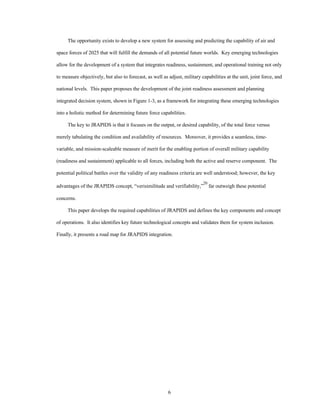
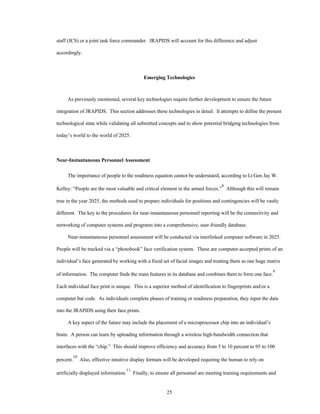
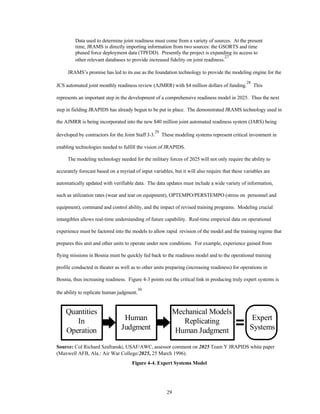
The current readiness and sustainment assessment method focuses on inputs and/or the availability of 
specific reserves or conditions from two separate and distinct sources, the service and the combatant 
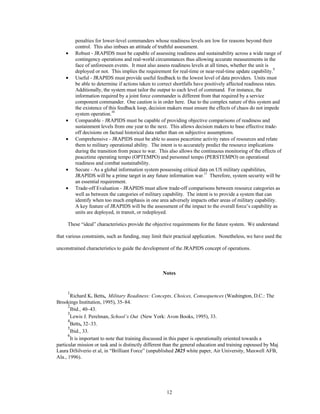
command. Figure 1-1 depicts the current system. As shown, the status of resources and training system 
(SORTS) reflects current levels of military readiness. SORTS generalizes a unit’s military readiness based 
on the lowest rating in five areas. Most commanders view the SORTS C-Rating (its measure of current 
readiness) as a report card of whether the unit can accomplish its wartime mission at its designed operating 
capability (DOC). Using this method, mission tasks (and the training requirements they generate) are 
essentially static and commanders have little ability to redirect resources in the short term for contingency 
operations. For sustainment, stockpiled assets are given an S-Rating. In this system the combatant 
commander in chief (CINC) prepares a periodic report that includes an objective tally of the amount of the 
theater war reserves available (pre-positioned and out of theater) based on the operation plan (OPLAN) 
requirements and a subjective overall S-Rating for his area of responsibility.7 The only assessment of output
(desired capability) in both methods relies too much on the subjective judgment of commanders and decision 
makers based on inputs they receive. Limited data available, private agendas,8 faulty interpretations, and 
other human frailties ensure an assessment fraught with potential inconsistencies and inaccuracies thereby 
potentially leading to ineffective and wasteful force management.9 Furthermore, because of the disconnect at 
lower levels, C-Rating and S-Rating do little to convey the true capabilities of the military at the unit, joint 
3 
force, and national level. 
Theate r S-Rating 
Personnel 
Supplies 
Equipment 
On Hand 
Condit ion 
Unit Input 
Readiness 
Stockpile S-Rating 
Stockpile R eporting 
Sustainment 
Unit 
Commanders’ 
Subjective 
Judgm ent 
Combatant 
Commanders 
Subjective 
Judgm ent 
Chairm an’s 
(CJCS) 
Readiness 
System 
Unit’s O verall C-Rating 
Resources C -Rating 
Ammo 
Fuel 
Spares 
Clo thing 
Food 
Source: Compiled from the ideas of the referenced sources: Moore, et al., vii. 
Figure 1-1. Current Readiness and Sustainability Assessments.
An upgrade to SORTS was recently implemented and renamed global status of resources and training 
system (GSORTS).10 This system communicates SORTS data over the Global Command and Control System 
(GCCS). These ongoing improvements to the current methods as well as to the next generation of readiness 
and sustainment assessment methods, such as in Joint Vision 2010, 
4 
11 still fall short of providing an accurate 
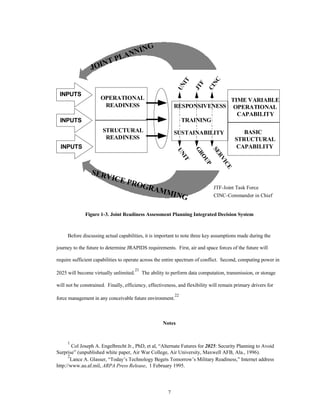
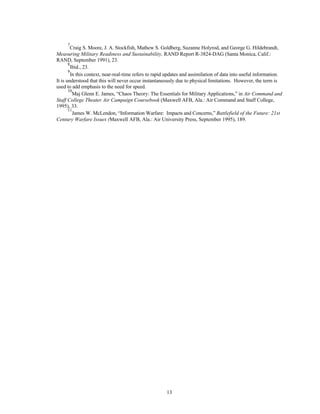
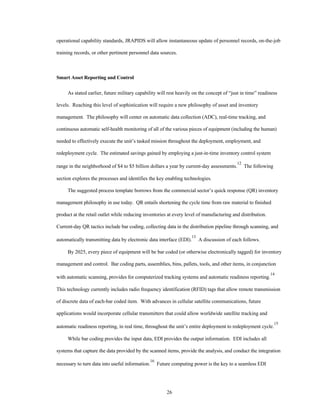
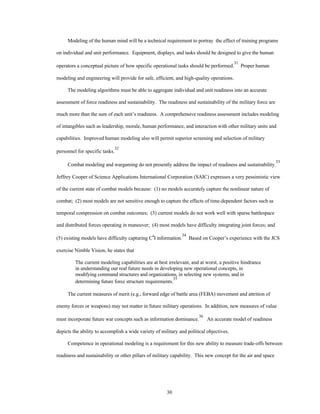
and predictive measure of joint force military capabilities at all levels.12 As shown in Figure 1-2, military 
readiness assessment still relies on stovepipe reporting as well as considerable subjective input. 
Stovepiping in this context refers to the lack of information cross-flow between the two systems. This lack of 
integration limits the quality of decisions regarding trade-offs between competing priorities. 
These systems also rely heavily on subjective input. Subjective evaluation of the line commander is an 
important element of a useful reporting system, but the manipulation of subjective readiness evaluations for 
political or other noncombat purposes must be minimized. Gen Michael Carns (USAF, retired) points out 
that the current readiness system is utilized by commanders, staff officers, and politicians to fight resource 
allocation battles.13 Dr Richard Kohn also highlights these complex ethical issues, and corresponding 
implications for civil-military relationships. He believes today’s military leaders and civilian decision 
makers are faced with a unique set of sociocultural problems when attempting to measure and assess military 
readiness objectively.14 Richard Betts devotes an entire chapter to similar issues in his 1995 book, Military 
Readiness: Concepts, Choices and Consequences.15 He notes the hazards associated with proposing new 
systems for measuring readiness. 
It should not be surprising that administration and services always had an excuse when they 
were criticized for allowing readiness to decline, or that critics adopted the same excuses 
when they moved into positions of authority themselves. The typical techniques for 
deflecting criticism were to deny the validity of criteria cited by critics, to conflate 
conflicting criteria, or to change the criteria by revising the official rating system.16 
However, since this paper concerns the development of a system to measure readiness in 2025, these 
political and social implications are outside its focus.
&-&69LHZRI5HDGLQHVV 
-6 
5HDGWR)LJKW 
5 
6HUYLFHV 
8QLW5HDGLQHVV 
3HRSOH 
(TXLSPHQW 
7UDLQLQJ 
,1V 
-RLQW5HDGLQHVV 
$ELOLWWRLQWHJUDWHDQG 
VQFKURQL]HIRUFHV 
7RH[HFXWHDVVLJQHGPLVVLRQV 
7UDGLWLRQDO5HDGLQHVV 7KH-RLQW3HUVSHFWLYH 
6HQLRU5HDGLQHVV2YHUVLJKWRXQFLO 
Source: Compiled from data presented by Gen John M. Shalikashvili to the House Committee on National 
Security, 25 January 1995. 
Figure 1-2. Joint Readiness System 
Although the variables affecting the possible alternate futures of 2025 are numerous, several constants 
exist that affect overall military capability. First, achieving the most military capability at the lowest overall 
cost will continue to be an important goal of any defense planning system.17 The cost issue is a critical point 
since military combat capability is called upon only intermittently and paying for high levels of continued but 
unused readiness is expensive.18 Second, historically, the American public has displayed a low tolerance 
for large standing military forces, especially when the perceived threat is low.19 Third, all of the factors 
currently affecting readiness and sustainability will continue to affect military capabilities in the future. 
Finally, as American defense policy changes, choices affecting the capability of military forces will be 
necessary to meet the variable requirements of the ever-changing security environment.
The opportunity exists to develop a new system for assessing and predicting the capability of air and 
space forces of 2025 that will fulfill the demands of all potential future worlds. Key emerging technologies 
allow for the development of a system that integrates readiness, sustainment, and operational training not only 
to measure objectively, but also to forecast, as well as adjust, military capabilities at the unit, joint force, and 
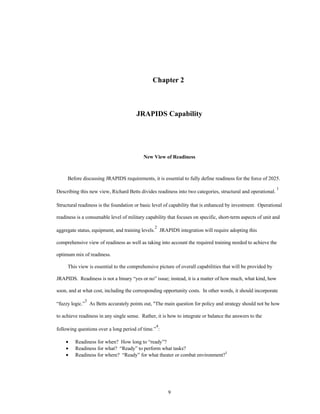
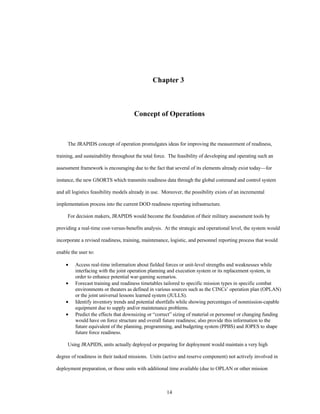
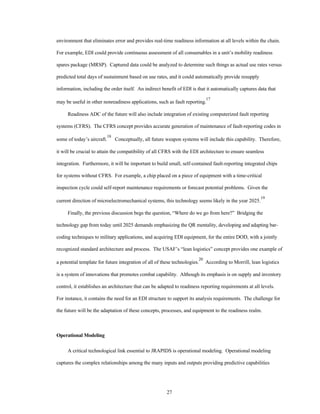
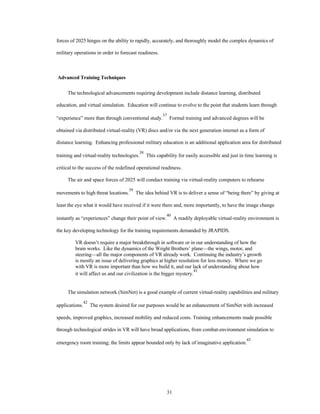
national levels. This paper proposes the development of the joint readiness assessment and planning 
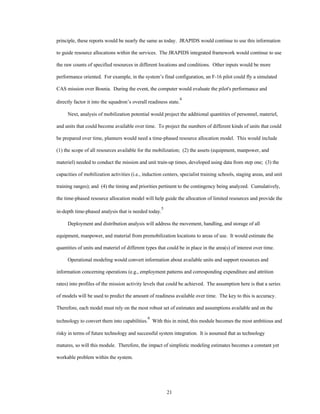
integrated decision system, shown in Figure 1-3, as a framework for integrating these emerging technologies 
into a holistic method for determining future force capabilities. 
The key to JRAPIDS is that it focuses on the output, or desired capability, of the total force versus 
merely tabulating the condition and availability of resources. Moreover, it provides a seamless, time-variable, 
and mission-scaleable measure of merit for the enabling portion of overall military capability 
(readiness and sustainment) applicable to all forces, including both the active and reserve component. The 
potential political battles over the validity of any readiness criteria are well understood; however, the key 
advantages of the JRAPIDS concept, “verisimilitude and verifiability,”20 far outweigh these potential 
6 
concerns. 
This paper develops the required capabilities of JRAPIDS and defines the key components and concept 
of operations. It also identifies key future technological concepts and validates them for system inclusion. 
Finally, it presents a road map for JRAPIDS integration.
7 
OPERATIONAL 
READINESS 
STRUCTURAL 
READINESS 
UNIT 
JTF 
CINC 
RESPONSIVENESS 
TRAINING 
SUSTAINABILITY 
UNIT 
GROUP 
SERVICE 
JOINT PLANNING 
INPUTS 
INPUTS 
TIME VARIABLE 
OPERATIONAL 
CAPABILITY 
BASIC 
STRUCTURAL 
CAPABILITY 
SERVICE PROGRAMMING 
JTF-Joint Task Force 
CINC-Commander in Chief 
INPUTS 
Figure 1-3. Joint Readiness Assessment Planning Integrated Decision System 
Before discussing actual capabilities, it is important to note three key assumptions made during the 
journey to the future to determine JRAPIDS requirements. First, air and space forces of the future will 
require sufficient capabilities to operate across the entire spectrum of conflict. Second, computing power in 
2025 will become virtually unlimited.21 The ability to perform data computation, transmission, or storage 
will not be constrained. Finally, efficiency, effectiveness, and flexibility will remain primary drivers for 
force management in any conceivable future environment.22 
Notes 
1 Col Joseph A. Engelbrecht Jr., PhD, et al, “Alternate Futures for 2025: Security Planning to Avoid 
Surprise” (unpublished white paper, Air War College, Air University, Maxwell AFB, Ala., 1996). 
2Lance A. Glasser, “Today’s Technology Begets Tomorrow’s Military Readiness,” Internet address 
http://www.au.af.mil, ARPA Press Release, 1 February 1995.
3Craig S. Moore, J. A. Stockfish, Mathew S. Goldberg, Suzanne Holyrod, and George G. Hildebrandt, 
Measuring Military Readiness and Sustainability, RAND Report R-3842-DAG, ( Santa Monica, Calif.: 
RAND, September 1991), 2. 
4Armed Forces Staff College Publication One, The Joint Staff Officer’s Guide, 1993 (Norfolk, Va: 
National Defense University, Armed Forces Staff College) 6–11. 
5Moore et al., 4. 
6Ideas generated from the following publications: Air University, SPACECAST 2020: The World of 
2020 and Alternate Futures” (Maxwell AFB, Ala.: Air University Press, June 1995), 10; Forward From the 
Sea (Washington, D.C.: Department of the Navy, January 1995), 9. Army Focus: Force XXI (Washington, 
D.C.: Department of the Army, January 15, 1995), 10. 
7Ibid., 18. 
8Gen Michael P. C. Carns, USAF, Retired, advisor comment on 2025 Team Y JRAPIDS white paper 
(Maxwell AFB, Ala.: Air War College/2025, 25 March 1996). 
9Richard K. Betts, Military Readiness: Concepts, Choices, Consequences (Washington, D.C.: The 
8 
Brookings Institution, 1995), 43. 
10Maj Jeff Fink, Headquarters USAF/XOOR, telephone interview with Lt Col David M. Snyder, 4 
April 1996; and Col James N. Worth, USAF/USACOM, J-32 Readiness Division, telephone interview with 
Lt Col Snyder, 5 April 1996. 
11Joint Chiefs of Staff white paper, “Joint Vision 2010 America’s Capability: Shaping the Future,” 
undated, telephone facsimile provided by Headquarters USAF/XOXS, 29 January 1996. 
12Lt Col Charles R. Rash, US Army, “Joint Readiness Evaluated,” US Army War College thesis 
(Carlisle Barracks, Pa.), April 1995, 3. 
13Carns. 
14Dr. Richard Kohn, advisor comment on 2025 Team Y JRAPIDS white paper (Maxwell AFB, Ala.: 
Air War College/2025, 25 March 1996). 
15Betts, 115–43. 
16Ibid., 132. 
17Lt Cmdr Leslie S. Turley, US Navy, “The Impact of the Defense Budgeting Process on Operational 
Readiness” (Monterey, Calif.: Naval Post-Graduate School, March 1993), 16. 
18Betts, 43. 
19Ibid., 24. 
20Col Richard Szafranski, USAF/AWC, assessor comment on 2025 Team Y JRAPIDS white paper 
(Maxwell AFB, Ala.: Air War College/2025, 25 March 1996). 
21Scientists present differing views on whether this assumption is valid for the world of 2025. We 
agree with several AF 2025 lecturers and Nicholas Negroponte, Being Digital (New York: Knopf, 1995). 
They stated that computational, storage, and transmission capability will not be a limiting factor in 2025. 
JRAPIDS requires a quantum leap in this capability, but it does not require an unlimited capability. 
22Lt Gen Jay W. Kelley, USAF, “Brilliant Warrior” (Unpublished paper, Air University, Maxwell 
AFB, Ala., February 1996), 4.
Chapter 2 
JRAPIDS Capability 
New View of Readiness 
Before discussing JRAPIDS requirements, it is essential to fully define readiness for the force of 2025. 
Describing this new view, Richard Betts divides readiness into two categories, structural and operational. 1 
Structural readiness is the foundation or basic level of capability that is enhanced by investment. Operational 
readiness is a consumable level of military capability that focuses on specific, short-term aspects of unit and 
aggregate status, equipment, and training levels.2 JRAPIDS integration will require adopting this 
comprehensive view of readiness as well as taking into account the required training needed to achieve the 
9 
optimum mix of readiness. 
This view is essential to the comprehensive picture of overall capabilities that will be provided by 
JRAPIDS. Readiness is not a binary “yes or no” issue; instead, it is a matter of how much, what kind, how 
soon, and at what cost, including the corresponding opportunity costs. In other words, it should incorporate 
“fuzzy logic.”3 As Betts accurately points out, The main question for policy and strategy should not be how 
to achieve readiness in any single sense. Rather, it is how to integrate or balance the answers to the 
following questions over a long period of time.”4: 
·  Readiness for when? How long to “ready”? 
·  Readiness for what? “Ready” to perform what tasks? 
·  Readiness for where? “Ready” for what theater or combat environment?5
The critical dimension of readiness, sustainment and training is time. In theory, future military forces 
can prepare for any type of contingency if they are provided enough time and resources. Realistically, 
resource and training time will be finite. The measurement of the amount of training time required to prepare 
for a particular task is an appropriate 2025 element of readiness. Thinking about and measuring readiness in 
the time dimension allows for relevant comparisons between levels of readiness and an understanding of the 
trade-off equation. The trade-off equation seeks an appropriate balance between immediately available 
capability and capability available at a later time thus allowing readiness preparations for other missions or 
tasks. Finally, the time aspect of readiness is most relevant if it deals with specific military tasks or 
10 
missions. 
This leads to the second dimension of a future view of readiness, specifying the task for which an 
individual or unit should be prepared. Training to do the right task is essential; it minimizes wasted effort, 
expenses, and potential capability deterioration. 
The final component of readiness is training to do the proper task in the right place. This generally 
means in a particular environment, geographic theater, or specific military medium (e.g., space, low altitude, 
permissive air environment, etc.). 
Operational readiness of an individual, weapon system, unit, or force (aggregation of several units) 
should be thought of as a matrix where preparedness to accomplish specific military tasks in specific 
environments is measured in units of time needed to prepare for the task. For the air and space forces of 
2025, optimal readiness need not always mean being immediately ready (preparation or training time equals 
zero) for 100 percent of the required tasks in all possible environments. A constant state of maximum 
readiness is costly and highly perishable. The future view of readiness must include (1) a comprehensive 
understanding of the type of training necessary; (2) the time available to prepare a unit for specific tasks; and 
(3) a corresponding understanding of key trade-offs and missed opportunities. 
This new view of readiness must focus on the outputs of readiness, sustainment, and training in an 
integrated manner, rather than the unmeshed inputs of each (as the current system does). The key to future air 
and space force readiness lies in understanding the readiness trade-offs available. As previously discussed, 
trade-offs, in this context, occur when the decision makers decide on the correct level and type of training that 
yields the optimal readiness for specific operational tasks. Within the unit, the trade-off decision must be
made between all of the tasks that are constantly competing for the available readiness, sustainment, and 
training resources. At the joint force level, the trade-off decision must be made between units. The proper 
readiness mix is essential. For example, a notional unit that had a high level of readiness (zero or minimal 
training time needed) in nearly all assigned OPLAN tasks may represent an inappropriate trade-off among 
resources if the threat is low. Finally, the readiness trade-off decision may also require a balance of 
investment among the various components of military combat capability as well as within each component. 
JRAPIDS Characteristics 
From the preceding discussion it becomes apparent that the effective management of the joint air and 
space forces of 2025 demands an output-focused, integrated systems approach to readiness assessment to 
obtain the optimal readiness combination of when, what, and where. As shown in Figure 1-3, JRAPIDS will 
assess, judge, and predict the impact of all factors in the following areas: 
·  Responsiveness - the promptness in preparing for the task at hand. 
·  Operational training - flexible training in the field that allows for preparing for new tasks in new 
11 
environments.6 
·  Sustainability - required endurance in performing a particular military task. 
JRAPIDS provides a new approach to readiness and sustainability measurement with a new set of 
components and processes. It is necessary to first determine the unconstrained requirements for the proposed 
system and then provide an assessment of the potential risks associated with developing the needed 
technology. The RAND study, Measuring Military Readiness and Sustainability, is the primary source for 
many of the following characteristics of an “ideal” readiness and sustainment system:7 
·  Measurement of Output - JRAPIDS must measure unit and force capability as a function of time 
versus merely computing assets on hand. It will answer the question, “readiness and sustainability 
for what?” JRAPIDS must be capable of assessing actual performance levels of all resources 
within the unit and it must provide an aggregate, scaleable performance indicator for the unit as 
whole. It must also be able to provide an overall performance potential assessment for joint and 
national level forces. 
·  Practical - JRAPIDS must be easy to use and inexpensive to operate. Said another way, “The job of 
measurement should stay extremely small compared with the jobs of providing readiness and 
sustainability.”8 Moreover, the information provided by JRAPIDS must be easily understood and 
easily interpreted by all users and decision makers, throughout the chain of command. 
·  Objective - JRAPIDS must be objective and verifiable to ensure accurate measurements. A few 
subjective judgments will still be required for personal insights such as morale levels or any other 
judgment requiring a high degree of human intuition. The key is that these should be limited in order 
to lessen the impact of incorrect assessment. Furthermore, system protocols should prevent
penalties for lower-level commanders whose readiness levels are low for reasons beyond their 
control. This also imbues an attitude of truthful assessment. 
·  Robust - JRAPIDS must be capable of assessing readiness and sustainability across a wide range of 
contingency operations and real-world circumstances thus allowing accurate measurements in the 
face of unforeseen events. It must also assess readiness levels at all times, whether the unit is 
deployed or not. This implies the requirement for real-time or near-real-time update capability.9 
·  Useful - JRAPIDS must provide useful feedback to the lowest level of data providers. Units must 
be able to determine if actions taken to correct shortfalls have positively affected readiness rates. 
Additionally, the system must tailor the output to each level of command. For instance, the 
information required by a joint force commander is different from that required by a service 
component commander. One caution is in order here. Due to the complex nature of this system and 
the existence of this feedback loop, decision makers must ensure the effects of chaos do not impede 
system operation.10 
·  Comparable - JRAPIDS must be capable of providing objective comparisons of readiness and 
sustainment levels from one year to the next. This allows decision makers to base effective trade-off 
decisions on factual historical data rather than on subjective assumptions. 
·  Comprehensive - JRAPIDS must be able to assess peacetime activity rates of resources and relate 
them to military operational ability. The intent is to accurately predict the resource implications 
during the transition from peace to war. This also allows the continuous monitoring of the effects of 
peacetime operating tempo (OPTEMPO) and personnel tempo (PERSTEMPO) on operational 
readiness and combat sustainability. 
·  Secure - As a global information system possessing critical data on US military capabilities, 
JRAPIDS will be a prime target in any future information war.11 Therefore, system security will be 
an essential requirement. 
·  Trade-off Evaluation - JRAPIDS must allow trade-off comparisons between resource categories as 
well as between the categories of military capability. The intent is to provide a system that can 
identify when too much emphasis in one area adversely impacts other areas of military capability. 
A key feature of JRAPIDS will be the assessment of the impact to the overall force’s capability as 
units are deployed, in transit, or redeployed. 
These “ideal” characteristics provide the objective requirements for the future system. We understand 
that various constraints, such as funding, may limit their practical application. Nonetheless, we have used the 
unconstrained characteristics to guide the development of the JRAPIDS concept of operations. 
Notes 
1Richard K. Betts, Military Readiness: Concepts, Choices, Consequences (Washington, D.C.: The 
12 
Brookings Institution, 1995), 35–84. 
2Ibid., 40–43. 
3Lewis J. Perelman, School’s Out (New York: Avon Books, 1995), 33. 
4Betts, 32–33. 
5Ibid., 33. 
6It is important to note that training discussed in this paper is operationally oriented towards a 
particular mission or task and is distinctly different than the general education and training espoused by Maj 
Laura DiSilverio et al, in “Brilliant Force” (unpublished 2025 white paper, Air University, Maxwell AFB, 
Ala., 1996).
7Craig S. Moore, J. A. Stockfish, Mathew S. Goldberg, Suzanne Holyrod, and George G. Hildebrandt, 
Measuring Military Readiness and Sustainability, RAND Report R-3824-DAG (Santa Monica, Calif.: 
RAND, September 1991), 23. 
8Ibid., 23. 
9In this context, near-real-time refers to rapid updates and assimilation of data into useful information. 
It is understood that this will never occur instantaneously due to physical limitations. However, the term is 
used to add emphasis to the need for speed. 
10Maj Glenn E. James, “Chaos Theory: The Essentials for Military Applications,” in Air Command and 
Staff College Theater Air Campaign Coursebook (Maxwell AFB, Ala.: Air Command and Staff College, 
1995), 33. 
11James W. McLendon, “Information Warfare: Impacts and Concerns,” Battlefield of the Future: 21st 
Century Warfare Issues (Maxwell AFB, Ala.: Air University Press, September 1995), 189. 
13
Chapter 3 
Concept of Operations 
The JRAPIDS concept of operation promulgates ideas for improving the measurement of readiness, 
training, and sustainability throughout the total force. The feasibility of developing and operating such an 
assessment framework is encouraging due to the fact that several of its elements already exist today—for 
instance, the new GSORTS which transmits readiness data through the global command and control system 
and all logistics feasibility models already in use. Moreover, the possibility exists of an incremental 
implementation process into the current DOD readiness reporting infrastructure. 
For decision makers, JRAPIDS would become the foundation of their military assessment tools by 
providing a real-time cost-versus-benefits analysis. At the strategic and operational level, the system would 
incorporate a revised readiness, training, maintenance, logistic, and personnel reporting process that would 
14 
enable the user to: 
·  Access real-time information about fielded forces or unit-level strengths and weaknesses while 
interfacing with the joint operation planning and execution system or its replacement system, in 
order to enhance potential war-gaming scenarios. 
·  Forecast training and readiness timetables tailored to specific mission types in specific combat 
environments or theaters as defined in various sources such as the CINCs’ operation plan (OPLAN) 
or the joint universal lessons learned system (JULLS). 
·  Identify inventory trends and potential shortfalls while showing percentages of nonmission-capable 
equipment due to supply and/or maintenance problems. 
·  Predict the effects that downsizing or “correct” sizing of material or personnel or changing funding 
would have on force structure and overall future readiness; also provide this information to the 
future equivalent of the planning, programming, and budgeting system (PPBS) and JOPES to shape 
future force readiness. 
Using JRAPIDS, units actually deployed or preparing for deployment would maintain a very high 
degree of readiness in their tasked missions. Units (active and reserve component) not actively involved in 
deployment preparation, or those units with additional time available (due to OPLAN or other mission
constraints) would become more cost effective by maintaining a minimum baseline level of readiness until 
specific requirements arise. Once these units were needed, specific mission requirements would drive a 
tailored operational training program. Sources for specific mission requirements would be the NCA, 
OPLANs, contingency plans (CONPLANs), functional plans, JULLS, or any other pertinent mission-specific 
database. The actual tasks and requisite performance specification would come from the future equivalent to 
the joint minimum essential task listing (JMETL).1 All units would be capable of: 
·  Prioritizing unit level and individual training requirements with ongoing maintenance and personnel 
status reports in order to minimize training time for specific operational commitments. 
·  Adapting mission or task training programs to accommodate the most current operational “lessons 
learned.” For example, early deployers could provide information useful to late deployers through 
the future equivalent of JULLS. 
·  Maintaining optimal readiness of ongoing immediate missions and tasks such as space surveillance, 
15 
missile warning, and combat alert. 
As our military forces ebb and flow into the twenty-first century, the trade-offs, most notably 
capabilities versus cost, will continue to play a major role in our overall force composition.2 All military 
services will strive to deliver more “bang for the buck.” Due to its focus on the output side and its total 
integration of operational training, readiness, and sustainment, a fully implemented JRAPIDS would provide 
such direct benefits as increased readiness and training connectivity throughout all areas of the military. 
Also, decision makers would have the ability to see directly the effect of different funding patterns on force 
capabilities, readiness, and sustainability.
Operational 
Modeling 
16 
Output 
Asset/Stockpile 
Inputs Reporting 
Mobilization 
Inputs Analysis 
Deployment/ 
Distribution 
Analysis 
Inputs 
Functional 
Checks and 
Tests 
Output 
Output 
Readiness 
Inputs Matrix 
Source: Craig S. Moore, J. A. Stockfish, Mathew S. Goldberg, Suzanne Holyrod, and George G. 
Hildebrandt, Measuring Military Readiness and Sustainability, RAND Report R-3842-DAG (Santa 
Monica, Calif.: RAND, September 1991), 98. 
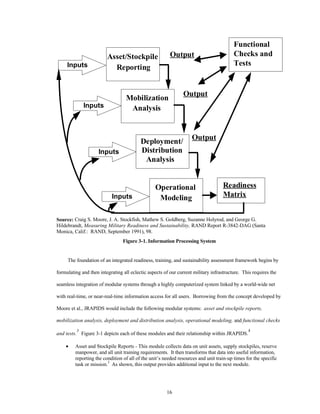
Figure 3-1. Information Processing System 
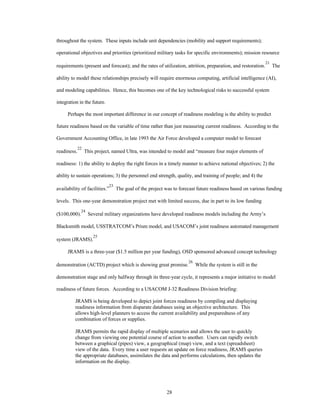
The foundation of an integrated readiness, training, and sustainability assessment framework begins by 
formulating and then integrating all eclectic aspects of our current military infrastructure. This requires the 
seamless integration of modular systems through a highly computerized system linked by a world-wide net 
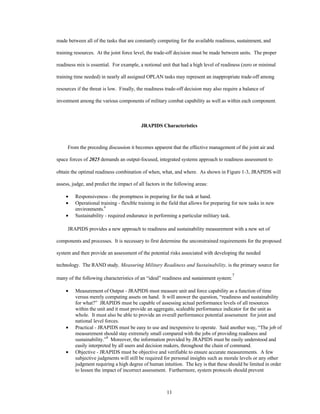
with real-time, or near-real-time information access for all users. Borrowing from the concept developed by 
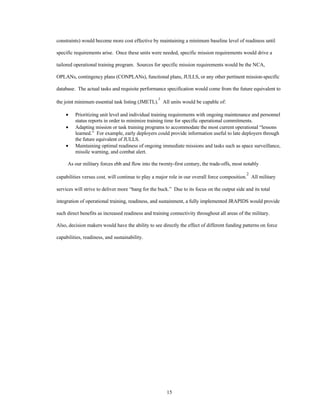
Moore et al., JRAPIDS would include the following modular systems: asset and stockpile reports, 
mobilization analysis, deployment and distribution analysis, operational modeling, and functional checks 
and tests. 
3 Figure 3-1 depicts each of these modules and their relationship within JRAPIDS.4 
·  Asset and Stockpile Reports - This module collects data on unit assets, supply stockpiles, reserve 
manpower, and all unit training requirements. It then transforms that data into useful information, 
reporting the condition of all of the unit’s needed resources and unit train-up times for the specific 
task or mission.5 As shown, this output provides additional input to the next module.
·  Mobilization Analysis - This module takes data collected on force mobilization (induction and 
training capacities) and industrial mobilization (industrial production and service capacities) and 
ties these to the timing objectives and priorities established for the mission. This information, along 
with the input from the previous module, is used to establish the actual availability of units, 
manpower, and materiel that could become available over time and the changing levels of unit 
capability attainable (the latter mainly through “training up”).6 
·  Deployment and Distribution Analysis - This module takes into account storage, handling, and 
movement of all things necessary to accomplish the tasks assigned to the units, or joint forces. It 
takes the information from the previous module and translates it into profiles of the numbers of 
combat units, support units, and materiel that could be available at appropriate locations in combat 
theaters.7 It also includes the effects of increasing lift and handling capacities at various civil 
reserve air fleet (CRAF) activation levels to allow the maximum flexibility in mobilization 
planning. 
·  Operational Modeling - This module converts the profiles from the previous module into the time-variable, 
mission-scaleable performance levels available at the desired operating location.8 
Assumptions, estimates, and empirical data gathered on the performance requirements for the 
specific mission would form the input to the various models. 
·  Functional Checks and Tests - This module would provide a significant feedback loop between each 
module as well as provide a way to estimate or verify all of the inputs, all of the outputs, and all of 
the time-capability relationships used throughout the system.9 
·  Feedback - Although not a module per se, feedback at all levels of the system, as well as between 
components, is absolutely critical. The effects of such feedback will provide the ability for “on-the-fly” 
corrections to ongoing training or readiness preparations. 
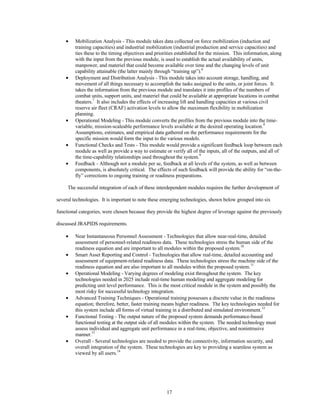
The successful integration of each of these interdependent modules requires the further development of 
several technologies. It is important to note these emerging technologies, shown below grouped into six 
functional categories, were chosen because they provide the highest degree of leverage against the previously 
17 
discussed JRAPIDS requirements. 
·  Near Instantaneous Personnel Assessment - Technologies that allow near-real-time, detailed 
assessment of personnel-related readiness data. These technologies stress the human side of the 
readiness equation and are important to all modules within the proposed system.10 
·  Smart Asset Reporting and Control - Technologies that allow real-time, detailed accounting and 
assessment of equipment-related readiness data. These technologies stress the machine side of the 
readiness equation and are also important to all modules within the proposed system.11 
·  Operational Modeling - Varying degrees of modeling exist throughout the system. The key 
technologies needed in 2025 include real-time human modeling and aggregate modeling for 
predicting unit level performance. This is the most critical module in the system and possibly the 
most risky for successful technology integration. 
·  Advanced Training Techniques - Operational training possesses a discrete value in the readiness 
equation; therefore, better, faster training means higher readiness. The key technologies needed for 
this system include all forms of virtual training in a distributed and simulated environment.12 
·  Functional Testing - The output nature of the proposed system demands performance-based 
functional testing at the output side of all modules within the system. The needed technology must 
assess individual and aggregate unit performance in a real-time, objective, and nonintrusive 
manner.13 
·  Overall - Several technologies are needed to provide the connectivity, information security, and 
overall integration of the system. These technologies are key to providing a seamless system as 
viewed by all users.14
The key to successful JRAPIDS integration lies in each of these enabling technologies. Therefore, these 
technologies are discussed in detail following a description of JRAPIDS in the next chapter. 
Notes 
1John R. Ballard and Steve C. Sifers, “JMETL: The Key to Joint Proficiency,” Joint Force Quarterly 
18 
no. 9 (Autumn 1995), 95. 
2USAF Scientific Advisory Board, New World Vistas: Air and Space Power for the 21st Century, 
summary volume (Washington, D.C.: USAF Scientific Advisory Board, 15 December 1995), 5. 
3Craig S. Moore, J.A. Stockfish, Mathew S. Goldberg, Suzanne Holyrod, and George G. Hildebrandt, 
Measuring Military Readiness and Sustainability, RAND Report R-3842-DAG (Santa Monica, Calif.: 
RAND, September 1991), 96. 
4Ibid., 97. 
5Ibid., 87 
6Ibid., 89 
7Ibid., 92 
8Ibid., 94 
9Ibid., 95 
102025 Concepts, No. 900175, “Virtual-reality Trainers,” No. 900516, “Generation X Theater Level 
Combat Simulation;” No. 200004, “Advanced MILSATCOM Capabilities,” No. 20007, “Rehearsal For All 
Missions, in a Mission Media, without Vehicle Movement,” No. 900454, “On Line Satellite Link for Medical 
Records for Deployed Personnel,” No. 900523, “Chip in the Head,” No. 900559, “Thumb Implanted 
Individual Identification Codes,” 2025 Concepts Database (Maxwell AFB, Ala.: Air War College/2025, 
1996). 
112025 Concepts, No. 200019, “Smart Packages,” No. 900323, “Bar Code Readers in Space;” No. 
900335, “Worldwide Military Cellular Phone System,” Concept No. 900367, “Enhanced Defense Readiness 
by Logistics Integration,” No. 900413, “Wireless Local Area Network,” No. 900609, “Smart Tools,” No. 
900611, “Smart Parts” No. 900672, “Integrated Logistical Battlespace Sustainment,” 2025 Concepts 
Database (Maxwell AFB, Ala.: Air War College/2025, 1996). 
122025 Concepts, No. 200007, “Rehearsal in All Missions, in a Mission Media, Without Vehicle,” No. 
900175, “Virtual-reality Trainers,” No. 900516, “Generation X Theater Level Combat Generation 
Simulation,” No. 900534, “Virtual Force 2025,” No. 900629, “VR for Cultural Competence,” No. 900643, 
“On Platform Initial Flying Training,” and No. 900680, “Holographic Meetings,” 2025 Database (Maxwell 
AFB, Ala., Air War College/2025, 1996). 
132025 Concepts, No. 900334, “De-Massification of Response,” No. 900484, “Functional 
Reorganization,” No. 900700 “The Flat Air Force,” 2025 Concepts Database (Maxwell AFB, Ala.: Air War 
College/2025, 1996). 
142025 Concepts, No. 200004, “Advanced MILSATCOM Capabilities,” No. 900131, “Security,” No. 
900138 “Secure Communications on Demand,” No. 900182, “Neuro-Network Computer Interface,” No. 
900183, “Computer Security,” No. 900184, “Automated Security,” No. 900290, “Artificial Intelligence,” No. 
900329, “Human Friendly Design,” No. 900561, “Data Bus Information Pull Computers,” No. 900669, 
“Database Sharing,” 2025 Concepts Database (Maxwell AFB, Ala.: Air War College/2025, 1996).
Chapter 4 
System Description 
By the year 2025, the joint readiness assessment and planning integrated decision system will provide a 
time-variable, mission-scaleable, cost-effective means of managing US forces’ overall readiness and 
sustainment levels. Today, due to timing constraints and system inadequacies, a notional F-16 squadron 
trained to conduct close-air-support (CAS) operations may find itself operationally deployed to conduct air-to- 
air operations. In the future, JRAPIDS will provide the CINC with near-real-time information on each 
unit’s readiness state thereby minimizing such a problem. 
JRAPIDS also will provide commanders at all levels with the most efficient and cost-effective means 
of maintaining a baseline level of proficiency (i.e., structural readiness) pending specific mission 
identification. In theory, JRAPIDS will be capable of identifying the time needed to achieve a particular 
readiness level for a given task. Unit commanders could then maintain some individuals or equipment at 
lower states of readiness based on available preparation time. Once the specific tasks are established, 
JRAPIDS would then identify any type of performance weakness and provide a tailored training or 
19 
preparation program. 
Military forces contain two stages of readiness, structural and operational. The foundation of JRAPIDS 
exploits this premise. Structural readiness concerns mass; it is about how soon a requirement-sized force can 
be available.1 It also refers to (1) the number of personnel under arms with at least a basic level of training; 
(2) the number of organized formations, including the quantity and quality of their weapons; and (3) the 
distribution of combat assets among land, sea, air, and space power. Structural readiness establishes the 
limits of organized capability in existing forces and potential capabilities in nonexisting forces. This begins
with procurement and includes the amount of time it takes to produce a new asset, system, basic level of 
20 
training, or unit from scratch. 
Operational readiness is different. According to Betts, “Operational readiness is about efficiency and 
is measured in terms of how soon an existing unit can reach peak capability to fight in combat,”2 or in our 
case, perform an operational task. It indicates how proficiently a unit may perform a given task, but not how 
successful it may be. In 2025, operational readiness must become more objective and comprehensive. 
JRAPIDS will build on the current assessments of operational readiness by including operation tempo and 
personnel tempo effects, mobility limits, exercise schedules, command control communications computer and 
intelligence (C4I), morale states, contingency types, and contingency duration.3 
OPERATIONAL 
READINESS 
STRUCTURAL 
READINESS 
UNIT 
JTF 
CINC 
RESPONSIVENESS 
TRAINING 
SUSTAINABILITY 
UNIT 
GROUP 
SERVICE 
JOPES 
INPUTS 
INPUTS 
TIME VARIABLE 
OPERATIONAL 
CAPABILITY 
BASIC 
STRUCTURAL 
CAPABILITY 
PPBS 
INPUTS 
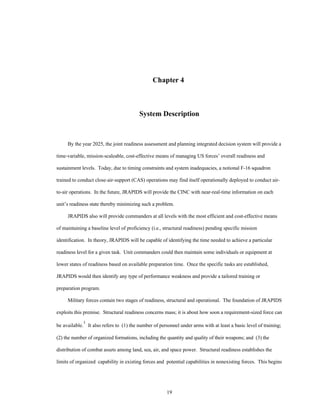
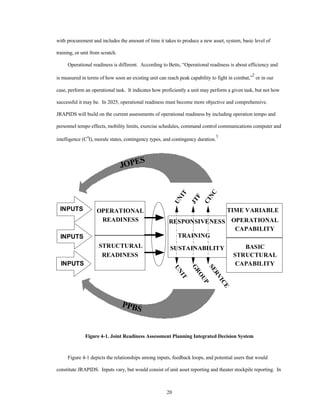
Figure 4-1. Joint Readiness Assessment Planning Integrated Decision System 
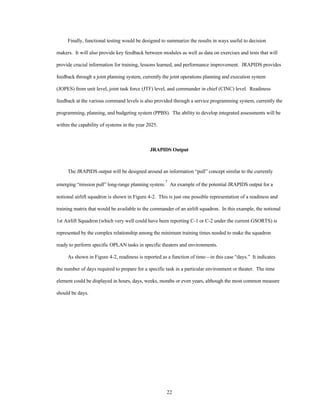
Figure 4-1 depicts the relationships among inputs, feedback loops, and potential users that would 
constitute JRAPIDS. Inputs vary, but would consist of unit asset reporting and theater stockpile reporting. In
principle, these reports would be nearly the same as today. JRAPIDS would continue to use this information 
to guide resource allocations within the services. The JRAPIDS integrated framework would continue to use 
the raw counts of specified resources in different locations and conditions. Other inputs would be more 
performance oriented. For example, in the system’s final configuration, an F-16 pilot could fly a simulated 
CAS mission over Bosnia. During the event, the computer would evaluate the pilot's performance and 
directly factor it into the squadron’s overall readiness state.4 
Next, analysis of mobilization potential would project the additional quantities of personnel, materiel, 
and units that could become available over time. To project the numbers of different kinds of units that could 
be prepared over time, planners would need a time-phased resource allocation model. This would include 
(1) the scope of all resources available for the mobilization; (2) the assets (equipment, manpower, and 
materiel) needed to conduct the mission and unit train-up times, developed using data from step one; (3) the 
capacities of mobilization activities (i.e., induction centers, specialist training schools, staging areas, and unit 
training ranges); and (4) the timing and priorities pertinent to the contingency being analyzed. Cumulatively, 
the time-phased resource allocation model will help guide the allocation of limited resources and provide the 
21 
in-depth time-phased analysis that is needed today.5 
Deployment and distribution analysis will address the movement, handling, and storage of all 
equipment, manpower, and material from premobilization locations to areas of use. It would estimate the 
quantities of units and materiel of different types that could be in place in the area(s) of interest over time. 
Operational modeling would convert information about available units and support resources and 
information concerning operations (e.g., employment patterns and corresponding expenditure and attrition 
rates) into profiles of the mission activity levels that could be achieved. The assumption here is that a series 
of models will be used to predict the amount of readiness available over time. The key to this is accuracy. 
Therefore, each model must rely on the most robust set of estimates and assumptions available and on the 
technology to convert them into capabilities.6 With this in mind, this module becomes the most ambitious and 
risky in terms of future technology and successful system integration. It is assumed that as technology 
matures, so will this module. Therefore, the impact of simplistic modeling estimates becomes a constant yet 
workable problem within the system.
Finally, functional testing would be designed to summarize the results in ways useful to decision 
makers. It will also provide key feedback between modules as well as data on exercises and tests that will 
provide crucial information for training, lessons learned, and performance improvement. JRAPIDS provides 
feedback through a joint planning system, currently the joint operations planning and execution system 
(JOPES) from unit level, joint task force (JTF) level, and commander in chief (CINC) level. Readiness 
feedback at the various command levels is also provided through a service programming system, currently the 
programming, planning, and budgeting system (PPBS). The ability to develop integrated assessments will be 
22 
within the capability of systems in the year 2025. 
JRAPIDS Output 
The JRAPIDS output will be designed around an information “pull” concept similar to the currently 
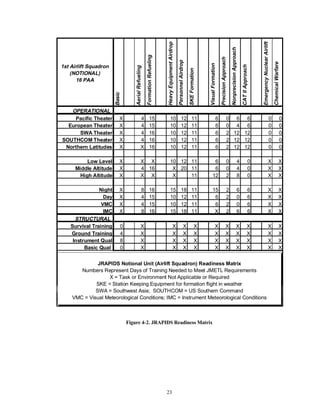
emerging “mission pull” long-range planning system.7 An example of the potential JRAPIDS output for a 
notional airlift squadron is shown in Figure 4-2. This is just one possible representation of a readiness and 
training matrix that would be available to the commander of an airlift squadron. In this example, the notional 
1st Airlift Squadron (which very well could have been reporting C-1 or C-2 under the current GSORTS) is 
represented by the complex relationship among the minimum training times needed to make the squadron 
ready to perform specific OPLAN tasks in specific theaters and environments. 
As shown in Figure 4-2, readiness is reported as a function of time—in this case “days.” It indicates 
the number of days required to prepare for a specific task in a particular environment or theater. The time 
element could be displayed in hours, days, weeks, months or even years, although the most common measure 
should be days.
23 
1st Airlift Squadron 
(NOTIONAL) 
16 PAA 
Basic 
Aerial Refueling 
Formation Refueling 
Heavy Equipment Airdrop 
Personnel Airdrop 
SKE Formation 
Visual Formation 
Precision Approach 
Nonprecision Approach 
CAT II Approach 
Emergency Nuclear Airlift 
Chemical Warfare 
OPERATIONAL 
Pacific Theater X 4 15 10 12 11 6 0 6 6 0 0 
European Theater X 4 15 10 12 11 6 0 4 6 0 0 
SWA Theater X 4 16 10 12 11 6 2 12 12 0 0 
SOUTHCOM Theater X 4 16 10 12 11 6 2 12 12 0 0 
Northern Latitudes X X 16 10 12 11 6 2 12 12 0 0 
Low Level X X X 101211 6 0 4 0 X X 
Middle Altitude X 4 16 X 20 11 6 0 4 0 X X 
High Altitude X X X X 11 12 2 8 0 X X 
Night X 8 16 15 18 11 15 2 6 6 X X 
Day X 4 15 10 12 11 6 2 0 6 X X 
VMC X 4 15 10 12 11 6 2 0 6 X X 
IMC X 8 16 15 18 11 X 2 6 6 X X 
STRUCTURAL 
Survival Training 0 X X X X X X X X X X 
Ground Training 4 X X X X X X X X X X 
Instrument Qual 8 X X X X X X X X X X 
Basic Qual 0 X X X X X X X X X X 
JRAPIDS Notional Unit (Airlift Squadron) Readiness Matrix 
Numbers Represent Days of Training Needed to Meet JMETL Requirements 
X = Task or Environment Not Applicable or Required 
SKE = Station Keeping Equipment for formation flight in weather 
SWA = Southwest Asia; SOUTHCOM = US Southern Command 
VMC = Visual Meteorological Conditions; IMC = Instrument Meteorological Conditions 
Figure 4-2. JRAPIDS Readiness Matrix
Operational Readiness 
24 
100 
80 
60 
40 
20 
Tactical JMETs 
for Notional 
Fighter Wings 
Structural Readiness 
0 
33 FW 1 FW 388 FW 
PERCENT 
READY 
TA1.4.2 Occupy Combat Area 
TA3.2.1 Conduct Lethal Engagement 
TA5.4.6 Synchronize Tactical Operations 
Figure 4-3. Notional JFACC Output 
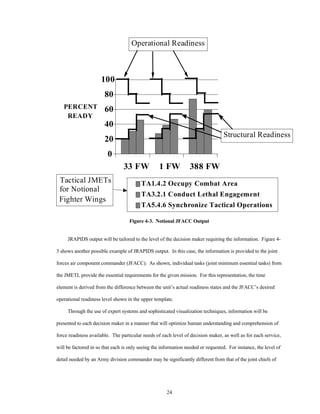
JRAPIDS output will be tailored to the level of the decision maker requiring the information. Figure 4- 
3 shows another possible example of JRAPIDS output. In this case, the information is provided to the joint 
forces air component commander (JFACC). As shown, individual tasks (joint minimum essential tasks) from 
the JMETL provide the essential requirements for the given mission. For this representation, the time 
element is derived from the difference between the unit’s actual readiness states and the JFACC’s desired 
operational readiness level shown in the upper template. 
Through the use of expert systems and sophisticated visualization techniques, information will be 
presented to each decision maker in a manner that will optimize human understanding and comprehension of 
force readiness available. The particular needs of each level of decision maker, as well as for each service, 
will be factored in so that each is only seeing the information needed or requested. For instance, the level of 
detail needed by an Army division commander may be significantly different from that of the joint chiefs of
staff (JCS) or a joint task force commander. JRAPIDS will account for this difference and adjust 
25 
accordingly. 
Emerging Technologies 
As previously mentioned, several key technologies require further development to ensure the future 
integration of JRAPIDS. This section addresses these technologies in detail. It attempts to define the present 
technological state while validating all submitted concepts and to show potential bridging technologies from 
today’s world to the world of 2025. 
Near-Instantaneous Personnel Assessment 
The importance of people to the readiness equation cannot be understated, according to Lt Gen Jay W. 
Kelley: “People are the most valuable and critical element in the armed forces.”8 Although this will remain 
true in the year 2025, the methods used to prepare individuals for positions and contingencies will be vastly 
different. The key to the procedures for near-instantaneous personnel reporting will be the connectivity and 
networking of computer systems and programs into a comprehensive, user-friendly database. 
Near-instantaneous personnel assessment will be conducted via interlinked computer software in 2025. 
People will be tracked via a “photobook” face verification system. These are computer-accepted prints of an 
individual’s face generated by working with a fixed set of facial images and treating them as one huge matrix 
of information. The computer finds the main features in its database and combines them to form one face.9 
Each individual face print is unique. This is a superior method of identification to fingerprints and/or a 
computer bar code. As individuals complete phases of training or readiness preparation, they input the data 
into the JRAPIDS using their face prints. 
A key aspect of the future may include the placement of a microprocessor chip into an individual’s 
brain. A person can learn by uploading information through a wireless high-bandwidth connection that 
interfaces with the “chip.” This should improve efficiency and accuracy from 5 to 10 percent to 95 to 100 
percent.10 Also, effective intuitive display formats will be developed requiring the human to rely on 
artificially displayed information.11 Finally, to ensure all personnel are meeting training requirements and
operational capability standards, JRAPIDS will allow instantaneous update of personnel records, on-the-job 
training records, or other pertinent personnel data sources. 
26 
Smart Asset Reporting and Control 
As stated earlier, future military capability will rest heavily on the concept of “just in time” readiness 
levels. Reaching this level of sophistication will require a new philosophy of asset and inventory 
management. The philosophy will center on automatic data collection (ADC), real-time tracking, and 
continuous automatic self-health monitoring of all of the various pieces of equipment (including the human) 
needed to effectively execute the unit’s tasked mission throughout the deployment, employment, and 
redeployment cycle. The estimated savings gained by employing a just-in-time inventory control system 
range in the neighborhood of $4 to $5 billion dollars a year by current-day assessments.12 The following 
section explores the processes and identifies the key enabling technologies. 
The suggested process template borrows from the commercial sector’s quick response (QR) inventory 
management philosophy in use today. QR entails shortening the cycle time from raw material to finished 
product at the retail outlet while reducing inventories at every level of manufacturing and distribution. 
Current-day QR tactics include bar coding, collecting data in the distribution pipeline through scanning, and 
automatically transmitting data by electronic data interface (EDI).13 A discussion of each follows. 
By 2025, every piece of equipment will be bar coded (or otherwise electronically tagged) for inventory 
management and control. Bar coding parts, assemblies, bins, pallets, tools, and other items, in conjunction 
with automatic scanning, provides for computerized tracking systems and automatic readiness reporting.14 
This technology currently includes radio frequency identification (RFID) tags that allow remote transmission 
of discrete data of each-bar coded item. With advances in cellular satellite communications, future 
applications would incorporate cellular transmitters that could allow worldwide satellite tracking and 
automatic readiness reporting, in real time, throughout the unit’s entire deployment to redeployment cycle.15 
While bar coding provides the input data, EDI provides the output information. EDI includes all 
systems that capture the data provided by the scanned items, provide the analysis, and conduct the integration 
necessary to turn data into useful information.16 Future computing power is the key to a seamless EDI
environment that eliminates error and provides real-time readiness information at all levels within the chain. 
For example, EDI could provide continuous assessment of all consumables in a unit’s mobility readiness 
spares package (MRSP). Captured data could be analyzed to determine such things as actual use rates versus 
predicted total days of sustainment based on use rates, and it could automatically provide resupply 
information, including the order itself. An indirect benefit of EDI is that it automatically captures data that 
may be useful in other nonreadiness applications, such as fault reporting.17 
Readiness ADC of the future will also include integration of existing computerized fault reporting 
systems (CFRS). The CFRS concept provides accurate generation of maintenance of fault-reporting codes in 
some of today’s aircraft.18 Conceptually, all future weapon systems will include this capability. Therefore, 
it will be crucial to attain the compatibility of all CFRS with the EDI architecture to ensure seamless 
integration. Furthermore, it will be important to build small, self-contained fault-reporting integrated chips 
for systems without CFRS. For example, a chip placed on a piece of equipment with a time-critical 
inspection cycle could self-report maintenance requirements or forecast potential problems. Given the 
current direction of microelectromechanical systems, this technology seems likely in the year 2025.19 
Finally, the previous discussion begs the question, “Where do we go from here?” Bridging the 
technology gap from today until 2025 demands emphasizing the QR mentality, developing and adapting bar-coding 
techniques to military applications, and acquiring EDI equipment, for the entire DOD, with a jointly 
recognized standard architecture and process. The USAF’s “lean logistics” concept provides one example of 
a potential template for future integration of all of these technologies.20 According to Morrill, lean logistics 
is a system of innovations that promotes combat capability. Although its emphasis is on supply and inventory 
control, it establishes an architecture that can be adapted to readiness reporting requirements at all levels. 
For instance, it contains the need for an EDI structure to support its analysis requirements. The challenge for 
the future will be the adaptation of these concepts, processes, and equipment to the readiness realm. 
27 
Operational Modeling 
A critical technological link essential to JRAPIDS is operational modeling. Operational modeling 
captures the complex relationships among the many inputs and outputs providing predictive capabilities
throughout the system. These inputs include unit dependencies (mobility and support requirements); 
operational objectives and priorities (prioritized military tasks for specific environments); mission resource 
requirements (present and forecast); and the rates of utilization, attrition, preparation, and restoration.21 The 
ability to model these relationships precisely will require enormous computing, artificial intelligence (AI), 
and modeling capabilities. Hence, this becomes one of the key technological risks to successful system 
28 
integration in the future. 
Perhaps the most important difference in our concept of readiness modeling is the ability to predict 
future readiness based on the variable of time rather than just measuring current readiness. According to the 
Government Accounting Office, in late 1993 the Air Force developed a computer model to forecast 
readiness.22 This project, named Ultra, was intended to model and “measure four major elements of 
readiness: 1) the ability to deploy the right forces in a timely manner to achieve national objectives; 2) the 
ability to sustain operations; 3) the personnel end strength, quality, and training of people; and 4) the 
availability of facilities.”23 The goal of the project was to forecast future readiness based on various funding 
levels. This one-year demonstration project met with limited success, due in part to its low funding 
($100,000).24 Several military organizations have developed readiness models including the Army’s 
Blacksmith model, USSTRATCOM’s Prism model, and USACOM’s joint readiness automated management 
system (JRAMS).25 
JRAMS is a three-year ($1.5 million per year funding), OSD sponsored advanced concept technology 
demonstration (ACTD) project which is showing great promise.26 While the system is still in the 
demonstration stage and only halfway through its three-year cycle, it represents a major initiative to model 
readiness of future forces. According to a USACOM J-32 Readiness Division briefing: 
JRAMS is being developed to depict joint forces readiness by compiling and displaying 
readiness information from disparate databases using an objective architecture. This 
allows high-level planners to access the current availability and preparedness of any 
combination of forces or supplies. 
JRAMS permits the rapid display of multiple scenarios and allows the user to quickly 
change from viewing one potential course of action to another. Users can rapidly switch 
between a graphical (pipes) view, a geographical (map) view, and a text (spreadsheet) 
view of the data. Every time a user requests an update on force readiness, JRAMS queries 
the appropriate databases, assimilates the data and performs calculations, then updates the 
information on the display.
Data used to determine joint readiness must come from a variety of sources. At the present 
time, JRAMS is directly importing information from two sources: the GSORTS and time 
phased force deployment data (TPFDD). Presently the project is expanding its access to 
other relevant databases to provide increased fidelity on joint readiness.27 
JRAMS’s promise has led to its use as the foundation technology to provide the modeling engine for the 
JCS automated joint monthly readiness review (AJMRR) with $4 million dollars of funding.28 This 
represents an important step in the development of a comprehensive readiness model in 2025. Thus the next 
step in fielding JRAPIDS has already begun to be put in place. The demonstrated JRAMS technology used in 
the AJMRR is being incorporated into the new $40 million joint automated readiness system (JARS) being 
developed by contractors for the Joint Staff J-3.29 These modeling systems represent critical investment in 
enabling technologies needed to fulfill the vision of JRAPIDS. 
The modeling technology needed for the military forces of 2025 will not only require the ability to 
accurately forecast based on a myriad of input variables, but it will also require that these variables are 
automatically updated with verifiable data. The data updates must include a wide variety of information, 
such as utilization rates (wear and tear on equipment), OPTEMPO/PERSTEMPO (stress on personnel and 
equipment), command and control ability, and the impact of revised training programs. Modeling crucial 
intangibles allows real-time understanding of future capability. Real-time empirical data on operational 
experience must be factored into the models to allow rapid revision of the model and the training regime that 
prepares this unit and other units to operate under new conditions. For example, experience gained from 
flying missions in Bosnia must be quickly fed back to the readiness model and to the operational training 
profile conducted in theater as well as to other units preparing (increasing readiness) for operations in 
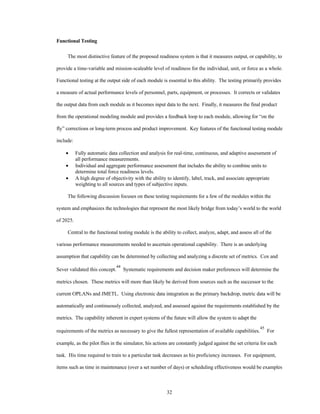
Bosnia, thus increasing readiness. Figure 4-3 points out the critical link in producing truly expert systems is 
29 
the ability to replicate human judgment.30 
Human 
Judgment 
Mechanical Models 
Replicating 
Human Judgment 
Quantities 
In 
Operation 
Expert 
Systems 
Source: Col Richard Szafranski, USAF/AWC, assessor comment on 2025 Team Y JRAPIDS white paper 
(Maxwell AFB, Ala.: Air War College/2025, 25 March 1996). 
Figure 4-4. Expert Systems Model
Modeling of the human mind will be a technical requirement to portray the effect of training programs 
on individual and unit performance. Equipment, displays, and tasks should be designed to give the human 
operators a conceptual picture of how specific operational tasks should be performed.31 Proper human 
modeling and engineering will provide for safe, efficient, and high-quality operations. 
The modeling algorithms must be able to aggregate individual and unit readiness into an accurate 
assessment of force readiness and sustainability. The readiness and sustainability of the military force are 
much more than the sum of each unit’s readiness. A comprehensive readiness assessment includes modeling 
of intangibles such as leadership, morale, human performance, and interaction with other military units and 
capabilities. Improved human modeling also will permit superior screening and selection of military 
30 
personnel for specific tasks.32 
Combat modeling and wargaming do not presently address the impact of readiness and sustainability.33 
Jeffrey Cooper of Science Applications International Corporation (SAIC) expresses a very pessimistic view 
of the current state of combat models because: (1) no models accurately capture the nonlinear nature of 
combat; (2) most models are not sensitive enough to capture the effects of time-dependent factors such as 
temporal compression on combat outcomes; (3) current models do not work well with sparse battlespace 
and distributed forces operating in maneuver; (4) most models have difficulty integrating joint forces; and 
(5) existing models have difficulty capturing C4I information.34 Based on Cooper’s experience with the JCS 
exercise Nimble Vision, he states that 
The current modeling capabilities are at best irrelevant, and at worst, a positive hindrance 
in understanding our real future needs in developing new operational concepts, in 
modifying command structures and organizations, in selecting new systems, and in 
determining future force structure requirements.35 
The current measures of merit (e.g., forward edge of battle area (FEBA) movement and attrition of 
enemy forces or weapons) may not matter in future military operations. In addition, new measures of value 
must incorporate future war concepts such as information dominance.36 An accurate model of readiness 
depicts the ability to accomplish a wide variety of military and political objectives. 
Competence in operational modeling is a requirement for this new ability to measure trade-offs between 
readiness and sustainability or other pillars of military capability. This new concept for the air and space
forces of 2025 hinges on the ability to rapidly, accurately, and thoroughly model the complex dynamics of 
31 
military operations in order to forecast readiness. 
Advanced Training Techniques 
The technological advancements requiring development include distance learning, distributed 
education, and virtual simulation. Education will continue to evolve to the point that students learn through 
“experience” more than through conventional study.37 Formal training and advanced degrees will be 
obtained via distributed virtual-reality (VR) discs and/or via the next generation internet as a form of 
distance learning. Enhancing professional military education is an additional application area for distributed 
training and virtual-reality technologies.38 This capability for easily accessible and just in time learning is 
critical to the success of the redefined operational readiness. 
The air and space forces of 2025 will conduct training via virtual-reality computers to rehearse 
movements to high threat locations.39 The idea behind VR is to deliver a sense of “being there” by giving at 
least the eye what it would have received if it were there and, more importantly, to have the image change 
instantly as “experiences” change their point of view.40 A readily deployable virtual-reality environment is 
the key developing technology for the training requirements demanded by JRAPIDS. 
VR doesn’t require a major breakthrough in software or in our understanding of how the 
brain works. Like the dynamics of the Wright Brothers’ plane—the wings, motor, and 
steering—all the major components of VR already work. Continuing the industry’s growth 
is mostly an issue of delivering graphics at higher resolution for less money. Where we go 
with VR is more important than how we build it, and our lack of understanding about how 
it will affect us and our civilization is the bigger mystery.41 
The simulation network (SimNet) is a good example of current virtual-reality capabilities and military 
applications.42 The system desired for our purposes would be an enhancement of SimNet with increased 
speeds, improved graphics, increased mobility and reduced costs. Training enhancements made possible 
through technological strides in VR will have broad applications, from combat-environment simulation to 
emergency room training; the limits appear bounded only by lack of imaginative application.43
32 
Functional Testing 
The most distinctive feature of the proposed readiness system is that it measures output, or capability, to 
provide a time-variable and mission-scaleable level of readiness for the individual, unit, or force as a whole. 
Functional testing at the output side of each module is essential to this ability. The testing primarily provides 
a measure of actual performance levels of personnel, parts, equipment, or processes. It corrects or validates 
the output data from each module as it becomes input data to the next. Finally, it measures the final product 
from the operational modeling module and provides a feedback loop to each module, allowing for “on the 
fly” corrections or long-term process and product improvement. Key features of the functional testing module 
include: 
·  Fully automatic data collection and analysis for real-time, continuous, and adaptive assessment of 
all performance measurements. 
·  Individual and aggregate performance assessment that includes the ability to combine units to 
determine total force readiness levels. 
·  A high degree of objectivity with the ability to identify, label, track, and associate appropriate 
weighting to all sources and types of subjective inputs. 
The following discussion focuses on these testing requirements for a few of the modules within the 
system and emphasizes the technologies that represent the most likely bridge from today’s world to the world 
of 2025. 
Central to the functional testing module is the ability to collect, analyze, adapt, and assess all of the 
various performance measurements needed to ascertain operational capability. There is an underlying 
assumption that capability can be determined by collecting and analyzing a discrete set of metrics. Cox and 
Sever validated this concept.44 Systematic requirements and decision maker preferences will determine the 
metrics chosen. These metrics will more than likely be derived from sources such as the successor to the 
current OPLANs and JMETL. Using electronic data integration as the primary backdrop, metric data will be 
automatically and continuously collected, analyzed, and assessed against the requirements established by the 
metrics. The capability inherent in expert systems of the future will allow the system to adapt the 
requirements of the metrics as necessary to give the fullest representation of available capabilities.45 For 
example, as the pilot flies in the simulator, his actions are constantly judged against the set criteria for each 
task. His time required to train to a particular task decreases as his proficiency increases. For equipment, 
items such as time in maintenance (over a set number of days) or scheduling effectiveness would be examples
of the desired output of the testing system. All levels of the analysis information for both the individual and 
the aggregate group will be readily accessible to provide the highest degree of feedback thus allowing for 
33 
correction and long term planning. 
The functional testing module will provide a picture of capabilities for individual parts and pieces as 
well as for the whole unit or force. Individual assessment seems straightforward and has already been 
discussed in detail. Unit and force assessment will be more elusive and will call for the ability to assess 
performance levels of all elements during all types of force employment exercises. The system will 
automatically pull data from several sources including various employment exercises (like today’s National 
Training Center or Red Flag), distributed VR simulated exercises, and lower levels of training (such as 
formation flying against a static target on a gunnery range). This data will be integrated with data from 
individual and lower-level assessments and analyzed to provide a time-variable assessment of the unit’s, or 
force’s, task-readiness state for the given element of the process. Once again, this information will be 
available to all levels of authority to provide an adequate feedback loop. 
The ability to test individuals and determine an aggregate measure of the force’s operational readiness 
becomes essential if “demassification” (or flattening of hierarchical organizations) becomes a reality in 
2025. In this environment, the performance of the “organic whole” becomes dependent on the ability of each 
individual unit that makes up this “whole.” 46 Thus, JRAPIDS will be operable in all organizational 
structures of the future. 
Central to JRAPIDS is objectivity. ADC and EDI will enable a very high degree of objectivity since 
human intervention for data collection or assessment will not be required (in its final form). However, some 
elements will remain untestable. Therefore, subjective assessment will probably remain a requirement for 
those few items in 2025, particularly those dealing with the human side of the readiness equation. The 
strength of the system lies in its ability to identify the source of subjective data and provide a true weighting 
by either limiting or increasing its value based on the validity of the input. For example, a unit commander’s 
subjective assessment of a unit’s morale would be weighted higher than a joint force commander’s 
assessment of the same unit since the unit commander has a better feel for his/her unit’s morale.
34 
Overall Technologies 
Technologies requiring development that will impact various segments of this readiness system include 
artificial intelligence and neural networking. Neural networking is critical to all human-computer interfaces 
within the training system. It is also key in determining one’s own personal readiness and level of training. 
As of 1990, a neural network architecture had been developed which displayed promise for emulating human 
behavior and performance.47 
It is based on a multi-layer, feed-forward architecture, but has a more complex 
architecture. The hidden layer has recursive connections that allow the network to emulate 
reaction time. The architecture also includes multiple sets of feed-forward connection 
weights. These different weights are trained and used under different situations to emulate 
different strategies. This makes the overall system a hybrid neural network expert 
system.48 
One application for neural networking is in the virtual-reality world. Advancements in this area will 
enable future warriors to train against intelligent and real-time reactive virtual warriors. The Information 
Sciences Institute has already created “computer agents capable of matching wits with top human jet-fighter 
pilots in simulated dogfights conducted in virtual computer environments.”49 
Artificial intelligence includes the endeavor to build a smart computer. The machines should be 
capable of solving problems it has never encountered before, learning from its mistakes, and surviving in its 
environment.50 The desire is for a computer to think as effectively as a human but much more efficiently. 
“Early AI developers assumed that what was easy for a human to do would also be easy for a computer. But 
it turned out to be the opposite. A computer can do things that are very hard for people, such as complex 
mathematics. But skills a two-year-old has mastered, such as recognizing a face or an object on a plate, has 
been a 40-year struggle for AI systems.”51 The failure of artificial intelligence in the past has been blamed 
on the inability to transfer prerequisite knowledge to the computer. According to Lenat, “Many of the 
prerequisite skills and assumptions have become implicit through millennia of cultural and biological 
evolution and through universal early childhood experiences.” 52 Researchers in Austin, Texas, have made 
strides in this area of teaching the computers. This project is nearing the level “at which it can serve as the 
seed from which a base of shared knowledge can grow.”53
Assessing readiness and developing training to specified readiness levels requires more than AI. It 
requires the ability to enhance the human analytical capability with human intelligence amplification (IA).54 
IA represents a capacity to produce a true expert system. Artificial intelligence and intelligence 
amplification are critical to fully develop the capabilities of JRAPIDS. It will allow JRAPIDS to 
anticipate and plan the needs of the armed forces in 2025 and provide adaptive planning and execution 
35 
direction. 
Notes 
1Richard K. Betts, Military Readiness: Concepts, Choices, Consequences (Washington, D.C.: The 
Brookings Institution, 1995), 41. 
2Ibid., 47. 
3General Accounting Office, National Security and International Affairs Division, Military Readiness: 
DOD Needs to Develop a More Comprehensive Measurement System (Washington, D.C.: Government 
Printing Office, October 1994), 5. 
4This example of continuous and automatic operational performance reporting is considered to be an 
“ideal” characteristic of JRAPIDS. Depending on technological advances, this level of reporting may not be 
available by the year 2025. 
5General Accounting Office, 5. 
6Craig S. Moore, J. A. Stockfish, Mathew S. Goldberg, Suzanne Holyrod, and George G. Hildebrandt, 
Measuring Military Readiness and Sustainability, RAND Report R-3842-DAG ( Santa Monica, Calif.: 
RAND, September 1991), 95. 
7Clark A. Murdock, “Mission-Pull and Long-Range Planning,” Joint Forces Quarterly no. 6 
(Autumn/Winter 1994): 31. 
8Lt Gen Jay W. Kelley, USAF, “Brilliant Warrior” (Unpublished paper, Air University, Maxwell Air 
Force Base, Ala.) February 1996, 1. 
9Richard Lipkin, “A Face By Any Other Name: How Computers Recognize Faces,” Science News, 
April 2, 1994, 145, and concept found in Maj Leonard Jackson et al., “2025 Logistics: Consider it Done.” 
(Unpublished 2025 white paper, Air University, Maxwell AFB, Ala., 1996). 
102025 Concepts, No. 900523, “Chip in the Head,” 2025 Concepts Database, (Maxwell AFB, Ala.: Air 
War College/2025, 1996). The concept of placing a microchip in an individual’s brain raises serious ethical 
issues, but they are outside the scope of this paper. 
11USAF Scientific Advisory Board, New World Vistas: Air and Space Power for the 21st Century, 
summary volume (Washington, D.C.: USAF Scientific Advisory Board, 15 December 1995), 67. 
12Paul Kaminski, “We Really Don’t Know,” Financial World no. 22 (24 October 1995): 56. 
13“New Growth in Automatic Data Collection,” Industry Week no. 16 (19 August 1993): AIM 3. 
14“Manufacturing: Fertile Soil for ADC,” Industry Week no. 16 (19 August 1993): AIM 6. 
152025 Concepts, No. 900335 “Worldwide Military Cellular Phone System,” 2025 Concepts Database, 
(Maxwell AFB, Ala.: Air War College/2025, 1996). 
16Daniel J. Biby, “Who Really Needs EDI?” Industry Week no. 21 (2 November 1992): 45. 
17Ibid., 32. 
18James T. Silva, “Please Debrief Me!” Air Force Journal of Logistics, Spring 1992, 19–20.
19Lance A. Glasser, “Today’s Technology Begets Tomorrow’s Military Readiness,” Internet address: 
http://www.au.af.mil/, ARPA Press Release, 1 February 1995. 
20Arthur B. Morrill, “Lean Logistics: Its Time Has Come!” Air Force Journal of Logistics, Spring- 
Summer 1994, 8–15. Another template that could be used is the battlefield responsive agile integrated 
network (BRAIN), a master logistics processing system espoused in the 2025 white paper by Maj Leonard 
Jackson et al., “2025 Logistics: Consider it Done,” (Unpublished 2025 white paper, Air University, Maxwell 
AFB, Ala., 1996). 
21Moore et al., 95. 
22General Accounting Office, National Security and International Affairs Division, Military Readiness: 
DOD Needs to Develop a More Comprehensive Measurement System (Washington, D.C.: Government 
Printing Office, October 1994), 5. 
23Ibid., 5. 
24Maj Jeff Fink, Headquarters USAF/XOOR, telephone interview with Lt Col David M. Snyder, 4 
36 
April 1996. 
25Fink, interview, and Col James N. Worth, USAF/USACOM, J-32 Readiness Division, telephone 
interview with Lt Col David M. Snyder, 5 April 1996. 
26Col James N. Worth, USAF/USACOM, J-32 Readiness Division, telephone interview with Lt Col 
David M. Snyder, 5 April 1996. 
27JRAMS Briefing, undated, telephone facsimile provided by Col James N. Worth, USAF/USACOM, 
J-32 Readiness Division, 5 April 1996. 
28Worth, interview. 
29Ibid. 
30Col Richard Szafranski, USAF/AWC, assessor comment on 2025 Team Y JRAPIDS white paper 
(Maxwell AFB, Ala.: Air War College/2025, 25 March 1996). 
312025 Concepts, No. 900329, “Human Friendly Design,” 2025 Concepts Database, (Maxwell AFB, 
Ala.: Air War College/2025, 1996). 
322025 Concepts, No. 900645, “Right Pilot,” 2025 Concepts Database (Maxwell AFB, Ala.: Air War 
College/2025, 1996). 
33Moore et al., 66. 
34Jeffrey Cooper, SAIC, electronic mail message received by Lt Col David M. Snyder at 1133 hours, 4 
April 1996. 
35Ibid. 
362025 Concepts, No. 900516, “Generation X Theater Level Combat Simulation,” 2025 Concepts 
Database (Maxwell AFB, Ala.: Air War College/2025, 1996). 
37John L. Petersen, The Road to 2015 (Corte Madera, Calif.: Waite Group Press 1994), 292. 
38Kelley, 10. 
392025 Concepts, No. 900175, “Virtual-reality Trainers;” No. 900516, “Generation X Theater Level 
Combat Simulation;” No. 200004, “Advanced MILSATCOM Capabilities;” and No. 200007, “Rehearsal 
For All Missions, in a Mission Media, without Vehicle Movement,” 2025 Concepts Database (Maxwell 
AFB, Ala.: Air War College/2025, 1996). 
40Nicholas P. Negroponte, Being Digital (New York: Vintage Books, 1995), 117. 
41Ken Pimental and Kevin Teixeira, Virtual-reality: Through the New Looking Glass (New York: 
Intel/Windcrest 1995), 341. 
42Petersen, 292. 
432025 Concepts, No. 200007, “Rehearsal in All Missions, in a Mission Media, Without Vehicle,” No. 
900175, “Virtual-reality Trainers,” No. 900516, “Generation X Theater Level Combat Generation 
Simulation,” No. 900534, “Virtual Force 2025,” No. 900629, “VR for Cultural Competence,” No. 900643,
“On Platform Initial Flying Training,” and No. 900680, “Holographic Meetings,” 2025 Database (Maxwell 
AFB, Ala.: Air War College/2025, 1996). 
44Capt John D. Cox and Capt Hugh G. Severs, USAF, “The Relationship Between Realism in Air 
Force Exercises and Combat Readiness,” thesis (Wright-Patterson AFB, Ohio: Air Force Institute of 
Technology, September 1994). 
45Petersen, 292. 
46Szafranski. 
47Edward L. Fix, Neural Network Based Human Performance Modeling (Wright-Patterson AFB, 
Ohio: Harry G. Armstrong Aerospace Medical Research Laboratory, October 1990), 19. 
48Ibid., 19. 
49Eric Mankin, “Computers Learn to Match Wits with Humans,” Internet address 
http://www.usc.edu/dept/News_Service/ns_staff/mankin.html, 15 March 1996. 
50Eric Dietrich, Thinking Computers and Virtual Persons: Essays on the Intentionality of Machines, 
37 
(New York: Academic Press 1994), 6. 
51Pimental and Teixeira, 341. 
52Douglas B. Lenat, “Artificial Intelligence: A Crucial Storehouse of Common Sense Knowledge Is 
Now Taking Shape,” Scientific American no. 3 (September 1995), 63. 
53Ibid. 
54Szafranski.
Chapter 5 
Investigative Recommendations 
Today’s readiness reporting system is inadequate for the air and space forces of 2025. The DOD 
should pursue the development of a JRAPID-type system capable of assessing and predicting force capability 
needed to meet the demands of all potential future worlds. The possible benefits derived from this system 
include both enhancements in force readiness and sustainability at substantial cost savings. 
We recommend DOD develop JRAPIDS in an integrated, yet incremental, approach. The modular 
system design lends itself to this type of implementation strategy. Within this construct, each module would 
be developed as technology becomes available. The following key steps should be taken to ensure the 
38 
successful system integration. 
·  Pursue development of the key emerging technologies, identified within this paper, enabling the 
likelihood of future JRAPIDS integration. 
·  Adopt a more comprehensive definition of readiness allowing a time-variable and mission-scaleable 
measure of merit for the enabling portion of overall military capability. 
·  Support ongoing joint staff initiatives, such as JARS, which will help build performance-based, 
time-oriented representations of unit readiness. 
·  Support and fund systems which link existing modeling systems, such as JRAMS and JARS, using an 
object-oriented architecture. 
·  Continue the development of comprehensive JMETLs 
·  Specify and verify performance measurements for all facets of individual, unit, and joint force 
readiness.1 
·  Begin identification, coordination, and integration of all relevant readiness and sustainment 
databases, such as individual, unit, and joint force processing; training capacities, condition and 
availability of personnel, equipment, and supplies needed before and after deployments; and key 
sustainability resources.2 
The first steps in the journey to a new readiness system have already begun. The challenges of the next 
decade include identifying the relevant databases, devising the necessary means to access and transform the
data into objective readiness information, and then distributing the information in real time to all levels of 
39 
decision makers. 
JRAPIDS as we envision it will require substantial, sustained funding. Initial funding for JARS is $40 
million.3 We estimate the total cost to fully implement JRAPIDS will exceed 10 times this amount over the 
30-year development/implementation process. Savings from leveraging system components being put in 
place during this time period will be significant. However, the most important savings comes from the 
efficient management of force readiness trade-offs. This will provide the air and space forces of 2025 with 
the most cost-efficient, mission-effective readiness posture ever. 
In conclusion, force management in 2025 requires an integrated system that provides commanders and 
decision makers with a comprehensive way to assess readiness and sustainment while custom designing 
operational training to meet performance levels specified by the given mission. JRAPIDS will provide a 
modular integrated tool to assess individual, unit, and joint force readiness in real time. JRAPIDS will 
allow commanders at all levels to make trade-off decisions between training, sustainment, and readiness. It 
is a total force tool for use by all US armed forces. 
Notes 
1Craig S. Moore, J. A. Stockfish, Mathew S. Goldberg, Suzanne Holyrod, and George G. Hildebrandt, 
Measuring Military Readiness and Sustainability, RAND Report R-3842-DAG ( Santa Monica, Calif.: 
RAND, September 1991), xiii. 
2 Ibid., xiii. 
3Col James N. Worth, USAF/USACOM, J-32 Readiness Division, telephone interview with Lt Col 
David M. Snyder, 5 April 1996.
Acronyms 
ACTD advanced concept technology demonstration 
ADC automatic data collection 
AI artificial intelligence 
AJMRR Automated Joint Monthly Readiness Review 
C-Rating capability rating 
CRAF civil reserve air fleet 
CAS close air support 
C3 command, control and communication 
C4I command, control, communications, computers, and intelligence 
CINC commander in chief 
CFRS computerized fault reporting system 
CONOP concept of operations 
CONPLAN concept plan 
DOC designed operating capability 
DOD Department Of Defense 
EDI electronic data integration 
FEBA forward edge of the battle area 
FW fighter wing 
GCCS global command and control system 
GSORTS global status of resources and training system 
IA intelligence amplification 
JARS joint automated readiness system 
JCS Joint Chiefs Of Staff 
JMET joint minimum essential task 
JMETL joint minimum essential task listing 
JOPES joint operations planning and execution system 
JRAMS joint readiness automated management system 
JRAPIDS joint readiness assessment and planning integrated decision system 
JTF joint task force 
JULLS joint universal lessons learned system 
MRSP mobility readiness spares package 
NCA national command authorities 
OPLAN operation plan 
OPTEMPO operating tempo 
OSD Office of the Secretary of Defense 
PAA primary aircraft assigned 
PERSTEMPO personnel tempo 
PPBS planning, programming, and budgeting system 
QR quick response 
RFID radio frequency identification 
SAB Scientific Advisory Board 
SKE station keeping equipment 
SORTS status of resources and training system 
S-Rating sustainability rating 
TA tactical 
TPFDD time phased force deployment data 
USACOM United States Atlantic Command 
USAF United States Air Force 
40
USSTRATCOM United States Strategic Command 
VR virtual-reality 
41
Bibliography 
Air Force Executive Guidance. December 1995, Update. 
Armed Forces Staff College Publication One, The Joint Staff Officer’s Guide, 1993. Norfolk, Va.: National 
Defense university Armed Forces Staff College. 
Air University, Spacecast 2020: The World of 2020 and Alternate Futures.” Maxwell AFB, Ala.: Air 
42 
University Press, June 1995. 
Betts, Richard K. Military Readiness: Concepts, Choices, Consequences. Washington, D.C.: The 
Brookings Institution, 1994. 
Biby, Daniel J. “Who Really Needs EDI?” Industry Week. Vol. 241, No. 21, 2 November 1992. 
Collins, John M. “Military Readiness: Principles Compared with US Practices.” Congressional Research 
Service, The Library of Congress, 21 January 1994. 
Cox, Capt John D. and Severs, Capt Hugh G., USAF. “The Relationship Between Realism in Air Force 
Exercises and Combat Readiness.” Thesis. Wright-Patterson AFB, Ohio: Air Force Institute of 
Technology, September 1994. 
Department of the Army. Army Focus: Force XXI. Washington, D.C.: Headquarters Department of the 
Army, 15 January 1995. 
Department of Navy. Forward From the Sea. Washington, D.C.: Headquarters United States Navy, 1995. 
Dietrich, Eric. Thinking Computers and Virtual Persons: Essays on the Intentionality of Machines. New 
York: Academic Press, 1994. 
Fix, Edward L. “Neural Network Based Human Performance Modeling.” Wright-Patterson AFB, Ohio: 
Harry G. Armstrong Aerospace Medical Research Laboratory, 1994. 
Glasser, Lance A. “Today’s Technology Begets Tomorrow’s Military Readiness.” ARPA Press Release, 
Internet, 1 February 1994. 
Greenberg, Ira. The Multilevel Secure Real-Time Distributed Operating System Study. New York: 
Griffiss AFB, May 1993. 
James, Maj Glenn E. “Chaos Theory: The Essentials for Military Applications,” Air Command and Staff 
College Theater Air Campaign Coursebook. Maxwell AFB, Ala., 1995. 
Joint Publication 1-02, Department of Defense Dictionary of Military and Associated Terms. 23 March 
1994. 
Kaminski, Paul. “Logistics, We Really Don’t Know,” Financial World. Vol. 164, No. 22, 24 October 1995. 
Kennedy, Paul. Preparing for the Twenty-First Century. New York: Random House, 1993. 
Laskowski, Lt Cmdr Mathew Ludwig. Neural Network Decision Support Systems for the Department of 
Defense: An Exploration. Monterey, Calif.: Navy Post Graduate School, September 1991. 
Lenat, Douglas B. “Artificial Intelligence: A Crucial Storehouse of Common Sense Knowledge Is Now 
Taking Shape,” Scientific American. Vol. 273, No. 3, 3 September 1995. 
Lipkin, Richard. “A Face By Any Other Name: How Computers Recognize Faces,” Science News. Vol. 
145, No. 14, 2 April 1994.
“Manufacturing: Fertile Soil for ADC,” Industry Week. Vol. 242, No. 16, 19 August 1993. 
Mayfield, Lt Col Maurice J., US Army. “Measurement of Combat Effectiveness During Peacetime 
Preparations for War.” Carlisle Barracks, Pa.: US Army War College, 1992. 
Moore, S. Craig; J. A. Stockfish; Mathew S. Goldberg; Suzanne Holyrod; and George G. Hildebrandt. 
“Measuring Military Readiness and Sustainability.” Santa Monica, Calif.: RAND, 1991. 
Morrill, Arthur B. “Lean Logistics: Its Time Has Come!” Air Force Journal of Logistics. Spring–Summer 
43 
1994. 
Mowafy, Lyn. Visualizing Spatial Relationships: Training Fighter Pilots in a Virtual Environment Debrief 
Interface. Brooks AFB, Tex. October 1993. 
Murdock, Clark A. “Mission-Pull and Long-Range Planning,” Joint Forces Quarterly. No. 6, 
Autumn/Winter, 1994. 
Nakamoto, Glen. Multi-Source Integration and Intelligence Analysis. Griffiss AFB, N.Y.: Rome 
Laboratory, April 1995. 
“New Growth in Automatic Data Collection,” Industry Week. Vol. 242, No. 16, 19 August 1994. 
Petersen, John L. The Road to 2015. Corte Madera, Calif.: Waite Group Press, 1994. 
Pimental, Ken and Kevin Teixeira. Virtual-reality: Through the New Looking Glass.” New York: 
Intel/Windcrest, 1995. 
Ross, Philip E. “I Can Read Your Face.” Forbes. Vol. 154, No. 14, 19 December 1994. 
Silva, James T. “Please Debrief Me!” Air Force Journal of Logistics. Spring 1992. 
Turley, Lt Cmdr Leslie S., USN. “The Impact of the Defense Budgeting Process on Operational Readiness.” 
Monterey, Calif.: Navy Post Graduate School, March 1993. 
United States Advanced Research Projects Agency, Report of the Senior Working Group on Military 
Operations Other Than War. Arlington, Va., May 1994. 
United States Naval Air Warfare Center, “Virtual-reality: An Air Combat TE Perspective.” Patuxent 
River, M.D., 1994. 
United States General Accounting Office, National Security and International Affairs Division. “Military 
Readiness: DOD Needs to Develop a More Comprehensive Measurement System.” Washington, D.C., 
October 1994. 
USAF Scientific Advisory Board. New World Vistas: Air and Space Power for the 21st Century, Summary 
Volume. Washington, D.C.: USAF Scientific Advisory Board, 15 December 1995. 
Yates, John D. “IDs Put On a New Face.” Security Management. Vol. 37, No. 9, September 1993.

Vol1ch05

  • 1.
    Joint Readiness Assessmentand Planning Integrated Decision System (JRAPIDS): Combat Readiness and Joint Force Management for 2025 A Research Paper Presented To Air Force 2025 by Lt Col David M. Snyder Maj Penny J. Dieryck Maj Wesley W. Long Maj Thomas G. Philipkosky Lt Cmdr Ronald Reis April 1996
  • 2.
    Disclaimer 2025 isa study designed to comply with a directive from the chief of staff of the Air Force to examine the concepts, capabilities, and technologies the United States will require to remain the dominant air and space force in the future. Presented on 17 June 1996, this report was produced in the Department of Defense school environment of academic freedom and in the interest of advancing concepts related to national defense. The views expressed in this report are those of the authors and do not reflect the official policy or position of the United States Air Force, Department of Defense, or the United States government. This report contains fictional representations of future situations/scenarios. Any similarities to real people or events, other than those specifically cited, are unintentional and are for purposes of illustration only. This publication has been reviewed by security and policy review authorities, is unclassified, and is cleared for public release. ii
  • 3.
    Contents Chapter Page Disclaimer..........................................................................................................................................ii Illustrations........................................................................................................................................ iv Preface ............................................................................................................................................... v Executive Summary ...........................................................................................................................vi 1 Introduction........................................................................................................................................... 1 2 JRAPIDS Capability............................................................................................................................. 9 New View of Readiness............................................................................................................... 9 JRAPIDS Characteristics ........................................................................................................... 11 3 Concept of Operations ........................................................................................................................ 14 4 System Description ............................................................................................................................. 19 JRAPIDS Output......................................................................................................................... 22 Emerging Technologies .............................................................................................................. 25 Near-Instantaneous Personnel Assessment............................................................................ 25 Smart Asset Reporting and Control....................................................................................... 26 Operational Modeling........................................................................................................... 27 Advanced Training Techniques ............................................................................................ 31 Functional Testing................................................................................................................. 32 Overall Technologies ........................................................................................................... 34 5 Investigative Recommendations.......................................................................................................... 38 Acronyms ......................................................................................................................................... 40 Bibliography..................................................................................................................................... 42 iii
  • 4.
    Illustrations Figure Page 1-1. Current Readiness and Sustainability Assessments. ........................................................................... 3 1-2. Joint Readiness System ...................................................................................................................... 5 1-3. Joint Readiness Assessment Planning Integrated Decision System..................................................... 7 3-1. Information Processing System......................................................................................................... 16 4-1. Joint Readiness Assessment Planning Integrated Decision System.................................................. 20 4-2. JRAPIDS Readiness Matrix ............................................................................................................. 23 4-3. Notional JFACC Output ................................................................................................................... 24 4-4. Expert Systems Model...................................................................................................................... 29 iv
  • 5.
    Preface In accomplishingthis research, we received invaluable help from several individuals. We thank our faculty advisors; Col (Dr) Tamzy House of the Air War College and Maj George E. Spenser of Air Command and Staff College for their support throughout the project. Their patience, insight, and advice were invaluable. Not to be forgotten, we thank our families for their continued sacrifices and understanding during v our absences. Lt Col David M. Snyder Maj Penny J. Dieryck Maj Wesley W. Long Maj Thomas G. Philipkosky Lt Cmdr Ronald Reis
  • 6.
    Executive Summary Leaderswho organize, train, equip, command, and fight with the air and space forces of 2025 will require a new view of readiness. The current readiness reporting system provides a static snapshot that essentially reports the ability of a unit to accomplish 100 percent of its wartime tasking. The opportunity exists to create a new system for measuring readiness and sustainment, one that will provide military and civilian leaders a more comprehensive understanding of total force readiness and the potential trade-off vi benefits available. The nature of the world will allow, as well as demand, an integrated system for measuring, adjusting, and forecasting readiness and training that will provide the US military with a comparative advantage. This system, called joint readiness assessment and planning integrated decision system (JRAPIDS), will automatically update the readiness status of individuals, units, and forces (active and reserve) while providing decision makers a comprehensive measure of readiness and sustainment that focuses on measurement at the output side of several interdependent modules. The final product consists of a time-variable, mission-scaleable matrix depicting capability available over time in a given theater for a given task or mission. The matrix provides a framework that allows decision makers overall force management capability. Finally, this paper suggests an incremental implementation plan for future JRAPIDS integration connected to potential technology development.
  • 7.
    Chapter 1 Introduction Military planners have long struggled to develop a system that ensures enough military capability exists, at any given time, to guarantee success across an increasingly broad range of operational missions. Each mission within this operational continuum requires a discrete set of capabilities derived from specific mission tasks. Looking to the future worlds of 2025,1 this concept appears constant. In other words, as long as there exists a military force to accomplish the tasks assigned by the national command authorities (NCA), there exists a discrete and quantifiable amount of desired capability. Moreover, as long as this condition exists, there will be a need to accurately measure, analyze, and predict these desired capabilities against 1 anticipated or actual requirements. Future force capability requirements will likely center around effectiveness, efficiency, and flexibility. Preparation should begin today for possible future funding adjustments. Effectiveness and efficiency ensure the proper amount of funding for the correct amount of forces with the ability needed to cover all expected missions. Flexibility ensures existing forces can respond rapidly to all situations and conduct missions across the entire spectrum of conflict. In characterizing the potential nature of future warfare, Lance Glasser, director of the Advanced Research Projects Agency, defined the importance of readiness to the future capability of US armed forces: These will be fight-anywhere, fight-anytime wars, where “anywhere” and “anytime” will largely be defined by the enemy. The battlespace will be characterized by sudden and awesome lethality. The outcome will be determined in large part by the readiness of US forces to engage the enemy.2 Therefore, in the year 2025, the ability to accurately assess all aspects of the force’s operational capability will be critical. This assessment will necessarily include the ability to accurately predict changes
  • 8.
    to the force’soverall capability (when, what, and how much) and allow informed decisions regarding trade-offs among all competing priorities. The question then becomes, how will military capability be defined in 2 the future? The Department of Defense currently defines military capability as consisting of four primary components: 3 · Force Structure - numbers and composition of units and forces. · Modernization - technical sophistication of the force as a whole. · Readiness - ability of forces, units, weapon systems, or equipment to deliver their designed outputs. This includes the ability to deploy and employ without unacceptable delay. · Sustainability - ability to maintain the necessary level and duration of operational activity to achieve military objectives.4 Within this construct, force structure and modernization establish the maximum force potential while readiness and sustainability enable (or constrain) the forces’ ability to achieve their potential quickly (readiness) and over the long term (sustainment).5 Several studies indicate that these basic notions will remain valid for the forces of 2025.6 Therefore, gauging the overall capability of the future force will require assessment in each of these four areas. However, a logical breakpoint exists between assessing the factors of maximum potential (force structure and modernization) and assessing the primary enabling factors (readiness and sustainment). This paper focuses on the latter of these areas, readiness and sustainment. The current readiness and sustainment assessment method focuses on inputs and/or the availability of specific reserves or conditions from two separate and distinct sources, the service and the combatant command. Figure 1-1 depicts the current system. As shown, the status of resources and training system (SORTS) reflects current levels of military readiness. SORTS generalizes a unit’s military readiness based on the lowest rating in five areas. Most commanders view the SORTS C-Rating (its measure of current readiness) as a report card of whether the unit can accomplish its wartime mission at its designed operating capability (DOC). Using this method, mission tasks (and the training requirements they generate) are essentially static and commanders have little ability to redirect resources in the short term for contingency operations. For sustainment, stockpiled assets are given an S-Rating. In this system the combatant commander in chief (CINC) prepares a periodic report that includes an objective tally of the amount of the theater war reserves available (pre-positioned and out of theater) based on the operation plan (OPLAN) requirements and a subjective overall S-Rating for his area of responsibility.7 The only assessment of output
  • 9.
    (desired capability) inboth methods relies too much on the subjective judgment of commanders and decision makers based on inputs they receive. Limited data available, private agendas,8 faulty interpretations, and other human frailties ensure an assessment fraught with potential inconsistencies and inaccuracies thereby potentially leading to ineffective and wasteful force management.9 Furthermore, because of the disconnect at lower levels, C-Rating and S-Rating do little to convey the true capabilities of the military at the unit, joint 3 force, and national level. Theate r S-Rating Personnel Supplies Equipment On Hand Condit ion Unit Input Readiness Stockpile S-Rating Stockpile R eporting Sustainment Unit Commanders’ Subjective Judgm ent Combatant Commanders Subjective Judgm ent Chairm an’s (CJCS) Readiness System Unit’s O verall C-Rating Resources C -Rating Ammo Fuel Spares Clo thing Food Source: Compiled from the ideas of the referenced sources: Moore, et al., vii. Figure 1-1. Current Readiness and Sustainability Assessments.
  • 10.
    An upgrade toSORTS was recently implemented and renamed global status of resources and training system (GSORTS).10 This system communicates SORTS data over the Global Command and Control System (GCCS). These ongoing improvements to the current methods as well as to the next generation of readiness and sustainment assessment methods, such as in Joint Vision 2010, 4 11 still fall short of providing an accurate and predictive measure of joint force military capabilities at all levels.12 As shown in Figure 1-2, military readiness assessment still relies on stovepipe reporting as well as considerable subjective input. Stovepiping in this context refers to the lack of information cross-flow between the two systems. This lack of integration limits the quality of decisions regarding trade-offs between competing priorities. These systems also rely heavily on subjective input. Subjective evaluation of the line commander is an important element of a useful reporting system, but the manipulation of subjective readiness evaluations for political or other noncombat purposes must be minimized. Gen Michael Carns (USAF, retired) points out that the current readiness system is utilized by commanders, staff officers, and politicians to fight resource allocation battles.13 Dr Richard Kohn also highlights these complex ethical issues, and corresponding implications for civil-military relationships. He believes today’s military leaders and civilian decision makers are faced with a unique set of sociocultural problems when attempting to measure and assess military readiness objectively.14 Richard Betts devotes an entire chapter to similar issues in his 1995 book, Military Readiness: Concepts, Choices and Consequences.15 He notes the hazards associated with proposing new systems for measuring readiness. It should not be surprising that administration and services always had an excuse when they were criticized for allowing readiness to decline, or that critics adopted the same excuses when they moved into positions of authority themselves. The typical techniques for deflecting criticism were to deny the validity of criteria cited by critics, to conflate conflicting criteria, or to change the criteria by revising the official rating system.16 However, since this paper concerns the development of a system to measure readiness in 2025, these political and social implications are outside its focus.
  • 11.
    &-&69LHZRI5HDGLQHVV -6 5HDGWR)LJKW 5 6HUYLFHV 8QLW5HDGLQHVV 3HRSOH (TXLSPHQW 7UDLQLQJ ,1V -RLQW5HDGLQHVV $ELOLWWRLQWHJUDWHDQG VQFKURQL]HIRUFHV 7RH[HFXWHDVVLJQHGPLVVLRQV 7UDGLWLRQDO5HDGLQHVV 7KH-RLQW3HUVSHFWLYH 6HQLRU5HDGLQHVV2YHUVLJKWRXQFLO Source: Compiled from data presented by Gen John M. Shalikashvili to the House Committee on National Security, 25 January 1995. Figure 1-2. Joint Readiness System Although the variables affecting the possible alternate futures of 2025 are numerous, several constants exist that affect overall military capability. First, achieving the most military capability at the lowest overall cost will continue to be an important goal of any defense planning system.17 The cost issue is a critical point since military combat capability is called upon only intermittently and paying for high levels of continued but unused readiness is expensive.18 Second, historically, the American public has displayed a low tolerance for large standing military forces, especially when the perceived threat is low.19 Third, all of the factors currently affecting readiness and sustainability will continue to affect military capabilities in the future. Finally, as American defense policy changes, choices affecting the capability of military forces will be necessary to meet the variable requirements of the ever-changing security environment.
  • 12.
    The opportunity existsto develop a new system for assessing and predicting the capability of air and space forces of 2025 that will fulfill the demands of all potential future worlds. Key emerging technologies allow for the development of a system that integrates readiness, sustainment, and operational training not only to measure objectively, but also to forecast, as well as adjust, military capabilities at the unit, joint force, and national levels. This paper proposes the development of the joint readiness assessment and planning integrated decision system, shown in Figure 1-3, as a framework for integrating these emerging technologies into a holistic method for determining future force capabilities. The key to JRAPIDS is that it focuses on the output, or desired capability, of the total force versus merely tabulating the condition and availability of resources. Moreover, it provides a seamless, time-variable, and mission-scaleable measure of merit for the enabling portion of overall military capability (readiness and sustainment) applicable to all forces, including both the active and reserve component. The potential political battles over the validity of any readiness criteria are well understood; however, the key advantages of the JRAPIDS concept, “verisimilitude and verifiability,”20 far outweigh these potential 6 concerns. This paper develops the required capabilities of JRAPIDS and defines the key components and concept of operations. It also identifies key future technological concepts and validates them for system inclusion. Finally, it presents a road map for JRAPIDS integration.
  • 13.
    7 OPERATIONAL READINESS STRUCTURAL READINESS UNIT JTF CINC RESPONSIVENESS TRAINING SUSTAINABILITY UNIT GROUP SERVICE JOINT PLANNING INPUTS INPUTS TIME VARIABLE OPERATIONAL CAPABILITY BASIC STRUCTURAL CAPABILITY SERVICE PROGRAMMING JTF-Joint Task Force CINC-Commander in Chief INPUTS Figure 1-3. Joint Readiness Assessment Planning Integrated Decision System Before discussing actual capabilities, it is important to note three key assumptions made during the journey to the future to determine JRAPIDS requirements. First, air and space forces of the future will require sufficient capabilities to operate across the entire spectrum of conflict. Second, computing power in 2025 will become virtually unlimited.21 The ability to perform data computation, transmission, or storage will not be constrained. Finally, efficiency, effectiveness, and flexibility will remain primary drivers for force management in any conceivable future environment.22 Notes 1 Col Joseph A. Engelbrecht Jr., PhD, et al, “Alternate Futures for 2025: Security Planning to Avoid Surprise” (unpublished white paper, Air War College, Air University, Maxwell AFB, Ala., 1996). 2Lance A. Glasser, “Today’s Technology Begets Tomorrow’s Military Readiness,” Internet address http://www.au.af.mil, ARPA Press Release, 1 February 1995.
  • 14.
    3Craig S. Moore,J. A. Stockfish, Mathew S. Goldberg, Suzanne Holyrod, and George G. Hildebrandt, Measuring Military Readiness and Sustainability, RAND Report R-3842-DAG, ( Santa Monica, Calif.: RAND, September 1991), 2. 4Armed Forces Staff College Publication One, The Joint Staff Officer’s Guide, 1993 (Norfolk, Va: National Defense University, Armed Forces Staff College) 6–11. 5Moore et al., 4. 6Ideas generated from the following publications: Air University, SPACECAST 2020: The World of 2020 and Alternate Futures” (Maxwell AFB, Ala.: Air University Press, June 1995), 10; Forward From the Sea (Washington, D.C.: Department of the Navy, January 1995), 9. Army Focus: Force XXI (Washington, D.C.: Department of the Army, January 15, 1995), 10. 7Ibid., 18. 8Gen Michael P. C. Carns, USAF, Retired, advisor comment on 2025 Team Y JRAPIDS white paper (Maxwell AFB, Ala.: Air War College/2025, 25 March 1996). 9Richard K. Betts, Military Readiness: Concepts, Choices, Consequences (Washington, D.C.: The 8 Brookings Institution, 1995), 43. 10Maj Jeff Fink, Headquarters USAF/XOOR, telephone interview with Lt Col David M. Snyder, 4 April 1996; and Col James N. Worth, USAF/USACOM, J-32 Readiness Division, telephone interview with Lt Col Snyder, 5 April 1996. 11Joint Chiefs of Staff white paper, “Joint Vision 2010 America’s Capability: Shaping the Future,” undated, telephone facsimile provided by Headquarters USAF/XOXS, 29 January 1996. 12Lt Col Charles R. Rash, US Army, “Joint Readiness Evaluated,” US Army War College thesis (Carlisle Barracks, Pa.), April 1995, 3. 13Carns. 14Dr. Richard Kohn, advisor comment on 2025 Team Y JRAPIDS white paper (Maxwell AFB, Ala.: Air War College/2025, 25 March 1996). 15Betts, 115–43. 16Ibid., 132. 17Lt Cmdr Leslie S. Turley, US Navy, “The Impact of the Defense Budgeting Process on Operational Readiness” (Monterey, Calif.: Naval Post-Graduate School, March 1993), 16. 18Betts, 43. 19Ibid., 24. 20Col Richard Szafranski, USAF/AWC, assessor comment on 2025 Team Y JRAPIDS white paper (Maxwell AFB, Ala.: Air War College/2025, 25 March 1996). 21Scientists present differing views on whether this assumption is valid for the world of 2025. We agree with several AF 2025 lecturers and Nicholas Negroponte, Being Digital (New York: Knopf, 1995). They stated that computational, storage, and transmission capability will not be a limiting factor in 2025. JRAPIDS requires a quantum leap in this capability, but it does not require an unlimited capability. 22Lt Gen Jay W. Kelley, USAF, “Brilliant Warrior” (Unpublished paper, Air University, Maxwell AFB, Ala., February 1996), 4.
  • 15.
    Chapter 2 JRAPIDSCapability New View of Readiness Before discussing JRAPIDS requirements, it is essential to fully define readiness for the force of 2025. Describing this new view, Richard Betts divides readiness into two categories, structural and operational. 1 Structural readiness is the foundation or basic level of capability that is enhanced by investment. Operational readiness is a consumable level of military capability that focuses on specific, short-term aspects of unit and aggregate status, equipment, and training levels.2 JRAPIDS integration will require adopting this comprehensive view of readiness as well as taking into account the required training needed to achieve the 9 optimum mix of readiness. This view is essential to the comprehensive picture of overall capabilities that will be provided by JRAPIDS. Readiness is not a binary “yes or no” issue; instead, it is a matter of how much, what kind, how soon, and at what cost, including the corresponding opportunity costs. In other words, it should incorporate “fuzzy logic.”3 As Betts accurately points out, The main question for policy and strategy should not be how to achieve readiness in any single sense. Rather, it is how to integrate or balance the answers to the following questions over a long period of time.”4: · Readiness for when? How long to “ready”? · Readiness for what? “Ready” to perform what tasks? · Readiness for where? “Ready” for what theater or combat environment?5
  • 16.
    The critical dimensionof readiness, sustainment and training is time. In theory, future military forces can prepare for any type of contingency if they are provided enough time and resources. Realistically, resource and training time will be finite. The measurement of the amount of training time required to prepare for a particular task is an appropriate 2025 element of readiness. Thinking about and measuring readiness in the time dimension allows for relevant comparisons between levels of readiness and an understanding of the trade-off equation. The trade-off equation seeks an appropriate balance between immediately available capability and capability available at a later time thus allowing readiness preparations for other missions or tasks. Finally, the time aspect of readiness is most relevant if it deals with specific military tasks or 10 missions. This leads to the second dimension of a future view of readiness, specifying the task for which an individual or unit should be prepared. Training to do the right task is essential; it minimizes wasted effort, expenses, and potential capability deterioration. The final component of readiness is training to do the proper task in the right place. This generally means in a particular environment, geographic theater, or specific military medium (e.g., space, low altitude, permissive air environment, etc.). Operational readiness of an individual, weapon system, unit, or force (aggregation of several units) should be thought of as a matrix where preparedness to accomplish specific military tasks in specific environments is measured in units of time needed to prepare for the task. For the air and space forces of 2025, optimal readiness need not always mean being immediately ready (preparation or training time equals zero) for 100 percent of the required tasks in all possible environments. A constant state of maximum readiness is costly and highly perishable. The future view of readiness must include (1) a comprehensive understanding of the type of training necessary; (2) the time available to prepare a unit for specific tasks; and (3) a corresponding understanding of key trade-offs and missed opportunities. This new view of readiness must focus on the outputs of readiness, sustainment, and training in an integrated manner, rather than the unmeshed inputs of each (as the current system does). The key to future air and space force readiness lies in understanding the readiness trade-offs available. As previously discussed, trade-offs, in this context, occur when the decision makers decide on the correct level and type of training that yields the optimal readiness for specific operational tasks. Within the unit, the trade-off decision must be
  • 17.
    made between allof the tasks that are constantly competing for the available readiness, sustainment, and training resources. At the joint force level, the trade-off decision must be made between units. The proper readiness mix is essential. For example, a notional unit that had a high level of readiness (zero or minimal training time needed) in nearly all assigned OPLAN tasks may represent an inappropriate trade-off among resources if the threat is low. Finally, the readiness trade-off decision may also require a balance of investment among the various components of military combat capability as well as within each component. JRAPIDS Characteristics From the preceding discussion it becomes apparent that the effective management of the joint air and space forces of 2025 demands an output-focused, integrated systems approach to readiness assessment to obtain the optimal readiness combination of when, what, and where. As shown in Figure 1-3, JRAPIDS will assess, judge, and predict the impact of all factors in the following areas: · Responsiveness - the promptness in preparing for the task at hand. · Operational training - flexible training in the field that allows for preparing for new tasks in new 11 environments.6 · Sustainability - required endurance in performing a particular military task. JRAPIDS provides a new approach to readiness and sustainability measurement with a new set of components and processes. It is necessary to first determine the unconstrained requirements for the proposed system and then provide an assessment of the potential risks associated with developing the needed technology. The RAND study, Measuring Military Readiness and Sustainability, is the primary source for many of the following characteristics of an “ideal” readiness and sustainment system:7 · Measurement of Output - JRAPIDS must measure unit and force capability as a function of time versus merely computing assets on hand. It will answer the question, “readiness and sustainability for what?” JRAPIDS must be capable of assessing actual performance levels of all resources within the unit and it must provide an aggregate, scaleable performance indicator for the unit as whole. It must also be able to provide an overall performance potential assessment for joint and national level forces. · Practical - JRAPIDS must be easy to use and inexpensive to operate. Said another way, “The job of measurement should stay extremely small compared with the jobs of providing readiness and sustainability.”8 Moreover, the information provided by JRAPIDS must be easily understood and easily interpreted by all users and decision makers, throughout the chain of command. · Objective - JRAPIDS must be objective and verifiable to ensure accurate measurements. A few subjective judgments will still be required for personal insights such as morale levels or any other judgment requiring a high degree of human intuition. The key is that these should be limited in order to lessen the impact of incorrect assessment. Furthermore, system protocols should prevent
  • 18.
    penalties for lower-levelcommanders whose readiness levels are low for reasons beyond their control. This also imbues an attitude of truthful assessment. · Robust - JRAPIDS must be capable of assessing readiness and sustainability across a wide range of contingency operations and real-world circumstances thus allowing accurate measurements in the face of unforeseen events. It must also assess readiness levels at all times, whether the unit is deployed or not. This implies the requirement for real-time or near-real-time update capability.9 · Useful - JRAPIDS must provide useful feedback to the lowest level of data providers. Units must be able to determine if actions taken to correct shortfalls have positively affected readiness rates. Additionally, the system must tailor the output to each level of command. For instance, the information required by a joint force commander is different from that required by a service component commander. One caution is in order here. Due to the complex nature of this system and the existence of this feedback loop, decision makers must ensure the effects of chaos do not impede system operation.10 · Comparable - JRAPIDS must be capable of providing objective comparisons of readiness and sustainment levels from one year to the next. This allows decision makers to base effective trade-off decisions on factual historical data rather than on subjective assumptions. · Comprehensive - JRAPIDS must be able to assess peacetime activity rates of resources and relate them to military operational ability. The intent is to accurately predict the resource implications during the transition from peace to war. This also allows the continuous monitoring of the effects of peacetime operating tempo (OPTEMPO) and personnel tempo (PERSTEMPO) on operational readiness and combat sustainability. · Secure - As a global information system possessing critical data on US military capabilities, JRAPIDS will be a prime target in any future information war.11 Therefore, system security will be an essential requirement. · Trade-off Evaluation - JRAPIDS must allow trade-off comparisons between resource categories as well as between the categories of military capability. The intent is to provide a system that can identify when too much emphasis in one area adversely impacts other areas of military capability. A key feature of JRAPIDS will be the assessment of the impact to the overall force’s capability as units are deployed, in transit, or redeployed. These “ideal” characteristics provide the objective requirements for the future system. We understand that various constraints, such as funding, may limit their practical application. Nonetheless, we have used the unconstrained characteristics to guide the development of the JRAPIDS concept of operations. Notes 1Richard K. Betts, Military Readiness: Concepts, Choices, Consequences (Washington, D.C.: The 12 Brookings Institution, 1995), 35–84. 2Ibid., 40–43. 3Lewis J. Perelman, School’s Out (New York: Avon Books, 1995), 33. 4Betts, 32–33. 5Ibid., 33. 6It is important to note that training discussed in this paper is operationally oriented towards a particular mission or task and is distinctly different than the general education and training espoused by Maj Laura DiSilverio et al, in “Brilliant Force” (unpublished 2025 white paper, Air University, Maxwell AFB, Ala., 1996).
  • 19.
    7Craig S. Moore,J. A. Stockfish, Mathew S. Goldberg, Suzanne Holyrod, and George G. Hildebrandt, Measuring Military Readiness and Sustainability, RAND Report R-3824-DAG (Santa Monica, Calif.: RAND, September 1991), 23. 8Ibid., 23. 9In this context, near-real-time refers to rapid updates and assimilation of data into useful information. It is understood that this will never occur instantaneously due to physical limitations. However, the term is used to add emphasis to the need for speed. 10Maj Glenn E. James, “Chaos Theory: The Essentials for Military Applications,” in Air Command and Staff College Theater Air Campaign Coursebook (Maxwell AFB, Ala.: Air Command and Staff College, 1995), 33. 11James W. McLendon, “Information Warfare: Impacts and Concerns,” Battlefield of the Future: 21st Century Warfare Issues (Maxwell AFB, Ala.: Air University Press, September 1995), 189. 13
  • 20.
    Chapter 3 Conceptof Operations The JRAPIDS concept of operation promulgates ideas for improving the measurement of readiness, training, and sustainability throughout the total force. The feasibility of developing and operating such an assessment framework is encouraging due to the fact that several of its elements already exist today—for instance, the new GSORTS which transmits readiness data through the global command and control system and all logistics feasibility models already in use. Moreover, the possibility exists of an incremental implementation process into the current DOD readiness reporting infrastructure. For decision makers, JRAPIDS would become the foundation of their military assessment tools by providing a real-time cost-versus-benefits analysis. At the strategic and operational level, the system would incorporate a revised readiness, training, maintenance, logistic, and personnel reporting process that would 14 enable the user to: · Access real-time information about fielded forces or unit-level strengths and weaknesses while interfacing with the joint operation planning and execution system or its replacement system, in order to enhance potential war-gaming scenarios. · Forecast training and readiness timetables tailored to specific mission types in specific combat environments or theaters as defined in various sources such as the CINCs’ operation plan (OPLAN) or the joint universal lessons learned system (JULLS). · Identify inventory trends and potential shortfalls while showing percentages of nonmission-capable equipment due to supply and/or maintenance problems. · Predict the effects that downsizing or “correct” sizing of material or personnel or changing funding would have on force structure and overall future readiness; also provide this information to the future equivalent of the planning, programming, and budgeting system (PPBS) and JOPES to shape future force readiness. Using JRAPIDS, units actually deployed or preparing for deployment would maintain a very high degree of readiness in their tasked missions. Units (active and reserve component) not actively involved in deployment preparation, or those units with additional time available (due to OPLAN or other mission
  • 21.
    constraints) would becomemore cost effective by maintaining a minimum baseline level of readiness until specific requirements arise. Once these units were needed, specific mission requirements would drive a tailored operational training program. Sources for specific mission requirements would be the NCA, OPLANs, contingency plans (CONPLANs), functional plans, JULLS, or any other pertinent mission-specific database. The actual tasks and requisite performance specification would come from the future equivalent to the joint minimum essential task listing (JMETL).1 All units would be capable of: · Prioritizing unit level and individual training requirements with ongoing maintenance and personnel status reports in order to minimize training time for specific operational commitments. · Adapting mission or task training programs to accommodate the most current operational “lessons learned.” For example, early deployers could provide information useful to late deployers through the future equivalent of JULLS. · Maintaining optimal readiness of ongoing immediate missions and tasks such as space surveillance, 15 missile warning, and combat alert. As our military forces ebb and flow into the twenty-first century, the trade-offs, most notably capabilities versus cost, will continue to play a major role in our overall force composition.2 All military services will strive to deliver more “bang for the buck.” Due to its focus on the output side and its total integration of operational training, readiness, and sustainment, a fully implemented JRAPIDS would provide such direct benefits as increased readiness and training connectivity throughout all areas of the military. Also, decision makers would have the ability to see directly the effect of different funding patterns on force capabilities, readiness, and sustainability.
  • 22.
    Operational Modeling 16 Output Asset/Stockpile Inputs Reporting Mobilization Inputs Analysis Deployment/ Distribution Analysis Inputs Functional Checks and Tests Output Output Readiness Inputs Matrix Source: Craig S. Moore, J. A. Stockfish, Mathew S. Goldberg, Suzanne Holyrod, and George G. Hildebrandt, Measuring Military Readiness and Sustainability, RAND Report R-3842-DAG (Santa Monica, Calif.: RAND, September 1991), 98. Figure 3-1. Information Processing System The foundation of an integrated readiness, training, and sustainability assessment framework begins by formulating and then integrating all eclectic aspects of our current military infrastructure. This requires the seamless integration of modular systems through a highly computerized system linked by a world-wide net with real-time, or near-real-time information access for all users. Borrowing from the concept developed by Moore et al., JRAPIDS would include the following modular systems: asset and stockpile reports, mobilization analysis, deployment and distribution analysis, operational modeling, and functional checks and tests. 3 Figure 3-1 depicts each of these modules and their relationship within JRAPIDS.4 · Asset and Stockpile Reports - This module collects data on unit assets, supply stockpiles, reserve manpower, and all unit training requirements. It then transforms that data into useful information, reporting the condition of all of the unit’s needed resources and unit train-up times for the specific task or mission.5 As shown, this output provides additional input to the next module.
  • 23.
    · MobilizationAnalysis - This module takes data collected on force mobilization (induction and training capacities) and industrial mobilization (industrial production and service capacities) and ties these to the timing objectives and priorities established for the mission. This information, along with the input from the previous module, is used to establish the actual availability of units, manpower, and materiel that could become available over time and the changing levels of unit capability attainable (the latter mainly through “training up”).6 · Deployment and Distribution Analysis - This module takes into account storage, handling, and movement of all things necessary to accomplish the tasks assigned to the units, or joint forces. It takes the information from the previous module and translates it into profiles of the numbers of combat units, support units, and materiel that could be available at appropriate locations in combat theaters.7 It also includes the effects of increasing lift and handling capacities at various civil reserve air fleet (CRAF) activation levels to allow the maximum flexibility in mobilization planning. · Operational Modeling - This module converts the profiles from the previous module into the time-variable, mission-scaleable performance levels available at the desired operating location.8 Assumptions, estimates, and empirical data gathered on the performance requirements for the specific mission would form the input to the various models. · Functional Checks and Tests - This module would provide a significant feedback loop between each module as well as provide a way to estimate or verify all of the inputs, all of the outputs, and all of the time-capability relationships used throughout the system.9 · Feedback - Although not a module per se, feedback at all levels of the system, as well as between components, is absolutely critical. The effects of such feedback will provide the ability for “on-the-fly” corrections to ongoing training or readiness preparations. The successful integration of each of these interdependent modules requires the further development of several technologies. It is important to note these emerging technologies, shown below grouped into six functional categories, were chosen because they provide the highest degree of leverage against the previously 17 discussed JRAPIDS requirements. · Near Instantaneous Personnel Assessment - Technologies that allow near-real-time, detailed assessment of personnel-related readiness data. These technologies stress the human side of the readiness equation and are important to all modules within the proposed system.10 · Smart Asset Reporting and Control - Technologies that allow real-time, detailed accounting and assessment of equipment-related readiness data. These technologies stress the machine side of the readiness equation and are also important to all modules within the proposed system.11 · Operational Modeling - Varying degrees of modeling exist throughout the system. The key technologies needed in 2025 include real-time human modeling and aggregate modeling for predicting unit level performance. This is the most critical module in the system and possibly the most risky for successful technology integration. · Advanced Training Techniques - Operational training possesses a discrete value in the readiness equation; therefore, better, faster training means higher readiness. The key technologies needed for this system include all forms of virtual training in a distributed and simulated environment.12 · Functional Testing - The output nature of the proposed system demands performance-based functional testing at the output side of all modules within the system. The needed technology must assess individual and aggregate unit performance in a real-time, objective, and nonintrusive manner.13 · Overall - Several technologies are needed to provide the connectivity, information security, and overall integration of the system. These technologies are key to providing a seamless system as viewed by all users.14
  • 24.
    The key tosuccessful JRAPIDS integration lies in each of these enabling technologies. Therefore, these technologies are discussed in detail following a description of JRAPIDS in the next chapter. Notes 1John R. Ballard and Steve C. Sifers, “JMETL: The Key to Joint Proficiency,” Joint Force Quarterly 18 no. 9 (Autumn 1995), 95. 2USAF Scientific Advisory Board, New World Vistas: Air and Space Power for the 21st Century, summary volume (Washington, D.C.: USAF Scientific Advisory Board, 15 December 1995), 5. 3Craig S. Moore, J.A. Stockfish, Mathew S. Goldberg, Suzanne Holyrod, and George G. Hildebrandt, Measuring Military Readiness and Sustainability, RAND Report R-3842-DAG (Santa Monica, Calif.: RAND, September 1991), 96. 4Ibid., 97. 5Ibid., 87 6Ibid., 89 7Ibid., 92 8Ibid., 94 9Ibid., 95 102025 Concepts, No. 900175, “Virtual-reality Trainers,” No. 900516, “Generation X Theater Level Combat Simulation;” No. 200004, “Advanced MILSATCOM Capabilities,” No. 20007, “Rehearsal For All Missions, in a Mission Media, without Vehicle Movement,” No. 900454, “On Line Satellite Link for Medical Records for Deployed Personnel,” No. 900523, “Chip in the Head,” No. 900559, “Thumb Implanted Individual Identification Codes,” 2025 Concepts Database (Maxwell AFB, Ala.: Air War College/2025, 1996). 112025 Concepts, No. 200019, “Smart Packages,” No. 900323, “Bar Code Readers in Space;” No. 900335, “Worldwide Military Cellular Phone System,” Concept No. 900367, “Enhanced Defense Readiness by Logistics Integration,” No. 900413, “Wireless Local Area Network,” No. 900609, “Smart Tools,” No. 900611, “Smart Parts” No. 900672, “Integrated Logistical Battlespace Sustainment,” 2025 Concepts Database (Maxwell AFB, Ala.: Air War College/2025, 1996). 122025 Concepts, No. 200007, “Rehearsal in All Missions, in a Mission Media, Without Vehicle,” No. 900175, “Virtual-reality Trainers,” No. 900516, “Generation X Theater Level Combat Generation Simulation,” No. 900534, “Virtual Force 2025,” No. 900629, “VR for Cultural Competence,” No. 900643, “On Platform Initial Flying Training,” and No. 900680, “Holographic Meetings,” 2025 Database (Maxwell AFB, Ala., Air War College/2025, 1996). 132025 Concepts, No. 900334, “De-Massification of Response,” No. 900484, “Functional Reorganization,” No. 900700 “The Flat Air Force,” 2025 Concepts Database (Maxwell AFB, Ala.: Air War College/2025, 1996). 142025 Concepts, No. 200004, “Advanced MILSATCOM Capabilities,” No. 900131, “Security,” No. 900138 “Secure Communications on Demand,” No. 900182, “Neuro-Network Computer Interface,” No. 900183, “Computer Security,” No. 900184, “Automated Security,” No. 900290, “Artificial Intelligence,” No. 900329, “Human Friendly Design,” No. 900561, “Data Bus Information Pull Computers,” No. 900669, “Database Sharing,” 2025 Concepts Database (Maxwell AFB, Ala.: Air War College/2025, 1996).
  • 25.
    Chapter 4 SystemDescription By the year 2025, the joint readiness assessment and planning integrated decision system will provide a time-variable, mission-scaleable, cost-effective means of managing US forces’ overall readiness and sustainment levels. Today, due to timing constraints and system inadequacies, a notional F-16 squadron trained to conduct close-air-support (CAS) operations may find itself operationally deployed to conduct air-to- air operations. In the future, JRAPIDS will provide the CINC with near-real-time information on each unit’s readiness state thereby minimizing such a problem. JRAPIDS also will provide commanders at all levels with the most efficient and cost-effective means of maintaining a baseline level of proficiency (i.e., structural readiness) pending specific mission identification. In theory, JRAPIDS will be capable of identifying the time needed to achieve a particular readiness level for a given task. Unit commanders could then maintain some individuals or equipment at lower states of readiness based on available preparation time. Once the specific tasks are established, JRAPIDS would then identify any type of performance weakness and provide a tailored training or 19 preparation program. Military forces contain two stages of readiness, structural and operational. The foundation of JRAPIDS exploits this premise. Structural readiness concerns mass; it is about how soon a requirement-sized force can be available.1 It also refers to (1) the number of personnel under arms with at least a basic level of training; (2) the number of organized formations, including the quantity and quality of their weapons; and (3) the distribution of combat assets among land, sea, air, and space power. Structural readiness establishes the limits of organized capability in existing forces and potential capabilities in nonexisting forces. This begins
  • 26.
    with procurement andincludes the amount of time it takes to produce a new asset, system, basic level of 20 training, or unit from scratch. Operational readiness is different. According to Betts, “Operational readiness is about efficiency and is measured in terms of how soon an existing unit can reach peak capability to fight in combat,”2 or in our case, perform an operational task. It indicates how proficiently a unit may perform a given task, but not how successful it may be. In 2025, operational readiness must become more objective and comprehensive. JRAPIDS will build on the current assessments of operational readiness by including operation tempo and personnel tempo effects, mobility limits, exercise schedules, command control communications computer and intelligence (C4I), morale states, contingency types, and contingency duration.3 OPERATIONAL READINESS STRUCTURAL READINESS UNIT JTF CINC RESPONSIVENESS TRAINING SUSTAINABILITY UNIT GROUP SERVICE JOPES INPUTS INPUTS TIME VARIABLE OPERATIONAL CAPABILITY BASIC STRUCTURAL CAPABILITY PPBS INPUTS Figure 4-1. Joint Readiness Assessment Planning Integrated Decision System Figure 4-1 depicts the relationships among inputs, feedback loops, and potential users that would constitute JRAPIDS. Inputs vary, but would consist of unit asset reporting and theater stockpile reporting. In
  • 27.
    principle, these reportswould be nearly the same as today. JRAPIDS would continue to use this information to guide resource allocations within the services. The JRAPIDS integrated framework would continue to use the raw counts of specified resources in different locations and conditions. Other inputs would be more performance oriented. For example, in the system’s final configuration, an F-16 pilot could fly a simulated CAS mission over Bosnia. During the event, the computer would evaluate the pilot's performance and directly factor it into the squadron’s overall readiness state.4 Next, analysis of mobilization potential would project the additional quantities of personnel, materiel, and units that could become available over time. To project the numbers of different kinds of units that could be prepared over time, planners would need a time-phased resource allocation model. This would include (1) the scope of all resources available for the mobilization; (2) the assets (equipment, manpower, and materiel) needed to conduct the mission and unit train-up times, developed using data from step one; (3) the capacities of mobilization activities (i.e., induction centers, specialist training schools, staging areas, and unit training ranges); and (4) the timing and priorities pertinent to the contingency being analyzed. Cumulatively, the time-phased resource allocation model will help guide the allocation of limited resources and provide the 21 in-depth time-phased analysis that is needed today.5 Deployment and distribution analysis will address the movement, handling, and storage of all equipment, manpower, and material from premobilization locations to areas of use. It would estimate the quantities of units and materiel of different types that could be in place in the area(s) of interest over time. Operational modeling would convert information about available units and support resources and information concerning operations (e.g., employment patterns and corresponding expenditure and attrition rates) into profiles of the mission activity levels that could be achieved. The assumption here is that a series of models will be used to predict the amount of readiness available over time. The key to this is accuracy. Therefore, each model must rely on the most robust set of estimates and assumptions available and on the technology to convert them into capabilities.6 With this in mind, this module becomes the most ambitious and risky in terms of future technology and successful system integration. It is assumed that as technology matures, so will this module. Therefore, the impact of simplistic modeling estimates becomes a constant yet workable problem within the system.
  • 28.
    Finally, functional testingwould be designed to summarize the results in ways useful to decision makers. It will also provide key feedback between modules as well as data on exercises and tests that will provide crucial information for training, lessons learned, and performance improvement. JRAPIDS provides feedback through a joint planning system, currently the joint operations planning and execution system (JOPES) from unit level, joint task force (JTF) level, and commander in chief (CINC) level. Readiness feedback at the various command levels is also provided through a service programming system, currently the programming, planning, and budgeting system (PPBS). The ability to develop integrated assessments will be 22 within the capability of systems in the year 2025. JRAPIDS Output The JRAPIDS output will be designed around an information “pull” concept similar to the currently emerging “mission pull” long-range planning system.7 An example of the potential JRAPIDS output for a notional airlift squadron is shown in Figure 4-2. This is just one possible representation of a readiness and training matrix that would be available to the commander of an airlift squadron. In this example, the notional 1st Airlift Squadron (which very well could have been reporting C-1 or C-2 under the current GSORTS) is represented by the complex relationship among the minimum training times needed to make the squadron ready to perform specific OPLAN tasks in specific theaters and environments. As shown in Figure 4-2, readiness is reported as a function of time—in this case “days.” It indicates the number of days required to prepare for a specific task in a particular environment or theater. The time element could be displayed in hours, days, weeks, months or even years, although the most common measure should be days.
  • 29.
    23 1st AirliftSquadron (NOTIONAL) 16 PAA Basic Aerial Refueling Formation Refueling Heavy Equipment Airdrop Personnel Airdrop SKE Formation Visual Formation Precision Approach Nonprecision Approach CAT II Approach Emergency Nuclear Airlift Chemical Warfare OPERATIONAL Pacific Theater X 4 15 10 12 11 6 0 6 6 0 0 European Theater X 4 15 10 12 11 6 0 4 6 0 0 SWA Theater X 4 16 10 12 11 6 2 12 12 0 0 SOUTHCOM Theater X 4 16 10 12 11 6 2 12 12 0 0 Northern Latitudes X X 16 10 12 11 6 2 12 12 0 0 Low Level X X X 101211 6 0 4 0 X X Middle Altitude X 4 16 X 20 11 6 0 4 0 X X High Altitude X X X X 11 12 2 8 0 X X Night X 8 16 15 18 11 15 2 6 6 X X Day X 4 15 10 12 11 6 2 0 6 X X VMC X 4 15 10 12 11 6 2 0 6 X X IMC X 8 16 15 18 11 X 2 6 6 X X STRUCTURAL Survival Training 0 X X X X X X X X X X Ground Training 4 X X X X X X X X X X Instrument Qual 8 X X X X X X X X X X Basic Qual 0 X X X X X X X X X X JRAPIDS Notional Unit (Airlift Squadron) Readiness Matrix Numbers Represent Days of Training Needed to Meet JMETL Requirements X = Task or Environment Not Applicable or Required SKE = Station Keeping Equipment for formation flight in weather SWA = Southwest Asia; SOUTHCOM = US Southern Command VMC = Visual Meteorological Conditions; IMC = Instrument Meteorological Conditions Figure 4-2. JRAPIDS Readiness Matrix
  • 30.
    Operational Readiness 24 100 80 60 40 20 Tactical JMETs for Notional Fighter Wings Structural Readiness 0 33 FW 1 FW 388 FW PERCENT READY TA1.4.2 Occupy Combat Area TA3.2.1 Conduct Lethal Engagement TA5.4.6 Synchronize Tactical Operations Figure 4-3. Notional JFACC Output JRAPIDS output will be tailored to the level of the decision maker requiring the information. Figure 4- 3 shows another possible example of JRAPIDS output. In this case, the information is provided to the joint forces air component commander (JFACC). As shown, individual tasks (joint minimum essential tasks) from the JMETL provide the essential requirements for the given mission. For this representation, the time element is derived from the difference between the unit’s actual readiness states and the JFACC’s desired operational readiness level shown in the upper template. Through the use of expert systems and sophisticated visualization techniques, information will be presented to each decision maker in a manner that will optimize human understanding and comprehension of force readiness available. The particular needs of each level of decision maker, as well as for each service, will be factored in so that each is only seeing the information needed or requested. For instance, the level of detail needed by an Army division commander may be significantly different from that of the joint chiefs of
  • 31.
    staff (JCS) ora joint task force commander. JRAPIDS will account for this difference and adjust 25 accordingly. Emerging Technologies As previously mentioned, several key technologies require further development to ensure the future integration of JRAPIDS. This section addresses these technologies in detail. It attempts to define the present technological state while validating all submitted concepts and to show potential bridging technologies from today’s world to the world of 2025. Near-Instantaneous Personnel Assessment The importance of people to the readiness equation cannot be understated, according to Lt Gen Jay W. Kelley: “People are the most valuable and critical element in the armed forces.”8 Although this will remain true in the year 2025, the methods used to prepare individuals for positions and contingencies will be vastly different. The key to the procedures for near-instantaneous personnel reporting will be the connectivity and networking of computer systems and programs into a comprehensive, user-friendly database. Near-instantaneous personnel assessment will be conducted via interlinked computer software in 2025. People will be tracked via a “photobook” face verification system. These are computer-accepted prints of an individual’s face generated by working with a fixed set of facial images and treating them as one huge matrix of information. The computer finds the main features in its database and combines them to form one face.9 Each individual face print is unique. This is a superior method of identification to fingerprints and/or a computer bar code. As individuals complete phases of training or readiness preparation, they input the data into the JRAPIDS using their face prints. A key aspect of the future may include the placement of a microprocessor chip into an individual’s brain. A person can learn by uploading information through a wireless high-bandwidth connection that interfaces with the “chip.” This should improve efficiency and accuracy from 5 to 10 percent to 95 to 100 percent.10 Also, effective intuitive display formats will be developed requiring the human to rely on artificially displayed information.11 Finally, to ensure all personnel are meeting training requirements and
  • 32.
    operational capability standards,JRAPIDS will allow instantaneous update of personnel records, on-the-job training records, or other pertinent personnel data sources. 26 Smart Asset Reporting and Control As stated earlier, future military capability will rest heavily on the concept of “just in time” readiness levels. Reaching this level of sophistication will require a new philosophy of asset and inventory management. The philosophy will center on automatic data collection (ADC), real-time tracking, and continuous automatic self-health monitoring of all of the various pieces of equipment (including the human) needed to effectively execute the unit’s tasked mission throughout the deployment, employment, and redeployment cycle. The estimated savings gained by employing a just-in-time inventory control system range in the neighborhood of $4 to $5 billion dollars a year by current-day assessments.12 The following section explores the processes and identifies the key enabling technologies. The suggested process template borrows from the commercial sector’s quick response (QR) inventory management philosophy in use today. QR entails shortening the cycle time from raw material to finished product at the retail outlet while reducing inventories at every level of manufacturing and distribution. Current-day QR tactics include bar coding, collecting data in the distribution pipeline through scanning, and automatically transmitting data by electronic data interface (EDI).13 A discussion of each follows. By 2025, every piece of equipment will be bar coded (or otherwise electronically tagged) for inventory management and control. Bar coding parts, assemblies, bins, pallets, tools, and other items, in conjunction with automatic scanning, provides for computerized tracking systems and automatic readiness reporting.14 This technology currently includes radio frequency identification (RFID) tags that allow remote transmission of discrete data of each-bar coded item. With advances in cellular satellite communications, future applications would incorporate cellular transmitters that could allow worldwide satellite tracking and automatic readiness reporting, in real time, throughout the unit’s entire deployment to redeployment cycle.15 While bar coding provides the input data, EDI provides the output information. EDI includes all systems that capture the data provided by the scanned items, provide the analysis, and conduct the integration necessary to turn data into useful information.16 Future computing power is the key to a seamless EDI
  • 33.
    environment that eliminateserror and provides real-time readiness information at all levels within the chain. For example, EDI could provide continuous assessment of all consumables in a unit’s mobility readiness spares package (MRSP). Captured data could be analyzed to determine such things as actual use rates versus predicted total days of sustainment based on use rates, and it could automatically provide resupply information, including the order itself. An indirect benefit of EDI is that it automatically captures data that may be useful in other nonreadiness applications, such as fault reporting.17 Readiness ADC of the future will also include integration of existing computerized fault reporting systems (CFRS). The CFRS concept provides accurate generation of maintenance of fault-reporting codes in some of today’s aircraft.18 Conceptually, all future weapon systems will include this capability. Therefore, it will be crucial to attain the compatibility of all CFRS with the EDI architecture to ensure seamless integration. Furthermore, it will be important to build small, self-contained fault-reporting integrated chips for systems without CFRS. For example, a chip placed on a piece of equipment with a time-critical inspection cycle could self-report maintenance requirements or forecast potential problems. Given the current direction of microelectromechanical systems, this technology seems likely in the year 2025.19 Finally, the previous discussion begs the question, “Where do we go from here?” Bridging the technology gap from today until 2025 demands emphasizing the QR mentality, developing and adapting bar-coding techniques to military applications, and acquiring EDI equipment, for the entire DOD, with a jointly recognized standard architecture and process. The USAF’s “lean logistics” concept provides one example of a potential template for future integration of all of these technologies.20 According to Morrill, lean logistics is a system of innovations that promotes combat capability. Although its emphasis is on supply and inventory control, it establishes an architecture that can be adapted to readiness reporting requirements at all levels. For instance, it contains the need for an EDI structure to support its analysis requirements. The challenge for the future will be the adaptation of these concepts, processes, and equipment to the readiness realm. 27 Operational Modeling A critical technological link essential to JRAPIDS is operational modeling. Operational modeling captures the complex relationships among the many inputs and outputs providing predictive capabilities
  • 34.
    throughout the system.These inputs include unit dependencies (mobility and support requirements); operational objectives and priorities (prioritized military tasks for specific environments); mission resource requirements (present and forecast); and the rates of utilization, attrition, preparation, and restoration.21 The ability to model these relationships precisely will require enormous computing, artificial intelligence (AI), and modeling capabilities. Hence, this becomes one of the key technological risks to successful system 28 integration in the future. Perhaps the most important difference in our concept of readiness modeling is the ability to predict future readiness based on the variable of time rather than just measuring current readiness. According to the Government Accounting Office, in late 1993 the Air Force developed a computer model to forecast readiness.22 This project, named Ultra, was intended to model and “measure four major elements of readiness: 1) the ability to deploy the right forces in a timely manner to achieve national objectives; 2) the ability to sustain operations; 3) the personnel end strength, quality, and training of people; and 4) the availability of facilities.”23 The goal of the project was to forecast future readiness based on various funding levels. This one-year demonstration project met with limited success, due in part to its low funding ($100,000).24 Several military organizations have developed readiness models including the Army’s Blacksmith model, USSTRATCOM’s Prism model, and USACOM’s joint readiness automated management system (JRAMS).25 JRAMS is a three-year ($1.5 million per year funding), OSD sponsored advanced concept technology demonstration (ACTD) project which is showing great promise.26 While the system is still in the demonstration stage and only halfway through its three-year cycle, it represents a major initiative to model readiness of future forces. According to a USACOM J-32 Readiness Division briefing: JRAMS is being developed to depict joint forces readiness by compiling and displaying readiness information from disparate databases using an objective architecture. This allows high-level planners to access the current availability and preparedness of any combination of forces or supplies. JRAMS permits the rapid display of multiple scenarios and allows the user to quickly change from viewing one potential course of action to another. Users can rapidly switch between a graphical (pipes) view, a geographical (map) view, and a text (spreadsheet) view of the data. Every time a user requests an update on force readiness, JRAMS queries the appropriate databases, assimilates the data and performs calculations, then updates the information on the display.
  • 35.
    Data used todetermine joint readiness must come from a variety of sources. At the present time, JRAMS is directly importing information from two sources: the GSORTS and time phased force deployment data (TPFDD). Presently the project is expanding its access to other relevant databases to provide increased fidelity on joint readiness.27 JRAMS’s promise has led to its use as the foundation technology to provide the modeling engine for the JCS automated joint monthly readiness review (AJMRR) with $4 million dollars of funding.28 This represents an important step in the development of a comprehensive readiness model in 2025. Thus the next step in fielding JRAPIDS has already begun to be put in place. The demonstrated JRAMS technology used in the AJMRR is being incorporated into the new $40 million joint automated readiness system (JARS) being developed by contractors for the Joint Staff J-3.29 These modeling systems represent critical investment in enabling technologies needed to fulfill the vision of JRAPIDS. The modeling technology needed for the military forces of 2025 will not only require the ability to accurately forecast based on a myriad of input variables, but it will also require that these variables are automatically updated with verifiable data. The data updates must include a wide variety of information, such as utilization rates (wear and tear on equipment), OPTEMPO/PERSTEMPO (stress on personnel and equipment), command and control ability, and the impact of revised training programs. Modeling crucial intangibles allows real-time understanding of future capability. Real-time empirical data on operational experience must be factored into the models to allow rapid revision of the model and the training regime that prepares this unit and other units to operate under new conditions. For example, experience gained from flying missions in Bosnia must be quickly fed back to the readiness model and to the operational training profile conducted in theater as well as to other units preparing (increasing readiness) for operations in Bosnia, thus increasing readiness. Figure 4-3 points out the critical link in producing truly expert systems is 29 the ability to replicate human judgment.30 Human Judgment Mechanical Models Replicating Human Judgment Quantities In Operation Expert Systems Source: Col Richard Szafranski, USAF/AWC, assessor comment on 2025 Team Y JRAPIDS white paper (Maxwell AFB, Ala.: Air War College/2025, 25 March 1996). Figure 4-4. Expert Systems Model
  • 36.
    Modeling of thehuman mind will be a technical requirement to portray the effect of training programs on individual and unit performance. Equipment, displays, and tasks should be designed to give the human operators a conceptual picture of how specific operational tasks should be performed.31 Proper human modeling and engineering will provide for safe, efficient, and high-quality operations. The modeling algorithms must be able to aggregate individual and unit readiness into an accurate assessment of force readiness and sustainability. The readiness and sustainability of the military force are much more than the sum of each unit’s readiness. A comprehensive readiness assessment includes modeling of intangibles such as leadership, morale, human performance, and interaction with other military units and capabilities. Improved human modeling also will permit superior screening and selection of military 30 personnel for specific tasks.32 Combat modeling and wargaming do not presently address the impact of readiness and sustainability.33 Jeffrey Cooper of Science Applications International Corporation (SAIC) expresses a very pessimistic view of the current state of combat models because: (1) no models accurately capture the nonlinear nature of combat; (2) most models are not sensitive enough to capture the effects of time-dependent factors such as temporal compression on combat outcomes; (3) current models do not work well with sparse battlespace and distributed forces operating in maneuver; (4) most models have difficulty integrating joint forces; and (5) existing models have difficulty capturing C4I information.34 Based on Cooper’s experience with the JCS exercise Nimble Vision, he states that The current modeling capabilities are at best irrelevant, and at worst, a positive hindrance in understanding our real future needs in developing new operational concepts, in modifying command structures and organizations, in selecting new systems, and in determining future force structure requirements.35 The current measures of merit (e.g., forward edge of battle area (FEBA) movement and attrition of enemy forces or weapons) may not matter in future military operations. In addition, new measures of value must incorporate future war concepts such as information dominance.36 An accurate model of readiness depicts the ability to accomplish a wide variety of military and political objectives. Competence in operational modeling is a requirement for this new ability to measure trade-offs between readiness and sustainability or other pillars of military capability. This new concept for the air and space
  • 37.
    forces of 2025hinges on the ability to rapidly, accurately, and thoroughly model the complex dynamics of 31 military operations in order to forecast readiness. Advanced Training Techniques The technological advancements requiring development include distance learning, distributed education, and virtual simulation. Education will continue to evolve to the point that students learn through “experience” more than through conventional study.37 Formal training and advanced degrees will be obtained via distributed virtual-reality (VR) discs and/or via the next generation internet as a form of distance learning. Enhancing professional military education is an additional application area for distributed training and virtual-reality technologies.38 This capability for easily accessible and just in time learning is critical to the success of the redefined operational readiness. The air and space forces of 2025 will conduct training via virtual-reality computers to rehearse movements to high threat locations.39 The idea behind VR is to deliver a sense of “being there” by giving at least the eye what it would have received if it were there and, more importantly, to have the image change instantly as “experiences” change their point of view.40 A readily deployable virtual-reality environment is the key developing technology for the training requirements demanded by JRAPIDS. VR doesn’t require a major breakthrough in software or in our understanding of how the brain works. Like the dynamics of the Wright Brothers’ plane—the wings, motor, and steering—all the major components of VR already work. Continuing the industry’s growth is mostly an issue of delivering graphics at higher resolution for less money. Where we go with VR is more important than how we build it, and our lack of understanding about how it will affect us and our civilization is the bigger mystery.41 The simulation network (SimNet) is a good example of current virtual-reality capabilities and military applications.42 The system desired for our purposes would be an enhancement of SimNet with increased speeds, improved graphics, increased mobility and reduced costs. Training enhancements made possible through technological strides in VR will have broad applications, from combat-environment simulation to emergency room training; the limits appear bounded only by lack of imaginative application.43
  • 38.
    32 Functional Testing The most distinctive feature of the proposed readiness system is that it measures output, or capability, to provide a time-variable and mission-scaleable level of readiness for the individual, unit, or force as a whole. Functional testing at the output side of each module is essential to this ability. The testing primarily provides a measure of actual performance levels of personnel, parts, equipment, or processes. It corrects or validates the output data from each module as it becomes input data to the next. Finally, it measures the final product from the operational modeling module and provides a feedback loop to each module, allowing for “on the fly” corrections or long-term process and product improvement. Key features of the functional testing module include: · Fully automatic data collection and analysis for real-time, continuous, and adaptive assessment of all performance measurements. · Individual and aggregate performance assessment that includes the ability to combine units to determine total force readiness levels. · A high degree of objectivity with the ability to identify, label, track, and associate appropriate weighting to all sources and types of subjective inputs. The following discussion focuses on these testing requirements for a few of the modules within the system and emphasizes the technologies that represent the most likely bridge from today’s world to the world of 2025. Central to the functional testing module is the ability to collect, analyze, adapt, and assess all of the various performance measurements needed to ascertain operational capability. There is an underlying assumption that capability can be determined by collecting and analyzing a discrete set of metrics. Cox and Sever validated this concept.44 Systematic requirements and decision maker preferences will determine the metrics chosen. These metrics will more than likely be derived from sources such as the successor to the current OPLANs and JMETL. Using electronic data integration as the primary backdrop, metric data will be automatically and continuously collected, analyzed, and assessed against the requirements established by the metrics. The capability inherent in expert systems of the future will allow the system to adapt the requirements of the metrics as necessary to give the fullest representation of available capabilities.45 For example, as the pilot flies in the simulator, his actions are constantly judged against the set criteria for each task. His time required to train to a particular task decreases as his proficiency increases. For equipment, items such as time in maintenance (over a set number of days) or scheduling effectiveness would be examples
  • 39.
    of the desiredoutput of the testing system. All levels of the analysis information for both the individual and the aggregate group will be readily accessible to provide the highest degree of feedback thus allowing for 33 correction and long term planning. The functional testing module will provide a picture of capabilities for individual parts and pieces as well as for the whole unit or force. Individual assessment seems straightforward and has already been discussed in detail. Unit and force assessment will be more elusive and will call for the ability to assess performance levels of all elements during all types of force employment exercises. The system will automatically pull data from several sources including various employment exercises (like today’s National Training Center or Red Flag), distributed VR simulated exercises, and lower levels of training (such as formation flying against a static target on a gunnery range). This data will be integrated with data from individual and lower-level assessments and analyzed to provide a time-variable assessment of the unit’s, or force’s, task-readiness state for the given element of the process. Once again, this information will be available to all levels of authority to provide an adequate feedback loop. The ability to test individuals and determine an aggregate measure of the force’s operational readiness becomes essential if “demassification” (or flattening of hierarchical organizations) becomes a reality in 2025. In this environment, the performance of the “organic whole” becomes dependent on the ability of each individual unit that makes up this “whole.” 46 Thus, JRAPIDS will be operable in all organizational structures of the future. Central to JRAPIDS is objectivity. ADC and EDI will enable a very high degree of objectivity since human intervention for data collection or assessment will not be required (in its final form). However, some elements will remain untestable. Therefore, subjective assessment will probably remain a requirement for those few items in 2025, particularly those dealing with the human side of the readiness equation. The strength of the system lies in its ability to identify the source of subjective data and provide a true weighting by either limiting or increasing its value based on the validity of the input. For example, a unit commander’s subjective assessment of a unit’s morale would be weighted higher than a joint force commander’s assessment of the same unit since the unit commander has a better feel for his/her unit’s morale.
  • 40.
    34 Overall Technologies Technologies requiring development that will impact various segments of this readiness system include artificial intelligence and neural networking. Neural networking is critical to all human-computer interfaces within the training system. It is also key in determining one’s own personal readiness and level of training. As of 1990, a neural network architecture had been developed which displayed promise for emulating human behavior and performance.47 It is based on a multi-layer, feed-forward architecture, but has a more complex architecture. The hidden layer has recursive connections that allow the network to emulate reaction time. The architecture also includes multiple sets of feed-forward connection weights. These different weights are trained and used under different situations to emulate different strategies. This makes the overall system a hybrid neural network expert system.48 One application for neural networking is in the virtual-reality world. Advancements in this area will enable future warriors to train against intelligent and real-time reactive virtual warriors. The Information Sciences Institute has already created “computer agents capable of matching wits with top human jet-fighter pilots in simulated dogfights conducted in virtual computer environments.”49 Artificial intelligence includes the endeavor to build a smart computer. The machines should be capable of solving problems it has never encountered before, learning from its mistakes, and surviving in its environment.50 The desire is for a computer to think as effectively as a human but much more efficiently. “Early AI developers assumed that what was easy for a human to do would also be easy for a computer. But it turned out to be the opposite. A computer can do things that are very hard for people, such as complex mathematics. But skills a two-year-old has mastered, such as recognizing a face or an object on a plate, has been a 40-year struggle for AI systems.”51 The failure of artificial intelligence in the past has been blamed on the inability to transfer prerequisite knowledge to the computer. According to Lenat, “Many of the prerequisite skills and assumptions have become implicit through millennia of cultural and biological evolution and through universal early childhood experiences.” 52 Researchers in Austin, Texas, have made strides in this area of teaching the computers. This project is nearing the level “at which it can serve as the seed from which a base of shared knowledge can grow.”53
  • 41.
    Assessing readiness anddeveloping training to specified readiness levels requires more than AI. It requires the ability to enhance the human analytical capability with human intelligence amplification (IA).54 IA represents a capacity to produce a true expert system. Artificial intelligence and intelligence amplification are critical to fully develop the capabilities of JRAPIDS. It will allow JRAPIDS to anticipate and plan the needs of the armed forces in 2025 and provide adaptive planning and execution 35 direction. Notes 1Richard K. Betts, Military Readiness: Concepts, Choices, Consequences (Washington, D.C.: The Brookings Institution, 1995), 41. 2Ibid., 47. 3General Accounting Office, National Security and International Affairs Division, Military Readiness: DOD Needs to Develop a More Comprehensive Measurement System (Washington, D.C.: Government Printing Office, October 1994), 5. 4This example of continuous and automatic operational performance reporting is considered to be an “ideal” characteristic of JRAPIDS. Depending on technological advances, this level of reporting may not be available by the year 2025. 5General Accounting Office, 5. 6Craig S. Moore, J. A. Stockfish, Mathew S. Goldberg, Suzanne Holyrod, and George G. Hildebrandt, Measuring Military Readiness and Sustainability, RAND Report R-3842-DAG ( Santa Monica, Calif.: RAND, September 1991), 95. 7Clark A. Murdock, “Mission-Pull and Long-Range Planning,” Joint Forces Quarterly no. 6 (Autumn/Winter 1994): 31. 8Lt Gen Jay W. Kelley, USAF, “Brilliant Warrior” (Unpublished paper, Air University, Maxwell Air Force Base, Ala.) February 1996, 1. 9Richard Lipkin, “A Face By Any Other Name: How Computers Recognize Faces,” Science News, April 2, 1994, 145, and concept found in Maj Leonard Jackson et al., “2025 Logistics: Consider it Done.” (Unpublished 2025 white paper, Air University, Maxwell AFB, Ala., 1996). 102025 Concepts, No. 900523, “Chip in the Head,” 2025 Concepts Database, (Maxwell AFB, Ala.: Air War College/2025, 1996). The concept of placing a microchip in an individual’s brain raises serious ethical issues, but they are outside the scope of this paper. 11USAF Scientific Advisory Board, New World Vistas: Air and Space Power for the 21st Century, summary volume (Washington, D.C.: USAF Scientific Advisory Board, 15 December 1995), 67. 12Paul Kaminski, “We Really Don’t Know,” Financial World no. 22 (24 October 1995): 56. 13“New Growth in Automatic Data Collection,” Industry Week no. 16 (19 August 1993): AIM 3. 14“Manufacturing: Fertile Soil for ADC,” Industry Week no. 16 (19 August 1993): AIM 6. 152025 Concepts, No. 900335 “Worldwide Military Cellular Phone System,” 2025 Concepts Database, (Maxwell AFB, Ala.: Air War College/2025, 1996). 16Daniel J. Biby, “Who Really Needs EDI?” Industry Week no. 21 (2 November 1992): 45. 17Ibid., 32. 18James T. Silva, “Please Debrief Me!” Air Force Journal of Logistics, Spring 1992, 19–20.
  • 42.
    19Lance A. Glasser,“Today’s Technology Begets Tomorrow’s Military Readiness,” Internet address: http://www.au.af.mil/, ARPA Press Release, 1 February 1995. 20Arthur B. Morrill, “Lean Logistics: Its Time Has Come!” Air Force Journal of Logistics, Spring- Summer 1994, 8–15. Another template that could be used is the battlefield responsive agile integrated network (BRAIN), a master logistics processing system espoused in the 2025 white paper by Maj Leonard Jackson et al., “2025 Logistics: Consider it Done,” (Unpublished 2025 white paper, Air University, Maxwell AFB, Ala., 1996). 21Moore et al., 95. 22General Accounting Office, National Security and International Affairs Division, Military Readiness: DOD Needs to Develop a More Comprehensive Measurement System (Washington, D.C.: Government Printing Office, October 1994), 5. 23Ibid., 5. 24Maj Jeff Fink, Headquarters USAF/XOOR, telephone interview with Lt Col David M. Snyder, 4 36 April 1996. 25Fink, interview, and Col James N. Worth, USAF/USACOM, J-32 Readiness Division, telephone interview with Lt Col David M. Snyder, 5 April 1996. 26Col James N. Worth, USAF/USACOM, J-32 Readiness Division, telephone interview with Lt Col David M. Snyder, 5 April 1996. 27JRAMS Briefing, undated, telephone facsimile provided by Col James N. Worth, USAF/USACOM, J-32 Readiness Division, 5 April 1996. 28Worth, interview. 29Ibid. 30Col Richard Szafranski, USAF/AWC, assessor comment on 2025 Team Y JRAPIDS white paper (Maxwell AFB, Ala.: Air War College/2025, 25 March 1996). 312025 Concepts, No. 900329, “Human Friendly Design,” 2025 Concepts Database, (Maxwell AFB, Ala.: Air War College/2025, 1996). 322025 Concepts, No. 900645, “Right Pilot,” 2025 Concepts Database (Maxwell AFB, Ala.: Air War College/2025, 1996). 33Moore et al., 66. 34Jeffrey Cooper, SAIC, electronic mail message received by Lt Col David M. Snyder at 1133 hours, 4 April 1996. 35Ibid. 362025 Concepts, No. 900516, “Generation X Theater Level Combat Simulation,” 2025 Concepts Database (Maxwell AFB, Ala.: Air War College/2025, 1996). 37John L. Petersen, The Road to 2015 (Corte Madera, Calif.: Waite Group Press 1994), 292. 38Kelley, 10. 392025 Concepts, No. 900175, “Virtual-reality Trainers;” No. 900516, “Generation X Theater Level Combat Simulation;” No. 200004, “Advanced MILSATCOM Capabilities;” and No. 200007, “Rehearsal For All Missions, in a Mission Media, without Vehicle Movement,” 2025 Concepts Database (Maxwell AFB, Ala.: Air War College/2025, 1996). 40Nicholas P. Negroponte, Being Digital (New York: Vintage Books, 1995), 117. 41Ken Pimental and Kevin Teixeira, Virtual-reality: Through the New Looking Glass (New York: Intel/Windcrest 1995), 341. 42Petersen, 292. 432025 Concepts, No. 200007, “Rehearsal in All Missions, in a Mission Media, Without Vehicle,” No. 900175, “Virtual-reality Trainers,” No. 900516, “Generation X Theater Level Combat Generation Simulation,” No. 900534, “Virtual Force 2025,” No. 900629, “VR for Cultural Competence,” No. 900643,
  • 43.
    “On Platform InitialFlying Training,” and No. 900680, “Holographic Meetings,” 2025 Database (Maxwell AFB, Ala.: Air War College/2025, 1996). 44Capt John D. Cox and Capt Hugh G. Severs, USAF, “The Relationship Between Realism in Air Force Exercises and Combat Readiness,” thesis (Wright-Patterson AFB, Ohio: Air Force Institute of Technology, September 1994). 45Petersen, 292. 46Szafranski. 47Edward L. Fix, Neural Network Based Human Performance Modeling (Wright-Patterson AFB, Ohio: Harry G. Armstrong Aerospace Medical Research Laboratory, October 1990), 19. 48Ibid., 19. 49Eric Mankin, “Computers Learn to Match Wits with Humans,” Internet address http://www.usc.edu/dept/News_Service/ns_staff/mankin.html, 15 March 1996. 50Eric Dietrich, Thinking Computers and Virtual Persons: Essays on the Intentionality of Machines, 37 (New York: Academic Press 1994), 6. 51Pimental and Teixeira, 341. 52Douglas B. Lenat, “Artificial Intelligence: A Crucial Storehouse of Common Sense Knowledge Is Now Taking Shape,” Scientific American no. 3 (September 1995), 63. 53Ibid. 54Szafranski.
  • 44.
    Chapter 5 InvestigativeRecommendations Today’s readiness reporting system is inadequate for the air and space forces of 2025. The DOD should pursue the development of a JRAPID-type system capable of assessing and predicting force capability needed to meet the demands of all potential future worlds. The possible benefits derived from this system include both enhancements in force readiness and sustainability at substantial cost savings. We recommend DOD develop JRAPIDS in an integrated, yet incremental, approach. The modular system design lends itself to this type of implementation strategy. Within this construct, each module would be developed as technology becomes available. The following key steps should be taken to ensure the 38 successful system integration. · Pursue development of the key emerging technologies, identified within this paper, enabling the likelihood of future JRAPIDS integration. · Adopt a more comprehensive definition of readiness allowing a time-variable and mission-scaleable measure of merit for the enabling portion of overall military capability. · Support ongoing joint staff initiatives, such as JARS, which will help build performance-based, time-oriented representations of unit readiness. · Support and fund systems which link existing modeling systems, such as JRAMS and JARS, using an object-oriented architecture. · Continue the development of comprehensive JMETLs · Specify and verify performance measurements for all facets of individual, unit, and joint force readiness.1 · Begin identification, coordination, and integration of all relevant readiness and sustainment databases, such as individual, unit, and joint force processing; training capacities, condition and availability of personnel, equipment, and supplies needed before and after deployments; and key sustainability resources.2 The first steps in the journey to a new readiness system have already begun. The challenges of the next decade include identifying the relevant databases, devising the necessary means to access and transform the
  • 45.
    data into objectivereadiness information, and then distributing the information in real time to all levels of 39 decision makers. JRAPIDS as we envision it will require substantial, sustained funding. Initial funding for JARS is $40 million.3 We estimate the total cost to fully implement JRAPIDS will exceed 10 times this amount over the 30-year development/implementation process. Savings from leveraging system components being put in place during this time period will be significant. However, the most important savings comes from the efficient management of force readiness trade-offs. This will provide the air and space forces of 2025 with the most cost-efficient, mission-effective readiness posture ever. In conclusion, force management in 2025 requires an integrated system that provides commanders and decision makers with a comprehensive way to assess readiness and sustainment while custom designing operational training to meet performance levels specified by the given mission. JRAPIDS will provide a modular integrated tool to assess individual, unit, and joint force readiness in real time. JRAPIDS will allow commanders at all levels to make trade-off decisions between training, sustainment, and readiness. It is a total force tool for use by all US armed forces. Notes 1Craig S. Moore, J. A. Stockfish, Mathew S. Goldberg, Suzanne Holyrod, and George G. Hildebrandt, Measuring Military Readiness and Sustainability, RAND Report R-3842-DAG ( Santa Monica, Calif.: RAND, September 1991), xiii. 2 Ibid., xiii. 3Col James N. Worth, USAF/USACOM, J-32 Readiness Division, telephone interview with Lt Col David M. Snyder, 5 April 1996.
  • 46.
    Acronyms ACTD advancedconcept technology demonstration ADC automatic data collection AI artificial intelligence AJMRR Automated Joint Monthly Readiness Review C-Rating capability rating CRAF civil reserve air fleet CAS close air support C3 command, control and communication C4I command, control, communications, computers, and intelligence CINC commander in chief CFRS computerized fault reporting system CONOP concept of operations CONPLAN concept plan DOC designed operating capability DOD Department Of Defense EDI electronic data integration FEBA forward edge of the battle area FW fighter wing GCCS global command and control system GSORTS global status of resources and training system IA intelligence amplification JARS joint automated readiness system JCS Joint Chiefs Of Staff JMET joint minimum essential task JMETL joint minimum essential task listing JOPES joint operations planning and execution system JRAMS joint readiness automated management system JRAPIDS joint readiness assessment and planning integrated decision system JTF joint task force JULLS joint universal lessons learned system MRSP mobility readiness spares package NCA national command authorities OPLAN operation plan OPTEMPO operating tempo OSD Office of the Secretary of Defense PAA primary aircraft assigned PERSTEMPO personnel tempo PPBS planning, programming, and budgeting system QR quick response RFID radio frequency identification SAB Scientific Advisory Board SKE station keeping equipment SORTS status of resources and training system S-Rating sustainability rating TA tactical TPFDD time phased force deployment data USACOM United States Atlantic Command USAF United States Air Force 40
  • 47.
    USSTRATCOM United StatesStrategic Command VR virtual-reality 41
  • 48.
    Bibliography Air ForceExecutive Guidance. December 1995, Update. Armed Forces Staff College Publication One, The Joint Staff Officer’s Guide, 1993. Norfolk, Va.: National Defense university Armed Forces Staff College. Air University, Spacecast 2020: The World of 2020 and Alternate Futures.” Maxwell AFB, Ala.: Air 42 University Press, June 1995. Betts, Richard K. Military Readiness: Concepts, Choices, Consequences. Washington, D.C.: The Brookings Institution, 1994. Biby, Daniel J. “Who Really Needs EDI?” Industry Week. Vol. 241, No. 21, 2 November 1992. Collins, John M. “Military Readiness: Principles Compared with US Practices.” Congressional Research Service, The Library of Congress, 21 January 1994. Cox, Capt John D. and Severs, Capt Hugh G., USAF. “The Relationship Between Realism in Air Force Exercises and Combat Readiness.” Thesis. Wright-Patterson AFB, Ohio: Air Force Institute of Technology, September 1994. Department of the Army. Army Focus: Force XXI. Washington, D.C.: Headquarters Department of the Army, 15 January 1995. Department of Navy. Forward From the Sea. Washington, D.C.: Headquarters United States Navy, 1995. Dietrich, Eric. Thinking Computers and Virtual Persons: Essays on the Intentionality of Machines. New York: Academic Press, 1994. Fix, Edward L. “Neural Network Based Human Performance Modeling.” Wright-Patterson AFB, Ohio: Harry G. Armstrong Aerospace Medical Research Laboratory, 1994. Glasser, Lance A. “Today’s Technology Begets Tomorrow’s Military Readiness.” ARPA Press Release, Internet, 1 February 1994. Greenberg, Ira. The Multilevel Secure Real-Time Distributed Operating System Study. New York: Griffiss AFB, May 1993. James, Maj Glenn E. “Chaos Theory: The Essentials for Military Applications,” Air Command and Staff College Theater Air Campaign Coursebook. Maxwell AFB, Ala., 1995. Joint Publication 1-02, Department of Defense Dictionary of Military and Associated Terms. 23 March 1994. Kaminski, Paul. “Logistics, We Really Don’t Know,” Financial World. Vol. 164, No. 22, 24 October 1995. Kennedy, Paul. Preparing for the Twenty-First Century. New York: Random House, 1993. Laskowski, Lt Cmdr Mathew Ludwig. Neural Network Decision Support Systems for the Department of Defense: An Exploration. Monterey, Calif.: Navy Post Graduate School, September 1991. Lenat, Douglas B. “Artificial Intelligence: A Crucial Storehouse of Common Sense Knowledge Is Now Taking Shape,” Scientific American. Vol. 273, No. 3, 3 September 1995. Lipkin, Richard. “A Face By Any Other Name: How Computers Recognize Faces,” Science News. Vol. 145, No. 14, 2 April 1994.
  • 49.
    “Manufacturing: Fertile Soilfor ADC,” Industry Week. Vol. 242, No. 16, 19 August 1993. Mayfield, Lt Col Maurice J., US Army. “Measurement of Combat Effectiveness During Peacetime Preparations for War.” Carlisle Barracks, Pa.: US Army War College, 1992. Moore, S. Craig; J. A. Stockfish; Mathew S. Goldberg; Suzanne Holyrod; and George G. Hildebrandt. “Measuring Military Readiness and Sustainability.” Santa Monica, Calif.: RAND, 1991. Morrill, Arthur B. “Lean Logistics: Its Time Has Come!” Air Force Journal of Logistics. Spring–Summer 43 1994. Mowafy, Lyn. Visualizing Spatial Relationships: Training Fighter Pilots in a Virtual Environment Debrief Interface. Brooks AFB, Tex. October 1993. Murdock, Clark A. “Mission-Pull and Long-Range Planning,” Joint Forces Quarterly. No. 6, Autumn/Winter, 1994. Nakamoto, Glen. Multi-Source Integration and Intelligence Analysis. Griffiss AFB, N.Y.: Rome Laboratory, April 1995. “New Growth in Automatic Data Collection,” Industry Week. Vol. 242, No. 16, 19 August 1994. Petersen, John L. The Road to 2015. Corte Madera, Calif.: Waite Group Press, 1994. Pimental, Ken and Kevin Teixeira. Virtual-reality: Through the New Looking Glass.” New York: Intel/Windcrest, 1995. Ross, Philip E. “I Can Read Your Face.” Forbes. Vol. 154, No. 14, 19 December 1994. Silva, James T. “Please Debrief Me!” Air Force Journal of Logistics. Spring 1992. Turley, Lt Cmdr Leslie S., USN. “The Impact of the Defense Budgeting Process on Operational Readiness.” Monterey, Calif.: Navy Post Graduate School, March 1993. United States Advanced Research Projects Agency, Report of the Senior Working Group on Military Operations Other Than War. Arlington, Va., May 1994. United States Naval Air Warfare Center, “Virtual-reality: An Air Combat TE Perspective.” Patuxent River, M.D., 1994. United States General Accounting Office, National Security and International Affairs Division. “Military Readiness: DOD Needs to Develop a More Comprehensive Measurement System.” Washington, D.C., October 1994. USAF Scientific Advisory Board. New World Vistas: Air and Space Power for the 21st Century, Summary Volume. Washington, D.C.: USAF Scientific Advisory Board, 15 December 1995. Yates, John D. “IDs Put On a New Face.” Security Management. Vol. 37, No. 9, September 1993.