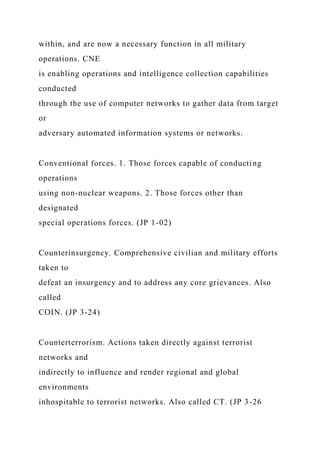
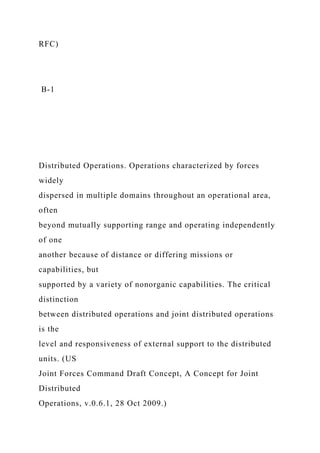
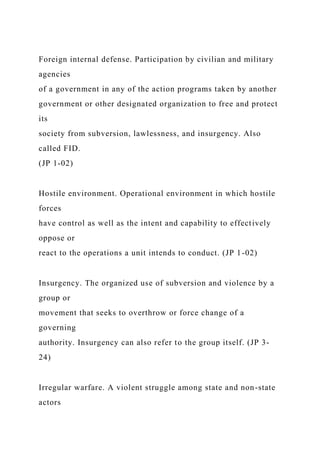
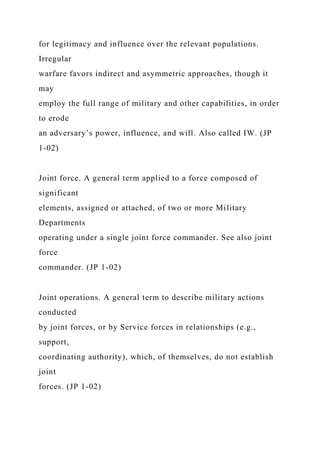
UNITED STATES ARMY
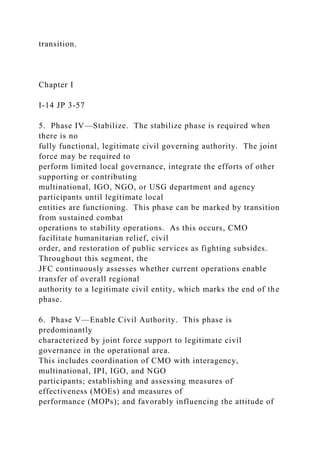
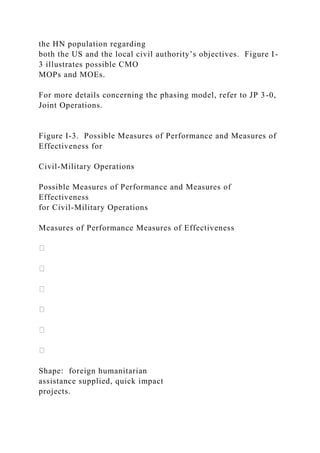
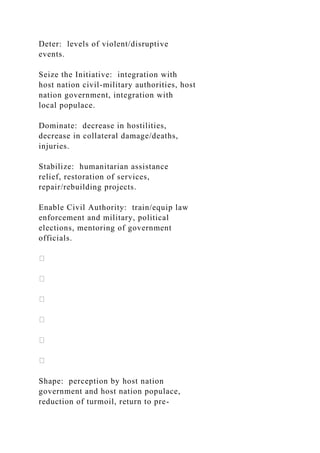
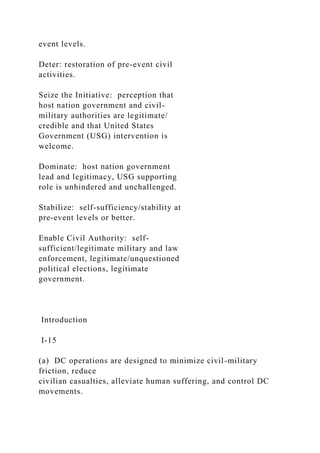
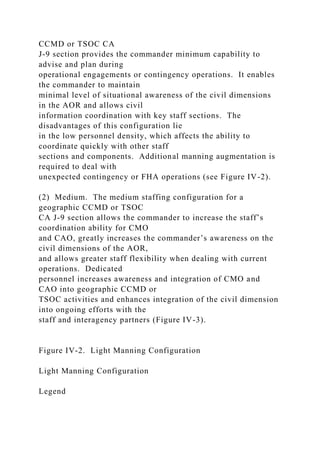
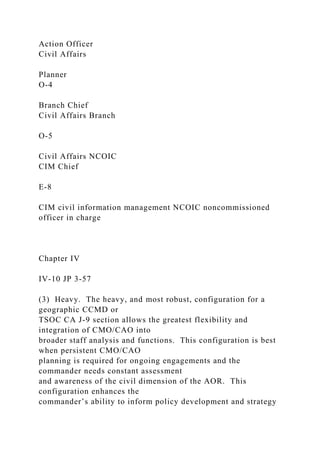
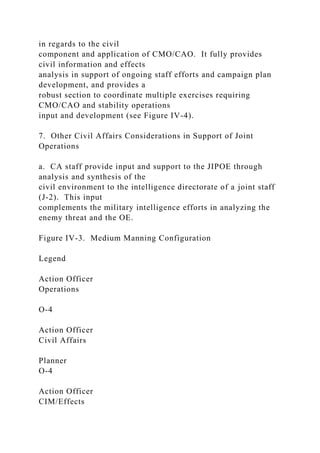
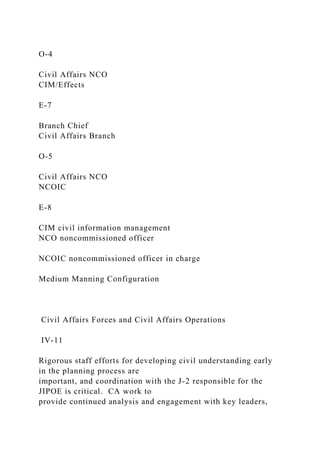
SPECIAL OPERATIONS COMMAND
USASOC Strategy-2035
April 2016
UNCLASSIFIED
UNCLASSIFIED 1
UNCLASSIFIED
UNCLASSIFIED 2
Where Army Special Operations Forces Stand Today
The ARSOF mission, vision, state of ARSOF 2022, and core
competencies are included below. Collectively, these subjects
represent where ARSOF stands today and serve as the starting
point from which capabilities and focuses must evolve.
USASOC Mission Statement
The United States Army Special Operations Command mans,
trains, equips, educates, organizes, sustains, and supports forces
to
conduct special warfare and surgical strike across the full range
of
military operations and spectrum of conflict in support of joint
force commanders and interagency partners, to meet theater and
national objectives.
USASOC Commander’s Vision
USASOC provides the Nation’s premier Special Operations
Forces, delivering appropriate and effective capabilities to
joint force commanders and interagency leaders across the
entire spectrum of conflict and under any operating conditions.
USASOC invests in new ideas and capabilities to anticipate
changing environments and new demands in order to maintain
a competitive edge over our Nation’s adversaries.
The State of ARSOF 2022
ARSOF 2022 restructured specific Army Special Operations
formations to optimize existing capabilities and to fill
capability
gaps for sensitive activities in complex operational
environments.
The restructure provided USASOC with an organic ability to
conduct advanced analysis of resistance potential in target areas
and
created small highly trained units of action capable of
developing
unique options for decision makers and joint force commanders
in
contested environments. The restructure also created planning
detachments capable of augmenting TSOC campaign planning
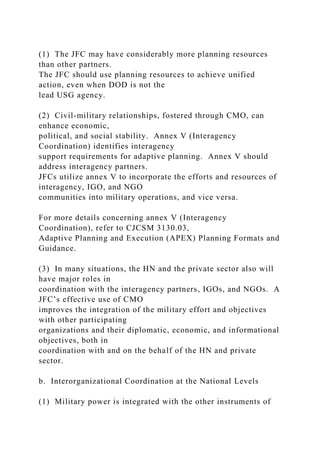
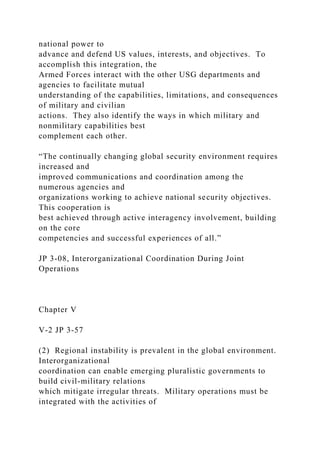
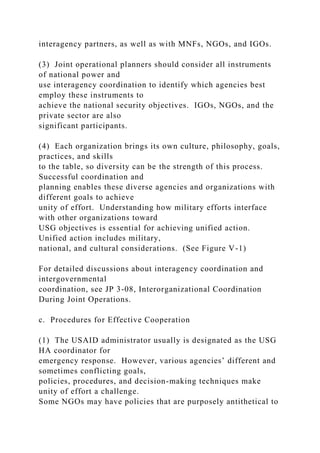
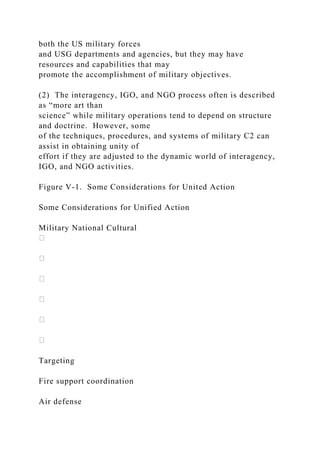
efforts, with emphasis on special warfare.
The ARSOF 2022 restructure established 1st Special Forces
Command (Airborne) (Provisional) as an Army Division-like
headquarters tasked with operational missions and force
provider
responsibilities. The restructure also established an organic
Military
Intelligence Battalion and two new staff directorates (Influence
and
the Office of Special Warfare) within 1st SFC (A)(P). These
changes allow 1st SFC (A)(P) to field a deployable and scalable
SOJTF headquarters to synchronize SOF effects for joint force
commanders. Additionally, each of the five Active Duty Special
Forces groups restructured their existing 4th Battalions,
creating
units of action designed to assist in understanding, defining,
and
preparing the operating environment. The capabilities
established
through ARSOF 2022 place emphasis on operations outside, or
preceding, major combat theaters. Ultimately, these capabilities
add
options to the USASOC portfolio of forces designed to address
trans-regional threats. ARSOF 2022 also established the
Strategic
Planning Process (SPP) as the command’s single process to
develop
the future force and its capabilities.
Introduction
USASOC Strategy-2035 represents guidance for the
development of future ARSOF operational and institutional
capabilities. It is a docu-
ment derived from our national strategies, SOCOM-2035, and
the Army Operating Concept. USASOC Strategy-2035 initiates
our Strategic
Planning Process and serves as the foundation for the USASOC
Guidance for Employment of the Force.
A more detailed campaign plan will follow this strategy. It will
explain how USASOC will accomplish the objectives contained
in this
strategy. It will direct and synchronize supporting actions
designed to enable ARSOF to provide the balanced portfolio of
capabilities that
the future requires. USASOC Strategy -2035 reflects current
guidance and fiscal realities and will be updated in response to
new guidance
as changes occur into the future.
UNCLASSIFIED
UNCLASSIFIED 3
Army Special Operations Forces Core Competencies
Core competencies are the operational and institutional
capabilities
of an organization that create competitive advantages. Including
the USASOC core competencies in this strategy furthers our
collective understanding of what makes ARSOF unique. The list
also serves as a point of reference as we strive to develop future
capabilities that maintain advantages over adversaries.
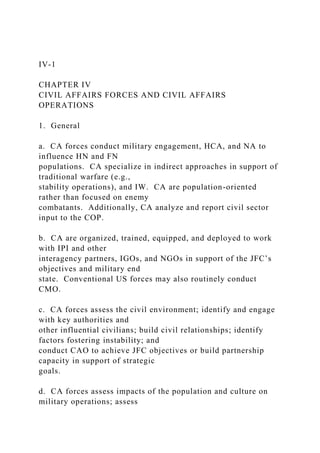
The ARSOF core competencies are:
selection processes, making the entry of high caliber candidates
the starting point for ARSOF capability development
people
of foreign cultures (operating in the human-centric and
personality-dependent domain)
Providing precision direct action capabilities, enabled by
SOF
unique intelligence, technology, and targeting processes in
support of theater and national objectives
professionals who are agile, adaptive, flexible, bold, innovative,
and possess a high degree of advanced training
to
address threats and exploit opportunities in peacetime
environments, gray zones where hostile entities threaten
stability
short of war, and areas in overt conflict
worldwide reach
support
career-long skill development from basic special operations
capabilities to the most advanced individual and collective
skills
The Strategic Context
Overview: The future operating environment will be populated
with state and non-state adversaries that employ hybrid forms of
conflict to challenge U.S. influence internationally. Although
the
possibility of overt confrontation remains a persistent aspect of
the
future environment, adversaries will more likely challenge the
stability of regions and U.S. interests through indirect means in
the
gray zone between peace and overt war. Adversarial actions in
gray
zones will seek to achieve irreversible gains at the expense of
U.S.
interests. These adversaries will become increasingly enabled
as
technology that was once only available to large nation-states
becomes cheaper and within reach. Additionally, the hyper
connected nature of the global environment will enable hostile
entities to influence vulnerable populations and hijack local
grievances in ways that threaten regional security. As a result,
threats to stability in gray zones will likely emerge more rapidly
in
the future, requiring the U.S. to have more rapidly employable
options available to counter adversarial actions. Ultimately,
these
challenges dictate that the U.S. not orient exclusively against
one
type of threat or a single form of conflict.
Future Adversaries and Competitors: The future operating
environment will continue to be dominated by nation-states,
with
technologically enabled non-state groups with trans-regional
reach
wielding more influence than seen in decades past. In the future
environment, state and non-state adversaries will attempt to
erode
U.S. and allied influence internationally. Competing nations
such as
Iran, Russia, the Democratic People’s Republic of North Korea,
and
the People’s Republic of China will challenge the current
international security dynamic as they seek greater influence
over
regional neighbors. Additionally, a variety of violent extremist
and
criminal organizations will seek to advance their agendas trans-
regionally at the expense of populations and established forms
of
governance. These state and non-state actors will likely exploit
opportunities to diminish U.S. military, economic, and/or
political
dominance until internal conditions or exterior deterrence
changes
their course.
UNCLASSIFIED
UNCLASSIFIED 4
Forms of Future Conflict: The chosen forms of conflict for
adver-
saries of the future are expected to be hybrid in nature, blending
conventional, irregular, informational, and cyber capabilities to
advance state and non-state agendas. The cyber environment
will be
central to many adversarial actions as hostile state and non-state
actors attempt to influence populations.
Hostile entities will continue to challenge
stability in the security environment
through actions short of maneuver war-
fare and approaches that may be indirect
in nature. Hybrid forms of conflict offer
cost effective means to challenge U.S.
influence internationally. Indirect ap-
proaches allow adversaries to avoid confronting U.S. power or
pro-
voking an international response while seeking irreversible
gains in
the regional balance of power. As a result, hybrid forms of
conflict
that challenge U.S. dominance and influence through indirect
ap-
proaches are the likely choice for adversaries of the future.
Globalization, Technology, and Speed of Threat Development:
In a world shaped by globalization, unpredictable and rapid
techno-
logical change will force shifts in political, military, and
economic
power. The barriers for adversaries to acquire and develop ad-
vanced technology, to include cyber and access denial systems,
will
diminish. The future will also see greater hyper connectivity
global-
ly, enabling hostile entities to influence a wider audience and to
hijack local grievances within disaffected populations.
Adversaries
will need minimal investment to employ social media and
informa-
tional technology to influence vulnerable populations, spread
their
ideologies, gather support, fund operations, crowd-source
intelli-
gence, and share techniques. Access to advanced technology
pro-
vides adversaries with viable alternatives to high intensity
warfare.
It provides a means to initiate less-attributable forms of conflict
to
offset U.S. strengths, particularly in the gray zone. These
aspects of
the future environment will accelerate the speed with which
threats
can develop.
Proliferation of Weapons of Mass Destruction (WMD): The
proliferation of chemical, biological, radiological, nuclear,
high-
yield explosive weapons, and the means by which they are
deliv-
ered will pose an increased threat to U.S. interests and
international
security in the future. The diminishing costs associated with
WMD
technology and the potential for destabilized governments to
lose
control of weapons will challenge security and interests of
nations
around the world to an unprecedented degree.
Decision Space in Gray Zones: The first, and possibly most im-
portant, step to preventing and mitigating
threats is detecting emerging threats be-
fore they irreversibly erode U.S. influ-
ence and destabilize regions. Early under-
standing of emerging threats will be es-
sential in the future operating environ-
ment for national leaders to have ade-
quate decision space necessary to develop
policies and plans that counter adversarial
actions. The U.S. will require the means to obtain early
understand-
ing of threats (especially in gray zones). The U.S will also need
the
capability to control escalation of crisis to deter threats from
devel-
oping into greater challenges that require a large commitment of
national resources.
Implications
Implications of the future operating environment that must be
con-
sidered while developing ARSOF capabilities are contained in
this
section.
denial and communications detection, denial, and encryption
technology while trans-regional non-state actors will employ
evolving technology to conceal communications and deliver
lethal attacks with minimal personnel. These issues require
ARSOF to:
tems that maintain advantage
over adversaries
-permissive, and
permissive environments
-
ciency (aviation and other mobility capabilities)
for rotary wing and unmanned aerial systems
collection capabilities at the tactical level
eater distances
Hybrid forms of conflict that
challenge U.S. dominance and
influence through indirect
approaches are the likely choice
for adversaries of the future.
UNCLASSIFIED
UNCLASSIFIED 5
ly to be hybrid in
nature,
blending conventional and irregular capabilities, requiring
ARSOF to:
intergovernmental, and multinational (JIIM) partnerships
-CF interdependence, interoperability, and
integration
spectrum of special operations
doctrine for operations to counter hybrid threats
capabilities, particularly with regard to understanding and
characterizing the human domain and indicators/warnings for
gray zone threats
er-based technology will become more important in
conflict
and activities to influence vulnerable populations and
governments, while cyber security will become more difficult to
guarantee. These issues require ARSOF to:
ions, influence, and operational
planning/execution in the cyber realm
operations, digital deception, communication disruption, and
disinformation campaigns)
emerge more rapidly in the future, requiring ARSOF to:
merging threats
operational levels
advanced language, regional expertise, and cultural
capabilities
potential for destabilized governments to lose control of
weapons require ARSOF to:
Commander’s Guidance to Ready, Mature, and Invest in
the Force
To become the force of tomorrow, this strategy prioritizes
objectives under three categories. These categories and related
objectives represent the Commanding General’s guidance for
ARSOF readiness to fulfill the requirements of the current
operating environment, to mature the force to meet future
demands under increasingly ambiguous circumstances, and to
invest in the future capabilities of ARSOF.
Ready the Force: Optimize capabilities and processes to better
position the force for the demands of the current operating
environment.
capabilities
Model
-CF interdependence, interoperability, and
integration
multinational (JIIM) partnerships
derstanding of the full range of ARSOF
capabilities with external audiences
Component balance
development
esponsive mechanisms to deploy forces when
needed (e.g. address the slow nature of RFF process)
unfinished requirements
Mature the Force: Advance ARSOF capabilities to meet mid-
term
demands.
incorporate improved technology, processes, and techniques
UNCLASSIFIED
UNCLASSIFIED 6
rate education/training into ARSOF learning
institutions to enable operations that track, monitor, and
counter WMD
situational awareness via handheld data, blue force tracking
systems, and secure communications)
(mobility platforms, weapons systems, and communications
technology – secure, unsecure, and non-attributable systems)
d
synthesis capabilities that enable understanding and
characterization of the human domain and provide indicators/
warnings for gray zone threats
and support to resistance movements (up to and including
UW)
develop effective partnerships in foreign cultures and to build
partner capabilities
to
rapidly integrate into, and excel within, ambiguous
environments
institutions
boundaries
processes to be
more agile/adaptive
Invest in the Future Force: Develop ARSOF capabilities to meet
challenges of the future operating environment.
ARSOF on the cutting edge
deploy, resilient enough to operate in austere environments,
and require minimal maintenance/logistics
speed and ease with which we process/synthesize information
at the tactical and operational levels
facilitate rapid collective understanding of the environment,
adversarial actions, and emerging threats
Develop and integrate systems and processes that enable
operator/leader level decision making
improve our ability to influence populations and to
understand/address how adversaries and their proxies do the
same (cyber and related capabilities)
influence operations, digital deception, communication
disruption, and disinformation campaigns at the tactical and
operational levels
advanced
cyber threats
longer operational range, over horizon observation, and can be
launched/recovered by tactical units
btain the next generation of ARSOF rotary wing capabilities
for transport and fire support that have longer range and
greater fuel efficiency
platforms to penetrate integrated air defense systems
ARSOF for their entire careers
more attuned to the demands of the future operating
environment
The future operating environment will present challenges that
de-
mand ARSOF to be adaptive, flexible, rapidly responsive, and
ca-
pable of succeeding in ambiguous circumstances. Through
delib-
erate effort, ARSOF will adapt operationally and institutionally
to ensure the effectiveness of the force remains without equal
for
decades into the future. The enterprise will continue to rely
upon
our specially selected, uniquely trained, and highly motivated
Soldiers to succeed in the future. Our no fail mission today is to
prepare the right balanced portfolio of capabilities for use by
the
Soldiers of tomorrow.
Sine Pari – Without Equal
11 September 2013
Civil-Military Operations
Joint Publication 3-57
i
PREFACE
1. Scope
This publication provides joint doctrine for planning and
conducting civil-military
operations (CMO) by joint forces, employing civil affairs
forces, conducting civil affairs
operations, and coordinating with departments, agencies, or
other organizations during the
execution of CMO.
2. Purpose
This publication has been prepared under the direction of the
Chairman of the Joint
Chiefs of Staff (CJCS). It sets forth joint doctrine to govern the
activities and performance
of the Armed Forces of the United States in joint operations and
provides the doctrinal basis
for US military coordination with other US Government
departments and agencies during
operations and for US military involvement in multinational
operations. It provides military
guidance for the exercise of authority by combatant
commanders and other joint force
commanders (JFCs) and prescribes joint doctrine for operations,
education, and training. It
provides military guidance for use by the Armed Forces in
preparing their appropriate plans.
It is not the intent of this publication to restrict the authority of
the JFC from organizing the
force and executing the mission in a manner the JFC deems
most appropriate to ensure unity
of effort in the accomplishment of the overall objective.
3. Application
a. Joint doctrine established in this publication applies to the
Joint Staff, commanders of
combatant commands, subordinate unified commands, joint task
forces, subordinate
components of these commands, the Services, and combat
support agencies.
b. The guidance in this publication is authoritative; as such,
this doctrine will be
followed except when, in the judgment of the commander,
exceptional circumstances dictate
otherwise. If conflicts arise between the contents of this
publication and the contents of
Service publications, this publication will take precedence
unless the CJCS, normally in
coordination with the other members of the Joint Chiefs of
Staff, has provided more current
and specific guidance. Commanders of forces operating as part
of a multinational (alliance
or coalition) military command should follow multinational
doctrine and procedures ratified
by the United States. For doctrine and procedures not ratified
by the United States,
commanders should evaluate and follow the multinational
command’s doctrine and
procedures, where applicable and consistent with US law,
regulations, and doctrine.
For the Chairman of the Joint Chiefs of Staff:
DAVID L. GOLDFEIN, Lt Gen, USAF
Director, Joint Staff
Preface
ii JP 3-57
Intentionally Blank
iii
SUMMARY OF CHANGES
REVISION OF JOINT PUBLICATION 3-57, DATED 08 JULY
2008
operations.
t.
-
military teams.”
and its organizations
regarding civil-military operations.
ppropriate.
current capabilities.
information, civil information
management, civil-military teams, and military government.”
pdates definitions for “civil affairs, civil-military
operations, civil-military
operations center, indigenous populations and institutions,
military civic action,
provincial reconstruction team, and private sector.”
Summary of Changes
iv JP 3-57
Intentionally Blank
v
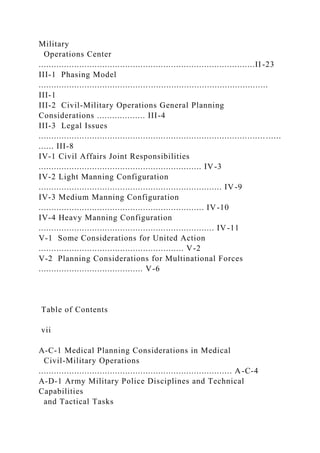
TABLE OF CONTENTS
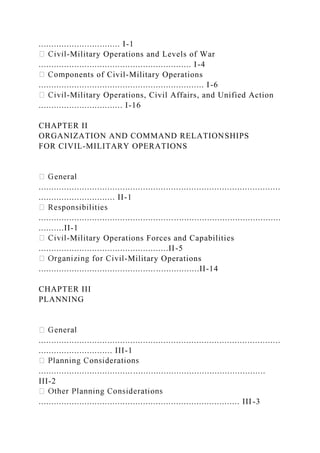
PAGE
EXECUTIVE SUMMARY
...............................................................................................
........ ix
CHAPTER I
INTRODUCTION
eral
...............................................................................................
................................ I-1
-Military Operations and Levels of War
............................................................ I-4
onents of Civil-Military Operations
................................................................. I-6
-Military Operations, Civil Affairs, and Unified Action
................................. I-16
CHAPTER II
ORGANIZATION AND COMMAND RELATIONSHIPS
FOR CIVIL-MILITARY OPERATIONS
...............................................................................................
.............................. II-1
...............................................................................................
..........II-1
-Military Operations Forces and Capabilities
...................................................II-5
-Military Operations
...............................................................II-14
CHAPTER III
PLANNING
...............................................................................................
............................. III-1
.........................................................................................
III-2
............................................................................... III -3
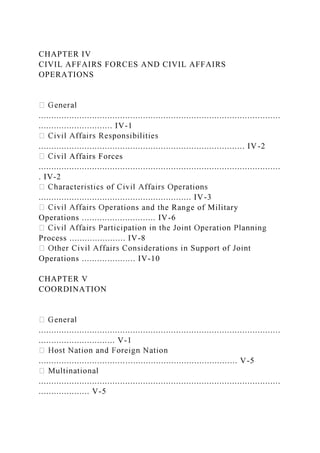
CHAPTER IV
CIVIL AFFAIRS FORCES AND CIVIL AFFAIRS
OPERATIONS
...............................................................................................
............................. IV-1
................................................................................. IV -2
vil Affairs Forces
...............................................................................................
. IV-2
............................................................ IV-3
tions and the Range of Military
Operations ............................. IV-6
Process ...................... IV-8
Operations ..................... IV-10
CHAPTER V
COORDINATION
...............................................................................................
.............................. V-1
.............................................................................. V-5
...............................................................................................
.................... V-5
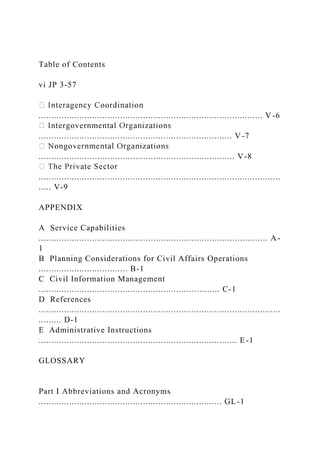
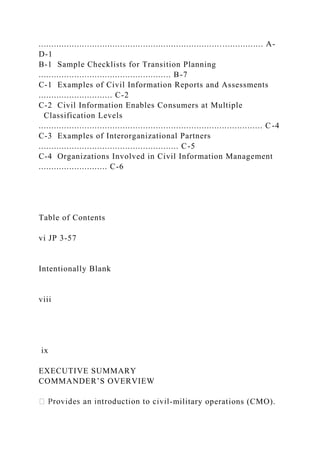
Table of Contents
vi JP 3-57
........................................................................................ V -6
............................................................................ V-7
............................................................................. V-8
...............................................................................................
..... V-9
APPENDIX
A Service Capabilities
.......................................................................................... A-
1
B Planning Considerations for Civil Affairs Operations
................................... B-1
C Civil Information Management
....................................................................... C-1
D References
...............................................................................................
......... D-1
E Administrative Instructions
.............................................................................. E-1
GLOSSARY
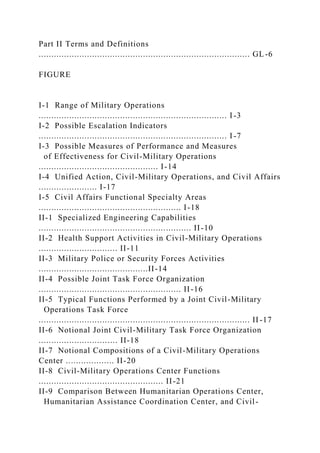
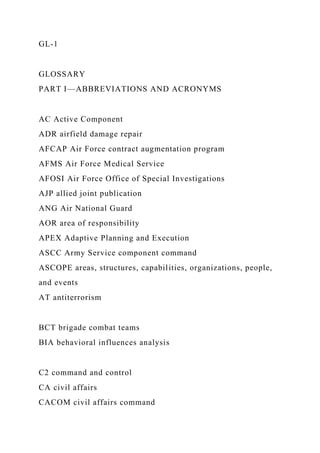
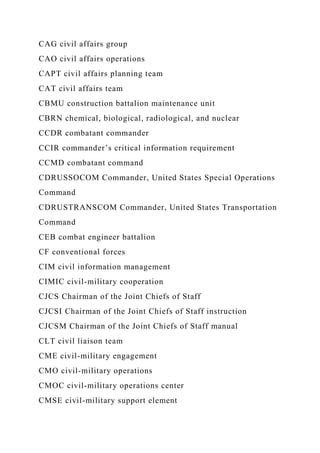
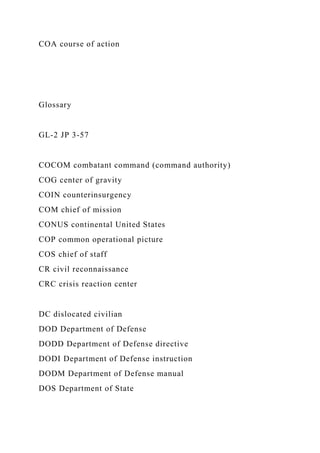
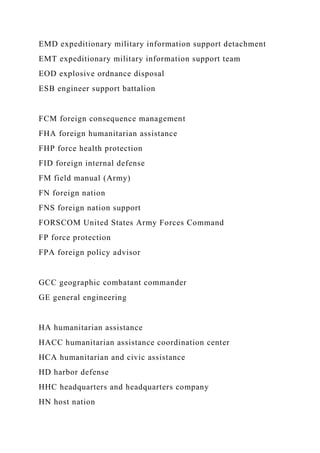
Part I Abbreviations and Acronyms
........................................................................ GL-1
Part II Terms and Definitions
................................................................................... GL -6
FIGURE
I-1 Range of Military Operations
.......................................................................... I-3
I-2 Possible Escalation Indicators
.......................................................................... I-7
I-3 Possible Measures of Performance and Measures
of Effectiveness for Civil-Military Operations
............................................... I-14
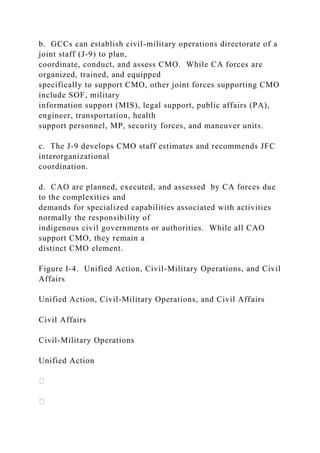
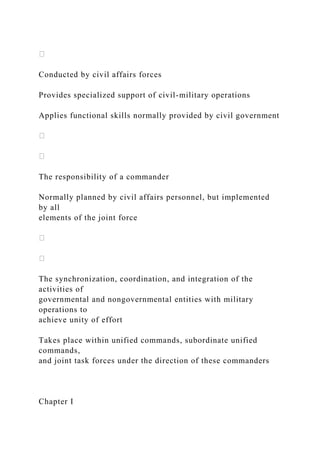
I-4 Unified Action, Civil-Military Operations, and Civil Affairs
....................... I-17
I-5 Civil Affairs Functional Specialty Areas
........................................................ I-18
II-1 Specialized Engineering Capabilities
............................................................ II-10
II-2 Health Support Activities in Civil-Military Operations
............................... II-11
II-3 Military Police or Security Forces Activities
...........................................II-14
II-4 Possible Joint Task Force Organization
........................................................ II-16
II-5 Typical Functions Performed by a Joint Civil-Military
Operations Task Force
................................................................................... II -17
II-6 Notional Joint Civil-Military Task Force Organization
............................... II-18
II-7 Notional Compositions of a Civil-Military Operations
Center ................... II-20
II-8 Civil-Military Operations Center Functions
................................................. II-21
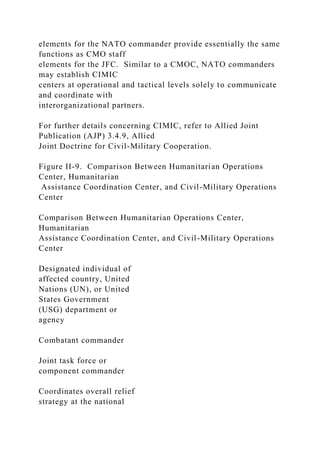
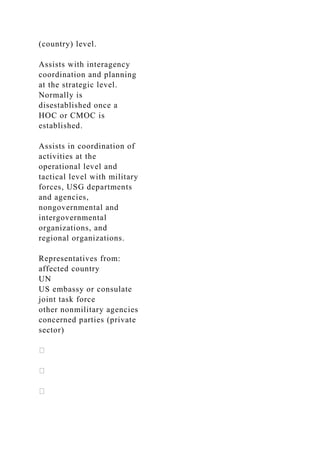
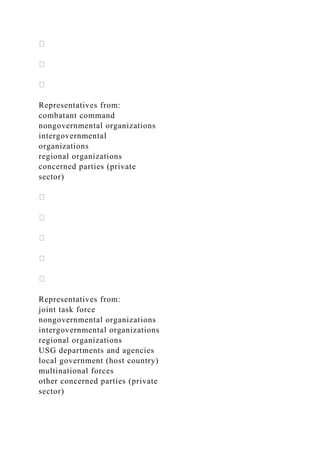
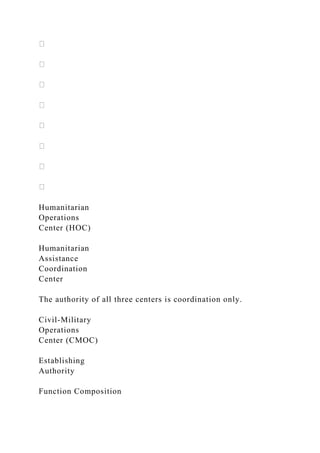
II-9 Comparison Between Humanitarian Operations Center,
Humanitarian Assistance Coordination Center, and Civil-
Military
Operations Center
.....................................................................................II -23
III-1 Phasing Model
..........................................................................................
III-1
III-2 Civil-Military Operations General Planning
Considerations ................... III-4
III-3 Legal Issues
......................................................................................... ......
...... III-8
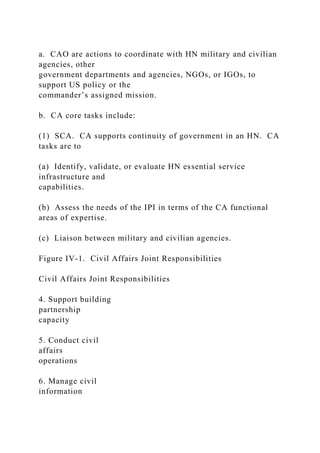
IV-1 Civil Affairs Joint Responsibilities
................................................................ IV-3
IV-2 Light Manning Configuration
........................................................................ IV-9
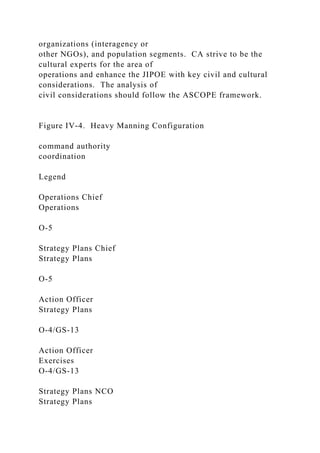
IV-3 Medium Manning Configuration
................................................................. IV-10
IV-4 Heavy Manning Configuration
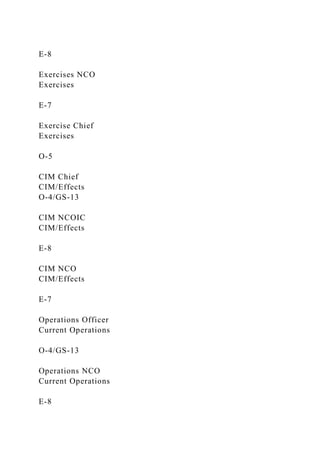
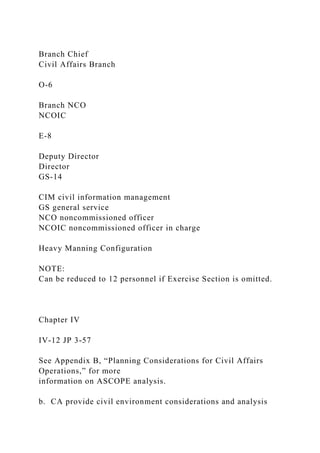
..................................................................... IV-11
V-1 Some Considerations for United Action
......................................................... V-2
V-2 Planning Considerations for Multinational Forces
......................................... V-6
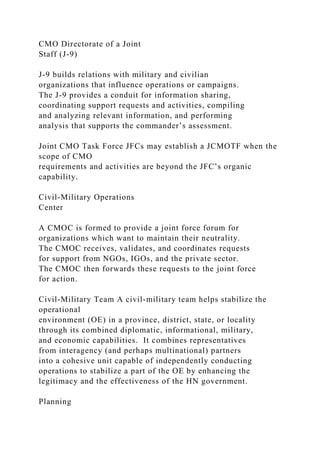
Table of Contents
vii
A-C-1 Medical Planning Considerations in Medical
Civil-Military Operations
............................................................................ A-C-4
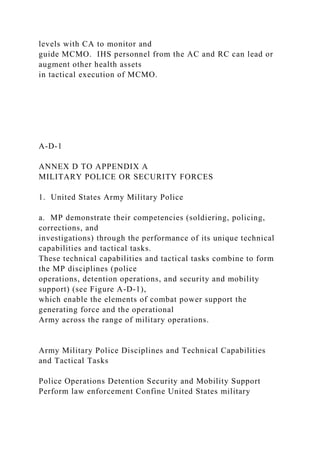
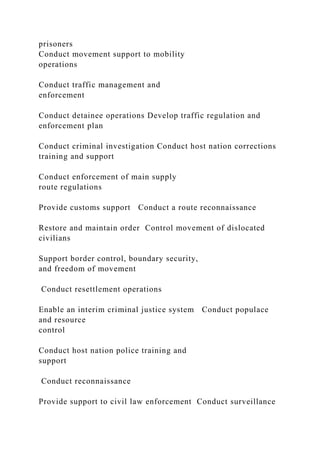
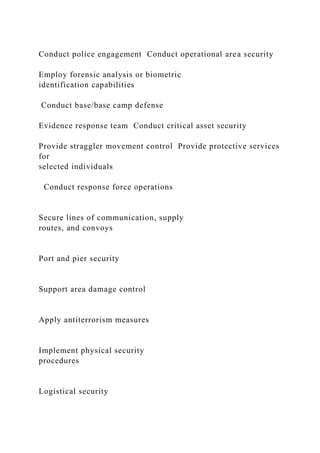
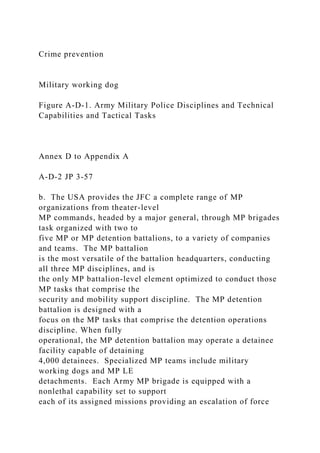
A-D-1 Army Military Police Disciplines and Technical
Capabilities
and Tactical Tasks
........................................................................................ A-
D-1
B-1 Sample Checklists for Transition Planning
.................................................... B-7
C-1 Examples of Civil Information Reports and Assessments
............................. C-2
C-2 Civil Information Enables Consumers at Multiple
Classification Levels
........................................................................................ C -4
C-3 Examples of Interorganizational Partners
....................................................... C-5
C-4 Organizations Involved in Civil Information Management
........................... C-6
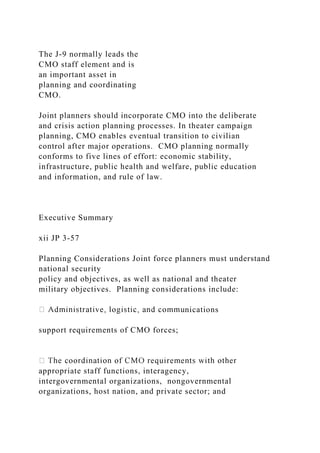
Table of Contents
vi JP 3-57
Intentionally Blank
viii
ix
EXECUTIVE SUMMARY
COMMANDER’S OVERVIEW
-military operations (CMO).
Introduction to Civil-Military Operations
Civil-Military Operations
(CMO)
Civil-military operations (CMO) are the activities of a
commander performed by designated civil affairs or other
military forces that establish, maintain, influence, or
exploit relationships between military forces and
indigenous populations and institutions (IPI), by directly
supporting the attainment of objectives relating to the
reestablishment or maintenance of stability within a
region or host nation (HN). At the strategic, operational,
and tactical levels of war, and during all military
operations, CMO are essential to the military instrument
to coordinate the integration of military and nonmilitary
instruments of national power, particularly in support of
stability, counterinsurgency, and other operations dealing
with asymmetric and irregular threats.
CMO and Levels of War CMO are applicable at the strategic,
operational, and
tactical levels of war. At the strategic level, CMO focus
on larger and long-term issues that may be part of a
Department of Defense (DOD) global campaign, or
United States Government (USG) reconstruction,
economic development initiatives, and stability operations
in failing or recovering nations. At the operational level,
CMO integrate and synchronize interagency,
intergovernmental organization (IGO), and
nongovernmental organization (NGO) activities with joint
force operations. Often, a civil-military team or civil-
military operations center (CMOC) may facilitate tactical-
level CMO among the military, the local populace,
NGOs, and IGOs.
xuchang.li
Highlight
Executive Summary
x JP 3-57
Components of CMO CMO include a range of activities that
integrate civil and
military actions for support to civil administration,
populace and resources control, foreign humanitarian
assistance, nation assistance, and civil information
management. These activities are particularly suited to
support the development of a country’s material and
human resources, or to assist the HN in achieving other
national objectives.
CMO, Civil Affairs (CA),
and Unified Action
In carrying out their CMO responsibilities, commanders
use civil affairs operations (CAO). The relationship
between CMO and CAO is best considered within the
broad context of unified action that involves the
synchronization, coordination, or integration of the
activities of governmental and nongovernmental entities
with military operations to achieve unity of effort.
Organization and Command Relationships for Civil-Military
Operations
Assistant Secretary of
Defense for Special
Operations and Low-
Intensity Conflict
The Assistant Secretary of Defense for Special Operations
and Low-Intensity Conflict acts as Office of the Secretary
of Defense point of contact for DOD and coordinates
CAO as they relate to the activities of interagency
partners, IGOs, NGOs, IPI, other organizations, and the
private sector, in accordance with applicable laws and
regulations to plan and conduct CMO.
Geographic Combatant
Commanders
The geographic combatant commanders (GCCs) provide
regional coordination and direction to their subordinate
commanders for the integration of CMO and CAO into
military plans and operations and coordinates CMO and
CAO with the appropriate chief of mission (COM).
Commander, United States
Special Operations
Command
Commander, United States Special Operations Command
provides GCCs with civil affairs (CA) from assigned
forces that are organized, trained, and equipped to plan
and conduct CAO in support of GCCs missions.
Subordinate Joint Force
Commanders
Subordinate joint force commanders (JFCs) implement
CA plans and coordinate CAO with country teams,
interagency partners, IGOs, NGOs, IPI, and HN or
foreign nation (FN) military and civilian authorities.
CMO Forces and
Capabilities
Commanders at all levels should not consider CMO the
sole responsibility of special operations forces (SOF) or
specifically CA and military information support (MIS)
units. CA and MIS units usually form the nucleus for
Executive Summary
xi
CMO planning efforts; while others, such as, SOF,
engineers, health service support, transportation, and
military police and security forces, normally function as
CMO enablers.
Organizing for CMO CMO are often key enablers to successful
joint operations.
Some of the types of CMO organizations are: the civil-
military operations directorate of a joint staff (J-9), joint
civil-military operations task forces (JCMOTFs), CMOCs,
and civil-military teams.
CMO Directorate of a Joint
Staff (J-9)
J-9 builds relations with military and civilian
organizations that influence operations or campaigns.
The J-9 provides a conduit for information sharing,
coordinating support requests and activities, compiling
and analyzing relevant information, and performing
analysis that supports the commander’s assessment.
Joint CMO Task Force JFCs may establish a JCMOTF when the
scope of CMO
requirements and activities are beyond the JFC’s organic
capability.
Civil-Military Operations
Center
A CMOC is formed to provide a joint force forum for
organizations which want to maintain their neutrality.
The CMOC receives, validates, and coordinates requests
for support from NGOs, IGOs, and the private sector.
The CMOC then forwards these requests to the joint force
for action.
Civil-Military Team A civil-military team helps stabilize the
operational
environment (OE) in a province, district, state, or locality
through its combined diplomatic, informational, military,
and economic capabilities. It combines representatives
from interagency (and perhaps multinational) partners
into a cohesive unit capable of independently conducting
operations to stabilize a part of the OE by enhancing the
legitimacy and the effectiveness of the HN government.
Planning
The J-9 normally leads the
CMO staff element and is
an important asset in
planning and coordinating
CMO.
Joint planners should incorporate CMO into the deliberate
and crisis action planning processes. In theater campaign
planning, CMO enables eventual transition to civilian
control after major operations. CMO planning normally
conforms to five lines of effort: economic stability,
infrastructure, public health and welfare, public education
and information, and rule of law.
Executive Summary
xii JP 3-57
Planning Considerations Joint force planners must understand
national security
policy and objectives, as well as national and theater
military objectives. Planning considerations include:
nications
support requirements of CMO forces;
appropriate staff functions, interagency,
intergovernmental organizations, nongovernmental
organizations, host nation, and private sector; and
anguage, cultural, and social customs for the
operational area.
Civil Affairs Forces and Civil Affairs Operations
CA specialize in indirect
approaches in support of
traditional warfare (e.g.,
stability operations), and
irregular warfare.
CA forces conduct military engagement, humanitarian
and civic assistance, and nation assistance to influence
HN and FN populations. CA forces assess impacts of
the population and culture on military operations;
assess impact of military operations on the population
and culture; and facilitate interorganizational
coordination.
CA Responsibilities CA joint responsibilities include plan,
coordinate,
conduct, and assess CAO, and support building
partnership capability.
Civil Affairs Operations CAO are actions to coordinate with HN
military and
civilian agencies, other government departments and
agencies, NGOs, or IGOs, to support US policy or the
commander’s assigned mission.
Coordination
Interorganizational
coordination is an essential
requirement for unified
action.
The joint force and the country team should facilitate
interorganizational coordination. The JFC, in
coordination with the COM, should determine whether
the CMOC can serve as the USG’s primary interface for
other government departments and agencies, IPI, IGOs,
NGOs, and multinational forces.
Host Nation and Foreign
Nation
CMO identifies resources, to include potential host-nation
support and foreign nation support. CMO can also help
Executive Summary
xiii
prevent unnecessary civilian hardship by advocating US
and HN legal obligations and moral considerations.
Interagency Coordination Organizations such as the joint
interagency coordination
group (JIACG) and CMOC support interorganizational
coordination. The JIACG is an interagency staff group
that establishes working relationships between civilian
and military operational planners.
Intergovernmental
Organizations and
Nongovernmental
Organizations
IGOs are created by a formal agreement (e.g., a treaty)
between two or more governments on a global or regional
basis for general or specialized purposes. IGOs and
NGOs are essential to resolve and stabilize many
humanitarian crises. The JFC should coordinate with
IGOs and NGOs as early as possible.
The Private Sector The private sector can assist the USG by
sharing
information, identifying risks, performing vulnerability
assessments, assisting in contingency and crisis action
planning, and providing other assistance as appropriate.
CMO encourage individual businesses, trade associations,
and other private sector organizations to foster dialogue
with the US military and the HN government.
CONCLUSION
This publication provides joint doctrine for planning and
conducting CMO by joint forces, employing civil affairs
forces, conducting civil affairs operations, and
coordinating with departments, agencies, or other
organizations during the execution of CMO.
Executive Summary
xiv JP 3-57
Intentionally Blank
I-1
CHAPTER I
INTRODUCTION
1. General
a. Strategic Aspects of Civil-Military Operations (CMO). Joint
force commanders
(JFCs) should build mutual support and integrate with the other
instruments of national
power to accomplish national strategic objectives. Resolving
national security issues in the
dynamic strategic environment of the 21st century typically
requires a range of diplomatic,
informational, military, and economic solutions. Both threats
and opportunities emanate
from the civil sector of any society. Potential challenges to
security, stability, and peace
include ethnic and religious conflict; cultural and
socioeconomic friction; terrorism and
insurgencies; the proliferation of weapons of mass destruction
(WMD); international
organized crime; incidental and deliberate population migration;
environmental security;
infectious diseases; and increasing competition for, or
exploitation of, dwindling natural
resources. These challenges can be addressed through the
integration and comprehensive use
of intergovernmental organizations (IGOs), national and local
governments, and
nongovernmental and private sector organizations, which have
proliferated in number,
variety, and capability. Recent policy initiatives, national
security directives, military
strategies, and evolving military doctrine reflect a growing
appreciation of the need to
leverage more nonmilitary tools and elements of the instruments
of national power, such as
interagency partners and private sector, in order to build a more
holistic and balanced
strategy. National Security Presidential Directive (NSPD)-44,
Management of Interagency
Efforts Concerning Reconstruction and Stabilization, for
example, tasks the Department of
State (DOS) to lead interagency coordination, planning, and
civil response for reconstruction
and stabilization to coordinate and strengthen efforts of the
United States Government (USG)
to prepare, plan, and conduct reconstruction and stabilization
assistance and related activities
in a range of situations that require the response capabilities of
multiple USG entities and to
harmonize such efforts with US military plans and operations.
Department of Defense
Instruction (DODI) 3000.05, Stability Operations, notes,
“Integrated civilian and military
efforts are essential to the conduct of successful stability
operations.” At the strategic,
operational, and tactical levels of war, and during all military
operations, CMO are
essential to the military instrument to coordinate the integration
of military and
nonmilitary instruments of national power, particularly in
support of stability,
counterinsurgency (COIN), and other operations dealing with
asymmetric and irregular
threats. Because they may permeate other aspects of national
security and military
strategy for an operation or campaign, CMO are inherently
strategic in nature and key to
achieving national security objectives.
“The United States Government will make a sustained effort to
engage civil
society and citizens and facilitate increased connections among
the American
people and peoples around the world through efforts ranging
from public service
and educational exchanges, to increased commerce and private
sector
partnerships.”
National Security Strategy, May 2010
Chapter I
I-2 JP 3-57
(1) Well designed CMO should be holistic, cumulative,
integrative, and synergistic.
CMO foster cooperation between military forces, the host nation
(HN), and
interorganizational partners by building trust and mutual
understanding to facilitate civil-
military transition, minimize costs and risks, and mitigate
threats and exploit opportunities.
CMO promote unity of effort and facilitate transition from
military to civil authority. CMO
also reduce friction in civil-military relationships to make US
and allied decision-making
processes faster than adversaries such as insurgents,
transnational criminal enterprises, and
terrorist organizations. Properly planned and monitored CMO
synchronize the instruments
of national power to produce greater efficiency, better
understanding of assessment tools,
faster responses, improved accountability, and more sustainable
operations after transition.
(2) Detailed analysis of indigenous populations and cultures is
essential to design
and plan effective CMO. Understanding local population and
culture enables effective
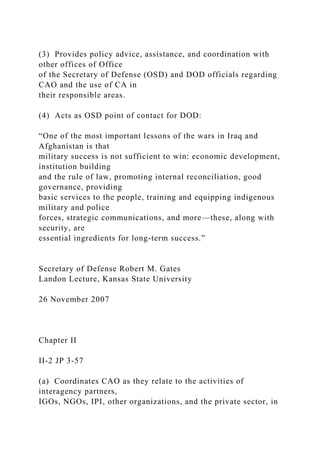
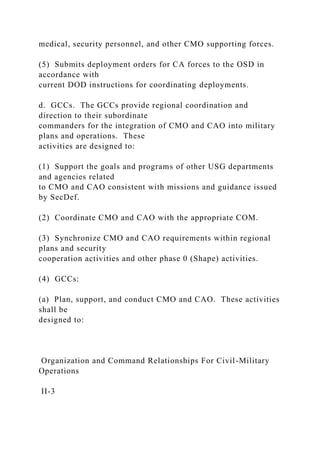
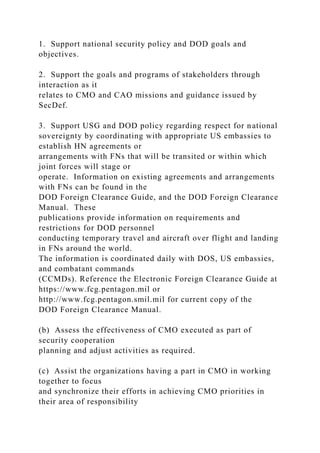
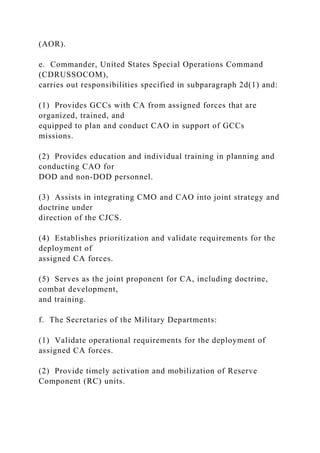
engagement. Individuals and units tasked with CMO will likely
be immersed in an
indigenous culture. These units should remain adaptive and
attuned to socio-culturally
relevant aspects of the operational environment (OE).
(3) CMO typically coordinate the efforts of joint, interagency,
and multinational
organizations. CMO’s coordinating and civil information
management (CIM) functions
build unity of effort and enable unified action.
(4) At all levels, CMO use negotiation, mediation,
collaboration, consensus, and
relationship building to create conditions for success.
(5) JFCs integrate civil affairs (CA) forces with other military
forces (e.g.,
maneuver, health service, military police [MP], engineer,
transportation, and special
operations forces [SOF]), to work alongside HN agencies,
military, and security forces (e.g.,
national, border, and local police) as well as the indigenous
populations and institutions
(IPI). Through interorganizational coordination, the JFC may
enable unified action that
includes other USG departments and agencies, IGOs,
nongovernmental organizations
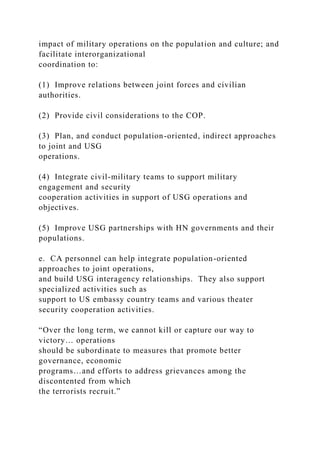
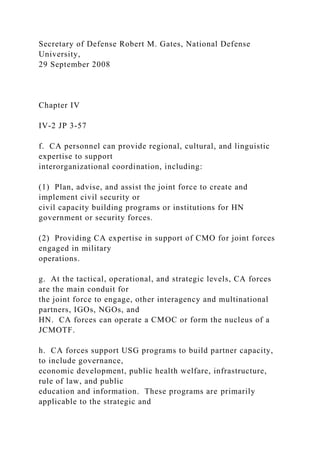
(NGOs), HNs, foreign nations (FNs), and the private sector.
For more details on the interagency community, IPI, HNs,
IGOs, NGOs, and the private
sector, refer to Chapter V, “Coordination,” and Joint
Publication (JP) 3-08,
Interorganizational Coordination During Joint Operations.
Collectively, the above terms
often are referred to as “stakeholders.”
b. CMO. CMO are the activities of a commander performed by
designated CA or other
military forces that establish, maintain, influence, or exploit
relationships between military
forces and IPI, by directly supporting the attainment of
objectives relating to the
reestablishment or maintenance of stability within a region or
HN. CMO may include
military forces conducting activities and functions of the local,
regional, or national
government. These activities may occur prior to, during, or
subsequent to other military
actions. They may also occur, if directed, in the absence of
other military operations. CMO
may be performed by designated CA forces, other military
forces, or a combination of CA
and other forces, and are conducted across the range of military
operations as depicted in
Figure I-1.
Introduction
I-3
(1) CMO contribute to missions within many operational areas
by synchronizing
and building synergy between multiple players and entities
contributing to the stabilization
of the HN.
(2) CMO help disseminate relevant messages and themes to
local leaders and the
HN population.
(3) CMO also provide feedback to information operations (IO)
as the assessments
reveal sentiments of targeted HN populations or organizations.
c. Authority to Conduct CMO
(1) Authority to conduct CMO can be derived from joint
operations, an
international cooperative agreement, or an agreement between
the USG or appropriate
military commander and the government of the area or country
in which US forces may be
employed. A commander’s authority to undertake CMO derives
from Presidential or
Secretary of Defense (SecDef) decisions. US strategic
objectives, US policy, and relations
between the HN government and the USG also influence the
authority to conduct CMO.
(2) The law of war requires occupying powers to restore public
order and safety
while respecting, to the extent possible, the laws of the
occupied country; and to establish a
civil administration and to control or conduct governmental
matters during and after
hostilities. International law determines when a territory or a
region is actually under the
authority of an occupying force, which generally follows the
cessation of hostilities.
Occupation is a question of fact based on the ability of the
occupying force to render the
occupied government incapable of exercising public authority
or, in the absence of a local
government, an ungoverned area. However, mere presence of
foreign forces in a nation does
not confer occupation rights or responsibilities on that force.
Foreign forces present in a
Figure I-1. Range of Military Operations
Range of Military Operations
Major Operations and Campaigns
Military Engagement, Security Cooperation, and Deterrence
Crisis Response and Limited Contingency Operations
Range of
Military
Operations
Our national leaders can use the military instrument of national
power across the conflict
continuum in a wide variety of operations that are commonly
characterized in three groups as
this figure depicts.
Peace Conflict Continuum War
Chapter I
I-4 JP 3-57
sovereign state by consent exercise rights and responsibilities
arising from established
accords or international agreements.
d. Liaison. Effective CMO require extensive liaison and
coordination among US,
multinational, and indigenous security forces and other engaged
government departments
and agencies as well as NGOs, IGOs, IPI, or the private sector.
Liaison officers are
commonly employed to establish close, continuous, and
physical communications between
organizations resulting in enhanced interoperability and
increased mission success.
e. Unified Action. One of the major challenges facing the JFC
in CMO is successfully
coordinating the activities of the joint force with those of the
multinational forces (MNFs)
and multiple civilian organizations within the joint operations
area (JOA), with each
potentially having their own purpose and goals. The joint force
operates under a single
responsible commander, but unified action requires interagency
coordination among all USG
participants and interorganizational coordination among all
participants. CMO should be
closely coordinated with interagency partners such as the US
embassy country team. The
JFC should coordinate CMO amongst components, supporting
forces, the country team, and
HN. This is particularly important for lethal operations
involving tactical air support or
indirect fires. CMO operations at the tactical, operational, and
strategic levels should be
nested to ensure unity of effort. Effective planning and
coordination for unified action
should result in unity of effort during execution.
f. Civilian-Military Relations. Civilian-military relations are
normally the
responsibility of the JFC. CMO have proven essential for those
relations and typically
facilitate accomplishment of the commander’s overall mission.
Adversaries may use
irregular warfare (IW) to avoid direct confrontation with the
US. They may target civilian
populations instead of military forces. This erodes distinction
between civilian and military
institutions, infrastructures, and systems; military and civilian
“dual use” infrastructures are
becoming more prevalent. Cities and social and cultural hubs
are often centers of gravity
(COGs) or decisive points rather than military forces or
geographic locations. As more
people and the influence of their greater numbers migrate to
densely populated urban areas,
the joint force is more likely to be operating in urban areas than
in remote locations.
Consequently, CMO should be considered in the planning and
execution of military
operations.
2. Civil-Military Operations and Levels of War
a. The levels of war are doctrinal perspectives that clarify the
links between strategic
objectives and tactical actions. The national strategic
objectives facilitate theater strategic
planning. Military strategy, derived from policy, is the basis
for all operations (see JP 3-0,
Joint Operations). CMO are applicable at the strategic,
operational, and tactical levels of
war. Specific actions at one level of war may affect all three
levels simultaneously but with
different effects at each level. CMO guidance should therefore
include higher headquarters
objectives and end states presented by USG policy and
guidance. Individuals and units
conducting CMO must understand the interrelationships of the
levels of war.
Introduction
I-5
b. Engaged civilian organizations likely will be more
concerned with a predetermined
agenda and not distinguish between the various levels of war.
NGO or IGO members who
communicate with US forces may report conversations to
foreign officials at the highest
level, who may then discuss them directly with the USG
officials. Misperceptions of CMO
actions by nonmilitary agencies can cause a commander to be
distracted from the mission.
Most civilian agencies are not organized with distinct
operational, tactical, or strategic levels.
NGO and IGO representatives collocated with forward-deployed
joint forces often do not
have the authority to make decisions that may change their
original mission. As such, it is
important that JFCs conducting CMO should understand the
civilian participant’s
organizational and hierarchical relationships as they relate to
decision making. This will
help clarify working relationships and reduce friction with all
parties concerned.
c. CMO are conducted at multiple levels. The effort at each
level may be focused on
different objectives, but the activities should be mutually
supporting.
(1) Strategic. At the strategic level, CMO focus on larger and
long-term issues
that may be part of a Department of Defense (DOD) global
campaign, or USG
reconstruction, economic development initiatives, and stability
operations in failing or
recovering nations. CMO are a component of a geographic
combatant commander’s
(GCC’s) theater security cooperation guidance within the
theater campaign plan (TCP). As
such, the GCC’s TCP objectives must align with national
strategic objectives.
(2) Operational
(a) At the operational level, CMO integrate and synchronize
interagency, IGO
and NGO activities with joint force operations. Interagency,
IGO, and NGO activities
generally support security cooperation and feature programs to
build relationships and
mitigate the need for military force. Consequently, CMO focus
on immediate or near-term
issues such as health service infrastructure; movement, feeding,
and sheltering of dislocated
civilians (DCs); police and security programs; promoting
government legitimacy; and
coordination for CMO support to tactical commanders.
(b) Joint force planners and interagency partners should
identify civil-military
objectives early in the planning process. CMO are integrated
into plans and operations
through interagency coordination, multinational partnerships,
and coordination with IGOs
and NGOs. Coordination of CMO for current and future
operations is conducted at the
operational level. Information is valuable to interorganizational
coordination, to efficiently
and effectively marshall and distribute resources (to include
funding), and to assess success
in an OE where success may not be measured by traditional
operational indicators.
Information management (IM) enables CMO for operational
commanders and facilitates the
required interorganizational coordination necessary.
(3) Tactical. Often, a civil-military team or civil-military
operations center
(CMOC) may facilitate tactical-level CMO among the military,
the local populace, NGOs,
and IGOs. Commanders derive tactical-level CMO from the core
tasks of support to civil
administration (SCA), populace and resources control (PRC),
foreign humanitarian
assistance (FHA), nation assistance (NA), and CIM. Tactical-
level CMO normally are more
Chapter I
I-6 JP 3-57
sharply focused and have more immediate effects. Often, a
civilian-military team or CMOC
will facilitate these actions between the military, the local
populace, and NGOs/IGOs.
During certain contingency operations, the Secretary of State
and SecDef will integrate
stabilization and reconstruction contingency plans with military
contingency plans and will
develop a general framework for fully coordinating stabilization
and reconstruction activities
and military operations at all levels where appropriate. The
DOS Bureau of Conflict and
Stabilization is tasked to implement policy requirements from
NSPD-44, Management of
Interagency Efforts Concerning Reconstruction and
Stabilization. This could provide a
framework at the national strategic level for stabilization and
reconstruction planning and
coordination. SecDef, through the Chairman of the Joint Chiefs
of Staff (CJCS), provides
direction to combatant commanders (CCDRs) and subordinate
JFCs to implement joint
operation planning for the NSPD-44, Management of
Interagency Efforts Concerning
Reconstruction and Stabilization, process.
d. Annex G (Civil Affairs) promulgates CMO requirements in a
formal plan or
operation order. CMO require coordination among CA,
maneuver, health support, MP,
engineer, transportation, and SOF. CMO involve cross-cutting
activities across staff sections
and subordinate units. Annex G identifies, consolidates, and
deconflicts the activities of the
various sections and units. Planning and coordination at lower
echelons require significantly
more details than discussed in annex G.
For more details concerning annex G (Civil Affairs), refer to
Chairman of the Joint Chiefs of
Staff Manual (CJCSM) 3130.03, Adaptive Planning and
Execution (APEX) Planning
Formats and Guidance.
e. Changes in the military or political situation, as well as
natural or man-made
disasters, can divert the joint force’s main effort from CMO to
combat operations. The JFC
should identify early indicators and warnings of changes in the
OE and allocate resources to
monitor these changes in order to anticipate changes in force
requirements. Branch and
sequel planning and preventive action may mitigate disruption
of CMO. Potential indicators
are depicted in Figure I-2.
3. Components of Civil-Military Operations
CMO are conducted to establish, maintain, influence, or exploit
relationships between
military forces, governmental and nongovernmental
organizations and authorities, and the
civilian populace in a permissive, uncertain, or hostile
operational area in order to facilitate
military operations, to consolidate and achieve operational US
objectives.
a. CMO include a range of activities that integrate civil and
military actions for SCA,
PRC, FHA, NA, and CIM. These activities are particularly
suited to support the
development of a country’s material and human resources, or to
assist the HN in achieving
other national objectives. CMO are normally based on the
desired level of civilian support,
availability of resources, and potential issues with inadvertent
interference by the local
population.
Introduction
I-7
(1) SCA. SCA helps continue or stabilize management by a
governing body of a
FN’s civilian authorities by assisting an established
government, or by supporting
establishment of a transitional military or civilian authority
over an occupied population until
an indigenous civil government can be established. SCA
consists of planning, coordinating,
advising, or assisting the commander with those activities that
reinforce or restore a civil
administration that supports US and multinational objectives.
SCA occurs most often during
stability operations. Some SCA activities may be used during
PRC, FHA, and NA.
(a) Civil administration in friendly territory includes advising
friendly
authorities and performing specific functions within the limits
of authority and liability
established by mutual agreements, or treaties and agreements
administered under the
authority of an IGO (e.g., United Nations [UN]).
(b) Civil administration in occupied territory encompasses the
establishment of a temporary military government, as directed
by SecDef, to exercise
executive, legislative, and judicial authority over the populace
of a territory that US forces
have taken from an enemy by force of arms until a civil
government can be established. This
may be an unilateral USG effort, or USG acting under the
authority of an IGO; or a
multinational effort not under the auspices of an IGO.
Figure I-2. Possible Escalation Indicators
Possible Escalation Indicators
Political activities and movements
Food or water shortages
Outbreaks of disease
Military setbacks
Natural disasters
Crop failures
Fuel shortages
Onset of seasonal changes (winter may exacerbate fuel and food
shortages, for example)
Police force and corrections system deterioration
Judicial system shortcomings
Insurgent attacks
Sharp rise in crime
Terrorist bombing
Disruption of public utilities, e.g., water, power, sewage, and
economic strife due to socioeconomic imbalance
Increase in local government corruption
Chapter I
I-8 JP 3-57
(c) Domestic and International Considerations. SCA is tailored
to the
situation based on US law, HN law, international law (including
the law of war),
international treaties, agreements, and memoranda of
understanding. To the fullest extent of
the means available to it, the occupying force must maintain an
orderly government in the
occupied territory and must have, as its ultimate goal, the
creation of a legitimate and
effective civilian government. Subject to the military
requirements, the JFC should avoid
military activities likely to increase tensions in the occupied
territory and conduct those
likely to facilitate and accelerate a return to a civil
administration. This is especially
important in multiethnic, multiracial, or multicultural
environments where one or more of the
parties to a conflict will almost invariably see a chosen course
of action (COA) as biased
against them.
(2) PRC
(a) PRC consists of two distinct, yet linked, components:
populace control and
resources control.
1. Populace control provides security to people, mobilizes
human
resources, denies personnel to the enemy, and detects and
reduces the effectiveness of enemy
agents. Populace control measures include curfews, movement
restrictions, travel permits,
identification and registration cards, and voluntary resettlement.
DC operations involve
populace control that requires extensive planning and
coordination among various military
and civilian organizations.
2. Resources control regulates the movement or consumption of
materiel
resources, mobilizes materiel resources, and denies materiel to
the enemy. Resources control
measures include licensing, regulations or guidelines,
checkpoints (e.g., roadblocks), ration
controls, amnesty programs, and inspection of facilities.
(b) These controls normally are a responsibility of HN civilian
governments.
US forces may implement PRC when HN civilian authorities or
agencies are unable or
unwilling to. PRC are escalated during civilian or military
emergencies. In a permissive
environment, joint forces implement PRC measures with the
consent of the local
government. In a hostile environment, PRC measures are
applied in accordance with
international law and the law of war.
(c) Nonlethal weapons can reduce the probability of death or
serious injury to
the civilian populace while maintaining effective force
protection (FP) measures.
Commanders should evaluate the use of nonlethal weapons in
operation plans.
For further guidance on nonlethal weapons, see Department of
Defense Directive (DODD)
3000.3, Policy for Non-Lethal Weapons.
(3) FHA. FHA operations are conducted outside the US and its
territories,
normally in support of the United States Agency for
International Development (USAID) or
DOS, and include programs conducted to relieve or reduce the
results of natural or man-
made disasters or other conditions, such as disease, hunger, or
privation that might present a
serious threat to life or that can result in great damage to or loss
of property. FHA provided
Introduction
I-9
by US forces is limited in scope and duration and is designed to
supplement or complement
the efforts of the HN civil authorities or agencies that may have
the primary responsibility
for providing assistance.
For further detail concerning FHA, refer to JP 3-29, Foreign
Humanitarian Assistance, and
DODD 5100.46, Foreign Disaster Relief (FDR).
(4) NA. NA is assistance rendered to a nation by US forces
within that nation’s
territory based on mutual agreement. NA promotes stability,
sustainable development, and
establishes HN internal institutions responsive to the populace.
NA is military engagement,
security cooperation, and deterrence operations that enhance the
CCDR’s shaping and
deterrence efforts. All NA actions are integrated with the chief
of mission’s (COM’s)
mission resource request. The goal is to promote long-term
regional stability. NA programs
often include, but are not limited to, security assistance, foreign
internal defense (FID), other
Title 10, United States Code (USC) programs and activities
performed on a reimbursable
basis by USG departments and agencies or IGOs.
(a) Security cooperation is the means by which DOD
encourages and enables
countries and organizations to work with the US to achieve
strategic goals.
(b) FID programs are the diplomatic, economic, informational,
and military
support to another nation which assists its fight against
subversion, lawlessness, and
insurgency. US military involvement in FID includes indirect
support, direct support, and
combat operations.
1. Military operations related to FID are support to COIN,
combating
terrorism, peace operations (PO), DOD support to counterdrug
operations, and FHA.
2. FID operations can help FNs control subversion,
lawlessness, and
insurgency.
For further detail in regard to FID and security assistance, refer
to JP 3-22, Foreign Internal
Defense.
(c) Other Title 10, USC, programs:
1. Section 401, Humanitarian and Civic Assistance (HCA)
Provided in
Conjunction with Military Operations. In contrast to FHA, US
Armed Forces may provide
HCA in conjunction with authorized military operations. HCA
programs generally
encompass planned activities and are limited by law to the
following: medical, surgical,
dental, and veterinary care provided in areas of the country that
are rural or are underserved
by medical, surgical, dental, and veterinary professionals,
respectively, including education,
training, and technical assistance related to the care provided;
construction of rudimentary
surface transportation systems; well drilling and construction of
basic sanitation facilities;
and rudimentary construction and repair of public facilities.
The assistance provided must
promote the security interests of both the US and the country in
which the activities are to be
carried out; and the specific operational readiness skills of the
members of the US forces
Chapter I
I-10 JP 3-57
participating in the activities. HCA activities must complement
but not duplicate any other
form of social or economic assistance provided by the US.
2. Section 402, Transportation of Humanitarian Relief Supplies
to Foreign
Countries. Under Title 10, USC, Section 402, SecDef may
authorize the transport to any
country, without charge, supplies furnished by nongovernmental
sources intended for
humanitarian assistance (HA). Transport is permitted only on a
space-available basis.
Supplies may be distributed by USG departments and agencies,
foreign governments,
international organizations, or nonprofit relief organizations.
Supplies may not be
distributed (directly or indirectly) to any individual, group, or
organization engaged in
military or paramilitary activities.
3. Section 404, Foreign Disaster Assistance. Under Title 10,
USC,
Section 404, the President may direct SecDef to provide disaster
assistance outside the
United States in response to man-made or natural disasters when
necessary to prevent the
loss of human life or serious harm to the environment.
Assistance under Title 10, USC,
Section 404, may include transportation, supplies, services, and
equipment.
4. Section 407, Humanitarian Demining Assistance and
Stockpiled
Conventional Munitions Assistance: Authority and Limitations.
Subject to regulations
issued by SecDef, the Secretaries of the Military Departments
are authorized by Title 10,
USC, Section 407, to undertake humanitarian demining
assistance activities and stockpiled
conventional munitions assistance in foreign countries. The
assistance provided must
promote either the security interests of both the US and the
country in which the activities
are to be carried out; or the specific operational readiness skills
of the members of the US
Armed Forces participating in the activities. Humanitarian
demining assistance activities
and stockpiled conventional munitions assistance must
complement but not duplicate any
other form of social or economic assistance provided by the US.
SecDef must ensure that no
member of the US Armed Forces, while providing humanitarian
demining assistance or
stockpiled conventional munitions assistance, engages in the
physical detection, lifting, or
destroying of landmines or other explosive remnants of war, or
stockpiled conventional
munitions assistance (unless the member does so for the
concurrent purpose of supporting a
US military operation); or provides such assistance as part of a
military operation that does
not involve the armed forces.
For further details concerning humanitarian demining, refer to
JP3-15, Barriers, Obstacles,
and Mine Warfare for Joint Operations.
5. Section 2557, Excess Nonlethal Supplies: Humanitarian
Relief. SecDef
may make any DOD nonlethal excess supplies available for
humanitarian relief purposes.
Excess supplies furnished under this authority are transferred to
DOS, which is responsible
for distributing the supplies. Nonlethal excess supplies means
property that is excess under
DOD regulations and is not a weapon, ammunition, or other
equipment or material designed
to inflict serious bodily harm or death.
Introduction
I-11
6. Section 2561, Humanitarian Assistance (HA). To the extent
provided
in defense authorization acts, funds appropriated to DOD for
HA shall be used to transport
humanitarian relief and for other humanitarian purposes
worldwide.
7. Section 166a, Combatant Commands: Funding Through the
Chairman
of the Joint Chiefs of Staff. Military civic action (MCA)
programs offer the JFC an
opportunity to improve the HN infrastructure and the living
conditions of the local populace
while enhancing the legitimacy of the HN government. These
programs use predominantly
indigenous military forces in such fields as education, training,
public works, agriculture,
transportation, communications, health, sanitation, and other
areas to improve HN economic
and social development. These programs can have excellent
long-term benefits for the HN
by enhancing the effectiveness of the host government by
developing needed skills and by
enhancing the legitimacy of the host government by showing the
people that their
government is capable of meeting the population’s basic needs.
MCA programs can help
gain the HN military public acceptance, which is especially
important in stability and COIN
operations with contentious human rights issues. MCA can also
address root causes of
civilian unrest through economic and social development
services. Joint forces may
supervise and advise during MCA, but the HN military should
lead the visible effort. MCA
projects require interagency cooperation, coordination, and
monitoring to succeed. The JFC
and staff should be aware of legal and financial limitations.
MCA is similar to CMO except
that in MCA, HN, or FN military or government personnel
perform tasks that are visible to
the indigenous population to garner popular support while US
personnel provide training and
advice.
For further detail relating to MCA, refer to JP 3-22, Foreign
Internal Defense.
8. Section 168, Military-to-Military Contacts and Comparable
Activities.
SecDef is the program authority for the conduct of military-to-
military activities. Military-
to-military contacts generally promote a democratic orientation
for nation partners’ defense
and security establishments. Examples of these activities
include military liaison teams;
exchanges of military and defense civilian personnel between
DOD and the defense
ministries of foreign governments; seminars and conferences
held primarily in a theater of
operations; and exchanges of military personnel between
individual units of US forces and
units of foreign armed forces.
Note: Military-to-military contacts must be approved by DOS.
(5) CIM. The focus of civil affairs operations (CAO) is to
enable commanders to
engage the civil component of the OE. CIM is one of the five
CA core tasks. Rarely
conducted in the absence of other CA core tasks, CIM focuses
on collecting, collating,
processing, analyzing, producing, and dissemination of relevant
civil information to maintain
influence or exploit relations between military forces,
governmental and NGOs, and the civil
population within any operational area. Analysis of civil
information is at the core of CIM.
Analysis is the sifting of information for patterns and indicators
of past behavior’s or ideas
that might possess predictive value and application. Analysis
molds information into a
usable product for the commander and staff. CMO practitioners
must direct analytical
efforts to answer the civil unknowns in the common operational
picture (COP) rather than
Chapter I
I-12 JP 3-57
exhaustively refining data. Analysis of civil information is
similar to the normal red team-
blue team analysis process, but instead focuses on identifying
mission variables; identifying
operational variables; identifying COGs; identifying trends;
conducting proactive analysis;
and identifying civil vulnerabilities. Analysis of civil
information must be packaged into
easily disseminated forms structured so as to inform the
commanders decision cycle. The
CIM process ensures COM products and services are relevant,
accurate, timely, and useable
by commanders and decision makers. Products of civil
information analysis are: layered
geospatial information; civil information for the COP; COGs;
civil consideration products;
answers to request for information; reported priority
intelligence requirements (PIRs);
updates to ongoing CAO assessments, area studies, and running
estimates. CIM core
analytical efforts must allow commanders and decision makers
to “see the data” via link
analysis; civil consideration analysis; systems analysis; trend
analysis. The CIM analytical
tools may include stability matrices; nodal analysis charts; link
analysis charts; geospatial
analysis; and civil consideration overlay. The core analytical
function of CIM informs the
commander’s decision cycle by providing civil information.
CIM provides a prioritized,
structured effort to support the commander’s collection plan,
provides input into building the
civil layer of the COP, informs the joint targeting
process/restricted target list, and
contributes to COG analysis. The end state of CIM is to
facilitate the fusion of civil
information (green and white) with operations and intelligence
(O&I). The end state of CIM
is to better allow the commander to understand the OE. CIM is
the process through which a
commander communicates with partners outside of the military
chain of command. CIM
provides the commander situational understanding and
knowledge of the civil component of
the OE through a formal data management process. CIM
enables the commander to
disseminate raw and analyzed civil information to both military
and nonmilitary partners.
(a) Commanders share information with partners to build
legitimacy through
transparency with the local, national, and international
organizations; accomplish common
goals; and gain comparative advantage through IPI capabilities.
(b) CIM extends the commander’s operational reach through
IPI resources and
actions; accelerates transition to a civil government by using
existing civil infrastructure and
institutions; and provides insight on metrics not captured by
organic assets.
(c) CIM can enable HN governments and the NGO and IGO
communities.
Shared civil information can enable cooperation between IGOs,
NGOs, and MNFs to
efficiently use limited resources.
(d) Subordinate JFCs synchronize their operations directly with
the activities
and operations of other military forces and nonmilitary
organizations in their operational
area. CIM provides a collaborative information environment
through a virtual aggregation
of individuals, organizations, systems, infrastructure, and
processes which provides data and
information to plan, execute, and assess CAO in support of
CMO. It will enable CA leaders
to make more informed recommendations to the supported
commander.
See Appendix C, “Civil Information Management,” for more
details on CIM.
Introduction
I-13
b. CMO in Joint Operations. CMO may occur in any phase of
military operations.
CMO can be broadly separated into population-centric actions
and support to civil actions,
though at times these operations can become mixed depending
upon the OE.
(1) CMO Studies. CMO planners should forecast and
continuously reevaluate
CMO requirements by analyzing the mission to determine
specific tasks. This includes
establishing guidance for the specific CMO tasks and
developing estimates of the situation to
include area studies. In denied areas, CMO planners use
intelligence products to access,
gather, and validate information for area or functional oriented
studies. Planners should
consider their knowledge of CMO, geographic areas of
specialization, language
qualifications, civil sector functional technical expertise, and
contacts with IPI. This will
allow for timely and critical information on the civilian
capabilities and resources in the
operational area. Civilian contacts may provide more extensive
insight than information
collected through intelligence channels, but CMO planners
should validate all critical
information and assumptions through intelligence capabilities.
CA area studies and area
assessments provide operational analysis of the civil component
of the OE.
(a) CMO tasks vary throughout operation phases. Although
JFCs determine
the number and actual phases used during a campaign or
operation, use of the phases
provides a flexible model to arrange CMO. These activities
may be performed by CA
personnel, other military forces, or combination.
1. Phase 0—Shape. During the implementation of the CCDR’s
security
cooperation planning objectives CMO can mitigate the need for
other military operations in
response to a crisis. CA support FID and contribute to
contingency and crisis action
planning. In a crisis, CA forces working with HNs, regional
partners, and IPI can shape the
environment. Shaping operations can include regional
conferences to bring together multiple
factions with competing concerns and goals, economic
agreements designed to build
interdependency, or regional aid packages to enhance stability.
2. Phase I—Deter. CMO should be integrated with flexible
deterrent
options to generate maximum strategic or operational effect.
CMO in the deter phase builds
on activities from the shape phase. CA forces support NA, SA,
FID, and PO. CA can also
conduct area studies and update area assessments to identify
potential civil sector and
civilian COGs.
3. Phase II—Seize the Initiative. During this phase, CMO are
conducted
to gain access to theater infrastructure and to expand friendly
freedom of action in support of
JFC operations. CMO are designed to minimize civil-military
friction and support friendly
political-military objectives.
4. Phase III—Dominate. CMO also help minimize HN civilian
interface
with joint operations so that collateral damage to IPI from
offensive, defensive, or stability
operations is limited. Limiting collateral damage may reduce
the duration and intensity of
combat and stability operations. Stability operations are
conducted as needed to ensure a
smooth transition to the next phase, relieve suffering, and set
conditions for civil-military
transition.
Chapter I
I-14 JP 3-57
5. Phase IV—Stabilize. The stabilize phase is required when
there is no
fully functional, legitimate civil governing authority. The joint
force may be required to
perform limited local governance, integrate the efforts of other
supporting or contributing
multinational, IGO, NGO, or USG department and agency
participants until legitimate local
entities are functioning. This phase can be marked by transition
from sustained combat
operations to stability operations. As this occurs, CMO
facilitate humanitarian relief, civil
order, and restoration of public services as fighting subsides.
Throughout this segment, the
JFC continuously assesses whether current operations enable
transfer of overall regional
authority to a legitimate civil entity, which marks the end of the
phase.
6. Phase V—Enable Civil Authority. This phase is
predominantly
characterized by joint force support to legitimate civil
governance in the operational area.
This includes coordination of CMO with interagency,
multinational, IPI, IGO, and NGO
participants; establishing and assessing measures of
effectiveness (MOEs) and measures of
performance (MOPs); and favorably influencing the attitude of
the HN population regarding
both the US and the local civil authority’s objectives. Figure I-
3 illustrates possible CMO
MOPs and MOEs.
For more details concerning the phasing model, refer to JP 3-0,
Joint Operations.
Figure I-3. Possible Measures of Performance and Measures of
Effectiveness for
Civil-Military Operations
Possible Measures of Performance and Measures of
Effectiveness
for Civil-Military Operations
Measures of Performance Measures of Effectiveness
Shape: foreign humanitarian
assistance supplied, quick impact
projects.
Deter: levels of violent/disruptive
events.
Seize the Initiative: integration with
host nation civil-military authorities, host
nation government, integration with
local populace.
Dominate: decrease in hostilities,
decrease in collateral damage/deaths,
injuries.
Stabilize: humanitarian assistance
relief, restoration of services,
repair/rebuilding projects.
Enable Civil Authority: train/equip law
enforcement and military, political
elections, mentoring of government
officials.
Shape: perception by host nation
government and host nation populace,
reduction of turmoil, return to pre-
event levels.
Deter: restoration of pre-event civil
activities.
Seize the Initiative: perception that
host nation government and civil-
military authorities are legitimate/
credible and that United States
Government (USG) intervention is
welcome.
Dominate: host nation government
lead and legitimacy, USG supporting
role is unhindered and unchallenged.
Stabilize: self-sufficiency/stability at
pre-event levels or better.
Enable Civil Authority: self-
sufficient/legitimate military and law
enforcement, legitimate/unquestioned
political elections, legitimate
government.
Introduction
I-15
(a) DC operations are designed to minimize civil-military
friction, reduce
civilian casualties, alleviate human suffering, and control DC
movements.
(b) CMO coordinates with civilian agencies to implement
measures to locate
and identify population centers. CMO also coordinate with
civilian agencies to create,
restore, and maintain public order. CMO coordinate resources
(e.g., labor, supplies, and
facilities). CMO coordinate immediate life sustaining services
to civilians in the operational
area(s) and assist with planning for disease control measures to
protect joint forces.
(c) CMO assets may designate routes and facilities for DCs to
minimize their
contact with forces engaged in combat.
(d) CMO may help contribute to logistics operations. CMO
planners can help
logistic planners identify available goods and services by using
their contacts within the
civilian sector.
(e) Even limited military operations such as raids and strikes
may significantly
affect the civil environment. CMO implications for most of
these operations depend on the
mission scope, national strategic end state, and the
characteristics of the civil sector in the
operational area. CMO activities in support of joint operations
include:
1. COIN. COIN operations are comprehensive civilian and
military
efforts taken to simultaneously defeat and contain insurgency
and address its root causes.
CMO support to COIN operations includes using military
capabilities to perform
traditionally civilian activities to help HN or FN deprive
insurgents of popular support.
CMO activities combine military-joint operations with
diplomatic, political, economic, and
informational initiatives of the HN and engaged
interorganizational partners to foster
stability. The principle goal of CMO in COIN operations or
FID is to isolate the insurgents
from the populace, thus depriving them of recruits, resources,
intelligence, and credibility.
2. Security Assistance. CMO support to security assistance can
include
training foreign military forces in CMO and civil-military
relations. CMO support training
that is beyond the capability of in-country US military
assistance elements. The security
cooperation planning should synchronize CMO planning and CA
forces with the other
security assistance capabilities.
3. PO. PO are normally multiagency and multinational
contingencies
involving all instruments of national power, and may include
international humanitarian and
reconstruction efforts. CMO foster a cooperative relationship
between the military forces,
civilian organizations, and the governments and populations in
the operational area.
4. Noncombatant Evacuation Operation (NEO). CMO support
to NEO
is designed to limit local national interference with evacuation
operations, maintain close
liaison with embassy officials to facilitate effective interagency
coordination, obtain civil or
indigenous support for the NEO, help DOS identify US citizens
and others to be evacuated,
and help embassy personnel receive, screen, process, and
debrief evacuees.
Chapter I
I-16 JP 3-57
(f) Stability Operations. Stability Operations are designed to
maintain or
reestablish a safe and secure environment and provide essential
governmental services,
emergency infrastructure reconstruction, or humanitarian relief.
Stability operations support
USG plans for reconstruction and development operations and
likely will be conducted in
coordination with and in support of HN authorities, other USG
departments and agencies,
IGOs, and NGOs.
1. Operation plans should balance offensive and defensive
operations and
stability operations in all phases. Planning for stability
operations should begin when the
joint operation planning process (JOPP) is initiated. Even
during combat operations to the
joint force may be required to establish or restore security and
provide humanitarian relief.
2. Initial CMO will likely secure and safeguard the populace,
reestablish
civil law and order, protect and repair critical infrastructure,
and restore public services. US
military forces should be prepared to accomplish these tasks
when indigenous civil, USG,
multinational or international capacity cannot. US military
forces may also support
legitimate civil authority.
3. US forces robust logistic and command and control (C2)
capabilities are
often essential to stability operations. Normally other agencies
such as DOS or USAID are
responsible for USG objectives, but lack logistic and C2
capabilities. Because of the
imbalance between capability and responsibility, stability
operations will likely support, or
transition support to, US diplomatic, IGO, or HN efforts.
Military forces support the lead
agency. US forces should be prepared to operate in integrated
civilian-military teams that
could include representatives from IPI, IGOs, NGOs, and
members of the private sector.
4. Peace building’s five mission sectors are security; HA and
social well-
being; justice and reconciliation; governance and participation;
and economic stabilization
and infrastructure. Commanders should conduct mission
analysis in collaboration with
national and intergovernmental agencies for each peace building
sector and understand the
impact of each sector on the others. For greater details see JP
3-07.3, Peace Operations.
4. Civil-Military Operations, Civil Affairs, and Unified Action
a. In carrying out their CMO responsibilities, commanders use
CAO. The relationship
between CMO and CAO is best considered within the broad
context of unified action that
involves the synchronization, coordination, or integration of the
activities of governmental
and nongovernmental entities with military operations to
achieve unity of effort. JFCs seek
this synergy by several means, one of the more prominent being
through the conduct of
CMO that bring together the activities of joint forces and MNFs
and nonmilitary
organizations to achieve common objectives. This relationship
is depicted in Figure I-4.
(1) There are six CA functional specialty areas: rule of law,
economic stability,
governance, public health and welfare, infrastructure, and
public education and information.
All six functional specialties are interrelated, and specialists
must often work together. See
Figure I-5.
Introduction
I-17
(2) CA functional specialists advise and assist the commander
and can assist or
direct subordinate civilian counterparts. These functional
specialists should be employed to
provide analysis in their specialty area that supports planning of
interagency efforts or HN
efforts, and in a general support role to joint force components
requiring such capabilities.
b. GCCs can establish civil-military operations directorate of a
joint staff (J-9) to plan,
coordinate, conduct, and assess CMO. While CA forces are
organized, trained, and equipped
specifically to support CMO, other joint forces supporting CMO
include SOF, military
information support (MIS), legal support, public affairs (PA),
engineer, transportation, health
support personnel, MP, security forces, and maneuver units.
c. The J-9 develops CMO staff estimates and recommends JFC
interorganizational
coordination.
d. CAO are planned, executed, and assessed by CA forces due
to the complexities and
demands for specialized capabilities associated with activities
normally the responsibility of
indigenous civil governments or authorities. While all CAO
support CMO, they remain a
distinct CMO element.
Figure I-4. Unified Action, Civil-Military Operations, and Civil
Affairs
Unified Action, Civil-Military Operations, and Civil Affairs
Civil Affairs
Civil-Military Operations
Unified Action
Conducted by civil affairs forces
Provides specialized support of civil-military operations
Applies functional skills normally provided by civil government
The responsibility of a commander
Normally planned by civil affairs personnel, but implemented
by all
elements of the joint force
The synchronization, coordination, and integration of the
activities of
governmental and nongovernmental entities with military
operations to
achieve unity of effort
Takes place within unified commands, subordinate unified
commands,
and joint task forces under the direction of these commanders
Chapter I
I-18 JP 3-57
For more information on civil affair operations, see Chapter IV,
“Civil Affairs Forces and
Civil Affairs Operations.”
Figure I-5. Civil Affairs Functional Specialty Areas
Civil Affairs Functional Specialty Areas
Rule of law pertains to the fair, competent, and efficient
application and fair
and effective enforcement of the civil and criminal laws of a
society through
impartial legal institutions and competent police and corrections
systems.
Economic stability pertains to the efficient management (for
example,
production, distribution, trade, and consumption) of resources,
goods, and
services to ensure the viability of a society’s economic system.
Infrastructure pertains to the design, construction, and
maintenance of the
organizations, systems, and architecture required to support
transportation, water, communications, and power.
Governance creates, resources, manages, and sustains the
institutions
and processes through which a society is governed, is protected,
and
prospers.
Public health and welfare pertains to the systems, institutions,
programs,
and practices that promote the physical, mental, and social well-
being of a
society.
Public education and information pertain to the design,
resourcing, and
implementation of education and information programs and
systems
through media and formal education institutions.
II-1
CHAPTER II
ORGANIZATION AND COMMAND RELATIONSHIPS
FOR CIVIL-MILITARY OPERATIONS
1. General
CMO are JFC activities designed to establish and maintain
relations with civil
authorities, the general population, and other organizations.
JFC plans and directs CMO in
their operational areas. Maintaining military-to-civil relations
and open communications
with IGOs, NGOs, and selected elements of the private sector is
integral to CMO.
a. The principles of effective C2 and staff organizational
concepts apply to CMO just as
they do for any other military operation.
b. CMO help integrate instruments of national power,
minimize civil-military friction,
maximize support for operations, and identify the commander’s
legal responsibilities and
potential moral obligations to the civilian populations within
the operational area.
2. Responsibilities
a. The President or SecDef provide policy guidance concerning
civil-military
interaction through the CJCS to the CCDR.
b. Assistant SecDef for Special Operations and Low-Intensity
Conflict:
(1) Acts as the principal civilian advisor to SecDef and the
Under Secretary of
Defense for Policy (USD[P]) on the policy and planning for the
use of CA within DOD.
(2) Supervises the formulation of plans and policy impacting
DOD CAO.
(3) Provides policy advice, assistance, and coordination with
other offices of Office
of the Secretary of Defense (OSD) and DOD officials regarding
CAO and the use of CA in
their responsible areas.
(4) Acts as OSD point of contact for DOD:
“One of the most important lessons of the wars in Iraq and
Afghanistan is that
military success is not sufficient to win: economic development,
institution building
and the rule of law, promoting internal reconciliation, good
governance, providing
basic services to the people, training and equipping indigenous
military and police
forces, strategic communications, and more—these, along with
security, are
essential ingredients for long-term success.”
Secretary of Defense Robert M. Gates
Landon Lecture, Kansas State University
26 November 2007
Chapter II
II-2 JP 3-57
(a) Coordinates CAO as they relate to the activities of
interagency partners,
IGOs, NGOs, IPI, other organizations, and the private sector, in
accordance with applicable
laws and regulations to plan and conduct CMO.
(b) Monitors interagency partner use of DOD forces for the
conduct of CAO.
SecDef should be contacted whenever questions arise with
respect to legality or propriety of
such use.
(5) Coordinates with OSD Director of Administration and
Management to approve
the detail of CA to duty with interagency partners.
(6) Reviews and coordinates requests for deployments for CA
forces and making
recommendations to the USD(P).
c. CJCS:
(1) Provides, as the principal military advisor to the President,
the National
Security Council (NSC), and SecDef, advice on the employment
of CMO and CA forces and
the conduct of CMO and CAO.
(2) Provides guidance to the supported CCDRs for the
integration of CMO and
CAO into military plans and operations, including security
cooperation planning.
(3) Integrates agency and multinational partners into planning
efforts as
appropriate.
(4) Develops and promulgates joint doctrine for CMO to
include CA, engineer,
medical, security personnel, and other CMO supporting forces.
(5) Submits deployment orders for CA forces to the OSD in
accordance with
current DOD instructions for coordinating deployments.
d. GCCs. The GCCs provide regional coordination and
direction to their subordinate
commanders for the integration of CMO and CAO into military
plans and operations. These
activities are designed to:
(1) Support the goals and programs of other USG departments
and agencies related
to CMO and CAO consistent with missions and guidance issued
by SecDef.
(2) Coordinate CMO and CAO with the appropriate COM.
(3) Synchronize CMO and CAO requirements within regional
plans and security
cooperation activities and other phase 0 (Shape) activities.
(4) GCCs:
(a) Plan, support, and conduct CMO and CAO. These activities
shall be
designed to:
Organization and Command Relationships For Civil-Military
Operations
II-3
1. Support national security policy and DOD goals and
objectives.
2. Support the goals and programs of stakeholders through
interaction as it
relates to CMO and CAO missions and guidance issued by
SecDef.
3. Support USG and DOD policy regarding respect for national
sovereignty by coordinating with appropriate US embassies to
establish HN agreements or
arrangements with FNs that will be transited or within which
joint forces will stage or
operate. Information on existing agreements and arrangements
with FNs can be found in the
DOD Foreign Clearance Guide, and the DOD Foreign Clearance
Manual. These
publications provide information on requirements and
restrictions for DOD personnel
conducting temporary travel and aircraft over flight and landing
in FNs around the world.
The information is coordinated daily with DOS, US embassies,
and combatant commands
(CCMDs). Reference the Electronic Foreign Clearance Guide at
https://www.fcg.pentagon.mil or
http://www.fcg.pentagon.smil.mil for current copy of the
DOD Foreign Clearance Manual.
(b) Assess the effectiveness of CMO executed as part of
security cooperation
planning and adjust activities as required.
(c) Assist the organizations having a part in CMO in working
together to focus
and synchronize their efforts in achieving CMO priorities in
their area of responsibility
(AOR).
e. Commander, United States Special Operations Command
(CDRUSSOCOM),
carries out responsibilities specified in subparagraph 2d(1) and:
(1) Provides GCCs with CA from assigned forces that are
organized, trained, and
equipped to plan and conduct CAO in support of GCCs
missions.
(2) Provides education and individual training in planning and
conducting CAO for
DOD and non-DOD personnel.
(3) Assists in integrating CMO and CAO into joint strategy and
doctrine under
direction of the CJCS.
(4) Establishes prioritization and validate requirements for the
deployment of
assigned CA forces.
(5) Serves as the joint proponent for CA, including doctrine,
combat development,
and training.
f. The Secretaries of the Military Departments:
(1) Validate operational requirements for the deployment of
assigned CA forces.
(2) Provide timely activation and mobilization of Reserve
Component (RC) units.
Chapter II
II-4 JP 3-57
(3) Assume DOD-wide responsibilities for specific CAO as
directed by SecDef.
g. The Secretaries of the Army and Navy:
(1) Carry out the responsibilities specified in subparagraph 2f
above.
(2) Recruit, train, organize, equip, and mobilize units and
personnel to meet the CA
requirements of the supported commander and provide CA
forces requested by the other
DOD components as directed by SecDef in accordance with the
force levels, programs,
plans, and missions approved by SecDef.
h. Services. Service Chiefs support interagency partners, the
other Services, and
multinational commanders and US CCDRs with forces,
specialists, and Service-specific
equipment to perform CMO. Additionally, the Service Chiefs:
(1) Support US policy and CCDR CA force requirements across
the range of
military operations.
(2) Direct their Service to cover CMO and CAO in Service
planning.
i. Subordinate JFCs:
(1) Plan, integrate, and monitor the deployment, employment,
sustainment, and
redeployment of CA forces.
(2) Implement CA plans consistent with international law, the
law of war, and US
law and treaty obligations, and coordinate agreements and
arrangements for en route transit
of US military forces or materiel to support the operation.
(3) As directed, in accordance with law and formal agreements,
control DCs,
maintain order, prevent and treat disease, provide relief of
civilian suffering, and protect and
preserve property and other resources to achieve US military
objectives.
(4) Educate assigned or attached personnel on relations with
civilian authorities or
HN population.
(5) Training and orientation for assigned or attached personnel
on indigenous
cultural and social attitudes and effects on military operations.
(6) Communicate civilian attitudes and needs to higher
command and other
government departments and agencies, IGOs, NGOs, IPI, and
the private sector.
(7) Employ CMO and CA forces to identify and coordinate
assistance, supplies,
facilities, and labor from indigenous sources.
(8) Incorporate CMO estimates and CA assessments to develop
strategy and
objectives.
(9) Assess staffs and subordinate commands CA capabilities.
Organization and Command Relationships For Civil-Military
Operations
II-5
(10) Coordinate CAO with country teams, interagency partners,
IGOs, NGOs, IPI,
and HN or FN military and civilian authorities.
(11) Request guidance from the establishing authority (e.g.,
GCC) on
implementation of multinational policies and objectives.
(12) Help allies plan and develop operational skills and
infrastructure to build
regional stability through CMO and CAO.
(13) Coordinate CMO and CAO planning with multinational
commanders and HN
forces, as directed by the establishing authority (e.g., GCC) in
conjunction with the country
team. Supported CCDRs and subordinate JFCs should consider
establishing CMO working
groups to bring all stakeholders together to focus their efforts in
achieving CMO priorities.
3. Civil-Military Operations Forces and Capabilities
a. Commanders at all levels should not consider CMO the sole
responsibility of SOF or
specifically CA and MIS units. All US military organizations
have the responsibility and
capability to support CMO. CA and MIS units usually form the
nucleus for CMO planning
efforts; while others, such as, SOF, engineers, health services,
transportation, and MP and
security forces, normally function as CMO enablers. Other
organizations that typically are
involved in CMO, such as other government departments and
agencies, IGOs, NGOs, HNs,
and the private sector will be covered in Chapter IV,
“Coordination.”
b. SOF
(1) Unless otherwise directed by SecDef (assigned in Forces
for Unified
Commands Memorandum, found in the Global Force
Management Implementation
Guidance), all SOF are under the combatant command
(command authority) (COCOM) of
the CDRUSSOCOM. SOF are those Active Component (AC)
and RC forces of the Services
designated by SecDef and specifically organized, trained, and
equipped to conduct and
support special operations.
(2) CA and military information support operations (MISO) are
mutually
supportive within CMO. During some operations, MISO can be
integrated with CAO
activities to increase support for the HN government and reduce
support to destabilizing
forces. MISO can publicize the existence and successes of CAO
to enhance the positive
perception of US and HN actions in the operational area and
transregionally. MISO inform
and direct civilians concerning safety and welfare to reduce
civilian casualties, suffering, and
interference with military operations. Regional language and
cultural expertise, and
specialized communications equipment provide the capability to
engage audiences with
culturally accepted informative messages.
(3) MISO can:
(a) Gather information to assess the location, state of mind,
health of local
populace, and the physical characteristics of the operational
area.
Chapter II
II-6 JP 3-57
(b) Disseminate information to promote safety and welfare of
the civilian
population.
(c) Influence a civilian population’s attitude toward US policy
and prepare it
for CMO during post conflict activities.
(d) Publicize health services and veterinary aid, construction,
and public
facilities activities, etc., to generate confidence in and positive
perception of US and HN
actions to the populace.
(e) Assist in assessments to determine the most effective
application of effort
and documenting the results.
(f) Support emergency relocation of DCs and for DC camp
operations.
(g) As a corollary, when conducted within the framework of a
viable CMO
concept, CAO can contribute significantly to the overall success
of MISO activities.
For further detail concerning MISO related activities and
Service capabilities, refer to JP 3-
13.2, Military Information Support Operations.
(4) Civil-Military Engagement (CME)
(a) CME is a formal United States Special Operations
Command (USSOCOM)
program to address specific shaping operations that support
global SOF contingency plans.
CME facilitates the efforts of USG departments and agencies,
IGOs, NGOs, and HN to
build, replace, repair, and sustain civil capabilities and
capacities that eliminate, reduce, or
mitigate civil vulnerabilities to local and regional populations.
(b) CME is a globally synchronized and regionally coordinated
program of
country-specific and regional actions executed through, and
with indigenous and interagency
partners, to eliminate the underlying conditions and core
motivations for local and regional
support to violent extremist organizations and their networks.
(c) The GCC theater special operations command (TSOC)
manages and
coordinates theater level CME. CME operations are
coordinated with the GCC’s
contingency and TCPs and synchronized with the DOS mission
strategic resource plan
(MSRP) of the US embassy of the HN in which operations are
conducted. United States
Army Special Operations Command (USASOC), civil-military
support elements (CMSEs)
plan, execute, and assess CME.
(d) CME is designed to identify and address critical civil
vulnerabilities in
under-governed and ungoverned areas or high-threat
environments where indigenous
authorities or the country team or USAID cannot engage. In
some situations, the inability to
address these critical areas may be a function of HN and/or
interagency lack of capacity.
Organization and Command Relationships For Civil-Military
Operations
II-7
(e) CME is preventive. CME supports a broader HN internal
defense and
development strategy by supporting the US embassy and HN
government’s efforts to counter
violent extremism and achieve stability.
(f) CME’s population-centric and indirect approach focuses on
both the
adversary’s vulnerabilities and the vulnerabilities of the
indigenous civil society. Adversary
weaknesses are exploited and threats to civil society are
addressed by building HN capability
and capacity to eliminate the causes and drivers of instability.
CME manifests itself in three
lines of effort (LOEs):
1. Enable partners to combat violent extremist organizations by
improving
interagency and HN capacity and legitimacy; supporting key
communicators and
marginalizing those undermining joint efforts (also known as
spoilers); and developing and
fostering relationships between the HN and the CCMD,
interagency, IGOs, and NGOs.
2. Deter tacit and active support of violent extremist
organizations by
facilitating the denial of resources, disruption, and degradation
over time; and setting the
conditions and support for other SOF elements to access the HN
and target adversaries.
3. Erode support for extremist ideologies through pro-active
and persistent
engagement with the HN and interagency; and support to US
and HN IO objectives.
(5) Other SOF Support. SOF units generally conduct CMO in
operations that
assist the HN or FN authorities, other government departments
and agencies, NGOs, and
IGOs restore peace and strengthen infrastructure. SOF are
regularly employed in mobile
training teams, joint and combined exercises, professional
development programs, and other
military-to-military activities to enhance theater security
cooperation.
c. CA
(1) Concept of Employment for CA
(a) CMO staffs at every level review and update plans and
orders. The CA
task organization is validated by the supported GCC and
included in the request for forces.
The forces are sourced once the Joint Staff validates the request
and assigns a force provider;
USSOCOM for Army SOF-CA and United States Army Forces
Command (FORSCOM) for
conventional forces (CF) CA. CA forces can be tasked to
deploy in support of an
operational area or directly to the supported unit. The Marine
Corps and Navy team provides
the GCC with quick reaction capability from the sea in the form
of a Marine expeditionary
unit stationed aboard ships, should the need of a fast civil-
military response be needed.
(b) CA assessments identify specific functional skills to
support the joint force
mission. These functional skills are often provided through
reach back to US based CA
functional specialists.
(c) The US Army civil affairs commands (CACOMs) provide
CA capability to
five geographic CCMDs: US Pacific Command, US European
Command, US Central
Command, US Africa Command, and US Southern Command.
CACOMs align with the
Chapter II
II-8 JP 3-57
GCCs; however, one CACOM supports both US European
Command and US Africa
Command. CACOMs develop plans, policy, and programs
through planning teams, fusion
of CIM, regional engagement, and civil component analysis at
the strategic and theater level.
(d) Requests for mobilization are initiated through the Joint
Staff and DOD.
When authorized, reserve CA elements are mobilized and
deployed. A majority of CA
forces are located in the Army Reserve.
(2) CAO. CA forces are a force multiplier for JFCs. CA
functions are conducted
by CA teams, to include civil affairs teams (CATs) at tactical
levels, civil affairs planning
teams (CAPTs), and civil liaison teams (CLTs) at tactical and
operational levels; CMSEs at
operational and theater strategic levels; and CMOCs with
functional specialty and CIM
capabilities at all levels. Individual members can augment joint
force headquarters, while
units can be attached to or support joint force components.
(a) Tactical level CATs are designed to provide the maneuver
commander
direct interaction with the civilian population.
(b) CA units form the nucleus of the CMOC to:
1. Facilitate collaborative civil-military efforts with other USG
departments and agencies, NGOs, IGOs, and IPI.
2. Provide direct functional specialist support to HN or FN
ministries (US
Army).
3. Provide the supported commander a CIM coordinator to
consolidate
civil information, conduct content management, and coordinate
civil data sharing.
(c) CA units augment the joint force CMO staff element or
subordinate
commands’ staff to provide specialized CA skills.
For more information see Chapter IV, “Civil Affairs Forces and
Civil Affairs Operations.”
(3) Policies. CAO always comply with international and
domestic law, but will
vary with US foreign policy, the military situation, the presence
of MNFs, and other factors.
Commanders should request guidance from appropriate
authorities in ambiguous situations.
(a) Policy Flow. CAO is guided by policy developed by the
President or
SecDef and are transmitted to commanders through command
channels.
(b) US Commanders Serving as MNF Commanders. MNF
policies are
normally developed by agreement between member nations and
provided to commanders
through a council of ministers or a similar policy making body.
Should multinational
CMO guidance be in conflict with US law, international law, or
specific national
instructions, commanders must immediately request guidance
through US channels.
MNF commanders operating as part of a North Atlantic Treaty
Organization (NATO)
force or with NATO forces should be mindful of the principles
of civil-military
Organization and Command Relationships For Civil-Military
Operations
II-9
cooperation (CIMIC), which govern CMO for NATO forces (to
include US forces under
such circumstances). See subparagraph 4i for additional CIMIC
details.
(c) GCCs. Policies concerning the scope of CMO and
procedural guidance
normally are covered in an Executive Order or by a policy
directive originating within the
NSC. Commanders receive guidance transmitted through
SecDef and the CJCS.
Commanders provide guidance to subordinate commanders,
including specific instructions
regarding the exercise of authority for CAO. Commanders
should liaise with supporting
CCDRs to work with US diplomatic representatives in their own
AORs to coordinate
CAO.
d. Intelligence. The operational relationship between
intelligence and CMO is
mutually enhancing, yet highly sensitive. In complex OEs,
cultural or situational
awareness and understanding and other information of potential
intelligence value may
originate from open sources derived from personal contacts and
relationships through
diplomacy, commercial activities, and CMO activities. Key
leader engagement, CIM, and
CMOC activities can enhance the commander’s situational
awareness. CA personnel
acquire a variety of information, but they must not violate
intelligence gathering
restrictions. Intelligence personnel operating openly and
directly with CA can jeopardize
CA personnel and the CMO mission. JFCs should delineate
responsibility between CMO
and intelligence with robust, yet discreet, operational lines of
coordination to manage risks.
Defense support to public diplomacy coordinates the JFC’s
CMO themes with other USG
departments and agencies. DOS leads public diplomacy with
DOD in a supporting role.
All communications must be in concert with strategic guidance.
e. Engineering
(1) Engineer operations support the local civilian population
through such
projects as building roads and public facilities. They also
coordinate engineer assets from
nonmilitary organizations and military forces. Engineer
operations typically include DOD
civilians, NGOs, IGOs, interagency partners, and contractors.
(2) Capabilities. Engineer units support the JFC through
combat engineering,
geospatial engineering, and general engineering (GE). US
military engineer units provide
specialized capabilities as depicted in Figure II-1. Technical
engineering support and
contract support are provided by a variety of supporting
organizations. The HN may also
have engineering capabilities specifically adapted to the local
environment. Contractors
and multinational military engineers in an immature theater also
can provide valuable
capabilities. Engineer requirements will change throughout the
operation so the JFC
should manage engineer capabilities across Service lines.
(3) Support to CMO. Within a joint force, engineers may
operate with other
government departments and agencies, NGOs, IGOs, and the
private sector. Establishing
and maintaining effective liaison with all participating agencies
is critical to achieving
unity of effort. The CMOC, especially the organic CIM
capability, can be a focal point
within the joint force for coordination with these agencies and
organizations.
Chapter II
II-10 JP 3-57
For further detail concerning Service capabilities and other
related engineer activities, refer
to Appendix A, “Service Capabilities,” and JP 3-34, Joint
Engineer Operations.
f. Health Services
(1) The use of health services has historically proven to be a
valuable low-risk asset
in support of CMO. Health services are generally a
noncontroversial and cost-effective
means of using the military to support US national interests in
another country. Health
service initiatives should be primarily focused on preventive
programs and capacity-building
activities that are sustainable by the HN. Health service
operations conducted to enhance the
stability of an HN should be well coordinated with all
concerned agencies, including
USAID, NGOs, and integrated into the respective US embassy
plans. Independent,
unplanned, health-service civic-action programs should not be
undertaken. If any direct
patient care activities are undertaken, issues of credentialing,
liability, standards of care, and
patient hand-off need to be addressed prior to engagement.
For more details, refer to JP 4-02, Health Services.
(2) Health Support Activities. Health support activities in
support of CMO
include medical services, dental treatment, veterinarian and
preventive medicine services,
medical logistics, and aeromedical evacuation. CMO planners
should take into consideration
Figure II-1. Specialized Engineering Capabilities
Specialized Engineering Capabilities
Firefighting services
Well-drilling
Underwater construction
Construction and repair of airfields and ports to include
associated
support equipment
Maintenance of lines of communications
Explosive hazard neutralization
Environmental assessments
Erection of bare base facilities
Construction of fuels and water supply
Power generation
Facilities engineering and management
Real estate management
Waste disposal
Public utilities, reconstruction/revitalization projects
Force protection enhancement
Organization and Command Relationships For Civil-Military
Operations
II-11
the legal and policy issues regarding the treatment of foreign
civilians and a greater focus on
the prevention and treatment of diseases.
(3) Policies. The joint force surgeon is responsible for health
support policies and
procedures based on the commander’s estimate of the situation.
Medical intelligence
provides JFCs occupational and environmental threat analysis to
improve force health
protection (FHP). Where practical, dual use of available health
support assets should be
considered to support CMO requirements and military
operations.
(4) Support to CMO
(a) Health support activities in CMO are illustrated in Figure
II-2. Additional
health support activities are listed in JP 4-02, Health Services.
(b) Health support activities support and enhance the HN health
sector
infrastructure by:
1. Developing medical programs tailored for the HN (e.g.,
appropriate and
affordable).
2. Developing sustainable training and acquisition programs.
3. Increasing the effectiveness of other USG department and
agency
programs such as USAID and DOS public diplomacy.
Figure II-2. Health Support Activities in Civil-Military
Operations
Health Support Activities in Civil-Military Operations
Public health activities, to include preventive medicine and
veterinary
care, food sanitation, water quality monitoring, sanitary facility
evaluations, immunizations of humans and animals, pediatric
medical
support, and resuscitation and stabilization of acute illness and
injuries
Diagnostic and treatment training
Development of health support logistic programs
Development of continuing health support education programs
Development of medical intelligence and threat analysis
Development of a host nation military field health support
system for
treatment and evacuation
Assistance in the upgrade, staffing, and supplying logistic
support of
existing health support facilities
Disease vector control/surveillance operations
Medical stability operations and building partner capacity for
biosecurity and humanitarian assistance/disaster response
Chapter II
II-12 JP 3-57
4. Recommending and coordinating health services education
opportunities for HN personnel.
5. Coordination with NGOs for long-term sustainability.
(c) Improving the economic well-being through veterinary
medicine and
animal husbandry.
For further detail concerning Service capabilities, refer to
Appendix A, “Service
Capabilities.”
g. Transportation
(1) JFCs may use a variety of military and commercial
transportation resources, to
include airlift, sealift, land surface transportation, overseas
resources (including vehicles),
port operations, pre-positioning programs, and intermodal
resources. The Commander,
United States Transportation Command (CDRUSTRANSCOM)
provides common-user air,
land, and sea transportation for DOD. Except for Service-
organic or theater-assigned assets,
or HN transportation support assets the GCC has negotiated,
CDRUSTRANSCOM exercises
COCOM of the strategic transportation assets of the Military
Departments and is the DOD
single manager for transportation. CDRUSTRANSCOM aligns
traffic management and
transportation single manager responsibilities. GCCs assigned
transportation assets should
ensure they are interoperable with the Defense Transportation
System. GCCs secure
transportation assets at forward locations through subordinate
commanders.
For further information on transportation operations, refer to JP
4-01, The Defense
Transportation System.
(2) Transportation Activities. Transportation organizations
plan, coordinate,
conduct, monitor, and control intertheater and intratheater
movement of personnel and materiel.
EQUIPMENT REQUIREMENTS IN CIVIL-MILITARY
OPERATIONS
In the aftermath of Hurricane MITCH, the devastated nations of
Central
America requested helicopter support to distribute relief
supplies as well as
conduct search and rescue operations in areas that had been cut
off by land
slides, road washouts, and bridge damage. As USSOUTHCOM
[US
Southern Command] planners executed Operation FUERTES
APOYO, a
strictly civil-military operation; helicopter units were the first
to deploy, and
were followed by engineer and bridging units. The ability of
helicopters to
access remote areas was critical during the response phase of
the
operation, when the priority of effort was to save lives. Later,
during
rehabilitation and restoration phases, as roads were cleared and
bridges
repaired, helicopters redeployed as less expensive ground
transportation
could again be utilized.
Source: United States Southern Command—Hurricane MITCH
1998
Organization and Command Relationships For Civil-Military
Operations
II-13
(3) Assets. JFCs conducting CMO can use assigned
components’ transportation
assets as well as United States Transportation Command
support. Organic transportation
varies with force composition but typically will include trucks,
helicopters, and possibly
watercraft. A versatile mix of these assets is normally organic
to deployed Navy amphibious
warfare ships.
(4) Support to CMO. Military transportation organizations can
distribute food,
water, and medical supplies; conduct health services
evacuation; and move DCs to a safe
environment. Some of these organizations can help restore HN
civilian transportation
infrastructure. The versatility of military transportation assets
(air, sea, and land) allows the
JFC to select the mode of transportation most appropriate for
the situation. JFCs should also
evaluate the feasibility of using other transportation system
infrastructure. This will enable a
smooth transition to civil stability operations and ensure a
source of revenue when
establishing a new national government. Services have robust
air traffic control capabilities
and are certified to Federal Aviation Administration standards.
However, these capabilities
do not directly translate to international air traffic control
within military channels, therefore
detailed plans should address what civil agencies or contract
organizations will eventually
act as the interim service provider and transition agency from
military to civil control.
For further detail concerning Service transportation assets and
capabilities, refer to
Appendix A, “Service Capabilities.”
h. MP or Security Forces
(1) MP or security forces are trained to exercise authority in
tense circumstances
without escalating tension. MP or security forces can
sometimes defuse tension because of
their law-enforcement training. They can also train other
supporting forces such as
engineers, and special operations to use nonlethal capabilities
within the use of force
continuum.
(2) MP or Security Forces Activities. MP or security forces
activities are shown
in Figure II-3.
(3) Policies. Commanders should understand the legal basis for
MP or security
forces and law enforcement (LE) activities in FN. Policies must
be in place with regards to
collection and sharing of identity information of HN and/or
other personnel. They must also
provide appropriate direction to subordinate commanders.
(4) Assets. The Services have a variety of MP or security
forces organizations to
provide the joint force significant capabilities.
(5) Support to CMO. MP or security forces are well suited for
CMO. MP or
security forces can staff checkpoints, liaise with HN police
forces, and conduct or assist with
traffic control, DC operations, and FP operations.
(a) Commanders should consult with the ambassador, joint
force staff judge
advocate (SJA), provost marshal, CA representatives
interagency partners, HN, FN, IGO,
and NGO representatives to mitigate HN hostility against MP or
security forces activities.
Chapter II
II-14 JP 3-57
(b) Training and support of foreign police forces is tightly
governed by US law
and policy. Commanders should understand US law and policy
related to training or
establishing FN police forces.
For further detail on Service MP or security forces capabilities,
refer to Appendix A,
“Service Capabilities.”
4. Organizing for Civil-Military Operations
a. J-9 CMO Directorate. CMO are often key enablers to
successful joint operations.
J-9 builds relations with military and civilian organizations that
influence operations or
campaigns. The J-9 coordinates with a variety of organizations
that have their own agendas
and objectives to enable collaborative planning. The J-9
provides a conduit for information
sharing, coordinating support requests and activities, compiling
and analyzing relevant
information, and performing analysis that supports the
commander’s assessment. J-9 staff
functions may include:
(1) Serve as staff proponent for the organization, use, and
integration of attached
CA forces.
(2) Provide liaison as needed to interagency partners, NGOs,
IGOs, and other joint
task forces (JTFs).
(3) Provide staff oversight and direction to the CMOC if
established by the JFC.
(4) Develop annex G (Civil Affairs) and assist in the
development of annex V
(Interagency Coordination) to operation plans and operation
orders.
Figure II-3. Military Police or Security Forces Activities
Military Police or Security Forces Activities
Convoy defense
Patrolling and manning checkpoints
Reaction force
Liaison to civilian police forces
Investigations of criminal activity
Handling, processing, safeguarding, and accounting for hostile
individuals
Physical security and preservation of order
Dislocated civilian processing
Populace and resource control
Force protection
Traffic control
Organization and Command Relationships For Civil-Military
Operations
II-15
(5) Coordinate with the comptroller and SJA to obtain advise
on proposed
expenditures of allocated funds, dedicated to CMO. Facilitate
movement, security, and
control of funds to subordinate units; and coordinate with the
funds controlling authority and
financial manager to meet the commander’s objectives.
(6) Support transition operations (terminated, transferred to
follow-on forces, or
transitioned to USG departments and agencies, IPI, or IGOs) as
required.
(7) Provide expertise and support to the joint interagency
coordination group
(JIACG) or joint interagency task force if either is part of the
joint staff.
(8) Organize a CIM coordination capability to manage
execution of the joint-CIM
process in the supported commanders’ operational area.
For further details on joint staff directorates, see JP 3-33, Joint
Task Force Headquarters.
b. JTF
(1) JTFs may conduct CMO during any military operation.
(2) SecDef, a GCC, a subunified commander, or an existing
JTF commander may
establish a joint civil-military operations task force (JCMOTF),
joint military information
support task force (JMISTF), or joint special operations task
force (JSOTF) when the size
and scope of CMO, MISO, or special operations in the JOA
requires coordination and
activities which exceeds current staff capacity.
(3) Figure II-4 illustrates possible JTF organization.
For further JTF guidance, refer to JP 1, Doctrine for the Armed
Forces of the United States,
and JP 3-33, Joint Task Force Headquarters.
c. JCMOTF. JFCs may establish a JCMOTF when the scope of
CMO requirements
and activities are beyond the JFC’s organic capability.
(1) JCMOTFs are configured for specific CMO requirements
such as stability
operations. Figure II-5 highlights some of the typical JCMOTF
functions.
(a) The composition of this organization should be
representative of the
forces comprising the JCMOTF. A JCMOTF may have both CF
and SOF assigned or
attached. United States Army CA commands and brigades or
the maritime civil affairs
and security training (MCAST) Command organizational
structure can provide the
operational C2 structure to form a JCMOTF. A notional
JCMOTF staff organization is
depicted in Figure II-6.
(b) A JCMOTF is a US joint force organization, similar in
organization to a
JSOTF or JTF, and is flexible in size and composition. It
usually is subordinate to a JTF, or
it can function as a stand-alone organization.
Chapter II
II-16 JP 3-57
(c) A JCMOTF can be formed in theater, in the US (within the
limits of the
law), or in both locations, depending on scope, duration, or
sensitivity of the CMO
requirement and associated policy considerations.
(2) JCMOTFs can:
(a) Consolidate and coordinate CMO.
(b) Provide unity of command.
(c) Allow the JFC to centralize CMO and transition efforts
under one
headquarters.
d. JMISTF. A JMISTF is appropriate when the requested MIS
force size and planned
disposition may exceed the C2 capabilities of the joint force
components. The JFC may
establish a JMISTF or military information support task force
(MISTF) as a component of
the joint force. The CCDR may establish the JMISTF or MISTF
as a component of an
existing joint force component such as a JSOTF or special
operations task force. MIS forces
may be organized as large as a JMISTF or as small as a MIS
team that provides a planning
capability. A JMISTF gives the JFC flexibility to arrange the
C2 structure of attached or
assigned MIS forces.
Figure II-4. Possible Joint Task Force Organization
Possible Joint Task Force Organization
NOTES:
1. A joint force always contains Service components (because of
administrative and logistic support and training
responsibilities).
2. A joint force composition can be a mixture of the above.
(Navy and Marine Corps forces alone will not
constitute a joint force).
3. There also may be a Coast Guard component in a joint force.
Joint
Task Force
Army
Component
Air Force
Component
Navy
Component
Marine Corps
Component
Joint Force
Special Operations
Component
Joint Force
Maritime
Component
Joint Military
Information Support
Task Force
Joint Force
Land
Component
Joint Force
Air
Component
Joint
Civil-Military
Operations Task
Force
Organization and Command Relationships For Civil-Military
Operations
II-17
For further details on JMISTFs, refer to JP 3-13.2, Military
Information Support Operations.
e. Humanitarian Operations Center (HOC). The HOC is a
senior level international
and interagency coordinating body designed to achieve unity of
effort in a large FHA
operation. HOCs are horizontally structured with no C2
authority. All members are
responsible to their own organizations or countries. The HOC
normally is established under
the direction of the government of the affected country or the
UN, or possibly the USAID
Office of United States Foreign Disaster Assistance (OFDA)
during a US unilateral
operation. Because the HOC operates at the national level, it
should consist of senior
representatives from the affected country, the US embassy, joint
force, OFDA, NGOs, IGOs,
and other major organizations in the operation.
f. Humanitarian Assistance Coordination Center (HACC).
During FHA operations,
CCDRs may organize a HACC to assist with interagency
partners, IGO, and NGO
coordination and planning. Normally, the HACC is a temporary
body that operates in early
planning and coordination stages. Once a CMOC or HOC is
established, the role of the
HACC diminishes, and its functions are accomplished through
normal CCDR’s staff and
crisis action organization.
Figure II-5. Typical Functions Performed by a Joint Civil-
Military Operations Task Force
Typical Functions Performed by a Joint Civil-Military
Operations
Task Force
Advise the commander, joint task force (CJTF), on policy;
funding; multinational,
foreign, or host nation sensitivities; and their effect on theater
strategy and/or
campaign and operational missions.
Provide command and control or direction of military host
nation advisory,
assessment, planning, and other assistance activities by joint US
forces.
Assist in establishing US or multinational and military-to-civil
links for greater
efficiency of cooperative assistance arrangements.
Perform essential coordination or liaison with host nation
agencies, country team,
United Nations agencies, and deployed US multinational, host-
nation military
forces, and supporting logistic organizations.
Assist in the planning and conduct of civil information
programs to publicize positive
results and objectives of military assistance projects, to build
civil acceptance and
support of US operations, and to promote indigenous
capabilities contributing to
recovery and economic-social development.
Plan and conduct joint and combined civil-military operations
training exercises.
Advise and assist in strengthening or stabilizing civil
infrastructures and services
and otherwise facilitating transition to peacekeeping or
consolidation operations
and associated hand-off to other government agencies,
intergovernmental
organizations, or host nation responsibility.
Assess or identify host-nation civil support, relief, or funding
requirements to the
CJTF for transmission to supporting commanders, Services, or
other responsible
United States Government departments or agencies.
Chapter II
II-18 JP 3-57
Figure II-6. Notional Joint Civil-Military Operations Task
Force Organization
Notional Joint Civil-Military Operations Task Force
Organization
CMOC civil-military operations center
CSEL command senior enlisted leader
COMJCMOTF commander, joint civil-military operations task
force
DCJCMOTF deputy commander, joint civil-military operations
task force
J-1 manpower and personnel directorate of a joint staff
J-2 intelligence directorate of a joint staff
J-3 operations directorate of a joint staff
J-4 logistics directorate of a joint staff
J-5 plans directorate of a joint staff
J-6 communications system directorate of a joint staff
JCMOTF joint civil-military operations task force
*CMOC is shown for illustrative purposes. The joint force
commander determines the staff relationship.
Legend
command authority
coordination
Nonmilitary
Agencies
Personal Staff Possible JCMOTF Units
J-1
J-2
J-3
J-4
J-5
J-6
Communications
Military Police/
Security Forces
Engineer
Medical
Aviation
Military Intelligence
Transportation
Services and Supply
Maintenance
Civil Affairs
Chief of Staff
DCJCMOTF
COMJCMOTF
CSEL
CMOC*
Surgeon
Chaplain
Inspector
General
Staff Judge
Advocate
Comptroller
Provost Marshal
Public Affairs
Special Operations
Forces
Organization and Command Relationships For Civil-Military
Operations
II-19
g. CMOC
(1) CMOCs are tailored to the mission and augmented by
engineer, medical, and
transportation assets to the supported commander. The CMOC
is the primary coordination
interface for US forces and IPI, humanitarian organizations,
IGOs, NGOs, MNFs, HN
government agencies, and other USG departments and agencies.
The CMOC facilitates
coordination among the key participants.
(2) A CMOC is formed to:
(a) Execute JFC CMO guidance.
(b) Lead JFC CIM.
(c) Liaise with other departments, agencies, and organizations.
(d) Provide a joint force forum for organizations which want to
maintain their
neutrality. Many of these organizations consider the CMOC as
a venue for stakeholder
discussions, but not a stakeholder decision-making forum.
(e) Receive, validate, and coordinate requests for support from
NGOs, IGOs,
and the private sector. The CMOC then forwards these requests
to the joint force for action.
JOINT TASK FORCE-HAITI HUMANITARIAN ASSISTANCE
COORDINATION CENTER
The joint task force (JTF)-Haiti commander organized boards,
centers, cells,
and working groups to facilitate collaboration and align JTF
operations with
the United Nations (UN) Stabilization Mission in Haiti and
other partners. JTF-
Haiti stood up a 30-person humanitarian assistance coordination
cell (HACC)
as a civil-military operations center like mechanism to integrate
with the UN
cluster system. The JTF Commander designated Brigadier
General Matern, a
Canadian exchange officer assigned to the XVIII Airborne
Corps Headquarters,
the responsibility to lead the HACC efforts. Primarily staffed
by members of
the 96th Civil Affairs Battalion, the HACC began the task of
integrating US
military support to the United States Agency for International
Development
(USAID), the UN cluster system, and the Government of Haiti
by coordinating,
planning, and assisting the establishment of medical clinics and
food and
water distribution points. The JTF also provided key support to
the staffs and
working groups of USAID and the UN. Possibly the most
important assistance
provided was in the area of planning and planners. A UN
strategic plans officer
recently commented about Operation UNIFIED RESPONSE.
The military’s
planning capability is not the most expensive part, but it is
probably the most
valuable. The international coordination structure would not
have stood up as
quickly if they were not tapped into the JTF planning capacity.
Various Sources
Chapter II
II-20 JP 3-57
(3) CMOC-type organizations should be convenient for
interorganizational partners
and use joint force communications, transportation, and staff
planning capacity to develop
unity of effort. JFC should build the CMOC from organic
assets and CA personnel, logistic,
legal, and communications elements. United States Army
(USA) CA units are organized to
provide the JFC the manpower and equipment to form the
nucleus of the CMOC. CMOCs
generally have representatives from:
(a) Liaisons from Service and functional components.
(b) USAID representatives.
(c) Embassy country team and other USG representatives.
(d) Military liaison personnel from participating countries.
(e) Host country or local government agency representatives.
(f) Representatives of NGOs, IGOs, and the private sector (as
appropriate).
(4) The composition of a notional CMOC is illustrated in
Figure II-7. It is not the
intent of this figure to emphasize the CMOC as the center of
coordination for all activities,
Figure II-7. Notional Composition of a Civil-Military
Operations Center
Legend
CARE Cooperative for Assistance and Relief
Everywhere
CMOC civil-military operations center
CMT civil-military team
DART disaster assistance response team
DOS Department of State
IGO intergovernmental organization
NGO nongovernmental organization
OFDA Office of US Foreign Disaster Assistance
UNICEF United Nations Children’s Fund
USDA United States Department of Agriculture
OFDA/DART, USDA,
DOS
Civil-Military Team,
Liaison Officers
CMOC
IGOs
Military
NGOs
CMT
Other
Government
Departments
and Agencies
United Nations
UNICEF
United Nations
World Food
Programme
United Nations
High
Commissioner
for Refugees
CARE
Doctors of the
World
Save the
Children
International
Rescue
Committee
Other Relief
and Benefit
Organizations
Notional Composition of a Civil-Military Operations Center
Organization and Command Relationships For Civil-Military
Operations
II-21
but rather to illustrate organizations that a JFC may cooperate
with and hold discussions with
concerning an ongoing operation.
(5) Political representatives in the CMOC may provide avenues
to coordinate
military and political actions. The CMOC may provide NGOs
and IGOs a single point of
coordination with US forces and help promote unified action.
(a) It is incumbent on the military not to attempt to dictate
what will happen
but to coordinate a unified approach to problem resolution.
(b) A JFC cannot direct interagency cooperation. The CMOC
can help
identify security, logistic support, information sharing,
communications, and other issues that
require collaboration.
(6) Figure II-8 depicts some of the CMOC functions.
(7) A joint force public affairs officer (PAO) or PA
representative and IO
representative should attend recurring CMOC meetings as the
PAO is the only official
spokesperson for the JFC other than the JFC himself. As active
members of the CMOC,
Figure II-8. Civil-Military Operations Center Functions
Civil-Military Operations Center Functions
Provide nonmilitary agencies with a focal point for activities
and matters
that are civilian related.
Coordinate relief efforts with US or multinational commands,
United
Nations, host nation, and other nonmilitary agencies.
Assist in the transfer of humanitarian responsibility to
nonmilitary
agencies.
Facilitate and coordinate activities of the joint force, other on-
scene
agencies, and higher echelons in the military chain of command.
Receive, validate, coordinate, and monitor requests from
humanitarian
organizations for routine and emergency military support.
Coordinate the response to requests for military support with
Service
components.
Coordinate requests to nonmilitary agencies for their support.
Coordinate with the disaster assistance response team deployed
by the
US Agency for International Development/Office of US Foreign
Disaster
Assistance.
Convene ad hoc mission planning groups to address complex
military
missions that support nonmilitary requirements, such as convoy
escort,
and management and security of dislocated civilian camps and
feeding
centers.
Convene follow-on assessment groups.
Chapter II
II-22 JP 3-57
those PA and IO representatives work with other CMOC
representatives (as available) to
help develop themes, messages, and specific news stories that
adhere to strategic guidance.
Additionally, a senior CMOC representative should attend the
CCMD/JTF battle rhythm
events that discuss IO and the commander’s communication
synchronization issues.
(8) The CMOC officer in charge (OIC) typically reports to the
CMO officer on the
staff. The OIC might be assigned to the J-9, the chief of staff
(COS), or the commander of
the JCMOTF if established. During certain operations, such as
the conduct of FHA, the JFC
might assign a deputy commander or the COS as the director of
the CMOC perhaps with
another officer assigned to provide detailed supervision of its
operation. The CMOC officer
requires access to the JFC based on the situation and mission.
(9) The USG may establish a crisis reaction center (CRC) as
part of a response
package prior to the arrival of a JTF. CMOC personnel may
integrate with the established
USG CRC to mitigate duplication of effort. USG departments
and agencies, IPI, IGOs,
NGOs, and MNFs coordinating with an established CRC may
not interface with a CMOC.
However, the JTF should be prepared to create a CMOC in the
event the CRC is
overwhelmed by the situation, or in another location based on
the JTF’s mission. See Figure
II-9 for a comparison between a HOC, HACC, and CMOC.
h. Civil-Military Teams. A civil-military team helps stabilize
the OE in a province,
district, state, or locality through its combined diplomatic,
informational, military, and
economic capabilities. It combines representatives from
interagency (and perhaps
multinational) partners into a cohesive unit capable of
independently conducting operations
to stabilize a part of the OE by enhancing the legitimacy and the
effectiveness of the HN
government. A civil-military team can focus on combined
military and civil efforts to
diminish the means and motivations of conflict, while
developing local institutions so they
can take the lead role in national governance, providing basic
services, economic
development, and enforcing the rule of law. Examples of civil-
military teaming include the
provincial reconstruction teams (PRTs) which were used in
Operations IRAQI FREEDOM
and NEW DAWN in Iraq, and Operation ENDURING
FREEDOM in Afghanistan.
(1) PRTs are designed to stabilize and enable civil authority.
Joint force planners
and interorganizational partners should organize and train the
PRT early in the JOPP. As
progress is made in stabilizing the area, the PRT will transition
to civil authorities.
(2) PRTs focus on the provincial government and local
infrastructure. Normally,
PRTs are assigned by province but may be assigned to local
governments within a province,
or to more than one province.
(3) PRT functions may include:
(a) Provide international military presence to help develop
nascent HN security
and rule of law capacity.
(b) Advise and empower stakeholders and local government
officials to
establish and improve legitimate government bodies.
Organization and Command Relationships For Civil-Military
Operations
II-23
(c) Plan reconstruction with interorganizational partners to
provide basic
services, build a functional economy, promote representative
government, and decrease
reliance on international assistance.
(4) Military participation in the PRT will vary with operational
requirements, but
should include CA personnel and security and staff support as
required. Interagency
memoranda of agreement which define roles, responsibilities,
and funding are required to
establish PRTs. PRT members should train as a unit to
facilitate unity of effort.
i. NATO CIMIC. Allied doctrine uses CIMIC to describe
CMO. CIMIC staff
elements for the NATO commander provide essentially the same
functions as CMO staff
elements for the JFC. Similar to a CMOC, NATO commanders
may establish CIMIC
centers at operational and tactical levels solely to communicate
and coordinate with
interorganizational partners.
For further details concerning CIMIC, refer to Allied Joint
Publication (AJP) 3.4.9, Allied
Joint Doctrine for Civil-Military Cooperation.
Figure II-9. Comparison Between Humanitarian Operations
Center, Humanitarian
Assistance Coordination Center, and Civil-Military Operations
Center
Comparison Between Humanitarian Operations Center,
Humanitarian
Assistance Coordination Center, and Civil-Military Operations
Center
Designated individual of
affected country, United
Nations (UN), or United
States Government
(USG) department or
agency
Combatant commander
Joint task force or
component commander
Coordinates overall relief
strategy at the national
(country) level.
Assists with interagency
coordination and planning
at the strategic level.
Normally is
disestablished once a
HOC or CMOC is
established.
Assists in coordination of
activities at the
operational level and
tactical level with military
forces, USG departments
and agencies,
nongovernmental and
intergovernmental
organizations, and
regional organizations.
Representatives from:
affected country
UN
US embassy or consulate
joint task force
other nonmilitary agencies
concerned parties (private
sector)
Representatives from:
combatant command
nongovernmental organizations
intergovernmental
organizations
regional organizations
concerned parties (private
sector)
Representatives from:
joint task force
nongovernmental organizations
intergovernmental organizations
regional organizations
USG departments and agencies
local government (host country)
multinational forces
other concerned parties (private
sector)
Humanitarian
Operations
Center (HOC)
Humanitarian
Assistance
Coordination
Center
The authority of all three centers is coordination only.
Civil-Military
Operations
Center (CMOC)
Establishing
Authority
Function Composition
Chapter II
II-24 JP 3-57
j. UN Operations
(1) United Nations Humanitarian Civil-Military Coordination
(UN
CMCoord). The UN CMCoord Officer Field Handbook
describes military support to UN
operations as, “The essential dialogue and interaction between
civilian and military actors in
humanitarian emergencies that is necessary to protect and
promote humanitarian principles,
avoid competition, minimize inconsistency, and when
appropriate pursue common goals.”
The key elements of UN CMCoord are information sharing, task
division, and planning.
Basic strategies range from coexistence to cooperation.
Coordination is a shared
responsibility facilitated by liaison and common training. The
humanitarian and military
actors have fundamentally different institutional thinking and
cultures, characterized by the
distinct chain-of-command and clear organizational structures
of the military vis-à-vis the
diversity of the humanitarian community. Civil-military
coordination is a shared
responsibility of the humanitarian and military actors.
(2) Coordination with the UN begins at the national level with
the DOS through the
US Representative to the UN. The US Representative to the UN
may be an invited member
of the NSC and participates in the formulation of policy matters
relevant to the UN and its
activities. An assistant from one of the Services coordinates
appropriate military interest
CIVIL-MILITARY TEAM
The first several hours after a major natural disaster such as the
Haiti
earthquake constitute a period of “incomplete situational
awareness.”
During this time, the situation is changing rapidly,
communications are
disrupted, access is limited, and most on-the-ground
assessments have not
yet been conducted. Because of its proximity to Haiti, the US
was quickly
able to dispatch a USAID [United States Agency for
International
Development] disaster assistance response team (DART) and
USSOUTHCOM [United States Southern Command] personnel
set up US
Joint Task Force Haiti to manage and coordinate logistics and to
support
other USG [United States Government] humanitarian response
activities.
Coordination centers were established at USSOUTHCOM in
Miami and at
USAID and State Department [Department of State] in
Washington to gather
information that was useful for strategic and programmatic
decision
making. One lesson learned/best practice that was followed was
the
assigning of DOD [Department of Defense], DOS [Department
of State], and
USAID personnel in each other’s coordination centers to serve
as liaisons
and advisors in an effort to develop and implement a “whole-of-
government” approach to the response. Representatives from
UN [United
Nations] agencies and NGOs [nongovernmental organizations]
also served
as liaisons in some of these coordination centers, as well as
with some USG
teams in Haiti. This helped to establish personal relationships,
facilitate
interorganizational information sharing, and provide greater
understanding
of cross-community cultures.
US Department of State
Humanitarian Information Unit
White Paper July 2010
Organization and Command Relationships For Civil-Military
Operations
II-25
primarily with the United Nation’s Office for the Coordination
of Humanitarian Affairs
(UNOCHA) and the United Nations Department for
Peacekeeping Operations (UNDPKO).
(3) The Foreign Assistance Act of 1961, The United Nations
Participation Act of
1945, and Executive Order 10206, Providing for Support of
United Nations’ Activities
Directed to the Peaceful Settlements of Disputes, authorize
various types of US military
support to the UN.
(4) US military operations in support of the UN usually fall
within Chapter VI,
“Pacific Settlement of Disputes,” or Chapter VII, “Action with
Respect to Threats to the
Peace, Breaches of the Peace, and Acts of Aggression,” of the
UN Charter.
(5) The UN normally conducts PO or FHA under the provisions
of a resolution or
mandate from the Security Council or the General Assembly.
Politicians and diplomats
trying to reach compromise develop mandates. The political
and diplomatic nature of UN
mandates often make them difficult to translate into workable
mission orders.
During Operation ENDURING FREEDOM (OEF) and Operation
IRAQI
FREEDOM (OIF), coalition forces established provincial
reconstruction
teams (PRTs) throughout Afghanistan and Iraq. Although PRTs
were used
in both operations to help stabilize the operational environment
following
major combat operations, the structure, oversight, and
implementation
differed in several significant ways.
OEF PRTs
All US-led PRTs commanded by military officer. PRTs
generally maintain
their own forward operating bases with their own force
protection and
support services. More focus on helping local governments
rebuild
infrastructure to meet basic needs.
Each PRT has a different structure that meets the needs of the
individual
area of operations. Coalition PRTs are structured differently
than US PRTs,
and each coalition PRT reflects that countries unique
organizational
structures and philosophies.
OIF PRTs
PRTs led by senior Foreign Service officer.
PRTs generally collocated with combat forces on an established
base where
support services are provided. Less focus on rebuilding
infrastructure,
more focus on coaching and mentoring government officials to
build and
grow the economies of their provinces. PRTs generally share a
modular
organizational structure.
Source: Provincial Reconstruction Teams in Iraq:
Tactics, Techniques, and Procedures
Center for Army Lessons Learned
January 2007
Chapter II
II-26 JP 3-57
Commanders can use the interagency process and the USG
strategic plan for
reconstruction, stabilization, or conflict transformation (if
developed) to feed back their
concerns through the political apparatus of the UN. The JFC
should always seek to clarify
the mission with the ambassador or UN resident coordinator, as
appropriate.
(6) The UN headquarters coordinate PO and FHA around the
world. The UN
organizes with headquarters and the operational field elements.
UN headquarters are a
combined strategic and operational level, and field elements are
separate tactical-level
equivalent to deployed elements of the Armed Forces of the
United States.
(7) At the headquarters, the Secretariat plans and directs
missions. Either the
UNDPKO or the UNOCHA serves as the headquarters
component during emergencies. The
Joint Staff and service headquarters may provide additional
support by temporary
augmentation for specific requirements.
(8) Field-level organization often is based on the resident
coordinator system
administered by the UN Development Program in conjunction
with the UNOCHA. The
resident coordinator mobilizes and manages the local UN
humanitarian resources and
provides direction for the field relief effort.
(9) In certain emergencies, the UN Secretary General (SYG)
may appoint a special
representative who reports to the SYG directly, as well as
advises UNDPKO and UNOCHA
at UN headquarters. The special representative may direct day-
to-day operations.
(10) JFCs may need a direct channel to either the resident
coordinator, the special
representative of the SYG, or both. The joint force deployment
order should establish
arrangements between the joint force and UN forces.
(11) UN-sponsored operations normally employ a force under a
single commander.
The force commander is appointed by the SYG with the consent
of the UN Security Council
and reports directly to the SYG’s special representative or to
the SYG. In any multinational
operation, the US commander will retain command authority
over all assigned US forces.
The US chain of command will flow from SecDef through the
GCC. On a case-by-case
basis, the President may consider placing appropriate US forces
under the operational control
of a UN commander for specific UN operations authorized by
the Security Council.
k. Other Organizational Humanitarian Structures. In an
affected country or joint
operational area there may be other humanitarian relief
organizations with similar goals and
objectives as the HOC, HACC, CMOC, CIMIC center, or others.
These organizations may
be referred to by a variety of names or acronyms and are usually
established early on and are
temporary in nature. No matter the organizational name, the
key is providing the link
between all relief organizations for the betterment of the
affected region(s). Once a HOC,
HACC, CMOC, or CIMIC center has been established by the
lead relief agency, the
coordination role of others diminishes, and functions are
accomplished through the normal
organization of the JFC’s staff. Effective coordination is the
key to success, remembering all
are ultimately responsible to their own organizations or
countries and may have an agenda
that does not support the US position, goals, or end state.
III-1
CHAPTER III
PLANNING
1. General
a. Joint planners should incorporate CMO into the deliberate
and crisis action planning
processes. CMO help shape the OE and support the GCC’s
TCP. In theater campaign
planning, CMO enables eventual transition to civilian control
after major operations. CMO
planners must ensure their input supports the JFC’s intent and
operational concept. While
CMO may not be the main joint force effort through the first
four joint operation phases (see
Figure III-1), CMO are typically a major part of the latter
phases. The termination criteria
may rely heavily on successful CMO efforts to establish a stable
environment (phase IV) for
successful transfer to civil authority (in phase V).
b. Planning. The J-9 normally leads the CMO staff element and
is an important asset
in planning and coordinating CMO. Planning should establish
the objectives, MOEs,
decisive points, and desired outcomes of the operation or
campaign. CMO planning
normally conforms to five LOEs: economic stability,
infrastructure, public health and
welfare, public education and information, and rule of law.
“Joint operation planning integrates military actions and
capabilities with those of
other instruments of national power in time, space, and purpose
in unified action
to achieve the JFC’s [joint force commander’s] objectives.”
JP 5-0, Joint Operation Planning
Figure III-1. Phasing Model
Phasing Model
Stabilize
Enable
Civil
Authority
Prevent
Prepare
Crisis
defined
Assure friendly
freedom of action
Access theater
infrastructure
Establish
dominant force
capabilities
Achieve full-
spectrum
superiority
Establish
security
Restore
services
Transfer to
civil
authority
Redeploy
Seize
Initiative
DominateDeterShape
Phase 0 Phase I Phase II Phase III Phase IV Phase V
Chapter III
III-2 JP 3-57
c. Deployment, Employment, Sustainment, and Redeployment
Planning. A clear
articulation of CMO mission requirements enhances selection of
forces to perform CMO.
APEX system integrates all elements of deliberate or crisis
action planning and identifies,
resources, and time-phasing of required forces. APEX and
JOPP promote coherent planning
across all levels of war and command echelons. JOPP is a less
formal but orderly analytical
process that provides a methodical approach to planning before
and during joint operations.
JOPP focuses on interaction between the commander and his
staff, the commanders and
staffs of the next higher and lower commands, and supporting
commanders and their staffs to
develop plans or orders for a specific mission.
For further detail concerning planning, refer to JP 5-0, Joint
Operation Planning, JP 3-33,
Joint Task Force Headquarters, and JP 3-35, Deployment and
Redeployment Operations.
d. Post Conflict Operations. Sustained hostilities can devastate
HN and even regional
facilities, services, and personnel. US forces and MNFs may be
required to distribute
emergency food and water, clothing, shelter, and health services
supplies to civilians.
e. Conflict Termination or Consolidation Considerations.
Planning considerations
for CMO include:
(1) The post conflict mission objectives.
(2) Integrated military-civilian organizational and oversight
elements or agencies.
(3) The extent of devastation.
(4) Local violence and IPI capacity.
(5) The availability of indigenous leaders and civil servants.
(6) The desires and objectives of other governments.
(7) US military in support to failed states.
f. Joint Lessons Learned Program. Commanders and their
staffs should review CMO
lessons from previous operations and exercises located in the
Joint Lessons Learned
Information System (JLLIS). In turn, upon completion of
operations, it is the responsibility
of the command to record lessons learned for future use.
Lessons learned can be entered at
the appropriate unclassified or classified JLLIS website,
https://www.jllis.mil or
http://jllis.smil.mil, respectively. Additionally, lessons learned
may be gleaned from each of
the Service component’s lessons learned programs.
2. Planning Considerations
Joint force planners must understand national security policy
and objectives, as well as
national and theater military objectives. CMO is designed to
improve the US military’s
relationships with foreign civilians and facilitate operations by
working with:
Planning
III-3
a. HN and regional legal institutions, customs, social
relationships, economic
organizations, and concepts of human and fundamental rights.
b. Public communications media being controlled, or censored,
inconsistently with US
standards.
c. Public education.
d. Cultural and religious leaders.
e. Public health and sanitation.
f. Labor, procurement, and contracting leaders.
g. DC care and control, civilian supply, public safety,
transportation, and humanitarian
relief.
h. Relief or assistance may conflict with local law, religion, or
cultural standards.
i. International law, customs, and practice governing the
sovereign territory of each
nation.
j. The relationship to and use of water, air, and land as it
relates to the indigenous
populations and environmental security.
k. Ability to communicate with IPI.
l. Criminal activities and the informal economy impacting the
economic environment.
m. Competing requirements and agendas of multiple
stakeholders. Figure III-2 depicts
general planning considerations.
3. Other Planning Considerations
a. Strategic Guidance. The adherence to strategic guidance and
consistent messaging
should be considered when planning information-related
capabilities (IRCs) and similar
activities of the country team; and may influence and inform the
various organizations and
partner countries that may be involved in the given operation.
The supported GCC and
subordinate JFCs should ensure messages are not contradictory
or damage the credibility of
the joint force or compromise the essential elements of friendly
information.
b. IO
(1) CMO is designed to engage HN personnel, IGOs, NGOs,
and IPI to shape their
opinions and subsequent behavior. IO integrates IRCs with
other lines of operation (LOOs)
to influence, disrupt, corrupt, or usurp adversaries and potential
adversaries decision-making
processes protecting those of the US.
Chapter III
III-4 JP 3-57
(2) IO support CMO by:
(a) Key leader engagement. By establishing and maintaining
liaison or
dialogue with key HN personnel, NGOs, and IGOs, CMO can
potentially secure a more
expedient and credible means of disseminating information and
influencing behavior.
(b) Informing populace of CMO activities and support.
(c) Correcting misinformation and hostile propaganda directed
against HN
civilian authorities by adversaries.
(d) Promoting civilian HN legitimacy to the indigenous
population.
(e) Providing information to assess CMO operations (e.g.,
civilian polling
data).
(3) IO Cell. The JFCs normally assigns responsibility for IO to
the operations
directorate of a joint staff (J-3). The J-3 has primary staff
responsibility to plan, coordinate,
integrate, and assess IO as part of the overall operation or
campaign. The J-3 may
Figure III-2. Civil-Military Operations General Planning
Considerations
Civil-Military Operations General Planning Considerations
Administrative, logistic, and communications support
requirements of
civil-military operations (CMO) forces
The need for early deployment and employment of CMO forces
The coordination between CMO requirements and plans and
strategies
The coordination of CMO requirements with other appropriate
staff
functions, the interagency, intergovernmental organizations,
nongovernmental organizations, host nation, and private sector
Additional lead time normally necessary for Reserve
Component forces
availability
The early identification of CMO resources and task organization
to
support the plan and maximize use of external organizations
Thorough inclusion and coverage of CMO in each phase of the
plan
requires proactive CMO staff work
The need to work closely with the intelligence directorate of a
joint staff to
both provide and obtain civil environment intelligence used in
planning
CMO input to the targeting process will help reduce destruction
of
essential civilian capabilities needed in phases IV (Stabilize)
and V
(Enable Civil Authorities)
The tactical, operational, and strategic objectives achievable via
CMO
Language, cultural, and social customs for the operational area
The need to work closely with the joint force staff in the
collecting and
fusing of civil information to provide the commander with an
analysis of the
civil component for use in the planning process
Planning
III-5
designate an IO cell chief. JFC guidance establishes the IO
cell’s organization and relations
with the joint staff, components, and other organizations. The
IO cell should have CMO or
CA representation. The IO cell conducts early and continuous
coordination with PA, CA,
MISO, and IRCs so messages do not contradict, or damage the
JFC, or compromise critical
information. An IO cell chief may chair an IO working group.
For more details concerning IO, refer to JP 3-13, Information
Operations.
c. PA
(1) The mission of joint PA is to plan, coordinate, and
synchronize US military
public information, command information, and community
engagement activities and
resources to support the commander’s objectives through the
communication of truthful,
timely, and factual unclassified information about joint military
activities within the
operational area to foreign, domestic, and internal audiences.
(2) Media coverage of CMO impacts perceptions of success or
failure and may
influence the commanders’ decisions.
HAITI INFORMATION OPERATIONS
During Operation UNIFIED RESPONSE, Lieutenant General
Keen and his
staff also recognized the need to implement an effective
strategic
communications plan to get out in front of the expanding public
media
presence. To accomplish this they organized the Joint
Interagency
Information Cell (JIIC). The JIIC was a centralized,
coordination body
comprised of US Government departments and agencies, headed
up by a
JIIC director, and assisted by the US Embassy Public
Diplomacy Officer.
The communications goal was to ensure key audiences
understood the
United States’ role in the global effort and to portray the US as
a capable,
efficient, and effective responder. Focusing on the key
audiences of the
Haitian people, the Haitian leadership, the international
community, and the
American people, the core themes emphasized “Haitians helping
Haitians”
and ever-expanding partnerships. Of equal importance was
dispelling the
undesirable themes that the US was keeping an inept Haitian
Government
afloat, that it was an occupying force, or that the US would
rebuild Haiti.
The White House sent a “trusted agent” to Haiti in an effort to
synchronize
situational awareness and messages, and the Chairman of the
Joint Chiefs
of Staff, Admiral Mullen, sent his personal public affairs officer
to serve with
the Joint Task Force Commander. “For the first few days of the
crisis, the
guy that was most valuable to me was the Chairman of the Joint
Chiefs of
Staff’s Public Affairs Officer (PAO)—he was with me all the
time.”
Operation UNIFIED RESPONSE—Haiti Earthquake 2010
Assistant Professor David R. DiOrio
Joint Forces Staff College
Chapter III
III-6 JP 3-57
(3) PA, coordinated with other military (e.g., MNFs) and
nonmilitary (e.g., DOS)
communication, can shape the OE, prevent misinformation and
disinformation from inciting
protest or hostilities, and help establish or maintain political
and public support to achieve
the commander’s objectives.
(a) Proper staff coordination is required to ensure information
released by one
staff element does not conflict with or complicate the work of
another. For example, PA,
CMO, and MIS messages may be different and may even be
aimed at different target
audiences, but they must not contradict one another, or the
credibility of one or all three may
be lost or compromised. This coordination should take place
during the planning process.
(b) PA support to CMO may include:
1. Coordinate releases to the media with all appropriate
agencies to
facilitate consistent and accurate information flow to the local
population.
2. Develop and disseminate media releases about CMO efforts
to local,
national, and international media, as well as to command
information outlets.
3. Help media cover CMO or CAO. Highlighting HN
government,
military, civilian group, or organization contributions to joint
operations may prove most
beneficial to US interests.
4. In cooperation with CA, publish and broadcast information
to protect DCs.
5. Clearly state US objectives and US intent to transition
operations to HN
agencies or NGOs (in the case of FHA operations) as soon as
conditions permit.
Highlighting US intent to assist until the HN government or
NGOs can lead operations
supports the exit strategy.
6. The JFC and PAO are the primary official military
spokespersons.
(4) The Joint Public Affairs Support Element (JPASE), a joint
subordinate
command of the United States Transportation Command’s Joint
Enabling Capabilities
Command, provides ready, rapidly deployable joint PA
capability to CCDRs in order to
facilitate rapid establishment of joint force headquarters, bridge
joint PA requirements, and
conduct PA training to meet theater challenges. The criticality
of PA during CMO places
considerable strain on existing PA staffs, which JPASE can
augment during the planning and
execution of CMO.
For further details concerning PA, refer to JP 3-61, Public
Affairs.
d. Legal
(1) Legal advisors should work with both the planning and
operations
directorates to review and prepare plans and orders, as well as
agreements or memoranda
of understanding between US forces and HN or nonmilitary
organizations. Many CMO
Planning
III-7
staffs will have a CA legal team to plan and provide legal
analysis. The SJA provides
legal expertise whether or not a CA legal team is available.
(2) CA legal teams or SJAs advice and assist during
preparation and review of
CMO plans for consistency with US law, SecDef guidance, and
the rules and principles of
international law, including treaties, other international
agreements, and local and HN laws.
The CMO staff element provides input for the development of
rules of engagement (ROE).
CMO missions may warrant supplemental ROE.
(3) CA legal teams and SJAs provide predeployment training to
personnel and units
preparing to conduct CMO. This training should include:
(a) Law of war.
(b) Human Rights Violations and Reporting Requirements.
Personnel should
be trained in the law of war to recognize and report violations
to their chain of command.
(c) ROE.
(d) Status of Forces. The status of forces is an important
concern for CMO
planners. Numerous legal issues such as HN criminal and civil
jurisdiction, authority to
conduct LE activities, claims against the US or US personnel,
authority for US forces to
carry arms and use force, FP, entry and exit requirements,
customs and tax liability,
contracting authority, authority to provide health care without a
local medical license,
vehicle registration and licensing, communications support,
facilities for US forces,
contractor status (local, US or other nationals), authority to
detain or arrest, as well as
identify vetting and provisions for transferring custody should
be resolved prior to
deployment. The SJA provides legal advice concerning status
of forces issues, to include the
provisions of current agreements, the need for additional
agreements, and the procedures for
obtaining agreements.
(e) Environmental law issues.
(4) During combat operations, CA legal teams provide the JFC
analysis and
recommendations concerning population control measures;
minimizing collateral damage or
injury to the civilian population; treatment of DCs, civilian
internees, and detainees;
acquisition of private and public property for military purposes;
MISO and IO; and other
operational law matters.
(5) During the stabilization phase, CA legal teams may provide
legal services
concerning claims submitted by local civilians and FHA issues.
(6) The JFC’s SJA and the CA SJA may advice and assist on
matters related to
civil administration. SJAs also may provide counsel regarding
the creation and supervision
of military tribunals and other activities for administration of
civil law and order. The JFC
may require legal services with respect to HN jurisdiction over
US military personnel and
activities. Figure III-3 highlights legal issues that may
influence joint force operations.
Chapter III
III-8 JP 3-57
For more details concerning legal matters, refer to JP 1-04,
Legal Support to Military
Operations.
e. Mortuary Affairs
(1) In CMO, the death of civilians requires specific political
and cultural
sensitivities. CA can help the JFC avoid diplomatic or political
and cultural complications.
Figure III-3. Legal Issues
Legal Issues
Military Justice
Legal Assistance
Environmental Law
Fiscal Law/Contracts
International Law
Operations Law Issues
Rules of Engagement (ROE)/Rules for the Use of Force (RUF)
Uniformity versus efficiency
Courts-martial asset sharing
Divergent command philosophies
Chain of command
Foreign claims
Single-service claims authority
Asset utilization and interoperability
Applicability of US law abroad
Environmental treaties and agreements
Fiscal authority to supply logistic support
Contingency contracting and host-nation support
Treaties and customary international law
Law of armed conflict
National policy issues
Executive orders
Status-of-forces agreement/status of mission agreements
Overflight of national airspace
Freedom of navigation
Basing rights (intermediate staging bases and forward
operations bases)
Dislocated civilians
Humanitarian assistance
Use of deadly force
An operations responsibility
Legal advisor may be the most experienced and educated in
ROE/RUF
development
Claims
Planning
III-9
(2) CA can act as intermediaries between the affected
organization and the
families to ensure the command honors cultural traditions and
complies with local
national regulations.
(3) CA can assist local agencies interface with military assets
providing support to
remove the remains. This can include handling customs,
location of storage facilities, burial
sites, transportation options, and providing linguists.
(4) CA advise the command on cultural traditions relating to
the handling and
removing of remains.
For further guidance on mortuary affairs, refer to JP 4-06,
Mortuary Affairs.
f. Intelligence. Joint intelligence preparation of the operational
environment’s
(JIPOE’s) continuous process defines the total OE; describes
the impact of the OE (to
include the civil and cultural environment); evaluates the
adversary; and determines and
describes adversary potential COAs (particularly the
adversary’s most likely COA and the
COA most dangerous to friendly forces and mission
accomplishment). The JIPOE process
assists JFCs and their staffs in achieving information
superiority by identifying adversary
COGs, focusing intelligence collection at the right time and
place, and analyzing the impact
of the OE on military operations.
For more information on JIPOE, see JP 2-01.3, Joint
Intelligence Preparation of the
Operational Environment.
g. Engineering. CMO will likely rely on engineering for
construction, repair,
operations, and maintenance of national, regional, and local
infrastructure and essential
services to include facilities, water, sanitation, transportation,
electricity and fuel
distribution. The joint staff engineers should be integrated into
CMO planning throughout
the entire process to synchronize engineer planning with CMO
objectives and provide
engineering technical expertise. The staff engineers can
provide initial technical assessments
of critical infrastructure and basic services necessary to sustain
the population. They can
also plan and coordinate follow-on infrastructure surveys as
part of the overall civil
reconnaissance (CR) plan to provide detailed descriptions on
the condition of major services.
These assessments and surveys will generally follow the model
of sewage, water, electricity,
academics, trash, medical, security, and other considerations.
The engineer planning may
include developing and managing construction projects, using
military or contract means, to
improve infrastructure and services. Engineer planning can
include the United States Army
Corps of Engineers (USACE), Naval Facilities Engineering
Command (NAVFAC), USAID,
HN government agencies, and other NGOs and IGOs. The joint
civil-military engineering
board, CMOC, and the JIACG can facilitate coordination
between stakeholders to improve
planning and execution of engineering.
For more information on military engineer capabilities, see JP
3-34, Joint Engineer
Operations.
Chapter III
III-10 JP 3-57
h. Logistics
(1) Logistic planners should assess CMO logistic requirements
and HN and theater
support capabilities. Risks and logistic objectives also should
be identified. Emphasis
should be placed upon locating logistic bases as close as
possible to the recipients. Logistic
planners should avoid locating distribution points in major
population centers to reduce
displacement of large civilians. All potential supply sources
should be considered, including
HN, commercial, multinational, and pre-positioned supplies.
Logistics and support
infrastructure to sustain CMO are frequently underestimated.
CMO often are logistics and
engineering intensive. Therefore, the overall logistic concept
should be closely tied into the
operational strategy and be mutually supporting. This includes:
(a) Identifying time-phased material requirements, facilities,
and other
resources. Remote and austere locations may require
deployment of materials handling
equipment and pre-positioned stocks.
(b) Identifying support methods and procedures required to
meet air, land, and
sea lines of communications. This also will require plans to
deconflict civil and military
transportation systems.
(c) Establishing procedures for coordinating and controlling
material
movements to and within the operational area. Priorities may
be established using
apportionment systems, providing the commander flexibility to
reinforce priority efforts with
additional assets.
(2) Planning should include logistic support normally outside
military logistics,
such as support to the civilian populace (e.g., women, children,
and the elderly). CMO often
provide support to these categories of individuals, and joint
force planners should ensure
proper aid is administered.
(3) Joint planners should consider potential requirements to
support nonmilitary
personnel (e.g., NGOs, IGOs, IPI, and the private sector).
(4) Cultural considerations for logistic planners supporting
CMO include:
(a) Inappropriate foods, materials, and methods may have a
detrimental impact
on CMO operations or the local populace’s perception on the
legitimacy and professionalism
of US forces. Procurement of culturally appropriate foods and
materials may require
additional planning and coordination or use of contractors.
(b) Cultural heritage sites and property (world heritage
monuments,
archaeological sites, artifacts, and sites of local significance)
should be protected from
construction and heavy machinery operations.
i. Project Management. Project management includes planning,
organizing, securing,
and managing resources to complete goals and objectives. A
project is a temporary endeavor
constrained by time, funding, and scope. Projects can improve
employment, social
conditions, and HN legitimacy.
Planning
III-11
j. Contracting. Most theater support contracts are awarded to
local vendors and
provide employment opportunities to indigenous personnel,
promote goodwill with the local
populace, and improve the local economic base. Unemployment
can lead to unrest and
contribute to local support to an insurgency. Maximizing local
hires through theater support
contracting or civil augmentation programs can alleviate this
situation. Expertise and
equipment may have to be outsourced. In these instances,
social, political, and economic
factors must be analyzed before selecting a foreign contractor.
One of the ways to mitigate
the impact of a foreign contractor is to require they fill a
specified percentage of their
unskilled labor jobs with local population. In areas where
security is an issue, hiring a local
security contingent that has a vested interest in the success of
the project can prove
successful.
(1) Contracting support plans may need to include specific
CMO related
guidance such as directives to maximize theater support
contracts or local hires.
(2) Integrating contracting efforts to the civil-military aspects
of the campaign
plan. Integrating contracting support into the civil-military
aspects of the GCCs campaign
or operation plan requires close coordination between the lead
contracting activity, normally
a Service, and the GCCs’ plans and operations staff.
Reconstruction and transition to civil
authorities’ related contracting effort is normally in support of
the COM or NGOs.
(a) Management Challenges. Joint staff directorates and
supporting
organizations can be quickly overwhelmed in their dual mission
to coordinate forces
support and support to civil authorities. A contracting board
which works with project
managers can alleviate the challenges of contract requirements.
(b) Assessing and Balancing Risk to Forces Support. Another
major
challenge in planning for and executing contracting support in
support of CMO is
identifying both the potential risk CMO may cause to overall
force support and any potential
positive results toward achieving the civil-military objectives.
What may be good for forces
support may not meet the needs of the civil-military aspects of
the overall plan. In all cases,
both the increased security risks and contract management
requirements must be closely
analyzed prior to making any formal decisions.
(c) Balancing Contracting Business Practices with Operational
Needs.
The JFC planners should work closely with the lead Service or
joint contracting personnel to
balance acceptable contracting business practices and
operational requirements.
For further detail concerning logistics and contracting, refer to
JP 1-06, Financial
Management Support in Joint Operations, JP 3-33, Joint Task
Force Headquarters, JP 3-34,
Joint Engineer Operations, JP 4-0, Joint Logistics, and JP 4-10,
Operational Contract
Support.
k. Financial Management
(1) Financial management supports the JFC through resource
management (RM)
and finance support. The joint force director for force
structure, resource, and assessment or
comptroller integrates RM and finance support. Financial
management objectives include:
Chapter III
III-12 JP 3-57
(a) Providing mission-essential funding using the proper source
and authority.
(b) Reducing the negative impact of insufficient funding on
readiness.
(c) Implementing internal controls to assure fiscal year
integrity and to prevent
antideficiency violations.
(d) Ensure financial management is coordinated between
Services and CCMDs
to provide and sustain resources.
(2) Financial managers may be collocated with the joint force
SJA and logistic
officer to obtain legal opinions and consolidate efforts in the
use of JFC’s fiscal resources.
(3) Resource managers develop command resource
requirements, identify sources
of funding, determine costs, acquire funds, distribute and
control funds, track costs and
obligations, capture costs, conduct reimbursement procedures,
establish an internal control
process, and coordinate finance support which may include
banking and currency support,
financial analysis and recommendations, and funding.
For further detail pertaining to financial management, refer to
JP 1-06, Financial
Management Support in Joint Operations.
l. IM. Information is shared to build common understanding of
challenges and
potential solutions. This goal is achieved through proper
management of the
information and people, processes, and technology. Information
sharing in CMO allows
the exchange of information with the interagency and MNF
partners and with other
organizations (IGOs, NGOs, the private sector). However, that
information sharing requires
not only close coordination with the foreign disclosure officer
and strict adherence to foreign
disclosure guidelines, but also knowledge of security
classification guides and information
security policy and procedures to ensure classified and
controlled unclassified information is
safeguarded. The information management plan must provide
explicit guidance for all forms
of information and sharing. Sharing and receiving intelligence
information is one of the
most difficult aspects of information sharing and requires
careful review and handling.
For more details on IM, refer to JP 3-0, Joint Operations, and JP
3-33, Joint Task Force
Headquarters. Guidance regarding disclosure of classified
military information to foreign
governments is contained in DODD 5230.11, Disclosure of
Classified Military Information
to Foreign Governments and International Organizations.
Guidance regarding safeguarding,
marking, and handling of DOD information (classified,
controlled unclassified, and
unclassified) is contained in Department of Defense Manual
(DODM) 5200.01, Volumes 1-4,
DOD Information Security Program.
m. Communications
(1) Communication with USG departments and agencies, MNF,
HN and FN
agencies, NGOs, IGOs, IPI, the private sector, and other
organizations is essential to
successful CMO. Communication with stakeholders can include
secure and nonsecure
Planning
III-13
modes using voice, data, and video teleconferencing through a
combination of military
and commercial systems.
(2) Communications systems are vital to plan, execute, and
sustain CMO.
Operations, logistic, and intelligence functions depend on
communications.
Communications is the central system that ties together all
aspects of joint operations and
allows commanders to maintain C2 of their forces.
Communications architecture supporting
CMO should provide for interoperable and compatible systems
to support the exchange of
information among all participants. Direct communications
between commanders,
interagency partners, NGOs, IGOs, HN, and the private sector
facilitates coordination and
decision making. While IM should optimize information
sharing among participants, it also
requires information protection for secure and nonsecure
communications. Additionally,
communications planning must consider the transition or
termination of US involvement and
the transfer of responsibility to an IGO, or the HN.
(3) Spectrum Management. HNs maintain strict control of
spectrum management
within their borders, and access by US forces is not guaranteed.
CMO require
communications and network planners to collaborate with
spectrum managers to coordinate
frequency allocation to military, government, nongovernmental,
and private sector users.
Aircraft and weapon systems, especially sensors, consume
significant frequency resources in
an already congested electromagnetic environment.
(4) Interoperability. Nonmilitary agencies may have their own
communications
networks, and the degree of sophistication will vary. These
may include commercial leased
circuits and satellite services, and high frequency radio
equipment. Commercial satellite
services can provide worldwide voice, data, and facsimile
communications. This system can
provide an excellent communications link between both military
and nonmilitary
organizations. CMOCs should be equipped with communication
equipment that facilitates
coordination with all participants. CMOC communications
requirements should be
identified early. Deployment planners should use commercial
off-the-shelf equipment to
meet end-user requirements. The need for interoperability of
communications equipment in
CMO also may necessitate using unclassified communications
means during the operation.
However, this can create information sharing challenges due to
the lack of secure
communications. The key to success is evaluating the use of all
available means of
communicating (military, commercial, HN, and FN) to put
together a network that supports
CMO. Every situation is unique.
For further details on communications support and spectrum
management, refer to JP 6-0,
Joint Communications System, and JP 6-01, Joint
Electromagnetic Spectrum Management
Operations.
n. Information Security. Information security is the protection
of information and
information systems against unauthorized access or
modification of information, whether in
storage, processing, or transit, and against denial of service to
authorized users.
Communications may be secured against monitoring through
encryption. Physical hardening
and redundancy reduce system failures stemming from sabotage
and elements of nature.
Chapter III
III-14 JP 3-57
Coordination with other agencies (e.g., interagency partners and
non-US organizations)
and MNFs also complicates communications security.
o. Religious Affairs
(1) While it may not be the primary catalyst for war, religion
can be a contributing
factor. Some examples include:
(a) Invoking religious overtones to develop an exclusivist
vision and program
for national and international action.
(b) Using a government’s or a group’s religion as a motivating
factor for
socializing conflict.
(c) Linking ideologies with theological concepts that have mass
appeal;
conflicts “theologized” to justify existence, establish
legitimacy, gain popularity, and enact
policies, laws, and COAs for internal and external activities.
(d) Attaining an end being gained by using theological
concepts as a means to
that end.
(2) By recognizing the significance of religion, cultural
sensitivities, and
ideology held by allies, multinational partners, and adversaries,
JFCs may avoid
unintentionally alienating friendly military forces or civilian
populations that could hamper
military operations. Commanders and their staffs should also
consider religion, other
cultural issues, and ideology while planning CMO. Chaplains
shall not participate in
activities that might compromise their noncombatant status
under the Geneva Conventions,
nor shall they function as intelligence collectors. However, the
joint force chaplain (JFCH),
as a staff officer, will participate as appropriate in planning for
the impact of religion on
current and future operations.
(3) As directed by the JFC, in coordination with the CMOC,
and in consultation
with the CCMD chaplain, a JFCH may also conduct liaison with
key civilian religious
leaders and faith-based organizations, with the goal of fostering
understanding and
reconciliation.
For more details concerning religious support, refer to JP 1-05,
Religious Affairs in Joint
Operations.
p. Linguist Support. CMO planners should determine linguist
support requirements
by phase. If needs in this area exceed organic capabilities,
services can be provided by other
USG departments and agencies as well as through contracts.
q. CA Planning Considerations
(1) Successful accomplishment of CAO in large part depends
on adequate plans
and policy determinations, an adequate staff capability, and
availability of dedicated CA to
assist the commander in carrying out responsibilities for CMO.
It is important that CA be
Planning
III-15
concentrated on those tasks that are most likely to lead to
mission accomplishment. CA
forces provide military commanders the knowledge and
analytical/operational capabilities
for CA-related decisions and actions that promote achievement
of military objectives and
facilitate transition to civilian authority.
(2) During the joint planning process, CA should:
(a) Identify CMO administrative, logistic, and communications
support
requirements.
(b) Recommend CMO force deployment schedules.
(c) Coordinate CMO with other staff functions and outside
agencies.
(d) Provide COAs for JCMOTF development.
For further details on CA planning, refer to Appendix B,
“Planning Considerations for Civil
Affairs Operations.”
Chapter III
III-16 JP 3-57
Intentionally Blank
IV-1
CHAPTER IV
CIVIL AFFAIRS FORCES AND CIVIL AFFAIRS
OPERATIONS
1. General
a. CA forces conduct military engagement, HCA, and NA to
influence HN and FN
populations. CA specialize in indirect approaches in support of
traditional warfare (e.g.,
stability operations), and IW. CA are population-oriented
rather than focused on enemy
combatants. Additionally, CA analyze and report civil sector
input to the COP.
b. CA are organized, trained, equipped, and deployed to work
with IPI and other
interagency partners, IGOs, and NGOs in support of the JFC’s
objectives and military end
state. Conventional US forces may also routinely conduct
CMO.
c. CA forces assess the civil environment; identify and engage
with key authorities and
other influential civilians; build civil relationships; identify
factors fostering instability; and
conduct CAO to achieve JFC objectives or build partnership
capacity in support of strategic
goals.
d. CA forces assess impacts of the population and culture on
military operations; assess
impact of military operations on the population and culture; and
facilitate interorganizational
coordination to:
(1) Improve relations between joint forces and civilian
authorities.
(2) Provide civil considerations to the COP.
(3) Plan, and conduct population-oriented, indirect approaches
to joint and USG
operations.
(4) Integrate civil-military teams to support military
engagement and security
cooperation activities in support of USG operations and
objectives.
(5) Improve USG partnerships with HN governments and their
populations.
e. CA personnel can help integrate population-oriented
approaches to joint operations,
and build USG interagency relationships. They also support
specialized activities such as
support to US embassy country teams and various theater
security cooperation activities.
“Over the long term, we cannot kill or capture our way to
victory… operations
should be subordinate to measures that promote better
governance, economic
programs…and efforts to address grievances among the
discontented from which
the terrorists recruit.”
Secretary of Defense Robert M. Gates, National Defense
University,
29 September 2008
Chapter IV
IV-2 JP 3-57
f. CA personnel can provide regional, cultural, and linguistic
expertise to support
interorganizational coordination, including:
(1) Plan, advise, and assist the joint force to create and
implement civil security or
civil capacity building programs or institutions for HN
government or security forces.
(2) Providing CA expertise in support of CMO for joint forces
engaged in military
operations.
g. At the tactical, operational, and strategic levels, CA forces
are the main conduit for
the joint force to engage, other interagency and multinational
partners, IGOs, NGOs, and
HN. CA forces can operate a CMOC or form the nucleus of a
JCMOTF.
h. CA forces support USG programs to build partner capacity,
to include governance,
economic development, public health welfare, infrastructure,
rule of law, and public
education and information. These programs are primarily
applicable to the strategic and
operational levels, and are executed primarily during routine
security cooperation and
military engagement activities.
i. In the absence of a legitimate HN civilian authority, CA
forces help the joint force
execute governmental functions. CA functional specialists
prepare for transition to HN
governance. CA units provide assessments on local, regional,
and national governments,
help establish local governance, and encourage the local
population to accept HN
governance.
See JP 3-07, Stability Operations.
2. Civil Affairs Responsibilities
CA joint responsibilities (see Figure IV-1) are not sequential
but may be conducted
throughout all phases of operations.
3. Civil Affairs Forces
a. CAO manage relations between military forces and civil
authorities through
coordination with other USG departments and agencies, IGOs,
NGOs, IPI, and the private
sector. They involve CA functional specialty skills that are
normally the responsibility of
HN governments. All CMO should support the JFC’s intent.
b. CA can support both SOF and CF. CA units supporting
conventional and SOF units
execute the same core tasks.
c. CA teams are trained to identify critical civil vulnerabilities,
conduct CR, engage HN
and interagency counterparts, create country or region-specific
supporting plans, develop a
series of activities to foster unity of effort to achieve JFC
objectives, oversee CMO projects,
and conduct transition activities. CA units can serve as primary
CMO advisors and joint
force representatives to the HN government, and
interorganizational partners.
Civil Affairs Forces and Civil Affairs Operations
IV-3
d. CA forces enhance JFC ability to execute stability
operations, IW, and military
transitional authority. CA forces functional specialist teams
help stabilize or restore the local
civil environment. These teams are organized into sections for
governance, economic
stability, infrastructure, rule of law, public health and welfare,
and public education and
information. The functional specialist team advises, assists,
restores, implements, or enables
transition of basic governmental functions. They also
coordinate with USG interagency
partners to enable a whole-of-government approach to
stabilizing the civil environment.
For more information, refer to Appendix A, “Service
Capabilities.”
4. Characteristics of Civil Affairs Operations
a. CAO are actions to coordinate with HN military and civilian
agencies, other
government departments and agencies, NGOs, or IGOs, to
support US policy or the
commander’s assigned mission.
b. CA core tasks include:
(1) SCA. CA supports continuity of government in an HN. CA
tasks are to
(a) Identify, validate, or evaluate HN essential service
infrastructure and
capabilities.
(b) Assess the needs of the IPI in terms of the CA functional
areas of expertise.
(c) Liaison between military and civilian agencies.
Figure IV-1. Civil Affairs Joint Responsibilities
Civil Affairs Joint Responsibilities
4. Support building
partnership
capacity
5. Conduct civil
affairs
operations
6. Manage civil
information
7. Provide
command and
control
Plan Execute Assess
1. Plan civil
affairs
operations
2. Advise on the
civil
environment
3. Coordinate
civil affairs
operations
8. Conduct
assessment of
the civil
environment
Chapter IV
IV-4 JP 3-57
(d) Coordinate and synchronize collaborative interagency or
multinational
SCA operations.
(e) Coordinate transition of SCA operations from military to
indigenous
government or international transitional government control.
(f) Conduct CIM to assess MOEs.
(2) PRC. PRC helps the JFC, HN governments, or de facto
authorities manage
population centers to enhance joint force freedom of action.
PRC identifies, reduces,
relocates, or accesses the population and resources that may
impede or otherwise threaten
joint operations. CA tasks in support of PRC:
(a) Identify or evaluate existing HN PRC measures and
capabilities.
(b) Advise and plan PRC measures to support the commander’s
objectives.
(c) Publicize control measures among IPI.
(d) Identify and assess MOEs and MOPs.
(e) Execute of selected PRC operations.
(f) Assist in the arbitration of problems arising from the
implementation of
PRC measures.
(g) Conduct targeted CIM in support of PRC.
(3) FHA. CA forces administer aspects of FHA in coordination
with interagency
partners. CA tasks:
(a) Prepare and review contingency plans to assist USG
departments and
agencies, IGOs, HN agencies, and NGOs to support FHA.
(b) Monitor all FHA operations for compliance with law,
agreements, and
treaties.
(c) Review guidance from DOD and the GCC regarding FHA
operations in
TCPs, FHA and disaster relief plans, and foreign consequence
management (FCM) plans.
(d) Assess the environments in which US forces will conduct
FHA:
1. Political situation.
2. Physical boundaries of the area.
3. Potential threat to forces and IPI.
4. Global visibility of the situation.
Civil Affairs Forces and Civil Affairs Operations
IV-5
5. Media interest climate for FHA operations.
6. Assess social and cultural factors that may influence FHA
delivery and
effectiveness.
(e) Confirm and validate HN’s ability to manage HA in the
JOA.
(f) Establish a CMOC to coordinate CAO and CMO efforts with
interagency
and multinational HA efforts in the JOA.
(g) Identify HA resources, including government agencies,
military units,
NGOs, and IPI; and establish contact and work relationships.
(h) Assess, monitor, and report the impact of FHA operations
on the populace
and the populace on the operations.
(i) Develop strategy to mitigate negative political, economic,
legal, social, and
military perceptions associated with FHA operations.
(j) Target CIM to support information sharing with partners.
(4) NA. CA tasks:
(a) Identify, validate, or evaluate NA project nominations.
(b) Train HN military to plan and execute CMO and CAO.
(c) Track costs to execute NA projects.
(d) Provide quality control assessments of NA operations and
costs.
(e) Target CIM to assess MOEs.
(5) CIM. Civil information is developed from data about civil
areas, structures,
capabilities, organizations, people, and events (ASCOPE) that
can be fused or processed to
increase interagency, IGO, and NGO situational awareness.
CIM is a CA planning
consideration. CIM is the process whereby civil information is
gathered, analyzed, and
entered into a central database, and fused with the supported
JFC, higher headquarters, DOD
and joint intelligence organizations, other USG departments and
agencies, interagency
partners, NGOs, and the private sector to ensure the timely
availability of information for
analysis and the widest possible dissemination of the raw and
analyzed civil information to
military and nonmilitary partners.
See Appendix C, “Civil Information Management,” for
additional details on CIM.
(6) Generally, CA tasks:
(a) Inform the COP.
Chapter IV
IV-6 JP 3-57
(b) Track civil metrics on MOP/MOE.
(c) Inform the commander’s critical information requirement
(CCIR)
development process.
(d) Synchronize operations throughout the OE.
(e) Identify civil named areas of interest.
(f) Maintain a historical account of an AOR through all phases.
5. Civil Affairs Operations and the Range of Military
Operations
a. CAO support military operations and vary in size, purpose,
and intensity within a
range that extends from military engagement, security
cooperation, and deterrence activities
to crisis response and limited contingency operations, and, if
necessary, major operations and
campaigns. The nature of the security environment may require
CA forces to engage in
several types of joint operations simultaneously across the
range of military operations.
Whether the prevailing context for the operation is one of
traditional warfare or IW, or even
if the operation takes place outside of war, combat and
stabilization are not sequential or
alternative operations. The CA planner and CMO staff plan,
integrate, and synchronize with
other operations to facilitate unity of effort and effective use of
developmental resources.
b. CA forces provide the JFC an analysis of the local
populace’s perceptions, their
willingness to support US and friendly forces, and other
information related to CMO. CA
forces promote military objectives and transition to civil
authorities.
c. Joint force planners should consider CMO in all phases and
balance offensive,
defensive, and stability operations. Over emphasis on offensive
and defensive operations in
earlier phases, to the exclusion of stability operations, may
limit development of basic
transition planning. Even during sustained combat operations,
civil security and
humanitarian relief must be established or restored as areas are
occupied, bypassed, or
returned to a transitional authority or HN control.
d. Initial CAO should advise the JFC and develop plans to
establish civil security to
protect both the joint force and the civilian population while
meeting the humanitarian needs
of HN civilians affected by armed conflict. Simultaneously, the
JFC should work with
partners to support the restoration of essential services and to
repair and protect critical
infrastructure. CAO may best serve JFC objectives when
conducted in areas where the USG
interagency, IGOs, and NGOs cannot operate.
e. Joint forces robust C2 and logistics capabilities may make
the JFC the only
viable USG entity to execute operations in hostile
environments. CAO should plan and
support transition of civil activities to interagency partners, HN,
or IPI. The lead
agency may not have the capacity to execute civil
administrative and other stability
functions. CA forces should support the HN government
through SCA or execute
government functions through a transitional military authority.
The joint force may be
Civil Affairs Forces and Civil Affairs Operations
IV-7
the only USG entity capable of civil administration,
stabilization, and reconstruction
efforts until after combat objectives are accomplished.
f. During crisis response and limited contingency operations,
the combination of
stability, offensive, and defensive operations varies with the
circumstances. Many crisis
response and limited contingency operations, such as FHA, may
not require combat. Others,
such as strikes and raids, may not require stability operations.
Still others, such as COIN,
will require a delicate balance of stability, offensive, and
defensive operations. CAO may be
executed by CAPTs or functional specialty teams at the
strategic and operational level or via
the execution of direct support by tactical CA teams in the JOA.
The JFC may determine
that the operating environment for a crisis response supports the
creation of a JCMOTF. In
this case, the senior CA officer and the CA officer’s staff may
form the nucleus of the task
force C2 and be augmented by supporting units to respond to
the crisis.
For further detail, refer to JP 3-07, Stability Operations.
g. COIN is comprehensive civilian and military efforts taken to
defeat an insurgency
and to address underlying causes of instability. COIN requires
joint forces to fight and build
sequentially or simultaneously depending on the circumstances.
CAO are fundamental to
COIN. In the COIN process of clear, hold, and build, CAO are
essential. CAO provide
direct support to tactical units during the clear phase. During
the hold phase, CAO are
targeted to isolate insurgents from the populace while
simultaneously building partner
capacity.
For further detail on COIN, refer to JP 3-24, Counterinsurgency
Operations.
h. During military engagement, security cooperation, and
deterrence activities, CAO
conducted in consonance with the GCC’s TCP objectives enable
joint operations and support
individual country teams. CA support to stabilization efforts
during peacetime can take the
form of NA operations and directed SCA.
i. Sustained joint force presence in a region can promote a
secure environment in which
diplomatic, economic, and informational programs designed to
reduce the drivers of conflict
and instability can flourish. Joint force presence and CMO can
prevent unstable situations
from escalating into larger conflicts.
j. Joint forces normally conduct NA and other military
engagement, security
cooperation, and deterrence activities in relatively stable states.
NA activities, USG efforts
to build partner capacity and security sector reform (SSR) are
designed to build regional
security. US forces stabilization efforts outside of war or crisis
response generally focus on
SSR.
k. DODI 3000.05, Stability Operations, directs DOD to
develop, implement, and
operate civil-military teams to support CMO activities for
infrastructure reconstruction,
governance, security, economic stability, and capacity
development.
Chapter IV
IV-8 JP 3-57
l. DOS, USAID, the United States Institute of Peace, and the
US Army Peacekeeping
and Stability Operations Institute published guidelines for civil-
military teams for USG
interagency consideration.
For further detail on civil-military teaming, refer to JP 3-08,
Interorganizational
Coordination During Joint Operations.
6. Civil Affairs Participation in the Joint Operation Planning
Process
a. When operational considerations require CMO staff
supervision of related processes,
activities, and capabilities associated with basic joint functions,
the commander may
establish a J-9 and staff it with a CA-qualified officer. Stability
operations, FHA, IW, CAO,
and operational commands with forces in countries under Title
22, USC, authority require
additional coordination and planning prior to deployment.
Commanders may elect to
establish a JCMOTF in lieu of building an internal staff.
b. The J-9 coordinates all CMO activities through the CMOC,
which is the focal point
for all partner engagements not formally organized within the
chain of command. The J-9
maintains visibility of and manages the civilian component of
the COP. This requires input
from sources outside of military and HN. CMOC operations
and inclusion of information
from these varied sources contribute to the accuracy and
timeliness of the COP and it
communicates an indigenous perspective (e.g., availability of
essential services and the
subsequent second and third order effects). The CMOC can
work in parallel, in conjunction
with, or independently of the JIACG within defined roles and
responsibilities.
c. The J-9 requests representation for CMO/CAO-specific
meetings and assigns
representatives to other established meetings that address the
basic joint functions, which
include, but are not limited to, the following:
(1) JIPOE.
(2) Joint targeting coordination board.
(3) J-3 current/future operations.
(4) Plans directorate of a joint staff.
(5) Commanders update brief.
(6) CCIR development process.
(7) Joint civil-military engineering board.
d. The J-9 advises the commander on CMO and specified
supporting CAO to
accomplish mission objectives. The J-9 identifies relevant
aspects of the civil component of
the environment and validates that CR tasks satisfy the
collection plan, enhance CIM, and
support answering open CCIRs.
Civil Affairs Forces and Civil Affairs Operations
IV-9
e. The J-9 participates in both lethal and nonlethal operational
planning and targeting. The
J-9 provides guidance on phasing and synchronizing
complementary combat, CMO, and CAO.
f. The J-9’s participation in the IO working group helps to
validate that subordinate
plans promote established themes and messages and they
synchronize operations with higher
headquarters intent. Additionally, the J-9 recommends that
CCIRs incorporate
recommended PIRs related to civil aspects of the JOA identified
during planning.
g. Depending upon the level of CMO/CAO activities, the J-9
can be scaled to meet the
required level of interaction.
(1) Light. The light manning configuration for a geographic
CCMD or TSOC CA
J-9 section provides the commander minimum capability to
advise and plan during
operational engagements or contingency operations. It enables
the commander to maintain
minimal level of situational awareness of the civil dimensions
in the AOR and allows civil
information coordination with key staff sections. The
disadvantages of this configuration lie
in the low personnel density, which affects the ability to
coordinate quickly with other staff
sections and components. Additional manning augmentation is
required to deal with
unexpected contingency or FHA operations (see Figure IV-2).
(2) Medium. The medium staffing configuration for a
geographic CCMD or TSOC
CA J-9 section allows the commander to increase the staff’s
coordination ability for CMO
and CAO, greatly increases the commander’s awareness on the
civil dimensions of the AOR,
and allows greater staff flexibility when dealing with current
operations. Dedicated
personnel increases awareness and integration of CMO and
CAO into geographic CCMD or
TSOC activities and enhances integration of the civil dimension
into ongoing efforts with the
staff and interagency partners (Figure IV-3).
Figure IV-2. Light Manning Configuration
Light Manning Configuration
Legend
Action Officer
Civil Affairs
Planner
O-4
Branch Chief
Civil Affairs Branch
O-5
Civil Affairs NCOIC
CIM Chief
E-8
CIM civil information management NCOIC noncommissioned
officer in charge
Chapter IV
IV-10 JP 3-57
(3) Heavy. The heavy, and most robust, configuration for a
geographic CCMD or
TSOC CA J-9 section allows the greatest flexibility and
integration of CMO/CAO into
broader staff analysis and functions. This configuration is best
when persistent CMO/CAO
planning is required for ongoing engagements and the
commander needs constant assessment
and awareness of the civil dimension of the AOR. This
configuration enhances the
commander’s ability to inform policy development and strategy
in regards to the civil
component and application of CMO/CAO. It fully provides
civil information and effects
analysis in support of ongoing staff efforts and campaign plan
development, and provides a
robust section to coordinate multiple exercises requiring
CMO/CAO and stability operations
input and development (see Figure IV-4).
7. Other Civil Affairs Considerations in Support of Joint
Operations
a. CA staff provide input and support to the JIPOE through
analysis and synthesis of the
civil environment to the intelligence directorate of a joint staff
(J-2). This input
complements the military intelligence efforts in analyzing the
enemy threat and the OE.
Figure IV-3. Medium Manning Configuration
Legend
Action Officer
Operations
O-4
Action Officer
Civil Affairs
Planner
O-4
Action Officer
CIM/Effects
O-4
Civil Affairs NCO
CIM/Effects
E-7
Branch Chief
Civil Affairs Branch
O-5
Civil Affairs NCO
NCOIC
E-8
CIM civil information management
NCO noncommissioned officer
NCOIC noncommissioned officer in charge
Medium Manning Configuration
Civil Affairs Forces and Civil Affairs Operations
IV-11
Rigorous staff efforts for developing civil understanding early
in the planning process are
important, and coordination with the J-2 responsible for the
JIPOE is critical. CA work to
provide continued analysis and engagement with key leaders,
organizations (interagency or
other NGOs), and population segments. CA strive to be the
cultural experts for the area of
operations and enhance the JIPOE with key civil and cultural
considerations. The analysis of
civil considerations should follow the ASCOPE framework.
Figure IV-4. Heavy Manning Configuration
command authority
coordination
Legend
Operations Chief
Operations
O-5
Strategy Plans Chief
Strategy Plans
O-5
Action Officer
Strategy Plans
O-4/GS-13
Action Officer
Exercises
O-4/GS-13
Strategy Plans NCO
Strategy Plans
E-8
Exercises NCO
Exercises
E-7
Exercise Chief
Exercises
O-5
CIM Chief
CIM/Effects
O-4/GS-13
CIM NCOIC
CIM/Effects
E-8
CIM NCO
CIM/Effects
E-7
Operations Officer
Current Operations
O-4/GS-13
Operations NCO
Current Operations
E-8
Branch Chief
Civil Affairs Branch
O-6
Branch NCO
NCOIC
E-8
Deputy Director
Director
GS-14
CIM civil information management
GS general service
NCO noncommissioned officer
NCOIC noncommissioned officer in charge
Heavy Manning Configuration
NOTE:
Can be reduced to 12 personnel if Exercise Section is omitted.
Chapter IV
IV-12 JP 3-57
See Appendix B, “Planning Considerations for Civil Affairs
Operations,” for more
information on ASCOPE analysis.
b. CA provide civil environment considerations and analysis
into the joint targeting
coordination board and targeting process. CA planners provide
nonlethal targeting options
to support the commander’s end state when appropriate and
support lethal targeting with
analysis of second and third order effects and mitigate the
effects of lethal targeting on the
civil environment and local population. Specifically, CA
analysis supports target
development by participating in target system analysis,
electronic target folder, and target list
development processes which is the responsibility of joint fires.
Nonlethal targeting can
include technologies designed to separate civilians from
combatants (ocular interruption
devices, warning munitions) as well as those intended to
influence the attitudes of the
population as a whole.
c. The following six-phase model is not intended to be a
universally prescriptive
template for all conceivable joint operations and may be
tailored to the character and
duration of the operation to which it applies:
(1) Shape. This phase occurs when joint and multinational
operations, inclusive of
normal and routine military activities, and various interagency
activities are performed to
dissuade or deter potential adversaries and to assure or solidify
relationships with friends and
allies. During this phase, CMO that are carried out as part of
NA are designed to support a
commander’s security cooperation activities that develop allied
and friendly military
capabilities for self-defense and multinational operations,
improve information exchange and
intelligence sharing, and provide US forces with peacetime and
contingency access. CAO
support FID missions and facilitate the integration of military
and US mission objectives into
joint planning. Civil information is collected across the
political, military, economic, social,
information, and infrastructure model to build trends, identify
exploitable vulnerabilities in a
civil system, and enable comprehensive planning. CA
participate in security cooperation
through military-to-military training and increase HN
government capability. The CAO goal
in the shape phase is to gain access, increase influence, and
share information to further US
objectives.
(2) Deter. The intent of this phase is to deter undesirable
adversary action by
demonstrating the capabilities and resolve of the joint force.
During this phase, CA planners
coordinate with interagency partners, IGOs, and, occasionally,
NGOs who work together to
enable the execution of subsequent phases of the campaign.
Specifically, CAO set the
conditions for the employment of PRC, support the legitimacy
of the HN government, and
integrate the capabilities of IGO, NGO, and interagency
partners that support unity of effort.
CAO consider nontraditional partner capabilities in joint
planning and enable partners to
apply resources effectively by providing timely and accurate
information. Incorporation of
civil information into mission analysis identifies critical
vulnerabilities in a civil system and
ways to mitigate them.
(3) Seize Initiative. JFCs seek to seize initiative through the
application of
appropriate joint force capabilities such as execution of PRC
measures. During this phase,
CA units, in conjunction with the HN, establish conditions for
stability by working through
Civil Affairs Forces and Civil Affairs Operations
IV-13
local leaders to avoid civilian casualties and damage to
property, coordinating protection
plans that leverage local-national capability, and preparing for
disruptions in essential
services and limitations on freedom of movement by civilians.
CA planners continue to
refine transition planning in coordination with the JFC staff and
appropriate partners.
(4) Dominate. This phase focuses on breaking the enemy’s will
for organized
resistance or, in noncombat situations, control of the OE.
During this phase, CAO support
the denial of adversary force access to population and
resources, enable proactive IO, and
minimize adversary support among the local populations.
Consideration of CAO during
planning contributes to operational design by addressing the
requirements of the civilian
population in the operational area. CAO and stability tasks are
conducted as needed to
facilitate smooth transition between phases. Planning and
coordination by CA planners
continues to focus on stability and transition.
(5) Stabilize. CMO and the execution of CAO are likely to
become the main effort
during this phase, in which there may be no fully functional,
legitimate civil governing
authority. During this phase, CA units may be required to
provide transitional military
authority, integrating the efforts of multinational, interagency,
IGO, or NGO partners until
legitimate local entities are functioning. CA forces leverage
previously collected civil
information to prioritize stability tasks necessary for the speedy
return to a stable state. CA
may also participate in civil-military teaming to enable efforts
such as reconstruction,
stabilization, and reestablishing government functions and
essential services. Examples of
civil-military teaming include PRTs and DOS field advance
civilian teams. Civil-military
teams, supported by joint forces, may enter the operational area
to establish or restore civil
security and provide humanitarian relief.
(6) Enable Civil Authority. This phase is characterized by
joint force support to
legitimate civil governance in theater. The main effort of CA
forces will most likely be SCA
and providing support to the JFC and DOS in the planning and
execution of CAO in
accordance with titles and treaties for post-conflict operations.
Upon termination of CAO,
the HN or interagency partner assumes responsibility.
Furthermore, CAO facilitate the
transition of military authority to legitimate government
authority. During this final phase,
CA units will act in a supporting role to the lawful civil
authority in the region and assist
with the return to shaping operations.
Chapter IV
IV-14 JP 3-57
Intentionally Blank
V-1
CHAPTER V
COORDINATION
1. General
a. Interorganizational coordination is an essential requirement
for unified action. The
JFC and his staff should understand each interorganizational
partner’s roles, responsibilities,
and procedures. The joint force and the country team should
facilitate interorganizational
coordination. The JFC, in coordination with the COM, should
determine whether the CMOC
can serve as the USG’s primary interface for other government
departments and agencies,
IPI, IGOs, NGOs, and MNFs.
(1) The JFC may have considerably more planning resources
than other partners.
The JFC should use planning resources to achieve unified
action, even when DOD is not the
lead USG agency.
(2) Civil-military relationships, fostered through CMO, can
enhance economic,
political, and social stability. Annex V (Interagency
Coordination) identifies interagency
support requirements for adaptive planning. Annex V should
address interagency partners.
JFCs utilize annex V to incorporate the efforts and resources of
interagency, IGO, and NGO
communities into military operations, and vice versa.
For more details concerning annex V (Interagency
Coordination), refer to CJCSM 3130.03,
Adaptive Planning and Execution (APEX) Planning Formats and
Guidance.
(3) In many situations, the HN and the private sector also will
have major roles in
coordination with the interagency partners, IGOs, and NGOs. A
JFC’s effective use of CMO
improves the integration of the military effort and objectives
with other participating
organizations and their diplomatic, economic, and informational
objectives, both in
coordination with and on the behalf of the HN and private
sector.
b. Interorganizational Coordination at the National Levels
(1) Military power is integrated with the other instruments of
national power to
advance and defend US values, interests, and objectives. To
accomplish this integration, the
Armed Forces interact with the other USG departments and
agencies to facilitate mutual
understanding of the capabilities, limitations, and consequences
of military and civilian
actions. They also identify the ways in which military and
nonmilitary capabilities best
complement each other.
“The continually changing global security environment requires
increased and
improved communications and coordination among the
numerous agencies and
organizations working to achieve national security objectives.
This cooperation is
best achieved through active interagency involvement, building
on the core
competencies and successful experiences of all.”
JP 3-08, Interorganizational Coordination During Joint
Operations
Chapter V
V-2 JP 3-57
(2) Regional instability is prevalent in the global environment.
Interorganizational
coordination can enable emerging pluralistic governments to
build civil-military relations
which mitigate irregular threats. Military operations must be
integrated with the activities of
interagency partners, as well as with MNFs, NGOs, and IGOs.
(3) Joint operational planners should consider all instruments
of national power and
use interagency coordination to identify which agencies best
employ these instruments to
achieve the national security objectives. IGOs, NGOs, and the
private sector are also
significant participants.
(4) Each organization brings its own culture, philosophy, goals,
practices, and skills
to the table, so diversity can be the strength of this process.
Successful coordination and
planning enables these diverse agencies and organizations with
different goals to achieve
unity of effort. Understanding how military efforts interface
with other organizations toward
USG objectives is essential for achieving unified action.
Unified action includes military,
national, and cultural considerations. (See Figure V-1)
For detailed discussions about interagency coordination and
intergovernmental
coordination, see JP 3-08, Interorganizational Coordination
During Joint Operations.
c. Procedures for Effective Cooperation
(1) The USAID administrator usually is designated as the USG
HA coordinator for
emergency response. However, various agencies’ different and
sometimes conflicting goals,
policies, procedures, and decision-making techniques make
unity of effort a challenge.
Some NGOs may have policies that are purposely antithetical to
both the US military forces
and USG departments and agencies, but they may have
resources and capabilities that may
promote the accomplishment of military objectives.
(2) The interagency, IGO, and NGO process often is described
as “more art than
science” while military operations tend to depend on structure
and doctrine. However, some
of the techniques, procedures, and systems of military C2 can
assist in obtaining unity of
effort if they are adjusted to the dynamic world of interagency,
IGO, and NGO activities.
Figure V-1. Some Considerations for United Action
Some Considerations for Unified Action
Military National Cultural
Targeting
Fire support coordination
Air defense
Teamwork and trust
Doctrine, organization,
and training
Equipment
National policies
Theater strategy
Goals and objectives
Consensus building
Intergovermental
relations
North Atlantic Treaty
Organization
Heritage
Cultural resources
Language/communication
Media relations
Law enforcement
Religious factors
Cultural/historic property
Coordination
V-3
Unity of effort can only be achieved through close, continuous
interagency and
interdepartmental coordination and cooperation, which are
necessary to overcome confusion
over objectives, inadequate structure or procedures, and
bureaucratic and personal
limitations. The Army aligns both a US Army AC CA element
and a US Army Reserve CA
command with each GCC (with the exception of US Northern
Command). Found only in the
US Army Reserve, CA commands are staffed with functional
experts possessing a wide
range of critical civilian skills. These functional experts are
knowledgeable in working with
their respective civilian counterpart agencies responsible for
their functional specialty. As
such, they already are experienced in the duties,
responsibilities, and in some cases the
agenda(s) of such agencies.
d. Foreign Policy Advisor (FPA)
(1) DOS assigns CCMDs an FPA who provides diplomatic
considerations and
enables informal linkage with embassies in the AOR and with
DOS leading to greater
interagency coordination.
(2) The FPA provides the GCC the following additional
capabilities:
(a) Supplies information regarding DOS policy goals and
objectives that are
relevant to the GCC’s theater strategy.
(b) Uses regional knowledge and language skills to assist the
GCC in
translating national objectives into military strategy.
(c) Coordinates with, and facilitates cooperation between, the
primary US
representatives and military personnel or their designated
representatives.
(3) Under certain circumstances, an FPA may be assigned to
strategic, operational,
or tactical level organizations.
e. Interagency Structure in Foreign Countries
(1) The COM (normally an ambassador) has responsibility for
all activities and
authority over all elements of the USG in a country, except that
authority regarding military
forces assigned or attached to a CCMD. Other key USG
organizations in place within most
nations include the United States defense attaché office
(USDAO) and the security assistance
organization (called by various specific names, such as the
office of defense cooperation,
office of defense coordination, the security assistance office,
and the military group largely
governed by the preference of the receiving country)—both part
of the country team. In
some countries, a single military office may perform these two
functions. It is important to
understand the differences between these agencies when
conducting theater interagency
coordination.
(2) COM. The ambassador is the senior representative of the
President in an HN
and is responsible for policy decisions and the activities of USG
in the country. The COM
integrates the programs and resources of all USG departments
and agencies represented on
the country team. The COM coordinates USG responses to HN
crises. Additionally, the
Chapter V
V-4 JP 3-57
COM may work directly with the GCC and subordinate JFCs
during crisis action planning.
US forces under the GCC’s command are not subject to the
COM’s statutory authority, but
the COM’s diplomatic responsibilities tie US strategic
objectives to joint operations. In
special cases, the COM has the authority to deny US military
access into the country and can
compel military personnel to leave.
(a) US DAO. The defense attaché (normally the senior defense
official) is the
COM’s principal military advisor on defense and national
security issues, the senior
diplomatically accredited DOD military officer assigned to a US
diplomatic mission, and the
single point of contact for all DOD matters involving the
embassy or DOD elements
assigned to or working from the embassy. Service attachés also
comprise the USDAO.
Defense attachés liaise with their HN counterparts. The
attachés also serve the ambassador
and coordinate with, and represent, their respective Military
Departments on Service matters.
The attachés assist the security cooperation activities (e.g., FID
programs) by exchanging
information with the GCCs’ staffs on HN military, social,
economic, and political conditions.
(b) Security Assistance Organization. Security assistance
organizations are
GCCs representatives for security cooperation activities,
including security assistance
programs. The GCC’s representatives include military
assistance advisory groups, military
missions and groups, offices of defense and military
cooperation, liaison groups, and, in
exceptional cases, defense attaché personnel designated to
perform security cooperation
activities.
(3) Country Team. The country team construct provides the
foundation for rapid
interagency consultation, coordination, and action on
recommendations from the field and
effective execution of US missions, programs, and policies.
The country team typically
includes political, public diplomacy (including PA), economic,
administrative, and consular
officers as well as a regional security and communications staff.
The senior defense official
and representatives from USG departments and agencies (e.g.,
LE and USAID) are often
represented on the team. The country team is not adequately
staffed to respond to various
crises and may require augmentation from the interagency
community.
(a) Country teams enable USG agencies to coordinate their
plans and
operations and keep one another and the COM informed of their
activities.
(b) The GCC is not a member of the diplomatic mission but he
may participate
or be represented in country team meetings and coordination.
f. Considerations for Effective Cooperation
(1) Organizational differences between the US forces and other
USG departments
and agencies complicate finding an appropriate counterpart.
Another significant difficulty is
the determination of the primary agency for a given interagency
activity. Further, overall
lead authority in a contingency operation is likely to be
exercised not by the GCC, but by a
US ambassador or other senior civilian official, who will
provide policy and goals for all
USG departments and agencies and US forces.
Coordination
V-5
(2) Field coordinators may not be vested to speak for parent
departments, agencies,
or organizations.
(3) Department and agency policies, processes, and procedures
differ greatly within
the interagency community. These differences may present
significant challenges to
interagency coordination. The various USG departments and
agencies often have different,
and sometimes inconsistent, goals, policies, procedures, and
decision-making techniques,
which make unified action a challenge. Additionally, individual
agency perspectives, core
values, and organizational culture can cause friction in the
interagency environment. To
address these problems, DOS (including USAID) and DOD have
developed guidelines and
policy to counter the factors that inhibit effective interagency
efforts.
(4) The President or NSC designates the primary coordinating
agency for
operations involving extensive USG and multinational partners.
For further detail on interagency coordination at the national
level, refer to JP 3-08,
Interorganizational Coordination During Joint Operations.
2. Host Nation and Foreign Nation
a. CMO promote military objectives through coordination with
HN and FN partners.
CMO identifies resources, to include potential host-nation
support (HNS) and foreign nation
support (FNS). CMO can also help prevent unnecessary civilian
hardship by advocating US
and HN legal obligations and moral considerations.
b. The functional specialists assist HN or FN governmental
organizations and agencies.
In turn, this enhances joint force access to negotiate HNS or
FNS.
c. A public-private partnership may be an effective way to
support CMO objectives.
Leveraging the private sector puts an HN face on the operations
and has the potential to gain
greater acceptance by the IPI. It also may reduce the need to
use military assets to support
civilian operations.
3. Multinational
a. US military forces should understand social and cultural
considerations related to
multinational operations.
b. Multinational partners’ agendas and interests may differ
from the US. Commanders
of partner nations’ forces may not have authority to make
operational decisions without
approval of their home country. Furthermore, national caveats
(e.g., ROE) may limit
commanders’ operations.
c. Figure V-2 highlights some additional MNF planning factors.
d. The GCC should recognize the differences between US
forces and MNFs and
harmonize planning. The GCC should be sensitive to MNF
positions and ensure planning is
a team effort. The GCC should standardize procedures to
clarify MNFs objectives.
Chapter V
V-6 JP 3-57
For further details concerning operating with MNFs, refer to JP
3-16, Multinational
Operations.
4. Interagency Coordination
Within the context of DOD involvement, interagency
coordination is the coordination
that occurs between elements of DOD and engaged USG
departments and agencies for the
purpose of achieving an objective. Interagency coordination
forges the vital link between the
US military and the other instruments of national power.
a. JFCs contribute to unity of effort by building interagency
partners’ situational
awareness and interoperability.
b. Organizations such as the JIACG and CMOC support
interorganizational
coordination.
(1) The JIACG is an interagency staff group that establishes
working relationships
between civilian and military operational planners. JIACGs are
tailored to CCDR
requirements and provide collaboration with other USG
departments and agencies. Members
participate in deliberate and crisis action planning and provide
links back to their parent
civilian agencies to help synchronize JTF operations with the
efforts of interagency partners.
(2) Commanders at all levels may establish a CMOC to enhance
interorganizational
coordination with military operations with various interagency,
HN government,
multinational, civilian, and NGOs. A CA command has the
capabilities to provide theater-
Figure V-2. Planning Considerations for Multinational Forces
Planning Considerations for Multinational Forces
Force capabilities
Command, control, and communications will there be problems
with
transfer of authority?
Logistics will the US have to provide support and to what
extent?
Level of training
Deployment capability will US transportation assets be
required?
Procedures for collecting, disseminating, and sharing
intelligence
(information)
Status of existing agreements have there already been
agreements
established that the joint task force will be expected to support?
National caveats (term for restrictions member nations place on
the use
of their forces) what is acceptable to the participating nation?
Cultural and historical background
Divergent rules of engagement
Language differences and linguist support
—
—
—
—
—
Coordination
V-7
level CMOC that conducts analysis of civil considerations in
coordination with the JIACG.
At the CA brigade level, CMOC functions may be assigned to
the joint, interagency, or
multinational element.
For additional details regarding interagency coordination, see
JP 3-08, Interorganizational
Coordination During Joint Operations.
5. Intergovernmental Organizations
a. IGOs are created by a formal agreement (e.g., a treaty)
between two or more
governments on a global or regional basis for general or
specialized purposes. NATO
and the Organization for Security and Cooperation in Europe
are regional security
organizations, while the African Union (formerly the
Organization of African Unity) and the
Organization of American States are general regional
organizations. A new trend toward
subregional organizations also is evident, particularly in Africa
where, for example, the
Economic Community of West African States has taken on some
security functions. These
organizations have defined structures, roles, and responsibilities
and may be equipped with
the resources and expertise to participate in complex
interagency, IGO, and NGO
coordination.
b. Coordination with IGOs
(1) Role of IGOs. Humanitarian relief is a fundamental
responsibility for most
IGOs. IGO humanitarian relief operations range from
immediate response to long-term
development. Organizations such as the United Nations High
Commissioner for Human
Rights (UNHCHR) or the World Food Program can represent
IGOs during crisis.
(2) UNOCHA facilitates IGOs’ humanitarian activities and
provides information.
UNOCHA also organizes the consolidated appeals document to
present IGO views on
specific crisis to the donor community.
(3) IGOs generally have specific responsibilities. For example,
The World Food
Program helps deliver food and determine appropriate nutrition
standards. The UNHCHR
provides legal protection and material support to DCs or those
in refugee-like situations.
(4) IGOs and NGOs are essential to resolve and stabilize many
humanitarian crises.
The JFC should coordinate with IGOs and NGOs as early as
possible.
(5) Isolated joint force reaction to actual or perceived
humanitarian need can be
counterproductive. For example, immediate humanitarian daily
rations may provide a
critical stopgap but they may also distort the local market and
negatively affect long-term
economic development. The IGO community can help resolve
such dilemmas.
(6) UNOCHA often provides coordination centers. NGOs
commonly utilize these
centers, as will the US embassy. UNOCHA facilities transition
to HN government
ministries, if the government is functioning.
Chapter V
V-8 JP 3-57
(7) UNOCHA headquarters in Geneva can provide information
and
communications links until the local UNOCHA coordination
center is established in the
operational area.
6. Nongovernmental Organizations
a. Role of NGOs. Working independently, alongside the US
military, or with other
USG departments and agencies, NGOs assist everywhere HA is
needed. NGOs range in size
and experience from those with multimillion dollar budgets and
decades of global experience
to newly created small organizations dedicated to a particular
emergency or disaster.
Capability, equipment, resources, and expertise vary greatly
from one NGO to another.
NGOs are involved in such diverse activities as education,
technical projects, relief activities,
DC assistance, public policy, and development programs. The
sheer number of lives they
affect, the resources they provide, and the moral authority
conferred by their humanitarian
focus enable NGOs to wield a great deal of influence within the
interagency and
international communities. In fact, individual organizations
often are funded by national and
international donor agencies as implementing partners to carry
out specific functions.
Similarly, internationally active NGOs may employ indigenous
groups, such as the Mother
Teresa Society in Kosovo, as local implementing partners.
(1) There are thousands of NGOs, which can be US, HN, or
third country
organizations.
(2) JFCs must verify that particular organizations are not
subject to economic
sanctions programs administered by the Department of the
Treasury’s Office of Foreign
Assets Control.
b. NGOs carefully guard against the perception that their
activities have been co-opted
for military purposes. NGOs missions are humanitarian and not
military. Commanders
factor NGOs activities and capabilities into their assessment to
integrate them into the
selected COA without the appearance of collusion.
(1) Humanitarian organizations generally coordinate by sectors
such as health and
food. Joint forces should contact local NGO sector
representatives to identify links to the
larger NGO community. Joint forces should coordinate with
humanitarian organizations in
the most open forum possible (i.e., outside the wire).
(2) NGOs very often lack robust logistic capability and
transportation assets, and
may ask for joint force support.
c. Private organizations sometimes voluntarily share
information about local and
regional affairs and civilian attitudes. Collegial relations can
enhance such disclosures.
Virtually all IGO and NGO operations interact with military
operations in some way—they
use the same (normally limited) lines of communications; they
draw on the same sources for
local interpreters and translators; and they compete for
buildings and storage space. CMO
enables operational information to be shared between joint
forces, IGOs, and NGOs.
Coordination
V-9
(1) Information acquired through interaction with IGOs and
NGOs can be
invaluable in answering CCIRs. Personnel conducting CMO
should submit reports that
answer CCIRs through appropriate channels. However, this
information and knowledge
should be acquired in a collateral fashion, and not part of
intelligence collection operations.
NGOs may share what they know of the environment within a
CMOC, but they will not
likely cooperate with active intelligence gathering.
(2) Conversely, NGOs expect US forces to provide information
such as mine
locations and hostile areas.
7. The Private Sector
The private sector is an umbrella term that may be applied in
the United States and in
foreign countries to any or all of the nonpublic or commercial
individuals and businesses,
specified nonprofit organizations, most of academia and other
scholastic institutions, and
selected NGOs. The private sector can assist the USG by
sharing information, identifying
risks, performing vulnerability assessments, assisting in
contingency and crisis action
planning, and providing other assistance as appropriate.
a. Role of Private Sector. The NSC coordinates joint
operations with other
instruments of national power. The private sector plays a
significant role in the US
economic and informational instruments. Leveraging the
private sector, during phase 0, IV,
and V operations, to assume such roles as economic and
business development, is often the
most expedient, effective, and enduring way to achieve a
political end state built on broad-
based, long-term US interests. Joint forces and interagency
partners should incorporate
private sector perspectives in plans and strategy. CMO
encourage individual businesses,
trade associations, and other private sector organizations to
foster dialogue with the US
military and the HN government. The sharing of operational
information with and
coordinating support of the private sector is an essential
element of successful CMO.
b. Communication between the US military and the private
sector promotes US
interests, policy, and objectives. CMO, through establishing
and maintaining
communications is one of the best ways to unify military and
public/private partnerships and
best practices to improve the FN’s or HN’s internal security and
promote stability operations
in the operational area. Stability operations tasks, when dealing
with the private sector,
includes fostering dialogue, helping revive the interface
between all parties, including
encouraging citizen-driven, bottom-up economic activity, and
constructing necessary
infrastructure. HN and regional private sector institutions often
possess skills and expertise
to contribute to the overall US objectives.
c. Partnerships between the public and private sectors to
protect critical infrastructure
are often essential. The private sector can own and operate a
large portion of the HN’s or
FN’s critical infrastructure; government agencies have access to
critical threat information,
and each controls security programs, research and development,
and other resources that may
be more effective if shared.
Chapter V
V-10 JP 3-57
d. The lead agency for USG response to disasters or
emergencies overseas is DOS,
specifically OFDA, which typically works through or with the
HN or an IGO to coordinate
with the private sector. DOD normally supports DOS through
FHA or FCM.
A-1
APPENDIX A
SERVICE CAPABILITIES
Annex A Civil Affairs Service Capabilities
B Engineering
C Medical Civil-Military Operations
D Military Police or Security Forces
E Military Information Support
Operations
The purpose of this appendix is to provide an overview of some
of the Service
capabilities that would most likely support CMO. Each annex
to this appendix will discuss a
different Service capability.
Appendix A
A-2 JP 3-57
Intentionally Blank Page
A-A-1
ANNEX A TO APPENDIX A
CIVIL AFFAIRS SERVICE CAPABILITIES
1. United States Army
The Global Force Management Implementation Guidance and
Forces for Unified
Commands Memorandum are the documents that assign CA
units to the respective CCDRs
for periods of other than war or contingencies.
a. Regular Army. Provides two CA brigades: one that is
designed to support SOF
operations, and one that is designed to support CF. CA
battalions with a headquarters and
headquarters company (HHC) are flexible, multipurpose
organizations for training,
equipping, and deploying CA companies and teams. The CA
battalion directly supports
commanders on forward deployed C2 nodes with planners and
facilitators for CAO and
theater security cooperation and contingency operations at the
strategic and operational level.
The CA companies directly support brigade combat teams
(BCTs), special operations task
forces, theater security cooperation, and contingency operations
at the operational and
tactical level. CATs are four man elements that provide the
GCC with a direct link to the
civilian population and HN military forces on the ground.
Additionally, a CMSE can be
formed by adding a two person planning element to a CAT to
support specific operations.
(1) USSOCOM provides regionally focused CA forces
structured to deploy rapidly
and provide initial CA support to SOF and contingency
operations.
(2) Joint Staff J-3 provides the CF CA force that is similar to
the SOF CA forces
and designed to support the CF principally through the Army
Service component commands
(ASCCs).
(3) CA Brigade (Airborne) (Special Operations). The USASOC
CA brigade
consists of an HHC and five regionally focused battalions
structured to deploy rapidly and
provide initial CA support to SOF and contingency operations.
The CA brigade has a
worldwide mission and provides US SOF with a responsive,
flexible, and modular CA force
package. The brigade has the ability to deploy classified and
unclassified communications
links that provide communications capability with supported
forces (SOF and conventional),
IPI, IGOs, interagency partners, private sector and NGOs. The
brigade has the structure to
form the core of the theater-level JCMOTF and is C2 system-
capable.
(a) The CA battalions are flexible, multipurpose organizations
for training,
equipping, and deploying task organized CATs in support of
CMO. They provide CA
support to the respective geographic combatant command, as
necessary by attaching task
organized elements from their headquarters or attached CA
assets. These CA elements
support SOF at the operational and tactical levels. The CA
battalion has an HHC, a CAPT,
and a CMOC including a CLT and CIM cell.
(b) Each CA battalion has five organic CA line companies,
each with a
CMOC. Each CA line company can provide C2 to the assigned
CATs and can provide
planning, coordination, and assessment at the tactical level.
Annex A to Appendix A
A-A-2 JP 3-57
(4) CA Brigade (Conventional Force Support). The CA brigade
functions as an
operating force unit designated as theater available in the global
forces pool assigned to
FORSCOM. The CA brigade is designed as an expeditionary,
operational-level CA
capability that supports the Army corps or an equivalent JTF
headquarters. The CA brigade
possesses a special functions cell and a PA staff capability. Its
mission focus is development,
reconstruction, and stabilization. The CA brigade enables SCA
and possesses the
operational C2 structure to form a JCMOTF. The brigade
headquarters provide C2 and staff
supervision of the operations of the CA brigade and assigned
CA battalions or attached units.
The CA brigade plans, enables, shapes, and manages CAO with
and through IPI, IGOs,
NGOs, and other government departments and agencies by
means of its CLTs and CMOC.
(a) CA brigade consists of an HHC and five regionally focused
battalions
structured to deploy rapidly and provide CA support to CF
across the range of military
operations.
(b) The five battalions with their organic companies have the
capability to
plan, enable, shape, and manage CAO; provide dedicated
support to stability operations; and
enable, enhance, and support CMO missions assigned to the
theater Army command by the
TCP. The battalion provides tactical-level CA support to a
division command or an
equivalent-level Army command/JTF during stability
operations.
(c) The CA battalion has an HHC, a CAPT, and a CMOC
including a CLT
O&I and CIM cell. Each CA battalion has five organic CA line
companies, each with a
CMOC. Each CA line company can provide C2 to the assigned
CATs and can provide
planning, coordination, and assessment at the tactical level in
support of BCTs or other units.
b. United States Army Reserve (USAR). The majority of the
Army’s CA
organizations are USAR and consist of commands, brigades,
battalions, and companies
capable of supporting SOF and CF at the tactical, operational,
and strategic levels.
(1) There are currently four CA commands, each commanded
by a USAR brigadier
general. They are regionally aligned to support United States
Pacific Command, United
States European Command/United States Africa Command,
United States Central
Command, and United States Southern Command. The CA
command develops plans,
policy, and programs through planning teams, fusion of IM,
engagement, and analysis at the
strategic and theater level. Its primary mission is to provide
theater-level CA planning,
coordination, policies, and programs in support of stabilization,
reconstruction, and
development efforts. The CA command may deploy a theater-
level CMOC to coordinate,
analyze, and enable policies, programs, and CMO capabilities in
support of the GCC and to
develop and manage the strategic-level civil inputs to the COP
for the GCC. A typical CA
command consists of an HHC, five CAPTs, and a CMOC
capable of split operations
(forward and rear) with three functional specialty cells, two
CLTs, O&I, and one CIM cell.
Each CA command has one or more CA brigades assigned; each
CA brigade has two or
more subordinate CA battalions. All are regionally focused and
have expertise in the
cultural and political aspects of countries within a region.
Civil Affairs Service Capabilities
A-A-3
(2) CA brigades function as the regionally focused,
expeditionary, operational level
CA capability that supports an ASCC/corps or JTF. Dependent
on the staffing, the brigade
commander may be required to be dual-hatted: commander and
staffer. Without a CA
element on the staff, the commander may serve as the
ASCC/corps/JTF commander’s senior
CA advisor. The brigade’s focus is development,
reconstruction, and stabilization. The CA
brigade enables SCA and is the operational C2 system structure
to form a JCMOTF, if
required. The brigade headquarters provide C2 and staff
supervision of the operations of the
CA brigade and assigned CA battalions or attached units. Its
focus is on tactical and
operational employment of CA forces and attached CMO forces.
The CA brigade plans,
enables, shapes, and manages CAO in coordination with IPI,
IGOs, NGOs, and the other
government departments and agencies through its CLT, which is
found in the CA brigades
CMOC.
(3) The CA battalion focus is on the division commander’s
ready-capability to
plan, enable, shape, and manage stabilization and reconstruction
and the
enablement/reestablishment/support of civil administration at
the provincial level. USAR
CA battalions possess CA functional specialty support in the
areas of rule of law,
governance, public health and welfare, and infrastructure, and
provide tactical CA support to
the division command. This battalion has an HHC, a CAPT, a
CMOC capable of providing
one CLT, a functional specialty cell, and four CA companies,
each with a CMOC and five
CATs. Each CA line company can provide planning,
coordination, and assessment at the
tactical level, and C2 to the assigned CATs. CA companies are
normally in direct support of
either BCTs or maneuver enhancement brigades.
(4) Employment Considerations. Reserve CA employment as
attached forces
requires detailed management of time-phased force and
deployment data and task
organizations by unit identification code. Supported unit
commanders are responsible to
provide the vast majority of administrative and logistic support
because these capabilities are
not usually organic to CA. By table of organization and
equipment, CA units are authorized
the latest in conventional and special operations
communications equipment and computers
to allow secured and unsecured Internet communication, over-
the-horizon and satellite
capable radios and laptop computers with access to the Internet.
Additionally, CA units must
be equipped with the current and most common civilian
communications equipment to allow
them to interface with IGOs, NGOs, IPI, and private sector in
the operational area. Specific
requirements beyond these capabilities are determined during
mission analysis and
forwarded to the supported command as a statement of
requirements.
2. United States Marine Corps
a. The United States Marine Corps (USMC) has the capability
to plan and conduct
CMO across the range of military operations. A dedicated CA
structure is maintained within
the RC and AC, consisting of three RC civil affairs groups
(CAGs) (with a fourth being
activated in fiscal year 2014), each commanded by a colonel (O-
6) and three Marine
expeditionary force (MEF) CA detachments, each lead by a
major (O-4). The CA
detachments are organic to the MEF, they augment and
reinforce the capabilities of the MEF
or other major subordinate elements of the Marine air-ground
task force (MAGTF). Should
the AC CA detachments be unavailable or insufficient in size
for the task at hand, MAGTF
Annex A to Appendix A
A-A-4 JP 3-57
commanders may request additional support from a CAG via
their Marine Corps component
commander. CAGs are mobilized when a MEF is provided to a
CCMD for planning or
operations. Each CAG is regionally oriented to the projected
employment of the MEF it
supports. In addition to supporting major combat operations,
USMC CA forces participate
in security cooperation efforts when made available by their
component commanders.
b. USMC CMO typically are centrally planned by the MAGTF
staff for decentralized
execution by assigned forces. Each MAGTF has organic air,
ground, C2, and logistic
capabilities that provide immediate and integrated CMO options
to the JFC. Operational
maneuver from the sea, implementing ship-to-objective
maneuver and seabased logistics,
enables rapid execution of USMC CMO, without the need to
establish extensive
infrastructure ashore. Each MEF’s assigned AC CA detachment
will provide initial CA
support to a deployed MAGTF. Qualified Marines from each
MEF’s aligned CAG are
prepared to deploy within days of a validated request, even if no
Presidential Reserve Call-
up is authorized. Additional volunteers may provide further
support, by Presidential Reserve
Call-up of CAG elements for contingencies, or by mobilization
of entire CAGs. Regardless
of size, USMC CA elements will require support from the
MAGTF in such areas as
transportation, health support, supply, and messing.
c. USMC CMO are performed to directly support the
MAGTF’s assigned mission,
which typically is of limited duration, performed under austere
conditions, and expeditionary
in nature. These missions might include NEOs, the offload of
maritime pre-positioning
ships, FHA in response to complex emergencies, amphibious
operations, or employment as
an enabler for follow-on operations. These types of limited
contingency operations rarely
will allow for exhaustive coordination of details or extensive
planning prior to execution.
Instead, the MAGTF must understand the goals and priorities of
the JFCs, COMs, and US
embassy country teams within the operational area. CA and
CMO initially focus on
confirming, updating, and disseminating the assessment of the
situation; providing an initial
response to emergencies; stabilizing the operational area; and
enhancing the legitimacy of
the force. Initial CA plans prepare for a transition of
responsibilities to other agencies, such
as other US military forces, interagency partners, IGOs, or
NGOs. USMC CA are also
prepared to assist a supported Navy commander. This support
might be required when
amphibious shipping is tasked to transship evacuees, provide
emergency medical support to
civilian casualties, or control sea approaches, pier space, or
cargo handling.
d. As a self-contained, combined arms force, the MAGTF may
become involved in
sustained operations ashore. These situations will require
detailed coordination with the
GCC’s CA assets, IGOs, NGOs, multinational partners, and the
other interagency
organizations operating within the MAGTF’s area of operations.
Deployed CA forces (and
those accessed via reachback) facilitate mission accomplishment
by focusing on civil
considerations. They leverage the MAGTF’s resources,
especially its logistical capability,
by integrating the complementary capabilities of other agencies
to achieve success and allow
timely force redeployment. Throughout, Marine CMO efforts
help the commander to meet
legal obligations and moral considerations while accomplishing
the military mission.
Civil Affairs Service Capabilities
A-A-5
3. United States Navy
All United States Navy (USN) maritime CA units are based in
the continental United
States (CONUS) and report administratively to the Chief of
Naval Operations via
Commander, US Fleet Forces Command and Commander, Navy
Expeditionary Combat
Command (NECC), a subordinate organization of US Fleet
Forces Command.
a. Navy CA forces support naval units engaged in the conduct
of CMO within the
maritime domain. Among the many capabilities found within
NECC are coastal riverine
force, explosives ordnance disposal, naval construction force
(NCF), expeditionary logistics
support group, expeditionary security force, and the MCAST
Command. MCAST
Command, together with other NECC expeditionary forces or
other USN forces, provides
capabilities for the conduct of CMO within the coastal riverine,
and near shore
environments. These capabilities range from projection of
CMO forces ashore from aircraft
carrier and amphibious warfare ships utilizing small surface
craft and helicopters to ground
transportation, engineer, communications, medical, and security
force capabilities provided
by NECC as an adaptive force package or that are organic to
individual ships. The MCAST
Command serves as the link between USN forces and the civil
element within the maritime
domain. MCAST Command conducts CAO across the maritime
domain supporting GCC,
USN component commanders, numbered fleets, and strike
groups, in the planning and
conduct of the full range of CMO.
b. The MCAST Command is a multi-composition organization
containing a mix of AC
and RC. It is organized with a group headquarters staff and a
functional specialty team, two
regionally aligned maritime CA squadrons along with
subordinate maritime CA unit
headquarters and maritime civil affairs teams (MCATs). The
MCAST Command is
immediately available for contingency operations and is trained
for worldwide operations
within the maritime domain. MCAST Command core
competencies include:
(1) Maritime CA Plans and Operations. MCAST Command
provides a highly
mobile group or squadron forward headquarters serving as a
CMO plans and operations
element integrating with Navy component and fleet
headquarters that are also capable of
integrating as joint CMO planners and operations staff within a
JTF. This forward
headquarters element is capable of providing C2 for direction of
employed MCAT
assessment operations and in directing/synchronizing the efforts
of the CMOC. This forward
headquarters maintain communications with their parent
maritime CA headquarters and
reachback to maritime CA functional experts.
(2) MCAT. MCAST Command provides regionally aligned,
highly mobile
MCATs capable of rapid deployment to their assigned theaters.
MCATs provide a
reconnaissance capability producing a civil assessment of the
supported commander’s area of
operations. They deploy with ground and maritime mobility
packages along with a robust
communications suite with long-distance radio and satellite
communications, digital photo
and video capabilities.
(3) CMOC. MCAST Command is capable of establishing and
operating a CMOC.
Annex A to Appendix A
A-A-6 JP 3-57
(4) Maritime Functional Area Expertise. MCAST Command
provides a full
range of functional expertise tailored for use within the
maritime domain. Additionally,
MCAST Command provides unique functional expertise in
marine fisheries and resources,
commercial port operations, and harbor and channel
construction and maintenance.
c. Employment Considerations. Although MCAST Command
possesses the
capability to respond rapidly in support of contingency
operations, its multi-composition
(Active/Reserve) nature and size constrains its ability to
respond to large scale operations
outside of its intended purpose, the support of theater naval
component forces. MCAST
Command forces are not substitutes for USA or USMC CA
forces and should only support
other Services in extreme situations.
4. United States Air Force
a. The United States Air Force (USAF) does not maintain CA
units. Many Air National
Guard (ANG), active duty Air Force, and Air Force reserve
judge advocates and paralegals
are trained in CA issues and have been involved in significant
CMO (e.g., PRTs in
Afghanistan). A variety of functional organizations and
capabilities within the Air Force
Reserve Command and ANG as well as the active force can
support or complement CMO.
These include legal, air mobility, chaplain, health support,
security forces, intelligence,
surveillance, reconnaissance, civil engineering,
communications, bioenvironmental, and
meteorological services. In supporting CCDRs, the USAF upon
request can provide
specially qualified personnel for service in Army or joint CA
units as specialists.
b. ANG Readiness Center. Access to ANG personnel with CA-
related skills may be
accomplished through the ANG Readiness Center, an active Air
Force unit that exercises
administrative control over such personnel ordered to active
duty under conditions short of
full mobilization.
c. The Air Force International Health Specialist (IHS) Program
develops a cadre of
multi-corps health professionals with expertise in CMO
including domestic and international
coordination. IHS personnel are ideally suited to integrate
public health and welfare with all
CA functional specialty areas.
5. United States Coast Guard
a. The United States Coast Guard (USCG) does not maintain
CA. However, the Coast
Guard can provide a variety of capabilities, assistance,
equipment, and training in helping a
country organize and establish a coast guard. USCG forces
have 11 statutory missions:
marine safety; search and rescue; aids to navigation; living
marine resources (fisheries LE);
marine environmental protection; ice operations; ports,
waterways and coastal security; drug
interdiction; migrant interdiction; defense readiness; and other
LE.
b. The Coast Guard Model Maritime Service Code is a valuable
reference for other
nations to use for establishing a maritime force.
A-B-1
ANNEX B TO APPENDIX A
ENGINEERING
1. United States Army
a. USA has a wide variety of engineer units at division, corps,
and theater level that
provide particular technical capabilities required to accomplish
essential, diversified tasks
throughout the depth of the theater. The engineer architecture
forms these units into an
organization that is responsive to commanders at all echelons.
b. US Army operational engineer headquarters, assigned to
Army and joint
organizations, include two theater engineer commands (TECs),
engineer brigades, engineer
battalions, and one prime power engineer battalion. The TEC
develops plans, procedures,
and programs for engineer support for the theater army. The
TEC commander exercises
command over those engineer (or other) units (Army and joint)
task-organized to the TEC, to
include commercial contract construction capability such as the
(USACE), NAVFAC, Air
Force Civil Engineer Center, multinational, HN, or others as
assigned. The TEC also may
support joint and multinational commands and other elements
according to lead Service
responsibilities, as directed by the supported JFC. The engineer
brigade, one of the Army’s
functional brigades, can control up to five mission-tailored
engineer battalions having
capabilities from any of the three engineer disciplines (combat,
general, and geospatial). The
engineer brigade can support a JTF or a Service or functional
component command (land,
air, or maritime) and provide C2 of all Service engineers and
oversight of contracted
engineering within an operational area. The engineer battalion
can conduct engineer
missions and control up to five mission-tailored engineer
companies. The engineer battalion
is typically found in the engineer brigade, in the maneuver
enhancement brigade, or
supporting a BCT. Engineer companies include a variety of
combat engineer units to
support the mobility, countermobility, and survivability of
maneuver forces; geospatial units;
and vertical and horizontal construction companies for GE.
Engineer teams include
specialized units for diving, mine dog detection, facilities
management, construction
management, geospatial planning, explosive hazards
coordination, water well drilling, real
estate management, quarrying, asphalt, and firefighting.
c. USACE is the Army’s direct reporting unit assigned
responsibility to execute Army
and DOD military construction, real estate acquisition, and
development of the nation’s
infrastructure through the civil works program. Other services
include wetlands and
waterway management and disaster relief support operations.
With its subordinate divisions,
districts, laboratories, and centers, USACE provides a broad
range of engineering service
support to the Military Departments, USG departments and
agencies, state governments, and
local authorities. The USACE also provides technical
assistance and contract support to
joint forces deployed worldwide.
d. US Army engineers are capable of providing the senior
engineer command
headquarters in the operational area or integrating into a joint
force and supporting other
Services as well as multinational and civilian organizations.
Annex B to Appendix A
A-B-2 JP 3-57
For additional information on the employment of USA
engineers, refer to Field Manual
(FM) 3-34, Engineer Operations, and JP 3-34, Joint Engineer
Operations.
2. United States Marine Corps
a. The Marine Corps provides operating forces to conduct
expeditionary operations, and
its organic engineering expertise rests in expeditionary
engineering. Expeditionary
engineering is the organic engineering capabilities conducted to
meet the maneuver, FP, and
basic logistic requirements of the MAGTF. Expeditionary
engineering ensures the MAGTF
can operate in austere environments with organic capabilities
typically for 0-6 months with
limited external support to maintain operations. Expeditionary
engineering provides
freedom of maneuver through the application of capabilities to
emplace and breach
obstacles/barriers as well as build and maintain combat
roads/trails, assault gap crossing, and
landing zones (formerly mobility and countermobility). FP
requirements are supported by
mitigating the effects of adversary weapons through position
hardening and emplacing
barriers that support stand-off (formerly survivability).
Expeditionary engineering support to
enabling basic logistic requirements of the MAGTF includes
limited horizontal/vertical
construction, power generation and distribution, bulk liquids
storage, and a working
understanding of infrastructure systems to adapt them for
MAGTF use (formerly GE).
b. The MEF is supported by an engineer support battalion
(ESB) that is organic to the
Marine logistics group (MLG) contained within the MEF. The
ESB is structured to facilitate
task organization and provide expeditionary engineering to the
MEF. The ESB is organized
to plan, coordinate, and supervise expeditionary engineering
support functions. The
expeditionary engineering support includes enhancing the
MEF’s maneuver, FP, and basic
logistics. The ESB additionally provides explosive ordnance
disposal (EOD) operations to
the MEF.
(1) ESB provides vertical and horizontal construction, gap
crossing, water
purification, and mobile electric power.
(2) ESB can conduct limited counter obstacle missions.
(3) ESB is the primary USMC engineering unit to support
CMO.
c. The Marine division is supported by one combat engineer
battalion (CEB) which
provides expeditionary engineering support through task-
organized combat engineer
elements. The mission of the CEB is to enhance the maneuver,
FP, and basic logistic
capability of the Marine division. The Marine division contains
three infantry regiments,
and a combat engineer company normally supports each
regiment. The CEB enhances the
movement of the division’s operational forces in much the same
manner as the ESB.
d. The Marine aircraft wing has expeditionary engineer
capabilities embedded in the
Marine wing support squadrons (MWSSs). These support
squadrons possess an engineer
company with capabilities for the construction and maintenance
of expeditionary airfields,
fuel handling, materials handling, and limited vertical and
horizontal construction. They
also can provide mobile electric power and can purify water to
potable standards. Each
Engineering
A-B-3
MWSS provides EOD support to expeditionary airfield
operations. Expeditionary engineer
requirements exceeding MWSS capabilities are augmented by
the ESB.
e. The Marine division, wing, and MLG structure outlined here
is identical for I and II
MEF. The organizational structure for engineering support for
III MEF is similar but
slightly reduced due to smaller end strength. GE support to
augment the organic MAGTF
expeditionary engineering capability is provided by the First
Naval Construction Division
(1 NCD).
For additional information on naval construction augmentation
to the Marine Corps, see
Marine Corps Warfighting Publication (MCWP) 4-11.5/Navy
Tactics, Techniques, and
Procedures (NTTP) 4-04.1M, Seabee Operations in the MAGTF.
3. United States Navy
a. Navy civil engineering forces are organized and equipped to
meet the requirements of
diverse CMO engineering tasks. They are versatile, flexible,
expandable, rapidly deployable,
sustainable, and are able to reconstitute for expeditionary
operations. Navy civil engineering
forces combine the complementary but distinct capabilities of
the construction and
engineering operating forces of the NECC and naval amphibious
construction battalions
(PHIBCBs) of the naval beach groups (NBGs), the business
enterprise of NAVFAC, and
CCMD staff engineer positions.
(1) Because of integral working relationships, naval civil
engineering forces are
able to leverage a wide range and scope of engineering and
construction capabilities to
support the warfighter. Mission support areas include
construction of advanced bases,
horizontal and vertical construction, battle damage repair, the
full range of facility planning,
design, construction, contracting, operation and maintenance,
and environmental compliance.
(2) Their expertise includes amphibious and underwater
construction, construction
contracting, facilities management, real estate acquisition,
environmental compliance, ship-
to-shore support, pier construction and repair, well-drilling,
fleet hospital erection,
construction of standard and nonstandard bridges, water and
fuel storage and distribution,
electrical power generation systems, and utilities systems. They
also provide technical
engineering and contract support.
b. The NCF provides the JFC with flexible expeditionary
engineering forces capable of
supporting a wide range of missions. The NCF primarily
supports the MAGTF and Navy
ashore forces as directed by existing plans and orders. The
NCF also supports component
missions specified by the CCDRs. NCF capabilities enable the
JFC to optimize the
effectiveness of dedicated Armed Forces across the range of
military operations.
For more information on the missions, capabilities, and
organization of the NCF refer to
Navy Technical Reference Publication 4-04.2.1, Doctrinal
Reference for the Naval
Construction Force.
(1) NCF units enhance the MAGTF through complementary,
not duplicative,
support.
Annex B to Appendix A
A-B-4 JP 3-57
(2) NCF units are highly skilled specialists capable of
executing projects of a more
sophisticated and permanent nature than normally accomplished
by USMC engineer
battalions. Their capabilities include the following:
(a) Military construction engineering support to CCMDs, the
USN, and the
USMC.
(b) Battle damage repair.
(c) Construct and maintain expeditionary airfields, main supply
routes,
advanced bases and port facilities, ammunition supply points,
deliberate bridging, as well as
a wide range of other combat support and combat service
support facilities.
(d) In a contingency environment, provide organic capability
for defensive
military operations and sustainment for independent operations.
(e) In a peacetime environment, provide Navy component
commanders
(NCCs) and joint force maritime component commanders
(JFMCCs) with contributory
support and GCCs with recovery operations, FHA, HCA, and
other operational support with
a rapid, expeditionary engineering response capability.
c. NECC provides forces to fulfill operational requirements of
a CCDR exercising C2
over subordinate naval construction groups consisting of an
operational naval construction
regiment (NCR) and Seabee readiness group. It may deploy
when two or more subordinate
NCR units (e.g., five or more naval mobile construction
battalions [NMCBs]) deploy to a
theater. NECC is comprised of two active and three reserve
NCRs, six active and six reserve
NMCBs, two active construction battalion maintenance unit
(CBMU) with reserve augment
support, and two active underwater construction teams (UCTs).
NCF units include the
following:
(1) The NMCB is the NCF’s main unit of action and most
capable construction
battalion (Seabee) unit for conducting construction and engineer
operations. It is a modular
task organization of air transportable, ground, and logistics
elements. NMCBs can deploy
rapidly as part of amphibious ready forces, maritime pre-
positioning forces, and air
contingency forces. It constructs advanced base facilities in
support of the USN, USMC, and
other Armed Forces and provides repair, maintenance, and
construction support during
contingency, emergency, or recovery operations.
(2) The CBMU provides follow-on public works operations,
maintenance and
repair at existing advanced base shore facilities or facilities
constructed by NMCBs in
contingency operations. It also provides public works support
for various Navy
expeditionary medical treatment facility configurations during
military operations.
Designated personnel are assigned in accordance with NTTP 4-
02.4, Expeditionary Medical
Facilities. In peacetime, CBMUs provide repair and
maintenance support to US shore
installations and have a secondary mission to conduct disaster
recovery missions.
Engineering
A-B-5
(3) The UCT provides underwater engineering, construction,
repair, and inspection
support and performs complex inshore and deep ocean
underwater construction tasks,
including ocean bottom surveys for potential underwater
facilities.
(4) The NCR exercises C2 over subordinate NCF or other
attached expeditionary
units, providing planning, coordination, and oversight. It
deploys when two or more
subordinate NCF units deploy to a theater.
For additional information on the employment of the NCF, refer
to Navy Warfare
Publication (NWP) 4-04, Navy Civil Engineering Operations,
and NTTP 4-04.1, Seabee
Operations in the MAGTF.
d. NAVFAC is the Navy’s global shore facilities manager.
This command’s primary
mission is to provide facilities engineering, acquisition, and
technical support to the
operating forces of the USN and USMC. It provides
construction supplemental and
contingency contracting capability for planning, designing, and
executing construction in
theater including architectural/engineering services, real estate,
environmental compliance,
and base operation support/facility services. It also provides
technical support across a broad
spectrum of engineering and scientific disciplines during
contingency and crisis action
planning, and solves challenging problems related to
engineering, infrastructure, and
environmental compliance during contingency operations using
reachback capabilities.
NAVFAC also maintains standing contingency contracts with
large international and
continental US civil construction, engineering, and facility
support service firms for
contingency response missions.
For additional information on the employment of NAVFAC,
refer to NWP 4-04, Navy Civil
Engineering Operations.
e. PHIBCBs are an integral part of Navy civil engineering
operating forces organized
under the NBG. They provide over-the-shore logistic movement
and construction support to
amphibious forces.
For information on the employment of the PHIBCBs, refer to
NWP 3-02.1, Ship to Shore
Movement, and NTTP 3-02.14 (Rev A), The Naval Beach
Group.
4. United States Air Force
a. The USAF engineering mission is to provide the necessary
assets and skilled personnel
to prepare and sustain global installations as stationary
platforms for projecting air and space
power across the range of military operations. Air operations
are highly dependent on operating
bases; consequently, engineering planners must participate in
all stages of operational planning
for bases to be available when they are needed. Air Force
engineering units can deploy either as
a part of an expeditionary force, or as detached units operating
in support of specific missions
and operational taskings. The USAF civil engineering mission
in support of a typical plan or
order includes airfield damage repair (ADR); emergency war
damage repair to other essential
facilities; force beddown; operations and maintenance; crash
rescue and fire suppression; EOD;
chemical, biological, radiological, and nuclear (CBRN) hazard
mitigation including toxic
industrial materials (TIMs); and improvised explosive devices;
and construction management of
Annex B to Appendix A
A-B-6 JP 3-57
emergency repair of war damage and force beddown that are
necessary for employing USAF
forces and weapons systems. These engineering forces are
organized either as Prime Base
Engineer Emergency Force (Prime BEEF), or Rapid Engineer
Deployable Heavy Operational
Repair Squadron, Engineer (RED HORSE) units. During any
type of military operation,
engineer requirements will be numerous, and military engineers
may be stretched beyond their
capability. A force multiplier for USAF engineering is the Air
Force contract augmentation
program (AFCAP) that allows civil engineers to focus on the
most critical missions.
b. Prime BEEF is the primary organizational structure for
supporting both mobility and in-
place contingency requirements. The principle objective of
deploying Prime BEEF teams is to
beddown and support an air and space expeditionary task force.
Force beddown generally
divides into three categories—aircraft, personnel, and
infrastructure support. Aircraft support
provides the maintenance shops, hangars, squadron operations
centers, munitions storage, fuel
storage, and other facilities directly supporting the flying
mission. Personnel support provides
the housing, feeding facilities, latrines, showers, administrative
offices, and other indirect support
facilities. Infrastructure support provides the utility systems,
solid and hazardous waste disposal,
roads, and communications that serve the beddown site.
Beddown locations range from main
operating bases with adequate existing facilities to bare bases
with no facilities other than
runways, taxiways, and aircraft parking aprons. Tasks
accomplished by Prime BEEF units
include airfield support, fire protection, fuel systems setup and
support, EOD functions,
construction of FP infrastructure, base defense, base denial,
ADR, facility repair, and utility
repair.
c. The AFCAP provides commanders with another option to
relieve military engineers,
particularly for critical high threat or critical missions. AFCAP
has installation support
capabilities that mirror the USAF engineering and force support
sustainment services functional
capabilities. AFCAP can provide all the installation support
services and operations inherent in
the Air Force engineering and force support sustainment
services functional areas, except EOD;
CBRN operations; and field operations and mortuary affairs.
AFCAP may be used after an
initial military beddown response, for facility erection and
construction requirements, or to
support recovery operations at existing locations across the full
spectrum of conflicts.
d. RED HORSE squadrons and their associated unit type code
configurations provide
highly mobile, largely self-sufficient, rapidly deployable
echelons to support major construction
requirements and to repair heavy war damage. RED HORSE
units are stand-alone squadrons not
tied to peacetime base support. They provide Air Force
component commanders a dedicated and
flexible airfield with base heavy construction and repair
capability. This capability allows the
GCCs to react, initiate movement, and support missions as the
air order of battle dictates. RED
HORSE units often accomplish major construction in forward
locations, in advance of the main
deploying force. They provide heavy horizontal (earth moving
and pavements) and vertical
(facility and utility skills such as petroleum, oils, and
lubricants; structural, mechanical, and
power generation) engineer capability, and possess special
capabilities such as quarry operation
(blasting and rock crushing), well drilling, concrete or asphalt
batch plant operations, specialized
building construction (K-Spans), and constructive explosive
operations. RED HORSE units also
are required to be current in a variety of other capabilities
across the range of military operations.
For more details on engineering, refer to JP 3-34, Joint
Engineer Operations.
A-C-1
ANNEX C TO APPENDIX A
MEDICAL CIVIL-MILITARY OPERATIONS
1. Overview
An assessment of total health support requirements for CMO
comes from careful
mission analysis, resource application, and an adequate survey
of existing medical care
infrastructure. This assessment should then be coordinated
within the theater health support
community. Medical civil-military operations (MCMO) will be
performed by health support
units directly and in conjunction with CA units. These
activities must always be in line with
the overall JFC’s CMO objectives. DODI 2205.02,
Humanitarian and Civic Assistance
(HCA) Activities, lists medical and other health interventions as
primary tools to promote the
security interests of the USG and the HN, enhance operational
readiness skills of US military
units, and promote USG foreign policy interests. There is
significant DOD policy on HCA
and HA based on legal authority within Title 10, USC.
Additionally, there are several
funding sources for CA and medical forces to perform MCMO
missions legally and
effectively.
2. Civil Affairs and the Health Sector
a. It is important for public health/medical personnel to be
involved directly with the
assessments, planning, and execution of CMO that directly and
indirectly affect the health
sector. The health sector is a term used internationally to
include all aspects within a country
or area that affects the population’s health. It is critical to
consider all the aspects of that
particular country to develop positive relationships and acquire
information to maximize the
health of the largest number of people. A viable health sector
that can lead to better overall
health is thus very important to a population and the HN
government in supporting the
stabilization and reconstruction efforts.
b. The term “health” is considered in the broadest sense as
defined by the World Health
Organization (WHO), “a state of complete physical, mental and
social well-being, and not
merely the absence of disease or infirmity.” Thus, health
includes direct care, disease
surveillance and prevention, sanitation, nutrition, potable water,
hazardous waste and
material management, and consideration of physical and
psychological impact of conflict
and hardship. All of these components of health are typically
disrupted, and often destroyed,
in nations in which military operations are conducted or other
natural or man-made crises
have occurred. Many times these services were already in
disrepair and a new emergency or
conflict makes them even worse.
c. Other sectors of a society that overlap with and impact the
health sector include
governance, administration, logistics, economics, and security.
The amount of HN
governmental control over health infrastructure, policy, and
personnel, or lack thereof, will
determine how the health assets will be employed and if they
can be reconstructed. A
country’s processes and alternative processes for acquiring
medical materiel will be affected
by its other logistic needs and capabilities. Finally, if the
environment is insecure, the risk to
health sector workers may prevent them from delivering
services to the population.
Annex C to Appendix A
A-C-2 JP 3-57
3. Medical Civil-Military Operations
a. MCMO are accomplished by health support personnel and
typically affect the health
sector of the involved nation and where other civil sectors
integrate with the health sector.
Cooperation and coordination with joint military assets,
interagency partners, HN, FN, IPI,
NGOs, IGOs, private sector, and other entities will facilitate
better long-term effects and
outcomes.
b. MCMO can be employed across the Range of Military
Operations. MCMO
include peacetime medical engagement cooperation activities,
FHA, disaster response and
disease outbreak response in a permissive environment, pre-
conflict health-related CMO, and
health-related activities during major campaigns and operations,
and post-conflict stability
operations. Although the primary mission of health support is
to enable FHP, health support
personnel may be tasked to conduct or support MCMO in
activities that build HN or FN
capacity in the public health sector. These operations often are
conducted in areas where
social services have been disrupted, resulting in poor sanitation,
inadequate and unsafe food
and water (as well as distribution problems), civil disturbances,
and general civil unrest,
diseases, uncontrolled distribution of hazardous wastes and
hazardous materials, and
environmental extremes. In this environment, there are several
health support activities that
may be appropriate for MCMO that include public health
activities, to include preventive
medicine initiatives, personal sanitation and hygiene training,
safe food and water
preparation and handling, infant and child care, preventive
dental hygiene, immunizations of
humans and animals, veterinary care and behavioral health
surveillance and support.
Additional efforts can include the development of logistic
programs, continuing medical
support education programs and medical intelligence and threat
analysis, and assistance in
upgrading and devising methods for supplying and sustaining
existing HN medical
infrastructure and facilities.
4. Planning for Medical Civil-Military Operations
a. Medical planners must consider FHP and direct care needs of
US forces as well as
the assets and resources needed to support CMO designed for
the indigenous population.
For example, the medical planners may have to adjust typical
personnel and logistic
packages to care for women and children affected even in
operations not originally of a
humanitarian nature.
b. Medical planning should account for the appropriate MCMO
that will enhance each
type of operation and at each operational phase. The medical
planner in conjunction with
other experts within the joint force surgeon’s office must liaise
with the CMO staff, the HN
or FN ministry of health, the country team, USAID, and other
USG and international
agencies that address the health sector to define requirements
and capabilities; establish
roles and responsibilities; identify the people, process, and
technology necessary to
conduct effective CIM; and provide functional area analysis to
the commander. An
understanding of the capabilities, intentions, and efforts of
these organizations will allow
the joint force surgeon and the medical planners to include, or
exclude, joint US military
health assets as appropriate.
Medical Civil-Military Operations
A-C-3
c. Needs assessment should be conducted in conjunction with
the HN or FN ministry
of health or governance leadership in the health sector, when
possible. Civilian health
partners such as the Centers for Disease Control and Prevention,
WHO, USAID, and any
NGOs/IGOs familiar with the operational area can help with
this process. The goal is to
identify the health sector priorities of the HN or FN and the
most threatening issues to the
local population. In doing so, the medical health service can
then target resources and
health assets to projects that will help build indigenous health
system capacity and
capabilities, save lives, meet the commander’s CMO objectives,
and be sustainable by the
HN or FN upon transition.
d. CMO planners need to be aware of aeromedical evacuation
requirements in regard to
highly contagious diseases. Patients with suspected or
confirmed highly contagious diseases
that pose a threat to US national security, require special public
health action, or have the
potential to cause public panic and social disruption will be
treated in place and not
transported with the aeromedical evacuation system. In extreme
cases, there may be a
requirement to move one or two index cases for medical
evaluation or critical medical care.
Immediate contact should be made with the supporting patient
medical requirements center
for the affected AOR to coordinate decisions for transport. If
patient movement is required,
prior approval must be given by the involved GCC,
CDRUSTRANSCOM, and SecDef in
consultation with medical authorities.
e. Medical logistics play a significant role in the delivery of
health care during stability
operations. Prior to a deployment, the joint force surgeon
determines if there are any special
medical supplies or equipment requirements for the operation;
with the focus of providing
only those supplies and medications available to the HN on a
regular basis. Due to the
variety of operations there will be different priorities to meet
MCMO needs. The medical
planner must include plans on how logistics experts will obtain
and coordinate
transportation, and transport, receive, sort, store, and distribute
Class VIII materiel. Further,
medical logistic personnel can collaborate with IGOs, NGOs,
and the HN or FN in assisting
the military or civilian medical supply infrastructure and
industry. See Figure A-C-1 for
CMO medical planning considerations.
5. Caring for Non-United States Patients
Past lessons in stability operations indicate that although
providing care and medical
resources to non-US patients has not been specifically planned
for except in pure
humanitarian missions, it is done in almost every operation.
Populations that must be
cared for include DCs, enemy wounded, and detainees. While
under US control, enemy
wounded and detainees are to receive medical treatment
equivalent to that provided to
US Armed Forces personnel within the AOR. Consequently,
during planning efforts,
careful consideration should be given to what role of care could
be sustainable by the
host-nation health sector for the care of local populations
affected by US military actions.
Often times, health care experts treat people in need regardless
of the person’s affiliation
or combatant status.
Annex C to Appendix A
A-C-4 JP 3-57
6. Health Sector Capacity Building
a. Health sector capacity building includes interventions with
intent to rebuild
indigenous capability and ownership in the health sector. The
goal is to equip, or re-equip,
the HN or FN to take care of their own people instead of the US
military providing care and
services of a different kind, quality, scope, and logistic package
than what will be present
upon transition. Basically, capacity building should avoid
providing parallel medical support
that foster different expectations or standards than HN or FN
can sustain in the future.
b. Health sector capacity building should focus on public health
and preventive
medicine, which are the basis of a strong health sector. The
most common causes of
morbidity and mortality are addressed mainly with sanitation,
potable water availability, and
nutritious food availability. Direct medical care and ancillary
health services have a role as
well and the US military medical forces can partner with other
agencies to do so. Capacity
building includes planning for the transition of health services
totally to HN or FN control
with other long-term NA health sector entities in support, such
as USAID, the Red Cross,
NGOs, or IGOs.
c. The focus of medical support initiatives during MCMO is to
improve HN or FN
capacity to provide public medical services to its population,
thereby enhancing legitimacy
of the HN or FN, enhancing FP, and accomplishing the JFC’s
objectives. Capacity building
initiatives during MCMO should emphasize long-term
developmental programs that are
sustainable by the HN or FN.
7. Teams
Multiple teams and cells can be established to bring military
and civilian minds together,
both indigenous and multinational, to coordinate and cooperate
on CMO. Health/medical
personnel can be members on these teams and function in
advisory and planning capacities
to help achieve success in the health sector that supports USG
objectives. The health care
experts on these teams may come from different USG
departments and agencies including
Figure A-C-1. Medical Planning Considerations in Medical
Civil-Military Operations
Medical Planning Considerations in
Medical Civil-Military Operations
Enhance host nation legitimacy
Account and prepare for local cultural and religious norms
Share information and validation of ideas with civil affairs,
foreign area
officers, and local and international health experts
Recognize local and international standards of care and avoid
raising
expectations above what is sustainable by the host nation
Account for potential negative effects of medical civil-military
operations
on local health care system and the economy
Legal issues
Medical Civil-Military Operations
A-C-5
DOD, USAID, the US embassy in the HN, Department of Health
and Human Services,
Public Health Service, Centers for Disease Control and
Prevention, or NGO/IGO experts in
MCMO and public health. Additionally, WHO and other
regional or international health
organizations may provide invaluable collaboration.
8. Joint Medical Assets for Civil-Military Operations
The five overarching joint medical capabilities for health
support are: first responder
care, forward resuscitative care, theater hospitalization,
definitive care, and en route care.
These capabilities are considered throughout the continuum of
the health care system by the
command surgeons and medical planners. MCMO is not one of
these five listed capabilities,
and there are no stand alone medical units from any Service
primarily designated to
accomplish MCMO. Theater medical assets must be designated
to accomplish MCMO as an
additional mission. However, capabilities are present within
each Service that can adapt to
providing civic assistance. There are a limited number of
medical personnel within each
Service who have acquired training and experience in CMO
related activities and are well
suited for leading, planning, and executing MCMO.
a. USA. CA units have medical personnel assigned with the
duties of providing
evaluation and advice on health sector issues pertinent to the
CAO. Particular emphasis of
the medical CA team member is placed upon preventive
medicine sanitation and disease
prevention, veterinary medicine and prevention of zoonotic
diseases. CA health personnel
are not intended to provide joint FHP, casualty care, or patient
movement capabilities to the
CA unit, nor deliver medical supplies to the populations to
achieve CA objectives.
Consequently, CA units are dependent on theater health support
assets for the care of the CA
unit and dependent upon theater health support assets in
conjunction with HN and NGO
assets to execute MCMO. USA battalion and brigade size units
and higher contain attached
or assigned Professional Filler System doctors, assigned
physician’s assistants and organic
medical platoons and companies that can provide medical
expertise to maneuver units
conducting CMO.
b. USN. The Navy does not have any medical personnel or
units primarily dedicated to
MCMO or CA support. Hospital corpsmen in special operations
have some CA training as
do all SOF. Forward deployable preventive medicine units are
ideally suited to assume a
civic assistance role and accomplish collaborative MCMO with
HN or FN and international
assets. Navy hospital ships are capable of providing medical
assets to a region for a defined
period and in a visible fashion. These and other organic
medical assets can be employed to
provide civic assistance in various operations, but again should
be employed with the
planning principles noted previously into primarily capacity
building activities with long-
term sustainability and effects for the allies being supported.
For more information on hospital ships, see NTTP 4-04.6,
Hospital Ships.
c. USMC. The AC Marine Corps CA force does not normally
have a medical expert
assigned on its table of organization, though the MAGTF
normally deploys with its own
organic medical capability which can be used in CMO.
Annex C to Appendix A
A-C-6 JP 3-57
d. USAF. The Air Force Medical Service (AFMS) deploys
modular, expandable field
health service units and equipment packages to accomplish care
in expeditionary force
operations. The AFMS provides an infrastructure designed to
field and sustain a medically
ready force throughout the entire range of military operations.
This postures the AFMS to
cover the full range of global engagement to respond in HA,
disaster response, as well as
health care operations. Due to the modularity and rapid
deployment capability, AFMS
assets may be used to support a primarily humanitarian, civic,
or other multinational
stability operations. AFMS personnel participate at the start of
force employment planning
and expeditionary force operations. Health service surveillance
teams are critical assets in
this process and can report on health threats at deployment
locations. The USAF IHS
program serves combatant and component command surgeons by
providing medics with
proficiency in a second language, regional and cultural
expertise, medical planning,
medical diplomacy, CMO, knowledge of IGOs and NGOs,
knowledge of HA and disaster
response, and other medical stability operations. IHS personnel
assigned to CCMDs or to
a JTF surgeon’s staff work at the strategic and operational
levels with CA to monitor and
guide MCMO. IHS personnel from the AC and RC can lead or
augment other health assets
in tactical execution of MCMO.
A-D-1
ANNEX D TO APPENDIX A
MILITARY POLICE OR SECURITY FORCES
1. United States Army Military Police
a. MP demonstrate their competencies (soldiering, policing,
corrections, and
investigations) through the performance of its unique technical
capabilities and tactical tasks.
These technical capabilities and tactical tasks combine to form
the MP disciplines (police
operations, detention operations, and security and mobility
support) (see Figure A-D-1),
which enable the elements of combat power support the
generating force and the operational
Army across the range of military operations.
Army Military Police Disciplines and Technical Capabilities
and Tactical Tasks
Police Operations Detention Security and Mobility Support
Perform law enforcement Confine United States military
prisoners
Conduct movement support to mobility
operations
Conduct traffic management and
enforcement
Conduct detainee operations Develop traffic regulation and
enforcement plan
Conduct criminal investigation Conduct host nation corrections
training and support
Conduct enforcement of main supply
route regulations
Provide customs support Conduct a route reconnaissance
Restore and maintain order Control movement of dislocated
civilians
Support border control, boundary security,
and freedom of movement
Conduct resettlement operations
Enable an interim criminal justice system Conduct populace
and resource
control
Conduct host nation police training and
support
Conduct reconnaissance
Provide support to civil law enforcement Conduct surveillance
Conduct police engagement Conduct operational area security
Employ forensic analysis or biometric
identification capabilities
Conduct base/base camp defense
Evidence response team Conduct critical asset security
Provide straggler movement control Provide protective services
for
selected individuals
Conduct response force operations
Secure lines of communication, supply
routes, and convoys
Port and pier security
Support area damage control
Apply antiterrorism measures
Implement physical security
procedures
Logistical security
Crime prevention
Military working dog
Figure A-D-1. Army Military Police Disciplines and Technical
Capabilities and Tactical Tasks
Annex D to Appendix A
A-D-2 JP 3-57
b. The USA provides the JFC a complete range of MP
organizations from theater-level
MP commands, headed by a major general, through MP brigades
task organized with two to
five MP or MP detention battalions, to a variety of companies
and teams. The MP battalion
is the most versatile of the battalion headquarters, conducting
all three MP disciplines, and is
the only MP battalion-level element optimized to conduct those
MP tasks that comprise the
security and mobility support discipline. The MP detention
battalion is designed with a
focus on the MP tasks that comprise the detention operations
discipline. When fully
operational, the MP detention battalion may operate a detainee
facility capable of detaining
4,000 detainees. Specialized MP teams include military
working dogs and MP LE
detachments. Each Army MP brigade is equipped with a
nonlethal capability set to support
each of its assigned missions providing an escalation of force
capability.
c. The JFC is able to draw from a force pool of MP units
available for integration into
joint forces at various echelons. The theater army normally
receives one MP command
when more than one MP brigade is required. The MP force
supporting a corps is not set by
rules of allocation. Rather, the force is tailored to meet
anticipated requirements based on an
analysis of the situation. The MP brigade headquarters focuses
on support to corps and
echelon-above-corps operations. The MP brigade is capable of
providing effective mission
command of MP operations for contingencies in which a corps
headquarters is required and
is the most likely MP headquarters to be tailored for a corps
echelon. The tailored MP force
supporting a division is not set by rules of allocation. Rather,
the force is tailored to meet
anticipated requirements based on an analysis of the situation.
The divisional MP force may
be organized under a multifunctional headquarters, such as the
maneuver enhancement
brigade, or under a functional MP headquarters.
d. United States Army Criminal Investigation Command
(USACIDC). USACIDC
operations support the senior mission commander or GCC in
maintaining discipline and
order by preventing or investigating felony crimes which reduce
a unit’s ability to train and
fight. During investigations, USACIDC concentrates efforts on
serious crimes, such as
wrongful deaths, controlled substance offenses, theft (based on
the amount limit identified in
Army Regulation 195-2, Criminal Investigation Activities),
fraud, sexual misconduct,
assaults, cyberspace crimes, and other national security
offenses. USACIDC also conducts
sensitive and special investigations involving senior Army
officials and those associated with
classified programs. USACIDC provides technical investigative
support, integrating its
organic capabilities with those of other federal investigative
agencies, joint and combined
police activities, Army MP activities, and other sources of MP-
related reachback support.
For more information on US Army MP, see FM 3-39, Military
Police Operations.
2. United States Marine Corps
a. Each MEF has a LE battalion assigned under the MEF
headquarters group. The
LE battalion provides task organized, functionally specialized
police units, capable of
conducting law and order functions to include LE, policing,
police advising/training,
and limited detentions/corrections operations tailored to support
the operational
requirements of the MAGTF commander. This provides optimal
support to the entire
MAGTF. There is a LE integration officer/chief assigned to the
MEF command
Military Police or Security Forces
A-D-3
element and each major subordinate command to assist the
commanders in coordinating
and planning for LE support requirements.
b. The LE battalion provides the MAGTF commander the
following capabilities:
(1) LE Operations. Those activities performed by personnel
authorized by legal
authority to compel compliance with, and investigate violations
of, laws, directives, and
punitive regulations. Key actions include:
(a) Provost marshals’ office/police station operations.
(b) Traffic enforcement.
(c) Incident response.
(d) Investigations.
(e) Site exploitation.
(f) Identity operations support.
(g) Exploitation analysis operations.
(h) Customs/border control support.
(2) Policing Operations. The goal is the establishment,
maintenance, or
restoration of law, order, and safety through the employment of
police techniques,
methodology, principles, and capabilities during military
operations. Key actions include:
(a) Police patrols.
(b) Police intelligence.
(c) Route regulation.
(d) Military working dog operations.
(e) Civil disturbance control.
(f) Protective services operations.
(3) Police Advising/Training. Advising and mission oriented
training provided by
MP personnel to enhance: Marine Corps units, external
agencies, and HNs police/security
forces to build their law and order capabilities. Specialized MP
capabilities also serve to
provide unique expertise as enablers to operations. Key actions
include capabilities that
encompass MP expertise that can advise and develop external
units to assist in their mission
accomplishment.
Annex D to Appendix A
A-D-4 JP 3-57
(4) Limited Detainee/Corrections Operations. Plan, coordinate,
conduct, and
monitor the collection, processing, safeguarding, and transfer of
enemy prisoners of war,
civilian internees, and US military prisoners. Included are
actions taken to ensure that
adequate shelter, sustainment, protection, and custody and
control for detainee/corrections
operations. Advise supported Service, interagency,
multinational, and HN
commands/agencies on detainee/corrections operations.
3. United States Air Force
a. USAF security forces provide LE, security, and base defense
in the following areas in
support of USAF, joint, and multinational operations:
(1) Law and Order Operations. Entry control and traffic
control points, LE,
crime prevention, traffic control, resource protection, and
limited accident/incident
investigation.
(2) Base Security Operations. Countering enemy ground
attacks on air bases is a
common task for all security forces.
(3) Military Working Dogs. The USAF trains DOD military
working dogs at
Lackland Air force Base, TX in support of its requirements as
well as other DOD or USG
taskings.
(4) Combat Arms. Conduct small arms training and weapons
maintenance.
(5) Nuclear Security. Provide security for nuclear munitions
from stockpile to
deployment.
(6) Area Security Operations. Security forces can conduct
operations beyond the
air base to provide protection against enemy attacks.
c. Security forces conduct these missions throughout the USAF,
CONUS, and outside
the continental United States (OCONUS). Security forces
conduct these missions fully
armed and prepared to confront any threat against US national
security.
d. In OCONUS operations, the air base defense mission may
include a base boundary
that extends beyond the base perimeter in order to conduct
tactical maneuver to defend
against the threat of attacks using standoff weapons. Security
forces conduct combat patrols
outside the perimeter fence within the base boundary. Security
forces coordinate these
operations with local LE, or in a theater of war, with HN, FN,
or MP assets. Security forces
ensure the area of security for the base is understood and
procedures to respond and reinforce
the security forces are coordinated.
e. The Air Force Office of Special Investigations (AFOSI) is a
field operating agency
that is the Air Force’s felony-level investigative service. It
reports to the Inspector General,
Office of the Secretary of the Air Force. The AFOSI provides
professional investigative
service to commanders of all Air Force activities. It further
identifies, investigates, and
neutralizes criminal, terrorist, and espionage threats to the
USAF and DOD personnel and
Military Police or Security Forces
A-D-5
resources. AFOSI focuses on four priorities: detect and provide
early warning or worldwide
threats to the USAF; identify and resolve crime impacting
USAF readiness or good order and
discipline; combat threats to USAF information systems and
technologies; and detect and
defeat fraud impacting USAF acquisitions and base level
capabilities.
4. United States Navy
The Navy’s maritime expeditionary security force (MESF)
operations are aimed at
countering or defeating Levels I and II threats and conducting
MESF activities and
operations that augment other forces in countering or defeating
a Level III threat (threat
levels are defined in JP 3-10, Joint Security Operations in
Theater). The threat spectrum
requires the conduct of maritime expeditionary security
operations against diverse
formations and capabilities to include terrorists engaged in
espionage, sabotage, and
subversion; small-scale, irregular forces engaged in
unconventional warfare requiring the
application of COIN techniques; and larger scale CF engaged in
combat in multiple
environments. The foundations of maritime expeditionary
security rest in scalable,
sustainable security forces capable of defending mission critical
assets in any operating
environment. USN MESF units and USCG deployable
specialized forces conduct maritime
and inshore surveillance, security, antiterrorism (AT), ground
and afloat defense, and
counterintelligence support of harbor defense (HD) and port
security (PS) operations. In
addition, these units are capable of accomplishing a wide range
of secondary tasks from
detention operations to LE. Maritime expeditionary security
operations:
(1) Conduct security for designated assets.
(2) Provide layered defense in the integrated coastal and
landward portion of the
maritime domain.
(3) Provide maritime expeditionary C2 integration with the
NCC; JFMCC;
commander JTF; and multinational operations when directed.
(4) Provide the NCC/JFMCC with adaptive force packages
responsive to the
CCDR’s force requirements.
(5) Support integrated maritime expeditionary security
capabilities including:
(a) Mobile and fixed defensive positions.
(b) Visit, board, search, and seizure Levels I, II, and III.
(c) Security in support of NCC/JFMCC operations.
(d) HD/PS and harbor approach defense.
(6) Provide maritime interception operations intelligence
exploitation teams.
(7) Provide maritime intelligence exploitation/sensitive site
exploitation teams.
Annex D to Appendix A
A-D-6 JP 3-57
(8) Support NCC theater security cooperation activities
providing:
(a) Training capability for partnering with other nations.
(b) Support for HN stability, security, transition, and
reconstruction.
A-E-1
ANNEX E TO APPENDIX A
MILITARY INFORMATION SUPPORT OPERATIONS
1. United States Army
a. MISO are planned operations conveying selected information
and indicators to
foreign audiences and are intended to influence the emotions,
motives, objective reasoning,
attitudes, and ultimately the behavior of foreign governments,
organizations, groups, and
individuals. The purpose of MISO is to induce or reinforce
foreign attitudes and behaviors
favorable to US national policy objectives.
(1) MISO are vital to CMO in pursuit of US national and
military objectives in
support of the JFC across the range of military operations.
Coordination, synchronization,
and deconfliction of the other IRCs enhance MISO
effectiveness. Dissemination of
information about CMO efforts and results via MISO can affect
the attitudes of broader
audiences and favorably influence key groups or individuals.
Conversely, CMO information
about individuals and groups in the OE, conditions affecting
their behavior, and other factors
contribute to MISO development of effective messages and
actions to influence selected
target audiences.
(2) CDRUSSOCOM exercises COCOM of all active USA MIS
forces; USA
Reserve MIS forces are assigned to FORSCOM and further
assigned to the USAR
Command. When directed, CDRUSSOCOM and Commander,
FORSCOM provide MIS
units and personnel to CCDRs and US ambassadors.
Coordination of MIS forces operations
is typically conducted through a JMISTF operating directly
under the JFC. The USA MIS
capability consists of the Military Information Support
Operations Command (a provisional
component subordinate command of USASOC), and two active
and two USAR MIS groups.
b. Military Information Support Group (MISG). The MISG
plans, coordinates, and
executes MISO at the strategic, operational, and tactical levels.
A MISG is structured to
support conventional and SOF deployed worldwide. It can
operate up to two MIS task
forces at the CCMD and the JTF level. A MISG typically
contains the following
organizations:
(1) MIS Battalion. MIS battalions provide cultural and
linguistic expertise and are
capable of providing simultaneous MISO to two or more
organizations within the CCMD;
(2) Special Operations Media Operations Battalion. The
special operations
media operations battalion provides audio, visual, and
audiovisual production, signal
support, and broadcast capabilities to the MISG, MISTF, and
tactical MIS units. The
battalion can simultaneously support two separate operational
areas at the CCMD level.
Additionally, the Strategic Dissemination Company in the
USAR provides tactical-level
media support to conventional MIS forces;
(3) Tactical MIS Battalion. Tactical MIS battalions provide
MISO to corps-level
units and below and select special operations and conventional
task forces at Army-level
equivalent-sized units. The battalion develops, produces, and
disseminates messages within
Annex E to Appendix A
A-E-2 JP 3-57
the MISO program guidance (themes, objectives, and target
audiences) and as authorized by
the series approval authority (CCDR or subordinate JFC). The
primary capability of the
battalion is the development and dissemination of MISO
messages, and coordination for the
execution of MIS actions. All USAR MIS battalions are
configured as tactical MIS
battalions.
c. In addition to supporting CMO, MISO support the other
special operations missions:
FID, unconventional warfare, direct action, and
counterterrorism. MISO also contribute to
special operations collateral activities and operations, such as
humanitarian demining.
2. United States Marine Corps
The USMC maintains an organic capability to conduct tactical
and limited MISO. The
MIS capability resides principally with the Marine Corps
Information Operations Center and
is organized as a tactical MISO company with three deployable
expeditionary military
information support detachments (EMDs). Each EMD contains
three expeditionary military
information support teams (EMTs). USMC EMTs are routinely
deployed in support of
Marine Corps components; MAGTFs, particularly Marine
expeditionary units embarked
aboard amphibious shipping; and various US Army MIS
organizations such as MIS teams or
JMISTFs. EMTs can plan and execute MISO through face-to-
face communication,
loudspeaker operations, radio broadcasts using radio-in-a-box,
and disseminating various
print and novelty products to selected target audiences in
support of a commander’s
objectives. Additionally, MV-22 Ospreys, KC-130 Hercules,
and various helicopter assault
support assets organic to a deployed MAGTF can conduct
leaflet dissemination. The Marine
Corps Information Operations Center can execute both audible
and visible actions designed
to convey specific impressions to the enemy (e.g., broadcasts
from man-portable, vehicle-
mounted, and airborne loudspeaker systems as well as radio-in-
a-box frequency modulation
and amplitude modulation band systems). Additionally, MV-22,
KC-130, and helicopter
assault support assets (organic to the Marine aircraft wings) can
conduct leaflet
dissemination.
3. United States Navy
a. Capabilities to produce audiovisual products are available
from Navy Expeditionary
Combat Camera; Fleet Combat Camera Group, Pacific; and from
all aircraft carriers and
most large deck amphibious warfare ships. Several sea-based
Navy and USMC jet aircraft
are configured to drop PDU-5/B leaflet canisters to dispense
leaflets. Ships also have voice
broadcast capabilities including high frequency, very high
frequency, and ultra high
frequency.
b. While product development is carried out almost exclusively
by Army MISO
planners, Navy personnel have the capability to produce
documents, posters, articles, and
other material for MISO. Language capabilities exist in naval
intelligence and among naval
personnel for most Asian, Middle Eastern, and European
languages.
Military Information Support Operations
A-E-3
4. United States Air Force
a. The USAF has a variety of assets used to execute missions in
support of MISO
objectives. EC-130 COMMANDO SOLO aircraft are equipped
to broadcast MISO radio
and television products. Transport aircraft perform static line
leaflet airdrop missions.
USAF aircraft can dispense leaflets by dropping leaflet
canisters.
b. USAF MISO capabilities extend beyond the traditional
dissemination roles of
airborne broadcasts and leaflet drops. Behavioral influences
analysis (BIA) provides an
analytical framework to facilitate understanding and
exploitation of the perceptual and
behavioral context of the OE. BIA directly supports MISO
target audience analysis
providing a more robust assessment of target audiences.
c. MIS officers coordinate and liaise between the Air Force air
operations center (or
joint air operations center if designated) and the IO staff to
utilize all-source analysis of an
adversary’s sociological, cultural, and demographic information
to recommend effective MIS
strategies. USAF MIS forces fill individual billets on joint
manning documents and are
capable of providing direct support and general support roles to
units conducting MISO.
For additional information, refer to JP 3-13.2, Military
Information Support Operations.
Annex E to Appendix A
A-E-4 JP 3-57
Intentionally Blank
B-1
APPENDIX B
PLANNING CONSIDERATIONS FOR CIVIL AFFAIRS
OPERATIONS
1. General
The JFC’s CMO staff provides staff support of USA, USMC,
and USN CA forces
deployed in theater. They ensure that CA capabilities are
employed and that CAO are
synchronized with conventional military operations. CMO
staffs also ensure CA personnel
participate in theater mission planning and that theater
component commanders are
thoroughly familiar with CA capabilities in addition to
operational and support requirements.
TSOCs provide C2 of SOF deployed in theater. They ensure
that SOF capabilities are
employed and that SOF are synchronized with conventional
military operations. TSOCs also
ensure SOF personnel participate in theater mission planning
and that theater component
commanders are thoroughly familiar with SOF capabilities in
addition to operational and
support requirements.
2. Planning Considerations
a. CA Selection. Selection of CA in support of a plan or order
should be based on a
clear concept of CA mission requirements. Once requirements
are developed, the CMO staff
element should determine appropriate augmentation
requirements based on CA functional
expertise.
b. Understanding the Civil Dimension. The challenge to CMO
planners is to
articulate their contribution to the JFC’s mission. These skills
generally are not aligned with
analysis needs in the conventional military. In the course of
mission analysis, the COGs
concept is useful as an analytical tool while designing
campaigns and operations to assist
commanders and staffs in analyzing friendly and adversary
sources of strength as well as
weaknesses and vulnerabilities.
(1) Analysis of the civil environment is necessary for CMO
planning to identify
strengths, weaknesses, opportunities, and threats in civil
infrastructure, economy,
governance, and other IPI that can be leveraged to advance the
joint mission and USG
objectives.
(2) Commanders and CMO planners must look beyond the
traditional military
construct in considering the impact of the civil dimension on
operations. While the civil
dimension applies to adversary, friendly, and environmental
COGs, in some operations, it
can dominate the focus of analysis. In such situations, the
interactions between humans and
the environment can result in recursive or unanticipated
consequences. Additionally,
analysis of the civil dimension is a continuous process
throughout an operation and looks at
the following six interrelated civil ASCOPE considerations:
(a) Areas. Key civilian areas are localities or aspects of the
terrain within a
commander’s OE, which are not normally thought of as
militarily significant. The
commander must analyze key civilian areas in terms of how
these areas affect the military’s
mission as well as how military operations impact these areas.
Examples of key civilian
Appendix B
B-2 JP 3-57
areas that a commander should analyze are areas defined by
political boundaries (e.g.,
districts within a city and municipalities within a region); areas
that have historical or
cultural significance (e.g., ancestral lands, burial grounds,
archeological sites and
settlements, and hunting, gathering, or grazing areas of settled
or nomadic people); locations
of government centers; social, political, religious, or criminal
enclaves; agricultural and
mining regions; economic and industrial zones; ethnic fault
lines; trade routes; and possible
sites for the temporary settlement of DCs or other civil
functions. Failure to consider key
civilian areas can seriously affect the success of any military
mission.
(b) Structures. Existing structures take on many significant
roles. Bridges,
communications towers, power plants, and dams, are often
considered high-value targets.
Others, such as churches, mosques, and national libraries, and
archeological structures are
cultural sites that are generally protected by international law or
other agreements. Hospitals
are given special protection under international law. Other
facilities with practical
applications, such as jails, warehouses, schools, television and
radio stations, and print plants
may be useful for military purposes. Analyzing structures
involves determining the location,
functions, capabilities, application, and consequences of
supporting military operations.
Using a structure for military purposes often competes with
civilian requirements for the
same structure and requires careful consideration. Additionally,
if exigent military
operations require decisions whether or not to destroy specific
structures, consideration must
balance the short- and long-term effects of such actions.
(c) Capabilities. Capabilities can be analyzed from different
levels. The
analyst views capabilities in priority from the perspective of
those required to save, sustain,
or enhance life. Capabilities can refer to the ability of local
authorities be they HNs or FNs,
aggressor nations, or some other bodies—to provide key
functions or services to a populace
(e.g., public administration, public safety, emergency services,
food, water, agriculture, and
environmental security). Capabilities include those areas with
which the populace needs
assistance in revitalizing after combat operations (e.g., public
works and utilities, public
health, economics, and commerce). Capabilities also refer to
resources and services that can
be contracted to support the military mission (e.g., interpreters,
laundry services, and
construction materials and equipment). The HN or other nations
may provide these
resources and services.
(d) Organizations. These organizations are nonmilitary groups
or institutions
that influence and interact within the operational area. They
generally have a hierarchical
structure, defined goals, established operations, fixed facilities
or meeting places, and a
means of financial or logistic support. Some organizations may
be indigenous to the area,
such as church groups, fraternal organizations, patriotic or
service organizations, labor
unions, criminal organizations, and community watch groups.
Other organizations may be
introduced to the area from external sources, such as
multinational corporations, interagency
partners, IGOs, and NGOs.
1. The commander must be familiar with the organizations
operating
within the operational area (e.g., their activities, capabilities,
and limitations). Additionally,
the commander must understand how the operations of different
organizations impact on the
Planning Considerations for Civil Affairs Operations
B-3
command’s mission, how military operations impact on
organizational activities, and how
organizations and military forces can work together towards
common goals, as necessary.
2. The commander uses the CMOC to keep advised of all these
issues.
(e) People. This general term is used to describe the
nonmilitary personnel
encountered by military forces during operations. The term
includes all the civilians within
an operational area as well as those outside this area whose
actions, opinions, or political
influence can affect the military mission. Individually or
collectively, people impact military
operations in positive, negative, or neutral manners.
1. There may be many different groups of people living and
working
within a given operational area. Like the discussion of
organizations above, people may be
indigenous to the area or introduced from external sources. An
analysis of demographics
should identify various capabilities, needs, and intentions of a
specific population.
2. It is useful to study the historical, cultural, ethnic, political,
economic,
and humanitarian factors of a target population in order to
understand the civil environment.
It is critical to identify key communicators as well as the formal
and informal
communication processes used to influence a given population.
(f) Events. Events include routine, cyclical, planned, or
spontaneous activities
that significantly impact both civilian lives and military
operations. Some civil events that
affect organizations, people, and military operations are
national and religious holidays,
agricultural crop/livestock and market cycles, elections, civil
disturbances, and celebrations.
Other events are disasters from natural, man-made, or
technological sources that create civil
hardship and require emergency response. Examples of events
precipitated by military
forces include combat operations, deployments, redeployments,
and paydays. Once the
analyst determines which events are occurring, it is important to
template the events and to
analyze them for political, economic, psychological,
environmental, and legal implications.
c. Predeployment Planning
(1) The early deployment of CA in the operational area can be
a great force
multiplier, setting the stage for the introduction of follow-on
forces into an environment that
has benefited from specialized interaction with the local
population.
(2) The functional composition of CA varies with mission,
availability,
qualifications of CA, plus the supported commander’s
preferences.
(3) Mobilization of RC CA must be a consideration during
predeployment
planning.
(a) The USA, USN, and USMC all have authorizations for CA
specialists. The
majority of these CA authorizations are in the RC.
(b) USAR CA units normally arrive in theater 130 days after
Presidential
Reserve Call-up for contingencies or upon mobilization.
Appendix B
B-4 JP 3-57
(4) Ensure agreement/arrangement is in place with the HN
through the appropriate
en route and operational area US embassies for personnel and
aircraft diplomatic clearances
to support CA arrival.
d. Post-Conflict Operations. Post-conflict activities typically
begin with significant
military involvement, and then move increasingly toward
civilian dominance as the threat
wanes and civil infrastructures are reestablished. US forces
frequently will be in transition
from one mission to another. The transitions may cause the US
military to be engaged in
several types of joint operations across the range of operations.
Transitions at the conclusion
of any major military operation require significant preparation,
planning, and coordination
between the interagency community, NGOs, IGOs, and the
HN/FN government. US military
forces, at the conclusion of hostilities, will support long-term
US interests and strategic
objectives including the establishment of security and stability
in the region.
(1) Transition or termination occurs either upon
accomplishment of the mission or
as the President or SecDef so directs. CMO planners play a
major role in transition and
termination not only in the planning process (by establishing a
transition mechanism) but
also with assisting civilian organizations in clarifying their
respective roles and
responsibilities after US military forces leave the area. In order
for reserve CA personnel to
be used in this critical phase, their need must be identified early
to allow for mobilization
and deployment.
(2) Predetermined progress achievements along LOOs such as,
availability of
resources, or a specific date is the basis for transition or
termination criteria. A successful
harvest or restoration of critical facilities in the crisis area are
examples of events that might
trigger termination of the mission. An acceptable drop in
mortality rates, a certain
percentage of DCs returned to their homes, or a given decrease
in threat activity is statistical
criteria that may prompt the end of US military forces’
involvement. Fulfilling transition
criteria is accomplished by evaluating performance outcomes
through MOEs to track
progress along LOEs. Progress along LOEs under a LOO can be
uneven, or the initial
conditions can vary significantly, so the weight of each LOE in
defining transition criteria
for the LOO they fall under should reflect operational
conditions and requirements.
(3) When other organizations (such as UN, NGOs, HN, FN, and
IGOs) have
marshaled the necessary capabilities to assume the mission, US
forces may execute a
transition plan.
(4) Transition may occur between the US joint force, another
military force (e.g.,
United States, multinational, and affected country), regional
organization, the UN, or civilian
organizations. A detailed plan addressing the various functions
and to whom they will
transition will greatly reduce the turmoil typically associated
with transition. A
comprehensive transition plan includes specific requirements
for all elements involved in the
transition, summarizes capabilities and assets, and assigns
specific responsibilities. A major
aspect during transition is the movement of large numbers of
military forces and civilians out
of or within the operational area.
Planning Considerations for Civil Affairs Operations
B-5
(a) An unclassified transition plan written in easily understood
terms
particularly is required when transitioning to nonmilitary
organizations. Organizing the plan
by specific functions (such as provision of food, restoration of
facilities, and medical care)
also enhances the transition.
(b) The joint force staff should periodically review the
transition plan with all
organizations that have a part in it. This will help ensure that
planning assumptions are still
valid, and determine if changes in the situation require changes
in the transition plan.
(5) Termination plans should cover transition to post-disaster
or emergency
activities and conditions, as well as disposition of military
forces. Orders and termination
plans should be prepared simultaneously and in conjunction
with the deployment plan, with
the termination plan serving as a supporting plan to an order.
(6) Transition Planning. CMO planners play a major role in
transition planning
and may be the best group to perform this function because of
their expertise. In order for
these planners to accomplish this task, a clearly identifiable end
state and transition or
termination criteria for the operation must be developed.
Transition groups are formed early
in the planning process of the operation with regular meetings
to update the transition plan
input as to the current operational environmental. Transition
planning begins with the end
state in mind and results in a sustainable, durable
structure/system. Transition to another
organization occurs because a specific deadline, milestone, or
end state has been met.
(a) Transition planning is an integral part of operation planning
and mission
analysis.
(b) Transferring control of an operation from US military to a
nonmilitary
organization or another military force requires detailed planning
and execution. Mission
analysis (analysis of mission statement), an identifiable end
state, USG strategic plan for
reconstruction, stabilization, or conflict transformation, and the
national policy will all play
an important role in the transition process. Transferring control
of an operation is situation
dependent and each one will possess different characteristics
and requirements.
(c) Transition planning must be initiated during the initial
phases of operation
planning to ensure adequate attention is placed in this critical
area—plan for transition when
planning for intervention.
(d) As the redeployment phase for US military forces
approaches, it is
important to continue emphasizing FP. The redeployment phase
can be the most hazardous
because the tactical focus shifts toward redeployment and away
from FP. (Note: Although
all facets of the transition planning process are important, it is
critical that personnel
protection is a priority in planning through implementation of
the plan. Protection of the
force is easy to overlook, but doing so could have serious
consequences.)
(e) Areas that will significantly impact the development of a
transition plan
are:
1. Identification of issues.
Appendix B
B-6 JP 3-57
2. Key events (past and present).
3. Work required to accomplish the transition.
4. A thorough knowledge of the organization or force taking
over control
of the operation.
(f) The CMOC is heavily involved in the transition process.
The CMOC
prepares to hand over its role as the facilitator between US
forces and IGOs, NGOs, other
interagency organizations, and local government agencies.
CMOC personnel prepare a
transition plan that includes all ongoing projects and
coordination, points of contact for all
agencies with which the CMOC has worked, possible resources,
and any other information
that may facilitate the transition process. There is no standard
format for a transition plan.
However, several significant areas must be addressed. The best
way to cover all the areas is
by using the five-paragraph operation order format (situation,
mission, execution,
sustainment, and command and signal). The CMOC can support
joint, combined, or single-
Service operations from the strategic to the tactical level. In
general, the CMOC is a
structured coordination center in which transition planning is an
essential activity.
(g) All CMO assets, identified by their interaction with the
civil environment
and involved in a mission, must be prepared to assist in the
planning and execution of
transition operations. The civil dimension may be the most
complex portion of this process.
It is imperative that all teams or sections conduct effective CIM
to aid in the transition
process. The transition process must be considered from the
initial planning of the mission.
CA play a major role in this planning process because of their
functional expertise, regional
focus, and ability to operate and facilitate activities with a
variety of organizations. Figure
B-1 depicts a sample checklist for transition planning.
(h) The transitional plan must be synchronized with the
strategic guidance. All
entities involved in the transition must have the same themes
and discussion points to be
relayed to the IPI, IGOs, NGOs, HN government, and any other
major players. It is critical
to ensure the population is informed of the transition, and
understand why. This will aid in
the prevention of destabilization of the HN once the transition
element begins to depart and
turn operations over to HN governmental agencies.
e. FP
(1) FP includes preventive measures taken to mitigate hostile
actions against DOD
personnel (to include family members), resources, facilities, and
critical information. These
actions conserve the force’s fighting potential so it can be
applied at the decisive time and
place and incorporate the coordinated and synchronized
offensive and defensive measures to
enable the effective employment of the joint force while
degrading opportunities for the
enemy. FP does not include actions to defeat the enemy or
protect against accidents,
weather, or disease. Elements of FP include but are not limited
to the following:
Planning Considerations for Civil Affairs Operations
B-7
(a) Chemical, Biological, Radiological, and Nuclear (CBRN)
Defense.
Operations in a CBRN environment will require the employment
of strategic and operational
capabilities and policies that minimize or negate CBRN threats
or hazards within an OE.
CBRN threats include the capability to employ and the
intentional employment of, or intent
to employ, weapons or improvised devices to produce CBRN
hazards. The employment or
threat of CBRN weapons including TIM poses serious
challenges to US military operations
worldwide. Together with USG interagency partners and
partner nations, the military will
continue to invest in capabilities to identify, protect against,
respond to, and mitigate the
effects of CBRN threats and hazards. The reduction of CBRN
threats and hazards through
building partnership capacity with partner nations and
preventing the proliferation of WMD
are essential in the global environment.
For additional guidance on CBRN, refer to JP 3-11, Operations
in Chemical, Biological,
Radiological, and Nuclear (CBRN) Environments.
(b) AT. AT programs support FP by establishing defensive
measures that
reduce the vulnerability of individuals and property to terrorist
acts, to include rapid
containment by local military and civilian force. They also
consist of defensive measures
to protect Service members, civilian employees, family
members, facilities, information,
and equipment.
Figure B-1. Sample Checklist for Transition Planning
Sample Checklist for Transition Planning
Who will determine when the transition begins or is complete?
Have stated operational objectives been accomplished?
Who will fund the transition?
What is the new mission?
What US forces, equipment, and/or supplies will remain behind?
What will be the command relationship for US forces that
remain behind?
What will be the communications requirements for US forces
that remain
behind?
Who will support US forces that remain behind?
Can intelligence be shared with the incoming force or
organization?
Will new rules of engagement be established?
Will ongoing operations (e.g., engineer projects) be
discontinued or interrupted?
Will the United States be expected to provide communications
capability to the
incoming force or organization?
Will the incoming force or organization use the same
headquarters facility as the
joint force?
What is the policy for redeployment of the joint force?
Will sufficient security be available to provide force protection?
Who provides it?
How will the turnover be accomplished?
Who will handle public affairs for the transition?
Have redeployment airlift and sealift arrangements been
approved and passed to
the United States Transportation Command?
Appendix B
B-8 JP 3-57
For further guidance on AT, refer to JP 3-07.2, Antiterrorism.
(c) Security. Security of forces and means enhances FP by
identifying and
reducing friendly vulnerability to hostile acts, influence, or
surprise. Security operations
protect flanks and rear areas in the operational area. Physical
security measures deter, detect,
and defend critical installations, facilities, information, and
systems against threats from
intelligence assets, terrorists, criminals, and unconventional
forces. Measures include
fencing and perimeter stand-off space, lighting and sensors,
vehicle barriers, blast protection,
intrusion detection systems and electronic surveillance, and
biometric access control devices
and systems. Physical security measures, like any defense,
should be overlapping and
deployed in depth.
For further guidance on physical security measures, refer to JP
3-10, Joint Security
Operations in Theater.
(d) Operations Security (OPSEC). Effective OPSEC prevents
adversaries
(or potential adversaries) from gaining critical information
concerning friendly operations,
and enable the successful execution of all IRCs. The most
effective OPSEC measures
manifest themselves at the lowest level. Varying patrol routes,
staffing guard posts and
towers at irregular intervals, and conducting vehicle and
personnel searches and
identification checks on a set but unpredictable pattern
discourage terrorist activity.
For further guidance concerning OPSEC, refer to JP 3-13.3,
Operations Security.
(e) LE. LE aids in FP through the prevention, detection,
response, and
investigation of crime. A cooperative police program involving
military and civilian or HN
or FN LE agencies directly contributes to overall FP.
(f) Personal Security. Personal security measures consist of
common-sense
rules of on- and off-duty conduct for every Service member.
They also include use of
individual protective equipment, use of hardened vehicles and
facilities, employment of
dedicated guard forces, and use of duress alarms.
(2) Planning for FP
(a) JFCs and their subordinate commanders must address FP
during all phases
of contingency action planning. All aspects of FP must be
considered and threats minimized
to ensure maximum operational success. JFCs and their
subordinate commanders must
implement FP measures appropriate to all anticipated threats, to
include terrorists.
(b) Supported and supporting commanders must ensure that
deploying forces
receive thorough briefings concerning the threat and personnel
protection requirements prior
to and upon arrival in the operational area.
(c) In addition, JFCs and their subordinate commanders must
evaluate the
deployment of forces and each COA for the impact of terrorist
organizations supporting
the threat and those not directly supporting the threat but
seeking to take advantage of
the situation.
Planning Considerations for Civil Affairs Operations
B-9
(d) CA forces must address their particular FP concerns with
JFCs. For
example, it may be inappropriate and counterproductive for CA
in full combat attire to
conduct liaison with local officials. These type concerns should
be addressed early in the
planning process. Additionally, CA must address with JFCs
how the various elements of FP
impact on how they perform their mission.
(e) CA, because of their ability to work with the populace and
their overall
expertise, can provide JFCs insight into FP concerns before they
become major issues.
(f) Intelligence support to FP consists of monitoring, reporting,
and analyzing
the activities, intentions, and capabilities of adversarial groups
to determine their possible
COAs. Detecting the adversary’s methods in today’s OE
requires a higher level of
situational understanding, informed by current and precise
intelligence. This type of threat
drives the need for predictive intelligence based on analysis of
focused information from
intelligence, LE, and security activities.
For more detailed discussion of FP, refer to JP 3-0, Joint
Operations.
f. Joint Urban Operations
(1) In any operational area, most of the civil authority and the
greater part of the
population are likely to reside in one or more urban areas.
Because of the numbers and
density of civilians, any urban operation will require a
significant CMO (CAO) effort on the
part of the joint force.
(2) CMO conducted as parts of urban operations strive to
achieve the same
objectives as in other types of operations. These are:
(a) Enhance military effectiveness.
(b) Support national objectives.
(c) Reduce the negative impact of military operations or other
destructive force
on civilians.
(3) CMO and Urban Operations
(a) As with other activities, the complex, physical aspects of
urban terrain can
hamper CMO. The urban terrain can fragment and channel
CMO efforts, particularly FHA.
It will be difficult to find and reach all those in need of support.
Constricted terrain makes it
more difficult to control large numbers of people in PRC
operations. Urban areas normally
offer many buildings usable for shelter, medical care, and other
forms of support, but the
damage to those structures from military operations or natural
or man-made disaster can
make them unusable, thus adding to the support difficulties.
(b) The civilian population is a primary concern of CMO, and
urban areas may
contain huge numbers of civilians. These numbers may range
from the thousands to the
millions. Depending on the circumstances, many will be
displaced and in need of basic
Appendix B
B-10 JP 3-57
support. Services may be degraded or nonexistent. The
requirement to control and support
the noncombatant population can easily overwhelm local
capabilities. Effective urban CMO
requires knowledge of the ethnic, cultural, religious, and
attitudinal characteristics of the
populace. Noncombatant populations in urban areas are rarely
homogenous, therefore
effective CMO will require the understanding of neighborhoods,
tribal relations, and the
basic allegiances and daily life of the inhabitants.
(c) Urban infrastructure may be functioning with some degree
of effectiveness,
in which case CMO must work through and with local
authorities and services. It may be
necessary to repair physical infrastructure facilities and means,
such as power plants or water
stations, as part of CMO. Existing service infrastructure may
be totally lacking or
overwhelmed by circumstances, requiring the joint force to
provide not only basic
subsistence and shelter, but the full gamut of support
personnel—police, legal,
administration, engineer, sanitation, medical, transportation,
and other.
(d) The proximity of civilians to military targets increases the
requirement to
actively screen the joint integrated prioritized target list for
indirect fires and minimize the
impact of collateral damage. The proximity to civilians
increases the risks that diseases and
other public health hazards will pose health risks to military
personnel.
(4) CMO Considerations in Joint Urban Operations. Urban
operations will
include CMO. Urban CMO can support overall operational
objectives or be the main focus
of operations, but are in any case the responsibility of the
CCDR to plan and conduct.
(5) Planning Considerations. Planning for CMO support of
urban operations is
generally the same as for other CMO with special emphasis on
the nature of the urban area.
The JFC and staff should consider the impact of military
operations on noncombatants to
include their culture, values, and infrastructure; thereby viewing
the urban area as a dynamic
and complex system—not solely as terrain. General planning
considerations were addressed
earlier in this chapter. Additional planning considerations are
below:
(a) CMO planners should carefully consider these aspects of
the urban area—
terrain, civilian populace, environment, and infrastructure.
(b) Some other factors to consider include legal implications,
communications,
culture, education, economic, religious, labor, health, and
administrative infrastructure.
(c) NGOs, IGOs, the interagency community, and IPI also play
a major part in
all CMO but may be of more importance in urban operations.
(6) Synchronization. CMO must be synchronized both
internally and with other
operations. The relation of CMO to the overall operation can
vary a great deal depending on
the situation. Joint urban operations could require the full
extent of CMO in one portion of
an urban area while another is still being heavily contested.
Most likely, regardless of the
situation, civilians in the operational area will have a great
impact on operations. Planning
must be synchronized to ensure CMO and other operations (e.g.,
combat operations) support
the USG overall objectives.
Planning Considerations for Civil Affairs Operations
B-11
(7) Support. CMO may require support in a number of key
areas from other forces
(e.g., health support, engineer, and MP/security forces).
(8) Other Operational Considerations. The most important
urban operation
consideration is that CMO will most likely occur simultaneously
with, not subsequent to,
other operations—including combat. The JFC must therefore
identify sufficient forces and
synchronize the planning and execution of these operations as
well as the support required.
The relation of CMO to other operations in joint urban
operations will vary, but CMO will
be a significant part of any operation.
For further guidance concerning urban operations, refer to JP 3-
06, Joint Urban Operations.
g. FCM
(1) FCM is USG activities to assist friends and allies with
preparing for and
responding to a CBRN incident that occurs on foreign soil in
order to mitigate human
casualties and to provide temporary associated essential
services. These operations involve
those essential services and activities required to manage and
mitigate problems resulting
from disasters and catastrophes, including natural, man-made,
or terrorist incidents. Such
services may include transportation, communications, public
works, fire fighting,
information planning, care of mass casualties, resources
support, essential or routine health
and medical services, urban search and rescue, hazardous
materials, food, and energy.
(2) Primary responsibility for managing and mitigating the
effects of a FCM
incident resides with the HN government. The DOS is
designated as the primary agency for
FCM operations in support of a foreign government. All DOD
support will be coordinated
through the responsible US embassy COM and country team.
For further detail concerning FCM, refer to Chairman of the
Joint Chiefs of Staff Instruction
(CJCSI) 3214.01B, Military Support to Foreign Consequence
Management Operations, JP 3-
29, Foreign Humanitarian Assistance, JP 3-40, Countering
Weapons of Mass Destruction,
and JP 3-41, Chemical, Biological, Radiological, and Nuclear
Consequence Management.
h. Humanitarian Demining Operations. The general role of CA
in these types of
operations is to assist the assigned SOF and other forces in their
efforts in supporting USG
and geographic CCMDs in achieving their objectives.
(1) CA execute programs that build capabilities in management,
administration,
logistics, equipment maintenance, communications, and data
processing. CA are
instrumental in the establishment of the HN humanitarian
demining office and the
coordination of support with NGOs and IGOs.
(a) Special forces teams train HN cadre in techniques to locate,
identify, and
destroy landmines and unexploded ordnance.
(b) MIS teams assist HN governments to develop and
implement mine
awareness programs to train local populations to identify, avoid,
and report locations of
landmines and unexploded ordnance until these threats are
removed.
Appendix B
B-12 JP 3-57
(c) CA train the HN demining headquarters in management and
C2 of its
subordinate elements. CA also provide liaison with the USG,
IGOs, NGOs, and local
organizations to coordinate support of the HN or FN demining
infrastructure.
(2) CA possess the expertise to support other SOF, CF, and
civilian organizations
in humanitarian demining operations. CA possess the unique
skills that foster relationships
with the civilian community, which allow them to be a logical
choice as part of a team to
assist HNs or FNs in demining operations.
For further guidance on military support to humanitarian
demining operations, refer to
CJCSI 3207.01B, Military Support to Humanitarian Mine
Actions, JP 3-15, Barriers,
Obstacles, and Mine Warfare for Joint Operations, JP 3-29,
Foreign Humanitarian
Assistance, JP 3-40, Countering Weapons of Mass Destruction,
and JP 3-41, Chemical,
Biological, Radiological, and Nuclear Consequence
Management.
i. Negotiation and Mediation. Although negotiation normally
is not a primary
responsibility for CA, often it falls upon them. CA often find
themselves in the role of a
mediator or even arbitrator at some point during military
operations. Each role requires
different attributes, but there are many common ones and the
following focuses on those
common attributes and techniques. The COM is the lead USG
representative in-country and
must authorize JFC personnel to coordinate with HNs, IGOs,
and NGOs.
(1) Negotiations do not occur in a vacuum. It is important to
understand the
broader issues of conflict and their changing nature.
(a) In many operations, it is essential to maintain dialogue with
all parties,
groups, and organizations—including of course the government
if one exists, but also the
opposition or various factions or militias.
(b) It is also important not to allow any one incident to destroy
dialogue (even
if force is applied)—creating an atmosphere of hostility will not
lead to a resolution.
(2) Negotiation is an exercise in persuasion. It is a way to
advance the command’s
interests by mutually decided action. Cooperation of the other
parties is a must; consider
them partners in solving problems.
(3) Think carefully about the full range of the force’s interests
and prepare
thoroughly for the full range of interests of the other parties.
What are the underlying
interests behind a particular position that a party has taken on a
particular issue? People
negotiate for different reasons such as:
(a) Tasks (e.g., the lease of a compound);
(b) Relationships (e.g., to get to know the other party and find
out more
information about whom that person is); and
(c) Status (e.g., legitimacy as a participant in the eyes of
others).
Planning Considerations for Civil Affairs Operations
B-13
(4) Think carefully about alternatives in negotiating an
agreement. How will you
as a negotiator be most persuasive in educating others to see a
negotiated settlement as being
in their best interests?
(5) Be attuned to cultural differences. Actions can have
different connotations.
The use of language can be different; “yes” may mean “no”.
How people reason and what
constitutes facts and what principles apply are shaped by
culture.
Solution
s often are best
when they come from the factions themselves. Nonverbal
behavior such as the symbolic
rituals or protocols of the arrangement for a meeting also is
important. It is particularly
important to look at opportunities for small interim agreements
that can be seen as “trust
building” steps that are necessary when it will take time to
reach agreement on larger issues.
(6) Negotiations will be conducted at several levels:
negotiations among USG
departments and agencies; between the multinational partners;
between the joint force and
UN agencies; and between the joint force and local leaders.
This complex web of
negotiations requires the following to build consensus: tact,
diplomacy, honesty, open
mindedness, patience, fairness, effective communications,
cross-cultural sensitivity, and
careful planning.
(7) Procedures for Negotiation. Successful negotiations should
be based on the
following steps:
(a) Establish communications. The first step is to establish an
effective means
of communicating with the political or faction leader(s). Do not
assume that certain leaders
or elements are opposed to your efforts without careful
investigation. Insist on fact finding
before forming any opinions.
(b) Carefully develop a strategic plan and diagram the results
of your analysis.
Useful questions to answer in this analysis are:
1. What are the main issues?
2. Who are the relevant parties? First order? Second? Third?
3. What are these parties’ publicly stated positions? Privately
stated
positions?
4. What are the underlying interests behind these positions?
5. What are the bottom-line needs of each party?
6. What are their concerns? Fears? To what degree does
“historical
baggage” affect them?
(c) There will be a negotiation on the conduct of negotiations
(examples:
physical location/seating arrangements [round table, U-shaped,
etc.]/agenda/security
requirements). This process must be addressed in the initial
planning sessions.
Appendix B
B-14 JP 3-57
(d) Set clear goals and objectives. Know what the joint force is
trying to
accomplish as well as the limits of its authority. Think
carefully about how the joint force
wants to approach the issues. Settle the easy issues first. Settle
issue by issue in some order.
Look to create linkages or to separate nonrelated issues. For
example, security issues might
be separated from logistic issues. Consider having details
worked out at later sessions with
the right people. Understand these sessions also will be
negotiations.
(e) Work with the parties to identify common ground on which
to build
meaningful dialogue. Expect to spend considerable time
determining the exact problem(s).
At this stage, be problem-oriented rather than solution-oriented.
1. If a party perceives more benefits from an alternative to
negotiations
than to any outcome negotiations could produce, do not expect
that party to negotiate to
achieve an agreement. You need to educate and persuade them
that negotiations will in fact
produce the most benefits.
2. Focus on underlying interests. Differences in the relative
value of
interests, forecasts of future events, aversion to risk, and time
preferences may offer
opportunities to develop options for mutual gain.
3. Learn from the parties. Seek ways through partnering with
them to find
possible alternatives beyond their present thinking.
4. When necessary, assume the role of convener, facilitator, or
mediator.
Be patient.
(f) Composition of negotiating forum and decision-making
mechanisms. In
some cases a committee or council can be formed with
appropriate representation from the
various interested parties. It is critical to identify the right
participants in advance. For
example, will it include COM and JFC-level, mid-level, or
working-level personnel?
1. In deciding what constitutes the appropriate construct for a
meeting,
consider the culture. For example, what role do women play in
the society? How is status
defined in the culture?
2. Composition of the committee or council also may include
legal
advisors, political representatives (e.g., DOS, UN agencies, or
others), military
representatives, and other civilian representatives from the joint
force, NGOs, or IGOs.
3. Members should possess the status and ability to deal with
the
leadership representing all involved parties.
4. For those members seen as part of the joint force, it is
important that
they understand the issues and speak with one voice. This will
require a prior coordination
within the joint force’s delegation. They must understand
policy and direction from higher
authority.
Planning Considerations for Civil Affairs Operations
B-15
5. Negotiations are time-consuming and can be frustrating. As
the head
negotiator, be attentive to whether you have the people
negotiating who can effectively
recommend that their superiors ratify an agreement reached.
Are all the decision makers
who will determine whether the agreement reached is
implemented represented in the
committee or council?
6. A supportive climate needs to be developed for the decision
makers to
complete an agreement. In that vein, it is useful to talk to those
who are not decision makers
but from whom the decision makers will need support. In this
way, they may assist you in
helping their decision makers reach agreement.
7. In zones of severe conflict and state collapse, it is frequently
difficult to
determine the legitimate community leaders with whom any
lasting agreement must be
made.
8. The JFC must ensure that all of his or her negotiators
understand the
scope and latitude of their authority. Their requirement to
obtain the JFC’s prior approval
will empower them in their role as negotiator or mediator.
(g) Establish the venue. What is the manner in which meetings
can be called?
Can a neutral ground be found that is acceptable to all sides?
Should US representatives go
to the factional leader’s location, or will this improperly affect
the negotiations? What about
the details such as the seating arrangements or specific settings
traditionally used in the
culture?
1. Selection of a negotiating venue also should be based on
security for all
involved parties, accessibility, availability of communications
facilities, and comfort.
2. Ensure that appropriate information arising from, or relevant
to, the
negotiations is shared with all parties. The timing of this
sharing may vary depending on the
circumstances.
3. Sharing of information notwithstanding, all information
generated from
the negotiations may be held in confidence until officially
released. That decision will
depend on the nature of the talks. For example, if publicity may
help create support and
empower the negotiators to agree, release of information may be
constructive. Flexibility is
needed here rather than a hard and fast rule.
(h) Cultural Considerations
1. There are organizational cultures within the various agencies
and
departments of the USG that shape the context of negotiations.
Equally important are
national cultural differences.
2. It is imperative that experienced interpreters be part of the
negotiating
team. What is critical is their understanding of the cultural
context of terms used. The team
needs more than literal translators.
Appendix B
B-16 JP 3-57
3. Negotiation is only one means of resolving conflict. It is
worthwhile to
consider indigenous conflict resolution techniques in selecting
an approach. Adapting your
techniques to indigenous ones (degradation of US objectives is
not acceptable) may improve
the prospects for a settlement.
4. There are differences in styles of reasoning, manner in which
an
individual negotiates, who carries authority, and behavior in
such dimensions as protocol and
time. For example, in our culture it is accepted that one may
offer concessions early in a
negotiation to reach an agreement. That approach may not have
the same connotation in
other cultures. Moreover, the concept of compromise, which
has a positive connotation for
Americans, may have a negative one in other cultures.
5. Where we as Americans tend to be direct problem solvers
with a give-
and-take approach, other cultures are indirect, most concerned
with the long-term
relationship, historical context, and principles. Issues of
symbolism, status, and face may be
important considerations.
6. For example, answers may not be direct, forcing the
negotiator to look
for indirect formulations and nonverbal gestures to understand
the other party’s intent. In
turn, careful wording and gestures are required so that
unintended meanings are not sent.
The other party may not say “no” directly to a proposal, but that
is what is meant.
7. If agreement cannot be reached, it is still important to keep
the dialogue
going. The negotiator should at a minimum seek agreement on
when the parties will meet
again; anything to keep the momentum alive. It is often helpful
to go back to earlier
discussions on common ground and seek to keep trust alive in
the process.
8. Within the negotiating team, one person who understands
conflict
dynamics and cross-cultural issues should look at the process of
the negotiations and advise
the rest of the team. This individual can watch for body
language and other indicators of
how the process is working. In turn, they may be able to coach
the joint force negotiators in
more effective techniques.
(i) Social Considerations
1. Social identity can be described through national, tribal,
clan, religious,
language, or other faction sharing the same geographical
territory and subject to the same
political authority and dominant cultural expectations, and that
hold the same psychological
ideals, beliefs, and convictions. Rapidly identifying the
importance the leading social
identity will directly reflect on the viability of rules established
that are in conflict with
general prescribed law by the current governing power (i.e., HN
government).
2. Identification of the underlying causes of conflict among the
civilian
populace (social, economic, geographical, ethnic, religious,
political) as related to the
social economic aspects consider the populace and whether they
feel secure. Corruption
(example: involvement in illicit drug production/sale/transport,
black marketing, banking
system, social economic aspects). Consider the populace in
reference to the level of
security they feel is present.
Planning Considerations for Civil Affairs Operations
B-17
3. It is worthwhile to consider essential needs (water, food,
shelter, etc.) as
a driving factor in stability operations. If necessities are
unavailable, all good intentions will
still lead to fear and resentment on the part of the locals.
4. Degree of religious freedom.
5. Presence of terrorist groups that could and do have an impact
on the
social fabric of the population (fear, compassion toward said
group[s]).
6. Consider the overall quality of life (pros and cons).
(j) Implementation
1. At the conclusion of negotiations, a report should be
prepared to ensure
all accomplishments, agreements, and disagreements are
recorded for future use.
2. Consider giving one person the task of reporting and
presenting to all
participants what has taken place. This can build trust in the
process if it is viewed as an
honest effort to understand each side’s position.
Appendix B
B-18 JP 3-57
Intentionally Blank
C-1
APPENDIX C
CIVIL INFORMATION MANAGEMENT
1. Description
a. Civil information pertains to civil ASCOPE within the civil
component of the OE,
which can be fused or processed to increase situational
awareness and understanding and
enhance unity of effort among interagency partners, coalition,
HN, IGO, NGO, and IPI
partners. It is a CA planning consideration.
b. CIM is the process whereby civil information is gathered,
entered into a database,
analyzed, and internally fused with other data sources from the
supported element, higher
headquarters, interagency, multinational, HN, IGO, NGO, and
IPI partners. This process
ensures the timely availability of accurate information for
mission analysis. It also ensures
the widest possible dissemination of civil information to other
military and select nonmilitary
partners throughout the JOA at the discretion of the JFC. CIM
is not solely the task of the
CA officer or noncommissioned officer in the CIM cell. It is an
essential task for all
components of a CA unit in coordination with the J-2, and
should be broadly tasked to the
supported units intelligence and maneuver elements to enhance
the COP and facilitate the
JIPOE process. The CIM goal is the enhancement of situational
awareness and
understanding for all elements in the OE to enhance decision
making.
c. The primary purpose of CIM is to improve the commander’s
awareness and
understanding of the civil component of the OE. The effective
management of civil
information provides a readily available historical database of
geospatially referenced data
that is collated and processed to support fusion and detailed
analysis essential for mission
planning. Civil information is gathered through civil
assessment and survey, data mining,
and collaboration. Examples of civil information consist of, but
are not limited to CMO
reports, situation reports, civil assessment and survey reports,
village assessments, reports on
key leader and other civil engagements, civil system
assessments, reports on civil projects,
and other logs, files, briefings, and photos pertaining to the
civil environment (see Figure C-
1).
d. Although CIM is a core task of CA, the joint force comprises
many elements that
interact with the civil population. During mission planning
cycles, CAO and CMO planners
must actively engage other members of the joint community to
extend the reach and
influence of civil information collection efforts. These
elements include, but are not limited
to, maneuver units and force enablers such as MP, engineers,
chaplain, SJA, medical service,
MISO, and civil-military teams.
e. Anticipating and satisfying civil information needs for the
JFC are tasks for the
CAO/CMO planners. The CMO planner is responsible for
providing the key civil
considerations that should support the JFC’s intent in order to
perform the following:
(1) Produce the CMO estimate.
(2) Participate in mission planning cycles.
Appendix C
C-2 JP 3-57
(3) Write the CA annex (Annex G to operation plans/operation
orders).
(4) Participate in CMO working group and IO working group to
develop unity of
effort across the JTF.
(5) Develop and synchronize the civil information plan with
other efforts to satisfy
the commander’s information requirements.
(6) Develop the civil layers of the COP.
(7) Increase the JFC’s situational awareness and understanding
of the civil
component of the operating environment.
(8) Coordinate and synchronize USG CMO efforts with the
coalition, HN, NGOs,
IGOs, and IPI.
(9) Develop standard operating procedures for the storage,
maintenance, access,
assurance, and sharing of civil information.
2. Organization and Employment
a. The responsible CMO staff manages the civil information
process for the JFC and
coordinates the retrieval, storage, dissemination, assurance, and
access with appropriate staff
Figure C-1. Examples of Civil Information Reports and
Assessments
Examples of Civil Information Reports and Assessments
Civil-military
operations reports
Situation reports
Capacity assessments
District/village
assessments
Project assessments
Types of Civil Data Assessment Forms
Building
School/orphanage
Warehouse
Store/market
Arts/historical/cultural/religious
Fuel point
Police station/security unit
Fire station
Trash removal
Sewage
Hospital/clinic
Road/route reconnaissance
Bridge
Railway
Fishery/hatchery
Ports/harbors
Airfield
Farm
Veterinary
Water/well/dam
Dislocated civilian
Foreign humanitarian assistance/disaster relief
Key leader engagement
Civil Information Management
C-3
information managers. Utilizing theater-specific CIM
architectures, their supporting
networks, and information assurance requirements as early as
possible enables effective
communication and coordination with other USG partners, IGO,
NGO, and IPI operating
in the JOA.
b. At each echelon, the CIM cell is the focal point for the
consolidation of civil data
and the development of geospatially referenced civil
information. With available
analytic capabilities, the O&I cell, organic to the CMOC, CIM
cell focuses analysis on
identifying civil vulnerabilities and their root causes. Once
entered into the COP, the
civil layers help shape operations and focus available resources
to meet specific strategic
and operational goals.
c. The CIM cell may be task organized in a CMOC or relocated
within a JTF,
JSOTF, or TSOC as dictated by the mission. Regardless of the
episodic nature of the
mission, the civil information will continue to have value
throughout each phase of an
operation or campaign.
d. The coordinated management of civil information is
applicable across the range of
military operations. Emphasized by the difficult experiences of
both Iraq and Afghanistan,
success is not only defined in military terms. CIM is critical in
providing information and
analysis in support of efforts for rebuilding infrastructure,
supporting economic
development, establishing the rule of law, building accountable
governance, establishing
essential services, and building a capable HN military
responsible to civilian authority.
e. Commanders must ensure civil information and resultant
products are accessible and
available throughout the JFC and with other USG departments,
agencies, and partner nations
supporting disaster response and HA activities, development
activities, and post-conflict
reconstruction and stabilization activities.
f. Through collaboration, interagency, coalition, IGOs, NGOs,
and IPIs operating within
the JOA can provide additional sources of civil information.
Collaboration contributes to
successful military operations by unifying and synchronizing
concurrent efforts to focus on a
desired end state. Institutional and cultural differences may
contribute to barriers in
collaboration and information sharing between agencies;
however, in most cases non-USG
organizations and the USG are working toward similar goals.
By attempting to
accommodate these concerns and sharing useful information and
resources, the JFC, can help
encourage active IGO and NGO cooperation. This requires the
JFC to manage and make
available relevant information to appropriate stakeholders. To
accomplish this, the CIM cell
must identify existing architectures (not organic to the CIM
cell) to host civil information at
the appropriate classification level to support concurrent non-
DOD efforts. To maximize
information sharing to the greatest extent possible, the goal for
civil information hosting
should always begin at the lowest possible classification level
while enabling civil
information migration to provide echelon appropriate civil
analysis (Figure C-2).
Appendix C
C-4 JP 3-57
g. The CIM process requires the ability to protect civil
information by ensuring its
integrity, authentication, confidentiality, and non-repudiation.
However, electronic
communication with HN and other partners may not be possible
using the same rigor
expected of DOD systems.
h. CIM sharing requires communication and understanding
among the various centers,
commissions, staffs, augmentations, field offices, and agencies.
The management of civil
information is a component of the joint IM plan and requires
close coordination between the
J-9 and the communications system directorate of a joint staff to
address network
architectures and interfaces, adherence to information assurance
policies and compliance
Figure C-2. Civil Information Enables Consumers at Multiple
Classification Levels
CIM civil information management
COM chief of mission
DAO defense attaché office(r)
Db database
DCM deputy chief of mission
ECON economic
GCC geographic combatant commander
HN host nation
IGO intergovernmental organization
IPI indigenous populations and institutions
J-2 intelligence directorate of a joint staff
J-3 operations directorate of a joint staff
J-5 plans directorate of a joint staff
J-9 civilian-military directorate of a joint staff
NGO nongovernmental organization
POLMIL political-military
TSOC theater special operations command
USAID United States Agency for International
Development
Civil information must be available, relevant, accurate, usable,
discoverable, timely, assured, and sharable at each
classification
level to support the appropriate community of interest.
Civil Information Flow
CIM Db (.mil/.gov) CIM Db (.smil/.sgov)CIM Db (.org/.net)
GCC
GCC
USAID
HN
IPI
IGO
IGO
NGO Embassy
Embassy
Embassy
COM
DCM
DAO
USAID
POLMIL
ECON
GCC
J-2
J-3
J-5
J-9
TSOC
Civil Information Flow
Legend
Civil Information Enables Consumers at
Multiple Classification Levels
Civil Information Management
C-5
with DOD directives regarding the handling and distribution of
information. The joint force
must understand these policies and maintain communications
with stakeholders to resolve
issues as they arise.
3. CIM Process
The CIM process generates civil information through the
following six steps
(Figure C-3):
(1) Plan and Collaborate
(a) Mission planning should not be based solely on the staff’s
analysis of
DOD-sourced information. Input from other sources, such as
various intelligence
organizations, interagency, the HN, IPI, IGOs, and NGOs is
essential to developing a better
understanding of the civil dimension. The CA staff leverages
these external sources of
information to provide a comprehensive understanding of the
OE that enables the JFC to
conduct operations that mitigate sources of instability, address
civil vulnerabilities, and
promote unity of effort.
(b) JFC participation in interagency and multinational forums
with the
command, senior USAID representatives, and other senior
agency representatives are
important for the deconfliction and coordination of activities.
(c) The JFC should participate in appropriate national-level
formal and
informal discussions among HN, UN, other government
departments and agencies, and NGO
participants to share perspectives and develop a common
understanding.
Figure C-3. Examples of Interorganizational Partners
Examples of Interorganizational Partners
Civil Information Management Process
Share
Plan
Gather
Produce
Analyze
Consolidate
Appendix C
C-6 JP 3-57
(d) The establishment of, or participation in, CMOCs, an HA
coordination center,
a UN on-site operations coordination center, or other
operational and tactical level collaboration
and information sharing organizations by the joint force is
essential for developing a
comprehensive understanding of the OE among those
conducting CMO (Figure C-4).
(e) Effective CIM requires the conduct of assessments to
determine conditions
in the JOA. Interagency, coalition, HN, NGO, IGO, and IPI
support for these assessments
may be critical to their accuracy. This assessment process
serves two important purposes: to
Figure C-4. Organizations Involved in Civil Information
Management
Organizations Involved in Civil Information Management
United States Government (USG), Intergovernmental
Organization
(IGO), and Nongovernmental Organization (NGO)
Interorganizational Coordination
USG Departments and Agencies
Department of Agriculture
IGOs
North Atlantic Treaty Organization
United Nations
United Nations Children’s Fund
United Nations Office for the Coordination of Humanitarian
Affairs
United Nations Food and Agriculture Organization
United Nations High Commissioner for Refugees
NGOs
International Red Cross and Red Crescent Movement
Department of Commerce
Department of Defense
Department of Energy
Department of Health and Human Services
Department of Homeland Security
Department of Justice
Department of Labor
Department of State
Department of Transportation
Department of the Treasury
Central Intelligence Agency
Environmental Protection Agency
General Services Administration
National Security Council
Office of the Director of National Intelligence
Peace Corps
United States Agency for International Development
United Nations World Food Programme
United Nations World Health Organization
United Nations Development Programme
United Nations Department of Peacekeeping Operations
European Union
Organization of American States
International Federation of Red Cross and Red Crescent
Societies
American Red Cross
Civil Information Management
C-7
gain clarity of the current situation and to enable the HN
government to be aware of the
benefits of the transformation process proposed. There is a
need for initial discussion
between the international community and national actors about
the scope and objectives of
the assessments. These will be determined by a number of
factors, including the openness,
willingness, and capacity of the key HN leaders. Assessments
provide an important
opportunity to build trust between international and local people
and organizations and to
develop local ownership of assistance programs.
(2) Information Gathering
(a) Information gathering occurs at all levels through civil
assessment and
survey operations and data mining with interagency, coalition,
HN, IGOs, NGOs, and IPIs to
satisfy the JFC’s requirements.
(b) The intent of CIM is to keep most of this information
unclassified and
easily shared with non-USG partners. The heart of information
gathering is the daily
interaction among US forces and the myriad of civilians in the
supported commander’s AO
and the capture of these contacts and data points. Initial
assessments may be short and
superficial due to pressure to quickly design and implement
programs and activities.
Political priorities or immediate threats posed by natural
disasters and ongoing or threatened
violent conflict may obstruct in-depth planning and preparation
at the onset of design and
planning. If priorities or threats limit the ability to conduct a
comprehensive assessment at
the outset, initial plans should direct the completion of more
detailed and comprehensive
assessments as soon as possible.
(c) CR is a targeted, planned, and coordinated observations and
evaluations of
specific civil aspects of the environment. CR focuses on the
civil component, the elements
of which are area, structures, capabilities, organizations,
people, and events. CR also focuses
on gathering civil information to enhance situational
understanding and facilitate decision
making. CAO and CMO planners (J-9) and supporting CAPTs,
in coordination with the
CMOC, integrate CR results into the overall OPLAN. Potential
sources of civil information
that a coordinated CR plan considers include the following:
1. Ongoing assessments of the JOA that identify MOE trends.
2. Identified unknowns in civil information.
3. Gaps identified during collation and analysis.
4. Gaps remaining in the area study, assessment, and staff
estimate.
5. CA interaction with IPI or civilian constructs of an
operational area,
including but not limited to the following:
a. HN government officials.
b. Religious leaders.
Appendix C
C-8 JP 3-57
c. Tribal, commercial, and private organizations.
d. All categories of DCs.
e. Legal and illegal immigrants.
f. Infrastructure managers and workers.
g. Local industry personnel.
h. Medical and educational personnel.
(d) Data mining is the process of extracting patterns from raw
data using
sophisticated data search capabilities and statistical algorithms
to discover patterns and
correlations in large preexisting databases. Data mining uses a
combination of open and
restricted-source databases for routine and continuous study and
research. Data mining is
focused by the civil information collection requirements and
provides corroboration of other
collected civil data. Data mining is focused on the following
factors:
1. Priority civil information requirements.
2. Requests for information.
3. Running estimates.
4. Gaps remaining in the area study and area assessment.
(3) Consolidation consists of collation and processing.
(a) Collation is the ordering of the data into groupings and
focuses on data
management. The tools and methods for this step are rapidly
maturing. A normalized
relational civil information database is capable of cataloging
vast amounts of data with
attached files and photos and rapidly retrieving this data for
follow-on processing, analysis,
production, and sharing. Within these database structures, civil
information is normally
collated by date, type, location, organization, activity, and
meta-tagged by supported goals
and objectives (e.g., program elements, lines of operation,
and/or COM MSRPs depending
on the specific mission and supported/supporting relationships).
(b) Processing is the physical and cognitive manipulation of the
separate pieces
of data into information. Processing structures the collated data
into a usable form of
information in preparation for analysis.
(4) Analysis. Analysis is the process by which collected
information is evaluated
and integrated with existing information to produce intelligence
products that best describe
the current and predicts the future impact of the threat and/or
environment on operations.
Analysts and civil information managers mold the civil
information into a usable product.
The most difficult analysis performed identifies indicators of
future events previously
obscured in the background data. CIM supervisors direct the
analytical efforts to those gaps
Civil Information Management
C-9
in the commanders’ awareness and understanding of the civil
component of the operating
environment. Analysis of civil information focuses on the
following:
1. Identifying mission variables.
2. Identifying operational variables.
3. Identifying COGs.
4. Identifying trends.
5. Conducting predictive analysis.
6. Identifying civil vulnerabilities.
7. Assessment of civil MOPs and MOEs.
8. Prioritization and apportionment of resources to address
civil
vulnerabilities, influence populations, and legitimize
governments.
(5) Production
(a) Production is the packaging of civil information products
into easily
disseminated reports, presentations, and updates. The
production phase of the CIM process
ensures CIM products and services are relevant, accurate,
timely, and useable for
commanders and other senior leaders. Following are the
products of civil information
analysis:
1. Layered geospatial information.
2. Civil layers (ASCOPE) for the COP.
3. COGs.
4. Civil considerations products.
5. Answers to requests for information.
6. Reported priority civil information requirements.
7. Updates to ongoing assessments, estimates, area studies.
(6) Information Sharing
(a) Information sharing involves both the active pushing of
products to specific
consumers through available architectures and the passive
posting of products on web
portals. The consumers may not realize what they need;
therefore, CA/CMO forces must
anticipate the information needs of the supported unit or
agency. Thorough dissemination of
civil information reduces redundancy and ensures that the
maximum effects are created by
Appendix C
C-10 JP 3-57
using limited resources to their fullest potential. Mechanisms
for dissemination may vary by
situation and echelon, but the process and goal remain constant.
The J-9 or CMO staff
normally serve as the JFC’s primary manager for the
dissemination and integration of civil
information and resultant products. Examples of information
sharing include the following:
1. Integration with the COP.
2. Establishment of civil information repositories and granting
access to
online databases that include reports, assessments, and area
studies.
3. Pushing and posting of reports, update briefs, and other civil
information products.
4. Integration with the joint targeting process (nonlethal).
5. Integration with TCP.
6. Integration with TCP cycles.
(b) Civil Information sharing is critical to the efficient pursuit
of common
goals. Although challenged by cultural and political
differences, a collaborative environment
facilitates information sharing between many different groups
and authorities that can work
in parallel. A collaborative environment facilitates information
sharing. Although
technology can support the creation of an unclassified
collaboration and information sharing
space, the challenges are largely social, institutional, cultural,
and organizational. These
impediments can limit and shape the willingness of civilian and
military personnel and
organizations to openly cooperate and share civil information.
(c) To overcome barriers to effective communications, the JFC
must determine
information sharing requirements and provide appropriate
disclosure guidance,
classifications, and caveats required throughout the civil
information lifecycle to enable
appropriate mission partners to the maximum extent allowed by
US laws and DOD policy.
The JFC should recognize the criticality of the civil information
sharing function at the
outset of complex operations to support unified actions. The
JFC should also identify
security requirements and vulnerabilities and conduct
comprehensive operational risk
assessment when sharing civil information.
D-1
APPENDIX D
REFERENCES
The development of JP 3-57 is based upon the following
primary references.
1. General
a. NSPD-44, Management of Interagency Efforts Concerning
Reconstruction and
Stabilization.
b. UN CMCoord Officer Field Handbook.
c. Title 10, USC, Armed Forces.
d. Title 22, USC, Foreign Relations and Intercourse.
2. Department of Defense Publications
a. Unified Command Plan.
b. DOD Foreign Clearance Guide.
c. DOD Foreign Clearance Manual.
b. DOD 3210.6-R, Department of Defense Grant and
Agreement Regulations.
c. DODD 1235.10, Activation, Mobilization, and
Demobilization of the Ready Reserve.
d. DODD 2000.13, Civil Affairs.
e. DODD 3000.07, Irregular Warfare.
f. DODD 3000.3, Policy for Nonlethal Weapons.
g. DODD 5100.46, Foreign Disaster Relief (FDR).
h. DODD 5230.11, Disclosure of Classified Military
Information to Foreign
Governments and International Organizations.
i. DODI 2205.02, Humanitarian and Civic Assistance (HCA)
Activities.
j. DODI 3000.05, Stability Operations.
k. DODM 5200.01, Volumes 1-4, DOD Information Security
Program.
3. Chairman of the Joint Chiefs of Staff Publications
a. CJCSI 3207.01B, Military Support to Humanitarian Mine
Actions.
Appendix D
D-2 JP 3-57
b. CJCSI 3214.01B, Military Support to Foreign Consequence
Management
Operations.
c. CJCSI 3214.01D, Defense Support for Chemical, Biological,
Radiological, and
Nuclear Incidents on Foreign Territory.
d. CJCSM 3130.03, Adaptive Planning and Execution (APEX)
Planning Formats and
Guidance.
e. JP 1, Doctrine for the Armed Forces of the United States.
f. JP 1-04, Legal Support to Military Operations.
g. JP 1-05, Religious Affairs in Joint Operations.
h. JP 1-06, Financial Management Support in Joint Operations.
i. JP 2-01, Joint and National Intelligence Support to Military
Operations.
j. JP 2-01.3, Joint Intelligence Preparation of the Operational
Environment.
k. JP 3-0, Joint Operations.
l. JP 3-05, Special Operations.
m. JP 3-06, Joint Urban Operations.
n. JP 3-07. Stability Operations.
o. JP 3-07.2, Antiterrorism.
p. JP 3-07.3, Peace Operations.
q. JP 3-08, Interorganizational Coordination During Joint
Operations.
r. JP 3-10, Joint Security Operations in Theater.
s. JP 3-11, Operations in Chemical, Biological, Radiological,
and Nuclear (CBRN)
Environments.
t. JP 3-13, Information Operations.
u. JP 3-13.2, Military Information Support Operations.
v. JP 3-13.3, Operations Security.
w. JP 3-15, Barriers, Obstacles, and Mine Warfare for Joint
Operations.
x. JP 3-16, Multinational Operations.
References
D-3
y. JP 3-22, Foreign Internal Defense.
z. JP 3-24, Counterinsurgency Operations.
aa. JP 3-29, Foreign Humanitarian Assistance.
bb. JP 3-33, Joint Task Force Headquarters.
cc. JP 3-34, Joint Engineer Operations.
dd. JP 3-35, Deployment and Redeployment Operations.
ee. JP 3-40, Countering Weapons of Mass Destruction.
ff. JP 3-41, Chemical, Biological, Radiological, and Nuclear
Consequence
Management.
gg. JP 3-61, Public Affairs.
hh. JP 3-68, Noncombatant Evacuation Operations.
ii. JP 4-0, Joint Logistics.
jj. JP 4-01, The Defense Transportation System.
kk. JP 4-02, Health Services.
ll. JP 4-05, Joint Mobilization Planning.
mm. JP 4-06, Mortuary Affairs.
nn. JP 4-10, Operational Contract Support.
oo. JP 5-0, Joint Operation Planning.
pp. JP 6-0, Joint Communications System.
qq. JP 6-01, Joint Electromagnetic Spectrum Management
Operations.
4. Allied Joint Publication
AJP 3.4.9, Allied Joint Doctrine for Civil-Military Cooperation.
5. United States Army Publications
a. Army Regulation 195-2, Criminal Investigation Activities.
b. FM 3-24, Counterinsurgency.
c. FM 3-34, Engineer Operations.
Appendix D
D-4 JP 3-57
d. FM 3-39, Military Police Operations.
e. FM 3-57, Civil Affairs Operations.
6. United States Marine Corps Publications
a. MCWP 3-33.1, Marine Air-Ground Task Force Civil-Military
Operations.
b. MCWP 3-33.5, Counterinsurgency.
c. MCWP 4-11.5/4-04.1M, Seabee Operations in the MAGTF.
7. United States Navy Publications
a. NTTP 3-02.14 (Rev A), The Naval Beach Group.
b. NTTP 4-02.4, Expeditionary Medical Facilities.
c. NTTP 4-04.1, Seabee Operations in the MAGTF.
d. NTTP 4-04.6, Hospital Ships.
e. Navy Technical Reference Publication 4-04.2.1, Doctrinal
Reference for the Naval
Construction Force.
f. NWP 3-02.1, Ship to Shore Movement.
g. NWP 3-29, Disaster Response Operations.
h. NWP 4-04, Navy Civil Engineering Operations.
8. United States Special Operations Command Publications
a. USSOCOM Publication 1, Doctrine for Special Operations.
b. USSOCOM Directive 525-38, Civil Military Engagement.
c. Joint Civil Information Management Tactical Handbook.
9. Multi-Service Publications
Marine Corps warfighting publication (MCWP) 4-11.5/Navy
Tactics, Techniques, and
Procedures (NTTP) 4-04.1M, Seabee Operations in the MAGTF.
E-1
APPENDIX E
ADMINISTRATIVE INSTRUCTIONS
1. User Comments
Users in the field are highly encouraged to submit comments on
this publication to: Joint
Staff J-7, Deputy Director, Joint Education and Doctrine,
ATTN: Joint Doctrine Analysis
Division, 116 Lake View Parkway, Suffolk, VA 23435-2697.
These comments should address
content (accuracy, usefulness, consistency, and organization),
writing, and appearance.
2. Authorship
The lead agent for this publication is the United States Special
Operations Command.
The Joint Staff doctrine sponsor for this publication is the
Director for Operations (J-3).
3. Supersession
This publication supersedes JP 3-57, 8 July 2008, Civil-Military
Operations.
4. Change Recommendations
a. Recommendations for urgent changes to this publication
should be submitted:
TO: JOINT STAFF WASHINGTON DC//J7-JE&D//
b. Routine changes should be submitted electronically to the
Deputy Director, Joint
Education and Doctrine, ATTN: Joint Doctrine Analysis
Division, 116 Lake View Parkway,
Suffolk, VA 23435-2697, and info the lead agent and the
Director for Joint Force Development,
J-7/JE&D.
c. When a Joint Staff directorate submits a proposal to the
CJCS that would change source
document information reflected in this publication, that
directorate will include a proposed
change to this publication as an enclosure to its proposal. The
Services and other organizations
are requested to notify the Joint Staff J-7 when changes to
source documents reflected in this
publication are initiated.
5. Distribution of Publications
Local reproduction is authorized, and access to unclassified
publications is unrestricted.
However, access to and reproduction authorization for classified
JPs must be IAW DOD
Manual 5200.01, Volume 1, DOD Information Security
Program: Overview, Classification,
and Declassification, and DOD Manual 5200.01, Volume 3,
DOD Information Security
Program: Protection of Classified Information.
Appendix E
E-2 JP 3-57
6. Distribution of Electronic Publications
a. Joint Staff J-7 will not print copies of JPs for distribution.
Electronic versions are
available on JDEIS at https://jdeis.js.mil (NIPRNET) and
http://jdeis.js.smil.mil (SIPRNET),
and on the JEL at http://www.dtic.mil/doctrine (NIPRNET).
b. Only approved JPs and joint test publications are releasable
outside the CCMDs,
Services, and Joint Staff. Release of any classified JP to
foreign governments or foreign
nationals must be requested through the local embassy (Defense
Attaché Office) to DIA,
Defense Foreign Liaison/IE-3, 200 MacDill Blvd., Joint Base
Anacostia-Bolling, Washington,
DC 20340-5100.
c. JEL CD-ROM. Upon request of a joint doctrine development
community member, the
Joint Staff J-7 will produce and deliver one CD-ROM with
current JPs. This JEL CD-ROM
will be updated not less than semi-annually and when received
can be locally reproduced for
use within the CCMDs, Services, and combat support agencies.
GL-1
GLOSSARY
PART I—ABBREVIATIONS AND ACRONYMS
AC Active Component
ADR airfield damage repair
AFCAP Air Force contract augmentation program
AFMS Air Force Medical Service
AFOSI Air Force Office of Special Investigations
AJP allied joint publication
ANG Air National Guard
AOR area of responsibility
APEX Adaptive Planning and Execution
ASCC Army Service component command
ASCOPE areas, structures, capabilities, organizations, people,
and events
AT antiterrorism
BCT brigade combat teams
BIA behavioral influences analysis
C2 command and control
CA civil affairs
CACOM civil affairs command
CAG civil affairs group
CAO civil affairs operations
CAPT civil affairs planning team
CAT civil affairs team
CBMU construction battalion maintenance unit
CBRN chemical, biological, radiological, and nuclear
CCDR combatant commander
CCIR commander’s critical information requirement
CCMD combatant command
CDRUSSOCOM Commander, United States Special Operations
Command
CDRUSTRANSCOM Commander, United States Transportation
Command
CEB combat engineer battalion
CF conventional forces
CIM civil information management
CIMIC civil-military cooperation
CJCS Chairman of the Joint Chiefs of Staff
CJCSI Chairman of the Joint Chiefs of Staff instruction
CJCSM Chairman of the Joint Chiefs of Staff manual
CLT civil liaison team
CME civil-military engagement
CMO civil-military operations
CMOC civil-military operations center
CMSE civil-military support element
COA course of action
Glossary
GL-2 JP 3-57
COCOM combatant command (command authority)
COG center of gravity
COIN counterinsurgency
COM chief of mission
CONUS continental United States
COP common operational picture
COS chief of staff
CR civil reconnaissance
CRC crisis reaction center
DC dislocated civilian
DOD Department of Defense
DODD Department of Defense directive
DODI Department of Defense instruction
DODM Department of Defense manual
DOS Department of State
EMD expeditionary military information support detachment
EMT expeditionary military information support team
EOD explosive ordnance disposal
ESB engineer support battalion
FCM foreign consequence management
FHA foreign humanitarian assistance
FHP force health protection
FID foreign internal defense
FM field manual (Army)
FN foreign nation
FNS foreign nation support
FORSCOM United States Army Forces Command
FP force protection
FPA foreign policy advisor
GCC geographic combatant commander
GE general engineering
HA humanitarian assistance
HACC humanitarian assistance coordination center
HCA humanitarian and civic assistance
HD harbor defense
HHC headquarters and headquarters company
HN host nation
HNS host-nation support
HOC humanitarian operations center
IGO intergovernmental organization
Glossary
GL-3
IHS international health specialist
IM information management
IO information operations
IPI indigenous populations and institutions
IRC information-related capability
IW irregular warfare
J-2 intelligence directorate of a joint staff
J-3 operations directorate of a joint staff
J-9 civil-military operations directorate of a joint staff
JCMOTF joint civil-military operations task force
JFC joint force commander
JFCH joint force chaplain
JFMCC joint force maritime component commander
JIACG joint interagency coordination group
JIPOE joint intelligence preparation of the operational
environment
JLLIS Joint Lessons Learned Information System
JMISTF joint military information support task force
JOA joint operations area
JOPP joint operation planning process
JP joint publication
JPASE Joint Public Affairs Support Element
JSOTF joint special operations task force
JTF joint task force
LE law enforcement
LOE line of effort
LOO line of operation
MAGTF Marine air-ground task force
MCA military civic action
MCAST maritime civil affairs and security training
MCAT maritime civil affairs team
MCMO medical civil-military operations
MCWP Marine Corps warfighting publication
MEF Marine expeditionary force
MESF maritime expeditionary security force
MIS military information support
MISG military information support group
MISO military information support operations
MISTF military information support task force
MLG Marine logistics group
MNF multinational force
MOE measure of effectiveness
MOP measure of performance
MP military police (Army and Marine)
Glossary
GL-4 JP 3-57
MSRP mission strategic resource plan
MWSS Marine wing support squadron
NA nation assistance
NATO North Atlantic Treaty Organization
NAVFAC Naval Facilities Engineering Command
NBG naval beach group
NCC Navy component commander
NCF naval construction force
NCR naval construction regiment
NECC Navy Expeditionary Combat Command
NEO noncombatant evacuation operation
NGO nongovernmental organization
NMCB naval mobile construction battalion
NSC National Security Council
NSPD national security Presidential directive
NTTP Navy tactics, techniques, and procedures
NWP Navy warfare publication
O&I operations and intelligence
OCONUS outside the continental United States
OE operational environment
OFDA Office of United States Foreign Disaster Assistance
(USAID)
OIC officer in charge
OPSEC operations security
OSD Office of the Secretary of Defense
PA public affairs
PAO public affairs officer
PHIBCB amphibious construction battalion
PIR priority intelligence requirement
PO peace operations
PRC populace and resources control
Prime BEEF Prime Base Engineer Emergency Force
PRT provincial reconstruction team
PS port security
RC Reserve Component
RED HORSE Rapid Engineer Deployable Heavy Operational
Repair
Squadron Engineer
RM resource management
ROE rules of engagement
SCA support to civil administration
SecDef Secretary of Defense
SJA staff judge advocate
Glossary
GL-5
SOF special operations forces
SSR security sector reform
SYG Secretary-General (UN)
TCP theater campaign plan
TEC theater engineer command
TIM toxic industrial material
TSOC theater special operations command
UCT underwater construction team
UN United Nations
UN CMCoord United Nations humanitarian civil-military
coordination
UNDPKO United Nations Department for Peacekeeping
Operations
UNHCHR United Nations High Commissioner for Human
Rights
UNOCHA United Nations Office for the Coordination of
Humanitarian Affairs
USA United States Army
USACE United States Army Corps of Engineers
USACIDC United States Army Criminal Investigation Command
USAF United States Air Force
USAID United States Agency for International Development
USAR United States Army Reserve
USASOC United States Army Special Operations Command
USC United States Code
USCG United States Coast Guard
USDAO United States defense attaché office
USD(P) Under Secretary of Defense for Policy
USG United States Government
USMC United States Marine Corps
USN United States Navy
USSOCOM United States Special Operations Command
WHO World Health Organization (UN)
WMD weapons of mass destruction
GL-6
JP 3-57
PART II—TERMS AND DEFINITIONS
civic action. None. (Approved for removal from JP 1-02.)
civil affairs. Designated Active and Reserve Component forces
and units organized,
trained, and equipped specifically to conduct civil affairs
operations and to support civil-
military operations. Also called CA. (JP 1-02. SOURCE: JP 3-
57)
civil affairs operations. Actions planned, executed, and
assessed by civil affairs forces that
enhance awareness of and manage the interaction with the civil
component of the
operational environment; identify and mitigate underlying
causes of instability within
civil society; or involve the application of functional specialty
skills normally the
responsibility of civil government. Also called CAO.
(Approved for incorporation into
JP 1-02.)
civil information. Relevant data relating to the civil areas,
structures, capabilities,
organizations, people, and events of the civil component of the
operational environment
used to support the situational awareness of the supported
commander. (Approved for
inclusion in JP 1-02.)
civil information management. Process whereby data relating to
the civil component of
the operational environment is gathered, collated, processed,
analyzed, produced into
information products, and disseminated. Also called CIM.
(Approved for inclusion in
JP 1-02.)
civil-military operations. Activities of a commander performed
by designated civil affairs
or other military forces that establish, maintain, influence, or
exploit relations between
military forces, indigenous populations, and institutions, by
directly supporting the
attainment of objectives relating to the reestablishment or
maintenance of stability
within a region or host nation. Also called CMO. (Approved
for incorporation into
JP 1-02.)
civil-military operations center. An organization, normally
comprised of civil affairs,
established to plan and facilitate coordination of activities of
the Armed Forces of the
United States within indigenous populations and institutions,
the private sector,
intergovernmental organizations, nongovernmental
organizations, multinational forces,
and other governmental agencies in support of the joint force
commander. Also called
CMOC. (Approved for incorporation into JP 1-02.)
civil-military team. A temporary organization of civilian and
military personnel task-
organized to provide an optimal mix of capabilities and
expertise to accomplish specific
operational and planning tasks. (Approved for inclusion in JP
1-02.)
civil reconnaissance. A targeted, planned, and coordinated
observation and evaluation of
specific civil aspects of the environment such as areas,
structures, capabilities,
organizations, people, or events. Also called CR. (Approved
for inclusion in JP 1-02.)
Glossary
GL-7
evacuee. A civilian removed from a place of residence by
military direction for reasons of
personal security or the requirements of the military situation.
(JP 1-02. SOURCE:
JP 3-57)
expellee. None. (Approved for removal from JP 1-02.)
host nation. A nation which receives the forces and/or supplies
of allied nations and/or
NATO organizations to be located on, to operate in, or to transit
through its territory.
Also called HN. (JP 1-02. SOURCE: JP 3-57)
humanitarian assistance. None. (Approved for removal from JP
1-02.)
indigenous populations and institutions. The societal
framework of an operational
environment including citizens, legal and illegal immigrants,
dislocated civilians, and
governmental, tribal, ethnic, religious, commercial, and private
organizations and
entities. Also called IPI. (Approved for incorporation into JP
1-02.)
military civic action. Programs and projects managed by United
States forces but executed
primarily by indigenous military or security forces that
contribute to the economic and
social development of a host nation civil society thereby
enhancing the legitimacy and
social standing of the host nation government and its military
forces. Also called MCA.
(Approved for incorporation into JP 1-02.)
military government. The supreme authority the military
exercises by force or agreement
over the lands, property, and indigenous populations and
institutions of domestic, allied,
or enemy territory therefore substituting sovereign authority
under rule of law for the
previously established government. (Approved for
incorporation into JP 1-02.)
private sector. An umbrella term that may be applied to any or
all of the nonpublic or
commercial individuals and businesses, specified nonprofit
organizations, most of
academia and other scholastic institutions, and selected
nongovernmental organizations.
(Approved for incorporation into JP 1-02.)
provincial reconstruction team. A civil-military team
designated to improve stability in a
given area by helping build the legitimacy and effectiveness of
a host nation local or
provincial government in providing security to its citizens and
delivering essential
government services. Also called PRT. (Approved for
incorporation into JP 1-02.)
Glossary
GL-8 JP 3-57
Intentionally Blank
Maintenance
Approval Development
Initiation
JOINT
DOCTRINE
PUBLICATION
ENHANCED
JOINT
WARFIGHTING
CAPABILITY
STEP #3 - Approval STEP #2 - Development
l
l
l
l
JSDS delivers adjudicated matrix to JS J-7
JS J-7 prepares publication for signature
JSDS prepares JS staffing package
JSDS staffs the publication via JSAP for
signature
l
l
l
l
l
l
LA selects primary review authority (PRA) to develop the first
draft (FD)
PRA develops FD for staffing with JDDC
FD comment matrix adjudication
JS J-7 produces the final coordination (FC) draft, staffs to
JDDC and JS via Joint Staff Action Processing (JSAP) system
Joint Staff doctrine sponsor (JSDS) adjudicates FC comment
matrix
FC joint working group
STEP #4 - Maintenance
l
l
l
l
JP published and continuously
assessed by users
Formal assessment begins
24-27 months following
publication
Revision begins 3.5 years
after publication
Each JP revision is completed
no later than 5 years after
signature
STEP #1 - Initiation
l
l
l
l
l
l
Joint doctrine development
community (JDDC) submission to fill
extant operational void
Joint Staff (JS) J-7 conducts front-
end analysis
Joint Doctrine Planning Conference
validation
Program directive (PD) development
and staffing/joint working group
PD includes scope, references,
outline, milestones, and draft
authorship
JS J-7 approves and releases PD to
lead agent (LA) (Service, combatant
command, JS directorate)
JOINT DOCTRINE PUBLICATIONS HIERARCHY
JOINT
DOCTRINE
JP 1
LOGISTICS
COMMUNICATIONS
SYSTEMPLANSOPERATIONSPERSONNEL INTELLIGENCE
JP 1-0 JP 2-0 JP 3-0 JP 4-0 JP 5-0 JP 6-0
OPERATIONS
JP 3-0
All joint publications are organized into a comprehensive
hierarchy as shown in the chart above. Joint
Publication (JP) 3-57 is in the Operations series of joint
doctrine publications. The diagram below
illustrates an overview of the development process:
PREFACESUMMARY OF CHANGESTABLE OF
CONTENTSEXECUTIVE SUMMARYCHAPTER I.
INTRODUCTIONGeneralCivil-Military Operations and Levels
of WarComponents of Civil-Military OperationsCivil-Military
Operations, Civil Affairs, and Unified ActionCHAPTER II.
ORGANIZATION AND COMMAND RELATIONSHIPS FOR
CIVIL-MILITARY OPERATIONSGeneralResponsibilitiesCivil-
Military Operations Forces and CapabilitiesOrganizing for
Civil-Military OperationsCHAPTER III.
PLANNINGGeneralPlanning ConsiderationsOther Planning
ConsiderationsCHAPTER IV. CIVIL AFFAIRS FORCES AND
CIVIL AFFAIRS OPERATIONSGeneralCivil Affairs
ResponsibilitiesCivil Affairs ForcesCharacteristics of Civil
Affairs OperationsCivil Affairs Operations and the Range of
Military OperationsCivil Affairs Participation in the Joint
Operation Planning ProcessOther Civil Affairs Considerations
in Support of Joint OperationsCHAPTER V.
COORDINATIONGeneralHost Nation and Foreign
NationMultinationalInteragency CoordinationIntergovernmental
OrganizationsNongovernmental OrganizationsThe Private
SectorAPPENDIXAPPENDIX A. SERVICE
CAPABILITIESANNEX A TO APPENDIX A. CIVIL AFFAIRS
SERVICE CAPABILITIESANNEX B TO APPENDIX A.
ENGINEERINGANNEX C TO APPENDIX A. MEDICAL
CIVIL-MILITARY OPERATIONSANNEX D TO APPENDIX A.
MILITARY POLICE OR SECURITY FORCESANNEX E TO
APPENDIX A. MILITARY INFORMATION SUPPORT
OPERATIONSAPPENDIX B. PLANNING CONSIDERATIONS
FOR CIVIL AFFAIRS OPERATIONSAPPENDIX C. CIVIL
INFORMATION MANAGEMENTAPPENDIX D.
REFERENCESAPPENDIX E. ADMINISTRATIVE
INSTRUCTIONSGLOSSARYPART I—ABBREVIATIONS AND
ACRONYMSPART II—TERMS AND
DEFINITIONSFIGUREFigure I-1. Range of Military
OperationsFigure I-2. Possible Escalation IndicatorsFigure I-3.
Possible Measures of Performance and Measures of
Effectiveness for Civil-Military OperationsFigure I-4. Unified
Action, Civil-Military Operations, and Civil AffairsFigure I-5.
Civil Affairs Functional Specialty AreasFigure II-1. Specialized
Engineering CapabilitiesFigure II-2. Health Support Activities
in Civil-Military OperationsFigure II-3. Military Police or
Security Forces ActivitiesFigure II-4. Possible Joint Task Force
OrganizationFigure II-5. Typical Functions Performed by a
Joint Civil-Military Operations Task ForceFigure II-6. Notional
Joint Civil-Military Operations Task Force OrganizationFigure
II-7. Notional Composition of a Civil-Military Operations
CenterFigure II-8. Civil-Military Operations Center
FunctionsFigure II-9. Comparison Between Humanitarian
Operations Center, Humanitarian Assistance Coordination
Center, and Civil-Military Operations CenterFigure III-1.
Phasing ModelFigure III-2. Civil-Military Operations General
Planning ConsiderationsFigure III-3. Legal IssuesFigure IV-1.
Civil Affairs Joint ResponsibilitiesFigure IV-2. Light Manning
ConfigurationFigure IV-3. Medium Manning
ConfigurationFigure IV-4. Heavy Manning ConfigurationFigure
V-1. Some Considerations for United ActionFigure V-2.
Planning Considerations for Multinational ForcesFigure A-C-1.
Medical Planning Considerations in Medical Civil-Military
OperationsFigure A-D-1. Army Military Police Disciplines and
TechnicalCapabilities and Tactical TasksFigure B-1. Sample
Checklist for Transition PlanningFigure C-1. Examples of Civil
Information Reports and AssessmentsFigure C-2. Civil
Information Enables Consumers at Multiple Classification
LevelsFigure C-3. Examples of Interorganizational
PartnersFigure C-4. Organizations Involved in Civil Information
Management
IRREGULAR WARFARE: COUNTERING IRREGULAR
THREATS
JOINT OPERATING CONCEPT
VERSION 2.0
17 May 2010
Distribution Statement A
Approved for public release; distribution is unlimited.
THIS PAGE INTENTIONALLY LEFT BLANK
APPROVAL
This concept reflects the continued evolution in Department of
Defense thinking about future security challenges and outlines
the
Department's approach to improving its capabilities and
increasing its
capacity for countering irregular threats. As part of this effort,
the
concept probes more deeply into the nature of these threats and
the
approach required to address them, to include striking the
appropriate
balance between population-focused and enemy-focused action.
This
concept envisions a collaborative process by which all agencies
synchronize and integrate their activities and commit to a
multinational,
multidisciplinary effort to counter irregular threats posed by
state and
non-state adversaries.
The Department of Defense leads for the Irregular Warfare:
Countering Irregular Threats Joint Operating Concept (JOC) v.
2.0, U.S.
Joint Forces Command and U.S. Special Operations Command,
co-
authored this concept. They developed it jointly with the Joint
Staff,
Services, Combatant Commands, and Agencies through the use
of joint
and service operational lessons learned, joint wargames,
seminars,
workshops and other concept development venues.
ERIC T. OLSON
~. -0
ON:MATTIS
Admiral. General.
United States Navy United States Marine Corps
Commander, Commander,
U.S. Special Operations Command U.S. Joint Forces Command
APPROVED
MICHAEL G. MULLEN
Admiral. United States Navy
Chairman, Joint Chiefs of Staff
THIS PAGE INTENTIONALLY LEFT BLANK
Table of Contents
Executive Summary
.............................................................................. 3
8
11
14
14
14
15
16
17
1. Introduction
............................................................................... .......
2. The Future Operating Environment
.................................................
3. The Irregular Warfare
Problem.........................................................
3.a. The Joint Force Problem
............................................................
3.b. Factors that Compound the Joint Force Problem
.......................
4. The Approach
..................................................................................
4.a. Central Idea
..............................................................................
4.b. The Ways: Irregular Warfare Activities and
Operations...............
4.c. Means to Counter Irregular Threats
........................................... 24
5. Key Required Capabilities
................................................................ 35
5.a. Methodology
.............................................................................. 35
5.b. Requirements
............................................................................ 35
6. Implications
.................................................................................... 37
7. Risks and
Mitigation........................................................................ 42
Appendix A –
References..................................................................... A-1
Appendix B – Glossary and
Acronyms................................................. B-1
Appendix C – IW JOC Relationship to Other Joint Operating
ConceptsC-1
Appendix D – Consolidated Table of Capabilities
.................................D-1
Appendix E – IW Vignette: Countering Irregular Threats
..................... E-1
Appendix F – Joint Assessment and Experimentation Plan
................. F-1
Appendix G – IW Planning Between the Military and the Rest
of
Government
.......................................................................................G -1
1
THIS PAGE INTENTIONALLY LEFT BLANK
2
IRREGULAR WARFARE: COUNTERING IRREGULAR
THREATS
JOINT OPERATING CONCEPT
EXECUTIVE SUMMARY
Joint operating concepts describe how the joint force is
expected to
conduct joint operations within a military campaign in the
future. They
identify the broad military capabilities necessary to achieve the
ends
envisioned by the concept.1 Since the original version of the
Irregular
Warfare Joint Operating Concept was approved in September
2007, the
understanding of irregular warfare has continued to evolve.
Battlefield
experience, further reflection, and official guidance led to the
decision to
update the concept in advance of the normal revision cycle.
Events such
as joint and Service wargames, workshops, seminars, and joint
experimentation have all contributed to the development of
thinking
about irregular warfare.
Official guidance has directed a continuing quest for better
ways to
prepare for and address irregular threats. The Quadrennial Roles
and
Missions Report, released in January 2009, cites irregular
warfare as one
of six core mission areas for the entire joint force.2 The
Capstone Concept
for Joint Operations, also published in January 2009, states that
we must
“build a balanced and versatile force” to accomplish a variety of
missions,
especially to improve combat capabilities with respect to
irregular
enemies.3 The Department of Defense Directive 3000.07
“recognizes that
irregular warfare is as strategically important as traditional
warfare.”4 In
addition, Secretary of Defense Robert Gates stated in a January
2009
Foreign Affairs article: “As secretary of defense, I have
repeatedly made
the argument in favor of institutionalizing counterinsurgency
skills and
the ability to conduct stability and support operations.”5
This joint operating concept (JOC) is part of the effort to
identify
and institutionalize these skills and abilities. The twofold
purpose of this
document is to articulate how the joint force must operate to
counter
irregular threats and to guide force development, materiel and
non-
materiel capability development, and experimentation. To that
end, this
1 Chairman of the Joint Chiefs of Staff Instruction 3010.02B,
27 January 2006. See also Mattis, James N.,
Vision for Joint Concept Development, 28 May 2009 (see page
3, paragraph 1 for a description of how concepts
differ from doctrine).
2 United States Department of Defense, Quadrennial Roles and
Missions Review Report (QRM), January 2009,
5.
3 United States Department of Defense, Capstone Concept for
Joint Operations (CCJO), v.3.0, 15 January 2009,
28-29.
4 Department of Defense Directive 3000.07, December 2008, 2.
5 Gates, Robert, “A Balanced Strategy: Reprogramming the
Pentagon for a New Age,” Foreign Affairs 88, no.1
(January/February 2009).
3
JOC describes how the future joint force will conduct
operations, when
directed by the President or Secretary of Defense, to prevent,
deter,
disrupt, and defeat non-state actors, as well as state actors who
pose
irregular threats. The joint force must be prepared to address
them
without compromising its ability to address conventional
threats.
This document assumes that “whole-of-government” efforts are
critical to the joint force’s success in countering most irregular
threats.6
While this JOC does not presume to tell other agencies how to
conduct
their activities to counter irregular threats, it does identify what
the joint
force must do to support a whole-of-government effort. Since
irregular
threats are not purely military problems, many of the responses
required
are not purely military either. Moreover, due to the complex and
amorphous nature of these threats, many of these contests will
not end
with decisive military victory. They are more likely to require
long-term
involvement to remedy, reduce, manage, or mitigate the causes
of violent
conflict. For those threats deemed to require a U.S. response,
the joint
force must find multidimensional approaches in tandem with
other
partners.
The irregular warfare problem is defined in this joint operating
concept as follows: Adaptive adversaries such as terrorists,
insurgents,
and criminal networks as well as states will increasingly resort
to
irregular forms of warfare as effective ways to challenge
conventional
military powers. Advances in technology and other trends in the
environment will render such irregular threats ever more lethal,
capable
of producing widespread chaos, and otherwise difficult to
counter. These
threats are enmeshed in the population and increasingly
empowered by
astute use of communications, cyberspace, and technology, such
that
their impact extends regionally and globally. Many of these
conflicts are
essentially contests for influence and legitimacy over relevant
populations.
The joint force approach as identified in this joint operating
concept is as follows: To prevent, deter, disrupt, and defeat
irregular
threats, the joint force must seek to work in concert with other
governmental agencies and multinational partners, and, where
appropriate, the host nation to understand the situation in depth,
plan
and act in concert, and continually assess and adapt their
approach in
response to the dynamic and complex nature of the problem.
This will be
achieved through a sustained and balanced approach aimed at
both the
threats themselves as well as the population and the causes and
6 A whole of government approach is an approach that
integrates the collaborative efforts of the departments
and agencies of the U.S. Government to achieve unity of effort
toward a shared goal. Army Field Manual FM 3-
07, Stability Operations, October 2008, 1-17.
4
conditions that give rise to the threats. The goal is to enhance a
local
partner’s legitimacy and influence over a population by
addressing the
causes of conflict and building the partner’s capacity to provide
security,
good governance, and economic development.
The approach in detail: The approach to the problem is to
prevent, deter, disrupt, or defeat irregular threats. Prevention is
the
primary focus of effort, since it is preferable to deal with
incipient threats
and the conditions that give rise to them. Once a threat is
manifest the
joint force will aim to deter, disrupt, or defeat it.
There are principally five activities or operations that are
undertaken in sequence, in parallel, or in blended form in a
coherent
campaign to address irregular threats: counterterrorism (CT),
unconventional warfare (UW), foreign internal defense (FID)7,
counterinsurgency (COIN), and stability operations (SO).8 In
addition to
these five core activities, there are a host of key related
activities
including strategic communications, information operations of
all kinds,
psychological operations, civil-military operations, and support
to law
enforcement, intelligence, and counterintelligence operations in
which
the joint force may engage to counter irregular threats.
In order to maximize the prospect of success, the joint force
must
understand the population and operating environment, including
the
complex historical, political, socio-cultural, religious, economic
and other
causes of violent conflict. The joint force must adopt
collaborative
frameworks to understand, plan, act, assess, and adapt in
concert with
U.S. Government (USG) interagency and multinational partners
and the
host nation. Adequate frameworks for such collaboration do not
currently exist in any codified or institutionalized form,
although a
variety of ad hoc mechanisms have been used and various
studies have
proposed such frameworks.
In planning and executing these collaborative operations, the
joint
force must be prepared to give priority to the battle of the
narrative;
undertake persistent engagement and sustained effort; build
partner
capability; employ a calibrated approach to the use of force that
weighs
its potential negative consequences; counter irregular threats’
leveraging
of cyberspace; overcome institutional seams to address the
regional and
global linkages of many irregular threats; and enable scalable,
7 Security force assistance (SFA), a term that overlaps with
foreign internal defense, is defined as: activities
that directly support the development of the capacity and
capability of foreign security forces and their
sustaining institutions. (DoD Draft Instruction)
8 These five activities and operations are not listed in an effort
to suggest sequence or a linear phasing model.
This concept advocates the execution of these five activities in
concert with one another to achieve the desired
ends.
5
integrated, distributed operations by general purpose and
special
operations forces.9 Maximizing the prospect of success will
likely require
additional or improved capabilities as well as potential doctrine,
organization, training, materiel, leadership and education,
personnel,
facility, and policy changes.
9 According to the USJFCOM Draft Concept, A Concept for
Joint Distributed Operations v.0.6.1, dated 28
October 2009, distributed operations are those characterized by
forces widely dispersed in multiple domains
throughout an operational area, often beyond mutually
supporting range and operating independently of one
another because of distance or differing missions or
capabilities, but supported by a variety of nonorganic
capabilities. The critical distinction between distributed
operations and joint distributed operations is the level
and responsiveness of external support to the distributed units.
6
The Irregular Warfare Problem: Adaptive adversaries such as
terrorists, insurgents, and
transnational criminal networks as well as states present
irregular threats that are not readily
countered by military means alone. These threats:
• Are enmeshed in the population
• Extend their reach and impact regionally and globally through
use of communications,
cyberspace and technology
• Compete with host nation for legitimacy and influence over
relevant populations
• Require long-term effort to address the causes of violent
conflict
IW JOC Logic
The Approach: To prevent, deter, disrupt and defeat irregular
threats, the Joint Force must:
• Understand in depth
• Plan and execute in concert with partners
• Assess and adapt in response to the dynamic and complex
nature of the problem
This approach requires balance between defeating the threats
and enhancing a local partner’s
legitimacy and influence over a population by addressing the
causes of conflict and building the
partner’s ability to provide security, good governance and
economic development.
Required Capabilities:
The ability to:
• Gather, assess, and share a holistic understanding of
the environment
• Integrate joint force IW planning with interagency (IA)
partners
• Synchronize joint force IW activities with IA partners
• Provide support to host nation, multinational (MN), IA,
and nongovernmental partners
• Draw support from host nation, MN, IA, and
nongovernmental partners
• Develop within the host nation an enduring capability
to establish and maintain security, provide legitimate
governance, and foster development programs that
address root causes of conflict and grievance
• Influence relevant populations by planning and
executing coordinated communications strategies and
by matching actions to messages
• Enable partners to plan and execute communications
strategies and match activities and messages
• Conduct cyber operations to influence, disrupt, deny,
and defeat adversaries’ activities
• Conduct local and regional assessments of operational
effectiveness
• Evaluate and understand the potential effects from
both population-focused action and enemy-focused
action.
• Project or modify IW-related actions and activities
with flexible force and operational constructs
IW Operations & Activities:
• Counterterrorism
• Unconventional Warfare
• Foreign Internal Defense
• Counterinsurgency
• Stability Operations
Guiding Principles to
Counter Irregular Threats:
• Understand complex political,
economic, cultural, religious,
and historical factors
• Use collaborative frameworks
to plan, act, assess and adapt
• Persistent engagement and
sustained effort given long-
term nature of conflict
• Build partner capability to
increase legitimacy of host
nation
• Balanced approach to the use
of force
• Prioritize the battle of the
narrative
• Counter use of cyberspace as
a safe-haven and means of
attack
• Overcome institutional seams
to address complex factors of
conflict
• Enable scalable, integrated
and distributed operations
Ends:
A joint force with an improved ability to prevent, and
when necessary, counter irregular threats through a
balanced approach aimed at both the threats
themselves, as well as elements of the operating
environment, including the population and the
causes and conditions that give rise to the threats
7
1. Introduction
Irregular threats of growing reach and power will frequently
confront the
United States and its strategic partners.10 This joint operating
concept
describes how the future joint force will conduct activities and
operations
when directed to prevent, deter, disrupt, and defeat non-state
actors as
well as state actors who pose irregular threats.11 The concept
also
identifies military capabilities to be applied as part of a “whole-
of-
government” effort.
Given the prevalence of irregular threats in the current and
expected future operating environment, the U.S. military must
become as
proficient in addressing irregular threats as it is in confronting
conventional or regular threats.12 Historically, the joint force
has focused
its efforts on defeating a state adversary’s conventional military
forces.
Current and future adversaries are more likely to pose irregular
threats,
however, and the United States must be able to respond to them.
Once
considered largely the province of special operations forces
(SOF),
irregular threats are now understood to fall within the purview
of the
entire joint force.
The purpose of this document is to guide force development,
capability development, and experimentation by:
to
think about irregular warfare (IW)
future operations
to
counter irregular threats and provide military support to
interagency and international efforts to counter irregular threats
successfully conduct the IW core mission area
materiel,
leadership and education, personnel, facility, and policy
changes
of
joint force capabilities and support to whole-of-government
efforts.
10 The use of the term “partner” in this concept may refer to
one or more of the following, depending on
context: interagency, host nation, allied nations, coalition
partners, other partner nations, sub-state
partners, intergovernmental organizations, nongovernmental
organizations, or private voluntary
organizations.
11 Non-state actors include individuals, violent extremist
groups, and state-like adversaries, who may use
conventional as well as irregular methods. State-like adversaries
refer to non-traditional adversaries that have
evolved to the point of attaining state-like power, authority, and
influence over a population. These are
elements that have taken root in a population group and have
grown to become the de facto governing
authority but are not formally recognized by the United States
or the international community.
12 The Department of Defense Directive 3000.07 (DoDD
3000.07): Irregular Warfare establishes policy and
assigns responsibility for DoD conduct of IW and development
of capabilities to address irregular challenges
to national security. The Quadrennial Roles and Missions
Review Report (QRM) and other documents also
identify the need for increased proficiency in irregular warfare
as a priority.
8
Understanding and appreciation of the challenges of irregular
warfare have matured since the publication of the Irregular
Warfare Joint
Operating Concept v. 1.0 in 2007. This concept uses the official
definition
adopted in Joint Publication 1-02, which describes irregular
warfare as: “a
violent struggle among state and non-state actors for legitimacy
and
influence over the relevant populations. Irregular warfare favors
indirect
and asymmetric approaches, though it may employ the full
range of
military and other capabilities, in order to erode an adversary’s
power,
influence, and will.”13
Discussion and debate continues regarding the use of the terms
“irregular” and “irregular warfare” to describe campaigns,
equipment,
and training of personnel. In addition, some allies and other
partners
object to the use of the term “irregular warfare” to characterize
their
actions, or the actions of the joint force in non-hostile
environments.
This concept also acknowledges that compartmentalized
distinctions of
warfare rarely exist in practice and that forces may very well
employ
some combination of conventional and irregular methods.14
For clarity this concept follows the original usage from the
2006
Quadrennial Defense Review in applying the term “irregular” to
describe
the nature of the threat (i.e., the methods and actions of the
adversary).15 Irregular threats include actors who employ
methods such
as guerrilla warfare, terrorism, sabotage, subversion, criminal
activities,
and insurgency.16
While violent extremist organizations and other non-state
adversaries have turned to irregular forms of warfare as
effective ways to
counter traditional military powers, such methods are not
limited to use
by non-state actors. Therefore, for the purpose of this concept,
irregular
threats are those posed by a) non-state actors and b) state actors
who
13 United States Department of Defense, Joint Publication 1-02:
Dictionary of Military and Associated Terms (JP
1-02).
14 The QRM and the CCJO note this blending tendency of
categories of warfare. One characterization uses the
term hybrid warfare to describe a blend of conventional,
irregular, terrorist and criminal aspects, namely: “a
full range of different modes of warfare including conventional
capabilities, irregular tactics and formations,
terrorist acts including indiscriminate violence and coercion,
and criminal disorder. Hybrid Wars can be
conducted by both states and a variety of non-state actors.
These multi-modal activities can be conducted by
separate units, or even by the same unit, but are generally
operationally and tactically directed and
coordinated within the main battlespace to achieve synergistic
effects in the physical and psychological
dimensions of conflict.” in Conflict in the 21st Century: the
Rise of Hybrid Wars, by Frank G. Hoffman.
15 The 2006 Quadrennial Defense Review introduced the term
irregular as one of four types of threats faced by
the United States: irregular, traditional, disruptive, and
catastrophic.
16 The Capstone Concept for Joint Operations v.3.0 observes
that combatants “may employ methods ranging
from combined-arms tactics to guerrilla warfare, terrorism,
sabotage, subversion, unconventional warfare, or
other methods usually considered ‘irregular.’ This full range of
methods will be available to both state and
non-state adversaries, who are likely to adopt some
combination.” Colin Gray, in Another Bloody Century:
Future Warfare, also includes insurgency as one of the “familiar
branches on the tree of irregular warfare,”
225-226. He also notes that methods used by irregular forces
may be adopted by regular forces.
9
adopt irregular methods. This concept recognizes that irregular
methods
may also be used against state actors who present more or less
conventional threats, though this is not a focus of this JOC. The
concept
recognizes that irregular warfare activities and operations are a
component of the military instrument of national power and may
be
employed to address a variety of challenges as national policy
directs.17
Thus, the scope of this concept addresses activities and
operations
involving irregular threats that are either present or nascent, as
well as
the enablers of such threats including financiers, recruiters, and
logistical support. While such operations will occur in both
steady-state
and surge conditions, they do not include conventional military
operations or normal peacetime military engagement where no
threat is
present.18 These operations occur in environments where there
is actual
or incipient violence emanating from irregular threats.
The Capstone Concept for Joint Operations (CCJO), which is
the
Chairman of the Joint Chiefs of Staff’s vision for how the joint
force will
operate, informs this concept.19 The central thesis of the CCJO
proposes
that future joint force commanders will take the following three
steps to
respond to a wide variety of security challenges. First,
commanders will
address each situation in its own unique political and strategic
context.
Second, they will then conduct integrated action according to a
concept
of operations designed for that unique situation. Third, they will
continuously assess the results of operations and modify their
understanding and operations accordingly.
The integrated action that the CCJO envisions future joint force
commanders employing is a blend of four military activities –
combat,
security, engagement, and relief and reconstruction – which will
be
applied in accordance with the unique requirements of each
operational
situation. Combat aims to defeat armed enemies; security
activities seek
to protect and control civil populations and territory;
engagement seeks
to improve the capabilities of or cooperation with partners; and
relief and
reconstruction seek to restore or maintain essential civil
services.20 The
CCJO offers them as the four basic building blocks from which
joint
operations are designed. The joint force commander will
develop a
concept of operations that integrates these four activities. Most
joint
17 Since not all actions undertaken to address these challenges
are necessarily named military operations,
this concept uses “operations and activities” or “activities” to
refer to those undertaken by the joint force or
any of its partner entities.
18 Steady-state is defined as cumulative day-to-day activities
that are outside of major surge operations. Surge
is defined as a condition, which requires forces to be provided
to support Combatant Commander operations
beyond routinely scheduled activities and results in exceeding
Secretary of Defense and Military Department
rotation planning goals or Reserve Component access policies in
order to meet that demand. The definition of
steady-state and surge are drawn from the Guidance for the
Development of the Force.
19 United States Department of Defense, Capstone Concept for
Joint Operations v 3.0, 12-21.
20 Ibid. 15-20.
10
operations require some combination of these activities
arranged and
weighted to accomplish the missions described in the
subordinate joint
integrating concepts.
In response to the changing character of warfare and irregular
threats in particular, this concept first provides a description of
the
future environment, followed by an operational problem set and
those
aspects which pose the greatest challenge for the joint force.
The concept
then proposes an operational approach that describes how the
joint force
will operate in response to those problems in the environment
we
anticipate. This in turn leads to a set of capabilities and
implications that
will allow the joint force to operate in the described manner.
The concept
then describes the risks and mitigations of adopting the
approach. The
joint force and the Services will use this concept to identify and
address
capability gaps and ultimately drive change in how the force
will operate.
2. The Future Operating Environment
The 2008 Joint Operating Environment (JOE) serves as one of
the primary
source documents to aid the joint force in identifying the
potential
challenges of the future security environment.21 The JOE
describes
major trends in demographics, globalization, economics,
resources,
climate, and other areas that affect security, as well as
challenges arising
from intra-state competition, weak and failing states,
unconventional
threats, the proliferation of weapons of mass destruction,
advances in
technology, and increasing urbanization. The complex interplay
of these
trends and challenges, together with the varied nature of
cultures,
historical experience, leaders’ idiosyncrasies, and the
occurrence of
events foreseen by no one, suggest that the operating
environment will be
even more complex and ambiguous in the future. Taking the
JOE as the
starting point, this section discusses three aspects that have
particular
relevance for irregular warfare: the fluidity of the environment,
the
adaptive nature of adversaries, and the centrality of the
population.
The future operating environment will be one of constant and
accelerating change. Economic, demographic, resource, climate,
and
other trends will engender competition locally, regionally, and
globally.
Global integration, intense nationalism, and religious
movements will
likely exacerbate the tensions created by each of these trends.
Frequent
conflicts will erupt among sub-state ethnic, tribal, religious, and
political
groups. State fragmentation, transnational crime, the globalized
movement of capital, competition for resources, and migration
and
21 United States Joint Forces Command, 2008 Joint Operating
Environment: Challenges and Implications for
the Future Joint Force, United States Joint Forces Command,
November 2008. Also see the National
Intelligence Council’s Global Trends 2025: A Transformed
World, November 2008.
11
urbanization will all contribute to the likelihood of conflict in
this
complex and fluid environment. Of particular concern are failed
and
failing states, which could lead to more “ungoverned spaces,”
which
become safe havens for terrorists, criminals, and groups
engaged in
other illicit activities. These “spaces” could be rural, urban,
maritime, air,
or “virtual.” Also of increasing concern are rogue states that use
proxies,
which allow the state to distance itself from actions and achieve
strategic
aims simultaneously.
Thinking, highly adaptive actors will take advantage of the
trends
outlined above and employ a combination of methods to include
criminality. Non-state actors will be a significant component of
the future
operating environment, and irregular wars will be more common
than
major regular or nuclear wars.22 Non-state actors will become
increasingly powerful as they extend their reach and capabilities
through
globalization and advancing technology, including cyber-
warfare;
chemical, radiological, biological, or nuclear weapons; and
sophisticated
information campaigns.
Often motivated by extremist ideologies or the desire to
overturn or
challenge the established order, or simply exploit the larger
state and
international system for their own gain, these adaptive actors
may
possess some of the power of states and adopt state-like
structures;
others will take the form of popular movements or distributed
networks.
Regardless, these actors are less constrained, or even
unconstrained, by
international laws and conventions observed by most states.
These
actors present a unique challenge, as they do not employ the
same
calculus as the states they oppose and will exploit the norms
observed by
states.
State and non-state actors will find new and more deadly means
of
conducting operations in all domains, to include land, air,
maritime, and
cyberspace to further their aims. This may include piracy and
smuggling
on the high seas; interruption of the flow of people, goods and
services;
fostering illicit commerce and activities; and otherwise
leveraging land,
air and maritime areas to ensure their freedom of movement and
deny it
to others.
These actors will use cyberspace for a host of activities that
transcend state and regional boundaries.23 Cyberspace provides
a
worldwide virtual safe haven to recruit, train, finance, plan, and
conduct
operations, as well as to magnify the impact of messages and
actions
22 United States Joint Forces Command, 2008 Joint Operating
Environment, 46.
23 Cyberspace is a global domain within the information
environment consisting of the interdependent
network of information technology infrastructures, including the
Internet, telecommunications networks,
computer systems, and embedded processors and controllers (JP
1-02).
12
through graphic, rapid information operations (IO).24 Any
group or
individual armed with the necessary knowledge and technology
may
wage stealthy cyber attacks to disrupt state or global
information
systems and networks, or obtain information that confers insight
and
advantage. Effective countermeasures are difficult to develop
and employ
with equal rapidity. The JOE states it succinctly: “the
introduction and
employment of new technologies and the adaptation and
creativity of our
adversaries will alter the character of joint operations a great
deal.”25
Since irregular warfare is a contest for legitimacy and influence
over the relevant populations, the populations carry particular
weight as
both the battleground and object of the conflict. Stealthy
adversaries
hide among the population, using it as a shield and willing or
unwilling
helper. These adversaries often play on legitimate aspirations
and
grievances against unpopular, abusive, or corrupt governments
to gain
popular support and legitimacy, such as in an insurgency. At
other
times, the “relevant” population these adversaries are trying to
influence
could be very particular government or security apparatus
officials,
commercial activities and businesses, or even groups outside of
the host
nation and not the general public, as seen with irregular
adversaries who
have infrastructure links to diasporas and criminal enterprises.
These
adversaries target civilians to intimidate and coerce them, and
expose the
inability of the state to provide protection.
Given the psychological and political dimensions of the contest,
perceptions are as important as any physical reality of the
battlefield.
Adept adversaries plan their actions around sophisticated
communications strategies enabled by the globalization of
information
and technology.26 In this age of instant communication, actors
have
become proficient at crafting their accounts of events into a
compelling
story or narrative. The intent of this narrative is to influence not
only the
local population but the global community as well. The battle of
the
narrative, as this struggle for influence has been called, is
waged
primarily through critical elements of the population who have
formal or
informal power or standing to sway the sentiments or induce the
compliance of the general population.27
24 Joint Publication 3-13, Information Operations defines IO as:
“The integrated employment of the core
capabilities of electronic warfare (EW), computer network
operations (CNO), psychological operations (PSYOP),
military deception (MILDEC), and operations security
(OPSEC), in concert with specified supporting and
related capabilities, to influence, disrupt, corrupt, or usurp
adversarial human and automated decision
making while protecting our own.”
25 United States Joint Forces Command, 2008 Joint Operating
Environment, 3.
26 Ibid. 39.
27 The “battle of the narrative,” an idea further developed in
section 4.c. of this document, is an informal term
meant to denote efforts by the joint force and its interagency
and other partners to counter the
message/narrative that the adversary socializes to win favor
with the population. An effective counter-
narrative is based in real grievances that resonate with the
relevant population.
13
3. The Irregular Warfare Problem
In the 21st century’s complex operating environment, adaptive
adversaries present irregular threats that seriously challenge
military-
only responses in what are essentially contests for influence and
legitimacy. Irregular threats including terrorists, insurgents, and
criminal networks are enmeshed in the population and are
increasingly
empowered by astute use of communications, cyberspace, and
technology to extend their reach regionally and globally.
Subversion and
terrorism are not readily countered by military means alone, just
as
legitimacy and influence cannot be achieved solely by rapid,
decisive
application of military power.
Since the problem is not purely a military one, the approach is
also
not purely military. Due to the nature of these complex and
amorphous
threats, these contests are unlikely to end with decisive military
victory.
Success will more often be defined by long-term involvement to
remedy,
reduce, manage, or mitigate the conflict and its causes. The
joint force
thus must find multidimensional approaches in tandem with
other
partners to solve them, when directed by the President to do so.
3.a. The Joint Force Problem
How should the joint force operate to prevent, deter, disrupt,
and defeat
irregular threats in conjunction with other governmental
agencies and
multinational partners, and support efforts to address the
underlying
causes of conflict and win the contest for legitimacy and
influence?
3.b. Factors that Compound the Joint Force Problem
Irregular threats present the following challenges for the joint
force:
factors and
diverse populations involved in each conflict are difficult to
understand in sufficient depth
-military nature of many aspects of the conflict fall
outside
the sole competence of the joint force
the
narrative
rotracted nature of the conflict tests U.S. staying power;
adversaries aim to survive and outlast rather than defeat the
joint
force outright
-nation government or local partner often possess
limited
ability to meet their populations’ security, governance, and
economic needs, and otherwise address causes of conflict,
which in
turn affects political legitimacy
-state actors leverage cyberspace as an operational safe
haven
and as a means to attack
14
ary force, while often necessary, can
be
used by adversaries to rally opposition, and excessive use of
force
can outweigh any gains derived from military power
linkages that enable more rapid, sustained and stealthy action,
and transcend governments’ institutional boundaries28
structure
of irregular threats demand versatile and agile joint forces and
organizations that are able to adapt to the complexity of the
threat.
4. The Approach
The approach describes how the joint force and its partners
prevent, and
when directed, counter irregular threats through a variety of
methods
aimed at changing the character of the operating environment,
including
the critical segments of the relevant populations, the threats
themselves,
and the causes and conditions that give rise to these threats. The
approach outlined here consists of ends, ways, and means to
counter
irregular threats. For the purposes of this JOC, ends are the
objectives or
desired outcomes; ways are specific actions that the joint force
will
undertake to reach those outcomes; and means are the methods
and
capabilities required to execute the ways.
28 Networks include internal and external support mechanisms
and agencies.
15
The ends are to prevent, deter, disrupt, or defeat irregular
threats.
Prevention is a primary focus of effort, since it is preferable to
deal with
incipient threats and the conditions that give rise to them. Once
a threat
is manifest the joint force will aim to deter, disrupt, or defeat it.
Deterring
irregular threats requires new approaches that take into account
the
nature of non-state groups’ leadership, motivations, and means
of
communicating.29 In some cases, disruption, mitigation, or
suppression
may be the most that can be accomplished to degrade or limit
the
adversary’s ability to cause harm. In other cases irregular
threats may be
defeated by swift and precise military action, but most often a
long-term
focus on the causes and conditions will be required for eventual
success.
The strategic measures of success are the degree to which a) the
influence and control of the relevant populations have been
wrested from
the adversary and b) the legitimacy and credibility conferred on
the
political authorities opposing the adversary have been
increased.
The ways are principally five activities or operations that are
undertaken
in sequence, in parallel, or in blended form in a coherent
campaign to
address irregular threats: counterterrorism (CT), unconventional
warfare
(UW), foreign internal defense (FID), counterinsurgency
(COIN), and
stability operations (SO).
The means are collaborative frameworks for the joint force to
act with its
partners to understand the problem in depth, plan and execute
activities
and operations, and assess and adapt continuously to achieve
the
desired outcomes, as well as key elements that characterize
effective joint
force operations against irregular threats, and their
corresponding
capabilities.
4.a. Central Idea
To prevent, deter, disrupt, and defeat irregular threats, the U.S.
military
will apply some blend of counterterrorism, unconventional
warfare,
foreign internal defense, counterinsurgency, and stability
operations. To
carry out these activities successfully, the joint force must
collaborate
with other governmental agencies, multinational partners, and,
where
appropriate, the host nation to understand the situation in depth,
act in
concert, and continually assess and adapt their approach in
response to
the dynamic and complex nature of the problem. The contest for
legitimacy and influence over a population will be won
primarily through
29 Amorphous leadership, nihilistic or millennial motivations or
stealthy communications all pose challenges
for deterring irregular threats. It is difficult, for example, to
design measures that will deter adversaries bent
on self-destruction or willing to absorb mass casualties.
16
persistent effort to enable a legitimate and capable local partner
to
address the conflict’s causes and provide security, good
governance, and
economic development. Success requires an appropriate balance
of
population-focused and threat-focused action, special emphasis
on a
strategy of continuous communication, offensive and defensive
cyberspace measures, regional and global coordination across
institutional seams, and tailored combinations of capable forces
to
conduct these varied missions.
4.b. The Ways: Irregular Warfare Activities and Operations
The principal way that the joint force will counter irregular
threats in
both steady-state and surge conditions is by some combination
of
counterterrorism, unconventional warfare, foreign internal
defense,
counterinsurgency, and stability operations. These are the
preferred
activities for addressing irregular threats because they are
typically
sustained activities that focus on the population and are
conducted with
other partners. Rather than treating them as five separate
activities or
operations, however, the joint force will blend these
complementary
activities into a coherent campaign tailored to the specific
circumstances.
The five activities may be undertaken in sequence, in parallel,
in partial
or blended form as needed to address the specific
circumstances. This
holistic application of the five activities characterizes the
approach to
irregular threats, which have often proven impervious to the
singular
application of any one of the five.30 Counterterrorism
operations, for
example, do not normally eradicate the threat or engender
lasting
stability without complementary efforts to address drivers of
conflict and
build host-nation capacity.
This concept recognizes that these five IW activities may also
be
applied outside the arena of irregular threats, as reflected in
their
doctrinal definitions. There is also significant overlap among
these five
activities.31 Finally, these activities are not an exclusive listing
of how the
joint force counters irregular threats. Key related activities are
strategic
communication, information operations of all kinds,
psychological
operations, civil-military operations, and support to law
enforcement,
intelligence, and counterintelligence operations.32
30 An imperfect analogy may aid understanding of this
fundamental point: the adoption of a combined arms
approach provided greater synergistic effect than infantry,
cavalry/tanks, and artillery operating separately.
31 There is also significant overlap among the five activities, in
particular between foreign internal defense,
stability operations, and counterinsurgency. The former term
came into being as a replacement for
counterinsurgency in the decade after Vietnam, but it is now
used more broadly to characterize support to
another country facing insurgency or other forms of lawlessness
and subversion. When foreign internal
defense is conducted in low-threat environments, it shares many
common features with stability operations.
Finally, counterterrorism and unconventional warfare are
evolving to include broader features than their core
notions of defeating terrorists and using indigenous partners to
overthrow state or state-like adversaries.
32 For the purposes of this concept, and in accordance with
Joint Publication 3-13, Information Operations,
psychological operations is considered a subset of information
operations.
17
This section describes how these five IW activities will be
conducted. Most of them will require the general purpose forces
(GPF) to
play a large and varied role. In addition, USG agencies and
multinational
and host-nation forces will often be partners as well.
Conducting many of
these activities and operations effectively will require
innovations in the
roles, skills, and relationships of the joint force in regard to its
interagency, host nation and other partners, general purpose
forces, and
special operations forces components, as well as in the
footprint, size,
scale, basing, sustainment, visibility, and distribution of its
forces.
In particular, because these activities may be undertaken on a
small or large scale, depending on the level of the threat and the
capacity
of the host nation, the joint force must be able to provide
scalable,
flexible force packages to support distributed operations,
including
logistics support for small unit operations, transportation,
lift/mobility,
air support, human and technical intelligence, surveillance and
reconnaissance (ISR), force protection, engineering,
communications,
medical assistance, and other enablers. In many cases this
entails
employing existing capabilities in new ways rather than
developing new
capabilities. Advisory personnel with the requisite language and
cultural
skills are needed. The footprint should be the minimum
essential to
accomplish the mission at an acceptable level of risk, since a
large
foreign presence tends to provoke opposition and undermine the
legitimacy of the host nation. Various sustainment and basing
options
can be employed to include joint forces based at sea.
Land, air, and maritime forces will all be used in new ways to
counter irregular threats, address root causes, and build partner-
nation
capability and capacity so they may provide ongoing security.
For
example, the Africa Partnership Station builds maritime safety
and
security capabilities in the Gulf of Guinea with partner nations
using an
at-sea platform that provides persistent regional presence with a
minimal
footprint ashore.33 Similarly, building partner air forces will be
an
important component of the overall security mission. The
Combined Air
Power Transition Force 438 AEW in Afghanistan and the Iraq
Training
and Advisory Mission-Air Force 321 AEW are examples of
long-duration
aviation capacity-building missions. Interdicting irregular
threats and
related operations will require continued, increased, and
innovative use
of precision strike capability, unmanned aerial systems,
intelligence,
surveillance, and reconnaissance platforms, and other space-
based
assets including weather and navigational capabilities.
Distributed
33 The Africa Partnership Station serves as a “maritime
university” that makes repeat visits on a schedule
tailored to meet the partner nations’ need for sustained support.
It is an interagency effort, coordinated with
the country teams, as well as nongovernmental organizations.
18
operations will place a premium on expanded use of low-profile
and other
forms of airlift for mobility, resupply, and medical evacuation.
Aspects of these activities and operations that are critical to an
irregular warfare context, including their focus, partners, and
key
requirements, are described below.
Stability operations in IW.34 This section addresses how the
joint force will conduct stability operations to establish or re-
establish
order in a fragile state where the threat of violence exists. The
focus of
joint force activities will be to provide a safe and secure
environment to
support other government agency programs to build host nation
capacity. When conditions require, the joint force will conduct
activities
to provide essential services, enable good governance, and
foster
economic development.
The Department of State (DoS) and the U.S. Agency for
International Development (USAID) will be the lead U.S.
agencies to
support a host-nation’s efforts to establish or improve key
aspects of
governance to include rule of law and a variety of services.
Other
agencies and departments, nongovernmental and
intergovernmental
organizations, and partner nations are also likely to be involved.
An
interagency protocol would provide a concept of operations,
structure for
civilian-military command authority, and an essential task list
identifying functions to be performed by each component of the
interagency team. In a large-scale effort, a shortage of
personnel from
non-Department of Defense (DoD) agencies may require the use
of DoD
personnel, including civilians and Reservists, who possess
critical non-
military skills in governance, rule of law, and development.
In stability operations, general purpose forces will likely
conduct
multiple civil-military operations across several lines of
operation. These
efforts, particularly large-scale projects, must be coordinated
with USAID
and may be conducted by Service-specific engineering units and
others.
Civil affairs personnel will also be required for these efforts, as
may
expeditionary medical personnel. In low-profile stability
operations, SOF
units will also conduct civil-military operations. Stability
operations often
include building host-nation security forces as outlined in
following
sections on FID and building partner capability.
34 The joint force doctrinal definition of stability operations is
“an overarching term encompassing various
military missions, tasks, and activities conducted outside the
United States in coordination with other
instruments of national power to maintain or reestablish a safe
and secure environment and provide essential
governmental services, emergency infrastructure reconstruction,
and humanitarian relief.” (Joint Publication
1-02) Other definitions for Stability Operations exist, for
example, in the National Defense Authorization Act of
FY 2009. The Reconstruction and Stabilization Civilian
Management Act of 2008 codified the existence and
functions of the Department of State Office of the Coordinator
for Reconstruction and Stabilization (S/CRS)
and authorized new interagency capabilities under the lead of
the Department of State.
19
Foreign internal defense in IW.35 The joint force will conduct
FID to enable and assist a host nation to prevent, deter, and
defeat a
variety of irregular threats, including criminal activity,
insurgency, and
chemical, biological, radiological, and nuclear incidents. The
Department
of State will generally lead efforts that support the sovereign
host-nation
government’s defense and development plan. The joint force
will often
focus on the military element of FID to build the host-nation’s
security
capacity, from the ministerial to tactical level. It may, if
requested, also
support civilian-led efforts to improve the host-nation’s
governance and
development capacity, for example by providing advisory
assistance
outside of the security sector in support of interagency
requirements.36
Security force assistance (SFA) is an overlapping term that is
defined as: activities that directly support the development of
the
capacity and capability of foreign security forces and their
sustaining
institutions.37 SFA encompasses DoD’s efforts to strengthen
the security
forces and their sustaining institutions of partner nations as well
as
international and regional security organizations. SFA can occur
across
the range of military operations, during all phases of military
operations,
and across the spectrum of conflict. 38 FID occurs in the
context of an
internal threat, whereas SFA may be provided or conducted as
part of
peacetime engagement activities or in response to an external
threat.
FID is a long-term effort that requires persistent rather than
episodic engagement. A comprehensive strategy must be
developed for
providing training and assistance to host nation security forces.
Civilian
and military efforts to build partner capacity to perform security
functions should be a multi-year program of synchronized
civilian and
military activities and engagements. GPF, SOF, and other
interagency
partners may conduct missions focused on assessing, training,
advising,
and assisting host-nation security forces to include ground, air,
and
maritime military forces as well as police, border forces, and
other
relevant divisions of the host-nation’s security apparatus.
35 Foreign internal defense is defined as “participation by
civilian and military agencies of a government in any
of the action programs taken by another government or other
designated organization to free and protect its
society from subversion, lawlessness, and insurgency.”(Joint
Publication 1-02)
36 The Foreign Internal Defense Joint Integrating Concept, v.
0.5, March 2009 describes these operations in
greater detail.
37 This definition of SFA is in draft form and not based in
doctrine. See section 4.c. on “Build partner
capability” for a discussion of related issues.
38 DoD shall conduct SFA activities in support of U.S. policy
in coordination with U.S. Government
departments or agencies and wherever possible, with foreign
governments and security forces, to enhance
partners’ capacity and capability to deter, and, when necessary,
defeat state and non-state adversaries as well
as expand the capacity and capability of partners to contribute
to multilateral operations. SFA comprises an
important component of the activities conducted through
Security Cooperation (SC) initiatives undertaken by
DoD. While SC encompasses all of DoD’s efforts to encourage
and enable international partners to work with
the United States in order to achieve strategic objectives (e.g.,
ranging from civil affairs activities to modeling
and simulation exchanges to senior leader bilateral meetings),
SFA focuses exclusively on enhancing the
capacity and capabilities of foreign security forces and their
sustaining institutions. (DoD Draft Instruction).
20
The development of non-military security forces is an important
component of FID, and an effective model with appropriate
authorities
and mechanisms to integrate interagency, training, advice, and
assistance is essential to achieve unity of effort. For small-scale
efforts,
police training and advising may be primarily a civilian
mission. If
required and appropriately authorized, military police and other
units
may be trained and deployed to train, advise, and assist non-
military
security forces. SOF’s primary role is to assess, train, advise,
and assist
host-nation military and paramilitary forces in the tasks that
require
their unique capabilities.39
Counterinsurgency.40 The joint force, in conjunction with
civilian
agencies, will conduct military, political, economic, and
information-
related actions as well as civic actions to defeat an insurgency.
The joint
force may lead COIN operations or it may support the host-
nation’s COIN
operations. The primary focus of effort for the joint force is to
establish
security, counter subversion and disrupt the insurgency, and its
external
support network. As it establishes security, the joint force will
also help
build the host-nation’s ability to provide security and support
development and governance to gain or maintain its legitimacy.
As the
host-nation’s capabilities improve, the joint force will move
into a
supporting FID role to enable the host nation to continue the
counterinsurgency effort.
The joint force may conduct counterinsurgency under either a
civilian or military lead. The ideal model for successful
counterinsurgency is a thoroughly integrated civilian-military
command
structure in support of the host nation government. The greater
emphasis in COIN on combat and securing the population
notwithstanding, the political nature of the struggle requires a
concerted
effort to address the root causes fueling the insurgency as an
acceptable
level of security is being established.
The scale, footprint, and capabilities required for COIN will
vary.
Counterinsurgency is manpower intensive because of the need
to provide
population security. If host-nation forces are insufficient, COIN
operations may require a large initial commitment of GPF,
including
enablers, support, and sustainment capabilities. In some cases,
the joint
force may need to operate in a low-profile (i.e., not readily
identifiable)
39 Joint Chiefs of Staff, Joint Publication 3-05, Joint Special
Operations, II-7.
40 JP 3-24, Counterinsurgency Operations defines
counterinsurgency as “comprehensive civilian and military
efforts taken to defeat an insurgency and to address any core
grievances” and insurgency as the following two
definitions will be included if finalized: The final draft of JP 3-
24 defines insurgency as “the organized use of
subversion and violence by a group or movement that seeks to
overthrow or force change of a governing
authority. Insurgency can also refer to the group itself.” These
definitions are approved for inclusion in JP 1-
02, Department of Defense Dictionary of Military and
Associated Terms.
21
manner, which would also require low-profile means of air,
land, and
maritime transport and sustainment. Rapid air mobility, airlift,
and
target acquisition are also crucial to success and can limit the
footprint
required and/or the duration of the operations.41 In addition,
certain
specialized capabilities may be required according to the
circumstances,
including, but not limited to, manned and unmanned aviation,
armed
reconnaissance, IO, riverine and littoral capabilities, explosive
ordnance
disposal, or other personnel or units that must be rapidly
deployable.42
Counterterrorism.43 The joint force will conduct lethal and
non-
lethal operations against terrorists and their networks to deter,
disrupt,
and defeat terrorists and their enablers, such as recruiters,
financiers,
facilitators, and propagandists. The focus of the joint force
effort in CT is
to capture or kill terrorists in order to permanently remove them
from a
position of damaging influence in the populace.44 To do so, the
joint force
will operate in a network-versus-network approach that focuses
on
dispersed, protracted, and persistent actions. This focus of joint
force
operations will be to first identify and understand the terrorist
networks’
leadership, affiliate groups, local organizations, radicalized
individuals,
and supporters and enablers, and then undertake continuous
action as
part of a global counterterrorist network that utilizes a broad set
of
interagency and multinational partner capabilities.
Counterterrorism
activities may be undertaken either before, or concurrently with,
FID and
COIN activities, and long-term success will normally require
sustained
follow-on efforts to build partner-nation capacity to address
residual
threats and prevent their resurgence.
Critical attributes of successful counterterrorism operations
include rapid, distributed transnational, regional, and global
activities by
interagency, coalition, and host-nation partners as well as other
international or multinational entities. Counterterrorism
operations are
often performed in conjunction with the host nation where
terrorists and
their networks reside or transit as well as with U.S. and partner
nation
intelligence services. The joint force must leverage foreign
partners’
capabilities and streamline information-sharing procedures to
ensure
rapid, successful, continuous action against terrorists and their
resources. The joint force will also support host-nation capacity
to
conduct counterterrorism operations at the regional level, and
thereby
41 Pre-deployment training of joint air attack team personnel
has increased air-ground coordination and
effectiveness. Such innovations and the importance of
adaptability are discussed in Air Force Doctrine
Document 2-3: Irregular Warfare, 1 August 2007.
42 The Navy Expeditionary Combat Command is one example
of a command designed to provide adaptive force
packages of rapidly deployable forces of active duty and reserve
specialists.
43 Operations that include the offensive measures taken to
prevent, deter, preempt, and respond to terrorism.
(Joint Publication 1-02)
44 The Defeating Terrorist Networks Joint Integrating Concept,
v.1.0 further explores the lethal and non-lethal
actions against terrorists and their support networks.
22
expand the CT network with new non-USG forces that have
greater
cultural knowledge and a lower profile. SOF additionally will
train host
nation CT forces, which can include constabulary, police, and
other
Ministry of Interior security forces. Host nations will require
appropriate,
sustainable material solutions to support their counterterrorism
operations.
Specially organized, trained, and equipped forces execute many
of
the joint force missions for counterterrorism, but are dependent
on the
same range of support capabilities that reside within the GPF
that other
distributed operations such as counterinsurgency require. They
must be
transnational and possess the standoff capabilities needed for
“look and
listen” operations, which provide a means of information
gathering in
denied and contested areas from a distance.
Unconventional warfare in IW.45 The joint force may employ
unconventional warfare to counter irregular threats, such as
states that
wage irregular or proxy warfare. When direct U.S. military
power
projection or intervention against state sponsors of irregular
threats is
militarily or politically undesirable or infeasible,
unconventional warfare
provides decision makers with an alternative to direct U.S.
military
intervention in order to counter irregular threats. Pursuant to a
national
policy decision, the joint force may conduct unconventional
warfare to
induce change in a foreign government’s behavior that is
contrary to U.S.
national interests. It may also be conducted to isolate,
destabilize, or
undermine a hostile foreign government. Finally, it may be used
to
enable the overthrow of a hostile regime or a shadow
government or force
the withdrawal of an occupying power by supporting or
fomenting an
insurgency.46 Additionally, unconventional warfare may be
executed
independently or in conjunction with other operations executed
by the
joint force. In the latter case, unconventional warfare would
support the
main effort. For example, the joint force might conduct UW
against a
revolutionary movement while at the same time conducting FID
with the
host nation.
While primarily considered a SOF activity, the conduct of
unconventional warfare requires the full capabilities of the joint
force to
provide enablers.47 Unconventional warfare requires significant
assistance from partner nations providing the following support:
basing
for joint forces, overflight rights, sanctuary, and external
support for
45 Unconventional warfare consists of activities conducted to
enable a resistance movement or insurgency to
coerce, disrupt, or overthrow a government or occupying power
by operating through or with an underground,
auxiliary and guerilla force in a denied area. Pending JP 1-02
definition.
46 One example of a successful UW operation was the ouster of
the Taliban regime in Afghanistan after the
9/11 attacks on the United States.
47 The Unconventional Warfare Joint Integrating Concept v. 0.9
discusses the actions and activities associated
with unconventional warfare in greater detail.
23
resistance forces. Additionally, allied nations may provide SOF
units to
work with resistance forces in conjunction with U.S. forces.
Unconventional warfare requires significant interagency
participation because the activity includes support to both the
military
and political aspects of internal opposition. Various forms of
diplomatic,
information, economic, or military pressure may be used to
increase the
effects of an insurgency or resistance movement.
Unconventional warfare
operations will require a highly capable joint force that
conducts
collaborative planning, resourcing, and execution of
unconventional
warfare related activities with key USG agencies such as the
Central
Intelligence Agency and the Department of State. Each of these
agencies
provides essential capabilities and expertise to support
unconventional
warfare operations.
Joint force strategists and planners should be capable of
recognizing and assessing the conditions that are appropriate for
successful unconventional warfare operations. This includes the
preparation of center of gravity analyses, vulnerability
assessments of
unfriendly and potentially adversarial regimes, and the
identification and
assessment of existing or potential insurgent or resistance
movements.
As in counterterrorism operations, unconventional warfare
entails non-
traditional military approaches that often necessitate low-profile
or
clandestine operations including support.48
4.c. Means to Counter Irregular Threats
The joint force will use fully integrated combinations of general
purpose
forces and special operations forces, and DoD combat support
agencies
(CSAs), usually in combination with interagency and
multinational
partners, to capitalize on the individual competencies of each
component. These fully integrated components will employ the
capabilities identified later in this document under the guiding
principles
described in this section to maximize the prospect of success.
A collaborative process to understand the operating
environment and the problem. The first and fundamental means
required are detailed processes to arrive at a holistic
understanding of all
facets of the problem, including the relevant root causes of the
conflict.
The varied, adaptive, networked nature of adversaries who
operate
stealthily and hide among the population creates a daunting
challenge
for the joint force to develop an in-depth understanding of the
threat(s)
48 Joint elements conducting and supporting unconventional
warfare generally operate in a highly distributed
manner. Small elements of SOF will work with the underground
and guerrillas, and small support bases will
be located in neighboring countries or sanctuaries. When the
resistance movement matures, it may move into
more lethal and visible operations, which will concurrently
increase the profile of joint unconventional warfare
forces.
24
and the environment, including the relevant population. The
joint force
must develop a thorough appreciation of the specific socio-
cultural,
political, religious, economic, and military factors involved and
a detailed
portrait of key segments of the population, including those who
wield
most influence in the society.49 Joint force commanders will
provide an
assessment to policymakers to inform their decision of the
costs, benefits
and implications of undertaking action. Commanders must make
realistic assessments to inform decision makers as to the
prospects for
success.
To accomplish this essential and fundamental task of
understanding, the joint force will marshal all available
resources in a
collaborative knowledge enterprise. Within its own ranks, it
will identify,
utilize, maintain, and incentivize the accumulation of linguistic
and
cultural expertise, since language proficiency and in-depth
knowledge of
regions, sub-regions, and subgroups takes years to acquire. The
joint
force will also simultaneously cast a wide net to tap sources of
information, intelligence, and knowledge throughout the U.S.
Government, its partners, and the local society to leverage
expertise,
methods, and technology available in academia, the private
sector, and
other organizations.50 A multinational, multidisciplinary effort
will
provide greater expertise than is available in the joint force or
the U.S.
Government. The joint force will incorporate these insights into
campaign
plans.51 The joint force will collaborate with interagency
partners to form
fusion cells to bring multiple sources of expertise and resources
to bear
on specific areas of concern such as narcotics or threat
financing.
This process of understanding includes, but is not limited to,
improved and expanded joint intelligence preparation of the
operational
environment. The joint force and its interagency partners will
initiate
intelligence collection, production, and dissemination in a
timely and
synchronized manner across the U.S. Government and other
partners,
employing a variety of low-profile, multidisciplinary means.
The aperture
of intelligence collection and analysis must broaden from a
threat focus
to one that includes the population and other aspects of the
operating
environment, since a narrow focus limits understanding of a
situation. A
variety of tools such as social network analysis, biometrics, and
electronic mapping should be applied systematically to create
integrated
49 For example, certain components of the population may be
more influential or relevant than others, and
this determination will vary from case to case. The relevant
population may not be every villager but rather
particular tribes, traditional leaders, or other influential groups
or individuals.
50 The Interagency Conflict Assessment Framework (ICAF) is a
tool that enables an interagency team to assess
conflict situations systematically and collaboratively. It is
described in Appendix G. Operational design offers
an additional approach. For a description, see TRADOC
Pamphlet 525-5-500: Commander’s Appreciation and
Campaign Design v1.0, 1-5 and 1-6.
51 Possible models for emulation, further development, or
codification are the MNF-I Joint Strategic
Assessment Team and the USCENTCOM Assessment Team,
groups of experts tasked by a commander to
conduct an independent, intensive study of the situation.
25
databases as part of an ongoing effort to gain a comprehensive
understanding that will in turn inform planning and
operations.52
Adopt collaborative frameworks to plan, act, assess, and
adapt. DoD should seek to establish processes and structures
that will
go beyond current USG department and agency approaches, with
the
goal of institutionalizing frameworks capable of directing
civilian-military
action on a regional and global scale. This may be done through
wholesale creation of a new framework, or in a more
evolutionary
manner, drawing on real-world opportunities for innovation. It
will
institutionalize frameworks capable of directing integrated
civilian-
military action on a regional and global scale. Such efforts to
improve our
whole-of-government approach will lay a strong foundation for
a broader
comprehensive approach, which integrates the USG effort with
multinational, nongovernmental, intergovernmental, and private
sector
partners who share common goals.53 The U.S. Government
cannot
achieve consistent unity of effort without these collaborative
frameworks,
but their adoption requires a decision of the U.S. Government,
not DoD
alone.54
Plan and Act in Concert. Collaborative frameworks will be
sought to
enable the joint force to act in concert with other USG agencies
and other
partners. The country team performs such a function within the
boundaries of a single country, but its planning and operational
capacity
may need to be augmented by more robust military groups and
greater
interagency capacity to deal with irregular threats. Moreover,
since many
irregular threats transcend the boundaries of any single country,
the
U.S. Government will create new mechanisms to conduct
integrated
civilian-military planning and implementation above the
country-team
level.55
52 For example, the understanding of the drivers of the conflict
and the population will inform the approach to
strategic communication, e.g., identification of themes that
resonate with the population and which local
messengers wield the most influence.
53 A comprehensive approach refers to efforts at cooperation
among a broad variety of government and
nongovernment actors. For descriptions of and distinctions
between a whole-of-government approach and a
comprehensive approach, see Army Field Manual 3-07: Stability
Operations, 1-17 through 1-22. The former
seeks collaboration while the latter relies on cooperation,
because the broader array of actors are not
compelled to work toward a common goal as are agencies of the
same government.
54 As acknowledged in the Risks and Mitigations section of this
JOC, the adoption of collaborative frameworks
is contingent upon a U.S. Government decision to do so. Absent
such a decision, the joint force must
continue to seek ad hoc means of coordination and
collaboration.
55 The Regional Security Initiative was one effort to coordinate
counterterrorism planning and execution
among embassies in a given region and with the geographic
combatant command. To maximize the impact of
U.S. Government counterterrorism efforts, the State Department
Office of the Coordinator for
Counterterrorism created the Regional Security Initiative, a
series of regionally-based, interagency strategy
planning activities, hosted by U.S. Embassies, to form a flexible
network of coordinated country teams to deny
terrorists safe haven. (United States Department of State Office
of the Coordinator for Counterterrorism, The
Terrorist Enemy)
26
A number of civilian-military planning and implementation
mechanisms have been implemented or proposed. One such
mechanism,
the Interagency Management System, currently exists, but its
use is
limited to reconstruction and stabilization contingencies.56 A
previous
mechanism for use in contingencies and steady-state operations
was
established by Presidential Decision Directive 56, which
mandated the
creation of political-military implementation plans. During the
Vietnam
War, an integrated civilian-military team led by civilians, the
Civil
Operations and Revolutionary Development Support (CORDS),
was
employed to conduct counterinsurgency operations. Similarly,
in Iraq and
Afghanistan, integrated planning cells and interagency fusion
cells were
created at the country team and joint task force level to bring
multiple
skills and authorities to bear on a given problem, although these
entities
did not have directive authority. Another example is the
National
Counterterrorism Center, which was established by Executive
Order
13354 as the primary USG agency responsible for strategic
operational
planning and synchronizing interagency operations, activities,
and
actions to counter terrorism.57 The Project on National Security
Reform
and the Center for Strategic and International Studies both
published
studies that proposed a standing procedure to form civilian-
military
entities or permanent interagency task forces to enable
interagency
collaboration.58
Under a civilian-military framework, the U.S. Government will
adapt the specific characteristics of the task force or command
entity to
the situation. Most activities to counter irregular threats will not
be
primarily combat operations led by joint task forces but rather
non-lethal
activities conducted with other partners. In these cases the joint
force
will most often operate as the supporting element, with the
Department
of State, a coalition, or other interagency or host nation partner
in the
lead. The joint force will enable unified action, anticipate the
potential
need to support numerous extended operations and be prepared
to fulfill
them. The combined civilian-military entity will ideally form its
plans and
programs in a single process but in any case they will be
synchronized to
achieve maximum synergy. The joint force may serve as lead
for major
mission elements or sub-objectives, and it will likely be
required to
support the transition of mission responsibilities to the host
nation when
conditions permit.
When acting as the supported entity, the joint force will
incorporate civilian USG agencies into its extensive planning
process
56. The Interagency Management System is described in
Appendix G.
57 NCTC can assign operational responsibilities to lead
agencies for CT activities that are consistent with
applicable law and support strategic plans to counter terrorism.
58 The Project on National Security Reform, Forging a New
Shield, November 2008, and Center for Strategic
and International Studies, Beyond Goldwater-Nichols Series.
27
from the start and draw on civilian expertise in all relevant
areas of those
plans.59 Government-wide planning will occur simultaneously
with
military planning, and coordination mechanisms will ensure
transparency and compatibility. If required to perform non-
military
tasks, the joint force will partner with the relevant U.S.
Government
civilian agencies in their planning and execution and transition
to
Department of State lead when conditions permit.60 Geographic
combatant commands will adopt additional mechanisms to
integrate
civilian-military operations. Two combatant commands have
both a
military deputy and civilian deputy (a senior foreign service
officer).
Interagency representatives at geographic combatant commands
are a
welcome advance, but these representatives do not have
authority to
decide or act on behalf of their parent agency. One further
evolution
might be interagency unified commands.61
Local commanders have the best understanding of their area of
responsibility. These commanders should have access to the
resources
needed to produce timely intelligence, conduct effective tactical
operations, and manage IO and civil-military operations. To
enable
subordinate commands to conduct effective, decentralized
operations,
the designated operational commanders will task organize their
assets at
the lowest practical level to push appropriate capabilities and
authorities
down to the local commander’s level to encourage the initiative
of the
subordinate commanders. These lowest echelons are closest to
the
population and the irregular threats, and must have access to or
control
of the resources to adapt and react as quickly as the threat. To
enable
subordinate commands to conduct effective, decentralized
operations,
operational commander theater capabilities will be allocated,
based on
59 Collaboration between the joint force and the interagency
partners will avoid unintended effects. Even if the
joint force has funding and authority to carry out stabilization
and reconstruction projects, it should enlist
the expertise of other partners to ensure that the right projects
are selected and executed with the right
sensitivity. For example, the joint force may have funds and
authority to build a school and do so, only to find
that the local tribal chief was dishonored when he did not get
credit. The host nation or USAID, for example,
may have had the requisite knowledge to ensure that the project
was executed in a way that honored the
chief. USAID’s Tactical Conflict Assessment and Planning
Framework gathers and analyzes the information
required to understand and achieve the desired impact on a
given local population.
60 The joint force has provided security for civilian entities,
such as the Embedded Provincial Reconstruction
Teams, in order to enable them to operate in hostile
environments. Responsibility for securing U.S. civilian
department and agency personnel under chief of mission
authority falls to the regional security officer of the
Embassy. Responsibilities will be decided on a case by case
basis in a memorandum of agreement between
the joint force and chief of mission. The joint force’s desire for
civilian expertise in planning and operations to
promote governance and development may lead it to provide
security for such personnel in order to obtain the
needed integrated civil-military action.
61 The U.S. Southern Command’s Command Strategy 2018:
Partnership for the Americas, December 2008,
states that “USSOUTHCOM seeks to evolve into an
interagency-oriented organization seeking to support
security and stability in the Americas.” The document
specifically recommends that such a command be able
to: 1) Improve synchronization of operations and activities
between Combatant Command (COCOM) and other
U.S. Government organizations operating in this part of the
world to create a collaborative, effective, and
efficient command, 2) Integrate personnel from interagency
partners into the COCOM staff and provide
similar liaisons to partner agency staff, 3) Ensure interagency
participation at all COCOM exercises and
conferences, 4) Support interagency-oriented security command
concept in future Unified Command Plans
and 5) Ensure COCOM has a 21st century facility to enable
discussions at all levels of classification.
28
prioritization of available resources, in order to satisfy needs
and achieve
desired end states.
Assess and Adapt. The joint force will also use these
collaborative
frameworks to conduct continuous assessment and adaptation,
which
are essential given the dynamic and adaptive nature of irregular
threats.
The problem itself will continuously evolve, as will the joint
force’s
understanding of it. Since any actions will alter the operational
environment and the problem, the joint force must also factor
the effects
into the assessment. These insights are captured in operational
design,
which provides a sophisticated method for understanding and
clearly
defining an approach to complex problems.62 The joint force
commander
or interagency task force leader and his staff initially frame the
problem
after an in-depth study of it, then proceed to formulate his
design and
operational approach. This approach is dynamic in that it
recognizes that
the original framing is a starting hypothesis and basis for
learning as
operations proceed. Along the way, strategic guidance may be
refined,
the operational environment will change, and situational
understanding
may increase. Through a process of ongoing assessment, the
commander
continually refines his design and reframes the problem to take
account
of new insights as well as the evolving situation. Leaders will
assess
progress against measurements of effectiveness and the desired
ends.
The assessment process requires a sophisticated methodology
that relies
on meaningful and apt quantitative measurements63 as well as
other
means to determine the value of new information, to include the
commander’s growing intuitive grasp of the problem. Leaders
will then
use the assessment to determine what adaptations may be
needed in the
framing of the problem or the campaign design in an ongoing,
iterative
process.
Give priority to the battle of the narrative. In irregular warfare,
the primary effects are created by influencing perceptions of
disparate
populations.64 Adversaries understand this and design their
operations
to achieve the desired effect on the perception of populations at
the local,
regional, and international level. Their efforts are made easier
when they
operate in domains that the United States and its allies generally
consider “free” (e.g., cyberspace, the press, and religious
institutions).
Adversaries use their knowledge of local history, culture, and
religion to
62 See TRADOC Pamphlet 525-5-500: Commander’s
Appreciation and Campaign Design v1.0, 1-5 and 1-6.
63 There is a growing appreciation that many input or output
metrics that simply tally actions taken (e.g.,
number of wells dug) do not capture what if any impact the
actions have had on the crucial issues of
influence and legitimacy. Some quantitative metrics are
powerful indicators; for example, based on his
experience in Southeast Asia, Sir Robert Thompson identified
two metrics, the amount of intelligence supplied
by the population and the rate of insurgent recruitment, as
significant measures of a counterinsurgency
campaign’s effectiveness.
64 For a more detailed explanation on influencing the behaviors
of selected populations, governments or other
decision-making groups, see the Strategic Communication Joint
Integrating Concept,v1.0.
29
frame their actions positively and those of the joint force
negatively. The
joint force and its partners must grasp the central importance of
this
“battle of the narrative” and adopt a meaningful approach to
communications that enables the host nation and other local
partners.
The first principle is to recognize that perception is shaped by
both
actions and words, and that both must convey the same message.
Actions taken that are contrary to words undermine credibility
and
negate the latter’s effect. The joint force must craft a strategy of
continuous communication that guides its own plans and
operations,
conveys its intent, and explains its actions. To do so effectively
requires
strategic listening, ongoing dialogue, and understanding of the
local
culture. It must also rapidly and proactively provide truthful
information
and evidence, since altering perceptions once created is
difficult.
The second principle is to work with the host nation or local
partner to bolster the local partner’s legitimacy and assist it in
crafting
alternative narratives that are culturally authentic and at least as
compelling as the adversaries’. Bolstering the local partner’s
legitimacy
and de-legitimizing the adversary are the critical objectives,
more so than
creating a favorable image for the United States. Building
indigenous
communications serves long-term objectives, and indigenous
messages
and messengers are usually far more resonant with the local
population.
Moreover, messages delivered unilaterally by the joint force
tend to
undermine the legitimacy of the local partner and the primacy
of civilian
rule.
The third principle is to delegitimize the adversary by
highlighting
how his actions contradict his stated aims and the needs,
interests, and
values of the local population. The joint force should facilitate
and
amplify local voices that effectively counter the adversary to
the extent
this is possible without the appearance of sponsorship. The joint
force
and its partners should also disrupt the adversary’s messaging
capability
and exploit his barbarous acts. In some cases, the potential for
success
may be modest: eroding an adversary’s influence may be the
only
achievable goal in some cases where that influence is
longstanding or
deeply rooted.65 To execute this approach, the joint force must
organize
more effectively at all levels to conduct information operations
and
strategic communication, and ensure it has appropriate
authorities,
policy, and doctrine to implement a proactive strategy.
Commanders
should push approval authority for rapid release of information
products
down to the tactical level to increase timeliness and
effectiveness. They
65 United States Government, Interagency Counterinsurgency
Guide, 20-21.
30
should form interagency fusion cells to ensure all perspectives
are
integrated.66
Undertake persistent engagement and sustained effort. In
many cases, success will require persistent engagement and
sustained
effort to counter irregular threats in both steady-state and surge
scenarios, since the threats are not susceptible to rapid or
surgical
solutions and sporadic and uncoordinated actions have little
positive and
often negative effect. The great majority of these efforts will be
very small-
scale and non-combat in nature, but longer-term assignments,
deployments, and/or repeat tours will be required for maximum
effectiveness to sustain relationships and develop the in-depth
cultural
knowledge required for effective IW activities. These efforts
will occur as
directed by the President, in permissive, uncertain, and hostile
environments, in situations where a standing government needs
to be
buttressed as well as those where no semblance of functioning
government exists. Given the proliferation and global reach of
some
irregular threats, numerous protracted operations may be
conducted
simultaneously. The joint force will therefore need the
resources,
authorities, rotational constructs, and area expertise to conduct
activities
and operations that may range from several months to many
years. Low-
profile operations will also have unique requirements, including
long-
range clandestine infiltration methods and heavy reliance on
ISR and
precision strike capabilities.
Build partner capability. The contest for legitimacy ultimately
rests on the local government’s own ability to provide security,
good
governance, and economic development and otherwise address
the
population’s needs. Activities that enhance the local
government’s
capability will go a long way toward the prevention of many
irregular
threats. A capable and professional local security force is vital
to
securing the population and achieving political legitimacy.
Thus, in many
cases the joint force will be required to assist in building host
nation
security force capability and capacity. Building partner
capability will
allow the joint force to limit the scope of its efforts and thus
allow the
joint force to maintain persistent engagement. Building partner
security
force capacity is one means of enhancing preventive security
and a
primary focus of effort for the joint force during steady-state
operations.
The joint force will work with other USG and multinational
partners to
enhance the capability of indigenous foreign security forces,
including
land, air, and maritime forces. DoD will train, advise, assist and
where
appropriate equip and combat-advise counterpart units from the
tactical
to the ministerial level, including defense ministries, Service
secretariats
66 For a more detailed discussion on this topic, to include
required joint force capabilities, see the Strategic
Communication Joint Integrating Concept, v.1.0.
31
and staffs, and other military institutions. These efforts will
require land,
air, and maritime advisors to provide training and expertise in
Service-
specific areas, as well as approaches that are transferrable,
affordable,
modular, and interoperable. Security also requires building
viable and
integrated criminal justice systems capable of implementing the
rule of
law. This includes policing, detention, judicial, and other
criminal justice
functions grounded in a local conception of law and legitimacy.
As such,
when required and if the appropriate authorities are in place,
DoD may
also provide such support to non-military security, law
enforcement, and
intelligence organizations at the invitation of the host nation
with full
coordination and support of the chief of mission and geographic
combatant commander. This may include, in accordance with
authorities
and policy guidance, constabulary, national and regional police,
border
security forces, port security forces, and authorized local
defense forces.
The joint force efforts should be coordinated, paced, and scaled
to
complement other training, education, assistance, and material
support
to a partner’s forces from other USG agencies, countries, or
private
entities. For example, the joint force should make use of
coalition
partners’ experience in building national police forces, since the
U.S.
Government does not have such forces. In addition, security
sector
reform requires an interagency approach to strengthen basic
governmental functions such as management, oversight, finance,
and the
entire judicial/criminal justice system, to include police,
detention/corrections, and prosecutorial/defense functions.67
Such
integrated rule-of-law programs should be the norm if host
nation
capability is lacking. In certain circumstances, the joint force
must be
prepared to execute basic governance and development tasks at
the local,
provincial, and national levels.
Employ a balanced approach. The joint force commander must
determine and strike the appropriate balance between
population-
focused and enemy-focused action, recognizing that the latter
can cause
civilian casualties and other negative impacts on the population
and the
battle of the narrative. This balancing act is one of the
commander’s
most difficult and important tasks. The joint force may be
required to
engage in combat actions against irregular threats, but the
inappropriate
use of military force can undermine the entire undertaking. In
some
cases, it may be necessary to limit use of force, or refrain from
the use of
force altogether.68 Bearing in mind the overarching objectives
of
legitimacy and influence, the joint force must be precise and
discriminate
in attacking and defeating the threat while also shaping and
influencing
the operating environment itself. The joint force must disrupt
violent
67 United States Agency for International Development, United
States Department of Defense, and United
States Department of State, “Security Sector Reform,” February
2009 defines as “reform efforts directed at the
institutions, processes, and forces that provide security and
promote rule of law.”
68 This does not preclude the appropriate use of force in
accordance with commanders’ rules of engagement.
32
extremist organizations, their infrastructure, their resources,
and access
to, and use of, weapons of mass destruction. This includes
actions to kill,
capture, and interdict adversaries. The joint force must calibrate
and
integrate these short-term actions with the much broader and
sustained
set of activities to shape and influence the environment, secure
the
population, and address the underlying drivers of the conflict.
Ultimately
these latter efforts, if successful, will have the most lasting and
potentially decisive effect, because they erode the enemy’s
ability to
survive and regenerate.69
Counter irregular threats’ leveraging of cyberspace. One of the
chief ways in which irregular threats increase their reach and
impact is
through cyberspace, which provides a virtual safe haven to
recruit, train,
finance, and plan operations by using sophisticated concealment
techniques. Countermeasures are complicated by the ubiquity of
cyberspace and the ease and ubiquity of establishing or
reestablishing a
presence there. Adversaries also execute denial of service
attacks to
inhibit, counter, control, or infiltrate opponents. In addition to
defending
against attacks, the joint force may take offensive measures to
disrupt
adversaries’ expanding and more sophisticated use of
cyberspace. To do
so the joint force must possess advanced access and
technological
expertise in computer network operations to exploit, attack, and
defend
websites, mobile technologies, various messaging systems, and
social
network environments, and achieve synergy among the various
computer
network operations and media. Barriers in law, policy, and
culture must
be overcome to achieve the agility needed to detect threats and
conduct
proactive cyberspace operations to deny, disrupt, and defeat
adversaries.70
Overcome institutional seams to address the regional and
global linkages of many irregular threats. In irregular warfare,
adversaries frequently operate without regard to state, regional,
or other
institutional or jurisdictional boundaries. The joint force must
work with
its partners to overcome these seams that complicate their
ability to
respond to these regional and cross-border threats. One
important
interagency seam is the Department of State’s bilateral
orientation,
which vests authorities at the ambassadorial level, while the
geographic
combatant commands are focused regionally. One of the primary
planning and coordination seams occurs because mission
strategic plans
and country assistance strategies of the civilian USG agencies
are
formulated on a country-by-country basis while the geographic
combatant commands’ theater campaign plans are regionally
focused.
69 United States Special Operations Command, 2008
USSOCOM Posture Statement, 4.
70 The Cyber Joint Operating Concept, currently in
development, addresses the full range of cyberspace issues.
For more on the use of cyberspace in irregular warfare, see the
Foreign Internal Defense Joint Integrating
Concept Appendix F: Cyberspace Operations: Domestic and
International Legal Implications.
33
Another seam is with USAID, which takes a much more long-
term
approach in planning its development assistance and other
programs in
most situations. Deconflicting the differing time horizons and
methodologies between DoD and USAID is important. This can
be
accomplished in part through DoD participation in
USAID/country team
planning and project design activities.
There are also seams between geographic combatant commands.
Geographic combatant commands meet semiannually to
synchronize
their theater plans for combating terrorism and determine roles,
missions, and priorities for the participating organizations.
Additionally,
while GCCs conduct informal cross-boundary coordination on a
daily
basis, these efforts can be expanded to incorporate interagency
partners
as well. The joint force has instituted synchronization efforts
for global
training and assistance planning and threat finance
coordination. These
means can be extended to address the full range of irregular
threats.
Revisions in law and policy are also needed to address the
jurisdictional
issues involving advances in technology and remove the barriers
that
impede agile responses by the joint force.
Devise force generation and allocation systems and policies
that enable scalable, integrated, distributed operations by
general
purpose and special operations forces. The operational
environment
and national objectives will determine the specific organization
of the
military response. In some circumstances SOF will support and
enable
GPF, and in others GPF will be required to support and enable
SOF. At
times they may be mutually supporting. New organizing and
deploying
constructs may be required to employ the desired skill sets and
achieve
the desired effects in protracted operations.71 The objectives
and the
nature of the operation should drive the decisions about the type
of
military units needed and their roles rather than the
conventional
hierarchical planning of unit size and rank structure.72 For
example,
large-scale operations in training and partner capacity building
will likely
fall to appropriate GPF units with SOF in direct support.
Special
operations elements will require enabling combat support as
they work
in more remote locations or politically sensitive missions. In
general,
countering irregular threats will require distributed, small-unit
operations and scalable, tailorable, integrated military-civilian
teams
with a mix of mutually supporting SOF and GPF. Distributed
operations
71 The Department of Defense Directive 3000.07, Enclosure,
Responsibilities, 12 (3) instructs the U.S. Joint
Forces Command commander in coordination with USSOCOM
and the Secretaries of the Military
Departments to “recommend mechanisms and capabilities for
increasing interoperability and integration of
SOF and GPF in IW-related activities.”
72 GEN (Ret) Gary Luck and COL (Ret) Mike Findlay, Insights
and Best Practices: Special Operations and
Conventional Force Integration, Focus Paper #5, for the Joint
Warfighting Center, United States Joint Forces
Command. See also United States Special Operations Command,
Publication 3-33: Handbook on
Conventional and SOF Integration and Interoperability.
34
on a global scale place great stress on enablers’ capacity for
providing
mobility, aerial sensors, field medics, remote logistics,
engineering
planners, construction, intelligence, regional specialists, human
terrain
teams, interpreters/translators, communications, dog teams,
close air
support specialists, security forces, and base operating support.
5. Key Required Capabilities
5.a. Methodology
The capability requirements for the IW JOC v. 2.0 were derived
from over
24 months of strategy-to-task analysis based on the IW JOC v.
1.0
capabilities based assessment, IW Development Series,
development of
three joint integrating concepts (Defeating Terrorist Networks,
Foreign
Internal Defense, Unconventional Warfare), the Guidance for
Development
of the Force study, the Joint Urban Warrior 2009 wargame, and
two IW
JOC v. 2.0 workshops.
Most recently, a draft of these capabilities was examined in
June
2009 as part of the IW JOC v. 2.0 limited objective experiment
and
subsequently refined or revised. Additionally, some
implications of the
activities and operations required to support irregular warfare
were
identified and catalogued.
5.b. Requirements
This capabilities list captures those joint requirements at the
operational
level deemed new, critical, or different for IW JOC v. 2.0, and
groups
them according to the three elements highlighted in the central
idea of
this concept. The capabilities listed in the IW JOC v. 1.0 remain
valid and
are still being considered and assessed in other venues.
Element 1: Create in-depth understanding of the operational
environment
-001C. The ability to gather, assess, and share a
holistic
understanding of the operational environment that includes the
drivers of instability, the root causes of conflict, and the history
behind them; the threats to security locally, nationally, and
regionally; as well as the capability and actions of the host
nation to respond to these factors
35
Element 2: Plan and execute in concert with partners
-002C. The ability to integrate joint force IW planning
with other USG agencies to facilitate regional and global
operations across USG agency and department boundaries
-003C. The ability to synchronize joint force execution
of
IW activities with other USG agencies to facilitate regional and
global operations across USG agency and department
boundaries
-004C. The ability to provide support to host nation,
multinational, other USG agencies, and nongovernmental
organizations (NGO)
-005C. The ability to draw support from host nation,
multinational, other USG agencies, and nongovernmental
organizations
-006C. The ability to assist efforts to develop within
the
host nation an enduring capability to establish and maintain
security, provide legitimate governance, and foster development
programs that address root grievances
-007C. The ability to influence relevant populations by
planning and executing coordinated communications strategies,
to include crafting narratives that match actions to messages so
that the population
authorities
competing actors
-008C. The ability to enable partners to plan and
execute
communications strategies, to include crafting narratives that
match activities and messages so that the relevant population
authorities
competing actors
36
.0-009C. The ability to conduct offensive cyberspace
operations to influence, disrupt, deny, and defeat adversaries’
activities
-010C. The ability to conduct defensive cyberspace
operations and computer network defense to influence, disrupt,
deny, and defeat adversaries’ activities
Element 3: Assess and adapt in response to the dynamic and
complex nature of the problem
-011C. The ability to conduct local and regional
assessments of operational effectiveness
-012C. The ability to evaluate and understand the
potential effects from both population-focused action and
enemy-focused action
-013C. The ability to project or modify IW-related
actions
and activities with flexible force and operational constructs
6. Implications
Listed below is a set of initial implications, based on elements
of the
central idea and the enabling capabilities. These implications
will need
to be explored, validated, and refined through further
experimentation,
capability analysis, and subsequent operational experience.
Element 1: Create understanding in depth
1. The joint force should establish semi-annual regional forums
as a mechanism that brings together academia, business and
industry,
diplomats, interagency partners, the military, multinational
partners,
and nongovernmental organizations to discuss development,
governance,
humanitarian conditions and the security of priority countries
within
their regions. This forum would allow all key stakeholders to
provide
input towards developing an adequate, holistic appreciation of
the
environment.
2. The Service and joint force professional military education
(PME) institutions should include education on a range of topics
related
to irregular warfare including: balanced approach, crafting the
narrative,
civil affairs, building partner capability, funding sources for
building
partner capability, civil-military teams, best and worst
practices, and
expectation management.
37
3. The Service and joint force PME institutions should stress
the importance of cultural norms and that enhanced
understanding of
culture and other environmental factors may require changes in
the
application of existing doctrine; tactics, techniques, and
procedures; and
standards.
4. The joint force should develop "senior mentor" type programs
with retirees from other USG agencies and nongovernmental
organizations in order to train and advise the DoD in
developmental and
governance activities.
5. Leaders at all levels should make a mental shift from
winning decisive engagements to embracing the idea that
“winning the
battle of the narrative” should be what drives many joint force
operations
in an IW environment – rather than conducting operations and
attempting to tell a favorable U.S. story in the aftermath.
6. The joint force should adopt a layered/tiered approach to
cultural awareness and language skills. Some personnel get all
the
requisite training and education, some personnel receive
additional
specialized training, and a third smaller tier receives the most
highly
specialized skills. These skills will provide an appreciation of
the
environment, as well as linguistic, social, and societal aspects
of
specified regions.
7. The Services should continue to refine personnel tracking
systems that identify IW-unique skill sets (e.g., in security force
assistance activities, regional expertise, intelligence and/or
interagency
experience) to support the joint force. The intent is to develop
and
sustain those skill sets, expertise and personal
relationships/contacts
throughout the course of an individual’s career.
8. Leaders should understand that the mere presence of the
joint force can radically alter and skew local, traditional power
brokers
and structures.
9. The joint force should leverage multinational partners when
developing cultural awareness of a country, region, people,
society or
tribe. Many of our partner nations have extensive experiences
and
previous relationships within a region that provide cultural
knowledge of
areas, people, and environments that the joint force may lack.
10. Service and joint force manpower models should support IW
requirements. Irregular warfare requires a force of more
experienced and
mature personnel who have experience in country, links to host
nation
personnel, are able to understand the causes of conflict, and
work with
other partners (e.g., interagency, multinational, and
nongovernmental).
38
11. The Services should incentivize and track personnel, both
active duty and reserve, with critical IW skills and experience
(e.g.,
trainer advisor billets; interagency assignments; foreign area
officers; or
civil affairs related specialties such as agricultural planning,
water
treatment, and public administration experience). Incentives
could
include career-level or re-enlistment bonuses, precepts to PME
education, promotion, and command selection boards, as well as
other
career enhancing assignments.
12. The joint force should expand its ability to conduct foreign
media analysis; leveraging the capabilities and capacities of
other USG
agencies when and where applicable. This ability will allow the
joint
force to identify the local media, their audiences, and how
information is
spread and transferred within the cultural context of the relevant
population.
13. Service and joint force lessons learned repositories should
become more integrated, more easily searchable, more user-
friendly, and
accessible to all USG agencies and relevant partners.
14. The joint force should recruit local formations and
incorporate local personnel (e.g., regional scouts, KATUSAs)
when and
where acceptable.
Element 2: Plan and execute in concert with partners
1. As joint force actions take place within the political context
of decisions made by the U.S. Government, DoD should
continue to work
with interagency partners to further develop national level
mechanisms
to determine the prioritization and resourcing of activities to be
performed by the joint force and those expected to be performed
by other
USG agencies
2. The joint force should pursue permanent, flexible, multi-
agency funding authorities with multi-year funding streams.73
Single-
year funding makes it difficult to establish persistent
engagement plans
for training host nation security forces.
3. The joint force should expand and place greater emphasis on
its knowledge and expertise in stability programming in order to
identify
and synchronize development, governance and security
activities; the
73 Sections 1206, 1207 and 1208 of the National Defense
Authorization Act respectively provide the
Department of Defense with the authority to train and equip
foreign military and maritime security forces;
transfer funds to the Department or State for reconstruction,
stabilization and security activities in foreign
countries; and reimburse foreign forces, groups or individuals
supporting or facilitating ongoing
counterterrorism military operations by U/S. special operations
forces.
39
relevant authorities; as well as the actors and transition points
among
them.
4. The joint force should increase and enhance MILGP
structures to oversee military support to host nation partners in
order to
reflect IW requirements and priorities.
5. The joint force should work with interagency partners to
refine doctrine that articulates supported and supporting roles
when
working together.
6. The joint force should identify the appropriate civil-military
integration points throughout the structure of the joint force, its
multi-
national partners, and the host nation. When appropriate, this
could
include other USG agency billets embedded in the joint force
structure
and joint force billets embedded in our partner’s structure from
the
tactical to the ministerial level.
7. The joint force should institutionalize nongovernmental
organization and civil-military team training as part of military
exercises,
pre-deployment training, and other events.
8. The joint force should emphasize the importance of joint
information operations in mission planning and ensure
coordination
between public affairs, military support to public diplomacy and
IO
functions to increase the potential for synergy.
9. The joint force should develop enhanced working
relationships with media outlets, in particular multinational and
local
outlets, and provide access to appropriate information.
10. The joint force should use appropriate and timely messaging
devices and methods in order to engage in sophisticated,
interactive
strategic communication at the local, regional, national, and
global
levels.
11. The joint force should establish mechanisms to streamline
the current review and approval process for computer network
attacks.
12. The joint force should place greater emphasis on cyberspace
in the planning process when developing courses of action.
13. The joint force should establish a collaborative system that
allows cyberspace operations to coordinate real-time with
partner
nations, host nation, and interagency partners.
14. The joint force should develop the capabilities to support
global distributed operations that would place small units
(below the
battalion level) of GPF in civil-military teams and situations
where they
will have to rely on host nation enablers and medical care.
40
15. The Services should review the training, leadership, and
rank structure needed by the GPF to conduct global distributed
operations.
16. The joint force should establish appropriate enablers,
sustainment, and support relationships and processes in support
of
global distributed operations.
Element 3: Assess and adapt in response to the dynamic and
complex nature of the problem
1. An existing, high-level coordination body with appropriate
seniority should establish a regular, integrated security
assessment
process for prioritized countries, inclusive of interagency
partners (e.g.,
DoD, DoS, USAID), which develops an appreciation of the
environment in
those countries; identifies potential threats to governance,
development
and security; articulates the resources needed to deal with the
various
types of threats; and assesses the range of ability of the country
to deal
with these threats.
2. The joint force should develop frameworks and mechanisms
with academia, business and industry, NGOs and other USG
agencies to
enable the identification and analysis of the appropriate leading
indicators that measure the effectiveness of developmental,
governance,
and security activities in an IW environment.
3. The joint force and Services should make the Global Force
Management process and Service Force Generation models
flexible
enough to meet the demand signals for IW activities; ensuring
that
deploying organization and constructs are paired with
appropriate and
sufficient enabler, support, and sustainment capabilities.
4. The joint force should establish processes to ensure there is
continuity and consistency of message and deeds, particularly
when
units rotate in and out of the host nation.
5. The joint force should institutionalize the capabilities,
currently being provided by ad-hoc and in-lieu-of organizations
employed
in Operation Iraqi Freedom/Operation Enduring Freedom
(OIF/OEF),
that are proven through experimentation to retain relevance in a
post-
war threat environment where there is the continued need to
conduct
counter-insurgency and population-centric missions.
6. The joint force should consider how readiness reporting is
conducted – readiness models should be flexible enough to
account for
units participating in IW activities and operations as well as
major
combat operations.
41
7. The Services and USSOCOM should ensure that weapons
systems and other material designs are transferable, affordable,
modular,
and interoperable to facilitate building partner capability.
7. Risks and Mitigation
Risks are hypothetical events that could render this concept
invalid.
They help frame the context in which this JOC applies.
Mitigations are
potential means to address the risks.
Risk #1: Adjusting joint force capabilities and capacities to
provide
greater emphasis on countering irregular threats risks reducing
capabilities and capacities to address regular threats, which may
be
less likely but potentially more dangerous.
Mitigation: This risk can be mitigated to the degree that
capabilities and
organizations can be designed for maximum versatility. In
addition, a
balanced approach is needed to develop and maintain those
specialized
capabilities and capacities that are required to address irregular
and
regular threats. New training techniques and technologies can
enhance
the ability of the joint force to develop, increase, and maintain
the
proficiency required to address both irregular and regular
threats.
Previously, training and education in irregular warfare activities
was
allowed to atrophy post-conflict. The joint force should not
allow our
education in conventional or traditional skills to atrophy. U.S.
military
personnel should be provided a balanced education that instills
in them
an understanding of both conventional and irregular warfare and
the
ability to adapt quickly to the challenges of either, or both, in
combination. Modularization of enabling capabilities can also
facilitate
rapid mission transition. In the final analysis, the President and
Secretary of Defense will decide where to take risk if such a
decision is
necessary due to resource or other constraints.
Risk #2: Participating in protracted irregular warfare activities
in
multiple locations may strain the capacity and reduce the
readiness
of the joint force to conduct major conventional combat
operations
and sustain its other long-term global commitments.
Mitigation: Identifying the likely range of irregular warfare
activities and
other contingencies should lead to an assessment of capacity
and
capabilities that will most likely be needed. Conduct
assessments of GPF
capabilities to determine capability gaps, and prepare a plan
with a
timeline to address them. This risk can be mitigated to the
degree that
capabilities and organizations can be designed for maximum
versatility.
In addition, a balanced approach is needed to develop and
maintain
those specialized and general purpose capabilities and
capacities that are
42
required to address irregular and regular threats. Mitigation
strategies
include increasing JPME to develop leaders that are more
capable of
operating across the spectrum of conflict; pursuing
technological
advances to increase our asymmetric advantages; and
dedicating force
structure to establish a persistent presence that may be useful to
avoid
violent conflict altogether and/or to shape the environment. This
could
include establishing permanent MILGPs within U.S. missions in
select
countries, and/or otherwise reconsidering the composition
and/or
training of DoD presence in U.S. missions. In addition,
contingency
plans and hedging strategies should be considered to provide
surge
capabilities and capacities to address irregular threats, either
through
utilizing capacity in the reserve component, rapid retraining of
other
specialties not in high demand, and identification of additional
capacity
in the DoD civilian workforce.
Risk #3: Assuming that civilian capacity and capability will be
created to conduct development and governance activities to
address irregular threats risks a lack of military preparedness to
undertake these tasks if the civilian USG agencies cannot
perform
them.
Mitigation: Mitigating this risk requires acknowledgement in
doctrine
and training that the joint force may be called upon in certain
circumstances to perform or assist in the performance of such
tasks and
to conduct these activities if necessary in the absence of other
agencies.
Risk #4: The U.S. Government does not develop collaborative
whole-
of-government approaches to conducting irregular warfare
activities.
Mitigation: The Department of Defense should conduct analyses
to
identify lessons learned and best practices from recent studies
and past
irregular warfare efforts and share these findings with other
agencies.
DoD and partners should collaborate in an effort to lead
development of
a unified approach with the requisite authorities and
mechanisms for
planning and operations, as well as roles and responsibilities for
specific
interagency partners in countering irregular threats. Whole-of-
government exercises should be established to test and rehearse
whole-
of-government collaborative approaches. Furthermore, given the
political
nature of IW, the joint force commander should carefully
consider his
command and control (C2) structures and review them with key
civilian
counterparts to identify required USG civilian-military
integration points.
For legal reasons related to Title 10 and Title 22, which will
likely
continue to exist for the foreseeable future, establishing a
unified
civilian-military command will probably be impossible. That
said, the
aforementioned C2 review may contribute to improved
processes for
cooperation and collaboration that will be important to enable
unified
43
44
action. In the absence of clear, formal processes, joint force
commanders
should familiarize themselves with successful experiences and
seek to
get USG agreement to apply them as appropriate.
Risk #5: Lack of success in building coalitions with partner
nations
to counter irregular threats reduces the prospects for achieving
overall success.
Mitigation: The Defense Department should strengthen current
alliances, partnerships, and informal associations while the
Department
of State and other USG agencies develop new relationships to
expand the
range of potential partners around the world. The United States
can
explore new ways to cooperate with existing international,
multinational,
regional, nongovernmental, private voluntary organizations and
other
non-state entities with which it shares common aims.
Risk #6: This concept’s emphasis on the indirect methods of
countering irregular threats could lead to the misconception that
IW
can be conducted successfully with limited casualties and little
physical destruction.
Mitigation: The requirement to strike the appropriate balance
between
population-focused and enemy-focused action does not diminish
the
need for the joint force to be able to kill, capture, and interdict
adversaries with speed, precision, and discrimination. The
imperative to
refrain from or de-escalate the use of force in certain
circumstances does
not imply that use of force will never be necessary. These are
tasks that
the military and no other agency of the U.S. Government is
uniquely
designed to accomplish.
Appendix A – References
Byman, Daniel, et al. Trends in Outside Support for Insurgent
Movements.
Arlington: RAND (2001)
Gates, Robert M. “A Balanced Strategy: Reprogramming the
Pentagon for
a New Age,” Foreign Affairs88, no. 1 (January-February 2009)
Gray, Colin. Another Bloody Century: Future Warfare. New
Haven:
Phoenix Press (2007)
Headquarters Department of the Army. Field Manual 3-0:
Operations
(February 2008)
Headquarters Department of the Army. Field Manual 3-07:
Stability
Operations (October 2008)
Headquarters Department of the Army. TRADOC Pamphlet 525-
5-500:
Commander’s Appreciation and Campaign Design v. 1.0
(January 2008)
Hoffman, Frank. Conflict in the 21st Century: The Rise of
Hybrid Wars.
Arlington: Potomac Institute for Policy Studies (2007)
Joint Chiefs of Staff. CJCSI 3170.01G: Chairman of the Joint
Chiefs of
Staff Instruction on Joint Capabilities Integration and
Development System
(March 2009)
Joint Chiefs of Staff. Joint Publication 3-05: Doctrine for Joint
Special
Operations (December 2003)
Joint Chiefs of Staff. Joint Publication 3-24: Counterinsurgency
Operations (October 2009)
Joint Chiefs of Staff. Joint Publication 3-57: Civil Military
Operations
(July 2008)
Joint Chiefs of Staff. Joint Publication 5-0: Doctrine for
Planning Joint
Operations (April 1995)
Luck, General (Ret) Gary and Colonel (Ret) Mike Findlay.
Insights and
Best Practices: Special Operations and Conventional Force
Integration,
Focus Paper #5, for the Joint Warfighting Center, United States
Joint
Forces Command (October 2008)
A-1
Mattis, General James N. Memorandum for Joint Forces
Command:
Irregular Warfare Vision (March 2009)
Mattis, General James N. Memorandum for Joint Forces
Command:
Joint Concept Development Vision (28 May 2009)
National Intelligence Council. Global Trends 2025: A
Transformed World
(November 2008)
National Security Council. Presidential Decision Directive 56:
Managing
Complex Contingency Operations (1997)
North Atlantic Treaty Organization. AJP-9(A): NATO Civil-
Military
Cooperation (CIMIC) Doctrine (June 2003)
Olson, Admiral Eric T. “A Balanced Approach to Irregular
Warfare,” The
Journal of International Security Affairs 16 (Spring 2009)
Project on National Security Reform. Forging a New Shield
(2008)
United States Agency for International Development, United
States
Department of Defense, and United States Department of State.
Security
Sector Reform (February 2009)
United States Air Force. Air Force Doctrine Document 2-3:
Irregular
Warfare (August 2007)
United States Congress. Reconstruction and Stabilization
Civilian
Management Act of 2008
United States Government. Interagency Counterinsurgency
Guide
(January 2009)
United States Department of Defense. Defeating Terrorist
Networks Joint
Integrating Concept v. 1.0 (May 2009)
United States Department of Defense. Department of Defense
Directive
3000.05: Military Support for Stability, Security, Transition,
and
Reconstruction Operations (November 2005)
United States Department of Defense. Department of Defense
Directive
3000.07: Irregular Warfare (December 2008)
United States Department of Defense. Foreign Internal Defense
Joint
Integrating Concept v. 0.5 (March 2009)
A-2
United States Department of Defense. Quadrennial Defense
Review
Report (February 2006)
United States Department of Defense. Quadrennial Roles and
Missions
Review Report (January 2009)
United States Department of Defense. Strategic Communication
Joint
Integrating Concept v. 1.0 (October 2009)
United States Department of Defense. Unconventional Warfare
Joint
Integrating Concept v. 0.7 (2009)
United States Joint Forces Command. 2008 Joint Operating
Environment:
Challenges and Implications for the Future Joint Force.
United States Joint Forces Command. Capstone Concept for
Joint
Operations v. 3.0 (January 2009)
United States Joint Forces Command. Concept for Joint
Distributed
Operations v. 0.6.1 (October 2009)
United States Southern Command. Command Strategy 2018:
Partnership
for the America’s (December 2008)
United States Special Operations Command. 2008 Global War
on
Terrorism Campaign Assessment
United States Special Operations Command. 2008 USSOCOM
Posture
Statement
United States Special Operations Command, Publication 3-33:
Handbook
on Conventional and SOF Integration and Interoperability
(September
2006)
A-3
A-4
THIS PAGE INTENTIONALLY LEFT BLANK
Appendix B – Glossary and Acronyms
Capability. The ability to execute a specified course of action.
(A
capability may or may not be accompanied by an intention.)
(Joint
Publication [JP] 1-02) It is defined by an operational user and
expressed
in broad operational terms in the format of an initial capabilities
document or a DOTMLPF change recommendation. In the case
of
materiel proposals, the definition will progressively evolve to
DOTMLPF
performance attributes identified in the capability development
document
and the capabilities production document. (CJCSI 3170.01) See
also
military capability.
Combat support agency. A Department of Defense agency or
activity
that provides combat support or combat service support
functions to
joint operating forces across the range of military operations
and in
support of combatant commanders executing military
operations. Also
called CSA.
Computer network operations. Includes three sub-categories:
computer
network attack (CNA), computer network defense (CND), and
computer
network exploitation (CNE). CNA consists of actions taken
through the
use of computer networks to disrupt, deny, degrade, or destroy
information resident in computers and computer networks, or
the
computers and networks themselves. CND involves actions
taken
through the use of computer networks to protect, monitor,
analyze,
detect, and respond to unauthorized activity within DoD
information
systems and computer networks. CND actions not only protect
DoD
systems from an external adversary but also from exploitation
from
within, and are now a necessary function in all military
operations. CNE
is enabling operations and intelligence collection capabilities
conducted
through the use of computer networks to gather data from target
or
adversary automated information systems or networks.
Conventional forces. 1. Those forces capable of conducting
operations
using non-nuclear weapons. 2. Those forces other than
designated
special operations forces. (JP 1-02)
Counterinsurgency. Comprehensive civilian and military efforts
taken to
defeat an insurgency and to address any core grievances. Also
called
COIN. (JP 3-24)
Counterterrorism. Actions taken directly against terrorist
networks and
indirectly to influence and render regional and global
environments
inhospitable to terrorist networks. Also called CT. (JP 3-26
RFC)
B-1
Distributed Operations. Operations characterized by forces
widely
dispersed in multiple domains throughout an operational area,
often
beyond mutually supporting range and operating independently
of one
another because of distance or differing missions or
capabilities, but
supported by a variety of nonorganic capabilities. The critical
distinction
between distributed operations and joint distributed operations
is the
level and responsiveness of external support to the distributed
units. (US
Joint Forces Command Draft Concept, A Concept for Joint
Distributed
Operations, v.0.6.1, 28 Oct 2009.)
Foreign internal defense. Participation by civilian and military
agencies
of a government in any of the action programs taken by another
government or other designated organization to free and protect
its
society from subversion, lawlessness, and insurgency. Also
called FID.
(JP 1-02)
Hostile environment. Operational environment in which hostile
forces
have control as well as the intent and capability to effectively
oppose or
react to the operations a unit intends to conduct. (JP 1-02)
Insurgency. The organized use of subversion and violence by a
group or
movement that seeks to overthrow or force change of a
governing
authority. Insurgency can also refer to the group itself. (JP 3-
24)
Irregular warfare. A violent struggle among state and non-state
actors
for legitimacy and influence over the relevant populations.
Irregular
warfare favors indirect and asymmetric approaches, though it
may
employ the full range of military and other capabilities, in order
to erode
an adversary’s power, influence, and will. Also called IW. (JP
1-02)
Joint force. A general term applied to a force composed of
significant
elements, assigned or attached, of two or more Military
Departments
operating under a single joint force commander. See also joint
force
commander. (JP 1-02)
Joint operations. A general term to describe military actions
conducted
by joint forces, or by Service forces in relationships (e.g.,
support,
coordinating authority), which, of themselves, do not establish
joint
forces. (JP 1-02)
Operational environment. A composite of the conditions,
circumstances, and influences that affect the employment of
military
forces and bear on the decisions of the commander. (JP 1-02)
Permissive environment. Operational environment in which host
country military and law enforcement agencies have control as
well as
B-2
the intent and capability to assist operations that a unit intends
to
conduct. (JP 3-0)
Psychological operations. Planned operations to convey selected
information and indicators to foreign audiences to influence
their
emotions, motives, objective reasoning, and ultimately the
behavior of
foreign governments, organizations, groups, and individuals.
The
purpose of psychological operations is to induce or reinforce
foreign
attitudes and behavior favorable to the originator’s objectives.
Also called
PSYOP. (JP 1-02)
Security assistance. A group of programs authorized by the
Foreign
Assistance Act of 1961, as amended, and the Arms Export
Control Act of
1976, as amended, or other related statutes by which the United
States
provides defense articles, military training, and other defense-
related
services by grant, loan, credit, or cash sales in furtherance of
national
policies and objectives. Also called SA. See also security
assistance
organization; security cooperation. (JP 3-57)
Security cooperation. All Department of Defense interactions
with
foreign defense establishments to build defense relationships
that
promote specific U.S. security interests, develop allied and
friendly
military capabilities for self-defense and multinational
operations, and
provide U.S. forces with peacetime and contingency access to a
host
nation. See also security assistance; security assistance
organization. (JP
1-02)
Security cooperation activity. Military activity that involves
other
nations and is intended to shape the operational environment in
peacetime. Activities include programs and exercises that the
U.S.
military conducts with other nations to improve mutual
understanding
and improve interoperability with treaty partners or potential
coalition
partners. They are designed to support a combatant
commander’s
theater strategy as articulated in the theater security cooperation
plan.
(JP 1-02)
Security cooperation planning. The subset of joint strategic
planning
conducted to support the Defense Department’s security
cooperation
program. This planning supports a combatant commander’s
theater
strategy. See also security cooperation. (JP 5-0)
Security force assistance. Activities that directly support the
development of the capacity and capability of foreign security
forces and
their sustaining institutions. Also called SFA. (Draft DoD
Instruction)
B-3
Security forces. Duly constituted military, paramilitary, police,
and
constabulary forces of a state. (DoDI 3000.07)
Security sector reform. Efforts directed at the institutions,
processes,
and forces that provide security and promote rule of law.
(United States
Agency for International Development, United States
Department of
Defense, and United States Department of State. Security Sector
Reform)
Special operations. Operations and activities conducted in
hostile,
denied, or politically sensitive environments to achieve
military,
diplomatic, informational, and/or economic objectives
employing military
capabilities for which there is no broad conventional force
requirement.
These activities often require covert, clandestine, or low profile
capabilities. Special operations are applicable across the range
of military
operations. They can be conducted independently or in
conjunction with
operations of conventional forces or other government agencies
and may
include operations through, with, or by indigenous or surrogate
forces.
Special operations differ from conventional operations in degree
of
physical and political risk, operational techniques, mode of
employment,
independence from friendly support, and dependence on detailed
operational intelligence and indigenous assets. (JP 1-02)
Stability operations. An overarching term encompassing various
military missions, tasks, and activities conducted outside the
United
States in coordination with other instruments of national power
to
maintain or reestablish a safe and secure environment, provide
essential
governmental services, emergency infrastructure reconstruction,
and
humanitarian relief. (DoDI 3000.05)
Strategic communication. Focused U.S. Government efforts to
understand and engage key audiences to create, strengthen, or
preserve
conditions favorable for the advancement of U.S. Government
interests,
policies, and objectives through the use of coordinated
programs, plans,
themes, messages, and products synchronized with the actions
of all
instruments of national power. (Strategic Communication Joint
Integrating Concept, v.0.9, 26 August 2008, B-10)
Terrorism. The calculated use of unlawful violence or threat of
unlawful
violence to inculcate fear; intended to coerce or to intimidate
governments or societies in the pursuit of goals that are
generally
political, religious, or ideological. (JP 1-02)
Traditional warfare. A form of warfare between the regulated
militaries
of states, or alliances of states, in which the objective is to
defeat an
adversary’s armed forces, destroy an adversary’s war-making
capacity, or
B-4
seize or retain territory in order to force a change in an
adversary’s
government or policies. (DoDD 3000.07)
Unconventional warfare. Activities conducted to enable a
resistance
movement or insurgency to coerce, disrupt or overthrow a
government or
occupying power by operating through or with an underground,
auxiliary
and guerilla force in a denied area. Also called UW. (UW Joint
Integrating
Concept [JIC], USSOCOM-approved definition)
Unified action. The synchronization, coordination, and/or
integration of
the activities of governmental and nongovernmental entities
with military
operations to achieve unity of effort. (JP 1-02)
B-5
Acronyms
C2 – Command and control
CABP – Comprehensive Approach to Building Partnership
CCJO – Capstone Concept for Joint Operations
CJCSI – Chairman of the Joint Chiefs of Staff Instruction
CJIATF – Combined joint interagency task force
CNA – Computer network attack
CND – Computer network defense
CNE – Computer network exploitation
COCOM – Combatant command
COIN – Counterinsurgency
CORDS –Civil operations and revolutionary development
support
CSA – Combat support agency
CT – Counterterrorism
DoD – Department of Defense
DoS – Department of State
DOTMLPF-P – Doctrine, Organization, Training, Materiel,
Leadership,
Personnel, Facilities and Policy
FID – Foreign internal defense
GPF – General purpose forces
ICAF – Interagency Conflict Assessment Framework
IGO – Intergovernmental organization
IMS – Interagency Management System
IO – Information operations
ISR – Intelligence, surveillance, and reconnaissance
IW – Irregular warfare
JIATF – Joint interagency task force
JIC – Joint integrating concept
JOC – Joint operating concept
JOE – Joint operating environment
JP – Joint publication
JTF – Joint task force
JWAC – Joint Warfare Analysis Center
MILGP – Military group
NGO – Nongovernmental organization
NSC – National Security Council
OEF – Operation Enduring Freedom
OIF – Operation Iraqi Freedom
PME – Professional military education
PSYOP – Psychological operations
PVO – Private voluntary organization
SA – Security assistance
SFA – Security force assistance
SO – Stability operations
SOF – Special operations forces
B-6
U.S. – United States
USAID – United States Agency for International Development
USG –U.S. Government
UW – Unconventional warfare
B-7
B-8
THIS PAGE INTENTIONALLY LEFT BLANK
Appendix C – IW JOC Relationship to Other Joint Operating
Concepts
The Irregular Warfare JOC v. 2.0 is consistent with the
Capstone Concept
for Joint Operations v. 3.0. The CCJO states that U.S. forces
require the
same level of expertise in irregular warfare that they developed
for
conventional warfare. The institutional implications of adopting
the
CCJO include improving knowledge of and capabilities for
waging
irregular warfare. The relationship of the IW JOC to the other
extant
JOCs is described below.
The Military Contribution to Cooperative Security (CS) JOC v.
1.0
supports irregular warfare by setting conditions for future
operations.
Countering irregular threats is dependent on complementary and
foundational elements of the CS JOC by helping gain
knowledge of the
operational environment, enabling operational access, and
preparing the
operational environment for potential irregular warfare
activities and
operations. CS activities provide pre-crisis situational
awareness, set the
foundation for operational access and develop the relationships
and
organizational precursors that enable effective partnerships in
times of
crisis. The CS JOC also makes clear that a commander’s
primary
objective during cooperative security is to create a less
permissive
environment for extremists by helping alleviate the underlying
conditions, motivators, and enablers of violent extremism and
destabilizing militancy. The CS JOC addresses primarily overt
activities,
acknowledging that other more irregular methods may be used
in
countries that are neither partners nor adversaries. Additionally,
cooperative security and IW activities such as FID can both
include
security force assistance.
The Deterrence Operations (DO) JOC v. 2.0 describes
operations
that aim to decisively influence the adversary’s decision-making
calculus
in order to prevent hostile actions against U.S. vital interests by
both
state and non-state actors. The DO JOC identifies five key
factors
relevant to irregular warfare. First, it is far more difficult to
determine
who the important non-state actor decision makers are. Second,
there is
generally greater uncertainty regarding how non-state actor
decision
makers perceive the benefits, costs, and consequences of
restraint
regarding actions we seek to counter. Third, state and non-state
actors
often differ in their susceptibility to our efforts to credibly
threaten cost
imposition. The fourth key factor that differentiates non-state
actors
involves the manner in which they value things: they have
different
goals/objectives, and they employ different means to achieve
them.
Finally, in contrast to non-state actors, countering state actors is
facilitated by well-established means of communications
between states.
C-1
In summary, success in these efforts will greatly reduce enemy
capabilities and discredit the enemy’s reputation for
effectiveness, while
at the same time enhancing the reputation and effectiveness of
the Joint
and coalition forces and the host-nation government.
The Military Support to Stabilization, Security, Transition, and
Reconstruction (SSTR) Operations JOC v. 2.0 addresses a broad
range of
military support to assist a state or region that is under severe
stress or
has collapsed due to a natural or manmade disaster. This joint
operating
concept overlaps in some respects with the IW JOC in
recognizing that
hostile forces will likely opt to attack the joint force, U.S.
allies, elements
of the existing or new host government, and even the local
population
through various irregular means, e.g., terrorism and insurgency.
The
SSTR JOC states the most critical determinant of success when
conducting SSTR operations in a conflict environment will be
convincing
the local populace to recognize the legitimacy of the existing or
new
government. If these operations are conducted in the presence
of armed
insurgent forces that are actively opposing the efforts of the
existing or
new host government, then operations against the insurgent
force are a
counterinsurgency operation where stability and reconstruction
activities
are part of the larger COIN operation. Pursuant to DoDD
3000.07, the IW
JOC includes a subset of stability operations. Those SSTR
operations
carried out in the wake of natural disasters or other situations
that
require humanitarian assistance, stabilization and
reconstruction, but
which do not occur where irregular threats are present or
incipient, are
not considered in the IW JOC. The forthcoming JP 3-07
contains further
discussion of stability operations.
The Major Combat Operations (MCO) JOC v. 2.0 addresses
conflicts
that involve primarily conventional, large-scale, violent military
operations against state adversaries. It overlaps with the IW
JOC in that
state adversaries with capable militaries will use their
capabilities in new
and creative ways including access denial, information
operations,
advanced conventional, WMD and irregular warfare methods to
coerce or
attack friends or allies, threaten regional stability, or take other
actions
that pose an unacceptable threat to the United States. The U.S.
military
must be capable of defeating such adversaries while minimizing
the
prospects for unintended escalation and considering the burdens
of post-
war transition and reconstruction. More importantly, joint force
planners
must anticipate continued, protracted resistance in the form of
irregular
warfare to occur by some enemy elements as major combat
operations
begin to subside.
The DOD Homeland Defense and Civil Support (CS) Joint
Operating
Concept (DOD HD and CS JOC) v. 2.0 states that threats to the
homeland
C-2
will continue to be diverse, adaptive, and in many cases
difficult to
predict. Potential adversaries will attempt to surprise the United
States
as they adopt an array of persistent and emerging traditional,
irregular,
catastrophic, and disruptive methods and capabilities to threaten
the
homeland. DoD intends to fulfill its responsibilities associated
with
securing the homeland by: 1) detecting, deterring, preventing,
or, if
necessary, defeating external threats to the homeland, 2)
responding to
catastrophic incidents, and 3) integrating and operating with
U.S. and
international partners to achieve unity of effort for HD and CS.
There are
also three circumstances that govern DoD involvement in HD
and CS
operations and Emergency Planning activities within the
homeland that
are categorized as extraordinary circumstances, emergency
circumstances, and limited scope missions. The central idea of
this
concept is for DoD to contribute to a national system that is
active and
layered. There are two key supporting ideas. First, HD and CS,
including
Emergency Preparedness, are national missions to which DoD
contributes. Second, these integrated national HD and CS
activities are
conducted via an active, layered defense comprised of a number
of
overlapping systems. This JOC proposes a multi-faceted
solution with an
active, layered defense, unified action to achieve unity of effort,
methods
to reduce uncertainty (including the proposal for a National
Homeland
Security Plan), and the desired ends, effects, and capabilities
that the
Joint Force Commander will need in the 2012-2025 timeframe
C-3
C-4
THIS PAGE INTENTIONALLY LEFT BLANK
Appendix D – Consolidated Table of Capabilities
This appendix provides a table of broad IW capabilities. These
capabilities represent the incremental development of
capabilities
identified during IW JOC v. 1.0 development as well as those
capabilities
defined during the development of the Defeating Terrorist
Networks,
Foreign Internal Defense, and Unconventional Warfare Joint
Integrating
Concepts (and the execution of follow-on capabilities based
assessments).
The tables are organized by the operations cycle of plan,
prepare,
execute, and assess. Within each table, the original source
document of
the capability is reflected by parenthetical notation in the left
hand
column. Following columns decompose the capabilities into the
relevant
Joint Capability Areas. The appendix does not include all tasks
required
to conduct IW in the future – it highlights capabilities and tasks
that are
new or have resurfaced and should be considered in a
Capabilities-Based
Assessment.
1. Design the Campaign.
Most Relevant JCA(s)
IW Broad Capability
Tier 1 Tier 2 Tier 3
Intelligence, Surveillance and
Reconnaissance Planning &
Direction
Collection
Analysis and Production
Battlespace
Awareness
Intelligence,
Surveillance and
Reconnaissance
Intelligence, Surveillance and
Reconnaissance Dissemination
Organize Foster Organizational
Collaboration
Develop Knowledge and
Situational Awareness
Command
and Control
Understand
Share Knowledge and
Situational Awareness
IW-
001C
(IW
2.0-
001C)
Ability to gather,
assess, and share
a holistic
understanding of
the environment
that includes the
drivers of instability,
the root causes of
conflict and the
history behind
them, the threats to
security locally,
nationally, and
regionally, as well
as the capabilities
and actions of the
host nation to
respond to these
factors
Net-Centric Enterprise
Services
Information Sharing/Computing
IW-
002C
(IW
2.0-
012C)
Ability to evaluate
and understand the
potential effects
from both
population-focused
action and enemy-
focused action.
Command
and Control
Understand Develop Knowledge and
Situational Awareness
Organize Structure Organization to
Mission
IW-
003C
(IW
Ability to project or
modify campaigns
with flexible force
Command
and Control
Planning Apply Situational Understanding
D-1
Most Relevant JCA(s)
IW Broad Capability
Tier 1 Tier 2 Tier 3
Develop Courses of Action 2.0-
013C)
and operational
constructs Analyze Courses of Action
2. Conduct Preparation of the Environment.
Most Relevant JCA(s)
IW Broad Capability
Tier 1 Tier 2 Tier 3
Force
Application
Maneuver Maneuver to Insert
Move the Force Deployment and
Distribution Sustain the Force
Food Service
Logistics
Logistics
Services Basecamp Service
Establish and Maintain Unity
of Effort with Mission Partners
Structure Organization to
Mission
Command
and Control
Organize
Foster Organizational
Collaboration
Partner with Governments
and Institutions
IW-
0041C
(IW -
007T)
Ability to conduct
operational
preparation of the
environment
Building
Partnerships
Shape
Build Capabilities and
Capacities of Partners and
Institutions
Intelligence, Surveillance and
Reconnaissance Planning &
Direction
Collection
Processing/Exploitation
Analysis/Production
IW-
005C
(IW-
006T)
Ability to conduct
intelligence
preparation of the
environment
Battlespace
Awareness
Intelligence,
Surveillance and
Reconnaissance
ISR Dissemination
3. Integrate Activities with Interagency and Multi-National
Partners.
Most Relevant JCA(s)
IW Broad Capability
Tier 1 Tier 2 Tier 3
IW-
006C
(IW 1.0-
013T)
Ability to share
information with other
government
agencies, multi-
national and
nongovernmental
partners
Net-Centric Enterprise
Services
Information Sharing and
Computing
Establish and Maintain Unity of
Effort with Mission Partners
Structure Organization to
Mission
Organize
Foster Organizational
Collaboration
IW-
007C
(IW 2.0-
002C)
Ability to integrate
joint force IW
planning with other
USG agencies to
facilitate regional and
global operations
across Federal
Command
and Control
Planning Apply Situational
D-2
Understanding
Understand Share Knowledge and
Situational Awareness
Direct Communicate Intent and
Guidance
Agency and
Department
boundaries
Building
Partnerships
Shape Partner with Governments and
Institutions9
Establish and Maintain Unity of
Effort with Mission Partners
Structure Organization to
Mission
Organize
Foster Organizational
Collaboration
Direct Task
IW-
008C
(IW 2.0-
003C)
The ability to
synchronize joint
force execution of IW
activities with other
USG agencies to
facilitate regional and
global operations
across Federal
Agency and
Department
boundaries
Command
and Control
Monitor Assess Compliance with
Guidance
4. Develop Within the Host Nation an Enduring Capability to
Establish
and Maintain Security, Provide Legitimate Governance, and
Foster
Development Programs that Address Root Grievances.74
Most Relevant JCA(s)
IW Broad Capability
Tier 1 Tier 2 Tier 3
IW-
009C
(IW 1.0-
031C)
Provide Security
Force Assistance
(formerly provide
military training and
advisory assistance)
Building
Partnerships
Shape
Build Capabilities and
Capacities of Partners and
Institutions
Partner with Governments and
Institutions
Provide Aid to Foreign
Partners and Institutions
IW-
010C
(IW 2.0-
008C)
The ability to enable
partners to plan and
execute
communications
strategies and match
activities and
messages so that the
relevant population
legitimacy of
local and host
nation authorities
ies moral and
physical support
to adversaries
and competing
actors
Building
Partnerships
Shape
Build Capabilities and
Capacities of Partners and
Institutions
Move the Force
Sustain the Force
IW-
011C
(IW 2.0-
Ability to provide
support to host
nation, multinational,
Logistics Deployment
and
Distribution Operate the JDDE
74 This capability was originally identified in IW JOC v. 2.0 as
IW 2.0-006C; during capability
consolidation, it became a Tier 1 IW capability.
D-3
Most Relevant JCA(s)
Manage Supplies and
Equipment
Inventory Management
Supply
Manage Supplier Networks
Inspect
Test
Service
Maintain
Repair
Food Service
Water and Ice Service
Basecamp Services
Logistic
Services
Hygiene Services
Provide Aid to Foreign
Partners and Institutions
004C) other USG agencies
and nongovernmental
partners
Building
Partnerships
Shape
Partner with Governments and
Institutions
5. Conduct Operations to Disrupt and Defeat Adversaries.
Most Relevant JCA(s)
IW Broad Capability
Tier 1 Tier 2 Tier 3
IW-
012C
(IW 1.0-
036C)
Ability to strike using
kinetic means
Force
Application
Engagement Kinetic Means
IW-
013C
(IW 1.0-
042C)
Ability to strike using
non-kinetic means
(includes ability to
conduct offensive
cyber operations to
influence, disrupt,
deny, and defeat
adversaries’ activities)
IW 2.0-009C)
Force
Application
Engagement Non-Kinetic Means
Protect Data and Networks Net-
Centric
Information
Assurance Respond to Attack/Event
IW-
014C
(IW 2.0-
010C)
Ability to conduct
defensive cyber
operations and
computer network
defense to influence,
disrupt, deny, and
defeat adversaries’
activities
Protection Prevent Prevent Non-Kinetic Attack
6. Control and Influence Populations and Resources.
Most Relevant JCA(s)
IW Broad Capability
Tier 1 Tier 2 Tier 3
Command
and Control
Planning Apply Situational
Understanding
IW-
015C
(IW 2.0-
The ability to
influence relevant
populations by Building Communicate Inform Domestic and
Foreign
D-4
Most Relevant JCA(s)
Audiences
Persuade Partner Audiences
Influence Adversary and
Competitor Audiences
007C) planning and
executing coordinated
communications
strategies and by
matching actions to
messages so that the
population
legitimacy of
local and host
nation
authorities
and physical
support to
adversaries and
competing
actors
Partnerships
Shape Partner with Governments and
Institutions
Building
Partnerships
Communicate Influence Adversary and
Competitor Audiences
IW-
016C
(IW 1.0-
022C)
The ability to conduct
information
operations Force
Application
Engagement Non-Kinetic
Building
Partnerships
Shape Provide Aid to Foreign
Partners and Institutions
Prevent Prevent Kinetic Attack Protection
Mitigate Mitigate Lethal Effects
Force
Support
Health
Readiness
Force Health Protection
Deployment
and
Distribution
Sustain the Force
IW-
017C
(IW 1.0-
040C)
The ability to conduct
civil affairs operations
Logistics
Engineering General Engineering
IW-
018C
(DTN -
005C)
The ability to
integrate
development actions
with interagency,
multinational and
NGO partners
Building
Partnerships
Shape Partner with Governments and
Institutions
7. Sustain the Campaign.
Most Relevant JCA(s)
IW Broad Capability
Tier 1 Tier 2 Tier 3
IW-
019C
(FID-
008C)
Ability to establish
sustainment support
Logistics Deployment
and
Distribution
Sustain the Force
IW-
020C
(FID-
025T)
Ability to provide
movement services
Logistics Deployment
and
Distribution
Move the Force
IW- Ability to draw Logistics Supply Manage Supplier
Networks
D-5
D-6
Contract Support Integration Operational
Contract
Support Contractor Management
021C
(IW 2.0-
005C)
support from host
nation,, multinational,
other USG agencies
and nongovernmental
partners
Building
Partnerships
Shape Partner with Governments and
Institutions
Maneuver Maneuver to Secure
Kinetic Means
IW-
022C
(IW 1.0-
033C)
Ability to conduct
personnel recovery
Force
Application
Engagement
Non-Kinetic Means
8. Assess Plans and Operations.
Most Relevant JCA(s)
IW Broad Capability
Tier 1 Tier 2 Tier 3
Assess Effects
Assess Achievement of
Objectives
Command
and Control
Monitor
Assess Guidance
Intelligence, Surveillance and
Reconnaissance Planning &
Direction
Collection
IW
Consol-
023C
(IW 2.0-
011C)
Ability to conduct
local and regional
assessments of
operational
effectiveness Battlespace
Awareness
Intelligence,
Surveillance and
Reconnaissance
Analysis and Production
Apply Situational
Understanding
IW
Consol-
024C
(IW -
024T)
Ability to modify the
campaign
Command
and Control
Planning
Develop Courses of Action
Appendix E – IW Vignette: Countering Irregular Threats
Introduction
This is a notional vignette based on a regional scenario that
describes
future U.S. conduct to counter irregular threats. It details the
integration
of the five primary IW activities and operations and the
employment of IW
JOC-derived capabilities. While grounded in real challenges, it
should
not be interpreted to be current events or situations in any
country.
The vignette begins by briefly outlining current notional theater
campaign plan activities. It then describes a series of actions
that show
how the joint force may confront the complex challenges
presented and
the results that are achieved. This vignette focuses on a single
regional
campaign, and it does not address the global capacity
requirements to
conduct multiple regional campaigns simultaneously.
Situation and Background
Sharkia, a state in the Central Gulf region, and Jaiysh al Safrani
(JAS), a
violent extremist group, are waging an irregular campaign
against
countries in the region and the United States.
Figure 1. Overview of Regional Actors
E-1
Table 1. Regional Threats
End: Increase influence and control of resources in the
Gulf while undermining U.S. influence in the region.
Sharkia
Ways:
rganized criminal networks in Harbia.
Western hostility.75
States and its allies as the perpetrators of hostility.
cultivate worldwide network of support.78
cyber attacks against Jisria.
End: Eliminate U.S. presence in the region Jaiysh al
Safrani
(JAS)
Ways:
-regional
states and ideologically-based charities.
The United States has been providing diplomatic and security
assistance to both Janubia and the island nation of Jisria. In
accordance
with the theater campaign plan of EASTCOM and the strategic
plans of
the respective U.S. missions, the joint force is conducting a
modestly
funded program to help develop these nations’ security forces
and to
target JAS and other emerging challenges. WESTCOM has
granted a low
priority to addressing the relevant countries in its area of
responsibility,
Harbia and Shimal. It has conducted sporadic engagement
activities
primarily aimed at maintaining bilateral military relations with
Harbia
and monitoring threats from the military regime in Shimal.
75 The effective use of a global media campaign and global
network of supporters is similar to the rise of the
Zapatistas of southern Mexico in 1994.
76 This reflects the growing disruptive use of cyber in conflicts
such as the pre-emptive cyber attacks by
Russia prior to the invasion of Georgia following the Georgia
incursion into South Ossetia.
77 The recent use of Twitter, Facebook, and proxy servers by
Iranian protestors demonstrates the global effect
of on-line social networking to rapidly and widely broadcast
messages and influence world opinion – despite a
state’s efforts to control the information domain (e.g., jam
broadcasts and block message traffic on the
Internet).
78 “Diasporas have played an important role in helping Tamil
rebels in Sri Lanka, Kurdish guerrillas in
Turkey, and the PLO, among other movements.” Daniel Byman,
et al. Trends in Outside Support for Insurgent
Movements.
E-2
2011: Request for Assistance and Understanding the
Operational
Environment
In 2011, the government of Janubia makes a formal request to
the
United States to increase its level of assistance and counter the
growing
unrest and violence. Acknowledging the threat posed by JAS,
the U.S.
Government, and partner nations agree to the request and begin
to
develop a campaign plan for persistent engagement in the
region.
In order to accomplish overarching U.S. objectives, the National
Security Council (NSC) establishes the Janubia Regional
Support Group
(JRSG) – an interagency task force.79 The JRSG first seeks to
develop an
in-depth understanding of Janubia and the region. This team
quickly
recognizes that they have limited information due to a lack of
access in
the region. In response, the U.S. ambassador to Janubia
establishes an
information fusion cell within the U.S. mission to overcome
access issues
and gain new information.80 WESTCOM engagement includes a
HUMINT
Foreign Military Intelligence Collection Activity capability able
to conduct
strategically overt debriefing of U.S. personnel in contact with
foreign
counterparts, other sources in the regional AOR. The
government of
Janubia grants permission to embed combined host nation,
interagency,
and civilian teams with local authorities executing defense and
development programs in order to build partner capability.81
These
teams survey the population to understand their grievances and
identify
and assess sub-national powerbrokers and stakeholders. The
Secretary
of Defense directs EASTCOM to deploy small advisory teams
composed of
GPF military police elements and SOF advisors and embed them
with
host nation security forces. At the same time the ambassador
and the
EASTCOM commander draw together a broader group of high-
level
experts to assess the current operating environment and gain a
deeper
understanding of the root causes of the current conflict. This
effort
includes representatives from host nation ministries, USG
agencies,
academic, nongovernmental and other nations who are
supporting
Janubia and the region-wide support effort. Virtual forums are
instituted
79 See Forging a New Shield, Project on National Security
Reform, for detailed discussion of such a mechanism
for integrated civilian-military policy implementation. The
JRSG is led by the Ambassador to Janubia with the
Deputy Commander of EASTCOM as the second in command,
and includes the Ambassadors from Janubia,
Harbia, and Jisria. The JRSG coordinates operational planning
in support of Janubia counterinsurgency
efforts. The JRSG includes planning elements from interagency
and partner nation organizations. Planning
and execution is coordinated through respective Embassies. To
support operational unity of effort and provide
integrated tactical control of deployed forces, EASTCOM and
WESTCOM establish a military group within
each Embassy. WESTCOM forces operating in the AOR are
shifted to the operational control of the deputy
commander EASTCOM for unity of command.
80 The Interagency Conflict Assessment Framework and
Tactical Conflict Assessment and Planning
Framework were used to enable an interagency team to assess
the situation systematically and
collaboratively. For more information see Appendix G.
81 To tap expertise from outside the joint force, in 2003 DoD
developed the Human Terrain Teams and
subsequently the Human Terrain System to embed social
scientists with military units for the purpose of
improving their understanding of the socio-cultural elements of
the operating environment.
E-3
to connect continuously with an even broader network of
subject matter
experts in social, economic, political, military, religious, and
cultural
domains.
This intensive initial assessment reveals how the ethnic
allegiances, which cross state and geographic combatant
command
boundaries, facilitate the supply of money, arms, recruits, and
propaganda emanating from Sharkia to the JAS insurgency
movement in
Janubia, the dictatorship of Shimal, and sympathetic segments
of the
population in Jisria. It also reveals the mutually supportive ties
between
Harbia, Janubia, and Jisria (Janubia and Jisria contain ethnic
enclaves
of Harbian expats) as well as ethnic cross-border ties between
tribal
elements of Harbia and Shimal. The assessment concludes that a
campaign of influence and support can counter these trends.
The NSC is briefed on this assessment by the ambassador to
Janubia. Based on this assessment, the President directs
attainment of
the following objectives within the region:
1) Counter the growing insurgency threat in Janubia;
2) Disrupt the subversive support to criminal and insurgent
networks
emanating from Shimal;
3) Defeat the terrorist network JAS;
4) Enhance the internal defense and development programs of
Harbia
to strengthen its role as a regional stabilizing force;
5) Subvert the destabilizing influence of Sharkia in the region;
6) Be prepared to conduct stability operations if required.
The NSC designates this region as a Tier 1 priority and directs
the
JRSG to accomplish these objectives.
2012: Initial Actions
The JRSG provides guidance to conduct a coordinated campaign
aimed
at:
of law,
and tolerance) in Janubia, Harbia, and Jisria
ia
JAS
networks.
The JRSG undertakes five simultaneous lines of operation, each
weighted based on priorities and available capabilities, and
undertaken
E-4
with the approval and participation of the governments of
Janubia,
Harbia, and Jisria.
1) Enable Janubia to counter the JAS insurgency, secure the
population and promote stability. The U.S. MILGP in Janubia is
tasked with embedding military advisors with Janubia security
forces to improve their capability to conduct direct action raids
against JAS strongholds. While these actions disrupt current
JAS
activities, a broader indirect campaign is conducted to isolate
JAS
from its sources of external support and from the population as
well as its sources of external support. Civil-military teams
repair
and upgrade infrastructure, facilitate economic development,
and
demonstrate support to the local population by the government
of
Janubia.
2) Undermine Sharkia’s influence by improving the
professionalism
and effectiveness of Janubia security forces, eliminating
corruption, and addressing rule-of-law initiatives to enhance
policing, judicial, detention, and administration of law
enforcement
and justice. Small SOF and GPF teams operating under the
direction of the MILGP are deployed in select, often remote,
parts of
Janubia, ensuring a minimal U.S. footprint and helping to
legitimize the host nation security forces by providing security
services to the population.82 The JRSG also establishes an
interagency coordination group (ICG) to support the U.S.
mission
staff in Janubia and Harbia to assist in their mission of building
development and governance capacity in their respective
countries.
The ICG coordinates a broad range of civil development
programs
ranging from foreign investments to direct support where
critical
host nation capacity shortfalls exist.
3) Erode Shimal’s legitimacy by training and equipping
subversive
elements within Shimal with ethnic ties to Harbia. This enables
cross border support to reduce the level of support Shimal is
able
to provide to JAS in Janubia without requiring incursions into
Shimal. This action is conducted in partnership with forces from
Gyamarti who have maintained relationships with sub-national
leaders in northwest Shimal. In this manner, money and arms
are
able to be supplied without direct implication of the nation of
Harbia.
82 In El Salvador, a multibillion-dollar FID effort over a decade
supported the Salvadoran government’s
national plan, Unidos Para Reconstruir, which included
economic development, governance programs and
security force assistance. A small U.S. MILGP oversaw the
military element of FID in support of an army with
very limited combat experience and a history of corruption and
human rights violations. The war was
concluded through a UN-mediated peace accord signed in 1991.
E-5
4) Establish a regional maritime security initiative combining
the
maritime security development programs in Harbia, Janubia,
and
Jisria. This international task force is chartered to counter the
Shimal-sponsored piracy disrupting shipping in the Shimal
Straits,
improve the flow of goods and bolster the import/export
economies
of Harbia, Janubia, and Jisria. Of particular importance are U.S.
diplomatic negotiations with Sebaya to support the maritime
security initiative, reduce its level of support to Shimal, and
increase its support for Jisria.83 Command for the maritime
security initiative is rotated between Jisria, Janubia, and Harbia
–
strengthening the legitimacy of the task force to provide
security to
the shipping lanes in international waters.
5) Isolate JAS and Sharkia from the population and counter
their
broad global support by establishing a strategic communication
cell in order to assist Janubia, Harbia, and Jisria in their
strategic
communication efforts. This includes the central government
crafting a message of support to the populations at risk, backing
it
up with development and governance programs that implement
actions directly supporting the message and obtaining feedback
through units in the field that interact with local populations,
assessing their views towards the central government and the
impact and reach of the information campaign. Additionally, the
strategic communication cell makes continuous efforts to
broadcast acts of violence and disruption committed by JAS and
to
clearly articulate linkages between JAS, Shimal, and Sharkia as
they are uncovered.
Because of the strong, vocal, global support for Sharkia, no
operations are conducted that directly target Sharkia – denying
any
opportunities for fueling Sharkia propaganda efforts.
2014: Assessment of Campaign Effects
The initial phase of the campaign succeeds in reducing the
presence of
JAS inside Janubia, de-escalates the conflict, and isolates the
military
regimes in Shimal and Sharkia. As a result of operations
conducted by
host nation security forces and security sector reforms
implemented in
all three countries, the legitimacy of the governments of
Janubia, Harbia,
and Jisria are strengthened. Janubia, Harbia, and Jisria are
increasingly
able to support and execute their own national plans.
83 The United States launched an international naval force
targeting Somali pirates, over 20 countries
contributed to the force including Russia. This collaboration
with a current peer competitor is an example of
partnering with third party nations to directly support stability
in a critical region while building stronger
constructive ties and indirectly reducing tensions between the
two nations – turning a potential adversary into
a partner with mutually supportive motivations.
E-6
Figure 2. Reduced effectiveness of Sharkia/JAS
2015: Changes in Janubia Regional Support Group objectives
The assessment of the campaign’s progress produces an
understanding
of the shift in adversary objectives as well as an understanding
of
evolving operating environment. This results in a review of
theater
campaign plans with updated leadership intent and planning
guidance:
and Jisria
-establish the legitimately elected former government of
Shimal by leading diplomatic efforts to remove the current
military regime, contain violence resulting from the transition
of
power and conduct stability operations to minimize the
disruption of services
he disruptive cyber capabilities of Sharkia.
The United States commits to long-term defense and
development
support for Harbia, Janubia, and Jisria and strengthens its
military
relationship through permanently established MILGPs in each
nation,
staffed with a rotating group of personnel with expertise and
long
experience in the region as well as habitual training
relationships with
E-7
E-8
host nation forces. The MILGPs provide command and control
of U.S.
forces, training and advisory services to security forces, foreign
military
sales programs that ensure proper equipping of indigenous
forces, and
ensure unity of effort with civilian agencies.
The United States also leads a diplomatic effort to gather
support
for a UN mandate to re-establish the former legitimately elected
government of Shimal. Supporting indigenous forces under the
UN
mandate, coalition forces (led by Harbia with key enablers
provided by
the United States) succeed in deposing the regime. At the same
time that
diplomatic negotiations are underway, the JRSG begins
planning for
post-conflict stability operations. This enables a quick
transition from
military to civilian lead with minimal disruption of essential
services.
The United States and regional partners develop a long-term
strategy during a Regional Synchronization Conference to deter
any
resurgence of influence by Sharkia, as supporters in multiple
countries
are actively working to rebuild the insurgency. To prevent a
resurgence
in support for Sharkia, the countries represented at this
conference
agree to provide continued support to partner governments in
countries
in which Sharkia and JAS supporters maintain a continued
presence.
Meanwhile, the JRSG is expanded with national-level
representation and
given directive authority to bridge the seams in the operating
models of
various USG departments and agencies. The enduring effect is a
national
effort that draws upon the appropriate strengths of multiple
USG
agencies and multinational support in a coordinated manner in
support
of national policy.
Appendix F – Joint Assessment and Experimentation Plan
1. Purpose. The purpose of this appendix is to describe the
primary
activities that informed the development of the IW JOC v. 2.0
and present
an outline for joint assessment and experimentation to further
refine the
elements of this concept and validate it for possible inclusion in
joint
doctrine.
2. Insights and Results Gained From Joint Assessment and
Experimentation. Multiple activities since the publication of the
IW JOC
v. 1.0 in September 2007 have contributed to the development
of the
ideas contained in this concept. These events include:
from the 2008 IW Development Series and
other
IW related experiments
-related
literature
including outcomes of the Guidance for the Development of the
Force-directed IW study
dialog to
help frame the problem.
Below are specific insights from some of the key activities
referenced
above.
IW JOC LOE (15-17 June 2009). An LOE was conducted during
the IW
JOC v.2.0 development process. The purpose of the LOE was to
accept,
refine, revise, or identify an initial set of capabilities required
of the joint
force to execute IW activities as stated in the JOC and to
determine the
DOTMLPF-P implications of these capabilities. To examine the
required
capabilities, participants were asked to explore how the joint
force will
understand, act, assess, and adapt coordinated activities in
multiple
operating environments.
Key insights from IW JOC LOE.
cause of
competition for the popular support are essential elements of
planning and strategy development. Additionally, since
information
will not be perfect, establish an acceptable level of
understanding
of the operating environment and host-nation culture.
F-1
U.S. Government conducts numerous,
international,
pre-crisis operations, there is a lack of synchronization. Local
actions have regional and international effects; therefore require
a
system of harmonization.
pending crisis due to
ambiguity of information where in reality a deep appreciation of
complex, adaptive systems is essential to formulate an
appropriate
solution.
roles.
The joint force should understand that due to the nature of IW,
it
is supporting a greater whole-of-government approach.
-walk geographic combatant
command plans and actions to assess impact in other areas or
responsibility and subsequently develop mitigation strategies.
task
force is preferred over a joint task force due to the inherent
combined and interagency construct for planning and execution.
when using the terms direct or indirect
approach.
IW.
an
area where irregular adversaries have a distinct advantage.
IW Development Series (May-December 2008). The 2008
USJFCOM/USSOCOM Irregular Warfare Development Series
was a set of
six workshops and an LOE that focused on the challenges facing
the
Department of Defense and other elements of the U.S.
Government to
understand and resolve the most difficult issues and capability
gaps for
conducting the type of irregular activities described in the 2006
Quadrennial Defense Review, the Irregular Warfare JOC, v. 2.0,
and
related documents.
Key Topics Discussed during the IWDS.
different agencies including USG agencies, combatant
commands,
academia, industry, NGOs, and sovereign partners. This
discussion among the JOC’s stakeholders continued, with the
result that the JOC revision was re-titled: Irregular Warfare:
Countering Irregular Threats.
Development Series explored how to develop capabilities,
which
enable achievement of indirect approaches using traditional and
non-traditional partners. Debate over the meaning of direct and
indirect approaches dominated early stakeholder discussions
during development of IW JOC v. 2.0. It was agreed that IW
JOC v.
F-2
2.0 would focus on a balanced approach that describes direct
and
indirect approaches without titling them as such. Aspects of the
indirect approach are emphasized in IW JOC v. 2.0, particularly
in
the sub-section titled Employ a balanced approach.
iple issues concerning
interagency partnering in IW were addressed during the
Irregular
Warfare Development Series, including lack of sufficient
resources
and the need for improved planning and execution frameworks.
These are other related issues are addressed in IW JOC v. 2.0,
particularly in the sections titled Adopt collaborative
frameworks to
plan, act, assess, and adapt and Overcome institutional seams.
the
perceived lack of effectiveness of our strategic communications
efforts were addressed during the IWDS. Both topics are
directly
addressed in the IW JOC v. 2.0 sections titled Building partner
capability and Give priority to the battle of the narrative.
eness of IW Operations. The Irregular
Warfare Development Series found that there is no capability to
effectively assess IW operations in a steady state. This issue is
addressed in the IW JOC v. 2.0 section titled Assess and Adapt.
Collaboration. The Irregular Warfare
Development Series explored how to build trust, enable
sovereignty, and connect countries with complementary U.S.
capabilities. The need to develop an enhanced shared situational
awareness among sovereign partners in the security, political,
social, economic, and information domains was identified. Both
the
whole-of-government and the broader comprehensive approach
are
used to frame this discussion in the IW JOC v. 2.0 section titled
Adopt collaborative frameworks to act, assess, and adapt.
-GPF Synchronization. Irregular Warfare Development
Series
identified a need to codify the relationships for support between
SOF-GPF and to develop a coherent IW planning construct. IW
JOC
v. 2.0 addresses these issues in the section titled, Enable
scalable,
integrated, distributed operations by general purpose and
special
operations forces.
Unified Quest 08 Building Partnership Capacity Seminar
Wargame.
This venue provided several key insights that were addressed in
IW JOC
v. 2.0:
engagement
process, requires a whole-of-government approach to address
the
full spectrum of conditions.
-term initiatives tied to and
consistent
with long-term objectives to be successful.
F-3
assigned to
the geographic combatant commands will improve the
commands’
responses and decisions across the range of country and
regional
issues.
a
method of creating stability, prioritization of military capability
will
become a challenge.
Unified Quest 09 Full Spectrum Operations Seminar Wargame.
This
venue included identified the following insights related to IW:
and considerations are a subset of the larger issue of enabling,
supporting, and sustaining distributed DoD and USG agencies.
lishing a U.S. structure that the host nation cannot adapt
to
or will not adopt may cause a lack of command and control
capability in the host nation when U.S. forces depart.
interagency,
intergovernmental, and multinational, and not solely military
factors.
information and intelligence is a key requirement for the
[operational] design and planning process between the joint task
force and country team.
Joint Urban Warrior 2009. Reflecting a growing interest in IW,
JUW 09
shifted its focus and objectives from combat in urbanized
environments
to the military’s contributions to a more holistic approach to
conflict
prevention – involving the U.S. Government interagency
community,
nongovernmental organizations (NGOs) and multinational
partners. Key
insights related to the IW JOC include:
inappropriate for steady-state conflict prevention.
-of-government is limiting, as it focuses attention on
USG
actors – excluding multinationals, NGOs, and international
governmental organizations (IGO). A comprehensive approach
is a
preferable and more descriptive term, capable of including
multinational partners, regional powers, host nations, NGOs,
IGOs, and others.
-faceted, comprehensive approach to assessing a
conflict is
critical; this may be the interagency conflict assessment as
articulated in the Interagency Conflict Assessment Framework.
-
state
efforts, but they generally lack the capacity, expeditionary
F-4
experience and, in some cases, statutory authority to lead large-
scale multi-institutional, multinational efforts abroad.
-09 recommendations included the establishment of a
formal
training and education institution (styled after U.S. Army
Training
and Doctrine Command), to train and educate government
civilians, military, NGO, IGO, and multinational partner
professionals.
the
headquarters of their corresponding geographic combatant
commands to create greater unity in strategic vision.
f elevated “super ambassadors” at the regional
levels
that operate much like current diplomatic special envoys would
bridge the gap between DoD regional focus and the Department
of
State’s country focus.
ng arrangements
between USG and multinational partners. Information is not
always shared, even with close allies. The need to incorporate
multinational opinions is critical to producing a balanced,
accurate
portrayal of the affected region.
s a growing understanding of the importance of
conflict
prevention vice post-conflict reaction and the importance of a
comprehensive approach integrating all aspects of the U.S.
Government, as well as multinational partners, IGO, and NGOs.
3. Areas for Future Joint Assessment and Experimentation.
Based on
the prevalence of irregular threats in the current and expected
future
operating environment, the IW JOC v. 2.0 identifies operational
capability
gaps in IW. Based on the work summarized above, this concept
proposes
an approach that describes how the joint force will operate in
response to
the problems anticipated in this environment. While these
approaches
are actionable, each should be refined through a more detailed
examination.
Assessments. Current and programmed assessment activities as
part of
existing IW-related CBAs are well-suited to further examine
some of the
approaches proposed in this JOC. As such, IW JOC v. 2.0
related
assessment activities will be integrated into the ongoing
USSOCOM “IW
CBA Campaign.”
Current work in the IW CBA Campaign consists of capability
assessments from the IW JOC v. 1.0 and one of three
subordinate joint
integrating concepts (Defeating Terrorist Networks). The IW
JOC v. 1.0
CBA was divided into three subordinate CBAs: preparation of
the
environment (complete), security force assistance (ongoing),
and control
and influence (not started). The control and influence CBA from
IW JOC
v. 1.0, originally sponsored by the U.S. Army, must be
completed or
F-5
F-6
incorporated into other CBA activities that are part of the
overall IW CBA
Campaign. Several activities being considered as candidates to
cover the
control and influence CBA are three related studies: the
psychological
operations CBA, the civil affairs CBA, and the Strategic
Communication
Joint Integrating Concept CBA.
The programmed work yet to be completed in the IW CBA
Campaign
consists of two additional JIC CBAs, foreign internal defense,
and
unconventional warfare.
Experimentation. Future Experimentation efforts include, but
are not
limited to, Joint Irregular Warrior 2010. This wargame has
made
advancing IW concepts and proposed approaches the focus of
the venue.
It proposes to provide ample opportunity to experiment with the
proposed approaches contained in this JOC in an interagency
and
international setting. Additionally, multiple other
experimentation
venues, as listed below, may offer opportunities to test this
concept.
Other Possible Joint Experimentation and Assessment Venues.
-26 February 2010)
-7 May 2010)
ip
(CABP)/USJFCOM
-Cultural Analysis/USEUCOM
(JWAC) (focused at country and provincial levels)
SSTRATCOM
84 Lessons learned at the operational and tactical levels can be
immediately folded into joint training venues.
For example, the U.S. Air Force Green Flag West Joint Air
Attack Team (JAAT) and U.S. Joint Forces
Command’s Joint Fires Integration and Interoperability Team
closely collaborated at the Army’s National
Training Center JAAT personnel, to include Army Brigade
Combat Teams and Air Force fighter squadrons,
prepared for combat missions in support of irregular warfare.
Appendix G – IW Planning Between the Military and the Rest
of
Government
Assessment and planning tools that may be employed are the
Interagency Conflict Assessment Framework (ICAF), the
Tactical Conflict
Assessment and Planning Framework (TCAPF), and the Country
Assistance Strategy. The ICAF is a tool that enables an
interagency team
to assess conflict situations systematically and collaboratively.
It draws
on existing conflict assessment procedures used by USG
departments
and agencies as well as some international and nongovernmental
organizations and builds upon them to provide a common
framework. It
also draws on social science expertise to describe a process that
an
interagency team uses to identify societal and situational
dynamics
shown to increase or decrease violent conflict, and to provide a
shared
perspective against which future progress can be measured.
The U.S. Agency for International Development (USAID) uses
the
TCAPF to help commanders and their staffs identify the causes
of
conflict, develop activities to diminish or mitigate them, and
evaluate the
effectiveness of the activities at the tactical (provincial or local)
level. It
should be used to provide data for the ICAF, which has a
strategic and
operational (country or regional) level focus. Country
Assistance
Strategies and Mission Strategic Plans are the USAID and
Department of
State official planning constructs. They are long-term plans
focused on
single countries, in contrast to the theater campaign plans of
geographic
combatant commands, which are regional in scope. USAID
representatives provide input on theater campaign plans.
The Interagency Management System (IMS) is an approved and
maturing response mechanism to organize USG planning and
operations
in the event of a reconstruction and stabilization crisis critical
to U.S.
national interests. Because its official use is limited to
reconstruction
and stabilization contingencies and must be activated by high-
level
decision, the IMS has only been tested in part, and has not been
routinely employed to date. It consists of a system of processes,
structures, and authorities that provide key leadership (Deputies
Committee/Interagency Policy Committee, GCC, chief of
mission) with
the capacity to integrate the instruments of national power and
leverage
the capabilities of all participants to achieve national strategic
objectives.
Key structures include a Country Reconstruction and
Stabilization
Group (CRSG) in D.C., an Integration Planning Cell (IPC)
located at the
relevant combatant command, an Advance Civilian Team (ACT)
located at
the U.S. mission, and any number of Field ACTs (FACTs)
located
throughout the effected nation. The system must be activated by
a
decision of the Secretary of State.
G-1
THIS PAGE INTENTIONALLY LEFT BLANK
G-2
IW JOC v2-0.pdfEXECUTIVE SUMMARY1. Introduction2. The
Future Operating Environment3. The Irregular Warfare
Problem3.a. The Joint Force Problem3.b. Factors that
Compound the Joint Force Problem4. The Approach4.a. Central
Idea4.b. The Ways: Irregular Warfare Activities and
Operations4.c. Means to Counter Irregular Threats5. Key
Required Capabilities5.a. Methodology5.b. Requirements 6.
Implications 7. Risks and MitigationAppendix A –
ReferencesAppendix B – Glossary and AcronymsAppendix C –
IW JOC Relationship to Other Joint Operating
ConceptsAppendix D – Consolidated Table of
CapabilitiesAppendix E – IW Vignette: Countering Irregular
ThreatsAppendix F – Joint Assessment and Experimentation
PlanAppendix G – IW Planning Between the Military and the
Rest of GovernmentIW JOC_Sig PageIW JOC v2-0EXECUTIVE
SUMMARY1. Introduction2. The Future Operating
Environment3. The Irregular Warfare Problem3.a. The Joint
Force Problem3.b. Factors that Compound the Joint Force
Problem4. The Approach4.a. Central Idea4.b. The Ways:
Irregular Warfare Activities and Operations4.c. Means to
Counter Irregular Threats5. Key Required Capabilities5.a.
Methodology5.b. Requirements 6. Implications 7. Risks and
MitigationAppendix A – ReferencesAppendix B – Glossary and
AcronymsAppendix C – IW JOC Relationship to Other Joint
Operating ConceptsAppendix D – Consolidated Table of
CapabilitiesAppendix E – IW Vignette: Countering Irregular
ThreatsAppendix F – Joint Assessment and Experimentation
PlanAppendix G – IW Planning Between the Military and the
Rest of Government
UNITED STATES ARMY SPECIAL OPERATIONS COMMAND USASOC.docx

UNITED STATES ARMY SPECIAL OPERATIONS COMMAND USASOC.docx

  • 1.
    UNITED STATES ARMY SPECIALOPERATIONS COMMAND USASOC Strategy-2035 April 2016 UNCLASSIFIED UNCLASSIFIED 1 UNCLASSIFIED UNCLASSIFIED 2 Where Army Special Operations Forces Stand Today The ARSOF mission, vision, state of ARSOF 2022, and core competencies are included below. Collectively, these subjects represent where ARSOF stands today and serve as the starting point from which capabilities and focuses must evolve. USASOC Mission Statement
  • 2.
    The United StatesArmy Special Operations Command mans, trains, equips, educates, organizes, sustains, and supports forces to conduct special warfare and surgical strike across the full range of military operations and spectrum of conflict in support of joint force commanders and interagency partners, to meet theater and national objectives. USASOC Commander’s Vision USASOC provides the Nation’s premier Special Operations Forces, delivering appropriate and effective capabilities to joint force commanders and interagency leaders across the entire spectrum of conflict and under any operating conditions. USASOC invests in new ideas and capabilities to anticipate changing environments and new demands in order to maintain a competitive edge over our Nation’s adversaries. The State of ARSOF 2022 ARSOF 2022 restructured specific Army Special Operations formations to optimize existing capabilities and to fill
  • 3.
    capability gaps for sensitiveactivities in complex operational environments. The restructure provided USASOC with an organic ability to conduct advanced analysis of resistance potential in target areas and created small highly trained units of action capable of developing unique options for decision makers and joint force commanders in contested environments. The restructure also created planning detachments capable of augmenting TSOC campaign planning efforts, with emphasis on special warfare. The ARSOF 2022 restructure established 1st Special Forces Command (Airborne) (Provisional) as an Army Division-like headquarters tasked with operational missions and force provider responsibilities. The restructure also established an organic Military Intelligence Battalion and two new staff directorates (Influence and the Office of Special Warfare) within 1st SFC (A)(P). These
  • 4.
    changes allow 1stSFC (A)(P) to field a deployable and scalable SOJTF headquarters to synchronize SOF effects for joint force commanders. Additionally, each of the five Active Duty Special Forces groups restructured their existing 4th Battalions, creating units of action designed to assist in understanding, defining, and preparing the operating environment. The capabilities established through ARSOF 2022 place emphasis on operations outside, or preceding, major combat theaters. Ultimately, these capabilities add options to the USASOC portfolio of forces designed to address trans-regional threats. ARSOF 2022 also established the Strategic Planning Process (SPP) as the command’s single process to develop the future force and its capabilities. Introduction USASOC Strategy-2035 represents guidance for the development of future ARSOF operational and institutional capabilities. It is a docu-
  • 5.
    ment derived fromour national strategies, SOCOM-2035, and the Army Operating Concept. USASOC Strategy-2035 initiates our Strategic Planning Process and serves as the foundation for the USASOC Guidance for Employment of the Force. A more detailed campaign plan will follow this strategy. It will explain how USASOC will accomplish the objectives contained in this strategy. It will direct and synchronize supporting actions designed to enable ARSOF to provide the balanced portfolio of capabilities that the future requires. USASOC Strategy -2035 reflects current guidance and fiscal realities and will be updated in response to new guidance as changes occur into the future. UNCLASSIFIED UNCLASSIFIED 3 Army Special Operations Forces Core Competencies Core competencies are the operational and institutional capabilities of an organization that create competitive advantages. Including the USASOC core competencies in this strategy furthers our
  • 6.
    collective understanding ofwhat makes ARSOF unique. The list also serves as a point of reference as we strive to develop future capabilities that maintain advantages over adversaries. The ARSOF core competencies are: selection processes, making the entry of high caliber candidates the starting point for ARSOF capability development people of foreign cultures (operating in the human-centric and personality-dependent domain) Providing precision direct action capabilities, enabled by SOF unique intelligence, technology, and targeting processes in support of theater and national objectives professionals who are agile, adaptive, flexible, bold, innovative, and possess a high degree of advanced training
  • 7.
    to address threats andexploit opportunities in peacetime environments, gray zones where hostile entities threaten stability short of war, and areas in overt conflict worldwide reach support career-long skill development from basic special operations capabilities to the most advanced individual and collective skills The Strategic Context Overview: The future operating environment will be populated with state and non-state adversaries that employ hybrid forms of conflict to challenge U.S. influence internationally. Although the possibility of overt confrontation remains a persistent aspect of the future environment, adversaries will more likely challenge the stability of regions and U.S. interests through indirect means in
  • 8.
    the gray zone betweenpeace and overt war. Adversarial actions in gray zones will seek to achieve irreversible gains at the expense of U.S. interests. These adversaries will become increasingly enabled as technology that was once only available to large nation-states becomes cheaper and within reach. Additionally, the hyper connected nature of the global environment will enable hostile entities to influence vulnerable populations and hijack local grievances in ways that threaten regional security. As a result, threats to stability in gray zones will likely emerge more rapidly in the future, requiring the U.S. to have more rapidly employable options available to counter adversarial actions. Ultimately, these challenges dictate that the U.S. not orient exclusively against one type of threat or a single form of conflict. Future Adversaries and Competitors: The future operating
  • 9.
    environment will continueto be dominated by nation-states, with technologically enabled non-state groups with trans-regional reach wielding more influence than seen in decades past. In the future environment, state and non-state adversaries will attempt to erode U.S. and allied influence internationally. Competing nations such as Iran, Russia, the Democratic People’s Republic of North Korea, and the People’s Republic of China will challenge the current international security dynamic as they seek greater influence over regional neighbors. Additionally, a variety of violent extremist and criminal organizations will seek to advance their agendas trans- regionally at the expense of populations and established forms of governance. These state and non-state actors will likely exploit opportunities to diminish U.S. military, economic, and/or political dominance until internal conditions or exterior deterrence
  • 10.
    changes their course. UNCLASSIFIED UNCLASSIFIED 4 Formsof Future Conflict: The chosen forms of conflict for adver- saries of the future are expected to be hybrid in nature, blending conventional, irregular, informational, and cyber capabilities to advance state and non-state agendas. The cyber environment will be central to many adversarial actions as hostile state and non-state actors attempt to influence populations. Hostile entities will continue to challenge stability in the security environment through actions short of maneuver war- fare and approaches that may be indirect in nature. Hybrid forms of conflict offer
  • 11.
    cost effective meansto challenge U.S. influence internationally. Indirect ap- proaches allow adversaries to avoid confronting U.S. power or pro- voking an international response while seeking irreversible gains in the regional balance of power. As a result, hybrid forms of conflict that challenge U.S. dominance and influence through indirect ap- proaches are the likely choice for adversaries of the future. Globalization, Technology, and Speed of Threat Development: In a world shaped by globalization, unpredictable and rapid techno- logical change will force shifts in political, military, and economic power. The barriers for adversaries to acquire and develop ad- vanced technology, to include cyber and access denial systems, will diminish. The future will also see greater hyper connectivity global- ly, enabling hostile entities to influence a wider audience and to
  • 12.
    hijack local grievanceswithin disaffected populations. Adversaries will need minimal investment to employ social media and informa- tional technology to influence vulnerable populations, spread their ideologies, gather support, fund operations, crowd-source intelli- gence, and share techniques. Access to advanced technology pro- vides adversaries with viable alternatives to high intensity warfare. It provides a means to initiate less-attributable forms of conflict to offset U.S. strengths, particularly in the gray zone. These aspects of the future environment will accelerate the speed with which threats can develop. Proliferation of Weapons of Mass Destruction (WMD): The proliferation of chemical, biological, radiological, nuclear, high- yield explosive weapons, and the means by which they are deliv-
  • 13.
    ered will posean increased threat to U.S. interests and international security in the future. The diminishing costs associated with WMD technology and the potential for destabilized governments to lose control of weapons will challenge security and interests of nations around the world to an unprecedented degree. Decision Space in Gray Zones: The first, and possibly most im- portant, step to preventing and mitigating threats is detecting emerging threats be- fore they irreversibly erode U.S. influ- ence and destabilize regions. Early under- standing of emerging threats will be es- sential in the future operating environ- ment for national leaders to have ade- quate decision space necessary to develop policies and plans that counter adversarial actions. The U.S. will require the means to obtain early
  • 14.
    understand- ing of threats(especially in gray zones). The U.S will also need the capability to control escalation of crisis to deter threats from devel- oping into greater challenges that require a large commitment of national resources. Implications Implications of the future operating environment that must be con- sidered while developing ARSOF capabilities are contained in this section. denial and communications detection, denial, and encryption technology while trans-regional non-state actors will employ evolving technology to conceal communications and deliver lethal attacks with minimal personnel. These issues require ARSOF to: tems that maintain advantage
  • 15.
    over adversaries -permissive, and permissiveenvironments - ciency (aviation and other mobility capabilities) for rotary wing and unmanned aerial systems collection capabilities at the tactical level eater distances Hybrid forms of conflict that challenge U.S. dominance and influence through indirect approaches are the likely choice for adversaries of the future. UNCLASSIFIED UNCLASSIFIED 5
  • 16.
    ly to behybrid in nature, blending conventional and irregular capabilities, requiring ARSOF to: intergovernmental, and multinational (JIIM) partnerships -CF interdependence, interoperability, and integration spectrum of special operations doctrine for operations to counter hybrid threats capabilities, particularly with regard to understanding and characterizing the human domain and indicators/warnings for gray zone threats er-based technology will become more important in conflict
  • 17.
    and activities toinfluence vulnerable populations and governments, while cyber security will become more difficult to guarantee. These issues require ARSOF to: ions, influence, and operational planning/execution in the cyber realm operations, digital deception, communication disruption, and disinformation campaigns) emerge more rapidly in the future, requiring ARSOF to: merging threats operational levels advanced language, regional expertise, and cultural
  • 18.
    capabilities potential for destabilizedgovernments to lose control of weapons require ARSOF to: Commander’s Guidance to Ready, Mature, and Invest in the Force To become the force of tomorrow, this strategy prioritizes objectives under three categories. These categories and related objectives represent the Commanding General’s guidance for ARSOF readiness to fulfill the requirements of the current operating environment, to mature the force to meet future demands under increasingly ambiguous circumstances, and to invest in the future capabilities of ARSOF. Ready the Force: Optimize capabilities and processes to better position the force for the demands of the current operating environment.
  • 19.
    capabilities Model -CF interdependence, interoperability,and integration multinational (JIIM) partnerships derstanding of the full range of ARSOF capabilities with external audiences Component balance development esponsive mechanisms to deploy forces when needed (e.g. address the slow nature of RFF process)
  • 20.
    unfinished requirements Mature theForce: Advance ARSOF capabilities to meet mid- term demands. incorporate improved technology, processes, and techniques UNCLASSIFIED UNCLASSIFIED 6 rate education/training into ARSOF learning institutions to enable operations that track, monitor, and counter WMD situational awareness via handheld data, blue force tracking systems, and secure communications) (mobility platforms, weapons systems, and communications
  • 21.
    technology – secure,unsecure, and non-attributable systems) d synthesis capabilities that enable understanding and characterization of the human domain and provide indicators/ warnings for gray zone threats and support to resistance movements (up to and including UW) develop effective partnerships in foreign cultures and to build partner capabilities to rapidly integrate into, and excel within, ambiguous environments institutions
  • 22.
    boundaries processes to be moreagile/adaptive Invest in the Future Force: Develop ARSOF capabilities to meet challenges of the future operating environment. ARSOF on the cutting edge deploy, resilient enough to operate in austere environments, and require minimal maintenance/logistics speed and ease with which we process/synthesize information at the tactical and operational levels facilitate rapid collective understanding of the environment, adversarial actions, and emerging threats Develop and integrate systems and processes that enable
  • 23.
    operator/leader level decisionmaking improve our ability to influence populations and to understand/address how adversaries and their proxies do the same (cyber and related capabilities) influence operations, digital deception, communication disruption, and disinformation campaigns at the tactical and operational levels advanced cyber threats longer operational range, over horizon observation, and can be launched/recovered by tactical units btain the next generation of ARSOF rotary wing capabilities for transport and fire support that have longer range and greater fuel efficiency
  • 24.
    platforms to penetrateintegrated air defense systems ARSOF for their entire careers more attuned to the demands of the future operating environment The future operating environment will present challenges that de- mand ARSOF to be adaptive, flexible, rapidly responsive, and ca- pable of succeeding in ambiguous circumstances. Through delib- erate effort, ARSOF will adapt operationally and institutionally to ensure the effectiveness of the force remains without equal for decades into the future. The enterprise will continue to rely upon our specially selected, uniquely trained, and highly motivated
  • 25.
    Soldiers to succeedin the future. Our no fail mission today is to prepare the right balanced portfolio of capabilities for use by the Soldiers of tomorrow. Sine Pari – Without Equal 11 September 2013 Civil-Military Operations Joint Publication 3-57 i PREFACE 1. Scope This publication provides joint doctrine for planning and conducting civil-military operations (CMO) by joint forces, employing civil affairs forces, conducting civil affairs operations, and coordinating with departments, agencies, or other organizations during the execution of CMO. 2. Purpose
  • 26.
    This publication hasbeen prepared under the direction of the Chairman of the Joint Chiefs of Staff (CJCS). It sets forth joint doctrine to govern the activities and performance of the Armed Forces of the United States in joint operations and provides the doctrinal basis for US military coordination with other US Government departments and agencies during operations and for US military involvement in multinational operations. It provides military guidance for the exercise of authority by combatant commanders and other joint force commanders (JFCs) and prescribes joint doctrine for operations, education, and training. It provides military guidance for use by the Armed Forces in preparing their appropriate plans. It is not the intent of this publication to restrict the authority of the JFC from organizing the force and executing the mission in a manner the JFC deems most appropriate to ensure unity of effort in the accomplishment of the overall objective. 3. Application a. Joint doctrine established in this publication applies to the Joint Staff, commanders of combatant commands, subordinate unified commands, joint task forces, subordinate components of these commands, the Services, and combat support agencies. b. The guidance in this publication is authoritative; as such, this doctrine will be followed except when, in the judgment of the commander, exceptional circumstances dictate otherwise. If conflicts arise between the contents of this
  • 27.
    publication and thecontents of Service publications, this publication will take precedence unless the CJCS, normally in coordination with the other members of the Joint Chiefs of Staff, has provided more current and specific guidance. Commanders of forces operating as part of a multinational (alliance or coalition) military command should follow multinational doctrine and procedures ratified by the United States. For doctrine and procedures not ratified by the United States, commanders should evaluate and follow the multinational command’s doctrine and procedures, where applicable and consistent with US law, regulations, and doctrine. For the Chairman of the Joint Chiefs of Staff: DAVID L. GOLDFEIN, Lt Gen, USAF Director, Joint Staff Preface ii JP 3-57 Intentionally Blank
  • 28.
    iii SUMMARY OF CHANGES REVISIONOF JOINT PUBLICATION 3-57, DATED 08 JULY 2008 operations. t. - military teams.” and its organizations regarding civil-military operations. ppropriate. current capabilities. information, civil information management, civil-military teams, and military government.” pdates definitions for “civil affairs, civil-military operations, civil-military
  • 29.
    operations center, indigenouspopulations and institutions, military civic action, provincial reconstruction team, and private sector.” Summary of Changes iv JP 3-57 Intentionally Blank v TABLE OF CONTENTS PAGE EXECUTIVE SUMMARY ............................................................................................... ........ ix CHAPTER I INTRODUCTION eral ...............................................................................................
  • 30.
    ................................ I-1 -Military Operationsand Levels of War ............................................................ I-4 onents of Civil-Military Operations ................................................................. I-6 -Military Operations, Civil Affairs, and Unified Action ................................. I-16 CHAPTER II ORGANIZATION AND COMMAND RELATIONSHIPS FOR CIVIL-MILITARY OPERATIONS ............................................................................................... .............................. II-1 ............................................................................................... ..........II-1 -Military Operations Forces and Capabilities ...................................................II-5 -Military Operations ...............................................................II-14 CHAPTER III PLANNING ............................................................................................... ............................. III-1 ......................................................................................... III-2 ............................................................................... III -3
  • 31.
    CHAPTER IV CIVIL AFFAIRSFORCES AND CIVIL AFFAIRS OPERATIONS ............................................................................................... ............................. IV-1 ................................................................................. IV -2 vil Affairs Forces ............................................................................................... . IV-2 ............................................................ IV-3 tions and the Range of Military Operations ............................. IV-6 Process ...................... IV-8 Operations ..................... IV-10 CHAPTER V COORDINATION ............................................................................................... .............................. V-1 .............................................................................. V-5 ............................................................................................... .................... V-5
  • 32.
    Table of Contents viJP 3-57 ........................................................................................ V -6 ............................................................................ V-7 ............................................................................. V-8 ............................................................................................... ..... V-9 APPENDIX A Service Capabilities .......................................................................................... A- 1 B Planning Considerations for Civil Affairs Operations ................................... B-1 C Civil Information Management ....................................................................... C-1 D References ............................................................................................... ......... D-1 E Administrative Instructions .............................................................................. E-1 GLOSSARY Part I Abbreviations and Acronyms ........................................................................ GL-1
  • 33.
    Part II Termsand Definitions ................................................................................... GL -6 FIGURE I-1 Range of Military Operations .......................................................................... I-3 I-2 Possible Escalation Indicators .......................................................................... I-7 I-3 Possible Measures of Performance and Measures of Effectiveness for Civil-Military Operations ............................................... I-14 I-4 Unified Action, Civil-Military Operations, and Civil Affairs ....................... I-17 I-5 Civil Affairs Functional Specialty Areas ........................................................ I-18 II-1 Specialized Engineering Capabilities ............................................................ II-10 II-2 Health Support Activities in Civil-Military Operations ............................... II-11 II-3 Military Police or Security Forces Activities ...........................................II-14 II-4 Possible Joint Task Force Organization ........................................................ II-16 II-5 Typical Functions Performed by a Joint Civil-Military Operations Task Force ................................................................................... II -17 II-6 Notional Joint Civil-Military Task Force Organization ............................... II-18 II-7 Notional Compositions of a Civil-Military Operations Center ................... II-20 II-8 Civil-Military Operations Center Functions ................................................. II-21 II-9 Comparison Between Humanitarian Operations Center, Humanitarian Assistance Coordination Center, and Civil-
  • 34.
    Military Operations Center .....................................................................................II -23 III-1Phasing Model .......................................................................................... III-1 III-2 Civil-Military Operations General Planning Considerations ................... III-4 III-3 Legal Issues ......................................................................................... ...... ...... III-8 IV-1 Civil Affairs Joint Responsibilities ................................................................ IV-3 IV-2 Light Manning Configuration ........................................................................ IV-9 IV-3 Medium Manning Configuration ................................................................. IV-10 IV-4 Heavy Manning Configuration ..................................................................... IV-11 V-1 Some Considerations for United Action ......................................................... V-2 V-2 Planning Considerations for Multinational Forces ......................................... V-6 Table of Contents vii A-C-1 Medical Planning Considerations in Medical Civil-Military Operations ............................................................................ A-C-4 A-D-1 Army Military Police Disciplines and Technical Capabilities and Tactical Tasks
  • 35.
    ........................................................................................ A- D-1 B-1 SampleChecklists for Transition Planning .................................................... B-7 C-1 Examples of Civil Information Reports and Assessments ............................. C-2 C-2 Civil Information Enables Consumers at Multiple Classification Levels ........................................................................................ C -4 C-3 Examples of Interorganizational Partners ....................................................... C-5 C-4 Organizations Involved in Civil Information Management ........................... C-6 Table of Contents vi JP 3-57 Intentionally Blank viii ix EXECUTIVE SUMMARY COMMANDER’S OVERVIEW -military operations (CMO).
  • 36.
    Introduction to Civil-MilitaryOperations Civil-Military Operations (CMO) Civil-military operations (CMO) are the activities of a commander performed by designated civil affairs or other military forces that establish, maintain, influence, or exploit relationships between military forces and indigenous populations and institutions (IPI), by directly supporting the attainment of objectives relating to the reestablishment or maintenance of stability within a region or host nation (HN). At the strategic, operational, and tactical levels of war, and during all military operations, CMO are essential to the military instrument to coordinate the integration of military and nonmilitary instruments of national power, particularly in support of stability, counterinsurgency, and other operations dealing with asymmetric and irregular threats. CMO and Levels of War CMO are applicable at the strategic, operational, and tactical levels of war. At the strategic level, CMO focus on larger and long-term issues that may be part of a Department of Defense (DOD) global campaign, or United States Government (USG) reconstruction,
  • 37.
    economic development initiatives,and stability operations in failing or recovering nations. At the operational level, CMO integrate and synchronize interagency, intergovernmental organization (IGO), and nongovernmental organization (NGO) activities with joint force operations. Often, a civil-military team or civil- military operations center (CMOC) may facilitate tactical- level CMO among the military, the local populace, NGOs, and IGOs. xuchang.li Highlight Executive Summary x JP 3-57 Components of CMO CMO include a range of activities that integrate civil and military actions for support to civil administration, populace and resources control, foreign humanitarian assistance, nation assistance, and civil information management. These activities are particularly suited to support the development of a country’s material and human resources, or to assist the HN in achieving other national objectives. CMO, Civil Affairs (CA), and Unified Action In carrying out their CMO responsibilities, commanders use civil affairs operations (CAO). The relationship between CMO and CAO is best considered within the broad context of unified action that involves the
  • 38.
    synchronization, coordination, orintegration of the activities of governmental and nongovernmental entities with military operations to achieve unity of effort. Organization and Command Relationships for Civil-Military Operations Assistant Secretary of Defense for Special Operations and Low- Intensity Conflict The Assistant Secretary of Defense for Special Operations and Low-Intensity Conflict acts as Office of the Secretary of Defense point of contact for DOD and coordinates CAO as they relate to the activities of interagency partners, IGOs, NGOs, IPI, other organizations, and the private sector, in accordance with applicable laws and regulations to plan and conduct CMO. Geographic Combatant Commanders The geographic combatant commanders (GCCs) provide regional coordination and direction to their subordinate commanders for the integration of CMO and CAO into military plans and operations and coordinates CMO and CAO with the appropriate chief of mission (COM). Commander, United States Special Operations Command Commander, United States Special Operations Command provides GCCs with civil affairs (CA) from assigned forces that are organized, trained, and equipped to plan
  • 39.
    and conduct CAOin support of GCCs missions. Subordinate Joint Force Commanders Subordinate joint force commanders (JFCs) implement CA plans and coordinate CAO with country teams, interagency partners, IGOs, NGOs, IPI, and HN or foreign nation (FN) military and civilian authorities. CMO Forces and Capabilities Commanders at all levels should not consider CMO the sole responsibility of special operations forces (SOF) or specifically CA and military information support (MIS) units. CA and MIS units usually form the nucleus for Executive Summary xi CMO planning efforts; while others, such as, SOF, engineers, health service support, transportation, and military police and security forces, normally function as CMO enablers. Organizing for CMO CMO are often key enablers to successful joint operations. Some of the types of CMO organizations are: the civil- military operations directorate of a joint staff (J-9), joint civil-military operations task forces (JCMOTFs), CMOCs, and civil-military teams.
  • 40.
    CMO Directorate ofa Joint Staff (J-9) J-9 builds relations with military and civilian organizations that influence operations or campaigns. The J-9 provides a conduit for information sharing, coordinating support requests and activities, compiling and analyzing relevant information, and performing analysis that supports the commander’s assessment. Joint CMO Task Force JFCs may establish a JCMOTF when the scope of CMO requirements and activities are beyond the JFC’s organic capability. Civil-Military Operations Center A CMOC is formed to provide a joint force forum for organizations which want to maintain their neutrality. The CMOC receives, validates, and coordinates requests for support from NGOs, IGOs, and the private sector. The CMOC then forwards these requests to the joint force for action. Civil-Military Team A civil-military team helps stabilize the operational environment (OE) in a province, district, state, or locality through its combined diplomatic, informational, military, and economic capabilities. It combines representatives from interagency (and perhaps multinational) partners into a cohesive unit capable of independently conducting operations to stabilize a part of the OE by enhancing the legitimacy and the effectiveness of the HN government. Planning
  • 41.
    The J-9 normallyleads the CMO staff element and is an important asset in planning and coordinating CMO. Joint planners should incorporate CMO into the deliberate and crisis action planning processes. In theater campaign planning, CMO enables eventual transition to civilian control after major operations. CMO planning normally conforms to five lines of effort: economic stability, infrastructure, public health and welfare, public education and information, and rule of law. Executive Summary xii JP 3-57 Planning Considerations Joint force planners must understand national security policy and objectives, as well as national and theater military objectives. Planning considerations include: nications support requirements of CMO forces; appropriate staff functions, interagency, intergovernmental organizations, nongovernmental organizations, host nation, and private sector; and
  • 42.
    anguage, cultural, andsocial customs for the operational area. Civil Affairs Forces and Civil Affairs Operations CA specialize in indirect approaches in support of traditional warfare (e.g., stability operations), and irregular warfare. CA forces conduct military engagement, humanitarian and civic assistance, and nation assistance to influence HN and FN populations. CA forces assess impacts of the population and culture on military operations; assess impact of military operations on the population and culture; and facilitate interorganizational coordination. CA Responsibilities CA joint responsibilities include plan, coordinate, conduct, and assess CAO, and support building partnership capability. Civil Affairs Operations CAO are actions to coordinate with HN military and civilian agencies, other government departments and agencies, NGOs, or IGOs, to support US policy or the commander’s assigned mission. Coordination Interorganizational coordination is an essential requirement for unified action.
  • 43.
    The joint forceand the country team should facilitate interorganizational coordination. The JFC, in coordination with the COM, should determine whether the CMOC can serve as the USG’s primary interface for other government departments and agencies, IPI, IGOs, NGOs, and multinational forces. Host Nation and Foreign Nation CMO identifies resources, to include potential host-nation support and foreign nation support. CMO can also help Executive Summary xiii prevent unnecessary civilian hardship by advocating US and HN legal obligations and moral considerations. Interagency Coordination Organizations such as the joint interagency coordination group (JIACG) and CMOC support interorganizational coordination. The JIACG is an interagency staff group that establishes working relationships between civilian and military operational planners. Intergovernmental Organizations and Nongovernmental Organizations
  • 44.
    IGOs are createdby a formal agreement (e.g., a treaty) between two or more governments on a global or regional basis for general or specialized purposes. IGOs and NGOs are essential to resolve and stabilize many humanitarian crises. The JFC should coordinate with IGOs and NGOs as early as possible. The Private Sector The private sector can assist the USG by sharing information, identifying risks, performing vulnerability assessments, assisting in contingency and crisis action planning, and providing other assistance as appropriate. CMO encourage individual businesses, trade associations, and other private sector organizations to foster dialogue with the US military and the HN government. CONCLUSION This publication provides joint doctrine for planning and conducting CMO by joint forces, employing civil affairs forces, conducting civil affairs operations, and coordinating with departments, agencies, or other organizations during the execution of CMO. Executive Summary xiv JP 3-57 Intentionally Blank
  • 45.
    I-1 CHAPTER I INTRODUCTION 1. General a.Strategic Aspects of Civil-Military Operations (CMO). Joint force commanders (JFCs) should build mutual support and integrate with the other instruments of national power to accomplish national strategic objectives. Resolving national security issues in the dynamic strategic environment of the 21st century typically requires a range of diplomatic, informational, military, and economic solutions. Both threats and opportunities emanate from the civil sector of any society. Potential challenges to security, stability, and peace include ethnic and religious conflict; cultural and socioeconomic friction; terrorism and insurgencies; the proliferation of weapons of mass destruction (WMD); international organized crime; incidental and deliberate population migration; environmental security; infectious diseases; and increasing competition for, or exploitation of, dwindling natural resources. These challenges can be addressed through the integration and comprehensive use of intergovernmental organizations (IGOs), national and local governments, and nongovernmental and private sector organizations, which have proliferated in number,
  • 46.
    variety, and capability.Recent policy initiatives, national security directives, military strategies, and evolving military doctrine reflect a growing appreciation of the need to leverage more nonmilitary tools and elements of the instruments of national power, such as interagency partners and private sector, in order to build a more holistic and balanced strategy. National Security Presidential Directive (NSPD)-44, Management of Interagency Efforts Concerning Reconstruction and Stabilization, for example, tasks the Department of State (DOS) to lead interagency coordination, planning, and civil response for reconstruction and stabilization to coordinate and strengthen efforts of the United States Government (USG) to prepare, plan, and conduct reconstruction and stabilization assistance and related activities in a range of situations that require the response capabilities of multiple USG entities and to harmonize such efforts with US military plans and operations. Department of Defense Instruction (DODI) 3000.05, Stability Operations, notes, “Integrated civilian and military efforts are essential to the conduct of successful stability operations.” At the strategic, operational, and tactical levels of war, and during all military operations, CMO are essential to the military instrument to coordinate the integration of military and nonmilitary instruments of national power, particularly in support of stability, counterinsurgency (COIN), and other operations dealing with asymmetric and irregular threats. Because they may permeate other aspects of national security and military
  • 47.
    strategy for anoperation or campaign, CMO are inherently strategic in nature and key to achieving national security objectives. “The United States Government will make a sustained effort to engage civil society and citizens and facilitate increased connections among the American people and peoples around the world through efforts ranging from public service and educational exchanges, to increased commerce and private sector partnerships.” National Security Strategy, May 2010 Chapter I I-2 JP 3-57 (1) Well designed CMO should be holistic, cumulative, integrative, and synergistic. CMO foster cooperation between military forces, the host nation (HN), and interorganizational partners by building trust and mutual understanding to facilitate civil- military transition, minimize costs and risks, and mitigate threats and exploit opportunities. CMO promote unity of effort and facilitate transition from military to civil authority. CMO also reduce friction in civil-military relationships to make US and allied decision-making processes faster than adversaries such as insurgents, transnational criminal enterprises, and
  • 48.
    terrorist organizations. Properlyplanned and monitored CMO synchronize the instruments of national power to produce greater efficiency, better understanding of assessment tools, faster responses, improved accountability, and more sustainable operations after transition. (2) Detailed analysis of indigenous populations and cultures is essential to design and plan effective CMO. Understanding local population and culture enables effective engagement. Individuals and units tasked with CMO will likely be immersed in an indigenous culture. These units should remain adaptive and attuned to socio-culturally relevant aspects of the operational environment (OE). (3) CMO typically coordinate the efforts of joint, interagency, and multinational organizations. CMO’s coordinating and civil information management (CIM) functions build unity of effort and enable unified action. (4) At all levels, CMO use negotiation, mediation, collaboration, consensus, and relationship building to create conditions for success. (5) JFCs integrate civil affairs (CA) forces with other military forces (e.g., maneuver, health service, military police [MP], engineer, transportation, and special operations forces [SOF]), to work alongside HN agencies, military, and security forces (e.g., national, border, and local police) as well as the indigenous populations and institutions (IPI). Through interorganizational coordination, the JFC may
  • 49.
    enable unified actionthat includes other USG departments and agencies, IGOs, nongovernmental organizations (NGOs), HNs, foreign nations (FNs), and the private sector. For more details on the interagency community, IPI, HNs, IGOs, NGOs, and the private sector, refer to Chapter V, “Coordination,” and Joint Publication (JP) 3-08, Interorganizational Coordination During Joint Operations. Collectively, the above terms often are referred to as “stakeholders.” b. CMO. CMO are the activities of a commander performed by designated CA or other military forces that establish, maintain, influence, or exploit relationships between military forces and IPI, by directly supporting the attainment of objectives relating to the reestablishment or maintenance of stability within a region or HN. CMO may include military forces conducting activities and functions of the local, regional, or national government. These activities may occur prior to, during, or subsequent to other military actions. They may also occur, if directed, in the absence of other military operations. CMO may be performed by designated CA forces, other military forces, or a combination of CA and other forces, and are conducted across the range of military operations as depicted in Figure I-1. Introduction
  • 50.
    I-3 (1) CMO contributeto missions within many operational areas by synchronizing and building synergy between multiple players and entities contributing to the stabilization of the HN. (2) CMO help disseminate relevant messages and themes to local leaders and the HN population. (3) CMO also provide feedback to information operations (IO) as the assessments reveal sentiments of targeted HN populations or organizations. c. Authority to Conduct CMO (1) Authority to conduct CMO can be derived from joint operations, an international cooperative agreement, or an agreement between the USG or appropriate military commander and the government of the area or country in which US forces may be employed. A commander’s authority to undertake CMO derives from Presidential or Secretary of Defense (SecDef) decisions. US strategic objectives, US policy, and relations between the HN government and the USG also influence the authority to conduct CMO. (2) The law of war requires occupying powers to restore public order and safety while respecting, to the extent possible, the laws of the occupied country; and to establish a
  • 51.
    civil administration andto control or conduct governmental matters during and after hostilities. International law determines when a territory or a region is actually under the authority of an occupying force, which generally follows the cessation of hostilities. Occupation is a question of fact based on the ability of the occupying force to render the occupied government incapable of exercising public authority or, in the absence of a local government, an ungoverned area. However, mere presence of foreign forces in a nation does not confer occupation rights or responsibilities on that force. Foreign forces present in a Figure I-1. Range of Military Operations Range of Military Operations Major Operations and Campaigns Military Engagement, Security Cooperation, and Deterrence Crisis Response and Limited Contingency Operations Range of Military Operations Our national leaders can use the military instrument of national power across the conflict continuum in a wide variety of operations that are commonly characterized in three groups as this figure depicts. Peace Conflict Continuum War
  • 52.
    Chapter I I-4 JP3-57 sovereign state by consent exercise rights and responsibilities arising from established accords or international agreements. d. Liaison. Effective CMO require extensive liaison and coordination among US, multinational, and indigenous security forces and other engaged government departments and agencies as well as NGOs, IGOs, IPI, or the private sector. Liaison officers are commonly employed to establish close, continuous, and physical communications between organizations resulting in enhanced interoperability and increased mission success. e. Unified Action. One of the major challenges facing the JFC in CMO is successfully coordinating the activities of the joint force with those of the multinational forces (MNFs) and multiple civilian organizations within the joint operations area (JOA), with each potentially having their own purpose and goals. The joint force operates under a single responsible commander, but unified action requires interagency coordination among all USG participants and interorganizational coordination among all participants. CMO should be closely coordinated with interagency partners such as the US embassy country team. The
  • 53.
    JFC should coordinateCMO amongst components, supporting forces, the country team, and HN. This is particularly important for lethal operations involving tactical air support or indirect fires. CMO operations at the tactical, operational, and strategic levels should be nested to ensure unity of effort. Effective planning and coordination for unified action should result in unity of effort during execution. f. Civilian-Military Relations. Civilian-military relations are normally the responsibility of the JFC. CMO have proven essential for those relations and typically facilitate accomplishment of the commander’s overall mission. Adversaries may use irregular warfare (IW) to avoid direct confrontation with the US. They may target civilian populations instead of military forces. This erodes distinction between civilian and military institutions, infrastructures, and systems; military and civilian “dual use” infrastructures are becoming more prevalent. Cities and social and cultural hubs are often centers of gravity (COGs) or decisive points rather than military forces or geographic locations. As more people and the influence of their greater numbers migrate to densely populated urban areas, the joint force is more likely to be operating in urban areas than in remote locations. Consequently, CMO should be considered in the planning and execution of military operations. 2. Civil-Military Operations and Levels of War
  • 54.
    a. The levelsof war are doctrinal perspectives that clarify the links between strategic objectives and tactical actions. The national strategic objectives facilitate theater strategic planning. Military strategy, derived from policy, is the basis for all operations (see JP 3-0, Joint Operations). CMO are applicable at the strategic, operational, and tactical levels of war. Specific actions at one level of war may affect all three levels simultaneously but with different effects at each level. CMO guidance should therefore include higher headquarters objectives and end states presented by USG policy and guidance. Individuals and units conducting CMO must understand the interrelationships of the levels of war. Introduction I-5 b. Engaged civilian organizations likely will be more concerned with a predetermined agenda and not distinguish between the various levels of war. NGO or IGO members who communicate with US forces may report conversations to foreign officials at the highest level, who may then discuss them directly with the USG officials. Misperceptions of CMO actions by nonmilitary agencies can cause a commander to be distracted from the mission. Most civilian agencies are not organized with distinct operational, tactical, or strategic levels. NGO and IGO representatives collocated with forward-deployed
  • 55.
    joint forces oftendo not have the authority to make decisions that may change their original mission. As such, it is important that JFCs conducting CMO should understand the civilian participant’s organizational and hierarchical relationships as they relate to decision making. This will help clarify working relationships and reduce friction with all parties concerned. c. CMO are conducted at multiple levels. The effort at each level may be focused on different objectives, but the activities should be mutually supporting. (1) Strategic. At the strategic level, CMO focus on larger and long-term issues that may be part of a Department of Defense (DOD) global campaign, or USG reconstruction, economic development initiatives, and stability operations in failing or recovering nations. CMO are a component of a geographic combatant commander’s (GCC’s) theater security cooperation guidance within the theater campaign plan (TCP). As such, the GCC’s TCP objectives must align with national strategic objectives. (2) Operational (a) At the operational level, CMO integrate and synchronize interagency, IGO and NGO activities with joint force operations. Interagency, IGO, and NGO activities generally support security cooperation and feature programs to build relationships and
  • 56.
    mitigate the needfor military force. Consequently, CMO focus on immediate or near-term issues such as health service infrastructure; movement, feeding, and sheltering of dislocated civilians (DCs); police and security programs; promoting government legitimacy; and coordination for CMO support to tactical commanders. (b) Joint force planners and interagency partners should identify civil-military objectives early in the planning process. CMO are integrated into plans and operations through interagency coordination, multinational partnerships, and coordination with IGOs and NGOs. Coordination of CMO for current and future operations is conducted at the operational level. Information is valuable to interorganizational coordination, to efficiently and effectively marshall and distribute resources (to include funding), and to assess success in an OE where success may not be measured by traditional operational indicators. Information management (IM) enables CMO for operational commanders and facilitates the required interorganizational coordination necessary. (3) Tactical. Often, a civil-military team or civil-military operations center (CMOC) may facilitate tactical-level CMO among the military, the local populace, NGOs, and IGOs. Commanders derive tactical-level CMO from the core tasks of support to civil administration (SCA), populace and resources control (PRC), foreign humanitarian assistance (FHA), nation assistance (NA), and CIM. Tactical- level CMO normally are more
  • 57.
    Chapter I I-6 JP3-57 sharply focused and have more immediate effects. Often, a civilian-military team or CMOC will facilitate these actions between the military, the local populace, and NGOs/IGOs. During certain contingency operations, the Secretary of State and SecDef will integrate stabilization and reconstruction contingency plans with military contingency plans and will develop a general framework for fully coordinating stabilization and reconstruction activities and military operations at all levels where appropriate. The DOS Bureau of Conflict and Stabilization is tasked to implement policy requirements from NSPD-44, Management of Interagency Efforts Concerning Reconstruction and Stabilization. This could provide a framework at the national strategic level for stabilization and reconstruction planning and coordination. SecDef, through the Chairman of the Joint Chiefs of Staff (CJCS), provides direction to combatant commanders (CCDRs) and subordinate JFCs to implement joint operation planning for the NSPD-44, Management of Interagency Efforts Concerning Reconstruction and Stabilization, process. d. Annex G (Civil Affairs) promulgates CMO requirements in a formal plan or operation order. CMO require coordination among CA,
  • 58.
    maneuver, health support,MP, engineer, transportation, and SOF. CMO involve cross-cutting activities across staff sections and subordinate units. Annex G identifies, consolidates, and deconflicts the activities of the various sections and units. Planning and coordination at lower echelons require significantly more details than discussed in annex G. For more details concerning annex G (Civil Affairs), refer to Chairman of the Joint Chiefs of Staff Manual (CJCSM) 3130.03, Adaptive Planning and Execution (APEX) Planning Formats and Guidance. e. Changes in the military or political situation, as well as natural or man-made disasters, can divert the joint force’s main effort from CMO to combat operations. The JFC should identify early indicators and warnings of changes in the OE and allocate resources to monitor these changes in order to anticipate changes in force requirements. Branch and sequel planning and preventive action may mitigate disruption of CMO. Potential indicators are depicted in Figure I-2. 3. Components of Civil-Military Operations CMO are conducted to establish, maintain, influence, or exploit relationships between military forces, governmental and nongovernmental organizations and authorities, and the civilian populace in a permissive, uncertain, or hostile operational area in order to facilitate military operations, to consolidate and achieve operational US
  • 59.
    objectives. a. CMO includea range of activities that integrate civil and military actions for SCA, PRC, FHA, NA, and CIM. These activities are particularly suited to support the development of a country’s material and human resources, or to assist the HN in achieving other national objectives. CMO are normally based on the desired level of civilian support, availability of resources, and potential issues with inadvertent interference by the local population. Introduction I-7 (1) SCA. SCA helps continue or stabilize management by a governing body of a FN’s civilian authorities by assisting an established government, or by supporting establishment of a transitional military or civilian authority over an occupied population until an indigenous civil government can be established. SCA consists of planning, coordinating, advising, or assisting the commander with those activities that reinforce or restore a civil administration that supports US and multinational objectives. SCA occurs most often during stability operations. Some SCA activities may be used during PRC, FHA, and NA.
  • 60.
    (a) Civil administrationin friendly territory includes advising friendly authorities and performing specific functions within the limits of authority and liability established by mutual agreements, or treaties and agreements administered under the authority of an IGO (e.g., United Nations [UN]). (b) Civil administration in occupied territory encompasses the establishment of a temporary military government, as directed by SecDef, to exercise executive, legislative, and judicial authority over the populace of a territory that US forces have taken from an enemy by force of arms until a civil government can be established. This may be an unilateral USG effort, or USG acting under the authority of an IGO; or a multinational effort not under the auspices of an IGO. Figure I-2. Possible Escalation Indicators Possible Escalation Indicators
  • 61.
    Political activities andmovements Food or water shortages Outbreaks of disease Military setbacks Natural disasters Crop failures Fuel shortages Onset of seasonal changes (winter may exacerbate fuel and food shortages, for example) Police force and corrections system deterioration Judicial system shortcomings
  • 62.
    Insurgent attacks Sharp risein crime Terrorist bombing Disruption of public utilities, e.g., water, power, sewage, and economic strife due to socioeconomic imbalance Increase in local government corruption Chapter I I-8 JP 3-57 (c) Domestic and International Considerations. SCA is tailored to the situation based on US law, HN law, international law (including the law of war), international treaties, agreements, and memoranda of understanding. To the fullest extent of the means available to it, the occupying force must maintain an orderly government in the occupied territory and must have, as its ultimate goal, the creation of a legitimate and effective civilian government. Subject to the military requirements, the JFC should avoid military activities likely to increase tensions in the occupied territory and conduct those likely to facilitate and accelerate a return to a civil administration. This is especially important in multiethnic, multiracial, or multicultural environments where one or more of the parties to a conflict will almost invariably see a chosen course
  • 63.
    of action (COA)as biased against them. (2) PRC (a) PRC consists of two distinct, yet linked, components: populace control and resources control. 1. Populace control provides security to people, mobilizes human resources, denies personnel to the enemy, and detects and reduces the effectiveness of enemy agents. Populace control measures include curfews, movement restrictions, travel permits, identification and registration cards, and voluntary resettlement. DC operations involve populace control that requires extensive planning and coordination among various military and civilian organizations. 2. Resources control regulates the movement or consumption of materiel resources, mobilizes materiel resources, and denies materiel to the enemy. Resources control measures include licensing, regulations or guidelines, checkpoints (e.g., roadblocks), ration controls, amnesty programs, and inspection of facilities. (b) These controls normally are a responsibility of HN civilian governments. US forces may implement PRC when HN civilian authorities or agencies are unable or unwilling to. PRC are escalated during civilian or military emergencies. In a permissive environment, joint forces implement PRC measures with the
  • 64.
    consent of thelocal government. In a hostile environment, PRC measures are applied in accordance with international law and the law of war. (c) Nonlethal weapons can reduce the probability of death or serious injury to the civilian populace while maintaining effective force protection (FP) measures. Commanders should evaluate the use of nonlethal weapons in operation plans. For further guidance on nonlethal weapons, see Department of Defense Directive (DODD) 3000.3, Policy for Non-Lethal Weapons. (3) FHA. FHA operations are conducted outside the US and its territories, normally in support of the United States Agency for International Development (USAID) or DOS, and include programs conducted to relieve or reduce the results of natural or man- made disasters or other conditions, such as disease, hunger, or privation that might present a serious threat to life or that can result in great damage to or loss of property. FHA provided Introduction I-9 by US forces is limited in scope and duration and is designed to supplement or complement the efforts of the HN civil authorities or agencies that may have
  • 65.
    the primary responsibility forproviding assistance. For further detail concerning FHA, refer to JP 3-29, Foreign Humanitarian Assistance, and DODD 5100.46, Foreign Disaster Relief (FDR). (4) NA. NA is assistance rendered to a nation by US forces within that nation’s territory based on mutual agreement. NA promotes stability, sustainable development, and establishes HN internal institutions responsive to the populace. NA is military engagement, security cooperation, and deterrence operations that enhance the CCDR’s shaping and deterrence efforts. All NA actions are integrated with the chief of mission’s (COM’s) mission resource request. The goal is to promote long-term regional stability. NA programs often include, but are not limited to, security assistance, foreign internal defense (FID), other Title 10, United States Code (USC) programs and activities performed on a reimbursable basis by USG departments and agencies or IGOs. (a) Security cooperation is the means by which DOD encourages and enables countries and organizations to work with the US to achieve strategic goals. (b) FID programs are the diplomatic, economic, informational, and military support to another nation which assists its fight against subversion, lawlessness, and insurgency. US military involvement in FID includes indirect support, direct support, and
  • 66.
    combat operations. 1. Militaryoperations related to FID are support to COIN, combating terrorism, peace operations (PO), DOD support to counterdrug operations, and FHA. 2. FID operations can help FNs control subversion, lawlessness, and insurgency. For further detail in regard to FID and security assistance, refer to JP 3-22, Foreign Internal Defense. (c) Other Title 10, USC, programs: 1. Section 401, Humanitarian and Civic Assistance (HCA) Provided in Conjunction with Military Operations. In contrast to FHA, US Armed Forces may provide HCA in conjunction with authorized military operations. HCA programs generally encompass planned activities and are limited by law to the following: medical, surgical, dental, and veterinary care provided in areas of the country that are rural or are underserved by medical, surgical, dental, and veterinary professionals, respectively, including education, training, and technical assistance related to the care provided; construction of rudimentary surface transportation systems; well drilling and construction of basic sanitation facilities; and rudimentary construction and repair of public facilities. The assistance provided must promote the security interests of both the US and the country in
  • 67.
    which the activitiesare to be carried out; and the specific operational readiness skills of the members of the US forces Chapter I I-10 JP 3-57 participating in the activities. HCA activities must complement but not duplicate any other form of social or economic assistance provided by the US. 2. Section 402, Transportation of Humanitarian Relief Supplies to Foreign Countries. Under Title 10, USC, Section 402, SecDef may authorize the transport to any country, without charge, supplies furnished by nongovernmental sources intended for humanitarian assistance (HA). Transport is permitted only on a space-available basis. Supplies may be distributed by USG departments and agencies, foreign governments, international organizations, or nonprofit relief organizations. Supplies may not be distributed (directly or indirectly) to any individual, group, or organization engaged in military or paramilitary activities. 3. Section 404, Foreign Disaster Assistance. Under Title 10, USC, Section 404, the President may direct SecDef to provide disaster assistance outside the United States in response to man-made or natural disasters when necessary to prevent the
  • 68.
    loss of humanlife or serious harm to the environment. Assistance under Title 10, USC, Section 404, may include transportation, supplies, services, and equipment. 4. Section 407, Humanitarian Demining Assistance and Stockpiled Conventional Munitions Assistance: Authority and Limitations. Subject to regulations issued by SecDef, the Secretaries of the Military Departments are authorized by Title 10, USC, Section 407, to undertake humanitarian demining assistance activities and stockpiled conventional munitions assistance in foreign countries. The assistance provided must promote either the security interests of both the US and the country in which the activities are to be carried out; or the specific operational readiness skills of the members of the US Armed Forces participating in the activities. Humanitarian demining assistance activities and stockpiled conventional munitions assistance must complement but not duplicate any other form of social or economic assistance provided by the US. SecDef must ensure that no member of the US Armed Forces, while providing humanitarian demining assistance or stockpiled conventional munitions assistance, engages in the physical detection, lifting, or destroying of landmines or other explosive remnants of war, or stockpiled conventional munitions assistance (unless the member does so for the concurrent purpose of supporting a US military operation); or provides such assistance as part of a military operation that does not involve the armed forces.
  • 69.
    For further detailsconcerning humanitarian demining, refer to JP3-15, Barriers, Obstacles, and Mine Warfare for Joint Operations. 5. Section 2557, Excess Nonlethal Supplies: Humanitarian Relief. SecDef may make any DOD nonlethal excess supplies available for humanitarian relief purposes. Excess supplies furnished under this authority are transferred to DOS, which is responsible for distributing the supplies. Nonlethal excess supplies means property that is excess under DOD regulations and is not a weapon, ammunition, or other equipment or material designed to inflict serious bodily harm or death. Introduction I-11 6. Section 2561, Humanitarian Assistance (HA). To the extent provided in defense authorization acts, funds appropriated to DOD for HA shall be used to transport humanitarian relief and for other humanitarian purposes worldwide. 7. Section 166a, Combatant Commands: Funding Through the Chairman of the Joint Chiefs of Staff. Military civic action (MCA) programs offer the JFC an opportunity to improve the HN infrastructure and the living conditions of the local populace
  • 70.
    while enhancing thelegitimacy of the HN government. These programs use predominantly indigenous military forces in such fields as education, training, public works, agriculture, transportation, communications, health, sanitation, and other areas to improve HN economic and social development. These programs can have excellent long-term benefits for the HN by enhancing the effectiveness of the host government by developing needed skills and by enhancing the legitimacy of the host government by showing the people that their government is capable of meeting the population’s basic needs. MCA programs can help gain the HN military public acceptance, which is especially important in stability and COIN operations with contentious human rights issues. MCA can also address root causes of civilian unrest through economic and social development services. Joint forces may supervise and advise during MCA, but the HN military should lead the visible effort. MCA projects require interagency cooperation, coordination, and monitoring to succeed. The JFC and staff should be aware of legal and financial limitations. MCA is similar to CMO except that in MCA, HN, or FN military or government personnel perform tasks that are visible to the indigenous population to garner popular support while US personnel provide training and advice. For further detail relating to MCA, refer to JP 3-22, Foreign Internal Defense. 8. Section 168, Military-to-Military Contacts and Comparable
  • 71.
    Activities. SecDef is theprogram authority for the conduct of military-to- military activities. Military- to-military contacts generally promote a democratic orientation for nation partners’ defense and security establishments. Examples of these activities include military liaison teams; exchanges of military and defense civilian personnel between DOD and the defense ministries of foreign governments; seminars and conferences held primarily in a theater of operations; and exchanges of military personnel between individual units of US forces and units of foreign armed forces. Note: Military-to-military contacts must be approved by DOS. (5) CIM. The focus of civil affairs operations (CAO) is to enable commanders to engage the civil component of the OE. CIM is one of the five CA core tasks. Rarely conducted in the absence of other CA core tasks, CIM focuses on collecting, collating, processing, analyzing, producing, and dissemination of relevant civil information to maintain influence or exploit relations between military forces, governmental and NGOs, and the civil population within any operational area. Analysis of civil information is at the core of CIM. Analysis is the sifting of information for patterns and indicators of past behavior’s or ideas that might possess predictive value and application. Analysis molds information into a usable product for the commander and staff. CMO practitioners must direct analytical efforts to answer the civil unknowns in the common operational
  • 72.
    picture (COP) ratherthan Chapter I I-12 JP 3-57 exhaustively refining data. Analysis of civil information is similar to the normal red team- blue team analysis process, but instead focuses on identifying mission variables; identifying operational variables; identifying COGs; identifying trends; conducting proactive analysis; and identifying civil vulnerabilities. Analysis of civil information must be packaged into easily disseminated forms structured so as to inform the commanders decision cycle. The CIM process ensures COM products and services are relevant, accurate, timely, and useable by commanders and decision makers. Products of civil information analysis are: layered geospatial information; civil information for the COP; COGs; civil consideration products; answers to request for information; reported priority intelligence requirements (PIRs); updates to ongoing CAO assessments, area studies, and running estimates. CIM core analytical efforts must allow commanders and decision makers to “see the data” via link analysis; civil consideration analysis; systems analysis; trend analysis. The CIM analytical tools may include stability matrices; nodal analysis charts; link analysis charts; geospatial analysis; and civil consideration overlay. The core analytical function of CIM informs the
  • 73.
    commander’s decision cycleby providing civil information. CIM provides a prioritized, structured effort to support the commander’s collection plan, provides input into building the civil layer of the COP, informs the joint targeting process/restricted target list, and contributes to COG analysis. The end state of CIM is to facilitate the fusion of civil information (green and white) with operations and intelligence (O&I). The end state of CIM is to better allow the commander to understand the OE. CIM is the process through which a commander communicates with partners outside of the military chain of command. CIM provides the commander situational understanding and knowledge of the civil component of the OE through a formal data management process. CIM enables the commander to disseminate raw and analyzed civil information to both military and nonmilitary partners. (a) Commanders share information with partners to build legitimacy through transparency with the local, national, and international organizations; accomplish common goals; and gain comparative advantage through IPI capabilities. (b) CIM extends the commander’s operational reach through IPI resources and actions; accelerates transition to a civil government by using existing civil infrastructure and institutions; and provides insight on metrics not captured by organic assets. (c) CIM can enable HN governments and the NGO and IGO communities.
  • 74.
    Shared civil informationcan enable cooperation between IGOs, NGOs, and MNFs to efficiently use limited resources. (d) Subordinate JFCs synchronize their operations directly with the activities and operations of other military forces and nonmilitary organizations in their operational area. CIM provides a collaborative information environment through a virtual aggregation of individuals, organizations, systems, infrastructure, and processes which provides data and information to plan, execute, and assess CAO in support of CMO. It will enable CA leaders to make more informed recommendations to the supported commander. See Appendix C, “Civil Information Management,” for more details on CIM. Introduction I-13 b. CMO in Joint Operations. CMO may occur in any phase of military operations. CMO can be broadly separated into population-centric actions and support to civil actions, though at times these operations can become mixed depending upon the OE. (1) CMO Studies. CMO planners should forecast and continuously reevaluate CMO requirements by analyzing the mission to determine
  • 75.
    specific tasks. Thisincludes establishing guidance for the specific CMO tasks and developing estimates of the situation to include area studies. In denied areas, CMO planners use intelligence products to access, gather, and validate information for area or functional oriented studies. Planners should consider their knowledge of CMO, geographic areas of specialization, language qualifications, civil sector functional technical expertise, and contacts with IPI. This will allow for timely and critical information on the civilian capabilities and resources in the operational area. Civilian contacts may provide more extensive insight than information collected through intelligence channels, but CMO planners should validate all critical information and assumptions through intelligence capabilities. CA area studies and area assessments provide operational analysis of the civil component of the OE. (a) CMO tasks vary throughout operation phases. Although JFCs determine the number and actual phases used during a campaign or operation, use of the phases provides a flexible model to arrange CMO. These activities may be performed by CA personnel, other military forces, or combination. 1. Phase 0—Shape. During the implementation of the CCDR’s security cooperation planning objectives CMO can mitigate the need for other military operations in response to a crisis. CA support FID and contribute to contingency and crisis action
  • 76.
    planning. In acrisis, CA forces working with HNs, regional partners, and IPI can shape the environment. Shaping operations can include regional conferences to bring together multiple factions with competing concerns and goals, economic agreements designed to build interdependency, or regional aid packages to enhance stability. 2. Phase I—Deter. CMO should be integrated with flexible deterrent options to generate maximum strategic or operational effect. CMO in the deter phase builds on activities from the shape phase. CA forces support NA, SA, FID, and PO. CA can also conduct area studies and update area assessments to identify potential civil sector and civilian COGs. 3. Phase II—Seize the Initiative. During this phase, CMO are conducted to gain access to theater infrastructure and to expand friendly freedom of action in support of JFC operations. CMO are designed to minimize civil-military friction and support friendly political-military objectives. 4. Phase III—Dominate. CMO also help minimize HN civilian interface with joint operations so that collateral damage to IPI from offensive, defensive, or stability operations is limited. Limiting collateral damage may reduce the duration and intensity of combat and stability operations. Stability operations are conducted as needed to ensure a smooth transition to the next phase, relieve suffering, and set conditions for civil-military
  • 77.
    transition. Chapter I I-14 JP3-57 5. Phase IV—Stabilize. The stabilize phase is required when there is no fully functional, legitimate civil governing authority. The joint force may be required to perform limited local governance, integrate the efforts of other supporting or contributing multinational, IGO, NGO, or USG department and agency participants until legitimate local entities are functioning. This phase can be marked by transition from sustained combat operations to stability operations. As this occurs, CMO facilitate humanitarian relief, civil order, and restoration of public services as fighting subsides. Throughout this segment, the JFC continuously assesses whether current operations enable transfer of overall regional authority to a legitimate civil entity, which marks the end of the phase. 6. Phase V—Enable Civil Authority. This phase is predominantly characterized by joint force support to legitimate civil governance in the operational area. This includes coordination of CMO with interagency, multinational, IPI, IGO, and NGO participants; establishing and assessing measures of effectiveness (MOEs) and measures of performance (MOPs); and favorably influencing the attitude of
  • 78.
    the HN populationregarding both the US and the local civil authority’s objectives. Figure I- 3 illustrates possible CMO MOPs and MOEs. For more details concerning the phasing model, refer to JP 3-0, Joint Operations. Figure I-3. Possible Measures of Performance and Measures of Effectiveness for Civil-Military Operations Possible Measures of Performance and Measures of Effectiveness for Civil-Military Operations Measures of Performance Measures of Effectiveness Shape: foreign humanitarian assistance supplied, quick impact projects.
  • 79.
    Deter: levels ofviolent/disruptive events. Seize the Initiative: integration with host nation civil-military authorities, host nation government, integration with local populace. Dominate: decrease in hostilities, decrease in collateral damage/deaths, injuries. Stabilize: humanitarian assistance relief, restoration of services, repair/rebuilding projects. Enable Civil Authority: train/equip law enforcement and military, political elections, mentoring of government officials. Shape: perception by host nation government and host nation populace, reduction of turmoil, return to pre-
  • 80.
    event levels. Deter: restorationof pre-event civil activities. Seize the Initiative: perception that host nation government and civil- military authorities are legitimate/ credible and that United States Government (USG) intervention is welcome. Dominate: host nation government lead and legitimacy, USG supporting role is unhindered and unchallenged. Stabilize: self-sufficiency/stability at pre-event levels or better. Enable Civil Authority: self- sufficient/legitimate military and law enforcement, legitimate/unquestioned political elections, legitimate government. Introduction I-15 (a) DC operations are designed to minimize civil-military friction, reduce civilian casualties, alleviate human suffering, and control DC movements.
  • 81.
    (b) CMO coordinateswith civilian agencies to implement measures to locate and identify population centers. CMO also coordinate with civilian agencies to create, restore, and maintain public order. CMO coordinate resources (e.g., labor, supplies, and facilities). CMO coordinate immediate life sustaining services to civilians in the operational area(s) and assist with planning for disease control measures to protect joint forces. (c) CMO assets may designate routes and facilities for DCs to minimize their contact with forces engaged in combat. (d) CMO may help contribute to logistics operations. CMO planners can help logistic planners identify available goods and services by using their contacts within the civilian sector. (e) Even limited military operations such as raids and strikes may significantly affect the civil environment. CMO implications for most of these operations depend on the mission scope, national strategic end state, and the characteristics of the civil sector in the operational area. CMO activities in support of joint operations include: 1. COIN. COIN operations are comprehensive civilian and military efforts taken to simultaneously defeat and contain insurgency and address its root causes. CMO support to COIN operations includes using military capabilities to perform
  • 82.
    traditionally civilian activitiesto help HN or FN deprive insurgents of popular support. CMO activities combine military-joint operations with diplomatic, political, economic, and informational initiatives of the HN and engaged interorganizational partners to foster stability. The principle goal of CMO in COIN operations or FID is to isolate the insurgents from the populace, thus depriving them of recruits, resources, intelligence, and credibility. 2. Security Assistance. CMO support to security assistance can include training foreign military forces in CMO and civil-military relations. CMO support training that is beyond the capability of in-country US military assistance elements. The security cooperation planning should synchronize CMO planning and CA forces with the other security assistance capabilities. 3. PO. PO are normally multiagency and multinational contingencies involving all instruments of national power, and may include international humanitarian and reconstruction efforts. CMO foster a cooperative relationship between the military forces, civilian organizations, and the governments and populations in the operational area. 4. Noncombatant Evacuation Operation (NEO). CMO support to NEO is designed to limit local national interference with evacuation operations, maintain close liaison with embassy officials to facilitate effective interagency coordination, obtain civil or
  • 83.
    indigenous support forthe NEO, help DOS identify US citizens and others to be evacuated, and help embassy personnel receive, screen, process, and debrief evacuees. Chapter I I-16 JP 3-57 (f) Stability Operations. Stability Operations are designed to maintain or reestablish a safe and secure environment and provide essential governmental services, emergency infrastructure reconstruction, or humanitarian relief. Stability operations support USG plans for reconstruction and development operations and likely will be conducted in coordination with and in support of HN authorities, other USG departments and agencies, IGOs, and NGOs. 1. Operation plans should balance offensive and defensive operations and stability operations in all phases. Planning for stability operations should begin when the joint operation planning process (JOPP) is initiated. Even during combat operations to the joint force may be required to establish or restore security and provide humanitarian relief. 2. Initial CMO will likely secure and safeguard the populace, reestablish civil law and order, protect and repair critical infrastructure, and restore public services. US
  • 84.
    military forces shouldbe prepared to accomplish these tasks when indigenous civil, USG, multinational or international capacity cannot. US military forces may also support legitimate civil authority. 3. US forces robust logistic and command and control (C2) capabilities are often essential to stability operations. Normally other agencies such as DOS or USAID are responsible for USG objectives, but lack logistic and C2 capabilities. Because of the imbalance between capability and responsibility, stability operations will likely support, or transition support to, US diplomatic, IGO, or HN efforts. Military forces support the lead agency. US forces should be prepared to operate in integrated civilian-military teams that could include representatives from IPI, IGOs, NGOs, and members of the private sector. 4. Peace building’s five mission sectors are security; HA and social well- being; justice and reconciliation; governance and participation; and economic stabilization and infrastructure. Commanders should conduct mission analysis in collaboration with national and intergovernmental agencies for each peace building sector and understand the impact of each sector on the others. For greater details see JP 3-07.3, Peace Operations. 4. Civil-Military Operations, Civil Affairs, and Unified Action a. In carrying out their CMO responsibilities, commanders use CAO. The relationship
  • 85.
    between CMO andCAO is best considered within the broad context of unified action that involves the synchronization, coordination, or integration of the activities of governmental and nongovernmental entities with military operations to achieve unity of effort. JFCs seek this synergy by several means, one of the more prominent being through the conduct of CMO that bring together the activities of joint forces and MNFs and nonmilitary organizations to achieve common objectives. This relationship is depicted in Figure I-4. (1) There are six CA functional specialty areas: rule of law, economic stability, governance, public health and welfare, infrastructure, and public education and information. All six functional specialties are interrelated, and specialists must often work together. See Figure I-5. Introduction I-17 (2) CA functional specialists advise and assist the commander and can assist or direct subordinate civilian counterparts. These functional specialists should be employed to provide analysis in their specialty area that supports planning of interagency efforts or HN efforts, and in a general support role to joint force components requiring such capabilities.
  • 86.
    b. GCCs canestablish civil-military operations directorate of a joint staff (J-9) to plan, coordinate, conduct, and assess CMO. While CA forces are organized, trained, and equipped specifically to support CMO, other joint forces supporting CMO include SOF, military information support (MIS), legal support, public affairs (PA), engineer, transportation, health support personnel, MP, security forces, and maneuver units. c. The J-9 develops CMO staff estimates and recommends JFC interorganizational coordination. d. CAO are planned, executed, and assessed by CA forces due to the complexities and demands for specialized capabilities associated with activities normally the responsibility of indigenous civil governments or authorities. While all CAO support CMO, they remain a distinct CMO element. Figure I-4. Unified Action, Civil-Military Operations, and Civil Affairs Unified Action, Civil-Military Operations, and Civil Affairs Civil Affairs Civil-Military Operations Unified Action
  • 87.
    Conducted by civilaffairs forces Provides specialized support of civil-military operations Applies functional skills normally provided by civil government The responsibility of a commander Normally planned by civil affairs personnel, but implemented by all elements of the joint force The synchronization, coordination, and integration of the activities of governmental and nongovernmental entities with military operations to achieve unity of effort Takes place within unified commands, subordinate unified commands, and joint task forces under the direction of these commanders Chapter I
  • 88.
    I-18 JP 3-57 Formore information on civil affair operations, see Chapter IV, “Civil Affairs Forces and Civil Affairs Operations.” Figure I-5. Civil Affairs Functional Specialty Areas Civil Affairs Functional Specialty Areas Rule of law pertains to the fair, competent, and efficient application and fair and effective enforcement of the civil and criminal laws of a society through impartial legal institutions and competent police and corrections systems. Economic stability pertains to the efficient management (for example, production, distribution, trade, and consumption) of resources, goods, and services to ensure the viability of a society’s economic system.
  • 89.
    Infrastructure pertains tothe design, construction, and maintenance of the organizations, systems, and architecture required to support transportation, water, communications, and power. Governance creates, resources, manages, and sustains the institutions and processes through which a society is governed, is protected, and prospers. Public health and welfare pertains to the systems, institutions, programs, and practices that promote the physical, mental, and social well- being of a society. Public education and information pertain to the design, resourcing, and implementation of education and information programs and systems through media and formal education institutions. II-1 CHAPTER II ORGANIZATION AND COMMAND RELATIONSHIPS FOR CIVIL-MILITARY OPERATIONS 1. General
  • 90.
    CMO are JFCactivities designed to establish and maintain relations with civil authorities, the general population, and other organizations. JFC plans and directs CMO in their operational areas. Maintaining military-to-civil relations and open communications with IGOs, NGOs, and selected elements of the private sector is integral to CMO. a. The principles of effective C2 and staff organizational concepts apply to CMO just as they do for any other military operation. b. CMO help integrate instruments of national power, minimize civil-military friction, maximize support for operations, and identify the commander’s legal responsibilities and potential moral obligations to the civilian populations within the operational area. 2. Responsibilities a. The President or SecDef provide policy guidance concerning civil-military interaction through the CJCS to the CCDR. b. Assistant SecDef for Special Operations and Low-Intensity Conflict: (1) Acts as the principal civilian advisor to SecDef and the Under Secretary of Defense for Policy (USD[P]) on the policy and planning for the use of CA within DOD. (2) Supervises the formulation of plans and policy impacting DOD CAO.
  • 91.
    (3) Provides policyadvice, assistance, and coordination with other offices of Office of the Secretary of Defense (OSD) and DOD officials regarding CAO and the use of CA in their responsible areas. (4) Acts as OSD point of contact for DOD: “One of the most important lessons of the wars in Iraq and Afghanistan is that military success is not sufficient to win: economic development, institution building and the rule of law, promoting internal reconciliation, good governance, providing basic services to the people, training and equipping indigenous military and police forces, strategic communications, and more—these, along with security, are essential ingredients for long-term success.” Secretary of Defense Robert M. Gates Landon Lecture, Kansas State University 26 November 2007 Chapter II II-2 JP 3-57 (a) Coordinates CAO as they relate to the activities of interagency partners, IGOs, NGOs, IPI, other organizations, and the private sector, in
  • 92.
    accordance with applicable lawsand regulations to plan and conduct CMO. (b) Monitors interagency partner use of DOD forces for the conduct of CAO. SecDef should be contacted whenever questions arise with respect to legality or propriety of such use. (5) Coordinates with OSD Director of Administration and Management to approve the detail of CA to duty with interagency partners. (6) Reviews and coordinates requests for deployments for CA forces and making recommendations to the USD(P). c. CJCS: (1) Provides, as the principal military advisor to the President, the National Security Council (NSC), and SecDef, advice on the employment of CMO and CA forces and the conduct of CMO and CAO. (2) Provides guidance to the supported CCDRs for the integration of CMO and CAO into military plans and operations, including security cooperation planning. (3) Integrates agency and multinational partners into planning efforts as appropriate. (4) Develops and promulgates joint doctrine for CMO to include CA, engineer,
  • 93.
    medical, security personnel,and other CMO supporting forces. (5) Submits deployment orders for CA forces to the OSD in accordance with current DOD instructions for coordinating deployments. d. GCCs. The GCCs provide regional coordination and direction to their subordinate commanders for the integration of CMO and CAO into military plans and operations. These activities are designed to: (1) Support the goals and programs of other USG departments and agencies related to CMO and CAO consistent with missions and guidance issued by SecDef. (2) Coordinate CMO and CAO with the appropriate COM. (3) Synchronize CMO and CAO requirements within regional plans and security cooperation activities and other phase 0 (Shape) activities. (4) GCCs: (a) Plan, support, and conduct CMO and CAO. These activities shall be designed to: Organization and Command Relationships For Civil-Military Operations II-3
  • 94.
    1. Support nationalsecurity policy and DOD goals and objectives. 2. Support the goals and programs of stakeholders through interaction as it relates to CMO and CAO missions and guidance issued by SecDef. 3. Support USG and DOD policy regarding respect for national sovereignty by coordinating with appropriate US embassies to establish HN agreements or arrangements with FNs that will be transited or within which joint forces will stage or operate. Information on existing agreements and arrangements with FNs can be found in the DOD Foreign Clearance Guide, and the DOD Foreign Clearance Manual. These publications provide information on requirements and restrictions for DOD personnel conducting temporary travel and aircraft over flight and landing in FNs around the world. The information is coordinated daily with DOS, US embassies, and combatant commands (CCMDs). Reference the Electronic Foreign Clearance Guide at https://www.fcg.pentagon.mil or http://www.fcg.pentagon.smil.mil for current copy of the DOD Foreign Clearance Manual. (b) Assess the effectiveness of CMO executed as part of security cooperation planning and adjust activities as required. (c) Assist the organizations having a part in CMO in working together to focus and synchronize their efforts in achieving CMO priorities in their area of responsibility
  • 95.
    (AOR). e. Commander, UnitedStates Special Operations Command (CDRUSSOCOM), carries out responsibilities specified in subparagraph 2d(1) and: (1) Provides GCCs with CA from assigned forces that are organized, trained, and equipped to plan and conduct CAO in support of GCCs missions. (2) Provides education and individual training in planning and conducting CAO for DOD and non-DOD personnel. (3) Assists in integrating CMO and CAO into joint strategy and doctrine under direction of the CJCS. (4) Establishes prioritization and validate requirements for the deployment of assigned CA forces. (5) Serves as the joint proponent for CA, including doctrine, combat development, and training. f. The Secretaries of the Military Departments: (1) Validate operational requirements for the deployment of assigned CA forces. (2) Provide timely activation and mobilization of Reserve Component (RC) units.
  • 96.
    Chapter II II-4 JP3-57 (3) Assume DOD-wide responsibilities for specific CAO as directed by SecDef. g. The Secretaries of the Army and Navy: (1) Carry out the responsibilities specified in subparagraph 2f above. (2) Recruit, train, organize, equip, and mobilize units and personnel to meet the CA requirements of the supported commander and provide CA forces requested by the other DOD components as directed by SecDef in accordance with the force levels, programs, plans, and missions approved by SecDef. h. Services. Service Chiefs support interagency partners, the other Services, and multinational commanders and US CCDRs with forces, specialists, and Service-specific equipment to perform CMO. Additionally, the Service Chiefs: (1) Support US policy and CCDR CA force requirements across the range of military operations. (2) Direct their Service to cover CMO and CAO in Service planning. i. Subordinate JFCs:
  • 97.
    (1) Plan, integrate,and monitor the deployment, employment, sustainment, and redeployment of CA forces. (2) Implement CA plans consistent with international law, the law of war, and US law and treaty obligations, and coordinate agreements and arrangements for en route transit of US military forces or materiel to support the operation. (3) As directed, in accordance with law and formal agreements, control DCs, maintain order, prevent and treat disease, provide relief of civilian suffering, and protect and preserve property and other resources to achieve US military objectives. (4) Educate assigned or attached personnel on relations with civilian authorities or HN population. (5) Training and orientation for assigned or attached personnel on indigenous cultural and social attitudes and effects on military operations. (6) Communicate civilian attitudes and needs to higher command and other government departments and agencies, IGOs, NGOs, IPI, and the private sector. (7) Employ CMO and CA forces to identify and coordinate assistance, supplies, facilities, and labor from indigenous sources. (8) Incorporate CMO estimates and CA assessments to develop strategy and
  • 98.
    objectives. (9) Assess staffsand subordinate commands CA capabilities. Organization and Command Relationships For Civil-Military Operations II-5 (10) Coordinate CAO with country teams, interagency partners, IGOs, NGOs, IPI, and HN or FN military and civilian authorities. (11) Request guidance from the establishing authority (e.g., GCC) on implementation of multinational policies and objectives. (12) Help allies plan and develop operational skills and infrastructure to build regional stability through CMO and CAO. (13) Coordinate CMO and CAO planning with multinational commanders and HN forces, as directed by the establishing authority (e.g., GCC) in conjunction with the country team. Supported CCDRs and subordinate JFCs should consider establishing CMO working groups to bring all stakeholders together to focus their efforts in achieving CMO priorities. 3. Civil-Military Operations Forces and Capabilities a. Commanders at all levels should not consider CMO the sole responsibility of SOF or
  • 99.
    specifically CA andMIS units. All US military organizations have the responsibility and capability to support CMO. CA and MIS units usually form the nucleus for CMO planning efforts; while others, such as, SOF, engineers, health services, transportation, and MP and security forces, normally function as CMO enablers. Other organizations that typically are involved in CMO, such as other government departments and agencies, IGOs, NGOs, HNs, and the private sector will be covered in Chapter IV, “Coordination.” b. SOF (1) Unless otherwise directed by SecDef (assigned in Forces for Unified Commands Memorandum, found in the Global Force Management Implementation Guidance), all SOF are under the combatant command (command authority) (COCOM) of the CDRUSSOCOM. SOF are those Active Component (AC) and RC forces of the Services designated by SecDef and specifically organized, trained, and equipped to conduct and support special operations. (2) CA and military information support operations (MISO) are mutually supportive within CMO. During some operations, MISO can be integrated with CAO activities to increase support for the HN government and reduce support to destabilizing forces. MISO can publicize the existence and successes of CAO to enhance the positive perception of US and HN actions in the operational area and
  • 100.
    transregionally. MISO inform anddirect civilians concerning safety and welfare to reduce civilian casualties, suffering, and interference with military operations. Regional language and cultural expertise, and specialized communications equipment provide the capability to engage audiences with culturally accepted informative messages. (3) MISO can: (a) Gather information to assess the location, state of mind, health of local populace, and the physical characteristics of the operational area. Chapter II II-6 JP 3-57 (b) Disseminate information to promote safety and welfare of the civilian population. (c) Influence a civilian population’s attitude toward US policy and prepare it for CMO during post conflict activities. (d) Publicize health services and veterinary aid, construction, and public facilities activities, etc., to generate confidence in and positive perception of US and HN actions to the populace.
  • 101.
    (e) Assist inassessments to determine the most effective application of effort and documenting the results. (f) Support emergency relocation of DCs and for DC camp operations. (g) As a corollary, when conducted within the framework of a viable CMO concept, CAO can contribute significantly to the overall success of MISO activities. For further detail concerning MISO related activities and Service capabilities, refer to JP 3- 13.2, Military Information Support Operations. (4) Civil-Military Engagement (CME) (a) CME is a formal United States Special Operations Command (USSOCOM) program to address specific shaping operations that support global SOF contingency plans. CME facilitates the efforts of USG departments and agencies, IGOs, NGOs, and HN to build, replace, repair, and sustain civil capabilities and capacities that eliminate, reduce, or mitigate civil vulnerabilities to local and regional populations. (b) CME is a globally synchronized and regionally coordinated program of country-specific and regional actions executed through, and with indigenous and interagency partners, to eliminate the underlying conditions and core motivations for local and regional support to violent extremist organizations and their networks.
  • 102.
    (c) The GCCtheater special operations command (TSOC) manages and coordinates theater level CME. CME operations are coordinated with the GCC’s contingency and TCPs and synchronized with the DOS mission strategic resource plan (MSRP) of the US embassy of the HN in which operations are conducted. United States Army Special Operations Command (USASOC), civil-military support elements (CMSEs) plan, execute, and assess CME. (d) CME is designed to identify and address critical civil vulnerabilities in under-governed and ungoverned areas or high-threat environments where indigenous authorities or the country team or USAID cannot engage. In some situations, the inability to address these critical areas may be a function of HN and/or interagency lack of capacity. Organization and Command Relationships For Civil-Military Operations II-7 (e) CME is preventive. CME supports a broader HN internal defense and development strategy by supporting the US embassy and HN government’s efforts to counter violent extremism and achieve stability. (f) CME’s population-centric and indirect approach focuses on both the
  • 103.
    adversary’s vulnerabilities andthe vulnerabilities of the indigenous civil society. Adversary weaknesses are exploited and threats to civil society are addressed by building HN capability and capacity to eliminate the causes and drivers of instability. CME manifests itself in three lines of effort (LOEs): 1. Enable partners to combat violent extremist organizations by improving interagency and HN capacity and legitimacy; supporting key communicators and marginalizing those undermining joint efforts (also known as spoilers); and developing and fostering relationships between the HN and the CCMD, interagency, IGOs, and NGOs. 2. Deter tacit and active support of violent extremist organizations by facilitating the denial of resources, disruption, and degradation over time; and setting the conditions and support for other SOF elements to access the HN and target adversaries. 3. Erode support for extremist ideologies through pro-active and persistent engagement with the HN and interagency; and support to US and HN IO objectives. (5) Other SOF Support. SOF units generally conduct CMO in operations that assist the HN or FN authorities, other government departments and agencies, NGOs, and IGOs restore peace and strengthen infrastructure. SOF are regularly employed in mobile training teams, joint and combined exercises, professional
  • 104.
    development programs, andother military-to-military activities to enhance theater security cooperation. c. CA (1) Concept of Employment for CA (a) CMO staffs at every level review and update plans and orders. The CA task organization is validated by the supported GCC and included in the request for forces. The forces are sourced once the Joint Staff validates the request and assigns a force provider; USSOCOM for Army SOF-CA and United States Army Forces Command (FORSCOM) for conventional forces (CF) CA. CA forces can be tasked to deploy in support of an operational area or directly to the supported unit. The Marine Corps and Navy team provides the GCC with quick reaction capability from the sea in the form of a Marine expeditionary unit stationed aboard ships, should the need of a fast civil- military response be needed. (b) CA assessments identify specific functional skills to support the joint force mission. These functional skills are often provided through reach back to US based CA functional specialists. (c) The US Army civil affairs commands (CACOMs) provide CA capability to five geographic CCMDs: US Pacific Command, US European Command, US Central Command, US Africa Command, and US Southern Command.
  • 105.
    CACOMs align withthe Chapter II II-8 JP 3-57 GCCs; however, one CACOM supports both US European Command and US Africa Command. CACOMs develop plans, policy, and programs through planning teams, fusion of CIM, regional engagement, and civil component analysis at the strategic and theater level. (d) Requests for mobilization are initiated through the Joint Staff and DOD. When authorized, reserve CA elements are mobilized and deployed. A majority of CA forces are located in the Army Reserve. (2) CAO. CA forces are a force multiplier for JFCs. CA functions are conducted by CA teams, to include civil affairs teams (CATs) at tactical levels, civil affairs planning teams (CAPTs), and civil liaison teams (CLTs) at tactical and operational levels; CMSEs at operational and theater strategic levels; and CMOCs with functional specialty and CIM capabilities at all levels. Individual members can augment joint force headquarters, while units can be attached to or support joint force components. (a) Tactical level CATs are designed to provide the maneuver commander direct interaction with the civilian population.
  • 106.
    (b) CA unitsform the nucleus of the CMOC to: 1. Facilitate collaborative civil-military efforts with other USG departments and agencies, NGOs, IGOs, and IPI. 2. Provide direct functional specialist support to HN or FN ministries (US Army). 3. Provide the supported commander a CIM coordinator to consolidate civil information, conduct content management, and coordinate civil data sharing. (c) CA units augment the joint force CMO staff element or subordinate commands’ staff to provide specialized CA skills. For more information see Chapter IV, “Civil Affairs Forces and Civil Affairs Operations.” (3) Policies. CAO always comply with international and domestic law, but will vary with US foreign policy, the military situation, the presence of MNFs, and other factors. Commanders should request guidance from appropriate authorities in ambiguous situations. (a) Policy Flow. CAO is guided by policy developed by the President or SecDef and are transmitted to commanders through command channels. (b) US Commanders Serving as MNF Commanders. MNF policies are
  • 107.
    normally developed byagreement between member nations and provided to commanders through a council of ministers or a similar policy making body. Should multinational CMO guidance be in conflict with US law, international law, or specific national instructions, commanders must immediately request guidance through US channels. MNF commanders operating as part of a North Atlantic Treaty Organization (NATO) force or with NATO forces should be mindful of the principles of civil-military Organization and Command Relationships For Civil-Military Operations II-9 cooperation (CIMIC), which govern CMO for NATO forces (to include US forces under such circumstances). See subparagraph 4i for additional CIMIC details. (c) GCCs. Policies concerning the scope of CMO and procedural guidance normally are covered in an Executive Order or by a policy directive originating within the NSC. Commanders receive guidance transmitted through SecDef and the CJCS. Commanders provide guidance to subordinate commanders, including specific instructions regarding the exercise of authority for CAO. Commanders should liaise with supporting CCDRs to work with US diplomatic representatives in their own
  • 108.
    AORs to coordinate CAO. d.Intelligence. The operational relationship between intelligence and CMO is mutually enhancing, yet highly sensitive. In complex OEs, cultural or situational awareness and understanding and other information of potential intelligence value may originate from open sources derived from personal contacts and relationships through diplomacy, commercial activities, and CMO activities. Key leader engagement, CIM, and CMOC activities can enhance the commander’s situational awareness. CA personnel acquire a variety of information, but they must not violate intelligence gathering restrictions. Intelligence personnel operating openly and directly with CA can jeopardize CA personnel and the CMO mission. JFCs should delineate responsibility between CMO and intelligence with robust, yet discreet, operational lines of coordination to manage risks. Defense support to public diplomacy coordinates the JFC’s CMO themes with other USG departments and agencies. DOS leads public diplomacy with DOD in a supporting role. All communications must be in concert with strategic guidance. e. Engineering (1) Engineer operations support the local civilian population through such projects as building roads and public facilities. They also coordinate engineer assets from nonmilitary organizations and military forces. Engineer
  • 109.
    operations typically includeDOD civilians, NGOs, IGOs, interagency partners, and contractors. (2) Capabilities. Engineer units support the JFC through combat engineering, geospatial engineering, and general engineering (GE). US military engineer units provide specialized capabilities as depicted in Figure II-1. Technical engineering support and contract support are provided by a variety of supporting organizations. The HN may also have engineering capabilities specifically adapted to the local environment. Contractors and multinational military engineers in an immature theater also can provide valuable capabilities. Engineer requirements will change throughout the operation so the JFC should manage engineer capabilities across Service lines. (3) Support to CMO. Within a joint force, engineers may operate with other government departments and agencies, NGOs, IGOs, and the private sector. Establishing and maintaining effective liaison with all participating agencies is critical to achieving unity of effort. The CMOC, especially the organic CIM capability, can be a focal point within the joint force for coordination with these agencies and organizations. Chapter II II-10 JP 3-57
  • 110.
    For further detailconcerning Service capabilities and other related engineer activities, refer to Appendix A, “Service Capabilities,” and JP 3-34, Joint Engineer Operations. f. Health Services (1) The use of health services has historically proven to be a valuable low-risk asset in support of CMO. Health services are generally a noncontroversial and cost-effective means of using the military to support US national interests in another country. Health service initiatives should be primarily focused on preventive programs and capacity-building activities that are sustainable by the HN. Health service operations conducted to enhance the stability of an HN should be well coordinated with all concerned agencies, including USAID, NGOs, and integrated into the respective US embassy plans. Independent, unplanned, health-service civic-action programs should not be undertaken. If any direct patient care activities are undertaken, issues of credentialing, liability, standards of care, and patient hand-off need to be addressed prior to engagement. For more details, refer to JP 4-02, Health Services. (2) Health Support Activities. Health support activities in support of CMO include medical services, dental treatment, veterinarian and preventive medicine services, medical logistics, and aeromedical evacuation. CMO planners should take into consideration
  • 111.
    Figure II-1. SpecializedEngineering Capabilities Specialized Engineering Capabilities Firefighting services
  • 112.
    Well-drilling Underwater construction Construction andrepair of airfields and ports to include associated support equipment Maintenance of lines of communications Explosive hazard neutralization Environmental assessments Erection of bare base facilities Construction of fuels and water supply Power generation Facilities engineering and management Real estate management Waste disposal Public utilities, reconstruction/revitalization projects Force protection enhancement Organization and Command Relationships For Civil-Military Operations
  • 113.
    II-11 the legal andpolicy issues regarding the treatment of foreign civilians and a greater focus on the prevention and treatment of diseases. (3) Policies. The joint force surgeon is responsible for health support policies and procedures based on the commander’s estimate of the situation. Medical intelligence provides JFCs occupational and environmental threat analysis to improve force health protection (FHP). Where practical, dual use of available health support assets should be considered to support CMO requirements and military operations. (4) Support to CMO (a) Health support activities in CMO are illustrated in Figure II-2. Additional health support activities are listed in JP 4-02, Health Services. (b) Health support activities support and enhance the HN health sector infrastructure by: 1. Developing medical programs tailored for the HN (e.g., appropriate and affordable). 2. Developing sustainable training and acquisition programs. 3. Increasing the effectiveness of other USG department and agency programs such as USAID and DOS public diplomacy.
  • 114.
    Figure II-2. HealthSupport Activities in Civil-Military Operations Health Support Activities in Civil-Military Operations Public health activities, to include preventive medicine and veterinary care, food sanitation, water quality monitoring, sanitary facility evaluations, immunizations of humans and animals, pediatric medical support, and resuscitation and stabilization of acute illness and injuries Diagnostic and treatment training Development of health support logistic programs
  • 115.
    Development of continuinghealth support education programs Development of medical intelligence and threat analysis Development of a host nation military field health support system for treatment and evacuation Assistance in the upgrade, staffing, and supplying logistic support of existing health support facilities Disease vector control/surveillance operations Medical stability operations and building partner capacity for biosecurity and humanitarian assistance/disaster response Chapter II II-12 JP 3-57 4. Recommending and coordinating health services education opportunities for HN personnel. 5. Coordination with NGOs for long-term sustainability. (c) Improving the economic well-being through veterinary medicine and animal husbandry. For further detail concerning Service capabilities, refer to Appendix A, “Service Capabilities.”
  • 116.
    g. Transportation (1) JFCsmay use a variety of military and commercial transportation resources, to include airlift, sealift, land surface transportation, overseas resources (including vehicles), port operations, pre-positioning programs, and intermodal resources. The Commander, United States Transportation Command (CDRUSTRANSCOM) provides common-user air, land, and sea transportation for DOD. Except for Service- organic or theater-assigned assets, or HN transportation support assets the GCC has negotiated, CDRUSTRANSCOM exercises COCOM of the strategic transportation assets of the Military Departments and is the DOD single manager for transportation. CDRUSTRANSCOM aligns traffic management and transportation single manager responsibilities. GCCs assigned transportation assets should ensure they are interoperable with the Defense Transportation System. GCCs secure transportation assets at forward locations through subordinate commanders. For further information on transportation operations, refer to JP 4-01, The Defense Transportation System. (2) Transportation Activities. Transportation organizations plan, coordinate, conduct, monitor, and control intertheater and intratheater movement of personnel and materiel. EQUIPMENT REQUIREMENTS IN CIVIL-MILITARY OPERATIONS
  • 117.
    In the aftermathof Hurricane MITCH, the devastated nations of Central America requested helicopter support to distribute relief supplies as well as conduct search and rescue operations in areas that had been cut off by land slides, road washouts, and bridge damage. As USSOUTHCOM [US Southern Command] planners executed Operation FUERTES APOYO, a strictly civil-military operation; helicopter units were the first to deploy, and were followed by engineer and bridging units. The ability of helicopters to access remote areas was critical during the response phase of the operation, when the priority of effort was to save lives. Later, during rehabilitation and restoration phases, as roads were cleared and bridges repaired, helicopters redeployed as less expensive ground transportation could again be utilized. Source: United States Southern Command—Hurricane MITCH 1998 Organization and Command Relationships For Civil-Military Operations II-13 (3) Assets. JFCs conducting CMO can use assigned
  • 118.
    components’ transportation assets aswell as United States Transportation Command support. Organic transportation varies with force composition but typically will include trucks, helicopters, and possibly watercraft. A versatile mix of these assets is normally organic to deployed Navy amphibious warfare ships. (4) Support to CMO. Military transportation organizations can distribute food, water, and medical supplies; conduct health services evacuation; and move DCs to a safe environment. Some of these organizations can help restore HN civilian transportation infrastructure. The versatility of military transportation assets (air, sea, and land) allows the JFC to select the mode of transportation most appropriate for the situation. JFCs should also evaluate the feasibility of using other transportation system infrastructure. This will enable a smooth transition to civil stability operations and ensure a source of revenue when establishing a new national government. Services have robust air traffic control capabilities and are certified to Federal Aviation Administration standards. However, these capabilities do not directly translate to international air traffic control within military channels, therefore detailed plans should address what civil agencies or contract organizations will eventually act as the interim service provider and transition agency from military to civil control. For further detail concerning Service transportation assets and capabilities, refer to
  • 119.
    Appendix A, “ServiceCapabilities.” h. MP or Security Forces (1) MP or security forces are trained to exercise authority in tense circumstances without escalating tension. MP or security forces can sometimes defuse tension because of their law-enforcement training. They can also train other supporting forces such as engineers, and special operations to use nonlethal capabilities within the use of force continuum. (2) MP or Security Forces Activities. MP or security forces activities are shown in Figure II-3. (3) Policies. Commanders should understand the legal basis for MP or security forces and law enforcement (LE) activities in FN. Policies must be in place with regards to collection and sharing of identity information of HN and/or other personnel. They must also provide appropriate direction to subordinate commanders. (4) Assets. The Services have a variety of MP or security forces organizations to provide the joint force significant capabilities. (5) Support to CMO. MP or security forces are well suited for CMO. MP or security forces can staff checkpoints, liaise with HN police forces, and conduct or assist with traffic control, DC operations, and FP operations.
  • 120.
    (a) Commanders shouldconsult with the ambassador, joint force staff judge advocate (SJA), provost marshal, CA representatives interagency partners, HN, FN, IGO, and NGO representatives to mitigate HN hostility against MP or security forces activities. Chapter II II-14 JP 3-57 (b) Training and support of foreign police forces is tightly governed by US law and policy. Commanders should understand US law and policy related to training or establishing FN police forces. For further detail on Service MP or security forces capabilities, refer to Appendix A, “Service Capabilities.” 4. Organizing for Civil-Military Operations a. J-9 CMO Directorate. CMO are often key enablers to successful joint operations. J-9 builds relations with military and civilian organizations that influence operations or campaigns. The J-9 coordinates with a variety of organizations that have their own agendas and objectives to enable collaborative planning. The J-9 provides a conduit for information sharing, coordinating support requests and activities, compiling and analyzing relevant information, and performing analysis that supports the
  • 121.
    commander’s assessment. J-9staff functions may include: (1) Serve as staff proponent for the organization, use, and integration of attached CA forces. (2) Provide liaison as needed to interagency partners, NGOs, IGOs, and other joint task forces (JTFs). (3) Provide staff oversight and direction to the CMOC if established by the JFC. (4) Develop annex G (Civil Affairs) and assist in the development of annex V (Interagency Coordination) to operation plans and operation orders. Figure II-3. Military Police or Security Forces Activities Military Police or Security Forces Activities
  • 122.
    Convoy defense Patrolling andmanning checkpoints Reaction force Liaison to civilian police forces Investigations of criminal activity Handling, processing, safeguarding, and accounting for hostile individuals Physical security and preservation of order Dislocated civilian processing Populace and resource control Force protection Traffic control Organization and Command Relationships For Civil-Military Operations
  • 123.
    II-15 (5) Coordinate withthe comptroller and SJA to obtain advise on proposed expenditures of allocated funds, dedicated to CMO. Facilitate movement, security, and control of funds to subordinate units; and coordinate with the funds controlling authority and financial manager to meet the commander’s objectives. (6) Support transition operations (terminated, transferred to follow-on forces, or transitioned to USG departments and agencies, IPI, or IGOs) as required. (7) Provide expertise and support to the joint interagency coordination group (JIACG) or joint interagency task force if either is part of the joint staff. (8) Organize a CIM coordination capability to manage execution of the joint-CIM process in the supported commanders’ operational area. For further details on joint staff directorates, see JP 3-33, Joint Task Force Headquarters. b. JTF (1) JTFs may conduct CMO during any military operation. (2) SecDef, a GCC, a subunified commander, or an existing JTF commander may establish a joint civil-military operations task force (JCMOTF), joint military information
  • 124.
    support task force(JMISTF), or joint special operations task force (JSOTF) when the size and scope of CMO, MISO, or special operations in the JOA requires coordination and activities which exceeds current staff capacity. (3) Figure II-4 illustrates possible JTF organization. For further JTF guidance, refer to JP 1, Doctrine for the Armed Forces of the United States, and JP 3-33, Joint Task Force Headquarters. c. JCMOTF. JFCs may establish a JCMOTF when the scope of CMO requirements and activities are beyond the JFC’s organic capability. (1) JCMOTFs are configured for specific CMO requirements such as stability operations. Figure II-5 highlights some of the typical JCMOTF functions. (a) The composition of this organization should be representative of the forces comprising the JCMOTF. A JCMOTF may have both CF and SOF assigned or attached. United States Army CA commands and brigades or the maritime civil affairs and security training (MCAST) Command organizational structure can provide the operational C2 structure to form a JCMOTF. A notional JCMOTF staff organization is depicted in Figure II-6. (b) A JCMOTF is a US joint force organization, similar in organization to a JSOTF or JTF, and is flexible in size and composition. It
  • 125.
    usually is subordinateto a JTF, or it can function as a stand-alone organization. Chapter II II-16 JP 3-57 (c) A JCMOTF can be formed in theater, in the US (within the limits of the law), or in both locations, depending on scope, duration, or sensitivity of the CMO requirement and associated policy considerations. (2) JCMOTFs can: (a) Consolidate and coordinate CMO. (b) Provide unity of command. (c) Allow the JFC to centralize CMO and transition efforts under one headquarters. d. JMISTF. A JMISTF is appropriate when the requested MIS force size and planned disposition may exceed the C2 capabilities of the joint force components. The JFC may establish a JMISTF or military information support task force (MISTF) as a component of the joint force. The CCDR may establish the JMISTF or MISTF as a component of an existing joint force component such as a JSOTF or special operations task force. MIS forces may be organized as large as a JMISTF or as small as a MIS
  • 126.
    team that providesa planning capability. A JMISTF gives the JFC flexibility to arrange the C2 structure of attached or assigned MIS forces. Figure II-4. Possible Joint Task Force Organization Possible Joint Task Force Organization NOTES: 1. A joint force always contains Service components (because of administrative and logistic support and training responsibilities). 2. A joint force composition can be a mixture of the above. (Navy and Marine Corps forces alone will not constitute a joint force). 3. There also may be a Coast Guard component in a joint force. Joint Task Force Army Component Air Force Component Navy Component Marine Corps Component
  • 127.
    Joint Force Special Operations Component JointForce Maritime Component Joint Military Information Support Task Force Joint Force Land Component Joint Force Air Component Joint Civil-Military Operations Task Force Organization and Command Relationships For Civil-Military Operations
  • 128.
    II-17 For further detailson JMISTFs, refer to JP 3-13.2, Military Information Support Operations. e. Humanitarian Operations Center (HOC). The HOC is a senior level international and interagency coordinating body designed to achieve unity of effort in a large FHA operation. HOCs are horizontally structured with no C2 authority. All members are responsible to their own organizations or countries. The HOC normally is established under the direction of the government of the affected country or the UN, or possibly the USAID Office of United States Foreign Disaster Assistance (OFDA) during a US unilateral operation. Because the HOC operates at the national level, it should consist of senior representatives from the affected country, the US embassy, joint force, OFDA, NGOs, IGOs, and other major organizations in the operation. f. Humanitarian Assistance Coordination Center (HACC). During FHA operations, CCDRs may organize a HACC to assist with interagency partners, IGO, and NGO coordination and planning. Normally, the HACC is a temporary body that operates in early planning and coordination stages. Once a CMOC or HOC is established, the role of the HACC diminishes, and its functions are accomplished through normal CCDR’s staff and crisis action organization.
  • 129.
    Figure II-5. TypicalFunctions Performed by a Joint Civil- Military Operations Task Force Typical Functions Performed by a Joint Civil-Military Operations Task Force Advise the commander, joint task force (CJTF), on policy; funding; multinational, foreign, or host nation sensitivities; and their effect on theater strategy and/or campaign and operational missions. Provide command and control or direction of military host nation advisory, assessment, planning, and other assistance activities by joint US forces. Assist in establishing US or multinational and military-to-civil
  • 130.
    links for greater efficiencyof cooperative assistance arrangements. Perform essential coordination or liaison with host nation agencies, country team, United Nations agencies, and deployed US multinational, host- nation military forces, and supporting logistic organizations. Assist in the planning and conduct of civil information programs to publicize positive results and objectives of military assistance projects, to build civil acceptance and support of US operations, and to promote indigenous capabilities contributing to recovery and economic-social development. Plan and conduct joint and combined civil-military operations training exercises. Advise and assist in strengthening or stabilizing civil infrastructures and services and otherwise facilitating transition to peacekeeping or consolidation operations and associated hand-off to other government agencies, intergovernmental organizations, or host nation responsibility. Assess or identify host-nation civil support, relief, or funding requirements to the CJTF for transmission to supporting commanders, Services, or other responsible United States Government departments or agencies.
  • 131.
    Chapter II II-18 JP3-57 Figure II-6. Notional Joint Civil-Military Operations Task Force Organization Notional Joint Civil-Military Operations Task Force Organization CMOC civil-military operations center CSEL command senior enlisted leader COMJCMOTF commander, joint civil-military operations task force DCJCMOTF deputy commander, joint civil-military operations task force J-1 manpower and personnel directorate of a joint staff J-2 intelligence directorate of a joint staff J-3 operations directorate of a joint staff J-4 logistics directorate of a joint staff J-5 plans directorate of a joint staff J-6 communications system directorate of a joint staff JCMOTF joint civil-military operations task force *CMOC is shown for illustrative purposes. The joint force commander determines the staff relationship. Legend command authority coordination Nonmilitary Agencies
  • 132.
    Personal Staff PossibleJCMOTF Units J-1 J-2 J-3 J-4 J-5 J-6 Communications Military Police/ Security Forces Engineer Medical Aviation Military Intelligence Transportation Services and Supply Maintenance Civil Affairs
  • 133.
    Chief of Staff DCJCMOTF COMJCMOTF CSEL CMOC* Surgeon Chaplain Inspector General StaffJudge Advocate Comptroller Provost Marshal Public Affairs Special Operations Forces Organization and Command Relationships For Civil-Military Operations II-19
  • 134.
    g. CMOC (1) CMOCsare tailored to the mission and augmented by engineer, medical, and transportation assets to the supported commander. The CMOC is the primary coordination interface for US forces and IPI, humanitarian organizations, IGOs, NGOs, MNFs, HN government agencies, and other USG departments and agencies. The CMOC facilitates coordination among the key participants. (2) A CMOC is formed to: (a) Execute JFC CMO guidance. (b) Lead JFC CIM. (c) Liaise with other departments, agencies, and organizations. (d) Provide a joint force forum for organizations which want to maintain their neutrality. Many of these organizations consider the CMOC as a venue for stakeholder discussions, but not a stakeholder decision-making forum. (e) Receive, validate, and coordinate requests for support from NGOs, IGOs, and the private sector. The CMOC then forwards these requests to the joint force for action. JOINT TASK FORCE-HAITI HUMANITARIAN ASSISTANCE COORDINATION CENTER The joint task force (JTF)-Haiti commander organized boards, centers, cells,
  • 135.
    and working groupsto facilitate collaboration and align JTF operations with the United Nations (UN) Stabilization Mission in Haiti and other partners. JTF- Haiti stood up a 30-person humanitarian assistance coordination cell (HACC) as a civil-military operations center like mechanism to integrate with the UN cluster system. The JTF Commander designated Brigadier General Matern, a Canadian exchange officer assigned to the XVIII Airborne Corps Headquarters, the responsibility to lead the HACC efforts. Primarily staffed by members of the 96th Civil Affairs Battalion, the HACC began the task of integrating US military support to the United States Agency for International Development (USAID), the UN cluster system, and the Government of Haiti by coordinating, planning, and assisting the establishment of medical clinics and food and water distribution points. The JTF also provided key support to the staffs and working groups of USAID and the UN. Possibly the most important assistance provided was in the area of planning and planners. A UN strategic plans officer recently commented about Operation UNIFIED RESPONSE. The military’s planning capability is not the most expensive part, but it is probably the most valuable. The international coordination structure would not have stood up as quickly if they were not tapped into the JTF planning capacity.
  • 136.
    Various Sources Chapter II II-20JP 3-57 (3) CMOC-type organizations should be convenient for interorganizational partners and use joint force communications, transportation, and staff planning capacity to develop unity of effort. JFC should build the CMOC from organic assets and CA personnel, logistic, legal, and communications elements. United States Army (USA) CA units are organized to provide the JFC the manpower and equipment to form the nucleus of the CMOC. CMOCs generally have representatives from: (a) Liaisons from Service and functional components. (b) USAID representatives. (c) Embassy country team and other USG representatives. (d) Military liaison personnel from participating countries. (e) Host country or local government agency representatives. (f) Representatives of NGOs, IGOs, and the private sector (as appropriate). (4) The composition of a notional CMOC is illustrated in Figure II-7. It is not the intent of this figure to emphasize the CMOC as the center of
  • 137.
    coordination for allactivities, Figure II-7. Notional Composition of a Civil-Military Operations Center Legend CARE Cooperative for Assistance and Relief Everywhere CMOC civil-military operations center CMT civil-military team DART disaster assistance response team DOS Department of State IGO intergovernmental organization NGO nongovernmental organization OFDA Office of US Foreign Disaster Assistance UNICEF United Nations Children’s Fund USDA United States Department of Agriculture OFDA/DART, USDA, DOS Civil-Military Team, Liaison Officers CMOC IGOs Military NGOs
  • 138.
    CMT Other Government Departments and Agencies United Nations UNICEF UnitedNations World Food Programme United Nations High Commissioner for Refugees CARE Doctors of the World Save the Children International Rescue Committee Other Relief and Benefit Organizations
  • 139.
    Notional Composition ofa Civil-Military Operations Center Organization and Command Relationships For Civil-Military Operations II-21 but rather to illustrate organizations that a JFC may cooperate with and hold discussions with concerning an ongoing operation. (5) Political representatives in the CMOC may provide avenues to coordinate military and political actions. The CMOC may provide NGOs and IGOs a single point of coordination with US forces and help promote unified action. (a) It is incumbent on the military not to attempt to dictate what will happen but to coordinate a unified approach to problem resolution. (b) A JFC cannot direct interagency cooperation. The CMOC can help identify security, logistic support, information sharing, communications, and other issues that require collaboration. (6) Figure II-8 depicts some of the CMOC functions. (7) A joint force public affairs officer (PAO) or PA representative and IO representative should attend recurring CMOC meetings as the PAO is the only official spokesperson for the JFC other than the JFC himself. As active
  • 140.
    members of theCMOC, Figure II-8. Civil-Military Operations Center Functions Civil-Military Operations Center Functions Provide nonmilitary agencies with a focal point for activities and matters that are civilian related. Coordinate relief efforts with US or multinational commands, United Nations, host nation, and other nonmilitary agencies. Assist in the transfer of humanitarian responsibility to
  • 141.
    nonmilitary agencies. Facilitate and coordinateactivities of the joint force, other on- scene agencies, and higher echelons in the military chain of command. Receive, validate, coordinate, and monitor requests from humanitarian organizations for routine and emergency military support. Coordinate the response to requests for military support with Service components. Coordinate requests to nonmilitary agencies for their support. Coordinate with the disaster assistance response team deployed by the US Agency for International Development/Office of US Foreign Disaster Assistance. Convene ad hoc mission planning groups to address complex military missions that support nonmilitary requirements, such as convoy escort, and management and security of dislocated civilian camps and feeding centers. Convene follow-on assessment groups. Chapter II
  • 142.
    II-22 JP 3-57 thosePA and IO representatives work with other CMOC representatives (as available) to help develop themes, messages, and specific news stories that adhere to strategic guidance. Additionally, a senior CMOC representative should attend the CCMD/JTF battle rhythm events that discuss IO and the commander’s communication synchronization issues. (8) The CMOC officer in charge (OIC) typically reports to the CMO officer on the staff. The OIC might be assigned to the J-9, the chief of staff (COS), or the commander of the JCMOTF if established. During certain operations, such as the conduct of FHA, the JFC might assign a deputy commander or the COS as the director of the CMOC perhaps with another officer assigned to provide detailed supervision of its operation. The CMOC officer requires access to the JFC based on the situation and mission. (9) The USG may establish a crisis reaction center (CRC) as part of a response package prior to the arrival of a JTF. CMOC personnel may integrate with the established USG CRC to mitigate duplication of effort. USG departments and agencies, IPI, IGOs, NGOs, and MNFs coordinating with an established CRC may not interface with a CMOC. However, the JTF should be prepared to create a CMOC in the event the CRC is overwhelmed by the situation, or in another location based on the JTF’s mission. See Figure
  • 143.
    II-9 for acomparison between a HOC, HACC, and CMOC. h. Civil-Military Teams. A civil-military team helps stabilize the OE in a province, district, state, or locality through its combined diplomatic, informational, military, and economic capabilities. It combines representatives from interagency (and perhaps multinational) partners into a cohesive unit capable of independently conducting operations to stabilize a part of the OE by enhancing the legitimacy and the effectiveness of the HN government. A civil-military team can focus on combined military and civil efforts to diminish the means and motivations of conflict, while developing local institutions so they can take the lead role in national governance, providing basic services, economic development, and enforcing the rule of law. Examples of civil- military teaming include the provincial reconstruction teams (PRTs) which were used in Operations IRAQI FREEDOM and NEW DAWN in Iraq, and Operation ENDURING FREEDOM in Afghanistan. (1) PRTs are designed to stabilize and enable civil authority. Joint force planners and interorganizational partners should organize and train the PRT early in the JOPP. As progress is made in stabilizing the area, the PRT will transition to civil authorities. (2) PRTs focus on the provincial government and local infrastructure. Normally, PRTs are assigned by province but may be assigned to local governments within a province,
  • 144.
    or to morethan one province. (3) PRT functions may include: (a) Provide international military presence to help develop nascent HN security and rule of law capacity. (b) Advise and empower stakeholders and local government officials to establish and improve legitimate government bodies. Organization and Command Relationships For Civil-Military Operations II-23 (c) Plan reconstruction with interorganizational partners to provide basic services, build a functional economy, promote representative government, and decrease reliance on international assistance. (4) Military participation in the PRT will vary with operational requirements, but should include CA personnel and security and staff support as required. Interagency memoranda of agreement which define roles, responsibilities, and funding are required to establish PRTs. PRT members should train as a unit to facilitate unity of effort. i. NATO CIMIC. Allied doctrine uses CIMIC to describe CMO. CIMIC staff
  • 145.
    elements for theNATO commander provide essentially the same functions as CMO staff elements for the JFC. Similar to a CMOC, NATO commanders may establish CIMIC centers at operational and tactical levels solely to communicate and coordinate with interorganizational partners. For further details concerning CIMIC, refer to Allied Joint Publication (AJP) 3.4.9, Allied Joint Doctrine for Civil-Military Cooperation. Figure II-9. Comparison Between Humanitarian Operations Center, Humanitarian Assistance Coordination Center, and Civil-Military Operations Center Comparison Between Humanitarian Operations Center, Humanitarian Assistance Coordination Center, and Civil-Military Operations Center Designated individual of affected country, United Nations (UN), or United States Government (USG) department or agency Combatant commander Joint task force or component commander Coordinates overall relief strategy at the national
  • 146.
    (country) level. Assists withinteragency coordination and planning at the strategic level. Normally is disestablished once a HOC or CMOC is established. Assists in coordination of activities at the operational level and tactical level with military forces, USG departments and agencies, nongovernmental and intergovernmental organizations, and regional organizations. Representatives from: affected country UN US embassy or consulate joint task force other nonmilitary agencies concerned parties (private sector)
  • 147.
    Representatives from: combatant command nongovernmentalorganizations intergovernmental organizations regional organizations concerned parties (private sector) Representatives from: joint task force nongovernmental organizations intergovernmental organizations regional organizations USG departments and agencies local government (host country) multinational forces other concerned parties (private sector)
  • 148.
    Humanitarian Operations Center (HOC) Humanitarian Assistance Coordination Center The authorityof all three centers is coordination only. Civil-Military Operations Center (CMOC) Establishing Authority Function Composition
  • 149.
    Chapter II II-24 JP3-57 j. UN Operations (1) United Nations Humanitarian Civil-Military Coordination (UN CMCoord). The UN CMCoord Officer Field Handbook describes military support to UN operations as, “The essential dialogue and interaction between civilian and military actors in humanitarian emergencies that is necessary to protect and promote humanitarian principles, avoid competition, minimize inconsistency, and when appropriate pursue common goals.” The key elements of UN CMCoord are information sharing, task division, and planning. Basic strategies range from coexistence to cooperation. Coordination is a shared responsibility facilitated by liaison and common training. The humanitarian and military actors have fundamentally different institutional thinking and cultures, characterized by the distinct chain-of-command and clear organizational structures of the military vis-à-vis the diversity of the humanitarian community. Civil-military coordination is a shared responsibility of the humanitarian and military actors. (2) Coordination with the UN begins at the national level with the DOS through the US Representative to the UN. The US Representative to the UN may be an invited member
  • 150.
    of the NSCand participates in the formulation of policy matters relevant to the UN and its activities. An assistant from one of the Services coordinates appropriate military interest CIVIL-MILITARY TEAM The first several hours after a major natural disaster such as the Haiti earthquake constitute a period of “incomplete situational awareness.” During this time, the situation is changing rapidly, communications are disrupted, access is limited, and most on-the-ground assessments have not yet been conducted. Because of its proximity to Haiti, the US was quickly able to dispatch a USAID [United States Agency for International Development] disaster assistance response team (DART) and USSOUTHCOM [United States Southern Command] personnel set up US Joint Task Force Haiti to manage and coordinate logistics and to support other USG [United States Government] humanitarian response activities. Coordination centers were established at USSOUTHCOM in Miami and at USAID and State Department [Department of State] in Washington to gather information that was useful for strategic and programmatic decision making. One lesson learned/best practice that was followed was the assigning of DOD [Department of Defense], DOS [Department of State], and
  • 151.
    USAID personnel ineach other’s coordination centers to serve as liaisons and advisors in an effort to develop and implement a “whole-of- government” approach to the response. Representatives from UN [United Nations] agencies and NGOs [nongovernmental organizations] also served as liaisons in some of these coordination centers, as well as with some USG teams in Haiti. This helped to establish personal relationships, facilitate interorganizational information sharing, and provide greater understanding of cross-community cultures. US Department of State Humanitarian Information Unit White Paper July 2010 Organization and Command Relationships For Civil-Military Operations II-25 primarily with the United Nation’s Office for the Coordination of Humanitarian Affairs (UNOCHA) and the United Nations Department for Peacekeeping Operations (UNDPKO). (3) The Foreign Assistance Act of 1961, The United Nations Participation Act of 1945, and Executive Order 10206, Providing for Support of United Nations’ Activities
  • 152.
    Directed to thePeaceful Settlements of Disputes, authorize various types of US military support to the UN. (4) US military operations in support of the UN usually fall within Chapter VI, “Pacific Settlement of Disputes,” or Chapter VII, “Action with Respect to Threats to the Peace, Breaches of the Peace, and Acts of Aggression,” of the UN Charter. (5) The UN normally conducts PO or FHA under the provisions of a resolution or mandate from the Security Council or the General Assembly. Politicians and diplomats trying to reach compromise develop mandates. The political and diplomatic nature of UN mandates often make them difficult to translate into workable mission orders. During Operation ENDURING FREEDOM (OEF) and Operation IRAQI FREEDOM (OIF), coalition forces established provincial reconstruction teams (PRTs) throughout Afghanistan and Iraq. Although PRTs were used in both operations to help stabilize the operational environment following major combat operations, the structure, oversight, and implementation differed in several significant ways. OEF PRTs All US-led PRTs commanded by military officer. PRTs generally maintain
  • 153.
    their own forwardoperating bases with their own force protection and support services. More focus on helping local governments rebuild infrastructure to meet basic needs. Each PRT has a different structure that meets the needs of the individual area of operations. Coalition PRTs are structured differently than US PRTs, and each coalition PRT reflects that countries unique organizational structures and philosophies. OIF PRTs PRTs led by senior Foreign Service officer. PRTs generally collocated with combat forces on an established base where support services are provided. Less focus on rebuilding infrastructure, more focus on coaching and mentoring government officials to build and grow the economies of their provinces. PRTs generally share a modular organizational structure. Source: Provincial Reconstruction Teams in Iraq: Tactics, Techniques, and Procedures Center for Army Lessons Learned January 2007
  • 154.
    Chapter II II-26 JP3-57 Commanders can use the interagency process and the USG strategic plan for reconstruction, stabilization, or conflict transformation (if developed) to feed back their concerns through the political apparatus of the UN. The JFC should always seek to clarify the mission with the ambassador or UN resident coordinator, as appropriate. (6) The UN headquarters coordinate PO and FHA around the world. The UN organizes with headquarters and the operational field elements. UN headquarters are a combined strategic and operational level, and field elements are separate tactical-level equivalent to deployed elements of the Armed Forces of the United States. (7) At the headquarters, the Secretariat plans and directs missions. Either the UNDPKO or the UNOCHA serves as the headquarters component during emergencies. The Joint Staff and service headquarters may provide additional support by temporary augmentation for specific requirements. (8) Field-level organization often is based on the resident coordinator system administered by the UN Development Program in conjunction with the UNOCHA. The resident coordinator mobilizes and manages the local UN humanitarian resources and
  • 155.
    provides direction forthe field relief effort. (9) In certain emergencies, the UN Secretary General (SYG) may appoint a special representative who reports to the SYG directly, as well as advises UNDPKO and UNOCHA at UN headquarters. The special representative may direct day- to-day operations. (10) JFCs may need a direct channel to either the resident coordinator, the special representative of the SYG, or both. The joint force deployment order should establish arrangements between the joint force and UN forces. (11) UN-sponsored operations normally employ a force under a single commander. The force commander is appointed by the SYG with the consent of the UN Security Council and reports directly to the SYG’s special representative or to the SYG. In any multinational operation, the US commander will retain command authority over all assigned US forces. The US chain of command will flow from SecDef through the GCC. On a case-by-case basis, the President may consider placing appropriate US forces under the operational control of a UN commander for specific UN operations authorized by the Security Council. k. Other Organizational Humanitarian Structures. In an affected country or joint operational area there may be other humanitarian relief organizations with similar goals and objectives as the HOC, HACC, CMOC, CIMIC center, or others. These organizations may
  • 156.
    be referred toby a variety of names or acronyms and are usually established early on and are temporary in nature. No matter the organizational name, the key is providing the link between all relief organizations for the betterment of the affected region(s). Once a HOC, HACC, CMOC, or CIMIC center has been established by the lead relief agency, the coordination role of others diminishes, and functions are accomplished through the normal organization of the JFC’s staff. Effective coordination is the key to success, remembering all are ultimately responsible to their own organizations or countries and may have an agenda that does not support the US position, goals, or end state. III-1 CHAPTER III PLANNING 1. General a. Joint planners should incorporate CMO into the deliberate and crisis action planning processes. CMO help shape the OE and support the GCC’s TCP. In theater campaign planning, CMO enables eventual transition to civilian control after major operations. CMO planners must ensure their input supports the JFC’s intent and operational concept. While CMO may not be the main joint force effort through the first four joint operation phases (see
  • 157.
    Figure III-1), CMOare typically a major part of the latter phases. The termination criteria may rely heavily on successful CMO efforts to establish a stable environment (phase IV) for successful transfer to civil authority (in phase V). b. Planning. The J-9 normally leads the CMO staff element and is an important asset in planning and coordinating CMO. Planning should establish the objectives, MOEs, decisive points, and desired outcomes of the operation or campaign. CMO planning normally conforms to five LOEs: economic stability, infrastructure, public health and welfare, public education and information, and rule of law. “Joint operation planning integrates military actions and capabilities with those of other instruments of national power in time, space, and purpose in unified action to achieve the JFC’s [joint force commander’s] objectives.” JP 5-0, Joint Operation Planning Figure III-1. Phasing Model Phasing Model Stabilize Enable Civil Authority Prevent
  • 158.
    Prepare Crisis defined Assure friendly freedom ofaction Access theater infrastructure Establish dominant force capabilities Achieve full- spectrum superiority Establish security Restore services Transfer to civil authority Redeploy Seize Initiative DominateDeterShape
  • 159.
    Phase 0 PhaseI Phase II Phase III Phase IV Phase V Chapter III III-2 JP 3-57 c. Deployment, Employment, Sustainment, and Redeployment Planning. A clear articulation of CMO mission requirements enhances selection of forces to perform CMO. APEX system integrates all elements of deliberate or crisis action planning and identifies, resources, and time-phasing of required forces. APEX and JOPP promote coherent planning across all levels of war and command echelons. JOPP is a less formal but orderly analytical process that provides a methodical approach to planning before and during joint operations. JOPP focuses on interaction between the commander and his staff, the commanders and staffs of the next higher and lower commands, and supporting commanders and their staffs to develop plans or orders for a specific mission. For further detail concerning planning, refer to JP 5-0, Joint Operation Planning, JP 3-33, Joint Task Force Headquarters, and JP 3-35, Deployment and Redeployment Operations. d. Post Conflict Operations. Sustained hostilities can devastate HN and even regional facilities, services, and personnel. US forces and MNFs may be required to distribute
  • 160.
    emergency food andwater, clothing, shelter, and health services supplies to civilians. e. Conflict Termination or Consolidation Considerations. Planning considerations for CMO include: (1) The post conflict mission objectives. (2) Integrated military-civilian organizational and oversight elements or agencies. (3) The extent of devastation. (4) Local violence and IPI capacity. (5) The availability of indigenous leaders and civil servants. (6) The desires and objectives of other governments. (7) US military in support to failed states. f. Joint Lessons Learned Program. Commanders and their staffs should review CMO lessons from previous operations and exercises located in the Joint Lessons Learned Information System (JLLIS). In turn, upon completion of operations, it is the responsibility of the command to record lessons learned for future use. Lessons learned can be entered at the appropriate unclassified or classified JLLIS website, https://www.jllis.mil or http://jllis.smil.mil, respectively. Additionally, lessons learned may be gleaned from each of the Service component’s lessons learned programs.
  • 161.
    2. Planning Considerations Jointforce planners must understand national security policy and objectives, as well as national and theater military objectives. CMO is designed to improve the US military’s relationships with foreign civilians and facilitate operations by working with: Planning III-3 a. HN and regional legal institutions, customs, social relationships, economic organizations, and concepts of human and fundamental rights. b. Public communications media being controlled, or censored, inconsistently with US standards. c. Public education. d. Cultural and religious leaders. e. Public health and sanitation. f. Labor, procurement, and contracting leaders. g. DC care and control, civilian supply, public safety, transportation, and humanitarian relief. h. Relief or assistance may conflict with local law, religion, or
  • 162.
    cultural standards. i. Internationallaw, customs, and practice governing the sovereign territory of each nation. j. The relationship to and use of water, air, and land as it relates to the indigenous populations and environmental security. k. Ability to communicate with IPI. l. Criminal activities and the informal economy impacting the economic environment. m. Competing requirements and agendas of multiple stakeholders. Figure III-2 depicts general planning considerations. 3. Other Planning Considerations a. Strategic Guidance. The adherence to strategic guidance and consistent messaging should be considered when planning information-related capabilities (IRCs) and similar activities of the country team; and may influence and inform the various organizations and partner countries that may be involved in the given operation. The supported GCC and subordinate JFCs should ensure messages are not contradictory or damage the credibility of the joint force or compromise the essential elements of friendly information. b. IO
  • 163.
    (1) CMO isdesigned to engage HN personnel, IGOs, NGOs, and IPI to shape their opinions and subsequent behavior. IO integrates IRCs with other lines of operation (LOOs) to influence, disrupt, corrupt, or usurp adversaries and potential adversaries decision-making processes protecting those of the US. Chapter III III-4 JP 3-57 (2) IO support CMO by: (a) Key leader engagement. By establishing and maintaining liaison or dialogue with key HN personnel, NGOs, and IGOs, CMO can potentially secure a more expedient and credible means of disseminating information and influencing behavior. (b) Informing populace of CMO activities and support. (c) Correcting misinformation and hostile propaganda directed against HN civilian authorities by adversaries. (d) Promoting civilian HN legitimacy to the indigenous population. (e) Providing information to assess CMO operations (e.g., civilian polling data).
  • 164.
    (3) IO Cell.The JFCs normally assigns responsibility for IO to the operations directorate of a joint staff (J-3). The J-3 has primary staff responsibility to plan, coordinate, integrate, and assess IO as part of the overall operation or campaign. The J-3 may Figure III-2. Civil-Military Operations General Planning Considerations Civil-Military Operations General Planning Considerations
  • 165.
    Administrative, logistic, andcommunications support requirements of civil-military operations (CMO) forces The need for early deployment and employment of CMO forces The coordination between CMO requirements and plans and strategies The coordination of CMO requirements with other appropriate staff functions, the interagency, intergovernmental organizations, nongovernmental organizations, host nation, and private sector Additional lead time normally necessary for Reserve Component forces availability The early identification of CMO resources and task organization to support the plan and maximize use of external organizations Thorough inclusion and coverage of CMO in each phase of the plan requires proactive CMO staff work The need to work closely with the intelligence directorate of a joint staff to both provide and obtain civil environment intelligence used in planning CMO input to the targeting process will help reduce destruction of essential civilian capabilities needed in phases IV (Stabilize) and V (Enable Civil Authorities)
  • 166.
    The tactical, operational,and strategic objectives achievable via CMO Language, cultural, and social customs for the operational area The need to work closely with the joint force staff in the collecting and fusing of civil information to provide the commander with an analysis of the civil component for use in the planning process Planning III-5 designate an IO cell chief. JFC guidance establishes the IO cell’s organization and relations with the joint staff, components, and other organizations. The IO cell should have CMO or CA representation. The IO cell conducts early and continuous coordination with PA, CA, MISO, and IRCs so messages do not contradict, or damage the JFC, or compromise critical information. An IO cell chief may chair an IO working group. For more details concerning IO, refer to JP 3-13, Information Operations. c. PA (1) The mission of joint PA is to plan, coordinate, and synchronize US military public information, command information, and community
  • 167.
    engagement activities and resourcesto support the commander’s objectives through the communication of truthful, timely, and factual unclassified information about joint military activities within the operational area to foreign, domestic, and internal audiences. (2) Media coverage of CMO impacts perceptions of success or failure and may influence the commanders’ decisions. HAITI INFORMATION OPERATIONS During Operation UNIFIED RESPONSE, Lieutenant General Keen and his staff also recognized the need to implement an effective strategic communications plan to get out in front of the expanding public media presence. To accomplish this they organized the Joint Interagency Information Cell (JIIC). The JIIC was a centralized, coordination body comprised of US Government departments and agencies, headed up by a JIIC director, and assisted by the US Embassy Public Diplomacy Officer. The communications goal was to ensure key audiences understood the United States’ role in the global effort and to portray the US as a capable, efficient, and effective responder. Focusing on the key audiences of the Haitian people, the Haitian leadership, the international community, and the American people, the core themes emphasized “Haitians helping
  • 168.
    Haitians” and ever-expanding partnerships.Of equal importance was dispelling the undesirable themes that the US was keeping an inept Haitian Government afloat, that it was an occupying force, or that the US would rebuild Haiti. The White House sent a “trusted agent” to Haiti in an effort to synchronize situational awareness and messages, and the Chairman of the Joint Chiefs of Staff, Admiral Mullen, sent his personal public affairs officer to serve with the Joint Task Force Commander. “For the first few days of the crisis, the guy that was most valuable to me was the Chairman of the Joint Chiefs of Staff’s Public Affairs Officer (PAO)—he was with me all the time.” Operation UNIFIED RESPONSE—Haiti Earthquake 2010 Assistant Professor David R. DiOrio Joint Forces Staff College Chapter III III-6 JP 3-57 (3) PA, coordinated with other military (e.g., MNFs) and nonmilitary (e.g., DOS) communication, can shape the OE, prevent misinformation and disinformation from inciting protest or hostilities, and help establish or maintain political
  • 169.
    and public supportto achieve the commander’s objectives. (a) Proper staff coordination is required to ensure information released by one staff element does not conflict with or complicate the work of another. For example, PA, CMO, and MIS messages may be different and may even be aimed at different target audiences, but they must not contradict one another, or the credibility of one or all three may be lost or compromised. This coordination should take place during the planning process. (b) PA support to CMO may include: 1. Coordinate releases to the media with all appropriate agencies to facilitate consistent and accurate information flow to the local population. 2. Develop and disseminate media releases about CMO efforts to local, national, and international media, as well as to command information outlets. 3. Help media cover CMO or CAO. Highlighting HN government, military, civilian group, or organization contributions to joint operations may prove most beneficial to US interests. 4. In cooperation with CA, publish and broadcast information to protect DCs. 5. Clearly state US objectives and US intent to transition
  • 170.
    operations to HN agenciesor NGOs (in the case of FHA operations) as soon as conditions permit. Highlighting US intent to assist until the HN government or NGOs can lead operations supports the exit strategy. 6. The JFC and PAO are the primary official military spokespersons. (4) The Joint Public Affairs Support Element (JPASE), a joint subordinate command of the United States Transportation Command’s Joint Enabling Capabilities Command, provides ready, rapidly deployable joint PA capability to CCDRs in order to facilitate rapid establishment of joint force headquarters, bridge joint PA requirements, and conduct PA training to meet theater challenges. The criticality of PA during CMO places considerable strain on existing PA staffs, which JPASE can augment during the planning and execution of CMO. For further details concerning PA, refer to JP 3-61, Public Affairs. d. Legal (1) Legal advisors should work with both the planning and operations directorates to review and prepare plans and orders, as well as agreements or memoranda of understanding between US forces and HN or nonmilitary organizations. Many CMO
  • 171.
    Planning III-7 staffs will havea CA legal team to plan and provide legal analysis. The SJA provides legal expertise whether or not a CA legal team is available. (2) CA legal teams or SJAs advice and assist during preparation and review of CMO plans for consistency with US law, SecDef guidance, and the rules and principles of international law, including treaties, other international agreements, and local and HN laws. The CMO staff element provides input for the development of rules of engagement (ROE). CMO missions may warrant supplemental ROE. (3) CA legal teams and SJAs provide predeployment training to personnel and units preparing to conduct CMO. This training should include: (a) Law of war. (b) Human Rights Violations and Reporting Requirements. Personnel should be trained in the law of war to recognize and report violations to their chain of command. (c) ROE. (d) Status of Forces. The status of forces is an important concern for CMO planners. Numerous legal issues such as HN criminal and civil
  • 172.
    jurisdiction, authority to conductLE activities, claims against the US or US personnel, authority for US forces to carry arms and use force, FP, entry and exit requirements, customs and tax liability, contracting authority, authority to provide health care without a local medical license, vehicle registration and licensing, communications support, facilities for US forces, contractor status (local, US or other nationals), authority to detain or arrest, as well as identify vetting and provisions for transferring custody should be resolved prior to deployment. The SJA provides legal advice concerning status of forces issues, to include the provisions of current agreements, the need for additional agreements, and the procedures for obtaining agreements. (e) Environmental law issues. (4) During combat operations, CA legal teams provide the JFC analysis and recommendations concerning population control measures; minimizing collateral damage or injury to the civilian population; treatment of DCs, civilian internees, and detainees; acquisition of private and public property for military purposes; MISO and IO; and other operational law matters. (5) During the stabilization phase, CA legal teams may provide legal services concerning claims submitted by local civilians and FHA issues. (6) The JFC’s SJA and the CA SJA may advice and assist on
  • 173.
    matters related to civiladministration. SJAs also may provide counsel regarding the creation and supervision of military tribunals and other activities for administration of civil law and order. The JFC may require legal services with respect to HN jurisdiction over US military personnel and activities. Figure III-3 highlights legal issues that may influence joint force operations. Chapter III III-8 JP 3-57 For more details concerning legal matters, refer to JP 1-04, Legal Support to Military Operations. e. Mortuary Affairs (1) In CMO, the death of civilians requires specific political and cultural sensitivities. CA can help the JFC avoid diplomatic or political and cultural complications. Figure III-3. Legal Issues Legal Issues Military Justice Legal Assistance
  • 174.
    Environmental Law Fiscal Law/Contracts InternationalLaw Operations Law Issues Rules of Engagement (ROE)/Rules for the Use of Force (RUF) Uniformity versus efficiency Courts-martial asset sharing Divergent command philosophies Chain of command Foreign claims Single-service claims authority Asset utilization and interoperability Applicability of US law abroad Environmental treaties and agreements
  • 175.
    Fiscal authority tosupply logistic support Contingency contracting and host-nation support Treaties and customary international law Law of armed conflict National policy issues Executive orders Status-of-forces agreement/status of mission agreements Overflight of national airspace Freedom of navigation Basing rights (intermediate staging bases and forward operations bases) Dislocated civilians Humanitarian assistance Use of deadly force An operations responsibility Legal advisor may be the most experienced and educated in ROE/RUF development Claims
  • 176.
    Planning III-9 (2) CA canact as intermediaries between the affected organization and the families to ensure the command honors cultural traditions and complies with local national regulations. (3) CA can assist local agencies interface with military assets
  • 177.
    providing support to removethe remains. This can include handling customs, location of storage facilities, burial sites, transportation options, and providing linguists. (4) CA advise the command on cultural traditions relating to the handling and removing of remains. For further guidance on mortuary affairs, refer to JP 4-06, Mortuary Affairs. f. Intelligence. Joint intelligence preparation of the operational environment’s (JIPOE’s) continuous process defines the total OE; describes the impact of the OE (to include the civil and cultural environment); evaluates the adversary; and determines and describes adversary potential COAs (particularly the adversary’s most likely COA and the COA most dangerous to friendly forces and mission accomplishment). The JIPOE process assists JFCs and their staffs in achieving information superiority by identifying adversary COGs, focusing intelligence collection at the right time and place, and analyzing the impact of the OE on military operations. For more information on JIPOE, see JP 2-01.3, Joint Intelligence Preparation of the Operational Environment. g. Engineering. CMO will likely rely on engineering for construction, repair, operations, and maintenance of national, regional, and local infrastructure and essential
  • 178.
    services to includefacilities, water, sanitation, transportation, electricity and fuel distribution. The joint staff engineers should be integrated into CMO planning throughout the entire process to synchronize engineer planning with CMO objectives and provide engineering technical expertise. The staff engineers can provide initial technical assessments of critical infrastructure and basic services necessary to sustain the population. They can also plan and coordinate follow-on infrastructure surveys as part of the overall civil reconnaissance (CR) plan to provide detailed descriptions on the condition of major services. These assessments and surveys will generally follow the model of sewage, water, electricity, academics, trash, medical, security, and other considerations. The engineer planning may include developing and managing construction projects, using military or contract means, to improve infrastructure and services. Engineer planning can include the United States Army Corps of Engineers (USACE), Naval Facilities Engineering Command (NAVFAC), USAID, HN government agencies, and other NGOs and IGOs. The joint civil-military engineering board, CMOC, and the JIACG can facilitate coordination between stakeholders to improve planning and execution of engineering. For more information on military engineer capabilities, see JP 3-34, Joint Engineer Operations.
  • 179.
    Chapter III III-10 JP3-57 h. Logistics (1) Logistic planners should assess CMO logistic requirements and HN and theater support capabilities. Risks and logistic objectives also should be identified. Emphasis should be placed upon locating logistic bases as close as possible to the recipients. Logistic planners should avoid locating distribution points in major population centers to reduce displacement of large civilians. All potential supply sources should be considered, including HN, commercial, multinational, and pre-positioned supplies. Logistics and support infrastructure to sustain CMO are frequently underestimated. CMO often are logistics and engineering intensive. Therefore, the overall logistic concept should be closely tied into the operational strategy and be mutually supporting. This includes: (a) Identifying time-phased material requirements, facilities, and other resources. Remote and austere locations may require deployment of materials handling equipment and pre-positioned stocks. (b) Identifying support methods and procedures required to meet air, land, and sea lines of communications. This also will require plans to deconflict civil and military
  • 180.
    transportation systems. (c) Establishingprocedures for coordinating and controlling material movements to and within the operational area. Priorities may be established using apportionment systems, providing the commander flexibility to reinforce priority efforts with additional assets. (2) Planning should include logistic support normally outside military logistics, such as support to the civilian populace (e.g., women, children, and the elderly). CMO often provide support to these categories of individuals, and joint force planners should ensure proper aid is administered. (3) Joint planners should consider potential requirements to support nonmilitary personnel (e.g., NGOs, IGOs, IPI, and the private sector). (4) Cultural considerations for logistic planners supporting CMO include: (a) Inappropriate foods, materials, and methods may have a detrimental impact on CMO operations or the local populace’s perception on the legitimacy and professionalism of US forces. Procurement of culturally appropriate foods and materials may require additional planning and coordination or use of contractors. (b) Cultural heritage sites and property (world heritage monuments, archaeological sites, artifacts, and sites of local significance)
  • 181.
    should be protectedfrom construction and heavy machinery operations. i. Project Management. Project management includes planning, organizing, securing, and managing resources to complete goals and objectives. A project is a temporary endeavor constrained by time, funding, and scope. Projects can improve employment, social conditions, and HN legitimacy. Planning III-11 j. Contracting. Most theater support contracts are awarded to local vendors and provide employment opportunities to indigenous personnel, promote goodwill with the local populace, and improve the local economic base. Unemployment can lead to unrest and contribute to local support to an insurgency. Maximizing local hires through theater support contracting or civil augmentation programs can alleviate this situation. Expertise and equipment may have to be outsourced. In these instances, social, political, and economic factors must be analyzed before selecting a foreign contractor. One of the ways to mitigate the impact of a foreign contractor is to require they fill a specified percentage of their unskilled labor jobs with local population. In areas where security is an issue, hiring a local security contingent that has a vested interest in the success of
  • 182.
    the project canprove successful. (1) Contracting support plans may need to include specific CMO related guidance such as directives to maximize theater support contracts or local hires. (2) Integrating contracting efforts to the civil-military aspects of the campaign plan. Integrating contracting support into the civil-military aspects of the GCCs campaign or operation plan requires close coordination between the lead contracting activity, normally a Service, and the GCCs’ plans and operations staff. Reconstruction and transition to civil authorities’ related contracting effort is normally in support of the COM or NGOs. (a) Management Challenges. Joint staff directorates and supporting organizations can be quickly overwhelmed in their dual mission to coordinate forces support and support to civil authorities. A contracting board which works with project managers can alleviate the challenges of contract requirements. (b) Assessing and Balancing Risk to Forces Support. Another major challenge in planning for and executing contracting support in support of CMO is identifying both the potential risk CMO may cause to overall force support and any potential positive results toward achieving the civil-military objectives. What may be good for forces support may not meet the needs of the civil-military aspects of
  • 183.
    the overall plan.In all cases, both the increased security risks and contract management requirements must be closely analyzed prior to making any formal decisions. (c) Balancing Contracting Business Practices with Operational Needs. The JFC planners should work closely with the lead Service or joint contracting personnel to balance acceptable contracting business practices and operational requirements. For further detail concerning logistics and contracting, refer to JP 1-06, Financial Management Support in Joint Operations, JP 3-33, Joint Task Force Headquarters, JP 3-34, Joint Engineer Operations, JP 4-0, Joint Logistics, and JP 4-10, Operational Contract Support. k. Financial Management (1) Financial management supports the JFC through resource management (RM) and finance support. The joint force director for force structure, resource, and assessment or comptroller integrates RM and finance support. Financial management objectives include: Chapter III III-12 JP 3-57 (a) Providing mission-essential funding using the proper source
  • 184.
    and authority. (b) Reducingthe negative impact of insufficient funding on readiness. (c) Implementing internal controls to assure fiscal year integrity and to prevent antideficiency violations. (d) Ensure financial management is coordinated between Services and CCMDs to provide and sustain resources. (2) Financial managers may be collocated with the joint force SJA and logistic officer to obtain legal opinions and consolidate efforts in the use of JFC’s fiscal resources. (3) Resource managers develop command resource requirements, identify sources of funding, determine costs, acquire funds, distribute and control funds, track costs and obligations, capture costs, conduct reimbursement procedures, establish an internal control process, and coordinate finance support which may include banking and currency support, financial analysis and recommendations, and funding. For further detail pertaining to financial management, refer to JP 1-06, Financial Management Support in Joint Operations. l. IM. Information is shared to build common understanding of challenges and potential solutions. This goal is achieved through proper management of the
  • 185.
    information and people,processes, and technology. Information sharing in CMO allows the exchange of information with the interagency and MNF partners and with other organizations (IGOs, NGOs, the private sector). However, that information sharing requires not only close coordination with the foreign disclosure officer and strict adherence to foreign disclosure guidelines, but also knowledge of security classification guides and information security policy and procedures to ensure classified and controlled unclassified information is safeguarded. The information management plan must provide explicit guidance for all forms of information and sharing. Sharing and receiving intelligence information is one of the most difficult aspects of information sharing and requires careful review and handling. For more details on IM, refer to JP 3-0, Joint Operations, and JP 3-33, Joint Task Force Headquarters. Guidance regarding disclosure of classified military information to foreign governments is contained in DODD 5230.11, Disclosure of Classified Military Information to Foreign Governments and International Organizations. Guidance regarding safeguarding, marking, and handling of DOD information (classified, controlled unclassified, and unclassified) is contained in Department of Defense Manual (DODM) 5200.01, Volumes 1-4, DOD Information Security Program. m. Communications (1) Communication with USG departments and agencies, MNF,
  • 186.
    HN and FN agencies,NGOs, IGOs, IPI, the private sector, and other organizations is essential to successful CMO. Communication with stakeholders can include secure and nonsecure Planning III-13 modes using voice, data, and video teleconferencing through a combination of military and commercial systems. (2) Communications systems are vital to plan, execute, and sustain CMO. Operations, logistic, and intelligence functions depend on communications. Communications is the central system that ties together all aspects of joint operations and allows commanders to maintain C2 of their forces. Communications architecture supporting CMO should provide for interoperable and compatible systems to support the exchange of information among all participants. Direct communications between commanders, interagency partners, NGOs, IGOs, HN, and the private sector facilitates coordination and decision making. While IM should optimize information sharing among participants, it also requires information protection for secure and nonsecure communications. Additionally, communications planning must consider the transition or termination of US involvement and
  • 187.
    the transfer ofresponsibility to an IGO, or the HN. (3) Spectrum Management. HNs maintain strict control of spectrum management within their borders, and access by US forces is not guaranteed. CMO require communications and network planners to collaborate with spectrum managers to coordinate frequency allocation to military, government, nongovernmental, and private sector users. Aircraft and weapon systems, especially sensors, consume significant frequency resources in an already congested electromagnetic environment. (4) Interoperability. Nonmilitary agencies may have their own communications networks, and the degree of sophistication will vary. These may include commercial leased circuits and satellite services, and high frequency radio equipment. Commercial satellite services can provide worldwide voice, data, and facsimile communications. This system can provide an excellent communications link between both military and nonmilitary organizations. CMOCs should be equipped with communication equipment that facilitates coordination with all participants. CMOC communications requirements should be identified early. Deployment planners should use commercial off-the-shelf equipment to meet end-user requirements. The need for interoperability of communications equipment in CMO also may necessitate using unclassified communications means during the operation. However, this can create information sharing challenges due to the lack of secure
  • 188.
    communications. The keyto success is evaluating the use of all available means of communicating (military, commercial, HN, and FN) to put together a network that supports CMO. Every situation is unique. For further details on communications support and spectrum management, refer to JP 6-0, Joint Communications System, and JP 6-01, Joint Electromagnetic Spectrum Management Operations. n. Information Security. Information security is the protection of information and information systems against unauthorized access or modification of information, whether in storage, processing, or transit, and against denial of service to authorized users. Communications may be secured against monitoring through encryption. Physical hardening and redundancy reduce system failures stemming from sabotage and elements of nature. Chapter III III-14 JP 3-57 Coordination with other agencies (e.g., interagency partners and non-US organizations) and MNFs also complicates communications security. o. Religious Affairs (1) While it may not be the primary catalyst for war, religion
  • 189.
    can be acontributing factor. Some examples include: (a) Invoking religious overtones to develop an exclusivist vision and program for national and international action. (b) Using a government’s or a group’s religion as a motivating factor for socializing conflict. (c) Linking ideologies with theological concepts that have mass appeal; conflicts “theologized” to justify existence, establish legitimacy, gain popularity, and enact policies, laws, and COAs for internal and external activities. (d) Attaining an end being gained by using theological concepts as a means to that end. (2) By recognizing the significance of religion, cultural sensitivities, and ideology held by allies, multinational partners, and adversaries, JFCs may avoid unintentionally alienating friendly military forces or civilian populations that could hamper military operations. Commanders and their staffs should also consider religion, other cultural issues, and ideology while planning CMO. Chaplains shall not participate in activities that might compromise their noncombatant status under the Geneva Conventions, nor shall they function as intelligence collectors. However, the joint force chaplain (JFCH), as a staff officer, will participate as appropriate in planning for
  • 190.
    the impact ofreligion on current and future operations. (3) As directed by the JFC, in coordination with the CMOC, and in consultation with the CCMD chaplain, a JFCH may also conduct liaison with key civilian religious leaders and faith-based organizations, with the goal of fostering understanding and reconciliation. For more details concerning religious support, refer to JP 1-05, Religious Affairs in Joint Operations. p. Linguist Support. CMO planners should determine linguist support requirements by phase. If needs in this area exceed organic capabilities, services can be provided by other USG departments and agencies as well as through contracts. q. CA Planning Considerations (1) Successful accomplishment of CAO in large part depends on adequate plans and policy determinations, an adequate staff capability, and availability of dedicated CA to assist the commander in carrying out responsibilities for CMO. It is important that CA be Planning III-15
  • 191.
    concentrated on thosetasks that are most likely to lead to mission accomplishment. CA forces provide military commanders the knowledge and analytical/operational capabilities for CA-related decisions and actions that promote achievement of military objectives and facilitate transition to civilian authority. (2) During the joint planning process, CA should: (a) Identify CMO administrative, logistic, and communications support requirements. (b) Recommend CMO force deployment schedules. (c) Coordinate CMO with other staff functions and outside agencies. (d) Provide COAs for JCMOTF development. For further details on CA planning, refer to Appendix B, “Planning Considerations for Civil Affairs Operations.” Chapter III III-16 JP 3-57 Intentionally Blank
  • 192.
    IV-1 CHAPTER IV CIVIL AFFAIRSFORCES AND CIVIL AFFAIRS OPERATIONS 1. General a. CA forces conduct military engagement, HCA, and NA to influence HN and FN populations. CA specialize in indirect approaches in support of traditional warfare (e.g., stability operations), and IW. CA are population-oriented rather than focused on enemy combatants. Additionally, CA analyze and report civil sector input to the COP. b. CA are organized, trained, equipped, and deployed to work with IPI and other interagency partners, IGOs, and NGOs in support of the JFC’s objectives and military end state. Conventional US forces may also routinely conduct CMO. c. CA forces assess the civil environment; identify and engage with key authorities and other influential civilians; build civil relationships; identify factors fostering instability; and conduct CAO to achieve JFC objectives or build partnership capacity in support of strategic goals. d. CA forces assess impacts of the population and culture on military operations; assess
  • 193.
    impact of militaryoperations on the population and culture; and facilitate interorganizational coordination to: (1) Improve relations between joint forces and civilian authorities. (2) Provide civil considerations to the COP. (3) Plan, and conduct population-oriented, indirect approaches to joint and USG operations. (4) Integrate civil-military teams to support military engagement and security cooperation activities in support of USG operations and objectives. (5) Improve USG partnerships with HN governments and their populations. e. CA personnel can help integrate population-oriented approaches to joint operations, and build USG interagency relationships. They also support specialized activities such as support to US embassy country teams and various theater security cooperation activities. “Over the long term, we cannot kill or capture our way to victory… operations should be subordinate to measures that promote better governance, economic programs…and efforts to address grievances among the discontented from which the terrorists recruit.”
  • 194.
    Secretary of DefenseRobert M. Gates, National Defense University, 29 September 2008 Chapter IV IV-2 JP 3-57 f. CA personnel can provide regional, cultural, and linguistic expertise to support interorganizational coordination, including: (1) Plan, advise, and assist the joint force to create and implement civil security or civil capacity building programs or institutions for HN government or security forces. (2) Providing CA expertise in support of CMO for joint forces engaged in military operations. g. At the tactical, operational, and strategic levels, CA forces are the main conduit for the joint force to engage, other interagency and multinational partners, IGOs, NGOs, and HN. CA forces can operate a CMOC or form the nucleus of a JCMOTF. h. CA forces support USG programs to build partner capacity, to include governance, economic development, public health welfare, infrastructure, rule of law, and public education and information. These programs are primarily applicable to the strategic and
  • 195.
    operational levels, andare executed primarily during routine security cooperation and military engagement activities. i. In the absence of a legitimate HN civilian authority, CA forces help the joint force execute governmental functions. CA functional specialists prepare for transition to HN governance. CA units provide assessments on local, regional, and national governments, help establish local governance, and encourage the local population to accept HN governance. See JP 3-07, Stability Operations. 2. Civil Affairs Responsibilities CA joint responsibilities (see Figure IV-1) are not sequential but may be conducted throughout all phases of operations. 3. Civil Affairs Forces a. CAO manage relations between military forces and civil authorities through coordination with other USG departments and agencies, IGOs, NGOs, IPI, and the private sector. They involve CA functional specialty skills that are normally the responsibility of HN governments. All CMO should support the JFC’s intent. b. CA can support both SOF and CF. CA units supporting conventional and SOF units execute the same core tasks.
  • 196.
    c. CA teamsare trained to identify critical civil vulnerabilities, conduct CR, engage HN and interagency counterparts, create country or region-specific supporting plans, develop a series of activities to foster unity of effort to achieve JFC objectives, oversee CMO projects, and conduct transition activities. CA units can serve as primary CMO advisors and joint force representatives to the HN government, and interorganizational partners. Civil Affairs Forces and Civil Affairs Operations IV-3 d. CA forces enhance JFC ability to execute stability operations, IW, and military transitional authority. CA forces functional specialist teams help stabilize or restore the local civil environment. These teams are organized into sections for governance, economic stability, infrastructure, rule of law, public health and welfare, and public education and information. The functional specialist team advises, assists, restores, implements, or enables transition of basic governmental functions. They also coordinate with USG interagency partners to enable a whole-of-government approach to stabilizing the civil environment. For more information, refer to Appendix A, “Service Capabilities.” 4. Characteristics of Civil Affairs Operations
  • 197.
    a. CAO areactions to coordinate with HN military and civilian agencies, other government departments and agencies, NGOs, or IGOs, to support US policy or the commander’s assigned mission. b. CA core tasks include: (1) SCA. CA supports continuity of government in an HN. CA tasks are to (a) Identify, validate, or evaluate HN essential service infrastructure and capabilities. (b) Assess the needs of the IPI in terms of the CA functional areas of expertise. (c) Liaison between military and civilian agencies. Figure IV-1. Civil Affairs Joint Responsibilities Civil Affairs Joint Responsibilities 4. Support building partnership capacity 5. Conduct civil affairs operations 6. Manage civil information
  • 198.
    7. Provide command and control PlanExecute Assess 1. Plan civil affairs operations 2. Advise on the civil environment 3. Coordinate civil affairs operations 8. Conduct assessment of the civil environment Chapter IV IV-4 JP 3-57 (d) Coordinate and synchronize collaborative interagency or multinational SCA operations. (e) Coordinate transition of SCA operations from military to indigenous government or international transitional government control.
  • 199.
    (f) Conduct CIMto assess MOEs. (2) PRC. PRC helps the JFC, HN governments, or de facto authorities manage population centers to enhance joint force freedom of action. PRC identifies, reduces, relocates, or accesses the population and resources that may impede or otherwise threaten joint operations. CA tasks in support of PRC: (a) Identify or evaluate existing HN PRC measures and capabilities. (b) Advise and plan PRC measures to support the commander’s objectives. (c) Publicize control measures among IPI. (d) Identify and assess MOEs and MOPs. (e) Execute of selected PRC operations. (f) Assist in the arbitration of problems arising from the implementation of PRC measures. (g) Conduct targeted CIM in support of PRC. (3) FHA. CA forces administer aspects of FHA in coordination with interagency partners. CA tasks: (a) Prepare and review contingency plans to assist USG departments and agencies, IGOs, HN agencies, and NGOs to support FHA.
  • 200.
    (b) Monitor allFHA operations for compliance with law, agreements, and treaties. (c) Review guidance from DOD and the GCC regarding FHA operations in TCPs, FHA and disaster relief plans, and foreign consequence management (FCM) plans. (d) Assess the environments in which US forces will conduct FHA: 1. Political situation. 2. Physical boundaries of the area. 3. Potential threat to forces and IPI. 4. Global visibility of the situation. Civil Affairs Forces and Civil Affairs Operations IV-5 5. Media interest climate for FHA operations. 6. Assess social and cultural factors that may influence FHA delivery and effectiveness. (e) Confirm and validate HN’s ability to manage HA in the JOA.
  • 201.
    (f) Establish aCMOC to coordinate CAO and CMO efforts with interagency and multinational HA efforts in the JOA. (g) Identify HA resources, including government agencies, military units, NGOs, and IPI; and establish contact and work relationships. (h) Assess, monitor, and report the impact of FHA operations on the populace and the populace on the operations. (i) Develop strategy to mitigate negative political, economic, legal, social, and military perceptions associated with FHA operations. (j) Target CIM to support information sharing with partners. (4) NA. CA tasks: (a) Identify, validate, or evaluate NA project nominations. (b) Train HN military to plan and execute CMO and CAO. (c) Track costs to execute NA projects. (d) Provide quality control assessments of NA operations and costs. (e) Target CIM to assess MOEs. (5) CIM. Civil information is developed from data about civil areas, structures, capabilities, organizations, people, and events (ASCOPE) that can be fused or processed to increase interagency, IGO, and NGO situational awareness.
  • 202.
    CIM is aCA planning consideration. CIM is the process whereby civil information is gathered, analyzed, and entered into a central database, and fused with the supported JFC, higher headquarters, DOD and joint intelligence organizations, other USG departments and agencies, interagency partners, NGOs, and the private sector to ensure the timely availability of information for analysis and the widest possible dissemination of the raw and analyzed civil information to military and nonmilitary partners. See Appendix C, “Civil Information Management,” for additional details on CIM. (6) Generally, CA tasks: (a) Inform the COP. Chapter IV IV-6 JP 3-57 (b) Track civil metrics on MOP/MOE. (c) Inform the commander’s critical information requirement (CCIR) development process. (d) Synchronize operations throughout the OE. (e) Identify civil named areas of interest.
  • 203.
    (f) Maintain ahistorical account of an AOR through all phases. 5. Civil Affairs Operations and the Range of Military Operations a. CAO support military operations and vary in size, purpose, and intensity within a range that extends from military engagement, security cooperation, and deterrence activities to crisis response and limited contingency operations, and, if necessary, major operations and campaigns. The nature of the security environment may require CA forces to engage in several types of joint operations simultaneously across the range of military operations. Whether the prevailing context for the operation is one of traditional warfare or IW, or even if the operation takes place outside of war, combat and stabilization are not sequential or alternative operations. The CA planner and CMO staff plan, integrate, and synchronize with other operations to facilitate unity of effort and effective use of developmental resources. b. CA forces provide the JFC an analysis of the local populace’s perceptions, their willingness to support US and friendly forces, and other information related to CMO. CA forces promote military objectives and transition to civil authorities. c. Joint force planners should consider CMO in all phases and balance offensive, defensive, and stability operations. Over emphasis on offensive and defensive operations in earlier phases, to the exclusion of stability operations, may
  • 204.
    limit development ofbasic transition planning. Even during sustained combat operations, civil security and humanitarian relief must be established or restored as areas are occupied, bypassed, or returned to a transitional authority or HN control. d. Initial CAO should advise the JFC and develop plans to establish civil security to protect both the joint force and the civilian population while meeting the humanitarian needs of HN civilians affected by armed conflict. Simultaneously, the JFC should work with partners to support the restoration of essential services and to repair and protect critical infrastructure. CAO may best serve JFC objectives when conducted in areas where the USG interagency, IGOs, and NGOs cannot operate. e. Joint forces robust C2 and logistics capabilities may make the JFC the only viable USG entity to execute operations in hostile environments. CAO should plan and support transition of civil activities to interagency partners, HN, or IPI. The lead agency may not have the capacity to execute civil administrative and other stability functions. CA forces should support the HN government through SCA or execute government functions through a transitional military authority. The joint force may be Civil Affairs Forces and Civil Affairs Operations
  • 205.
    IV-7 the only USGentity capable of civil administration, stabilization, and reconstruction efforts until after combat objectives are accomplished. f. During crisis response and limited contingency operations, the combination of stability, offensive, and defensive operations varies with the circumstances. Many crisis response and limited contingency operations, such as FHA, may not require combat. Others, such as strikes and raids, may not require stability operations. Still others, such as COIN, will require a delicate balance of stability, offensive, and defensive operations. CAO may be executed by CAPTs or functional specialty teams at the strategic and operational level or via the execution of direct support by tactical CA teams in the JOA. The JFC may determine that the operating environment for a crisis response supports the creation of a JCMOTF. In this case, the senior CA officer and the CA officer’s staff may form the nucleus of the task force C2 and be augmented by supporting units to respond to the crisis. For further detail, refer to JP 3-07, Stability Operations. g. COIN is comprehensive civilian and military efforts taken to defeat an insurgency and to address underlying causes of instability. COIN requires joint forces to fight and build sequentially or simultaneously depending on the circumstances. CAO are fundamental to COIN. In the COIN process of clear, hold, and build, CAO are
  • 206.
    essential. CAO provide directsupport to tactical units during the clear phase. During the hold phase, CAO are targeted to isolate insurgents from the populace while simultaneously building partner capacity. For further detail on COIN, refer to JP 3-24, Counterinsurgency Operations. h. During military engagement, security cooperation, and deterrence activities, CAO conducted in consonance with the GCC’s TCP objectives enable joint operations and support individual country teams. CA support to stabilization efforts during peacetime can take the form of NA operations and directed SCA. i. Sustained joint force presence in a region can promote a secure environment in which diplomatic, economic, and informational programs designed to reduce the drivers of conflict and instability can flourish. Joint force presence and CMO can prevent unstable situations from escalating into larger conflicts. j. Joint forces normally conduct NA and other military engagement, security cooperation, and deterrence activities in relatively stable states. NA activities, USG efforts to build partner capacity and security sector reform (SSR) are designed to build regional security. US forces stabilization efforts outside of war or crisis response generally focus on SSR.
  • 207.
    k. DODI 3000.05,Stability Operations, directs DOD to develop, implement, and operate civil-military teams to support CMO activities for infrastructure reconstruction, governance, security, economic stability, and capacity development. Chapter IV IV-8 JP 3-57 l. DOS, USAID, the United States Institute of Peace, and the US Army Peacekeeping and Stability Operations Institute published guidelines for civil- military teams for USG interagency consideration. For further detail on civil-military teaming, refer to JP 3-08, Interorganizational Coordination During Joint Operations. 6. Civil Affairs Participation in the Joint Operation Planning Process a. When operational considerations require CMO staff supervision of related processes, activities, and capabilities associated with basic joint functions, the commander may establish a J-9 and staff it with a CA-qualified officer. Stability operations, FHA, IW, CAO, and operational commands with forces in countries under Title 22, USC, authority require additional coordination and planning prior to deployment. Commanders may elect to
  • 208.
    establish a JCMOTFin lieu of building an internal staff. b. The J-9 coordinates all CMO activities through the CMOC, which is the focal point for all partner engagements not formally organized within the chain of command. The J-9 maintains visibility of and manages the civilian component of the COP. This requires input from sources outside of military and HN. CMOC operations and inclusion of information from these varied sources contribute to the accuracy and timeliness of the COP and it communicates an indigenous perspective (e.g., availability of essential services and the subsequent second and third order effects). The CMOC can work in parallel, in conjunction with, or independently of the JIACG within defined roles and responsibilities. c. The J-9 requests representation for CMO/CAO-specific meetings and assigns representatives to other established meetings that address the basic joint functions, which include, but are not limited to, the following: (1) JIPOE. (2) Joint targeting coordination board. (3) J-3 current/future operations. (4) Plans directorate of a joint staff. (5) Commanders update brief. (6) CCIR development process.
  • 209.
    (7) Joint civil-militaryengineering board. d. The J-9 advises the commander on CMO and specified supporting CAO to accomplish mission objectives. The J-9 identifies relevant aspects of the civil component of the environment and validates that CR tasks satisfy the collection plan, enhance CIM, and support answering open CCIRs. Civil Affairs Forces and Civil Affairs Operations IV-9 e. The J-9 participates in both lethal and nonlethal operational planning and targeting. The J-9 provides guidance on phasing and synchronizing complementary combat, CMO, and CAO. f. The J-9’s participation in the IO working group helps to validate that subordinate plans promote established themes and messages and they synchronize operations with higher headquarters intent. Additionally, the J-9 recommends that CCIRs incorporate recommended PIRs related to civil aspects of the JOA identified during planning. g. Depending upon the level of CMO/CAO activities, the J-9 can be scaled to meet the required level of interaction. (1) Light. The light manning configuration for a geographic
  • 210.
    CCMD or TSOCCA J-9 section provides the commander minimum capability to advise and plan during operational engagements or contingency operations. It enables the commander to maintain minimal level of situational awareness of the civil dimensions in the AOR and allows civil information coordination with key staff sections. The disadvantages of this configuration lie in the low personnel density, which affects the ability to coordinate quickly with other staff sections and components. Additional manning augmentation is required to deal with unexpected contingency or FHA operations (see Figure IV-2). (2) Medium. The medium staffing configuration for a geographic CCMD or TSOC CA J-9 section allows the commander to increase the staff’s coordination ability for CMO and CAO, greatly increases the commander’s awareness on the civil dimensions of the AOR, and allows greater staff flexibility when dealing with current operations. Dedicated personnel increases awareness and integration of CMO and CAO into geographic CCMD or TSOC activities and enhances integration of the civil dimension into ongoing efforts with the staff and interagency partners (Figure IV-3). Figure IV-2. Light Manning Configuration Light Manning Configuration Legend
  • 211.
    Action Officer Civil Affairs Planner O-4 BranchChief Civil Affairs Branch O-5 Civil Affairs NCOIC CIM Chief E-8 CIM civil information management NCOIC noncommissioned officer in charge Chapter IV IV-10 JP 3-57 (3) Heavy. The heavy, and most robust, configuration for a geographic CCMD or TSOC CA J-9 section allows the greatest flexibility and integration of CMO/CAO into broader staff analysis and functions. This configuration is best when persistent CMO/CAO planning is required for ongoing engagements and the commander needs constant assessment and awareness of the civil dimension of the AOR. This configuration enhances the commander’s ability to inform policy development and strategy
  • 212.
    in regards tothe civil component and application of CMO/CAO. It fully provides civil information and effects analysis in support of ongoing staff efforts and campaign plan development, and provides a robust section to coordinate multiple exercises requiring CMO/CAO and stability operations input and development (see Figure IV-4). 7. Other Civil Affairs Considerations in Support of Joint Operations a. CA staff provide input and support to the JIPOE through analysis and synthesis of the civil environment to the intelligence directorate of a joint staff (J-2). This input complements the military intelligence efforts in analyzing the enemy threat and the OE. Figure IV-3. Medium Manning Configuration Legend Action Officer Operations O-4 Action Officer Civil Affairs Planner O-4 Action Officer CIM/Effects
  • 213.
    O-4 Civil Affairs NCO CIM/Effects E-7 BranchChief Civil Affairs Branch O-5 Civil Affairs NCO NCOIC E-8 CIM civil information management NCO noncommissioned officer NCOIC noncommissioned officer in charge Medium Manning Configuration Civil Affairs Forces and Civil Affairs Operations IV-11 Rigorous staff efforts for developing civil understanding early in the planning process are important, and coordination with the J-2 responsible for the JIPOE is critical. CA work to provide continued analysis and engagement with key leaders,
  • 214.
    organizations (interagency or otherNGOs), and population segments. CA strive to be the cultural experts for the area of operations and enhance the JIPOE with key civil and cultural considerations. The analysis of civil considerations should follow the ASCOPE framework. Figure IV-4. Heavy Manning Configuration command authority coordination Legend Operations Chief Operations O-5 Strategy Plans Chief Strategy Plans O-5 Action Officer Strategy Plans O-4/GS-13 Action Officer Exercises O-4/GS-13 Strategy Plans NCO Strategy Plans
  • 215.
    E-8 Exercises NCO Exercises E-7 Exercise Chief Exercises O-5 CIMChief CIM/Effects O-4/GS-13 CIM NCOIC CIM/Effects E-8 CIM NCO CIM/Effects E-7 Operations Officer Current Operations O-4/GS-13 Operations NCO Current Operations E-8
  • 216.
    Branch Chief Civil AffairsBranch O-6 Branch NCO NCOIC E-8 Deputy Director Director GS-14 CIM civil information management GS general service NCO noncommissioned officer NCOIC noncommissioned officer in charge Heavy Manning Configuration NOTE: Can be reduced to 12 personnel if Exercise Section is omitted. Chapter IV IV-12 JP 3-57 See Appendix B, “Planning Considerations for Civil Affairs Operations,” for more information on ASCOPE analysis. b. CA provide civil environment considerations and analysis
  • 217.
    into the jointtargeting coordination board and targeting process. CA planners provide nonlethal targeting options to support the commander’s end state when appropriate and support lethal targeting with analysis of second and third order effects and mitigate the effects of lethal targeting on the civil environment and local population. Specifically, CA analysis supports target development by participating in target system analysis, electronic target folder, and target list development processes which is the responsibility of joint fires. Nonlethal targeting can include technologies designed to separate civilians from combatants (ocular interruption devices, warning munitions) as well as those intended to influence the attitudes of the population as a whole. c. The following six-phase model is not intended to be a universally prescriptive template for all conceivable joint operations and may be tailored to the character and duration of the operation to which it applies: (1) Shape. This phase occurs when joint and multinational operations, inclusive of normal and routine military activities, and various interagency activities are performed to dissuade or deter potential adversaries and to assure or solidify relationships with friends and allies. During this phase, CMO that are carried out as part of NA are designed to support a commander’s security cooperation activities that develop allied and friendly military capabilities for self-defense and multinational operations,
  • 218.
    improve information exchangeand intelligence sharing, and provide US forces with peacetime and contingency access. CAO support FID missions and facilitate the integration of military and US mission objectives into joint planning. Civil information is collected across the political, military, economic, social, information, and infrastructure model to build trends, identify exploitable vulnerabilities in a civil system, and enable comprehensive planning. CA participate in security cooperation through military-to-military training and increase HN government capability. The CAO goal in the shape phase is to gain access, increase influence, and share information to further US objectives. (2) Deter. The intent of this phase is to deter undesirable adversary action by demonstrating the capabilities and resolve of the joint force. During this phase, CA planners coordinate with interagency partners, IGOs, and, occasionally, NGOs who work together to enable the execution of subsequent phases of the campaign. Specifically, CAO set the conditions for the employment of PRC, support the legitimacy of the HN government, and integrate the capabilities of IGO, NGO, and interagency partners that support unity of effort. CAO consider nontraditional partner capabilities in joint planning and enable partners to apply resources effectively by providing timely and accurate information. Incorporation of civil information into mission analysis identifies critical vulnerabilities in a civil system and ways to mitigate them.
  • 219.
    (3) Seize Initiative.JFCs seek to seize initiative through the application of appropriate joint force capabilities such as execution of PRC measures. During this phase, CA units, in conjunction with the HN, establish conditions for stability by working through Civil Affairs Forces and Civil Affairs Operations IV-13 local leaders to avoid civilian casualties and damage to property, coordinating protection plans that leverage local-national capability, and preparing for disruptions in essential services and limitations on freedom of movement by civilians. CA planners continue to refine transition planning in coordination with the JFC staff and appropriate partners. (4) Dominate. This phase focuses on breaking the enemy’s will for organized resistance or, in noncombat situations, control of the OE. During this phase, CAO support the denial of adversary force access to population and resources, enable proactive IO, and minimize adversary support among the local populations. Consideration of CAO during planning contributes to operational design by addressing the requirements of the civilian population in the operational area. CAO and stability tasks are conducted as needed to facilitate smooth transition between phases. Planning and
  • 220.
    coordination by CAplanners continues to focus on stability and transition. (5) Stabilize. CMO and the execution of CAO are likely to become the main effort during this phase, in which there may be no fully functional, legitimate civil governing authority. During this phase, CA units may be required to provide transitional military authority, integrating the efforts of multinational, interagency, IGO, or NGO partners until legitimate local entities are functioning. CA forces leverage previously collected civil information to prioritize stability tasks necessary for the speedy return to a stable state. CA may also participate in civil-military teaming to enable efforts such as reconstruction, stabilization, and reestablishing government functions and essential services. Examples of civil-military teaming include PRTs and DOS field advance civilian teams. Civil-military teams, supported by joint forces, may enter the operational area to establish or restore civil security and provide humanitarian relief. (6) Enable Civil Authority. This phase is characterized by joint force support to legitimate civil governance in theater. The main effort of CA forces will most likely be SCA and providing support to the JFC and DOS in the planning and execution of CAO in accordance with titles and treaties for post-conflict operations. Upon termination of CAO, the HN or interagency partner assumes responsibility. Furthermore, CAO facilitate the transition of military authority to legitimate government
  • 221.
    authority. During thisfinal phase, CA units will act in a supporting role to the lawful civil authority in the region and assist with the return to shaping operations. Chapter IV IV-14 JP 3-57 Intentionally Blank V-1 CHAPTER V COORDINATION 1. General a. Interorganizational coordination is an essential requirement for unified action. The JFC and his staff should understand each interorganizational partner’s roles, responsibilities, and procedures. The joint force and the country team should facilitate interorganizational coordination. The JFC, in coordination with the COM, should determine whether the CMOC can serve as the USG’s primary interface for other government departments and agencies, IPI, IGOs, NGOs, and MNFs.
  • 222.
    (1) The JFCmay have considerably more planning resources than other partners. The JFC should use planning resources to achieve unified action, even when DOD is not the lead USG agency. (2) Civil-military relationships, fostered through CMO, can enhance economic, political, and social stability. Annex V (Interagency Coordination) identifies interagency support requirements for adaptive planning. Annex V should address interagency partners. JFCs utilize annex V to incorporate the efforts and resources of interagency, IGO, and NGO communities into military operations, and vice versa. For more details concerning annex V (Interagency Coordination), refer to CJCSM 3130.03, Adaptive Planning and Execution (APEX) Planning Formats and Guidance. (3) In many situations, the HN and the private sector also will have major roles in coordination with the interagency partners, IGOs, and NGOs. A JFC’s effective use of CMO improves the integration of the military effort and objectives with other participating organizations and their diplomatic, economic, and informational objectives, both in coordination with and on the behalf of the HN and private sector. b. Interorganizational Coordination at the National Levels (1) Military power is integrated with the other instruments of
  • 223.
    national power to advanceand defend US values, interests, and objectives. To accomplish this integration, the Armed Forces interact with the other USG departments and agencies to facilitate mutual understanding of the capabilities, limitations, and consequences of military and civilian actions. They also identify the ways in which military and nonmilitary capabilities best complement each other. “The continually changing global security environment requires increased and improved communications and coordination among the numerous agencies and organizations working to achieve national security objectives. This cooperation is best achieved through active interagency involvement, building on the core competencies and successful experiences of all.” JP 3-08, Interorganizational Coordination During Joint Operations Chapter V V-2 JP 3-57 (2) Regional instability is prevalent in the global environment. Interorganizational coordination can enable emerging pluralistic governments to build civil-military relations which mitigate irregular threats. Military operations must be integrated with the activities of
  • 224.
    interagency partners, aswell as with MNFs, NGOs, and IGOs. (3) Joint operational planners should consider all instruments of national power and use interagency coordination to identify which agencies best employ these instruments to achieve the national security objectives. IGOs, NGOs, and the private sector are also significant participants. (4) Each organization brings its own culture, philosophy, goals, practices, and skills to the table, so diversity can be the strength of this process. Successful coordination and planning enables these diverse agencies and organizations with different goals to achieve unity of effort. Understanding how military efforts interface with other organizations toward USG objectives is essential for achieving unified action. Unified action includes military, national, and cultural considerations. (See Figure V-1) For detailed discussions about interagency coordination and intergovernmental coordination, see JP 3-08, Interorganizational Coordination During Joint Operations. c. Procedures for Effective Cooperation (1) The USAID administrator usually is designated as the USG HA coordinator for emergency response. However, various agencies’ different and sometimes conflicting goals, policies, procedures, and decision-making techniques make unity of effort a challenge. Some NGOs may have policies that are purposely antithetical to
  • 225.
    both the USmilitary forces and USG departments and agencies, but they may have resources and capabilities that may promote the accomplishment of military objectives. (2) The interagency, IGO, and NGO process often is described as “more art than science” while military operations tend to depend on structure and doctrine. However, some of the techniques, procedures, and systems of military C2 can assist in obtaining unity of effort if they are adjusted to the dynamic world of interagency, IGO, and NGO activities. Figure V-1. Some Considerations for United Action Some Considerations for Unified Action Military National Cultural Targeting Fire support coordination Air defense
  • 226.
    Teamwork and trust Doctrine,organization, and training Equipment National policies Theater strategy Goals and objectives Consensus building Intergovermental relations North Atlantic Treaty Organization
  • 227.
    Heritage Cultural resources Language/communication Media relations Lawenforcement Religious factors Cultural/historic property Coordination V-3 Unity of effort can only be achieved through close, continuous interagency and interdepartmental coordination and cooperation, which are necessary to overcome confusion
  • 228.
    over objectives, inadequatestructure or procedures, and bureaucratic and personal limitations. The Army aligns both a US Army AC CA element and a US Army Reserve CA command with each GCC (with the exception of US Northern Command). Found only in the US Army Reserve, CA commands are staffed with functional experts possessing a wide range of critical civilian skills. These functional experts are knowledgeable in working with their respective civilian counterpart agencies responsible for their functional specialty. As such, they already are experienced in the duties, responsibilities, and in some cases the agenda(s) of such agencies. d. Foreign Policy Advisor (FPA) (1) DOS assigns CCMDs an FPA who provides diplomatic considerations and enables informal linkage with embassies in the AOR and with DOS leading to greater interagency coordination. (2) The FPA provides the GCC the following additional capabilities: (a) Supplies information regarding DOS policy goals and objectives that are relevant to the GCC’s theater strategy. (b) Uses regional knowledge and language skills to assist the GCC in translating national objectives into military strategy.
  • 229.
    (c) Coordinates with,and facilitates cooperation between, the primary US representatives and military personnel or their designated representatives. (3) Under certain circumstances, an FPA may be assigned to strategic, operational, or tactical level organizations. e. Interagency Structure in Foreign Countries (1) The COM (normally an ambassador) has responsibility for all activities and authority over all elements of the USG in a country, except that authority regarding military forces assigned or attached to a CCMD. Other key USG organizations in place within most nations include the United States defense attaché office (USDAO) and the security assistance organization (called by various specific names, such as the office of defense cooperation, office of defense coordination, the security assistance office, and the military group largely governed by the preference of the receiving country)—both part of the country team. In some countries, a single military office may perform these two functions. It is important to understand the differences between these agencies when conducting theater interagency coordination. (2) COM. The ambassador is the senior representative of the President in an HN and is responsible for policy decisions and the activities of USG in the country. The COM integrates the programs and resources of all USG departments
  • 230.
    and agencies representedon the country team. The COM coordinates USG responses to HN crises. Additionally, the Chapter V V-4 JP 3-57 COM may work directly with the GCC and subordinate JFCs during crisis action planning. US forces under the GCC’s command are not subject to the COM’s statutory authority, but the COM’s diplomatic responsibilities tie US strategic objectives to joint operations. In special cases, the COM has the authority to deny US military access into the country and can compel military personnel to leave. (a) US DAO. The defense attaché (normally the senior defense official) is the COM’s principal military advisor on defense and national security issues, the senior diplomatically accredited DOD military officer assigned to a US diplomatic mission, and the single point of contact for all DOD matters involving the embassy or DOD elements assigned to or working from the embassy. Service attachés also comprise the USDAO. Defense attachés liaise with their HN counterparts. The attachés also serve the ambassador and coordinate with, and represent, their respective Military Departments on Service matters. The attachés assist the security cooperation activities (e.g., FID programs) by exchanging
  • 231.
    information with theGCCs’ staffs on HN military, social, economic, and political conditions. (b) Security Assistance Organization. Security assistance organizations are GCCs representatives for security cooperation activities, including security assistance programs. The GCC’s representatives include military assistance advisory groups, military missions and groups, offices of defense and military cooperation, liaison groups, and, in exceptional cases, defense attaché personnel designated to perform security cooperation activities. (3) Country Team. The country team construct provides the foundation for rapid interagency consultation, coordination, and action on recommendations from the field and effective execution of US missions, programs, and policies. The country team typically includes political, public diplomacy (including PA), economic, administrative, and consular officers as well as a regional security and communications staff. The senior defense official and representatives from USG departments and agencies (e.g., LE and USAID) are often represented on the team. The country team is not adequately staffed to respond to various crises and may require augmentation from the interagency community. (a) Country teams enable USG agencies to coordinate their plans and operations and keep one another and the COM informed of their activities.
  • 232.
    (b) The GCCis not a member of the diplomatic mission but he may participate or be represented in country team meetings and coordination. f. Considerations for Effective Cooperation (1) Organizational differences between the US forces and other USG departments and agencies complicate finding an appropriate counterpart. Another significant difficulty is the determination of the primary agency for a given interagency activity. Further, overall lead authority in a contingency operation is likely to be exercised not by the GCC, but by a US ambassador or other senior civilian official, who will provide policy and goals for all USG departments and agencies and US forces. Coordination V-5 (2) Field coordinators may not be vested to speak for parent departments, agencies, or organizations. (3) Department and agency policies, processes, and procedures differ greatly within the interagency community. These differences may present significant challenges to interagency coordination. The various USG departments and agencies often have different, and sometimes inconsistent, goals, policies, procedures, and
  • 233.
    decision-making techniques, which makeunified action a challenge. Additionally, individual agency perspectives, core values, and organizational culture can cause friction in the interagency environment. To address these problems, DOS (including USAID) and DOD have developed guidelines and policy to counter the factors that inhibit effective interagency efforts. (4) The President or NSC designates the primary coordinating agency for operations involving extensive USG and multinational partners. For further detail on interagency coordination at the national level, refer to JP 3-08, Interorganizational Coordination During Joint Operations. 2. Host Nation and Foreign Nation a. CMO promote military objectives through coordination with HN and FN partners. CMO identifies resources, to include potential host-nation support (HNS) and foreign nation support (FNS). CMO can also help prevent unnecessary civilian hardship by advocating US and HN legal obligations and moral considerations. b. The functional specialists assist HN or FN governmental organizations and agencies. In turn, this enhances joint force access to negotiate HNS or FNS. c. A public-private partnership may be an effective way to support CMO objectives. Leveraging the private sector puts an HN face on the operations
  • 234.
    and has thepotential to gain greater acceptance by the IPI. It also may reduce the need to use military assets to support civilian operations. 3. Multinational a. US military forces should understand social and cultural considerations related to multinational operations. b. Multinational partners’ agendas and interests may differ from the US. Commanders of partner nations’ forces may not have authority to make operational decisions without approval of their home country. Furthermore, national caveats (e.g., ROE) may limit commanders’ operations. c. Figure V-2 highlights some additional MNF planning factors. d. The GCC should recognize the differences between US forces and MNFs and harmonize planning. The GCC should be sensitive to MNF positions and ensure planning is a team effort. The GCC should standardize procedures to clarify MNFs objectives. Chapter V V-6 JP 3-57 For further details concerning operating with MNFs, refer to JP 3-16, Multinational
  • 235.
    Operations. 4. Interagency Coordination Withinthe context of DOD involvement, interagency coordination is the coordination that occurs between elements of DOD and engaged USG departments and agencies for the purpose of achieving an objective. Interagency coordination forges the vital link between the US military and the other instruments of national power. a. JFCs contribute to unity of effort by building interagency partners’ situational awareness and interoperability. b. Organizations such as the JIACG and CMOC support interorganizational coordination. (1) The JIACG is an interagency staff group that establishes working relationships between civilian and military operational planners. JIACGs are tailored to CCDR requirements and provide collaboration with other USG departments and agencies. Members participate in deliberate and crisis action planning and provide links back to their parent civilian agencies to help synchronize JTF operations with the efforts of interagency partners. (2) Commanders at all levels may establish a CMOC to enhance interorganizational coordination with military operations with various interagency, HN government, multinational, civilian, and NGOs. A CA command has the
  • 236.
    capabilities to providetheater- Figure V-2. Planning Considerations for Multinational Forces Planning Considerations for Multinational Forces Force capabilities Command, control, and communications will there be problems with transfer of authority? Logistics will the US have to provide support and to what
  • 237.
    extent? Level of training Deploymentcapability will US transportation assets be required? Procedures for collecting, disseminating, and sharing intelligence (information) Status of existing agreements have there already been agreements established that the joint task force will be expected to support? National caveats (term for restrictions member nations place on the use of their forces) what is acceptable to the participating nation? Cultural and historical background Divergent rules of engagement Language differences and linguist support — — — — —
  • 238.
    Coordination V-7 level CMOC thatconducts analysis of civil considerations in coordination with the JIACG. At the CA brigade level, CMOC functions may be assigned to the joint, interagency, or multinational element. For additional details regarding interagency coordination, see JP 3-08, Interorganizational Coordination During Joint Operations. 5. Intergovernmental Organizations a. IGOs are created by a formal agreement (e.g., a treaty) between two or more governments on a global or regional basis for general or specialized purposes. NATO and the Organization for Security and Cooperation in Europe are regional security organizations, while the African Union (formerly the Organization of African Unity) and the Organization of American States are general regional organizations. A new trend toward subregional organizations also is evident, particularly in Africa where, for example, the Economic Community of West African States has taken on some security functions. These organizations have defined structures, roles, and responsibilities and may be equipped with the resources and expertise to participate in complex interagency, IGO, and NGO coordination.
  • 239.
    b. Coordination withIGOs (1) Role of IGOs. Humanitarian relief is a fundamental responsibility for most IGOs. IGO humanitarian relief operations range from immediate response to long-term development. Organizations such as the United Nations High Commissioner for Human Rights (UNHCHR) or the World Food Program can represent IGOs during crisis. (2) UNOCHA facilitates IGOs’ humanitarian activities and provides information. UNOCHA also organizes the consolidated appeals document to present IGO views on specific crisis to the donor community. (3) IGOs generally have specific responsibilities. For example, The World Food Program helps deliver food and determine appropriate nutrition standards. The UNHCHR provides legal protection and material support to DCs or those in refugee-like situations. (4) IGOs and NGOs are essential to resolve and stabilize many humanitarian crises. The JFC should coordinate with IGOs and NGOs as early as possible. (5) Isolated joint force reaction to actual or perceived humanitarian need can be counterproductive. For example, immediate humanitarian daily rations may provide a critical stopgap but they may also distort the local market and negatively affect long-term
  • 240.
    economic development. TheIGO community can help resolve such dilemmas. (6) UNOCHA often provides coordination centers. NGOs commonly utilize these centers, as will the US embassy. UNOCHA facilities transition to HN government ministries, if the government is functioning. Chapter V V-8 JP 3-57 (7) UNOCHA headquarters in Geneva can provide information and communications links until the local UNOCHA coordination center is established in the operational area. 6. Nongovernmental Organizations a. Role of NGOs. Working independently, alongside the US military, or with other USG departments and agencies, NGOs assist everywhere HA is needed. NGOs range in size and experience from those with multimillion dollar budgets and decades of global experience to newly created small organizations dedicated to a particular emergency or disaster. Capability, equipment, resources, and expertise vary greatly from one NGO to another. NGOs are involved in such diverse activities as education, technical projects, relief activities, DC assistance, public policy, and development programs. The
  • 241.
    sheer number oflives they affect, the resources they provide, and the moral authority conferred by their humanitarian focus enable NGOs to wield a great deal of influence within the interagency and international communities. In fact, individual organizations often are funded by national and international donor agencies as implementing partners to carry out specific functions. Similarly, internationally active NGOs may employ indigenous groups, such as the Mother Teresa Society in Kosovo, as local implementing partners. (1) There are thousands of NGOs, which can be US, HN, or third country organizations. (2) JFCs must verify that particular organizations are not subject to economic sanctions programs administered by the Department of the Treasury’s Office of Foreign Assets Control. b. NGOs carefully guard against the perception that their activities have been co-opted for military purposes. NGOs missions are humanitarian and not military. Commanders factor NGOs activities and capabilities into their assessment to integrate them into the selected COA without the appearance of collusion. (1) Humanitarian organizations generally coordinate by sectors such as health and food. Joint forces should contact local NGO sector representatives to identify links to the larger NGO community. Joint forces should coordinate with
  • 242.
    humanitarian organizations in themost open forum possible (i.e., outside the wire). (2) NGOs very often lack robust logistic capability and transportation assets, and may ask for joint force support. c. Private organizations sometimes voluntarily share information about local and regional affairs and civilian attitudes. Collegial relations can enhance such disclosures. Virtually all IGO and NGO operations interact with military operations in some way—they use the same (normally limited) lines of communications; they draw on the same sources for local interpreters and translators; and they compete for buildings and storage space. CMO enables operational information to be shared between joint forces, IGOs, and NGOs. Coordination V-9 (1) Information acquired through interaction with IGOs and NGOs can be invaluable in answering CCIRs. Personnel conducting CMO should submit reports that answer CCIRs through appropriate channels. However, this information and knowledge should be acquired in a collateral fashion, and not part of intelligence collection operations. NGOs may share what they know of the environment within a CMOC, but they will not
  • 243.
    likely cooperate withactive intelligence gathering. (2) Conversely, NGOs expect US forces to provide information such as mine locations and hostile areas. 7. The Private Sector The private sector is an umbrella term that may be applied in the United States and in foreign countries to any or all of the nonpublic or commercial individuals and businesses, specified nonprofit organizations, most of academia and other scholastic institutions, and selected NGOs. The private sector can assist the USG by sharing information, identifying risks, performing vulnerability assessments, assisting in contingency and crisis action planning, and providing other assistance as appropriate. a. Role of Private Sector. The NSC coordinates joint operations with other instruments of national power. The private sector plays a significant role in the US economic and informational instruments. Leveraging the private sector, during phase 0, IV, and V operations, to assume such roles as economic and business development, is often the most expedient, effective, and enduring way to achieve a political end state built on broad- based, long-term US interests. Joint forces and interagency partners should incorporate private sector perspectives in plans and strategy. CMO encourage individual businesses, trade associations, and other private sector organizations to foster dialogue with the US
  • 244.
    military and theHN government. The sharing of operational information with and coordinating support of the private sector is an essential element of successful CMO. b. Communication between the US military and the private sector promotes US interests, policy, and objectives. CMO, through establishing and maintaining communications is one of the best ways to unify military and public/private partnerships and best practices to improve the FN’s or HN’s internal security and promote stability operations in the operational area. Stability operations tasks, when dealing with the private sector, includes fostering dialogue, helping revive the interface between all parties, including encouraging citizen-driven, bottom-up economic activity, and constructing necessary infrastructure. HN and regional private sector institutions often possess skills and expertise to contribute to the overall US objectives. c. Partnerships between the public and private sectors to protect critical infrastructure are often essential. The private sector can own and operate a large portion of the HN’s or FN’s critical infrastructure; government agencies have access to critical threat information, and each controls security programs, research and development, and other resources that may be more effective if shared. Chapter V
  • 245.
    V-10 JP 3-57 d.The lead agency for USG response to disasters or emergencies overseas is DOS, specifically OFDA, which typically works through or with the HN or an IGO to coordinate with the private sector. DOD normally supports DOS through FHA or FCM. A-1 APPENDIX A SERVICE CAPABILITIES Annex A Civil Affairs Service Capabilities B Engineering C Medical Civil-Military Operations D Military Police or Security Forces E Military Information Support Operations The purpose of this appendix is to provide an overview of some of the Service capabilities that would most likely support CMO. Each annex to this appendix will discuss a different Service capability.
  • 246.
    Appendix A A-2 JP3-57 Intentionally Blank Page A-A-1 ANNEX A TO APPENDIX A CIVIL AFFAIRS SERVICE CAPABILITIES 1. United States Army The Global Force Management Implementation Guidance and Forces for Unified Commands Memorandum are the documents that assign CA units to the respective CCDRs for periods of other than war or contingencies. a. Regular Army. Provides two CA brigades: one that is designed to support SOF operations, and one that is designed to support CF. CA battalions with a headquarters and headquarters company (HHC) are flexible, multipurpose organizations for training, equipping, and deploying CA companies and teams. The CA battalion directly supports commanders on forward deployed C2 nodes with planners and facilitators for CAO and
  • 247.
    theater security cooperationand contingency operations at the strategic and operational level. The CA companies directly support brigade combat teams (BCTs), special operations task forces, theater security cooperation, and contingency operations at the operational and tactical level. CATs are four man elements that provide the GCC with a direct link to the civilian population and HN military forces on the ground. Additionally, a CMSE can be formed by adding a two person planning element to a CAT to support specific operations. (1) USSOCOM provides regionally focused CA forces structured to deploy rapidly and provide initial CA support to SOF and contingency operations. (2) Joint Staff J-3 provides the CF CA force that is similar to the SOF CA forces and designed to support the CF principally through the Army Service component commands (ASCCs). (3) CA Brigade (Airborne) (Special Operations). The USASOC CA brigade consists of an HHC and five regionally focused battalions structured to deploy rapidly and provide initial CA support to SOF and contingency operations. The CA brigade has a worldwide mission and provides US SOF with a responsive, flexible, and modular CA force package. The brigade has the ability to deploy classified and unclassified communications links that provide communications capability with supported forces (SOF and conventional),
  • 248.
    IPI, IGOs, interagencypartners, private sector and NGOs. The brigade has the structure to form the core of the theater-level JCMOTF and is C2 system- capable. (a) The CA battalions are flexible, multipurpose organizations for training, equipping, and deploying task organized CATs in support of CMO. They provide CA support to the respective geographic combatant command, as necessary by attaching task organized elements from their headquarters or attached CA assets. These CA elements support SOF at the operational and tactical levels. The CA battalion has an HHC, a CAPT, and a CMOC including a CLT and CIM cell. (b) Each CA battalion has five organic CA line companies, each with a CMOC. Each CA line company can provide C2 to the assigned CATs and can provide planning, coordination, and assessment at the tactical level. Annex A to Appendix A A-A-2 JP 3-57 (4) CA Brigade (Conventional Force Support). The CA brigade functions as an operating force unit designated as theater available in the global forces pool assigned to FORSCOM. The CA brigade is designed as an expeditionary, operational-level CA capability that supports the Army corps or an equivalent JTF
  • 249.
    headquarters. The CAbrigade possesses a special functions cell and a PA staff capability. Its mission focus is development, reconstruction, and stabilization. The CA brigade enables SCA and possesses the operational C2 structure to form a JCMOTF. The brigade headquarters provide C2 and staff supervision of the operations of the CA brigade and assigned CA battalions or attached units. The CA brigade plans, enables, shapes, and manages CAO with and through IPI, IGOs, NGOs, and other government departments and agencies by means of its CLTs and CMOC. (a) CA brigade consists of an HHC and five regionally focused battalions structured to deploy rapidly and provide CA support to CF across the range of military operations. (b) The five battalions with their organic companies have the capability to plan, enable, shape, and manage CAO; provide dedicated support to stability operations; and enable, enhance, and support CMO missions assigned to the theater Army command by the TCP. The battalion provides tactical-level CA support to a division command or an equivalent-level Army command/JTF during stability operations. (c) The CA battalion has an HHC, a CAPT, and a CMOC including a CLT O&I and CIM cell. Each CA battalion has five organic CA line companies, each with a CMOC. Each CA line company can provide C2 to the assigned
  • 250.
    CATs and canprovide planning, coordination, and assessment at the tactical level in support of BCTs or other units. b. United States Army Reserve (USAR). The majority of the Army’s CA organizations are USAR and consist of commands, brigades, battalions, and companies capable of supporting SOF and CF at the tactical, operational, and strategic levels. (1) There are currently four CA commands, each commanded by a USAR brigadier general. They are regionally aligned to support United States Pacific Command, United States European Command/United States Africa Command, United States Central Command, and United States Southern Command. The CA command develops plans, policy, and programs through planning teams, fusion of IM, engagement, and analysis at the strategic and theater level. Its primary mission is to provide theater-level CA planning, coordination, policies, and programs in support of stabilization, reconstruction, and development efforts. The CA command may deploy a theater- level CMOC to coordinate, analyze, and enable policies, programs, and CMO capabilities in support of the GCC and to develop and manage the strategic-level civil inputs to the COP for the GCC. A typical CA command consists of an HHC, five CAPTs, and a CMOC capable of split operations (forward and rear) with three functional specialty cells, two CLTs, O&I, and one CIM cell. Each CA command has one or more CA brigades assigned; each
  • 251.
    CA brigade hastwo or more subordinate CA battalions. All are regionally focused and have expertise in the cultural and political aspects of countries within a region. Civil Affairs Service Capabilities A-A-3 (2) CA brigades function as the regionally focused, expeditionary, operational level CA capability that supports an ASCC/corps or JTF. Dependent on the staffing, the brigade commander may be required to be dual-hatted: commander and staffer. Without a CA element on the staff, the commander may serve as the ASCC/corps/JTF commander’s senior CA advisor. The brigade’s focus is development, reconstruction, and stabilization. The CA brigade enables SCA and is the operational C2 system structure to form a JCMOTF, if required. The brigade headquarters provide C2 and staff supervision of the operations of the CA brigade and assigned CA battalions or attached units. Its focus is on tactical and operational employment of CA forces and attached CMO forces. The CA brigade plans, enables, shapes, and manages CAO in coordination with IPI, IGOs, NGOs, and the other government departments and agencies through its CLT, which is found in the CA brigades CMOC. (3) The CA battalion focus is on the division commander’s
  • 252.
    ready-capability to plan, enable,shape, and manage stabilization and reconstruction and the enablement/reestablishment/support of civil administration at the provincial level. USAR CA battalions possess CA functional specialty support in the areas of rule of law, governance, public health and welfare, and infrastructure, and provide tactical CA support to the division command. This battalion has an HHC, a CAPT, a CMOC capable of providing one CLT, a functional specialty cell, and four CA companies, each with a CMOC and five CATs. Each CA line company can provide planning, coordination, and assessment at the tactical level, and C2 to the assigned CATs. CA companies are normally in direct support of either BCTs or maneuver enhancement brigades. (4) Employment Considerations. Reserve CA employment as attached forces requires detailed management of time-phased force and deployment data and task organizations by unit identification code. Supported unit commanders are responsible to provide the vast majority of administrative and logistic support because these capabilities are not usually organic to CA. By table of organization and equipment, CA units are authorized the latest in conventional and special operations communications equipment and computers to allow secured and unsecured Internet communication, over- the-horizon and satellite capable radios and laptop computers with access to the Internet. Additionally, CA units must be equipped with the current and most common civilian
  • 253.
    communications equipment toallow them to interface with IGOs, NGOs, IPI, and private sector in the operational area. Specific requirements beyond these capabilities are determined during mission analysis and forwarded to the supported command as a statement of requirements. 2. United States Marine Corps a. The United States Marine Corps (USMC) has the capability to plan and conduct CMO across the range of military operations. A dedicated CA structure is maintained within the RC and AC, consisting of three RC civil affairs groups (CAGs) (with a fourth being activated in fiscal year 2014), each commanded by a colonel (O- 6) and three Marine expeditionary force (MEF) CA detachments, each lead by a major (O-4). The CA detachments are organic to the MEF, they augment and reinforce the capabilities of the MEF or other major subordinate elements of the Marine air-ground task force (MAGTF). Should the AC CA detachments be unavailable or insufficient in size for the task at hand, MAGTF Annex A to Appendix A A-A-4 JP 3-57 commanders may request additional support from a CAG via their Marine Corps component commander. CAGs are mobilized when a MEF is provided to a
  • 254.
    CCMD for planningor operations. Each CAG is regionally oriented to the projected employment of the MEF it supports. In addition to supporting major combat operations, USMC CA forces participate in security cooperation efforts when made available by their component commanders. b. USMC CMO typically are centrally planned by the MAGTF staff for decentralized execution by assigned forces. Each MAGTF has organic air, ground, C2, and logistic capabilities that provide immediate and integrated CMO options to the JFC. Operational maneuver from the sea, implementing ship-to-objective maneuver and seabased logistics, enables rapid execution of USMC CMO, without the need to establish extensive infrastructure ashore. Each MEF’s assigned AC CA detachment will provide initial CA support to a deployed MAGTF. Qualified Marines from each MEF’s aligned CAG are prepared to deploy within days of a validated request, even if no Presidential Reserve Call- up is authorized. Additional volunteers may provide further support, by Presidential Reserve Call-up of CAG elements for contingencies, or by mobilization of entire CAGs. Regardless of size, USMC CA elements will require support from the MAGTF in such areas as transportation, health support, supply, and messing. c. USMC CMO are performed to directly support the MAGTF’s assigned mission, which typically is of limited duration, performed under austere conditions, and expeditionary
  • 255.
    in nature. Thesemissions might include NEOs, the offload of maritime pre-positioning ships, FHA in response to complex emergencies, amphibious operations, or employment as an enabler for follow-on operations. These types of limited contingency operations rarely will allow for exhaustive coordination of details or extensive planning prior to execution. Instead, the MAGTF must understand the goals and priorities of the JFCs, COMs, and US embassy country teams within the operational area. CA and CMO initially focus on confirming, updating, and disseminating the assessment of the situation; providing an initial response to emergencies; stabilizing the operational area; and enhancing the legitimacy of the force. Initial CA plans prepare for a transition of responsibilities to other agencies, such as other US military forces, interagency partners, IGOs, or NGOs. USMC CA are also prepared to assist a supported Navy commander. This support might be required when amphibious shipping is tasked to transship evacuees, provide emergency medical support to civilian casualties, or control sea approaches, pier space, or cargo handling. d. As a self-contained, combined arms force, the MAGTF may become involved in sustained operations ashore. These situations will require detailed coordination with the GCC’s CA assets, IGOs, NGOs, multinational partners, and the other interagency organizations operating within the MAGTF’s area of operations. Deployed CA forces (and those accessed via reachback) facilitate mission accomplishment
  • 256.
    by focusing oncivil considerations. They leverage the MAGTF’s resources, especially its logistical capability, by integrating the complementary capabilities of other agencies to achieve success and allow timely force redeployment. Throughout, Marine CMO efforts help the commander to meet legal obligations and moral considerations while accomplishing the military mission. Civil Affairs Service Capabilities A-A-5 3. United States Navy All United States Navy (USN) maritime CA units are based in the continental United States (CONUS) and report administratively to the Chief of Naval Operations via Commander, US Fleet Forces Command and Commander, Navy Expeditionary Combat Command (NECC), a subordinate organization of US Fleet Forces Command. a. Navy CA forces support naval units engaged in the conduct of CMO within the maritime domain. Among the many capabilities found within NECC are coastal riverine force, explosives ordnance disposal, naval construction force (NCF), expeditionary logistics support group, expeditionary security force, and the MCAST Command. MCAST Command, together with other NECC expeditionary forces or
  • 257.
    other USN forces,provides capabilities for the conduct of CMO within the coastal riverine, and near shore environments. These capabilities range from projection of CMO forces ashore from aircraft carrier and amphibious warfare ships utilizing small surface craft and helicopters to ground transportation, engineer, communications, medical, and security force capabilities provided by NECC as an adaptive force package or that are organic to individual ships. The MCAST Command serves as the link between USN forces and the civil element within the maritime domain. MCAST Command conducts CAO across the maritime domain supporting GCC, USN component commanders, numbered fleets, and strike groups, in the planning and conduct of the full range of CMO. b. The MCAST Command is a multi-composition organization containing a mix of AC and RC. It is organized with a group headquarters staff and a functional specialty team, two regionally aligned maritime CA squadrons along with subordinate maritime CA unit headquarters and maritime civil affairs teams (MCATs). The MCAST Command is immediately available for contingency operations and is trained for worldwide operations within the maritime domain. MCAST Command core competencies include: (1) Maritime CA Plans and Operations. MCAST Command provides a highly mobile group or squadron forward headquarters serving as a CMO plans and operations
  • 258.
    element integrating withNavy component and fleet headquarters that are also capable of integrating as joint CMO planners and operations staff within a JTF. This forward headquarters element is capable of providing C2 for direction of employed MCAT assessment operations and in directing/synchronizing the efforts of the CMOC. This forward headquarters maintain communications with their parent maritime CA headquarters and reachback to maritime CA functional experts. (2) MCAT. MCAST Command provides regionally aligned, highly mobile MCATs capable of rapid deployment to their assigned theaters. MCATs provide a reconnaissance capability producing a civil assessment of the supported commander’s area of operations. They deploy with ground and maritime mobility packages along with a robust communications suite with long-distance radio and satellite communications, digital photo and video capabilities. (3) CMOC. MCAST Command is capable of establishing and operating a CMOC. Annex A to Appendix A A-A-6 JP 3-57 (4) Maritime Functional Area Expertise. MCAST Command provides a full range of functional expertise tailored for use within the
  • 259.
    maritime domain. Additionally, MCASTCommand provides unique functional expertise in marine fisheries and resources, commercial port operations, and harbor and channel construction and maintenance. c. Employment Considerations. Although MCAST Command possesses the capability to respond rapidly in support of contingency operations, its multi-composition (Active/Reserve) nature and size constrains its ability to respond to large scale operations outside of its intended purpose, the support of theater naval component forces. MCAST Command forces are not substitutes for USA or USMC CA forces and should only support other Services in extreme situations. 4. United States Air Force a. The United States Air Force (USAF) does not maintain CA units. Many Air National Guard (ANG), active duty Air Force, and Air Force reserve judge advocates and paralegals are trained in CA issues and have been involved in significant CMO (e.g., PRTs in Afghanistan). A variety of functional organizations and capabilities within the Air Force Reserve Command and ANG as well as the active force can support or complement CMO. These include legal, air mobility, chaplain, health support, security forces, intelligence, surveillance, reconnaissance, civil engineering, communications, bioenvironmental, and meteorological services. In supporting CCDRs, the USAF upon request can provide
  • 260.
    specially qualified personnelfor service in Army or joint CA units as specialists. b. ANG Readiness Center. Access to ANG personnel with CA- related skills may be accomplished through the ANG Readiness Center, an active Air Force unit that exercises administrative control over such personnel ordered to active duty under conditions short of full mobilization. c. The Air Force International Health Specialist (IHS) Program develops a cadre of multi-corps health professionals with expertise in CMO including domestic and international coordination. IHS personnel are ideally suited to integrate public health and welfare with all CA functional specialty areas. 5. United States Coast Guard a. The United States Coast Guard (USCG) does not maintain CA. However, the Coast Guard can provide a variety of capabilities, assistance, equipment, and training in helping a country organize and establish a coast guard. USCG forces have 11 statutory missions: marine safety; search and rescue; aids to navigation; living marine resources (fisheries LE); marine environmental protection; ice operations; ports, waterways and coastal security; drug interdiction; migrant interdiction; defense readiness; and other LE. b. The Coast Guard Model Maritime Service Code is a valuable reference for other
  • 261.
    nations to usefor establishing a maritime force. A-B-1 ANNEX B TO APPENDIX A ENGINEERING 1. United States Army a. USA has a wide variety of engineer units at division, corps, and theater level that provide particular technical capabilities required to accomplish essential, diversified tasks throughout the depth of the theater. The engineer architecture forms these units into an organization that is responsive to commanders at all echelons. b. US Army operational engineer headquarters, assigned to Army and joint organizations, include two theater engineer commands (TECs), engineer brigades, engineer battalions, and one prime power engineer battalion. The TEC develops plans, procedures, and programs for engineer support for the theater army. The TEC commander exercises command over those engineer (or other) units (Army and joint) task-organized to the TEC, to include commercial contract construction capability such as the (USACE), NAVFAC, Air Force Civil Engineer Center, multinational, HN, or others as assigned. The TEC also may support joint and multinational commands and other elements according to lead Service
  • 262.
    responsibilities, as directedby the supported JFC. The engineer brigade, one of the Army’s functional brigades, can control up to five mission-tailored engineer battalions having capabilities from any of the three engineer disciplines (combat, general, and geospatial). The engineer brigade can support a JTF or a Service or functional component command (land, air, or maritime) and provide C2 of all Service engineers and oversight of contracted engineering within an operational area. The engineer battalion can conduct engineer missions and control up to five mission-tailored engineer companies. The engineer battalion is typically found in the engineer brigade, in the maneuver enhancement brigade, or supporting a BCT. Engineer companies include a variety of combat engineer units to support the mobility, countermobility, and survivability of maneuver forces; geospatial units; and vertical and horizontal construction companies for GE. Engineer teams include specialized units for diving, mine dog detection, facilities management, construction management, geospatial planning, explosive hazards coordination, water well drilling, real estate management, quarrying, asphalt, and firefighting. c. USACE is the Army’s direct reporting unit assigned responsibility to execute Army and DOD military construction, real estate acquisition, and development of the nation’s infrastructure through the civil works program. Other services include wetlands and waterway management and disaster relief support operations. With its subordinate divisions,
  • 263.
    districts, laboratories, andcenters, USACE provides a broad range of engineering service support to the Military Departments, USG departments and agencies, state governments, and local authorities. The USACE also provides technical assistance and contract support to joint forces deployed worldwide. d. US Army engineers are capable of providing the senior engineer command headquarters in the operational area or integrating into a joint force and supporting other Services as well as multinational and civilian organizations. Annex B to Appendix A A-B-2 JP 3-57 For additional information on the employment of USA engineers, refer to Field Manual (FM) 3-34, Engineer Operations, and JP 3-34, Joint Engineer Operations. 2. United States Marine Corps a. The Marine Corps provides operating forces to conduct expeditionary operations, and its organic engineering expertise rests in expeditionary engineering. Expeditionary engineering is the organic engineering capabilities conducted to meet the maneuver, FP, and basic logistic requirements of the MAGTF. Expeditionary engineering ensures the MAGTF can operate in austere environments with organic capabilities
  • 264.
    typically for 0-6months with limited external support to maintain operations. Expeditionary engineering provides freedom of maneuver through the application of capabilities to emplace and breach obstacles/barriers as well as build and maintain combat roads/trails, assault gap crossing, and landing zones (formerly mobility and countermobility). FP requirements are supported by mitigating the effects of adversary weapons through position hardening and emplacing barriers that support stand-off (formerly survivability). Expeditionary engineering support to enabling basic logistic requirements of the MAGTF includes limited horizontal/vertical construction, power generation and distribution, bulk liquids storage, and a working understanding of infrastructure systems to adapt them for MAGTF use (formerly GE). b. The MEF is supported by an engineer support battalion (ESB) that is organic to the Marine logistics group (MLG) contained within the MEF. The ESB is structured to facilitate task organization and provide expeditionary engineering to the MEF. The ESB is organized to plan, coordinate, and supervise expeditionary engineering support functions. The expeditionary engineering support includes enhancing the MEF’s maneuver, FP, and basic logistics. The ESB additionally provides explosive ordnance disposal (EOD) operations to the MEF. (1) ESB provides vertical and horizontal construction, gap crossing, water
  • 265.
    purification, and mobileelectric power. (2) ESB can conduct limited counter obstacle missions. (3) ESB is the primary USMC engineering unit to support CMO. c. The Marine division is supported by one combat engineer battalion (CEB) which provides expeditionary engineering support through task- organized combat engineer elements. The mission of the CEB is to enhance the maneuver, FP, and basic logistic capability of the Marine division. The Marine division contains three infantry regiments, and a combat engineer company normally supports each regiment. The CEB enhances the movement of the division’s operational forces in much the same manner as the ESB. d. The Marine aircraft wing has expeditionary engineer capabilities embedded in the Marine wing support squadrons (MWSSs). These support squadrons possess an engineer company with capabilities for the construction and maintenance of expeditionary airfields, fuel handling, materials handling, and limited vertical and horizontal construction. They also can provide mobile electric power and can purify water to potable standards. Each Engineering A-B-3
  • 266.
    MWSS provides EODsupport to expeditionary airfield operations. Expeditionary engineer requirements exceeding MWSS capabilities are augmented by the ESB. e. The Marine division, wing, and MLG structure outlined here is identical for I and II MEF. The organizational structure for engineering support for III MEF is similar but slightly reduced due to smaller end strength. GE support to augment the organic MAGTF expeditionary engineering capability is provided by the First Naval Construction Division (1 NCD). For additional information on naval construction augmentation to the Marine Corps, see Marine Corps Warfighting Publication (MCWP) 4-11.5/Navy Tactics, Techniques, and Procedures (NTTP) 4-04.1M, Seabee Operations in the MAGTF. 3. United States Navy a. Navy civil engineering forces are organized and equipped to meet the requirements of diverse CMO engineering tasks. They are versatile, flexible, expandable, rapidly deployable, sustainable, and are able to reconstitute for expeditionary operations. Navy civil engineering forces combine the complementary but distinct capabilities of the construction and engineering operating forces of the NECC and naval amphibious construction battalions (PHIBCBs) of the naval beach groups (NBGs), the business enterprise of NAVFAC, and
  • 267.
    CCMD staff engineerpositions. (1) Because of integral working relationships, naval civil engineering forces are able to leverage a wide range and scope of engineering and construction capabilities to support the warfighter. Mission support areas include construction of advanced bases, horizontal and vertical construction, battle damage repair, the full range of facility planning, design, construction, contracting, operation and maintenance, and environmental compliance. (2) Their expertise includes amphibious and underwater construction, construction contracting, facilities management, real estate acquisition, environmental compliance, ship- to-shore support, pier construction and repair, well-drilling, fleet hospital erection, construction of standard and nonstandard bridges, water and fuel storage and distribution, electrical power generation systems, and utilities systems. They also provide technical engineering and contract support. b. The NCF provides the JFC with flexible expeditionary engineering forces capable of supporting a wide range of missions. The NCF primarily supports the MAGTF and Navy ashore forces as directed by existing plans and orders. The NCF also supports component missions specified by the CCDRs. NCF capabilities enable the JFC to optimize the effectiveness of dedicated Armed Forces across the range of military operations.
  • 268.
    For more informationon the missions, capabilities, and organization of the NCF refer to Navy Technical Reference Publication 4-04.2.1, Doctrinal Reference for the Naval Construction Force. (1) NCF units enhance the MAGTF through complementary, not duplicative, support. Annex B to Appendix A A-B-4 JP 3-57 (2) NCF units are highly skilled specialists capable of executing projects of a more sophisticated and permanent nature than normally accomplished by USMC engineer battalions. Their capabilities include the following: (a) Military construction engineering support to CCMDs, the USN, and the USMC. (b) Battle damage repair. (c) Construct and maintain expeditionary airfields, main supply routes, advanced bases and port facilities, ammunition supply points, deliberate bridging, as well as a wide range of other combat support and combat service support facilities. (d) In a contingency environment, provide organic capability
  • 269.
    for defensive military operationsand sustainment for independent operations. (e) In a peacetime environment, provide Navy component commanders (NCCs) and joint force maritime component commanders (JFMCCs) with contributory support and GCCs with recovery operations, FHA, HCA, and other operational support with a rapid, expeditionary engineering response capability. c. NECC provides forces to fulfill operational requirements of a CCDR exercising C2 over subordinate naval construction groups consisting of an operational naval construction regiment (NCR) and Seabee readiness group. It may deploy when two or more subordinate NCR units (e.g., five or more naval mobile construction battalions [NMCBs]) deploy to a theater. NECC is comprised of two active and three reserve NCRs, six active and six reserve NMCBs, two active construction battalion maintenance unit (CBMU) with reserve augment support, and two active underwater construction teams (UCTs). NCF units include the following: (1) The NMCB is the NCF’s main unit of action and most capable construction battalion (Seabee) unit for conducting construction and engineer operations. It is a modular task organization of air transportable, ground, and logistics elements. NMCBs can deploy rapidly as part of amphibious ready forces, maritime pre- positioning forces, and air contingency forces. It constructs advanced base facilities in
  • 270.
    support of theUSN, USMC, and other Armed Forces and provides repair, maintenance, and construction support during contingency, emergency, or recovery operations. (2) The CBMU provides follow-on public works operations, maintenance and repair at existing advanced base shore facilities or facilities constructed by NMCBs in contingency operations. It also provides public works support for various Navy expeditionary medical treatment facility configurations during military operations. Designated personnel are assigned in accordance with NTTP 4- 02.4, Expeditionary Medical Facilities. In peacetime, CBMUs provide repair and maintenance support to US shore installations and have a secondary mission to conduct disaster recovery missions. Engineering A-B-5 (3) The UCT provides underwater engineering, construction, repair, and inspection support and performs complex inshore and deep ocean underwater construction tasks, including ocean bottom surveys for potential underwater facilities. (4) The NCR exercises C2 over subordinate NCF or other attached expeditionary units, providing planning, coordination, and oversight. It
  • 271.
    deploys when twoor more subordinate NCF units deploy to a theater. For additional information on the employment of the NCF, refer to Navy Warfare Publication (NWP) 4-04, Navy Civil Engineering Operations, and NTTP 4-04.1, Seabee Operations in the MAGTF. d. NAVFAC is the Navy’s global shore facilities manager. This command’s primary mission is to provide facilities engineering, acquisition, and technical support to the operating forces of the USN and USMC. It provides construction supplemental and contingency contracting capability for planning, designing, and executing construction in theater including architectural/engineering services, real estate, environmental compliance, and base operation support/facility services. It also provides technical support across a broad spectrum of engineering and scientific disciplines during contingency and crisis action planning, and solves challenging problems related to engineering, infrastructure, and environmental compliance during contingency operations using reachback capabilities. NAVFAC also maintains standing contingency contracts with large international and continental US civil construction, engineering, and facility support service firms for contingency response missions. For additional information on the employment of NAVFAC, refer to NWP 4-04, Navy Civil Engineering Operations.
  • 272.
    e. PHIBCBs arean integral part of Navy civil engineering operating forces organized under the NBG. They provide over-the-shore logistic movement and construction support to amphibious forces. For information on the employment of the PHIBCBs, refer to NWP 3-02.1, Ship to Shore Movement, and NTTP 3-02.14 (Rev A), The Naval Beach Group. 4. United States Air Force a. The USAF engineering mission is to provide the necessary assets and skilled personnel to prepare and sustain global installations as stationary platforms for projecting air and space power across the range of military operations. Air operations are highly dependent on operating bases; consequently, engineering planners must participate in all stages of operational planning for bases to be available when they are needed. Air Force engineering units can deploy either as a part of an expeditionary force, or as detached units operating in support of specific missions and operational taskings. The USAF civil engineering mission in support of a typical plan or order includes airfield damage repair (ADR); emergency war damage repair to other essential facilities; force beddown; operations and maintenance; crash rescue and fire suppression; EOD; chemical, biological, radiological, and nuclear (CBRN) hazard mitigation including toxic industrial materials (TIMs); and improvised explosive devices; and construction management of
  • 273.
    Annex B toAppendix A A-B-6 JP 3-57 emergency repair of war damage and force beddown that are necessary for employing USAF forces and weapons systems. These engineering forces are organized either as Prime Base Engineer Emergency Force (Prime BEEF), or Rapid Engineer Deployable Heavy Operational Repair Squadron, Engineer (RED HORSE) units. During any type of military operation, engineer requirements will be numerous, and military engineers may be stretched beyond their capability. A force multiplier for USAF engineering is the Air Force contract augmentation program (AFCAP) that allows civil engineers to focus on the most critical missions. b. Prime BEEF is the primary organizational structure for supporting both mobility and in- place contingency requirements. The principle objective of deploying Prime BEEF teams is to beddown and support an air and space expeditionary task force. Force beddown generally divides into three categories—aircraft, personnel, and infrastructure support. Aircraft support provides the maintenance shops, hangars, squadron operations centers, munitions storage, fuel storage, and other facilities directly supporting the flying mission. Personnel support provides the housing, feeding facilities, latrines, showers, administrative offices, and other indirect support
  • 274.
    facilities. Infrastructure supportprovides the utility systems, solid and hazardous waste disposal, roads, and communications that serve the beddown site. Beddown locations range from main operating bases with adequate existing facilities to bare bases with no facilities other than runways, taxiways, and aircraft parking aprons. Tasks accomplished by Prime BEEF units include airfield support, fire protection, fuel systems setup and support, EOD functions, construction of FP infrastructure, base defense, base denial, ADR, facility repair, and utility repair. c. The AFCAP provides commanders with another option to relieve military engineers, particularly for critical high threat or critical missions. AFCAP has installation support capabilities that mirror the USAF engineering and force support sustainment services functional capabilities. AFCAP can provide all the installation support services and operations inherent in the Air Force engineering and force support sustainment services functional areas, except EOD; CBRN operations; and field operations and mortuary affairs. AFCAP may be used after an initial military beddown response, for facility erection and construction requirements, or to support recovery operations at existing locations across the full spectrum of conflicts. d. RED HORSE squadrons and their associated unit type code configurations provide highly mobile, largely self-sufficient, rapidly deployable echelons to support major construction requirements and to repair heavy war damage. RED HORSE
  • 275.
    units are stand-alonesquadrons not tied to peacetime base support. They provide Air Force component commanders a dedicated and flexible airfield with base heavy construction and repair capability. This capability allows the GCCs to react, initiate movement, and support missions as the air order of battle dictates. RED HORSE units often accomplish major construction in forward locations, in advance of the main deploying force. They provide heavy horizontal (earth moving and pavements) and vertical (facility and utility skills such as petroleum, oils, and lubricants; structural, mechanical, and power generation) engineer capability, and possess special capabilities such as quarry operation (blasting and rock crushing), well drilling, concrete or asphalt batch plant operations, specialized building construction (K-Spans), and constructive explosive operations. RED HORSE units also are required to be current in a variety of other capabilities across the range of military operations. For more details on engineering, refer to JP 3-34, Joint Engineer Operations. A-C-1 ANNEX C TO APPENDIX A MEDICAL CIVIL-MILITARY OPERATIONS 1. Overview An assessment of total health support requirements for CMO
  • 276.
    comes from careful missionanalysis, resource application, and an adequate survey of existing medical care infrastructure. This assessment should then be coordinated within the theater health support community. Medical civil-military operations (MCMO) will be performed by health support units directly and in conjunction with CA units. These activities must always be in line with the overall JFC’s CMO objectives. DODI 2205.02, Humanitarian and Civic Assistance (HCA) Activities, lists medical and other health interventions as primary tools to promote the security interests of the USG and the HN, enhance operational readiness skills of US military units, and promote USG foreign policy interests. There is significant DOD policy on HCA and HA based on legal authority within Title 10, USC. Additionally, there are several funding sources for CA and medical forces to perform MCMO missions legally and effectively. 2. Civil Affairs and the Health Sector a. It is important for public health/medical personnel to be involved directly with the assessments, planning, and execution of CMO that directly and indirectly affect the health sector. The health sector is a term used internationally to include all aspects within a country or area that affects the population’s health. It is critical to consider all the aspects of that particular country to develop positive relationships and acquire information to maximize the health of the largest number of people. A viable health sector
  • 277.
    that can leadto better overall health is thus very important to a population and the HN government in supporting the stabilization and reconstruction efforts. b. The term “health” is considered in the broadest sense as defined by the World Health Organization (WHO), “a state of complete physical, mental and social well-being, and not merely the absence of disease or infirmity.” Thus, health includes direct care, disease surveillance and prevention, sanitation, nutrition, potable water, hazardous waste and material management, and consideration of physical and psychological impact of conflict and hardship. All of these components of health are typically disrupted, and often destroyed, in nations in which military operations are conducted or other natural or man-made crises have occurred. Many times these services were already in disrepair and a new emergency or conflict makes them even worse. c. Other sectors of a society that overlap with and impact the health sector include governance, administration, logistics, economics, and security. The amount of HN governmental control over health infrastructure, policy, and personnel, or lack thereof, will determine how the health assets will be employed and if they can be reconstructed. A country’s processes and alternative processes for acquiring medical materiel will be affected by its other logistic needs and capabilities. Finally, if the environment is insecure, the risk to health sector workers may prevent them from delivering
  • 278.
    services to thepopulation. Annex C to Appendix A A-C-2 JP 3-57 3. Medical Civil-Military Operations a. MCMO are accomplished by health support personnel and typically affect the health sector of the involved nation and where other civil sectors integrate with the health sector. Cooperation and coordination with joint military assets, interagency partners, HN, FN, IPI, NGOs, IGOs, private sector, and other entities will facilitate better long-term effects and outcomes. b. MCMO can be employed across the Range of Military Operations. MCMO include peacetime medical engagement cooperation activities, FHA, disaster response and disease outbreak response in a permissive environment, pre- conflict health-related CMO, and health-related activities during major campaigns and operations, and post-conflict stability operations. Although the primary mission of health support is to enable FHP, health support personnel may be tasked to conduct or support MCMO in activities that build HN or FN capacity in the public health sector. These operations often are conducted in areas where social services have been disrupted, resulting in poor sanitation, inadequate and unsafe food
  • 279.
    and water (aswell as distribution problems), civil disturbances, and general civil unrest, diseases, uncontrolled distribution of hazardous wastes and hazardous materials, and environmental extremes. In this environment, there are several health support activities that may be appropriate for MCMO that include public health activities, to include preventive medicine initiatives, personal sanitation and hygiene training, safe food and water preparation and handling, infant and child care, preventive dental hygiene, immunizations of humans and animals, veterinary care and behavioral health surveillance and support. Additional efforts can include the development of logistic programs, continuing medical support education programs and medical intelligence and threat analysis, and assistance in upgrading and devising methods for supplying and sustaining existing HN medical infrastructure and facilities. 4. Planning for Medical Civil-Military Operations a. Medical planners must consider FHP and direct care needs of US forces as well as the assets and resources needed to support CMO designed for the indigenous population. For example, the medical planners may have to adjust typical personnel and logistic packages to care for women and children affected even in operations not originally of a humanitarian nature. b. Medical planning should account for the appropriate MCMO that will enhance each
  • 280.
    type of operationand at each operational phase. The medical planner in conjunction with other experts within the joint force surgeon’s office must liaise with the CMO staff, the HN or FN ministry of health, the country team, USAID, and other USG and international agencies that address the health sector to define requirements and capabilities; establish roles and responsibilities; identify the people, process, and technology necessary to conduct effective CIM; and provide functional area analysis to the commander. An understanding of the capabilities, intentions, and efforts of these organizations will allow the joint force surgeon and the medical planners to include, or exclude, joint US military health assets as appropriate. Medical Civil-Military Operations A-C-3 c. Needs assessment should be conducted in conjunction with the HN or FN ministry of health or governance leadership in the health sector, when possible. Civilian health partners such as the Centers for Disease Control and Prevention, WHO, USAID, and any NGOs/IGOs familiar with the operational area can help with this process. The goal is to identify the health sector priorities of the HN or FN and the most threatening issues to the local population. In doing so, the medical health service can then target resources and
  • 281.
    health assets toprojects that will help build indigenous health system capacity and capabilities, save lives, meet the commander’s CMO objectives, and be sustainable by the HN or FN upon transition. d. CMO planners need to be aware of aeromedical evacuation requirements in regard to highly contagious diseases. Patients with suspected or confirmed highly contagious diseases that pose a threat to US national security, require special public health action, or have the potential to cause public panic and social disruption will be treated in place and not transported with the aeromedical evacuation system. In extreme cases, there may be a requirement to move one or two index cases for medical evaluation or critical medical care. Immediate contact should be made with the supporting patient medical requirements center for the affected AOR to coordinate decisions for transport. If patient movement is required, prior approval must be given by the involved GCC, CDRUSTRANSCOM, and SecDef in consultation with medical authorities. e. Medical logistics play a significant role in the delivery of health care during stability operations. Prior to a deployment, the joint force surgeon determines if there are any special medical supplies or equipment requirements for the operation; with the focus of providing only those supplies and medications available to the HN on a regular basis. Due to the variety of operations there will be different priorities to meet MCMO needs. The medical
  • 282.
    planner must includeplans on how logistics experts will obtain and coordinate transportation, and transport, receive, sort, store, and distribute Class VIII materiel. Further, medical logistic personnel can collaborate with IGOs, NGOs, and the HN or FN in assisting the military or civilian medical supply infrastructure and industry. See Figure A-C-1 for CMO medical planning considerations. 5. Caring for Non-United States Patients Past lessons in stability operations indicate that although providing care and medical resources to non-US patients has not been specifically planned for except in pure humanitarian missions, it is done in almost every operation. Populations that must be cared for include DCs, enemy wounded, and detainees. While under US control, enemy wounded and detainees are to receive medical treatment equivalent to that provided to US Armed Forces personnel within the AOR. Consequently, during planning efforts, careful consideration should be given to what role of care could be sustainable by the host-nation health sector for the care of local populations affected by US military actions. Often times, health care experts treat people in need regardless of the person’s affiliation or combatant status.
  • 283.
    Annex C toAppendix A A-C-4 JP 3-57 6. Health Sector Capacity Building a. Health sector capacity building includes interventions with intent to rebuild indigenous capability and ownership in the health sector. The goal is to equip, or re-equip, the HN or FN to take care of their own people instead of the US military providing care and services of a different kind, quality, scope, and logistic package than what will be present upon transition. Basically, capacity building should avoid providing parallel medical support that foster different expectations or standards than HN or FN can sustain in the future. b. Health sector capacity building should focus on public health and preventive medicine, which are the basis of a strong health sector. The most common causes of morbidity and mortality are addressed mainly with sanitation, potable water availability, and nutritious food availability. Direct medical care and ancillary health services have a role as well and the US military medical forces can partner with other agencies to do so. Capacity building includes planning for the transition of health services totally to HN or FN control with other long-term NA health sector entities in support, such as USAID, the Red Cross, NGOs, or IGOs. c. The focus of medical support initiatives during MCMO is to
  • 284.
    improve HN orFN capacity to provide public medical services to its population, thereby enhancing legitimacy of the HN or FN, enhancing FP, and accomplishing the JFC’s objectives. Capacity building initiatives during MCMO should emphasize long-term developmental programs that are sustainable by the HN or FN. 7. Teams Multiple teams and cells can be established to bring military and civilian minds together, both indigenous and multinational, to coordinate and cooperate on CMO. Health/medical personnel can be members on these teams and function in advisory and planning capacities to help achieve success in the health sector that supports USG objectives. The health care experts on these teams may come from different USG departments and agencies including Figure A-C-1. Medical Planning Considerations in Medical Civil-Military Operations Medical Planning Considerations in Medical Civil-Military Operations
  • 285.
    Enhance host nationlegitimacy Account and prepare for local cultural and religious norms Share information and validation of ideas with civil affairs, foreign area officers, and local and international health experts Recognize local and international standards of care and avoid raising expectations above what is sustainable by the host nation Account for potential negative effects of medical civil-military operations on local health care system and the economy Legal issues Medical Civil-Military Operations A-C-5 DOD, USAID, the US embassy in the HN, Department of Health and Human Services, Public Health Service, Centers for Disease Control and Prevention, or NGO/IGO experts in MCMO and public health. Additionally, WHO and other regional or international health organizations may provide invaluable collaboration.
  • 286.
    8. Joint MedicalAssets for Civil-Military Operations The five overarching joint medical capabilities for health support are: first responder care, forward resuscitative care, theater hospitalization, definitive care, and en route care. These capabilities are considered throughout the continuum of the health care system by the command surgeons and medical planners. MCMO is not one of these five listed capabilities, and there are no stand alone medical units from any Service primarily designated to accomplish MCMO. Theater medical assets must be designated to accomplish MCMO as an additional mission. However, capabilities are present within each Service that can adapt to providing civic assistance. There are a limited number of medical personnel within each Service who have acquired training and experience in CMO related activities and are well suited for leading, planning, and executing MCMO. a. USA. CA units have medical personnel assigned with the duties of providing evaluation and advice on health sector issues pertinent to the CAO. Particular emphasis of the medical CA team member is placed upon preventive medicine sanitation and disease prevention, veterinary medicine and prevention of zoonotic diseases. CA health personnel are not intended to provide joint FHP, casualty care, or patient movement capabilities to the CA unit, nor deliver medical supplies to the populations to achieve CA objectives. Consequently, CA units are dependent on theater health support assets for the care of the CA
  • 287.
    unit and dependentupon theater health support assets in conjunction with HN and NGO assets to execute MCMO. USA battalion and brigade size units and higher contain attached or assigned Professional Filler System doctors, assigned physician’s assistants and organic medical platoons and companies that can provide medical expertise to maneuver units conducting CMO. b. USN. The Navy does not have any medical personnel or units primarily dedicated to MCMO or CA support. Hospital corpsmen in special operations have some CA training as do all SOF. Forward deployable preventive medicine units are ideally suited to assume a civic assistance role and accomplish collaborative MCMO with HN or FN and international assets. Navy hospital ships are capable of providing medical assets to a region for a defined period and in a visible fashion. These and other organic medical assets can be employed to provide civic assistance in various operations, but again should be employed with the planning principles noted previously into primarily capacity building activities with long- term sustainability and effects for the allies being supported. For more information on hospital ships, see NTTP 4-04.6, Hospital Ships. c. USMC. The AC Marine Corps CA force does not normally have a medical expert assigned on its table of organization, though the MAGTF normally deploys with its own organic medical capability which can be used in CMO.
  • 288.
    Annex C toAppendix A A-C-6 JP 3-57 d. USAF. The Air Force Medical Service (AFMS) deploys modular, expandable field health service units and equipment packages to accomplish care in expeditionary force operations. The AFMS provides an infrastructure designed to field and sustain a medically ready force throughout the entire range of military operations. This postures the AFMS to cover the full range of global engagement to respond in HA, disaster response, as well as health care operations. Due to the modularity and rapid deployment capability, AFMS assets may be used to support a primarily humanitarian, civic, or other multinational stability operations. AFMS personnel participate at the start of force employment planning and expeditionary force operations. Health service surveillance teams are critical assets in this process and can report on health threats at deployment locations. The USAF IHS program serves combatant and component command surgeons by providing medics with proficiency in a second language, regional and cultural expertise, medical planning, medical diplomacy, CMO, knowledge of IGOs and NGOs, knowledge of HA and disaster response, and other medical stability operations. IHS personnel assigned to CCMDs or to a JTF surgeon’s staff work at the strategic and operational
  • 289.
    levels with CAto monitor and guide MCMO. IHS personnel from the AC and RC can lead or augment other health assets in tactical execution of MCMO. A-D-1 ANNEX D TO APPENDIX A MILITARY POLICE OR SECURITY FORCES 1. United States Army Military Police a. MP demonstrate their competencies (soldiering, policing, corrections, and investigations) through the performance of its unique technical capabilities and tactical tasks. These technical capabilities and tactical tasks combine to form the MP disciplines (police operations, detention operations, and security and mobility support) (see Figure A-D-1), which enable the elements of combat power support the generating force and the operational Army across the range of military operations. Army Military Police Disciplines and Technical Capabilities and Tactical Tasks Police Operations Detention Security and Mobility Support Perform law enforcement Confine United States military
  • 290.
    prisoners Conduct movement supportto mobility operations Conduct traffic management and enforcement Conduct detainee operations Develop traffic regulation and enforcement plan Conduct criminal investigation Conduct host nation corrections training and support Conduct enforcement of main supply route regulations Provide customs support Conduct a route reconnaissance Restore and maintain order Control movement of dislocated civilians Support border control, boundary security, and freedom of movement Conduct resettlement operations Enable an interim criminal justice system Conduct populace and resource control Conduct host nation police training and support Conduct reconnaissance Provide support to civil law enforcement Conduct surveillance
  • 291.
    Conduct police engagementConduct operational area security Employ forensic analysis or biometric identification capabilities Conduct base/base camp defense Evidence response team Conduct critical asset security Provide straggler movement control Provide protective services for selected individuals Conduct response force operations Secure lines of communication, supply routes, and convoys Port and pier security Support area damage control Apply antiterrorism measures Implement physical security procedures Logistical security
  • 292.
    Crime prevention Military workingdog Figure A-D-1. Army Military Police Disciplines and Technical Capabilities and Tactical Tasks Annex D to Appendix A A-D-2 JP 3-57 b. The USA provides the JFC a complete range of MP organizations from theater-level MP commands, headed by a major general, through MP brigades task organized with two to five MP or MP detention battalions, to a variety of companies and teams. The MP battalion is the most versatile of the battalion headquarters, conducting all three MP disciplines, and is the only MP battalion-level element optimized to conduct those MP tasks that comprise the security and mobility support discipline. The MP detention battalion is designed with a focus on the MP tasks that comprise the detention operations discipline. When fully operational, the MP detention battalion may operate a detainee facility capable of detaining 4,000 detainees. Specialized MP teams include military working dogs and MP LE detachments. Each Army MP brigade is equipped with a nonlethal capability set to support each of its assigned missions providing an escalation of force
  • 293.
    capability. c. The JFCis able to draw from a force pool of MP units available for integration into joint forces at various echelons. The theater army normally receives one MP command when more than one MP brigade is required. The MP force supporting a corps is not set by rules of allocation. Rather, the force is tailored to meet anticipated requirements based on an analysis of the situation. The MP brigade headquarters focuses on support to corps and echelon-above-corps operations. The MP brigade is capable of providing effective mission command of MP operations for contingencies in which a corps headquarters is required and is the most likely MP headquarters to be tailored for a corps echelon. The tailored MP force supporting a division is not set by rules of allocation. Rather, the force is tailored to meet anticipated requirements based on an analysis of the situation. The divisional MP force may be organized under a multifunctional headquarters, such as the maneuver enhancement brigade, or under a functional MP headquarters. d. United States Army Criminal Investigation Command (USACIDC). USACIDC operations support the senior mission commander or GCC in maintaining discipline and order by preventing or investigating felony crimes which reduce a unit’s ability to train and fight. During investigations, USACIDC concentrates efforts on serious crimes, such as wrongful deaths, controlled substance offenses, theft (based on the amount limit identified in
  • 294.
    Army Regulation 195-2,Criminal Investigation Activities), fraud, sexual misconduct, assaults, cyberspace crimes, and other national security offenses. USACIDC also conducts sensitive and special investigations involving senior Army officials and those associated with classified programs. USACIDC provides technical investigative support, integrating its organic capabilities with those of other federal investigative agencies, joint and combined police activities, Army MP activities, and other sources of MP- related reachback support. For more information on US Army MP, see FM 3-39, Military Police Operations. 2. United States Marine Corps a. Each MEF has a LE battalion assigned under the MEF headquarters group. The LE battalion provides task organized, functionally specialized police units, capable of conducting law and order functions to include LE, policing, police advising/training, and limited detentions/corrections operations tailored to support the operational requirements of the MAGTF commander. This provides optimal support to the entire MAGTF. There is a LE integration officer/chief assigned to the MEF command Military Police or Security Forces A-D-3
  • 295.
    element and eachmajor subordinate command to assist the commanders in coordinating and planning for LE support requirements. b. The LE battalion provides the MAGTF commander the following capabilities: (1) LE Operations. Those activities performed by personnel authorized by legal authority to compel compliance with, and investigate violations of, laws, directives, and punitive regulations. Key actions include: (a) Provost marshals’ office/police station operations. (b) Traffic enforcement. (c) Incident response. (d) Investigations. (e) Site exploitation. (f) Identity operations support. (g) Exploitation analysis operations. (h) Customs/border control support. (2) Policing Operations. The goal is the establishment, maintenance, or restoration of law, order, and safety through the employment of police techniques, methodology, principles, and capabilities during military operations. Key actions include:
  • 296.
    (a) Police patrols. (b)Police intelligence. (c) Route regulation. (d) Military working dog operations. (e) Civil disturbance control. (f) Protective services operations. (3) Police Advising/Training. Advising and mission oriented training provided by MP personnel to enhance: Marine Corps units, external agencies, and HNs police/security forces to build their law and order capabilities. Specialized MP capabilities also serve to provide unique expertise as enablers to operations. Key actions include capabilities that encompass MP expertise that can advise and develop external units to assist in their mission accomplishment. Annex D to Appendix A A-D-4 JP 3-57 (4) Limited Detainee/Corrections Operations. Plan, coordinate, conduct, and monitor the collection, processing, safeguarding, and transfer of enemy prisoners of war, civilian internees, and US military prisoners. Included are
  • 297.
    actions taken toensure that adequate shelter, sustainment, protection, and custody and control for detainee/corrections operations. Advise supported Service, interagency, multinational, and HN commands/agencies on detainee/corrections operations. 3. United States Air Force a. USAF security forces provide LE, security, and base defense in the following areas in support of USAF, joint, and multinational operations: (1) Law and Order Operations. Entry control and traffic control points, LE, crime prevention, traffic control, resource protection, and limited accident/incident investigation. (2) Base Security Operations. Countering enemy ground attacks on air bases is a common task for all security forces. (3) Military Working Dogs. The USAF trains DOD military working dogs at Lackland Air force Base, TX in support of its requirements as well as other DOD or USG taskings. (4) Combat Arms. Conduct small arms training and weapons maintenance. (5) Nuclear Security. Provide security for nuclear munitions from stockpile to deployment.
  • 298.
    (6) Area SecurityOperations. Security forces can conduct operations beyond the air base to provide protection against enemy attacks. c. Security forces conduct these missions throughout the USAF, CONUS, and outside the continental United States (OCONUS). Security forces conduct these missions fully armed and prepared to confront any threat against US national security. d. In OCONUS operations, the air base defense mission may include a base boundary that extends beyond the base perimeter in order to conduct tactical maneuver to defend against the threat of attacks using standoff weapons. Security forces conduct combat patrols outside the perimeter fence within the base boundary. Security forces coordinate these operations with local LE, or in a theater of war, with HN, FN, or MP assets. Security forces ensure the area of security for the base is understood and procedures to respond and reinforce the security forces are coordinated. e. The Air Force Office of Special Investigations (AFOSI) is a field operating agency that is the Air Force’s felony-level investigative service. It reports to the Inspector General, Office of the Secretary of the Air Force. The AFOSI provides professional investigative service to commanders of all Air Force activities. It further identifies, investigates, and neutralizes criminal, terrorist, and espionage threats to the USAF and DOD personnel and
  • 299.
    Military Police orSecurity Forces A-D-5 resources. AFOSI focuses on four priorities: detect and provide early warning or worldwide threats to the USAF; identify and resolve crime impacting USAF readiness or good order and discipline; combat threats to USAF information systems and technologies; and detect and defeat fraud impacting USAF acquisitions and base level capabilities. 4. United States Navy The Navy’s maritime expeditionary security force (MESF) operations are aimed at countering or defeating Levels I and II threats and conducting MESF activities and operations that augment other forces in countering or defeating a Level III threat (threat levels are defined in JP 3-10, Joint Security Operations in Theater). The threat spectrum requires the conduct of maritime expeditionary security operations against diverse formations and capabilities to include terrorists engaged in espionage, sabotage, and subversion; small-scale, irregular forces engaged in unconventional warfare requiring the application of COIN techniques; and larger scale CF engaged in combat in multiple environments. The foundations of maritime expeditionary security rest in scalable, sustainable security forces capable of defending mission critical
  • 300.
    assets in anyoperating environment. USN MESF units and USCG deployable specialized forces conduct maritime and inshore surveillance, security, antiterrorism (AT), ground and afloat defense, and counterintelligence support of harbor defense (HD) and port security (PS) operations. In addition, these units are capable of accomplishing a wide range of secondary tasks from detention operations to LE. Maritime expeditionary security operations: (1) Conduct security for designated assets. (2) Provide layered defense in the integrated coastal and landward portion of the maritime domain. (3) Provide maritime expeditionary C2 integration with the NCC; JFMCC; commander JTF; and multinational operations when directed. (4) Provide the NCC/JFMCC with adaptive force packages responsive to the CCDR’s force requirements. (5) Support integrated maritime expeditionary security capabilities including: (a) Mobile and fixed defensive positions. (b) Visit, board, search, and seizure Levels I, II, and III. (c) Security in support of NCC/JFMCC operations. (d) HD/PS and harbor approach defense.
  • 301.
    (6) Provide maritimeinterception operations intelligence exploitation teams. (7) Provide maritime intelligence exploitation/sensitive site exploitation teams. Annex D to Appendix A A-D-6 JP 3-57 (8) Support NCC theater security cooperation activities providing: (a) Training capability for partnering with other nations. (b) Support for HN stability, security, transition, and reconstruction. A-E-1 ANNEX E TO APPENDIX A MILITARY INFORMATION SUPPORT OPERATIONS 1. United States Army a. MISO are planned operations conveying selected information and indicators to foreign audiences and are intended to influence the emotions,
  • 302.
    motives, objective reasoning, attitudes,and ultimately the behavior of foreign governments, organizations, groups, and individuals. The purpose of MISO is to induce or reinforce foreign attitudes and behaviors favorable to US national policy objectives. (1) MISO are vital to CMO in pursuit of US national and military objectives in support of the JFC across the range of military operations. Coordination, synchronization, and deconfliction of the other IRCs enhance MISO effectiveness. Dissemination of information about CMO efforts and results via MISO can affect the attitudes of broader audiences and favorably influence key groups or individuals. Conversely, CMO information about individuals and groups in the OE, conditions affecting their behavior, and other factors contribute to MISO development of effective messages and actions to influence selected target audiences. (2) CDRUSSOCOM exercises COCOM of all active USA MIS forces; USA Reserve MIS forces are assigned to FORSCOM and further assigned to the USAR Command. When directed, CDRUSSOCOM and Commander, FORSCOM provide MIS units and personnel to CCDRs and US ambassadors. Coordination of MIS forces operations is typically conducted through a JMISTF operating directly under the JFC. The USA MIS capability consists of the Military Information Support Operations Command (a provisional component subordinate command of USASOC), and two active
  • 303.
    and two USARMIS groups. b. Military Information Support Group (MISG). The MISG plans, coordinates, and executes MISO at the strategic, operational, and tactical levels. A MISG is structured to support conventional and SOF deployed worldwide. It can operate up to two MIS task forces at the CCMD and the JTF level. A MISG typically contains the following organizations: (1) MIS Battalion. MIS battalions provide cultural and linguistic expertise and are capable of providing simultaneous MISO to two or more organizations within the CCMD; (2) Special Operations Media Operations Battalion. The special operations media operations battalion provides audio, visual, and audiovisual production, signal support, and broadcast capabilities to the MISG, MISTF, and tactical MIS units. The battalion can simultaneously support two separate operational areas at the CCMD level. Additionally, the Strategic Dissemination Company in the USAR provides tactical-level media support to conventional MIS forces; (3) Tactical MIS Battalion. Tactical MIS battalions provide MISO to corps-level units and below and select special operations and conventional task forces at Army-level equivalent-sized units. The battalion develops, produces, and disseminates messages within
  • 304.
    Annex E toAppendix A A-E-2 JP 3-57 the MISO program guidance (themes, objectives, and target audiences) and as authorized by the series approval authority (CCDR or subordinate JFC). The primary capability of the battalion is the development and dissemination of MISO messages, and coordination for the execution of MIS actions. All USAR MIS battalions are configured as tactical MIS battalions. c. In addition to supporting CMO, MISO support the other special operations missions: FID, unconventional warfare, direct action, and counterterrorism. MISO also contribute to special operations collateral activities and operations, such as humanitarian demining. 2. United States Marine Corps The USMC maintains an organic capability to conduct tactical and limited MISO. The MIS capability resides principally with the Marine Corps Information Operations Center and is organized as a tactical MISO company with three deployable expeditionary military information support detachments (EMDs). Each EMD contains three expeditionary military information support teams (EMTs). USMC EMTs are routinely deployed in support of Marine Corps components; MAGTFs, particularly Marine
  • 305.
    expeditionary units embarked aboardamphibious shipping; and various US Army MIS organizations such as MIS teams or JMISTFs. EMTs can plan and execute MISO through face-to- face communication, loudspeaker operations, radio broadcasts using radio-in-a-box, and disseminating various print and novelty products to selected target audiences in support of a commander’s objectives. Additionally, MV-22 Ospreys, KC-130 Hercules, and various helicopter assault support assets organic to a deployed MAGTF can conduct leaflet dissemination. The Marine Corps Information Operations Center can execute both audible and visible actions designed to convey specific impressions to the enemy (e.g., broadcasts from man-portable, vehicle- mounted, and airborne loudspeaker systems as well as radio-in- a-box frequency modulation and amplitude modulation band systems). Additionally, MV-22, KC-130, and helicopter assault support assets (organic to the Marine aircraft wings) can conduct leaflet dissemination. 3. United States Navy a. Capabilities to produce audiovisual products are available from Navy Expeditionary Combat Camera; Fleet Combat Camera Group, Pacific; and from all aircraft carriers and most large deck amphibious warfare ships. Several sea-based Navy and USMC jet aircraft are configured to drop PDU-5/B leaflet canisters to dispense leaflets. Ships also have voice broadcast capabilities including high frequency, very high
  • 306.
    frequency, and ultrahigh frequency. b. While product development is carried out almost exclusively by Army MISO planners, Navy personnel have the capability to produce documents, posters, articles, and other material for MISO. Language capabilities exist in naval intelligence and among naval personnel for most Asian, Middle Eastern, and European languages. Military Information Support Operations A-E-3 4. United States Air Force a. The USAF has a variety of assets used to execute missions in support of MISO objectives. EC-130 COMMANDO SOLO aircraft are equipped to broadcast MISO radio and television products. Transport aircraft perform static line leaflet airdrop missions. USAF aircraft can dispense leaflets by dropping leaflet canisters. b. USAF MISO capabilities extend beyond the traditional dissemination roles of airborne broadcasts and leaflet drops. Behavioral influences analysis (BIA) provides an analytical framework to facilitate understanding and exploitation of the perceptual and behavioral context of the OE. BIA directly supports MISO
  • 307.
    target audience analysis providinga more robust assessment of target audiences. c. MIS officers coordinate and liaise between the Air Force air operations center (or joint air operations center if designated) and the IO staff to utilize all-source analysis of an adversary’s sociological, cultural, and demographic information to recommend effective MIS strategies. USAF MIS forces fill individual billets on joint manning documents and are capable of providing direct support and general support roles to units conducting MISO. For additional information, refer to JP 3-13.2, Military Information Support Operations. Annex E to Appendix A A-E-4 JP 3-57 Intentionally Blank B-1 APPENDIX B PLANNING CONSIDERATIONS FOR CIVIL AFFAIRS OPERATIONS
  • 308.
    1. General The JFC’sCMO staff provides staff support of USA, USMC, and USN CA forces deployed in theater. They ensure that CA capabilities are employed and that CAO are synchronized with conventional military operations. CMO staffs also ensure CA personnel participate in theater mission planning and that theater component commanders are thoroughly familiar with CA capabilities in addition to operational and support requirements. TSOCs provide C2 of SOF deployed in theater. They ensure that SOF capabilities are employed and that SOF are synchronized with conventional military operations. TSOCs also ensure SOF personnel participate in theater mission planning and that theater component commanders are thoroughly familiar with SOF capabilities in addition to operational and support requirements. 2. Planning Considerations a. CA Selection. Selection of CA in support of a plan or order should be based on a clear concept of CA mission requirements. Once requirements are developed, the CMO staff element should determine appropriate augmentation requirements based on CA functional expertise. b. Understanding the Civil Dimension. The challenge to CMO planners is to articulate their contribution to the JFC’s mission. These skills
  • 309.
    generally are notaligned with analysis needs in the conventional military. In the course of mission analysis, the COGs concept is useful as an analytical tool while designing campaigns and operations to assist commanders and staffs in analyzing friendly and adversary sources of strength as well as weaknesses and vulnerabilities. (1) Analysis of the civil environment is necessary for CMO planning to identify strengths, weaknesses, opportunities, and threats in civil infrastructure, economy, governance, and other IPI that can be leveraged to advance the joint mission and USG objectives. (2) Commanders and CMO planners must look beyond the traditional military construct in considering the impact of the civil dimension on operations. While the civil dimension applies to adversary, friendly, and environmental COGs, in some operations, it can dominate the focus of analysis. In such situations, the interactions between humans and the environment can result in recursive or unanticipated consequences. Additionally, analysis of the civil dimension is a continuous process throughout an operation and looks at the following six interrelated civil ASCOPE considerations: (a) Areas. Key civilian areas are localities or aspects of the terrain within a commander’s OE, which are not normally thought of as militarily significant. The commander must analyze key civilian areas in terms of how
  • 310.
    these areas affectthe military’s mission as well as how military operations impact these areas. Examples of key civilian Appendix B B-2 JP 3-57 areas that a commander should analyze are areas defined by political boundaries (e.g., districts within a city and municipalities within a region); areas that have historical or cultural significance (e.g., ancestral lands, burial grounds, archeological sites and settlements, and hunting, gathering, or grazing areas of settled or nomadic people); locations of government centers; social, political, religious, or criminal enclaves; agricultural and mining regions; economic and industrial zones; ethnic fault lines; trade routes; and possible sites for the temporary settlement of DCs or other civil functions. Failure to consider key civilian areas can seriously affect the success of any military mission. (b) Structures. Existing structures take on many significant roles. Bridges, communications towers, power plants, and dams, are often considered high-value targets. Others, such as churches, mosques, and national libraries, and archeological structures are cultural sites that are generally protected by international law or other agreements. Hospitals are given special protection under international law. Other
  • 311.
    facilities with practical applications,such as jails, warehouses, schools, television and radio stations, and print plants may be useful for military purposes. Analyzing structures involves determining the location, functions, capabilities, application, and consequences of supporting military operations. Using a structure for military purposes often competes with civilian requirements for the same structure and requires careful consideration. Additionally, if exigent military operations require decisions whether or not to destroy specific structures, consideration must balance the short- and long-term effects of such actions. (c) Capabilities. Capabilities can be analyzed from different levels. The analyst views capabilities in priority from the perspective of those required to save, sustain, or enhance life. Capabilities can refer to the ability of local authorities be they HNs or FNs, aggressor nations, or some other bodies—to provide key functions or services to a populace (e.g., public administration, public safety, emergency services, food, water, agriculture, and environmental security). Capabilities include those areas with which the populace needs assistance in revitalizing after combat operations (e.g., public works and utilities, public health, economics, and commerce). Capabilities also refer to resources and services that can be contracted to support the military mission (e.g., interpreters, laundry services, and construction materials and equipment). The HN or other nations may provide these resources and services.
  • 312.
    (d) Organizations. Theseorganizations are nonmilitary groups or institutions that influence and interact within the operational area. They generally have a hierarchical structure, defined goals, established operations, fixed facilities or meeting places, and a means of financial or logistic support. Some organizations may be indigenous to the area, such as church groups, fraternal organizations, patriotic or service organizations, labor unions, criminal organizations, and community watch groups. Other organizations may be introduced to the area from external sources, such as multinational corporations, interagency partners, IGOs, and NGOs. 1. The commander must be familiar with the organizations operating within the operational area (e.g., their activities, capabilities, and limitations). Additionally, the commander must understand how the operations of different organizations impact on the Planning Considerations for Civil Affairs Operations B-3 command’s mission, how military operations impact on organizational activities, and how organizations and military forces can work together towards common goals, as necessary. 2. The commander uses the CMOC to keep advised of all these
  • 313.
    issues. (e) People. Thisgeneral term is used to describe the nonmilitary personnel encountered by military forces during operations. The term includes all the civilians within an operational area as well as those outside this area whose actions, opinions, or political influence can affect the military mission. Individually or collectively, people impact military operations in positive, negative, or neutral manners. 1. There may be many different groups of people living and working within a given operational area. Like the discussion of organizations above, people may be indigenous to the area or introduced from external sources. An analysis of demographics should identify various capabilities, needs, and intentions of a specific population. 2. It is useful to study the historical, cultural, ethnic, political, economic, and humanitarian factors of a target population in order to understand the civil environment. It is critical to identify key communicators as well as the formal and informal communication processes used to influence a given population. (f) Events. Events include routine, cyclical, planned, or spontaneous activities that significantly impact both civilian lives and military operations. Some civil events that affect organizations, people, and military operations are national and religious holidays, agricultural crop/livestock and market cycles, elections, civil
  • 314.
    disturbances, and celebrations. Otherevents are disasters from natural, man-made, or technological sources that create civil hardship and require emergency response. Examples of events precipitated by military forces include combat operations, deployments, redeployments, and paydays. Once the analyst determines which events are occurring, it is important to template the events and to analyze them for political, economic, psychological, environmental, and legal implications. c. Predeployment Planning (1) The early deployment of CA in the operational area can be a great force multiplier, setting the stage for the introduction of follow-on forces into an environment that has benefited from specialized interaction with the local population. (2) The functional composition of CA varies with mission, availability, qualifications of CA, plus the supported commander’s preferences. (3) Mobilization of RC CA must be a consideration during predeployment planning. (a) The USA, USN, and USMC all have authorizations for CA specialists. The majority of these CA authorizations are in the RC. (b) USAR CA units normally arrive in theater 130 days after Presidential
  • 315.
    Reserve Call-up forcontingencies or upon mobilization. Appendix B B-4 JP 3-57 (4) Ensure agreement/arrangement is in place with the HN through the appropriate en route and operational area US embassies for personnel and aircraft diplomatic clearances to support CA arrival. d. Post-Conflict Operations. Post-conflict activities typically begin with significant military involvement, and then move increasingly toward civilian dominance as the threat wanes and civil infrastructures are reestablished. US forces frequently will be in transition from one mission to another. The transitions may cause the US military to be engaged in several types of joint operations across the range of operations. Transitions at the conclusion of any major military operation require significant preparation, planning, and coordination between the interagency community, NGOs, IGOs, and the HN/FN government. US military forces, at the conclusion of hostilities, will support long-term US interests and strategic objectives including the establishment of security and stability in the region. (1) Transition or termination occurs either upon accomplishment of the mission or as the President or SecDef so directs. CMO planners play a
  • 316.
    major role intransition and termination not only in the planning process (by establishing a transition mechanism) but also with assisting civilian organizations in clarifying their respective roles and responsibilities after US military forces leave the area. In order for reserve CA personnel to be used in this critical phase, their need must be identified early to allow for mobilization and deployment. (2) Predetermined progress achievements along LOOs such as, availability of resources, or a specific date is the basis for transition or termination criteria. A successful harvest or restoration of critical facilities in the crisis area are examples of events that might trigger termination of the mission. An acceptable drop in mortality rates, a certain percentage of DCs returned to their homes, or a given decrease in threat activity is statistical criteria that may prompt the end of US military forces’ involvement. Fulfilling transition criteria is accomplished by evaluating performance outcomes through MOEs to track progress along LOEs. Progress along LOEs under a LOO can be uneven, or the initial conditions can vary significantly, so the weight of each LOE in defining transition criteria for the LOO they fall under should reflect operational conditions and requirements. (3) When other organizations (such as UN, NGOs, HN, FN, and IGOs) have marshaled the necessary capabilities to assume the mission, US forces may execute a
  • 317.
    transition plan. (4) Transitionmay occur between the US joint force, another military force (e.g., United States, multinational, and affected country), regional organization, the UN, or civilian organizations. A detailed plan addressing the various functions and to whom they will transition will greatly reduce the turmoil typically associated with transition. A comprehensive transition plan includes specific requirements for all elements involved in the transition, summarizes capabilities and assets, and assigns specific responsibilities. A major aspect during transition is the movement of large numbers of military forces and civilians out of or within the operational area. Planning Considerations for Civil Affairs Operations B-5 (a) An unclassified transition plan written in easily understood terms particularly is required when transitioning to nonmilitary organizations. Organizing the plan by specific functions (such as provision of food, restoration of facilities, and medical care) also enhances the transition. (b) The joint force staff should periodically review the transition plan with all organizations that have a part in it. This will help ensure that planning assumptions are still
  • 318.
    valid, and determineif changes in the situation require changes in the transition plan. (5) Termination plans should cover transition to post-disaster or emergency activities and conditions, as well as disposition of military forces. Orders and termination plans should be prepared simultaneously and in conjunction with the deployment plan, with the termination plan serving as a supporting plan to an order. (6) Transition Planning. CMO planners play a major role in transition planning and may be the best group to perform this function because of their expertise. In order for these planners to accomplish this task, a clearly identifiable end state and transition or termination criteria for the operation must be developed. Transition groups are formed early in the planning process of the operation with regular meetings to update the transition plan input as to the current operational environmental. Transition planning begins with the end state in mind and results in a sustainable, durable structure/system. Transition to another organization occurs because a specific deadline, milestone, or end state has been met. (a) Transition planning is an integral part of operation planning and mission analysis. (b) Transferring control of an operation from US military to a nonmilitary organization or another military force requires detailed planning and execution. Mission
  • 319.
    analysis (analysis ofmission statement), an identifiable end state, USG strategic plan for reconstruction, stabilization, or conflict transformation, and the national policy will all play an important role in the transition process. Transferring control of an operation is situation dependent and each one will possess different characteristics and requirements. (c) Transition planning must be initiated during the initial phases of operation planning to ensure adequate attention is placed in this critical area—plan for transition when planning for intervention. (d) As the redeployment phase for US military forces approaches, it is important to continue emphasizing FP. The redeployment phase can be the most hazardous because the tactical focus shifts toward redeployment and away from FP. (Note: Although all facets of the transition planning process are important, it is critical that personnel protection is a priority in planning through implementation of the plan. Protection of the force is easy to overlook, but doing so could have serious consequences.) (e) Areas that will significantly impact the development of a transition plan are: 1. Identification of issues.
  • 320.
    Appendix B B-6 JP3-57 2. Key events (past and present). 3. Work required to accomplish the transition. 4. A thorough knowledge of the organization or force taking over control of the operation. (f) The CMOC is heavily involved in the transition process. The CMOC prepares to hand over its role as the facilitator between US forces and IGOs, NGOs, other interagency organizations, and local government agencies. CMOC personnel prepare a transition plan that includes all ongoing projects and coordination, points of contact for all agencies with which the CMOC has worked, possible resources, and any other information that may facilitate the transition process. There is no standard format for a transition plan. However, several significant areas must be addressed. The best way to cover all the areas is by using the five-paragraph operation order format (situation, mission, execution, sustainment, and command and signal). The CMOC can support joint, combined, or single- Service operations from the strategic to the tactical level. In general, the CMOC is a structured coordination center in which transition planning is an essential activity. (g) All CMO assets, identified by their interaction with the
  • 321.
    civil environment and involvedin a mission, must be prepared to assist in the planning and execution of transition operations. The civil dimension may be the most complex portion of this process. It is imperative that all teams or sections conduct effective CIM to aid in the transition process. The transition process must be considered from the initial planning of the mission. CA play a major role in this planning process because of their functional expertise, regional focus, and ability to operate and facilitate activities with a variety of organizations. Figure B-1 depicts a sample checklist for transition planning. (h) The transitional plan must be synchronized with the strategic guidance. All entities involved in the transition must have the same themes and discussion points to be relayed to the IPI, IGOs, NGOs, HN government, and any other major players. It is critical to ensure the population is informed of the transition, and understand why. This will aid in the prevention of destabilization of the HN once the transition element begins to depart and turn operations over to HN governmental agencies. e. FP (1) FP includes preventive measures taken to mitigate hostile actions against DOD personnel (to include family members), resources, facilities, and critical information. These actions conserve the force’s fighting potential so it can be applied at the decisive time and place and incorporate the coordinated and synchronized
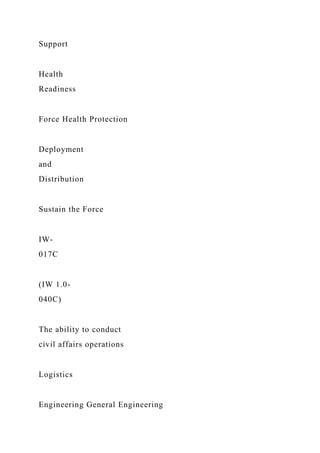
  • 322.
    offensive and defensivemeasures to enable the effective employment of the joint force while degrading opportunities for the enemy. FP does not include actions to defeat the enemy or protect against accidents, weather, or disease. Elements of FP include but are not limited to the following: Planning Considerations for Civil Affairs Operations B-7 (a) Chemical, Biological, Radiological, and Nuclear (CBRN) Defense. Operations in a CBRN environment will require the employment of strategic and operational capabilities and policies that minimize or negate CBRN threats or hazards within an OE. CBRN threats include the capability to employ and the intentional employment of, or intent to employ, weapons or improvised devices to produce CBRN hazards. The employment or threat of CBRN weapons including TIM poses serious challenges to US military operations worldwide. Together with USG interagency partners and partner nations, the military will continue to invest in capabilities to identify, protect against, respond to, and mitigate the effects of CBRN threats and hazards. The reduction of CBRN threats and hazards through building partnership capacity with partner nations and
  • 323.
    preventing the proliferationof WMD are essential in the global environment. For additional guidance on CBRN, refer to JP 3-11, Operations in Chemical, Biological, Radiological, and Nuclear (CBRN) Environments. (b) AT. AT programs support FP by establishing defensive measures that reduce the vulnerability of individuals and property to terrorist acts, to include rapid containment by local military and civilian force. They also consist of defensive measures to protect Service members, civilian employees, family members, facilities, information, and equipment. Figure B-1. Sample Checklist for Transition Planning Sample Checklist for Transition Planning
  • 324.
    Who will determinewhen the transition begins or is complete? Have stated operational objectives been accomplished? Who will fund the transition? What is the new mission? What US forces, equipment, and/or supplies will remain behind? What will be the command relationship for US forces that remain behind? What will be the communications requirements for US forces that remain behind? Who will support US forces that remain behind?
  • 325.
    Can intelligence beshared with the incoming force or organization? Will new rules of engagement be established? Will ongoing operations (e.g., engineer projects) be discontinued or interrupted? Will the United States be expected to provide communications capability to the incoming force or organization? Will the incoming force or organization use the same headquarters facility as the joint force? What is the policy for redeployment of the joint force? Will sufficient security be available to provide force protection? Who provides it? How will the turnover be accomplished? Who will handle public affairs for the transition? Have redeployment airlift and sealift arrangements been approved and passed to the United States Transportation Command? Appendix B B-8 JP 3-57 For further guidance on AT, refer to JP 3-07.2, Antiterrorism. (c) Security. Security of forces and means enhances FP by identifying and reducing friendly vulnerability to hostile acts, influence, or
  • 326.
    surprise. Security operations protectflanks and rear areas in the operational area. Physical security measures deter, detect, and defend critical installations, facilities, information, and systems against threats from intelligence assets, terrorists, criminals, and unconventional forces. Measures include fencing and perimeter stand-off space, lighting and sensors, vehicle barriers, blast protection, intrusion detection systems and electronic surveillance, and biometric access control devices and systems. Physical security measures, like any defense, should be overlapping and deployed in depth. For further guidance on physical security measures, refer to JP 3-10, Joint Security Operations in Theater. (d) Operations Security (OPSEC). Effective OPSEC prevents adversaries (or potential adversaries) from gaining critical information concerning friendly operations, and enable the successful execution of all IRCs. The most effective OPSEC measures manifest themselves at the lowest level. Varying patrol routes, staffing guard posts and towers at irregular intervals, and conducting vehicle and personnel searches and identification checks on a set but unpredictable pattern discourage terrorist activity. For further guidance concerning OPSEC, refer to JP 3-13.3, Operations Security. (e) LE. LE aids in FP through the prevention, detection,
  • 327.
    response, and investigation ofcrime. A cooperative police program involving military and civilian or HN or FN LE agencies directly contributes to overall FP. (f) Personal Security. Personal security measures consist of common-sense rules of on- and off-duty conduct for every Service member. They also include use of individual protective equipment, use of hardened vehicles and facilities, employment of dedicated guard forces, and use of duress alarms. (2) Planning for FP (a) JFCs and their subordinate commanders must address FP during all phases of contingency action planning. All aspects of FP must be considered and threats minimized to ensure maximum operational success. JFCs and their subordinate commanders must implement FP measures appropriate to all anticipated threats, to include terrorists. (b) Supported and supporting commanders must ensure that deploying forces receive thorough briefings concerning the threat and personnel protection requirements prior to and upon arrival in the operational area. (c) In addition, JFCs and their subordinate commanders must evaluate the deployment of forces and each COA for the impact of terrorist organizations supporting the threat and those not directly supporting the threat but seeking to take advantage of
  • 328.
    the situation. Planning Considerationsfor Civil Affairs Operations B-9 (d) CA forces must address their particular FP concerns with JFCs. For example, it may be inappropriate and counterproductive for CA in full combat attire to conduct liaison with local officials. These type concerns should be addressed early in the planning process. Additionally, CA must address with JFCs how the various elements of FP impact on how they perform their mission. (e) CA, because of their ability to work with the populace and their overall expertise, can provide JFCs insight into FP concerns before they become major issues. (f) Intelligence support to FP consists of monitoring, reporting, and analyzing the activities, intentions, and capabilities of adversarial groups to determine their possible COAs. Detecting the adversary’s methods in today’s OE requires a higher level of situational understanding, informed by current and precise intelligence. This type of threat drives the need for predictive intelligence based on analysis of focused information from intelligence, LE, and security activities. For more detailed discussion of FP, refer to JP 3-0, Joint
  • 329.
    Operations. f. Joint UrbanOperations (1) In any operational area, most of the civil authority and the greater part of the population are likely to reside in one or more urban areas. Because of the numbers and density of civilians, any urban operation will require a significant CMO (CAO) effort on the part of the joint force. (2) CMO conducted as parts of urban operations strive to achieve the same objectives as in other types of operations. These are: (a) Enhance military effectiveness. (b) Support national objectives. (c) Reduce the negative impact of military operations or other destructive force on civilians. (3) CMO and Urban Operations (a) As with other activities, the complex, physical aspects of urban terrain can hamper CMO. The urban terrain can fragment and channel CMO efforts, particularly FHA. It will be difficult to find and reach all those in need of support. Constricted terrain makes it more difficult to control large numbers of people in PRC operations. Urban areas normally offer many buildings usable for shelter, medical care, and other forms of support, but the
  • 330.
    damage to thosestructures from military operations or natural or man-made disaster can make them unusable, thus adding to the support difficulties. (b) The civilian population is a primary concern of CMO, and urban areas may contain huge numbers of civilians. These numbers may range from the thousands to the millions. Depending on the circumstances, many will be displaced and in need of basic Appendix B B-10 JP 3-57 support. Services may be degraded or nonexistent. The requirement to control and support the noncombatant population can easily overwhelm local capabilities. Effective urban CMO requires knowledge of the ethnic, cultural, religious, and attitudinal characteristics of the populace. Noncombatant populations in urban areas are rarely homogenous, therefore effective CMO will require the understanding of neighborhoods, tribal relations, and the basic allegiances and daily life of the inhabitants. (c) Urban infrastructure may be functioning with some degree of effectiveness, in which case CMO must work through and with local authorities and services. It may be necessary to repair physical infrastructure facilities and means, such as power plants or water stations, as part of CMO. Existing service infrastructure may
  • 331.
    be totally lackingor overwhelmed by circumstances, requiring the joint force to provide not only basic subsistence and shelter, but the full gamut of support personnel—police, legal, administration, engineer, sanitation, medical, transportation, and other. (d) The proximity of civilians to military targets increases the requirement to actively screen the joint integrated prioritized target list for indirect fires and minimize the impact of collateral damage. The proximity to civilians increases the risks that diseases and other public health hazards will pose health risks to military personnel. (4) CMO Considerations in Joint Urban Operations. Urban operations will include CMO. Urban CMO can support overall operational objectives or be the main focus of operations, but are in any case the responsibility of the CCDR to plan and conduct. (5) Planning Considerations. Planning for CMO support of urban operations is generally the same as for other CMO with special emphasis on the nature of the urban area. The JFC and staff should consider the impact of military operations on noncombatants to include their culture, values, and infrastructure; thereby viewing the urban area as a dynamic and complex system—not solely as terrain. General planning considerations were addressed earlier in this chapter. Additional planning considerations are below:
  • 332.
    (a) CMO plannersshould carefully consider these aspects of the urban area— terrain, civilian populace, environment, and infrastructure. (b) Some other factors to consider include legal implications, communications, culture, education, economic, religious, labor, health, and administrative infrastructure. (c) NGOs, IGOs, the interagency community, and IPI also play a major part in all CMO but may be of more importance in urban operations. (6) Synchronization. CMO must be synchronized both internally and with other operations. The relation of CMO to the overall operation can vary a great deal depending on the situation. Joint urban operations could require the full extent of CMO in one portion of an urban area while another is still being heavily contested. Most likely, regardless of the situation, civilians in the operational area will have a great impact on operations. Planning must be synchronized to ensure CMO and other operations (e.g., combat operations) support the USG overall objectives. Planning Considerations for Civil Affairs Operations B-11 (7) Support. CMO may require support in a number of key areas from other forces
  • 333.
    (e.g., health support,engineer, and MP/security forces). (8) Other Operational Considerations. The most important urban operation consideration is that CMO will most likely occur simultaneously with, not subsequent to, other operations—including combat. The JFC must therefore identify sufficient forces and synchronize the planning and execution of these operations as well as the support required. The relation of CMO to other operations in joint urban operations will vary, but CMO will be a significant part of any operation. For further guidance concerning urban operations, refer to JP 3- 06, Joint Urban Operations. g. FCM (1) FCM is USG activities to assist friends and allies with preparing for and responding to a CBRN incident that occurs on foreign soil in order to mitigate human casualties and to provide temporary associated essential services. These operations involve those essential services and activities required to manage and mitigate problems resulting from disasters and catastrophes, including natural, man-made, or terrorist incidents. Such services may include transportation, communications, public works, fire fighting, information planning, care of mass casualties, resources support, essential or routine health and medical services, urban search and rescue, hazardous materials, food, and energy.
  • 334.
    (2) Primary responsibilityfor managing and mitigating the effects of a FCM incident resides with the HN government. The DOS is designated as the primary agency for FCM operations in support of a foreign government. All DOD support will be coordinated through the responsible US embassy COM and country team. For further detail concerning FCM, refer to Chairman of the Joint Chiefs of Staff Instruction (CJCSI) 3214.01B, Military Support to Foreign Consequence Management Operations, JP 3- 29, Foreign Humanitarian Assistance, JP 3-40, Countering Weapons of Mass Destruction, and JP 3-41, Chemical, Biological, Radiological, and Nuclear Consequence Management. h. Humanitarian Demining Operations. The general role of CA in these types of operations is to assist the assigned SOF and other forces in their efforts in supporting USG and geographic CCMDs in achieving their objectives. (1) CA execute programs that build capabilities in management, administration, logistics, equipment maintenance, communications, and data processing. CA are instrumental in the establishment of the HN humanitarian demining office and the coordination of support with NGOs and IGOs. (a) Special forces teams train HN cadre in techniques to locate, identify, and destroy landmines and unexploded ordnance. (b) MIS teams assist HN governments to develop and
  • 335.
    implement mine awareness programsto train local populations to identify, avoid, and report locations of landmines and unexploded ordnance until these threats are removed. Appendix B B-12 JP 3-57 (c) CA train the HN demining headquarters in management and C2 of its subordinate elements. CA also provide liaison with the USG, IGOs, NGOs, and local organizations to coordinate support of the HN or FN demining infrastructure. (2) CA possess the expertise to support other SOF, CF, and civilian organizations in humanitarian demining operations. CA possess the unique skills that foster relationships with the civilian community, which allow them to be a logical choice as part of a team to assist HNs or FNs in demining operations. For further guidance on military support to humanitarian demining operations, refer to CJCSI 3207.01B, Military Support to Humanitarian Mine Actions, JP 3-15, Barriers, Obstacles, and Mine Warfare for Joint Operations, JP 3-29, Foreign Humanitarian Assistance, JP 3-40, Countering Weapons of Mass Destruction, and JP 3-41, Chemical, Biological, Radiological, and Nuclear Consequence
  • 336.
    Management. i. Negotiation andMediation. Although negotiation normally is not a primary responsibility for CA, often it falls upon them. CA often find themselves in the role of a mediator or even arbitrator at some point during military operations. Each role requires different attributes, but there are many common ones and the following focuses on those common attributes and techniques. The COM is the lead USG representative in-country and must authorize JFC personnel to coordinate with HNs, IGOs, and NGOs. (1) Negotiations do not occur in a vacuum. It is important to understand the broader issues of conflict and their changing nature. (a) In many operations, it is essential to maintain dialogue with all parties, groups, and organizations—including of course the government if one exists, but also the opposition or various factions or militias. (b) It is also important not to allow any one incident to destroy dialogue (even if force is applied)—creating an atmosphere of hostility will not lead to a resolution. (2) Negotiation is an exercise in persuasion. It is a way to advance the command’s interests by mutually decided action. Cooperation of the other parties is a must; consider them partners in solving problems.
  • 337.
    (3) Think carefullyabout the full range of the force’s interests and prepare thoroughly for the full range of interests of the other parties. What are the underlying interests behind a particular position that a party has taken on a particular issue? People negotiate for different reasons such as: (a) Tasks (e.g., the lease of a compound); (b) Relationships (e.g., to get to know the other party and find out more information about whom that person is); and (c) Status (e.g., legitimacy as a participant in the eyes of others). Planning Considerations for Civil Affairs Operations B-13 (4) Think carefully about alternatives in negotiating an agreement. How will you as a negotiator be most persuasive in educating others to see a negotiated settlement as being in their best interests? (5) Be attuned to cultural differences. Actions can have different connotations. The use of language can be different; “yes” may mean “no”. How people reason and what constitutes facts and what principles apply are shaped by culture.
  • 338.
    Solution s often arebest when they come from the factions themselves. Nonverbal behavior such as the symbolic rituals or protocols of the arrangement for a meeting also is important. It is particularly important to look at opportunities for small interim agreements that can be seen as “trust building” steps that are necessary when it will take time to reach agreement on larger issues. (6) Negotiations will be conducted at several levels: negotiations among USG departments and agencies; between the multinational partners; between the joint force and UN agencies; and between the joint force and local leaders. This complex web of negotiations requires the following to build consensus: tact, diplomacy, honesty, open mindedness, patience, fairness, effective communications, cross-cultural sensitivity, and careful planning.
  • 339.
    (7) Procedures forNegotiation. Successful negotiations should be based on the following steps: (a) Establish communications. The first step is to establish an effective means of communicating with the political or faction leader(s). Do not assume that certain leaders or elements are opposed to your efforts without careful investigation. Insist on fact finding before forming any opinions. (b) Carefully develop a strategic plan and diagram the results of your analysis. Useful questions to answer in this analysis are: 1. What are the main issues? 2. Who are the relevant parties? First order? Second? Third? 3. What are these parties’ publicly stated positions? Privately stated positions?
  • 340.
    4. What arethe underlying interests behind these positions? 5. What are the bottom-line needs of each party? 6. What are their concerns? Fears? To what degree does “historical baggage” affect them? (c) There will be a negotiation on the conduct of negotiations (examples: physical location/seating arrangements [round table, U-shaped, etc.]/agenda/security requirements). This process must be addressed in the initial planning sessions. Appendix B B-14 JP 3-57 (d) Set clear goals and objectives. Know what the joint force is trying to accomplish as well as the limits of its authority. Think carefully about how the joint force
  • 341.
    wants to approachthe issues. Settle the easy issues first. Settle issue by issue in some order. Look to create linkages or to separate nonrelated issues. For example, security issues might be separated from logistic issues. Consider having details worked out at later sessions with the right people. Understand these sessions also will be negotiations. (e) Work with the parties to identify common ground on which to build meaningful dialogue. Expect to spend considerable time determining the exact problem(s). At this stage, be problem-oriented rather than solution-oriented. 1. If a party perceives more benefits from an alternative to negotiations than to any outcome negotiations could produce, do not expect that party to negotiate to achieve an agreement. You need to educate and persuade them that negotiations will in fact produce the most benefits. 2. Focus on underlying interests. Differences in the relative value of
  • 342.
    interests, forecasts offuture events, aversion to risk, and time preferences may offer opportunities to develop options for mutual gain. 3. Learn from the parties. Seek ways through partnering with them to find possible alternatives beyond their present thinking. 4. When necessary, assume the role of convener, facilitator, or mediator. Be patient. (f) Composition of negotiating forum and decision-making mechanisms. In some cases a committee or council can be formed with appropriate representation from the various interested parties. It is critical to identify the right participants in advance. For example, will it include COM and JFC-level, mid-level, or working-level personnel? 1. In deciding what constitutes the appropriate construct for a meeting, consider the culture. For example, what role do women play in the society? How is status
  • 343.
    defined in theculture? 2. Composition of the committee or council also may include legal advisors, political representatives (e.g., DOS, UN agencies, or others), military representatives, and other civilian representatives from the joint force, NGOs, or IGOs. 3. Members should possess the status and ability to deal with the leadership representing all involved parties. 4. For those members seen as part of the joint force, it is important that they understand the issues and speak with one voice. This will require a prior coordination within the joint force’s delegation. They must understand policy and direction from higher authority. Planning Considerations for Civil Affairs Operations
  • 344.
    B-15 5. Negotiations aretime-consuming and can be frustrating. As the head negotiator, be attentive to whether you have the people negotiating who can effectively recommend that their superiors ratify an agreement reached. Are all the decision makers who will determine whether the agreement reached is implemented represented in the committee or council? 6. A supportive climate needs to be developed for the decision makers to complete an agreement. In that vein, it is useful to talk to those who are not decision makers but from whom the decision makers will need support. In this way, they may assist you in helping their decision makers reach agreement. 7. In zones of severe conflict and state collapse, it is frequently difficult to determine the legitimate community leaders with whom any lasting agreement must be made.
  • 345.
    8. The JFCmust ensure that all of his or her negotiators understand the scope and latitude of their authority. Their requirement to obtain the JFC’s prior approval will empower them in their role as negotiator or mediator. (g) Establish the venue. What is the manner in which meetings can be called? Can a neutral ground be found that is acceptable to all sides? Should US representatives go to the factional leader’s location, or will this improperly affect the negotiations? What about the details such as the seating arrangements or specific settings traditionally used in the culture? 1. Selection of a negotiating venue also should be based on security for all involved parties, accessibility, availability of communications facilities, and comfort. 2. Ensure that appropriate information arising from, or relevant to, the negotiations is shared with all parties. The timing of this
  • 346.
    sharing may varydepending on the circumstances. 3. Sharing of information notwithstanding, all information generated from the negotiations may be held in confidence until officially released. That decision will depend on the nature of the talks. For example, if publicity may help create support and empower the negotiators to agree, release of information may be constructive. Flexibility is needed here rather than a hard and fast rule. (h) Cultural Considerations 1. There are organizational cultures within the various agencies and departments of the USG that shape the context of negotiations. Equally important are national cultural differences. 2. It is imperative that experienced interpreters be part of the negotiating team. What is critical is their understanding of the cultural context of terms used. The team
  • 347.
    needs more thanliteral translators. Appendix B B-16 JP 3-57 3. Negotiation is only one means of resolving conflict. It is worthwhile to consider indigenous conflict resolution techniques in selecting an approach. Adapting your techniques to indigenous ones (degradation of US objectives is not acceptable) may improve the prospects for a settlement. 4. There are differences in styles of reasoning, manner in which an individual negotiates, who carries authority, and behavior in such dimensions as protocol and time. For example, in our culture it is accepted that one may offer concessions early in a negotiation to reach an agreement. That approach may not have the same connotation in other cultures. Moreover, the concept of compromise, which
  • 348.
    has a positiveconnotation for Americans, may have a negative one in other cultures. 5. Where we as Americans tend to be direct problem solvers with a give- and-take approach, other cultures are indirect, most concerned with the long-term relationship, historical context, and principles. Issues of symbolism, status, and face may be important considerations. 6. For example, answers may not be direct, forcing the negotiator to look for indirect formulations and nonverbal gestures to understand the other party’s intent. In turn, careful wording and gestures are required so that unintended meanings are not sent. The other party may not say “no” directly to a proposal, but that is what is meant. 7. If agreement cannot be reached, it is still important to keep the dialogue going. The negotiator should at a minimum seek agreement on when the parties will meet again; anything to keep the momentum alive. It is often helpful
  • 349.
    to go backto earlier discussions on common ground and seek to keep trust alive in the process. 8. Within the negotiating team, one person who understands conflict dynamics and cross-cultural issues should look at the process of the negotiations and advise the rest of the team. This individual can watch for body language and other indicators of how the process is working. In turn, they may be able to coach the joint force negotiators in more effective techniques. (i) Social Considerations 1. Social identity can be described through national, tribal, clan, religious, language, or other faction sharing the same geographical territory and subject to the same political authority and dominant cultural expectations, and that hold the same psychological ideals, beliefs, and convictions. Rapidly identifying the importance the leading social identity will directly reflect on the viability of rules established
  • 350.
    that are inconflict with general prescribed law by the current governing power (i.e., HN government). 2. Identification of the underlying causes of conflict among the civilian populace (social, economic, geographical, ethnic, religious, political) as related to the social economic aspects consider the populace and whether they feel secure. Corruption (example: involvement in illicit drug production/sale/transport, black marketing, banking system, social economic aspects). Consider the populace in reference to the level of security they feel is present. Planning Considerations for Civil Affairs Operations B-17 3. It is worthwhile to consider essential needs (water, food, shelter, etc.) as a driving factor in stability operations. If necessities are
  • 351.
    unavailable, all goodintentions will still lead to fear and resentment on the part of the locals. 4. Degree of religious freedom. 5. Presence of terrorist groups that could and do have an impact on the social fabric of the population (fear, compassion toward said group[s]). 6. Consider the overall quality of life (pros and cons). (j) Implementation 1. At the conclusion of negotiations, a report should be prepared to ensure all accomplishments, agreements, and disagreements are recorded for future use. 2. Consider giving one person the task of reporting and presenting to all participants what has taken place. This can build trust in the process if it is viewed as an honest effort to understand each side’s position.
  • 352.
    Appendix B B-18 JP3-57 Intentionally Blank C-1 APPENDIX C CIVIL INFORMATION MANAGEMENT 1. Description a. Civil information pertains to civil ASCOPE within the civil component of the OE, which can be fused or processed to increase situational awareness and understanding and enhance unity of effort among interagency partners, coalition,
  • 353.
    HN, IGO, NGO,and IPI partners. It is a CA planning consideration. b. CIM is the process whereby civil information is gathered, entered into a database, analyzed, and internally fused with other data sources from the supported element, higher headquarters, interagency, multinational, HN, IGO, NGO, and IPI partners. This process ensures the timely availability of accurate information for mission analysis. It also ensures the widest possible dissemination of civil information to other military and select nonmilitary partners throughout the JOA at the discretion of the JFC. CIM is not solely the task of the CA officer or noncommissioned officer in the CIM cell. It is an essential task for all components of a CA unit in coordination with the J-2, and should be broadly tasked to the supported units intelligence and maneuver elements to enhance the COP and facilitate the JIPOE process. The CIM goal is the enhancement of situational awareness and understanding for all elements in the OE to enhance decision making.
  • 354.
    c. The primarypurpose of CIM is to improve the commander’s awareness and understanding of the civil component of the OE. The effective management of civil information provides a readily available historical database of geospatially referenced data that is collated and processed to support fusion and detailed analysis essential for mission planning. Civil information is gathered through civil assessment and survey, data mining, and collaboration. Examples of civil information consist of, but are not limited to CMO reports, situation reports, civil assessment and survey reports, village assessments, reports on key leader and other civil engagements, civil system assessments, reports on civil projects, and other logs, files, briefings, and photos pertaining to the civil environment (see Figure C- 1). d. Although CIM is a core task of CA, the joint force comprises many elements that interact with the civil population. During mission planning cycles, CAO and CMO planners
  • 355.
    must actively engageother members of the joint community to extend the reach and influence of civil information collection efforts. These elements include, but are not limited to, maneuver units and force enablers such as MP, engineers, chaplain, SJA, medical service, MISO, and civil-military teams. e. Anticipating and satisfying civil information needs for the JFC are tasks for the CAO/CMO planners. The CMO planner is responsible for providing the key civil considerations that should support the JFC’s intent in order to perform the following: (1) Produce the CMO estimate. (2) Participate in mission planning cycles. Appendix C C-2 JP 3-57
  • 356.
    (3) Write theCA annex (Annex G to operation plans/operation orders). (4) Participate in CMO working group and IO working group to develop unity of effort across the JTF. (5) Develop and synchronize the civil information plan with other efforts to satisfy the commander’s information requirements. (6) Develop the civil layers of the COP. (7) Increase the JFC’s situational awareness and understanding of the civil component of the operating environment. (8) Coordinate and synchronize USG CMO efforts with the coalition, HN, NGOs, IGOs, and IPI. (9) Develop standard operating procedures for the storage, maintenance, access, assurance, and sharing of civil information.
  • 357.
    2. Organization andEmployment a. The responsible CMO staff manages the civil information process for the JFC and coordinates the retrieval, storage, dissemination, assurance, and access with appropriate staff Figure C-1. Examples of Civil Information Reports and Assessments Examples of Civil Information Reports and Assessments Civil-military operations reports
  • 358.
    Situation reports Capacity assessments District/village assessments Projectassessments Types of Civil Data Assessment Forms Building School/orphanage Warehouse Store/market Arts/historical/cultural/religious Fuel point Police station/security unit Fire station Trash removal Sewage Hospital/clinic Road/route reconnaissance Bridge Railway Fishery/hatchery
  • 359.
    Ports/harbors Airfield Farm Veterinary Water/well/dam Dislocated civilian Foreign humanitarianassistance/disaster relief Key leader engagement Civil Information Management C-3 information managers. Utilizing theater-specific CIM architectures, their supporting networks, and information assurance requirements as early as possible enables effective communication and coordination with other USG partners, IGO, NGO, and IPI operating in the JOA. b. At each echelon, the CIM cell is the focal point for the consolidation of civil data
  • 360.
    and the developmentof geospatially referenced civil information. With available analytic capabilities, the O&I cell, organic to the CMOC, CIM cell focuses analysis on identifying civil vulnerabilities and their root causes. Once entered into the COP, the civil layers help shape operations and focus available resources to meet specific strategic and operational goals. c. The CIM cell may be task organized in a CMOC or relocated within a JTF, JSOTF, or TSOC as dictated by the mission. Regardless of the episodic nature of the mission, the civil information will continue to have value throughout each phase of an operation or campaign. d. The coordinated management of civil information is applicable across the range of military operations. Emphasized by the difficult experiences of both Iraq and Afghanistan, success is not only defined in military terms. CIM is critical in providing information and analysis in support of efforts for rebuilding infrastructure,
  • 361.
    supporting economic development, establishingthe rule of law, building accountable governance, establishing essential services, and building a capable HN military responsible to civilian authority. e. Commanders must ensure civil information and resultant products are accessible and available throughout the JFC and with other USG departments, agencies, and partner nations supporting disaster response and HA activities, development activities, and post-conflict reconstruction and stabilization activities. f. Through collaboration, interagency, coalition, IGOs, NGOs, and IPIs operating within the JOA can provide additional sources of civil information. Collaboration contributes to successful military operations by unifying and synchronizing concurrent efforts to focus on a desired end state. Institutional and cultural differences may contribute to barriers in collaboration and information sharing between agencies; however, in most cases non-USG organizations and the USG are working toward similar goals.
  • 362.
    By attempting to accommodatethese concerns and sharing useful information and resources, the JFC, can help encourage active IGO and NGO cooperation. This requires the JFC to manage and make available relevant information to appropriate stakeholders. To accomplish this, the CIM cell must identify existing architectures (not organic to the CIM cell) to host civil information at the appropriate classification level to support concurrent non- DOD efforts. To maximize information sharing to the greatest extent possible, the goal for civil information hosting should always begin at the lowest possible classification level while enabling civil information migration to provide echelon appropriate civil analysis (Figure C-2). Appendix C
  • 363.
    C-4 JP 3-57 g.The CIM process requires the ability to protect civil information by ensuring its integrity, authentication, confidentiality, and non-repudiation. However, electronic communication with HN and other partners may not be possible using the same rigor expected of DOD systems. h. CIM sharing requires communication and understanding among the various centers, commissions, staffs, augmentations, field offices, and agencies. The management of civil information is a component of the joint IM plan and requires close coordination between the J-9 and the communications system directorate of a joint staff to address network architectures and interfaces, adherence to information assurance policies and compliance Figure C-2. Civil Information Enables Consumers at Multiple Classification Levels
  • 364.
    CIM civil informationmanagement COM chief of mission DAO defense attaché office(r) Db database DCM deputy chief of mission ECON economic GCC geographic combatant commander HN host nation IGO intergovernmental organization IPI indigenous populations and institutions J-2 intelligence directorate of a joint staff J-3 operations directorate of a joint staff J-5 plans directorate of a joint staff J-9 civilian-military directorate of a joint staff NGO nongovernmental organization POLMIL political-military TSOC theater special operations command USAID United States Agency for International Development Civil information must be available, relevant, accurate, usable, discoverable, timely, assured, and sharable at each classification
  • 365.
    level to supportthe appropriate community of interest. Civil Information Flow CIM Db (.mil/.gov) CIM Db (.smil/.sgov)CIM Db (.org/.net) GCC GCC USAID HN IPI IGO IGO NGO Embassy Embassy Embassy COM
  • 366.
    DCM DAO USAID POLMIL ECON GCC J-2 J-3 J-5 J-9 TSOC Civil Information Flow Legend CivilInformation Enables Consumers at Multiple Classification Levels Civil Information Management
  • 367.
    C-5 with DOD directivesregarding the handling and distribution of information. The joint force must understand these policies and maintain communications with stakeholders to resolve issues as they arise. 3. CIM Process The CIM process generates civil information through the following six steps (Figure C-3): (1) Plan and Collaborate (a) Mission planning should not be based solely on the staff’s analysis of DOD-sourced information. Input from other sources, such as various intelligence organizations, interagency, the HN, IPI, IGOs, and NGOs is essential to developing a better understanding of the civil dimension. The CA staff leverages these external sources of
  • 368.
    information to providea comprehensive understanding of the OE that enables the JFC to conduct operations that mitigate sources of instability, address civil vulnerabilities, and promote unity of effort. (b) JFC participation in interagency and multinational forums with the command, senior USAID representatives, and other senior agency representatives are important for the deconfliction and coordination of activities. (c) The JFC should participate in appropriate national-level formal and informal discussions among HN, UN, other government departments and agencies, and NGO participants to share perspectives and develop a common understanding. Figure C-3. Examples of Interorganizational Partners Examples of Interorganizational Partners Civil Information Management Process
  • 369.
    Share Plan Gather Produce Analyze Consolidate Appendix C C-6 JP3-57 (d) The establishment of, or participation in, CMOCs, an HA coordination center, a UN on-site operations coordination center, or other operational and tactical level collaboration and information sharing organizations by the joint force is essential for developing a comprehensive understanding of the OE among those
  • 370.
    conducting CMO (FigureC-4). (e) Effective CIM requires the conduct of assessments to determine conditions in the JOA. Interagency, coalition, HN, NGO, IGO, and IPI support for these assessments may be critical to their accuracy. This assessment process serves two important purposes: to Figure C-4. Organizations Involved in Civil Information Management Organizations Involved in Civil Information Management United States Government (USG), Intergovernmental Organization (IGO), and Nongovernmental Organization (NGO) Interorganizational Coordination USG Departments and Agencies Department of Agriculture IGOs
  • 371.
    North Atlantic TreatyOrganization United Nations United Nations Children’s Fund United Nations Office for the Coordination of Humanitarian Affairs United Nations Food and Agriculture Organization United Nations High Commissioner for Refugees NGOs International Red Cross and Red Crescent Movement
  • 372.
    Department of Commerce Departmentof Defense Department of Energy Department of Health and Human Services Department of Homeland Security Department of Justice Department of Labor
  • 373.
    Department of State Departmentof Transportation Department of the Treasury Central Intelligence Agency Environmental Protection Agency General Services Administration National Security Council Office of the Director of National Intelligence Peace Corps United States Agency for International Development United Nations World Food Programme United Nations World Health Organization United Nations Development Programme United Nations Department of Peacekeeping Operations European Union Organization of American States International Federation of Red Cross and Red Crescent Societies American Red Cross
  • 375.
    Civil Information Management C-7 gainclarity of the current situation and to enable the HN government to be aware of the benefits of the transformation process proposed. There is a need for initial discussion between the international community and national actors about the scope and objectives of the assessments. These will be determined by a number of factors, including the openness, willingness, and capacity of the key HN leaders. Assessments provide an important opportunity to build trust between international and local people and organizations and to develop local ownership of assistance programs.
  • 376.
    (2) Information Gathering (a)Information gathering occurs at all levels through civil assessment and survey operations and data mining with interagency, coalition, HN, IGOs, NGOs, and IPIs to satisfy the JFC’s requirements. (b) The intent of CIM is to keep most of this information unclassified and easily shared with non-USG partners. The heart of information gathering is the daily interaction among US forces and the myriad of civilians in the supported commander’s AO and the capture of these contacts and data points. Initial assessments may be short and superficial due to pressure to quickly design and implement programs and activities. Political priorities or immediate threats posed by natural disasters and ongoing or threatened violent conflict may obstruct in-depth planning and preparation at the onset of design and planning. If priorities or threats limit the ability to conduct a comprehensive assessment at
  • 377.
    the outset, initialplans should direct the completion of more detailed and comprehensive assessments as soon as possible. (c) CR is a targeted, planned, and coordinated observations and evaluations of specific civil aspects of the environment. CR focuses on the civil component, the elements of which are area, structures, capabilities, organizations, people, and events. CR also focuses on gathering civil information to enhance situational understanding and facilitate decision making. CAO and CMO planners (J-9) and supporting CAPTs, in coordination with the CMOC, integrate CR results into the overall OPLAN. Potential sources of civil information that a coordinated CR plan considers include the following: 1. Ongoing assessments of the JOA that identify MOE trends. 2. Identified unknowns in civil information. 3. Gaps identified during collation and analysis. 4. Gaps remaining in the area study, assessment, and staff
  • 378.
    estimate. 5. CA interactionwith IPI or civilian constructs of an operational area, including but not limited to the following: a. HN government officials. b. Religious leaders. Appendix C C-8 JP 3-57 c. Tribal, commercial, and private organizations. d. All categories of DCs. e. Legal and illegal immigrants. f. Infrastructure managers and workers. g. Local industry personnel.
  • 379.
    h. Medical andeducational personnel. (d) Data mining is the process of extracting patterns from raw data using sophisticated data search capabilities and statistical algorithms to discover patterns and correlations in large preexisting databases. Data mining uses a combination of open and restricted-source databases for routine and continuous study and research. Data mining is focused by the civil information collection requirements and provides corroboration of other collected civil data. Data mining is focused on the following factors: 1. Priority civil information requirements. 2. Requests for information. 3. Running estimates. 4. Gaps remaining in the area study and area assessment. (3) Consolidation consists of collation and processing.
  • 380.
    (a) Collation isthe ordering of the data into groupings and focuses on data management. The tools and methods for this step are rapidly maturing. A normalized relational civil information database is capable of cataloging vast amounts of data with attached files and photos and rapidly retrieving this data for follow-on processing, analysis, production, and sharing. Within these database structures, civil information is normally collated by date, type, location, organization, activity, and meta-tagged by supported goals and objectives (e.g., program elements, lines of operation, and/or COM MSRPs depending on the specific mission and supported/supporting relationships). (b) Processing is the physical and cognitive manipulation of the separate pieces of data into information. Processing structures the collated data into a usable form of information in preparation for analysis. (4) Analysis. Analysis is the process by which collected information is evaluated
  • 381.
    and integrated withexisting information to produce intelligence products that best describe the current and predicts the future impact of the threat and/or environment on operations. Analysts and civil information managers mold the civil information into a usable product. The most difficult analysis performed identifies indicators of future events previously obscured in the background data. CIM supervisors direct the analytical efforts to those gaps Civil Information Management C-9 in the commanders’ awareness and understanding of the civil component of the operating environment. Analysis of civil information focuses on the following: 1. Identifying mission variables. 2. Identifying operational variables.
  • 382.
    3. Identifying COGs. 4.Identifying trends. 5. Conducting predictive analysis. 6. Identifying civil vulnerabilities. 7. Assessment of civil MOPs and MOEs. 8. Prioritization and apportionment of resources to address civil vulnerabilities, influence populations, and legitimize governments. (5) Production (a) Production is the packaging of civil information products into easily disseminated reports, presentations, and updates. The production phase of the CIM process ensures CIM products and services are relevant, accurate, timely, and useable for commanders and other senior leaders. Following are the
  • 383.
    products of civilinformation analysis: 1. Layered geospatial information. 2. Civil layers (ASCOPE) for the COP. 3. COGs. 4. Civil considerations products. 5. Answers to requests for information. 6. Reported priority civil information requirements. 7. Updates to ongoing assessments, estimates, area studies. (6) Information Sharing (a) Information sharing involves both the active pushing of products to specific consumers through available architectures and the passive posting of products on web portals. The consumers may not realize what they need; therefore, CA/CMO forces must
  • 384.
    anticipate the informationneeds of the supported unit or agency. Thorough dissemination of civil information reduces redundancy and ensures that the maximum effects are created by Appendix C C-10 JP 3-57 using limited resources to their fullest potential. Mechanisms for dissemination may vary by situation and echelon, but the process and goal remain constant. The J-9 or CMO staff normally serve as the JFC’s primary manager for the dissemination and integration of civil information and resultant products. Examples of information sharing include the following: 1. Integration with the COP. 2. Establishment of civil information repositories and granting access to online databases that include reports, assessments, and area
  • 385.
    studies. 3. Pushing andposting of reports, update briefs, and other civil information products. 4. Integration with the joint targeting process (nonlethal). 5. Integration with TCP. 6. Integration with TCP cycles. (b) Civil Information sharing is critical to the efficient pursuit of common goals. Although challenged by cultural and political differences, a collaborative environment facilitates information sharing between many different groups and authorities that can work in parallel. A collaborative environment facilitates information sharing. Although technology can support the creation of an unclassified collaboration and information sharing space, the challenges are largely social, institutional, cultural, and organizational. These impediments can limit and shape the willingness of civilian and military personnel and
  • 386.
    organizations to openlycooperate and share civil information. (c) To overcome barriers to effective communications, the JFC must determine information sharing requirements and provide appropriate disclosure guidance, classifications, and caveats required throughout the civil information lifecycle to enable appropriate mission partners to the maximum extent allowed by US laws and DOD policy. The JFC should recognize the criticality of the civil information sharing function at the outset of complex operations to support unified actions. The JFC should also identify security requirements and vulnerabilities and conduct comprehensive operational risk assessment when sharing civil information. D-1
  • 387.
    APPENDIX D REFERENCES The developmentof JP 3-57 is based upon the following primary references. 1. General a. NSPD-44, Management of Interagency Efforts Concerning Reconstruction and Stabilization. b. UN CMCoord Officer Field Handbook. c. Title 10, USC, Armed Forces. d. Title 22, USC, Foreign Relations and Intercourse. 2. Department of Defense Publications a. Unified Command Plan. b. DOD Foreign Clearance Guide.
  • 388.
    c. DOD ForeignClearance Manual. b. DOD 3210.6-R, Department of Defense Grant and Agreement Regulations. c. DODD 1235.10, Activation, Mobilization, and Demobilization of the Ready Reserve. d. DODD 2000.13, Civil Affairs. e. DODD 3000.07, Irregular Warfare. f. DODD 3000.3, Policy for Nonlethal Weapons. g. DODD 5100.46, Foreign Disaster Relief (FDR). h. DODD 5230.11, Disclosure of Classified Military Information to Foreign Governments and International Organizations. i. DODI 2205.02, Humanitarian and Civic Assistance (HCA) Activities. j. DODI 3000.05, Stability Operations.
  • 389.
    k. DODM 5200.01,Volumes 1-4, DOD Information Security Program. 3. Chairman of the Joint Chiefs of Staff Publications a. CJCSI 3207.01B, Military Support to Humanitarian Mine Actions. Appendix D D-2 JP 3-57 b. CJCSI 3214.01B, Military Support to Foreign Consequence Management Operations. c. CJCSI 3214.01D, Defense Support for Chemical, Biological, Radiological, and Nuclear Incidents on Foreign Territory. d. CJCSM 3130.03, Adaptive Planning and Execution (APEX) Planning Formats and
  • 390.
    Guidance. e. JP 1,Doctrine for the Armed Forces of the United States. f. JP 1-04, Legal Support to Military Operations. g. JP 1-05, Religious Affairs in Joint Operations. h. JP 1-06, Financial Management Support in Joint Operations. i. JP 2-01, Joint and National Intelligence Support to Military Operations. j. JP 2-01.3, Joint Intelligence Preparation of the Operational Environment. k. JP 3-0, Joint Operations. l. JP 3-05, Special Operations. m. JP 3-06, Joint Urban Operations. n. JP 3-07. Stability Operations. o. JP 3-07.2, Antiterrorism.
  • 391.
    p. JP 3-07.3,Peace Operations. q. JP 3-08, Interorganizational Coordination During Joint Operations. r. JP 3-10, Joint Security Operations in Theater. s. JP 3-11, Operations in Chemical, Biological, Radiological, and Nuclear (CBRN) Environments. t. JP 3-13, Information Operations. u. JP 3-13.2, Military Information Support Operations. v. JP 3-13.3, Operations Security. w. JP 3-15, Barriers, Obstacles, and Mine Warfare for Joint Operations. x. JP 3-16, Multinational Operations.
  • 392.
    References D-3 y. JP 3-22,Foreign Internal Defense. z. JP 3-24, Counterinsurgency Operations. aa. JP 3-29, Foreign Humanitarian Assistance. bb. JP 3-33, Joint Task Force Headquarters. cc. JP 3-34, Joint Engineer Operations. dd. JP 3-35, Deployment and Redeployment Operations. ee. JP 3-40, Countering Weapons of Mass Destruction. ff. JP 3-41, Chemical, Biological, Radiological, and Nuclear Consequence Management. gg. JP 3-61, Public Affairs. hh. JP 3-68, Noncombatant Evacuation Operations.
  • 393.
    ii. JP 4-0,Joint Logistics. jj. JP 4-01, The Defense Transportation System. kk. JP 4-02, Health Services. ll. JP 4-05, Joint Mobilization Planning. mm. JP 4-06, Mortuary Affairs. nn. JP 4-10, Operational Contract Support. oo. JP 5-0, Joint Operation Planning. pp. JP 6-0, Joint Communications System. qq. JP 6-01, Joint Electromagnetic Spectrum Management Operations. 4. Allied Joint Publication AJP 3.4.9, Allied Joint Doctrine for Civil-Military Cooperation. 5. United States Army Publications
  • 394.
    a. Army Regulation195-2, Criminal Investigation Activities. b. FM 3-24, Counterinsurgency. c. FM 3-34, Engineer Operations. Appendix D D-4 JP 3-57 d. FM 3-39, Military Police Operations. e. FM 3-57, Civil Affairs Operations. 6. United States Marine Corps Publications a. MCWP 3-33.1, Marine Air-Ground Task Force Civil-Military Operations. b. MCWP 3-33.5, Counterinsurgency. c. MCWP 4-11.5/4-04.1M, Seabee Operations in the MAGTF.
  • 395.
    7. United StatesNavy Publications a. NTTP 3-02.14 (Rev A), The Naval Beach Group. b. NTTP 4-02.4, Expeditionary Medical Facilities. c. NTTP 4-04.1, Seabee Operations in the MAGTF. d. NTTP 4-04.6, Hospital Ships. e. Navy Technical Reference Publication 4-04.2.1, Doctrinal Reference for the Naval Construction Force. f. NWP 3-02.1, Ship to Shore Movement. g. NWP 3-29, Disaster Response Operations. h. NWP 4-04, Navy Civil Engineering Operations. 8. United States Special Operations Command Publications a. USSOCOM Publication 1, Doctrine for Special Operations.
  • 396.
    b. USSOCOM Directive525-38, Civil Military Engagement. c. Joint Civil Information Management Tactical Handbook. 9. Multi-Service Publications Marine Corps warfighting publication (MCWP) 4-11.5/Navy Tactics, Techniques, and Procedures (NTTP) 4-04.1M, Seabee Operations in the MAGTF. E-1 APPENDIX E ADMINISTRATIVE INSTRUCTIONS 1. User Comments Users in the field are highly encouraged to submit comments on
  • 397.
    this publication to:Joint Staff J-7, Deputy Director, Joint Education and Doctrine, ATTN: Joint Doctrine Analysis Division, 116 Lake View Parkway, Suffolk, VA 23435-2697. These comments should address content (accuracy, usefulness, consistency, and organization), writing, and appearance. 2. Authorship The lead agent for this publication is the United States Special Operations Command. The Joint Staff doctrine sponsor for this publication is the Director for Operations (J-3). 3. Supersession This publication supersedes JP 3-57, 8 July 2008, Civil-Military Operations. 4. Change Recommendations a. Recommendations for urgent changes to this publication should be submitted:
  • 398.
    TO: JOINT STAFFWASHINGTON DC//J7-JE&D// b. Routine changes should be submitted electronically to the Deputy Director, Joint Education and Doctrine, ATTN: Joint Doctrine Analysis Division, 116 Lake View Parkway, Suffolk, VA 23435-2697, and info the lead agent and the Director for Joint Force Development, J-7/JE&D. c. When a Joint Staff directorate submits a proposal to the CJCS that would change source document information reflected in this publication, that directorate will include a proposed change to this publication as an enclosure to its proposal. The Services and other organizations are requested to notify the Joint Staff J-7 when changes to source documents reflected in this publication are initiated. 5. Distribution of Publications Local reproduction is authorized, and access to unclassified publications is unrestricted.
  • 399.
    However, access toand reproduction authorization for classified JPs must be IAW DOD Manual 5200.01, Volume 1, DOD Information Security Program: Overview, Classification, and Declassification, and DOD Manual 5200.01, Volume 3, DOD Information Security Program: Protection of Classified Information. Appendix E E-2 JP 3-57 6. Distribution of Electronic Publications a. Joint Staff J-7 will not print copies of JPs for distribution. Electronic versions are available on JDEIS at https://jdeis.js.mil (NIPRNET) and http://jdeis.js.smil.mil (SIPRNET), and on the JEL at http://www.dtic.mil/doctrine (NIPRNET).
  • 400.
    b. Only approvedJPs and joint test publications are releasable outside the CCMDs, Services, and Joint Staff. Release of any classified JP to foreign governments or foreign nationals must be requested through the local embassy (Defense Attaché Office) to DIA, Defense Foreign Liaison/IE-3, 200 MacDill Blvd., Joint Base Anacostia-Bolling, Washington, DC 20340-5100. c. JEL CD-ROM. Upon request of a joint doctrine development community member, the Joint Staff J-7 will produce and deliver one CD-ROM with current JPs. This JEL CD-ROM will be updated not less than semi-annually and when received can be locally reproduced for use within the CCMDs, Services, and combat support agencies.
  • 401.
    GL-1 GLOSSARY PART I—ABBREVIATIONS ANDACRONYMS AC Active Component ADR airfield damage repair AFCAP Air Force contract augmentation program AFMS Air Force Medical Service AFOSI Air Force Office of Special Investigations AJP allied joint publication ANG Air National Guard AOR area of responsibility APEX Adaptive Planning and Execution ASCC Army Service component command ASCOPE areas, structures, capabilities, organizations, people, and events AT antiterrorism BCT brigade combat teams BIA behavioral influences analysis C2 command and control CA civil affairs CACOM civil affairs command
  • 402.
    CAG civil affairsgroup CAO civil affairs operations CAPT civil affairs planning team CAT civil affairs team CBMU construction battalion maintenance unit CBRN chemical, biological, radiological, and nuclear CCDR combatant commander CCIR commander’s critical information requirement CCMD combatant command CDRUSSOCOM Commander, United States Special Operations Command CDRUSTRANSCOM Commander, United States Transportation Command CEB combat engineer battalion CF conventional forces CIM civil information management CIMIC civil-military cooperation CJCS Chairman of the Joint Chiefs of Staff CJCSI Chairman of the Joint Chiefs of Staff instruction CJCSM Chairman of the Joint Chiefs of Staff manual CLT civil liaison team CME civil-military engagement CMO civil-military operations CMOC civil-military operations center CMSE civil-military support element
  • 403.
    COA course ofaction Glossary GL-2 JP 3-57 COCOM combatant command (command authority) COG center of gravity COIN counterinsurgency COM chief of mission CONUS continental United States COP common operational picture COS chief of staff CR civil reconnaissance CRC crisis reaction center DC dislocated civilian DOD Department of Defense DODD Department of Defense directive DODI Department of Defense instruction DODM Department of Defense manual DOS Department of State
  • 404.
    EMD expeditionary militaryinformation support detachment EMT expeditionary military information support team EOD explosive ordnance disposal ESB engineer support battalion FCM foreign consequence management FHA foreign humanitarian assistance FHP force health protection FID foreign internal defense FM field manual (Army) FN foreign nation FNS foreign nation support FORSCOM United States Army Forces Command FP force protection FPA foreign policy advisor GCC geographic combatant commander GE general engineering HA humanitarian assistance HACC humanitarian assistance coordination center HCA humanitarian and civic assistance HD harbor defense HHC headquarters and headquarters company HN host nation
  • 405.
    HNS host-nation support HOChumanitarian operations center IGO intergovernmental organization Glossary GL-3 IHS international health specialist IM information management IO information operations IPI indigenous populations and institutions IRC information-related capability IW irregular warfare J-2 intelligence directorate of a joint staff J-3 operations directorate of a joint staff J-9 civil-military operations directorate of a joint staff JCMOTF joint civil-military operations task force JFC joint force commander JFCH joint force chaplain JFMCC joint force maritime component commander
  • 406.
    JIACG joint interagencycoordination group JIPOE joint intelligence preparation of the operational environment JLLIS Joint Lessons Learned Information System JMISTF joint military information support task force JOA joint operations area JOPP joint operation planning process JP joint publication JPASE Joint Public Affairs Support Element JSOTF joint special operations task force JTF joint task force LE law enforcement LOE line of effort LOO line of operation MAGTF Marine air-ground task force MCA military civic action MCAST maritime civil affairs and security training MCAT maritime civil affairs team MCMO medical civil-military operations MCWP Marine Corps warfighting publication MEF Marine expeditionary force MESF maritime expeditionary security force MIS military information support
  • 407.
    MISG military informationsupport group MISO military information support operations MISTF military information support task force MLG Marine logistics group MNF multinational force MOE measure of effectiveness MOP measure of performance MP military police (Army and Marine) Glossary GL-4 JP 3-57 MSRP mission strategic resource plan MWSS Marine wing support squadron NA nation assistance NATO North Atlantic Treaty Organization NAVFAC Naval Facilities Engineering Command NBG naval beach group NCC Navy component commander NCF naval construction force NCR naval construction regiment
  • 408.
    NECC Navy ExpeditionaryCombat Command NEO noncombatant evacuation operation NGO nongovernmental organization NMCB naval mobile construction battalion NSC National Security Council NSPD national security Presidential directive NTTP Navy tactics, techniques, and procedures NWP Navy warfare publication O&I operations and intelligence OCONUS outside the continental United States OE operational environment OFDA Office of United States Foreign Disaster Assistance (USAID) OIC officer in charge OPSEC operations security OSD Office of the Secretary of Defense PA public affairs PAO public affairs officer PHIBCB amphibious construction battalion PIR priority intelligence requirement PO peace operations PRC populace and resources control Prime BEEF Prime Base Engineer Emergency Force
  • 409.
    PRT provincial reconstructionteam PS port security RC Reserve Component RED HORSE Rapid Engineer Deployable Heavy Operational Repair Squadron Engineer RM resource management ROE rules of engagement SCA support to civil administration SecDef Secretary of Defense SJA staff judge advocate Glossary GL-5 SOF special operations forces SSR security sector reform SYG Secretary-General (UN)
  • 410.
    TCP theater campaignplan TEC theater engineer command TIM toxic industrial material TSOC theater special operations command UCT underwater construction team UN United Nations UN CMCoord United Nations humanitarian civil-military coordination UNDPKO United Nations Department for Peacekeeping Operations UNHCHR United Nations High Commissioner for Human Rights UNOCHA United Nations Office for the Coordination of Humanitarian Affairs USA United States Army USACE United States Army Corps of Engineers USACIDC United States Army Criminal Investigation Command USAF United States Air Force USAID United States Agency for International Development USAR United States Army Reserve USASOC United States Army Special Operations Command USC United States Code USCG United States Coast Guard USDAO United States defense attaché office
  • 411.
    USD(P) Under Secretaryof Defense for Policy USG United States Government USMC United States Marine Corps USN United States Navy USSOCOM United States Special Operations Command WHO World Health Organization (UN) WMD weapons of mass destruction GL-6 JP 3-57 PART II—TERMS AND DEFINITIONS civic action. None. (Approved for removal from JP 1-02.) civil affairs. Designated Active and Reserve Component forces and units organized, trained, and equipped specifically to conduct civil affairs operations and to support civil-
  • 412.
    military operations. Alsocalled CA. (JP 1-02. SOURCE: JP 3- 57) civil affairs operations. Actions planned, executed, and assessed by civil affairs forces that enhance awareness of and manage the interaction with the civil component of the operational environment; identify and mitigate underlying causes of instability within civil society; or involve the application of functional specialty skills normally the responsibility of civil government. Also called CAO. (Approved for incorporation into JP 1-02.) civil information. Relevant data relating to the civil areas, structures, capabilities, organizations, people, and events of the civil component of the operational environment used to support the situational awareness of the supported commander. (Approved for
  • 413.
    inclusion in JP1-02.) civil information management. Process whereby data relating to the civil component of the operational environment is gathered, collated, processed, analyzed, produced into information products, and disseminated. Also called CIM. (Approved for inclusion in JP 1-02.) civil-military operations. Activities of a commander performed by designated civil affairs or other military forces that establish, maintain, influence, or exploit relations between military forces, indigenous populations, and institutions, by directly supporting the attainment of objectives relating to the reestablishment or maintenance of stability within a region or host nation. Also called CMO. (Approved for incorporation into JP 1-02.)
  • 414.
    civil-military operations center.An organization, normally comprised of civil affairs, established to plan and facilitate coordination of activities of the Armed Forces of the United States within indigenous populations and institutions, the private sector, intergovernmental organizations, nongovernmental organizations, multinational forces, and other governmental agencies in support of the joint force commander. Also called CMOC. (Approved for incorporation into JP 1-02.) civil-military team. A temporary organization of civilian and military personnel task- organized to provide an optimal mix of capabilities and expertise to accomplish specific operational and planning tasks. (Approved for inclusion in JP 1-02.)
  • 415.
    civil reconnaissance. Atargeted, planned, and coordinated observation and evaluation of specific civil aspects of the environment such as areas, structures, capabilities, organizations, people, or events. Also called CR. (Approved for inclusion in JP 1-02.) Glossary GL-7 evacuee. A civilian removed from a place of residence by military direction for reasons of personal security or the requirements of the military situation. (JP 1-02. SOURCE: JP 3-57) expellee. None. (Approved for removal from JP 1-02.)
  • 416.
    host nation. Anation which receives the forces and/or supplies of allied nations and/or NATO organizations to be located on, to operate in, or to transit through its territory. Also called HN. (JP 1-02. SOURCE: JP 3-57) humanitarian assistance. None. (Approved for removal from JP 1-02.) indigenous populations and institutions. The societal framework of an operational environment including citizens, legal and illegal immigrants, dislocated civilians, and governmental, tribal, ethnic, religious, commercial, and private organizations and entities. Also called IPI. (Approved for incorporation into JP 1-02.) military civic action. Programs and projects managed by United States forces but executed
  • 417.
    primarily by indigenousmilitary or security forces that contribute to the economic and social development of a host nation civil society thereby enhancing the legitimacy and social standing of the host nation government and its military forces. Also called MCA. (Approved for incorporation into JP 1-02.) military government. The supreme authority the military exercises by force or agreement over the lands, property, and indigenous populations and institutions of domestic, allied, or enemy territory therefore substituting sovereign authority under rule of law for the previously established government. (Approved for incorporation into JP 1-02.) private sector. An umbrella term that may be applied to any or all of the nonpublic or commercial individuals and businesses, specified nonprofit organizations, most of
  • 418.
    academia and otherscholastic institutions, and selected nongovernmental organizations. (Approved for incorporation into JP 1-02.) provincial reconstruction team. A civil-military team designated to improve stability in a given area by helping build the legitimacy and effectiveness of a host nation local or provincial government in providing security to its citizens and delivering essential government services. Also called PRT. (Approved for incorporation into JP 1-02.) Glossary GL-8 JP 3-57 Intentionally Blank
  • 419.
  • 420.
    l l JSDS delivers adjudicatedmatrix to JS J-7 JS J-7 prepares publication for signature JSDS prepares JS staffing package JSDS staffs the publication via JSAP for signature l l l l l l
  • 421.
    LA selects primaryreview authority (PRA) to develop the first draft (FD) PRA develops FD for staffing with JDDC FD comment matrix adjudication JS J-7 produces the final coordination (FC) draft, staffs to JDDC and JS via Joint Staff Action Processing (JSAP) system Joint Staff doctrine sponsor (JSDS) adjudicates FC comment matrix FC joint working group STEP #4 - Maintenance l l l l
  • 422.
    JP published andcontinuously assessed by users Formal assessment begins 24-27 months following publication Revision begins 3.5 years after publication Each JP revision is completed no later than 5 years after signature STEP #1 - Initiation l l l l l
  • 423.
    l Joint doctrine development community(JDDC) submission to fill extant operational void Joint Staff (JS) J-7 conducts front- end analysis Joint Doctrine Planning Conference validation Program directive (PD) development and staffing/joint working group PD includes scope, references, outline, milestones, and draft authorship JS J-7 approves and releases PD to lead agent (LA) (Service, combatant command, JS directorate) JOINT DOCTRINE PUBLICATIONS HIERARCHY
  • 424.
    JOINT DOCTRINE JP 1 LOGISTICS COMMUNICATIONS SYSTEMPLANSOPERATIONSPERSONNEL INTELLIGENCE JP1-0 JP 2-0 JP 3-0 JP 4-0 JP 5-0 JP 6-0 OPERATIONS JP 3-0 All joint publications are organized into a comprehensive hierarchy as shown in the chart above. Joint Publication (JP) 3-57 is in the Operations series of joint doctrine publications. The diagram below illustrates an overview of the development process: PREFACESUMMARY OF CHANGESTABLE OF
  • 425.
    CONTENTSEXECUTIVE SUMMARYCHAPTER I. INTRODUCTIONGeneralCivil-MilitaryOperations and Levels of WarComponents of Civil-Military OperationsCivil-Military Operations, Civil Affairs, and Unified ActionCHAPTER II. ORGANIZATION AND COMMAND RELATIONSHIPS FOR CIVIL-MILITARY OPERATIONSGeneralResponsibilitiesCivil- Military Operations Forces and CapabilitiesOrganizing for Civil-Military OperationsCHAPTER III. PLANNINGGeneralPlanning ConsiderationsOther Planning ConsiderationsCHAPTER IV. CIVIL AFFAIRS FORCES AND CIVIL AFFAIRS OPERATIONSGeneralCivil Affairs ResponsibilitiesCivil Affairs ForcesCharacteristics of Civil Affairs OperationsCivil Affairs Operations and the Range of Military OperationsCivil Affairs Participation in the Joint Operation Planning ProcessOther Civil Affairs Considerations in Support of Joint OperationsCHAPTER V. COORDINATIONGeneralHost Nation and Foreign NationMultinationalInteragency CoordinationIntergovernmental OrganizationsNongovernmental OrganizationsThe Private SectorAPPENDIXAPPENDIX A. SERVICE CAPABILITIESANNEX A TO APPENDIX A. CIVIL AFFAIRS SERVICE CAPABILITIESANNEX B TO APPENDIX A. ENGINEERINGANNEX C TO APPENDIX A. MEDICAL CIVIL-MILITARY OPERATIONSANNEX D TO APPENDIX A. MILITARY POLICE OR SECURITY FORCESANNEX E TO
  • 426.
    APPENDIX A. MILITARYINFORMATION SUPPORT OPERATIONSAPPENDIX B. PLANNING CONSIDERATIONS FOR CIVIL AFFAIRS OPERATIONSAPPENDIX C. CIVIL INFORMATION MANAGEMENTAPPENDIX D. REFERENCESAPPENDIX E. ADMINISTRATIVE INSTRUCTIONSGLOSSARYPART I—ABBREVIATIONS AND ACRONYMSPART II—TERMS AND DEFINITIONSFIGUREFigure I-1. Range of Military OperationsFigure I-2. Possible Escalation IndicatorsFigure I-3. Possible Measures of Performance and Measures of Effectiveness for Civil-Military OperationsFigure I-4. Unified Action, Civil-Military Operations, and Civil AffairsFigure I-5. Civil Affairs Functional Specialty AreasFigure II-1. Specialized Engineering CapabilitiesFigure II-2. Health Support Activities in Civil-Military OperationsFigure II-3. Military Police or Security Forces ActivitiesFigure II-4. Possible Joint Task Force OrganizationFigure II-5. Typical Functions Performed by a Joint Civil-Military Operations Task ForceFigure II-6. Notional Joint Civil-Military Operations Task Force OrganizationFigure II-7. Notional Composition of a Civil-Military Operations CenterFigure II-8. Civil-Military Operations Center FunctionsFigure II-9. Comparison Between Humanitarian Operations Center, Humanitarian Assistance Coordination Center, and Civil-Military Operations CenterFigure III-1. Phasing ModelFigure III-2. Civil-Military Operations General
  • 427.
    Planning ConsiderationsFigure III-3.Legal IssuesFigure IV-1. Civil Affairs Joint ResponsibilitiesFigure IV-2. Light Manning ConfigurationFigure IV-3. Medium Manning ConfigurationFigure IV-4. Heavy Manning ConfigurationFigure V-1. Some Considerations for United ActionFigure V-2. Planning Considerations for Multinational ForcesFigure A-C-1. Medical Planning Considerations in Medical Civil-Military OperationsFigure A-D-1. Army Military Police Disciplines and TechnicalCapabilities and Tactical TasksFigure B-1. Sample Checklist for Transition PlanningFigure C-1. Examples of Civil Information Reports and AssessmentsFigure C-2. Civil Information Enables Consumers at Multiple Classification LevelsFigure C-3. Examples of Interorganizational PartnersFigure C-4. Organizations Involved in Civil Information Management IRREGULAR WARFARE: COUNTERING IRREGULAR THREATS JOINT OPERATING CONCEPT
  • 428.
    VERSION 2.0 17 May2010 Distribution Statement A Approved for public release; distribution is unlimited. THIS PAGE INTENTIONALLY LEFT BLANK APPROVAL This concept reflects the continued evolution in Department of Defense thinking about future security challenges and outlines
  • 429.
    the Department's approach toimproving its capabilities and increasing its capacity for countering irregular threats. As part of this effort, the concept probes more deeply into the nature of these threats and the approach required to address them, to include striking the appropriate balance between population-focused and enemy-focused action. This concept envisions a collaborative process by which all agencies synchronize and integrate their activities and commit to a multinational, multidisciplinary effort to counter irregular threats posed by state and non-state adversaries. The Department of Defense leads for the Irregular Warfare: Countering Irregular Threats Joint Operating Concept (JOC) v. 2.0, U.S. Joint Forces Command and U.S. Special Operations Command, co- authored this concept. They developed it jointly with the Joint Staff,
  • 430.
    Services, Combatant Commands,and Agencies through the use of joint and service operational lessons learned, joint wargames, seminars, workshops and other concept development venues. ERIC T. OLSON ~. -0 ON:MATTIS Admiral. General. United States Navy United States Marine Corps Commander, Commander, U.S. Special Operations Command U.S. Joint Forces Command APPROVED MICHAEL G. MULLEN Admiral. United States Navy Chairman, Joint Chiefs of Staff THIS PAGE INTENTIONALLY LEFT BLANK
  • 431.
    Table of Contents ExecutiveSummary .............................................................................. 3 8 11 14 14 14 15 16 17 1. Introduction ............................................................................... ....... 2. The Future Operating Environment ................................................. 3. The Irregular Warfare Problem.........................................................
  • 432.
    3.a. The JointForce Problem ............................................................ 3.b. Factors that Compound the Joint Force Problem ....................... 4. The Approach .................................................................................. 4.a. Central Idea .............................................................................. 4.b. The Ways: Irregular Warfare Activities and Operations............... 4.c. Means to Counter Irregular Threats ........................................... 24 5. Key Required Capabilities ................................................................ 35 5.a. Methodology .............................................................................. 35 5.b. Requirements ............................................................................ 35 6. Implications .................................................................................... 37 7. Risks and
  • 433.
    Mitigation........................................................................ 42 Appendix A– References..................................................................... A-1 Appendix B – Glossary and Acronyms................................................. B-1 Appendix C – IW JOC Relationship to Other Joint Operating ConceptsC-1 Appendix D – Consolidated Table of Capabilities .................................D-1 Appendix E – IW Vignette: Countering Irregular Threats ..................... E-1 Appendix F – Joint Assessment and Experimentation Plan ................. F-1 Appendix G – IW Planning Between the Military and the Rest of Government .......................................................................................G -1 1
  • 434.
    THIS PAGE INTENTIONALLYLEFT BLANK 2 IRREGULAR WARFARE: COUNTERING IRREGULAR THREATS JOINT OPERATING CONCEPT
  • 435.
    EXECUTIVE SUMMARY Joint operatingconcepts describe how the joint force is expected to conduct joint operations within a military campaign in the future. They identify the broad military capabilities necessary to achieve the ends envisioned by the concept.1 Since the original version of the Irregular Warfare Joint Operating Concept was approved in September 2007, the understanding of irregular warfare has continued to evolve. Battlefield experience, further reflection, and official guidance led to the decision to update the concept in advance of the normal revision cycle. Events such as joint and Service wargames, workshops, seminars, and joint experimentation have all contributed to the development of thinking about irregular warfare.
  • 436.
    Official guidance hasdirected a continuing quest for better ways to prepare for and address irregular threats. The Quadrennial Roles and Missions Report, released in January 2009, cites irregular warfare as one of six core mission areas for the entire joint force.2 The Capstone Concept for Joint Operations, also published in January 2009, states that we must “build a balanced and versatile force” to accomplish a variety of missions, especially to improve combat capabilities with respect to irregular enemies.3 The Department of Defense Directive 3000.07 “recognizes that irregular warfare is as strategically important as traditional warfare.”4 In addition, Secretary of Defense Robert Gates stated in a January 2009 Foreign Affairs article: “As secretary of defense, I have repeatedly made the argument in favor of institutionalizing counterinsurgency skills and
  • 437.
    the ability toconduct stability and support operations.”5 This joint operating concept (JOC) is part of the effort to identify and institutionalize these skills and abilities. The twofold purpose of this document is to articulate how the joint force must operate to counter irregular threats and to guide force development, materiel and non- materiel capability development, and experimentation. To that end, this 1 Chairman of the Joint Chiefs of Staff Instruction 3010.02B, 27 January 2006. See also Mattis, James N., Vision for Joint Concept Development, 28 May 2009 (see page 3, paragraph 1 for a description of how concepts differ from doctrine). 2 United States Department of Defense, Quadrennial Roles and Missions Review Report (QRM), January 2009, 5. 3 United States Department of Defense, Capstone Concept for
  • 438.
    Joint Operations (CCJO),v.3.0, 15 January 2009, 28-29. 4 Department of Defense Directive 3000.07, December 2008, 2. 5 Gates, Robert, “A Balanced Strategy: Reprogramming the Pentagon for a New Age,” Foreign Affairs 88, no.1 (January/February 2009). 3 JOC describes how the future joint force will conduct operations, when directed by the President or Secretary of Defense, to prevent, deter, disrupt, and defeat non-state actors, as well as state actors who pose irregular threats. The joint force must be prepared to address them without compromising its ability to address conventional threats. This document assumes that “whole-of-government” efforts are
  • 439.
    critical to thejoint force’s success in countering most irregular threats.6 While this JOC does not presume to tell other agencies how to conduct their activities to counter irregular threats, it does identify what the joint force must do to support a whole-of-government effort. Since irregular threats are not purely military problems, many of the responses required are not purely military either. Moreover, due to the complex and amorphous nature of these threats, many of these contests will not end with decisive military victory. They are more likely to require long-term involvement to remedy, reduce, manage, or mitigate the causes of violent conflict. For those threats deemed to require a U.S. response, the joint force must find multidimensional approaches in tandem with other partners. The irregular warfare problem is defined in this joint operating
  • 440.
    concept as follows:Adaptive adversaries such as terrorists, insurgents, and criminal networks as well as states will increasingly resort to irregular forms of warfare as effective ways to challenge conventional military powers. Advances in technology and other trends in the environment will render such irregular threats ever more lethal, capable of producing widespread chaos, and otherwise difficult to counter. These threats are enmeshed in the population and increasingly empowered by astute use of communications, cyberspace, and technology, such that their impact extends regionally and globally. Many of these conflicts are essentially contests for influence and legitimacy over relevant populations. The joint force approach as identified in this joint operating concept is as follows: To prevent, deter, disrupt, and defeat
  • 441.
    irregular threats, the jointforce must seek to work in concert with other governmental agencies and multinational partners, and, where appropriate, the host nation to understand the situation in depth, plan and act in concert, and continually assess and adapt their approach in response to the dynamic and complex nature of the problem. This will be achieved through a sustained and balanced approach aimed at both the threats themselves as well as the population and the causes and 6 A whole of government approach is an approach that integrates the collaborative efforts of the departments and agencies of the U.S. Government to achieve unity of effort toward a shared goal. Army Field Manual FM 3- 07, Stability Operations, October 2008, 1-17. 4
  • 442.
    conditions that giverise to the threats. The goal is to enhance a local partner’s legitimacy and influence over a population by addressing the causes of conflict and building the partner’s capacity to provide security, good governance, and economic development. The approach in detail: The approach to the problem is to prevent, deter, disrupt, or defeat irregular threats. Prevention is the primary focus of effort, since it is preferable to deal with incipient threats and the conditions that give rise to them. Once a threat is manifest the joint force will aim to deter, disrupt, or defeat it. There are principally five activities or operations that are undertaken in sequence, in parallel, or in blended form in a coherent campaign to address irregular threats: counterterrorism (CT), unconventional warfare (UW), foreign internal defense (FID)7,
  • 443.
    counterinsurgency (COIN), andstability operations (SO).8 In addition to these five core activities, there are a host of key related activities including strategic communications, information operations of all kinds, psychological operations, civil-military operations, and support to law enforcement, intelligence, and counterintelligence operations in which the joint force may engage to counter irregular threats. In order to maximize the prospect of success, the joint force must understand the population and operating environment, including the complex historical, political, socio-cultural, religious, economic and other causes of violent conflict. The joint force must adopt collaborative frameworks to understand, plan, act, assess, and adapt in concert with U.S. Government (USG) interagency and multinational partners
  • 444.
    and the host nation.Adequate frameworks for such collaboration do not currently exist in any codified or institutionalized form, although a variety of ad hoc mechanisms have been used and various studies have proposed such frameworks. In planning and executing these collaborative operations, the joint force must be prepared to give priority to the battle of the narrative; undertake persistent engagement and sustained effort; build partner capability; employ a calibrated approach to the use of force that weighs its potential negative consequences; counter irregular threats’ leveraging of cyberspace; overcome institutional seams to address the regional and global linkages of many irregular threats; and enable scalable, 7 Security force assistance (SFA), a term that overlaps with
  • 445.
    foreign internal defense,is defined as: activities that directly support the development of the capacity and capability of foreign security forces and their sustaining institutions. (DoD Draft Instruction) 8 These five activities and operations are not listed in an effort to suggest sequence or a linear phasing model. This concept advocates the execution of these five activities in concert with one another to achieve the desired ends. 5 integrated, distributed operations by general purpose and special operations forces.9 Maximizing the prospect of success will likely require additional or improved capabilities as well as potential doctrine, organization, training, materiel, leadership and education, personnel, facility, and policy changes.
  • 446.
    9 According tothe USJFCOM Draft Concept, A Concept for Joint Distributed Operations v.0.6.1, dated 28 October 2009, distributed operations are those characterized by forces widely dispersed in multiple domains throughout an operational area, often beyond mutually supporting range and operating independently of one another because of distance or differing missions or capabilities, but supported by a variety of nonorganic capabilities. The critical distinction between distributed operations and joint distributed operations is the level and responsiveness of external support to the distributed units. 6 The Irregular Warfare Problem: Adaptive adversaries such as terrorists, insurgents, and transnational criminal networks as well as states present irregular threats that are not readily countered by military means alone. These threats: • Are enmeshed in the population • Extend their reach and impact regionally and globally through
  • 447.
    use of communications, cyberspaceand technology • Compete with host nation for legitimacy and influence over relevant populations • Require long-term effort to address the causes of violent conflict IW JOC Logic The Approach: To prevent, deter, disrupt and defeat irregular threats, the Joint Force must: • Understand in depth • Plan and execute in concert with partners • Assess and adapt in response to the dynamic and complex nature of the problem This approach requires balance between defeating the threats and enhancing a local partner’s legitimacy and influence over a population by addressing the causes of conflict and building the partner’s ability to provide security, good governance and economic development. Required Capabilities:
  • 448.
    The ability to: •Gather, assess, and share a holistic understanding of the environment • Integrate joint force IW planning with interagency (IA) partners • Synchronize joint force IW activities with IA partners • Provide support to host nation, multinational (MN), IA, and nongovernmental partners • Draw support from host nation, MN, IA, and nongovernmental partners • Develop within the host nation an enduring capability to establish and maintain security, provide legitimate governance, and foster development programs that address root causes of conflict and grievance • Influence relevant populations by planning and executing coordinated communications strategies and by matching actions to messages • Enable partners to plan and execute communications
  • 449.
    strategies and matchactivities and messages • Conduct cyber operations to influence, disrupt, deny, and defeat adversaries’ activities • Conduct local and regional assessments of operational effectiveness • Evaluate and understand the potential effects from both population-focused action and enemy-focused action. • Project or modify IW-related actions and activities with flexible force and operational constructs IW Operations & Activities: • Counterterrorism • Unconventional Warfare • Foreign Internal Defense • Counterinsurgency • Stability Operations Guiding Principles to Counter Irregular Threats:
  • 450.
    • Understand complexpolitical, economic, cultural, religious, and historical factors • Use collaborative frameworks to plan, act, assess and adapt • Persistent engagement and sustained effort given long- term nature of conflict • Build partner capability to increase legitimacy of host nation • Balanced approach to the use of force • Prioritize the battle of the narrative • Counter use of cyberspace as a safe-haven and means of attack
  • 451.
    • Overcome institutionalseams to address complex factors of conflict • Enable scalable, integrated and distributed operations Ends: A joint force with an improved ability to prevent, and when necessary, counter irregular threats through a balanced approach aimed at both the threats themselves, as well as elements of the operating environment, including the population and the causes and conditions that give rise to the threats 7 1. Introduction
  • 452.
    Irregular threats ofgrowing reach and power will frequently confront the United States and its strategic partners.10 This joint operating concept describes how the future joint force will conduct activities and operations when directed to prevent, deter, disrupt, and defeat non-state actors as well as state actors who pose irregular threats.11 The concept also identifies military capabilities to be applied as part of a “whole- of- government” effort. Given the prevalence of irregular threats in the current and expected future operating environment, the U.S. military must become as proficient in addressing irregular threats as it is in confronting conventional or regular threats.12 Historically, the joint force has focused its efforts on defeating a state adversary’s conventional military forces. Current and future adversaries are more likely to pose irregular threats,
  • 453.
    however, and theUnited States must be able to respond to them. Once considered largely the province of special operations forces (SOF), irregular threats are now understood to fall within the purview of the entire joint force. The purpose of this document is to guide force development, capability development, and experimentation by: to think about irregular warfare (IW) future operations to counter irregular threats and provide military support to interagency and international efforts to counter irregular threats successfully conduct the IW core mission area
  • 454.
    materiel, leadership and education,personnel, facility, and policy changes of joint force capabilities and support to whole-of-government efforts. 10 The use of the term “partner” in this concept may refer to one or more of the following, depending on context: interagency, host nation, allied nations, coalition partners, other partner nations, sub-state partners, intergovernmental organizations, nongovernmental organizations, or private voluntary organizations. 11 Non-state actors include individuals, violent extremist groups, and state-like adversaries, who may use conventional as well as irregular methods. State-like adversaries refer to non-traditional adversaries that have evolved to the point of attaining state-like power, authority, and influence over a population. These are elements that have taken root in a population group and have grown to become the de facto governing
  • 455.
    authority but arenot formally recognized by the United States or the international community. 12 The Department of Defense Directive 3000.07 (DoDD 3000.07): Irregular Warfare establishes policy and assigns responsibility for DoD conduct of IW and development of capabilities to address irregular challenges to national security. The Quadrennial Roles and Missions Review Report (QRM) and other documents also identify the need for increased proficiency in irregular warfare as a priority. 8 Understanding and appreciation of the challenges of irregular warfare have matured since the publication of the Irregular Warfare Joint Operating Concept v. 1.0 in 2007. This concept uses the official definition adopted in Joint Publication 1-02, which describes irregular warfare as: “a
  • 456.
    violent struggle amongstate and non-state actors for legitimacy and influence over the relevant populations. Irregular warfare favors indirect and asymmetric approaches, though it may employ the full range of military and other capabilities, in order to erode an adversary’s power, influence, and will.”13 Discussion and debate continues regarding the use of the terms “irregular” and “irregular warfare” to describe campaigns, equipment, and training of personnel. In addition, some allies and other partners object to the use of the term “irregular warfare” to characterize their actions, or the actions of the joint force in non-hostile environments. This concept also acknowledges that compartmentalized distinctions of warfare rarely exist in practice and that forces may very well employ some combination of conventional and irregular methods.14
  • 457.
    For clarity thisconcept follows the original usage from the 2006 Quadrennial Defense Review in applying the term “irregular” to describe the nature of the threat (i.e., the methods and actions of the adversary).15 Irregular threats include actors who employ methods such as guerrilla warfare, terrorism, sabotage, subversion, criminal activities, and insurgency.16 While violent extremist organizations and other non-state adversaries have turned to irregular forms of warfare as effective ways to counter traditional military powers, such methods are not limited to use by non-state actors. Therefore, for the purpose of this concept, irregular threats are those posed by a) non-state actors and b) state actors who
  • 458.
    13 United StatesDepartment of Defense, Joint Publication 1-02: Dictionary of Military and Associated Terms (JP 1-02). 14 The QRM and the CCJO note this blending tendency of categories of warfare. One characterization uses the term hybrid warfare to describe a blend of conventional, irregular, terrorist and criminal aspects, namely: “a full range of different modes of warfare including conventional capabilities, irregular tactics and formations, terrorist acts including indiscriminate violence and coercion, and criminal disorder. Hybrid Wars can be conducted by both states and a variety of non-state actors. These multi-modal activities can be conducted by separate units, or even by the same unit, but are generally operationally and tactically directed and coordinated within the main battlespace to achieve synergistic effects in the physical and psychological dimensions of conflict.” in Conflict in the 21st Century: the Rise of Hybrid Wars, by Frank G. Hoffman. 15 The 2006 Quadrennial Defense Review introduced the term irregular as one of four types of threats faced by the United States: irregular, traditional, disruptive, and catastrophic.
  • 459.
    16 The CapstoneConcept for Joint Operations v.3.0 observes that combatants “may employ methods ranging from combined-arms tactics to guerrilla warfare, terrorism, sabotage, subversion, unconventional warfare, or other methods usually considered ‘irregular.’ This full range of methods will be available to both state and non-state adversaries, who are likely to adopt some combination.” Colin Gray, in Another Bloody Century: Future Warfare, also includes insurgency as one of the “familiar branches on the tree of irregular warfare,” 225-226. He also notes that methods used by irregular forces may be adopted by regular forces. 9 adopt irregular methods. This concept recognizes that irregular methods may also be used against state actors who present more or less conventional threats, though this is not a focus of this JOC. The concept recognizes that irregular warfare activities and operations are a component of the military instrument of national power and may
  • 460.
    be employed to addressa variety of challenges as national policy directs.17 Thus, the scope of this concept addresses activities and operations involving irregular threats that are either present or nascent, as well as the enablers of such threats including financiers, recruiters, and logistical support. While such operations will occur in both steady-state and surge conditions, they do not include conventional military operations or normal peacetime military engagement where no threat is present.18 These operations occur in environments where there is actual or incipient violence emanating from irregular threats. The Capstone Concept for Joint Operations (CCJO), which is the Chairman of the Joint Chiefs of Staff’s vision for how the joint force will operate, informs this concept.19 The central thesis of the CCJO
  • 461.
    proposes that future jointforce commanders will take the following three steps to respond to a wide variety of security challenges. First, commanders will address each situation in its own unique political and strategic context. Second, they will then conduct integrated action according to a concept of operations designed for that unique situation. Third, they will continuously assess the results of operations and modify their understanding and operations accordingly. The integrated action that the CCJO envisions future joint force commanders employing is a blend of four military activities – combat, security, engagement, and relief and reconstruction – which will be applied in accordance with the unique requirements of each operational situation. Combat aims to defeat armed enemies; security activities seek to protect and control civil populations and territory; engagement seeks
  • 462.
    to improve thecapabilities of or cooperation with partners; and relief and reconstruction seek to restore or maintain essential civil services.20 The CCJO offers them as the four basic building blocks from which joint operations are designed. The joint force commander will develop a concept of operations that integrates these four activities. Most joint 17 Since not all actions undertaken to address these challenges are necessarily named military operations, this concept uses “operations and activities” or “activities” to refer to those undertaken by the joint force or any of its partner entities. 18 Steady-state is defined as cumulative day-to-day activities that are outside of major surge operations. Surge is defined as a condition, which requires forces to be provided to support Combatant Commander operations beyond routinely scheduled activities and results in exceeding Secretary of Defense and Military Department rotation planning goals or Reserve Component access policies in order to meet that demand. The definition of
  • 463.
    steady-state and surgeare drawn from the Guidance for the Development of the Force. 19 United States Department of Defense, Capstone Concept for Joint Operations v 3.0, 12-21. 20 Ibid. 15-20. 10 operations require some combination of these activities arranged and weighted to accomplish the missions described in the subordinate joint integrating concepts. In response to the changing character of warfare and irregular threats in particular, this concept first provides a description of the future environment, followed by an operational problem set and those aspects which pose the greatest challenge for the joint force. The concept
  • 464.
    then proposes anoperational approach that describes how the joint force will operate in response to those problems in the environment we anticipate. This in turn leads to a set of capabilities and implications that will allow the joint force to operate in the described manner. The concept then describes the risks and mitigations of adopting the approach. The joint force and the Services will use this concept to identify and address capability gaps and ultimately drive change in how the force will operate. 2. The Future Operating Environment The 2008 Joint Operating Environment (JOE) serves as one of the primary source documents to aid the joint force in identifying the potential challenges of the future security environment.21 The JOE describes major trends in demographics, globalization, economics, resources,
  • 465.
    climate, and otherareas that affect security, as well as challenges arising from intra-state competition, weak and failing states, unconventional threats, the proliferation of weapons of mass destruction, advances in technology, and increasing urbanization. The complex interplay of these trends and challenges, together with the varied nature of cultures, historical experience, leaders’ idiosyncrasies, and the occurrence of events foreseen by no one, suggest that the operating environment will be even more complex and ambiguous in the future. Taking the JOE as the starting point, this section discusses three aspects that have particular relevance for irregular warfare: the fluidity of the environment, the adaptive nature of adversaries, and the centrality of the population.
  • 466.
    The future operatingenvironment will be one of constant and accelerating change. Economic, demographic, resource, climate, and other trends will engender competition locally, regionally, and globally. Global integration, intense nationalism, and religious movements will likely exacerbate the tensions created by each of these trends. Frequent conflicts will erupt among sub-state ethnic, tribal, religious, and political groups. State fragmentation, transnational crime, the globalized movement of capital, competition for resources, and migration and 21 United States Joint Forces Command, 2008 Joint Operating Environment: Challenges and Implications for the Future Joint Force, United States Joint Forces Command, November 2008. Also see the National Intelligence Council’s Global Trends 2025: A Transformed World, November 2008. 11
  • 467.
    urbanization will allcontribute to the likelihood of conflict in this complex and fluid environment. Of particular concern are failed and failing states, which could lead to more “ungoverned spaces,” which become safe havens for terrorists, criminals, and groups engaged in other illicit activities. These “spaces” could be rural, urban, maritime, air, or “virtual.” Also of increasing concern are rogue states that use proxies, which allow the state to distance itself from actions and achieve strategic aims simultaneously. Thinking, highly adaptive actors will take advantage of the trends outlined above and employ a combination of methods to include criminality. Non-state actors will be a significant component of
  • 468.
    the future operating environment,and irregular wars will be more common than major regular or nuclear wars.22 Non-state actors will become increasingly powerful as they extend their reach and capabilities through globalization and advancing technology, including cyber- warfare; chemical, radiological, biological, or nuclear weapons; and sophisticated information campaigns. Often motivated by extremist ideologies or the desire to overturn or challenge the established order, or simply exploit the larger state and international system for their own gain, these adaptive actors may possess some of the power of states and adopt state-like structures; others will take the form of popular movements or distributed networks. Regardless, these actors are less constrained, or even unconstrained, by
  • 469.
    international laws andconventions observed by most states. These actors present a unique challenge, as they do not employ the same calculus as the states they oppose and will exploit the norms observed by states. State and non-state actors will find new and more deadly means of conducting operations in all domains, to include land, air, maritime, and cyberspace to further their aims. This may include piracy and smuggling on the high seas; interruption of the flow of people, goods and services; fostering illicit commerce and activities; and otherwise leveraging land, air and maritime areas to ensure their freedom of movement and deny it to others. These actors will use cyberspace for a host of activities that
  • 470.
    transcend state andregional boundaries.23 Cyberspace provides a worldwide virtual safe haven to recruit, train, finance, plan, and conduct operations, as well as to magnify the impact of messages and actions 22 United States Joint Forces Command, 2008 Joint Operating Environment, 46. 23 Cyberspace is a global domain within the information environment consisting of the interdependent network of information technology infrastructures, including the Internet, telecommunications networks, computer systems, and embedded processors and controllers (JP 1-02). 12 through graphic, rapid information operations (IO).24 Any group or individual armed with the necessary knowledge and technology
  • 471.
    may wage stealthy cyberattacks to disrupt state or global information systems and networks, or obtain information that confers insight and advantage. Effective countermeasures are difficult to develop and employ with equal rapidity. The JOE states it succinctly: “the introduction and employment of new technologies and the adaptation and creativity of our adversaries will alter the character of joint operations a great deal.”25 Since irregular warfare is a contest for legitimacy and influence over the relevant populations, the populations carry particular weight as both the battleground and object of the conflict. Stealthy adversaries hide among the population, using it as a shield and willing or unwilling helper. These adversaries often play on legitimate aspirations and grievances against unpopular, abusive, or corrupt governments
  • 472.
    to gain popular supportand legitimacy, such as in an insurgency. At other times, the “relevant” population these adversaries are trying to influence could be very particular government or security apparatus officials, commercial activities and businesses, or even groups outside of the host nation and not the general public, as seen with irregular adversaries who have infrastructure links to diasporas and criminal enterprises. These adversaries target civilians to intimidate and coerce them, and expose the inability of the state to provide protection. Given the psychological and political dimensions of the contest, perceptions are as important as any physical reality of the battlefield. Adept adversaries plan their actions around sophisticated communications strategies enabled by the globalization of information and technology.26 In this age of instant communication, actors
  • 473.
    have become proficient atcrafting their accounts of events into a compelling story or narrative. The intent of this narrative is to influence not only the local population but the global community as well. The battle of the narrative, as this struggle for influence has been called, is waged primarily through critical elements of the population who have formal or informal power or standing to sway the sentiments or induce the compliance of the general population.27 24 Joint Publication 3-13, Information Operations defines IO as: “The integrated employment of the core capabilities of electronic warfare (EW), computer network operations (CNO), psychological operations (PSYOP), military deception (MILDEC), and operations security (OPSEC), in concert with specified supporting and related capabilities, to influence, disrupt, corrupt, or usurp adversarial human and automated decision making while protecting our own.” 25 United States Joint Forces Command, 2008 Joint Operating
  • 474.
    Environment, 3. 26 Ibid.39. 27 The “battle of the narrative,” an idea further developed in section 4.c. of this document, is an informal term meant to denote efforts by the joint force and its interagency and other partners to counter the message/narrative that the adversary socializes to win favor with the population. An effective counter- narrative is based in real grievances that resonate with the relevant population. 13 3. The Irregular Warfare Problem In the 21st century’s complex operating environment, adaptive adversaries present irregular threats that seriously challenge military- only responses in what are essentially contests for influence and legitimacy. Irregular threats including terrorists, insurgents, and criminal networks are enmeshed in the population and are increasingly empowered by astute use of communications, cyberspace, and
  • 475.
    technology to extendtheir reach regionally and globally. Subversion and terrorism are not readily countered by military means alone, just as legitimacy and influence cannot be achieved solely by rapid, decisive application of military power. Since the problem is not purely a military one, the approach is also not purely military. Due to the nature of these complex and amorphous threats, these contests are unlikely to end with decisive military victory. Success will more often be defined by long-term involvement to remedy, reduce, manage, or mitigate the conflict and its causes. The joint force thus must find multidimensional approaches in tandem with other partners to solve them, when directed by the President to do so. 3.a. The Joint Force Problem How should the joint force operate to prevent, deter, disrupt,
  • 476.
    and defeat irregular threatsin conjunction with other governmental agencies and multinational partners, and support efforts to address the underlying causes of conflict and win the contest for legitimacy and influence? 3.b. Factors that Compound the Joint Force Problem Irregular threats present the following challenges for the joint force: factors and diverse populations involved in each conflict are difficult to understand in sufficient depth -military nature of many aspects of the conflict fall outside the sole competence of the joint force the narrative
  • 477.
    rotracted nature ofthe conflict tests U.S. staying power; adversaries aim to survive and outlast rather than defeat the joint force outright -nation government or local partner often possess limited ability to meet their populations’ security, governance, and economic needs, and otherwise address causes of conflict, which in turn affects political legitimacy -state actors leverage cyberspace as an operational safe haven and as a means to attack 14 ary force, while often necessary, can be used by adversaries to rally opposition, and excessive use of force
  • 478.
    can outweigh anygains derived from military power linkages that enable more rapid, sustained and stealthy action, and transcend governments’ institutional boundaries28 structure of irregular threats demand versatile and agile joint forces and organizations that are able to adapt to the complexity of the threat. 4. The Approach The approach describes how the joint force and its partners prevent, and when directed, counter irregular threats through a variety of methods aimed at changing the character of the operating environment, including the critical segments of the relevant populations, the threats themselves, and the causes and conditions that give rise to these threats. The approach outlined here consists of ends, ways, and means to counter irregular threats. For the purposes of this JOC, ends are the
  • 479.
    objectives or desired outcomes;ways are specific actions that the joint force will undertake to reach those outcomes; and means are the methods and capabilities required to execute the ways. 28 Networks include internal and external support mechanisms and agencies. 15 The ends are to prevent, deter, disrupt, or defeat irregular threats. Prevention is a primary focus of effort, since it is preferable to deal with incipient threats and the conditions that give rise to them. Once a threat is manifest the joint force will aim to deter, disrupt, or defeat it. Deterring
  • 480.
    irregular threats requiresnew approaches that take into account the nature of non-state groups’ leadership, motivations, and means of communicating.29 In some cases, disruption, mitigation, or suppression may be the most that can be accomplished to degrade or limit the adversary’s ability to cause harm. In other cases irregular threats may be defeated by swift and precise military action, but most often a long-term focus on the causes and conditions will be required for eventual success. The strategic measures of success are the degree to which a) the influence and control of the relevant populations have been wrested from the adversary and b) the legitimacy and credibility conferred on the political authorities opposing the adversary have been increased. The ways are principally five activities or operations that are undertaken in sequence, in parallel, or in blended form in a coherent
  • 481.
    campaign to address irregularthreats: counterterrorism (CT), unconventional warfare (UW), foreign internal defense (FID), counterinsurgency (COIN), and stability operations (SO). The means are collaborative frameworks for the joint force to act with its partners to understand the problem in depth, plan and execute activities and operations, and assess and adapt continuously to achieve the desired outcomes, as well as key elements that characterize effective joint force operations against irregular threats, and their corresponding capabilities. 4.a. Central Idea To prevent, deter, disrupt, and defeat irregular threats, the U.S. military will apply some blend of counterterrorism, unconventional
  • 482.
    warfare, foreign internal defense,counterinsurgency, and stability operations. To carry out these activities successfully, the joint force must collaborate with other governmental agencies, multinational partners, and, where appropriate, the host nation to understand the situation in depth, act in concert, and continually assess and adapt their approach in response to the dynamic and complex nature of the problem. The contest for legitimacy and influence over a population will be won primarily through 29 Amorphous leadership, nihilistic or millennial motivations or stealthy communications all pose challenges for deterring irregular threats. It is difficult, for example, to design measures that will deter adversaries bent on self-destruction or willing to absorb mass casualties. 16
  • 483.
    persistent effort toenable a legitimate and capable local partner to address the conflict’s causes and provide security, good governance, and economic development. Success requires an appropriate balance of population-focused and threat-focused action, special emphasis on a strategy of continuous communication, offensive and defensive cyberspace measures, regional and global coordination across institutional seams, and tailored combinations of capable forces to conduct these varied missions. 4.b. The Ways: Irregular Warfare Activities and Operations The principal way that the joint force will counter irregular threats in both steady-state and surge conditions is by some combination of counterterrorism, unconventional warfare, foreign internal defense, counterinsurgency, and stability operations. These are the preferred
  • 484.
    activities for addressingirregular threats because they are typically sustained activities that focus on the population and are conducted with other partners. Rather than treating them as five separate activities or operations, however, the joint force will blend these complementary activities into a coherent campaign tailored to the specific circumstances. The five activities may be undertaken in sequence, in parallel, in partial or blended form as needed to address the specific circumstances. This holistic application of the five activities characterizes the approach to irregular threats, which have often proven impervious to the singular application of any one of the five.30 Counterterrorism operations, for example, do not normally eradicate the threat or engender lasting stability without complementary efforts to address drivers of conflict and build host-nation capacity.
  • 485.
    This concept recognizesthat these five IW activities may also be applied outside the arena of irregular threats, as reflected in their doctrinal definitions. There is also significant overlap among these five activities.31 Finally, these activities are not an exclusive listing of how the joint force counters irregular threats. Key related activities are strategic communication, information operations of all kinds, psychological operations, civil-military operations, and support to law enforcement, intelligence, and counterintelligence operations.32 30 An imperfect analogy may aid understanding of this fundamental point: the adoption of a combined arms approach provided greater synergistic effect than infantry, cavalry/tanks, and artillery operating separately. 31 There is also significant overlap among the five activities, in
  • 486.
    particular between foreigninternal defense, stability operations, and counterinsurgency. The former term came into being as a replacement for counterinsurgency in the decade after Vietnam, but it is now used more broadly to characterize support to another country facing insurgency or other forms of lawlessness and subversion. When foreign internal defense is conducted in low-threat environments, it shares many common features with stability operations. Finally, counterterrorism and unconventional warfare are evolving to include broader features than their core notions of defeating terrorists and using indigenous partners to overthrow state or state-like adversaries. 32 For the purposes of this concept, and in accordance with Joint Publication 3-13, Information Operations, psychological operations is considered a subset of information operations. 17 This section describes how these five IW activities will be conducted. Most of them will require the general purpose forces
  • 487.
    (GPF) to play alarge and varied role. In addition, USG agencies and multinational and host-nation forces will often be partners as well. Conducting many of these activities and operations effectively will require innovations in the roles, skills, and relationships of the joint force in regard to its interagency, host nation and other partners, general purpose forces, and special operations forces components, as well as in the footprint, size, scale, basing, sustainment, visibility, and distribution of its forces. In particular, because these activities may be undertaken on a small or large scale, depending on the level of the threat and the capacity of the host nation, the joint force must be able to provide scalable, flexible force packages to support distributed operations, including logistics support for small unit operations, transportation, lift/mobility,
  • 488.
    air support, humanand technical intelligence, surveillance and reconnaissance (ISR), force protection, engineering, communications, medical assistance, and other enablers. In many cases this entails employing existing capabilities in new ways rather than developing new capabilities. Advisory personnel with the requisite language and cultural skills are needed. The footprint should be the minimum essential to accomplish the mission at an acceptable level of risk, since a large foreign presence tends to provoke opposition and undermine the legitimacy of the host nation. Various sustainment and basing options can be employed to include joint forces based at sea. Land, air, and maritime forces will all be used in new ways to counter irregular threats, address root causes, and build partner- nation capability and capacity so they may provide ongoing security. For example, the Africa Partnership Station builds maritime safety
  • 489.
    and security capabilities inthe Gulf of Guinea with partner nations using an at-sea platform that provides persistent regional presence with a minimal footprint ashore.33 Similarly, building partner air forces will be an important component of the overall security mission. The Combined Air Power Transition Force 438 AEW in Afghanistan and the Iraq Training and Advisory Mission-Air Force 321 AEW are examples of long-duration aviation capacity-building missions. Interdicting irregular threats and related operations will require continued, increased, and innovative use of precision strike capability, unmanned aerial systems, intelligence, surveillance, and reconnaissance platforms, and other space- based assets including weather and navigational capabilities. Distributed
  • 490.
    33 The AfricaPartnership Station serves as a “maritime university” that makes repeat visits on a schedule tailored to meet the partner nations’ need for sustained support. It is an interagency effort, coordinated with the country teams, as well as nongovernmental organizations. 18 operations will place a premium on expanded use of low-profile and other forms of airlift for mobility, resupply, and medical evacuation. Aspects of these activities and operations that are critical to an irregular warfare context, including their focus, partners, and key requirements, are described below. Stability operations in IW.34 This section addresses how the joint force will conduct stability operations to establish or re-
  • 491.
    establish order in afragile state where the threat of violence exists. The focus of joint force activities will be to provide a safe and secure environment to support other government agency programs to build host nation capacity. When conditions require, the joint force will conduct activities to provide essential services, enable good governance, and foster economic development. The Department of State (DoS) and the U.S. Agency for International Development (USAID) will be the lead U.S. agencies to support a host-nation’s efforts to establish or improve key aspects of governance to include rule of law and a variety of services. Other agencies and departments, nongovernmental and intergovernmental organizations, and partner nations are also likely to be involved.
  • 492.
    An interagency protocol wouldprovide a concept of operations, structure for civilian-military command authority, and an essential task list identifying functions to be performed by each component of the interagency team. In a large-scale effort, a shortage of personnel from non-Department of Defense (DoD) agencies may require the use of DoD personnel, including civilians and Reservists, who possess critical non- military skills in governance, rule of law, and development. In stability operations, general purpose forces will likely conduct multiple civil-military operations across several lines of operation. These efforts, particularly large-scale projects, must be coordinated with USAID and may be conducted by Service-specific engineering units and others. Civil affairs personnel will also be required for these efforts, as may expeditionary medical personnel. In low-profile stability
  • 493.
    operations, SOF units willalso conduct civil-military operations. Stability operations often include building host-nation security forces as outlined in following sections on FID and building partner capability. 34 The joint force doctrinal definition of stability operations is “an overarching term encompassing various military missions, tasks, and activities conducted outside the United States in coordination with other instruments of national power to maintain or reestablish a safe and secure environment and provide essential governmental services, emergency infrastructure reconstruction, and humanitarian relief.” (Joint Publication 1-02) Other definitions for Stability Operations exist, for example, in the National Defense Authorization Act of FY 2009. The Reconstruction and Stabilization Civilian Management Act of 2008 codified the existence and functions of the Department of State Office of the Coordinator for Reconstruction and Stabilization (S/CRS) and authorized new interagency capabilities under the lead of the Department of State.
  • 494.
    19 Foreign internal defensein IW.35 The joint force will conduct FID to enable and assist a host nation to prevent, deter, and defeat a variety of irregular threats, including criminal activity, insurgency, and chemical, biological, radiological, and nuclear incidents. The Department of State will generally lead efforts that support the sovereign host-nation government’s defense and development plan. The joint force will often focus on the military element of FID to build the host-nation’s security capacity, from the ministerial to tactical level. It may, if requested, also support civilian-led efforts to improve the host-nation’s governance and development capacity, for example by providing advisory
  • 495.
    assistance outside of thesecurity sector in support of interagency requirements.36 Security force assistance (SFA) is an overlapping term that is defined as: activities that directly support the development of the capacity and capability of foreign security forces and their sustaining institutions.37 SFA encompasses DoD’s efforts to strengthen the security forces and their sustaining institutions of partner nations as well as international and regional security organizations. SFA can occur across the range of military operations, during all phases of military operations, and across the spectrum of conflict. 38 FID occurs in the context of an internal threat, whereas SFA may be provided or conducted as part of peacetime engagement activities or in response to an external threat.
  • 496.
    FID is along-term effort that requires persistent rather than episodic engagement. A comprehensive strategy must be developed for providing training and assistance to host nation security forces. Civilian and military efforts to build partner capacity to perform security functions should be a multi-year program of synchronized civilian and military activities and engagements. GPF, SOF, and other interagency partners may conduct missions focused on assessing, training, advising, and assisting host-nation security forces to include ground, air, and maritime military forces as well as police, border forces, and other relevant divisions of the host-nation’s security apparatus. 35 Foreign internal defense is defined as “participation by civilian and military agencies of a government in any of the action programs taken by another government or other designated organization to free and protect its society from subversion, lawlessness, and insurgency.”(Joint
  • 497.
    Publication 1-02) 36 TheForeign Internal Defense Joint Integrating Concept, v. 0.5, March 2009 describes these operations in greater detail. 37 This definition of SFA is in draft form and not based in doctrine. See section 4.c. on “Build partner capability” for a discussion of related issues. 38 DoD shall conduct SFA activities in support of U.S. policy in coordination with U.S. Government departments or agencies and wherever possible, with foreign governments and security forces, to enhance partners’ capacity and capability to deter, and, when necessary, defeat state and non-state adversaries as well as expand the capacity and capability of partners to contribute to multilateral operations. SFA comprises an important component of the activities conducted through Security Cooperation (SC) initiatives undertaken by DoD. While SC encompasses all of DoD’s efforts to encourage and enable international partners to work with the United States in order to achieve strategic objectives (e.g., ranging from civil affairs activities to modeling and simulation exchanges to senior leader bilateral meetings), SFA focuses exclusively on enhancing the capacity and capabilities of foreign security forces and their sustaining institutions. (DoD Draft Instruction).
  • 498.
    20 The development ofnon-military security forces is an important component of FID, and an effective model with appropriate authorities and mechanisms to integrate interagency, training, advice, and assistance is essential to achieve unity of effort. For small-scale efforts, police training and advising may be primarily a civilian mission. If required and appropriately authorized, military police and other units may be trained and deployed to train, advise, and assist non- military security forces. SOF’s primary role is to assess, train, advise, and assist host-nation military and paramilitary forces in the tasks that require their unique capabilities.39
  • 499.
    Counterinsurgency.40 The jointforce, in conjunction with civilian agencies, will conduct military, political, economic, and information- related actions as well as civic actions to defeat an insurgency. The joint force may lead COIN operations or it may support the host- nation’s COIN operations. The primary focus of effort for the joint force is to establish security, counter subversion and disrupt the insurgency, and its external support network. As it establishes security, the joint force will also help build the host-nation’s ability to provide security and support development and governance to gain or maintain its legitimacy. As the host-nation’s capabilities improve, the joint force will move into a supporting FID role to enable the host nation to continue the counterinsurgency effort.
  • 500.
    The joint forcemay conduct counterinsurgency under either a civilian or military lead. The ideal model for successful counterinsurgency is a thoroughly integrated civilian-military command structure in support of the host nation government. The greater emphasis in COIN on combat and securing the population notwithstanding, the political nature of the struggle requires a concerted effort to address the root causes fueling the insurgency as an acceptable level of security is being established. The scale, footprint, and capabilities required for COIN will vary. Counterinsurgency is manpower intensive because of the need to provide population security. If host-nation forces are insufficient, COIN operations may require a large initial commitment of GPF, including enablers, support, and sustainment capabilities. In some cases, the joint force may need to operate in a low-profile (i.e., not readily identifiable)
  • 501.
    39 Joint Chiefsof Staff, Joint Publication 3-05, Joint Special Operations, II-7. 40 JP 3-24, Counterinsurgency Operations defines counterinsurgency as “comprehensive civilian and military efforts taken to defeat an insurgency and to address any core grievances” and insurgency as the following two definitions will be included if finalized: The final draft of JP 3- 24 defines insurgency as “the organized use of subversion and violence by a group or movement that seeks to overthrow or force change of a governing authority. Insurgency can also refer to the group itself.” These definitions are approved for inclusion in JP 1- 02, Department of Defense Dictionary of Military and Associated Terms. 21 manner, which would also require low-profile means of air, land, and maritime transport and sustainment. Rapid air mobility, airlift, and
  • 502.
    target acquisition arealso crucial to success and can limit the footprint required and/or the duration of the operations.41 In addition, certain specialized capabilities may be required according to the circumstances, including, but not limited to, manned and unmanned aviation, armed reconnaissance, IO, riverine and littoral capabilities, explosive ordnance disposal, or other personnel or units that must be rapidly deployable.42 Counterterrorism.43 The joint force will conduct lethal and non- lethal operations against terrorists and their networks to deter, disrupt, and defeat terrorists and their enablers, such as recruiters, financiers, facilitators, and propagandists. The focus of the joint force effort in CT is to capture or kill terrorists in order to permanently remove them from a position of damaging influence in the populace.44 To do so, the
  • 503.
    joint force will operatein a network-versus-network approach that focuses on dispersed, protracted, and persistent actions. This focus of joint force operations will be to first identify and understand the terrorist networks’ leadership, affiliate groups, local organizations, radicalized individuals, and supporters and enablers, and then undertake continuous action as part of a global counterterrorist network that utilizes a broad set of interagency and multinational partner capabilities. Counterterrorism activities may be undertaken either before, or concurrently with, FID and COIN activities, and long-term success will normally require sustained follow-on efforts to build partner-nation capacity to address residual threats and prevent their resurgence. Critical attributes of successful counterterrorism operations
  • 504.
    include rapid, distributedtransnational, regional, and global activities by interagency, coalition, and host-nation partners as well as other international or multinational entities. Counterterrorism operations are often performed in conjunction with the host nation where terrorists and their networks reside or transit as well as with U.S. and partner nation intelligence services. The joint force must leverage foreign partners’ capabilities and streamline information-sharing procedures to ensure rapid, successful, continuous action against terrorists and their resources. The joint force will also support host-nation capacity to conduct counterterrorism operations at the regional level, and thereby 41 Pre-deployment training of joint air attack team personnel has increased air-ground coordination and effectiveness. Such innovations and the importance of adaptability are discussed in Air Force Doctrine Document 2-3: Irregular Warfare, 1 August 2007.
  • 505.
    42 The NavyExpeditionary Combat Command is one example of a command designed to provide adaptive force packages of rapidly deployable forces of active duty and reserve specialists. 43 Operations that include the offensive measures taken to prevent, deter, preempt, and respond to terrorism. (Joint Publication 1-02) 44 The Defeating Terrorist Networks Joint Integrating Concept, v.1.0 further explores the lethal and non-lethal actions against terrorists and their support networks. 22 expand the CT network with new non-USG forces that have greater cultural knowledge and a lower profile. SOF additionally will train host nation CT forces, which can include constabulary, police, and other Ministry of Interior security forces. Host nations will require appropriate, sustainable material solutions to support their counterterrorism
  • 506.
    operations. Specially organized, trained,and equipped forces execute many of the joint force missions for counterterrorism, but are dependent on the same range of support capabilities that reside within the GPF that other distributed operations such as counterinsurgency require. They must be transnational and possess the standoff capabilities needed for “look and listen” operations, which provide a means of information gathering in denied and contested areas from a distance. Unconventional warfare in IW.45 The joint force may employ unconventional warfare to counter irregular threats, such as states that wage irregular or proxy warfare. When direct U.S. military power projection or intervention against state sponsors of irregular threats is
  • 507.
    militarily or politicallyundesirable or infeasible, unconventional warfare provides decision makers with an alternative to direct U.S. military intervention in order to counter irregular threats. Pursuant to a national policy decision, the joint force may conduct unconventional warfare to induce change in a foreign government’s behavior that is contrary to U.S. national interests. It may also be conducted to isolate, destabilize, or undermine a hostile foreign government. Finally, it may be used to enable the overthrow of a hostile regime or a shadow government or force the withdrawal of an occupying power by supporting or fomenting an insurgency.46 Additionally, unconventional warfare may be executed independently or in conjunction with other operations executed by the joint force. In the latter case, unconventional warfare would support the main effort. For example, the joint force might conduct UW
  • 508.
    against a revolutionary movementwhile at the same time conducting FID with the host nation. While primarily considered a SOF activity, the conduct of unconventional warfare requires the full capabilities of the joint force to provide enablers.47 Unconventional warfare requires significant assistance from partner nations providing the following support: basing for joint forces, overflight rights, sanctuary, and external support for 45 Unconventional warfare consists of activities conducted to enable a resistance movement or insurgency to coerce, disrupt, or overthrow a government or occupying power by operating through or with an underground, auxiliary and guerilla force in a denied area. Pending JP 1-02 definition. 46 One example of a successful UW operation was the ouster of the Taliban regime in Afghanistan after the 9/11 attacks on the United States.
  • 509.
    47 The UnconventionalWarfare Joint Integrating Concept v. 0.9 discusses the actions and activities associated with unconventional warfare in greater detail. 23 resistance forces. Additionally, allied nations may provide SOF units to work with resistance forces in conjunction with U.S. forces. Unconventional warfare requires significant interagency participation because the activity includes support to both the military and political aspects of internal opposition. Various forms of diplomatic, information, economic, or military pressure may be used to increase the effects of an insurgency or resistance movement. Unconventional warfare operations will require a highly capable joint force that conducts collaborative planning, resourcing, and execution of
  • 510.
    unconventional warfare related activitieswith key USG agencies such as the Central Intelligence Agency and the Department of State. Each of these agencies provides essential capabilities and expertise to support unconventional warfare operations. Joint force strategists and planners should be capable of recognizing and assessing the conditions that are appropriate for successful unconventional warfare operations. This includes the preparation of center of gravity analyses, vulnerability assessments of unfriendly and potentially adversarial regimes, and the identification and assessment of existing or potential insurgent or resistance movements. As in counterterrorism operations, unconventional warfare entails non- traditional military approaches that often necessitate low-profile or clandestine operations including support.48 4.c. Means to Counter Irregular Threats
  • 511.
    The joint forcewill use fully integrated combinations of general purpose forces and special operations forces, and DoD combat support agencies (CSAs), usually in combination with interagency and multinational partners, to capitalize on the individual competencies of each component. These fully integrated components will employ the capabilities identified later in this document under the guiding principles described in this section to maximize the prospect of success. A collaborative process to understand the operating environment and the problem. The first and fundamental means required are detailed processes to arrive at a holistic understanding of all facets of the problem, including the relevant root causes of the conflict. The varied, adaptive, networked nature of adversaries who operate stealthily and hide among the population creates a daunting challenge for the joint force to develop an in-depth understanding of the threat(s)
  • 512.
    48 Joint elementsconducting and supporting unconventional warfare generally operate in a highly distributed manner. Small elements of SOF will work with the underground and guerrillas, and small support bases will be located in neighboring countries or sanctuaries. When the resistance movement matures, it may move into more lethal and visible operations, which will concurrently increase the profile of joint unconventional warfare forces. 24 and the environment, including the relevant population. The joint force must develop a thorough appreciation of the specific socio- cultural, political, religious, economic, and military factors involved and a detailed portrait of key segments of the population, including those who wield
  • 513.
    most influence inthe society.49 Joint force commanders will provide an assessment to policymakers to inform their decision of the costs, benefits and implications of undertaking action. Commanders must make realistic assessments to inform decision makers as to the prospects for success. To accomplish this essential and fundamental task of understanding, the joint force will marshal all available resources in a collaborative knowledge enterprise. Within its own ranks, it will identify, utilize, maintain, and incentivize the accumulation of linguistic and cultural expertise, since language proficiency and in-depth knowledge of regions, sub-regions, and subgroups takes years to acquire. The joint force will also simultaneously cast a wide net to tap sources of information, intelligence, and knowledge throughout the U.S. Government, its partners, and the local society to leverage expertise,
  • 514.
    methods, and technologyavailable in academia, the private sector, and other organizations.50 A multinational, multidisciplinary effort will provide greater expertise than is available in the joint force or the U.S. Government. The joint force will incorporate these insights into campaign plans.51 The joint force will collaborate with interagency partners to form fusion cells to bring multiple sources of expertise and resources to bear on specific areas of concern such as narcotics or threat financing. This process of understanding includes, but is not limited to, improved and expanded joint intelligence preparation of the operational environment. The joint force and its interagency partners will initiate intelligence collection, production, and dissemination in a timely and synchronized manner across the U.S. Government and other partners,
  • 515.
    employing a varietyof low-profile, multidisciplinary means. The aperture of intelligence collection and analysis must broaden from a threat focus to one that includes the population and other aspects of the operating environment, since a narrow focus limits understanding of a situation. A variety of tools such as social network analysis, biometrics, and electronic mapping should be applied systematically to create integrated 49 For example, certain components of the population may be more influential or relevant than others, and this determination will vary from case to case. The relevant population may not be every villager but rather particular tribes, traditional leaders, or other influential groups or individuals. 50 The Interagency Conflict Assessment Framework (ICAF) is a tool that enables an interagency team to assess conflict situations systematically and collaboratively. It is described in Appendix G. Operational design offers an additional approach. For a description, see TRADOC Pamphlet 525-5-500: Commander’s Appreciation and
  • 516.
    Campaign Design v1.0,1-5 and 1-6. 51 Possible models for emulation, further development, or codification are the MNF-I Joint Strategic Assessment Team and the USCENTCOM Assessment Team, groups of experts tasked by a commander to conduct an independent, intensive study of the situation. 25 databases as part of an ongoing effort to gain a comprehensive understanding that will in turn inform planning and operations.52 Adopt collaborative frameworks to plan, act, assess, and adapt. DoD should seek to establish processes and structures that will go beyond current USG department and agency approaches, with the goal of institutionalizing frameworks capable of directing civilian-military action on a regional and global scale. This may be done through
  • 517.
    wholesale creation ofa new framework, or in a more evolutionary manner, drawing on real-world opportunities for innovation. It will institutionalize frameworks capable of directing integrated civilian- military action on a regional and global scale. Such efforts to improve our whole-of-government approach will lay a strong foundation for a broader comprehensive approach, which integrates the USG effort with multinational, nongovernmental, intergovernmental, and private sector partners who share common goals.53 The U.S. Government cannot achieve consistent unity of effort without these collaborative frameworks, but their adoption requires a decision of the U.S. Government, not DoD alone.54 Plan and Act in Concert. Collaborative frameworks will be sought to enable the joint force to act in concert with other USG agencies
  • 518.
    and other partners. Thecountry team performs such a function within the boundaries of a single country, but its planning and operational capacity may need to be augmented by more robust military groups and greater interagency capacity to deal with irregular threats. Moreover, since many irregular threats transcend the boundaries of any single country, the U.S. Government will create new mechanisms to conduct integrated civilian-military planning and implementation above the country-team level.55 52 For example, the understanding of the drivers of the conflict and the population will inform the approach to strategic communication, e.g., identification of themes that resonate with the population and which local messengers wield the most influence. 53 A comprehensive approach refers to efforts at cooperation among a broad variety of government and
  • 519.
    nongovernment actors. Fordescriptions of and distinctions between a whole-of-government approach and a comprehensive approach, see Army Field Manual 3-07: Stability Operations, 1-17 through 1-22. The former seeks collaboration while the latter relies on cooperation, because the broader array of actors are not compelled to work toward a common goal as are agencies of the same government. 54 As acknowledged in the Risks and Mitigations section of this JOC, the adoption of collaborative frameworks is contingent upon a U.S. Government decision to do so. Absent such a decision, the joint force must continue to seek ad hoc means of coordination and collaboration. 55 The Regional Security Initiative was one effort to coordinate counterterrorism planning and execution among embassies in a given region and with the geographic combatant command. To maximize the impact of U.S. Government counterterrorism efforts, the State Department Office of the Coordinator for Counterterrorism created the Regional Security Initiative, a series of regionally-based, interagency strategy planning activities, hosted by U.S. Embassies, to form a flexible network of coordinated country teams to deny terrorists safe haven. (United States Department of State Office
  • 520.
    of the Coordinatorfor Counterterrorism, The Terrorist Enemy) 26 A number of civilian-military planning and implementation mechanisms have been implemented or proposed. One such mechanism, the Interagency Management System, currently exists, but its use is limited to reconstruction and stabilization contingencies.56 A previous mechanism for use in contingencies and steady-state operations was established by Presidential Decision Directive 56, which mandated the creation of political-military implementation plans. During the Vietnam War, an integrated civilian-military team led by civilians, the Civil Operations and Revolutionary Development Support (CORDS), was
  • 521.
    employed to conductcounterinsurgency operations. Similarly, in Iraq and Afghanistan, integrated planning cells and interagency fusion cells were created at the country team and joint task force level to bring multiple skills and authorities to bear on a given problem, although these entities did not have directive authority. Another example is the National Counterterrorism Center, which was established by Executive Order 13354 as the primary USG agency responsible for strategic operational planning and synchronizing interagency operations, activities, and actions to counter terrorism.57 The Project on National Security Reform and the Center for Strategic and International Studies both published studies that proposed a standing procedure to form civilian- military entities or permanent interagency task forces to enable interagency collaboration.58
  • 522.
    Under a civilian-militaryframework, the U.S. Government will adapt the specific characteristics of the task force or command entity to the situation. Most activities to counter irregular threats will not be primarily combat operations led by joint task forces but rather non-lethal activities conducted with other partners. In these cases the joint force will most often operate as the supporting element, with the Department of State, a coalition, or other interagency or host nation partner in the lead. The joint force will enable unified action, anticipate the potential need to support numerous extended operations and be prepared to fulfill them. The combined civilian-military entity will ideally form its plans and programs in a single process but in any case they will be synchronized to achieve maximum synergy. The joint force may serve as lead for major
  • 523.
    mission elements orsub-objectives, and it will likely be required to support the transition of mission responsibilities to the host nation when conditions permit. When acting as the supported entity, the joint force will incorporate civilian USG agencies into its extensive planning process 56. The Interagency Management System is described in Appendix G. 57 NCTC can assign operational responsibilities to lead agencies for CT activities that are consistent with applicable law and support strategic plans to counter terrorism. 58 The Project on National Security Reform, Forging a New Shield, November 2008, and Center for Strategic and International Studies, Beyond Goldwater-Nichols Series. 27
  • 524.
    from the startand draw on civilian expertise in all relevant areas of those plans.59 Government-wide planning will occur simultaneously with military planning, and coordination mechanisms will ensure transparency and compatibility. If required to perform non- military tasks, the joint force will partner with the relevant U.S. Government civilian agencies in their planning and execution and transition to Department of State lead when conditions permit.60 Geographic combatant commands will adopt additional mechanisms to integrate civilian-military operations. Two combatant commands have both a military deputy and civilian deputy (a senior foreign service officer). Interagency representatives at geographic combatant commands are a welcome advance, but these representatives do not have authority to decide or act on behalf of their parent agency. One further evolution
  • 525.
    might be interagencyunified commands.61 Local commanders have the best understanding of their area of responsibility. These commanders should have access to the resources needed to produce timely intelligence, conduct effective tactical operations, and manage IO and civil-military operations. To enable subordinate commands to conduct effective, decentralized operations, the designated operational commanders will task organize their assets at the lowest practical level to push appropriate capabilities and authorities down to the local commander’s level to encourage the initiative of the subordinate commanders. These lowest echelons are closest to the population and the irregular threats, and must have access to or control of the resources to adapt and react as quickly as the threat. To enable subordinate commands to conduct effective, decentralized operations,
  • 526.
    operational commander theatercapabilities will be allocated, based on 59 Collaboration between the joint force and the interagency partners will avoid unintended effects. Even if the joint force has funding and authority to carry out stabilization and reconstruction projects, it should enlist the expertise of other partners to ensure that the right projects are selected and executed with the right sensitivity. For example, the joint force may have funds and authority to build a school and do so, only to find that the local tribal chief was dishonored when he did not get credit. The host nation or USAID, for example, may have had the requisite knowledge to ensure that the project was executed in a way that honored the chief. USAID’s Tactical Conflict Assessment and Planning Framework gathers and analyzes the information required to understand and achieve the desired impact on a given local population. 60 The joint force has provided security for civilian entities, such as the Embedded Provincial Reconstruction Teams, in order to enable them to operate in hostile environments. Responsibility for securing U.S. civilian department and agency personnel under chief of mission
  • 527.
    authority falls tothe regional security officer of the Embassy. Responsibilities will be decided on a case by case basis in a memorandum of agreement between the joint force and chief of mission. The joint force’s desire for civilian expertise in planning and operations to promote governance and development may lead it to provide security for such personnel in order to obtain the needed integrated civil-military action. 61 The U.S. Southern Command’s Command Strategy 2018: Partnership for the Americas, December 2008, states that “USSOUTHCOM seeks to evolve into an interagency-oriented organization seeking to support security and stability in the Americas.” The document specifically recommends that such a command be able to: 1) Improve synchronization of operations and activities between Combatant Command (COCOM) and other U.S. Government organizations operating in this part of the world to create a collaborative, effective, and efficient command, 2) Integrate personnel from interagency partners into the COCOM staff and provide similar liaisons to partner agency staff, 3) Ensure interagency participation at all COCOM exercises and conferences, 4) Support interagency-oriented security command concept in future Unified Command Plans and 5) Ensure COCOM has a 21st century facility to enable
  • 528.
    discussions at alllevels of classification. 28 prioritization of available resources, in order to satisfy needs and achieve desired end states. Assess and Adapt. The joint force will also use these collaborative frameworks to conduct continuous assessment and adaptation, which are essential given the dynamic and adaptive nature of irregular threats. The problem itself will continuously evolve, as will the joint force’s understanding of it. Since any actions will alter the operational environment and the problem, the joint force must also factor the effects into the assessment. These insights are captured in operational design,
  • 529.
    which provides asophisticated method for understanding and clearly defining an approach to complex problems.62 The joint force commander or interagency task force leader and his staff initially frame the problem after an in-depth study of it, then proceed to formulate his design and operational approach. This approach is dynamic in that it recognizes that the original framing is a starting hypothesis and basis for learning as operations proceed. Along the way, strategic guidance may be refined, the operational environment will change, and situational understanding may increase. Through a process of ongoing assessment, the commander continually refines his design and reframes the problem to take account of new insights as well as the evolving situation. Leaders will assess progress against measurements of effectiveness and the desired ends. The assessment process requires a sophisticated methodology
  • 530.
    that relies on meaningfuland apt quantitative measurements63 as well as other means to determine the value of new information, to include the commander’s growing intuitive grasp of the problem. Leaders will then use the assessment to determine what adaptations may be needed in the framing of the problem or the campaign design in an ongoing, iterative process. Give priority to the battle of the narrative. In irregular warfare, the primary effects are created by influencing perceptions of disparate populations.64 Adversaries understand this and design their operations to achieve the desired effect on the perception of populations at the local, regional, and international level. Their efforts are made easier when they operate in domains that the United States and its allies generally consider “free” (e.g., cyberspace, the press, and religious institutions).
  • 531.
    Adversaries use theirknowledge of local history, culture, and religion to 62 See TRADOC Pamphlet 525-5-500: Commander’s Appreciation and Campaign Design v1.0, 1-5 and 1-6. 63 There is a growing appreciation that many input or output metrics that simply tally actions taken (e.g., number of wells dug) do not capture what if any impact the actions have had on the crucial issues of influence and legitimacy. Some quantitative metrics are powerful indicators; for example, based on his experience in Southeast Asia, Sir Robert Thompson identified two metrics, the amount of intelligence supplied by the population and the rate of insurgent recruitment, as significant measures of a counterinsurgency campaign’s effectiveness. 64 For a more detailed explanation on influencing the behaviors of selected populations, governments or other decision-making groups, see the Strategic Communication Joint Integrating Concept,v1.0. 29
  • 532.
    frame their actionspositively and those of the joint force negatively. The joint force and its partners must grasp the central importance of this “battle of the narrative” and adopt a meaningful approach to communications that enables the host nation and other local partners. The first principle is to recognize that perception is shaped by both actions and words, and that both must convey the same message. Actions taken that are contrary to words undermine credibility and negate the latter’s effect. The joint force must craft a strategy of continuous communication that guides its own plans and operations, conveys its intent, and explains its actions. To do so effectively requires strategic listening, ongoing dialogue, and understanding of the local culture. It must also rapidly and proactively provide truthful information
  • 533.
    and evidence, sincealtering perceptions once created is difficult. The second principle is to work with the host nation or local partner to bolster the local partner’s legitimacy and assist it in crafting alternative narratives that are culturally authentic and at least as compelling as the adversaries’. Bolstering the local partner’s legitimacy and de-legitimizing the adversary are the critical objectives, more so than creating a favorable image for the United States. Building indigenous communications serves long-term objectives, and indigenous messages and messengers are usually far more resonant with the local population. Moreover, messages delivered unilaterally by the joint force tend to undermine the legitimacy of the local partner and the primacy of civilian rule.
  • 534.
    The third principleis to delegitimize the adversary by highlighting how his actions contradict his stated aims and the needs, interests, and values of the local population. The joint force should facilitate and amplify local voices that effectively counter the adversary to the extent this is possible without the appearance of sponsorship. The joint force and its partners should also disrupt the adversary’s messaging capability and exploit his barbarous acts. In some cases, the potential for success may be modest: eroding an adversary’s influence may be the only achievable goal in some cases where that influence is longstanding or deeply rooted.65 To execute this approach, the joint force must organize more effectively at all levels to conduct information operations and strategic communication, and ensure it has appropriate authorities, policy, and doctrine to implement a proactive strategy.
  • 535.
    Commanders should push approvalauthority for rapid release of information products down to the tactical level to increase timeliness and effectiveness. They 65 United States Government, Interagency Counterinsurgency Guide, 20-21. 30 should form interagency fusion cells to ensure all perspectives are integrated.66 Undertake persistent engagement and sustained effort. In many cases, success will require persistent engagement and sustained effort to counter irregular threats in both steady-state and surge scenarios, since the threats are not susceptible to rapid or
  • 536.
    surgical solutions and sporadicand uncoordinated actions have little positive and often negative effect. The great majority of these efforts will be very small- scale and non-combat in nature, but longer-term assignments, deployments, and/or repeat tours will be required for maximum effectiveness to sustain relationships and develop the in-depth cultural knowledge required for effective IW activities. These efforts will occur as directed by the President, in permissive, uncertain, and hostile environments, in situations where a standing government needs to be buttressed as well as those where no semblance of functioning government exists. Given the proliferation and global reach of some irregular threats, numerous protracted operations may be conducted simultaneously. The joint force will therefore need the resources, authorities, rotational constructs, and area expertise to conduct activities and operations that may range from several months to many years. Low-
  • 537.
    profile operations willalso have unique requirements, including long- range clandestine infiltration methods and heavy reliance on ISR and precision strike capabilities. Build partner capability. The contest for legitimacy ultimately rests on the local government’s own ability to provide security, good governance, and economic development and otherwise address the population’s needs. Activities that enhance the local government’s capability will go a long way toward the prevention of many irregular threats. A capable and professional local security force is vital to securing the population and achieving political legitimacy. Thus, in many cases the joint force will be required to assist in building host nation security force capability and capacity. Building partner capability will allow the joint force to limit the scope of its efforts and thus
  • 538.
    allow the joint forceto maintain persistent engagement. Building partner security force capacity is one means of enhancing preventive security and a primary focus of effort for the joint force during steady-state operations. The joint force will work with other USG and multinational partners to enhance the capability of indigenous foreign security forces, including land, air, and maritime forces. DoD will train, advise, assist and where appropriate equip and combat-advise counterpart units from the tactical to the ministerial level, including defense ministries, Service secretariats 66 For a more detailed discussion on this topic, to include required joint force capabilities, see the Strategic Communication Joint Integrating Concept, v.1.0. 31
  • 539.
    and staffs, andother military institutions. These efforts will require land, air, and maritime advisors to provide training and expertise in Service- specific areas, as well as approaches that are transferrable, affordable, modular, and interoperable. Security also requires building viable and integrated criminal justice systems capable of implementing the rule of law. This includes policing, detention, judicial, and other criminal justice functions grounded in a local conception of law and legitimacy. As such, when required and if the appropriate authorities are in place, DoD may also provide such support to non-military security, law enforcement, and intelligence organizations at the invitation of the host nation with full coordination and support of the chief of mission and geographic combatant commander. This may include, in accordance with
  • 540.
    authorities and policy guidance,constabulary, national and regional police, border security forces, port security forces, and authorized local defense forces. The joint force efforts should be coordinated, paced, and scaled to complement other training, education, assistance, and material support to a partner’s forces from other USG agencies, countries, or private entities. For example, the joint force should make use of coalition partners’ experience in building national police forces, since the U.S. Government does not have such forces. In addition, security sector reform requires an interagency approach to strengthen basic governmental functions such as management, oversight, finance, and the entire judicial/criminal justice system, to include police, detention/corrections, and prosecutorial/defense functions.67 Such integrated rule-of-law programs should be the norm if host nation
  • 541.
    capability is lacking.In certain circumstances, the joint force must be prepared to execute basic governance and development tasks at the local, provincial, and national levels. Employ a balanced approach. The joint force commander must determine and strike the appropriate balance between population- focused and enemy-focused action, recognizing that the latter can cause civilian casualties and other negative impacts on the population and the battle of the narrative. This balancing act is one of the commander’s most difficult and important tasks. The joint force may be required to engage in combat actions against irregular threats, but the inappropriate use of military force can undermine the entire undertaking. In some cases, it may be necessary to limit use of force, or refrain from the use of
  • 542.
    force altogether.68 Bearingin mind the overarching objectives of legitimacy and influence, the joint force must be precise and discriminate in attacking and defeating the threat while also shaping and influencing the operating environment itself. The joint force must disrupt violent 67 United States Agency for International Development, United States Department of Defense, and United States Department of State, “Security Sector Reform,” February 2009 defines as “reform efforts directed at the institutions, processes, and forces that provide security and promote rule of law.” 68 This does not preclude the appropriate use of force in accordance with commanders’ rules of engagement. 32 extremist organizations, their infrastructure, their resources,
  • 543.
    and access to, anduse of, weapons of mass destruction. This includes actions to kill, capture, and interdict adversaries. The joint force must calibrate and integrate these short-term actions with the much broader and sustained set of activities to shape and influence the environment, secure the population, and address the underlying drivers of the conflict. Ultimately these latter efforts, if successful, will have the most lasting and potentially decisive effect, because they erode the enemy’s ability to survive and regenerate.69 Counter irregular threats’ leveraging of cyberspace. One of the chief ways in which irregular threats increase their reach and impact is through cyberspace, which provides a virtual safe haven to recruit, train, finance, and plan operations by using sophisticated concealment techniques. Countermeasures are complicated by the ubiquity of cyberspace and the ease and ubiquity of establishing or
  • 544.
    reestablishing a presence there.Adversaries also execute denial of service attacks to inhibit, counter, control, or infiltrate opponents. In addition to defending against attacks, the joint force may take offensive measures to disrupt adversaries’ expanding and more sophisticated use of cyberspace. To do so the joint force must possess advanced access and technological expertise in computer network operations to exploit, attack, and defend websites, mobile technologies, various messaging systems, and social network environments, and achieve synergy among the various computer network operations and media. Barriers in law, policy, and culture must be overcome to achieve the agility needed to detect threats and conduct proactive cyberspace operations to deny, disrupt, and defeat adversaries.70
  • 545.
    Overcome institutional seamsto address the regional and global linkages of many irregular threats. In irregular warfare, adversaries frequently operate without regard to state, regional, or other institutional or jurisdictional boundaries. The joint force must work with its partners to overcome these seams that complicate their ability to respond to these regional and cross-border threats. One important interagency seam is the Department of State’s bilateral orientation, which vests authorities at the ambassadorial level, while the geographic combatant commands are focused regionally. One of the primary planning and coordination seams occurs because mission strategic plans and country assistance strategies of the civilian USG agencies are formulated on a country-by-country basis while the geographic combatant commands’ theater campaign plans are regionally focused. 69 United States Special Operations Command, 2008
  • 546.
    USSOCOM Posture Statement,4. 70 The Cyber Joint Operating Concept, currently in development, addresses the full range of cyberspace issues. For more on the use of cyberspace in irregular warfare, see the Foreign Internal Defense Joint Integrating Concept Appendix F: Cyberspace Operations: Domestic and International Legal Implications. 33 Another seam is with USAID, which takes a much more long- term approach in planning its development assistance and other programs in most situations. Deconflicting the differing time horizons and methodologies between DoD and USAID is important. This can be accomplished in part through DoD participation in USAID/country team planning and project design activities.
  • 547.
    There are alsoseams between geographic combatant commands. Geographic combatant commands meet semiannually to synchronize their theater plans for combating terrorism and determine roles, missions, and priorities for the participating organizations. Additionally, while GCCs conduct informal cross-boundary coordination on a daily basis, these efforts can be expanded to incorporate interagency partners as well. The joint force has instituted synchronization efforts for global training and assistance planning and threat finance coordination. These means can be extended to address the full range of irregular threats. Revisions in law and policy are also needed to address the jurisdictional issues involving advances in technology and remove the barriers that impede agile responses by the joint force. Devise force generation and allocation systems and policies that enable scalable, integrated, distributed operations by
  • 548.
    general purpose and specialoperations forces. The operational environment and national objectives will determine the specific organization of the military response. In some circumstances SOF will support and enable GPF, and in others GPF will be required to support and enable SOF. At times they may be mutually supporting. New organizing and deploying constructs may be required to employ the desired skill sets and achieve the desired effects in protracted operations.71 The objectives and the nature of the operation should drive the decisions about the type of military units needed and their roles rather than the conventional hierarchical planning of unit size and rank structure.72 For example, large-scale operations in training and partner capacity building will likely fall to appropriate GPF units with SOF in direct support. Special
  • 549.
    operations elements willrequire enabling combat support as they work in more remote locations or politically sensitive missions. In general, countering irregular threats will require distributed, small-unit operations and scalable, tailorable, integrated military-civilian teams with a mix of mutually supporting SOF and GPF. Distributed operations 71 The Department of Defense Directive 3000.07, Enclosure, Responsibilities, 12 (3) instructs the U.S. Joint Forces Command commander in coordination with USSOCOM and the Secretaries of the Military Departments to “recommend mechanisms and capabilities for increasing interoperability and integration of SOF and GPF in IW-related activities.” 72 GEN (Ret) Gary Luck and COL (Ret) Mike Findlay, Insights and Best Practices: Special Operations and Conventional Force Integration, Focus Paper #5, for the Joint Warfighting Center, United States Joint Forces Command. See also United States Special Operations Command, Publication 3-33: Handbook on Conventional and SOF Integration and Interoperability.
  • 550.
    34 on a globalscale place great stress on enablers’ capacity for providing mobility, aerial sensors, field medics, remote logistics, engineering planners, construction, intelligence, regional specialists, human terrain teams, interpreters/translators, communications, dog teams, close air support specialists, security forces, and base operating support. 5. Key Required Capabilities 5.a. Methodology The capability requirements for the IW JOC v. 2.0 were derived from over 24 months of strategy-to-task analysis based on the IW JOC v. 1.0 capabilities based assessment, IW Development Series, development of
  • 551.
    three joint integratingconcepts (Defeating Terrorist Networks, Foreign Internal Defense, Unconventional Warfare), the Guidance for Development of the Force study, the Joint Urban Warrior 2009 wargame, and two IW JOC v. 2.0 workshops. Most recently, a draft of these capabilities was examined in June 2009 as part of the IW JOC v. 2.0 limited objective experiment and subsequently refined or revised. Additionally, some implications of the activities and operations required to support irregular warfare were identified and catalogued. 5.b. Requirements This capabilities list captures those joint requirements at the operational level deemed new, critical, or different for IW JOC v. 2.0, and groups
  • 552.
    them according tothe three elements highlighted in the central idea of this concept. The capabilities listed in the IW JOC v. 1.0 remain valid and are still being considered and assessed in other venues. Element 1: Create in-depth understanding of the operational environment -001C. The ability to gather, assess, and share a holistic understanding of the operational environment that includes the drivers of instability, the root causes of conflict, and the history behind them; the threats to security locally, nationally, and regionally; as well as the capability and actions of the host nation to respond to these factors 35 Element 2: Plan and execute in concert with partners
  • 553.
    -002C. The abilityto integrate joint force IW planning with other USG agencies to facilitate regional and global operations across USG agency and department boundaries -003C. The ability to synchronize joint force execution of IW activities with other USG agencies to facilitate regional and global operations across USG agency and department boundaries -004C. The ability to provide support to host nation, multinational, other USG agencies, and nongovernmental organizations (NGO) -005C. The ability to draw support from host nation, multinational, other USG agencies, and nongovernmental organizations -006C. The ability to assist efforts to develop within the host nation an enduring capability to establish and maintain security, provide legitimate governance, and foster development programs that address root grievances -007C. The ability to influence relevant populations by
  • 554.
    planning and executingcoordinated communications strategies, to include crafting narratives that match actions to messages so that the population authorities competing actors -008C. The ability to enable partners to plan and execute communications strategies, to include crafting narratives that match activities and messages so that the relevant population authorities competing actors 36
  • 555.
    .0-009C. The abilityto conduct offensive cyberspace operations to influence, disrupt, deny, and defeat adversaries’ activities -010C. The ability to conduct defensive cyberspace operations and computer network defense to influence, disrupt, deny, and defeat adversaries’ activities Element 3: Assess and adapt in response to the dynamic and complex nature of the problem -011C. The ability to conduct local and regional assessments of operational effectiveness -012C. The ability to evaluate and understand the potential effects from both population-focused action and enemy-focused action -013C. The ability to project or modify IW-related actions and activities with flexible force and operational constructs 6. Implications
  • 556.
    Listed below isa set of initial implications, based on elements of the central idea and the enabling capabilities. These implications will need to be explored, validated, and refined through further experimentation, capability analysis, and subsequent operational experience. Element 1: Create understanding in depth 1. The joint force should establish semi-annual regional forums as a mechanism that brings together academia, business and industry, diplomats, interagency partners, the military, multinational partners, and nongovernmental organizations to discuss development, governance, humanitarian conditions and the security of priority countries within their regions. This forum would allow all key stakeholders to provide input towards developing an adequate, holistic appreciation of the environment.
  • 557.
    2. The Serviceand joint force professional military education (PME) institutions should include education on a range of topics related to irregular warfare including: balanced approach, crafting the narrative, civil affairs, building partner capability, funding sources for building partner capability, civil-military teams, best and worst practices, and expectation management. 37 3. The Service and joint force PME institutions should stress the importance of cultural norms and that enhanced understanding of culture and other environmental factors may require changes in the application of existing doctrine; tactics, techniques, and procedures; and standards.
  • 558.
    4. The jointforce should develop "senior mentor" type programs with retirees from other USG agencies and nongovernmental organizations in order to train and advise the DoD in developmental and governance activities. 5. Leaders at all levels should make a mental shift from winning decisive engagements to embracing the idea that “winning the battle of the narrative” should be what drives many joint force operations in an IW environment – rather than conducting operations and attempting to tell a favorable U.S. story in the aftermath. 6. The joint force should adopt a layered/tiered approach to cultural awareness and language skills. Some personnel get all the requisite training and education, some personnel receive additional specialized training, and a third smaller tier receives the most highly specialized skills. These skills will provide an appreciation of the environment, as well as linguistic, social, and societal aspects
  • 559.
    of specified regions. 7. TheServices should continue to refine personnel tracking systems that identify IW-unique skill sets (e.g., in security force assistance activities, regional expertise, intelligence and/or interagency experience) to support the joint force. The intent is to develop and sustain those skill sets, expertise and personal relationships/contacts throughout the course of an individual’s career. 8. Leaders should understand that the mere presence of the joint force can radically alter and skew local, traditional power brokers and structures. 9. The joint force should leverage multinational partners when developing cultural awareness of a country, region, people, society or tribe. Many of our partner nations have extensive experiences and previous relationships within a region that provide cultural knowledge of
  • 560.
    areas, people, andenvironments that the joint force may lack. 10. Service and joint force manpower models should support IW requirements. Irregular warfare requires a force of more experienced and mature personnel who have experience in country, links to host nation personnel, are able to understand the causes of conflict, and work with other partners (e.g., interagency, multinational, and nongovernmental). 38 11. The Services should incentivize and track personnel, both active duty and reserve, with critical IW skills and experience (e.g., trainer advisor billets; interagency assignments; foreign area officers; or civil affairs related specialties such as agricultural planning, water treatment, and public administration experience). Incentives
  • 561.
    could include career-level orre-enlistment bonuses, precepts to PME education, promotion, and command selection boards, as well as other career enhancing assignments. 12. The joint force should expand its ability to conduct foreign media analysis; leveraging the capabilities and capacities of other USG agencies when and where applicable. This ability will allow the joint force to identify the local media, their audiences, and how information is spread and transferred within the cultural context of the relevant population. 13. Service and joint force lessons learned repositories should become more integrated, more easily searchable, more user- friendly, and accessible to all USG agencies and relevant partners. 14. The joint force should recruit local formations and incorporate local personnel (e.g., regional scouts, KATUSAs) when and where acceptable.
  • 562.
    Element 2: Planand execute in concert with partners 1. As joint force actions take place within the political context of decisions made by the U.S. Government, DoD should continue to work with interagency partners to further develop national level mechanisms to determine the prioritization and resourcing of activities to be performed by the joint force and those expected to be performed by other USG agencies 2. The joint force should pursue permanent, flexible, multi- agency funding authorities with multi-year funding streams.73 Single- year funding makes it difficult to establish persistent engagement plans for training host nation security forces. 3. The joint force should expand and place greater emphasis on its knowledge and expertise in stability programming in order to identify and synchronize development, governance and security activities; the
  • 563.
    73 Sections 1206,1207 and 1208 of the National Defense Authorization Act respectively provide the Department of Defense with the authority to train and equip foreign military and maritime security forces; transfer funds to the Department or State for reconstruction, stabilization and security activities in foreign countries; and reimburse foreign forces, groups or individuals supporting or facilitating ongoing counterterrorism military operations by U/S. special operations forces. 39 relevant authorities; as well as the actors and transition points among them. 4. The joint force should increase and enhance MILGP structures to oversee military support to host nation partners in
  • 564.
    order to reflect IWrequirements and priorities. 5. The joint force should work with interagency partners to refine doctrine that articulates supported and supporting roles when working together. 6. The joint force should identify the appropriate civil-military integration points throughout the structure of the joint force, its multi- national partners, and the host nation. When appropriate, this could include other USG agency billets embedded in the joint force structure and joint force billets embedded in our partner’s structure from the tactical to the ministerial level. 7. The joint force should institutionalize nongovernmental organization and civil-military team training as part of military exercises, pre-deployment training, and other events. 8. The joint force should emphasize the importance of joint
  • 565.
    information operations inmission planning and ensure coordination between public affairs, military support to public diplomacy and IO functions to increase the potential for synergy. 9. The joint force should develop enhanced working relationships with media outlets, in particular multinational and local outlets, and provide access to appropriate information. 10. The joint force should use appropriate and timely messaging devices and methods in order to engage in sophisticated, interactive strategic communication at the local, regional, national, and global levels. 11. The joint force should establish mechanisms to streamline the current review and approval process for computer network attacks. 12. The joint force should place greater emphasis on cyberspace in the planning process when developing courses of action.
  • 566.
    13. The jointforce should establish a collaborative system that allows cyberspace operations to coordinate real-time with partner nations, host nation, and interagency partners. 14. The joint force should develop the capabilities to support global distributed operations that would place small units (below the battalion level) of GPF in civil-military teams and situations where they will have to rely on host nation enablers and medical care. 40 15. The Services should review the training, leadership, and rank structure needed by the GPF to conduct global distributed operations. 16. The joint force should establish appropriate enablers, sustainment, and support relationships and processes in support of global distributed operations.
  • 567.
    Element 3: Assessand adapt in response to the dynamic and complex nature of the problem 1. An existing, high-level coordination body with appropriate seniority should establish a regular, integrated security assessment process for prioritized countries, inclusive of interagency partners (e.g., DoD, DoS, USAID), which develops an appreciation of the environment in those countries; identifies potential threats to governance, development and security; articulates the resources needed to deal with the various types of threats; and assesses the range of ability of the country to deal with these threats. 2. The joint force should develop frameworks and mechanisms with academia, business and industry, NGOs and other USG agencies to enable the identification and analysis of the appropriate leading indicators that measure the effectiveness of developmental, governance,
  • 568.
    and security activitiesin an IW environment. 3. The joint force and Services should make the Global Force Management process and Service Force Generation models flexible enough to meet the demand signals for IW activities; ensuring that deploying organization and constructs are paired with appropriate and sufficient enabler, support, and sustainment capabilities. 4. The joint force should establish processes to ensure there is continuity and consistency of message and deeds, particularly when units rotate in and out of the host nation. 5. The joint force should institutionalize the capabilities, currently being provided by ad-hoc and in-lieu-of organizations employed in Operation Iraqi Freedom/Operation Enduring Freedom (OIF/OEF), that are proven through experimentation to retain relevance in a post- war threat environment where there is the continued need to conduct
  • 569.
    counter-insurgency and population-centricmissions. 6. The joint force should consider how readiness reporting is conducted – readiness models should be flexible enough to account for units participating in IW activities and operations as well as major combat operations. 41 7. The Services and USSOCOM should ensure that weapons systems and other material designs are transferable, affordable, modular, and interoperable to facilitate building partner capability. 7. Risks and Mitigation Risks are hypothetical events that could render this concept invalid. They help frame the context in which this JOC applies. Mitigations are potential means to address the risks.
  • 570.
    Risk #1: Adjustingjoint force capabilities and capacities to provide greater emphasis on countering irregular threats risks reducing capabilities and capacities to address regular threats, which may be less likely but potentially more dangerous. Mitigation: This risk can be mitigated to the degree that capabilities and organizations can be designed for maximum versatility. In addition, a balanced approach is needed to develop and maintain those specialized capabilities and capacities that are required to address irregular and regular threats. New training techniques and technologies can enhance the ability of the joint force to develop, increase, and maintain the proficiency required to address both irregular and regular threats. Previously, training and education in irregular warfare activities was allowed to atrophy post-conflict. The joint force should not
  • 571.
    allow our education inconventional or traditional skills to atrophy. U.S. military personnel should be provided a balanced education that instills in them an understanding of both conventional and irregular warfare and the ability to adapt quickly to the challenges of either, or both, in combination. Modularization of enabling capabilities can also facilitate rapid mission transition. In the final analysis, the President and Secretary of Defense will decide where to take risk if such a decision is necessary due to resource or other constraints. Risk #2: Participating in protracted irregular warfare activities in multiple locations may strain the capacity and reduce the readiness of the joint force to conduct major conventional combat operations and sustain its other long-term global commitments. Mitigation: Identifying the likely range of irregular warfare activities and
  • 572.
    other contingencies shouldlead to an assessment of capacity and capabilities that will most likely be needed. Conduct assessments of GPF capabilities to determine capability gaps, and prepare a plan with a timeline to address them. This risk can be mitigated to the degree that capabilities and organizations can be designed for maximum versatility. In addition, a balanced approach is needed to develop and maintain those specialized and general purpose capabilities and capacities that are 42 required to address irregular and regular threats. Mitigation strategies include increasing JPME to develop leaders that are more capable of operating across the spectrum of conflict; pursuing
  • 573.
    technological advances to increaseour asymmetric advantages; and dedicating force structure to establish a persistent presence that may be useful to avoid violent conflict altogether and/or to shape the environment. This could include establishing permanent MILGPs within U.S. missions in select countries, and/or otherwise reconsidering the composition and/or training of DoD presence in U.S. missions. In addition, contingency plans and hedging strategies should be considered to provide surge capabilities and capacities to address irregular threats, either through utilizing capacity in the reserve component, rapid retraining of other specialties not in high demand, and identification of additional capacity in the DoD civilian workforce. Risk #3: Assuming that civilian capacity and capability will be created to conduct development and governance activities to
  • 574.
    address irregular threatsrisks a lack of military preparedness to undertake these tasks if the civilian USG agencies cannot perform them. Mitigation: Mitigating this risk requires acknowledgement in doctrine and training that the joint force may be called upon in certain circumstances to perform or assist in the performance of such tasks and to conduct these activities if necessary in the absence of other agencies. Risk #4: The U.S. Government does not develop collaborative whole- of-government approaches to conducting irregular warfare activities. Mitigation: The Department of Defense should conduct analyses to identify lessons learned and best practices from recent studies and past irregular warfare efforts and share these findings with other agencies. DoD and partners should collaborate in an effort to lead
  • 575.
    development of a unifiedapproach with the requisite authorities and mechanisms for planning and operations, as well as roles and responsibilities for specific interagency partners in countering irregular threats. Whole-of- government exercises should be established to test and rehearse whole- of-government collaborative approaches. Furthermore, given the political nature of IW, the joint force commander should carefully consider his command and control (C2) structures and review them with key civilian counterparts to identify required USG civilian-military integration points. For legal reasons related to Title 10 and Title 22, which will likely continue to exist for the foreseeable future, establishing a unified civilian-military command will probably be impossible. That said, the aforementioned C2 review may contribute to improved processes for cooperation and collaboration that will be important to enable
  • 576.
    unified 43 44 action. In theabsence of clear, formal processes, joint force commanders should familiarize themselves with successful experiences and seek to get USG agreement to apply them as appropriate. Risk #5: Lack of success in building coalitions with partner nations to counter irregular threats reduces the prospects for achieving overall success. Mitigation: The Defense Department should strengthen current alliances, partnerships, and informal associations while the Department of State and other USG agencies develop new relationships to expand the
  • 577.
    range of potentialpartners around the world. The United States can explore new ways to cooperate with existing international, multinational, regional, nongovernmental, private voluntary organizations and other non-state entities with which it shares common aims. Risk #6: This concept’s emphasis on the indirect methods of countering irregular threats could lead to the misconception that IW can be conducted successfully with limited casualties and little physical destruction. Mitigation: The requirement to strike the appropriate balance between population-focused and enemy-focused action does not diminish the need for the joint force to be able to kill, capture, and interdict adversaries with speed, precision, and discrimination. The imperative to refrain from or de-escalate the use of force in certain circumstances does not imply that use of force will never be necessary. These are tasks that
  • 578.
    the military andno other agency of the U.S. Government is uniquely designed to accomplish. Appendix A – References Byman, Daniel, et al. Trends in Outside Support for Insurgent Movements. Arlington: RAND (2001) Gates, Robert M. “A Balanced Strategy: Reprogramming the Pentagon for a New Age,” Foreign Affairs88, no. 1 (January-February 2009) Gray, Colin. Another Bloody Century: Future Warfare. New Haven: Phoenix Press (2007) Headquarters Department of the Army. Field Manual 3-0: Operations (February 2008)
  • 579.
    Headquarters Department ofthe Army. Field Manual 3-07: Stability Operations (October 2008) Headquarters Department of the Army. TRADOC Pamphlet 525- 5-500: Commander’s Appreciation and Campaign Design v. 1.0 (January 2008) Hoffman, Frank. Conflict in the 21st Century: The Rise of Hybrid Wars. Arlington: Potomac Institute for Policy Studies (2007) Joint Chiefs of Staff. CJCSI 3170.01G: Chairman of the Joint Chiefs of Staff Instruction on Joint Capabilities Integration and Development System (March 2009) Joint Chiefs of Staff. Joint Publication 3-05: Doctrine for Joint Special Operations (December 2003) Joint Chiefs of Staff. Joint Publication 3-24: Counterinsurgency Operations (October 2009)
  • 580.
    Joint Chiefs ofStaff. Joint Publication 3-57: Civil Military Operations (July 2008) Joint Chiefs of Staff. Joint Publication 5-0: Doctrine for Planning Joint Operations (April 1995) Luck, General (Ret) Gary and Colonel (Ret) Mike Findlay. Insights and Best Practices: Special Operations and Conventional Force Integration, Focus Paper #5, for the Joint Warfighting Center, United States Joint Forces Command (October 2008) A-1 Mattis, General James N. Memorandum for Joint Forces Command:
  • 581.
    Irregular Warfare Vision(March 2009) Mattis, General James N. Memorandum for Joint Forces Command: Joint Concept Development Vision (28 May 2009) National Intelligence Council. Global Trends 2025: A Transformed World (November 2008) National Security Council. Presidential Decision Directive 56: Managing Complex Contingency Operations (1997) North Atlantic Treaty Organization. AJP-9(A): NATO Civil- Military Cooperation (CIMIC) Doctrine (June 2003) Olson, Admiral Eric T. “A Balanced Approach to Irregular Warfare,” The Journal of International Security Affairs 16 (Spring 2009) Project on National Security Reform. Forging a New Shield (2008)
  • 582.
    United States Agencyfor International Development, United States Department of Defense, and United States Department of State. Security Sector Reform (February 2009) United States Air Force. Air Force Doctrine Document 2-3: Irregular Warfare (August 2007) United States Congress. Reconstruction and Stabilization Civilian Management Act of 2008 United States Government. Interagency Counterinsurgency Guide (January 2009) United States Department of Defense. Defeating Terrorist Networks Joint Integrating Concept v. 1.0 (May 2009) United States Department of Defense. Department of Defense Directive 3000.05: Military Support for Stability, Security, Transition,
  • 583.
    and Reconstruction Operations (November2005) United States Department of Defense. Department of Defense Directive 3000.07: Irregular Warfare (December 2008) United States Department of Defense. Foreign Internal Defense Joint Integrating Concept v. 0.5 (March 2009) A-2 United States Department of Defense. Quadrennial Defense Review Report (February 2006) United States Department of Defense. Quadrennial Roles and Missions Review Report (January 2009)
  • 584.
    United States Departmentof Defense. Strategic Communication Joint Integrating Concept v. 1.0 (October 2009) United States Department of Defense. Unconventional Warfare Joint Integrating Concept v. 0.7 (2009) United States Joint Forces Command. 2008 Joint Operating Environment: Challenges and Implications for the Future Joint Force. United States Joint Forces Command. Capstone Concept for Joint Operations v. 3.0 (January 2009) United States Joint Forces Command. Concept for Joint Distributed Operations v. 0.6.1 (October 2009) United States Southern Command. Command Strategy 2018: Partnership for the America’s (December 2008) United States Special Operations Command. 2008 Global War
  • 585.
    on Terrorism Campaign Assessment UnitedStates Special Operations Command. 2008 USSOCOM Posture Statement United States Special Operations Command, Publication 3-33: Handbook on Conventional and SOF Integration and Interoperability (September 2006) A-3 A-4 THIS PAGE INTENTIONALLY LEFT BLANK
  • 586.
    Appendix B –Glossary and Acronyms Capability. The ability to execute a specified course of action. (A capability may or may not be accompanied by an intention.) (Joint Publication [JP] 1-02) It is defined by an operational user and expressed in broad operational terms in the format of an initial capabilities document or a DOTMLPF change recommendation. In the case of materiel proposals, the definition will progressively evolve to DOTMLPF performance attributes identified in the capability development document and the capabilities production document. (CJCSI 3170.01) See also military capability. Combat support agency. A Department of Defense agency or activity that provides combat support or combat service support functions to
  • 587.
    joint operating forcesacross the range of military operations and in support of combatant commanders executing military operations. Also called CSA. Computer network operations. Includes three sub-categories: computer network attack (CNA), computer network defense (CND), and computer network exploitation (CNE). CNA consists of actions taken through the use of computer networks to disrupt, deny, degrade, or destroy information resident in computers and computer networks, or the computers and networks themselves. CND involves actions taken through the use of computer networks to protect, monitor, analyze, detect, and respond to unauthorized activity within DoD information systems and computer networks. CND actions not only protect DoD systems from an external adversary but also from exploitation from
  • 588.
    within, and arenow a necessary function in all military operations. CNE is enabling operations and intelligence collection capabilities conducted through the use of computer networks to gather data from target or adversary automated information systems or networks. Conventional forces. 1. Those forces capable of conducting operations using non-nuclear weapons. 2. Those forces other than designated special operations forces. (JP 1-02) Counterinsurgency. Comprehensive civilian and military efforts taken to defeat an insurgency and to address any core grievances. Also called COIN. (JP 3-24) Counterterrorism. Actions taken directly against terrorist networks and indirectly to influence and render regional and global environments inhospitable to terrorist networks. Also called CT. (JP 3-26
  • 589.
    RFC) B-1 Distributed Operations. Operationscharacterized by forces widely dispersed in multiple domains throughout an operational area, often beyond mutually supporting range and operating independently of one another because of distance or differing missions or capabilities, but supported by a variety of nonorganic capabilities. The critical distinction between distributed operations and joint distributed operations is the level and responsiveness of external support to the distributed units. (US Joint Forces Command Draft Concept, A Concept for Joint Distributed Operations, v.0.6.1, 28 Oct 2009.)
  • 590.
    Foreign internal defense.Participation by civilian and military agencies of a government in any of the action programs taken by another government or other designated organization to free and protect its society from subversion, lawlessness, and insurgency. Also called FID. (JP 1-02) Hostile environment. Operational environment in which hostile forces have control as well as the intent and capability to effectively oppose or react to the operations a unit intends to conduct. (JP 1-02) Insurgency. The organized use of subversion and violence by a group or movement that seeks to overthrow or force change of a governing authority. Insurgency can also refer to the group itself. (JP 3- 24) Irregular warfare. A violent struggle among state and non-state actors
  • 591.
    for legitimacy andinfluence over the relevant populations. Irregular warfare favors indirect and asymmetric approaches, though it may employ the full range of military and other capabilities, in order to erode an adversary’s power, influence, and will. Also called IW. (JP 1-02) Joint force. A general term applied to a force composed of significant elements, assigned or attached, of two or more Military Departments operating under a single joint force commander. See also joint force commander. (JP 1-02) Joint operations. A general term to describe military actions conducted by joint forces, or by Service forces in relationships (e.g., support, coordinating authority), which, of themselves, do not establish joint forces. (JP 1-02)
  • 592.
    Operational environment. Acomposite of the conditions, circumstances, and influences that affect the employment of military forces and bear on the decisions of the commander. (JP 1-02) Permissive environment. Operational environment in which host country military and law enforcement agencies have control as well as B-2 the intent and capability to assist operations that a unit intends to conduct. (JP 3-0) Psychological operations. Planned operations to convey selected information and indicators to foreign audiences to influence their emotions, motives, objective reasoning, and ultimately the behavior of foreign governments, organizations, groups, and individuals. The
  • 593.
    purpose of psychologicaloperations is to induce or reinforce foreign attitudes and behavior favorable to the originator’s objectives. Also called PSYOP. (JP 1-02) Security assistance. A group of programs authorized by the Foreign Assistance Act of 1961, as amended, and the Arms Export Control Act of 1976, as amended, or other related statutes by which the United States provides defense articles, military training, and other defense- related services by grant, loan, credit, or cash sales in furtherance of national policies and objectives. Also called SA. See also security assistance organization; security cooperation. (JP 3-57) Security cooperation. All Department of Defense interactions with foreign defense establishments to build defense relationships that promote specific U.S. security interests, develop allied and
  • 594.
    friendly military capabilities forself-defense and multinational operations, and provide U.S. forces with peacetime and contingency access to a host nation. See also security assistance; security assistance organization. (JP 1-02) Security cooperation activity. Military activity that involves other nations and is intended to shape the operational environment in peacetime. Activities include programs and exercises that the U.S. military conducts with other nations to improve mutual understanding and improve interoperability with treaty partners or potential coalition partners. They are designed to support a combatant commander’s theater strategy as articulated in the theater security cooperation plan. (JP 1-02) Security cooperation planning. The subset of joint strategic
  • 595.
    planning conducted to supportthe Defense Department’s security cooperation program. This planning supports a combatant commander’s theater strategy. See also security cooperation. (JP 5-0) Security force assistance. Activities that directly support the development of the capacity and capability of foreign security forces and their sustaining institutions. Also called SFA. (Draft DoD Instruction) B-3 Security forces. Duly constituted military, paramilitary, police, and constabulary forces of a state. (DoDI 3000.07) Security sector reform. Efforts directed at the institutions, processes,
  • 596.
    and forces thatprovide security and promote rule of law. (United States Agency for International Development, United States Department of Defense, and United States Department of State. Security Sector Reform) Special operations. Operations and activities conducted in hostile, denied, or politically sensitive environments to achieve military, diplomatic, informational, and/or economic objectives employing military capabilities for which there is no broad conventional force requirement. These activities often require covert, clandestine, or low profile capabilities. Special operations are applicable across the range of military operations. They can be conducted independently or in conjunction with operations of conventional forces or other government agencies and may include operations through, with, or by indigenous or surrogate forces. Special operations differ from conventional operations in degree
  • 597.
    of physical and politicalrisk, operational techniques, mode of employment, independence from friendly support, and dependence on detailed operational intelligence and indigenous assets. (JP 1-02) Stability operations. An overarching term encompassing various military missions, tasks, and activities conducted outside the United States in coordination with other instruments of national power to maintain or reestablish a safe and secure environment, provide essential governmental services, emergency infrastructure reconstruction, and humanitarian relief. (DoDI 3000.05) Strategic communication. Focused U.S. Government efforts to understand and engage key audiences to create, strengthen, or preserve conditions favorable for the advancement of U.S. Government interests, policies, and objectives through the use of coordinated programs, plans, themes, messages, and products synchronized with the actions
  • 598.
    of all instruments ofnational power. (Strategic Communication Joint Integrating Concept, v.0.9, 26 August 2008, B-10) Terrorism. The calculated use of unlawful violence or threat of unlawful violence to inculcate fear; intended to coerce or to intimidate governments or societies in the pursuit of goals that are generally political, religious, or ideological. (JP 1-02) Traditional warfare. A form of warfare between the regulated militaries of states, or alliances of states, in which the objective is to defeat an adversary’s armed forces, destroy an adversary’s war-making capacity, or B-4 seize or retain territory in order to force a change in an adversary’s
  • 599.
    government or policies.(DoDD 3000.07) Unconventional warfare. Activities conducted to enable a resistance movement or insurgency to coerce, disrupt or overthrow a government or occupying power by operating through or with an underground, auxiliary and guerilla force in a denied area. Also called UW. (UW Joint Integrating Concept [JIC], USSOCOM-approved definition) Unified action. The synchronization, coordination, and/or integration of the activities of governmental and nongovernmental entities with military operations to achieve unity of effort. (JP 1-02) B-5 Acronyms
  • 600.
    C2 – Commandand control CABP – Comprehensive Approach to Building Partnership CCJO – Capstone Concept for Joint Operations CJCSI – Chairman of the Joint Chiefs of Staff Instruction CJIATF – Combined joint interagency task force CNA – Computer network attack CND – Computer network defense CNE – Computer network exploitation COCOM – Combatant command COIN – Counterinsurgency CORDS –Civil operations and revolutionary development support CSA – Combat support agency CT – Counterterrorism DoD – Department of Defense DoS – Department of State DOTMLPF-P – Doctrine, Organization, Training, Materiel, Leadership, Personnel, Facilities and Policy FID – Foreign internal defense GPF – General purpose forces ICAF – Interagency Conflict Assessment Framework IGO – Intergovernmental organization IMS – Interagency Management System
  • 601.
    IO – Informationoperations ISR – Intelligence, surveillance, and reconnaissance IW – Irregular warfare JIATF – Joint interagency task force JIC – Joint integrating concept JOC – Joint operating concept JOE – Joint operating environment JP – Joint publication JTF – Joint task force JWAC – Joint Warfare Analysis Center MILGP – Military group NGO – Nongovernmental organization NSC – National Security Council OEF – Operation Enduring Freedom OIF – Operation Iraqi Freedom PME – Professional military education PSYOP – Psychological operations PVO – Private voluntary organization SA – Security assistance SFA – Security force assistance SO – Stability operations SOF – Special operations forces B-6
  • 602.
    U.S. – UnitedStates USAID – United States Agency for International Development USG –U.S. Government UW – Unconventional warfare B-7 B-8 THIS PAGE INTENTIONALLY LEFT BLANK Appendix C – IW JOC Relationship to Other Joint Operating Concepts The Irregular Warfare JOC v. 2.0 is consistent with the
  • 603.
    Capstone Concept for JointOperations v. 3.0. The CCJO states that U.S. forces require the same level of expertise in irregular warfare that they developed for conventional warfare. The institutional implications of adopting the CCJO include improving knowledge of and capabilities for waging irregular warfare. The relationship of the IW JOC to the other extant JOCs is described below. The Military Contribution to Cooperative Security (CS) JOC v. 1.0 supports irregular warfare by setting conditions for future operations. Countering irregular threats is dependent on complementary and foundational elements of the CS JOC by helping gain knowledge of the operational environment, enabling operational access, and preparing the operational environment for potential irregular warfare activities and
  • 604.
    operations. CS activitiesprovide pre-crisis situational awareness, set the foundation for operational access and develop the relationships and organizational precursors that enable effective partnerships in times of crisis. The CS JOC also makes clear that a commander’s primary objective during cooperative security is to create a less permissive environment for extremists by helping alleviate the underlying conditions, motivators, and enablers of violent extremism and destabilizing militancy. The CS JOC addresses primarily overt activities, acknowledging that other more irregular methods may be used in countries that are neither partners nor adversaries. Additionally, cooperative security and IW activities such as FID can both include security force assistance. The Deterrence Operations (DO) JOC v. 2.0 describes operations that aim to decisively influence the adversary’s decision-making
  • 605.
    calculus in order toprevent hostile actions against U.S. vital interests by both state and non-state actors. The DO JOC identifies five key factors relevant to irregular warfare. First, it is far more difficult to determine who the important non-state actor decision makers are. Second, there is generally greater uncertainty regarding how non-state actor decision makers perceive the benefits, costs, and consequences of restraint regarding actions we seek to counter. Third, state and non-state actors often differ in their susceptibility to our efforts to credibly threaten cost imposition. The fourth key factor that differentiates non-state actors involves the manner in which they value things: they have different goals/objectives, and they employ different means to achieve them. Finally, in contrast to non-state actors, countering state actors is facilitated by well-established means of communications
  • 606.
    between states. C-1 In summary,success in these efforts will greatly reduce enemy capabilities and discredit the enemy’s reputation for effectiveness, while at the same time enhancing the reputation and effectiveness of the Joint and coalition forces and the host-nation government. The Military Support to Stabilization, Security, Transition, and Reconstruction (SSTR) Operations JOC v. 2.0 addresses a broad range of military support to assist a state or region that is under severe stress or has collapsed due to a natural or manmade disaster. This joint operating concept overlaps in some respects with the IW JOC in
  • 607.
    recognizing that hostile forceswill likely opt to attack the joint force, U.S. allies, elements of the existing or new host government, and even the local population through various irregular means, e.g., terrorism and insurgency. The SSTR JOC states the most critical determinant of success when conducting SSTR operations in a conflict environment will be convincing the local populace to recognize the legitimacy of the existing or new government. If these operations are conducted in the presence of armed insurgent forces that are actively opposing the efforts of the existing or new host government, then operations against the insurgent force are a counterinsurgency operation where stability and reconstruction activities are part of the larger COIN operation. Pursuant to DoDD 3000.07, the IW JOC includes a subset of stability operations. Those SSTR operations carried out in the wake of natural disasters or other situations
  • 608.
    that require humanitarian assistance,stabilization and reconstruction, but which do not occur where irregular threats are present or incipient, are not considered in the IW JOC. The forthcoming JP 3-07 contains further discussion of stability operations. The Major Combat Operations (MCO) JOC v. 2.0 addresses conflicts that involve primarily conventional, large-scale, violent military operations against state adversaries. It overlaps with the IW JOC in that state adversaries with capable militaries will use their capabilities in new and creative ways including access denial, information operations, advanced conventional, WMD and irregular warfare methods to coerce or attack friends or allies, threaten regional stability, or take other actions that pose an unacceptable threat to the United States. The U.S. military
  • 609.
    must be capableof defeating such adversaries while minimizing the prospects for unintended escalation and considering the burdens of post- war transition and reconstruction. More importantly, joint force planners must anticipate continued, protracted resistance in the form of irregular warfare to occur by some enemy elements as major combat operations begin to subside. The DOD Homeland Defense and Civil Support (CS) Joint Operating Concept (DOD HD and CS JOC) v. 2.0 states that threats to the homeland C-2 will continue to be diverse, adaptive, and in many cases difficult to
  • 610.
    predict. Potential adversarieswill attempt to surprise the United States as they adopt an array of persistent and emerging traditional, irregular, catastrophic, and disruptive methods and capabilities to threaten the homeland. DoD intends to fulfill its responsibilities associated with securing the homeland by: 1) detecting, deterring, preventing, or, if necessary, defeating external threats to the homeland, 2) responding to catastrophic incidents, and 3) integrating and operating with U.S. and international partners to achieve unity of effort for HD and CS. There are also three circumstances that govern DoD involvement in HD and CS operations and Emergency Planning activities within the homeland that are categorized as extraordinary circumstances, emergency circumstances, and limited scope missions. The central idea of this concept is for DoD to contribute to a national system that is active and
  • 611.
    layered. There aretwo key supporting ideas. First, HD and CS, including Emergency Preparedness, are national missions to which DoD contributes. Second, these integrated national HD and CS activities are conducted via an active, layered defense comprised of a number of overlapping systems. This JOC proposes a multi-faceted solution with an active, layered defense, unified action to achieve unity of effort, methods to reduce uncertainty (including the proposal for a National Homeland Security Plan), and the desired ends, effects, and capabilities that the Joint Force Commander will need in the 2012-2025 timeframe C-3 C-4
  • 612.
    THIS PAGE INTENTIONALLYLEFT BLANK Appendix D – Consolidated Table of Capabilities This appendix provides a table of broad IW capabilities. These capabilities represent the incremental development of capabilities identified during IW JOC v. 1.0 development as well as those capabilities defined during the development of the Defeating Terrorist Networks, Foreign Internal Defense, and Unconventional Warfare Joint Integrating Concepts (and the execution of follow-on capabilities based assessments). The tables are organized by the operations cycle of plan, prepare, execute, and assess. Within each table, the original source document of the capability is reflected by parenthetical notation in the left
  • 613.
    hand column. Following columnsdecompose the capabilities into the relevant Joint Capability Areas. The appendix does not include all tasks required to conduct IW in the future – it highlights capabilities and tasks that are new or have resurfaced and should be considered in a Capabilities-Based Assessment. 1. Design the Campaign. Most Relevant JCA(s) IW Broad Capability Tier 1 Tier 2 Tier 3 Intelligence, Surveillance and Reconnaissance Planning & Direction Collection Analysis and Production Battlespace
  • 614.
    Awareness Intelligence, Surveillance and Reconnaissance Intelligence, Surveillanceand Reconnaissance Dissemination Organize Foster Organizational Collaboration Develop Knowledge and Situational Awareness Command and Control Understand Share Knowledge and Situational Awareness IW- 001C (IW
  • 615.
    2.0- 001C) Ability to gather, assess,and share a holistic understanding of the environment that includes the drivers of instability, the root causes of conflict and the history behind them, the threats to security locally, nationally, and regionally, as well as the capabilities and actions of the host nation to respond to these factors Net-Centric Enterprise
  • 616.
    Services Information Sharing/Computing IW- 002C (IW 2.0- 012C) Ability toevaluate and understand the potential effects from both population-focused action and enemy- focused action. Command and Control Understand Develop Knowledge and Situational Awareness
  • 617.
    Organize Structure Organizationto Mission IW- 003C (IW Ability to project or modify campaigns with flexible force Command and Control Planning Apply Situational Understanding D-1 Most Relevant JCA(s) IW Broad Capability Tier 1 Tier 2 Tier 3
  • 618.
    Develop Courses ofAction 2.0- 013C) and operational constructs Analyze Courses of Action 2. Conduct Preparation of the Environment. Most Relevant JCA(s) IW Broad Capability Tier 1 Tier 2 Tier 3 Force Application Maneuver Maneuver to Insert Move the Force Deployment and Distribution Sustain the Force Food Service Logistics
  • 619.
    Logistics Services Basecamp Service Establishand Maintain Unity of Effort with Mission Partners Structure Organization to Mission Command and Control Organize Foster Organizational Collaboration Partner with Governments and Institutions IW- 0041C (IW - 007T)
  • 620.
    Ability to conduct operational preparationof the environment Building Partnerships Shape Build Capabilities and Capacities of Partners and Institutions Intelligence, Surveillance and Reconnaissance Planning & Direction Collection Processing/Exploitation Analysis/Production IW- 005C (IW- 006T)
  • 621.
    Ability to conduct intelligence preparationof the environment Battlespace Awareness Intelligence, Surveillance and Reconnaissance ISR Dissemination 3. Integrate Activities with Interagency and Multi-National Partners. Most Relevant JCA(s) IW Broad Capability Tier 1 Tier 2 Tier 3 IW-
  • 622.
    006C (IW 1.0- 013T) Ability toshare information with other government agencies, multi- national and nongovernmental partners Net-Centric Enterprise Services Information Sharing and Computing Establish and Maintain Unity of Effort with Mission Partners Structure Organization to Mission Organize
  • 623.
    Foster Organizational Collaboration IW- 007C (IW 2.0- 002C) Abilityto integrate joint force IW planning with other USG agencies to facilitate regional and global operations across Federal Command and Control Planning Apply Situational D-2
  • 624.
    Understanding Understand Share Knowledgeand Situational Awareness Direct Communicate Intent and Guidance Agency and Department boundaries Building Partnerships Shape Partner with Governments and Institutions9 Establish and Maintain Unity of Effort with Mission Partners Structure Organization to Mission
  • 625.
    Organize Foster Organizational Collaboration Direct Task IW- 008C (IW2.0- 003C) The ability to synchronize joint force execution of IW activities with other USG agencies to facilitate regional and global operations across Federal Agency and Department boundaries
  • 626.
    Command and Control Monitor AssessCompliance with Guidance 4. Develop Within the Host Nation an Enduring Capability to Establish and Maintain Security, Provide Legitimate Governance, and Foster Development Programs that Address Root Grievances.74 Most Relevant JCA(s) IW Broad Capability Tier 1 Tier 2 Tier 3 IW- 009C (IW 1.0- 031C) Provide Security
  • 627.
    Force Assistance (formerly provide militarytraining and advisory assistance) Building Partnerships Shape Build Capabilities and Capacities of Partners and Institutions Partner with Governments and Institutions Provide Aid to Foreign Partners and Institutions IW- 010C (IW 2.0- 008C) The ability to enable
  • 628.
    partners to planand execute communications strategies and match activities and messages so that the relevant population legitimacy of local and host nation authorities ies moral and physical support to adversaries and competing actors Building Partnerships Shape Build Capabilities and
  • 629.
    Capacities of Partnersand Institutions Move the Force Sustain the Force IW- 011C (IW 2.0- Ability to provide support to host nation, multinational, Logistics Deployment and Distribution Operate the JDDE 74 This capability was originally identified in IW JOC v. 2.0 as IW 2.0-006C; during capability consolidation, it became a Tier 1 IW capability. D-3
  • 630.
    Most Relevant JCA(s) ManageSupplies and Equipment Inventory Management Supply Manage Supplier Networks Inspect Test Service Maintain Repair Food Service Water and Ice Service Basecamp Services Logistic Services
  • 631.
    Hygiene Services Provide Aidto Foreign Partners and Institutions 004C) other USG agencies and nongovernmental partners Building Partnerships Shape Partner with Governments and Institutions 5. Conduct Operations to Disrupt and Defeat Adversaries. Most Relevant JCA(s) IW Broad Capability Tier 1 Tier 2 Tier 3
  • 632.
    IW- 012C (IW 1.0- 036C) Ability tostrike using kinetic means Force Application Engagement Kinetic Means IW- 013C (IW 1.0- 042C) Ability to strike using non-kinetic means (includes ability to conduct offensive cyber operations to
  • 633.
    influence, disrupt, deny, anddefeat adversaries’ activities) IW 2.0-009C) Force Application Engagement Non-Kinetic Means Protect Data and Networks Net- Centric Information Assurance Respond to Attack/Event IW- 014C (IW 2.0- 010C) Ability to conduct defensive cyber operations and
  • 634.
    computer network defense toinfluence, disrupt, deny, and defeat adversaries’ activities Protection Prevent Prevent Non-Kinetic Attack 6. Control and Influence Populations and Resources. Most Relevant JCA(s) IW Broad Capability Tier 1 Tier 2 Tier 3 Command and Control Planning Apply Situational Understanding IW-
  • 635.
    015C (IW 2.0- The abilityto influence relevant populations by Building Communicate Inform Domestic and Foreign D-4 Most Relevant JCA(s) Audiences Persuade Partner Audiences Influence Adversary and Competitor Audiences 007C) planning and executing coordinated communications strategies and by matching actions to messages so that the
  • 636.
    population legitimacy of local andhost nation authorities and physical support to adversaries and competing actors Partnerships Shape Partner with Governments and Institutions Building Partnerships Communicate Influence Adversary and Competitor Audiences
  • 637.
    IW- 016C (IW 1.0- 022C) The abilityto conduct information operations Force Application Engagement Non-Kinetic Building Partnerships Shape Provide Aid to Foreign Partners and Institutions Prevent Prevent Kinetic Attack Protection Mitigate Mitigate Lethal Effects Force
  • 638.
    Support Health Readiness Force Health Protection Deployment and Distribution Sustainthe Force IW- 017C (IW 1.0- 040C) The ability to conduct civil affairs operations Logistics Engineering General Engineering
  • 639.
    IW- 018C (DTN - 005C) The abilityto integrate development actions with interagency, multinational and NGO partners Building Partnerships Shape Partner with Governments and Institutions 7. Sustain the Campaign. Most Relevant JCA(s)
  • 640.
    IW Broad Capability Tier1 Tier 2 Tier 3 IW- 019C (FID- 008C) Ability to establish sustainment support Logistics Deployment and Distribution Sustain the Force IW- 020C (FID- 025T) Ability to provide movement services
  • 641.
    Logistics Deployment and Distribution Move theForce IW- Ability to draw Logistics Supply Manage Supplier Networks D-5 D-6 Contract Support Integration Operational Contract Support Contractor Management 021C (IW 2.0- 005C)
  • 642.
    support from host nation,,multinational, other USG agencies and nongovernmental partners Building Partnerships Shape Partner with Governments and Institutions Maneuver Maneuver to Secure Kinetic Means IW- 022C (IW 1.0- 033C) Ability to conduct personnel recovery
  • 643.
    Force Application Engagement Non-Kinetic Means 8. AssessPlans and Operations. Most Relevant JCA(s) IW Broad Capability Tier 1 Tier 2 Tier 3 Assess Effects Assess Achievement of Objectives Command and Control Monitor Assess Guidance
  • 644.
    Intelligence, Surveillance and ReconnaissancePlanning & Direction Collection IW Consol- 023C (IW 2.0- 011C) Ability to conduct local and regional assessments of operational effectiveness Battlespace Awareness Intelligence, Surveillance and Reconnaissance Analysis and Production Apply Situational
  • 645.
    Understanding IW Consol- 024C (IW - 024T) Ability tomodify the campaign Command and Control Planning Develop Courses of Action Appendix E – IW Vignette: Countering Irregular Threats
  • 646.
    Introduction This is anotional vignette based on a regional scenario that describes future U.S. conduct to counter irregular threats. It details the integration of the five primary IW activities and operations and the employment of IW JOC-derived capabilities. While grounded in real challenges, it should not be interpreted to be current events or situations in any country. The vignette begins by briefly outlining current notional theater campaign plan activities. It then describes a series of actions that show how the joint force may confront the complex challenges presented and the results that are achieved. This vignette focuses on a single regional campaign, and it does not address the global capacity requirements to conduct multiple regional campaigns simultaneously.
  • 647.
    Situation and Background Sharkia,a state in the Central Gulf region, and Jaiysh al Safrani (JAS), a violent extremist group, are waging an irregular campaign against countries in the region and the United States. Figure 1. Overview of Regional Actors E-1 Table 1. Regional Threats End: Increase influence and control of resources in the Gulf while undermining U.S. influence in the region. Sharkia
  • 648.
    Ways: rganized criminal networksin Harbia. Western hostility.75 States and its allies as the perpetrators of hostility. cultivate worldwide network of support.78 cyber attacks against Jisria. End: Eliminate U.S. presence in the region Jaiysh al Safrani (JAS) Ways:
  • 649.
    -regional states and ideologically-basedcharities. The United States has been providing diplomatic and security assistance to both Janubia and the island nation of Jisria. In accordance with the theater campaign plan of EASTCOM and the strategic plans of the respective U.S. missions, the joint force is conducting a modestly funded program to help develop these nations’ security forces and to target JAS and other emerging challenges. WESTCOM has granted a low priority to addressing the relevant countries in its area of responsibility, Harbia and Shimal. It has conducted sporadic engagement activities primarily aimed at maintaining bilateral military relations with Harbia and monitoring threats from the military regime in Shimal.
  • 650.
    75 The effectiveuse of a global media campaign and global network of supporters is similar to the rise of the Zapatistas of southern Mexico in 1994. 76 This reflects the growing disruptive use of cyber in conflicts such as the pre-emptive cyber attacks by Russia prior to the invasion of Georgia following the Georgia incursion into South Ossetia. 77 The recent use of Twitter, Facebook, and proxy servers by Iranian protestors demonstrates the global effect of on-line social networking to rapidly and widely broadcast messages and influence world opinion – despite a state’s efforts to control the information domain (e.g., jam broadcasts and block message traffic on the Internet). 78 “Diasporas have played an important role in helping Tamil rebels in Sri Lanka, Kurdish guerrillas in Turkey, and the PLO, among other movements.” Daniel Byman, et al. Trends in Outside Support for Insurgent Movements. E-2
  • 651.
    2011: Request forAssistance and Understanding the Operational Environment In 2011, the government of Janubia makes a formal request to the United States to increase its level of assistance and counter the growing unrest and violence. Acknowledging the threat posed by JAS, the U.S. Government, and partner nations agree to the request and begin to develop a campaign plan for persistent engagement in the region. In order to accomplish overarching U.S. objectives, the National Security Council (NSC) establishes the Janubia Regional Support Group (JRSG) – an interagency task force.79 The JRSG first seeks to develop an in-depth understanding of Janubia and the region. This team
  • 652.
    quickly recognizes that theyhave limited information due to a lack of access in the region. In response, the U.S. ambassador to Janubia establishes an information fusion cell within the U.S. mission to overcome access issues and gain new information.80 WESTCOM engagement includes a HUMINT Foreign Military Intelligence Collection Activity capability able to conduct strategically overt debriefing of U.S. personnel in contact with foreign counterparts, other sources in the regional AOR. The government of Janubia grants permission to embed combined host nation, interagency, and civilian teams with local authorities executing defense and development programs in order to build partner capability.81 These teams survey the population to understand their grievances and identify and assess sub-national powerbrokers and stakeholders. The Secretary of Defense directs EASTCOM to deploy small advisory teams
  • 653.
    composed of GPF militarypolice elements and SOF advisors and embed them with host nation security forces. At the same time the ambassador and the EASTCOM commander draw together a broader group of high- level experts to assess the current operating environment and gain a deeper understanding of the root causes of the current conflict. This effort includes representatives from host nation ministries, USG agencies, academic, nongovernmental and other nations who are supporting Janubia and the region-wide support effort. Virtual forums are instituted 79 See Forging a New Shield, Project on National Security Reform, for detailed discussion of such a mechanism for integrated civilian-military policy implementation. The JRSG is led by the Ambassador to Janubia with the Deputy Commander of EASTCOM as the second in command, and includes the Ambassadors from Janubia,
  • 654.
    Harbia, and Jisria.The JRSG coordinates operational planning in support of Janubia counterinsurgency efforts. The JRSG includes planning elements from interagency and partner nation organizations. Planning and execution is coordinated through respective Embassies. To support operational unity of effort and provide integrated tactical control of deployed forces, EASTCOM and WESTCOM establish a military group within each Embassy. WESTCOM forces operating in the AOR are shifted to the operational control of the deputy commander EASTCOM for unity of command. 80 The Interagency Conflict Assessment Framework and Tactical Conflict Assessment and Planning Framework were used to enable an interagency team to assess the situation systematically and collaboratively. For more information see Appendix G. 81 To tap expertise from outside the joint force, in 2003 DoD developed the Human Terrain Teams and subsequently the Human Terrain System to embed social scientists with military units for the purpose of improving their understanding of the socio-cultural elements of the operating environment. E-3
  • 655.
    to connect continuouslywith an even broader network of subject matter experts in social, economic, political, military, religious, and cultural domains. This intensive initial assessment reveals how the ethnic allegiances, which cross state and geographic combatant command boundaries, facilitate the supply of money, arms, recruits, and propaganda emanating from Sharkia to the JAS insurgency movement in Janubia, the dictatorship of Shimal, and sympathetic segments of the population in Jisria. It also reveals the mutually supportive ties between Harbia, Janubia, and Jisria (Janubia and Jisria contain ethnic enclaves of Harbian expats) as well as ethnic cross-border ties between tribal
  • 656.
    elements of Harbiaand Shimal. The assessment concludes that a campaign of influence and support can counter these trends. The NSC is briefed on this assessment by the ambassador to Janubia. Based on this assessment, the President directs attainment of the following objectives within the region: 1) Counter the growing insurgency threat in Janubia; 2) Disrupt the subversive support to criminal and insurgent networks emanating from Shimal; 3) Defeat the terrorist network JAS; 4) Enhance the internal defense and development programs of Harbia to strengthen its role as a regional stabilizing force; 5) Subvert the destabilizing influence of Sharkia in the region; 6) Be prepared to conduct stability operations if required. The NSC designates this region as a Tier 1 priority and directs
  • 657.
    the JRSG to accomplishthese objectives. 2012: Initial Actions The JRSG provides guidance to conduct a coordinated campaign aimed at: of law, and tolerance) in Janubia, Harbia, and Jisria ia JAS networks. The JRSG undertakes five simultaneous lines of operation, each weighted based on priorities and available capabilities, and undertaken
  • 658.
    E-4 with the approvaland participation of the governments of Janubia, Harbia, and Jisria. 1) Enable Janubia to counter the JAS insurgency, secure the population and promote stability. The U.S. MILGP in Janubia is tasked with embedding military advisors with Janubia security forces to improve their capability to conduct direct action raids against JAS strongholds. While these actions disrupt current JAS activities, a broader indirect campaign is conducted to isolate JAS from its sources of external support and from the population as well as its sources of external support. Civil-military teams repair and upgrade infrastructure, facilitate economic development,
  • 659.
    and demonstrate support tothe local population by the government of Janubia. 2) Undermine Sharkia’s influence by improving the professionalism and effectiveness of Janubia security forces, eliminating corruption, and addressing rule-of-law initiatives to enhance policing, judicial, detention, and administration of law enforcement and justice. Small SOF and GPF teams operating under the direction of the MILGP are deployed in select, often remote, parts of Janubia, ensuring a minimal U.S. footprint and helping to legitimize the host nation security forces by providing security services to the population.82 The JRSG also establishes an interagency coordination group (ICG) to support the U.S. mission staff in Janubia and Harbia to assist in their mission of building development and governance capacity in their respective countries. The ICG coordinates a broad range of civil development programs
  • 660.
    ranging from foreigninvestments to direct support where critical host nation capacity shortfalls exist. 3) Erode Shimal’s legitimacy by training and equipping subversive elements within Shimal with ethnic ties to Harbia. This enables cross border support to reduce the level of support Shimal is able to provide to JAS in Janubia without requiring incursions into Shimal. This action is conducted in partnership with forces from Gyamarti who have maintained relationships with sub-national leaders in northwest Shimal. In this manner, money and arms are able to be supplied without direct implication of the nation of Harbia. 82 In El Salvador, a multibillion-dollar FID effort over a decade supported the Salvadoran government’s national plan, Unidos Para Reconstruir, which included economic development, governance programs and
  • 661.
    security force assistance.A small U.S. MILGP oversaw the military element of FID in support of an army with very limited combat experience and a history of corruption and human rights violations. The war was concluded through a UN-mediated peace accord signed in 1991. E-5 4) Establish a regional maritime security initiative combining the maritime security development programs in Harbia, Janubia, and Jisria. This international task force is chartered to counter the Shimal-sponsored piracy disrupting shipping in the Shimal Straits, improve the flow of goods and bolster the import/export economies of Harbia, Janubia, and Jisria. Of particular importance are U.S. diplomatic negotiations with Sebaya to support the maritime security initiative, reduce its level of support to Shimal, and increase its support for Jisria.83 Command for the maritime
  • 662.
    security initiative isrotated between Jisria, Janubia, and Harbia – strengthening the legitimacy of the task force to provide security to the shipping lanes in international waters. 5) Isolate JAS and Sharkia from the population and counter their broad global support by establishing a strategic communication cell in order to assist Janubia, Harbia, and Jisria in their strategic communication efforts. This includes the central government crafting a message of support to the populations at risk, backing it up with development and governance programs that implement actions directly supporting the message and obtaining feedback through units in the field that interact with local populations, assessing their views towards the central government and the impact and reach of the information campaign. Additionally, the strategic communication cell makes continuous efforts to broadcast acts of violence and disruption committed by JAS and to clearly articulate linkages between JAS, Shimal, and Sharkia as
  • 663.
    they are uncovered. Becauseof the strong, vocal, global support for Sharkia, no operations are conducted that directly target Sharkia – denying any opportunities for fueling Sharkia propaganda efforts. 2014: Assessment of Campaign Effects The initial phase of the campaign succeeds in reducing the presence of JAS inside Janubia, de-escalates the conflict, and isolates the military regimes in Shimal and Sharkia. As a result of operations conducted by host nation security forces and security sector reforms implemented in all three countries, the legitimacy of the governments of Janubia, Harbia, and Jisria are strengthened. Janubia, Harbia, and Jisria are increasingly able to support and execute their own national plans. 83 The United States launched an international naval force
  • 664.
    targeting Somali pirates,over 20 countries contributed to the force including Russia. This collaboration with a current peer competitor is an example of partnering with third party nations to directly support stability in a critical region while building stronger constructive ties and indirectly reducing tensions between the two nations – turning a potential adversary into a partner with mutually supportive motivations. E-6 Figure 2. Reduced effectiveness of Sharkia/JAS 2015: Changes in Janubia Regional Support Group objectives The assessment of the campaign’s progress produces an understanding of the shift in adversary objectives as well as an understanding of evolving operating environment. This results in a review of
  • 665.
    theater campaign plans withupdated leadership intent and planning guidance: and Jisria -establish the legitimately elected former government of Shimal by leading diplomatic efforts to remove the current military regime, contain violence resulting from the transition of power and conduct stability operations to minimize the disruption of services he disruptive cyber capabilities of Sharkia. The United States commits to long-term defense and development support for Harbia, Janubia, and Jisria and strengthens its military
  • 666.
    relationship through permanentlyestablished MILGPs in each nation, staffed with a rotating group of personnel with expertise and long experience in the region as well as habitual training relationships with E-7 E-8 host nation forces. The MILGPs provide command and control of U.S. forces, training and advisory services to security forces, foreign military sales programs that ensure proper equipping of indigenous forces, and ensure unity of effort with civilian agencies.
  • 667.
    The United Statesalso leads a diplomatic effort to gather support for a UN mandate to re-establish the former legitimately elected government of Shimal. Supporting indigenous forces under the UN mandate, coalition forces (led by Harbia with key enablers provided by the United States) succeed in deposing the regime. At the same time that diplomatic negotiations are underway, the JRSG begins planning for post-conflict stability operations. This enables a quick transition from military to civilian lead with minimal disruption of essential services. The United States and regional partners develop a long-term strategy during a Regional Synchronization Conference to deter any resurgence of influence by Sharkia, as supporters in multiple countries are actively working to rebuild the insurgency. To prevent a resurgence in support for Sharkia, the countries represented at this
  • 668.
    conference agree to providecontinued support to partner governments in countries in which Sharkia and JAS supporters maintain a continued presence. Meanwhile, the JRSG is expanded with national-level representation and given directive authority to bridge the seams in the operating models of various USG departments and agencies. The enduring effect is a national effort that draws upon the appropriate strengths of multiple USG agencies and multinational support in a coordinated manner in support of national policy. Appendix F – Joint Assessment and Experimentation Plan 1. Purpose. The purpose of this appendix is to describe the
  • 669.
    primary activities that informedthe development of the IW JOC v. 2.0 and present an outline for joint assessment and experimentation to further refine the elements of this concept and validate it for possible inclusion in joint doctrine. 2. Insights and Results Gained From Joint Assessment and Experimentation. Multiple activities since the publication of the IW JOC v. 1.0 in September 2007 have contributed to the development of the ideas contained in this concept. These events include: from the 2008 IW Development Series and other IW related experiments -related literature
  • 670.
    including outcomes ofthe Guidance for the Development of the Force-directed IW study dialog to help frame the problem. Below are specific insights from some of the key activities referenced above. IW JOC LOE (15-17 June 2009). An LOE was conducted during the IW JOC v.2.0 development process. The purpose of the LOE was to accept, refine, revise, or identify an initial set of capabilities required of the joint force to execute IW activities as stated in the JOC and to determine the DOTMLPF-P implications of these capabilities. To examine the
  • 671.
    required capabilities, participants wereasked to explore how the joint force will understand, act, assess, and adapt coordinated activities in multiple operating environments. Key insights from IW JOC LOE. cause of competition for the popular support are essential elements of planning and strategy development. Additionally, since information will not be perfect, establish an acceptable level of understanding of the operating environment and host-nation culture. F-1
  • 672.
    U.S. Government conductsnumerous, international, pre-crisis operations, there is a lack of synchronization. Local actions have regional and international effects; therefore require a system of harmonization. pending crisis due to ambiguity of information where in reality a deep appreciation of complex, adaptive systems is essential to formulate an appropriate solution. roles. The joint force should understand that due to the nature of IW, it is supporting a greater whole-of-government approach. -walk geographic combatant command plans and actions to assess impact in other areas or responsibility and subsequently develop mitigation strategies.
  • 673.
    task force is preferredover a joint task force due to the inherent combined and interagency construct for planning and execution. when using the terms direct or indirect approach. IW. an area where irregular adversaries have a distinct advantage. IW Development Series (May-December 2008). The 2008 USJFCOM/USSOCOM Irregular Warfare Development Series was a set of six workshops and an LOE that focused on the challenges facing the Department of Defense and other elements of the U.S. Government to understand and resolve the most difficult issues and capability gaps for conducting the type of irregular activities described in the 2006 Quadrennial Defense Review, the Irregular Warfare JOC, v. 2.0, and
  • 674.
    related documents. Key TopicsDiscussed during the IWDS. different agencies including USG agencies, combatant commands, academia, industry, NGOs, and sovereign partners. This discussion among the JOC’s stakeholders continued, with the result that the JOC revision was re-titled: Irregular Warfare: Countering Irregular Threats. Development Series explored how to develop capabilities, which enable achievement of indirect approaches using traditional and non-traditional partners. Debate over the meaning of direct and indirect approaches dominated early stakeholder discussions during development of IW JOC v. 2.0. It was agreed that IW JOC v. F-2
  • 675.
    2.0 would focuson a balanced approach that describes direct and indirect approaches without titling them as such. Aspects of the indirect approach are emphasized in IW JOC v. 2.0, particularly in the sub-section titled Employ a balanced approach. iple issues concerning interagency partnering in IW were addressed during the Irregular Warfare Development Series, including lack of sufficient resources and the need for improved planning and execution frameworks. These are other related issues are addressed in IW JOC v. 2.0, particularly in the sections titled Adopt collaborative frameworks to plan, act, assess, and adapt and Overcome institutional seams. the perceived lack of effectiveness of our strategic communications efforts were addressed during the IWDS. Both topics are
  • 676.
    directly addressed in theIW JOC v. 2.0 sections titled Building partner capability and Give priority to the battle of the narrative. eness of IW Operations. The Irregular Warfare Development Series found that there is no capability to effectively assess IW operations in a steady state. This issue is addressed in the IW JOC v. 2.0 section titled Assess and Adapt. Collaboration. The Irregular Warfare Development Series explored how to build trust, enable sovereignty, and connect countries with complementary U.S. capabilities. The need to develop an enhanced shared situational awareness among sovereign partners in the security, political, social, economic, and information domains was identified. Both the whole-of-government and the broader comprehensive approach are used to frame this discussion in the IW JOC v. 2.0 section titled Adopt collaborative frameworks to act, assess, and adapt. -GPF Synchronization. Irregular Warfare Development Series identified a need to codify the relationships for support between SOF-GPF and to develop a coherent IW planning construct. IW
  • 677.
    JOC v. 2.0 addressesthese issues in the section titled, Enable scalable, integrated, distributed operations by general purpose and special operations forces. Unified Quest 08 Building Partnership Capacity Seminar Wargame. This venue provided several key insights that were addressed in IW JOC v. 2.0: engagement process, requires a whole-of-government approach to address the full spectrum of conditions. -term initiatives tied to and consistent with long-term objectives to be successful.
  • 678.
    F-3 assigned to the geographiccombatant commands will improve the commands’ responses and decisions across the range of country and regional issues. a method of creating stability, prioritization of military capability will become a challenge. Unified Quest 09 Full Spectrum Operations Seminar Wargame. This venue included identified the following insights related to IW:
  • 679.
    and considerations area subset of the larger issue of enabling, supporting, and sustaining distributed DoD and USG agencies. lishing a U.S. structure that the host nation cannot adapt to or will not adopt may cause a lack of command and control capability in the host nation when U.S. forces depart. interagency, intergovernmental, and multinational, and not solely military factors. information and intelligence is a key requirement for the [operational] design and planning process between the joint task force and country team. Joint Urban Warrior 2009. Reflecting a growing interest in IW, JUW 09 shifted its focus and objectives from combat in urbanized environments
  • 680.
    to the military’scontributions to a more holistic approach to conflict prevention – involving the U.S. Government interagency community, nongovernmental organizations (NGOs) and multinational partners. Key insights related to the IW JOC include: inappropriate for steady-state conflict prevention. -of-government is limiting, as it focuses attention on USG actors – excluding multinationals, NGOs, and international governmental organizations (IGO). A comprehensive approach is a preferable and more descriptive term, capable of including multinational partners, regional powers, host nations, NGOs, IGOs, and others. -faceted, comprehensive approach to assessing a conflict is critical; this may be the interagency conflict assessment as articulated in the Interagency Conflict Assessment Framework.
  • 681.
    - state efforts, but theygenerally lack the capacity, expeditionary F-4 experience and, in some cases, statutory authority to lead large- scale multi-institutional, multinational efforts abroad. -09 recommendations included the establishment of a formal training and education institution (styled after U.S. Army Training and Doctrine Command), to train and educate government civilians, military, NGO, IGO, and multinational partner professionals. the headquarters of their corresponding geographic combatant
  • 682.
    commands to creategreater unity in strategic vision. f elevated “super ambassadors” at the regional levels that operate much like current diplomatic special envoys would bridge the gap between DoD regional focus and the Department of State’s country focus. ng arrangements between USG and multinational partners. Information is not always shared, even with close allies. The need to incorporate multinational opinions is critical to producing a balanced, accurate portrayal of the affected region. s a growing understanding of the importance of conflict prevention vice post-conflict reaction and the importance of a comprehensive approach integrating all aspects of the U.S. Government, as well as multinational partners, IGO, and NGOs. 3. Areas for Future Joint Assessment and Experimentation. Based on
  • 683.
    the prevalence ofirregular threats in the current and expected future operating environment, the IW JOC v. 2.0 identifies operational capability gaps in IW. Based on the work summarized above, this concept proposes an approach that describes how the joint force will operate in response to the problems anticipated in this environment. While these approaches are actionable, each should be refined through a more detailed examination. Assessments. Current and programmed assessment activities as part of existing IW-related CBAs are well-suited to further examine some of the approaches proposed in this JOC. As such, IW JOC v. 2.0 related assessment activities will be integrated into the ongoing USSOCOM “IW CBA Campaign.” Current work in the IW CBA Campaign consists of capability assessments from the IW JOC v. 1.0 and one of three
  • 684.
    subordinate joint integrating concepts(Defeating Terrorist Networks). The IW JOC v. 1.0 CBA was divided into three subordinate CBAs: preparation of the environment (complete), security force assistance (ongoing), and control and influence (not started). The control and influence CBA from IW JOC v. 1.0, originally sponsored by the U.S. Army, must be completed or F-5 F-6 incorporated into other CBA activities that are part of the overall IW CBA Campaign. Several activities being considered as candidates to
  • 685.
    cover the control andinfluence CBA are three related studies: the psychological operations CBA, the civil affairs CBA, and the Strategic Communication Joint Integrating Concept CBA. The programmed work yet to be completed in the IW CBA Campaign consists of two additional JIC CBAs, foreign internal defense, and unconventional warfare. Experimentation. Future Experimentation efforts include, but are not limited to, Joint Irregular Warrior 2010. This wargame has made advancing IW concepts and proposed approaches the focus of the venue. It proposes to provide ample opportunity to experiment with the proposed approaches contained in this JOC in an interagency and international setting. Additionally, multiple other experimentation venues, as listed below, may offer opportunities to test this
  • 686.
    concept. Other Possible JointExperimentation and Assessment Venues. -26 February 2010) -7 May 2010) ip (CABP)/USJFCOM -Cultural Analysis/USEUCOM (JWAC) (focused at country and provincial levels) SSTRATCOM 84 Lessons learned at the operational and tactical levels can be
  • 687.
    immediately folded intojoint training venues. For example, the U.S. Air Force Green Flag West Joint Air Attack Team (JAAT) and U.S. Joint Forces Command’s Joint Fires Integration and Interoperability Team closely collaborated at the Army’s National Training Center JAAT personnel, to include Army Brigade Combat Teams and Air Force fighter squadrons, prepared for combat missions in support of irregular warfare. Appendix G – IW Planning Between the Military and the Rest of Government Assessment and planning tools that may be employed are the Interagency Conflict Assessment Framework (ICAF), the Tactical Conflict Assessment and Planning Framework (TCAPF), and the Country Assistance Strategy. The ICAF is a tool that enables an interagency team to assess conflict situations systematically and collaboratively. It draws on existing conflict assessment procedures used by USG
  • 688.
    departments and agencies aswell as some international and nongovernmental organizations and builds upon them to provide a common framework. It also draws on social science expertise to describe a process that an interagency team uses to identify societal and situational dynamics shown to increase or decrease violent conflict, and to provide a shared perspective against which future progress can be measured. The U.S. Agency for International Development (USAID) uses the TCAPF to help commanders and their staffs identify the causes of conflict, develop activities to diminish or mitigate them, and evaluate the effectiveness of the activities at the tactical (provincial or local) level. It should be used to provide data for the ICAF, which has a strategic and operational (country or regional) level focus. Country Assistance
  • 689.
    Strategies and MissionStrategic Plans are the USAID and Department of State official planning constructs. They are long-term plans focused on single countries, in contrast to the theater campaign plans of geographic combatant commands, which are regional in scope. USAID representatives provide input on theater campaign plans. The Interagency Management System (IMS) is an approved and maturing response mechanism to organize USG planning and operations in the event of a reconstruction and stabilization crisis critical to U.S. national interests. Because its official use is limited to reconstruction and stabilization contingencies and must be activated by high- level decision, the IMS has only been tested in part, and has not been routinely employed to date. It consists of a system of processes, structures, and authorities that provide key leadership (Deputies Committee/Interagency Policy Committee, GCC, chief of mission) with
  • 690.
    the capacity tointegrate the instruments of national power and leverage the capabilities of all participants to achieve national strategic objectives. Key structures include a Country Reconstruction and Stabilization Group (CRSG) in D.C., an Integration Planning Cell (IPC) located at the relevant combatant command, an Advance Civilian Team (ACT) located at the U.S. mission, and any number of Field ACTs (FACTs) located throughout the effected nation. The system must be activated by a decision of the Secretary of State. G-1
  • 691.
    THIS PAGE INTENTIONALLYLEFT BLANK G-2 IW JOC v2-0.pdfEXECUTIVE SUMMARY1. Introduction2. The Future Operating Environment3. The Irregular Warfare Problem3.a. The Joint Force Problem3.b. Factors that Compound the Joint Force Problem4. The Approach4.a. Central Idea4.b. The Ways: Irregular Warfare Activities and Operations4.c. Means to Counter Irregular Threats5. Key
  • 692.
    Required Capabilities5.a. Methodology5.b.Requirements 6. Implications 7. Risks and MitigationAppendix A – ReferencesAppendix B – Glossary and AcronymsAppendix C – IW JOC Relationship to Other Joint Operating ConceptsAppendix D – Consolidated Table of CapabilitiesAppendix E – IW Vignette: Countering Irregular ThreatsAppendix F – Joint Assessment and Experimentation PlanAppendix G – IW Planning Between the Military and the Rest of GovernmentIW JOC_Sig PageIW JOC v2-0EXECUTIVE SUMMARY1. Introduction2. The Future Operating Environment3. The Irregular Warfare Problem3.a. The Joint Force Problem3.b. Factors that Compound the Joint Force Problem4. The Approach4.a. Central Idea4.b. The Ways: Irregular Warfare Activities and Operations4.c. Means to Counter Irregular Threats5. Key Required Capabilities5.a. Methodology5.b. Requirements 6. Implications 7. Risks and MitigationAppendix A – ReferencesAppendix B – Glossary and AcronymsAppendix C – IW JOC Relationship to Other Joint Operating ConceptsAppendix D – Consolidated Table of CapabilitiesAppendix E – IW Vignette: Countering Irregular ThreatsAppendix F – Joint Assessment and Experimentation PlanAppendix G – IW Planning Between the Military and the Rest of Government