INTELLIGENCE 

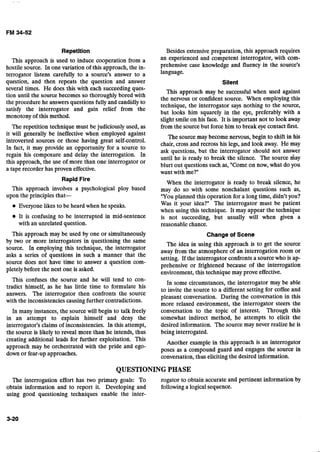
INTERROGATION 

HEADQUARTERS, DEPARTMENT OF THE ARMY
m a g o niioraty (ANR-PL)
ARN: Military DocumentsSection
Room 1A518, Pentagon
Washington, DC 20310-6050
DISTRIBUTION RESTRICTION: Approved for public release; distribution Is unlimited.
*FM34-52
FIELD MANUAL34-52 Headquarters
Department of the Anny
Washington. DC. 28 September 1992
INTELLIGENCE INTERROGATION
Table of Contents
Page
PREFACE . . . . . . . . . . . . . . . . . . . . . . . . . . . . . . . . . . . . . . . . . . . . . . . . . . . . . . . .iv

CHAPTER 1 .MILITARY INTELLIGENCEMISSIONSAND . . . . . . . . . . . . . . . . . . . . . . . .1.1 

INTELLIGENCEPREPARATIONOFTHEBATTLEFIELD 

WarfightingDoctrine . . . . . . . . . . . . . . . . . . . . . . . . . . . . . . . . . . . . . . .1.1

The Intelligence Cycle . . . . . . . . . . . . . . . . . . . . . . . . . . . . . . . . . . . . . . .1.1 

IntelligenceDisciplines . . . . . . . . . . . . . . . . . . . . . . . . . . . . . . . . . . . . . .1.2 

Intelligenceand ElectronicWarfare Operations . . . . . . . . . . . . . . . . . . . . . . . .1-3 

Mission. Enemy. Troops. Terrain. and TimeAvailable Factors . . . . . . . . . . . . . . . 1-5 

Definitionof Interrogation . . . . . . . . . . . . . . . . . . . . . . . . . . . . . . . . . . . .1.6

Definitionof Prisoner of War and EnemyPrisonerof War . . . . . . . . . . . . . . . . . .1.9 

Pertinent Articles of Geneva Conventions . . . . . . . . . . . . . . . . . . . . . . . . . . .1.10 

Types of Sources . . . . . . . . . . . . . . . . . . . . . . . . . . . . . . . . . . . . . . . . . .1.10 

Personal Qualities . . . . . . . . . . . . . . . . . . . . . . . . . . . . . . . . . . . . . . . . .1.12 

SpecialAreas of Knowledge . . . . . . . . . . . . . . . . . . . . . . . . . . . . . . . . . . .1.14 

Interrogator Capabilitiesand Limitations . . . . . . . . . . . . . . . . . . . . . . . . . . . .1-15 

Conflicts . . . . . . . . . . . . . . . . . . . . . . . . . . . . . . . . . . . . . . . . . . . . . . .1.16 

Interrogation Missions . . . . . . . . . . . . . . . . . . . . . . . . . . . . . . . . . . . . . .1.17 

Drugand Law EnforcementAgency Operations . . . . . . . . . . . . . . . . . . . . . . . .1.17 

CHAPTER 2 .COMPOSITIONAND STRUCTURE . . . . . . . . . . . . . . . . . . . . . . . . . . . . . .2.1 

Tactical Operations Center . . . . . . . . . . . . . . . . . . . . . . . . . . . . . . . . . . . .2.1 

Interrogation Below Division . . . . . . . . . . . . . . . . . . . . . . . . . . . . . . . . . . .2.2 

Division Interrogation Assets . . . . . . . . . . . . . . . . . . . . . . . . . . . . . . . . . . .2.3 

Corps Interrogation Assets and Organization . . . . . . . . . . . . . . . . . . . . . . . . .2.6 

Echelons Above Corps InterrogationAssets and Organization . . . . . . . . . . . . . . .2.7 

Enemy Prisoner of War and InterrogationFacilities . . . . . . . . . . . . . . . . . . . . . 2.9 

DISTRIBUTIONRESTRICTION: Approved for publicrelease; distributionis unlimited.
*Thispublication supersedesFM 34.52. 8 May 1987.
Page
Corps Facilities . . . . . . . . . . . . . . . . . . . . . . . . . . . . . . . . . . . . . . . . . . .2.10

EchelonsAbove Corps Facilities . . . . . . . . . . . . . . . . . . . . . . . . . . . . . . . . .2.12

Medical Company Interrogations . . . . . . . . . . . . . . . . . . . . . . . . . . . . . . . . 2.12

Interrogationat Brigade and Below . . . . . . . . . . . . . . . . . . . . . . . . . . . . . . .2.12

Special Forces. . . . . . . . . . . . . . . . . . . . . . . . . . . . . . . . . . . . . . . . . . . .2.14

Amphibious Operations . . . . . . . . . . . . . . . . . . . . . . . . . . . . . . . . . . . . . .2.14

Airborne Operations . . . . . . . . . . . . . . . . . . . . . . . . . . . . . . . . . . . . . . . 2.15

Interrogator SupportedOperations . . . . . . . . . . . . . . . . . . . . . . . . . . . . . . .2.18

Theater InterrogationFacility . . . . . . . . . . . . . . . . . . . . . . . . . . . . . . . . . .2.22

Support Relationships . . . . . . . . . . . . . . . . . . . . . . . . . . . . . . . . . . . . . . .2.24

CHAPTER3 .THE INTERROGATIONPROCESS . . . . . . . . . . . . . . . . . . . . . . . . . . . . . . .3.1

CollectionPriority . . . . . . . . . . . . . . . . . . . . . . . . . . . . . . . . . . . . . . . . . 3.1

Screening . . . . . . . . . . . . . . . . . . . . . . . . . . . . . . . . . . . . . . . . . . . . . .3.2

Planning and Preparation . . . . . . . . . . . . . . . . . . . . . . . . . . . . . . . . . . . . . 3.7

Approach Phase . . . . . . . . . . . . . . . . . . . . . . . . . . . . . . . . . . . . . . . . . .3.10

QuestioningPhase . . . . . . . . . . . . . . . . . . . . . . . . . . . . . . . . . . . . . . . . . 3.20

TerminationPhase. . . . . . . . . . . . . . . . . . . . . . . . . . . . . . . . . . . . . . . . .3.26

Reporting Information . . . . . . . . . . . . . . . . . . . . ; . . . . . . . . . . . . . . . . .3.28

Interrogationwith an Interpreter . . . . . . . . . . . . . . . . . . . . . . . . . . . . . . . .3.29

StrategicInterrogationsand Debriefings . . . . . . . . . . . . . . . . . . . . . . . . . . . .3.31

CHAPTER 4 .PROCESSINGAND EXPLOITING CAPTUREDENEMY . . . . . . . . . . . . . . . . . .4.1

DOCUMENTS 

Document Categories . . . . . . . . . . . . . . . . . . . . . . . . . . . . . . . . . . . . . . . 4.2

Document Handling . . . . . . . . . . . . . . . . . . . . . . . . . . . . . . . . . . . . . . . .4.4

Document Exploitation . . . . . . . . . . . . . . . . . . . . . . . . . . . . . . . . . . . . . . 4.7

Translating . . . . . . . . . . . . . . . . . . . . . . . . . . . . . . . . . . . . . . . . . . . . . 4.9

EvacuationProcedures . . . . . . . . . . . . . . . . . . . . . . . . . . . . . . . . . . . . . . 4.12

APPENDIX A .UNIFORM CODE OFMILITARYJUSTICE EXTRACT . . . . . . . . . . . . . . . . .A-1 

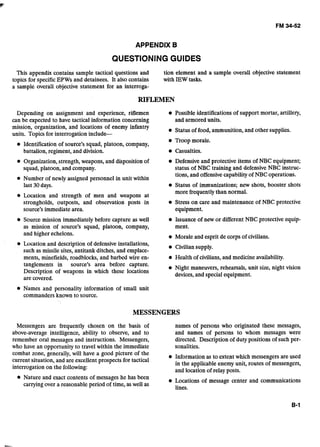
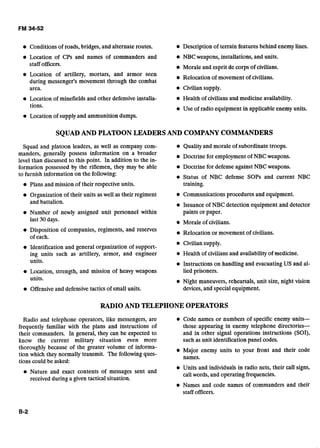
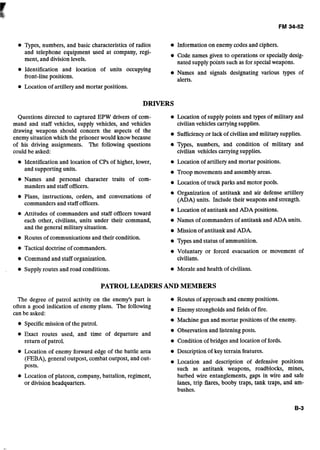
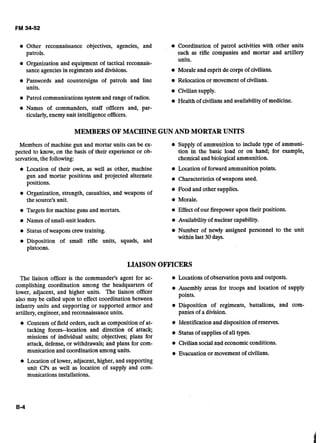
APPENDIX B .QUESTIONING GUIDES . . . . . . . . . . . . . . . . . . . . . . . . . . . . . . . . . . . .B-1 

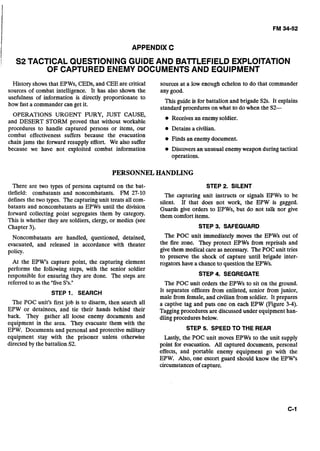
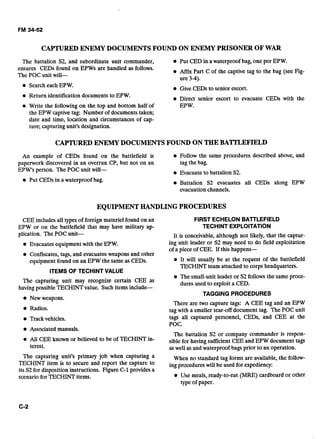
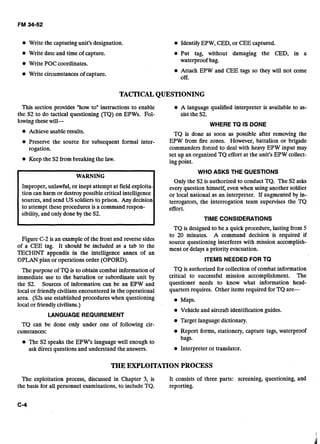
APPENDIX C .S2TACTICALQUESTIONING GUIDE AND BATTLEFIELDEXPLOITATION ..C-1
OF CAPTURED ENEMYDOCUMENTSAND EQUIPMENT
APPENDIX D .PROTECTEDPERSONSRIGHTS VERSUS SECURITYNEEDS . . . . . . . . . . . .D-1
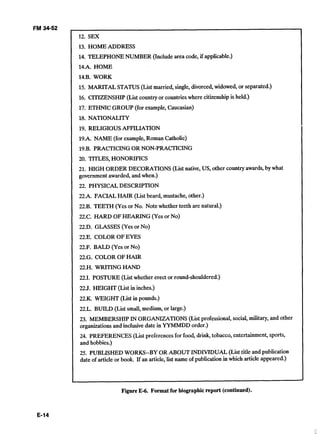
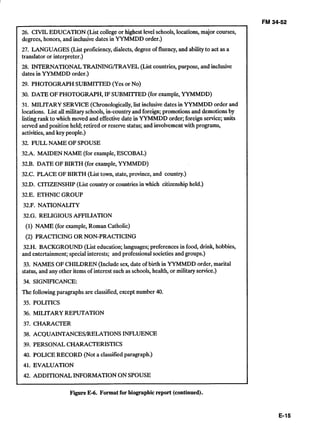
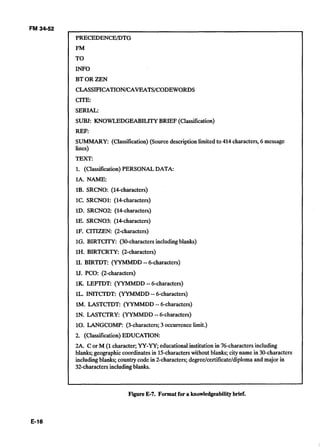
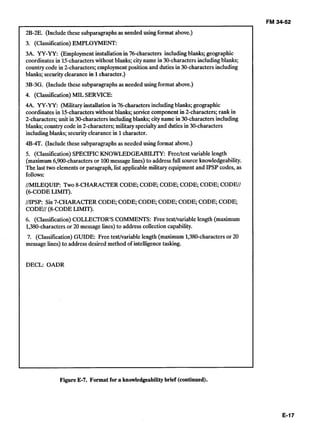
APPENDIX E .REPORTS . . . . . . . . . . . . . . . . . . . . . . . . . . . . . . . . . . . . . . . . . . . . . . E-1
APPENDIX F.COMMANDLANGUAGEPROGRAM . . . . . . . . . . . . . . . . . . . . . . . . . . . . F-1 

APPENDIX G .INDIVIDUALAND COLLECTIVETRAINING . . . . . . . . . . . . . . . . . . . . . .G-1
Page
GLOSSARY . . . . . . . . . . . . . . . . . . . . . . . . . . . . . . . . . . . . . . . . . . . . . . . . . . . Glossary-1
REFERENCES . . . . . . . . . . . . . . . . . . . . . . . . . . . . . . . . . . . . . . . . . . . . . . . References-1
INDEX . . . . . . . . . . . . . . . . . . . . . . . . . . . . . . . . . . . . . . . . . . . . . . . . . . . . . . . Index-1
iii
PREFACE
This manual provides doctrinal guidance, techniques,and procedures governing
employmentof interrogators as human intelligence(HUMINT) collection assets in support of
the commander's intelligenceneeds. It outlines the interrogator's role within the intelligence
collection effort and the supported unit's day-to-dayoperations. Details are presented on how
interrogation assets accomplish their assignedcollectionmission.
Material in this manual applies to operations in low-, mid-, and high-intensityconflicts.
Principlesoutlined arevalid under conditions involvinguse of electronicwarfare (EW) or
nuclear, biological,or chemical (NBC)weapons.
This manual is intended for use by interrogators aswell as commanders,staff officers,and
militaryintelligence (MI) personnel chargedwith the responsibilityof the interrogation
collection effort. Unless otherwisestated, descriptionspertaining to duties, functions,and
responsibilitiesof the GI, G2, G3, G4, and G5 apply to equivalent positions at other
organizational echelons.
Interrogation is the HUMINTsubdisciplineresponsiblefor MI exploitation of enemy
personnel and documents to answer the supported specificinformation requirements (SIR).
These SIR responses,alongwith those of other MI disciplines, are correlated to satisfythe
force commander's priority intelligencerequirements (PIR) and intelligencerequirements
(IRIS
During previousarmed conflicts, interrogators contributed significantlyto the overall
intelligencecollection effort. They revalidated and establishedkeystoneinterrogation
doctrine (for example,theater interrogation facility [TIq operations) and documented
valuablelessons learned. This knowledgebecamethe genesis for evolvinginterrogation
doctrine.
During SouthwestAsia operations, interrogators organizedand operated a massive
document exploitation (DOCEX) effort. Interrogation units screened,interrogated, or
debriefed49,350enemy prisoners of war (EPWs),and gathered enough captured enemy
documents (CEDs) for DOCEX to fill 18trailer trucks.
MI interrogation units are a proven and valued collectionasset. This manual incorporates
the operational experiencesand lessons learned. It builds upon existingdoctrine and moves
interrogation into the 21st century.
Theseprinciples and techniquesof interrogation are to be used within the constraints
establishedby the following:
The Uniform Code of Military Justice (UCMJ).
Geneva Conventionfor the Amelioration of the Wounded and Sick in Armed Forces in
the Field of August 12,1949,hereinafter referred to as GWS.
Geneva ConventionRelative to the Treatmentof Prisoners of War of August 12,1949,
hereinafter referred to as GPW.
Geneva ConventionRelative to the Protectionof Civilian Persons in Timeof War of
August 12,1949,hereinafter referred to as GC.
Doctrine in this publication conformswith and supportsprinciplescontained in Fh4 34-1.
This publication implementsthe followingStandardizationAgreements (STANAGs):
STANAG 2033, Interrogationof Prisonersof War, Edition 6.
STANAG2044, Proceduresfor Dealingwith Prisoners of War, Edition 5.
STANAG2084, Handlingand Reportingof Captured Enemy Equipmentand
Documents,Edition 5.
This publicationalso complieswith STANAG 1059and QuadripartiteStandardization
Agreements (QSTAGs) 170,523,and 528.
The use of the terms EPW, detainee, and sourceare interchangeableduring interrogation
process.
Unless this publicationstates otherwise, masculinenouns or pronounsdo not refer
exclusivelyto men.
The proponent of this publication is the US Army IntelligenceCenter. Send comments
and recommendationson DA Form 2028 (Recommended Changesto PubIicationsand Blank
Forms) to Headquarters,US Army IntelligenceCenter, A m ATSI-TDL-D,Fort
Huachuca,AZ 85613-6000.
CHAPTER 1
MILITARY INTELLIGENCE MISSIONSAND INTELLIGENCEPREPARATION
OF THE BATTLEFIELD
This manual is about interrogation operations. The capabilities and limitations of interrogation. It includes
purpose of this chapter is to define the interrogation information on the various levels of conflict, interroga-
mission and its critical elements; describe battlefield tion missions, intelligence preparation of the battlefield
operations, IEW operations, and the intelligence (IPB) and the intelligence cycle. The level of detail is
processes, disciplines, and the mission, enemy, troops, structured to assist you in understanding the interroga-
terrain, and time available (ME'IT-T) factors that shape tion tactics, techniques, and procedures described in the
and drivethe interrogation process. remainder of the manual.
It also addresses the personal qualities and special
areas of knowledge of the interrogator and the
WARFIGHTINGDOCTRINE
Battlefield operations demand seizing and maintain- Determine the enemy's capability and guard
ing the initiative. When operations are properly against that capability.
designed and executed, initiative accrues significant
benefits from the outset of an operation to finalvictory.
Protect friendly forces and operations from enemy
intelligence collection operations.
It permits attacking where, when, and what; while forc-
ing the enemy to react and try to adapt to our opera- Ensure the enemy is defeated.
tions.
o Use the weather and terrain to friendlyadvantage.
To gain the initiative, the commander must-
The commander uses defensive and offensive opera-
See the enemy early and determine the capabilities tions to destroy enemy first-echelon forces and deep-at-
and intentions of the enemy. tack to simultaneously delay, disrupt, and manipulate
Find and track enemy follow-onechelons.
Identify enemy high-value targets (HWs), which,
if successfully attacked, will contribute to the
degradation of important enemy battlefield func-
tions.
Identify, locate, and develop the required targeting
data for the attack of high-payoff targets (HPTs),
which, if successfully attacked, will contribute to
the successof friendlyplans.
enemy follow-on forces. The commander anticipates,
creates, and exploits windows of opportunity, using
flexiblebattle planning, to gain the initiative through of-
fensiveoperations.
By effectively employing maneuver and fire support
assets, manipulating the enemy, and expertly using the
weather and the terrain, the friendly commander can
successfully defeat a superior enemy force. OPERA-
TION DESERT STORM is an example of the success-
ful application of this doctrine.
Detect enemy weaknesses and develop the neces- IEW support is vital to the successful planning and
sary data to support the exploitation of these execution of battlefield operations at all echelons. In-
weaknesses. telligence support at brigade and battalion levels
focuses primarily on close operations, while at division
use warfare (EW) assets to it focuseson close and deep operations. Corps is the
support battlefield operations while protecting
focal point for intelligence operations that support rear
friendlyuse of the electromagnetic spectrum.
and deep operations.
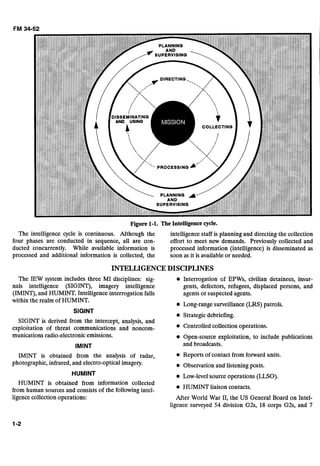
THEINTELLIGENCECYCLE
Intelligence operations follow a four-phase process commander's mission. Supervising and planning are in-
known as the intelligence cycle, which is shown at herent in all phases of the cycle.
Figure 1-1. The intelligence cycle is oriented to the
Figure 1-1. TheIntelligencecycle.
The intelligence cycle is continuous. Although the intelligence staff is planning and directing the collection
four phases are conducted in sequence, all are con- effort to meet new demands. Previously collected and
ducted concurrently. While available information is processed information (intelligence) is disseminated as
processed and additional information is collected, the soon as it is availableor needed.
INTELLIGENCEDISCIPLINES
The IEW system includes three MI disciplines: sig- Interrogation cf EPWs, civilian detainees, insur-
nals intelligence (SIGINT), imagery intelligence gents, defectors, refugees, displaced persons, and
(IMINT),and HUMINT. Intelligence interrogation falls agents or suspected agents. -
within the realm of HUMINT.
Long-rangesumeillance (LRS) patrols.. .
SlGlNT
Strategicdebriefing.
SIGINT is derived from the intercept, analysis, and
exploitation of threat communications and noncom- @ Controlled collection operations.
munications radio-electronic emissions.
IMlNT
Open-source exploitation, to include publications
and broadcasts.
IMINT is obtained from the analysis of radar, Reports of contact from forward units.
photographic, infrared, and electro-optical imagery. Observation and listening posts.
HUMINT Low-levelsource operations (LLSO).
HUMINT is obtained from information collected
from human sources and consists of the following intel- HUMINT liaison contacts.
ligence collection operations: After World War 11, the US General Board on Intel-
ligence Sumeyed 54 division G2s, 18 corps G2s, and 7
Army G2s. It concluded that 43 percent of all intel- ligence interest, including order of battle (OB) factors,
ligence produced in the European theater of operations as well as scientific and technical (S&T) intelligence
was from HUMINT, and 84 percent of the HUMINT subjects. During OPERATION DESERT STORM, in-
was from interrogation. The majority of those surveyed terrogators collected information which helped to-
agreed that interrogation was the most valuable of all
collection operations.
Develop a plan to breach Iraqi defensive belts.
HUMINT is vital in all combat operations, regardless
Confirm Iraqi supply-line interdiction by coalition
ofechelon or intensity of conflict. By nature, HUMINT
air strikes.
lends itself to the collection of information about the Identify diminishing Iraqi troop morale.
enemy's thought processes and intentions. HUMINT
can provide information on almost any topic of intel-
Identify a US PW captured during the battle of
Kafji.
INTELLIGENCEAND ELECTRONICWARFARE OPERATIONS
The intelligence cycle supports six tasks which are entire environment of conflict, supporting contingency
common to all echelons and which must be worked, at aswell as planning operations.
least in part, concurrently to satisfy the needs of the
At the strategic level, IPB focuses on all factors
commander. The commander may have to prioritize
these functions when resource and time constraints dic-
that contribute to military potential and includes
political, economic, sociological,and S&T aspects
tate.
of the enemy's ability and intent to conduct
INDICATIONSAND WARNING (I&W) militaryoperations.
I&W identifies major shifts in enemy tactics, opera-
tions, and strategy which will set or change the terms of
battle. They protect the commander from surprise and
identify areas or times of risk by detecting enemy ac-
tions that are counter to planning assumptions.
At the operational level, they identify potential
enemyaction and determine the need for a military
response and the probability of hostilities.
At the tactical level, they focus on the timing of
hostilities rather than on their probability.
I&W prevent surprise and minimize risk through the
early identification of enemy activitiesand capabilities.
INTELLIGENCE PREPARATIONOF THE
BAlTLEFIELD
At the operational level, IPB identifies the enemy's
political, economic or military center of gravity,
the lines of operation, and the points in time and
geography where the decisive engagements of a
campaignwill occur. It also predicts the courses of
action (COAs) the enemy is likely to follow. This
is done by incorporating political, economic, so-
cial, and geographical factors, as well as military
factors (such as his military potential and ability to
applyair, ground, and naval power).
At the tactical level, IPB focuses on the details of
the terrain, weather, and enemy. It predicts and
prioritizes the enemy's COAs and synchronizes the
application of combat power on identified decisive
points.
IPB integrates the environment with the enemy's In mid-intensity conflict (MIC) to high-intensitycon-
fighting doctrine and actions. It reveals his capabilities flict (HIC), IPB focuseson the traditional aspects of ter-
and vulnerabilities and allows the commander to sys- rain, weather, and enemy. Many of the factors evaluated
tematically predict his actions. It also allows him to un- in IPB at the strategic level are used during IPB for low-
derstand the battlefield and how to synchronize all of intensity conflict (LIC) at the operational and tactical
his battlefield operating systemsfor maximum effect. levels.
The results of IPB and staff wargaming are used to Social, economic, and political factors that affect the
coordinate and synchronize the intelligence system environment of conflict are considered in IPB. The
regardless of the echelon at which it is performed or the population must be examined in as much detail as the
intensity of conflict. IPB is more than preparation of enemy and the terrain to understand what an enemy can
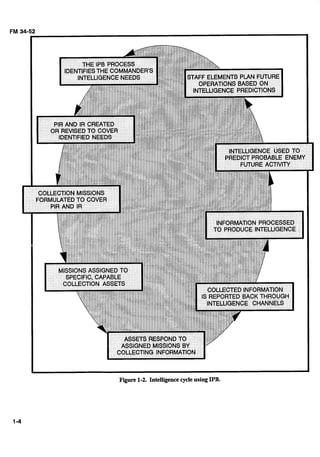
the field of battle during hostilities. IPB considers the or cannot do. Figure 1-2 shows the intelligence cycle
using IPB.
Figure 1-2. Intelligencecycleusing IPB.
SITUATION DEVELOPMENT
Situation development confirms or denies the enemy
COAs predicted in IPB. It confirmspredicted centers of
gravity and decisive points and identifies enemy
strengths and vulnerabilities. This enables the com-
mander to make timely decisions and effectively apply
his combat power.
TARGET DEVELOPMENTAND TARGET 

ACQUISITION 

Target development and target acquisition provide
targets and targeting data for attacks by fire, maneuver,
and electronic means. They identify and locate those
targets that will have the greatest impact on the
campaign's decisive engagements. These include deep
operational reserves, strategic and operational level
command,control, and communications (c3) nodes, key
lines of communication, and air and naval staging
facilities throughout the enemy's depth that contribute
to his combat potential.
At the tactical level, they address those HVTs that
directly contribute to the application of combat power
at decisive points on the battlefield.
BAlTLE DAMAGE ASSESSMENT (BDA)
BDA provides the commander with the effect of
friendly operations on the enemy. It focuses on the
enemy's remaining military capabilities and potential.
At the operational level, it also considers the
campaign's effects on the enemy's economy and opera-
tional infrastructure as well as his military force struc-
ture.
BDA is focused on providing effects of particular
strikes and attacks, or a series of them. BDA is per-
formed by the same collection assets used to satisfy the
commander's intelligence and targeting priorities;
therefore, BDA cannot be performed continuously
without degradation of other capabilities, such as situa-
tion development and targeting. The commander must
prioritize the BDA effort, identifying what he must
know and when he must know it, just as he does for his
PIR and targeting priorities.
FORCE PROTECTION
Force protection identifies friendly vulnerabilities
and the enemy's efforts to exploit them. At the opera-
tional level, it includes the early identification of sig-
nificant improvements in weapon lethality, the
introduction of weapons of mass destruction into the
conflict,or the commitment of terrorist or other uncon-
ventional forces into friendlyrear areas.
Force protection goes beyond countering enemy in-
telligence and includes the protection of all forces that
contribute to our combat power. At the tactical level, it
emphasizes measures to counter the enemy's intel-
ligence collection capabilities and to protect the force
from enemyaction.
MISSION, ENEMY, TROOPS, TERRAIN,AND TIMEAVAILABLE FACTORS 

The MElT-T factors are important to the com-
mander when planning interrogation operations.
MElT-T determines how the commander will use inter-
rogation assets. The effect of ME=-T on interrogation
missions is discussed below.
MISSION SUPPORT
The supported force's mission bears directly on how
the interrogation element will be employed. In cordon
and search operations, commanders may determine in-
terrogators are best suited to screen the populace in
order to identify insurgents and their supporters. In
counter-drug operations, commanders may use inter-
rogators to exploit documents and to train US and
foreign agents in interrogation techniques. In all con-
flicts, the focuswill be on EPW interrogation and CED
exploitation.
The mission influences interrogation operations in
other ways. For example,if the force's mission is offen-
sive, interrogation elements must be highly mobile, with
secure communications to the supported G2 or S2.
They must be constantly prepared to move forward with
the element they are supporting. This limits time avail-
able for exploitation and dissemination.
On the other hand, if the mission is defensive, inter-
rogation elements have more time to exploit individual
sources. They may also have more flexibility to exploit
EPWs or detainees and CEDs, to fulfill the
commander's intent to construct operational graphics.
Collection requirements vary according to echelon.
Strategic echelon requirements reflect the wide scope of
interest of the theater and national command authority
(NCA); whereas, tactical PIR and IR--and resultant
SIR--reflect the immediate, more narrowly focused in-
telligence interest of the maneuver commander.
ENEMY
The enemy, and our knowledge of the enemy, can in-
fluence interrogator assignments and the complexity of
the exploitation process. One factor which affects inter-
rogation operations is the type of opposing enemy force.
The techniques and procedures used to collect from in-
surgents in a LIC may differ from those used to collect
from regular enemy forces in a MIC to HIC.
For example, an EPW from a regular forces unit may
have undergone political indoctrination, but his com-
mitment to his unit may not be as strong as that of the
insurgent who is passionately committed to an ideal.
Thus, interrogators may have more difficulty persuading
the insurgent to talk.
Another factor affecting interrogation operations is
our current intelligence holdings on the enemy force
and the interrogator's understanding of the threat. Our
intelligence holdings on the composition of a newly
formed insurgent organization usually will not be as
complete as holdings on the composition of a regular
enemy force. Thus, the focus of interrogation efforts in
the early stages of a LIC may be on enemy force com-
position; whereas, the focus in a MIC or HIC may be on
enemv force missions or intentions.
Cultural aspects also affect interrogation missions.
The employment of some basic interrogation techniques
will differ based on the ethnic and cultural background
of the enemy, and our failure to understand and adapt
to this could ham~erthe collection effort.
TROOPS
The number, experience level, and language
proficiency of interrogators affect the tactical employ-
ment of interrogation elements. Due to the limited
number of interrogators at any echelon, interrogation
element commanders have to pick from available inter-
rogators. They must manage personnel to ensure the
most experienced are used to the best advantage (for ex-
ample, to exploit complex enemy documents) and select
EPWs most likely to answer SIR.
Interrogation element commanders often have to
contend with a mismatch between language-qualified
personnel assigned to the unit and languages needed to
perform the mission. They overcome the mismatch by
acquiring local national (LN) interpreter support
through the Assistant Chief of Staff, G1 (Personnel).
They can also augment their interrogators by requesting
other available linguists within the supported command
to serve as interpreters:
Another troop-related factor which affects interroga-
tion operations is the training of all soldiers on EPW
handling and evacuation. EPW treatment during the
early stages of capture is critical to the success of sub-
sequent interrogations. The availability of military
police (MP) support at brigade and above can enhance
interrogation activities. Interrogation operations are
more effective in a controlled environment where EPWs
are adequately guarded.
TERRAIN
Terrain and weather are relevant to interrogator
operations an& affect site deployments, communica-
tions, and mobility. MP must ensure proper shelter and
security for the EPW facility if it is collocated or imme-
diately adjacent to the EPW collecting point or intern-
ment facility.
TIME AVAILABLE
Information collected through interrogation opera-
tions is valuable only if it is reported in a timely manner.
Exploitation procedures may need to be adjusted to
make the most use of time available. At the tactical
level, interrogations will be brief, PIR driven, and
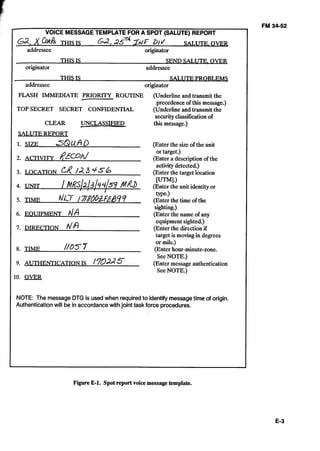
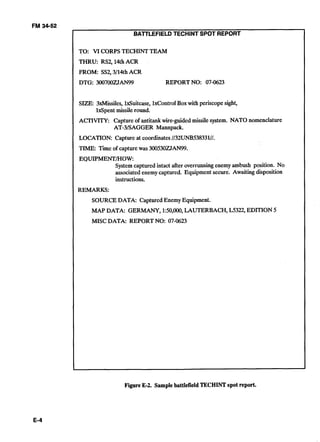
reported in concise formats such as size, activity, loca-
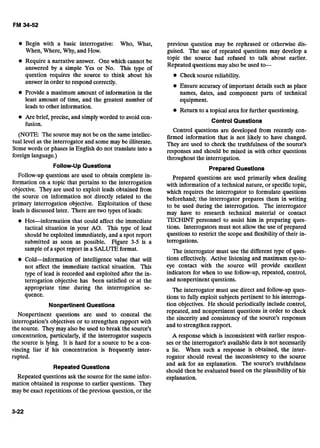
tion, unit, time, equipment (SALUTE).
At the operational and strategic levels, time will
generally allow for a more expanded interrogation effort
and flexible reporting format, such as the intelligence
information report (IIR).
The challenge is for interrogators to be proficient lin-
guists and skilled members of a highly organized collec-
tion activity. This ensures the acquisition of the
maximum amount of pertinent information regardless
of time available.
Like other intelligence assets, interrogators must
serve the commander. Interrogation operations are of
no value unless they contribute to the accomplishment
of the supported commander's mission. To understand
the interrogator's role in mission accomplishment, one
must understand the interrogation process.
DEFINITION OFINTERROGATION
Interrogation is the process of questioning a source to The goal of any interrogation is to obtain reliable infor-
obtain the maximum amount of usable information. mation in a lawful manner, in a minimum amount of
,,time, and to satisfy intelligence requirements of any
echelonof command. Sources may be-
1 e Civilian internees.
Insurgents.
I EPWs.
Defectors.
Refugees.
Displacedpersons.
Agents or suspected agents.
Other non-US personnel.
A good interrogation produces needed information
which is timely,complete, clear, and accurate. An inter-
rogation involves the interaction of two personalities-
the source and interrogator. Each contact between
these two may differ because of individual charac-
teristics and capabilities of the participants. Further-
more, the circumstances of each contact and physical
environmentvary.
Other forms of intelligence interrogations include in-
terviews, debriefings,and elicitations. There are certain
principles which generally apply to all types of inter-
rogations; namely, the objective,the prohibition against
use of force,and security.
OBJECTIVE
Each interrogation must be conducted for a definite
purpose. The interrogator must keep this purpose firm-
ly in mind as he proceeds to obtain usable information
to satisfy the assigned requirement, and thus contribute
to the successof the unit's mission.
The objective may be specific-Establish the exact
location of an ammunition storage facility. Or it may be
general--Seek to obtain OB information about a
specificechelon of the enemy forces.
In either case, the interrogator must use the objective
as a basis for planning and conducting the interrogation.
He should attempt to prevent the source from becoming
aware of the true objectiveof the interrogation. The in-
terrogator should not concentrate on the objective to
the extent he overlooks or fails to recognize and exploit
other valuable information extracted from the source.
For example, during an interrogation, the inter-
rogator learns of the presence of a heretofore unknown,
highly destructive weapon. Although this information
may not be in line with his specific objective, the inter-
rogator must develop this important lead to obtain all
possible information concerning this weapon. It be-
comes obvious an interrogation objective can be
changed as necessary or desired.
PROHIBITIONAGAINST USE OF FORCE
The Intelligence Staff Officer (J2, G2, or S2) has
responsibility for all command intelligence functions.
He assiststhe commander by-
e Supervising the collection, evaluation, and inter-
pretation of all intelligence information.
Disseminating intelligence to appropriate higher,
lower, and adjacent units.
Assuming primary responsibility to ensure that all
command intelligence functions are conducted in
accordance with international, US, and other ap-
plicable law and policy. Specifically,the J2, G2, or
S2 is responsible to ensure the GWS, GPW, and
GCare not violated by intelligence personnel.
One of the significant means used by the intelligence
staff is the interrogation of the following:
EPWs.
Captured insurgents.
Civilian internees.
Other captured, detained,or retained persons.
Foreign deserters or other persons of intelligence
interest.
These persons are protected by the Geneva Conven-
tions for the Protection of War Victims of August 12,
1949, as they relate to Captured wounded and sick
enemy personnel (GWS), retained enemy medical per-
sonnel and chaplains (GWS), enemy prisoners of war
(GPW), and civilian internees (GC). Captured insur-
gents and other detained personnel whose status is not
clear, such as suspected terrorists, are entitled to PW
protection until their precise status has been deter-
mined by competent authority.
In conducting intelligence interrogations, the 52, G2,
or S2 has primary staff responsibility to ensure these ac-
tivities are performed in accordance with the GWS,
GPW, and GC, as well as US policies, regarding the
treatment and handling of the above-mentioned per-
sons.
The GWS, GPW, GC, and US policy expressly
prohibit acts of violence or intimidation, including
physical or mental torture, threats, insults, or exposure
to inhumane treatment as a means of or aid to inter-
rogation.
Such illegal acts are not authorized and will not be
condoned by the US Army. Acts in violation of these
prohibitions are criminal acts punishable under the
UCMJ. If there is doubt as to the legality of a proposed
form of interrogation not specifically authorized in this
manual, the advice of the command judge advocate
should be sought before using the method in question.
Experience indicates that the use of prohibited tech-
niques is not necessary to gain the cooperation of inter-
rogation sources. Use of torture and other illegal
methods is a poor technique that yields unreliable
results, may damage subsequent collection efforts, and
can induce the source to say what he thinks the inter-
rogator wants to hear.
Revelation of use of torture by US personnel will
bring discredit upon the US and its armed forces while
undermining domestic and international support for the
war effort. It also may place US and allied personnel in
enemy hands at a greater risk of abuse by their captors.
Conversely, knowing the enemy has abused US and al-
lied PWs does not justify using methods of interrogation
specifically prohibited by the GWS, GPW, or GC, and
US policy.
Limitations on the use of methods identified herein
as expressly prohibited should not be confused with
psychological ploys, verbal trickery, or other nonviolent
or noncoercive ruses used by the interrogator in the
successful interrogation of hesitant or uncooperative
sources.
The psychological techniques and principles in this
manual should neither be confused with, nor construed
to be synonymous with, unauthorized techniques such
as brainwashing, physical or mental torture, or any
other form of mental coercion to include drugs that may
induce lasting and permanent mental alteration and
damage.
Physical or mental torture and coercion revolve
around eliminating the source's free will, and are ex-
pressly prohibited by GWS, Article 13; GPW, Articles
13 and 17; and GC, Articles 31 and 32. Torture is
defined as the infliction of intense pain to body or mind
to extract a confession or information, or for sadistic
pleasure.
Examples of physical torture include--
Electric shock.
Infliction of pain through chemicals or bondage
(other than legitimate use of restraints to prevent
escape).
Forcing an individual to stand, sit, or kneel in ab-
normal positions for prolonged periods of time.
Food deprivation.
Any form of beating.
Examples of mental torture include--
Mock executions.
Abnormal sleep deprivation.
Chemicallyinduced psychosis.
Coercion is defined as actions designed to unlawfully
induce another to compel an act against one's will. Ex-
amples of coercion include-
@ Threatening or implying physical or mental torture
to the subject, his family, or others to whom he
owes loyalty.
Intentionally denying medical assistance or care in
exchange for the information sought or other
cooperation.
Threatening or implying that other rights guaran-
teed by the GWS, GPW, or GC will not be
provided unless cooperation is forthcoming.
Specific acts committed by US Army personnel may
subject them to prosecution under one or more of the
followingpunitive articles of the UCMJ:
Article 78-Accessoryafter the fact.
Article 80 - Attempts (to commit one of the fol-
lowingoffenses).
Article 81 - Conspiracy (to commit one of the fol-
lowingoffenses).
Article 93 -Crueltyand maltreatment.
Article 118 - Murder.
Article 119 - Manslaughter.
Article 124 - Maiming.
I
I
! Article 127- Extortion.
/ Article 128 - Assault (consummated by battery;
with a dangerous weapon; or intentionally inflict-
,
ing grievous bodily harm).
Article 134 - Homicide, negligent:
-- Misprision of a serious offense
(taking some positive act to conceal a serious crime
committed by another).
-- Soliciting another to commit an of-
fense.
-- Threat, communicating.
SeeAppendix A for the text of these offenses.
While using legitimate interrogation techniques, cer-
tain applications of approaches and techniques may ap-
proach the line between lawful actions and unlawful
actions. It may often be difficult to determine where
lawful actions end and unlawful actions begin. In at-
tempting to determine if a contemplated approach or
technique would be considered unlawful, consider these
two tests:
The approaches, psychological techniques, and other
principles presented in this manual must be read in light
of the requirements of international and US law as dis-
cussed above.
Authority for conducting interrogations of personnel
detained by military forces rests primarily upon the
traditional concept that the commander may use all
available resources and lawful means to accomplish his
mission and to protect and secure his unit.
It is the stated policy of the US Army that military
operations will be conducted in accordance with the law
of war obligations of the US. The GWS, GPW, and GC
establish specific standards for humane care and treat-
ment of enemy personnel captured, retained, or
detained by US military forces and its allies. Suspected
or alleged violations of these standards will be reported,
investigated and, if appropriate, referred to competent
authority for trial or other disposition. Violations of
the GWS, GPW, or GC committed by US personnel
normally constituteviolations of the UCMJ.
The commander is responsible for ensuring that the
forces under his command complywith the GWS, GPW,
0 Given all the surrounding facts and circumstances,
and GC. Should violations occur in the conduct of war-
fare, the commander bears primary responsibility for in-
would a reasonable person in the place of the per-
vestigating and prosecuting violations.
son being interrogated believe that his rights, as
guaranteed under both international and US law, SECURITY
are being violated or withheld, or will be violated The interrogator, by virtue of his position, possesses a
or withheld if he fails to cooperate. great deal of classified information. He is aware his job
If your contemplated actions were perpetrated by is to obtain information, not impart it to the source. He
the enemy against US pws, you would believe such safeguards military information as well as the source of
actions violate international or US law. that information.
If you answer yes to either of these tests, do not This becomes very clear when one considers that
engage in the contemplated action. If a doubt still among those Persons with whom the interrogator has
remains as to the legality of a proposed action, seek a Contact, there are those attempting to collect informa-
legal opinion from your servicing judge advocate. tion for the enemy. The interrogator is alert to detect
any attempt made by the source to elicit information.
DEFINITION OF PRISONER OFWAR AND ENEMYPRISONER OFWAR
A PW is a US or allied person detained by an enemy The occupying power considers it necessary by
power. An EPW is a person detained by US or allied reason of such allegiance to intern them; in par-
powers. The first issue interrogators must deal with is ticular, if-
who must be afforded PW treatment. Figure 1-3
paraphrases Article 4 of the GPW. In addition, the fol-
Such persons have made an unsuccessful at-
tempt to rejoin the armed forces t o which
lowing personnel shall be treated as PWs: Persons
they belong and which are engaged in com-
belonging, or having belonged, to the armed forces of
bat; or
the occupied country, if-
PWs are persons who have fallen into the power of the enemyand who are-
Members of the armed forces of a party to the conflict, militias, or volunteer corps forming
part of such armed forces.
Members of other militias and volunteer corps, including those of organized resistance move-
ments, belonging to a part of the conflict, and operating in or outside their territory, even if
this territory is occupied, provided such militias or volunteer corps, including such organized
resistance movements, fulfill the followingconditions by-
--Beingcommanded by a person responsible for their subordinates.
--Havinga fixed distinctive sign recognizable at a distance.
--Carryingarms openly.
--Conducting their operations by the laws and customs of war.
Members of regular armed forceswho profess allegiance to a government or an authority not
recognized by the Detaining Power.
Persons who accompanythe armed forces without being members of it, such as civilian mem-
bers of military aircraft crews, war correspondents, supply contractors, members of labor
units or services responsible for the welfare of the armed forces, if they have received
authorization from the armed forces they accompany,who shall provide them for that pur-
pose with an identity card as described in the Geneva Conventions.
Members of the crews of merchant marine, and crews of civil aircraft of the parties to the
conflict,who do not benefit by more favorable treatment under any other provisions of inter-
national law.
Inhabitants of an unoccupied territory, who on the approach of the enemy, spontaneously
take up arms to resist the invading forces, without having had time to form themselves into
regular armed units provided they carry arms openly and respect the laws and customs of war.
Figure 1-3. Definitionof prisonerofwar (GPW).
Where they fail to comply with a summons made individual as such. The determination whether an in-
to them with a view to internment. dividual qualifies as a PW is a Staff Judge Advocate
(SJA) function, but has a direct impact on the interroga-
Obvi0usl~,there are many ~ e r s ~ ~ ~ ~ ~who qua''@ for tion effort due to GPW requirements. 1t is especially
and require treatment as PWs. If there is any question important in LICs to distinguish between PWs and
whether a person should be treated as a PW, treat the criminals.
PERTINENTARTICLES OF GENEVA CONVENTIONS
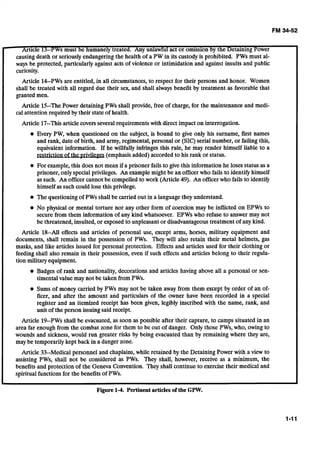
Several articles of the GPW apply to inter- most commonly used by interrogators are
rogators and interrogation operations. The articles shown in Figure 1-4.
TYPES OF SOURCES
The interrogator encounters many sources who vary perfect health; intelligence levels may range from well
greatly in personality, social class, civilian occupation, below average to well above average; and security con-
military specialty, and political and religious beliefs. sciousnessmay range from the lowest to the highest.
Their physical conditions may range from near death to
Article 13--PWsmust be humanely treated. Any unlawful act or omission by the Detaining Power
causing death or seriously endangering the health of a PW in its custodyis prohibited. PWs must al-
ways be protected, particularly against acts of violence or intimidation and against insults and public
curiosity.
Article 14--PWsare entitled, in all circumstances,to respect for their persons and honor. Women
shall be treated with all regard due their sex, and shall always benefit by treatment as favorable that
granted men.
Article 15--ThePower detaining PWs shall provide, free of charge, for the maintenance and medi-
cal attention required by their state of health.
Article 17--Thisarticle coversseveral requirements with direct impact on interrogation.
Every PW, when questioned on the subject, is bound to give only his surname, first names
and rank, date of birth, and army, regimental, personal or (SIC) serial number, or failing this,
equivalent information. If he willfully infringes this rule, he may render himself liable to a
. . . .restrictlan of the privrleggs(emphasisadded) accorded to his rank or status.
For example,this does not mean if a prisoner fails to give this information he loses status as a
prisoner, only special privileges. An examplemight be an officerwho fails to identify himself
as such. An officer cannot be compelled to work (Article 49). An officerwho fails to identify
himself as such could lose this privilege.
The questioning of PWs shall be carried out in a languagethey understand.
No physical or mental torture nor any other form of coercion may be inflicted on EPWs to
secure from them information of any kind whatsoever. EPWs who refuse to answer may not
be threatened, insulted, or exposed to unpleasant or disadvantageoustreatment of any kind.
Article 18--All effects and articles of personal use, except arms, horses, military equipment and
documents, shall remain in the possession of PWs. They will also retain their metal helmets, gas
masks, and like articles issued for personal protection. Effects and articles used for their clothing or
feeding shall also remain in their possession, even if such effects and articles belong to their regula-
tion military equipment.
Badges of rank and nationality, decorations and articles having above all a personal or sen-
timental value may not be taken from PWs.
Sums of money carried by PWs may not be taken away from them except by order of an of-
ficer, and after the amount and particulars of the owner have been recorded in a special
register and an itemized receipt has been given, legibly inscribed with the name, rank, and
unit of the person issuingsaid receipt.
Article 19--PWsshall be evacuated, as soon as possible after their capture, to camps situated in an
area far enough from the combat zone for them to be out of danger. Only those PWs, who, owing to
wounds and sickness,would run greater risks by being evacuated than by remaining where they are,
may be temporarily kept back in a danger zone.
Article 33--Medical personnel and chaplains,while retained by the Detaining Power with a view to
assisting PWs, shall not be considered as PWs. They shall, however, receive as a minimum, the
benefits and protection of the Geneva Convention. They shall continue to exercisetheir medical and
spiritual functions for the benefits of PWs.
Figure 1-4. Pertinentarticlesof the GPW.
Sources may be civilian internees, insurgents, EPWs,
defectors, refugees, displaced persons, and agents or
suspected agents. Because of these variations, the inter-
rogator makes a careful study of every source to
evaluate his mental, emotional, and physical state, and
uses it as a basis for interrogation. He deals mainlywith
three categories of sources: cooperative and friendly,
neutral and nonpartisan, and hostile and antagonistic.
COOPERATIVEAND FRIENDLY
A cooperative and friendly source offers little resis-
tance to interrogation, and normally speaks freely on al-
most any topic introduced, other than those which tend
to incriminate or degrade him personally. To obtain the
maximum amount of information from cooperative and
friendly sources, the interrogator takes care to establish
and preserve a friendly and cooperative atmosphere by
not inquiring into those private affairs which are beyond
the scope of the interrogation. At the same time, he
must avoid becoming overly friendly and losing control
of the interrogation.
NEUTRALAND NONPARTISAN
A neutral and nonpartisan source is cooperative to a
limited degree. He normally takes the position of
answering questions asked directly, but seldom volun-
teers information. In some cases, he may be afraid to
answer for fear of reprisals by the enemy. This often is
the case in LIC where the people may be fearful of in-
surgent reprisals. With the neutral and nonpartisan
source, the interrogator may have to ask many specific
questions to obtain the information required.
HOSTILEAND ANTAGONISTIC
A hostile and antagonistic source is most difficult to
interrogate. In many cases, he refuses to talk at all, and
offers a real challenge to the interrogator. An inter-
source appears to be an excellent target for exploitation,
the source should be segregated and approached in an
effort to obtain his cooperation. Because of possible
high stress and frustration levels that such a source may
invoke in you, great care must be taken to maintain your
self-control. No matter what the source says or does,
you must abide by the provisions of the law of war as
previously discussed.
The absence of the use of threats in interrogation is
intentional, as threats in and of themselves constitute a
form of coercion. Any attempt at enforcement of a
threat would constitute an act prohibited by the GWS,
GPW, or GCand is punishable under the UCMJ.
A hostile or antagonisticsource may be best exploited
at echelons where sufficient time and resources will
generally be available.
The successful interrogator is a skilled professional
who is able to rapidly evaluate sources of information
and adapt his approaches and techniques accordingly.
The interrogator extracts intelligence from two primary
sources: human sources and material sources (primarily
CEDs). The senior interrogator determines which of
these sources may be most effectively exploited to meet
the supported commander's PIR and IR.
CEDs (see Chapter 4) include any piece of recorded
information which has been in the possession of a
foreign nation and comes into US possession. This in-
cludes US documents which the foreign nation may
have possessed. There are many ways to acquire a docu-
ment; some are found in the possession of human
sources, on enemy dead, or on the battlefield. There are
three types of documents:
Official (government or military) documents such
as overlays,field orders, maps, and codes.
rogator must have self-control, patience, and tact when
dealing with him. Personal (private or commercial) documents such
as letters, diaries, newsvauers, and books.A . .
At lower tactical echelons, there is generally insuffi.-
Identity (government or military) documents suchcient time available to effectively interrogate a hostile
or antagonistic source. When time is available, and the as cards and books.
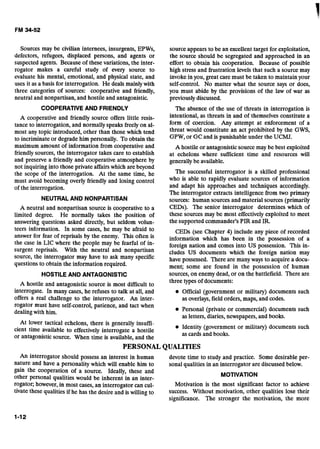
PERSONALQUALITIES
An interrogator should possess an interest in human devote time to study and practice. Some desirable per-
nature and have a personality which will enable him to sonal qualities in an interrogator are discussed below.
gain the cooperation of a source. Ideally, these and
other personal qualities would be inherent in an inter- MOTIVATION
rogator; however, in most cases, an interrogator can cul- Motivation is the most significant factor to achieve
ti~atethese qualities if he has the desire and is willing to Success. Without motivation, other qualities lose their
significance. The stronger the motivation, the more
successful the interrogator. An interrogator may be
motivatedby several factors;for example:
An interest in human relations.
A desire to react to the challenge of personal inter-
play.
An enthusiasm for the collection of information.
A profound interest in foreign languages and cul-
tures.
ALERTNESS
The interrogator must be constantly aware of the
shifting attitudes which normally characterize a source's
reaction to interrogation. The interrogator-
@ Notes the source's every gesture, word, and voice
inflection.
Determines why the source is in a certain mood or
why his mood suddenly changed. It is from the
source's mood and actions the interrogator deter-
mines how to best proceed with the interrogation.
Watches for any indication the source is withhold-
ing information.
Watches for a tendency to resist further question-
ing, diminishing resistance, contradictions, or
other tendencies, to include susceptibility.
PATIENCEAND TACT
The interrogator must have patience and tact in creat-
ing and maintaining rapport between himself and the
source, thereby enhancing the success of the interroga-
tion. The validity of the source's statements and mo-
tives behind these statements may be obtainable only
through exercise of tact and patience. Displaying im-
patience may-
@ Encourage the difficult source to think if he
remains unresponsive for a little longer, the inter-
rogator will stop questioning.
Cause the source to lose respect for the inter-
rogator, thereby reducing his effectiveness.
An interrogator, with patience and tact, is able to ter-
minate an interrogation and later continue it without
arousing apprehension or resentment.
CREDIBILITY
The interrogator must maintain credibility with the
source and friendly forces. Failure to produce material
rewards when promised may adversely affect future in-
terrogations. The importance of accurate reporting
cannot be overstressed, since interrogation reports are
often the basis for tactical decisionsand operations.
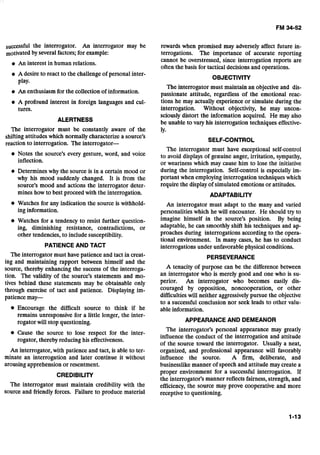
OBJECTIVITY
The interrogator must maintain an objective and dis-
passionate attitude, regardless of the emotional reac-
tions he may actually experience or simulate during the
interrogation. Without objectivity, he may uncon-
sciously distort the information acquired. He may also
be unable to vary his interrogation techniques effective-
ly.
SELF-CONTROL
The interrogator must have exceptional self-control
to avoid displays of genuine anger, irritation, sympathy,
or weariness which may cause him to lose the initiative
during the interrogation. Self-control is especially im-
portant when employinginterrogation techniques which
require the display of simulated emotions or attitudes.
ADAPTABILITY
An interrogator must adapt to the many and varied
personalities which he will encounter. He should try to
imagine himself in the source's position. By being
adaptable, he can smoothly shift his techniques and ap-
proaches during interrogations according to the opera-
tional environment. In many cases, he has to conduct
interrogations under unfavorable physical conditions.
PERSEVERANCE
A tenacity of purpose can be the difference between
an interrogator who is merely good and one who is su-
perior. An interrogator who becomes easily dis-
couraged by opposition, noncooperation, or other
difficultieswill neither aggressively pursue the objective
to a successful conclusion nor seek leads to other valu-
able information.
APPEARANCE AND DEMEANOR
The interrogator's personal appearance may greatly
influence the conduct of the interrogation and attitude
of the source toward the interrogator. Usually a neat,
organized, and professional appearance will favorably
influence the source. A firm, deliberate, and
businesslike manner of speech and attitude may create a
proper environment for a successful interrogation. If
the interrogator's manner reflects fairness,strength, and
efficiency, the source may prove cooperative and more
receptive to questioning.
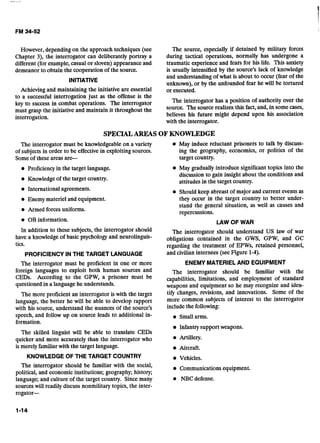
However, depending on the approach techniques (see
Chapter 3), the interrogator can deliberately portray a
different (for example,casual or sloven) appearanceand
demeanor to obtain the cooperation of the source.
INITIATIVE
Achieving and maintaining the initiative are essential
to a successful interrogation just as the offense is the
key to success in combat operations. The interrogator
must grasp the initiative and maintain it throughout the
interrogation.
The source, especially if detained by military forces
during tactical operations, normally has undergone a
traumatic experience and fears for his life. This anxiety
is usually intensified by the source's lack of knowledge
and understanding of what is about to occur (fear of the
unknown), or by the unfounded fear he will be tortured
or executed.
The interrogator has a position of authority over the
source. The source realizes this fact,and, in some cases,
believes his future might depend upon his association
with the interrogator.
SPECIALAREAS OF KNOWLEDGE
The interrogator must be knowledgeableon a variety May induce reluctant prisoners to talk by discuss-
of subjects in order to be effective in exploitingsources. ing the geography, economics, or politics of the
Someof these areas are- target country.
Proficiencyin the target language.
Knowledgeof the target country.
International agreements.
Enemy materiel and equipment.
Armed forcesuniforms.
OB information.
In addition to these subjects, the interrogator should
have a knowledge of basic psychology and neurolinguis-
tics.
PROFICIENCYIN THE TARGET LANGUAGE
The interrogator must be proficient in one or more
foreign languages to exploit both human sources and
CEDs. According to the GPW, a prisoner must be
questioned in a language he understands.
The more proficient an interrogator is with the target
language, the better he will be able to develop rapport
with his source, understand the nuances of the source's
speech, and follow up on source leads to additional in-
formation.
The skilled linguist will be able to translate CEDs
quicker and more accurately than the interrogator who
is merely familiarwith the target language.
May gradually introduce significant topics into the
discussion to gain insight about the conditions and
attitudes in the target country.
Should keep abreast of major and current events as
they occur in the targct country to better under-
stand the general situation, as well as causes and
repercussions.
LAW OF WAR
The interrogator should understand US law of war
obligations contained in the GWS, GPW, and GC
regarding the treatment of EPWs, retained personnel,
and civilian internees (see Figure 1-4).
ENEMY MATERIELAND EQUIPMENT
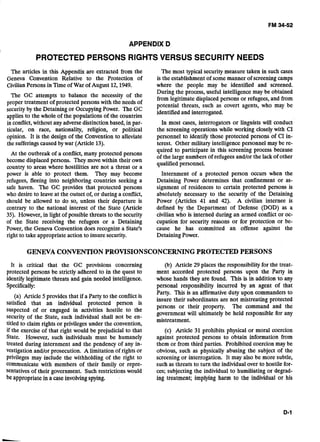
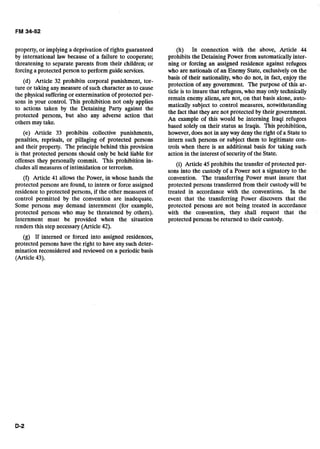
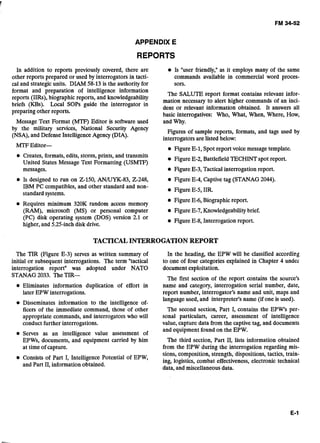
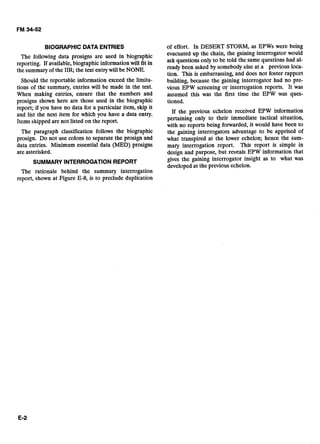
The interrogator should be familiar with the
capabilities, limitations, and employment of standard
weapons and equipment so he may recognize and iden-
tify changes, revisions, and innovations. Some of the
more common subjects of interest to the interrogator
include the following:
Small arms.
Infantrysupportweapons.
Artillery.
Aircraft.
KNOWLEDGE OF THE TARGET COUNTRY Vehicles.
The interrogator should be familiar with the social, Communications equipment.
political, and economic institutions; geography; history;
language; and culture of the target country. Since many NBC defense.
sourceswill readily discuss nonmilitary topics, the inter-
rogator-
ARMED FORCES UNIFORMS AND INSIGNIA new information. Aids which may be used to identify
Through his knowledge of uniforms, insignia, decora- units are-
tions, and other distinctivedevices,the interrogator may Names.
be able to determine the rank, branch of service, type of
unit, and military experience of a military or Commanders.
paramilitary source. This knowledge is helpful during Home station identifications.
the planning and preparation and the approach phases
discussed in Chapter 3. Code designations and numbers.
OB INFORMATION Uniforms and insignia.
OB is defined as the identification, strength, com- e Guidons.
mand structure, and disposition of personnel, units, and Documents.
equipment of any military force. Interrogation OB ele-
ments are separate categories by which detailed infor- Military postal system data.
mation is maintained. Theyare- Equipment and vehicle markings.
Missions. UNDERSTANDINGBASIC PSYCHOLOGY
Composition.
Disposition.
Strength.
Training.
Combat effectiveness.
Tactics.
Logistics.
Electronic technical data.
Miscellaneousdata.
During the questioning phase, OB elements assist the
interrogator in verifyingthe accuracy of the information
obtained and can be used as an effective tool to gain
An interrogator can best adapt himself to the EPW's
or detainee's personality and control of the their reac-
tions when he understands basic psychological factors,
traits, attitudes, drives, motivations, and inhibitions.
For example, the timely use or promise of rewards and
incentives may mean the difference between an
interrogation's success or failure and future EPW or
detainee exploitation.
NEUROLlNGUlSTlCS
Neurolinguistics is a behavioral communication
model and a set of procedures that improve communica-
tion skills. The interrogator should read and react to
nonverbal communications. An interrogator can best
adapt himself to the source's personality and control his
own reactions when he understands basic psychological
factors, traits, attitudes, drives, motivations, and inhibi-
tions.
INTERROGATORCAPABILITIESAND LIMITATIONS
HUMINTcollection is capable of obtaining informa-
tion pertinent to all six IEW tasks:
Situation development.
Target development and target acquisition.
I&W.
IPB.
BDA.
Force protection.
Interrogators are trained as linguists to question
EPWs and civilian detainees and to exploit CEDs.
During their collection, interrogators attempt to obtain
and report any information possessed by these targets
that pertains to the IEW tasks. This persistence is
determined by comparing the information obtained to
the SIR contained in the interrogation element's collec-
tion mission.
Interrogators are capable of collectinginformation on
political, economic, and a wide range of military topics.
For the most part, interrogators attempt to organize
their collection effort according to the OB elements
analysts use. In addition to these elements, inter-
rogators also obtain PIR-directed information on the
missions assigned to enemy units. Appendix B discusses
relevant questioning guides.
ENVIRONMENTALCONSIDERATIONS
The environment in which interrogation operations
are performed affects the degree of success achieved.
There are primarily two areas, both having limitations,
upon which the interrogators depend:
0 The IEW process which gives direction and pur-
pose to their collection efforts.
Periodic intelligence report (PERINTREP).
Supplementary intelligence report (SUPINTREP).
Other intelligence reports.
Combat Operations
Combat operations can limit interrogators by-
Delaying evacuation of EPWs or detainees and
captured documents, thereby limiting time avail-
able to exploit them.
The conduct of combat operations which provides Allowing prisoners and documents to be
them with collection targets; that is, EPWs, mishandled, thereby decreasing their exploitation
detainees, and CEDs. potential.
If the IEW process or combat operations are not Not providing the equipment, supplies, and secure
ideal, use what you can to capitalize on capabilities. communications needed for successful operations.
IEW Process INHERENT LIMITATIONS
The IEW process can limit interrogators by assigning Interrogation operations are also limited by the very
collection missions which are not suited to HUMINT nature of HUMINT collection. EPWs or detainees and
collection capabilities; as well as by not disseminating CEDs must actually have the desired information before
copies of thefollowing reports:
Intelligence summary (INTSUM).
Intelligence report (INTREP).
Daily intelligence summary (DISUM).
interrogators can collect it. With EPWs or detainees,
there is always the possibility knowledgeable individuals
may refuse to cooperate.
The UCMJ, GWS, GPW, and GC set definite limits
on measures which can be taken to induce an EPW or
detainee to cooperate.
CONFLICTS
HICs are conflicts between two or more nations and Are waged by combining and employing political,
their respective allies, where the belligerents employ economic, informational, and military instruments.
modern technology complemented by intelligence;
mobility; firepower (to include NBC weapons); service
Are often localized, generally in the Third World,
but contain regional and global security implica-
support; and c3resources.
tions.
MICs are conflicts between two or more nations and
their respective allies, where the belligerents employ
modern technology complemented by intelligence;
mobility; firepower (without NBC); c3;and service sup-
port resources for limited objectives under definitive
policy limiting employment of destructive power and
geography involved.
LICs are political-military confrontations between
contending states or groups below conventional war and
above the routine, peaceful competition among states.
They-
Frequently involve protracted struggles of compet-
ing principles and ideologies.
Range from subversion to the use of armed force.
LIC operational intelligence requirements are
HUMINT intensive and demand detailed familiarity
with the military, political, and front organizations of
the insurgent enemy, and the environment in which he
operates.
The interrogator's familiarity with the areas of opera-
tions (AOs) must include an understanding of the insur-
gency, its objectives, history, successes, and failures.
This understanding is required not only on a general
countlywide basis but also on an expanded basis within
the interrogator's particular AO. Therefore, it is essen-
tial the interrogator grasps the importance the insur-
gent organization places on accomplishing political
objectives as opposed to military successes.
One measure of the interrogator's effectiveness is his
ability to apply appropriate interrogation techniques to
the personality of the source. Interrogations associated
with LIC operations dictate the need for skill in the full
range of interrogation techniques so the interrogator
can conduct the many types of interrogations demanded.
Warfighting doctrine IEW principles apply for LIC;
however, intelligence indicators for insurgent activity
are unique. Anything insurgents can do to influence
and direct a societytoward overthrowingits government
is reflected by some action or indication, no matter how
subtle. Some MI advisors may be required to assist
paramilitary and nonmilitary elements in developing
HUMINTsources and exploiting their information.
As US forces are committed to the LIC operation, in-
terrogation support will more closely adhere to the
traditional tactical environment. Qpical LIC missions
are-
@ Counterinsurgency and insurgencysupport.
Combatting terrorism.
Peacekeeping and peacetime contingency opera-
tions.
HUMINT is a major LIC sourcebecause of the neces-
sity to exploit the local populace and to know and un-
derstand enemy intentions. In LIC, interrogators
exploit EPWs and CEDs. For example, in addition to
conducting EPW operations at collecting points, inter-
rogators may participate in cordon and search and
roadblock operations, tactical check points, and low-
level collection missions in conjunction with the sup-
porting CI unit (see FM 34-60A(S)). Interrogators may
also provide support to drug and law enforcement agen-
cy (DLEA) operations.
INTERROGATIONMISSIONS
Interrogators perform various types of missions. As LLSO linguist support.
discussed previously, the two main missions are person-
nel and document exploitation. There are other func-
Psychological operations (PSYOP) linguist sup-
port.
tions for which interrogators are ideally suited because
of their language ~ ~ ~ - H U M I N Ttraining. These in- @ CivilAffairs (CA) linguist support.
clude--
Treaty verification and observer duties.
Linguist support to hostage negotiations, counter-
drug, and special operation forces (SOF) opera-
tions.
DRUG AND LAW ENFORCEMENTAGENCY OPERATIONS
Army interrogators may assist Federal law enforce- agreements. Such assistance will ordinarily constitute
ment authorities and, where lives are endangered, state security assistance, which must be approved in accord-
and local law enforcement authorities, after concur- ance with AR 12-15.
rence by the Army General Counsel and approval by the
Under no circumstances will interrogators assist any
Secretary of Defense or his designee. (See AR 381-10,
law authorilia in any manner without
Procedure 12,and AR 500-51.)
prior approval by competent authority after a legal
Army interrogators may assist law enforcement agen- review of the proposal.
cies and security services or foreign governments or in-
ternational organizations only in accordance with
applicable law and policy, including any status-offorces
CHAPTER 2
COMPOSITIONAND STRUCTURE
The interrogation architecture (interrogators and in- Information System (PWIS) is a databased system main-
terrogation units) is a seamless system that supports tained by the provost marshal's officeat theater level. It
operations from brigade to theater level. The dynamic has the capability to recall an EPW's evacuation audit
warfighting doctrine requires interrogation units be trail.
highly mobile and have aitomation andcommunication
equipment to report information to the supported com-
This prisoner of war interrogation (IPW) com-
munication and automation system facilitates transmis-
mander.
sion of EPW-derived information from brigade to
Regardless of their employment level, interrogation theater; it precludes duplicated effort in EPW or CED
units should be equipped with state-of-the-art automat- exploitation.
ion equipment, necessary HUMINT software, and dedi-
The MI unit commander must ensure interrogators
cated and secure communication equipment with skip
have the necessary equipment to accomplish their war-
echelon, digital, voice, facsimile, and optical scanning
capability. Thisequipment enables interrogators to- time mission. The MI unit commander retains overall
responsibilityfor interrogators assigned to his unit. The
Receive data base information.
Manipulate that information.
manner in which these interrogators are controlled
depends on how the MI unit is task organized for com-
bat.
Incorporate it into their operational data bases.
If interrogators are deployed in general support (GS)
Produce tactical information reports. of the division, the MI battalion commander exercises
By using secure communication equipment, inter-
control over them through his S3 and the battalion tac-
tical operations center (TOC). If interrogators are
rogators are able to disseminatetime-sensitiveinforma-
deployed in direct support (DS) of a division's subor-
tion to the supported commander as answers to his PIR
which facilitatesdecision-making. The Prisoner of War
dinate units, they are tasked by the commanders of
those units through their S2s.
TACTICALOPERATIONS CENTER
Normally, interrogators are a primary source of OB
information. The interrogation element chief should
ensure that he or someone appointed to this duty has
daily personal contact with the division or corps collec-
tion management and dissemination (CM&D) section
at the TOC. During these visits, all questions and infor-
mation pertaining to OB and intelligence target priority
lists can be discussed and later disseminated to various
interrogators.
Interrogator elements must receive all reports and
findings made by analysts; in turn, all interrogation
reports should reach analysts. Direct contact must be
maintained between these two elements, preferably in
person or by telephone. This ensures access to impor-
tant information which may arise between liaison visits.
TASKING RELATIONSHIPS
DS and GS teams are under operational control
(OPCON) to the IEW companywhen they are support-
ing that company. The officers responsible for tasking
interrogation elements ensure the following steps are
accomplished:
Collection missions that reflect the capabilities
and limitations of interrogators are assigned.
INTREPs are integrated with information
provided by other collectors during the IPB
process.
Copies of the INTSUM, INTREP, PERINTREP,
DISUM, and SUPINTREP are disseminatedto the
interrogation element as they are published.
Close contact is maintained with the interrogation
element.
When interrogators are task-organized under the
IEW company, the team leader directs the tasking. The
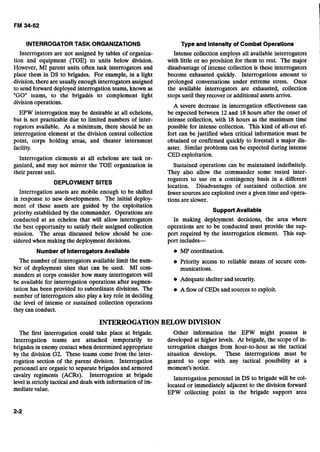
INTERROGATORTASK ORGANIZATIONS Type and Intensityof Combat Operations
Interrogators are not assigned by tables of organiza-
tion and equipment (TOE) to units below division.
However, MI parent units often task interrogators and
place them in DS to brigades. For example, in a light
division,there are usuallyenough interrogators assigned
to send forward deployed interrogation teams, known as
"GO" teams, to the brigades to complement light
divisionoperations.
EPW interrogation may be desirable at all echelons,
but is not practicable due to limited numbers of inter-
rogators available. As a minimum, there should be an
interrogation element at the division central collection
point, corps holding areas, and theater internment
facility.
Interrogation elements at all echelons are task or-
ganized, and may not mirror the TOE organization in
their parent unit.
DEPLOYMENTSITES
Interrogation assets are mobile enough to be shifted
in response to new developments. The initial deploy-
ment of these assets are guided by the exploitation
priority established by the commander. Operations are
conducted at an echelon that will allow interrogators
the best opportunity to satisfy their assigned collection
mission. The areas discussed below should be con-
sideredwhen makingthe deploymentdecisions.
Intense collection employs all available interrogators
with little or no provision for them to rest. The major
disadvantageof intense collection is these interrogators
become exhausted quickly. Interrogations amount to
prolonged conversations under extreme stress. Once
the available interrogators are exhausted, collection
stopsuntil they recover or additional assets arrive.
A severe decrease in interrogation effectiveness can
be expected between 12 and 18 hours after the onset of
intense collection, with 18 hours as the maximum time
possible for intense collection. This kind of all-out ef-
fort can be justified when critical information must be
obtained or confirmed quickly to forestall a major dis-
aster. Similar problems can be expected during intense
CED exploitation.
Sustained operations can be maintained indefinitely.
They also allow the commander some rested inter-
rogators to use on a contingency basis in a different
location. Disadvantages of sustained collection are
fewer sources are exploited over a given time and opera-
tions are slower.
Support Available
In making deployment decisions, the area where
operations are to be conducted must provide the sup-
port required by the interrogation element. This sup-
port includes-
Number of InterrogatorsAvailable MP coordination.
The number of interrogatorsavailable limit the num- Priority access to reliable means of secure com-
ber of deployment sites that can be used. MI com- munications.
manders at &rps consider how many interrogators will
be available for interrogation operations after augmen- Adequateshelterand security.
tation has been provided to subordinatedivisions. The A flow of CEDs and sourcesto exploit.
number of interrogators also play a key role in deciding
the level of intense or sustained collection operations
they can conduct.
INTERROGATIONBELOWDMSION
The first interrogation could take place at brigade. Other information the EPW might possess is
Interrogation teams are attached temporarily to developed at higher levels. At brigade, the scope of in-
brigades in enemy contactwhen determinedappropriate terrogation changes from hour-to-hour as the tactical
by the division G2. These teams come from the inter- situation develops. These interrogations must be
rogation section of the parent division. Interrogation geared to cope with any tactical possibility at a
personnel are organic to separatebrigades and armored moment's notice.
cavalry regiments (ACRS). ~nterro~ationat brigade Interrogation personnel in DS to brigade will be col-
level is strictly tactical and dealswith information of im- located or immediately adjacent to the division
mediatevalue.
EPW collecting point in the brigade support area
(BsA). For MI units to receive S2 support, the be collocated and accessible to the Command post
collecting point and interrogation site will (CP).
DIVISIONINTERROGATIONASSETS
An MI battalion is organic to each division. It
provides combat intelligence, EW, and OPSEC support
to light or heavy infantry and airborne or air assault
divisions.
The MI battalion provides special support the G2
needs to produce combat intelligence. Interrogation
personnel organic to the MI battalions compose the in-
terrogation support element.
ORGANIZATION (LIGHT DIVISION)
In a light division, interrogators belong to the I&S
Company, MI Battalion. Figure 2-1 shows this struc-
ture. Light division MI battalions have 25 interrogators
subordinate to the I&S company. l b o 5-man DS teams
in the interrogation platoon ensure the platoon can pro-
vide support to two committed brigades.
Platoon Headquarters
The intelligence and surveillance (I&S) company Platoon headquarters provides c3for the interroga-
~rovidesdivision CI, interrogation, and surveillance tion element. It consists of a platoon leader and ser-
support. geant. The platoon headquarters coordinates with-
The I&S company interrogation team manages the I&S companycommander for personnel status, ad-
division's interrogation assets, including those inter- ministrative support, and logistical support prior
rogation teams attached from corps. Additional team to deployment to the divisionsupport area (DSA).
duties are-
MI battalion S3 for intelligence tasking and
Screen CEDs. deployment of interrogation assets.
Provide interpreter and translator support.
Liaison with PSYOP and G5 personnel.
Division G2 for reporting, enemy situation up-
dates, and PIR, IR, and SIR.
DISCOM commander for DSA logisticaland com-
munications support, and interrogation element
location in the DSA.
Figure2-1.MI Company (I&S), MI Battalion,Light Division.
MP company commander for division central EPW
collecting point location, and EPW processing and
evacuation procedures.
Medical battalion commander for procedures to
treat and clear wounded EPW for questioning.
CI platoon leader for requirements and joint CI
and interrogation procedures.
MI company team leaders for deployment of DS
interrogation teams.
CA and PSYOP elements for requirements and
processingof civilian detainees and refugees.
Operatlons Section
This consists of a section chief (warrant officer), non-
commissioned officer in charge (NCOIC), and two 4-
member interrogation teams. The operations section
chief manages the interrogation effort to ensure inter-
rogations respond to division intelligence requirements.
DOCEX Section
This consists of a section chief (warrant officer) and
three document examiners. The DOCEX section may
be used as an additional interrogation team when
priority of exploitation and EPW capture rate dictate.
The division G2 determines whether interrogation or
document examination will have priority.
When three brigades are committed in an operation,
the DOCEX section may be employed as a third brigade
level team.
DOCEX assets may also function in an interrogation
role when the number of EPWs at the division central
collecting point requires additional division level inter-
rogators or when the CED rate is very low.
lnterrogatlonTeams
Each interrogation team consists of a team leader
(warrant officer), NCO assistant team leader, and three
team members. Teams are normally employed as part
of the MI company teams which provide IEW support
to the brigades.
ORGANIZATION (HEAVY DIVISION)
In a heavy division, interrogators are assigned to the
I&S Company, MI Battalion. Figure 2-2 shows this
structure.
Figure 2-2. I&SCompany,MI Battalion, Heavy Division.
ORGANIZATION (AIRBORNE OR AIR ASSAULT ORGANIZATION (ACR AND SEPARATE BRIGADE)
DIVISION)
In an ACR or separate brigade, interrogators are as-
In an airborne Or air assault division, inter- signed to the operations support platoon of the MI
rogators are assigned to the I&S Company, MI company. Figure 2-4shows this organization.
Battalion. Figure 2-3shows this structure.
Figure 2-3. I&S Company,MI Battalion, AirborneorAirAssault Division.
Figure2-4. MI CompanyOperations SupportPlatoon forACR and SeparateBrigade.
SPECIAL FORCES GROUP Interrogation teams may be combined with the CI sec-
a special Group (Airborne) (SFGA), inter- tion when not conductinginterrogation operations.
rogators are assigned to the Military Intelligence
Detachment (MID). Figure 2-5 shows this structure.
LEGEND: * ASPS and C M O sections are consolidated on TOE.
* * All SlGlNT MOSSare consolidated under the ASPS per the 31803L000 TOE.
Figure2-5. Organization, MI Detachment, SupportCompany, Special Forces Group.
CORPS INTERROGATIONASSETSAND ORGANIZATION
At corps, interrogators are assigned to the MI Bat- of a company headquarters, IPW and CI operation sec-
talion (Tactical Exploitation) (TE). Figure 2-6 shows tions, CI and interrogation platoons, and a maintenance
this structure. The CI interrogation companyconsists section.
Figure 2-6. MI Battalion (TE).
The CI platoon has nine teams and the interrogation
platoon normally has eight teams. Interrogatorscan be
hlaced in a DS role to divisions to augment division in-
terrogation assets.
The corps also has a Reserve Components (RC)
MI Battalion (TE), which has a subordinate CI in-
terrogation compa ny . Figure 2-7 shows this
structure.
There are also linguist battalionswhich augment and
support Active Component (AC) units in time of hos-
tilities.
Figure 2-7. RC MI Battalion (TE) Corps.
ECHELONSABOVE CORPS INTERROGATIONASSETS AND ORGANIZATION
The MI Battalion (Collection and Exploitation headquarters company (HHC), MI Company (CI), and
[C&E]),as shownat Figure 2-8, has a headquarters and MI Company (Interrogationand Exploitation)[I&E]).
Figure2-8. MI Battalion (C&E), MI Brigade (EAC).
The MI Battalion (ME), as shown at Figure 2-9, has
an HHCand three MI companies (ME), of which one is
GS. 7b0 MI companies-(ME) (INTG) operate the
theater,joint, or combined interrogation facilities,while
the (GS) is for OSto
and below (ECB).
The MI Company (Interrogation) of the MI Battalion
(C&E) and (I&E), as shown at Figure 2-10, has a com-
pany headquarters, operations section, communications
section, food service section, and an I&E platoon, con-
sistingof two sections.
The MI company (ME) (GS), MI Battalion (ME),
has a headquarters section, an operations section, and
three interrogation platoons, each with a platoon head-
quarters and eight sections. Figure 2-11 shows this
structure.
Figure 2-9. MI Battalion (I&E),MI Brigade (EAC).
Figure 2-10. MI Company (INTG),MI Battalion (C&E) and (I&E).
Figure 2-11. MI Company (ME) (GS), MI Battalion (ME). 

ENEMYPRISONER OFWAR AND INTERROGATIONFACILITIES 

There are significant differences in EPW and inter-
rogation facilities at each echelon; this is due to the
numbers of EPWs, the missions of the various echelons,
and the size of the interrogation elements.
EVACUATIONAND GUARDING EPW
Initially,the capturing unit is responsible for evacuat-
ing and guarding EPWs. In brigade-size operations,
battalions evacuate prisoners to brigade collecting
points as the situation permits. In most cases, EPWs
are evacuated rapidly using backhaul transportation
from brigade collecting points to departure areas be-
cause they require food and guards, both of which are in
short supply at brigade. EPW collecting points should
be located close to supply routes to speed evacuation.
BRIGADEAND LOWER ECHELONS
At brigade level, EPWs can be detained in open
fields, courtyards, gardens, jungle clearings, or similar
sites if they are hidden from enemy observation. If
necessary, these areas can be enclosed with barbed wire
for more efficient EPW handling. Because EPWs sel-
dom remain at a forward collecting point for more than
a few hours, EPWs are not usually kept in a building or
other shelter.
Interrogation facilities at battalion and brigade are
kept to a minimum. Brigade interrogation personnel
should be located adjacent to the brigade forward EPW
collecting point in the BSA. The collecting point
should be out of sight and sound of other BSAactivities.
It should be close to normal evacuation routes.
The distance between the collecting point and CP is
important. When possible, the collecting point and in-
terrogation site should be within walking distance or a
fewminute's drivingdistance of the CP.
Interrogators with battalions or brigades should have
vehicles equipped with radios for rapid communication
with their respective intelligence officers and other in-
telligence agencies.
DIVISIONFACILITIES
The principal EPW tactical interrogation takes place
at division. While the procedure is similar to that used
at brigade, the interrogation scope is broader.
Previous interrogation reports received from brigade
are reviewed. This information is expanded by further
interrogations for tactical information to include all OB
elements.
The interrogators at division level will prepare and
disseminate summary interrogation reports. As dictated
by the tactical situation, the interrogation facility at
division may be augmented by corps interrogation per-
sonnel-
The division's central EPW collecting point is
operated by division Mp under the supervision of the
division provost marshal. The interrogation section
should be located immediately adjacent to the division's
central EPW collecting point, normally along the main
supply route (MSR) within or near the division support
command (DISCOM).
The distance between the interrogation facility and
G2 section (rear) is not as critical as at brigade level.
Personal liaison between the interrogation and intel-
ligence sections, although important, may not be re-
quired as frequentlyas at brigade.
At division, the G2 directs interrogation section col-
lection efforts in conjunction with the CM&D section
and the MI battalion commander, who serves as one of
his principal assistants.
Compared to brigade facilities, division interrogation
facilities are expanded. This is because the division in-
terrogation section handles and interrogates more cap-
tured personnel, and interrogations are conducted in
greater detail. When practicable, interrogations at
division should be conducted in improvised interroga-
tion rooms in buildings adjacent to the division collect-
ing point. If possible, separate rooms should be
availableto permit several interrogations at once.
CORPS FACILITIES 

The corps EPW holding area is established and
operated by MP under the supervision of the corps
provost marshal. The Corps Interrogation Facility
(CIF) will usually be a more permanent type facility
than at echelons below corps. It should consist of
operations and interrogation areas with separate,
enclosed interrogation booths or rooms. If possible,
there should be a separate DOCEX area. Figure 2-12
shows a sample CIF.
Figure 2-12. Sample Corps Interrogationfacility (CIF).
2-10
The commander, CI Interrogation Company, MI Bat-
talion (TE), MI Brigade (Corps), is the CIF com-
mander. CIFs are the principal establishment for the
exploitation of captured personnel and CEDs. Func-
tions of the centers include-
Conducting tactical and strategic interrogations
based on the intelligence requirements and specific
guidanceof the corps G2section.
Screening to select sources suited for further ex-
ploitation at a higher echelon interrogation center.
Screening of EPW and other sources of specificCI
interest.
Interrogating sources of interest to PSYOP intel-
ligencebased on their requirements.
Preparing and disseminating interrogation reports.
Continuous coordination between the CIF com-
mander and EPW holding area commander is essential.
At a sub-level, it is also important for interrogators to
maintain a good working relationship with MP at the
holding area.
MP, who are in constant contact with EPWs or
detainees, can provide interrogators valuable informa-
tion on individual sources. By properly handling
prisoners at all times, they also contribute to the success
of interrogation operations by helping to reduce resis-
tance by the sources.
The CIF should be administrativelyand operationally
self-sufficient and located within or adjacent to the
EPW holding area, close enough to facilitate opera-
tions.
ADEQUATE INTERROGATION FACILITIES
At corps level, particular emphasis should be placed
on providing facilities adequate for the interrogation of
EPWs of higher positions or rank. Because interroga-
tions will normally last longer than at division, a greater
degree of comfort should be provided, if possible. In
other respects, the type of interrogation facilities and
equipment parallels those found at division.
08 SECTION
OB analystsare a valuable interrogation facilityasset.
They ensure PIR, IR, and SIR are updated, and report-
ing is in response to them. In addition, they maintain a
situation map (SITMAP) and OB updates to keep inter-
rogators current on tactical situations.
EDITORIALPERSONNEL
The senior interrogator may assign interrogators to
edit INTREPs. They also may use the organizational
chain of command to ensure quality control of report-
ing. When OB analysts are available, the commander
may task them to edit reports.
DOCEX SECTION
The DOCEX section receives documents taken from
captured personnel, battlefield casualties, and positions
abandoned by the enemy. It processes captured docu-
ments; for example, screens for intelligence value,
categorizes, and translates. It forwards translation
reports on information of immediate tactical value.
(Chapter 4 describesdocument categories.)
SPECIALIZED INFORMATION
The scope of interrogations at corps iswidened by the
commander's intelligence requirements, SIR of the
numerous technical service staff agencies, and other in-
telligence agencies and services. All such special needs
for information are coordinated by the corps G2 sec-
tion. Interrogators must be aware of these overall intel-
ligence requirements to adequately exploit captured
personnel.
Because of the range of specialized information re-
quired, interrogation at corps level should be conducted
by interrogators who specialize in fields such as armor,
engineering, medicine, and other specialized subject
areas.
To extract detailed EPW information, the senior in-
terrogator will assign some interrogators as screeners
and others to specializedareas. However, he must coor-
dinate, for example, with technical intelligence
(TECHINT) assets. This is to prevent duplication or
gaps in information obtained.
Continuous coordination is required between all
echelon interrogators to ensure a smoothly functioning
operation.
The corps MI brigade applies the technical expertise,
intelligence manpower, and equipment needed by G2 to
produce integrated combat intelligence. The corps
commander has OPCON, while the G2 has staff super-
vision over the MI brigade.
ECHELONSABOVE CORPS FACILITIES
At echelons above corps (EAC), the MI company Have intelligence analysts to handle requirements
(ME), MI battalion ( M E ) or (I&E), MI brigade and keep interrogators informed of changes in the
(EAC), will form the Theater Interrogation Facility operational or strategicsituation..d
(TIF): The TIF, which is commanded byan MI captain,
provides interrogation support to the theater or joint @ Maintain the capability to deploy "GO" teams to
command and to national level intelligence agencies. multiple theater EPW camps, as well as to forward
The TIFwill-
deploy them to corps and ECB as needed.
Be located within the main theater EPW intern- @ Provide experienced senior interrogation warrant
ment facility.
officers and NCOs who are graduates of the
Department of Defense (DOD) Strategic
Be tailored organizationally to meet requirements ~ebrieferCourse (additional skill identifier 9N or
of the theater and situation. N7) and physical plant for the Joint Debriefing
Include interrogators, CI personnel, and intel-
Center (JDC), where exploitation of high-level
(Category A) sources takes place on operational
ligence analysts from the Army, Air Force, Marine
and strategictopics.
Corps, and, in some cases, the Navy.
Be organized similarly to the CIF; that is, by func-
tion.
MEDICAL COMPANYINTERROGATIONS
Sometimes it may be advantageous to conduct inter- US Army doctors and medics are considered com-
rogations at the medical company. Wounded prisoners petent medical authorities. In their absence, the inter-
being evacuated through medical channels are frequent- rogation may not commence, even upon direction of
ly valuable sources of information; however, inter- nonmedical military authority.
rogators cannot represent themselves as medical or Red When interrogating a sick or wounded EPW, great
Cross personnel. care must be taken to avoid implying that treatment will
The fact the EPW is wounded, and in an "enemyn be withheld if cooperation is denied. The interrogation
hospital, puts him in a state of mind conducive to inter- process must not interfere with timely medical treat-
rogation. The permission of competent medical ment, to include administering medication to relieve
authority is required before wounded prisoners can be pain.
interrogated.
INTERROGATIONAT BRIGADEAND BELOW
Interrogators are not usually attached below brigade
level unless the combat situation requires limited tacti-
cal interrogation at battalion or lower. In this event,
skilled interrogators from the MI battalion will be at-
tached temporarily to committed battalions. They will
assist in exploiting EPW immediately upon capture to
extract information needed in support of the capturing
unit.
Interrogations at battalion or lower are brief and con-
cerned only with information bearing directly on the
combat mission of the capturing unit. The following are
examples of circumstanceswarranting an interrogation:
A unit or landing force assigned an independent
mission in which the S2is primarily responsible for
collecting information necessary to fulfill the unit's
mission. Immediate tactical intelligence is neces-
sary for mission accomplishment.
There is a definite need for interrogation at a
lower level to permit rapid reaction based on infor-
mation obtained.
It is advantageous to have an EPW point out
enemy defenses and installation from observation
points in forward areas.
BAlTALlON S2 CONTROLS
Interrogators employed for temporary periods at bat-
talion level receive PIR, IR, and SIR from the sup-
ported battalion S2. This will ensure interrogators are
fullyoriented to the battalion's collection mission.
In other instances, interrogators may be placed at
brigade in an "on-calln status, from which they can
proceed to any of the subordinate battalions as cir-
cumstances warrant. Upon completion of a low-level,
immediate-type interrogation, they can return to
brigade and again become available for immediate
employment.
Commanders and S2sbelow brigade level who are un-
able to obtain interrogator support from higher
echelons should include provisions in unit and staff
standing operating procedures (SOPS) for the "tactical
questioning" (not interrogation) of EPWs or detainees.
They should identify assigned personnel for language
capability.
Interrogation personnel should provide training in
the area of tactical questioning to designated S2 person-
nel. The potential for abuse of the EPW is greatest at
the initial capture and tactical questioning phase. With
the excitement and stress of the battlefield, it may be-
come easy for unskilled personnel to resort to illegal
techniques to elicit critical information.
Your instruction must stress the importance of the
proper treatment of EPWs. Emphasize that the abuse
of an EPW at the initial stage of contact often renders
future interrogation futile.
If you are engaged in, or supervisingthe tactical ques-
tioning of EPWs, you are responsible for ensuring that
EPWs are treated in accordance with the requirements
of international and US law. Any tactical questioning
conducted must be in response to the supported
commander's PIR. Appendix C discusses S2 tactical
questioning.
At this level the brigade S2 must maintain secure
communication with interrogation personnel to ensure
requirements are answered. Except under extreme
weather conditions, and MP availability, it is not neces-
sary to keep EPWs within the confines of a building or
other shelter at battalion level since they will not
remain for more than a few hours before being
evacuated.
The capturing unit escorts or transports EPWs or
detainees to the nearest collecting point, and turns them
over to the MP. Interrogators in DS of the brigade will
screen and categorize all EPWs or detainees, question
them, and report information obtained in response to
brigade PIR, IR, and SIR. Theywill do this under time
constraints, as all EPWs or detainees must be evacuated
without delay.
In spite of the temporary nature of the forward EPW
collecting point, interrogators should maintain enough
spacebetween the collecting point and the interrogation
site to ensure the privacy of interrogations. EPWs or
detainees should not be able to observe or hear inter-
rogations in progress.
INTERROGATIONSIN OTHER OPERATIONS
The functions and basic operational techniques
employed by the interrogation element attached to the
infantry division apply to interrogation elements sup-
porting armored, amphibious, and airborne operations
in any terrain or climate.
Differences arise primarily in the planning stages and
interrogation objectives. These differences normally
result from the inherent characteristics of each type of
unit and terrain and climate involved.
For example, the interrogator engaging in airborne
and amphibious operations will be dependent upon in-
telligencesupport from higher agenciesduring the plan-
ning stage. This is necessary because the unit does not
have actual contact with the enemy until a specific
operation begins.
Once H-hour arrives, the interrogator will be faced
with a rapidly developing and changing tactical situa-
tion. At this time, the degree of success correlates to
the preparations made during the planning stage.
Consequently, the interrogator must make a con-
certed effort to learn everything possible about the ob-
jective area-terrain, enemy, and weather-and relate
these factors to the mission of the unit supported. Only
by taking these steps will the interrogator be able to en-
sure success, and be prepared to begin interrogations as
soon as possible after contact with the enemy is estab-
lished. Interrogation objectives depend upon the mis-
sion assignedand type of unit supported.
SPECIALFORCES
SpecialForces perform five primary missions: The Special Forces Group (SFG) normally deploys
three two-person teams, as required, to support group
Unconventional warfare.
operations. One of the teams may be attached to the
Foreign internal defense. joint interrogation facility (JIF). Special Forces inter-
rogation activitiesinclude,but are not limited to-
e Direct action.
Interrogating EPWs, debriefing detainees and
Special reconnaissance.
returned US personnel, and other persons of intel-
Counterterrorism. ligenceinterest to the supported commander.
The primary role of Special Forces is to influence Exploiting documents that appear to directly satis-
deep, close, or rear operations beyond the forward fy the supported commanders specific operational
limits of conventional military forces. These operations requirements (SORs).
may extend into a hostile nation's homeland o; into the
Participating in overt elicitation activities. These
territory of hostile states that threaten lines of com-
activities include liaison, escort, observer, and
munication in the friendlystrategicrear.
treaty verification measures.
AMPHIBIOUS OPERATIONS
The assault landing team is the basicsubordinate task
organization of the assault echelon of a landing force.
Regardless of whether a battalion or brigade landing
team is the basic element, it will operate independently
during the first stages of the landing, and be organized
to land, overrun beach defenses, and secure terrain ob-
jectives.
The interrogation element, along with CI teams,
should participate in all aspects of the planning phase
affectingthe landingforce to which it is attached. Inter-
rogators should conduct specialized training. The chief
interrogator should coordinate with the landing force
intelligence officer on all matters concerning inter-
rogators after the landing has been made.
The interrogators obtain as much background infor-
mation about the enemy as possible to interrogate cap-
tured enemypersonnel. Interrogators should study-
@ All maps, charts, and photographs of the terrain
and defensesof the landing areas.
All INTREPs on the enemy armed forces in that
area.
Available information on enemy reserves, as well
as on civilians residingin the area.
Interrogators should engage in other phases of train-
ing, including rehearsals, to smoothly execute embarka-
tion, movement,and debarkation operations.
ligence officer, and employed at his direction. Small in-
terrogation teams may be formed,which will embark on
separate ships. Communication silencewill place an ef-
fective barrier between these teams until that silence is
lifted.
When the assault begins, organizational artillery, air
support, and naval gunfire depend primarily on shore
units for accurate target information. As a result, inter-
rogators may be required to concentrate their efforts on
target acquisition.
The importance of information obtained from cap-
tured enemy personnel is magnifiedwhen establishing a
beachhead. This is because the commander is unable to
undertake probing actions to "feel out" the enemy as he
can during a more conventional land operation.
INITIALINTERROGATIONS
Interrogators should conduct initial interrogations
near the landing beach close to the CP to communicate
information without delay. If necessary, interrogators
may be sent forward to operate with assault companies.
EPW are turned over to the landing force shore party
for custody and eventual evacuation.
Further instructions on interrogations and EPW han-
dling are in the intelligence annex of the landing force
operations order (OPORD). The interrogation of
civilians for information of intelligence value also is an
important part of the interrogation mission.
The interrogation element attached to an amphibious
landing force will be OPCON to the landing force intel-
ESTABLISHAND OPERATE
When headquarters of the next higher echelon above
the landing force has landed and established its CP,
some of the interrogators may be returned to the com-
mand level from which they were originally detached.
At this time, collecting points and interrogation
facilities can be established and operated as in ordinary
ground operations.
The shore party or helicopter support teams operate
EPW collecting points in the vicinity of the landing
beaches. EPW are evacuated from these points to
designated ships by landing craft, helicopter, or am-
phibious vehicle. Retention in the objective areas is
begun as increased facilities, supplies, and personnel
permit, consistent with reasonable EPW safety from
enemy action.
AIRBORNE OPERATIONS
The functions and basic methods of operations by in- Interrogators should spend sufficient time coordinat-
terrogation personnel with airborne operations are ing with other intelligence specialists, particularly
similar to that of an infantry division. However, the analysts, to provide a realistic and complete picture of
method of employment of interrogators is somewhat the enemy situation.
different. Interrogators who are to operate with air-
borne units must understand the peculiarities in opera-
tions, as well as in training.
The most significant difference between airborne and
normal ground operations is airborne operations are
usually carried out behind enemy lines. Before the
operation, airborne qualified interrogators must-
* Gain a realistic and complete picture of the enemy
situation.
Study enemy units identified in the objective area,
and those capable of moving to counterattack our
forces.
They must study enemy units identified in the objec-
tive area, as well as significant terrain features, to pro-
vide a background for more comprehensive inter-
rogations when the first EPWs are captured. Prior to
the actual airborne assault, interrogators must know CP
locations of the division and its subordinate units.
Interrogators involved in airborne operations must
anticipate the numerous problems which will affect the
interrogation mission. For example, it is conceivable
during the assault phase that no basic transportation
will be available to interrogation personnel; thus,
flexibility is critical in planning and executing airborne
operations.
Locate significant terrain features in the objective
area.
COLLECTINGPOINTS AND INTERROGATION
FACILITIES
The command echelon to which interrogators will be Collecting points and interrogation facilities are es-
attached depends on each airborne battalion for the as- tablished and operated as in other operations when-
sault phase. Interrogators move into the objective area
with the unit they are supporting. They are OPCON to Headquarters of the next higher echelon above the
the unit intelligence officer. assault units have been airdropped.
As soon as the objective areas and the missions of the Assault units have established physical contact
respective units within an airborne force are designated, with higher headquarters.
the interrogators who are to take part in the operation AIR ASSAULT (AIRMOBILE) OPERATIONS
must receive details on most aspects of the operation.
Air assault operations are characterized by a high de-
Interrogators must be provided with-
gree of tactical mobility. They are conducted by
The SIR and proposed H-hour. transporting infantry and field artillery units, with the- .
necessary combat support (CS) and combat service sup-
* Maps, photographs, and other data required for in-
terrogations.
port (CSS), into battle by helicopter. Once deployed on
the ground, air assault infantry battalions fight like
All information on enemy units which are outside other infantry battalions. The essence of air assault tac-
the objective area, but are capable of being tics is a rapid tempo of operations over extended ranges.
employed to counterattack US forces. In division air assault operations, to support more than
one brigade, there must be corps augmentation. FM 71-
101describesair assault operations.
Security of aircraft enroute to landing zones (LZs) is
a major concern. Friendly aircraft and air defense sup-
port must ensure air routes are free of enemy aircraft
and air defense systems.
When remotely monitored battlefield sensor systems
(REMBASS) are available, friendly ground assets
emplace REMBASS along likely enemy ground ap-
proach routes in the LZ to detect and report ground
movement. Ground surveillance radar (GSR) is
employed to warn of enemy movement on friendly
flanks.
Air assault operations require extensive HUMINT
support in operation planning. CI analysis is critical to
ensure OPSEC measures are taken to prevent divulging
criticalinformation, such as-
8 Date and time of operation.
8 Sizeof force to be employed.
8 Air routes to and from planned LZs.
8 Planned LZ locations.
CI must also support staging area actions to prevent
espionage, sabotage, and acts of terrorism which could
adversely affect the operation.
Interrogation is a primary source of information for
air assault operations IPB. Interrogation support of ini-
tial stagesof the operation may be critical to its success.
The assault force commander needs immediate and
current enemy intelligence. Lack of immediate ques-
tioning of EPWs captured in securing the LZs or in fol-
low-up actions may cause failure of the operation.
Planners must consider the difficulty in getting EPWs
back to a support area during the early stages of an air
assault operation. Interrogators should support the air
assault elements as soon as possible. This may mean an
interrogation team is included in the air assault force to
operate at a forward EPW collecting point established
in the vicinityof the LZ.
Normally, one interrogation team should support
each air assault battalion during the assault phase. If
the air assault battalion is using more than one LZ, the
team may be split to support each LZ.
After assault units have established a ground link-up,
some or all of the interrogators may be returned to the
echelon of command fromwhich theywere detached.
Interrogators supporting the early stages of an air as-
sault operation must be provided with the SIR, which
are critical to the operation's success. Interrogators
must plan ahead on how to question EPWs to satisfy
immediate collection requirements.
ARMORED AND MECHANIZED JNFANTRY

OPERATIONS 

Armored units normally operate on extensive fronts,
with deep zones of action and dispersed formations. Be-
cause of the mobility and wide range of action of ar-
mored units, interrogation normally is not as detailed as
in other divisions. Interrogators must remain mobile,
operatewith minimum facilities,and be alert for sudden
changesin the tactical situation.
Planningand Operation
With a few exceptions, the planning and preparation
necessary for interrogators supporting armored units is
the same as for those supporting regular infantry units.
Since radio is the normal means of communication, all
interrogation team members must be familiar with voice
radio procedures and know how to operate radio equip-
ment common to armored units.
Interrogator Employment
Interrogator personnel who support armored or
mechanized units will come under OPCON of the 52,
G2, or S2 of the supported unit. Interrogators at all
levels of armored or mechanized units must be able to
operate during fluid situations, and remain mobile at all
times. Because of this mobility, liaison with the 52, G2,
or S2will not be as frequent as in other units.
Interrogators must operate with maximum efficiency
on the basis of radio communications, messages, and
written reports. As in other type units, interrogation
personnel remain OPCON to the G2 until operations
begin. At that time, the division MI battalion will at-
tach interrogation personnel to subordinate units.
After an operation is completed, interrogation person-
nel will revert to division control, pending a future mis-
sion.
Normally, interrogations within armored units will be
limited to interrogating EPWs for location and deploy-
ment of antitank weapons and defenses, enemy
roadblocks, and presence of enemy armor. In fast
moving offensive operations, interrogators are best CAPTURE RATES
, employed with the forwardelements of the units. US military involvement in tactical operations during
Limited Interrogations and since World War I1 has shown that conflict-
EPWs are questioned briefly at the point of capture
generates large numbers of EPWs, other detainees, and
(POC), and evacuated to division EPW forward collect-
CEDs. The higher the intensity of conflict, the larger
ing points, or are turned over to division MP for evacua-
the number of EPWs, detainees, and CEDs.
- -
tion. Interrogators with battalions and brigades in In OPERATION DESERT STORM, EPWs were
armored operations should have vehicles equipped with captured, and surrendered, in such great numbers that
radios so they can communicate with the respective in- many with information had little or no contact with in-
telligenceofficersand other intelligence agencies. terrogators until they were transported to rear area col-
lecting points. By this time, any tactical information
General exploitation techniques and procedures are
they had was of limited use.
modified to fit the environment and objectives of each
interrogation. In LIC operations in Grenada and Panama, the EPW
capture rate was lower, but the detainee rate was higher.
EPWs are a primary source of information during tac-
The following factors contributed to an extreme chal-
tical operations. The ability to exploit that source is a
lenge for interrogation operations:
critical factor in mission success. EPWs are first-hand
and last-minute observers of enemy operations. They Limited sizeof US forces.
represent one of the fewforms of directassociation with
Limited number of language-qualified inter-
the enemyand usually possess valuable information.
rogators.
Other sources of information are enemy and friendly
The focus on local populace.
civilians, refugees, defectors, captured agents, and in-
formers. Because these sources may have lived in or Massiveamounts of CEDs.
passed through areas occupied or controlled by the
To be successful, interrogation support to tactical
enemy, they can providevaluable information.
I operations must be carefully planned. Available inter-
I CEDs are another important source of information rogation assets must be balanced against the operations
which interrogation personnel will exploit in tactical objective, enemy situation estimate, and projected EPW
operations. Documents will be found in the possession capture rates.
of EPWs or other detainees and on the battlefield.
Often, they provide critical and sometimes detailed
The formulas in Table 2-1 are used to estimate the
enemy information.
approximate division-level EPW capture rates. These
formulas could vary according to type of conflict and
mission.
Table 2-1. Division-levelEPW capture rate.
Defensive Posture OffensivePosture
.00035EPWs* =9EPWsIday .00367EPWs* = 94EPWsIday
*percombat soldier per day.
I
civilian suspects may also be detained during opera-
CounterinsurgencyOperations
tions.
EPW capture rate for counterinsurgency operations This requires individual screening at brigade and
may be very low. However,failure of the enemy to wear division levels of detained personnel to determine their
a uniform or other recognizable insignia results in an status and appropriate disposition. In Viet Nam, the
identification problem. As a result, large numbers of ratio of EPWs approximated one for each six detainees
taken into custody.
Terrorists INTERROGATION OF PROTECTEDPERSONS
Terrorists are a fact of contemporary life. They are Civilians and refugees caught in the middle of a con-
dedicated,intelligent,well financed,resourceful,and as- flict are protected by the GWS, ~ p w ,and GC. Most of
tute planners. They are difficult to identify and are not the provisions discussed below apply whether the
easily captured or interned. The use of terrorist tactics civilian or refugee is found in the territory of a party to
worldwide has increased significantly over the past 25 the conflict, or in occupied territory. Civilians and
years, and this trend is not expected to abate in the fu- refugees fall into the broadly defined category of
ture. protected persons under the GC.
Besides peacetime, acts of terrorism should also be
expected in time of armed conflict. US forces must be
prepared to engage in counterterrorist activities to as-
sist the civil and militarypolice. Current doctrine states
counterterrorist activities may involve use of general
purpose forces as well as those specifically organized
and trained in counterterrorist techniques. There is no
data available on projected terrorist capture rates.
It is important to keep in mind that protected per-
sons, even those who might be detained by you, are not
EPWs. They must be treated differently and kept
segregated from EPWs. The rights and protections af-
forded EPWs and protected persons, as well as those
control and disciplinary measures that may be used
against them, are different. Appendix D provides GWS,
GPW, and GC provisions for protecting personsrights.
INTERROGATOR SUPPORTED OPERATIONS
Combat operations which the tactical interrogator Denying the enemyintelligence.
supports are discussed below. No matter what the
Disrupting and destroying enemy command, con-
operation is called, it is still incumbent upon the inter-
rogator to gain critical combat information in support
trol, communications,and intelligence(c31).
of that operation. The interrogator plays a key role to Maintainingoperational integrity.
ensure the combat operation is a success.
Interrogation provides a high percentage of informa-
OFFENSIVEOPERATIONS tion on the enemy and terrain which, along with
Sucmsful offensiveoperations demand imagination, weather, are the key elements in the bat-
thorough coordination, and skilled execution. These tlefield.
operations are characterizedby- Movementto Contact
Aggressiveness.
Initiative.
Rapid shifts in the main effort to take advantage of
opportunities.
Momentum.
Deep and rapid destruction of enemy forces.
Offenses should move fast, follow successful probes
through gaps in the enemy defenses, and shift strength
quickly to widen penetrations and reinforce successes to
carry the battle deep into the enemy rear operations.
They should destroy or control the forces or areas criti-
cal to the enemy's overall defensive organization before
the enemy can react.
In the offense, certain principles are essential to bat-
tlefield success:
0 Knowingthe battlefield.
Movement to contact is a tactical operation to find
and engage the enemy. The force is organized to hold
the bulk of its combat power in the main body. It moves
aggressivelytoward the enemy, making maximum use of
IEW resources to find the enemy before the enemy
detects the friendlyforce.
When contact is made, combat information and intel-
ligence determine where and with what force to attack
and overcomeenemy resistance. Interrogation is an im-
portant source of that information.
In a movement to contact, the friendly force may en-
counter an enemy defending or moving to contact.
Once contact is made, the action must be resolved
quickly if the movement to contact operation is to con-
tinue. This is normally done by a hasty attack launched
as quickly as possible with whatever assets are on hand.
No time is available for detailed IPB and analysis, other
than what has been done prior to movement to contact.
The analyst quickly updates the intelligence analysis for
as quickly as possible with whatever assets are on hand.
No time is available for detailed IPB and analysis, other
than what has been done prior to movement to contact.
The analyst quickly updates the intelligence analysis for
the commander and continues the update as the attack
progresses.
IEW resources look deep to determine second-
echelon vulnerabilities. These vulnerabilities form the
basis for friendly offensive action, particularly deep in-
terdiction.
While continuing to look deep, IEW resources also
support close operations directly. They continue to be
sensitive to enemy vulnerabilities which would bring
maximum friendly success when exploited. Where pos-
sible, IEW resources support deception operations.
In the movement to contact, interrogators should be
deployed forward to interrogate EPWs as well as in-
digenous personnel, particularly refugees, to determine
as much as possible about the enemy and terrain which
lies in the path of the advancing force.
Meeting Engagement
The meeting engagement may be the result of move-
ment to contact. It occurs when a moving force, incom-
pletely deployed for battle, engages an enemy force
about which it has inadequate intelligence. Once con-
tact is made, electronic countermeasures (ECM) are
employed against enemy key and electronic guidance
systems.
All available collection resources deploy to determine
the size, composition, disposition, capabilities, and in-
tentions of the enemy force. They immediately report
critical information, such as the location of assailable
flanks and other enemy vulnerabilities, to the force
commander. The commander needs this information
quickly to decide whether to bypass, attack, or defend
against the enemy.
Meeting engagement battles can be avoided if IEW
resources are effectively integrated and used. If intel-
ligence is effective, the commander can prepare for bat-
tle before encountering the enemy force.
Hasty and DeliberateAttacks
In hasty and deliberate attacks, IEW tasks arevirtual-
ly the same. MI resources determine as much informa-
tion as possible about the enemy's defensive posture.
Key information determined by IEW assets includes-
How the enemy's defense is organized.
Where enemy reserve and counterattack forces are
located, and when they move.
What NBC weapons systems the enemy has, and
where they are located.
Where the enemy's conventional artillery is lo-
cated.
Where enemy radio electronic combat (REC) as-
sets arelocated.
In a hasty attack, the need for rapid collection of com-
bat information is critical. In such an attack it may be
advantageous to deploy interrogation teams down to
battalion level to operate in a similar manner as in the
movement to contact.
In the deliberate attack, intelligence on the enemy is
more complete, and interrogation support may not be
provided below brigade. However, planning for a
deliberate attack should task organize interrogation as-
sets to satisfythe greatest need.
For example, a committed brigade that conducts the
main attack receives the support of two interrogation
teams; a brigade in a supporting attack receives only one
team; and a brigade in reserve receives no interrogation
support.
Exploitation and Pursuit
Commanders planning offensive operations must be
prepared to conduct exploitation and pursuit- actions.
Without prior detailed planning for these contingencies,
fleeting opportunities to press a successful attack to
completion may be missed. IEW resources, particularly
MI assets, play an important part in planning for and ex-
ecuting exploitation and pursuit missions.
IPB is critical and helps identify enemy vul-
nerabilities. Intelligence supports targeting by identify-
ing, locating, and tracking enemy forces which may
move to counter exploitation forces.
After the initial assault, MI assets determine the in-
tegrity of enemy defenses. They locate gaps, holes, and
weak spots that may be exploited. They determine if the
enemy intends to defend in place, delay, or withdraw to
subsequent defensive positions. ECM are maximized to
increase enemy force confusion.
Reconnaissance In Force
A reconnaissance in force (RIF) is a limited objective
operation by a substantial force to obtain information
and to determine enemy dispositions and strengths.
The RIF also tests enemy reactions to friendly force ac-
tion. Enemy reactions r a y reveal major defensive
weaknesses which could be exploited.
Even when using RIF to gain information, com-
manders executing it must be alert to seize an oppor-
tunity to exploit tactical success. If the enemy situation
must be developed across a broad front, a RIF may
probe the enemy at selected points.
Recognizing that RIF is primarily an information-
gathering operation, commanders must carefully con-
sider the risks involved. Precise plans must be made in
advance to extricate the force or to exploit success.
In many respects, MI RIF support is like movement
to contact. Interrogation support is critical since EPWs
will be an important source of the information the RIF
seeks. Interrogation support, described in movement to
contact, may be the most efficient means of supporting
the RIF.
River Crossing
River-crossing operations are an integral part of land
warfare. The objective of any river-crossing operation is
to project combat power across a water obstacle while
ensuring the integrity and momentum of the force. Be-
cause the modern battlefield is so lethal, and small
enemy units can be destructive, crossings must be quick
and undetected. Therefore, it is essential that rivers be
crossed in stride as a continuation of operations.
MI units contribute to the planning and execution
phases of river-crossing operations:
IPB enables the commander to select the best
crossing site and know the battlefield beyond, so
operations can be sustained without interruption.
IEW forces deploy forward and continue seeking
enemy weaknesses for exploitation, and to warn of
enemy forces capable of affecting the operation.
Other elements guard the flanks to prevent enemy
surprise.
MI resources further help the commander know
the battlefield and guard against a surprise attack
by identifying, locating, and tracking enemy NBC-
capable delivery systems.
Based on the picture of the battlefield drawn by the
G2 as a result of IPB, the commander decides whether
the crossing will be-
Day or night.
Wide or narrow on the front.
MI units normally are not part of the assault force;
however, GSR teams may accompany the assault force if
surveillance of enemy approaches to the exit bank can-
not be conducted from the entry bank. Additionally, in-
terrogators should be included in the assault force if
immediate EPW exploitation is deemed critical to
developing intelligence on the exit-bank battlefield.
Evacuation of EPWs back over the crossing site to a
support area collecting point normally will be delayed.
This is due to the need to get the maximum amount of
force across the river in the shortest time. Two-way
traffic in the early stages of the crossing may be
precluded.
A forward collecting point on the exit-bank side of
the river may be established immediately behind the as-
sault force, and interrogations can be conducted to ob-
tain information critical to the immediate situation. To
accomplish this, organization of interrogation assets as
outlined under movement to contact may be employed.
DEFENSIVEOPERATIONS
Defensive operations can retain ground, deny the
enemy access to an area, and damage or destroy attack-
ing forces. They cannot, however, win the battle by im-
posing the will of the commander on the enemy. For
this reason, the defense is a temporary expedient, under-
taken only when it is impossible to conduct offensive
operations, or when attacking in another area. All
defensive actions are undertaken in anticipation of ul-
timately resuming the offense.
Commanders plan the overall defensive effort on the
basis of the METI'-T. MI assets are allocated within the
elements of the organizational framework to support
the overall scheme. The IEW principles for supporting
offensive operations apply to the defense, as well as to
other operations. Interrogation support to defensive
operations, likewise, is basically the same as that
provided to offensive operations. Listed below are im-
portant factors to consider in defensive operations:
The primary focus of intelligence requirements is
on which enemy will attack and when, where, and
how they intend to do it.
The decentralized, fluid nature of the covering
force battle requires interrogation support at the
lowest possible echelon. This requires DS inter-Hasty or deliberate.
rogation teams from the division MI battalion and support the covering force must be balanced against the
the MI brigade (Corps). Questioning of civilians increased corps rear operations support. The increased
and EPWs is brief and is conducted to obtain infor- emphasis on rear operations may mean fewer corps in-
mation of immediate tactical value. Interrogators terrogation assets availableto support division.-
gather information about the identification,-com-
position, disposition and direction of movement,
The G2, in coordination with the MI unit com-
strength, and capabilities of enemy forces involved
mander, may determine that an echelon between the
in the immediatecovering forcebattle.
covering force and corps will not be supported. For ex-
ample, EPWs may be interrogated by DS interrogators
More interrogation support is required at corps. supporting the covering force, and then be evacuated
The enemy has the initiative, and will probably back to division, bypassing brigade. Additionally, the
conduct operations in the friendly rear area. five-member DS team, which provides flexibility, may
Support of defense operations requires the closest have to be reduced to two or three interrogators. Table
management of interrogation assets. The necessity to
2-2shows interrogation support in LIC.
Table 2-2. Interrogationsupport In LIC.
INSURGENCY
Interrogate EPWs and detainees.
Exploit CEDs.
ProvidePSYOP linguisticsupport.
Train insurgent combatants in interrogation tech-
niques.
COMBATTINGTERRORISM
Provide PSYOP linguisticsupport directed against
terrorists.
Provide CA linguisticsupport.
Provide linguisticsupport for liaison with military
or paramilitary HQ.
Providelinguisticsupport during PW exchanges.
Debrief members of US peacekeeping forces for
intelligencepurposes.
COUNTERINSURGENCY
InterrogateEPWs and detainees.
Exploit CEDs.
Train HN forces in interrogation techniques.
Providelinguisticsupport to other US forces,
advisors, and trainers.
Provide PSYOP linguisticsupport.
Provide CALinguisticsupport.
In counter-drug operations-
-Train HN personnel in interrogation
techniques.
-Exploit and analyze drug-related
documents.
PEACETIMEAND PEACEKEEPINGOPERATION
Provide PSYOP linguisticsupport.
Debrief knowledgeable civiliansbeing
evacuated from danger zones during NEO.
Support counter-drug operations by-
-Training HN personnel in interroga-
tion techniques.
-Exploiting and analyzing narcotics-
related documents.
THEATER INTERROGATIONFACILITY
The EAC interrogation facilitywill normallybe desig-
nated as the TIF. A TIF is staffed by US Army inter-
rogators and analysts, with support from Air Force,
Navy, Marine Corps, and other US national agencies as
required. In a multinational operation, a combined in-
terrogation facility may be established with allied inter-
rogator augmentation. In addition to conventional
theater Army operations, a TIF may be established to
A TIF is organized into a headquarters section,
operations section, and two interrogation and DOCEX
sections. It will normally have an attached TSA section
from Operations Group, and a liaison team from the
Joint Captured Materiel Exploitation Center (JCMEC).
The JCMEC liaison team assists'in exploiting sources
who have knowledge of captured enemy weapons and
equipment.
support a joint or unified command to meet theater re-
The headquarters section provides all command, ad-
quirements during crisis or contingencydeployments.
ministrative, logistical, and maintenance support to the- -
MI battalion companies, MI brigade (EAC) provide TIF. It coordinates with-
US Army interrogation support to-the EAC ?Ik. The
mission of the TIFis to-
e Commander, MI Battalion (ME) for personnel
status, administrative support, and logistical sup-
Establish liaison with host nation (HN) com- port prior to deploymentr-
manders to achieve critical intelligence informa-
Battalion S3 for deployment of interrogation as-
tion in response to theater and national level
sets.
intelligencecollection requirements.-
Theater J2 for reporting procedures, operational
Ensure communication between HN and US situation update, and theater and national level in-
military TIF commanders, and establish rapport telligence requirements.
with HN interrogation activities.-
Provost marshal for location of theater EPW
Coordinate for national level collection require- camps, and for procedures to be followed by inter-
ments. rogators and MP for processing, interrogating, and
Interrogate PWs, high-level political and military internment.
personnel, civilian internees, defectors, refugees, Commanders of theater medical support units and
and displaced persons. internment facility for procedures to treat, and
Participate in debriefings of US and allied person- clear for questioning,wounded EPWs.
nel who have escaped after being captured,-or who Commander,CI company, for CI requirements and
have evaded capture. joint interrogation and CI procedures.
Translate and exploitselected CEDs. OPERATIONS SECTION
Assist in technical support activity (TSA) opera- This section (whereideally the officer in charge [OIC]
tions (see FM 34-5(S)). has the 3Q additional skill identifier) is organized into
The MI battalion (I&E) has an HHC for c3,and the operations, OB,and communicatiofls elements. The
three interrogation companies, of which one is Active operations section-
Component (AC) and the other two are RC. The com- e Designateswork areas for all TIFelements.
panies consist of two MI companies, I&E (EPW sup-
port) and one MI company, I&E (GS-EAC). Establishesand maintains TIFfunctional files.
The two MI companies support EPW compound Establishesinterrogation priorities.
operations. Their elements are primarily for GS at Maintainsa daily log and journal.
EAC, but may be deployed for DS at corps and division.
The MI company (ME) (GS-EAC) provides priority in- Disseminatesincomingand outgoingdistribution.
terrogation and DOCEX support to corps and divisions, Conducts liaison with local officials, adjacent and
to the TIF, and to temporary EPW compounds as re- subordinate intelligence activities, CI, MP,
quired. PSYOP, the JCMEC, Plans and Policy Directorate
(JS),and provost marshal.
Conducts coordination with holding area OIC or
enclosure commander for screening site, medical
support, access, movement, and evacuation proce-
dures for EPWs.
Conductsoperationsbriefings when required.
Managesscreeningoperations.
Manages EPW access for intelligencecollection.
Assigns control numbers (seeDIAM 58-13).
Supervises all intelligence collection activities
within the TIF.
OB ELEMENT
This element-
@ Obtains the initial data base and updates and
maintains it.
Establishes and maintains OB workbooksand files
to include data generated by intelligence informa-
tion which has not been verified.
Maintains SITMAPsdisplayingenemy and friendly
situation.
Catalogs, cross-references, and disseminates col-
lection requirements to TIFcollection elements.
Reviews INTREPs for inclusion into data base.
ConductsOBbriefingswhen required.
OTHER MI ELEMENTS
Collection missions are tailored and assigned by the
CM&D section subordinate to the G2 at corps and
division. The same functions are performed at brigade
and battalion by the battlefield information control cen-
ter (BICC). These elements must ensure the assigned
collection mission is passed by secure means, through
established channels,to the interrogation element.
If interrogators are deployed in a GS role, the CM&D
section will pass its interrogator taskings to the MI bat-
talion TOC. If interrogators are deployed in a DS role,
theywill receive taskings directlyfrom the BICC.
The CM&D section (through the MI battalion TOC)
or the BICC must maintain close contact with the inter-
rogation element. This contact allows a two-way flowof
communication.
The CM&D or BICC element needs the contact to
accomplish the preceding three steps. They also use the
contact to revise the interrogation element's collection
mission as required. The interrogation element re-
quires the contact to ensure it receives current guidance,
direction, and assistancein solvingcollection problems.
ALL SOURCE ANALYSIS SYSTEM (ASAS)
This system provides assistance to the J2, G2, or G3
and MI unit commanders who collect and analyze intel-
ligence and perform CI and EW functions. The follow-
ing elements feed into the ASAS.
Imagery Exploltatlon
Interrogators should maintain close contact with im-
agery exploitation elements. Interrogators may be re-
quired to identi9 items on air photographs and should
report information of interest to the imagery analysts.
Imagery analysts can aid interrogation personnel by fur-
nishing photographs for use in connection with inter-
rogation and by verifying leads originally obtained
through interrogation.
TECHINT Personnel
Normally, interrogation elements coordinate with the
TECHINT sections of the RC battalion (TE). The
TECHINT section, and its field teams, furnishes
guidance and requirements to the interrogation ele-
ments through questionnaires and interrogation guides.
These are valuable aids to the interrogator in obtaining
specificTECHINT information.
Interrogators notify the nearest TECHINT personnel
to obtain detailed technical information and guidance.
At tactical levels, this is the exception rather than the
rule, but it may be necessary when information is of im-
mediate tacticalvalue.
COUNTERINTELLIGENCE
Coordination between CI and interrogation elements
is always necessary. This coordination is effected con-
tinuously, directly or indirectly, and at the discretion of
the intelligence officer. CI elements are active in the
security screening of refugees and civilians in the com-
bat zone.
CI personnel and interrogators must work together to
ensure proper interrogation of enemy civilians or per-
sonnel speaking the enemy's language. Interrogator
personnel can further assistthe CI effort by-
@ Furnishing leads on suspected enemy agents and
intelligencepersonnel.
.InformingCI elements concerning enemy person-
nel dressed in other than enemyuniforms.
Referring to CI elements, or making available to guards on a continuing or as required basis. These
them for interrogation, all EPWs and other sources guards may also be attached to EPW and processing
of CI interest. CI personnel are trained for inter- reception campsas needed.
rogation in cases of suspected espionage, sabotage,
EPW administrative processing is done by MP PW
or subversion. Their knowledgeof the CI situation
processing units. includes personnel
(to include hostile intelligence activities) enhances
preparation, fingerprint and identity cards (if needed),
full exploitation of appropriatesources.
and internment serial number assignment.
MILITARY POLICE
-
PSYOP
The corps MP commander operates the corps EPW
Normally, interrogation elements coordinate with
area and provides escort guard to
PSYOP elements to obtain information concerning the
divisions for EPW evacuation in routine or medical
motivational factors and cultural value systems of the
channels. EPWs are evacuated from the corps holding
to be interrogated.
area to the next higher echelon with the least possible-
delay. PSYOP units, as a part of their normal operations,
develop detailed analysis concerning psychological and
The MP commander also arranges and coordinates cultural factors of friendly and hostile elements in the
transportation requirements to include rations and
AO. Such information will help interrogation person-
water, if required, for the movement to include number nel to understand the source's attitude, value system,
of vehicles, railroad or passenger cars, or aircraft with
and perception; it will also help to obtain information
the time and place of departure. more rapidly, and at the same time, PSYOP information
Expeditious EPW evacuation is provided by the prior on current conditions in enemy country or among
dispatch of escort guards to establish a ready reserve at enemy forces. A PSYOP PIR would be established to
the supported divisions. This reserve evacuation cover this requirement.
capability is maintained by sending additional escort
SUPPORTRELATIONSHIPS
Successful interrogation operations require support
from elements within their echelon of assignment, in-
cluding all major staff organizations. These elements
are collectivelyresponsible for the planning that creates
the overall environment for interrogators. The intel-
ligence staffs (J2, G2, or S2) direct contribution to in-
terrogation operations has already been discussed. Its
general responsibilities are outlined below, along with
those of other staff and support elements.
PERSONNEL (GI AND S1)
dling and evacuation. This plan must satisfy the inter-
ests of all other staff officersand provide for-
e Humane treatment of all sources.
Prompt evacuation from the combat zone.
Opportunities to interrogate sources.
Integration of procedures for the evacuation, con-
trol, and administration of sources with other CS
and CSS operations (through the provost mar-
shal).
The GI and S1are responsible for-
e Training for all troops on the provisions of inter-
Supervisingthe medical support furnished to sour- national agreements and regulations relating to
ces. sources.
Maintaining a list (by language and proficiency) of Ensuring deliveryof EPW and detainee mail.
qualifiedlinguistswithin their command.
Maintaining EPW and detainee statistics.-
Coordinating with the G5 for procurement and
payment of other interpreters and translators Administration and control of EPW currency and
needed to perform intelligence and nonintel- pay records, to include coordination with ap-
ligence duties. propriate intelligence authorities about investiga-
tion of large sums of money.
The G1 and S1 ensure the echelon's operations plan
(OPLAN) contains complete provisions for source han-
INTELLIGENCE (52, G2, AND S2)
The J2, G2, and S2 are responsible for supervising ap-
propriate censorship activities relating to sources. They
also-
@ Coordinate with the G3 to ensure plans for inter-
rogation, CI, PSYOP, and CA operations are in-
cluded in unit training plans and OPLANs.
Draft instructions for MI handling, evacuating, and
exploiting captured enemy personnel and CEDs.
(They coordinate with the G3 to ensure draft in-
structions are included in the command SOP,
OPLANs, and supplementary orders.)
Project source capture flows.
Determine the number of interpreters and trans-
lators needed to perform intelligence duties.
Control the procedures used to process and grant
clearances to the interpreters and translators who
need them.
Coordinate with G5 on screening of non-suspect
local nationals and displaced persons.
OPERATIONS (G3 AND S3)
The G3 and S3 are responsible for operations, plans,
organization, and training. Where MP assets are not
available, or insufficient, they are responsible for ob-
taining, organizing, and supenrising employment of ad-
ditional personnel as guards. The G3 and S3-
Prepare, coordinate, and publish the command
SOP, OPLANs, and supplementary orders. This
includes instructions for handling, evacuating, and
exploiting captured enemy personnel and CEDs,
which are drafted by the G2.
Incorporate interrogation operations into future
plans and operations.
Ensure subordinate units are trained in proper
handling and evacuation of captured enemy per-
sonnel, captured enemy materiel (CEM), and
CEDs.
Train guard personnel.
Provide G2 and S2 with details of planned opera-
tions.
Plan and supervise all PSYOP activities in support
of tactical operations.
Evaluate, in coordination with the G2 and G5,
enemy PYSOP efforts and effectiveness of friendly
PSYOP on target groups.
SUPPLY (G4 AND S4)
The G4 and S4 are responsible for storing and main-
taining supplies and equipment needed by subordinate
units to conduct source handling operations, as well as
delivering them to subordinate units as they are needed.
The G4 and S4also supervise-
@ Command policy for evacuation and internment of
captured enemy personnel, and evacuation and
safekeepingof CEM and CEDs.
Real estate acquisition and construction of source
holding area facilities.
Collection and distribution of captured enemy sup-
plies. (This is coordinated with the intelligence
and operations staffs.)
Procurement and distribution of rations to source
holding areas. (Captured enemy rations will be
used when possible.)
EPW and detainee transportation.
Determination of requirements for use of source
labor for the logistical support needed in source
handling operations.
Logistical support to interpreter personnel.
CIVIL-MILITARY OPERATIONS (G5 AND S5)
The G5 and S5 are responsible for CA. They-
@ Advise, assist, and make recommendations that re-
Tate to civil-military operations (CMO) and CA
aspects of current or proposed operations.
Prepare estimates and conduct studies and
analyses for CMO activities.
Prepare the portions of operations, administrative,
and logistics plans and orders for CMO activities.
Determine requirements for resources to ac-
complish command CMO activities, including CA
units and personnel.
Coordinate with local US government, G I and S1
representatives, and HN armed forces for procur-
ing native linguists for interpreter support.
Recommend command policy on obligations be-
tween civil and military authorities; on the A 0
population; and on the works and activities arising
from treaties, agreements, international law, and
US policy.
Provide civil support for tactical and CSS opera-
tions and prevent civilian interference with these
operations.
Coordinate military support of populace and
resource control programs.
Provide technical advice and assistance in reorien-
tation of sources and enemy defectors.
Coordinate MI aspects of CMO activities with the
G2 or S2.
ADDITIONAL SUPPORT
Besides the major staff elements, an interrogation
element requires support from several other elements in
order to conduct operations. These elements are dis-
cussed below.
Communications
Secure, reliable communication must be available at
or -near the interrogation element's deployment site.
Priority access to these communications must be ar-
ranged to support contact with collection management.
Staff Judge Advocate
This element can provide legal support and advice on
the interpretation and application of international
regulations and agreements about handling sources. It
is also a channel for reporting known or suspected war
crimes.
Health Service Support
This element must clear all sick and wounded sources
'
before they can be interrogated. Seriously sick or
wounded sources are evacuated through medical chan-
nels. If adequate facilities are not available in EPW
hospitals, EPWs are admitted to military or civilian
medical facilities where treatment can be obtained.
Each EPW is medically examined and weighed at
least once a month. Provisions are made for the isola-
tion of communicable cases, disinfection, and inocula-
tions. Retained medical personnel and EPWs with
medical training are used to care for their own sick and
wounded.
NBC Protection
All EPWs will be provided NBC protection. If EPWs
do not have their own NBC protection equipment, or
their equipment is not usable, the detaining forces must
provide them with proper NBC gear.
Chaplain Support
The unit ministry team, consisting of the chaplain and
chaplain assistant, provides religious support. The team
coordinates with the G5 and S5 to provide religious
support for refugees, displaced persons, and indigenous
civilians. It provides services for EPWs or assists
detained clergy of enemy forces and other detained cler-
gy. The team provides burial rites according to the
religious rites of combatants. Religious preference of
EPWs will be obtained from DA Form 4237-R
(Detainee Personnel Record) (see Chapter 3).
Inspector General
This element is a channel for reporting known or
suspected war crimes.
Public Affairs officer
The public affairs officer advises and informs the
commander of public affairs impact inherent in planned
or implemented EPW operations.
Engineer Officer
The engineer officer assists in planning the construc-
tion of EPW enclosures. He also assists the G2 and S2
in developing obstacle intelligence (OBSTINTEL)
during the IPB. OBSTINTEL requirements are
reflected in the PIR and IR. Much of the IR is technical
in nature and warrants direct coordination with the in-
terrogator to ensure the right questions are asked.
Through the J2, G2, and S2, he will also analyze the in-
formation collected and its impact on the maneuver and
engineer plan.
Military Band Unit
At division and corps, the band may augment the MP
by providing security at central collecting points and
corps holding areas.
CHAPTER 3
THE INTERROGATION PROCESS
Criteria for selecting personnel to be interrogated ments, number and conditions of detainees, and
varywith the- time restrictions.
Commander's collection requirements. The interrogation process involves screening of sources
for interrogation and the use of interrogation techni-
Time limitations.
ques and procedures. Screening and interrogation in-
Number and types of potential sources available. volve complex interpersonal skills, and many aspects of
their performance are subjective. Each screening and
Exact circumstances surrounding the em~lo~ment
interrogation is unique because of the interaction be-
of US Forces.
tween the interrogator and the source.-
In this regard, source selection is important in
The five interrogation phases-planning and prepara-
conducting interrogation at tactical echelons of
tion, approach, questioning, termination, and report-
command because of the proximity to enemy ele-
ing-are discussed later in this chapter.
COLLECTION PRIORITY
Interrogators are trained to exploit sources and clinging to very basic values (love of family and loyalty
CEDs. This allows the all-source collection manager to friends or comrades).
three exploitation options for interrogation assets:
Since humans are adaptable, this initial vulnerability
They may exploit sources alone, exploit CEDs, or ex-
passes quickly. An individual's established values begin
ploit both simultaneously.
to assert themselves again within a day or two. When
In the past, it was assumed interrogators could ac- this happens, much of an individual~s~susceptibilityto
complish the dual collection mission no matter what interrogation is gone.
type of combat operations were being supported. This
Memory stores information in two areas: short-term
may no longer be true. Unit staffing, coupled with the
and long-term memory. The five senses constantly
amount of CEDs and sources, may prevent exploitation
transmit information to the brain's short-term memory
of sources and CEDs simultaneously.
temporarily and then shifts to the brain's long-term
The density of interrogation assets and command em- memory. The time at which this transfer takes place
phasis on the collection effort determine mission re- varies, but research shows a great amount of detail is
quirements. The feasibility of a dual collection mission lost during that transfer. The percentage of information
may also be the result of initial IPB by the commander's lost beyond recall varies from study to study, but 70 per-
intelligence staff. If an echelon cannot conduct a dual cent is a conservative estimate.
collec~oneffort, interrogating sources receives the
priority for two reasons:
Much of the information of value to the interrogator
is information the source is not aware he has. Although
The greater intelligence potential of a source. no research data is available in this area, it is likely this
type of information will be lost quickly.
The rate at which people forget detailed informa-
tion. CEDs, while not affected by memory loss, are often
time-sensitive and thus are screened quickly for possible
An individual's value system is easier to bypass imme
exploitation (see Chapter 4).
diately after undergoing a significant traumatic ex-
perience. The circumstances of capture are traumatic The supported echelon's intelligence officer deter-
for most sources. Many former PWs indicated extreme mines the guidelines for priority of exploitation. The
disorientation immediately after capture. Capture commander's intelligence needs and the JTs, GTs, or
thrusts them into a foreign environment over which they S2's estimate of the enemy's intentions dictate the ex-
have no control. Their mores were of no use to them tent to which these guidelines can be applied. Exploita-
during this period. Most of them survived this phase by tion priorities are reviewed and changed when needed.
SCREENING
Screening is the selection of sources for interrogation. ing of information is one indicator of EPW's or
It must be conducted at every echelon to- detainee's cooperation.
Determine source cooperativeness and When examining documents, screeners should iden-
knowledgeability. tify topics on which EPWs and detainees have pertinent
information. Screeners should make a note of any
Determine which sources can the
documents captured with specific EPWs and detainees
commander's PIR and IR in a timely manner.
that may contain indications of pertinent knowledge
PREPARE TO CONDUCT SCREENINGS and potential cooperation.
Screeners should obtain a copy of the element's over- PERSONNELSCREENING
all objective statement from the PIR, IR, and SIR and If time permits, screeners should question holding
become familiar with the intelligence indicators listed area personnel about the EPWs and detainees. Since
there. Screeners must use their experience and imagina- these personnel are in almost constant contact with the
tion to devise ways to identify EPWs and detainees who EpWs and detainees,their descriptionsof ones
might possess information pertinent to these indicators. can help identify sources who might answer the sup-
For example, one group of indicators may concern ported commander's PIR and IR.
new enemy units moving along a specific avenue of ap- Screeners should identify and note those EPWs and
proach. In this case, a screener may want to concentrate detainees whose appearance and behavior indicate they
first On screening EPWs and detainees near
are willing to cooperate immediately or are unlikely to
that location' When he questions those EPWs Or
cooperate ever. Unless time is critically short, screeners
detainees, the screener might try to determine what should-
units are due to arrive in that area in the near future.
The ability to recognize branch of service and rank in- Personally observe the EPWs and detainees.
signia can be of great assistance to screeners. Pay attention to rank and branch of service insig-
Screeners coordinate with MP holding area guards on nias, and condition of uniform and equipment.
their role in the screening process. The guards are told Carefully observe the behavior demonstrated by
where the screening will take place, how EPWs and
detainees are to be brought there from the holding area,
other EPWs and detainees.
and what types of behavior on their part will facilitate Look for things like attempts to talk to the guards,
the screenings. intentional placement in the wrong segregation
DOCUMENT SCREENING
group, or any overt signs of nervousness, anxiety,
I or fright.-
If time permits, screeners should go to the holding
area and examine all available documents pertaining to Note any EPW or detainee whose appearance or
the EPWs and detainees. They should look for signs behavior indicates willingness to talk.
that certain EPWs and detainees are willing, or can be CI SCREENING
induced, to cooperate with
screening and interrogation
records are important.
the interrogator. Previous
reports and EPW personnel
Interrogation reports identify EPWs and detainees
who have been cooperative in the past. Prior screening
reports indicate EPWs and detainees who appear
cooperative. During EPW inprocessing, MPs prepare a
DA Form 4237-R, which is prescribed by AR 190-8. A
sample is shown at Figure 3-1. DA Form 4237-R con-
tains additional information not required by the GWS,
GPW, and GC, but which the EPWs and detainees may
have volunteered during inprocessing. The volunteer-
Before initiating the screening process, the inter-
rogator establishes liaison with supporting CI agents.
The CI element, through the CM&D, provides PIR of
CI interest. During the screening process, interrogators
identify sources of CI interest. After these sources have
been interrogated for any information of immediate tac-
tical value (as needed), they are turned over to CI. CI is
interested in sourceswho-
Have no identification documents.
Have excessive or modified identification docu-
ments.
DETAINEE PERSONNEL RECORD
For us0 of thl8 form. u AR 1808.the proponant agency Is OOZSPER.
PART I - TO BE COMPLETED AT T I M E OF MOCESSINC
See Item 28.
26 WON
36. REMARKS
None.
37. PUOTO
PHOTO
(Front V k w )
PHOTO
( R l l h l PmlUr)
38. PREPARED BY Ilndiuldual and unit)
SFC D.C. SMITH, 17th MP Co.
Lg DATE PREPAAEO 41. PLACE
8 Oct 99 '29th INF DIV REAR INTERNMENT FACILITY
39. SIGNA
DA FORM 4237.R. Aug 85 EDITION OF M A V 8 1 IS OBSOLETE
n d A A
Figure 3-1. DA Form 4237-R (Detainee PersonnelRecord) (front).
FM 34-52
h A-
P A R T I1 - T O RE M A I N T A I N F D B Y U N I T H A V I N C C U S T n D V
.-
41. L A S l N A M E D FIRS1 N A M E S
CH'OE H N N - SIK
43. I N T E R N M E N T S E R I A L N U M B E R
US-1501-23176 

44. M E D I C A L RECORD
r. I M M U N I Z A T I O N IVacclnollonr and lnnoculal~on.with D~IPSJ
Smallpox - 15 APR 98
b. M A J O R ILLNESSES A N 0 PHYSICAL DEFECTS (Wlth IJafrrJ c. B L O O D GFIOUP
NONE. B POS 

45. I N T E R N M E N T E M P L O Y M E N T (IUALIFICATIDNS
FARMER 

46. SERIOUS OFFENSES. PUNISHMENTS. A N D ESCAPES (Wtth U a f r r l
NONE. 

40. FINANCLAL STATUS A T TIME OF "HST I N T E R N A T I O N A L T R A N S F E R
I. CERTIFICATE O F C R E D I T B A L A N C E ISSUED TO EPW (Amount in unontr~ b A M T I N I ICURES
C. L O C A T I O N d D A T C
60. F I N A N C I A L S T A T U S A T T I M E OF SECOND l N T t R N A T I O N A L T R A N S F E R
I . CERTIFICATE O F C R E D I T B A L A N C E ISSUE0 TO EPW l ~ m o u n t~n~~.orA,j b A M T I N f IGuRES
C. L O C A T I O N
-61.
r . REASON
R E P A T R I A T I O N
d DATE
b. MODE c. D A T E
I ? . F I N A N C I A L STATUS A T TIMC OF R E P A i R I A T I O N
r . C E R T I F I C A T E OF C R E D I T B A L A N C E ISSUFD TO EPW IAma,unl ~nwords) b. AMT I N F l C U R t S
c. L O C A T I O N ' d D A T E
R R V F Y d C O f ' ! I A P I ) P Y .?.?I R , A1.Y: R q
Figure 3-1. DA Form 4237-R (Detainee Personnel Record) (reverse).
Possess unusually large amounts of cash or valu- Source screening ends when the screener is sure he
ables. can make an accurate assessment of the source's poten-
Possess knowledge of critical interest (for example,
tial cooperation and pertinent knowledge. At this time,
the source is returned to the control of the guards, and
nuclear power or chemical plant operations,
the screener records his assessment on the screening
weapons test and development).
report.
Are illegal border crossers.
Attempt to avoid checkpoints.
The assessment is recorded using a screening code.
The screening code is an alphanumeric designation
which reflects the level of cooperation expected from
A r e o n t h e black, gray, o r white list
(FM 34-60A(S)).
the source and the level of knowledgeability the source
may possess. Table 3-1 shows the codes for assessing
Request to see CI or US Army Intelligence sources.
personnel.
Have family in the denied area.
Those sources who have been assigned to the same
category may be interrogated in any order deemed ap-
propriate by the senior interrogator. Category 1Asources
Screenen try to
normally should be the first to be interrogated;
knowledgeable EPWs and detainees first. These include
ategory lB, next; followed by those assigned to
EPWs and detainees identified during the screener's categories 2A lC, 2B, 3k tC, and 3B. 3C
review of documents, questioning of holding area per-
sources are normally interrogated last.
sonnel, and their own personal observations. Based on
screener notes and rec6mmendations, they establish the This order ensures the highest probability of obtain-
order which EPWs and detainees will be questioned. ing the greatest amount of pertinent information within
The holding area guards are then told to bring these available time. Screening codes may change with the
EPWs and detainees, in order, to the screening site one echelon. The higher the echelon, the more time is avail-
at a time. able to conduct an approach.
A screener must use a screening report to record in- Figure 3-3 shows the order in which sources will be
formation as it is obtained from the source. Figure 3-2 interrogated. The term "screening category" should not
is a format for a screening report. All information be confused with the categories that are assigned to
shown is rarely obtained from any one source. The EPWs and detainees based on their intelligence value.
blocks save the screener as much additional writing as
There are five interrogation phases which take place
possible. If PIR, IR, and SIR information is obtained, it
the screening process.
is spot reported in SALUTE format. When this type of
information is obtained during screening, it must be ex- Planning and preparation.
ploited fully and reported as soon as possible.
Table3-1.Instructions for assessing sources.
CODE COOPERATION LEVEL
1 Responds to direct questions.
2 Responds hesitantly to questioning.
3 Does not respond to questioning.
KNOWLEDGEABILITYLEVEL
A Very likely to possess PIR information.
B Might have IR information.
C Does not appear to have pertinent information.
MP NUMBER: 	 EVACUATION DATE:
LNAME (P): / f / / d A / ~ c DATE: 7 h 9 99 

LNAME (M): A TIME: /4/7 

E
FNAME: HAITHAM P 	 PLACE: Z A lJ13956R 

s MNAME: A&%LL)H u CAP UNIT: /6/</3/4AXGT

0 SVC/ID NO: /234srb7 R CIRCUMSTANCE&: AF7&R 

DOB: 24 0~7-80 E f/RE F/GH 7 

A 

L IANGUAGES: A R A B ~ C ~ D
DOCUMENTS: &dE 

MARITAL STATUS: M S W A
&)= Military c = civilian T WPNSIEQUIP: A$- 47
*** STATUS: p = Paramilitary ? = Other A
BRANCH: AF @CG MC NV PHYSICAL CONDITION: SEX: @ F
RNK WOUNDED: Y @M
1 FULL UNIT DSG: s 2/47 3c0 	 A REMARKS:
L 	 S 

S , 

: DUmPSN: BUT]/a A D / s H 	 E MENTAL CONDITION:
A JOB: R ~ f L G r n ~ h j EDUCATION= 8 YRS
STATION: M INTELLIGENCE: AVG + AVG @Y
SKILLS: s~ A R P ' H ~ ~ T E R E MENTALSTATE: ~/ERI/OLLS
EXPERIENCE: ~ f ' f 7 flus- N
. T
SCREENER: Sfc ~ ~ Y C EC JOB: JTUD#f
I D DATE: TIME:
V ORG: A COOPERATION: @ ( ~ i ~ h ) 2 3 (low)
I DUTIES:
KNOWLEDGE: A (High) @ C (low)L 	 A
I BGW LIST: Y @ BGW CODE. 

A SKILLS: dod&- SOURCE CATEGORY: A I3 @ D

N
APPROACH: DI@C.j; Tdc& 7-1d&
SPECIAL HANDLING REQUIREMENT CODES:
P
I
R
84
I
R
R
E
M
A
R
K
S --- -
-
--
Figure 3-2.Screeningreportformat.
AMOUNT OF PERTINENT KNOWLEDGE
Most Least
Least
?
Figure 3-3. Interrogationpriorities by screeningcategory.
Approach. Termination.
Questioning. Reporting.
PLANNINGAND PREPARATION
Once the senior interrogator has assigned specific DA Form 4237-R (Figure 3-1).
sources to his subordinates, the interrogators develop a The planning and preparation phase and the ap-
plan for their interrogations' These plans the
proach phase (discussed later) are interrelated. In the
mmmander's 'IR, IR, and 'IR and current planning and preparation phase, the interrogator
tactical situation. If they do not, subsequent interroga- gathers-
tionswill not help the element to satisfyits assignedcol-
lection mission, and information needed by the Information on the source's circumstances of cap-
supported unit will be missed. ture.
Each interrogator, where feasible, begins his Comments from others who have been with the
preparation by examining the SITMAP, OB data source.
base, and pertinent information contained in the inter- @ Information on the source's observed behavior and
rogation element's files. personal traits.
Screening reports (Figure 3-2) and DA Form 5976 Peculiarities from the screeningsheet.
(Enemy Prisoner of War Capture Tag) are excellent
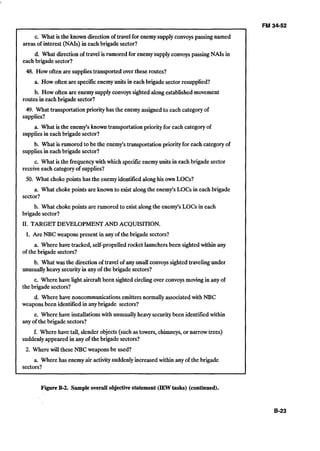
sources of information the interrogator needs. This information helps the interrogator develop a
Figure 3-4 shows a sample of DA Form 5976. There picture of the source and enables him to select ap-
should be at least one of these documents available on proaches most likelyto work.
each EPW and detainee. Additional sources of infor- There are four primary factors that must be con-
mation maybe- sideredwhen selectingtentative approaches:
Documents captured with the EPW or detainee. The source's mental and physical state. Is the
Reports from interrogation elements at previous source injured, angry, crying, arrogant, cocky, or
echelons. frightened? If so, how can this state be best ex-
ploited during interrogation.
0 0
A n x h pMof tag P EPW. (Do nol removr f -1EPW.)
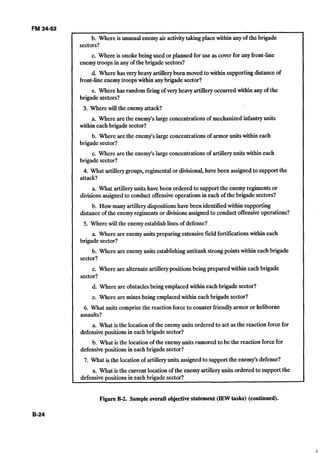
1. Search - For weapons. m~l~larydocur .ents. or
speaal equpment
3. Segregate - By tank. sex. and nat~onal~ty
4. Safeguard -To pevent harm ofescape.
5. S p e d - Evacua:a from the ccur~tatzone
DA FORM 59762JAN 91
,wire, or other duraole material to
appropriate section of this fonn to
EPW's equipment or property.
DA FORM5976, JAN 91
OOCUMEKTRPECIAL EOUIPYENTI
WlUPONS CARD (Part C)
A m tM1 put of trg to EPWs r o t a M proparty.
i D o n o t m n o m C F o m ~ . J
As a mlnimwn. the tag must inckde Lhe lollow~ng
- n ~ l . ~ r d ~ o l ~ e .
- //an8.crpbringvut.
- Hem 9, placeolcqHwe (grni coordinates).
- Hem lo. c i r u m m e s of capture (how the
EPW was W U I ~ ) .
0 0
,
Figure3-4. DA Form 5976 (EnemyPrisoner ofWar CaptureTag).
The source's background. What is the source's age
and level of militaryor civilian experience.
The objective of the interrogation. How much
time is availablefor the interrogation? Is the com-
mander interested only in specific areas (PIR, IR,
SIR)? Is this source knowledgeableenough to re-
quire a full OB interrogation?
The interrogator himself. What abilities does he
have that can be brought into play? What weak-
nesses does he have that may interfere with the in-
terrogation? Can his personality adapt to the
personality of the source?
The interrogation may require the interrogator con-
duct research to obtain detailed data on a specific
geographic area, political group, weapons system, or
technical field. In the technical field, TECHINT per-
sonnel assist the interrogator.
There are various weapons identification guides to as-
sist the interrogator in identifying any weapons men-
tioned by the source. However, the source should not
be shown this guide until he has thoroughly described
the items, or has drawn a picture of the weapons.
The interrogator may require maps, .documents,
recording and photographic equipment, screening
reports, and other aids to facilitate the interrogation.
From these aids, he must select those best suited to ac-
complish the objective, determine their availability, and
arrange for their procurement well in advanceof .the in-
terrogation. Someaids the interrogator may use are-
DA Form 5976.
Previous interrogation reports.
Documents found on an EPW or detainee or on
the battlefield.
Maps.
Imagery or aerial photographs.
i OB data.
Guards.
CA and PSYOP personnel.
Informants.
Physical aids (such as lights, tables, drafting tools).
The interrogator must consider in advance obstacles
and limitations which may affect the interrogation.
These obstacles and limitations may include-
EPW or detainee legal status.
Time and facilitiesavailable for interrogation.
The militarysituation.
Knowledgeability.
Language restrictions.
e Physical condition.
Psychologicalaspects.
Other issues which may appear during the course
of the interrogation.
Logistical requirements include-
Billets.
Office space.
Heat.
Light.
Messing and detention facilities.
Transportation which may be required in support
of the interrogation.
The various staff sections of the supported command
may be called upon to furnish the necessary logistical
items mentioned above. All support requests will be
coordinated with the appropriate staff officer by the
EPW or detainee camp or collectingpoint commander.
Interrogatorsshouldquestion guardsabout the sources,
time permitting, as part of preparation. Since the
guards are in constant contact with the sources, they
may be able to provide information on-
e Their physicalcondition.
Demonstrated attitude and behavior.
Contact made with other guards or sources.
How the source has been handled since capture.
Hearsay (HIS) information from others who have
handled the source.
Confirmation of capture data, especially the cir-
cumstancesunder which the source was captured.
Interrogation guides.
Time permitting, each interrogator should un- Combat effectiveness.
obtrusively observe the source to personally confirm his
identity and to check his personal appearance and be-
Logistics.
havior. Electronic technical data.
After the interrogator has collected all information Miscellaneous.
available about his assigned source, he analyzes it. He
As a result of the planning and preparation phase, the
looh for of P ~ Y ~ ~ ~ ~ ~ ~Or physical weak- interrogator develops a plan for conducting his assigned
ness that might make the source susceptible to one or
interrogation. He must review this plan with the senior
more which lacilitates his
interrogator, when possible. Whether written or oral,
strategy. He also uses the information he collected to
the interrogation plan must contain at least the follow-
identify the type and level of knowledge possessed by
ing items:
the source pertinent to the element's collection mission.
Interrogation objective.
The interrogator uses his estimate of the type and ex-
tent of knowledge possessed by the source to modify the EPW's or detainee's identity, to include visual ob-
basic topical sequence of questioning. He selects only servation of the EPW or detainee by the inter-
those topics in which he believes the source has per- rogator.
tinent knowledge. In this way, the interrogator refines
Interrogation time and place.
his element's overall objective into a set of specific in-
terrogation subjects. Primary and alternate approaches.
The major topics that can be covered in an interroga- Questioning techniques to be used or why the in-
tion are shown below in their normal sequence. How- terrogator selected only specific topics from the
ever, the interrogator is free to modify this sequence as basic questioning sequence.
necessary.
Missions.
Composition.
Weapons, equipment, strength.
Dispositions.
Tactics.
Training.
Means of recording and reporting information ob-
tained.
The senior interrogator reviews each plan and makes
any changes he feels necessary based on the
commander's PIR and IR. After the plan is approved,
the holding compound is notified when to bring the
source to the interrogation site. The interrogator col-
lects all available interrogation aids needed (maps,
charts, writing tools, and reference materials) and
proceeds to the interrogation site.
APPROACHPHASE
The approach phase begins with initial contact be- Begins to use an approach technique.
tween the-^^^ or detainee and interrogator. Extreme
care is required since the success of the interrogation
hinges, to a large degree, on the early development of
the EPW's or detainee's willingness to communicate.
The interrogator's objective during this phase is to es-
tablish EPW or detainee rapport, and to gain his willing
cooperation so he will correctly answer pertinent ques-
tions to follow. The interrogator-
The amount of time spent on this phase will mostly
depend on the probable quantity and value of informa-
tion the EPW or detainee possesses, the availability of
other EPW or detainee with knowledge on the same
topics, and available time. At the initial contact, a
businesslike relationship should be maintained. As the
EPW or detainee assumes a cooperative attitude, a
more relaxed atmosphere may be advantageous. The in-
Adopts an appropriate attitude based on EPW or terrogator must carefully determine which of the
detainee appraisal. various approach techniques to employ.
Prepares for an attitude change, if necessary. Regardless of the type of EPW or detainee and his
outward personality, he does possess weaknesses which,
if recognized by the interrogator, can be exploited.
These weaknesses are manifested in personality traits
such as speech, mannerisms, facial expressions, physical
movements, excessive perspiration, and other overt in-
dications that vary from EPW or detainee.
From a psychological standpoint, the interrogator
must be cognizant of the following behaviors. People
tend to-
e Talk, especially after harrowing experiences.
Show deference when confronted by superior
authority.
Rationalize acts about which they feel guilty.
Fail to apply or remember lessons they may have
been taught regarding security if confronted with a
disorganized or strange situation.
Cooperatewith those who have control over them.
Attach less importance to a topic about which the
interrogator demonstrates identical or related ex-
perience or knowledge.
Appreciate flattery and exoneration from guilt.
Resent having someone or something they respect
belittled, especially by someone they dislike.
Respond to kindness and understanding during
trying circumstances.
Cooperate readily when given material rewards
such as extra food or luxury items for their per-
sonal comfort.
Interrogators do not "run" an approach by following a
set pattern or routine. Each interrogation is different,
but all interrogation approaches have the following in
common. They-
Establish and maintain control over the source and
interrogation.
Establish and maintain rapport between the inter-
rogator and source.
Manipulate the source's emotions and weaknesses
to gain his willing cooperation.
The successful application of approach techniques
eventually induces the source to willingly provide ac-
curate intelligence information to the interrogator. The
term "willingly" refers to the source's answering the
interrogator's questions, not necessarily his coopera-
tion.
The source may or may not be aware he is providing
the interrogator with information about enemy forces.
Some approaches may be complete when the source
begins to answer questions. Others may have to be con-
stantly maintained or reinforced throughout the inter-
rogation.
The techniques used in an approach can best be
defined as a series of events, not just verbal conversa-
tion between the interrogator and the source. The ex-
ploitation of the source's emotion can be harsh or
gentle in application. Some useful techniques used by
interrogators are-
Hand and body movements.
Actual physical contact such as a hand on the
shoulder for reassurance.
Silence.
RAPPORT POSTURES
There are two types of rapport postures determined
during planning and preparation: stern and sym-
pathetic.
In the stem posture, the interrogator keeps the EPW
or detainee at attention. The aim is to make the EPW
or detainee keenly aware of his helpless and inferior
status. Interrogators use this posture with officers,
NCOs, and security-conscious enlisted men.
In the sympathetic posture, the interrogator addresses
the EPW or detainee in a friendly fashion, striving to
put him at ease. This posture is commonly used in in-
terrogating older or younger EPWs. EPWs may be
frightened and confused. One variation of this posture
is when the interrogator asks about the EPW's family.
Few EPWs will hesitate to discuss their family.
Frightened persons, regardless of rank, will invariably
talk in order to relieve tension once they hear a sym-
pathetic voice in their own tongue. To put the EPW at
ease, the interrogator may allow the EPW to sit down,
offer a cigarette, ask whether or not he needs medical
care, and otherwise show interest in his case.
There are many variations of these basic postures.
Regardless of the one used, the interrogator must
present a military appearance and show character and
energy. The interrogator must control his temper at all
times, except when a display is planned. The inter-
rogator must not waste time in pointless discussions or
make promises he cannot keep; for example, the
interrogator's granting political asylum.
When making promises in an effort to establish rap-
port, great care must be taken to prevent implying that
rights guaranteed the EPW under international and US
lawwill be withheld if the EPW refuses to cooperate.
Under no circumstances will the interrogator betray
surprise at anything the EPW might say. Many EPWs
will talk freely if they feel the information they are dis-
cussing is already known to the interrogator. If the in-
terrogator acts surprised, the EPW may stop talking
immediately.
The interrogator encourages any behavior that
deepens rapport and increases the flow of communica-
tion. At the same time, the interrogator must dis-
courage any behavior that has the opposite effect.
The interrogator must always be in control of the in-
terrogation. If the EPW or detainee challenges this
control, the interrogator must act quickly and firmly.
Everything the interrogator says and does must be
within the limits of the GPW, Article 17.
DEVELOPING RAPPORT
Rapport must be maintained throughout the inter-
rogatioh, not only in the approach phase. If the inter-
rogator has established good rapport initially and then
abandons the effort, the source would rightfully assume
the interrogator cares less and less about him as the in-
formation is being obtained. If this occurs, rapport is
lost and the source may cease answering questions.
Rapport may be developed by-
e Asking about the circumstances of capture. By
doing this, the interrogator can gain insight into
the prisoner's actual state of mind and, more im-
portantly, he can ascertain his possible breaking
points.
Asking background questions. After asking about
the source's circumstances of capture, apparent in-
terest can be built by asking about the source's
family,civilian life, friends, likes, and dislikes. This
is to develop rapport, but nonpertinent questions
may open new avenues for the approach and help
determine whether tentative approaches chosen in
the planning and preparation phase will be effec-
tive. If these questions show that the tentative ap-
proaches chosen will not be effective, a flexible
interrogator can shift the approach direction
without the source being aware of the change.
Depending on the situation, and requests the source
may have made, the interrogator also can use the fol-
lowing to develop rapport.
Offer realistic incentives, such as-
-Immediate comfort items (coffee, cigarettes).
--Short-term (a meal, shower, send a letter home).
-Long-term (repatriation, political asylum).
Feign experience similar to those of the source.
Show concern for'the source through the use of
voice vitality and body language.
Help the source to rationalize his guilt.
Show kindness and understanding toward the
source's predicament.
Exonerate the source from guilt.
Flatter the source.
After having established control and rapport, the in-
terrogator continually assesses the source to see if the
approaches-and later the questioning techniques-
chosen in the planning and preparation phase will in-
deed work.
Approaches chosen in planning and preparation are
tentative and based on the sometimes scanty informa-
tion available from documents, guards, and personal ob-
servation. This may lead the interrogator to select
approaches which may be totally incorrect for obtaining
this source's willing cooperation. Thus, careful assess-
ment of the source is critical to avoid wasting valuable
time in the approach phase.
The questions can be mixed or separate. If, for ex-
ample, the interrogator has tentatively chosen a "loveof
comrades"approach, he should ask the source questions
like "How did you get along with your fellow squad
members?" If the source answers they were all very
close and worked well as a team, the interrogator can
use this approach and be reasonably sure of its success.
However, if the source answers, "They all hated my
guts and I couldn't stand any of them," the interrogator
should abandon that approach and ask some quick, non-
pertinent questions to give himself time to work out a
new approach.
Smooth Transltions
The interrogator must guide the conversation
smoothly and logically, especially if he needs to move
from one approach technique to another. "Poking and
hoping" in the approach may alert the prisoner to ploys
and will make thejob more difficult.
Tie-ins to another approach can be made logically
and smoothly by using transitional phrases. Logical tie-
ins can be made by including simple sentences which
connect the previously used approach with the basis for
the next one.
Transitions can also be smoothly covered by leaving
the unsuccessful approach and going back to nonper-
tinent questions. By using nonpertinent conversation,
the interrogator can move the conversation in the
desired direction and, as previously stated, sometimes
can obtain leads and hints about the source's stresses or
weaknesses or other approach strategies that may be
more successful.
Sincere and Convincing
If an interrogator is using argument and reason to get
the source to cooperate, he must be convincing and ap-
pear sincere. All inferences of promises, situations, and
arguments, or other invented material must be believ-
able. What a source may or may not believe depends on
the interrogator's knowledge, experience, and training.
A good source assessment is the basis for the approach
and vital to the success of the interrogation effort.
Recognizethe Breaking Point
Every source has a breaking point, but an inter-
rogator never knows what it is until it has been reached.
There are, however, some good indicators the source is
near his breaking point or has already reached it. For
example, if during the approach, the source leans for-
ward with his facial expression indicating an interest in
the proposal or is more hesitant in his argument, he is
probably nearing the breaking point. The interrogator
must be alert to recognize these signs.
Once the interrogator determines the source is break-
ing, he should interject a question pertinent to the ob-
jective of the interrogation. If the source answers it, the
interrogator can move into the questioning phase. If
the source does not answer or balks at answering it, the
interrogator must realize the source was not as close to
the breaking point as thought. In this case, the inter-
rogator must continue with his approach, or switch to
an alternate approach or questioning technique and
continue to work until he feels the source is near break-
ing.
The interrogator can tell if the source has broken
only by interjecting pertinent questions. This process
must be followed until the EPW or detainee begins to
answer pertinent questions. It is possible the EPW or
detainee may cooperate for a while and then balk at
answering further questions. If this occurs, the inter-
rogator can reinforce the approaches that initially
gained the source's cooperation or move into a different
approach before returning to the questioning phase.
At this point, it is important to note the amount of
time spent with a particular source depends on several
factors:
The battlefield situation.
Expediency which the supported commander's PIR
and IRrequirements need to be answered.
Source's willingness to talk.
The number of approaches used is limited only by the
interrogator's skill. Almost any ruse or deception is
usable as long as the provisions of the GPW, as outlined
in Figure 1-4,are not violated.
An interrogator must not pass himself off as a medic,
chaplain, or as a member of the Red Cross (Red Cres-
cent or Red Lion). To every approach technique, there
are literally hundreds of possible variations, each of
which can be developed for a specific situation or
source. The variations are limited only by the
interrogator's personality, experience, ingenuity, and
imagination.
APPROACH COMBINATIONS
With the exception of the direct approach, no other
approach is effective by itself. Interrogators use dif-
ferent approach techniques or combine them into a
cohesive, logical technique. Smooth transitions, sin-
cerity, logic, and conviction almost always make a
strategy work. The lack of will undoubtedly dooms it to
failure. Someexamples of combinations are-
Direct-futility-love of comrades.
The number of combinations are unlimited. Inter-
rogators must carefully choose the approach strategy in
the planning and preparation phase and listen carefully
to what the source is saying (verbally or nonverbally) for
leads the strategy chosen will not work. When this oc-
curs, the interrogator must adapt to approaches he
believes will work in gaining the source's cooperation..
The approach techniques are not new nor are all the
possible or acceptable techniques discussed below.
Everything the interrogator says and does must be in
concert with the GWS, GPW, GC, and UCMJ. The ap-
proaches which have proven effective are-
Direct.
Incentive.
Emotional.
Increased fear-up.
Pride and ego.
Direct Approach
The interrogator asks questions directly related to in-
formation sought, making no effort to conceal the
interrogation's purpose. The direct approach, always
the first to be attempted, is used on EPWs or detainees
who the interrogator believes will cooperate.
This may occur when interrogating an EPW or
detainee who has proven cooperative during initial
screening or first interrogation. It may also be used on
those with little or no security training. The direct ap-
proach works best on lower enlisted personnel, as they
have little or no resistance training and have had mini-
mal security training.
The direct approach is simple to use, and it is possible
to obtain the maximum amount of information in the
minimum amount of time. It is frequently employed at
lower echelons when the tactical situation precludes
selecting other techniques, and where the EPW's or
detainee's mental state is one of confusion or extreme
shock. Figure C-3 contains sample questions used in
direct questioning.
The direct approach is the most effective. Statistics
show in World War 11, it was 90 percent effective. In
Vietnam and OPERATIONS URGENT WRY, JUST
CAUSE, and DESERT STORM, it was 95 percent ef-
fective.
Incentive Approach
The incentive approach is based on the application of
inferred discomfort upon an EPW or detainee who lacks
willpower. The EPW or detainee may display fondness
for certain luxury items such as candy, fruit, or cigaret-
tes. This fondness provides the interrogator with a posi-
tive means of rewarding the EPW or detainee for
cooperation and truthfulness, as he may give or with-
hold such comfort items at his discretion. Caution must
be used when employing this technique because-
Any pressure applied in this manner must not
amount to a denial of basic human needs under
any circumstances. [NOTE:Interrogators may not
withhold a source's rights under the GPW, but
they can withhold a source's privileges.] Granting
incentives must not infringe on these rights, but
they can be things to which the source is already
entitled. This can be effective only if the source is
unaware of his rights or privileges.
The EPW or detainee might be tempted to provide
false or inaccurate information to gain the desired
luxury item or to stop the interrogation.
The GPW, Article 41, requires the posting of the con-
vention contents in the EPW's own language. This is an
MP responsibility.
Incentives must seem to be logical and possible. An
interrogator must not promise anything that cannot be
delivered. Interrogators do not make promises, but
usually infer them while sidestepping guarantees.
For example, if an interrogator made a promise he
could not keep and he or another interrogator had to
talk with the source again, the source would not have
any trust and would probably not cooperate. Instead of
clearly promising a certain thing, such as political
asylum, an interrogator will offer to do what he can to
help achieve the source's desired goal; as long as the
source cooperates.
As with developing rapport, the incentive approach
can be broken down into two incentives. The deter-
mination rests on when the source expects to receive the
incentive offered.
Short term-received immediately; for example,
letter home, seeing wounded buddies.
Long term-received within a period of time; for
example, political asylum.
EmotionalApproach
Through EPW or detainee observation, the inter-
rogator can often identify dominant emotions which
motivate. The motivating emotion may be greed, love,
hate, revenge, or others. The interrogator employs ver-
bal and emotional ruses in applying pressure to the
EPW's or detainee's dominant emotions.
One major advantage of this technique is it is ver-
satile and allows the interrogator to use the same basic
situation positively and negatively.
For example, this technique can be used on the EPW
who has a great love for his unit and fellow soldiers.
The interrogator may take advantage of this by telling
the EPW that by providing pertinent information, he
may shorten the war or battle in progress and save many
of his comrades' lives, but his refusal to talk may cause
their deaths. This places the burden on the EPW or
detainee and may motivate him to seek relief through
cooperation.
Conversely, this technique can also be used on the
EPW or detainee who hates his unit because it withdrew
and left him to be captured, or who feels he was unfairly
treated in his unit. In such cases, the interrogator can
point out that if the EPW cooperates and specifies the
unit's location, the unit can be destroyed, thus giving
the EPW an opportunity for revenge. The interrogator
proceeds with this method in a very formal manner.
This approach is likely to be effective with the imma-
ture and timid EPW.
Emotional Love Amroach. For the emotional love
approach to be successful, the interrogator must focus
on the anxiety felt by the source about the circumstan-
ces in which he finds himself. The interrogator must
direct the love the source feels toward the appropriate
object: family, homeland, or comrades. If the inter-
rogator can show the source what the source himself can
do to alter or improve his situation, the approach has a
chance of success.
This approach usually involves some incentive such as
communication with the source's family or a quicker
end to the war to save his comrades' lives. A good inter-
rogator will usually orchestrate some futility with an
emotional love approach to hasten the source's reaching
the breaking point.
Sincerityand conviction are critical in a successful at-
tempt at an emotional love approach as the interrogator
must show genuine concern for the source, and for the
object at which the interrogator is directing the source's
emotion.
If the interrogator ascertains the source has great love
for his unit and fellow soldiers, the interrogator can ef-
fectively exploit the situation. This places a burden on
the source and may motivate him to seek relief through
cooperation with the interrogator.
Hate Approach. The emotional hate ap-
proach focuses on any genuine hate, or possibly a desire
for revenge, the source may feel. The interrogator must
ascertain exactly what it is the source may hate so the
emotion can be exploited to override the source's ra-
tional side. The source may have negative feelings
about his country's regime, immediate superiors, of-
ficers in general, or fellow soldiers.
This approach is usually most effective on members
of racial or religious minorities who have suffered dis-
crimination in military and civilian life. If a source feels
he has been treated unfairly in his unit, the interrogator
can point out that, if the source cooperates and divulges
the location of that unit, the unit can be destroyed, thus
affording the source revenge.
By using a conspiratorial tone of voice, the inter-
rogator can enhance the value of this technique.
Phrases, such as "You owe them no loyalty for the way
they treated you," when used appropriately, can expedite
the success of this technique.
Do not immediately begin to berate a certain facet of
the source's background or life until your assessment in-
dicates the source feels a negative emotion toward it.
The emotional hate approach can be used more effec-
tively by drawing out the source's negative emotions
with questions that elicit a thought-provoking response.
For example, "Why do you think they allowed you to be
captured?" or "Why do you think they left you to die?"
Do not berate the source's forces or homeland unless
certain negative emotions surface.
Many sources may have great love for their country,
but may hate the regime in control. The emotional hate
approach is most effective with the immature or timid
source who may have no opportunity up to this point
for revenge, or never had the courage to voice his feel-
ings.
Fear-Up Approach
The fear-up approach is the exploitation of a source's
preexisting fear during the period of capture and inter-
rogation. The approach works best with young, inex-
perienced sources, or sources who exhibit a greater than
normal amount of fear or nervousness. A source's fear
may be justified or unjustified. For example, a source
who has committed a war crime may justifiably fear
prosecution and punishment. By contrast, a sourcewho
has been indoctrinated by enemy propaganda may un-
justifiably fear that he will suffer torture or death in our
hands if captured.
This approach has the greatest potential to violate
the law of war. Great care must be taken to avoid
threatening or coercing a sourcewhich is in violation of
the GPW, Article 17.
It is critical the interrogator distinguish what the
source fears in order to exploit that fear. The way in
which the interrogator exploits the source's fear
depends on whether the source's fear is justified or un-
justified.
Fear-Up (Harsh). In this approach, the interrogator
behaves in an overpowering manner with a loud and
threatening voice. The interrogator may even feel the
need to throw objects across the room to heighten the
source's implanted feelings of fear. Great care must be
taken when doing this so any actions would not violate
the prohibition on coercion and threats contained in the
GPW, Article 17.
This technique is to convince the source he does in-
deed have something to fear; that he has no option but
to cooperate. A good interrogator will implant in the
source's mind that the interrogator himself is not the
object to be feared, but is a possible way out of the trap.
Use the confirmation of fear only on sources whose
fear is justified. During this approach, confirm to the
source that he does indeed have a legitimate fear. Then
convince the source that you are the source's best or
only hope in avoiding or mitigating the object of his
fear,such as punishment for his crimes.
You must take great care to avoid promising actions
that are not in your power to grant. For example, if the
source has committed a war crime, inform the source
that the crime has been reported to the appropriate
authorities and that action is pending. Next inform the
source that, if he cooperates and tells the truth, you will
report that he cooperated and told the truth to the ap-
propriate authorities. You may add that you will also
report his lack of cooperation. You may not promise
that the charges against him will be dismissed because
you have no authority to dismiss the charges.
Fear-Up (u.This approach is better suited to the
strong, confident type of interrogator; there is generally
no need to raise the voice or resort to heavy-handed,
table-banging.
For example, capture may be a result of coin-
ciden-the soldier was caught on the wrong side of
the border before hostilities actually commenced (he
was armed, he could be a terrorist)--or as a result of his
actions (he surrendered contrary to his military oath
and is now a traitor to his country, and his forces will
take careof the disciplinaryaction).
The fear-up (mild) approach must be credible. It
usuallyinvolvessome logicalincentive.
In most cases, a loud voice is not necessary. The ac-
tual fear is increased by helping the source realize the
unpleasant consequences the facts may cause and by
presenting an alternative, which, of course, can be
brought about by answeringsome simple questions.
The fear-up (harsh) approach is usually a dead end,
and a wise interrogator may want to keep it in reserve as
a trump card. After working to increase the source's
fear, it would be difficult to convincehim everythingwill
be all right if the approach is not successful.
Fear-Down Approach
This technique is nothing more than calming the
source and convincing him he will be properly and
humanely treated, or telling him the war for him is mer-
cifully over and he need not go into combat again.
When used with a soothing, calm tone of voice, this
often creates rapport and usually nothing else is needed
to get the source to cooperate.
While calmingthe source, it is a good idea to stay ini-
tially with nonpertinent conversation and to avoid the
subject which has caused the source's fear. This works
quickly in developing rapport and communication, as
the source will readilyrespond to kindness.
When using this approach, it is important the inter-
rogator relate to the source at his perspective level and
not expect the source to come up to the interrogator's
level.
If the EPW or detainee is so frightened he has
withdrawn into a shell or regressed to a less threatening
state of mind, the interrogator must break through to
him. The interrogator can do this by putting himself on
the same physical level as the source; this may require
some physical contact. As the source relaxes and begins
to respond to kindness, the interrogator can begin asking
pertinent questions.
This approach technique may backfire if allowed to
go too far. After convincingthe source he has nothing
to fear, he may cease to be afraid and may feel secure
to resist the interrogator's pertinent question.
If this occurs,reverting to a harsher approach technique
usuallywill bring the desired result quickly.
The fear-down approach works best if the source's
fear is unjustified. During this approach, take specific
actions to reduce the source's unjustified fear. For ex-
ample,if the source believes that he will be abusedwhile
in your custody, make extra efforts to ensure that the
sourceis well cared for, fed,and appropriately treated.
Once the source is convinced that he has no
legitimate reason to fear you, he will be more inclined
to cooperate. The interrogator is under no duty to
reduce a source's unjustified fear. The only prohibition
is that the interrogator may not say or do anything that
directly or indirectly communicates to the source that
he will be harmed unless he provides the requested in-
formation.
These applications of the fear approach may be com-
bined to achieve the desired effect. For example, if a
source has justified and unjustified fears, you may ini-
tially reduce the source's unfounded fears, then confirm
his legitimate fears. Again, the source should be con-
vinced the interrogator is his best or only hope in avoid-
ingor mitigating the object of his fear.
Pride and EgoApproach
The strategy of this approach is to trick the source
into revealingdesired information by goading or flatter-
ing him. It is effectivewith sources who have displayed
weakness or feelings of inferiority. A real or imaginary
deficiency voiced about the source, loyalty to his or-
ganization, or any other feature can provide a basis for
this technique.
The interrogator accuses the source of weakness or
implies he is unable to do a certain thing. This type of
source is also prone to excuses and reasons why he did
or did not do a certain thing, often shifting the blame to
others. An example is opening the interrogation with
the question, "Whydidyou surrender so easilywhen you
could have escaped by crossing the nearby ford in the
river?"
The source is likely to provide a basis for further
questions or to reveal significant intelligence informa-
tion if he attempts to explain his surrender in order to
vindicate himself. He may give an answer such as, "No
one could cross the ford because it is mined."
This technique can also be employed in another man-
ner--by flattering the source into admitting certain in-
formation in order to gain credit. For example, while
interrogating a suspected saboteur, the interrogator
states: "Thiswas a smooth operation. I have seen many
previous attempts fail. I bet you planned this. Who else
but a clever person like you would have planned it?
When did you first decide to do the job?"
This technique is especially effective with the source
who has been looked down upon by his superiors. The
source has the opportunity to show someone he is intel-
ligent.
A problem with the pride and ego approach is it relies
on trickery. The source will eventually realize he has
been tricked and may refuse to cooperate further. If this
occurs, the interrogator can easily move into a fear-up
approach and convince the source the questions he has
already answered have committed him, and it would be
useless to resist further.
The interrogator can mention it will be reported to
the source's forces that he has cooperated fully with the
enemy,will be considered a traitor, and has much to fear
if he is returned to his forces.
This may even offer the interrogator the option to go
into a love-of-family approach where the source must
protect his family by preventing his forces from learning
of his duplicityor collaboration. Telling the source you
will not report that he talked or that he was a severedis-
cipline problem is an incentive that may enhance the ef-
fectiveness of the approach.
Pride and EEO-UDA roach. This appioach is most
effective on sources with little or no intelligence, or on
those who have been looked down upon for a long time.
It is very effective on low-ranking enlisted personnel
and junior grade officers, as it allows the source to final-
ly showsomeone he does indeed have some "brains."
The source is constantly flattered into providing cer-
tain information in order to gain credit. The inter-
rogator must take care to use a flattering
somewhat-in-awetone of voice, and speak highly of the
source throughout this approach. This quicklyproduces
positive feelingson the source's part, as he has probably
been looking for this type of recognition all of his life.
The interrogator may blow things out of proportion
using items from the source's background and making
them seem noteworthy or important. As everyone is
eager to hear praise, the source will eventually reveal
pertinent information to solicit more laudatory com-
ments from the interrogator.
Effective targets for a successfulpride and ego-up ap-
proach are usually the sociallyaccepted reasons for flat-
tery, such as appearance and good militarybearing. The
interrogator should closelywatch the source's demeanor
for indications the approach is working. Some indica-
tions to look for are-
@ Raising of the head.
A look of pride in the eyes.
Swellingof the chest.
Stiffeningof the back.
Pride and EPO-Down Ap~roach. This approach is
based on attacking the source's sense of personal worth.
Any source who shows any real or imagined inferiority
or weakness about himself, loyalty to his organization,
or captured under embarrassing circumstances, can be
easily broken with this approach technique.
The objectiveis for the interrogator to pounce on the
source's sense of pride by attacking his loyalty, in'tel-
ligence, abilities, leadership qualities, slovenly ap-
pearance, or any other perceived weakness. This will
usually goad the source into becoming defensive, and he
will try to convince the interrogator he is wrong. In his
attempt to redeem his pride, the source will usually in-
voluntarily provide pertinent information in attempting
to vindicate himself.
A source susceptible to this approach is also prone to
make excuses and give reasons why he did or did not do
a certain thing, often shifting the blame to others. If the
interrogator uses a sarcastic, caustic tone of voice with
appropriate expressions of distaste or disgust, the
source will readily believe him. Possible targets for the
pride and ego-down approach are the source's-
@ Loyalty.
Technicalcompetence.
Leadership abilities.
Soldierlyqualities.
Appearance.
The pride and ego-down approach is also a dead end
in that, if unsuccessful, it is difficult for the interrogator
to recover and move to another approach and rees-
tablish a different type of rapport without losing all
credibility.
Futility
In this approach, the interrogator convinces the
source that resistance to questioning is futile. When
employing this technique, the interrogator must have
factual information. These facts are presented by the in-
terrogator in a persuasive, logical manner. He should
be aware of and able to exploit the source's psychologi-
cal and moral weaknesses, as well as weaknesses in-
herent in his society.
The futility approach is effective when the inter-
rogator can play on doubts that already exist in the
source's mind. There are different variations of the
futilityapproach. For example:
Futility of the personal situation-"You are not
finishedhere until you answer the questions."
Futility in that "everyonetalks sooner or later."
Futility of the battlefield situation.
Futility in the sense if the source does not mind
talking about history, why should he mind talking
about his missions, they are also history.
If the source's unit had run out of supplies (ammuni-
tion, food, or fuel), it would be somewhat easy to con-
vince him all of his forces are having the same logistical
problems. A soldier who has been ambushed may have
doubts as to how he was attacked so suddenly. The in-
terrogator should be able to talk him into believing that
the interrogator's forces knew of the EPW's unit loca-
tion, as well as many more units.
The interrogator might describe the source's frighten-
ing recollections of seeing death on the battlefield as an
everydayoccurrence for his forces. Factual or seemingly
factual information must be presented in a persuasive,
logical manner, and in a matter-of-fact tone of voice.
Making the situation appear hopeless allows the
source to rationalize his actions, especially if that action
is cooperating with the interrogator. When employing
this technique, the interrogator must not only have fac-
tual information but also be aware of and exploit the
source's psychological, moral, and sociological weak-
nesses.
Another way of using the futility approach is to blow
things out of proportion. If the source's unit was low
on, or had exhausted, all food supplies, he can be easily
led to believe all of his forces had run out of food. If the
source is hinging on cooperating, it may aid the inter-
rogation effort if he is told all the other source's have
cooperated.
The futility approach must be orchestrated with other
approach techniques (for example, love of comrades).
A source who may want to help save his comrades' lives
may be convinced the battlefield situation is hopeless
and they will die without his assistance.
The futility approach is used to paint a bleak picture
for the prisoner, but it is not effective in and of itself in
gaining the source's cooperation.
We Know All
This approach may be employed in conjunction with
the "file and dossier" technique (discussed below) or by
itself. If used alone, the interrogator must first become
thoroughly familiar with available data concerning the
source. To begin the interrogation, the interrogator
asks questions based on this known data. When the
source hesitates, refuses to answer, or provides an incor-
rect or incomplete reply, the interrogator provides the
detailed answer.
When the source begins to give accurate and com-
plete information, the interrogator interjects questions
designed to gain the needed information. Questions to
which answers are already known are also asked to test
the source's truthfulness and to maintain the deception
that the information is already known. By repeating this
procedure, the interrogator convinces the source that
resistance is useless as everything is already known.
After gaining the source's cooperation, the inter-
rogator still tests the extent of cooperation by peri-
odically using questions to which he has the answers;
this is very necessary. If the interrogator does not chal-
lenge the source when he is lying, the source will know
everything is not known, and he has been tricked. He
may then provide incorrect answers to the interrogator's
questions.
There are some inherent problems with the use of the
"weknow all" approach. The interrogator is required to
prepare everything in detail, which is time consuming.
He must commit much of the information to memory,
as working from notes may show the limits of the infor-
mation actually known.
File and Dossier
The file and dossier approach is used when the inter-
rogator prepares a dossier containing all available infor-
mation obtained from documents concerning the source
or his organization. Careful arrangement of the
material within the file may give the illusion it contains
more data than actually there. The file may be padded
with extra paper, if necessary. Index tabs with titles such
as education, employment, criminal record, military ser-
vice, and others are particularly effective.
The interrogator confronts the source with the dos-
siers at the beginning of the interrogation and explains
intelligence has provided a complete record of every sig-
nificant happening in the source's life; therefore, it
would be useless to resist. The interrogator may read a
few selected bits of known data to further impress the
source.
If the technique is successful, the source will be in-
timidated by the size of the file, conclude everything is
known, and resign himself to complete cooperation.
The success of this technique is largely dependent on
the naivete of the source, volume of data on the subject,
and skill of the interrogator in convincing the source.
EstablishYour Identity
This approach is especially adaptable to interroga-
tion. The interrogator insists the source has been cor-
rectly identified as an infamous individual wanted by
higher authorities on serious charges, and he is not the
person he purports to be. In an effort to clear himself of
this allegation, the source makes a genuine and detailed
effort to establish or substantiate his true identity. In so
doing, he may provide the interrogator with information
and leads for further development.
The "establish your identity"approach was effective in
Viet Nam with the Viet Cong and in OPERATIONS
JUST CAUSE and DESERT STORM.
This approach can be used at tactical echelons. The
interrogator must be aware if it is used in conjunction
with the file and dossier approach, as it may exceed the
tactical interrogator's preparation resources.
The interrogator should initially refuse to believe the
source and insist he is the criminal wanted by the am-
biguous higher authorities. This will force the source to
give even more detailed information about his unit in
order to convince the interrogator he is who he says he
is. This approach works well when combined with the
"futility"or "weknow all" approach.
Repetition Besides extensive preparation, this approach requires
n i s approach is used to induce cooperation from a an experienced and competent interrogator, with com-
hostile source. In one variation of this approach, the in- prehensive case howledge and in the
terrogator listens carefully to a source's answer to a language.
question, and then repeats the question and answer Silent
several times. He does this with each succeeding ques-
This approach may be successful when used against
tion until the source becomes so thoroughly bored with
the nervous or confident source. When employing this
the procedure he answers questions fully and candidly to
technique, the interrogator says nothing to the source,
satisfy the interrogator and gain relief from the
but looks him squarely in the eye, preferably with a
monotony of this method.
slight smile on his face. It is important not to look away
The repetition technique must be judiciously used, as from the source but force him to break eye contact first.
it will generally be ineffective when employed against
The source may become nervous, begin to shift in his
introverted sources or those having great self-control.
chair, cross and recross his legs, and look away. He may
In fact, it may provide an opportunity for a source to
ask questions, but the interrogator should not answer
regain his composure and delay the interrogation. In
until he is ready to break the silence. The source may
this approach, the use of more than one interrogator or
blurt out questions such as, "Come on now, what do you
a tape recorder has proven effective.
want with me?"
Rapid Fire
When the interrogator is ready to break silence, he
This approach involves a ~s~chologicalploy based may do so with some nonchalant questions such as,
upon the principles that- "You planned this operation for a long time, didn't you?
Everyone likes to be heard when he speaks. Was it your idea?" The interrogator must be patient
when using this technique. It may appear the technique
It is confusing to be interrupted in mid-sentence is not succeeding, but usually will when given a
with an unrelated question. reasonable chance.
This approach may be used by one or simultaneously Change of Scene
by two or more interrogators in questioning the same The idea in using this approach is to get the source
source. In employing this technique, the interrogator
away from the atmosphere of an interrogation room or
asks a series Of questions in such a manner that the setting. If the interrogator confronts a source who is ap-
source does not have time to answer a question com-
prehensive or frightened because of the interrogation
pletely before the next one is asked. environment, this technique may prove effective.
This confuses the source and he will tend to con- In some circumstances, the interrogator may be able
tradict himself, as he has little time to formulate his to invite the to a different setting for and
answers. The interrogator then confronts the source
pleasant conversation. During the conversation in this
with the inconsistencies causing further contradictions. more relaxed environment, the interrogator steers the-
In many instances, the source will begin to talk freely conversation to the topic of interest. Through this
in an attempt to explain himself and deny the somewhat indirect method, he attempts to elicit the
interrogator's claims of inconsistencies. In this attempt, desired information. The source may never realize he is
the source is likely to reveal more than he intends, thus being interrogated.
creating additional leads for further exploitation. This Another example in this approach is an interrogator
approach may be orchestrated with the pride and ego-
poses as a compound guard and engages the source in
down or fear-up approaches.
conversation, thus eliciting the desired information.
QUESTIONINGPHASE
The interrogation effort has two primary goals: To rogator to obtain accurate and pertinent information by
obtain information and to report it. Developing and followinga logical sequence.
using good questioning techniques enable the inter-
The questioning phase starts when the source begins
to answer questions pertinent to interrogation objec-
tives.
QUESTIONINGTECHNIQUES
Good questioning techniques must be used
throughout the interrogation. The interrogator must
know when to use different types of questions. Good
questioning techniques enable the interrogator to ex-
tract the maximum amount of information in the mini-
mum amount of time. The interrogator must be able to
use the followingtypes of questions:
Direct.
Nonpertinent.
Repeated.
Control.
Prepared.
Direct Questions
Questions should be presented in a logical sequence
to avoid neglecting significant topics. A series of ques-
tions following a chronological sequence of events is
frequently employed, but this is not the only logical
method of asking questions. Adherence to a sequence
should not deter the interrogator from exploiting infor-
mational leadsas they are obtained.
The interrogator must consider the probable
response of the source to a particular question or line of
questioning and should not, if at all possible, ask direct
questions likely to evoke a refusal to answer or to an-
tagonizethe source.
Experience has shown that in most tactical interroga-
tions, the source is cooperative. In such instances, the
interrogator should proceed with direct questions.
Good, direct questions-
(CLASSIFICATION)
SPOTREPORT
TO: G2, X Corps DATE: 171105FEB99
FROM: Team 2, IPW Section,213th MI Bn REPORT NO: 02-314
25th Div (Armd),X Corps
1. SIZETWHO: Squad.
2. ACTIVITY/WHAT: Reconnaissance.
3. LOCATIONIWI~ERE:NB 576472 (Huy intersection).
4. UNITTWHO: 1MRSP MRCD MRBl44MRRl56 MRD.
5. TIMETWHEN: No later than 171800FEB99.
6. EQUIPMENT/HOW: Using assignedweapons and equipment, recon forward areas to determine avenues
of approach for elements of 2 MRB.
7. REMARKS:
a. SOURCE: EPW, Interrogation serial number US-AR-23.035-73.
b. MAP DATA: GERMANY, EISENACH-HUNFELD, 1:50,000,USACGSC50-242, Edition 5.
c. HIS, CPTANRUF, CO, 3 MRCD MRBl44MRRl56MRD, DOI: 170100FEB99.
(CLASSIFICATION)
.
Figure 3-5. Sample spot report (SALUTE).
3-21 .
Begin with a basic interrogative: Who, What,
When, Where, Why, and How.
Require a narrative answer. One which cannot be
answered by a simple Yes or No. This type of
question requires the source to think about his
answer in order to respond correctly.
Provide a maximum amount of information in the
least amount of time, and the greatest number of
leads to other information.
Are brief, precise, and simply worded to avoid con-
fusion.
(NOTE: The source may not be on the same intellec-
tual level as the interrogator and some may be illiterate.
Some words or phases in English do not translate into a
foreign language.)
Follow-UpQuestlons
Follow-up questions are used to obtain complete in-
formation on a topic that pertains to the interrogation
objective. They are used to exploit leads obtained from
the source on information not directly related to the
primary interrogation objective. Exploitation of these
leads is discussed later. There are two types of leads:
Hot-information that could affect the immediate
tactical situation in your AO. This type of lead
should be exploited immediately, and a spot report
submitted as soon as possible. Figure 3-5 is a
sample of a spot report in a SALUTEformat.
Cold-information of intelligence value that will
not affect the immediate tactical situation. This
type of lead is recorded and exploited after the in-
terrogation objective has been satisfied or at the
appropriate time during the interrogation se-
quence.
Nonpertinent Questlons
Nonpertinent questions are used to conceal the
interrogation's objectives or to strengthen rapport with
the source. They may also be used to break the source's
concentration, particularly, if the interrogator suspects
the source is lying. It is hard for a source to be a con-
vincing liar if his concentration is frequently inter-
rupted.
RepeatedQuestions
Repeated questions ask the source for the same infor-
mation obtained in response to earlier questions. They
may be exact repetitions of the previous question, or the
previous question may be rephrased or otherwise dis-
guised. The use of repeated questions may develop a
topic the source had refused to talk about earlier.
Repeated questions may also be used to-
Check source reliability.
Ensure accuracy of important details such as place
names, dates, and component parts of technical
equipment.
Return to a topical area for further questioning.
Control Questions
Control questions are developed from recently con-
firmed information that is not likely to have changed.
They are used to check the truthfulness of the source's
responses and should be mixed in with other questions
throughout the interrogation.
Prepared Questions
Prepared questions are used primarily when dealing
with information of a technical nature, or specific topic,
which requires the interrogator to formulate questions
beforehand;-the interrogator prepares them in writing
to be used during the interrogation. The interrogator
may have to research technical material or contact
TECHINT personnel to assist him in preparing ques-
tions. Interrogators must not allow the use of prepared
questions to restrict the scope and flexibilityof their in-
terrogations.
The interrogator must use the different type of ques-
tions effectively. Active listening and maximum eye-to-
eye contact with the source will provide excellent
indicators for when to use follow-up, repeated, control,
and nonpertinent questions.
The interrogator must use direct and follow-up ques-
tions to fully exploit subjects pertinent to his interroga-
tion objectives. He should periodically include control,
repeated, and nonpertinent questions in order to check
the sincerity and consistency of the source's responses
and to strengthen rapport.
A response which is inconsistent with earlier respon-
ses or the interrogator's available data is not necessarily
a lie. When such a response is obtained, the inter-
rogator should reveal the inconsistency to the source
and ask for an explanation. The source's truthfulness
should then be evaluated based on the plausibility of his
explanation.
QUESTIONSTO AVOID INTERROGATORS GUIDE
Interrogators should avoid the following types of
questions.
Leading Questions
Leading questions require the source to answer Yes
or No. They do not elicit narrative answers. They also
prompt the source to answer the question in a way he
thinks the interrogator wants to hear it; for example,
"Didyou go to the command post last night?" Although
normally avoided during the interrogation, leading
questions may be used to-
Verify facts.
Pinpoint map locations.
Confirm information obtained during map track-
ing. Leading questions are used sparingly during
map tracking.
Negative Questions
Negative questions should never be used during an in-
terrogation. They imply the source should reply in the
negative, and this sometimes confuses or leads the
source to provide false information; for example,
"You're not in the 1st Company, are you?" Negative
questions usually require additional questions to clarify
the source's responses.
CompoundQuestions
Compound questions are never used during an inter-
rogation. They are two questions asked at the same
time; for example, "Before you were captured today,
were you traveling north or south?" They are easily
misunderstood and may confuse the source or force him
to give an ambiguous answer. Compound questions
allow the source to evade a part of the question or to
give an incomplete answer. They may confuse the
source or cause the interrogator to misunderstand the
response.
An Interrogators Guide is a pamphlet or notebook
designed to guide the interrogator through the inter-
rogation. The IPW senior interrogator should ensure
team members prepare an interrogators guide, which
could be included in the unit's SOP. The guides are
made based on the A 0 and supported command intel-
ligence requirements. They should be jointly prepared
by the interrogator and available intelligence analysts.
The guides contain information such as-
PIR and IR.
Topical sequence question format.
Actual prepared questions to be used during the
interrogation.
Guidelines for employing the various approach
techniques.
Formats or samples of completed interrogation
reports used by interrogators.
SPOT REPORTABLE INFORMATION
Spot reportable information is critical to the success-
ful accomplishment of friendly COAs. Information may
be spot reportable even when an interrogator cannot
determine its immediate intelligence value. Spot
reportable information is always time sensitive in that
its value depends on the speed with which it is reported
and processed.
If an interrogator obtains information he thinks is
spot reportable, he must compare the information with
his element's overall objective statement. Items of in-
formation relating to any of the intelligence indicators
listed in the objective statement are spot reportable. In-
formation relating to indicators not listed may still be
spot reportable.
The key to identifying spot reportable information is
recognizing its potential value. If the information indi-
Vague Questions cates a significant change in the enemy's capabilities or
intentions, it is spot reportable. Information inconsis-
Vague questions do not have enough for
tent with current OB holdings should be spot reported
the source to understand exactly what is being asked by
if the inconsistency concerns an important item and the
the interrogator. They may be incom~lete,general, 0'
source has given a plausible explanation forit.
otherwise nonspecific and create doubt in the source's
mind. Vague Gestions confuse the source, waste time, If an interrogator cannot decide if a piece of informa-
are easily evaded, and result in answers that may confuse tion is spot reportable, he should act as though it is.
or mislead the interrogator. This means he should exploit it fully and record all per-
tinent information. The interrogator should then con-
sult the senior interrogator for a final determination of
the information's value. Spot reportable information is source's pertinent knowledge in this topical area before
transmitted by the interrogator either written or orally moving on to the next topic in his sequence. He main-
in the SALUTE format (Figure 3-5). tains his established questioning sequence to ensure no
LEADS
topics are missed. The only exception is exploiting a hot
lead.- - - -.
Leads are signs which tell the interrogator the source
has additional pertinent information that can be ob- MapTracking
tained through further questioning. Hot and cold leads During the questioning phase, the interrogator will
are provided by a source in response to interrogator attempt to pinpoint locations of any enemy dispositions
questions. known to the source. He will attempt to determine the
whereabouts of the source, and 1 1 compare the
A hot lead, when exploited, may obtain spot report-
source's description of terrain features with maps, aerial
able information. A cold lead, when exploited, may ob- photographs, and pictomaps. Some map tracking ad-
tain information not spot reportable, but still of
vantages a r e
intelligence value.
The source is led through his memory in a logical
The use of follow-up questions to fully exploit hot
manner.
and cold leads may require an interrogator to cover
topics he did not list in his interrogation plan. An inter- @ A valid reliability scale can be determined by com-
rogator must exploit hot leads as soon as he identifies paring the source's information with a map or
them. aerial photographs.
Once the interrogator is sure he has obtained and Discrepancies in the source's statements are easier
recorded all the details known to the source, he issues a to detect.
spot report. The interrogator then resumes his ques- The interrogator asks the source if he can read the
tioning of the source at the same point where the hot map being used. If so, he should be asked to show the
lead was obtained. An interrogator should note cold
location ofroutes and dispositions. If the source cannot
leads as they are obtained, and them during read the interrogator,s map, he must be asked if he
his questioning On the which the lead knows compass directions. If not, the interrogator must
apply. explain them to him. This can be done by having the
Cold leads may expand the scope of the interrogation source picture himself facing the rising or setting sun
because they may indicate the source possesses per- and then establishing compass points.- -
tinent information in areas not selected for
The interrogator may find the source is most confi-
questioning. If the interrogator does not fullyexploit all dent when expressing himself in terms other than
cold leads he obtains, he must include information on pass directions. When this happens, the interrogator
all leads he did not exploit in his interrogation report. should allow the source to use his own frames of refer-
HEARSAY INFORMATION
HIS information must include the most precise data
possible of its source. This will include--
@ Name, rank, and duty position.
Full unit designation of the person who provided
the information.
Date-time group (DTG) when the source obtained
the information.
ence. However, the interrogator must ensure he under-
stands the source.
The first location the interrogator should try to estab-
lish as the initial common point of reference (ICPR) is
the source's POC. The POC cannot be used, however,
unless the source can describe it well enough for the in-
terrogator to be certain of its location. If the POC can-
not be used, the interrogator must review locations
previously mentioned by the source and ask him to
describe each of them in turn.
QUESTIONING SEQUENCE
Once the source describes a location well enough for
The begins the questioning phase with the interrogator to be certain of its position on the map,
the first topic in the sequence he tentatively established ICPR has been established. meinterrogator then
as part of his interrogation plan. He obtains all the marks that position.
The interrogator reviews the source's past missions to
identify those points he actually visited. The inter-
rogator determines'how long ago the sourcewas at each
point, and approximately how far each point is from the
ICPR.
The interrogator wants to select as the destination
common point of reference (DCPR) that point visited
by the source which provides the longest route of travel
to the ICPR, and is still within the supported
command's AI. The DCPR selected must be a location
the source can describe well enough for it to be plotted
on the map, even if it is nothing more than a general
vicinity.
Establisha Route
The interrogator establishes the route the source
traveled between the DCPR and ICPR. When the
DCPR is a specificpoint, the interrogator can establish
the route from it to the ICPR, tracing the route in the
samedirection which the source actuallytraveled.
When the DCPR is an undefined point, the inter-
rogator establishes the route from ICPR to the DCPR.
This means the interrogator must trace the route in the
opposite direction from -that traveled by the source.
The interrogator should establish the route traveled by
using the following procedures in the sequence shown:
Obtain the direction in which the source would
travel when leaving the ICPR.
Obtain a description of the surface on which the
sourcewould be traveling.
Obtain the distance the sourcewould travel in this
direction.
Obtain a description of the prominent terrain fea-
tures the source would remember while traveling
in this direction.
Repeat the questions and plot responses until the
entire route between the ICPR and DCPR has
been plotted.
The interrogator can follow the same sequence when
establishing the route actually traveled by the source by
beginningwith the DCPR.
Exploitthe DCPR
The interrogator must obtain the exact location and
description of each enemy disposition the source knew
about at the DCPR. The interrogator does this by
having the source-
Identify and describe all items of military sig-
nificance belonging to his forceswhich are located
at the DCPR.
Provide the full unit designation of enemy units to
which these items belong.
Identify and describe all collocated enemy units.
Describe security measures employed at each iden-
tified disposition.
Identify the source of his information.
Provide the date and time he obtained his informa-
tion.
Provide name, rank, duty position, and full unit
designation of each person who provided HIS in-
formation to the source.
The interrogator must repeat these questions, and
plot or record the information as it is provided by the
source, until he obtains all dispositions known by the
source to be in the vicinity of the DCPR.
Segment and Exploit the Route
The interrogator begins exploiting the source's route
with the segment closest to the ICPR or DCPR. The in-
terrogator will segment closest to the DCPR, but either
can be used.
The interrogator will exploit each segment of the
route by asking the question: "From (description of
common point of reference [(CPR)] to (description of
next CPR) back along your route of travel, what of
military significance belonging to your forces do you
know of, have seen, or heard?" B e interrogator will
continue from segment to segment, fully exploiting
each, until he has exploited the entire route traveled.
Exploit DispositionsNot On Route
If the interrogator obtains a disposition which is not
located on the established route, he must establish the
route the source would have taken to that disposition.
The interrogator then treats this new route the same
way he does any other route segment, exploiting it fully
before moving on to the next segment of the original
route.
The sequence above organizes map tracking so infor-
mation obtained from the source can be plotted and
recorded accurately. The description of each disposition
must be recorded preferably near the site of the disposi-
tion on the map.
Recording Information
There are several reasons for recording information
obtained during interrogations. The most important -is
to ensure information can be reported completely and
accurately. Recorded information may also be used
to-
e Refresh the interrogator's memory on a topic
covered earlier, such as when returning to a topic
after exploiting a hot lead.
Check responses to repeated questions.
Point out inconsistencies to the source.
Gain the cooperation of other sources.
Compare with information received from other
sources.
Taking Notes
There are several methods of recording information
used during interrogations. l b o are listed below, along
with their advantages and disadvantages. These
methods may be used separately, or in combination with
each other.
The interrogator will not have enough time to record
eachword the source says. Thus, he must-
Be able to summarize information into a few
words.
Use past experiences to decide which items of in-
formation should be recorded.
Organize his materials to avoid having to flip back
and forth between references.
The only information that should be recorded during
the approach phase is that required by Part I of
DA Form 4237-R (Figure 3-1). All other information
should not be recorded until after the source's coopera-
tion has been obtained.
All notes must be complete, accurate, and legible.
Notes should be organized by topical areas. A separate
piece of paper should be used to record cold leads. The
interrogator should use authorized military abbrevia-
tions and brevity codes (see AR 310-50). Notes should
be in a recognizable format and complete for other in-
terrogators to use. Situations may arise that require one
interrogator to finish another's interrogation.
Usin? His Own Notes. The interrogator's own notes Usin9 a Sound or Video Recorder. This method al-
are the primary method of recording information. lows the interrogator to continually observe the source.
When the interrogator takes his own notes, he has a When compared with note taking, this method allows
ready reference to verify responses to repeated ques- more information to be obtained in less time. However,
tions or to refresh his memory. They also provide him more time is required for report writing because the en-
with the means to record cold leads for later exploits- tire tape must be replayed to transfer information to the
tion. report.
Using his own notes expedites the interrogator's ac-
curate transferral of information into a report format.
When taking his own notes, however, he cannot observe
the source continuously. This may cause him to miss
leads or fail to detect losses in rapport or control that
are detectable only through clues provided by the
source's behavior.
It is possible to lose control, and the source's willing
cooperation, by concentrating too much on note taking.
The interrogator must avoid distracting the sourcewhile
taking notes. They should be taken in such a way that
maintains maximum eye-to-eye contactwith the source.
Record names, numbers, and other pertinent,
detailed information that may be unclear on the tape.
Sound recorders cannot provide a quick reference that
can be used to compare answers to a repeated question,
and the equipment may malfunction.
Another method which has proven successful during
exercises is to have linguist qualified intelligence
analysts view interrogations or debriefings by using
video cameras and monitors. This method allows the
intelligence analyst to immediately pass additional ques-
tions to the interrogator to follow up on possible source
knowledge.
TERMINATIONPHASE
When it is necessary or prudent, the interrogator will The approaches used to "break" the source must be
terminate the interrogation. There are many ways to reinforced. Any promised incentives should be
conduct a termination, but the following points must be rendered. The reinforcement must be sincere and
conveyed to the source:
FM 34-52
....
;iiiiii.;;;!i? n.......... - , 6 5 K BROWN"'
1 

I Z HElGnT COLOR OF HAIR
N o
1 1.70 m BLACK
x
2 BLOOD TYPE RELIGIONY,
0
9 B POS NONE
- m
0 . n NOTICE
m 0 '
2 9 a
2 CI Thk cud ia L u e d to prironcrr or
-n I-(4 m w u in the cutody of the Unikdn
> S t r t u Army. T h t c u d must be
i curitd at dl timu by the EPW
0
z x to whom it k k u e d .
Rm- of DA Form 2662.R. M a y 8 2
REVERSE
Figure3-6. DA Form 2662-R (United StatesArmy EPW IdentificationCard).
convincing, as the source may be interrogated The interrogator's presence is required elsewhere.
again.
TERMINATION PROCEDURES
The source must be told the information he gave Whatever the reason for terminating, the interrogator
be checked for and accuracy. His must remember there is a possibility someone may want
reaction to this be to question the source at a later date. For that reason,
monitored. he should terminate without any loss of rapport when
The source must be told he will be spoken to again possible. He offers the opportunity for the source to
by the same or another interrogator. change or add to any information he has given.
Any identification or other documents, personal During termination, the interrogator must properly
property, or other material must be returned to the dispose of any documents captured with the Source. A
source or be given to the evacuation guard, as ap- source's military identity document must be returned to
propriate. him.
REASONS FOR TERMINATION
Some reasons for termination are-
If a source does not hold an identity card issued by his
government, the MP will issue a DA Form 2662-R
(United States Army EPW Identification Card). This
The source remains uncooperative during the ap- form, shown at Figure 3-6,will accompanythe source at
proach phase. all times. AR 190-8is the prescribing directive of this
The source could be wounded, sick, or elderly, and
form.
his condition might force the interrogator to ter- Some captured documents will contain information
minate until a later time. that must be exploited at higher echelons. These docu-
ments may be- impounded by the interrogator and
The interrogation objective requires several ques-
evacuated through intelligence channels. The inter-
tioning periods to obtain all the information.
rogator must issue a receipt to the source for any per-
The source may change his attitude during the in- sonal documents he decides to impound. He must
terrogation, and may become more alert, bel- comply with the accounting procedures established for
ligerent, bored, or too talkative, thus indicating captured documents by the MP in accordance with AR
termination until later. 190-8.
The interrogator fails to maintain rapport and These procedures are time-consuming but necessary.
loses control of the interrogation. The interrogator can save time by preparing receipts
and document tags during the planning and preparation
Interrogation objectives have been satisfied.
phase.
The interrogator becomes physically or mentally
The interrogator completes the termination phase by
unable to continue.
instructing the escort guard to return the source to the
Information possessed by the source is of such holding compound and to keep him away from sources
value his immediate evacuation to the next echelon who have not been interrogated.
is required.
REPORTINGINFORMATION
The last portion of the interrogation process is Although the interrogator normally takes notes
reporting information obtained. The most brilliantly during the interrogation, he will have to rely on his
executed interrogation becomes a wasted effort if not memory, to some degree, while reporting information
reported properly. To aid military operations, informa- received from the source. The more distractions that
tion obtained must be transmitted as quickly as the occur between the interrogation and the reporting, the
situation permits in a usable form to an agency capable greater the chance the interrogator will lose some of the
of taking action. information obtained. The reporting normally is done
in the format appropriate for the information being
reported.
Appendix E contains formats of reports. Initial Each item of information not obtained as a direct
reports are submitted electronically when possible to result of the source's personal experiences must be
ensure the information reaches the intelligence analysts accompanied by a description of how he obtained
in the least amount of time. that information.
Written reports are prepared to document electronic All dispositions, towns, and other specific
reports. They are used as initial means of reporting only geographic locations must be accompanied by a
when electronic reporting is impossible. Any informa- correct, complete set of at least 6-digit universal
tion of intelligence value that will diminishwith the pas- transverse mercator (UTM) coordinates, to in-
sage of time must be SALUTE reported. clude the correct 100,000-meter grid zone iden-
Electronic SALUTE reports are formatted and sub-
mitted according to the procedures established during
tifier. The UTM coordinates are in STP
34-97E24-SM-TG.
the senior interrogator's initial coordination. ~nforma: 0 The information is reported exactly as it was ob-
tion not SALUTE reportable is electronically reported tained from the source. No information is deleted
with a lower priority. or added without explanatory comments.
The aim of any interrogation is to obtain information The report contains no errors in spelling,punctua-
which will help satisfy a commander's intelligence re- tion, or grammar that affect the meaning of the in-
quirements. Since these requirements will differ in formation reported.
scope at each level, when conducting PIR or IR inter-
Each report must include the interrogator's assess-
rogations, nonapplicable paragraphs may be deleted.
Part I must always be included and distribution made
ment of the source's value. This assessment addresses
accordingto STANAG2033.
the source's intelligence, experience, cooperation, and
reliability. Any areas of special knowledge possessed by- -
Regardless of the report format used, information the sour& shobld be identified.
must be reported accurately according to the following
criteria:
The assessment codes are established by STANAG
2033. The codes assigned,and a written statement sup-
Each item of information reported which has a dif- porting these assignments, must be included on each
ferent date of information from the overall report report.
must be accompanied by its correct date.
INTERROGATIONWITH AN INTERPRETER
Interrogating through an interpreter is time consum- With the alternate method, the interpreter listens to
ing because the interpreter must repeat everything said an entire phrase, sentence, or paragraph. He then
by the interrogator and source. The interrogator must translates during natural pauses in the interrogation.
brief the interpreter before the interrogation-can begin.
- -
An interrogation with an interpreter will go through all
The simultaneous method should be selected only if
all the following criteria are met:
five phases of the interrogation process. After the in-
terrogation is over, the interrogator will evaluate the in- The sentence structure of the target language is
terpreter. parallel to English.
INTERPRETATIONMETHODS The interpreter can understand and speak English
During the planning and preparation phase, the inter- aswell as the target languagewith ease.
rogator selects a method of interpretation. There are The interpreter has specialvocabulary skills for the
two methods: Simultaneous and alternate. The inter- topics to be covered.
rogator obtains information about his interpreter from
the senior interrogator. He analyzes this information The interpreter can easily imitate the
and talks to the interpreter before deciding which interrogator's tone of voice and attitude for the ap-
method to use. proaches selected.
Neither interrogator nor interpreter tends to get
confused when using the simultaneous method of
interpretation.
With the simultaneous method, the interpreter listens
and translates at the same time as the person for whom
he is interpreting, usually just a phrase or a few words
behind.
If any of the criteria in the simultaneous method can-
not be met, the interrogator must use the alternate
method. The alternate method should also be used
when a high degree of precision is required.
INTERPRETER BRIEFING
Once the interrogator has chosen a method of inter-
pretation, he must brief his interpreter. This briefing
must cover-
Current tactical situation.
Background information obtained on the source.
Specificinterrogation objectives.
Method of interpretation to be used.
The conduct of the interrogation: For example
--Statements made by the interpreter and source
should be interpreted in the first person, using thesame
content, tone of voice, inflection, and intent. The inter-
preter must not inject his own personality, ideas,or
questions into the interrogation.
-The interpreter should inform the interrogator
if there are any inconsistenciesin the languageused by
the source. The interrogator will use this information
in his assessmentof the source. One exampleis a
source who claims to be an officer,but uses excessive
slang and profanity.
Selected approach techniques and how they are to
be applied.
Physical arrangements of the interrogation site.
Ideally, the interrogator and the source should face
each other with the interpreter behind the source.
This enhances interrogator control by allowing
him to simultaneously observe the source and in-
terpreter.
Need for the interpreter to assist with preparing
reports.
Throughout the briefing, the interrogator fully and
clearly answers questions the interpreter may have.
This helps ensure the interpreter completely under-
stands his role in the interrogation.
CONDUCT THE INTERROGATION
During the interrogation, the interrogator corrects
the interpreter if he violates any standards on which he
was briefed. For example, if the interpreter injects his
own ideas into the interrogation, he must be corrected.
Corrections should be made in a low-key manner. At
no time should the interrogator rebuke his interpreter
sternly or loudlywhile they are with the source. The in-
terrogator should never argue with the interpreter in
the presence of the source. If a major correction must
be made, the interrogator and interpreter should leave
the interrogation site temporarily, and onlywhen neces-
sary.
When initial source contact is made, the interpreter
must instruct him to maintain eye contact with the in-
terrogator. Since rapport and control must be estab-
lished, the interpreter should be able to closely imitate
the attitude, behavior, and tone of voice used by the in-
terrogator and source. The questioning phase is con-
ducted in the same way it would be if no interpreter
were used.
During the termination phase, too, the interpreter's
ability to closely imitate' the interrogator and source is
important. The approaches used are reinforced, and
necessary sincerity and conviction must be conveyed to
the source.
The interpreter assists the interrogator in preparing
reports. He may be able to fill in gaps and unclear areas
in the interrogator's notes. He may also assist in trans-
literating, translating, and explainingforeign terms.
After submitting all reports, the interrogator
evaluates the performance of his interpreter. The
evaluation must cover the same points of information
the interrogator received from the senior interrogator.
The interrogator submits the results of his evaluation
to the senior interrogator, who uses this evaluation to
update information about the interpreter. This evalua-
tion may also be used to develop training programs for
interpreters.
STRATEGICINTERROGATIONSAND DEBRIEFINGS
Strategic debriefing is questioning of individuals who
are sources of information in a strategic or operational
environment. This is done to obtain usable information
in response to command and national level intelligence
needs. Strategic intelligence-
Provides support to national level planners and
operational commanders across the operational
continuum, and is useful for long-rangeplanning.
Is collected in peacetime as well as wartime; it
often fills intelligence gaps on extremely sensitive
topics or areas.
The objective of the strategic debriefing process is to
obtain information of the highest degree of credibility
Review 10s.
Assemble and organize necessary maps, technical
reference manuals, city plans, photographs, and
handbooks in anticipated debriefingsequence.
Select an appropriate debriefing site with con-
sideration to host country legal agreements or par-
ticular unit SOP directives.
lnltiaiContact
The debriefer will usually use a friendly rapport pos-
ture with sources, who have a status far different from
EPWs or detainees.
Questioning
to satisfy outstanding information objectives (10). This Good questioning techniques, rapport, and effective
avoids surprises of a strategicnature and consequences. lead follow-up ensure answeringspecific10.
The types of sources encountered in strategic debrief- ReportingInformationObtained
ing are emigres, refugees, resettlers, defectors, and
selected US personnel. While there are other types,
Comprehensive and logical note taking is translated
into objective reporting within the parameters of intel-
these represent the majority. Strategic debriefing
guidance is provided in DIAM 58-13 and F M 34-5(S),
ligencereport procedures in DIAM 58-13.
- , r
Chapter 4. Concludingthe Debriefing
DUTIESAND RESPONSlBlLiTlESOF
DEBRIEFERS
Specific duties and responsibilities peculiar to a par-
ticular operation will be detailed In unit SOPS. This is
due to the diversenature of the various operations using
debriefers outside continental United States
(OCONUS) and within the continental United States
(CONUS). However, debriefers have the following
common duties and responsibilities regardlessof assign-
ment.
Notification
Proper response to notification of the availability of a
source will depend upon unit operations. The debriefer
may have to respond spontaneously as in the case of
walk-in sources. He may have the luxuty of advance
notice as in the caseof an invitational interview.
Planningthe Debriefing
An interview is concluded in a manner which enables
any debriefer to contact a source at a later date and
resume the debriefing process. The debriefer ensures
the source receives all promised incentives. It is often
necessary to provide source transportation and lodging.
Such considerations demand the debriefer be familiar
with procedures for using Intelligence Contingency
Funds (ICFs).
Operational Security
There is an obvious need for OPSEC before, during,
and after any debriefing. Source confidentiality and
handling of classified materials demand constant and
special attention.
LanguageAbility
Maintaining a language proficiency is a basic require-
ment; improvement of dialects, slang, technical ter-
minology,and militaryvocabulary is a must.
The process for planning a strategic debriefing is Liaison
similar to conducting a tactical interrogation, with the
A debriefer may have the added responsibility of
following considerations peculiar to the strategic en-
maintaining local liaison with host-government agencies
vironment. The debriefer sbould-
while OCONUS. Unit SOPS usually dictate necessary
Determine source's area of knowledgeability, per- and proper procedures.
sonality traits, and potential intelligencevalue.
S&TEnhancement
The debriefer keeps abreast with target country S&T
developments. Intelligence agencies publish numerous
reports and summaries which are readily available to the
strategicdebriefer.
STRATEGIC INTELLIGENCECOMPONENTS
Information gathered as strategic intelligence may be
categorized into eight components. An easy way to
remember these components is the acronym "BEST
MAPS":
Biographic intelligence.
Economic intelligence.
Sociological intelligence.
Transportation and telecommunications intel-
ligence.
Military geographic intelligence.
Armed forces intelligence.
Political intelligence.
S&Tintelligence.
Each of these components can be divided into sub-
components. These components and subcomponents
are not all-encompassing nor mutually exclusive. This
approach enhances familiarization with the types of in-
formation included in strategic intelligence.
Biographlc lntelllgence
Biographic intelligence is the study of individuals of
actual or potential importance through knowledge of
their personalities and backgrounds. This component
can be divided into subcomponents:
Educational and occupational history4ivilian
and military backgrounds of individuals.
Individual accomplishment-notable accomplish-
ments of an individual's professional or private
life.
Idiosyncrasies and habits-mannerisms and un-
usual life styles.
Position, influence, and potential-present future
positions of power or influence.
Attitudes and hobbies-significant interests that
may affect an individual's accessibility.
Biographic information is reported by a message in-
telligence report in accordance with the format in
DIAM58-13.
Economlc lntelllgence
Economic intelligence studies economic strength and
weaknesses of a country. Its subcomponents a r e
Economicwarfare-information on the diplomatic
or financial steps a country may take to induce
neutral countries to cease tradingwith its enemies.
Economic vulnerabilities-the degree to which a
country's military would be hampered by the loss
of materials or facilities.
Manufacturing-information on processes, facili-
ties, logistics, and raw materials.
Source of economic capability-any means a
country has to sustain its economy.
Sociological Intelligence
Sociological intelligence deals with people, customs,
behaviors, and institutions. The subcomponents are-
Population-rates of increase, decrease, or migra-
tions.
Social characteristics-customs, morals, and
values.
Manpowerdivisions and distribution within the
workforce.
Welfare-health and education.
Public information-information services within
the country.
Transportationand Telecommunlcations
Intelligence
Transportation and telecommunications intelligence
studies systems dedicated to and used during military
emergencies and peacetime. The subcomponents are
too varied and numerous to cover.
MilitaryGeographic Intelligence
Military geographic intelligence studies all
geographic factors (physical and cultural) which may
impact on military operations. Physical geography is
concerned with natural or manmade geophysical fea-
tures. Cultural geography provides demographics infor-
mation.
Armed ForcesIntelligence
Armed forces intelligence is the integrated study of
the ground, sea, and air forces of the country. This is
often referred to as OB. It is concerned with-
e Strategy-military alternatives in terms of posi-
tion, terrain, economics, and politics.
a Tactics-military deployments and operations
doctrine.
e OB-location, organization, weapons, strengths.
Equipment-analysis of all military materiel.
Logistics-procurement, storage, and distribution.
Training-as carried out at all echelons to support
doctrine.
Organization-detailed analysis of command
structures.
Manpower-available resources and their con-
ditioning.
Political Intelligence
Political intelligence studies all political aspects
which may affect military operations. Its subcom-
ponents are-
Government structure-organization of depart-
ments and ministries.
e National policies-government actions and
decisions.
Political dynamics-government views and reac-
tions to events.
Propaganda-information and disinformation
programs.
Policy and intelligence services-organization and
functions.
Subversion-subversive acts sponsored by the
government.
S&T Intelligence
S&T intelligence studies the country's potential and
capability to support objectives through development of
new processes, equipment, and weapons systems. The
subcomponents a r e
Weapons and weapon systems.
Missile and space programs.
Nuclear energy andweapons technology.
NBC developments.
a Basic applied science.
Research and development systems.
STRATEGIC INTELLIGENCECYCLE
Equally important to strategic intelligence com-
ponents is awareness of the strategic intelligence cycle,
and the debriefer's role within that 5-step cycle.
The debriefers-
Identify intelligence gaps.
Translate these gaps into 10.
Answer those 10.
Prepare intelligence reports.
a Prepare intelligence evaluation by the I 0
originator.
These evaluations measure information and report
writing quality (see Appendix E). Evaluations provide
vital feedback and guidance to strategicdebriefers.
Appendix F contains information on the command
language program (CLP) and Appendix G, on in-
dividual and collectivetraining.
CHAPTER 4
PROCESSINGAND EXPLOITINGCAPTURED ENEMY DOCUMENTS
STANAG 2084 defines a document as any piece of reasons. This does not mean EPW or detainee inter-
recorded information, regardless of form, obtained from rogation is fruitless; however, it should not be con-
the enemy, which subsequently comes into the hands of sidered absolutely reliable.
a friendly force. CEDs can be US or allied documents
In contrast, a CED is something which the enemy has
that were once in the hands of the enemy. CEDs are-
written for its own use. For this reason, CEDs are
e Qped, handwritten, printed, painted, engraved, or
drawn materials.
Sound or voice recordings.
Imagery such as videotapes, movies, or photo-
graphs.
Computer storage media including,but not limited
to, floppy disks.
Reproductions of any of the items listed above.
CEDs are mainly acquired two ways: Some are taken
from sour-; most, however, are captured on the bat-
tlefield from former enemy locations and enemydead.
Documents found on EPWs or detainees or on the
battlefield--which can be exploited more efficiently
when combined with interrogation--are forwarded with
the EPW or detainee to the next echelon in the evacua-
tion channel.
In exceptional cases, documents may be evacuated
ahead of the EPW or detainee for advance study by in-
telligence agencies. A notation should be made on the
prisoner's captive tag (Figure 3-6), or accompanying ad-
ministrative papers, about the existence of such docu-
ments and their location if they become separated from
the EPW or detainee.
usually truthful and accurate. Spectacular cases have
occurred in which falsified documents have been per-
mitted to fall into enemy hands as a means of deception.
However, these cases are exceptions and thus are usual-
ly famous. Because deceptive documents are unusual, a
commander tends to believe in the authenticity of cap-
tured documents.
Information contained in CEDs can prove to be of in-
telligence value to commanders at all levels. CEDs are
important because they provide information directly
from the enemy. Only rarely will a single document or
group of documents provide vital information. Usually,
each document provides a small bit of a larger body of
information. Each CED, much like a single piece of a
puzzle, contributes to the whole.
In addition to their tactical intelligence value, techni-
cal data and political indicators can be extracted from
CEDs that are important to strategic and national level
agencies. CEDs can be helpful in exploitingsources.
The handling methods and reporting procedures to
be used by US personnel acquiring CEDs are contained
in STANAG 2084. It states CEDs, except those belong-
ing to captured enemy equipment (CEE), will be for-
warded for exploitation to the appropriate captured
DOCEX center (normally organic to major North At-
EPW or detainee interrogation has its disadvantages.
lantic Treaty Organization [NATO] commands). There
are three types of documents:
The main disadvantage is prisoner-derived information
usually has to be confirmed from other sources; for ex- Officialdocuments of governmental or military
ample, OB, CEDs, and other EPWs or detainees. origin (such as overlays, field orders, maps, codes,
field manuals, and reports).
A prisoner may lie to further his army's cause or to
ingratiate himself with the interrogator, by telling him Identity--personal items (such as cards or books,
what the prisoner believes he wants to hear. A prisoner passport, and drivers license).- .
may lack ;he background knowledge needed to interpret
Personal--documents of a private or commercial
what he has seen or to pass it on accurately. He may
origin (such as letters, diaries, and photographs).
misunderstand or misinterpret the interrogator's ques-
tion because of languagebarriers or fright. Thevolume of CEDs in combat will overwhelm an in-- - -
An EPW or detainee may have been misinformed or
terrogation element of the size projected for a heavy
misled concerning the true situation for any number of
division. A flow of CEDs similar to those encountered
in OPERATIONS URGENT FURY, JUST CAUSE,
and DESERT STORM would supply enough targets to
keep a light division's interrogators busy around-the-
clock screening and categorizing CEDs. Any attempt to
conduct deeper exploitation would result in a tremen-
dous evacuation delay and the end of timely reporting.
Experience shows a division involved in a HIC may
have to process between 525 and 5,300 sources per
week. While these figures are estimates, they
demonstrate the inability of a division's own inter-
rogators to simultaneouslyexploit sources and CEDs.
Information contained in undeveloped imagery and
recordings is inaccessible to most interrogation ele-
ments. The intelligence value of painted, drawn, or
engraved material cannot be exploited by many ele-
ments unless it is accomplished by explanatory informa-
tion in writing. An example of this would be an overlay
prepared without map data, registration points, or iden-
tifying terrain features.
In spite of these limitations, an estimated 90 percent
of all the information contained in CEDs can be ex-
ploited.
Divisions may receive additional interrogation assets Figure 4-1 shows a comparison along a timeline of
from corps, depending on their mission. Prior planning the amounts of information available to the inter-
must be conducted to establish the availability of these rogator from the two collection targets.
assets and their deploymentwithin the division. The comparison assumes the CEDs and sources ini-
The densityof interrogation assets and command em- tially had the same amount of information, and it was of
phasis on the collection effort determine mission re- equal intelligence value. The figures used are conserva-
quirements. The feasibilityof a dual collection mission tive estimates, and the time between the two target
may also be the result of initial IPB by the commander's types might be even greater between 24 and 72 hours.
intelligence staff. If an echelon cannot conduct a dual The percentage of information available from sources
collection effort,EPW interrogation receives priority. drops sharply during the first 24 hours after capture.
CEDs, while not affected by memory loss, are often This represents the rapid loss of what sources would
time sensitive; therefore, they are quickly screened for consider to be insignificant details. A slower drop in the
possible exploitation. Interrogators are given the CED percentage begins at 48 hours to represent the resur-
exploitation mission because of their linguistic ability. gence of established value systems. This resurgence
This makes printed and typed material readily ex- makes it harder for interrogators to obtain what infor-
ploitable, but many handwritten documents are il- mation the source still remembers.
legible.
DOCUMENT CATEGORIES
The category assigned to each CED must be recorded
as part of the Captured ~ocumentLog entry for that
CED. Interrogators should also enter a brief descrip-
tion of that CED. This description should identify the
type of document (such as sound recording, written
material, painting, engraving, imagery); and what lan-
guagewas used in the CED.
This entry should also specify the physical construc-
tion of the CED (such as typed, printed, handwritten,
tape cassette, photographs, film) and give some indica-
tion of its size (such as the number of pages, rolls of
film,cassettes). The categories are discussed below.
CATEGORYA
Category A documents-
Contain spot reportable information.
Are time sensitive.
Contain significant intelligence information.
May be critical to successfully accomplishing
friendly COAs.
Significant intelligence topics include enemy OB, new
weapons or equipment on the battlefield, and may con-
tain information that indicates a significant change in
the enemy's capabilities or intentions.
When a document is identified as Category A, the
document examiner immediately ceases screening
operations and submits a spot report in SALUTE for-
mat of the critical information from the document. The
examinerthen resumes screening operations.
3
CATEGORY B
Category B documents contain information pertain-
ing to enemy cryptographic or communication systems.
Once a document is identified as Category B, it is clas-
EPWs OR SOURCES
sified SECRET. This is done to limit the number of
people havingknowledgeof the capture or contents.
Category B documents may contain spot reportable
information, thereby requiring immediate exploitation.
In every case, these documents will be transferred
through secure channels to the technical control and
analysis element (TCAE) or TSA as soon as possible.
CATEGORY C
Catego~yC documents contain no spot reportable or
time-sensitiveinformation, but do contain information
of general intelligencevalue that does not indicate sig-
Category C documents may be of interest or value to
other agencies. When identified as Category C, they re-
quire exploitation,regardlessof content.
CATEGORY D
Category D documents appear to contain information
of no intelligencevalue. Documents are not identified
as Category D until after a thorough examination by
document translation specialists at the highest com-
mand interested. This is accomplished at EAC.
Category D documents are to be disposed of as directed
by the appropriate authority.
nificant changes in enemy capabilities or intentions.
DOCUMENTHANDLING
The accountabilityphase begins at the time the docu- Place document was captured, includingthe six- or
ment is captured. Original documents must not be eight-digit coordinate, and description of the loca-
marked, altered, or defaced in any way. Documents tion of capture.
must be clearly tagged. The capturing unit attaches a
captured document tag (DA Form 5976, Part C) to each
Identityof the capturing unit.
document; multiple CEDSare bundled or bagged Identity of the source from whom the document
together. The capture data is always recorded on a cap- was taken, if applicable.
tured document tag. Figure 4-2 shows a format to use
Summary of the circumstances under which the
when a capture tag is not available; record the required
documentwas found.
data on any paper.- .*
The captured document tag should be assigned a se-
EVACUATION
auential number at the first formal emloitation ~oint. CED intelligence value will be determined and ex-
ihoaingthe nationality of the by nation- ploited as early as possible. The document must be for-
a1 letters prescribed in STANAG 1059. The capturing warded immediately to higher headquarters-
unit will record the information as follows:
8 Time documentwas captured, recorded as a DTG.
CAPTURED DOCUMENT TAG
NATIONALITYOF CAPTURING FORCE
(STANAG 1059)
I. DATEKIME CAPTURED: U 756tAPR 94
2. PLACE CAPTURED: 74 l 2 3 956
3. CAPTURING UNIT: /CO/L13/4
4. IDENTITY OFSOURCE (IFAPPLICABLE):
5. CIRCUMSTANCESOF CAPTURE: 6ffMD // /&AuDbd&D £MmyCR
Figure 4-2. Captured document tag format.
Custody of CEDs transfers (normally from the MP)
to MI when MI identifies a document as having intel-
ligence interest. When MI interest in an EPW-related
CED stops, MI gives it back to the MP.
Echelon Responsibiiitles
There is no set time for how long any particular
echelon may keep a document for study. The primary
aim of speedy evacuation to the rear for interrogator ex-
amination remains. During evacuation,escorts carefully
guard CEDs to prevent recapture, loss, or destruction.
Capturing Unit Responsibilities
The capturing unit is responsible for properly tagging
and securing CEDs found on an EPW or on the bat-
tlefield. It forwards CEDs found on the battlefield
directly to its S2. Documents found on an EPW stay
with him. If the capturing unit takes CEDs from a cap-
tured person, it does so in accordance with the GPW
and unit SOPS.
The capturing unit must clearly tag CEDs to show
which EPW it was taken from so they can be matched
up later. Specificresponsibilitiesare discussed below.
Capture Unit's S2. This officer is responsible for tag-
ging all untagged CEDs. The S2 performs battlefield
DOCEX as practicable and ensures speedy CED
evacuation to brigade.
Escort or Guards. Bripade and Below. The brigade
provides escorts and guards to transport EPWs and
CEDs from subordinate battalions to the division for-
ward collectingpoint. The guards-
Assumeaccountabilityfor transported CEDs.
Ensure each item transported has a completed
captured document tag attached.
Ensure items.gathered from different battalions
are not mixed.
Bri~adeIPW Team. This 2- to 4-person team's mis-
sion, when placed in DS, is to collect information of
critical interest to the supported brigade commander. It
concentrates whatever DOCEX efforts it can on CEDs
found with EPWs. MP evacuate all examined CEDs,
along with unexamined CEDs, via EPW evacuation
channels.
Division IPW Section. This interrogation section's
mission is similar to that of the brigade IPW team. At
this stage, priority evacuation of high value EPWs and
CEDs direct to EAC is possible. Most EPWs and CEDs
of intelligence interest go to the corps EPW holding
facility.
MP Fscorts. MP assume responsibilityfor evacuating
CEDs and EPWs from the brigade's capturing units at
the division's forward collecting point. They escort
EPWs and CEDs through EAC. MI assumes control
from the MP when interrogators determine a captured
item or EPW is of intelligencevalue.
Corps CED Team. The CIFcommander may task-or-
ganize a team of interrogators at the corps EPW hold-
ing facilityto screen incoming CEDs for examinationby
the CIFDOCEX element. The CED screeningteam-
Sorts incomingCEDs.
Identifiesthose of possibleintelligencevalue.
Separates them.
Assumes custody from the MP.
Batches selected CEDs and delivers them to the
CIF DOCEX element.
CIF DOCEX Element. At the CIF or combined
corps interrogation facility (CCIF), interrogators scan
selected CEDs and decide their intelligence category.
They assign serial numbers and examine CEDs to
answer corps collection requirements, filing spot
reports in SALUTEformat as necessary.
CIF interrogators batch and forward Category B
documents to specialized collection activities. Inter-
rogators label, batch, and direct evacuation of all other
documents to EAC via MP and EPW evacuation chan-
nels. Examples are the TECHINT team, CI team for
espionage items, and Criminal Investigation Division
(CID) or SJAfor war crimesinformation.
Theater Document Fxaminerg Theater level inter-
rogators, normally at a TIF, perform a final examination
of all documents of possible theater intelligence value
before storing or evacuating them. The Defense Intel-
ligence Agency (DIA) sets procedures for exploitation
of documents above theater Army level. The following
procedures have been devised to aid timelyexploitation:
Technical documents (TECHDOCs) found with
materiel that relate to their design or operation
should be evacuated with the materiel. When the
materiel cannot be evacuated, the documents
should be identified with the materiel by attaching
a sheet marked "TECHDOC." This should list the
precise location, time, circumstance of capture,
and a detailed description of the materiel. If pos-
sible, photographs should be taken of the equip-
ment and evacuatedwith the document. An object
of known size such as a ruler should be placed
close to the materiel and photographed with it to
providea size reference.
CEDs containing communications or cryp-
tographic information are handled as secret
material and are evacuated through secure chan-
nels to the TCAEat division and the TSAat EAC.
ACCOUNTABILITY
At each echelon, starting with the capturing unit,
steps are taken to ensure CED accountability is main-
tained during document evacuation. To establish ac-
countability, the responsible element inventories all
incoming CEDs. Thorough accountability procedures
at each echelon ensure CEDs are not lost. To record
each processing step as it occurs helps correct mistakes
in CED processing.
I
comingbatch of documents includes a CED transmittal.
Figure 4-3 shows this format. The exact format for a
document transmittal is a matter of local SOP, but it
should containthe informationlisted below:
The identity of the element to which the CEDs are
to be evacuated.
The identity ofthe unit forwarding the CEDs.
The identification number of the document trans-
mittal.
Whether or not CEDs in the package have been
screened and the screening category. (If not
screened,NA is circled.)
A list of the document serial numbers of the CEDs
in the package.
When a batch is received without a transmittal, the
interrogation element contacts the forwarding unit and
obtainsa list of document serial numbers.
Accountability is accomplished by anyone who cap- The interrogation element records all trace actions in
tures, evacuates, processes,or handles CEDs. All CEDs itsjournal.
should have completed captured document tags. An in-
CAPTUREDENEMY DOCUMENTTRANSMITTAL
TO: ca, X CORPS DATE/TIME: &
FROM: a ,~ S T M F ~ / I / TRANSMITTALNO: O/o
SCREENED: YES NO CATEGORY: NA
DOCUMENTSERIALNUMBERS:
76-AR-oS/ &L100
SY-dk-8-/ &9.7
Figure4-3. Sample CED transmittal.
Inventoryingthe CEDs as they arrive.
Initiating necessary trace actions.
Maintaining the CED log.
When intelligence derived from a CED is included in
a unit or information INTREPs, the identification let-
ters and number of the document concerned are quoted
to avoid false confirmation. All CEDs are shipped with
any associateddocuments.
INVENTORY
An inventory of incoming CEDs is conducted initially
by comparing the CED to the captured document tag
and accompanying transmittal documents. This com-
parison identifies-
Transmittals that list missing CEDs.
Document tags not attached to CEDs.
CEDs not attached to document tags.
CEDs not listed on the accompanying transmittal
documents.
LOG
The captured document log, shown at Figure 4-4, is a
record of what an element knows about a CED. After
trace actions are initiated, the CEDs are entered in the
remarks section of the captured document log. This log
must contain the following:
Name of capturing unit.
File number (a sequential number to identify the
order of entry).
DTG the CEDwas received at this element.
Document serial number of the captured docu-
ment tag.
Identification number of the transmittal document
accompanying the CED.
Full designation of the unit that forwarded the
CED.
Name and rank of individual that received the
CED.
DTG and place of capture (as listed on the cap-
tured document tag).
Identity of the capturing units (as listed on the cap-
tured document tag).
Document category (after screening).
Description of the CED (at a minimum the
description includes the original language; number
of pages; type of document such as a map, letter, or
photograph; and the enemy's identification num-
ber for the CED, if available).
Destination and identification number of the out-
goingtransmittal.
Remarks (other information that can assist the
unit in identifying the CED to include processing
codes. These are set up by local SOPSto denote all
actions taken with the document while at the ele-
ment, including spot (SALUTE) reports, transla-
tions, reproductions, or return of the CED to the
source from whom it was taken).
Accountability for the CED should be established at
each echelon once the actions described above have
been done.
TRACE ACTIONS
When necessary, the receiving unit initiates a CED
trace action. Trace actions are initiated on all missing
CEDs, captured document tags, and all information
missing from the captured document tag. Trace actions
are initiated by contacting elements from which the
documents were received. This corrective action can be
completed swiftly if that unit's captured document log
was filled out completely.
If necessary, the trace action continues to other ele-
ments that have handled the document. If a captured
document tag is unavailable from elements that have
previously handled the CED, the document examiner
fills out a captured document tag for the document
using whatever information is available. Attempts to
obtain missing CEDs are critical because of the infor-
mation those CEDs might contain.
DOCUMENTEXPLOITATION
As incoming CEDs are accounted for, the exploita- CED screening to determine potential intelligence
tion phase for intelligence information begins. Ex- value.
ploitation includes-
Extracting pertinent information from the CED.
UNIT:/bzflDII/(4)

FILERECEIVEDDOCUMENTINCOMINGTRANS-FORWARDINGRECEIVEDBYTIMEANDPLACE
NUMBERDTGSERIALNUMBERMISSIONNUMBERUNITOFCAPTURE(DTG)
I
ope////9/02MS-AR-/q/0./NA4%80ycei/07tfzdc123YSg9
00021/14/72~S-~'KHIAI/~dfi/sz&5&-%~ES///3/fc%&C654321
CAPTURINGUNITSCREENINGDESCRIPTIONOFDOCUMENTOUTGOINGREMARKS

CATEGORYTRANSM17TAL

@///2/3cP~USO~YALo//.17A~O~JSL~T~A
A0pu'U0/9../3
Reporting the extracted information.
CEDs are processed and exploitedas soon as possible
within the constraints of the unit's mission. The main
mission of some units is to exploit human sourcesrather
than to translate CEDs; therefore, manpower con-
straints may limit time for translation.
However, translating CEDs is necessary at any
echelon where interrogators and translators are as-
signed. Therefore, it is important that interrogation
elements possess qualified personnel to provide the
translation support required. Intelligence units ensure
there is no delay in CED exploitation.
Qualified personnel or document copying facilities
should be available to handle CEDs; personnel should
be available to exploit the volume or type of documents
concerned. If not, documents are forwarded immedi-
ately to the next higher echelon. Copying availabilityis
determined by the echelon in question, as well as mis-
sion and mobility considerations.
CED SCREENING
Document exploitation begins when CEDs are
screened for information of immediate intelligence in-
terest. As each document is screened, it is assigned one
of four category designations. The category assigned
determines the document's priority for exploitation and
evacuation.
CED screening procedures include receiving the
latest PIR, IR, and SIR, current friendly and enemy
situationupdate; relevant OB; and review.
Brigade and division interrogators get this informa-
tion from the supported J2, G2, or S2. Corps and
theater DOCEX elements receive this information from
their parent MI battalion or brigade. The DOCEX ele-
ments are responsible for obtaining and providing such
operational intelligence information to their DOCEX
teams.
SPECIAL DOCUMENTHANDLING
TECHDOG are given special handling to expedite
exploitation and evacuation. TECHDOG are handled
as Category A CEDs until screened by TECHINT per-
sonnel. Generally, TECHDOCs accompany the cap-
tured equipment until the intelligence exploitation is
completed. TECHDOG include maintenance hand-
books, operational manuals, and drawings. Examples of
TECHDOG include
Air Force documents (AIRDOG). These are
documents of any category captured from crashed
enemy aircraft, particularly if related to enemy
anti-aircraft defense or air control and reporting
systems. AIRDOCs are transmitted to the nearest
Air Force headquarters without delay.
Navy documents (NAVDOG). These are docu-
ments taken from ships (for example, code books,
call signs, frequency tables, and identificationsym-
bols). NAVDOG are forwarded without delay to
the nearest Navy headquarters.
Maps and charts of enemy forces. Captured maps
and charts containing any operational graphics are
evacuated immediately to the supporting all-
source analysis center. Captured maps and charts
without graphics may be transmitted to the
topographical intelligence section attached to
corps.
SCREENING AT HIGHER ECHELONS
CEDs can be recategorized during screening con-
ducted at higher echelons. The information may have
become outdated, or the echelon currently exploiting
the document may have different intelligence require-
ments.
TRANSLATING
Once a CED has been screened, the document must
be exploited. The translation must be clearly and ac-
curately typed or handwritten; this ensures usability.
Also, as part of interrogation duties, the interrogator
may have previously translated a document by sight to
help gain a source's cooperation.
TYPES OF TRANSLATIONS
Full-one in which the entire document is trans-
lated. It is time-intensiveand requires manpower,
especially for lengthy documents or TECHDOCs.
It is unlikely many full translations will be per-
formed at corps or below. Even when dealing with
Category A documents, it may not be necessary to
translate the entire document to gain the informa-
tion it contains.
There are three types of translations:
Extract-one in which only a portion of the docu-
ment is translated. For instance, a TECHINT
analyst may decide a few paragraphs in the middle
of a 600-page helicopter maintenance manual
merit translation, and a full translation is not
necessary. The analyst would request only what he
needed.
Summary--one in which a translator begins by
reading the entire document. He then summarizes
the main points of information instead of render-
ing a full or extracttranslation.
A summary translation requires a translator have
more analytical abilities. The translator must balance
the need for complete exploitation of the document
against time availablein combat operations.
A summary translation may also be used by trans-
lators working in languages in which they have not been
formally trained. For instance, a Russian linguist may
not be able to accurately deliver a full translation of a
Bulgarian language document. However, he can
probably render a usable summaryof the information it
contains.
TRANSLATION REPORTS
Fxcept for SALUTE spot reports, all information
resulting from document exploitation activities will be
reported in a translation report. After all required
SALUTE reports have been submitted, the translator
will prepare required translation reports.
CEDs that contain information of intelligence value
that was not SALUTEreported are the subject of trans-
lation reports. Translation reports are prepared on all
Category C CEDs and include portions of Category A,
TECHDOCs, and Category B CEDs not SALUTE
reported.
The priorities for preparing translation reports are-
@ Categoryk
TECHDOCs.
CategoryB.
CategoryC.
A translation report, shownat Figure 4-5,should con-
tain the followinginformation:
Originator, which is the element that prepared the
report.
Date of preparation showingthe DTG.
Report number as designatedby local SOP.
Document number taken from the captured docu-
ment tag.
Document description includingtype of document,
number of pages, physical construction of docu-
ment, and enemy identification number, if ap-
plicable.
Original CED language.
DTG document was received at element preparing
the report.
DTG documentwas captured.
Place documentwas captured.
Identityof capturing unit.
Circumstances under which document was cap-
tured.
Rank and last name of translator.
Type of translation: full,extract,or summary.
Remarks for clarification or explanation, including
the identification of the portions of the document
translated in an extract translation.
Classification and downgrading instructions, ac-
cordingto AR 380-5.
DISSEMINATIONAND RECORDS
The translator records each exploitation step taken in
the captured document log. Transmission of spot and
translation reports is entered in the element's journal.
At least two copies are prepared for each spot
(SALUTE) and translation report. One copy is placed
in the interrogation elements's files. The other accom-
panies the CED when it is evacuated. When the CED
cannot be fully exploited, a copy of the CED should be
made and retained. The original CED is forwarded
through evacuation channels. Even when copies of an
unexploited CED cannot be made, the original CED is
still forwarded through evacuation channels without
delay.
Destination, which is the element to which the
report will be forwarded.
(CLASSIFICATION)
TRANSLATIONREPORT
TO: G2,23d Inf Div (MECH) DATE: 291130ZAUG99
FROM:IPW Sec,I&S Co,231st MI Bn REPORTNUMBER: 08-0356
PART I. CONTROLDATA:
1. DOCUMENTNUMBER: US-WAIBVO-03093.
2. DOCUMENTDESCRIPTION: Personal letter, 1page, handwritten.
3. DOCUMENT'S ORIGINALLANGUAGE: Russian.
4. DATE AND TIME RECEIVED: 290510ZAUG99.
5. DATEAND TIME OFCAPTURE:290120ZAUG99.
6. PLACE OF CAPTURE: vic NB146122.
7. CAPTURINGUNIT: Co.A, 2d Bn, 1stInf Bde, 23d Inf Div.
8. CIRCUMSTANCESOFCAPTURE: Duringambush.
9. TRANSLATOR: SGTRoyce.
10. TRANSLATIONTYPE: Full.
PART 11. TRANSLATIONTEXT:
My dear Serezhen'ka:
It has been a long time since I received a letter from you. How areyou andwhere areyou? The last
timeyou wrote that fightingwas going on around you all the time, and this worries me a lot. Take
care of yourself. There have been many changes at home. Your mother, despiteher age, had to go
to work in the factory. They make tanks there,but the sign over the entrancesays this is a sugarplant.
I don't know why they do this. At the schoolwhere Iwork,we were also told to go and work at the
sameplant. They are going to close the school. Everyonehas to go to the front or work in the war
industry. Iwould be more at ease if I knewyou arealiveand well. Pleasewrite as soon asyou can.
Your KATHY.
PART 111: REMARKS: None.
(CLASSIFICATION)
Figure 4-5. Sampletranslation report.
EVACUATIONPROCEDURES
For friendly forces to benefit fully from a document,
send CEDs to the element most qualified to exploit
them as quickly as possible. Information gained from a
CED is frequently time-sensitive. If a document is not
sent to the element most capable of exploiting it, time
will be lost. Time lost in exploiting the document may
reduce or even negate the value of the information. The
CED evacuation procedures in use at any element must
ensure documents are shipped to their proper destina-
tions in a timely manner.
NORMALEVACUATION
CEDs are normally evacuated from echelon to
echelon through the intelligence organizational chain.
Depending on the type of documents, they may even-
When determining evacuation priorities, inter-
rogators consider CEDs ready for evacuation. Lower
priority CEDs, no matter how old, are never evacuated
ahead of those with higher priority. A package of docu-
ments contains CEDs of only one category. All un-
screened CEDs are handled as Category C documents,
but they are not packaged with screened Category C
documents. CEDs in a single package must have the
same destination.
TRANSMITTAL DOCUMENTS
When CEDs are evacuated from any echelon, a docu-
ment transmittal is used (see Figure 4-3). A separate
document transmittal is prepared for each group of
CEDs to be evacuated.
tuily be evacuated tb the National Center for Docu-
When second copies of Category B CEDs are being
ment Exploitation. Interrogators and translators can
sent to a TECHINT element, a separate document
exploit CEDs at every echelon; they will make an at-
transmittal is required.
tempt to exploit CEDswithin their expertise and techni-
cal support-constraints. The transmittal identification number is recorded in-.
DIRECT EVACUATION
the captured document log as part of the entry for each
CED.
Some CEDs are evacuated to different elements
based upon the information contained and the type of All CEDs being evacuated must be accompanied with
document concerned. Direct evacuation to an element the
outside the chain of command takes place at the lowest TECHDOC cover sheet.
practical echelon. Specific evacuation guidelines con-
tained in local unit SOPS are followed when dealing SECRET coversheet on CategoryB documents.
with documents requiring special handling. Translation reports and hard-copy spot reports in
EVACUATIONPRIORITIES SALUTE format accompanying translated docu-
ments.
When transportation assets are limited, CEDs are
evacuated according to priority. The priority is the Captured document tags.
categoly assigned to the CED. All Categoly A CEDs
will be evacuated first, TECHDOCs will be considered
Category A CEDs until examined by the captured
materiel exploitation center (CMEC), followed in order
by Categories B, C, and D.
Category B documents are evacuated to the TCAE,
which maintains a SIGINTand EW data base. Category
B documents pertaining to communications equipment
are duplicated, if possible; the duplicate documents are
sent to the CMEC.
CEDs not evacuated are held until the next transpor-
tation arrives. These remaining CEDs are combined
with any other CEDs of the same category that have ar-
rived and have been processed.
ASSOCIATED DOCUMENTS
Preparations for further CED evacuation begin with
verifying document serial numbers. This is done by
comparing the entry in the captured document log with
the entry on the captured document tag attached to
each CED.
Once all CEDs are present, copies of all reports
derived from the CEDs are assembled. A copy of all
SALUTE and translation reports is placed with the
CEDs that were the sources of those reports. When
possible, all Category B CEDs and their captured docu-
ment tags should be copied.
GROUP DOCUMENTS
CEDs are first grouped according to their assigned
screening category. Personnel must be careful when
sorting CEDs to ensure no CED is separated from its
associated documents. These large groupings can be
broken down into smaller groups. Each of these smaller
groupingsconsistsof CEDs that were-
@ Captured by the same unit.
Captured in the same place.
Captured on the same dayat the same time.
Received at the interrogation element at the same
time.
DOCUMENTS CAPTUREDWITH A SOURCE
The documents captured with a source play an impor-
tant role in the interrogation process and can contain
reportable information the same as with a CED ob-
tained on the battlefield. During source screening
operations, for instance, documents can indicate a
specificsource may have information pertaining to the
commander's intelligence requirements.
The interrogator uses various pieces of information in
forming his interrogation plan. Documents captured
with the source may provide the key to the approach
necessary to gain the source's cooperation.
Guidelines for the disposition of the source's docu-
ments and valuables are set by international agreement
and discussed in more detail in AR 190-8and FM 19-4.
Oneway the source's trust and continued cooperation
can be gained is through fair and equitable handling of
his personal possessions. In some instances, such treat-
ment can make it more likely the source will cooperate
during interrogation. Furthermore, fair treatment by
the interrogator and holding area personnel can ease
tensions in the confinement facility.
DOCUMENT DISPOSAL
The disposition of documents captured with a source
is normally an MP function. Because of their language
capabilities, interrogators at the compound probably
will be required to provide assistance.
The MP sign for all documents taken from sources.
To ensure proper handling and expeditious disposition
of these documents, the interrogation element should
sign for any documents captured with a source. When
the interrogation element assumes control of docu-
ments, they process them according to established pro-
cedures.
When documents are captured with a source, it is
recommended that they be taken away from him so he
cannot destroy them. However, under no circumstances
is a source's identification card to be permanently taken
from him.
When documents are taken from a source, it is neces-
sary to ensure the source from whom they were taken
can be identified. The best way to do this is with the
source's captive tag. The bottom portion of the tag is
designed to be used for marking equipment or docu-
ments. Three possible actions may be taken with docu-
ments captured with a source. The documents may be
confiscated,impounded, or returned to the source.
Confiscation
Documents confiscated from a source are taken away
with no intention of returning them. Official docu-
ments, except identification documents, are confiscated
and appropriately evacuated. The intelligence value of
the document should be weighed against the document's
support in the interrogation of the source.
Category A documents require exploitation and
should be copied. One copy should be translated and
exploited separately, and the other copy should be
evacuated with the source. If copying facilities are not
available, a decision should be made on whether to
evacuate the documentwith the source or separately.
Category B CEDs should be evacuated to the TCAE
for appropriate exploitation. Category C official docu-
ments can best be used in the interrogation of the
source. Therefore, these CEDs and Category D official
documents should be evacuatedwith the source.
Impounded
Impounded CEDs are taken away with the intention
of returning them later. When a document is im-
pounded, the source must be given a receipt. The
receipt must contain a list of the items impounded and
the legible name, rank, and unit of the person issuing
the receipt. All personal effects, including monies and
other valuables,will be safeguarded.
An inventory of personal effects that have been im-
pounded will be entered on DA Form 4237-R (see-
Figure 3-1). Also, the officer in charge or authorized
representative will complete and sign DA Form 1132-R
(Prisoner's Personal Property List - Personal). A copy
will be provided the source. See AR 190-8for proce-
dures on handling personal effects.
Returned
Returned CEDs are usually personal in nature, taken
only for inspection and information of interest, and im-
mediately given back to the source. Personal documents
belonging to a source will be returned to the source
after examination in accordance with the GPW.Copies
of such papers may be made and forwardedif considered
appropriate. An identification document must be
returned to the source.
RECOGNITIONAND EVACUATION OF 

DOCUMENTS 

In a fast-movingtactical situation, it is possible docu-
ments captured with sources will not be handled ex-
peditiously. Final disposition of these documents may
not be made until the source is evacuated at least as far
as the corps holding area.
Some documents captured with a source will aid in
the interrogation of the source. Others, particularly
Category A, should be copied and evacuated separately.
One copy can remain with the source to aid in the inter-
rogation, and the other can be translated and exploited
separately.
It is essential that the capturing unit correctly identify
the documents captured with the source. This is more
easily donewhen the interrogation element, rather than
the MP element, signs for the documents captured with
sources.
EVACUATIONOF SIGNIFICANTDOCUMENTS
To efficiently exploit CEDs and sources, documents
captured with a source are normally evacuated with the
source. A document of great significance may be
evacuated ahead of the source, but a reproduction
should be kept with the source. If reproduction is not
possible, note on the captured document tag where the
document was sent.
Significant documents such as Categories A and B,
TECHDOCs, maps, charts, AIRDOG, and NAVDOCs
are evacuateddirectly.
APPENDIX A 

UNIFORMCODE OF MILITARY JUSTICE EXTRACT 

Article 78, Accessory afterthe fact
Text of the offense: Any person subject to this chap-
ter who, knowing that an -offense punishable by this
chapter has been committed, receives, comforts, or as-
sists the offender in order to hinder or prevent his ap-
prehension, trial, or punishment shall be punished as a
court-martial shall direct.
Article 80. Attempts
Text of the offense:
(a) An act, done with specific intent to commit an
offense under this chapter, amounting to more than
mere preparation and tending, even though failing, to
effect its commission, is an attempt' to commit that of-
fense.
(b) Any person subject to this chapter who attempts
to commit any offense punishable by this chapter shall
be punished as a court-martial may direct, unless other-
wise specifically prescribed.
(c) Any person subject to this chapter may be con-
victed of an attempt to commit an offense although it
appears on the trial that the offense was consummated.
Article 81?Conspiracv
Text of the offense: Any person subject to this chap-
ter who conspires with any other person to commit an
offense under this chapter shall, if one or more of the
conspirators does an act to effect the object of the con-
spiracy, be punished as a court- martial may direct.
Article 93: Crueltyand maltreatment
Elements of the offense:
(1) That a certain person was subject to the or-
ders of the accused; and
(2) That the accused was cruel toward, or op-
pressed, or maltreated that person. (The cruelty, op-
pression, or maltreatment, -although not necessarily
physical, must be measured by an objective standard.)
Article 118.Murder
Text of the offense: Any person subject to this chap-
ter who, without justification or excuse, unlawfully kills
a human being, when he-
(1) has a premeditated design to kill;
(2) intends to kill or inflict great bodily harm;. . -
(3) is engaged in an act that is inherently
dangerous to others and evinces a wanton disregard of
human life; or
(4) is engaged in the perpetration or attempted
perpetration of a burglary, sodomy, rape, robbery, or ag-
gravated arson;
is guilty of murder, and shall suffer punishment as a
court-martial shall direct, except that if found guilty
under clause (1) or (4), he shall suffer death or im-
prisonment for life as a court-martial may direct.
Article 119. Manslauphter
Text of the offense:
(a) Any person subject to this chapter who, with an
intent to inflict great bodily harm, unlawfully kills a
human being in the heat of sudden passion caused by
adequate provocation is guilty of voluntary
manslaughter and shall be punished as a court-martial
may direct.
(b) Any person subject to this chapter who, without
an intent to kill or inflict great bodily harm, unlawfully
kills a human being-
(1) by culpable negligence; or
(2) while perpetrating or attemptingto perpetrate
an offense, other than those named in clause (4) of Ar-
ticle 118, directly affecting the person; is guilty of in-
voluntary manslaughter and shall be punished as a
court-martial may direct.
Article 124,Maiming
Text of the offense: Any person subject to this chap-
ter who, with intent to injure, disfigure, or disable, &-
flicts upon the person of another an injury which-
(1) seriously disfigures his person by any mutila-
tion thereof;
(2) destroys or disables any member or organ of
his body; or
(3) seriously diminishes the physical vigor by the
injury of any member or organ;
is guilty of maiming and shall be punished as a court-
martial may direct.
Article 127. Extortion
Text of the offense: Any person subject to this chap-
ter who communicates threats to another person with
the intention thereby to obtain anything of value or any
acquittance, or immunity is guilty of extortion and shall
be punished as a court-martial may direct.
Article 128,Assatllt
Text of the offense:
(a) Any person subject to this chapter who attempts
or offers with unlawf~llforce or violence to do bodily
harm to another person, whether or not the attempt or
offer is consummated, is guilty of assault and shall be
punished as a court-martial may direct.
(b) Any person subject to this chapter who-
(1) commits an assa~lltwith a dangcrous weapon
or other means or force likely ro produce death or
grievous bodily harm; or
(2) commits an assault and intentionally inflicts
grievous bodily harm with or without a weapon;
is guilty of aggravated assault and shall be punished as a
court-martial may direct.
Article 134, Homicide, negligent
Elements of the offense:
(1) That a certain person is dead;
(2) That this death resulted from the act or failure
to act of the accused;
(3) That the killing by the accused was unlawful;
(4) That the act or failure to act of the accused
which caused the death amounred to simple negligence;
and
(5) That, under the circumsrances, the conduct of
the accused was to the prejudice of good order and dis-
cipline in the armed forces or was of a nalure to bring
discredit upon the armed forces.
A A
Elements of the offense:
(1) That a certain serious offense was committed
by a certain person;
(2) That the accused knew that the said person
had committed the serious offense;
(3) That thereafter, the accused concealed the
serious offense and failed to make it known to civilian
or military authorities as soon as possible;
(4) That the concealing was wrongful; and
(5) That, under the circumstances, the conduct of
the accused was to the prejudice of good order and dis-
cipline in the armed forces or was of a nature to bring
discredit upon the armed forces.
Article 134, Soliciting another to commit
an offense
Elements of the offense:
(1) That the accused solicited a certain person or
persons to commit a certain offense under the code
other than one of the four offenses named in Article 82;
(2) That the accused did so with the intent that
the offense actually be committed; and
(3) That, under the circumstances, the conduct of
the accused was to the prejudice of good order and dis-
cipline in the armed forces or was of a nature to bring
discredit upon the armed forces.
Article 134, Threat?communicating
Elements of the offense:
(1) That the accused communicated certain lan-
guage expressing a present determination or intent to
wrongfully injure the person, property, or reputation of
another person, presently or in the future;
(2) That the communication was made known to
that person or a third person;
(3) That the communication was wrongful; and
(4) That, under the circumstances, the conduct of
the accused was to the prejudice of good order and dis-
cipline in the armed forces or was of a nature to bring
discredit upon the armed forces.
APPENDIX B
QUESTIONING GUIDES
This appendix contains sample tactical questions and tion element and a sample overall objective statement
topics for specific EPWs and detainees. It also contains with IEW tasks.
a sample overall objective statement for an interroga-
RIFLEMEN
Depending on assignment and experience, riflemen Possible identifications of support mortar, artillery,
can be expected to have tactical information concerning and armored units.
mission, organization, and locations of enemy infanti
Status of food, ammunition, and other supplies.
units. Topics for interrogation include-
Troop morale.
Identification of source's squad, platoon, company,
battalion, regiment, and division. Casualties.
Organization,strength, weapons, and disposition of Defensive and protective items of NBC equipment;
squad, platoon, and company. status of NBC training and defensive NBC instruc-
tions, and offensive capability of NBC operations.
Number of newly assigned personnel in unit within
last 30days. Status of immunizations; new shots, booster shots
more frequently than normal.
Location and strength of men and weapons at
strongholds, outposts, and observation posts in Stress on care and maintenance of NBC protective
source's immediate area. equipment.
Source mission immediately before capture as well Issuance of new or different NBC protective equip-
as mission of source's squad, platoon, company, ment.
and higher echelons. Morale and esprit de corps of civilians.
Location and description of defensive installations,
Civilian supply.
such as missile sites, antitank ditches, and emplace-
ments, minefields, roadblocks, and barbed wire en- Health of civilians, and medicine availability.
tanglements in source's area before capture.
Night maneuvers, rehearsals, unit size, night vision
Description of weapons in which these locations
devices, and special equipment.
are covered.
Names and personality information of small unit
commanders known to source.
MESSENGERS
Messengers are frequently chosen on the basis of names of persons who originated these messages,
above-average intelligence, ability to observe, and to and names of persons to whom messages were
remember oral messages and instructions. Messengers, directed. Description of duty positions of such per-
who have an opportunity to travel within the immediate sonalities.
combat zone, generally, will have a good picture of the
Information as to extent which messengers are used
current situation, and are excellent prospects for tactical
in the applicable enemy unit, routes of messengers,
interrogation on the following:
and location of relay posts.
Nature and exact contents of messages he has been
Locations of message center and communications
carrying over a reasonable period of time, aswell as
lines.
Conditions of roads, bridges, and alternate routes. Description of terrain features behind enemy lines.
Location of CPs and names of commanders and NBC weapons, installations, and units.
staff officers. Morale and esprit de corps of civilians.
Location of artillery, mortars, and armor seen Relocation of movement of civilians.
during messenger's movement through the combat
area. Civilian supply.
Location of minefields and other defensive installa- Health of civilians and medicine availability.
tions.
Location of supply and ammunition dumps.
Use of radio equipment in applicable enemy units.
SQUADAND PLATOONLEADERSAND COMPANYCOMMANDERS
Squad and platoon leaders, as well as company com- e Quality and morale of subordinate troops.
manders, generally possess information on a broader Doctrine for employment of NBC weapons.
level than discussed to this ~oint.In addition to the in-
formation possessed by the riflemen, they may be able Doctrine for defense against NBC weapons.
to furnish information on the following: Status of NBC defense SOPS and current NBC
Plans and mission of their respective units. training.
Organization of their units as well as their regiment Communications procedures and equipment.
and battalion. Issuance of NBC detection equipment and detector
Number of newly assigned unit personnel within paints or paper.
last 30 days. Morale of civilians.
Disposition of companies, regiments, and reserves Relocation or movement of civilians.
of each.
Civilian supply.
Identification and general organization of support-
ing units such as artillery, armor, and engineer Health of civilians and availability of medicine.
units. Instructions on handling and evacuating US and al-
e Location, strength, and mission of heavy weapons lied prisoners.
units. Night maneuvers, rehearsals, unit size, night vision
Offensive and defensive tactics of small units. devices,and special equipment.
RADIO AND TELEPHONE OPERATORS
Radio and telephone operators, like messengers, are
frequently familiar with the plans and instructions of
their commanders. In general, they can be expected to
know the current military situation even more
thoroughly because of the greater volume of informa-
tion which they normally transmit. The following ques-
tions could be asked:
Nature and exact contents of messages sent and
received during a given tactical situation.
Code names or numbers of specific enemy units-
those appearing in enemy telephone directories-
and in other signal operations instructions (SOI),
such as unit identification panel codes.
Major enemy units to your front and their code
names.
Units and individuals in radio nets, their call signs,
call words, and operating frequencies.
Names and code names of commanders and their
staff officers.
Types, numbers, and basic characteristics of radios Information on enemy codes and ciphers.
and telephone equipment used at company, regi- Code names given to operations or specially desig-
ment, and division levels. nated supply points such as for specialweapons.
Identification and location of units occupying
Names and signals designating various types of
front-line positions.
alerts.
Location of artillery and mortar positions.
Questions directed to captured EPW drivers of com- e Location of supply points and types of military and
mand and staff vehicles, supply vehicles, and vehicles civilianvehicles carryingsupplies.- -
drawing weapons should concern the aspects of the
Sufficiencyor lack of civilian and military supplies.
enemv situation which the prisoner would know because
of his driving assignments. The following questions Types, numbers, and condition of militaly and
could be asked: civilian vehiclescarryingsupplies.
Identification and location of CPs of higher, lower, Location of artillery and mortar positions.
and supporting units. Troop movements and assemblyareas.
Names and personal character traits of com-
e Location of truck parks and motor pools.
manders and staff officers.
Organization of antitank and air defense artille~y
Plans, instructions, orders, and conversations of (ADA) units. Include their weapons and strength.
commanders and staff officers.
Location of antitank and ADA positions.
e Attitudes of commanders and staff officers toward
each other, civilians, units under their command, Names of commanders of antitank and ADA units.
and the general military situation. Mission of antitank and ADA.
Routes of communications and their condition.
Types and status of ammunition.
e Tactical doctrine of commanders. Voluntary or forced evacuation or movement of
e Command and staff organization. civilians.
. Supply routes and road conditions. Morale and health of civilians.
PATROLLEADERS AND MEMBERS
The degree of patrol activity on the enemy's part is Routes of approach and enemy positions.
often a good indidation of enemy plans. The following
Enemy strongholds and fields of fire.
can be asked:
Machine gun and mortar positions of the enemy.
e Specificmission of the patrol.
Observation and listening posts.
Exact routes used, and time of departure and
return of patrol. Condition of bridges and location of fords.
Location of enemy forward edge of the battle area Description of key terrain features.
(FEBA),general outpost, combat outpost, and out- Location and description of defensive positions
posts. such as antitank weapons, roadblocks, mines,
Location of platoon, company,battalion, regiment, barbed wire entanglements, gaps in wire and safe
or division headquarters. lanes, trip flares, booby traps, tank traps, and am-
bushes.
Other reconnaissance objectives, agencies, and Coordination of patrol activities with other units
patrols. such as rifle companies and mortar and artillery
units.
Organization and equipment of tactical reconnais-
sance agencies in regiments and divisions. Morale and esprit de corps of civilians.
Passwords and countersigns of patrols and line Relocation or movement of civilians.
units. Civilian supply.
Patrol communications system and range of radios.
Health of civilians and availabilityof medicine.
@ Names of commanders, staff officers and, par-
ticularly, enemy unit intelligence officers.
MEMBERS OF MACHINE GUNAND MORTAR UNITS
Members of machine gun and mortar units can be ex- @ Supply of ammunition to include type of ammuni-
pected to know, on the basis of their experience or ob- tion in the basic load or on hand; for example,
servation,the following: chemicaland biological ammunition.
Location of their own, as well as other, machine Location of forward ammunition points.
gun and mortar positions and projected alternate Characteristicsof weapons used.
uositions.
Food and other supplies.
Organization, strength, casualties, and weapons of
the source's unit. Morale.
Targets for machine guns and mortars. Effect of our firepower upon their positions.
Names of small-unit leaders. Availability of nuclear capability.
Status of weapons crewtraining. Number of newly assigned personnel to the unit
within last 30days.
Disposition of small rifle units, squads, and
LIAISON OFFICERS
The liaison officer is the commander's agent for ac- Locations of observation posts and outposts.
complishing coordination among the headquarters of Assembly areas for troops and location of supply
lower, adjacent, and higher units. The liaison officer points.
also may be called upon to effect coordination between
infantry units and supporting or supported armor and Disposition of regiments, battalions, and com-
artillery,engineer, and reconnaissance units. panies of a division.
Contents of field orders, such as composition of at- @ Identification and disposition of reserves.
tacking forces--location and direction of attack; Status of supplies of all types.
missions of individual units; objectives; plans for
attack, defense, or withdrawals; and plansfor com- Civiliansocial and economic conditions.
munication and coordination among units. Evacuation or movement of civilians.
Location of lower, adjacent, higher, and supporting
unit CPs as well as location of supply and com-
munications installations.
ARMORED TROOPS
Armored troops are good interrogation prospects Effect of weather on tank operations.
concerning enemy tank tactics, communications, logis- Armored reconnaissance missions.
tics, and based on combat experience, mines, traps, and
ambushes. Topics for interrogation should cover- @ Number of newly assigned personnel in unit within
Unit identifications.
last 30days.
Morale and esprit de corps of civilians.
Designation and strength of supporting or sup-
ported infantry units. @ Relocation or movement of civilians.
Types and characteristics of tanks employed. Civilian supply.
Mechanical and tactical weaknessesof these tanks. Health of civilians and availabilityof medicine.
e Means of communications between tanks and be- e Status of ammunition and POL resupply.
tween tanks and infantry. Location of ammunition supplypoints.
Missionsand objectives. Ammunition supply to include type in the basic
Routes of approach. load or on hand; for example, chemical ammuni-
tion.
Armored units in reserve.
Location of tank parks and assemblyareas.
Measures for defense against NBC and radiological
attack, to include type of NBC defensiveequipment
Location of impassableterrain features. installed in the tank.
Methods of mortar, artillery, and tank coordina- Night maneuvers, rehearsals, unit size, night vision
tion. devices,and special equipment.
Location of tank repair depots and petroleum, oils,
and. lubricants (POL) dumps (to include resupply
and refueling techniques).
ARTILLERYMEN
Topics to be coveredwhen questioning captured artil- Targets for various types of fire during different
lerymen are broken down as follows by forward ob- phases of combat.
servers,artillery firingbattery personnel, and air defense Nature of the infantry artillery communication net.
artillerymen.
FORWARD OBSERVERS
Type and location of artillery fire requested by in-
fantry units.
Location, organization, and number of guns of the
batterv or battalion whose fire the source was ob- Identification of corps or other supporting artillery
servingand directing. units.
-
Location of front lines, outposts, and observation Plan of attack, defense, or withdrawal of enemy
posts. units.
e Location of alternateobservation posts. Methods of coordinating artillery fire with infantry
maneuver.
Location and probable time of occupation of
present or alternate gun positions. Mission and objectives of source's unit as well as of
supported units..A
Deployment of artillery.
iRoutes of approach and their condition. Charac-
Characteristics of guns, includingcaliber and range. teristics of terrain features.
Methods of observing and directing artillery fire, Counterbattery protection for artillery installa-
including information such as types of aircraft tions.
employed. Effect of friendlycounterbattery fire.
Methods of counterbattery fire and protecting Location of battery ammunition points.
enemy positions from counterbattery fire.
Disposition of local securityweapons.
Use and location of dummyartillery positions.
Direction and elevation of fire.
Types of artillery ammunition used for various tar-
gets, new types of ammunition, conservation of Instructions concerning ammunition use.
firesand reasons for conservation. Names of battery and other commanders.
Location of artillery and infantry unit CPs. Detailed description of artillery weapons used.
Trafficability of routes appropriate for movement Status of weapons crew training.
of heavv artillery.
Information on food supplies and morale of
Names of commanders, staff officers, and their at- militaryand civilians.
titudes toward each other and infantry com-
manders. Measures for defense against NBC attack.
Number of newly assigned personnel to the unit Types and amount of ammunition, to include
within last 30 days. chemical and nuclear, in basic load or on hand.
Effect of our artillery upon enemyunits. Location of chemicaland biologicalammunition.
Location and numbering of defensive
concentrations.
Location of ammunition supplypoints.
Location targets marked for chemical and biologi-
cal fires.
AIR DEFENSEARTILLERYMEN
Radio channels used for fire control nets. Location and number of air defenseweapons.
Identification and location of supporting bat- @ Detailed description and characteristics of air
talions. defense guns and missiles used.
Availability of nuclear fire support. Shape, size, and location of ground radars.
Morale and esprit de corps of civilians.
Relocation or movement of civilians.
Organization of air defense units.
Types of areas defended.
Civiliansupply. Nuclear capability.
Health of civilians and availabilityof medicine. Methods of attack against friendly aircraft, by type
of aircraft.
ARTILLERY FIRING
BAlTERY PERSONNEL Avenues of approach and altitudes most and least
advantageous to enemyair defense.
Measures of defenseagainst friendlyartillery fire.
Methods of identifyingunknown aircraft.
MEDICAL CORPSMEN
Although medical personnel are entitled to special Number of casualties over a given phase of combat
protective measures under international agreements, operations.
they can be and are interrogated without infringement Weapons accounting for most casualties.
of any existing laws or rules of warfare. The following
questions could be asked: Key personnel who have been casualties.
Conditions of health and sanitation in enemy units. Information on mass sickness or epidemics in the
enemy forces.
Ratio of dead to wounded.
W e s of treatment and medication for NBC casual-
Commander's tactics in relation to number of ties.
casualties.
Adequacy and efficiencyof casualtyevacuation.
Supply and availability of materials used in treat-
ment of NBC causalities.
Weapons most feared by the enemy. Specialtraining or treatment of NBC casualties.
Location and staffingof aid stations and hospitals. New or recent immunizations.
Organization of division, regiment, and battalion Morale and esprit de corps of civilians.
medical units.
Relocation or movement of civilians.
Status and types of medical supplies.
Civilian supply.
Use and characteristics of newly developed
medicineor drugs. Health of civilians and availabilityof medicine.
Data on wounded, sick, or dead in enemy hands. Location and present condition of civilian hospi-
Skill of enemy medical personnel.
tals, factories-producing medical supplies, and
warehouse and stores containing medical supplies.
ENGINEER TROOPS
Engineer personnel are prime interrogation can- Location of camouflaged positions and installa-
didates for information concerning bridges, fortifica- tions.
tions, minefields, and coordination between infantry Water supplyand locations of water points.
and supported units. Topics to be coveredare-- -
Missionof supported unit.
Organization, strength, and weapons of engineer
units.
Exact location and pattern of existing minefields, Presence of other than organic engineer units at
location of bridges, buildings, airfields, and other the front, and mission of such units.
installations ~ r e ~ a r e dfor demolition, and m e s of1 I .*
mines of explosivesused. Number of trucks, tractors, and other engineer
vehicles available.
Doctrine pertaining to the use of mines and booby
traps to include types of mines, characteristics of Location of new or repaired bridges.
firingdevices,andminefields patterns.
Location of roadblocks and tank traps and how
they are constructed.
Conditions of roads, bridges, and streams or rivers
for trafficability of personnel, vehicles, and armor;
weight-carrying capacity of bridges and location
and description of fords.
Location of engineer materials and equipment such
as road material, bridge timber, lumber, steel, ex-
plosives, quarries, rock crushers, sawmills, and
machine shops.
Use of demolitions.
Morale and esprit de corps of civilians.
Relocation or movement of civilians.
Civilian supply.
Health of civilians and availabilityof medicine.
Location and present conditions of civilian power
plants, water works, and sewagedisposal plants.
Night maneuvers, rehearsals, unit size, night vision
devices,and special equipment.
Location of dummyvehicles and tank and gun posi-
tions.
RECONNAISSANCETROOPS
Reconnaissance personnel and degree of activity are Routes of approach used by the unit.a.
good indicators o n enemy intentions. Topics for ques- Identification, composition, organization, strength,
tioning are- and disposition of the main body of troops and
The reconnaissance plan, march order, time reinforcements. Routes to be used.
schedule, and specific-missions of all elements, General quality of troops of the reconnaissance
means of coordination and communication be- unit and of the main body.
tween elements, and unit and higher headquarters.
Radio communication equipment and frequencies
Nature of orders received from higher head- used.
auarters.1
Night maneuvers, rehearsals, unit size, night vision
Identification, organization, composition, strength, devices, and special equipment.
means of transportation, and weapons of the unit.
LOCAL CMLIANS
Civilians who recently left enemy-heldareas normally
have important information, and often give this infor-
mation readily.
This information is usually important to CA and
PSYOP personnel. The following questions could be
asked:
Location of enemy front lines and major defensive
positions.
Location of artille~ypositions.
Condition of roads,bridges,and major buildings.
Enemy policy and attitude toward localcivilians.
Human and material resources of the area.
Morale and esprit de corps of local civilians.
Data on important civilian personalities remaining
in enemy areas.
Health and medical status of localpopulace.
Effectof friendly operations on civilianpopulace.- -
Location and nature of minefields in enemy rear Instructions to prepare for defensive measures
area. againstNBCattack.
Description of key terrain. Recent immunizations.
POLITICALAND PROPAGANDAPERSONNEL
Personnel recently acquired through combat opera- Enemy analysis of ourweaknesses and strengths.
tions and identified as involved with political and Target audiences for propaganda, including
PSYOP should be questioned as follows: priorities.
Policy, plans, and objectives.
Organization and training.
Effects of our PSYOP.
Analysis of enemyweaknesses and strengths.
Current and past activities, to include themes of Enemy counterpropaganda activities.
any propaganda programs.
GUERRILLA PERSONNEL
Guerrilla personnel, depending of assignment,can be strength, equipment, leadership, and local influence or
expected to have information concerning activities, support. Topicsto be covered are-
Area of activities.
Nature of activities.
Strength.
Equipment.
Motivation.
Leadership.
Reliability.
Contacts.
External direction or support.
NBC OPERATIONS
The following topics are of interest when interrogat-
ing personnel about NBC operations:
What items of NBC protective equipment have
been issued to troops? Is there any differentiation
in issue of items for particular areas? If so, what
items for what areas?
Are there any new or recent immunizations indi-
cated by sources during interrogations?
What immunizations have troop units received, as
indicated in captured immunization records?
Are troops equipped with protective masks? Is the
individual required to carry the mask on his per-
son? Are there any sectors where the mask is not
required equipment for the individual? What ac-,
cessory equipment is issuedwith the mask?
Is protective equipment issued to troops? If so,
what type of clothing or articles? If specialclothing
is used, is it for any particular geographic area?
Have troop units constructed NBC protective shel-
ters? If so, what type?
Are fortification, individual and collective,
provided with overhead cover?
Are troops issued any protective footwear or other
means to provide protection against penetration by
liquid agents?
Are tanks and armored vehicles provided with spe-
cially installed protective equipment to protect the
crewin caseof chemicalattack?
Are troops issued any type of individual protective
items for first aid, such as antidotes or protective
ointment?
Are there any areas for which additional or unusual
NBC safetyprecautions have been established?
What is the size and composition of NBC specialist
troop units? Where are they located? Why?
Have troops been issued any special precautionary
instructions concerning consumption of food and
water or handling of livestock in areas that may be
overrun by enemyforces?
What training, if any, have troops received in the
use of incapacitating-type agents and their dissemi-
nation?
What items of chemical detection equipment have
been issued to troops? Are the items operated
continuously, irregularly,or not at all? Is there any
differentiation made regarding their use in certain
areas?
What type radiation-measuring instruments are is-
sued to troop units and what is their range or limit?
How are they distributed?
How many hours of training with radiation-
measuring instruments have monitoring and survey
personnel received?
How many hours of NBC training have troops
received? How many hours of individual training
are devoted to chemical, biological, and radiologi-
cal operations? Have troops received any special
or accelerated training above what is considered
routine?
Do units have decontamination materials on hand?
If so,what type and quantity?
Have you observed decontamination stations or in-
stallations established in your area? If so, what are
their location and composition?
Are troop units issued biological sampling kits or
devices? If so, what is their type and composition?
Have you observed any cylinders or containers
which might contain bulk chemical agents?
Have you observed any tactical aircraft equipped
with accessory tanks which indicated a spray
capability?
Are you aware of location of dumps of chemical-
filled ammunition, bombs, clusters, and bulk What types of tunnels, caves, and modifications are
chemical agents? used in defense against riot control agents and ex-
plosive gases?
Do artillery, mortar, or rocket units have chemical
ammunition on hand? What defensivematerial and instructions are issued
@ At what radiological exposure or dose are troops
for defense against riot control agents?
required to relocate? What defensive measures are taken against defolia-
tion and anticrop agents?
Are there any problem areas or shortcomings in
NBC material?
OVERALLOBJECTIVESTATEMENT
Figure B-1 shows a sample overall objective statement are used as subheadings with intelligence indicators
for an interrogation element in division GS. It is not all grouped under each. Figure B-2 contains an overall ob-
inclusive. PIR and IR shown are not comprehensive and jective statement that includes the six IEW tasks.
-
FM 3452 

PRIORITY INTELLIGENCE REQUIREMENTS
I. NBC WEAPONS.
1. Are NBC weapons present in any of the brigade sectors?
2. Whenwillthese NBC weaponsbe used?
3. Where willthese NBC weaponsbe used?
4. How many of these NBCweaponswillbe used against each target?
5. What systemswill deliver these NBC weapons?
II. ENEMY A'ITACK.
1. When willthe enemy attack?
2. Where willthe enemy attack?
3. What is the attack's main objective?
4. What units willconduct the attack?
5. What is the combat effectiveness of attack units?
6. What artillerygroups, regimental or divisional,will support the attack?
7. Where are these artillerygroupslocated?
111. ENEMY DEFENSE.
1.Where willthe enemyestablishlines of defense?
2. What enemyunits havebeen assignedto each defensivebelt?
3. What is the combat effectivenessof the units assigned to each defensivebelt?
4. What types of antitankweaponshavebeen assignedto each defensivebelt?
5. What obstacles have been emplacedin each defensivebelt?
6. What minefieldshave been emplaced in each defensivebelt?
7. What enemyunits comprise the reaction force to counter friendlyarmor or
heliborne assaults?
8. What types of artilleryare assignedto support the defense?
9. Where is this artillerylocated?
IV. ENEMY RETREAT.
1. What units willtake part in the retreat?
2. What are the current positions of the retreating units?
3. Whenwilleach of the retreating units begin its movement?
4. What routes willbe taken by the retreatingunits?
5. What units have been designated the rear guard for the retreat?
Figure B-1. Sample overall objectivestatement.
6. What units havebeen designated the coveringforce for the retreat?
7. Where willeach of the retreatingunits establishnew positions?
8. What types of artilleryhave been assigned to support the retreat?
9. What deception effortswillbe made to concealthe retreat?
V .ENEMY REINFORCEMENT.
1. What units comprisethe enemy'ssecondechelon?
2. What is the combat effectiveness of the units in the enemy'ssecond echelon?
3. What is the directionof travel for each unit in the enemy's second echelon?
4. How soon willunits in the enemy's second echelonbegin to enter each brigade's AO?
5. What units within the enemy'sfirst echelonwill receive reinforcementsof
p e r s o ~ e lor equipment?
6. To what extent will these unitsbe reinforced?
7. How soon will these reinforcements arrive?
8. By what routes willthese reinforcements arrive?
INFORMATIONREQUIREMENTS
I. SUPPLYPOINTS.
1.What types of ammunitionis the enemystockpiling?
2. What are the types of POL the enemyis stockpiling?
3. Where are these supplypoints located?
4. What units are servicedby these supplypoints?
5. How much materiel is currently stockpiled at these locations?
11. WLNERABILITIES.
1.What malfunctionsare occurringwith the enemy's--
a. Weapons?
b. Vehicles?
c. Communications?
d. Ammunition?
2. What are the enemy'smajor supplyroutes?
3. How often are supplies transported over these routes?
4. What transportation priority has the enemyassignedto each categoryof
supplies?
5. What choke points has the enemy identified alonghis own lines of
communications?
Figure B-1. Sampleoverall objective statement (continued).
FM 3452
I. SITUATIONDEVELOPMENT.
1. Are NBC weaponspresent in any of the brigade sectors?
a. Have any tracked, self-propelledrocket launchersbeen sightedwithin any of
the brigade sectors?
b. Have any small convoys been sighted traveling under unusuallyheavy security
within any of the brigade sectors?
c. Have light aircraftbeen sighted circling over convoys moving in any of the
brigade sectors?
d. Have any noncommunicationsemittersnormallyassociated with NBC
weaponsbeen identified in anybrigade sector?
e. Have any installationswith unusuallyheavy securitybeen identifiedwithin any
of the brigade sectors?
f. Have any tall, slender objects(such as towers, chimneys, or narrow trees)
suddenlyappeared in any of the brigade sectors?
2. When will these NBC weapons be used?
a. Have contingency orders been receivedby any enemyunits in any of the
brigade sectorswhich indicate circumstancesunder which NBC weaponswillbe used?
b. Have codewords been disseminated to alert enemytroops that NBC weapons
will be used in any of the brigade sectors?
c. What procedures are to be followedby enemytroops in anybrigade sector
immediatelyfollowingreceipt of alert codes?
d. Have anyfront-lineenemytroops in anybrigade sector inexplicablyslowedor
halted their advance?
e. Has anyvery heavy artillerybeen moved to within supportingdistanceof
front-line enemytroops within anybrigade sector?
f. Has random firing of very heavy artilleryoccurredwithin any of the brigade
sectors?
3. Where willthese NBC weapons be used?
a. Have allknown enemy agentssuddenlydisappearedfrom any areas within
any of the brigade sectors?
b. Has enemy air activitysuddenlyincreasedin any areas within any of the
brigade sectors?
c. Is unusual enemy air activitytaking place in any areas within any of the
brigade sectors?
d. Is smokebeing used or planned for use as cover for any front-lineenemy
troops in any of the brigade sectors?
e. Have specificareas within anybrigade sectorbeen identifiedas targets for
NBC weapons?
Figure B-2.Sample overall objectivestatement (IEWtasks).
FM 34-52
f. Have orders been received by any enemyunits in anybrigade sector which
indicate that NBC weapons might be used in support of their activities?
4. How many of these NBC weaponswill be used against each target?
a. How many very heavy artillerydispositionshave been identifiedwithin each
brigade sector?
b. How many noncommunicationsemitters associatedwith NBCweapons have
been identifiedwithin each brigade sector?
c. How many transporter-erector-launchers(TELs) have been sightedwithin
each brigade sector?
d. How many enemyunits within eachbrigade sector have been notified that
NBCweapons mightbe used to support them?
e. How many front-line enemyunits within each brigade sector have inexplicably
slowedor stopped their advance?
5. What types of systemswillbe used to deliver these NBC weapons?
a. What calibersof very heavy artilleryhave been identifiedwithin each of the
brigade sectors?
b. What types of TELshave been identified within each brigade sector?
c. What types of chemicalagents have been identifiedwithin each brigade
sector?
d. What types of biologicalagents have been identified within each brigade
sector?
e. What types of noncommunicationsemittershave been identifiedwithin each
brigade sector?
6. Whenwill the enemy attack?
a. Have anyenemyunits in any of the brigade sectorsreceived orders to
conduct assault operations?
b. Is the enemymassingmechanizedinfantryunits in any of the brigade sectors?
c. Is the enemymassingarmor units in any of the brigade sectors?
d. Is the enemy massingartilleryunits in any of the brigade sectors?
e. Are front-lineenemy troops disposed alongrelatively narrowfrontsin any
areas within any of the brigade sectors?
f. What rumors indicatingfuture offensiveoperationsare circulatingwithin enemy
units in each brigade sector?
7. Where willthe enemyattack?
a. What avenuesof approach will be used by specificenemyunits within each
brigade sector?
b. How many enemyunits will use each avenueof approach within each brigade
sector?
Figure B-2.Sample overall objectivestatement (IEWtasks) (continued).
-
c. Where are the enemy's large concentrationsof mechanized infantryunits
within each brigade sector?
d. Where are the enemy's large concentrationsof armor units within each
brigade sector?
e. Where are the enemy'slarge concentrationsof artilleryunits within each
brigade sector?
8. What is the attack's main objective?
a. What objectiveshave been assigned to specificenemyunits in each brigade
sector for their offensiveoperations?
b. How many objectiveshave been assigned to specificenemyunits in each
brigade sector for their offensiveoperations?
c. How many enemy units within each brigade sector have been assignedthe
same objectives?
9. What units have been assignedto conduct the attack?
a. What enemy units in any of the brigade sectorshave received orders to
conduct assault operations?
b. What enemyunits are rumored to be preparing to conduct offensive
operationswithin any of the brigade sectors?
c. What enemyunits have been assigned to use specificavenues of approach
within each brigade sector?
d. What specificenemyunits have been assigned the same objectiveswithin
each brigade sector?
10. What is the combat effectiveness of the units assignedto conductthe attack?
a. How many personnel are currentlyfit for dutywithin the specificenemyunits
assignedto conduct offensiveoperationsin any of the brigade sectors?
b. How many vehicles are currently operationalwithin the specificenemyunits
assignedto conduct offensiveoperationsin any of the brigade sectors?
c. How manyweapon systemsare currently operationalwithin the specific
enemyunits assignedto conductoffensiveoperationsin anyof the brigade sectors?
d. What is the morale of the personnel assigned to the specificenemyunits
assignedto conduct offensiveoperationsin any of the brigade sectors?
11. What artillerygroups,regimental or divisional,have been assignedto support 

the attack? 

a. What artilleryunits have been ordered to support the enemyregiments or
divisionsassignedto conduct offensiveoperationsin each of the brigade sectors?
b. What artilleryassetshave been identified within supportingdistanceof the
enemyregiments or divisionsassignedto conduct offensiveoperations?
c. What types of noncommunicationsemittersassociated with regimental or
divisionalartillerygroupshave been identified within each of the brigade sectors?
Figure B-2.Sampleoverall objective statement (IEWtasks) (continued).
FM 3452
12. Where will the enemyestablishlinesof defense?
a. Where are enemyunits preparing extensivefield fortificationswithin each
brigade sector?
b. Where are enemyunits establishingantitankstrongpointswithin eachbrigade
sector?
c. To which front-lineenemyunitswithin each brigade sector are antitankunits
being attached?
d. Where are alternate artillerypositionsbeing prepared within eachbrigade
sector?
e. Where are obstaclesbeing emplacedwithin each brigade sector?
f. Where are minesbeing emplaced within each brigade sector?
13. What enemyunits have been assignedto each defensivebelt?
a. What specificenemyunits are preparing extensivefield fortificationswithin
each brigade sector?
b. What specificenemyunits are establishingantitank strongpointswithin each
brigade sector?
c. What specificenemyunits within each brigade sector are receiving attached
antitankunits?
d. What specificenemyunits within each brigade sector are preparing alternate
artillerypositions?
e. What specificenemyunits are emplacingobstacleswithin each brigade
sector?
f. What specificenemyunits are emplacingmines within each brigade sector?
14. What is the combat effectiveness of the units assignedto each defensivebelt?
a. How many personnel are currentlyfit for dutywithin the specificenemy units
assignedto the defensivebelts in each brigade sector?
b. How many vehicles are currently operationalwithin the specificenemyunits
assignedto the defensivebelts in each brigade sector?
c. How manyweapons systems are currently operationalwithin the specific
enemyunits assignedto the defensivebelts in each brigade sector?
d. What is the morale of the personnel assigned to the specificenemyunits
assigned to the defensivebelts in eachbrigade sector?
15. What types of antitankweaponshave been assignedto each defensive belt?
a. What types of antitankweapons are possessedby the specificenemyunits
assignedto the defensivebelts in each brigade sector?
b. What types of antitank units have been attached to specificenemy units
assignedto the defensivebelts in each brigade sector?
Figure B-2.Sample overall objective statement (IEWtasks) (continued).
FM 34-52
16. What obstacles have been emplaced in each defensivebelt?
a. What natural obstacleshave been incorporated into the defensivebelts in
eachbrigade sector?
b. What manmade antipersonnelobstacles have been emplaced by the specific
enemyunits assigned to the defensivebelts within each brigade sector?
c. What manmade anti-vehicularobstacleshave been emplacedby the specific
enemyunits assignedto the defensive beltswithin each brigade sector?
17. What minefields have been emplaced in each defensivebelt?
a. What types of antipersonnelmines are being emplaced by the specificenemy
units assignedto the defensivebelts in eachbrigade sector?
b. What types of antitank mines are being emplaced by the specificenemy units
assignedto the defensivebelts in each brigade sector?
18. What units comprise the reaction force to counter friendlyarmor or heliborne
assaults?
a. What enemyunits have received orders to act as the reaction force for
defensive positionsin each brigade sector?
b. What enemy units are rumored to be the reaction force for defensive positions
in each brigade sector?
c. What enemyunits are located behind, but in proximityto, the defensive
positions in each brigade sector?
19. What types of artillery are assignedto support the defense?
a. What enemyartilleryunits have received orders to support the defensive
positionsin each brigade sector?
b. What enemy artillery units are rumored to be supportingthe defensive
positions in each brigade sector?
c. What types of artillery have been identified within each brigade sector?
20. Where is this artillerylocated?
a. What is the current locationof the enemyartilleryunits ordered to support the
defensive positions in eachbrigade sector?
b. What is the current location of the enemy artilleryunits rumored to be
supportingthe defensive positions in eachbrigade sector?
c. What is the current location of all artilleryidentified within eachbrigade sector?
21. What units wiU take part in the retreat?
a. What enemyunits in each brigade sector have received orders to participate
in a retreat?
b. What enemyunits in each brigade sector are rumored to be participatingin a
retreat?
c. What enemy units within each brigade sector are disposed along an extended
front?
Figure B-2. Sampleoverall objective statement (IEWtasks) (continued).
FM 34-52
d. What enemyunits in each brigade sector have been notified their artillery
support is movingto the rear?
e. What enemyunits in each brigade sectorhave been notified their logistical
support is movingto the rear?
22. What are the current positions of the retreating units?
a. What is the current location of enemyunits in each brigade sector ordered to
participate in a retreat?
b. What is the current location of enemyunits in each brigade sector rumored to
be participatingin a retreat?
c. What is the current location of enemyunits within eachbrigade sector
disposedalong an extended front?
d. What is the current location of artilleryunits supportingenemyunits in each
brigade sector?
e. What is the current location of logistical units supportingenemyunits in each
brigade sector?
23. When will each of the retreating unitsbegin its movement?
a. At what time have specificenemyunits in eachbrigade sectorbeen ordered to
begin their retreat?
b. What start times are being mentioned in rumors about the retreat of specific
enemy units in each brigade sector?
24. What routes will be taken by the retreating units?
a. What movement routes have been assigned for the retreat of specificenemy
units in each brigade sector?
b. What movement routes are being cited in rumors about the retreat of specific
enemyunits in each brigade sector?
c. What movement routes are being used or planned for use duringthe retreat of
enemy artillery units in eachbrigade sector?
d. What movement routes are being used or planned for use duringthe retreat of
enemylogisticalunits in each brigade sector?
25. What units have been designated the rear guard for the retreat?
a. What specificenemyunits have been ordered to act as rear guard for the
retreat in each brigade sector?
b. What specificenemyunits are rumored to be rear guard for the retreat in each
brigade sector?
26. What units have been designated the coveringforce for the retreat?
a. What specificenemyunits have been ordered to act as coveringforce for the
retreat in each brigade sector?
b. What specificenemyunits are rumored to be coveringforce for the retreat in
each brigade sector?
Figure B-2.Sampleoverall objective statement (IEWtasks) (continued).
FM 34-52
27. Where will each of the retreatingunits establishnew positions?
a. Where are the new positions assigned to retreating enemyunits in each
brigade sector?
b. What are the new positionsbeing cited in rumors about the retreat of enemy
units in each brigade sector?
c. Where are the new positions assignedto retreating enemy artilleryunits in
each brigade sector?
d. Where are the new positions assigned to retreating enemylogistical units in
each brigade sector?
28. What types of artillery have been assignedto support the retreat?
a. What specificenemyartilleryunits have been assignedto support the retreat
in each brigade sector?
b. What specificenemyartilleryunits are rumored to be supportingthe retreat in
each brigade sector?
29. What deception effortswill be made to concealthe retreat?
a. What deception effortshave been ordered in conjunctionwith the retreat in
each brigade sector?
b. What specificenemyunits are conductingdeception efforts in conjunction
with the retreat in each brigade sector?
c. What deception effortsare being cited in rumorsabout the retreat in each
brigade sector?
d. What enemyunits are rumored to be conductingdeception effortsin
conjunctionwith the retreat in eachbrigade sector?
30. What units comprise the enemy'ssecondechelon?
a. What specificunits are known to be part of the enemy's second echelonin
each brigade sector?
b. What specificunits are rumored to be part of the enemy's second echelonin
each brigade sector?
c. How many units comprise the enemy's secondechelon in each brigade
sector?
d. What type of units comprise the enemy's secondechelon in each brigade
sector?
31. What is the combat effectiveness of the units in the enemy's second echelon?
a. How many personnel are currentlyfit for dutywithin the specificenemyunits
comprisingthe second echelonin eachbrigade sector?
b. Howmany vehicles are currentlyoperationalwithin the specificenemyunits
comprisingthe secondechelon in each brigade sector?
c. How many weapons systemsare currently operationalwithin the specific
enemy units comprisingthe secondechelon in each brigade sector.
Figure B-2.Sample overall objective statement (IEWtasks) (continued).
FM 34-52
d. What is the morale of the personnelassignedto the specificenemyunits
comprisingthe secondechelon in eachbrigade sector?
32. What is the direction of travel for each unit in the enemy'ssecond echelon?
a. What is the known directionof travel for units comprisingthe enemy's second
echelonin each brigade sector?
b. What are the known movementroutes for units comprisingthe enemy's
second echelonin eachbrigade sector?
c. What is the rumored directionof travelfor units comprisingthe enemy's
second echelonin each brigade sector?
d. What are the rumored movement routes for units comprisingthe enemy's
second echelonin eachbrigade sector?
33. How soon will units in the enemy's secondechelonbegin to enter eachbrigade's
AO?
a. What is the current known location of units comprisingthe enemy'ssecond
echelonin each brigade sector?
b. What is the current rumored location of units comprisingthe enemy's second
echelonin eachbrigade sector?
c. What is the known rate of travelfor units comprisingthe enemy's second
echelonin each brigade sector?
d. What is the rumored rate of travel for units comprisingthe enemy's second
echelonin each brigade sector?
34. What units within the enemy's first echelonwill receivereinforcementsof
personnel or equipment?
a. What personnel or equipmentreplacement have been ordered for specific
front-lineenemyunits in each brigade sector?
b. What specificfront-line enemyunits in each brigade sector are rumored to be
receiving personnel or equipment replacements?
35. To what extent will these units be reinforced?
a. How many personnelreplacementshave been ordered for specificenemy
units in each brigade sector?
b. How many personnel are cited in the rumors concerningreplacementsfor
specificenemyunits in each brigade sector?
c. How much lost equipment has been ordered replaced in specificenemyunits
in eachbrigade sector?
d. How much equipment is cited in the rumors concerningreplacementsfor
specificenemyunits in eachbrigade sector?
36. How soonwill these reinforcements arrive?
a. At what time will scheduled personnelreplacementsarriveat specificenemy
units in each brigade sector?
Figure B-2.Sample overall objective statement (IEWtasks) (continued).
FM 34-52 

b. At what time will scheduledequipment replacementsarrive at specificenemy
units in each brigade sector?
c. What time is cited in rumors concerningpersonnelreplacementsfor specific
enemyunits in eachbrigade sector?
d. What time is citedin rumors concerningequipment replacementsfor specific
enemyunits in each brigade sector?
37. Bywhat routes will these reinforcementsarrive?
a. What is the current known location of personneland equipmentreplacements
for specificenemyunits in eachbrigade sector?
b. What is the current rumored location of personnel and equipment
replacementsfor specificenemyunits in eachbrigade sector?
c. What are the known movement routes of personnel and equipment
replacementsfor specificenemyunits in each brigade sector?
d. What are the rumored movement routes for personnel and equipment
replacementsfor specificenemyunits in each brigade sector?
38. What type of ammunitionis the enemy stockpiling?
a. What type of small arms ammunition is the enemy stockpilingin eachbrigade
sector?
b. What type of ammunitionis the enemystockpilingfor crew-servedweapons in
each brigade sector?
c. What type of ammunitionis the enemy stockpilingfor armored vehiclesin each
brigade sector?
d. What type of artillery ammunition is the enemystockpilingin each brigade
sector?
39. What type of POL is the enemystockpiling?
a. What type of fuelisthe enemystockpilingin eachbrigade sector?
b. What type of oil is the enemy stockpilingin eachbrigade sector?
c. What type of lubricantsis the enemy stockpilingin eachbrigade sector?
40. Where are these supplypoints located?
a. Where are the enemy's ammunitionsupplypoints located in eachbrigade
sector?
b. Where are the enemy's POL supplypoints located in each brigade sector?
41. What units are s e ~ c e dby these supplypoints?
a. What ammunitionsupplypoints support specificenemyunits in each brigade
sector?
b. What POL supplypoints support specificenemyunits in each brigade sector?
Figure B-2.Sampleoverall objective statement (IEWtasks) (continued).
42. How much materialis currentlystockpiled at these locations?
a. How much ammunitionis stockpiled at specificsupplypoints in each brigade
sector?
b. How much POL are stockpiled at specificsupplypoints in each brigade sector?
43. What malfunctionsare occurringwith the enemy's weapons?
a. What malfunctionsare occurringwith the enemy'ssmall arms in each brigade
sector?
b. What malfunctionsare occurringwith the enemy's crew-servedweapons in
eachbrigade sector?
G What malfunctionsare occurringwith the enemy'sartilleryin each brigade
sector?
44. What malfunctionsare occurringwith the enemy's vehicles?
a. What malfunctionsare occurringwith the enemy's tracked vehicles in each
brigade sector?
b. What malfunctionsare occurringwith the enemy's wheeled vehicles in each
brigade sector?
45. What malfunctionsare occurringwith enemycommunications?
a. What malfunctionsare occurringwith enemyvehicle- mounted
communicationsequipmentin each brigade sector?
b. What malfunctionsare occurringwith enemymanpacked communications
equipmentin each brigade sector?
c. What malfunctionsare occurringwith enemy pyrotechnic means of
communicationin each brigade sector?
46. What malfunctionsare occurringwith enemyammunition?
a. What malfunctionsare occurringwith enemysmallarms ammunitionin each
brigade sector?
b. What malfunctionsare occurringwith enemy artillery ammunition in each
brigade sector?
c. What malfunctionsare occurringwith enemy ammunitionfor armored vehicles
in each brigade sector?
d. What malfunctionsare occurringwith enemyammunitionfor crew-served
weapons in each brigade sector?
47. What are enemymain supplyroutes?
a. What are the known movement routes used by enemysupplyconvoys in each
brigade sector?
b. What movement routes are rumored to be used by enemysupplyconvoysin
each of the brigade sectors?
Figure B-2.Sample overall objectivestatement (IEWtasks) (continued).
FM 34-52 

c. What is the known direction of travel for enemysupplyconvoys passingnamed
areas of interest (NAIs) in each brigade sector?
d. What directionof travel is rumored for enemysupplyconvoyspassingNAIs in
each brigade sector?
48. How often are suppliestransported over these routes?
a. How often are specificenemyunits in each brigade sector resupplied?
b. How often are enemysupplyconvoys sighted alongestablished movement
routes in each brigade sector?
49. What transportation priorityhas the enemy assigned to each categoryof
supplies?
a. What is the enemy'sknown transportation priority for each categoryof
suppliesin each brigade sector?
b. What is rumored to be the enemy's transportationpriorityfor each categoryof
suppliesin eachbrigade sector?
c. What is the frequencywith which specificenemy units in each brigade sector
receive each categoryof supplies?
50. What choke points has the enemyidentified alonghis own LOCs?
a. What choke points are known to exist alongthe enemy's LOCs in each brigade
sector?
b. What choke points are rumored to exist alongthe enemy's LOCs in each
brigade sector?
11. TARGET DEVELOPMENT AND ACQUISITION.
1. Are NBC weaponspresent in any of the brigade sectors?
a. Where have tracked, self-propelledrocket launchersbeen sightedwithin any
of the brigade sectors?
b. What was the directionof travel of any small convoyssighted travelingunder
unusuallyheavy securityin any of the brigade sectors?
c. Where have light aircraftbeen sighted circlingover convoysmoving in any of
the brigade sectors?
d. Where have noncommunicationsemittersnormallyassociatedwith NBC
weaponsbeen identified in anybrigade sectors?
e. Where have installationswith unusuallyheavy securitybeen identifiedwithin
any of the brigade sectors?
f. Where have tall, slender objects (such as towers, chimneys,or narrowtrees)
suddenlyappeared in any of the brigade sectors?
2. Where will these NBC weaponsbe used?
a. Where has enemy air activitysuddenlyincreased within any of the brigade
sectors?
Figure B-2.Sample overall objectivestatement (IEWtasks) (continued).
FM 34-52
b. Where is unusual enemy air activitytakingplace within any of the brigade
sectors?
c. Where is smokebeingused or planned for use as cover for any front-line
enemytroops in any of the brigade sectors?
d. Where has very heavy artillerybeen moved to within supportingdistanceof
front-lineenemytroopswithin anybrigade sector?
e. Where has random fuing of very heavy artilleryoccurred within any of the
brigade sectors?
3. Where will the enemy attack?
a. Where are the enemy's large concentrationsof mechanized infantryunits
within eachbrigade sector?
b. Where are the enemy's large concentrationsof armor units within each
brigade sector?
c. Where are the enemy'slarge concentrationsof artilleryunits within each
brigade sector?
4. What artillerygroups,regimental or divisional,have been assignedto support the
attack?
a. What artilleryunits havebeen ordered to support the enemyregiments or
divisionsassignedto conduct offensiveoperationsin each of the brigade sectors?
b. How many artillerydispositionshave been identified within supporting
distanceof the enemyregiments or divisionsassignedto conduct offensiveoperations?
5. Where will the enemy establishlines of defense?
a. Where are enemyunits preparing extensivefield fortificationswithin each
brigade sector?
b. Where are enemyunits establishingantitankstrongpointswithin each brigade
sector?
c. Where are alternate artillerypositionsbeing prepared within each brigade
sector?
d. Where are obstaclesbeing emplaced within each brigade sector?
e. Where are mines being emplaced within each brigade sector?
6. What units comprisethe reaction force to counter friendlyarmor or heliborne
assaults?
a. What is the location of the enemyunits ordered to act as the reaction forcefor
defensivepositionsin each brigade sector?
b. What is the location of the enemyunits rumored to be the reaction forcefor
defensivepositionsin each brigade sector?
7. What is the location of artilleryunits assigned to support the enemy's defense?
a. What is the current location of the enemyartilleryunits ordered to support the
defensivepositionsin eachbrigade sector?
Figure B-2.Sample overall objectivestatement (IEWtasks) (continued).
b. What is the current location of the enemyartilleryunits rumored to be
supportingthe defensive positions in each brigade sector?
8. What are the current positions of retreating enemyunits?
a. What is the current location of enemy units in each brigade sector that have
been ordered to participate in a retreat?
b. What is the current location of enemyunits in each brigade sector that are
rumored to be participatingin a retreat?
c. What is the current locationof enemyunits within each brigade sector
disposed along an extended front?
d. What is the current location of artilleryunits supportingenemyunits in each
brigade sector?
e. What is the current locationof logistical units supportingenemyunits in each
brigade sector?
9. What routes will be taken by retreating enemyunits?
a. What movement routes havebeen assignedfor the retreat of specificenemy
units in each brigade sector?
b. What movement routes are being cited in rumors about the retreat of specific
enemyunits in eachbrigade sector?
c. What movement routes are beingused or planned for use during the retreat of
enemy-
(1) Artillery units in each brigade sector?
(2) Logisticalunits in each brigade sector?
10. Where will each retreating enemyunit establishits new position?
a. Where are the new positions assignedto retreating enemy units in each
brigade sector?
b. What are the new positionsbeing cited in rumors about the retreat of enemy
units in each brigade sector?
c. Where are the new positions assigned to retreating enemyartilleryunits in
eachbrigade sector?
d. Where are the new positions assignedto retreating enemylogisticalunits in
each brigade sector?
11. How soon will units in the enemy'ssecondechelon begin to enter each brigade's
AO?
a. What is the current known locationof units comprisingthe enemy'ssecond
echelon in each brigade sector?
b. What is the current rumored location of units comprisingthe enemy'ssecond
echelon in each brigade sector?
Figure B-2.Sample overall objectivestatement (IEWtasks) (continued).
FM 34-52
c. What is the known rate of travelfor units comprisingthe enemy'ssecond
echelonin eachbrigade sector?
d. What is the rumored rate of travel for units comprisingthe enemy'ssecond
echelonin each brigade sector?
12. By what routes will enemyreinforcements arrive?
a. What is the current known location of personnel and equipmentreplacements
for specificenemyunits in eachbrigade sector?
b. What is the current rumored location of personnel and equipment
replacementsfor specificenemyunits in each brigade sector?
c. What are the known movement routes of personnel and equipment
replacementsfor specificenemyunits in eachbrigade sector?
d. What are the rumored movementroutes of personnel and equipment
replacementsfor specificenemyunits in eachbrigade sector?
13. Where are the enemy's supplypoints located?
a. Where are the enemy's ammunitionsupplypoints located in eachbrigade
sector?
b. Where are the enemy's POL supplypoints located in each brigade sector?
14. What are the enemy's main supplyroutes?
a. What are the known movement routes used by enemysupplyconvoysin each
brigade sector?
b. What movement routes are rumored to be used by enemy supplyconvoysin
each of the brigade sectors?
c. What is the known directionof travel for enemy supplyconvoyspassingNAIs
in each brigade sector?
d. What direction of travel is rumored for enemysupplyconvoys passing NAIs in
each brigade sector?
15. What choke pointshas the enemy identified alonghis own LOCs?
a. Where are choke points alongthe enemy'sLOCs in eachbrigade sector
known to exist?
b. Where are choke points rumored to exist along the enemy's LOCs in each
brigade sector?
111. INTELLIGENCE PREPARATION OFTHE BATTLEFIELD.
1. Are NBC weapons present in any of the brigade sectors?
a. Have anynoncommunicationsemittersnormally associatedwith NBC
weapons been identified in anybrigade sector?
b. What is the circular area in eachbrigade sectorwithinwhich these
noncommunicationsemittersare probablylocated?
Figure B-2.Sample overall objectivestatement (IEWtasks) (continued).
c. What is the nomenclatureor operatingfrequency of the noncommunications
emittersidentified in each brigade sector?
2. Where will these NBC weaponsbe used?
a. Have specificareaswithin anybrigade sectorbeen identified as targets for
NBC weapons?
b. Have orders been receivedby any enemyunits in anybrigade sectorwhich
indicateNBC weapons might be used in support of their activities?
3. What types of systemswill be used to deliver these NBCweapons?
a. What noncommunicationsemittersassociatedwith very heavy artilleryhave
been identifiedwithin each brigade sector?
b. What noncommunicationsemittersassociatedwith TELs have been identified
in each brigade sector?
c. What is the nomenclatureor operatingfrequencyof anynoncommunications
emitters identified in eachbrigade sector?
4. When will the enemyattack?
a. What rumors indicatingfuture offensiveoperationsare circulatingwithin
enemyunits in each brigade sector?
b. Is the enemymassing mechanizedinfantryunits in anyof the brigade sectors?
c. Is the enemymassing armor units in any of the brigade sectors?
d. Is the enemymassing artilleryunits in any of thebrigade sectors?
e. What is the nomenclatureor operatingfrequency of any electronicemitters
belongingto enemyunits preparing to conduct offensiveoperationsin each brigade
sector?
5. Where willthe enemyattack?
a. What avenues of approach willbe used by specificenemyunits within each
brigade sector?
b. Where are the enemy's large concentrationsof mechanizedinfantryunits
within eachbrigade sector?
c. Where are the enemy's large concentrationsof armor units within each brigade
sector?
d. Where are the enemy's large concentrationsof artilleryunits within each
brigade sector?
e. What is the nomenclatureor operatingfrequencyof any electronicemitters
belongingto enemyunits preparing to conduct offensiveoperationsin each brigade
sector?
6. What units have been assignedto conduct the attack?
a. What enemyunits are rumored to be preparing for offensiveoperationswithin
any of the brigade sectors?
-
Figure B-2.Sample overall objective stattement (JEWtasks) (continued).
b. What enemyunits havebeen assignedto use specificavenuesof approach
within each brigade sector?
c. What is the nomenclatureor operatingfrequency of any electronicemitters
belongingto enemyunits preparing to conduct offensiveoperationsin each brigade
sector?
7. What artillerygroups,regimental or divisional,have been assignedto support the
attack?
a. What artilleryunits have been ordered to support the enemyregiments or
divisionsassigned to conduct offensiveoperationsin each of the brigade sectors?
b. What is the nomenclatureor operatingfrequency of noncommunications
emittersbelongingto the regimental or divisionalartillerygroupsidentifiedwithin each
of the brigade sectors?
c. What is the nomenclatureor operatingfrequency of communicationsemitters
belongingto the regimental or divisionalartillerygroupsidentifiedwithin each of the
brigade sectors?
8. Where willthe enemyestablishlines of defense?
a. Where are enemyunits preparing extensivefield fortificationswithin each
brigade sector?
b. Where are alternate artillerypositionsbeing prepared within eachbrigade
sector?
9. What enemyunits havebeen assignedto each defensivebelt?
a. What specificenemyunits are preparing extensivefield fortificationswithin
eachbrigade sector?
b. What specificenemyunits within each brigade sector are preparing alternate
artillerypositions?
c. What is the nomenclatureor operatingfrequency of electronicemitters
belongingto enemyunits establishinglinesof defensewithin each brigade sector?
10. What units comprise the reaction force to counter friendlyarmor or heliborne
assaults?
a. What enemyunits are rumored to be the reaction force for defensive positions
in eachbrigade sector?
b. What enemyunits are locatedbehind, but in proximityto, the defensive
positionsin each brigade sector?
c. What is the nomenclatureor operatingfrequency of electronicemitters
belongingto the units which are part of the enemy'sreaction forcewithin each brigade
sector?
11. What types of artilleryare assigned to support the defense?
a. What artilleryunits are rumored to be supportingthe enemy's defensive
positions in each brigade sector?
-
Figure B-2.Sample overall objectivestatement (IEWtasks) (continued).
FM 34-52 

b. What isthe current location of the enemyartilleryunits rumored to be
supportingthe defensive positions in each brigade sector?
c. What is the nomenclatureor operatingfrequencyof electronicemitters
belongingto the artilleryunits rumored to be supportingthe enemy's defensive positions
in each brigade sector?
12. What enemyunits willtake part in a retreat?
a. What enemyunits in each brigade sector are rumored to be participatingin a
retreat?
b. What enemyunits in each brigade sector have been notified their-
(1) Artillery support is moving to the rear?
(2) Logisticalsupport is moving to the rear?
c. What is the nomenclatureand operatingfrequencyof electronicemitters
belongingto retreating enemyunits in each brigade sector?
13. What are current positions of retreatingunits?
a. What is the current location of enemyunits in eachbrigade sector rumored to
be participatingin a retreat?
b. What is the current location of artilleryunits supportingenemyunits in each
brigade sector?
c. What is the current location of logistical units supportingenemyunits in each
brigade sector?
14. When willeach of the retreating unitsbegin its movement?
a. At what time have specificenemyunits in each brigade sector been ordered
to begin their retreat?
b. What start times are being mentioned in rumors about the retreat of specific
enemyunits in eachbrigade sector?
15. What routes willbe taken by the retreatingunits?
a. What movement routes arebeing cited in rumors about the retreat of specific
enemyunits in each brigade sector?
b. What movement routes are being used or planned for use duringthe retreat of
enemy artilleryunits in each brigade sector?
c. What niovement routes are being used or planned for use duringthe retreat of
enemy logisticalunits in each brigade sector?
16. Where will each of the retreating units establishnew positions?
a. Where are the new positionsbeing cited in rumorsabout the retreat of enemy
units in each brigade sector?
b. Where are the new positions assigned to retreating enemyartilleryunits in
each brigade sector?
Figure B-2.Sample overall objective statement (IEW,tasks)(continued).
c. Where are the new positions assigned to retreating enemylogisticalunits in
each brigade sector?
17. What units comprise the enemy's secondechelon?
a. What specificunits are rumored to be part of the enemy'ssecond echelonin
each brigade sector?
b. Howmany units comprise the enemy's secondechelonin each brigade
sector?
c. What type of units comprisethe enemy's secondechelonin eachbrigade
sector?
d. What is the nomenclatureand operatingfrequency of electronicemitters
belongingto units in the enemy's secondechelon in eachbrigade sector?
18. What is the directionof travelfor each unit in the enemy's second echelon?
a. What is the rumored directionof travel for units comprisingthe enemy's
second echelon in each brigade sector?
b. What are the rumored movement routes for units comprisingthe enemy's
second echelonin eachbrigade sector?
19. How soon will units in the enemy'ssecondechelonbegin to enter eachbrigade's
A 0?
a. What is the current rumored location of units comprisingthe enemy's second
echelonin each brigade sector?
b. What is the rumored rate of travel for units comprisiig the enemy's second
echelonin each brigade sector?
20. How soonwill enemyreinforcements arrive?
a. What times are being citedin rumors aboutthe arrival of personnel
replacementsat specificenemyunits in eachbrigade sector?
b. What times arebeing cited in rumors about the arrival of equipment
replacementsat specificenemyunits in eachbrigade sector?
21. Bywhat routes will enemyreinforcements arrive?
a. What are the current locations of replacementpersonnel and equipment cited
in rumors about specificenemyunits in eachbrigade sector?
b. What are the movement routes of replacementpersonneland equipment
cited in rumors about specificenemyunits in each brigade sector?
22. What specificenemyunits are servicedby enemy supplypoints?
a. What ammunitionsupplypoints support specificenemyunits in each brigade
sector?
b. What POLsupplypoints support specificenemyunits in each brigade sector?
c. What is the nomenclatureor operatingfrequency of electronicemitters
belongingto enemysupplypoints in each brigadesector?
Figure B-2.Sample overall objective statement (IEWtasks) (continued).
L
FM 34-52 

23. What malfunctionsare occurringwith enemycommunications?
a. What malfunctionsare occurringwith enemyvehicle- mounted 

communicationsequipment in each brigade sector? 

b. What malfunctionsare occurringwith enemymanpacked communications 

equipmentin each brigade sector? 

c. What is the nomenclatureor operatingfrequencyof enemycommunications 

equipmentwhich is malfunctioning? 

24. What are major enemysupplyroutes?
a. What are the known movement routes used by enemysupplyconvoysin each 

brigade sector? 

b. What movement routes are rumored to be used by enemysupplyconvoysin 

each of the boigadesectors? 

c. What is the known direction of travel for enemysupplyconvoyspassingNAIs 

in eachbrigade sector? 

d. What directionof travel is rumored for enemysupplyconvoys passingNAIs in 

eachbrigade factor? 

25. What choke points have the enemyidentified alongtheir own LOCs?
a. What choke points alongenemyLOCsin each brigade sector are known to 

exist? 

b. What choke points are rumored to exist alongenemyLOCs in each brigade 

sector? 

IV. FORCE PROTECTION.
1.Where will NBC weaponsbe used?
a. Have specificareas within anybrigade sectorbeen identified astargets for 

NBC weapons? 

b. Have ordersbeen received by any enemyunits in anybrigade sector which 

indicatethat NBC weapons might be used in support? 

c. Where has enemyair activitysuddenlyincreasedwithin anyof the brigade 

sectors? 

d. Where is unusual enemyair activitytakingplacewithin any of the brigade 

sectors? 

e. Where has very heavy artillerybeen moved to within supportingdistanceof

front-line enemy troops within anybrigade sector? 

f. Where has random firing of very heavy artilleryoccurred within any of the 

brigade sectors? 

2. What is the main objective of enemy attack?
a. What objectiveshave been assignedto specifrcenemyunits in each brigade 

sector for their offensiveoperations? 

A 

Figure B-2.Sampleoverallobjective statement (IEWtasks) (continued).
b. How many enemyunits within each brigade sector have been assignedthe
same objectives?
c. What measures are the enemyusing to concealthe offensive's objectivesin
each brigade sector?
3. What units have been assignedto conduct the attack?
a. What enemyunits are rumored to be preparingfor offensiveoperationswithin
any of the brigade sectors?
b. What specialoperationselements are attached to enemyunits preparing for
offensiveoperations in each brigade sector?
c. What is the nomenclatureor operatingfrequencyof any electronicemitters
belonging to enemyunits preparing to conduct offensiveoperationsin each brigade
sector?
4. What enemyunits have been assigned to defensivebelts?
a. What specificenemyunits are preparing extensivefield fortificationsin each
brigade sector?
b. What special operationselementshave been attached to enemyunits
establishinglines of defensein each brigade sector?
c. What is the nomenclatureor operatingfrequency of electronicemitters
belongingto enemyunits establishinglines of defensewithin each brigade sector?
d. What measuresare employed to conceal defensivepreparations in each
brigade sector?
5. What units comprise the reaction force to counter friendlyarmor or heliborne
assaults?
a. What enemyunits are rumored to be the reaction force for defensive positions
in each brigade sector?
b. What enemyunits are locatedbehind, but in proximityto, the defensive
positionsin each brigade sector?
c. What specialoperations elements have been attached to the units in enemy
reaction force in eachbrigade sector?
d. What is the nomenclatureor operatingfrequency of electronicemitters
belonging to the units which are part of the enemy's reaction forcewithin each brigade
sector?
6. What enemyunits will take part in a retreat?
a. What enemyunits in each brigade sector are rumored to be participatingin a
retreat?
b. What special operationselementsare attached to retreating enemy units in
each brigade sector?
c. What enemyunits in each brigade sectorhave been designated as
stay-behindelements?
Figure B-2.Sample overall objectivestatement (IEWtasks) (continued).
d. What effortshave been made to recruit stay-behindagentsfrom the local
populace in eachbrigade sector?
e. What is the nomenclatureor operatingfrequencyof electronicemitters
belonging to retreating enemyunits in each brigade sector?
7. What deceptioneffortswill be made to concealthe retreat?
a. What deception effortshave been ordered in conjunctionwith the retreat in
eachbrigade sector?
b. What specificenemy units are conductingdeception effortsin conjunction
with the retreat in each brigade sector?
c. What specialoperations elementsare involved in the deception effortsbeing
conductedin eachbrigade sector?
d. What deceptionefforts are being cited in rumors about the retreat in each
brigade sector?
e. What enemyunits are rumored to be conductingdeception efforts in
conjunctionwith the retreat in each brigade sector?
8. What units comprise the enemy's second echelon?
a. What specificunits are rumored to be part of the enemy'ssecond echelon in
each brigade sector?
b. How many units comprise the enemy's secondechelon in each brigade
sector?
c. What type of units comprise the enemy's secondechelonin eachbrigade
sector?
d. What special operations elements are attached to units in the enemy's second
echelon?
e. What is the nomenclatureand operatingfrequency of electronicemitters
belongingto units in the enemy's second echelon in each brigade sector?
V. BA'ITLE DAMAGEASSESSMENT.
1. What production loss has the enemysustained?
a. How longwill it take to recuperate?
b. What was the extent of battle damage?
c. What was the attack's total effect?
d. How much warfighting stock was lost?
e. How many personnelwere lost?
f. What type, and how many pieces, of warfighting equipmentwere destroyed or
damaged?
Figure B-2.Sample overall objective statement (IEWtasks) (continued).
g. How many craters are visible?
h. Where was the detonationpoint?
i. What contingencyplans have been put into effect?
VI. INDICATIONS AND WARNING.
1. How stableis the current government?
a. What anti-allieddemonstrationsare planned?
b. Who, or what organization,is responsible for the unrest?
c. Howwell financed is the opposition?
d. What outsidehelp is the opposition receiving?
e. What is the current economicsituation?
f. What kind of treatment can foreign citizensexpect?
Figure B-2.Sample overall objectivestatement (IEWtasks) (continued).
APPENDIX C
/ S2 TACTICAL QUESTIONING GUIDE AND BATTLEFIELD EXPLOITATION
OF CAPTURED ENEMY DOCUMENTSAND EQUIPMENT
History shows that EPWs, CEDs, and CEE are critical sources at a low enough echelon to do that commander
sources of combat intelligence. It has also shown the any ~ o o d .- -
usefulness of information is directly proportionate to
how fast a commander can get it.
This guide is for battalion and brigade S2s. It explains
standard procedures on what to do when the S2-
OPERATIONS URGENT FURY, JUST CAUSE,
and DESERT STORM proved that without workable
Receives an enemy soldier.
procedures to handle captured persons or items, our Detains a civilian.
combat effectiveness suffers because the evacuation
chain jams the forward resupply effort. We also suffer
Finds an enemy document.
because we have not exploited combat information Discovers an unusual enemy weapon during tactical
operations.
PERSONNELHANDLING
There are two types of persons captured on the bat-
tlefield: combatants and noncombatants. FM 27-10
defines the two types. The capturing unit treats all com-
batants and noncombatants as EPWs until the division
forward collecting point segregates them by category.
This is whether they are soldiers, clergy, or medics (see
Chapter 3).
Noncombatants are handled, questioned, detained,
evacuated, and released in accordance with theater
policy.
At the EPW's capture point, the capturing element
performs the following steps, with the senior soldier
responsible for ensuring they are done. The steps are
referred to as the "fiveS's."
STEP 1. SEARCH
The POC unit's first job is to disarm, then search all
EPW or detainees, and tie their hands behind their
back. They gather all loose enemy documents and
equipment in the area. They evacuate them with the
EPW. Documents and personal and protective military
equipment stay with the prisoner unless otherwise
directed by the battalion S2.
STEP 2. SILENT
The capturing unit instructs or signals EPWs to be
silent. If that does not work, the EPW is gagged.
Guards give orders to EPWs, but do not talk nor give
them comfort items.
STEP 3. SAFEGUARD
The POC unit immediately moves the EPWs out of
the fire zone. They protect EPWs from reprisals and
give them medical care as necessary. The POC unit tries
to preserve the shock of capture until brigade inter-
rogators have a chance to question the EPWs.
STEP 4. SEGREGATE
The POC unit orders the EPWs to sit on the ground.
It separates officers from enlisted, senior from junior,
male from female, and civilian from soldier. It prepares
a captive tag and puts one on each EPW (Figure 3-4).
Tagging procedures are discussed under equipment han-
dling procedures below.
STEP 5. SPEED TO THE REAR
Lastly, the POC unit moves EPWs to the unit supply
point for evacuation. All captured documents, personal
effects, and portable enemy equipment go with the
EPW. Also, one escort guard should know the EPW's
circumstances of capture.
CAPTUREDENEMYDOCUMENTSFOUND ON ENEMY PRISONER OF WAR
The battalion S2, and subordinate unit commander, Put CED in a waterproof bag, one per EPW.
ensures CEDs found on EPWs are handled as follows. e Affix Part C of the captive tag to the bag (see Fig-
The POC unit will- ure 3-4).
Search each EPW. Give CEDs to senior escort.
e Return identification documents to EPW. Direct senior escort to evacuate CEDs with the
Write the following on the top and bottom half of EPW.
the EPW captive tag: Number of documents taken;
date and time, location and circumstances of cap-
ture; capturing unit's designation.
CAPTUREDENEMYDOCUMENTSFOUND ON THEBATTLEFIELD
An example of CEDs found on the battlefield is Follow the same procedures described above, and
paperwork discovered in an overrun CP, but not on an tag the bag.
EPW's person. The POC unit will- Evacuate to battalion S2.
Put CEDs in a waterproof bag. Battalion S2 evacuates all CEDs along EPW
evacuation channels.
EQUIPMENTHANDLINGPROCEDURES
CEE includesall types of foreign materiel found on an
EPW or on the battlefield that may have military ap-
plication. The POC unit-
e Evacuatesequipmentwith the EPW.
Confiscates, tags, and evacuatesweapons and other
equipment found on an EPW the same as CEDs.
ITEMS OF TECHINT VALUE
The capturing unit may recognize certain CEE as
havingpossible TECHINTvalue. Such items include-
@ New weapons.
Radios.
Trackvehicles.
Associated manuals.
All CEE known or believed to be of TECHINT in-
terest.
The capturing unit's primary job when capturing a
TECHINT item is to secure and report the capture to
its S2for disposition instructions. Figure C-1providesa
scenario for TECHINT items.
FIRST ECHELONBATTLEFIELD
TECHINT EXPLOITATION
It is conceivable, although not likely, that the captur-
ing unit leader or S2 may need to do field exploitation
of a piece of CEE. If this happens-
It will usually be at the request of the battlefield
TECHINT team attached to corps headquarters.
e The small-unit leader or S2follows the same proce-
dures used to exploit a CED.
TAGGING PROCEDURES
There are two capture tags: A CEE tag and an EPW
tag with a smaller tear-off document tag. The POC unit
tags all captured personnel, CEDs, and CEE at the
POC.
The battalion S2 or company commander is respon-
sible for having sufficient CEE and EPW document tags
aswell as and waterproof bags prior to an operation.
When no standard tag forms are available, the follow-
ing procedures will be used for expediency:
Use meals, ready-to-eat (MRE) cardboard or other
type of paper.
Write the capturing unit's designation. IdentifyEPW, CED, or CEE captured.
Write date and time of capture.
Write POC coordinates.
Write circumstancesof capture.
Put tag, without damaging the CED, in a
waterproof bag.
Attach EPW and CEE tags so they will not come
off.
TACTICALQUESTIONING
This section provides "how to" instructions to enable A language qualified interpreter is available to as-
the S2 to do tactical questioning (TQ) on EPWs. Fol- sist the S2.
lowingthesewill-
WHERE TQ IS DONE
Achieve usable results. TQ is done as soon as possible after removing the
Preserve the source for subseauent formal inter- EPW from fire zones. However, battalion or brigade
rogation.
Keep the S2from breaking the law.
WARNING
Improper, unlawful, or inept attempt at field exploita-
tion can harm or destroy possible critical intelligence
sources, and send US soldiers to prison. Any decision
to attempt these procedures is a command respon-
sibility,and only done by the S2.
commanders forced to deal with h&vy EPW input may
set up an organized TQ effort at the unit's EPW collect-
ing point.
WHO ASKS THE QUESTIONS
Only the S2 is authorized to conduct TQ. The S2 asks
every question himself, even when using another soldier
or local national as an interpreter. If augmented by in-
terrogators, the interrogation team supervises the TQ
effort.
TIME CONSIDERATIONS
TQ is designed to be a quick procedure, lasting from 5
to 20 minuk. A command decision is required if
Figure C-2 is an exampleof the front and reversesides Source questioning interfereswith mission acmmplish-
of a CEE tag. It should be included as a tab to the merit or delaysa priority evacuation.
TECHINT appendix in the intelligence annex of an
OPLAN plan or operations order (OPORD). ITEMS NEEDED FOR TQ
The purpose of TQ is to obtain combat information of
immediate use to the battalion or subordinate unit by
the S2. Sources of information can be an EPW and
local or friendlyciviliansencountered in the operational
area. (S2s use established procedures when questioning
local or friendlycivilians.)
LANGUAGE REQUIREMENT
TQ can be done only under one of following cir-
cumstances:
TQ is authorized for collection of combat information
critical to successful mission accomplishment. The
questioner needs to know what information head-
quarters requires. Other items required for TQ are-
Maps.
Vehicleand aircraft identification guides.
Target languagedictionary.
Report forms, stationery, capture tags, waterproof
bags.
The S2 speaks the EPW's language well enough to
ask direct questions and understand the answers. Interpreter or translator.
THE EXPLOITATION PROCESS
The exploitation process, discussed in Chapter 3, is It consists of three parts: screening, questioning, and
the basis for all personnel examinations, to include TQ. reporting.
FM 

T O B E AFFIXED TO
TECH INTEL USECAPTURED ENEMY EQUIPMENT
ONLY
DO NOT DISTURB
NOMENCLATURE; flT-/do-A T I M E O F R E C E I P T : 

SERIAL. NO: /R3+567 -

99 D A T E O F R E C E I P T :
DATEIPLACE C A P T U R E D : ~ ~ S ~
CA /23454 I N S P E C T E D B Y :
N A M E H A N 6
CAPTURING UNIT :lzdFf0/~/3&%7
QUANTITY: QdE EACH
D I S P O S I T I O N :
B E L O W FOR USE BY T E C H I N T E L
UNITS ONLY
-a
3o NOTICE c;C
T H I S EQUIPMENT I S BEING HELD
u
2
-4
4
c
FOR:
A N A L Y S I S
U T l L l Z A T l C N
VI D E S T R U C T 1 3 N
m
B Y AUTHORITY OF 1 1 . i JOINT4
rn
= U.S. FORCES C O M M A N D E R .
Y
-3e
rn
Z: I I O N A T U H L P A I U I E O n r ~ t
U N I T GAT^
Do 

f DO NOT DISTURBCT
2 THIS EQUIPMENT0 

CP 

Y)
PROPERTY U.S. GOVERNMENT
3 

+
ra= 

P E R S O N N E L T A M P E R I N G W I T H
CL
0
Q; THIS E Q U I P M E N T W I L L B E
L
S U B J E C T T O P R O S E C U T I O N U N D E R
A R T I C L E 1 0 3 , U C M J
Figure C-2. Front and reversesides of CEEtag.
SCREENING formation instead of information pertinent to the
If there is more than one EPW, the quickest method tactical questioner's combat mission.
to pick who to question first is to- e Never promises anything that cannot be delivered.
Check the captive tag to see if your unit recently REPORTING
captured the EPW with unusual equipment; for ex- Tactical questioners report acquired information in
a rifle Or trap in an area of SALUTE format (Figure 3-5). To do this, they-
o~erationalinterest.
Obtain combat information using the direct ques-
Observe for high rank, key enemy unit patches, and tioning technique (see Chapter 3).
unusual behavior.
a Record combat information of interest to head-
Use established guidelines and rank the most likely quarters. This is recorded in SALUTE format as
EPWs first for questioning. relevant answersare obtained.
QUESTIONING
a Attempt to fill in all SALUTE report blanks before
The key to questioning is brevity. Tacticalquestioners moving to another collection 'reauirement or
work fast until they find an EPW who will give useful beforeending the questioning.
combat information. To do this, the tactical ques-
tioner- End questioning by telling the EPW they will talk
again, and return reauired items, such as the
Ensures the EPW is under guard. Gw's ID.
Briefs interpreter as necessary. THE TACTICAL QUESTIONINGPLAN
Has the EPW searched and obtains identity docu- The questioning plan used during TQ is short, simple,
ment. and standard. The questioner can use it to uncover spot
reportable information on any subject. An easy way to
Looks over EPW's identity document and CEDs. remember it is through the phrase "BIG4 and JUMP."
Makes a mental questioning plan. BIG 4 is a nickname for the Geneva Convention's
Presents military bearing. Preserves the shock of "name,rank, servicenumber, and date of birth."
capture. JUMP is an acronym for job, unit, mission, PIR,
Asks military questions, intermixing biographical IR, and SIR, which is the sequence of the TQ plan.
questions so as not to arouse the EPW's security More specifically, the TQ plan covers the following
training. topics in sequence. Figure C-3 shows examples of the
Compares answers given on the identity card and BIG 4 and JUMP questions.
other items found on the EPW to check for truth- EPW biographical data.
fulness.
EPW duty position or job.
Ends questioning if the EPW stops or refuses to
answer military questions. EPW unit or employer.
Ends questioning if the EPW intentionally or unin- EPW present and future mission at time of capture.
tentionally provides so much irrelevant military in- Commander's collection requirements in order of
priority.
BATTLEFIELD DOCUMENTEXPLOITATION
Battlefield DOCEX is a capturing unit procedure overlays. Units with linguists have the advantage of
done by the S2before interrogator exploitation. A com- being able to do more.
bat unit without language-qualified personnel can per-
form limited battlefield DOCEX, mainly on maps and
What isyour last name? First name? Middle name?
What is your rank? Service number? Date of Birth?
* * * *
What isyour position (orjob) in your unit (or firm)?
What unit are you in (or who doyou work for)?
What was your mission (or what type of work were you doing) when you were captured?
What would your future mission have been (or what jobs or projects would you have had) had
you not been captured? What other missions would you have had if you had not been
captured?
* * *
Follow up on all given information items; in particular, ensure you have the source's full
unit designation and thoroughly followup on the source's missions. A good rule of thumb
is to ask Who, What, When, Where, How, and Why to fullydevelopwhatever
information you obtain.
NOTE: Continue to ask questions based on collection requirements, phrasing them as
direct questions. For example, "Whereis the GAT0 cell's arm caches?"or "When will
your unit attack SAN PABLO?
Figure C-3. BIG 4 and JUMP question examples.
After capturing an EPW or enemy CP, the capturing
unit needs to look for maps, encrypted items, OPORDs,
overlays,and other documents. The capturing unit then
notifies headquarters to request disposition instruc-
tions.
The small-unit leader safeguards the items pending
disposition instructions. At the same time he-
Looks over the document.
Does not mark or harm it in anyway.
Uses whatever resources are available to decipher
it; for example, dictionaries and enemy map symbol
guides. An example of Soviet and non-NATO sym-
bols is at Figure C-5.
Looks for information that has a direct bearing on
his current mission.
After finding information of possible value to the mis-
sion, the S2 extracts the combat information and uses
the SALUTE format as a template to organize the in-
formation (see Figure 3-5).
FM 34-52
I OTHER SYMBOLS
OCCUPIED
AREA
I
CONTAMINATED
AREA (OR RESERVE)
ATOMIC BOMB
OR D M C E
I
CONCRETE 'DRAGON 'TEETH
BRIDGE PREPARED
FOR DESTRUCTION
HEAW MACHINEGUN
I
KEY ENEMY MAP SYMBOLS 

TO BE OCCUPIEDBY DEFENSIVE
OCCUPIED ENEMY INFANIRY
CHEMICAL MEDIC DECONTRUCK
TROOPER
ANTI-PERSONNEL ANITTANK MINEFIELD ANTI-TANK DITCH
MINEFIELD
ENEMYTIMBER AND FORTIFIEDBUILDING BARBED OR CONCERTINA WIRE
EARTH BUNKER
SMALL ARMS
L -
UGHT MACHINEGUN COMPANY MACHINEGUN MEDIUM MACHINEGUN
+
HEAW AA MACHINEGUN ANTI-TANK RECOILESS
ANTI-TANK RIFLE 

GRENADE LAUNCHER 

Figure C-4. Sovietand non-NATOmapsymbols.
L
KEY ENEMY MAP SYMBOLS
ARMOR
TANK APC I/ COMPANY IN THE AlTACK TANKS IN THE DEFENSE
0 0 6
MOTORIZED RIFLE
ARTILLERY
I I 1 1 1 1IGUN HOWrrZER ADA ANTI-TANK MULTIPLE ROCKET MORTAR ARTILLERY BAlTERY
LAUNCHER IN FIRING POSITION
+ i + a fi 
SAM UNIT ON SELF-PROPELLED 152-mm ROCKET AT AIR DEFENSE
THE MARCH AA GUN SELF-PROPELLED LAUNCH SITE MISSILE
HOWrrZER
COMMAND AND CONTROL
A d $ % L f E F 
SQD LDR PLT LDR CO CDR RN CDR BN HQ RGMT HQ BDE HQ DIV HQ
HELICOPTERS
W X b
x( d7+
CBT
CBT OTHER RADAR TRANSCEIVER SIGNAL
Figure C-4. Sovietand non-NATOmapsymbols (continued).
- -
APPENDIX D 

PROTECTED PERSONS RIGHTS VERSUS SECURITY NEEDS 

The articles in this Appendix are extracted from the
Geneva Convention Relative to the Protection of
CivilianPersons in Timeof War of August 12,1949.
The GC attempts to balance the necessity of the
proper treatment of protected persons with the needs of
securityby the Detaining or OccupyingPower. The GC
applies to the whole of the populations of the countries
i i conflict,without any adversedistinction based, in par-
ticular, on race, nationality, religion, or political
opinion. It is the design of the Convention to alleviate
the sufferingscaused by war (Article 13).
At the outbreak of a conflict, many protected persons
become displaced persons. They move within their own
country to areas where hostilities are not a threat or a
power is able to. protect them. They may become
refugees, fleeing into neighboring countries seeking a
safe haven. The GC provides that protected persons
who desire to leave at the outset of, or during a conflict,
should be allowed to do so, unless their departure is
contrary to the national interest of the State (Article
35). However,in light of possible threats to the security
of the State receiving the refugees or a Detaining
Power, the Geneva Convention does recognize a State's
right to take appropriateaction to insure security.
The most typical security measure taken in such cases
is the establishment of some manner of screening camps
where the people may be identified and screened.
During the process, useful intelligence may be obtained
from legitimate displaced persons or refugees, and from
potential threats, such as covert agents, who may be
identified and interrogated.
In most cases, interrogators or linguists will conduct
the screening operations while working closely with CI
personnel to identify those protected persons of CI in-
terest. Other military intelligence personnel may be re-
quired to participate in this screening process because
of the large numbers of refugees and/or the lack of other
qualified personnel.
Internment of a protected person occurs when the
Detaining Power determines that confinement or as-
signment of residences to certain protected persons is
absolutely necessary to the security of the Detaining
Power (Articles 41 and 42). A civilian internee is
defined by the Department of Defense (DOD) as a
civilian who is interned during an armed conflict or oc-
cupation for security reasons or for protection or be-
cause he has committed an offense against the
Detaining Power.
GENEVA CONVENTIONPROVISIONSCONCERNINGPROTECTED PERSONS 

It is critical that the GC provisions concerning
protected persons be strictly adhered to in the quest to
identify legitimate threats and gain needed intelligence.
Specifically:
(a) Article 5provid,esthat if a Party to the conflict is
satisfied that an individual protected person is
suspected of or engaged in activities hostile to the
security of the State, such individual shall not be en-
titled to claim rights or privileges under the convention,
if the exercise of that right would be prejudicial to that
State. However, such individuals must be humanely
treated during internment and the pendency of any in-
vestigation and/or prosecution. A limitation of rights or
privileges may include the withholding of the right to
communicate with members of their family or repre-
sentativesof their government. Such restrictions would
.be appropriate in a caseinvolvingspying.
(b) Article 29 places the responsibility for the treat-
ment accorded protected persons upon the Party in
whose hands they are found. This is in addition to any
personal responsibility incurred by an agent of that
Party. This is an affirmative duty upon commanders to
insure their subordinates are not mistreating protected
persons or their property. The command and the
government will ultimately be held responsible for any
mistreatment.
(c) Article 31 prohibits physical or moral coercion
against protected persons to obtain information from
them or from third parties. Prohibited coercion may be
obvious, such as physically abusing the subject of the
screening or interrogation. It may also be more subtle,
such as threats to turn the individual over to hostile for-
ces; subjecting the individual to humiliating or degrad-
ing treatment; implying harm to the individual or his
property, or implyinga deprivation of rights guaranteed
by international law because of a failure to cooperate;
threatening to separate parents from their children; or
forcing a protected person to perform guide services.
(d) Article 32 prohibits corporal punishment, tor-
ture or taking any measure of such character as to cause
the physicalsufferingor extermination of protected'per-
sons in your control. This prohibition not only applies
to actions taken by the Detaining Party against the
protected persons, but also any adverse action that
others may take.
(e) Article 33 prohibits collective punishments,
penalties, reprisals, or pillaging of protected persons
and their property. The principle behind this provision
is that protected persons should only be held liable for
offenses they personally commit. This prohibition in-
cludes all measures of intimidation or terrorism.
(f) Article 41 allows the Power, in whose hands the
protected persons are found, to intern or force assigned
residence to protected persons, if the other measures of
control permitted by the convention are inadequate.
Some persons may demand internment (for example,
protected persons who may be threatened by others).
Internment must be provided when the situation
renders this step necessary (Article 42).
(g) If interned or forced into assigned residences,
protected persons have the right to have any such deter-
mination reconsidered and reviewed on a periodic basis
(Article 43).
(h) In connection with the above, Article 44
prohibits the Detaining Power from automatically inter-
ning or forcing an assigned residence against refugees
who are nationals of an Enemy State, exclusively on the
basis of their nationality, who do not, in fact, enjoy the
protection of any government. The purpose of this ar-
ticle is to insure that refugees,who may only technically
remain enemy aliens, are not, on that basis alone, auto-
matically subject to control measures, notwithstanding
the fact that they are not protected by their government.
An example of this would be interning Iraqi refugees
based solely on their status as Iraqis. This prohibition,
however, does not in anyway deny the right of a State to
intern such persons or subject them to legitimate con-
trols when there is an additional basis for taking such
action in the interest of securityof the State.
(i) Article 45 prohibits the transfer of protected per-
sons into the custody of a Power not a signatory to the
convention. The transferring Power must insure that
protected persons transferred from their custodywill be
treated in accordance with the conventions. In the
event that the transferring Power discovers that the
protected persons are not being treated in accordance
with the convention, they shall request that the
protected persons be returned to their custody.
APPENDIX E
REPORTS
In addition to reports previously covered, there are Is "user friendly," as it employs many of the same
other reports prepared or used by interrogators in tacti- commands available in commercial word proces-
cal and strategic units. DIAM 58-13 is the authority for SOTS.
format and preparation of intelligence information
The SALUTE report format contains relevant infor-
reports (IIRs), biographic reports, and knowledgeability
mation necessary to alert higher commands of an inci-
briefs (KBs)' guide the interrogator in dent or relevant information obtained. It answers all
preparing other reports.
basic interrogatives: Who, What, When, Where, How,
Message Text Format (MTF) Editor is software used and Why.
by the military services, National Security Agency
(NSA),and Defense Intelligence Agency (DIA).
Figures of sample reports, formats, and tags used by
interrogators are listed below:
MTF Editor-
-
Figure E-1, Spot report voice messagetemplate.
Creates, formats, edits, stores, prints, and transmits
United States Message Text Formatting (USMTF)
Figure E-2, Battlefield TECHINT spot report.
- - .
messages. Figure E-3, Tactical interrogation report.
Is designed to run on Z-150, AN/UYK-83, 2-248, Figure E-4, Captive tag (STANAG 2044).
IBM PC compatibles, and other standard and non-
Figure E-5, IIR.
standard systems.
Requires minimum 320K random access memory
Figure E-6, Biographic report.
(a),microsoft (MS) or personal computer Figure E-7, Knowledgeabilitybrief.
(PC) disk operating system (DOS) version 2.1 or
Figure E-8, Interrogation report.
higher, and 5.25-inch disk drive.
TACTICALINTERROGATIONREPORT
The TIR (Figure E-3) serves as written summary of
initial or subsequent interrogations. The term "tactical
interrogation reportn was adopted under NATO
STANAG 2033. The TIR-
Eliminates information duplication of effort in
later EPW interrogations.
Disseminates information to the intelligence of-
ficers of the immediate command, those of other
appropriate commands, and interrogators who will
conduct further interrogations.
Serves as an intelligence value assessment of
EPWs, documents, and equipment carried by him
at time of capture.
In the heading, the EPW will be classified according
to one of four categories explained in Chapter 4 undei
document exploitation.
The first section of the report contains the source's
name and category, interrogation serial number, date,
report number, interrogator's name and unit, maps and
language used, and interpreter's name (if one is used).
The second section, Part I, contains the EPW's per-
sonal particulars, career, assessment of intelligence
value, capture data from the captive tag, and documents
and equipment found on the EPW.
The third section, Part 11, lists information obtained
from the EPW during the interrogation regarding mis-
Consists of Part I, Intelligence Potential of EPW,
sions, composition, strength, dispositions, tactics, train-
ing, logistics, combat effectiveness, electronic technical
and Part 11,information obtained.
data, and miscellaneous data.
BlOGRAPHlC DATA ENTRIES
The following data prosigns are used in biographic
reporting. If available,biographic information will fit in
the summary of the IIR, the text entrywill be NONE.
Should the reportable information exceed the limita-
tions of the summary, entries will be made in the text.
When making entries, ensure that the numbers and
prosigns shown here are those used in the biographic
report; if you have no data for a particular item, skip it
and list the next item for which you have a data entry.
Items skipped are not listed on the report.
The paragraph classification follows the biographic
prosign. Do not use colons to separate the prosign and
data entries. Minimum essential data (MED) prosigns
are asterisked.
SUMMARY INTERROGATIONREPORT
The rationale behind the summary interrogation
report, shown at Figure E-8, is to preclude duplication
of effort. In DESERT STORM, as EPWs were being
evacuated up the chain, the gaining interrogator would
ask questions only to be told the same questions had al-
ready been asked by somebody else at a previous loca-
tion. This is embarrassing, and does not foster rapport
building, because the gaining interrogator had no pre-
vious EPW screening or interrogation reports. It was
assumed this was the first time the EPW was ques-
tioned.
If the previous echelon received EPW information
pertaining only to their immediate tactical situation,
with no reports being forwarded, it would have been to
the gaining interrogators advantage to be apprised of
what transpired at the lower echelon; hence the sum-
mary interrogation report. This report is simple in
design and purpose, but reveals EPW information that
gives the gaining interrogator insight as to what was
developed at the previous echelon.
VOICE MESSAGE TEMPLATE FOR A SPOT (SALUTE) REPORT
62,X h b THIS IS ~ 2 , ZMF D,J SALUTE. OVER
addressee originator
THIS IS SENDSALUTE. OVER
originator addressee
THIS IS SALUTE PROBLEMS
addressee originator
FLASH IMMEDIATE PRIORITY ROUTINE (Underline and transmit the- precedence of this message.)
TOP SECRET SECRET CONFIDENTIAL (Underline and transmit the
securityclassificationof
CLEAR UNCLASSIFIED this message.)
SALUTEREPORT
1. SIZE ~ Q u f i D (Enter the size of the unit 

or target.) 

2.	 ACTIVITY (Enter a descriptionof the 

activitydetected.) 

3.	 LOCATION CR /a3 4s6 (Enter the target location 

[UTMI.)

MR~I+'~,I~Y/~~
4. UNIT 	 (Enter the unit identity or
type.)
5.	 TIME n/17 /7/802F.09? (Enter the time of the 

sighting.) 

6.	 EOUIPMENT dA (Enter the name of any 

equipmentsighted.) 

7.	 DIRECTION d A (Enter the directionif 

target is movingin degrees 

or mils.) 

8.	 TIME //057 (Enter hour-minute-zone. 

SeeNOTE.) 

9.	 AUTHENTICATION IS /70225 (Enter message authentication
See NOTE.)
10. OVER
NOTE: The messageDTG is usedwhen requiredto identifymessagetime of origin.
Authenticationwill be in accordance withjoint task force procedures.
Figure E-1. Spot reportvoice message template.
-- --
BATTLEFIELDTECHINT SPOT REPORT
TO: VI CORPSTECHINT TEAM
THRU: RS2,14th ACR
FROM: SS2,3/14thACR
DTG: 300700ZJAN99 REPORT NO: 07-0623
SIZE 3xMissiles, Muitcase, lxControlBoxwith periscope sight,
lxSpent missile round.
ACTIVITY: Capture of antitankwire-guidedmissile system. NATO nomenclature
AT-3lSAGGER Mannpack.
LOCATION: Capture at coordinates//32UNB538331//.
TIME: Time of capture was 300530ZJAN99.
EQUIPMENTIHOW:
System captured intact after overrunningenemyambush position. No
associated enemycaptured. Equipment secure. Awaiting disposition
instructions.
REMARKS:
SOURCE DATA: Captured EnemyEquipment.
MAP DATA: GERMANY,1:50,000, LAUTERBACH, L5322, EDITION 5
MISC DATA: REPORT NO: 07-0623
Figure E-2.SamplebattlefieldTECHINTspot report.
5
FM 34-52
(CLASSIFICATION) 

TACTICAL INTERROGATIONREPORT 

NAME OFPRISONER: KLEYMENOV INTERROGATOR: SGTROYCE.
CATEGORY: A@C D UNITFORMATION TO WHICH
INTERROGATOR ATTACHED: Intg Sec,
Intel-SurvCo, 231st MI Bn, 23d Inf Div
INTG SERIALNQ: US-AR-1234-1 MAPS USED: GERMANY, 1:50,000,
EISENACHUNFELD, Ed #2.
DTG OFINTG: 221700ZNOV99 LANGUAGE USED: Russian
INTG REPORT NO: PT-001 INTERPRETER: None
PART I - INTELLIGENCE POTENTIAL OFENEMY PRISONER OFWAR (EPW)
A. PERSONAL PARTICULARS:
1. Rank, full name, servicenumber, and position: JrLT, Dimitar KLEYMENOV,
No. 0506031,Plt Ldr.
2. Date and place of birth: 23May 72, TBILISI,Georgian SSR,USSR.
3. Nationality: Soviet (Ethnic Rumanian) (Religion: Orthodox).
4. Knowledge of languagesand proficiency: Russian (N).
5. Unit, formation, or organization: 2MR Plt (MRP), 2 MR Co (MRC), 3 MR Bn
(MRB), 62MR Regt (MRR), 34MR Div (MRD)(2MRP/2/3/62/34MRD).
6. Datettime,placelgrid references,capturingunit and circumstancesof capture:
221330ZNOV99,Hill 457 (NB625305),A/1/2/3, captured after taking Hill 457.
B. CAREER:
1. Premilitary: Gymnasiumgraduate, attended 1year at
University of Moscow.
Vocational training: None.
Paramilitary training: None.
2.	 Military: 5years military service,attended OCS Oct97; previousmilitaryjobs:
Assistant Platoon Leader.
DOWNGRADINGPECLASSIFICATIONDATA: 

(NOTE: Thisreport is UNCLASSIFIED. 

The word "CLASSIFICATION"is used for training purposes 

to denote lineswhich may carry classification markings on an
actual report.)
(CLASSIFICATION)
Figure E-3. SampleTIR
FM 34-52 

(CLASSIFICATION) 

TACTICAL INTERROGATIONREPORT

NAME OFPRISONER: KLEYMENOV INTERROGATOR: SGTROYCE.
CATEGORY: A@C D UNITFORMATION TO WHICH
INTERROGATOR ATTACHED: Intg Sec,
Intel-Suw Co, 231st MI Bn, 23d Inf Div
INTG SERIALNO: US-AR-1234-1 MAPS USED: GERMANY, 1:50,000,
EISENAC HUNFELD, Ed #2.
DTG OFINTG: 221700ZNOV99 LANCiUAGE USED: Russian
INTG REPORT NO: PT-001 INTERPRETER: None
PART I - INTELLIGENCE POTENTIAL OFENEMY PRISONER OFWAR (EPW)
A. PERSONAL PARTICULARS:
1. Rank, fullname, servicenumber, and position: JrLT, DimitarKLEYMENOV,
No. 0506031,Plt Ldr.
2.	Date and place of birth: 23May 72, TBILISI,Georgian SSR, USSR.
3. Nationality: Soviet (EthnicRumanian) (Religion: Orthodox).
4. Knowledge of languagesand proficiency: Russian (N).
5. Unit, formation, or organization: 	2 MR Plt (MRP), 2 MR Co (MRC), 3MR Bn
(MRB), 62MR Regt (MRR), 34MR Div (MRD)(2MRP/2/3/62/34MRD).
6. Dateltime,placelgrid references,capturing unit and circumstancesof capture:
221330ZNOV99,Hill 457 (NB625305),A/1/2/3, captured after takingHill457.
B. 	CAREER:
1. Premilitary: Gymnasiumgraduate, attended 1year at
University of Moscow.
Vocational training: None.
Paramilitary training: None.
2.	 Military: 5years military service,attended OCS Oct97; previousmilitaryjobs:
Assistant Platoon Leader.
DOWNGRADINGIDECLASSIFICATIONDATA: 

(NOTE: Thisreport is UNCLASSIFIED. 

The word "CLASSIFICATION"is used for trainingpurposes 

to denote lineswhich may carry classification markings on an
actual report.)
(CLASSIFICATION)
Figure E-3. SampleTIR
FM 34-52
(CLASSIFICATION)
C. ASSESSMENT OFINTELLIGENCE VALUE:
1. Intelligence, experience, cooperation,reliability: EPW seemed cooperativein that he
did not hesitate to answer questions. EPW has 5years' military experience. EPW
appeared reliable in that no discrepancieswere noted through the use of control and
repeated questions. EPW was of averageintelligenceas he attended 1year University
of Moscow.
2. Specialistknowledge: None.
3. Discussionof approach techniques: EPW cooperated on the orchestrationof the
Incentive (better treatment) and Pride and Ego Up (too good to do mundaneEPW
work) approaches.
D.	DOCUMENTS CARRIED AT TIME OF CAPTURE:
1. List of documents: M D card No. 0506031(returned to EPW).
2. Details of money and valuables: 18xrubles(impoundedand receipted).
E. EOUIPMENT OFINTELLIGENCE INTEREST CARRIED AT TIME OF
CAPTURE:
1. Personal equipment: MhMK protective mask (returned to EPW).
2. Weapons: 	Wmm FM pistol, 2xemptymagazines, Mull magazine (all evacuated 

through supplychannels). 

PART II - INFORMATIONOBTAINED
A. SUMMARY:
1. DO1is 221330ZNOV99unless otherwiseindicated in the body of this report.
2. This report contains informationpertainingto the 34th MRD, or units subordinate
thereto.
B. 	TEXT:
1. MISSIONS:
a. EPW:
(1) TOC: To establishPlt OP and defensiveposition for 2MRP/2/3/62/34MRD.
(2) FUTURE: To assist callingin artilleryfire on enemypositions.
(3) PAST: Participated in assault against Hill 457 (Nl3625305).
b. UNIT: (2MRP/2/3/62/34MRD).
(1) PRESENT: To establishand maintain OP and defensive positions.
(2) 	FUTURE: To monitor convoytraffk, use position asjumping off point for
future operations.
(CLASSIFICATION)
d
Figure E-3. SampleTIR (continued).
I
FM 34-52
(CLASSIFICATION)
(3) PAST: Assaulted Hill457 (NB625305).
c. UNIT: (2MRCl3162134MRD).
(1) PRESENT: To continueoffensiveoperation east on highway.
(2) FUTURE: To link up with the 3MRB in ALSFELD (NB1922) NLT 27NOV99.
(3) PAST: Crossed internationalborder 18NOV99to liberate oppressed populace.
2. COMPOSITION: (62MRRl34MRD).
a: 62MRR had 2xMRB, dsg 1and 3. lxArty Btry, dsg unk. 2xEngr Bn, dsg unk.
b. 2MRBl62MRR had 3xMRCdsg 1,2,and 3.
c. 2MRCl3162MRRhad lxHq Section and 3xMRPdsg 1,2,3.
d. Ea MRPl213162MRR had 3xMRS, dsg 1,2,3.
3. STRENGTH: (2MRC).
a. Personnel: (2MRC).
(1) 2MRChad 93xpersonnel(6xOff/87xEM).
(2) Hq SecJ2MRChad 6xpersonnel(3xOff -CO, PO, T013xEM lSG, BMP
driverlmechanic,BMP commanderlgunner).
(3) Ea MRPl2MRChad 29xpersonnel(lxOff- Plt Ldr128xEM- lxPlt SGT and 27xPlt
mbrs).
(4) Ea MRSIea MRPl2MRChad 9xEM (Mqd Ldr, 8xSqd mbrs).
b. WEAPONS AND EQUIPMENT: (2MRPl2MRC).
(1) IndividualWeapons: (2MRP).
(a) 7x9mmpistol (Wlt Ldr, lxea RPG-16 gunner, lxea BMP driverlmechanic).
(b) 16x5.45mmAK-74rifles (lxea remainingEM except RPK-74gunners).
(c) 1x7.62mmSVDsniper rifle carriedby sniper,2MRP.
(2) Crew-served Weapons: (2MRP).
(a) 6x5.45mm RPK-74 LMG (2xea MRSl2MRP).
(b) 3x58mm RPG-I6 ATGL (lxea MRSl2MRP).
(3) Other Weapons: (2MRP) Ea mbrl2MRP carried unk no RGD-5 and F-1hand
grenades.
(4) Armored Vehicles: (2MRP) (3xBMP, ea armed with lx73mmsmoothboregun,
lx7.62mm coaxialMG, and IxAT-3SAGGER ATGM, lxea MRSl2MRP).
(5) Other Vehicles: Unk.
(CLASSIFICATION)
Figure E-3. Sample TIR (continued).
FM 34-52
(CLASSIFICATION)
(6) CommunicationEquipment: (2MRP).
(a) 3xR-123transceivers, lxea BMP/2MRP.
(b) 1xR-126transceivers, lxPlt Hql2MRP.
(7) NBC Equipment: (2MRP).
(a) Individual:
(1) 29xShMprotectivemasks (lxea mbrJ2MRP).
(2) 2%U/I protective clothingsets (lxea mbrl2MRP).
(3) 29xU/I individualdecon kits (lxea mbrl2MRP).
(b) Vehicular: (2MRP) 3xU/I air filtration systems (lxea BMP/2MRP).
(8) Specializedequipment: None.
4. DISPOSITIONS:
(a) CP, 3MRB/62/34MRDlocvic NB673344 in abandoned2xstory buildingin

HEIMBOLDSHAUSEN (NB6734) (HIS, CO, 2MRC/3MRB,DOI: 

211200ZNOV99). 

(b) CP, 2MRC/3/62/34MRDlocvicNB639310 in buildingat road intersectionin 

RANSBACH (NB6331) (DOI: 211130ZNOV99). 

(c) CP, lMRP/2/3/62/34MRDlocvic NB626291, in building N of road junction 

WEHRSHAUSEN (NB6229) (DOI: 210800ZNOV99). 

(d) CP, 3MRP/2/3/62/34MRDlocvic NB608324 in one-story,white buildingin HILMES
(NB6032) (DOI: 210800ZNOV99).
(e) CP, artillerybattery, FUD UNK, locvic NB626334. (WS, CO, 2MRC/3/62/34MRD 

DOI: 220400ZNOV99). 

(f) CP, 2MRP/2/3/62/34MRD,Hill457, locvic NB625305. (DOI: 221330ZNOV99).
5. TACTICS: (2MRC/3/62/34MRD) To continuerapid advancetoward ALSFELD
(NB1922) where variousU/Iunits will consolidateand then advanceSW.
6. TRAINING: (2MRC/3/62/34MRD) Practiced small unit and company-size attack
formation alongwith ground controlof attackformations.
7. COMBAT EFFECTIVENESS: (2MRC/3/62/34MRD).
a. Losses: (2MRC).
(1) Personnel: lOxKIA in 2MRS/1/2/MRCdue to artillerybarrage on 20NOV99.
(2) Equipment: lxBMP in 2MRS/1/2MRCdue to artillerybarrage on 20NOV99.
b. Replacements: (2MRC).
(CLASSIFICATION)
-
FigureE-3. SampleTIR (continued).
fk 

FM 3452 

(CLASSIFICATION)
(1) Personnel: 5xEM receivedby 2MRS/1/2MRCto replace losses.
(2) Equipment: lxBMP received by 2MRS/l/2MRCwithin 8 hours of loss.
c. Reinforcements: Unk to EPW.
d. Combat experience: Unk to EPW.
e. Morale: (2MRPI2MRC)Moralewas good due to offensivegoing as planned and faith
in leaders. PO, 3MRB162134MRCgivesgood politicalindoctrination.
f. Electronictechnical data: Unk to EPW.
8. LOGISTICS: (2MRP/2/3/62/34MRD).
(a) Weapons and Ammunition: (2MRP).
(1)Weapons: (2MRP) All weaponswere in excellentconditiondue to inspectionin
earlyNov99. Spareparts for allweaponswere stored in BMPs. No shortagesof
weapons or spare parts.
(2) Ammunition: (2MRP)All ammunition were in excellent conditionas it was
issued new and alsowas inspectedin early Nov99. No shortages.
(b) Vehiclesand POL: (2MRP).
(1) Vehicles: (2MRP) All BMPswere in good conditions due to regular
maintenance. Ea BMPl2MRP carried its own spare parts and tool kit. No
shortagesof vehicle spare parts.
(2) POL:	 (2MRP) POL was resuppliedea eveningby a U/I tanker truck at
approximately1800. No shortages.
(c) FoodlWater: (2MRP).
(1) Food: (2MRP)All personnel eatingfield rations since offensivebegan. Each
member eats 2xcanned rations each day. Resupply every3xdays. Last resupply on
2ONOV99. No shortages.
(2) Water: (2MRP) Water was obtainedfromlocal sources. Each memberf2MRP
has purification tablets to be used asnecessary. No shortages.
(d) CommunicationEquipment: (2MRP) All transceiversare in good working order as
they were inspectedin earlyNov99. Spare parts are stored in BMPs.
(e) Medical: (2MRP)Each member had Mrst-aid kit.
(0	NBC Equipment: (2MRP) All NBC gear wasin excellent condition as it was 

inspected in late Oct99. 

9. MISCELLANEOUS: (3MRB).
a. Personalities: (3MRBI62134MRD).
(CLASSIFICATION)
Figure E-3. SampleTIR (continued).
FM 34-52 

(CLASSIFICATION)
Last Name First Name MND Rank Psn FUD
GARNOV W. MNU MAJ PO 3MRB
PANKRATOV A. MNU CPT CO 2MRCl3MRB
ZAGORSKIY H. MNU SrSGT 1SG 2MRCI3MRB
MEL'NIKOV C. MNU SrLT Plt Ldr lMRP/2/3MRB
KOVALEV I. MNU SGT Plt Ldr 2MRP/2/3MRB
KHOLODNOV M. MNU JrLT Plt Ldr 3MRPI213MRB
b. Code nameslnumbers: Unk to EPW.
c. Radio frequencies: (2MRCl3MRB)Frequenciesfor the R-123transceiver on
22NOV99were: Primary - 14.70MHz. Alternate - 18.36MHz. Frequencies changed
dailyat 2400 per unit SOI. Effective date: 22NOV99.
d. CallSigns: (2MRCl3MRB) Call signsfor 22NOV99were CO, 2MRCTASC 20;
lMRPj2MRC - PZQN 11;2MRP12MRC- PZQN 12;2MRP12MRC- PZQN 13. CdI
signs changed daily at 2400 per unit SOI. Effective date: 22NOV99.
e. Passwords: (2MRCl3MRB) Challengefor 22NOV99was NOS; Countersign was
UTROM. Passwords changed dailyat 2400 per unit SOP.
f. Obstacles: Unk to EPW.
g. PSYOP: Unk to EPW.
PART Ill - REMARKS
Recommend EPW for further interrogationon annual trainingcompetition at battalion
and regimental levels.
(CLASSIFICATION)
Figure E-3. SampleTIR (continued).
FM 34-52
/ -  / 	 
/ I 0 I Attach to 1 0 1 I I
/ I 	  P W / II I 	 II
/
I
 / 
Part A I I REMRRKS: I
I Serial No. of Tag: R ~ L I % / ~i 	 II Include any information that
I
I Nationality of Capture Unlt:
I LLS
I Capturing Unit:d&-/)/(/~/3
I
I
I
I
I
I
I
I may assist in the intell- I
I igence effort; eg, special I
I circumstances of capture. I
I
I Associated PW captured at
: same time/location. PW I
I Power Served, etc. I
I I
I	I I
I 	 I
II I
I
I I
I I
II I
II I
II I
I
I
I
I
II I
II I
I
I----Perforation-------------- I
I 	 I 0 I
I 	 I I
1- I
I WIG of Capture: //Oh45zAW99I
I
II
I Location of capture:CAl23#5& I
I
I; rw -: FiORZ5, Jmd I
II
, First, MI) I
I
r PWDOB: / S M f i Y 29
I
I IPW Senrice Number:
I
I Part B attached
I or Dccuments:
!----------------------------------I
I
part B 

I
II
II
II
II
II
I 0 1
1
ISerial Number of T a g : 0 ~ 6 ~ ~  7 iAttach to PW equipment 

I 	 II I documents. Ensure all
I Nationality of Capture Unit: I I documents/equipnent are 1I
II 	
I I secure in one package.L
I
I I Mark with X in box below
I; PW Name: ~ 0 6 ' ~ ~ ~ 	
II
I I if of particular intell -
a (LastName, First, MI) I I igence rmportance. I
I PW Rank: VT I III
I
RE'P~6ilc I I
I m r served by PW:&F A u m ~ d r nI I
I I
I I
/ MG or capture:j/Db~5gAM?97 : I
I
I b a tion of Capture: rA123$56:
I II I
I
I II I
I
I II I
I
I II I
I
I
I I I
I I I
I
I
I I
I
I
I
I
I
Figure E-4. StandardizedEPWand personalequipmentand documentcaptivetag
(STAMG2044).
FM 34-52
(CLASSIFICATION)
FM GZ, /d.T/t/FB/V
TO G a, XI/
INFO G2, X GafPs
CLASSIFICATION/CAVEATS
SERIAL: (U).
PASS: (U) OPTIONAL.
COUNTRY: (U).
SUBJ: IIR bfl847/ A- @
WARNING: (U) THISIS AN INFORMATIONREPORT,NOT FINALLY
EVALUATED INTELLIGENCE. REPORT CLASSImED
(CLASSIFICATION/CAVEATS,WITH CAVEATS ABBREVIATED).
I
DOI: (U).
REQS: (U).
SOURCE: (&.
SUMMARY: (&).
TEXT: (a.
COMMENTS: (a.

//IPSP: (U) 87- 11.

IICOMSOBJ: (U) 37- 11.

PROJ: (U). 

COLL: (U) (OPTIONAL). 

PREP: (U). 

ENCL: (g)TO FOLLOW. 1ENCLOSURES. (OPTIONAL). WARNING: 

(U) REPORT CLASSIFIED (CLASSIF'ICATION/CAVEATSWITH CAVEATS
SPELLEDOUT).
DECL: OADR ##
NOTE: LEFT MARGIN DASHES ENSUREPROPER SPACING BETWEEN
PROSIGNS.
(UNCLASSIFIED)
Figure E-5. Format forintelligence informationreport (IIR).
F 

FM 3452
*l. NAME OF COUNTRY
2. DATE OFINFORMATION (for example,YYMMDD or YYMMDD-YYMLDD)
3. DATE OFREPORT (for example, YYMMDD)
*4.A. FULL NAME (Must be listed in Roman letters in the order normally used by the
individual,with surnamein capital letters; accent on last name, if known; phonetic
pronunciation,as appropriate.)
4.B. NAME(S) BY WHICH INDIVIDUALPREFERS TO BE ADDRESSED
(1) IN OFFICIAL CORRESPONDENCE
(2) ORALLYAT OFFICIAL GATHERINGS
4.C. FULL NAME IN NATIVE ALPHABET (Include standard telegraphiccode or
other transcriptioncode.)
4.D. VARIANTS, ALIASES, OR NICKNAMES
*5. RANK (List complete officialrank)
5.A. ENGLISH LANGUAGE (List American equivalent.)
5.B. NATIVE
6. DATE OFRANK (for example, YYMMDD)
7. POSITION/BILLET 

*7.A. PRESENT POSITION (Listwhat the person is and where.) 

7.B. MILITARYADDRESS 

7.C. DATE ASSUMED POSITION (for example,YYMMDD) 

7.D. SCHEDULEDDATE OFDEPARTURE (for example,YYMMDD) 

7.E. NAME OFPREDECESSOR I 

(1) PREDECESSOR'S RANK
(2) PREDECESSOR'S BRANCH OFARMED SERVICE
(3) DATE PREDECESSOR ASSIGNED (for example,YYMMDD)
(4) DURATION OFPREDECESSOR'S ASSIGNMENT (List from and to date in 

YYMMDD order.) 

*8. BRANCH OFARMED SERVICE (for example,Army, Navy, Air Force, Special
Branch)
9. SPECIALITY/OTHERORGANIZATIONS(List affiation with Ministryof Defense,
a space program, or other specialized agencies or programs.)
10. DATE OFBIRTH (for example, YYMMDD)
11. PLACE OFBIRTH (List town, state,province, country.)
Figure E-6. Format for biographicreport.
12. SEX
13. HOME ADDRESS
14. TELEPHONE NUMBER (Include area code, if applicable.)
14.A. HOME
14.B. WORK
15. MARITAL STATUS (List married,single, divorced,widowed, or separated.)
16. CITIZENSHIP (List countryor countrieswhere citizenshipis held.)
17. ETHNIC GROUP (for example, Caucasian)
18. NATIONALITY
19. RELIGIOUS AFFILIATION
19.A. NAME (for example,Roman Catholic)
19.B. PRACTICING OR NON-PRACTICING
20. TITLES,HONORIFICS
21. HIGH ORDER DECORATIONS (List native, US, other country awards,by what
government awarded,and when.)
22. PHYSICALDESCRIPTION
22.A. FACIALHAIR (Listbeard, mustache, other.)
22.B. TEETH (Yes or No. Note whether teeth are natural.)
22.C. HARD OFHEARING (Yes or No)
22.D. GLASSES (Yes or No)
22.E. COLOR OFEYES
22.F. BALD (Yes or No)
22.G. COLOR OFHAIR
22.H. WRITING HAND
22.1. POSTURE (List whether erect or round-shouldered.)
225. HEIGHT (List in inches.)
22.K. WEIGHT (List in pounds.)
22.L. BUILD (List small,medium, or large.)
23. MEMBERSHIP IN ORGANIZATIONS(List professional, social,military, and other
organizationsand inclusivedate in YYMMDD order.)
24. PREFERENCES (List preferencesfor food, drink, tobacco, entertainment,sports,
and hobbies.)
25. PUBLISHED WORKS--BYOR ABOUT INDIVIDUAL (List title and publication
date of article or book. If an article, list name of publication in which article appeared.)
Figure E-6. Formatfor biographic report (continued).
- FM 3452
26. CIVILEDUCATION (List college or highest level schools, locations, major courses, 

degrees, honors,and inclusivedates in YYMMDD order.) 

27. LANGUAGES (List proficiency, dialects,degree of fluency,and ability to act as a 

translator or interpreter.) 

28. INTERNATIONALTRAININGRRAVEL (List countries, purpose, and inclusive 

dates in YYMMDD order.) 

29. PHOTOGRAPH SUBMITTED (Yes or No)
30. DATE OFPHOTOGRAPH, IFSUBMITTED(for example, YYMMDD)
31. MILITARYSERVICE (Chronologically, list inclusive dates in YYMMDD order and 

locations. List all military schools,in-countryand foreign;promotionsand demotionsby

listing rank to which moved and effective date in YYMMDD order; foreign service;units 

served and position held; retired or reserve status; and involvementwith programs, 

activities, and key people.) 

32. FULL NAME OFSPOUSE
32.A. MAIDEN NAME (for example,ESCOBAL)
32.B. DATE OFBIRTH (for example, YYMMDD)
32.C. PLACE OFBIRTH (List town, state, province, and country.)
32.D. CITIZENSHIP (List country or countries in which citizenshipheld.)
32.E. ETHNIC GROUP
32.F. NATIONALITY
32.G. RELIGIOUS AFFILIATION
(1) NAME (for example,Roman Catholic)
(2) PRACTICING OR NON-PRACTICING
32.H. BACKGROUND (List education;languages;preferencesin food, drink, hobbies, 

and entertainment;special interests; and professionalsocieties and groups.) 

33. NAMES OFCHILDREN (Includesex, date of birth in YYMMDD order, marital 

status,and any other items of interest such as schools, health, or military service.) 

34. SIGNIFICANCE: 

The followingparagraphs are classified, except number 40.

35. POLITICS
36. MILITARYREPUTATION
37. CHARACTER
38. ACQUAINTANCES/RELATIONSINFLUENCE
39. PERSONAL CHARACTERISTICS
40. POLICE RECORD (Not a classified paragraph.)
41. EVALUATION
42. ADDITIONAL INFORMATION ON SPOUSE
Figure E-6.Formatforbiographicreport (continued).
FM 34-52
PRECEDENCEIDTG
FM 

TO 

INFO 

BT OR ZEN 

CLASSIFICATION/CAVEATS/CODEWORDS 

CITE: 

SERIAL: 

SUBJ: KNOWLEDGEABILITYBRIEF (Classification) 

REF: 

SUMMARY: (Classification) (Source descriptionlimited to 414 characters,6 message 

lines) 

TEXT: 

1. (Classification)PERSONALDATA: 

1A.NAME: 

1B. SRCNO: (14-characters) 

1C. SRCNO1: (14-characters) 

ID. SRCN02: (14-characters) 

1E. SRCN03: (14-characters) 

IF.CITIZEN: (2-characters) 

1G. BIRTCITY: (30-charactersincludingblanks) 

1H. BIRTCRTY: (Zcharacters) 

11. BIRTDT: (YYMMDD --6-characters) 

1J. PCO: (2-characters) 

1K.LEFTDT: (YYMMDD --6-characters) 

1L. INITCTDT: (YYMMDD -- dcharacters) 

1M.LASTCTDT: (YYMMDD -- 6-characters) 

IN. LASTCTRY: (YYMMDD --6-characters) 

10. LANGCOMP: (3-characters;3 occurrencelimit.)
2. (Classification) EDUCATION:
2A. C or M (1 character; W-W;educationalinstitutionin 76-charactersincluding
blanks; geographiccoordinatesin 15-characterswithout blanks; cityname in 30-characters
includingblanks; country code in 2-characters;degree/certificate/diplomaand major in
32-charactersincludingblanks.
.
Figure E-7.Format for a knowledgeabilitybrief.
FM 34-52
2B-2E. (Includethese subparagraphsas needed using format above.)
3. (Classification)EMPLOYMENT:
3A. W-W: (Employmentinstallationin 76-characters includingblanks; geographic
coordinatesin 15-characterswithout blanks; cityname in 30-charactersincludingblanks;
countrycode in 2-characters; employment position and dutiesin 30-charactersincluding
blanks; securityclearancein 1character.)
3B-3G. (Includethese subparagraphsas needed using format above.)
4. (Classification)MIL SERVICE:
4A. W-YY: (Militaryinstallationin 76-characters includingblanks;geographic
coordinatesin 15-characterswithout blanks; servicecomponent in Zcharacters; rank in
2-characters;unit in 30-charactersincludingblanks; cityname in 30-charactersincluding
blanks; country code in 2-characters;militaryspecialtyand dutiesin 30-characters
includingblanks; securityclearance in 1character.
4B-4T. (Includethese subparagraphsas needed using format above.)
5. (Classification)SPECIFICKNOWLEDGEABILITY: Freeltextvariable length
(maximum 6,900-charactersor 100message lines) to address full sourceknowledgeability.
The last two elements or paragraph, list applicable military equipment and IPSP codes, as
follows:
//MILEQUIP: Two 8-CHARACTER CODE; CODE; CODE; CODE; CODE; CODE//
(6-CODELIMIT).
//IPSP: Six7-CHARACTER CODE; CODE; CODE; CODE; CODE; CODE; CODE;
CODE// (8-CODELIMIT).
6. (Classification)COLLECTOR'S COMMENTS: Free textlvariablelength (maximum
1,380-charactersor 20 message lines) to address collectioncapability.
7. (Classification) GUIDE: Free textlvariablelength (maximum 1,380-charactersor 20
message lines) to address desired method of intelligencetasking.
DECL: OADR
FigureE-7.Format for a knowledgeabilitybrief (continued).
FM 34-52 

(CLASSIFICATION)
SOURCENAME
SOURCE'SRANK AND SERVICEISERIALNO. fiT 123 +567.
SOURCESDPOB 3 &p 80, W ~ D I J ~ ~
SOURCE'SUNIT ISQ~ 0 3I+/~/NRC INTG SEQUENCE
~ o c m u r ~ AK-4F, AGLRE H)T ~ ~ K RCAPTURED WISOURCE OF
CIVILIANCAREER S T U J & ~ T
M~LITARYCAREER RIF ~ L f l dAI
SPECIALISTKNOWLEDGE NDA/E
D U R A ~ O NOF INTO a/y/d IWG LOCATION 19'/.73+56
REPORTS GENERATED PfRS &SS&S
I w o OBTAINEDs m y om^ uuIT suFFWZD 60%
P-ASYAI T/E5 DUR/dG COAL~POHA T A C K .
INTG NAME AND UNIT &FC Ml TH
LANGUAGE USED c SOURCE?SMP SERIAL NO. US- 23079/d
(CLASSIFICATION)
Figure E-8. Sample summary interrogationreport.
APPENDIX F
COMMAND LANGUAGE PROGRAM
Foreign language knowledge is a perishable skill. most critical. It is incumbent on the commander to es-
Without constant reinforcement, this knowledgequickly tablish and maintain an effectiveCLP.
fades. In a combat situation, this knowledge will be
STANDARDS
The goal for any language maintenance program is to romance languagesbelong to Category I (easiest),while
have all linguists perform critical wartime mission tasks most of the Asian languages belong to Category IV
proficiently. Scoring 2/2/2 or better on the listening, (hardest). Therefore, a 2 on the DLPT for Korean does
reading, and speaking portion of the Defense Language not correspond to a 2 for French.
Proficiency Test (DLPT) is the minimum standard for
foreign language proficiency. However, there are
There are several versions of the DLPT for each lan-
guage. A 2 result on a version I examination is not the
several reasons why this should not be the sole criteria
same as a result on a version 111examination,even in
for judging the effectiveness of a language maintenance
the same language. There are different forms (For ex-
program nor an individual's proficiency.
ample,A, B, or C) within each examinationversion.
Languages have different degrees of difficulty. The
Nevertheless,unless there is a qualified native speaker
Defense Language Institute, Foreign Language Center
who can evaluate language proficiency, the DLPT can
has divided languages into four categories
be used to evaluate language maintenance program ef-
according to difficulty for an English speaker. The
fectiveness.
METHODS
The best method of learning and maintaining a There is satellite communications for learning which
foreign language is total immersion. Opportunities for transmits in-language news broadcasts from countries
total immersion include in-country temporary duty and around the world.
teaching institutions. Unfortunately, in-country ex-
An effective CLP begins with the commander. He
perience is not readily available for all languages, and
must have a clear and accurate picture of his language
immersion courses can be cost prohibitive.
mission requirements and be accountable for the CLP.
A substitute for immersion training is one-on-one in-
struction or conversation with a native speaker. This
can be part of the formal instruction at DLIFLC,
Presidio of Monterey, CA; at the Foreign Language
Training Center, Europe (FLTCE), Garmisch, Ger-
many; and universityrefresher training courses or a DA-
sponsored institute. It can also be done through hiring
native speakers at unit locations.
The most prevalent, but probably least effective,
method is through self-study materials, such as US
Army Forces Command Language Maintenance
Refresher and Improvement Course (FLAMRIC) and
A command language council is formed to assist the
commander. Council recommendations should become
policy following command endorsement. This council-
Consistsof unit members who have a CLP interest.
Consistsof memberswho are appointed on orders.
Should meet at least quarterly and follow an agen-
da.
Should prepare and disseminate meeting minutes
to unit linguists.
foreign language tapes. Most of these materials are
available from DLIFLC or local language learning
The CLP manager (CLPM) chairs the CLP council.
Units commanded by a colonel should have a full-time
centers.
CLPM. In lieu of rank and duty position, the CLPM
should be appointed based on academic credentials or
experience. The CLPM's tenure should be at least one
year or longer.
The CLPM should maintain an individual linguist
data base, with the following information:
Duty assignment.
Primary military occupational specialty(MOS).
On-goinglanguagetraining.
Post-DLIFLC languagetraining.
Expiration term of service (ETS)date.
Permanent change of station (PCS) and date
eligiblefor return from overseas (DEROS) date (if
applicable).
Foreign languageproficiency pay (FLPP) status.
DLPT dates and scores, to includewhich version.
Required DLPT test.
Individualtraining plan.
Year-to-year test results.
Current DA Form 330 (Language Proficiency
Questionnaire).
The command should have a detailed SOP covering
all CLP aspects. It should be specific in task assign-
ments and self-explanatory. It is updated regularly and
becomes an integral part of the unit or command SOP.
Unit languagetraining time, governed by AR 611-6,is
designated at regular intervals on the training schedule,
and should take priority over competing and un-
scheduled training. Each linguist should have the op-
portunity to attend a specified amount of language
training with established objectivesand goals.
Units should have a refresher language training pro-
gram. Self-studymaterials should be available, and off-
duty use encouraged.
The CLPM should be aware of adult language educa-
tion courses in the community. Both duty-hour and off-
duty hour attendance are encouraged.
Opportunities for operational readiness . training
(REDTRAIN) should be used in support of the CLP.
These opportunities include,but are not limited to, for-
ward area training, live environment training, and sum-
mer languageprograms.
Monetary support for language maintenance
programs comes mainly from REDTRAIN funds.
These funds are normally located at major Army com-
mands and are available to subordinate units. How-
ever, this should not preclude use of a unit's regular
funds to support language sustainment when available.
Funding to support CLPs must be identified and
documented regularly. These requirements must be ad-
dressed in annual budget planning. The CLP should
also be represented in long-range budget planning.
CLP requirements should be separate from other train-
ingbudgets.
A good incentive is the FLPP for qualified linguists,
depending on how they score on their DLPT. Only
qualifiedlinguistsare eligibleto receiveFLPP.
A state-of-the-art language training vehicle is the
teletraining network, or commonly referred to as video
teletraining (v.
The VTT' systemwas used by DLIFLC to teach Arabic
to troops being deployed to Southwest Asia. DLIFLC
broadcasts Arab language instruction to Fort Hood and
Fort Huachuca. Other critical instruction was passed
through the system.
The V'TT is versatile and has many applications.
Video and audio can be transmitted from one site to any
number of receiving sites. In a two-way interactive
mode, two sites can hold a bidirectional video and audio
conference. In the multipoint mode, up to eight loca-
tions can hold a conference. The host site transmits the
video and audio, while other locations receive the host's
audio and video, plus all audio from the remaining sites.
Any site can request, during the conference, to become
the host site.
DLIFLC is committed to the VJT concept. It is ready
to assist units having VTI"capabilitywith their remedial
foreign language sustainment and enhancement
programs.
For information concerning VIT language training,
contact DLIFLC's Distance Education Division at DSN
878-5746/5747; Commercial (408) 647-574615747; or
FAX at DSN 878-5512or Commercial (408) 647-5512.
V'IT is a proven cost effective and viable language
training tool; for example, training soldiers in their
units with qualified native speakers, which dramatically
reduces travel and per diem costs.
APPENDIX G
INDIVIDUALAND COLLECTIVE TRAINING
"In no other profession are the penalties for employ-
ing untrained personnel so appalling or so irrevocable
as in the military."-General Douglas MacArthur.
Interrogator employment during OPERATION
DESERT STORM demonstrated that units whose mis-
sion training plans (MTPs) were battle focused and
based on the principles of training outlined in FM 25-
100 and FM 25-101, accomplished the EPW and
DOCEX mission more efficiently and timely.
The commander bears the ultimate responsibility for
training his soldiers to fight and win. This appendix is
designed to make the interrogation unit commander
aware of aspects to consider when developing unit train-
ing programs.
There are no commissioned interrogation officers.
The commissioned interrogation specialty was
eliminated in 1970. The Interrogation Warrant Officer
(351E), and the Senior Enlisted Interrogator (97E4L)
advise the commander on the training and employment
of interrogators. They provide the technical expertise
required to develop the unit mission-essential task list
(METL) and training plans and exercises to support
that METL.
MISSION-ESSENTIALTASK LIST
To train interrogators in the areas critical to theaunit's
mission accomplishment, the commander (CIDnterroga-
tion Company or I&S Company) develops a complete
and accurate METL. During the METL development
process, the commander-
Analyzes the MI battalion commander's restated
wartime mission and approved METL, identifies
specified and implied tasks.
Uses situation training exercises ( S l X ) and field
training exercises (FIXs) in ARTEP 34-298-10-
MTP to determine collective tasks in support of
critical wartime missions.
Sequences collective tasks as he expects them to
occur during the execution of the company's war-
time mission.
Obtains battalion commander's approval of the
company METL.
Briefs company leadership (officers and NCOs);
uses soldiers training publications, soldiers
manuals, and MTPs to identify leader and soldier
tasks to support the collective critical tasks which
comprise the METL.
When developing the METL, the commander keeps
in mind, regardless of echelon, that interrogators have a
mission to perform at the next lower echelon as GS or
DS. For this reason, they must train and practice per-
forming their mission at the assigned and lower echelon,
and deploywith both echelons.
In addition to understanding the METL of your unit,
you must be familiar with the METL of supported staffs
and units. Other unit METLs to consider are--
Supported S2s and the maneuver brigade and bat-
talion staffs to which they belong. Train with these
staffs during FIXs and command post exercises
(CPXs) to facilitate team cohesiveness for combat.
The S2 should know and train with his interroga-
tion support team to prepare for wartime opera-
tions.
Train and deploy with CI personnel. Interrogation
and CI personnel should cross-train on each others
respective wartime critical tasks.
Train with combat arms units. Interrogators
should train and emphasize the importance of tag-
ging and evacuating EPWs and CEDs. Stress that
EPWs and CEDs provide information that saves
lives.
JOINTMILITARYINTELLIGENCEAND MILITARY POLICETRAINING
OPERATIONS URGENT FURY,JUST CAUSE, operations. Without integrating the two METLs, you
and DESERT STORM demonstrated the need for in- cannot developscenarios that allowsoldiers to train in a
terrogators and MP to conduct integrated training with battle-focused environment. The two units must learn
regard to EPW and civilian internee operations. to work together and understand the requirements and
functions each unit will have to perform in wartime.
For effective, meaningful training to occur, com-
Members of the band are trained and may be employed
manders must plan, develop, and coordinate many tasks.
Interrogators must be familiar with the METL of the
as augmentees to the holding area perimeter security
MP unit assigned to your echelon with regard to EPW
force.
EXERCISEREQUIREMENTS
In addition to normal personnel and equipment re-
quired of any unit exercise, the following must be
planned for and considered.
SCENARIO
The most time consuming and complicated portion of
an interrogation exercise is scenario development. In-
cluded in the scenario must be reasonable actions of
enemy and friendlyforces.
Stories must be developed for EPWs and civilian in-
ternees; for example, as in the technical support pack-
ages and interrogator comprehensive evaluation. These
stories should be entered into an automated HUMINT
data base, and should interact with each other at least
minimally. For example:
Units should cross match.
Missions should fit together.
Some degree of personality (names of leaders and
soldiers) should be shared by personnel.
It is not necessary that all EPWs and civilian internees
have stories that include information of intelligence
value nor that stories be complete in all aspects. There
should be enough material in the stories to provide a
realistic "skeletonnon which role players can build.
If possible, interrogators should develop or assist with
story development. The stories should tie into real
world exercise play and provide indicators of enemy
COAs to the G2. Tying EPW and CI stories to exercise
play facilitates incorporating EPW play into G2 exercise
planning and execution. This will help identify and fix
many shortcomings in the stories.
PERSONNEL
Additional personnel must be employed to make an
interrogation exercise successful. Personnel will be
needed to serve as EPWs, civilian internees, medical
personnel, interpreters, CI teams, and EPW civilian in-
ternee guards for lower echelon units. The numbers of
personnel needed can be varied and personnel may be
reinserted anynumber of times, in any number of roles.
The minimum number of personnel serving as EPWs
and civilian internees at any one time should not be al-
lowed to go below 10to 15. Personnel should be able to
speak a foreign language; preferably, languages of as-
signed interrogators. This allows for optimum training
and practice in performing the actual job of an inter-
rogator.
Possible sources for linquistically capable EPW and
civilian internee role players include--
Other interrogation units.
EW and CI personnel.
PYSOP personnel.
MP personnel.
e CA personnel.
Linquistically capable personnel may also be in other
MOSS and units not normally associated with foreign
languagecapabilities.
Another source of linquistic support is the US Army
Reserve (USAR) and the Army National Guard
(ARNG) units for AC units and vice versa. A few per-
sonnel with languagesnot indigenous to the unit should
be included so interpreters can be trained when used.
If possible, at least one insertion of mass numbers of
EPWs and civilian internees should occur. The number
of personnel should be at least double the number of
available interrogators. One way of simulating this is
to-
Insert a large quantity of individuals.
Allow a short time for MP and interrogator person-
nel to work with this.
0 Remove a portion of the personnel.
Immediately reinsert them as new EPWs and
civilian internees. The knowledgeability and
cooperativeness of the sources should be mixed; for
example, some may be of CI interest, some may
have no information, and a few may refuse to
break.
DOCUMENTS
Documents present another time consuming and dif-
ficult consideration for interrogation operation exer-
cises. Documents should be in foreign languages;
numerous documents should be relevant to scenario
documents which are developed to interact with the
EPWs and civilian internees and as stand-alone intel-
ligence sources.
The number of documents used during an exercise
should be excessive; large quantities of documents
should be input into the scenario at the same time
EPWs are being inputted. This allows simulation of
EPWs and civilian internees, and documents arriving on
the samesources of transportation.
MULTIPLE EXERCISE LOCATIONS
In order to exercise evacuation of EPWs and civilian
internees, support to lower echelons' multiple exercise
locations is necessary. These locations do not need to
be drastically separated, but should not be within sight
of each other.
For example, location to simulate a medical aid sta-
tion should also be included along with personnel to
simulate medical personnel. This allows personnel to
practice interrogating EPWs and civilian internees in
the medical evacuation system. Having multiple loca-
tions selves several purposes.
Both interrogation and MP units have functions
that must be performed at a lower echelon.
Interrogators must be able to support the lower
echelons with interrogations. This means teams
must be able to deploy and act without normal unit
leadership.
Coordination must be affected with the supported
lower echelon unit.
Reports must be transmitted to the supported unit
and accompany EPWs being evacuated.
MP must receipt and receive EPW and civilian in-
ternees from lower echelons and guard them during
the evacuation process from lower echelon to as-
signed echelon.
There is also a need to practice having multiple EPW
and civilian internee facilities at the assigned echelon.
When these are established, MP and interrogation as-
sets must be divided in order to operate the additional
facilities.
An additional aspect of using additional locations is
training of interrogation and MP units to function with
reduced staffing necessitated by performing multiple
missions simultaneously.
OTHER SUPPORT
For corps int&rogation platoon exercises, a food ser-
vices section of the HHS company should be deployed
in support of the exercise. This allows the food service
section to practice operating two separate mess facilities
required by doctrine.
I
GLOSSARY 

AC
ACE
ACR
ADA
'41
AIRDOC
A 0
armd
ARNG
ARTEP
ASAS
ASPS
ATGM
BICC
BIRTCRTY
BIRTCITY
BIRTDT
bn
BSA
I BT
CA 

CAP 

c3 

C-E
C&E
CEE
CCIF
CED
CEM
CHA
CI
CID
CIF
CLP
CLPM
Active Component
analysisand control element
armored cavalry regiment
air defense artillery
area of interest
Air Force document
area of operations
armored
Army National Guard
Army Training Evaluation Program
All-SourceAnalysis System
all-source production section
antitank guided missile
battlefield information control center
birth country
birth city
birth date
battalion
brigade support area
message break indicator
CivilAffairs
civicaction program
command,control, and
communications
command,control, communications,
and intelligence
communications-electronics
collection and exploitation
captured enemy equipment
combined corps interrogation facility
captured enemy document
captured enemy materiel
central holding area
counterintelligence
Criminal Investigation Division
Corps Interrogation Facility
Command Language Program
Manager
CMEC
CMO
co
COA
coll
CONUS
CP
CPR
CPT
CPX
CS
CSS
DA
DCPR
DECL
DEROS
DIA
DISCOM
DISUM
div
DLEA
DLPT
DLIFLC
doc
DOCEX
DOD
DO1
DOS
DPOB
DPRK
DS
DSA
dsg
DSN
DST
DTG
collection management and
dissemination
Captured Materiel Exploitation Center
civil-military operations
company
courseof action
collection
continental United States
command post
common point'of reference
captain
command post exercise
combat support
combat servicesupport
Department of the Army
destination common point of reference
declassify
date eligiblefor return from overseas
Defense Intelligence Agency
division support command
dailyintelligence summary
division
drug and law enforcement agency
Defense Language ProficiencyTest
Defense Language Institute Foreign
Language Center
document
document exploitation
Department of Defense
date of information
disk operating system
date and place of birth
Democratic People's Republicof
Korea
direct support
division support area
designation
digital support network
decisionsupport template
date-time group
ea
EAC
ECB
ECM
EM
encl
engr
EPW
equip
ETS
EW
FAX
Feb
FEBA
FIS
FLAMRIC
FLPP
FLTCE
G1
G5
GAZ
GC
GPW
GS
GSR
GWS
each
echelonsabovecorps
echelon corps and below
electronic countermeasures
enlisted member
enclosure
engineer
enemy prisoner of war
equipment
expiration term of service
electronicwarfare
facsimile
February
forward edge of the battle area
foreign intelligenceand security
US Army Forces Command Language
Maintenance Refresher and
Improvement Course
foreign languageproficiency pay
Foreign LanguageTraining Center,
Europe
field manual
fire support
field training exercise
Assistant Chief of Staff (Personnel) 

Assistant Chief of Staff (Civil Affairs) 

Soviet truck 

Geneva Convention Relative to the 

Protection of CivilianPersons in
Time of War of August 12,1949
Geneva Convention Relative to the
Treatment of Prisoners of War
of August 12,1949
general support
ground surveillanceradar
Geneva Convention for the
Amelioration of the Wounded and
Sick in Armed Forces in the Field
of August 12,1949
hq
HHC
HHS
HIC
HPT
HIS
HUMINT
HVT
hwy
ICF
ICPR
I&E
IEW
II-IA
IIR
IMINT
info
intg
INTSUM
INTREP
I 0 

IPB
J5
JCMEC
JIF
JTF
jr
JUMP
headquarters
headquarters and headquarters
company
headquarters, headquarters and
service
high-intensityconflict
high-payofftarget
hearsay
human intelligence
high-valuetarget
highway
Intelligence Contingency Fund
initial common point of reference
interrogation and exploitation
intelligenceand electronicwarfare
initial holding area
intelligenceinformation report
imageryintelligence
information
interrogation
intelligencesummary
intelligencereport
information objectives
intelligencepreparation of the
battlefield
prisoner of war interrogation
intelligencerequirements
intelligenceand surveillance
indications and warning
Plans and Policy Directorate
Joint Captured Materiel Exploitation
Center
Joint Interrogation Facility
joint task force
junior
job, unit, mission, and PIR, IR, and
SIR
thousand
LANGCOMP
ldr
LIC
LLSO
loc
LN
LRS
LZ
MASINT
mbr
MDCI
MED
METL
METT-T
MHz
MI
MIC
MID
mil
misc
MN/I
MOS
MP
MRC
MRD 

MRR
MRS
MS
MSR
MTF
NA
NAI
NATO
NAVDOC
NBC
NCA
NCO
knowledgeabilitybriefs
languagecompetency
leader
low-intensityconflict
low-levelsource operations
location
localnational
long-rangesurveillance
landing zone
measurement and signature intelligence
member
multidisciplinecounterintelligence
minimum essential data
mission essential task list
mission, enemy, troops, terrain, and
time available
megahertz
military intelligence
mid-intensityconflict
military intelligencedetachment
military
miscellaneous
middle name or initial
military occupational specialty
military police
motorized rifle company
motorized rifle division
motorized rifle regiment
motorized rifle squad
microsoft
main supplyroute
MessageText Format
not applicable
named area of interest
North AtlanticTreaty Organization
Navy document
nuclear,biological, and chemical
national command authority
noncommissioned officer
NCOIC
NEO
no
NSA
OADR
OB
OBSTINTEL
OCONUS
OCS
off
OP
OPCON
OPLAN
OPORD
OPSEC
PC
PCS
PERINTREP
pers
PHA
PIR
pit
PM
PO
POC
POL
Prep
proj
PSA
PSYOP
PW
QSTAG
RAM
RC
REC
recon
REDTRAIN
noncommissionedofficer in charge
noncombatant evacuationoperations
number
National SecurityAgency
Originating Agency's Determination
Required
order of battle
obstacle intelligence
outside continental United States
officer candidate school
officer
observation post
operational control
operations plan
operations order
operations security
personal computer
permanent changeof station
periodic intelligencereport
personnel
permanent holding area
priority intelligencerequirements
platoon
Makarovpistol (Soviet)
political officer
point of capture
petroleum, oils, and lubricants
preparation
project
post-strike assessment
psychological operations
prisoner of war
Quadripartite Standardization
Agreement
random access memory
Reserve Components
radio electronic combat
reconnoiter
readinesstraining
RIF
S&T
S2
SALUTE
sec
SFG
SFGA
SJA
SIGINT
SIR
SITMAP
SOF
SOP
SO1
SOR
sqd
sr
srchno
SSO
STANAG
STX
SUPINTREP
SVD
SW
TCAE
TE
TECHDOC
TECHINT
TEL
THA
TIF
TIR
TOC
TOE
TQ
TRADOC
TSA
reconnaissancein force
scientificand technical
IntelligenceOfficer
size,activity, location, unit, time,
equipment
section
SpecialForces Group
SpecialForces Group (Airborne)
staffjudge advocate
signalsintelligence
specificinformation requirements
situationmap
specialoperationsforces
standingoperatingprocedure
signaloperation instruction
specificoperationalrequirement
squad
senior
searchnumber
specialsupport office
Standardization Agreement
situation training exercise
supplementaryintelligencereport
Soviet rifle
southwest
technicalcontroland analysiselement
tactical exploitation
technical document
technicalintelligence
transporter-erector-launcher
temporaryholding area
Theater InterrogationFacility
tactical interrogationreport
tactical operationscenter
tables of organizationand equipment
tactical questioning
United StatesArmy Trainingand
Doctrine Command 

technical support activity 

UCMJ
UII
unk
USAR
USMTF
UTM
vic
v'rr
Uniform Codeof MilitaryJustice
unit of issue
unknown
United StatesArmy Reserve
United StatesMessage Text
Format
universal transversemercator (grid)
vicinity
videoteletraining
with
executiveofficer
I
REFERENCES 

SOURCES USED
These are the sources quoted or paraphrased in this publication.
Armv Publications
AR 310-50. Authorized Abbreviationsand Brevity Codes. 15November 1985. 

DA Form 330. Language ProficiencyQuestionnaire. July 1985. 

AR 350-30. Code of Conduct/Survival,Evasion, Resistanceand Escape (SERE) Training. 10December 1985. 

AR 380-5. Department of the Army Information SecurityProgram. 25February 1988. 

FM 21-26. Map Reading and Land Navigation. 30 September 1987. 

FM 21-31. Topographic Symbols. 19June 1961. 

(C)FM 21-78. Resistance and Escape (U). 15June 1989. 

FM 34-2. Collection Management. 20 October 1990. 

FM34-3. IntelligenceAnalysis. 15March 1990. 

FM 34-54. Battlefield Technical Intelligence. 5 April 1990. 

FM 34-60. Counterintelligence. 5February 1990. 

FM 34-130. IntelligencePreparation of the Battlefield. 23May 1989. 

FM 100-20. Low Intensity Conflict. 5December 1990. 

FM 101-5-1. Operational Terms and Symbols. 21 October 1985. 

STP 21-1-SMCT. Soldier's Manual of Common Tasks, SkillLevel 1. 1October 1990. 

STP 21-24-SMCT. Soldier's Manual of Common Tasks, Skill Levels 2-4. 10January 1989. 

STP 34-97E1-SM. Soldier's Manual, SkillLevel 1,MOS97E,Interrogator. 27 June 1990. 

DOCUMENTS NEEDED
These documents must be availableto the intended users of this publication.
DA Form 1132-R. Prisoner's Personal Property List - Personal. April 1986. 

DA Form 2028. Recommended Changes to Publicationsand Blank Forms. February 1974. 

DA Form 2662-R. United States Army EPW IdentificationCard. May 1982. 

DA Form 4237-R. Prisoner of War Personnel Record. August 1985. 

DA Form 5976. Enemy Prisoner of War Capture Tag. January 1991. 

DODD 5100.77. Department of DefenseLaw of War Program. 

AR 381-10. US Army IntelligenceActivities. 1July 1984. 

AR 12-15. Joint SecurityAssistanceTraining (JSAT)Regulation. 28 February 1990. 

AR 190-8. Enemy Prisoners of War - Administration, Employment,and Compensation. 1June 1982. 

AR 190-57. Civilian Internees - Administration, Employment, and Compensation. 4 March 1987. 

AR 210-174. AccountingProcedures for Prisoners' Personal Property and Funds. 17September 1986.
AR 500-51. EmergencyEmploymentof Army and Other ResourcesSupport to CivilianLaw Enforcement.
1July 1983.
AR 611-6. Army LinguistManagement. 16 October 1985.
FM 19-4. Enemy Prisoners of War, Civilian Internees, and Detained Persons. 23 May 1984.
FM 25-100. Training the Force. 15November 1988.
FM25-101. Battle Focused Training. 30 September 1990.
FM27-10. The Law of Land Warfare. 18July 1956.
FM 34-1. Intelligenceand ElectronicWarfare Operations. 2July 1987.
(S-NF)FM 34-60A. Counterintelligence Operations (U). 6 June 1989.
FM71-101. Infantry,Airborne, and Air Assault Division Operations. 26 March 1980.
FM100-5. Operations. 5 May 1986. 

(S)TC34-5. Human Intelligence Operations (U). 3 October 1988. 

ARTEP 34-298-10-MTP. Mission Training Plan for Interrogation Platoon MilitaryIntelligenceBattalion Light
Infantry Division. 8 October 1991.
STP 34-97E24-SM-TG. Soldier's Manual, SkillLevels2/3/4 and Trainer's Guide, MOS 97E,Interrogator.
27 June 1990.
(S-NF)DIAM58-13. DefenseHuman Resources IntelligenceCollectionProcedures (U). 28 March 1988.
StandardizationAareements (STANAGs)
2033. Interrogation of Prisoners of War. Edition 6.
2044. Procedures for Dealingwith Prisoners of War. Edition 5.
2084. Handling and Reporting of Captured EnemyEquipment and Documents, Edition 5.
A
approachphase. Seealso interrogationphases. 

approach combinations,3-13through 3-20 

developingrapport, 3-12,3-13 

part of interrogationphase, 3-5,3-10 

rapport postures, 3-11 

B
battle damageassessment (BDA). See IEW tasks.
BEST MAPS, 3-32,3-33
briefings,3-30 

C
capturedenemydocuments
accountability of, 4-6 

as sourcesof information,2-17,3-1,4-1,4-13 

definitionand types of, 1-12,4-1,4-9 

disposal of, 4-13 

evacuation of, 4-4,4-12,4-14 

exploitationof, C-1 

groupingof, 4-12 

inventoryof, 4-7 

loggingof, 4-7,4-8 

tracingof, 4-7 

transmittal of, 4-6,4-12 

CED. See captured enemydocuments.
Command and LanguageProgram (CLP),F-1 

conflicts
types of, 1-16 

Corps InterrogationFacility (CIF), 2-10, 2-11,4-5
counter-drugoperations
use of interrogators,1-5 

INDEX 

debriefings
OPSECrequirement, 3-31 

responsibilitiesduring,3-31 

strategic,3-31 

E
enemy. SeeME=-T factors.
enemyprisoner ofwar (EPW) 

as sourcesof information, 2-17 

at CIF,2-10 

at TIF, 2-12 

evacuatingand guarding, 2-9 

when wounded, 2-12 

F
force protection. See IEW tasks.
G
Geneva Conventions. See GWS, GPW,and GC.
GWS, GPW, and GC, 1-14,l-16 

command responsibilities, 1-7,1-9 

coordinatingwith SJA, 1-9,3-14 

definitionof, iv, v, 1-11

postingArticlesof, 3-14 

protected persons rightsvs security needs, D-1 

violationsof,3-16 

hearsayinformation, 3-9,3-24
high-intensityconflict (HIC). Seeconflicts.
human intelligence (HUMINT), 1-2 

I 

IEW tasks
BDA, 1-5 

force protection, 1-5 

I&W, 1-3 

IPB, 1-3,l-4 

overall objectivestatementsamplesB-11, B-13
situation development, 1-5 

target developmentand target acquisition,1-5 

imagery intelligence (IMINT),1-2 

indications andwarning (I&W). SeeIEW tasks.
individualand collectivetraining, G-1 

information objectives, 3-31 

IntelligenceInformationReport (IIR). Seereports.
intelligence preparation of the battlefield (IPB). See
IEW tasks.
intelligence requirements (IR) 

screeningfor, 3-2 

interrogationoperations 

culturalaspectson, 1-5 

factorsaffecting, 1-5,1-6 

IEW supportin, 1-1

offensiveand defensive, 1-5 

interrogationphases, 343-7 through 3-28 

interrogations 

architecture,2-1 

debriefing,3-31 

in armored and mechanized infantryoperations,2-16 

strategic,3-31 

objectiveof, 1-7,l-17 

prohibitionagainst use of force, 1-7 

types of, 1-7through 1-9 

with interpretors,3-29 

interrogationsupport in LIC, 2-21 

interrogators 

characteristicsof, 1-12through 1-16 

functionsof, 3-1 

in defensiveoperations, 2-20

in GS and DS role,2-23 

in offensiveoperations,2-18 

Interrogators Guide, 3-23 

K
KnowledgeabilityBrief (KB). SeeReports.
L
leads 

hot and cold,3-24 

M
Message Text Format 0,E-1 

ME'IT-T factors 

enemy, 1-6 

mission, 1-5 

terrain, 1-6 

time available, 1-6 

troops, 1-6 

mission essentialtasklist (METL), G-1 

mission support. SeeMETT-Tfactors.
military police, 2-1,2-9,2-13,2-24,3-2,4-5,4-13
P
planning and preparation, 3-5,3-7through 3-10. See
also interrogation phases.
Prisoner of War InformationSystem (PWIS), 2-1

Q
Quadripartite StandardizationAgreements 

(QSTAGs),v 

questioningphase, 3-7,3-20through 3-26. Seealso
interrogationphases. 

hearsay information,3-24 

Interrogators Guide, 3-23 

leads,3-24 

questioning guides, B-1, C-1 

questions to avoid,3-23 

sequencing,3-24through 3-26 

spot reportable information,3-23,3-24 

techniques,3-21,3-22, C-4
I	 reportingphase, 3-28. Seealso interrogation phases.
Reports 

BiographicReport, E-1, E-13 

CaptiveTag, E-1, E-11 

captured documentlog format, 4-8 

captured document.tagformat, 4-4 

CED transmittal,4-6 

Detainee PersonnelRecord, 3-3 

EPW CaptureTag, 3-8 

EPW ID Card, 3-27 

IEW process, 1-16,2-1 

IIR,E-1, E-12 

Interrogation Report, E-1, E-18 

Knowledgeability Brief,E-1, E-16 

SALUTEReport, 1-6,3-21,E-1, E-3 

screeningformat,3-6 

TECHINTSpot Report, E-1, E-4 

TIR,E-1, E-5 

responsibilities of

capturingunit, 2-9,4-5 

1	 commanders, 1-9,2-1,2-21 

Provost Marshal, 2-10 . 

team leaders,2-1,4-5 

S
screening 

CIinterest in, 3-2 

definitionand types of, 3-2through 3-6 

priorities, 3-7 

signals intelligence(SIGN), 1-2 

situation development. See IEW tasks.
size, activity,location, unit, time, equipment
(SALUTE). Seereports.
sources 

assessing,3-5 

breaking points of, 3-13 

definitionand types of, 1-10 

SpecialForces, 2-14
spot reportable information, 3-23,3-29,E-1,E-4 

StandardizationAgreements (STANAGs)

1059,iv, 4-4 

2033, iv

2044,v 

2084,V,4-1 

assessmentcodes,3-29 

strategicintelligencecomponents,3-32,3-33
strategicintelligencecycle, 3-33 

TacticalInterrogation Report (TIR). SeeReports.
target developmentand target acquisition. See IEW
tasks.
technical documents (TECHDOCs), 444-9 

Technical Intelligence(TECHINT). SeeReports.
termination phase. Seealso interrogationphases. 

procedures,3-26 

reasons for, 3-28 

terrain. SeeMETT-Tfactors.
terrorists, 2-18 

Theater Interrogation Facility (TIF) 

functionsof,2-12 

mission,2-22 

time available. Seealso METT-Tfactors. 

at operationaland strategiclevels, 1-6 

at tactical level, 1-6 

translations 

reports, 4-10 

types of, 4-9
troops. See ME'IT-T factors.
U
UCMJ, iv, 1-9,l-12
Extract,A-1
I
FM 34-52
28 SEPTEMBER 1992
By Order of the Secretary of the Army:
GORDON R. SULLIVAN
General, United States Army
Chief of Staff
OFFICIAL:
MILTON H. HAMILTON
AdministrativeAssistant to the 

Secretary of the Army 

02404
DISTRIBUTION:
Active Army, USAR,and ARNG: To be distributedin accordancewith DA Form 12-11El
requirements for FM 34-52, Intelligence Interrogation (Qty rqr block no. 1130).
'U.S. Government PrintingOffice: 1992- 627-027160015

intel_interrrogation_sept-1992

  • 1.
    INTELLIGENCE INTERROGATION HEADQUARTERS,DEPARTMENT OF THE ARMY m a g o niioraty (ANR-PL) ARN: Military DocumentsSection Room 1A518, Pentagon Washington, DC 20310-6050 DISTRIBUTION RESTRICTION: Approved for public release; distribution Is unlimited.
  • 2.
    *FM34-52 FIELD MANUAL34-52 Headquarters Departmentof the Anny Washington. DC. 28 September 1992 INTELLIGENCE INTERROGATION Table of Contents Page PREFACE . . . . . . . . . . . . . . . . . . . . . . . . . . . . . . . . . . . . . . . . . . . . . . . . . . . . . . . .iv CHAPTER 1 .MILITARY INTELLIGENCEMISSIONSAND . . . . . . . . . . . . . . . . . . . . . . . .1.1 INTELLIGENCEPREPARATIONOFTHEBATTLEFIELD WarfightingDoctrine . . . . . . . . . . . . . . . . . . . . . . . . . . . . . . . . . . . . . . .1.1 The Intelligence Cycle . . . . . . . . . . . . . . . . . . . . . . . . . . . . . . . . . . . . . . .1.1 IntelligenceDisciplines . . . . . . . . . . . . . . . . . . . . . . . . . . . . . . . . . . . . . .1.2 Intelligenceand ElectronicWarfare Operations . . . . . . . . . . . . . . . . . . . . . . . .1-3 Mission. Enemy. Troops. Terrain. and TimeAvailable Factors . . . . . . . . . . . . . . . 1-5 Definitionof Interrogation . . . . . . . . . . . . . . . . . . . . . . . . . . . . . . . . . . . .1.6 Definitionof Prisoner of War and EnemyPrisonerof War . . . . . . . . . . . . . . . . . .1.9 Pertinent Articles of Geneva Conventions . . . . . . . . . . . . . . . . . . . . . . . . . . .1.10 Types of Sources . . . . . . . . . . . . . . . . . . . . . . . . . . . . . . . . . . . . . . . . . .1.10 Personal Qualities . . . . . . . . . . . . . . . . . . . . . . . . . . . . . . . . . . . . . . . . .1.12 SpecialAreas of Knowledge . . . . . . . . . . . . . . . . . . . . . . . . . . . . . . . . . . .1.14 Interrogator Capabilitiesand Limitations . . . . . . . . . . . . . . . . . . . . . . . . . . . .1-15 Conflicts . . . . . . . . . . . . . . . . . . . . . . . . . . . . . . . . . . . . . . . . . . . . . . .1.16 Interrogation Missions . . . . . . . . . . . . . . . . . . . . . . . . . . . . . . . . . . . . . .1.17 Drugand Law EnforcementAgency Operations . . . . . . . . . . . . . . . . . . . . . . . .1.17 CHAPTER 2 .COMPOSITIONAND STRUCTURE . . . . . . . . . . . . . . . . . . . . . . . . . . . . . .2.1 Tactical Operations Center . . . . . . . . . . . . . . . . . . . . . . . . . . . . . . . . . . . .2.1 Interrogation Below Division . . . . . . . . . . . . . . . . . . . . . . . . . . . . . . . . . . .2.2 Division Interrogation Assets . . . . . . . . . . . . . . . . . . . . . . . . . . . . . . . . . . .2.3 Corps Interrogation Assets and Organization . . . . . . . . . . . . . . . . . . . . . . . . .2.6 Echelons Above Corps InterrogationAssets and Organization . . . . . . . . . . . . . . .2.7 Enemy Prisoner of War and InterrogationFacilities . . . . . . . . . . . . . . . . . . . . . 2.9 DISTRIBUTIONRESTRICTION: Approved for publicrelease; distributionis unlimited. *Thispublication supersedesFM 34.52. 8 May 1987.
  • 3.
    Page Corps Facilities .. . . . . . . . . . . . . . . . . . . . . . . . . . . . . . . . . . . . . . . . . .2.10 EchelonsAbove Corps Facilities . . . . . . . . . . . . . . . . . . . . . . . . . . . . . . . . .2.12 Medical Company Interrogations . . . . . . . . . . . . . . . . . . . . . . . . . . . . . . . . 2.12 Interrogationat Brigade and Below . . . . . . . . . . . . . . . . . . . . . . . . . . . . . . .2.12 Special Forces. . . . . . . . . . . . . . . . . . . . . . . . . . . . . . . . . . . . . . . . . . . .2.14 Amphibious Operations . . . . . . . . . . . . . . . . . . . . . . . . . . . . . . . . . . . . . .2.14 Airborne Operations . . . . . . . . . . . . . . . . . . . . . . . . . . . . . . . . . . . . . . . 2.15 Interrogator SupportedOperations . . . . . . . . . . . . . . . . . . . . . . . . . . . . . . .2.18 Theater InterrogationFacility . . . . . . . . . . . . . . . . . . . . . . . . . . . . . . . . . .2.22 Support Relationships . . . . . . . . . . . . . . . . . . . . . . . . . . . . . . . . . . . . . . .2.24 CHAPTER3 .THE INTERROGATIONPROCESS . . . . . . . . . . . . . . . . . . . . . . . . . . . . . . .3.1 CollectionPriority . . . . . . . . . . . . . . . . . . . . . . . . . . . . . . . . . . . . . . . . . 3.1 Screening . . . . . . . . . . . . . . . . . . . . . . . . . . . . . . . . . . . . . . . . . . . . . .3.2 Planning and Preparation . . . . . . . . . . . . . . . . . . . . . . . . . . . . . . . . . . . . . 3.7 Approach Phase . . . . . . . . . . . . . . . . . . . . . . . . . . . . . . . . . . . . . . . . . .3.10 QuestioningPhase . . . . . . . . . . . . . . . . . . . . . . . . . . . . . . . . . . . . . . . . . 3.20 TerminationPhase. . . . . . . . . . . . . . . . . . . . . . . . . . . . . . . . . . . . . . . . .3.26 Reporting Information . . . . . . . . . . . . . . . . . . . . ; . . . . . . . . . . . . . . . . .3.28 Interrogationwith an Interpreter . . . . . . . . . . . . . . . . . . . . . . . . . . . . . . . .3.29 StrategicInterrogationsand Debriefings . . . . . . . . . . . . . . . . . . . . . . . . . . . .3.31 CHAPTER 4 .PROCESSINGAND EXPLOITING CAPTUREDENEMY . . . . . . . . . . . . . . . . . .4.1 DOCUMENTS Document Categories . . . . . . . . . . . . . . . . . . . . . . . . . . . . . . . . . . . . . . . 4.2 Document Handling . . . . . . . . . . . . . . . . . . . . . . . . . . . . . . . . . . . . . . . .4.4 Document Exploitation . . . . . . . . . . . . . . . . . . . . . . . . . . . . . . . . . . . . . . 4.7 Translating . . . . . . . . . . . . . . . . . . . . . . . . . . . . . . . . . . . . . . . . . . . . . 4.9 EvacuationProcedures . . . . . . . . . . . . . . . . . . . . . . . . . . . . . . . . . . . . . . 4.12 APPENDIX A .UNIFORM CODE OFMILITARYJUSTICE EXTRACT . . . . . . . . . . . . . . . . .A-1 APPENDIX B .QUESTIONING GUIDES . . . . . . . . . . . . . . . . . . . . . . . . . . . . . . . . . . . .B-1 APPENDIX C .S2TACTICALQUESTIONING GUIDE AND BATTLEFIELDEXPLOITATION ..C-1 OF CAPTURED ENEMYDOCUMENTSAND EQUIPMENT APPENDIX D .PROTECTEDPERSONSRIGHTS VERSUS SECURITYNEEDS . . . . . . . . . . . .D-1 APPENDIX E .REPORTS . . . . . . . . . . . . . . . . . . . . . . . . . . . . . . . . . . . . . . . . . . . . . . E-1 APPENDIX F.COMMANDLANGUAGEPROGRAM . . . . . . . . . . . . . . . . . . . . . . . . . . . . F-1 APPENDIX G .INDIVIDUALAND COLLECTIVETRAINING . . . . . . . . . . . . . . . . . . . . . .G-1
  • 4.
    Page GLOSSARY . .. . . . . . . . . . . . . . . . . . . . . . . . . . . . . . . . . . . . . . . . . . . . . . . . . Glossary-1 REFERENCES . . . . . . . . . . . . . . . . . . . . . . . . . . . . . . . . . . . . . . . . . . . . . . . References-1 INDEX . . . . . . . . . . . . . . . . . . . . . . . . . . . . . . . . . . . . . . . . . . . . . . . . . . . . . . . Index-1 iii
  • 5.
    PREFACE This manual providesdoctrinal guidance, techniques,and procedures governing employmentof interrogators as human intelligence(HUMINT) collection assets in support of the commander's intelligenceneeds. It outlines the interrogator's role within the intelligence collection effort and the supported unit's day-to-dayoperations. Details are presented on how interrogation assets accomplish their assignedcollectionmission. Material in this manual applies to operations in low-, mid-, and high-intensityconflicts. Principlesoutlined arevalid under conditions involvinguse of electronicwarfare (EW) or nuclear, biological,or chemical (NBC)weapons. This manual is intended for use by interrogators aswell as commanders,staff officers,and militaryintelligence (MI) personnel chargedwith the responsibilityof the interrogation collection effort. Unless otherwisestated, descriptionspertaining to duties, functions,and responsibilitiesof the GI, G2, G3, G4, and G5 apply to equivalent positions at other organizational echelons. Interrogation is the HUMINTsubdisciplineresponsiblefor MI exploitation of enemy personnel and documents to answer the supported specificinformation requirements (SIR). These SIR responses,alongwith those of other MI disciplines, are correlated to satisfythe force commander's priority intelligencerequirements (PIR) and intelligencerequirements (IRIS During previousarmed conflicts, interrogators contributed significantlyto the overall intelligencecollection effort. They revalidated and establishedkeystoneinterrogation doctrine (for example,theater interrogation facility [TIq operations) and documented valuablelessons learned. This knowledgebecamethe genesis for evolvinginterrogation doctrine. During SouthwestAsia operations, interrogators organizedand operated a massive document exploitation (DOCEX) effort. Interrogation units screened,interrogated, or debriefed49,350enemy prisoners of war (EPWs),and gathered enough captured enemy documents (CEDs) for DOCEX to fill 18trailer trucks. MI interrogation units are a proven and valued collectionasset. This manual incorporates the operational experiencesand lessons learned. It builds upon existingdoctrine and moves interrogation into the 21st century. Theseprinciples and techniquesof interrogation are to be used within the constraints establishedby the following: The Uniform Code of Military Justice (UCMJ). Geneva Conventionfor the Amelioration of the Wounded and Sick in Armed Forces in the Field of August 12,1949,hereinafter referred to as GWS.
  • 6.
    Geneva ConventionRelative tothe Treatmentof Prisoners of War of August 12,1949, hereinafter referred to as GPW. Geneva ConventionRelative to the Protectionof Civilian Persons in Timeof War of August 12,1949,hereinafter referred to as GC. Doctrine in this publication conformswith and supportsprinciplescontained in Fh4 34-1. This publication implementsthe followingStandardizationAgreements (STANAGs): STANAG 2033, Interrogationof Prisonersof War, Edition 6. STANAG2044, Proceduresfor Dealingwith Prisoners of War, Edition 5. STANAG2084, Handlingand Reportingof Captured Enemy Equipmentand Documents,Edition 5. This publicationalso complieswith STANAG 1059and QuadripartiteStandardization Agreements (QSTAGs) 170,523,and 528. The use of the terms EPW, detainee, and sourceare interchangeableduring interrogation process. Unless this publicationstates otherwise, masculinenouns or pronounsdo not refer exclusivelyto men. The proponent of this publication is the US Army IntelligenceCenter. Send comments and recommendationson DA Form 2028 (Recommended Changesto PubIicationsand Blank Forms) to Headquarters,US Army IntelligenceCenter, A m ATSI-TDL-D,Fort Huachuca,AZ 85613-6000.
  • 7.
    CHAPTER 1 MILITARY INTELLIGENCEMISSIONSAND INTELLIGENCEPREPARATION OF THE BATTLEFIELD This manual is about interrogation operations. The capabilities and limitations of interrogation. It includes purpose of this chapter is to define the interrogation information on the various levels of conflict, interroga- mission and its critical elements; describe battlefield tion missions, intelligence preparation of the battlefield operations, IEW operations, and the intelligence (IPB) and the intelligence cycle. The level of detail is processes, disciplines, and the mission, enemy, troops, structured to assist you in understanding the interroga- terrain, and time available (ME'IT-T) factors that shape tion tactics, techniques, and procedures described in the and drivethe interrogation process. remainder of the manual. It also addresses the personal qualities and special areas of knowledge of the interrogator and the WARFIGHTINGDOCTRINE Battlefield operations demand seizing and maintain- Determine the enemy's capability and guard ing the initiative. When operations are properly against that capability. designed and executed, initiative accrues significant benefits from the outset of an operation to finalvictory. Protect friendly forces and operations from enemy intelligence collection operations. It permits attacking where, when, and what; while forc- ing the enemy to react and try to adapt to our opera- Ensure the enemy is defeated. tions. o Use the weather and terrain to friendlyadvantage. To gain the initiative, the commander must- The commander uses defensive and offensive opera- See the enemy early and determine the capabilities tions to destroy enemy first-echelon forces and deep-at- and intentions of the enemy. tack to simultaneously delay, disrupt, and manipulate Find and track enemy follow-onechelons. Identify enemy high-value targets (HWs), which, if successfully attacked, will contribute to the degradation of important enemy battlefield func- tions. Identify, locate, and develop the required targeting data for the attack of high-payoff targets (HPTs), which, if successfully attacked, will contribute to the successof friendlyplans. enemy follow-on forces. The commander anticipates, creates, and exploits windows of opportunity, using flexiblebattle planning, to gain the initiative through of- fensiveoperations. By effectively employing maneuver and fire support assets, manipulating the enemy, and expertly using the weather and the terrain, the friendly commander can successfully defeat a superior enemy force. OPERA- TION DESERT STORM is an example of the success- ful application of this doctrine. Detect enemy weaknesses and develop the neces- IEW support is vital to the successful planning and sary data to support the exploitation of these execution of battlefield operations at all echelons. In- weaknesses. telligence support at brigade and battalion levels focuses primarily on close operations, while at division use warfare (EW) assets to it focuseson close and deep operations. Corps is the support battlefield operations while protecting focal point for intelligence operations that support rear friendlyuse of the electromagnetic spectrum. and deep operations. THEINTELLIGENCECYCLE Intelligence operations follow a four-phase process commander's mission. Supervising and planning are in- known as the intelligence cycle, which is shown at herent in all phases of the cycle. Figure 1-1. The intelligence cycle is oriented to the
  • 8.
    Figure 1-1. TheIntelligencecycle. Theintelligence cycle is continuous. Although the intelligence staff is planning and directing the collection four phases are conducted in sequence, all are con- effort to meet new demands. Previously collected and ducted concurrently. While available information is processed information (intelligence) is disseminated as processed and additional information is collected, the soon as it is availableor needed. INTELLIGENCEDISCIPLINES The IEW system includes three MI disciplines: sig- Interrogation cf EPWs, civilian detainees, insur- nals intelligence (SIGINT), imagery intelligence gents, defectors, refugees, displaced persons, and (IMINT),and HUMINT. Intelligence interrogation falls agents or suspected agents. - within the realm of HUMINT. Long-rangesumeillance (LRS) patrols.. . SlGlNT Strategicdebriefing. SIGINT is derived from the intercept, analysis, and exploitation of threat communications and noncom- @ Controlled collection operations. munications radio-electronic emissions. IMlNT Open-source exploitation, to include publications and broadcasts. IMINT is obtained from the analysis of radar, Reports of contact from forward units. photographic, infrared, and electro-optical imagery. Observation and listening posts. HUMINT Low-levelsource operations (LLSO). HUMINT is obtained from information collected from human sources and consists of the following intel- HUMINT liaison contacts. ligence collection operations: After World War 11, the US General Board on Intel- ligence Sumeyed 54 division G2s, 18 corps G2s, and 7
  • 9.
    Army G2s. Itconcluded that 43 percent of all intel- ligence interest, including order of battle (OB) factors, ligence produced in the European theater of operations as well as scientific and technical (S&T) intelligence was from HUMINT, and 84 percent of the HUMINT subjects. During OPERATION DESERT STORM, in- was from interrogation. The majority of those surveyed terrogators collected information which helped to- agreed that interrogation was the most valuable of all collection operations. Develop a plan to breach Iraqi defensive belts. HUMINT is vital in all combat operations, regardless Confirm Iraqi supply-line interdiction by coalition ofechelon or intensity of conflict. By nature, HUMINT air strikes. lends itself to the collection of information about the Identify diminishing Iraqi troop morale. enemy's thought processes and intentions. HUMINT can provide information on almost any topic of intel- Identify a US PW captured during the battle of Kafji. INTELLIGENCEAND ELECTRONICWARFARE OPERATIONS The intelligence cycle supports six tasks which are entire environment of conflict, supporting contingency common to all echelons and which must be worked, at aswell as planning operations. least in part, concurrently to satisfy the needs of the At the strategic level, IPB focuses on all factors commander. The commander may have to prioritize these functions when resource and time constraints dic- that contribute to military potential and includes political, economic, sociological,and S&T aspects tate. of the enemy's ability and intent to conduct INDICATIONSAND WARNING (I&W) militaryoperations. I&W identifies major shifts in enemy tactics, opera- tions, and strategy which will set or change the terms of battle. They protect the commander from surprise and identify areas or times of risk by detecting enemy ac- tions that are counter to planning assumptions. At the operational level, they identify potential enemyaction and determine the need for a military response and the probability of hostilities. At the tactical level, they focus on the timing of hostilities rather than on their probability. I&W prevent surprise and minimize risk through the early identification of enemy activitiesand capabilities. INTELLIGENCE PREPARATIONOF THE BAlTLEFIELD At the operational level, IPB identifies the enemy's political, economic or military center of gravity, the lines of operation, and the points in time and geography where the decisive engagements of a campaignwill occur. It also predicts the courses of action (COAs) the enemy is likely to follow. This is done by incorporating political, economic, so- cial, and geographical factors, as well as military factors (such as his military potential and ability to applyair, ground, and naval power). At the tactical level, IPB focuses on the details of the terrain, weather, and enemy. It predicts and prioritizes the enemy's COAs and synchronizes the application of combat power on identified decisive points. IPB integrates the environment with the enemy's In mid-intensity conflict (MIC) to high-intensitycon- fighting doctrine and actions. It reveals his capabilities flict (HIC), IPB focuseson the traditional aspects of ter- and vulnerabilities and allows the commander to sys- rain, weather, and enemy. Many of the factors evaluated tematically predict his actions. It also allows him to un- in IPB at the strategic level are used during IPB for low- derstand the battlefield and how to synchronize all of intensity conflict (LIC) at the operational and tactical his battlefield operating systemsfor maximum effect. levels. The results of IPB and staff wargaming are used to Social, economic, and political factors that affect the coordinate and synchronize the intelligence system environment of conflict are considered in IPB. The regardless of the echelon at which it is performed or the population must be examined in as much detail as the intensity of conflict. IPB is more than preparation of enemy and the terrain to understand what an enemy can the field of battle during hostilities. IPB considers the or cannot do. Figure 1-2 shows the intelligence cycle using IPB.
  • 10.
  • 11.
    SITUATION DEVELOPMENT Situation developmentconfirms or denies the enemy COAs predicted in IPB. It confirmspredicted centers of gravity and decisive points and identifies enemy strengths and vulnerabilities. This enables the com- mander to make timely decisions and effectively apply his combat power. TARGET DEVELOPMENTAND TARGET ACQUISITION Target development and target acquisition provide targets and targeting data for attacks by fire, maneuver, and electronic means. They identify and locate those targets that will have the greatest impact on the campaign's decisive engagements. These include deep operational reserves, strategic and operational level command,control, and communications (c3) nodes, key lines of communication, and air and naval staging facilities throughout the enemy's depth that contribute to his combat potential. At the tactical level, they address those HVTs that directly contribute to the application of combat power at decisive points on the battlefield. BAlTLE DAMAGE ASSESSMENT (BDA) BDA provides the commander with the effect of friendly operations on the enemy. It focuses on the enemy's remaining military capabilities and potential. At the operational level, it also considers the campaign's effects on the enemy's economy and opera- tional infrastructure as well as his military force struc- ture. BDA is focused on providing effects of particular strikes and attacks, or a series of them. BDA is per- formed by the same collection assets used to satisfy the commander's intelligence and targeting priorities; therefore, BDA cannot be performed continuously without degradation of other capabilities, such as situa- tion development and targeting. The commander must prioritize the BDA effort, identifying what he must know and when he must know it, just as he does for his PIR and targeting priorities. FORCE PROTECTION Force protection identifies friendly vulnerabilities and the enemy's efforts to exploit them. At the opera- tional level, it includes the early identification of sig- nificant improvements in weapon lethality, the introduction of weapons of mass destruction into the conflict,or the commitment of terrorist or other uncon- ventional forces into friendlyrear areas. Force protection goes beyond countering enemy in- telligence and includes the protection of all forces that contribute to our combat power. At the tactical level, it emphasizes measures to counter the enemy's intel- ligence collection capabilities and to protect the force from enemyaction. MISSION, ENEMY, TROOPS, TERRAIN,AND TIMEAVAILABLE FACTORS The MElT-T factors are important to the com- mander when planning interrogation operations. MElT-T determines how the commander will use inter- rogation assets. The effect of ME=-T on interrogation missions is discussed below. MISSION SUPPORT The supported force's mission bears directly on how the interrogation element will be employed. In cordon and search operations, commanders may determine in- terrogators are best suited to screen the populace in order to identify insurgents and their supporters. In counter-drug operations, commanders may use inter- rogators to exploit documents and to train US and foreign agents in interrogation techniques. In all con- flicts, the focuswill be on EPW interrogation and CED exploitation. The mission influences interrogation operations in other ways. For example,if the force's mission is offen- sive, interrogation elements must be highly mobile, with secure communications to the supported G2 or S2. They must be constantly prepared to move forward with the element they are supporting. This limits time avail- able for exploitation and dissemination. On the other hand, if the mission is defensive, inter- rogation elements have more time to exploit individual sources. They may also have more flexibility to exploit EPWs or detainees and CEDs, to fulfill the commander's intent to construct operational graphics. Collection requirements vary according to echelon. Strategic echelon requirements reflect the wide scope of interest of the theater and national command authority (NCA); whereas, tactical PIR and IR--and resultant SIR--reflect the immediate, more narrowly focused in- telligence interest of the maneuver commander.
  • 12.
    ENEMY The enemy, andour knowledge of the enemy, can in- fluence interrogator assignments and the complexity of the exploitation process. One factor which affects inter- rogation operations is the type of opposing enemy force. The techniques and procedures used to collect from in- surgents in a LIC may differ from those used to collect from regular enemy forces in a MIC to HIC. For example, an EPW from a regular forces unit may have undergone political indoctrination, but his com- mitment to his unit may not be as strong as that of the insurgent who is passionately committed to an ideal. Thus, interrogators may have more difficulty persuading the insurgent to talk. Another factor affecting interrogation operations is our current intelligence holdings on the enemy force and the interrogator's understanding of the threat. Our intelligence holdings on the composition of a newly formed insurgent organization usually will not be as complete as holdings on the composition of a regular enemy force. Thus, the focus of interrogation efforts in the early stages of a LIC may be on enemy force com- position; whereas, the focus in a MIC or HIC may be on enemv force missions or intentions. Cultural aspects also affect interrogation missions. The employment of some basic interrogation techniques will differ based on the ethnic and cultural background of the enemy, and our failure to understand and adapt to this could ham~erthe collection effort. TROOPS The number, experience level, and language proficiency of interrogators affect the tactical employ- ment of interrogation elements. Due to the limited number of interrogators at any echelon, interrogation element commanders have to pick from available inter- rogators. They must manage personnel to ensure the most experienced are used to the best advantage (for ex- ample, to exploit complex enemy documents) and select EPWs most likely to answer SIR. Interrogation element commanders often have to contend with a mismatch between language-qualified personnel assigned to the unit and languages needed to perform the mission. They overcome the mismatch by acquiring local national (LN) interpreter support through the Assistant Chief of Staff, G1 (Personnel). They can also augment their interrogators by requesting other available linguists within the supported command to serve as interpreters: Another troop-related factor which affects interroga- tion operations is the training of all soldiers on EPW handling and evacuation. EPW treatment during the early stages of capture is critical to the success of sub- sequent interrogations. The availability of military police (MP) support at brigade and above can enhance interrogation activities. Interrogation operations are more effective in a controlled environment where EPWs are adequately guarded. TERRAIN Terrain and weather are relevant to interrogator operations an& affect site deployments, communica- tions, and mobility. MP must ensure proper shelter and security for the EPW facility if it is collocated or imme- diately adjacent to the EPW collecting point or intern- ment facility. TIME AVAILABLE Information collected through interrogation opera- tions is valuable only if it is reported in a timely manner. Exploitation procedures may need to be adjusted to make the most use of time available. At the tactical level, interrogations will be brief, PIR driven, and reported in concise formats such as size, activity, loca- tion, unit, time, equipment (SALUTE). At the operational and strategic levels, time will generally allow for a more expanded interrogation effort and flexible reporting format, such as the intelligence information report (IIR). The challenge is for interrogators to be proficient lin- guists and skilled members of a highly organized collec- tion activity. This ensures the acquisition of the maximum amount of pertinent information regardless of time available. Like other intelligence assets, interrogators must serve the commander. Interrogation operations are of no value unless they contribute to the accomplishment of the supported commander's mission. To understand the interrogator's role in mission accomplishment, one must understand the interrogation process. DEFINITION OFINTERROGATION Interrogation is the process of questioning a source to The goal of any interrogation is to obtain reliable infor- obtain the maximum amount of usable information. mation in a lawful manner, in a minimum amount of
  • 13.
    ,,time, and tosatisfy intelligence requirements of any echelonof command. Sources may be- 1 e Civilian internees. Insurgents. I EPWs. Defectors. Refugees. Displacedpersons. Agents or suspected agents. Other non-US personnel. A good interrogation produces needed information which is timely,complete, clear, and accurate. An inter- rogation involves the interaction of two personalities- the source and interrogator. Each contact between these two may differ because of individual charac- teristics and capabilities of the participants. Further- more, the circumstances of each contact and physical environmentvary. Other forms of intelligence interrogations include in- terviews, debriefings,and elicitations. There are certain principles which generally apply to all types of inter- rogations; namely, the objective,the prohibition against use of force,and security. OBJECTIVE Each interrogation must be conducted for a definite purpose. The interrogator must keep this purpose firm- ly in mind as he proceeds to obtain usable information to satisfy the assigned requirement, and thus contribute to the successof the unit's mission. The objective may be specific-Establish the exact location of an ammunition storage facility. Or it may be general--Seek to obtain OB information about a specificechelon of the enemy forces. In either case, the interrogator must use the objective as a basis for planning and conducting the interrogation. He should attempt to prevent the source from becoming aware of the true objectiveof the interrogation. The in- terrogator should not concentrate on the objective to the extent he overlooks or fails to recognize and exploit other valuable information extracted from the source. For example, during an interrogation, the inter- rogator learns of the presence of a heretofore unknown, highly destructive weapon. Although this information may not be in line with his specific objective, the inter- rogator must develop this important lead to obtain all possible information concerning this weapon. It be- comes obvious an interrogation objective can be changed as necessary or desired. PROHIBITIONAGAINST USE OF FORCE The Intelligence Staff Officer (J2, G2, or S2) has responsibility for all command intelligence functions. He assiststhe commander by- e Supervising the collection, evaluation, and inter- pretation of all intelligence information. Disseminating intelligence to appropriate higher, lower, and adjacent units. Assuming primary responsibility to ensure that all command intelligence functions are conducted in accordance with international, US, and other ap- plicable law and policy. Specifically,the J2, G2, or S2 is responsible to ensure the GWS, GPW, and GCare not violated by intelligence personnel. One of the significant means used by the intelligence staff is the interrogation of the following: EPWs. Captured insurgents. Civilian internees. Other captured, detained,or retained persons. Foreign deserters or other persons of intelligence interest. These persons are protected by the Geneva Conven- tions for the Protection of War Victims of August 12, 1949, as they relate to Captured wounded and sick enemy personnel (GWS), retained enemy medical per- sonnel and chaplains (GWS), enemy prisoners of war (GPW), and civilian internees (GC). Captured insur- gents and other detained personnel whose status is not clear, such as suspected terrorists, are entitled to PW protection until their precise status has been deter- mined by competent authority. In conducting intelligence interrogations, the 52, G2, or S2 has primary staff responsibility to ensure these ac- tivities are performed in accordance with the GWS, GPW, and GC, as well as US policies, regarding the treatment and handling of the above-mentioned per- sons.
  • 14.
    The GWS, GPW,GC, and US policy expressly prohibit acts of violence or intimidation, including physical or mental torture, threats, insults, or exposure to inhumane treatment as a means of or aid to inter- rogation. Such illegal acts are not authorized and will not be condoned by the US Army. Acts in violation of these prohibitions are criminal acts punishable under the UCMJ. If there is doubt as to the legality of a proposed form of interrogation not specifically authorized in this manual, the advice of the command judge advocate should be sought before using the method in question. Experience indicates that the use of prohibited tech- niques is not necessary to gain the cooperation of inter- rogation sources. Use of torture and other illegal methods is a poor technique that yields unreliable results, may damage subsequent collection efforts, and can induce the source to say what he thinks the inter- rogator wants to hear. Revelation of use of torture by US personnel will bring discredit upon the US and its armed forces while undermining domestic and international support for the war effort. It also may place US and allied personnel in enemy hands at a greater risk of abuse by their captors. Conversely, knowing the enemy has abused US and al- lied PWs does not justify using methods of interrogation specifically prohibited by the GWS, GPW, or GC, and US policy. Limitations on the use of methods identified herein as expressly prohibited should not be confused with psychological ploys, verbal trickery, or other nonviolent or noncoercive ruses used by the interrogator in the successful interrogation of hesitant or uncooperative sources. The psychological techniques and principles in this manual should neither be confused with, nor construed to be synonymous with, unauthorized techniques such as brainwashing, physical or mental torture, or any other form of mental coercion to include drugs that may induce lasting and permanent mental alteration and damage. Physical or mental torture and coercion revolve around eliminating the source's free will, and are ex- pressly prohibited by GWS, Article 13; GPW, Articles 13 and 17; and GC, Articles 31 and 32. Torture is defined as the infliction of intense pain to body or mind to extract a confession or information, or for sadistic pleasure. Examples of physical torture include-- Electric shock. Infliction of pain through chemicals or bondage (other than legitimate use of restraints to prevent escape). Forcing an individual to stand, sit, or kneel in ab- normal positions for prolonged periods of time. Food deprivation. Any form of beating. Examples of mental torture include-- Mock executions. Abnormal sleep deprivation. Chemicallyinduced psychosis. Coercion is defined as actions designed to unlawfully induce another to compel an act against one's will. Ex- amples of coercion include- @ Threatening or implying physical or mental torture to the subject, his family, or others to whom he owes loyalty. Intentionally denying medical assistance or care in exchange for the information sought or other cooperation. Threatening or implying that other rights guaran- teed by the GWS, GPW, or GC will not be provided unless cooperation is forthcoming. Specific acts committed by US Army personnel may subject them to prosecution under one or more of the followingpunitive articles of the UCMJ: Article 78-Accessoryafter the fact. Article 80 - Attempts (to commit one of the fol- lowingoffenses). Article 81 - Conspiracy (to commit one of the fol- lowingoffenses). Article 93 -Crueltyand maltreatment. Article 118 - Murder. Article 119 - Manslaughter. Article 124 - Maiming.
  • 15.
    I I ! Article 127-Extortion. / Article 128 - Assault (consummated by battery; with a dangerous weapon; or intentionally inflict- , ing grievous bodily harm). Article 134 - Homicide, negligent: -- Misprision of a serious offense (taking some positive act to conceal a serious crime committed by another). -- Soliciting another to commit an of- fense. -- Threat, communicating. SeeAppendix A for the text of these offenses. While using legitimate interrogation techniques, cer- tain applications of approaches and techniques may ap- proach the line between lawful actions and unlawful actions. It may often be difficult to determine where lawful actions end and unlawful actions begin. In at- tempting to determine if a contemplated approach or technique would be considered unlawful, consider these two tests: The approaches, psychological techniques, and other principles presented in this manual must be read in light of the requirements of international and US law as dis- cussed above. Authority for conducting interrogations of personnel detained by military forces rests primarily upon the traditional concept that the commander may use all available resources and lawful means to accomplish his mission and to protect and secure his unit. It is the stated policy of the US Army that military operations will be conducted in accordance with the law of war obligations of the US. The GWS, GPW, and GC establish specific standards for humane care and treat- ment of enemy personnel captured, retained, or detained by US military forces and its allies. Suspected or alleged violations of these standards will be reported, investigated and, if appropriate, referred to competent authority for trial or other disposition. Violations of the GWS, GPW, or GC committed by US personnel normally constituteviolations of the UCMJ. The commander is responsible for ensuring that the forces under his command complywith the GWS, GPW, 0 Given all the surrounding facts and circumstances, and GC. Should violations occur in the conduct of war- fare, the commander bears primary responsibility for in- would a reasonable person in the place of the per- vestigating and prosecuting violations. son being interrogated believe that his rights, as guaranteed under both international and US law, SECURITY are being violated or withheld, or will be violated The interrogator, by virtue of his position, possesses a or withheld if he fails to cooperate. great deal of classified information. He is aware his job If your contemplated actions were perpetrated by is to obtain information, not impart it to the source. He the enemy against US pws, you would believe such safeguards military information as well as the source of actions violate international or US law. that information. If you answer yes to either of these tests, do not This becomes very clear when one considers that engage in the contemplated action. If a doubt still among those Persons with whom the interrogator has remains as to the legality of a proposed action, seek a Contact, there are those attempting to collect informa- legal opinion from your servicing judge advocate. tion for the enemy. The interrogator is alert to detect any attempt made by the source to elicit information. DEFINITION OF PRISONER OFWAR AND ENEMYPRISONER OFWAR A PW is a US or allied person detained by an enemy The occupying power considers it necessary by power. An EPW is a person detained by US or allied reason of such allegiance to intern them; in par- powers. The first issue interrogators must deal with is ticular, if- who must be afforded PW treatment. Figure 1-3 paraphrases Article 4 of the GPW. In addition, the fol- Such persons have made an unsuccessful at- tempt to rejoin the armed forces t o which lowing personnel shall be treated as PWs: Persons they belong and which are engaged in com- belonging, or having belonged, to the armed forces of bat; or the occupied country, if-
  • 16.
    PWs are personswho have fallen into the power of the enemyand who are- Members of the armed forces of a party to the conflict, militias, or volunteer corps forming part of such armed forces. Members of other militias and volunteer corps, including those of organized resistance move- ments, belonging to a part of the conflict, and operating in or outside their territory, even if this territory is occupied, provided such militias or volunteer corps, including such organized resistance movements, fulfill the followingconditions by- --Beingcommanded by a person responsible for their subordinates. --Havinga fixed distinctive sign recognizable at a distance. --Carryingarms openly. --Conducting their operations by the laws and customs of war. Members of regular armed forceswho profess allegiance to a government or an authority not recognized by the Detaining Power. Persons who accompanythe armed forces without being members of it, such as civilian mem- bers of military aircraft crews, war correspondents, supply contractors, members of labor units or services responsible for the welfare of the armed forces, if they have received authorization from the armed forces they accompany,who shall provide them for that pur- pose with an identity card as described in the Geneva Conventions. Members of the crews of merchant marine, and crews of civil aircraft of the parties to the conflict,who do not benefit by more favorable treatment under any other provisions of inter- national law. Inhabitants of an unoccupied territory, who on the approach of the enemy, spontaneously take up arms to resist the invading forces, without having had time to form themselves into regular armed units provided they carry arms openly and respect the laws and customs of war. Figure 1-3. Definitionof prisonerofwar (GPW). Where they fail to comply with a summons made individual as such. The determination whether an in- to them with a view to internment. dividual qualifies as a PW is a Staff Judge Advocate (SJA) function, but has a direct impact on the interroga- Obvi0usl~,there are many ~ e r s ~ ~ ~ ~ ~who qua''@ for tion effort due to GPW requirements. 1t is especially and require treatment as PWs. If there is any question important in LICs to distinguish between PWs and whether a person should be treated as a PW, treat the criminals. PERTINENTARTICLES OF GENEVA CONVENTIONS Several articles of the GPW apply to inter- most commonly used by interrogators are rogators and interrogation operations. The articles shown in Figure 1-4. TYPES OF SOURCES The interrogator encounters many sources who vary perfect health; intelligence levels may range from well greatly in personality, social class, civilian occupation, below average to well above average; and security con- military specialty, and political and religious beliefs. sciousnessmay range from the lowest to the highest. Their physical conditions may range from near death to
  • 17.
    Article 13--PWsmust behumanely treated. Any unlawful act or omission by the Detaining Power causing death or seriously endangering the health of a PW in its custodyis prohibited. PWs must al- ways be protected, particularly against acts of violence or intimidation and against insults and public curiosity. Article 14--PWsare entitled, in all circumstances,to respect for their persons and honor. Women shall be treated with all regard due their sex, and shall always benefit by treatment as favorable that granted men. Article 15--ThePower detaining PWs shall provide, free of charge, for the maintenance and medi- cal attention required by their state of health. Article 17--Thisarticle coversseveral requirements with direct impact on interrogation. Every PW, when questioned on the subject, is bound to give only his surname, first names and rank, date of birth, and army, regimental, personal or (SIC) serial number, or failing this, equivalent information. If he willfully infringes this rule, he may render himself liable to a . . . .restrictlan of the privrleggs(emphasisadded) accorded to his rank or status. For example,this does not mean if a prisoner fails to give this information he loses status as a prisoner, only special privileges. An examplemight be an officerwho fails to identify himself as such. An officer cannot be compelled to work (Article 49). An officerwho fails to identify himself as such could lose this privilege. The questioning of PWs shall be carried out in a languagethey understand. No physical or mental torture nor any other form of coercion may be inflicted on EPWs to secure from them information of any kind whatsoever. EPWs who refuse to answer may not be threatened, insulted, or exposed to unpleasant or disadvantageoustreatment of any kind. Article 18--All effects and articles of personal use, except arms, horses, military equipment and documents, shall remain in the possession of PWs. They will also retain their metal helmets, gas masks, and like articles issued for personal protection. Effects and articles used for their clothing or feeding shall also remain in their possession, even if such effects and articles belong to their regula- tion military equipment. Badges of rank and nationality, decorations and articles having above all a personal or sen- timental value may not be taken from PWs. Sums of money carried by PWs may not be taken away from them except by order of an of- ficer, and after the amount and particulars of the owner have been recorded in a special register and an itemized receipt has been given, legibly inscribed with the name, rank, and unit of the person issuingsaid receipt. Article 19--PWsshall be evacuated, as soon as possible after their capture, to camps situated in an area far enough from the combat zone for them to be out of danger. Only those PWs, who, owing to wounds and sickness,would run greater risks by being evacuated than by remaining where they are, may be temporarily kept back in a danger zone. Article 33--Medical personnel and chaplains,while retained by the Detaining Power with a view to assisting PWs, shall not be considered as PWs. They shall, however, receive as a minimum, the benefits and protection of the Geneva Convention. They shall continue to exercisetheir medical and spiritual functions for the benefits of PWs. Figure 1-4. Pertinentarticlesof the GPW.
  • 18.
    Sources may becivilian internees, insurgents, EPWs, defectors, refugees, displaced persons, and agents or suspected agents. Because of these variations, the inter- rogator makes a careful study of every source to evaluate his mental, emotional, and physical state, and uses it as a basis for interrogation. He deals mainlywith three categories of sources: cooperative and friendly, neutral and nonpartisan, and hostile and antagonistic. COOPERATIVEAND FRIENDLY A cooperative and friendly source offers little resis- tance to interrogation, and normally speaks freely on al- most any topic introduced, other than those which tend to incriminate or degrade him personally. To obtain the maximum amount of information from cooperative and friendly sources, the interrogator takes care to establish and preserve a friendly and cooperative atmosphere by not inquiring into those private affairs which are beyond the scope of the interrogation. At the same time, he must avoid becoming overly friendly and losing control of the interrogation. NEUTRALAND NONPARTISAN A neutral and nonpartisan source is cooperative to a limited degree. He normally takes the position of answering questions asked directly, but seldom volun- teers information. In some cases, he may be afraid to answer for fear of reprisals by the enemy. This often is the case in LIC where the people may be fearful of in- surgent reprisals. With the neutral and nonpartisan source, the interrogator may have to ask many specific questions to obtain the information required. HOSTILEAND ANTAGONISTIC A hostile and antagonistic source is most difficult to interrogate. In many cases, he refuses to talk at all, and offers a real challenge to the interrogator. An inter- source appears to be an excellent target for exploitation, the source should be segregated and approached in an effort to obtain his cooperation. Because of possible high stress and frustration levels that such a source may invoke in you, great care must be taken to maintain your self-control. No matter what the source says or does, you must abide by the provisions of the law of war as previously discussed. The absence of the use of threats in interrogation is intentional, as threats in and of themselves constitute a form of coercion. Any attempt at enforcement of a threat would constitute an act prohibited by the GWS, GPW, or GCand is punishable under the UCMJ. A hostile or antagonisticsource may be best exploited at echelons where sufficient time and resources will generally be available. The successful interrogator is a skilled professional who is able to rapidly evaluate sources of information and adapt his approaches and techniques accordingly. The interrogator extracts intelligence from two primary sources: human sources and material sources (primarily CEDs). The senior interrogator determines which of these sources may be most effectively exploited to meet the supported commander's PIR and IR. CEDs (see Chapter 4) include any piece of recorded information which has been in the possession of a foreign nation and comes into US possession. This in- cludes US documents which the foreign nation may have possessed. There are many ways to acquire a docu- ment; some are found in the possession of human sources, on enemy dead, or on the battlefield. There are three types of documents: Official (government or military) documents such as overlays,field orders, maps, and codes. rogator must have self-control, patience, and tact when dealing with him. Personal (private or commercial) documents such as letters, diaries, newsvauers, and books.A . . At lower tactical echelons, there is generally insuffi.- Identity (government or military) documents suchcient time available to effectively interrogate a hostile or antagonistic source. When time is available, and the as cards and books. PERSONALQUALITIES An interrogator should possess an interest in human devote time to study and practice. Some desirable per- nature and have a personality which will enable him to sonal qualities in an interrogator are discussed below. gain the cooperation of a source. Ideally, these and other personal qualities would be inherent in an inter- MOTIVATION rogator; however, in most cases, an interrogator can cul- Motivation is the most significant factor to achieve ti~atethese qualities if he has the desire and is willing to Success. Without motivation, other qualities lose their significance. The stronger the motivation, the more
  • 19.
    successful the interrogator.An interrogator may be motivatedby several factors;for example: An interest in human relations. A desire to react to the challenge of personal inter- play. An enthusiasm for the collection of information. A profound interest in foreign languages and cul- tures. ALERTNESS The interrogator must be constantly aware of the shifting attitudes which normally characterize a source's reaction to interrogation. The interrogator- @ Notes the source's every gesture, word, and voice inflection. Determines why the source is in a certain mood or why his mood suddenly changed. It is from the source's mood and actions the interrogator deter- mines how to best proceed with the interrogation. Watches for any indication the source is withhold- ing information. Watches for a tendency to resist further question- ing, diminishing resistance, contradictions, or other tendencies, to include susceptibility. PATIENCEAND TACT The interrogator must have patience and tact in creat- ing and maintaining rapport between himself and the source, thereby enhancing the success of the interroga- tion. The validity of the source's statements and mo- tives behind these statements may be obtainable only through exercise of tact and patience. Displaying im- patience may- @ Encourage the difficult source to think if he remains unresponsive for a little longer, the inter- rogator will stop questioning. Cause the source to lose respect for the inter- rogator, thereby reducing his effectiveness. An interrogator, with patience and tact, is able to ter- minate an interrogation and later continue it without arousing apprehension or resentment. CREDIBILITY The interrogator must maintain credibility with the source and friendly forces. Failure to produce material rewards when promised may adversely affect future in- terrogations. The importance of accurate reporting cannot be overstressed, since interrogation reports are often the basis for tactical decisionsand operations. OBJECTIVITY The interrogator must maintain an objective and dis- passionate attitude, regardless of the emotional reac- tions he may actually experience or simulate during the interrogation. Without objectivity, he may uncon- sciously distort the information acquired. He may also be unable to vary his interrogation techniques effective- ly. SELF-CONTROL The interrogator must have exceptional self-control to avoid displays of genuine anger, irritation, sympathy, or weariness which may cause him to lose the initiative during the interrogation. Self-control is especially im- portant when employinginterrogation techniques which require the display of simulated emotions or attitudes. ADAPTABILITY An interrogator must adapt to the many and varied personalities which he will encounter. He should try to imagine himself in the source's position. By being adaptable, he can smoothly shift his techniques and ap- proaches during interrogations according to the opera- tional environment. In many cases, he has to conduct interrogations under unfavorable physical conditions. PERSEVERANCE A tenacity of purpose can be the difference between an interrogator who is merely good and one who is su- perior. An interrogator who becomes easily dis- couraged by opposition, noncooperation, or other difficultieswill neither aggressively pursue the objective to a successful conclusion nor seek leads to other valu- able information. APPEARANCE AND DEMEANOR The interrogator's personal appearance may greatly influence the conduct of the interrogation and attitude of the source toward the interrogator. Usually a neat, organized, and professional appearance will favorably influence the source. A firm, deliberate, and businesslike manner of speech and attitude may create a proper environment for a successful interrogation. If the interrogator's manner reflects fairness,strength, and efficiency, the source may prove cooperative and more receptive to questioning.
  • 20.
    However, depending onthe approach techniques (see Chapter 3), the interrogator can deliberately portray a different (for example,casual or sloven) appearanceand demeanor to obtain the cooperation of the source. INITIATIVE Achieving and maintaining the initiative are essential to a successful interrogation just as the offense is the key to success in combat operations. The interrogator must grasp the initiative and maintain it throughout the interrogation. The source, especially if detained by military forces during tactical operations, normally has undergone a traumatic experience and fears for his life. This anxiety is usually intensified by the source's lack of knowledge and understanding of what is about to occur (fear of the unknown), or by the unfounded fear he will be tortured or executed. The interrogator has a position of authority over the source. The source realizes this fact,and, in some cases, believes his future might depend upon his association with the interrogator. SPECIALAREAS OF KNOWLEDGE The interrogator must be knowledgeableon a variety May induce reluctant prisoners to talk by discuss- of subjects in order to be effective in exploitingsources. ing the geography, economics, or politics of the Someof these areas are- target country. Proficiencyin the target language. Knowledgeof the target country. International agreements. Enemy materiel and equipment. Armed forcesuniforms. OB information. In addition to these subjects, the interrogator should have a knowledge of basic psychology and neurolinguis- tics. PROFICIENCYIN THE TARGET LANGUAGE The interrogator must be proficient in one or more foreign languages to exploit both human sources and CEDs. According to the GPW, a prisoner must be questioned in a language he understands. The more proficient an interrogator is with the target language, the better he will be able to develop rapport with his source, understand the nuances of the source's speech, and follow up on source leads to additional in- formation. The skilled linguist will be able to translate CEDs quicker and more accurately than the interrogator who is merely familiarwith the target language. May gradually introduce significant topics into the discussion to gain insight about the conditions and attitudes in the target country. Should keep abreast of major and current events as they occur in the targct country to better under- stand the general situation, as well as causes and repercussions. LAW OF WAR The interrogator should understand US law of war obligations contained in the GWS, GPW, and GC regarding the treatment of EPWs, retained personnel, and civilian internees (see Figure 1-4). ENEMY MATERIELAND EQUIPMENT The interrogator should be familiar with the capabilities, limitations, and employment of standard weapons and equipment so he may recognize and iden- tify changes, revisions, and innovations. Some of the more common subjects of interest to the interrogator include the following: Small arms. Infantrysupportweapons. Artillery. Aircraft. KNOWLEDGE OF THE TARGET COUNTRY Vehicles. The interrogator should be familiar with the social, Communications equipment. political, and economic institutions; geography; history; language; and culture of the target country. Since many NBC defense. sourceswill readily discuss nonmilitary topics, the inter- rogator-
  • 21.
    ARMED FORCES UNIFORMSAND INSIGNIA new information. Aids which may be used to identify Through his knowledge of uniforms, insignia, decora- units are- tions, and other distinctivedevices,the interrogator may Names. be able to determine the rank, branch of service, type of unit, and military experience of a military or Commanders. paramilitary source. This knowledge is helpful during Home station identifications. the planning and preparation and the approach phases discussed in Chapter 3. Code designations and numbers. OB INFORMATION Uniforms and insignia. OB is defined as the identification, strength, com- e Guidons. mand structure, and disposition of personnel, units, and Documents. equipment of any military force. Interrogation OB ele- ments are separate categories by which detailed infor- Military postal system data. mation is maintained. Theyare- Equipment and vehicle markings. Missions. UNDERSTANDINGBASIC PSYCHOLOGY Composition. Disposition. Strength. Training. Combat effectiveness. Tactics. Logistics. Electronic technical data. Miscellaneousdata. During the questioning phase, OB elements assist the interrogator in verifyingthe accuracy of the information obtained and can be used as an effective tool to gain An interrogator can best adapt himself to the EPW's or detainee's personality and control of the their reac- tions when he understands basic psychological factors, traits, attitudes, drives, motivations, and inhibitions. For example, the timely use or promise of rewards and incentives may mean the difference between an interrogation's success or failure and future EPW or detainee exploitation. NEUROLlNGUlSTlCS Neurolinguistics is a behavioral communication model and a set of procedures that improve communica- tion skills. The interrogator should read and react to nonverbal communications. An interrogator can best adapt himself to the source's personality and control his own reactions when he understands basic psychological factors, traits, attitudes, drives, motivations, and inhibi- tions. INTERROGATORCAPABILITIESAND LIMITATIONS HUMINTcollection is capable of obtaining informa- tion pertinent to all six IEW tasks: Situation development. Target development and target acquisition. I&W. IPB. BDA. Force protection. Interrogators are trained as linguists to question EPWs and civilian detainees and to exploit CEDs. During their collection, interrogators attempt to obtain and report any information possessed by these targets that pertains to the IEW tasks. This persistence is determined by comparing the information obtained to the SIR contained in the interrogation element's collec- tion mission. Interrogators are capable of collectinginformation on political, economic, and a wide range of military topics. For the most part, interrogators attempt to organize their collection effort according to the OB elements analysts use. In addition to these elements, inter- rogators also obtain PIR-directed information on the
  • 22.
    missions assigned toenemy units. Appendix B discusses relevant questioning guides. ENVIRONMENTALCONSIDERATIONS The environment in which interrogation operations are performed affects the degree of success achieved. There are primarily two areas, both having limitations, upon which the interrogators depend: 0 The IEW process which gives direction and pur- pose to their collection efforts. Periodic intelligence report (PERINTREP). Supplementary intelligence report (SUPINTREP). Other intelligence reports. Combat Operations Combat operations can limit interrogators by- Delaying evacuation of EPWs or detainees and captured documents, thereby limiting time avail- able to exploit them. The conduct of combat operations which provides Allowing prisoners and documents to be them with collection targets; that is, EPWs, mishandled, thereby decreasing their exploitation detainees, and CEDs. potential. If the IEW process or combat operations are not Not providing the equipment, supplies, and secure ideal, use what you can to capitalize on capabilities. communications needed for successful operations. IEW Process INHERENT LIMITATIONS The IEW process can limit interrogators by assigning Interrogation operations are also limited by the very collection missions which are not suited to HUMINT nature of HUMINT collection. EPWs or detainees and collection capabilities; as well as by not disseminating CEDs must actually have the desired information before copies of thefollowing reports: Intelligence summary (INTSUM). Intelligence report (INTREP). Daily intelligence summary (DISUM). interrogators can collect it. With EPWs or detainees, there is always the possibility knowledgeable individuals may refuse to cooperate. The UCMJ, GWS, GPW, and GC set definite limits on measures which can be taken to induce an EPW or detainee to cooperate. CONFLICTS HICs are conflicts between two or more nations and Are waged by combining and employing political, their respective allies, where the belligerents employ economic, informational, and military instruments. modern technology complemented by intelligence; mobility; firepower (to include NBC weapons); service Are often localized, generally in the Third World, but contain regional and global security implica- support; and c3resources. tions. MICs are conflicts between two or more nations and their respective allies, where the belligerents employ modern technology complemented by intelligence; mobility; firepower (without NBC); c3;and service sup- port resources for limited objectives under definitive policy limiting employment of destructive power and geography involved. LICs are political-military confrontations between contending states or groups below conventional war and above the routine, peaceful competition among states. They- Frequently involve protracted struggles of compet- ing principles and ideologies. Range from subversion to the use of armed force. LIC operational intelligence requirements are HUMINT intensive and demand detailed familiarity with the military, political, and front organizations of the insurgent enemy, and the environment in which he operates. The interrogator's familiarity with the areas of opera- tions (AOs) must include an understanding of the insur- gency, its objectives, history, successes, and failures. This understanding is required not only on a general countlywide basis but also on an expanded basis within the interrogator's particular AO. Therefore, it is essen- tial the interrogator grasps the importance the insur- gent organization places on accomplishing political objectives as opposed to military successes.
  • 23.
    One measure ofthe interrogator's effectiveness is his ability to apply appropriate interrogation techniques to the personality of the source. Interrogations associated with LIC operations dictate the need for skill in the full range of interrogation techniques so the interrogator can conduct the many types of interrogations demanded. Warfighting doctrine IEW principles apply for LIC; however, intelligence indicators for insurgent activity are unique. Anything insurgents can do to influence and direct a societytoward overthrowingits government is reflected by some action or indication, no matter how subtle. Some MI advisors may be required to assist paramilitary and nonmilitary elements in developing HUMINTsources and exploiting their information. As US forces are committed to the LIC operation, in- terrogation support will more closely adhere to the traditional tactical environment. Qpical LIC missions are- @ Counterinsurgency and insurgencysupport. Combatting terrorism. Peacekeeping and peacetime contingency opera- tions. HUMINT is a major LIC sourcebecause of the neces- sity to exploit the local populace and to know and un- derstand enemy intentions. In LIC, interrogators exploit EPWs and CEDs. For example, in addition to conducting EPW operations at collecting points, inter- rogators may participate in cordon and search and roadblock operations, tactical check points, and low- level collection missions in conjunction with the sup- porting CI unit (see FM 34-60A(S)). Interrogators may also provide support to drug and law enforcement agen- cy (DLEA) operations. INTERROGATIONMISSIONS Interrogators perform various types of missions. As LLSO linguist support. discussed previously, the two main missions are person- nel and document exploitation. There are other func- Psychological operations (PSYOP) linguist sup- port. tions for which interrogators are ideally suited because of their language ~ ~ ~ - H U M I N Ttraining. These in- @ CivilAffairs (CA) linguist support. clude-- Treaty verification and observer duties. Linguist support to hostage negotiations, counter- drug, and special operation forces (SOF) opera- tions. DRUG AND LAW ENFORCEMENTAGENCY OPERATIONS Army interrogators may assist Federal law enforce- agreements. Such assistance will ordinarily constitute ment authorities and, where lives are endangered, state security assistance, which must be approved in accord- and local law enforcement authorities, after concur- ance with AR 12-15. rence by the Army General Counsel and approval by the Under no circumstances will interrogators assist any Secretary of Defense or his designee. (See AR 381-10, law authorilia in any manner without Procedure 12,and AR 500-51.) prior approval by competent authority after a legal Army interrogators may assist law enforcement agen- review of the proposal. cies and security services or foreign governments or in- ternational organizations only in accordance with applicable law and policy, including any status-offorces
  • 24.
    CHAPTER 2 COMPOSITIONAND STRUCTURE Theinterrogation architecture (interrogators and in- Information System (PWIS) is a databased system main- terrogation units) is a seamless system that supports tained by the provost marshal's officeat theater level. It operations from brigade to theater level. The dynamic has the capability to recall an EPW's evacuation audit warfighting doctrine requires interrogation units be trail. highly mobile and have aitomation andcommunication equipment to report information to the supported com- This prisoner of war interrogation (IPW) com- munication and automation system facilitates transmis- mander. sion of EPW-derived information from brigade to Regardless of their employment level, interrogation theater; it precludes duplicated effort in EPW or CED units should be equipped with state-of-the-art automat- exploitation. ion equipment, necessary HUMINT software, and dedi- The MI unit commander must ensure interrogators cated and secure communication equipment with skip have the necessary equipment to accomplish their war- echelon, digital, voice, facsimile, and optical scanning capability. Thisequipment enables interrogators to- time mission. The MI unit commander retains overall responsibilityfor interrogators assigned to his unit. The Receive data base information. Manipulate that information. manner in which these interrogators are controlled depends on how the MI unit is task organized for com- bat. Incorporate it into their operational data bases. If interrogators are deployed in general support (GS) Produce tactical information reports. of the division, the MI battalion commander exercises By using secure communication equipment, inter- control over them through his S3 and the battalion tac- tical operations center (TOC). If interrogators are rogators are able to disseminatetime-sensitiveinforma- deployed in direct support (DS) of a division's subor- tion to the supported commander as answers to his PIR which facilitatesdecision-making. The Prisoner of War dinate units, they are tasked by the commanders of those units through their S2s. TACTICALOPERATIONS CENTER Normally, interrogators are a primary source of OB information. The interrogation element chief should ensure that he or someone appointed to this duty has daily personal contact with the division or corps collec- tion management and dissemination (CM&D) section at the TOC. During these visits, all questions and infor- mation pertaining to OB and intelligence target priority lists can be discussed and later disseminated to various interrogators. Interrogator elements must receive all reports and findings made by analysts; in turn, all interrogation reports should reach analysts. Direct contact must be maintained between these two elements, preferably in person or by telephone. This ensures access to impor- tant information which may arise between liaison visits. TASKING RELATIONSHIPS DS and GS teams are under operational control (OPCON) to the IEW companywhen they are support- ing that company. The officers responsible for tasking interrogation elements ensure the following steps are accomplished: Collection missions that reflect the capabilities and limitations of interrogators are assigned. INTREPs are integrated with information provided by other collectors during the IPB process. Copies of the INTSUM, INTREP, PERINTREP, DISUM, and SUPINTREP are disseminatedto the interrogation element as they are published. Close contact is maintained with the interrogation element. When interrogators are task-organized under the IEW company, the team leader directs the tasking. The
  • 25.
    INTERROGATORTASK ORGANIZATIONS Typeand Intensityof Combat Operations Interrogators are not assigned by tables of organiza- tion and equipment (TOE) to units below division. However, MI parent units often task interrogators and place them in DS to brigades. For example, in a light division,there are usuallyenough interrogators assigned to send forward deployed interrogation teams, known as "GO" teams, to the brigades to complement light divisionoperations. EPW interrogation may be desirable at all echelons, but is not practicable due to limited numbers of inter- rogators available. As a minimum, there should be an interrogation element at the division central collection point, corps holding areas, and theater internment facility. Interrogation elements at all echelons are task or- ganized, and may not mirror the TOE organization in their parent unit. DEPLOYMENTSITES Interrogation assets are mobile enough to be shifted in response to new developments. The initial deploy- ment of these assets are guided by the exploitation priority established by the commander. Operations are conducted at an echelon that will allow interrogators the best opportunity to satisfy their assigned collection mission. The areas discussed below should be con- sideredwhen makingthe deploymentdecisions. Intense collection employs all available interrogators with little or no provision for them to rest. The major disadvantageof intense collection is these interrogators become exhausted quickly. Interrogations amount to prolonged conversations under extreme stress. Once the available interrogators are exhausted, collection stopsuntil they recover or additional assets arrive. A severe decrease in interrogation effectiveness can be expected between 12 and 18 hours after the onset of intense collection, with 18 hours as the maximum time possible for intense collection. This kind of all-out ef- fort can be justified when critical information must be obtained or confirmed quickly to forestall a major dis- aster. Similar problems can be expected during intense CED exploitation. Sustained operations can be maintained indefinitely. They also allow the commander some rested inter- rogators to use on a contingency basis in a different location. Disadvantages of sustained collection are fewer sources are exploited over a given time and opera- tions are slower. Support Available In making deployment decisions, the area where operations are to be conducted must provide the sup- port required by the interrogation element. This sup- port includes- Number of InterrogatorsAvailable MP coordination. The number of interrogatorsavailable limit the num- Priority access to reliable means of secure com- ber of deployment sites that can be used. MI com- munications. manders at &rps consider how many interrogators will be available for interrogation operations after augmen- Adequateshelterand security. tation has been provided to subordinatedivisions. The A flow of CEDs and sourcesto exploit. number of interrogators also play a key role in deciding the level of intense or sustained collection operations they can conduct. INTERROGATIONBELOWDMSION The first interrogation could take place at brigade. Other information the EPW might possess is Interrogation teams are attached temporarily to developed at higher levels. At brigade, the scope of in- brigades in enemy contactwhen determinedappropriate terrogation changes from hour-to-hour as the tactical by the division G2. These teams come from the inter- situation develops. These interrogations must be rogation section of the parent division. Interrogation geared to cope with any tactical possibility at a personnel are organic to separatebrigades and armored moment's notice. cavalry regiments (ACRS). ~nterro~ationat brigade Interrogation personnel in DS to brigade will be col- level is strictly tactical and dealswith information of im- located or immediately adjacent to the division mediatevalue. EPW collecting point in the brigade support area
  • 26.
    (BsA). For MIunits to receive S2 support, the be collocated and accessible to the Command post collecting point and interrogation site will (CP). DIVISIONINTERROGATIONASSETS An MI battalion is organic to each division. It provides combat intelligence, EW, and OPSEC support to light or heavy infantry and airborne or air assault divisions. The MI battalion provides special support the G2 needs to produce combat intelligence. Interrogation personnel organic to the MI battalions compose the in- terrogation support element. ORGANIZATION (LIGHT DIVISION) In a light division, interrogators belong to the I&S Company, MI Battalion. Figure 2-1 shows this struc- ture. Light division MI battalions have 25 interrogators subordinate to the I&S company. l b o 5-man DS teams in the interrogation platoon ensure the platoon can pro- vide support to two committed brigades. Platoon Headquarters The intelligence and surveillance (I&S) company Platoon headquarters provides c3for the interroga- ~rovidesdivision CI, interrogation, and surveillance tion element. It consists of a platoon leader and ser- support. geant. The platoon headquarters coordinates with- The I&S company interrogation team manages the I&S companycommander for personnel status, ad- division's interrogation assets, including those inter- ministrative support, and logistical support prior rogation teams attached from corps. Additional team to deployment to the divisionsupport area (DSA). duties are- MI battalion S3 for intelligence tasking and Screen CEDs. deployment of interrogation assets. Provide interpreter and translator support. Liaison with PSYOP and G5 personnel. Division G2 for reporting, enemy situation up- dates, and PIR, IR, and SIR. DISCOM commander for DSA logisticaland com- munications support, and interrogation element location in the DSA. Figure2-1.MI Company (I&S), MI Battalion,Light Division.
  • 27.
    MP company commanderfor division central EPW collecting point location, and EPW processing and evacuation procedures. Medical battalion commander for procedures to treat and clear wounded EPW for questioning. CI platoon leader for requirements and joint CI and interrogation procedures. MI company team leaders for deployment of DS interrogation teams. CA and PSYOP elements for requirements and processingof civilian detainees and refugees. Operatlons Section This consists of a section chief (warrant officer), non- commissioned officer in charge (NCOIC), and two 4- member interrogation teams. The operations section chief manages the interrogation effort to ensure inter- rogations respond to division intelligence requirements. DOCEX Section This consists of a section chief (warrant officer) and three document examiners. The DOCEX section may be used as an additional interrogation team when priority of exploitation and EPW capture rate dictate. The division G2 determines whether interrogation or document examination will have priority. When three brigades are committed in an operation, the DOCEX section may be employed as a third brigade level team. DOCEX assets may also function in an interrogation role when the number of EPWs at the division central collecting point requires additional division level inter- rogators or when the CED rate is very low. lnterrogatlonTeams Each interrogation team consists of a team leader (warrant officer), NCO assistant team leader, and three team members. Teams are normally employed as part of the MI company teams which provide IEW support to the brigades. ORGANIZATION (HEAVY DIVISION) In a heavy division, interrogators are assigned to the I&S Company, MI Battalion. Figure 2-2 shows this structure. Figure 2-2. I&SCompany,MI Battalion, Heavy Division.
  • 28.
    ORGANIZATION (AIRBORNE ORAIR ASSAULT ORGANIZATION (ACR AND SEPARATE BRIGADE) DIVISION) In an ACR or separate brigade, interrogators are as- In an airborne Or air assault division, inter- signed to the operations support platoon of the MI rogators are assigned to the I&S Company, MI company. Figure 2-4shows this organization. Battalion. Figure 2-3shows this structure. Figure 2-3. I&S Company,MI Battalion, AirborneorAirAssault Division. Figure2-4. MI CompanyOperations SupportPlatoon forACR and SeparateBrigade.
  • 29.
    SPECIAL FORCES GROUPInterrogation teams may be combined with the CI sec- a special Group (Airborne) (SFGA), inter- tion when not conductinginterrogation operations. rogators are assigned to the Military Intelligence Detachment (MID). Figure 2-5 shows this structure. LEGEND: * ASPS and C M O sections are consolidated on TOE. * * All SlGlNT MOSSare consolidated under the ASPS per the 31803L000 TOE. Figure2-5. Organization, MI Detachment, SupportCompany, Special Forces Group. CORPS INTERROGATIONASSETSAND ORGANIZATION At corps, interrogators are assigned to the MI Bat- of a company headquarters, IPW and CI operation sec- talion (Tactical Exploitation) (TE). Figure 2-6 shows tions, CI and interrogation platoons, and a maintenance this structure. The CI interrogation companyconsists section. Figure 2-6. MI Battalion (TE).
  • 30.
    The CI platoonhas nine teams and the interrogation platoon normally has eight teams. Interrogatorscan be hlaced in a DS role to divisions to augment division in- terrogation assets. The corps also has a Reserve Components (RC) MI Battalion (TE), which has a subordinate CI in- terrogation compa ny . Figure 2-7 shows this structure. There are also linguist battalionswhich augment and support Active Component (AC) units in time of hos- tilities. Figure 2-7. RC MI Battalion (TE) Corps. ECHELONSABOVE CORPS INTERROGATIONASSETS AND ORGANIZATION The MI Battalion (Collection and Exploitation headquarters company (HHC), MI Company (CI), and [C&E]),as shownat Figure 2-8, has a headquarters and MI Company (Interrogationand Exploitation)[I&E]). Figure2-8. MI Battalion (C&E), MI Brigade (EAC).
  • 31.
    The MI Battalion(ME), as shown at Figure 2-9, has an HHCand three MI companies (ME), of which one is GS. 7b0 MI companies-(ME) (INTG) operate the theater,joint, or combined interrogation facilities,while the (GS) is for OSto and below (ECB). The MI Company (Interrogation) of the MI Battalion (C&E) and (I&E), as shown at Figure 2-10, has a com- pany headquarters, operations section, communications section, food service section, and an I&E platoon, con- sistingof two sections. The MI company (ME) (GS), MI Battalion (ME), has a headquarters section, an operations section, and three interrogation platoons, each with a platoon head- quarters and eight sections. Figure 2-11 shows this structure. Figure 2-9. MI Battalion (I&E),MI Brigade (EAC). Figure 2-10. MI Company (INTG),MI Battalion (C&E) and (I&E).
  • 32.
    Figure 2-11. MICompany (ME) (GS), MI Battalion (ME). ENEMYPRISONER OFWAR AND INTERROGATIONFACILITIES There are significant differences in EPW and inter- rogation facilities at each echelon; this is due to the numbers of EPWs, the missions of the various echelons, and the size of the interrogation elements. EVACUATIONAND GUARDING EPW Initially,the capturing unit is responsible for evacuat- ing and guarding EPWs. In brigade-size operations, battalions evacuate prisoners to brigade collecting points as the situation permits. In most cases, EPWs are evacuated rapidly using backhaul transportation from brigade collecting points to departure areas be- cause they require food and guards, both of which are in short supply at brigade. EPW collecting points should be located close to supply routes to speed evacuation. BRIGADEAND LOWER ECHELONS At brigade level, EPWs can be detained in open fields, courtyards, gardens, jungle clearings, or similar sites if they are hidden from enemy observation. If necessary, these areas can be enclosed with barbed wire for more efficient EPW handling. Because EPWs sel- dom remain at a forward collecting point for more than a few hours, EPWs are not usually kept in a building or other shelter. Interrogation facilities at battalion and brigade are kept to a minimum. Brigade interrogation personnel should be located adjacent to the brigade forward EPW collecting point in the BSA. The collecting point should be out of sight and sound of other BSAactivities. It should be close to normal evacuation routes. The distance between the collecting point and CP is important. When possible, the collecting point and in- terrogation site should be within walking distance or a fewminute's drivingdistance of the CP. Interrogators with battalions or brigades should have vehicles equipped with radios for rapid communication with their respective intelligence officers and other in- telligence agencies. DIVISIONFACILITIES The principal EPW tactical interrogation takes place at division. While the procedure is similar to that used at brigade, the interrogation scope is broader. Previous interrogation reports received from brigade are reviewed. This information is expanded by further interrogations for tactical information to include all OB elements. The interrogators at division level will prepare and disseminate summary interrogation reports. As dictated by the tactical situation, the interrogation facility at division may be augmented by corps interrogation per- sonnel- The division's central EPW collecting point is operated by division Mp under the supervision of the division provost marshal. The interrogation section should be located immediately adjacent to the division's
  • 33.
    central EPW collectingpoint, normally along the main supply route (MSR) within or near the division support command (DISCOM). The distance between the interrogation facility and G2 section (rear) is not as critical as at brigade level. Personal liaison between the interrogation and intel- ligence sections, although important, may not be re- quired as frequentlyas at brigade. At division, the G2 directs interrogation section col- lection efforts in conjunction with the CM&D section and the MI battalion commander, who serves as one of his principal assistants. Compared to brigade facilities, division interrogation facilities are expanded. This is because the division in- terrogation section handles and interrogates more cap- tured personnel, and interrogations are conducted in greater detail. When practicable, interrogations at division should be conducted in improvised interroga- tion rooms in buildings adjacent to the division collect- ing point. If possible, separate rooms should be availableto permit several interrogations at once. CORPS FACILITIES The corps EPW holding area is established and operated by MP under the supervision of the corps provost marshal. The Corps Interrogation Facility (CIF) will usually be a more permanent type facility than at echelons below corps. It should consist of operations and interrogation areas with separate, enclosed interrogation booths or rooms. If possible, there should be a separate DOCEX area. Figure 2-12 shows a sample CIF. Figure 2-12. Sample Corps Interrogationfacility (CIF). 2-10
  • 34.
    The commander, CIInterrogation Company, MI Bat- talion (TE), MI Brigade (Corps), is the CIF com- mander. CIFs are the principal establishment for the exploitation of captured personnel and CEDs. Func- tions of the centers include- Conducting tactical and strategic interrogations based on the intelligence requirements and specific guidanceof the corps G2section. Screening to select sources suited for further ex- ploitation at a higher echelon interrogation center. Screening of EPW and other sources of specificCI interest. Interrogating sources of interest to PSYOP intel- ligencebased on their requirements. Preparing and disseminating interrogation reports. Continuous coordination between the CIF com- mander and EPW holding area commander is essential. At a sub-level, it is also important for interrogators to maintain a good working relationship with MP at the holding area. MP, who are in constant contact with EPWs or detainees, can provide interrogators valuable informa- tion on individual sources. By properly handling prisoners at all times, they also contribute to the success of interrogation operations by helping to reduce resis- tance by the sources. The CIF should be administrativelyand operationally self-sufficient and located within or adjacent to the EPW holding area, close enough to facilitate opera- tions. ADEQUATE INTERROGATION FACILITIES At corps level, particular emphasis should be placed on providing facilities adequate for the interrogation of EPWs of higher positions or rank. Because interroga- tions will normally last longer than at division, a greater degree of comfort should be provided, if possible. In other respects, the type of interrogation facilities and equipment parallels those found at division. 08 SECTION OB analystsare a valuable interrogation facilityasset. They ensure PIR, IR, and SIR are updated, and report- ing is in response to them. In addition, they maintain a situation map (SITMAP) and OB updates to keep inter- rogators current on tactical situations. EDITORIALPERSONNEL The senior interrogator may assign interrogators to edit INTREPs. They also may use the organizational chain of command to ensure quality control of report- ing. When OB analysts are available, the commander may task them to edit reports. DOCEX SECTION The DOCEX section receives documents taken from captured personnel, battlefield casualties, and positions abandoned by the enemy. It processes captured docu- ments; for example, screens for intelligence value, categorizes, and translates. It forwards translation reports on information of immediate tactical value. (Chapter 4 describesdocument categories.) SPECIALIZED INFORMATION The scope of interrogations at corps iswidened by the commander's intelligence requirements, SIR of the numerous technical service staff agencies, and other in- telligence agencies and services. All such special needs for information are coordinated by the corps G2 sec- tion. Interrogators must be aware of these overall intel- ligence requirements to adequately exploit captured personnel. Because of the range of specialized information re- quired, interrogation at corps level should be conducted by interrogators who specialize in fields such as armor, engineering, medicine, and other specialized subject areas. To extract detailed EPW information, the senior in- terrogator will assign some interrogators as screeners and others to specializedareas. However, he must coor- dinate, for example, with technical intelligence (TECHINT) assets. This is to prevent duplication or gaps in information obtained. Continuous coordination is required between all echelon interrogators to ensure a smoothly functioning operation. The corps MI brigade applies the technical expertise, intelligence manpower, and equipment needed by G2 to produce integrated combat intelligence. The corps commander has OPCON, while the G2 has staff super- vision over the MI brigade.
  • 35.
    ECHELONSABOVE CORPS FACILITIES Atechelons above corps (EAC), the MI company Have intelligence analysts to handle requirements (ME), MI battalion ( M E ) or (I&E), MI brigade and keep interrogators informed of changes in the (EAC), will form the Theater Interrogation Facility operational or strategicsituation..d (TIF): The TIF, which is commanded byan MI captain, provides interrogation support to the theater or joint @ Maintain the capability to deploy "GO" teams to command and to national level intelligence agencies. multiple theater EPW camps, as well as to forward The TIFwill- deploy them to corps and ECB as needed. Be located within the main theater EPW intern- @ Provide experienced senior interrogation warrant ment facility. officers and NCOs who are graduates of the Department of Defense (DOD) Strategic Be tailored organizationally to meet requirements ~ebrieferCourse (additional skill identifier 9N or of the theater and situation. N7) and physical plant for the Joint Debriefing Include interrogators, CI personnel, and intel- Center (JDC), where exploitation of high-level (Category A) sources takes place on operational ligence analysts from the Army, Air Force, Marine and strategictopics. Corps, and, in some cases, the Navy. Be organized similarly to the CIF; that is, by func- tion. MEDICAL COMPANYINTERROGATIONS Sometimes it may be advantageous to conduct inter- US Army doctors and medics are considered com- rogations at the medical company. Wounded prisoners petent medical authorities. In their absence, the inter- being evacuated through medical channels are frequent- rogation may not commence, even upon direction of ly valuable sources of information; however, inter- nonmedical military authority. rogators cannot represent themselves as medical or Red When interrogating a sick or wounded EPW, great Cross personnel. care must be taken to avoid implying that treatment will The fact the EPW is wounded, and in an "enemyn be withheld if cooperation is denied. The interrogation hospital, puts him in a state of mind conducive to inter- process must not interfere with timely medical treat- rogation. The permission of competent medical ment, to include administering medication to relieve authority is required before wounded prisoners can be pain. interrogated. INTERROGATIONAT BRIGADEAND BELOW Interrogators are not usually attached below brigade level unless the combat situation requires limited tacti- cal interrogation at battalion or lower. In this event, skilled interrogators from the MI battalion will be at- tached temporarily to committed battalions. They will assist in exploiting EPW immediately upon capture to extract information needed in support of the capturing unit. Interrogations at battalion or lower are brief and con- cerned only with information bearing directly on the combat mission of the capturing unit. The following are examples of circumstanceswarranting an interrogation: A unit or landing force assigned an independent mission in which the S2is primarily responsible for collecting information necessary to fulfill the unit's mission. Immediate tactical intelligence is neces- sary for mission accomplishment. There is a definite need for interrogation at a lower level to permit rapid reaction based on infor- mation obtained. It is advantageous to have an EPW point out enemy defenses and installation from observation points in forward areas. BAlTALlON S2 CONTROLS Interrogators employed for temporary periods at bat- talion level receive PIR, IR, and SIR from the sup-
  • 36.
    ported battalion S2.This will ensure interrogators are fullyoriented to the battalion's collection mission. In other instances, interrogators may be placed at brigade in an "on-calln status, from which they can proceed to any of the subordinate battalions as cir- cumstances warrant. Upon completion of a low-level, immediate-type interrogation, they can return to brigade and again become available for immediate employment. Commanders and S2sbelow brigade level who are un- able to obtain interrogator support from higher echelons should include provisions in unit and staff standing operating procedures (SOPS) for the "tactical questioning" (not interrogation) of EPWs or detainees. They should identify assigned personnel for language capability. Interrogation personnel should provide training in the area of tactical questioning to designated S2 person- nel. The potential for abuse of the EPW is greatest at the initial capture and tactical questioning phase. With the excitement and stress of the battlefield, it may be- come easy for unskilled personnel to resort to illegal techniques to elicit critical information. Your instruction must stress the importance of the proper treatment of EPWs. Emphasize that the abuse of an EPW at the initial stage of contact often renders future interrogation futile. If you are engaged in, or supervisingthe tactical ques- tioning of EPWs, you are responsible for ensuring that EPWs are treated in accordance with the requirements of international and US law. Any tactical questioning conducted must be in response to the supported commander's PIR. Appendix C discusses S2 tactical questioning. At this level the brigade S2 must maintain secure communication with interrogation personnel to ensure requirements are answered. Except under extreme weather conditions, and MP availability, it is not neces- sary to keep EPWs within the confines of a building or other shelter at battalion level since they will not remain for more than a few hours before being evacuated. The capturing unit escorts or transports EPWs or detainees to the nearest collecting point, and turns them over to the MP. Interrogators in DS of the brigade will screen and categorize all EPWs or detainees, question them, and report information obtained in response to brigade PIR, IR, and SIR. Theywill do this under time constraints, as all EPWs or detainees must be evacuated without delay. In spite of the temporary nature of the forward EPW collecting point, interrogators should maintain enough spacebetween the collecting point and the interrogation site to ensure the privacy of interrogations. EPWs or detainees should not be able to observe or hear inter- rogations in progress. INTERROGATIONSIN OTHER OPERATIONS The functions and basic operational techniques employed by the interrogation element attached to the infantry division apply to interrogation elements sup- porting armored, amphibious, and airborne operations in any terrain or climate. Differences arise primarily in the planning stages and interrogation objectives. These differences normally result from the inherent characteristics of each type of unit and terrain and climate involved. For example, the interrogator engaging in airborne and amphibious operations will be dependent upon in- telligencesupport from higher agenciesduring the plan- ning stage. This is necessary because the unit does not have actual contact with the enemy until a specific operation begins. Once H-hour arrives, the interrogator will be faced with a rapidly developing and changing tactical situa- tion. At this time, the degree of success correlates to the preparations made during the planning stage. Consequently, the interrogator must make a con- certed effort to learn everything possible about the ob- jective area-terrain, enemy, and weather-and relate these factors to the mission of the unit supported. Only by taking these steps will the interrogator be able to en- sure success, and be prepared to begin interrogations as soon as possible after contact with the enemy is estab- lished. Interrogation objectives depend upon the mis- sion assignedand type of unit supported.
  • 37.
    SPECIALFORCES SpecialForces perform fiveprimary missions: The Special Forces Group (SFG) normally deploys three two-person teams, as required, to support group Unconventional warfare. operations. One of the teams may be attached to the Foreign internal defense. joint interrogation facility (JIF). Special Forces inter- rogation activitiesinclude,but are not limited to- e Direct action. Interrogating EPWs, debriefing detainees and Special reconnaissance. returned US personnel, and other persons of intel- Counterterrorism. ligenceinterest to the supported commander. The primary role of Special Forces is to influence Exploiting documents that appear to directly satis- deep, close, or rear operations beyond the forward fy the supported commanders specific operational limits of conventional military forces. These operations requirements (SORs). may extend into a hostile nation's homeland o; into the Participating in overt elicitation activities. These territory of hostile states that threaten lines of com- activities include liaison, escort, observer, and munication in the friendlystrategicrear. treaty verification measures. AMPHIBIOUS OPERATIONS The assault landing team is the basicsubordinate task organization of the assault echelon of a landing force. Regardless of whether a battalion or brigade landing team is the basic element, it will operate independently during the first stages of the landing, and be organized to land, overrun beach defenses, and secure terrain ob- jectives. The interrogation element, along with CI teams, should participate in all aspects of the planning phase affectingthe landingforce to which it is attached. Inter- rogators should conduct specialized training. The chief interrogator should coordinate with the landing force intelligence officer on all matters concerning inter- rogators after the landing has been made. The interrogators obtain as much background infor- mation about the enemy as possible to interrogate cap- tured enemypersonnel. Interrogators should study- @ All maps, charts, and photographs of the terrain and defensesof the landing areas. All INTREPs on the enemy armed forces in that area. Available information on enemy reserves, as well as on civilians residingin the area. Interrogators should engage in other phases of train- ing, including rehearsals, to smoothly execute embarka- tion, movement,and debarkation operations. ligence officer, and employed at his direction. Small in- terrogation teams may be formed,which will embark on separate ships. Communication silencewill place an ef- fective barrier between these teams until that silence is lifted. When the assault begins, organizational artillery, air support, and naval gunfire depend primarily on shore units for accurate target information. As a result, inter- rogators may be required to concentrate their efforts on target acquisition. The importance of information obtained from cap- tured enemy personnel is magnifiedwhen establishing a beachhead. This is because the commander is unable to undertake probing actions to "feel out" the enemy as he can during a more conventional land operation. INITIALINTERROGATIONS Interrogators should conduct initial interrogations near the landing beach close to the CP to communicate information without delay. If necessary, interrogators may be sent forward to operate with assault companies. EPW are turned over to the landing force shore party for custody and eventual evacuation. Further instructions on interrogations and EPW han- dling are in the intelligence annex of the landing force operations order (OPORD). The interrogation of civilians for information of intelligence value also is an important part of the interrogation mission. The interrogation element attached to an amphibious landing force will be OPCON to the landing force intel-
  • 38.
    ESTABLISHAND OPERATE When headquartersof the next higher echelon above the landing force has landed and established its CP, some of the interrogators may be returned to the com- mand level from which they were originally detached. At this time, collecting points and interrogation facilities can be established and operated as in ordinary ground operations. The shore party or helicopter support teams operate EPW collecting points in the vicinity of the landing beaches. EPW are evacuated from these points to designated ships by landing craft, helicopter, or am- phibious vehicle. Retention in the objective areas is begun as increased facilities, supplies, and personnel permit, consistent with reasonable EPW safety from enemy action. AIRBORNE OPERATIONS The functions and basic methods of operations by in- Interrogators should spend sufficient time coordinat- terrogation personnel with airborne operations are ing with other intelligence specialists, particularly similar to that of an infantry division. However, the analysts, to provide a realistic and complete picture of method of employment of interrogators is somewhat the enemy situation. different. Interrogators who are to operate with air- borne units must understand the peculiarities in opera- tions, as well as in training. The most significant difference between airborne and normal ground operations is airborne operations are usually carried out behind enemy lines. Before the operation, airborne qualified interrogators must- * Gain a realistic and complete picture of the enemy situation. Study enemy units identified in the objective area, and those capable of moving to counterattack our forces. They must study enemy units identified in the objec- tive area, as well as significant terrain features, to pro- vide a background for more comprehensive inter- rogations when the first EPWs are captured. Prior to the actual airborne assault, interrogators must know CP locations of the division and its subordinate units. Interrogators involved in airborne operations must anticipate the numerous problems which will affect the interrogation mission. For example, it is conceivable during the assault phase that no basic transportation will be available to interrogation personnel; thus, flexibility is critical in planning and executing airborne operations. Locate significant terrain features in the objective area. COLLECTINGPOINTS AND INTERROGATION FACILITIES The command echelon to which interrogators will be Collecting points and interrogation facilities are es- attached depends on each airborne battalion for the as- tablished and operated as in other operations when- sault phase. Interrogators move into the objective area with the unit they are supporting. They are OPCON to Headquarters of the next higher echelon above the the unit intelligence officer. assault units have been airdropped. As soon as the objective areas and the missions of the Assault units have established physical contact respective units within an airborne force are designated, with higher headquarters. the interrogators who are to take part in the operation AIR ASSAULT (AIRMOBILE) OPERATIONS must receive details on most aspects of the operation. Air assault operations are characterized by a high de- Interrogators must be provided with- gree of tactical mobility. They are conducted by The SIR and proposed H-hour. transporting infantry and field artillery units, with the- . necessary combat support (CS) and combat service sup- * Maps, photographs, and other data required for in- terrogations. port (CSS), into battle by helicopter. Once deployed on the ground, air assault infantry battalions fight like All information on enemy units which are outside other infantry battalions. The essence of air assault tac- the objective area, but are capable of being tics is a rapid tempo of operations over extended ranges. employed to counterattack US forces. In division air assault operations, to support more than
  • 39.
    one brigade, theremust be corps augmentation. FM 71- 101describesair assault operations. Security of aircraft enroute to landing zones (LZs) is a major concern. Friendly aircraft and air defense sup- port must ensure air routes are free of enemy aircraft and air defense systems. When remotely monitored battlefield sensor systems (REMBASS) are available, friendly ground assets emplace REMBASS along likely enemy ground ap- proach routes in the LZ to detect and report ground movement. Ground surveillance radar (GSR) is employed to warn of enemy movement on friendly flanks. Air assault operations require extensive HUMINT support in operation planning. CI analysis is critical to ensure OPSEC measures are taken to prevent divulging criticalinformation, such as- 8 Date and time of operation. 8 Sizeof force to be employed. 8 Air routes to and from planned LZs. 8 Planned LZ locations. CI must also support staging area actions to prevent espionage, sabotage, and acts of terrorism which could adversely affect the operation. Interrogation is a primary source of information for air assault operations IPB. Interrogation support of ini- tial stagesof the operation may be critical to its success. The assault force commander needs immediate and current enemy intelligence. Lack of immediate ques- tioning of EPWs captured in securing the LZs or in fol- low-up actions may cause failure of the operation. Planners must consider the difficulty in getting EPWs back to a support area during the early stages of an air assault operation. Interrogators should support the air assault elements as soon as possible. This may mean an interrogation team is included in the air assault force to operate at a forward EPW collecting point established in the vicinityof the LZ. Normally, one interrogation team should support each air assault battalion during the assault phase. If the air assault battalion is using more than one LZ, the team may be split to support each LZ. After assault units have established a ground link-up, some or all of the interrogators may be returned to the echelon of command fromwhich theywere detached. Interrogators supporting the early stages of an air as- sault operation must be provided with the SIR, which are critical to the operation's success. Interrogators must plan ahead on how to question EPWs to satisfy immediate collection requirements. ARMORED AND MECHANIZED JNFANTRY OPERATIONS Armored units normally operate on extensive fronts, with deep zones of action and dispersed formations. Be- cause of the mobility and wide range of action of ar- mored units, interrogation normally is not as detailed as in other divisions. Interrogators must remain mobile, operatewith minimum facilities,and be alert for sudden changesin the tactical situation. Planningand Operation With a few exceptions, the planning and preparation necessary for interrogators supporting armored units is the same as for those supporting regular infantry units. Since radio is the normal means of communication, all interrogation team members must be familiar with voice radio procedures and know how to operate radio equip- ment common to armored units. Interrogator Employment Interrogator personnel who support armored or mechanized units will come under OPCON of the 52, G2, or S2 of the supported unit. Interrogators at all levels of armored or mechanized units must be able to operate during fluid situations, and remain mobile at all times. Because of this mobility, liaison with the 52, G2, or S2will not be as frequent as in other units. Interrogators must operate with maximum efficiency on the basis of radio communications, messages, and written reports. As in other type units, interrogation personnel remain OPCON to the G2 until operations begin. At that time, the division MI battalion will at- tach interrogation personnel to subordinate units. After an operation is completed, interrogation person- nel will revert to division control, pending a future mis- sion. Normally, interrogations within armored units will be limited to interrogating EPWs for location and deploy- ment of antitank weapons and defenses, enemy roadblocks, and presence of enemy armor. In fast
  • 40.
    moving offensive operations,interrogators are best CAPTURE RATES , employed with the forwardelements of the units. US military involvement in tactical operations during Limited Interrogations and since World War I1 has shown that conflict- EPWs are questioned briefly at the point of capture generates large numbers of EPWs, other detainees, and (POC), and evacuated to division EPW forward collect- CEDs. The higher the intensity of conflict, the larger ing points, or are turned over to division MP for evacua- the number of EPWs, detainees, and CEDs. - - tion. Interrogators with battalions and brigades in In OPERATION DESERT STORM, EPWs were armored operations should have vehicles equipped with captured, and surrendered, in such great numbers that radios so they can communicate with the respective in- many with information had little or no contact with in- telligenceofficersand other intelligence agencies. terrogators until they were transported to rear area col- lecting points. By this time, any tactical information General exploitation techniques and procedures are they had was of limited use. modified to fit the environment and objectives of each interrogation. In LIC operations in Grenada and Panama, the EPW capture rate was lower, but the detainee rate was higher. EPWs are a primary source of information during tac- The following factors contributed to an extreme chal- tical operations. The ability to exploit that source is a lenge for interrogation operations: critical factor in mission success. EPWs are first-hand and last-minute observers of enemy operations. They Limited sizeof US forces. represent one of the fewforms of directassociation with Limited number of language-qualified inter- the enemyand usually possess valuable information. rogators. Other sources of information are enemy and friendly The focus on local populace. civilians, refugees, defectors, captured agents, and in- formers. Because these sources may have lived in or Massiveamounts of CEDs. passed through areas occupied or controlled by the To be successful, interrogation support to tactical enemy, they can providevaluable information. I operations must be carefully planned. Available inter- I CEDs are another important source of information rogation assets must be balanced against the operations which interrogation personnel will exploit in tactical objective, enemy situation estimate, and projected EPW operations. Documents will be found in the possession capture rates. of EPWs or other detainees and on the battlefield. Often, they provide critical and sometimes detailed The formulas in Table 2-1 are used to estimate the enemy information. approximate division-level EPW capture rates. These formulas could vary according to type of conflict and mission. Table 2-1. Division-levelEPW capture rate. Defensive Posture OffensivePosture .00035EPWs* =9EPWsIday .00367EPWs* = 94EPWsIday *percombat soldier per day. I civilian suspects may also be detained during opera- CounterinsurgencyOperations tions. EPW capture rate for counterinsurgency operations This requires individual screening at brigade and may be very low. However,failure of the enemy to wear division levels of detained personnel to determine their a uniform or other recognizable insignia results in an status and appropriate disposition. In Viet Nam, the identification problem. As a result, large numbers of ratio of EPWs approximated one for each six detainees taken into custody.
  • 41.
    Terrorists INTERROGATION OFPROTECTEDPERSONS Terrorists are a fact of contemporary life. They are Civilians and refugees caught in the middle of a con- dedicated,intelligent,well financed,resourceful,and as- flict are protected by the GWS, ~ p w ,and GC. Most of tute planners. They are difficult to identify and are not the provisions discussed below apply whether the easily captured or interned. The use of terrorist tactics civilian or refugee is found in the territory of a party to worldwide has increased significantly over the past 25 the conflict, or in occupied territory. Civilians and years, and this trend is not expected to abate in the fu- refugees fall into the broadly defined category of ture. protected persons under the GC. Besides peacetime, acts of terrorism should also be expected in time of armed conflict. US forces must be prepared to engage in counterterrorist activities to as- sist the civil and militarypolice. Current doctrine states counterterrorist activities may involve use of general purpose forces as well as those specifically organized and trained in counterterrorist techniques. There is no data available on projected terrorist capture rates. It is important to keep in mind that protected per- sons, even those who might be detained by you, are not EPWs. They must be treated differently and kept segregated from EPWs. The rights and protections af- forded EPWs and protected persons, as well as those control and disciplinary measures that may be used against them, are different. Appendix D provides GWS, GPW, and GC provisions for protecting personsrights. INTERROGATOR SUPPORTED OPERATIONS Combat operations which the tactical interrogator Denying the enemyintelligence. supports are discussed below. No matter what the Disrupting and destroying enemy command, con- operation is called, it is still incumbent upon the inter- rogator to gain critical combat information in support trol, communications,and intelligence(c31). of that operation. The interrogator plays a key role to Maintainingoperational integrity. ensure the combat operation is a success. Interrogation provides a high percentage of informa- OFFENSIVEOPERATIONS tion on the enemy and terrain which, along with Sucmsful offensiveoperations demand imagination, weather, are the key elements in the bat- thorough coordination, and skilled execution. These tlefield. operations are characterizedby- Movementto Contact Aggressiveness. Initiative. Rapid shifts in the main effort to take advantage of opportunities. Momentum. Deep and rapid destruction of enemy forces. Offenses should move fast, follow successful probes through gaps in the enemy defenses, and shift strength quickly to widen penetrations and reinforce successes to carry the battle deep into the enemy rear operations. They should destroy or control the forces or areas criti- cal to the enemy's overall defensive organization before the enemy can react. In the offense, certain principles are essential to bat- tlefield success: 0 Knowingthe battlefield. Movement to contact is a tactical operation to find and engage the enemy. The force is organized to hold the bulk of its combat power in the main body. It moves aggressivelytoward the enemy, making maximum use of IEW resources to find the enemy before the enemy detects the friendlyforce. When contact is made, combat information and intel- ligence determine where and with what force to attack and overcomeenemy resistance. Interrogation is an im- portant source of that information. In a movement to contact, the friendly force may en- counter an enemy defending or moving to contact. Once contact is made, the action must be resolved quickly if the movement to contact operation is to con- tinue. This is normally done by a hasty attack launched as quickly as possible with whatever assets are on hand. No time is available for detailed IPB and analysis, other than what has been done prior to movement to contact. The analyst quickly updates the intelligence analysis for
  • 42.
    as quickly aspossible with whatever assets are on hand. No time is available for detailed IPB and analysis, other than what has been done prior to movement to contact. The analyst quickly updates the intelligence analysis for the commander and continues the update as the attack progresses. IEW resources look deep to determine second- echelon vulnerabilities. These vulnerabilities form the basis for friendly offensive action, particularly deep in- terdiction. While continuing to look deep, IEW resources also support close operations directly. They continue to be sensitive to enemy vulnerabilities which would bring maximum friendly success when exploited. Where pos- sible, IEW resources support deception operations. In the movement to contact, interrogators should be deployed forward to interrogate EPWs as well as in- digenous personnel, particularly refugees, to determine as much as possible about the enemy and terrain which lies in the path of the advancing force. Meeting Engagement The meeting engagement may be the result of move- ment to contact. It occurs when a moving force, incom- pletely deployed for battle, engages an enemy force about which it has inadequate intelligence. Once con- tact is made, electronic countermeasures (ECM) are employed against enemy key and electronic guidance systems. All available collection resources deploy to determine the size, composition, disposition, capabilities, and in- tentions of the enemy force. They immediately report critical information, such as the location of assailable flanks and other enemy vulnerabilities, to the force commander. The commander needs this information quickly to decide whether to bypass, attack, or defend against the enemy. Meeting engagement battles can be avoided if IEW resources are effectively integrated and used. If intel- ligence is effective, the commander can prepare for bat- tle before encountering the enemy force. Hasty and DeliberateAttacks In hasty and deliberate attacks, IEW tasks arevirtual- ly the same. MI resources determine as much informa- tion as possible about the enemy's defensive posture. Key information determined by IEW assets includes- How the enemy's defense is organized. Where enemy reserve and counterattack forces are located, and when they move. What NBC weapons systems the enemy has, and where they are located. Where the enemy's conventional artillery is lo- cated. Where enemy radio electronic combat (REC) as- sets arelocated. In a hasty attack, the need for rapid collection of com- bat information is critical. In such an attack it may be advantageous to deploy interrogation teams down to battalion level to operate in a similar manner as in the movement to contact. In the deliberate attack, intelligence on the enemy is more complete, and interrogation support may not be provided below brigade. However, planning for a deliberate attack should task organize interrogation as- sets to satisfythe greatest need. For example, a committed brigade that conducts the main attack receives the support of two interrogation teams; a brigade in a supporting attack receives only one team; and a brigade in reserve receives no interrogation support. Exploitation and Pursuit Commanders planning offensive operations must be prepared to conduct exploitation and pursuit- actions. Without prior detailed planning for these contingencies, fleeting opportunities to press a successful attack to completion may be missed. IEW resources, particularly MI assets, play an important part in planning for and ex- ecuting exploitation and pursuit missions. IPB is critical and helps identify enemy vul- nerabilities. Intelligence supports targeting by identify- ing, locating, and tracking enemy forces which may move to counter exploitation forces. After the initial assault, MI assets determine the in- tegrity of enemy defenses. They locate gaps, holes, and weak spots that may be exploited. They determine if the enemy intends to defend in place, delay, or withdraw to subsequent defensive positions. ECM are maximized to increase enemy force confusion. Reconnaissance In Force A reconnaissance in force (RIF) is a limited objective operation by a substantial force to obtain information and to determine enemy dispositions and strengths.
  • 43.
    The RIF alsotests enemy reactions to friendly force ac- tion. Enemy reactions r a y reveal major defensive weaknesses which could be exploited. Even when using RIF to gain information, com- manders executing it must be alert to seize an oppor- tunity to exploit tactical success. If the enemy situation must be developed across a broad front, a RIF may probe the enemy at selected points. Recognizing that RIF is primarily an information- gathering operation, commanders must carefully con- sider the risks involved. Precise plans must be made in advance to extricate the force or to exploit success. In many respects, MI RIF support is like movement to contact. Interrogation support is critical since EPWs will be an important source of the information the RIF seeks. Interrogation support, described in movement to contact, may be the most efficient means of supporting the RIF. River Crossing River-crossing operations are an integral part of land warfare. The objective of any river-crossing operation is to project combat power across a water obstacle while ensuring the integrity and momentum of the force. Be- cause the modern battlefield is so lethal, and small enemy units can be destructive, crossings must be quick and undetected. Therefore, it is essential that rivers be crossed in stride as a continuation of operations. MI units contribute to the planning and execution phases of river-crossing operations: IPB enables the commander to select the best crossing site and know the battlefield beyond, so operations can be sustained without interruption. IEW forces deploy forward and continue seeking enemy weaknesses for exploitation, and to warn of enemy forces capable of affecting the operation. Other elements guard the flanks to prevent enemy surprise. MI resources further help the commander know the battlefield and guard against a surprise attack by identifying, locating, and tracking enemy NBC- capable delivery systems. Based on the picture of the battlefield drawn by the G2 as a result of IPB, the commander decides whether the crossing will be- Day or night. Wide or narrow on the front. MI units normally are not part of the assault force; however, GSR teams may accompany the assault force if surveillance of enemy approaches to the exit bank can- not be conducted from the entry bank. Additionally, in- terrogators should be included in the assault force if immediate EPW exploitation is deemed critical to developing intelligence on the exit-bank battlefield. Evacuation of EPWs back over the crossing site to a support area collecting point normally will be delayed. This is due to the need to get the maximum amount of force across the river in the shortest time. Two-way traffic in the early stages of the crossing may be precluded. A forward collecting point on the exit-bank side of the river may be established immediately behind the as- sault force, and interrogations can be conducted to ob- tain information critical to the immediate situation. To accomplish this, organization of interrogation assets as outlined under movement to contact may be employed. DEFENSIVEOPERATIONS Defensive operations can retain ground, deny the enemy access to an area, and damage or destroy attack- ing forces. They cannot, however, win the battle by im- posing the will of the commander on the enemy. For this reason, the defense is a temporary expedient, under- taken only when it is impossible to conduct offensive operations, or when attacking in another area. All defensive actions are undertaken in anticipation of ul- timately resuming the offense. Commanders plan the overall defensive effort on the basis of the METI'-T. MI assets are allocated within the elements of the organizational framework to support the overall scheme. The IEW principles for supporting offensive operations apply to the defense, as well as to other operations. Interrogation support to defensive operations, likewise, is basically the same as that provided to offensive operations. Listed below are im- portant factors to consider in defensive operations: The primary focus of intelligence requirements is on which enemy will attack and when, where, and how they intend to do it. The decentralized, fluid nature of the covering force battle requires interrogation support at the lowest possible echelon. This requires DS inter-Hasty or deliberate.
  • 44.
    rogation teams fromthe division MI battalion and support the covering force must be balanced against the the MI brigade (Corps). Questioning of civilians increased corps rear operations support. The increased and EPWs is brief and is conducted to obtain infor- emphasis on rear operations may mean fewer corps in- mation of immediate tactical value. Interrogators terrogation assets availableto support division.- gather information about the identification,-com- position, disposition and direction of movement, The G2, in coordination with the MI unit com- strength, and capabilities of enemy forces involved mander, may determine that an echelon between the in the immediatecovering forcebattle. covering force and corps will not be supported. For ex- ample, EPWs may be interrogated by DS interrogators More interrogation support is required at corps. supporting the covering force, and then be evacuated The enemy has the initiative, and will probably back to division, bypassing brigade. Additionally, the conduct operations in the friendly rear area. five-member DS team, which provides flexibility, may Support of defense operations requires the closest have to be reduced to two or three interrogators. Table management of interrogation assets. The necessity to 2-2shows interrogation support in LIC. Table 2-2. Interrogationsupport In LIC. INSURGENCY Interrogate EPWs and detainees. Exploit CEDs. ProvidePSYOP linguisticsupport. Train insurgent combatants in interrogation tech- niques. COMBATTINGTERRORISM Provide PSYOP linguisticsupport directed against terrorists. Provide CA linguisticsupport. Provide linguisticsupport for liaison with military or paramilitary HQ. Providelinguisticsupport during PW exchanges. Debrief members of US peacekeeping forces for intelligencepurposes. COUNTERINSURGENCY InterrogateEPWs and detainees. Exploit CEDs. Train HN forces in interrogation techniques. Providelinguisticsupport to other US forces, advisors, and trainers. Provide PSYOP linguisticsupport. Provide CALinguisticsupport. In counter-drug operations- -Train HN personnel in interrogation techniques. -Exploit and analyze drug-related documents. PEACETIMEAND PEACEKEEPINGOPERATION Provide PSYOP linguisticsupport. Debrief knowledgeable civiliansbeing evacuated from danger zones during NEO. Support counter-drug operations by- -Training HN personnel in interroga- tion techniques. -Exploiting and analyzing narcotics- related documents.
  • 45.
    THEATER INTERROGATIONFACILITY The EACinterrogation facilitywill normallybe desig- nated as the TIF. A TIF is staffed by US Army inter- rogators and analysts, with support from Air Force, Navy, Marine Corps, and other US national agencies as required. In a multinational operation, a combined in- terrogation facility may be established with allied inter- rogator augmentation. In addition to conventional theater Army operations, a TIF may be established to A TIF is organized into a headquarters section, operations section, and two interrogation and DOCEX sections. It will normally have an attached TSA section from Operations Group, and a liaison team from the Joint Captured Materiel Exploitation Center (JCMEC). The JCMEC liaison team assists'in exploiting sources who have knowledge of captured enemy weapons and equipment. support a joint or unified command to meet theater re- The headquarters section provides all command, ad- quirements during crisis or contingencydeployments. ministrative, logistical, and maintenance support to the- - MI battalion companies, MI brigade (EAC) provide TIF. It coordinates with- US Army interrogation support to-the EAC ?Ik. The mission of the TIFis to- e Commander, MI Battalion (ME) for personnel status, administrative support, and logistical sup- Establish liaison with host nation (HN) com- port prior to deploymentr- manders to achieve critical intelligence informa- Battalion S3 for deployment of interrogation as- tion in response to theater and national level sets. intelligencecollection requirements.- Theater J2 for reporting procedures, operational Ensure communication between HN and US situation update, and theater and national level in- military TIF commanders, and establish rapport telligence requirements. with HN interrogation activities.- Provost marshal for location of theater EPW Coordinate for national level collection require- camps, and for procedures to be followed by inter- ments. rogators and MP for processing, interrogating, and Interrogate PWs, high-level political and military internment. personnel, civilian internees, defectors, refugees, Commanders of theater medical support units and and displaced persons. internment facility for procedures to treat, and Participate in debriefings of US and allied person- clear for questioning,wounded EPWs. nel who have escaped after being captured,-or who Commander,CI company, for CI requirements and have evaded capture. joint interrogation and CI procedures. Translate and exploitselected CEDs. OPERATIONS SECTION Assist in technical support activity (TSA) opera- This section (whereideally the officer in charge [OIC] tions (see FM 34-5(S)). has the 3Q additional skill identifier) is organized into The MI battalion (I&E) has an HHC for c3,and the operations, OB,and communicatiofls elements. The three interrogation companies, of which one is Active operations section- Component (AC) and the other two are RC. The com- e Designateswork areas for all TIFelements. panies consist of two MI companies, I&E (EPW sup- port) and one MI company, I&E (GS-EAC). Establishesand maintains TIFfunctional files. The two MI companies support EPW compound Establishesinterrogation priorities. operations. Their elements are primarily for GS at Maintainsa daily log and journal. EAC, but may be deployed for DS at corps and division. The MI company (ME) (GS-EAC) provides priority in- Disseminatesincomingand outgoingdistribution. terrogation and DOCEX support to corps and divisions, Conducts liaison with local officials, adjacent and to the TIF, and to temporary EPW compounds as re- subordinate intelligence activities, CI, MP, quired. PSYOP, the JCMEC, Plans and Policy Directorate (JS),and provost marshal.
  • 46.
    Conducts coordination withholding area OIC or enclosure commander for screening site, medical support, access, movement, and evacuation proce- dures for EPWs. Conductsoperationsbriefings when required. Managesscreeningoperations. Manages EPW access for intelligencecollection. Assigns control numbers (seeDIAM 58-13). Supervises all intelligence collection activities within the TIF. OB ELEMENT This element- @ Obtains the initial data base and updates and maintains it. Establishes and maintains OB workbooksand files to include data generated by intelligence informa- tion which has not been verified. Maintains SITMAPsdisplayingenemy and friendly situation. Catalogs, cross-references, and disseminates col- lection requirements to TIFcollection elements. Reviews INTREPs for inclusion into data base. ConductsOBbriefingswhen required. OTHER MI ELEMENTS Collection missions are tailored and assigned by the CM&D section subordinate to the G2 at corps and division. The same functions are performed at brigade and battalion by the battlefield information control cen- ter (BICC). These elements must ensure the assigned collection mission is passed by secure means, through established channels,to the interrogation element. If interrogators are deployed in a GS role, the CM&D section will pass its interrogator taskings to the MI bat- talion TOC. If interrogators are deployed in a DS role, theywill receive taskings directlyfrom the BICC. The CM&D section (through the MI battalion TOC) or the BICC must maintain close contact with the inter- rogation element. This contact allows a two-way flowof communication. The CM&D or BICC element needs the contact to accomplish the preceding three steps. They also use the contact to revise the interrogation element's collection mission as required. The interrogation element re- quires the contact to ensure it receives current guidance, direction, and assistancein solvingcollection problems. ALL SOURCE ANALYSIS SYSTEM (ASAS) This system provides assistance to the J2, G2, or G3 and MI unit commanders who collect and analyze intel- ligence and perform CI and EW functions. The follow- ing elements feed into the ASAS. Imagery Exploltatlon Interrogators should maintain close contact with im- agery exploitation elements. Interrogators may be re- quired to identi9 items on air photographs and should report information of interest to the imagery analysts. Imagery analysts can aid interrogation personnel by fur- nishing photographs for use in connection with inter- rogation and by verifying leads originally obtained through interrogation. TECHINT Personnel Normally, interrogation elements coordinate with the TECHINT sections of the RC battalion (TE). The TECHINT section, and its field teams, furnishes guidance and requirements to the interrogation ele- ments through questionnaires and interrogation guides. These are valuable aids to the interrogator in obtaining specificTECHINT information. Interrogators notify the nearest TECHINT personnel to obtain detailed technical information and guidance. At tactical levels, this is the exception rather than the rule, but it may be necessary when information is of im- mediate tacticalvalue. COUNTERINTELLIGENCE Coordination between CI and interrogation elements is always necessary. This coordination is effected con- tinuously, directly or indirectly, and at the discretion of the intelligence officer. CI elements are active in the security screening of refugees and civilians in the com- bat zone. CI personnel and interrogators must work together to ensure proper interrogation of enemy civilians or per- sonnel speaking the enemy's language. Interrogator personnel can further assistthe CI effort by- @ Furnishing leads on suspected enemy agents and intelligencepersonnel. .InformingCI elements concerning enemy person- nel dressed in other than enemyuniforms.
  • 47.
    Referring to CIelements, or making available to guards on a continuing or as required basis. These them for interrogation, all EPWs and other sources guards may also be attached to EPW and processing of CI interest. CI personnel are trained for inter- reception campsas needed. rogation in cases of suspected espionage, sabotage, EPW administrative processing is done by MP PW or subversion. Their knowledgeof the CI situation processing units. includes personnel (to include hostile intelligence activities) enhances preparation, fingerprint and identity cards (if needed), full exploitation of appropriatesources. and internment serial number assignment. MILITARY POLICE - PSYOP The corps MP commander operates the corps EPW Normally, interrogation elements coordinate with area and provides escort guard to PSYOP elements to obtain information concerning the divisions for EPW evacuation in routine or medical motivational factors and cultural value systems of the channels. EPWs are evacuated from the corps holding to be interrogated. area to the next higher echelon with the least possible- delay. PSYOP units, as a part of their normal operations, develop detailed analysis concerning psychological and The MP commander also arranges and coordinates cultural factors of friendly and hostile elements in the transportation requirements to include rations and AO. Such information will help interrogation person- water, if required, for the movement to include number nel to understand the source's attitude, value system, of vehicles, railroad or passenger cars, or aircraft with and perception; it will also help to obtain information the time and place of departure. more rapidly, and at the same time, PSYOP information Expeditious EPW evacuation is provided by the prior on current conditions in enemy country or among dispatch of escort guards to establish a ready reserve at enemy forces. A PSYOP PIR would be established to the supported divisions. This reserve evacuation cover this requirement. capability is maintained by sending additional escort SUPPORTRELATIONSHIPS Successful interrogation operations require support from elements within their echelon of assignment, in- cluding all major staff organizations. These elements are collectivelyresponsible for the planning that creates the overall environment for interrogators. The intel- ligence staffs (J2, G2, or S2) direct contribution to in- terrogation operations has already been discussed. Its general responsibilities are outlined below, along with those of other staff and support elements. PERSONNEL (GI AND S1) dling and evacuation. This plan must satisfy the inter- ests of all other staff officersand provide for- e Humane treatment of all sources. Prompt evacuation from the combat zone. Opportunities to interrogate sources. Integration of procedures for the evacuation, con- trol, and administration of sources with other CS and CSS operations (through the provost mar- shal). The GI and S1are responsible for- e Training for all troops on the provisions of inter- Supervisingthe medical support furnished to sour- national agreements and regulations relating to ces. sources. Maintaining a list (by language and proficiency) of Ensuring deliveryof EPW and detainee mail. qualifiedlinguistswithin their command. Maintaining EPW and detainee statistics.- Coordinating with the G5 for procurement and payment of other interpreters and translators Administration and control of EPW currency and needed to perform intelligence and nonintel- pay records, to include coordination with ap- ligence duties. propriate intelligence authorities about investiga- tion of large sums of money. The G1 and S1 ensure the echelon's operations plan (OPLAN) contains complete provisions for source han-
  • 48.
    INTELLIGENCE (52, G2,AND S2) The J2, G2, and S2 are responsible for supervising ap- propriate censorship activities relating to sources. They also- @ Coordinate with the G3 to ensure plans for inter- rogation, CI, PSYOP, and CA operations are in- cluded in unit training plans and OPLANs. Draft instructions for MI handling, evacuating, and exploiting captured enemy personnel and CEDs. (They coordinate with the G3 to ensure draft in- structions are included in the command SOP, OPLANs, and supplementary orders.) Project source capture flows. Determine the number of interpreters and trans- lators needed to perform intelligence duties. Control the procedures used to process and grant clearances to the interpreters and translators who need them. Coordinate with G5 on screening of non-suspect local nationals and displaced persons. OPERATIONS (G3 AND S3) The G3 and S3 are responsible for operations, plans, organization, and training. Where MP assets are not available, or insufficient, they are responsible for ob- taining, organizing, and supenrising employment of ad- ditional personnel as guards. The G3 and S3- Prepare, coordinate, and publish the command SOP, OPLANs, and supplementary orders. This includes instructions for handling, evacuating, and exploiting captured enemy personnel and CEDs, which are drafted by the G2. Incorporate interrogation operations into future plans and operations. Ensure subordinate units are trained in proper handling and evacuation of captured enemy per- sonnel, captured enemy materiel (CEM), and CEDs. Train guard personnel. Provide G2 and S2 with details of planned opera- tions. Plan and supervise all PSYOP activities in support of tactical operations. Evaluate, in coordination with the G2 and G5, enemy PYSOP efforts and effectiveness of friendly PSYOP on target groups. SUPPLY (G4 AND S4) The G4 and S4 are responsible for storing and main- taining supplies and equipment needed by subordinate units to conduct source handling operations, as well as delivering them to subordinate units as they are needed. The G4 and S4also supervise- @ Command policy for evacuation and internment of captured enemy personnel, and evacuation and safekeepingof CEM and CEDs. Real estate acquisition and construction of source holding area facilities. Collection and distribution of captured enemy sup- plies. (This is coordinated with the intelligence and operations staffs.) Procurement and distribution of rations to source holding areas. (Captured enemy rations will be used when possible.) EPW and detainee transportation. Determination of requirements for use of source labor for the logistical support needed in source handling operations. Logistical support to interpreter personnel. CIVIL-MILITARY OPERATIONS (G5 AND S5) The G5 and S5 are responsible for CA. They- @ Advise, assist, and make recommendations that re- Tate to civil-military operations (CMO) and CA aspects of current or proposed operations. Prepare estimates and conduct studies and analyses for CMO activities. Prepare the portions of operations, administrative, and logistics plans and orders for CMO activities. Determine requirements for resources to ac- complish command CMO activities, including CA units and personnel. Coordinate with local US government, G I and S1 representatives, and HN armed forces for procur- ing native linguists for interpreter support. Recommend command policy on obligations be- tween civil and military authorities; on the A 0
  • 49.
    population; and onthe works and activities arising from treaties, agreements, international law, and US policy. Provide civil support for tactical and CSS opera- tions and prevent civilian interference with these operations. Coordinate military support of populace and resource control programs. Provide technical advice and assistance in reorien- tation of sources and enemy defectors. Coordinate MI aspects of CMO activities with the G2 or S2. ADDITIONAL SUPPORT Besides the major staff elements, an interrogation element requires support from several other elements in order to conduct operations. These elements are dis- cussed below. Communications Secure, reliable communication must be available at or -near the interrogation element's deployment site. Priority access to these communications must be ar- ranged to support contact with collection management. Staff Judge Advocate This element can provide legal support and advice on the interpretation and application of international regulations and agreements about handling sources. It is also a channel for reporting known or suspected war crimes. Health Service Support This element must clear all sick and wounded sources ' before they can be interrogated. Seriously sick or wounded sources are evacuated through medical chan- nels. If adequate facilities are not available in EPW hospitals, EPWs are admitted to military or civilian medical facilities where treatment can be obtained. Each EPW is medically examined and weighed at least once a month. Provisions are made for the isola- tion of communicable cases, disinfection, and inocula- tions. Retained medical personnel and EPWs with medical training are used to care for their own sick and wounded. NBC Protection All EPWs will be provided NBC protection. If EPWs do not have their own NBC protection equipment, or their equipment is not usable, the detaining forces must provide them with proper NBC gear. Chaplain Support The unit ministry team, consisting of the chaplain and chaplain assistant, provides religious support. The team coordinates with the G5 and S5 to provide religious support for refugees, displaced persons, and indigenous civilians. It provides services for EPWs or assists detained clergy of enemy forces and other detained cler- gy. The team provides burial rites according to the religious rites of combatants. Religious preference of EPWs will be obtained from DA Form 4237-R (Detainee Personnel Record) (see Chapter 3). Inspector General This element is a channel for reporting known or suspected war crimes. Public Affairs officer The public affairs officer advises and informs the commander of public affairs impact inherent in planned or implemented EPW operations. Engineer Officer The engineer officer assists in planning the construc- tion of EPW enclosures. He also assists the G2 and S2 in developing obstacle intelligence (OBSTINTEL) during the IPB. OBSTINTEL requirements are reflected in the PIR and IR. Much of the IR is technical in nature and warrants direct coordination with the in- terrogator to ensure the right questions are asked. Through the J2, G2, and S2, he will also analyze the in- formation collected and its impact on the maneuver and engineer plan. Military Band Unit At division and corps, the band may augment the MP by providing security at central collecting points and corps holding areas.
  • 50.
    CHAPTER 3 THE INTERROGATIONPROCESS Criteria for selecting personnel to be interrogated ments, number and conditions of detainees, and varywith the- time restrictions. Commander's collection requirements. The interrogation process involves screening of sources for interrogation and the use of interrogation techni- Time limitations. ques and procedures. Screening and interrogation in- Number and types of potential sources available. volve complex interpersonal skills, and many aspects of their performance are subjective. Each screening and Exact circumstances surrounding the em~lo~ment interrogation is unique because of the interaction be- of US Forces. tween the interrogator and the source.- In this regard, source selection is important in The five interrogation phases-planning and prepara- conducting interrogation at tactical echelons of tion, approach, questioning, termination, and report- command because of the proximity to enemy ele- ing-are discussed later in this chapter. COLLECTION PRIORITY Interrogators are trained to exploit sources and clinging to very basic values (love of family and loyalty CEDs. This allows the all-source collection manager to friends or comrades). three exploitation options for interrogation assets: Since humans are adaptable, this initial vulnerability They may exploit sources alone, exploit CEDs, or ex- passes quickly. An individual's established values begin ploit both simultaneously. to assert themselves again within a day or two. When In the past, it was assumed interrogators could ac- this happens, much of an individual~s~susceptibilityto complish the dual collection mission no matter what interrogation is gone. type of combat operations were being supported. This Memory stores information in two areas: short-term may no longer be true. Unit staffing, coupled with the and long-term memory. The five senses constantly amount of CEDs and sources, may prevent exploitation transmit information to the brain's short-term memory of sources and CEDs simultaneously. temporarily and then shifts to the brain's long-term The density of interrogation assets and command em- memory. The time at which this transfer takes place phasis on the collection effort determine mission re- varies, but research shows a great amount of detail is quirements. The feasibility of a dual collection mission lost during that transfer. The percentage of information may also be the result of initial IPB by the commander's lost beyond recall varies from study to study, but 70 per- intelligence staff. If an echelon cannot conduct a dual cent is a conservative estimate. collec~oneffort, interrogating sources receives the priority for two reasons: Much of the information of value to the interrogator is information the source is not aware he has. Although The greater intelligence potential of a source. no research data is available in this area, it is likely this type of information will be lost quickly. The rate at which people forget detailed informa- tion. CEDs, while not affected by memory loss, are often time-sensitive and thus are screened quickly for possible An individual's value system is easier to bypass imme exploitation (see Chapter 4). diately after undergoing a significant traumatic ex- perience. The circumstances of capture are traumatic The supported echelon's intelligence officer deter- for most sources. Many former PWs indicated extreme mines the guidelines for priority of exploitation. The disorientation immediately after capture. Capture commander's intelligence needs and the JTs, GTs, or thrusts them into a foreign environment over which they S2's estimate of the enemy's intentions dictate the ex- have no control. Their mores were of no use to them tent to which these guidelines can be applied. Exploita- during this period. Most of them survived this phase by tion priorities are reviewed and changed when needed.
  • 51.
    SCREENING Screening is theselection of sources for interrogation. ing of information is one indicator of EPW's or It must be conducted at every echelon to- detainee's cooperation. Determine source cooperativeness and When examining documents, screeners should iden- knowledgeability. tify topics on which EPWs and detainees have pertinent information. Screeners should make a note of any Determine which sources can the documents captured with specific EPWs and detainees commander's PIR and IR in a timely manner. that may contain indications of pertinent knowledge PREPARE TO CONDUCT SCREENINGS and potential cooperation. Screeners should obtain a copy of the element's over- PERSONNELSCREENING all objective statement from the PIR, IR, and SIR and If time permits, screeners should question holding become familiar with the intelligence indicators listed area personnel about the EPWs and detainees. Since there. Screeners must use their experience and imagina- these personnel are in almost constant contact with the tion to devise ways to identify EPWs and detainees who EpWs and detainees,their descriptionsof ones might possess information pertinent to these indicators. can help identify sources who might answer the sup- For example, one group of indicators may concern ported commander's PIR and IR. new enemy units moving along a specific avenue of ap- Screeners should identify and note those EPWs and proach. In this case, a screener may want to concentrate detainees whose appearance and behavior indicate they first On screening EPWs and detainees near are willing to cooperate immediately or are unlikely to that location' When he questions those EPWs Or cooperate ever. Unless time is critically short, screeners detainees, the screener might try to determine what should- units are due to arrive in that area in the near future. The ability to recognize branch of service and rank in- Personally observe the EPWs and detainees. signia can be of great assistance to screeners. Pay attention to rank and branch of service insig- Screeners coordinate with MP holding area guards on nias, and condition of uniform and equipment. their role in the screening process. The guards are told Carefully observe the behavior demonstrated by where the screening will take place, how EPWs and detainees are to be brought there from the holding area, other EPWs and detainees. and what types of behavior on their part will facilitate Look for things like attempts to talk to the guards, the screenings. intentional placement in the wrong segregation DOCUMENT SCREENING group, or any overt signs of nervousness, anxiety, I or fright.- If time permits, screeners should go to the holding area and examine all available documents pertaining to Note any EPW or detainee whose appearance or the EPWs and detainees. They should look for signs behavior indicates willingness to talk. that certain EPWs and detainees are willing, or can be CI SCREENING induced, to cooperate with screening and interrogation records are important. the interrogator. Previous reports and EPW personnel Interrogation reports identify EPWs and detainees who have been cooperative in the past. Prior screening reports indicate EPWs and detainees who appear cooperative. During EPW inprocessing, MPs prepare a DA Form 4237-R, which is prescribed by AR 190-8. A sample is shown at Figure 3-1. DA Form 4237-R con- tains additional information not required by the GWS, GPW, and GC, but which the EPWs and detainees may have volunteered during inprocessing. The volunteer- Before initiating the screening process, the inter- rogator establishes liaison with supporting CI agents. The CI element, through the CM&D, provides PIR of CI interest. During the screening process, interrogators identify sources of CI interest. After these sources have been interrogated for any information of immediate tac- tical value (as needed), they are turned over to CI. CI is interested in sourceswho- Have no identification documents. Have excessive or modified identification docu- ments.
  • 52.
    DETAINEE PERSONNEL RECORD Forus0 of thl8 form. u AR 1808.the proponant agency Is OOZSPER. PART I - TO BE COMPLETED AT T I M E OF MOCESSINC See Item 28. 26 WON 36. REMARKS None. 37. PUOTO PHOTO (Front V k w ) PHOTO ( R l l h l PmlUr) 38. PREPARED BY Ilndiuldual and unit) SFC D.C. SMITH, 17th MP Co. Lg DATE PREPAAEO 41. PLACE 8 Oct 99 '29th INF DIV REAR INTERNMENT FACILITY 39. SIGNA DA FORM 4237.R. Aug 85 EDITION OF M A V 8 1 IS OBSOLETE n d A A Figure 3-1. DA Form 4237-R (Detainee PersonnelRecord) (front).
  • 53.
    FM 34-52 h A- PA R T I1 - T O RE M A I N T A I N F D B Y U N I T H A V I N C C U S T n D V .- 41. L A S l N A M E D FIRS1 N A M E S CH'OE H N N - SIK 43. I N T E R N M E N T S E R I A L N U M B E R US-1501-23176 44. M E D I C A L RECORD r. I M M U N I Z A T I O N IVacclnollonr and lnnoculal~on.with D~IPSJ Smallpox - 15 APR 98 b. M A J O R ILLNESSES A N 0 PHYSICAL DEFECTS (Wlth IJafrrJ c. B L O O D GFIOUP NONE. B POS 45. I N T E R N M E N T E M P L O Y M E N T (IUALIFICATIDNS FARMER 46. SERIOUS OFFENSES. PUNISHMENTS. A N D ESCAPES (Wtth U a f r r l NONE. 40. FINANCLAL STATUS A T TIME OF "HST I N T E R N A T I O N A L T R A N S F E R I. CERTIFICATE O F C R E D I T B A L A N C E ISSUED TO EPW (Amount in unontr~ b A M T I N I ICURES C. L O C A T I O N d D A T C 60. F I N A N C I A L S T A T U S A T T I M E OF SECOND l N T t R N A T I O N A L T R A N S F E R I . CERTIFICATE O F C R E D I T B A L A N C E ISSUE0 TO EPW l ~ m o u n t~n~~.orA,j b A M T I N f IGuRES C. L O C A T I O N -61. r . REASON R E P A T R I A T I O N d DATE b. MODE c. D A T E I ? . F I N A N C I A L STATUS A T TIMC OF R E P A i R I A T I O N r . C E R T I F I C A T E OF C R E D I T B A L A N C E ISSUFD TO EPW IAma,unl ~nwords) b. AMT I N F l C U R t S c. L O C A T I O N ' d D A T E R R V F Y d C O f ' ! I A P I ) P Y .?.?I R , A1.Y: R q Figure 3-1. DA Form 4237-R (Detainee Personnel Record) (reverse).
  • 54.
    Possess unusually largeamounts of cash or valu- Source screening ends when the screener is sure he ables. can make an accurate assessment of the source's poten- Possess knowledge of critical interest (for example, tial cooperation and pertinent knowledge. At this time, the source is returned to the control of the guards, and nuclear power or chemical plant operations, the screener records his assessment on the screening weapons test and development). report. Are illegal border crossers. Attempt to avoid checkpoints. The assessment is recorded using a screening code. The screening code is an alphanumeric designation which reflects the level of cooperation expected from A r e o n t h e black, gray, o r white list (FM 34-60A(S)). the source and the level of knowledgeability the source may possess. Table 3-1 shows the codes for assessing Request to see CI or US Army Intelligence sources. personnel. Have family in the denied area. Those sources who have been assigned to the same category may be interrogated in any order deemed ap- propriate by the senior interrogator. Category 1Asources Screenen try to normally should be the first to be interrogated; knowledgeable EPWs and detainees first. These include ategory lB, next; followed by those assigned to EPWs and detainees identified during the screener's categories 2A lC, 2B, 3k tC, and 3B. 3C review of documents, questioning of holding area per- sources are normally interrogated last. sonnel, and their own personal observations. Based on screener notes and rec6mmendations, they establish the This order ensures the highest probability of obtain- order which EPWs and detainees will be questioned. ing the greatest amount of pertinent information within The holding area guards are then told to bring these available time. Screening codes may change with the EPWs and detainees, in order, to the screening site one echelon. The higher the echelon, the more time is avail- at a time. able to conduct an approach. A screener must use a screening report to record in- Figure 3-3 shows the order in which sources will be formation as it is obtained from the source. Figure 3-2 interrogated. The term "screening category" should not is a format for a screening report. All information be confused with the categories that are assigned to shown is rarely obtained from any one source. The EPWs and detainees based on their intelligence value. blocks save the screener as much additional writing as There are five interrogation phases which take place possible. If PIR, IR, and SIR information is obtained, it the screening process. is spot reported in SALUTE format. When this type of information is obtained during screening, it must be ex- Planning and preparation. ploited fully and reported as soon as possible. Table3-1.Instructions for assessing sources. CODE COOPERATION LEVEL 1 Responds to direct questions. 2 Responds hesitantly to questioning. 3 Does not respond to questioning. KNOWLEDGEABILITYLEVEL A Very likely to possess PIR information. B Might have IR information. C Does not appear to have pertinent information.
  • 55.
    MP NUMBER: EVACUATION DATE: LNAME (P): / f / / d A / ~ c DATE: 7 h 9 99 LNAME (M): A TIME: /4/7 E FNAME: HAITHAM P PLACE: Z A lJ13956R s MNAME: A&%LL)H u CAP UNIT: /6/</3/4AXGT 0 SVC/ID NO: /234srb7 R CIRCUMSTANCE&: AF7&R DOB: 24 0~7-80 E f/RE F/GH 7 A L IANGUAGES: A R A B ~ C ~ D DOCUMENTS: &dE MARITAL STATUS: M S W A &)= Military c = civilian T WPNSIEQUIP: A$- 47 *** STATUS: p = Paramilitary ? = Other A BRANCH: AF @CG MC NV PHYSICAL CONDITION: SEX: @ F RNK WOUNDED: Y @M 1 FULL UNIT DSG: s 2/47 3c0 A REMARKS: L S S , : DUmPSN: BUT]/a A D / s H E MENTAL CONDITION: A JOB: R ~ f L G r n ~ h j EDUCATION= 8 YRS STATION: M INTELLIGENCE: AVG + AVG @Y SKILLS: s~ A R P ' H ~ ~ T E R E MENTALSTATE: ~/ERI/OLLS EXPERIENCE: ~ f ' f 7 flus- N . T SCREENER: Sfc ~ ~ Y C EC JOB: JTUD#f I D DATE: TIME: V ORG: A COOPERATION: @ ( ~ i ~ h ) 2 3 (low) I DUTIES: KNOWLEDGE: A (High) @ C (low)L A I BGW LIST: Y @ BGW CODE. A SKILLS: dod&- SOURCE CATEGORY: A I3 @ D N APPROACH: DI@C.j; Tdc& 7-1d& SPECIAL HANDLING REQUIREMENT CODES: P I R 84 I R R E M A R K S --- - - -- Figure 3-2.Screeningreportformat.
  • 56.
    AMOUNT OF PERTINENTKNOWLEDGE Most Least Least ? Figure 3-3. Interrogationpriorities by screeningcategory. Approach. Termination. Questioning. Reporting. PLANNINGAND PREPARATION Once the senior interrogator has assigned specific DA Form 4237-R (Figure 3-1). sources to his subordinates, the interrogators develop a The planning and preparation phase and the ap- plan for their interrogations' These plans the proach phase (discussed later) are interrelated. In the mmmander's 'IR, IR, and 'IR and current planning and preparation phase, the interrogator tactical situation. If they do not, subsequent interroga- gathers- tionswill not help the element to satisfyits assignedcol- lection mission, and information needed by the Information on the source's circumstances of cap- supported unit will be missed. ture. Each interrogator, where feasible, begins his Comments from others who have been with the preparation by examining the SITMAP, OB data source. base, and pertinent information contained in the inter- @ Information on the source's observed behavior and rogation element's files. personal traits. Screening reports (Figure 3-2) and DA Form 5976 Peculiarities from the screeningsheet. (Enemy Prisoner of War Capture Tag) are excellent sources of information the interrogator needs. This information helps the interrogator develop a Figure 3-4 shows a sample of DA Form 5976. There picture of the source and enables him to select ap- should be at least one of these documents available on proaches most likelyto work. each EPW and detainee. Additional sources of infor- There are four primary factors that must be con- mation maybe- sideredwhen selectingtentative approaches: Documents captured with the EPW or detainee. The source's mental and physical state. Is the Reports from interrogation elements at previous source injured, angry, crying, arrogant, cocky, or echelons. frightened? If so, how can this state be best ex- ploited during interrogation.
  • 57.
    0 0 A nx h pMof tag P EPW. (Do nol removr f -1EPW.) 1. Search - For weapons. m~l~larydocur .ents. or speaal equpment 3. Segregate - By tank. sex. and nat~onal~ty 4. Safeguard -To pevent harm ofescape. 5. S p e d - Evacua:a from the ccur~tatzone DA FORM 59762JAN 91 ,wire, or other duraole material to appropriate section of this fonn to EPW's equipment or property. DA FORM5976, JAN 91 OOCUMEKTRPECIAL EOUIPYENTI WlUPONS CARD (Part C) A m tM1 put of trg to EPWs r o t a M proparty. i D o n o t m n o m C F o m ~ . J As a mlnimwn. the tag must inckde Lhe lollow~ng - n ~ l . ~ r d ~ o l ~ e . - //an8.crpbringvut. - Hem 9, placeolcqHwe (grni coordinates). - Hem lo. c i r u m m e s of capture (how the EPW was W U I ~ ) . 0 0 , Figure3-4. DA Form 5976 (EnemyPrisoner ofWar CaptureTag).
  • 58.
    The source's background.What is the source's age and level of militaryor civilian experience. The objective of the interrogation. How much time is availablefor the interrogation? Is the com- mander interested only in specific areas (PIR, IR, SIR)? Is this source knowledgeableenough to re- quire a full OB interrogation? The interrogator himself. What abilities does he have that can be brought into play? What weak- nesses does he have that may interfere with the in- terrogation? Can his personality adapt to the personality of the source? The interrogation may require the interrogator con- duct research to obtain detailed data on a specific geographic area, political group, weapons system, or technical field. In the technical field, TECHINT per- sonnel assist the interrogator. There are various weapons identification guides to as- sist the interrogator in identifying any weapons men- tioned by the source. However, the source should not be shown this guide until he has thoroughly described the items, or has drawn a picture of the weapons. The interrogator may require maps, .documents, recording and photographic equipment, screening reports, and other aids to facilitate the interrogation. From these aids, he must select those best suited to ac- complish the objective, determine their availability, and arrange for their procurement well in advanceof .the in- terrogation. Someaids the interrogator may use are- DA Form 5976. Previous interrogation reports. Documents found on an EPW or detainee or on the battlefield. Maps. Imagery or aerial photographs. i OB data. Guards. CA and PSYOP personnel. Informants. Physical aids (such as lights, tables, drafting tools). The interrogator must consider in advance obstacles and limitations which may affect the interrogation. These obstacles and limitations may include- EPW or detainee legal status. Time and facilitiesavailable for interrogation. The militarysituation. Knowledgeability. Language restrictions. e Physical condition. Psychologicalaspects. Other issues which may appear during the course of the interrogation. Logistical requirements include- Billets. Office space. Heat. Light. Messing and detention facilities. Transportation which may be required in support of the interrogation. The various staff sections of the supported command may be called upon to furnish the necessary logistical items mentioned above. All support requests will be coordinated with the appropriate staff officer by the EPW or detainee camp or collectingpoint commander. Interrogatorsshouldquestion guardsabout the sources, time permitting, as part of preparation. Since the guards are in constant contact with the sources, they may be able to provide information on- e Their physicalcondition. Demonstrated attitude and behavior. Contact made with other guards or sources. How the source has been handled since capture. Hearsay (HIS) information from others who have handled the source. Confirmation of capture data, especially the cir- cumstancesunder which the source was captured. Interrogation guides.
  • 59.
    Time permitting, eachinterrogator should un- Combat effectiveness. obtrusively observe the source to personally confirm his identity and to check his personal appearance and be- Logistics. havior. Electronic technical data. After the interrogator has collected all information Miscellaneous. available about his assigned source, he analyzes it. He As a result of the planning and preparation phase, the looh for of P ~ Y ~ ~ ~ ~ ~ ~Or physical weak- interrogator develops a plan for conducting his assigned ness that might make the source susceptible to one or interrogation. He must review this plan with the senior more which lacilitates his interrogator, when possible. Whether written or oral, strategy. He also uses the information he collected to the interrogation plan must contain at least the follow- identify the type and level of knowledge possessed by ing items: the source pertinent to the element's collection mission. Interrogation objective. The interrogator uses his estimate of the type and ex- tent of knowledge possessed by the source to modify the EPW's or detainee's identity, to include visual ob- basic topical sequence of questioning. He selects only servation of the EPW or detainee by the inter- those topics in which he believes the source has per- rogator. tinent knowledge. In this way, the interrogator refines Interrogation time and place. his element's overall objective into a set of specific in- terrogation subjects. Primary and alternate approaches. The major topics that can be covered in an interroga- Questioning techniques to be used or why the in- tion are shown below in their normal sequence. How- terrogator selected only specific topics from the ever, the interrogator is free to modify this sequence as basic questioning sequence. necessary. Missions. Composition. Weapons, equipment, strength. Dispositions. Tactics. Training. Means of recording and reporting information ob- tained. The senior interrogator reviews each plan and makes any changes he feels necessary based on the commander's PIR and IR. After the plan is approved, the holding compound is notified when to bring the source to the interrogation site. The interrogator col- lects all available interrogation aids needed (maps, charts, writing tools, and reference materials) and proceeds to the interrogation site. APPROACHPHASE The approach phase begins with initial contact be- Begins to use an approach technique. tween the-^^^ or detainee and interrogator. Extreme care is required since the success of the interrogation hinges, to a large degree, on the early development of the EPW's or detainee's willingness to communicate. The interrogator's objective during this phase is to es- tablish EPW or detainee rapport, and to gain his willing cooperation so he will correctly answer pertinent ques- tions to follow. The interrogator- The amount of time spent on this phase will mostly depend on the probable quantity and value of informa- tion the EPW or detainee possesses, the availability of other EPW or detainee with knowledge on the same topics, and available time. At the initial contact, a businesslike relationship should be maintained. As the EPW or detainee assumes a cooperative attitude, a more relaxed atmosphere may be advantageous. The in- Adopts an appropriate attitude based on EPW or terrogator must carefully determine which of the detainee appraisal. various approach techniques to employ. Prepares for an attitude change, if necessary. Regardless of the type of EPW or detainee and his outward personality, he does possess weaknesses which,
  • 60.
    if recognized bythe interrogator, can be exploited. These weaknesses are manifested in personality traits such as speech, mannerisms, facial expressions, physical movements, excessive perspiration, and other overt in- dications that vary from EPW or detainee. From a psychological standpoint, the interrogator must be cognizant of the following behaviors. People tend to- e Talk, especially after harrowing experiences. Show deference when confronted by superior authority. Rationalize acts about which they feel guilty. Fail to apply or remember lessons they may have been taught regarding security if confronted with a disorganized or strange situation. Cooperatewith those who have control over them. Attach less importance to a topic about which the interrogator demonstrates identical or related ex- perience or knowledge. Appreciate flattery and exoneration from guilt. Resent having someone or something they respect belittled, especially by someone they dislike. Respond to kindness and understanding during trying circumstances. Cooperate readily when given material rewards such as extra food or luxury items for their per- sonal comfort. Interrogators do not "run" an approach by following a set pattern or routine. Each interrogation is different, but all interrogation approaches have the following in common. They- Establish and maintain control over the source and interrogation. Establish and maintain rapport between the inter- rogator and source. Manipulate the source's emotions and weaknesses to gain his willing cooperation. The successful application of approach techniques eventually induces the source to willingly provide ac- curate intelligence information to the interrogator. The term "willingly" refers to the source's answering the interrogator's questions, not necessarily his coopera- tion. The source may or may not be aware he is providing the interrogator with information about enemy forces. Some approaches may be complete when the source begins to answer questions. Others may have to be con- stantly maintained or reinforced throughout the inter- rogation. The techniques used in an approach can best be defined as a series of events, not just verbal conversa- tion between the interrogator and the source. The ex- ploitation of the source's emotion can be harsh or gentle in application. Some useful techniques used by interrogators are- Hand and body movements. Actual physical contact such as a hand on the shoulder for reassurance. Silence. RAPPORT POSTURES There are two types of rapport postures determined during planning and preparation: stern and sym- pathetic. In the stem posture, the interrogator keeps the EPW or detainee at attention. The aim is to make the EPW or detainee keenly aware of his helpless and inferior status. Interrogators use this posture with officers, NCOs, and security-conscious enlisted men. In the sympathetic posture, the interrogator addresses the EPW or detainee in a friendly fashion, striving to put him at ease. This posture is commonly used in in- terrogating older or younger EPWs. EPWs may be frightened and confused. One variation of this posture is when the interrogator asks about the EPW's family. Few EPWs will hesitate to discuss their family. Frightened persons, regardless of rank, will invariably talk in order to relieve tension once they hear a sym- pathetic voice in their own tongue. To put the EPW at ease, the interrogator may allow the EPW to sit down, offer a cigarette, ask whether or not he needs medical care, and otherwise show interest in his case. There are many variations of these basic postures. Regardless of the one used, the interrogator must present a military appearance and show character and energy. The interrogator must control his temper at all times, except when a display is planned. The inter-
  • 61.
    rogator must notwaste time in pointless discussions or make promises he cannot keep; for example, the interrogator's granting political asylum. When making promises in an effort to establish rap- port, great care must be taken to prevent implying that rights guaranteed the EPW under international and US lawwill be withheld if the EPW refuses to cooperate. Under no circumstances will the interrogator betray surprise at anything the EPW might say. Many EPWs will talk freely if they feel the information they are dis- cussing is already known to the interrogator. If the in- terrogator acts surprised, the EPW may stop talking immediately. The interrogator encourages any behavior that deepens rapport and increases the flow of communica- tion. At the same time, the interrogator must dis- courage any behavior that has the opposite effect. The interrogator must always be in control of the in- terrogation. If the EPW or detainee challenges this control, the interrogator must act quickly and firmly. Everything the interrogator says and does must be within the limits of the GPW, Article 17. DEVELOPING RAPPORT Rapport must be maintained throughout the inter- rogatioh, not only in the approach phase. If the inter- rogator has established good rapport initially and then abandons the effort, the source would rightfully assume the interrogator cares less and less about him as the in- formation is being obtained. If this occurs, rapport is lost and the source may cease answering questions. Rapport may be developed by- e Asking about the circumstances of capture. By doing this, the interrogator can gain insight into the prisoner's actual state of mind and, more im- portantly, he can ascertain his possible breaking points. Asking background questions. After asking about the source's circumstances of capture, apparent in- terest can be built by asking about the source's family,civilian life, friends, likes, and dislikes. This is to develop rapport, but nonpertinent questions may open new avenues for the approach and help determine whether tentative approaches chosen in the planning and preparation phase will be effec- tive. If these questions show that the tentative ap- proaches chosen will not be effective, a flexible interrogator can shift the approach direction without the source being aware of the change. Depending on the situation, and requests the source may have made, the interrogator also can use the fol- lowing to develop rapport. Offer realistic incentives, such as- -Immediate comfort items (coffee, cigarettes). --Short-term (a meal, shower, send a letter home). -Long-term (repatriation, political asylum). Feign experience similar to those of the source. Show concern for'the source through the use of voice vitality and body language. Help the source to rationalize his guilt. Show kindness and understanding toward the source's predicament. Exonerate the source from guilt. Flatter the source. After having established control and rapport, the in- terrogator continually assesses the source to see if the approaches-and later the questioning techniques- chosen in the planning and preparation phase will in- deed work. Approaches chosen in planning and preparation are tentative and based on the sometimes scanty informa- tion available from documents, guards, and personal ob- servation. This may lead the interrogator to select approaches which may be totally incorrect for obtaining this source's willing cooperation. Thus, careful assess- ment of the source is critical to avoid wasting valuable time in the approach phase. The questions can be mixed or separate. If, for ex- ample, the interrogator has tentatively chosen a "loveof comrades"approach, he should ask the source questions like "How did you get along with your fellow squad members?" If the source answers they were all very close and worked well as a team, the interrogator can use this approach and be reasonably sure of its success. However, if the source answers, "They all hated my guts and I couldn't stand any of them," the interrogator should abandon that approach and ask some quick, non- pertinent questions to give himself time to work out a new approach.
  • 62.
    Smooth Transltions The interrogatormust guide the conversation smoothly and logically, especially if he needs to move from one approach technique to another. "Poking and hoping" in the approach may alert the prisoner to ploys and will make thejob more difficult. Tie-ins to another approach can be made logically and smoothly by using transitional phrases. Logical tie- ins can be made by including simple sentences which connect the previously used approach with the basis for the next one. Transitions can also be smoothly covered by leaving the unsuccessful approach and going back to nonper- tinent questions. By using nonpertinent conversation, the interrogator can move the conversation in the desired direction and, as previously stated, sometimes can obtain leads and hints about the source's stresses or weaknesses or other approach strategies that may be more successful. Sincere and Convincing If an interrogator is using argument and reason to get the source to cooperate, he must be convincing and ap- pear sincere. All inferences of promises, situations, and arguments, or other invented material must be believ- able. What a source may or may not believe depends on the interrogator's knowledge, experience, and training. A good source assessment is the basis for the approach and vital to the success of the interrogation effort. Recognizethe Breaking Point Every source has a breaking point, but an inter- rogator never knows what it is until it has been reached. There are, however, some good indicators the source is near his breaking point or has already reached it. For example, if during the approach, the source leans for- ward with his facial expression indicating an interest in the proposal or is more hesitant in his argument, he is probably nearing the breaking point. The interrogator must be alert to recognize these signs. Once the interrogator determines the source is break- ing, he should interject a question pertinent to the ob- jective of the interrogation. If the source answers it, the interrogator can move into the questioning phase. If the source does not answer or balks at answering it, the interrogator must realize the source was not as close to the breaking point as thought. In this case, the inter- rogator must continue with his approach, or switch to an alternate approach or questioning technique and continue to work until he feels the source is near break- ing. The interrogator can tell if the source has broken only by interjecting pertinent questions. This process must be followed until the EPW or detainee begins to answer pertinent questions. It is possible the EPW or detainee may cooperate for a while and then balk at answering further questions. If this occurs, the inter- rogator can reinforce the approaches that initially gained the source's cooperation or move into a different approach before returning to the questioning phase. At this point, it is important to note the amount of time spent with a particular source depends on several factors: The battlefield situation. Expediency which the supported commander's PIR and IRrequirements need to be answered. Source's willingness to talk. The number of approaches used is limited only by the interrogator's skill. Almost any ruse or deception is usable as long as the provisions of the GPW, as outlined in Figure 1-4,are not violated. An interrogator must not pass himself off as a medic, chaplain, or as a member of the Red Cross (Red Cres- cent or Red Lion). To every approach technique, there are literally hundreds of possible variations, each of which can be developed for a specific situation or source. The variations are limited only by the interrogator's personality, experience, ingenuity, and imagination. APPROACH COMBINATIONS With the exception of the direct approach, no other approach is effective by itself. Interrogators use dif- ferent approach techniques or combine them into a cohesive, logical technique. Smooth transitions, sin- cerity, logic, and conviction almost always make a strategy work. The lack of will undoubtedly dooms it to failure. Someexamples of combinations are- Direct-futility-love of comrades. The number of combinations are unlimited. Inter- rogators must carefully choose the approach strategy in the planning and preparation phase and listen carefully
  • 63.
    to what thesource is saying (verbally or nonverbally) for leads the strategy chosen will not work. When this oc- curs, the interrogator must adapt to approaches he believes will work in gaining the source's cooperation.. The approach techniques are not new nor are all the possible or acceptable techniques discussed below. Everything the interrogator says and does must be in concert with the GWS, GPW, GC, and UCMJ. The ap- proaches which have proven effective are- Direct. Incentive. Emotional. Increased fear-up. Pride and ego. Direct Approach The interrogator asks questions directly related to in- formation sought, making no effort to conceal the interrogation's purpose. The direct approach, always the first to be attempted, is used on EPWs or detainees who the interrogator believes will cooperate. This may occur when interrogating an EPW or detainee who has proven cooperative during initial screening or first interrogation. It may also be used on those with little or no security training. The direct ap- proach works best on lower enlisted personnel, as they have little or no resistance training and have had mini- mal security training. The direct approach is simple to use, and it is possible to obtain the maximum amount of information in the minimum amount of time. It is frequently employed at lower echelons when the tactical situation precludes selecting other techniques, and where the EPW's or detainee's mental state is one of confusion or extreme shock. Figure C-3 contains sample questions used in direct questioning. The direct approach is the most effective. Statistics show in World War 11, it was 90 percent effective. In Vietnam and OPERATIONS URGENT WRY, JUST CAUSE, and DESERT STORM, it was 95 percent ef- fective. Incentive Approach The incentive approach is based on the application of inferred discomfort upon an EPW or detainee who lacks willpower. The EPW or detainee may display fondness for certain luxury items such as candy, fruit, or cigaret- tes. This fondness provides the interrogator with a posi- tive means of rewarding the EPW or detainee for cooperation and truthfulness, as he may give or with- hold such comfort items at his discretion. Caution must be used when employing this technique because- Any pressure applied in this manner must not amount to a denial of basic human needs under any circumstances. [NOTE:Interrogators may not withhold a source's rights under the GPW, but they can withhold a source's privileges.] Granting incentives must not infringe on these rights, but they can be things to which the source is already entitled. This can be effective only if the source is unaware of his rights or privileges. The EPW or detainee might be tempted to provide false or inaccurate information to gain the desired luxury item or to stop the interrogation. The GPW, Article 41, requires the posting of the con- vention contents in the EPW's own language. This is an MP responsibility. Incentives must seem to be logical and possible. An interrogator must not promise anything that cannot be delivered. Interrogators do not make promises, but usually infer them while sidestepping guarantees. For example, if an interrogator made a promise he could not keep and he or another interrogator had to talk with the source again, the source would not have any trust and would probably not cooperate. Instead of clearly promising a certain thing, such as political asylum, an interrogator will offer to do what he can to help achieve the source's desired goal; as long as the source cooperates. As with developing rapport, the incentive approach can be broken down into two incentives. The deter- mination rests on when the source expects to receive the incentive offered. Short term-received immediately; for example, letter home, seeing wounded buddies. Long term-received within a period of time; for example, political asylum. EmotionalApproach Through EPW or detainee observation, the inter- rogator can often identify dominant emotions which motivate. The motivating emotion may be greed, love, hate, revenge, or others. The interrogator employs ver-
  • 64.
    bal and emotionalruses in applying pressure to the EPW's or detainee's dominant emotions. One major advantage of this technique is it is ver- satile and allows the interrogator to use the same basic situation positively and negatively. For example, this technique can be used on the EPW who has a great love for his unit and fellow soldiers. The interrogator may take advantage of this by telling the EPW that by providing pertinent information, he may shorten the war or battle in progress and save many of his comrades' lives, but his refusal to talk may cause their deaths. This places the burden on the EPW or detainee and may motivate him to seek relief through cooperation. Conversely, this technique can also be used on the EPW or detainee who hates his unit because it withdrew and left him to be captured, or who feels he was unfairly treated in his unit. In such cases, the interrogator can point out that if the EPW cooperates and specifies the unit's location, the unit can be destroyed, thus giving the EPW an opportunity for revenge. The interrogator proceeds with this method in a very formal manner. This approach is likely to be effective with the imma- ture and timid EPW. Emotional Love Amroach. For the emotional love approach to be successful, the interrogator must focus on the anxiety felt by the source about the circumstan- ces in which he finds himself. The interrogator must direct the love the source feels toward the appropriate object: family, homeland, or comrades. If the inter- rogator can show the source what the source himself can do to alter or improve his situation, the approach has a chance of success. This approach usually involves some incentive such as communication with the source's family or a quicker end to the war to save his comrades' lives. A good inter- rogator will usually orchestrate some futility with an emotional love approach to hasten the source's reaching the breaking point. Sincerityand conviction are critical in a successful at- tempt at an emotional love approach as the interrogator must show genuine concern for the source, and for the object at which the interrogator is directing the source's emotion. If the interrogator ascertains the source has great love for his unit and fellow soldiers, the interrogator can ef- fectively exploit the situation. This places a burden on the source and may motivate him to seek relief through cooperation with the interrogator. Hate Approach. The emotional hate ap- proach focuses on any genuine hate, or possibly a desire for revenge, the source may feel. The interrogator must ascertain exactly what it is the source may hate so the emotion can be exploited to override the source's ra- tional side. The source may have negative feelings about his country's regime, immediate superiors, of- ficers in general, or fellow soldiers. This approach is usually most effective on members of racial or religious minorities who have suffered dis- crimination in military and civilian life. If a source feels he has been treated unfairly in his unit, the interrogator can point out that, if the source cooperates and divulges the location of that unit, the unit can be destroyed, thus affording the source revenge. By using a conspiratorial tone of voice, the inter- rogator can enhance the value of this technique. Phrases, such as "You owe them no loyalty for the way they treated you," when used appropriately, can expedite the success of this technique. Do not immediately begin to berate a certain facet of the source's background or life until your assessment in- dicates the source feels a negative emotion toward it. The emotional hate approach can be used more effec- tively by drawing out the source's negative emotions with questions that elicit a thought-provoking response. For example, "Why do you think they allowed you to be captured?" or "Why do you think they left you to die?" Do not berate the source's forces or homeland unless certain negative emotions surface. Many sources may have great love for their country, but may hate the regime in control. The emotional hate approach is most effective with the immature or timid source who may have no opportunity up to this point for revenge, or never had the courage to voice his feel- ings. Fear-Up Approach The fear-up approach is the exploitation of a source's preexisting fear during the period of capture and inter- rogation. The approach works best with young, inex- perienced sources, or sources who exhibit a greater than normal amount of fear or nervousness. A source's fear may be justified or unjustified. For example, a source who has committed a war crime may justifiably fear
  • 65.
    prosecution and punishment.By contrast, a sourcewho has been indoctrinated by enemy propaganda may un- justifiably fear that he will suffer torture or death in our hands if captured. This approach has the greatest potential to violate the law of war. Great care must be taken to avoid threatening or coercing a sourcewhich is in violation of the GPW, Article 17. It is critical the interrogator distinguish what the source fears in order to exploit that fear. The way in which the interrogator exploits the source's fear depends on whether the source's fear is justified or un- justified. Fear-Up (Harsh). In this approach, the interrogator behaves in an overpowering manner with a loud and threatening voice. The interrogator may even feel the need to throw objects across the room to heighten the source's implanted feelings of fear. Great care must be taken when doing this so any actions would not violate the prohibition on coercion and threats contained in the GPW, Article 17. This technique is to convince the source he does in- deed have something to fear; that he has no option but to cooperate. A good interrogator will implant in the source's mind that the interrogator himself is not the object to be feared, but is a possible way out of the trap. Use the confirmation of fear only on sources whose fear is justified. During this approach, confirm to the source that he does indeed have a legitimate fear. Then convince the source that you are the source's best or only hope in avoiding or mitigating the object of his fear,such as punishment for his crimes. You must take great care to avoid promising actions that are not in your power to grant. For example, if the source has committed a war crime, inform the source that the crime has been reported to the appropriate authorities and that action is pending. Next inform the source that, if he cooperates and tells the truth, you will report that he cooperated and told the truth to the ap- propriate authorities. You may add that you will also report his lack of cooperation. You may not promise that the charges against him will be dismissed because you have no authority to dismiss the charges. Fear-Up (u.This approach is better suited to the strong, confident type of interrogator; there is generally no need to raise the voice or resort to heavy-handed, table-banging. For example, capture may be a result of coin- ciden-the soldier was caught on the wrong side of the border before hostilities actually commenced (he was armed, he could be a terrorist)--or as a result of his actions (he surrendered contrary to his military oath and is now a traitor to his country, and his forces will take careof the disciplinaryaction). The fear-up (mild) approach must be credible. It usuallyinvolvessome logicalincentive. In most cases, a loud voice is not necessary. The ac- tual fear is increased by helping the source realize the unpleasant consequences the facts may cause and by presenting an alternative, which, of course, can be brought about by answeringsome simple questions. The fear-up (harsh) approach is usually a dead end, and a wise interrogator may want to keep it in reserve as a trump card. After working to increase the source's fear, it would be difficult to convincehim everythingwill be all right if the approach is not successful. Fear-Down Approach This technique is nothing more than calming the source and convincing him he will be properly and humanely treated, or telling him the war for him is mer- cifully over and he need not go into combat again. When used with a soothing, calm tone of voice, this often creates rapport and usually nothing else is needed to get the source to cooperate. While calmingthe source, it is a good idea to stay ini- tially with nonpertinent conversation and to avoid the subject which has caused the source's fear. This works quickly in developing rapport and communication, as the source will readilyrespond to kindness. When using this approach, it is important the inter- rogator relate to the source at his perspective level and not expect the source to come up to the interrogator's level. If the EPW or detainee is so frightened he has withdrawn into a shell or regressed to a less threatening state of mind, the interrogator must break through to him. The interrogator can do this by putting himself on the same physical level as the source; this may require some physical contact. As the source relaxes and begins to respond to kindness, the interrogator can begin asking pertinent questions. This approach technique may backfire if allowed to go too far. After convincingthe source he has nothing
  • 66.
    to fear, hemay cease to be afraid and may feel secure to resist the interrogator's pertinent question. If this occurs,reverting to a harsher approach technique usuallywill bring the desired result quickly. The fear-down approach works best if the source's fear is unjustified. During this approach, take specific actions to reduce the source's unjustified fear. For ex- ample,if the source believes that he will be abusedwhile in your custody, make extra efforts to ensure that the sourceis well cared for, fed,and appropriately treated. Once the source is convinced that he has no legitimate reason to fear you, he will be more inclined to cooperate. The interrogator is under no duty to reduce a source's unjustified fear. The only prohibition is that the interrogator may not say or do anything that directly or indirectly communicates to the source that he will be harmed unless he provides the requested in- formation. These applications of the fear approach may be com- bined to achieve the desired effect. For example, if a source has justified and unjustified fears, you may ini- tially reduce the source's unfounded fears, then confirm his legitimate fears. Again, the source should be con- vinced the interrogator is his best or only hope in avoid- ingor mitigating the object of his fear. Pride and EgoApproach The strategy of this approach is to trick the source into revealingdesired information by goading or flatter- ing him. It is effectivewith sources who have displayed weakness or feelings of inferiority. A real or imaginary deficiency voiced about the source, loyalty to his or- ganization, or any other feature can provide a basis for this technique. The interrogator accuses the source of weakness or implies he is unable to do a certain thing. This type of source is also prone to excuses and reasons why he did or did not do a certain thing, often shifting the blame to others. An example is opening the interrogation with the question, "Whydidyou surrender so easilywhen you could have escaped by crossing the nearby ford in the river?" The source is likely to provide a basis for further questions or to reveal significant intelligence informa- tion if he attempts to explain his surrender in order to vindicate himself. He may give an answer such as, "No one could cross the ford because it is mined." This technique can also be employed in another man- ner--by flattering the source into admitting certain in- formation in order to gain credit. For example, while interrogating a suspected saboteur, the interrogator states: "Thiswas a smooth operation. I have seen many previous attempts fail. I bet you planned this. Who else but a clever person like you would have planned it? When did you first decide to do the job?" This technique is especially effective with the source who has been looked down upon by his superiors. The source has the opportunity to show someone he is intel- ligent. A problem with the pride and ego approach is it relies on trickery. The source will eventually realize he has been tricked and may refuse to cooperate further. If this occurs, the interrogator can easily move into a fear-up approach and convince the source the questions he has already answered have committed him, and it would be useless to resist further. The interrogator can mention it will be reported to the source's forces that he has cooperated fully with the enemy,will be considered a traitor, and has much to fear if he is returned to his forces. This may even offer the interrogator the option to go into a love-of-family approach where the source must protect his family by preventing his forces from learning of his duplicityor collaboration. Telling the source you will not report that he talked or that he was a severedis- cipline problem is an incentive that may enhance the ef- fectiveness of the approach. Pride and EEO-UDA roach. This appioach is most effective on sources with little or no intelligence, or on those who have been looked down upon for a long time. It is very effective on low-ranking enlisted personnel and junior grade officers, as it allows the source to final- ly showsomeone he does indeed have some "brains." The source is constantly flattered into providing cer- tain information in order to gain credit. The inter- rogator must take care to use a flattering somewhat-in-awetone of voice, and speak highly of the source throughout this approach. This quicklyproduces positive feelingson the source's part, as he has probably been looking for this type of recognition all of his life. The interrogator may blow things out of proportion using items from the source's background and making them seem noteworthy or important. As everyone is eager to hear praise, the source will eventually reveal
  • 67.
    pertinent information tosolicit more laudatory com- ments from the interrogator. Effective targets for a successfulpride and ego-up ap- proach are usually the sociallyaccepted reasons for flat- tery, such as appearance and good militarybearing. The interrogator should closelywatch the source's demeanor for indications the approach is working. Some indica- tions to look for are- @ Raising of the head. A look of pride in the eyes. Swellingof the chest. Stiffeningof the back. Pride and EPO-Down Ap~roach. This approach is based on attacking the source's sense of personal worth. Any source who shows any real or imagined inferiority or weakness about himself, loyalty to his organization, or captured under embarrassing circumstances, can be easily broken with this approach technique. The objectiveis for the interrogator to pounce on the source's sense of pride by attacking his loyalty, in'tel- ligence, abilities, leadership qualities, slovenly ap- pearance, or any other perceived weakness. This will usually goad the source into becoming defensive, and he will try to convince the interrogator he is wrong. In his attempt to redeem his pride, the source will usually in- voluntarily provide pertinent information in attempting to vindicate himself. A source susceptible to this approach is also prone to make excuses and give reasons why he did or did not do a certain thing, often shifting the blame to others. If the interrogator uses a sarcastic, caustic tone of voice with appropriate expressions of distaste or disgust, the source will readily believe him. Possible targets for the pride and ego-down approach are the source's- @ Loyalty. Technicalcompetence. Leadership abilities. Soldierlyqualities. Appearance. The pride and ego-down approach is also a dead end in that, if unsuccessful, it is difficult for the interrogator to recover and move to another approach and rees- tablish a different type of rapport without losing all credibility. Futility In this approach, the interrogator convinces the source that resistance to questioning is futile. When employing this technique, the interrogator must have factual information. These facts are presented by the in- terrogator in a persuasive, logical manner. He should be aware of and able to exploit the source's psychologi- cal and moral weaknesses, as well as weaknesses in- herent in his society. The futility approach is effective when the inter- rogator can play on doubts that already exist in the source's mind. There are different variations of the futilityapproach. For example: Futility of the personal situation-"You are not finishedhere until you answer the questions." Futility in that "everyonetalks sooner or later." Futility of the battlefield situation. Futility in the sense if the source does not mind talking about history, why should he mind talking about his missions, they are also history. If the source's unit had run out of supplies (ammuni- tion, food, or fuel), it would be somewhat easy to con- vince him all of his forces are having the same logistical problems. A soldier who has been ambushed may have doubts as to how he was attacked so suddenly. The in- terrogator should be able to talk him into believing that the interrogator's forces knew of the EPW's unit loca- tion, as well as many more units. The interrogator might describe the source's frighten- ing recollections of seeing death on the battlefield as an everydayoccurrence for his forces. Factual or seemingly factual information must be presented in a persuasive, logical manner, and in a matter-of-fact tone of voice. Making the situation appear hopeless allows the source to rationalize his actions, especially if that action is cooperating with the interrogator. When employing this technique, the interrogator must not only have fac- tual information but also be aware of and exploit the source's psychological, moral, and sociological weak- nesses. Another way of using the futility approach is to blow things out of proportion. If the source's unit was low on, or had exhausted, all food supplies, he can be easily
  • 68.
    led to believeall of his forces had run out of food. If the source is hinging on cooperating, it may aid the inter- rogation effort if he is told all the other source's have cooperated. The futility approach must be orchestrated with other approach techniques (for example, love of comrades). A source who may want to help save his comrades' lives may be convinced the battlefield situation is hopeless and they will die without his assistance. The futility approach is used to paint a bleak picture for the prisoner, but it is not effective in and of itself in gaining the source's cooperation. We Know All This approach may be employed in conjunction with the "file and dossier" technique (discussed below) or by itself. If used alone, the interrogator must first become thoroughly familiar with available data concerning the source. To begin the interrogation, the interrogator asks questions based on this known data. When the source hesitates, refuses to answer, or provides an incor- rect or incomplete reply, the interrogator provides the detailed answer. When the source begins to give accurate and com- plete information, the interrogator interjects questions designed to gain the needed information. Questions to which answers are already known are also asked to test the source's truthfulness and to maintain the deception that the information is already known. By repeating this procedure, the interrogator convinces the source that resistance is useless as everything is already known. After gaining the source's cooperation, the inter- rogator still tests the extent of cooperation by peri- odically using questions to which he has the answers; this is very necessary. If the interrogator does not chal- lenge the source when he is lying, the source will know everything is not known, and he has been tricked. He may then provide incorrect answers to the interrogator's questions. There are some inherent problems with the use of the "weknow all" approach. The interrogator is required to prepare everything in detail, which is time consuming. He must commit much of the information to memory, as working from notes may show the limits of the infor- mation actually known. File and Dossier The file and dossier approach is used when the inter- rogator prepares a dossier containing all available infor- mation obtained from documents concerning the source or his organization. Careful arrangement of the material within the file may give the illusion it contains more data than actually there. The file may be padded with extra paper, if necessary. Index tabs with titles such as education, employment, criminal record, military ser- vice, and others are particularly effective. The interrogator confronts the source with the dos- siers at the beginning of the interrogation and explains intelligence has provided a complete record of every sig- nificant happening in the source's life; therefore, it would be useless to resist. The interrogator may read a few selected bits of known data to further impress the source. If the technique is successful, the source will be in- timidated by the size of the file, conclude everything is known, and resign himself to complete cooperation. The success of this technique is largely dependent on the naivete of the source, volume of data on the subject, and skill of the interrogator in convincing the source. EstablishYour Identity This approach is especially adaptable to interroga- tion. The interrogator insists the source has been cor- rectly identified as an infamous individual wanted by higher authorities on serious charges, and he is not the person he purports to be. In an effort to clear himself of this allegation, the source makes a genuine and detailed effort to establish or substantiate his true identity. In so doing, he may provide the interrogator with information and leads for further development. The "establish your identity"approach was effective in Viet Nam with the Viet Cong and in OPERATIONS JUST CAUSE and DESERT STORM. This approach can be used at tactical echelons. The interrogator must be aware if it is used in conjunction with the file and dossier approach, as it may exceed the tactical interrogator's preparation resources. The interrogator should initially refuse to believe the source and insist he is the criminal wanted by the am- biguous higher authorities. This will force the source to give even more detailed information about his unit in order to convince the interrogator he is who he says he is. This approach works well when combined with the "futility"or "weknow all" approach.
  • 69.
    Repetition Besides extensivepreparation, this approach requires n i s approach is used to induce cooperation from a an experienced and competent interrogator, with com- hostile source. In one variation of this approach, the in- prehensive case howledge and in the terrogator listens carefully to a source's answer to a language. question, and then repeats the question and answer Silent several times. He does this with each succeeding ques- This approach may be successful when used against tion until the source becomes so thoroughly bored with the nervous or confident source. When employing this the procedure he answers questions fully and candidly to technique, the interrogator says nothing to the source, satisfy the interrogator and gain relief from the but looks him squarely in the eye, preferably with a monotony of this method. slight smile on his face. It is important not to look away The repetition technique must be judiciously used, as from the source but force him to break eye contact first. it will generally be ineffective when employed against The source may become nervous, begin to shift in his introverted sources or those having great self-control. chair, cross and recross his legs, and look away. He may In fact, it may provide an opportunity for a source to ask questions, but the interrogator should not answer regain his composure and delay the interrogation. In until he is ready to break the silence. The source may this approach, the use of more than one interrogator or blurt out questions such as, "Come on now, what do you a tape recorder has proven effective. want with me?" Rapid Fire When the interrogator is ready to break silence, he This approach involves a ~s~chologicalploy based may do so with some nonchalant questions such as, upon the principles that- "You planned this operation for a long time, didn't you? Everyone likes to be heard when he speaks. Was it your idea?" The interrogator must be patient when using this technique. It may appear the technique It is confusing to be interrupted in mid-sentence is not succeeding, but usually will when given a with an unrelated question. reasonable chance. This approach may be used by one or simultaneously Change of Scene by two or more interrogators in questioning the same The idea in using this approach is to get the source source. In employing this technique, the interrogator away from the atmosphere of an interrogation room or asks a series Of questions in such a manner that the setting. If the interrogator confronts a source who is ap- source does not have time to answer a question com- prehensive or frightened because of the interrogation pletely before the next one is asked. environment, this technique may prove effective. This confuses the source and he will tend to con- In some circumstances, the interrogator may be able tradict himself, as he has little time to formulate his to invite the to a different setting for and answers. The interrogator then confronts the source pleasant conversation. During the conversation in this with the inconsistencies causing further contradictions. more relaxed environment, the interrogator steers the- In many instances, the source will begin to talk freely conversation to the topic of interest. Through this in an attempt to explain himself and deny the somewhat indirect method, he attempts to elicit the interrogator's claims of inconsistencies. In this attempt, desired information. The source may never realize he is the source is likely to reveal more than he intends, thus being interrogated. creating additional leads for further exploitation. This Another example in this approach is an interrogator approach may be orchestrated with the pride and ego- poses as a compound guard and engages the source in down or fear-up approaches. conversation, thus eliciting the desired information. QUESTIONINGPHASE The interrogation effort has two primary goals: To rogator to obtain accurate and pertinent information by obtain information and to report it. Developing and followinga logical sequence. using good questioning techniques enable the inter-
  • 70.
    The questioning phasestarts when the source begins to answer questions pertinent to interrogation objec- tives. QUESTIONINGTECHNIQUES Good questioning techniques must be used throughout the interrogation. The interrogator must know when to use different types of questions. Good questioning techniques enable the interrogator to ex- tract the maximum amount of information in the mini- mum amount of time. The interrogator must be able to use the followingtypes of questions: Direct. Nonpertinent. Repeated. Control. Prepared. Direct Questions Questions should be presented in a logical sequence to avoid neglecting significant topics. A series of ques- tions following a chronological sequence of events is frequently employed, but this is not the only logical method of asking questions. Adherence to a sequence should not deter the interrogator from exploiting infor- mational leadsas they are obtained. The interrogator must consider the probable response of the source to a particular question or line of questioning and should not, if at all possible, ask direct questions likely to evoke a refusal to answer or to an- tagonizethe source. Experience has shown that in most tactical interroga- tions, the source is cooperative. In such instances, the interrogator should proceed with direct questions. Good, direct questions- (CLASSIFICATION) SPOTREPORT TO: G2, X Corps DATE: 171105FEB99 FROM: Team 2, IPW Section,213th MI Bn REPORT NO: 02-314 25th Div (Armd),X Corps 1. SIZETWHO: Squad. 2. ACTIVITY/WHAT: Reconnaissance. 3. LOCATIONIWI~ERE:NB 576472 (Huy intersection). 4. UNITTWHO: 1MRSP MRCD MRBl44MRRl56 MRD. 5. TIMETWHEN: No later than 171800FEB99. 6. EQUIPMENT/HOW: Using assignedweapons and equipment, recon forward areas to determine avenues of approach for elements of 2 MRB. 7. REMARKS: a. SOURCE: EPW, Interrogation serial number US-AR-23.035-73. b. MAP DATA: GERMANY, EISENACH-HUNFELD, 1:50,000,USACGSC50-242, Edition 5. c. HIS, CPTANRUF, CO, 3 MRCD MRBl44MRRl56MRD, DOI: 170100FEB99. (CLASSIFICATION) . Figure 3-5. Sample spot report (SALUTE). 3-21 .
  • 71.
    Begin with abasic interrogative: Who, What, When, Where, Why, and How. Require a narrative answer. One which cannot be answered by a simple Yes or No. This type of question requires the source to think about his answer in order to respond correctly. Provide a maximum amount of information in the least amount of time, and the greatest number of leads to other information. Are brief, precise, and simply worded to avoid con- fusion. (NOTE: The source may not be on the same intellec- tual level as the interrogator and some may be illiterate. Some words or phases in English do not translate into a foreign language.) Follow-UpQuestlons Follow-up questions are used to obtain complete in- formation on a topic that pertains to the interrogation objective. They are used to exploit leads obtained from the source on information not directly related to the primary interrogation objective. Exploitation of these leads is discussed later. There are two types of leads: Hot-information that could affect the immediate tactical situation in your AO. This type of lead should be exploited immediately, and a spot report submitted as soon as possible. Figure 3-5 is a sample of a spot report in a SALUTEformat. Cold-information of intelligence value that will not affect the immediate tactical situation. This type of lead is recorded and exploited after the in- terrogation objective has been satisfied or at the appropriate time during the interrogation se- quence. Nonpertinent Questlons Nonpertinent questions are used to conceal the interrogation's objectives or to strengthen rapport with the source. They may also be used to break the source's concentration, particularly, if the interrogator suspects the source is lying. It is hard for a source to be a con- vincing liar if his concentration is frequently inter- rupted. RepeatedQuestions Repeated questions ask the source for the same infor- mation obtained in response to earlier questions. They may be exact repetitions of the previous question, or the previous question may be rephrased or otherwise dis- guised. The use of repeated questions may develop a topic the source had refused to talk about earlier. Repeated questions may also be used to- Check source reliability. Ensure accuracy of important details such as place names, dates, and component parts of technical equipment. Return to a topical area for further questioning. Control Questions Control questions are developed from recently con- firmed information that is not likely to have changed. They are used to check the truthfulness of the source's responses and should be mixed in with other questions throughout the interrogation. Prepared Questions Prepared questions are used primarily when dealing with information of a technical nature, or specific topic, which requires the interrogator to formulate questions beforehand;-the interrogator prepares them in writing to be used during the interrogation. The interrogator may have to research technical material or contact TECHINT personnel to assist him in preparing ques- tions. Interrogators must not allow the use of prepared questions to restrict the scope and flexibilityof their in- terrogations. The interrogator must use the different type of ques- tions effectively. Active listening and maximum eye-to- eye contact with the source will provide excellent indicators for when to use follow-up, repeated, control, and nonpertinent questions. The interrogator must use direct and follow-up ques- tions to fully exploit subjects pertinent to his interroga- tion objectives. He should periodically include control, repeated, and nonpertinent questions in order to check the sincerity and consistency of the source's responses and to strengthen rapport. A response which is inconsistent with earlier respon- ses or the interrogator's available data is not necessarily a lie. When such a response is obtained, the inter- rogator should reveal the inconsistency to the source and ask for an explanation. The source's truthfulness should then be evaluated based on the plausibility of his explanation.
  • 72.
    QUESTIONSTO AVOID INTERROGATORSGUIDE Interrogators should avoid the following types of questions. Leading Questions Leading questions require the source to answer Yes or No. They do not elicit narrative answers. They also prompt the source to answer the question in a way he thinks the interrogator wants to hear it; for example, "Didyou go to the command post last night?" Although normally avoided during the interrogation, leading questions may be used to- Verify facts. Pinpoint map locations. Confirm information obtained during map track- ing. Leading questions are used sparingly during map tracking. Negative Questions Negative questions should never be used during an in- terrogation. They imply the source should reply in the negative, and this sometimes confuses or leads the source to provide false information; for example, "You're not in the 1st Company, are you?" Negative questions usually require additional questions to clarify the source's responses. CompoundQuestions Compound questions are never used during an inter- rogation. They are two questions asked at the same time; for example, "Before you were captured today, were you traveling north or south?" They are easily misunderstood and may confuse the source or force him to give an ambiguous answer. Compound questions allow the source to evade a part of the question or to give an incomplete answer. They may confuse the source or cause the interrogator to misunderstand the response. An Interrogators Guide is a pamphlet or notebook designed to guide the interrogator through the inter- rogation. The IPW senior interrogator should ensure team members prepare an interrogators guide, which could be included in the unit's SOP. The guides are made based on the A 0 and supported command intel- ligence requirements. They should be jointly prepared by the interrogator and available intelligence analysts. The guides contain information such as- PIR and IR. Topical sequence question format. Actual prepared questions to be used during the interrogation. Guidelines for employing the various approach techniques. Formats or samples of completed interrogation reports used by interrogators. SPOT REPORTABLE INFORMATION Spot reportable information is critical to the success- ful accomplishment of friendly COAs. Information may be spot reportable even when an interrogator cannot determine its immediate intelligence value. Spot reportable information is always time sensitive in that its value depends on the speed with which it is reported and processed. If an interrogator obtains information he thinks is spot reportable, he must compare the information with his element's overall objective statement. Items of in- formation relating to any of the intelligence indicators listed in the objective statement are spot reportable. In- formation relating to indicators not listed may still be spot reportable. The key to identifying spot reportable information is recognizing its potential value. If the information indi- Vague Questions cates a significant change in the enemy's capabilities or intentions, it is spot reportable. Information inconsis- Vague questions do not have enough for tent with current OB holdings should be spot reported the source to understand exactly what is being asked by if the inconsistency concerns an important item and the the interrogator. They may be incom~lete,general, 0' source has given a plausible explanation forit. otherwise nonspecific and create doubt in the source's mind. Vague Gestions confuse the source, waste time, If an interrogator cannot decide if a piece of informa- are easily evaded, and result in answers that may confuse tion is spot reportable, he should act as though it is. or mislead the interrogator. This means he should exploit it fully and record all per- tinent information. The interrogator should then con- sult the senior interrogator for a final determination of
  • 73.
    the information's value.Spot reportable information is source's pertinent knowledge in this topical area before transmitted by the interrogator either written or orally moving on to the next topic in his sequence. He main- in the SALUTE format (Figure 3-5). tains his established questioning sequence to ensure no LEADS topics are missed. The only exception is exploiting a hot lead.- - - -. Leads are signs which tell the interrogator the source has additional pertinent information that can be ob- MapTracking tained through further questioning. Hot and cold leads During the questioning phase, the interrogator will are provided by a source in response to interrogator attempt to pinpoint locations of any enemy dispositions questions. known to the source. He will attempt to determine the whereabouts of the source, and 1 1 compare the A hot lead, when exploited, may obtain spot report- source's description of terrain features with maps, aerial able information. A cold lead, when exploited, may ob- photographs, and pictomaps. Some map tracking ad- tain information not spot reportable, but still of vantages a r e intelligence value. The source is led through his memory in a logical The use of follow-up questions to fully exploit hot manner. and cold leads may require an interrogator to cover topics he did not list in his interrogation plan. An inter- @ A valid reliability scale can be determined by com- rogator must exploit hot leads as soon as he identifies paring the source's information with a map or them. aerial photographs. Once the interrogator is sure he has obtained and Discrepancies in the source's statements are easier recorded all the details known to the source, he issues a to detect. spot report. The interrogator then resumes his ques- The interrogator asks the source if he can read the tioning of the source at the same point where the hot map being used. If so, he should be asked to show the lead was obtained. An interrogator should note cold location ofroutes and dispositions. If the source cannot leads as they are obtained, and them during read the interrogator,s map, he must be asked if he his questioning On the which the lead knows compass directions. If not, the interrogator must apply. explain them to him. This can be done by having the Cold leads may expand the scope of the interrogation source picture himself facing the rising or setting sun because they may indicate the source possesses per- and then establishing compass points.- - tinent information in areas not selected for The interrogator may find the source is most confi- questioning. If the interrogator does not fullyexploit all dent when expressing himself in terms other than cold leads he obtains, he must include information on pass directions. When this happens, the interrogator all leads he did not exploit in his interrogation report. should allow the source to use his own frames of refer- HEARSAY INFORMATION HIS information must include the most precise data possible of its source. This will include-- @ Name, rank, and duty position. Full unit designation of the person who provided the information. Date-time group (DTG) when the source obtained the information. ence. However, the interrogator must ensure he under- stands the source. The first location the interrogator should try to estab- lish as the initial common point of reference (ICPR) is the source's POC. The POC cannot be used, however, unless the source can describe it well enough for the in- terrogator to be certain of its location. If the POC can- not be used, the interrogator must review locations previously mentioned by the source and ask him to describe each of them in turn. QUESTIONING SEQUENCE Once the source describes a location well enough for The begins the questioning phase with the interrogator to be certain of its position on the map, the first topic in the sequence he tentatively established ICPR has been established. meinterrogator then as part of his interrogation plan. He obtains all the marks that position.
  • 74.
    The interrogator reviewsthe source's past missions to identify those points he actually visited. The inter- rogator determines'how long ago the sourcewas at each point, and approximately how far each point is from the ICPR. The interrogator wants to select as the destination common point of reference (DCPR) that point visited by the source which provides the longest route of travel to the ICPR, and is still within the supported command's AI. The DCPR selected must be a location the source can describe well enough for it to be plotted on the map, even if it is nothing more than a general vicinity. Establisha Route The interrogator establishes the route the source traveled between the DCPR and ICPR. When the DCPR is a specificpoint, the interrogator can establish the route from it to the ICPR, tracing the route in the samedirection which the source actuallytraveled. When the DCPR is an undefined point, the inter- rogator establishes the route from ICPR to the DCPR. This means the interrogator must trace the route in the opposite direction from -that traveled by the source. The interrogator should establish the route traveled by using the following procedures in the sequence shown: Obtain the direction in which the source would travel when leaving the ICPR. Obtain a description of the surface on which the sourcewould be traveling. Obtain the distance the sourcewould travel in this direction. Obtain a description of the prominent terrain fea- tures the source would remember while traveling in this direction. Repeat the questions and plot responses until the entire route between the ICPR and DCPR has been plotted. The interrogator can follow the same sequence when establishing the route actually traveled by the source by beginningwith the DCPR. Exploitthe DCPR The interrogator must obtain the exact location and description of each enemy disposition the source knew about at the DCPR. The interrogator does this by having the source- Identify and describe all items of military sig- nificance belonging to his forceswhich are located at the DCPR. Provide the full unit designation of enemy units to which these items belong. Identify and describe all collocated enemy units. Describe security measures employed at each iden- tified disposition. Identify the source of his information. Provide the date and time he obtained his informa- tion. Provide name, rank, duty position, and full unit designation of each person who provided HIS in- formation to the source. The interrogator must repeat these questions, and plot or record the information as it is provided by the source, until he obtains all dispositions known by the source to be in the vicinity of the DCPR. Segment and Exploit the Route The interrogator begins exploiting the source's route with the segment closest to the ICPR or DCPR. The in- terrogator will segment closest to the DCPR, but either can be used. The interrogator will exploit each segment of the route by asking the question: "From (description of common point of reference [(CPR)] to (description of next CPR) back along your route of travel, what of military significance belonging to your forces do you know of, have seen, or heard?" B e interrogator will continue from segment to segment, fully exploiting each, until he has exploited the entire route traveled. Exploit DispositionsNot On Route If the interrogator obtains a disposition which is not located on the established route, he must establish the route the source would have taken to that disposition. The interrogator then treats this new route the same way he does any other route segment, exploiting it fully before moving on to the next segment of the original route. The sequence above organizes map tracking so infor- mation obtained from the source can be plotted and recorded accurately. The description of each disposition must be recorded preferably near the site of the disposi- tion on the map.
  • 75.
    Recording Information There areseveral reasons for recording information obtained during interrogations. The most important -is to ensure information can be reported completely and accurately. Recorded information may also be used to- e Refresh the interrogator's memory on a topic covered earlier, such as when returning to a topic after exploiting a hot lead. Check responses to repeated questions. Point out inconsistencies to the source. Gain the cooperation of other sources. Compare with information received from other sources. Taking Notes There are several methods of recording information used during interrogations. l b o are listed below, along with their advantages and disadvantages. These methods may be used separately, or in combination with each other. The interrogator will not have enough time to record eachword the source says. Thus, he must- Be able to summarize information into a few words. Use past experiences to decide which items of in- formation should be recorded. Organize his materials to avoid having to flip back and forth between references. The only information that should be recorded during the approach phase is that required by Part I of DA Form 4237-R (Figure 3-1). All other information should not be recorded until after the source's coopera- tion has been obtained. All notes must be complete, accurate, and legible. Notes should be organized by topical areas. A separate piece of paper should be used to record cold leads. The interrogator should use authorized military abbrevia- tions and brevity codes (see AR 310-50). Notes should be in a recognizable format and complete for other in- terrogators to use. Situations may arise that require one interrogator to finish another's interrogation. Usin? His Own Notes. The interrogator's own notes Usin9 a Sound or Video Recorder. This method al- are the primary method of recording information. lows the interrogator to continually observe the source. When the interrogator takes his own notes, he has a When compared with note taking, this method allows ready reference to verify responses to repeated ques- more information to be obtained in less time. However, tions or to refresh his memory. They also provide him more time is required for report writing because the en- with the means to record cold leads for later exploits- tire tape must be replayed to transfer information to the tion. report. Using his own notes expedites the interrogator's ac- curate transferral of information into a report format. When taking his own notes, however, he cannot observe the source continuously. This may cause him to miss leads or fail to detect losses in rapport or control that are detectable only through clues provided by the source's behavior. It is possible to lose control, and the source's willing cooperation, by concentrating too much on note taking. The interrogator must avoid distracting the sourcewhile taking notes. They should be taken in such a way that maintains maximum eye-to-eye contactwith the source. Record names, numbers, and other pertinent, detailed information that may be unclear on the tape. Sound recorders cannot provide a quick reference that can be used to compare answers to a repeated question, and the equipment may malfunction. Another method which has proven successful during exercises is to have linguist qualified intelligence analysts view interrogations or debriefings by using video cameras and monitors. This method allows the intelligence analyst to immediately pass additional ques- tions to the interrogator to follow up on possible source knowledge. TERMINATIONPHASE When it is necessary or prudent, the interrogator will The approaches used to "break" the source must be terminate the interrogation. There are many ways to reinforced. Any promised incentives should be conduct a termination, but the following points must be rendered. The reinforcement must be sincere and conveyed to the source:
  • 76.
    FM 34-52 .... ;iiiiii.;;;!i? n..........- , 6 5 K BROWN"' 1 I Z HElGnT COLOR OF HAIR N o 1 1.70 m BLACK x 2 BLOOD TYPE RELIGIONY, 0 9 B POS NONE - m 0 . n NOTICE m 0 ' 2 9 a 2 CI Thk cud ia L u e d to prironcrr or -n I-(4 m w u in the cutody of the Unikdn > S t r t u Army. T h t c u d must be i curitd at dl timu by the EPW 0 z x to whom it k k u e d . Rm- of DA Form 2662.R. M a y 8 2 REVERSE Figure3-6. DA Form 2662-R (United StatesArmy EPW IdentificationCard).
  • 77.
    convincing, as thesource may be interrogated The interrogator's presence is required elsewhere. again. TERMINATION PROCEDURES The source must be told the information he gave Whatever the reason for terminating, the interrogator be checked for and accuracy. His must remember there is a possibility someone may want reaction to this be to question the source at a later date. For that reason, monitored. he should terminate without any loss of rapport when The source must be told he will be spoken to again possible. He offers the opportunity for the source to by the same or another interrogator. change or add to any information he has given. Any identification or other documents, personal During termination, the interrogator must properly property, or other material must be returned to the dispose of any documents captured with the Source. A source or be given to the evacuation guard, as ap- source's military identity document must be returned to propriate. him. REASONS FOR TERMINATION Some reasons for termination are- If a source does not hold an identity card issued by his government, the MP will issue a DA Form 2662-R (United States Army EPW Identification Card). This The source remains uncooperative during the ap- form, shown at Figure 3-6,will accompanythe source at proach phase. all times. AR 190-8is the prescribing directive of this The source could be wounded, sick, or elderly, and form. his condition might force the interrogator to ter- Some captured documents will contain information minate until a later time. that must be exploited at higher echelons. These docu- ments may be- impounded by the interrogator and The interrogation objective requires several ques- evacuated through intelligence channels. The inter- tioning periods to obtain all the information. rogator must issue a receipt to the source for any per- The source may change his attitude during the in- sonal documents he decides to impound. He must terrogation, and may become more alert, bel- comply with the accounting procedures established for ligerent, bored, or too talkative, thus indicating captured documents by the MP in accordance with AR termination until later. 190-8. The interrogator fails to maintain rapport and These procedures are time-consuming but necessary. loses control of the interrogation. The interrogator can save time by preparing receipts and document tags during the planning and preparation Interrogation objectives have been satisfied. phase. The interrogator becomes physically or mentally The interrogator completes the termination phase by unable to continue. instructing the escort guard to return the source to the Information possessed by the source is of such holding compound and to keep him away from sources value his immediate evacuation to the next echelon who have not been interrogated. is required. REPORTINGINFORMATION The last portion of the interrogation process is Although the interrogator normally takes notes reporting information obtained. The most brilliantly during the interrogation, he will have to rely on his executed interrogation becomes a wasted effort if not memory, to some degree, while reporting information reported properly. To aid military operations, informa- received from the source. The more distractions that tion obtained must be transmitted as quickly as the occur between the interrogation and the reporting, the situation permits in a usable form to an agency capable greater the chance the interrogator will lose some of the of taking action. information obtained. The reporting normally is done in the format appropriate for the information being reported.
  • 78.
    Appendix E containsformats of reports. Initial Each item of information not obtained as a direct reports are submitted electronically when possible to result of the source's personal experiences must be ensure the information reaches the intelligence analysts accompanied by a description of how he obtained in the least amount of time. that information. Written reports are prepared to document electronic All dispositions, towns, and other specific reports. They are used as initial means of reporting only geographic locations must be accompanied by a when electronic reporting is impossible. Any informa- correct, complete set of at least 6-digit universal tion of intelligence value that will diminishwith the pas- transverse mercator (UTM) coordinates, to in- sage of time must be SALUTE reported. clude the correct 100,000-meter grid zone iden- Electronic SALUTE reports are formatted and sub- mitted according to the procedures established during tifier. The UTM coordinates are in STP 34-97E24-SM-TG. the senior interrogator's initial coordination. ~nforma: 0 The information is reported exactly as it was ob- tion not SALUTE reportable is electronically reported tained from the source. No information is deleted with a lower priority. or added without explanatory comments. The aim of any interrogation is to obtain information The report contains no errors in spelling,punctua- which will help satisfy a commander's intelligence re- tion, or grammar that affect the meaning of the in- quirements. Since these requirements will differ in formation reported. scope at each level, when conducting PIR or IR inter- Each report must include the interrogator's assess- rogations, nonapplicable paragraphs may be deleted. Part I must always be included and distribution made ment of the source's value. This assessment addresses accordingto STANAG2033. the source's intelligence, experience, cooperation, and reliability. Any areas of special knowledge possessed by- - Regardless of the report format used, information the sour& shobld be identified. must be reported accurately according to the following criteria: The assessment codes are established by STANAG 2033. The codes assigned,and a written statement sup- Each item of information reported which has a dif- porting these assignments, must be included on each ferent date of information from the overall report report. must be accompanied by its correct date. INTERROGATIONWITH AN INTERPRETER Interrogating through an interpreter is time consum- With the alternate method, the interpreter listens to ing because the interpreter must repeat everything said an entire phrase, sentence, or paragraph. He then by the interrogator and source. The interrogator must translates during natural pauses in the interrogation. brief the interpreter before the interrogation-can begin. - - An interrogation with an interpreter will go through all The simultaneous method should be selected only if all the following criteria are met: five phases of the interrogation process. After the in- terrogation is over, the interrogator will evaluate the in- The sentence structure of the target language is terpreter. parallel to English. INTERPRETATIONMETHODS The interpreter can understand and speak English During the planning and preparation phase, the inter- aswell as the target languagewith ease. rogator selects a method of interpretation. There are The interpreter has specialvocabulary skills for the two methods: Simultaneous and alternate. The inter- topics to be covered. rogator obtains information about his interpreter from the senior interrogator. He analyzes this information The interpreter can easily imitate the and talks to the interpreter before deciding which interrogator's tone of voice and attitude for the ap- method to use. proaches selected.
  • 79.
    Neither interrogator norinterpreter tends to get confused when using the simultaneous method of interpretation. With the simultaneous method, the interpreter listens and translates at the same time as the person for whom he is interpreting, usually just a phrase or a few words behind. If any of the criteria in the simultaneous method can- not be met, the interrogator must use the alternate method. The alternate method should also be used when a high degree of precision is required. INTERPRETER BRIEFING Once the interrogator has chosen a method of inter- pretation, he must brief his interpreter. This briefing must cover- Current tactical situation. Background information obtained on the source. Specificinterrogation objectives. Method of interpretation to be used. The conduct of the interrogation: For example --Statements made by the interpreter and source should be interpreted in the first person, using thesame content, tone of voice, inflection, and intent. The inter- preter must not inject his own personality, ideas,or questions into the interrogation. -The interpreter should inform the interrogator if there are any inconsistenciesin the languageused by the source. The interrogator will use this information in his assessmentof the source. One exampleis a source who claims to be an officer,but uses excessive slang and profanity. Selected approach techniques and how they are to be applied. Physical arrangements of the interrogation site. Ideally, the interrogator and the source should face each other with the interpreter behind the source. This enhances interrogator control by allowing him to simultaneously observe the source and in- terpreter. Need for the interpreter to assist with preparing reports. Throughout the briefing, the interrogator fully and clearly answers questions the interpreter may have. This helps ensure the interpreter completely under- stands his role in the interrogation. CONDUCT THE INTERROGATION During the interrogation, the interrogator corrects the interpreter if he violates any standards on which he was briefed. For example, if the interpreter injects his own ideas into the interrogation, he must be corrected. Corrections should be made in a low-key manner. At no time should the interrogator rebuke his interpreter sternly or loudlywhile they are with the source. The in- terrogator should never argue with the interpreter in the presence of the source. If a major correction must be made, the interrogator and interpreter should leave the interrogation site temporarily, and onlywhen neces- sary. When initial source contact is made, the interpreter must instruct him to maintain eye contact with the in- terrogator. Since rapport and control must be estab- lished, the interpreter should be able to closely imitate the attitude, behavior, and tone of voice used by the in- terrogator and source. The questioning phase is con- ducted in the same way it would be if no interpreter were used. During the termination phase, too, the interpreter's ability to closely imitate' the interrogator and source is important. The approaches used are reinforced, and necessary sincerity and conviction must be conveyed to the source. The interpreter assists the interrogator in preparing reports. He may be able to fill in gaps and unclear areas in the interrogator's notes. He may also assist in trans- literating, translating, and explainingforeign terms. After submitting all reports, the interrogator evaluates the performance of his interpreter. The evaluation must cover the same points of information the interrogator received from the senior interrogator. The interrogator submits the results of his evaluation to the senior interrogator, who uses this evaluation to update information about the interpreter. This evalua- tion may also be used to develop training programs for interpreters.
  • 80.
    STRATEGICINTERROGATIONSAND DEBRIEFINGS Strategic debriefingis questioning of individuals who are sources of information in a strategic or operational environment. This is done to obtain usable information in response to command and national level intelligence needs. Strategic intelligence- Provides support to national level planners and operational commanders across the operational continuum, and is useful for long-rangeplanning. Is collected in peacetime as well as wartime; it often fills intelligence gaps on extremely sensitive topics or areas. The objective of the strategic debriefing process is to obtain information of the highest degree of credibility Review 10s. Assemble and organize necessary maps, technical reference manuals, city plans, photographs, and handbooks in anticipated debriefingsequence. Select an appropriate debriefing site with con- sideration to host country legal agreements or par- ticular unit SOP directives. lnltiaiContact The debriefer will usually use a friendly rapport pos- ture with sources, who have a status far different from EPWs or detainees. Questioning to satisfy outstanding information objectives (10). This Good questioning techniques, rapport, and effective avoids surprises of a strategicnature and consequences. lead follow-up ensure answeringspecific10. The types of sources encountered in strategic debrief- ReportingInformationObtained ing are emigres, refugees, resettlers, defectors, and selected US personnel. While there are other types, Comprehensive and logical note taking is translated into objective reporting within the parameters of intel- these represent the majority. Strategic debriefing guidance is provided in DIAM 58-13 and F M 34-5(S), ligencereport procedures in DIAM 58-13. - , r Chapter 4. Concludingthe Debriefing DUTIESAND RESPONSlBlLiTlESOF DEBRIEFERS Specific duties and responsibilities peculiar to a par- ticular operation will be detailed In unit SOPS. This is due to the diversenature of the various operations using debriefers outside continental United States (OCONUS) and within the continental United States (CONUS). However, debriefers have the following common duties and responsibilities regardlessof assign- ment. Notification Proper response to notification of the availability of a source will depend upon unit operations. The debriefer may have to respond spontaneously as in the case of walk-in sources. He may have the luxuty of advance notice as in the caseof an invitational interview. Planningthe Debriefing An interview is concluded in a manner which enables any debriefer to contact a source at a later date and resume the debriefing process. The debriefer ensures the source receives all promised incentives. It is often necessary to provide source transportation and lodging. Such considerations demand the debriefer be familiar with procedures for using Intelligence Contingency Funds (ICFs). Operational Security There is an obvious need for OPSEC before, during, and after any debriefing. Source confidentiality and handling of classified materials demand constant and special attention. LanguageAbility Maintaining a language proficiency is a basic require- ment; improvement of dialects, slang, technical ter- minology,and militaryvocabulary is a must. The process for planning a strategic debriefing is Liaison similar to conducting a tactical interrogation, with the A debriefer may have the added responsibility of following considerations peculiar to the strategic en- maintaining local liaison with host-government agencies vironment. The debriefer sbould- while OCONUS. Unit SOPS usually dictate necessary Determine source's area of knowledgeability, per- and proper procedures. sonality traits, and potential intelligencevalue.
  • 81.
    S&TEnhancement The debriefer keepsabreast with target country S&T developments. Intelligence agencies publish numerous reports and summaries which are readily available to the strategicdebriefer. STRATEGIC INTELLIGENCECOMPONENTS Information gathered as strategic intelligence may be categorized into eight components. An easy way to remember these components is the acronym "BEST MAPS": Biographic intelligence. Economic intelligence. Sociological intelligence. Transportation and telecommunications intel- ligence. Military geographic intelligence. Armed forces intelligence. Political intelligence. S&Tintelligence. Each of these components can be divided into sub- components. These components and subcomponents are not all-encompassing nor mutually exclusive. This approach enhances familiarization with the types of in- formation included in strategic intelligence. Biographlc lntelllgence Biographic intelligence is the study of individuals of actual or potential importance through knowledge of their personalities and backgrounds. This component can be divided into subcomponents: Educational and occupational history4ivilian and military backgrounds of individuals. Individual accomplishment-notable accomplish- ments of an individual's professional or private life. Idiosyncrasies and habits-mannerisms and un- usual life styles. Position, influence, and potential-present future positions of power or influence. Attitudes and hobbies-significant interests that may affect an individual's accessibility. Biographic information is reported by a message in- telligence report in accordance with the format in DIAM58-13. Economlc lntelllgence Economic intelligence studies economic strength and weaknesses of a country. Its subcomponents a r e Economicwarfare-information on the diplomatic or financial steps a country may take to induce neutral countries to cease tradingwith its enemies. Economic vulnerabilities-the degree to which a country's military would be hampered by the loss of materials or facilities. Manufacturing-information on processes, facili- ties, logistics, and raw materials. Source of economic capability-any means a country has to sustain its economy. Sociological Intelligence Sociological intelligence deals with people, customs, behaviors, and institutions. The subcomponents are- Population-rates of increase, decrease, or migra- tions. Social characteristics-customs, morals, and values. Manpowerdivisions and distribution within the workforce. Welfare-health and education. Public information-information services within the country. Transportationand Telecommunlcations Intelligence Transportation and telecommunications intelligence studies systems dedicated to and used during military emergencies and peacetime. The subcomponents are too varied and numerous to cover. MilitaryGeographic Intelligence Military geographic intelligence studies all geographic factors (physical and cultural) which may impact on military operations. Physical geography is concerned with natural or manmade geophysical fea- tures. Cultural geography provides demographics infor- mation.
  • 82.
    Armed ForcesIntelligence Armed forcesintelligence is the integrated study of the ground, sea, and air forces of the country. This is often referred to as OB. It is concerned with- e Strategy-military alternatives in terms of posi- tion, terrain, economics, and politics. a Tactics-military deployments and operations doctrine. e OB-location, organization, weapons, strengths. Equipment-analysis of all military materiel. Logistics-procurement, storage, and distribution. Training-as carried out at all echelons to support doctrine. Organization-detailed analysis of command structures. Manpower-available resources and their con- ditioning. Political Intelligence Political intelligence studies all political aspects which may affect military operations. Its subcom- ponents are- Government structure-organization of depart- ments and ministries. e National policies-government actions and decisions. Political dynamics-government views and reac- tions to events. Propaganda-information and disinformation programs. Policy and intelligence services-organization and functions. Subversion-subversive acts sponsored by the government. S&T Intelligence S&T intelligence studies the country's potential and capability to support objectives through development of new processes, equipment, and weapons systems. The subcomponents a r e Weapons and weapon systems. Missile and space programs. Nuclear energy andweapons technology. NBC developments. a Basic applied science. Research and development systems. STRATEGIC INTELLIGENCECYCLE Equally important to strategic intelligence com- ponents is awareness of the strategic intelligence cycle, and the debriefer's role within that 5-step cycle. The debriefers- Identify intelligence gaps. Translate these gaps into 10. Answer those 10. Prepare intelligence reports. a Prepare intelligence evaluation by the I 0 originator. These evaluations measure information and report writing quality (see Appendix E). Evaluations provide vital feedback and guidance to strategicdebriefers. Appendix F contains information on the command language program (CLP) and Appendix G, on in- dividual and collectivetraining.
  • 83.
    CHAPTER 4 PROCESSINGAND EXPLOITINGCAPTUREDENEMY DOCUMENTS STANAG 2084 defines a document as any piece of reasons. This does not mean EPW or detainee inter- recorded information, regardless of form, obtained from rogation is fruitless; however, it should not be con- the enemy, which subsequently comes into the hands of sidered absolutely reliable. a friendly force. CEDs can be US or allied documents In contrast, a CED is something which the enemy has that were once in the hands of the enemy. CEDs are- written for its own use. For this reason, CEDs are e Qped, handwritten, printed, painted, engraved, or drawn materials. Sound or voice recordings. Imagery such as videotapes, movies, or photo- graphs. Computer storage media including,but not limited to, floppy disks. Reproductions of any of the items listed above. CEDs are mainly acquired two ways: Some are taken from sour-; most, however, are captured on the bat- tlefield from former enemy locations and enemydead. Documents found on EPWs or detainees or on the battlefield--which can be exploited more efficiently when combined with interrogation--are forwarded with the EPW or detainee to the next echelon in the evacua- tion channel. In exceptional cases, documents may be evacuated ahead of the EPW or detainee for advance study by in- telligence agencies. A notation should be made on the prisoner's captive tag (Figure 3-6), or accompanying ad- ministrative papers, about the existence of such docu- ments and their location if they become separated from the EPW or detainee. usually truthful and accurate. Spectacular cases have occurred in which falsified documents have been per- mitted to fall into enemy hands as a means of deception. However, these cases are exceptions and thus are usual- ly famous. Because deceptive documents are unusual, a commander tends to believe in the authenticity of cap- tured documents. Information contained in CEDs can prove to be of in- telligence value to commanders at all levels. CEDs are important because they provide information directly from the enemy. Only rarely will a single document or group of documents provide vital information. Usually, each document provides a small bit of a larger body of information. Each CED, much like a single piece of a puzzle, contributes to the whole. In addition to their tactical intelligence value, techni- cal data and political indicators can be extracted from CEDs that are important to strategic and national level agencies. CEDs can be helpful in exploitingsources. The handling methods and reporting procedures to be used by US personnel acquiring CEDs are contained in STANAG 2084. It states CEDs, except those belong- ing to captured enemy equipment (CEE), will be for- warded for exploitation to the appropriate captured DOCEX center (normally organic to major North At- EPW or detainee interrogation has its disadvantages. lantic Treaty Organization [NATO] commands). There are three types of documents: The main disadvantage is prisoner-derived information usually has to be confirmed from other sources; for ex- Officialdocuments of governmental or military ample, OB, CEDs, and other EPWs or detainees. origin (such as overlays, field orders, maps, codes, field manuals, and reports). A prisoner may lie to further his army's cause or to ingratiate himself with the interrogator, by telling him Identity--personal items (such as cards or books, what the prisoner believes he wants to hear. A prisoner passport, and drivers license).- . may lack ;he background knowledge needed to interpret Personal--documents of a private or commercial what he has seen or to pass it on accurately. He may origin (such as letters, diaries, and photographs). misunderstand or misinterpret the interrogator's ques- tion because of languagebarriers or fright. Thevolume of CEDs in combat will overwhelm an in-- - - An EPW or detainee may have been misinformed or terrogation element of the size projected for a heavy misled concerning the true situation for any number of division. A flow of CEDs similar to those encountered
  • 84.
    in OPERATIONS URGENTFURY, JUST CAUSE, and DESERT STORM would supply enough targets to keep a light division's interrogators busy around-the- clock screening and categorizing CEDs. Any attempt to conduct deeper exploitation would result in a tremen- dous evacuation delay and the end of timely reporting. Experience shows a division involved in a HIC may have to process between 525 and 5,300 sources per week. While these figures are estimates, they demonstrate the inability of a division's own inter- rogators to simultaneouslyexploit sources and CEDs. Information contained in undeveloped imagery and recordings is inaccessible to most interrogation ele- ments. The intelligence value of painted, drawn, or engraved material cannot be exploited by many ele- ments unless it is accomplished by explanatory informa- tion in writing. An example of this would be an overlay prepared without map data, registration points, or iden- tifying terrain features. In spite of these limitations, an estimated 90 percent of all the information contained in CEDs can be ex- ploited. Divisions may receive additional interrogation assets Figure 4-1 shows a comparison along a timeline of from corps, depending on their mission. Prior planning the amounts of information available to the inter- must be conducted to establish the availability of these rogator from the two collection targets. assets and their deploymentwithin the division. The comparison assumes the CEDs and sources ini- The densityof interrogation assets and command em- tially had the same amount of information, and it was of phasis on the collection effort determine mission re- equal intelligence value. The figures used are conserva- quirements. The feasibilityof a dual collection mission tive estimates, and the time between the two target may also be the result of initial IPB by the commander's types might be even greater between 24 and 72 hours. intelligence staff. If an echelon cannot conduct a dual The percentage of information available from sources collection effort,EPW interrogation receives priority. drops sharply during the first 24 hours after capture. CEDs, while not affected by memory loss, are often This represents the rapid loss of what sources would time sensitive; therefore, they are quickly screened for consider to be insignificant details. A slower drop in the possible exploitation. Interrogators are given the CED percentage begins at 48 hours to represent the resur- exploitation mission because of their linguistic ability. gence of established value systems. This resurgence This makes printed and typed material readily ex- makes it harder for interrogators to obtain what infor- ploitable, but many handwritten documents are il- mation the source still remembers. legible. DOCUMENT CATEGORIES The category assigned to each CED must be recorded as part of the Captured ~ocumentLog entry for that CED. Interrogators should also enter a brief descrip- tion of that CED. This description should identify the type of document (such as sound recording, written material, painting, engraving, imagery); and what lan- guagewas used in the CED. This entry should also specify the physical construc- tion of the CED (such as typed, printed, handwritten, tape cassette, photographs, film) and give some indica- tion of its size (such as the number of pages, rolls of film,cassettes). The categories are discussed below. CATEGORYA Category A documents- Contain spot reportable information. Are time sensitive. Contain significant intelligence information. May be critical to successfully accomplishing friendly COAs. Significant intelligence topics include enemy OB, new weapons or equipment on the battlefield, and may con- tain information that indicates a significant change in the enemy's capabilities or intentions. When a document is identified as Category A, the document examiner immediately ceases screening operations and submits a spot report in SALUTE for- mat of the critical information from the document. The examinerthen resumes screening operations. 3 CATEGORY B Category B documents contain information pertain- ing to enemy cryptographic or communication systems. Once a document is identified as Category B, it is clas-
  • 85.
  • 86.
    sified SECRET. Thisis done to limit the number of people havingknowledgeof the capture or contents. Category B documents may contain spot reportable information, thereby requiring immediate exploitation. In every case, these documents will be transferred through secure channels to the technical control and analysis element (TCAE) or TSA as soon as possible. CATEGORY C Catego~yC documents contain no spot reportable or time-sensitiveinformation, but do contain information of general intelligencevalue that does not indicate sig- Category C documents may be of interest or value to other agencies. When identified as Category C, they re- quire exploitation,regardlessof content. CATEGORY D Category D documents appear to contain information of no intelligencevalue. Documents are not identified as Category D until after a thorough examination by document translation specialists at the highest com- mand interested. This is accomplished at EAC. Category D documents are to be disposed of as directed by the appropriate authority. nificant changes in enemy capabilities or intentions. DOCUMENTHANDLING The accountabilityphase begins at the time the docu- Place document was captured, includingthe six- or ment is captured. Original documents must not be eight-digit coordinate, and description of the loca- marked, altered, or defaced in any way. Documents tion of capture. must be clearly tagged. The capturing unit attaches a captured document tag (DA Form 5976, Part C) to each Identityof the capturing unit. document; multiple CEDSare bundled or bagged Identity of the source from whom the document together. The capture data is always recorded on a cap- was taken, if applicable. tured document tag. Figure 4-2 shows a format to use Summary of the circumstances under which the when a capture tag is not available; record the required documentwas found. data on any paper.- .* The captured document tag should be assigned a se- EVACUATION auential number at the first formal emloitation ~oint. CED intelligence value will be determined and ex- ihoaingthe nationality of the by nation- ploited as early as possible. The document must be for- a1 letters prescribed in STANAG 1059. The capturing warded immediately to higher headquarters- unit will record the information as follows: 8 Time documentwas captured, recorded as a DTG. CAPTURED DOCUMENT TAG NATIONALITYOF CAPTURING FORCE (STANAG 1059) I. DATEKIME CAPTURED: U 756tAPR 94 2. PLACE CAPTURED: 74 l 2 3 956 3. CAPTURING UNIT: /CO/L13/4 4. IDENTITY OFSOURCE (IFAPPLICABLE): 5. CIRCUMSTANCESOF CAPTURE: 6ffMD // /&AuDbd&D £MmyCR Figure 4-2. Captured document tag format.
  • 87.
    Custody of CEDstransfers (normally from the MP) to MI when MI identifies a document as having intel- ligence interest. When MI interest in an EPW-related CED stops, MI gives it back to the MP. Echelon Responsibiiitles There is no set time for how long any particular echelon may keep a document for study. The primary aim of speedy evacuation to the rear for interrogator ex- amination remains. During evacuation,escorts carefully guard CEDs to prevent recapture, loss, or destruction. Capturing Unit Responsibilities The capturing unit is responsible for properly tagging and securing CEDs found on an EPW or on the bat- tlefield. It forwards CEDs found on the battlefield directly to its S2. Documents found on an EPW stay with him. If the capturing unit takes CEDs from a cap- tured person, it does so in accordance with the GPW and unit SOPS. The capturing unit must clearly tag CEDs to show which EPW it was taken from so they can be matched up later. Specificresponsibilitiesare discussed below. Capture Unit's S2. This officer is responsible for tag- ging all untagged CEDs. The S2 performs battlefield DOCEX as practicable and ensures speedy CED evacuation to brigade. Escort or Guards. Bripade and Below. The brigade provides escorts and guards to transport EPWs and CEDs from subordinate battalions to the division for- ward collectingpoint. The guards- Assumeaccountabilityfor transported CEDs. Ensure each item transported has a completed captured document tag attached. Ensure items.gathered from different battalions are not mixed. Bri~adeIPW Team. This 2- to 4-person team's mis- sion, when placed in DS, is to collect information of critical interest to the supported brigade commander. It concentrates whatever DOCEX efforts it can on CEDs found with EPWs. MP evacuate all examined CEDs, along with unexamined CEDs, via EPW evacuation channels. Division IPW Section. This interrogation section's mission is similar to that of the brigade IPW team. At this stage, priority evacuation of high value EPWs and CEDs direct to EAC is possible. Most EPWs and CEDs of intelligence interest go to the corps EPW holding facility. MP Fscorts. MP assume responsibilityfor evacuating CEDs and EPWs from the brigade's capturing units at the division's forward collecting point. They escort EPWs and CEDs through EAC. MI assumes control from the MP when interrogators determine a captured item or EPW is of intelligencevalue. Corps CED Team. The CIFcommander may task-or- ganize a team of interrogators at the corps EPW hold- ing facilityto screen incoming CEDs for examinationby the CIFDOCEX element. The CED screeningteam- Sorts incomingCEDs. Identifiesthose of possibleintelligencevalue. Separates them. Assumes custody from the MP. Batches selected CEDs and delivers them to the CIF DOCEX element. CIF DOCEX Element. At the CIF or combined corps interrogation facility (CCIF), interrogators scan selected CEDs and decide their intelligence category. They assign serial numbers and examine CEDs to answer corps collection requirements, filing spot reports in SALUTEformat as necessary. CIF interrogators batch and forward Category B documents to specialized collection activities. Inter- rogators label, batch, and direct evacuation of all other documents to EAC via MP and EPW evacuation chan- nels. Examples are the TECHINT team, CI team for espionage items, and Criminal Investigation Division (CID) or SJAfor war crimesinformation. Theater Document Fxaminerg Theater level inter- rogators, normally at a TIF, perform a final examination of all documents of possible theater intelligence value before storing or evacuating them. The Defense Intel- ligence Agency (DIA) sets procedures for exploitation of documents above theater Army level. The following procedures have been devised to aid timelyexploitation: Technical documents (TECHDOCs) found with materiel that relate to their design or operation should be evacuated with the materiel. When the materiel cannot be evacuated, the documents should be identified with the materiel by attaching a sheet marked "TECHDOC." This should list the precise location, time, circumstance of capture,
  • 88.
    and a detaileddescription of the materiel. If pos- sible, photographs should be taken of the equip- ment and evacuatedwith the document. An object of known size such as a ruler should be placed close to the materiel and photographed with it to providea size reference. CEDs containing communications or cryp- tographic information are handled as secret material and are evacuated through secure chan- nels to the TCAEat division and the TSAat EAC. ACCOUNTABILITY At each echelon, starting with the capturing unit, steps are taken to ensure CED accountability is main- tained during document evacuation. To establish ac- countability, the responsible element inventories all incoming CEDs. Thorough accountability procedures at each echelon ensure CEDs are not lost. To record each processing step as it occurs helps correct mistakes in CED processing. I comingbatch of documents includes a CED transmittal. Figure 4-3 shows this format. The exact format for a document transmittal is a matter of local SOP, but it should containthe informationlisted below: The identity of the element to which the CEDs are to be evacuated. The identity ofthe unit forwarding the CEDs. The identification number of the document trans- mittal. Whether or not CEDs in the package have been screened and the screening category. (If not screened,NA is circled.) A list of the document serial numbers of the CEDs in the package. When a batch is received without a transmittal, the interrogation element contacts the forwarding unit and obtainsa list of document serial numbers. Accountability is accomplished by anyone who cap- The interrogation element records all trace actions in tures, evacuates, processes,or handles CEDs. All CEDs itsjournal. should have completed captured document tags. An in- CAPTUREDENEMY DOCUMENTTRANSMITTAL TO: ca, X CORPS DATE/TIME: & FROM: a ,~ S T M F ~ / I / TRANSMITTALNO: O/o SCREENED: YES NO CATEGORY: NA DOCUMENTSERIALNUMBERS: 76-AR-oS/ &L100 SY-dk-8-/ &9.7 Figure4-3. Sample CED transmittal.
  • 89.
    Inventoryingthe CEDs asthey arrive. Initiating necessary trace actions. Maintaining the CED log. When intelligence derived from a CED is included in a unit or information INTREPs, the identification let- ters and number of the document concerned are quoted to avoid false confirmation. All CEDs are shipped with any associateddocuments. INVENTORY An inventory of incoming CEDs is conducted initially by comparing the CED to the captured document tag and accompanying transmittal documents. This com- parison identifies- Transmittals that list missing CEDs. Document tags not attached to CEDs. CEDs not attached to document tags. CEDs not listed on the accompanying transmittal documents. LOG The captured document log, shown at Figure 4-4, is a record of what an element knows about a CED. After trace actions are initiated, the CEDs are entered in the remarks section of the captured document log. This log must contain the following: Name of capturing unit. File number (a sequential number to identify the order of entry). DTG the CEDwas received at this element. Document serial number of the captured docu- ment tag. Identification number of the transmittal document accompanying the CED. Full designation of the unit that forwarded the CED. Name and rank of individual that received the CED. DTG and place of capture (as listed on the cap- tured document tag). Identity of the capturing units (as listed on the cap- tured document tag). Document category (after screening). Description of the CED (at a minimum the description includes the original language; number of pages; type of document such as a map, letter, or photograph; and the enemy's identification num- ber for the CED, if available). Destination and identification number of the out- goingtransmittal. Remarks (other information that can assist the unit in identifying the CED to include processing codes. These are set up by local SOPSto denote all actions taken with the document while at the ele- ment, including spot (SALUTE) reports, transla- tions, reproductions, or return of the CED to the source from whom it was taken). Accountability for the CED should be established at each echelon once the actions described above have been done. TRACE ACTIONS When necessary, the receiving unit initiates a CED trace action. Trace actions are initiated on all missing CEDs, captured document tags, and all information missing from the captured document tag. Trace actions are initiated by contacting elements from which the documents were received. This corrective action can be completed swiftly if that unit's captured document log was filled out completely. If necessary, the trace action continues to other ele- ments that have handled the document. If a captured document tag is unavailable from elements that have previously handled the CED, the document examiner fills out a captured document tag for the document using whatever information is available. Attempts to obtain missing CEDs are critical because of the infor- mation those CEDs might contain. DOCUMENTEXPLOITATION As incoming CEDs are accounted for, the exploita- CED screening to determine potential intelligence tion phase for intelligence information begins. Ex- value. ploitation includes- Extracting pertinent information from the CED.
  • 90.
  • 91.
    Reporting the extractedinformation. CEDs are processed and exploitedas soon as possible within the constraints of the unit's mission. The main mission of some units is to exploit human sourcesrather than to translate CEDs; therefore, manpower con- straints may limit time for translation. However, translating CEDs is necessary at any echelon where interrogators and translators are as- signed. Therefore, it is important that interrogation elements possess qualified personnel to provide the translation support required. Intelligence units ensure there is no delay in CED exploitation. Qualified personnel or document copying facilities should be available to handle CEDs; personnel should be available to exploit the volume or type of documents concerned. If not, documents are forwarded immedi- ately to the next higher echelon. Copying availabilityis determined by the echelon in question, as well as mis- sion and mobility considerations. CED SCREENING Document exploitation begins when CEDs are screened for information of immediate intelligence in- terest. As each document is screened, it is assigned one of four category designations. The category assigned determines the document's priority for exploitation and evacuation. CED screening procedures include receiving the latest PIR, IR, and SIR, current friendly and enemy situationupdate; relevant OB; and review. Brigade and division interrogators get this informa- tion from the supported J2, G2, or S2. Corps and theater DOCEX elements receive this information from their parent MI battalion or brigade. The DOCEX ele- ments are responsible for obtaining and providing such operational intelligence information to their DOCEX teams. SPECIAL DOCUMENTHANDLING TECHDOG are given special handling to expedite exploitation and evacuation. TECHDOG are handled as Category A CEDs until screened by TECHINT per- sonnel. Generally, TECHDOCs accompany the cap- tured equipment until the intelligence exploitation is completed. TECHDOG include maintenance hand- books, operational manuals, and drawings. Examples of TECHDOG include Air Force documents (AIRDOG). These are documents of any category captured from crashed enemy aircraft, particularly if related to enemy anti-aircraft defense or air control and reporting systems. AIRDOCs are transmitted to the nearest Air Force headquarters without delay. Navy documents (NAVDOG). These are docu- ments taken from ships (for example, code books, call signs, frequency tables, and identificationsym- bols). NAVDOG are forwarded without delay to the nearest Navy headquarters. Maps and charts of enemy forces. Captured maps and charts containing any operational graphics are evacuated immediately to the supporting all- source analysis center. Captured maps and charts without graphics may be transmitted to the topographical intelligence section attached to corps. SCREENING AT HIGHER ECHELONS CEDs can be recategorized during screening con- ducted at higher echelons. The information may have become outdated, or the echelon currently exploiting the document may have different intelligence require- ments. TRANSLATING Once a CED has been screened, the document must be exploited. The translation must be clearly and ac- curately typed or handwritten; this ensures usability. Also, as part of interrogation duties, the interrogator may have previously translated a document by sight to help gain a source's cooperation. TYPES OF TRANSLATIONS Full-one in which the entire document is trans- lated. It is time-intensiveand requires manpower, especially for lengthy documents or TECHDOCs. It is unlikely many full translations will be per- formed at corps or below. Even when dealing with Category A documents, it may not be necessary to translate the entire document to gain the informa- tion it contains. There are three types of translations:
  • 92.
    Extract-one in whichonly a portion of the docu- ment is translated. For instance, a TECHINT analyst may decide a few paragraphs in the middle of a 600-page helicopter maintenance manual merit translation, and a full translation is not necessary. The analyst would request only what he needed. Summary--one in which a translator begins by reading the entire document. He then summarizes the main points of information instead of render- ing a full or extracttranslation. A summary translation requires a translator have more analytical abilities. The translator must balance the need for complete exploitation of the document against time availablein combat operations. A summary translation may also be used by trans- lators working in languages in which they have not been formally trained. For instance, a Russian linguist may not be able to accurately deliver a full translation of a Bulgarian language document. However, he can probably render a usable summaryof the information it contains. TRANSLATION REPORTS Fxcept for SALUTE spot reports, all information resulting from document exploitation activities will be reported in a translation report. After all required SALUTE reports have been submitted, the translator will prepare required translation reports. CEDs that contain information of intelligence value that was not SALUTEreported are the subject of trans- lation reports. Translation reports are prepared on all Category C CEDs and include portions of Category A, TECHDOCs, and Category B CEDs not SALUTE reported. The priorities for preparing translation reports are- @ Categoryk TECHDOCs. CategoryB. CategoryC. A translation report, shownat Figure 4-5,should con- tain the followinginformation: Originator, which is the element that prepared the report. Date of preparation showingthe DTG. Report number as designatedby local SOP. Document number taken from the captured docu- ment tag. Document description includingtype of document, number of pages, physical construction of docu- ment, and enemy identification number, if ap- plicable. Original CED language. DTG document was received at element preparing the report. DTG documentwas captured. Place documentwas captured. Identityof capturing unit. Circumstances under which document was cap- tured. Rank and last name of translator. Type of translation: full,extract,or summary. Remarks for clarification or explanation, including the identification of the portions of the document translated in an extract translation. Classification and downgrading instructions, ac- cordingto AR 380-5. DISSEMINATIONAND RECORDS The translator records each exploitation step taken in the captured document log. Transmission of spot and translation reports is entered in the element's journal. At least two copies are prepared for each spot (SALUTE) and translation report. One copy is placed in the interrogation elements's files. The other accom- panies the CED when it is evacuated. When the CED cannot be fully exploited, a copy of the CED should be made and retained. The original CED is forwarded through evacuation channels. Even when copies of an unexploited CED cannot be made, the original CED is still forwarded through evacuation channels without delay. Destination, which is the element to which the report will be forwarded.
  • 93.
    (CLASSIFICATION) TRANSLATIONREPORT TO: G2,23d InfDiv (MECH) DATE: 291130ZAUG99 FROM:IPW Sec,I&S Co,231st MI Bn REPORTNUMBER: 08-0356 PART I. CONTROLDATA: 1. DOCUMENTNUMBER: US-WAIBVO-03093. 2. DOCUMENTDESCRIPTION: Personal letter, 1page, handwritten. 3. DOCUMENT'S ORIGINALLANGUAGE: Russian. 4. DATE AND TIME RECEIVED: 290510ZAUG99. 5. DATEAND TIME OFCAPTURE:290120ZAUG99. 6. PLACE OF CAPTURE: vic NB146122. 7. CAPTURINGUNIT: Co.A, 2d Bn, 1stInf Bde, 23d Inf Div. 8. CIRCUMSTANCESOFCAPTURE: Duringambush. 9. TRANSLATOR: SGTRoyce. 10. TRANSLATIONTYPE: Full. PART 11. TRANSLATIONTEXT: My dear Serezhen'ka: It has been a long time since I received a letter from you. How areyou andwhere areyou? The last timeyou wrote that fightingwas going on around you all the time, and this worries me a lot. Take care of yourself. There have been many changes at home. Your mother, despiteher age, had to go to work in the factory. They make tanks there,but the sign over the entrancesays this is a sugarplant. I don't know why they do this. At the schoolwhere Iwork,we were also told to go and work at the sameplant. They are going to close the school. Everyonehas to go to the front or work in the war industry. Iwould be more at ease if I knewyou arealiveand well. Pleasewrite as soon asyou can. Your KATHY. PART 111: REMARKS: None. (CLASSIFICATION) Figure 4-5. Sampletranslation report.
  • 94.
    EVACUATIONPROCEDURES For friendly forcesto benefit fully from a document, send CEDs to the element most qualified to exploit them as quickly as possible. Information gained from a CED is frequently time-sensitive. If a document is not sent to the element most capable of exploiting it, time will be lost. Time lost in exploiting the document may reduce or even negate the value of the information. The CED evacuation procedures in use at any element must ensure documents are shipped to their proper destina- tions in a timely manner. NORMALEVACUATION CEDs are normally evacuated from echelon to echelon through the intelligence organizational chain. Depending on the type of documents, they may even- When determining evacuation priorities, inter- rogators consider CEDs ready for evacuation. Lower priority CEDs, no matter how old, are never evacuated ahead of those with higher priority. A package of docu- ments contains CEDs of only one category. All un- screened CEDs are handled as Category C documents, but they are not packaged with screened Category C documents. CEDs in a single package must have the same destination. TRANSMITTAL DOCUMENTS When CEDs are evacuated from any echelon, a docu- ment transmittal is used (see Figure 4-3). A separate document transmittal is prepared for each group of CEDs to be evacuated. tuily be evacuated tb the National Center for Docu- When second copies of Category B CEDs are being ment Exploitation. Interrogators and translators can sent to a TECHINT element, a separate document exploit CEDs at every echelon; they will make an at- transmittal is required. tempt to exploit CEDswithin their expertise and techni- cal support-constraints. The transmittal identification number is recorded in-. DIRECT EVACUATION the captured document log as part of the entry for each CED. Some CEDs are evacuated to different elements based upon the information contained and the type of All CEDs being evacuated must be accompanied with document concerned. Direct evacuation to an element the outside the chain of command takes place at the lowest TECHDOC cover sheet. practical echelon. Specific evacuation guidelines con- tained in local unit SOPS are followed when dealing SECRET coversheet on CategoryB documents. with documents requiring special handling. Translation reports and hard-copy spot reports in EVACUATIONPRIORITIES SALUTE format accompanying translated docu- ments. When transportation assets are limited, CEDs are evacuated according to priority. The priority is the Captured document tags. categoly assigned to the CED. All Categoly A CEDs will be evacuated first, TECHDOCs will be considered Category A CEDs until examined by the captured materiel exploitation center (CMEC), followed in order by Categories B, C, and D. Category B documents are evacuated to the TCAE, which maintains a SIGINTand EW data base. Category B documents pertaining to communications equipment are duplicated, if possible; the duplicate documents are sent to the CMEC. CEDs not evacuated are held until the next transpor- tation arrives. These remaining CEDs are combined with any other CEDs of the same category that have ar- rived and have been processed. ASSOCIATED DOCUMENTS Preparations for further CED evacuation begin with verifying document serial numbers. This is done by comparing the entry in the captured document log with the entry on the captured document tag attached to each CED. Once all CEDs are present, copies of all reports derived from the CEDs are assembled. A copy of all SALUTE and translation reports is placed with the CEDs that were the sources of those reports. When possible, all Category B CEDs and their captured docu- ment tags should be copied.
  • 95.
    GROUP DOCUMENTS CEDs arefirst grouped according to their assigned screening category. Personnel must be careful when sorting CEDs to ensure no CED is separated from its associated documents. These large groupings can be broken down into smaller groups. Each of these smaller groupingsconsistsof CEDs that were- @ Captured by the same unit. Captured in the same place. Captured on the same dayat the same time. Received at the interrogation element at the same time. DOCUMENTS CAPTUREDWITH A SOURCE The documents captured with a source play an impor- tant role in the interrogation process and can contain reportable information the same as with a CED ob- tained on the battlefield. During source screening operations, for instance, documents can indicate a specificsource may have information pertaining to the commander's intelligence requirements. The interrogator uses various pieces of information in forming his interrogation plan. Documents captured with the source may provide the key to the approach necessary to gain the source's cooperation. Guidelines for the disposition of the source's docu- ments and valuables are set by international agreement and discussed in more detail in AR 190-8and FM 19-4. Oneway the source's trust and continued cooperation can be gained is through fair and equitable handling of his personal possessions. In some instances, such treat- ment can make it more likely the source will cooperate during interrogation. Furthermore, fair treatment by the interrogator and holding area personnel can ease tensions in the confinement facility. DOCUMENT DISPOSAL The disposition of documents captured with a source is normally an MP function. Because of their language capabilities, interrogators at the compound probably will be required to provide assistance. The MP sign for all documents taken from sources. To ensure proper handling and expeditious disposition of these documents, the interrogation element should sign for any documents captured with a source. When the interrogation element assumes control of docu- ments, they process them according to established pro- cedures. When documents are captured with a source, it is recommended that they be taken away from him so he cannot destroy them. However, under no circumstances is a source's identification card to be permanently taken from him. When documents are taken from a source, it is neces- sary to ensure the source from whom they were taken can be identified. The best way to do this is with the source's captive tag. The bottom portion of the tag is designed to be used for marking equipment or docu- ments. Three possible actions may be taken with docu- ments captured with a source. The documents may be confiscated,impounded, or returned to the source. Confiscation Documents confiscated from a source are taken away with no intention of returning them. Official docu- ments, except identification documents, are confiscated and appropriately evacuated. The intelligence value of the document should be weighed against the document's support in the interrogation of the source. Category A documents require exploitation and should be copied. One copy should be translated and exploited separately, and the other copy should be evacuated with the source. If copying facilities are not available, a decision should be made on whether to evacuate the documentwith the source or separately. Category B CEDs should be evacuated to the TCAE for appropriate exploitation. Category C official docu- ments can best be used in the interrogation of the source. Therefore, these CEDs and Category D official documents should be evacuatedwith the source. Impounded Impounded CEDs are taken away with the intention of returning them later. When a document is im- pounded, the source must be given a receipt. The receipt must contain a list of the items impounded and the legible name, rank, and unit of the person issuing the receipt. All personal effects, including monies and other valuables,will be safeguarded. An inventory of personal effects that have been im- pounded will be entered on DA Form 4237-R (see- Figure 3-1). Also, the officer in charge or authorized representative will complete and sign DA Form 1132-R (Prisoner's Personal Property List - Personal). A copy
  • 96.
    will be providedthe source. See AR 190-8for proce- dures on handling personal effects. Returned Returned CEDs are usually personal in nature, taken only for inspection and information of interest, and im- mediately given back to the source. Personal documents belonging to a source will be returned to the source after examination in accordance with the GPW.Copies of such papers may be made and forwardedif considered appropriate. An identification document must be returned to the source. RECOGNITIONAND EVACUATION OF DOCUMENTS In a fast-movingtactical situation, it is possible docu- ments captured with sources will not be handled ex- peditiously. Final disposition of these documents may not be made until the source is evacuated at least as far as the corps holding area. Some documents captured with a source will aid in the interrogation of the source. Others, particularly Category A, should be copied and evacuated separately. One copy can remain with the source to aid in the inter- rogation, and the other can be translated and exploited separately. It is essential that the capturing unit correctly identify the documents captured with the source. This is more easily donewhen the interrogation element, rather than the MP element, signs for the documents captured with sources. EVACUATIONOF SIGNIFICANTDOCUMENTS To efficiently exploit CEDs and sources, documents captured with a source are normally evacuated with the source. A document of great significance may be evacuated ahead of the source, but a reproduction should be kept with the source. If reproduction is not possible, note on the captured document tag where the document was sent. Significant documents such as Categories A and B, TECHDOCs, maps, charts, AIRDOG, and NAVDOCs are evacuateddirectly.
  • 97.
    APPENDIX A UNIFORMCODEOF MILITARY JUSTICE EXTRACT Article 78, Accessory afterthe fact Text of the offense: Any person subject to this chap- ter who, knowing that an -offense punishable by this chapter has been committed, receives, comforts, or as- sists the offender in order to hinder or prevent his ap- prehension, trial, or punishment shall be punished as a court-martial shall direct. Article 80. Attempts Text of the offense: (a) An act, done with specific intent to commit an offense under this chapter, amounting to more than mere preparation and tending, even though failing, to effect its commission, is an attempt' to commit that of- fense. (b) Any person subject to this chapter who attempts to commit any offense punishable by this chapter shall be punished as a court-martial may direct, unless other- wise specifically prescribed. (c) Any person subject to this chapter may be con- victed of an attempt to commit an offense although it appears on the trial that the offense was consummated. Article 81?Conspiracv Text of the offense: Any person subject to this chap- ter who conspires with any other person to commit an offense under this chapter shall, if one or more of the conspirators does an act to effect the object of the con- spiracy, be punished as a court- martial may direct. Article 93: Crueltyand maltreatment Elements of the offense: (1) That a certain person was subject to the or- ders of the accused; and (2) That the accused was cruel toward, or op- pressed, or maltreated that person. (The cruelty, op- pression, or maltreatment, -although not necessarily physical, must be measured by an objective standard.) Article 118.Murder Text of the offense: Any person subject to this chap- ter who, without justification or excuse, unlawfully kills a human being, when he- (1) has a premeditated design to kill; (2) intends to kill or inflict great bodily harm;. . - (3) is engaged in an act that is inherently dangerous to others and evinces a wanton disregard of human life; or (4) is engaged in the perpetration or attempted perpetration of a burglary, sodomy, rape, robbery, or ag- gravated arson; is guilty of murder, and shall suffer punishment as a court-martial shall direct, except that if found guilty under clause (1) or (4), he shall suffer death or im- prisonment for life as a court-martial may direct. Article 119. Manslauphter Text of the offense: (a) Any person subject to this chapter who, with an intent to inflict great bodily harm, unlawfully kills a human being in the heat of sudden passion caused by adequate provocation is guilty of voluntary manslaughter and shall be punished as a court-martial may direct. (b) Any person subject to this chapter who, without an intent to kill or inflict great bodily harm, unlawfully kills a human being- (1) by culpable negligence; or (2) while perpetrating or attemptingto perpetrate an offense, other than those named in clause (4) of Ar- ticle 118, directly affecting the person; is guilty of in- voluntary manslaughter and shall be punished as a court-martial may direct. Article 124,Maiming Text of the offense: Any person subject to this chap- ter who, with intent to injure, disfigure, or disable, &- flicts upon the person of another an injury which- (1) seriously disfigures his person by any mutila- tion thereof; (2) destroys or disables any member or organ of his body; or (3) seriously diminishes the physical vigor by the injury of any member or organ;
  • 98.
    is guilty ofmaiming and shall be punished as a court- martial may direct. Article 127. Extortion Text of the offense: Any person subject to this chap- ter who communicates threats to another person with the intention thereby to obtain anything of value or any acquittance, or immunity is guilty of extortion and shall be punished as a court-martial may direct. Article 128,Assatllt Text of the offense: (a) Any person subject to this chapter who attempts or offers with unlawf~llforce or violence to do bodily harm to another person, whether or not the attempt or offer is consummated, is guilty of assault and shall be punished as a court-martial may direct. (b) Any person subject to this chapter who- (1) commits an assa~lltwith a dangcrous weapon or other means or force likely ro produce death or grievous bodily harm; or (2) commits an assault and intentionally inflicts grievous bodily harm with or without a weapon; is guilty of aggravated assault and shall be punished as a court-martial may direct. Article 134, Homicide, negligent Elements of the offense: (1) That a certain person is dead; (2) That this death resulted from the act or failure to act of the accused; (3) That the killing by the accused was unlawful; (4) That the act or failure to act of the accused which caused the death amounred to simple negligence; and (5) That, under the circumsrances, the conduct of the accused was to the prejudice of good order and dis- cipline in the armed forces or was of a nalure to bring discredit upon the armed forces. A A Elements of the offense: (1) That a certain serious offense was committed by a certain person; (2) That the accused knew that the said person had committed the serious offense; (3) That thereafter, the accused concealed the serious offense and failed to make it known to civilian or military authorities as soon as possible; (4) That the concealing was wrongful; and (5) That, under the circumstances, the conduct of the accused was to the prejudice of good order and dis- cipline in the armed forces or was of a nature to bring discredit upon the armed forces. Article 134, Soliciting another to commit an offense Elements of the offense: (1) That the accused solicited a certain person or persons to commit a certain offense under the code other than one of the four offenses named in Article 82; (2) That the accused did so with the intent that the offense actually be committed; and (3) That, under the circumstances, the conduct of the accused was to the prejudice of good order and dis- cipline in the armed forces or was of a nature to bring discredit upon the armed forces. Article 134, Threat?communicating Elements of the offense: (1) That the accused communicated certain lan- guage expressing a present determination or intent to wrongfully injure the person, property, or reputation of another person, presently or in the future; (2) That the communication was made known to that person or a third person; (3) That the communication was wrongful; and (4) That, under the circumstances, the conduct of the accused was to the prejudice of good order and dis- cipline in the armed forces or was of a nature to bring discredit upon the armed forces.
  • 99.
    APPENDIX B QUESTIONING GUIDES Thisappendix contains sample tactical questions and tion element and a sample overall objective statement topics for specific EPWs and detainees. It also contains with IEW tasks. a sample overall objective statement for an interroga- RIFLEMEN Depending on assignment and experience, riflemen Possible identifications of support mortar, artillery, can be expected to have tactical information concerning and armored units. mission, organization, and locations of enemy infanti Status of food, ammunition, and other supplies. units. Topics for interrogation include- Troop morale. Identification of source's squad, platoon, company, battalion, regiment, and division. Casualties. Organization,strength, weapons, and disposition of Defensive and protective items of NBC equipment; squad, platoon, and company. status of NBC training and defensive NBC instruc- tions, and offensive capability of NBC operations. Number of newly assigned personnel in unit within last 30days. Status of immunizations; new shots, booster shots more frequently than normal. Location and strength of men and weapons at strongholds, outposts, and observation posts in Stress on care and maintenance of NBC protective source's immediate area. equipment. Source mission immediately before capture as well Issuance of new or different NBC protective equip- as mission of source's squad, platoon, company, ment. and higher echelons. Morale and esprit de corps of civilians. Location and description of defensive installations, Civilian supply. such as missile sites, antitank ditches, and emplace- ments, minefields, roadblocks, and barbed wire en- Health of civilians, and medicine availability. tanglements in source's area before capture. Night maneuvers, rehearsals, unit size, night vision Description of weapons in which these locations devices, and special equipment. are covered. Names and personality information of small unit commanders known to source. MESSENGERS Messengers are frequently chosen on the basis of names of persons who originated these messages, above-average intelligence, ability to observe, and to and names of persons to whom messages were remember oral messages and instructions. Messengers, directed. Description of duty positions of such per- who have an opportunity to travel within the immediate sonalities. combat zone, generally, will have a good picture of the Information as to extent which messengers are used current situation, and are excellent prospects for tactical in the applicable enemy unit, routes of messengers, interrogation on the following: and location of relay posts. Nature and exact contents of messages he has been Locations of message center and communications carrying over a reasonable period of time, aswell as lines.
  • 100.
    Conditions of roads,bridges, and alternate routes. Description of terrain features behind enemy lines. Location of CPs and names of commanders and NBC weapons, installations, and units. staff officers. Morale and esprit de corps of civilians. Location of artillery, mortars, and armor seen Relocation of movement of civilians. during messenger's movement through the combat area. Civilian supply. Location of minefields and other defensive installa- Health of civilians and medicine availability. tions. Location of supply and ammunition dumps. Use of radio equipment in applicable enemy units. SQUADAND PLATOONLEADERSAND COMPANYCOMMANDERS Squad and platoon leaders, as well as company com- e Quality and morale of subordinate troops. manders, generally possess information on a broader Doctrine for employment of NBC weapons. level than discussed to this ~oint.In addition to the in- formation possessed by the riflemen, they may be able Doctrine for defense against NBC weapons. to furnish information on the following: Status of NBC defense SOPS and current NBC Plans and mission of their respective units. training. Organization of their units as well as their regiment Communications procedures and equipment. and battalion. Issuance of NBC detection equipment and detector Number of newly assigned unit personnel within paints or paper. last 30 days. Morale of civilians. Disposition of companies, regiments, and reserves Relocation or movement of civilians. of each. Civilian supply. Identification and general organization of support- ing units such as artillery, armor, and engineer Health of civilians and availability of medicine. units. Instructions on handling and evacuating US and al- e Location, strength, and mission of heavy weapons lied prisoners. units. Night maneuvers, rehearsals, unit size, night vision Offensive and defensive tactics of small units. devices,and special equipment. RADIO AND TELEPHONE OPERATORS Radio and telephone operators, like messengers, are frequently familiar with the plans and instructions of their commanders. In general, they can be expected to know the current military situation even more thoroughly because of the greater volume of informa- tion which they normally transmit. The following ques- tions could be asked: Nature and exact contents of messages sent and received during a given tactical situation. Code names or numbers of specific enemy units- those appearing in enemy telephone directories- and in other signal operations instructions (SOI), such as unit identification panel codes. Major enemy units to your front and their code names. Units and individuals in radio nets, their call signs, call words, and operating frequencies. Names and code names of commanders and their staff officers.
  • 101.
    Types, numbers, andbasic characteristics of radios Information on enemy codes and ciphers. and telephone equipment used at company, regi- Code names given to operations or specially desig- ment, and division levels. nated supply points such as for specialweapons. Identification and location of units occupying Names and signals designating various types of front-line positions. alerts. Location of artillery and mortar positions. Questions directed to captured EPW drivers of com- e Location of supply points and types of military and mand and staff vehicles, supply vehicles, and vehicles civilianvehicles carryingsupplies.- - drawing weapons should concern the aspects of the Sufficiencyor lack of civilian and military supplies. enemv situation which the prisoner would know because of his driving assignments. The following questions Types, numbers, and condition of militaly and could be asked: civilian vehiclescarryingsupplies. Identification and location of CPs of higher, lower, Location of artillery and mortar positions. and supporting units. Troop movements and assemblyareas. Names and personal character traits of com- e Location of truck parks and motor pools. manders and staff officers. Organization of antitank and air defense artille~y Plans, instructions, orders, and conversations of (ADA) units. Include their weapons and strength. commanders and staff officers. Location of antitank and ADA positions. e Attitudes of commanders and staff officers toward each other, civilians, units under their command, Names of commanders of antitank and ADA units. and the general military situation. Mission of antitank and ADA. Routes of communications and their condition. Types and status of ammunition. e Tactical doctrine of commanders. Voluntary or forced evacuation or movement of e Command and staff organization. civilians. . Supply routes and road conditions. Morale and health of civilians. PATROLLEADERS AND MEMBERS The degree of patrol activity on the enemy's part is Routes of approach and enemy positions. often a good indidation of enemy plans. The following Enemy strongholds and fields of fire. can be asked: Machine gun and mortar positions of the enemy. e Specificmission of the patrol. Observation and listening posts. Exact routes used, and time of departure and return of patrol. Condition of bridges and location of fords. Location of enemy forward edge of the battle area Description of key terrain features. (FEBA),general outpost, combat outpost, and out- Location and description of defensive positions posts. such as antitank weapons, roadblocks, mines, Location of platoon, company,battalion, regiment, barbed wire entanglements, gaps in wire and safe or division headquarters. lanes, trip flares, booby traps, tank traps, and am- bushes.
  • 102.
    Other reconnaissance objectives,agencies, and Coordination of patrol activities with other units patrols. such as rifle companies and mortar and artillery units. Organization and equipment of tactical reconnais- sance agencies in regiments and divisions. Morale and esprit de corps of civilians. Passwords and countersigns of patrols and line Relocation or movement of civilians. units. Civilian supply. Patrol communications system and range of radios. Health of civilians and availabilityof medicine. @ Names of commanders, staff officers and, par- ticularly, enemy unit intelligence officers. MEMBERS OF MACHINE GUNAND MORTAR UNITS Members of machine gun and mortar units can be ex- @ Supply of ammunition to include type of ammuni- pected to know, on the basis of their experience or ob- tion in the basic load or on hand; for example, servation,the following: chemicaland biological ammunition. Location of their own, as well as other, machine Location of forward ammunition points. gun and mortar positions and projected alternate Characteristicsof weapons used. uositions. Food and other supplies. Organization, strength, casualties, and weapons of the source's unit. Morale. Targets for machine guns and mortars. Effect of our firepower upon their positions. Names of small-unit leaders. Availability of nuclear capability. Status of weapons crewtraining. Number of newly assigned personnel to the unit within last 30days. Disposition of small rifle units, squads, and LIAISON OFFICERS The liaison officer is the commander's agent for ac- Locations of observation posts and outposts. complishing coordination among the headquarters of Assembly areas for troops and location of supply lower, adjacent, and higher units. The liaison officer points. also may be called upon to effect coordination between infantry units and supporting or supported armor and Disposition of regiments, battalions, and com- artillery,engineer, and reconnaissance units. panies of a division. Contents of field orders, such as composition of at- @ Identification and disposition of reserves. tacking forces--location and direction of attack; Status of supplies of all types. missions of individual units; objectives; plans for attack, defense, or withdrawals; and plansfor com- Civiliansocial and economic conditions. munication and coordination among units. Evacuation or movement of civilians. Location of lower, adjacent, higher, and supporting unit CPs as well as location of supply and com- munications installations.
  • 103.
    ARMORED TROOPS Armored troopsare good interrogation prospects Effect of weather on tank operations. concerning enemy tank tactics, communications, logis- Armored reconnaissance missions. tics, and based on combat experience, mines, traps, and ambushes. Topics for interrogation should cover- @ Number of newly assigned personnel in unit within Unit identifications. last 30days. Morale and esprit de corps of civilians. Designation and strength of supporting or sup- ported infantry units. @ Relocation or movement of civilians. Types and characteristics of tanks employed. Civilian supply. Mechanical and tactical weaknessesof these tanks. Health of civilians and availabilityof medicine. e Means of communications between tanks and be- e Status of ammunition and POL resupply. tween tanks and infantry. Location of ammunition supplypoints. Missionsand objectives. Ammunition supply to include type in the basic Routes of approach. load or on hand; for example, chemical ammuni- tion. Armored units in reserve. Location of tank parks and assemblyareas. Measures for defense against NBC and radiological attack, to include type of NBC defensiveequipment Location of impassableterrain features. installed in the tank. Methods of mortar, artillery, and tank coordina- Night maneuvers, rehearsals, unit size, night vision tion. devices,and special equipment. Location of tank repair depots and petroleum, oils, and. lubricants (POL) dumps (to include resupply and refueling techniques). ARTILLERYMEN Topics to be coveredwhen questioning captured artil- Targets for various types of fire during different lerymen are broken down as follows by forward ob- phases of combat. servers,artillery firingbattery personnel, and air defense Nature of the infantry artillery communication net. artillerymen. FORWARD OBSERVERS Type and location of artillery fire requested by in- fantry units. Location, organization, and number of guns of the batterv or battalion whose fire the source was ob- Identification of corps or other supporting artillery servingand directing. units. - Location of front lines, outposts, and observation Plan of attack, defense, or withdrawal of enemy posts. units. e Location of alternateobservation posts. Methods of coordinating artillery fire with infantry maneuver. Location and probable time of occupation of present or alternate gun positions. Mission and objectives of source's unit as well as of supported units..A Deployment of artillery. iRoutes of approach and their condition. Charac- Characteristics of guns, includingcaliber and range. teristics of terrain features.
  • 104.
    Methods of observingand directing artillery fire, Counterbattery protection for artillery installa- including information such as types of aircraft tions. employed. Effect of friendlycounterbattery fire. Methods of counterbattery fire and protecting Location of battery ammunition points. enemy positions from counterbattery fire. Disposition of local securityweapons. Use and location of dummyartillery positions. Direction and elevation of fire. Types of artillery ammunition used for various tar- gets, new types of ammunition, conservation of Instructions concerning ammunition use. firesand reasons for conservation. Names of battery and other commanders. Location of artillery and infantry unit CPs. Detailed description of artillery weapons used. Trafficability of routes appropriate for movement Status of weapons crew training. of heavv artillery. Information on food supplies and morale of Names of commanders, staff officers, and their at- militaryand civilians. titudes toward each other and infantry com- manders. Measures for defense against NBC attack. Number of newly assigned personnel to the unit Types and amount of ammunition, to include within last 30 days. chemical and nuclear, in basic load or on hand. Effect of our artillery upon enemyunits. Location of chemicaland biologicalammunition. Location and numbering of defensive concentrations. Location of ammunition supplypoints. Location targets marked for chemical and biologi- cal fires. AIR DEFENSEARTILLERYMEN Radio channels used for fire control nets. Location and number of air defenseweapons. Identification and location of supporting bat- @ Detailed description and characteristics of air talions. defense guns and missiles used. Availability of nuclear fire support. Shape, size, and location of ground radars. Morale and esprit de corps of civilians. Relocation or movement of civilians. Organization of air defense units. Types of areas defended. Civiliansupply. Nuclear capability. Health of civilians and availabilityof medicine. Methods of attack against friendly aircraft, by type of aircraft. ARTILLERY FIRING BAlTERY PERSONNEL Avenues of approach and altitudes most and least advantageous to enemyair defense. Measures of defenseagainst friendlyartillery fire. Methods of identifyingunknown aircraft. MEDICAL CORPSMEN Although medical personnel are entitled to special Number of casualties over a given phase of combat protective measures under international agreements, operations. they can be and are interrogated without infringement Weapons accounting for most casualties. of any existing laws or rules of warfare. The following questions could be asked: Key personnel who have been casualties.
  • 105.
    Conditions of healthand sanitation in enemy units. Information on mass sickness or epidemics in the enemy forces. Ratio of dead to wounded. W e s of treatment and medication for NBC casual- Commander's tactics in relation to number of ties. casualties. Adequacy and efficiencyof casualtyevacuation. Supply and availability of materials used in treat- ment of NBC causalities. Weapons most feared by the enemy. Specialtraining or treatment of NBC casualties. Location and staffingof aid stations and hospitals. New or recent immunizations. Organization of division, regiment, and battalion Morale and esprit de corps of civilians. medical units. Relocation or movement of civilians. Status and types of medical supplies. Civilian supply. Use and characteristics of newly developed medicineor drugs. Health of civilians and availabilityof medicine. Data on wounded, sick, or dead in enemy hands. Location and present condition of civilian hospi- Skill of enemy medical personnel. tals, factories-producing medical supplies, and warehouse and stores containing medical supplies. ENGINEER TROOPS Engineer personnel are prime interrogation can- Location of camouflaged positions and installa- didates for information concerning bridges, fortifica- tions. tions, minefields, and coordination between infantry Water supplyand locations of water points. and supported units. Topics to be coveredare-- - Missionof supported unit. Organization, strength, and weapons of engineer units. Exact location and pattern of existing minefields, Presence of other than organic engineer units at location of bridges, buildings, airfields, and other the front, and mission of such units. installations ~ r e ~ a r e dfor demolition, and m e s of1 I .* mines of explosivesused. Number of trucks, tractors, and other engineer vehicles available. Doctrine pertaining to the use of mines and booby traps to include types of mines, characteristics of Location of new or repaired bridges. firingdevices,andminefields patterns. Location of roadblocks and tank traps and how they are constructed. Conditions of roads, bridges, and streams or rivers for trafficability of personnel, vehicles, and armor; weight-carrying capacity of bridges and location and description of fords. Location of engineer materials and equipment such as road material, bridge timber, lumber, steel, ex- plosives, quarries, rock crushers, sawmills, and machine shops. Use of demolitions. Morale and esprit de corps of civilians. Relocation or movement of civilians. Civilian supply. Health of civilians and availabilityof medicine. Location and present conditions of civilian power plants, water works, and sewagedisposal plants. Night maneuvers, rehearsals, unit size, night vision devices,and special equipment. Location of dummyvehicles and tank and gun posi- tions.
  • 106.
    RECONNAISSANCETROOPS Reconnaissance personnel anddegree of activity are Routes of approach used by the unit.a. good indicators o n enemy intentions. Topics for ques- Identification, composition, organization, strength, tioning are- and disposition of the main body of troops and The reconnaissance plan, march order, time reinforcements. Routes to be used. schedule, and specific-missions of all elements, General quality of troops of the reconnaissance means of coordination and communication be- unit and of the main body. tween elements, and unit and higher headquarters. Radio communication equipment and frequencies Nature of orders received from higher head- used. auarters.1 Night maneuvers, rehearsals, unit size, night vision Identification, organization, composition, strength, devices, and special equipment. means of transportation, and weapons of the unit. LOCAL CMLIANS Civilians who recently left enemy-heldareas normally have important information, and often give this infor- mation readily. This information is usually important to CA and PSYOP personnel. The following questions could be asked: Location of enemy front lines and major defensive positions. Location of artille~ypositions. Condition of roads,bridges,and major buildings. Enemy policy and attitude toward localcivilians. Human and material resources of the area. Morale and esprit de corps of local civilians. Data on important civilian personalities remaining in enemy areas. Health and medical status of localpopulace. Effectof friendly operations on civilianpopulace.- - Location and nature of minefields in enemy rear Instructions to prepare for defensive measures area. againstNBCattack. Description of key terrain. Recent immunizations. POLITICALAND PROPAGANDAPERSONNEL Personnel recently acquired through combat opera- Enemy analysis of ourweaknesses and strengths. tions and identified as involved with political and Target audiences for propaganda, including PSYOP should be questioned as follows: priorities. Policy, plans, and objectives. Organization and training. Effects of our PSYOP. Analysis of enemyweaknesses and strengths. Current and past activities, to include themes of Enemy counterpropaganda activities. any propaganda programs. GUERRILLA PERSONNEL Guerrilla personnel, depending of assignment,can be strength, equipment, leadership, and local influence or expected to have information concerning activities, support. Topicsto be covered are-
  • 107.
    Area of activities. Natureof activities. Strength. Equipment. Motivation. Leadership. Reliability. Contacts. External direction or support. NBC OPERATIONS The following topics are of interest when interrogat- ing personnel about NBC operations: What items of NBC protective equipment have been issued to troops? Is there any differentiation in issue of items for particular areas? If so, what items for what areas? Are there any new or recent immunizations indi- cated by sources during interrogations? What immunizations have troop units received, as indicated in captured immunization records? Are troops equipped with protective masks? Is the individual required to carry the mask on his per- son? Are there any sectors where the mask is not required equipment for the individual? What ac-, cessory equipment is issuedwith the mask? Is protective equipment issued to troops? If so, what type of clothing or articles? If specialclothing is used, is it for any particular geographic area? Have troop units constructed NBC protective shel- ters? If so, what type? Are fortification, individual and collective, provided with overhead cover? Are troops issued any protective footwear or other means to provide protection against penetration by liquid agents? Are tanks and armored vehicles provided with spe- cially installed protective equipment to protect the crewin caseof chemicalattack? Are troops issued any type of individual protective items for first aid, such as antidotes or protective ointment? Are there any areas for which additional or unusual NBC safetyprecautions have been established? What is the size and composition of NBC specialist troop units? Where are they located? Why? Have troops been issued any special precautionary instructions concerning consumption of food and water or handling of livestock in areas that may be overrun by enemyforces? What training, if any, have troops received in the use of incapacitating-type agents and their dissemi- nation? What items of chemical detection equipment have been issued to troops? Are the items operated continuously, irregularly,or not at all? Is there any differentiation made regarding their use in certain areas? What type radiation-measuring instruments are is- sued to troop units and what is their range or limit? How are they distributed? How many hours of training with radiation- measuring instruments have monitoring and survey personnel received? How many hours of NBC training have troops received? How many hours of individual training are devoted to chemical, biological, and radiologi- cal operations? Have troops received any special or accelerated training above what is considered routine? Do units have decontamination materials on hand? If so,what type and quantity? Have you observed decontamination stations or in- stallations established in your area? If so, what are their location and composition? Are troop units issued biological sampling kits or devices? If so, what is their type and composition? Have you observed any cylinders or containers which might contain bulk chemical agents?
  • 108.
    Have you observedany tactical aircraft equipped with accessory tanks which indicated a spray capability? Are you aware of location of dumps of chemical- filled ammunition, bombs, clusters, and bulk What types of tunnels, caves, and modifications are chemical agents? used in defense against riot control agents and ex- plosive gases? Do artillery, mortar, or rocket units have chemical ammunition on hand? What defensivematerial and instructions are issued @ At what radiological exposure or dose are troops for defense against riot control agents? required to relocate? What defensive measures are taken against defolia- tion and anticrop agents? Are there any problem areas or shortcomings in NBC material? OVERALLOBJECTIVESTATEMENT Figure B-1 shows a sample overall objective statement are used as subheadings with intelligence indicators for an interrogation element in division GS. It is not all grouped under each. Figure B-2 contains an overall ob- inclusive. PIR and IR shown are not comprehensive and jective statement that includes the six IEW tasks.
  • 109.
    - FM 3452 PRIORITYINTELLIGENCE REQUIREMENTS I. NBC WEAPONS. 1. Are NBC weapons present in any of the brigade sectors? 2. Whenwillthese NBC weaponsbe used? 3. Where willthese NBC weaponsbe used? 4. How many of these NBCweaponswillbe used against each target? 5. What systemswill deliver these NBC weapons? II. ENEMY A'ITACK. 1. When willthe enemy attack? 2. Where willthe enemy attack? 3. What is the attack's main objective? 4. What units willconduct the attack? 5. What is the combat effectiveness of attack units? 6. What artillerygroups, regimental or divisional,will support the attack? 7. Where are these artillerygroupslocated? 111. ENEMY DEFENSE. 1.Where willthe enemyestablishlines of defense? 2. What enemyunits havebeen assignedto each defensivebelt? 3. What is the combat effectivenessof the units assigned to each defensivebelt? 4. What types of antitankweaponshavebeen assignedto each defensivebelt? 5. What obstacles have been emplacedin each defensivebelt? 6. What minefieldshave been emplaced in each defensivebelt? 7. What enemyunits comprise the reaction force to counter friendlyarmor or heliborne assaults? 8. What types of artilleryare assignedto support the defense? 9. Where is this artillerylocated? IV. ENEMY RETREAT. 1. What units willtake part in the retreat? 2. What are the current positions of the retreating units? 3. Whenwilleach of the retreating units begin its movement? 4. What routes willbe taken by the retreatingunits? 5. What units have been designated the rear guard for the retreat? Figure B-1. Sample overall objectivestatement.
  • 110.
    6. What unitshavebeen designated the coveringforce for the retreat? 7. Where willeach of the retreatingunits establishnew positions? 8. What types of artilleryhave been assigned to support the retreat? 9. What deception effortswillbe made to concealthe retreat? V .ENEMY REINFORCEMENT. 1. What units comprisethe enemy'ssecondechelon? 2. What is the combat effectiveness of the units in the enemy'ssecond echelon? 3. What is the directionof travel for each unit in the enemy's second echelon? 4. How soon willunits in the enemy's second echelonbegin to enter each brigade's AO? 5. What units within the enemy'sfirst echelonwill receive reinforcementsof p e r s o ~ e lor equipment? 6. To what extent will these unitsbe reinforced? 7. How soon will these reinforcements arrive? 8. By what routes willthese reinforcements arrive? INFORMATIONREQUIREMENTS I. SUPPLYPOINTS. 1.What types of ammunitionis the enemystockpiling? 2. What are the types of POL the enemyis stockpiling? 3. Where are these supplypoints located? 4. What units are servicedby these supplypoints? 5. How much materiel is currently stockpiled at these locations? 11. WLNERABILITIES. 1.What malfunctionsare occurringwith the enemy's-- a. Weapons? b. Vehicles? c. Communications? d. Ammunition? 2. What are the enemy'smajor supplyroutes? 3. How often are supplies transported over these routes? 4. What transportation priority has the enemyassignedto each categoryof supplies? 5. What choke points has the enemy identified alonghis own lines of communications? Figure B-1. Sampleoverall objective statement (continued).
  • 111.
    FM 3452 I. SITUATIONDEVELOPMENT. 1.Are NBC weaponspresent in any of the brigade sectors? a. Have any tracked, self-propelledrocket launchersbeen sightedwithin any of the brigade sectors? b. Have any small convoys been sighted traveling under unusuallyheavy security within any of the brigade sectors? c. Have light aircraftbeen sighted circling over convoys moving in any of the brigade sectors? d. Have any noncommunicationsemittersnormallyassociated with NBC weaponsbeen identified in anybrigade sector? e. Have any installationswith unusuallyheavy securitybeen identifiedwithin any of the brigade sectors? f. Have any tall, slender objects(such as towers, chimneys, or narrow trees) suddenlyappeared in any of the brigade sectors? 2. When will these NBC weapons be used? a. Have contingency orders been receivedby any enemyunits in any of the brigade sectorswhich indicate circumstancesunder which NBC weaponswillbe used? b. Have codewords been disseminated to alert enemytroops that NBC weapons will be used in any of the brigade sectors? c. What procedures are to be followedby enemytroops in anybrigade sector immediatelyfollowingreceipt of alert codes? d. Have anyfront-lineenemytroops in anybrigade sector inexplicablyslowedor halted their advance? e. Has anyvery heavy artillerybeen moved to within supportingdistanceof front-line enemytroops within anybrigade sector? f. Has random firing of very heavy artilleryoccurredwithin any of the brigade sectors? 3. Where willthese NBC weapons be used? a. Have allknown enemy agentssuddenlydisappearedfrom any areas within any of the brigade sectors? b. Has enemy air activitysuddenlyincreasedin any areas within any of the brigade sectors? c. Is unusual enemy air activitytaking place in any areas within any of the brigade sectors? d. Is smokebeing used or planned for use as cover for any front-lineenemy troops in any of the brigade sectors? e. Have specificareas within anybrigade sectorbeen identifiedas targets for NBC weapons? Figure B-2.Sample overall objectivestatement (IEWtasks).
  • 112.
    FM 34-52 f. Haveorders been received by any enemyunits in anybrigade sector which indicate that NBC weapons might be used in support of their activities? 4. How many of these NBC weaponswill be used against each target? a. How many very heavy artillerydispositionshave been identifiedwithin each brigade sector? b. How many noncommunicationsemitters associatedwith NBCweapons have been identifiedwithin each brigade sector? c. How many transporter-erector-launchers(TELs) have been sightedwithin each brigade sector? d. How many enemyunits within eachbrigade sector have been notified that NBCweapons mightbe used to support them? e. How many front-line enemyunits within each brigade sector have inexplicably slowedor stopped their advance? 5. What types of systemswillbe used to deliver these NBC weapons? a. What calibersof very heavy artilleryhave been identifiedwithin each of the brigade sectors? b. What types of TELshave been identified within each brigade sector? c. What types of chemicalagents have been identifiedwithin each brigade sector? d. What types of biologicalagents have been identified within each brigade sector? e. What types of noncommunicationsemittershave been identifiedwithin each brigade sector? 6. Whenwill the enemy attack? a. Have anyenemyunits in any of the brigade sectorsreceived orders to conduct assault operations? b. Is the enemymassingmechanizedinfantryunits in any of the brigade sectors? c. Is the enemymassingarmor units in any of the brigade sectors? d. Is the enemy massingartilleryunits in any of the brigade sectors? e. Are front-lineenemy troops disposed alongrelatively narrowfrontsin any areas within any of the brigade sectors? f. What rumors indicatingfuture offensiveoperationsare circulatingwithin enemy units in each brigade sector? 7. Where willthe enemyattack? a. What avenuesof approach will be used by specificenemyunits within each brigade sector? b. How many enemyunits will use each avenueof approach within each brigade sector? Figure B-2.Sample overall objectivestatement (IEWtasks) (continued).
  • 113.
    - c. Where arethe enemy's large concentrationsof mechanized infantryunits within each brigade sector? d. Where are the enemy's large concentrationsof armor units within each brigade sector? e. Where are the enemy'slarge concentrationsof artilleryunits within each brigade sector? 8. What is the attack's main objective? a. What objectiveshave been assigned to specificenemyunits in each brigade sector for their offensiveoperations? b. How many objectiveshave been assigned to specificenemyunits in each brigade sector for their offensiveoperations? c. How many enemy units within each brigade sector have been assignedthe same objectives? 9. What units have been assignedto conduct the attack? a. What enemy units in any of the brigade sectorshave received orders to conduct assault operations? b. What enemyunits are rumored to be preparing to conduct offensive operationswithin any of the brigade sectors? c. What enemyunits have been assigned to use specificavenues of approach within each brigade sector? d. What specificenemyunits have been assigned the same objectiveswithin each brigade sector? 10. What is the combat effectiveness of the units assignedto conductthe attack? a. How many personnel are currentlyfit for dutywithin the specificenemyunits assignedto conduct offensiveoperationsin any of the brigade sectors? b. How many vehicles are currently operationalwithin the specificenemyunits assignedto conduct offensiveoperationsin any of the brigade sectors? c. How manyweapon systemsare currently operationalwithin the specific enemyunits assignedto conductoffensiveoperationsin anyof the brigade sectors? d. What is the morale of the personnel assigned to the specificenemyunits assignedto conduct offensiveoperationsin any of the brigade sectors? 11. What artillerygroups,regimental or divisional,have been assignedto support the attack? a. What artilleryunits have been ordered to support the enemyregiments or divisionsassignedto conduct offensiveoperationsin each of the brigade sectors? b. What artilleryassetshave been identified within supportingdistanceof the enemyregiments or divisionsassignedto conduct offensiveoperations? c. What types of noncommunicationsemittersassociated with regimental or divisionalartillerygroupshave been identified within each of the brigade sectors? Figure B-2.Sampleoverall objective statement (IEWtasks) (continued).
  • 114.
    FM 3452 12. Wherewill the enemyestablishlinesof defense? a. Where are enemyunits preparing extensivefield fortificationswithin each brigade sector? b. Where are enemyunits establishingantitankstrongpointswithin eachbrigade sector? c. To which front-lineenemyunitswithin each brigade sector are antitankunits being attached? d. Where are alternate artillerypositionsbeing prepared within eachbrigade sector? e. Where are obstaclesbeing emplacedwithin each brigade sector? f. Where are minesbeing emplaced within each brigade sector? 13. What enemyunits have been assignedto each defensivebelt? a. What specificenemyunits are preparing extensivefield fortificationswithin each brigade sector? b. What specificenemyunits are establishingantitank strongpointswithin each brigade sector? c. What specificenemyunits within each brigade sector are receiving attached antitankunits? d. What specificenemyunits within each brigade sector are preparing alternate artillerypositions? e. What specificenemyunits are emplacingobstacleswithin each brigade sector? f. What specificenemyunits are emplacingmines within each brigade sector? 14. What is the combat effectiveness of the units assignedto each defensivebelt? a. How many personnel are currentlyfit for dutywithin the specificenemy units assignedto the defensivebelts in each brigade sector? b. How many vehicles are currently operationalwithin the specificenemyunits assignedto the defensivebelts in each brigade sector? c. How manyweapons systems are currently operationalwithin the specific enemyunits assignedto the defensivebelts in each brigade sector? d. What is the morale of the personnel assigned to the specificenemyunits assigned to the defensivebelts in eachbrigade sector? 15. What types of antitankweaponshave been assignedto each defensive belt? a. What types of antitankweapons are possessedby the specificenemyunits assignedto the defensivebelts in each brigade sector? b. What types of antitank units have been attached to specificenemy units assignedto the defensivebelts in each brigade sector? Figure B-2.Sample overall objective statement (IEWtasks) (continued).
  • 115.
    FM 34-52 16. Whatobstacles have been emplaced in each defensivebelt? a. What natural obstacleshave been incorporated into the defensivebelts in eachbrigade sector? b. What manmade antipersonnelobstacles have been emplaced by the specific enemyunits assigned to the defensivebelts within each brigade sector? c. What manmade anti-vehicularobstacleshave been emplacedby the specific enemyunits assignedto the defensive beltswithin each brigade sector? 17. What minefields have been emplaced in each defensivebelt? a. What types of antipersonnelmines are being emplaced by the specificenemy units assignedto the defensivebelts in eachbrigade sector? b. What types of antitank mines are being emplaced by the specificenemy units assignedto the defensivebelts in each brigade sector? 18. What units comprise the reaction force to counter friendlyarmor or heliborne assaults? a. What enemyunits have received orders to act as the reaction force for defensive positionsin each brigade sector? b. What enemy units are rumored to be the reaction force for defensive positions in each brigade sector? c. What enemyunits are located behind, but in proximityto, the defensive positions in each brigade sector? 19. What types of artillery are assignedto support the defense? a. What enemyartilleryunits have received orders to support the defensive positionsin each brigade sector? b. What enemy artillery units are rumored to be supportingthe defensive positions in each brigade sector? c. What types of artillery have been identified within each brigade sector? 20. Where is this artillerylocated? a. What is the current locationof the enemyartilleryunits ordered to support the defensive positions in eachbrigade sector? b. What is the current location of the enemy artilleryunits rumored to be supportingthe defensive positions in eachbrigade sector? c. What is the current location of all artilleryidentified within eachbrigade sector? 21. What units wiU take part in the retreat? a. What enemyunits in each brigade sector have received orders to participate in a retreat? b. What enemyunits in each brigade sector are rumored to be participatingin a retreat? c. What enemy units within each brigade sector are disposed along an extended front? Figure B-2. Sampleoverall objective statement (IEWtasks) (continued).
  • 116.
    FM 34-52 d. Whatenemyunits in each brigade sector have been notified their artillery support is movingto the rear? e. What enemyunits in each brigade sectorhave been notified their logistical support is movingto the rear? 22. What are the current positions of the retreating units? a. What is the current location of enemyunits in each brigade sector ordered to participate in a retreat? b. What is the current location of enemyunits in each brigade sector rumored to be participatingin a retreat? c. What is the current location of enemyunits within eachbrigade sector disposedalong an extended front? d. What is the current location of artilleryunits supportingenemyunits in each brigade sector? e. What is the current location of logistical units supportingenemyunits in each brigade sector? 23. When will each of the retreating unitsbegin its movement? a. At what time have specificenemyunits in eachbrigade sectorbeen ordered to begin their retreat? b. What start times are being mentioned in rumors about the retreat of specific enemy units in each brigade sector? 24. What routes will be taken by the retreating units? a. What movement routes have been assigned for the retreat of specificenemy units in each brigade sector? b. What movement routes are being cited in rumors about the retreat of specific enemyunits in each brigade sector? c. What movement routes are being used or planned for use duringthe retreat of enemy artillery units in eachbrigade sector? d. What movement routes are being used or planned for use duringthe retreat of enemylogisticalunits in each brigade sector? 25. What units have been designated the rear guard for the retreat? a. What specificenemyunits have been ordered to act as rear guard for the retreat in each brigade sector? b. What specificenemyunits are rumored to be rear guard for the retreat in each brigade sector? 26. What units have been designated the coveringforce for the retreat? a. What specificenemyunits have been ordered to act as coveringforce for the retreat in each brigade sector? b. What specificenemyunits are rumored to be coveringforce for the retreat in each brigade sector? Figure B-2.Sampleoverall objective statement (IEWtasks) (continued).
  • 117.
    FM 34-52 27. Wherewill each of the retreatingunits establishnew positions? a. Where are the new positions assigned to retreating enemyunits in each brigade sector? b. What are the new positionsbeing cited in rumors about the retreat of enemy units in each brigade sector? c. Where are the new positions assignedto retreating enemy artilleryunits in each brigade sector? d. Where are the new positions assigned to retreating enemylogistical units in each brigade sector? 28. What types of artillery have been assignedto support the retreat? a. What specificenemyartilleryunits have been assignedto support the retreat in each brigade sector? b. What specificenemyartilleryunits are rumored to be supportingthe retreat in each brigade sector? 29. What deception effortswill be made to concealthe retreat? a. What deception effortshave been ordered in conjunctionwith the retreat in each brigade sector? b. What specificenemyunits are conductingdeception efforts in conjunction with the retreat in each brigade sector? c. What deception effortsare being cited in rumorsabout the retreat in each brigade sector? d. What enemyunits are rumored to be conductingdeception effortsin conjunctionwith the retreat in eachbrigade sector? 30. What units comprise the enemy'ssecondechelon? a. What specificunits are known to be part of the enemy's second echelonin each brigade sector? b. What specificunits are rumored to be part of the enemy's second echelonin each brigade sector? c. How many units comprise the enemy's secondechelon in each brigade sector? d. What type of units comprise the enemy's secondechelon in each brigade sector? 31. What is the combat effectiveness of the units in the enemy's second echelon? a. How many personnel are currentlyfit for dutywithin the specificenemyunits comprisingthe second echelonin eachbrigade sector? b. Howmany vehicles are currentlyoperationalwithin the specificenemyunits comprisingthe secondechelon in each brigade sector? c. How many weapons systemsare currently operationalwithin the specific enemy units comprisingthe secondechelon in each brigade sector. Figure B-2.Sample overall objective statement (IEWtasks) (continued).
  • 118.
    FM 34-52 d. Whatis the morale of the personnelassignedto the specificenemyunits comprisingthe secondechelon in eachbrigade sector? 32. What is the direction of travel for each unit in the enemy'ssecond echelon? a. What is the known directionof travel for units comprisingthe enemy's second echelonin each brigade sector? b. What are the known movementroutes for units comprisingthe enemy's second echelonin eachbrigade sector? c. What is the rumored directionof travelfor units comprisingthe enemy's second echelonin each brigade sector? d. What are the rumored movement routes for units comprisingthe enemy's second echelonin eachbrigade sector? 33. How soon will units in the enemy's secondechelonbegin to enter eachbrigade's AO? a. What is the current known location of units comprisingthe enemy'ssecond echelonin each brigade sector? b. What is the current rumored location of units comprisingthe enemy's second echelonin eachbrigade sector? c. What is the known rate of travelfor units comprisingthe enemy's second echelonin each brigade sector? d. What is the rumored rate of travel for units comprisingthe enemy's second echelonin each brigade sector? 34. What units within the enemy's first echelonwill receivereinforcementsof personnel or equipment? a. What personnel or equipmentreplacement have been ordered for specific front-lineenemyunits in each brigade sector? b. What specificfront-line enemyunits in each brigade sector are rumored to be receiving personnel or equipment replacements? 35. To what extent will these units be reinforced? a. How many personnelreplacementshave been ordered for specificenemy units in each brigade sector? b. How many personnel are cited in the rumors concerningreplacementsfor specificenemyunits in each brigade sector? c. How much lost equipment has been ordered replaced in specificenemyunits in eachbrigade sector? d. How much equipment is cited in the rumors concerningreplacementsfor specificenemyunits in eachbrigade sector? 36. How soonwill these reinforcements arrive? a. At what time will scheduled personnelreplacementsarriveat specificenemy units in each brigade sector? Figure B-2.Sample overall objective statement (IEWtasks) (continued).
  • 119.
    FM 34-52 b.At what time will scheduledequipment replacementsarrive at specificenemy units in each brigade sector? c. What time is cited in rumors concerningpersonnelreplacementsfor specific enemyunits in eachbrigade sector? d. What time is citedin rumors concerningequipment replacementsfor specific enemyunits in each brigade sector? 37. Bywhat routes will these reinforcementsarrive? a. What is the current known location of personneland equipmentreplacements for specificenemyunits in eachbrigade sector? b. What is the current rumored location of personnel and equipment replacementsfor specificenemyunits in eachbrigade sector? c. What are the known movement routes of personnel and equipment replacementsfor specificenemyunits in each brigade sector? d. What are the rumored movement routes for personnel and equipment replacementsfor specificenemyunits in each brigade sector? 38. What type of ammunitionis the enemy stockpiling? a. What type of small arms ammunition is the enemy stockpilingin eachbrigade sector? b. What type of ammunitionis the enemystockpilingfor crew-servedweapons in each brigade sector? c. What type of ammunitionis the enemy stockpilingfor armored vehiclesin each brigade sector? d. What type of artillery ammunition is the enemystockpilingin each brigade sector? 39. What type of POL is the enemystockpiling? a. What type of fuelisthe enemystockpilingin eachbrigade sector? b. What type of oil is the enemy stockpilingin eachbrigade sector? c. What type of lubricantsis the enemy stockpilingin eachbrigade sector? 40. Where are these supplypoints located? a. Where are the enemy's ammunitionsupplypoints located in eachbrigade sector? b. Where are the enemy's POL supplypoints located in each brigade sector? 41. What units are s e ~ c e dby these supplypoints? a. What ammunitionsupplypoints support specificenemyunits in each brigade sector? b. What POL supplypoints support specificenemyunits in each brigade sector? Figure B-2.Sampleoverall objective statement (IEWtasks) (continued).
  • 120.
    42. How muchmaterialis currentlystockpiled at these locations? a. How much ammunitionis stockpiled at specificsupplypoints in each brigade sector? b. How much POL are stockpiled at specificsupplypoints in each brigade sector? 43. What malfunctionsare occurringwith the enemy's weapons? a. What malfunctionsare occurringwith the enemy'ssmall arms in each brigade sector? b. What malfunctionsare occurringwith the enemy's crew-servedweapons in eachbrigade sector? G What malfunctionsare occurringwith the enemy'sartilleryin each brigade sector? 44. What malfunctionsare occurringwith the enemy's vehicles? a. What malfunctionsare occurringwith the enemy's tracked vehicles in each brigade sector? b. What malfunctionsare occurringwith the enemy's wheeled vehicles in each brigade sector? 45. What malfunctionsare occurringwith enemycommunications? a. What malfunctionsare occurringwith enemyvehicle- mounted communicationsequipmentin each brigade sector? b. What malfunctionsare occurringwith enemymanpacked communications equipmentin each brigade sector? c. What malfunctionsare occurringwith enemy pyrotechnic means of communicationin each brigade sector? 46. What malfunctionsare occurringwith enemyammunition? a. What malfunctionsare occurringwith enemysmallarms ammunitionin each brigade sector? b. What malfunctionsare occurringwith enemy artillery ammunition in each brigade sector? c. What malfunctionsare occurringwith enemy ammunitionfor armored vehicles in each brigade sector? d. What malfunctionsare occurringwith enemyammunitionfor crew-served weapons in each brigade sector? 47. What are enemymain supplyroutes? a. What are the known movement routes used by enemysupplyconvoys in each brigade sector? b. What movement routes are rumored to be used by enemysupplyconvoysin each of the brigade sectors? Figure B-2.Sample overall objectivestatement (IEWtasks) (continued).
  • 121.
    FM 34-52 c.What is the known direction of travel for enemysupplyconvoys passingnamed areas of interest (NAIs) in each brigade sector? d. What directionof travel is rumored for enemysupplyconvoyspassingNAIs in each brigade sector? 48. How often are suppliestransported over these routes? a. How often are specificenemyunits in each brigade sector resupplied? b. How often are enemysupplyconvoys sighted alongestablished movement routes in each brigade sector? 49. What transportation priorityhas the enemy assigned to each categoryof supplies? a. What is the enemy'sknown transportation priority for each categoryof suppliesin each brigade sector? b. What is rumored to be the enemy's transportationpriorityfor each categoryof suppliesin eachbrigade sector? c. What is the frequencywith which specificenemy units in each brigade sector receive each categoryof supplies? 50. What choke points has the enemyidentified alonghis own LOCs? a. What choke points are known to exist alongthe enemy's LOCs in each brigade sector? b. What choke points are rumored to exist alongthe enemy's LOCs in each brigade sector? 11. TARGET DEVELOPMENT AND ACQUISITION. 1. Are NBC weaponspresent in any of the brigade sectors? a. Where have tracked, self-propelledrocket launchersbeen sightedwithin any of the brigade sectors? b. What was the directionof travel of any small convoyssighted travelingunder unusuallyheavy securityin any of the brigade sectors? c. Where have light aircraftbeen sighted circlingover convoysmoving in any of the brigade sectors? d. Where have noncommunicationsemittersnormallyassociatedwith NBC weaponsbeen identified in anybrigade sectors? e. Where have installationswith unusuallyheavy securitybeen identifiedwithin any of the brigade sectors? f. Where have tall, slender objects (such as towers, chimneys,or narrowtrees) suddenlyappeared in any of the brigade sectors? 2. Where will these NBC weaponsbe used? a. Where has enemy air activitysuddenlyincreased within any of the brigade sectors? Figure B-2.Sample overall objectivestatement (IEWtasks) (continued).
  • 122.
    FM 34-52 b. Whereis unusual enemy air activitytakingplace within any of the brigade sectors? c. Where is smokebeingused or planned for use as cover for any front-line enemytroops in any of the brigade sectors? d. Where has very heavy artillerybeen moved to within supportingdistanceof front-lineenemytroopswithin anybrigade sector? e. Where has random fuing of very heavy artilleryoccurred within any of the brigade sectors? 3. Where will the enemy attack? a. Where are the enemy's large concentrationsof mechanized infantryunits within eachbrigade sector? b. Where are the enemy's large concentrationsof armor units within each brigade sector? c. Where are the enemy'slarge concentrationsof artilleryunits within each brigade sector? 4. What artillerygroups,regimental or divisional,have been assignedto support the attack? a. What artilleryunits havebeen ordered to support the enemyregiments or divisionsassignedto conduct offensiveoperationsin each of the brigade sectors? b. How many artillerydispositionshave been identified within supporting distanceof the enemyregiments or divisionsassignedto conduct offensiveoperations? 5. Where will the enemy establishlines of defense? a. Where are enemyunits preparing extensivefield fortificationswithin each brigade sector? b. Where are enemyunits establishingantitankstrongpointswithin each brigade sector? c. Where are alternate artillerypositionsbeing prepared within each brigade sector? d. Where are obstaclesbeing emplaced within each brigade sector? e. Where are mines being emplaced within each brigade sector? 6. What units comprisethe reaction force to counter friendlyarmor or heliborne assaults? a. What is the location of the enemyunits ordered to act as the reaction forcefor defensivepositionsin each brigade sector? b. What is the location of the enemyunits rumored to be the reaction forcefor defensivepositionsin each brigade sector? 7. What is the location of artilleryunits assigned to support the enemy's defense? a. What is the current location of the enemyartilleryunits ordered to support the defensivepositionsin eachbrigade sector? Figure B-2.Sample overall objectivestatement (IEWtasks) (continued).
  • 123.
    b. What isthe current location of the enemyartilleryunits rumored to be supportingthe defensive positions in each brigade sector? 8. What are the current positions of retreating enemyunits? a. What is the current location of enemy units in each brigade sector that have been ordered to participate in a retreat? b. What is the current location of enemyunits in each brigade sector that are rumored to be participatingin a retreat? c. What is the current locationof enemyunits within each brigade sector disposed along an extended front? d. What is the current location of artilleryunits supportingenemyunits in each brigade sector? e. What is the current locationof logistical units supportingenemyunits in each brigade sector? 9. What routes will be taken by retreating enemyunits? a. What movement routes havebeen assignedfor the retreat of specificenemy units in each brigade sector? b. What movement routes are being cited in rumors about the retreat of specific enemyunits in eachbrigade sector? c. What movement routes are beingused or planned for use during the retreat of enemy- (1) Artillery units in each brigade sector? (2) Logisticalunits in each brigade sector? 10. Where will each retreating enemyunit establishits new position? a. Where are the new positions assignedto retreating enemy units in each brigade sector? b. What are the new positionsbeing cited in rumors about the retreat of enemy units in each brigade sector? c. Where are the new positions assigned to retreating enemyartilleryunits in eachbrigade sector? d. Where are the new positions assignedto retreating enemylogisticalunits in each brigade sector? 11. How soon will units in the enemy'ssecondechelon begin to enter each brigade's AO? a. What is the current known locationof units comprisingthe enemy'ssecond echelon in each brigade sector? b. What is the current rumored location of units comprisingthe enemy'ssecond echelon in each brigade sector? Figure B-2.Sample overall objectivestatement (IEWtasks) (continued).
  • 124.
    FM 34-52 c. Whatis the known rate of travelfor units comprisingthe enemy'ssecond echelonin eachbrigade sector? d. What is the rumored rate of travel for units comprisingthe enemy'ssecond echelonin each brigade sector? 12. By what routes will enemyreinforcements arrive? a. What is the current known location of personnel and equipmentreplacements for specificenemyunits in eachbrigade sector? b. What is the current rumored location of personnel and equipment replacementsfor specificenemyunits in each brigade sector? c. What are the known movement routes of personnel and equipment replacementsfor specificenemyunits in eachbrigade sector? d. What are the rumored movementroutes of personnel and equipment replacementsfor specificenemyunits in eachbrigade sector? 13. Where are the enemy's supplypoints located? a. Where are the enemy's ammunitionsupplypoints located in eachbrigade sector? b. Where are the enemy's POL supplypoints located in each brigade sector? 14. What are the enemy's main supplyroutes? a. What are the known movement routes used by enemysupplyconvoysin each brigade sector? b. What movement routes are rumored to be used by enemy supplyconvoysin each of the brigade sectors? c. What is the known directionof travel for enemy supplyconvoyspassingNAIs in each brigade sector? d. What direction of travel is rumored for enemysupplyconvoys passing NAIs in each brigade sector? 15. What choke pointshas the enemy identified alonghis own LOCs? a. Where are choke points alongthe enemy'sLOCs in eachbrigade sector known to exist? b. Where are choke points rumored to exist along the enemy's LOCs in each brigade sector? 111. INTELLIGENCE PREPARATION OFTHE BATTLEFIELD. 1. Are NBC weapons present in any of the brigade sectors? a. Have anynoncommunicationsemittersnormally associatedwith NBC weapons been identified in anybrigade sector? b. What is the circular area in eachbrigade sectorwithinwhich these noncommunicationsemittersare probablylocated? Figure B-2.Sample overall objectivestatement (IEWtasks) (continued).
  • 125.
    c. What isthe nomenclatureor operatingfrequency of the noncommunications emittersidentified in each brigade sector? 2. Where will these NBC weaponsbe used? a. Have specificareaswithin anybrigade sectorbeen identified as targets for NBC weapons? b. Have orders been receivedby any enemyunits in anybrigade sectorwhich indicateNBC weapons might be used in support of their activities? 3. What types of systemswill be used to deliver these NBCweapons? a. What noncommunicationsemittersassociatedwith very heavy artilleryhave been identifiedwithin each brigade sector? b. What noncommunicationsemittersassociatedwith TELs have been identified in each brigade sector? c. What is the nomenclatureor operatingfrequencyof anynoncommunications emitters identified in eachbrigade sector? 4. When will the enemyattack? a. What rumors indicatingfuture offensiveoperationsare circulatingwithin enemyunits in each brigade sector? b. Is the enemymassing mechanizedinfantryunits in anyof the brigade sectors? c. Is the enemymassing armor units in any of the brigade sectors? d. Is the enemymassing artilleryunits in any of thebrigade sectors? e. What is the nomenclatureor operatingfrequency of any electronicemitters belongingto enemyunits preparing to conduct offensiveoperationsin each brigade sector? 5. Where willthe enemyattack? a. What avenues of approach willbe used by specificenemyunits within each brigade sector? b. Where are the enemy's large concentrationsof mechanizedinfantryunits within eachbrigade sector? c. Where are the enemy's large concentrationsof armor units within each brigade sector? d. Where are the enemy's large concentrationsof artilleryunits within each brigade sector? e. What is the nomenclatureor operatingfrequencyof any electronicemitters belongingto enemyunits preparing to conduct offensiveoperationsin each brigade sector? 6. What units have been assignedto conduct the attack? a. What enemyunits are rumored to be preparing for offensiveoperationswithin any of the brigade sectors? - Figure B-2.Sample overall objective stattement (JEWtasks) (continued).
  • 126.
    b. What enemyunitshavebeen assignedto use specificavenuesof approach within each brigade sector? c. What is the nomenclatureor operatingfrequency of any electronicemitters belongingto enemyunits preparing to conduct offensiveoperationsin each brigade sector? 7. What artillerygroups,regimental or divisional,have been assignedto support the attack? a. What artilleryunits have been ordered to support the enemyregiments or divisionsassigned to conduct offensiveoperationsin each of the brigade sectors? b. What is the nomenclatureor operatingfrequency of noncommunications emittersbelongingto the regimental or divisionalartillerygroupsidentifiedwithin each of the brigade sectors? c. What is the nomenclatureor operatingfrequency of communicationsemitters belongingto the regimental or divisionalartillerygroupsidentifiedwithin each of the brigade sectors? 8. Where willthe enemyestablishlines of defense? a. Where are enemyunits preparing extensivefield fortificationswithin each brigade sector? b. Where are alternate artillerypositionsbeing prepared within eachbrigade sector? 9. What enemyunits havebeen assignedto each defensivebelt? a. What specificenemyunits are preparing extensivefield fortificationswithin eachbrigade sector? b. What specificenemyunits within each brigade sector are preparing alternate artillerypositions? c. What is the nomenclatureor operatingfrequency of electronicemitters belongingto enemyunits establishinglinesof defensewithin each brigade sector? 10. What units comprise the reaction force to counter friendlyarmor or heliborne assaults? a. What enemyunits are rumored to be the reaction force for defensive positions in eachbrigade sector? b. What enemyunits are locatedbehind, but in proximityto, the defensive positionsin each brigade sector? c. What is the nomenclatureor operatingfrequency of electronicemitters belongingto the units which are part of the enemy'sreaction forcewithin each brigade sector? 11. What types of artilleryare assigned to support the defense? a. What artilleryunits are rumored to be supportingthe enemy's defensive positions in each brigade sector? - Figure B-2.Sample overall objectivestatement (IEWtasks) (continued).
  • 127.
    FM 34-52 b.What isthe current location of the enemyartilleryunits rumored to be supportingthe defensive positions in each brigade sector? c. What is the nomenclatureor operatingfrequencyof electronicemitters belongingto the artilleryunits rumored to be supportingthe enemy's defensive positions in each brigade sector? 12. What enemyunits willtake part in a retreat? a. What enemyunits in each brigade sector are rumored to be participatingin a retreat? b. What enemyunits in each brigade sector have been notified their- (1) Artillery support is moving to the rear? (2) Logisticalsupport is moving to the rear? c. What is the nomenclatureand operatingfrequencyof electronicemitters belongingto retreating enemyunits in each brigade sector? 13. What are current positions of retreatingunits? a. What is the current location of enemyunits in eachbrigade sector rumored to be participatingin a retreat? b. What is the current location of artilleryunits supportingenemyunits in each brigade sector? c. What is the current location of logistical units supportingenemyunits in each brigade sector? 14. When willeach of the retreating unitsbegin its movement? a. At what time have specificenemyunits in each brigade sector been ordered to begin their retreat? b. What start times are being mentioned in rumors about the retreat of specific enemyunits in eachbrigade sector? 15. What routes willbe taken by the retreatingunits? a. What movement routes arebeing cited in rumors about the retreat of specific enemyunits in each brigade sector? b. What movement routes are being used or planned for use duringthe retreat of enemy artilleryunits in each brigade sector? c. What niovement routes are being used or planned for use duringthe retreat of enemy logisticalunits in each brigade sector? 16. Where will each of the retreating units establishnew positions? a. Where are the new positionsbeing cited in rumorsabout the retreat of enemy units in each brigade sector? b. Where are the new positions assigned to retreating enemyartilleryunits in each brigade sector? Figure B-2.Sample overall objective statement (IEW,tasks)(continued).
  • 128.
    c. Where arethe new positions assigned to retreating enemylogisticalunits in each brigade sector? 17. What units comprise the enemy's secondechelon? a. What specificunits are rumored to be part of the enemy'ssecond echelonin each brigade sector? b. Howmany units comprise the enemy's secondechelonin each brigade sector? c. What type of units comprisethe enemy's secondechelonin eachbrigade sector? d. What is the nomenclatureand operatingfrequency of electronicemitters belongingto units in the enemy's secondechelon in eachbrigade sector? 18. What is the directionof travelfor each unit in the enemy's second echelon? a. What is the rumored directionof travel for units comprisingthe enemy's second echelon in each brigade sector? b. What are the rumored movement routes for units comprisingthe enemy's second echelonin eachbrigade sector? 19. How soon will units in the enemy'ssecondechelonbegin to enter eachbrigade's A 0? a. What is the current rumored location of units comprisingthe enemy's second echelonin each brigade sector? b. What is the rumored rate of travel for units comprisiig the enemy's second echelonin each brigade sector? 20. How soonwill enemyreinforcements arrive? a. What times are being citedin rumors aboutthe arrival of personnel replacementsat specificenemyunits in eachbrigade sector? b. What times arebeing cited in rumors about the arrival of equipment replacementsat specificenemyunits in eachbrigade sector? 21. Bywhat routes will enemyreinforcements arrive? a. What are the current locations of replacementpersonnel and equipment cited in rumors about specificenemyunits in eachbrigade sector? b. What are the movement routes of replacementpersonneland equipment cited in rumors about specificenemyunits in each brigade sector? 22. What specificenemyunits are servicedby enemy supplypoints? a. What ammunitionsupplypoints support specificenemyunits in each brigade sector? b. What POLsupplypoints support specificenemyunits in each brigade sector? c. What is the nomenclatureor operatingfrequency of electronicemitters belongingto enemysupplypoints in each brigadesector? Figure B-2.Sample overall objective statement (IEWtasks) (continued).
  • 129.
    L FM 34-52 23.What malfunctionsare occurringwith enemycommunications? a. What malfunctionsare occurringwith enemyvehicle- mounted communicationsequipment in each brigade sector? b. What malfunctionsare occurringwith enemymanpacked communications equipmentin each brigade sector? c. What is the nomenclatureor operatingfrequencyof enemycommunications equipmentwhich is malfunctioning? 24. What are major enemysupplyroutes? a. What are the known movement routes used by enemysupplyconvoysin each brigade sector? b. What movement routes are rumored to be used by enemysupplyconvoysin each of the boigadesectors? c. What is the known direction of travel for enemysupplyconvoyspassingNAIs in eachbrigade sector? d. What directionof travel is rumored for enemysupplyconvoys passingNAIs in eachbrigade factor? 25. What choke points have the enemyidentified alongtheir own LOCs? a. What choke points alongenemyLOCsin each brigade sector are known to exist? b. What choke points are rumored to exist alongenemyLOCs in each brigade sector? IV. FORCE PROTECTION. 1.Where will NBC weaponsbe used? a. Have specificareas within anybrigade sectorbeen identified astargets for NBC weapons? b. Have ordersbeen received by any enemyunits in anybrigade sector which indicatethat NBC weapons might be used in support? c. Where has enemyair activitysuddenlyincreasedwithin anyof the brigade sectors? d. Where is unusual enemyair activitytakingplacewithin any of the brigade sectors? e. Where has very heavy artillerybeen moved to within supportingdistanceof front-line enemy troops within anybrigade sector? f. Where has random firing of very heavy artilleryoccurred within any of the brigade sectors? 2. What is the main objective of enemy attack? a. What objectiveshave been assignedto specifrcenemyunits in each brigade sector for their offensiveoperations? A Figure B-2.Sampleoverallobjective statement (IEWtasks) (continued).
  • 130.
    b. How manyenemyunits within each brigade sector have been assignedthe same objectives? c. What measures are the enemyusing to concealthe offensive's objectivesin each brigade sector? 3. What units have been assignedto conduct the attack? a. What enemyunits are rumored to be preparingfor offensiveoperationswithin any of the brigade sectors? b. What specialoperationselements are attached to enemyunits preparing for offensiveoperations in each brigade sector? c. What is the nomenclatureor operatingfrequencyof any electronicemitters belonging to enemyunits preparing to conduct offensiveoperationsin each brigade sector? 4. What enemyunits have been assigned to defensivebelts? a. What specificenemyunits are preparing extensivefield fortificationsin each brigade sector? b. What special operationselementshave been attached to enemyunits establishinglines of defensein each brigade sector? c. What is the nomenclatureor operatingfrequency of electronicemitters belongingto enemyunits establishinglines of defensewithin each brigade sector? d. What measuresare employed to conceal defensivepreparations in each brigade sector? 5. What units comprise the reaction force to counter friendlyarmor or heliborne assaults? a. What enemyunits are rumored to be the reaction force for defensive positions in each brigade sector? b. What enemyunits are locatedbehind, but in proximityto, the defensive positionsin each brigade sector? c. What specialoperations elements have been attached to the units in enemy reaction force in eachbrigade sector? d. What is the nomenclatureor operatingfrequency of electronicemitters belonging to the units which are part of the enemy's reaction forcewithin each brigade sector? 6. What enemyunits will take part in a retreat? a. What enemyunits in each brigade sector are rumored to be participatingin a retreat? b. What special operationselementsare attached to retreating enemy units in each brigade sector? c. What enemyunits in each brigade sectorhave been designated as stay-behindelements? Figure B-2.Sample overall objectivestatement (IEWtasks) (continued).
  • 131.
    d. What effortshavebeen made to recruit stay-behindagentsfrom the local populace in eachbrigade sector? e. What is the nomenclatureor operatingfrequencyof electronicemitters belonging to retreating enemyunits in each brigade sector? 7. What deceptioneffortswill be made to concealthe retreat? a. What deception effortshave been ordered in conjunctionwith the retreat in eachbrigade sector? b. What specificenemy units are conductingdeception effortsin conjunction with the retreat in each brigade sector? c. What specialoperations elementsare involved in the deception effortsbeing conductedin eachbrigade sector? d. What deceptionefforts are being cited in rumors about the retreat in each brigade sector? e. What enemyunits are rumored to be conductingdeception efforts in conjunctionwith the retreat in each brigade sector? 8. What units comprise the enemy's second echelon? a. What specificunits are rumored to be part of the enemy'ssecond echelon in each brigade sector? b. How many units comprise the enemy's secondechelon in each brigade sector? c. What type of units comprise the enemy's secondechelonin eachbrigade sector? d. What special operations elements are attached to units in the enemy's second echelon? e. What is the nomenclatureand operatingfrequency of electronicemitters belongingto units in the enemy's second echelon in each brigade sector? V. BA'ITLE DAMAGEASSESSMENT. 1. What production loss has the enemysustained? a. How longwill it take to recuperate? b. What was the extent of battle damage? c. What was the attack's total effect? d. How much warfighting stock was lost? e. How many personnelwere lost? f. What type, and how many pieces, of warfighting equipmentwere destroyed or damaged? Figure B-2.Sample overall objective statement (IEWtasks) (continued).
  • 132.
    g. How manycraters are visible? h. Where was the detonationpoint? i. What contingencyplans have been put into effect? VI. INDICATIONS AND WARNING. 1. How stableis the current government? a. What anti-allieddemonstrationsare planned? b. Who, or what organization,is responsible for the unrest? c. Howwell financed is the opposition? d. What outsidehelp is the opposition receiving? e. What is the current economicsituation? f. What kind of treatment can foreign citizensexpect? Figure B-2.Sample overall objectivestatement (IEWtasks) (continued).
  • 133.
    APPENDIX C / S2TACTICAL QUESTIONING GUIDE AND BATTLEFIELD EXPLOITATION OF CAPTURED ENEMY DOCUMENTSAND EQUIPMENT History shows that EPWs, CEDs, and CEE are critical sources at a low enough echelon to do that commander sources of combat intelligence. It has also shown the any ~ o o d .- - usefulness of information is directly proportionate to how fast a commander can get it. This guide is for battalion and brigade S2s. It explains standard procedures on what to do when the S2- OPERATIONS URGENT FURY, JUST CAUSE, and DESERT STORM proved that without workable Receives an enemy soldier. procedures to handle captured persons or items, our Detains a civilian. combat effectiveness suffers because the evacuation chain jams the forward resupply effort. We also suffer Finds an enemy document. because we have not exploited combat information Discovers an unusual enemy weapon during tactical operations. PERSONNELHANDLING There are two types of persons captured on the bat- tlefield: combatants and noncombatants. FM 27-10 defines the two types. The capturing unit treats all com- batants and noncombatants as EPWs until the division forward collecting point segregates them by category. This is whether they are soldiers, clergy, or medics (see Chapter 3). Noncombatants are handled, questioned, detained, evacuated, and released in accordance with theater policy. At the EPW's capture point, the capturing element performs the following steps, with the senior soldier responsible for ensuring they are done. The steps are referred to as the "fiveS's." STEP 1. SEARCH The POC unit's first job is to disarm, then search all EPW or detainees, and tie their hands behind their back. They gather all loose enemy documents and equipment in the area. They evacuate them with the EPW. Documents and personal and protective military equipment stay with the prisoner unless otherwise directed by the battalion S2. STEP 2. SILENT The capturing unit instructs or signals EPWs to be silent. If that does not work, the EPW is gagged. Guards give orders to EPWs, but do not talk nor give them comfort items. STEP 3. SAFEGUARD The POC unit immediately moves the EPWs out of the fire zone. They protect EPWs from reprisals and give them medical care as necessary. The POC unit tries to preserve the shock of capture until brigade inter- rogators have a chance to question the EPWs. STEP 4. SEGREGATE The POC unit orders the EPWs to sit on the ground. It separates officers from enlisted, senior from junior, male from female, and civilian from soldier. It prepares a captive tag and puts one on each EPW (Figure 3-4). Tagging procedures are discussed under equipment han- dling procedures below. STEP 5. SPEED TO THE REAR Lastly, the POC unit moves EPWs to the unit supply point for evacuation. All captured documents, personal effects, and portable enemy equipment go with the EPW. Also, one escort guard should know the EPW's circumstances of capture.
  • 134.
    CAPTUREDENEMYDOCUMENTSFOUND ON ENEMYPRISONER OF WAR The battalion S2, and subordinate unit commander, Put CED in a waterproof bag, one per EPW. ensures CEDs found on EPWs are handled as follows. e Affix Part C of the captive tag to the bag (see Fig- The POC unit will- ure 3-4). Search each EPW. Give CEDs to senior escort. e Return identification documents to EPW. Direct senior escort to evacuate CEDs with the Write the following on the top and bottom half of EPW. the EPW captive tag: Number of documents taken; date and time, location and circumstances of cap- ture; capturing unit's designation. CAPTUREDENEMYDOCUMENTSFOUND ON THEBATTLEFIELD An example of CEDs found on the battlefield is Follow the same procedures described above, and paperwork discovered in an overrun CP, but not on an tag the bag. EPW's person. The POC unit will- Evacuate to battalion S2. Put CEDs in a waterproof bag. Battalion S2 evacuates all CEDs along EPW evacuation channels. EQUIPMENTHANDLINGPROCEDURES CEE includesall types of foreign materiel found on an EPW or on the battlefield that may have military ap- plication. The POC unit- e Evacuatesequipmentwith the EPW. Confiscates, tags, and evacuatesweapons and other equipment found on an EPW the same as CEDs. ITEMS OF TECHINT VALUE The capturing unit may recognize certain CEE as havingpossible TECHINTvalue. Such items include- @ New weapons. Radios. Trackvehicles. Associated manuals. All CEE known or believed to be of TECHINT in- terest. The capturing unit's primary job when capturing a TECHINT item is to secure and report the capture to its S2for disposition instructions. Figure C-1providesa scenario for TECHINT items. FIRST ECHELONBATTLEFIELD TECHINT EXPLOITATION It is conceivable, although not likely, that the captur- ing unit leader or S2 may need to do field exploitation of a piece of CEE. If this happens- It will usually be at the request of the battlefield TECHINT team attached to corps headquarters. e The small-unit leader or S2follows the same proce- dures used to exploit a CED. TAGGING PROCEDURES There are two capture tags: A CEE tag and an EPW tag with a smaller tear-off document tag. The POC unit tags all captured personnel, CEDs, and CEE at the POC. The battalion S2 or company commander is respon- sible for having sufficient CEE and EPW document tags aswell as and waterproof bags prior to an operation. When no standard tag forms are available, the follow- ing procedures will be used for expediency: Use meals, ready-to-eat (MRE) cardboard or other type of paper.
  • 135.
    Write the capturingunit's designation. IdentifyEPW, CED, or CEE captured. Write date and time of capture. Write POC coordinates. Write circumstancesof capture. Put tag, without damaging the CED, in a waterproof bag. Attach EPW and CEE tags so they will not come off. TACTICALQUESTIONING This section provides "how to" instructions to enable A language qualified interpreter is available to as- the S2 to do tactical questioning (TQ) on EPWs. Fol- sist the S2. lowingthesewill- WHERE TQ IS DONE Achieve usable results. TQ is done as soon as possible after removing the Preserve the source for subseauent formal inter- EPW from fire zones. However, battalion or brigade rogation. Keep the S2from breaking the law. WARNING Improper, unlawful, or inept attempt at field exploita- tion can harm or destroy possible critical intelligence sources, and send US soldiers to prison. Any decision to attempt these procedures is a command respon- sibility,and only done by the S2. commanders forced to deal with h&vy EPW input may set up an organized TQ effort at the unit's EPW collect- ing point. WHO ASKS THE QUESTIONS Only the S2 is authorized to conduct TQ. The S2 asks every question himself, even when using another soldier or local national as an interpreter. If augmented by in- terrogators, the interrogation team supervises the TQ effort. TIME CONSIDERATIONS TQ is designed to be a quick procedure, lasting from 5 to 20 minuk. A command decision is required if Figure C-2 is an exampleof the front and reversesides Source questioning interfereswith mission acmmplish- of a CEE tag. It should be included as a tab to the merit or delaysa priority evacuation. TECHINT appendix in the intelligence annex of an OPLAN plan or operations order (OPORD). ITEMS NEEDED FOR TQ The purpose of TQ is to obtain combat information of immediate use to the battalion or subordinate unit by the S2. Sources of information can be an EPW and local or friendlyciviliansencountered in the operational area. (S2s use established procedures when questioning local or friendlycivilians.) LANGUAGE REQUIREMENT TQ can be done only under one of following cir- cumstances: TQ is authorized for collection of combat information critical to successful mission accomplishment. The questioner needs to know what information head- quarters requires. Other items required for TQ are- Maps. Vehicleand aircraft identification guides. Target languagedictionary. Report forms, stationery, capture tags, waterproof bags. The S2 speaks the EPW's language well enough to ask direct questions and understand the answers. Interpreter or translator. THE EXPLOITATION PROCESS The exploitation process, discussed in Chapter 3, is It consists of three parts: screening, questioning, and the basis for all personnel examinations, to include TQ. reporting.
  • 136.
    FM T OB E AFFIXED TO TECH INTEL USECAPTURED ENEMY EQUIPMENT ONLY DO NOT DISTURB NOMENCLATURE; flT-/do-A T I M E O F R E C E I P T : SERIAL. NO: /R3+567 - 99 D A T E O F R E C E I P T : DATEIPLACE C A P T U R E D : ~ ~ S ~ CA /23454 I N S P E C T E D B Y : N A M E H A N 6 CAPTURING UNIT :lzdFf0/~/3&%7 QUANTITY: QdE EACH D I S P O S I T I O N : B E L O W FOR USE BY T E C H I N T E L UNITS ONLY -a 3o NOTICE c;C T H I S EQUIPMENT I S BEING HELD u 2 -4 4 c FOR: A N A L Y S I S U T l L l Z A T l C N VI D E S T R U C T 1 3 N m B Y AUTHORITY OF 1 1 . i JOINT4 rn = U.S. FORCES C O M M A N D E R . Y -3e rn Z: I I O N A T U H L P A I U I E O n r ~ t U N I T GAT^ Do f DO NOT DISTURBCT 2 THIS EQUIPMENT0 CP Y) PROPERTY U.S. GOVERNMENT 3 + ra= P E R S O N N E L T A M P E R I N G W I T H CL 0 Q; THIS E Q U I P M E N T W I L L B E L S U B J E C T T O P R O S E C U T I O N U N D E R A R T I C L E 1 0 3 , U C M J Figure C-2. Front and reversesides of CEEtag.
  • 137.
    SCREENING formation insteadof information pertinent to the If there is more than one EPW, the quickest method tactical questioner's combat mission. to pick who to question first is to- e Never promises anything that cannot be delivered. Check the captive tag to see if your unit recently REPORTING captured the EPW with unusual equipment; for ex- Tactical questioners report acquired information in a rifle Or trap in an area of SALUTE format (Figure 3-5). To do this, they- o~erationalinterest. Obtain combat information using the direct ques- Observe for high rank, key enemy unit patches, and tioning technique (see Chapter 3). unusual behavior. a Record combat information of interest to head- Use established guidelines and rank the most likely quarters. This is recorded in SALUTE format as EPWs first for questioning. relevant answersare obtained. QUESTIONING a Attempt to fill in all SALUTE report blanks before The key to questioning is brevity. Tacticalquestioners moving to another collection 'reauirement or work fast until they find an EPW who will give useful beforeending the questioning. combat information. To do this, the tactical ques- tioner- End questioning by telling the EPW they will talk again, and return reauired items, such as the Ensures the EPW is under guard. Gw's ID. Briefs interpreter as necessary. THE TACTICAL QUESTIONINGPLAN Has the EPW searched and obtains identity docu- The questioning plan used during TQ is short, simple, ment. and standard. The questioner can use it to uncover spot reportable information on any subject. An easy way to Looks over EPW's identity document and CEDs. remember it is through the phrase "BIG4 and JUMP." Makes a mental questioning plan. BIG 4 is a nickname for the Geneva Convention's Presents military bearing. Preserves the shock of "name,rank, servicenumber, and date of birth." capture. JUMP is an acronym for job, unit, mission, PIR, Asks military questions, intermixing biographical IR, and SIR, which is the sequence of the TQ plan. questions so as not to arouse the EPW's security More specifically, the TQ plan covers the following training. topics in sequence. Figure C-3 shows examples of the Compares answers given on the identity card and BIG 4 and JUMP questions. other items found on the EPW to check for truth- EPW biographical data. fulness. EPW duty position or job. Ends questioning if the EPW stops or refuses to answer military questions. EPW unit or employer. Ends questioning if the EPW intentionally or unin- EPW present and future mission at time of capture. tentionally provides so much irrelevant military in- Commander's collection requirements in order of priority. BATTLEFIELD DOCUMENTEXPLOITATION Battlefield DOCEX is a capturing unit procedure overlays. Units with linguists have the advantage of done by the S2before interrogator exploitation. A com- being able to do more. bat unit without language-qualified personnel can per- form limited battlefield DOCEX, mainly on maps and
  • 138.
    What isyour lastname? First name? Middle name? What is your rank? Service number? Date of Birth? * * * * What isyour position (orjob) in your unit (or firm)? What unit are you in (or who doyou work for)? What was your mission (or what type of work were you doing) when you were captured? What would your future mission have been (or what jobs or projects would you have had) had you not been captured? What other missions would you have had if you had not been captured? * * * Follow up on all given information items; in particular, ensure you have the source's full unit designation and thoroughly followup on the source's missions. A good rule of thumb is to ask Who, What, When, Where, How, and Why to fullydevelopwhatever information you obtain. NOTE: Continue to ask questions based on collection requirements, phrasing them as direct questions. For example, "Whereis the GAT0 cell's arm caches?"or "When will your unit attack SAN PABLO? Figure C-3. BIG 4 and JUMP question examples. After capturing an EPW or enemy CP, the capturing unit needs to look for maps, encrypted items, OPORDs, overlays,and other documents. The capturing unit then notifies headquarters to request disposition instruc- tions. The small-unit leader safeguards the items pending disposition instructions. At the same time he- Looks over the document. Does not mark or harm it in anyway. Uses whatever resources are available to decipher it; for example, dictionaries and enemy map symbol guides. An example of Soviet and non-NATO sym- bols is at Figure C-5. Looks for information that has a direct bearing on his current mission. After finding information of possible value to the mis- sion, the S2 extracts the combat information and uses the SALUTE format as a template to organize the in- formation (see Figure 3-5).
  • 139.
    FM 34-52 I OTHERSYMBOLS OCCUPIED AREA I CONTAMINATED AREA (OR RESERVE) ATOMIC BOMB OR D M C E I CONCRETE 'DRAGON 'TEETH BRIDGE PREPARED FOR DESTRUCTION HEAW MACHINEGUN I KEY ENEMY MAP SYMBOLS TO BE OCCUPIEDBY DEFENSIVE OCCUPIED ENEMY INFANIRY CHEMICAL MEDIC DECONTRUCK TROOPER ANTI-PERSONNEL ANITTANK MINEFIELD ANTI-TANK DITCH MINEFIELD ENEMYTIMBER AND FORTIFIEDBUILDING BARBED OR CONCERTINA WIRE EARTH BUNKER SMALL ARMS L - UGHT MACHINEGUN COMPANY MACHINEGUN MEDIUM MACHINEGUN + HEAW AA MACHINEGUN ANTI-TANK RECOILESS ANTI-TANK RIFLE GRENADE LAUNCHER Figure C-4. Sovietand non-NATOmapsymbols.
  • 140.
    L KEY ENEMY MAPSYMBOLS ARMOR TANK APC I/ COMPANY IN THE AlTACK TANKS IN THE DEFENSE 0 0 6 MOTORIZED RIFLE ARTILLERY I I 1 1 1 1IGUN HOWrrZER ADA ANTI-TANK MULTIPLE ROCKET MORTAR ARTILLERY BAlTERY LAUNCHER IN FIRING POSITION + i + a fi SAM UNIT ON SELF-PROPELLED 152-mm ROCKET AT AIR DEFENSE THE MARCH AA GUN SELF-PROPELLED LAUNCH SITE MISSILE HOWrrZER COMMAND AND CONTROL A d $ % L f E F SQD LDR PLT LDR CO CDR RN CDR BN HQ RGMT HQ BDE HQ DIV HQ HELICOPTERS W X b x( d7+ CBT CBT OTHER RADAR TRANSCEIVER SIGNAL Figure C-4. Sovietand non-NATOmapsymbols (continued).
  • 141.
    - - APPENDIX D PROTECTED PERSONS RIGHTS VERSUS SECURITY NEEDS The articles in this Appendix are extracted from the Geneva Convention Relative to the Protection of CivilianPersons in Timeof War of August 12,1949. The GC attempts to balance the necessity of the proper treatment of protected persons with the needs of securityby the Detaining or OccupyingPower. The GC applies to the whole of the populations of the countries i i conflict,without any adversedistinction based, in par- ticular, on race, nationality, religion, or political opinion. It is the design of the Convention to alleviate the sufferingscaused by war (Article 13). At the outbreak of a conflict, many protected persons become displaced persons. They move within their own country to areas where hostilities are not a threat or a power is able to. protect them. They may become refugees, fleeing into neighboring countries seeking a safe haven. The GC provides that protected persons who desire to leave at the outset of, or during a conflict, should be allowed to do so, unless their departure is contrary to the national interest of the State (Article 35). However,in light of possible threats to the security of the State receiving the refugees or a Detaining Power, the Geneva Convention does recognize a State's right to take appropriateaction to insure security. The most typical security measure taken in such cases is the establishment of some manner of screening camps where the people may be identified and screened. During the process, useful intelligence may be obtained from legitimate displaced persons or refugees, and from potential threats, such as covert agents, who may be identified and interrogated. In most cases, interrogators or linguists will conduct the screening operations while working closely with CI personnel to identify those protected persons of CI in- terest. Other military intelligence personnel may be re- quired to participate in this screening process because of the large numbers of refugees and/or the lack of other qualified personnel. Internment of a protected person occurs when the Detaining Power determines that confinement or as- signment of residences to certain protected persons is absolutely necessary to the security of the Detaining Power (Articles 41 and 42). A civilian internee is defined by the Department of Defense (DOD) as a civilian who is interned during an armed conflict or oc- cupation for security reasons or for protection or be- cause he has committed an offense against the Detaining Power. GENEVA CONVENTIONPROVISIONSCONCERNINGPROTECTED PERSONS It is critical that the GC provisions concerning protected persons be strictly adhered to in the quest to identify legitimate threats and gain needed intelligence. Specifically: (a) Article 5provid,esthat if a Party to the conflict is satisfied that an individual protected person is suspected of or engaged in activities hostile to the security of the State, such individual shall not be en- titled to claim rights or privileges under the convention, if the exercise of that right would be prejudicial to that State. However, such individuals must be humanely treated during internment and the pendency of any in- vestigation and/or prosecution. A limitation of rights or privileges may include the withholding of the right to communicate with members of their family or repre- sentativesof their government. Such restrictions would .be appropriate in a caseinvolvingspying. (b) Article 29 places the responsibility for the treat- ment accorded protected persons upon the Party in whose hands they are found. This is in addition to any personal responsibility incurred by an agent of that Party. This is an affirmative duty upon commanders to insure their subordinates are not mistreating protected persons or their property. The command and the government will ultimately be held responsible for any mistreatment. (c) Article 31 prohibits physical or moral coercion against protected persons to obtain information from them or from third parties. Prohibited coercion may be obvious, such as physically abusing the subject of the screening or interrogation. It may also be more subtle, such as threats to turn the individual over to hostile for- ces; subjecting the individual to humiliating or degrad- ing treatment; implying harm to the individual or his
  • 142.
    property, or implyingadeprivation of rights guaranteed by international law because of a failure to cooperate; threatening to separate parents from their children; or forcing a protected person to perform guide services. (d) Article 32 prohibits corporal punishment, tor- ture or taking any measure of such character as to cause the physicalsufferingor extermination of protected'per- sons in your control. This prohibition not only applies to actions taken by the Detaining Party against the protected persons, but also any adverse action that others may take. (e) Article 33 prohibits collective punishments, penalties, reprisals, or pillaging of protected persons and their property. The principle behind this provision is that protected persons should only be held liable for offenses they personally commit. This prohibition in- cludes all measures of intimidation or terrorism. (f) Article 41 allows the Power, in whose hands the protected persons are found, to intern or force assigned residence to protected persons, if the other measures of control permitted by the convention are inadequate. Some persons may demand internment (for example, protected persons who may be threatened by others). Internment must be provided when the situation renders this step necessary (Article 42). (g) If interned or forced into assigned residences, protected persons have the right to have any such deter- mination reconsidered and reviewed on a periodic basis (Article 43). (h) In connection with the above, Article 44 prohibits the Detaining Power from automatically inter- ning or forcing an assigned residence against refugees who are nationals of an Enemy State, exclusively on the basis of their nationality, who do not, in fact, enjoy the protection of any government. The purpose of this ar- ticle is to insure that refugees,who may only technically remain enemy aliens, are not, on that basis alone, auto- matically subject to control measures, notwithstanding the fact that they are not protected by their government. An example of this would be interning Iraqi refugees based solely on their status as Iraqis. This prohibition, however, does not in anyway deny the right of a State to intern such persons or subject them to legitimate con- trols when there is an additional basis for taking such action in the interest of securityof the State. (i) Article 45 prohibits the transfer of protected per- sons into the custody of a Power not a signatory to the convention. The transferring Power must insure that protected persons transferred from their custodywill be treated in accordance with the conventions. In the event that the transferring Power discovers that the protected persons are not being treated in accordance with the convention, they shall request that the protected persons be returned to their custody.
  • 143.
    APPENDIX E REPORTS In additionto reports previously covered, there are Is "user friendly," as it employs many of the same other reports prepared or used by interrogators in tacti- commands available in commercial word proces- cal and strategic units. DIAM 58-13 is the authority for SOTS. format and preparation of intelligence information The SALUTE report format contains relevant infor- reports (IIRs), biographic reports, and knowledgeability mation necessary to alert higher commands of an inci- briefs (KBs)' guide the interrogator in dent or relevant information obtained. It answers all preparing other reports. basic interrogatives: Who, What, When, Where, How, Message Text Format (MTF) Editor is software used and Why. by the military services, National Security Agency (NSA),and Defense Intelligence Agency (DIA). Figures of sample reports, formats, and tags used by interrogators are listed below: MTF Editor- - Figure E-1, Spot report voice messagetemplate. Creates, formats, edits, stores, prints, and transmits United States Message Text Formatting (USMTF) Figure E-2, Battlefield TECHINT spot report. - - . messages. Figure E-3, Tactical interrogation report. Is designed to run on Z-150, AN/UYK-83, 2-248, Figure E-4, Captive tag (STANAG 2044). IBM PC compatibles, and other standard and non- Figure E-5, IIR. standard systems. Requires minimum 320K random access memory Figure E-6, Biographic report. (a),microsoft (MS) or personal computer Figure E-7, Knowledgeabilitybrief. (PC) disk operating system (DOS) version 2.1 or Figure E-8, Interrogation report. higher, and 5.25-inch disk drive. TACTICALINTERROGATIONREPORT The TIR (Figure E-3) serves as written summary of initial or subsequent interrogations. The term "tactical interrogation reportn was adopted under NATO STANAG 2033. The TIR- Eliminates information duplication of effort in later EPW interrogations. Disseminates information to the intelligence of- ficers of the immediate command, those of other appropriate commands, and interrogators who will conduct further interrogations. Serves as an intelligence value assessment of EPWs, documents, and equipment carried by him at time of capture. In the heading, the EPW will be classified according to one of four categories explained in Chapter 4 undei document exploitation. The first section of the report contains the source's name and category, interrogation serial number, date, report number, interrogator's name and unit, maps and language used, and interpreter's name (if one is used). The second section, Part I, contains the EPW's per- sonal particulars, career, assessment of intelligence value, capture data from the captive tag, and documents and equipment found on the EPW. The third section, Part 11, lists information obtained from the EPW during the interrogation regarding mis- Consists of Part I, Intelligence Potential of EPW, sions, composition, strength, dispositions, tactics, train- ing, logistics, combat effectiveness, electronic technical and Part 11,information obtained. data, and miscellaneous data.
  • 144.
    BlOGRAPHlC DATA ENTRIES Thefollowing data prosigns are used in biographic reporting. If available,biographic information will fit in the summary of the IIR, the text entrywill be NONE. Should the reportable information exceed the limita- tions of the summary, entries will be made in the text. When making entries, ensure that the numbers and prosigns shown here are those used in the biographic report; if you have no data for a particular item, skip it and list the next item for which you have a data entry. Items skipped are not listed on the report. The paragraph classification follows the biographic prosign. Do not use colons to separate the prosign and data entries. Minimum essential data (MED) prosigns are asterisked. SUMMARY INTERROGATIONREPORT The rationale behind the summary interrogation report, shown at Figure E-8, is to preclude duplication of effort. In DESERT STORM, as EPWs were being evacuated up the chain, the gaining interrogator would ask questions only to be told the same questions had al- ready been asked by somebody else at a previous loca- tion. This is embarrassing, and does not foster rapport building, because the gaining interrogator had no pre- vious EPW screening or interrogation reports. It was assumed this was the first time the EPW was ques- tioned. If the previous echelon received EPW information pertaining only to their immediate tactical situation, with no reports being forwarded, it would have been to the gaining interrogators advantage to be apprised of what transpired at the lower echelon; hence the sum- mary interrogation report. This report is simple in design and purpose, but reveals EPW information that gives the gaining interrogator insight as to what was developed at the previous echelon.
  • 145.
    VOICE MESSAGE TEMPLATEFOR A SPOT (SALUTE) REPORT 62,X h b THIS IS ~ 2 , ZMF D,J SALUTE. OVER addressee originator THIS IS SENDSALUTE. OVER originator addressee THIS IS SALUTE PROBLEMS addressee originator FLASH IMMEDIATE PRIORITY ROUTINE (Underline and transmit the- precedence of this message.) TOP SECRET SECRET CONFIDENTIAL (Underline and transmit the securityclassificationof CLEAR UNCLASSIFIED this message.) SALUTEREPORT 1. SIZE ~ Q u f i D (Enter the size of the unit or target.) 2. ACTIVITY (Enter a descriptionof the activitydetected.) 3. LOCATION CR /a3 4s6 (Enter the target location [UTMI.) MR~I+'~,I~Y/~~ 4. UNIT (Enter the unit identity or type.) 5. TIME n/17 /7/802F.09? (Enter the time of the sighting.) 6. EOUIPMENT dA (Enter the name of any equipmentsighted.) 7. DIRECTION d A (Enter the directionif target is movingin degrees or mils.) 8. TIME //057 (Enter hour-minute-zone. SeeNOTE.) 9. AUTHENTICATION IS /70225 (Enter message authentication See NOTE.) 10. OVER NOTE: The messageDTG is usedwhen requiredto identifymessagetime of origin. Authenticationwill be in accordance withjoint task force procedures. Figure E-1. Spot reportvoice message template.
  • 146.
    -- -- BATTLEFIELDTECHINT SPOTREPORT TO: VI CORPSTECHINT TEAM THRU: RS2,14th ACR FROM: SS2,3/14thACR DTG: 300700ZJAN99 REPORT NO: 07-0623 SIZE 3xMissiles, Muitcase, lxControlBoxwith periscope sight, lxSpent missile round. ACTIVITY: Capture of antitankwire-guidedmissile system. NATO nomenclature AT-3lSAGGER Mannpack. LOCATION: Capture at coordinates//32UNB538331//. TIME: Time of capture was 300530ZJAN99. EQUIPMENTIHOW: System captured intact after overrunningenemyambush position. No associated enemycaptured. Equipment secure. Awaiting disposition instructions. REMARKS: SOURCE DATA: Captured EnemyEquipment. MAP DATA: GERMANY,1:50,000, LAUTERBACH, L5322, EDITION 5 MISC DATA: REPORT NO: 07-0623 Figure E-2.SamplebattlefieldTECHINTspot report.
  • 147.
    5 FM 34-52 (CLASSIFICATION) TACTICALINTERROGATIONREPORT NAME OFPRISONER: KLEYMENOV INTERROGATOR: SGTROYCE. CATEGORY: A@C D UNITFORMATION TO WHICH INTERROGATOR ATTACHED: Intg Sec, Intel-SurvCo, 231st MI Bn, 23d Inf Div INTG SERIALNQ: US-AR-1234-1 MAPS USED: GERMANY, 1:50,000, EISENACHUNFELD, Ed #2. DTG OFINTG: 221700ZNOV99 LANGUAGE USED: Russian INTG REPORT NO: PT-001 INTERPRETER: None PART I - INTELLIGENCE POTENTIAL OFENEMY PRISONER OFWAR (EPW) A. PERSONAL PARTICULARS: 1. Rank, full name, servicenumber, and position: JrLT, Dimitar KLEYMENOV, No. 0506031,Plt Ldr. 2. Date and place of birth: 23May 72, TBILISI,Georgian SSR,USSR. 3. Nationality: Soviet (Ethnic Rumanian) (Religion: Orthodox). 4. Knowledge of languagesand proficiency: Russian (N). 5. Unit, formation, or organization: 2MR Plt (MRP), 2 MR Co (MRC), 3 MR Bn (MRB), 62MR Regt (MRR), 34MR Div (MRD)(2MRP/2/3/62/34MRD). 6. Datettime,placelgrid references,capturingunit and circumstancesof capture: 221330ZNOV99,Hill 457 (NB625305),A/1/2/3, captured after taking Hill 457. B. CAREER: 1. Premilitary: Gymnasiumgraduate, attended 1year at University of Moscow. Vocational training: None. Paramilitary training: None. 2. Military: 5years military service,attended OCS Oct97; previousmilitaryjobs: Assistant Platoon Leader. DOWNGRADINGPECLASSIFICATIONDATA: (NOTE: Thisreport is UNCLASSIFIED. The word "CLASSIFICATION"is used for training purposes to denote lineswhich may carry classification markings on an actual report.) (CLASSIFICATION) Figure E-3. SampleTIR
  • 148.
    FM 34-52 (CLASSIFICATION) TACTICAL INTERROGATIONREPORT NAME OFPRISONER: KLEYMENOV INTERROGATOR: SGTROYCE. CATEGORY: A@C D UNITFORMATION TO WHICH INTERROGATOR ATTACHED: Intg Sec, Intel-Suw Co, 231st MI Bn, 23d Inf Div INTG SERIALNO: US-AR-1234-1 MAPS USED: GERMANY, 1:50,000, EISENAC HUNFELD, Ed #2. DTG OFINTG: 221700ZNOV99 LANCiUAGE USED: Russian INTG REPORT NO: PT-001 INTERPRETER: None PART I - INTELLIGENCE POTENTIAL OFENEMY PRISONER OFWAR (EPW) A. PERSONAL PARTICULARS: 1. Rank, fullname, servicenumber, and position: JrLT, DimitarKLEYMENOV, No. 0506031,Plt Ldr. 2. Date and place of birth: 23May 72, TBILISI,Georgian SSR, USSR. 3. Nationality: Soviet (EthnicRumanian) (Religion: Orthodox). 4. Knowledge of languagesand proficiency: Russian (N). 5. Unit, formation, or organization: 2 MR Plt (MRP), 2 MR Co (MRC), 3MR Bn (MRB), 62MR Regt (MRR), 34MR Div (MRD)(2MRP/2/3/62/34MRD). 6. Dateltime,placelgrid references,capturing unit and circumstancesof capture: 221330ZNOV99,Hill 457 (NB625305),A/1/2/3, captured after takingHill457. B. CAREER: 1. Premilitary: Gymnasiumgraduate, attended 1year at University of Moscow. Vocational training: None. Paramilitary training: None. 2. Military: 5years military service,attended OCS Oct97; previousmilitaryjobs: Assistant Platoon Leader. DOWNGRADINGIDECLASSIFICATIONDATA: (NOTE: Thisreport is UNCLASSIFIED. The word "CLASSIFICATION"is used for trainingpurposes to denote lineswhich may carry classification markings on an actual report.) (CLASSIFICATION) Figure E-3. SampleTIR
  • 149.
    FM 34-52 (CLASSIFICATION) C. ASSESSMENTOFINTELLIGENCE VALUE: 1. Intelligence, experience, cooperation,reliability: EPW seemed cooperativein that he did not hesitate to answer questions. EPW has 5years' military experience. EPW appeared reliable in that no discrepancieswere noted through the use of control and repeated questions. EPW was of averageintelligenceas he attended 1year University of Moscow. 2. Specialistknowledge: None. 3. Discussionof approach techniques: EPW cooperated on the orchestrationof the Incentive (better treatment) and Pride and Ego Up (too good to do mundaneEPW work) approaches. D. DOCUMENTS CARRIED AT TIME OF CAPTURE: 1. List of documents: M D card No. 0506031(returned to EPW). 2. Details of money and valuables: 18xrubles(impoundedand receipted). E. EOUIPMENT OFINTELLIGENCE INTEREST CARRIED AT TIME OF CAPTURE: 1. Personal equipment: MhMK protective mask (returned to EPW). 2. Weapons: Wmm FM pistol, 2xemptymagazines, Mull magazine (all evacuated through supplychannels). PART II - INFORMATIONOBTAINED A. SUMMARY: 1. DO1is 221330ZNOV99unless otherwiseindicated in the body of this report. 2. This report contains informationpertainingto the 34th MRD, or units subordinate thereto. B. TEXT: 1. MISSIONS: a. EPW: (1) TOC: To establishPlt OP and defensiveposition for 2MRP/2/3/62/34MRD. (2) FUTURE: To assist callingin artilleryfire on enemypositions. (3) PAST: Participated in assault against Hill 457 (Nl3625305). b. UNIT: (2MRP/2/3/62/34MRD). (1) PRESENT: To establishand maintain OP and defensive positions. (2) FUTURE: To monitor convoytraffk, use position asjumping off point for future operations. (CLASSIFICATION) d Figure E-3. SampleTIR (continued).
  • 150.
    I FM 34-52 (CLASSIFICATION) (3) PAST:Assaulted Hill457 (NB625305). c. UNIT: (2MRCl3162134MRD). (1) PRESENT: To continueoffensiveoperation east on highway. (2) FUTURE: To link up with the 3MRB in ALSFELD (NB1922) NLT 27NOV99. (3) PAST: Crossed internationalborder 18NOV99to liberate oppressed populace. 2. COMPOSITION: (62MRRl34MRD). a: 62MRR had 2xMRB, dsg 1and 3. lxArty Btry, dsg unk. 2xEngr Bn, dsg unk. b. 2MRBl62MRR had 3xMRCdsg 1,2,and 3. c. 2MRCl3162MRRhad lxHq Section and 3xMRPdsg 1,2,3. d. Ea MRPl213162MRR had 3xMRS, dsg 1,2,3. 3. STRENGTH: (2MRC). a. Personnel: (2MRC). (1) 2MRChad 93xpersonnel(6xOff/87xEM). (2) Hq SecJ2MRChad 6xpersonnel(3xOff -CO, PO, T013xEM lSG, BMP driverlmechanic,BMP commanderlgunner). (3) Ea MRPl2MRChad 29xpersonnel(lxOff- Plt Ldr128xEM- lxPlt SGT and 27xPlt mbrs). (4) Ea MRSIea MRPl2MRChad 9xEM (Mqd Ldr, 8xSqd mbrs). b. WEAPONS AND EQUIPMENT: (2MRPl2MRC). (1) IndividualWeapons: (2MRP). (a) 7x9mmpistol (Wlt Ldr, lxea RPG-16 gunner, lxea BMP driverlmechanic). (b) 16x5.45mmAK-74rifles (lxea remainingEM except RPK-74gunners). (c) 1x7.62mmSVDsniper rifle carriedby sniper,2MRP. (2) Crew-served Weapons: (2MRP). (a) 6x5.45mm RPK-74 LMG (2xea MRSl2MRP). (b) 3x58mm RPG-I6 ATGL (lxea MRSl2MRP). (3) Other Weapons: (2MRP) Ea mbrl2MRP carried unk no RGD-5 and F-1hand grenades. (4) Armored Vehicles: (2MRP) (3xBMP, ea armed with lx73mmsmoothboregun, lx7.62mm coaxialMG, and IxAT-3SAGGER ATGM, lxea MRSl2MRP). (5) Other Vehicles: Unk. (CLASSIFICATION) Figure E-3. Sample TIR (continued).
  • 151.
    FM 34-52 (CLASSIFICATION) (6) CommunicationEquipment:(2MRP). (a) 3xR-123transceivers, lxea BMP/2MRP. (b) 1xR-126transceivers, lxPlt Hql2MRP. (7) NBC Equipment: (2MRP). (a) Individual: (1) 29xShMprotectivemasks (lxea mbrJ2MRP). (2) 2%U/I protective clothingsets (lxea mbrl2MRP). (3) 29xU/I individualdecon kits (lxea mbrl2MRP). (b) Vehicular: (2MRP) 3xU/I air filtration systems (lxea BMP/2MRP). (8) Specializedequipment: None. 4. DISPOSITIONS: (a) CP, 3MRB/62/34MRDlocvic NB673344 in abandoned2xstory buildingin HEIMBOLDSHAUSEN (NB6734) (HIS, CO, 2MRC/3MRB,DOI: 211200ZNOV99). (b) CP, 2MRC/3/62/34MRDlocvicNB639310 in buildingat road intersectionin RANSBACH (NB6331) (DOI: 211130ZNOV99). (c) CP, lMRP/2/3/62/34MRDlocvic NB626291, in building N of road junction WEHRSHAUSEN (NB6229) (DOI: 210800ZNOV99). (d) CP, 3MRP/2/3/62/34MRDlocvic NB608324 in one-story,white buildingin HILMES (NB6032) (DOI: 210800ZNOV99). (e) CP, artillerybattery, FUD UNK, locvic NB626334. (WS, CO, 2MRC/3/62/34MRD DOI: 220400ZNOV99). (f) CP, 2MRP/2/3/62/34MRD,Hill457, locvic NB625305. (DOI: 221330ZNOV99). 5. TACTICS: (2MRC/3/62/34MRD) To continuerapid advancetoward ALSFELD (NB1922) where variousU/Iunits will consolidateand then advanceSW. 6. TRAINING: (2MRC/3/62/34MRD) Practiced small unit and company-size attack formation alongwith ground controlof attackformations. 7. COMBAT EFFECTIVENESS: (2MRC/3/62/34MRD). a. Losses: (2MRC). (1) Personnel: lOxKIA in 2MRS/1/2/MRCdue to artillerybarrage on 20NOV99. (2) Equipment: lxBMP in 2MRS/1/2MRCdue to artillerybarrage on 20NOV99. b. Replacements: (2MRC). (CLASSIFICATION) - FigureE-3. SampleTIR (continued).
  • 152.
    fk FM 3452 (CLASSIFICATION) (1) Personnel: 5xEM receivedby 2MRS/1/2MRCto replace losses. (2) Equipment: lxBMP received by 2MRS/l/2MRCwithin 8 hours of loss. c. Reinforcements: Unk to EPW. d. Combat experience: Unk to EPW. e. Morale: (2MRPI2MRC)Moralewas good due to offensivegoing as planned and faith in leaders. PO, 3MRB162134MRCgivesgood politicalindoctrination. f. Electronictechnical data: Unk to EPW. 8. LOGISTICS: (2MRP/2/3/62/34MRD). (a) Weapons and Ammunition: (2MRP). (1)Weapons: (2MRP) All weaponswere in excellentconditiondue to inspectionin earlyNov99. Spareparts for allweaponswere stored in BMPs. No shortagesof weapons or spare parts. (2) Ammunition: (2MRP)All ammunition were in excellent conditionas it was issued new and alsowas inspectedin early Nov99. No shortages. (b) Vehiclesand POL: (2MRP). (1) Vehicles: (2MRP) All BMPswere in good conditions due to regular maintenance. Ea BMPl2MRP carried its own spare parts and tool kit. No shortagesof vehicle spare parts. (2) POL: (2MRP) POL was resuppliedea eveningby a U/I tanker truck at approximately1800. No shortages. (c) FoodlWater: (2MRP). (1) Food: (2MRP)All personnel eatingfield rations since offensivebegan. Each member eats 2xcanned rations each day. Resupply every3xdays. Last resupply on 2ONOV99. No shortages. (2) Water: (2MRP) Water was obtainedfromlocal sources. Each memberf2MRP has purification tablets to be used asnecessary. No shortages. (d) CommunicationEquipment: (2MRP) All transceiversare in good working order as they were inspectedin earlyNov99. Spare parts are stored in BMPs. (e) Medical: (2MRP)Each member had Mrst-aid kit. (0 NBC Equipment: (2MRP) All NBC gear wasin excellent condition as it was inspected in late Oct99. 9. MISCELLANEOUS: (3MRB). a. Personalities: (3MRBI62134MRD). (CLASSIFICATION) Figure E-3. SampleTIR (continued).
  • 153.
    FM 34-52 (CLASSIFICATION) LastName First Name MND Rank Psn FUD GARNOV W. MNU MAJ PO 3MRB PANKRATOV A. MNU CPT CO 2MRCl3MRB ZAGORSKIY H. MNU SrSGT 1SG 2MRCI3MRB MEL'NIKOV C. MNU SrLT Plt Ldr lMRP/2/3MRB KOVALEV I. MNU SGT Plt Ldr 2MRP/2/3MRB KHOLODNOV M. MNU JrLT Plt Ldr 3MRPI213MRB b. Code nameslnumbers: Unk to EPW. c. Radio frequencies: (2MRCl3MRB)Frequenciesfor the R-123transceiver on 22NOV99were: Primary - 14.70MHz. Alternate - 18.36MHz. Frequencies changed dailyat 2400 per unit SOI. Effective date: 22NOV99. d. CallSigns: (2MRCl3MRB) Call signsfor 22NOV99were CO, 2MRCTASC 20; lMRPj2MRC - PZQN 11;2MRP12MRC- PZQN 12;2MRP12MRC- PZQN 13. CdI signs changed daily at 2400 per unit SOI. Effective date: 22NOV99. e. Passwords: (2MRCl3MRB) Challengefor 22NOV99was NOS; Countersign was UTROM. Passwords changed dailyat 2400 per unit SOP. f. Obstacles: Unk to EPW. g. PSYOP: Unk to EPW. PART Ill - REMARKS Recommend EPW for further interrogationon annual trainingcompetition at battalion and regimental levels. (CLASSIFICATION) Figure E-3. SampleTIR (continued).
  • 154.
    FM 34-52 / - / / I 0 I Attach to 1 0 1 I I / I P W / II I II / I / Part A I I REMRRKS: I I Serial No. of Tag: R ~ L I % / ~i II Include any information that I I Nationality of Capture Unlt: I LLS I Capturing Unit:d&-/)/(/~/3 I I I I I I I I may assist in the intell- I I igence effort; eg, special I I circumstances of capture. I I I Associated PW captured at : same time/location. PW I I Power Served, etc. I I I I I I I I II I I I I I I II I II I II I I I I I II I II I I I----Perforation-------------- I I I 0 I I I I 1- I I WIG of Capture: //Oh45zAW99I I II I Location of capture:CAl23#5& I I I; rw -: FiORZ5, Jmd I II , First, MI) I I r PWDOB: / S M f i Y 29 I I IPW Senrice Number: I I Part B attached I or Dccuments: !----------------------------------I I part B I II II II II II I 0 1 1 ISerial Number of T a g : 0 ~ 6 ~ ~ 7 iAttach to PW equipment I II I documents. Ensure all I Nationality of Capture Unit: I I documents/equipnent are 1I II I I secure in one package.L I I I Mark with X in box below I; PW Name: ~ 0 6 ' ~ ~ ~ II I I if of particular intell - a (LastName, First, MI) I I igence rmportance. I I PW Rank: VT I III I RE'P~6ilc I I I m r served by PW:&F A u m ~ d r nI I I I I I / MG or capture:j/Db~5gAM?97 : I I I b a tion of Capture: rA123$56: I II I I I II I I I II I I I II I I I I I I I I I I I I I I I I I I Figure E-4. StandardizedEPWand personalequipmentand documentcaptivetag (STAMG2044).
  • 155.
    FM 34-52 (CLASSIFICATION) FM GZ,/d.T/t/FB/V TO G a, XI/ INFO G2, X GafPs CLASSIFICATION/CAVEATS SERIAL: (U). PASS: (U) OPTIONAL. COUNTRY: (U). SUBJ: IIR bfl847/ A- @ WARNING: (U) THISIS AN INFORMATIONREPORT,NOT FINALLY EVALUATED INTELLIGENCE. REPORT CLASSImED (CLASSIFICATION/CAVEATS,WITH CAVEATS ABBREVIATED). I DOI: (U). REQS: (U). SOURCE: (&. SUMMARY: (&). TEXT: (a. COMMENTS: (a. //IPSP: (U) 87- 11. IICOMSOBJ: (U) 37- 11. PROJ: (U). COLL: (U) (OPTIONAL). PREP: (U). ENCL: (g)TO FOLLOW. 1ENCLOSURES. (OPTIONAL). WARNING: (U) REPORT CLASSIFIED (CLASSIF'ICATION/CAVEATSWITH CAVEATS SPELLEDOUT). DECL: OADR ## NOTE: LEFT MARGIN DASHES ENSUREPROPER SPACING BETWEEN PROSIGNS. (UNCLASSIFIED) Figure E-5. Format forintelligence informationreport (IIR).
  • 156.
    F FM 3452 *l.NAME OF COUNTRY 2. DATE OFINFORMATION (for example,YYMMDD or YYMMDD-YYMLDD) 3. DATE OFREPORT (for example, YYMMDD) *4.A. FULL NAME (Must be listed in Roman letters in the order normally used by the individual,with surnamein capital letters; accent on last name, if known; phonetic pronunciation,as appropriate.) 4.B. NAME(S) BY WHICH INDIVIDUALPREFERS TO BE ADDRESSED (1) IN OFFICIAL CORRESPONDENCE (2) ORALLYAT OFFICIAL GATHERINGS 4.C. FULL NAME IN NATIVE ALPHABET (Include standard telegraphiccode or other transcriptioncode.) 4.D. VARIANTS, ALIASES, OR NICKNAMES *5. RANK (List complete officialrank) 5.A. ENGLISH LANGUAGE (List American equivalent.) 5.B. NATIVE 6. DATE OFRANK (for example, YYMMDD) 7. POSITION/BILLET *7.A. PRESENT POSITION (Listwhat the person is and where.) 7.B. MILITARYADDRESS 7.C. DATE ASSUMED POSITION (for example,YYMMDD) 7.D. SCHEDULEDDATE OFDEPARTURE (for example,YYMMDD) 7.E. NAME OFPREDECESSOR I (1) PREDECESSOR'S RANK (2) PREDECESSOR'S BRANCH OFARMED SERVICE (3) DATE PREDECESSOR ASSIGNED (for example,YYMMDD) (4) DURATION OFPREDECESSOR'S ASSIGNMENT (List from and to date in YYMMDD order.) *8. BRANCH OFARMED SERVICE (for example,Army, Navy, Air Force, Special Branch) 9. SPECIALITY/OTHERORGANIZATIONS(List affiation with Ministryof Defense, a space program, or other specialized agencies or programs.) 10. DATE OFBIRTH (for example, YYMMDD) 11. PLACE OFBIRTH (List town, state,province, country.) Figure E-6. Format for biographicreport.
  • 157.
    12. SEX 13. HOMEADDRESS 14. TELEPHONE NUMBER (Include area code, if applicable.) 14.A. HOME 14.B. WORK 15. MARITAL STATUS (List married,single, divorced,widowed, or separated.) 16. CITIZENSHIP (List countryor countrieswhere citizenshipis held.) 17. ETHNIC GROUP (for example, Caucasian) 18. NATIONALITY 19. RELIGIOUS AFFILIATION 19.A. NAME (for example,Roman Catholic) 19.B. PRACTICING OR NON-PRACTICING 20. TITLES,HONORIFICS 21. HIGH ORDER DECORATIONS (List native, US, other country awards,by what government awarded,and when.) 22. PHYSICALDESCRIPTION 22.A. FACIALHAIR (Listbeard, mustache, other.) 22.B. TEETH (Yes or No. Note whether teeth are natural.) 22.C. HARD OFHEARING (Yes or No) 22.D. GLASSES (Yes or No) 22.E. COLOR OFEYES 22.F. BALD (Yes or No) 22.G. COLOR OFHAIR 22.H. WRITING HAND 22.1. POSTURE (List whether erect or round-shouldered.) 225. HEIGHT (List in inches.) 22.K. WEIGHT (List in pounds.) 22.L. BUILD (List small,medium, or large.) 23. MEMBERSHIP IN ORGANIZATIONS(List professional, social,military, and other organizationsand inclusivedate in YYMMDD order.) 24. PREFERENCES (List preferencesfor food, drink, tobacco, entertainment,sports, and hobbies.) 25. PUBLISHED WORKS--BYOR ABOUT INDIVIDUAL (List title and publication date of article or book. If an article, list name of publication in which article appeared.) Figure E-6. Formatfor biographic report (continued).
  • 158.
    - FM 3452 26.CIVILEDUCATION (List college or highest level schools, locations, major courses, degrees, honors,and inclusivedates in YYMMDD order.) 27. LANGUAGES (List proficiency, dialects,degree of fluency,and ability to act as a translator or interpreter.) 28. INTERNATIONALTRAININGRRAVEL (List countries, purpose, and inclusive dates in YYMMDD order.) 29. PHOTOGRAPH SUBMITTED (Yes or No) 30. DATE OFPHOTOGRAPH, IFSUBMITTED(for example, YYMMDD) 31. MILITARYSERVICE (Chronologically, list inclusive dates in YYMMDD order and locations. List all military schools,in-countryand foreign;promotionsand demotionsby listing rank to which moved and effective date in YYMMDD order; foreign service;units served and position held; retired or reserve status; and involvementwith programs, activities, and key people.) 32. FULL NAME OFSPOUSE 32.A. MAIDEN NAME (for example,ESCOBAL) 32.B. DATE OFBIRTH (for example, YYMMDD) 32.C. PLACE OFBIRTH (List town, state, province, and country.) 32.D. CITIZENSHIP (List country or countries in which citizenshipheld.) 32.E. ETHNIC GROUP 32.F. NATIONALITY 32.G. RELIGIOUS AFFILIATION (1) NAME (for example,Roman Catholic) (2) PRACTICING OR NON-PRACTICING 32.H. BACKGROUND (List education;languages;preferencesin food, drink, hobbies, and entertainment;special interests; and professionalsocieties and groups.) 33. NAMES OFCHILDREN (Includesex, date of birth in YYMMDD order, marital status,and any other items of interest such as schools, health, or military service.) 34. SIGNIFICANCE: The followingparagraphs are classified, except number 40. 35. POLITICS 36. MILITARYREPUTATION 37. CHARACTER 38. ACQUAINTANCES/RELATIONSINFLUENCE 39. PERSONAL CHARACTERISTICS 40. POLICE RECORD (Not a classified paragraph.) 41. EVALUATION 42. ADDITIONAL INFORMATION ON SPOUSE Figure E-6.Formatforbiographicreport (continued).
  • 159.
    FM 34-52 PRECEDENCEIDTG FM TO INFO BT OR ZEN CLASSIFICATION/CAVEATS/CODEWORDS CITE: SERIAL: SUBJ: KNOWLEDGEABILITYBRIEF (Classification) REF: SUMMARY: (Classification) (Source descriptionlimited to 414 characters,6 message lines) TEXT: 1. (Classification)PERSONALDATA: 1A.NAME: 1B. SRCNO: (14-characters) 1C. SRCNO1: (14-characters) ID. SRCN02: (14-characters) 1E. SRCN03: (14-characters) IF.CITIZEN: (2-characters) 1G. BIRTCITY: (30-charactersincludingblanks) 1H. BIRTCRTY: (Zcharacters) 11. BIRTDT: (YYMMDD --6-characters) 1J. PCO: (2-characters) 1K.LEFTDT: (YYMMDD --6-characters) 1L. INITCTDT: (YYMMDD -- dcharacters) 1M.LASTCTDT: (YYMMDD -- 6-characters) IN. LASTCTRY: (YYMMDD --6-characters) 10. LANGCOMP: (3-characters;3 occurrencelimit.) 2. (Classification) EDUCATION: 2A. C or M (1 character; W-W;educationalinstitutionin 76-charactersincluding blanks; geographiccoordinatesin 15-characterswithout blanks; cityname in 30-characters includingblanks; country code in 2-characters;degree/certificate/diplomaand major in 32-charactersincludingblanks. . Figure E-7.Format for a knowledgeabilitybrief.
  • 160.
    FM 34-52 2B-2E. (Includethesesubparagraphsas needed using format above.) 3. (Classification)EMPLOYMENT: 3A. W-W: (Employmentinstallationin 76-characters includingblanks; geographic coordinatesin 15-characterswithout blanks; cityname in 30-charactersincludingblanks; countrycode in 2-characters; employment position and dutiesin 30-charactersincluding blanks; securityclearancein 1character.) 3B-3G. (Includethese subparagraphsas needed using format above.) 4. (Classification)MIL SERVICE: 4A. W-YY: (Militaryinstallationin 76-characters includingblanks;geographic coordinatesin 15-characterswithout blanks; servicecomponent in Zcharacters; rank in 2-characters;unit in 30-charactersincludingblanks; cityname in 30-charactersincluding blanks; country code in 2-characters;militaryspecialtyand dutiesin 30-characters includingblanks; securityclearance in 1character. 4B-4T. (Includethese subparagraphsas needed using format above.) 5. (Classification)SPECIFICKNOWLEDGEABILITY: Freeltextvariable length (maximum 6,900-charactersor 100message lines) to address full sourceknowledgeability. The last two elements or paragraph, list applicable military equipment and IPSP codes, as follows: //MILEQUIP: Two 8-CHARACTER CODE; CODE; CODE; CODE; CODE; CODE// (6-CODELIMIT). //IPSP: Six7-CHARACTER CODE; CODE; CODE; CODE; CODE; CODE; CODE; CODE// (8-CODELIMIT). 6. (Classification)COLLECTOR'S COMMENTS: Free textlvariablelength (maximum 1,380-charactersor 20 message lines) to address collectioncapability. 7. (Classification) GUIDE: Free textlvariablelength (maximum 1,380-charactersor 20 message lines) to address desired method of intelligencetasking. DECL: OADR FigureE-7.Format for a knowledgeabilitybrief (continued).
  • 161.
    FM 34-52 (CLASSIFICATION) SOURCENAME SOURCE'SRANKAND SERVICEISERIALNO. fiT 123 +567. SOURCESDPOB 3 &p 80, W ~ D I J ~ ~ SOURCE'SUNIT ISQ~ 0 3I+/~/NRC INTG SEQUENCE ~ o c m u r ~ AK-4F, AGLRE H)T ~ ~ K RCAPTURED WISOURCE OF CIVILIANCAREER S T U J & ~ T M~LITARYCAREER RIF ~ L f l dAI SPECIALISTKNOWLEDGE NDA/E D U R A ~ O NOF INTO a/y/d IWG LOCATION 19'/.73+56 REPORTS GENERATED PfRS &SS&S I w o OBTAINEDs m y om^ uuIT suFFWZD 60% P-ASYAI T/E5 DUR/dG COAL~POHA T A C K . INTG NAME AND UNIT &FC Ml TH LANGUAGE USED c SOURCE?SMP SERIAL NO. US- 23079/d (CLASSIFICATION) Figure E-8. Sample summary interrogationreport.
  • 162.
    APPENDIX F COMMAND LANGUAGEPROGRAM Foreign language knowledge is a perishable skill. most critical. It is incumbent on the commander to es- Without constant reinforcement, this knowledgequickly tablish and maintain an effectiveCLP. fades. In a combat situation, this knowledge will be STANDARDS The goal for any language maintenance program is to romance languagesbelong to Category I (easiest),while have all linguists perform critical wartime mission tasks most of the Asian languages belong to Category IV proficiently. Scoring 2/2/2 or better on the listening, (hardest). Therefore, a 2 on the DLPT for Korean does reading, and speaking portion of the Defense Language not correspond to a 2 for French. Proficiency Test (DLPT) is the minimum standard for foreign language proficiency. However, there are There are several versions of the DLPT for each lan- guage. A 2 result on a version I examination is not the several reasons why this should not be the sole criteria same as a result on a version 111examination,even in for judging the effectiveness of a language maintenance the same language. There are different forms (For ex- program nor an individual's proficiency. ample,A, B, or C) within each examinationversion. Languages have different degrees of difficulty. The Nevertheless,unless there is a qualified native speaker Defense Language Institute, Foreign Language Center who can evaluate language proficiency, the DLPT can has divided languages into four categories be used to evaluate language maintenance program ef- according to difficulty for an English speaker. The fectiveness. METHODS The best method of learning and maintaining a There is satellite communications for learning which foreign language is total immersion. Opportunities for transmits in-language news broadcasts from countries total immersion include in-country temporary duty and around the world. teaching institutions. Unfortunately, in-country ex- An effective CLP begins with the commander. He perience is not readily available for all languages, and must have a clear and accurate picture of his language immersion courses can be cost prohibitive. mission requirements and be accountable for the CLP. A substitute for immersion training is one-on-one in- struction or conversation with a native speaker. This can be part of the formal instruction at DLIFLC, Presidio of Monterey, CA; at the Foreign Language Training Center, Europe (FLTCE), Garmisch, Ger- many; and universityrefresher training courses or a DA- sponsored institute. It can also be done through hiring native speakers at unit locations. The most prevalent, but probably least effective, method is through self-study materials, such as US Army Forces Command Language Maintenance Refresher and Improvement Course (FLAMRIC) and A command language council is formed to assist the commander. Council recommendations should become policy following command endorsement. This council- Consistsof unit members who have a CLP interest. Consistsof memberswho are appointed on orders. Should meet at least quarterly and follow an agen- da. Should prepare and disseminate meeting minutes to unit linguists. foreign language tapes. Most of these materials are available from DLIFLC or local language learning The CLP manager (CLPM) chairs the CLP council. Units commanded by a colonel should have a full-time centers. CLPM. In lieu of rank and duty position, the CLPM should be appointed based on academic credentials or
  • 163.
    experience. The CLPM'stenure should be at least one year or longer. The CLPM should maintain an individual linguist data base, with the following information: Duty assignment. Primary military occupational specialty(MOS). On-goinglanguagetraining. Post-DLIFLC languagetraining. Expiration term of service (ETS)date. Permanent change of station (PCS) and date eligiblefor return from overseas (DEROS) date (if applicable). Foreign languageproficiency pay (FLPP) status. DLPT dates and scores, to includewhich version. Required DLPT test. Individualtraining plan. Year-to-year test results. Current DA Form 330 (Language Proficiency Questionnaire). The command should have a detailed SOP covering all CLP aspects. It should be specific in task assign- ments and self-explanatory. It is updated regularly and becomes an integral part of the unit or command SOP. Unit languagetraining time, governed by AR 611-6,is designated at regular intervals on the training schedule, and should take priority over competing and un- scheduled training. Each linguist should have the op- portunity to attend a specified amount of language training with established objectivesand goals. Units should have a refresher language training pro- gram. Self-studymaterials should be available, and off- duty use encouraged. The CLPM should be aware of adult language educa- tion courses in the community. Both duty-hour and off- duty hour attendance are encouraged. Opportunities for operational readiness . training (REDTRAIN) should be used in support of the CLP. These opportunities include,but are not limited to, for- ward area training, live environment training, and sum- mer languageprograms. Monetary support for language maintenance programs comes mainly from REDTRAIN funds. These funds are normally located at major Army com- mands and are available to subordinate units. How- ever, this should not preclude use of a unit's regular funds to support language sustainment when available. Funding to support CLPs must be identified and documented regularly. These requirements must be ad- dressed in annual budget planning. The CLP should also be represented in long-range budget planning. CLP requirements should be separate from other train- ingbudgets. A good incentive is the FLPP for qualified linguists, depending on how they score on their DLPT. Only qualifiedlinguistsare eligibleto receiveFLPP. A state-of-the-art language training vehicle is the teletraining network, or commonly referred to as video teletraining (v. The VTT' systemwas used by DLIFLC to teach Arabic to troops being deployed to Southwest Asia. DLIFLC broadcasts Arab language instruction to Fort Hood and Fort Huachuca. Other critical instruction was passed through the system. The V'TT is versatile and has many applications. Video and audio can be transmitted from one site to any number of receiving sites. In a two-way interactive mode, two sites can hold a bidirectional video and audio conference. In the multipoint mode, up to eight loca- tions can hold a conference. The host site transmits the video and audio, while other locations receive the host's audio and video, plus all audio from the remaining sites. Any site can request, during the conference, to become the host site. DLIFLC is committed to the VJT concept. It is ready to assist units having VTI"capabilitywith their remedial foreign language sustainment and enhancement programs. For information concerning VIT language training, contact DLIFLC's Distance Education Division at DSN 878-5746/5747; Commercial (408) 647-574615747; or FAX at DSN 878-5512or Commercial (408) 647-5512. V'IT is a proven cost effective and viable language training tool; for example, training soldiers in their units with qualified native speakers, which dramatically reduces travel and per diem costs.
  • 164.
    APPENDIX G INDIVIDUALAND COLLECTIVETRAINING "In no other profession are the penalties for employ- ing untrained personnel so appalling or so irrevocable as in the military."-General Douglas MacArthur. Interrogator employment during OPERATION DESERT STORM demonstrated that units whose mis- sion training plans (MTPs) were battle focused and based on the principles of training outlined in FM 25- 100 and FM 25-101, accomplished the EPW and DOCEX mission more efficiently and timely. The commander bears the ultimate responsibility for training his soldiers to fight and win. This appendix is designed to make the interrogation unit commander aware of aspects to consider when developing unit train- ing programs. There are no commissioned interrogation officers. The commissioned interrogation specialty was eliminated in 1970. The Interrogation Warrant Officer (351E), and the Senior Enlisted Interrogator (97E4L) advise the commander on the training and employment of interrogators. They provide the technical expertise required to develop the unit mission-essential task list (METL) and training plans and exercises to support that METL. MISSION-ESSENTIALTASK LIST To train interrogators in the areas critical to theaunit's mission accomplishment, the commander (CIDnterroga- tion Company or I&S Company) develops a complete and accurate METL. During the METL development process, the commander- Analyzes the MI battalion commander's restated wartime mission and approved METL, identifies specified and implied tasks. Uses situation training exercises ( S l X ) and field training exercises (FIXs) in ARTEP 34-298-10- MTP to determine collective tasks in support of critical wartime missions. Sequences collective tasks as he expects them to occur during the execution of the company's war- time mission. Obtains battalion commander's approval of the company METL. Briefs company leadership (officers and NCOs); uses soldiers training publications, soldiers manuals, and MTPs to identify leader and soldier tasks to support the collective critical tasks which comprise the METL. When developing the METL, the commander keeps in mind, regardless of echelon, that interrogators have a mission to perform at the next lower echelon as GS or DS. For this reason, they must train and practice per- forming their mission at the assigned and lower echelon, and deploywith both echelons. In addition to understanding the METL of your unit, you must be familiar with the METL of supported staffs and units. Other unit METLs to consider are-- Supported S2s and the maneuver brigade and bat- talion staffs to which they belong. Train with these staffs during FIXs and command post exercises (CPXs) to facilitate team cohesiveness for combat. The S2 should know and train with his interroga- tion support team to prepare for wartime opera- tions. Train and deploy with CI personnel. Interrogation and CI personnel should cross-train on each others respective wartime critical tasks. Train with combat arms units. Interrogators should train and emphasize the importance of tag- ging and evacuating EPWs and CEDs. Stress that EPWs and CEDs provide information that saves lives.
  • 165.
    JOINTMILITARYINTELLIGENCEAND MILITARY POLICETRAINING OPERATIONSURGENT FURY,JUST CAUSE, operations. Without integrating the two METLs, you and DESERT STORM demonstrated the need for in- cannot developscenarios that allowsoldiers to train in a terrogators and MP to conduct integrated training with battle-focused environment. The two units must learn regard to EPW and civilian internee operations. to work together and understand the requirements and functions each unit will have to perform in wartime. For effective, meaningful training to occur, com- Members of the band are trained and may be employed manders must plan, develop, and coordinate many tasks. Interrogators must be familiar with the METL of the as augmentees to the holding area perimeter security MP unit assigned to your echelon with regard to EPW force. EXERCISEREQUIREMENTS In addition to normal personnel and equipment re- quired of any unit exercise, the following must be planned for and considered. SCENARIO The most time consuming and complicated portion of an interrogation exercise is scenario development. In- cluded in the scenario must be reasonable actions of enemy and friendlyforces. Stories must be developed for EPWs and civilian in- ternees; for example, as in the technical support pack- ages and interrogator comprehensive evaluation. These stories should be entered into an automated HUMINT data base, and should interact with each other at least minimally. For example: Units should cross match. Missions should fit together. Some degree of personality (names of leaders and soldiers) should be shared by personnel. It is not necessary that all EPWs and civilian internees have stories that include information of intelligence value nor that stories be complete in all aspects. There should be enough material in the stories to provide a realistic "skeletonnon which role players can build. If possible, interrogators should develop or assist with story development. The stories should tie into real world exercise play and provide indicators of enemy COAs to the G2. Tying EPW and CI stories to exercise play facilitates incorporating EPW play into G2 exercise planning and execution. This will help identify and fix many shortcomings in the stories. PERSONNEL Additional personnel must be employed to make an interrogation exercise successful. Personnel will be needed to serve as EPWs, civilian internees, medical personnel, interpreters, CI teams, and EPW civilian in- ternee guards for lower echelon units. The numbers of personnel needed can be varied and personnel may be reinserted anynumber of times, in any number of roles. The minimum number of personnel serving as EPWs and civilian internees at any one time should not be al- lowed to go below 10to 15. Personnel should be able to speak a foreign language; preferably, languages of as- signed interrogators. This allows for optimum training and practice in performing the actual job of an inter- rogator. Possible sources for linquistically capable EPW and civilian internee role players include-- Other interrogation units. EW and CI personnel. PYSOP personnel. MP personnel. e CA personnel. Linquistically capable personnel may also be in other MOSS and units not normally associated with foreign languagecapabilities. Another source of linquistic support is the US Army Reserve (USAR) and the Army National Guard (ARNG) units for AC units and vice versa. A few per- sonnel with languagesnot indigenous to the unit should be included so interpreters can be trained when used.
  • 166.
    If possible, atleast one insertion of mass numbers of EPWs and civilian internees should occur. The number of personnel should be at least double the number of available interrogators. One way of simulating this is to- Insert a large quantity of individuals. Allow a short time for MP and interrogator person- nel to work with this. 0 Remove a portion of the personnel. Immediately reinsert them as new EPWs and civilian internees. The knowledgeability and cooperativeness of the sources should be mixed; for example, some may be of CI interest, some may have no information, and a few may refuse to break. DOCUMENTS Documents present another time consuming and dif- ficult consideration for interrogation operation exer- cises. Documents should be in foreign languages; numerous documents should be relevant to scenario documents which are developed to interact with the EPWs and civilian internees and as stand-alone intel- ligence sources. The number of documents used during an exercise should be excessive; large quantities of documents should be input into the scenario at the same time EPWs are being inputted. This allows simulation of EPWs and civilian internees, and documents arriving on the samesources of transportation. MULTIPLE EXERCISE LOCATIONS In order to exercise evacuation of EPWs and civilian internees, support to lower echelons' multiple exercise locations is necessary. These locations do not need to be drastically separated, but should not be within sight of each other. For example, location to simulate a medical aid sta- tion should also be included along with personnel to simulate medical personnel. This allows personnel to practice interrogating EPWs and civilian internees in the medical evacuation system. Having multiple loca- tions selves several purposes. Both interrogation and MP units have functions that must be performed at a lower echelon. Interrogators must be able to support the lower echelons with interrogations. This means teams must be able to deploy and act without normal unit leadership. Coordination must be affected with the supported lower echelon unit. Reports must be transmitted to the supported unit and accompany EPWs being evacuated. MP must receipt and receive EPW and civilian in- ternees from lower echelons and guard them during the evacuation process from lower echelon to as- signed echelon. There is also a need to practice having multiple EPW and civilian internee facilities at the assigned echelon. When these are established, MP and interrogation as- sets must be divided in order to operate the additional facilities. An additional aspect of using additional locations is training of interrogation and MP units to function with reduced staffing necessitated by performing multiple missions simultaneously. OTHER SUPPORT For corps int&rogation platoon exercises, a food ser- vices section of the HHS company should be deployed in support of the exercise. This allows the food service section to practice operating two separate mess facilities required by doctrine.
  • 167.
    I GLOSSARY AC ACE ACR ADA '41 AIRDOC A 0 armd ARNG ARTEP ASAS ASPS ATGM BICC BIRTCRTY BIRTCITY BIRTDT bn BSA IBT CA CAP c3 C-E C&E CEE CCIF CED CEM CHA CI CID CIF CLP CLPM Active Component analysisand control element armored cavalry regiment air defense artillery area of interest Air Force document area of operations armored Army National Guard Army Training Evaluation Program All-SourceAnalysis System all-source production section antitank guided missile battlefield information control center birth country birth city birth date battalion brigade support area message break indicator CivilAffairs civicaction program command,control, and communications command,control, communications, and intelligence communications-electronics collection and exploitation captured enemy equipment combined corps interrogation facility captured enemy document captured enemy materiel central holding area counterintelligence Criminal Investigation Division Corps Interrogation Facility Command Language Program Command Language Program Manager CMEC CMO co COA coll CONUS CP CPR CPT CPX CS CSS DA DCPR DECL DEROS DIA DISCOM DISUM div DLEA DLPT DLIFLC doc DOCEX DOD DO1 DOS DPOB DPRK DS DSA dsg DSN DST DTG collection management and dissemination Captured Materiel Exploitation Center civil-military operations company courseof action collection continental United States command post common point'of reference captain command post exercise combat support combat servicesupport Department of the Army destination common point of reference declassify date eligiblefor return from overseas Defense Intelligence Agency division support command dailyintelligence summary division drug and law enforcement agency Defense Language ProficiencyTest Defense Language Institute Foreign Language Center document document exploitation Department of Defense date of information disk operating system date and place of birth Democratic People's Republicof Korea direct support division support area designation digital support network decisionsupport template date-time group
  • 168.
    ea EAC ECB ECM EM encl engr EPW equip ETS EW FAX Feb FEBA FIS FLAMRIC FLPP FLTCE G1 G5 GAZ GC GPW GS GSR GWS each echelonsabovecorps echelon corps andbelow electronic countermeasures enlisted member enclosure engineer enemy prisoner of war equipment expiration term of service electronicwarfare facsimile February forward edge of the battle area foreign intelligenceand security US Army Forces Command Language Maintenance Refresher and Improvement Course foreign languageproficiency pay Foreign LanguageTraining Center, Europe field manual fire support field training exercise Assistant Chief of Staff (Personnel) Assistant Chief of Staff (Civil Affairs) Soviet truck Geneva Convention Relative to the Protection of CivilianPersons in Time of War of August 12,1949 Geneva Convention Relative to the Treatment of Prisoners of War of August 12,1949 general support ground surveillanceradar Geneva Convention for the Amelioration of the Wounded and Sick in Armed Forces in the Field of August 12,1949 hq HHC HHS HIC HPT HIS HUMINT HVT hwy ICF ICPR I&E IEW II-IA IIR IMINT info intg INTSUM INTREP I 0 IPB J5 JCMEC JIF JTF jr JUMP headquarters headquarters and headquarters company headquarters, headquarters and service high-intensityconflict high-payofftarget hearsay human intelligence high-valuetarget highway Intelligence Contingency Fund initial common point of reference interrogation and exploitation intelligenceand electronicwarfare initial holding area intelligenceinformation report imageryintelligence information interrogation intelligencesummary intelligencereport information objectives intelligencepreparation of the battlefield prisoner of war interrogation intelligencerequirements intelligenceand surveillance indications and warning Plans and Policy Directorate Joint Captured Materiel Exploitation Center Joint Interrogation Facility joint task force junior job, unit, mission, and PIR, IR, and SIR thousand
  • 169.
    LANGCOMP ldr LIC LLSO loc LN LRS LZ MASINT mbr MDCI MED METL METT-T MHz MI MIC MID mil misc MN/I MOS MP MRC MRD MRR MRS MS MSR MTF NA NAI NATO NAVDOC NBC NCA NCO knowledgeabilitybriefs languagecompetency leader low-intensityconflict low-levelsource operations location localnational long-rangesurveillance landingzone measurement and signature intelligence member multidisciplinecounterintelligence minimum essential data mission essential task list mission, enemy, troops, terrain, and time available megahertz military intelligence mid-intensityconflict military intelligencedetachment military miscellaneous middle name or initial military occupational specialty military police motorized rifle company motorized rifle division motorized rifle regiment motorized rifle squad microsoft main supplyroute MessageText Format not applicable named area of interest North AtlanticTreaty Organization Navy document nuclear,biological, and chemical national command authority noncommissioned officer NCOIC NEO no NSA OADR OB OBSTINTEL OCONUS OCS off OP OPCON OPLAN OPORD OPSEC PC PCS PERINTREP pers PHA PIR pit PM PO POC POL Prep proj PSA PSYOP PW QSTAG RAM RC REC recon REDTRAIN noncommissionedofficer in charge noncombatant evacuationoperations number National SecurityAgency Originating Agency's Determination Required order of battle obstacle intelligence outside continental United States officer candidate school officer observation post operational control operations plan operations order operations security personal computer permanent changeof station periodic intelligencereport personnel permanent holding area priority intelligencerequirements platoon Makarovpistol (Soviet) political officer point of capture petroleum, oils, and lubricants preparation project post-strike assessment psychological operations prisoner of war Quadripartite Standardization Agreement random access memory Reserve Components radio electronic combat reconnoiter readinesstraining
  • 170.
    RIF S&T S2 SALUTE sec SFG SFGA SJA SIGINT SIR SITMAP SOF SOP SO1 SOR sqd sr srchno SSO STANAG STX SUPINTREP SVD SW TCAE TE TECHDOC TECHINT TEL THA TIF TIR TOC TOE TQ TRADOC TSA reconnaissancein force scientificand technical IntelligenceOfficer size,activity,location, unit, time, equipment section SpecialForces Group SpecialForces Group (Airborne) staffjudge advocate signalsintelligence specificinformation requirements situationmap specialoperationsforces standingoperatingprocedure signaloperation instruction specificoperationalrequirement squad senior searchnumber specialsupport office Standardization Agreement situation training exercise supplementaryintelligencereport Soviet rifle southwest technicalcontroland analysiselement tactical exploitation technical document technicalintelligence transporter-erector-launcher temporaryholding area Theater InterrogationFacility tactical interrogationreport tactical operationscenter tables of organizationand equipment tactical questioning United StatesArmy Trainingand Doctrine Command technical support activity UCMJ UII unk USAR USMTF UTM vic v'rr Uniform Codeof MilitaryJustice unit of issue unknown United StatesArmy Reserve United StatesMessage Text Format universal transversemercator (grid) vicinity videoteletraining with executiveofficer
  • 171.
    I REFERENCES SOURCES USED Theseare the sources quoted or paraphrased in this publication. Armv Publications AR 310-50. Authorized Abbreviationsand Brevity Codes. 15November 1985. DA Form 330. Language ProficiencyQuestionnaire. July 1985. AR 350-30. Code of Conduct/Survival,Evasion, Resistanceand Escape (SERE) Training. 10December 1985. AR 380-5. Department of the Army Information SecurityProgram. 25February 1988. FM 21-26. Map Reading and Land Navigation. 30 September 1987. FM 21-31. Topographic Symbols. 19June 1961. (C)FM 21-78. Resistance and Escape (U). 15June 1989. FM 34-2. Collection Management. 20 October 1990. FM34-3. IntelligenceAnalysis. 15March 1990. FM 34-54. Battlefield Technical Intelligence. 5 April 1990. FM 34-60. Counterintelligence. 5February 1990. FM 34-130. IntelligencePreparation of the Battlefield. 23May 1989. FM 100-20. Low Intensity Conflict. 5December 1990. FM 101-5-1. Operational Terms and Symbols. 21 October 1985. STP 21-1-SMCT. Soldier's Manual of Common Tasks, SkillLevel 1. 1October 1990. STP 21-24-SMCT. Soldier's Manual of Common Tasks, Skill Levels 2-4. 10January 1989. STP 34-97E1-SM. Soldier's Manual, SkillLevel 1,MOS97E,Interrogator. 27 June 1990. DOCUMENTS NEEDED These documents must be availableto the intended users of this publication. DA Form 1132-R. Prisoner's Personal Property List - Personal. April 1986. DA Form 2028. Recommended Changes to Publicationsand Blank Forms. February 1974. DA Form 2662-R. United States Army EPW IdentificationCard. May 1982. DA Form 4237-R. Prisoner of War Personnel Record. August 1985. DA Form 5976. Enemy Prisoner of War Capture Tag. January 1991. DODD 5100.77. Department of DefenseLaw of War Program. AR 381-10. US Army IntelligenceActivities. 1July 1984. AR 12-15. Joint SecurityAssistanceTraining (JSAT)Regulation. 28 February 1990. AR 190-8. Enemy Prisoners of War - Administration, Employment,and Compensation. 1June 1982. AR 190-57. Civilian Internees - Administration, Employment, and Compensation. 4 March 1987. AR 210-174. AccountingProcedures for Prisoners' Personal Property and Funds. 17September 1986.
  • 172.
    AR 500-51. EmergencyEmploymentofArmy and Other ResourcesSupport to CivilianLaw Enforcement. 1July 1983. AR 611-6. Army LinguistManagement. 16 October 1985. FM 19-4. Enemy Prisoners of War, Civilian Internees, and Detained Persons. 23 May 1984. FM 25-100. Training the Force. 15November 1988. FM25-101. Battle Focused Training. 30 September 1990. FM27-10. The Law of Land Warfare. 18July 1956. FM 34-1. Intelligenceand ElectronicWarfare Operations. 2July 1987. (S-NF)FM 34-60A. Counterintelligence Operations (U). 6 June 1989. FM71-101. Infantry,Airborne, and Air Assault Division Operations. 26 March 1980. FM100-5. Operations. 5 May 1986. (S)TC34-5. Human Intelligence Operations (U). 3 October 1988. ARTEP 34-298-10-MTP. Mission Training Plan for Interrogation Platoon MilitaryIntelligenceBattalion Light Infantry Division. 8 October 1991. STP 34-97E24-SM-TG. Soldier's Manual, SkillLevels2/3/4 and Trainer's Guide, MOS 97E,Interrogator. 27 June 1990. (S-NF)DIAM58-13. DefenseHuman Resources IntelligenceCollectionProcedures (U). 28 March 1988. StandardizationAareements (STANAGs) 2033. Interrogation of Prisoners of War. Edition 6. 2044. Procedures for Dealingwith Prisoners of War. Edition 5. 2084. Handling and Reporting of Captured EnemyEquipment and Documents, Edition 5.
  • 173.
    A approachphase. Seealso interrogationphases. approach combinations,3-13through 3-20 developingrapport, 3-12,3-13 part of interrogationphase, 3-5,3-10 rapport postures, 3-11 B battle damageassessment (BDA). See IEW tasks. BEST MAPS, 3-32,3-33 briefings,3-30 C capturedenemydocuments accountability of, 4-6 as sourcesof information,2-17,3-1,4-1,4-13 definitionand types of, 1-12,4-1,4-9 disposal of, 4-13 evacuation of, 4-4,4-12,4-14 exploitationof, C-1 groupingof, 4-12 inventoryof, 4-7 loggingof, 4-7,4-8 tracingof, 4-7 transmittal of, 4-6,4-12 CED. See captured enemydocuments. Command and LanguageProgram (CLP),F-1 conflicts types of, 1-16 Corps InterrogationFacility (CIF), 2-10, 2-11,4-5 counter-drugoperations use of interrogators,1-5 INDEX debriefings OPSECrequirement, 3-31 responsibilitiesduring,3-31 strategic,3-31 E enemy. SeeME=-T factors. enemyprisoner ofwar (EPW) as sourcesof information, 2-17 at CIF,2-10 at TIF, 2-12 evacuatingand guarding, 2-9 when wounded, 2-12 F force protection. See IEW tasks. G Geneva Conventions. See GWS, GPW,and GC. GWS, GPW, and GC, 1-14,l-16 command responsibilities, 1-7,1-9 coordinatingwith SJA, 1-9,3-14 definitionof, iv, v, 1-11 postingArticlesof, 3-14 protected persons rightsvs security needs, D-1 violationsof,3-16 hearsayinformation, 3-9,3-24 high-intensityconflict (HIC). Seeconflicts. human intelligence (HUMINT), 1-2 I IEW tasks BDA, 1-5 force protection, 1-5 I&W, 1-3 IPB, 1-3,l-4 overall objectivestatementsamplesB-11, B-13
  • 174.
    situation development, 1-5 target developmentand target acquisition,1-5 imagery intelligence (IMINT),1-2 indications andwarning (I&W). SeeIEW tasks. individualand collectivetraining, G-1 information objectives, 3-31 IntelligenceInformationReport (IIR). Seereports. intelligence preparation of the battlefield (IPB). See IEW tasks. intelligence requirements (IR) screeningfor, 3-2 interrogationoperations culturalaspectson, 1-5 factorsaffecting, 1-5,1-6 IEW supportin, 1-1 offensiveand defensive, 1-5 interrogationphases, 343-7 through 3-28 interrogations architecture,2-1 debriefing,3-31 in armored and mechanized infantryoperations,2-16 strategic,3-31 objectiveof, 1-7,l-17 prohibitionagainst use of force, 1-7 types of, 1-7through 1-9 with interpretors,3-29 interrogationsupport in LIC, 2-21 interrogators characteristicsof, 1-12through 1-16 functionsof, 3-1 in defensiveoperations, 2-20 in GS and DS role,2-23 in offensiveoperations,2-18 Interrogators Guide, 3-23 K KnowledgeabilityBrief (KB). SeeReports. L leads hot and cold,3-24 M Message Text Format 0,E-1 ME'IT-T factors enemy, 1-6 mission, 1-5 terrain, 1-6 time available, 1-6 troops, 1-6 mission essentialtasklist (METL), G-1 mission support. SeeMETT-Tfactors. military police, 2-1,2-9,2-13,2-24,3-2,4-5,4-13 P planning and preparation, 3-5,3-7through 3-10. See also interrogation phases. Prisoner of War InformationSystem (PWIS), 2-1 Q Quadripartite StandardizationAgreements (QSTAGs),v questioningphase, 3-7,3-20through 3-26. Seealso interrogationphases. hearsay information,3-24 Interrogators Guide, 3-23 leads,3-24 questioning guides, B-1, C-1 questions to avoid,3-23 sequencing,3-24through 3-26 spot reportable information,3-23,3-24 techniques,3-21,3-22, C-4
  • 175.
    I reportingphase, 3-28.Seealso interrogation phases. Reports BiographicReport, E-1, E-13 CaptiveTag, E-1, E-11 captured documentlog format, 4-8 captured document.tagformat, 4-4 CED transmittal,4-6 Detainee PersonnelRecord, 3-3 EPW CaptureTag, 3-8 EPW ID Card, 3-27 IEW process, 1-16,2-1 IIR,E-1, E-12 Interrogation Report, E-1, E-18 Knowledgeability Brief,E-1, E-16 SALUTEReport, 1-6,3-21,E-1, E-3 screeningformat,3-6 TECHINTSpot Report, E-1, E-4 TIR,E-1, E-5 responsibilities of capturingunit, 2-9,4-5 1 commanders, 1-9,2-1,2-21 Provost Marshal, 2-10 . team leaders,2-1,4-5 S screening CIinterest in, 3-2 definitionand types of, 3-2through 3-6 priorities, 3-7 signals intelligence(SIGN), 1-2 situation development. See IEW tasks. size, activity,location, unit, time, equipment (SALUTE). Seereports. sources assessing,3-5 breaking points of, 3-13 definitionand types of, 1-10 SpecialForces, 2-14 spot reportable information, 3-23,3-29,E-1,E-4 StandardizationAgreements (STANAGs) 1059,iv, 4-4 2033, iv 2044,v 2084,V,4-1 assessmentcodes,3-29 strategicintelligencecomponents,3-32,3-33 strategicintelligencecycle, 3-33 TacticalInterrogation Report (TIR). SeeReports. target developmentand target acquisition. See IEW tasks. technical documents (TECHDOCs), 444-9 Technical Intelligence(TECHINT). SeeReports. termination phase. Seealso interrogationphases. procedures,3-26 reasons for, 3-28 terrain. SeeMETT-Tfactors. terrorists, 2-18 Theater Interrogation Facility (TIF) functionsof,2-12 mission,2-22 time available. Seealso METT-Tfactors. at operationaland strategiclevels, 1-6 at tactical level, 1-6 translations reports, 4-10 types of, 4-9
  • 176.
    troops. See ME'IT-Tfactors. U UCMJ, iv, 1-9,l-12 Extract,A-1
  • 177.
    I FM 34-52 28 SEPTEMBER1992 By Order of the Secretary of the Army: GORDON R. SULLIVAN General, United States Army Chief of Staff OFFICIAL: MILTON H. HAMILTON AdministrativeAssistant to the Secretary of the Army 02404 DISTRIBUTION: Active Army, USAR,and ARNG: To be distributedin accordancewith DA Form 12-11El requirements for FM 34-52, Intelligence Interrogation (Qty rqr block no. 1130). 'U.S. Government PrintingOffice: 1992- 627-027160015