Applications
Outline
      Aims


    Objectives


    Over View of VoIP Technology


    VoIP Quality


    VoIP Codecs
Time Table

                       April   May   June   July
Project proposal
   submission                                      10%

Collection and study
                                                   30%
   information
    Analysis                                       35%

                                                   0.5%
   Simulation

   Write Report                                    0.5%


                                                   85%
Aim

  Comparing to VoIP systems by simulation.
Objective
               VoIP voice quality
                    Codecs

               VoIP Equipment

              Phone Frequencies

            Bandwidth requirements
               Setup simulation
 VoIP (Voice over Internet Protocol).
 Sometimes referred to as Internet telephony.
 Sending voice information as digital form in discrete packets.
VoIP Protocol                                     Description

          H.323                 ITU standard protocol for interactive conference.


          MGCP                  (IETF) standard for PSTN gateway control.

           SIP                   IETF standard protocol for interactive and no interactive
                                conference .

            RTP                 IETF standard protocol for media streaming .

           RTCP                 IETF standard that provides out-of-band control information
                                for an RTP flow .


ISDN (Integrated Services Network).          RTP (Real Time Protocol).
IETF (Internet Engineering Task Force ).     RTCP (Real Time Control Protocol).
MGCP(Media Gateway Control Protocol).        ISDN (Integrated Services Digital
SIP(Session Initiation Protocol )            Network )
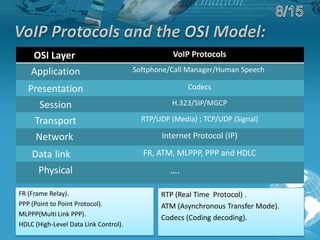
OSI Layer                                     VoIP Protocols
    Application                        Softphone/Call Manager/Human Speech

   Presentation                                       Codecs

     Session                                      H.323/SIP/MGCP

     Transport                           RTP/UDP (Media) ; TCP/UDP (Signal)

     Network                                  Internet Protocol (IP)

    Data link                            FR, ATM, MLPPP, PPP and HDLC
     Physical                                    ….

FR (Frame Relay).                             RTP (Real Time Protocol) .
PPP (Point to Point Protocol).                ATM (Asynchronous Transfer Mode).
MLPPP(Multi Link PPP).
                                              Codecs (Coding decoding).
HDLC (High-Level Data Link Control).
Low cost.
Use existing infrastructure.
Call forwarding.
Voice mail and fax applications.
Call waiting.
Caller ID.
Send documents and/or pictures while you
 talk at the same time.
Sound quality and reliability .
Lack of continuous service during a power outage.
Emergency calls (911) (Problem of locating call).
Vulnerable to same attacks as IP data networks
Viruses, Worms and spams .
Packet loss.
 Packet Loss.
    Loss of packets severely degrades the voice application.
    Network packets loss (as a result of congestion or rerouting in the IP network).
    Late arrival loss (dropped at receiver).
    Link failures or system errors.

 End-to-end Delay.
    Transmission and queuing delay.
    VoIP Typically tolerates delay up to 150ms before the quality of the call degrades .
    Codec processing delay .
    Packetizing/depacketizing delay.

 Jitter (delay variation).
    Caused by queuing delay within the IP network.
    Instantaneous buffer use causes delay variation in the same voice stream .
Sender                                             Receiver

                                                           De-       Jitter
      Encoder       Packetizer        IP Network                                Decoder
                                                        packetizer   buffer


coding distortion      delay           packet loss                              codec
                                                         delay   buffer-delay   impairment
codec delay                            network delay             buffer-loss    delay
                                       jitter


Other impairments: echo, sidetone, background noise

                            MOS (Mean Opinion Score).
 Codec is a process of digitizing the voice sample , or converting
  digitized signal into an analog signal.

 Each VoIP equipment must implement Codec in order to
  implement VoIP.
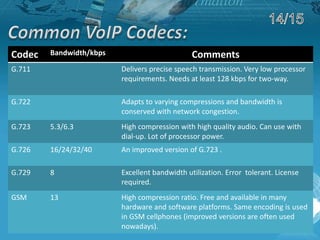
Codec   Bandwidth/kbps                         Comments
G.711                    Delivers precise speech transmission. Very low processor
                         requirements. Needs at least 128 kbps for two-way.

G.722                    Adapts to varying compressions and bandwidth is
                         conserved with network congestion.
G.723   5.3/6.3          High compression with high quality audio. Can use with
                         dial-up. Lot of processor power.
G.726   16/24/32/40      An improved version of G.723 .

G.729   8                Excellent bandwidth utilization. Error tolerant. License
                         required.
GSM     13               High compression ratio. Free and available in many
                         hardware and software platforms. Same encoding is used
                         in GSM cellphones (improved versions are often used
                         nowadays).
 Books:
   Olivier Hersent , “Deploying VoIP Protocols and IMS Infrastructure”, Second
    Edition (© 2011 John Wiley & Sons Ltd).


 Whitepaper:
   Preparing for the Promise of Voice-over Internet Protocol (VoIP) – Cox
    Communications


 World wide web:
   http://www.nwfusion.com/research/voip.html
Voice Quality Metrics in VoIP

Voice Quality Metrics in VoIP

  • 2.
  • 3.
    Outline Aims Objectives Over View of VoIP Technology VoIP Quality VoIP Codecs
  • 4.
    Time Table April May June July Project proposal submission 10% Collection and study 30% information Analysis 35% 0.5% Simulation Write Report 0.5% 85%
  • 5.
    Aim Comparingto VoIP systems by simulation.
  • 6.
    Objective VoIP voice quality Codecs VoIP Equipment Phone Frequencies Bandwidth requirements Setup simulation
  • 7.
     VoIP (Voiceover Internet Protocol).  Sometimes referred to as Internet telephony.  Sending voice information as digital form in discrete packets.
  • 8.
    VoIP Protocol Description H.323 ITU standard protocol for interactive conference. MGCP (IETF) standard for PSTN gateway control. SIP IETF standard protocol for interactive and no interactive conference . RTP IETF standard protocol for media streaming . RTCP IETF standard that provides out-of-band control information for an RTP flow . ISDN (Integrated Services Network). RTP (Real Time Protocol). IETF (Internet Engineering Task Force ). RTCP (Real Time Control Protocol). MGCP(Media Gateway Control Protocol). ISDN (Integrated Services Digital SIP(Session Initiation Protocol ) Network )
  • 9.
    OSI Layer VoIP Protocols Application Softphone/Call Manager/Human Speech Presentation Codecs Session H.323/SIP/MGCP Transport RTP/UDP (Media) ; TCP/UDP (Signal) Network Internet Protocol (IP) Data link FR, ATM, MLPPP, PPP and HDLC Physical …. FR (Frame Relay). RTP (Real Time Protocol) . PPP (Point to Point Protocol). ATM (Asynchronous Transfer Mode). MLPPP(Multi Link PPP). Codecs (Coding decoding). HDLC (High-Level Data Link Control).
  • 10.
    Low cost. Use existinginfrastructure. Call forwarding. Voice mail and fax applications. Call waiting. Caller ID. Send documents and/or pictures while you talk at the same time.
  • 11.
    Sound quality andreliability . Lack of continuous service during a power outage. Emergency calls (911) (Problem of locating call). Vulnerable to same attacks as IP data networks Viruses, Worms and spams . Packet loss.
  • 12.
     Packet Loss.  Loss of packets severely degrades the voice application.  Network packets loss (as a result of congestion or rerouting in the IP network).  Late arrival loss (dropped at receiver).  Link failures or system errors.  End-to-end Delay.  Transmission and queuing delay.  VoIP Typically tolerates delay up to 150ms before the quality of the call degrades .  Codec processing delay .  Packetizing/depacketizing delay.  Jitter (delay variation).  Caused by queuing delay within the IP network.  Instantaneous buffer use causes delay variation in the same voice stream .
  • 13.
    Sender Receiver De- Jitter Encoder Packetizer IP Network Decoder packetizer buffer coding distortion delay packet loss codec delay buffer-delay impairment codec delay network delay buffer-loss delay jitter Other impairments: echo, sidetone, background noise MOS (Mean Opinion Score).
  • 14.
     Codec isa process of digitizing the voice sample , or converting digitized signal into an analog signal.  Each VoIP equipment must implement Codec in order to implement VoIP.
  • 15.
    Codec Bandwidth/kbps Comments G.711 Delivers precise speech transmission. Very low processor requirements. Needs at least 128 kbps for two-way. G.722 Adapts to varying compressions and bandwidth is conserved with network congestion. G.723 5.3/6.3 High compression with high quality audio. Can use with dial-up. Lot of processor power. G.726 16/24/32/40 An improved version of G.723 . G.729 8 Excellent bandwidth utilization. Error tolerant. License required. GSM 13 High compression ratio. Free and available in many hardware and software platforms. Same encoding is used in GSM cellphones (improved versions are often used nowadays).
  • 16.
     Books:  Olivier Hersent , “Deploying VoIP Protocols and IMS Infrastructure”, Second Edition (© 2011 John Wiley & Sons Ltd).  Whitepaper:  Preparing for the Promise of Voice-over Internet Protocol (VoIP) – Cox Communications  World wide web:  http://www.nwfusion.com/research/voip.html