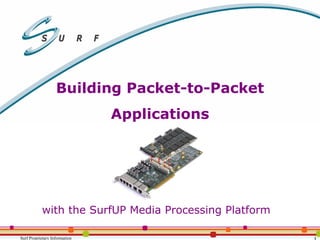
Building Packet-to-Packet Applications with the SurfUP Media Processing Platform
Presentation Highlights Packet-to-Packet (PTP) Applications Overview  Media Processing Needs for PTP Applications  Optimal System Architectures SurfUP Support for PTP Applications SurfUP for Transcoding Value Propositions
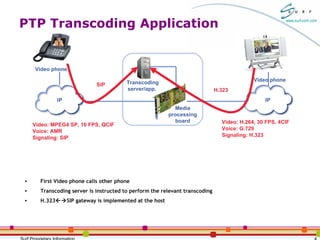
PTP Transcoding Application Video phone Transcoding server/app.  Media processing board First Video phone calls other phone Transcoding server is instructed to perform the relevant transcoding H.323  SIP gateway is implemented at the host Video: MPEG4 SP, 10 FPS, QCIF Voice: AMR Signaling: SIP Video: H.264, 30 FPS, 4CIF Voice: G.729 Signaling: H.323 Video phone SIP H.323 IP IP
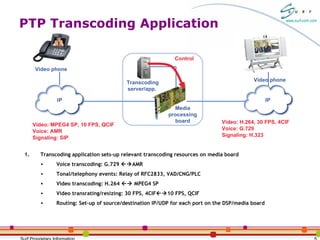
PTP Transcoding Application Video phone Transcoding server/app.  Media processing board Transcoding application sets-up relevant transcoding resources on media board Voice transcoding: G.729   AMR Tonal/telephony events: Relay of RFC2833, VAD/CNG/PLC Video transcoding: H.264    MPEG4 SP Video transrating/resizing: 30 FPS, 4CIF  10 FPS, QCIF Routing: Set-up of source/destination IP/UDP for each port on the DSP/media board  Video phone Control Video: H.264, 30 FPS, 4CIF Voice: G.729 Signaling: H.323 Video: MPEG4 SP, 10 FPS, QCIF Voice: AMR Signaling: SIP IP IP
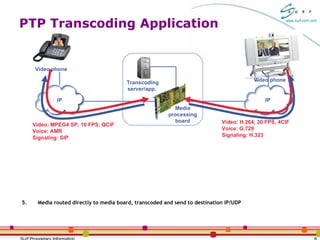
PTP Transcoding Application Video phone Transcoding server/app.  Media processing board 5. Media routed directly to media board, transcoded and send to destination IP/UDP Video phone Video: MPEG4 SP, 10 FPS, QCIF Voice: AMR Signaling: SIP Video: H.264, 30 FPS, 4CIF Voice: G.729 Signaling: H.323 IP IP
Presentation Highlights Packet-to-Packet (PTP) Applications Overview   Media Processing Needs for PTP Applications  Optimal System Architectures SurfUP Support for PTP Applications SurfUP for Transcoding Value Propositions
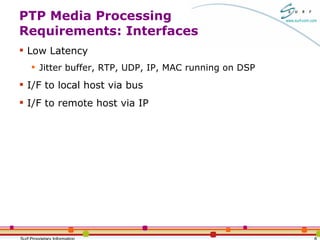
PTP Media Processing Requirements: Interfaces Low Latency Jitter buffer, RTP, UDP, IP, MAC running on DSP I/F to local host via bus I/F to remote host via IP
PTP Media Processing Requirements Voice transcoding from any to any G.729, G.723.1, G.711, NB-AMR, WB-AMR, EVRC and more… Telephony event relay RFC2833 relay, Tonal detection/generation, VAD/CNG/PLC relay Video transcoding encoding/decoding MPEG4 SP, MPEG4 ASP, H.263, H.263+, H.263++, H.264 Video processing Frame-rate adjustment, Frame resolution resizing Fax processing Conversion of fax over G.711 to T.38 Voice conferencing for large bridge apps. using dominant speakers detection Video processing for conferencing apps Picture-in-Picture / Continuous Presence...)
Presentation Highlights Packet-to-Packet (PTP) Applications Overview  Media Processing Needs for PTP Applications   Optimal System Architectures SurfUP Support for PTP Applications SurfUP for Transcoding Value Propositions
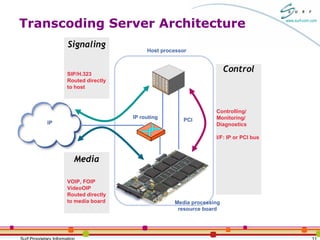
Transcoding Server Architecture Host processor Media processing resource board SIP/H.323 Routed directly to host IP routing PCI VOIP, FOIP VideoOIP Routed directly to media board Controlling/ Monitoring/ Diagnostics I/F: IP or PCI bus Signaling Media Control IP Router Shelve
Presentation Highlights Packet-to-Packet (PTP) Applications Overview  Media Processing Needs for PTP Applications  Optimal System Architectures SurfUP Support for PTP Applications SurfUP for Transcoding Value Propositions
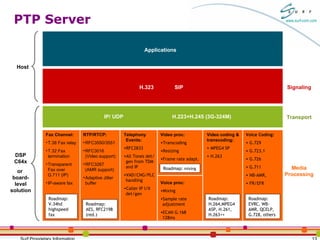
PTP Server Video proc: Transcoding  Resizing  Frame rate adapt. Video coding & transcoding: MPEG4 SP H.263 Voice Coding: G.729 G.723.1 G.726 G.711 NB-AMR, FR/EFR Media Processing RTP/RTCP: RFC3550/3551 RFC3016 (Video support) RFC3267  (AMR support) Adaptive Jitter buffer Telephony Events: RFC2833 All Tones det/gen from TDM and IP VAD/CNG/PLC handling Caller IP I/II det/gen Fax Channel: T.38 Fax relay T.32 Fax termination Transparent Fax over G.711 (IP) IP-aware fax Transport Signaling IP/ UDP H.323  SIP Applications Voice proc: Mixing Sample rate adjustment ECAN G.168 128ms H.223+H.245 (3G-324M) Roadmap: V.34hd highspeed fax Roadmap: AES, RFC2198 (red.) Roadmap: H.264,MPEG4 ASP, H.261, H.263++ Roadmap: EVRC, WB-AMR, QCELP, G.728, others Roadmap:  mixing DSP C64x or  board- level solution Host
PTP Server Media Processing Transport Signaling Applications DSP C64x or  board- level solution Host With Partners
Presentation Highlights Packet-to-Packet (PTP) Applications Overview  Media Processing Needs for PTP Applications  Optimal System Architectures SurfUP Support for PTP Applications SurfUP for Transcoding Value Propositions
SurfUP Integration Levels: Chip-Level STP-12 (based on C6412) Density:  100 voice transcoding G.711 ports (RTP mapping) 50 voice transcoding G.729ab  G.711 26 Video Encode & Decode ports (MPEG4, QCIF, 10 FPS) 50 fax transcoding ports (G.711  T.38) Latency  (from arrival to exit of a packet through ETH port):   5ms (max) when processing block is configured to 5ms 20ms (max) when processing block is configured to 20ms Supports also PSTN  IP I/F for VOIP gateway SurfDetect real-time streaming diagnostics from DSP Open-port for integration of customer technology Same SW can run also on other TI C64x-based DSPs DSP Chip-Level Solution C64x-based
SurfUP Integration Levels: Board-Level SurfAce-112 Form Factor: PCI Number of STP-12 DSPs: 1 on board/2,4 or 8 with daughter card Interfaces: Ethernet PCI H.100 Density:  Number of DSPs * density of single STP-12  SW features: same as STP-12 Modes of operation:  Control through PCI Stand-alone mode: Control through Ethernet Board-Level Solution
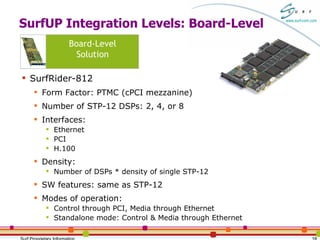
SurfUP Integration Levels: Board-Level SurfRider-812 Form Factor: PTMC (cPCI mezzanine) Number of STP-12 DSPs: 2, 4, or 8 Interfaces: Ethernet PCI H.100 Density:  Number of DSPs * density of single STP-12  SW features: same as STP-12 Modes of operation:  Control through PCI, Media through Ethernet Standalone mode: Control & Media through Ethernet Board-Level Solution
Presentation Highlights Packet-to-Packet (PTP) Applications Overview  Media Processing Needs for PTP Applications  Optimal System Architectures SurfUP Support for PTP Applications SurfUP for Transcoding Value Propositions
SurfUP for Transcoding:  Value Proposition (1) Voice, Video and fax/modem processing on the same DSP: Supports a flexible usage model  Always balance between voice and video processing One integration for support of all media types Eliminates voice/video synchronization issues Other solutions separate Voice & Video processing  (different DSPs/host) causing system to be unbalanced.
SurfUP for Transcoding:  Value Proposition (2) Direct DSP  network interface for lowest possible delay DSPs connected to Ethernet eliminate the need for an aggregation unit that causes excessive delay  Solutions with DSPs that do not have direct IP network interface suffer from unnecessary delay and bottlenecks.
SurfUP for Transcoding:  Value Proposition (3) Open Platform Vendors are able to add SW modules to the DSP code, in order to create a competitive advantage, without the need to recompile the DSP or host interface code Integration of new Voice and Video standards takes no more than a few days Closed system solutions don’t allow vendors to add value to the media processing sub-system. External memory is a must for providing an open platform.
SurfUP for Transcoding:  Value Proposition (4) Support for various applications with the same HW/SW VOIP & Video gateways Voice & Video Messaging/CTI application Lawful Interception (LI) applications Possible ONLY when Voice & Video run on the same DSP.
SurfUP for Transcoding:  Value Proposition (5) Streaming diagnostics for quick resolutions of issues The release version can stream the diagnostics from problematic connections without affecting other connections.  Control is per channel/call/DSP Solutions without external memory cannot include diagnostics in the release version.
Thank You www.surf-com.com

Packet-to-Packet Applications

  • 1.
    Building Packet-to-Packet Applicationswith the SurfUP Media Processing Platform
  • 2.
    Presentation Highlights Packet-to-Packet(PTP) Applications Overview Media Processing Needs for PTP Applications Optimal System Architectures SurfUP Support for PTP Applications SurfUP for Transcoding Value Propositions
  • 3.
    Presentation Highlights Packet-to-Packet(PTP) Applications Overview Media Processing Needs for PTP Applications Optimal System Architectures SurfUP Support for PTP Applications SurfUP for Transcoding Value Propositions
  • 4.
    PTP Transcoding ApplicationVideo phone Transcoding server/app. Media processing board First Video phone calls other phone Transcoding server is instructed to perform the relevant transcoding H.323  SIP gateway is implemented at the host Video: MPEG4 SP, 10 FPS, QCIF Voice: AMR Signaling: SIP Video: H.264, 30 FPS, 4CIF Voice: G.729 Signaling: H.323 Video phone SIP H.323 IP IP
  • 5.
    PTP Transcoding ApplicationVideo phone Transcoding server/app. Media processing board Transcoding application sets-up relevant transcoding resources on media board Voice transcoding: G.729  AMR Tonal/telephony events: Relay of RFC2833, VAD/CNG/PLC Video transcoding: H.264  MPEG4 SP Video transrating/resizing: 30 FPS, 4CIF  10 FPS, QCIF Routing: Set-up of source/destination IP/UDP for each port on the DSP/media board Video phone Control Video: H.264, 30 FPS, 4CIF Voice: G.729 Signaling: H.323 Video: MPEG4 SP, 10 FPS, QCIF Voice: AMR Signaling: SIP IP IP
  • 6.
    PTP Transcoding ApplicationVideo phone Transcoding server/app. Media processing board 5. Media routed directly to media board, transcoded and send to destination IP/UDP Video phone Video: MPEG4 SP, 10 FPS, QCIF Voice: AMR Signaling: SIP Video: H.264, 30 FPS, 4CIF Voice: G.729 Signaling: H.323 IP IP
  • 7.
    Presentation Highlights Packet-to-Packet(PTP) Applications Overview Media Processing Needs for PTP Applications Optimal System Architectures SurfUP Support for PTP Applications SurfUP for Transcoding Value Propositions
  • 8.
    PTP Media ProcessingRequirements: Interfaces Low Latency Jitter buffer, RTP, UDP, IP, MAC running on DSP I/F to local host via bus I/F to remote host via IP
  • 9.
    PTP Media ProcessingRequirements Voice transcoding from any to any G.729, G.723.1, G.711, NB-AMR, WB-AMR, EVRC and more… Telephony event relay RFC2833 relay, Tonal detection/generation, VAD/CNG/PLC relay Video transcoding encoding/decoding MPEG4 SP, MPEG4 ASP, H.263, H.263+, H.263++, H.264 Video processing Frame-rate adjustment, Frame resolution resizing Fax processing Conversion of fax over G.711 to T.38 Voice conferencing for large bridge apps. using dominant speakers detection Video processing for conferencing apps Picture-in-Picture / Continuous Presence...)
  • 10.
    Presentation Highlights Packet-to-Packet(PTP) Applications Overview Media Processing Needs for PTP Applications Optimal System Architectures SurfUP Support for PTP Applications SurfUP for Transcoding Value Propositions
  • 11.
    Transcoding Server ArchitectureHost processor Media processing resource board SIP/H.323 Routed directly to host IP routing PCI VOIP, FOIP VideoOIP Routed directly to media board Controlling/ Monitoring/ Diagnostics I/F: IP or PCI bus Signaling Media Control IP Router Shelve
  • 12.
    Presentation Highlights Packet-to-Packet(PTP) Applications Overview Media Processing Needs for PTP Applications Optimal System Architectures SurfUP Support for PTP Applications SurfUP for Transcoding Value Propositions
  • 13.
    PTP Server Videoproc: Transcoding Resizing Frame rate adapt. Video coding & transcoding: MPEG4 SP H.263 Voice Coding: G.729 G.723.1 G.726 G.711 NB-AMR, FR/EFR Media Processing RTP/RTCP: RFC3550/3551 RFC3016 (Video support) RFC3267 (AMR support) Adaptive Jitter buffer Telephony Events: RFC2833 All Tones det/gen from TDM and IP VAD/CNG/PLC handling Caller IP I/II det/gen Fax Channel: T.38 Fax relay T.32 Fax termination Transparent Fax over G.711 (IP) IP-aware fax Transport Signaling IP/ UDP H.323 SIP Applications Voice proc: Mixing Sample rate adjustment ECAN G.168 128ms H.223+H.245 (3G-324M) Roadmap: V.34hd highspeed fax Roadmap: AES, RFC2198 (red.) Roadmap: H.264,MPEG4 ASP, H.261, H.263++ Roadmap: EVRC, WB-AMR, QCELP, G.728, others Roadmap: mixing DSP C64x or board- level solution Host
  • 14.
    PTP Server MediaProcessing Transport Signaling Applications DSP C64x or board- level solution Host With Partners
  • 15.
    Presentation Highlights Packet-to-Packet(PTP) Applications Overview Media Processing Needs for PTP Applications Optimal System Architectures SurfUP Support for PTP Applications SurfUP for Transcoding Value Propositions
  • 16.
    SurfUP Integration Levels:Chip-Level STP-12 (based on C6412) Density: 100 voice transcoding G.711 ports (RTP mapping) 50 voice transcoding G.729ab  G.711 26 Video Encode & Decode ports (MPEG4, QCIF, 10 FPS) 50 fax transcoding ports (G.711  T.38) Latency (from arrival to exit of a packet through ETH port): 5ms (max) when processing block is configured to 5ms 20ms (max) when processing block is configured to 20ms Supports also PSTN  IP I/F for VOIP gateway SurfDetect real-time streaming diagnostics from DSP Open-port for integration of customer technology Same SW can run also on other TI C64x-based DSPs DSP Chip-Level Solution C64x-based
  • 17.
    SurfUP Integration Levels:Board-Level SurfAce-112 Form Factor: PCI Number of STP-12 DSPs: 1 on board/2,4 or 8 with daughter card Interfaces: Ethernet PCI H.100 Density: Number of DSPs * density of single STP-12 SW features: same as STP-12 Modes of operation: Control through PCI Stand-alone mode: Control through Ethernet Board-Level Solution
  • 18.
    SurfUP Integration Levels:Board-Level SurfRider-812 Form Factor: PTMC (cPCI mezzanine) Number of STP-12 DSPs: 2, 4, or 8 Interfaces: Ethernet PCI H.100 Density: Number of DSPs * density of single STP-12 SW features: same as STP-12 Modes of operation: Control through PCI, Media through Ethernet Standalone mode: Control & Media through Ethernet Board-Level Solution
  • 19.
    Presentation Highlights Packet-to-Packet(PTP) Applications Overview Media Processing Needs for PTP Applications Optimal System Architectures SurfUP Support for PTP Applications SurfUP for Transcoding Value Propositions
  • 20.
    SurfUP for Transcoding: Value Proposition (1) Voice, Video and fax/modem processing on the same DSP: Supports a flexible usage model Always balance between voice and video processing One integration for support of all media types Eliminates voice/video synchronization issues Other solutions separate Voice & Video processing (different DSPs/host) causing system to be unbalanced.
  • 21.
    SurfUP for Transcoding: Value Proposition (2) Direct DSP  network interface for lowest possible delay DSPs connected to Ethernet eliminate the need for an aggregation unit that causes excessive delay Solutions with DSPs that do not have direct IP network interface suffer from unnecessary delay and bottlenecks.
  • 22.
    SurfUP for Transcoding: Value Proposition (3) Open Platform Vendors are able to add SW modules to the DSP code, in order to create a competitive advantage, without the need to recompile the DSP or host interface code Integration of new Voice and Video standards takes no more than a few days Closed system solutions don’t allow vendors to add value to the media processing sub-system. External memory is a must for providing an open platform.
  • 23.
    SurfUP for Transcoding: Value Proposition (4) Support for various applications with the same HW/SW VOIP & Video gateways Voice & Video Messaging/CTI application Lawful Interception (LI) applications Possible ONLY when Voice & Video run on the same DSP.
  • 24.
    SurfUP for Transcoding: Value Proposition (5) Streaming diagnostics for quick resolutions of issues The release version can stream the diagnostics from problematic connections without affecting other connections. Control is per channel/call/DSP Solutions without external memory cannot include diagnostics in the release version.
  • 25.

Editor's Notes

  • #14 VAD – Voice activity detection CNG – Comfort noise generation PLC – Packet loss concealment
  • #15 VAD – Voice activity detection CNG – Comfort noise generation PLC – Packet loss concealment
  • #17 Avi
  • #18 Avi
  • #19 Avi