
H.323 Protocol
Mahbuba Monzur
Mou
172-15-9891
Mahabubur
Rahman Pollob
172-15-9877
Tanzimul Hasib
172-15-9895
Md. Taiseen Azam
171-15-9142
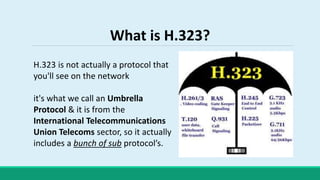
H.323 is not actually a protocol that
you'll see on the network
it's what we call an Umbrella
Protocol & it is from the
International Telecommunications
Union Telecoms sector, so it actually
includes a bunch of sub protocol’s.
What is H.323?
H323 intro :
o H.323 is a multimedia conferencing protocol, which includes voice,
video & data conferencing for use over Packet-switched networks.
o So, H.323 is a standard specified for Packet-based Multimedia
Communications Systems by ITU-T.
o H.323 suite is an ´Umbrella´ standard, references to other standards
and ITU recommendations.
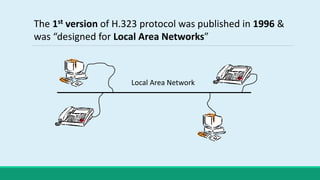
Local Area Network
The 1st version of H.323 protocol was published in 1996 &
was “designed for Local Area Networks”
The first thing companies tried to do was use H.323 in Wide
Area Networks, large private VoIP networks & the Internet
◦ Output result : it worked very well
H.323 version 4 was approved November 17, 2000 &
brings a number of enhancements to H.323.
Areas of focus include:
◦ Scalability
◦ Services
◦ “Must Have” Features
◦ Generic Extensibility Framework
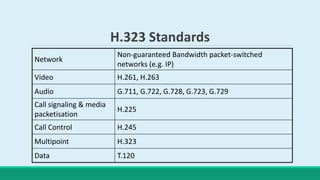
H.323 Standards
Network
Non-guaranteed Bandwidth packet-switched
networks (e.g. IP)
Video H.261, H.263
Audio G.711, G.722, G.728, G.723, G.729
Call signaling & media
packetisation
H.225
Call Control H.245
Multipoint H.323
Data T.120
Elements of an H.323 System
1. Terminals
2. Multipoint Control Units (MCUs)
3. Gateways
4. Gatekeeper
5. Border Elements
Referred to as
“endpoints”
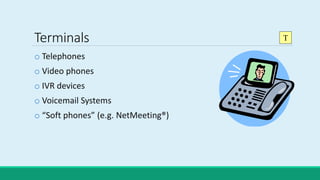
Terminals
o Telephones
o Video phones
o IVR devices
o Voicemail Systems
o “Soft phones” (e.g. NetMeeting®)
T
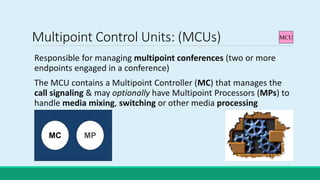
Multipoint Control Units: (MCUs)
Responsible for managing multipoint conferences (two or more
endpoints engaged in a conference)
The MCU contains a Multipoint Controller (MC) that manages the
call signaling & may optionally have Multipoint Processors (MPs) to
handle media mixing, switching or other media processing
MCU
MC MP
Gateways
The Gateway is composed of a “Media Gateway Controller” (MGC)
& a “Media Gateway” (MG), which may co-exist or exist separately
o The MGC handles call signaling & non-media-related functions
o The MG handles the media
GW
Gatekeeper
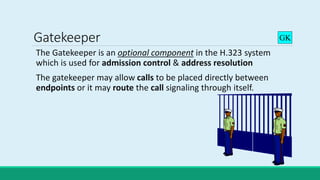
The Gatekeeper is an optional component in the H.323 system
which is used for admission control & address resolution
The gatekeeper may allow calls to be placed directly between
endpoints or it may route the call signaling through itself.
GK
Border Elements
which are often co-located with a Gatekeeper, exchange addressing
information & participate in call authorization between
administrative domains
It may aggregate address information to reduce the volume of
routing information passed through the network
BE
Zone
GK
GW
MCU
T
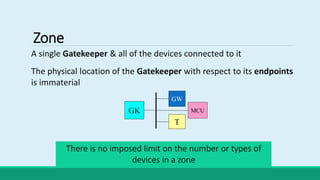
There is no imposed limit on the number or types of
devices in a zone
A single Gatekeeper & all of the devices connected to it
The physical location of the Gatekeeper with respect to its endpoints
is immaterial
Administrative Domain
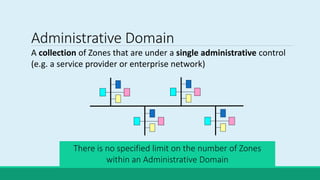
There is no specified limit on the number of Zones
within an Administrative Domain
A collection of Zones that are under a single administrative control
(e.g. a service provider or enterprise network)
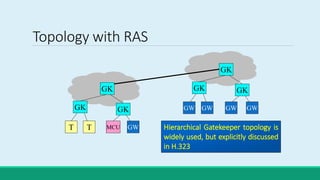
Topology with RAS
GK GK
T T MCU GW
GK
GK GK
GWGWGWGW
GK
Hierarchical Gatekeeper topology is
widely used, but explicitly discussed
in H.323
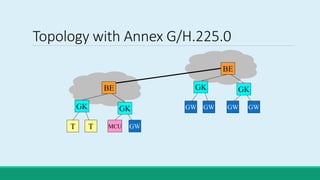
Topology with Annex G/H.225.0
BE
GK GK
T T MCU GW
BE
GK GK
GWGWGWGW
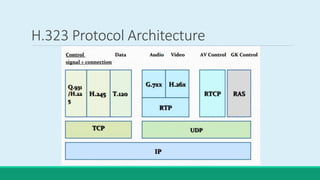
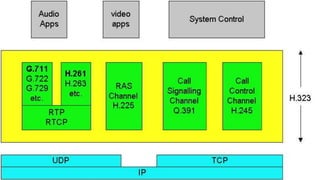
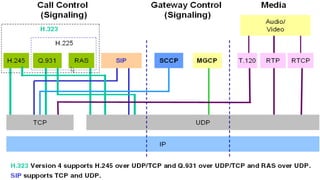
H.323 Protocol Architecture
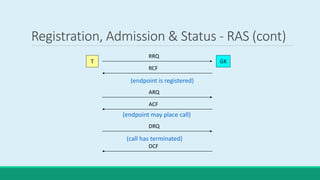
Registration, Admission & Status - RAS (cont)
T GK
RRQ
RCF
ARQ
(endpoint is registered)
ACF
(endpoint may place call)
DRQ
DCF
(call has terminated)
GW
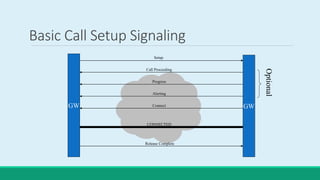
Basic Call Setup Signaling
GW
Setup
Call Proceeding
Progress
Alerting
Connect
CONNECTED
Release Complete
Optional
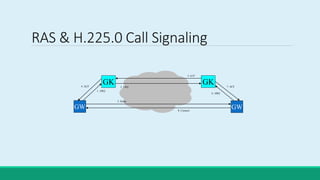
RAS & H.225.0 Call Signaling
GK
GW
GK
GW
1. ARQ
2. LRQ
3. LCF
4. ACF
5. Setup
6. ARQ
7. ACF
8. Connect
H.323 Call Signalling Model
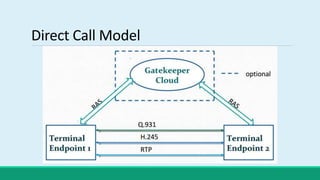
 Direct Call Model
Gatekeeper Optional
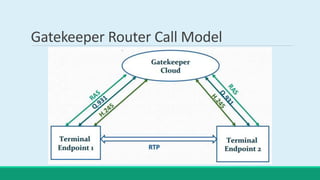
 Gatekeeper Router Call Model
Direct Call Model
Gatekeeper Router Call Model
Comments on H.323
 H.323 is scalable
 H.323 allows the use of multiple codecs
 H.323 is a very complex system with all of kinds of features for multimedia
communications
 H.323 is a proven technology used in large networks. It has excellent integration with
PSTN.
 Multimedia conferencing shows the real potential for H.323 used in multimedia
communication
 H.323 is organized around four major facilities: (a) terminals, (b)
Gateways, (c) Gatekeeper & (d) MCUs
 A principal technology for the transmission of real-time audio, video, &
data communication over packet-based networks
 Multipoint & point-to-point sessions.
 A rich & complex specification
 Scalable, reliable, flexible system,
 Supplementary services & new features are powerful
Conclusions


Presentation of H323 protocol

  • 1.
  • 2.
  • 3.
    H.323 is notactually a protocol that you'll see on the network it's what we call an Umbrella Protocol & it is from the International Telecommunications Union Telecoms sector, so it actually includes a bunch of sub protocol’s. What is H.323?
  • 4.
    H323 intro : oH.323 is a multimedia conferencing protocol, which includes voice, video & data conferencing for use over Packet-switched networks. o So, H.323 is a standard specified for Packet-based Multimedia Communications Systems by ITU-T. o H.323 suite is an ´Umbrella´ standard, references to other standards and ITU recommendations.
  • 5.
    Local Area Network The1st version of H.323 protocol was published in 1996 & was “designed for Local Area Networks”
  • 6.
    The first thingcompanies tried to do was use H.323 in Wide Area Networks, large private VoIP networks & the Internet ◦ Output result : it worked very well
  • 7.
    H.323 version 4was approved November 17, 2000 & brings a number of enhancements to H.323. Areas of focus include: ◦ Scalability ◦ Services ◦ “Must Have” Features ◦ Generic Extensibility Framework
  • 8.
    H.323 Standards Network Non-guaranteed Bandwidthpacket-switched networks (e.g. IP) Video H.261, H.263 Audio G.711, G.722, G.728, G.723, G.729 Call signaling & media packetisation H.225 Call Control H.245 Multipoint H.323 Data T.120
  • 9.
    Elements of anH.323 System 1. Terminals 2. Multipoint Control Units (MCUs) 3. Gateways 4. Gatekeeper 5. Border Elements Referred to as “endpoints”
  • 10.
    Terminals o Telephones o Videophones o IVR devices o Voicemail Systems o “Soft phones” (e.g. NetMeeting®) T
  • 11.
    Multipoint Control Units:(MCUs) Responsible for managing multipoint conferences (two or more endpoints engaged in a conference) The MCU contains a Multipoint Controller (MC) that manages the call signaling & may optionally have Multipoint Processors (MPs) to handle media mixing, switching or other media processing MCU MC MP
  • 12.
    Gateways The Gateway iscomposed of a “Media Gateway Controller” (MGC) & a “Media Gateway” (MG), which may co-exist or exist separately o The MGC handles call signaling & non-media-related functions o The MG handles the media GW
  • 13.
    Gatekeeper The Gatekeeper isan optional component in the H.323 system which is used for admission control & address resolution The gatekeeper may allow calls to be placed directly between endpoints or it may route the call signaling through itself. GK
  • 14.
    Border Elements which areoften co-located with a Gatekeeper, exchange addressing information & participate in call authorization between administrative domains It may aggregate address information to reduce the volume of routing information passed through the network BE
  • 15.
    Zone GK GW MCU T There is noimposed limit on the number or types of devices in a zone A single Gatekeeper & all of the devices connected to it The physical location of the Gatekeeper with respect to its endpoints is immaterial
  • 16.
    Administrative Domain There isno specified limit on the number of Zones within an Administrative Domain A collection of Zones that are under a single administrative control (e.g. a service provider or enterprise network)
  • 17.
    Topology with RAS GKGK T T MCU GW GK GK GK GWGWGWGW GK Hierarchical Gatekeeper topology is widely used, but explicitly discussed in H.323
  • 18.
    Topology with AnnexG/H.225.0 BE GK GK T T MCU GW BE GK GK GWGWGWGW
  • 19.
  • 22.
    Registration, Admission &Status - RAS (cont) T GK RRQ RCF ARQ (endpoint is registered) ACF (endpoint may place call) DRQ DCF (call has terminated)
  • 23.
    GW Basic Call SetupSignaling GW Setup Call Proceeding Progress Alerting Connect CONNECTED Release Complete Optional
  • 24.
    RAS & H.225.0Call Signaling GK GW GK GW 1. ARQ 2. LRQ 3. LCF 4. ACF 5. Setup 6. ARQ 7. ACF 8. Connect
  • 25.
    H.323 Call SignallingModel  Direct Call Model Gatekeeper Optional  Gatekeeper Router Call Model
  • 26.
  • 27.
  • 28.
    Comments on H.323 H.323 is scalable  H.323 allows the use of multiple codecs  H.323 is a very complex system with all of kinds of features for multimedia communications  H.323 is a proven technology used in large networks. It has excellent integration with PSTN.  Multimedia conferencing shows the real potential for H.323 used in multimedia communication
  • 29.
     H.323 isorganized around four major facilities: (a) terminals, (b) Gateways, (c) Gatekeeper & (d) MCUs  A principal technology for the transmission of real-time audio, video, & data communication over packet-based networks  Multipoint & point-to-point sessions.  A rich & complex specification  Scalable, reliable, flexible system,  Supplementary services & new features are powerful Conclusions
  • 30.