Risma Rustiyan R
Information System
Department
Faculty of Science and
Technology
State Islamic University
of Sulthan Syarif Kasim
Riau
(UIN SUSKA RIAU)
2017
Agenda Introduction
Definition
V-model figure
Four Test Level
The Differences between V-Model and
Waterfall Model
V-Model Introduction:
The V-model was developed to address
some of the problems experienced using
the traditional waterfall approach. Defects
were being found too late in the life cycle,
as testing was not involved until the end
of the project.Testing also added lead time
due to its late involvement.
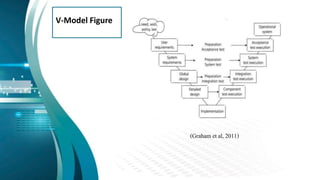
Definition The V-model is a model that illustrates
how testing activities (verification and
validation) can be integrated into each
phase of the life cycle.
Definition (Cont.) Within the V-model, validation testing
takes place especially during the early
stages, e.g. reviewing the user
requirements, and late in the life cycle,
e.g.during user acceptance testing
V-Model Figure
(Graham et al, 2011)
Four Test Level The four test levels used, each with their own objectives,are:
• component testing: searches for defects in and verifies the
functioning of software components (e.g. modules, programs,
objects, classes etc.) that are separately testable;
• integration testing: tests interfaces between components,
interactions to different parts of a system such as an operating
system,file system and hardware or interfacesbetween systems;
• system testing: concerned with the behavior of the whole
system/product asdefined by the scope of a development project or
product. The main focus ofsystem testing is verification against
specified requirements;
• acceptance testing: validation testing with respect to user needs,
requirements, and business processes conducted to determine
whether or not to accept the system.
V-Model VS
Waterfall Model
The waterfall model was one of the earliest
models to be designed. It has a natural timeline
where tasks are executed in a sequential fashion.
We start at the top of the waterfall with a
feasibility study and flow down through the
various project tasks finishing with
implementation into the live environment.
V-Model Vs
Waterfall Model
(Cont.)
Design flows through into development,
which in turn flows into build, and finally
on into test. Testing tends to happen
towards the end of the project life cycle so
defects are detected close to the live
implementation date. With this model it has
been difficult to get feedback passed
backwards up the waterfall and there are
difficulties if we need to carry out
numerous iterations for a particular phase.
Reference
Graham, Dorothy, et al. “Foundation of Software Testing ISTQB
Certification”. Chapter 1 Fundamentals of Testing. 2011

Software development model

  • 1.
    Risma Rustiyan R InformationSystem Department Faculty of Science and Technology State Islamic University of Sulthan Syarif Kasim Riau (UIN SUSKA RIAU) 2017
  • 2.
    Agenda Introduction Definition V-model figure FourTest Level The Differences between V-Model and Waterfall Model
  • 3.
    V-Model Introduction: The V-modelwas developed to address some of the problems experienced using the traditional waterfall approach. Defects were being found too late in the life cycle, as testing was not involved until the end of the project.Testing also added lead time due to its late involvement.
  • 4.
    Definition The V-modelis a model that illustrates how testing activities (verification and validation) can be integrated into each phase of the life cycle.
  • 5.
    Definition (Cont.) Withinthe V-model, validation testing takes place especially during the early stages, e.g. reviewing the user requirements, and late in the life cycle, e.g.during user acceptance testing
  • 6.
  • 7.
    Four Test LevelThe four test levels used, each with their own objectives,are: • component testing: searches for defects in and verifies the functioning of software components (e.g. modules, programs, objects, classes etc.) that are separately testable; • integration testing: tests interfaces between components, interactions to different parts of a system such as an operating system,file system and hardware or interfacesbetween systems; • system testing: concerned with the behavior of the whole system/product asdefined by the scope of a development project or product. The main focus ofsystem testing is verification against specified requirements; • acceptance testing: validation testing with respect to user needs, requirements, and business processes conducted to determine whether or not to accept the system.
  • 8.
    V-Model VS Waterfall Model Thewaterfall model was one of the earliest models to be designed. It has a natural timeline where tasks are executed in a sequential fashion. We start at the top of the waterfall with a feasibility study and flow down through the various project tasks finishing with implementation into the live environment.
  • 9.
    V-Model Vs Waterfall Model (Cont.) Designflows through into development, which in turn flows into build, and finally on into test. Testing tends to happen towards the end of the project life cycle so defects are detected close to the live implementation date. With this model it has been difficult to get feedback passed backwards up the waterfall and there are difficulties if we need to carry out numerous iterations for a particular phase.
  • 10.
    Reference Graham, Dorothy, etal. “Foundation of Software Testing ISTQB Certification”. Chapter 1 Fundamentals of Testing. 2011