Vitamin Deficiency
Disorders
BACKGROUND
Vitamins are organic substances that
are essential for several enzymatic
functions in human metabolism
Thiamine was discovered in 1912 & was
thought to be a vital amine compound &
thus the term vitamin was invented
VITAMINS
 Vitamins are classified according
to solubility into fat soluble & water
soluble.
 13 vitamins are known, 4 fat
soluble (KEDA) & 9 water soluble
(C, Folate & the B group).
VITAMIN A
 Vitamin A is a generic term for many
related compounds.
 Retinol (alcohol), Retinal (aldehyde)
are often called preformed vitamin A.
Retinal can be converted by the body to
retinoic acid which is known to affect
gene transcription.
 Body can convert b-carotene to retinol,
thus called provitamin A.
FUNCTIONS
•Vision: integrity of eye & formation of
rodopsin necessary for dark adaptation.
•Regulation of gene expression: vital to
cell differentiation & physiologic processes
•Growth & development
•Immunity: important for activation of T
lymphocyte, maturation of WBC & integrity
of physiological barrier.
Nutrient Interactions
•Zinc deficiency interfere with vitamin A
metabolism in several ways:
It decreases the synthesis of retinol binding
protein, which transports retinol to tissues.
It decreases the activity of the enzyme
retinyl palmitate, which is necessary for
release of retinol from the liver.
Zn is needed for the enzyme that convert
retinol into retinal.
Nutrient Interactions/2
•Iron & vitamin A.
Vitamin A deficiency may exacerbate IDF
Vitamin A supplementation improves
iron status among children & pregnant
women.
Combining vitamin A with iron controls
IDA more quickly & effectively than using
iron alone.
VITAMIN A UNITS
 1 mg of retinol = 6 mg of b-carotene.
 3 mg of retinol = 10 international units
of vitamin A.
 100 mg carrots contain 10 mg of b-
carotene.
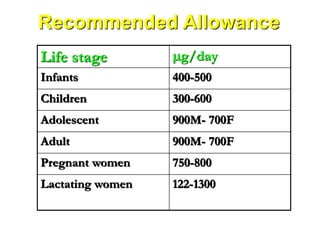
Life stage mg/day
Infants 400-500
Children 300-600
Adolescent 900M- 700F
Adult 900M- 700F
Pregnant women 750-800
Lactating women 122-1300
Recommended Allowance
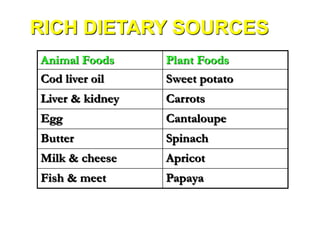
Animal Foods Plant Foods
Cod liver oil Sweet potato
Liver & kidney Carrots
Egg Cantaloupe
Butter Spinach
Milk & cheese Apricot
Fish & meet Papaya
RICH DIETARY SOURCES
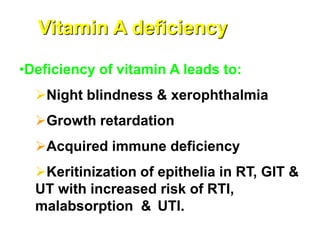
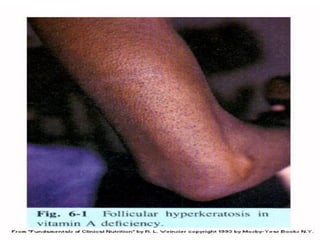
Vitamin A deficiency
•Deficiency of vitamin A leads to:
Night blindness & xerophthalmia
Growth retardation
Acquired immune deficiency
Keritinization of epithelia in RT, GIT &
UT with increased risk of RTI,
malabsorption & UTI.
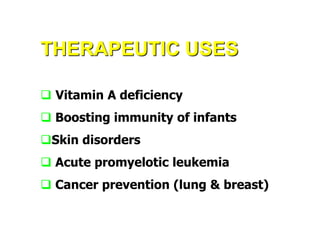
THERAPEUTIC USES
 Vitamin A deficiency
 Boosting immunity of infants
Skin disorders
 Acute promyelotic leukemia
 Cancer prevention (lung & breast)
TOXICITY
•Vitamin A in excess leads to:
•Dermatitis with xanthosis cutis
•Hepatosplenomegaly
•Bone pain & increased risk of fracture
•Pseudotumor Cerebri
VITAMIN D
 Vitamin D comprises a group of sterols; the
most important of which are cholecalciferol
(vitamin D3) & ergosterol (vitamin D2).
 Humans & animal utilize only vitamin D3 &
they can produce it inside their bodies from
cholesterol.
 Cholesterol is converted to 7-dehydro-
cholesterol (7DC), which is a precursor of
vitamin D3.
FUNCTIONS
•Calcium metabolism: vitamin D enhances
ca absorption in the gut & renal tubules.
•Cell differentiation: particularly of
collagen & skin epithelium
•Immunity: important for Cell Mediated
Immunity & coordination of the immune
response.
Vitamin D deficiency
•Deficiency of vitamin D leads to:
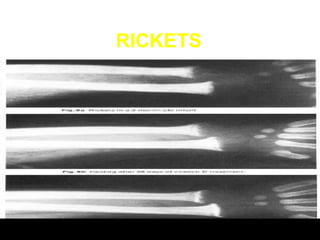
 Rickets in small children.
 Osteomalacia
 Osteoporosis
GROUPS AT RISK
•Infants
•Elderly
•Dark skinned
•Covered women
•Kidney failure patients
•Patients with chronic liver disease
•Fat malabsorption disorders
•Genetic types of rickets
•Patients on anticonvulsant drugs
Sources of Vitamin D
 Sunlight is the most important source
 Fish liver oil
 Fish & sea food (herring & salmon)
 Eggs
 Plants do not contain vitamin D3
THERAPEUTIC USES
Rickets & Osteomalacia
Osteoporosis
Psoriasis
Cancer prevention (prostate & colorectal)
Autoimmune diseases
TOXICITY
•Hypervitaminosis D
causes hypercalcemia, which manifest as:
Nausea & vomiting
Excessive thirst & polyuria
Severe itching
Joint & muscle pains
Disorientation & coma.
RICKETS

Vitamin deficiency disorder

  • 1.
  • 2.
    BACKGROUND Vitamins are organicsubstances that are essential for several enzymatic functions in human metabolism Thiamine was discovered in 1912 & was thought to be a vital amine compound & thus the term vitamin was invented
  • 3.
    VITAMINS  Vitamins areclassified according to solubility into fat soluble & water soluble.  13 vitamins are known, 4 fat soluble (KEDA) & 9 water soluble (C, Folate & the B group).
  • 4.
    VITAMIN A  VitaminA is a generic term for many related compounds.  Retinol (alcohol), Retinal (aldehyde) are often called preformed vitamin A. Retinal can be converted by the body to retinoic acid which is known to affect gene transcription.  Body can convert b-carotene to retinol, thus called provitamin A.
  • 5.
    FUNCTIONS •Vision: integrity ofeye & formation of rodopsin necessary for dark adaptation. •Regulation of gene expression: vital to cell differentiation & physiologic processes •Growth & development •Immunity: important for activation of T lymphocyte, maturation of WBC & integrity of physiological barrier.
  • 6.
    Nutrient Interactions •Zinc deficiencyinterfere with vitamin A metabolism in several ways: It decreases the synthesis of retinol binding protein, which transports retinol to tissues. It decreases the activity of the enzyme retinyl palmitate, which is necessary for release of retinol from the liver. Zn is needed for the enzyme that convert retinol into retinal.
  • 7.
    Nutrient Interactions/2 •Iron &vitamin A. Vitamin A deficiency may exacerbate IDF Vitamin A supplementation improves iron status among children & pregnant women. Combining vitamin A with iron controls IDA more quickly & effectively than using iron alone.
  • 8.
    VITAMIN A UNITS 1 mg of retinol = 6 mg of b-carotene.  3 mg of retinol = 10 international units of vitamin A.  100 mg carrots contain 10 mg of b- carotene.
  • 9.
    Life stage mg/day Infants400-500 Children 300-600 Adolescent 900M- 700F Adult 900M- 700F Pregnant women 750-800 Lactating women 122-1300 Recommended Allowance
  • 10.
    Animal Foods PlantFoods Cod liver oil Sweet potato Liver & kidney Carrots Egg Cantaloupe Butter Spinach Milk & cheese Apricot Fish & meet Papaya RICH DIETARY SOURCES
  • 11.
    Vitamin A deficiency •Deficiencyof vitamin A leads to: Night blindness & xerophthalmia Growth retardation Acquired immune deficiency Keritinization of epithelia in RT, GIT & UT with increased risk of RTI, malabsorption & UTI.
  • 12.
    THERAPEUTIC USES  VitaminA deficiency  Boosting immunity of infants Skin disorders  Acute promyelotic leukemia  Cancer prevention (lung & breast)
  • 13.
    TOXICITY •Vitamin A inexcess leads to: •Dermatitis with xanthosis cutis •Hepatosplenomegaly •Bone pain & increased risk of fracture •Pseudotumor Cerebri
  • 15.
    VITAMIN D  VitaminD comprises a group of sterols; the most important of which are cholecalciferol (vitamin D3) & ergosterol (vitamin D2).  Humans & animal utilize only vitamin D3 & they can produce it inside their bodies from cholesterol.  Cholesterol is converted to 7-dehydro- cholesterol (7DC), which is a precursor of vitamin D3.
  • 16.
    FUNCTIONS •Calcium metabolism: vitaminD enhances ca absorption in the gut & renal tubules. •Cell differentiation: particularly of collagen & skin epithelium •Immunity: important for Cell Mediated Immunity & coordination of the immune response.
  • 17.
    Vitamin D deficiency •Deficiencyof vitamin D leads to:  Rickets in small children.  Osteomalacia  Osteoporosis
  • 18.
    GROUPS AT RISK •Infants •Elderly •Darkskinned •Covered women •Kidney failure patients •Patients with chronic liver disease •Fat malabsorption disorders •Genetic types of rickets •Patients on anticonvulsant drugs
  • 19.
    Sources of VitaminD  Sunlight is the most important source  Fish liver oil  Fish & sea food (herring & salmon)  Eggs  Plants do not contain vitamin D3
  • 20.
    THERAPEUTIC USES Rickets &Osteomalacia Osteoporosis Psoriasis Cancer prevention (prostate & colorectal) Autoimmune diseases
  • 21.
    TOXICITY •Hypervitaminosis D causes hypercalcemia,which manifest as: Nausea & vomiting Excessive thirst & polyuria Severe itching Joint & muscle pains Disorientation & coma.
  • 22.