VISUAL LEARNERS
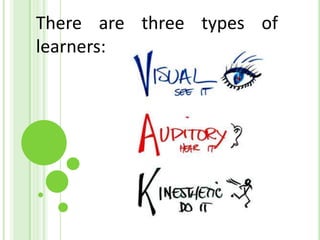
There are three types of learners:
DEFINITIONUnlike Auditory and Kinesthetic, visuallearner tends to learn watching, to know a new concept. Fifty to sixty-five percent of people are visuals.
FEATURESThey tend to remember new faces, but they have troubles to remember the name of new people.When they go to a new place, they look around to analyze everything.They do not support the disorder, so they use to be clean and tidy.
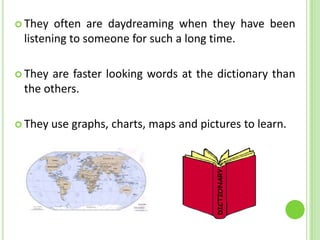
They often are daydreaming when they have been listening to someone for such a long time.They are faster looking words at the dictionary than the others.They use graphs, charts, maps and pictures to learn.
They like to plan things before do it.If they cannot explain something by talk, they try to draw the explanation.They use to express by their body instead of the language.
They work with computers, flashcards, videos and films.They study better if they have a quiet place, to be far away from noise.When they are studying they visualize the text as a photograph to remember it.
While they are reading they take notes to organize what they are reading.They use sentences like: “Do you see?”, “Show me”, or “Look at this”.Their eyes look up, to the left and up to the right.
STRATEGIES  To remember sentences and important words of a text they should use bright colours like yellow, green or orange fluorescent. Bright post-its can help too.
 The teacher doesn’t have to move a lot when she/he is talking because visual learners need to see her/his mouth.Permit the student to read in silence instead of aloud.
Help the student to use acronyms for memorize series of words, for example names of mountains, capitals, rivers, countries, etc.

Visual learners

  • 1.
  • 2.
    There are threetypes of learners:
  • 3.
    DEFINITIONUnlike Auditory andKinesthetic, visuallearner tends to learn watching, to know a new concept. Fifty to sixty-five percent of people are visuals.
  • 4.
    FEATURESThey tend toremember new faces, but they have troubles to remember the name of new people.When they go to a new place, they look around to analyze everything.They do not support the disorder, so they use to be clean and tidy.
  • 5.
    They often aredaydreaming when they have been listening to someone for such a long time.They are faster looking words at the dictionary than the others.They use graphs, charts, maps and pictures to learn.
  • 6.
    They like toplan things before do it.If they cannot explain something by talk, they try to draw the explanation.They use to express by their body instead of the language.
  • 7.
    They work withcomputers, flashcards, videos and films.They study better if they have a quiet place, to be far away from noise.When they are studying they visualize the text as a photograph to remember it.
  • 8.
    While they arereading they take notes to organize what they are reading.They use sentences like: “Do you see?”, “Show me”, or “Look at this”.Their eyes look up, to the left and up to the right.
  • 9.
    STRATEGIES Toremember sentences and important words of a text they should use bright colours like yellow, green or orange fluorescent. Bright post-its can help too.
  • 10.
    The teacherdoesn’t have to move a lot when she/he is talking because visual learners need to see her/his mouth.Permit the student to read in silence instead of aloud.
  • 11.
    Help the studentto use acronyms for memorize series of words, for example names of mountains, capitals, rivers, countries, etc.