Section 3
Learning with
Difficulty Seeing,
Hearing, and
Comunicating
TYPES, CHARACTERISTICS, AND
IDENTIFICATION OF LEARNERS WITH
DIFFICULTY SEEING, HEARING AND
COMMUNICATING
LEARNERS WITH DIFFICULTY SEEING
VISUAL ACQUITY
refers to the ability to distinguish forms or
discriminate among details. It is usually
measured by reading letters, numbers,and other
symbols from the Snellen Eye Chart.
LEGAL BLINDNESS
refers to having a visual acquity of 20/200 or
less in the better eye with the use of a corrective
lens. When one’s field of vision is restricted to
an area no greater than 20 degrees,one can be
considered as legaly blind.
PARTIALLY SIGHTED
individuals are those whose visual acquity in the
better eye after correction falls between 20/70
and 20/200.
LEARNERS WITH DIFFICULTY SEEING
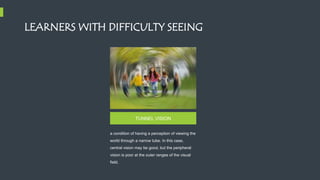
TUNNEL VISION
a condition of having a perception of viewing the
world through a narrow tube. In this case,
central vision may be good, but the peripheral
vision is poor at the outer ranges of the visual
field.
CHARACTERISTICS OF LEARNERS
WITH DIFFICULTY SEEING
• Cognition and Language
• Motor Development and Mobility
• Social Adjustment and Interaction
TYPES AND CAUSES OF VISUAL IMPAIRMENT
CONDITION DEFINITION & CAUSE REMARKS AND
IMPLICATIONS
Amblyopia reduction in or loss of vision in
the weaker eye from lack of use;
caused by strabismus, unequal
refractive errors, or opacity of
the lens or cornea.
close work may result in eye
fatigue, loss of place, or poor
concentration, seating should
favor the functional eye.
Astigmatism Blurred vision results from
irregularities in the cornea or
other eye surfaces, causing
unequal focus on the retina
(refractive error).
Loss of accommodation, leading
to discomfort during close tasks
like reading; children may
complain.
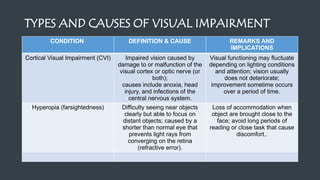
TYPES AND CAUSES OF VISUAL IMPAIRMENT
CONDITION DEFINITION & CAUSE REMARKS AND
IMPLICATIONS
Cortical Visual Impairment (CVI) Impaired vision caused by
damage to or malfunction of the
visual cortex or optic nerve (or
both);
causes include anoxia, head
injury, and infections of the
central nervous system.
Visual functioning may fluctuate
depending on lighting conditions
and attention; vision usually
does not deteriorate;
improvement sometime occurs
over a period of time.
Hyperopia (farsightedness) Difficulty seeing near objects
clearly but able to focus on
distant objects; caused by a
shorter than normal eye that
prevents light rays from
converging on the retina
(refractive error).
Loss of accommodation when
object are brought close to the
face; avoid long periods of
reading or close task that cause
discomfort..
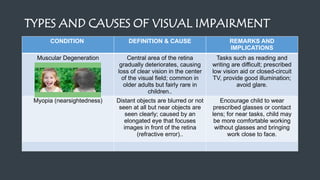
TYPES AND CAUSES OF VISUAL IMPAIRMENT
CONDITION DEFINITION & CAUSE REMARKS AND
IMPLICATIONS
Muscular Degeneration Central area of the retina
gradually deteriorates, causing
loss of clear vision in the center
of the visual field; common in
older adults but fairly rare in
children..
Tasks such as reading and
writing are difficult; prescribed
low vision aid or closed-circuit
TV, provide good illumination;
avoid glare.
Myopia (nearsightedness) Distant objects are blurred or not
seen at all but near objects are
seen clearly; caused by an
elongated eye that focuses
images in front of the retina
(refractive error)..
Encourage child to wear
prescribed glasses or contact
lens; for near tasks, child may
be more comfortable working
without glasses and bringing
work close to face.
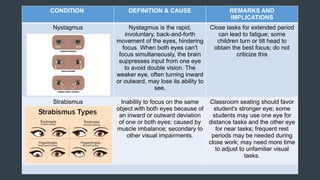
CONDITION DEFINITION & CAUSE REMARKS AND
IMPLICATIONS
Nystagmus Nystagmus is the rapid,
involuntary, back-and-forth
movement of the eyes, hindering
focus. When both eyes can't
focus simultaneously, the brain
suppresses input from one eye
to avoid double vision. The
weaker eye, often turning inward
or outward, may lose its ability to
see.
Close tasks for extended period
can lead to fatigue; some
children turn or tilt head to
obtain the best focus; do not
criticize this
Strabismus Inability to focus on the same
object with both eyes because of
an inward or outward deviation
of one or both eyes; caused by
muscle imbalance; secondary to
other visual impairments.
Classroom seating should favor
student's stronger eye; some
students may use one eye for
distance tasks and the other eye
for near tasks; frequent rest
periods may be needed during
close work; may need more time
to adjust to unfamiliar visual
tasks.
Identifying
Learners with
Difficulty
Seeing
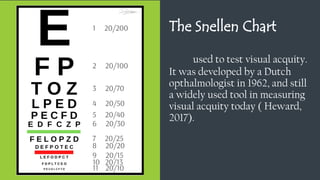
The Snellen Chart
used to test visual acquity.
It was developed by a Dutch
opthalmologist in 1962, and still
a widely used tool in measuring
visual acquity today ( Heward,
2017).
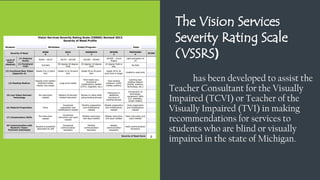
has been developed to assist the
Teacher Consultant for the Visually
Impaired (TCVI) or Teacher of the
Visually Impaired (TVI) in making
recommendations for services to
students who are blind or visually
impaired in the state of Michigan.
The Vision Services
Severity Rating Scale
(VSSRS)
LEARNERS WITH DIFFICULTY HEARING
 Deafness
 Hearing Loss
 Residual Hearing
 Hard of Hearing
 Deaf Culture
CHARACTERISTICTS OF LEARNERS WITH DIFFICULTY
HEARING
 Literacy
 Speaking
 Academic Achievement
 Social Functioning
TYPES AND CAUSES OF HEARING LOSS (Howard, 2017)
• Conductive Hearing Impairment
• Sensory Hearing Impairment
• Neural Hearing Impairment
• Mixed Hearing Impairment
• Unilateral Hearing Loss
• Bilateral Hearing Loss
• Congenital Hearing Loss
• Acquired Hearing Loss
• Prelingual Hearing Loss
• Postilingual Hearing Loss
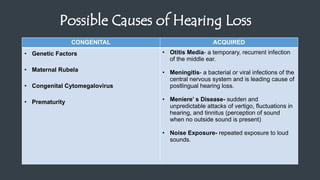
Possible Causes of Hearing Loss
CONGENITAL ACQUIRED
• Genetic Factors
• Maternal Rubela
• Congenital Cytomegalovirus
• Prematurity
• Otitis Media- a temporary, recurrent infection
of the middle ear.
• Meningitis- a bacterial or viral infections of the
central nervous system and is leading cause of
postlingual hearing loss.
• Meniere’ s Disease- sudden and
unpredictable attacks of vertigo, fluctuations in
hearing, and tinnitus (perception of sound
when no outside sound is present)
• Noise Exposure- repeated exposure to loud
sounds.
SIGNS THAT A CHILD HAS A HEARING PROBLEM
• Speech Problems
• Inattentiveness
• Increasing Volume
• Not Following Directions
• Learning Difficulties
• Social Withdrawal
ASSESSMENT OF HEARING LOSS
•Assessment of Infants
•Pure Tone Audiometry
•Speech Reception Test
•Alternative Audiometric Techniques
THANK YOU

Learners with Difficulty Seeing & Hearing.pptx

  • 1.
    Section 3 Learning with DifficultySeeing, Hearing, and Comunicating
  • 2.
    TYPES, CHARACTERISTICS, AND IDENTIFICATIONOF LEARNERS WITH DIFFICULTY SEEING, HEARING AND COMMUNICATING
  • 3.
    LEARNERS WITH DIFFICULTYSEEING VISUAL ACQUITY refers to the ability to distinguish forms or discriminate among details. It is usually measured by reading letters, numbers,and other symbols from the Snellen Eye Chart. LEGAL BLINDNESS refers to having a visual acquity of 20/200 or less in the better eye with the use of a corrective lens. When one’s field of vision is restricted to an area no greater than 20 degrees,one can be considered as legaly blind. PARTIALLY SIGHTED individuals are those whose visual acquity in the better eye after correction falls between 20/70 and 20/200.
  • 4.
    LEARNERS WITH DIFFICULTYSEEING TUNNEL VISION a condition of having a perception of viewing the world through a narrow tube. In this case, central vision may be good, but the peripheral vision is poor at the outer ranges of the visual field.
  • 5.
    CHARACTERISTICS OF LEARNERS WITHDIFFICULTY SEEING • Cognition and Language • Motor Development and Mobility • Social Adjustment and Interaction
  • 6.
    TYPES AND CAUSESOF VISUAL IMPAIRMENT CONDITION DEFINITION & CAUSE REMARKS AND IMPLICATIONS Amblyopia reduction in or loss of vision in the weaker eye from lack of use; caused by strabismus, unequal refractive errors, or opacity of the lens or cornea. close work may result in eye fatigue, loss of place, or poor concentration, seating should favor the functional eye. Astigmatism Blurred vision results from irregularities in the cornea or other eye surfaces, causing unequal focus on the retina (refractive error). Loss of accommodation, leading to discomfort during close tasks like reading; children may complain.
  • 7.
    TYPES AND CAUSESOF VISUAL IMPAIRMENT CONDITION DEFINITION & CAUSE REMARKS AND IMPLICATIONS Cortical Visual Impairment (CVI) Impaired vision caused by damage to or malfunction of the visual cortex or optic nerve (or both); causes include anoxia, head injury, and infections of the central nervous system. Visual functioning may fluctuate depending on lighting conditions and attention; vision usually does not deteriorate; improvement sometime occurs over a period of time. Hyperopia (farsightedness) Difficulty seeing near objects clearly but able to focus on distant objects; caused by a shorter than normal eye that prevents light rays from converging on the retina (refractive error). Loss of accommodation when object are brought close to the face; avoid long periods of reading or close task that cause discomfort..
  • 8.
    TYPES AND CAUSESOF VISUAL IMPAIRMENT CONDITION DEFINITION & CAUSE REMARKS AND IMPLICATIONS Muscular Degeneration Central area of the retina gradually deteriorates, causing loss of clear vision in the center of the visual field; common in older adults but fairly rare in children.. Tasks such as reading and writing are difficult; prescribed low vision aid or closed-circuit TV, provide good illumination; avoid glare. Myopia (nearsightedness) Distant objects are blurred or not seen at all but near objects are seen clearly; caused by an elongated eye that focuses images in front of the retina (refractive error).. Encourage child to wear prescribed glasses or contact lens; for near tasks, child may be more comfortable working without glasses and bringing work close to face.
  • 9.
    CONDITION DEFINITION &CAUSE REMARKS AND IMPLICATIONS Nystagmus Nystagmus is the rapid, involuntary, back-and-forth movement of the eyes, hindering focus. When both eyes can't focus simultaneously, the brain suppresses input from one eye to avoid double vision. The weaker eye, often turning inward or outward, may lose its ability to see. Close tasks for extended period can lead to fatigue; some children turn or tilt head to obtain the best focus; do not criticize this Strabismus Inability to focus on the same object with both eyes because of an inward or outward deviation of one or both eyes; caused by muscle imbalance; secondary to other visual impairments. Classroom seating should favor student's stronger eye; some students may use one eye for distance tasks and the other eye for near tasks; frequent rest periods may be needed during close work; may need more time to adjust to unfamiliar visual tasks.
  • 10.
  • 11.
    The Snellen Chart usedto test visual acquity. It was developed by a Dutch opthalmologist in 1962, and still a widely used tool in measuring visual acquity today ( Heward, 2017).
  • 12.
    has been developedto assist the Teacher Consultant for the Visually Impaired (TCVI) or Teacher of the Visually Impaired (TVI) in making recommendations for services to students who are blind or visually impaired in the state of Michigan. The Vision Services Severity Rating Scale (VSSRS)
  • 13.
    LEARNERS WITH DIFFICULTYHEARING  Deafness  Hearing Loss  Residual Hearing  Hard of Hearing  Deaf Culture
  • 14.
    CHARACTERISTICTS OF LEARNERSWITH DIFFICULTY HEARING  Literacy  Speaking  Academic Achievement  Social Functioning
  • 15.
    TYPES AND CAUSESOF HEARING LOSS (Howard, 2017) • Conductive Hearing Impairment • Sensory Hearing Impairment • Neural Hearing Impairment • Mixed Hearing Impairment • Unilateral Hearing Loss • Bilateral Hearing Loss • Congenital Hearing Loss • Acquired Hearing Loss • Prelingual Hearing Loss • Postilingual Hearing Loss
  • 16.
    Possible Causes ofHearing Loss CONGENITAL ACQUIRED • Genetic Factors • Maternal Rubela • Congenital Cytomegalovirus • Prematurity • Otitis Media- a temporary, recurrent infection of the middle ear. • Meningitis- a bacterial or viral infections of the central nervous system and is leading cause of postlingual hearing loss. • Meniere’ s Disease- sudden and unpredictable attacks of vertigo, fluctuations in hearing, and tinnitus (perception of sound when no outside sound is present) • Noise Exposure- repeated exposure to loud sounds.
  • 17.
    SIGNS THAT ACHILD HAS A HEARING PROBLEM • Speech Problems • Inattentiveness • Increasing Volume • Not Following Directions • Learning Difficulties • Social Withdrawal
  • 18.
    ASSESSMENT OF HEARINGLOSS •Assessment of Infants •Pure Tone Audiometry •Speech Reception Test •Alternative Audiometric Techniques
  • 19.