The Internet of Things
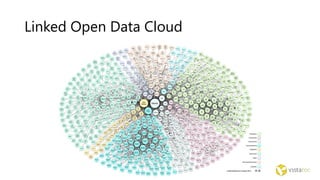
Linked Open Data Cloud
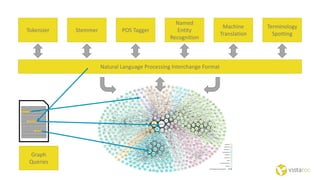
Tokenizer Stemmer POS Tagger
Named
Entity
Recognition
Machine
Translation
Terminology
Spotting
Natural Language Processing Interchange Format
Graph
Queries
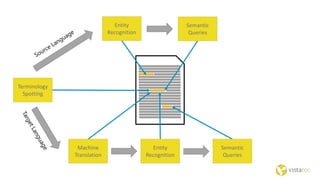
Terminology
Spotting
Machine
Translation
Entity
Recognition
Semantic
Queries
Entity
Recognition
Semantic
Queries
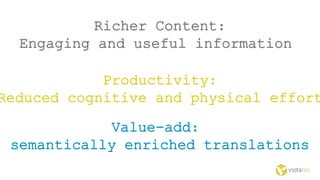
Productivity:
Reduced cognitive and physical effort
Value-add:
semantically enriched translations
Richer Content:
Engaging and useful information
Public Open Data, So What?
Private, curated data
<xliff version=“2.0”>
…
…
…
…
…
<mrk id=“1” its:taIdenRef=“http..”>
</mrk>
{
@id: dbpedia:object {
abstract: “……..”}
}
</xliff>
Compatible
with
XLIFF
Transportable
through
workflow
<xliff version=“2.0”>
…
…
…
…
…
<mrk id=“1” its:taIdenRef=“http..”>
</mrk>
{
@id: dbpedia:object {
abstract: “……..”}
}
</xliff>
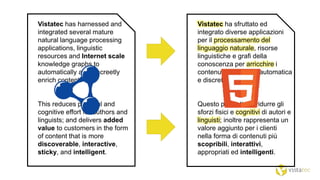
Vistatec has harnessed and
integrated several mature
natural language processing
applications, linguistic
resources and Internet scale
knowledge graphs to
automatically and discreetly
enrich content.
This reduces physical and
cognitive effort for authors and
linguists; and delivers added
value to customers in the form
of content that is more
discoverable, interactive,
sticky, and intelligent.
Vistatec ha sfruttato ed
integrato diverse applicazioni
per il processamento del
linguaggio naturale, risorse
linguistiche e grafi della
conoscenza per arricchire i
contenuti in maniera automatica
e discreta.
Questo permette di ridurre gli
sforzi fisici e cognitivi di autori e
linguisti; inoltre rappresenta un
valore aggiunto per i clienti
nella forma di contenuti più
scopribili, interattivi,
appropriati ed intelligenti.
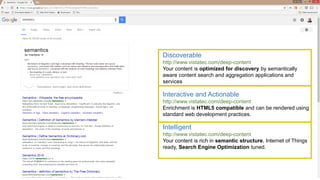
Discoverable
http://www.vistatec.com/deep-content
Your content is optimized for discovery by semantically
aware content search and aggregation applications and
services
Interactive and Actionable
http://www.vistatec.com/deep-content
Enrichment is HTML5 compatible and can be rendered using
standard web development practices.
Intelligent
http://www.vistatec.com/deep-content
Your content is rich in semantic structure, Internet of Things
ready, Search Engine Optimization tuned.

Vistatec

  • 2.
  • 3.
  • 4.
  • 5.
    Tokenizer Stemmer POSTagger Named Entity Recognition Machine Translation Terminology Spotting Natural Language Processing Interchange Format Graph Queries
  • 6.
  • 7.
    Productivity: Reduced cognitive andphysical effort Value-add: semantically enriched translations Richer Content: Engaging and useful information
  • 13.
    Public Open Data,So What? Private, curated data
  • 15.
    <xliff version=“2.0”> … … … … … <mrk id=“1”its:taIdenRef=“http..”> </mrk> { @id: dbpedia:object { abstract: “……..”} } </xliff> Compatible with XLIFF Transportable through workflow
  • 16.
    <xliff version=“2.0”> … … … … … <mrk id=“1”its:taIdenRef=“http..”> </mrk> { @id: dbpedia:object { abstract: “……..”} } </xliff>
  • 17.
    Vistatec has harnessedand integrated several mature natural language processing applications, linguistic resources and Internet scale knowledge graphs to automatically and discreetly enrich content. This reduces physical and cognitive effort for authors and linguists; and delivers added value to customers in the form of content that is more discoverable, interactive, sticky, and intelligent. Vistatec ha sfruttato ed integrato diverse applicazioni per il processamento del linguaggio naturale, risorse linguistiche e grafi della conoscenza per arricchire i contenuti in maniera automatica e discreta. Questo permette di ridurre gli sforzi fisici e cognitivi di autori e linguisti; inoltre rappresenta un valore aggiunto per i clienti nella forma di contenuti più scopribili, interattivi, appropriati ed intelligenti.
  • 19.
    Discoverable http://www.vistatec.com/deep-content Your content isoptimized for discovery by semantically aware content search and aggregation applications and services Interactive and Actionable http://www.vistatec.com/deep-content Enrichment is HTML5 compatible and can be rendered using standard web development practices. Intelligent http://www.vistatec.com/deep-content Your content is rich in semantic structure, Internet of Things ready, Search Engine Optimization tuned.

Editor's Notes

  • #2 I want to present to you our semantic enrichment innovation called “Deep Content”.
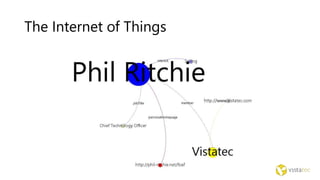
  • #3 In the Internet of Things, everything can have a unique identity: people, places, events, objects, and concepts.
  • #4 And also thanks to the W3C, these entities can be related in formal ways. Such are the Microsoft User graph, Facebook Social graph, Google Knowledge graph, and so on…
  • #5 …and the largest general knowledge graph of all – the Linked Open Data Cloud.
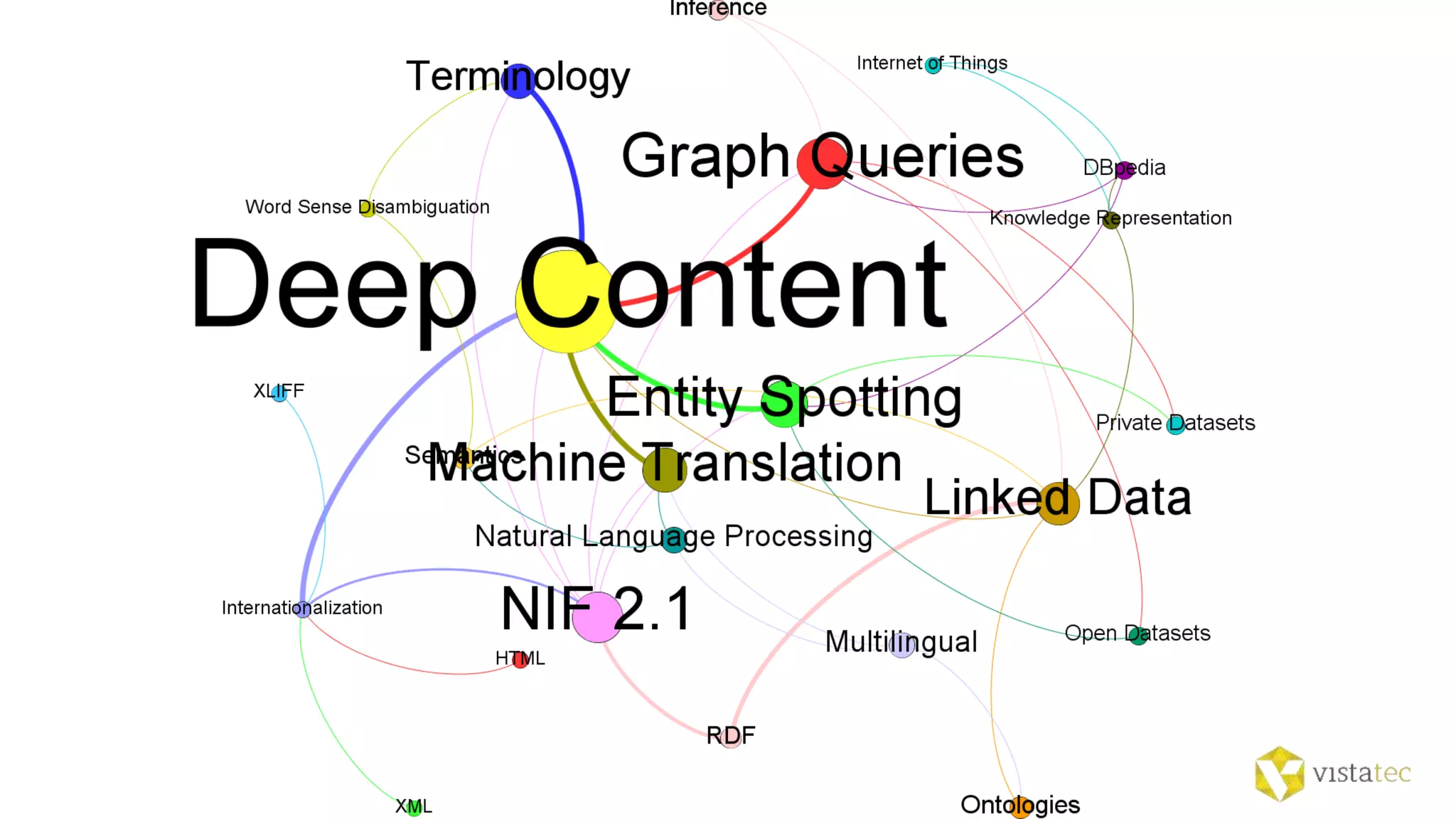
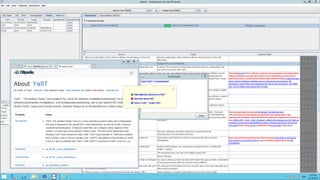
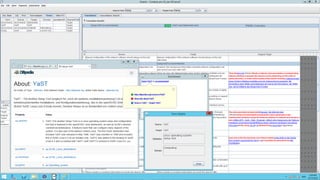
  • #6 Deep Content utilizes several Internet scale NLP technologies available via Web Services API’s. All of these services return data in the NLP Interchange format. NLP Interchange is the XLIFF of the NLP world. The beauty of NIF is that it is an RDF vocabulary and thus links (pun intended) seamlessly to the data cloud. This means we can use the power inherent in the “open” knowledge model of RDF and the Linked Open Data cloud to execute configurable inferential queries to reach from the document precisely into vast quantities of knowledge.
  • #7 Because the services have this common backbone protocol, we can chain the services together so that the output from one is the input to another. The power here is that subsequent services in the chain can benefit from knowledge in preceding services. For example, the machine translation service can benefit from domain specific terminology recognized in a previous step. And all of the services contribute to the enrichment of the content.
  • #8 We have three motivations for creating Deep Content: (a) Assist content creators to produce engaging content; (b) Assist linguists during the familiarization and assessment stages of a translation job; and (c) deliver added value to customers by delivering content which has a higher value to cost ratio.
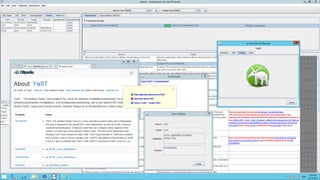
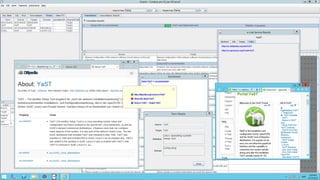
  • #9 And so in the time it takes to perform translation memory leverage on a document we can discretely, semantically enhance the content with terminology definitions, recognised entities and limitless links to authoritative references on the topics and entities contained within the content.
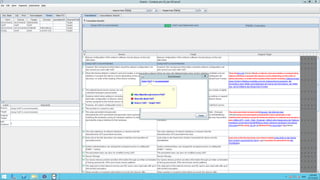
  • #13 Of course it is possible to choose what enrichments you want to call upon and retain in the document.
  • #14 One valid criticism of what I’m talking about could be: “You can add links to public general knowledge, so what?” But the fact is that we can also integrate and utilize private, curated data too!
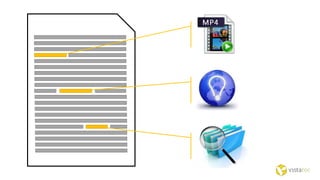
  • #15 So if you’re a company with say existing resources and artefacts such as videos, knowledge base articles, and reference content which are useful and pertain to the new content, we can perform recognition and linking against these repositories as well.
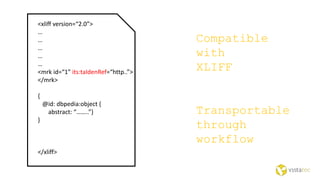
  • #16 The semantic enrichment process does not require getting entangled with proprietary systems and formats. All of this uses open standards such that we can add the enrichment as metadata to XLIFF and thus carry the content and its semantic graph representation through our existing tool chains.
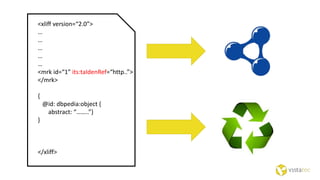
  • #17 We can also serialize the enriched content as linked data so that in the same way you build up and re-use translations, so too can we do this with the enrichments: newly created entities and relationships can form data against which future documents are enriched.
  • #18 Finally the whole point to this is that we can save the translated document plus all of the selected enrichment to valid HTML5.
  • #19 The future of content discovery on the web is not isolated keyword search. It is context, surfing of knowledge graphs powered by semantic mark-up. Google has been pointing the way with their Rich Snippets.
  • #20 In summary, we believe we have harnessed a set of mature natural language technologies and integrated them using open standard protocols to produce a service which delivers Rich, Discoverable, Future-proofed, Intelligent content!