Technology in the Classroom:  A Vision for the Future
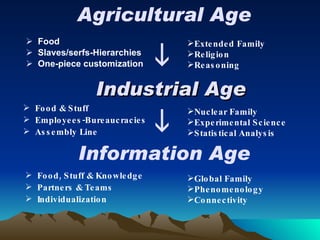
Industrial Age Food Slaves/serfs-Hierarchies One-piece customization Agricultural Age  Information Age  Extended Family Religion Reasoning Food & Stuff Employees-Bureaucracies Assembly Line Nuclear Family Experimental Science Statistical Analysis Global Family Phenomenology Connectivity Food, Stuff & Knowledge Partners & Teams Individualization
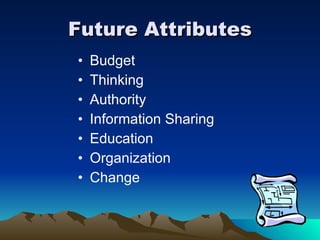
Future Attributes Budget Thinking Authority Information Sharing Education Organization Change
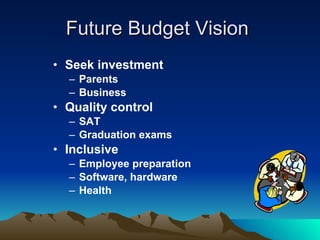
Future Budget Vision  Seek investment Parents Business Quality control SAT Graduation exams Inclusive Employee preparation Software, hardware Health
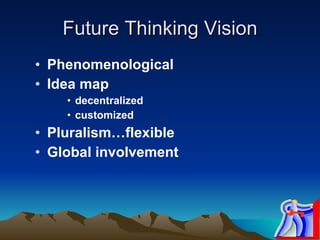
Future Thinking Vision Phenomenological Idea map decentralized customized Pluralism…flexible Global involvement
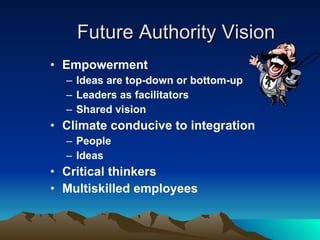
Future Authority Vision Empowerment Ideas are top-down or bottom-up Leaders as facilitators Shared vision Climate conducive to integration People Ideas Critical thinkers Multiskilled employees
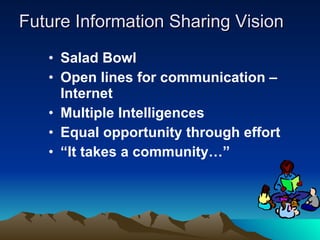
Future Information Sharing Vision Salad Bowl Open lines for communication – Internet Multiple Intelligences Equal opportunity through effort “ It takes a community…”
Future Education Vision Broad education programs Student centered Constructivist Charter schools School vouchers On-Line education People who can continuously learn Real world learning Business adaptations/internships Safety
Future Organization Vision Government, Business, Parent– cooperation Education is an investment Reconciliation of capitalism with social interests Network based Self-organizing, adaptive structures Online organizations Real time
Future Change Vision Positive response Part of the natural order Essential to renewal and vitality Flexible Teacher updating
Survey Mailed  December, 2000 264 survey instruments mailed to Alabama superintendents 67 returned
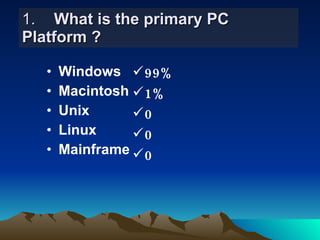
1. What is the primary PC  Platform ? Windows Macintosh Unix Linux Mainframe 99% 1% 0 0 0
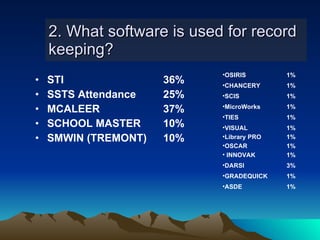
2. What software is used for record keeping? STI 36% SSTS Attendance 25% MCALEER 37% SCHOOL MASTER 10% SMWIN (TREMONT) 10% OSIRIS 1% CHANCERY 1% SCIS 1% MicroWorks 1% TIES 1% VISUAL 1%   Library PRO 1% OSCAR 1% INNOVAK 1% DARSI 3% GRADEQUICK 1% ASDE 1%
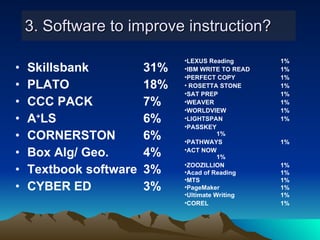
3. Software to improve instruction? Skillsbank 31% PLATO 18% CCC PACK 7% A + LS 6% CORNERSTON 6% Box Alg/ Geo. 4% Textbook software 3% CYBER ED 3% LEXUS Reading 1% IBM WRITE TO READ 1% PERFECT COPY 1% ROSETTA STONE 1% SAT PREP 1% WEAVER 1% WORLDVIEW 1% LIGHTSPAN 1% PASSKEY 1% PATHWAYS 1% ACT NOW 1% ZOOZILLION 1% Acad of Reading 1% MTS 1% PageMaker 1% Ultimate Writing 1% COREL 1%
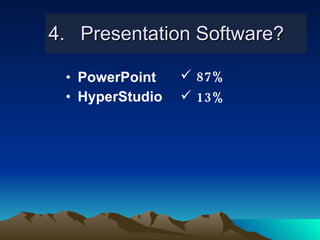
4. Presentation Software? PowerPoint HyperStudio 87% 13%
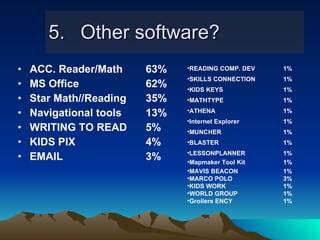
5. Other software? ACC. Reader/Math 63% MS Office   62% Star Math//Reading 35%  Navigational tools 13%  WRITING TO READ 5% KIDS PIX 4% EMAIL 3% READING COMP. DEV 1% SKILLS CONNECTION 1% KIDS KEYS 1% MATHTYPE 1% ATHENA 1% Internet Explorer 1% MUNCHER 1% BLASTER 1% LESSONPLANNER 1%   Mapmaker Tool Kit 1% MAVIS BEACON 1% MARCO POLO 3% KIDS WORK 1% WORLD GROUP 1% Groilers ENCY 1%
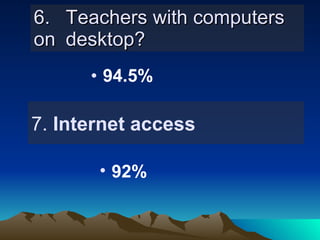
94.5% 6.  Teachers with computers on  desktop? 7.  Internet access 92%
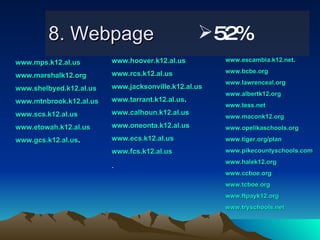
8. Webpage 52% www.mps.k12.al.us www.marshalk12.org www.shelbyed.k12.al.us www.mtnbrook.k12.al.us www.scs.k12.al.us www.etowah.k12.al.us www.gcs.k12.al.us . www.hoover.k12.al.us www.rcs.k12.al.us www.jacksonville.k12.al.us www.tarrant.k12.al.us . www.calhoun.k12.al.us www.oneonta.k12.al.us www.ecs.k12.al.us www.fcs.k12.al.us . www.escambia.k12.net . www.bcbe.org www.lawrenceal.org www.albertk12.org www.tess.net www.maconk12.org www.opelikaschools.org www.tiger.org/plan www.pikecountyschools.com www.halek12.org www.ccboe.org www.tcboe.org www.ftpayk12.org www.tryschools.net
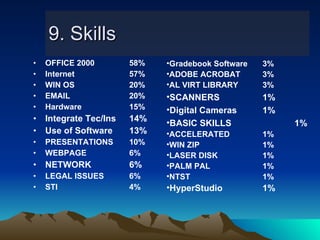
9. Skills OFFICE 2000 58% Internet 57% WIN OS 20% EMAIL 20% Hardware 15% Integrate Tec/Ins 14% Use of Software 13% PRESENTATIONS 10%  WEBPAGE 6% NETWORK 6% LEGAL ISSUES 6% STI 4% Gradebook Software 3% ADOBE ACROBAT 3% AL VIRT LIBRARY 3% SCANNERS 1% Digital Cameras 1% BASIC SKILLS 1% ACCELERATED 1% WIN ZIP 1% LASER DISK 1% PALM PAL 1% NTST 1% HyperStudio 1%
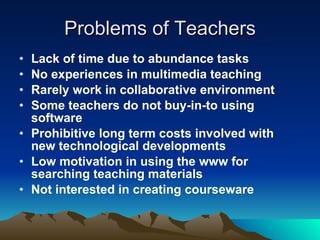
Problems of Teachers Lack of time due to abundance tasks  No experiences in multimedia teaching  Rarely work in collaborative environment  Some teachers do not buy-in-to using software  Prohibitive long term costs involved with new technological developments  Low motivation in using the www for searching teaching materials  Not interested in creating courseware
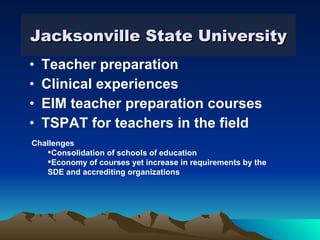
Jacksonville State University Teacher preparation  Clinical experiences EIM teacher preparation courses TSPAT for teachers in the field Challenges Consolidation of schools of education Economy of courses yet increase in requirements by the SDE and accrediting organizations
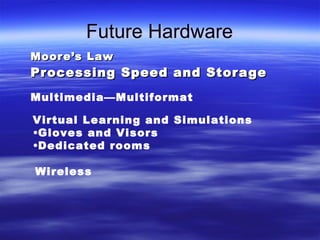
Future Hardware Moore’s Law Processing Speed and Storage Multimedia—Multiformat Virtual Learning and Simulations Gloves and Visors Dedicated rooms Wireless
Future Software “… software will  someday get intelligent enough to give individualized tutoring that is much better than the typical classroom experience.” Kahn, Ken. &quot;Re: Future of Learning.&quot; 26 February 2002. Online Posting. [IFETS-DISCUSSION:2895] . Retrieved 27 February 2003 <http://ifets.gmd.de/archiv/0685.html>
Future Changes Content rather than process Theory more important than technology  Changes driven by instructional theorists rather than technologists Find weakness and strengths in pedagogy Improvements in understanding Lifelong learner  - Resource based learning - Collaborative learning - Problem based learning - Narrative based teaching - Situated learning
Future Schools? ------------------------------ Date:  Wed, 17 Mar 2004 10:55:49 -0500 From:  Bill Ellis <tranet@RANGELEY.ORG> Subject: Re: IFETS-DISCUSSION Re:  PARADIGM SHIFT The current school system is authoritarian, hierarchal, and undemocratic. The social system is authoritarian, hierarchical and undemocratic. Connecting these was the thesis of Paulo Friere. Ivan Illich added that the values and life styles absorbed in schools were self-interest, competition, and materialism  -- the so called &quot;Dominator Paradigm&quot; the root of the Euro American Culture. An emerging &quot;Gaian Paradigm&quot; is rooted in a new scientific understanding that everything in the universe is a holon, composed on smaller holons and embedded in larger holons.  That is, each of us, (and everything else), is dependent on every one else (and everything else).  Every individual is composed of organs, cells, molecules, atoms etc. and embedded in family, community, society, nature, the earth, etc. All are interconnected and interdependent. We each &quot;belong&quot; to Gaia (The Earth and all of it life forms). We must discover and obey the laws of Gaia to continue human existencd.  We each &quot;belong&quot; to one another. We are interdependent.  We are responsible to Gaia and for Gaia.  We are responsible for one another. We cannot abrogate that responsibility to others -- including the government.  Our personal learning is our personal responsibility. The future of society is our personal responsibility.  The transition from the Dominator Paradigm to the Gaian paradigm suggests a transition from government schools to learning communities.  A transition to Life-Long Self-Learning.  And it is happening. Just my thoughts. IMHO Bill Ellis, General Coordinator A Coalition for Self-Learning POBox 567 Rangeley, ME 04970 USA
Future  Collaboration Instructional design is moving, and will continue to do so rapidly, to involve the learner more and more. Collaboration (synchronous and asynchronous) will become more important elements in our courses and participation will probably be an important factor for certified courses. Multi-user simulation exercises and games is probably the coming trend... and it is a trend that can fundamentally enhance the learner experience.  Kiran Bhandari  Brainvisa Technologies Ltd. From: &quot;Kiran Bhandari&quot; <kiran@brainvisa.com> Subject: [IFETS-DISCUSSION:3403] RE: future trends Date: Thu, 2 May 2002 16:23:52 +0530
Future  Budget Perspective Authority Information Sharing Education Organization Change
References Bork, Alfred. (2001). Four Fictional Views of the Future of Learning. The Internet and Higher Education, 3 (2000), 271-284. Retrieved February, 27 2003, from http://www.ics.uci.edu/~bork/fiction.pdf.  Brown, J.C.(1970). The Troika incident; a tetralogue in two parts. New York: Doubleday.  Clarke, A. (1956). The city and the Stars. New York: Harcourt Brace and World. Leonard, G. (1968). Education and ecstasy. Berkeley, CA: North Atlantic Books.  Zenanko, Mike. &quot;Dr. Bork's Discussion “The Future of Learning&quot;.22 February 2002. Online Posting. International Forum Education al Technology & Society. Retrieved 27 February 2003 <http://ifets.gmd.de/archiv/0684.html>

Vision of Education

  • 1.
    Technology in theClassroom: A Vision for the Future
  • 2.
    Industrial Age FoodSlaves/serfs-Hierarchies One-piece customization Agricultural Age  Information Age  Extended Family Religion Reasoning Food & Stuff Employees-Bureaucracies Assembly Line Nuclear Family Experimental Science Statistical Analysis Global Family Phenomenology Connectivity Food, Stuff & Knowledge Partners & Teams Individualization
  • 3.
    Future Attributes BudgetThinking Authority Information Sharing Education Organization Change
  • 4.
    Future Budget Vision Seek investment Parents Business Quality control SAT Graduation exams Inclusive Employee preparation Software, hardware Health
  • 5.
    Future Thinking VisionPhenomenological Idea map decentralized customized Pluralism…flexible Global involvement
  • 6.
    Future Authority VisionEmpowerment Ideas are top-down or bottom-up Leaders as facilitators Shared vision Climate conducive to integration People Ideas Critical thinkers Multiskilled employees
  • 7.
    Future Information SharingVision Salad Bowl Open lines for communication – Internet Multiple Intelligences Equal opportunity through effort “ It takes a community…”
  • 8.
    Future Education VisionBroad education programs Student centered Constructivist Charter schools School vouchers On-Line education People who can continuously learn Real world learning Business adaptations/internships Safety
  • 9.
    Future Organization VisionGovernment, Business, Parent– cooperation Education is an investment Reconciliation of capitalism with social interests Network based Self-organizing, adaptive structures Online organizations Real time
  • 10.
    Future Change VisionPositive response Part of the natural order Essential to renewal and vitality Flexible Teacher updating
  • 11.
    Survey Mailed December, 2000 264 survey instruments mailed to Alabama superintendents 67 returned
  • 12.
    1. What isthe primary PC Platform ? Windows Macintosh Unix Linux Mainframe 99% 1% 0 0 0
  • 13.
    2. What softwareis used for record keeping? STI 36% SSTS Attendance 25% MCALEER 37% SCHOOL MASTER 10% SMWIN (TREMONT) 10% OSIRIS 1% CHANCERY 1% SCIS 1% MicroWorks 1% TIES 1% VISUAL 1% Library PRO 1% OSCAR 1% INNOVAK 1% DARSI 3% GRADEQUICK 1% ASDE 1%
  • 14.
    3. Software toimprove instruction? Skillsbank 31% PLATO 18% CCC PACK 7% A + LS 6% CORNERSTON 6% Box Alg/ Geo. 4% Textbook software 3% CYBER ED 3% LEXUS Reading 1% IBM WRITE TO READ 1% PERFECT COPY 1% ROSETTA STONE 1% SAT PREP 1% WEAVER 1% WORLDVIEW 1% LIGHTSPAN 1% PASSKEY 1% PATHWAYS 1% ACT NOW 1% ZOOZILLION 1% Acad of Reading 1% MTS 1% PageMaker 1% Ultimate Writing 1% COREL 1%
  • 15.
    4. Presentation Software?PowerPoint HyperStudio 87% 13%
  • 16.
    5. Other software?ACC. Reader/Math 63% MS Office 62% Star Math//Reading 35% Navigational tools 13% WRITING TO READ 5% KIDS PIX 4% EMAIL 3% READING COMP. DEV 1% SKILLS CONNECTION 1% KIDS KEYS 1% MATHTYPE 1% ATHENA 1% Internet Explorer 1% MUNCHER 1% BLASTER 1% LESSONPLANNER 1% Mapmaker Tool Kit 1% MAVIS BEACON 1% MARCO POLO 3% KIDS WORK 1% WORLD GROUP 1% Groilers ENCY 1%
  • 17.
    94.5% 6. Teachers with computers on desktop? 7. Internet access 92%
  • 18.
    8. Webpage 52%www.mps.k12.al.us www.marshalk12.org www.shelbyed.k12.al.us www.mtnbrook.k12.al.us www.scs.k12.al.us www.etowah.k12.al.us www.gcs.k12.al.us . www.hoover.k12.al.us www.rcs.k12.al.us www.jacksonville.k12.al.us www.tarrant.k12.al.us . www.calhoun.k12.al.us www.oneonta.k12.al.us www.ecs.k12.al.us www.fcs.k12.al.us . www.escambia.k12.net . www.bcbe.org www.lawrenceal.org www.albertk12.org www.tess.net www.maconk12.org www.opelikaschools.org www.tiger.org/plan www.pikecountyschools.com www.halek12.org www.ccboe.org www.tcboe.org www.ftpayk12.org www.tryschools.net
  • 19.
    9. Skills OFFICE2000 58% Internet 57% WIN OS 20% EMAIL 20% Hardware 15% Integrate Tec/Ins 14% Use of Software 13% PRESENTATIONS 10% WEBPAGE 6% NETWORK 6% LEGAL ISSUES 6% STI 4% Gradebook Software 3% ADOBE ACROBAT 3% AL VIRT LIBRARY 3% SCANNERS 1% Digital Cameras 1% BASIC SKILLS 1% ACCELERATED 1% WIN ZIP 1% LASER DISK 1% PALM PAL 1% NTST 1% HyperStudio 1%
  • 20.
    Problems of TeachersLack of time due to abundance tasks No experiences in multimedia teaching Rarely work in collaborative environment Some teachers do not buy-in-to using software Prohibitive long term costs involved with new technological developments Low motivation in using the www for searching teaching materials Not interested in creating courseware
  • 21.
    Jacksonville State UniversityTeacher preparation Clinical experiences EIM teacher preparation courses TSPAT for teachers in the field Challenges Consolidation of schools of education Economy of courses yet increase in requirements by the SDE and accrediting organizations
  • 22.
    Future Hardware Moore’sLaw Processing Speed and Storage Multimedia—Multiformat Virtual Learning and Simulations Gloves and Visors Dedicated rooms Wireless
  • 23.
    Future Software “…software will someday get intelligent enough to give individualized tutoring that is much better than the typical classroom experience.” Kahn, Ken. &quot;Re: Future of Learning.&quot; 26 February 2002. Online Posting. [IFETS-DISCUSSION:2895] . Retrieved 27 February 2003 <http://ifets.gmd.de/archiv/0685.html>
  • 24.
    Future Changes Contentrather than process Theory more important than technology Changes driven by instructional theorists rather than technologists Find weakness and strengths in pedagogy Improvements in understanding Lifelong learner - Resource based learning - Collaborative learning - Problem based learning - Narrative based teaching - Situated learning
  • 25.
    Future Schools? ------------------------------Date: Wed, 17 Mar 2004 10:55:49 -0500 From: Bill Ellis <tranet@RANGELEY.ORG> Subject: Re: IFETS-DISCUSSION Re: PARADIGM SHIFT The current school system is authoritarian, hierarchal, and undemocratic. The social system is authoritarian, hierarchical and undemocratic. Connecting these was the thesis of Paulo Friere. Ivan Illich added that the values and life styles absorbed in schools were self-interest, competition, and materialism -- the so called &quot;Dominator Paradigm&quot; the root of the Euro American Culture. An emerging &quot;Gaian Paradigm&quot; is rooted in a new scientific understanding that everything in the universe is a holon, composed on smaller holons and embedded in larger holons. That is, each of us, (and everything else), is dependent on every one else (and everything else). Every individual is composed of organs, cells, molecules, atoms etc. and embedded in family, community, society, nature, the earth, etc. All are interconnected and interdependent. We each &quot;belong&quot; to Gaia (The Earth and all of it life forms). We must discover and obey the laws of Gaia to continue human existencd. We each &quot;belong&quot; to one another. We are interdependent. We are responsible to Gaia and for Gaia. We are responsible for one another. We cannot abrogate that responsibility to others -- including the government. Our personal learning is our personal responsibility. The future of society is our personal responsibility. The transition from the Dominator Paradigm to the Gaian paradigm suggests a transition from government schools to learning communities. A transition to Life-Long Self-Learning. And it is happening. Just my thoughts. IMHO Bill Ellis, General Coordinator A Coalition for Self-Learning POBox 567 Rangeley, ME 04970 USA
  • 26.
    Future CollaborationInstructional design is moving, and will continue to do so rapidly, to involve the learner more and more. Collaboration (synchronous and asynchronous) will become more important elements in our courses and participation will probably be an important factor for certified courses. Multi-user simulation exercises and games is probably the coming trend... and it is a trend that can fundamentally enhance the learner experience. Kiran Bhandari Brainvisa Technologies Ltd. From: &quot;Kiran Bhandari&quot; <kiran@brainvisa.com> Subject: [IFETS-DISCUSSION:3403] RE: future trends Date: Thu, 2 May 2002 16:23:52 +0530
  • 27.
    Future BudgetPerspective Authority Information Sharing Education Organization Change
  • 28.
    References Bork, Alfred.(2001). Four Fictional Views of the Future of Learning. The Internet and Higher Education, 3 (2000), 271-284. Retrieved February, 27 2003, from http://www.ics.uci.edu/~bork/fiction.pdf. Brown, J.C.(1970). The Troika incident; a tetralogue in two parts. New York: Doubleday. Clarke, A. (1956). The city and the Stars. New York: Harcourt Brace and World. Leonard, G. (1968). Education and ecstasy. Berkeley, CA: North Atlantic Books. Zenanko, Mike. &quot;Dr. Bork's Discussion “The Future of Learning&quot;.22 February 2002. Online Posting. International Forum Education al Technology & Society. Retrieved 27 February 2003 <http://ifets.gmd.de/archiv/0684.html>